1. Introduction
With the rapid advancement of communication technologies, smart devices operating in the GHz frequency band are ubiquitous in modern life. Electromagnetic equipment plays a pivotal role across multiple sectors, including industrial automation, healthcare, and telecommunications [
1,
2]. However, the widespread deployment of these devices has led to escalating electromagnetic pollution, which can interfere with normal equipment operation, compromise signal integrity, and even pose potential health risks [
3]. As such, the development of high-performance electromagnetic wave (EMW) absorbing materials has emerged as a critical scientific and technological priority. An ideal EMW absorber should be thin, lightweight, broadband, and highly attenuative, with superior environmental stability (e.g., oxidation resistance, thermal stability, and mechanical robustness). Achieving these features requires careful material design to ensure proper impedance matching between the absorber and free space while maximizing electromagnetic energy dissipation [
4]. EMW materials can be broadly categorized into three classes: carbon-based materials, polymer-matrix composites, and metal-matrix materials. Carbon-based materials—such as carbon fibers [
5,
6,
7], graphene [
8,
9,
10,
11], and biomass-derived carbons [
12,
13,
14,
15]—have received considerable attention due to their low density, high specific surface area, excellent electrical conductivity, and thermal stability. These properties make them particularly suitable for applications where weight, flexibility, and thermal endurance are critical.
Among carbon-based materials, biomass-derived carbon is particularly attractive due to its renewable, porous, and structurally tunable nature. Through carbonization, activation, or doping, its intrinsic micro/nanostructures can be tailored to optimize EMW absorption. These structural features enhance multiple loss mechanisms, including dielectric loss, interfacial polarization, and multiple scattering effects, thereby improving the overall absorption efficiency [
16]. Several representative strategies have been explored to optimize biomass-derived carbon for EMW absorption. These include adjusting carbonization temperature to modify morphology, removing heteroatoms to tune electrical conductivity, controlling the ratio of biomass components, and introducing heteroatom doping to improve dielectric loss. The key research trend in this field is to understand how the intrinsic structure of biomass precursors affects the final absorption performance of the derived carbon materials. For example, Xie et al. [
17] demonstrated that adjusting the carbonization temperature of popcorn-derived carbon from 750 to 900 °C transformed hollow protrusions into uniform nanosheets, optimizing impedance matching and enhancing absorption performance. Li et al. [
18] used rice husk-derived natural silica to prepare hybrid carbon materials with both thinness and mechanical strength. However, high-cost plasma treatment and silica removal, which reduced interfacial polarization sites, limited the effectiveness of these materials. Lou et al. [
19] developed a heterostructured carbon material with a fiber/sheet morphology by tuning the cellulose-to-lignin ratio in bamboo-derived lignocellulose, achieving superior conductive loss and environmental adaptability. Mou et al. [
20] synthesized boron carbon nitride nanosheets from coconut shells and systematically studied the impact of carbon content on absorption properties, highlighting the role of heteroatom doping in improving dielectric loss and impedance matching. Collectively, these studies illustrate the significant potential of biomass-derived carbon materials for EMW absorption, while also highlighting challenges, including high density, high filler ratios, and limited structural stability. To overcome these limitations, hybrid strategies that combine conductive and magnetic components have shown great promise. The integration of magnetic materials, such as ferrites, metals, or metal–organic frameworks (MOFs), into carbon matrices can synergistically enhance both dielectric and magnetic loss mechanisms. Magnetic fillers not only contribute to magnetic resonance loss but also improve impedance matching by balancing permittivity and permeability, thus broadening the effective absorption bandwidth. The precise design of composite microstructures—through control of filler type, distribution, and interface engineering—enables optimization of multiple attenuation pathways, including conduction loss, polarization loss, and multiple scattering. Although both biomass-derived carbon and MOF-derived magnetic components have been explored individually, most existing studies have focused primarily on controlling carbonization conditions, optimizing component doping, or developing single biomass precursors. Systematic research on the role of the natural microstructures of different wood species in regulating the pore structure, magnetic particle distribution, electromagnetic parameters, and impedance matching of composite materials remains lacking. In particular, how the intrinsic structural differences of wood templates further influence the final wave absorption performance and its loss mechanisms remains unclear. In this study, wood with different natural structural characteristics was selected as a biomass template, and Co
3O
4@C composites were synthesized using a ZIF-67-assisted strategy. The study systematically compared the effects of different wood frameworks on microstructure, phase composition, electromagnetic parameters, and energy absorption performance. The focus of this study lies not only in the preparation of a biomass carbon/magnetic component composite wave-absorbing material but also in elucidating the structure–property relationships among the wood template structure, Co
3O
4 distribution, electromagnetic parameters, impedance matching, and wave-absorption performance. This provides new insights into the design of high-performance, lightweight wave-absorbing materials utilizing the inherent structure of natural wood. Given that different wood species have distinct fiber morphologies, cell wall thicknesses, and porosities, we hypothesize that the resulting Co
3O
4@C composites will exhibit different pore structures and Co
3O
4 dispersion states. Consequently, these differences will lead to distinct electromagnetic parameters, which, in turn, affect impedance matching and absorption performance. Among the four wood templates, we specifically anticipate that pine wood (M3), with its rough, wrinkled surface and moderate porosity, will achieve the best impedance matching and the lowest reflection loss.
In this study, we developed a composite EMW absorber by using different types of wood as a biomass carbon skeleton and MOFs as magnetic fillers. The resulting material combines the advantages of low density, high surface area, and structural tunability of biomass carbon with the magnetic loss capability of MOFs. This dual-functional design enhances microwave absorption performance while maintaining environmental and mechanical stability. The phase composition of the composites was characterized by X-ray diffraction (XRD), while microstructure and morphology were examined via scanning electron microscopy (SEM). Electromagnetic parameters, including complex permittivity and permeability, were measured using a vector network analyzer, providing quantitative insight into the absorption mechanism. Detailed analysis revealed that the synergy between conductive carbon skeletons and magnetic MOF fillers facilitates multiple EMW attenuation pathways, including interfacial polarization, dipole polarization, and magnetic resonance, thereby achieving broadband, strong absorption even at reduced thicknesses. Overall, this work provides a novel strategy for the rational design of biomass-derived carbon-based EMW absorbers and demonstrates the feasibility of combining renewable carbon resources with advanced magnetic fillers. The findings have significant implications for the development of lightweight, environmentally friendly, and high-performance EMW absorption materials for next-generation communication devices and complex electromagnetic environments.
3. Results and Discussion
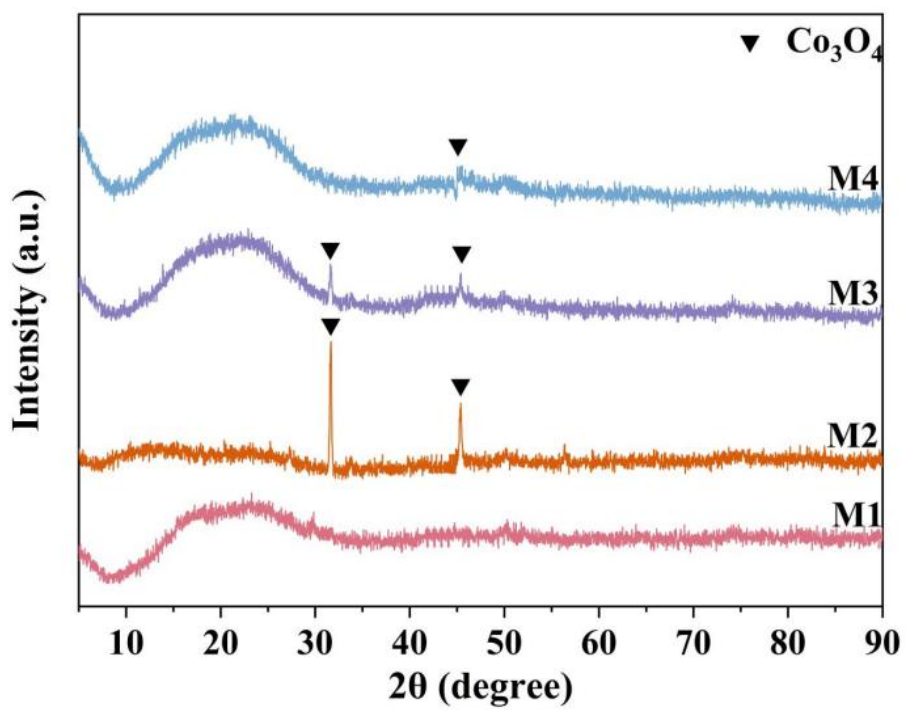
XRD analysis of different wood samples (M1–M4) after heat treatment at 700 °C reveals distinct structural differences and crystalline features among the four samples (
Figure 1). All samples exhibited broad diffraction peaks in the 2θ range of 20–30°, indicating that the carbon-based framework of the heat-treated wood consists primarily of amorphous carbon. This amorphous nature introduces abundant defects, micropores, and a non-uniform microstructure, all of which enhance electromagnetic scattering and dielectric loss. The broader diffraction peaks also reflect the lower crystallinity of carbon-based materials, which is consistent with the characteristics of traditionally produced biomass carbonization products [
21,
22,
23]. Additionally, more potential active sites are created, enabling subsequent interfacial polarization and charge transport, thereby enhancing the material’s EMW absorption capabilities. Notably, M2 and M3 show clear Co
3O
4 diffraction peaks, with no impurity peaks detected. It demonstrates that the precursor ZIF-67 completely decomposes and successfully transforms into Co
3O
4 nanocrystals during the heat treatment process without forming any byproducts or impurities, highlighting the efficiency and controllability of the material preparation process. This transformation integrates magnetic components into the material, endowing the composite with multifunctional properties while simultaneously facilitating dielectric and magnetic losses during EMW absorption. In contrast, M1 and M4 show much weaker Co
3O
4 peaks, possibly due to lower Co
3O
4 loading or signal masking by the carbon matrix. Although the diffraction peak signal is low, the presence of magnetic nanoparticles in the composite material is valuable for optimizing its microwave absorption properties. Overall, the specimens formed a composite structure consisting of an amorphous carbon matrix embedded with Co
3O
4 nanocrystals after heat treatment. The composite structure not only preserved the inherent electrical conductivity and porosity of the carbon material but also successfully incorporated magnetic components, thereby enabling synergy between dielectric and magnetic losses.
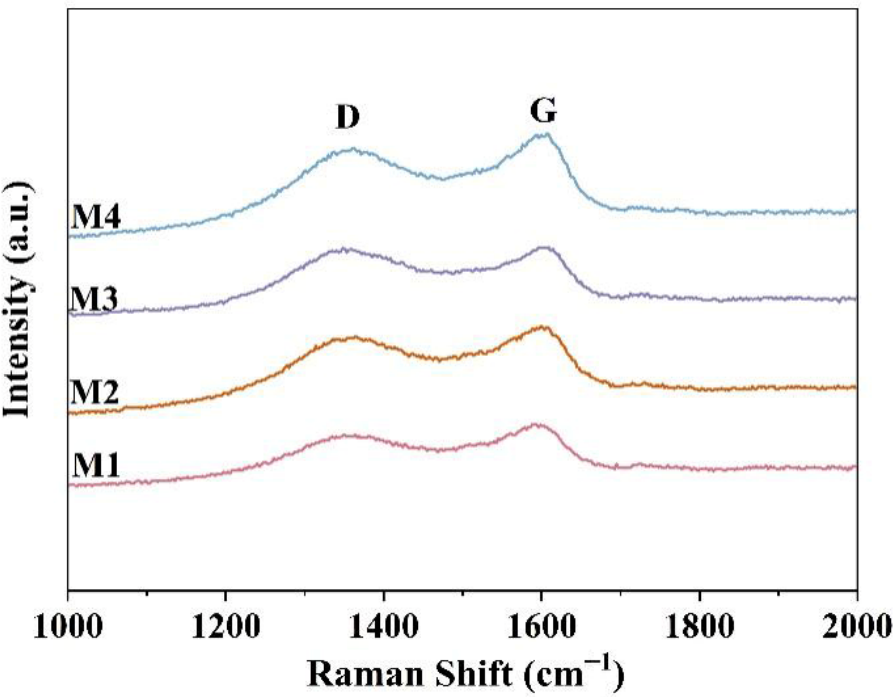
Raman spectroscopy was used to analyze the carbon structures of the wood-derived Co
3O
4@C composites (
Figure 2). Baseline correction was applied before fitting to reduce background interference. The spectra in the range of 1000–1800 cm
−1 were deconvoluted using a Gaussian–Lorentzian mixed function, with the D band and G band centered at approximately 1350 cm
−1 and 1580 cm
−1, respectively. The I
D/I
G values were calculated from the fitted peak heights. As shown in
Figure 2, all samples exhibit distinct D and G bands, indicating the coexistence of disordered carbon and sp
2-hybridized graphitic domains. The D band is associated with defect-related or amorphous carbon structures [
24,
25,
26], whereas the G band corresponds to the in-plane vibration of sp
2-bonded carbon atoms [
27]. The fitted I
D/I
G values of M1, M2, M3, and M4 are 0.87, 0.92, 1.03, and 0.89, respectively, suggesting that the four samples possess generally similar carbon frameworks with only slight differences in local disorder and graphitic ordering. Therefore, the I
D/I
G ratio is used here as a semi-quantitative parameter to reflect the relative degree of structural disorder, rather than as a direct indicator of graphitization [
28]. Although M3 exhibits a slightly higher I
D/I
G value, the Raman differences among the four samples are limited. This suggests that Raman-derived defects alone cannot fully account for the observed differences in electromagnetic wave absorption performance. While defect sites can promote dipolar or interfacial polarization, the superior performance of M3 more likely arises from the synergy among defect polarization, pore structure, Co
3O
4 dispersion, and impedance matching.
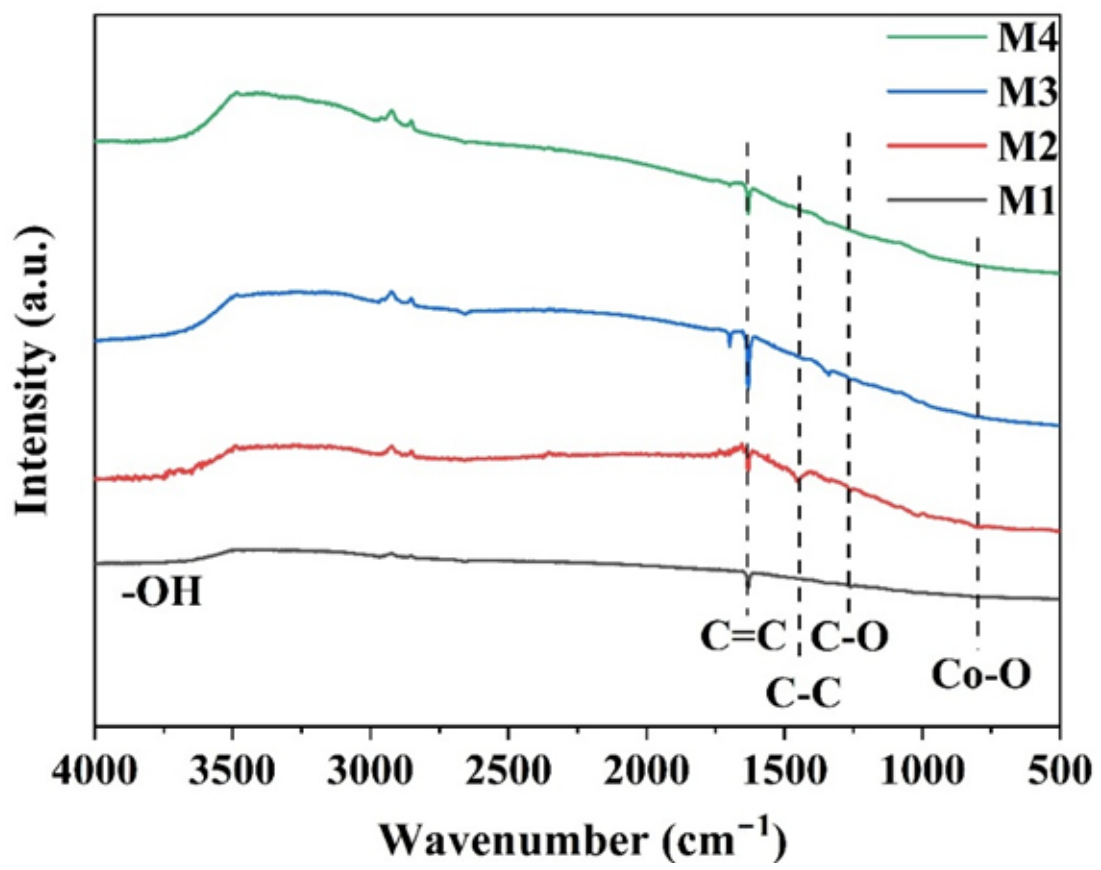
The FT-IR spectrum of the absorber reveals that the material formed a composite structure dominated by an aromatic carbon skeleton after pyrolysis at 700 °C in an argon atmosphere (
Figure 3). The broad absorption band observed in the 3500–4000 cm
−1 range is attributed to O–H stretching vibrations, primarily originating from water molecules adsorbed on the material surface. This confirms the distinct material hydrophilicity and the presence of surface-active sites. The most prominent feature in the spectrum is the absorption band appearing at 1580–1620 cm
−1, characteristic of the stretching vibration of aromatic C=C bonds [
29,
30,
31]. The presence of C-C backbone vibration peaks observed in the wavenumber range of 1450–1500 cm
−1 confirms the successful formation of a highly conjugated and aromatic graphene-like carbon network during pyrolysis [
32,
33,
34]. This structure endows the material with excellent electrical conductivity and structural stability. A weak peak at the 795 cm
−1 region is assigned to Co-O vibrations, confirming the presence of oxidized Co species. This signal may originate from Co
3O
4 formed by the slight surface oxidation of Co nanoparticles during pyrolysis.
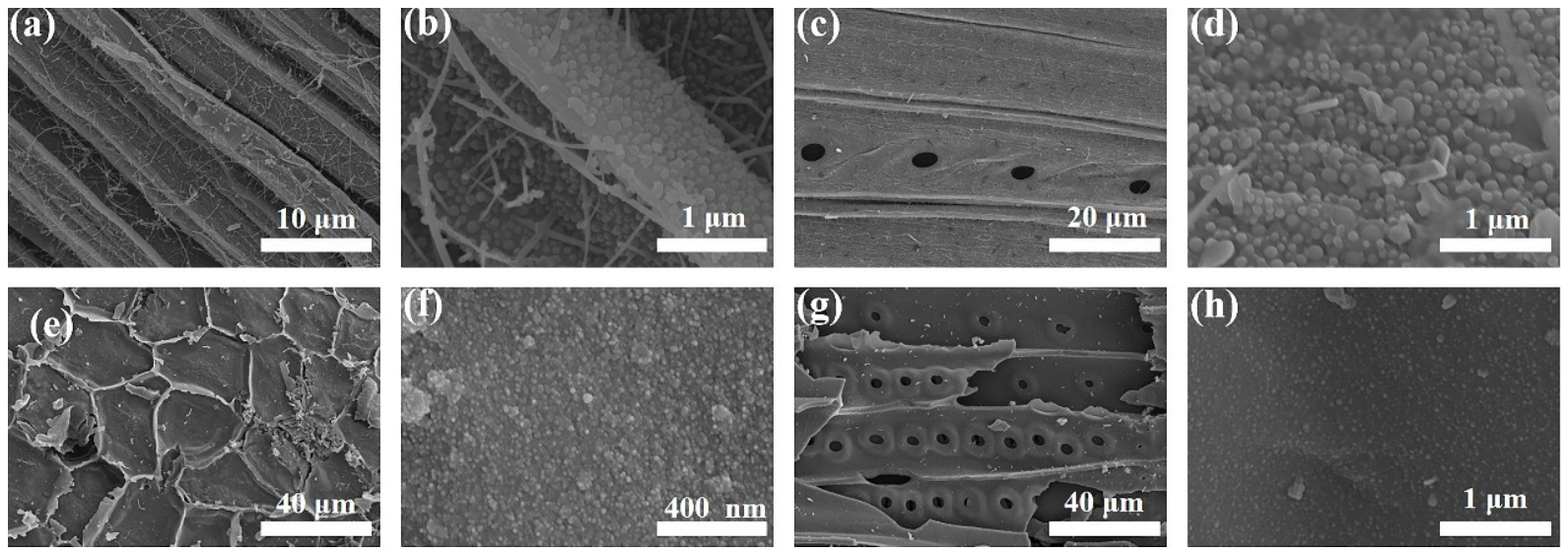
Figure 4a,b show the SEM images of bamboo. Fibers with a diameter of approximately 1 μm are clearly observed in the microstructure. Particles are uniformly distributed across the surface of the bamboo fibers, indicating that ZIF-67 has achieved uniform growth on its surface. Poplar wood (
Figure 4c,d) shows a uniformly smooth surface with a few pores at low magnification. At higher magnification, partial agglomeration of ZIF-67 particles is observed within the matrix. As shown in
Figure 4e,f, the pine wood surface is rough and exhibits a wrinkled morphology. Further magnification confirms the presence of ZIF-67 particles.
Figure 4g,h reveal that balsa wood exhibits a highly porous structure with numerous voids. Detailed examination indicates a minimal presence of particles within the matrix, which explains the relatively weak diffraction peaks observed in the XRD patterns.
As shown in
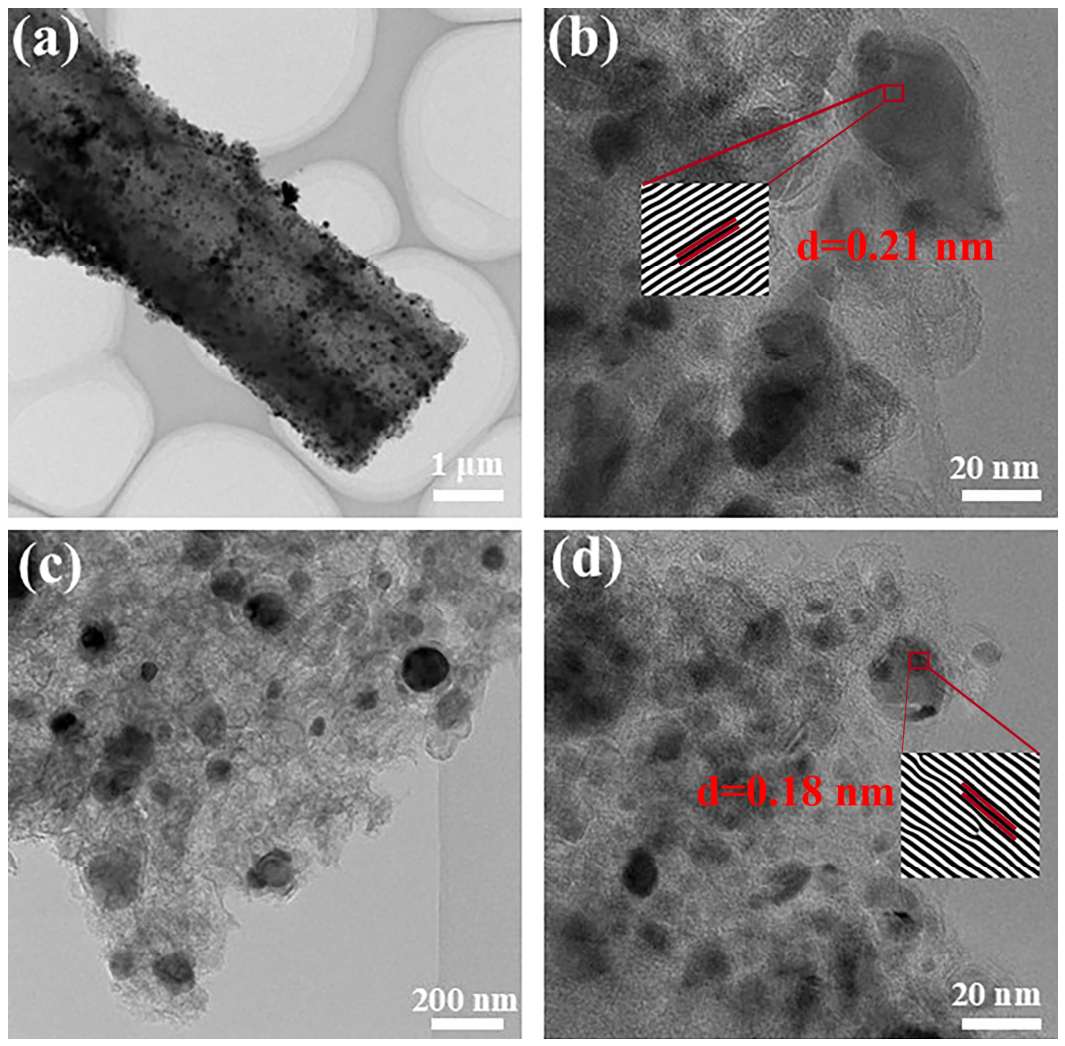
Figure 5, the morphology and crystal structure of the synthesized M1 and M4 samples were examined using TEM (FEI Tecnai G2 F20 S-TWIN, FEI Company, Hillsboro, OR, USA). TEM images reveal numerous dark nanoparticles, confirming the formation of nanoscale Co-based species.
Figure 5a,b show nanoparticles distributed on the surface of bamboo fibers. Upon further magnification, an interplanar spacing of approximately 0.21 nm is observed, corresponding to the (311) crystal plane of Co
3O
4.
Figure 5c,d present TEM images of poplar wood, where black nanoparticles are uniformly distributed within the carbon framework, with an interplanar spacing of 0.18 nm corresponding to the (200) crystal plane of Co
3O
4. These results provide direct evidence for the existence of crystalline Co
3O
4 in both composites. The relatively weak Co
3O
4 diffraction peaks in the XRD patterns are likely due to its low loading amount, small crystallite size, and high dispersion [
35], which lead to weak and broadened diffraction signals below the detection limit of XRD.
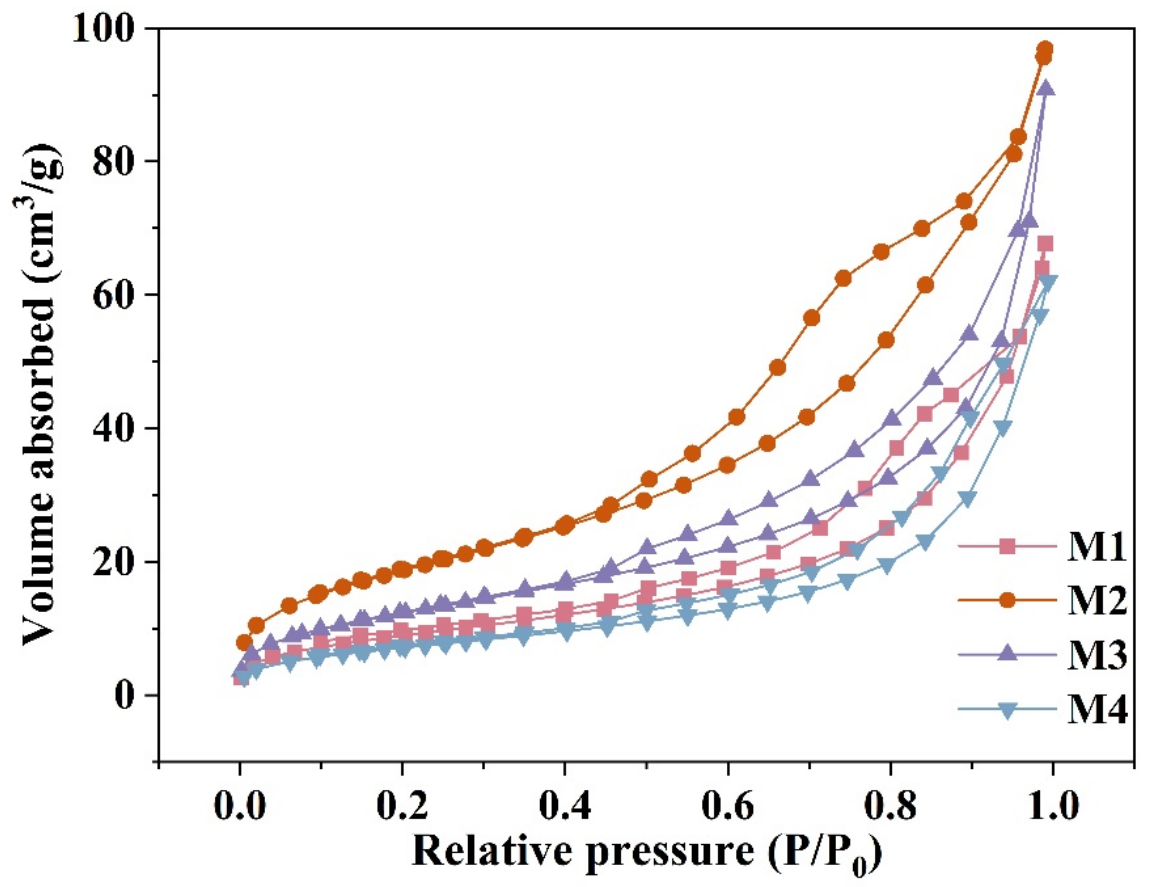
BET analysis further revealed significant differences in the pore structure characteristics among these four wood-derived Co
3O
4@C composites (
Table 1). M2 exhibited the highest specific surface area (66.79 m
2/g) and pore volume (0.15 cm
3/g), indicating the most developed pore structure and the largest number of available interfaces. These structural characteristics typically enhance interfacial polarization and prolong the propagation path of incident electromagnetic waves through multiple scattering and reflection. In contrast, M4 exhibits the lowest specific surface area (26.64 m
2/g) and pore volume (0.09 cm
3/g), indicating low interfacial density and a weaker contribution to dielectric attenuation. M1 falls in the intermediate range. M3 possesses a high surface area (46.32 m
2/g) and pore volume (0.14 cm
3/g) with an average pore diameter of 12.04 nm, indicating a well-developed porous structure that balances interfacial density and wave propagation. These findings demonstrate that pore structure is a critical factor influencing electromagnetic properties, and that the wood template effectively regulates the pore architecture of the derived composites.
These differences in pore structure among the four samples are expected to influence their electromagnetic parameters, because a higher specific surface area and pore volume generally enhance interfacial polarization and multiple scattering, thereby affecting the complex permittivity.
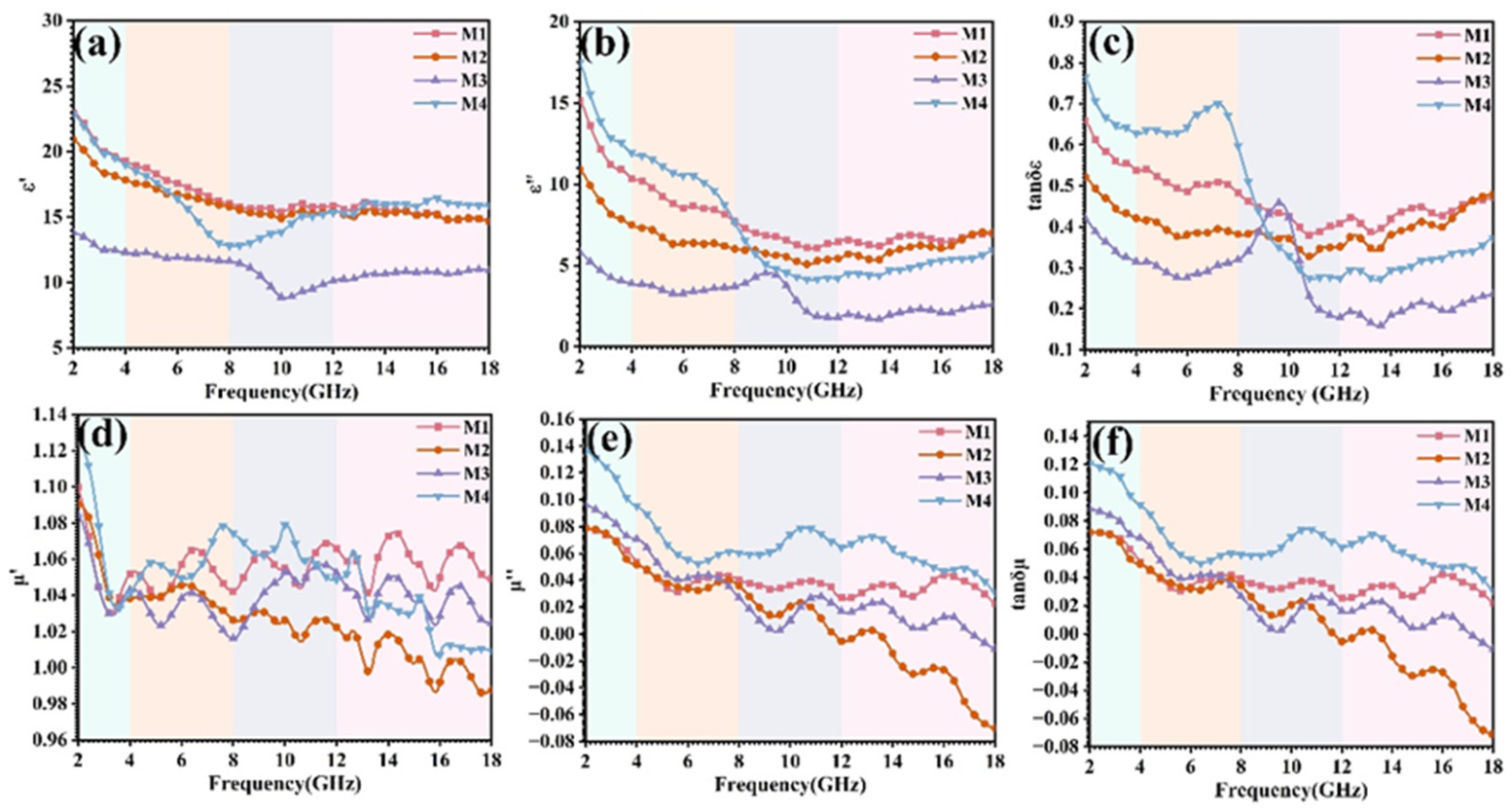
Figure 6 presents the measured electromagnetic parameters of M1–M4, revealing how the pore structure correlates with the dielectric response.
The electromagnetic parameters of each sample were measured over the frequency range of 2–18 GHz to systematically investigate their electromagnetic wave absorption characteristics.
Figure 7 shows the electromagnetic parameters of various wood-derived Co
3O
4@C composites after heat treatment at 700 °C. Analysis of the electromagnetic parameters indicates that the microstructure of the carbon matrix has a significant influence on the dielectric behavior of the composites. The dielectric constant (
εr) is a key macroscopic parameter characterizing the polarization capacity and energy-storage properties of dielectric materials. Its physical essence stems from the microstructural polarization response of the material under an alternating electric field. From a physical-mechanism perspective, the dielectric constant is a complex quantity,
ε =
ε′ −
jε″, where the real part,
ε′, reflects the ability of the material to store electric-field energy and corresponds to the intensity of polarization in the dielectric under an electric field. The imaginary part,
ε″, represents energy loss due to polarization hysteresis and conduction. Together, they determine the dielectric loss tangent, tan
δε =
ε″/
ε′. In electromagnetic wave absorption applications, the dielectric constant must satisfy a balance of adaptability: an excessively high
ε′ leads to a severe impedance mismatch between the material and free space, causing strong surface reflection of electromagnetic waves and reducing wave penetration efficiency. Conversely, an excessively low
ε′ results in insufficient polarization loss, rendering the material incapable of effectively attenuating electromagnetic waves. The optimal range of dielectric constants achieves a synergy between impedance matching and attenuation capability, ensuring both efficient electromagnetic wave incidence and energy dissipation through multiple polarization mechanisms.
In this study, the real part of permittivity for all wood-based composites exhibited relatively high values at low frequencies, then gradually decreased with increasing frequency, and ultimately remained constant at high frequencies, demonstrating typical frequency dispersion behavior. This trend reflects the typical relaxation of polarization at higher frequencies. The natural structure of the wood matrix (e.g., fiber morphology and porosity) regulates ε′ and ε″ values, thereby influencing the balance between impedance matching and loss capacity, and providing a key basis for subsequent analysis of the wave-absorbing performance of different samples.
Among the four samples, M4 exhibits the highest
ε′,
ε″, and tan
δε, especially at low frequencies, indicating strong polarization and possible conduction loss. M1 also maintains relatively high dielectric parameters, reflecting a strong dielectric response. In contrast, M2 has notably lower
ε′ and
ε″. M3 exhibits the lowest and most stable
ε′ over the entire frequency range. Although the
ε″ is not dominant, it still retains a certain level of dielectric loss. These results demonstrate that the dielectric parameters of M3 have been regulated to a more appropriate range, thereby avoiding the severe impedance mismatch caused by excessively high permittivity. The dielectric loss tangent (tan
δε) curves further reveal that M1 and M4 possess relatively high dielectric dissipation efficiency, especially M4, which exhibits the strongest energy dissipation capability in the low-frequency range. M2 remains at an intermediate level, whereas the tan
δε value of M3 is comparatively lower but shows obvious fluctuations in the middle-frequency region, implying that effective polarization relaxation processes still exist within the sample. Thus, M3 achieves absorption not by maximizing dielectric loss, but by balancing loss capability with impedance matching.
Figure 7d–f present the magnetic response characteristics of the four samples. It can be observed that the real part of permeability (
μ′) for all samples remains close to 1, indicating a weak magnetic energy-storage capability. Meanwhile, the imaginary part of permeability (
μ″) and the magnetic loss tangent (tan
δμ) are generally low, with variation amplitudes much smaller than those of the dielectric parameters. This suggests that the microwave absorption mechanism in this system is dominated by dielectric loss, with magnetic loss playing only an auxiliary role. M4 exhibits relatively higher
μ′ and tan
δμ in certain frequency ranges, indicating that its magnetic-loss contribution is slightly stronger than that of the other samples. Although the magnetic loss of M3 is not prominent, its electromagnetic parameters are more balanced, which is more favorable for improving the overall microwave absorption performance.
The differences observed in ε′, ε″, and tan δε among these four samples lay the foundation for their distinct reflection-loss behaviors. As the subsequent reflection loss analysis will demonstrate, the key to achieving excellent absorption lies in striking an optimal balance between polarization loss and impedance matching, rather than simply maximizing ε″.
The reflection loss values of the different wood samples were calculated using Equations (1) and (2) to evaluate EMW absorption performance [
36].
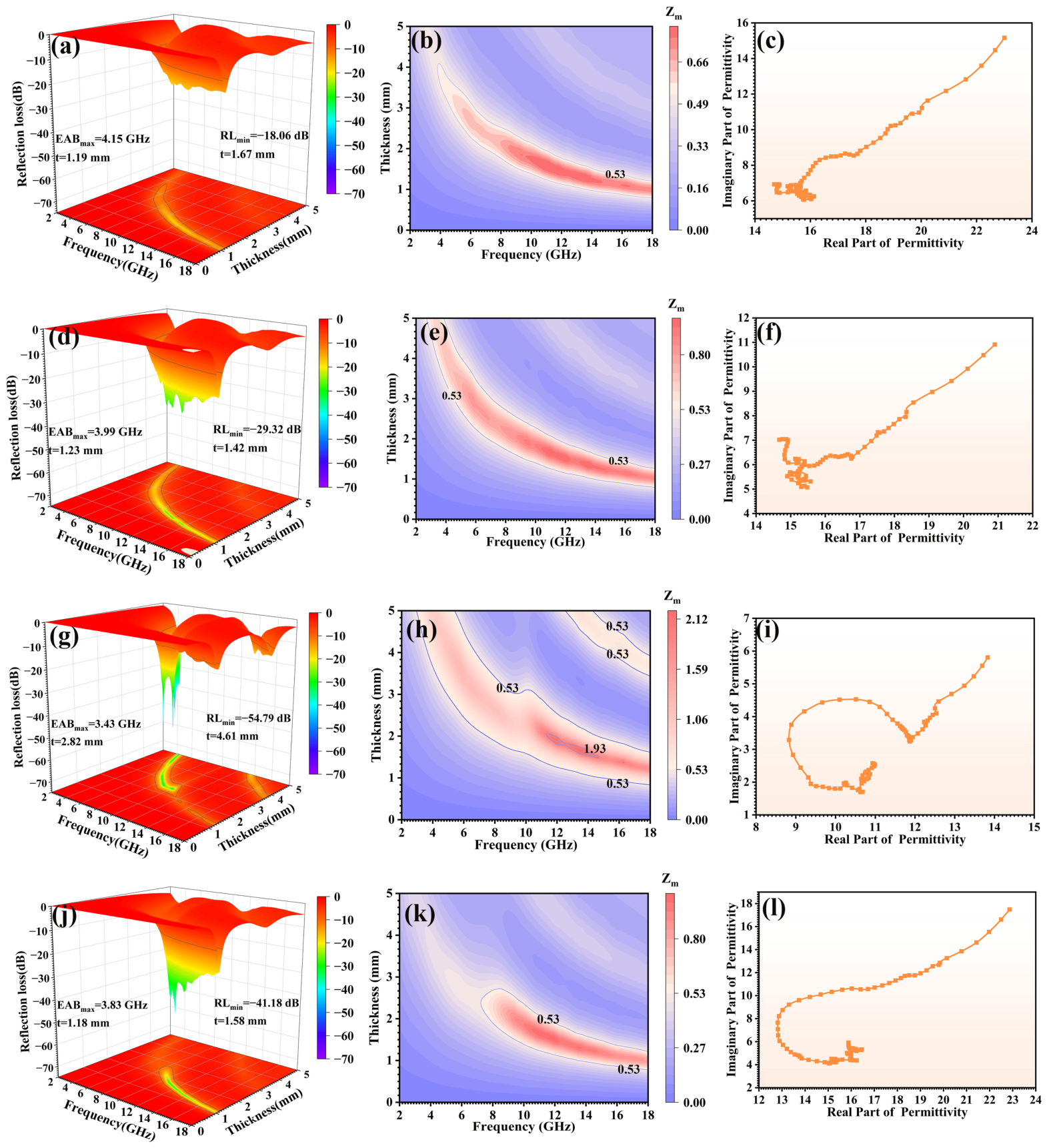
Figure 8a,d,g,j presents the three-dimensional RL plots for M1, M2, M3, and M4, respectively. Combined with the RL results, it is evident that the microwave absorption performance of the four samples does not simply depend on a single dielectric loss parameter, but is governed by the synergistic interplay between impedance matching and attenuation capability. The four samples exhibit distinct absorption characteristics. M1 shows a RL
min of only −18.06 dB, but its EAB
max reaches 4.15 GHz, which is the largest among all samples. This indicates that although M1 has a certain absorption capability over a relatively broad frequency range, the excessively high dielectric parameters lead to a marked mismatch between the input impedance of the material and the impedance of free space, resulting in strong surface reflection of EMWs and limited deep absorption capability. The RL
min of M2 decreases to −29.32 dB, with an EAB
max of 3.99 GHz, indicating that as the dielectric parameters are moderately reduced, the impedance matching is improved, allowing more EMWs to enter the material and be dissipated, thereby significantly enhancing the absorption performance compared with M1. It is noteworthy that M3 exhibits a RL
min of −54.79 dB. Although its EAB
max of 3.43 GHz is not the widest among the four samples, it still demonstrates the best overall microwave absorption performance. Since both the
ε′ and
ε″ values of M3 fall within a moderate range, its input impedance is closer to that of free space, enabling incident EMWs to enter the material more efficiently. Meanwhile, sufficient polarization relaxation and energy dissipation mechanisms are retained within the sample, thereby achieving a cooperative effect of enhanced wave penetration and effective attenuation. The impedance-matching contour maps shown in the previous figure further support this conclusion, revealing that M3 possesses the most favorable matching state at specific frequencies and thicknesses, which, in turn, leads to the deepest reflection-loss valley. M4 exhibits a RL
min of −41.18 dB and an EAB
max of 3.83 GHz, giving it the second-best comprehensive performance after M3. Combined with its relatively high
ε″ and tan
δε, it can be inferred that M4 possesses strong energy dissipation capability, enabling rapid attenuation of EMWs once they enter the material. However, its dielectric parameters, especially in the low-frequency region, remain relatively high, leading to impedance matching slightly inferior to that of M3, resulting in somewhat weaker overall performance. In other words, M4 can be regarded as a sample with “strong attenuation capability but slightly weaker matching,” whereas M3 represents a case of “optimal matching with moderate loss.” In summary, the differences in microwave absorption performance among the four samples essentially originate from the synergistic regulation of dielectric loss capability and impedance matching degree. Although M1 and M4 possess relatively high dielectric loss, excessively large dielectric parameters tend to intensify interfacial reflection and hinder the entry of electromagnetic waves. M2 improves the matching state through a moderate reduction in dielectric parameters and therefore exhibits better absorption performance than M1. In M3, the dielectric parameters fall into a more appropriate range, achieving the best impedance matching while retaining effective loss capability, thereby attaining the lowest reflection loss and the best overall microwave absorption performance. Therefore, it can be concluded that M3 exhibits the best comprehensive microwave absorption performance, followed by M4, M2, and M1.
To further understand the EMW absorption mechanisms, we analyzed the impedance matching and the attenuation coefficient of each sample. As the impedance matching value approaches 1, the reflection of EMWs from the absorber surface decreases. Considering the practical challenge of achieving an ideal impedance-matching value of 1 across all thicknesses and frequencies during absorber design and manufacturing, an absorber is generally considered practical when its RL value is below −10 dB. Under these conditions, the corresponding impedance matching values typically range from 0.53 to 1.93. As shown in
Figure 8b,e,h,k, the effective impedance-matching regions highlighted by black lines indicate the frequency-thickness intervals where incident EMWs can efficiently penetrate the absorber. The differences in absorption performance among the four samples primarily stem from variations in the degree of impedance matching. M3 does not achieve the widest EAB, but it exhibits optimal impedance matching in a specific frequency range, leading to the lowest RL. M1, conversely, has a broader EAB but a weaker absorption peak due to poorer impedance matching. Thus, broadband absorption and strong absorption are not equivalent: broadband depends on the extent of the impedance-matching region, while strong absorption relies on local optimal matching combined with sufficient loss.
Based on Debye theory, the real and imaginary parts of the dielectric constant satisfy the following relationship, also known as the Cole−Cole curve. The Cole–Cole curves reveal significant differences in the dielectric loss mechanisms among the various samples (
Figure 8c,f,i,l). M1 and M2 exhibit mainly conductive loss and weak relaxation behavior. In contrast, the M3 and M4 samples exhibit distinct non-ideal semicircular features, indicating the presence of multiple Debye relaxation processes, including the synergistic effects of interfacial polarization, dipole polarization, and conductive loss. In particular, the Cole–Cole curve of the M3 sample exhibits distinct distortion and multi-segment characteristics, indicating a more complex polarization mechanism and a broader distribution of relaxation periods within the material. This multi-mechanism synergistic polarization behavior helps enhance the dissipation capacity of EMWs, thereby significantly improving the wave-absorbing performance.
A comprehensive analysis of the structural characterization, electromagnetic parameters, and reflection loss results indicates that the microwave absorption behavior of the Co3O4@C composites is governed by the cooperative regulation of multiple structural factors rather than by a single parameter. Raman spectra show generally similar carbon frameworks among the four samples, with only slight differences in defect density. These defect sites can act as dipolar polarization centers, contributing to dielectric loss. FT-IR results further suggest the presence of residual oxygen-containing groups and Co–O-related species, which can provide additional polarization-active sites. Meanwhile, the porous biomass-derived carbon framework inherited from the wood templates not only offers abundant interfaces for interfacial polarization but also prolongs the propagation path of incident electromagnetic waves through multiple scattering and reflection. In addition, Co3O4 dispersion modulates heterointerface density and thus the balance between dielectric and magnetic loss. These structural features do not independently determine the final absorption performance, but instead regulate the electromagnetic response of the composites through their effects on dielectric attenuation capability and impedance matching. Samples with excessively high dielectric parameters, such as M1 and M4, exhibit relatively strong dielectric loss but have less favorable impedance matching, which increases surface reflection of incident electromagnetic waves and limits effective wave penetration. In contrast, although M2 shows the highest specific surface area and pore volume, it does not deliver the best reflection loss, indicating that a larger interfacial area alone is insufficient to guarantee superior absorption. M3, however, achieves a balanced combination of moderate defect polarization, a well-developed porous structure, and relatively uniform Co3O4 dispersion, thereby tuning its dielectric parameters to an optimal range for both impedance matching and attenuation. As a result, M3 achieves the best overall microwave absorption performance. Therefore, the structure–property relationship in this system should be understood as a synergistic process in which carbon defects, residual functional groups, pore structure, and Co3O4 dispersion collectively influence polarization behavior, attenuation capability, and impedance matching. The superior electromagnetic wave absorption performance of M3 is thus attributed to the cooperative optimization of these factors, rather than to any single structural characteristic alone.
To quantitatively compare the electromagnetic wave absorption properties of the Co
3O
4@C composite prepared in this study with those of related wave-absorbing materials reported in recent years,
Table 2 summarizes the reflection loss, matching thickness, effective absorption bandwidth, and corresponding thickness for representative materials. These comparison materials encompass a variety of types, including biomass-derived carbon, metal oxides, carbon-based composites, and systems modified with magnetic components.
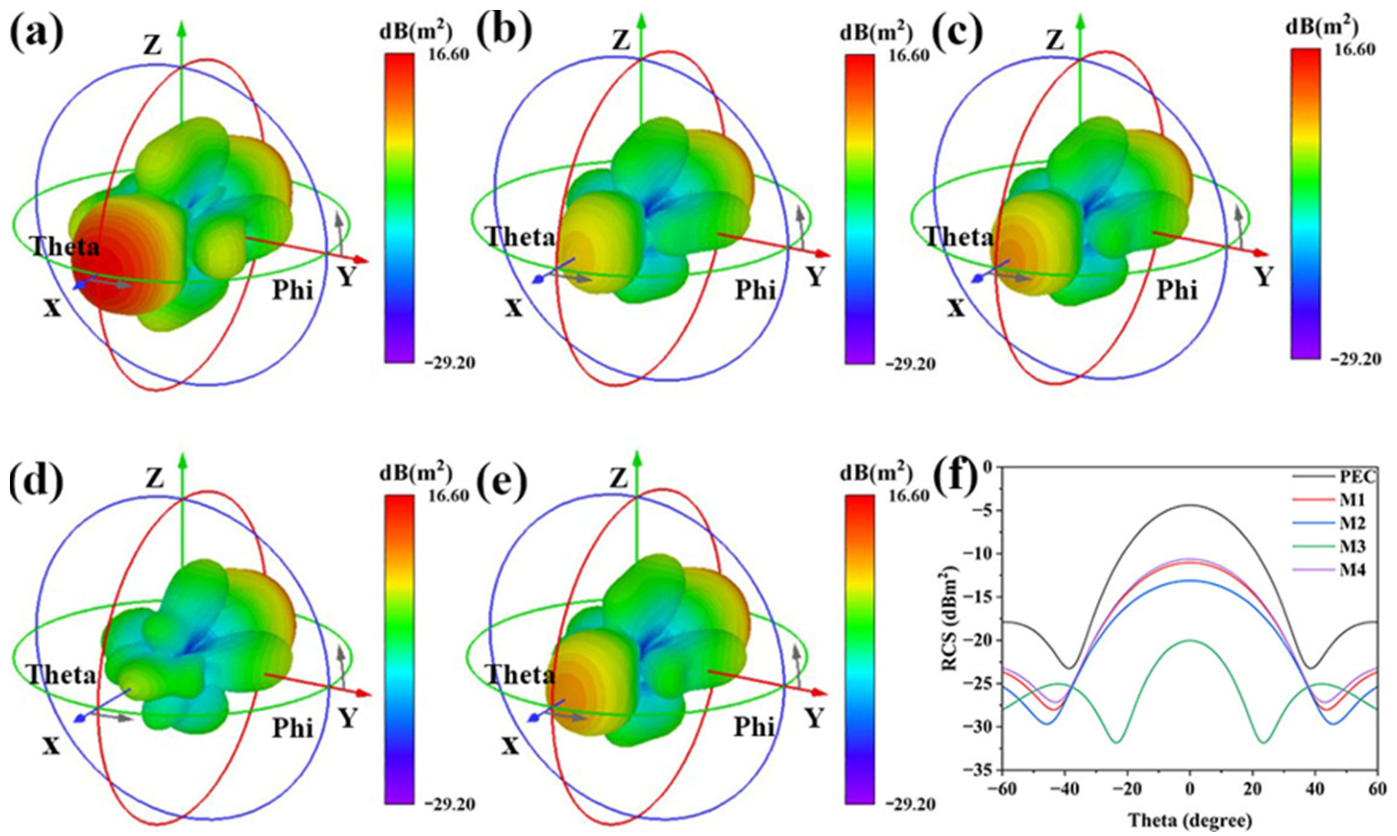
To assess the practical applicability of biomass-derived carbon materials, their far-field absorption properties were investigated using CST Studio Suite 2023 software. Radar cross-section (RCS) was employed to measure the intensity of backscattered signals generated by the target under radar wave irradiation. A lower radar cross-section value indicates a stronger EMW absorption capability of the absorber. The model consists of an absorber layer and a perfect electrical conductor (PEC) substrate, each with dimensions of 200 mm × 200 mm. The thickness of the absorber layer is set to 4.61 mm, which is the experimental matching thickness at which sample M3 achieves its minimum reflection loss (RL
min = −54.79 dB, as shown in
Figure 8). The monitoring frequency is set to 4.64 GHz. The PEC substrate thickness is 2 mm. The model was positioned in the XOY plane, with the
Z-axis aligned along the direction of incident electromagnetic waves. The scattering directions in the spherical coordinate system are denoted by Theta and Phi.
Figure 9a–f shows the 3D RCS simulation results for an exposed PEC and the PEC coated with the absorbing materials. Among all samples, the M3-coated PEC exhibits the weakest reflected wave intensity, confirming its optimal far-field absorption performance. For the M3-coated PEC, the detection angle range spans from −60° to 60°. Within this range, the RCS values remain below −20 dBm
2 for nearly all angles, signifying the excellent RCS reduction capability of this sample at the specified frequency. These RCS results are consistent with the reflection loss analysis, further confirming M3 as the best-performing sample.