An Integrated Behavioral Framework for Risky Pedestrian Crossing Behavior Extending the Theory of Planned Behavior




Abstract
1. Introduction
2. Research Hypotheses Development
2.1. A Theory of Planned Behavior-Based Approach to Understanding Risky Pedestrian Crossing
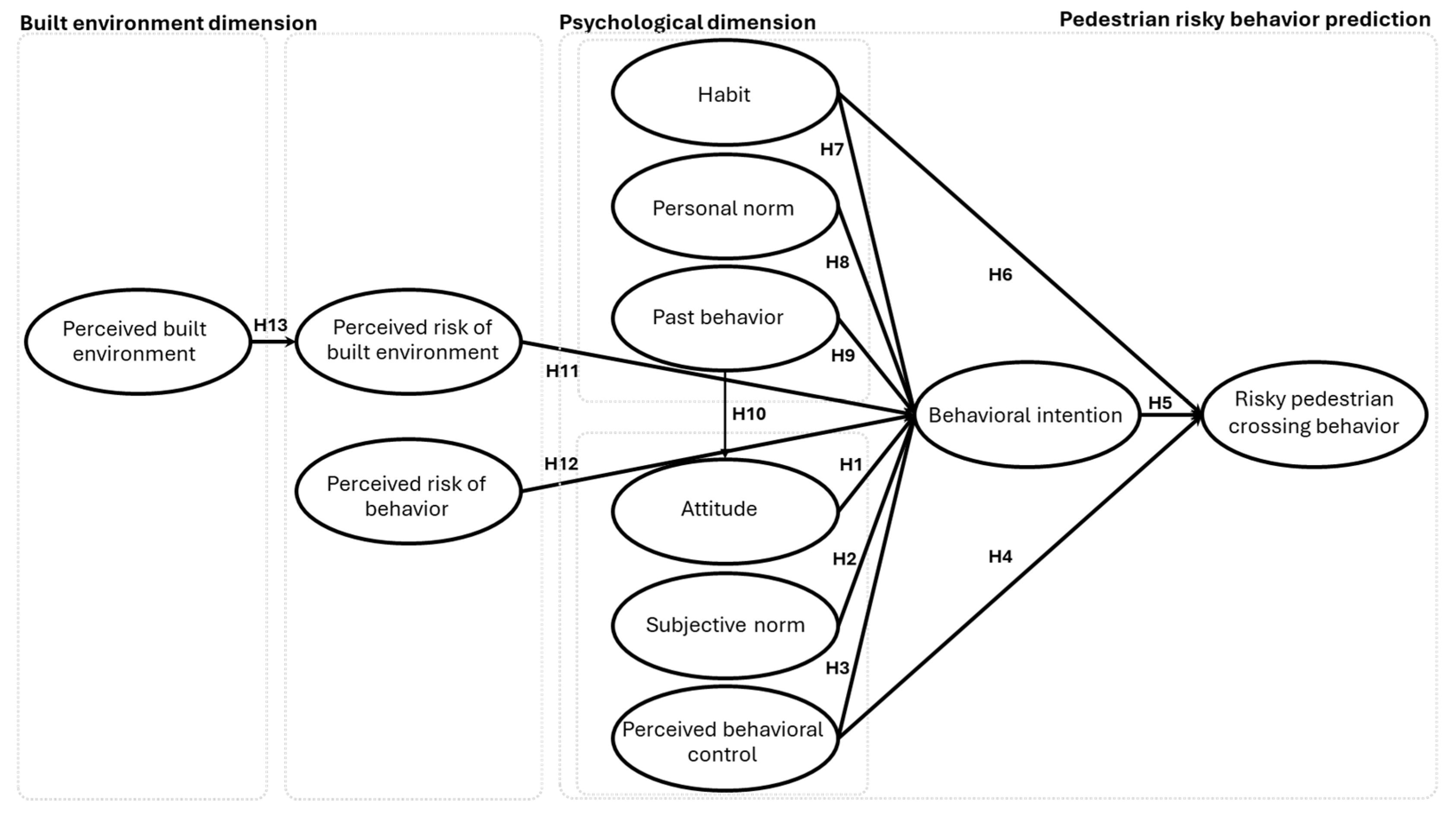
2.2. The Components of the Extended Theory of Planned Behavior Framework and Linking Built Environment
3. Methodology
3.1. Study Setting and Instrument Construction
3.2. Sample and Data Collection
3.3. Data Reliability and Validity
3.4. Data Analysis
4. Results
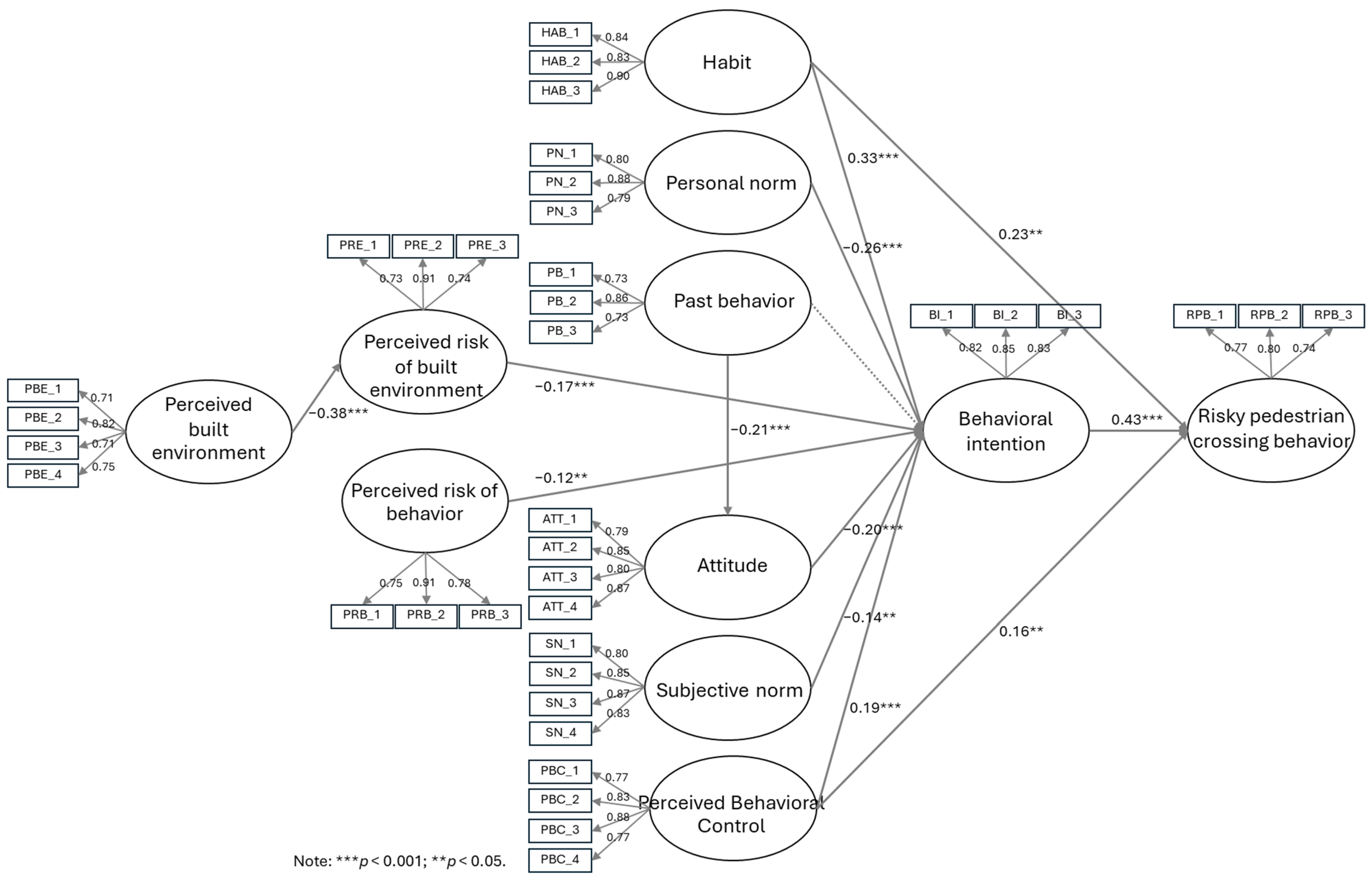
4.1. Evaluation of the Measurement Model
4.2. Extended Theory of Planned Behavior to Explain Risky Pedestrian Crossing Behavior
5. Discussions
5.1. Extending the Theory of Planned Behavior to Predict Risky Pedestrian Crossing Behavior Through Intention
5.2. The Role of Control- and Habit-Related Factors Influencing Risky Pedestrian Crossing Behavior
5.3. Understanding the Relationships Linking Built Environment Dimension and Risky Pedestrian Crossing Behavior
5.4. Limitation and Further Study
6. Conclusions
Author Contributions
Funding
Institutional Review Board Statement
Informed Consent Statement
Data Availability Statement
Acknowledgments
Conflicts of Interest
References
- Gössling, S.; Humpe, A. The global scale, distribution and growth of aviation: Implications for climate change. Glob. Environ. Change 2020, 65, 102194. [Google Scholar] [CrossRef] [PubMed]
- UNDP. What Is Sustainable Transport and What Role Does It Play in Tackling Climate Change? 2025. Available online: https://climatepromise.undp.org/news-and-stories/what-sustainable-transport-and-what-role-does-it-play-tackling-climate-change (accessed on 16 March 2026).
- Rogers, S.H.; Gardner, K.H.; Carlson, C.H. Social capital and walkability as social aspects of sustainability. Sustainability 2013, 5, 3473–3483. [Google Scholar] [CrossRef]
- Baobeid, A.; Koç, M.; Al-Ghamdi, S.G. Walkability and Its Relationships with Health, Sustainability, and Livability: Elements of Physical Environment and Evaluation Frameworks. Front. Built Environ. 2021, 7, 721218. [Google Scholar] [CrossRef]
- Friel, C.; Walsh, D.; Whyte, B.; Dibben, C.; Feng, Z.; Baker, G.; Kelly, P.; Demou, E.; Dundas, R. Health benefits of pedestrian and cyclist commuting: Evidence from the Scottish Longitudinal Study. BMJ Public Health 2024, 2, e001295. [Google Scholar] [CrossRef]
- Millard-Ball, A.; Reginald, M.; Yusuf, Y.; Bian, C. Global health and climate benefits from walking and cycling infrastructure. Proc. Natl. Acad. Sci. USA 2025, 122, e2422334122. [Google Scholar] [CrossRef]
- Ma, J.; Li, W. Exploring the group heterogeneity in the impact of social cohesion on the walking frequency of older adults in China. Front. Public Health 2024, 12, 1424975. [Google Scholar] [CrossRef] [PubMed]
- Sharma, S.N.; Dehalwar, K. A Systematic Literature Review of Pedestrian Safety in Urban Transport Systems. J. Road Saf. 2025, 36, 55–78. [Google Scholar] [CrossRef]
- WHO. New WHO Manual Aims to Strengthen Pedestrian Safety. 2023. Available online: https://www.who.int/news/item/03-05-2023-new-who-manual-aims-to-strengthen-pedestrian-safety (accessed on 7 April 2025).
- WHO. Global Status Report on Road Safety 2023. 2023. Available online: https://www.who.int/publications/i/item/9789240086517 (accessed on 10 April 2025).
- OECD. Safety of Vulnerable Road Users, Scientific Expert Group on the Safety of Vulnerable Road Users (RS7); OECD: France, Paris, 1998.
- Yannis, G.; Nikolaou, D.; Laiou, A.; Stürmer, Y.A.; Buttler, I.; Jankowska-Karpa, D. Vulnerable road users: Cross-cultural perspectives on performance and attitudes. IATSS Res. 2020, 44, 220–229. [Google Scholar] [CrossRef]
- Alonso, F.; Esteban, C.; Useche, S.; Colomer, N. Effect of Road Safety Education on road risky behaviors of Spanish children and adolescents: Findings from a national study. Int. J. Environ. Res. Public Health 2018, 15, 2828. [Google Scholar] [CrossRef] [PubMed]
- Hussain, M.; Shi, J.; Baikejuli, M. Which factors contribute to road crashes in non-commercial and commercial vehicles? An examination of administrative data from motorways in Pakistan. Int. J. Inj. Control Saf. Promot. 2021, 28, 513–520. [Google Scholar] [CrossRef]
- Zamani, A.; Behnood, A.; Davoodi, S.R. Temporal stability of pedestrian injury severity in pedestrian-vehicle crashes: New insights from random parameter logit model with heterogeneity in means and variances. Anal. Methods Accid. Res. 2021, 32, 100184. [Google Scholar] [CrossRef]
- Hossain, A.; Das, S.; Jafari, M.; Starewich, M.; Chakraborty, R.; Kutela, B. Behavioral and psychological determinants of pedestrian collisions on arterial roads with evidence from random parameter models. Sci. Rep. 2025, 15, 31684. [Google Scholar] [CrossRef]
- Park, S.; Ko, D. Investigating the Factors Influencing Pedestrian–Vehicle Crashes by Age Group in Seoul, South Korea: A Hierarchical Model. Sustainability 2020, 12, 4239. [Google Scholar] [CrossRef]
- Iamtrakul, P.; Chayphong, S.; Crizzle, A.M. A spatial analysis of built environment determinants influencing pedestrian fatalities in Bangkok, Thailand. J. Urban Mobil. 2026, 9, 100225. [Google Scholar] [CrossRef]
- Shehadeh, E.A.; Al-Bayatti, A.H.; Bingöl, M.A. Effect of roadway environment characteristics on pedestrian safety at signalised intersections in Amman. Urban Plan. Transp. Res. 2024, 12, 2317766. [Google Scholar] [CrossRef]
- Hou, M.; Chen, S.; Cheng, J. The effect of risk perception and other psychological factors on mobile phone use while crossing the street among pedestrians. Accid. Anal. Prev. 2022, 170, 106643. [Google Scholar] [CrossRef]
- Palat, B.; Paran, F.; Delhomme, P. Applying an extended theory of planned behavior to predicting violations at automated railroad crossings. Accid. Anal. Prev. 2017, 98, 174–184. [Google Scholar] [CrossRef] [PubMed]
- Rijal, B.; Yilmaz, N. Effects of Distracted Pedestrian Behavior on Transportation Safety: Causes and Contributing Factors. Appl. Sci. 2024, 14, 11068. [Google Scholar] [CrossRef]
- Xiao, Y.; Liu, Y.; Liang, Z. Study on Road-Crossing Violations among Young Pedestrians Based on the Theory of Planned Behavior. J. Adv. Transp. 2021, 2021, 6893816. [Google Scholar] [CrossRef]
- Fu, X.; Juan, Z. Exploring the psychosocial factors associated with public transportation usage and examining the “gendered” difference. Transp. Res. Part A Policy Pract. 2017, 103, 70–82. [Google Scholar] [CrossRef]
- Zhou, H.; Romero, S.B.; Qin, X. An extension of the theory of planned behavior to predict pedestrians’ violating crossing behavior using structural equation modeling. Accid. Anal. Prev. 2016, 95, 417–424. [Google Scholar] [CrossRef]
- Gannon, B.; Rosta, L.; Reeve, M.; Hyde, M.K.; Lewis, I. Does it matter whether friends, parents, or peers drink walk? Identifying which normative influences predict young pedestrian’s decisions to walk while intoxicated. Transp. Res. Part F Traffic Psychol. Behav. 2014, 22, 12–24. [Google Scholar] [CrossRef]
- Hou, M.; Cheng, J.; Xiao, F.; Wang, C. Distracted Behavior of Pedestrians While Crossing Street: A Case Study in China. Int. J. Environ. Res. Public Health 2021, 18, 353. [Google Scholar] [CrossRef]
- Soathong, A.; Chowdhury, S.; Wilson, D.; Ranjitkar, P. Investigating the motivation for pedestrians’ risky crossing behaviour at urban mid-block road sections. Travel Behav. Soc. 2021, 22, 155–165. [Google Scholar] [CrossRef]
- Barón, L.; Otila da Costa, J.; Soares, F.; Faria, S.; Prudêncio Jacques, M.A.; Fraga de Freitas, E. Effect of Built Environment Factors on Pedestrian Safety in Portuguese Urban Areas. Appl. Syst. Innov. 2021, 4, 28. [Google Scholar] [CrossRef]
- Koh, P.P.; Wong, Y.D.; Chandrasekar, P. Safety evaluation of pedestrian behaviour and violations at signalised pedestrian crossings. Saf. Sci. 2014, 70, 143–152. [Google Scholar] [CrossRef]
- Oviedo-Trespalacios, O.; Scott-Parker, B. Footbridge usage in high-traffic flow highways: The intersection of safety and security in pedestrian decision making. Transp. Res. F Traffic Psychol. Behav. 2017, 49, 177–187. [Google Scholar] [CrossRef]
- McConville, M.E.; Rodríguez, D.A.; Clifton, K.; Cho, G.; Fleischhacker, S. Disaggregate land uses and walking. Am. J. Prev. Med. 2011, 40, 25–32. [Google Scholar] [CrossRef]
- Ajzen, I. From intentions to actions: A theory of planned behavior. In Action-Control: From Cognition to Behavior; Kuhl, J., Beckman, J., Eds.; Springer: Berlin/Heidelberg, Germany, 1985; pp. 11–39. [Google Scholar]
- Hukkelberg, S.S.; Hagtvet, K.A.; Kovac, V.B. Latent interaction effects in the theory of planned behaviour applied to quitting smoking. Br. J. Health Psychol. 2014, 19, 83–100. [Google Scholar] [CrossRef]
- Williams, S.L.; French, D.P. Theory of planned behaviour variables and objective walking behaviour do not show seasonal variation in a randomised controlled trial. BMC Public Health 2014, 14, 120. [Google Scholar] [CrossRef] [PubMed]
- Xu, J.; Liu, H.; Liu, X.; Gao, C. Extended theory of planned behavior to explain the influence mechanism of low-speed driving behavior. PLoS ONE 2023, 18, e0287489. [Google Scholar] [CrossRef] [PubMed]
- Hafeez, F.; Ullah Sheikh, U.; Mas’ud, A.A.; Al-Shammari, S.; Hamid, M.; Azhar, A. Application of the Theory of Planned Behavior in Autonomous Vehicle-Pedestrian Interaction. Appl. Sci. 2022, 12, 2574. [Google Scholar] [CrossRef]
- Piazza, A.J.; Knowlden, A.P.; Hibberd, E.; Leeper, J.; Paschal, A.M.; Usdan, S. Mobile device use while crossing the street: Utilizing the theory of planned behavior. Accid. Anal. Prev. 2019, 127, 9–18. [Google Scholar] [CrossRef] [PubMed]
- Papadimitriou, E.; Theofilatos, A.; Yannis, G. Patterns of pedestrian attitudes, perceptions and behaviour in Europe. Saf. Sci. 2013, 53, 114–122. [Google Scholar] [CrossRef]
- Liu, M.; Wu, J.; Yousaf, A.; Wang, L.; Hu, K.; Plant, K.L.; McIlroy, R.C.; Stanton, N.A. Exploring the relationship between attitudes, risk perceptions, fatalistic beliefs, and pedestrian behaviors in China. Int. J. Environ. Res. Public Health 2021, 18, 3378. [Google Scholar] [CrossRef] [PubMed]
- Demir, B.; Özkan, T.; Demir, S. Pedestrian violations: Reasoned or social reactive? Comparing theory of planned behavior and prototype willingness model. Transp. Res. F Traffic Psychol. Behav. 2019, 60, 560–572. [Google Scholar] [CrossRef]
- O’Dell, A.L.; Filtness, A.J.; Morris, A.P. Predicting the intention of distracted pedestrians at road crossings. Accid. Anal. Prev. 2022, 173, 106707. [Google Scholar] [CrossRef]
- Xin, X.; Jia, N.; Ling, S.; He, Z. The effect of the ‘yield to pedestrians’ policy on risky pedestrian behaviors: Is it a ‘two-edged sword’? Transp. Res. A Policy Pract. 2023, 178, 103870. [Google Scholar] [CrossRef]
- Moshki, M.; Khajavi, A.; Sadeghi-Bazargani, H.; Vahedi, S.; Pour-Doulati, S. Developing Pedestrians’ Red-light Violation Behavior Questionnaire (PRVBQ); Assessment of Content Validity and Reliability. Bull. Emerg. Trauma 2020, 8, 98–106. [Google Scholar] [CrossRef]
- Lennon, A.; Oviedo-Trespalacios, O.; Matthews, S. Pedestrian self-reported use of smart phones: Positive attitudes and high exposure influence intentions to cross the road while distracted. Accid. Anal. Prev. 2017, 98, 338–347. [Google Scholar] [CrossRef]
- Sniehotta, F.F.; Presseau, J.; Araújo-Soares, V. Time to retire the theory of planned behaviour. Health Psychol. Rev. 2014, 8, 1–7. [Google Scholar] [CrossRef] [PubMed]
- Liu, J.; Li, C.; Hu, S. Analysis of pedestrian violations based on an integrative model: Evidence from college students in China. J. Transp. Health 2023, 28, 101560. [Google Scholar] [CrossRef]
- Hashemiparast, M.; Sharma, M.; Asghari Jafarabadi, M.; Hosseini, Z. Still careless: Findings from a cross-sectional study of young pedestrians’ risky road crossing behaviors. Arch. Public Health 2020, 78, 44. [Google Scholar] [CrossRef]
- Matović, B.; Petrović, A.; Damjanović, M.; Bulajić, A.; Ilić, V. Socio-cognitive determinants of pedestrians’ intention to cross on a red light signal: An application of the theory of planned behaviour. Safety 2024, 10, 33. [Google Scholar] [CrossRef]
- Bamberg, S.; Ajzen, I.; Schmidt, P. Choice of Travel Mode in the Theory of Planned Behavior: The Roles of Past Behavior, Habit, and Reasoned Action. Basic Appl. Soc. Psychol. 2003, 25, 175–187. [Google Scholar] [CrossRef] [PubMed]
- Cristea, M.; Paran, F.; Delhomme, P. Extending the theory of planned behaviour: The role of behavioural options and additional factors in predicting speed behaviour. Transp. Res. Part F Traffic Psychol. Behav. 2013, 21, 122–132. [Google Scholar] [CrossRef]
- Xu, Y.; Li, Y.; Zhang, F. Pedestrians’ intention to jaywalk: Automatic or planned? A study based on a dual-process model in china. Accid. Anal. Prev. 2013, 50, 811–819. [Google Scholar] [CrossRef]
- Conner, M.; Armitage, C.J. Extending the theory of planned behaviour: A review and avenues for further research. J. Appl. Soc. Psychol. 1998, 28, 1429–1464. [Google Scholar] [CrossRef]
- Jovanović, D.; Šraml, M.; Matović, B.; Mićić, S. An Examination of the Construct and Predictive Validity of the Self-Reported Speeding Behavior Model. Accid. Anal. Prev. 2017, 99, 66–76. [Google Scholar] [CrossRef]
- Parker, D.; Manstead, A.S.R.; Stradling, S.G. Extending the theory of planned behavior: The role of personal norm. Br. J. Soc. Psychol. 1995, 34, 127–137. [Google Scholar] [CrossRef]
- Schwartz, S.H. Normative influences on Altruism. In Advances in Experimental Social Psychology; Elsevier: Amsterdam, The Netherlands, 1977; Volume 10, pp. 221–279. [Google Scholar]
- Karami, Z.; Rejali, S.; Aghabayk, K. Investigating pedestrians’ red light running intentions at urban intersections in different traffic Environments: A scenario-based analysis guided by theoretical frameworks. Transp. Res. Part F Traffic Psychol. Behav. 2024, 107, 196–223. [Google Scholar] [CrossRef]
- Deery, H.A. Hazard and risk perception among young novice drivers. J. Saf. Res. 1999, 30, 225–236. [Google Scholar] [CrossRef]
- Dinh, D.D.; Vũ, N.H.; McIlroy, R.C.; Plant, K.A.; Stanton, N.A. Effect of attitudes towards traffic safety and risk perceptions on pedestrian behaviours in Vietnam. IATSS Res. 2020, 44, 238–247. [Google Scholar] [CrossRef]
- Zheng, H.; Giang, W.C.W. Risk perception and distraction engagement with smart devices in different types of walking environments. Accid. Anal. Prev. 2021, 162, 106405. [Google Scholar] [CrossRef]
- Ackaah, W.; Larbi, J.; Aidoo, E.N. Pedestrian red-light violations and other safety-related behaviours at signalised crosswalks. Urban Plan. Transp. Res. 2024, 12, 2353073. [Google Scholar] [CrossRef]
- Yang, J.; Gauli, N.; Shiwakoti, N.; Tay, R.; Deng, H.; Chen, J.; Nepal, B.; Li, J. Examining the Factors Influencing Pedestrian Behaviour and Safety: A Review with a Focus on Culturally and Linguistically Diverse Communities. Sustainability 2025, 17, 6007. [Google Scholar] [CrossRef]
- Pelé, M.; Bellut, C.; Debergue, E.; Gauvin, C.; Jeanneret, A.; Leclere, T.; Nicolas, L.; Pontier, F.; Zausa, D.; Sueur, C. Cultural influence of social information use in pedestrian road-crossing behaviours. R. Soc. Open Sci. 2017, 4, 160739. [Google Scholar] [CrossRef]
- Rankavat, S.; Tiwari, G. Influence of actual and perceived risks in selecting crossing facilities by pedestrians. Travel Behav. Soc. 2020, 21, 1–9. [Google Scholar] [CrossRef]
- Saxena, A. Texting and crossing: An extended theory of planned behaviour to model the psychological and demographic factors related to pedestrians’ use of cell phone for texting at crosswalks in developing country. IATSS Res. 2023, 47, 50–60. [Google Scholar] [CrossRef]
- Granié, M.A.; Pannetier, M.; Gueho, L. Developing a self-reporting method to measure pedestrian behaviors at all ages. Accid. Anal. Prev. 2013, 50, 830–839. [Google Scholar] [CrossRef] [PubMed]
- Sogbe, E.; Susilawati, S. Dissecting pedestrian behaviour in Ghana: A cluster-based analysis of safety and risk profiles. Int. J. Inj. Control Saf. Promot. 2025, 1–15. [Google Scholar] [CrossRef]
- Soper, D.S. A-Priori Sample Size Calculator for Structural Equation Models. 2026. Available online: https://www.danielsoper.com/statcalc (accessed on 16 March 2026).
- Hair, J.F.; Black, W.C.; Babin, B.J.; Anderson, R.E. Multivariate Data Analysis, 7th ed.; Pearson: Harlow, UK, 2014. [Google Scholar]
- Fornell, C.; Larcker, D.F. Evaluating structural equation models with unobservable variables and measurement error. J. Mark. Res. 1981, 18, 39–50. [Google Scholar] [CrossRef]
- Franke, G.R.; Sarstedt, M. Heuristics versus statistics in discriminant validity testing: A comparison of four procedures. Internet Res. 2019, 29, 430–447. [Google Scholar] [CrossRef]
- Hooper, D.; Coughlan, J.; Mullen, M. Structural equation modelling: Guidelines for determining model fit. Electron. J. Bus. Res. Methods 2008, 6, 53–60. [Google Scholar]
- Bortoleto, A.P.; Kurisu, K.H.; Hanaki, K. Model development for household waste prevention behaviour. Waste Manag. 2012, 32, 2195–2207. [Google Scholar] [CrossRef]
- Xiong, B.; Skitmore, M.; Xia, B. A critical review of structural equation modeling applications in construction research. Autom. Constr. 2015, 49, 59–70. [Google Scholar] [CrossRef]
- Wolny, R.; Kol, J.; Stolecka-Makowska, A.; Szojda, G. Digital Consumer Behavior in Poland and Its Environmental Impact Within the Framework of Sustainability. Sustainability 2025, 17, 4691. [Google Scholar] [CrossRef]
- Liu, H.; Liu, X.; Jia, M. Revealing the speeding principle based on the extended theory of planned behavior. Transp. Res. Part F Traffic Psychol. Behav. 2025, 109, 1080–1099. [Google Scholar] [CrossRef]
- Aarts, H.; Dijksterhuis, A. Habits as knowledge structures: Automaticity in goal-directed behavior. J. Pers. Soc. Psychol. 2000, 78, 53. [Google Scholar] [CrossRef]



| Factors | Indicators | Loadings | Std. Error | p-Value | Cronbach’s Alpha | CR | AVE |
|---|---|---|---|---|---|---|---|
| Attitude: ATT | ATT_1 | 0.791 | 0.021 | <0.001 | 0.896 | 0.898 | 0.688 |
| ATT_2 | 0.850 | 0.017 | <0.001 | ||||
| ATT_3 | 0.801 | 0.020 | <0.001 | ||||
| ATT_4 | 0.868 | 0.016 | <0.001 | ||||
| Subject norm: SN | SN_1 | 0.797 | 0.020 | <0.001 | 0.904 | 0.904 | 0.702 |
| SN_2 | 0.850 | 0.016 | <0.001 | ||||
| SN_3 | 0.872 | 0.015 | <0.001 | ||||
| SN_4 | 0.831 | 0.017 | <0.001 | ||||
| Perceived behavioral control: PBC | PBC_1 | 0.771 | 0.022 | <0.001 | 0.885 | 0.889 | 0.666 |
| PBC_2 | 0.834 | 0.018 | <0.001 | ||||
| PBC_3 | 0.880 | 0.015 | <0.001 | ||||
| PBC_4 | 0.765 | 0.022 | <0.001 | ||||
| Habit: HAB | HAB_1 | 0.837 | 0.017 | <0.001 | 0.887 | 0.890 | 0.726 |
| HAB_2 | 0.828 | 0.018 | <0.001 | ||||
| HAB_3 | 0.898 | 0.014 | <0.001 | ||||
| Personal norm: PN | PN_1 | 0.801 | 0.021 | <0.001 | 0.863 | 0.864 | 0.681 |
| PN_2 | 0.878 | 0.017 | <0.001 | ||||
| PN_3 | 0.790 | 0.022 | <0.001 | ||||
| Past behavior: PB | PB_1 | 0.728 | 0.029 | <0.001 | 0.806 | 0.808 | 0.584 |
| PB_2 | 0.858 | 0.026 | <0.001 | ||||
| PB_3 | 0.727 | 0.029 | <0.001 | ||||
| Behavioral intention: BI | BI_1 | 0.818 | 0.018 | <0.001 | 0.872 | 0.872 | 0.695 |
| BI_2 | 0.852 | 0.015 | <0.001 | ||||
| BI_3 | 0.831 | 0.017 | <0.001 | ||||
| Risky pedestrian crossing behavior: RPB | RPB_1 | 0.768 | 0.025 | <0.001 | 0.811 | 0.812 | 0.590 |
| RPB_2 | 0.798 | 0.023 | <0.001 | ||||
| RPB_3 | 0.739 | 0.026 | <0.001 | ||||
| Perceived risk of built environment: PRE | PRE_1 | 0.725 | 0.027 | <0.001 | 0.823 | 0.838 | 0.622 |
| PRE_2 | 0.907 | 0.020 | <0.001 | ||||
| PRE_3 | 0.739 | 0.026 | <0.001 | ||||
| Perceived risk of behavior: PRB | PRB_1 | 0.749 | 0.024 | <0.001 | 0.848 | 0.861 | 0.669 |
| PRB_2 | 0.910 | 0.016 | <0.001 | ||||
| PRB_3 | 0.775 | 0.023 | <0.001 | ||||
| Perceived built environment: PBE | PBE_1 | 0.706 | 0.029 | <0.001 | 0.831 | 0.838 | 0.569 |
| PBE_2 | 0.817 | 0.023 | <0.001 | ||||
| PBE_3 | 0.707 | 0.028 | <0.001 | ||||
| PBE_4 | 0.750 | 0.026 | <0.001 |
| Constructs | ATT | SN | PBC | HAB | PN | PB | PRE | PRB | PBE | BI | RPB |
|---|---|---|---|---|---|---|---|---|---|---|---|
| ATT | - | ||||||||||
| SN | 0.351 | - | |||||||||
| PBC | 0.289 | 0.434 | - | ||||||||
| HAB | 0.343 | 0.486 | 0.613 | - | |||||||
| PN | 0.305 | 0.680 | 0.410 | 0.450 | - | ||||||
| PB | 0.167 | 0.241 | 0.053 | 0.067 | 0.231 | - | |||||
| PRE | 0.256 | 0.364 | 0.305 | 0.378 | 0.421 | 0.023 | - | ||||
| PRB | 0.375 | 0.628 | 0.394 | 0.488 | 0.619 | 0.111 | 0.388 | - | |||
| PBE | 0.457 | 0.389 | 0.181 | 0.307 | 0.354 | 0.052 | 0.350 | 0.401 | - | ||
| BI | 0.554 | 0.718 | 0.661 | 0.761 | 0.728 | 0.218 | 0.572 | 0.699 | 0.447 | - | |
| RPB | 0.469 | 0.478 | 0.596 | 0.674 | 0.458 | 0.146 | 0.349 | 0.441 | 0.391 | 0.767 | - |
Disclaimer/Publisher’s Note: The statements, opinions and data contained in all publications are solely those of the individual author(s) and contributor(s) and not of MDPI and/or the editor(s). MDPI and/or the editor(s) disclaim responsibility for any injury to people or property resulting from any ideas, methods, instructions or products referred to in the content. |
© 2026 by the authors. Licensee MDPI, Basel, Switzerland. This article is an open access article distributed under the terms and conditions of the Creative Commons Attribution (CC BY) license.
Share and Cite
Chayphong, S.; Iamtrakul, P.; Yoh, K. An Integrated Behavioral Framework for Risky Pedestrian Crossing Behavior Extending the Theory of Planned Behavior. Sustainability 2026, 18, 5585. https://doi.org/10.3390/su18115585
Chayphong S, Iamtrakul P, Yoh K. An Integrated Behavioral Framework for Risky Pedestrian Crossing Behavior Extending the Theory of Planned Behavior. Sustainability. 2026; 18(11):5585. https://doi.org/10.3390/su18115585
Chicago/Turabian StyleChayphong, Sararad, Pawinee Iamtrakul, and Kento Yoh. 2026. "An Integrated Behavioral Framework for Risky Pedestrian Crossing Behavior Extending the Theory of Planned Behavior" Sustainability 18, no. 11: 5585. https://doi.org/10.3390/su18115585
APA StyleChayphong, S., Iamtrakul, P., & Yoh, K. (2026). An Integrated Behavioral Framework for Risky Pedestrian Crossing Behavior Extending the Theory of Planned Behavior. Sustainability, 18(11), 5585. https://doi.org/10.3390/su18115585