1. Introduction
Sustainable rural development has become a central global agenda within the framework of the Sustainable Development Goals (SDGs), particularly in addressing poverty alleviation, inclusive economic growth, and sustainable production systems [
1]. Globally, approximately 80% of the poor population resides in rural areas, while the agricultural sector employs more than 26% of the global workforce. However, its contribution to economic value remains relatively low due to limited market access and weak local institutional capacity [
2,
3]. This condition highlights that rural development should not solely focus on increasing production but must also strengthen organizational capacity, improve value chain efficiency, and enhance collaboration among stakeholders [
4].
Recent international studies also emphasize that institutional capacity and collaborative governance are critical factors influencing sustainable rural transformation in emerging economies. Research conducted in Asia, Africa, and Latin America highlights that weak institutional coordination, limited stakeholder collaboration, and low market integration continue to constrain rural economic resilience and sustainable development outcomes [
5,
6]. These studies indicate that strengthening organizational capacity is essential not only for improving economic productivity but also for enhancing social inclusion and long-term sustainability within rural systems.
In the Indonesian context, similar challenges are evident. Although the agricultural sector absorbs more than 28% of the national workforce, it contributes only around 12–13% to the Gross Domestic Product, reflecting significant productivity and efficiency gaps [
7]. One of the government’s strategic approaches to addressing regional inequality is through the development of transmigration areas, which integrate population redistribution with local economic development based on natural resources. These areas have evolved into new growth centers driven by agribusiness activities. Nevertheless, they continue to face structural challenges, particularly related to limited organizational capacity and inefficient value chain performance [
8].
At the local level, rural economies are predominantly based on primary commodities such as palm oil, rubber, and horticulture. The existing value chain systems are often inefficient and highly dependent on intermediaries who control market access. This condition leads to low bargaining power among farmers and limited value-added generation at the local level. Previous studies indicate that smallholder farmers in developing countries typically capture only 10–20% of the final value of agrifood products, while most of the value is concentrated at downstream stages of the supply chain [
9]. Inefficiencies in value chains can result in economic losses of up to 30–40% due to logistical constraints, product quality issues, and weak coordination among actors [
10].
These challenges are closely linked to the limited capacity of local organizations. Although rural economic institutions such as village-owned enterprises (BUMDes), cooperatives, and farmer groups have been established, many of them have not yet been able to perform strategic functions effectively, particularly in commodity aggregation, market integration, and industrial partnerships. The literature emphasizes that organizational capacity is a critical determinant in improving value chain performance and achieving sustainable rural development. Organizations with strong capacity—reflected in human resources, governance systems, and stakeholder networks—are more capable of enhancing productivity, expanding market access, and fostering innovation in resource management [
11,
12]. Conversely, weak organizational capacity often leads to fragmented production systems, poor coordination, and high dependency on external actors [
13].
Sustainable rural development approaches underscore the importance of integrating institutional capacity, social innovation, and multi-stakeholder collaboration to create resilient and inclusive local economic systems [
14]. In this regard, transmigration areas in Indonesia provide a unique empirical setting to examine how organizational capacity interacts with value chain structures and influences the sustainability of rural development. Therefore, this study aims to analyze the role of organizational capacity in enhancing agribusiness value chain performance and its implications for sustainable rural development. It also seeks to identify strategic approaches to strengthening organizational capacity in order to improve local economic efficiency, enhance farmers’ bargaining power, and promote long-term regional sustainability.
Despite the extensive body of literature on rural development and agribusiness value chains, existing studies tend to examine these domains in isolation. A substantial number of studies have focused on rural development from perspectives such as poverty alleviation, livelihood diversification, and regional economic growth [
1,
4]. Similarly, the literature on value chains has emphasized efficiency, market integration, and value-added distribution within agrifood systems [
12,
15]. These streams of research often overlook the critical role of organizational capacity as an enabling factor that shapes how value chains function in rural contexts.
More specifically, while previous studies acknowledge the importance of institutions and governance, limited attention has been given to how the capacity of local organizations—such as cooperatives, farmer groups, and village enterprises—directly influences value chain performance and sustainability outcomes [
11,
13]. The interaction between organizational capacity and value chain dynamics remains underexplored, particularly in developing country settings where institutional constraints are more pronounced.
The empirical context of transmigration areas has received relatively little attention in the international literature. Transmigration regions represent a unique development model characterized by state-led population redistribution, newly established socio-economic systems, and evolving institutional structures. These characteristics create distinct challenges and opportunities for rural development, especially in terms of organizational capacity building and value chain integration. Most existing studies on rural development and value chains have been conducted in more established agricultural regions, thereby limiting their applicability to transmigration contexts.
A critical research gap exists in understanding how organizational capacity interacts with value chain structures within transmigration areas and how this interaction influences sustainable rural development outcomes. Addressing this gap is essential not only for advancing theoretical understanding but also for informing policy interventions aimed at strengthening rural institutions and improving economic sustainability in emerging rural regions.
This study is guided by three main research questions. First, it seeks to examine the current state and level of organizational capacity in transmigration areas. Second, it aims to analyze how organizational capacity influences the efficiency and performance of agribusiness value chains. Third, the study explores potential strategies for strengthening organizational capacity in order to support sustainable rural development.
This study contributes to the literature in several important ways. First, it provides an integrative framework by linking organizational capacity theory, value chain analysis, and sustainable rural development, which are often examined separately in previous studies. By combining these perspectives, the study offers a more comprehensive understanding of how institutional capacity shapes value chain performance and influences sustainability outcomes in rural areas. Second, this research introduces the unique empirical context of transmigration areas in Indonesia, which have received limited attention in the international literature. As a state-driven development model characterized by newly formed socio-economic systems and evolving institutional structures, transmigration areas offer valuable insights into the dynamics of organizational capacity and rural transformation. This study not only advances theoretical development but also provides practical implications for policy and institutional strengthening in emerging rural regions.
2. Literature Review
2.1. Organizational Capacity
Organizational capacity is widely recognized as a critical factor in determining the effectiveness and performance of institutions, particularly in the context of rural development and public sector governance. It refers to the ability of an organization to mobilize and utilize its resources, competencies, and relationships to achieve its objectives in a sustainable manner [
11,
16]. In rural and agribusiness contexts, organizational capacity plays a vital role in facilitating collective action, improving market access, and enhancing value chain performance.
The concept of organizational capacity is commonly understood as a multidimensional construct encompassing several interrelated components. First, human resources capacity reflects the skills, knowledge, and competencies of individuals within an organization. Strong human capital enables organizations to manage production processes, adopt innovations, and respond effectively to changing market conditions [
13]. Second, institutional capacity relates to governance structures, rules, and organizational systems that guide decision-making and coordination, thereby supporting transparency and efficiency.
Third, leadership capacity is essential in shaping organizational direction, fostering collaboration, and driving innovation. Effective leadership influences strategic decision-making and enhances the organization’s ability to adapt to external challenges [
11]. Finally, stakeholder network capacity refers to the organization’s ability to establish and maintain relationships with external actors, including government agencies, private sector partners, and community groups. Strong networks are particularly important in agribusiness systems, where coordination among multiple actors is required to ensure the effectiveness of value chains [
12].
These dimensions of organizational capacity are highly relevant in rural development contexts, where local institutions often operate under resource constraints and face complex socio-economic challenges. Strengthening these capacities is therefore essential for improving organizational performance, enhancing value chain integration, and supporting sustainable rural development outcomes.
2.2. Sustainable Rural Development
Sustainable rural development has emerged as a key concept in addressing the complex challenges faced by rural areas, particularly in developing countries. It emphasizes the need to balance economic growth, social inclusion, and environmental sustainability, commonly referred to as the “triple bottom line” approach [
1,
17]. This perspective recognizes that rural development should not be limited to increasing agricultural productivity, but must also ensure equitable distribution of benefits, social well-being, and the preservation of natural resources.
From an economic perspective, sustainable rural development aims to improve productivity, increase income levels, and enhance market integration for rural communities. Strengthening local economies—particularly through agribusiness and value-added activities—is essential to reduce poverty and create long-term economic resilience [
4]. Economic growth alone is insufficient if it is not accompanied by improvements in social conditions and environmental management.
The social dimension focuses on inclusivity, equity, and community empowerment. It highlights the importance of strengthening local institutions, enhancing participation, and ensuring that development benefits are distributed fairly among different groups within rural communities [
14]. Social sustainability also involves building trust, cooperation, and collective action, which are critical for effective governance and long-term development outcomes.
The environmental dimension emphasizes the responsible use and management of natural resources to ensure their availability for future generations. In rural areas, where livelihoods are highly dependent on natural resources, sustainable practices such as efficient land use, conservation, and environmentally friendly production systems are crucial [
2]. Failure to address environmental sustainability may lead to resource degradation, reduced productivity, and increased vulnerability to climate change.
These three dimensions are interconnected and must be addressed simultaneously to achieve truly sustainable rural development. Recent studies on rural transformation further emphasize that sustainable rural development depends heavily on institutional readiness, governance quality, and collaborative capacity among stakeholders. In emerging rural economies, institutional limitations frequently hinder market integration, innovation adoption, and sustainable resource management. Previous research also demonstrates that organizational capacity plays a strategic role in improving agribusiness competitiveness, strengthening local resilience, and supporting sustainability transitions in rural areas [
5,
18]. In this context, organizational capacity plays a crucial role in integrating economic, social, and environmental objectives, enabling rural institutions to manage resources effectively, coordinate stakeholders, and support sustainable value chain development.
Sustainable rural development challenges are not unique to Indonesia but are also widely experienced in many developing countries across Asia, Africa, and Latin America. In several emerging rural regions, weak institutional capacity, limited market integration, and dependency on primary commodities continue to hinder local economic transformation and sustainability outcomes. Studies in Sub-Saharan Africa, South Asia, and Latin America indicate that rural communities often face structural barriers such as limited infrastructure, poor coordination among institutions, and unequal access to value-added markets, which reduce the competitiveness of smallholder farmers and weaken rural resilience.
Previous international studies have emphasized that strengthening organizational capacity and improving agribusiness value chains are critical for promoting sustainable rural development. Research on rural transformation highlights that local institutions, stakeholder collaboration, and governance quality significantly influence the effectiveness of rural economic systems and the sustainability of local livelihoods. Recent studies on energy transition and rural sustainability have shown that institutional readiness and local organizational capability are essential for supporting long-term sustainability and reducing socio-economic vulnerability in rural areas [
19].
In the context of agribusiness value chains, studies from developing countries demonstrate that farmers with stronger institutional support and better integration into value chains tend to achieve higher productivity, stronger bargaining power, and greater value-added creation. Conversely, weak institutional coordination and heavy dependence on intermediaries often lead to fragmented production systems, market inefficiencies, and unequal distribution of economic benefits. These international experiences indicate that organizational capacity plays a strategic role not only in improving economic performance but also in supporting inclusive and sustainable rural transformation.
2.3. Value Chain in Agribusiness
The concept of value chains in agribusiness has become increasingly important in understanding how agricultural products move from production to final consumption, as well as how value is created and distributed among actors. A value chain encompasses the full range of activities required to bring a product from its initial production stage through processing, distribution, and final sale [
15]. In agribusiness systems, value chains typically involve multiple actors, including farmers, collectors, processors, distributors, and retailers, each contributing to the creation of economic value.
Three key dimensions are commonly used to assess the performance of agribusiness value chains: efficiency, value added, and market access. Efficiency refers to the ability of the value chain to minimize costs and optimize the flow of goods and information across different stages. Inefficiencies often arise due to poor infrastructure, weak coordination, and fragmented institutional arrangements, which can increase transaction costs and reduce competitiveness [
10]. Improving efficiency is essential for enhancing productivity and ensuring smoother integration within the supply chain.
Value added represents the additional economic value created at each stage of the value chain. In many developing countries, smallholder farmers tend to capture only a limited share of the total value, as most value-added activities occur at downstream levels such as processing and marketing [
9]. Strengthening value-added processes at the local level—such as through processing, aggregation, and quality improvement—can significantly enhance rural incomes and economic resilience.
Market access is another critical dimension, referring to the ability of producers to connect with buyers, both locally and globally. Limited access to markets often results in dependency on intermediaries, which can reduce farmers’ bargaining power and limit income opportunities. Expanding market access requires improvements in infrastructure, information systems, and institutional linkages, as well as stronger coordination among value chain actors [
12]. Recent agribusiness studies indicate that institutional arrangements surrounding producers strongly influence value chain efficiency, market access, and value-added distribution. Efficient value chain governance can improve coordination among actors, reduce transaction costs, and increase competitiveness within rural economies. Conversely, fragmented institutional systems and weak collaborative governance often create structural inefficiencies and limit the participation of smallholder farmers in higher-value markets [
6,
20].
In agribusiness contexts, value chains are typically structured from upstream (input supply and production) to downstream (processing, distribution, and marketing). Understanding this structure is essential for identifying bottlenecks and opportunities for intervention. A well-functioning value chain not only improves economic performance but also contributes to sustainable rural development by increasing income, enhancing efficiency, and strengthening linkages among stakeholders.
2.4. Transmigration Development Context
Transmigration has long been recognized as a strategic policy instrument for regional development in Indonesia, particularly in addressing population distribution and promoting economic growth in less developed areas. As a state-led development model, transmigration involves the relocation of populations from densely populated regions to less populated areas, accompanied by the establishment of new settlements and economic systems [
21]. Over time, transmigration areas have evolved beyond their initial function as resettlement zones into emerging centers of economic activity.
In the context of rural development, transmigration areas play an important role as new growth centers, particularly in regions with significant natural resource potential. These areas are often developed with a focus on agribusiness, including plantation crops, food production, and related economic activities. The establishment of agricultural-based economies in transmigration areas is intended to stimulate local economic development, create employment opportunities, and reduce regional disparities [
22]. As such, transmigration contributes not only to spatial redistribution but also to the expansion of productive economic frontiers.
Despite their potential, transmigration areas often face structural challenges that hinder their development. These challenges include limited infrastructure, weak institutional capacity, and underdeveloped market systems. In many cases, the economic systems in transmigration areas remain heavily dependent on primary commodities and external market actors, which limits value-added creation and local economic resilience [
23]. The success of transmigration as a development strategy depends not only on land and resource availability but also on the strength of local institutions and the effectiveness of economic integration.
In recent years, the role of transmigration has shifted toward supporting sustainable rural development by emphasizing agribusiness development, value chain integration, and institutional strengthening. This shift reflects the need to move beyond traditional settlement-based approaches toward more comprehensive development strategies that integrate economic, social, and environmental dimensions. In this regard, strengthening organizational capacity in transmigration areas becomes essential to ensure that these regions can function effectively as sustainable growth centers and contribute to long-term rural transformation.
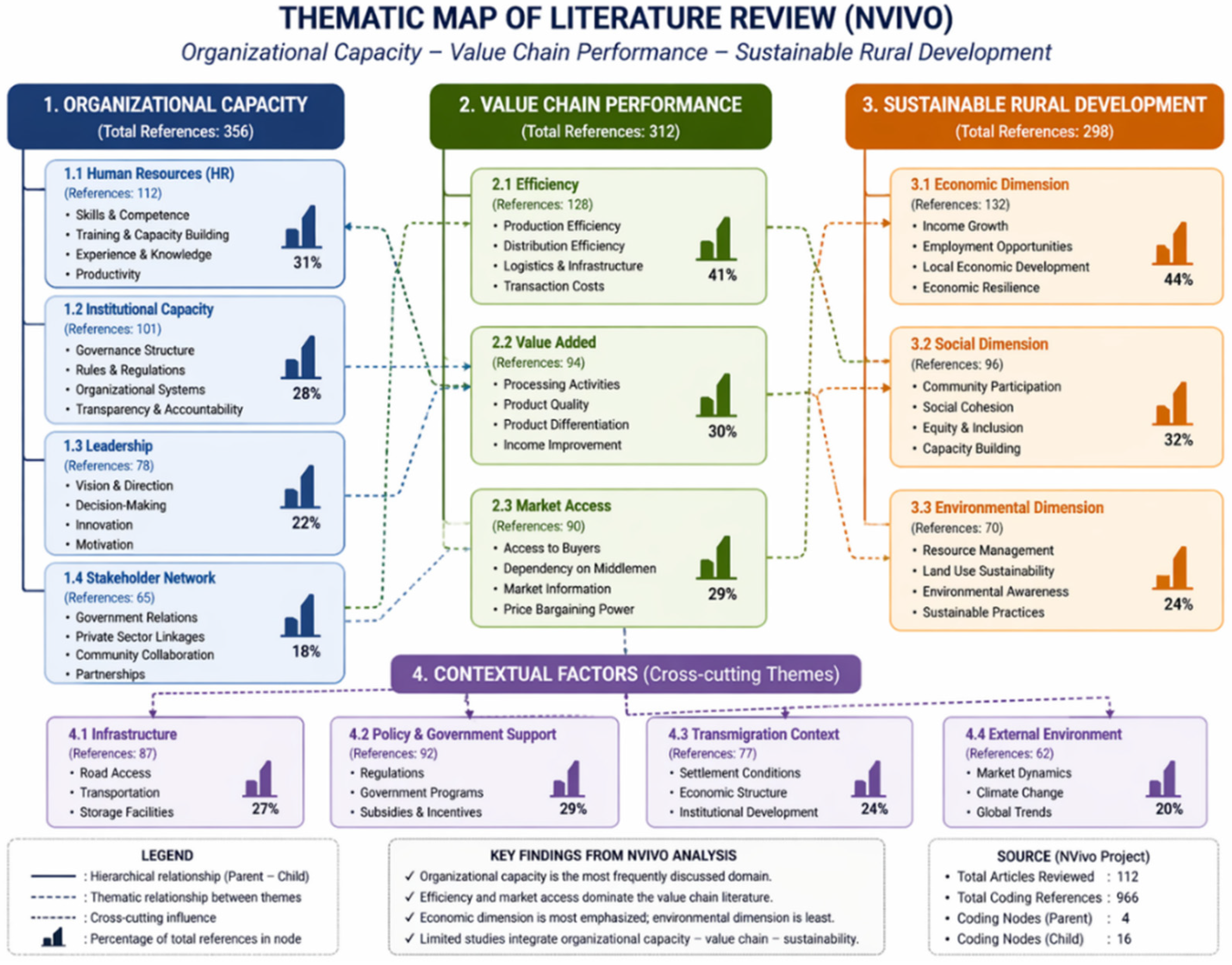
To further synthesize the literature, a thematic analysis was conducted using NVivo, and the results are presented in
Figure 1.
As shown in
Figure 1, organizational capacity, value chain performance, and sustainable rural development emerge as the dominant themes. The interaction between these themes remains limited, indicating a research gap addressed in this study.
Based on the reviewed literature, a significant gap remains in understanding how organizational capacity interacts with agribusiness value chain structures and influences sustainable rural development, particularly in transmigration areas characterized by evolving institutional systems and emerging rural economies. Existing studies tend to examine organizational capacity, rural governance, and value chain performance separately, with limited integration among these perspectives. This study positions organizational capacity as a strategic institutional mechanism that shapes value chain effectiveness and sustainability outcomes within rural transformation processes. This conceptual positioning provides the basis for developing the analytical framework and research design employed in this study.
3. Methods
3.1. Conceptual Framework and Research Design
This study adopts a qualitative case study approach to examine the role of organizational capacity in shaping agribusiness value chain performance and its implications for sustainable rural development in transmigration areas. The case study approach is considered appropriate because it enables an in-depth understanding of complex socio-economic dynamics within rural contexts characterized by evolving institutional structures and emerging agribusiness systems [
24,
25].
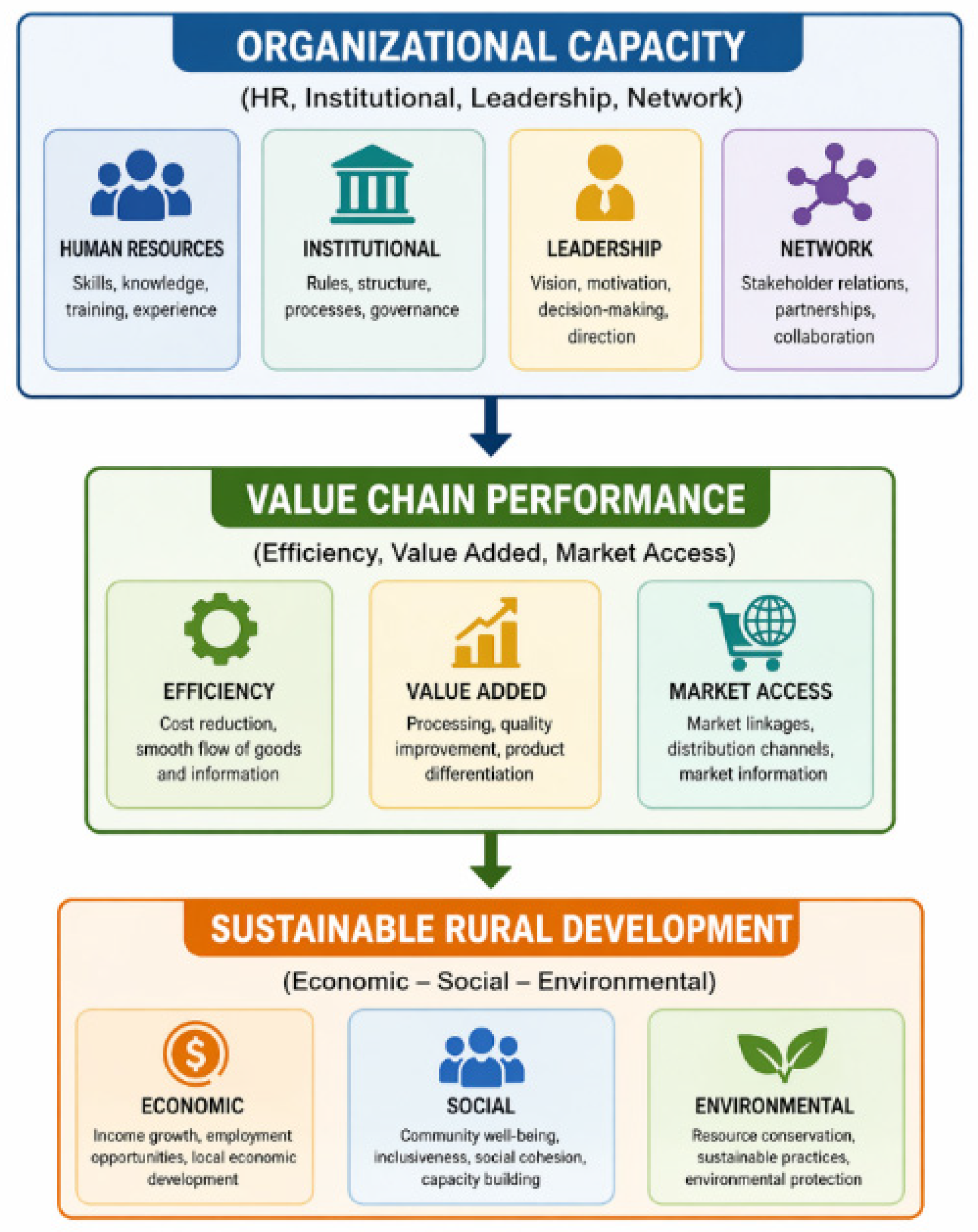
The study is guided by an integrated conceptual framework linking organizational capacity, value chain performance, and sustainable rural development (
Figure 2). Within this framework, organizational capacity is conceptualized as a multidimensional construct consisting of human resources, institutional arrangements, leadership, and stakeholder networks. These dimensions influence the ability of local institutions to coordinate actors, manage resources, and facilitate collective economic activities.
Value chain performance is positioned as a mediating mechanism reflecting efficiency, market integration, and value-added creation within agribusiness systems. Strong organizational capacity is assumed to improve value chain coordination, reduce transaction costs, and enhance market access, thereby contributing to more effective rural economic systems. Conversely, weak organizational capacity may lead to fragmented coordination, dependency on intermediaries, and limited value-added creation.
Sustainable rural development is conceptualized as the ultimate outcome of the framework, integrating economic, social, and environmental dimensions. Improved value chain performance is expected to contribute to increased rural income, stronger social cohesion, and more sustainable resource management practices.
The research employs a multi-stage analytical approach consisting of descriptive, diagnostic, predictive, and prescriptive phases. The descriptive phase identifies existing organizational capacity and agribusiness value chain structures. The diagnostic phase analyzes institutional constraints, coordination problems, and inefficiencies affecting local economic systems. The predictive phase explores potential development trajectories resulting from strengthened organizational capacity and improved value chain integration. Finally, the prescriptive phase formulates strategic recommendations aimed at enhancing institutional effectiveness and supporting sustainable rural transformation.
Figure 2 illustrates the analytical relationship between organizational capacity, value chain performance, and sustainable rural development used as the basis for this study.
3.2. Study Area
The study was conducted in the Sebamban Transmigration Area, located in Tanah Bumbu Regency, South Kalimantan, Indonesia. This area represents a typical transmigration development setting characterized by newly established settlements, evolving institutional structures, and agribusiness-based local economies. As a designated transmigration zone, the area has been developed as part of a broader regional development strategy aimed at promoting population redistribution and stimulating economic growth in less densely populated regions.
The Sebamban area consists of multiple transmigration villages that are spatially distributed and interconnected through local economic activities. These villages function as integrated socio-economic units where agricultural production serves as the primary livelihood. The economic structure of the area is predominantly based on agribusiness activities, including plantation crops such as oil palm and rubber, as well as horticultural production. These sectors play a central role in supporting household income, employment, and local economic development.
The area exhibits characteristics commonly found in emerging rural economies, such as limited infrastructure, developing market systems, and evolving institutional capacity. The multi-village structure also creates variations in resource access, production capacity, and market connectivity across different locations. These conditions make the Sebamban Transmigration Area a relevant case for examining the interaction between organizational capacity, value chain performance, and sustainable rural development.
3.3. Data Collection
Data were collected using multiple qualitative techniques to ensure depth of understanding and triangulation of findings. The study employed in-depth interviews, field observations, focus group discussions (FGDs), and secondary data analysis as primary data sources. First, semi-structured interviews were conducted with key stakeholders involved in the agribusiness value chain, including farmers, cooperative members, and local intermediaries. These interviews aimed to capture participants’ experiences, perceptions, and insights regarding organizational capacity, production processes, market access, and value chain dynamics. The semi-structured format allowed flexibility in exploring emerging themes while maintaining consistency across interviews. Second, field observations were carried out to obtain direct insights into on-site conditions, including agricultural practices, infrastructure availability, and interactions among value chain actors. Observations enabled the researcher to validate interview findings and gain a contextual understanding of operational realities in the study area. Third, focus group discussions (FGDs) were conducted involving multiple stakeholders, including community representatives, local institutions, and relevant actors in the agribusiness system. The FGDs facilitated collective reflection and discussion on key challenges, opportunities, and potential strategies for strengthening organizational capacity and improving value chain performance. This approach also allowed for the identification of shared perspectives as well as differing viewpoints among stakeholders.
Secondary data were collected from relevant government sources and institutional documents to complement primary data. These data provided contextual information on regional development, agricultural production, and policy frameworks, supporting a more comprehensive analysis. To enhance the reliability and validity of the findings, data triangulation was applied by cross-verifying information obtained from different sources and methods. This approach ensured that the analysis captured a holistic and consistent representation of the research context.
3.4. Informants
The study involved 28 key informants purposively selected to represent the main actors within the agribusiness system and rural institutional structure in the transmigration area. The informants consisted of farmers, cooperative members, local intermediaries, village-owned enterprise (BUMDes) representatives, village government officials, agricultural extension officers, and representatives from relevant government agencies. The selection was based on their roles, experiences, and direct involvement in agribusiness activities, value chain processes, and institutional development.
The informants were categorized into four main groups. First, farmers were included as primary actors in agricultural production, providing insights into farming practices, market access, and value chain challenges. Second, representatives from local economic institutions, such as BUMDes and farmer groups (Gapoktan), were selected to reflect organizational and institutional dimensions of rural economic activities, including governance structures, collective action, and institutional capacity. Third, village government officials were involved to capture perspectives related to local governance, policy implementation, and village development planning. Fourth, representatives from relevant government agencies were included to provide broader perspectives regarding agricultural development, market systems, and regional planning.
The inclusion of multiple informant groups enabled a comprehensive understanding of the research problem from different perspectives and supported data triangulation, thereby strengthening the credibility and trustworthiness of the findings.
3.5. Data Analysis
The data were analyzed using a thematic analysis approach supported by systematic coding procedures and NVivo qualitative data analysis software. Thematic analysis was employed to identify, analyze, and interpret patterns and themes emerging from qualitative data collected through interviews, field observations, and focus group discussions (FGDs) [
26].
The analysis process began with data familiarization, in which all interview transcripts, field notes, and FGD records were carefully reviewed to obtain a comprehensive understanding of the research context. This stage was followed by an open coding process, where meaningful units of information were identified and categorized into initial codes. Subsequently, axial coding was conducted to connect related categories and organize them into broader analytical themes associated with organizational capacity, value chain performance, institutional coordination, and sustainable rural development.
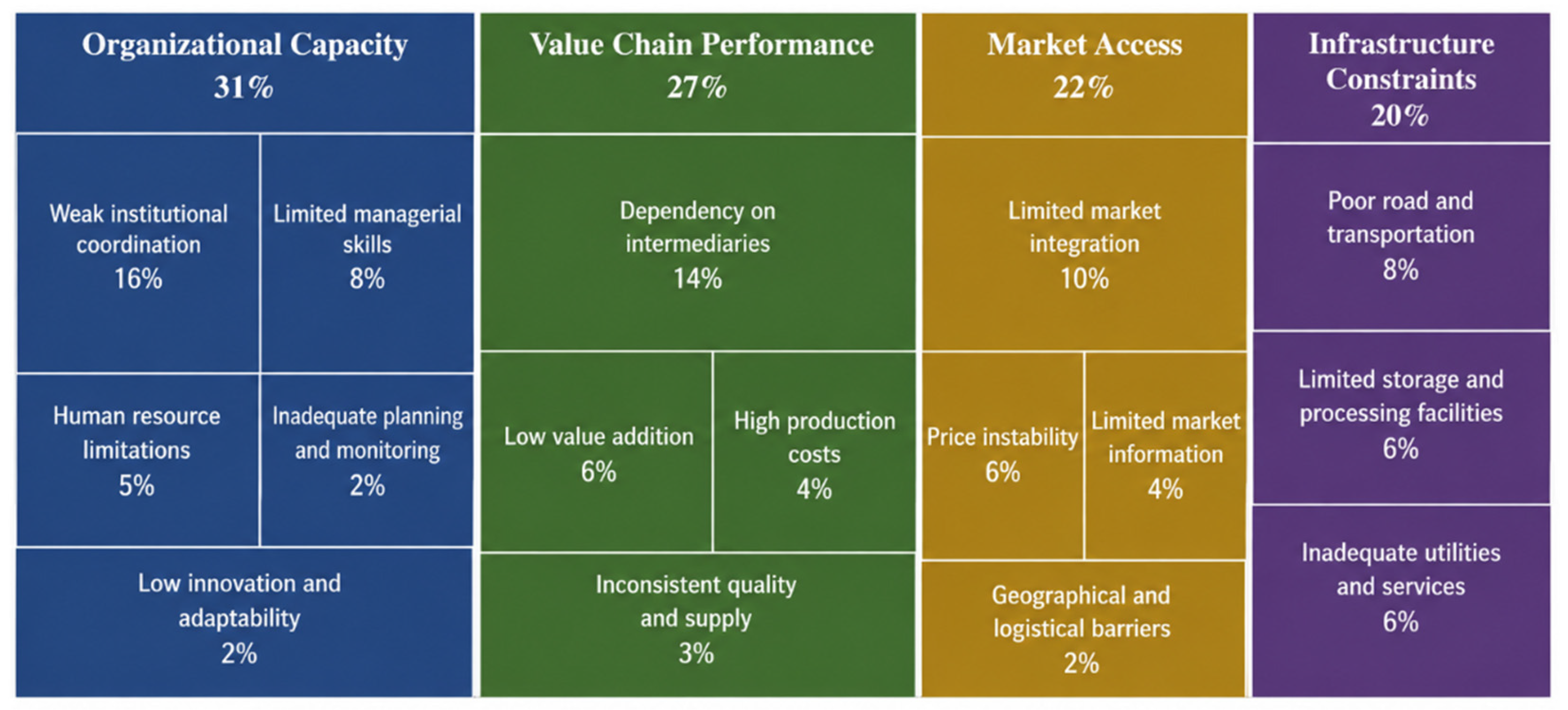
The NVivo-assisted qualitative analysis generated 52 initial codes, which were subsequently categorized into 14 sub-themes and 4 major analytical themes. Coding frequency analysis was conducted to identify dominant issues and recurring patterns emerging across interviews, observations, and FGDs. The coding results (
Table 1) indicate that weak institutional coordination accounted for 31% of total coded references, followed by dependency on intermediaries (27%), limited market access (22%), and inadequate infrastructure support (20%). These findings demonstrate that institutional and market-related constraints remain dominant barriers affecting value chain efficiency and sustainable rural development in transmigration areas.
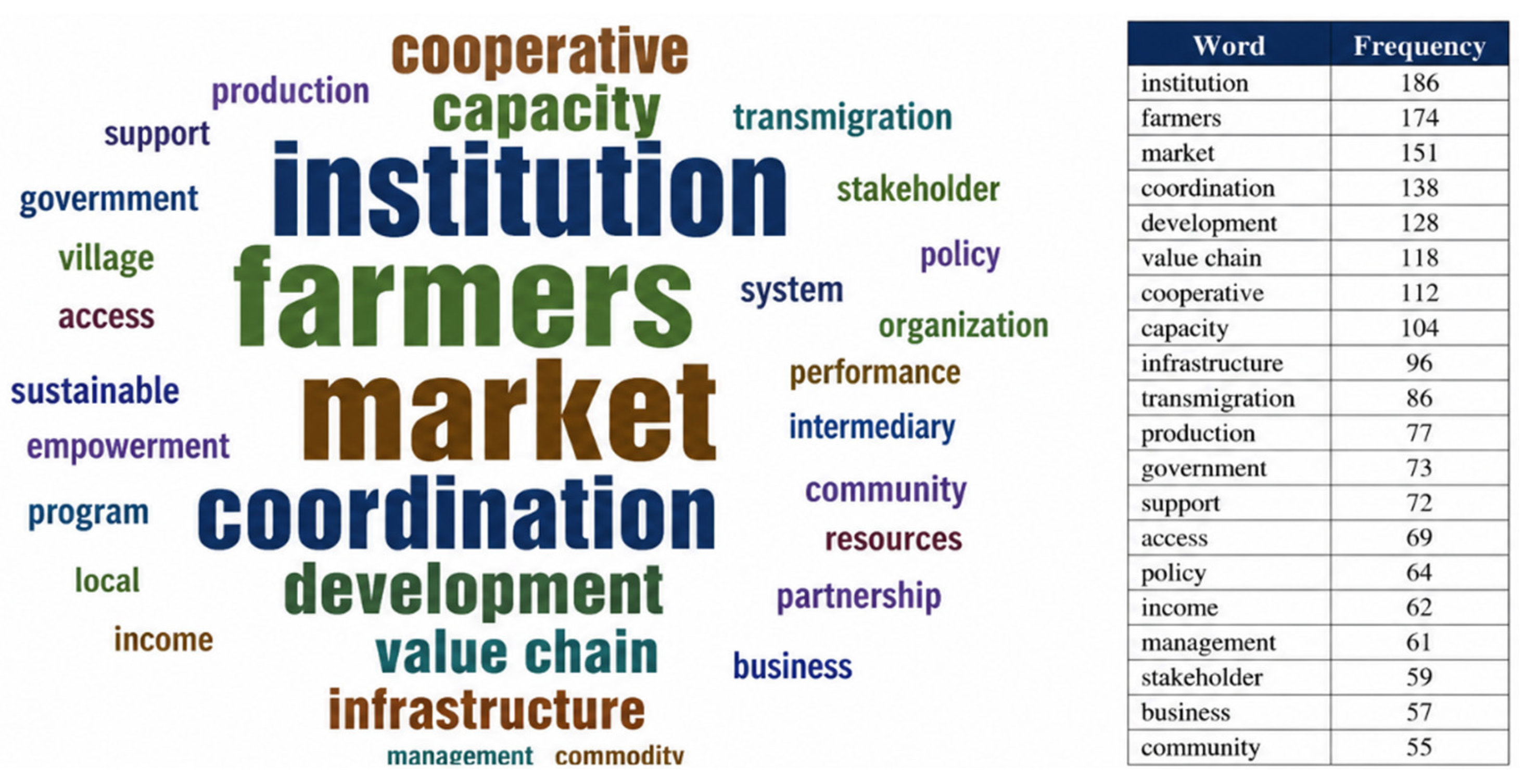
Figure 3 illustrates the NVivo word frequency analysis, highlighting dominant concepts emerging from interviews and focus group discussions. Terms such as “institution”, “market”, “farmers”, “coordination”, and “infrastructure” appeared most frequently, indicating the centrality of organizational and market-related challenges in sustainable rural development within transmigration areas.
Figure 4 presents the NVivo tree map analysis illustrating the proportional distribution of major themes and sub-themes identified during the coding process. The visualization highlights that organizational capacity and value chain performance emerged as the most dominant analytical themes influencing sustainable rural development outcomes.
To enhance analytical rigor, NVivo software was utilized to facilitate systematic data organization, classification, retrieval, and comparison across informant groups. The software also enabled the development of thematic relationships, coding matrices, and visual representations such as word frequency analysis and tree map analysis to support interpretative consistency and analytical transparency.
Furthermore, triangulation was applied to ensure the validity and reliability of the findings. Cross-validation was conducted across multiple data sources, including interviews, field observations, FGDs, and secondary documents, as well as across different stakeholder groups. This triangulation process enabled the confirmation of consistent findings and the identification of differing perspectives, thereby strengthening the credibility and trustworthiness of the analysis [
27,
28].
The combination of thematic analysis, systematic coding, NVivo-assisted analysis, and triangulation provided a robust analytical framework for examining the interaction between organizational capacity, value chain performance, and sustainable rural development.
4. Results
The findings presented in this section are derived from interviews, field observations, and focus group discussions involving 28 informants representing farmers, local institutions, village governments, and relevant stakeholders within the agribusiness system.
4.1. Existing Organizational Capacity
The findings indicate that local institutional structures are present and actively operating, particularly through village-owned enterprises (BUMDes), cooperatives, and farmer groups. These institutions play a role in supporting agricultural production and facilitating collective activities at the community level. Their effectiveness remains constrained by limited organizational capacity, particularly in managerial and operational aspects. Interview results reveal that many local institutions lack adequate management skills and strategic direction. As one informant stated: “The organization exists, but it does not run optimally. We still do not have proper management, especially in planning and marketing” (Farmer group member).
This limitation is reflected in weak coordination and the absence of structured decision-making processes. Another informant emphasized: “Decisions are usually made informally, depending on immediate needs, not based on long-term planning.” (Cooperative representative). A key issue identified is the limited role of local institutions in aggregating agricultural commodities. Although farmer groups and cooperatives are expected to function as aggregators, their involvement in consolidating production and strengthening market access remains minimal. As a result, farmers continue to depend on intermediaries: “We sell our products to collectors because we do not have direct access to factories or larger markets” (Farmer).
This dependency weakens farmers’ bargaining power and reduces the potential for value-added creation at the local level. Furthermore, the lack of integration among local institutions contributes to fragmented operations. As noted by a local stakeholder: “There is no strong coordination between BUMDes, cooperatives, and farmer groups. Each works independently”.
These findings suggest that while institutional structures are in place, their capacity to function as effective economic actors remains limited. Strengthening managerial competencies, improving organizational coordination, and enhancing the role of local institutions in value chain aggregation are critical to improving overall performance.
4.2. Value Chain Performance
The findings indicate that the agribusiness value chain in the study area follows a relatively simple structure, consisting of farmers, intermediaries (collectors), processing industries. While this structure enables the flow of agricultural products from production to market, it also reflects a limited level of integration and coordination among actors.
One of the most prominent issues identified is the high dependency on intermediaries, particularly collectors, who act as the primary link between farmers and processing industries. Interview results reveal that farmers rely heavily on these intermediaries due to limited access to direct markets. As one farmer explained: “We depend on collectors because they are the only ones who come directly to the village and buy our products”. This dependency significantly weakens farmers’ bargaining power and reduces their ability to negotiate better prices. As noted by another informant: “Prices are usually determined by the collectors, so we have very little control over how much we earn”.
High logistics costs represent another critical constraint affecting value chain efficiency. Limited infrastructure, such as inadequate road conditions and transportation facilities, increases the cost of moving goods from farms to markets. A stakeholder highlighted: “Transportation costs are quite high, especially during the rainy season when road access becomes more difficult”. Another issue identified is the low quality of agricultural products, which limits their competitiveness in higher-value markets. This problem is often linked to inconsistent production practices, lack of quality control, and limited post-harvest handling capacity. As one cooperative member stated: “Product quality is still inconsistent because farmers use different methods, and there is no standardization”.
The combination of these challenges—dependency on intermediaries, high logistics costs, and low product quality—results in an inefficient value chain system. This condition not only reduces economic returns at the local level but also limits opportunities for value-added development and market expansion.
The findings suggest that improving value chain performance requires strengthening coordination among actors, enhancing infrastructure, and promoting quality standardization, which are closely linked to the capacity of local organizations.
4.3. Relationship Between Capacity and Value Chain
The findings reveal a strong and consistent relationship between organizational capacity and value chain performance, where weak institutional capacity directly constrains the effectiveness of agribusiness systems. The analysis identifies three key consequences, low bargaining power, low efficiency, and limited value-added creation, all of which are closely linked to limitations in organizational capacity.
First, weak organizational capacity contributes to low bargaining power among farmers. The absence of strong collective institutions limits farmers’ ability to negotiate prices and access more profitable markets. As one informant stated: “We cannot negotiate prices because we sell individually. There is no organization that represents us in the market”. Another farmer added: “We follow the price set by the collectors because we have no alternative buyers”. This condition reflects a structural imbalance in market relations, where farmers are positioned as price takers rather than active market participants.
Second, limited organizational capacity leads to low efficiency in value chain operations. The lack of coordination among local institutions results in fragmented production, distribution, and logistics processes. A stakeholder explained: “There is no coordination between farmers and institutions, so distribution is handled individually, which increases costs”. Another informant noted: “Sometimes we sell at different times and prices because there is no collective system to manage production and sales”. These inefficiencies increase transaction costs and reduce overall competitiveness in the market.
Third, weak organizational capacity significantly limits the ability to generate value-added at the local level. Without institutional support for processing, quality control, and market linkage, farmers are unable to move beyond primary production. As one cooperative member stated: “We only sell raw products because we do not have facilities or support for processing”. Similarly, another informant emphasized: “There is no standardization, so our products cannot enter higher-value markets”. This condition restricts income potential and limits participation in higher-value segments of the value chain.
The findings demonstrate that organizational capacity functions as a structural determinant of value chain performance. Weak institutional coordination emerged as one of the most dominant issues identified during the NVivo coding process, accounting for 31% of total coded references. Informants frequently emphasized the lack of synchronization between local institutions, limited inter-agency collaboration, and weak coordination mechanisms affecting agribusiness development and market integration. Approximately 68% of informants highlighted market dependency and weak bargaining power as major barriers affecting local economic sustainability. Meanwhile, 57% emphasized infrastructure limitations, particularly transportation access and logistics support, as significant constraints within the agribusiness value chain. These findings indicate that institutional and market-related constraints remain dominant barriers affecting value chain efficiency and sustainable rural development in transmigration areas. Weak capacity leads to systemic inefficiencies, while strengthening institutional capacity can improve bargaining power, enhance efficiency, and increase value-added creation, ultimately supporting sustainable rural development.
4.4. Implications for Sustainability
The findings indicate that limitations in organizational capacity and value chain performance have significant implications for sustainable rural development, particularly across economic, social, and environmental dimensions.
From an economic perspective, weak organizational capacity and inefficient value chain structures limit income generation and local economic upgrading. The heavy dependence on intermediaries reduces farmers’ ability to capture higher value. As one farmer explained: “Even when prices increase in the market, we do not feel the impact because the collectors determine the price”. Similarly, another informant noted: “We cannot sell directly to factories, so our income depends on the price set by middlemen”. This condition reflects a structural constraint that hinders inclusive economic growth and reduces economic resilience.
From a social perspective, limited institutional coordination weakens collective action and community empowerment. The absence of strong collaboration among local organizations reduces trust and participation. As highlighted by a stakeholder: “There is still a lack of cooperation between institutions, so programs are often implemented separately”. Another informant added: “If we work together through a strong organization, we could improve our situation, but coordination is still weak”. This fragmentation limits the potential for inclusive development and equitable distribution of benefits.
From an environmental perspective, the lack of organizational capacity affects the adoption of sustainable agricultural practices. Farmers often rely on traditional methods without standardized guidance or institutional support. As one informant stated: “We follow what we know from experience, but there is little guidance on how to manage resources sustainably”. Another stakeholder emphasized: “There is no structured support for improving farming practices, especially related to environmental sustainability”. This situation increases the risk of inefficient resource use and potential environmental degradation.
The findings suggest that strengthening organizational capacity and improving value chain performance are critical for achieving sustainable rural development. Enhancing coordination, promoting value-added activities, and improving institutional support systems can contribute to more balanced economic, social, and environmental outcomes.
5. Discussion
5.1. Theoretical Implications
The findings of this study provide important theoretical contributions by reinforcing and extending the role of organizational capacity as a key determinant of local economic performance, particularly within agribusiness-based rural systems. The results confirm that organizational capacity is not merely an internal institutional attribute, but a critical factor that directly shapes the effectiveness of value chain operations and economic outcomes at the local level.
Consistent with existing literature, this study supports the argument that strong organizational capacity—reflected in effective governance, leadership, and stakeholder coordination—enhances the ability of local actors to organize production, access markets, and improve economic performance [
11,
13]. Similar findings have been reported by previous studies emphasizing that institutional capacity plays a central role in strengthening rural economic resilience, market integration, and collective action within agribusiness systems.
This study extends previous research by demonstrating that in transmigration areas, organizational capacity functions not only as an institutional resource but also as a structural mechanism shaping value chain efficiency and sustainable rural development outcomes simultaneously. Weak organizational capacity was found to contribute to fragmented coordination, low bargaining power, dependency on intermediaries, and limited value-added creation within local agribusiness systems.
Unlike previous studies that primarily focus on governance quality or market efficiency separately, this study integrates organizational capacity, value chain performance, and sustainable rural development into a unified analytical framework. This integrative perspective contributes theoretically by providing a broader understanding of how institutional strengthening influences not only economic performance, but also social cohesion, governance effectiveness, and long-term sustainability within emerging rural economies.
The findings further reinforce the theoretical proposition that sustainable rural development cannot be achieved solely through increased production or market expansion, but requires strong institutional capacity capable of coordinating actors, managing resources, and facilitating collective economic action within rural transformation processes.
5.2. Comparison with Previous Studies
The findings of this study are broadly consistent with previous research on rural governance, which emphasizes the importance of local institutional capacity, coordination, and participatory decision-making in shaping rural development outcomes. Previous studies have shown that weak governance structures often lead to fragmented implementation, low community participation, and limited institutional effectiveness in rural areas [
13,
14]. The present study confirms these arguments by demonstrating that limited organizational capacity constrains coordination among local institutions and reduces the ability of rural actors to collectively manage economic activities. In this context, rural governance should not be understood solely as an administrative structure, but also as a reflection of organizational capability, institutional coherence, and collaborative capacity.
The findings are also consistent with previous studies on agribusiness value chains, which emphasize that efficiency, market access, and value-added creation are strongly influenced by institutional arrangements surrounding producers [
12,
15]. Existing literature suggests that weak coordination and heavy dependence on intermediaries often reduce farmers’ bargaining power and limit local value capture. This study supports those findings by revealing that local producers remain dependent on collectors, face high logistics costs, and possess limited capacity to improve product quality or participate in downstream processing activities.
This study offers an important extension to previous research by bridging rural governance and agribusiness value chain perspectives within a single analytical framework. While rural governance studies generally focus on public administration, participation, and institutional arrangements, value chain studies tend to emphasize market structure, efficiency, and economic integration. This study demonstrates that organizational capacity functions as a connecting mechanism linking governance quality with value chain performance and sustainable rural development outcomes.
Compared with previous studies conducted in more established rural economies, this research highlights the distinctive challenges of transmigration-based rural development, where institutional structures remain evolving and local economies continue to depend heavily on primary commodities. This context provides additional empirical insight into how institutional limitations influence both governance quality and agribusiness value chain effectiveness within transitional rural settings.
The findings contribute to the literature by providing a more integrated understanding of the relationship between organizational capacity, value chain performance, and sustainable rural development. The study further suggests that strengthening rural institutions is not only essential for improving governance effectiveness, but also for enhancing economic resilience, market integration, and long-term sustainability in emerging rural regions.
5.3. Policy Implications
The findings of this study highlight several important policy implications for strengthening organizational capacity and improving value chain performance in rural areas.
First, there is a need to strengthen the role of village-owned enterprises (BUMDes) as aggregators within the agribusiness value chain. BUMDes can function as key institutional actors in consolidating production, improving quality standardization, and facilitating market access. By enhancing their operational and managerial capacity, BUMDes can reduce farmers’ dependence on intermediaries and improve bargaining power. Policies should focus on institutional strengthening, governance improvement, and the provision of financial and technical support to enable BUMDes to operate effectively as collective economic actors.
Second, improving human resource capacity is essential for enhancing the overall performance of local organizations. Training programs, technical assistance, and continuous capacity-building initiatives are needed to develop managerial skills, financial literacy, and strategic planning capabilities among farmers, cooperatives, and local institutions. Strengthening human capital will enable local actors to adopt more efficient production practices, improve product quality, and respond more effectively to market demands.
Third, promoting partnerships with the private sector and agro-industries is crucial to improve market integration and value-added opportunities. Strategic collaboration between local institutions and industry actors can facilitate access to broader markets, improve supply chain coordination, and encourage downstream processing activities. Policies should support the development of inclusive business models that connect smallholders with larger market systems, while ensuring fair benefit distribution.
These policy directions emphasize the importance of an integrated approach that combines institutional strengthening, capacity building, and market linkage development. Such an approach is essential to reduce structural inefficiencies, enhance local economic performance, and support sustainable rural development.
5.4. Capacity Strengthening Model
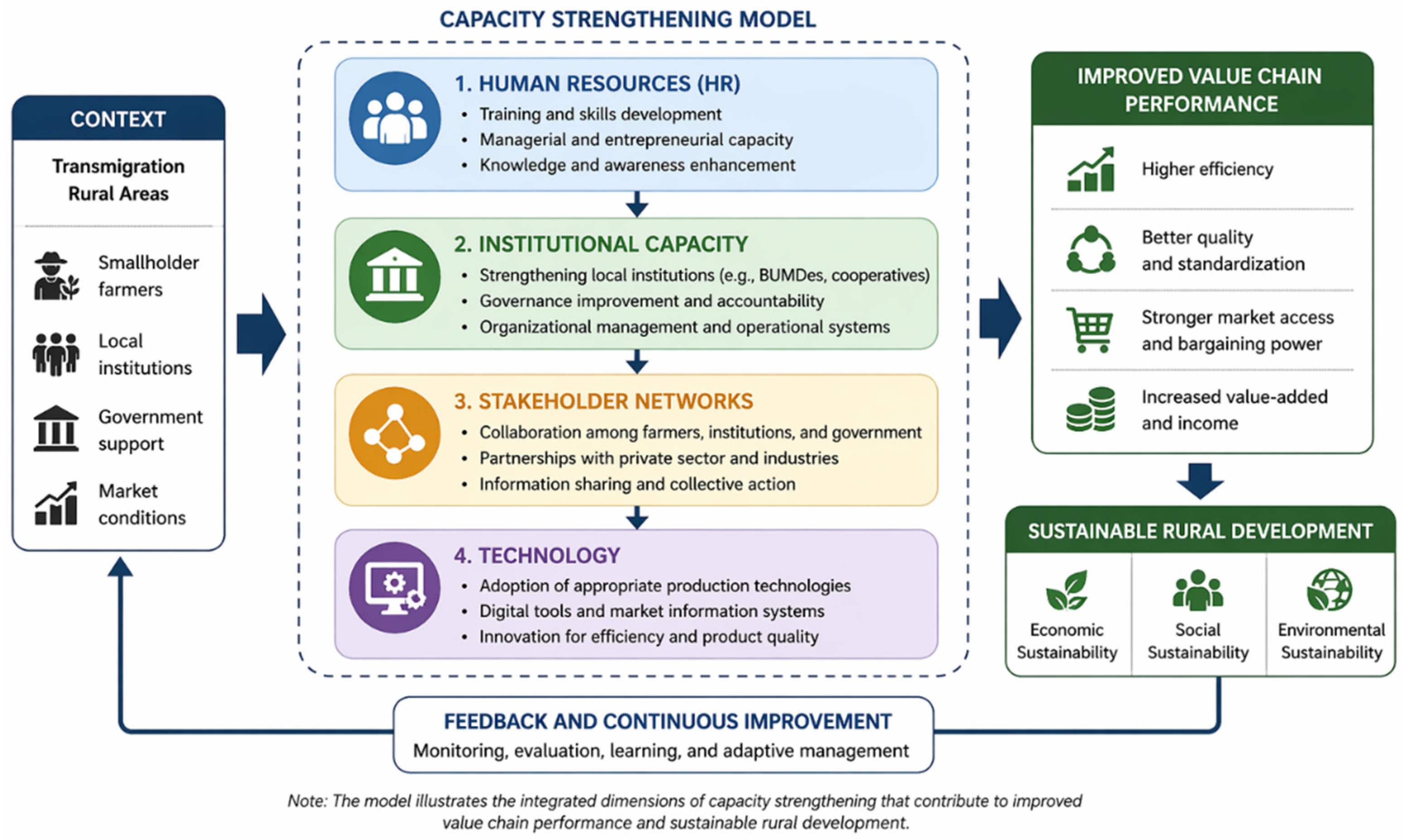
Based on the findings, this study proposes a capacity strengthening model that emphasizes four key dimensions: human resources, institutional capacity, stakeholder networks, and technology (
Figure 5). These components are interconnected and collectively determine the effectiveness of local organizations in improving value chain performance and achieving sustainable rural development.
First, human resource capacity is fundamental in enhancing managerial skills, technical knowledge, and strategic decision-making. Strengthening human capital enables local actors to improve productivity, adopt innovations, and respond to market demands more effectively. Training and continuous capacity-building programs are essential. Second, institutional capacity plays a critical role in ensuring effective governance, coordination, and organizational sustainability. Strengthening institutional structures—such as BUMDes, cooperatives, and farmer groups—can enhance collective action, improve aggregation functions, and support better market integration. Third, stakeholder networks are crucial in facilitating collaboration among actors, including government agencies, private sector partners, and local communities. Strong networks enable information exchange, resource sharing, and coordinated action across the value chain, thereby improving efficiency and reducing dependency on intermediaries. Fourth, technology adoption serves as an enabling factor that supports all other dimensions. The use of digital tools, market information systems, and improved production technologies can enhance efficiency, product quality, and access to markets. Technology also plays a key role in strengthening transparency and coordination within the value chain.
The proposed model highlights that capacity strengthening should be approached holistically, integrating human, institutional, relational, and technological dimensions. This integrated approach is essential for improving value chain performance and achieving sustainable rural development outcomes.
5.5. Theoretical Contribution
This study contributes theoretically by extending the organizational capacity perspective within the context of transmigration-based rural development, which remains relatively underexplored in existing literature. Unlike previous studies that primarily examine organizational capacity, rural governance, or agribusiness value chains separately, this research integrates these dimensions into a unified analytical framework linking organizational capacity, value chain performance, and sustainable rural development.
The findings demonstrate that organizational capacity functions not only as an internal institutional resource, but also as a structural mechanism shaping market integration, collective action, value-added creation, and sustainability outcomes within rural economies. This study therefore expands existing rural development literature by emphasizing the interconnected relationship between governance quality, institutional coordination, and agribusiness value chain effectiveness in transitional rural settings.
Furthermore, the study strengthens the theoretical proposition that sustainable rural transformation requires not only economic expansion, but also institutional strengthening capable of coordinating actors, facilitating collaboration, and supporting long-term sustainability.
5.6. Practical Implication
The findings of this study provide several practical implications for policymakers, local governments, rural institutions, and development agencies involved in transmigration and rural development programs. The study highlights the importance of strengthening local institutional capacity, improving inter-agency coordination, and enhancing stakeholder collaboration to improve agribusiness value chain performance and sustainable rural development outcomes.
Practically, this study proposes a capacity strengthening model emphasizing four strategic dimensions: human resource development, institutional strengthening, stakeholder network expansion, and technology adoption. Strengthening village-owned enterprises (BUMDes), cooperatives, and farmer groups is essential to reduce dependency on intermediaries, improve market access, and enhance local value-added creation.
The findings also suggest that integrated rural development policies should not focus solely on infrastructure or production expansion, but must also prioritize institutional governance, collaborative mechanisms, and long-term organizational sustainability. These insights may serve as strategic references for designing more inclusive, institution-based, and sustainability-oriented rural transformation policies in transmigration areas.
6. Conclusions and Recommendations
This study concludes that organizational capacity is a critical determinant of agribusiness value chain performance and sustainable rural development in transmigration areas. The findings demonstrate that limited organizational capacity in terms of governance, coordination, leadership, and institutional effectiveness constrains the ability of local actors to optimize agribusiness systems and strengthen local economic resilience. Weak institutional coordination, dependency on intermediaries, limited value-added activities, and high transaction costs were identified as major barriers reducing market integration and sustainability outcomes. Conversely, stronger organizational capacity improves coordination, enhances value chain efficiency, and supports more sustainable economic, social, and environmental development outcomes.
This study contributes novelty by integrating organizational capacity, agribusiness value chain performance, and sustainable rural development into a unified analytical framework within the context of transmigration-based rural development, which remains relatively underexplored in the previous literature. The findings extend existing studies by demonstrating that organizational capacity functions not only as an institutional resource, but also as a structural mechanism shaping governance effectiveness, market integration, and sustainability outcomes simultaneously.
From a policy perspective, the findings emphasize the importance of strengthening local institutions such as BUMDes, cooperatives, and farmer groups through continuous capacity-building programs, governance improvement, stakeholder collaboration, and technology adoption. Integrated institutional strengthening is essential to reduce structural inefficiencies, improve market access, and support long-term rural economic sustainability.
Based on the findings, several strategic recommendations can be proposed. First, local governments should prioritize institutional strengthening programs aimed at improving managerial capacity, leadership, and organizational governance within village-level institutions. Second, stronger collaboration among government agencies, local institutions, private sector actors, and rural communities is necessary to improve coordination and reduce fragmentation within agribusiness value chains. Third, digitalization and market information systems should be expanded to improve efficiency, transparency, and farmers’ bargaining power while reducing dependency on intermediaries. Fourth, data-driven policy interventions and integrated rural development planning are required to support more effective, inclusive, and sustainability-oriented rural transformation processes.
Nevertheless, this study has several limitations. The research focuses on a specific transmigration area and applies a qualitative case study approach, which may limit the generalizability of the findings to other rural contexts. In addition, the study primarily emphasizes institutional and organizational dimensions, while broader political, cultural, and macroeconomic factors remain beyond the scope of analysis.
Future research is recommended to conduct comparative studies across multiple transmigration regions, apply mixed-method or quantitative approaches, and explore the integration of digital transformation, collaborative governance, geospatial analysis (GIS), and big data approaches to provide more comprehensive insights into rural development dynamics and agribusiness value chain sustainability.