Article

Weak Node Identification for Small-Signal Stability in Renewable Energy-Dominated Power System Based on Residue-Centered Participation Analysis

School of Electrical Engineering, Shandong University, 17923 Jingshi Road, Lixia District, Jinan 250061, China
*
Author to whom correspondence should be addressed.
Sustainability 2026, 18(11), 5507; https://doi.org/10.3390/su18115507 (registering DOI)
Submission received: 22 April 2026 / Revised: 26 May 2026 / Accepted: 28 May 2026 / Published: 1 June 2026

Abstract

With high renewable penetration, power system oscillations become more complex. Since internal control details of renewable stations are often inaccessible, classic participation analysis relying on detailed models is difficult to apply, making weak node identification urgently needed. To address this problem, this paper proposes a residue-centered impedance-based method for small-signal stability in renewable energy-dominated power systems. First, an equivalent state-space model is built from station impedance models, linking the black-box impedance and white-box state-space participation analysis. Then, the physical essence of weak node identification is analyzed, and a residue-centered participation factor is introduced as the indicator. Subsequently, the effect of the station impedances at weak nodes on system stability is quantified. Finally, the method is validated on a four-station testing system and a real-life renewable energy-dominated power system. The rank correlation between the proposed method and the traditional state-space method is close to 1, demonstrating its effectiveness for system-level weak node identification. The proposed method provides engineering guidance for parameter tuning and damping control in practical power systems, which can help improve renewable energy accommodation and support low-carbon, secure, and sustainable power system operation.

1. Introduction

With the large-scale integration of renewable energy, the dynamics of power electronics-dominated power systems have been significantly impacted, and oscillations have become more pronounced [1,2]. To reduce the impact of oscillations on the stability of system, it is necessary to study oscillation characteristics [3]. In particular, the localization of oscillation sources is of great significance for oscillation control and system stability enhancement [4]. This is not only a technical necessity but also a key enabler for the sustainable energy transition [5,6]. Therefore, identifying weak nodes that exacerbate poorly damped oscillations is urgently needed to support both system stability and sustainability [7,8].
Currently, small-signal stability analysis and weak node identification in renewable energy-dominated power systems rely mainly on two approaches: modal analysis based on state-space model and frequency-domain modal analysis based on impedance model [9,10].
Modal analysis is a classic and fundamental tool for small-signal stability analysis in power systems [11,12]. Constructing the state-space model of the system and calculating its eigenvalues, the real part of each complex eigenvalue represents the damping of the corresponding oscillation mode, while the imaginary part represents the frequency. Through modal analysis, information such as the left and right eigenvectors and participation factors (PFs) associated with oscillation modes can be obtained [11,13]. Correspondingly, the weak nodes most closely associated with poorly damped oscillation modes can be definitively identified. However, the state-space model is essentially a white-box model, which requires detailed structures and parameters of renewable energy stations. Due to commercially sensitive information, obtaining such details for modeling is often unattainable [14].
Frequency-domain modal analysis uses impedance models to identify weak nodes associated with poorly damped oscillation modes. Impedance models are derived from their terminal characteristics [15,16]. Unlike state-space model, the impedance model can be a black-box model that requires no internal details, relying solely on terminal voltage and current characteristics [17,18]. This black-box nature has motivated many recent studies on impedance measurement and black-box modeling [19,20]. Consequently, the impedance model has gained extensive application in the stability analysis of renewable energy-dominated power systems [21]. However, the impedance model cannot directly provide information such as specific oscillation frequencies, damping ratios, or PFs [22].
To overcome this limitation, some researchers have proposed a frequency-domain modal analysis method based on the network admittance matrix [23,24,25,26,27]. By eigenvalue decomposition of the admittance matrix, a PF defined by the left and right eigenvectors of the admittance matrix is proposed to identify the most participating nodes, which is called resonance/frequency-domain modal analysis. This method has opened up new avenues for impedance-based participation analysis. Nevertheless, the relationship between impedance PF and state-space PF remains unclear. To fill this gap, a grey-box participation analysis method has been developed based on a whole-system impedance model [28,29,30]. The sensitivity of eigenvalues to equipment impedance is analyzed, and the impedance PF and the parameter PF are proposed to identify weak nodes in the system and weak links within the equipment. The proposed eigenvalue sensitivity is then compared with that in classic state-space participation analysis. However, this impedance PF focuses on the equipment impedance and therefore does not provide a physical explanation of how system node characteristics relate to system stability at the system level. Specifically, grey-box impedance PF is defined directly on the full residue matrix. It does not offer a direct physical interpretation in terms of observability and controllability of node voltages/currents. In addition, these methods do not provide a quantitative estimation of how the oscillation mode changes when multiple stations experience parameter perturbations simultaneously. Moreover, the intrinsic correspondence between the participation analysis based on impedance model and that based on state-space model has not been established.
To address these gaps, this paper proposes a weak node identification method for small-signal stability in renewable energy-dominated power system based on participation analysis. The proposed method introduces an impedance PF based on the Frobenius norm of the residue matrix and derives an estimation formula for oscillation mode variations under multi-node parameter perturbations. Compared with frequency-domain modal analysis and grey-box methods, the proposed method further investigates the physical essence of weak node identification, and directly derives the weak node identification indicator from the time-domain perspective. The contributions are as follows:
(1)
Based on impedance models of renewable energy stations, an equivalent state-space model of the renewable energy-dominated power system is constructed without incorporating detailed internal information of the stations. The relationship between the equivalent and original state variables is demonstrated through linear transformation, providing a foundation for interpreting the physical essence of weak node identification.
(2)
From the perspective of mode observability and controllability, the physical essence of the residue as an impedance PF is clarified. Furthermore, the residue-centered impedance PF is proposed as an indicator for identifying weak nodes associated with poorly damped oscillation modes, thereby establishing a participation analysis method based on the system impedance model.
(3)
Based on the sensitivity of eigenvalues to impedance, a formula is derived to estimate the variation of poorly damped oscillation modes under parameter variations at different stations. This formula establishes a quantitative framework for assessing the effect of station impedances at weak nodes on system stability.
The remainder of this paper is organized as follows. Section 2 constructs the equivalent state-space model of the renewable energy-dominated power system. Section 3 analyzes the physical essence of weak node identification and proposes the impedance PF as the identification indicator. Section 4 quantitatively analyzes the effect of station impedances at weak nodes on system stability. Section 5 validates the proposed weak node identification method on a parallel system with four renewable energy stations and a real-life renewable energy-dominated power system.

2. Construction of Equivalent State-Space Model for Renewable Energy-Dominated Power System

In this section, an equivalent state-space model is constructed based on the impedance model of the renewable energy-dominated power system. The differences and connections between this model and the original state-space model are correspondingly analyzed.

2.1. Impedance Model

The renewable energy-dominated power system can be divided into two parts: renewable energy stations and the network, as shown in Figure 1. u s , i and i s , i are the terminal voltage and current in d q -frame of the renewable energy station i, while u i and i i are the injected voltage and the response current, respectively. For the renewable energy station i, its impedance Z i = [ Z i , d d , Z i , d q ; Z i , q d , Z i , q q ] can be obtained from its terminal characteristics. Based on the station impedance Z i and the network admittance Y net , the system impedance Z or admittance Y can be derived [28], which contains the admittance or impedance at different nodes of the system. For example, the system impedance at node k is represented by the diagonal submatrix Z sys , k , which is formed by the ( 2 k 1 ) -th and 2 k -th rows and columns of Z . The expressions of Z and Y are given by
Z = I + Z s Y net 1 Z s G ( s ) = Y = I + Y net Z s 1 Y net
where Z s = diag Z 1 Z i Z n is a block-diagonal matrix consisting of the station impedances at each node. n is the total number of nodes. I is an identity matrix. G ( s ) is the transfer function of the system.
Since the impedance model of the system only describes the terminal characteristics and hides the internal state variable information, it cannot be directly applied to classic participation analysis. To explore the relationship between the impedance and state-space model in participation analysis, a link must be established between them.

2.2. Equivalent State-Space Model

Based on the impedance model of each renewable energy station, an equivalent state-space model with the same dimension as the original can be constructed. Compared with the original state-space model, the state variables of the equivalent model have no physical meaning. The equivalent model is used only for analyzing the physical essence of PFs. Furthermore, by combining the equivalent state-space model of each station with the network model, the equivalent state-space model of the whole system can be obtained.
For the renewable energy station i, its transfer function matrix is the inverse of its impedance Z i . Based on the poles and residues of this transfer function matrix, a minimal state-space realization of station i can be written as [31]
Δ x ˙ s , i = A i Δ x s , i + B i Δ u s , i Δ i s , i = C i Δ x s , i
where x s , i is the equivalent state variable of the renewable energy station i. u s , i and i s , i are the terminal voltage and current, respectively. A i , B i , and C i are the equivalent state matrix, input matrix, and output matrix, respectively.
Combining the state-space model of individual renewable energy station with that of the network, the equivalent state-space model of the whole system can be obtained as
Δ x ˙ = A Δ x + B Δ u Δ i = C Δ x + D Δ u
where x = x s , 1 T x s , i T x s , n T x net T T is the equivalent state variable of the whole system. x net is the state variable of the network. u = u 1 T u i T u n T T and i = i 1 T i i T i n T T are the injected voltage and the response current of the whole system, respectively. A , B , C , and D are the equivalent state matrix, input matrix, output matrix, and feedthrough matrix of the whole system, respectively.
Considering the non-uniqueness of the state-space model, suppose that there is a transformation matrix T s , i , which establishes the relationship between the equivalent state variables x s , i and the original state variable x s , or , i . It can be written as
x s , i = T s , i x s , or , i
Using Equation (4), a transformation matrix T for the whole system can be constructed. It transforms the equivalent state variable x back to the original state variable x or of the whole system with physical meaning. The transformation matrix T is given by
T = diag T s , 1 T s , i T s , n I net x = T x or
where I net is an identity matrix with the same dimension as x net .
Consequently, the original state-space model of the system is obtained as
Δ x ˙ or = A or Δ x or + B or Δ u Δ i = C or Δ x or + D Δ u
where A or , B or , and C or are the original state matrix, input matrix, and output matrix, respectively. The relationships between these matrices and their original counterparts are
A = T 1 A or T , B = T 1 B or , C = C or T
The equivalent state-space model derived from the impedance model does not incorporate the detailed internal information of the renewable energy stations. The equivalent state variables can be regarded as a linear transformation of the original state variables. The transformation matrix T illustrates this linear transformation, linking the accessible equivalent model to the inaccessible original model in a clear mathematical form. Additionally, the transformation matrix T is intended to facilitate the physical interpretation of the essence of the impedance PF. Consequently, it is only of theoretical significance.

3. Indicator for Weak Node Identification in Renewable Energy-Dominated Power System

An indicator is proposed in this section for identifying weak nodes associated with poorly damped oscillation modes. First, the physical essence of weak node identification is analyzed from the state-space PF. Then, a practical identification indicator based on the impedance PF is proposed and compared with the state-space PF.

3.1. Physical Essence of Weak Node Identification

For small-signal stability, weak nodes are defined as nodes that have high participation in a poorly damped oscillation mode. For a state-space model, participation analysis can be directly used to identify weak nodes. In the equivalent state-space model of a renewable energy-dominated power system, the left eigenvector ψ i indicates how strongly the equivalent state variables excite the mode λ i [13]. The right eigenvector φ i indicates how strongly the mode λ i drives the equivalent state variables [13]. Combining the left and right eigenvectors yields the equivalent state-space PF, i.e., p j i , which quantifies the participation between the j-th equivalent state variable and the mode λ i [13]. Specifically, it can be expressed as
p j i = φ j i ψ j i
where ψ j i and φ j i denote the j-th elements of ψ i and φ i , respectively.
Since the state variables in the equivalent state-space model lack physical meaning, p j i cannot identify the devices or links associated with a poorly damped oscillation mode. It is necessary to derive the relationship between the mode λ i and the original state variables to identify weak nodes. Using the fact that eigenvalues remain unchanged under linear transformation [32], the relationship between the left and right eigenvectors of the equivalent and original state-space models can be derived. The derivation is provided in Appendix A. The original state-space PF p or , j i quantifies the participation between the mode λ i and the j-th original state variable and can be obtained as
p or , j i = w = 1 N t j w φ w i w = 1 N t it , j w ψ w i
where t j w and t it , j w are the ( j , w ) elements of the transformation matrix T and its inverse transpose T T , respectively. N is the dimension of the equivalent state variable x . ψ w i and φ w i denote the w-th elements of ψ i and φ i , respectively.
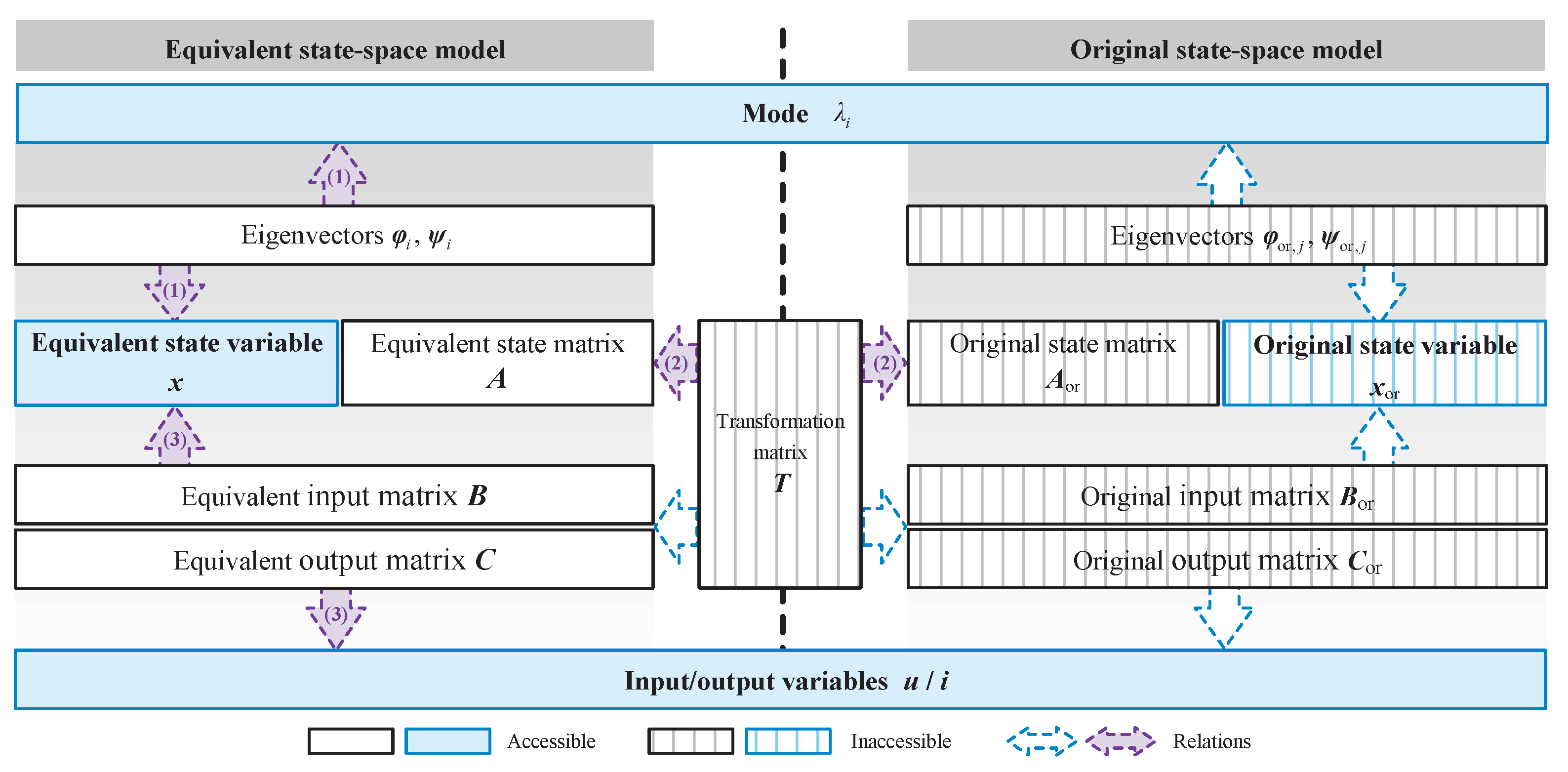
In summary, based on the left and right eigenvectors, the equivalent state-space PF p j i can be defined to quantify the participation between mode λ i and the j-th equivalent state variable, as shown in relation (1) in Figure 2. The original state-space PF p or , j i further includes the transformation matrix T to reflect the participation between mode λ i and the original state variables, as shown in relations (1) and (2) in Figure 2. Since T is inaccessible, p or , j i is only of theoretical significance.
The method for weak node identification can be further explored from the perspective of mode observability and controllability. Clearly, the input u acts on the equivalent state variable x through the input matrix B . The left eigenvector ψ i measures the excitation of λ i by x . Therefore, their product ψ i T B gives the controllability of mode λ i by input u [33]. Similarly, the equivalent state variable x acts on the output variable i through the output matrix C . The right eigenvector φ i indicates how strongly λ i drives x . Hence, the product C φ i gives the observability of the mode λ i on output i [33]. Thus, by combining the observability and controllability, the participation between node voltage u /current i and mode λ i can be comprehensively measured, as shown by relations (1) and (3) in Figure 2. Consequently, the physical essence of weak node identification is to measure such observability and controllability, which provides new insights for defining the indicator.

3.2. Indicator for the Weak Node Identification

The indicator for weak node identification is derived from the time-domain response of the output. For the equivalent state-space model in Equation (3), by decoupling the state variables, the zero-state response of the system can be obtained as
Δ i ( t ) = i = 1 N C φ i ψ i T B 0 t e λ i t τ Δ u ( τ ) d τ + D Δ u ( t )
From Equation (10), the coefficient C φ i ψ i T B measures the participation of node voltage u and current i in mode λ i .
The residue Res is defined as
Res = lim s λ i s λ i G ( s )
where G ( s ) can be expressed using the equivalent state-space model in Equation (3) as
G ( s ) = C s I A 1 B + D
The equivalent state matrix A in Equation (12) can be transformed into a diagonal matrix of eigenvalues by the left and right eigenvector matrices. Then, combining this with Equation (11), the expression of the residue Res is obtained as
Res = C φ i ψ i T B
According to Equations (10) and (13), the physical meaning of the residue Res is the observability and controllability of mode λ i . Consequently, the residue Res can quantify the participation of node voltage u /current i in mode λ i .
For the node k, the diagonal 2 × 2 submatrix Res i , k of Res reflects the observability and controllability of the voltages/currents of node k with respect to mode λ i . The node voltages/currents can also be described by impedance, giving clear physical meaning. To further quantitatively describe the participation of node k in the mode λ i , the Frobenius norm of Res i , k is applied. It is computationally simple and measures the overall magnitude of the matrix, thereby reflecting the combined effect of d-axis, q-axis, and cross-coupling terms [32]. As expected, the Frobenius norm of Res i , k can be defined as the impedance PF and used as the indicator for weak node identification, i.e.,
p Z , k i = Res i , k F
By Equation (14), the impedance PFs p Z , k i for each node in the poorly damped oscillation mode λ i are calculated and compared. The nodes with larger values are identified as the weak nodes.
The core of this indicator is the residue Res of the system at the pole λ i . In practice, the station impedance at node k and the system residue can be obtained using vector fitting from impedance measurements, as well as through black-box or data-driven modeling approaches [19,20,34]. Since this indicator relies on the black-box model, it does not need internal details of the renewable energy station. Therefore, it is more applicable to the renewable energy-dominated power system.

3.3. Comparison Between Classic State-Space PF and Impedance PF

The impedance PF p Z , k i and the state-space PFs p j i and p or , j i are compared in Table 1 in terms of mathematical expressions and physical meanings.
Mathematically, both the impedance PF p Z , k i and the equivalent state-space PF p j i are based on the left and right eigenvectors ψ i and φ i , while p Z , k i additionally contains the input and output matrices B c , k and C r , k to relate the equivalent state variables to voltages/currents of node k.
The physical interpretation of this mathematical relationship is that p Z , k i is the extension of p j i to the node voltages/currents. p j i measures the participation between mode λ i and the equivalent state variables, and B c , k and C r , k establish the relationship between voltages/currents of node k and the equivalent state variables. Hence, their combination gives the participation between the mode λ i and the voltages/currents of node k.

4. Quantitative Analysis of the Effect of Station Impedances at Weak Nodes on System Stability

In this section, the effect of station impedances at weak nodes on system stability is quantitatively analyzed. First, the eigenvalue sensitivity to impedance is defined. Then, based on the total differential of the eigenvalue λ i , formulas are derived for estimating the oscillation mode under station parameter perturbations at multiple nodes.

4.1. Definition of Eigenvalue Sensitivity to Impedance

The variation Δ λ i of eigenvalue λ i with respect to a variation in the system impedance Z sys , k at the node k is given by [29]
Δ λ i = Res i , k H , Δ Z sys , k ( λ i )
where · , · denotes the Frobenius inner product. Res i , k H is the conjugate transpose of the residue Res i , k .
On the other hand, the total differential of the eigenvalue λ i in Equation (15) can be formulated as
Δ λ i = p = 1 2 q = 1 2 λ i z sys , k , p q Δ z sys , k , p q = p = 1 2 q = 1 2 r ¯ i , k , q p Δ z sys , k , p q
where z sys , k , p q is the ( p , q ) element of the impedance Z sys , k . r ¯ i , k , q p is the complex conjugate of ( q , p ) element of the residue Res i , k .
Equation (16) shows that the sensitivity of the eigenvalue λ i to the element z sys , k , p q of the impedance Z sys , k is equal to the element r ¯ i , k , q p of the negative conjugate transpose Res i , k H of the residue Res i , k .
This conclusion is analogous to the sensitivity of the eigenvalue λ i to the element a p q of the equivalent state matrix A . For classic participation analysis, the total differential of λ i is given by
Δ λ i = p = 1 N q = 1 N λ i a p q Δ a p q = ψ i φ i T , Δ A
In Equation (17), the sensitivity of λ i to the diagonal element a j j is equal to the equivalent state-space PF p j i , that is
λ i a j j = φ j i ψ j i = p j i
By comparing the impedance PF p Z , k i and the equivalent state-space PF p j i through Equations (16) and (18), it is observed that they both reflect the sensitivity of an eigenvalue to a local component of the system. p Z , k i is the eigenvalue sensitivity to terminal characteristic changes of the station at the node k. p j i is the eigenvalue sensitivity to dynamic characteristics of state variables. This conclusion can be used to evaluate the effect of station impedances at weak nodes on system stability.

4.2. Oscillation Mode Estimation Under Parameter Perturbations at Multiple Nodes

Suppose that the parameters of stations 1 to m are all perturbed. Then the impedance Z j ( j = 1 , , m ) of each corresponding station has a variation Δ Z j . The mode λ i can be regarded as a complex-valued scalar function of the complex matrix variables Z j . According to matrix theory [32], its total differential is given by
Δ λ i = j = 1 m J j H , Δ Z j
where J j is the complex Jacobian matrix of λ i with respect to Z j .
When computing J k corresponding to a particular station impedance Z k , the other station impedances Z j ( j k ) are treated as constant. Furthermore, the system impedance Z sys , k at the node k can be expressed as the series connection of the station impedance Z k and the impedance Z g k of the rest of the system, that is, Z sys , k = Z k + Z g k . Thus, when computing J k , the variation of the system impedance is equal to that of the station impedance, i.e., Δ Z sys , k = Δ Z k . Then, Equation (15) can be further written as
Δ λ i = Res i , k H , Δ Z k ( λ i )
Equation (20) represents the variation of the mode λ i under station impedance perturbations at node k. Consequently, the Jacobian matrix J k with respect to Z k is
J k = Res i , k
Therefore, according to Equations (19) and (21), the total differential of λ i is given by
Δ λ i = k = 1 m Res i , k H , Δ Z k ( λ i )
Equation (22) can be used to quantify the effect of impedance variations at multiple nodes on the poorly damped oscillation modes. When m = 1 , Equation (22) reduces to Equation (20), showing that the single-node formula is a special case of the multi-node formula.

5. Case Study

In this section, the accuracy of the indicator of weak node identification and the oscillation mode estimation is validated using a parallel system with four renewable energy stations and a real-life renewable energy-dominated power system in northwest China. In addition, the computational complexity of the proposed method is analyzed.

5.1. Case 1: Parallel System with Four Renewable Energy Stations

In Case 1, a parallel system with four renewable energy stations is described. The accuracy of the indicator of weak node identification and the oscillation mode estimation under parameter perturbations is validated using this system.

5.1.1. System Description of Case 1

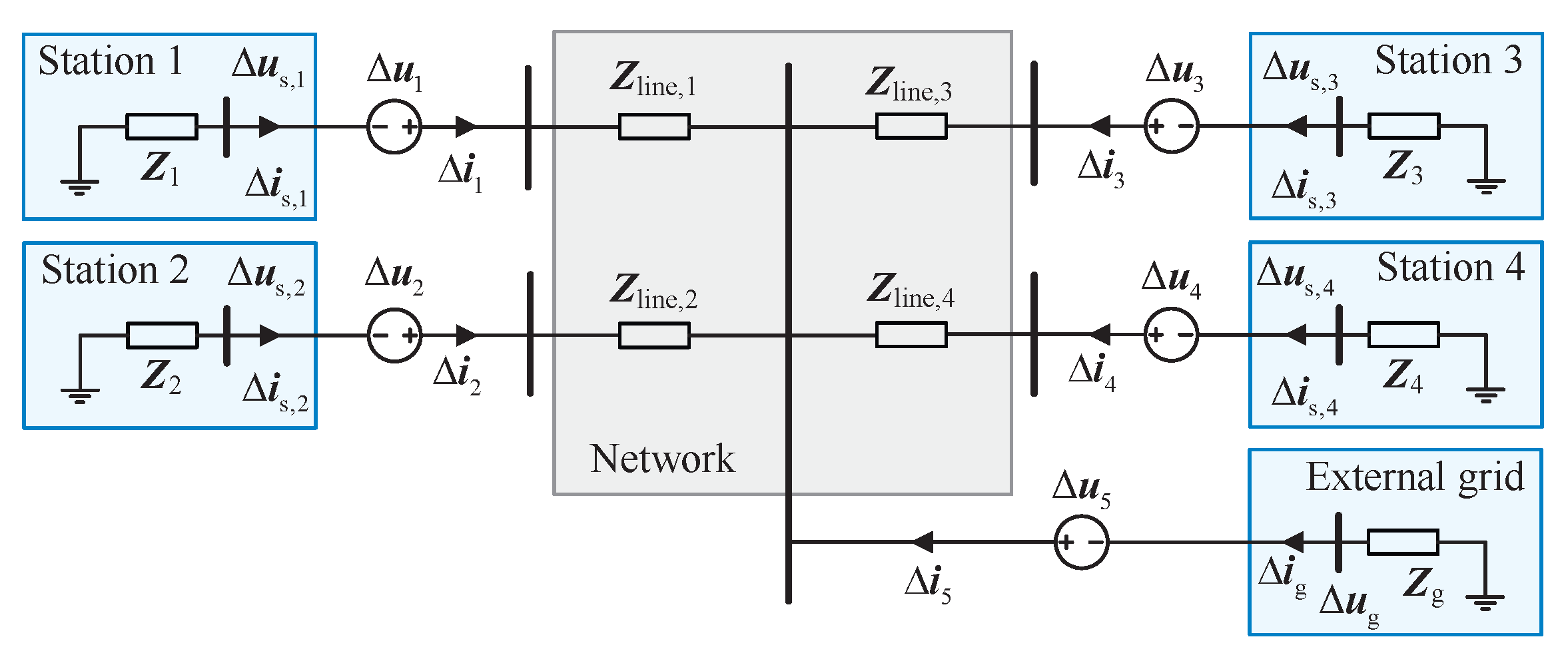
The structure of the parallel system with four renewable energy stations is shown in Figure 3. Four renewable energy stations are connected to the external grid at the point of common coupling (PCC) through separate lines. Each renewable energy station is represented by a direct current (DC) source connected with a converter. The external grid is represented by an ideal voltage source in series with an impedance. Stations 1 and 2 use grid-forming (GFM) converters with virtual synchronous generator control combined with dual-loop voltage and current control. Stations 3 and 4 use grid-following (GFL) converters with outer power loop and inner current loop control. The parameters are listed in Table A1 in Appendix B.

5.1.2. Analysis of Poorly Damped Oscillation Modes

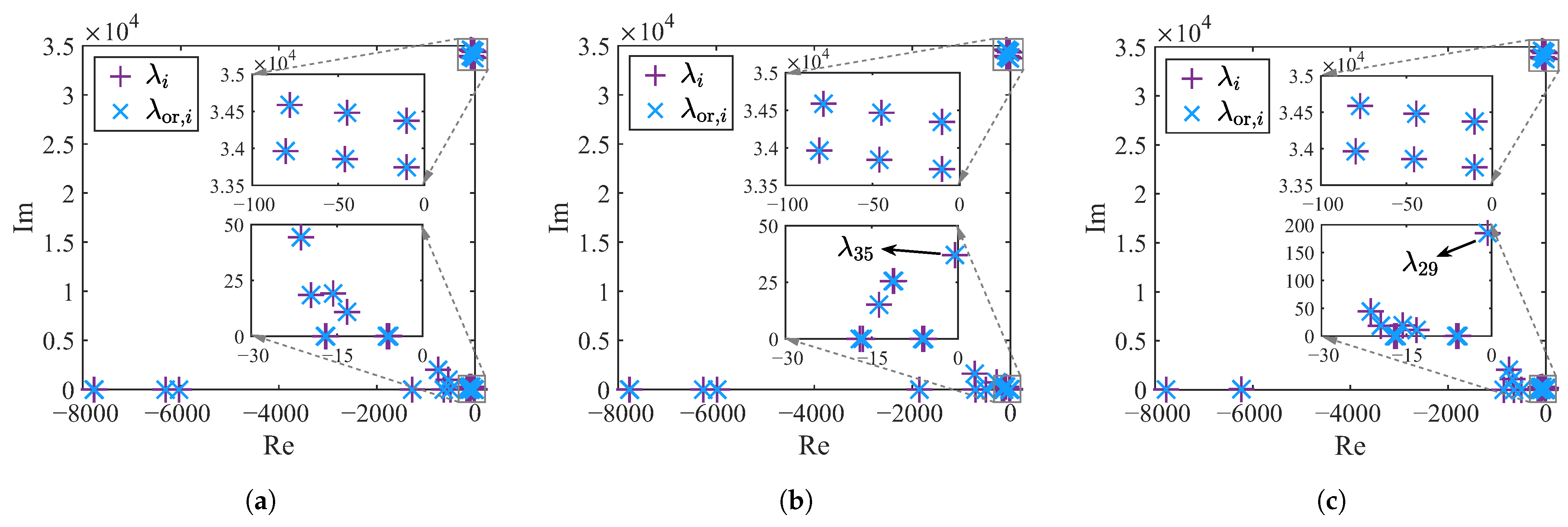
The eigenvalues λ i of the testing system are computed from its equivalent state-space model, and the distribution is shown by the purple markers in Figure 4a. As can be seen, the distribution of λ i coincides with that of λ or , i from the original state-space model, whose distribution is shown by the blue markers. The maximum relative error between them is 2.5002 × 10 6 , which confirms the consistency of the two state-space models. Moreover, all eigenvalues are located in the left half plane, indicating that the testing system is small-signal stable under this set of parameters.
Then, two cases with poorly damped oscillation modes are constructed for the analysis of the weak node by modifying certain system parameters.
(1)
Case 1a: The proportional gain k P u , 1 and k P u , 2 of voltage loop at Stations 1 and 2 are both changed to 2.56. The eigenvalues are recomputed, and their distribution is shown in Figure 4b. In Case 1a, a pair of eigenvalues λ 35 , 36 = 0.5551 ± j 37.0685 is located close to the imaginary axis, indicating a poorly damped oscillation mode with an oscillation frequency of about 6 Hz.
(2)
Case 1b: The proportional gain k Ppll , 1 of the phase-locked loop (PLL) at Station 3 changes to 0.015, as shown in Figure 4c, leading to another poorly damped oscillation mode λ 29 , 30 = 0.7021 ± j 185.1746 with a frequency of about 29 Hz.
Next, the indicator for weak node identification is validated, and the effect of station impedances at weak nodes on system stability is analyzed under Case 1a and Case 1b.

5.1.3. Accuracy Validation of Indicator for the Weak Node Identification

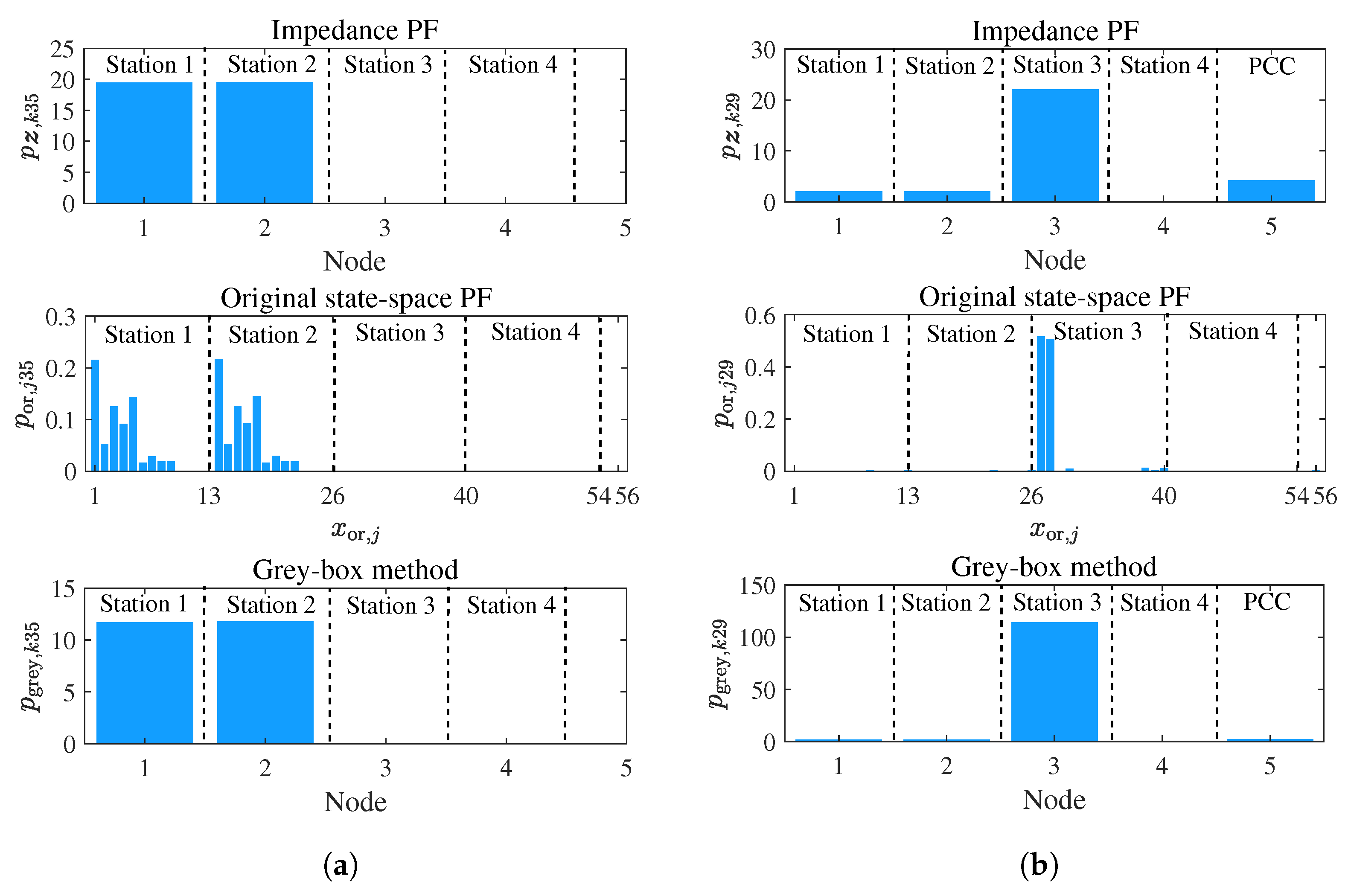
For Case 1a, the impedance PFs p Z , k 35 ( k = 1 , , 5 ), original state-space PFs p or , j 35 ( j = 1 , , 56 ), and the indicators p grey , k 35 ( k = 1 , , 5 ) of grey-box method [29] are computed, respectively, which are shown in Figure 5a. All three methods indicate that Stations 1 and 2 are more strongly associated with the poorly damped oscillation mode than Stations 3 and 4.
For Case 1b, the impedance PFs p Z , k 29 ( k = 1 , , 5 ), original state-space PFs p or , j 29 ( j = 1 , , 56 ), and the indicators p grey , k 29 ( k = 1 , , 5 ) of grey-box method are computed, respectively. The results are shown in Figure 5b, which indicate that Station 3 is more strongly associated with this poorly damped oscillation mode than Stations 1, 2, and 4.
To quantitatively evaluate the consistency among the proposed impedance PFs, the original state-space PFs, and the grey-box method indicators in identifying weak nodes, the Spearman rank correlation coefficient [35] is adopted for analysis.
Specifically, for Case 1a, both the impedance PFs and the grey-box method indicators can directly rank the nodes in descending order of their participation degrees in mode λ 35 . The ranking results are R Z , 35 = [ 2 , 1 , 4 , 5 , 3 ] and R grey , 35 = [ 2 , 1 , 4 , 5 , 3 ] , meaning that the ranks of nodes 1 to 5 are 2, 1, 4, 5, 3, respectively. For original state-space PFs, the node-level participation can be defined as the maximum PF among all state variables belonging to each node, to highlight the weakest link within each station. Then the nodes can be ranked and the result is R or , 35 = [ 2 , 1 , 4 , 5 , 3 ] . Finally, the correlations between the ranks of the impedance PFs and those of the state-space PFs and the grey-box method indicators are calculated by Spearman rank correlation coefficient, that is
ρ = 1 6 k = 1 n d k 2 n n 2 1
where n is the total number of nodes. d k is the difference in ranks for the node k between two methods, i.e., d Z , or , 35 , k = R Z , 35 , k R or , k and d Z , grey , 35 , k = R Z , 35 , k R grey , 35 , k .
The Spearman rank correlation coefficients are ρ Z , or , 35 = 1 and ρ Z , grey , 35 = 1 . The closer the Spearman rank correlation coefficient is to 1, the stronger the consistency between the two methods in ranking the nodes.
For Case 1b, the ranks of three methods are R Z , 29 = [ 3 , 4 , 1 , 5 , 2 ] , R or , 29 = [ 4 , 3 , 1 , 5 , 2 ] , and R grey , 29 = [ 4 , 3 , 1 , 5 , 2 ] , respectively. The Spearman rank correlation coefficients are ρ Z , or , 29 = 0.9 and ρ Z , grey , 29 = 0.9 . The ranking differences in nodes 1 and 2 occur because stations 1 and 2 have identical control structures and parameters, resulting in very close participation values. Moreover, as shown in Figure 5b, these values are clearly separated from that of the top-ranked node. Since the core objective is to identify the node most strongly associated with the poorly damped oscillation mode, the ranking differences do not affect the conclusion.

5.1.4. Accuracy Validation of Oscillation Mode Estimation Under Parameter Perturbations

Using Equation (22), under station parameter perturbations at a single node or multiple nodes, the variations of the poorly damped oscillation modes are computed for Case 1a and Case 1b. The key parameters affecting system stability are then analyzed, and the accuracy of the method is validated through time-domain simulations.
(1)
Oscillation Mode Estimation under Parameter Perturbations at a Single Node
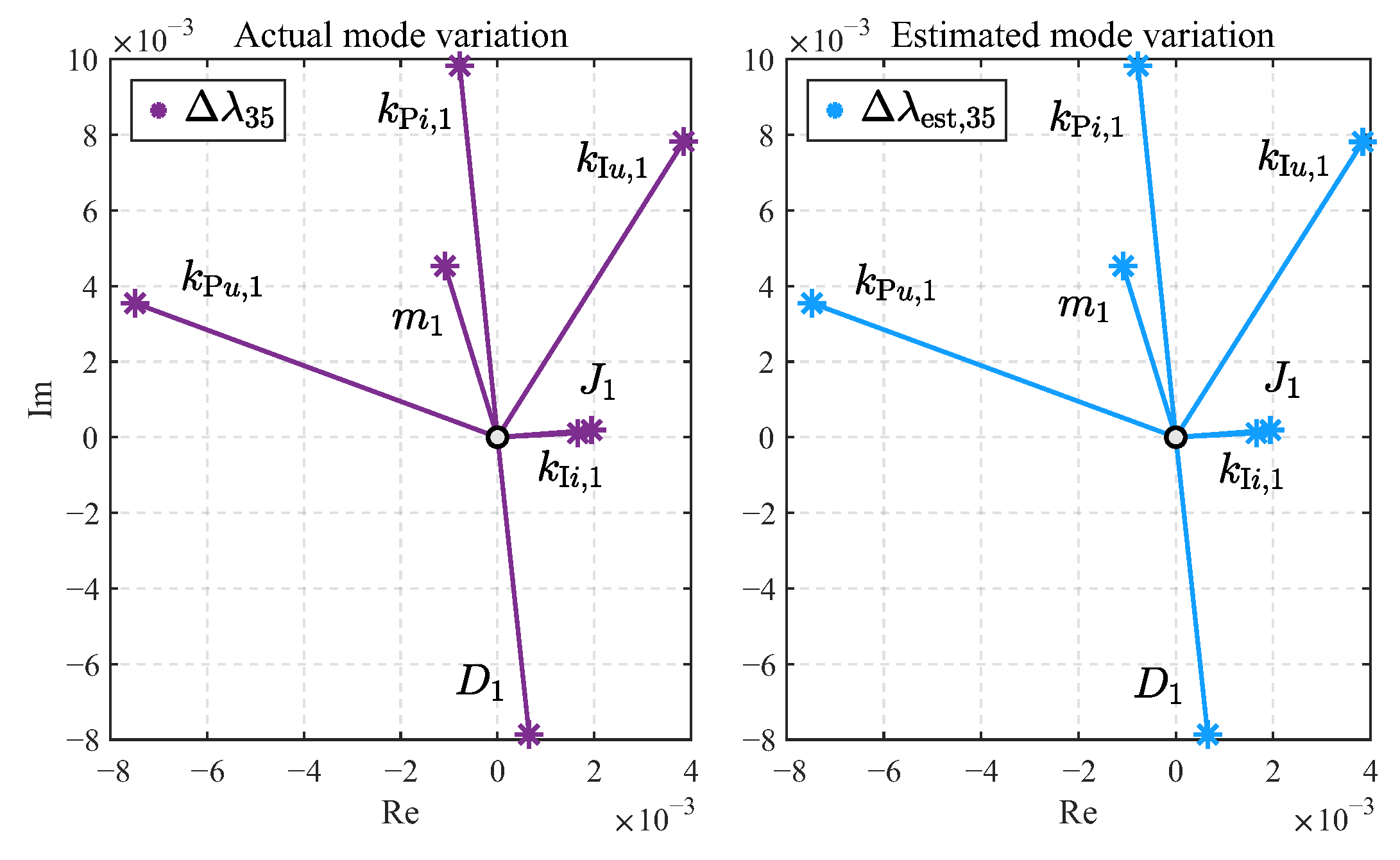
For Case 1a, a positive perturbation of the order 10 3 is applied to each control parameter of Station 1. The estimated variations Δ λ est , 35 are then computed and compared with the actual variations Δ λ 35 obtained from the equivalent state-space model. As shown in Figure 6, the actual variations Δ λ 35 coincide with the estimated variations Δ λ est , 35 , which validates the accuracy of the oscillation mode estimation.
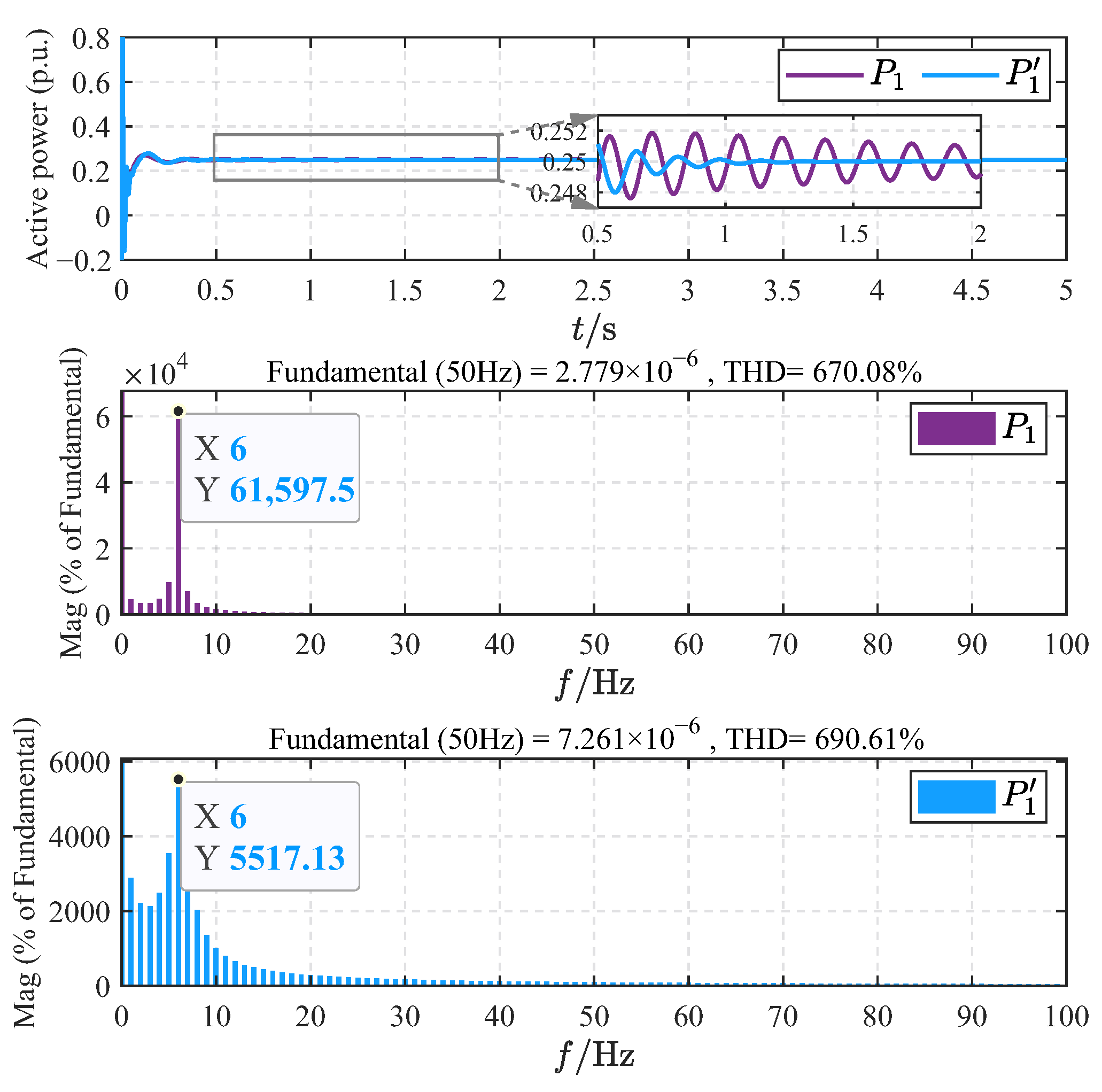
Furthermore, as shown in Figure 6, increasing the proportional gain k P u , 1 of voltage loop shifts the real part of the eigenvalue λ 35 to the left, thus effectively enhancing the damping of this mode. To verify this conclusion, k P u , 1 is increased from 2.56 to 4.35. As a result, the mode shifts from λ 35 , 36 = 0.5551 ± j 37.0685 to λ 35 , 36 = 5.0641 ± j 38.6140 , indicating a significant increase in damping while the oscillation frequency remains at 6 Hz. Time-domain simulations are performed in Matlab/Simulink R2024b to compare the active power responses P 1 and P 1 of Station 1 before and after the parameter adjustment, as shown in Figure 7. The results show that after increasing k P u , 1 , the active power oscillation converges faster, with the same frequency of 6 Hz, thereby confirming the analysis.
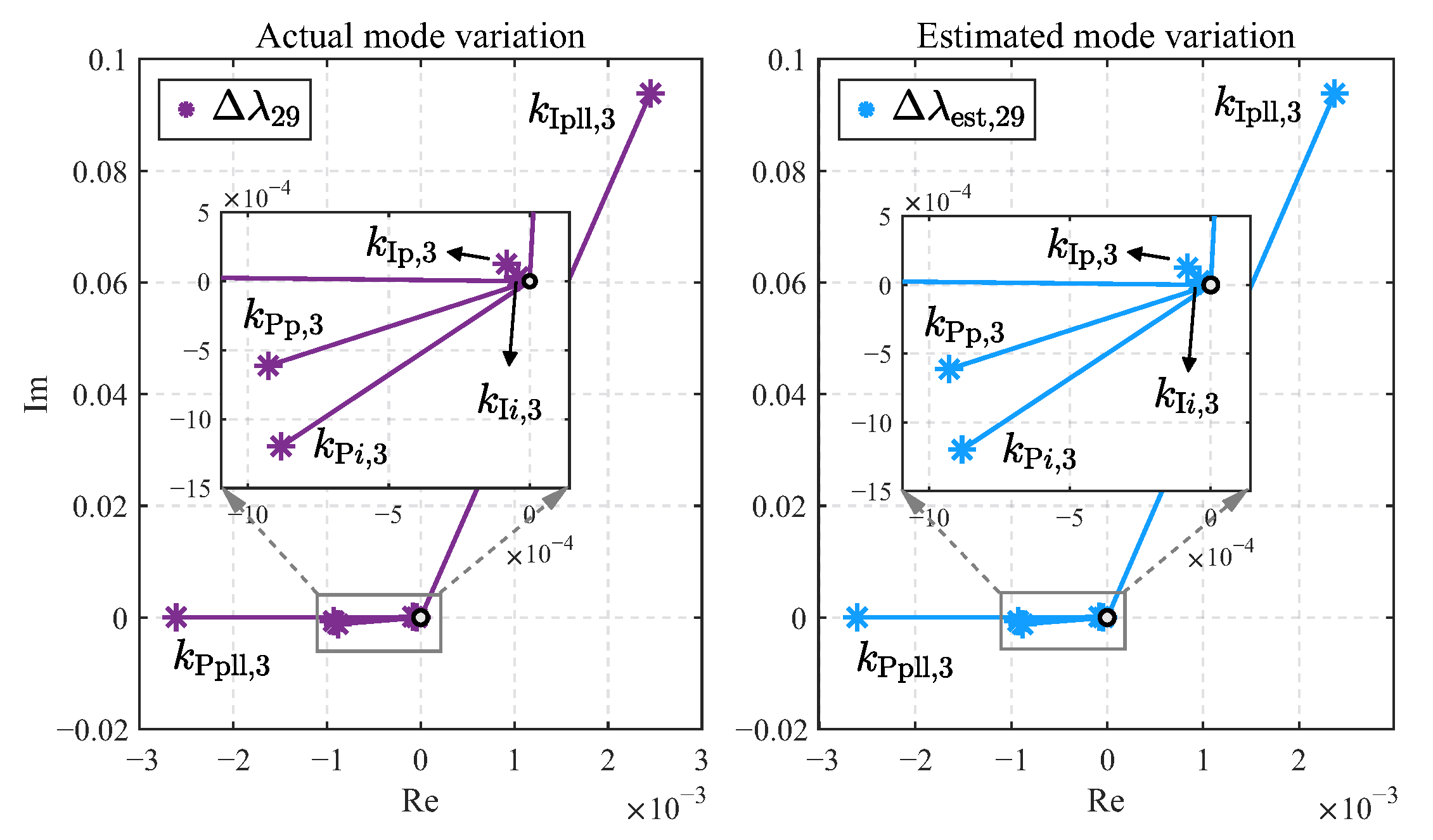
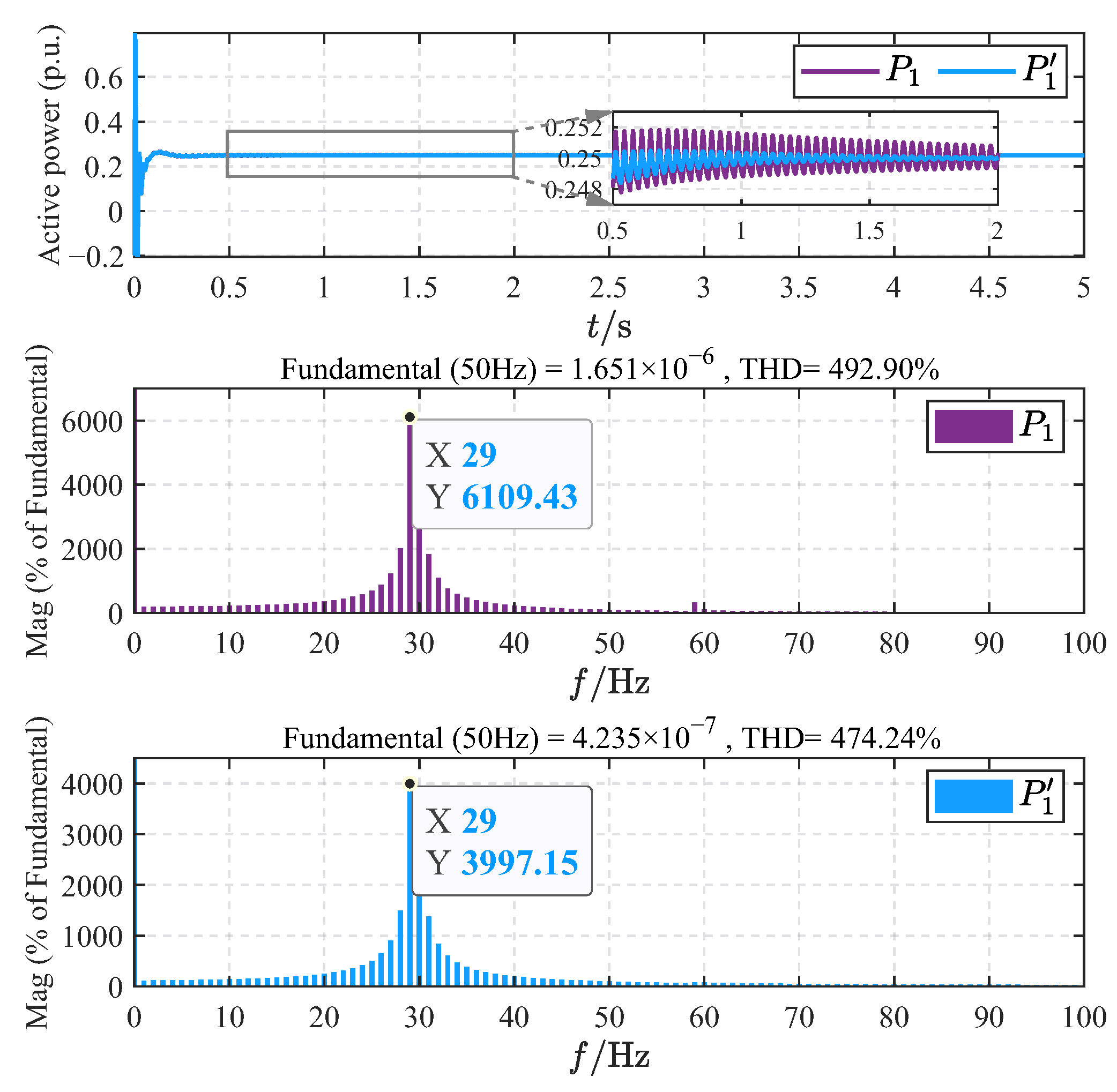
For Case 1b, a positive perturbation of the order 10 3 is applied to each control parameter of Station 3. The estimated variations Δ λ est , 29 and the actual variations Δ λ 29 are computed as shown in Figure 8. It can be seen that the proportional gain k Ppll , 3 of the PLL at Station 3 has a significant influence on the real part of the eigenvalue λ 29 . When k Ppll , 3 is increased from 0.015 to 0.03, the mode shifts from λ 29 , 30 = 0.7021 ± j 185.1746 to λ 29 , 30 = 3.2693 ± j 185.1704 , indicating a significant increase in damping while the oscillation frequency remains at 29 Hz. The active power P 1 and P 1 of Station 1 before and after the parameter adjustment are compared in Figure 9.
(2)
Oscillation Mode Estimation under Parameter Perturbations at Multiple Nodes
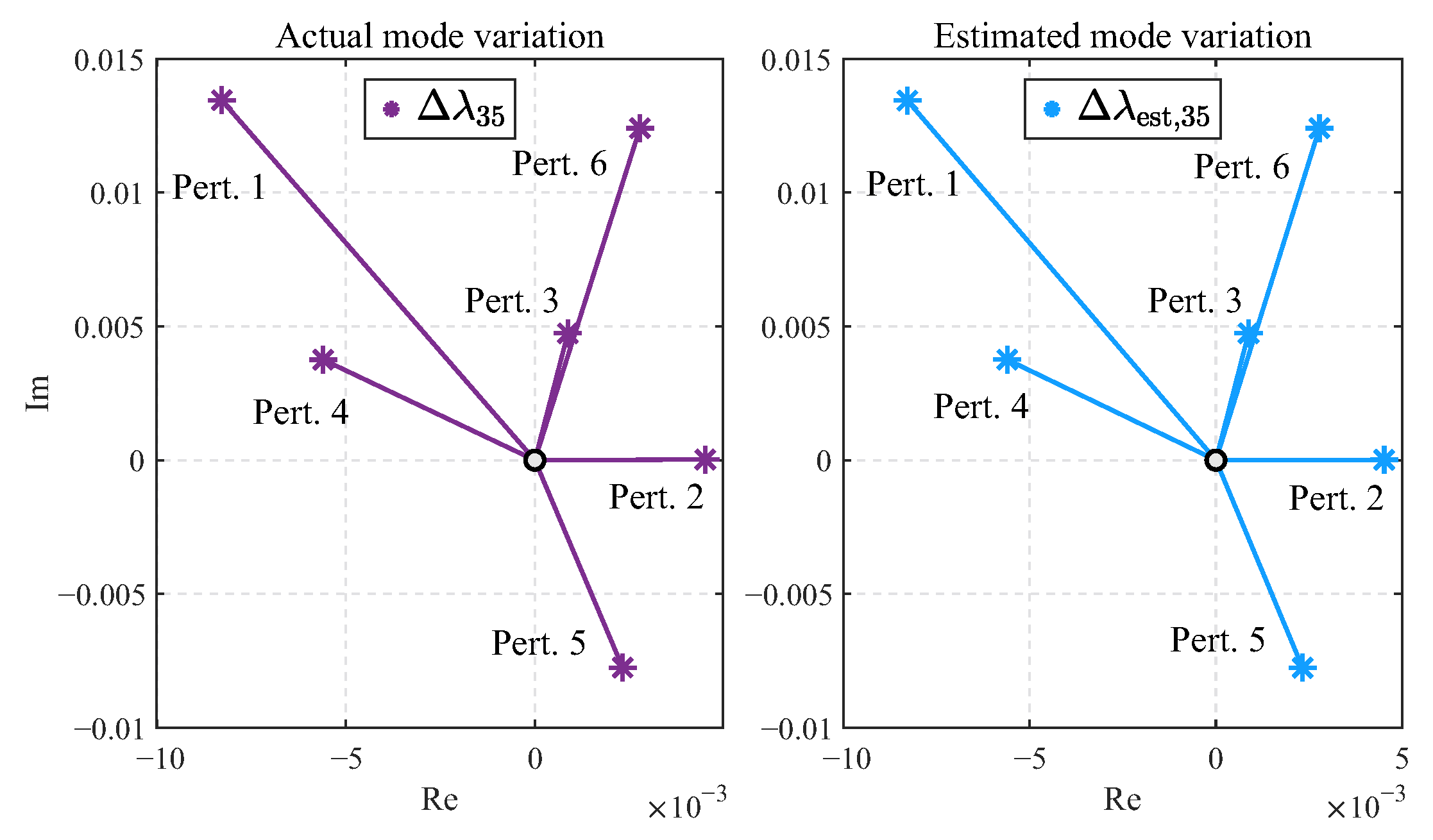
For Case 1a, positive perturbations of the order 10 3 are applied to six different parameter combinations of four stations, shown as Pert. 1–6 in Table A2 in Appendix B. The estimated and actual mode variations Δ λ est , 35 and Δ λ 35 are computed as shown in Figure 10. As can be seen from this figure, the estimated variations Δ λ est , 35 coincide with the actual variations Δ λ 35 , which validates the accuracy of the formula for oscillation mode estimation under parameter perturbations at multiple nodes. Furthermore, it can also be seen that the parameter combinations Pert. 1 and Pert. 4 have greater effects on the real part of this mode. This is because both Pert. 1 and Pert. 4 contain k P u , 1 , which has a stronger impact on the real part of λ 35 , as demonstrated in Section 5.1.4 (1).
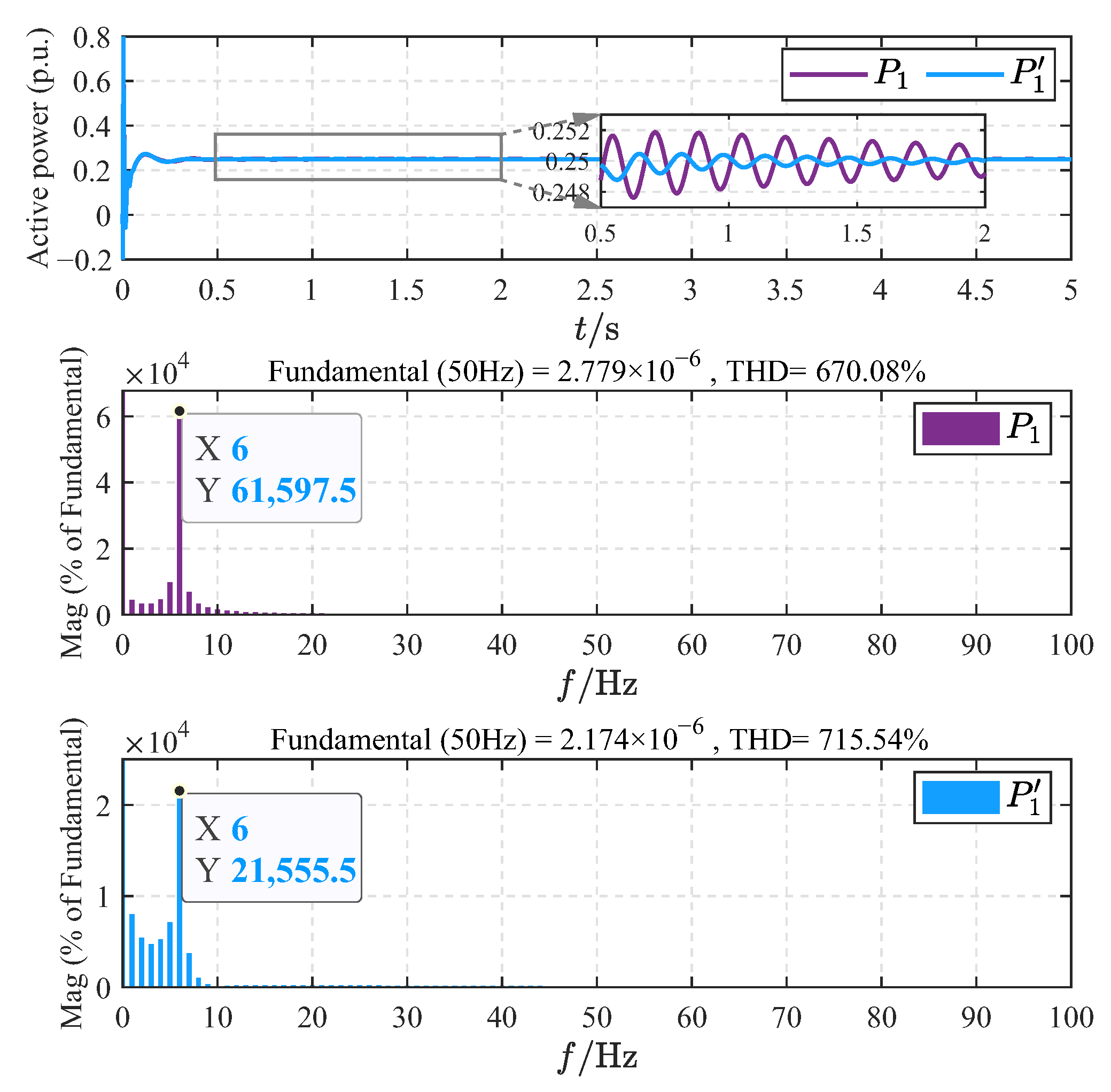
Then, time-domain simulations are performed to further verify the effect of station parameter perturbations on system stability. The parameter combination Pert. 1 is adjusted according to Case 1a in Table 2. As a result, the oscillation mode shifts from λ 35 , 36 = 0.5551 ± j 37.0685 to λ 35 , 36 = 1.3712 ± j 38.4506 . The absolute value of the real part, i.e., the damping, increases significantly, while the imaginary part increases slightly, with the oscillation frequency remaining at about 6 Hz. This is consistent with the trend shown in Figure 10. The active power P 1 and P 1 of Station 1 before and after the parameter adjustments are compared, as presented in Figure 11. After the adjustment, the active power oscillation converges faster, and the oscillation frequency is still 6 Hz, thereby validating the accuracy of the oscillation mode estimation method under parameter perturbations at multiple nodes.
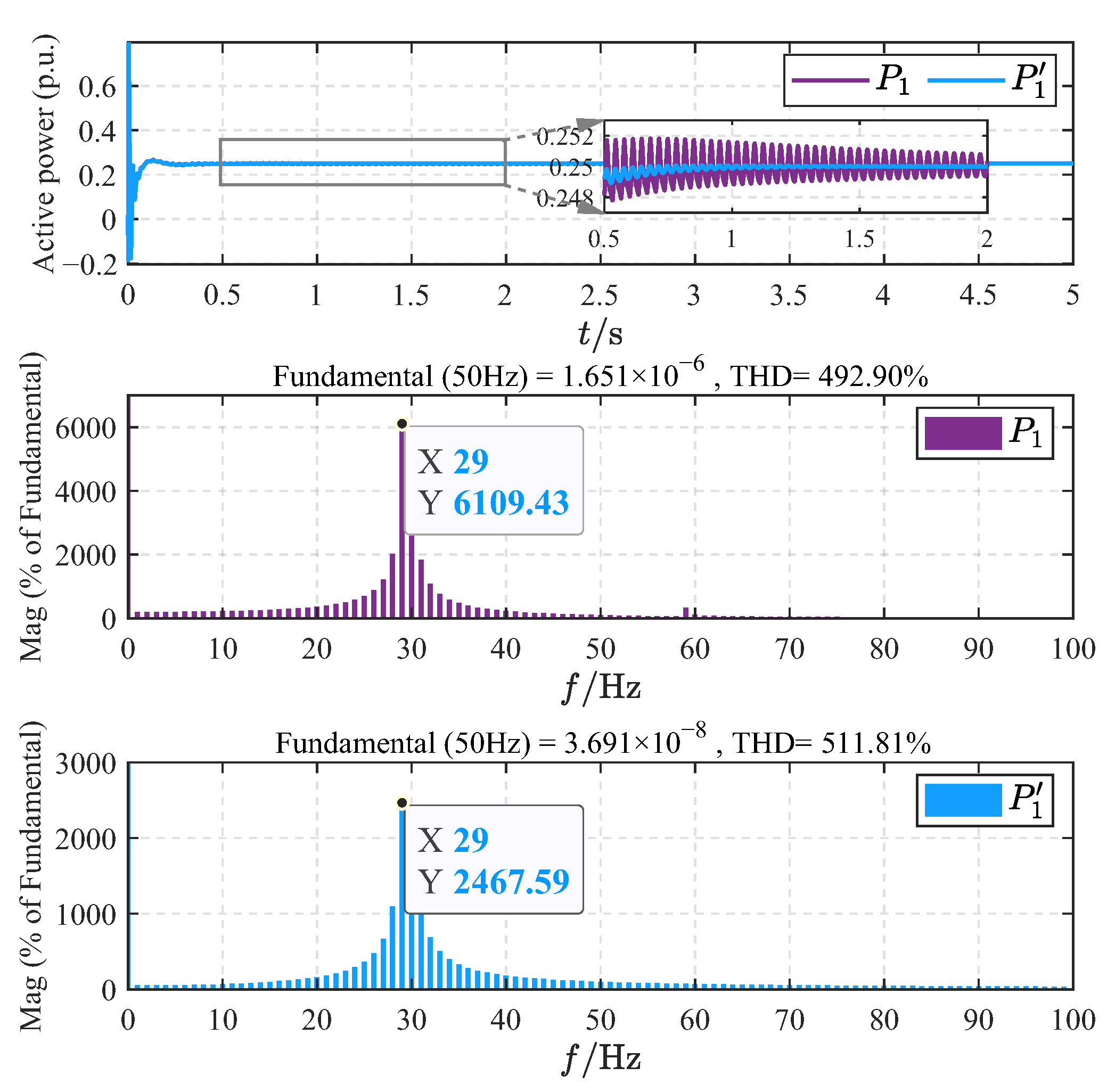
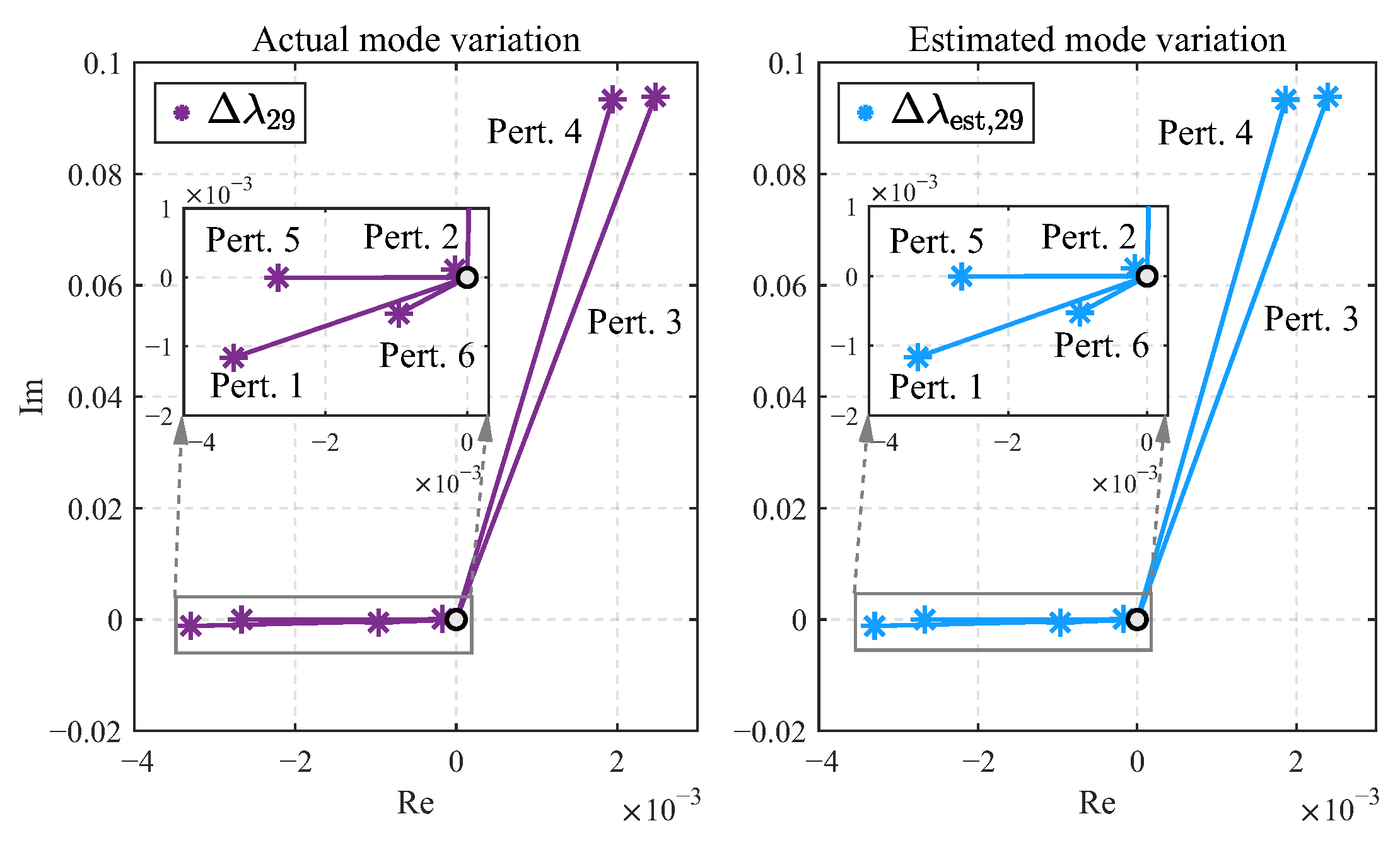
For Case 1b, positive perturbations of the order 10 3 are applied to the same parameter combinations as in Case 1a. As shown in Figure 12, the estimated variations Δ λ est , 29 coincide with the actual mode variations Δ λ 29 . It is observed that the parameter combinations Pert. 1 and Pert. 5 have greater effects on the real part of this mode. This is because both Pert. 1 and Pert. 5 contain k Ppll , 3 , which has a stronger impact on the real part of λ 29 , as demonstrated in Section 5.1.4 (1). Then, the parameter combination Pert. 1 is adjusted in the time-domain simulation according to Case 1b in Table 2. As a result, the oscillation mode shifts from λ 29 , 30 = 0.7021 ± j 185.1746 to λ 29 , 30 = 2.0301 ± j 185.0406 . The damping increases significantly, while the oscillation frequency remains at about 29 Hz. The active power P 1 and P 1 of Station 1 before and after the parameter adjustments are compared, as presented in Figure 13. After the adjustment, the active power oscillation converges faster, with the same frequency of 29 Hz, thus validating the above analysis.

5.2. Case 2: Real-Life Renewable Energy-Dominated Power System

The renewable energy-dominated power systems in northwest China have experienced multiple sub-synchronous oscillation events with frequencies in the range of 20–40 Hz [36]. In this section, the proposed method is applied to a real-life renewable energy-dominated power system in northwest China, to further prove the accuracy of the method.

5.2.1. System Description of Case 2

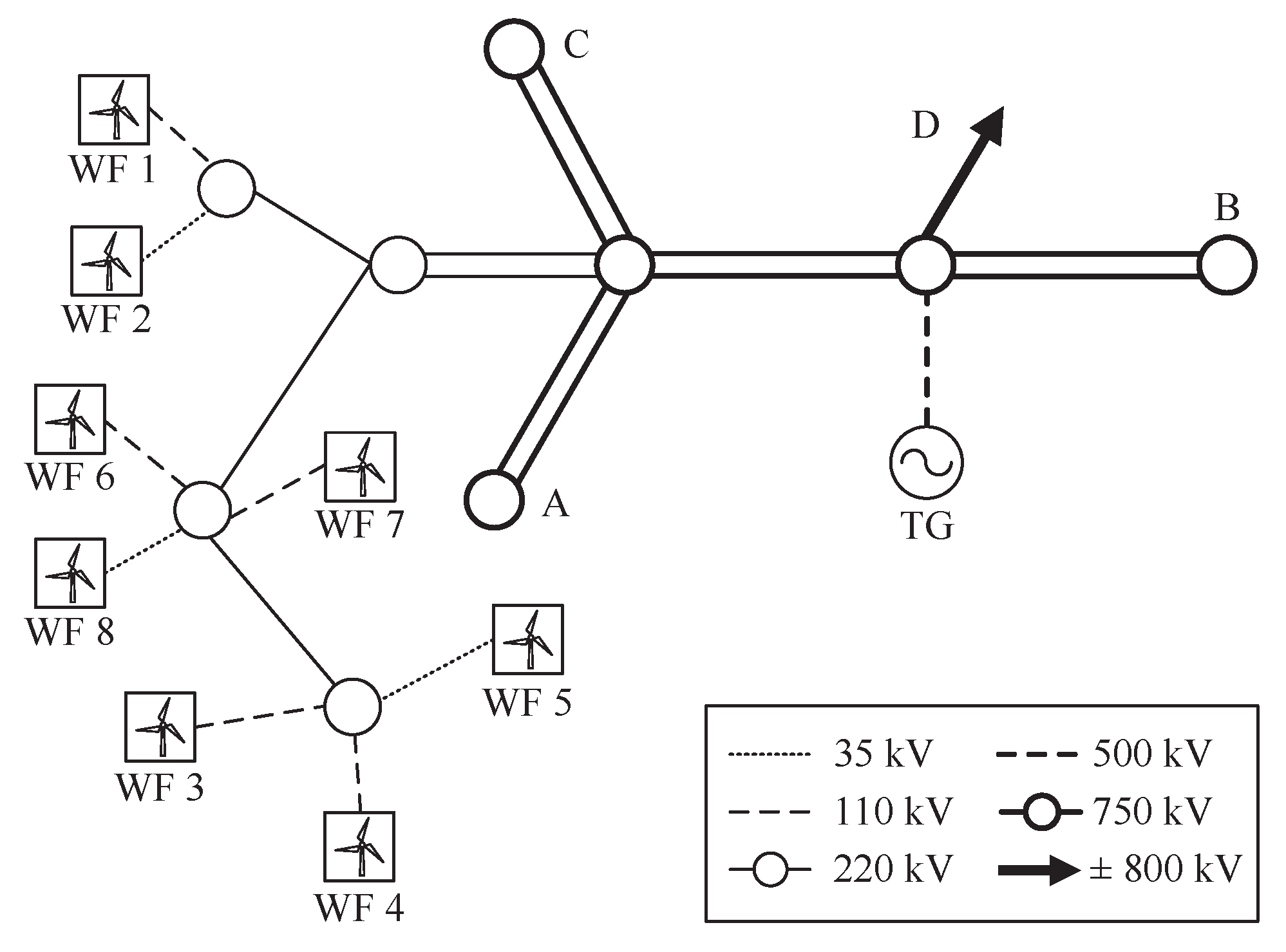
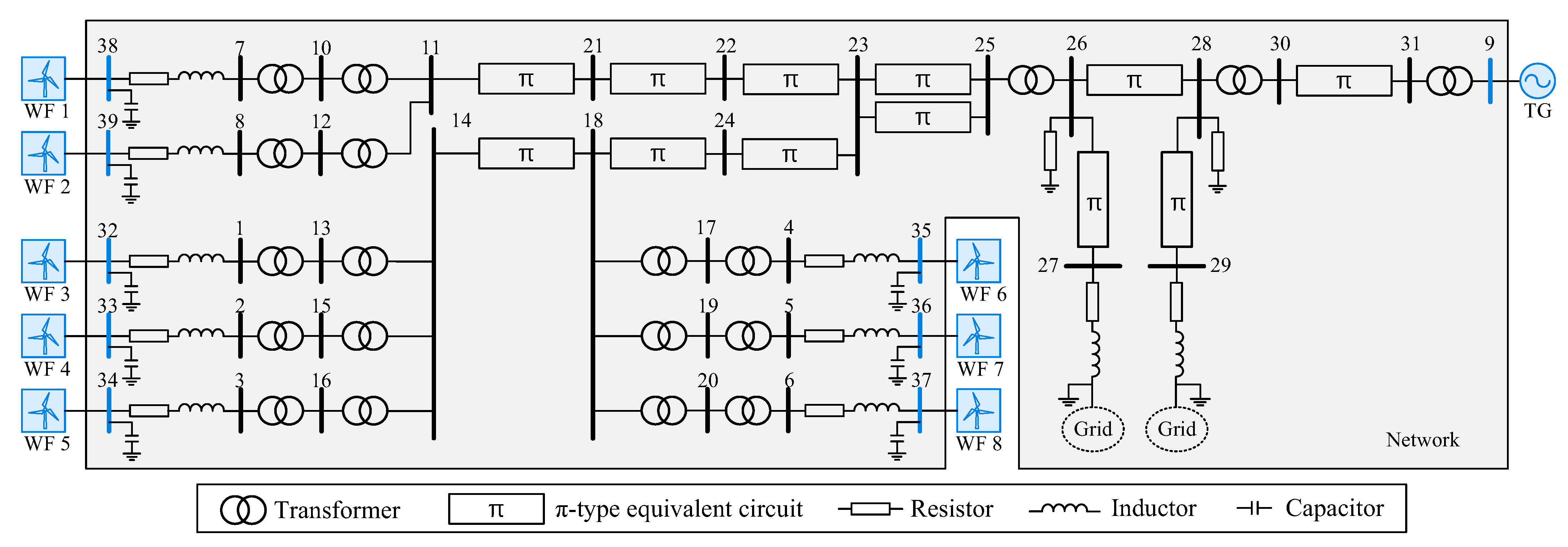
The diagram of the real-life renewable energy-dominated power system is shown in Figure 14. It consists of multiple wind farms (WFs), a turbine generator (TG), 750 kV buses A, B, and C, and a ±800 kV high-voltage direct current (HVDC) transmission line D. Here, the bus C and HVDC transmission line D serve as resistive loads. The buses A and B are considered as nodes connected to the external power grid. The equivalent circuit of the real-life renewable energy-dominated power system is shown in Figure 15.

5.2.2. Accuracy Validation of the Weak Node Identification Method

In this section, the impedance PFs are used to identify weak nodes under a poorly damped oscillation mode. Then, the variations of the mode under the impedance perturbations at the weak node are analyzed. The accuracy of the analysis is validated through time-domain simulations.
(1)
Analysis of Poorly Damped Oscillation Mode
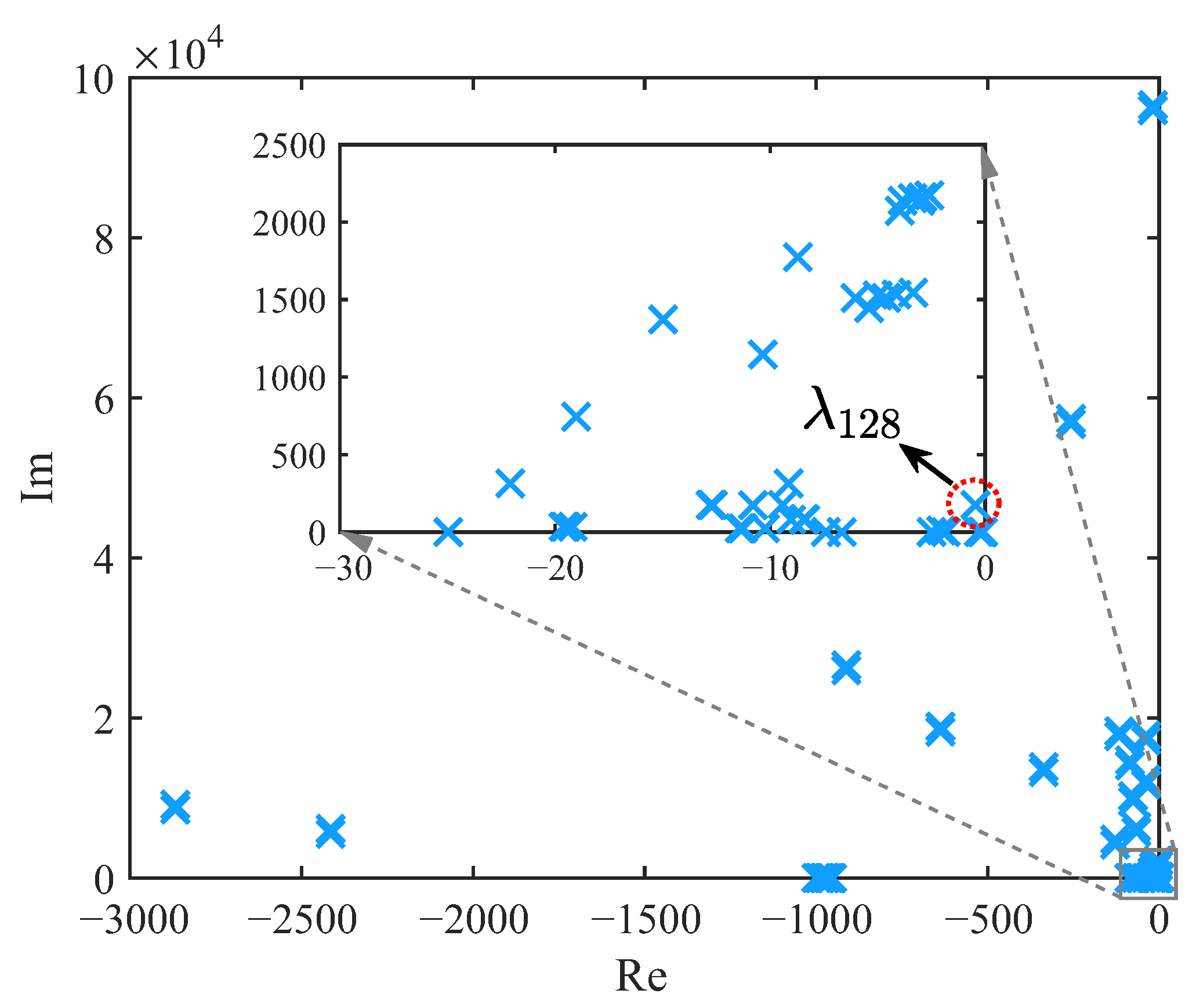
The eigenvalues of the real-life renewable energy-dominated power system are shown in Figure 16. For clarity, only eigenvalues with real parts greater than 3000 are plotted, since those with more negative real parts are highly damped and not critical for the small-signal analysis. It can be seen that there is a pair of eigenvalues λ 128 , 129 = 0.4485 ± j 174.9565 located close to the imaginary axis, indicating a poorly damped oscillation mode with an oscillation frequency of about 28 Hz.
(2)
Weak Node Identification Using Impedance PFs
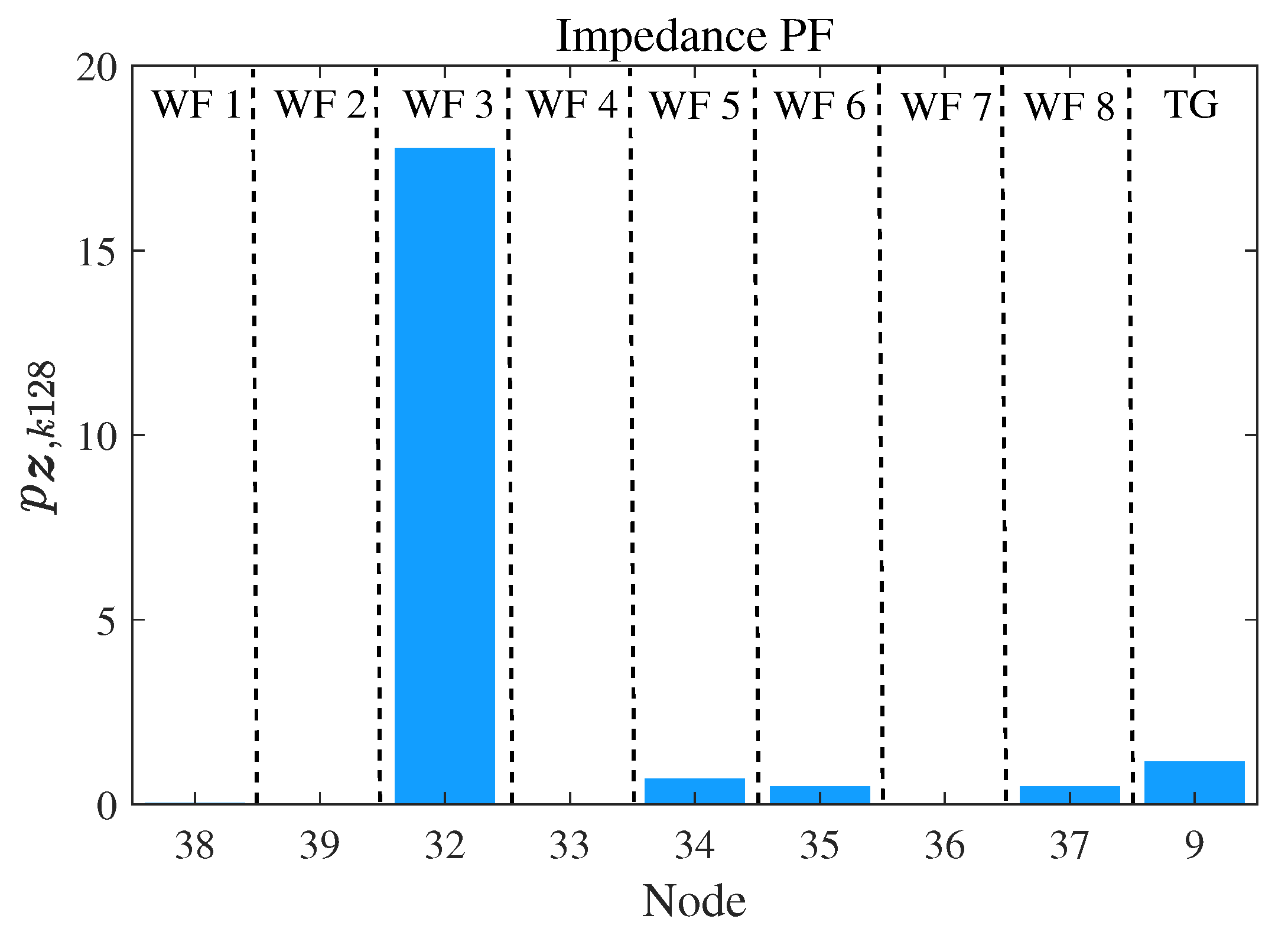
The impedance PFs p Z , k 128 ( k = 38 , 39 , 32 , 33 , 34 , 35 , 36 , 37 , 9 ) of the 8 WFs and the TG are computed, which are shown in Figure 17. The impedance PFs indicate that WF 3 is more strongly associated with the poorly damped oscillation mode λ 128 than other WFs and the TG.
(3)
Oscillation Mode Estimation under Parameter Perturbations at Weak Node and Time-domain Verification
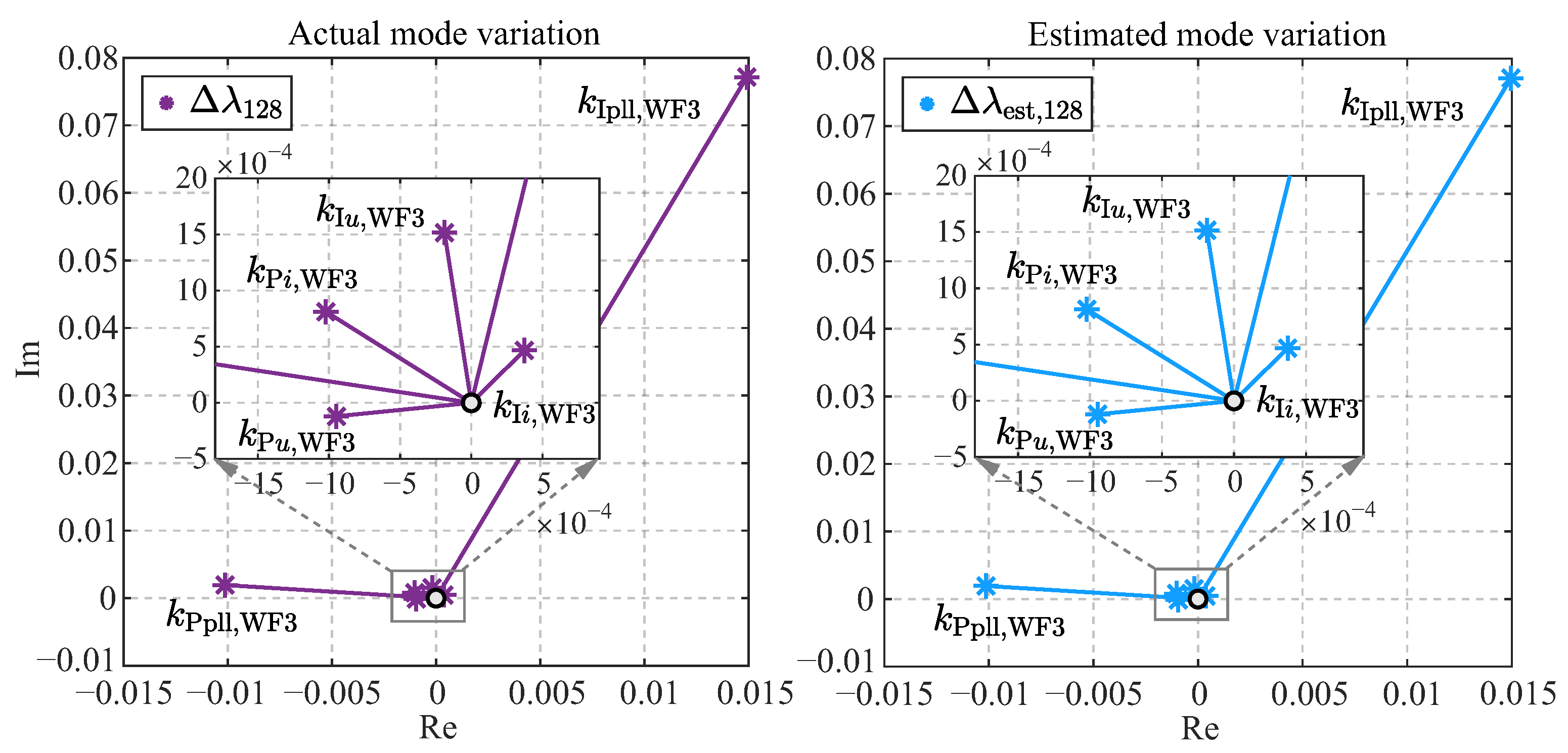
The effect of impedance Z WF 3 of WF 3 on the mode λ 128 is analyzed by applying perturbations to the controller parameters. The controller parameters of WF 3 are listed in Table A3 in Appendix B. A positive perturbation of the order 10 3 is applied to each control parameter of WF 3. The estimated variations Δ λ est , 128 are then computed and compared with the actual variations Δ λ 128 . As shown in Figure 18, the actual variations Δ λ 128 coincide with the estimated variations Δ λ est , 128 , which validates the accuracy of the oscillation mode estimation.
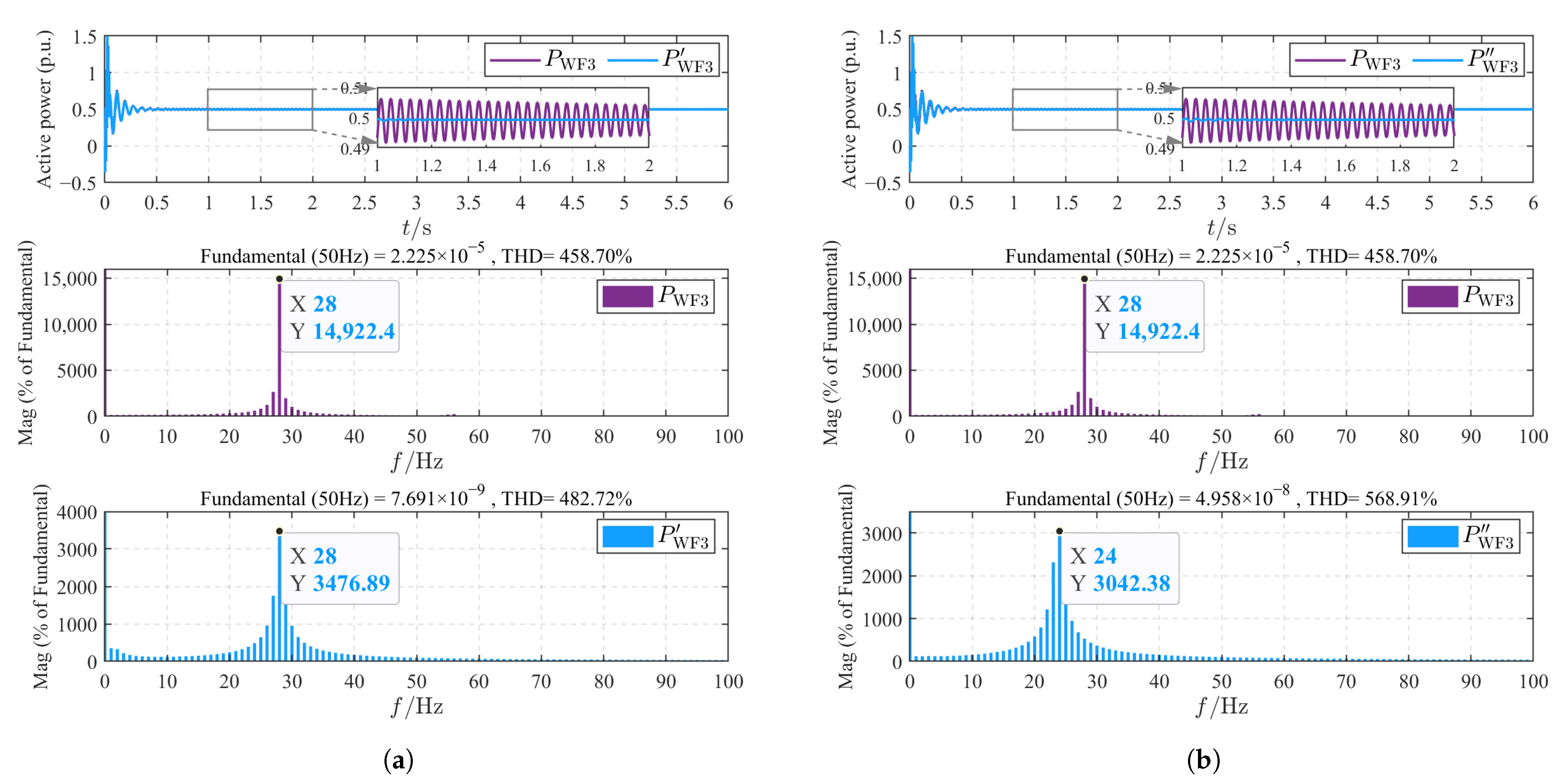
Furthermore, as shown in Figure 18, increasing the proportional gain k Ppll , WF 3 or decreasing the integral gain k Ipll , WF 3 of the PLL can shift the real part of the eigenvalue λ 128 to the left, thus effectively enhancing the damping of this mode. To verify this conclusion, k Ppll , WF 3 is increased from 21 to 28. As a result, the mode shifts from λ 128 , 129 = 0.4485 ± j 174.9565 to λ 128 , 129 = 3.6568 ± j 175.6380 , indicating a significant increase in damping while the oscillation frequency remains at 28 Hz. Time-domain simulations are performed in Matlab/Simulink to compare the active power responses P WF 3 and P WF 3 of WF 3 before and after the parameter adjustment, as shown in Figure 19a. The results show that after increasing k Ppll , WF 3 , the active power oscillation converges faster, with the same frequency of 28 Hz. When k Ipll , WF 3 is decreased from 28,000 to 20,000, the mode shifts from λ 128 , 129 = 0.4485 ± j 174.9565 to λ 128 , 129 = 4.5036 ± j 148.6217 , indicating a significant increase in damping while the oscillation frequency decreases to about 24 Hz. The active power P WF 3 and P WF 3 are compared in Figure 19b. After the parameter adjustment, the active power oscillation converges faster, and the oscillation frequency changes to 24 Hz, thereby validating the accuracy of the above weak node analysis.

5.3. Computational Complexity Analysis

The two core formulas of this paper, namely Equation (14) for the indicator of weak node identification and Equation (22) for the oscillation mode estimation, both have low computational complexity. Specifically, for a system with n nodes, when analyzing an oscillation mode, the computational complexity is as follows.
(1)
Indicator of Weak Node Identification: For each node, the Frobenius norm of a 2 × 2 residue matrix is computed. Summing over all n nodes gives a complexity of O ( n ) .
(2)
Oscillation Mode Estimation: Suppose that the mode is associated with m weak nodes. For each weak node, the Frobenius inner product of two 2 × 2 matrices is calculated, and the m results are summed. The complexity for this step is O ( m ) .
(3)
Overall complexity: The total complexity is O ( n + m ) . If h oscillation modes need to be analyzed, the total complexity becomes approximately O ( h ( n + m ) ) .
It should be noted that the above complexity analysis presupposes that the impedance models of stations and the system residues are already available. In practice, these quantities can be obtained through impedance measurement and vector fitting, whose computational complexity depends on the specific setup and algorithm [34]. Real-time online implementation would further require fast measurement and fitting techniques. However, a detailed analysis of these aspects is beyond the scope of this paper, as the main focus is the system-level weak node identification framework.

6. Conclusions and Limitations

Improving small-signal stability of power systems is key to ensuring the secure integration of high-penetration renewable energy and achieving a sustainable energy transition. This paper addresses the problem of weak node identification for small-signal stability in renewable energy-dominated power systems, and proposes an identification method based on residue-centered participation analysis.

6.1. Conclusions

(1)
Model Contribution: A unified analysis framework connecting the impedance model and the state-space model is established by constructing an equivalent state-space model. It explicitly bridges black-box impedance and white-box state-space participation analysis. The maximum eigenvalue error between the equivalent and the original model is only on the order of 10 6 , indicating the equivalence of the model.
(2)
Methodological Contribution: A system-level weak node identification indicator is proposed. This indicator directly reflects the observability and controllability of a node with respect to poorly damped oscillation modes. It is applicable to black-box impedance models and possesses clear physical meaning. The rank correlation between the results of the proposed indicator and those of state-space PF is close to 1, indicating high consistency.
(3)
Engineering Application: An estimation formula for oscillation mode variations under impedance perturbations at multiple nodes is derived. It provides engineering guidance for parameter tuning and damping control in practical power systems.

6.2. Limitations

It should be noted that the proposed method is based on the small-signal linearization assumption and is therefore suitable for small-signal stability analysis. To date, its validation has been limited to simulation-based case studies under specific parameter settings and renewable penetration scenarios. No real-life measurement data have been used. Moreover, the robustness of the method under varying control parameters, penetration levels, and operating conditions has not been systematically examined. Future work will address these limitations by: (i) testing the method with real-life measurement data; (ii) conducting comprehensive robustness analyses under diverse scenarios; and (iii) extending the method to nonlinear and large-disturbance domains.

Author Contributions

Conceptualization, Y.L. and Q.M.; methodology, Y.L. and Q.M.; software, Y.L.; validation, Y.L. and Q.M.; formal analysis, Y.L. and Q.M.; investigation, Y.L.; resources, Q.M.; data curation, Y.L. and Q.M.; writing—original draft preparation, Y.L.; writing—review and editing, Q.M.; visualization, Y.L.; supervision, Q.M.; project administration, Q.M.; funding acquisition, Q.M. All authors have read and agreed to the published version of the manuscript.

Funding

This research was funded by the National Natural Science Foundation of China under Grant 52207120.

Institutional Review Board Statement

Not applicable.

Informed Consent Statement

Not applicable.

Data Availability Statement

The original contributions presented in this study are included in the article. Further inquiries can be directed to the corresponding author.

Conflicts of Interest

The authors declare no conflicts of interest. The funders had no role in the design of the study; in the collection, analyses, or interpretation of data; in the writing of the manuscript; or in the decision to publish the results.

Abbreviations

The following abbreviations are used in this manuscript:
DCDirect current
GFLGrid-following
GFMGrid-forming
HVDCHigh-voltage direct current
PCCPoint of common coupling
PFParticipation factor
PLLPhase-locked loop
TGTurbine generator
WFWind farm

Appendix A. Derivation of the Original State-Space PF

For the equivalent state-space model, the eigenvalues λ i satisfy the equation given by
A φ i = λ i φ i
According to Equation (7), the equivalent and original state matrices are related by A = T 1 A or T . Substituting it into Equation (A1) gives
T 1 A or T φ i = λ i φ i
which is equivalent to
A or T φ i = λ i T φ i
From Equation (A3), it can be seen that T φ i is a right eigenvector of the original state matrix A or , i.e.,
φ or , i = T φ i
Similarly, the left eigenvector of A or is given by
ψ or , i T = ψ i T T 1
According to Equations (A4) and (A5), the j-th elements of φ or , i and ψ or , i T are
φ or , j i = w = 1 N t j w φ w i , ψ or , j i = w = 1 N t it , j w ψ w i
where t j w and t it , j w are the ( j , w ) elements of T and its inverse transpose T T , respectively. ψ w i and φ w i denote the w-th elements of ψ i T and φ i , respectively.
Therefore, the original state-space PF is given by
p or , j i = φ or , j i ψ or , j i = w = 1 N t j w φ w i w = 1 N t it , j w ψ w i

Appendix B. Parameters of the Testing Systems

The definitions and values of the parameters of the parallel system with four renewable energy stations are summarized in Table A1.
Table A1. Parameters of the parallel system with four renewable energy stations.
Parameter of GFM Converter ( k = 1 , 2 )DefinitionValue (p.u.)Parameter of GFL Converter ( k = 3 , 4 )DefinitionValue (p.u.)
D k Damping coefficient15 k Ppll , k Proportional gain of the PLL1
J k Inertia coefficient0.1 k Ipll , k Integral gain of the PLL100
m k Reactive power-voltage droop coefficient20 k P i , k Proportional gain of the current loop0.8
k P i , k Proportional gain of the current loop0.8 k I i , k Integral gain of the current loop5
k I i , k Integral gain of the current loop5 k Pp , k Proportional gain of the power loop2
k P u , k Proportional gain of the voltage loop5 k Ip , k Integral gain of the power loop50
k I u , k Integral gain of the voltage loop100 R line , k Line resistance 1.75 × 10 5
R line , k Line resistance 1.75 × 10 5 L line , k Line inductance 0.86 × 10 6
L line , k Line inductance 0.86 × 10 6
The parameter combinations of the parallel system with four renewable energy stations used in Section 5.1.4 (2) are listed in Table A2.
Table A2. Parameter combinations of the parallel system with four renewable energy stations.
Station 1Station 2Station 3Station 4
Pert. 1 k P u , 1 k P i , 2 k Ppll , 3 k Pp , 4
Pert. 2 D 1 k I u , 2 k Ip , 3 k P i , 4
Pert. 3 J 1 m 2 k Ipll , 3 k I i , 4
Pert. 4 J 1 k P u , 2 k Ipll , 3 k Ip , 4
Pert. 5 D 1 k I i , 2 k Ppll , 3 k P i , 4
Pert. 6 m 1 k I u , 2 k Pp , 3 k I i , 4
The definitions and values of the parameters of WF 3 in the real-life renewable energy-dominated power system are summarized in Table A3.
Table A3. Parameters of WF 3 in the real-life renewable energy-dominated power system.
ParameterDefinitionValue (p.u.)
k Ppll , WF 3 Proportional gain of the PLL21
k Ipll , WF 3 Integral gain of the PLL28,000
k P u , WF 3 Proportional gain of the voltage loop1
k I u , WF 3 Integral gain of the voltage loop280
k P i , WF 3 Proportional gain of the current loop1
k I i , WF 3 Integral gain of the current loop80

References

  1. Meegahapola, L.G.; Bu, S.; Wadduwage, D.P.; Chung, C.Y.; Yu, X. Review on Oscillatory Stability in Power Grids with Renewable Energy Sources: Monitoring, Analysis, and Control Using Synchrophasor Technology. IEEE Trans. Ind. Electron. 2021, 68, 519–531. [Google Scholar] [CrossRef]
  2. Cheng, Y.; Fan, L.; Rose, J.; Huang, S.; Schmall, J.; Wang, X.; Xie, X.; Shair, J.; Ramamurthy, J.R.; Modi, N.; et al. Real-World Subsynchronous Oscillation Events in Power Grids with High Penetrations of Inverter-Based Resources. IEEE Trans. Power Syst. 2023, 38, 316–330. [Google Scholar] [CrossRef]
  3. Chen, Y.; Wu, F.; Shi, L.; Li, Y.; Wang, Z.; Ding, Y. Analysis and Suppression Strategies of Sub-Synchronous Oscillations in DFIG Wind Farm Integrated with Synchronous Pumped Storage System. Sustainability 2025, 17, 4588. [Google Scholar] [CrossRef]
  4. Xu, Y.; Cheng, Y.; Zheng, L.; Liu, H. A Criterion for Oscillation Source Localization with IBRs Based on Sub-Synchronous Frequency Component of Instantaneous Power. IEEE Trans. Power Syst. 2024, 39, 7346–7358. [Google Scholar] [CrossRef]
  5. Qiu, J.; Zhao, J.; Wen, F.; Zhao, J.; Gao, C.; Zhou, Y.; Tao, Y.; Lai, S. Challenges and Pathways of Low-Carbon Oriented Energy Transition and Power System Planning Strategy: A Review. IEEE Trans. Netw. Sci. Eng. 2024, 11, 5396–5416. [Google Scholar] [CrossRef]
  6. Shrestha, A.; Pradhan, P.; Yassin, M.A.M.; Sharma, B.; Gonzalez-Longatt, F. Transitioning to a 100% Renewable Power Grid: Key Challenges and Opportunities. IEEE Trans. Technol. Soc. 2025, 6, 358–373. [Google Scholar] [CrossRef]
  7. Feng, R.; Xu, J.; Zhao, Z.; Dan, Y.; He, J.; Gu, C.; Shu, X.; Xia, X.; Yang, L.; Shen, L. Comparative Analysis of Energy Flow Characteristics in a Battery-Electric Heavy-Duty Tractor-Trailer Between Standard and User Driving Test Cycles. Energy 2026, 355, 141217. [Google Scholar] [CrossRef]
  8. Bâra, A.; Oprea, S.; Murafa, C. Energy Communities’ Archetypes and Operational Scenarios Using Agents and Embedding Heating and Transportation. Environ. Model. Assess. 2025, 30, 1195–1216. [Google Scholar] [CrossRef]
  9. Chen, Q.; Bu, S.; Chung, C. Small-Signal Stability Criteria in Power Electronics-Dominated Power Systems: A Comparative Review. J. Mod. Power Syst. Clean Energy 2024, 12, 1003–1018. [Google Scholar] [CrossRef]
  10. Amin, M.; Molinas, M. Small-Signal Stability Assessment of Power Electronics Based Power Systems: A Discussion of Impedance- and Eigenvalue-Based Methods. IEEE Trans. Ind. Appl. 2017, 53, 5014–5030. [Google Scholar] [CrossRef]
  11. Kundur, P.; Balu, N.J.; Lauby, M.G. Power System Stability and Control; McGraw-Hill: New York, NY, USA, 1994; pp. 699–822. [Google Scholar]
  12. Wang, X.; Song, Y.; Irving, M. Modern Power Systems Analysis; Springer: New York, NY, USA, 2010; pp. 489–542. [Google Scholar]
  13. Perez-arriaga, I.J.; Verghese, G.C.; Schweppe, F.C. Selective Modal Analysis with Applications to Electric Power Systems, PART I: Heuristic Introduction. IEEE Trans. Power Appar. Syst. 1982, PAS-101, 3117–3125. [Google Scholar] [CrossRef]
  14. Sun, D.; Liu, H.; Gong, M.; Chen, Z.; Hart, P. A Stability Analysis Tool for Bulk Power Systems Using Black-Box Models of Inverter-Based Resources. IEEE Trans. Ind. Appl. 2023, 59, 7318–7327. [Google Scholar] [CrossRef]
  15. Liu, Z.; Liu, J.; Hou, X.; Dou, Q.; Xue, D.; Liu, T. Output Impedance Modeling and Stability Prediction of Three-Phase Paralleled Inverters with Master–Slave Sharing Scheme Based on Terminal Characteristics of Individual Inverters. IEEE Trans. Power Electron. 2016, 31, 5306–5320. [Google Scholar] [CrossRef]
  16. Gong, H.; Wang, X.; Yang, D. DQ-Frame Impedance Measurement of Three-Phase Converters Using Time-Domain MIMO Parametric Identification. IEEE Trans. Power Electron. 2021, 36, 2131–2142. [Google Scholar] [CrossRef]
  17. Fang, J.; Yang, S.; Xie, Z.; Zhang, X.; Chang, L. Gradient-Based Black-Box Method for Improving the Stability Margin of Power Station Constructed by Inverters Without Exposing Controller Details. IEEE Trans. Power Electron. 2025, 40, 4830–4847. [Google Scholar] [CrossRef]
  18. Xin, H.; Yaermaimaiti, A.; Huang, L.; Yang, Y. Quantitative Evaluation of Frequency Domain Approaches in Assessing Small-Signal Stability of Grid-Tied Converters. IEEE Trans. Power Electron. 2025, 40, 18378–18389. [Google Scholar] [CrossRef]
  19. Li, Y.; Liao, Y.; Zhao, L.; Chen, M.; Wang, X.; Nordström, L.; Mittal, P.; Vincent Poor, H. Machine Learning at the Grid Edge: Data-Driven Impedance Models for Model-Free Inverters. IEEE Trans. Power Electron. 2024, 39, 10465–10481. [Google Scholar] [CrossRef]
  20. Li, H.; Nian, H.; Hu, B.; He, Z. Impedance Dataset Optimization Method for Data-Driven Modeling of Renewable Power Generation Equipment Considering Multi-Operation Conditions. J. Mod. Power Syst. Clean Energy 2025, 13, 1642–1652. [Google Scholar] [CrossRef]
  21. Sui, Z.; Sun, Q.; Wang, R.; Li, D.; Wang, P. The Grid-Connected Inverter Stability Enhancement Control Based on Impedance Instability Region Elimination. IEEE Trans. Power Electron. 2025, 40, 9606–9624. [Google Scholar] [CrossRef]
  22. Orellana, L.; Sainz, L.; Prieto-Araujo, E.; Cheah-Mané, M.; Mehrjerdi, H.; Gomis-Bellmunt, O. Study of Black-Box Models and Participation Factors for the Positive-Mode Damping Stability Criterion. Int. J. Electr. Power Energy Syst. 2023, 148, 108957. [Google Scholar] [CrossRef]
  23. Xu, W.; Huang, Z.; Cui, Y.; Wang, H. Harmonic Resonance Mode Analysis. IEEE Trans. Power Deliv. 2005, 20, 1182–1190. [Google Scholar] [CrossRef]
  24. Ebrahimzadeh, E.; Blaabjerg, F.; Wang, X.; Bak, C. Bus Participation Factor Analysis for Harmonic Instability in Power Electronics Based Power Systems. IEEE Trans. Power Electron. 2018, 33, 10341–10351. [Google Scholar] [CrossRef]
  25. Hong, L.; Shu, W.; Wang, J.; Mian, R. Harmonic Resonance Investigation of a Multi-Inverter Grid-Connected System Using Resonance Modal Analysis. IEEE Trans. Power Deliv. 2019, 34, 63–72. [Google Scholar] [CrossRef]
  26. Zhan, Y.; Xie, X.; Liu, H.; Liu, H.; Li, Y. Frequency-Domain Modal Analysis of the Oscillatory Stability of Power Systems with High-Penetration Renewables. IEEE Trans. Sustain. Energy 2019, 10, 1534–1543. [Google Scholar] [CrossRef]
  27. Liao, Y.; Wang, X.; Wang, X. Frequency-Domain Participation Analysis for Electronic Power Systems. IEEE Trans. Power Electron. 2022, 37, 2531–2537. [Google Scholar] [CrossRef]
  28. Gu, Y.; Li, Y.; Zhu, Y.; Green, T.C. Impedance-Based Whole-System Modeling for a Composite Grid via Embedding of Frame Dynamics. IEEE Trans. Power Syst. 2021, 36, 336–345. [Google Scholar] [CrossRef]
  29. Zhu, Y.; Gu, Y.; Li, Y.; Green, T.C. Participation Analysis in Impedance Models: The Grey-Box Approach for Power System Stability. IEEE Trans. Power Syst. 2022, 37, 343–353. [Google Scholar] [CrossRef]
  30. Zhu, Y.; Gu, Y.; Li, Y.; Green, T.C. Impedance-Based Root-Cause Analysis: Comparative Study of Impedance Models and Calculation of Eigenvalue Sensitivity. IEEE Trans. Power Syst. 2023, 38, 1642–1654. [Google Scholar] [CrossRef]
  31. Kailath, T. Linear Systems; Prentice-Hall: Englewood Cliffs, NJ, USA, 1980; pp. 345–498. [Google Scholar]
  32. Zhang, X. Matrix Analysis and Applications; Cambridge University Press: Cambridge, UK, 2017; pp. 3–94, 129–180, 413–510. [Google Scholar]
  33. Chan, S.M. Modal Controllability and Observability of Power-System Models. Int. J. Electr. Power Energy Syst. 1984, 6, 83–88. [Google Scholar] [CrossRef]
  34. Gustavsen, B.; Semlyen, A. Rational Approximation of Frequency Domain Responses by Vector Fitting. IEEE Trans. Power Deliv. 1999, 14, 1052–1061. [Google Scholar] [CrossRef]
  35. Gibbons, J. Nonparametric Measures of Association; SAGE Publications, Inc.: Thousand Oaks, CA, USA, 1993; pp. 3–15. [Google Scholar]
  36. Fan, L.; Miao, Z. Wind in Weak Grids: 4 Hz or 30 Hz Oscillations? IEEE Trans. Power Syst. 2018, 33, 5803–5804. [Google Scholar] [CrossRef]
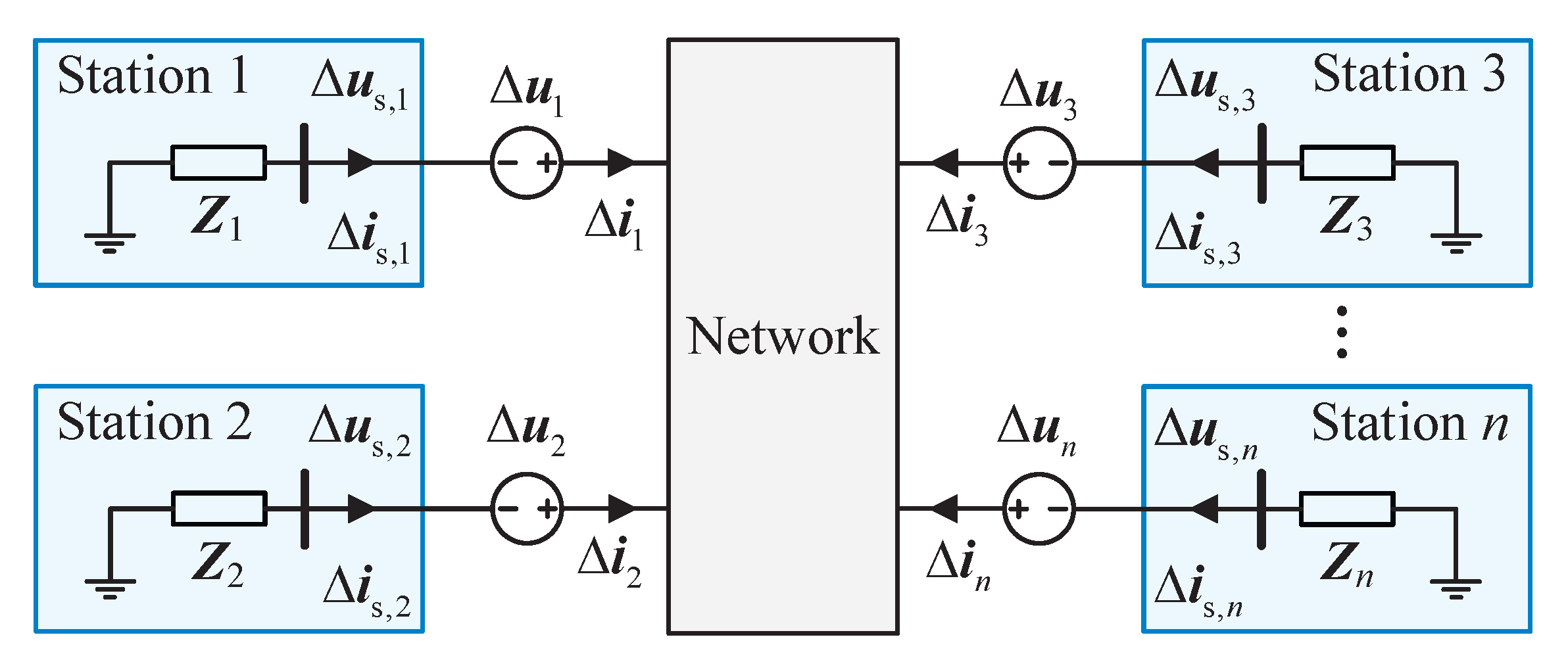
Figure 1. Schematic diagram of the renewable energy-dominated power system.
Sustainability 18 05507 g001
Figure 2. Schematic diagram of relationships among different state-space PFs. Blue indicates the variables of interest, and purple indicates the relationships of interest.
Sustainability 18 05507 g002
Figure 3. Schematic diagram of the parallel system with four renewable energy stations.
Sustainability 18 05507 g003
Figure 4. The eigenvalue distributions of the equivalent and original state-space models. (a) Original parameter case. (b) Case 1a. (c) Case 1b.
Sustainability 18 05507 g004
Figure 5. The impedance PFs, original state-space PFs, and the indicators of grey-box method. (a) Case 1a. (b) Case 1b.
Sustainability 18 05507 g005
Figure 6. The actual and estimated mode variations under parameter perturbations at Station 1.
Sustainability 18 05507 g006
Figure 7. Active power and FFT analysis of Station 1 before and after k P u , 1 adjustment.
Sustainability 18 05507 g007
Figure 8. The actual and estimated mode variations under parameter perturbations at Station 3.
Sustainability 18 05507 g008
Figure 9. Active power and FFT analysis of Station 1 before and after k Ppll , 3 adjustment.
Sustainability 18 05507 g009
Figure 10. The actual and estimated mode variations under parameter perturbations at Station 1–4 for Case 1a.
Sustainability 18 05507 g010
Figure 11. Active power and FFT analysis of Station 1 before and after parameter adjustments at Station 1–4 for Case 1a.
Sustainability 18 05507 g011
Figure 12. The actual and estimated mode variations under parameter perturbations at Station 1–4 for Case 1b.
Sustainability 18 05507 g012
Figure 13. Active power and FFT analysis of Station 1 before and after parameter adjustments at Station 1–4 for Case 1b.
Sustainability 18 05507 g013
Figure 14. The diagram of the real-life renewable energy-dominated power system. WF: wind farm; TG: turbine generator; A, B, C: 750 kV buses; D: high-voltage direct current transmission line.
Sustainability 18 05507 g014
Figure 15. The equivalent circuit of the real-life renewable energy-dominated power system. The numbers in the figure indicate the node numbers. There are 39 nodes in total.
Sustainability 18 05507 g015
Figure 16. The eigenvalue distributions of the real-life renewable energy-dominated power system.
Sustainability 18 05507 g016
Figure 17. The impedance PFs of the 8 WFs and the TG in the real-life renewable energy-dominated power system.
Sustainability 18 05507 g017
Figure 18. The actual and estimated mode variations under parameter perturbations at WF 3.
Sustainability 18 05507 g018
Figure 19. Active power and FFT analysis of WF 3 before and after parameter adjustment. (a) Increasing k Ppll , WF 3 from 21 to 28. (b) Decreasing k Ipll , WF 3 from 28,000 to 20,000.
Sustainability 18 05507 g019
Table 1. Differences and relationships between the state-space and impedance PFs.
State-Space PFImpedance PF
Original State-Space PFEquivalent State-Space PF
Mathematical expression p or , j i = w = 1 N t j w φ w i w = 1 N t it , j w ψ w i p j i = φ j i ψ j i p Z , k i = C r , k φ i ψ i T B c , k F
Physical meaningParticipation between mode λ i and the j-th original state variableParticipation between mode λ i and the j-th equivalent state variableObservability and controllability of λ i with respect to the node k
RelationshipThe transformation matrix T relates the equivalent and original state-space PFs.\
\The input and output matrices B and C extend the relation of mode λ i from internal state variables to external node.
Table 2. Parameter adjustments.
ParameterBeforeAfter
Case 1a k P u , 1 2.562.82
k P i , 2 0.80.88
k Ppll , 3 11.1
k Pp , 4 22.2
Case 1b k P u , 1 55.5
k P i , 2 0.80.88
k Ppll , 3 0.0150.0225
k Pp , 4 22.2
Disclaimer/Publisher’s Note: The statements, opinions and data contained in all publications are solely those of the individual author(s) and contributor(s) and not of MDPI and/or the editor(s). MDPI and/or the editor(s) disclaim responsibility for any injury to people or property resulting from any ideas, methods, instructions or products referred to in the content.