Article

Investigation of Spatial and Demographic Drivers of Long-Term Oasis Landscape Sustainability in Saharan Regions

by
Mohamed Elhadi Matallah
1,2,*,
Fatima Zahra Ben Ratmia
3,
Waqas Ahmed Mahar
1,4,
Atef Ahriz
5,
Mohamed Akram Eddine Ben Ratmia
3,
Mohammed Faci
6,
Ghani Boudersa
5 and
Jacques Teller
7
1
Sustainable Building Design Lab., Department UEE, Faculty of Applied Sciences, University of Liège, 4000 Liege, Belgium
2
Civil Engineering and Hydraulics Laboratory, Sustainable Development and Environment (LARGHYDE), University of Biskra, Biskra 07000, Algeria
3
Department of Architecture, Mohamed Khider University, Biskra 07000, Algeria
4
Department of Architecture, School of Art, Design and Architecture (SADA), National University of Sciences and Technology (NUST), Islamabad 44000, Pakistan
5
Department of Architecture, Echahid Cheikh Larbi Tebessi University, Tebessa 12002, Algeria
6
Center for Scientific and Technical Research on Arid Regions (CRSTRA), Biskra 07000, Algeria
7
Local Environment Management and Analysis (LEMA) Urban & Environmental Engineering Department, Faculty of Applied Sciences, University of Liège, 4000 Liege, Belgium
*
Author to whom correspondence should be addressed.
Sustainability 2026, 18(11), 5497; https://doi.org/10.3390/su18115497
Submission received: 24 March 2026 / Revised: 10 May 2026 / Accepted: 17 May 2026 / Published: 1 June 2026
(This article belongs to the Section Environmental Sustainability and Applications)

Abstract

Across the Saharan region of North Africa, oasis territories constitute the dominant form of human settlement. In Algeria, the Sahara is undergoing rapid urban and agricultural expansion, resulting in significant spatial and demographic transformations and increased environmental pressures on oasis systems. Despite these critical dynamics, existing studies have addressed oasis sustainability only superficially, lacking quantitative, territory-scale indicators that integrate both spatial and demographic dimensions. As a result, preserving oasis territories has become a critical challenge for national economic and industrial development. Spatial planning and demographic balance are key drivers for oasis landscape sustainability. This study focuses on the Tolga oasis territory, one of the largest in North Africa, to investigate the spatial and demographic relationships among the built environment, urban perimeters, population dynamics, and palm grove areas. The methodology combines: (1) historical cartographic analysis using georeferenced maps from 1900 to 2020 processed in QGIS (RMSE < 5 m); (2) GIS-based digitization of built-up areas (BuA) and palm grove areas (PGA) across four reference periods (1900, 1940, 1980, 2020); (3) polynomial regression modeling for urban perimeter vs. inter-oasis distance; and (4) least squares method for the population–palm tree correlation. Using spatial and statistical analyses, the results indicate that the built-up area should remain below a threshold ratio of 0.05 relative to the cultivated area to maintain the oasis landscape. Strong polynomial correlations (0.5876 ≤ R2 ≤ 0.974) confirm the structural link between urban perimeter growth and inter-oasis distance, outperforming linear regression (mean ΔR2 = +0.226). In addition, a strong correlation is identified between population size and palm tree abundance, as expressed by the relationship PT = 1.6376 Po + 755,050, where P denotes population size (F-statistic = 178.4; p < 0.01; N = 24; 95% CI of slope = ±0.24). Adopting a territorial-scale approach, this study proposes novel quantitative indicators, including ratio and formula-based models that can be integrated into Saharan territorial planning strategies to support sustainable oasis development.

1. Introduction

1.1. Research Background and Existing Problems

Arid and semi-arid regions cover approximately 41% of Earth’s land area and nearly 75% of North Africa [1]. Within these regions, oasis territories constitute distinctive intrazonal landscapes in which vegetation and human settlements develop in response to the availability of water resources [2]. The oasis system is traditionally defined by the interaction of three inseparable components: water, palm groves, and human settlements [3]. This interaction is shaped by a combination of site-related drivers, including topography and bioclimatic conditions, and situation-specific drivers, such as historical trade routes, as well as intrinsic structural characteristics of oasis systems, including water mobilization systems, agricultural typologies, social hierarchies, and their levels of integration within the local context [4]. Developing countries in arid regions are more vulnerable than developed countries to anthropogenic disturbances and climate change. The warming trend in arid lands is twice as pronounced as in humid regions. Rising temperatures are likely to disproportionately affect poorer populations in arid environments, leading to increased poverty, ecosystem degradation, and accelerated desertification. Moreover, rapid population growth is a critical factor threatening ecosystem sustainability. Between 2000 and 2025, arid lands accounted for 51% of global population growth, with 50% occurring in developing countries compared to only 1% in developed countries. Oases are widely recognized as fragile systems embedded within highly hostile environments such as the Sahara. Their spatial evolution and transformation are driven by multiple pressures, including climate change, population growth, and anthropogenic activities [5,6], leading to two contrasting morphological shaping: oasification or desertification [5].
Unfortunately, these inherent constraints pose challenges to many of the United Nations’ Sustainable Development Goals (SDGs) within the rural contexts, such as enhancing and providing sustainable urbanization (SDG 11.3), integrating climate change measures into national policies, strategies, and planning (SDG 13.2), and taking significant action to reduce degradation of natural habitats (SDG 15.5), which are often totally neglected and not implemented. In this regard, Algeria, as the main study context, has made crucial commitments for the SDGs 2030 [6,7], to ensure the development of urbanization with rational control of population growth and its impacts on natural resources and fragile environments, specifically the Saharan lands. However, focusing the bulk of development programs on urban areas in the short term can eventually lead to an imbalance between rural and urban environments.
Structurally, oasis systems develop as networked, discontinuous patterns, often described as an archipelago of settlements. Hernández-Agüero et al. (2025) [8], provided a global, spatially explicit inventory of oases, identifying 1344 oases worldwide. Their results show that oases in Asia and North Africa (ANA) cover only about 1.5% of the global dryland area, yet support around 150 million inhabitants, with up to 400 million people living in or near oasis systems, highlighting their disproportionate socio-ecological importance. In the same study, researchers indicated that, despite their ecological, cultural, and demographic significance, less than 0.5% of oasis areas are currently protected, making oases among the least conserved ecosystems worldwide and underscoring the urgent need for integrated conservation and planning strategies.

1.2. Existing Solutions and Limitations

Further, previous studies on oasis sustainability worldwide have primarily focused on environmental imbalance and degradation processes [9,10,11,12,13,14,15], highlighting the need for integrated analytical frameworks capable of characterizing oasis systems beyond purely environmental dimensions. Bouzaher and Alkama (2013) [11], demonstrated in their study that reintegrating date palm groves into urban planning in the Ziban oasis region in the southeast of Algeria can significantly mitigate overheating and improve outdoor thermal conditions, with the 5 m × 5 m palm spacing identified as the most effective module for solar shading in arid and semi-arid climates. In another context, in the study of Lamqadem et al. (2018) [14], the researchers showed that applying the MEDALUS model combined with GIS and Sentinel-2 data reveals that more than 50% of the Middle Draa Valley, in Morocco oases are highly to very highly sensitive to desertification, with climate stress (low rainfall, high temperatures) and human pressure (overgrazing, intensive water use) identified as the dominant drivers. Moreover, in China, the study of Yang et al. (2019) [12], showed that the expansion of artificial oases in the Manas River Basin (1976–2015), driven by water-saving irrigation technologies, significantly improved water-use efficiency and regional economic growth but simultaneously caused a sharp decline in natural oases and kept the system in a persistent metastable state (H0 < 0.5), indicating unsustainable development. To the best of our knowledge, existing studies have addressed the sustainability of oasis landscapes only superficially, and most have not identified the key drivers required to sustain oasis landscape systems. Overall, there is a need for a specific, integrated approach that enables a comprehensive characterization of oasis landscaping.
While numerous studies have addressed water management challenges in arid regions [16,17,18], which represent a critical constraint in these fragile environments, others have examined the relationship between oasis systems and agricultural expansion, particularly vegetation-based farming systems [19,20,21]. Benziouche (2017) [20], has revealed that organic date palm farming in the Ziban region in Algeria, has the potential to enhance date valorization, export competitiveness, and palm grove preservation, with positive price premiums despite lower yields compared to conventional systems. Another study of Bouaziz et al. (2018) [21], highlighted that North African oases are dynamic and living systems undergoing profound socio-economic, agricultural, and environmental transformations, where sustainability increasingly depends on the coexistence of diversified agricultural practices and adaptive water-resource management rather than a strict opposition between traditional and modern systems. Additional research has examined the socio-economic dimensions of oases and their role in transforming traditional settlements into Saharan urban centers [15,22]. The study of Belguidoum (2002) [22], showed that urbanization in the Sahara is a long-term process shaped by both historical caravan networks and more recent state-led integration policies, resulting in profound transformations of Saharan cities, social structures, and urban forms, including rapid demographic growth, functional diversification, and spatial re-composition.
In general, the characteristics of urban morphology can be classified into two main categories:
  • Physical characteristics: They specifically include the size of the urban area, the materials used, the number of floors, population size, expansion rate, and related indicators. On the other hand, in oasis territories, these characteristics were primarily determined by:
    (a)
    Water-related attributes: particularly the volume of available water resources and the ease of access to them.
    (b)
    Geospatial criteria and features, including:
    • The distance between oases, i.e., the spatial position of each oasis in relation to other oases.
    • The geographical position of the oasis relative to the main trans-Saharan trade routes (a topic that warrants independent investigation).
    • The topographical characteristics, particularly in terms of accessibility and the suitability of the surrounding land for agricultural use.
    • The economic characteristics of the oasis in comparison with neighboring oases.
  • Social characteristics: these constitute the most critical dimension in this context. They were shaped by a set of factors that historically characterized desert societies, including:
    • Collective values: one of the most significant attributes, which has considerably weakened over time, yet it originally played a fundamental role in the establishment and continuity of the urban system.
    • Social cohesion: traditional social structures were distinguished by their strong capacity to formulate and enforce regulatory frameworks governing community organization and all aspects of daily life.

1.3. The Constructed Methods and Advantages

The novelty of this research resides in four key contributions: (1) the development of the first quantitative spatial–demographic framework specifically designed for oasis territorial planning at a century-long temporal scale; (2) the derivation of measurable sustainability thresholds (BuA/PGA ≤ 0.05) grounded in empirical, multi-period data spanning from 1900 to 2020; (3) the formulation of a predictive equation (PT = 1.6376 Po + 755,050) linking population growth to palm tree requirements; and (4) the direct applicability of these quantitative tools to national planning frameworks, namely the National Spatial Planning Scheme (NSPS) and the Development Plan for the Territory (DPT) for the 2030 horizon. While existing studies have provided conceptual characterization drivers, the present study advances beyond description toward operationalization, translating these drivers into quantitative ratios and predictive equations suitable for territorial governance.
Despite this growing body of literature, knowledge remains limited about the integrated spatial and demographic drivers of oasis landscape systems. Therefore, the objective of this study is to investigate two key drivers, spatial and demographic, to assess their interrelationships and their influence on the sustainability of the oasis landscape. Existing studies on oasis spatial patterns have adopted various characterization drivers, including: (1) geographical location, (2) water mobilization systems, (3) palm grove, and (4) built environment configuration. Based on these drivers, the present study proposes a comprehensive characterization criterion applicable to oasis territories across the arid regions specifically of North Africa. In this regard, the research question is:
To what extent do spatial patterns and demographic dynamics affect the sustainability of oasis landscapes in arid environments?

1.4. Main Structure, Content, and Contribution of the Study

Based on the framework outlined previously, the present study pursues the following research objectives and hypotheses. Research objective: to quantify the spatial and demographic relationships driving oasis landscape sustainability through the development of measurable indicators and predictive models applicable to territorial planning.
Hypothesis 1: 
The ratio of built-up area to palm grove area (BuA/PGA) determines spatial equilibrium, with a critical threshold of ≤0.05 for sustainability.
Hypothesis 2: 
Urban perimeter growth is structurally linked to inter-oasis distance through a polynomial relationship.
Hypothesis 3: 
Population size is positively correlated with palm tree abundance, and this correlation can be formalized into a predictive equation for future planning.
Based on this framework, the research is initially structured into four main dimensions representing the key factors driving oasis development and sustainability.
1.
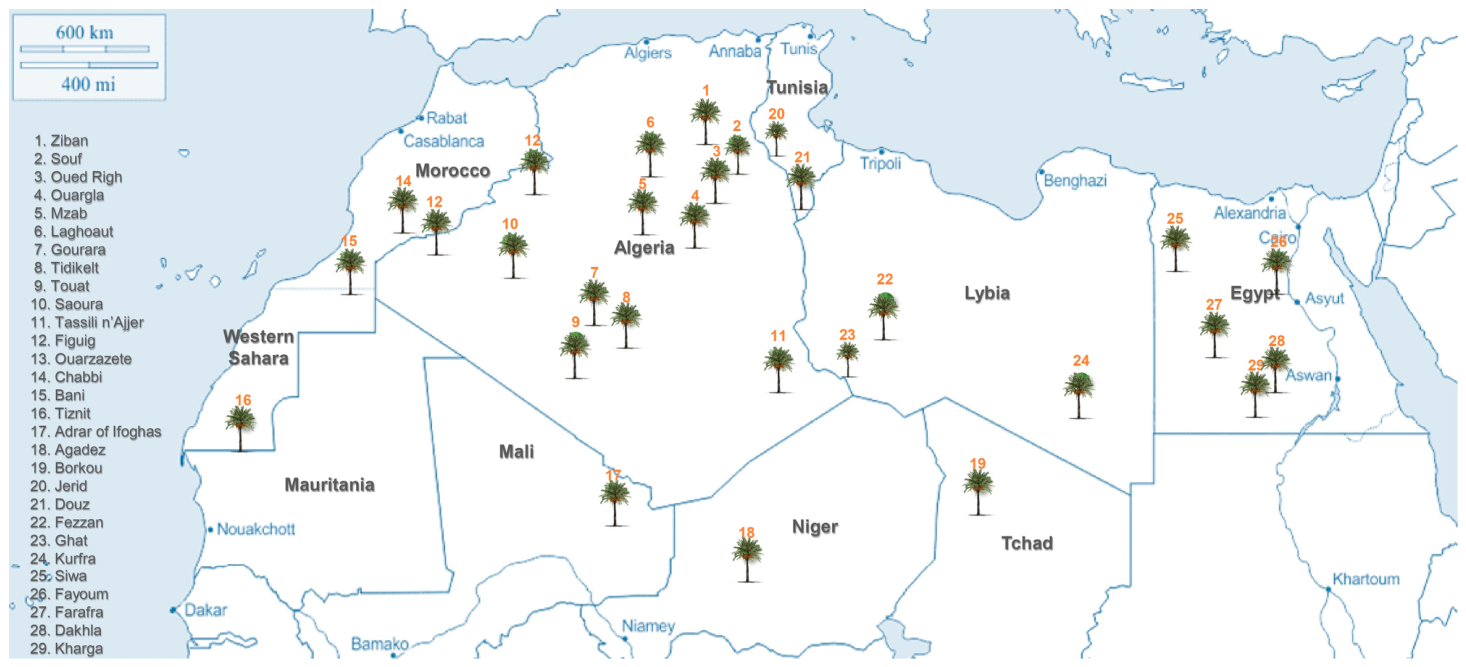
The first dimension focuses on geographical location (Figure 1) [3,23,24], allowing analysis of the major geomorphological contexts of oasis territories. Four principal geographic settings are identified: (a) Sahara plains, generally flat areas often located at the foothills of mountain ranges; (b) Erg, characterized by extensive dune systems forming the Eastern and Western Ergs; (c) Reg, representing flat, stony surfaces; and (d) Hamada, defined as tabular rocky plateaus bounded by escarpments. These geographical settings are closely linked to historical caravan routes that connected the Middle East to North Africa and the Mediterranean to the Sahel regions.
2.
The second dimension addresses water mobilization and traditional management systems across multiple spatial scales [18,25,26,27,28,29,30,31]. Identified modes include source-based, fluvial, gorge, valley, artesian, foggara, and cell systems, each governed by specific natural conditions and hydraulic principles. These systems range from gravity-fed spring distribution and fluvial dam–canal networks to underground galleries (foggara) and shallow groundwater exploitation.
3.
The third dimension examines the palm grove and its spatial relationship with the built environment [32,33,34,35,36], considering both natural surroundings and urban interfaces. Four principal palm grove morphologies are identified: serrated, circular, grid, and subspontaneous forms. In addition, the relationship between palm groves and the built environment is analyzed at two levels: horizontal configuration (interference, adjacency, separation) and vertical configuration, reflecting topographic positioning (level, elevated, or underlying).
4.
The fourth dimension focuses on built environment patterns, including forms of development, axes of expansion, and structural organization of built-up areas [3,15,30,37,38]. Development forms are classified as regular (quadrangular) or irregular (circular or honeycomb patterns), while expansion axes include radioconcentric, linear, and fan-shaped growth. Built-up structures are further distinguished as either single-unit masses or aggregations of multiple units.
To the best of our knowledge, the criteria presented in Table 1 constitute the principal factors for characterizing oasis landscapes in North African arid regions.
Within this framework, the present study analyzes the relationships between three main components of the oasis system: (i) population, (ii) palm trees (palm grove), and (iii) urban and cultivated areas, along with their associated spatial connection distances, providing quantitative outcomes for understanding the oasis landscape’s dynamics.
The Tolga oasis territory, one of the largest and longest-standing oasis landscapes worldwide, has persisted over an extended historical period [50]. This territory reveals critical aspects that merit investigation, offering robust insights into the planning and governance of oasis environments. Accordingly, the present study examines spatial and demographic dynamics as key determinants in maintaining the overall structure and sustainability of the oasis landscape.
Figure 1 illustrates the major and most well-known oasis territories distributed across several North African countries.

2. Literature Review

This section systematically reviews and compares existing studies on oasis sustainability to position the present research within the current state of knowledge and to highlight the innovation of our approach. Recent research on oasis sustainability can be broadly categorized into five thematic approaches: (a) environmental and desertification assessments, (b) hydrological and water resource analyses, (c) remote sensing and land-use change detection, (d) socio-economic and governance studies, and (e) integrated spatial planning frameworks.
Environmental and desertification studies have employed standardized indices such as the MEDALUS model [13,14] and spectral indices derived from Sentinel-2 data [52]. While these approaches effectively quantify environmental degradation, they typically do not incorporate demographic or spatial planning dimensions. Hydrological studies in Saharan oases have focused on groundwater management, irrigation efficiency, and aquifer depletion [16,17,18,53,54]. Kharroubi et al., (2023) [54] provided institutional analysis and policy recommendations for groundwater governance in the Algerian Sahara, yet did not develop quantitative spatial indicators.
Remote sensing approaches by Yang et al. (2019) [12], Ben Ratmia et al. (2025) [55], Yan et al., (2025) [56], and F. El-Baz (2010) [57] have provided valuable spatio-temporal land-use change analyses. Socio-economic studies have examined urbanization processes [22], agricultural transformations [20,21], and demographic pressure on agricultural carrying capacity [58]. K. Amrani, (2024) [59] specifically examined demographic-agricultural interactions in Ouargla region, in Algeria, yet without proposing quantitative planning tools.
Integrated spatial planning frameworks remain scarce in oasis research. Matallah et al. (2020, 2021) [60,61] investigated outdoor thermal comfort in oasis urban fabrics. Hadji and Petrisor (2025) [51] examined palm groves as green infrastructure in Biskra. Perez-Ramos (2024) [49] explored vernacular agricultural landscapes. Lu et al. (2023) [62] analyzed urban-agricultural land-use interactions in oasis cities. Chen et al. (2024) [63] provided a global review concluding that integrated spatial–demographic approaches remain underexplored. In summary, no existing study has yet proposed an integrated quantitative framework that combines spatial ratios, demographic correlations, and predictive models at the territory scale. The present study fills this gap by developing three measurable indicators (BuA/PGA, Di/P, Po/PT) applicable to national planning frameworks.

3. Materials and Methods

The research methodology adopts an integrated analytical framework to assess the sustainability of the Tolga oasis territory by examining the interaction between spatial configuration and demographic dynamics. The approach combines spatial analysis, demographic data processing, and landscape characterization to identify the key drivers of the long-term stability of the oasis system. Geospatial tools were employed to map land-use patterns, palm grove distribution, urban expansion, and infrastructural networks, while demographic indicators are analyzed to capture population growth, density, and settlement dynamics within the oasis territory.
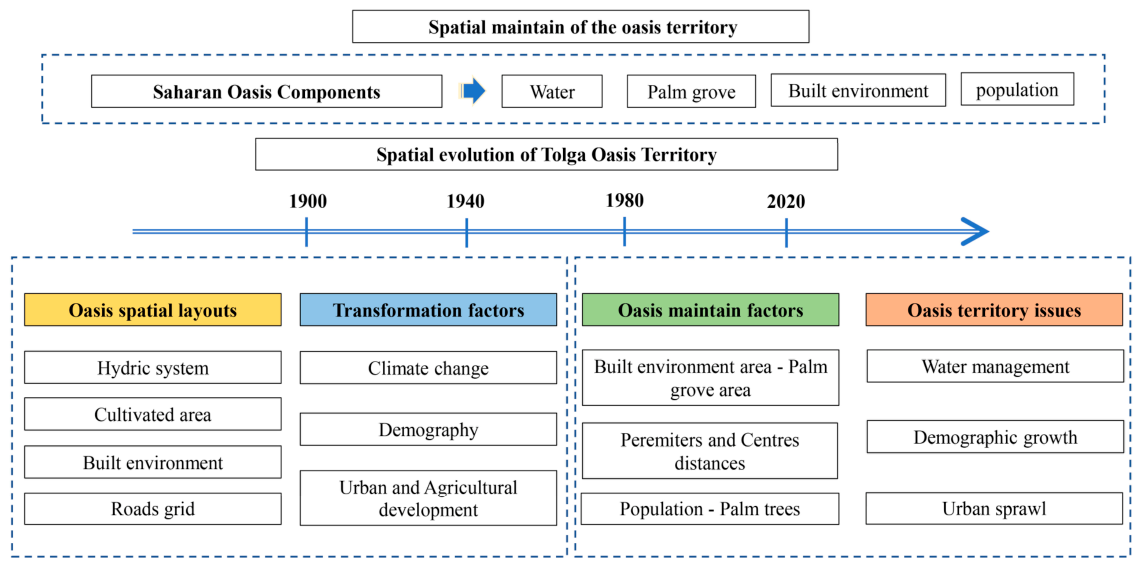
The purpose of this methodological framework is to develop a structured and robust analytical model that enables supporting long-term planning and governance of oasis landscapes in arid environments. Figure 2 illustrates the study’s conceptual framework, and details the methodological steps.
For the mapping approach, it is necessary to note that historical maps (1900, 1940, and 1980) were scanned and resampled to a ground spatial resolution of 2–5 m before being georeferenced in QGIS (v.2.18). A first-order polynomial (affine) transformation was applied using stable ground control points (GCPs), including road intersections, permanent structures, hydrographic features, and topographic landmarks identifiable in both historical and recent datasets. Additionally, georeferencing accuracy was evaluated using Root Mean Square Error (RMSE), which was maintained below one (1) pixel (≤5 m).
On the other hand, polynomial regression was adopted instead of linear regression because the relationship between urban perimeter growth and inter-oasis distance exhibited nonlinearity over time. Urban expansion in oasis territories occurs in phases influenced by infrastructure development, demographic shifts, and spatial constraints, resulting in a curvature rather than a constant growth rate. The higher coefficients of determination (R2) obtained with the polynomial model confirm its superior fit and greater suitability for representing long-term oasis dynamics.

3.1. Study Area

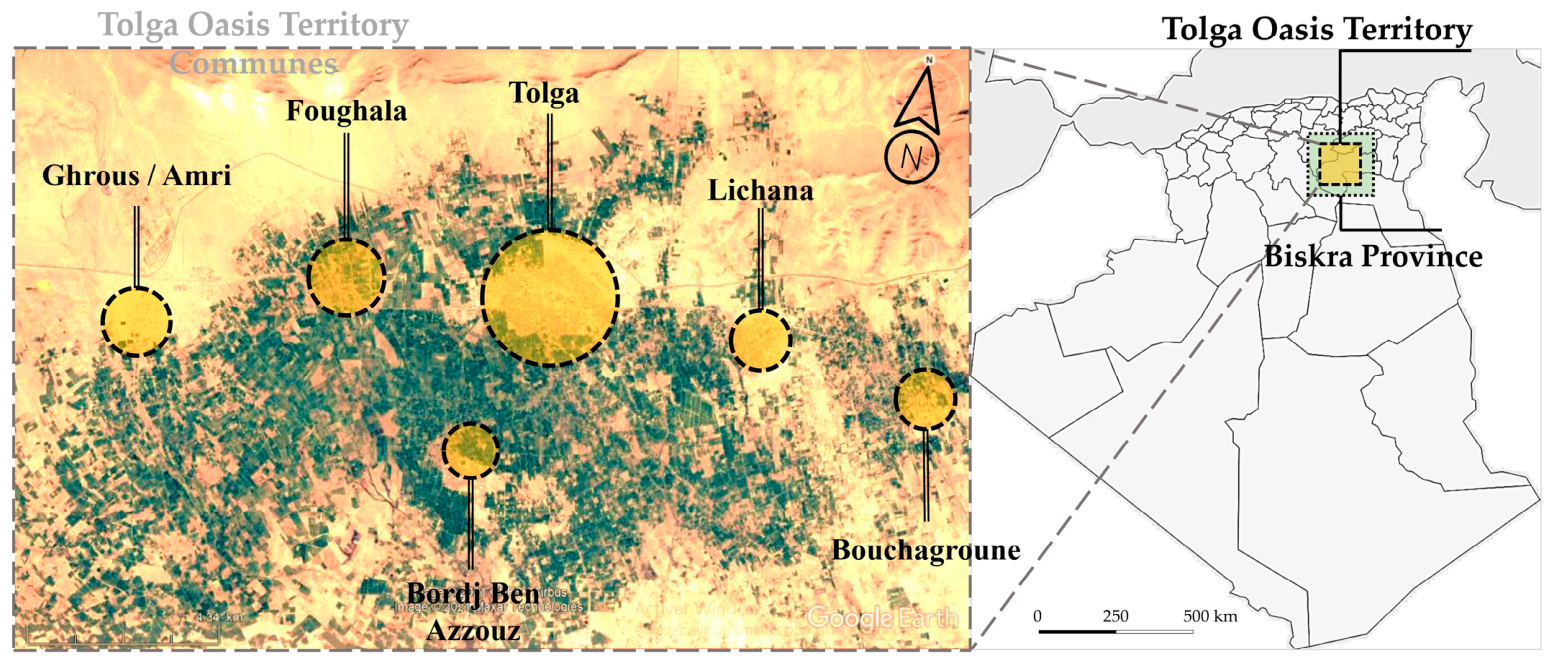
The Tolga oasis territory is located approximately 400 km southeast of Algiers (the capital) and lies within the Ziban region of Biskra Province. As shown in Figure 3, the territory is structured around Tolga, the second-largest city in the region, which functions as the main urban center of an oasis complex comprising Tolga–Farfar, Lichana–Zaatcha, Bouchagroune, Bordj Ben Azzouz, Foughala, and El Ghrous–Amri oases (Figure 2). This complex is considered the largest continuously inhabited oasis system in Algeria, with a population exceeding 150,000 according to the 2017 census. The constituent oases (municipalities) are interconnected by roads and palm groves, with no distinct boundaries between them. The demographic growth of the Tolga oasis territory has shown a continuous upward trend over the past decades, increasing from 25,903 inhabitants in 1966 to 41,300 in 1977 (excluding Foughala, for which no statistical data were available at that time), then to 65,262 in 1987, 87,013 in 1996, 119,189 in 2008, and reaching 150,036 inhabitants in 2017. Furthermore, Tolga city has experienced a much faster growth rate than the surrounding oases (municipalities), with an average increase of approximately 15,000 inhabitants per decade since the 1987 Algerian national census. This accelerated growth underscores the city’s strong attractiveness, largely driven by the concentration of services, infrastructure, and living facilities.
Geographically, the territory extends between 34°38′ and 35°05′ N latitude and 4°56′ and 5°35′ E longitude, covering a total area of 1590.50 km2. The urbanized area covers 2155.2 ha, while agricultural land covers 20,561.6 ha, of which approximately 95% consists of palm groves. The physical setting is diverse, comprising plains (50% of the area), a mountainous range to the north, and marshy zones in the southern part of the territory [60,61].
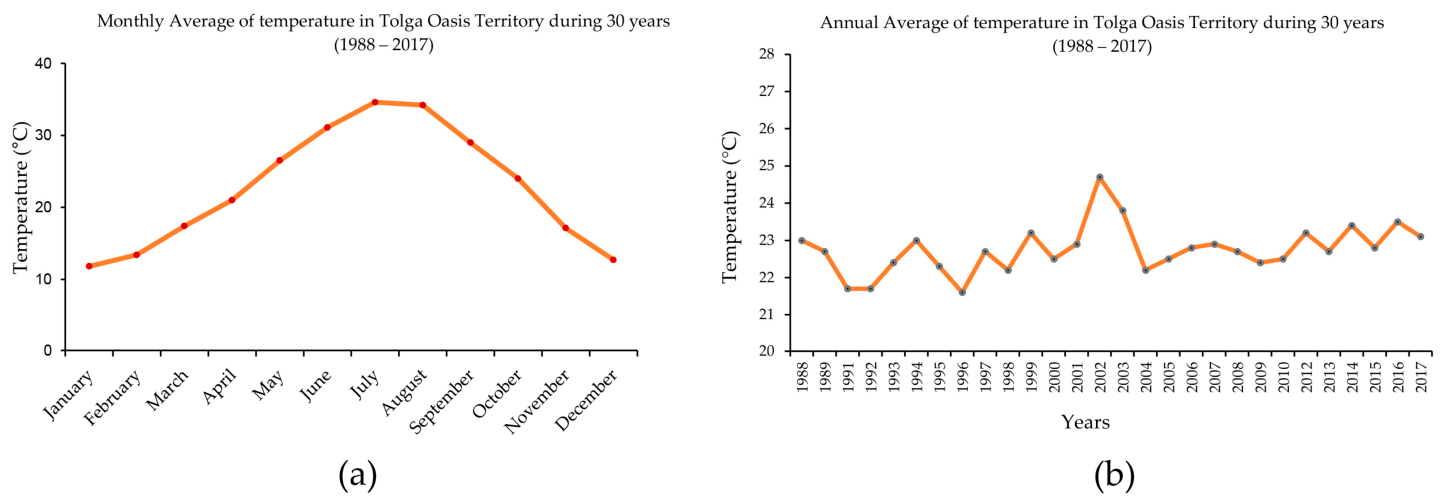
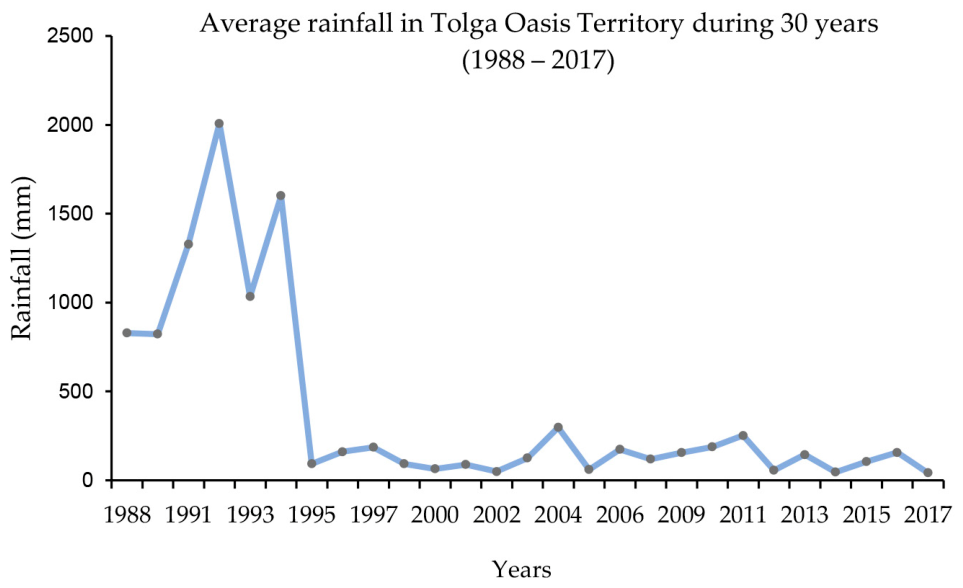
The study area is characterized by an arid climate (BWh, Köppen–Geiger classification), with pronounced seasonal contrasts in summer and winter temperatures. Based on climatic data from the annual weather reports of Algeria (National Office of Meteorology) covering the period 1988–2017, the mean annual precipitation of the study region showed a remarkable decline, decreasing from approximately 1270 mm during 1988–1994 to about 126 mm for the period 1995–2017 (Figure 4 and Figure 5). This persistent low level of precipitation reflects the region’s pronounced aridity and is likely associated with broader climatic variability and ongoing climate change.
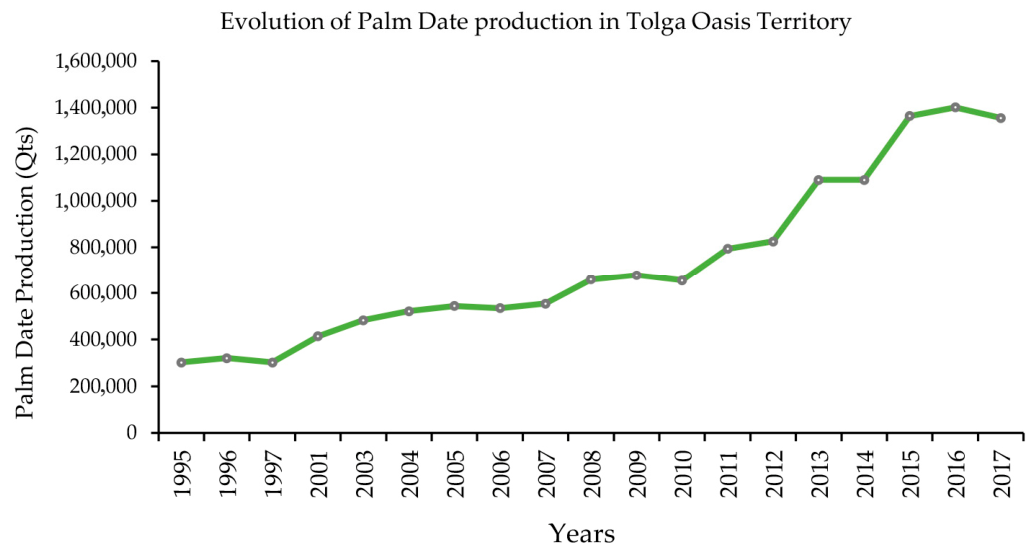
Tolga is internationally recognized for the high quality of its dates known as ‘Deglet Nour’, with approximately 1,356,202 quintals produced in 2017 [20]. The territory contains more than 1,006,600 date palm trees (Phoenix dactylifera L.), forming extensive palm groves that surround and integrate all urban areas within the oasis system. Historically rooted in agricultural activity, the Tolga oasis territory continues to rely on its agrarian and rural character as a fundamental component of its socio-economic structure. Since the 1980s, agricultural development has been strongly supported by national policies in Algeria, notably the Access to Agricultural Land Ownership Program (1983) and the National Agricultural Development Plan (2000), which have stimulated the expansion and intensification of agricultural practices across the entire oasis network (Figure 6). Owing to its climatic conditions, agricultural productivity, and spatial extent, the study area is considered one of the largest and most significant oasis territories in the Saharan Desert of North Africa [60,61].

3.2. Data Sources and Processing

The present study aims to develop a novel territorial planning framework for oasis landscapes, grounded in spatial and demographic factors. The proposed framework is intended to support decision-making by structuring and managing interactions among the main components of oasis territories, which play a critical role in ensuring spatial sustainability, functional balance, and long-term persistence of oasis systems in arid environments worldwide (Figure 2).
Overall, the proposed measures can be quantitatively integrated as planning and predictive tools to support territorial development strategies in Algeria, particularly within national frameworks such as the National Spatial Planning Scheme (NSPS) and the Development Plan for the Territory (DPT), with a specific focus on arid environments by 2030.
In this regard, the NSPS is an Algerian strategic governmental instrument that translates national policies for spatial planning and sustainable development into operational guidelines at both national and regional scales. It identifies territorial strengths, weaknesses, opportunities, and threats, thereby framing evolving territorial dynamics. The NSPS is structured around four strategic orientations: (i) promoting a sustainable territory, (ii) fostering territorial rebalancing dynamics, (iii) enhancing territorial attractiveness and competitiveness, and (iv) ensuring territorial equity.
Furthermore, the Development Plan for the Territory (DPT) functions as an intermediary planning instrument, providing an analytical and operational framework for territorial evaluation, planning, and programming at the provincial level. It ensures the implementation of NSPS strategies while adapting them to local specificities. Despite undergoing multiple transformations over time, this territory has preserved essential characteristics of its historical settlement structure.
Accordingly, the study addresses the analysis of two complementary elements: (i) an investigation of the historical evolution and major transformations of the Tolga oasis territory’s landscape, and (ii) the identification of correlations between spatial and demographic drivers within the oasis urban system to assess sustainability dynamics. To achieve the first objective, the methodological framework followed three stages:
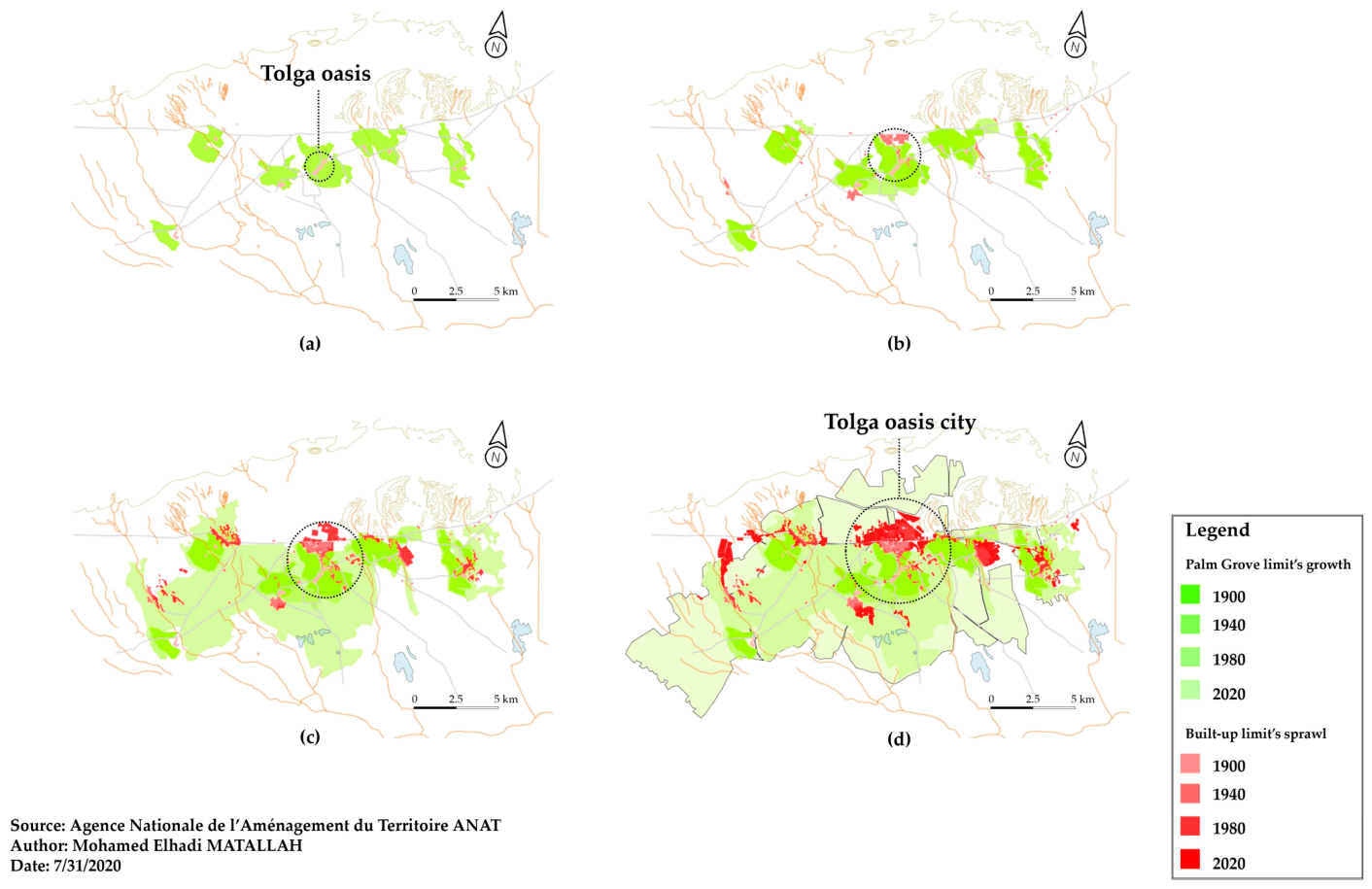
  • First, the temporal growth of the Tolga oasis territory landscape was analyzed through a historical perspective. Thus, a mapping analysis was conducted to represent spatial transformations within the oasis complex. Moreover, the spatial evolution was mapped from 1900 to 2020 using QGIS 2.18 (open-source GIS software) [64], illustrating the spatial dynamics and interaction between urban and agricultural areas. The temporal analysis was structured into four reference snapshots: (i) the reference snapshot of 1900, representing the initial spatial configuration of the oasis territory; (ii) the snapshot of 1940, corresponding to transformations under French governance (changes from 1900); (iii) the snapshot of 1980, following the implementation of the Access to Agricultural Land Ownership (AALO) Algerian strategy and the second provincial territorial division (changes from 1940); and (iv) the snapshot of 2020, marked by the National Agricultural Development Plan (NADP) and distinct housing and infrastructure programs (changes from 1980). This snapshot-based approach eliminates overlap between periods.
  • A mapping was produced through the georeferencing of historical military maps (1910, 1926, and 1933), added to recent cartographic sources from the National Institute of Cartography and Remote Sensing (NCRS: 2005 and 2016), and remote sensing imagery (NCRS, code 153–183, July 1981). Therefore, the evolution of the Tolga oasis territory has been influenced by multiple interacting drivers, including climate change, population growth, local urban and agricultural development, and human activities. To assess the magnitude of these transformations, the study evaluates climatic trends, demographic growth (1987–2017), agricultural development (date palm production, 1995–2017), and spatial expansion over more than a century. Given that the local economy is primarily based on date palm cultivation (Phoenix dactylifera L.), these variables were selected as the most relevant drivers of territorial change. Additionally, all statistical data were obtained from the monographs on Biskra Province.
  • The second analytical step aims to establish mathematical correlations between the key components of the oasis territory. These correlations are hypothesized to represent the fundamental mechanisms that have enabled the long-term preservation and resilience of the Tolga oasis landscape. By quantifying interactions among spatial, demographic, climatic, and agricultural drivers, the study seeks to clarify their role in sustaining oasis territories under arid environmental conditions.
To achieve the second objective, the study focused on establishing quantitative correlations between key spatial and demographic drivers. The development of these mathematical relationships was based on an integrated mapping and statistical analysis of data on population dynamics, spatial configuration (including built-up surfaces and inter-settlement distances), and the number of date palm trees. Accordingly, three principal ratios were formulated: (i) the ratio between built-up area and palm grove area, (ii) the relationship between distances separating urban centers and the extent of built-up perimeters, and (iii) the ratio between population size and the number of palm trees.
a.
Ratio: Built-up Area—Palm Grove Area
Previous studies conducted by Alkama et al. (2001) [28] and Bouzaher et al. (2012, 2013) [10,11] have shown that the urban structure of oasis landscape is characterized by a strong spatial interdependence between cultivated areas primarily palm groves and the built environment, regardless of settlement typology (village, ksar, medina, or city) which were the ancient human settlements founded within the Saharan regions. The evolution of human settlements is therefore closely linked to the dynamics of palm grove expansion or contraction [4,22,65]. In this context, the built–cultivated area ratio expresses the proportion of built-up surface (m2 or ha) relative to cultivated land within the oasis system and serves as a key indicator of spatial balance. To ensure long-term sustainability, urban expansion within oasis territories should not exceed a critical threshold relative to the palm grove’s area. Accordingly, built-up and cultivated areas were quantified using QGIS for the four historical periods identified in the evolution of the Tolga oasis territory.
b.
Ratio: Distance between urban centers and urban zones’ perimeters
The degree of aggregation of urban perimeters raises fundamental questions concerning the spatial balance of oasis settlements and is shaped by multiple interacting drivers, including economic development, urban planning policies, topographical constraints, and the distribution of services [66,67,68]. Accordingly, the analysis of connectivity levels among oasis entities seeks to elucidate the relationship between urban sprawl patterns within oasis settlements and the distances separating secondary urban centers from the Tolga oasis core, which serves as the dominant structuring pole for development across the studied territory [15].
c.
Ratio: Population—Palm trees
Based on the findings of Bouzaher et al. (2012, 2013) [10,11], the strong dependence of oasis inhabitants on date palm cultivation, recognized as the primary economic resource in the study area [44], allows for the formulation of a correlation between population size and the number of palm trees.

4. Results

This section includes both the results and their interpretation based on the analyzed data. In particular, it presents the development and application of spatial and demographic ratios within equations, followed by a discussion of their implications for the understanding of oasis landscapes’ dynamics. Overall, the spatial evolution within the territorial level was as follows:
  • Reference snapshot—1900
The earliest settlements of the Tolga oasis territory were established on or near Roman ruins, particularly around former thermal zones, and functioned as relay points along historic caravan routes [28]. At this initial stage, the oasis territory exhibited spatial characteristics similar to other oasis landscapes in the Ziban region, characterized by an organic built-up pattern embedded within the palm grove networks [15]. Urban expansion was highly constrained, remaining closely dependent on the boundaries of palm groves and local population density. Moreover, the oases forming the study area were aligned along the former caravan axis, with an average inter-settlement distance of approximately 2.5 km following J. Hurabielle, (1899) [69], indicating a compact and functionally interconnected oasis network.
  • Snapshot 1940 (changes from 1900)
During French rule, the Tolga oasis territory underwent a marked transformation in its urban growth pattern. The built-up area expanded partially northward beyond the palm grove’s limit through ex nihilo development, whereas agricultural expansion of the palm grove progressed predominantly toward the southern areas. Consequently, each phase of expansion within the oasis territory exhibited variable spatial scales, depending on population size and the newly established infrastructure.
This period also witnessed significant improvements in accessibility, with the development of drivable road networks in multiple directions and the construction of a railway line after 1910, linking Tolga to the city of Biskra. Despite the overall territorial expansion, several smaller oases disappeared during this phase, notably those of Zaatcha and Amri, reflecting the uneven impacts of colonial-era transformations on the oasis network.
  • Snapshot 1980 (changes from 1940)
During this period, the Tolga oasis territory experienced further spatial expansion, driven in part by the opening of the main road linking Biskra to Algiers (capital), which established a strong structural axis for urban development. Concurrently, the palm grove continued to expand southward, likely in response to the location of available water sources in the southern sector of the territory. The interdependence between built-up areas and palm groves remained pronounced, with human settlements largely embedded within cultivated zones.
Urban growth patterns were strongly influenced by proximity to major road infrastructures and the spatial configuration of the palm grove, resulting in two dominant morphological forms: compact (rounded) settlements and linear (elongated) extensions. Additionally, several historic settlements, including old Lichana, old Bouchagroune, old Foughala, and old Bordj Ben Azzouz, were partially abandoned following the severe flooding events of 1969, which affected large parts of the Algerian Sahara.
  • Snapshot 2020 (changes from 1980)
At present, the Tolga oasis territory encompasses approximately 2155.2 ha of urbanized areas and 20,561.6 ha of palm grove areas, representing increases of about 49 times and 11.5 times, respectively, compared to their extents in 1900. Additionally, spatial growth continues predominantly toward the north, extending beyond National Road No. 46 (which lies between Biskra city and Algiers, the capital). Consequently, Tolga oasis remains the central driver of territorial dynamics across the study area, concentrating tertiary, agricultural, and urban functions, while the surrounding oasis network evolves in close relation to the development of Tolga as the primary territorial core [70]. Figure 6 illustrates the spatial genesis and long-term expansion of the Tolga oasis territory.

4.1. Evolution of Tolga Oasis Urban Patterns

The results of this study are synthesized in the following sections. The analysis of the spatial and demographic parameters enabled the development of quantitative correlations between the key components of the oasis landscape, including the built-up and palm grove areas, inter-urban distances, and population dynamics with the number of date palm trees.
Ratio: Built-up area—Palm grove area
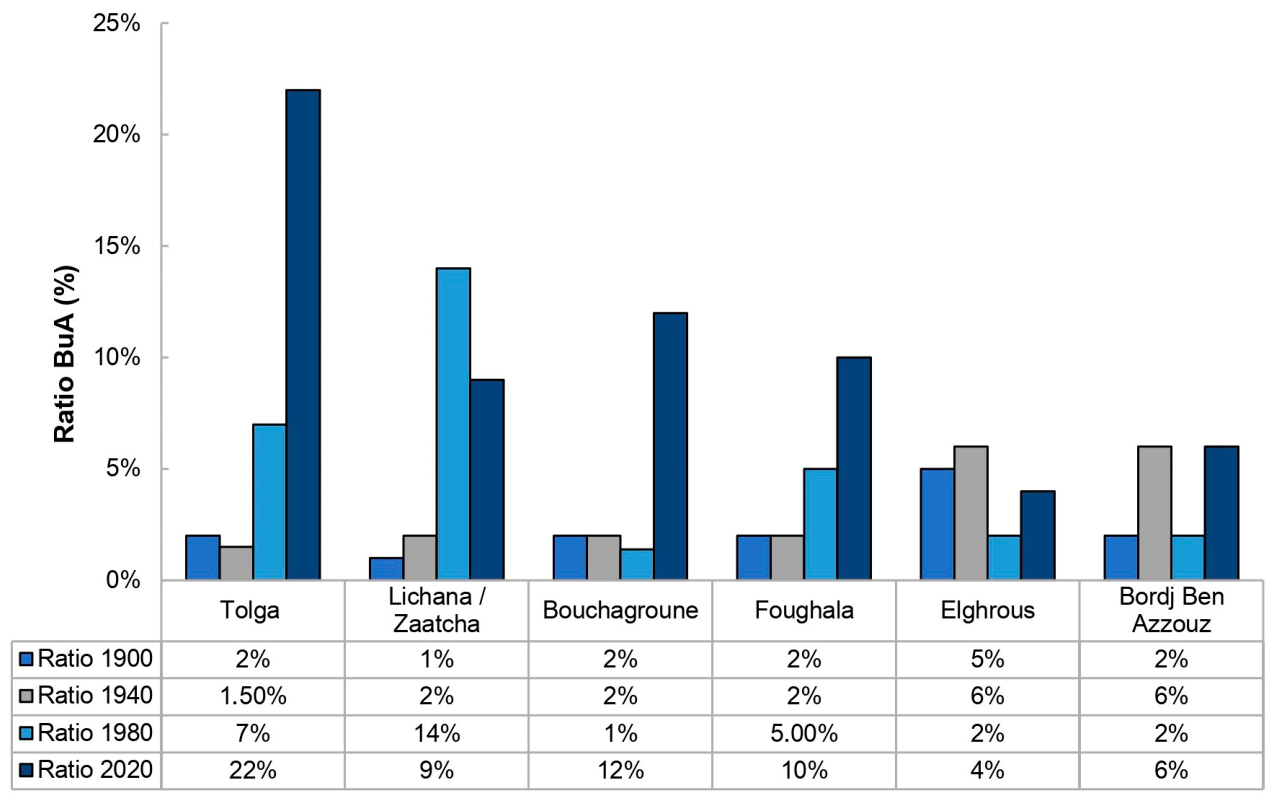
The calculation of built-up and cultivated (palm grove) areas was carried out using georeferenced mapping data. The resulting ratio (BuA/PGA) represents the proportion of the built-up surface relative to the palm grove surface and was computed for each of the four historical periods to capture the spatial evolution of the study area over a long-term period (Figure 7).
Table 2 summarizes the cumulative changes in built-up and palm grove areas across distinct historical periods relative to the initial reference period.
  • Reference snapshot (1900)
During the initial reference period (1900), the Tolga oasis territory exhibited a very low level of spatial imbalance between the built-up and palm grove areas. The average built-up and palm grove area ratio (BuA/PGA) was approximately 2% across the territory, indicating that built-up areas represented only about 2% of the cultivated palm grove area. This form, observed in four out of the six oasis settlements, reflects a strong spatial integration of human settlements (built-up) within the cultivated landscape (palm grove).
  • Snapshot 1940 (changes from 1900)
During the second period, the built-up expanded relatively balanced manner, increasing by two to five times its initial extent. On the other hand, the palm grove area experienced a more moderate growth, approximately doubling compared to the previous period. The average BuA/PGA ratio reached about 3%, with spatial variations among settlements, including three values of 2%, two values of 6%, and one value of 1.5%. These results reveal an emerging decoupling between urban growth and the expansion of agricultural land.
  • Snapshot 1980 (changes from 1940)
In this period, urban expansion intensified considerably, with built-up areas increasing between four and thirty-six times their initial size, while palm grove areas expanded between ×3 and ×15 times. The average BuA/PGA ratio increase to approximately 5%, with marked disparities among oasis settlements. The ratio values ranged from 14% and 7% in the most built-up areas to 5%, two values of 2%, and one value of 1.4% in less affected oases. It should be noted that during this period, the oasis of Farfar was administratively and spatially integrated into Tolga, becoming a secondary agglomeration after 1974, which contributed to the observed increase in urban concentration.
  • Snapshot 2020 (changes from 1980)
In the most recent period, urban growth continued at a sustained pace, with built-up areas expanding between four and thirty-six times their initial extent. Meanwhile, palm grove growth showed greater spatial differentiation, increasing by a factor of four in Lichana, three in El Ghrous, and remaining close to initial levels (Tolga, Bouchagroune, Foughala, and Bordj Ben Azzouz. Overall, the oasis territory exhibits a markedly higher average BuA/PGA ratio of approximately 10.5%, with various values of 22%, 12%, 10%, 9%, 6%, and 4%, highlighting increasing pressure on cultivated areas and a growing spatial imbalance between urban and agricultural components (Figure 8).

4.2. Ratio: Urban Area Perimeter—Center Distance

At this stage, two key variables were analyzed across the four historical periods: the perimeter across the four historical periods Urban perimeters were defined as the polygonal boundaries of the built-up areas, and distances were measured from the centroids of these polygons to the centroid of the Tolga urban polygon, which is considered the primary center structuring urban development across the entire studied territory [15]. As urban perimeters evolved over time, the location of centroids shifted accordingly in response to changes in urban form.
From 1900 to 2020, the expansion of urban perimeters revealed substantial growth disparities among the oasis settlements, with Lichana and Foughala increasing by a factor of twelve, Bouchagroune by eleven, Tolga by nine, El Ghrous by six, and Bordj Ben Azzouz by five. Therefore, statistical analysis identified a strong polynomial correlation between urban perimeter extension and distance from the Tolga center, with coefficients of determination ranging from R2 = 0.5876 to R2 = 0.974. High correlations were observed for Lichana (R2 = 0.974), El Ghrous (R2 = 0.9336), and Foughala (R2 = 0.9301), while Bordj Ben Azzouz (R2 = 0.5876) exhibited moderate correlations.
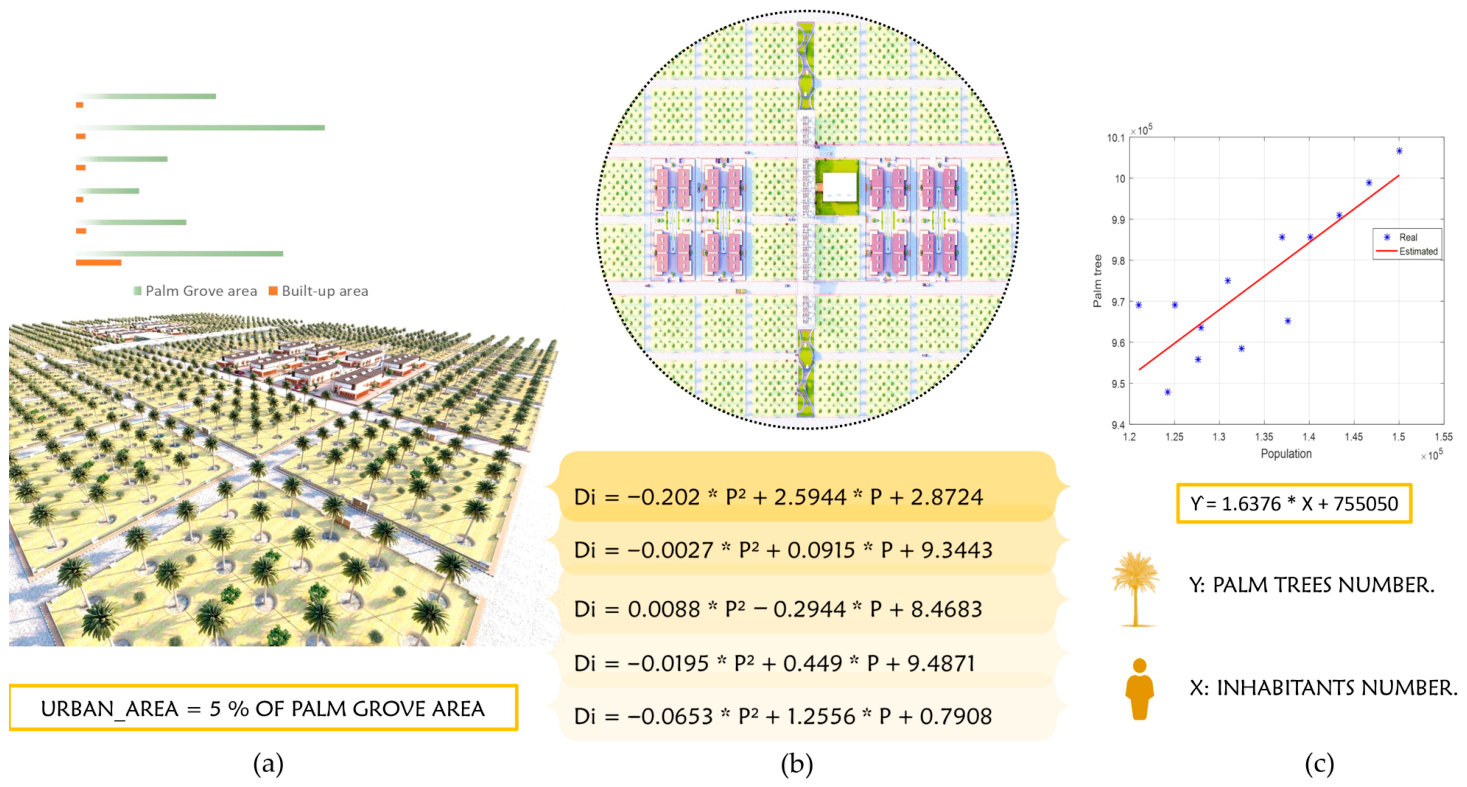
Based on these relationships, five polynomial equations, one for each oasis, were established to model inter-urban distances as a function of urban perimeter growth (Table 3).
The polynomial model consistently outperforms the linear model across all five oases. The improvement is particularly substantial for Foughala (ΔR2 = +0.645) and El Ghrous (ΔR2 = +0.300), where the linear model fails to capture the curvilinear expansion pattern. The mean R2 improvement of +0.226 confirms the suitability of the 2nd-degree polynomial based on the Akaike Information Criterion (AIC) (Table 4).

4.3. Ratio: Population—Palm Trees

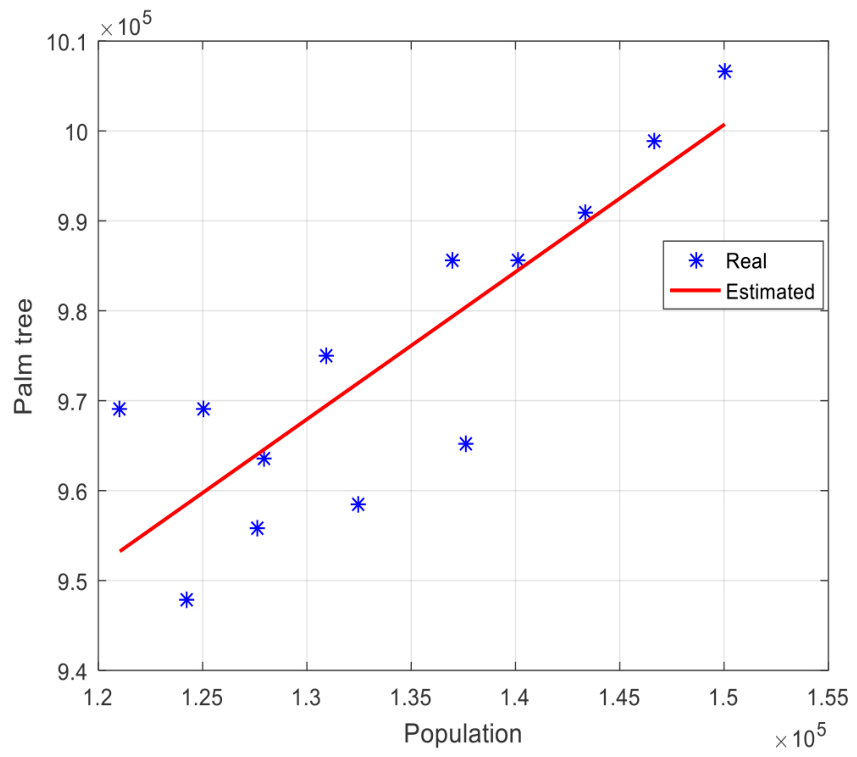
In addition, the relationship between population size (Po) and the number of palm trees (PT) was analyzed using statistical data from population censuses (Figure 9). The results reveal strong positive correlations across all oases, with coefficients of determination of R2 = 0.9245 for Tolga, 0.9209 for Lichana, 0.9019 for Bouchagroune, 0.7979 for Foughala, 0.8515 for Bordj Ben Azzouz, and 0.9859 for El Ghrous, indicating a high degree of dependence between the two variables.
Building on these results, a general equation was formulated to describe the relationship between population and palm trees across entire study area. This equation was developed using the least squares method, incorporating numerical variables (population and palm tree counts) and categorical variables (municipalities). The resulting linear model links Y (number of palm trees) to X (population size) and is designed to predict future palm tree requirements based on projected population growth. Population projections were derived from official forecasts reported by the Ministry of Planning, Development, and Urban Policy (MPDUP) and the Directorate of Public Works and Transport (DPWT) for the 2030 Horizon (Figure 9).
Based on this framework, the following assumptions are adopted:
Y ^ = [ X   𝟙 ] ( a b ) = H θ
where Y ^ is the number of palm trees, X is the number of inhabitants, and θ is a derivative. The final equation is:
Y ^ = 1.6376 X + 755050
The complete statistical parameters for this equation are: sample size N = 24 (6 municipalities × 4 periods); overall R2 = 0.89; F-statistic = 178.4 (p < 0.01); 95% confidence interval for the slope: 1.6376 ± 0.24; 95% confidence interval for the intercept: 755,050 ± 112,300. This model was calibrated specifically for the Tolga oasis territory; its direct application to other oasis systems requires independent validation with local data.
In this regard, the progressive increase in the BuA/PGA ratio from 2% (1900) to 10.5% (2020), with local elevations reaching 22%, quantitatively demonstrates a structural shift from strong spatial integration toward increasing urban pressure on cultivated palm groves. These rising ratios provide measurable sustainability thresholds, indicating that maintaining BuA/PGA values close to ≤5% is critical for preserving agricultural land, limiting urban sprawl, and ensuring long-term spatial equilibrium within the oasis landscape. Additionally, the strong polynomial relationships identified (0.5876 ≤ R2 ≤ 0.974) confirm that urban perimeter growth is structurally linked to inter-oasis distance, reflecting a measurable spatial hierarchy centered on Tolga. These equations provide quantitative planning benchmarks for controlling urban expansion rates, optimizing inter-settlement distances, and maintaining the spatial cohesion necessary for long-term oasis sustainability. Furthermore, high correlations (0.7979 ≤ R2 ≤ 0.9859) confirm a strong structural dependence between population size and palm tree numbers across the oasis territory, showing that demographic growth is directly linked to agricultural capacity. The derived predictive model (Ŷ = 1.6376 X + 755,050) therefore provides a quantitative sustainability benchmark, enabling planners to align population projections with minimum palm tree requirements in order to preserve phoenicultural balance and long-term oasis landscape resilience.
By translating spatial–demographic interactions into predictive equations, the study supports proactive and sustainability-oriented governance of oasis landscapes in arid regions (Figure 10).

5. Discussion

This section discusses the study’s main findings and their implications for territorial planning and sustainability in arid environments, specifically in the North African Saharan region.
The primary objective of this research is to develop a quantitative approach that supports territorial policies and planning strategies adopted by the Algerian government particularly the National Spatial Planning Scheme (NSPS) and the Development Plan for the Territory (DPT) with the aim of fostering sustainable territorial development in arid regions. In Algeria, arid lands cover more than 80% of the national territory and are predominantly structured around oases territories, making them a critical focus for sustainable planning strategies.
The current methodological framework developed in this study explicitly emphasizes spatial and demographic dimensions, which are prioritized as axes of the DPT orientations for the 2030 horizon. In this regard, by focusing on these dimensions, the approach directly responds to these national planning objectives while adapting them to the specific constraints, dynamics, and landscape characteristics of oasis territories.
The results highlight the continuity of sustainability mechanisms within the Tolga oasis territory, despite exposure to multiple impacts, including climate change, population growth, and agricultural development. These dynamics interact with the main spatial drivers of the oasis landscape, namely palm groves, population distribution, the built environment, and connectivity networks, which collectively determine the long-term balance and resilience of the territorial landscape.
The first factor analyzed (BuA/PGA) establishes a quantitative relationship between the built-up area (BuA) and the palm grove area (PGA). By examining the evolution of these variables across four historical periods (1900–2020), the study defines an average surface ratio of BEA = 0.05 × PGA. Accordingly, this ratio confirms the historically strong spatial integration between urban settlements and cultivated areas in oasis systems, while also providing a quantitative threshold that can be used to ensure partially the sustainability of future oasis settlements and landscapes. Further, numerous studies have demonstrated that rapid and uncontrolled urban growth threatens environmental sustainability through deforestation, ecosystem degradation, urban sprawl, and microclimatic alteration, particularly in arid regions [71]. In this regard, integrating a specific spatial factor such as the BuA/PGA ratio into planning strategies and tools specifically in arid environments becomes essential for ensuring future urban development toward balanced and sustainable growth.
The second factor examines the relationship between two spatial variables: the perimeter of the built environment ‘P’ (km), representing the extent of urbanized contours, and the distance ‘Di’, (km) between the centroid of each oasis settlement and the main development pole of the Tolga city. Thus, measured across the four historical periods, this relationship provides insight into how urban expansion interacts with spatial connectivity. Furthermore, this factor aligns with NSPS guidelines aimed at strengthening connectivity networks among oasis entities in arid environments, particularly in southern Algeria. Additionally, its practical value lies in its application to urban planning, particularly for programming future urban extensions. Thus, by anticipating the relationship between urban perimeter growth and distance from the central pole, decision-makers can identify more appropriate locations for expansion at early planning stages, thereby reducing spatial fragmentation and reinforcing territorial coherence. The identified correlations identified were formalized through a set of predictive equations.
The third factor addresses the relationship between population growth and the number of palm trees, reflecting the strong socio-economic dependence of local populations on palm grove agriculture [10,11]. Therefore, date palms constitute the principal economic and ecological capital of oasis territories [15,28,72]. By correlating population size (Po) with the number of palm trees (PT), a linear model was formulated at the scale of the entire Tolga oasis territory:
PT = 1.6376 Po + 755,050.
This equation enables the estimation of future palm tree requirements based on population future projections, providing a strategic tool for maintaining the oasis landscape [29]. Moreover, the population–palm tree (Po/PT) ratio is a critical factor for maintaining equilibrium between demographic growth and agricultural development in oasis territories.
Compared to the study of Ben Ratmia et al. (2025) [55], the spatio-temporal land-use analysis of Tolga (1994–2024), both studies consistently show a strong co-evolution between urban expansion and palm grove growth, particularly in central oases such as Tolga and Lichana, where high spatial correlations indicate concurrent development rather than direct land-use competition. While this study relies on remote sensing and hotspot detection to identify land-cover dynamics, it extends these findings by translating spatial patterns into quantitative ratios and predictive equations that integrate demographic and historical dimensions. As a result, this research moves beyond descriptive land-use change analysis toward an operational territorial planning framework aligned with NSPS and DPT the objectives for sustainable oasis governance.
It should be noted that these outcomes are consistent with observations reported for other Saharan and North African oasis landscapes, while also revealing specific local dynamics. Similar to oases in southern Morocco (e.g., Draa and Tafilalt), Tunisia (Tozeur–Nefta), and Egypt (Siwa), Tolga territory exhibits a historically strong spatial integration between the built environment and palm groves, where human settlements developed within or immediately adjacent to cultivated areas, maintaining a close functional and ecological relationship. However, as observed in many North African oases, the past few decades have been marked by a growing decoupling between urban expansion and agricultural growth, leading to rising pressure on palm groves and water resources. Furthermore, compared to other oasis territories such as Tozeur in Tunisia or Ghardaïa in Algeria, where urban growth has been more compact or has followed a regular spatial configuration through traditional urban tissues, the Tolga oasis landscape shows a more pronounced northward spatial expansion and a stronger polarization around a single dominant urban core. Moreover, the strong correlation identified between population growth and palm tree numbers in Tolga contrasts with situations reported in some Saharan oases where agricultural abandonment or economic diversification has weakened this relationship. These differences highlight the importance of context-specific spatial–demographic planning tools, and confirm that quantitative indicators such as the built environment–palm grove ratio and the population–palm tree relationship can provide transferable insights for sustainability-oriented governance across arid oasis systems.
The policy relevance of the proposed framework extends beyond Algeria to major oasis territories facing similar spatial and demographic pressures. In Morocco’s Draa Valley, palm groves have declined by roughly 30–40% in several segments [53] over recent decades due to drought and urban encroachment, highlighting the need for spatial thresholds regulating expansion. In Tunisia, the Tozeur–Nefta oasis territory supports over 200,000 inhabitants on less than 10,000 ha of irrigated land, illustrating the importance of balancing population growth with agricultural capacity [73,74]. Egypt’s Siwa Oasis hosts about 35,000 residents and more than 300,000 date palms [75,76], while Saudi Arabia’s Al-Ahsa oasis exceeds 2 million palm trees and supports over 150,000 inhabitants, demonstrating strong population–agriculture interdependence [77].
Overall, the conducted quantitative approach demonstrates strong potential for integrating the determined ratios into national and territorial planning strategies. By transforming spatial–demographic interactions into measurable indicators and predictive equations, the approach contributes to more informed, predictive, and sustainability-oriented territorial governance in arid environments.

Strengths and Limitations of the Study

Policy implications and practical applications:
Based on the quantitative findings, the following specific policy recommendations are proposed for integration into Algeria’s NSPS and DPT frameworks:
  • Regulatory indicator: municipal planning instruments should adopt a BuA/PGA ratio of ≤0.05 as a mandatory spatial balance threshold for all oasis zones.
  • Construction cap: new built-up areas should be limited to 5% of the existing palm grove area per planning period (approximately 10 years).
  • Conservation red lines: palm grove conservation perimeters should be established based on the Po/PT ratio, ensuring that palm tree resources are maintained in proportion to projected population growth.
  • Population control targets: population projections for the 2030 horizon should be systematically linked to palm tree forecasts using the predictive equation PT = 1.6376 Po + 755,050.
  • Spatial impact assessment: mandatory spatial impact assessments should be required for any proposed urban extension within oasis zones, using the Di/P polynomial equations to evaluate the effect on territorial cohesion.
The outcomes of the present study demonstrate strong potential for integration into territorial planning strategies, particularly the National Spatial Planning Scheme (NSPS) and the Development Plan for the Territory (DPT) for the 2030 horizon in Algeria. The proposed quantitative drivers and predictive relationships directly support the second strategic guideline of the NSPS document, which focuses on creating dynamics of territorial rebalancing. In this context, the results can serve as operational tools for decision-makers to formulate long-term strategies and define future development itinerary related to demographic growth, agricultural expansion particularly palm grove development, and spatial extensions of urban areas. Such tools contribute to improved management of natural resources, enhanced territorial equity, and more balanced territorial development adapted to the specific constraints of oasis environments.
The research focuses on the Tolga oasis territory in Algeria, which is the largest, most populated, and most continuously inhabited in Algeria and North Africa. While the empirical analysis is context-specific, the methodological approach and derived ratios and equations are robust and can be adapted to other Algerian oasis territories. This is particularly relevant given that Saharan and arid environments account for approximately 80% of the national territory. In this regard, the study provides one of the first quantitative attempts to formalize the spatial structure of urban oasis landscapes, offering a set of measurable indicators that can support similar research and planning initiatives across arid regions, particularly regarding the sustainability of urbanized oasis systems.
Despite these contributions, the study also presents limitations that point to important avenues for future research. A major limitation concerns water management, which remains a critical factor influencing both sustainability and vulnerability in Saharan oasis territories. Although water availability underpins all oasis dynamics, it was not explicitly integrated into the quantitative framework developed in this study. Therefore, future research should address water resources in greater depth, including groundwater exploitation, ecosystem interactions, institutional constraints, and governance strategies, in line with priorities highlighted in the NSPS guidelines.
A second limitation concerns the economic dimension of oasis territories, particularly the role of agricultural and economic development in the sustainability of oasis systems. This dimension is closely linked to socio-cultural drivers and opens important perspectives for future research addressing three interrelated components: (i) economic dynamics and agricultural development policies, (ii) social structures, including population distribution and functional hierarchies, and (iii) cultural dimensions, particularly the persistence of rurality and traditional practices in oasis environments.
Otherwise, the study highlights that multiple territorial and environmental constraints continue to influence and, in some cases, destabilize spatial and demographic dynamics within oasis systems. Three major drivers of imbalance can be identified. The first concerns water scarcity, as declining water availability is strongly linked to increased population demand and the expansion of irrigated agricultural areas over the past three decades [16]. In the Tolga oasis territory, intensive reliance on pump-based drilling in the Albian aquifer has led to a significant increase in the number of wells, reaching 1232 across the public and private sectors. Over a 20-year period, groundwater flow rates have decreased from 6493 L/s to 3981 L/s, representing a reduction of more than 2500 L/s and posing a serious environmental risk to the sustainability of the oasis system.
The second driver relates to demographic pressure. Accordingly, over recent decades, population growth within the Tolga oasis territory has been continuous and increasingly concentrated in a limited number of urban centers. This has generated spatial imbalances in settlement hierarchies, service provision, administrative functions, and population distribution. According to projections for 2030, population figures are expected to rise sharply across the oasis network, reaching approximately 100,000 inhabitants in Tolga, 25,853 in El Ghrous, 21,596 in Foughala, 20,044 in Bordj Ben Azzouz, 17,700 in Bouchagroune, and 17,072 in Lichana raising concerns regarding carrying capacity and long-term territorial sustainability.
The third driver concerns urban sprawl. In this regard, future urban development strategies toward 2030 largely follow existing patterns of ribbon and plate-based urbanization, reinforcing linear expansion and increasing pressure on cultivated lands. In Tolga, this trend has widened the disconnect between urban growth and agricultural preservation. One of the major shortcomings of current urban strategies in oasis regions is their insufficient consideration of the agricultural component, which constitutes the primary ecological and economic foundation of these fragile environments.
In summary, while the proposed framework provides a robust quantitative basis for understanding and managing spatial–demographic interactions in oasis territories, the results also underscore the need to integrate water management, economic dynamics, and socio-cultural dimensions into future planning. Such integration is essential to ensure the long-term sustainability and resilience of oasis systems under increasing environmental and demographic pressures.

6. Conclusions

The conservation of the oasis landscape represents a strategic priority within development policies of Saharan territories. Integrating spatial and demographic reasoning at early planning stages is essential to preserving and restoring oasis regions. Accordingly, the first phase of this study applied a quantitative framework to establish three key correlations BuA/PGA, Di/P, and Po/PT, whose results demonstrate their crucial role in sustaining the spatial equilibrium and long-term sustainability of urban oasis landscapes, with strong potential for robustness to other oasis territories.
The significance of these correlations can be summarized as follows: (1) maintaining the built-up area at approximately 5% of the cultivated palm grove area helps prevent spatial imbalance between urban and agricultural zones and supports oasis sustainability; (2) future urban expansion distances should be defined during early planning stages relative to the dominant urban center such as the centroid of Tolga oasis to preserve functional connectivity across the oasis network; (3) sustaining palm grove productivity requires aligning population growth with palm tree availability. Therefore, population projections should be systematically linked to palm tree forecasts within urban planning instruments. In this regard, the proposed predictive equation offers a practical tool for anticipating palm tree requirements and reinforcing the long-term sustainability of oasis urban landscapes.
Beyond the Tolga oasis territory, the proposed spatial–demographic framework offers transferable insights for arid regions across North Africa and the Middle East, where urban growth, water scarcity, and agricultural dependence create similar sustainability challenges. By providing measurable thresholds and predictive indicators, the approach can support regional planning strategies aimed regulate urban expansion, safeguard oasis agriculture, and align demographic dynamics with environmental carrying capacity. Consequently, the framework contributes to a scalable methodological basis for sustainability-oriented governance of oasis landscapes in arid environments.

Author Contributions

Conceptualization, M.E.M. and J.T.; methodology, M.E.M., J.T., W.A.M. and A.A.; formal analysis, M.E.M., J.T., F.Z.B.R., W.A.M. and A.A.; investigation, M.E.M., F.Z.B.R. and M.A.E.B.R.; resources, M.E.M., J.T., A.A. and M.F.; data curation, M.E.M., J.T., A.A. and M.F.; writing—original draft preparation, M.E.M., J.T., W.A.M. and A.A.; writing—review and editing, M.E.M., J.T., W.A.M., A.A., G.B. and M.F.; visualization, M.E.M., F.Z.B.R. and M.A.E.B.R.; supervision, J.T.; project administration, M.E.M., J.T. and F.Z.B.R. All authors have read and agreed to the published version of the manuscript.

Funding

This research received no external funding.

Institutional Review Board Statement

Not applicable.

Informed Consent Statement

Not applicable.

Data Availability Statement

The data presented in this article can be obtained from the corresponding author upon request.

Acknowledgments

We would like to acknowledge the University of Biskra, and the Local Environment Management and Analysis (LEMA) Laboratory at the University of Liege in Belgium for their collaboration and valuable support during the study analysis. The authors would also like to thank the University of Biskra, Algeria and the University of Liege, Belgium for their assistance in administrative procedures.

Conflicts of Interest

The authors declare no conflicts of interest.

Abbreviations

The following abbreviations are used in this manuscript:
NSPSNational Spatial Planning Scheme
DPTDevelopment Plan for the Territory
MPDUPMaster Plan for Development and Urban Planning
NADPNational Agricultural Development Plan
AALOAccess to Agricultural Land Ownership

References

  1. Okin, G.S.; Gillette, D.A.; Herrick, J.E. Multi-scale controls on and consequences of aeolian processes in landscape change in arid and semi-arid environments. J. Arid Environ. 2006, 65, 253–275. [Google Scholar] [CrossRef]
  2. Ling, H.; Xu, H.; Fu, J.; Fan, Z.; Xu, X. Suitable oasis scale in a typical continental river basin in an arid region of China: A case study of the Manas River Basin. Quat. Int. 2013, 286, 116–125. [Google Scholar] [CrossRef]
  3. Côte, M. Signatures Sahariennes: Terroirs Territoires vus du Ciel; Méditerranée: Bruxelles, Belgique, 2012. [Google Scholar]
  4. Kouzmine, Y. Dynamiques et Mutations Territoriales du Sahara Algérien vers de Nouvelles Approches Fondées sur L’observation. Doctoral Dissertation, Université de Franche-Comté, Besançon, France, 2007. [Google Scholar]
  5. Zhang, H.; Wu, J.-W.; Zeng, Q.H.; Yu, Y.J. A preliminary study of oasis evolution in the Tarim Basin, Xinjiang, China. J. Arid Environ. 2003, 55, 545–553. [Google Scholar] [CrossRef]
  6. Kalarasse, A.; Foufou, A. Sustainable Development Goals (SDGS) In Rural Context within a Rural Development Policy in North-eastern Algeria: Case of the Wilaya of Guelma. J. China Univ. Min. Technol. 2025, 30, 75–81. [Google Scholar]
  7. Bouteche, B.; Bougdah, H. Sustainable cities and precarious housing: The case of Algeria. Manag. Sustain. Dev. 2023, 15, 28–35. [Google Scholar] [CrossRef]
  8. Hernández-Agüero, J.A.; Falkenhahn, M.; Hetzer, J.; Wesche, K.; Zarfl, C.; Tockner, K. Mapping the global distribution and conservation status of oases—Ecosystems of pivotal biocultural relevance. PeerJ 2025, 13, e18884. [Google Scholar] [CrossRef]
  9. Jia, B.; Zhang, Z.; Ci, L.; Ren, Y.; Pan, B.; Zhang, Z. Oasis land-use dynamics and its influence on the oasis environment in Xinjiang, China. J. Arid Environ. 2004, 56, 11–26. [Google Scholar] [CrossRef]
  10. Bouzaher, S.; Alkama, D. Palm Trees Reuses as Sustainable Element in the Sahara. The Case of Ziban, as Self-Sustainable Urban Units. Energy Procedia 2012, 22, 1076–1085. [Google Scholar] [CrossRef]
  11. born Bouzaher, S.L.; Alkama, D. The requalification of the palm trees of Ziban as a tool for sustainable planning. Procedia-Soc. Behav. Sci. 2013, 102, 508–519. [Google Scholar] [CrossRef]
  12. Yang, G.; Li, F.; Chen, D.; He, X.; Xue, L.; Long, A. Assessment of changes in oasis scale and water management in the arid Manas River Basin, north western China. Sci. Total Environ. 2019, 691, 506–515. [Google Scholar] [CrossRef]
  13. Ait Lamqadem, A.; Pradhan, B.; Saber, H.; Rahimi, A. Desertification sensitivity analysis using MEDALUS model and GIS: A case study of the Oases of Middle Draa Valley, Morocco. Sensors 2018, 18, 2230. [Google Scholar] [CrossRef]
  14. Lamqadem, A.A.; Saber, H.; Pradhan, B. Quantitative assessment of desertification in an arid oasis using remote sensing data and spectral index techniques. Remote Sens. 2018, 10, 1862. [Google Scholar] [CrossRef]
  15. Coté, M. (Ed.) La Ville et le désert: Le Bas-Sahara Algérien; Karthala Éditions: Paris, France, 2005. [Google Scholar]
  16. Daoudi, A.; Lejars, C.; Benouniche, M. La Gouvernance de L’eau Souterraine Dans le Sahara Algérien: Enjeux, Cadre Légal et Pratiques Locales. Ph.D. Thesis, ENSA—École Nationale Supérieure D’agronomie D’alger, Algiers, Algeria, 2017. [Google Scholar]
  17. Daoudi, A.; Lejars, C. De L’agriculture Oasienne à L’agriculture Saharienne Dans la Région des Zibans en Algérie. Acteurs du dynamisme et Facteurs D’incertitude. New Medit 2016, 2, 45–52. [Google Scholar]
  18. Benziouche, S.E.; Chehat, F. Irrigation problem in Ziban oases (Algeria): Causes and consequences. Environ. Dev. Sustain. 2019, 21, 2693–2706. [Google Scholar] [CrossRef]
  19. Song, W.; Zhang, Y. Expansion of agricultural oasis in the Heihe River Basin of China: Patterns, reasons and policy implications. Phys. Chem. Earth Parts A/B/C 2015, 89, 46–55. [Google Scholar] [CrossRef]
  20. Benziouche, S.E. L’agriculture biologique, un outil de développement de la filière dattes dans la région des Ziban en Algérie. Cah. Agric. 2017, 26, 35008. [Google Scholar] [CrossRef]
  21. Bouaziz, A.; Hammani, A.; Kuper, M. Les oasis en Afrique du Nord: Dynamiques territoriales et durabilité des systèmes de production agricole. Cah. Agric. 2018, 27, 14001. [Google Scholar] [CrossRef]
  22. Belguidoum, S. Urbanisation et urbanité au Sahara. Méditerranée Rev. Géographique Des Pays Méditerranéens 2002, 99, 53–64. [Google Scholar] [CrossRef]
  23. Bisson, J. Développement et Mutations au Sahara Maghrébin; Ministère de l’Education Nationale, Centre Régional de Documentation Pédagogique, Acad. D’orléans-Tours: Orléans, France, 1993. [Google Scholar]
  24. Toutain, G.; Dollé, V.; Ferry, M. Situation des systèmes oasiens en régions chaudes. Les Cah. De La Rech. Développement 1989, 22, 3–14. [Google Scholar]
  25. Dubost, D.; Moguedet, G. Un patrimoine menacé: Les foggaras du Touat. Sci. Et Chang. Planétaires/Sécheresse 1998, 9, 117–122. [Google Scholar]
  26. Ballais, J.L. Les villes sahariennes et les ressources en eau. In La Ville et le Désert. Le Bas-Sahara Algérien; IREMAM-KARTHALA: Paris, France, 2005. [Google Scholar]
  27. Ballais, J.L. Les villes sahariennes et les risques naturels. In La Ville et le Désert. Le Bas-Sahara Algérien; IREMAM-KARTHALA: Paris, France, 2005. [Google Scholar]
  28. Alkama, D.; Tacherift, A. Essai D’Analyse Typo-Morphologique des Noyaux Urbains Traditionnels Dans la Région des Ziban; Université Mohamed Khider: Biskra, Algeria, 2001; Available online: http://archives.univ-biskra.dz/handle/123456789/748 (accessed on 3 February 2020).
  29. Bouzaher Lalouani, S. Un Aménagement Durable par un Projet Écotouristique Cas des Ksour de la Micro Région des Ziban. Le Redressement d’un Circuit Écotouristique. Doctoral Dissertation, Université Mohamed Khider-Biskra, Biskra, Algérie, 2015. [Google Scholar]
  30. Bouchair, A.; Dupagne, A. Building traditions of Mzab facing the challenges of re-shaping of its built form and society. Build. Environ. 2003, 38, 1345–1364. [Google Scholar] [CrossRef]
  31. Farhi, B.E.; Hadhaga, F.Z. Ville oasienne, ville saharienne et ville au sahara: Controverse conceptuelle entre rurbanite et contextualite. Courr. Du Savoir 2018, 25, 81–92. [Google Scholar]
  32. Djennane, A. Constat de situation des zones Sud des oasis algériennes. In Revue Options Méditerranéennes; CIHEAM: Paris, France, 1990; pp. 29–40. [Google Scholar]
  33. Roux, M. Sahara: Géographie de L’imaginaire. Doctoral Dissertation, Université de Franche-Comté, Besançon, France, 1993. [Google Scholar]
  34. Battesti, V. Les échelles temporelles des oasis du Jérid tunisien. Anthropos 2000, 95, 419–432. [Google Scholar]
  35. Battesti, V. Jardins au Désert: Évolution des Pratiques et Savoirs Oasiens: Jérid Tunisien; IRD Éditions: Montpellier, France, 2005. [Google Scholar]
  36. Kassah, A. Oasis et aménagement en zones arides. Enjeux, défis et stratégies. In Gestion des Ressources Naturelles et Développement Durable des Systèmes Oasiens du Nefzaoua; Cirad: Montpellier, France, 2009; p. 6. [Google Scholar]
  37. Bensaâd, A. De l’espace euro-maghrébin à l’espace eurafricain: Le Sahara comme nouvelle jonction intercontinentale. L’Année Du Maghreb 2006, I, 83–100. [Google Scholar] [CrossRef]
  38. Ravereau, A.; Le, M. Le M’Zab, une Leçon D’Architecture; Actes Sud: Arles, France, 1984. [Google Scholar]
  39. Tristram, H.B. The Great Sahara: Wanderings South of the Atlas Mountains; John Murray: London, UK, 1860. [Google Scholar]
  40. Capot-Rey, R. Dry and humid morphology in the Western Erg. Geogr. Rev. 1945, 35, 391–407. [Google Scholar] [CrossRef] [PubMed]
  41. Leveau, P. The environment of North Africa. In A Companion to North Africa in Antiquity; Wiley-Blackwell: Hoboken, NJ, USA, 2022; pp. 24–38. [Google Scholar]
  42. Baumhauer, R. The Major Regions of the Continent. In Physical Geography of Africa; Springer Berlin Heidelberg: Berlin, Heidelberg, 2025; pp. 9–15. [Google Scholar]
  43. Baumhauer, R. The Natural Environments of the Continent. In Physical Geography of Africa; Springer Berlin Heidelberg: Berlin, Heidelberg, 2025; pp. 1–7. [Google Scholar]
  44. Soufiane, F.; Said, M.; Atef, A. Sustainable urban design of historical city centers. Energy Procedia 2015, 74, 301–307. [Google Scholar] [CrossRef][Green Version]
  45. Ahriz, A.; Zemmouri, N.; Fezzai, S. Ksour of the SAHARA desert as a great lesson of sustainable urban design in hot desert oases. J. Impact Factor 2017, 3, 110. [Google Scholar]
  46. Hadeid, M.; Ghodbani, T.; Dari, O.; Bellal, S.A. Saharan Agriculture in the Algerian Oasis: Limited Adaptation to Environmental, Social and Economic Changes. In Climate Change and Water Resources in Africa: Perspectives and Solutions Towards an Imminent Water Crisis; Springer International Publishing: Cham, Germany, 2021; pp. 239–253. [Google Scholar]
  47. Lal, R. Agriculture in the North Western Sahara Aquifer System: A miracle in the making? J. Soil Water Conserv. 2023, 78, 57A–62A. [Google Scholar] [CrossRef]
  48. Henderson, F.M. Morphology and anatomy of palm seedlings. Bot. Rev. 2006, 72, 273–329. [Google Scholar] [CrossRef]
  49. Pérez-Ramos, P. The Oasis Loop: Vernacular Agricultural Landscapes in Arid Conditions. Int. J. Islam. Archit. 2024, 13, 441–463. [Google Scholar] [CrossRef]
  50. Matallah, M.E.; Ahriz, A.; Zitouni, D.C.; Arrar, H.F.; Ratmia, M.A.E.B.; Attia, S. A methodological approach to evaluate the passive cooling effect of Oasis palm groves. Sustain. Cities Soc. 2023, 99, 104887. [Google Scholar] [CrossRef]
  51. Hadji, M.; Petrişor, A.I. Palm groves in oasis cities: A sustainable and multifunctional green infrastructure-the case of Biskra, Algeria. Rev. Şcolii Dr. De Urban. 2025, 10, 75–84. [Google Scholar]
  52. Lamaamri, M.; Lghabi, N.; Ghazi, A.; El Harchaoui, N.; Adnan, M.S.G.; Shakiul Islam, M. Evaluation of desertification in the middle Moulouya basin (north-east morocco) using sentinel-2 images and spectral index techniques. Earth Syst. Environ. 2023, 7, 473–492. [Google Scholar] [CrossRef]
  53. Bouzelmate, H.; Jaiti, F.; El Bakouri, Z.; Meziani, R.; Hssaini, L.; Rhazi, M. Climate change vulnerability of Drâa-Tafilalet oases: A survey and ground-level perspective. J. Water Land Dev. 2025, 65, 164–176. [Google Scholar] [CrossRef]
  54. Kharroubi, M.; Bouselsal, B.; Ouarekh, M.; Benaabidate, L.; Khadri, R. Water quality assessment and hydrogeochemical characterization of the Ouargla complex terminal aquifer (Algerian Sahara). Arab. J. Geosci. 2022, 15, 251. [Google Scholar] [CrossRef]
  55. Ben Ratmia, M.A.E.; Fezzai, S.; Zitouni, D.C.; Matallah, M.E.; Bouzaher, S.; Ben Ratmia, F.Z.; Ramírez-Guerrero, G. Identifying hotspots of urbanization and agricultural growth: A spatio-temporal analysis of land use dynamics in Tolga, Algeria (1994–2024). Arid. Land Res. Manag. 2025, 39, 602–624. [Google Scholar] [CrossRef]
  56. Yan, G.; Jiang, L.; Liu, Y. Remote Sensing Identification of Major Crops and Trade-Off of Water and Land Utilization of Oasis in Altay Prefecture. Land 2025, 14, 1426. [Google Scholar] [CrossRef]
  57. El-Baz, F. Remote sensing: Generating knowledge about groundwater. In Sustainable Management of a Scarce Resource; Special Study; The Arab Forum for Environment and Development (AFED): Beirut, Lebanon, 2010; pp. 201–222. [Google Scholar]
  58. Smith, B.C. Demographic Transition and Global Food Security: A Systematic Review of Agricultural Pressures and Policy Responses. Preprints 2026. [Google Scholar] [CrossRef]
  59. Amrani, K. Durabilité des agrosystèmes oasiens: évaluation et perspectives de développement. Cas de la palmeraie de Ouargla (Algérie). Les Cahiers d’EMAM. Études sur le Monde Arabe et la Méditerranée. Doctoral Dissertation, Université Grenoble Alpes, Grenoble, France, 2024. [Google Scholar]
  60. Matallah, M.E.; Alkama, D.; Ahriz, A.; Attia, S. Assessment of the Outdoor Thermal Comfort in Oases Settlements. Atmosphere 2020, 11, 185. [Google Scholar] [CrossRef]
  61. Matallah, M.E.; Alkama, D.; Teller, J.; Ahriz, A.; Attia, S. Quantification of the Outdoor Thermal Comfort within Different Oases Urban Fabrics. Sustainability 2021, 13, 3051. [Google Scholar] [CrossRef]
  62. Lu, J.; Zhang, X.; Liang, S.; Cui, X. Spatiotemporal dynamics of vegetation index in an oasis-desert transition zone and relationship with environmental factors. Sustainability 2023, 15, 3503. [Google Scholar] [CrossRef]
  63. Chen, Y.; Fang, G.; Li, Z.; Zhang, X.; Gao, L.; Elbeltagi, A.; Hassan El, S.; Weili, D.; Omnia Mohamed Abdou, W.; Li, Y. The crisis in oases: Research on ecological security and sustainable development in arid regions. Annu. Rev. Environ. Resour. 2024, 49, 1–20. [Google Scholar] [CrossRef]
  64. Qgis GIS Tool. Available online: https://www.qgis.org/fr/site/ (accessed on 30 May 2021).
  65. Chaouche-Bencherif, M. La Micro-Urbanisation et la Ville-Oasis; une Alternative à L’équilibre des Zones Arides Pour une Ville Saharienne Durable CAS du Bas-Sahara. Doctoral Dissertation, Université de Constantine, Constantine, Algeria, 2007. [Google Scholar]
  66. Sharifi, A. Urban form resilience: A meso-scale analysis. Cities 2019, 93, 238–252. [Google Scholar] [CrossRef]
  67. Sharifi, A. Resilient urban forms: A macro-scale analysis. Cities 2019, 85, 1–14. [Google Scholar] [CrossRef]
  68. Bertaud, A. Metropolis: A Measure of the Spatial Organization of 7 Large Cities. Unpublished Working Paper. 2001, pp. 1–22. Available online: https://alainbertaud.com/wp-content/uploads/2013/06/AB_Metropolis_Spatial_Organization.pdf (accessed on 14 December 2019).
  69. Hurabielle, J. Au Pays du Bleu: Biskra et les Oasis Environnantes; Challamel: Douvaine, France, 1899. [Google Scholar]
  70. Hammoudi, A. le Patrimoine Ksourien, Mutation et Devenir. Le cas du Zab El Gherbi–Tolga. Doctoral Dissertation, Université Mohamed Khider Biskra, Biskra, Algérie, 2014. [Google Scholar]
  71. Stone, B.; Hess, J.J.; Frumkin, H. Urban form and extreme heat events: Are sprawling cities more vulnerable to climate change than compact cities? Environ. Health Perspect. 2010, 118, 1425–1428. [Google Scholar] [CrossRef]
  72. Bouguedoura, N.; Bennaceur, M.; Babahani, S.; Benziouche, S.E. Date palm status and perspective in Algeria. In Date Palm Genetic Resources and Utilization; Springer: Dordrecht, The Netherlands, 2015; pp. 125–168. [Google Scholar]
  73. Ghazouani, W. De L’identification des Contraintes Environnementales à L’évaluation des Performances Agronomiques dans un Système Irrigué Collectif. Cas de L’oasis de Fatnassa (Nefzaoua, Sud Tunisien). Doctoral Dissertation, AgroParisTech, Palaiseau, France, 2009. [Google Scholar]
  74. Hatira, A.; Baccar, L.; Grira, M.; Gallali, T. Analyse de sensibilité du système oasien et mesures de sauvegarde de l’oasis de Métouia (Tunisie). Rev. Des Sci. De L’eau 2007, 20, 59–69. [Google Scholar] [CrossRef][Green Version]
  75. Santoro, A.; Venturi, M.; Bertani, R.; Agnoletti, M. A review of the role of forests and agroforestry systems in the FAO Globally Important Agricultural Heritage Systems (GIAHS) programme. Forests 2020, 11, 860. [Google Scholar] [CrossRef]
  76. Kandal, H.A.; Yacoub, H.A.; Gerkema, M.P.; Swart, J.A. Traditional knowledge and community resilience in Wadi Allaqi, Egypt. J. Arid Environ. 2019, 171, 103987. [Google Scholar] [CrossRef]
  77. Ismail, A.I.; Hassaballa, A.A.; Almadini, A.M.; Daffalla, S. Analyzing the Spatial correspondence between different date fruit cultivars and farms’ cultivated Areas, case study: Al-Ahsa Oasis, Kingdom of Saudi Arabia. Appl. Sci. 2022, 12, 5728. [Google Scholar] [CrossRef]
Figure 1. Geographical distribution of major oasis territories in North Africa.
Sustainability 18 05497 g001
Figure 2. Study’s conceptual framework.
Sustainability 18 05497 g002
Figure 3. Tolga oasis territory in Algeria and the Ziban Region, in Biskra province.
Sustainability 18 05497 g003
Figure 4. Average annual precipitation in Tolga oasis territory over a 30-Year Period (1988–2017).
Sustainability 18 05497 g004
Figure 5. (a) Monthly average of air temperature in Tolga oasis territory over a 30-Year Period (1988–2017); (b) Annual average of air temperature in Tolga oasis territory over a 30-Year Period (1988–2017).
Sustainability 18 05497 g005
Figure 6. Evolution of date production in the Tolga oasis territory (1995–2017).
Sustainability 18 05497 g006
Figure 7. Development of the Tolga oasis territory in Algeria from 1900 to 2020 by georeferenced maps using QGIS: (a) snapshot 1900; (b) snapshot 1940; (c) snapshot 1980 and (d) snapshot 2020.
Sustainability 18 05497 g007
Figure 8. Comparison of the built-up area (BuA) and palm grove area (PGA) ratios within 1900, 1940, 1980, and 2020 throughout the Tolga oasis territory.
Sustainability 18 05497 g008
Figure 9. Estimation of future palm tree numbers based on population projections.
Sustainability 18 05497 g009
Figure 10. The oasis landscape sustainability chart: (a) built-up and palm grove areas; (b) distance and urban perimeter relationships; (c) palm trees numbers and inhabitants projections.
Sustainability 18 05497 g010
Table 1. Characterization of the oasis territories in the arid regions of North Africa.
CharacterizationForms and TypesOasis LocationsReferences
Geographical locationSaharan plains: flat lowland areas generally located at the foothills of the Saharan Atlas mountain ranges.Ziban, and Oued Righ (Algeria)[39,40,41,42,43]
Great Eastern Erg and Great Western Erg: characterized by extensive fields of massive sand dunes.Chebbi, Chigaga (Morocco); Souf, Saoura, Tidekelt (Algeria), Ténéré (Niger)
Reg: extensive flat surfaces covered with gravel and stones.Tanezrouft (Algérie), reg libyen (Libya)
Hamada: flat, tabular rocky plateaus bounded by steep cliffs.Dra, Guir, (Algeria); El Zegher (Libya); El Harich (Mali)
Water mobilization
Systems
Source: downstream water distribution by gravity flow (a traditional water-access mode now largely replaced by groundwater drilling).Figuig (Morocco); Laghouat, Ziban (Algeria), Djerid (Tunisia); Ghadamès, Ghat (Libya); Farafra, Dakhla (Egypt)[44,45,46,47]
Fluvial: permanent watercourses, with water mobilization ensured through small dams and canals.Oued Draa, Oued Ziz (Morocco); Oued Abdi, Oued el Abiod (Algeria); Nil (Egypt), Niger (Niger)
Gorge: a watercourse located between adjacent mountain ranges, regulated by small dams.Akka, Djbel Bani (Morocco); El kantara (Algeria)
Valley: a non-perennial watercourse, where water resources are supplied by shallow groundwater flow and mobilized through wells.Hoggar, Tassili et Mzab (Algeria); Aïr (Niger); Adrar des Ifoghas (Mali); Tagant (Mauritania)
Artesian: water supplied by artesian wells with depths ranging from 60 to 80 m.Oued Righ (Algeria); Nefzaoua (Tunisia); Siwa (Egypt)
Foggaras: groundwater accessed at depths of 10–30 m through subhorizontal underground galleries extending 1–2 km, complemented by extraction wells.Gourara, Touat, Tidikelt (Algeria); Fezzan (Libya)
Cell: a shallow groundwater table system characterized by placing palm trees directly over the water source, with no irrigation infrastructure and no visible surface water.Souf, Hadjira, Ngoussa, Tarhouzi, Tinerkouk Gourara (Algeria)
Attachment of the natural environment and the palm groveExternal shapeSerrated: located along the margins of a mountain or mound, extending over a defined area, with a form determined by the surrounding relief. [40,48,49]
Circular: a growth pattern organized concentrically around a water source, a plain, or an existing built-up area.Zaouia, Tamerna (Algeria); Siwa (Egypt)
Grid (allotment): a regular grid pattern divided into blocks of quasi-uniform dimensions, primarily established through state-led agricultural development initiatives.Farafra (Egypt); Oubari Fezzan (libya); Ibn Chabbat (Tunisia), Hassi Ben Abdallah (Algeria)
Subspontaneous: spontaneous aggregation of palm groves driven by the availability of water sources.Tizint (Mauritania); Kawar (Niger); Borkou (Chad); Wadi Mourzouk Fezzan (Libya)
Attachment of the palm grove to the built-up areaHorizontalIn the crown of the frame (interference): concentration of the built frame within the palm grove.Tolga (Ziban); Touggourt (Oued Righ); Ouargla (Algeria); Kharga (Egypt)
Tozeur (Tunisia),
Al Qariya (Libya); Bechni (Nefzaoua, Tunisia)
[39,40,50,51]
Adjacent: a neighboring interface zone between the palm grove and the surrounding built environment.
Separate: a complete spatial separation between palm groves (irrigated areas) and the surrounding built environment (dry areas).
Vertical
(Topographical aspect)
Leveled: buildings located at the same elevation, reflecting a similar topographical setting.Lichana, Chetma (Algeria); Nefta (Tunisia)
Elevated: built-up areas located above the reference level (0.0), situated on hills, mountains, or mounds.Mzab, Sedrata, Taghit (Algeria)
Underneath: low-lying palm groves at the reference level (0.0), where palm trees are planted in basins or cells.Souf, Tinerkouk ‘Gourara’ (Algeria)
Built-up area morphologyExpansion patternRegular (quadrangular): a built-up area characterized by straight planar forms, typically rectangular or square.Tamentit ‘Touat’ (Algeria); Fezouata (Morocco)[39,40,50,51]
Irregular: a built-up pattern characterized by circular layouts or honeycomb-like configurations.Touggourt, (Algeria); Draa (Morocco)
Expansion itinerary (urban development axis)Radioconcentric: a circular pattern of building growth radiating from a central point toward the boundaries of the palm grove.Oued Righ, Beni Izguen ‘Mzab’ (Algeria)
Linear: a ribbon-like pattern of building growth following natural (valley) or artificial (palm grove) constraints.Akka, Icht, Tata, Zrigat (Morocco); Agadès (Niger); Bouziri (Tunisia)
Fan: an angular pattern of built-up expansion spreading from a landmark toward a physical or artificial boundary.Tamerna ‘Oued Righ’ (Algeria)
Structure of the built areaUnit: a single, compact built mass.Mzab, Timimoun (Algeria)
Plural: a configuration composed of multiple built masses (islands).Tamentit ‘Touat’ Ouargla (Algeria); Agadès (Niger)
Table 2. Evolution of built-up area (BuA) and palm grove area (PGA) ratios in the Tolga oasis territory (1900–2020). All areas in hectares (ha). Sources: historical military maps (1910, 1926, 1933), NCRS cartographic data (1981, 2005, 2016), and high-resolution satellite imagery (2020).
Area (ha)TolgaLichanaBouchagrouneFoughalaB.B.AzzouzEl Ghrous
1900BuA13.752.6557.425.686.73
PGA499.24264252.37269.69247.4134.17
BuA/PGA2%1%2%2%2%5%
1940BuA68.7513.251014.8428.413.46
PGA998.48528504.74539.38494.8268.34
BuA/PGA1.5%2%2%2%6%6%
1980BuA233.7595.42074.262.4853.84
PGA3494.687921261.851348.4524742012.55
BuA/PGA7%14%1%5%2%2%
2020BuA1086.25249.1180230.02181.76228.82
PGA4992.426401514.222157.523216.25903.48
BuA/PGA22%9%12%10%6%4%
Table 3. Perimeter and distance of the urban area in the Tolga oasis territory in 1900, 1940, 1980, and 2020.
OasisTolgaLichanaBouchagrouneFoughalaEl GhrousBordj Ben Azouz
Urban area perimeter
Perimeter 1900 (km)4 km0.75 km1.90 km2.35 km2.4 km1.76 km
Perimeter 1940 (km)15.52 km3.39 km2.88 km5.81 km3.95 km5.32 km
Perimeter 1980 (km)21.9 km4.42 km9.3 km19 km7.8 km5.33 km
Perimeter 2020 (km)38.1 km8.8 km20.9 km27.5 km15.4 km9 km
Distance between oasis urban perimeters centers and Tolga urban center
Distance 1900 (km) 4.6 km9.25 km8 km10.3 km2.8 km
Distance 1940 (km)5.5 km9.9 km6.8 km11.2 km4.45 km
Distance 1980 (km)6.18 km9.9 km6.2 km11.7 km6.8 km
Distance 2020 (km)6.25 km10.1 km7 km11.8 km6.8 km
Formulas Di = −0.202 * P2 + 2.5944 * P + 2.8724Di = −0.0027 * P2 + 0.0915 * P + 9.3443Di = 0.0088 * P2 − 0.2944 * P + 8.4683Di = −0.0195 * P2 + 0.449 * P + 9.4871Di = −0.0653 * P2 + 1.2556 * P + 0.7908
Table 4. Comparative analysis of linear and polynomial (2nd degree) regression models for the relationship between urban perimeter (P, km) and inter-oasis distance (Di, km) for the five oasis settlements (1900–2020). R2 linear values computed by the authors from the original data points using ordinary least squares.
OasisR2 LinearLinear EquationR2 Poly.Polynomial EquationΔR2Pref.
Lichana0.7395Di = 0.1968 P + 4.77830.9740Di = −0.0027 P2 + 0.0915 P + 9.3443+0.235Poly.
Bouchagroune0.5012Di = 0.0300 P + 9.52510.5876Di = 0.0088 P2 + 0.2944 P + 8.4683+0.086Poly.
Foughala0.2853Di = −0.0342 P + 7.46750.9301Di = −0.0195 P2 + 0.449 P + 9.4871+0.645Poly.
El Ghrous0.6337Di = 0.0940 P + 10.55540.9336Di = −0.0653 P2 + 1.2556 P + 0.7908+0.300Poly.
B.B. Azzouz0.6959Di = 0.5511 P + 2.26250.7598Di = −0.202 P2 + 2.5944 P + 2.8724+0.064Poly.
Average0.5711-0.7970-+0.226Poly.
Disclaimer/Publisher’s Note: The statements, opinions and data contained in all publications are solely those of the individual author(s) and contributor(s) and not of MDPI and/or the editor(s). MDPI and/or the editor(s) disclaim responsibility for any injury to people or property resulting from any ideas, methods, instructions or products referred to in the content.