1. Introduction
The Italian National System for Environmental Protection has been dealing for more than 20 years with sites of national interest, which are areas of particular environmental value identified for the purposes of remediation by law, considering the different environmental matrices, including surface water bodies and related sediments [
1,
2]. Marine sediments have also been included among the environmental matrices, subject to analysis of the contamination status, due to their sanitary and environmental prominence. Indeed, they act both as the final receptor of contaminants (toxic and persistent) coming from anthropic activities and as a source of exchange with the aquatic environment and its organisms [
3]. In fact, transport and deposition phenomena, associated with high levels of pollutants present in all industrial or anthropized areas, lead to direct or indirect contamination of sediments and the water column [
4]. Furthermore, contamination phenomena can be induced through sediment movement operations [
5,
6]. In this sense, dredging operations have the dual objective of using the marine–coastal areas and maintaining environmental quality. In these areas, there is no doubt about the need to verify and evaluate the possible effects (physical, chemical, biological and eco-toxicological) on the environment that could be due to the execution of such activities, especially where the presence of environmental criticalities is recognized [
7,
8].
At the national level, the management of contaminated sediments dredged from marine and port areas is often based on landfill disposal and/or confined disposal in reclaimed ponds. However, these strategies have several disadvantages, among which are mainly the limited availability of space and low environmental sustainability [
9]. In addition, the storage of dredged sediments characterized by high-concern contaminations represents a critical issue, since in this case, direct deposition in marine re-immersion areas or in the same landfill basins is forbidden at the national level. Nonetheless, the Italian environmental laws (such as Legislative Decree n. 152/2006 and Ministerial Decree n. 173/2016), as well as international literature, consider sediments as a resource and their reuse as a suitable and preferable solution, provided that the contamination levels comply with regulatory standards [
10]. Bearing in mind this aspect, the evaluation of remediation strategies to be implemented for the remediation of contaminated sediments must necessarily consider the possibility of reusing the matrix after treatment. In this sense, the reuse of marine sediments in construction materials is considered a sustainable alternative, especially when compared to their disposal in landfills [
11].
In general, the application of chemical or biological remediation technologies (such as sediment washing or bioremediation) is strongly dependent on the water content in the solid matrix to be treated. In fact, for bioremediation interventions, wet conditions are usually used to ensure better environmental conditions for microbial consortia, although too high a water content reduces the amount of soil/sediment that can be treated in a unit of time. In the case of soil/sediment washing, the use of high liquid/solid ratios generally leads to greater removal efficiency, but it also leads to a significant amount of washing solution [
11,
12,
13,
14].
In this context, it is also necessary to consider the contaminant load and its stability with respect to removal and therefore its persistence: in fact, while a limited contamination of hydrocarbons in the sediments (less than 1500–2000 mg
TPH/kg
DM) could be treated with alternative treatment techniques (chemical, physical or biological), at high concentrations (in the order of tens of thousands of mg
TPH/kg
DM) the useful, effective and convenient techniques are limited, and biological remediation techniques (bacterial inhibition) and chemical processes (due to the high use of chemical additives) are strongly penalized [
15,
16,
17]. In order to overcome these stringent critical issues, which do not allow the application in often-diversified conditions, thermal techniques seem to assume a particular interest, even if they are characterized by high energy consumption, which has always limited their use [
18,
19].
In fact, in order to extend the application and treatment to different scenarios of contamination and, in particular, to contaminated sediment, promoting at the same time an environmental reclamation operation, thermal desorption (TD) is proposed as a particularly promising technology for sediment remediation. In recent years, in fact, TD has aroused considerable interest, both from a scientific and operational point of view, thanks to its high removal efficiency and the reduced treatment times required [
14,
20,
21]. TD is a highly effective physical-thermal remediation technique for volatile and semi-volatile organic pollutants, but it must be kept in mind that the use of elevated temperatures involves high energy consumption and can compromise the properties of soils and sediments, modifying their ecological functions due to irreversible alteration of their mineral and chemical structure. For example, excessive heating can lead to the dehydration and decomposition of mineral clay lattice structures. Kaolinite structures typically begin to break down when heated between 420 and 500 °C, so significant textural changes in soils and sediments due to heating are unlikely to occur at temperatures below 400 °C. Thus, these disadvantages are strictly related to the treatment temperature and duration of heating [
22,
23,
24]. In particular, several authors have referred to a temperature range between 300 and 350 °C to define the treatment as Low-Temperature Thermal Desorption Treatment (LTDT) (<300–350 °C) or High-Temperature Thermal Desorption (HTTD, with T > 300–350 °C) [
14,
25,
26,
27,
28,
29]. However, LTDT can be considered as a ‘sustainable’ remediation technology, thanks to energy savings (low temperature), maintenance of physical–chemical properties and the rapid recolonization capacity of microbial communities in thermally treated soils and sediments [
19,
24,
27,
30,
31]. Falciglia and co-workers observed a slight decrease in marine sediments’ organic matter content when TD was applied in the range of low temperature (particularly, when temperatures were less than 240 °C) [
30]. They also obtained high removal efficiencies applying LTDT for TPH-contaminated sediments, always greater than 80% when the treatment temperature was above 200 °C (contact time of 20 min). Sang and co-workers obtained high removal efficiencies after treatment in the low-temperature range to remediate lube-oil-contaminated matrices [
28]. The LTDT application at a temperature of 350 °C was 94% effective. Fangzhou Li and co-workers analyzed the mineralogical structure of the petroleum-contaminated solid matrix after TD, both at low temperatures and at high temperatures, highlighting some minerals decomposing, such as carbonate salt, at temperatures above 500 °C [
27]. High-Temperature Thermal Desorption was also investigated for physicochemical properties, demonstrating that the heating process can significantly reduce organic matter and total nitrogen content.
Furthermore, from a management point of view, the organic contaminants desorbed/volatilized during thermal treatment make it necessary to prepare appropriate management and treatment systems for off-gases (in the form of VOCs, volatile or semi-volatile organic compounds), useful for preventing secondary contamination phenomena, due to the emission of such pollutants into the atmosphere [
14,
29].
However, despite the potential advantages, very few applications of TD at low temperatures have been reported in the literature so far, and even fewer with specific reference to contaminated sediments.
In this context, the experimental study in this work investigates the effectiveness of LTDT against marine sediments contaminated with hydrocarbons. In particular, the experimental analysis involved the use of a laboratory-scale TD plant for the treatment of three different contaminated matrices at different initial concentrations (low, medium and high), at different temperatures and different contact times.
Finally, the effect of a possible adsorption treatment for the off-gas produced was evaluated, using innovative recovery matrices (BIOCHAR) and commercial matrices (GAC, Granular Activated Carbon), in order to propose a simple and environmentally compatible technique for controlling gaseous discharges and to demonstrate that the reuse of these adsorbent materials is an innovative alternative to activated carbons.
The results were discussed comprehensively, considering both the priority object of the study (decontamination of marine sediments) and the design and management aspects (including energy consumption and off-gas control).
2. Materials and Methods
2.1. Sample Characterization
The marine sediments that were the object of the present study were collected from Sicilian port areas and have already been subjected to previous studies [
3,
32,
33]. Sub-samples were collected at multiple georeferenced stations and stored at 4 °C until use. The composite was assembled by mass-weighted mixing, homogenized mechanically for 60 min, and its homogeneity was verified by triplicate subsampling from different positions. The sediment particle size distribution was assessed by the ASTM D421-85 method and highlighted the main presence of silt (67.3%) and sand (29.7%), while the clay fraction was not significant (3%). It is important to underline that in this new experimentation, the analyzed sediments were previously manipulated in order to obtain the initial pollution ranges consistent with the objectives of the study (mixing the different aliquots and increasing, where necessary, the hydrocarbon content with an “external” dosage). Further details are provided below.
In particular, the real matrix (obtained by mixing different real samples stored in a cold room) presented a residual hydrocarbon contamination slightly higher than the Italian Regulation limit for “sites for commercial and industrial use”, equal to 750 mgTPH/kgDM (the real residual contamination was equal to 787 mgTPH/kgDM). Nevertheless, to evaluate the effectiveness of TD for the treatment of polluted sediments characterized by low, medium and high contamination conditions, it was decided to artificially contaminate the available sediments by adding commercial diesel fuel (European automotive diesel, EN 590 compliant), in order to guarantee the desired TPH contamination for the experiments.
Specifically, the contamination was carried out in three distinct phases, by adding a known volume of commercial diesel (C13–C25) and a subsequent stirring phase, using a digital shaker (“VWR Advanced Digital Shaker”) for a given contact time (an “orbital shaker” by selecting the number of revolutions of the orbital plate). In particular, the sediment/diesel ratios of 500 g/80 mL (first contamination), 500 g/500 mL (second contamination) and 500 g/250 mL (third contamination) were used. The sediments thus contaminated were stirred at a speed of 150 rpm for 60 days. Once the mixing phase was completed, a filtration phase was carried out to remove the non-adsorbed diesel layer from the sediments. Filtration was performed using a Büchner funnel (glass fiber filters, ~1.2 µm pore size) under vacuum; the sediment cake was further drained for 30 min before weighing and subsampling by the cone-and-quarter method. The three diesel-to-sediment ratios were selected through preliminary calibration tests to achieve target TPH levels representative of low, high and intermediate contamination scenarios.
Thereafter, the spiked sediments were stored at 4 °C and utilized within 6 weeks of preparation to ensure sample stability and experimental consistency.
It is worth noting that, while artificial spiking with fresh diesel enabled controlled contamination gradients, we are aware that it may not fully mimic the complex aging and weathering processes in real polluted sediments, potentially affecting hydrocarbon bioavailability. However, artificial spiking enabled us to simulate low, medium and high contamination levels, in line with the aim of the study.
The characterization of the TPH contaminated matrix was carried out using the EPA 3545A method (pressurized fluid extraction) with subsequent analysis with GC/FID. Specifically, starting from a quantity of 10.0 g of sediment, previously dried in an oven at 40 °C for 48 h, we proceeded with the solid–liquid solvents extraction phase using the “BUCHI Speed Extractor E-916”, BUCHI, Newmarket Suffolk, UK. Filters (0.45 µm) were inserted at the upper and lower ends of each container to contain the sample inside it and ensure the release of only TPH, limiting the presence of impurities in the extracted solution. In particular, the extraction phase involved pressurized washing of the samples with organic solvents (acetone and n-hexane), allowing their transfer to the liquid phase. The extracted solution was loaded into the “BUCHI Syncore” evaporator for the recovery of the pollutant and the removal of the extraction solvents. Following the solvent evaporation phase, the purification of the extracted contaminants in the liquid phase was performed using purification columns packed with “Florisil” and anhydrous sodium sulphate (Na2SO4) for their adsorbent properties toward water and inorganic substances. At the same time, using hexane, the eluate was filtered into 10 mL volumetric flasks. The purification procedure was concluded by bringing the eluate to the necessary volume with hexane. Therefore, after extraction, the necessary aliquot was taken for chromatographic analysis on the GC/FID “Agilent 6890N”, (Agilent, Santa Clara, CA, USA). Finally, moisture measurement was carried out using a thermal balance type “AnD mod. ML-50”.
The experimental campaign was planned starting from the treatment of the first two artificially contaminated matrices (first and second contamination, respectively, with low and high level of contamination). Subsequently, based on the chemical and energetic evaluations of TD efficiency, we proceeded to the experimental analysis of an intermediate contamination level (third contamination), which also justified the use of a thermal treatment rather than a biological or chemical one (the same matrix was used for parallel experimental campaigns on the chemical-biological treatment of sediments).
The specifications and operating conditions of the experiments are reported in the next paragraph.
Table 1 reports the initial characterization of the artificially contaminated sediments in the various experimental steps considered, including the water content of sediments entering the thermal desorption unit.
2.2. Experimental Campaign
The experimental work was developed in three phases, namely PHASE 1, PHASE 2 and PHASE 3. In the first two phases, the performances of the TD were compared as a function of the initial concentration of contamination, and the effects of the oven temperature (PHASE 1) and the sediment/heat source contact time (PHASE 2) were evaluated for both contamination levels (first and second contamination).
Once the optimal process parameters for the remediation of the contaminated matrix (temperature and contact time) were identified, the off-gas control analysis was carried out (PHASE 3), evaluating the adsorption capacity of the absorbent material used to prevent atmospheric pollution phenomena. In this case, as discussed above, it was decided to proceed by adopting an artificially contaminated matrix, different from that of the first two phases, but with the optimal process parameters obtained from the first two. The treatment of the contaminated matrix in the third contamination step involved 3 tests (P1-P2-P3) carried out with the same (best) operating conditions of LTDT but with 3 different adsorbent materials on the off-gas circuit: a commercial activated carbon (GAC) and two different types of BIOCHAR (1 and 2).
Table 2 summarizes the operating conditions used in every single experimental phase. The selection of these factors and their experimental levels was based on previous studies [
25,
26,
28,
30].
Specifically, as described above, thermal desorption tests carried out in the first two phases concerned the optimization of the two main operating parameters: in PHASE 1, thermal desorption treatments were conducted at different temperatures; in PHASE 2, different desorption times from the solid matrix were studied while maintaining the optimal temperature identified during the first experimental phase.
Referring to
Table 1 and the operating ramps of the lab-scale plant, described in detail in the next paragraph, the first three tests were carried out at the maximum temperatures of 200, 350 and 500 °C and a contact time of 15 min. Subsequently, further tests were performed, varying the contact time to 10, 15 and 20 min while maintaining the optimal maximum process temperature detected by the first tests (equal to 200 °C). Furthermore, during test execution, the energy consumption was monitored via a digital wattmeter.
At the end of each test, the chemical–physical characterization of the sediments was carried out (EPA method 3545A and GC/FID analysis) to evaluate the residual concentration of TPHs. At the same time, a 10 mL aliquot of iso-propanol was taken from the traps for GC/MS analysis to evaluate the concentration of VOCs desorbed from the sediments and trapped in solution.
Finally, once the optimal parameters were set, on the basis of the previous phases, the treatment efficiency was evaluated on the sediment with an average TPH contamination (third contamination reported in
Table 1) while evaluating the treatment efficiency of the off-gas by using three different adsorbent materials according to the repetition of three tests (P1-P2-P3) conducted with the same LTDT conditions.
2.3. Laboratory-Scale Experimental Setup
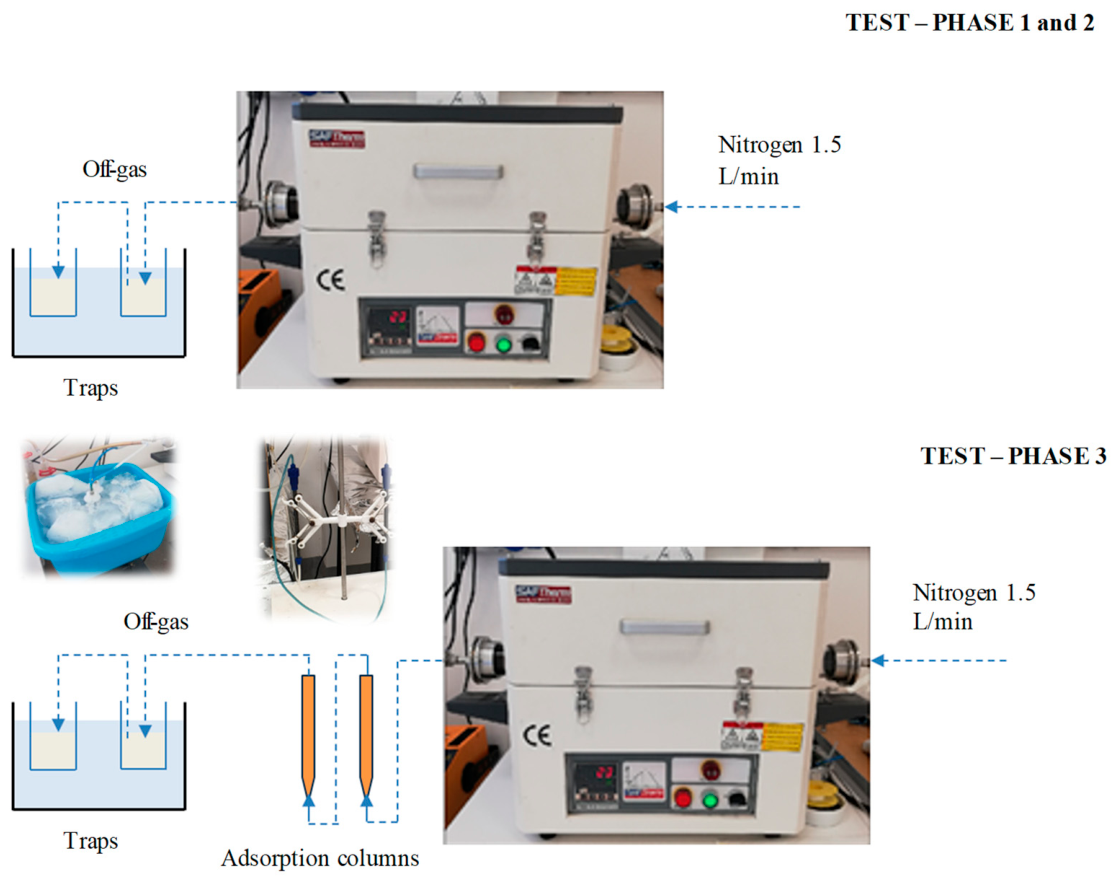
The experimental apparatus used to simulate thermal desorption was installed at the Energy and Environment Laboratory of the University of Enna “Kore” and is shown in
Figure S1. The system consists of a tubular furnace (Split Furnace type) with heating elements “SAFTherm SANTE FURNACE”, (Henan, China), equipped with a quartz tube with a 60 mm diameter and a length of 800 mm. The Split Furnace was equipped at the ends with gastight stainless-steel flanges for the control of the internal atmosphere and the flushing of specific carrier gases (typically inert gases such as nitrogen), which allowed, on the one hand, the maintenance of a controlled atmosphere and, on the other hand, the removal of the desorbed fumes and vapors.
The sediment samples (approx. 20.0 g of grain size < 2 mm and previously dried in an oven at 40 °C for 48 h, thus reaching the water content shown in
Table 1) were placed in the middle of the tube inside a quartz boat. From one end of the quartz tube, the carrier gas (nitrogen) was fluxed at a constant flow rate of 1.5 L/min in order to keep an inert atmosphere inside the tube. The opposite end of the quartz tube was appropriately connected to an off-gas recovery system consisting of two cryogenic traps for the condensation of VOCs (maintained at a temperature of 4 °C, with a water and ice bath), containing a known volume of iso-propanol.
During PHASE 3, columns packed with adsorbent material were added to the traps that had already been used in the previous phases. The traps were placed in series with the adsorption columns. The flow diagram of the treatment system, from the transport carrier to the off-gas measurement and control system, is shown in
Figure 1.
Each TD test was performed by setting specific heating ramps, i.e., individual work steps (setting heating times and temperatures) of the tubular furnace for the volatilization of TPH contained in the sediments. In general, the work steps considered were the following:
Heating from room temperature to 105 °C for the removal of residual moisture;
Constant maintenance of the drying temperature at 105 °C for 20 min;
Heating up to the maximum design temperature expected for each test, to be reached in 5 min;
Maintenance of the maximum design temperature for the pre-established desorption time;
Interruption of heating once the design desorption time at the maximum temperature has elapsed.
The heating ramps for the PHASE 1, 2 and 3 tests are shown in
Figure S2a–c.
2.4. Characteristics of Adsorbent Materials and Management of Off-Gases
The biochars used for the off-gases adsorption following the thermal treatment were provided by the University of Palermo. The two types of BIOCHAR, obtained from the pyrolysis of tree species such as pine and eucalyptus (
Figure S3), called B440 and B880, presented different characteristics (
Table S1), including granulometry. In fact, B440 was characterized by particles with smaller dimensions than B880, which was made up of particles with a more rounded and coarse shape (>2 mm).
In order to prevent air pollution phenomena from the dispersion of pollutants volatilized by the sediments, a system (
Figure 1) consisting of two Pyrex adsorption columns placed in series and a cold trap (−30 °C) was implemented. A trap containing ethanol was set up at the outlet of the quartz tube, with the aim of separating the desorbed compounds through physical adsorption and condensation processes.
The columns, characterized by a net volume of approximately 0.35 L, were filled with GAC in test P1 and with BIOCHAR in tests P2 and P3. The columns were completely packed to fill the entire available volume (with variable masses of the adsorbent, depending on the individual specific density). Considering the different dimensional characteristics of the tested adsorption materials, the columns filled with activated carbons (P1) contained (both) approximately 6.0 g, while during the tests conducted with BIOCHAR, the columns contained 4.5 g of B440 (P2) and approximately 2.0 g of B880 (P3).
To determine the effectiveness of thermal desorption experiments and the surface functionalities for B440 and B880, FTIR analysis was carried out using a Shimadzu IR Tracer spectrometer in mid-IR mode, equipped with a Universal ATR sampling device containing diamond/ZnSe crystal. The spectra were recorded in the range from 600 to 4000 1/cm, with a resolution of 4 1/cm, by averaging 64 scans. The spectra were baseline corrected and normalized.
2.5. Kinetic Model
The study of the kinetic model was carried out considering the trend of the residual TPH concentrations found in the sediments treated with the two different levels of initial contamination, with the variation in the contact time for the thermal treatment carried out at 200 °C.
The kinetic model applied in the present study was inspired by the one reported in [
9,
30]. In particular, the nature of the decontamination mechanisms can be expressed as a function of the n-th order of reaction, considering n strictly related to the matrix-contaminant interaction. Specifically, the pollutant removal mechanism was evaluated through first-order kinetics, following an exponential decay represented by the following equation (Equation (1)):
where C is the residual concentration of contaminant (expressed in mg
TPH/kg
DM) in the solid matrix after a treatment time t (min), C
0 represents the initial concentration of the contaminant, k (1/min) and n instead represent the desorption constants.
By expressing the above equation in logarithmic form and differentiating as a function of the treatment time, it is possible to determine the desorption rate −dC/dt as (Equation (2))
Once the constants k and n were determined, the correlation was evaluated using the correlation coefficient R
2. The model follows a stretched exponential form, suited to heterogeneous systems governed by a distribution of desorption activation energies—consistent with the n-th order kinetic framework previously applied by Falciglia et al. [
25,
30] and Liu et al. [
26] for thermal desorption of petroleum-contaminated matrices. When n < 1, the instantaneous desorption rate (Equation (2)) decreases over time, capturing the progressive shift from rapid evaporation of lighter hydrocarbon fractions to slower desorption of more strongly sorbed heavy compounds; n = 1 recovers classical first-order kinetics.
3. Results and Discussion
3.1. General Considerations
The results of the contamination (
Table 1) showed significant pollution of all samples, with exceedances of the CSCs foreseen by Legislative Decree n. 152/2006 (part IV,
Table 1, column B, Annex 5, Italian law) valid for TPHs and equal to 750 mg/kg
DM for “sites for commercial and industrial use”.
As previously observed, the experimental investigation was developed with two investigative approaches:
The first experimental approach, carried out on the basis of the tests conducted in PHASE 1 and 2, aimed at verifying the impact of the process temperature and contact times, with tests carried out with an initial TPH concentration of 1335 mg/kgDM (limited contamination) and 35,011 mg/kgDM (significant contamination).
The second approach was aimed at comparing the effects of the reduction in pollutants in exhaust gases. In this case, in order to extend the results of the investigation, confirming the data obtained from the previous investigation PHASES, it was decided to operate with the best process conditions and with an intermediate contamination of the sediments, equal to 13,182 mg/kgDM.
The results relating to each individual experimental phase are discussed in the paragraphs below.
3.2. PHASE 1: Experiments at Different Temperatures
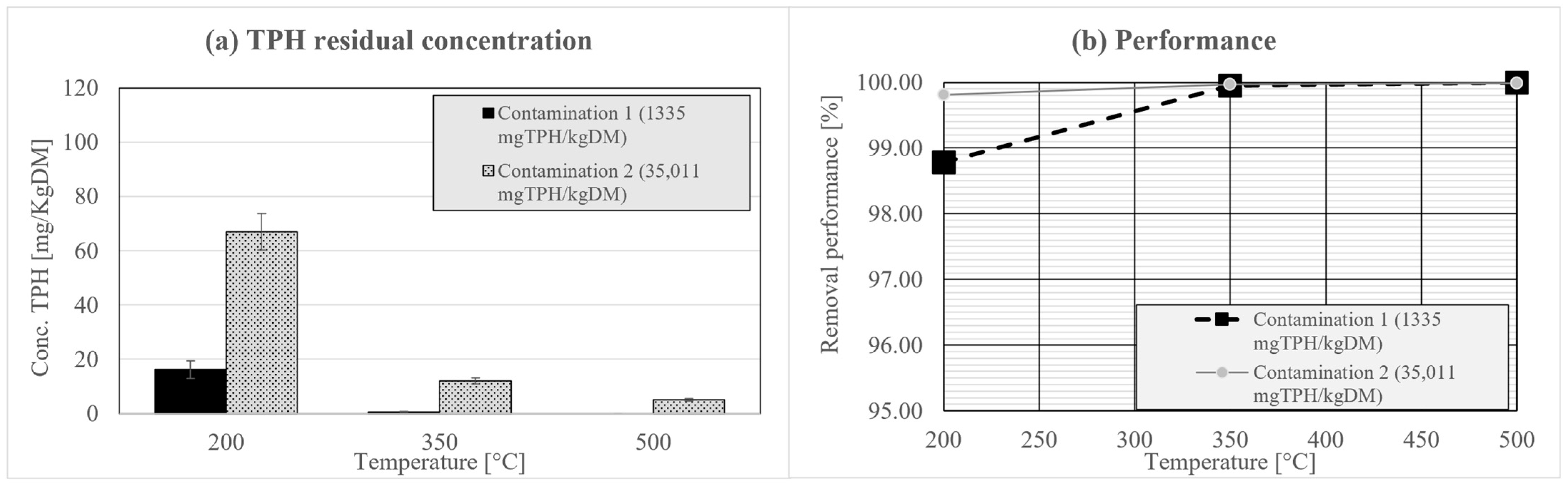
Following the first contamination of the sediments, three TD tests were conducted by varying the maximum temperature reached during the treatment. In particular, the setting of the heating ramps provided for an initial drying phase inside the furnace at 105 °C with a nitrogen flow to guarantee an inert atmosphere inside the quartz tube and the subsequent reaching of the maximum treatment temperature, respectively, equal to 200, 350 and 500 °C for a contact time of 15 min. The results obtained from the analysis of the residual concentration of TPH in the sediments following the first three tests are reported in
Figure 2. The results highlighted a very high effectiveness of the treatment starting from the test conducted at a maximum temperature of 200 °C, following which compliance with the CSC imposed by the legislation was guaranteed, the residual concentration of TPH being equal to 16.2 mg/kg
DM. Finally, the tests carried out at 350 and 500 °C showed the complete removal of hydrocarbons from the contaminated matrix with removal efficiencies of 99.96 and 100%, respectively.
The tests, with the three different temperature ramps, were repeated for the second contaminated matrix at high concentrations: about 35,000 mg/kgDM. Also in this case, the yields were more than satisfactory:
In the last case, despite the high removal percentages, the limits relating to COLUMN A of Legislative Decree n. 152/2006, part IV,
Table 1, Annex 5 were slightly exceeded (50 mg/kgDM). Conversely, the limits were respected when higher temperatures were applied (12 and 5 mg/kgDM, respectively, at 350 and 500 °C).
3.3. PHASE 2: Experiments at Different Contact Times
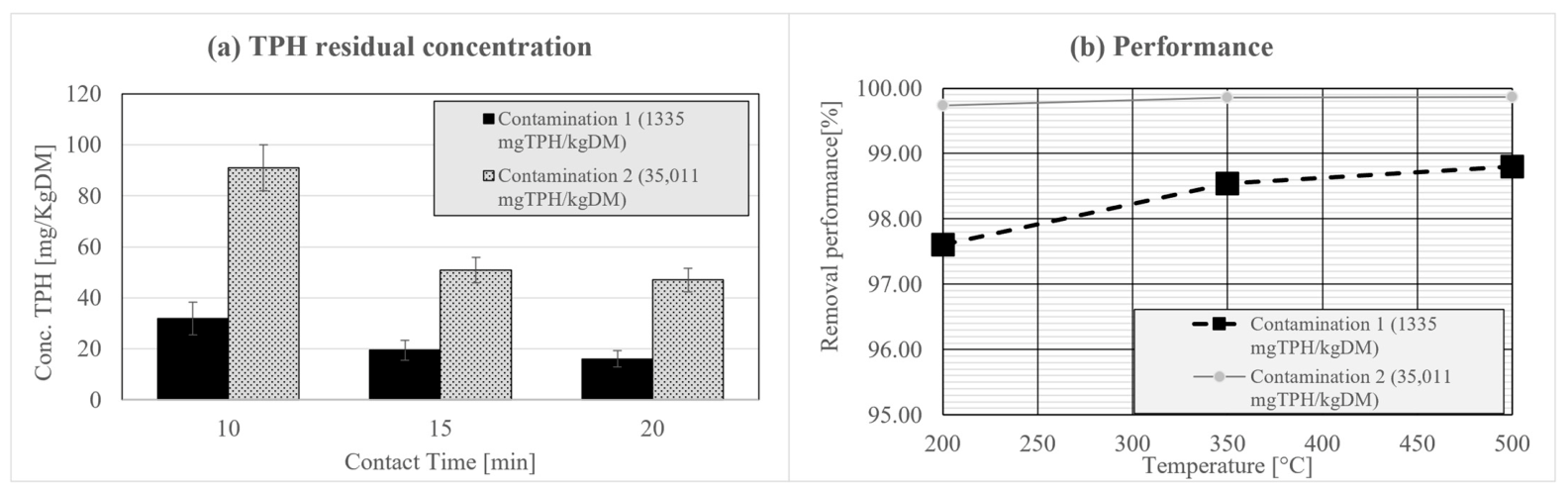
From the results achieved in PHASE 1, three further TD tests were performed in which the desorption time was varied in an inert atmosphere when the process temperature was kept constant. In more detail, the tests were carried out with contact times of 10, 15 and 20 min at a process temperature of 200 °C. From the analysis of the residual concentration of TPH in the treated sediments, it emerged that the limits set by the current legislation relating to COLUMN B of Italian Legislative Decree 152/2006, part IV,
Table 1, Annex 5 had been reached for all conditions and both samples of contaminated sediment.
On the contrary, with regard to the limits of COLUMN A, despite the high percentage yields (greater than 99.8%), the residual concentration after treatment of the highly contaminated matrix (35,011 mg/kgDM) was:
Satisfactory and compliant with Regulation limits, for the tests conducted over 20 min (37 mg/kgDM);
Slightly higher than the limits for the test conducted at 15 min (50.9 mg/kgDM);
Significantly higher for the test conducted at 10 min (92.0 mg/kgDM).
Figure 3 summarizes all the data and results of PHASE 2.
The removal efficiencies obtained in PHASES 1 and 2 were consistently high, despite the differences in the initial TPH concentrations in the sediments following the two distinct contamination phases. With regard to the residual conditions, despite the significant efficiencies, in light of the more restrictive Regulation limits, the best working scenario can be assumed to be the one characterized by a working temperature of 200 °C and a contact time of 15 min for initial TPH concentrations lower than 30,000 mg/kgDM.
The result is also confirmed by the double repeatability carried out in the tests of the two phases: from the initial 35,000 mg/kgDM in the original matrix, the residual value of TPH in the treated sample was equal to 57 and 51 mg/kgDM, in PHASE 1 and 2, respectively (at ct of 15 min and a temperature of 200 °C).
3.4. PHASE 3: Vapor Adsorption Tests by Varying the Adsorbent Material
The need to prevent uncontrolled atmosphere emissions of desorbed VOCs led to the need to preliminarily evaluate the characterization of the potential off-gas produced. In this sense, an appropriate management system was set up at a laboratory scale, already discussed in
Section 2.3. A typical composition of the exhaust gases produced by the TD tests is reported in
Figure S4, in terms of VOC concentration, measured during the test performed at the maximum temperature of 200 °C (optimal temperature condition) and with a contact time of 15 min. From the analysis of the chromatograms, it was possible to detect the presence of TPH in both traps (placed in series), in line with expectations: in greater quantities for the first trap; smaller but not zero for the second. The presence of closely eluting peaks in the two chromatograms as a function of acquisition time (between 10 and 12 min) can potentially be associated with key VOCs such as alkanes and heavy aromatics. Nevertheless, a quantitative assessment was not possible due to instrumental limitations. The general scenario demonstrates the need for further investigations aimed at identifying a complementary and closed system to be able to manage all the off-gases desorbed from the sediments. In this sense, and as previously introduced, two different off-gas treatment systems were tested:
It is useful to underline that all three tests conducted at working temperature at 200 °C and with a contact time of 15 min in PHASE 3 confirmed the results and the repeatability of the test, previously observed in PHASE 1 and 2:
The decontamination process allowed for reducing all pollutants and obtaining treated sediments that were potentially reusable according to the national regulation.
As regards the control of off-gases, the study was based on the measurement of a general and inclusive parameter: being a totally closed system, consisting of the emission source directly connected to the adsorption treatment (on two columns) and to the final condensation traps, the collected gas was adsorbed in the biochar or trapped entirely. In this context, and in this experimental phase, the preliminary analysis was based on the measurement of TPH adsorbed directly in the studied matrices (Norit, B880 and B440) and condensed in the final traps.
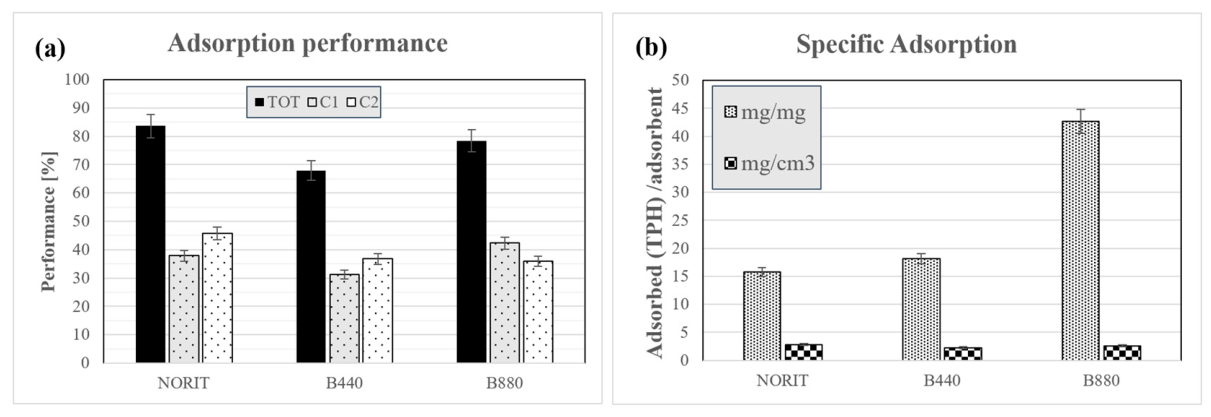
The tests have shown that the system consisting of the series of adsorption columns and cold traps is very efficient, especially when B880 is used as an adsorbent material. In fact, from the evaluation of the concentration of adsorbed TPHs, carried out for the two columns of each adsorbent material tested, the high adsorption efficiency of BIOCHAR B880 emerged. The adsorption performance was equal to an average of 78% of the pollutants desorbed from the sediments, a value close to the 83% observed in the case of commercial activated carbons (
Figure 4a).
On the other hand, BIOCHAR B440 performed the worst, with an average adsorption of about 67%.
In general, adsorption was distributed homogeneously between the first and second columns, with a slight prevalence in the second column in the case of NORIT and B440, and in the first column in the case of B880. The differences are generally considered to be the effect of the type of experimental setup (bench-scale) rather than the effects of packing due to differences in density or intrinsic characteristics.
Figure 4b, comparing the adsorption in terms of TPH mass per mass of adsorbent material, shows that the potential abatement of BIOCHAR is actually significantly higher than what the simple abatement percentages show. In this sense, the figure shows that the specific adsorption efficiency of B880 is higher than that of B440, which is higher than the commercial NORIT activated carbon with values of 43, 18 and 16 mg
TPH/mg of adsorbent, respectively. On the contrary, in terms of TPH adsorbed per volume of adsorbent, the values are very similar ((2 ± 0.1) mg
TPH/cm
3): this condition is undoubtedly due to the different density of the adsorbent materials, which, at least in terms of volume of adsorbent, mitigates the differences in volumetric adsorption. The three Phase 3 tests (P1: GAC, P2: B440, P3: B880) were carried out under identical LTDT conditions (200 °C, 15 min). Repeatability of the desorption step was confirmed by the residual TPH across all tests: 17 ± 2 mg/kgDM (coefficient of variation, CV = 11.8%), ensuring comparability. Each test included two columns in series (n = 2 measurements per material). A non-parametric Kruskal–Wallis test applied to column-level adsorption efficiencies confirmed a statistically significant difference among the three materials (H = 5.78,
p = 0.048). Pairwise Mann–Whitney U tests (Bonferroni-corrected α = 0.0167) showed B880 ≈ GAC (
p = 0.32, no significant difference), and both significantly outperformed B440 (
p < 0.05).
Despite the interesting results, given the important contamination status of the solid matrix, the adsorption system was not effective enough to recover all the TPHs desorbed during heating. In fact, a significant percentage (which varies between 25 and 40%, approximately) was recovered inside the cold trap at the end of the circuit.
Nevertheless, it is believed that the use of recycled BIOCHAR is a promising alternative to commercial adsorbents, both in terms of treatment efficiency and in relation to the purposes of the circular economy. Future activities will assess key aspects related to the reusability of spent biochar. In the literature, the regeneration of biochar obtained from tree species is widely recognized and evaluated, especially through thermal methods in which the adsorbed pollutant is carbonized and decomposed, and eventually the molecule becomes smaller than the pore size of biochar, thus increasing its usability [
34,
35].
From the results of FTIR tests, adsorption capacity was observed after thermal desorption at 200 °C. The characteristics of the IR stretching bands in a range between 2900 and 2900 cm
−1 attributed to linear aliphatic hydrocarbons are almost absent in sediments (
Figures S5 and S6), while those bands appear in the biochar B440 and B880 after thermal desorption, as demonstrated by
Figures S7 and S8.
3.5. Aspects Related to the Kinetics of TPH Removal
From the results obtained following the experimental trials, with reference to the residual concentrations of TPH in the treated sediments (
Figure 3), it is clear that the residual concentrations decrease over time and therefore the desorption rate increases following the thermal treatment. The kinetic model showed values of the correlation coefficient R2 close to 1 and high values for the desorption constants obtained, reported in
Table 3. These values confirm a removal kinetics lower than the first order, as demonstrated by the values of n (0.52–0.85). The lower value (n = 0.52, C
0 = 1336 mg/kg
DM) reflects heterogeneous surface-dominated sorption with a broad distribution of activation energies, while the higher value (n = 0.85, C
0 = 35,011 mg/kg
DM) indicates bulk-phase evaporation kinetics approaching first-order behavior at higher contaminant loading, consistent with the findings of Falciglia et al. [
25] and Liu et al. [
26]. With reference to the constant k, it assumes increasing values (from 0.0152 1/min to 0.0265 1/min) as the initial concentration of TPH in the contaminated sediments increases.
Several other authors have obtained similar correlations from the application of thermal desorption for the removal of volatile organic pollutants, characterized by removal kinetics lower than the first order [
25,
26,
36]. The authors demonstrated the trend of exponential decrease with respect to the time of the residual concentrations of pollutants in the sediments, allowing us to state that the thermal treatment is characterized by an initial phase of rapid evaporation of the contaminants [
36,
37,
38].
Falciglia and co-workers have, in fact, obtained removal kinetics with similar reaction orders (n) when thermal desorption at low temperatures was applied on sediments characterized by a real history of TPH contamination, albeit with low concentration values of petroleum hydrocarbons [
25,
30]. Finally, the analysis of the experimental data obtained highlighted an important characteristic of thermal desorption conducted at low temperatures (200 °C), represented by the ability to rapidly remove TPH from sediments regardless of the contamination levels, while ensuring compliance with regulatory limits.
3.6. Comparison Between the Different TD Tests and Future Insights
The analysis of the results discussed in the previous paragraphs highlights how, in general, longer contact times and higher temperatures guarantee the total removal of TPH. Obviously, as previously stated, the most suitable operating conditions for a real-scale application are those that guarantee the achievement of the remediation objectives (compliance with the Regulation limits) with the least economic commitment, both for investment and for operating costs. Therefore, the optimal operating condition of the process is the one that involves the thermal desorption of the sediments conducted at 200 °C for at least 15 min.
Together with the study of the process efficiencies, a preliminary analysis was carried out for the applicability of a system for the abatement of hydrocarbons contained in the exhaust gases (off-gas) and produced by the thermal process. The scientific analysis stimulates and directs future research on the application of adsorbent materials from dry and/or wet pyrolysis treatments of organic waste, which would thus find their use in the field of environmental recovery of polluted matrices such as those of marine sediments of port areas subjected to intense human activities.
In this context, both BIOCHARs used showed high potential as adsorbent agents.
These extremely interesting applications certainly require further investigation to determine the optimal amount of adsorbent necessary for the complete abatement of pollutants, the speciation of TPH and direct measurements of VOCs in the gas flow at each point of the circuit of the fume treatment line, potentially assessable by detector (FID, Flame Ionization Detector or PID, Photoionization Detector). To improve system closure and the complete recovery of VOCs, some strategies should be implemented, including a system consisting of adsorption columns with larger volumes, thus increasing the mass of adsorbent material to be introduced, followed by an increased number of condensing traps.
To corroborate what has been analyzed so far, the analysis of the energy consumption of the plant was undoubtedly particularly useful. Although conducted at a laboratory scale, the study can provide useful information regarding energy savings for a possible process scale-up, especially with reference to the relative comparison, rather than the absolute data of consumption between the different operating conditions analyzed in this study.
For the evaluation of energy consumption, during the different tests conducted in the laboratory, a digital wattmeter was used, which allowed the calculation of the electrical and thermal energy consumed for the volatilization of TPHs as a function of the mass of sediment treated. As can be seen from the relative comparison of the consumptions reported in
Table S2a, the energy consumption was equal to 3.75 kWh/kg
SEDIMENT for the thermal desorption test carried out at the maximum process temperature of 500 °C and 20 min of contact time. At lower working temperatures and equal treatment times, the consumption was reduced by about a third at 350 °C (2.67 kWh/kg
SEDIMENT) and by almost 60% at 200 °C (1.59 kWh/kg
SEDIMENT).
Once the optimal working temperature (200 °C) was defined, corroborated by the removal efficiency data described in the previous parameters, we moved on to the consumption analysis, considering a reduction in contact times. In this case, as reported in
Table S2b, a further saving of 14.2% was obtained at ct = 15 min (1.37 kWh/kg) and a further 27.1% at ct = 10 min (1.16 kWh/kg).
These results showed the convenience of applying physical–thermal technology using low temperatures, which allowed satisfactory yields to be obtained, even if they were slightly lower than those obtained at high temperatures (350 and 500 °C) and resulted in a 40–70% reduction in energy consumption compared to applications at medium-high temperatures.
In particular, considering the average cost of energy (for industrial applications) at the time of the investigation (0.23 €/kWh + VAT), it is possible to consider a treatment of sediments contaminated with LTDT at 200 °C that varies between 325 and 383 €/t with a process conducted, respectively, at 10 or 15 min of contact time, against over 1000 €/t of a TD treatment conducted at 500 °C and 20 min of contact time. It is worth noting that the cost estimates (€/t) reported here are not directly scalable to industrial processes due to heat losses, batch versus continuous operation, and ancillary equipment. The study is intended only to provide a relative comparison in terms of “recoverability and potential energy savings”; as such, the references are not directly applicable, in terms of savings and time, to full-scale applications.
4. Conclusions
The results obtained in the present study confirmed that thermal desorption is indeed a feasible technology for the remediation of sediments contaminated by organic pollutants, even at low temperatures (200 °C).
Specifically, the TD tests carried out on samples of contaminated marine sediments showed a high efficacy of the treatment for the removal of TPH in all the tests carried out, with removal efficiencies varying between 98 and 100%. The results obtained clearly show the scientific interest in applying the treatment at low temperatures, significantly lower than those for thermal destruction (>600 °C). Furthermore, high-temperature thermal treatment would lead, on the one hand, to an increase in energy consumption (therefore costs), and on the other, to the progressive deterioration of the properties of the sediments, and therefore, fewer management solutions aimed at reusing the remediated environmental matrix. However, in view of full-scale applications and for the purpose of reuse, the ecotoxicity of sediments after treatment (e.g., bioassays with benthic organisms) should be thoroughly investigated in future studies to ensure ecological safety for marine reuse. The evaluated process parameters allowed a contact time of 15 min and a maximum process temperature of 200 °C to be identified as optimal values. The contact time could also be reduced to 10 min in less demanding regulatory scenarios (reuse in industrial areas). Based on these applications, energy consumption can be reduced by up to 70%, promoting the diffusivity of the process also for the treatment of contaminated marine sediments (as well as soils).
Finally, in order to delve deeper into the aspects related to the sustainable off-gas treatment, the study proposes the use of BIOCHAR obtained from the pyrolysis of organic waste materials rather than the use of expensive, and often less efficient, commercial adsorbent materials.
In order to further explore relevant aspects resulting from the results of the scientific work, it would be useful to delve deeper into the aspects related to the reuse of sediments, the management of residual or recoverable solid waste, and the use of alternative energy sources for further energy savings.




 ,
,