Assessing Sustainability Awareness in Teacher Education: Validation of a Multidimensional Scale in Pakistan



Abstract
1. Introduction
1.1. The Framework of the SAS
1.2. Purpose of the Study
- RQ1. What are the descriptive levels of sustainability awareness among pre-service teachers across the economic, environmental, and social dimensions of the SAS?
- RQ2. Is the three-dimensional structure of the SAS supported by exploratory and confirmatory factor analyses?
- RQ3. Does the SAS demonstrate evidence of construct validity, including convergent and discriminant validity?
- RQ4. Is the internal consistency of the SAS supported by Cronbach’s alpha and McDonald’s omega?
2. Materials and Methods
2.1. Item Development and Content Validity of the SAS
2.2. Participants and Procedure
2.3. Ethical Considerations
2.4. Data Analysis
3. Results
3.1. Descriptive Statistics
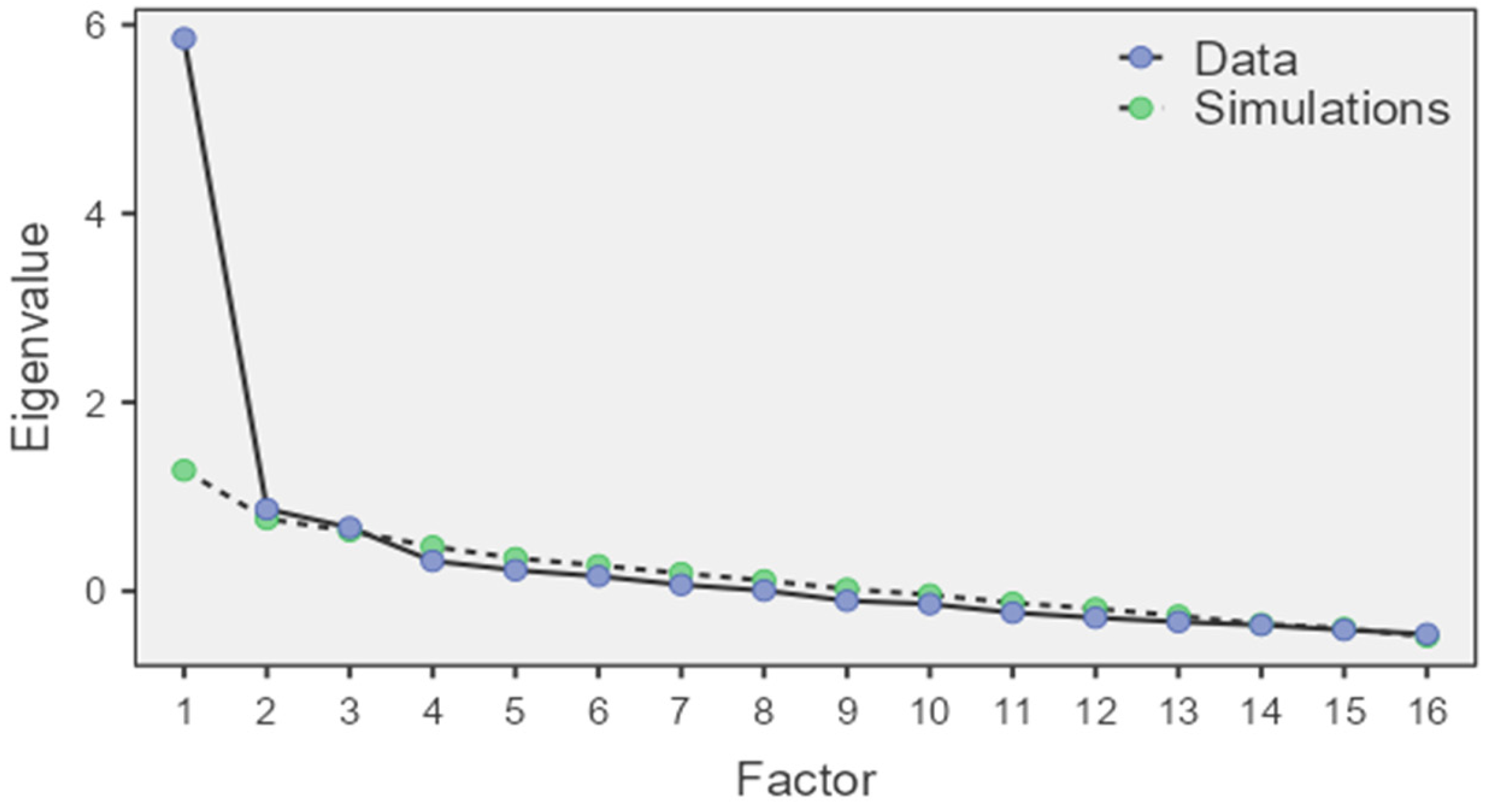
3.2. Exploratory Factor Analysis
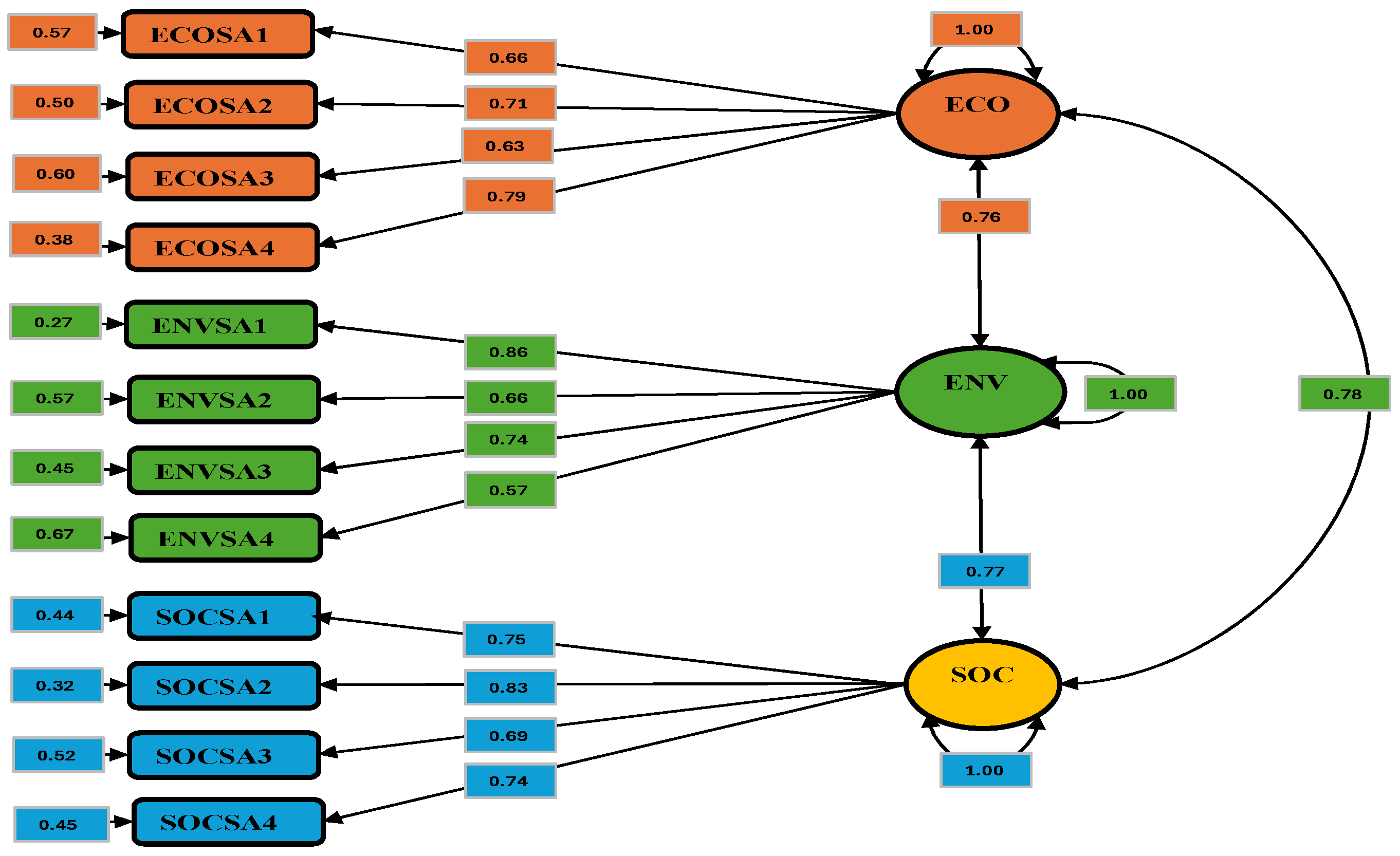
3.3. Confirmatory Factor Analysis
3.4. Construct Validity
3.4.1. Convergent Validity
3.4.2. Discriminant Validity
3.5. Reliability Analysis of the SAS
4. Discussion
Author Contributions
Funding
Data Availability Statement
Acknowledgments
Conflicts of Interest
Appendix A

| I am aware that: | 1 Strongly Disagree | 2 Disagree | 3 Neutral | 4 Agree | 5 Strongly Agree |
| 1 | 2 | 3 | 4 | 5 |
| 1 | 2 | 3 | 4 | 5 |
| 1 | 2 | 3 | 4 | 5 |
| 1 | 2 | 3 | 4 | 5 |
| 1 | 2 | 3 | 4 | 5 |
| 1 | 2 | 3 | 4 | 5 |
| 1 | 2 | 3 | 4 | 5 |
| 1 | 2 | 3 | 4 | 5 |
| 1 | 2 | 3 | 4 | 5 |
| 1 | 2 | 3 | 4 | 5 |
| 1 | 2 | 3 | 4 | 5 |
| 1 | 2 | 3 | 4 | 5 |
References
- Moschis, G.P.; Mathur, A.; Shannon, R. Toward Achieving Sustainable Food Consumption: Insights from the Life Course Paradigm. Sustainability 2020, 12, 5359. [Google Scholar] [CrossRef]
- United Nations. Transforming Our World: The 2030 Agenda for Sustainable Development; United Nations: New York, NY, USA, 2015. [Google Scholar]
- United Nations. Agenda 21: Programme of Action for Sustainable Development. In Proceedings of the United Nations Conference on Environment and Development, Rio de Janeiro, Brazil, 3–14 June 1992; Available online: https://www.un.org/esa/dsd/agenda21/Agenda%2021.pdf (accessed on 26 March 2026).
- Biasutti, M.; Frate, S. A Validity and Reliability Study of the Attitudes toward Sustainable Development Scale. Environ. Educ. Res. 2017, 23, 214–230. [Google Scholar] [CrossRef]
- Biasutti, M.; De Baz, T.; Alshawa, H. Assessing the Infusion of Sustainability Principles into University Curricula. J. Teach. Educ. Sustain. 2016, 18, 21–40. [Google Scholar] [CrossRef]
- Bloom, B.S.; Engelhart, M.D.; Furst, E.J.; Hill, W.H.; Krathwohl, D.R. Handbook I: Cognitive Domain; David McKay: New York, NY, USA, 1956; pp. 483–498. [Google Scholar]
- United Nations Educational, Scientific and Cultural Organization (UNESCO). Education for Sustainable Development Goals: Learning Objectives; United Nations Educational, Scientific and Cultural Organization: Paris, France, 2017. [Google Scholar] [CrossRef]
- Ajzen, I. The Theory of Planned Behavior. Organ. Behav. Hum. Decis. Process. 1991, 50, 179–211. [Google Scholar] [CrossRef]
- Lad, N.; Akerlof, K.L. Assessing Campus Sustainability Literacy and Culture: How Are Universities Doing It and to What End? Front. Sustain. 2022, 3, 927294. [Google Scholar] [CrossRef]
- Bardy, R.; Rubens, A.; Eberle, P. Building Intellectual Capital for Sustainable Development: Combining Local Wisdom and Advanced Knowledge. Electron. J. Knowl. Manag. 2017, 15, 159. [Google Scholar]
- Biasutti, M.; Makrakis, V.; Concina, E.; Frate, S. Educating Academic Staff to Reorient Curricula in ESD. Int. J. Sustain. High. Educ. 2018, 19, 179–196. [Google Scholar] [CrossRef]
- Kadji-Beltrán, C. Enhancing Sustainability Teaching Competence in Preschool Teacher Education Using Living Labs. Sustainability 2024, 16, 2781. [Google Scholar] [CrossRef]
- Kahriman-Pamuk, D.; Pramling Samuelsson, I. Nurturing Sustainability in Toddlerhood: Investigating Preschool Teachers’ Views and Daily Practices in a Swedish Preschool. Children 2024, 11, 1412. [Google Scholar] [CrossRef]
- Makrakis, V.; Biasutti, M.; Kostoulas-Makrakis, N.; Ghazali, M.; Othman, W.; Ali, M.; Mavrantonaki, K. ICT-Enabled Education for Sustainability Justice in South East Asian Universities. Sustainability 2024, 16, 4049. [Google Scholar] [CrossRef]
- Geok, T.K.; Shah, A.; Goh, G.G.G.; Zeb, A. The Links between Sustainability Dimensions and Green Campus Initiatives in Mountain Universities. J. Infrastruct. Policy Dev. 2024, 8, 7653. [Google Scholar] [CrossRef]
- Jamil, M.; Mehmood, W.; Aslam, A. Sustainability Education in Pakistan: A Qualitative Content Analysis of the 10th Grade Pakistan Studies Textbook. Voyag. J. Educ. Stud. 2024, 4, 80–95. [Google Scholar] [CrossRef]
- Biasutti, M. An Intensive Programme on Education for Sustainable Development: The Participants’ Experience. Environ. Educ. Res. 2015, 21, 734–752. [Google Scholar] [CrossRef]
- Kalsoom, Q.; Khanam, A.; Quraishi, U. Sustainability Consciousness of Pre-Service Teachers in Pakistan. Int. J. Sustain. High. Educ. 2017, 18, 1090–1107. [Google Scholar] [CrossRef]
- Zeeshan, M.; Qureshi, N. Development of a Scale to Measure Environmental Consciousness of Pre-Service Teachers in Punjab, Pakistan. J. Soc. Sci. Res. 2023, 3, 768–781. Available online: https://jssr.com.pk/index.php/jssr/article/download/199/172/1743 (accessed on 2 April 2026). [CrossRef]
- Nousheen, A.; Zai, S.A.Y.; Waseem, M.; Khan, S.A. Education for Sustainable Development (ESD): Effects of Sustainability Education on Pre-Service Teachers’ Attitude towards Sustainable Development (SD). J. Clean. Prod. 2020, 250, 119537. [Google Scholar] [CrossRef]
- Malik, M.N.; Khan, H.H.; Chofreh, A.G.; Goni, F.A.; Klemeš, J.J.; Alotaibi, Y. Investigating Students’ Sustainability Awareness and the Curriculum of Technology Education in Pakistan. Sustainability 2019, 11, 2651. [Google Scholar] [CrossRef]
- DeVellis, R.F.; Thorpe, C.T. Scale Development: Theory and Applications; SAGE Publications: Thousand Oaks, CA, USA, 2021. [Google Scholar]
- Jeurissen, R. John Elkington, Cannibals with Forks: The Triple Bottom Line of 21st Century Business. J. Bus. Ethics 2000, 23, 229–231. [Google Scholar] [CrossRef]
- Chen, C.; An, Q.; Zheng, L.; Guan, C. Sustainability Literacy: Assessment of Knowingness, Attitude, and Behavior Regarding Sustainable Development among Students in China. Sustainability 2022, 14, 9486. [Google Scholar] [CrossRef]
- Kuehl, C.; Sparks, A.C.; Hodges, H.; Smith, E.R.A.N. Exploring Sustainability Literacy: Developing and Assessing a Bottom-up Measure of What Students Know about Sustainability. Front. Sustain. 2023, 4, 1167041. [Google Scholar] [CrossRef]
- Michalos, A.C.; Creech, H.; Swayze, N.; Kahlke, M.; Buckler, C.; Rempel, K. Measuring Knowledge, Attitudes and Behaviors Concerning Sustainable Development among Tenth Grade Students in Manitoba. Soc. Indic. Res. 2012, 106, 213–238. [Google Scholar] [CrossRef]
- Afroz, N.; Ilham, Z. Assessment of Knowledge, Attitude and Practice of University Students towards Sustainable Development Goals (SDGs). J. Indones. Sustain. Dev. Plan. 2020, 1, 31–44. [Google Scholar] [CrossRef]
- MacCallum, R.C.; Widaman, K.F.; Zhang, S.; Hong, S. Sample Size in Factor Analysis. Psychol. Methods 1999, 4, 84. [Google Scholar] [CrossRef]
- Mundfrom, D.J.; Shaw, D.G.; Ke, T.L. Minimum Sample Size Recommendations for Conducting Factor Analyses. Int. J. Test. 2005, 5, 159–168. [Google Scholar] [CrossRef]
- Horn, J.L. A Rationale and Test for the Number of Factors in Factor Analysis. Psychometrika 1965, 30, 179–185. [Google Scholar] [CrossRef]
- Hayton, J.C.; Allen, D.G.; Scarpello, V. Factor Retention Decisions in Exploratory Factor Analysis: A Tutorial on Parallel Analysis. Organ. Res. Methods 2004, 7, 191–205. [Google Scholar] [CrossRef]
- Hair, J.F.; Black, W.C.; Babin, B.J.; Anderson, R.E.; Tatham, R.L. Multivariate Data Analysis; Pearson Education: Upper Saddle River, NJ, USA, 2019; ISBN 978-1-4737-5654-0. [Google Scholar]
- Li, C.H. The Performance of ML, DWLS, and ULS Estimation with Robust Corrections in Structural Equation Models with Ordinal Variables. Psychol. Methods 2016, 21, 369. [Google Scholar] [CrossRef]
- Hu, L.T.; Bentler, P.M. Cutoff Criteria for Fit Indexes in Covariance Structure Analysis: Conventional Criteria versus New Alternatives. Struct. Equ. Model. Multidiscip. J. 1999, 6, 1–55. [Google Scholar] [CrossRef]
- Marsh, H.W.; Hau, K.-T.; Wen, Z. In Search of Golden Rules: Comment on Hypothesis-Testing Approaches to Setting Cutoff Values for Fit Indexes and Dangers in Overgeneralizing Hu and Bentler’s (1999) Findings. Struct. Equ. Model. Multidiscip. J. 2004, 11, 320–341. [Google Scholar] [CrossRef]
- Fornell, C.; Larcker, D.F. Evaluating Structural Equation Models with Unobservable Variables and Measurement Error. J. Mark. Res. 1981, 18, 39–50. [Google Scholar] [CrossRef]
- Mia, M.M.; Zayed, N.M.; Islam, K.M.A.; Nitsenko, V.; Matusevych, T.; Mordous, I. The Strategy of Factors Influencing Learning Satisfaction Explored by First and Second-Order Structural Equation Modeling (SEM). Inventions 2022, 7, 59. [Google Scholar] [CrossRef]
- Gonzaga-Domider, K.; Dalayap, R.H., Jr. Structural Equation Modelling of Students’ Difficulties in General Mathematics. Int. J. Res. Innov. Soc. Sci. 2025, 9, 2667–2694. [Google Scholar] [CrossRef]
- Flora, D.B.; Curran, P.J. An Empirical Evaluation of Alternative Methods of Estimation for Confirmatory Factor Analysis with Ordinal Data. Psychol. Methods 2004, 9, 466. [Google Scholar] [CrossRef]
- Henseler, J.; Ringle, C.M.; Sarstedt, M. A New Criterion for Assessing Discriminant Validity in Variance-Based Structural Equation Modeling. J. Acad. Mark. Sci. 2015, 43, 115–135. [Google Scholar] [CrossRef]
- Nunnally, J.C.; Bernstein, I.H. Psychometric Theory, 3rd ed.; McGraw-Hill: New York, NY, USA, 1994; ISBN 0070474656. [Google Scholar]
- Hayes, A.F.; Coutts, J.J. Use Omega Rather than Cronbach’s Alpha for Estimating Reliability. Commun. Methods Meas. 2020, 14, 1–24. [Google Scholar] [CrossRef]


| Study | Construct | Sample | Items/Dimensions | Validation | Key Focus or Distinction |
|---|---|---|---|---|---|
| [18] | Sustainability consciousness (KAB) | Pre-service teachers | 50; Env/Soc/Eco | Limited | Assesses broader sustainability consciousness through KAB dimensions |
| [21] | Sustainability awareness | Tech students | 14; no defined dimensions | Face/content only | Focuses on sustainability awareness among technology students |
| [20] | Attitudes toward SD | Pre-service teachers | 20; Env/Eco/Soc/Edu | Validated | Focuses on attitudes toward sustainable development |
| [19] | Environmental consciousness (K, A, beliefs, practices) | Pre-service teachers | 64; 5 dimensions | EFA only | Examines environmental consciousness among pre-service teachers |
| Present study | Sustainability awareness | Pre-service teachers | 12; Env/Eco/Soc | EFA + CFA + validity + reliability (α, ω) | Short, validated, multidimensional, SDG-aligned, teacher-specific |
| Construct | Conceptual Definitions | Key Topics |
|---|---|---|
| Economic dimension | Refers to economic processes that support sustainable growth, including employment, infrastructure, and productivity within long-term sustainability goals. | Poverty reduction, local businesses and employment, reliable infrastructure, innovation and productivity |
| Environmental dimension | Focuses on the protection and responsible management of natural resources and ecosystems, including human impacts on climate and environmental sustainability. | Climate change and human impact, waste reduction, population growth and resource depletion, pollution management |
| Social dimension | Emphasizes equity, human rights, education, and well-being, promoting inclusive and just societies aligned with sustainable development goals. | Human rights, gender equality, quality education, community well-being, infectious disease management |
| Stage | Number of Items | Evaluation Outcome | Decision |
|---|---|---|---|
| Initial item pool | 32 | Developed from SDGs, literature, and existing scales | Sent for expert review |
| Expert screening | 32 → 25 | Seven items rated not relevant | Removed |
| Content validity | 25 | S-CVI/Ave = 0.88 | Supported |
| Final items for survey | 25 | Consensus among experts after revision | Retained for EFA |
| Final SAS | 12 | Clear three-factor structure | Retained in SAS |
| Dimension | Item | M (SD) |
|---|---|---|
| Economic | ECO1 | 4.26 (0.76) |
| ECO2 | 4.28 (0.75) | |
| ECO3 | 4.03 (0.80) | |
| ECO4 | 4.18 (0.82) | |
| Overall Mean | 4.18 (0.59) | |
| Environmental | ENV1 | 4.18 (0.84) |
| ENV2 | 4.08 (0.78) | |
| ENV3 | 4.20 (0.80) | |
| ENV4 | 3.87 (0.89) | |
| Overall Mean | 4.08 (0.61) | |
| Social | SOC1 | 4.14 (0.75) |
| SOC2 | 4.36 (0.78) | |
| SOC3 | 4.06 (0.83) | |
| SOC4 | 4.08 (0.96) | |
| Overall Mean | 4.16 (0.62) |
| Factors | |||||
|---|---|---|---|---|---|
| Item Code | SAS Items I Am Aware That: | M (SD) | 1 | 2 | 3 |
| ECOSA1 | Reducing poverty contributes to long-term economic growth | 4.27 (0.81) | 0.578 | ||
| ECOSA2 | Local businesses contribute to employment and economic sustainability | 4.26 (0.84) | 0.842 | ||
| ECOSA3 | Reliable infrastructure contributes to sustainable economic growth | 3.99 (0.86) | 0.451 | ||
| ECOSA4 | Innovation and technology contribute to economic productivity | 4.19 (0.85) | 0.680 | ||
| ENVSA1 | Human activities contribute to changes in the atmosphere and climate system | 4.18 (0.77) | 0.502 | ||
| ENVSA2 | Reducing household and industrial waste contributes to environmental sustainability | 4.06 (0.80) | 0.668 | ||
| ENVSA3 | Urbanization and population growth contribute to resource depletion and ecosystem degradation | 4.30 (0.77) | 0.573 | ||
| ENVSA4 | Preventing and managing pollution contributes to environmental sustainability | 3.91 (0.91) | 0.603 | ||
| SOCSA1 | Protecting human rights and promoting social equity contribute to social sustainability | 4.13 (0.80) | 0.597 | ||
| SOCSA2 | Equal opportunities for all genders contribute to social sustainability | 4.29 (0.81) | 0.567 | ||
| SOCSA3 | Inclusive, quality education contributes to social sustainability | 4.14 (0.81) | 0.515 | ||
| SOCSA4 | Managing major infectious diseases contributes to community well-being and stability | 4.07 (1.0) | 0.510 | ||
| (SAS) Factors | M (SD) | SS Loading | % Variance | Cronbach’s α | McDonald’s ω |
|---|---|---|---|---|---|
| Economic Sustainability | 4.19 (0.61) | 2.99 | 18.7 | 0.825 | 0.827 |
| Environment Sustainability | 4.11 (0.59) | 2.54 | 15.9 | 0.760 | 0.762 |
| Social Sustainability | 4.15 (0.61) | 2.29 | 14.3 | 0.748 | 0.754 |
| Total | 4.18 (0.51) | 48.9 | 0.897 | 0.900 |
| Model | N | χ2(df) | p | χ2/df | RMSEA | 90% CI RMSEA | SRMR | CFI | TLI |
|---|---|---|---|---|---|---|---|---|---|
| CFA | 145 | 85.8 (51) | 0.002 | 1.68 | 0.068 | [0.042, 0.093] | 0.056 | 0.93 | 0.91 |
| Construct | Item | Stand. Loadings | SE | z | p |
|---|---|---|---|---|---|
| Economic | ECOSA1 | 0.576 | 0.0580 | 6.51 | <0.001 |
| ECOSA2 | 0.612 | 0.0662 | 7.25 | <0.001 | |
| ECOSA3 | 0.644 | 0.0721 | 7.32 | <0.001 | |
| ECOSA4 | 0.766 | 0.0632 | 9.64 | <0.001 | |
| Environmental | ENVSA1 | 0.795 | 0.0675 | 10.08 | <0.001 |
| ENVSA2 | 0.518 | 0.0736 | 5.93 | <0.001 | |
| ENVSA3 | 0.661 | 0.0635 | 8.00 | <0.001 | |
| ENVSA4 | 0.530 | 0.0803 | 5.75 | <0.001 | |
| Social | SOCSA1 | 0.681 | 0.0633 | 8.04 | <0.001 |
| SOCSA2 | 0.742 | 0.0656 | 9.47 | <0.001 | |
| SOCSA3 | 0.650 | 0.0685 | 7.90 | <0.001 | |
| SOCSA4 | 0.692 | 0.0825 | 7.93 | <0.001 |
| Construct | CR | AVE |
|---|---|---|
| Economic | 0.715 | 0.489 |
| Environmental | 0.737 | 0.508 |
| Social | 0.780 | 0.569 |
| Construct Pairs | HTMT |
|---|---|
| Eco-Env | 0.78 |
| Eco-Soc | 0.83 |
| Env-Soc | 0.81 |
| Constructs | Economic | Environmental | Social |
|---|---|---|---|
| Economic | 1.000 | 0.735 | 0.773 |
| Environmental | 0.735 | 1.000 | 0.765 |
| Social | 0.773 | 0.765 | 1.000 |
| Dimension | Cronbach’s Alpha α | McDonald’s Omega ω |
|---|---|---|
| Economic awareness | 0.741 | 0.742 |
| Environmental awareness | 0.726 | 0.729 |
| Social awareness | 0.738 | 0.742 |
| Full Scale | 0.872 | 0.875 |
Disclaimer/Publisher’s Note: The statements, opinions and data contained in all publications are solely those of the individual author(s) and contributor(s) and not of MDPI and/or the editor(s). MDPI and/or the editor(s) disclaim responsibility for any injury to people or property resulting from any ideas, methods, instructions or products referred to in the content. |
© 2026 by the authors. Licensee MDPI, Basel, Switzerland. This article is an open access article distributed under the terms and conditions of the Creative Commons Attribution (CC BY) license.
Share and Cite
Waheed, A.; Fazil, M.; Biasutti, M. Assessing Sustainability Awareness in Teacher Education: Validation of a Multidimensional Scale in Pakistan. Sustainability 2026, 18, 5398. https://doi.org/10.3390/su18115398
Waheed A, Fazil M, Biasutti M. Assessing Sustainability Awareness in Teacher Education: Validation of a Multidimensional Scale in Pakistan. Sustainability. 2026; 18(11):5398. https://doi.org/10.3390/su18115398
Chicago/Turabian StyleWaheed, Abdul, Muhammad Fazil, and Michele Biasutti. 2026. "Assessing Sustainability Awareness in Teacher Education: Validation of a Multidimensional Scale in Pakistan" Sustainability 18, no. 11: 5398. https://doi.org/10.3390/su18115398
APA StyleWaheed, A., Fazil, M., & Biasutti, M. (2026). Assessing Sustainability Awareness in Teacher Education: Validation of a Multidimensional Scale in Pakistan. Sustainability, 18(11), 5398. https://doi.org/10.3390/su18115398