Review

The Impact of Water Hyacinth (Pontederia crassipes) on Freshwater Ecosystems: Ecological and Socioecological Significance

Department of Applied Biological Science, Faculty of Agriculture, Kagawa University, Miki 761-0795, Kagawa, Japan
*
Author to whom correspondence should be addressed.
Sustainability 2026, 18(11), 5390; https://doi.org/10.3390/su18115390
Submission received: 9 April 2026 / Revised: 16 May 2026 / Accepted: 22 May 2026 / Published: 27 May 2026

Abstract

Water hyacinth (Pontederia crassipes Mart.) is native to the Amazon basin. It has spread to freshwater ecosystems in over 80 countries in tropical, subtropical, and warm temperate regions. Due to its invasive nature, water hyacinth is listed among the world’s 100 worst invasive alien species. Infestations of water hyacinth affect the abiotic components of these ecosystems, including water evaporation, flow, and quality; oxygen and nitrogen levels; sunlight transmission; and greenhouse gases. These changes reduce the abundance and diversity of primary producers in the food web, including phytoplankton and aquatic plants. Consequently, these alterations affect consumers in the food web, including zooplankton, invertebrates, fish, and birds. A negative correlation has often been observed between water hyacinth infestations and the abundance and diversity of these organisms, particularly native species. However, the abundance of some introduced species among these consumers has increased due to water hyacinth infestations. These changes alter the structure and function of natural ecosystems compared to what they were before infestations occurred. Infestations also negatively impact daily human activities and livelihoods, harming local communities and increasing disease transmission. Global warming and the eutrophication of freshwater ecosystems allow water hyacinth to spread into additional non-native areas in high latitudes, thereby increasing the threat it poses. Water hyacinth also contributes to global warming by increasing methane emissions. Over the past century, management strategies have shifted toward restoring the structure and function of ecosystems by progressively integrating various sectors. The infestation of water hyacinth is a complicated, site-specific process influenced by time, climate, existing biotic and abiotic factors, and ecosystem resilience. Therefore, long-term monitoring of environmental outcomes is essential for developing sustainable, site-specific strategies. Robust evaluation systems are necessary to track the efficacy of interventions and to understand the broader ecological ramifications of management strategies. Water hyacinth is still sold in some local markets for ornamental purposes. Raising public awareness of its invasive characteristics is necessary.

1. Introduction

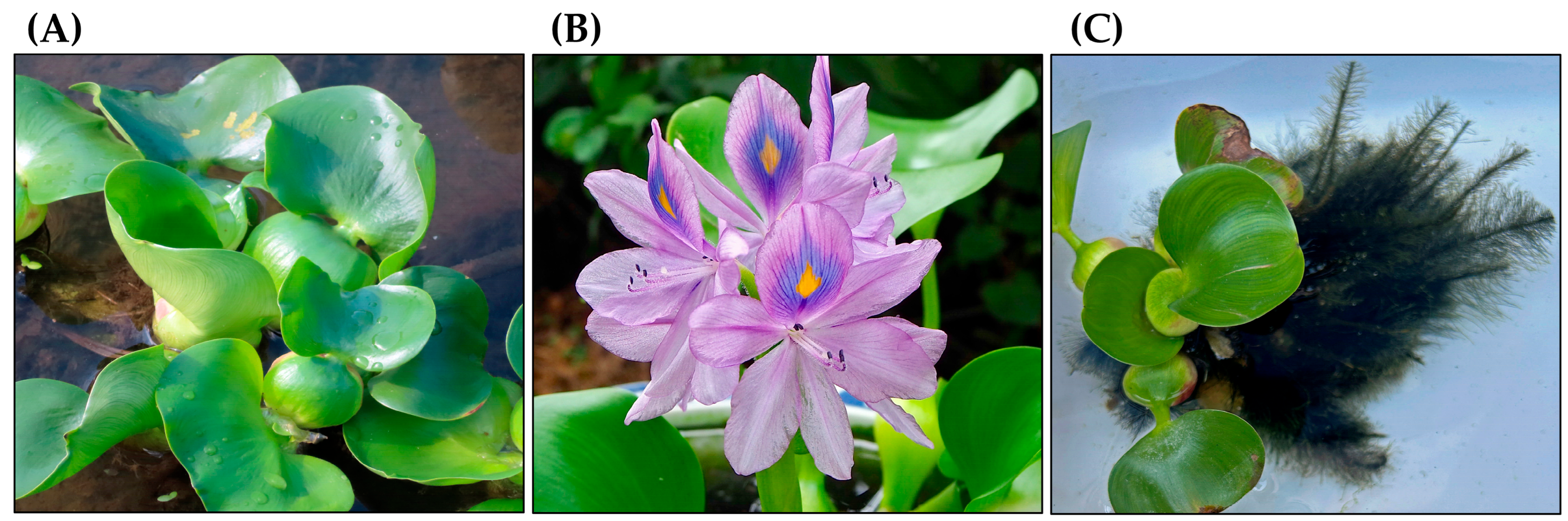
Water hyacinth (Pontederia crassipes Mart., formerly classified as Eichhornia crassipes) is a free-floating macrophyte belonging to the Pontederiaceae family. The plant has up to ten, glossy, thick, 5–20 cm ovate leaves with spirally arranged petioles on short rhizomes that form rosettes. The fusiform, swollen petioles contain spongy-like tissues. These tissues provide buoyancy. Roots develop at the base of the petioles. The roots grow to be 20–60 cm long and form a dense, feathery mass. Axillary buds on the rhizomes develop into stolons that grow horizontally 10–50 cm before establishing daughter plants. The inflorescence is a spike that grows up to 50 cm tall. It is subtended by two bracts and composed of 8–15 sessile flowers. Each flower has a 1.5 cm long perianth tube that develops into six lobes containing three petals and three calyxes, each of which is up to 4 cm long. The main lobe is a yellow, diamond-shaped patch surrounded by shades of pink and purple. Water hyacinth forms large, monospecific mats on the surface of freshwater [1,2,3,4,5,6,7] (Figure 1).
Water hyacinth originates from the Amazon River basin in Brazil and has naturally spread to other areas of South America [8,9]. It was originally introduced as an ornamental plant, and has since spread to over 80 countries in North America, Central America, Africa, Oceania, Europe, and Asia. This species easily escapes cultivation and thrives in freshwater ecosystems in tropical, subtropical, and warm temperate regions of these continents [1,2,10,11,12].
The optimal temperature range for water hyacinth is between 25 and 30 °C. It stops growing at temperatures below 10 °C. It can tolerate temperatures below 5 °C for a limited time, though its leaves often die in such conditions. As the temperature rises, damaged plants begin to regrow from their rhizomes [2,10,13,14]. Water hyacinth prefers a neutral pH but can grow in water ranging from acidic to slightly alkaline (pH 4 to 8) [15]. It tolerates low levels of saltwater. However, high salinity is lethal [16,17]. The proliferation of water hyacinth is largely driven by the presence of nutrients, particularly nitrogen and phosphorus. It thrives in eutrophic freshwater [10,18].
The chromosome number of water hyacinth is 2n = 4x = 32. No varieties or subspecies have been identified within this species [1,19,20]. The species exhibits low genetic diversity in its introduced ranges [21,22,23]. This genetic uniformity in introduced ranges is likely the result of severe genetic bottlenecks associated with the migratory history of the species [10,12,24]. However, the species exhibits epigenetic variation in response to different environmental conditions. In open stands and at the edges of dense stands, the petioles are short and bulbous. In dense stands, the petioles are thinner and do not bulge. They can grow up to 1 m long vertically [25]. The morphology of these ecotypes is shown in the pictures from the publication of Coetzee et al. [26]. Water hyacinth primarily grows as a free-floating macrophyte, but it can also survive as an emergent macrophyte when rooted in soil in areas with low water levels [8,9,27,28]. Water hyacinth is an allotetraploid species with high intraspecific collinearity and a significantly expanded gene family. Gene clustering analysis of its orthologs, as well as comparisons with other plant species, indicates a high degree of adaptive evolution in genes involved in phytohormone signaling, photosynthesis, cell wall biosynthesis, interaction with plant pathogens, tolerance to abiotic stress, and sequestration of heavy metals [29]. Thus, water hyacinth exhibits high epigenetic variation due to allotetraploidy, which enables it to adapt to different environmental conditions.
Water hyacinth reproduces both sexually and asexually. It flowers 10–15 weeks after germination [30]. The flowers produce three-celled capsules that are 1.0–1.5 cm long and contain an average of 143 seeds [31]. One inflorescence containing 8–15 flowers can produce an estimated 1144 to 2145 seeds. These seeds accumulate in floating mats and in the sediment beneath the water hyacinth mats [32]. The density of water hyacinth seeds in sediments from various bodies of water ranged from 0 to 2534 seeds/m2, with an average germination rate of 54% [33]. Seeds that accumulated in sediments remained viable for up to 20 years, while those in fields remained viable for over 28 years [34,35,36]. Fresh seeds had a germination rate of over 90% [37], whereas seeds in the seed bank remained dormant and only germinated under suitable conditions [12]. Water hyacinth that germinated under submerged conditions took root in the soil and grew. Around the 10-leaf stage, the plants detached their roots and began to float as floating macrophytes [38,39,40]. Therefore, the seed bank helps maintain the water hyacinth population when its floating mats disappear due to high water flow during storms or human removal. Seeds are dispersed hydrochorously through rainwater runoff, stream flow, and flooding along waterways. Seeds can also be carried long distances by birds, mammals, and human activity [12]. Thus, seeds contribute to population maintenance and expansion.
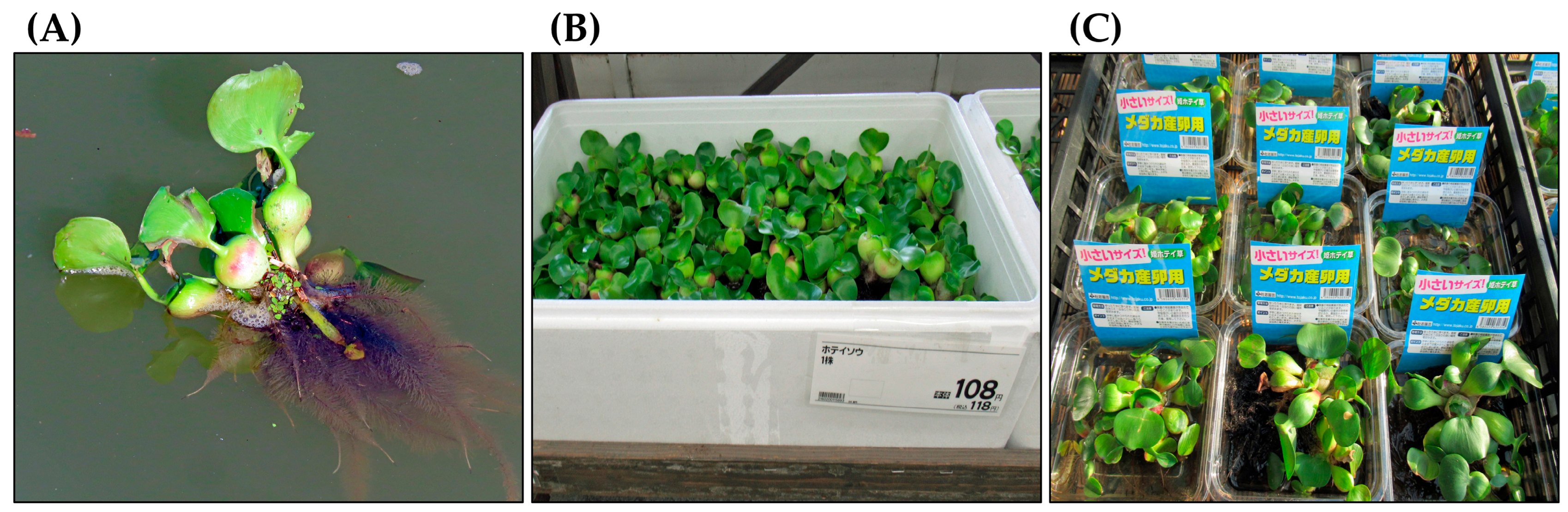
Water hyacinth increases its population rapidly through asexual reproduction. This occurs when axillary buds develop into stolons that establish daughter plants, called ramets. Physiologically independent clonal plants form when stolons detach from the mother plant due to decay or breakage [41,42,43]. This vegetative reproduction occurs indefinitely, producing large populations. Under suitable conditions, the population doubles within one to two weeks [44]. Ten water hyacinth plants have been estimated to grow to 655,360 plants and cover half a hectare in eight months [45]. The main natural dispersal method of water hyacinth is water flow along rivers and lakes. Floodwaters can carry the plants long distances. The plants can also be carried by wind or animals. Human activity is the primary cause of accidental and intentional dispersal over short and long distances. Water hyacinth is still sold at some local markets for ornamental purposes and for use in aquariums (Figure 2). Water hyacinth easily escapes cultivation [12].
The following examples illustrate the expansion history of water hyacinth. The water hyacinth population was first detected in the Guadiana River in southwestern Spain in 2004. The population declined significantly that winter due to cold temperatures. However, the plants regenerated from the remaining parts in April 2005. By November of that year, the population had spread 75 km along the river and covered 200 hectares, producing 175,000 tons of biomass [46,47]. Water hyacinth first appeared in Lake Victoria in Africa in 1988. Within 10 years, it spread to cover over 9500 hectares [48]. The plant was first observed at the edge of Lake Tana in Ethiopia in 2011, covering 20 hectares of the surface of the lake by 2012. By the end of 2019, it had spread to cover over 25,000 hectares of the lake surface [49,50]. Water hyacinth was introduced to China in the early 1900s and has since spread to 19 provinces. By 2003, it had infested over 130,000 sites and covered 27,000 hectares in Fujian Province alone [51,52].
Water hyacinth is characterized by its rapid growth and tendency to form dense mats in freshwater ecosystems, such as lakes, rivers, canals, and paddy fields. The plant is also found in protected areas. The presence of water hyacinth significantly alters the structure and function of these ecosystems, including their abiotic and biotic components, as well as human activity [1,2,10,12,53]. Due to its detrimental effects on natural ecosystems, the International Union for Conservation of Nature (IUCN) has designated water hyacinth as one of the world’s 100 worst invasive alien species [54]. Many countries also have legal regulations to prevent the introduction and spread of this species because of its negative ecological and socioecological impacts [12]. This paper aims to update and discuss the impact of water hyacinth on the abundance and diversity of native species, including aquatic plants, plankton, invertebrates, fish, and birds. It will also address its impact on socioecology. Additionally, the paper will address its impact on abiotic factors such as water quality, flow, oxygen levels, and greenhouse gas emissions. A comprehensive review of the existing literature was conducted using the following databases: Scopus, ScienceDirect, PubMed, and Google Scholar. The following terms related to Pontederia crassipes and Eichhornia crassipes were searched: water quality, dissolved oxygen, flora, fauna, invasive species, phytoplankton, aquatic plants, zooplankton, invertebrates, fish, birds, agriculture, fisheries, disease, socioecology, and management. We included these research papers in our analysis to the fullest extent possible. However, we excluded publications with unclear methods, no statistical analysis, or a lack of an English summary if the publication was in a local language. Additionally, we avoided making direct comparisons between data from different publications because the publications used different analytical methods under different environmental conditions.

2. Impacts on Abiotic Components

An infestation of water hyacinth negatively affects water quality. It decreases the levels of dissolved oxygen and nitrogen while increasing turbidity and COD. Its large, floating mats absorb sunlight for photosynthesis. This absorption, coupled with high turbidity, reduces sunlight transmission into the water column.

2.1. Water Evaporation

Evapotranspiration from water hyacinth mats has been observed in various freshwater ecosystems. For instance, the presence of water hyacinth increased evapotranspiration by 44–48% compared to evaporation from open water at Brokopondo Lake in Suriname [55]. From 2013 to 2017, water hyacinth mats covered between 1.3% (38,400 m2) and 30% (2,158,500 m2) of the lake surface of Batujai Reservoir in Central Lombok, Indonesia, depending on the season. When the mats covered 20% of the lake surface, the evapotranspiration rate of the water hyacinth mats was estimated to be 8000 tons per day [56]. In 2019, the seasonal coverage of water hyacinth in Lake Tana, Ethiopia, ranged from 4.14 km2 in the autumn to 15.35 km2 in the winter. The net daily evapotranspiration of the water hyacinth mats also fluctuated, ranging from 0.067 km3 (67,000,000 tons) to 0.2297 km3 (229,700,000 tons) [57]. From 2002 to 2022, water hyacinth mats covered between 1.68 km2 and 6.82 km2 of the Chongon Reservoir in Guayaquil, Ecuador, depending on whether it was the dry or rainy season. These figures equate to approximately 10.4% and 41.3% of the total surface area of the reservoir, respectively. The average evapotranspiration rate from water hyacinth mats was estimated to be between 5.3 and 6.3 mm per day, or approximately between 85,000 and 101,500 tons per day. For comparison, the evaporation rate from open water was 4.4 mm per day, or about 70,900 tons per day. Thus, water hyacinth increased evaporation by a factor of 1.2 to 1.4 [58].
From 2015 to 2016, the evapotranspiration rate in water hyacinth-infested areas of the Rosetta Branch of the Nile River was estimated to be 21.3 million m3 per year, or about 58,000 tons per day. For comparison, the evapotranspiration rates were 0.7 million m3 per year for native common reed (Phragmites australis) and 1.1 million m3 per year for torpedo grass (Panicum repens). Thus, the water hyacinth rate was 30- and 19-fold greater than the rates of common reed and torpedo grass, respectively [59]. From 1982 to 1983, the evapotranspiration rate of water hyacinth was 196,000 L per hectare per day in Parańa, Argentina. This value was 2.3- to 2.8-fold greater than that of other aquatic floating plants, such as water lettuce (Pistia stratiotes; 84,000 L/ha/d), Salvinia herzogii (87,000 L/ha/d), and Azolla caroliniana (71,000 L/ha/d) [60]. Therefore, water hyacinth infestation increases evapotranspiration. This increase exceeds that caused by other aquatic plant species. The resulting disruption to the water balance of freshwater ecosystems can be significant.

2.2. Water Flow

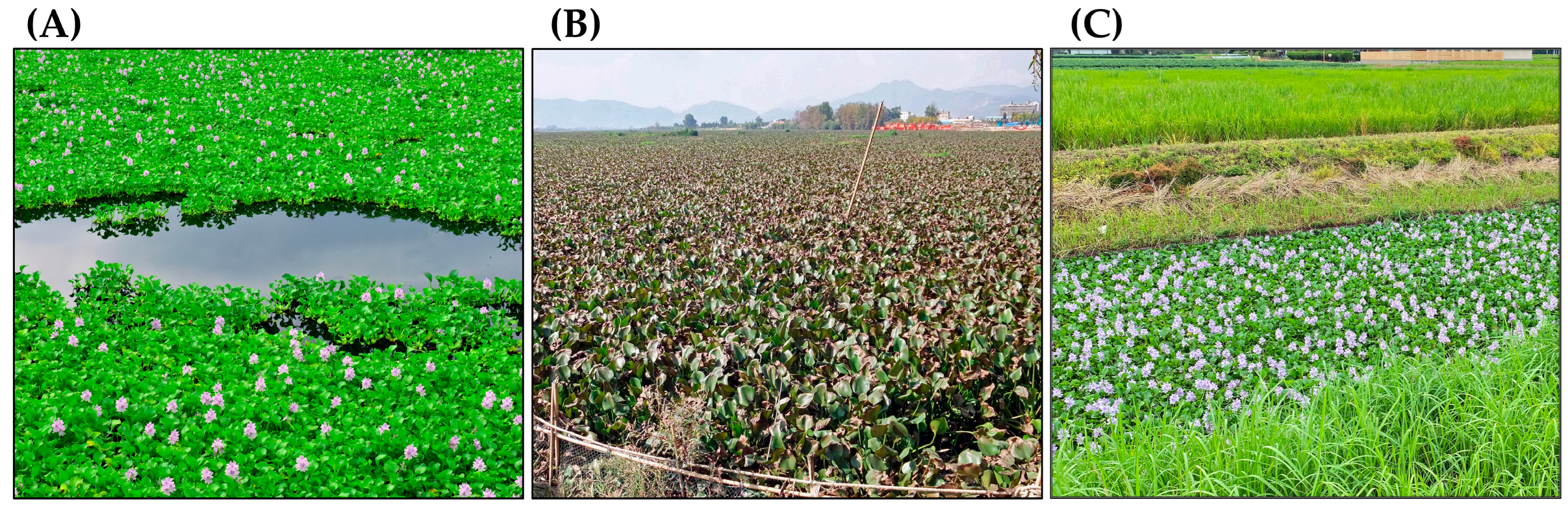
The dense mats and extensive submerged root systems of water hyacinth increase flow resistance. This increases Manning’s roughness coefficient and decreases the water conveyance capacity [61,62,63]. Manning’s roughness coefficient measures the resistance that floodplains, rivers, and channels present to water flow. It takes into account surface roughness, obstructions, friction, and vegetation [64]. Thus, the presence of water hyacinth reduces water flow and causes blockages in rivers, channels, irrigation systems, and drainage systems. These blockages lead to increased sedimentation and flooding potential [65]. From 1984 to 1985, the annual mean detritus from water hyacinth in Lake Apopka, Florida, USA, was estimated at 1.9 g of dry weight per m2 per day. This equaled 8.7% of the total water hyacinth production [66,67]. Large masses of floating mats can clog irrigation pumps, collapse weirs and bridges, and damage flood control facilities [68]. An infestation of water hyacinth reduces water flow, blocks waterways, increases sedimentation, and raises the potential for flooding, which can destroy ecosystems (Figure 3).

2.3. Water Quality

An infestation of water hyacinth in Lake Naivasha, Kenya, decreased the level of dissolved oxygen from 5.98 mg/L in non-infested areas to 1.96 mg/L and lowered the pH from 7.71 to 6.92. Conversely, the infestation increased the level of free carbon dioxide from 12.86 mg/L to 26.45 mg/L [69]. Infestations of water hyacinth have also been reported to increase chemical oxygen demand (COD) and decrease dissolved oxygen levels in Lake Chivero in Zimbabwe [70] and in a tropical lagoon in Nigeria [71]. The impact of water hyacinth infestations on water quality was evaluated using multiple publications from various countries. The results showed that infestations significantly decreased dissolved oxygen levels in freshwater ecosystems [11,72,73], though they did not significantly affect temperature, pH, electrical conductivity, or phosphate concentration [73].
Infestations of water hyacinth have been observed to increase water turbidity in the Burdekin Delta floodplain in Queensland, Australia [74], and the Sacramento-San Joaquin Delta in California, USA [75]. Water hyacinth grows rapidly and produces large amounts of detritus [66,76]. The decomposition of this detritus leads to high turbidity and COD levels in the water. This results in lower dissolved oxygen levels beneath water hyacinth mats in freshwater ecosystems [70,75,76,77,78].
Several studies have examined the impact of water hyacinth infestations on nitrogen levels in freshwater ecosystems and found that infestations significantly reduce nitrogen levels [11,73]. This reflects the rapid growth of water hyacinth, which is accompanied by high nitrogen absorption [79,80]. In the shallow, eutrophic Lake Dianchi in China, nitrogen levels in the water within water hyacinth mats were significantly lower than in the water far from water hyacinth mats [81]. Dense mats of water hyacinth create anaerobic conditions that favor denitrification and lead to further nitrogen loss [82]. These processes may cause nitrogen depletion. Therefore, water hyacinth infestation decreases dissolved oxygen and nitrogen levels, while increasing carbon dioxide levels, COD, and turbidity in freshwater ecosystems.
Additionally, water hyacinth absorbs and accumulates heavy metals, such as iron, lead, cadmium, zinc, manganese, chromium, copper, mercury, fluoride, and arsenic, from water. This makes it a viable option for bioremediation of the polluted freshwater ecosystems [83,84,85]. Water hyacinth accumulated 2040 mg/kg and 9650 mg/kg of cadmium and zinc, respectively, in its roots [83]. However, when water hyacinth debris decomposes, the accumulated pollutants are released back into the ecosystem [66,86]. Methods for preventing decomposition or collecting biomass before it decomposes have yet to be developed.

2.4. Sunlight Transmission

There is no exact information available on the effect of large, floating water hyacinth mats on sunlight transmission into the water column. These mats efficiently absorb sunlight for photosynthesis [87,88,89], which significantly reduces sunlight transmission compared to open water areas. Increased turbidity due to water hyacinth infestations also reduced sunlight transmission. Reduced sunlight transmission affects the photosynthesis and growth of emergent and submerged aquatic plant species, as well as phytoplankton.

2.5. Greenhouse Gas

Freshwater ecosystems receive large amounts of organic matter from their drainage basins. This results in intense heterotrophy and high oxygen consumption, causing anaerobic sediments [90]. These anaerobic sediments produce methane (CH4), a major greenhouse gas, during heterotrophy [91]. Aquatic plants that grow in anoxic sediments have a convective gas-throughflow system that delivers oxygen from the atmosphere to their rhizomes and roots [92,93]. This system also efficiently carries methane to the atmosphere from sediments [94,95]. It has been estimated that aquatic plants are responsible for between 31% and 96% of total global methane emissions from freshwater ecosystems [96,97].
Water hyacinth is also known to emit methane into the atmosphere [90,98]. Of the 22 research areas affected by water hyacinth in the Amazon and Pantanal regions of Brazil, areas with shallow water exhibited the highest methane emissions (307 mg of methane per m2 per day). In these areas, the roots and aerenchyma tissues of water hyacinth facilitate the transport of methane from the sediments [99,100]. The amount of methane emitted depends on the plant and environmental conditions, including plant age, density, sediment rooting, organic matter content, and temperature [101,102]. In the Hong Lake Natural Reserve in China, methane emissions from water hyacinth were 1.2-, 3.3- and 2.4-fold greater than those from Zizania latifolia (Griseb.) Hance ex F. Muell. (a native emergent plant), Trapa natans L. (a native floating plant), and open water zones, respectively [103]. Therefore, water hyacinth infestations lead to increased methane emissions from sediments in freshwater ecosystems. This contributes to global warming. Table 1 summarizes the impact of water hyacinth infestations on abiotic components.

3. Impacts on Primary Producers in the Food Web

A water hyacinth infestation significantly alters the abiotic components of ecosystems. This alteration affects primary producers in the food web, including phytoplankton and aquatic plants. Several studies have examined the impact of water hyacinth infestations on the abundance and diversity of phytoplankton and other aquatic plant species.

3.1. Phytoplankton

At Koka Reservoir in Ethiopia, the abundance and species richness of phytoplankton were significantly higher in areas without water hyacinth infestations than in areas with them. This reduction was caused by alterations to the abiotic components resulting from the water hyacinth infestations. Dissolved oxygen levels were positively correlated with phytoplankton abundance and species richness. Turbidity was negatively correlated with them due to its blocking of light penetration. Water hyacinth mats also block sunlight from reaching the water column and prevent gas exchange between the surface of the water and the atmosphere [104].
Mechanical removal of water hyacinth mats has been observed to increase the population of phytoplankton, including cyanobacteria, in reservoirs in Mexico [105,106] and in Brazil [107,108]. Phytoplankton populations were low in areas of Lake Naivasha in Kenya that were covered by water hyacinth, resulting in significant changes in species abundance and composition [109]. Therefore, water hyacinth may reduce the abundance and diversity of phytoplankton by reducing sunlight transmission, gas exchange, and dissolved oxygen levels.
Under laboratory conditions, water hyacinth was found to inhibit the growth of the cyanobacterium Raphidiopsis raciborskii (Cyanoprokaryota). This inhibition was not caused by nutrient competition [110]. This cyanobacterium is known to produce several toxic substances, including saxitoxin and cylindrospermopsin [111]. Conversely, the population of the cyanobacterium Microcystis aeruginosa (Cyanoprokaryota) was 15-fold higher in littoral zones infested with water hyacinth than in non-infested littoral zones of Lake Chivero in Harare, Zimbabwe [112]. Microcystis aeruginosa forms a bloom that produces toxic substances, including microsystin and cyanopeptolin [113]. The populations of R. raciborskii, M. aeruginosa and water hyacinth increase in water with hypereutrophic conditions. These contrasting results may stem from the different investigation conditions, such as laboratory or natural conditions.
Acetone extracts from water hyacinth roots have been shown to inhibit the growth of phytoplankton, such as Chlorella spp. and Scendesmus obliquus [114]. Methanol extracts from the entire water hyacinth plant also inhibited the growth of Chlorella vulgaris [115]. Several compounds were identified in methanol extracts of water hyacinth roots. Among these compounds, 1,4-benzenediol exhibited higher inhibitory activity against Microcystis aeruginosa [116]. These results imply that some compounds including 1,4-benzenediol may inhibit the growth of these phytoplankton species as allelochemicals. Additionally, the allelopathic activity and allelopathic substances of water hyacinth against various terrestrial plant species have been reported [117,118,119,120]. Allelochemicals can only act once they are released into an environment, including a water system [121,122,123,124]. They must also exceed their active threshold concentrations in the environment. Otherwise, these allelochemicals cannot suppress the growth of the intended plants, including phytoplankton [125,126,127,128]. However, these allelochemicals have only been identified in water hyacinth extracts. Their release and concentration in freshwater systems remain unknown. Therefore, it is too early to conclude that these compounds act as allelochemicals that suppress the growth of these phytoplankton. Table 2 summarizes the impact of water hyacinth infestations on phytoplankton.

3.2. Aquatic Plants

Under mesocosm conditions, water hyacinth hindered the growth of two submerged plants, Ceratophyllum demersum L. and Myriophyllum spicatum L., by interfering with their photosynthesis and nutrient uptake [129]. Water hyacinth was grown alongside two native plants, Ludwigia peploides (Kunth) P.H. Raven ssp. stipulacea and Hydrilla verticillata (L.f.) Royle, under mesocosm conditions with varying nutrient levels. The growth of water hyacinth increased with higher nutrient levels. However, despite the increase in nutrient levels, the growth of these native plants did not increase. Water hyacinth inhibited their growth by interfering with their nutrient uptake. These results suggest that eutrophication increases the competitive ability of water hyacinth over these native plant species by suppressing their nutrient uptake [130].
Epiphytic algal communities on water hyacinth and the native floating plant Hydrocharis dubia (Blume) Backer were investigated in 40 natural freshwater ecosystems in China. Algae were less abundant on water hyacinth roots than on H. dubia roots. Water hyacinth has a greater biomass and occupies more space. This limits the sunlight, nutrients, and space available for the growth of these epiphytic algae [131].
A total of 23 species belonging to 15 families were identified in Lake Abaya in Ethiopia. Of these, 16 species were observed in infested sites, and 17 species were observed in non-infested sites. The six aquatic plant species include four emergent species: Lemna aequinoctialis Welw. (Lemnaceae), Cyperus esculentus L. (Cyperaceae), Polygonum punctatum Raf. (Polygonaceae), and Sparganium americanum Nutt. (Typhaceae), and two floating species: Pistia stratiotes L. (Araceae), and Potamogeton crispus L. (Potamogetonaceae), were found only in non-infested sites. Six aquatic plant species, including two submerged macrophytes: Bacopa monnieri (L.) Wettst. (Scrophulariaceae), and Leptochloa fusca (L.) Kunth (Poaceae); two emergent species: Bulbine abyssinica A. Rich. (Asphodelaceae), and Echinochloa rotundiflora Clayton (Poaceae); and a floating species: Isoetes spp. (Isoetaceae), were found only in infested sites [132]. Therefore, the presence of water hyacinth affects the species composition of these ecosystems. These differences may be caused by various abiotic factors, including sunlight, turbidity, oxygen level, nitrogen level, and water flow.
A negative correlation was observed between the abundance and diversity of aquatic plants and the biomass of water hyacinth in 12 lakes, two wetland lakes, and 20 rivers in China, where water hyacinth is an introduced species. However, this correlation was not observed in 17 lakes and 17 rivers in Brazil, where water hyacinth is a native species [133]. These aquatic plants in China may not have coevolved with water hyacinth, meaning they may not tolerate water hyacinth. This could result in growth inhibition by water hyacinth in China.
The available information suggests that water hyacinth negatively affects the abundance and diversity of aquatic plant communities, including submerged, emergent, and floating plants, as well as epiphytic plants. This occurs through disruption of sunlight perception and nutrient uptake. Water hyacinth occupies available niches, displacing other aquatic plant species. Thus, water hyacinth alters the abundance and composition of aquatic plants. However, it has been reported that water hyacinth does not inhibit the growth of neighboring species within its native range. Table 2 summarizes the impact of water hyacinth infestations on aquatic plants.

4. Impacts on Consumers in the Food Web

The abundance, distribution, and diversity of zooplankton, invertebrates, fish, and birds depend on water quality, food availability, and habitat conditions. The density and composition of predators also affect these organisms. Water hyacinth likely alters these components. Several studies have examined the impact of water hyacinth infestations on the abundance and diversity of zooplanktons, invertebrates, fish and birds.

4.1. Zooplankton

Water hyacinth provides more microhabitats for zooplankton. In mesocosm conditions, the abundance of water hyacinth and microcrustaceans increased due to greater habitat diversity [134]. Two cladoceran species, Chydorus brevilabris and Simocephalus vetulus, use water hyacinth mats to hide from planktivorous fish [135]. The abundance and diversity of epiphytic rotifer species in water hyacinth mats were attributed to the greater food availability and protection from predators afforded by the root structure of water hyacinth [136].
Cyclopodia species were more abundant in the water hyacinth-infested areas of Lake Chivero in Harare, Zimbabwe. Conversely, the densities of Chydorus species (Chydoridae) and Daphnia longispina (Daphniidae) were lower in these areas [112]. The zooplankton community inside, around, and outside of large-scale water hyacinth mats in Lake Taihu, China, was investigated. A total of 21 zooplankton genera from 15 families were identified. Cadoceran species had significantly higher densities inside the mats than outside, while rotifer species exhibited the opposite pattern [137]. Free-floating plants, such as water hyacinth, have been reported to have lower abundances of medium-sized zooplankton than other emergent and submerged plants [138]. Small zooplankton may prefer to hide from predators under water hyacinth mats. This may explain the different distributions under water hyacinth mats.
The abundance and diversity of the zooplankton population in Lake Naivasha, Kenya, decreased significantly due to water hyacinth infestation [139]. The zooplankton population in the Koka Reservoir in Ethiopia consists of 38 species belonging to the orders Rotifera, Copepoda, and Cladocera. Zooplankton abundance and diversity were significantly higher in areas without water hyacinth infestation. Some zooplankton taxa were only found in non-infested zones [140].
The zooplankton community is linked not only to water hyacinth but also to other aquatic plant communities [138,141,142]. It is also linked to the density and composition of predators [143]. These components are site-specific. The abundance of zooplankton was found to be both positively and negatively correlated with water hyacinth. However, the abundance and diversity of zooplankton were significantly impacted by the presence of water hyacinth. Therefore, water hyacinth infestation alters the zooplankton community by changing the availability of food and refuge for predators. The alteration of natural freshwater ecosystems is one consequence of water hyacinth infestation. Table 3 summarizes the impact of water hyacinth infestations on zooplankton.

4.2. Macroinvertebrates

Macroinvertebrates are more abundant near aquatic plants than in open water [144,145]. In the Alvarado Lagoon System in Veracruz, Mexico, the assemblages of macroinvertebrates associated with water hyacinth roots included species from the orders Decapoda, Amphipoda, Mollusca, and Isopoda [146]. These species were also studied in the Waccamaw River in South Carolina, USA. The most common species belonged to the orders Branchiopoda, Talitridae, Oligochaeta, and Diptera [147]. In the water hyacinth assemblage of Lake Xochimilco in Mexico City, the most abundant species were the amphipod Hyalella azteca and the dipteran Chironomus plumosus [148]. From 2019 to 2020, the abundance and diversity of macroinvertebrates were investigated in several lakes in the Pokhara Valley, Nepal. A total of 29 species belonging to 15 orders of macroinvertebrates were identified. Habitats infested with water hyacinth had higher species abundance and diversity than non-infested habitats. However, the distribution of species differed between the two types of habitats. Species belonging to the orders Caenogastropoda, Sphaeriida, Ephemeroptera, Odonata, and Coleoptera were significantly more abundant in water hyacinth-infested habitats. Conversely, species belonging to the orders Diptera and Haplotaxida were more abundant in non-infested habitats [149]. Therefore, the macroinvertebrate assemblages were larger in the water hyacinth than in open water. Water hyacinth provides a habitat for these species of macroinvertebrate species. There was a positive correlation between the density of these macroinvertebrates and the presence of water hyacinth. However, the species of macroinvertebrates associated with water hyacinth varied by location, possibly due to different environmental conditions.
Benthic macroinvertebrates in the conservation areas of Lake Nsezi and the Nseleni River in South Africa were investigated. A total of 817 specimens from 13 families and 17,980 specimens from 27 families were collected from sites infested with water hyacinth and from open water sites, respectively. The presence of water hyacinth reduced the abundance and diversity of benthic macroinvertebrates [150]. Water hyacinth also reduced the number of benthic macroinvertebrates in the New Year’s River in South Africa [151].
The invertebrate assemblage associated with the native plant pennywort (Hydrocotyle umbellata), which is sometimes found floating or emergent, and the invasive plant water hyacinth, was investigated in the Sacramento-San Joaquin Delta in California. The densities of insects and epibenthic and benthic invertebrates were higher in pennywort than in water hyacinth. The taxonomic compositions of these invertebrate assemblages were significantly different between pennywort and water hyacinth. The native amphipod species Hyalella azteca was more abundant in pennywort, while the introduced amphipod species Crangonyx floridanus was more abundant in water hyacinth [152]. Water hyacinth infestation caused significant ecological alterations to the native macroinvertebrate community.
Water hyacinth provides a habitat for macroinvertebrates. Some macroinvertebrates were more abundant in areas infested with water hyacinth than in open water areas. However, water hyacinth reduced the species richness and population abundance of benthic macroinvertebrates compared to open water areas. Assemblages of water hyacinth had fewer species and lower populations of insects and epibenthic and benthic invertebrates than assemblages of native plants. Therefore, the presence of water hyacinth increases the abundance of some species while decreasing the abundance of others. Thus, it significantly impacts the abundance and diversity of the aquatic macroinvertebrate community in comparison to non-infested zones, including conservation areas. Table 3 summarizes the impact of water hyacinth infestations on invertebrates.

4.3. Fish

The floating mats and extensive root systems of water hyacinth provide shelter for small and juvenile fish. This protects them from predatory birds and fish. However, an infestation of water hyacinth affects the availability of food sources, such as invertebrates and plankton, for fish. Water hyacinth mats also decrease dissolved oxygen levels. These alterations likely impact the abundance and diversity of fish species. Several investigations have been conducted to determine the impact of water hyacinth infestations on fish populations.
The presence of water hyacinth mats was reported to affect the distribution of fish species in Lake Chivero, Zimbabwe. Smaller and juvenile fish, including Oreochromis niloticus, Pharyngochromis acuticeps, Tilapia sparrmanii, and Barbus paludinosus, were prevalent in infested areas. Mature, larger fish were found in deep, non-infested areas [112]. This may be because water hyacinth provides these small fish with shelter and feeding grounds.
In Lake Victoria, Kenya, observations of the diet of Nile tilapia (Oreochromis niloticus) revealed a shift in feeding habits due to an infestation of water hyacinth. The fish increasingly consumed invertebrates associated with water hyacinth [153]. Similarly, in the Sacramento-San Joaquin Delta in California, the diet of bluegill sunfish (Lepomis macrochirus) shifted to include macroinvertebrates associated with water hyacinth [152]. These dietary shifts are likely due to the increased abundance of macroinvertebrate species caused by water hyacinth infestation.
From 2019 to 2020, researchers investigated the abundance and diversity of fish species in several lakes in the Pokhara Valley, Nepal. These lakes exhibited different levels of water hyacinth coverage. A total of 21 fish species were identified in these lakes. The total abundance of introduced species, such as Oreochromis niloticus and Ctenopharyngodon idella, increased with water hyacinth coverage. However, the abundance of native species, such as Cyprinus carpio, decreased with water hyacinth coverage [154]. A significant negative correlation was also observed between the abundance of native tilapia (Oreochromis niloticus) and the extent of water hyacinth coverage in Lake Victoria, Kenya [155].
From 2014 to 2015, the abundance and diversity of fish species were investigated in both water hyacinth-infested and non-infested areas of the Nyanza Gulf of Lake Victoria in Kenya. Protopterus aethiopicus (35% of the total abundance) and Clarias gariepinus (28%) were found in high numbers in infested areas. In contrast, Lates niloticus (23%) and Oreochromis niloticus (18%) were most prevalent in non-infested areas. Dissolved oxygen levels were 2.44 mg/L and 4.24 mg/L in infested and non-infested areas, respectively. P. aethiopicus and C. gariepinus can tolerate low oxygen levels, but L. niloticus is highly sensitive to them [156]. Water hyacinth infestation may alter the fish population due to changes in oxygen concentration.
Table 3. Impact of water hyacinth infestations on consumers.
ConsumerIncreaseDecreaseLocationReference
Zooplankton Under mesocosm condition[134,135,136]
Lake Chivero, Harare, Zimbabwe[112]
Lake Taihu, China[137]
Lake Naivasha, Kenya[139]
Koka Reservoir, Ethiopia[140]
Macroinvertebrate Alvarado Lagoon System, Veracruz, Mexico[146]
Waccamaw River, South Carolina, USA[147]
Lake Xochimilco, Mexico [148]
Pokhara Valley, Nepal[149]
Lake Nsezi and the Nseleni River, South Africa[150]
New Year’s River, South Africa[151]
Sacramento-San Joaquin Delta, California[152]
FishLake Chivero, Zimbabwe[112]
Pokhara Valley, Nepal[154]
Lake Victoria, Kenya[155]
Lake Victoria, Uganda[157]
Burdekin River, Queensland, Australia[158]
Bird St. Marks River, Florida, USA,[159]
Lake Cluster, Pokhara Valley, Nepal [160]
Santragachhi, Kolkata, India[161]
Lake Chapala, Mexico[162]
Through electrofishing, the species and abundance of fish were determined in 30 different habitats representing six types of habitats along the shoreline of Lake Victoria in Uganda. These habitats included open shores, rocky shores, areas covered by water hyacinth, and three areas with emergent plants, such as Vossia, Typha, and Papyrus species. A total of 2860 specimens belonging to 57 species were sampled. Significant reductions in species abundance and diversity were observed in water hyacinth habitats compared to other habitats [157]. From 2002 to 2004, water hyacinth was mechanically removed from the Burdekin River floodplain in Queensland, Australia. This resulted in a significant increase in the abundance and diversity of native fish species in the area [158].
Water hyacinth provides shelter and feeding grounds for small fish and alters fish dietary behavior. It increases the abundance of fish, particularly introduced fish species. However, it often reduces the abundance and diversity of native fish species. Therefore, water hyacinth affects the abundance and composition of fish species in freshwater ecosystems. Table 3 summarizes the impact of water hyacinth infestations on fish populations.

4.4. Birds

An infestation of water hyacinth alters the abundance, distribution, and composition of invertebrates, fish, and other aquatic plant species. This affects the availability of food and habitats for water birds. Water hyacinth mats can physically prevent water birds from accessing food sources. These alterations likely impact the abundance and diversity of water bird species, as well as their feeding activities. Several studies have investigated the effects of water hyacinth infestations on bird populations.
On the St. Marks River in Florida, USA, birds most often obtained prey near the edges of water hyacinth mats and rarely hunted within them [159]. The composition of bird communities, classified by feeding guild, varied between habitats with and without water hyacinth mats. Omnivorous birds were more abundant in habitats with water hyacinth mats than without. The opposite was true for piscivorous birds. Overall, there were fewer birds in the Lake Cluster of the Pokhara Valley in Nepal, where water hyacinth mats were present [160]. From 1998 to 2009, the population of migratory water birds in the Santragachhi wetland near Kolkata, India, declined by over 55% due to an infestation of water hyacinth. Three protected bird species disappeared from the wetland. This decline in bird populations was negatively correlated with the expansion of water hyacinth mats [161]. Several species of migratory birds, especially small birds, were not observed in Lake Chapala, Mexico, during the winter when the water hyacinth mats were largest. The mats limited the access for birds to food [162].
Therefore, water hyacinth infestations reduce the abundance and diversity of water birds by disrupting their foraging due to the presence of water hyacinth mats. Table 3 summarizes the impact of water hyacinth infestations on birds.

5. Impact on Socioecology

5.1. Agriculture and Fishery

Infestations of water hyacinth in paddy rice fields have been observed in Southeast Asia, Africa, and Southern Europe [53,163,164,165,166,167]. These infestations reduce rice production by depleting nutrients, disturbing irrigation systems, and reducing cultivated land [53,163,167,168]. The production of other crops, such as maize, sorghum, chickpea, onion, and tiff, decreased significantly after water hyacinth infestation due to disrupted irrigation and reduced cultivated land [53]. During flooding and other events involving excess water, large populations of water hyacinth flow into farmlands and overtake them. Even after the water level drops, the plants can survive by sending their extensive roots deep into the ground. This compacts the land, making it difficult to plow. Managing the land becomes labor-intensive and costly [169]. Most farmers in areas affected by water hyacinth infestations experience crop production disruptions. Many farmers have also abandoned their farmland along waterways due to blocked access caused by water hyacinth mats [170]. Water hyacinth infests grasslands, such as those of Cynodon dactylon and Echinochloa pyramidalis. These infestations smother and destroy the grasslands. These grasslands were previously used for grazing livestock. This reduces livestock production [53,168,171].
The water hyacinth infestation reduced the catch of economically important fish, including tilapia (Oreochromis spp.), catfish (Siluriformes spp.), and Labeobarbus spp., by 45–75%. This reduction is more significant in smaller fisheries. One possible reason for this decline is the smaller population of these fish in the area due to the water hyacinth infestation [49,172,173]. The infestation also prevents fishing boats from reaching fishing spots and entangles fishing nets and other equipment. It also disrupts transportation to markets after fish are caught [49,53,172,173,174,175]. Lakeshores and riverbanks are ideal environments for fish reproduction. However, the dense mats and extensive root systems of water hyacinth can entangle fish and disrupt their migration to spawning grounds, preventing fish reproduction [53]. Therefore, water hyacinth infestation negatively affects agricultural production and fishing in the local community. Eradicating the plant requires a lot of labor and is expensive. Some people abandon their farms and fishing businesses due to water hyacinth infestations.

5.2. Daily Life and Health in Humans

An infestation of water hyacinth affects people who depend on bodies of water for their daily lives, especially those in riparian communities in developing countries. Water hyacinth mats impede the transportation of people, food, and daily necessities through canals, rivers, and lakes, particularly in regions where ships are the primary mode of transportation. These mats also suppress community and recreational activities and reduce income for those working in transportation, agriculture, fisheries, and related businesses. Eradicating water hyacinth from canals, rivers, and lakes is nearly impossible. Consequently, many people have transitioned from agriculture, fishing, transportation, and related occupations to other occupations. This has destroyed their livelihoods, as well as community activities and structures [53,167,170,174,176]. The infestation of water hyacinth has made their livelihoods precarious and unsustainable.
Water hyacinth mats provide habitats where mosquito larvae can proliferate. This increases the opportunity for disease transmission. Mosquitoes carry protozoa, parasitic nematodes, and viruses that cause malaria, filariasis, dengue fever, West Nile virus, chikungunya virus, yellow fever, and Japanese encephalitis [174,175,177,178]. Water hyacinth mats also provide habitats for snails, such as Oncomelania, Biomphalaria and Bulinus, to proliferate. These snails carry schistosomiasis [179,180,181]. The reason remains unclear, but water hyacinth infestations are positively associated with an increased number of cholera and typhoid patients [13,182]. The infestations of water hyacinth have been linked to an increase in crocodile attacks on livestock and humans. The thick mats of water hyacinth provide camouflage for crocodiles, enabling them to approach the shore undetected [174,183].
Water hyacinth infestations disrupt daily activities and livelihoods, harm local communities, and increase the likelihood of disease transmission. This renders human habitats less habitable. Table 4 summarizes the impact of water hyacinth infestations on socioecological components.

6. Discussion

Many published reviews have addressed management strategies for water hyacinth. Since over 10 of these reviews are available only after 2020 [171,184,185,186,187,188,189,190,191,192,193,194,195], we will not summarize and discuss each management strategy here. These strategies include physical, chemical and biological controls, as well as integrated controls. After reviewing these strategies, it was determined that each has its own set of advantages and disadvantages. However, effective long-term control strategies for water hyacinth have not yet been developed. An effective long-term control strategy should be based on the specific conditions of each site, including the designated use of the body of water, its size, and its spatial configuration. It should also consider seasonal weather patterns. Over the past century, management strategies have shifted toward restoring the structure and function of ecosystems by progressively integrating various sectors.
Over the decades, research has been conducted on the valorization of water hyacinth as a renewable biomass resource. Several reviews on this topic have been published [51,181,187,191,196,197,198,199,200,201,202,203,204]. This valorization research covers using water hyacinth plants for phytoremediation, medicinal purposes, livestock feed, paper and fiber production, bioplastics, composting, and producing bioethanol, biogas, and biochar. However, high processing costs, low demand for its products, and inaccessible water hyacinth infestations limit the development of its utilization to laboratories and small-scale facilities. Therefore, utilization is not likely to be an effective solution for managing water hyacinth.
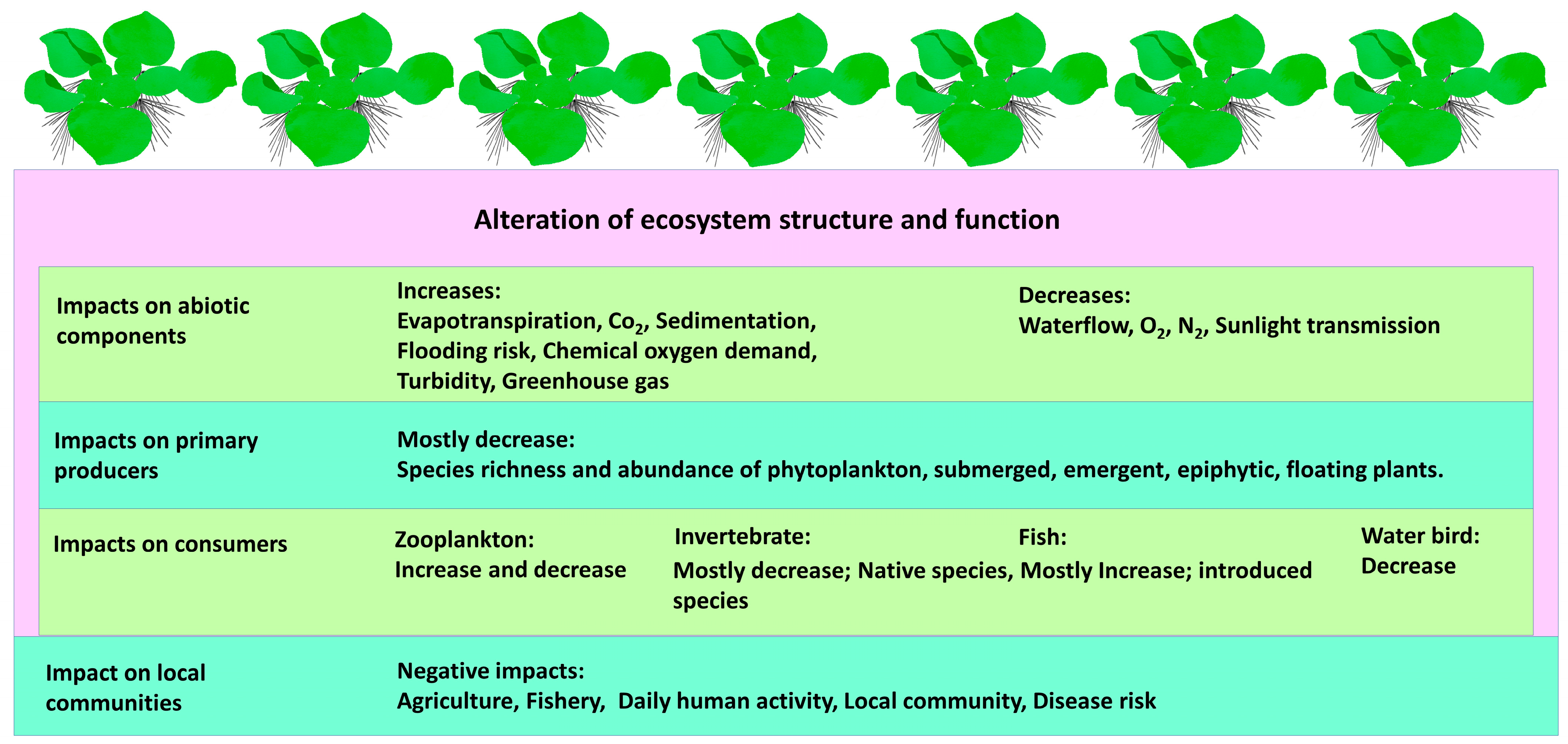
Infestations of water hyacinth alter the abiotic components of freshwater ecosystems, including water evaporation, flow, and quality; oxygen and nitrogen levels; sunlight transmission; and greenhouse gases (Table 1). These changes to the abiotic components, particularly reduction in sunlight transmission, dissolved oxygen and nitrogen levels, decrease the abundance and diversity of primary producers in the food web, including phytoplankton and aquatic plants (Table 2). These reductions, in turn, affect consumers in the food web, including zooplankton, invertebrates, fish, and birds. Often, a negative correlation has been observed between water hyacinth infestations and the abundance and diversity of these organisms, particularly native species. The most important factors determining these distributions are food availability, oxygen level, and habitat availability. A positive correlation has also been observed between water hyacinth infestations and the abundance of these organisms. The abundance of some of these organisms increased due to water hyacinth infestations (Table 3). Some authors have described these increases as having a positive impact. However, it is also an alteration of natural ecosystems compared to those before infestations occurred. Restoring the structure and function of these ecosystems should be a management priority. The infestations negatively affect the daily lives of local communities, including their agriculture and fisheries, as well as their living conditions (Table 4). Figure 4 illustrates the effects of water hyacinth infestations on abiotic, biotic, and socioecological components.
Under the future climate scenarios and global warming trends, its distribution range could extend considerably farther north and south in the Northern and Southern hemispheres, respectively. Increased rainfall, hurricane intensity, and frequent flooding can break up water hyacinth plants and carry their pieces long distances [14,72,205,206]. This contributes to the further dispersal of water hyacinth. Water hyacinth thrives in eutrophic waters, which are prevalent in shallow bodies of water in populated areas. Its rapid growth, high reproductive rate, and ability to adapt to different environments promote its wider distribution, and pose a greater threat to freshwater ecosystems worldwide. Additionally, water hyacinth contributes to global warming by increasing methane emissions [90,98,99,100,103].
A literature review of numerous publications on the impact of water hyacinth revealed that its infestation is a complicated, site-specific process influenced by time, climate, existing biotic and abiotic factors, and ecosystem resilience. Therefore, long-term monitoring of environmental outcomes is essential for developing effective, site-specific management strategies. Robust evaluation systems are also necessary for tracking the efficacy of interventions and understanding the broader ecological ramifications of management strategies. Historically, the ornamental use of water hyacinth has contributed to its worldwide distribution. Today, water hyacinth is still sold in some local markets. Therefore, raising public awareness of its invasive characteristics is necessary. Controlling the growth of water hyacinth is crucial due to its tendency to spread to unintended places, including protected areas, amid global warming trends. If left unmanaged, it will continue to spread across freshwater ecosystems, significantly impacting both the environment and human communities. Controlling this invasive aquatic plant is essential for maintaining healthy freshwater ecosystems.

7. Conclusions

The presence of water hyacinth alters the abiotic components of freshwater ecosystems in tropical, subtropical, and warm temperate regions. These components include water evaporation, flow, and quality; oxygen and nitrogen levels; sunlight transmission; and greenhouse gases. These changes affect the abundance and diversity of primary producers in the food web, including phytoplankton and aquatic plants. In turn, these changes influence consumers, such as zooplankton, invertebrates, fish, and birds. Often, a negative correlation has been observed between water hyacinth infestations and the abundance and diversity of these organisms, particularly native species. Infestations negatively impact daily human activities and livelihoods, harming local communities and increasing disease transmission. Global warming trends may favor the spread of the species into additional non-native areas, increasing the threat it poses. Water hyacinth contributes to global warming by increasing methane emissions from freshwater ecosystems. Controlling this invasive aquatic plant is essential for maintaining healthy freshwater ecosystems. Without management, the plant will continue to spread across freshwater ecosystems, significantly impacting the environment and human communities. An effective long-term control strategy should be based on the specific conditions of each site. These conditions include the designated use of the body of water, its size, and its spatial configuration. The strategy should also consider seasonal weather patterns.

Author Contributions

M.K. and H.K.-N.: conception and design of the review; screening of papers, M.K.: writing—original draft preparation, review and editing. All authors have read and agreed to the published version of the manuscript.

Funding

This research received no external funding.

Institutional Review Board Statement

Not applicable.

Informed Consent Statement

Not applicable.

Data Availability Statement

No new data were created or analyzed in this study.

Conflicts of Interest

The authors declare no conflicts of interest.

References

  1. Royal Botanical Gardens, Kew. Pontederia crassipes. Water Hyacinth. Available online: https://www.kew.org/plants/water-hyacinth (accessed on 17 March 2026).
  2. CABI Compendium, Digital Library. Eichhornia crassipes (Water Hyacinth). Available online: https://www.cabidigitallibrary.org/doi/abs/10.1079/cabicompendium.20544 (accessed on 17 March 2026).
  3. World Flora Online. Pontederia crassipes. Available online: https://www.worldfloraonline.org/taxon/wfo-0000501039 (accessed on 17 March 2026).
  4. Species Profile—USGS NAS, Nonindigenous Aquatic Species Database. Common Water Hyacinth, Eichhornia crassipes (Mart.) Solms. Available online: https://nas.er.usgs.gov/queries/greatlakes/FactSheet.aspx?Species_ID=1130&Potential=Y&Type=2#:~:text=Multiple%20ramets%2C%20or%20daughter%20plants,horizontal%20stolon%20from%20axillary%20buds.&text=Leaves:%20Sessile%20and%20petiolate%20leaves,smaller%20and%20have%20three%20stamens (accessed on 17 March 2026).
  5. Zhang, Z.H.; Guo, J.Y. Biology of water hyacinth. In Water Hyacinth. Environmental Challenges, Management and Utilization; Yan, S., Guo, J.Y., Eds.; CRC Press: Boca Raton, FL, USA, 2017; pp. 15–43. [Google Scholar]
  6. Maulidyna, A.; Alicia, F.; Agustin, H.N.; Dewi, I.R.; Nurhidayah, I.; Dewangga, A.; Kusumaningrum, L.; Nugroho, G.D.; Jumari, J.; Setyawan, A.D. Economic impacts of the invasive species water hyacinth (Eichhornia crassipes): Case study of Rawapening Lake, Central Java, Indonesia. Intel. J. Bonorowo Wetl. 2021, 11, 18–31. [Google Scholar] [CrossRef]
  7. Bibi, M.; Asad, F.; Shahid, S.; Kiramat, H. Anatomical, histochemical and phytochemical screening of the vegetative parts of Eichhornia crassipes. J. Pure Appl. Agric. 2023, 8, 42–52. [Google Scholar]
  8. Penfound, W.T.; Earle, T.T. The biology of the water hyacinth. Ecol. Monogr. 1948, 18, 447–472. [Google Scholar] [CrossRef]
  9. Barrett, S.C.H.; Forno, I.W. Style morph distribution in new world populations of Eichhornia crassipes (Mart.) Solms-Laubach (Water hyacinth). Aquat. Bot. 1982, 13, 299–306. [Google Scholar] [CrossRef]
  10. Gopal, B. Water Hyacinth; Elsevier: Amsterdam, The Netherlands, 1987; pp. 1–477. [Google Scholar]
  11. Villamagna, A.M.; Murphy, B.R. Ecological and socio-economic impacts of invasive water hyacinth (Eichhornia crassipes): A review. Freshw. Biol. 2010, 55, 282–298. [Google Scholar] [CrossRef]
  12. Coetzee, J.A.; Hill, M.P.; Ruiz-Téllez, T.; Starfinger, U.; Brunel, S. Monographs on invasive plants in Europe No 2: Eichhornia crassipes (Mart.) Solms. Bot. Lett. 2017, 164, 303–326. [Google Scholar] [CrossRef]
  13. Owens, C.S.; Madsen, J.D. Low temperature limits of waterhyacinth. J. Aquat. Plant Maneg. 1995, 33, 63–68. [Google Scholar]
  14. Kriticos, D.J.; Brunel, S. Assessing and managing the current and future pest risk from water hyacinth, (Eichhornia crassipes), an invasive aquatic plant threatening the environment and water security. PLoS ONE 2016, 11, e0120054. [Google Scholar] [CrossRef] [PubMed]
  15. Haller, W.T.; Sutton, D.L. Effect of pH and high phosphorus concentrations on growth of water hyacinth. Hyacinth Cont. J. 1973, 11, 59–61. [Google Scholar]
  16. de Casabianca, M.L.; Laugier, T. Eichhornia crassipes production on petroliferous wastewaters: Effects of salinity. Bioresour. Technol. 1995, 54, 39–43. [Google Scholar] [CrossRef]
  17. Muramoto, S.; Aoyama, I.; Oki, Y. Effect of salinity on the concentration of some elements in water hyacinth (Eichhornia crassipes) at critical levels. J. Environ. Sci. Health A 1991, 26, 205–215. [Google Scholar] [CrossRef]
  18. Reddy, K.R.; Agami, M.; Tucker, J.C. Influence of phosphorus on growth and nutrient storage by water hyacinth (Eichhornia crassipes (Mart.) Solms) plants. Aquat. Bot. 1990, 37, 355–365. [Google Scholar] [CrossRef]
  19. Isa, H.; Egbuche, K.C.; Malgwi, M.M.; Tukur, N.A. Cytological studies in Eichhornia crassipes (Mart.) Solms. Am. J. Plant Physiol. 2013, 8, 50–62. [Google Scholar] [CrossRef]
  20. Liu, F.; Sun, L.; Li, Y.; Deng, Y.; Liu, J.; Wang, W.; Li, J.; Zhang, Z.; Xu, Y.; Chang, Y.; et al. Genome-enabled phosphorus acquisition strategy drives the rapid reproduction of water hyacinth (Pontederia crassipes) leading to global invasion. Environ. Exp. Bot. 2025, 240, 106278. [Google Scholar] [CrossRef]
  21. Li, W.; Wang, B.; Wang, J. Lack of genetic variation of an invasive clonal plant Eichhornia crassipes in China revealed by RAPD and ISSR markers. Aquat. Bot. 2006, 84, 176–180. [Google Scholar] [CrossRef]
  22. Zhang, Y.Y.; Zhang, D.Y.; Barrett, S.C. Genetic uniformity characterizes the invasive spread of water hyacinth (Eichhornia crassipes), a clonal aquatic plant. Mol. Ecol. 2010, 19, 1774–1786. [Google Scholar] [CrossRef]
  23. da Cunha, N.L.; Xue, H.; Wright, S.I.; Barrett, S.C. Genetic variation and clonal diversity in floating aquatic plants: Comparative genomic analysis of water hyacinth species in their native range. Mol. Ecol. 2022, 31, 5307–5325. [Google Scholar] [CrossRef]
  24. Barrett, S.C.H. Waterweed invasions. Sci. Am. 1989, 261, 90–97. [Google Scholar] [CrossRef]
  25. Center, T.D.; Spencer, N.R. The phenology and growth of water hyacinth (Eichhornia crassipes (Mart.) Solms) in a eutrophic north-central Florida lake. Aquat. Bot. 1981, 10, 1–32. [Google Scholar] [CrossRef]
  26. Coetzee, J.A.; Hill, M.P.; Julien, M.H.; Center, T.D.; Cordo, H.A. Eichhornia crassipes (Mart.) Solms-Laub. (Pontederiaceae). In Biological Control of Tropical Weeds Using Arthropods; Muniappan, R., Reddy, G.V.P., Raman, A., Eds.; Cambridge University Press: New York, NY, USA, 2009; pp. 183–210. [Google Scholar]
  27. Venter, N.; Cowie, B.W.; Witkowski, E.T.; Snow, G.C.; Byrne, M.J. The amphibious invader: Rooted water hyacinth’s morphological and physiological strategy to survive stranding and drought events. Aquat. Bot. 2017, 143, 41–48. [Google Scholar] [CrossRef]
  28. Huang, X.; Ke, F.; Li, Q.; Zhao, Y.; Guan, B.; Li, K. Functional traits underlying performance variations in the overwintering of the cosmopolitan invasive plant water hyacinth (Eichhornia crassipes) under climate warming and water drawdown. Ecol. Evol. 2022, 12, e9181. [Google Scholar] [CrossRef] [PubMed]
  29. Bisht, M.S.; Singh, M.; Chakraborty, A.; Sharma, V.K. Genome of the most noxious weed water hyacinth (Eichhornia crassipes) provides insights into plant invasiveness and its translational potential. Iscience 2024, 27, 110698. [Google Scholar] [CrossRef]
  30. Barrett, S.C.H. Sexual reproduction in Eichhornia crassipes (water hyacinth). II. Seed production in natural populations. J. Appl. Ecol. 1980, 17, 113–124. [Google Scholar] [CrossRef]
  31. Barrett, S.C.H. Sexual reproduction in Eichhornia crassipes (water hyacinth). I. Fertility of clones from diverse regions. J. Appl. Ecol. 1980, 17, 101–112. [Google Scholar] [CrossRef]
  32. Cronk, J.K.; Fennessy, M.S. Wetland Plants: Biology and Ecology; CRC Press: Boca Raton, FL, USA, 2001; pp. 1–482. [Google Scholar]
  33. Pérez, E.A.; Coetzee, J.A.; Téllez, T.R.; Hill, M.P. A first report of water hyacinth (Eichhornia crassipes) soil seed banks in South Africa. S. Afr. J. Bot. 2011, 77, 795–800. [Google Scholar] [CrossRef]
  34. Obeid, M.; El Seed, M.T. Factors affecting dormancy and germination of seeds of Eichhornia crassipes (Mart.) Solms. From the Nile. Weed Res. 1976, 16, 71–80. [Google Scholar] [CrossRef]
  35. Matthews, L.J.; Manson, B.E.; Coffey, B.T. Longevity of waterhyacinth (Eichhornia crassipes (Mart.) Solms) seed in New Zealand. In Proceedings of the 6th Asian-Pacific Weed Science Society Conference, Bogor, Indonesia, 11–17 July 1977; Volume 1, pp. 263–267. [Google Scholar]
  36. Sullivan, P.R.; Wood, R. Water hyacinth (Eichhornia crassipes (Mart.) Solms) seed longevity and the implications for management. In Proceedings of the Eighteenth Australasian Weeds Conference, Melbourne, VIC, Australia, 8–11 October 2012; pp. 37–40. [Google Scholar]
  37. Pérez, E.A.; Téllez, T.R.; Maqueda, S.R.; Linares, P.J.C.; Pardo, F.M.P.; Medina, P.L.R.; Moreno, J.L.; Gallego, F.L.; Cortés, J.G.; Guzmán, J.M.S. Seed germination and risks of using the invasive plant Eichhornia crassipes (Mart.) Solms-Laub. (water hyacinth) for composting, ovine feeding and biogas production. Acta Bot. Gallica 2015, 162, 203–214. [Google Scholar] [CrossRef]
  38. Tomihisa, Y. Ecological studies of water hyacinth Eichhornia crassipes Solms-Laub. I. A developmental studies of the seedlings. J. Weed Sci. Tech. 1976, 21, 16–20. [Google Scholar] [CrossRef]
  39. Matthews, L.J. Seedling establishment of water hyacinth. Int. J. Pest Maneg. C 1967, 13, 7–8. [Google Scholar] [CrossRef]
  40. Wright, A.D.; Purcell, M.F. Eichhornia crassipes (Mart.) Solms-Laubach. In The Biology of Australian Weeds, Plant Protection Quarterly; Shepherd, R.C.H., Richardson, R.G., Groves, R.H., Eds.; Polymeria Publishing: Melbourne, Australia, 1995; pp. 111–122. [Google Scholar]
  41. Richards, J.H. Developmental potential of axillary buds of water hyacinth, Eichhornia crassipes Solms. (Pontederiaceae). Am. J. Bot. 1982, 69, 615–622. [Google Scholar] [CrossRef]
  42. Watson, M.A.; Cook, C.S. The development of spatial pattern in clones of an aquatic plant, Eichhornia crassipes Solms. Am. J. Bot. 1982, 69, 248–253. [Google Scholar] [CrossRef]
  43. Yu, H.; Shen, N.; Yu, D.; Liu, C. Clonal integration increases growth performance and expansion of Eichhornia crassipes in littoral zones: A simulation study. Environ. Exp. Bot. 2019, 159, 13–22. [Google Scholar] [CrossRef]
  44. Keller, R.P.; Lodge, D.M. Invasive Species. In Encyclopedia of Inland Waters; Likens, G.E., Ed.; Academic Press: London, UK, 2009; pp. 92–99. [Google Scholar]
  45. Gunnarsson, C.C.; Petersen, C.M. Water hyacinths as a resource in agriculture and energy production: A literature review. Waste Maneg. 2007, 27, 117–129. [Google Scholar] [CrossRef] [PubMed]
  46. Téllez, T.R.; López, E.M.D.R.; Granado, G.L.; Pérez, E.A.; López, R.M.; Guzmán, J.M.S. The water hyacinth, Eichhornia crassipes: An invasive plant in the Guadiana River Basin (Spain). Aquat. Invasions 2008, 3, 42–53. [Google Scholar] [CrossRef]
  47. Aguiar, F.C.F.; Ferreira, M.T. Plant invasions in the rivers of the Iberian Peninsula, south-western Europe: A review. Plant Biosyst. 2013, 147, 1107–1119. [Google Scholar] [CrossRef]
  48. Kateregga, E.; Sterner, T. Indicators for an invasive species: Water hyacinths in Lake Victoria. Ecol. Indi. 2007, 7, 362–370. [Google Scholar] [CrossRef]
  49. Asmare, E. Current trend of water hyacinth expansion and its consequence on the fisheries around north eastern part of Lake Tana. Ethiopia. J. Biodiv. Endanger. Species 2017, 5, 189. [Google Scholar] [CrossRef]
  50. Cai, J.; Jiao, C.; Mekonnen, M.; Legesse, S.A.; Ishikawa, K.; Wondie, A.; Sato, S. Water hyacinth infestation in Lake Tana, Ethiopia: A review of population dynamics. Limnology 2023, 24, 51–60. [Google Scholar] [CrossRef]
  51. Yan, S.H.; Song, W.; Guo, J.Y. Advances in management and utilization of invasive water hyacinth (Eichhornia crassipes) in aquatic ecosystems—A review. Crit. Rev. Biotechnol. 2017, 37, 218–228. [Google Scholar] [CrossRef]
  52. Lu, J.; Wu, J.; Fu, Z.; Zhu, L. Water hyacinth in China: A sustainability science-based management framework. Environ. Manag. 2007, 40, 823–830. [Google Scholar] [CrossRef]
  53. Damtie, Y.A.; Berlie, A.B.; Gessese, G.M. Impact of water hyacinth on rural livelihoods: The case of Lake Tana, Amhara region, Ethiopia. Heliyon 2022, 8, e09132. [Google Scholar] [CrossRef]
  54. IUCN. 100 of the World’s Worst Invasive Alien Species. Available online: https://portals.iucn.org/library/sites/library/files/documents/2000-126.pdf (accessed on 17 March 2026).
  55. Van der Weert, R.; Kamerling, G.E. Evapotranspiration of water hyacinth (Eichhornia crassipes). J. Hydrol. 1974, 22, 201–212. [Google Scholar] [CrossRef]
  56. Sasaqi, D.; Pranoto, P.; Setyono, P. Estimation of water losses through evapotranspiration of water hyacinth (Eichhornia crassipes). J. Sustain. Agric. 2019, 34, 86–100. [Google Scholar] [CrossRef]
  57. Damtie, Y.A.; Mengistu, D.A.; Meshesha, D.T. Spatial coverage of water hyacinth (Eichhornia crassipes (Mart.) Solms) on Lake Tana and associated water loss. Heliyon 2021, 7, e08196. [Google Scholar] [CrossRef] [PubMed]
  58. Cárdenas-Cuadrado, C.; Morocho, L.; Guevara, J.; Cepeda, M.; Hernández-Paredes, T.; Arcos-Jácome, D.; Ortega, C.; Portalanza, D. Modeling the impact of water hyacinth on evapotranspiration in the Chongón Reservoir using remote sensing techniques: Implications for aquatic ecology and invasive species management. Hydrology 2025, 12, 80. [Google Scholar] [CrossRef]
  59. Ali, Y.M.; Khedr, I.S.E.D. Estimation of water losses through evapotranspiration of aquatic weeds in the Nile River (Case study: Rosetta Branch). Water Sci. 2018, 32, 259–275. [Google Scholar] [CrossRef]
  60. Lallana, V.H.; Sabattini, R.A.; Lallana, M.D.C. Evapotranspiration from Eichhornia crassipes, Pistia stratiotes, Salvinia herzogii and Azolla caroliniana during summer in Argentina. J. Aquat. Plant Maneg. 1987, 25, 48–50. [Google Scholar]
  61. Urantinon, A.; Pilailar, S. Effect of water hyacinth on open-channel water flow behavior: Laboratory scale. Agric. Nat. Resour. 2015, 49, 913–923. [Google Scholar]
  62. Mohamed, H.I.; Abd-Elaal, A.E.M.; Mahmoud, A.A. Flow characteristics of open channels with floating vegetation. J. Eng. Sci. 2020, 48, 186–196. [Google Scholar] [CrossRef]
  63. Gui, Z.; Shan, Y.; Liu, C. Flow velocity adjustment in a channel with a floating vegetation canopy. J. Hydrol. 2024, 628, 130528. [Google Scholar] [CrossRef]
  64. HEC-RAS. Hydraulic Reference Manual, Manning’s Roughness Coefficients. Available online: https://www.hec.usace.army.mil/confluence/rasdocs/ras1dtechref/latest/performing-a-dam-break-study-with-hec-ras/mannings-roughness-coefficients (accessed on 17 March 2026).
  65. Ferreria, M.T.; Catarino, L.; Moreira, I. Aquatic weed assemblages in an Iberian drainage channel system and related environmental factors. Weed Res. 1998, 38, 291–300. [Google Scholar] [CrossRef]
  66. Reddy, K.R.; DeBusk, W.F. Decomposition of water hyacinth detritus in eutrophic lake water. Hydrobiologia 1991, 211, 101–109. [Google Scholar] [CrossRef]
  67. Nyananyo, B.; Gijo, A.H.; Ogamba, E.N. The physico-chemistry and distribution of water hyacinth (Eichhornia crassipes) on the river Nun in the Niger Nelta. J. Appl. Sci. Environ. Manag. 2007, 11, 133–137. [Google Scholar]
  68. Center, T.D.; Hill, M.P.; Cordo, H.U.G.O.; Julien, M.H. Waterhyacinth. In Biological Control of Invasive Plants in the Eastern United States; USDA Forest Service Publication: Fort Lauderdale, FL, USA, 2002; pp. 41–64. [Google Scholar]
  69. Mironga, J.M.; Mathooko, J.M.; Onywere, S.M. Effect of water hyacinth infestation on the physicochemical characteristics of Lake Naivasha. Int. J. Humanit. Soc. Sci. 2012, 2, 103–113. [Google Scholar]
  70. Rommens, W.; Maes, J.; Dekeza, N.; Inghelbrecht, P.; Nhiwatiwa, T.; Holsters, E.; Ollevier, F.; Marshall, B.; Brendonck, L. The impact of water hyacinth (Eichhornia crassipes) in a eutrophic subtropical impoundment (Lake Chivero, Zimbabwe). I. Water quality. Arch. Hydrobiol. 2003, 158, 373–388. [Google Scholar] [CrossRef]
  71. Uwadiae, R.E.; Okunade, G.O.; Okosun, A.O. Community structure, biomass and density of benthic phytomacrofauna communities in a tropical lagoon infested by water hyacinth (Eichhornia crassipes). Pan-Am. J. Aquat. Sci. 2011, 6, 44–56. [Google Scholar]
  72. Wu, H.; Ding, J. Abiotic and biotic determinants of plant diversity in aquatic communities invaded by water hyacinth [Eichhornia crassipes (Mart.) Solms]. Front. Plant Sci. 2020, 11, 1306. [Google Scholar] [CrossRef]
  73. Jha, R.R.; Li, D. Quantifying the effects of water hyacinth (Pontederia crassipes) on freshwater ecosystems: A meta-analysis. Biol. Invasions 2025, 27, 27. [Google Scholar] [CrossRef]
  74. Perna, C.; Burrows, D. Improved dissolved oxygen status following removal of exotic weed mats in important fish habitat lagoons of the tropical Burdekin River floodplain, Australia. Mar. Pollut. Bull. 2005, 51, 138–148. [Google Scholar] [CrossRef]
  75. Tobias, V.D.; Conrad, J.L.; Mahardja, B.; Khanna, S. Impacts of water hyacinth treatment on water quality in a tidal estuarine environment. Biol. Invasions 2019, 21, 3479–3490. [Google Scholar] [CrossRef]
  76. Gupta, M.K.; Shrivastava, P.; Singhal, P.K. Decomposition of young water hyacinth leaves in lake water. Hydrobiologia 1996, 335, 33–41. [Google Scholar] [CrossRef]
  77. Zimmels, Y.; Kirzhner, F.; Malkovskaja, A. Application of Eichhornia crassipes and Pistia stratiotes for treatment of urban sewage in Israel. J. Environ. Maneg. 2006, 81, 420–428. [Google Scholar]
  78. Wang, Z.; Yan, S.H. Direct and strong influence of water hyacinth on aquatic communities in natural waters. In Water Hyacinth; CRC Press: Boca Raton, FL, USA, 2017; pp. 44–65. [Google Scholar]
  79. Reddy, K.R.; Tucker, J.C. Productivity and nutrient uptake of water hyacinth, Eichhornia crassipes I. Effect of nitrogen source. Econ. Bot. 1983, 37, 237–247. [Google Scholar] [CrossRef]
  80. Imaoka, T.; Teranishi, S. Rates of nutrient uptake and growth of the water hyacinth [Eichhornia crassipes (Mart.) Solms]. Water Res. 1988, 22, 943–951. [Google Scholar] [CrossRef]
  81. Wang, Z.; Zhang, Z.; Zhang, J.; Zhang, Y.; Liu, H.; Yan, S. Large-scale utilization of water hyacinth for nutrient removal in Lake Dianchi in China: The effects on the water quality, macrozoobenthos and zooplankton. Chemosphere 2012, 89, 1255–1261. [Google Scholar] [CrossRef]
  82. Jia, J.; Xiao, H.; Peng, S.; Zhang, K. Study on purification efficiency of novel aquatic plant combinations and characteristics of microbial community disturbance in eutrophic water bodies. Water 2023, 15, 2586. [Google Scholar] [CrossRef]
  83. Rezania, S.; Ponraj, M.; Talaiekhozani, A.; Mohamad, S.E.; Din, M.F.M.; Taib, S.M.; Sabbagh, F.; Sairan, F.M. Perspectives of phytoremediation using water hyacinth for removal of heavy metals, organic and inorganic pollutants in wastewater. J. Eviron. Maneg. 2015, 163, 125–133. [Google Scholar]
  84. Mishra, S.; Maiti, A. The efficiency of Eichhornia crassipes in the removal of organic and inorganic pollutants from wastewater: A review. Environ. Sci. Pollut. Control Ser. 2017, 24, 7921–7937. [Google Scholar]
  85. Yang, H.; Tan, T.; Ren, G.; Liu, Y.; Liu, Z.; Xia, S.; Wu, Z.; Zhang, Y. The dual nature of water hyacinth (Pontederia crassipes): Environmental threats and sustainable solutions. Water Biol. Secur. 2025, 4, 100359. [Google Scholar] [CrossRef]
  86. Kapembwa, C.; Shitumbanuma, V.; Yengwe, J.; Schoustra, S.; De Deyn, G.B. Impact of river water and sediment properties on the chemical composition of water hyacinth and hippo grass. Environ. Chall. 2024, 14, 100851. [Google Scholar]
  87. Richards, J.H.; Lee, D.W. Light effects on leaf morphology in water hyacinth (Eichhornia crassipes). Am. J. Bot. 1986, 73, 1741–1747. [Google Scholar] [CrossRef]
  88. Liu, L.; Yang, X.; Robakowski, P.; Ye, Z.; Wang, F.; Zhou, S. Mechanistic modeling reveals adaptive photosynthetic strategies of Pontederia crassipes: Implications for aquatic plant physiology and invasion dynamics. Biology 2025, 14, 600. [Google Scholar] [CrossRef] [PubMed]
  89. Ripley, B.S.; Muller, E.; Behenna, M.; Whittington-Jones, G.M.; Hill, M.P. Biomass and photosynthetic productivity of water hyacinth (Eichhornia crassipes) as affected by nutrient supply and mirid (Eccritotarus catarinensis) biocontrol. Biol. Control 2006, 39, 392–400. [Google Scholar] [CrossRef]
  90. Peixoto, R.B.; Marotta, H.; Bastviken, D.; Enrich-Prast, A. Floating aquatic macrophytes can substantially offset open water CO2 emissions from tropical floodplain lake ecosystems. Ecosystems 2016, 19, 724–736. [Google Scholar] [CrossRef]
  91. Bastviken, D.; Santoro, A.L.; Marotta, H.; Pinho, L.Q.; Calheiros, D.F.; Crill, P.; Enrich-Prast, A. Methane emissions from Pantanal, South America, during the low water season: Toward more comprehensive sampling. Environ. Sci. Technol. 2010, 44, 5450–5455. [Google Scholar] [CrossRef]
  92. Grosse, W. The mechanism of thermal transpiration (= thermal osmosis). Aquat. Bot. 1996, 54, 101–110. [Google Scholar] [CrossRef]
  93. Grosse, W. Pressurized aquatic ventilation in floating-leaved aquatic macrophytes. Aquat. Bot. 1996, 54, 137–150. [Google Scholar]
  94. Whiting, G.J.; Chanton, J.P. Control of the diurnal pattern of methane emission from emergent aquatic macrophytes by gas transport mechanisms. Aquat. Bot. 1996, 54, 237–253. [Google Scholar] [CrossRef]
  95. Kim, J.; Verma, S.B.; Billesbach, D.P.; Clement, R.J. Diel variation in methane emission from a midlatitude prairie wetland: Significance of convective throughflow in Phragmites australis. J. Geophys. Res. 1998, 103, 28029–28039. [Google Scholar] [CrossRef]
  96. Whiting, G.J.; Chanton, J.P. Plant-dependent CH4 emission in a subartic Canadian fen. Glob. Biogeochem. Cycles 1992, 6, 225–231. [Google Scholar] [CrossRef]
  97. Dorodnikov, M.; Knorr, K.H.; Kuzyakov, Y.; Wilmking, M. Plant-mediated CH4 transport and contribution of photosynthates to methanogenesis at a boreal mire: A 14C pulse-labeling study. Biogeosciences 2011, 8, 2365–2375. [Google Scholar] [CrossRef]
  98. Banik, A.; Sen, M.; Sen, S.P. Methane emissions from water hyacinth-infested freshwater ecosystems. Chemosphere 1993, 27, 1539–1552. [Google Scholar] [CrossRef]
  99. Villa, J.A.; Ju, Y.; Stephen, T.; Rey-Sanchez, C.; Wrighton, K.C.; Bohrer, G. Plant-mediated methane transport in emergent and floating-leaved species of a temperate freshwater mineral-soil wetland. Limnol. Oceanogr. 2020, 65, 1635–1650. [Google Scholar] [CrossRef]
  100. Junior, E.S.O.; van Bergen, T.J.; Nauta, J.; Budiša, A.; Aben, R.C.; Weideveld, S.T.J.; Souza, C.A.d.; Muniz, C.C.; Roelofs, J.G.M.; Lamers, L.P.M.; et al. Water hyacinth’s effect on greenhouse gas fluxes: A field study in a wide variety of tropical water bodies. Ecosystems 2021, 24, 988–1004. [Google Scholar] [CrossRef]
  101. Oliveira, E.; Tang, Y.; Berg, S.J.P.; Cardoso, S.J.; Lamers, L.P.M.; Sarian, K. The impact of water hyacinth (Eichhornia crassipes) on greenhouse gas emission and nutrient mobilization depends on rooting and plant coverage. Aquat. Bot. 2018, 145, 1–9. [Google Scholar] [CrossRef]
  102. Struik, Q.; Junior, E.S.O.; Veraart, A.J.; Kosten, S. Methane emissions through water hyacinth are controlled by plant traits and environmental conditions. Aquat. Bot. 2022, 183, 103574. [Google Scholar] [CrossRef]
  103. Zhou, W.; Xiang, S.; Shi, Y.; Xu, X.; Lu, H.; Ou, W.; Yang, J. Invasive water hyacinth (Eichhornia crassipes) increases methane emissions from a subtropical lake in the Yangtze River in China. Diversity 2022, 14, 1036. [Google Scholar] [CrossRef]
  104. Getnet, H.; Kifle, D.; Fetahi, T. Impact of water hyacinth (Eichhornia crassipes) on water quality and phytoplankton community structure in the littoral region of Koka Reservoir, Ethiopia. Int. J. Fish. Aquat. Stud. 2021, 9, 266–276. [Google Scholar]
  105. Lugo, A.; Bravo-Inclan, L.A.; Alcocer, J.; Gaytan, M.L.; Oliva, M.G.; Sanchez, M.d.R.; Chavez, M.; Vilaclara, G. Effect on the planktonic community of the chemical program used to control water hyacinth (Eichhornia crassipes) in Guadalupe Dam, Mexico. Aquat. Ecosyst. Health Maneg. 1998, 1, 333–343. [Google Scholar] [CrossRef]
  106. Mangas-Ramirez, E.; Elias-Gutierrez, M. Effect of mechanical removal of water hyacinth (Eichhornia crassipes) on the water quality and biological communities in a Mexican reservoir. Aquat. Ecosyst. Health Maneg. 2004, 7, 161–168. [Google Scholar] [CrossRef]
  107. Bicudo, D.D.; Fonseca, B.M.; Bini, L.M.; Crossetti, L.O.; Bicudo, C.E.D.; Araujo-Jesus, T. Undesirable side-effects of water hyacinth control in a shallow tropical reservoir. Freshw. Biol. 2007, 52, 1120–1133. [Google Scholar] [CrossRef]
  108. Crossetti, L.O.; de M. Bicudo, C.E. Adaptations in phytoplankton life strategies to imposed change in a shallow urban tropical eutrophic reservoir, Garças Reservoir, over 8 years. Hydrobiologia 2008, 614, 91–105. [Google Scholar] [CrossRef]
  109. Mironga, J.M.; Mathooko, J.M.; Onywere, S.M. The effect of water hyacinth (Eichhornia crassipes) infestation on phytoplankton productivity in Lake Naivasha and the status of control. J. Environ. Sci. Eng. 2011, 5, 1252–1260. [Google Scholar]
  110. Cheng, X.; Pan, W.; Hu, Y.; Zou, Y.; Huang, X. Preliminary study on the Inhibitory effect and mechanism of Eichhornia crassipes on co-cultured Raphidiopsis raciborskii. Water 2023, 15, 1690. [Google Scholar] [CrossRef]
  111. Vico, P.; Bonilla, S.; Cremella, B.; Aubriot, L.; Iriarte, A.; Piccini, C. Biogeography of the cyanobacterium Raphidiopsis (Cylindrospermopsis) raciborskii: Integrating genomics, phylogenetic and toxicity data. Mol. Phylogenet. Evol. 2020, 148, 106824. [Google Scholar] [CrossRef]
  112. Brendonck, L.; Maes, J.; Rommens, W.; Dekeza, N.; Nhiwatiwa, T.; Barson, M.; Callebaut, V.; Phiri, C.; Moreau, K.; Gratwicke, B.; et al. The impact of water hyacinth (Eichhornia crassipes) in a eutrophic subtropical impoundment (Lake Chivero, Zimbabwe). II. Species diversity. Arch. Hydrobiol. 2003, 158, 389–405. [Google Scholar] [CrossRef]
  113. Wilson, A.E.; Sarnelle, O.; Neilan, B.A.; Salmon, T.P.; Gehringer, M.M.; Hay, M.E. Genetic variation of the bloom-forming cyanobacterium Microcystis aeruginosa within and among lakes: Implications for harmful algal blooms. Appl. Environ. Microbiol. 2005, 71, 6126–6133. [Google Scholar] [CrossRef]
  114. Jin, Z.H.; Zhuang, Y.Y.; Dai, S.G.; Li, T.L. Isolation and identification of extracts of Eichhornia crassipes and their allelopathic effects on algae. Bull. Environ. Contam. Toxicol. 2003, 71, 1048–1052. [Google Scholar] [CrossRef]
  115. Shanab, S.M.; Shalaby, E.A.; Lightfoot, D.A.; El-Shemy, H.A. Allelopathic effects of water hyacinth (Eichhornia crassipes). PLoS ONE 2010, 5, e13200. [Google Scholar] [CrossRef]
  116. Cheng, G.G.; Liu, Y.P.; Gu, J.; Qian, S.Y.; Yang, H.J.; Na, Z.Y.; Luo, X.D. Phytochemicals and allelopathy of induced water hyacinth against Microcystis aeruginosa. J. Nat. Prod. 2021, 84, 1772–1779. [Google Scholar] [CrossRef] [PubMed]
  117. Kumar, P.; Sarbhoy, R.K.; Chauhan, R.S.; Khirwar, S.S.; Singh, R.B. Effects of Eichhornia crassipes extract on germination and early seedling growth of Pennisetum typhoides. Biosci. Biotechnol. Res. Asia 2010, 7, 339–341. [Google Scholar]
  118. Kato-Noguchi, H.; Moriyasu, M.; Ohno, O.; Suenaga, K. Growth limiting effects on various terrestrial plant species by an allelopathic substance, loliolide, from water hyacinth. Aquat. Bot. 2014, 117, 56–61. [Google Scholar] [CrossRef]
  119. Ahmed, S.A.; Ito, M.; Ueki, K. Phytotoxic effect of waterhyacinth water extract and decayed residue. J. Weed Sci. Technol. 1982, 27, 177–183. [Google Scholar] [CrossRef][Green Version]
  120. Gul, B.; Saeed, M.; Khan, H.; Khan, M.I.; Khan, I. Impact of water hyacinth and water lettuce aqueous extracts on growth and germination of wheat and its associated troublesome weeds. Appl. Ecol. Environ. Res. 2017, 15, 939–950. [Google Scholar] [CrossRef]
  121. Kato-Noguchi, H. The impact and invasive mechanisms of Pueraria montana var. lobata, one of the world’s worst alien species. Plants 2023, 12, 3066. [Google Scholar] [CrossRef]
  122. Kato-Noguchi, H.; Kato, M. The impact of life history traits and defensive abilities on the invasiveness of Ulex europaeus L. Diversity 2025, 17, 805. [Google Scholar] [CrossRef]
  123. Kato-Noguchi, H.; Kato, M. Mechanisms and impact of Acacia mearnsii invasion. Diversity 2025, 17, 553. [Google Scholar] [CrossRef]
  124. Bais, H.P.; Weir, T.L.; Perry, L.G.; Gilroy, S.; Vivanco, J.M. The role of root exudates in rhizosphere interactions with plants and other organisms. Annu. Rev. Plant Biol. 2006, 57, 233–266. [Google Scholar] [CrossRef]
  125. Kato-Noguchi, H.; Ino, T. Concentration and release level of momilactone B in the seedlings of eight rice cultivars. J. Plant Physiol. 2005, 162, 965–969. [Google Scholar] [CrossRef]
  126. Kato-Noguchi, H. Defensive molecules momilactones A and B: Function, biosynthesis, induction and occurrence. Toxins 2023, 15, 241. [Google Scholar] [CrossRef]
  127. Kato-Noguchi, H.; Kato, M. The invasive mechanism and impact of Arundo donax, one of the world’s 100 worst invasive alien species. Plants 2025, 14, 2175. [Google Scholar] [CrossRef]
  128. Kato-Noguchi, H.; Ota, K.; Ino, T. Release of momilactone A and B from rice plants into the rhizosphere and its bioactivities. Allelopath. J. 2008, 22, 321–328. [Google Scholar]
  129. Zhou, J.; Pan, X.; Xu, H.; Wang, Q.; Cui, L. Invasive Eichhornia crassipes affects the capacity of submerged macrophytes to utilize nutrients. Sustainability 2017, 9, 565. [Google Scholar] [CrossRef]
  130. Zhao, Y.; Lu, J.; Zhu, L.; Fu, Z. Effects of nutrient levels on growth characteristics and competitive ability of water hyacinth (Eichhornia crassipes), an aquatic invasive plant. Biodivers. Sci. 2006, 14, 159. [Google Scholar] [CrossRef][Green Version]
  131. Lv, T.; Fan, S.; Wang, H.; Li, D.; Wang, Q.; Lei, X.; Liu, C.; Yu, D. Invasion of water hyacinth and water lettuce inhibits the abundance of epiphytic algae. Divers. Distrib. 2022, 28, 1650–1662. [Google Scholar] [CrossRef]
  132. Mengistu, B.B.; Unbushe, D.; Abebe, E. Invasion of water hyacinth (Eichhornia crassipes) is associated with decline in macrophyte biodiversity in an Ethiopian Rift-Valley Lake—Abaya. Open J. Ecol. 2017, 7, 667–681. [Google Scholar] [CrossRef]
  133. Lolis, L.A.; Alves, D.C.; Fan, S.; Lv, T.; Yang, L.; Li, Y.; Liu, C.; Yu, D.; Thomaz, S.M. Negative correlations between native macrophyte diversity and water hyacinth abundance are stronger in its introduced than in its native range. Divers. Distrib. 2020, 26, 242–253. [Google Scholar] [CrossRef]
  134. Stephan, L.R.; Beisner, B.E.; Oliveira, S.G.; Castilho-Noll, M.S.M. Influence of Eichhornia crassipes (Mart) solms on a tropical microcrustacean community based on taxonomic and functional trait diversity. Water 2019, 11, 2423. [Google Scholar] [CrossRef]
  135. Montiel-Martínez, A.; Ciros-Pérez, J.; Corkidi, G. Littoral zooplankton—Water hyacinth interactions: Habitat or refuge? Hydrobiologia 2015, 755, 173–182. [Google Scholar] [CrossRef]
  136. Arora, J.; Mehra, N.K. Species diversity of planktonic and epiphytic rotifers in the backwaters of the Delhi segment of the Yamuna River, with remarks on new records from India. Zool. Stud. 2003, 42, 239–247. [Google Scholar]
  137. Chen, H.G.; Peng, F.; Zhang, Z.Y.; Zhang, L.; Zhou, X.D.; Liu, H.Q.; Wang, W.; Liu, G.F.; Xue, W.D.; Yan, S.H.; et al. Effects of engineered use of water hyacinths (Eicchornia crassipes) on the zooplankton community in Lake Taihu, China. Ecol. Eng. 2012, 38, 125–129. [Google Scholar] [CrossRef]
  138. Meerhoff, M.; Iglesias, C.; De Mello, F.T.; Clemente, J.M.; Jensen, E.; Lauridsen, T.L.; Jeppesen, E. Effects of habitat complexity on community structure and predator avoidance behaviour of littoral zooplankton in temperate versus subtropical shallow lakes. Freshw. Biol. 2007, 52, 1009–1021. [Google Scholar] [CrossRef]
  139. Mironga, J.M.; Mathooko, J.M.; Onywere, S.M. Effects of spreading patterns of water hyacinth (Eichhornia crassipes) on zooplankton population in Lake Naivasha, Kenya. Int. J. Dev. Sustain. 2014, 3, 1971–1987. [Google Scholar]
  140. Getnet, H.; Kifle, D.; Fetahi, T. Water hyacinth (Eichhornia crassipes) affects the composition and abundance of zooplankton in the littoral region of Koka Reservoir, Ethiopia. Afr. J. Aquat. Sci. 2020, 45, 486–492. [Google Scholar] [CrossRef]
  141. Dodson, S.I.; Lillie, R.A.; Will-Wolf, S. Land use, water chemistry, aquatic vegetation, and zooplankton community structure of shallow lakes. Ecol. Appl. 2005, 1, 1191–1198. [Google Scholar] [CrossRef]
  142. Maia-Barbosa, P.M.; Peixoto, R.S.; Guimarães, A.S. Zooplankton in littoral waters of a tropical lake: A revisited biodiversity. Braz. J. Biol. 2008, 68, 1069–1078. [Google Scholar] [CrossRef]
  143. Meerhoff, M.; Mazzeo, N.; Moss, B.; Rodriguez-Gallego, L. The structuring role of free-floating versus submerged plants in a subtropical shallow lake. Aquat. Ecol. 2003, 37, 377–391. [Google Scholar] [CrossRef]
  144. Schultz, R.; Dibble, E. Effects of invasive macrophytes on freshwater fish and macroinvertebrate communities: The role of invasive plant traits. Hydrobiologia 2012, 684, 1–14. [Google Scholar] [CrossRef]
  145. Tasker, S.J.; Foggo, A.; Bilton, D.T. Quantifying the ecological impacts of alien aquatic macrophytes: A global meta-analysis of effects on fish, macroinvertebrate and macrophyte assemblages. Freshw. Biol. 2022, 67, 1847–1860. [Google Scholar] [CrossRef]
  146. Rocha-Ramirez, A.; Ramirez-Rojas, A.; Chavez-Lopez, R.; Alcocer, J. Invertebrate assemblages associated with root masses of Eichhornia crassipes (Mart.) Solms-Laubach 1883 in the Alvarado Lagoonal System, Veracruz, Mexico. Aquat. Ecol. 2007, 41, 319–333. [Google Scholar] [CrossRef]
  147. Barker, J.E.; Hutchens, J.J., Jr.; Luken, J.O. Macroinvertebrates associated with water hyacinth roots and a root analog. Freshw. Sci. 2014, 33, 159–167. [Google Scholar] [CrossRef]
  148. Rocha-Ramírez, A.; Robles-Valderrama, E.; Ramírez-Flores, E. Invasive alien species water hyacinth Eichhornia crassipes as abode for macroinvertebrates in hypertrophic Ramsar Site, Lake Xochimilco, Mexico. J. Environ. Biol. 2014, 35, 1071. [Google Scholar]
  149. Basaula, R.; Sharma, H.P.; Sapkota, K. The invasion of water hyacinth and its impact on diversity of macro-invertebrates in the lake cluster of Pokhara Valley, Nepal. Prithvi Acad. J. 2022, 5, 1–16. [Google Scholar] [CrossRef]
  150. Coetzee, J.A.; Jones, R.W.; Hill, M.P. Water hyacinth, Eichhornia crassipes (Pontederiaceae), reduces benthic macroinvertebrate diversity in a protected subtropical lake in South Africa. Biodivers. Conserv. 2014, 2, 1319–1330. [Google Scholar] [CrossRef]
  151. Midgley, J.M.; Hill, M.P.; Villet, M.H. The effect of water hyacinth, Eichhornia crassipes (Martius) Solms and Laubach (Pontederiaceae), on benthic biodiversity in two impoundments on the New Year’s River, South Africa. Afr. J. Aquat. Sci. 2006, 31, 25–30. [Google Scholar] [CrossRef]
  152. Toft, J.D.; Simenstad, C.A.; Cordell, J.R.; Grimaldo, L.F. The effects of introduced water hyacinth on habitat structure, invertebrate assemblages, and fish diets. Estuaries 2003, 26, 746–758. [Google Scholar] [CrossRef]
  153. Njiru, M.; Okeyo-Owuor, J.B.; Muchiri, M.; Cowx, I.G. Shifts in the food of Nile tilapia, Oreochromis niloticus (L.) in Lake Victoria, Kenya. Afr. J. Ecol. 2004, 42, 163–170. [Google Scholar] [CrossRef]
  154. Basaula, R.; Sharma, H.P.; Paudel, B.R.; Kunwar, P.S.; Sapkota, K. Effects of invasive water hyacinth on fish diversity and abundance in the Lake Cluster of Pokhara Valley, Nepal. Glob. Ecol. Conserv. 2023, 46, e02565. [Google Scholar] [CrossRef]
  155. Ongore, C.O.; Aura, C.M.; Ogari, Z.; Njiru, J.M.; Nyamweya, C.S. Spatial-temporal dynamics of water hyacinth, Eichhornia crassipes (Mart.) and other macrophytes and their impact on fisheries in Lake Victoria, Kenya. J. Great Lakes Res. 2018, 44, 1273–1280. [Google Scholar] [CrossRef]
  156. Yongo, E.; Outa, N.; Ngodhe, S.O. Effects of Water hyacinth (Eichhornia crassipes Solm) Infestation on water quality, fish species diversity and abundance in the Nyanza Gulf of Lake Victoria, Kenya. Int. J. Fish. Aquat. Res. 2017, 2, 8–10. [Google Scholar]
  157. Willoughby, N.G.; Watson, I.G.; Twongo, T. Preliminary studies on the effects of water hyacinth on the diversity, abundance and ecology of the littoral fish fauna in Lake Victoria, Uganda. In Limnology, Climatology and Paleoclimatology of the East African Lakes; Johnson, T.C., Odada, E.O., Eds.; Routledge: London, UK, 2019; pp. 643–655. [Google Scholar]
  158. Perna, C.N.; Cappo, M.; Pusey, B.J.; Burrows, D.W.; Pearson, R.G. Removal of aquatic weeds greatly enhances fish community richness and diversity: An example from the Burdekin River floodplain, tropical Australia. River Res. Appl. 2012, 28, 1093–1104. [Google Scholar] [CrossRef]
  159. Bartodziej, W.; Weymouth, G. Waterbird abundance and activity on waterhyacinth and Egeria in the St. Marks River, Florida. J. Aquat. Plant Maneg. 1995, 33, 19–22. [Google Scholar]
  160. Basaula, R.; Sharma, H.P.; Belant, J.L.; Sapkota, K. Invasive water hyacinth limits globally threatened waterbird abundance and diversity at Lake Cluster of Pokhara Valley, Nepal. Sustainability 2021, 13, 13700. [Google Scholar] [CrossRef]
  161. Khan, T.N. Temporal changes to the abundance and community structure of migratory waterbirds in Santragachhi Lake, West Bengal, and their relationship with water hyacinth cover. Curr. Sci. 2010, 99, 1570–1577. [Google Scholar]
  162. Villamagna, A.M.; Murphy, B.R.; Karpanty, S.M. Community-level waterbird responses to water hyacinth (Eichhornia crassipes). Invas. Plant Sci. Manag. 2012, 5, 353–362. [Google Scholar] [CrossRef]
  163. Smith, R.J., Jr. Weeds of major economic importance in rice and yield losses due to weed competition. In Proceedings of the Conference on Weed Control in Rice, Los Banos, Phillipines, 31 August–4 September 1981; International Rice Research Institute: Los Banjos, Philippines, 1983; pp. 19–36. [Google Scholar]
  164. Balasubramanian, D.; Arunachalam, K.; Arunachalam, A.; Das, A.K. Water hyacinth [Eichhornia crassipes (Mart.) Solms.] engineered soil nutrient availability in a low-land rain-fed rice farming system of north-east India. Ecol. Eng. 2013, 58, 3–12. [Google Scholar] [CrossRef]
  165. Room, P.M.; Fernando, I.V.S. Weed invasions countered by biological control: Salvinia molesta and Eichhornia crassipes in Sri Lanka. Aquat. Bot. 1992, 42, 99–107. [Google Scholar] [CrossRef]
  166. Vasconcelos, T.; Tavares, M.; Gaspar, N. Aquatic plants in the rice fields of the Tagus Valley, Portugal. Hydrobiologia 1999, 415, 59–65. [Google Scholar] [CrossRef]
  167. Abba, A.; Sankarannair, S.; Gautam, R.; Kaparaju, P. Integrating local knowledge and innovative approaches for sustainable water hyacinth management towards livelihoods enhancement in rural India. Sci. Rep. 2025, 15, 26233. [Google Scholar] [CrossRef] [PubMed]
  168. Enyew, B.G.; Assefa, W.W.; Gezie, A. Socioeconomic effects of water hyacinth (Eichhornia crassipes) in Lake Tana, North Western Ethiopia. PLoS ONE 2020, 15, e0237668. [Google Scholar] [CrossRef]
  169. Tewabe, D.; Asmare, E.; Zelalem, W.; Mohamed, B. Identification of impacts, some biology of water hyacinth (Eichhornia crassipes) and its management options in lake tana, Ethiopia. Net. J. Agric. Sci. 2017, 5, 8–15. [Google Scholar] [CrossRef]
  170. Honlah, E.; Segbefia, A.Y.; Appiah, D.O.; Mensah, M. The effects of water hyacinth invasion on smallholder farming along River Tano and Tano Lagoon, Ghana. Cogent Food Agric. 2019, 5, 1567042. [Google Scholar] [CrossRef]
  171. Getahun, S.; Kefale, H. Problem of water hyacinth (Eichhornia crassipes (Mart.)) in Lake Tana (Ethiopia): Ecological, economic, and social implications and management options. Int. J. Ecol. 2023, 2023, 4618069. [Google Scholar] [CrossRef]
  172. Segbefia, A.Y.; Honlah, E.; Appiah, D.O. Effects of water hyacinth invasion on sustainability of fishing livelihoods along the River Tano and Abby-Tano Lagoon, Ghana. Cogent. Food Agric. 2019, 5, 1654649. [Google Scholar] [CrossRef]
  173. Waithaka, E. Impacts of water hyacinth (Eichhornia crassipes) on the fishing communities of Lake Naivasha, Kenya. Ethiopia. J. Biodivers. Endanger. Species 2013, 1, 108. [Google Scholar] [CrossRef]
  174. Yigermal, H.; Assefa, F. Impact of the invasive water hyacinth (Eichhornia crassipes) on socio-economic attributes: A review. J. Agric. Environ. Sci. 2019, 4, 44–55. [Google Scholar]
  175. Voukeng, S.N.K.; Weyl, P.; Hill, M.; Chi, N. The attitudes of riparian communities to the presence of water hyacinth in the Wouri River Basin, Douala, Cameroon. Afr. J. Aquat. Sci. 2019, 44, 7–13. [Google Scholar] [CrossRef]
  176. Gudina, A.; Woldemedhin, D.G.; Seyoum, A.; Senbeta, F.; Assefa, E.; Alemayehu, A. Water hyacinth [Eichhornia Crassipes (Mart.)] invasion: Implications for livelihoods in the central Rift Valley of Ethiopia. Front. Sustain. Food Syst. 2025, 8, 1490881. [Google Scholar] [CrossRef]
  177. Degaga, A.H. Water hyacinth (Eichhornia crassipes) biology and its impacts on ecosystem, biodiversity, economy and human well-being. J. Life Sci. Biomed. 2018, 8, 94–100. [Google Scholar]
  178. Gezie, A.; Assefa, W.W.; Getnet, B.; Anteneh, W.; Dejen, E.; Mereta, S.T. Potential impacts of water hyacinth invasion and management on water quality and human health in Lake Tana watershed, Northwest Ethiopia. Biol. Invasions 2018, 20, 2517–2534. [Google Scholar] [CrossRef]
  179. Plummer, M.L. Impact of invasive water hyacinth (Eichhornia crassipes) on snail hosts of schistosomiasis in Lake Victoria, East Africa. EcoHealth 2005, 2, 81–86. [Google Scholar] [CrossRef]
  180. Ofulla, A.V.O.; Karanja, D.; Omondi, R.; Okurut, T.; Matano, A.; Jembe, T.; Abila, R.; Boera, P.; Gichuki, J. Relative abundance of mosquitoes and snails associated with water hyacinth and hippo grass in the Nyanza gulf of Lake Victoria. Lakes Reserv. Res. Manag. 2010, 15, 255–271. [Google Scholar] [CrossRef]
  181. Patel, S. Threats, management and envisaged utilizations of aquatic weed Eichhornia crassipes: An overview. Rev. Environ. Sci. Biotechnol. 2012, 11, 249–259. [Google Scholar] [CrossRef]
  182. Feikin, D.; Tabu, C.; Gichuki, J. Does water hyacinth on East African lakes promote cholera outbreaks? Am. J. Trop. Med. Hyg. 2010, 83, 370–373. [Google Scholar] [CrossRef] [PubMed]
  183. Mengist, Y.; Moges, Y. Distribution, impacts and management option for water hyacinth (Eichhnornia crassipes [Mart.] Solms) in Ethiopia: A review. J. Adv. Agric. 2019, 10, 1764–1771. [Google Scholar] [CrossRef]
  184. Ayanda, O.I.; Ajayi, T.; Asuwaju, F.P. Eichhornia crassipes (Mart.) Solms: Uses, challenges, threats, and prospects. Sci. World J. 2020, 2020, 3452172. [Google Scholar] [CrossRef]
  185. Dechassa, N. Origin, distribution, impact and management of water hyacinth (Eichhornia crassipes (Martius) Solm): A review. People 2020, 10, 13–18. [Google Scholar]
  186. Gupta, A.K.; Yadav, D. Biological control of water hyacinth. Environ. Contam. Rev. 2020, 3, 37–39. [Google Scholar] [CrossRef]
  187. Karouach, F.; Ben Bakrim, W.; Ezzariai, A.; Sobeh, M.; Kibret, M.; Yasri, A.; Hafidi, M.; Kouisni, L. A comprehensive evaluation of the existing approaches for controlling and managing the proliferation of water hyacinth (Eichhornia crassipes). Front. Environ. Sci. 2022, 9, 767871. [Google Scholar] [CrossRef]
  188. May, L.; Dobel, A.J.; Ongore, C. Controlling water hyacinth (Eichhornia crassipes (Mart.) Solms): A proposed framework for preventative management. Inland Waters 2022, 12, 163–172. [Google Scholar] [CrossRef]
  189. Prasetyo, S.; Anggoro, S.; Soeprobowati, T.R. Water hyacinth Eichhornia crassipes (Mart) Solms management in Rawapening Lake, Central Java. Aquac. Aquar. Conserv. Legis. 2022, 15, 532–543. [Google Scholar]
  190. Sharma, S.; Pandey, L.M. Prospective of fungal pathogen-based bioherbicides for the control of water hyacinth: A review. J. Basic Microbiol. 2022, 62, 415–427. [Google Scholar] [CrossRef] [PubMed]
  191. Djihouessi, M.B.; Olokotum, M.; Chabi, L.C.; Mouftaou, F.; Aina, M.P. Paradigm shifts for sustainable management of water hyacinth in tropical ecosystems: A review and overview of current challenges. Environ. Chall. 2023, 11, 100705. [Google Scholar] [CrossRef]
  192. Abba, A.; Sankarannair, S. Global impact of water hyacinth (Eichhornia crassipes) on rural communities and mitigation strategies: A systematic review. Environ. Sci. Poll. Res. 2024, 31, 43616–43632. [Google Scholar] [CrossRef]
  193. Pendse, D.S.; Deshmukh, M.P. A comprehensive study on an integrated approach for water hyacinth management to conserve natural water resources in India. Mater. Today Proc. 2024, 124, 10–19. [Google Scholar] [CrossRef]
  194. Khotsa, M.D.; Mkolo, N.M.; Motshudi, M.C.; Mphephu, M.M.; Makhafola, M.A.; Naidoo, C.M. A comprehensive review of the biology, ecological impacts, and control strategies of Eichhornia crassipes. Diversity 2025, 17, 564. [Google Scholar] [CrossRef]
  195. Cinco-Izquierdo, M.D.L.; Musule-Lagunes, R.; Romero-Izquierdo, A.G.; Maya-Yescas, R.; Martínez-Cinco, M.A. Eradication or exploitation? Water hyacinth control alternatives in Mexico: A Review. Processes 2026, 14, 745. [Google Scholar] [CrossRef]
  196. Rezania, S.; Ponraj, M.; Din, M.F.M.; Songip, A.R.; Sairan, F.M.; Chelliapan, S. The diverse applications of water hyacinth with main focus on sustainable energy and production for new era: An overview. Renew. Sustain. Energy Rev. 2015, 41, 943–954. [Google Scholar] [CrossRef]
  197. Nandiyanto, A.B.D.; Ragadhita, R.; Hofifah, S.N.; Husaeni, D.F.A.l.; Husaeni, D.N.A.l.; Fiandini, M.; Luckiardi, S.; Soegoto, E.S.; Darmawan, A.; Aziz, M. Progress in the utilization of water hyacinth as effective biomass material. Environ. Dev. Sustain. 2024, 26, 24521–24568. [Google Scholar] [CrossRef]
  198. Basu, A.; Hazra, A.K.; Chaudhury, S.; Ross, A.B.; Balachandran, S. State of the art research on sustainable use of water hyacinth: A bibliometric and text mining analysis. Informatics 2021, 8, 38. [Google Scholar] [CrossRef]
  199. Ilo, O.P.; Simatele, M.D.; Nkomo, S.P.L.; Mkhize, N.M.; Prabhu, N.G. The benefits of water hyacinth (Eichhornia crassipes) for Southern Africa: A review. Sustainability 2020, 12, 9222. [Google Scholar] [CrossRef]
  200. Jafari, N. Ecological and socio-economic utilization of water hyacinth (Eichhornia crassipes Mart Solms). J. Appl. Sci. Environ. Manag. 2010, 14, 43–49. [Google Scholar] [CrossRef]
  201. Rufchaei, R.; Mirvaghefi, A.; Hoseinifar, S.H.; Valipour, A.; Nedaei, S. Effects of dietary administration of water hyacinth (Eichhornia crassipes) leaves extracts on innate immune parameters, antioxidant defence and disease resistance in rainbow trout (Oncorhynchus mykiss). Aquaculture 2020, 515, 734533. [Google Scholar] [CrossRef]
  202. Harun, I.; Pushiri, H.; Amirul-Aiman, A.J.; Zulkeflee, Z. Invasive water hyacinth: Ecology, impacts and prospects for the rural economy. Plants 2021, 10, 1613. [Google Scholar] [CrossRef]
  203. Bakrim, B.W.; Ezzariai, A.; Karouach, F.; Sobeh, M.; Kibret, M.; Hafidi, M.; Kouisni, L.; Yasri, A. Eichhornia crassipes (Mart.) Solms: A comprehensive review of its chemical composition, traditional use, and value-added products. Front. Pharmacol. 2022, 13, 842511. [Google Scholar] [CrossRef] [PubMed]
  204. Sierra-Carmona, C.G.; Hernández-Orduña, M.G.; Murrieta-Galindo, R. Alternative uses of water hyacinth (Pontederia crassipes) from a sustainable perspective: A systematic literature review. Sustainability 2022, 14, 3931. [Google Scholar] [CrossRef]
  205. Dersseh, M.G.; Melesse, A.M.; Tilahun, S.A.; Abate, M.; Dagnew, D.C. Water hyacinth: Review of its impacts on hydrology and ecosystem services—Lessons for management of Lake Tana. In Extreme Hydrology and Climate Variability; Melesse, A.M., Abtew, W., Senay, G., Eds.; Elsevier: Amsterdam, The Netherlands, 2019; pp. 237–251. [Google Scholar]
  206. You, W.; Yu, D.; Xie, D.; Yu, L.; Xiong, W.; Han, C. Responses of the invasive aquatic plant water hyacinth to altered nutrient levels under experimental warming in China. Aquat. Bot. 2014, 119, 51–56. [Google Scholar] [CrossRef]
Figure 1. Water hyacinth (Pontederia crassipes). (A): Leaves and fusiform petioles, (B): Flowers, (C): Roots.
Sustainability 18 05390 g001
Figure 2. Water hyacinth. (A): Dispersal by water during flooding, (B): Sale for ornamental use, ホテイソウ: Water hyacinth (C): Sale for aquarium use. 小さいサイズ, メダカ産卵用: Small size, For aquarium.
Sustainability 18 05390 g002
Figure 3. Water hyacinth, (A): On a lake, (B): On a huge lake, (C): In an irrigation canal.
Sustainability 18 05390 g003
Figure 4. Impacts of a water hyacinth infestation on abiotic, biotic, and socioecological components.
Sustainability 18 05390 g004
Table 1. Impact of water hyacinth infestations on abiotic components.
Abiotic ComponentsIncreaseDecreaseReference
Evapotranspiration [55,56,57,58,59,60]
Water flow [61,62,63]
Sedimentation [65,66,67]
Flood risk [65,68]
Oxygen level [69,70,71,72,73]
Chemical oxygen demand [70,71]
Carbon dioxide level [69,72,73]
Nitrogen level [73,81,82]
Turbidity [74,75]
Sunlight [87,88,89]
Greenhouse gas [90,98,99,100,103]
Table 2. Impact of water hyacinth infestations on producers.
Primary ProducerIncreaseDecreaseLocationReference
Phytoplankton Koka Reservoir, Ethiopia[104]
Several reservoirs, Mexico[105,106]
Several reservoirs, Brazil[107,108]
Lake Naivasha, Kenya[109]
Under laboratory condition[110]
Lake Chivero, Harare, Zimbabwe [112]
Aquatic plants Under mesocosm condition[129,130]
In 40 natural freshwater streams, China[131]
Lake Abaya, Ethiopia[132]
In 12 lakes, 2 wetland lakes, and 20 rivers, China[133]
No changeIn 17 lakes and 17 rivers, Brazil[133]
Table 4. Impact of water hyacinth infestations on socioecological components.
Socioecological ComponentIncreaseDecreaseReference
Agriculture [53,153,156,168,169]
Fishery [49,53,172,173,174,175]
Transportation [53,167,170,174,176]
Community activity [53,167,174,176]
Recreational activity [53,167,174,176]
Income [53,168,169,170,171,172,173,174,176]
Disease infection [174,175,176,177,178,179,180,181,182]
Disclaimer/Publisher’s Note: The statements, opinions and data contained in all publications are solely those of the individual author(s) and contributor(s) and not of MDPI and/or the editor(s). MDPI and/or the editor(s) disclaim responsibility for any injury to people or property resulting from any ideas, methods, instructions or products referred to in the content.