1. Introduction
Eco-labeling started as a simple tool for sustainability and has now become a common way to guide consumers, shape business practices, and support policy [
1]. An eco-label provides information about the environmental performance of products and services, helping stakeholders make choices that align with sustainability goals [
2]. By offering clear and trustworthy signals, eco-labels connect producers, consumers, regulators, and society, while raising awareness and encouraging responsible decisions [
3].
For businesses, eco-labels encourage them to improve products and processes to meet higher environmental standards [
4]. For governments, they act as policy tools to strengthen regulations and sustainability goals [
5]. Over time, eco-labeling has become a key part of global trade and consumer culture, impacting both local markets and international supply chains. Life Cycle Assessment (LCA) has become an important tool for assessing environmental impacts, guiding policy, improving product design, and ensuring compliance [
6]. At the same time, tensions arise between standardizing practices and adjusting to local conditions, as various regions, industries, and organizations interpret and use methods in different ways [
7].
In some areas, focusing on private companies has complicated eco-labeling. Some companies give detailed information about their environmental impact, while others use technologies such as AI to evaluate product life cycles [
8]. These practices can blur the line between regulatory compliance and marketing, highlighting the difficulty of balancing global standards with local needs [
9]. In manufacturing, eco-labels appear in textiles, electronics, building materials, and food production to promote transparency in the supply chain, reduce environmental damage, and encourage new ideas in product design and process improvement [
10]. However, challenges still exist, such as inconsistent carbon measurement, limited access to data, and the risk of manipulated audits [
11].
Eco-labeling is growing across the service sector, including hospitality, tourism, healthcare, and logistics. Service providers use eco-labels to establish responsible practices, build consumer trust, and demonstrate compliance with sustainability standards [
12]. In healthcare, for instance, providers must balance patient needs with efforts to cut carbon emissions while still offering high-quality care [
13]. This complexity is further compounded by consumer behavior [
14]. Environmental concern does not always lead to action, and studies on willingness to pay show that market choices are complicated [
15]. This scattered research landscape makes it difficult to see how these areas work together in complex systems, especially during crises [
16]. Despite the growing role of eco-labeling, studies on policy, design, and consumer behavior are often conducted in isolation. This has resulted in a fragmented landscape where thematic boundaries remain unclear, and the resilience of these systems during global crises remains untested. Furthermore, significant gaps persist in understanding long-term consumer trust and the accessibility of these frameworks for SMEs. This study addresses these gaps by proposing an integrated socio-technical perspective. It adopts a socio-technical systems and adaptive governance perspective, viewing eco-labeling as an evolving configuration of technologies, institutions, actors, and meanings that co-develop in response to market pressures, regulatory change, and external shocks. To operationalize this perspective, this study explicitly adopts a socio-technical systems and adaptive governance framework, which is detailed in the following section and guides the subsequent analysis.
Building on this foundation, it is important to situate eco-labeling within the broader field of Sustainable Supply Chain Management (SSCM), which integrates environmental, social, and economic objectives across interorganizational business processes [
17]. SSCM research has evolved from addressing isolated environmental and social concerns. It now adopts a more integrated triple-bottom-line perspective. This perspective recognizes the interdependence of ecological, societal, and economic performance [
18]. Despite this progress, several important challenges remain within the SSCM literature. Existing research continues to emphasize environmental performance, while social dimensions and the balanced integration of all three sustainability pillars remain underdeveloped [
3]. In addition, much of the literature focuses on whether sustainability improves financial performance rather than examining how supply chains can become fundamentally sustainable systems [
19]. Although SSCM highlights supply chain-level coordination, many studies still prioritize focal firms while giving limited attention to broader stakeholder networks such as NGOs, regulators, and communities [
20]. These limitations suggest the need to better integrate SSCM perspectives with governance mechanisms that operate across entire supply chains, such as eco-labeling systems. Accordingly, eco-labeling functions not only as a certification or marketing mechanism but also as a governance tool that can enhance transparency, support traceability, influence supplier practices, and embed sustainability criteria into sourcing and product development decisions across global supply chains. This highlights the importance of understanding eco-labeling as an integral part of SSCM governance systems rather than as an isolated certification tool.
Studies on policy, design, supply chains, and consumer behavior are often conducted in isolation. In the future, eco-labeling is likely to play a bigger role as global sustainability pressures rise [
21]. Testa et al. [
22] discussed new technologies such as digital product passports, blockchain traceability, and AI assessments that would likely improve transparency, enable greater industry-specific customization, integrate eco-labels into circular economy models, and build resilience against crises such as climate change and supply chain disruptions. This literature review makes four main theoretical contributions to eco-labeling research. First, it reframes eco-labeling as a living socio-technical system shaped by ongoing interaction among institutions, firms, and NGOs, especially during global crises. Second, it contributes a clear diagnostic framework that treats key terms such as “sustainability” as shared reference points and uses time, place, and sector qualifiers to support consistent interpretation across studies. Third, it contributes by linking separated research areas, particularly policy and design, and shows how changes in one area influence others. Finally, the review contributes a new view of fragmentation, presenting it not as a weakness but as a source of variety and flexibility that governance systems can manage rather than eliminate. By adopting this socio-technical and adaptive governance perspective, the study integrates fragmented research areas, examines the dynamic interactions among actors and institutions, and provides actionable insights for governance and policy.
These fragmented research areas contribute to a number of critical problems that this study seeks to resolve. To begin with, thematic field boundaries are not well defined, with conflicting definitions of labels creating a “gray area” of certification. Second, the stability of eco-labels in times of crises is unknown. Solutions aimed at stabilizing markets can collapse in the event of shocks, as has been witnessed with some organic labels suspended following 2020. Third, existing synergies between policy structures and consumer attitudes are only to a limited extent exploited, and this constrains the capacity to craft efficient and adaptive eco-labeling systems.
To address such challenges, this research uses a sociotechnical perspective that formulates eco-labeling as a dynamic system in which institutional players, businesses, and non-governmental organizations negotiate its nature and functionality in a continuous fashion. This research aims to answer the following main research question: “How do thematic boundaries, crisis resilience, and governance configurations shape the development and functioning of eco-labeling as a socio-technical system?” Answering this question requires a structured approach that not only identifies patterns and challenges in eco-labeling but also synthesizes these insights into a framework that can guide both research and practice. Hence, the key research objective of this study is: “To develop an integrated understanding of eco-labeling as a dynamic socio-technical system, with the identification of patterns of thematic overlap, crisis responsiveness, and governance innovation, to inform future research and practice.”
To achieve this objective, the study addresses several sub-objectives: (1) examine areas where eco-label definitions and research themes overlap or remain unclear, highlighting gaps and ambiguities in current knowledge; (2) investigate how major shocks, such as global crises, reshape research focus and affect the stability and adaptation of eco-labeling systems; (3) explore how regulatory, industry, and consumer-led mechanisms emerge and interact to structure eco-labeling practices across sectors; (4) systematically map the literature to provide a conceptual framework that connects policy, corporate practices, and consumer behavior within eco-labeling; and (5) offer recommendations for adaptive, resilient, and context-sensitive eco-labeling strategies in both manufacturing and service industries.
To answer the research questions and meet the objectives, it is necessary to gather the relevant literature in a clear and organized way.
Section 2 outlines the methodology, introducing the theoretical framework guiding the analysis before describing the search strategy used in this review. It details the databases, keywords, inclusion and exclusion criteria, and screening procedures that helped ensure a thorough and careful collection of studies. This method provides the groundwork for the subsequent conceptual analysis and synthesis of the findings.
2. Methodology
This research adopts the PRISMA-ScR (Preferred Reporting Items for Systematic Reviews and Meta-Analyses Extension for Scoping Reviews) framework to organize and synthesize the existing knowledge on eco-labeling research [
23]. The completed PRISMA-ScR checklist is available in the
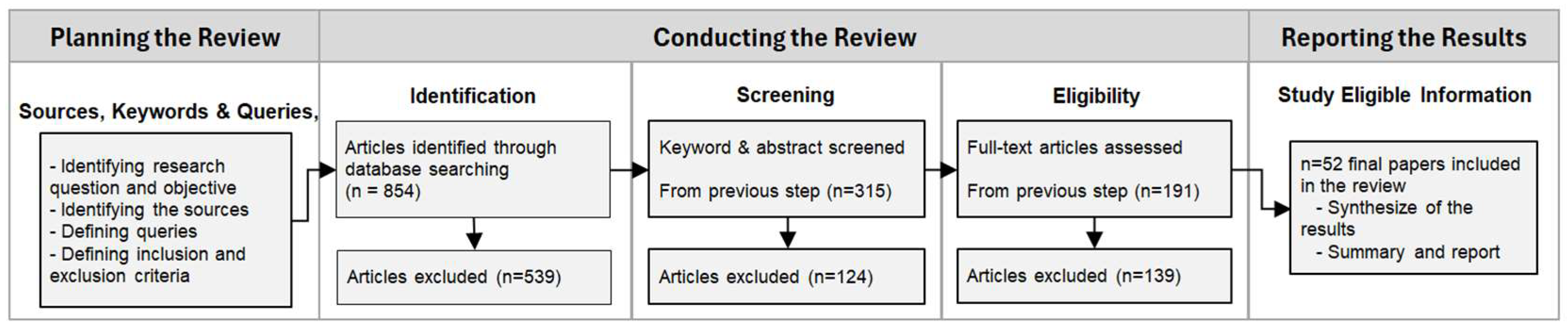
Supplementary Materials. This approach ensures transparency, replicability, and methodological rigor in identifying, screening, and selecting studies. The review process involves three main steps: (1) planning the review, including defining research objectives, keywords, and databases; (2) conducting the review, including systematic searching, screening based on inclusion and exclusion criteria, and quality assessment; and (3) reporting the results using a PRISMA-inspired flow diagram (
Figure 1) to illustrate the identification, screening, eligibility, and final inclusion of studies.
As shown in
Figure 1, the first step outlines the process for selecting relevant articles, including the identification of sources, formulation of search queries, and definition of inclusion and exclusion criteria. The second step involves executing these queries across all selected databases to compile a comprehensive set of relevant studies. Finally, the third step focuses on categorizing, summarizing, and systematizing the insights on eco-labeling derived from the selected articles. The following sections first detail the theoretical framework guiding this analysis, followed by each step of the review process, from selecting relevant articles and executing search queries to systematically analyzing the resulting literature.
2.1. Theoretical Framework: Socio-Technical Systems and Adaptive Governance
This study is grounded in a socio-technical systems perspective, complemented by adaptive governance theory, to analyze eco-labeling as a dynamic, multi-layered, and evolving system. Rather than treating eco-labeling as a discrete policy instrument or a purely informational mechanism, this framework conceptualizes it as part of a broader configuration of interacting technological, institutional, and social elements. Socio-technical systems theory posits that sustainability challenges emerge from the co-evolution of technologies, actors, institutions, and practices, emphasizing that systemic change cannot be understood through isolated components alone. Within this perspective, eco-labeling is understood as an integrated system encompassing certification standards, life cycle assessment methodologies, regulatory structures, market incentives, and consumer engagement, all of which evolve through continuous interaction and feedback.
This perspective is particularly relevant for eco-labeling because it captures the inherent complexity and interdependence of the system. For example, changes in regulatory standards influence firm behavior and supply chain practices, which in turn affect label design, consumer trust, and market outcomes. Similarly, technological advancements—such as digital traceability systems or blockchain-based verification—reshape institutional arrangements and redefine credibility mechanisms. By framing eco-labeling as a socio-technical system, this study moves beyond linear cause-and-effect interpretations. Instead, it examines how multiple system components co-develop, reinforce, or constrain one another across sectors and regions.
Building on this foundation, adaptive governance theory provides a complementary lens to understand how eco-labeling systems respond to uncertainty, complexity, and external shocks. Adaptive governance emphasizes flexibility, learning, and multi-level coordination among diverse actors, highlighting the capacity of governance systems to evolve in response to changing environmental, economic, and social conditions. In contrast to static or top-down regulatory models, adaptive governance recognizes that sustainability challenges require iterative processes, experimentation, and continuous adjustment. This perspective is particularly relevant in the context of eco-labeling, where governance involves a mix of voluntary standards, market-based mechanisms, and regulatory interventions that must remain responsive to shifting stakeholder expectations and global sustainability pressures.
Eco-labeling systems operate within a dynamic environment shaped by crises, technological change, and geopolitical shifts. Events such as the 2008 financial crisis and the COVID-19 pandemic demonstrate how external shocks can disrupt supply chains, alter consumer behavior, and prompt rapid policy innovation. Adaptive governance provides the conceptual tools to interpret these disruptions not as anomalies but as critical moments of system reconfiguration, during which new standards, practices, and institutional arrangements can emerge. This lens, therefore, enables the analysis of eco-labeling as a system characterized by continuous adaptation rather than equilibrium.
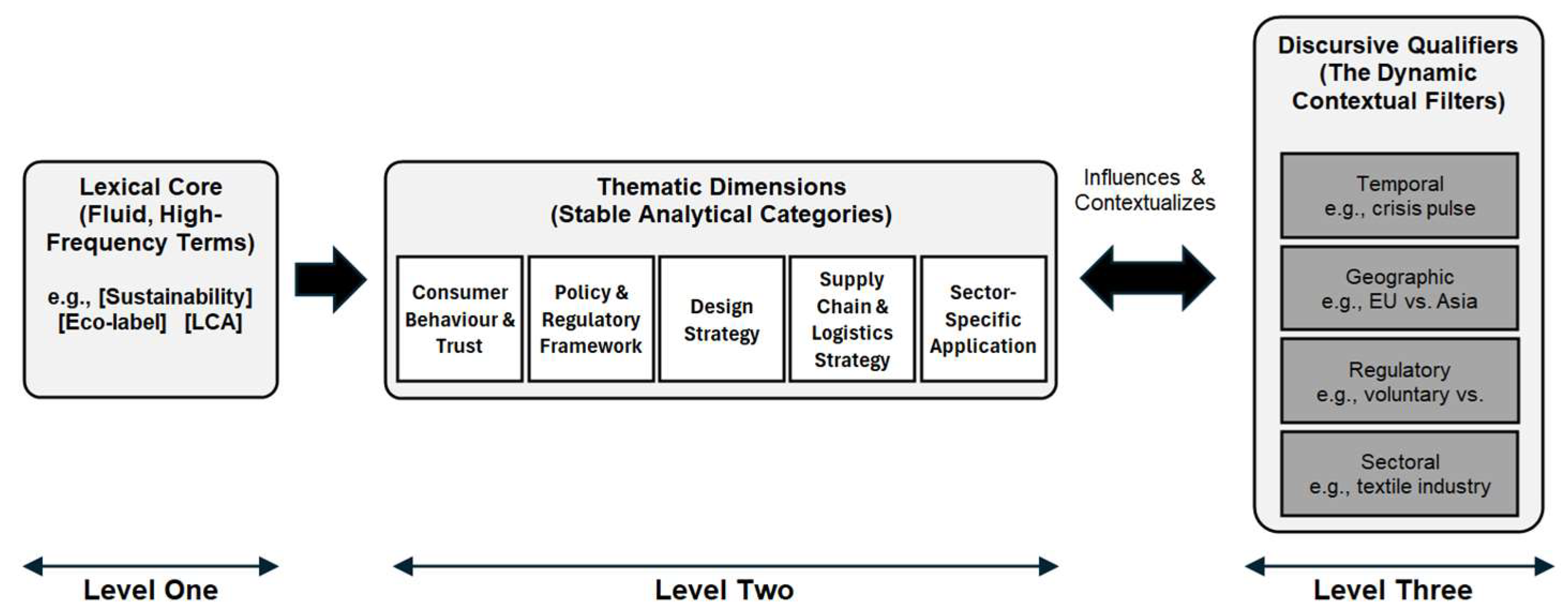
Integrating these perspectives allows this study to conceptualize eco-labeling as an Embedded Socio-Technical System (ESTS), in which technological tools (e.g., life cycle assessment, digital traceability), institutional arrangements (e.g., policy frameworks, certification schemes), and social dynamics (e.g., consumer trust, market behavior) interact across sectors and regions. Consistent with socio-technical systems theory, the ESTS framework captures the co-evolution of technological, institutional, and behavioral components of eco-labeling systems.
The ESTS framework directly informs the analytical design of this study in several ways. First, it underpins the identification of the five thematic dimensions—consumer behavior and trust, policy and regulatory frameworks, design strategy, supply chain and logistics, and sector-specific applications—as interdependent components of a broader system rather than isolated domains of inquiry. Second, it provides a theoretical basis for interpreting fragmentation within the literature. Instead of viewing fragmentation as a limitation, the framework interprets it as an inherent characteristic of complex adaptive systems, reflecting diversity in actors, contexts, and institutional arrangements. Third, it enables the analysis of temporal evolution, geographic variation, and thematic overlap as expressions of system dynamics, adaptation, and co-evolution. For instance, shifts in research focus following global crises are understood as adaptive responses, while regional specialization reflects embedded institutional and economic conditions.
Finally, this theoretical framework guides the interpretation of governance implications. By combining socio-technical systems thinking with adaptive governance, the study highlights the importance of coordination across system components, the need for flexible and context-sensitive policy instruments, and the value of learning-based approaches to standardization and certification. It also supports the development of diagnostic tools—such as the proposed conceptual framework and governance action matrix—that can identify leverage points within the system and inform targeted interventions.
This study grounds its analysis in socio-technical systems and adaptive governance theory, moving beyond simple description to explain how eco-labeling systems evolve, interact, and can be governed. This approach strengthens the analysis and contributes to broader discussions on sustainability transitions, governance of complex systems, and the role of market-based tools in achieving environmental and social goals. Guided by this theoretical foundation, the subsequent sections detail the systematic scoping review process used to gather and evaluate the literature.
2.2. Planning the Review
The planning phase provides the groundwork for this organized examination of eco-labeling research. This step includes setting clear objectives for the review, pinpointing relevant sources, and crafting effective search queries. Establishing clear criteria for inclusion and exclusion ensures that the selected studies are pertinent, trustworthy, and in line with the goals of the review. This methodical approach not only facilitates navigation of the existing literature but also reveals any gaps and directs the next steps in the analysis.
2.2.1. Identifying Objective
This literature review aims to gather a complete collection of journal and conference publications and to organize existing knowledge on eco-labeling research. Specifically, the review looks at how eco-labels affect consumer behavior, inform policy and regulatory frameworks, and influence practices across various industry sectors. It also aims to pinpoint the strategies used in eco-label design and how they fit into supply chains. Finally, the review examines gaps in the literature to suggest areas for future research on flexible and robust eco-labeling systems.
2.2.2. Identifying the Sources
The literature search was conducted across four core academic databases: IEEE Xplore (Institute of Electrical and Electronics Engineers, New York, NY, USA), SpringerLink (Springer Nature, Berlin, Germany), Web of Science (Clarivate, London, UK), and ABI/INFORM (ProQuest, Ann Arbor, MI, USA). These databases were selected due to their complementary coverage of engineering, environmental science, business, and interdisciplinary sustainability research, which aligns with the multi-dimensional nature of eco-labeling. Scopus was not included due to its substantial overlap with Web of Science and SpringerLink in indexing the peer-reviewed sustainability, environmental management, and supply chain literature. Given the scoping nature of this review, the selected databases were considered sufficient to ensure conceptual coverage across the five analytical dimensions, with an emphasis on thematic depth and coding consistency rather than exhaustive bibliometric completeness.
The review period was limited to publications from 2000 to 2025 to capture the contemporary evolution of eco-labeling as a formalized sustainability instrument. The year 2000 marks a methodological inflection point associated with the consolidation of life cycle assessment (LCA) methodologies, the expansion of ISO-based environmental standards, and the emergence of structured eco-label certification schemes in policy and industry contexts. The upper bound of 2025 ensures inclusion of recent developments in digital traceability, supply chain transparency, and post-pandemic sustainability governance. Earlier foundational studies identified through backward citation tracking were included via snowball sampling to ensure theoretical completeness while maintaining focus on contemporary empirical developments.
The literature search and screening process was conducted between 1 May 2025 and 30 September 2025 as part of a structured research project. All databases were accessed within this time window, and final article selection was completed by the end of September 2025, ensuring full temporal transparency and enabling replication under equivalent conditions.
2.2.3. Defining Queries and Search Strategy
The search strategy was developed using a structured, iterative process grounded in the five core thematic dimensions of the study: Consumer Behavior and Trust, Policy and Regulatory Frameworks, Design Strategy, Supply Chain and Logistics Strategy, and Sector-Specific Applications. An initial set of keywords was identified through domain expertise, preliminary scoping searches, and iterative refinement to ensure both conceptual coverage and relevance to eco-labeling research.
The final keyword set included: “eco-label,” “eco-labeling,” “eco-certification,” “sustainability label,” “environmental label,” “green product,” “life cycle assessment,” “consumer behaviour,” “carbon footprint,” and “eco-label policy.” These terms were selected to capture both the technical and behavioral dimensions of eco-labeling systems while maintaining alignment with the sustainability governance literature.
Boolean logic (AND/OR) was used to construct structured search queries that combined synonymous concepts (OR) and linked thematic dimensions (AND). This ensured comprehensive retrieval of relevant studies while minimizing irrelevant results. To ensure consistency and reproducibility, a unified search logic was applied across all databases, with the syntax adapted to database-specific requirements. Four database-specific search strings were implemented as follows: (1) Web of Science: ((“eco-label” OR “eco-labeling” OR “eco-certification” OR “sustainability label” OR “environmental label”) AND (“green product” OR “life cycle assessment” OR “consumer behaviour” OR “carbon footprint” OR “eco-label policy”)), (2) IEEE Xplore: (“eco-label” OR “eco-labeling” OR “eco-certification” OR “sustainability label”) AND (“life cycle assessment” OR “carbon footprint” OR “green product” OR “consumer behaviour”), (3) SpringerLink: (“eco-label*” OR “eco-certification” OR “environmental label”) AND (“consumer behaviour” OR “policy” OR “life cycle assessment” OR “carbon footprint”), and (4) ABI/INFORM: (“eco-label” OR “eco-labeling” OR “green product” OR “sustainability label”) AND (“consumer behaviour” OR “eco-label policy” OR “carbon footprint” OR “trust” OR “certification”).
Across all databases, search strings were adapted to platform-specific syntax while preserving the semantic equivalence of constructs. This approach ensured comparability across sources while maintaining database sensitivity and precision. The use of standardized Boolean logic and harmonized keyword structures supports transparency, reproducibility, and alignment with PRISMA-ScR methodological guidelines.
2.2.4. Inclusion/Exclusion Criteria
To ensure a systematic, transparent, and replicable selection of studies, this review applied explicitly operationalized inclusion and exclusion criteria following PRISMA-ScR guidelines, with the screening process occurring in three phases: identification, screening, and eligibility. Studies were included if they met the following criteria: (1) peer-reviewed journal articles or conference papers; (2) published in English between 2000 and 2025 to capture contemporary trends, practices, and innovations; (3) explicitly focused on eco-labeling in relation to at least one of the following domains—supply chain management and logistics, public policy and regulatory frameworks, consumer behavior and trust, design strategies and life cycle assessment, or sector-specific applications, such as textiles, construction, healthcare, and consumer goods; and (4) empirical, conceptual, or theoretical studies providing data, analysis, or insights relevant to eco-labeling. For instance, a study examining blockchain-enabled eco-labeling in the textile industry was included because it addressed both supply chain and design strategy dimensions, while research evaluating consumer willingness-to-pay for carbon-labeled products or assessing government eco-label policies was included because it pertained to consumer behavior and institutional governance.
Studies were excluded if they met any of the following criteria: (1) published in languages other than English; (2) consisted of editorials, opinion pieces, blogs, or other gray literature; (3) published prior to 2000 unless identified as seminal works through snowballing from relevant references; or (4) did not directly address eco-labeling or its governance, supply chain, consumer, or design aspects. For example, a commentary on general environmental awareness without reference to labeling, sustainability certifications, or governance was excluded, as were studies analyzing Life Cycle Assessment or green product design without linkage to eco-labeling.
All included articles were coded using a binary matrix across the five key thematic dimensions, guided by a shared coding manual with operational definitions, decision rules, and illustrative coding examples to ensure inter-coder reliability. The selection of thematic dimensions and coding structure was informed by the socio-technical systems framework, ensuring coverage of key system components—including actors (consumer behavior), institutions (policy), technologies (design), and operational networks (supply chains)—and guaranteeing that the review systematically captured studies directly relevant to the technological, institutional, and behavioral facets of eco-labeling systems, while providing a clear rationale for inclusion and exclusion decisions.
White papers and technical reports were identified during the search and snowballing phases to support source triangulation and ensure comprehensive coverage of the eco-labeling landscape. However, these documents were excluded from the final analytical dataset to maintain methodological consistency, comparability, and alignment with the PRISMA-ScR framework. The final analysis was therefore restricted to peer-reviewed journals and conference articles.
2.2.5. Methodological Quality Appraisal of Included Studies
A structured methodological quality appraisal was conducted to enhance the transparency and interpretive robustness of the included studies. In line with PRISMA-ScR guidelines, this appraisal does not serve as a basis for excluding studies or assigning risk-of-bias scores, but rather as a descriptive tool to assess the relative methodological strength and reporting quality of the evidence base. Given the heterogeneous nature of eco-labeling research across disciplines, the appraisal framework was designed to be broad and adaptable, focusing on key indicators of research quality that are applicable across quantitative, qualitative, and mixed-methods studies.
The results of the quality appraisal were used to inform the interpretation of findings across the five thematic dimensions rather than to weight or exclude individual studies. Overall, most studies demonstrated moderate to high methodological clarity and relevance to eco-labeling research, particularly in terms of clearly defined objectives and thematic alignment (
Table 1). However, variability was observed in data transparency and analytical rigor, especially in conceptual or policy-oriented studies. This variability reinforces the exploratory nature of the field and highlights the importance of interpreting results within the context of differing methodological approaches. Importantly, this appraisal strengthens the reliability of the thematic synthesis by providing a transparent overview of the underlying evidence base.
2.3. Conducting the Review
The systematic review initially identified 854 potential sources through comprehensive searches across four databases (IEEE Xplore, SpringerLink, Web of Science, and ABI/INFORM). After a multi-phase screening and eligibility assessment, the final dataset comprised 52 studies. This sample was derived through a rigorous three-phase process—identification, screening, and eligibility—applying explicit inclusion and exclusion criteria to ensure methodological rigor, relevance, and alignment with the review objectives. This approach balances comprehensive coverage with in-depth thematic analysis, ensuring sufficient data across all five thematic dimensions of eco-labeling while remaining manageable for detailed coding and synthesis. The full screening and selection process is illustrated in
Figure 1. The following section provides a detailed explanation of the identification, screening, and eligibility steps, clarifying how the initial set of articles was narrowed down to this final sample.
2.3.1. Identification
Search queries were run across four selected databases: IEEE Xplore, SpringerLink, Web of Science, and ABI/INFORM. This process initially identified 854 potential sources. Using a snowballing approach to review the references of selected key articles, four additional studies were added. After removing duplicates, the total number of identified articles was 315.
2.3.2. Screening
The screening involved a two-phase process. In the first screening stage, irrelevant publication types (such as books, book chapters, reviews, and non-English articles) were removed, and an initial review of titles, keywords, and abstracts of the remaining studies was conducted to assess their relevance to the review’s objectives. During this review, each article was categorized as “included,” “excluded,” or “not-sure,” with all “not-sure” articles retained to avoid omitting potentially relevant studies. In the second phase of screening, a more detailed review of the titles and abstracts was conducted, focusing on studies addressing eco-labeling in relation to consumer behavior, policy frameworks, industry-specific applications, and supply chain practices. Following this assessment, 124 articles were excluded, while 191 articles were selected for full-text review.
2.3.3. Eligibility
For the final eligibility assessment, the full texts of the 191 selected articles were examined. Each study was evaluated for methodological rigor, relevance, and alignment with the research objectives. This process ultimately resulted in the exclusion of 139 articles, leaving 52 deemed fully eligible for the final review. These 52 studies met all the inclusion criteria. This sample ensures sufficient coverage across all thematic dimensions while remaining feasible for in-depth thematic analysis.
2.3.4. Rationale for Final Sample Size and Analytical Depth
The final inclusion of 52 studies should be understood in the context of a PRISMA-ScR (Preferred Reporting Items for Systematic Reviews and Meta-Analyses extension for Scoping Reviews) methodology, which prioritizes conceptual mapping and thematic synthesis over exhaustive quantitative coverage. Unlike bibliometric or meta-analytic reviews that aim to maximize sample size for statistical inference, the objective of this study is to develop a structured, multi-dimensional understanding of eco-labeling as a socio-technical system. As such, the focus is on analytical depth, interpretive coding consistency, and cross-thematic integration rather than on numerical expansion of the dataset.
Although the initial search strategy identified 854 records across multiple databases, strict inclusion and exclusion criteria were necessary to retain only studies capable of supporting systematic multi-dimensional coding. Each included study needed to contribute meaningfully to at least one of the five analytical dimensions—consumer behavior and trust, policy and regulatory frameworks, design strategy, supply chain and logistics strategy, and sector-specific applications—while also providing sufficient methodological clarity to allow for consistent binary coding across independent reviewers. This requirement significantly reduced the eligible sample but ensured analytical robustness and comparability across studies.
The decision to retain 52 studies reflects a deliberate methodological trade-off between breadth and depth. Expanding the dataset further would have increased heterogeneity across study designs, conceptual definitions, and reporting quality, thereby reducing inter-coder reliability and weakening the validity of cross-thematic comparisons. By constraining the dataset to a more analytically coherent subset, the study ensures that each coded observation contributes directly to the identification of thematic overlap, semantic ambiguity, and governance-related patterns within the eco-labeling literature.
This approach is consistent with prior PRISMA-ScR-based reviews in sustainability and governance research, where smaller, carefully curated datasets have been used to enable structured thematic synthesis and conceptual framework development. In such contexts, the unit of analysis is not the frequency of publications but the depth of conceptual representation across defined analytical dimensions.
Importantly, the value of this review lies in its ability to integrate the fragmented literature into a coherent socio-technical interpretation of eco-labeling systems. The dataset is, therefore, sufficient to achieve theoretical saturation across the five thematic dimensions identified in this study, as evidenced by the recurrence of core constructs such as consumer trust, certification governance, life cycle assessment, and supply chain integration across the included studies. Therefore, the sample size should be interpreted as analytically sufficient for structured thematic saturation rather than exhaustive bibliometric coverage.
2.4. Reporting the Results
The final stage of the review involves synthesizing and presenting the findings from the selected studies, in accordance with PRISMA-ScR guidelines. Reporting includes systematically summarizing key characteristics of the eligible studies, such as publication year, geographic focus, industry sector, research methods, and thematic relevance. To provide a structured synthesis, articles were categorized according to the five pre-defined themes: policy and regulatory frameworks, design strategies, supply chain and logistics strategies, consumer behavior and trust, and industry-specific applications. Within each theme, findings were analyzed to identify patterns, trends, gaps, and areas of consensus or debate. The synthesis also highlights methodological approaches, theoretical frameworks, and practical implications, ensuring that insights are both comprehensive and actionable. Relevant flowcharts, tables, and figures are provided to transparently illustrate the screening and selection process, showing the number of studies identified, screened, assessed for eligibility, and included in the review. Finally, results are presented in a way that supports evidence-based conclusions, guiding future research directions, policy development, and the practical design and implementation of eco-labeling systems.
2.5. Coding Procedure and Reliability
To systematically analyze the selected literature, a rigorous coding procedure was implemented, designed to ensure consistency, transparency, and reproducibility. Two independent research teams first underwent a calibration session in which 10 randomly selected articles were jointly coded to ensure a consistent understanding of operational definitions, decision rules, and thematic boundaries. This preparatory step was critical to align interpretations across coders, reduce subjective bias, and ensure a shared understanding of how each of the five thematic dimensions—Consumer Behavior and Trust, Policy and Regulatory Frameworks, Design Strategy, Supply Chain and Logistics Strategy, and Sector-Specific Applications—would be applied. By engaging in this calibration exercise, clear rules were established for coding borderline cases, ambiguous terminology, and multi-dimensional studies, laying the foundation for a systematic and replicable approach.
Before conducting the formal binary coding on the final 191 articles, the research team developed the thematic framework to ensure that the analytical categories were empirically grounded in the dataset rather than predetermined. To achieve this, a data-driven, inductive semantic clustering process was applied to the metadata gathered following the initial screening phase. First, all author-provided keywords from the gathered papers were extracted, compiled, and analyzed for frequency to establish the core lexicon of the field. The top 60 most frequently occurring keywords were then isolated for structural examination. Second, the research team conducted a manual semantic grouping exercise, inductively clustering these keywords based on conceptual affinity and domain relationships. This process produced five preliminary conceptual clusters: (1) Eco-labeling, Certifications, and Consumer Behavior; (2) Sustainability and Environmental Impact; (3) Green Supply Chain and Production; (4) Methods and Analytical Tools; and (5) Marketing, Retail, and Social Context. The preliminary clusters were refined and translated into the five formal thematic dimensions used for the systematic coding of the 191 eligible articles: Consumer Behavior and Trust, Policy and Regulatory Frameworks, Design Strategy, Supply Chain and Logistics Strategy, and Sector-Specific Applications. This refinement stage helped clarify areas of overlap. For instance, broad supply-chain-related keywords were separated into two clearer categories—operational elements such as logistics and inventory, and contextual elements tied to specific sectors like food or concrete. Likewise, analytical tools such as LCA were combined with environmental metrics, which together formed the basis of the Design Strategy dimension.
2.5.1. Coding Rounds and Process
Coding occurred in three explicit rounds. Round 1 involved independent binary coding (0 = not relevant, 1 = relevant) for each of the five thematic dimensions, allowing articles to be assigned to multiple dimensions if they addressed more than one area. Round 2 consisted of cross-validation, where discrepancies were identified in a dedicated “Different Opinions” column and resolved through structured discussions between the coding teams. Round 3 involved final consensus coding for any remaining disagreements, ensuring that all articles were classified accurately according to the agreed-upon rules. For example, an article examining consumer willingness-to-pay for eco-certified electronics was coded as Consumer Behavior = 1, Policy and Regulatory = 0, Design Strategy = 1, Supply Chain = 1, and Sector-Specific Applications = 1, illustrating how a single study can span multiple dimensions. This multi-round approach not only enhances coding reliability but also ensures that every classification decision is transparent and can be replicated by other researchers.
2.5.2. Datasets for Transparency and Reproducibility
Two complementary datasets were maintained to maximize transparency and replicability. The master database included detailed article metadata (paper ID, citation, authors, year published, article title, journal, abstract, geography, and keywords) alongside final theme classifications. The intercoder reliability dataset preserved the raw votes from both coding teams, documenting agreements and disagreements for quantitative evaluation of consistency. By preserving all coding decisions, including disputed cases, these datasets allow future researchers to replicate the coding procedure, verify theme assignments, and evaluate the robustness of thematic analyses. This careful documentation ensures that the review process is both transparent and auditable, meeting best-practice standards for systematic literature reviews.
2.5.3. Intercoder Reliability
Coding reliability was quantified using Cohen’s Kappa (κ), which measures agreement between two independent coders while correcting for chance agreement. For each of the five thematic dimensions, a 2 × 2 contingency table was constructed using the binary coding results (0 = not relevant, 1 = relevant). The formula for Cohen’s Kappa is as follows:
where
is the observed proportion of agreement between coders, and
is the expected agreement by chance. Kappa values range from −1 to 1, with higher values indicating stronger agreement. Values below 0 indicate less-than-chance agreement, 0–0.20 indicate slight agreement, 0.21–0.40 fair, 0.41–0.60 moderate, 0.61–0.80 substantial, and 0.81–1.00 almost perfect agreement (Landis & Koch, 1977 [
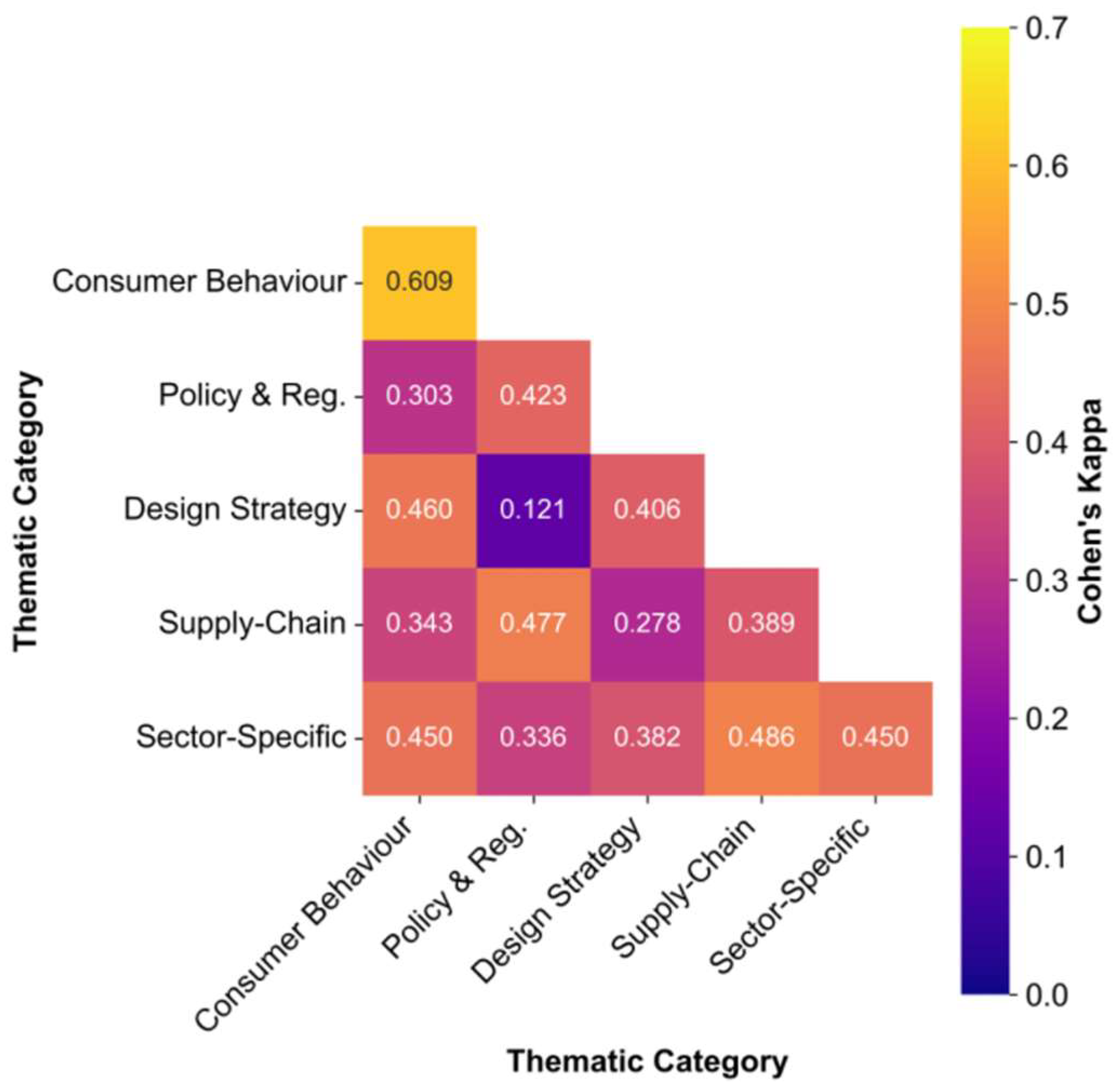
24]). In practice, Cohen’s Kappa was computed for each thematic dimension using the intercoder reliability dataset, which preserved the raw votes from both coding teams. Disagreements were flagged in the “Different Opinions” column. Dimensions with κ < 0.60 underwent additional calibration discussions to refine operational definitions and resolve ambiguities. Final Kappa values were reported in the 5 × 5 Kappa matrix (
Figure 2), with diagonal cells representing within-theme agreement (e.g., Consumer Behavior κ = 0.61; Policy and Regulatory Frameworks κ = 0.42), and off-diagonal cells capturing cross-theme overlaps, reflecting natural conceptual intersections such as co-occurrence between supply chain and policy dimensions. Explicit documentation of the calculation, interpretation, and resolution of disagreements ensures transparency, reproducibility, and rigor, allowing other researchers to replicate the coding procedure or adapt it for similar systematic reviews.
The resulting 5 × 5 Kappa matrix shows diagonal cells representing within-theme agreement (e.g., Consumer Behavior κ = 0.61; Policy and Regulatory Frameworks κ = 0.42), indicating moderate-to-strong consistency (
Figure 2). Off-diagonal cells reflect overlaps between themes, capturing natural conceptual intersections such as the co-occurrence of supply chain and policy dimensions or design strategy and sector-specific applications. Reporting both diagonal and off-diagonal values provides a comprehensive view of coding stability, highlighting not only reliability within themes but also the inherent interconnectedness of eco-labeling research. To reduce subjectivity and guide coder judgment, coding examples were systematically applied throughout the process. For instance, a study on carbon footprint labeling in supply chains that also affects consumer purchasing behavior was coded as relevant for Consumer Behavior and Trust, Design Strategy, and Supply Chain and Logistics Strategy. Another example: a government policy study on the implementation of eco-labels in healthcare was coded solely under Policy and Regulatory Frameworks. Incorporating these illustrative examples into the coding manual ensured consistent decision-making, provided concrete guidance for ambiguous cases, and strengthened the reproducibility of the coding process.
2.5.4. Quantitative Analyses
All subsequent analyses were based on the coded datasets generated through the multi-round, calibrated coding procedure. For instance, temporal mapping of thematic focus illustrates how publication volume evolved over time, highlighting notable surges in research on design strategy, sector-specific applications, and policy frameworks after 2020. This temporal mapping not only captures emerging trends but also demonstrates the sensitivity of the coding process in detecting thematic shifts across periods. Furthermore, visualizing keyword co-occurrence patterns—distinguishing between stable, well-defined concepts (e.g., “willingness-to-pay”) and semantically ambiguous terms (e.g., “sustainability,” “eco-label”)—provides empirical evidence that the coding captured both precise and broader thematic intersections. Lastly, mapping the evolution of geographic and thematic focus shows country-level trends, revealing that the United States initially led in policy-focused studies, Europe concentrated on consumer behavior and sector-specific applications, and China has recently emerged in supply chain research. These visual and quantitative analyses provide concrete validation that the multi-round coding procedure, coupled with inter-coder reliability measures like Cohen’s Kappa, produced consistent and reproducible classifications across themes, dimensions, and regions. By explicitly linking the coding methodology to these visual outputs, the review demonstrates that systematic, transparent, and replicable coding can generate actionable insights into the evolution, geographic distribution, and thematic interactions of eco-labeling research, while also highlighting the analytical value of combining quantitative mapping with qualitative interpretation.
All coding and analyses were carried out using Python software (version 3.13.5; Python Software Foundation, Wilmington, DE, USA) on a Windows 11 operating system (Microsoft Corporation, Redmond, WA, USA), leveraging Pandas (version 2.3.1) and Scikit-learn (version 1.7.1) for data processing and clustering, and Seaborn (version 0.13.2) and Matplotlib (version 3.10.6) for visualizations. The classification matrix, search queries, and analysis scripts are available upon reasonable request. Since this study relied solely on publicly available secondary data and did not involve human subjects, formal ethics approval was not required.
2.6. Data Analysis and Analytical Techniques
To systematically interpret the coded literature and provide a comprehensive view of the eco-labeling research landscape, this study implemented a multi-method analytical framework that integrates descriptive mapping, thematic analysis, network and clustering techniques, temporal evolution, and geographic/sectoral trends. This dedicated Data Analysis section distinguishes among techniques, specifies data sources, and explicitly links analytical approaches to the study’s research questions. The combination of multiple methods ensures both depth and rigor, enabling the capture of not only the structure of the literature but also its conceptual and temporal dynamics. This study adopts a systematic literature review SLR design, following PRISMA-ScR guidelines for study identification, screening, and qualitative thematic synthesis. To complement the systematic review process, bibliometric and network analysis techniques are used as supplementary analytical tools to quantitatively explore keyword co-occurrence, conceptual structure, and temporal and geographic trends. This combination supports both structured interpretive synthesis and data-assisted mapping of the eco-labeling literature.
2.6.1. Descriptive Mapping
Descriptive analysis was conducted using the master database, which includes article metadata such as authors, journal, year of publication, geographic focus, sector, and final thematic classifications. This phase quantified the distribution of studies across the five dimensions—Consumer Behavior and Trust, Policy and Regulatory Frameworks, Design Strategy, Supply Chain and Logistics Strategy, and Sector-Specific Applications—as well as across geographic regions and publication years. This analysis addresses research questions about the overall landscape of eco-labeling research, including the volume of research in each theme, the dominant regions of study, and emerging sectors. Descriptive mapping is primarily exploratory, enabling the identification of patterns, concentrations, and gaps that inform subsequent, more detailed analyses.
2.6.2. Thematic Analysis
Thematic analysis leveraged the binary-coded data from the master database to examine patterns and overlaps across the five thematic dimensions. Co-occurrence frequencies were calculated to determine how often articles addressed multiple themes simultaneously, revealing cross-cutting interactions within the literature. For instance, studies addressing both consumer trust and supply chain management highlight the interconnectedness of behavioral and operational dimensions. This analysis directly informs research questions concerning interactions between themes, fragmentation versus integration, and potential leverage points for governance interventions. Thematic analysis is primarily exploratory, yet it also functions in a semi-confirmatory way by checking whether hypothesized thematic connections—such as links between policy frameworks and design strategy—are present in the data.
2.6.3. Network and Clustering Analysis
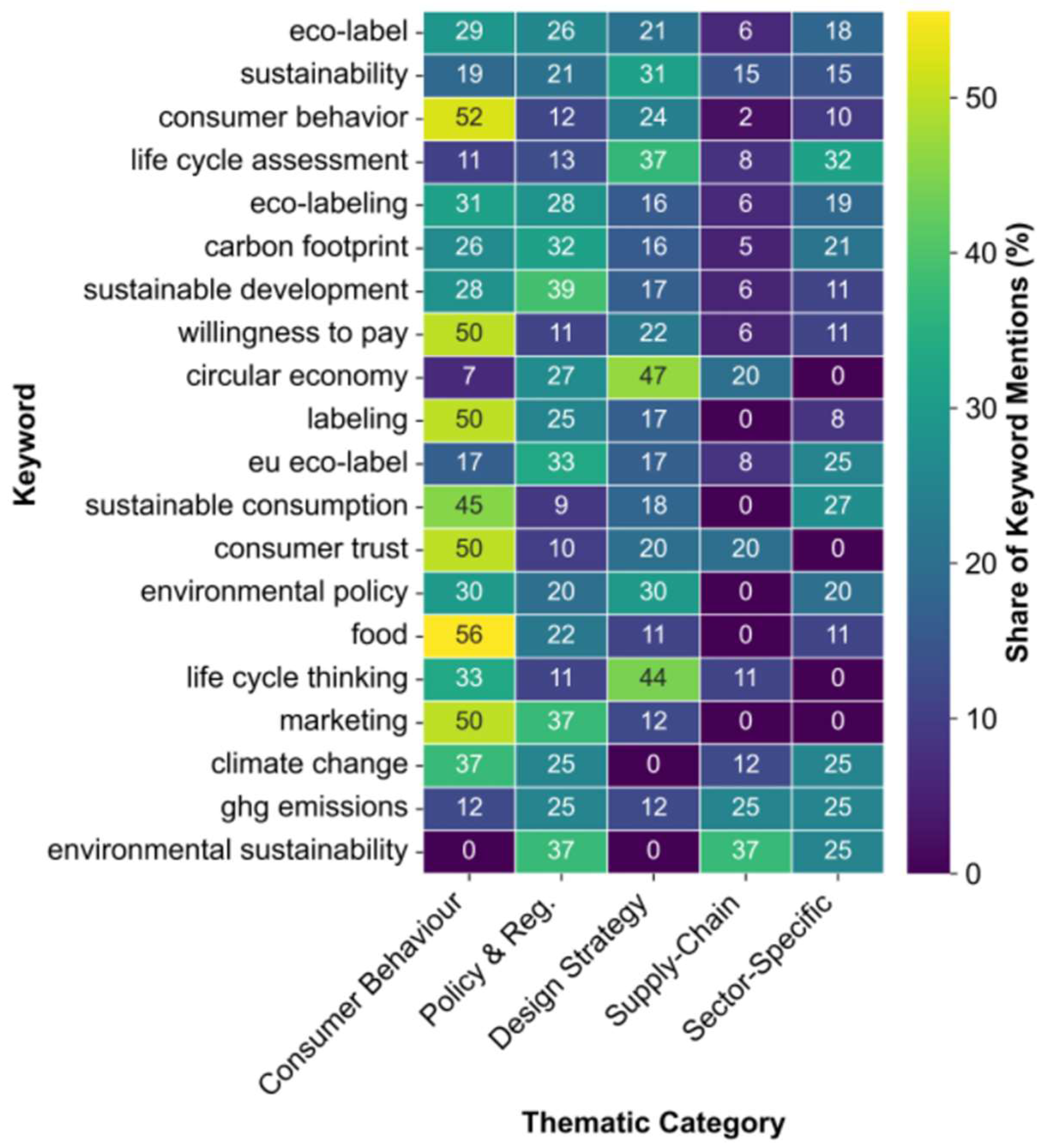
To explore semantic relationships and conceptual structure, network and clustering analyses were performed on keywords extracted from abstracts and metadata in the master database, totaling over 1700 unique keyword instances. Co-occurrence patterns were used to construct weighted networks in which nodes represent keywords and edges reflect co-occurrence frequency. Clustering algorithms identified groups of semantically related terms, enabling the detection of thematic clusters such as “sustainability,” “life cycle assessment,” “circular economy,” “consumer behaviour,” and “regulatory compliance.” This method is exploratory, highlighting both the structure of knowledge and areas where concepts overlap or diverge across themes. Results are visualized in Figure 5: Normalized Heatmap of Top 20 Keywords Across Five Thematic Categories, which reveals which concepts are highly specialized and which are semantically ambiguous, providing insight into conceptual coherence and fragmentation in the literature.
2.6.4. Temporal Evolution Analysis
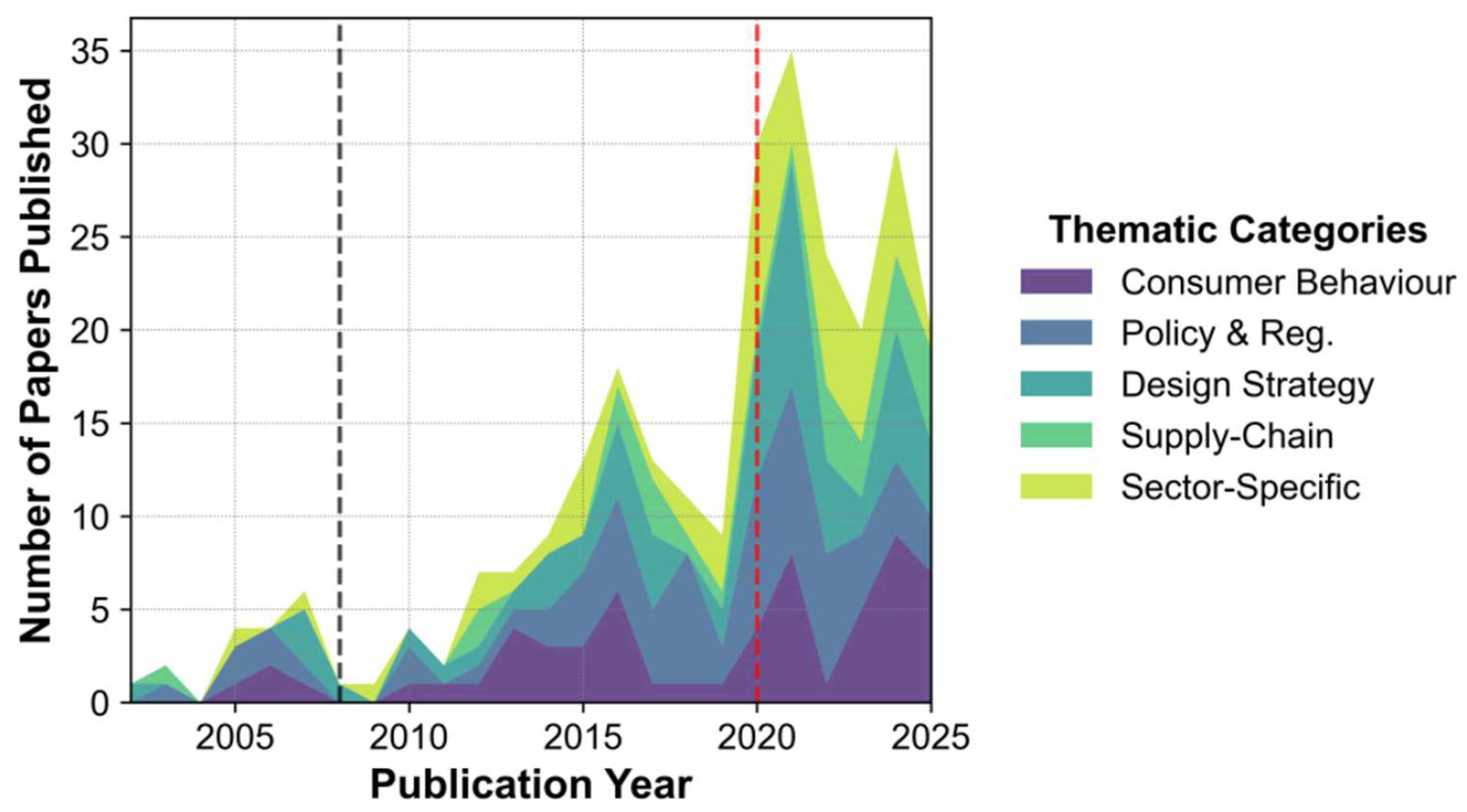
Temporal analysis examined the growth and evolution of research themes over time, using the master database’s publication year and theme columns to construct a theme-by-year matrix. This enabled the identification of trends, surges, and periods of heightened research activity. For example, Figure 4: Temporal Evolution of Thematic Focus illustrates the increase in design strategy, sector-specific applications, and policy studies after 2020, reflecting emerging global sustainability pressures and post-pandemic research priorities. Temporal evolution analysis is exploratory, allowing patterns to emerge naturally. However, it also serves a confirmatory function by validating trends suggested by descriptive mapping, such as the growing alignment between policy research and supply chain-focused studies.
2.6.5. Geographic and Sectoral Analysis
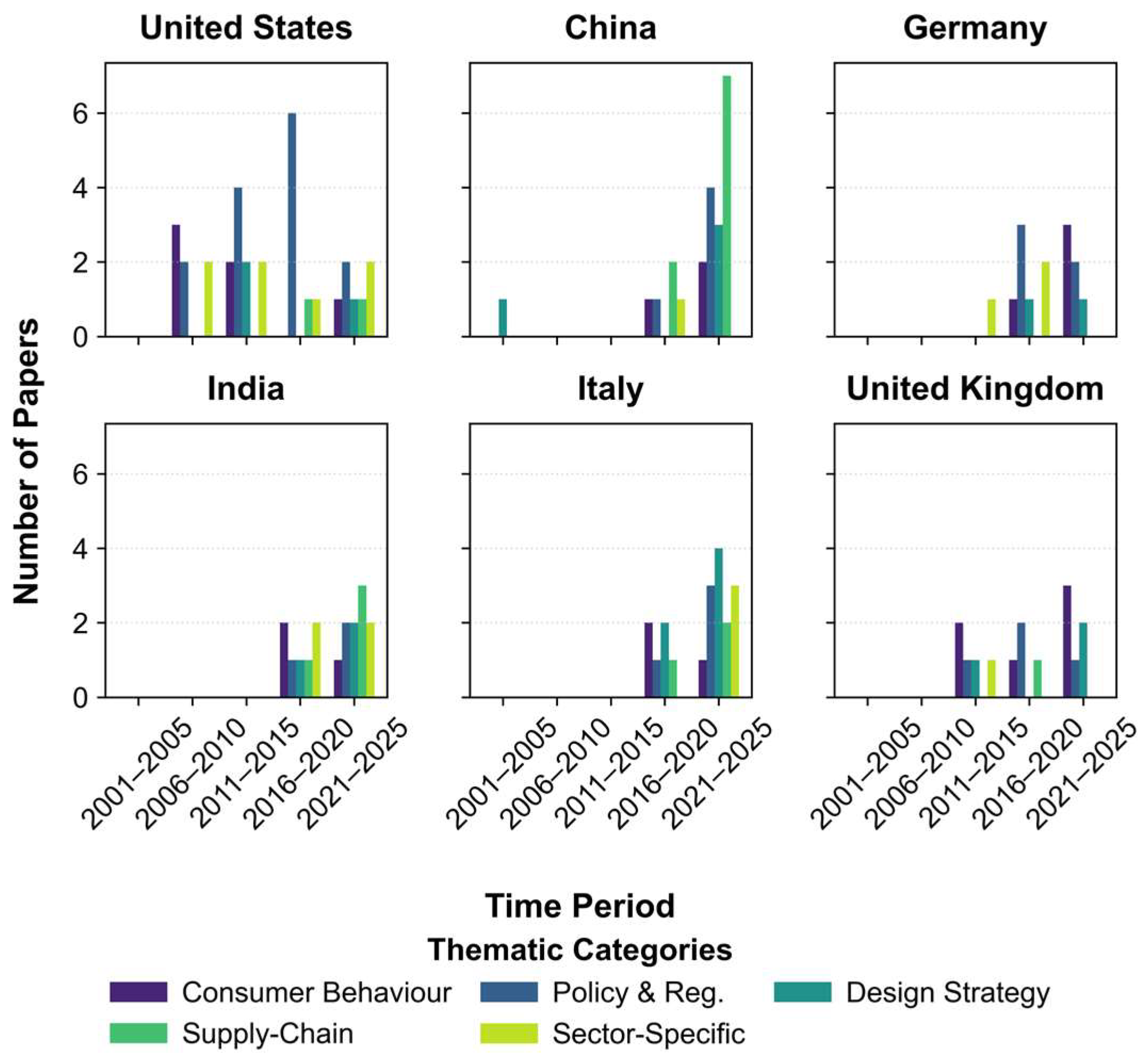
Geographic and sectoral analyses utilized metadata fields for study location and industry focus to examine spatial and sectoral patterns in eco-labeling research. This approach helps answer questions about regional dominance, sector-specific adoption, and research gaps, offering insight into where research has been concentrated and which regions or sectors are underexplored. Figure 6: Evolution of Geographic and Thematic Focus in Eco-Labeling Research shows that the United States initially led policy research, Europe focused on consumer behavior and sector-specific applications, and China has recently emerged in supply chain research. These analyses are largely exploratory, uncovering patterns that inform policy relevance and highlight opportunities for future studies.
Each analytical method was selected to directly address specific research questions. Descriptive mapping identifies the scope, volume, and distribution of studies; thematic analysis examines conceptual interactions and fragmentation; network and clustering analysis elucidates semantic structure and conceptual overlaps; temporal analysis traces research evolution and responsiveness to global events; and geographic/sectoral analysis identifies spatial and sector-specific research trends. By combining exploratory and semi-confirmatory approaches, the framework balances discovery with structured assessment, ensuring robust and interpretable insights. This multi-method analytical framework allows for a comprehensive, multi-dimensional understanding of the eco-labeling literature, clearly distinguishing between exploratory and confirmatory analyses, and explicitly linking each technique to the research questions. By integrating descriptive, thematic, network, temporal, and spatial perspectives, the framework provides a rigorous foundation for interpreting the structure, evolution, and gaps in eco-labeling research.
3. Results
Guided by the socio-technical systems framework, this study organizes the reviewed literature into five interrelated thematic dimensions: consumer behavior and trust; policy and regulatory frameworks; design strategy; supply chain and logistics strategy; and sector-specific applications. The analysis treats eco-labeling as a system composed of interacting components rather than isolated or independent thematic areas. The results presented in this section reflect the empirical distribution and coding of the reviewed studies across these dimensions. Eco-labeling is consistently described in the literature as a mechanism for communicating environmental performance information related to products, services, and industrial processes [
25]. The reviewed studies examine eco-labeling across multiple analytical levels, including individual consumer responses, institutional and regulatory systems, the technical design features of labeling schemes, supply chain implementation mechanisms, and sector-specific applications across different industries.
Appendix A provides standardized documentation of the key characteristics of the 52 included studies. It records the research objectives, core contributions, and thematic classification of each article according to the five predefined eco-labeling dimensions. The included studies span a wide range of sectors, including agriculture, forestry, manufacturing, textiles, consumer goods, energy systems, construction materials, healthcare applications, and circular economy-related systems. This coverage reflects the diversity of empirical contexts in which eco-labeling has been studied in the literature. The thematic coding indicates that all five dimensions are represented across the dataset, although the distribution of studies is uneven. Consumer behavior and trust, policy and regulatory frameworks, and supply chain and logistics strategy appear most frequently across the reviewed articles. These themes are widely addressed across different sectors and methodological approaches [
26]. Design strategy and sector-specific applications are also consistently present but show greater variability in focus depending on industry context and research objectives. Within the dataset, studies often address multiple thematic dimensions simultaneously. For example, several studies combine consumer behavior analysis with regulatory considerations, while others integrate design-related aspects with supply chain or sector-specific applications. This multi-dimensional coverage is reflected in the coding structure presented in
Appendix A, where each article is mapped to one or more of the five thematic categories [
27]. The classification of the literature across these five dimensions provides a structured overview of how eco-labeling research is distributed across different domains. It captures variation in sectoral focus, methodological orientation, and analytical emphasis across the 52 reviewed studies. The next sections present a detailed synthesis of each thematic dimension based on this classification framework.
3.1. Theme One: Consumer Behavior and Trust
Eco-labels are associated with variation in consumer responses across demographic, geographic, and product-related contexts [
28]. Evidence shows that sociodemographic variables such as age, income, and education are associated with differences in consumer responses to eco-labels [
29]. Additional influencing factors reported in the literature include political orientation, cultural values, and supply chain context [
27]. Studies conducted across different regions, including Vietnam, Denmark, and the Mediterranean, report variation in willingness-to-pay (WTP) for eco-labelled products, with trust in certification systems frequently identified as a recurring factor associated with consumer response patterns [
30]. Psychological and emotional variables, such as environmental concern, novelty preference, and emotional engagement, are also reported as variables linked to consumer responses to eco-labels [
31]. The limitations in the literature include misinterpretation of labels, concerns about greenwashing, and limited product availability, which are associated with variation in consumer responses and trust.
Studies also report the use of multi-level or tiered labelling systems, standardized communication formats, and third-party verification mechanisms as common design and governance approaches examined in relation to consumer response outcomes [
32]. Across studies, trust in certification systems is repeatedly reported as a central variable associated with eco-label effectiveness and willingness-to-pay outcomes [
33].
Table 2 summarizes the main factors identified in the literature influencing consumer responses to eco-labels, including demographic variables, trust and certification, psychological and emotional factors, and reported limitations. It also consolidates evidence on how these variables are linked to reported behavioral outcomes such as willingness-to-pay and post-purchase responses including product use and disposal behaviors [
34].
3.2. Theme Two: Policy and Regulatory Frameworks
Policy and regulatory frameworks are reported in the literature as key structural components supporting the implementation of eco-labeling systems [
35]. Studies identify the use of formal standards such as Environmental Product Declarations (EPDs) based on ISO 14025 [
36] as mechanisms for standardizing environmental information across sectors. These standards ensure comparability and consistency in environmental reporting across products and industries. Governance mechanisms commonly examined in the literature include third-party verification, monitoring systems, and enforcement procedures. These mechanisms are associated with the credibility and certification processes of eco-labels across different regulatory contexts [
37]. The literature also reports variation in the implementation of regulatory requirements across regions and firm types, particularly between large firms and small and medium-sized enterprises (SMEs). Research identifies implementation constraints related to SMEs and smallholder producers, particularly in developing country contexts, including limited institutional capacity, compliance costs, and administrative constraints [
38]. Case studies from countries such as Indonesia, Ukraine, and Tunisia document the presence of institutional support structures, capacity-building programs, and national eco-label schemes designed to support adoption and compliance processes [
39].
Studies also report on the use of complementary policy instruments alongside eco-label frameworks. These include price-based incentives, public procurement requirements, and reputational mechanisms linked to certified products. In addition, eco-label systems are examined alongside broader environmental policy instruments, such as circular economy initiatives, waste reduction strategies, and energy efficiency regulations. Across studies, variability is reported in the degree of policy harmonization, enforcement consistency, and institutional capacity across regions. Reported challenges include differences in regulatory stringency, limited enforcement capacity, and instances of inconsistent application of standards [
40].
Table 3 summarizes the key policy and regulatory elements identified in the literature, including standardization mechanisms, governance structures, market-related instruments, and implementation challenges. It consolidates evidence on how these factors are associated with the operation and adoption of eco-label systems across different sectors and regions [
41].
3.3. Theme Three: Design Strategy
Design strategy is reported in the literature as a key component influencing how eco-labels communicate environmental performance and how such information is processed in product and service contexts [
42]. Studies commonly report the use of Life Cycle Assessment (LCA) and Environmental Product Declarations (EPDs) as structured approaches for providing environmental information across product life cycles. The literature identifies technical complexity and the limited interpretability of LCA-based information as recurring characteristics that affect user comprehension [
43]. In response, studies report the use of simplified scoring systems, visual indicators, and comparative metrics to represent environmental performance in more accessible formats [
44]. These approaches are frequently examined in relation to consumer interpretation and label usability. Eco-design frameworks are also documented in the literature as incorporating multiple dimensions of product development, including environmental, social, and economic factors. Studies report the integration of design considerations at early stages of product development and the use of new materials and production technologies in eco-design applications [
44].
Table 4 summarizes the main design elements identified in the literature, including Life Cycle Assessment, consumer-centered approaches, multi-criteria assessments, and technological applications. It also consolidates findings on how design elements are structured and applied across studies, including their use in different sectors and product categories. The literature documents variation in design approaches depending on product type, sector, and assessment method [
45]. Across studies, LCA is used to provide lifecycle-based environmental data, while consumer-centered design approaches include standardized visual formats, simplified indicators, and benchmarking systems. Multi-criteria assessment approaches are reported as combining indicators such as carbon emissions, water use, energy consumption, and recyclability. These are used across studies to represent environmental performance across multiple impact categories [
46]. Technological tools such as blockchain systems, additive manufacturing processes, and digital reporting platforms are reported in the literature as mechanisms for improving traceability and environmental data reporting [
47]. These tools are examined in relation to environmental information transparency and data tracking systems.
3.4. Theme Four: Supply Chain and Logistics Strategy
Eco-labels are reported in the literature as embedded within supply chain and logistics systems, including environmental performance tracking, transparency mechanisms, and circular-economy-related practices [
48]. Studies across sectors such as agri-food, textiles, and packaging report the use of carbon footprint measurement, alignment of supplier practices with retailer requirements, and integration of Life Cycle Assessment (LCA) into supply chain decision-making [
29]. The literature identifies multi-tier supply chain coordination as a recurring structure in eco-label-related research. Studies report on the use of digital technologies, including blockchain, Internet of Things (IoT), artificial intelligence (AI), and big data analytics, for environmental monitoring, traceability, and reporting of supply chain activities. These technologies are frequently examined in relation to data tracking and compliance systems. Case-based studies report the involvement of multiple supply chain actors, including suppliers, manufacturers, and retailers, in eco-label implementation processes. The literature documents that supply chain participation extends beyond end-consumer influence and includes upstream coordination among production and distribution actors [
49].
Policy and market-related instruments are also reported as influencing supply chain practices in eco-label contexts. These include subsidies, certification schemes, regulatory incentives, and procurement-related mechanisms [
50]. Studies also report the use of analytical approaches, such as game-theoretic models and multi-objective optimization methods, to examine trade-offs among cost, environmental performance, and service levels [
51].
Table 5 summarizes the main strategies and tools identified in the literature for integrating eco-labels into supply chains and logistics systems. These include carbon footprint management, retailer-driven requirements, supply chain optimization models, technology-enabled traceability systems, and policy or market-based instruments. Dual-level eco-efficiency assessments are reported in the literature as analytical approaches that evaluate environmental performance at both the manufacturer and supply chain levels [
52]. These assessments are applied across sectors to quantify environmental performance indicators.
3.5. Theme Five: Sector-Specific Applications
Eco-label adoption across industrial sectors is reported in the literature as varying according to sector-specific production processes, environmental impacts, and regulatory contexts [
15]. Studies identify different sectoral implementations of eco-label frameworks across construction, textiles, consumer goods, healthcare, and plastics. In the construction sector, eco-label applications include product-level certifications such as brick clay, concrete with supplementary cementitious materials (SCMs), and building-level certifications such as LEED. Studies report the use of Life Cycle Assessment (LCA), Building Information Modelling (BIM), and supply chain verification in relation to environmental impact measurement [
53]. In the textile sector, studies report the use of regional and gate-to-gate eco-label frameworks, particularly in contexts such as Indonesia and India. These frameworks are associated in the literature with tracking water use, resource consumption, and production-related environmental indicators [
53]. Studies also report that energy monitoring and emissions reporting practices are used in small and medium-sized enterprises (SMEs) as part of eco-label-related activities [
54]. In the consumer goods and beauty sectors, the literature reports the use of third-party-verified eco-labels. These are examined in relation to purchasing decisions, certification systems, and responses to greenwashing concerns [
55]. In the healthcare sector, studies report eco-label-related applications, including climate-related surgical practices and PPE management systems. In the plastics sector, studies report the use of circular economy approaches, including single-use plastic reduction and material reuse systems [
56].
Table 6 summarizes sector-specific eco-label applications identified in the literature, including construction, textiles, consumer goods, healthcare, and plastics. It consolidates reported eco-label types and associated environmental assessment approaches across sectors. Across studies, recurring elements include the use of standardized environmental criteria, reporting systems, and data-driven assessment tools. Reported methods include LCA tools, BIM systems, and digital environmental reporting platforms used for monitoring and documentation of environmental performance [
57].
3.6. Research Gaps in Eco-Labeling Across Themes
Across the eco-labeling literature, several gaps are reported that affect the completeness of current knowledge. In consumer behavior and trust, most studies focus on willingness-to-pay and demographic variables. However, limited longitudinal evidence is reported on how trust in eco-labels develops over time or how eco-labels relate to post-purchase behaviors, such as product use, maintenance, and disposal [
58].
Table 7 provides an overview of research gaps and challenges identified across five eco-labeling themes, summarizing areas where the existing literature reports limited or uneven evidence. Studies also report limited examination of the relationships between emotional engagement, cultural values, and cognitive biases, particularly in emerging market contexts. In policy and regulatory frameworks, the literature reports a strong focus on standardization and third-party verification. However, empirical studies evaluating specific policy interventions remain limited. Research also reports variation in findings related to the balance between mandatory and voluntary regulatory approaches, as well as limited comparative evidence on the adaptation of global certification standards across different local contexts [
59]. Cross-country comparative studies are also limited in this area.
In design strategy research, studies commonly address life cycle assessment integration, multi-criteria evaluation, and simplified labeling formats. However, limited empirical evidence is reported on how different design features influence user behavior. The literature also reports limited integration of social dimensions such as labour conditions and community-level impacts. In addition, applications of emerging technologies such as blockchain, IoT, and additive manufacturing remain under-evaluated in terms of measured outcomes in eco-label systems. In supply chain and logistics research, studies report the importance of multi-tier coordination across stakeholders. However, limited work focuses on scalable frameworks applicable to complex global supply chains [
59].
Across sectors, studies are often concentrated in specific industries or regions, with limited cross-sector generalization. Research also reports early-stage development of digital tools for monitoring, predictive analytics, and life cycle assessment, with limited evidence on implementation outcomes, such as costs, adoption barriers, and long-term performance [
60]. Sector-specific studies indicate uneven coverage, with greater focus on construction and textiles compared to healthcare, plastics, and electronics [
61]. Additional studies report limited data on eco-label integration under varying market conditions, supply chain constraints, and levels of consumer awareness.
3.7. Analytical Mapping of the Literature
This section presents the core findings of the analysis, moving beyond a descriptive summary to provide an integrated, multi-dimensional mapping of the eco-labelling research domain. The results are structured across four analytical planes: first, assessing the coherence and distinction between thematic categories; second, visualizing their conceptual structure and temporal evolution; third, diagnosing semantic ambiguity through keyword analysis; and finally, tracing geographic trends and regional specializations. Together, these layers offer a comprehensive portrait of the field’s intellectual structure, its evolving priorities, and its global dynamics.
3.7.1. Analyzing Thematic Coherence and Distinction
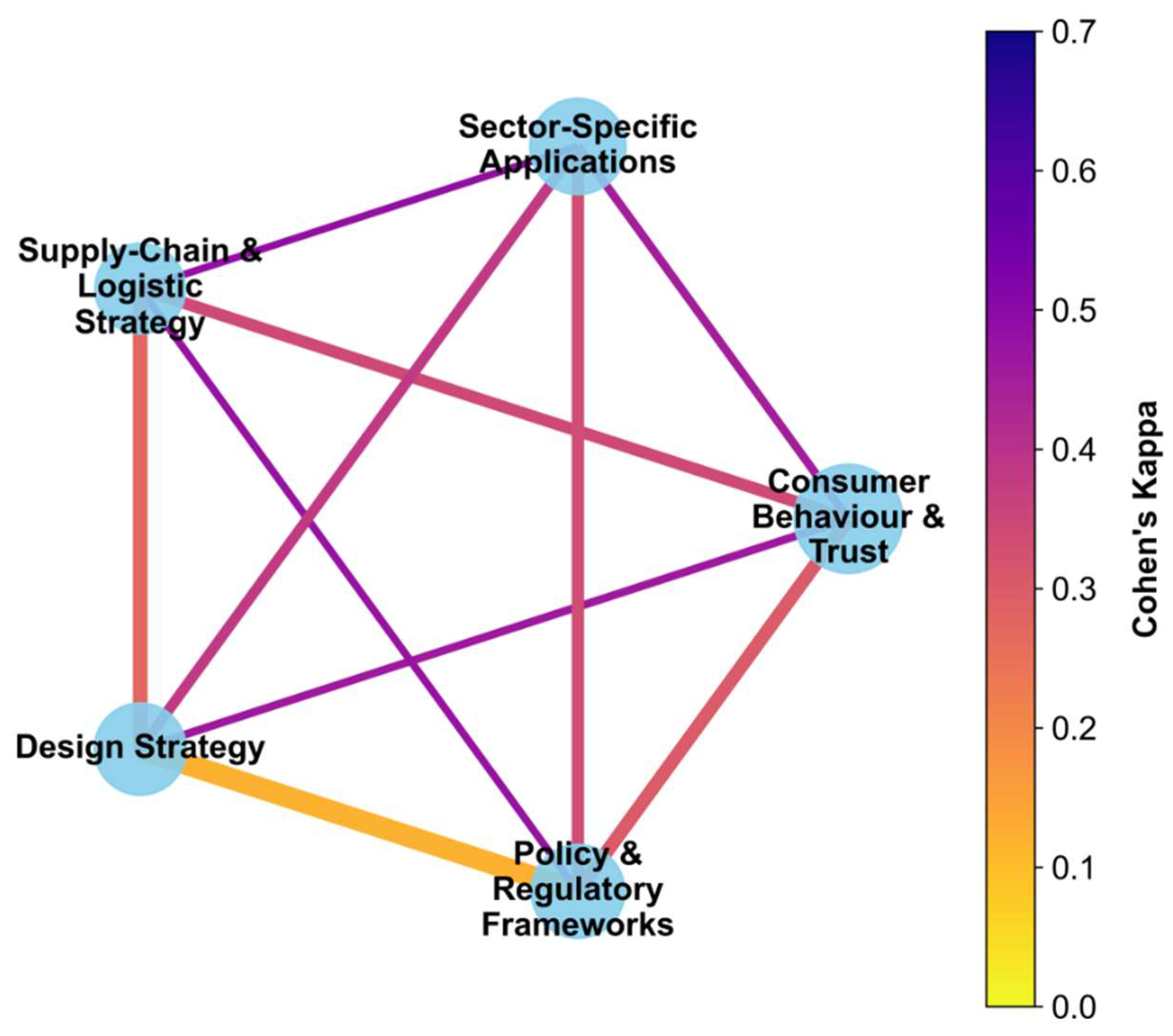
The Cohen’s Kappa heatmap provides a visual representation of how well the five thematic categories identified in the review agree with each other. It highlights both the coherence within these themes and the areas where they overlap conceptually. The strongest agreement is found in the Consumer Behavior and Trust category (κ = 0.609), showing a significant consistency in how studies were classified within this category. Moderate agreement is observed among categories such as Policy and Regulation–Supply Chain (κ = 0.477), Supply Chain–Sector-Specific (κ = 0.486), and Consumer Behavior–Design Strategy (κ = 0.460). While there is some alignment, it’s not complete across these areas. On the other hand, the Policy and Regulation–Design Strategy category (κ = 0.121) shows only slight agreement, highlighting the distinctness of these research streams and the limited overlap in the existing literature.
As shown in
Figure 2, most values fall within a fair-to-moderate range, emphasizing that while eco-labelling research themes are interconnected, they each capture unique aspects of the field that deserve individual analysis. Some thematic categories show higher levels of co-occurrence, particularly between supply chain, policy frameworks, and sector-specific applications. Lower levels of agreement are observed between design strategy and regulatory framework categories. Variation in agreement levels is present across all thematic comparisons, indicating differences in coding alignment between categories.
3.7.2. Mapping Conceptual Stability
From a conceptual mapping perspective,
Figure 3 illustrates the network diagram, where the size of each node reflects the stability of a category based on its self-agreement score (the larger the node, the more stable it is). The lines connecting these nodes show the relationships between different categories. Interestingly, the thickness and brightness of these lines are inversely related to Cohen’s Kappa, which means that brighter and thicker lines actually indicate less agreement and more conceptual confusion.
3.7.3. Analyzing Temporal Shifts
To examine temporal distribution,
Figure 4 presents annual publication counts for each theme using a stacked area chart. Publication volume shows variation over time, with a minimum value recorded in 2008 (2 articles). After 2020, publication counts increased across multiple themes. A comparison between the post-COVID period (2020–2025) and the pre-COVID period (2001–2019) shows higher publication counts in design strategy (+54.2%), sector-specific applications (+94.4%), and policy research (+2.9%). Consumer behavior and supply chain themes also show increases in publication frequency in the post-2020 period. Overall, all five thematic categories exhibit non-uniform temporal distributions across the full time horizon.
3.7.4. Mapping Conceptual Stability and Semantic Ambiguity
To better understand conceptual clarity and semantic ambiguity in this field, a keyword co-occurrence analysis was conducted across 191 articles. The 20 most common keywords were selected from a total of 1716 keyword-topic instances and arranged into a 20 × 5 co-occurrence matrix. Interestingly, ten keywords—such as “eco-label,” “sustainability,” and “consumer behaviour”—occurred across all five thematic categories, suggesting significant lexical redundancy.
The Jaccard similarity index and hierarchical agglomerative clustering (using Ward’s method) were applied to keyword co-occurrence data. The results were visualized using a normalized heatmap (
Figure 5), which shows distinct patterns in keyword relationships. Keywords were grouped into two categories based on distribution patterns: “specialist” and “generalist” terms. Specialist keywords, including “willingness to pay,” “food,” and “circular economy,” were clustered within single thematic groups. Generalist keywords such as “sustainability,” “carbon footprint,” and “eco-labeling” appeared across multiple thematic categories. The heatmap indicates variation in keyword distribution across thematic groupings. A total of 20 high-frequency keywords were analyzed across five thematic categories. These keywords were selected from 1716 keyword-topic instances extracted from the dataset. Co-occurrence frequencies were calculated across all thematic categories to construct the analytical matrix. The resulting matrix contains 20 keywords mapped across five thematic dimensions for comparison.
3.7.5. Tracing Geographic Evolution and Regional Specialization
A geographic-temporal analysis was conducted to explore how research is distributed globally and how regional specializations are evolving. This was done by assigning country identifiers to each article and thematically aggregating them at the national level. The findings, illustrated in
Figure 6, display the number of publications for each major country over five-year intervals, with trends categorized by themes.
The analysis of geographic distribution shows variation in research output across countries and themes over time. The United States records an early concentration of publications in policy and regulatory themes. European countries show higher publication counts in consumer behavior and sector-specific application themes. China shows increased publication output in supply chain and logistics-related themes in later periods. Country-level publication counts vary across thematic categories over the full time period. Differences in thematic focus are observed across geographic regions, with variation in dominant research themes by country. The distribution of publications indicates changes in geographic contributions across different thematic areas over time.
3.8. Synthesis and Implications for Governance
To synthesize the multi-dimensional dataset, the Embedded Socio-Technical Systems (ESTS) framework was used as an organizing structure for presenting the analytical outputs.
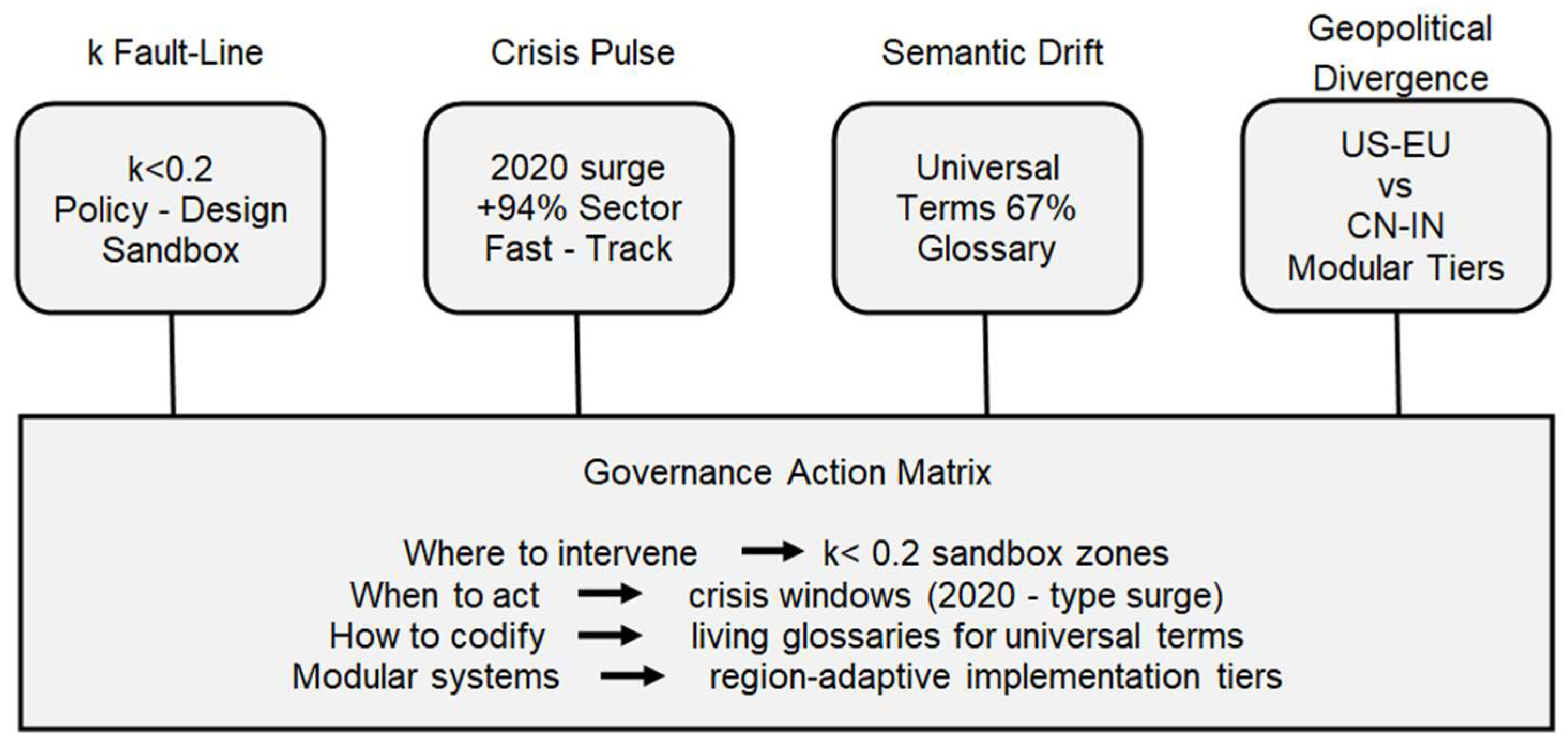
Figure 7 shows the Governance Action Matrix derived from the coded data. The matrix presents relationships across policy, design, and governance-related thematic categories. Low coherence values (K < 0.2) are observed between selected category pairs, particularly between the policy and design dimensions. Additional variation is observed across other category intersections within the matrix.
The matrix also displays temporal and geographic patterns across the dataset. Temporal variations correspond to identifiable changes in publication activity across time periods. Geographic variation is shown through differences in thematic distribution across countries. The matrix organizes results across semantic alignment, temporal distribution, and geographic dimensions. Values are presented as relative indicators across all thematic intersections in
Figure 7.
4. Discussion
This study uses insights from the systematic review to propose a dynamic, diagnostic framework for guiding both future research and the governance of eco-labeling systems. The framework moves beyond rigid standardization by integrating a stable lexical core of commonly used terms with clearly defined thematic dimensions and contextual discursive qualifiers—temporal, geographic, regulatory, and sectoral—that shape how eco-label concepts are interpreted and applied. Explicitly accounting for these interrelated layers provides a structured yet flexible approach to map, compare, and synthesize eco-labeling studies across industries and regions, while offering practical guidance for policymakers, firms, and researchers navigating the complexity and diversity inherent in sustainable labeling practices.
4.1. Proposed Conceptual Framework
Considering these insights, this study proposes a fresh approach for future research and governance, advocating for a transition away from rigid standardization toward a dynamic and diagnostic framework. This framework, shown in
Figure 8, should be grounded in a stable core of frequently used terms, a set of focused thematic areas that address core research issues, and an essential layer of discursive qualifiers—like temporal, geographic, and regulatory filters—that clearly influence how concepts are understood and applied in different contexts (
Figure 8).
4.1.1. Level One: The Lexical Core
At the base of this framework lies a collection of high-frequency terms crucial to eco-labeling research, yet whose meanings can be quite fluid. Words like “sustainability,” “eco-label,” “life cycle assessment,” and “carbon footprint” appear in numerous studies, but their definitions can vary depending on context. Rather than trying to pin down a single, unchanging definition for each term, this approach views them as boundary objects—concepts that can be molded to fit various local or sectoral needs while still fostering a common understanding across different studies. The aim for researchers and policymakers is not to erase the diverse meanings of these terms, but to acknowledge, map, and document them thoughtfully. By capturing how these key terms are utilized in various regions, industries, and academic fields, scholars can create a “living glossary” that tracks their nuances. For instance, “sustainability” might mean meeting legal standards in one study, represent a corporate branding tactic in another, or act as a performance measure in a supply chain in yet another. Mapping these distinctions enables more effective comparison of studies, synthesis of findings across different contexts, and the bolstering of meta-analyses, ultimately enhancing the clarity, consistency, and practical value of research in the eco-labeling field.
4.1.2. Level Two: Thematic Dimensions
These are the primary channels through which research is organized and should be treated as the key categories for systematic reviews and policy development. The analysis confirms the salience of five core dimensions: (1) Consumer Behavior and Trust: Investigating psychological antecedents, willingness-to-pay, credibility, and the behavioral impact of labels; (2) Policy and Regulatory Frameworks: Focusing on law, governance, international standards, and certification schemes; (3) Design Strategy: Concerning the technical and communicative design of labels, LCA methodologies, and integration into product development, (4) Supply Chain and Logistics Strategy: Encompassing traceability, procurement, logistics emissions, and multi-tier supplier management, and (5) Sector-Specific Applications: Addressing the unique challenges and opportunities in textiles, construction, food, healthcare, etc.
Companies and researchers should ensure that their work is clearly connected to one or more of these thematic dimensions. Rather than treating each dimension—such as Policy and Regulatory Frameworks, Supply Chain and Logistics Strategy, Design Strategy, Consumer Behavior and Trust, or Sector-Specific Applications—as separate or isolated areas, the framework encourages examining how they interact with one another. For example, a policy change, such as the introduction of a new regulation or certification standard, can influence how supply chains operate, which may, in turn, affect consumer trust in eco-labels or their willingness to pay for certified products. By exploring these connections, companies can better understand the ripple effects of decisions across multiple areas, design more coherent strategies, and ensure that interventions in one dimension support and reinforce outcomes in others. This approach promotes a holistic view of eco-labeling, emphasizing the importance of coordination, feedback loops, and integrated thinking rather than fragmented or siloed efforts.
4.1.3. Level Three: The Discursive Qualifiers
This is the most critical and innovative layer of the framework. It asserts that the meaning of the Lexical Core within any Thematic Dimension is not fixed but is radically shaped by a set of contextual filters. These qualifiers must be explicitly stated in any research or policy proposal to ensure accurate interpretation and transferability. They include: (1) Temporal Qualifiers: Is the research or policy situated in a period of stability, or does it respond to a crisis pulse (e.g., post-COVID, post-financial crash)? Meaning shifts over time; a “resilient supply chain” pre- and post-pandemic implies different things. (2) Geographic/Regional Qualifiers: Does the study focus on mature regulatory regimes (e.g., EU), emerging production hubs (e.g., Vietnam), or consumer-driven markets (e.g., US)? The meaning of “compliance” is geographically mediated. (3) Regulatory Qualifiers: Is the context defined by voluntary corporate initiatives, mandatory government regulations, or third-party certifications? This filter fundamentally alters the application of any thematic dimension. (4) Sectoral Qualifiers: Does the concept apply to the textile industry, food sector, or digital services? A “transparent supply chain” has vastly different operational meanings across sectors.
The framework requires a clear outline of the research context, specifying the qualifiers they use. For example, instead of simply stating a result is about “consumer trust,” it should detail specifics like “consumer trust (Thematic Dimension) in voluntary labels (Regulatory Qualifier) for food products (Sectoral Qualifier) in Southeast Asia (Geographic Qualifier) during a period of price inflation (Temporal Qualifier).” This level of detail not only facilitates fair comparisons between studies but also helps prevent sweeping claims that might ignore significant differences. Building on these discursive qualifiers, the framework is operationalized through three analytical steps, demonstrating its empirical application in diagnosing fragmentation, identifying governance leverage points, and guiding comparative research. First, thematic dimensions were identified and tested for coherence using inter-coder agreement (Cohen’s Kappa). Second, semantic ambiguity was assessed through keyword co-occurrence and clustering analyses. Third, contextual qualifiers—temporal, geographic, regulatory, and sectoral—were extracted from metadata and mapped across studies.
4.2. Implications for Governance
This diagnostic framework lays the groundwork for the Governance Action Matrix discussed previously, providing both structure and direction for practical application. It tackles three essential questions. First, where should the intervention occur? The framework highlights areas where thematic dimensions intersect yet lack clarity or consensus, such as the space between policy and design, and stresses the importance of refining the definitions of key terms within the Lexical Core for specific sectors or regions. Second, when is the right time for action? Temporal Qualifiers point out moments of disruption or crisis—such as the 2008 financial crash or the COVID-19 pandemic—as prime opportunities to establish new norms and drive change while systems are more adaptable. Third, how should these actions be codified? The framework suggests governance tools that are modular and tailored to specific contexts, designed for particular combinations of qualifiers (for instance, a policy crafted for the textile sector in emerging economies), rather than a one-size-fits-all approach. Together, these principles pave the way for more advanced eco-labeling research and practices. Instead of viewing fragmentation as a drawback, the framework reinterprets it as a source of diversity and flexibility. By providing a common language to navigate complexity, it fosters eco-labeling systems that are not only robust but also responsive to their context, attuned to change, and rooted in a realistic understanding of how meaning and governance evolve in an interconnected world.
4.3. Theoretical Implications
This study advances eco-labeling theory by demonstrating that thematic fragmentation is an inherent feature of socio-technical systems, rather than a flaw to be eliminated. By integrating temporal, geographic, regulatory, and sectoral qualifiers, the framework captures the co-evolution of actors, institutions, and meanings. This perspective enables cumulative theory-building across previously siloed research areas, showing how policy, design, supply chain, and consumer behavior interact dynamically. Furthermore, it highlights the resilience of eco-labeling systems under crises, revealing that adaptive governance mechanisms can leverage fragmentation as a source of variety and flexibility. These insights extend socio-technical and governance theories by providing a structured framework for understanding and comparing eco-labeling systems across sectors, regions, and time periods.
4.4. Practical Implications
From a governance standpoint, the findings suggest that traditional approaches emphasizing strict standardization may overlook the benefits of context-sensitive, adaptive strategies. Policymakers, regulators, and firms can leverage the framework to identify points where thematic dimensions intersect and design interventions that enhance trust, transparency, and system coherence. Crisis events—whether global health emergencies, climate shocks, or market disruptions—provide windows for experimentation and innovation. Recognizing the timing, sectoral context, and regional conditions is critical for interventions that are not only effective but also resilient over time. Empirical application of the framework allows decision-makers to tailor strategies to local contexts while maintaining coherence across global markets. By operationalizing the framework through inter-coder agreement, keyword co-occurrence, and contextual mapping, stakeholders can systematically diagnose fragmentation, identify governance leverage points, and support cross-sector and cross-region policy interventions.
Building on this governance perspective, the review offers specific actionable insights for various stakeholders. Policymakers can leverage the findings to harmonize standards, design SME-friendly incentives, and strengthen monitoring systems to prevent greenwashing. Industry actors can integrate eco-labels into supply chains and operational strategies, adopt consumer-centred label designs, and utilize digital tools to enhance transparency and traceability. Practitioners can prioritize sector-specific interventions, engage consumers effectively, and align sustainability objectives with operational practices. Ultimately, applying these insights ensures that the review bridges the gap between conceptual theory and real-world decision-making.
5. Conclusions
This study demonstrates that eco-labeling functions as a dynamic socio-technical system, where thematic fragmentation, semantic ambiguity, and regional divergence are inherent structural features rather than mere anomalies. By integrating five thematic dimensions—consumer behavior and trust, policy and regulatory frameworks, design strategy, supply chain and logistics, and sector-specific applications—through temporal, geographic, regulatory, and sectoral qualifiers, the proposed diagnostic framework captures the complexity and adaptability of eco-labeling systems. This approach reframes fragmentation not as a weakness but as a source of variety and flexibility that governance mechanisms can strategically manage. Importantly, the study reveals that eco-labeling’s evolution is driven not only by regulatory pressures or technological innovation, but also by interactions among actors, institutions, and contextual forces, particularly during periods of crisis such as the COVID-19 pandemic or major supply chain disruptions. These insights extend theory by showing how socio-technical and governance perspectives can be combined to analyze the emergence, coherence, and resilience of eco-labeling systems across sectors and regions. The results obtained through inter-coder agreement, keyword co-occurrence, and contextual mapping directly inform these governance insights, showing how fragmentation and thematic interactions can be managed strategically.
The findings align with prior systematic reviews of eco-labeling, such as Dreist et al. [
1] and Testa et al. [
22], which highlighted the fragmented nature of eco-labeling research and the need for integrative frameworks. This analysis extends these studies by explicitly operationalizing thematic dimensions and contextual qualifiers, offering a more nuanced understanding of cross-thematic interactions. While previous reviews emphasized either policy or consumer behavior in isolation, the present study reveals how these dimensions co-evolve, particularly under crisis conditions. Divergences are also evident: unlike earlier SLRs that treated fragmentation as a limitation, the proposed framework reframes it as a source of adaptive flexibility, which has implications for governance and theory-building.
The study also provides guidance for researchers seeking to advance knowledge in this field. Future investigations should employ integrative, multi-dimensional approaches that account for the interactions between thematic dimensions and contextual qualifiers, enabling a more nuanced understanding of how eco-labeling systems operate in diverse environments. Empirical applications of the framework can help evaluate how crises reshape eco-labeling dynamics, how sector-specific challenges influence adoption and impact, and how consumer trust and behavioral responses evolve over time. By operationalizing the framework through steps such as inter-coder agreement, keyword co-occurrence, and contextual mapping, researchers can systematically diagnose fragmentation, identify governance leverage points, and generate comparative insights across sectors, regions, and temporal contexts. This opens the possibility for cumulative theory-building and more coherent guidance for policy and practice. The key takeaways are (1) fragmentation in eco-labeling is an asset, enabling flexibility when managed through diagnostic frameworks, (2) adaptive governance, aligned with temporal, geographic, regulatory, and sectoral qualifiers, strengthens trust and system resilience, (3) crisis events are critical opportunities for innovation and policy recalibration, (4) integration across thematic dimensions enhances cumulative knowledge and policy coherence, and (5) empirical application of the framework allows cross-sector and cross-region comparisons, supporting robust, context-sensitive interventions.
In conclusion, this study shifts the discourse from a descriptive, fragmented understanding of eco-labeling toward a theory-driven, integrative perspective that bridges research, policy, and practice. By providing a diagnostic framework grounded in socio-technical systems and adaptive governance, it equips scholars and practitioners to navigate complexity, manage diversity, and design interventions that are both contextually sensitive and scalable. Ultimately, the study underscores that eco-labeling is not merely a labeling exercise but a strategic lever for advancing sustainability, enhancing transparency, and fostering resilience across global markets and industries. By emphasizing both conceptual clarity and practical applicability, it lays a foundation for future research and governance initiatives that can strengthen the credibility, effectiveness, and adaptability of eco-labeling systems worldwide. This study contributes to socio-technical systems and adaptive governance theory by demonstrating how fragmentation can function as an adaptive feature in complex sustainability governance systems.
5.1. Limitations
While this study provides a rigorous, systematic review of eco-labeling research, several limitations should be acknowledged to contextualize the findings and guide future work. First, the review focuses exclusively on peer-reviewed journal and conference articles published in English between 2000 and 2025. This scope excludes the gray literature, policy reports, and non-English publications, which may contain additional insights, particularly from emerging markets or region-specific studies. Furthermore, relying strictly on the peer-reviewed literature introduces the possibility of publication bias. Studies with positive or statistically significant eco-labeling outcomes are more likely to be published than studies with null results. Second, the use of a highly curated 52-article core sample allowed for in-depth qualitative coding, but the small sample size introduces potential selection and coverage biases. Some niche perspectives or keyword variants may be underrepresented in the literature mapping. Third, because the methodological quality appraisal was used descriptively rather than as an exclusion filter, the synthesis includes studies with different levels of analytical rigor. This variation may influence the strength of some conclusions. Fourth, although the coding and thematic analysis were carefully structured, calibrated, and evaluated using inter-coder reliability checks and Cohen’s Kappa, the process inherently involves subjective judgments. Subtle nuances in terminology, context, or cross-thematic relationships may not be fully captured. Fifth, the study concentrates on five thematic dimensions—consumer behavior and trust, policy and regulatory frameworks, design strategy, supply chain and logistics, and sector-specific applications—which, while comprehensive, necessarily limit the breadth of the analysis. Other potentially relevant factors, such as organizational, financial, or cultural dimensions, were not explicitly coded. Finally, although the proposed diagnostic framework enables cross-sector and cross-region comparisons, its empirical applicability in real-world policy or industry contexts remains to be validated. Factors such as local regulatory differences, cultural variations, and resource constraints in SMEs may affect the transferability of findings and strategies.
Future Research Directions
Building on these limitations, several avenues for future research emerge. Expanding the review to include the non-English and gray literature could uncover regionally specific practices or innovations. Incorporating additional thematic dimensions, such as organizational, financial, or cultural factors, could provide a more holistic understanding of eco-labeling dynamics. Moreover, empirically applying and testing the framework in field-based case studies or policy evaluations would help assess its practical utility and adaptability, validating its relevance for diverse stakeholders. By addressing these areas, future studies can strengthen both the theoretical foundations and applied relevance of eco-labeling research, contributing to more robust, context-sensitive governance and management strategies.



 ,
,