The Sustainable Evaluation and Improvement of Age-Friendly Outdoor Thermal Environments in Rural Xi’an: A Perspective on Spatiotemporal Variations in Elderly Daily Activity

 ,
,  ,
,  ,
,
Abstract
1. Introduction
- Identify the spaces for the elderly’s outdoor daily activities and the activity types conducted at different times in summer and winter, and explore the spatiotemporal differentiation patterns of the elderly’s activities.
- Identify the outdoor thermal response patterns of the elderly and establish comfort demand benchmarks for their outdoor activity spaces to align with the goals of climate-resilient construction and the sustainable development of urban–rural human settlements.
- Evaluate the thermal environment levels of the elderly’s outdoor activity spaces and propose effective improvement paths for uncomfortable conditions.
2. Materials and Methods
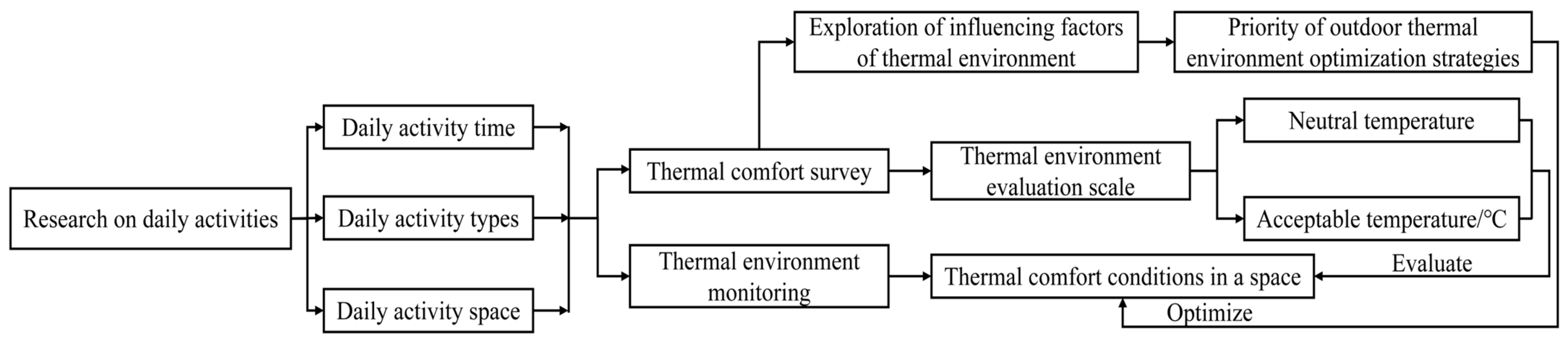
2.1. An Overview of the Technical Route
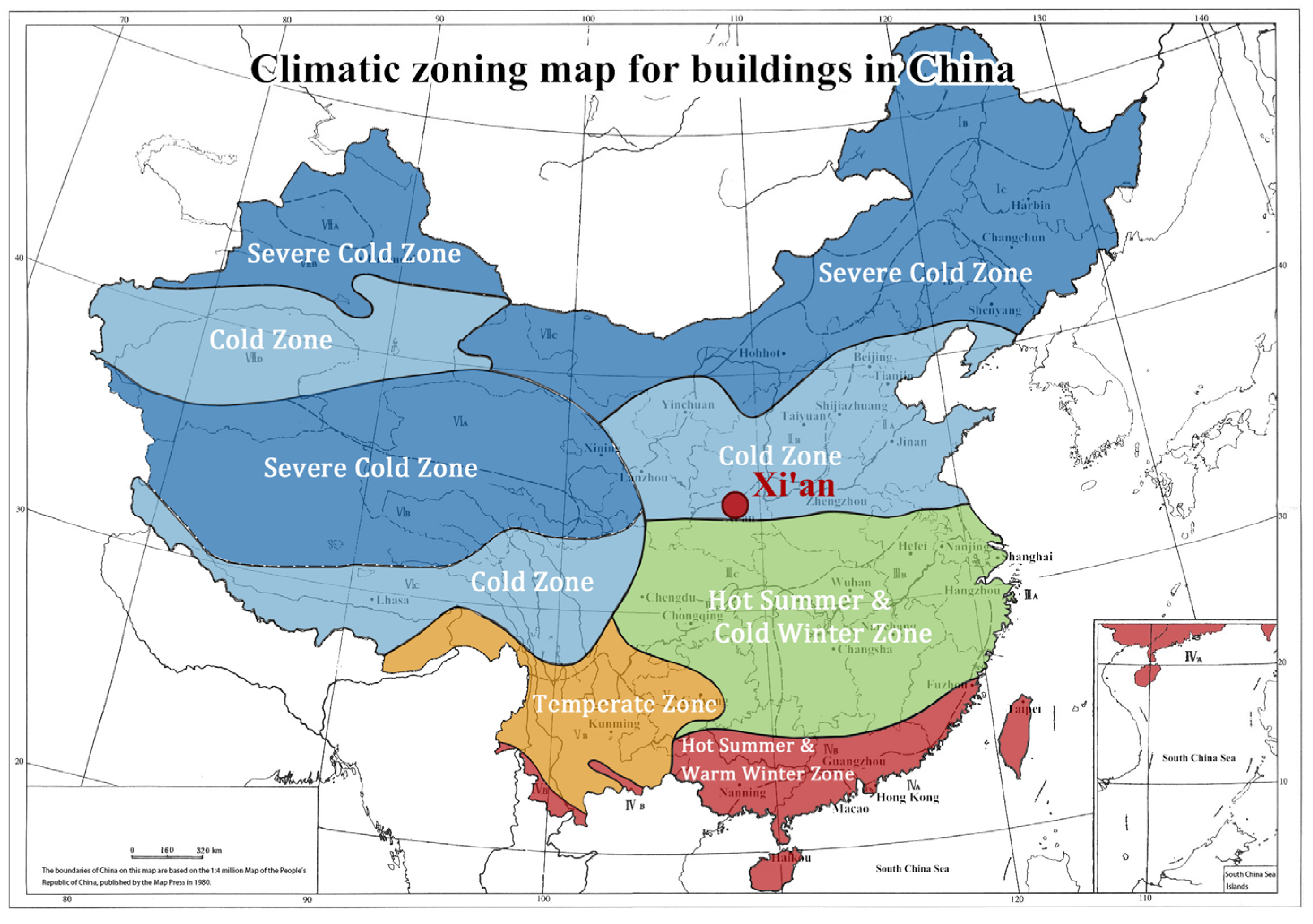
2.2. An Overview of the Study Site
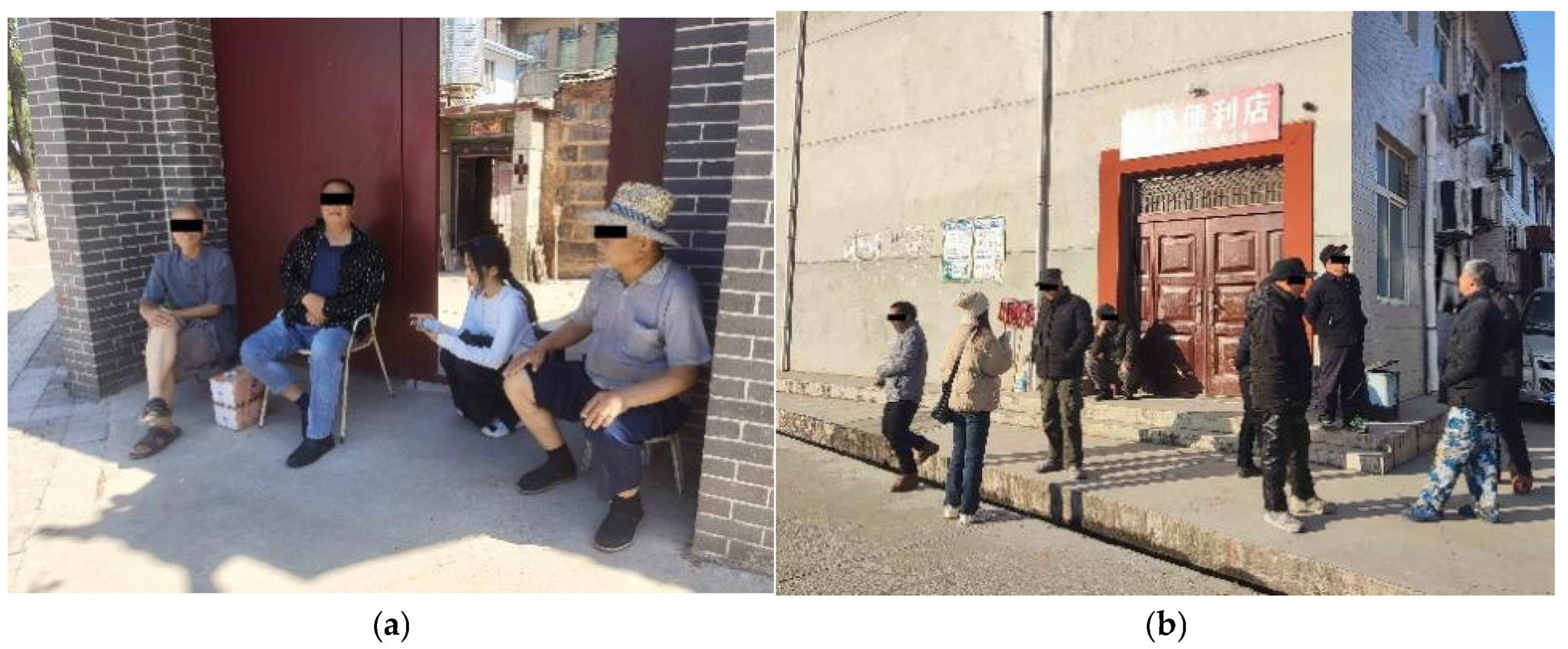
2.3. Investigation on Temporal and Spatial Patterns of Outdoor Daily Activities
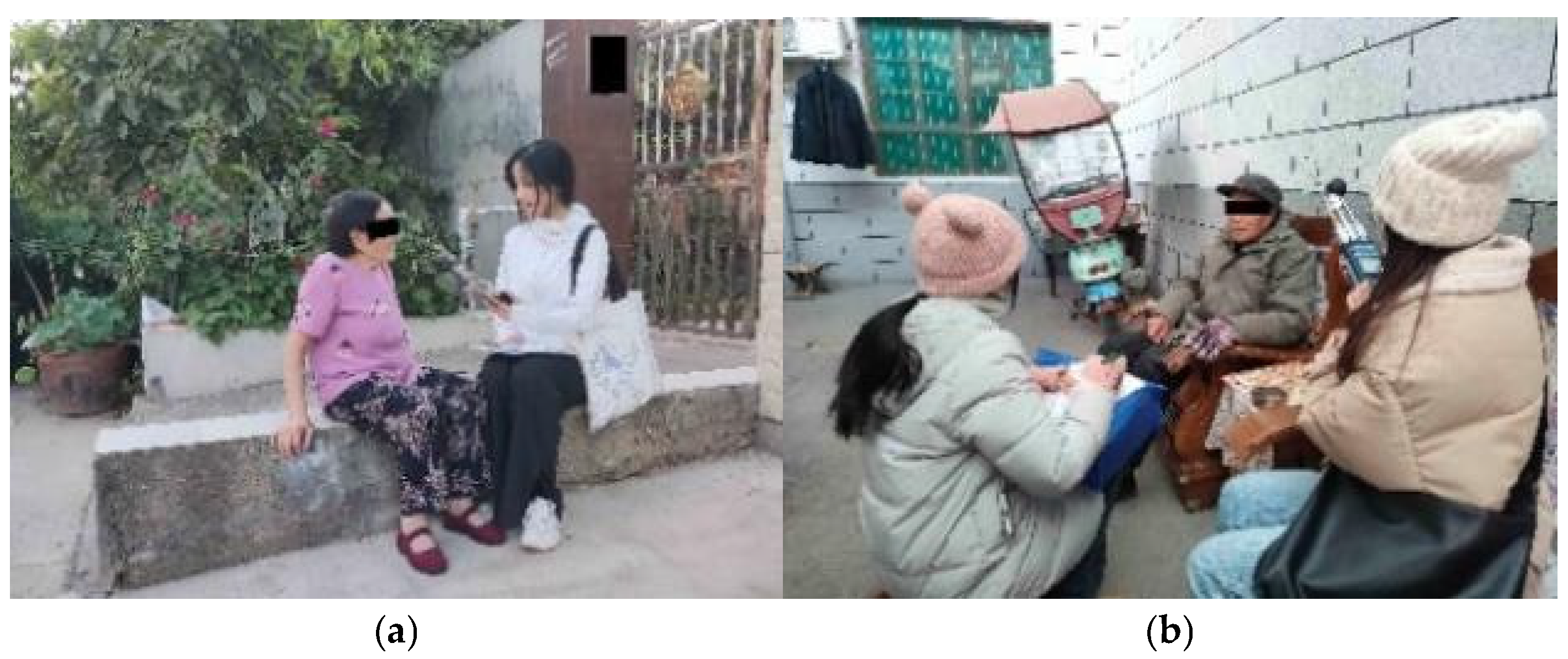
2.4. Investigation on Outdoor Thermal Comfort
2.5. Continuous Monitoring of Outdoor Thermal Environment
3. Results and Analysis
3.1. Spatiotemporal Patterns of Outdoor Daily Activities
3.1.1. Content and Classification of Daily Activities
3.1.2. Temporal Distribution Patterns of Daily Activities
- Summer
- 2.
- Winter
3.1.3. Analysis and Discussion
3.2. Thermal Environment, Thermal Response and Thermal Comfort
3.2.1. Outdoor Thermal Environment
3.2.2. Clothing Adjustment
3.2.3. Thermal Sensation and Neutral Temperature
3.2.4. Thermal Acceptability and Acceptable Temperature Range
3.3. Evaluation of Thermal Environment in Outdoor Daily Activity Spaces
3.3.1. Continuous Testing of Outdoor Thermal Environment
- 1.
- Summer
- 2.
- Winter
3.3.2. Evaluation of Outdoor Thermal Environment
- Summer
- 2.
- Winter
3.4. Objective Improvement Strategies for Thermal Environment and Subjective Adaptation Suggestions for Humans
3.4.1. Priority Improvement Paths and Strategies for Thermal Environment
3.4.2. Suggestions for Individual Subjective Adaptive Behaviors
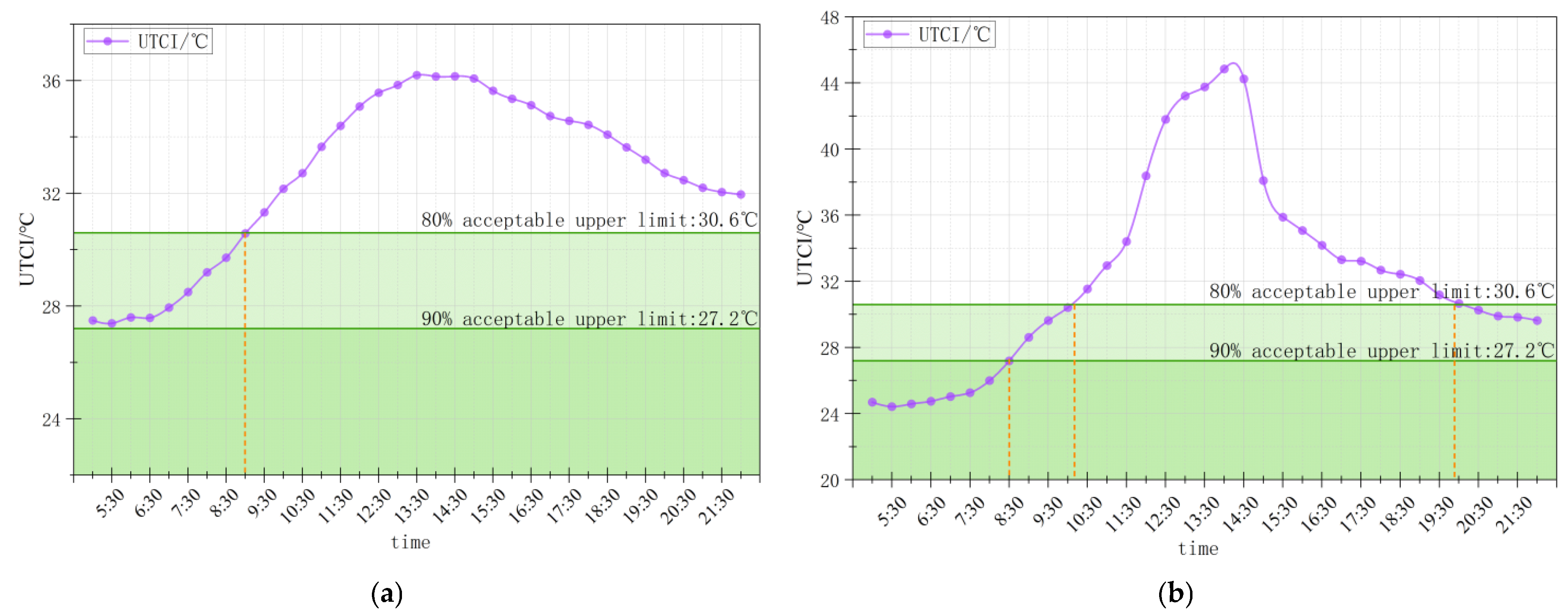
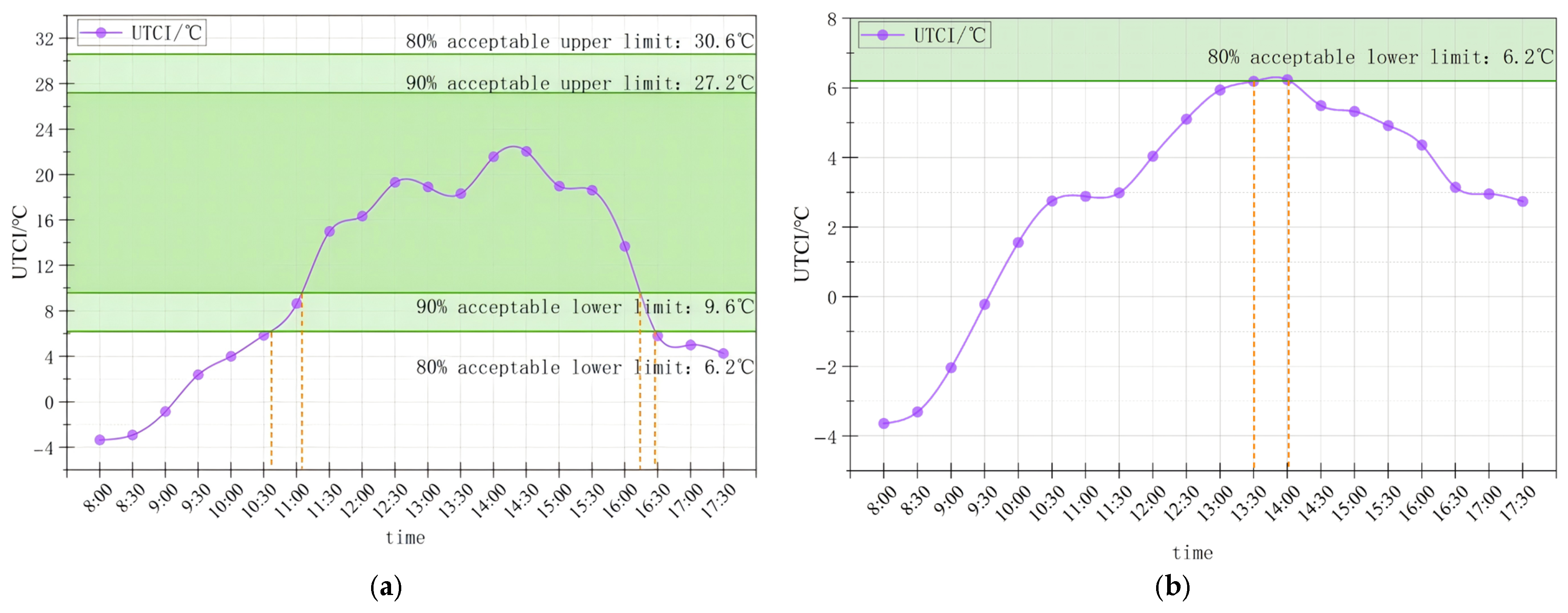
- Adjustments to Activity Time and Activity Space. Based on the patterns in the elderly’s activity spaces, the UTCI of the south-facing doorways in winter fell within the 80% outdoor thermal acceptability range during 10:30–16:30, making this period suitable for outdoor activities, such as leisure activities and health-promoting physical activities. In summer, the UTCI in the courtyard fell within the 80% outdoor thermal acceptability range before 10:00 and after 20:00. Therefore, activities at the north-facing doorways are recommended before 9:00, while activities in the courtyard are recommended before 10:00 and after 20:00.
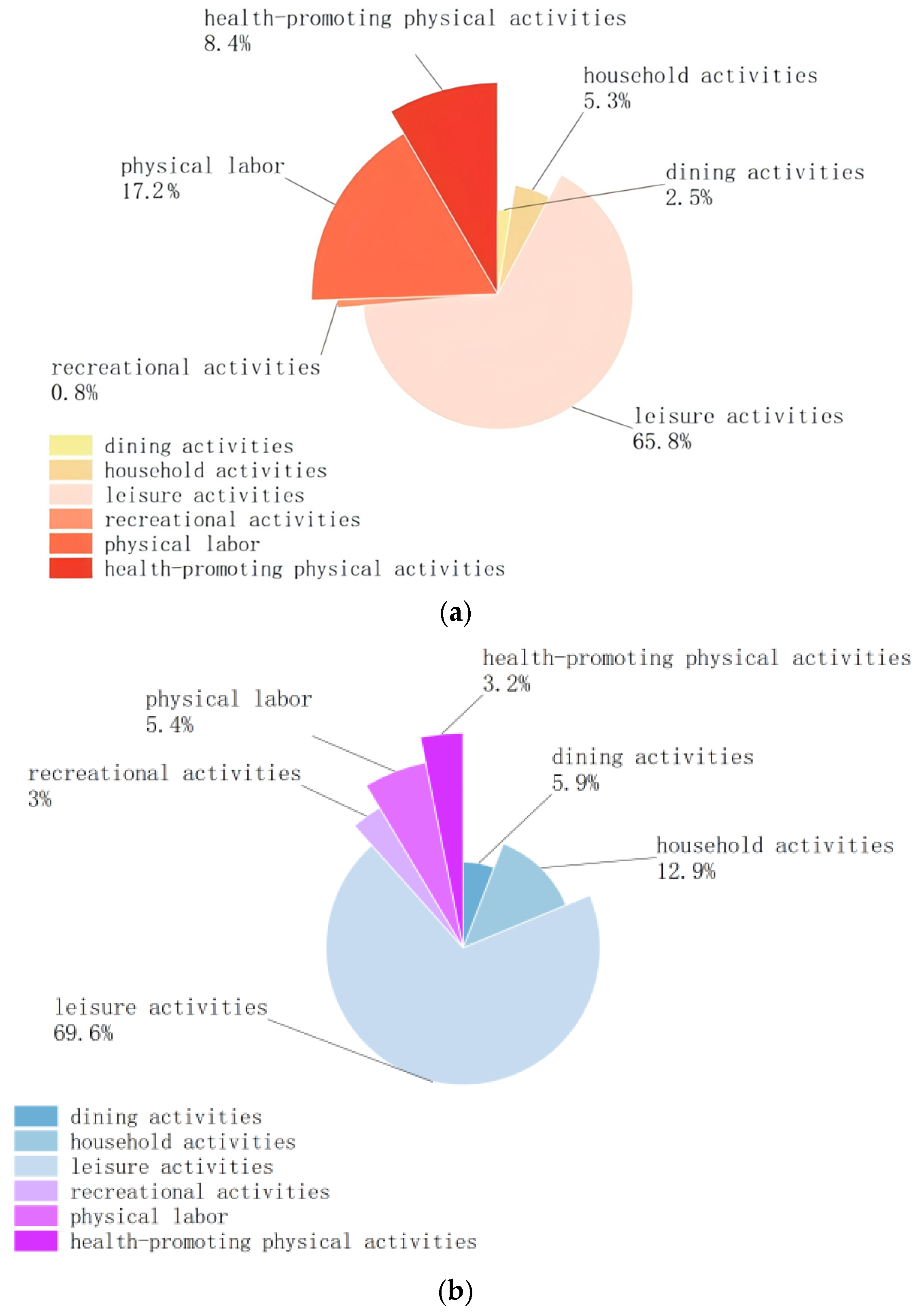
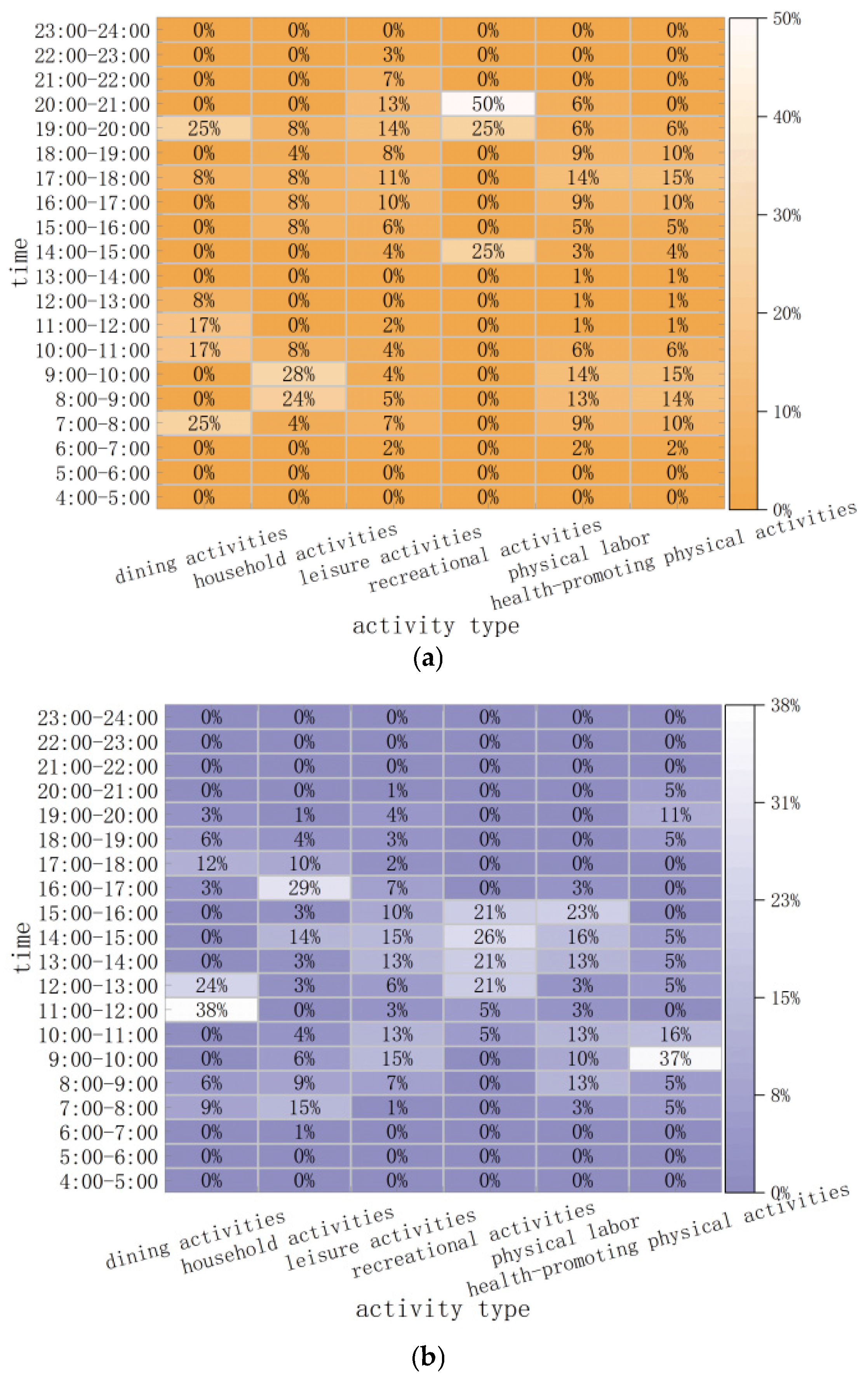
- Adjustments to the Content and Intensity of Daily Activities. According to the analysis of the patterns of the elderly’s daily activity types, their daily activities showed clear seasonal differences. In summer, outdoor activities were dominated by leisure activities and physical labor, while in winter, they were dominated by leisure activities and household activities. Due to the needs of agricultural production, rural elderly residents may need to engage in outdoor labor. Therefore, it is recommended that farm work be scheduled before 10:00 a.m. in summer to avoid high-temperature periods and reduce the risk of heat stress.
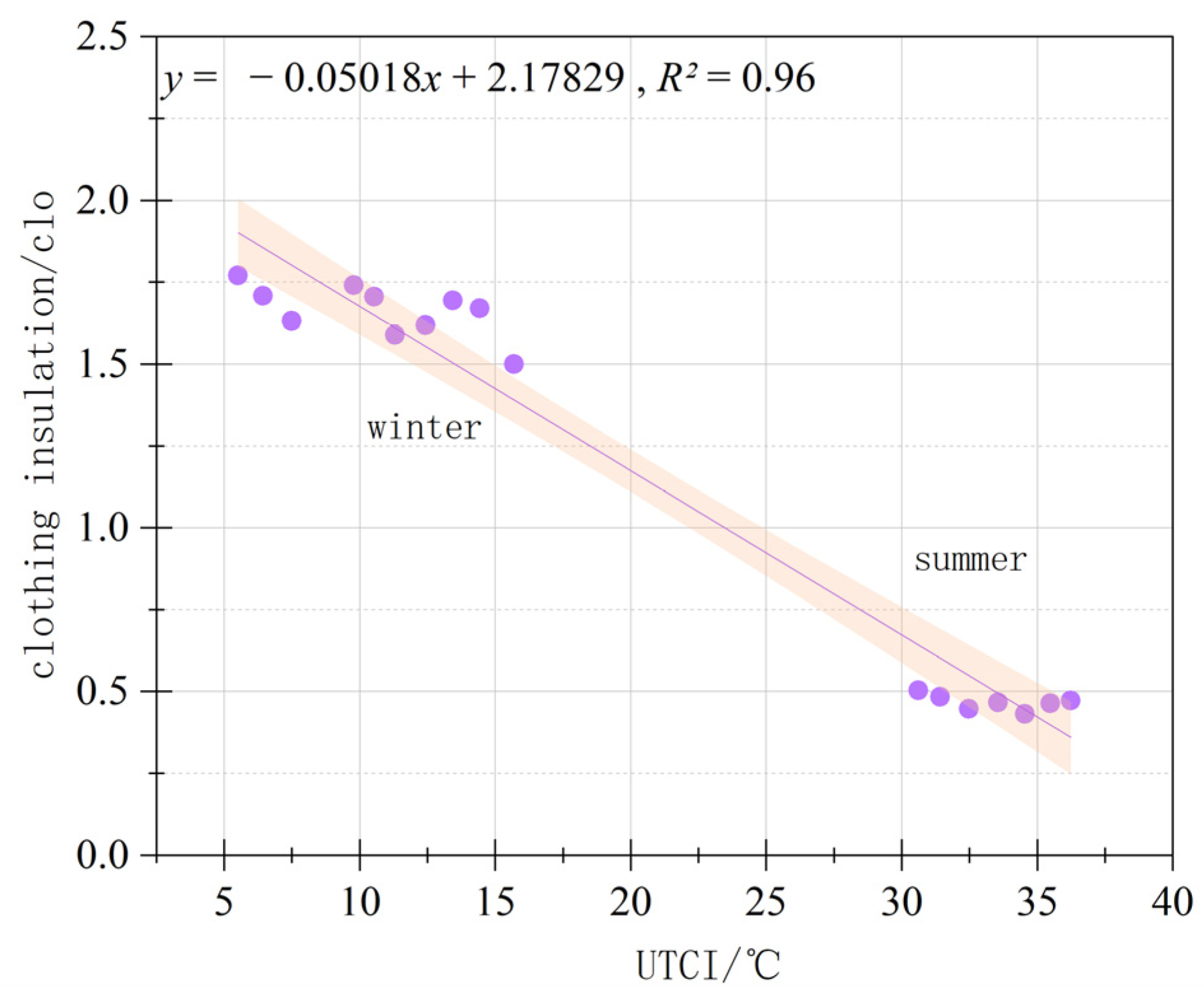
- Clothing Adjustment. Elderly individuals should make appropriate clothing adjustments, mainly by adding or removing garments, and should adjust their clothing reasonably in response to temperature changes. It is recommended that the elderly adopt a dynamic clothing adjustment mechanism and use a layered dressing strategy to cope with day–night temperature differences, while also ensuring protection against extreme temperatures.
3.5. Limitations and Future Work
4. Conclusions
- The outdoor daily activities among elderly residents in rural Xi’an exhibited clear seasonal spatiotemporal differentiation patterns. In summer, their outdoor activities were concentrated in the morning and evening periods, specifically from 6:00 to 9:00 and from 17:00 to 21:00, and the elderly preferred to stay in shaded spaces. Leisure activities were widely distributed, and health-promoting physical activities accounted for a high proportion. In winter, their outdoor activities were concentrated during 9:00–11:00 and 13:00–17:00, while they mainly engaged in indoor activities during other time periods. The elderly preferred sunny spaces, and various activities showed a relatively scattered distribution. Overall, the activity patterns were adapted to the climatic characteristics of summer and winter. Different activity types exhibited clear differences in spatiotemporal distribution, which may be related to regional and seasonal climatic characteristics and the living habits of urban and rural elderly residents.
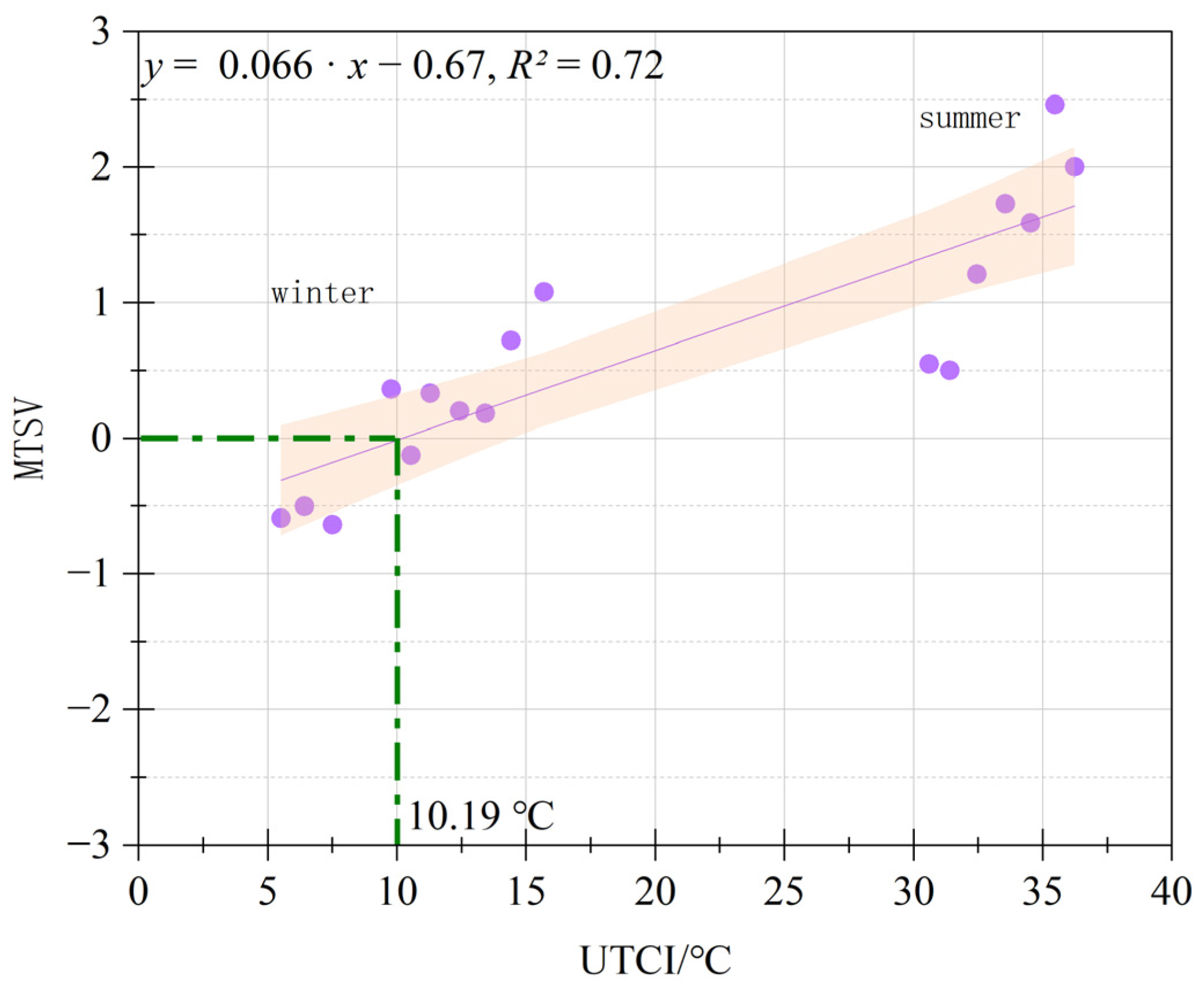
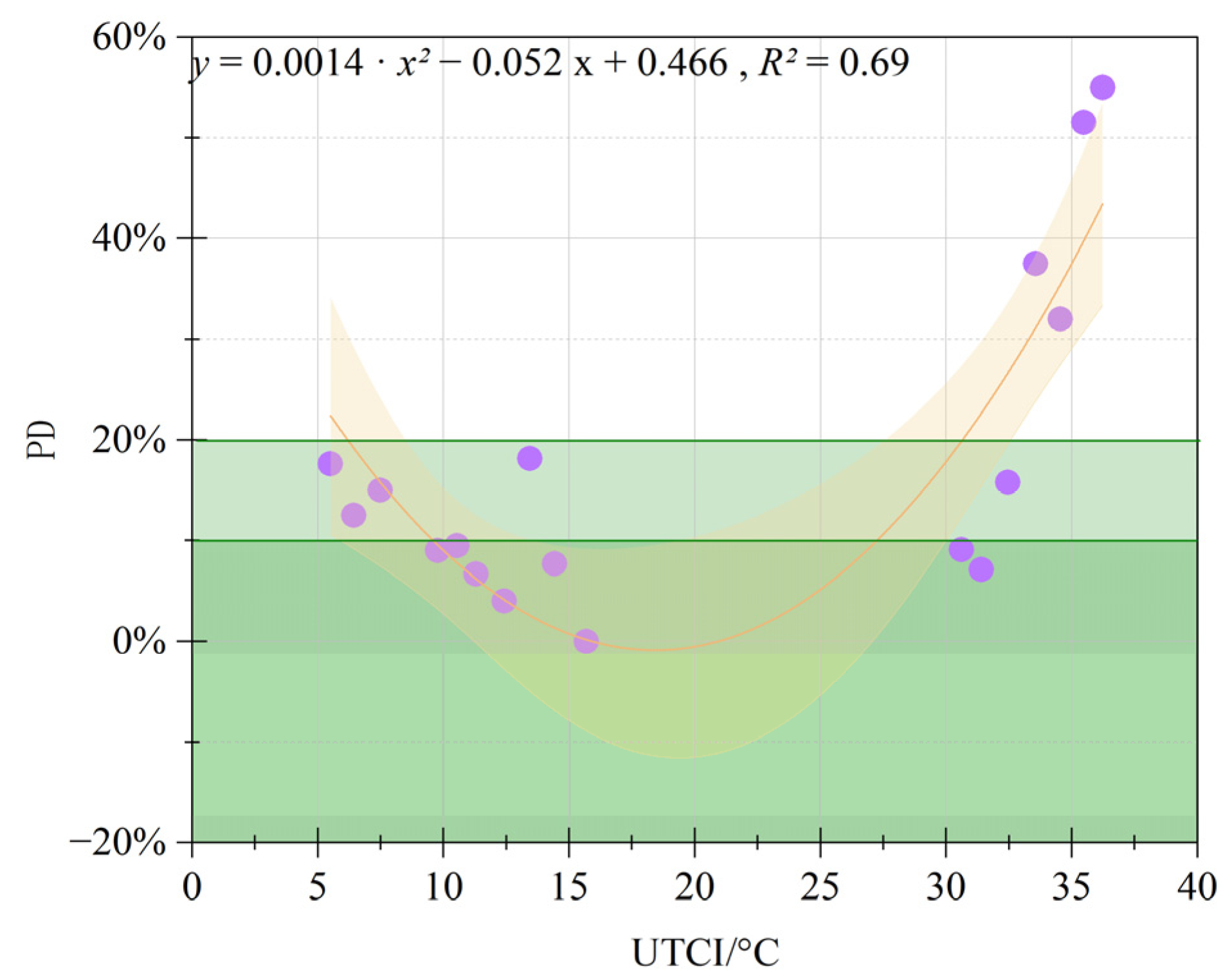
- Elderly residents in rural Xi’an exhibited unique thermal response patterns and thermal comfort requirements in outdoor spaces. Their thermal response patterns differed from those of elderly individuals in urban Xi’an and other climate zones. The measured neutral temperature was 10.19 °C, and the 90% and 80% thermal acceptability ranges were 9.60–27.20 °C and 6.20–30.60 °C, respectively. These values also differed from those of elderly individuals in urban Xi’an, regions in the same climate zone but with distinct typical climatic characteristics, and other climate zones. These differences may be associated with climatic features, the living habits of urban and rural elderly residents, and disparities in the thermal environment quality of outdoor living spaces for urban and rural elderly residents.
- The outdoor daily activity spaces used by elderly residents in rural Xi’an exhibited different thermal environment comfort levels. In summer, the comfortable time periods of the courtyard, before 10:00 and after 20:00, were broader than those of the north-facing doorways before 9:00, but the daily UTCI peak in the courtyard was higher. In winter, due to direct sunlight, the UTCI acceptable time period of the south-facing doorways, from 10:30 to 16:30, was longer than that of the courtyard, from 13:30 to 14:00. An outdoor thermal sensation random forest model was established, and the results showed that the weights of environmental and individual parameters influencing thermal sensation, in descending order, were mean radiant temperature, relative humidity, air temperature, wind speed, clothing thermal resistance, and metabolic rate. Based on these results, targeted thermal environment improvement strategies for summer and winter were proposed, along with behavioral recommendations for adjusting activity time and space, as well as activity content and intensity.
Author Contributions
Funding
Institutional Review Board Statement
Informed Consent Statement
Data Availability Statement
Conflicts of Interest
Appendix A. Daily Activity Survey Questionnaire for Rural Elderly in Xi’an Area
| Gender | □ Male □ Female | Height | cm | |
| Age | ________ Years | Weight | kg | |
| Educational Background | □ Primary School or Below □ Junior High School □ Senior High School/Technical Secondary School □ College or Above | |||
| Chronic Diseases | ||||
| Time Period | Daily Activity | Location | ||
| 5:00–6:00 | □ Bedroom □ Kitchen □ Living Room □ Courtyard □ Hallway □ Doorway □ Alley □ Square □ Others: ______ | |||
| 6:00–7:00 | □ Bedroom □ Kitchen □ Living Room □ Courtyard □ Hallway □ Doorway □ Alley □ Square □ Others: ______ | |||
| 7:00–8:00 | □ Bedroom □ Kitchen □ Living Room □ Courtyard □ Hallway □ Doorway □ Alley □ Square □ Others: ______ | |||
| 8:00–9:00 | □ Bedroom □ Kitchen □ Living Room □ Courtyard □ Hallway □ Doorway □ Alley □ Square □ Others: ______ | |||
| 9:00–10:00 | □ Bedroom □ Kitchen □ Living Room □ Courtyard □ Hallway □ Doorway □ Alley □ Square □ Others: ______ | |||
| 10:00–11:00 | □ Bedroom □ Kitchen □ Living Room □ Courtyard □ Hallway □ Doorway □ Alley □ Square □ Others: ______ | |||
| 11:00–12:00 | □ Bedroom □ Kitchen □ Living Room □ Courtyard □ Hallway □ Doorway □ Alley □ Square □ Others: ______ | |||
| 12:00–13:00 | □ Bedroom □ Kitchen □ Living Room □ Courtyard □ Hallway □ Doorway □ Alley □ Square □ Others: ______ | |||
| 13:00–14:00 | □ Bedroom □ Kitchen □ Living Room □ Courtyard □ Hallway □ Doorway □ Alley □ Square □ Others: ______ | |||
| 14:00–15:00 | □ Bedroom □ Kitchen □ Living Room □ Courtyard □ Hallway □ Doorway □ Alley □ Square □ Others: ______ | |||
| 15:00–16:00 | □ Bedroom □ Kitchen □ Living Room □ Courtyard □ Hallway □ Doorway □ Alley □ Square □ Others: ______ | |||
| 16:00–17:00 | □ Bedroom □ Kitchen □ Living Room □ Courtyard □ Hallway □ Doorway □ Alley □ Square □ Others: ______ | |||
| 17:00–18:00 | □ Bedroom □ Kitchen □ Living Room □ Courtyard □ Hallway □ Doorway □ Alley □ Square □ Others: ______ | |||
| 18:00–19:00 | □ Bedroom □ Kitchen □ Living Room □ Courtyard □ Hallway □ Doorway □ Alley □ Square □ Others: ______ | |||
| 19:00–20:00 | □ Bedroom □ Kitchen □ Living Room □ Courtyard □ Hallway □ Doorway □ Alley □ Square □ Others: ______ | |||
| 20:00–21:00 | □ Bedroom □ Kitchen □ Living Room □ Courtyard □ Hallway □ Doorway □ Alley □ Square □ Others: ______ | |||
| 21:00–22:00 | □ Bedroom □ Kitchen □ Living Room □ Courtyard □ Hallway □ Doorway □ Alley □ Square □ Others: ______ | |||
| 22:00–23:00 | □ Bedroom □ Kitchen □ Living Room □ Courtyard □ Hallway □ Doorway □ Alley □ Square □ Others: ______ | |||
Appendix B. Thermal Comfort Survey Questionnaire for Rural Elderly in Xi’an Area
| Survey Location | |||||||
| Gender | Age(years) | Height (cm) | Weight (kg) | ||||
| Educational Background | □ Primary School or Below □ Junior High School Senior □ High School/Technical Secondary School □ College or Above | ||||||
| Chronic Diseases | |||||||
| Living Alone | (Yes/No) | ||||||
| Temperature (°C) | _______ | Relative Humidity (%) | _______ | Globe Temperature (°C) | _______ | Air Velocity (m/s) | _______ |

| Common Activities | Metabolic Rate (met) | Common Activities | Metabolic Rate (met) |
|---|---|---|---|
| Sleeping | 0.7 | Cooking | 1.6–2.0 |
| Reclining | 0.8 | Cleaning | 2.0–3.4 |
| Sitting Quietly | 1.0 | Dancing | 2.4–4.4 |
| Standing Relaxed | 1.2 | Aerobics/Fitness | 3.0–4.0 |
| Walking | 1.7–2.0 | Shoveling/Digging | 4.0–4.8 |
| Others (Please specify) | |||
| Scale | |||||||
|---|---|---|---|---|---|---|---|
| 3 | 2 | 1 | 0 | −1 | −2 | −3 | |
| Sensation | Hot | Warm | Slightly warm | Neutral | Slightly cool | Cool | Cold |
| Acceptability | - | Completely Acceptable | Just Acceptable | - | Just Unacceptable | Completely Unacceptable | - |
| Preference | Cooler | No change | Warmer | ||||
| Underwear & Upper Garments | Trousers | □Long-Sleeved Shirt Dress (Thick) 0.47 |
| □Men’s Underwear 0.04 | □Ultra-Short Shorts 0.06 | □Thick Short Outerwear 0.42 |
| □Women’s Underwear 0.04 | □Men’s Casual Shorts0.08 | □Thick Long Outerwear 0.48 |
| □Short-Sleeved T-Shirt 0.08 | □Straight Trousers (Thin) 0.15 | □Thin Jacket 0.22 |
| □Sleeveless/Low-Cut Blouse 0.12 | □Regular Trousers 0.24 | □Thick Jacket 0.49 |
| □Short-Sleeved Men’s Shirt 0.19 | □Thermal Underpants 0.15 | □Short Cotton-Padded Jacket 0.5 |
| □Long-Sleeved Men’s Shirt 0.25 | □Thick Thermal Underpants 0.25 | □Mid-Length Cotton-Padded Jacket 0.6 |
| □Undershirt 0.34 | □Sports Trousers 0.28 | Footwear & Socks |
| □Flannel Shirt 0.37 | □Down Trousers 0.39 | □Socks 0.02 |
| Sweaters & Vests | □Cotton Trousers 0.4 | □Sandals/Flip-Flops 0.02 |
| □Thermal Undershirt 0.2 | □Thickened Trousers 0.44 | □Cloth Shoes/Sneakers 0.08 |
| □Thick Thermal Undershirt 0.34 | Skirts & Outerwear | □Cotton Slippers 0.03 |
| □Vest 0.29 | □Skirt (Thin) 0.14 | □Boots 0.10 |
| □Long-Sleeved Sweater 0.36 | □Skirt (Thick) 0.23 | Headwear |
| □Light Sweater 0.2 | □Short-Sleeved Shirt Dress (Thin) 0.29 | □Hat 0.02 |
| □Wool Sweater 0.32 | □Long-Sleeved Shirt Dress (Thin) 0.33 | □Scarf 0.02 |
References
- National Bureau of Statistics of China. Main Results of the Seventh National Population Census. 2021. Available online: https://www.stats.gov.cn/zt_18555/zdtjgz/zgrkpc/dqcrkpc/ggl/202302/t20230215_1904008.html (accessed on 15 December 2025). (In Chinese)
- State Council of the People’s Republic of China. National Population Development Plan (2016–2030). Gazette of the State Council. 2017. Available online: https://www.gov.cn/gongbao/content/2017/content_5171324.htm (accessed on 15 December 2025). (In Chinese)
- Pei, C.; Zhou, L. The design for the interactive space of elderly-care buildings in an aging society: A case of a nursing home in Zhuzhou City, Hunan Province. Urban. Archit. 2025, 22, 72–75. (In Chinese) [Google Scholar] [CrossRef]
- Wang, D. The Study of Home-Based Care for the Aged and Its Design of Housing Adaptability. Master’s Thesis, Tongji University, Shanghai, China, 2007. (In Chinese) [Google Scholar]
- Gu, Y.; Li, Y.; Jia, Z.; Gao, W. A study on the effect of rural indoor thermal environment on cardiovascular physiological parameters in the elderly. Build. Sci. 2023, 39, 213–218. (In Chinese) [Google Scholar] [CrossRef]
- Blatteis, C.M. Age-dependent changes in temperature regulation: A mini review. Gerontology 2012, 58, 289–295. [Google Scholar] [CrossRef] [Scilit] [PubMed]
- Lu, S.-H.; Leasure, A.-R.; Dai, Y.-T. A systematic review of body temperature variations in older people. J. Clin. Nurs. 2010, 19, 4–16. [Google Scholar] [CrossRef] [Scilit] [PubMed]
- World Health Organization. World Report on Ageing and Health. 2015. Available online: https://apps.who.int/iris/handle/10665/186463 (accessed on 20 December 2025).
- Zheng, W.; Feng, R.; Wang, Y.; Shao, T.; Chow, D.; Zhang, L. Fundamental Research on Sustainable Building Design for the Rural Elderly: A Field Study of Various Subjective Responses to Thermal Environments and Comfort Demands during Summer in Xi’an, China. Sustainability 2024, 16, 7778. [Google Scholar] [CrossRef] [Scilit]
- Department of Family Development; National Health and Family Planning Commission. Notice on Issuing the “13th Five-Year Plan for Healthy Ageing”. 2017. Available online: https://www.nhc.gov.cn/jtfzs/jslgf/201703/63ce9714ca164840be76b362856a6c5f.shtml (accessed on 14 December 2025). (In Chinese)
- Liu, T.; Wang, Y.; Zhang, L.; Xu, N.; Tang, F. Outdoor Thermal Comfort Research and Its Implications for Landscape Architecture: A Systematic Review. Sustainability 2025, 17, 2330. [Google Scholar] [CrossRef] [Scilit]
- Office of the Leading Group for the Seventh National Population Census of the State Council. China Population Census Yearbook 2020 (Volume I); China Statistics Press: Beijing, China, 2022; pp. 308, 310. (In Chinese) [Google Scholar]
- National Health and Family Planning Commission; National Development and Reform Commission; Ministry of Education. 13th Five-Year Plan for Healthy Ageing. 2017. Available online: https://www.gov.cn/zhengce/content/2017-03/06/content_5173930.htm (accessed on 5 December 2025). (In Chinese)
- Campbell, N. Designing for social needs to support aging in place within continuing care retirement communities. J. Hous. Built Environ. 2015, 30, 645–665. [Google Scholar] [CrossRef] [Scilit]
- Gardner, P.J. Natural neighborhood networks—Important social networks in the lives of older adults aging in place. J. Aging Stud. 2011, 25, 263–271. [Google Scholar] [CrossRef] [Scilit]
- Wang, X.; Wang, X. Study of the influence of outdoor activities on the subjective happiness level of urban solitary aged people. Med. Soc. 2012, 25, 69–71. (In Chinese) [Google Scholar]
- Xue, N.; Lu, J. Brief discussion on elderly daily life needs in the context of population aging. Employ. Guarant. 2024, 10, 100–102. (In Chinese) [Google Scholar]
- Li, X.; Fang, Z.; Yin, L. Northern rural areas public activity space aging research. Archit. Cult. 2016, 3, 180–181. (In Chinese) [Google Scholar]
- Zhang, J.; Lu, J.; Deng, W.; Beccarelli, P.; Lun, I.Y.F. Thermal comfort investigation of rural houses in China: A review. Build. Environ. 2023, 235, 110208. [Google Scholar] [CrossRef] [Scilit]
- Zhou, S.; Li, B.; Du, C.; Liu, H.; Wu, Y.; Hodder, S.; Chen, M.; Kosonen, R.; Ming, R.; Ouyang, L.; et al. Opportunities and challenges of using thermal comfort models for building design and operation for the elderly: A literature review. Renew. Sustain. Energy Rev. 2023, 183, 113504. [Google Scholar] [CrossRef] [Scilit]
- Washburn, R.A.; McAuley, E.; Katula, J.; Mihalko, S.L.; Boileau, R.A. The physical activity scale for the elderly (PASE): Evidence for validity. J. Clin. Epidemiol. 1999, 52, 643–651. [Google Scholar] [CrossRef] [Scilit]
- Feng, R. Study on Evaluation and Improvement of Spatial Thermal Environment Based on the Rules of Temporal and Spatial Differentiation of Daily Activities of the Elderly in Rural Xi’an. Master’s Thesis, Northwestern Polytechnical University, Xi’an, China, 2025. (In Chinese) [Google Scholar]
- Wei, L. A Living Space Research of the Elderly Based on Their Activity Pattern—A Case Study of Nanjing City. Master’s Thesis, Nanjing University, Nanjing, China, 2012. (In Chinese) [Google Scholar]
- Wu, S.; Wu, W.; Zhang, T.; Zhang, Q. Study on the spatial characteristics of daily activities of the elderly in the old community—Taking the actual investigation of Ningbo Huangli community as an example. Archit. Cult. 2019, 7, 80–82. (In Chinese) [Google Scholar]
- Fang, H. Study on classification of typical outdoor activity space of the elderly in Lhasa. Urban. Archit. 2019, 16, 34–35. (In Chinese) [Google Scholar] [CrossRef]
- Guan, Y. Research on Rural Living Circle Based on the Travel Ability of Villagers—A Case Study of Tongnan of Chongqing as an Example. Master’s thesis, Chongqing University, Chongqing, China, 2021. (In Chinese) [Google Scholar]
- Wu, S.; Wu, W.; Xia, X.; Zhou, J. Characteristics of Physical Activities and Environmental Factor Preferences of Older Adults in Rural Resettlement Community in Ningbo, China. J. Environ. Public Health 2022, 2022, 5414384. [Google Scholar] [CrossRef] [Scilit] [PubMed]
- Leng, H.; Jiang, C. The activity characteristics of senior people in outdoor public space during winter in severely cold regions and relating inspirations for planning. Archit. J. 2015, 88–93. (In Chinese) [Google Scholar]
- Ma, X.; Tian, Y.; Du, M.; Hong, B.; Lin, B. How to design comfortable open spaces for the elderly? Implications of their thermal perceptions in an urban park. Sci. Total Environ. 2021, 768, 144985. [Google Scholar] [CrossRef] [Scilit]
- Fang, X.; Hu, J. Study of the outdoor thermal comfort threshold of elderly people in hot and humid regions in summer. South Archit. 2019, 2, 5–12. (In Chinese) [Google Scholar]
- Wang, Z. Evaluation and Design of Outdoor Thermal Environment in Universities in Cold Regions During the Transition Season. Master’s Thesis, Dalian University of Technology, Dalian, China, 2022. [Google Scholar]
- Pan, Z.; Zhang, F.; Han, R. Study on the difference between thermal comfort in summer and autumn of the elderly in Lanzhou urban park. Build. Sci. 2023, 39, 285–292. (In Chinese) [Google Scholar] [CrossRef]
- Peng, C.; He, Y. Study on outdoor thermal comfort of elderly care buildings in Changsha area. Neotype Urban Constr. Technol. 2024, 33, 96–98. (In Chinese) [Google Scholar]
- Su, X. Thermal Comfort Evaluation Model for the Elderly in Outdoor Open Spaces in China’s Cold Region. Master’s Thesis, Northwest A&F University, Yangling, China, 2024. (In Chinese) [Google Scholar]
- Yin, Y.; Zhang, D.; Zhen, M.; Jing, W.; Luo, W.; Feng, W. Combined effects of the thermal-acoustic environment on subjective evaluations in outdoor public spaces. Sustain. Cities Soc. 2022, 77, 103522. [Google Scholar] [CrossRef] [Scilit]
- Tian, Y. Optimum Design of Urban Open Scenic Spot Based on Outdoor Thermal Comfort Evaluation of Residents and Tourists. Master’s Thesis, Northwest A&F University, Yangling, China, 2022. (In Chinese) [Google Scholar]
- Zhou, P.; Song, D.; Zhang, C.; Li, Q. Discussion of winter outdoor thermal comfort of senior citizen at geracomium in region of hot summer and cold winter. Hous. Sci. 2024, 44, 46–55. (In Chinese) [Google Scholar] [CrossRef]
- Wang, J. A Study of Outdoor Thermal Comfort in Summer in Nursing Homes in Guangzhou. Master’s Thesis, South China University of Technology, Guangzhou, China, 2024. (In Chinese) [Google Scholar]
- Shen, X.; Wang, X. A study on the thermal environment of outdoor activity space in residential areas under the guidance of elderly health: Taking Xiyuan New Village in Hefei as an example. Des. Community 2024, 4, 61–66. (In Chinese) [Google Scholar]
- Cherchi, G.; Santus, A.; Fiorino, D.R.; Ferrari, S. Microclimate Assessment and Outdoor Human Comfort Enhancement of a Historic Village in Sardinia, Italy. Urban Plan. 2025, 10, 10708. [Google Scholar] [CrossRef] [Scilit]
- GB 50176-2016; Thermal Design Code for Civil Building. National Standard of China: Beijing, China, 2016.
- Peel, M.C.; Finlayson, B.L.; McMahon, T.A. Updated world map of the Köppen-Geiger climate classification. Hydrol. Earth Syst. Sci. 2007, 11, 1633–1644. [Google Scholar] [CrossRef] [Scilit]
- ISO 7726; Thermal Environments—Specifications Relating to Appliances and Methods for Measuring Physical Characteristics of the Environment. International Organization for Standardization (ISO): Geneva, Switzerland, 2002.
- Xiong, Y. Research on Spatial Organization of Community Life Circle Based on Spatiotemporal Behavior of the Elderly—Taking Nanyuanmen Street of Xi’an City as an Example. Master’s Thesis, Xi’an University of Architecture and Technology, Xi’an, China, 2021. (In Chinese) [Google Scholar]
- Sun, Y.; Chen, T.; Han, Y. A study on leisure behavior of the aged in Beijing. Geogr. Res. 2001, 20, 537–546. (In Chinese) [Google Scholar]
- Huang, Y.; Zhu, X. Research on features of daily activities of urban elderly and influence factors of their perception evaluation:A case study of communities in central area of Shanghai. Shanghai Urban Plan. Rev. 2018, 6, 87–96. (In Chinese) [Google Scholar]
- ASHRAE. ASHRAE Handbook Fundamental; American Society of Heating, Refrigerating and Air-Conditioning Engineers (ASHRAE): Atlanta, GA, USA, 2017. [Google Scholar]
- ANSI/ASHRAE 55-2020; Thermal Environmental Conditions for Human Occupancy. ASHRAE: Peachtree Corners, GA, USA, 2020.
- Mccullough, E.A.; Jones, B.W.; Huck, J. A Comprehensive Data Base for Estimating Clothing Insulation. ASHRAE Trans. 1985, 91, 29–47. [Google Scholar]
- Höppe, P. The physiological equivalent temperature: A universal index for the biometeorological assessment of the thermal environment. Int. J. Biometeorol. 1999, 43, 71–75. [Google Scholar] [CrossRef] [Scilit]
- Jendritzky, G.; de Dear, R.; Havenith, G. UTCI-Why another thermal index? Int. J. Biometeorol. 2012, 56, 421–428. [Google Scholar] [CrossRef] [Scilit]
- Yao, F.; Fang, H.; Han, J.; Zhang, Y. Study on the outdoor thermal comfort evaluation of the elderly in the Tibetan plateau. Sustain. Cities Soc. 2022, 77, 103582. [Google Scholar] [CrossRef] [Scilit]
- Su, Y.; Gong, A.; Qu, Y. Research on thermal comfort in outdoor activity spaces for the elderly in Dalian City. Low Temp. Archit. Technol. 2024, 46, 40–44. (In Chinese) [Google Scholar] [CrossRef]
- Han, K. The Research on Outdoor Thermal Comfort of the Elderly in Hot Summer and Cold Winter Area—Taking the City of Chengdu as a Case. Master’s Thesis, Southwest Jiaotong University, Chengdu, China, 2022. (In Chinese) [Google Scholar]
- GB/T 50785-2012; Evaluation Standard for Indoor Thermal and Humid Environment in Civil Buildings. Ministry of Construction of the People’s Republic of China: Beijing, China, 2012.
- Wang, K.; Lu, S. Thermal comfort voting(TCV) prediction based on machine learning. Gas Heat 2024, 44, 6–11. (In Chinese) [Google Scholar] [CrossRef]
- Deng, B.; Gong, A.; Wang, J. Modeling and prediction of human thermal comfort based on machine learning. J. Tianjin Univ. (Sci. Technol.) 2025, 58, 237–246. (In Chinese) [Google Scholar]
- Kou, Z. Indoor Environmental Quality Assessment and Its Effect on Elderly Health in Wannan Dwellings. Master’s Thesis, Anhui University of Technology, Maanshan, China, 2022. (In Chinese) [Google Scholar]




| Authors | Location | Research Focus | Findings | Year | Reference |
|---|---|---|---|---|---|
| Wei | Urban Nanjing, China | Activity spatiotemporal characteristics and group differences. | The study analyzed the spatiotemporal characteristics and intragroup differences of the elderly’s shopping, leisure, and personal affairs activities, and explored the individual and environmental factors influencing such activities. | 2012 | [23] |
| Wu | Urban Ningbo, China | Temporal and spatial characteristics and seasonality of elderly activities. | The study found that the activity time of the elderly was relatively fixed and significantly affected by seasonal changes, and further revealed gender differences in their activity characteristics in winter. | 2019 | [24] |
| Fang | Urban Lhasa, China | Functional classification and regional characteristics of elderly outdoor activity spaces. | The study classified the typical outdoor activity spaces used by the elderly in Lhasa, analyzed the functions of religion, rest, entertainment, and care, and proposed optimization suggestions. | 2019 | [25] |
| Guan | Rural Chongqing, China | Influencing Factors influencing for the distribution of daily activity spaces. | The study found that villagers’ travel purposes, travel capabilities, and travel frequency respectively affected the distribution characteristics, spatial coverage, and demand differences of rural daily activity spaces in research targeting the physical activity characteristics of the rural elderly. | 2021 | [26] |
| Wu | Rural Ningbo (Nanyu New Village), China | Activity type classification for the rural elderly. | The study divided the physical activities among the rural elderly into four categories: health promotion, social interaction, daily living, and recreation and leisure. | 2022 | [27] |
| Leng | Rural Hailin (Xin’an Town), Yichun (Wudalianchi Town), Changchun (Qijia Town), Kaiyuan (Qingyunbao Town), Shenyang (Haoguantun Town), China | Correlation of social attributes and activity characteristics of the Elderly. | This study conducted correlation analysis between the social attributes and activity characteristics of the rural elderly in cold regions and put forward targeted public space planning strategies. | 2015 | [28] |
| Authors | Location | Research Focus | Findings | Year of Publication | Reference |
|---|---|---|---|---|---|
| Fang | Urban Guangzhou, China | Thermal comfort evaluation method. | The study evaluated the conditions and characteristics of outdoor thermal environments across different types of measurement point spaces in nursing homes in Guangzhou. It derived the neutral outdoor physiological equivalent temperature (PET) values and thermal comfort thresholds for the elderly. | 2019 | [30] |
| Wang | Urban Dalian, China | Analysis of thermal environment differences. | The study systematically quantified the differences in human thermal comfort under direct sunlight, tree shade, and building shade during the transition season in cold regions to provide a reference for the outdoor space design of universities in cold regions. | 2022 | [31] |
| Pan | Urban Lanzhou, China | Seasonal differences in outdoor thermal comfort among the elderly. | The study comparatively analyzed the thermal comfort evaluations among the elderly for three representative urban parks in Lanzhou City in summer and autumn, and clarified the seasonal characteristics of park thermal comfort. | 2023 | [32] |
| Peng | Urban Changsha, China | Outdoor thermal comfort status and thermal comfort evaluation. | The study investigated the outdoor thermal comfort conditions and corresponding thermal comfort evaluation of elderly care buildings in Changsha City. | 2024 | [33] |
| Su | Urban Xi’an, China | Thermal environment evaluation for specific activity types. | The study investigated the outdoor thermal comfort conditions among the elderly under different activity types. | 2024 | [34] |
| Tian | Urban Xi’an, China | Thermal perception influencing factors. | The study proposed thermal perception optimization strategies and corresponding recommendations for open scenic areas from the perspective of different population groups, based on visitors’ thermal benchmarks, meteorological characteristics, and the distribution of factors influencing thermal perception. | 2022 | [36] |
| Zhou | Urban Shanghai, China | Thermal environment optimization strategies. | The study investigated the effects of thermal environmental factors on the winter thermal comfort of the elderly in hot summer and cold winter regions and put forward corresponding optimization strategies. | 2024 | [37] |
| Wang | Urban Guangzhou, China | Quantitative analysis of influencing factors on thermal comfort. | The study investigated thermal comfort among the elderly and the current thermal environment in elderly care facilities in hot and humid regions, constructed an outdoor thermal comfort prediction model for the elderly, and proposed optimization strategies for the outdoor thermal environment of elderly activity areas. | 2024 | [38] |
| Shen | Rural Hefei (Xiyuan New Village), China | Thermal environment simulation and optimization. | The study used ENVI-met software to conduct a quantitative analysis of the current rural thermal environment, screened activity spaces suitable for the elderly based on healthy temperature thresholds, and put forward optimization suggestions. | 2024 | [39] |
| Cherchi | Rural Osida, Italy | Rural thermal environment optimization strategies. | The study analyzed the problem of outdoor thermal discomfort in summer in the rural area of Osida, identified solar radiation as the core influencing factor, and proposed measures to improve the thermal environment. | 2025 | [40] |
| Model | Measuring Range | Instrument Accuracy | Measurement |
|---|---|---|---|
| Heat index instrument (Portable Delta HD32.3) | Air temperature: −40–100 °C | 1/3DIN | Investigation of outdoor thermal comfort/continuous monitoring of outdoor thermal environment. |
| Relative humidity: 0–100% | ±2% | ||
| Black globe temperature: −30–120 °C | 1/3DIN | ||
| Air velocity:0.01–5 m/s | ±(0.05 + 0.5% of reading) m/s | ||
| Temperature and humidity data logger (HOBOMX 2301) | Air temperature: −40–70 °C | ±0.25 °C, (−40–0 °C) ±0.2 °C, (0–70 °C) | Continuous monitoring of outdoor thermal environment. |
| Relative humidity: 0–100% | ±2.5% | ||
| Black globe temperature self-recording instrument (HQZY-1) | Black globe temperature: −20–80 °C | ±0.3 °C | |
| Wind speed anemometer (Kestrel 5500) | Air velocity: 0.4–40 m/s | 0.1 m/s |
| Daily Activity Content | Activity Type |
|---|---|
| Breakfast, lunch, dinner | Dining activities |
| Housework, sending and picking up children from school, childcare, caring for family members | Household activities |
| Sun exposure (in winter), sedentary rest, conversation | Leisure activities |
| Playing board games, mobile phone use, reading | Recreational activities |
| Performing farm work, growing vegetables, watering flowers, raising animals | Physical labor |
| Chinese square dance, cycling, massage, oxygen inhalation | Health-promoting physical activities |
| City | Climate Zone | Region | Season | Activity Classification Method | Main Outdoor Activity Time | References |
|---|---|---|---|---|---|---|
| Xi’an | C | Rural | Summer, winter | Dining activities, household activities, leisure activities, recreational activities, physical labor, health-promoting physical activities | Summer: 6:00–9:00, 17:00–21:00 Winter: 9:00–11:00, 13:00–17:00 | Current study |
| Xi’an | C | Urban | Autumn | Survival-oriented behavior, family responsibility-oriented behavior, life-oriented behavior | Three types of services are distributed throughout the day; Survival-oriented Behavior has no fixed travel time points. Family Responsibility-oriented Behavior is mostly distributed between 6:30–9:00, 10:30–11:15, and 13:30–17:00. Life-oriented Behavior is mostly distributed between 7:00–11:30, 14:30–17:30, and 18:40–19:50. | [44] |
| Ningbo | HSCW | Urban | Winter | Static activity, dynamic activity, group activity | 10:00–11:00, 15:00–16:00 | [24] |
| Beijing | C | Urban | Whole year | Work, housework, shopping, personal matters, sleep or naps, leisure and entertainment (intellectual type, emotional type, fitness type, communicative type, public welfare type) | 6:00–10:00, 16:00–18:00 | [45] |
| Shanghai | HSCW | Urban | Summer | Travel, Vegetable market shopping, Store shopping, Leisure and fitness, Cultural entertainment, Medical and health care, Social interaction | / | [46] |
| Season | Sample Size | Parameter | Minimum | Maximum | Mean | Standard Deviation |
|---|---|---|---|---|---|---|
| Summer | Male: 49 Female: 64 | Air temperature ta/°C | 27.00 | 36.30 | 31.87 | 2.09 |
| Relative humidity RH/% | 28.40 | 74.60 | 55.43 | 11.84 | ||
| Air velocity va/m/s | 0.00 | 1.43 | 0.37 | 0.26 | ||
| Black globe temperature tg/°C | 28.70 | 38.80 | 32.29 | 1.91 | ||
| UTCI/°C | 29.82 | 38.68 | 33.52 | 1.84 | ||
| Winter | Male: 54 Female: 76 | Air temperature ta/°C | 3.20 | 16.00 | 8.45 | 3.57 |
| Relative humidity RH/% | 13.90 | 77.20 | 42.80 | 18.95 | ||
| Air velocity va/m/s | 0.03 | 2.37 | 0.39 | 0.35 | ||
| Black globe temperature tg/°C | 4.00 | 20.50 | 10.09 | 4.20 | ||
| UTCI/°C | 4.11 | 18.74 | 10.25 | 3.60 |
| Season | Sample Size | Minimum | Maximum | Mean | Standard Deviation |
|---|---|---|---|---|---|
| Summer | Male: 49 Female: 64 | 0.338 | 0.720 | 0.463 | 0.072 |
| Winter | Male: 54 Female: 76 | 1.190 | 2.232 | 1.690 | 0.200 |
| City | Climate Zone | Region | Population Type | Season | Activity Classification Method | Neutral Temperature | References |
|---|---|---|---|---|---|---|---|
| Xi’an | C | Rural | Elderly population | Summer, winter | MTSV = 0.066UTCI − 0.67 (R2 = 0.72) | 10.19 | Current study |
| Xi’an | C | Urban | Elderly population | Whole year | Whole year: MTSV = 0.0497PET − 0.6537 (R2 = 0.877) Summer: MTSV = 0.0678PET − 1.3785 (R2 = 0.639) Winter: MTSV = 0.0407PET − 0.5404 (R2 = 0.452) | Whole year: 13.20 (PET) Summer: 20.30 Winter: 13.30 | [29] |
| Lhasa | C | Urban | Elderly population | Whole year | MTSV = 0.066PET − 1.360 (R2 = 0.781) | 20.60 | [52] |
| Lanzhou | C | Urban | Elderly population | Summer, autumn | Summer: MTSV = 0.10PET − 1.76 (R2 = 0.84) Autumn: MTSV = 0.14PET − 2.78 (R2 = 0.86) | Summer: 17.60 Autumn: 19.80 | [32] |
| Dalian | SC | Urban | Elderly population | Summer | MTSV = 0.13PET − 2.93873 | 22.60 (PET) | [53] |
| Guangzhou | HSWW | Urban | Elderly population | Summer | MTSV = 0.276PET − 7.065 (R2 = 0.63) | 25.60 (PET) | [30] |
| City | Climate Zone | Region | Population Type | Season | Activity Classification Method | Outdoor Thermal Acceptability Range (UTCI) | References |
|---|---|---|---|---|---|---|---|
| Xi’an | C | Rural | Elderly population | Summer, winter | PD = 0.0014UTCI2 − 0.052UTCI + 0.466 (R2 = 0.69) | 90%: 9.60–27.20 80%: 6.20–30.60 | Current study |
| Xi’an | C | Urban | Elderly population | Whole year | PD = 0.0749PET2 − 2.7592PET + 31.179 (R2 = 0.7603) | 10.90–25.90 (PET) (90%) | [29] |
| Lanzhou | C | Urban | Elderly population | Summer, autumn | Summer: URV = 0.0012PET2 − 0.054PET + 0.57 (R2 = 0.86) Autumn: URV = 0.0018PET2 − 0.089PET + 1 (R2 = 0.80) | Summer: ≤33.00 Autumn: 15.00–33.00 (90%) | [32] |
| Chengdu | HSCW | Urban | Elderly population | Summer, autumn, winter | Summer: PD = 0.0012PET2 − 0.0437PET + 0.3442 (R2 = 0.6179) Autumn: PD = 0.0245PET2 − 0.8188PET + 6.81114 (R2 = 0.7064) Winter: PD = 0.0054PET2 − 0.1569PET + 1.1574 (R2 = 0.522) | Summer: ≤29.52 Autumn: 14.41–19.01 Winter: ≥10.62 (PET) (90%) | [54] |
| Dalian | SC | Urban | Elderly population | Summer | PD = 0.42396PET2 − 16.90794PET + 178.05524 (R2 = 0.9065) | ≤27.08 °C (PET) (80%) | [53] |
| Guangzhou | HSWW | Urban | Elderly population | Summer | URV = 0.496PET2 − 26.667PET + 359.412 (R2 = 0.776) | ≤31.15 °C (PET) (90%) | [30] |
| Season | Time | Cycle |
|---|---|---|
| Winter | 24 January, 08:00–18:00 | 10 h |
| Summer | 26 July, 05:00–22:00 | 17 h |
| Space | Parameter | Minimum | Maximum |
|---|---|---|---|
| Courtyard | Air temperature ta/°C | 25.85 | 41.19 |
| Relative humidity RH/% | 15.00 | 32.85 | |
| Air velocity va/m/s | 0.0 | 0.7 | |
| Black globe temperature tg/°C | 25.4 | 55.6 | |
| Entrance (north-facing) | Air temperature ta/°C | 26.63 | 35.67 |
| Relative humidity RH/% | 36.31 | 59.04 | |
| Air velocity va/m/s | 0.0 | 0.5 | |
| Black globe temperature tg/°C | 26.8 | 36.5 |
| Space | Parameter | Minimum | Maximum |
|---|---|---|---|
| Courtyard | Air temperature ta/°C | −3.61 | 5.40 |
| Relative humidity RH/% | 15.00 | 33.67 | |
| Air velocity va/m/s | 0.0 | 0.7 | |
| Black globe temperature tg/°C | −3.6 | 7.8 | |
| Entrance (south-facing) | Air temperature ta/°C | −3.55 | 11.03 |
| Relative humidity RH/% | 15.00 | 53.96 | |
| Air velocity va/m/s | 0.0 | 1.2 | |
| Black globe temperature tg/°C | −3.9 | 27.3 |
| Season | Space | UTCI Range/°C | Outdoor 80% Thermal Acceptability Range/°C | Time Periods Corresponding to the 80% Outdoor Thermal Acceptability Range |
|---|---|---|---|---|
| Summer | Courtyard | 24.40–44.80 °C | 6.20–30.60 °C | Before 10:00; after 20:00 |
| entrance (north-facing) | 27.40–36.20 °C | 6.20–30.60 °C | Before 09:00 | |
| Winter | Courtyard | −3.60–6.20 °C | 6.20–30.60 °C | 13:30–14:00 |
| entrance (south-facing) | −3.40–22.00 °C | 6.20–30.60 °C | 10:30–16:30 |
| Serial Number | Feature | Weight |
|---|---|---|
| 1 | Mean radiant temperature tmrt/°C | 0.232 |
| 2 | Relative humidity RH/% | 0.230 |
| 3 | Air temperature ta/°C | 0.186 |
| 4 | Air velocity va/m/s | 0.131 |
| 5 | Clothing thermal resistance CTR/clo | 0.125 |
| 6 | Metabolic rate MR/Met | 0.095 |
| Strategy Priority (Sorted by Weight) | Feature Parameters | Improvement Measures (Summer) | Improvement Measures (Winter) |
|---|---|---|---|
| 1 (0.232) | Mean radiant temperature tmrt/°C | 1. Providing shaded spaces (adding sunshade facilities, planting street trees, shade trees, etc.). 2. Low sky view factor (SVF) of building complexes (under no sunshade facilities: in summer, UTCI decreases with increased SVF) to reduce solar radiation penetration. | Increasing SVF. |
| 2 (0.230) | Relative humidity RH/% | Green planting (plant transpiration). | |
| 3 (0.186) | Air temperature ta/°C | 1. Increasing green coverage rate (to reduce temperature). 2. Rational green planting (including types of greening configuration, tree morphology, quantity, and distribution). | 1. Using materials with low thermal conductivity as road materials. 2. Constructing solar greenhouses. |
| 4 (0.131) | Air velocity va/m/s | 1. Improving rural building layout (reserving main ventilation ducts and increasing inter-building spacing). 2. Aligning lane orientation with summer dominant wind direction to facilitate air inflow. 3. Planting ventilation-permeable deciduous tree species. | 1. Planting evergreen tree species with large crown width (wind-shielding) and wind-shielding shrubs. 2. Avoiding lane orientation aligning with winter dominant wind direction. 3. Using front-row buildings to block cold winds. |
| 5 (0.125) | Clothing thermal resistance CTR/clo | Reducing amount of clothing worn. | Increasing amount of clothing worn. |
| 6 (0.095) | Metabolic rate MR/Met | Engaging in activities with low metabolic rate (e.g., walking and reading). | Engaging in activities with high metabolic rate (e.g., square dancing and fitness exercises). |
Disclaimer/Publisher’s Note: The statements, opinions and data contained in all publications are solely those of the individual author(s) and contributor(s) and not of MDPI and/or the editor(s). MDPI and/or the editor(s) disclaim responsibility for any injury to people or property resulting from any ideas, methods, instructions or products referred to in the content. |
© 2026 by the authors. Licensee MDPI, Basel, Switzerland. This article is an open access article distributed under the terms and conditions of the Creative Commons Attribution (CC BY) license.
Share and Cite
Zheng, W.; Liu, L.; Wang, Y.; Feng, R.; Zhang, J.; Shao, T.; Cho, S.; Zhou, H.; Cui, J. The Sustainable Evaluation and Improvement of Age-Friendly Outdoor Thermal Environments in Rural Xi’an: A Perspective on Spatiotemporal Variations in Elderly Daily Activity. Sustainability 2026, 18, 5250. https://doi.org/10.3390/su18115250
Zheng W, Liu L, Wang Y, Feng R, Zhang J, Shao T, Cho S, Zhou H, Cui J. The Sustainable Evaluation and Improvement of Age-Friendly Outdoor Thermal Environments in Rural Xi’an: A Perspective on Spatiotemporal Variations in Elderly Daily Activity. Sustainability. 2026; 18(11):5250. https://doi.org/10.3390/su18115250
Chicago/Turabian StyleZheng, Wuxing, Lu Liu, Yingluo Wang, Ranran Feng, Jiaying Zhang, Teng Shao, Seigen Cho, Haonan Zhou, and Jingqiu Cui. 2026. "The Sustainable Evaluation and Improvement of Age-Friendly Outdoor Thermal Environments in Rural Xi’an: A Perspective on Spatiotemporal Variations in Elderly Daily Activity" Sustainability 18, no. 11: 5250. https://doi.org/10.3390/su18115250
APA StyleZheng, W., Liu, L., Wang, Y., Feng, R., Zhang, J., Shao, T., Cho, S., Zhou, H., & Cui, J. (2026). The Sustainable Evaluation and Improvement of Age-Friendly Outdoor Thermal Environments in Rural Xi’an: A Perspective on Spatiotemporal Variations in Elderly Daily Activity. Sustainability, 18(11), 5250. https://doi.org/10.3390/su18115250