Review

Towards a Circular Automotive Industry: A Scoping Review
Institute of General Mechanical Engineering, Technische Hochschule Köln (University of Applied Sciences), Steinmüllerallee 1, 51643 Gummersbach, Germany
*
Author to whom correspondence should be addressed.
Sustainability 2026, 18(11), 5240; https://doi.org/10.3390/su18115240
Submission received: 9 April 2026 / Revised: 15 May 2026 / Accepted: 18 May 2026 / Published: 22 May 2026

Abstract

The transition towards a circular economy (CE) has emerged as a key strategy for promoting sustainable development, particularly in resource-intensive industries. Representing such an industry, the automotive sector offers substantial CE potential. However, its practical implementation remains fragmented, and the theoretical discourse lacks consistency. This study addresses these gaps through a scoping review. The analysis first identifies key industry-specific research gaps in the CE transition. A subsequent evaluation of practical case studies reveals significant heterogeneity in the implementation of circular practices across companies and value chain positions. In addition, the summary of recommendations from the existing literature provides a structured overview of necessary measures in the areas of management, research, and policy. The results indicate a strong concentration on two CE-related areas: electric vehicle (EV) batteries and recycling strategies, while higher-value circular strategies remain underrepresented. Moreover, the maturity of circular practices varies considerably across value chain actors, with suppliers in particular lagging behind OEMs and downstream actors. Based on these findings, the study critically discusses the roles of industry, research institutions, and policymakers in enabling a more comprehensive and systemic transition towards circularity in the automotive sector. By systematically linking theoretical developments, empirical evidence, and stakeholder-specific implications, the study advances the field of automotive-related CE research.

1. Introduction

Over the past decade, the concept of the circular economy (CE) has gained substantial global relevance and is increasingly regarded as a key approach to promoting sustainable development. In contrast to the traditional linear production model, CE aims to retain resources within economic cycles for as long as possible, minimize waste, and reduce environmental burdens [1]. In this context, the automotive industry has the potential to assume a leading position in the transition towards circularity due to its significant CE-related opportunities. This potential is reflected, for instance, in the annual generation of up to nine million tonnes of end-of-life vehicles (ELVs) in the European Union, which represents a substantial reservoir for material recovery [2]. Similarly, in the United States, a significant proportion of revenue from remanufactured components is already generated within the automotive sector [3]. Moreover, studies indicate that remanufactured engines exhibit significantly lower material and energy consumption, reduced emission levels, lower production costs and market prices compared to newly manufactured products [4].
At the same time, several industry-specific characteristics hinder the consistent focus on circular principles. A central challenge arises from vehicle design: modern automobiles consist of more than 20,000 individual components, whose material composition must satisfy complex and often competing requirements related to safety, functionality, environmental compatibility, and economic efficiency [5]. In addition to valuable metals, many components contain hazardous substances, making their safe handling, separation, and recovery technically demanding and organizationally complex [4]. Furthermore, ongoing technological transformation, particularly in the domains of alternative powertrains, is fundamentally reshaping existing CE processes. Battery raw materials account for approximately 40% of the total value of battery packs, thereby increasingly shifting the economic incentives for recycling and recovery away from other vehicle components [6]. In addition, international markets exhibit significant differences in their maturity levels regarding remanufacturing and reuse. While the United States has maintained an established remanufacturing market for decades, the penetration of remanufactured spare parts in Europe remains comparatively low. In China, repaired and directly reused components continue to dominate [3,7]. These regional differences are further reinforced by heterogeneous regulatory frameworks, which shape the implementation and maturity of circular business models (CBMs) across national contexts.
Given the substantial CE potential, it is striking that not only significant practical challenges persist, but also that the academic discourse remains fragmented and incomplete. Existing studies point to a range of research gaps, including a lack of viable business cases and persistent economic uncertainties associated with the CE transition [1], particularly with regard to small and medium-sized enterprises (SMEs) [8]. Further gaps relate to the conceptual ambiguity surrounding CE-compatible business models [9,10], a shortage of firm-level analyses [11,12], and an insufficient understanding of CE from an ecosystem perspective involving multiple interdependent actors [6]. In addition, systematic reviews that examine component-specific barriers to circularity are largely missing [13].
Against this backdrop of substantial industry-specific CE potential, practical complexities and fragmented theoretical knowledge, there is a clear need for a comprehensive overview of existing research. In particular, a systematic overview is required that integrates both dominant research streams and insights into the practical implementation of CE within automotive companies. The present study seeks to address this need. Specifically, this study identifies key thematic areas and research gaps within the academic discourse, derives practice-oriented insights through the analysis of selected case studies, and formulates recommendations for relevant stakeholder groups to support the ongoing transition towards a circular automotive industry. The study therefore primarily focuses on managerial and organizational perspectives rather than providing an in-depth analysis of technological aspects, although selected technology-related elements are considered where relevant. To structure the investigation, three central research questions (RQs) are formulated:
  • Which topics dominate the scientific discourse on a circular automotive industry, and which research gaps can be identified?
  • Which institutional factors facilitate or hinder the development and implementation of CBMs?
  • Which strategies and approaches are considered particularly promising for advancing the transformation of the automotive industry towards an effective CE?

2. Materials and Methods

To address the RQs, a scoping review was conducted to assess the current state of academic research on the circular automotive industry. The review process was guided by the PRISMA-ScR guidelines (Preferred Reporting Items for Systematic Reviews and Meta-Analyses extension for Scoping Reviews) to ensure transparency, traceability and reproducibility [14] (checklist provided in Supplementary Materials). The scoping review followed a multi-stage process comprising the formulation of the RQs, a systematic database search, screening and selection of relevant studies based on clearly defined inclusion and exclusion criteria, and finally the qualitative analysis of the set of selected studies. As the aim of this review is to map the research field rather than to evaluate effect sizes, no formal risk-of-bias assessment was performed. The literature search was conducted in the scientific databases Scopus, ScienceDirect, and EBSCO, which cover a broad range of interdisciplinary, peer-reviewed journals. Given the substantial overlap observed among these databases, the inclusion of additional databases was deemed unlikely to yield significant added value and was therefore not pursued further. Nevertheless, other databases were screened selectively, and relevant publications identified through this process were incorporated via manual search. Only English-language publications were considered in the literature, regardless of the year of publication. The search strategy combined automotive-related keywords with terms related to the CE, automotive industry, R-strategies and reverse logistics. To ensure alignment with the RQs and to capture practice-oriented insights, additional keywords targeting empirical studies and case-based research were included. The identified keywords were applied in various forms and complemented by relevant synonyms and iteratively refined until a search string was developed that yielded a substantial number of relevant publications. For example, the following search string was used in the Scopus database:
TITLE (“automotiv*” OR “vehicle*” OR “car”) AND TITLE (“circular*” OR “CBM” OR “closed-loop” OR “reverse logistics” OR “recycl*” OR “remanufactur” OR “refurbish*” OR “repair” OR “reus*” OR “repurpose*” OR “redesign*” OR “rethink*”) AND TITLE-ABS-KEY (“use cas*” OR “cas*” OR “empirical stud*”)
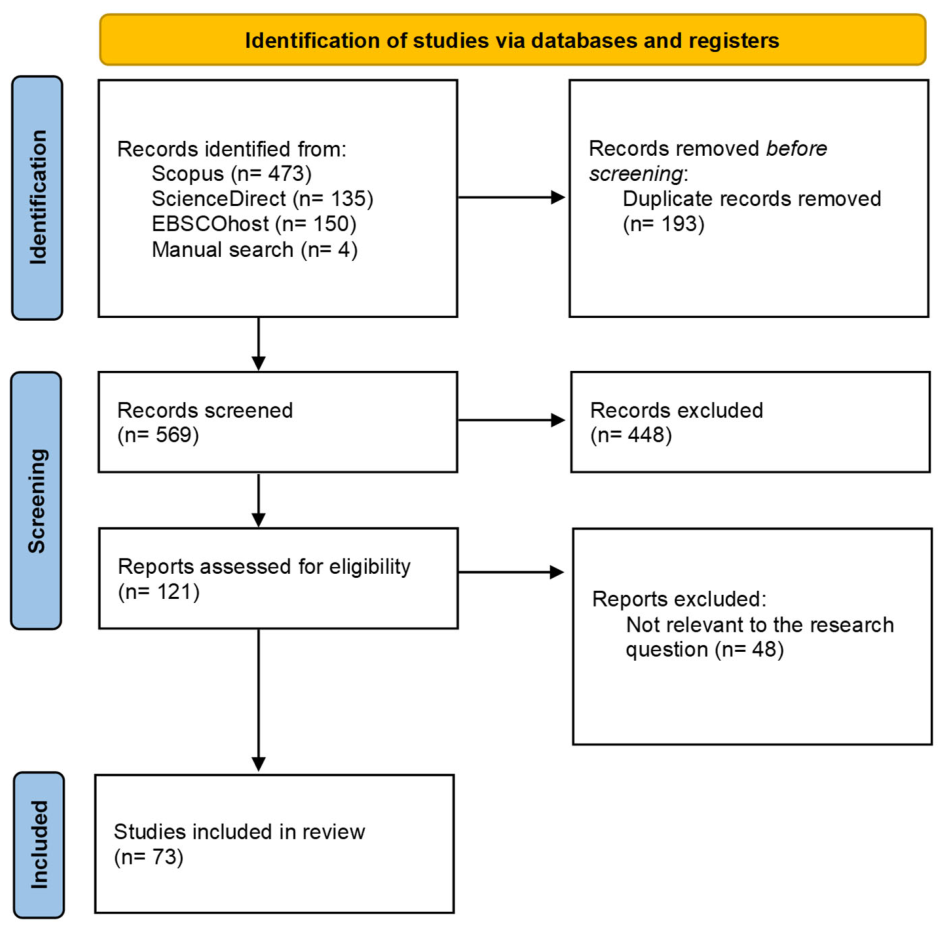
The initial search yielded 569 potentially relevant records after the removal of duplicates. The screening and selection process followed the PRISMA-ScR approach and consisted of a title and abstract screening to identify studies addressing the thematic scope of the review, followed by a full-text assessment to evaluate their eligibility. The process was conducted by three reviewers: each paper was assigned to one primary reviewer, while the other two reviewers independently cross-checked the extracted data to ensure accuracy and consistency. Studies were included if they contributed to at least one of the RQs by meeting one or more of the following criteria:
  • Analysis or comparison of circular strategies or regulatory frameworks, supporting the identification of dominant topics and research gaps (RQ1)
  • Examination of organizational, regulatory, or supply chain–related factors influencing the development or implementation of CBMs in the automotive industry (RQ2)
  • Empirical single-case or multiple-case studies involving automotive industry actors (e.g., Original Equipment Manufacturers (OEMs), suppliers, recyclers, remanufacturers) that provide insights into effective circular practices and strategies (RQ2 and RQ3)
  • Methodological tools, models, or Life Cycle Assessment (LCA) studies providing clear insights into the implementation and/or effectiveness of different CE approaches in the automotive industry.
Studies were excluded if they exhibited:
  • A purely technological focus (e.g., specific recycling technologies) with automotive-specific CE considerations only marginally discussed
  • An exclusive focus on mathematical optimization models (e.g., routing optimization, multi-criteria decision-making tools) or stand-alone LCA studies, where automotive-specific CE was not a central focus
  • A focus on industries other than automotive (e.g., aerospace or railway engineering),
  • A focus on traffic accidents or accident repair,
  • Analyses of parking systems (car parks),
  • Purely material-scientific or mechanical analyses,
  • A focus on materials or manufacturing technologies without a CE perspective at the firm level or
  • Purely macro-economic or regional analyses without a corporate focus.
The definition of the exclusion criteria resulted in the removal of a large number of papers (n = 448) from the analysis. In particular, the exclusion of studies with an exclusive focus on mathematical optimization models or stand-alone LCA studies without automotive-specific CE considerations led to the omission of many publications. These included studies addressing LCA methodologies [15] or network optimization models [16] that did not specifically focus on automotive actors, as well as macroeconomic modeling approaches with only limited relevance to the firm level [17]. Following the screening and eligibility assessment, 73 studies were identified as relevant and included in the qualitative analysis (see Figure 1). The Supplementary Materials provide a list of all the included studies. The results were thematically classified and mapped to the RQs to provide a structured and comprehensive overview of the current state of research and future research and action needs. The analysis followed a structured coding approach, combining deductive category development based on the RQs with inductive refinement during the analysis. The coding process was conducted collaboratively through iterative discussions among the authors to ensure consistency in category development and interpretation. The following information was recorded: author/source, year, title, reviewer within the team, type of study, content and focus of the paper, research gaps according to the author, obstacles, enablers, recommendations for action for stakeholders like governments and companies, geographical scope (e.g., country, region), and considered R-strategy. This data list was used for the evaluation of the literature and to answer the RQs, which are presented in the following chapter.

3. Results

The previously defined RQs are answered below based on the identified publications. First, the analysis examines the key topics dominating the scientific discourse on a circular automotive industry and identifies existing research gaps. Secondly, factors that facilitate or hinder the development and implementation of CBMs are explored, particularly in relation to organizational structures, regulatory frameworks, and positions within supply chains. Finally, the analysis highlights strategies and approaches that are considered especially promising for advancing the transformation of the automotive industry toward an effective CE.

3.1. RQ 1: Which Topics Dominate the Scientific Discourse on a Circular Automotive Industry and Which Research Gaps Can Be Identified?

The analysis of the literature provides an overview of thematic developments, research priorities and existing gaps in the transition toward a circular automotive industry. The aim is to systematically structure the current state of research on CE approaches in the automotive sector. In order to achieve this, the various CE-strategies (R-strategies) were structured as Recycle, Reuse, Repurpose, Remanufacture, Refurbish, and Repair, following a widely established hierarchy of circularity in which strategies are differentiated according to their potential to retain product value and reduce resource consumption [18]. Within this hierarchy, higher-order strategies that extend product use at the component or product level, such as Reuse or Repair, are generally associated with greater circularity benefits than material recovery-oriented approaches such as Recycling. In the same way, a structured comparison across different system levels of the automotive value chain was conducted, encompassing the categories of individual components, EV batteries, and whole vehicles.
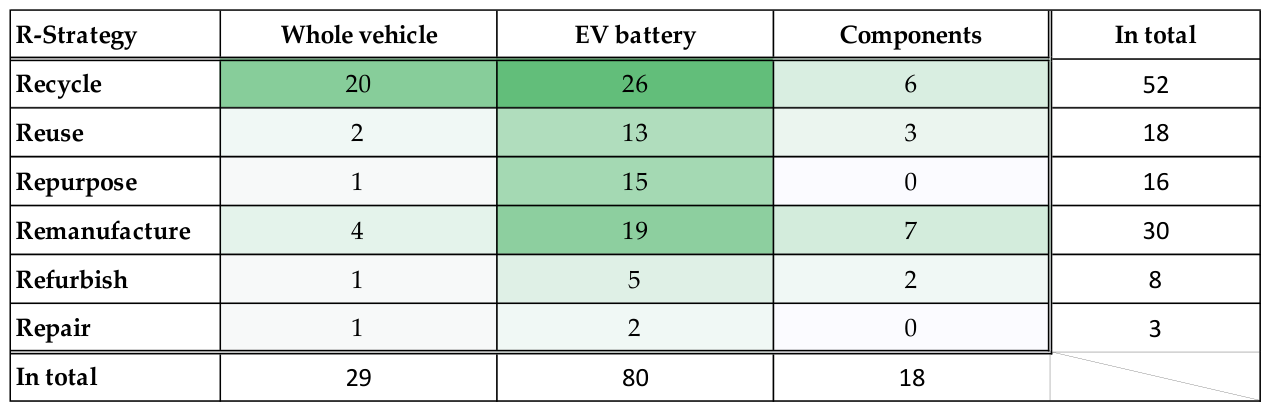
Figure 2 summarizes the number of publications per R-strategy and system level, noting that individual studies may address multiple categories. Publications were assigned to a category whenever a clear thematic connection was identified. Consequently, studies that provided an in-depth investigation of two or more R-strategies were counted multiple times. The color coding indicates the frequency of mentions, with darker shades of green representing a higher number of publications. The results reveal a strong dominance of recycling, particularly at the Electric vehicle (EV) battery level, followed by remanufacturing. Whole-vehicle studies also focus mainly on these two strategies, whereas reuse, refurbish and repair remain marginal. Component-level research is comparatively limited across all R-strategies. Overall, the distribution highlights significant imbalances in research efforts. The following sections therefore examine the literature in greater detail for each system level.

3.1.1. Overview: Vehicle

Table 1 shows that research on R-strategies in the vehicle sector is strongly concentrated on recycling-related topics, while higher-value circular strategies receive comparatively less attention. Recycling is by far the most extensively examined strategy and covers a wide range of thematic perspectives. Existing research addresses assessments of lightweight vehicle design [5], vehicle recycling system and dismantling [19], material flow analyses of aluminum within recycling systems [20,21] and metal recycling technologies [22,23]. Comparative assessments of recycling systems also contribute to this knowledge base [24]. Beyond technical process analyses, a significant part of the literature focuses on recycling planning and modeling, including recycling planning models [25], location-allocation models [26], costing and optimization models for reverse logistics [27] and the design of reverse logistics costing, optimization and networks (RLNs) [28]. Further specific fields are material circularity models [29], end-of-life (EoL) management for spare part resale [30], environmental and sustainability aspects are also represented, particularly analyses of recycling effects in EV production [31] and through LCA-based assessments of recycling pathways and material selection [2,32,33] and economic evaluations of aluminum-intensive vehicles [34]. Additional contributions address environmental management information systems and procedural aspects of vehicle recycling [35,36]. This indicates that recycling is primarily treated as a mature, well-established field, with a strong focus on efficiency, system optimization, and environmental impact quantification. The inclusion of topics such as environmental management information systems and EV-specific recycling effects further suggests increasing complexity due to electrification trends.
In contrast, reuse is addressed far less frequently and within a much narrower scope. The literature mainly focuses on conceptual material circularity models [29] and EoL management for spare parts [30], with limited attention to technical, logistical, or environmental evaluation. Repurposing is even more weakly represented. Research in this area is largely confined to generic material circularity models [29]. Remanufacturing shows a slightly broader but still limited coverage. Studies address location-allocation models [26], EoL management and material circularity modeling [29,30] and selected application-oriented cases, such as the conversion of steel waste into grating steel sheets [37]. The strategies of refurbishing and repairing are the least represented in the vehicle-focused literature and are almost exclusively discussed in relation to conceptual material circularity models [29]. This suggests that these strategies are still underdeveloped in research within the vehicle domain, despite their importance in extending product lifetimes and reducing resource demand.
Overall, the distribution of topics indicates a clear hierarchy in research maturity. Recycling dominates both in volume and methodological depth. Remanufacturing occupies an intermediate position, while other strategies (reuse, refurbish, repair, repurpose) remain comparatively underexplored.

3.1.2. Overview: EV Battery

Table 2 reveals that research on R-strategies in the field of EV batteries is strongly concentrated on recycling-oriented topics, similar to the broader vehicle domain, but with a noticeably higher emphasis on remanufacturing. Recycling remains by far the most extensively studied strategy and shows a high level of thematic diversity and maturity. Existing studies address battery-specific recycling and dismantling processes, assessment frameworks for recycling plants, EoL option analyses and regulatory interventions [6,38,39,40,41,42,43]. The review also focuses on opportunities and actor-related challenges [8,9,13,44], CBMs [45], and recycling system configurations [46]. In addition, a substantial body of research focuses on logistics and management aspects, including blockchain-enabled traceability, reverse logistics management, recycling network design and CLSC [11,47,48,49,50]. Moreover, additional emphasis is placed on participation, incentive and sanction mechanisms [10,51], circular spare part management [52], and collection and recycling decisions [53]. Environmental assessment plays a central role, particularly through LCA and material circularity assessment approaches [54,55,56]. Overall, this breadth reflects a comparatively mature research field driven by regulatory pressure and the growing relevance of battery recycling.
In contrast, reuse is addressed less frequently and within a more fragmented thematic scope. The literature mainly focuses on feasibility and EoL assessments, barriers and actor-related challenges and second-life applications of EV batteries as stationary energy storage systems, often evaluated using LCA-based approaches [8,58,59,60,61,62]. Additional contributions address blockchain applications, circular spare part management and CLSC design [47,50,52]. Compared to recycling, reuse is less focused on infrastructure design and more on value extension through functional repurposing of battery systems, although uncertainties regarding feasibility and actor involvement remain central barriers. The repurposing and remanufacturing strategies represent a more developed intermediate category. Existing studies primarily examine technical and environmental assessments, feasibility considerations, reverse logistics roles and network structures and CBMs, frequently in connection with second-life battery applications [45,54,63,64,65]. Despite this, both strategies remain less established than recycling. In contrast, Refurbish and Repair remain highly underrepresented. Research in these areas is largely confined to enabling factors such as circular design methods, blockchain technologies, circular spare part management and CLSC concepts [38,47,52]. This suggests that these strategies are still in early stages of methodological maturity within the EV battery domain.
Overall, the distribution indicates a clear stratification of research maturity. While recycling remains the most comprehensive field, the broader methodological landscape is strongly shaped by system modeling, optimization approaches, life cycle assessment, and circular supply chain design. Remanufacturing is increasingly integrated into these modeling frameworks, whereas reuse and repurposing are more application-driven but less structured. Refurbish and repair remain methodologically underdeveloped. This highlights a research gap in extending advanced system modeling approaches toward higher-value retention strategies in EV battery circularity.

3.1.3. Overview: Vehicle Components

The literature on vehicle components shows significantly lower research intensity compared to studies on entire vehicles or EV batteries and reveals a clear concentration on specific R-strategies, with a strong focus on a limited number of component-specific applications (see Table 3). Recycling is the dominant strategy at the component level. Research primarily focuses on technical analyses of individual components and materials, including the electric drivetrain, vehicle doors, magnesium and plastic parts and aluminum bodies [69,70,71,72,73]. Organizational aspects, such as outsourcing for sustainable reverse logistics, are addressed only marginally [74]. Recycling is therefore mainly treated as a technically oriented EoL solution.
Reuse is covered less frequently and centers on the electric drivetrain, material flow analyses and reverse logistics approaches [69,74,75]. Repurpose is entirely absent, indicating a clear research gap. Remanufacturing shows a fragmented research base, addressing selected technical and logistics-related topics such as metal losses, tire remanufacturing and supply chain challenges [7,69,76,77,78]. Refurbish is only marginally discussed, and repair is not addressed at all.
Overall, the distribution shows that R-strategies for vehicle components are significantly less systematized than in vehicle- or battery-level research. The literature is dominated by case-based and component-specific studies, with remanufacturing representing the most methodologically advanced category. However, the absence or marginal presence of several R-strategies highlights a substantial research gap in developing integrated circular economy frameworks at the component level, particularly for reuse, repurpose, repair, and refurbishment strategies.

3.1.4. Key Research Gaps and Barriers in the CE Within the Automotive Sector

The present summary of research gaps and barriers in the CE within the automotive sector is based on an analysis of the corresponding scientific discourse. It highlights the development and persistence of certain research gaps in the field of CE, particularly in the context of EV batteries and ELVs.
Lack of standardization of frameworks, methods and indicators. A fundamental research gap in the automotive CE context is the lack of standardized, practical and comparable frameworks, methods and indicators for the implementation and evaluation of circular strategies throughout the vehicle lifecycle. Literature shows that existing CE indicators are often considered in isolation, rarely linked to operational decision-making, and lack systematic integration along the value chain [29,56]. There are no widely accepted uniform frameworks for remanufacturing, component reuse, or circular product design [38,67]. Regulatory uncertainties, missing norms and inconsistent standards further exacerbate this deficit and complicate the practical application of circular approaches in the automotive sector [9,64].
Insufficient data availability, transparency deficits and missing information systems. Another central research gap concerns the insufficient availability of reliable, harmonized and cross-organizational data on vehicle composition, component usage duration, condition, return volumes and material flows at EoL. These data gaps interfere with both ecological and economic assessments and complicate the development of robust decision models [41,44]. Additionally, there is a lack of integrated information and IT systems that systematically link environmental, process and economic data to enable continuous traceability [35,67]. Missing transparency along reverse logistics chains, as well as inconsistent reporting requirements, reinforce these issues and create uncertainties in planning and investment decisions [47,57].
Technological and process-related challenges in return, disassembly and recycling. The literature identifies significant research gaps regarding the standardization and efficiency of technical processes in the return, disassembly, remanufacturing and recycling of vehicles and components. A high diversity of products and materials, complex constructions and a lack of modular designs lead to labor-intensive, costly and heterogeneous disassembly processes [42,69]. Simultaneously, economically viable sorting and separation technologies are lacking, resulting in material losses and quality degradation of secondary materials [21,70,71]. Quantitative comparative analyses of different recycling and recovery technologies are largely missing, as are integrated material and energy flow models that realistically represent circular options [54,55].
Economic, regulatory and societal barriers. Finally, there is a pronounced research gap in the integrated analysis of economic, regulatory and societal conditions for circular value creation in the automotive sector. Investment risks, unclear profitability of remanufacturing and reuse strategies and lack of scalable business models remain insufficiently explored, especially for SMEs [8,12]. Regulatory frameworks are often missing harmonized, practical provisions for vehicle and component take-back, reuse and recycling [24,25]. Moreover, societal factors such as ownership of ELVs, low willingness to return products and acceptance issues regarding secondary materials are inadequately considered, even though they significantly influence return volumes and quality of circular material flows. The entrepreneurial and social acceptance of CBMs remains limited, particularly with regard to return or leasing concepts [10,43].
Lack of holistic sustainability and environmental assessments. Life cycle and environmental assessments often focus on individual aspects and neglect the integration of ecological, economic and social dimensions [64]. Inconsistent data and varying recycling technologies lead to high uncertainty in assessment outcomes [31,55]. The diversity of battery designs complicates standardized methods, particularly for second-life applications [66]. Furthermore, the usage context is often not considered, even though it is critical for realistic environmental assessments [54].

3.2. RQ 2: Which Institutional Factors Facilitate or Hinder the Development and Implementation of CBMs?

Based on the conducted scoping review, 17 specific case studies on company-level development and implementation of CBMs and related approaches in the automotive industry were identified (see Table 4). These studies reveal substantial differences regarding enabling and inhibiting factors, depending on the role within the automotive value chain, established company structures, as well as regional and regulatory embedding.

3.2.1. Overview: Structural and Geographical Classification of the Case Studies

The analyzed case studies cover eight OEMs, six recyclers or remanufacturers, and three supplier companies. This distribution already indicates that academic CBM literature in the automotive context places a stronger emphasis on downstream stages of the value chain, where reverse logistics, disassembly, and circular valorization become particularly relevant.
Geographically, most case studies are located in China (n = 8) and the EU (n = 7). Notably, no case studies from North or South America are identified, which may reflect regional differences in the maturity of CE initiatives. However, given that the United States has had a well-developed remanufacturing market since 1996, and that the U.S. remanufacturing market is estimated at USD 53 billion annually, with nearly 70% of revenues generated in the automotive sector [3], this absence may also be attributable to regional publication patterns.
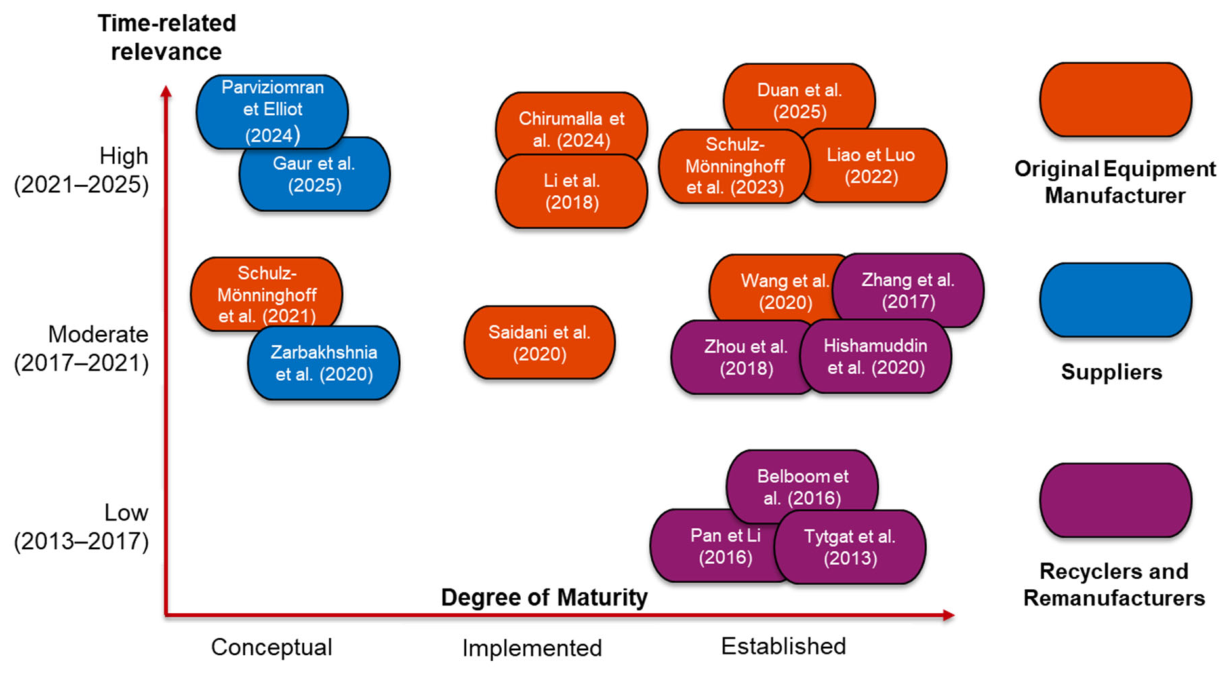
For the subsequent analysis, the case studies are differentiated according to their position along the value chain, distinguishing between OEMs, recyclers, remanufacturers, and suppliers. In addition, the maturity level of the companies regarding the implementation of CE approaches is assessed using a three-stage classification: The category “Conceptual” refers to a company’s strategic engagement with CE approaches at a purely conceptual level, without having translated them into implemented measures. “Implemented” denotes the next stage, including completed pilot projects that have not yet been scaled. The category “Established” describes a functioning circular approach that typically still exhibits optimization potential and therefore remains the subject of academic investigation. Figure 3 provides an overview of the studies analyzed by contrasting publication recency and maturity level, differentiated by supply chain position.

3.2.2. OEM

The identified OEM-related case studies predominantly focus on battery take-back and recycling (six papers). This focus results from regulatory dynamics (e.g., European battery and EoL regulations) as well as from the strategic and economic importance of vehicle batteries. Furthermore, many case studies examine CE pioneers that have already established reverse logistics infrastructures or developed second-life concepts. For example, Duan et al. (2025) [67] analyze Tesla as an early adopter of CE, focusing on opportunities to optimize CLSCs of batteries through blockchain technologies. Wang et al. (2020) [11] investigate Chang’an Automobile with regard to optimization options for its established recycling network, consisting of eight collection centers, two waste treatment facilities and a recycling and remanufacturing center. Chirumalla et al. (2024) [1] examine a heavy-duty vehicle manufacturer aiming to achieve 100% fossil-free operations by 2040, which can also be interpreted as an indicator of strong environmental commitment.
The pioneering role of selected OEMs illustrates that large, capital-intensive firms possess greater capabilities to pilot complex CBMs and embed them within organizational strategies. Factors such as high innovation capacity, strong environmental orientation, and the ability to integrate digital technologies (e.g., blockchain-based traceability) prove particularly empowering. At the same time, the OEM-related literature highlights that reverse flows of EoL products, especially batteries, remain challenging due to an imbalance between product inflows and outflows [49,56] and the large variations in quality, as well as in terms of different technical standards, such as cell chemistries [49,58,67].

3.2.3. Recycler and Remanufacturer

Companies operating at the recycling and remanufacturing stage typically exhibit established processes in the analyzed case studies. However, further development strongly depends on economic conditions. Several studies emphasize the importance of cost optimization, particularly in take-back logistics, disassembly processes, and the profitability of specific recycling pathways.
Consequently, multiple papers address the development of evaluation models and decision-support systems aimed at improving technical and environmental efficiency. For instance, Pan and Li (2016) [32] assess an ELV recycling system and develop an optimized energy-based indicator system to evaluate resource efficiency, environmental impact, economic performance, and technical efficiency. Zhou et al. (2018) [27] propose an approach for analyzing and optimizing reverse logistics costs and apply it to an established Chinese vehicle recycler. Zhang et al. (2017) [3] identify low profit margins as a major challenge in their analysis of several Chinese remanufacturing companies. At the same time, these firms benefit from regulatory frameworks that increase material return flows. For example, EU Directive 2000/53/EC creates market pressure for efficient recycling, while the EU Battery Directive and related regulations require manufacturers to meet specific recycling targets [2,57].
Notably, the literature on recyclers and remanufacturers is less current than that on other value chain stages. The available case studies were published between 2013 and 2021, which limits their ability to reflect current business practices. Given the rapid increase in battery electric vehicles (BEVs) penetration in recent years, updated investigations of these actors appear particularly relevant.

3.2.4. Supplier

The limited number of available case studies on suppliers indicates that companies at this stage of the value chain are significantly earlier in the transformation process compared to OEMs and recyclers. Two of the three cases analyzed remain in conceptual or strategic phases of their CE-related activities. Key challenges include limited financial resources and the absence of systemic frameworks. Organizational characteristics such as SME status appear particularly inhibiting [8] and are further reinforced by structural disadvantages, including the lack of direct access to EoL products.
In contrast to OEM-focused studies, supplier case studies exhibit considerable diversity in terms of analyzed vehicle components. While Parviziomran and Elliot (2024) [8] focus on a battery manufacturer, Gaur et al. (2025) [50] examine Arfat Auto Industries as a producer of brake pads and clutches. Zarbakhshnia et al. (2020) [74] analyze Kerman Khodro Powertrain Co. as a manufacturer and supplier of engines, transmissions, and axles.

3.3. RQ 3: Which Strategies and Approaches Are Considered Particularly Promising for Advancing the Transformation of the Automotive Industry Towards an Effective CE?

CE is increasingly recognized as a major societal challenge that requires shared responsibility among academia, practitioners, and policymakers [38,65]. Against this background, this section analyzes which stakeholder groups are addressed by the recommendations in the academic literature and how these recommendations are intended to support the transition toward a circular automotive industry.
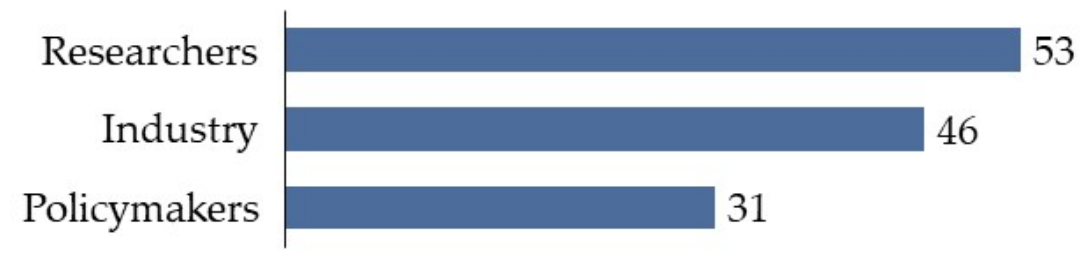
An initial analysis of the reviewed studies indicates that recommendations are primarily directed at industrial companies, policymakers, and research institutions. While some studies address all three stakeholder groups, others focus exclusively on individual stakeholders. The numerical distribution of addressed stakeholders is presented in Figure 4. The results indicate that the majority of studies focus on research institutions, followed by industrial companies, with policymakers being the least frequently addressed.
This section analyzes the specific recommendations addressed to each stakeholder group. The focus is placed on the most frequently mentioned thematic fields, as the frequency of occurrence can be interpreted as an indicator of the perceived relevance of the respective recommendations.

3.3.1. Recommendations for Research Institutions

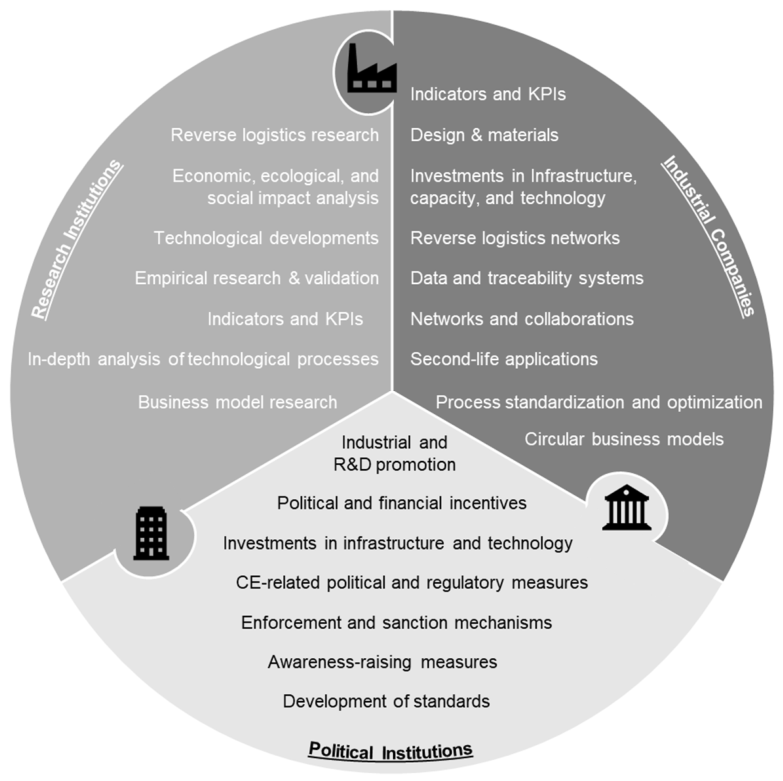
Research institutions play a central role in the transformation toward a circular automotive industry. The reviewed studies particularly emphasize the need for expanded empirical research as well as the further development of evaluation methods and indicator systems.
Empirical Research and Validation (20 studies). The most frequently mentioned research need concerns the lack of empirically grounded studies in key areas of the circular automotive industry. Specifically, empirical investigations are required in relation to blockchain applications [67], CE barriers for SMEs [8], remanufacturing and second-life EV battery applications [41], and battery recycling networks [11]. Further research priorities include long-term assessments of EU battery recycling regulations [44], longitudinal studies on battery degradation in second-life applications [60], analyses of material flow changes induced by new vehicle technologies [24], and evaluations of the efficiency and environmental impacts of separation technologies [70]. In addition, a strong need is identified for validating existing indicators and frameworks in real production and recycling contexts [1,38].
Development of Assessment Methods and Key Performance Indicators (KPIs) (17 studies). Another major thematic area concerns the development of practical assessment methods for quantitatively capturing CE impacts. Several studies emphasize the need to integrate environmental and social indicators into existing cost–benefit analyses and material flow models [25,39]. Tang et al. (2023) [10] argues that, beyond recycling rates, additional KPI, such as emission reduction through secondary material use, should receive greater attention. Further research needs include systemic assessment models for battery circular systems [41] and holistic, standardized evaluation procedures for second-life batteries [60,63,75].
Technological Development (15 studies). Recommendations in this cluster focus on technological development needs, including vehicle and component design, alternative materials and standardized data formats. Duan et al. (2025) [67] identify the need for interoperable data standards for circular value creation, while Jacquet et al. (2023) [69] highlights the need for improved design guidelines. Moreover, Sato et al. (2018) [75] analyze the environmental impacts of different design approaches, such as design for reuse, and emphasize their relevance for circularity.
Additional clusters include analyses of economic, environmental, and social impacts (15 studies), research on strategies, business models, and profitability assessments (13 studies), optimization of reverse logistics and closed-loop networks (13 studies), and in-depth technological and process-oriented studies (11 studies).

3.3.2. Recommendations for Industry

The thematic distribution of recommendations for industrial actors highlights that companies play a central role in the CE transformation of the automotive value creation system at both strategic and operational levels. The following thematic clusters can be identified in the literature, ranked in descending order of frequency:
Integration of Data and Traceability Systems (18 studies). Data exchange, transparency, and traceability play a key role in company-related recommendations. Several authors call for the development and integration of diagnostic, information, and monitoring systems [23,41,59]. These systems aim to improve the transparency and controllability of material flows along circular value chains [24,25,30]. In particular, data sharing is considered crucial in the context of EV batteries [67]. Recommended measures include the introduction of battery passports [47] and the use of blockchain and IoT technologies to enhance traceability [10].
Process Standardization and Optimization (18 studies). Technological and procedural barriers are identified as major obstacles to the implementation of circular approaches, largely due to the high heterogeneity of recycling and recovery technologies [20]. Especially in battery disassembly, varying cell chemistries, construction designs, and insufficient sorting technologies hinder efficient processes [21,41]. Accordingly, technological advancements as well as the standardization and optimization of processes are regarded as key enablers. These include standardized remanufacturing processes [67] and advances in recycling and disassembly technologies, such as hydrometallurgy [31], post-shredder treatments [71], air classifiers, and gasification technologies [24]. In addition, advanced sorting methods, such as float-sink systems and x-ray fluorescence analysis, enable more precise material separation [70].
Circular Design and Materials (14 studies). Modular product architectures and the selection of recycling-friendly materials are considered key design factors for a circular automotive industry [69]. The literature emphasizes the need for simplification and standardization of component designs, for example, through part standards and increased model compatibility [75]. The “design for recycling” approach, which integrates recyclability and ease of disassembly at early development stages, is particularly highlighted [21,71].
Additional thematic clusters include investments in infrastructure, capacity, and technology (11 studies), the promotion of second-life applications (11 studies), the development of cooperation and network structures (10 studies), the establishment of KPI systems (nine studies), the integration of CBMs (eight studies), and the development of reverse logistics systems (seven studies).

3.3.3. Recommendations for Government and Policymakers

Governments have a substantial influence on the development of the automotive industry through legislative and regulatory measures [29]. The wide range of political recommendations in the literature reflects this role.
Implementation of CE-Related Policies and Regulations (17 studies). The reviewed studies emphasize the need for clear and consistent regulations to promote CE practices. Particular attention is paid to EU-related instruments, such as the Battery Regulation [38,47], the ELV Directive (2000/53/EC) [2,24], and the Circular Economy Action Plan [38,64]. Recommended measures include revising existing legislation that hinders circular approaches, implementing extended producer responsibility (EPR) schemes [48], and establishing standardized testing and labeling systems for reusable components [25]. A major focus concerns ELVs. The literature highlights the importance of consistent enforcement and further development of ELV regulations, including higher recovery targets [25], clear legal frameworks for ELV take-back with defined recycling quotas and EPR [28], and binding regulations with explicit targets and sanction mechanisms [22]. The expansion of authorized ELV treatment facilities is also recommended [23]. With regard to EV batteries, the literature advocates clear regulatory frameworks for collection, take-back, and recycling, as well as regulatory and normative clarity for second-life applications [41,64,65].
Industrial and R&D Support (15 studies). Tailored support for industrial actors and research institutions is identified as a key prerequisite for developing a circular automotive industry. The reviewed studies suggest that policymakers should promote value chain collaboration [29] and support circular practices through pilot and demonstration projects. Bobba et al. (2018) [64] emphasizes the importance of funding measures to facilitate market formation and scaling of second-life battery applications. In addition, political support for sustainable recycling practices and existing recycling infrastructures is frequently requested [2,32]. Focused funding for investments in collection, disassembly, and recycling technologies is also recommended [28,55].
Financial Incentives (11 studies). Appropriate regulatory frameworks incorporating economic incentive mechanisms are considered key levers for accelerating CBMs [10,39]. The literature highlights the need for tax incentives, for example, for ELV recyclers [26], as well as subsidies for recycling and service infrastructure development [10]. Furthermore, differentiated incentive systems are proposed, including support for blockchain-based circular solutions [67], eco-design incentives and circular car initiatives [29], incentives for plastics recycling [71] and support schemes for secondary aluminum utilization [21].
Additional clusters include government-directed infrastructure and technology investments (10 studies), enforcement and sanction mechanisms (seven studies), standard development and harmonization (seven studies), and public awareness measures (five studies).

4. Discussion and Conclusions

This paper aimed to provide a comprehensive and structured assessment of the automotive industry’s transition towards a CE by identifying dominant research themes and gaps, analyzing enabling and limiting factors across organizational and supply chain contexts and deriving stakeholder-specific strategies to advance the transformation. To this end, three central RQs were formulated and systematically examined using a scoping review.

4.1. RQ 1: Dominant Research Themes and Gaps Regarding CBM in the Automotive Industry

First, the dominant research topics and existing research gaps in the scientific discourse were identified. The results of the review reveal a clear focus on recycling, particularly at the EV battery level, followed by remanufacturing. Studies addressing entire vehicles also predominantly concentrate on these two strategies, whereas reuse, refurbishment, and repair remain comparatively marginal. At the component level, research activity is generally limited across all R-strategies. The findings demonstrate a strong research emphasis on recycling as the dominant EoL strategy for vehicles, whereas higher-priority R-strategies remain significantly underexplored. This imbalance highlights clear research gaps and underlines the need for future studies to focus more strongly on applied, vehicle-specific analyses, system integration and sustainability assessment.
The explicit analysis of literature-based research gaps indicates substantial development potential regarding the standardization of frameworks, methods, and indicators. In addition, insufficient data availability, transparency deficits, a lack of information systems and technological and process-related challenges in take-back, dismantling and recycling make it difficult to implement circular practices. Economic, regulatory and social barriers, as well as a lack of holistic sustainability and environmental assessments, should continue to be addressed in the future.

4.2. RQ 2: Enabling and Inhibiting Factors for CBMs in the Automotive Industry

The second RQ aimed to examine the factors that facilitate or inhibit the development and implementation of CBMs in relation to organizational structures, regulatory frameworks and positions within automotive supply chains. The key findings are:
  • OEM-focused studies primarily examine companies considered pioneers of CE, with emphasis on battery take-back and recycling.
  • Recyclers and remanufacturers operate mature technical processes but remain economically vulnerable. In addition, the limited recency of available studies may not fully reflect current industry dynamics.
  • Supplier-focused case studies remain scarce and indicate predominantly early-stage CBM development. Company size, particularly the limited resources of SMEs, emerges as a key influencing factor.
A comparative analysis of the case studies indicates a heterogeneous level of CE maturity across the automotive value chain. OEM-related studies predominantly focus on battery recycling and take-back systems, reflecting both the strategic importance of EV batteries and the influence of existing regulatory frameworks. Recyclers and remanufacturers generally operate comparatively mature technical processes, although their further development strongly depends on the optimization of existing cost structures. In contrast, many suppliers, particularly SMEs, appear to remain in early-stage or conceptual phases of CE transformation due to limited financial and organizational resources, missing systemic frameworks, and restricted access to EoL products. Across all actor groups, economic feasibility, supportive regulatory conditions, and the availability of suitable infrastructure emerge as central determinants for successful CBMs.

4.3. RQ 3: Future Roadmap for a “Circular Automotive Industry”

Finally, in response to the third RQ, promising strategies and approaches were systematically derived from the scientific literature to advance the transformation of the automotive industry towards an effective CE. The analysis of recommendations demonstrates that the transition toward a circular automotive industry requires coordinated interaction among industry, government, and research. The literature clearly indicates that none of these stakeholder groups is capable of independently driving the transformation. Rather, circularity emerges from the interaction of regulatory frameworks, corporate implementation strategies, and scientific research (see Figure 5).

4.4. Synthesis of Findings from RQ1–RQ3

To integrate and interpret the results across the different RQs, it is useful to focus on the two central findings within this study.
The first central finding is the strong dominance of battery-related topics compared to other vehicle components. When linking this observation with the industry perspective (RQ2), it becomes evident that this focus is largely driven by OEMs. Due to the high-cost share and the value of critical materials, OEMs primarily concentrate their CE activities on battery-related solutions. In contrast, upstream supply chain actors such as specialized suppliers tend to focus on other components aligned with their core competencies. However, these activities often remain at a comparatively low level of maturity. This can be attributed to structural constraints, as many suppliers are SMEs with limited financial resources and a greater distance from end customers, which complicates both the return of used components and the broad implementation of CE strategies. A closer look at political actors further explains the strong emphasis on batteries. In this domain, regulatory frameworks already exist that actively promote CE approaches. However, to extend the transition towards a CE across the entire automotive industry, the recommendations identified in RQ3, such as creating reliable regulatory structures, supporting research and industrial pilot projects as well as establishing effective incentive systems, need to be expanded beyond the battery domain. In particular, future policy measures should increasingly address other resource-intensive and critical vehicle components. As identified in RQ1, initial CE approaches already exist for electric drivetrains, vehicle doors, magnesium components, and aluminum bodies, providing a foundation for further policy support and scaling efforts. Furthermore, stronger support mechanisms are required for financially constrained actors, especially SME suppliers, who often face limited financial, technological, and organizational capacities to implement CE strategies. Potential support measures may include targeted funding programs, standardized CE guidelines, and simplified access to refurbishment and remanufacturing infrastructures.
At the same time, both political actors and research institutions should place greater emphasis on recyclers and remanufacturers, which play a crucial role in enabling circular value creation. The findings indicate that these actors face persistent challenges regarding economic viability, while recent academic attention has been comparatively limited. Research institutions, in their role as knowledge generators, can address this gap by advancing empirical validation, developing robust indicators, and establishing standardized assessment methods, particularly for these downstream supply chain stages. In parallel, political actors can support these efforts through targeted incentive systems and policy instruments that enhance economic feasibility by enabling improved cost structures or market conditions.
The second key finding is the strong concentration of both research and practice on recycling as the dominant CE strategy, whereas higher-priority R-strategies, such as reuse, repurpose, refurbish, and repair, remain significantly underexplored. Strengthening these higher-value strategies, which preserve a larger share of embedded materials and value, requires a sufficient return flow of well-maintained vehicles and components.
From this perspective, effective take-back systems emerge as a critical bottleneck. However, according to the analysis, even highly capable actors such as OEMs are still in the process of establishing such systems. The findings therefore suggest that the development of robust take-back systems cannot be achieved by individual actors alone but requires coordinated efforts across the entire ecosystem. This perspective aligns with authors addressing key enablers for the transition towards a CE, such as data standards, battery passports, traceability, and second-life applications, who also emphasize the active involvement of multiple stakeholders as a critical success factor [67].
To achieve this, each group of actors has distinct responsibilities: industrial companies need to prioritize the further development and implementation of shared take-back solutions [46]. Policymakers, who have already established several CE-related regulations, should further strengthen their focus on CE by developing effective enforcement mechanisms that facilitate collaboration between stakeholders. As the findings suggest a lack of incentives for dominant players to share information that is critical across the value chain [47], policymakers can address this challenge by providing targeted funding for collaborative projects involving multiple industry actors to establish and scale take-back systems. These efforts could be further strengthened through collaborative initiatives focused on cross-company CE infrastructures, as well as through the introduction of mandatory information-sharing standards to improve transparency and coordination along the value chain. In this context, the recent literature on stakeholder participation in CE systems should be taken into account [43]. Finally, research institutions should contribute by providing empirical evidence on the effectiveness of collaborative take-back systems.

4.5. Limitations

This systematic review has several limitations. Regarding the focus of our research, it should be noted that we concentrated on CE-related developments from a managerial perspective, rather than providing an in-depth analysis of technological aspects. While basic technology-related elements were considered, future research should address these dimensions more explicitly and in greater detail.
In addition, several methodological limitations should be acknowledged. First, the search strategy was limited, as only selected databases were considered. This means that relevant studies indexed in other databases may not have been identified. Second, only English-language publications were included, which means that language bias cannot be ruled out. Third, despite the systematic development of the search strategy, there is a risk that the applied search terms did not fully cover all relevant synonyms or related concepts. Moreover, due to the emerging and exploratory nature of the research field, the review focused primarily on conceptual synthesis rather than a formalized quality appraisal of the included studies. Consequently, the absence of a standardized quality assessment may affect the robustness and comparability of the synthesized findings. Also, a formal inter-rater reliability assessment was not conducted and should be considered in future research designs. Finally, subjective decisions in the application of inclusion and exclusion criteria, especially in unclear or ambiguous studies, cannot be completely ruled out. Collectively, these factors may have influenced the comprehensiveness, reproducibility and objectivity of the study selection process.

Supplementary Materials

The following supporting information can be downloaded at: https://www.mdpi.com/article/10.3390/su18115240/s1, Preferred Reporting Items for Systematic reviews and Meta-Analyses extension for Scoping Reviews (PRISMA-ScR) checklist; Consolidated overview of all studies and publications included in the scoping review (shortened database).

Author Contributions

Conceptualization, C.H., M.D. and D.B.; Methodology, M.D., D.B. and S.A.T., Validation, M.D., D.B. and S.A.T.; Investigation, M.D., D.B. and S.A.T.; Data Curation, M.D. and D.B.; Writing—Original Draft Preparation, M.D., D.B. and S.A.T.; Writing—Review and Editing, M.D., D.B. and C.H.; Visualization, M.D. and D.B.; Supervision, C.H.; Project Administration, C.H. All authors have read and agreed to the published version of the manuscript.

Funding

This study is part of the transformation network for an electric, sustainable and digital automotive industry (referred to as TrendAuto2030plus), funded by the German Federal Ministry of Economics and Energy (BMWE), funding number: 16TNW0017A.

Institutional Review Board Statement

Not applicable.

Informed Consent Statement

Not applicable.

Data Availability Statement

The original data presented in the study are openly available in Zenodo at https://doi.org/10.5281/zenodo.19480593, accessed on 9 April 2026.

Conflicts of Interest

The authors declare no conflicts of interest.

Abbreviations

The following abbreviations are used in this manuscript:
CECircular Economy
RQResearch Question
OEMOriginal Equipment Manufacturer
CLSCClosed-Loop Supply Chain
EoLEnd-of-Life
ELVEnd-of-Life Vehicle
EVElectric Vehicle
RLNReverse Logistics Network
EUEuropean Union
SMESmall- and Medium-sized Enterprise
KPIKey Performance Indicator
EPRExtended Producer Responsibility
CBMCircular Business Model
LCALife Cycle Assessment
BEVBattery Electric Vehicle

References

  1. Chirumalla, K.; Balestrucci, F.; Sannö, A.; Oghazi, P. The Transition from a Linear to a Circular Economy through a Multi-Level Readiness Framework: An Explorative Study in the Heavy-Duty Vehicle Manufacturing Industry. J. Innov. Knowl. 2024, 9, 100539. [Google Scholar] [CrossRef] [Scilit]
  2. Belboom, S.; Lewis, G.; Bareel, P.-F.; Léonard, A. Life Cycle Assessment of Hybrid Vehicles Recycling: Comparison of Three Business Lines of Dismantling. Waste Manag. 2016, 50, 184–193. [Google Scholar] [CrossRef] [Scilit] [PubMed]
  3. Zhang, J.-H.; Yang, B.; Chen, M. Challenges of the Development for Automotive Parts Remanufacturing in China. J. Clean. Prod. 2017, 140, 1087–1094. [Google Scholar] [CrossRef] [Scilit]
  4. Smith, V.M.; Keoleian, G.A. The Value of Remanufactured Engines: Life-Cycle Environmental and Economic Perspectives. J. Ind. Ecol. 2004, 8, 193–221. [Google Scholar] [CrossRef] [Scilit]
  5. Sato, F.E.K.; Nakata, T. Analysis of the Impact of Vehicle Lightweighting on Recycling Benefits Considering Life Cycle Energy Reductions. Resour. Conserv. Recycl. 2021, 164, 105118. [Google Scholar] [CrossRef] [Scilit]
  6. Balakrishnan, A.S.; Ramanathan, R.; Ramanathan, U.; Srinivasan, R. (Ramki) Responsible Battery Disposal Management Practices: An Investigation in the Electric Vehicle Industry from a Circular Economy Perspective. J. Environ. Manag. 2025, 383, 125488. [Google Scholar] [CrossRef] [Scilit]
  7. Zhang, Z.; Matsubae, K.; Nakajima, K. Impact of Remanufacturing on the Reduction of Metal Losses through the Life Cycles of Vehicle Engines. Resour. Conserv. Recycl. 2021, 170, 105614. [Google Scholar] [CrossRef] [Scilit]
  8. Parviziomran, E.; Elliot, V. Barriers to Circular Economy: Insights from a Small Electric Vehicle Battery Manufacturer. J. Purch. Supply Manag. 2024, 30, 100905. [Google Scholar] [CrossRef] [Scilit]
  9. Chizaryfard, A.; Nuur, C.; Trucco, P. Managing Structural Tensions in the Transition to the Circular Economy: The Case of Electric Vehicle Batteries. Circ. Econ. Sustain. 2022, 2, 1157–1185. [Google Scholar] [CrossRef] [Scilit]
  10. Tang, Y.; Zhang, Q.; Liu, B.; Li, Y.; Ni, R.; Wang, Y. What Influences Residents’ Intention to Participate in the Electric Vehicle Battery Recycling? Evidence from China. Energy 2023, 276, 127563. [Google Scholar] [CrossRef] [Scilit]
  11. Wang, L.; Wang, X.; Yang, W. Optimal Design of Electric Vehicle Battery Recycling Network—From the Perspective of Electric Vehicle Manufacturers. Appl. Energy 2020, 275, 115328. [Google Scholar] [CrossRef] [Scilit]
  12. Li, L.; Dababneh, F.; Zhao, J. Cost-Effective Supply Chain for Electric Vehicle Battery Remanufacturing. Appl. Energy 2018, 226, 277–286. [Google Scholar] [CrossRef] [Scilit]
  13. Feng, J.; Liu, W.; Chen, F. Moving towards a Circular Economy: A Systematic Review of Barriers to Electric Vehicle Battery Recycling. Sustain. Prod. Consum. 2025, 54, 241–260. [Google Scholar] [CrossRef] [Scilit]
  14. Page, M.J.; McKenzie, J.E.; Bossuyt, P.M.; Boutron, I.; Hoffmann, T.C.; Mulrow, C.D.; Shamseer, L.; Tetzlaff, J.M.; Akl, E.A.; Brennan, S.E.; et al. The PRISMA 2020 Statement: An Updated Guideline for Reporting Systematic Reviews. BMJ 2021, 372, n71. [Google Scholar] [CrossRef] [Scilit]
  15. Cusenza, M.A.; Guarino, F.; Longo, S.; Ferraro, M.; Cellura, M. Energy and Environmental Benefits of Circular Economy Strategies: The Case Study of Reusing Used Batteries from Electric Vehicles. J. Energy Storage 2019, 25, 100845. [Google Scholar] [CrossRef] [Scilit]
  16. Kusakci, A.O.; Ayvaz, B.; Cin, E.; Aydin, N. Optimization of Reverse Logistics Network of End of Life Vehicles under Fuzzy Supply: A Case Study for Istanbul Metropolitan Area. J. Clean. Prod. 2019, 215, 1036–1051. [Google Scholar] [CrossRef] [Scilit]
  17. Watari, T.; Nansai, K.; Nakajima, K.; Mclellan, B.C.; Dominish, E.; Giurco, D.P. Integrating Circular Economy Strategies with Low-Carbon Scenarios: Lithium Use in Electric Vehicles. Environ. Sci. Technol. 2019, 53, 11657–11665. [Google Scholar] [CrossRef] [Scilit]
  18. Potting, J.; Hekkert, M.P.; Worrell, E.; Hanemaaijer, A. Circular Economy: Measuring Innovation in the Product Chain; PBL Netherlands Environmental Assessment Agency: The Hague, The Netherlands, 2017. [Google Scholar]
  19. Zajac, P.; Ejdys, S.; Balicki, P. Rationalisation of the Functioning of Vehicle Recycling. Rocz. Ochr. Sr. 2023, 25, 329–341. [Google Scholar]
  20. Dordević, M.; Pavlović, A.; Arsovski, S.; Pavlović, M.D.; Jevtić, D.S. Material Flows within an End-of-Life Vehicle Recycling System—A Periodical Analysis of Generated Quantities. Strojarstvo 2011, 53, 469–475. [Google Scholar]
  21. Hatayama, H.; Daigo, I.; Matsuno, Y.; Adachi, Y. Evolution of Aluminum Recycling Initiated by the Introduction of Next-Generation Vehicles and Scrap Sorting Technology. Resour. Conserv. Recycl. 2012, 66, 8–14. [Google Scholar] [CrossRef] [Scilit]
  22. Altay, M.C.; Sivri, N.; Onat, B.; Şahin, Ü.; Zorağa, M.; Altay, H.F. Recycle of Metals for End-of-Life Vehicles (ELVs) and Relation to Kyoto Protocol. Renew. Sustain. Energy Rev. 2011, 15, 2447–2451. [Google Scholar] [CrossRef] [Scilit]
  23. Zamri, M.K.; Saibani, N.; Rahman, M.N.A.; Tawil, N.M.; Pisal, S.M.M.; Tarmidi, R.; Hishamuddin, H. Recent Recycling Procedures for End-of-Life Vehicles (ELV) Metals in Malaysia; Prosedur Terkini Bagi Kitar Semula Logam Daripada Kenderaan Akhir Hayat (ELV) Di Malaysia. J. Kejuruter. 2023, 6, 229–237. [Google Scholar] [CrossRef] [Scilit] [PubMed]
  24. Sakai, S.I.; Yoshida, H.; Hiratsuka, J.; Vandecasteele, C.H.A.; Kohlmeyer, R.; Rotter, V.S.; Passarini, F.; Santini, A.; Peeler, M.V.; Li, J. An International Comparative Study of End-of-Life Vehicle (ELV) Recycling Systems. J. Mater. Cycles Waste Manag. 2014, 16, 1–20. [Google Scholar] [CrossRef] [Scilit]
  25. Simic, V.M.; Dimitrijević, B. Interval Linear Programming Model for Long-Term Planning of Vehicle Recycling in the Republic of Serbia under Uncertainty. Waste Manag. Res. 2015, 33, 114–129. [Google Scholar] [CrossRef] [Scilit] [PubMed]
  26. Xiao, Z.; Sun, J.; Shu, W.; Wang, T. Location-Allocation Problem of Reverse Logistics for End-of-Life Vehicles Based on the Measurement of Carbon Emissions. Comput. Ind. Eng. 2019, 127, 169–181. [Google Scholar] [CrossRef] [Scilit]
  27. Zhou, Z.; Cai, Y.; Xiao, Y.; Chen, X.; Zeng, H. The Optimization of Reverse Logistics Cost Based on Value Flow Analysis—A Case Study on Automobile Recycling Company in China. J. Intell. Fuzzy Syst. 2018, 34, 807–818. [Google Scholar] [CrossRef] [Scilit]
  28. Dai, H.; Wang, Q. Reverse Logistics Network Design for the Collection of End-Oflife Vehicles. Proc. ASME Des. Eng. Tech. Conf. 2012, 5, 541–548. [Google Scholar]
  29. Martins, A.V.; Godina, R.; Azevedo, S.G.; Carvalho, H. Towards the Development of a Model for Circularity: The Circular Car as a Case Study. Sustain. Energy Technol. Assess. 2021, 45, 101215. [Google Scholar] [CrossRef] [Scilit]
  30. Saidani, M.; Yannou, B.; Leroy, Y.; Cluzel, F. Dismantling, Remanufacturing and Recovering Heavy Vehicles in a Circular Economy—Technico-Economic and Organisational Lessons Learnt from an Industrial Pilot Study. Resour. Conserv. Recycl. 2020, 156, 104684. [Google Scholar] [CrossRef] [Scilit]
  31. Hao, H.; Qiao, Q.; Liu, Z.; Zhao, F. Impact of Recycling on Energy Consumption and Greenhouse Gas Emissions from Electric Vehicle Production: The China 2025 Case. Resour. Conserv. Recycl. 2017, 122, 114–125. [Google Scholar] [CrossRef] [Scilit]
  32. Pan, Y.; Li, H. Sustainability Evaluation of End-of-Life Vehicle Recycling Based on Emergy Analysis: A Case Study of an End-of-Life Vehicle Recycling Enterprise in China. J. Clean. Prod. 2016, 131, 219–227. [Google Scholar] [CrossRef] [Scilit]
  33. Liu, J.; Daigo, I.; Panasiuk, D.; Dunuwila, P.; Hamada, K.; Hoshino, T. Impact of Recycling Effect in Comparative Life Cycle Assessment for Materials Selection—A Case Study of Light-Weighting Vehicles. J. Clean. Prod. 2022, 349, 131317. [Google Scholar] [CrossRef] [Scilit]
  34. Boon, J.E.; Isaacs, J.A.; Gupta, S.M. Economic Impact of Aluminum-Intensive Vehicles on the U.S. Automotive Recycling Infrastructure. J. Ind. Ecol. 2000, 4, 117–134. [Google Scholar] [CrossRef] [Scilit]
  35. Schweiger, K. An Environmental Management Information System to Support the Decision-Making Process in the Recycling Sector for End-of-Life-Vehicles. In Proceedings of the 20th Pacific Asia Conference on Information Systems (PACIS 2016), Chiayi, Taiwan, 27 June–1 July 2016. [Google Scholar]
  36. Flaskó, A.; Cservenák, Á. Recycling of Car Wrecks. Adv. Logist. Syst. Theory Pract. 2024, 18, 96–104. [Google Scholar] [CrossRef] [Scilit]
  37. Abdullah, Z.T. Assessment of End-of-Life Vehicle Recycling: Remanufacturing Waste Sheet Steel into Mesh Sheet. PLoS ONE 2021, 16, e0261079. [Google Scholar] [CrossRef] [Scilit]
  38. Picatoste, A.; Justel, D.; Mendoza, J.M.F. Circular Design Criteria and Indicators for the Sustainable Life Cycle Management of Electric Vehicle Batteries. Sustain. Prod. Consum. 2025, 56, 182–206. [Google Scholar] [CrossRef] [Scilit]
  39. Chaianong, A.; Pharino, C.; Langkau, S.; Limthongkul, P.; Kunanusont, N. Pathways for Enhancing Sustainable Mobility in Emerging Markets: Cost-Benefit Analysis and Policy Recommendations for Recycling of Electric-Vehicle Batteries in Thailand. Sustain. Prod. Consum. 2024, 47, 1–16. [Google Scholar] [CrossRef] [Scilit]
  40. Wei, Q.; Wu, Y.; Li, S.; Chen, R.; Ding, J.; Zhang, C. Spent Lithium Ion Battery (LIB) Recycle from Electric Vehicles: A Mini-Review. Sci. Total Environ. 2023, 866, 161380. [Google Scholar] [CrossRef] [Scilit]
  41. Rönkkö, P.; Majava, J.; Hyvärinen, T.; Oksanen, I.; Tervonen, P.; Lassi, U.M. The Circular Economy of Electric Vehicle Batteries: A Finnish Case Study. Environ. Syst. Decis. 2024, 44, 100–113. [Google Scholar] [CrossRef] [Scilit]
  42. Fervorari, M.; Colledani, M. In-Depth Analysis of Electric Vehicles Battery Pack Structure and Disassembly Procedure for the Application of Circular Economy Strategies. Procedia CIRP 2024, 127, 242–248. [Google Scholar] [CrossRef] [Scilit]
  43. Gong, B.; Gao, Y.; Li, K.W.; Liu, Z.; Huang, J. Cooperate or Compete? A Strategic Analysis of Formal and Informal Electric Vehicle Battery Recyclers under Government Intervention. Int. J. Logist. Res. Appl. 2024, 27, 149–169. [Google Scholar] [CrossRef] [Scilit]
  44. Skeete, J.-P.; Wells, P.; Dong, X.; Heidrich, O.; Harper, G. Beyond the EVent Horizon: Battery Waste, Recycling, and Sustainability in the United Kingdom Electric Vehicle Transition. Energy Res. Soc. Sci. 2020, 69, 101581. [Google Scholar] [CrossRef] [Scilit]
  45. Altuntas Vural, C.; van Loon, P.; Halldórsson, Á.; Fransson, J.; Josefsson, F. Life after Use: Circular Supply Chains for Second-Life of Electric Vehicle Batteries. Prod. Plan. Control 2025, 36, 1229–1246. [Google Scholar] [CrossRef] [Scilit]
  46. Li, J.; Liu, F.; Zhang, J.Z.; Tong, Z. Optimal Configuration of Electric Vehicle Battery Recycling System under Across-Network Cooperation. Appl. Energy 2023, 338, 120898. [Google Scholar] [CrossRef] [Scilit]
  47. Ribeiro da Silva, E.; Lohmer, J.; Rohla, M.; Angelis, J.J. Unleashing the Circular Economy in the Electric Vehicle Battery Supply Chain: A Case Study on Data Sharing and Blockchain Potential. Resour. Conserv. Recycl. 2023, 193, 106969. [Google Scholar] [CrossRef] [Scilit]
  48. Hojas Baenas, J.M.; de Castro, R.; Gomes Battistelle, R.A.; Gobbo Junior, J.A. A Study of Reverse Logistics Flow Management in Vehicle Battery Industries in the Midwest of the State of São Paulo (Brazil). J. Clean. Prod. 2011, 19, 168–172. [Google Scholar] [CrossRef] [Scilit]
  49. Liao, G.H.W.; Luo, X. Collaborative Reverse Logistics Network for Electric Vehicle Batteries Management from Sustainable Perspective. J. Environ. Manag. 2022, 324, 116352. [Google Scholar] [CrossRef] [Scilit] [PubMed]
  50. Gaur, J.; Amini, M.; Govindan, K. Configuring a Greener Closed-Loop Supply Chain: A Case Study of an Electric Vehicle Battery Manufacturer. J. Oper. Res. Soc. 2025, 695–715. [Google Scholar] [CrossRef] [Scilit]
  51. Tang, Y.; Zhang, Q.; Li, Y.; Wang, G.; Li, Y. Recycling Mechanisms and Policy Suggestions for Spent Electric Vehicles’ Power Battery -A Case of Beijing. J. Clean. Prod. 2018, 186, 388–406. [Google Scholar] [CrossRef] [Scilit]
  52. Hermsen, M.; Niemeyer, J.F.; Uhlig, E.; Mennenga, M.; Herrmann, C. Towards a Circular Spare Parts Management for Commercial Vehicles: A Framework Proposal for the Case of Batteries. Procedia CIRP 2025, 135, 403–408. [Google Scholar] [CrossRef] [Scilit]
  53. Zhang, C.; Chen, Y.-X.; Tian, Y.-X. Collection and Recycling Decisions for Electric Vehicle End-of-Life Power Batteries in the Context of Carbon Emissions Reduction. Comput. Ind. Eng. 2023, 175, 108869. [Google Scholar] [CrossRef] [Scilit]
  54. Schulz-Mönninghoff, M.; Bey, N.; Nørregaard, P.U.; Niero, M. Integration of Energy Flow Modelling in Life Cycle Assessment of Electric Vehicle Battery Repurposing: Evaluation of Multi-Use Cases and Comparison of Circular Business Models. Resour. Conserv. Recycl. 2021, 174, 105773. [Google Scholar] [CrossRef] [Scilit]
  55. Zhou, Y.; Cui, X.; Lin, A.; Dong, Y.; Duan, G. Environmental Life Cycle Assessment on the Recycling Processes of Power Batteries for New Energy Vehicles. J. Clean. Prod. 2025, 488, 144641. [Google Scholar] [CrossRef] [Scilit]
  56. Schulz-Mönninghoff, M.; Neidhardt, M.; Niero, M. What Is the Contribution of Different Business Processes to Material Circularity at Company-Level? A Case Study for Electric Vehicle Batteries. J. Clean. Prod. 2023, 382, 135232. [Google Scholar] [CrossRef] [Scilit]
  57. Tytgat, J. The Recycling Efficiency of Li-Ion EV Batteries According to the European Commission Regulation, and the Relation with the End-of-Life Vehicles Directive Recycling Rate. World Electr. Veh. J. 2013, 6, 1039–1047. [Google Scholar] [CrossRef] [Scilit]
  58. Chirumalla, K.; Kulkov, I.; Vu, F.; Rahic, M. Second Life Use of Li-Ion Batteries in the Heavy-Duty Vehicle Industry: Feasibilities of Remanufacturing, Repurposing, and Reusing Approaches. Sustain. Prod. Consum. 2023, 42, 351–366. [Google Scholar] [CrossRef] [Scilit]
  59. Sari, D.P.; Ulkhaq, M.M.; Rinawati, D.I.; Rasyida, D.R. Barriers of Reverse Logistics Implementation: A Case Study in a Car Battery Industry in Indonesia. Int. J. Supply Chain Manag. 2018, 7, 53–67. [Google Scholar]
  60. Ahmadi, L.; Young, S.B.; Fowler, M.; Fraser, R.A.; Achachlouei, M.A. A Cascaded Life Cycle: Reuse of Electric Vehicle Lithium-Ion Battery Packs in Energy Storage Systems. Int. J. Life Cycle Assess. 2017, 22, 111–124. [Google Scholar] [CrossRef] [Scilit]
  61. Assunção, A.; Moura, P.S.; Almeida, A.T. de Technical and Economic Assessment of the Secondary Use of Repurposed Electric Vehicle Batteries in the Residential Sector to Support Solar Energy. Appl. Energy 2016, 181, 120–131. [Google Scholar] [CrossRef] [Scilit]
  62. Casals, L.C.; García, B.A.; Cremades, L.V. Electric Vehicle Battery Reuse: Preparing for a Second Life. J. Ind. Eng. Manag. 2017, 10, 266–285. [Google Scholar] [CrossRef] [Scilit]
  63. Phophongviwat, T.; Polmai, S.; Maneeinn, C.; Hongesombut, K.; Sivalertporn, K. Technical Assessment of Reusing Retired Electric Vehicle Lithium-Ion Batteries in Thailand. World Electr. Veh. J. 2023, 14, 161. [Google Scholar] [CrossRef] [Scilit]
  64. Bobba, S.; Mathieux, F.; Ardente, F.; Blengini, G.A.; Cusenza, M.A.; Podias, A.; Pfrang, A. Life Cycle Assessment of Repurposed Electric Vehicle Batteries: An Adapted Method Based on Modelling Energy Flows. J. Energy Storage 2018, 19, 213–225. [Google Scholar] [CrossRef] [Scilit]
  65. Alamerew, Y.A.; Brissaud, D. Modelling Reverse Supply Chain through System Dynamics for Realizing the Transition towards the Circular Economy: A Case Study on Electric Vehicle Batteries. J. Clean. Prod. 2020, 254, 120025. [Google Scholar] [CrossRef] [Scilit]
  66. Spindlegger, A.; Slotyuk, L.; Jandric, A.; Souza, R.G.D.; Prenner, S.; Part, F. Environmental Performance of Second-Life Lithium-Ion Batteries Repurposed from Electric Vehicles for Household Storage Systems. Sustain. Prod. Consum. 2025, 54, 227–240. [Google Scholar] [CrossRef] [Scilit]
  67. Duan, K.; Pang, G.; Lin, Y.; Lonsdale, C. Unlocking Blockchain’s Potential in Collaborative Remanufacturing and Data Sharing: A Case Study on Electric Vehicle Batteries. Ind. Manag. Data Syst. 2025, 125, 2321–2347. [Google Scholar] [CrossRef] [Scilit]
  68. Alfaro-Algaba, M.; Ramirez, F.J. Techno-Economic and Environmental Disassembly Planning of Lithium-Ion Electric Vehicle Battery Packs for Remanufacturing. Resour. Conserv. Recycl. 2020, 154, 104461. [Google Scholar] [CrossRef] [Scilit]
  69. Jacquet, P.; Vaucheret, A.; Grimaud, G.; Gallone, T. Eco-Innovation for Recycling/Remanufacturing Electric Vehicle Engines. In International Conference on Integrated Design and Production; Lecture Notes in Mechanical Engineering; Springer International Publishing: Cham, Switzerland, 2023; pp. 587–594. [Google Scholar]
  70. Ehrenberger, S.I.; Friedrich, H.E. Life-Cycle Assessment of the Recycling of Magnesium Vehicle Components. JOM 2013, 65, 1303–1309. [Google Scholar] [CrossRef] [Scilit]
  71. Soo, V.K.; Compston, P.; Doolan, M. Is the Australian Automotive Recycling Industry Heading towards a Global Circular Economy?—A Case Study on Vehicle Doors. Procedia CIRP 2016, 48, 10–15. [Google Scholar] [CrossRef] [Scilit]
  72. Ragosta, G.; Musto, P.V.; Martuscelli, E.; Russo, P.; Zeloni, L. Recycling of Plastic Car Components: The Case of a Multilayer Item Based on Polypropylene. J. Mater. Sci. 2000, 35, 3741–3751. [Google Scholar] [CrossRef] [Scilit]
  73. Hoyle, G. Recycling Opportunities in the UK for Aluminium-Bodied Motor Cars. Resour. Conserv. Recycl. 1995, 15, 181–191. [Google Scholar] [CrossRef] [Scilit]
  74. Zarbakhshnia, N.; Wu, Y.; Govindan, K.; Soleimani, H. A Novel Hybrid Multiple Attribute Decision-Making Approach for Outsourcing Sustainable Reverse Logistics. J. Clean. Prod. 2020, 242, 118461. [Google Scholar] [CrossRef] [Scilit]
  75. Sato, F.E.K.; Furubayashi, T.; Nakata, T. Energy and CO2 Benefit Assessment of Reused Vehicle Parts through a Material Flow Approach. Int. J. Automot. Eng. 2018, 9, 91–98. [Google Scholar] [CrossRef] [Scilit]
  76. Soleimani, H.; Chaharlang, Y.; Ghaderi, H. Collection and Distribution of Returned-Remanufactured Products in a Vehicle Routing Problem with Pickup and Delivery Considering Sustainable and Green Criteria. J. Clean. Prod. 2018, 172, 960–970. [Google Scholar] [CrossRef] [Scilit]
  77. Lebreton, B.; Tuma, A. A Quantitative Approach to Assessing the Profitability of Car and Truck Tire Remanufacturing. Int. J. Prod. Econ. 2006, 104, 639–652. [Google Scholar] [CrossRef] [Scilit]
  78. Mat Ropi, N.; Hishamuddin, H.; Abd Wahab, D. Analysis of the Supply Chain Disruption Risks in the Malaysian Automotive Remanufacturing Industry—A Case Study. Int. J. Integr. Eng. 2020, 12, 1–11. [Google Scholar] [CrossRef] [Scilit]
Figure 1. PRISMA flow diagram.
Sustainability 18 05240 g001
Figure 2. Number of publications per R-strategy and system level.
Sustainability 18 05240 g002
Figure 3. Categorization of case studies by publication date and CE maturity level [1,2,3,8,11,12,27,30,32,49,50,54,56,57,67,74,78].
Sustainability 18 05240 g003
Figure 4. Distribution of studies providing recommendations divided by addressed stakeholder group.
Sustainability 18 05240 g004
Figure 5. Recommended actions divided by stakeholder group.
Sustainability 18 05240 g005
Table 1. Overview of topics in the field of vehicles based on R-strategies.
R-StrategyThemes and References
RecycleEffects of lightweight vehicle design [5], Vehicle recycling system and dismantling [19], Material flow analysis of aluminum [20,21], Metal recycling and processes [22,23], Comparison of recycling systems [24], Recycling planning models [25], Location-allocation model [26], Reverse logistics costing, optimization and network design [27,28], Material circularity models [29], End-of-life (EoL) management for spare part resale [30], Recycling effects in EV production [31], Sustainability assessment and LCA [2,32,33], Economic evaluation [34], Environmental management information system [35], Necessity and process [36]
ReuseMaterial circularity models [29], EoL management for spare part resale [30]
RepurposeMaterial circularity models [29]
RemanufactureLocation-allocation model [26], Material circularity models [29], EoL management for spare part resale [30], Production of grating from steel waste [37]
RefurbishMaterial circularity models [29]
RepairMaterial circularity models [29]
Table 2. Overview of topics in the field of EV Battery based on R strategies.
R-StrategyThemes and References
RecycleReSOLVE framework for battery disposal [6], design methods and recycling process assessments [38,39,40], EoL option analysis [41], Dismantling methods [42], Government intervention [43], Opportunities and (actor) challenges [8,9,13,44], CBMs [45], Recycling system configuration [46], Blockchain-enabled tracking [47], Reverse logistics management and recycling networks [11,48,49], Closed-loop supply chain (CLSC) design [50], Participation, incentives and sanctions mechanisms [10,51], Circular spare part management [52], Collection and recycling decisions [53], LCA of battery and recycling processes [54,55], Material circularity assessment [56], Importance of recycling efficiency [57]
ReuseCircular design methods and EoL feasibility [38,41,58], Opportunities, (actor) challenges and implementation obstacles [8,9,44,59], Blockchain applications [47], CLSC design [50], Circular spare part management [52], Second-life applications, Energy storage system and LCA [60,61,62]
RepurposeBarriers [8], EoL option analysis and feasibility [41,58], CBMs [45], Blockchain applications [47], CLSC design [50], Circular spare part management [52], Material circularity assessment [56], Technical assessment [63], LCA [54,64], Reverse logistics role [65], Second-life applications [56,62,66]
RemanufactureOpportunities and (actor) challenges [8,9,44], Reverse logistics role, barriers and network management [11,59,65], Supply chain network model [12], Circular design methods [38], Second-life applications and CBMs [45,62], Blockchain applications [47,67], CLSC design [50], Circular spare part management [52], Feasibility [58], Technical assessment [63], LCA and Material circularity assessment [54,56], Battery pack dismantling planning [68]
RefurbishCircular design methods [38], Blockchain applications [47], CLSC design [50], Circular spare part management [52], Barriers in reverse logistics implementation [59]
RepairBlockchain applications [47], Circular spare part management [52]
Table 3. Overview of topics in the field of vehicle components on R strategies.
R-StrategyThemes and References
RecycleElectric drivetrain [69], LCA of vehicle doors and magnesium components [70,71], Plastic interior components (dashboard) [72], Recycling options for aluminum bodies [73], Outsourcing approach for sustainable reverse logistics [74]
ReuseElectric drivetrain [69], Outsourcing approach for sustainable reverse logistics [74], Environmental and energy assessment [75]
Repurpose-
RemanufactureDevelopment challenges [3], Metal losses in motor lifecycle [7], Electric drivetrain [69], Outsourcing approach for sustainable reverse logistics [74], Green vehicle routing problem model [76], Tire remanufacturing [77], Supply chain disruption risks [78]
RefurbishDevelopment challenges [3], Outsourcing approach for sustainable reverse logistics [74]
Repair-
Table 4. Overview of the case studies analyzed.
Author/SourceMain Focus (Case Study Company)Location
Chirumalla et al. (2024) [1]Development of a multi-level circular readiness framework
(anonymized)
Anonymized
Belboom et al. (2016) [2]Environmental assessment of hybrid vehicle recycling by comparison of three recycling business lines (Comet Traitement SA)Châtelet, Belgium
Zhang et al. (2017) [3]Analysis with recommendations for the remanufacturing industry (multiple actors)China
Parviziomran et Elliot (2024) [8]Analysis of barriers to CE implementation in the EV battery sector (Alfa, fictitious name)Sweden
Wang et al. (2020) [11]Optimization model for EV battery recycling network (Chang’an Automobile)Chongqing, China
Li et al. (2018) [12]Modeling of battery recycling systems for an established and a new OEM (JMEV, DFEV)Jiangxi, China
Zhou et al. (2018) [27]Analysis and optimization of reverse logistics costs (anonymized)China
Saidani et al. (2020) [30]EoL management of a complete vehicle (Manitou & Manitou Reman)France
Pan et Li (2016) [32]Assessment of the ELV recycling system using an emergy-based indicator framework (anonymized)Jiangxi, China
Liao et Luo (2022) [49]Collaborative RLN: proposal of a fuzzy optimization model (Chang’an Automobile)Chongqing, China
Gaur et al. (2025) [50]Optimization model for CLSC configuration (Arfat Auto Industries)Delhi,
India
Schulz-Mönninghoff et al. (2021) [54]Assessing environmental impacts of repurposing, remanufacturing, and recycling (anonymized)Germany
Schulz-Mönninghoff et al. (2023) [56]Enhancing material circularity of EV batteries (anonymized)Anonymized
Tytgat (2013) [57]Calculation of EU battery recycling efficiency in accordance with Regulation (EU) No. 493/2012 (Umicore)Brussels, Belgium
Duan et al. (2025) [67]Application of blockchain in EV battery CLSC (Tesla)Shanghai,
China
Zarbakhshnia et al. (2020) [74]Methodology for identifying the optimal reverse logistics service provider (Kerman Khodro Powertrain Co.)Kerman, Iran
Hishamuddin et al. (2020) [78]Analysis of disruptions affecting remanufacturing companies in Malaysia (anonymized)Malaysia
Disclaimer/Publisher’s Note: The statements, opinions and data contained in all publications are solely those of the individual author(s) and contributor(s) and not of MDPI and/or the editor(s). MDPI and/or the editor(s) disclaim responsibility for any injury to people or property resulting from any ideas, methods, instructions or products referred to in the content.