


Abstract
As urban areas expand, the sustainable management of municipal water becomes a critical challenge, especially in arid and semi-arid regions facing severe water scarcity. Accurate assessment of urban plant water requirements (PWR) is essential for developing sustainable landscape architecture and resilient green infrastructure. In this study, a new quantitative equation (PWRq) was developed as a regional proof of concept to adjust reference evapotranspiration estimates for hyper-arid conditions. A Tree Morphology Coefficient (Ktm) is introduced to combine canopy features (form, height) and leaf traits (size, density) with an updated drought-resistance coefficient (Kdr). Field measurements of 277 mature trees, representing 27 native and introduced species in Riyadh and Jeddah, Saudi Arabia, were analyzed. The framework explicitly includes an empirical multiplier to account for extreme urban heat island (UHI) effects and aerodynamic canopy scaling. Instead of direct empirical validation, the PWRq model was benchmarked against established reference indices: Water Use Classification of Landscape Species (WUCOLS) and Simplified Landscape Irrigation Demand Estimation (SLIDE), showing strong alignment with established categorical indices and structural traits. The results confirm that the morphology-based method effectively makes previously subjective classifications objective. Notably, the quantitative assessment found that the dominant introduced species require about 3.5 times more water than native species. As a proof of concept, future research should empirically validate these findings against direct physical measurements, such as sap flow sensors or lysimeters. The proposed framework presents a practical, objective decision-support tool for municipal policymakers and landscape architects to optimize species selection, implement nature-based solutions (NBS), and achieve long-term sustainability in urban greening.
1. Introduction
Urban environments in arid and hyper-arid cities face many challenges, including high temperatures, scarce freshwater supplies, and elevated evapotranspiration. At the same time, the expansion of urban areas has increased demand for green spaces to improve the quality of life. Landscape architecture projects (LAPs), especially in Saudi Arabia, such as Riyadh and Jeddah, have emphasized urban and rural development to enhance the environment and support biodiversity; therefore, municipal water use for irrigation has increased. However, the large amount of municipal water needed for outdoor irrigation in these areas required accurate measurement of plant water requirement (PWR) to ensure sustainability in landscape planning [1,2]. Furthermore, optimizing urban plant water requirements is intrinsically linked to the United Nations Sustainable Development Goals (SDGs), particularly Goal 6 (Clean Water and Sanitation) and Goal 11 (Sustainable Cities and Communities) [3]. Regionally, massive afforestation programs, such as the Saudi Green Initiative under Vision 2030, which aims to plant billions of trees, necessitate rigorous, data-driven water conservation strategies to balance ambitious urban greening with critical water scarcity [4,5,6].
The current irrigation systems face several serious issues, including reliance on outdated estimation techniques and a lack of alignment between water requirements and irrigation quality. These approaches have been characterized by fixed amounts of irrigation or by grouping plants into general categories of water demand groups (high, medium, low), without any adjustments or calibrations [7,8]. Recent regional guidelines, including the Urban Afforestation Guide for Riyadh [9] and the Eastern Province Guide [10], still primarily depend on qualitative frequency categories or broad plant types (trees or shrubs) rather than specific physiological requirements. Conventional approaches that rely solely on these methodologies do not provide accurate plant irrigation and often lead to over-irrigation, shallow root systems, nutrient leaching, and increased vulnerability to pests and diseases [11].
Recently, to address these limitations, PWR estimation has increasingly shifted toward evapotranspiration (ET) models. The FAO-56 Penman–Monteith model [12] established the global standard for reference evapotranspiration (ETo). Ricks [13] was among the first to introduce ETo methods to LAPs in Saudi Arabia and to develop adjustable species coefficients for drought-resistant groups. The Water Use Classification of Landscape Species (WUCOLS) method was later developed, which adapted ETo by using a landscape coefficient (KL) based on species, density, and microclimate coefficients to improve landscape irrigation flexibility [14]. This approach has been widely benchmarked and used across different climate zones worldwide [15,16].
The Simplified Landscape Irrigation Demand Estimation (SLIDE) methodology was developed in response to this issue, connecting ETo with plant morphology by using projected canopy area while recognizing the role of plant structure in water use [17]. Subsequent examinations confirmed the comparability of SLIDE in various climates [18].
More recently, these models have been used in arid areas, showing their versatility for sustainable irrigation optimization [1]. While methods provide transpiration data for estimating water needs, they are costly and require skilled operation, making them impractical for routine landscape auditing [19].
On the other hand, significant gaps remain to be filled in arid climates [17]. These methods perform especially well in Mediterranean regions, but in several regions where plant characters and drought-adaptation strategies differ widely, they do not always perform well. For instance, Saher et al. [20] demonstrated that xeric landscapes reduce the amount of water used but interact with microclimates differently than mesic landscapes, indicating that classification alone is not sufficient in this context.
In recent years, there has been a clear shift in LAPs’ plant selection toward native species to reduce water use and promote environmental sustainability. In the LAPs Makkah region, the percentage of native species was only 16% [21]. This shift necessitated reconsidering the drought resistance coefficient to align with the new native species and accurately estimate their water needs. Native species in arid and hyper-arid regions, such as Vachellia tortilis and Vachellia flava, which survive on less than 100 mm/year of rainfall, have evolved morphological and physiological traits that significantly reduce water loss under extreme climatic stress [22,23]. These adaptations include small or compound leaves, low to moderate foliage density, open or spreading canopies, and deep root systems, which collectively limit transpiration and enhance drought resistance [24]. Consequently, applying generalized plant water-use factors without accounting for these traits may overestimate irrigation requirements for native desert species.
This limitation highlights the need to refine drought-resistance coefficients by explicitly incorporating plant morphological characteristics into estimates of plant water requirements (PWR) in arid LAPs. While general frameworks do not consider morphological factors such as leaf size, density, and tree canopy shape and height, which are important and critical components of physiological classifications of drought resistance and essential for controlling transpiration under a high vapor pressure deficit [25]. This addition to the PWR estimation method will make it easier for the landscape designer to select a plant list, focus on the native species, and improve the planting design of the irrigation hydrozone.
This study introduces a novel approach for estimating plant water requirements (PWRq) based on integrated morphological traits, rather than relying solely on canopy size or generalized species coefficients. The proposed model combines drought resistance with the morphological traits coefficient (Ktm), which includes leaf size, leaf density, and canopy structure, allowing for a more physiologically accurate representation of plant water use in arid environments. Unlike conventional methods such as WUCOLS, which depend on predefined species classifications, the developed approach captures intra-species variability and site-specific adaptations. The model was statistically benchmarked using field measurements across multiple species, demonstrating strong predictive performance and highlighting the dominant role of plant functional traits in determining water demand. This contribution offers a practical framework for enhancing irrigation estimation and landscape water management in water-scarce regions, establishing the foundation for future global calibrations.
2. Materials and Methods
2.1. Study Area and Environmental Conditions
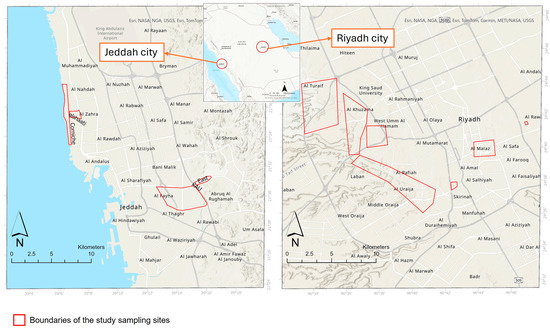
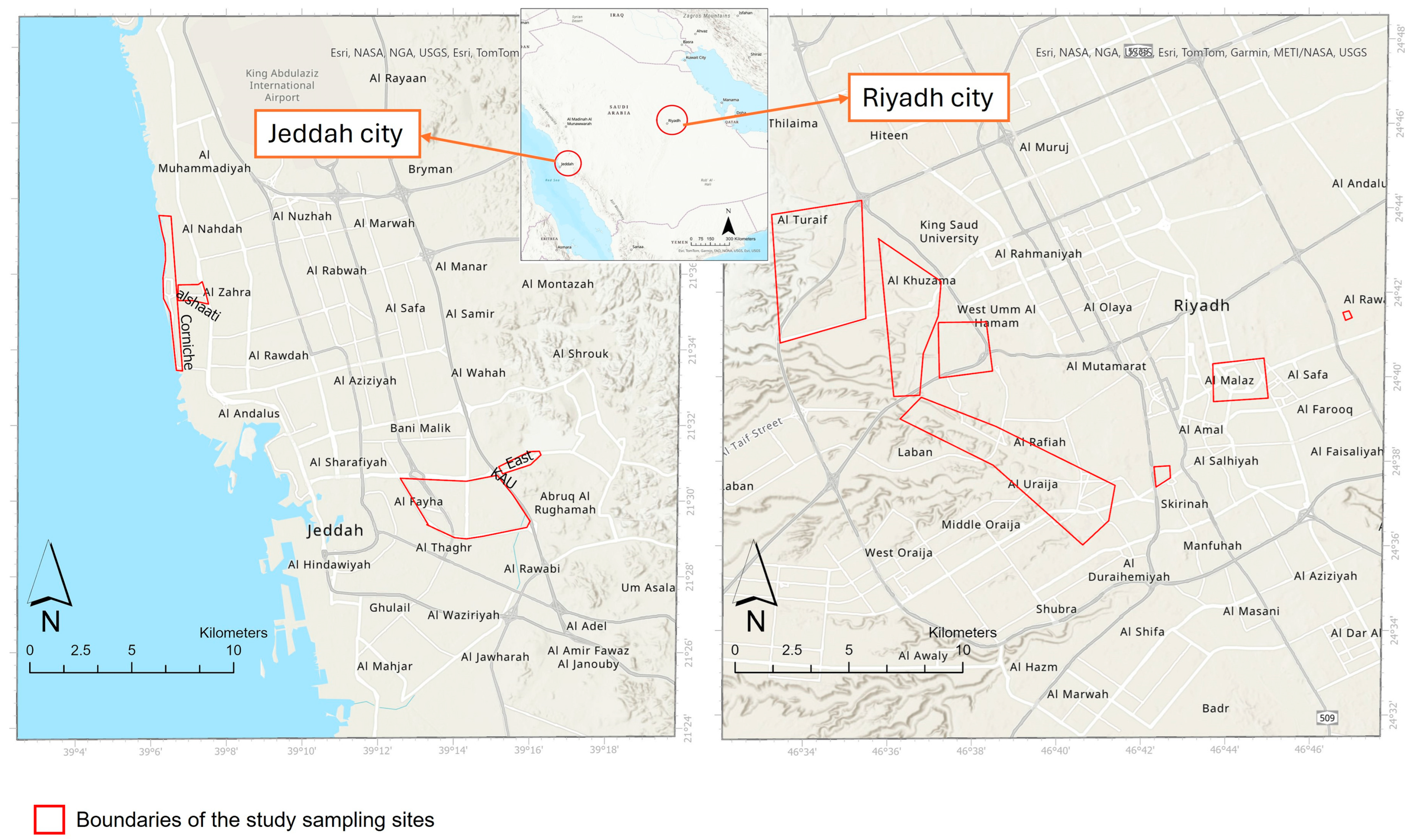
The research was conducted in two major cities in the Kingdom of Saudi Arabia: Riyadh and Jeddah (Figure 1). Two distinct climate types, hot, arid to hyper-arid, serve as sample cities and facilitate the investigation of water use in landscape trees under the constraints of extreme environmental conditions. Riyadh (24°38′ N, 46°43′ E; elevation 612 m) is characterized by a hyper-arid continental climate, with the extreme maximum summer temperature rising above 49 °C, the relative humidity remaining very low (<15% in summer), and the annual rainfall less than 100 mm. Jeddah has a hot, arid maritime climate. It is situated on the Red Sea coast at 21°32′ N, 39°10′ E, with an elevation of 12 m. Summer maximum temperatures are also extremely high, reaching up to (>45 °C), but this area experiences higher relative humidity (40–70%). Rainfall is rare but can occasionally occur in extreme events (e.g., 110 mm in a single day in 2009).
Figure 1.
Locations of the study areas in Saudi Arabia, highlighting sites in Riyadh (Central) and Jeddah (Western Coast). Source: Drafted by the authors using ArcGIS Pro 3 (Esri, Redlands, CA, USA).
Daily reference evapotranspiration (ETo) data were collected for both cities following the FAO-56 Penman–Monteith method [26]. Both cities experience high evaporative demand, with annual ETo exceeding 2500–3000 mm. During summer, daily ETo values range from 9.29 to 11.7 mm/day, with Riyadh recording the highest values due to lower humidity. In winter, these values drop significantly to below 1.0 mm/day (0.6–2.35 mm/day), with Jeddah showing relatively higher values during this season.
2.2. Plant Sampling and Field Measurements
Field measurements were collected across various LAPs at urban and rural planting sites, including public parks, roadside corridors, university campuses, and public landscapes where irrigation is necessary for plant survival. Soils at these sites are predominantly sandy loam to silty loam with low clay content, or compacted urban fill with low organic matter content. Microclimatic conditions at these sites vary significantly due to surrounding urbanization, shading, and wind exposure.
A total of 277 mature, healthy tree and shrub specimens, representing 27 distinct species, were evaluated in this study. Rather than applying a strictly random approach, a stratified purposive sampling strategy was employed to capture a comprehensive gradient of morphological traits and water-use adaptations relevant to arid urban environments. The selection criteria specifically targeted two main groups: (1) dominant introduced species currently prevalent in Landscape Architecture Projects (LAPs) (e.g., Peltophorum pterocarpum, Millingtonia hortensis), and (2) native desert species highly recommended for future sustainable urban afforestation (e.g., Vachellia tortilis, Ziziphus spina-christi). Furthermore, to provide the necessary environmental context, the specimens were carefully selected across various urban site typologies, including public parks, street medians, residential neighborhoods, and open landscape plots, each presenting different urban planting conditions.
For each species, a sample size of 5 to 14 individuals was measured. While this range may appear statistically constrained for certain native species, it represents an exhaustive sampling of all available, fully mature, and accessible specimens within the studied municipal boundaries. This constraint reflects the current scarcity of mature native trees in existing landscape projects. Nevertheless, this sample size is sufficient to capture natural variability and meet the required statistical standards for an initial proof of concept [27]. Additionally, due to the scarcity of mature native trees in the studied urban landscapes, the sample sizes for certain species (e.g., Vachellia gerrardi, n = 5) were constrained. Statistical means derived from such small samples are highly sensitive to intra-species individual variation; therefore, the specific coefficients for these species should be treated as preliminary estimates requiring broader validation in future studies.
Field measurements of tree morphological traits focused on quantifying canopy structure and leaf features, including Tree Height (Th), Branch Height (Bh), Canopy Diameter (Cd) and radius (Cr), and Canopy Height (Ch = Th − Bh). Additionally, several descriptive features were recorded for canopy form (classified as Columnar (C), Rounded (R), Pyramidal (P), and Spreading (S)), leaf density, and leaf size. Physical dimensions were measured using a digital measurement laser distance device (Leica DISTO D8).
2.3. PWRq Framework as a New Model
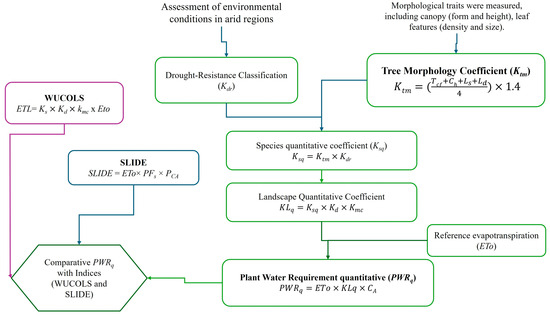
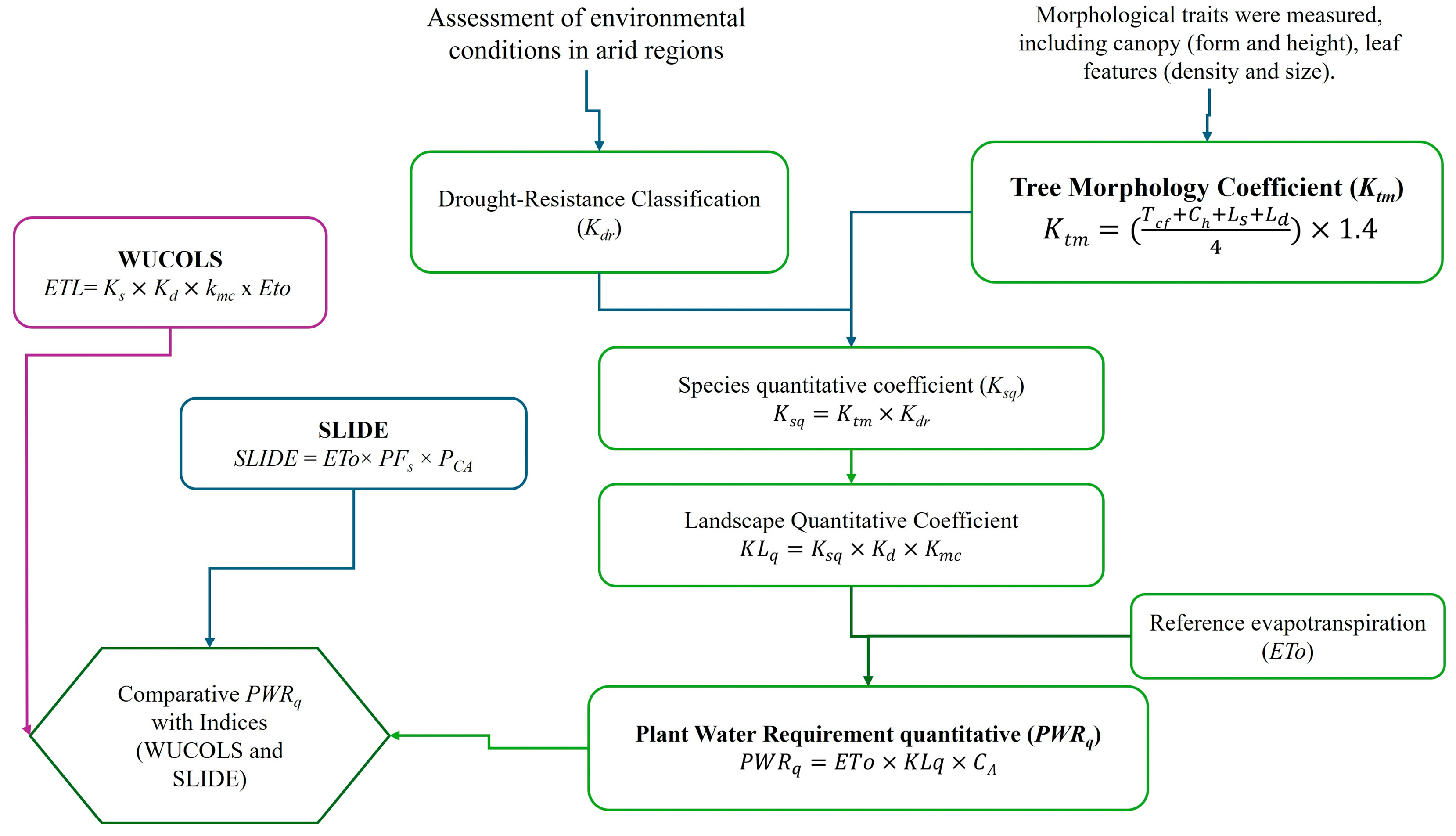
To implement the proposed framework for estimating quantitative plant water requirements (PWRq), a computational workflow was developed to derive an irrigation index from empirical morphological traits (Figure 2). The model computes a new index, Tree Morphology Coefficient (Ktm), from measurements of morphological traits for canopy form and structure and leaf traits, and also computes the drought resistance coefficient (Kdr), which is updated under arid conditions. This integration enables the derivation of the species coefficient (Ksq) and the subsequent Landscape Plant Coefficient (KLq), bridging the gap between theoretical classification and actual water demand. Crucially, the PWRq is calculated independently of prior generalized models, allowing for an objective benchmarking of its performance against established reference methodologies (WUCOLS and SLIDE).
Figure 2.
Methodological flowchart illustrating the independent development of the proposed morphology-based model (PWRq) and its subsequent benchmarking against established reference indices (WUCOLS and SLIDE).
2.4. Development of the New PWRq Model
This study introduces a new quantitative framework to estimate Plant Water Requirements (PWRq) in arid environments. The new methodology applied the following indices:
2.4.1. The Tree Morphology Coefficient (Ktm)
A combined tree morphology Coefficient (Ktm) was developed to combine tree morphological variables, including canopy characteristics (form and height) and leaf characteristics (leaf size and density), and to express the most essential tree characteristics related to water requirements. Ktm was calculated using the following equation:
where, the Tree canopy form (Tcf) factor was estimated to be for the four groups (Columnar (C), Rounded (R), Pyramidal (P), and Spreading (S)). The Tcf is based on the tree canopy volume (Cv), which was calculated using geometric approximation methods [28,29] (Table 1), leaf size (Ls), leaf density (Ld), and tree height (Th).
Table 1.
The proposed morphology-based system for converting measurable tree traits (leaf size (Ls), leaf density (Ld), tree canopy form (Tcf), and tree height (Th)) into quantitative indices, and Classification of drought resistance coefficient (Kdr) for landscape species based on eco-physiological performance and origin.
Mathematically, a Columnar shape is modeled as a full cylinder (ratio = 1.0); a Pyramidal shape is modeled as a cone (1/3 the volume of a cylinder, hence 0.33); a Rounded shape is modeled as a sphere or ellipsoid (roughly 2/3 the volume, hence 0.66); and a Spreading shape is modeled as a flattened ellipsoid with a reduced vertical axis, assigned a ratio of 0.15.
This structural classification explains the aerodynamic properties of the canopy; empirical evidence suggests that sparser canopies may have higher coupling with the atmosphere, potentially affecting water use under high vapor pressure deficits [17,30].
The tree’s canopy height (Ch) was estimated by converting the measurements to a specific value, which ranged in the study between 0.3 and 1.2 to capture the aerodynamic roughness and the increased transpiration surface associated with taller canopies, which aligns with the standard crop coefficient (Kc) ranges defined in FAO-56 [12]. This classification is categorized as follows: very large to very small canopy (>7.5 m to <3 m, respectively) (Table 1).
Leaf traits were classified using practical frameworks for arid species, as follows: Leaf Size (Ls): Classified into four categories for leaves or leaflets (Mesophyll, Microphyll, Nanophyll, Leptophyll) [31] with quantitative values (0.3–1.0) (Table 1).
This classification distinguishes species with leptophyll leaves, especially scale-leaved species such as Tamarix aphylla, desert species such as Vachellia flava and Vachellia tortilis, and drought-tolerant introduced species such as Prosopis juliflora and Parkinsonia aculeata. It also includes nanophyll species represented by Tamarindus indica, Peltophorum pterocarpum, and Albizia lebbeck. It further distinguishes microphyll species, including Balanties aegyptiaca, Bucida buceras, Millingtonia hortensis, Samanea saman, and Ziziphus spina-christi, and mesophyll species represented by introduced species such as Plumeria obtuse, Cordia sebestena, Polyalthia longifolia pendula, Ficus altissima, and Ficus longifolia.
2.4.2. Leaf Density (Ld)
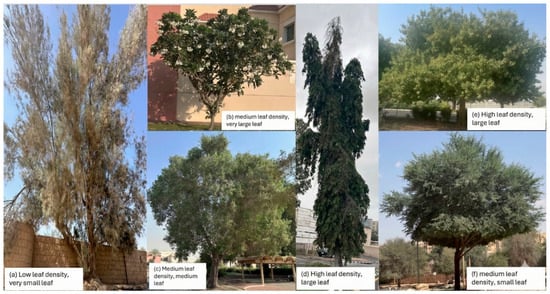
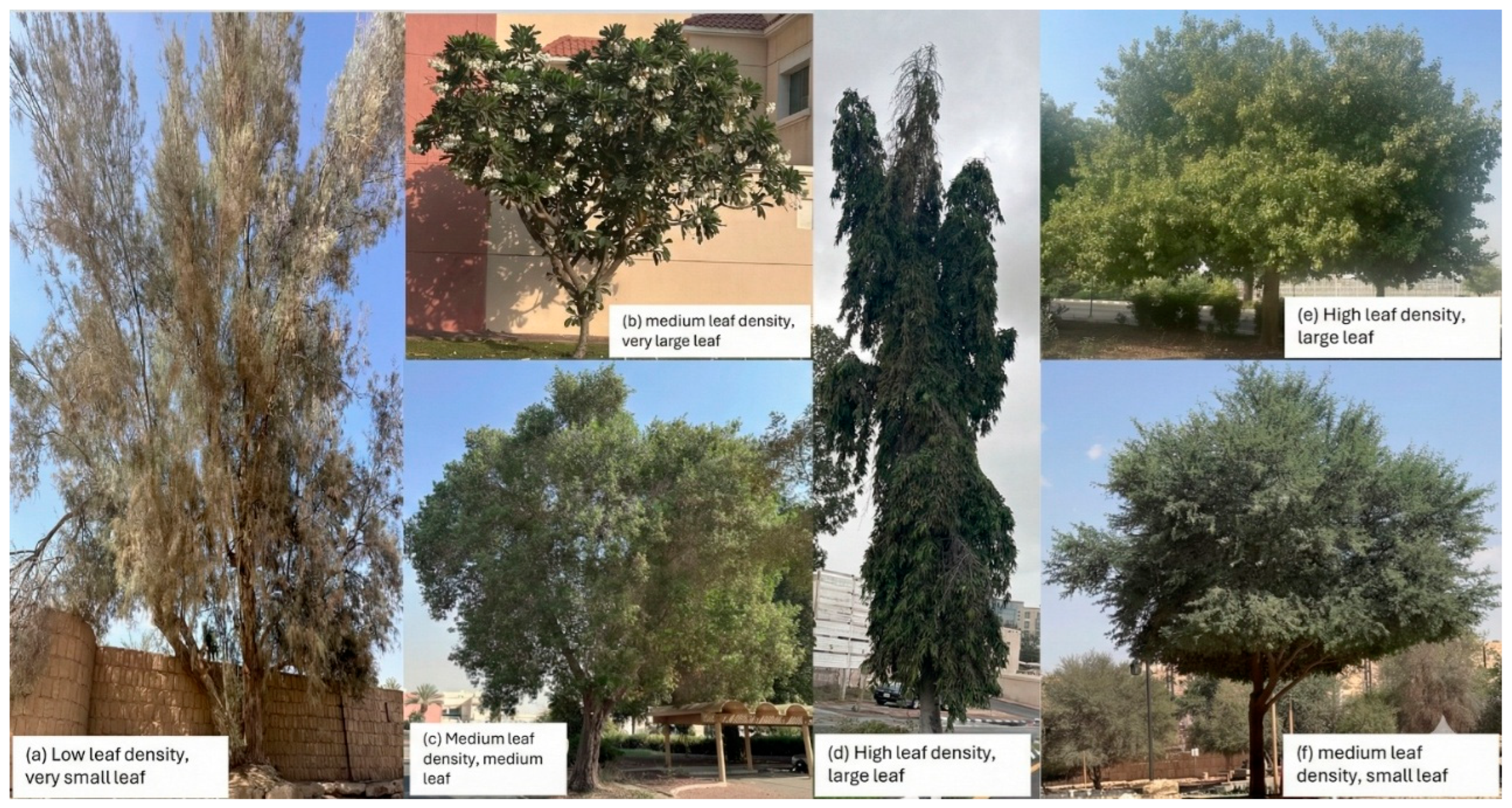
Assessed based on foliage transparency. Differences among trees are classified into five groups (high to very low) with quantitative values (0.3–1.0), which helps display their diversity (Table 1). Native and desert species vary in density from very low (e.g., Tamarix aphylla, Vachellia flava, and Vachellia tortilis) to medium (e.g., Vachellia gerrardi and Ziziphus spina-christi). However, the species introduced include both high-density species (e.g., Polyalthia longifolia pendula and Ficus altissima) and low-density species (e.g., Parkinsonia aculeata) (Figure 3).
Figure 3.
Visual classification of morphological traits is used to assign model coefficients. Several examples: (a) Tamarix aphylla, (b) Plumeria obtusa, (c) Conocarpus lancifolius, (d) Polyalthia longifolia pendula, (e) Ficus altissima, (f) Vachellia nilotica. Source: Photographs taken by the authors, March–December 2025.
To incorporate these traits into the PWRq estimation model, the qualitative measurements were converted into quantitative coefficients (Table 1).
2.4.3. Calibration Factor (1.4)
The 1.4 scaling factor is not arbitrary; it was empirically and theoretically determined to calibrate the morphological factors (Tcf, Ch, Ls, Ld). First, this factor accounts for the canopy effect, in which the effective transpiring leaf area significantly exceeds the simple projected canopy area, a ratio that can range from 1.3 to 1.6 in many woody species [28,29,30]. Second, in arid environments, isolated trees experience hot air that penetrates the canopy, increasing evapotranspiration rates beyond standard reference crop assumptions [8,26]. Furthermore, this value is theoretically grounded in the established Landscape Coefficient Method (LCM) and WUCOLS guidelines [32]. According to these frameworks, the microclimate factor (Kmc) reaches a maximum of 1.4 in high-stress urban landscapes surrounded by heat-absorbing surfaces (e.g., asphalt and buildings) and subject to the Urban Heat Island (UHI) effect. These conditions perfectly mirror the extreme hyper-arid urban environments of Riyadh and Jeddah. Thus, multiplying the average morphological traits by 1.4 serves as an empirical upper-bound multiplier, ensuring that Ktm remains practical and comparable to existing irrigation-coefficient frameworks.
2.4.4. Drought-Resistance Classification (Kdr)
A drought-resistance coefficient (Kdr) has been developed to enhance studies of arid regions in general and native flora species in particular. The coefficient ranges from 0.1 (very high drought resistance) to 0.9 (very low drought resistance) (Table 1).
Rather than relying on direct physiological measurements (e.g., stomatal conductance or sap flow), the Kdr assignments were determined heuristically based on the species’ origin and documented ecological performance in the region. For instance, native desert flora highly adapted to hyper-arid natural environments were assigned (Very High), whereas introduced species originating from humid or sub-humid regions with known high irrigation dependency in local horticultural practices were assigned (Low or Very Low).
2.4.5. The Species Quantitative Coefficient (Ksq)
The species quantitative coefficient (Ksq) is the basis coefficient for an adjustment of the ETo value in the PWRq calculation equation, through which all the factors affecting the determination of the water requirement of the plant species are integrated, including the tree morphological trials and the drought resistance coefficient.
By calculating Ktm, and Kdr, the species quantitative coefficient (Ksq) can be calculated after applying the following equation:
where Ktm is the Tree Morphology Coefficient, and Kdr is the drought-resistance coefficient.
2.4.6. The Landscape Quantitative Coefficient (KLq)
To apply the species-specific data to actual urban planting scenarios, the Landscape Quantitative Coefficient (KLq) was derived. This coefficient integrates the new species coefficient (Ksq) with established site factors to comprehensively assess landscape water needs:
where KLq is the proposed landscape Quantitative coefficient, Kd (Density Coefficient): measures vegetation density (0.5–1.3), following WUCOLS IV guidelines [14]. Kmc (Microclimate Coefficient): accounts for site-specific factors such as shading, wind exposure, and heat-island effects (0.5–1.4) [14,33].
2.4.7. Plant Water Requirement Quantitative Equation (PWRq)
The final plant water requirement for each tree was calculated using the proposed morphology-based equation:
where PWRq is Quantitative Plant Water Requirement (L/day), Eto is Reference Evapotranspiration (mm/day), calculated using the FAO-56 Penman–Monteith method [12], KLq is the proposed Landscape Quantitative Coefficient, CA is Projected Canopy Area (m2), calculated from field measurements (CA = π × Cr2). The canopy area is the closest measure of the area of the sunlit leaves [17].
This equation converts visual and structural features of plants into variables, which would facilitate extensive monitoring of irrigation performance for species, especially in arid areas.
2.5. Computation of Comparative Indices (WUCOLS and SLIDE)
To benchmark the proposed PWRq, its estimate was statistically compared against two benchmark reference standards: WUCOLS and SLIDE. The results of each model were calculated for peak summer conditions (July–August) using the recorded highest ETo and water need for the tree area. Importantly, too, since the effects of plant species and morphological traits need to be specifically limited, the planting density (Kd) and microclimate (Kmc) coefficients were subjected to a neutral baseline of 1.0 for all three equations.
The rationale for normalizing the site-specific factors (Kd and Kmc) to 1.0 was to mathematically isolate the baseline species effect. While the WUCOLS species factor (Ks) is a composite value that inherently embeds expert ecological knowledge, setting environmental modifiers to neutral values ensured that any comparative variance between the models was strictly attributable to the tree’s inherent morphological and physiological traits, rather than microclimatic disparities.
The comparative indices were computed as follows:
- WUCOLS Method (WUCOLS IV) consensus classifications defined a standard water use species factor (Ks) of 0.1 to 0.9 for the species [14]. The formula applied is: WUCOLS = Ks × Kd × kmc × Eto, where Ks is the species factor, Kd is the density coefficient, kmc is the microclimate coefficient, and ETo is the reference evapotranspiration.
- SLIDE Method: An index to calculate simplified requirements for irrigation was obtained according to plant factor (PFs) used for Kjelgren et al. [17]. The equation applied is SLIDE = ETo × PFs × Pca, where PFs is the plant factor, Pca is the projected canopy area, and ETo is the reference evapotranspiration.
2.6. Statistical Analyses
To assess the variations and relationships among the studied variables, multiple statistical approaches were conducted, including independent t-tests, one-way ANOVA, Pearson correlation, and linear regression. Furthermore, a Principal Component Analysis (PCA) with Varimax rotation was employed to explore the underlying dimensions of the measured morphological traits, statistically validating their integration into the proposed Tree Morphology Coefficient (Ktm). All data were analyzed using IBM SPSS Statistics (v. 23).
The complete dataset, including individual morphological measurements and derived coefficients for all surveyed trees, is available in the Supplementary Materials.
3. Results
This study assessed the water requirements of 277 tree and shrub samples from 27 species under peak summer conditions in Riyadh and Jeddah. The new method for estimating PWRq was applied to calculate the water requirements of several tree species commonly used in LAPs. Also, the water requirement was computed using the WUCOLS and SLIDE methods, enabling comparison with the results obtained from the PWRq method. These calculations were based on the highest daily reference evapotranspiration (ETo) of 11.7 mm/day (July–August). Additionally, all morphological traits of the trees were measured and described to be included in the new PWRq, as shown in (Table 2).
Table 2.
List of sampled species, their origins, drought-resistance classifications, morphological categories, and mean measurements used in the study (N = 277). Abbreviations: Origin: native species (Na), Introduced species (In). Leaf type: Simple (S), Bipinnate (Bp), Pinnate (P), Palmately compound (Pc), Scale-like (Sl). All other abbreviations are described in Table 1.
3.1. Descriptive Statistics of Tree Morphological Traits Measurements
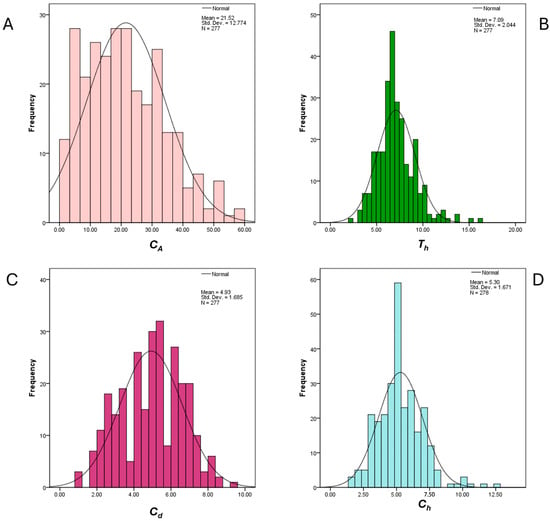
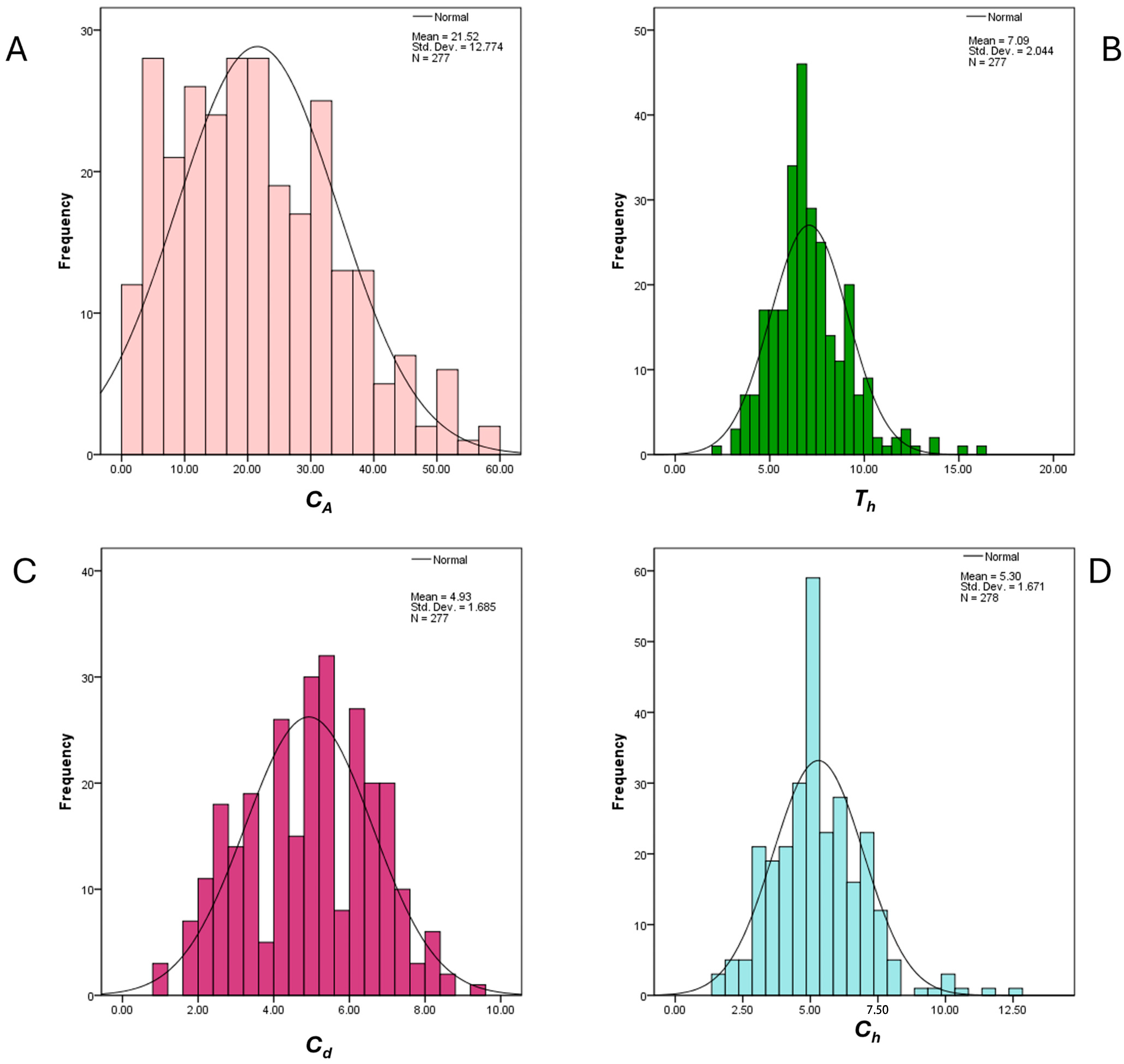
Substantial variability was observed in the morphological tree measurements (N = 277). Tree height (Th) averaged 7.09 ± 2.04 m, canopy height (Ch) 5.30 ± 1.67, canopy diameter (Cd) 4.93 ± 1.7, and radius (Rd) 2.56 ± 2.57, while canopy area (CA) showed wide variation (21.52 ± 12.77 m2).
The histograms of the measured variables show a wide range of structural diversity in our sample population (N = 277). Tree height (Th), Canopy height (Ch), and Canopy diameter (Cd) are distributed such that their means and medians are centered at 7.04 m and 4.92 m, respectively, indicating a proportionate distribution of medium-sized urban trees. However, Canopy Area (CA) shows a distinctive right-skewed distribution, with most samples concentrated in the 10–30 m2 range and a long tail extending to large canopy trees (>60 m2) (Figure 4). This large variability, notably in Canopy Area, underscores the need to account for different canopy types.
Figure 4.
Frequency distribution histograms of key morphological measurements for the landscape species studied (N = 277). The plots illustrate the variability in: (A) Crown Area (CA), showing a right-skewed distribution; (B) Tree Height (Th); (C) Canopy Diameter (Cd); and (D) Canopy Height (Ch). The solid black lines represent the fitted normal distribution curves. Note: Data analyzed and images generated using IBM SPSS Statistics, version 23 (IBM Corp., Armonk, NY, USA).
3.2. Impact of Morphological Traits on Water Requirements
One-way ANOVA results demonstrated highly significant interspecific variability (p < 0.001) across all measured and derived variables (Table 3). The Morphological Traits Coefficient (Ktm) exhibited the highest variance ratio (F = 6.36), indicating strong discriminative power in distinguishing among the tree features. This was followed by Leaf Density (Ld) (F = 4.87) and the Landscape Quantitative Coefficient (KLq) (F = 4.16). Other morphological traits also showed significant variation: Tree Height (Th) (F = 3.81) and Crown Area (CA) (F = 3.63) varied considerably among groups, confirming the morphological diversity of the sampled population. The significant differences in Leaf Size (Ls) and Canopy Form (Tcf) further validate the necessity of incorporating these specific traits into the water requirement model rather than relying on generic averages.
Table 3.
Results of One-way ANOVA assessing the variation of morphological traits and calculated indices across species groups.
3.3. Principal Component Analysis of Morphological Traits
To statistically validate the integration of morphological variables into the tree morphology coefficient (Ktm), a Principal Component Analysis (PCA) with Varimax rotation was conducted. The suitability of the data for factor analysis was confirmed, with a Kaiser–Meyer–Olkin (KMO) measure of 0.625 (indicating adequate sample size) and a highly significant Bartlett’s Test of Sphericity (p < 0.001), confirming that the variables are adequately correlated for dimension reduction.
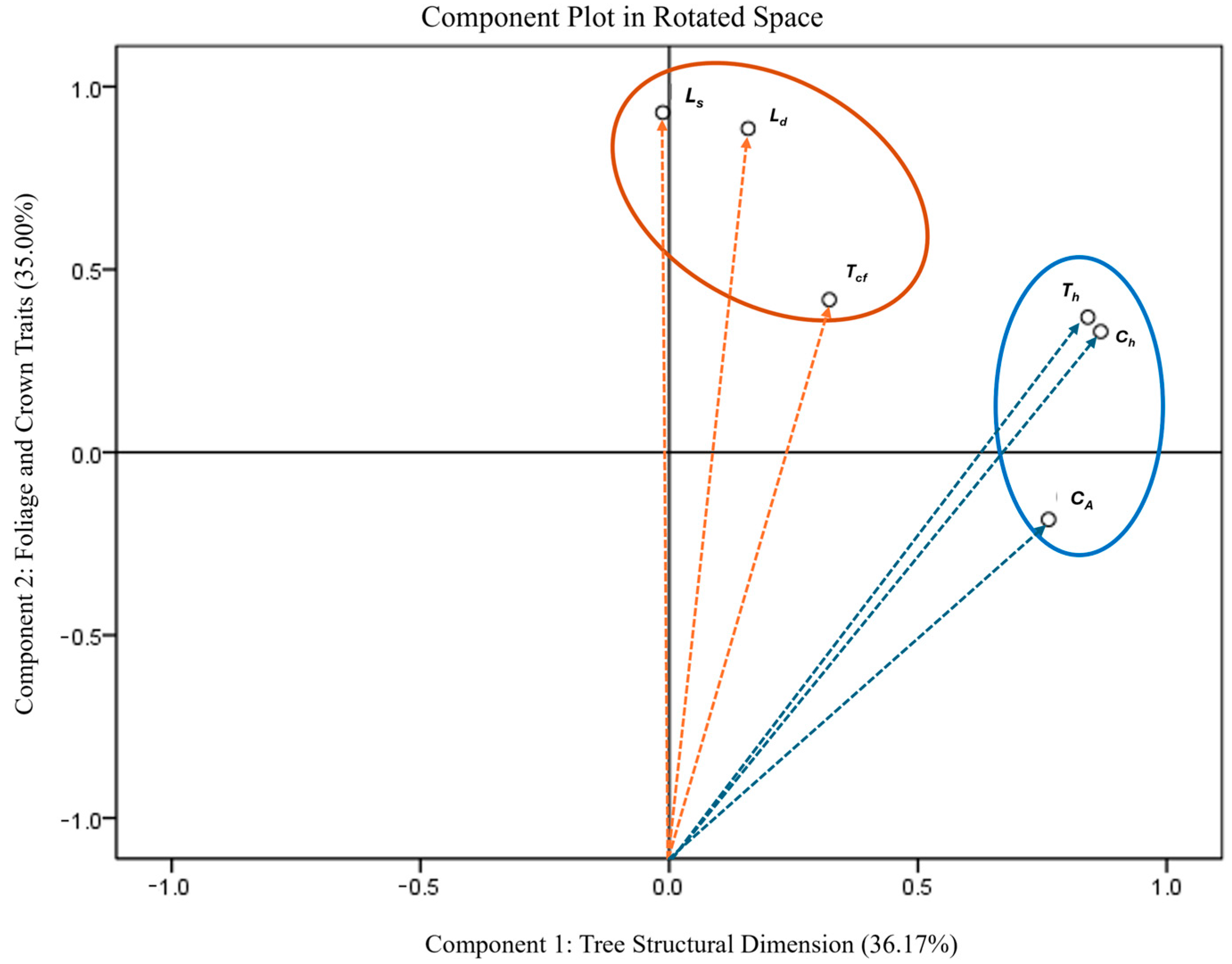
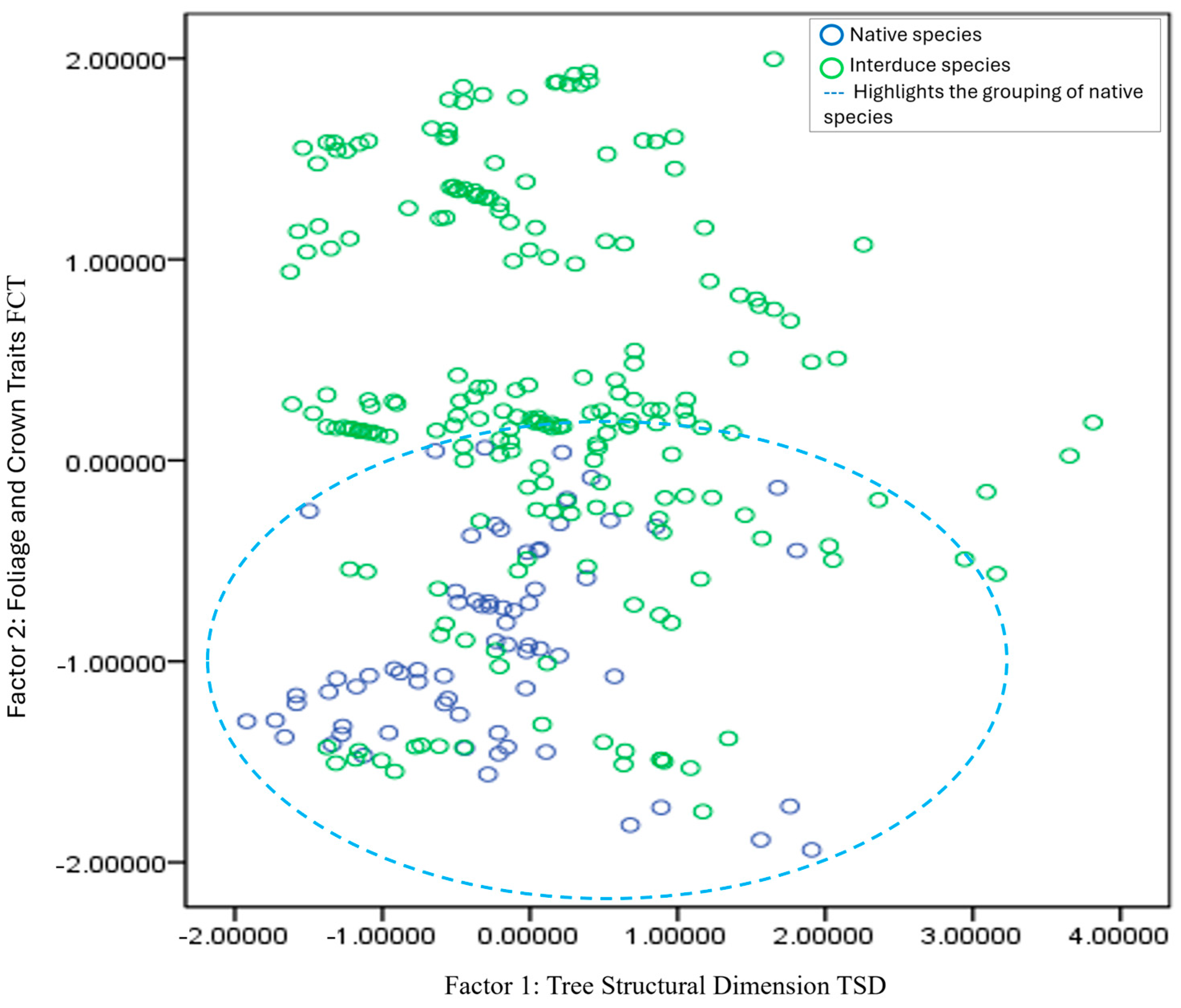
The PCA successfully extracted two primary components with eigenvalues greater than 1, which cumulatively explained a robust 71.18% of the total variance in the morphological data. The rotated component matrix revealed a highly logical grouping of the traits. Factor 1, which explained 36.17% of the variance, showed strong positive loadings for canopy height (Ch = 0.867), tree height (Th = 0.841), and canopy area (CA = 0.762), representing the Tree Structural Dimension TSD. Factor 2, explaining 35.00% of the variance, was heavily loaded with leaf size (Ls = 0.929), leaf density (Ld = 0.885), and tree canopy form (Tcf = 0.417), representing the Foliage and Crown Traits FCT. This bipartite clustering statistically justifies the structure of the proposed Ktm equation, confirming that both TSD (Factor 1) and FCT (Factor 2) represent distinct, significant, and complementary drivers of the tree’s overall morphological profile (Figure 5). Furthermore, projecting the individual tree samples onto these two principal components revealed a distinct ecological divergence. As illustrated in Figure 6, native species clustered densely within the lower limits of both dimensions, reflecting a highly conserved morphological strategy adapted to hyper-arid conditions. Conversely, introduced species exhibited wide dispersion with significantly higher structural and foliage trait values, driving their elevated water demand.
Figure 5.
PCA loading plot in rotated space for morphological variables. Spatial clustering visualizes the two distinct structural components identified in the rotated component matrix: Factor 1 (Component 1) represents Tree Structural Dimension TSD (capturing Ch, Th, CA), while Factor 2 (Component 2) represents Foliage and Crown Traits FCT (capturing Ls, Ld, Tcf). This bipartite clustering statistically justifies the structure of the proposed Ktm equation. Note: Data analyzed and images generated using IBM SPSS Statistics, version 23 (IBM Corp., Armonk, NY, USA).
Figure 6.
PCA score plot displaying the distribution of the 277 sampled trees based on their morphological traits. The distinct clustering patterns highlight the morphological divergence between species origins. Native species (blue circles) are densely clustered in the lower quadrants (negative Factor 2), indicating a highly conserved ecological strategy of small leaves and sparse canopies adapted to hyper-arid conditions. In contrast, introduced species (green circles) exhibit wide dispersion across the upper quadrants, reflecting diverse traits with large leaves and dense canopies that drive higher water demands. The dotted blue circle highlights the grouping of native species. Note: Data analyzed and images generated using IBM SPSS Statistics, version 23 (IBM Corp., Armonk, NY, USA).
3.4. Correlation Analysis of Morphological Traits and Water Requirement
The correlation between estimated plant water requirement (PWRq) and measured morphological variables was assessed using Pearson correlation analysis (Table 4). All morphological characteristics showed statistically significant positive correlations with PWRq (p < 0.05). Among the individual predictors of water demand, Crown Area (CA) showed the highest correlation (r = 0.623, p < 0.001), indicating that canopy area could be the main determinant of water use demand, followed closely by Crown Height (Ch) (r = 0.610), emphasizing the impact of vertical canopy breadth. Taller canopy trees need significantly more water, whether classified specifically (e.g., Conocarpus lancifolius, Ficus altissima, or Ficus longifolia). Leaf characteristics also showed robust relationships; Leaf Density (Ld) and Leaf Size (Ls) correlated significantly with PWRq (r = 0.542 and r = 0.401, respectively), with minimum values for (Leptophyll) presented by Tamarix aphylla, Vachellia tortilis, and Vachellia flava, Parkinsonia aculeata, and maximum values for (Mesophyll) leaves represented by Ficus altissima, and Tabebuia rosea-alba; Nanophyll and Microphyll leaves show similar intermediate values (e.g., Balanties aegyptiaca, Ziziphus spina-christi, and Guaicum sanctum) displayed the weakest yet significant positive correlation (r = 0.281), suggesting a secondary role in water consumption compared to canopy size and density.
Table 4.
Pearson correlation matrix between Plant Water Requirement (PWRq) and morphological variables (N = 277).
It was determined that the model-derived coefficients are robustly associated with PWRq. Among these, the Tree Morphology Coefficient (Ktm) showed a strong correlation (r = 0.617), and the Species Coefficient (Ksq) and Landscape Quantitative Coefficient (KLq) showed identical moderate correlations (r = 0.517), reflecting their linear interdependence.
Furthermore, PWRq was moderately positively correlated with the Drought-Resistance Coefficient (Kdr) (r = 0.485, p < 0.01). This aligns with the proposed classification system, in which species with Very High Drought Resistance (vhdr) are closely associated with low irrigation demand (e.g., Vachellia flava, Tamarix aphylla, and Prosopis cineraria at 40 L/day), whereas species with Very Low Drought Resistance (vldr) require much more irrigation (Millingtonia hortensis or Samanea saman over 150 L/day), as shown in Table 4.
3.5. Benchmarking and Comparative Analysis of Indices
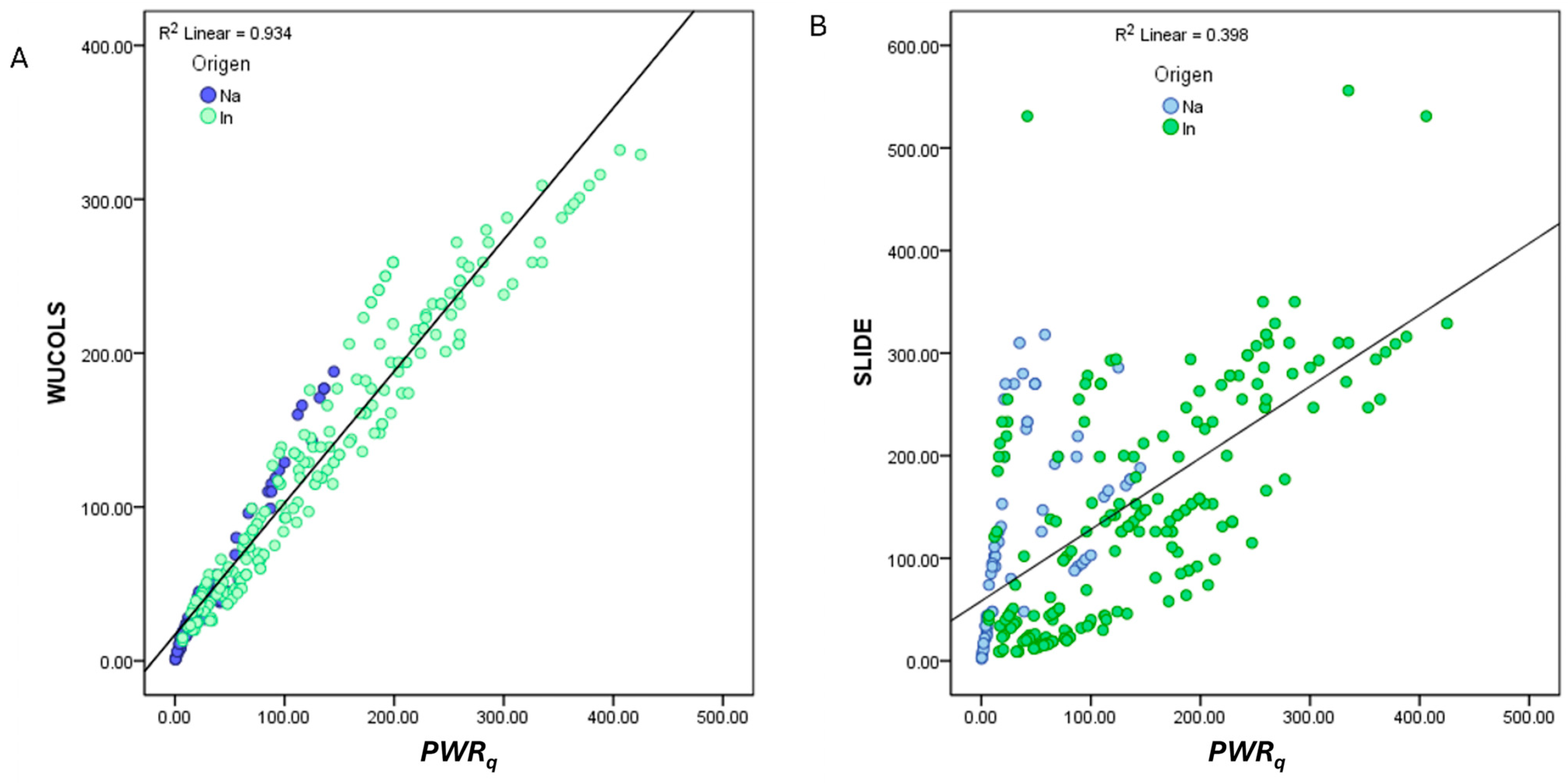
To enhance the authority of the new equation, it was compared with the previous models, WUCOLS and SLIDE. The water requirements of the samples were assessed using these models; the results ranged from 0.7 to 331.7 L/day for WUCOLS and from 2 to 556 L/day for SLIDE. In contrast, the calculated PWRq ranged from 0.3 to 425 L/day.
Correlation analysis with WUCOLS and SLIDE provided a linear relationship; however, comparative ANOVA showed significant differences among the indices. The higher variance ratio (F = 70.79) for WUCOLS reflects its sensitivity to rigid, species-specific classifications. SLIDE, on the other hand, exhibited a drastically reduced variance (F = 3.63), suggesting it relies on more generalized physical parameters rather than the taxonomic distinctiveness captured by WUCOLS and the proposed model.
The strength of the morphological model (PWRq) relative to the WUCOLS and SLIDE indices was assessed using regression analysis. The regression model indicated that WUCOLS was the dominant predictor of the morphological model (β = 0.969, t = 47.24, p < 0.001). Interestingly, in the presence of WUCOLS, SLIDE did not contribute significantly to the prediction (β = −0.004, p = 0.831), confirming that the morphology-based PWRq primarily mirrors the physiological precision of WUCOLS while offering finer structural resolution.
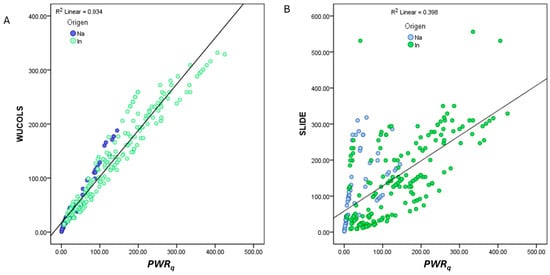
The scatter plots reveal a clear clustering pattern by species origin. Native species (Na), such as Vachellia and Ziziphus, are clustered predominantly in the lower-left quadrant, indicating consistently lower water requirements across all models. In contrast, introduced species (In) show broader dispersion, extending into high-water-use ranges (Figure 7). This clear separation validates the model’s sensitivity to the conservative water-use strategies of native flora compared with the higher demand of exotic species.
Figure 7.
Comparative scatter plots with linear regression lines validating the proposed model against established indices. Data points are coded by Species Origin (Blue = Native Na, Green = Introduced In). The panels demonstrate: (A) The strong agreement between the proposed PWRq and WUCOLS (R2 = 0.934); and (B) The correlation between PWRq and SLIDE (R2 = 0.398). The clustering of blue markers in the lower range confirms the low water demand of native species. Note: Data analyzed and images generated using IBM SPSS Statistics, version 23 (IBM Corp., Armonk, NY, USA).
3.6. The Role of Species Origin
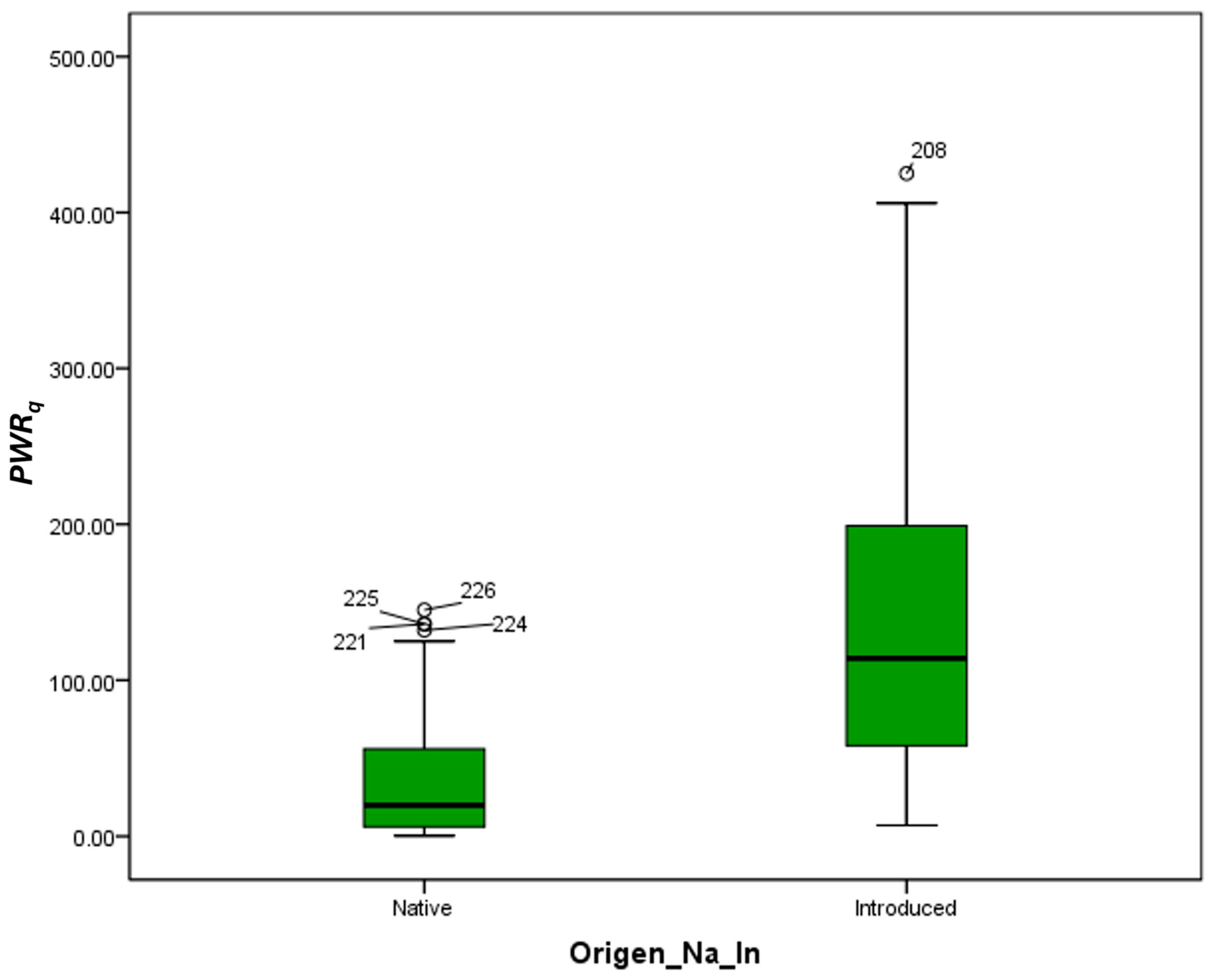
To assess the estimated water requirements (PWRq) of Native and Introduced species, an independent samples t-test was conducted to quantify the difference in Plant Water Requirements (PWRq) between Native and Introduced species. Levene’s test indicated that the assumption of homogeneity of variance was violated (F = 51.43, p < 0.001); therefore, the results were reported assuming unequal variances.
The analysis revealed a highly statistically significant difference in water demand (t (262.68) = −11.68, p < 0.001). Introduced species exhibited a drastically higher mean water requirement (M = 135.66, SD = 97.41) than native species, which maintained a much lower baseline (M = 37.97, SD = 41.09). The mean difference of −97.69 indicates that, on average, introduced trees require approximately 3.5 times more water than native alternatives within the studied landscape.
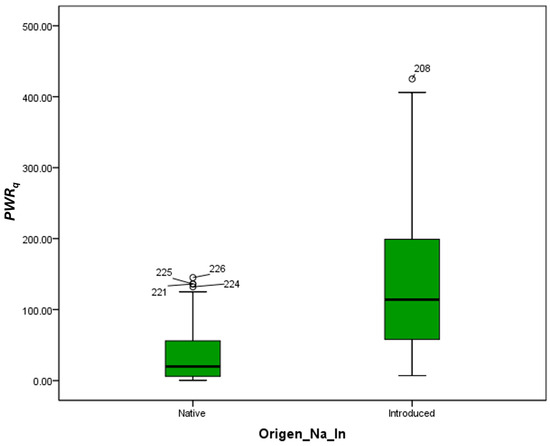
As illustrated, native species are characterized by a compact distribution with a remarkably low median (PWRq approximately 38 L/day). Native species in arid conditions, such as Vachellia flava, Vachellia tortilis, and Tamarix aphylla, used the least water: 7 to 14 L/day, respectively, indicating a consistent water-conservation strategy across the population, despite minor outliers representing exceptionally large specimens (e.g., Tamarindus indica: 114 L/day).
In contrast, introduced species have a significantly higher median water requirement, approximately 136 L/day. Among these species, Conocarpus lancifolius, Peltophorum pterocarpum, and Ficus altissima have the highest water requirements, exceeding 300 L/day. This wide variation illustrates the diverse water consumption rates among introduced species, ranging from moderate to excessive. Also, the visual distribution shows that even introduced species with lower water demands often exceed the native population’s median requirement (Figure 8).
Figure 8.
Boxplot comparing the distribution of Plant Water Requirements (PWRq L/day) between Native and Introduced species. The distinct separation shows that native species maintain consistently low water demand, whereas introduced species exhibit high variability. The outliers (circles) represent individual trees with extreme water demands. Note: Data analyzed and images generated using IBM SPSS Statistics, version 23 (IBM Corp., Armonk, NY, USA).
4. Discussion
4.1. Morphological Tree Factors Determining Water Requirements
We analyzed 27 plant species commonly used in the LAPs of Saudi Arabia, including seven native species, to identify key factors for estimating water demand, especially in arid regions. We explained that the principal contributors to trees’ water demand in arid regions are morphological traits, including canopy form, area, height, and leaf size and density. The considerable diversity observed among species suggests that structural properties are highly significant for evapotranspiration rates. Incorporating plant morphological traits into the drought resistance coefficient (Kdr) provides a more ecologically realistic estimation of plant water requirements. These findings are consistent with the idea that morphological traits account for most of the PWR variance, aligning with the global meta-analysis by Tfwala et al. [19], which identified tree size measurements (height and stem diameter) as the primary drivers of whole-tree water use. However, unlike forestry-focused models that rely on the diameter at Breast Height (DBH), our framework emphasizes canopy structure, offering a more relevant quantity for urban landscape aesthetics and shading.
The development of the new plant water requirement equation (PWRq), which efficiently incorporates the quantitative estimation of the tree’s morphological Ktm and Ksq coefficients, as well as the development of the Kdr drought-resistant coefficient, has improved its ability to adjust the ETo value. The significant analytical impact of the proposed morphological features, especially Tree Canopy Form (Tcf) height (Ch), and canopy Area (CA), supports the idea that canopy shape influences the aerodynamic interactions of trees. This aligns with actual transpiration rates of isolated urban trees and confirms the inclusion of the aerodynamic scaling factor (1.4) in our model, which predicts that isolated trees in arid areas experience greater advective exchange than dense stands [34]. While the 1.4 calibration factor performed consistently across the dataset, future studies should conduct sensitivity analysis to evaluate its robustness under different climatic and urban conditions. Moreover, the high contribution of Leaf Density (Ld) in the regression model further reinforces the findings of Saher et al. [20], who observed higher cooling benefits from dense canopies but increased water consumption.
However, urban planners must navigate an ecosystem services trade-off: while dense, large-leaved canopies (often found in introduced species) maximize shade and urban cooling, they proportionally escalate water consumption. The proposed Ktm provides a quantifiable metric to optimize this balance, enabling designers to achieve target thermal comfort while strictly capping water budgets.
4.2. The Innovation of the Tree Morphology Coefficient (Ktm)
This study innovates in building a unified Tree Morphology Coefficient (Ktm). In contrast to previous approaches that depend on categorical determinants, the Tree Morphology Coefficient (Ktm) provides an accurate measure of the actual morphological state of all trees. This precision is essential in arid urban landscapes, where maintenance practices, irrigation, and pruning influence canopy growth. The framework transforms visual character traits into hydrologic features. It provides landscape designers, practitioners, and experts with an efficient, practical, precision irrigation technique and a scalable tool that can be applied worldwide to meet the need for intelligent water management strategies in LAPs in arid areas [2]. For practical implementation, urban planners can apply the PWRq model during the design phase by estimating canopy characteristics and selecting species based on target irrigation budgets. The model can also be integrated into GIS-based planning tools for large-scale urban greening strategies. In practice, the Ktm coefficient enables landscape architects to improve the assessment of water expenses for planting materials used in green areas at the design stage, as well as for existing green spaces based on trees’ morphological shapes (e.g., dense, form canopies), and to replace them with more water-efficient designs whilst maintaining the apparent aesthetic and maintenance.
4.3. Native vs. Introduced Species Approaches
The leaf-level characteristics (Ls, Ld) were significant predictors of PWRq. The correlation between water need and species origin suggests that native desert species (e.g., Vachellia, Ziziphus) have evolved hydraulic strategies, such as small leaves and sparse canopies, to reduce transpiration losses. This is in line with established eco-physiological principles, which indicate that xeric-adapted species reduce hydraulic conductance to preserve turgor [34,35]. This aligns with previous eco-physiological studies that xeric species (e.g., Prosopis cineraria, Vachellia flava, Parkinsonia aculeata) reduce hydraulic conductance, preserving their turgor under stress. In contrast, the PWRq of non-native species with large leaves (e.g., Plumeria obtusa, Polyalthia longifolia pendula, Ficus longifolia) and wider canopies was higher, indicating they required more water, were not drought-resistant, and were not compatible with low-water use in water-scarce conditions.
In hyper-arid regions heavily reliant on energy-intensive desalination for municipal water supplies, the 3.5-fold increase in water demand by introduced species represents not only a hydrological burden but also a significant carbon footprint. Prioritizing native species with lower PWRq thus directly supports energy–water nexus sustainability and carbon mitigation efforts.
4.4. Benchmarking Against Previous Indices (WUCOLS and SLIDE)
The observed very strong relationship between the empirical PWRq and WUCOLS (r = 0.967) is notable. Importantly, this strong relationship reflects conceptual alignment rather than model dependency, as the PWRq framework was independently derived from morphological variables and drought-resistance traits. Although the high correlation demonstrates the mathematical consistency of the proposed framework with established standards, future research should validate these estimates against direct measurements. This suggests that the species-based taxonomies of California’s Mediterranean climate remain suitable in the dry environments.
A preliminary sensitivity analysis shows that PWRq is primarily influenced by the integrated Tree Morphology Coefficient (Ktm), which encompasses key structural and foliage traits (Tcf, Ch, Ls, and Ld) along with drought adaptability (Kdr). In this context, the Canopy Area (CA) mainly serves as a secondary scaling factor that reflects overall plant size. This interpretation is strongly supported by the statistical analysis, where multiple regression results revealed a high explanatory power (R2 = 0.82), confirming that the combined effect of morphological and structural variables significantly controls water demand. Notably, Ls and Ld showed highly significant effects (p < 0.001), along with leaf type, indicating that leaf traits are crucial determinants of transpiration behavior. Additionally, the moderate correlations between PWRq and both Kdr (r = 0.436) and Tcf (r = 0.320) reinforce the importance of drought tolerance and canopy structure in regulating water consumption.
Collectively, these findings confirm that Ktm represents the primary driver of plant water requirements, while CA functions mainly as a geometric scaling parameter rather than a dominant controlling factor. Although the correlation with SLIDE is slightly lower, it remains significant (r = 0.631), indicating that the tree dimensions are relevant and support the model’s structural sensitivity.
The joint regression analysis (WUCOLS + SLIDE) showed strong predictive power for the new model (R2 = 0.934). However, the model was primarily comparable on WUCOLS as the physiological base (β = 0.969, p < 0.001), while SLIDE served a supportive benchmarking role through correlation rather than a statistically significant contribution in the combined regression (β = −0.004, p > 0.05).
This confirms that the proposed method successfully internalizes the canopy structure principles of SLIDE while aligning its final output strictly with the physiological baselines of WUCOLS, effectively bridging the gap between theoretical classification and quantifiable field data.
4.5. Study Limitations and Future Directions
This study has beneficial effects, and some limitations should be acknowledged. In particular, the data was collected in peak summer (July–August), which is essential. Future research should investigate the new coefficients in the other seasons. Also, the 1.4 calibration factor mentioned above performed well on the dataset, but it can be tested across different regions to assess its generalizability. Furthermore, the current Tree Morphology Coefficient (Ktm) applies equal weighting to its four constituent variables (Tcf, Ch, Ls, and Ld). While this serves as a practical baseline for a proof of concept, our correlation analyses suggest these traits contribute disproportionately to total water demand. Future studies should explore applying differential weighting to this equation derived from PCA or regression outputs to refine its precision.
The coefficients of microclimate (Kmc) and vegetation density (Kd), which were neutralized when calculating KLq in this study, require further analysis to ensure optimal application in dry regions, particularly given the effects of soil conditions and different irrigation systems.
Importantly, a potential risk of double-counting exists regarding the microclimate factor. Since the Ktm equation already incorporates a 1.4 multiplier, which partially accounts for peak urban microclimate stress, applying an additional maximum Microclimate Coefficient (Kmc) in the final KLq formula could overestimate water requirements. Therefore, practitioners are advised to carefully adjust or neutralize Kmc when applying this model in high-stress sites similar to those studied here.
5. Conclusions
This study demonstrates that plant water needs in hyper-arid urban landscapes are primarily driven by morphological traits rather than just canopy size. The proposed morphology-based model (PWRq) and its combined Tree Morphology Coefficient (Ktm) effectively integrate drought resistance, leaf characteristics, and canopy structure to accurately estimate water demand. By connecting measurable field data with established physiological standards (WUCOLS) and structural principles (SLIDE), this innovative framework converts subjective plant classifications into a clear, measurable method. Importantly, it accurately captures the low water requirements of native desert species while objectively adjusting to the higher needs of introduced species based on their specific structural and drought-tolerance traits. However, as this study represents a proof of concept based on cross-model benchmarking, future research must validate these model outputs against direct physiological measurements, such as sap flow sensors or weighing lysimeters, to confirm actual transpiration rates.
These findings emphasize the urgent need to include plant morphological traits in irrigation estimation models to prevent over-irrigation in water-scarce regions. By providing an empirical basis for comparing the water footprint of native versus introduced species, this framework allows municipal authorities, urban planners, and landscape architects to implement effective Nature-Based Solutions (NBS). Ultimately, it serves as a powerful decision-support tool to optimize urban green infrastructure, guide sustainable plant selections, and significantly reduce municipal water use during extreme climate conditions.
Furthermore, while initially calibrated as a regional proof of concept for the Arabian Peninsula, the fundamental architecture of the Ktm framework, relying on universal plant physical traits rather than rigid taxonomic lists, ensures its high global transferability. It can be readily adapted and scaled for other global drylands, such as the US Southwest, North Africa, and Australia. By advancing global urban water resilience and supporting climate-resilient landscape planning, this framework directly contributes to achieving long-term urban sustainability goals in the face of escalating water scarcity.
Supplementary Materials
The following supporting information can be downloaded at https://www.mdpi.com/article/10.3390/su18105195/s1: Complete dataset of morphological measurements and calculated coefficients.
Funding
The project was funded by the KAU Endowment (WAQF) at King Abdulaziz University, Jeddah, Saudi Arabia. The author, therefore, acknowledges with thanks WAQF and the Deanship of Scientific Research (DSR) for technical and financial support.
Data Availability Statement
The original contributions presented in this study are included in the article/Supplementary Materials. Further inquiries can be directed to the corresponding author.
Acknowledgments
I thank the Department of Landscape Architecture in the Faculty of Architecture and Planning for providing support. During the preparation of this work, the authors used Grammarly Pro (2026 version) and Gemini Pro (2026 version) to refine the language for clarity and flow in the final stages of the manuscript. After using this tool, the authors reviewed and edited the content as needed and take full responsibility for the content of the published article.
Conflicts of Interest
The author declares that he has no known competing financial interests or personal relationships that could have appeared to influence the work reported in this paper.
Abbreviations
| Bh | Branch Height |
| CA | Projected Canopy Area |
| Cd | Canopy Diameter |
| Ch | Canopy Height |
| Cr | Canopy Radius |
| Cv | Tree Canopy Volume |
| DBH | Diameter at Breast Height |
| ET | Evapotranspiration |
| ETo | Reference Evapotranspiration |
| FCT | Foliage and Crown Traits |
| Kc | Crop Coefficient |
| Kd | Density Coefficient |
| Kdr | Drought-Resistance Coefficient |
| KL | Landscape Coefficient |
| KLq | Landscape Quantitative Coefficient |
| Kmc | Microclimate Coefficient |
| Ks | Standard Water Use Species Factor (WUCOLS) |
| Ksq | Species Quantitative Coefficient |
| Ktm | Tree Morphology Coefficient |
| LAPs | Landscape Architecture Projects |
| Ld | Leaf Density |
| Ls | Leaf Size |
| NBS | Nature-Based Solutions |
| PCA | Principal Component Analysis |
| PFs | Plant Factor (SLIDE) |
| PWR | Plant Water Requirements |
| PWRq | Quantitative Plant Water Requirement |
| SDGs | Sustainable Development Goals |
| SLIDE | Simplified Landscape Irrigation Demand Estimation |
| Tcf | Tree Canopy Form |
| Th | Tree Height |
| TSD | Tree Structural Dimension |
| UHI | Urban Heat Island |
| WUCOLS | Water Use Classification of Landscape Species |
References
- Elkatoury, A.; Alazba, A.A. Irrigation Water Demand Management-Based Innovative Strategy: Model Application on the Green Riyadh Initiative, Saudi Arabia. Water 2024, 16, 3559. [Google Scholar] [CrossRef] [Scilit]
- Ahmed, Z.; Gui, D.; Murtaza, G.; Yunfei, L.; Ali, S. An Overview of Smart Irrigation Management for Improving Water Productivity under Climate Change in Drylands. Agronomy 2023, 13, 2113. [Google Scholar] [CrossRef] [Scilit]
- Transforming Our World: The 2030 Agenda for Sustainable Development | Department of Economic and Social Affairs. Available online: https://sdgs.un.org/2030agenda (accessed on 27 March 2026).
- Saudi Green Initiative. Greening Saudi. Available online: https://www.sgi.gov.sa/about-sgi/sgi-targets/greening-saudi/ (accessed on 28 March 2026).
- Al-Hagla, K.; Alrawaf, T. Operationalizing Nature-Based Solutions for Urban Sustainability in Hyper-Arid Regions: The Case of the Eastern Province, Saudi Arabia. Sustainability 2025, 17, 8036. [Google Scholar] [CrossRef] [Scilit]
- Alhowaish, A.K. Green Municipal Bonds and Sustainable Urbanism in Saudi Arabian Cities: Toward a Conceptual Framework. Sustainability 2025, 17, 3950. [Google Scholar] [CrossRef] [Scilit]
- Al-Zaght, M. Gardening and Plants in Saudi Arabia; King Saud University Press: Riyadh, Saudi Arabia, 1989. [Google Scholar]
- Gilman, E.F. Irrigating Landscape Plants During Establishment; University of Florida, IFAS Extension: Gainesville, FL, USA, 1993. [Google Scholar]
- Royal Commission for Riyadh City. Urban Afforestation Guide for the City of Riyadh; Riyadh Municipality: Riyadh, Saudi Arabia, 2019.
- Sharqia Development Authority (SDA). Urban Afforestation Guide in the Eastern Province; SDA: Dammam, Saudi Arabia, 2024.
- Hilaire, R.S.; Arnold, M.A.; Wilkerson, D.C.; Devitt, D.A.; Hurd, B.H.; Lesikar, B.J.; Lohr, V.I.; Martin, C.A.; McDonald, G.V.; Morris, R.L.; et al. Efficient Water Use in Residential Urban Landscapes. HortScience 2008, 43, 2081–2092. [Google Scholar] [CrossRef] [Scilit]
- Allen, R.G. Crop Evapotranspiration: Guidelines for Computing Crop Water Requirements; FAO irrigation and drainage paper; Food and Agriculture Organization of the United Nations: Rome, Italy, 2000. [Google Scholar]
- Ricks, G. Landscape Plant Manual for Saudi Arabia; King Saud University Press: Jeddah, Saudi Arabia, 1992. [Google Scholar]
- Costello, L.R.; Jones, K.S. Water Use Classification of Landscape Species; University of California: Davis, CA, USA, 2014. [Google Scholar]
- Sovocool, K.A.; Morgan, M.; Bennett, D. An In-depth Investigation of Xeriscape as a Water Conservation Measure. J. AWWA 2006, 98, 82–93. [Google Scholar] [CrossRef] [Scilit]
- Pereira, L.S.; Paredes, P.; Hunsaker, D.J.; López-Urrea, R.; Mohammadi Shad, Z. Standard Single and Basal Crop Coefficients for Field Crops. Updates and Advances to the FAO56 Crop Water Requirements Method. Agric. Water Manag. 2021, 243, 106466. [Google Scholar] [CrossRef] [Scilit]
- Kjelgren, R.; Beeson, R.; Pittenger, D.R.; Montague, T. Simplified Landscape Irrigation Demand Estimation: SLIDE Rules. Appl. Eng. Agric. 2016, 32, 363–378. [Google Scholar] [CrossRef] [Scilit]
- Allen, R.G.; Dukes, M.D.; Snyder, R.L.; Kjelgren, R.; Kilic, A. A Review of Landscape Water Requirements Using a Multicomponent Landscape Coefficient. Trans. ASABE 2020, 63, 2039–2058. [Google Scholar] [CrossRef] [Scilit]
- Tfwala, C.M.; Van Rensburg, L.D.; Schall, R.; Zietsman, P.C.; Dlamini, P. Whole Tree Water Use: Effects of Tree Morphology and Environmental Factors. Ecol. Indic. 2019, 102, 366–373. [Google Scholar] [CrossRef] [Scilit]
- Saher, R.; Middel, A.; Stephen, H.; Ahmad, S. Assessing the Microclimate Effects and Irrigation Water Requirements of Mesic, Oasis, and Xeric Landscapes. Hydrology 2022, 9, 104. [Google Scholar] [CrossRef] [Scilit]
- Ghazal, A.M.F. The environmental and visual characteristics and the dynamic of in ornamental plant species used in landscape architecture projects in western region of Saudi Arabia. J. King Abdulaziz Univ. Environ. Des. Sci. 2015, 9, 101–138. [Google Scholar] [CrossRef] [Scilit]
- El Atta, H.A. Morphological and Anatomical Response of Acacia Ehrenbergiana Hayne and Acacia Tortilis (Forssk) Haynes Subspp. Raddiana Seedlings to Induced Water Stress. Afr. J. Biotechnol. 2012, 11, 10188–10199. [Google Scholar] [CrossRef] [Scilit]
- Radwan, U.; Radwan, T.; Abouelkasim, E. Comparison of Ecophysiological Responses of Acacia Raddiana Savi and Acacia Nilotica (L.) During Seedling Establishment in Extreme Arid Conditions. Egypt. J. Bot. 2020, 2, 593–603. [Google Scholar] [CrossRef] [Scilit]
- Lopez-Iglesias, B.; Villar, R.; Poorter, L. Functional Traits Predict Drought Performance and Distribution of Mediterranean Woody Species. Acta Oecol. 2014, 56, 10–18. [Google Scholar] [CrossRef] [Scilit]
- Nardini, A.; Luglio, J. Leaf Hydraulic Capacity and Drought Vulnerability: Possible Trade-offs and Correlations with Climate across Three Major Biomes. Funct. Ecol. 2014, 28, 810–818. [Google Scholar] [CrossRef] [Scilit]
- Islam, S.; Singh, D.R.K.; Khan, R.A.; Danish, M. Analysis of Potential Evapotranspiration of Different Cities of Kingdom of Saudi Arabia. Int. J. Adv. Innov. Res. 2016, 5, 3290–3294. [Google Scholar]
- Tabachnick, B.G.; Fidell, L.S. Using Multivariate Statistics, 6th ed.; Pearson: Boston, MA, USA; Munich, Germany, 2013. [Google Scholar]
- Di Salvatore, U.; Marchi, M.; Cantiani, P. Single-Tree Crown Shape and Crown Volume Models for Pinus Nigra J. F. Arnold in Central Italy. Ann. For. Sci. 2021, 78, 76. [Google Scholar] [CrossRef] [Scilit]
- Zhu, Z.; Kleinn, C.; Nölke, N. Assessing Tree Crown Volume—A Review. For. Int. J. For. Res. 2021, 94, 18–35. [Google Scholar] [CrossRef] [Scilit]
- Kjelgren, R.; Montague, T. Urban Tree Transpiration over Turf and Asphalt Surfaces. Atmos. Environ. 1998, 32, 35–41. [Google Scholar] [CrossRef] [Scilit]
- Raunkiaer, C. The Life Forms of Plants and Statistical Plant Geography Being the Collected Papers of C. Raunkiaer; Clarendon Press: Oxford, UK, 1934. [Google Scholar]
- Costello, L.R.; Matheny, N.P.; Clark, J.R.; Jones, K.S. A Guide to Estimating Irrigation Water Needs of Landscape Plantings in California (WUCOLS III); University of California Cooperative Extension, California Department of Water Resources: Oakland, CA, USA, 2000. [Google Scholar]
- Oke, T.R. The Energetic Basis of the Urban Heat Island. Q. J. R. Meteorol. Soc. 1982, 108, 1–24. [Google Scholar] [CrossRef] [Scilit]
- Chaves, M.M.; Flexas, J.; Pinheiro, C. Photosynthesis under Drought and Salt Stress: Regulation Mechanisms from Whole Plant to Cell. Ann. Bot. 2009, 103, 551–560. [Google Scholar] [CrossRef] [Scilit] [PubMed]
- Nobel, P. Physicochemical and Environmental Plant Physiology; Elsevier: Amsterdam, The Netherlands, 2009. [Google Scholar]

Disclaimer/Publisher’s Note: The statements, opinions and data contained in all publications are solely those of the individual author(s) and contributor(s) and not of MDPI and/or the editor(s). MDPI and/or the editor(s) disclaim responsibility for any injury to people or property resulting from any ideas, methods, instructions or products referred to in the content. |
© 2026 by the author. Licensee MDPI, Basel, Switzerland. This article is an open access article distributed under the terms and conditions of the Creative Commons Attribution (CC BY) license.