Vernacular Bahareque Architecture and Bioclimatic Performance: Multi-Criteria Assessment of Kichwa-Saraguro Dwellings in the Ecuadorian Andes

Abstract
1. Introduction
2. Materials and Methods
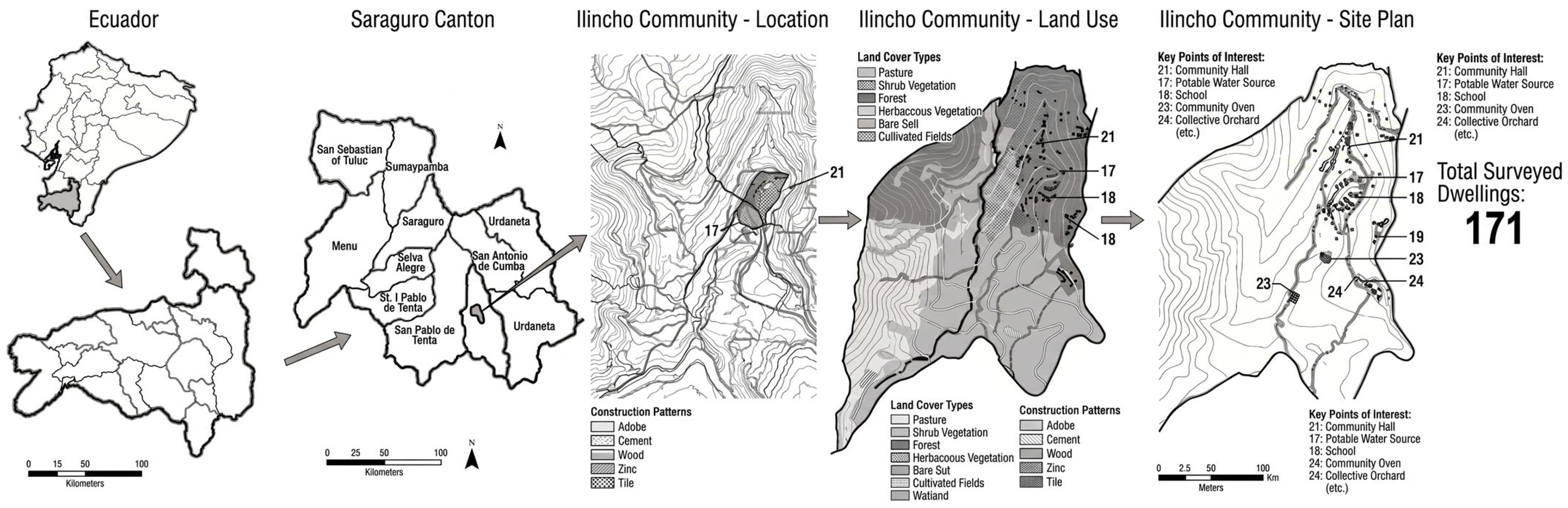
2.1. Study Area
2.2. Field Survey and Typological Classification
2.3. Spatial Pattern Analysis
2.4. Multi-Criteria Bioclimatic Framework
2.5. Exploratory Energy Simulation
2.6. Methodological Limitations
3. Results
3.1. Typological Characterization
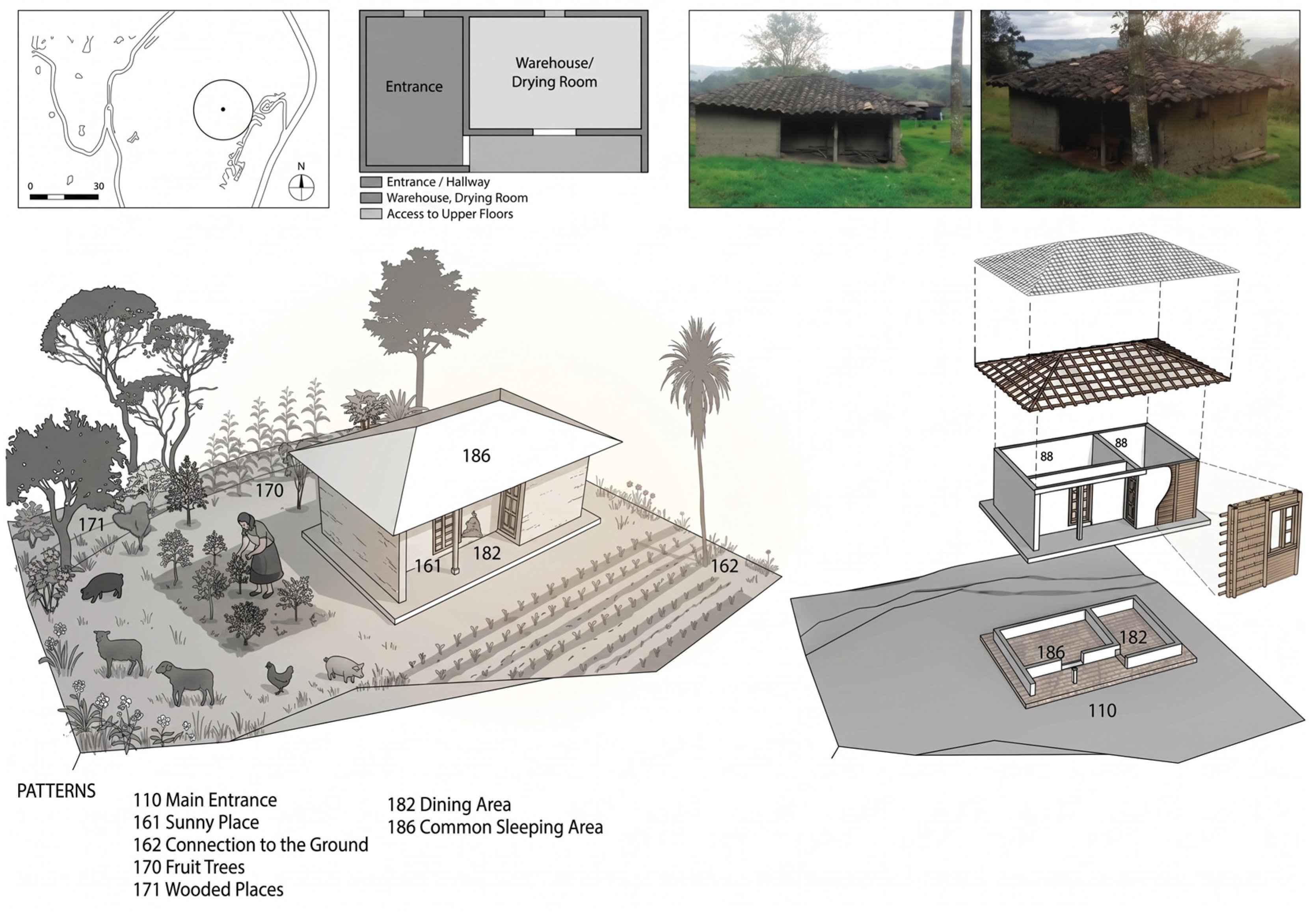
3.2. Spatial Patterns
3.3. Bioclimatic Performance Index
3.4. Exploratory Energy Simulation: Typology C
4. Discussion
4.1. Bioclimatic Performance in Comparative Perspective
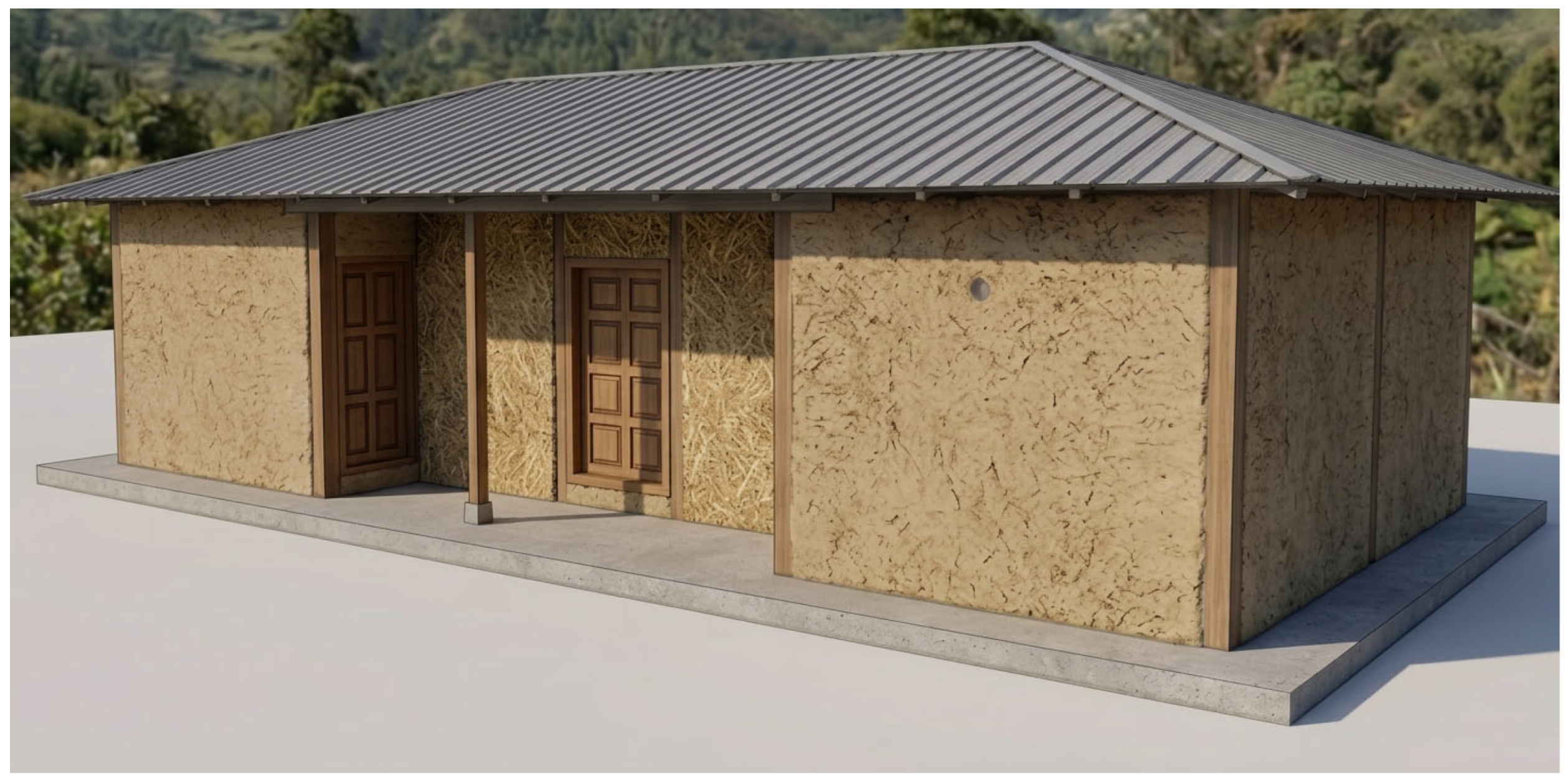
4.2. Typology C as the Highest-Performing Configuration Within the Evaluated Sample
4.3. Limitations and Methodological Implications
4.4. Implications for Sustainable Rural Housing Policy
5. Conclusions
Supplementary Materials
Author Contributions
Funding
Institutional Review Board Statement
Informed Consent Statement
Data Availability Statement
Acknowledgments
Conflicts of Interest
Abbreviations
| ASHRAE | American Society of Heating, Refrigerating and Air-Conditioning Engineers |
| BIM | Building Information Modelling |
| BPI | Bioclimatic Performance Index |
| EPW | EnergyPlus Weather file |
| IEA | International Energy Agency |
| LACCEI | Latin American and Caribbean Consortium of Engineering Institutions |
| m a.s.l. | metres above sea level |
| NEC-HS-EE | Norma Ecuatoriana de la Construcción–Habitabilidad y Salud–Eficiencia Energética |
| TMY | Typical Meteorological Year |
| UTPL | Universidad Técnica Particular de Loja |
References
- IEA. Buildings—Tracking Clean Energy Progress. Available online: https://www.iea.org/energy-system/buildings (accessed on 28 March 2026).
- OECD; CAF; CEPAL. Perspectivas Económicas de América Latina 2022; OECD Publishing: Paris, France, 2022. [Google Scholar] [CrossRef]
- Nguyen, A.T.; Truong, N.S.H.; Rockwood, D.; Tran Le, A.D. Studies on Sustainable Features of Vernacular Architecture in Different Regions Across the World. Front. Archit. Res. 2019, 8, 535–548. [Google Scholar] [CrossRef]
- Fernandes, J.; Silva, S.M.; Mateus, R.; Teixeira, E.R. Analysis of the Thermal Performance and Comfort Conditions of Vernacular Rammed Earth Architecture from Southern Portugal. Encycl. Renew. Sustain. Mater. 2020, 4, 1–10. [Google Scholar] [CrossRef]
- Singh, M.K.; Mahapatra, S.; Atreya, S.K. Bioclimatism and Vernacular Architecture of North-East India. Build. Environ. 2009, 44, 878–888. [Google Scholar] [CrossRef]
- Singh, M.K.; Mahapatra, S.; Atreya, S.K. Solar Passive Features in Vernacular Architecture of North-East India. Sol. Energy 2011, 85, 2011–2022. [Google Scholar] [CrossRef]
- Chandel, S.S.; Sharma, V.; Marwah, B.M. Review of Energy Efficient Features in Vernacular Architecture for Improving Indoor Thermal Comfort Conditions. Renew. Sustain. Energy Rev. 2016, 65, 459–477. [Google Scholar] [CrossRef]
- Coch, H. Bioclimatism in Vernacular Architecture. Renew. Sustain. Energy Rev. 1998, 2, 67–87. [Google Scholar] [CrossRef]
- Manzano-Agugliaro, F.; Montoya, F.G.; Sabio-Ortega, A.; García-Cruz, A. Review of Bioclimatic Architecture Strategies for Achieving Thermal Comfort. Renew. Sustain. Energy Rev. 2015, 49, 736–755. [Google Scholar] [CrossRef]
- Tamaskani Esfehankalateh, A.; Farrokhzad, M.; Tamaskani Esfehankalateh, F.; Soflaei, F. Bioclimatic Passive Design Strategies of Traditional Houses in Cold Climate Regions. Environ. Dev. Sustain. 2022, 24, 10027–10068. [Google Scholar] [CrossRef]
- Kırbaş, B.; Hızlı, N. Learning from Vernacular Architecture: Ecological Solutions in Traditional Erzurum Houses. Procedia Soc. Behav. Sci. 2016, 216, 788–799. [Google Scholar] [CrossRef]
- Cañas, I.; Martín, S. Recovery of Spanish Vernacular Construction as a Model of Bioclimatic Architecture. Build. Environ. 2004, 39, 1477–1495. [Google Scholar] [CrossRef]
- Hidalgo-Zambrano, R.V.; Milanes, C.B.; Pérez Montero, O.; Mestanza-Ramón, C. A Sustainable Proposal for a Cultural Heritage Declaration in Ecuador. Sustainability 2023, 15, 1115. [Google Scholar] [CrossRef]
- Moscoso-García, P.; Quesada-Molina, F. Analysis of Passive Strategies in Traditional Vernacular Architecture. Buildings 2023, 13, 1984. [Google Scholar] [CrossRef]
- Dall’Orto, V.; Monteros Cueva, K. Living Architecture: The Role of Intermediate Spaces in the Social Sustainability of Andean Rural Housing. Sustainability 2025, 17, 8267. [Google Scholar] [CrossRef]
- Torres-Gutiérrez, M.; Correa-Jaramillo, R.; Chalán-Saca, Á.H. Indigenous self-building and bioclimatic architecture. In Proceedings of the 22nd LACCEI International Multi-Conference, San José, Costa Rica, 17–19 July 2024. [Google Scholar] [CrossRef]
- Municipio Intercultural de Saraguro. Plan de Desarrollo y Ordenamiento Territorial 2020–2030; Municipio Intercultural de Saraguro: Saraguro, Ecuador, 2020. [Google Scholar]
- Chalán Saca, Á.H. Territorio Rural, Vivienda Vernácula y Materialidad de la Envolvente; Examen Complexivo, Universidad Técnica Particular de Loja: Loja, Ecuador, 2023; Unpublished. [Google Scholar]
- Alexander, C.; Ishikawa, S.; Silverstein, M. A Pattern Language: Towns, Buildings, Construction; Oxford University Press: New York, NY, USA, 1977. [Google Scholar]
- Castillo Haeger, C.; del Castillo Oyarzún, M. Enseñanza, Sustentabilidad, Arquitectura. Arquit. Del. Sur 2015, 33, 30–43. [Google Scholar]
- Khei, S.; Mateus, R.; Ortega, J.; Briones-Llorente, R. Quantitative Analysis of Vernacular Residential Building Typologies and Bioclimatic Strategies in the Warm-Summer Mediterranean Climate. Buildings 2024, 14, 2321. [Google Scholar] [CrossRef]
- Ministerio de Desarrollo Urbano y Vivienda (MIDUVI). Norma Ecuatoriana de la Construcción—Eficiencia Energética en Edificaciones Residenciales (EE), NEC-HS-EE; MIDUVI: Quito, Ecuador, 2018; Available online: https://www.mit.gob.ec/wp-content/uploads/downloads/2026/03/4.-NEC-HS-EE-Eficiencia-Energetica.pdf (accessed on 4 May 2026).
- Trebilcock, M. (Ed.) Manual de Hermeticidad al Aire de Edificaciones; Universidad del Bío-Bío, Centro de Investigación en Tecnologías de la Construcción (CITEC UBB) and Dirección de Extensión en Construcción, Pontificia Universidad Católica de Chile (DECON UC): Concepción, Chile, 2014; ISBN 978-956-9275-27-2. [Google Scholar]
- ASHRAE. ANSI/ASHRAE Standard 55-2013: Thermal Environmental Conditions for Human Occupancy; American Society of Heating, Refrigerating and Air-Conditioning Engineers: Atlanta, GA, USA, 2013. [Google Scholar]
- Delgado-Gutiérrez, E.; Canivell, J.; Bienvenido-Huertas, D.; Rubio-Bellido, C.; Delgado-Gutiérrez, Y.D. Improvement Options of a Social Housing Prototype in Different Climate Zones in Ecuador. Buildings 2022, 12, 989. [Google Scholar] [CrossRef]
- Albuja-Sánchez, J.; Solano-Vinueza, G.; Naranjo, O.; Anaguano-Marcillo, M.; Peñaherrera-Aguirre, M.; Medina-Pons, A.; Darquea-Cordova, F. Ancestral Construction Techniques in Southern Ecuador: From pre-Hispanic Cultures to Contemporary Practices. Built Herit. 2025, 9, 54. [Google Scholar] [CrossRef]
- Mite-Anastacio, F.; Tello-Ayala, K.; García-Troncoso, N.; Silva, C.E.; Malaga-Chuquitaype, C.; Arévalo, K.; Villao, D. Structural Behavior of Cemented Bahareque for Social Housing. Front. Built Environ. 2022, 8, 922397. [Google Scholar] [CrossRef]
- Morocho Jaramillo, D.E.; Mileto, C.; Vegas López-Manzanares, F. The Amazonian Architecture and Challenges Faced in Socio-Spatial Transformation Processes. Buildings 2024, 14, 842. [Google Scholar] [CrossRef]
- Morales-Cristóbal, R.; Sánchez-Medrano, M.T.; Arista-González, G.J.; Suárez-Domínguez, E.J. Comparison of Housing Construction Systems in the Huasteca Zone. Case Stud. Constr. Mater. 2020, 13, e00359. [Google Scholar] [CrossRef]
- García-Espinosa, A.; Blanco-Aguilera, J.L.; Hernández-Molina, R. Seismic Behavior of Bahareque Walls Under in-Plane Horizontal Loads. Buildings 2025, 15, 4. [Google Scholar] [CrossRef]





| Constructive Element | Dimension/Description | Function |
|---|---|---|
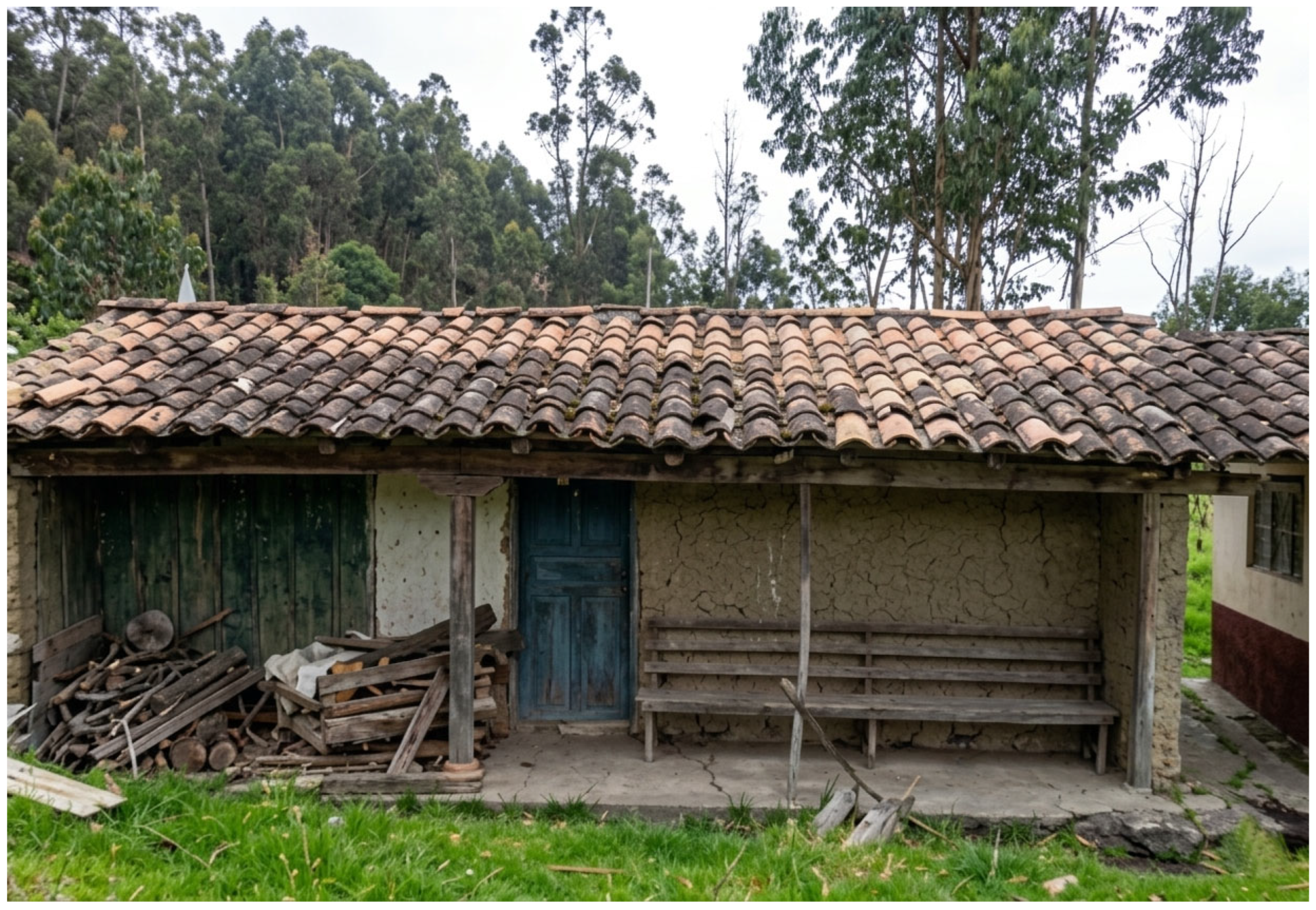
| Corner and minor posts | Buried 50 cm, spacing ~40 cm | Vertical load-bearing structure |
| Horizontal braces (pilores) | Upper and intermediate levels | Horizontal bracing |
| Ridge columns (horcones) | 0.90–1.20 m above intermediate walls | Ridge beam support |
| Top plate (solera) | 12 × 20 cm square section | Perimeter top closure |
| Corridor columns | 20–25 cm diameter | Portal support |
| Wattle infill (chaclla/chincha) | Tied at 10–15 cm spacing | Base for clay plaster |
| Clay-straw plaster (embarre) | ~4 cm per face, 15 days drying | Cladding and thermal mass |
| Roof | Ceramic tile, slope 20–25% | Water and solar protection |
| Foundation | Stone pads at corners + 50 cm deep holes | Ground moisture insulation |
| Category | No. of Criteria | Main Evaluated Aspects | Scoring Basis |
|---|---|---|---|
| A. Site and context | 8 | Topographic suitability; solar exposure; wind protection; relationship to natural landscape; vegetation as climate buffer; land use compatibility; microclimatic context; proximity to productive land | Direct field observation; comparison with climatic context data |
| B. Orientation and form | 6 | Principal façade orientation; plan compactness; form factor; roof geometry; self-shading capacity; solar incidence on main openings | Architectural measurement; compass observation; plan analysis |
| C. Natural ventilation | 6 | Distribution and size of openings; cross-ventilation potential; prevailing wind alignment; deliberate minimization of air exchange (recalibrated as positive strategy in cold mountain climate) | Field measurement of openings; observation of envelope continuity |
| D. Solar control | 6 | Provision of overhangs; portal as multi-façade shading device; window-to-wall ratio; solar gain through east/south openings; horizontal shading elements; seasonal solar geometry appropriateness | Architectural measurement; sun angle calculations for study latitude |
| E. Thermal mass and envelope | 8 | Wall thickness and mass; thermal conductivity of envelope materials; floor-to-ground separation; roof thermal performance; envelope air tightness; thermal bridge continuity; buffer zone effectiveness; heat storage and release behavior | Material documentation; dimensional measurement; normative reference (NEC-HS-EE) |
| F. Materials and construction | 4 | Use of locally sourced materials; low embodied energy content; absence of industrial processing; material durability and maintenance requirements | Material identification and provenance documentation; observation |
| G. Spatial organization | 6 | Functional spatial hierarchy; zone transition gradients from public to private; multi-functionality of interior spaces; integration of hearth as thermal and social center; spatial adequacy for climate-sensitive activities | Spatial observation; architectural plan analysis |
| H. Cultural and social aspects | 4 | Collective construction practices (minga); intergenerational knowledge transmission; cosmological and ceremonial elements embedded in construction sequence; community social cohesion outcomes | Ethnographic observation; prior documentation [16] |
| Total | 48 |
| Typology | Description | Est. Area (m2) | Portal | n | % |
|---|---|---|---|---|---|
| I-1P | Compact I-shaped block, 1 story | ~35 | 1 side | 1 | 3.3 |
| I-2P | Compact I-shaped block, 2 stories | ~60 | 1 side | 1 | 3.3 |
| 2B | Two compact blocks | ~55 | 1 side | 1 | 3.3 |
| L | Compact L-shaped block | ~55 | 2 sides | 11 | 36.7 |
| C | Compact C-shaped block | ~70 | 3 sides | 16 | 53.3 |
| Total | 30 | 100 |
| Category | I-1P | I-2P | L | C | 2B |
|---|---|---|---|---|---|
| A. Site and context | 75.0 | 75.0 | 75.0 | 87.5 | 75.0 |
| B. Orientation and form | 75.0 | 75.0 | 83.3 | 83.3 | 58.3 |
| C. Natural ventilation | 66.7 | 66.7 | 66.7 | 83.3 | 58.3 |
| D. Solar control | 83.3 | 83.3 | 83.3 | 83.3 | 83.3 |
| E. Thermal mass and envelope | 75.0 | 75.0 | 75.0 | 81.2 | 75.0 |
| F. Materials and construction | 100.0 | 100.0 | 100.0 | 100.0 | 100.0 |
| G. Spatial organization | 83.3 | 83.3 | 83.3 | 100.0 | 66.7 |
| H. Cultural and social aspects | 100.0 | 100.0 | 100.0 | 100.0 | 100.0 |
| Overall index (%) | 81.2 | 81.2 | 82.3 | 88.5 | 77.1 |
| Morphological BPI (A–E, G) (%) | 76.4 | 76.4 | 77.8 | 86.4 | 69.4 |
| Space | ASHRAE 55 Range | T-Min (°C) | T-Max (°C) | Assessment |
|---|---|---|---|---|
| Sleeping area | 18–25 °C | 18.80 | 29.20 | Compliant (min.) |
| Living room | 18–25 °C | 17.20 | 33.30 | Non-compliant |
| Kitchen | 18–25 °C | 15.90 | 29.90 | Partially compliant |
Disclaimer/Publisher’s Note: The statements, opinions and data contained in all publications are solely those of the individual author(s) and contributor(s) and not of MDPI and/or the editor(s). MDPI and/or the editor(s) disclaim responsibility for any injury to people or property resulting from any ideas, methods, instructions or products referred to in the content. |
© 2026 by the authors. Licensee MDPI, Basel, Switzerland. This article is an open access article distributed under the terms and conditions of the Creative Commons Attribution (CC BY) license.
Share and Cite
Correa-Jaramillo, R.; Torres-Gutiérrez, M.; Chalán-Saca, Á. Vernacular Bahareque Architecture and Bioclimatic Performance: Multi-Criteria Assessment of Kichwa-Saraguro Dwellings in the Ecuadorian Andes. Sustainability 2026, 18, 5192. https://doi.org/10.3390/su18105192
Correa-Jaramillo R, Torres-Gutiérrez M, Chalán-Saca Á. Vernacular Bahareque Architecture and Bioclimatic Performance: Multi-Criteria Assessment of Kichwa-Saraguro Dwellings in the Ecuadorian Andes. Sustainability. 2026; 18(10):5192. https://doi.org/10.3390/su18105192
Chicago/Turabian StyleCorrea-Jaramillo, Ramiro, Mercedes Torres-Gutiérrez, and Ángel Chalán-Saca. 2026. "Vernacular Bahareque Architecture and Bioclimatic Performance: Multi-Criteria Assessment of Kichwa-Saraguro Dwellings in the Ecuadorian Andes" Sustainability 18, no. 10: 5192. https://doi.org/10.3390/su18105192
APA StyleCorrea-Jaramillo, R., Torres-Gutiérrez, M., & Chalán-Saca, Á. (2026). Vernacular Bahareque Architecture and Bioclimatic Performance: Multi-Criteria Assessment of Kichwa-Saraguro Dwellings in the Ecuadorian Andes. Sustainability, 18(10), 5192. https://doi.org/10.3390/su18105192