Article

From Artificial Intelligence to Green Purchasing Behavior: The Role of Environmental Knowledge and Green Truth in Shaping Environmental Attitudes and the Purchase of Organic Products in University Students


by
Wilson Zambrano-Vélez
1,*,
Nelson Carrión-Bósquez
2,*,
Jorge Bernal-Peralta
3,
Andrés Vélez-Luna
4,
Cristina Villacís-Mejía
5,
Ximena Tobar-Cazares
6,
Cristian Ramírez-Larreategui
7,
Lenin Tobar-Cazares
8,
Jorge Vinueza-Martínez
9 and
Rubén Marchena-Chanduvi
10
1
Facultad de Ciencias Sociales y de la Salud, Universidad Estatal Península de Santa Elena, La Libertad 240250, Ecuador
2
Departamento de Administración, Facultad de Economía y Administración, Universidad Católica del Norte, Antofagasta 1270709, Chile
3
Facultad de Administración y Economía, Universidad de Tarapacá, Arica 1000007, Chile
4
Extensión El Carmen, Facultad de Ciencias Administrativas, Contables y Comercio, Universidad Laica Eloy Alfaro de Manabí (ULEAM), El Carmen 130450, Ecuador
5
Vicerrectorado Académico, Universidad Pública de Santo Domingo de los Tsáchilas—UPSDT, km 28, vía Santo Domingo—Quevedo, Santo Domingo 230153, Ecuador
6
Facultad de Derecho, Ciencias Administrativas y Sociales, Universidad UTE, Quito 170508, Ecuador
7
Independent Researcher, Santo Domingo 230101, Ecuador
8
Facultad de Ciencias Económicas, Universidad Central del Ecuador, Quito 170515, Ecuador
9
Facultad de Ciencias e Ingeniería, Universidad Estatal de Milagro, Milagro 091050, Ecuador
10
Escuela Profesional de Ingeniería Agroindustrial, Facultad de Ciencias Agrarias, Universidad Nacional Autónoma de Chota, Cajamarca 06001, Peru
*
Authors to whom correspondence should be addressed.
Sustainability 2026, 18(10), 5167; https://doi.org/10.3390/su18105167
Submission received: 6 April 2026 / Revised: 7 May 2026 / Accepted: 17 May 2026 / Published: 20 May 2026

Abstract

This study explores how Artificial Intelligence (AI) shapes Green Purchasing Behavior through cognitive and attitudinal mechanisms by implementing the Stimulus–Organism–Response (SOR Model) Theory. It analyzes AI as an external stimulus that influences Environmental Knowledge and Green Truth, which, in turn, affects Environmental Attitudes and Green Purchasing Behavior. A cross-sectional quantitative design was employed using survey data collected from 412 consumers in the province of Guayas (Ecuador). The data were analyzed using partial least-squares structural equation modeling (PLS-SEM). The results indicate that AI exerts a weak influence on Green Purchasing Behavior; instead, its impact operates primarily through indirect pathways. Specifically, AI significantly enhances Environmental Knowledge and promotes Green Truth, subsequently shaping consumers’ Environmental Attitudes. Furthermore, Environmental Attitude emerged as the strongest predictor of Green Purchasing Behavior, confirming its central role in translating internal evaluations into consumption decisions. These findings contribute to the literature by integrating AI into sustainable consumption models and demonstrate that its effectiveness depends on its ability to generate credible and meaningful internal responses rather than directly influencing behavior.

1. Introduction

Over recent decades, the growing consumption of traditional products has generated significant environmental impacts, contributing to the deterioration of ecosystems and the increase in multiple forms of pollution [1,2]. In particular, intensive production systems, the indiscriminate use of chemical inputs, and massive waste generation have exacerbated problems such as climate change, soil degradation, and water pollution [3]. In this context, consumer behavior plays a central role in the sustainability debate, as purchasing decisions not only respond to functional needs but also generate significant environmental externalities [4].
Faced with the aforementioned environmental problems, Green Purchasing Behavior (GPB) has become a concrete mechanism through which consumers can translate their ecological concerns into consumption actions consistent with sustainability [5,6]. Beyond a simple preference for environmentally friendly products, this behavior reflects a deliberate consumer decision-making process in which individuals evaluate the environmental impact of their choices and prioritize alternatives that minimize environmental harm [7,8]. In this sense, the consumption of environmentally friendly products constitutes a practical manifestation of pro-environmental values, allowing consumers to align their consumption practices with the principles of ecological and ethical responsibility [9,10]. In addition to helping reduce the negative impact of traditional consumption, this type of behavior also generates market signals that encourage companies to adopt more sustainable practices [11,12].
In the consumption context, digital transformation has reshaped how consumers access, process, and interpret information [13,14,15]. Specifically, Artificial Intelligence (AI) has transformed the way individuals seek information by facilitating access to fast, personalized, and easily understandable responses [16,17]. In this sense, AI-based chatbots have become widely used tools for accessing information across various fields, including sustainability [18,19,20]. Consequently, AI not only acts as a channel for accessing knowledge but also shapes how consumers develop their perceptions and beliefs regarding responsible consumption [21]. As noted by Foroughi et al. [22], the implementation of AI has driven a significant evolution in green marketing by facilitating better alignment between communication strategies and sustainability goals, while also optimizing message segmentation toward environmentally conscious consumers. However, significant challenges remain, particularly regarding consumer perceptions of the use of automated systems for obtaining information that supports ethical decision making [14].
In light of the above, changes in consumer purchasing decisions have been accompanied by a growing demand for reliable environmental information [7,8,9,10]. This phenomenon is largely explained by growing concern over environmental impacts and the need to reduce information asymmetry in sustainable product markets [23]. Consequently, variables called Environmental Knowledge (EKN) and Green Truth (GTR) are crucial to understanding consumer behavior, as they help explain how individuals process, evaluate, and use information related to ecological attributes [24,25,26]. Specifically, EKN facilitates understanding of the environmental effects associated with consumption, allowing individuals to evaluate more critically the consequences of their decisions and distinguish between more and less sustainable alternatives [27]. Likewise, GTR helps reduce perceived uncertainty surrounding products’ environmental claims, especially in contexts where practices such as greenwashing may generate skepticism and distrust [28]. Thus, both variables not only serve an informational function but also act as cognitive and evaluative mechanisms that strengthen the credibility of green attributes, significantly influencing the formation of positive attitudes toward more conscious consumption [29] and, ultimately, the adoption of responsible purchasing behaviors [30,31].
Furthermore, Environmental Attitude (EAT) has been widely recognized as a key antecedent in the formation of GPB [32,33], constituting a central component within explanatory models of sustainable consumer behavior [34,35]. This variable reflects individuals’ evaluative predisposition toward environmental protection and, consequently, toward the adoption of responsible behaviors [36]. In this sense, empirical studies have demonstrated that a favorable EAT not only increases the likelihood that consumers will adopt green practices but also strengthens the consistency between their values and purchasing decisions [37,38]. Likewise, EAT serves as a mediating mechanism through which environmental beliefs and perceptions are transformed into behavioral intentions, acting as a determining factor in the transition from environmental awareness to sustainable action [24,30]. However, despite its relevance, important research gaps remain regarding the factors that shape EAT [39], especially in digital contexts where information is abundant, dynamic, and mediated by emerging technologies [40].
The academic literature has consistently demonstrated that EAT is one of the main drivers of GPB, directly influencing individuals’ willingness to prefer sustainable alternatives [9,30,32]. However, despite these advances, empirical evidence regarding the role of AI in shaping EAT and subsequent GPB remains limited [41]. Addressing this gap is crucial for understanding the emerging determinants of sustainable consumption behavior in contemporary digital environments. Considering that EAT could serve as a bridge for the connection between AI and GPB, it is important to explore how this interaction may function as an internal mechanism that translates environmental information into consumption decisions. In this sense, AI could directly influence behavior or affect how consumers acquire knowledge and perceive the veracity of ecological information, which could ultimately strengthen or weaken their attitudes toward sustainability. In light of the above, this study examines the influence of AI on the formation of EAT and GPB, particularly in the context of products identified with environmental protection. In order to fulfill the stated objective, this study aimed to provide answers to the following research questions:
  • What is the impact of Artificial Intelligence on Green Purchasing Behavior?
  • How does Artificial Intelligence influence Environmental Attitude, Environmental Knowledge, and Green Truth?
  • How do Environmental Knowledge and Green Truth influence Environmental Attitude?
  • How do Environmental Knowledge and Green Truth mediate the relationship between Artificial Intelligence and Environmental Attitude?
  • What is the effect of Environmental Attitude on Green Purchasing Behavior?

2. Review of the Literature

2.1. Conceptual Foundations of the Stimulus–Organism–Response (SOR) Model

Historically, the impact of environmental stimuli on consumer attitudes and behaviors has been explored through structural frameworks primarily focused on economic, social, and cultural factors [42]. However, these approaches fail to fully explain how certain external stimuli interact with individuals’ cognitive and affective processes, especially in contexts characterized by digitalization and the growing relevance of sustainable consumption [35]. Within this context, the SOR model provides a more integrative theoretical perspective, as it proposes that environmental stimuli can activate psychological mechanisms that subsequently shape consumer actions. This approach enables deeper examination of how attitudes and behaviors are shaped within complex digital environments mediated by emerging technologies [40,43].
Drawing on the SOR Model, stimuli are understood as external signals capable of triggering internal processes in individuals [44,45]. In the current context, these stimuli can be represented by AI systems that function as informational mechanisms, facilitating personalized recommendations, access to relevant content, and guidance regarding sustainable consumption decisions [22,46]. Unlike approaches focused on the specific characteristics of platforms or communication formats, this study conceptualizes AI as a source of information perceived by users, whose impact depends on how such information is interpreted and valued within consumption contexts [47]. This perspective aligns with previous research in digital environments, where the perception of content, rather than mere exposure, constitutes a key factor influencing consumers’ internal processes and subsequent decisions [34,35,40]. In line with this reasoning, the SOR Model is especially relevant for understanding the role of AI in consumer behavior, as it conceptualizes AI as a stimulus that influences cognitive and attitudinal variables prior to behavioral responses [47]. Within the domain of organic product consumption, information generated or mediated by AI systems contributes to promoting lifestyles and behaviors aligned with environmental protection [48], while also shaping consumers’ internal states and guiding their predisposition toward sustainable behaviors [49]. Consequently, the behavioral response is reflected in the purchase decision for organic products, underscoring the relevance of the SOR framework as an appropriate theoretical model for examining the relationship between digital stimuli and sustainable consumption behaviors in digital environments [34,35,40,45,50,51].

2.2. Artificial Intelligence (AI)

AI refers to technological systems capable of processing large volumes of data, learning from information, and generating responses or recommendations that mimic human cognitive abilities [48,52]. AI has become a transformative element in shaping consumer behavior, particularly through personalization, interactivity, greater accessibility, and the delivery of sustainability-related information, thereby influencing consumption decisions [53,54]. In the context of green consumption, AI enables personalized product recommendations, improves information transparency, and facilitates the creation of interactive experiences that promote environmentally responsible decisions [22,46,47]. Within this context, previous studies indicate that variables such as personal norms, green values, environmental concerns, and attribution of responsibility play a significant role in how AI-driven sustainability efforts influence ecological behaviors [27,38]. Likewise, evidence suggests that AI-driven services foster more informed and conscious decision-making processes, contributing to the development of pro-environmental behaviors and increasing consumers’ awareness of sustainability [7].
From a sectoral perspective, the adoption of AI has generated significant sustainability impacts, highlighting its relationship with eco-innovation and the growth in green patents [55], as well as its contribution to the development of more sustainable operational practices in sectors such as healthcare [56], urban management [7], and recycling [53]. AI has also demonstrated its ability to strengthen purchase intentions, including those related to environmentally friendly products [46]. However, this evidence remains fragmented and provides limited understanding of consumer-level purchasing behavior, particularly considering that most studies have focused on banking and service sectors [54,57,58]. Despite the growing relevance of AI, some studies indicate that consumers tend to value characteristics such as the depth of explanations provided by AI regarding sustainability-related attributes, particularly when they lack established environmental values [59,60]. Similarly, it has been documented that certain AI applications can inhibit green purchase intentions, highlighting possible unintended consequences arising from the use of persuasive strategies that are not aligned with genuine sustainability goals [33]. These findings indicate that the effectiveness of AI-generated messages is not uniform; rather, it varies according to factors such as consumer trust, individual values, and the perceived credibility of green information.
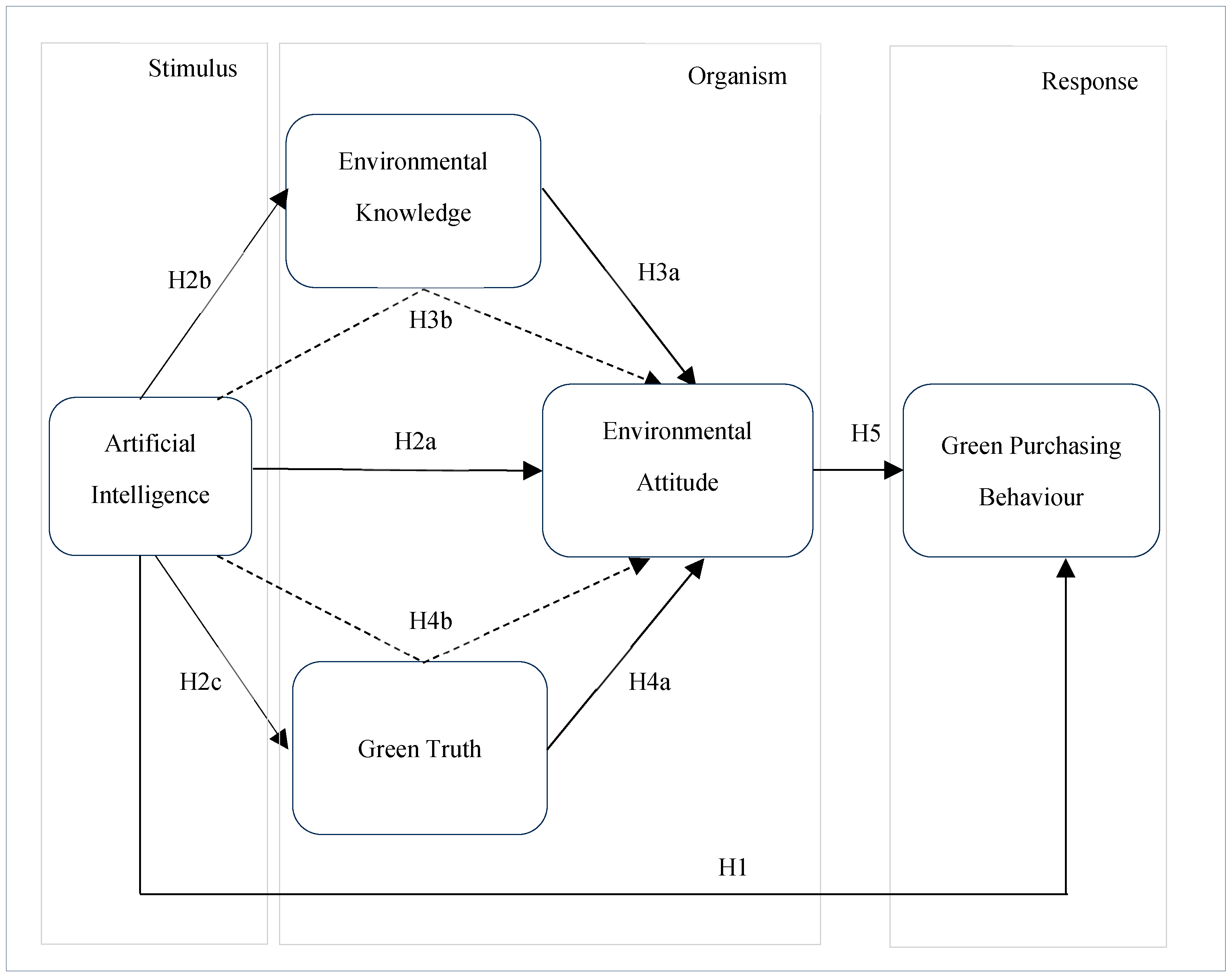
From a theoretical perspective of the SOR model, AI has been conceptualized as an extrinsic factor that activates cognitive and evaluative processes embedded in consumers. In this sense, previous studies have shown that AI-powered systems facilitate access to sustainability-related information, enhance personalization, and strengthen consumers’ understanding of environmental sustainability, which can influence both knowledge formation and trust perceptions [22,46,47,54]. Furthermore, empirical evidence suggests that AI can indirectly shape pro-environmental behavior by strengthening information processing and perceived credibility rather than acting as a direct determinant of behavior [59,60]. Within this framework, AI (stimulus) is expected to influence EKN and GTR (organism), which subsequently influence EAT (organism), ultimately leading to GPB (response). Accordingly, the proposed hypotheses examine the direct and indirect effects of AI on GPB, as well as its role in activating internal cognitive and evaluative mechanisms consistent with the SOR model. Therefore, the following hypotheses were formulated:
H1. 
AI influences GPB.
H2a. 
AI influences consumers’ EAT.
H2b. 
AI influences consumers’ EKN.
H2c. 
AI influences consumers’ GTR.

2.3. Environmental Knowledge (EKN)

EKN has been defined as a comprehensive and nuanced understanding of environmental issues, including an informed recognition of the impacts resulting from human activities, which evolves over time through environmental education processes that foster sustainability-oriented perspectives, ethical orientations, and responsible behavioral patterns [61]. In this regard, such knowledge extends beyond the mere acquisition of information about natural systems; it gains practical relevance when individuals internalize the implications of their actions and recognize the effectiveness of responsible practices in their daily lives [62,63]. From this perspective, within the scope of consuming products focused on environmental protection, EKN acts a fundamental factor by serving as a cognitive and value-based foundation that enables individuals to interpret sustainability-related messages, evaluate consumption alternatives, and shape predispositions toward environmentally responsible practices [64,65]. Consequently, integrating EKN into the research framework is crucial for elucidating how digital stimuli trigger internal processes that ultimately lead to behavioral responses consistent with sustainable consumption practices [43,66].
Empirical evidence consistently indicates that elevated levels of environmental literacy and awareness are positively associated with greater engagement in collective and collaborative sustainability initiatives, thereby contributing to shared value creation among consumers, organizations, and communities [67,68]. Similarly, it has been demonstrated that the circulation of resources, information, and sustainability-oriented interactions becomes more prevalent as consumers develop a stronger ecological orientation, thereby enhancing their willingness to participate in sustainable and collaborative initiatives [69,70]. Although several studies in the field of sustainable consumption have shown that EKN strengthens participation in responsible practices that transcend the act of consumption [61,62], empirical research examining whether AI can influence EKN remains limited.
Within the SOR framework, EKN can be understood as a cognitive component within the organism that enables individuals to interpret and evaluate environmental information derived from external stimuli. Previous studies have shown that higher levels of EKN improve individuals’ ability to critically process sustainability-related information, which in turn contributes to the development of favorable EAT and responsible consumption behaviors [61,62,64,65]. Furthermore, empirical research indicates that knowledge not only influences attitudes directly but also acts as a mediating mechanism between informational stimuli and attitudinal responses [29,37,61]. In this context, AI, as a stimulus, can strengthen EKN, which subsequently influences EAT, reinforcing its role as a key cognitive pathway within the SOR model. Considering the above, this study proposes the following hypotheses:
H3a. 
EKN influences consumers’ EAT.
H3b. 
EKN mediates the relationship between AI and consumers’ EAT.

2.4. Green Truth (GTR)

GTR has been defined as the extent to which environmental messages disseminated in digital environments are perceived as credible, authentic, and consistent, particularly in contexts where consumers assess the reliability of ecological content and its alignment with genuine environmental commitment [71,72]. In this respect, the construct is closely linked to both source credibility and perceived message efficacy, as individuals are more likely to respond favorably when they perceive the information as reliable and the environmental issue as meaningful and legitimate [73]. From this perspective, GTR becomes especially important within sectors such as organic food, where consumers rely on clear and credible sustainability cues to guide their decision making [28]. Consequently, the perception of content truthfulness not only shapes the interpretation of information but also influences commitment to pro-environmental values and willingness to engage in responsible consumption practices [66,74]. Therefore, it is essential to analyze the role of GTR as a cognitive and evaluative mechanism capable of activating internal states that subsequently support sustainability-oriented behavioral responses.
From an empirical perspective, the literature has demonstrated that trust and credibility in communication play a critical role in promoting consumer involvement in collaborative dynamics, especially in digital environments characterized by interaction, knowledge sharing, and voluntary participation [70,75]. Indeed, the perceived authenticity and consistency of green messages foster more favorable consumer perceptions, thereby encouraging the sharing of experiences, the promotion of sustainable practices, and active participation in brand- and community-driven initiatives [68,73]. Thus, GTR can be conceptualized as a key antecedent that helps explain why individuals choose to participate in collaborative initiatives designed to promote environmental awareness and values [76]. In this regard, the relationship between GTR and environmental behaviors should be analyzed further, particularly in contexts where integrative frameworks have provided limited explanations for the factors through which green perceptions translate into actual behaviors [42,67].
From the point of view of the SOR model, GTR represents a perceptual and evaluative component within the organism, reflecting the degree to which consumers perceive environmental information as credible and authentic. Previous research has consistently demonstrated that the credibility of the consumers and the associated trust in sustainability messages are critical factors in shaping favorable attitudes toward sustainability and reducing uncertainty in green consumption contexts [28,71,72,73]. Furthermore, studies suggest that trust-based perceptions are often stronger predictors of attitudinal responses than the mere availability of information, as consumers rely on perceived authenticity to validate environmental claims [68,73]. Within this framework, AI can act as a stimulus that enhances the perceived credibility of environmental information, thereby reinforcing the role of GTR as an internal mechanism that influences EAT. This reasoning supports the assumption that trust-related perceptions play a central role in translating external stimuli into attitudinal responses. Considering the above, the following hypotheses are proposed:
H4a. 
GTR influences consumers’ EAT.
H4b. 
GTR mediates the relationship between AI and consumers’ EAT.

2.5. Environmental Attitude (EAT)

Conceptually, EAT can be described as a cognitive and affective orientation toward the natural environment, as reflected in their interpretations, judgments, and behavioral responses to ecological challenges [77]. This construct represents a fundamental internal determinant in the development of behaviors identified with environmental protection and preferences for products that contribute to such protection, as it reflects not only the degree of concern for the environment but also individuals’ motivation to act in accordance with these values [38,78]. In this sense, EAT acts as an integrative mechanism that connects cognitive processes, such as EKN and environmental awareness, with behavioral decisions, facilitating the translation of these predispositions into sustainable consumption practices [62]. Therefore, understanding the role of EAT is essential for explaining how consumers process environmental information and how these attitudes influence their choices in sustainability-oriented markets [36].
From an empirical perspective, academic findings have consistently identified that EAT is a significant predictor that promotes environmentally aligned behaviors across diverse cultural and geographical contexts. In this sense, Aertsens et al. [79] identified a positive association between EAT and GPB, particularly in the case of organic products. On the other hand, researchers Von Meyer et al. [80] and Prakash et al. [81] reported similar findings among German consumers. Likewise, recent research has reinforced the idea that EAT increases green purchasing intentions, particularly among younger consumers whose attitudes are strongly aligned with environmental protection [34,40,77,82,83]. However, despite this evidence, some studies have challenged these findings, suggesting that the role of EAT in GPB may be weaker under certain conditions [27].
Within the SOR framework, EAT represents the organism’s final internal state that directly precedes behavioral responses. Previous studies have shown that EAT serves as a key mechanism through which cognitive and perceptual factors translate into consumption behavior, particularly in the context of organic products [37,79,80,81]. In this sense, EAT integrates the effects of knowledge and perceived credibility, acting as a central evaluative filter that determines the likelihood of engaging in GPB [34,40,77,82,83]. Therefore, according to the SOR model, attitudes are expected to serve as a bridge between cognitive and perceptual processes, reinforcing consumers’ predisposition to purchase organic products. Considering the above, the following hypotheses are proposed:
H5. 
EAT influences GPB.

2.6. Research Model

To analyze the gaps previously identified and facilitate the understanding of the relationships to be tested in this study, the model to be hypothesized is presented below (see Figure 1).

3. Materials and Methods

3.1. Survey Instrument Development and Data Collection Procedures

This study was grounded in a positivist research paradigm, which enabled the empirical testing of the hypothesized relationships within the proposed model. Accordingly, a deductive research approach was adopted to integrate variables identified in the literature and examine them within the SOR Model. In line with this approach, the study employed a quantitative methodology with a correlational and cross-sectional design. Data were collected through a structured questionnaire composed of 25 items, including four sociodemographic questions and 21 items designed to measure the study constructs. The questionnaire underwent a content validation process through expert review, in which two specialists, one specializing in research methodology and the other in marketing, evaluated the clarity and relevance of the items without identifying significant concerns. Subsequently, to verify the comprehensibility of the questionnaire, the research applied a pilot test through 30 participants. The results confirmed that the questionnaire was clear and suitable for full-scale administration. The questions used in the survey were selected from previous studies published in high-impact journals and their measurement scale was a seven-point Likert scale. In this sense, five items measured AI [84], four measured EKN [27], four measured GTR [85], four measured EAT [86], and four measured GPB [87]. (See Appendix A).
A convenience sampling method, categorized as non-probabilistic, was applied, and the sample comprised undergraduate and graduate students living in the province of Guayas (Ecuador) who voluntarily agreed to participate in the study. The survey was administered via a Google form and was conducted during January and February of 2026. In this sense, 412 responses were obtained. The selection of undergraduate and graduate students as the unit of analysis was justified both theoretically and contextually. This group represents a segment characterized by high levels of digital literacy, frequent use of Artificial Intelligence tools, and greater exposure to sustainability-related information, making them particularly relevant for examining technology-driven sustainable consumption behaviors. Furthermore, previous research has indicated that young university-educated consumers tend to adopt a predisposition to develop actions in favor of the environment and their consumption preference is aligned with organic products [77,82,83]. Additionally, to ensure the presence of a genuine demand for organic products within the sample, a screening question was included to identify participants who had purchased or consumed organic products in recent months. This criterion allowed the study to focus on individuals with current purchasing experience, thus enhancing the validity of the findings regarding environmentally friendly purchasing behavior.

3.2. Statistical Procedure

Following the methodological guidelines proposed by Leguina [88], the analysis was conducted in two stages: (a) the measurement model was examined to assess convergent and discriminant validity, and (b) the structural model was analyzed to evaluate its overall fit and test the hypotheses using structural equation modeling. First, convergent validity was determined considering the following criteria: (a) Cronbach’s Alpha test, (b) Composite Reliability Coefficient test, and (c) Average Variance Extracted test. On the other hand, the discriminant validity of the model was verified using the following tests: the (a) Fornell–Larcker criterion and the (b) Heterotrait–Monotrait Ratio (HTMT). Second, the researchers estimated the structural model using SmartPLS 4.1.1.8 software to test the hypothesized relationships. This analysis included the evaluation of the statistical significance of the proposed paths, together with the assessment of path coefficients (β), the Standardized Root-Mean-Square Residual (SRMR), and the coefficient of determination (R2).
To justify the use of PLS-SEM, it is important to determine that this approach is particularly applicable for exploratory research, complex models, and prediction-oriented studies. In contrast to covariance-based SEM (CB-SEM), PLS-SEM does not rely on strict assumptions of data normality and is more appropriate for models with multiple constructs and mediation effects, as reflected in the proposed model. Furthermore, PLS-SEM is widely recommended when the objective is to maximize the explained variance of endogenous constructs rather than to confirm an established theory [89,90]. Therefore, its use was consistent with the predictive and exploratory nature of the proposed model.

4. Results

4.1. Sociodemographic Characterization

The sociodemographic characterization indicated a relative gender balance, with a slight predominance of female participants (56%), followed by males (43%) and a marginal representation of non-binary individuals (1%). Regarding age distribution, the sample was largely composed of young adults, particularly those aged 23–28 (35%) and 29–34 (30%), which collectively represented 65% of the participants. Furthermore, the presence of consumers aged under 23 (8%) and older groups (35–44: 14%, 45–54: 9%, and over 55: 4%) suggests that the sample reflects consumers with greater technological exposure and a stronger predisposition toward AI use. Regarding educational level, most participants held undergraduate degrees (64%), followed by those with postgraduate studies (36%). This is particularly relevant, as higher levels of education are often associated with stronger information-processing skills, critical thinking, and greater sensitivity to environmental issues. Finally, all participants (100%) were from the province of Guayas (see Table 1 for additional details).

4.2. Measurement Model Evaluation (Convergent and Discriminant Validity)

To evaluate reliability and convergent validity, widely accepted indicators were employed, including Cronbach’s Alpha and Composite Reliability Coefficients (rho_a − rho_c), as well as Average Variance Extracted. Initially, the factor loadings of all items were examined, leading to the removal of one item from the AI construct (AI5:0.062), one from EAT (EAT4:0.128), and one from GPB (GPB4:0.027) due to insufficient factor loadings. Subsequently, the values obtained for Cronbach’s Alpha and Composite Reliability Coefficients exceeded the recommended threshold of 0.70, demonstrating good internal consistency consistent with established methodological recommendations [89]. Convergent validity was confirmed because all constructs achieved Average Variance Extracted values above 0.50, indicating that each latent variable explained more than half of the variance in their respective indicators. Furthermore, the Average Variance Extracted values were lower than the Composite Reliability Coefficients (rho_a and rho_c), further confirming the robustness of the measurement model [90] (see Table 2).
To assess discriminant validity, the HTMT index was used, considering a base value of <0.90 to ensure adequate differentiation between constructs [91,92]. In this sense, the HTMT values indicated that the latent variables demonstrated adequate discriminant validity, confirming that the constructs were empirically distinct. Additional details are presented in Table 3.
On the other hand, the Fornell–Larcker criterion was also calculated. This criterion requires that the square root of the Average Variance Extracted for each construct be greater than their correlations with all other constructs in the model [93]. These values are presented on the diagonal of the correlation matrix. As shown, this condition was consistently satisfied, as the square roots of the Average Variance Extracted were greater than the inter-construct correlations in all cases. Collectively, these results indicated that the model exhibited satisfactory discriminant validity. Additional details are presented in Table 4.

4.3. Structural Equation Modeling (Hypothesis Testing and Model Fitting)

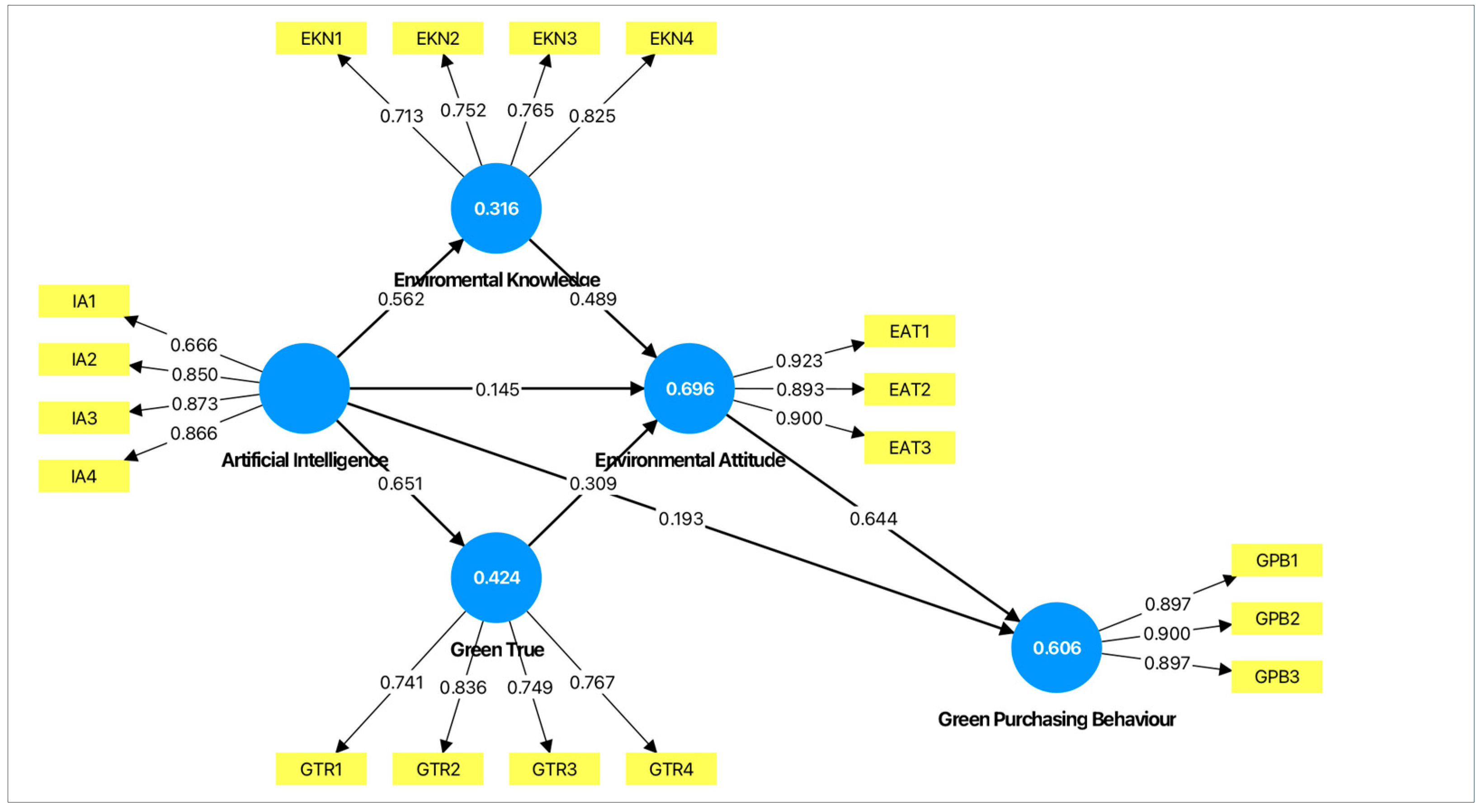
Following confirmation of the measurement model’s convergent and discriminant validity, the structural model was analyzed using SmartPLS 4.1.1.8. To evaluate the significance of the proposed relationships and examine the structural paths, a bootstrapping technique with 5000 subsamples was employed [94]. To assess the predictive power, R2 coefficients were analyzed. The analysis yielded the following values: EKN (R2: 0.316), GTR (R2: 0.424), EAT (R2: 0.696), and GPB (R2: 0.606). According to Chin [95], R2 values exceeding 0.10 are considered acceptable, suggesting that the model demonstrated adequate explanatory power. Furthermore, the Standardized Root-Mean-Square Residual (SRMR) was computed as an absolute indicator of model fit, capturing the average discrepancy between the observed and model-implied correlations. In this sense, Roemer et al. [92] determined that values below 0.10 show evidence of adequate model fit; in this study, an SRMR value of 0.08 indicated a satisfactory level of fit.
In addition to the previously reported indicators, further criteria were incorporated to strengthen the evaluation of the structural model. The predictive relevance of the model was assessed using the Stone–Geisser Q2 value, which yielded values above zero for all endogenous constructs. The obtained values were as follows, EKN = 0.386, GTR = 0.412, EAT = 0.698, and GPB = 0.632, indicating adequate predictive relevance. Furthermore, additional model fit indices were examined, including the Normed Fit Index (NFI). The model achieved an NFI value of 0.932, which indicated an acceptable level of fit and exceeded the recommended threshold of 0.90. Finally, the chi-square statistic (χ2 = 1301.9) was reported as part of the overall model evaluation. Collectively, these results provide additional support for the robustness and predictive validity of the proposed model [89,90]. Additionally, the analysis of the relations of the variables indicates the following results: AI influences GPB (β: 0.193, p-value: <0.005), EAT (β: 0.145, p-value: <0.005), EKN (β: 0.562, p-value: <0.005), and GTR (β: 0.651, p-value: <0.005). It was also found that EKN (β: 0.489, p-value: <0.005) and GTR (β: 0.309, p-value: <0.005) influenced EAT, and that EAT (β: 0.644, p-value: <0.005) influenced GPB. Furthermore, regarding the mediating effects, the study found that EKN (β: 0.275, p-value: <0.005) mediates the relationship between AI and EAT, as does GTR (β: 0.201, p-value: <0.005) (for more details, see Table 5).
Finally, the Variance Inflation Factor (VIF) was examined to verify the absence of multicollinearity, while common method bias was assessed using the full collinearity approach recommended in the literature. The results of the VIF test indicated that all values of the items reached values below the limit established in the literature (<3.3) [96], thus proving that multicollinearity does not exist. Furthermore, based on this criterion, no evidence of common method bias was detected, further supporting the validity of the estimates and the robustness of the structural model proposed in this study. Furthermore, Harman’s single factor test was analyzed through SPSS 24. The results indicated that the first unrotated factor explained 47.971% of the total variance. This finding supported the robustness of the data and reduced the likelihood of the observed relationships being affected by systematic bias. This approach was consistent with established methodological guidelines for detecting common method bias in survey-based research [97].

5. Discussion

5.1. Influence of AI on GPB

H1 was supported, indicating that AI exerts a direct, positive, and statistically significant effect on GPB. However, the magnitude of this coefficient suggests a weaker explanatory contribution compared to other relationships within the model. From the perspective of the SOR Model, this finding is theoretically consistent, as AI operates as an external stimulus, while the behavioral response depends on how this information is cognitively and perceptually processed within the organism. Prior studies have shown that AI-driven systems can enhance sustainable consumption by improving personalization, accessibility, and the delivery of environmental information [22,46,47]. Nguyen et al. [18] and Luminita et al. [21] showed through their research positive effects of AI tools on green satisfaction and purchase intentions. The present results are consistent with these findings, confirming that AI can contribute to sustainable consumption behavior. However, the relatively moderate magnitude of the coefficient also supports critical perspectives in the literature. For example, König et al. [59] found that consumers may prioritize the explainability of AI over its environmental attributes, whereas Wang et al. [60] demonstrated that certain AI-based recommendation systems can even reduce green consumption. In line with these studies, the current findings suggest that the influence of AI is neither universal nor automatic but rather conditional on how consumers evaluate and interpret the information provided. Therefore, within the SOR Model, this result corroborates the idea that AI, as a stimulus, does not directly determine behavior but instead depends on intermediate organism-level mechanisms. Consequently, rather than replacing traditional determinants of green behavior, AI appears to function as an informational infrastructure that supports, but does not independently drive, organic purchasing decisions, particularly among young, university-educated, and digitally experienced consumers.

5.2. Influence of AI on EAT, EKN and GTR

Hypothesis H2a was supported, indicating that AI has a positive and statistically significant influence on EAT. However, the relatively low magnitude of this effect, compared with other relationships in the model, suggests that AI does not constitute a primary mechanism for attitude formation. From the perspective of the SOR framework, this finding is theoretically consistent, as AI operates as a stimulus, considering attitudes represent a higher-order organism state that emerges from prior cognitive and perceptual processes. In this regard, prior studies such as García et al. [40] and Carrión et al. [34] have demonstrated that digital environments can influence EAT by providing information and interactive experiences. However, other studies emphasize that attitudes are not formed directly through technological exposure, but rather through intermediate mechanisms such as knowledge and evaluative processing [61,62]. The present findings align with this perspective, suggesting that although AI contributes to attitude formation, its effect is indirect and mediated by more robust cognitive processes, particularly in samples characterized by high levels of education and strong critical information-processing skills.
Furthermore, Hypothesis H2b was supported, indicating that AI exerts a strong and significant influence on EKN, representing one of the most robust relationships in the model. Within the SOR Model, this result suggests that AI functions as an external stimulus that primarily activates cognitive mechanisms within the organism. This finding is consistent with studies by Pham et al. [16] and Gupta and Mukherjee [17], which highlight the role of AI in facilitating access to information and enhancing learning processes in digital environments. Similarly, other authors through their research show that EKN serves as a critical foundation for interpreting sustainability-related information and guiding responsible decision making [61,65]. In line with this evidence, the present results indicate that AI acts predominantly as a cognitive enabler, strengthening consumers’ ability to acquire, process, and internalize environmental information, which subsequently influences downstream attitudinal and behavioral responses.
Hypothesis H2c was also accepted, this finding indicates that AI has a positive and significant impact on GTR, constituting the strongest direct relationship in the model. From the SOR perspective, this result highlights the role of AI as a stimulus that not only provides information but also shapes organism-level perceptual states, particularly those related to credibility and trust. This finding aligns with prior research that emphasizes the importance of perceived credibility and authenticity in shaping responses to environmental communication [28,73]. Furthermore, Sonetti et al. [72] suggest that the perceived consistency and reliability of environmental information are key determinants in reducing uncertainty and strengthening consumer trust. Our results extend this literature by showing that AI significantly enhances the perceived truthfulness of environmental content, thereby reinforcing trust-based mechanisms. However, from a critical perspective, this finding also raises concerns regarding the potential for over-reliance on AI systems, particularly in contexts where the accuracy of information may not be fully verifiable, potentially leading to phenomena such as digital greenwashing. Therefore, while AI appears to be highly effective in strengthening perceived credibility, its influence should be interpreted with caution, as trust may be driven more by perception than objective validity.

5.3. Environmental Knowledge and Green Truth Influence Environmental Attitude

Hypothesis H3a was supported, demonstrating that EKN shows a positive and relevant impact on EAT. However, when compared to the effect of GTR, its magnitude is relatively smaller, suggesting that knowledge alone is not the most decisive factor in shaping pro-Environmental Attitudes within the current model. From the perspective of the SOR model, this finding is theoretically consistent, as EKN represents a cognitive organism state that provides the basis for attitudinal evaluation but requires complementary mechanisms to generate stronger attitudinal responses [43,50]. In the context of the analyzed sample, composed mainly of young university-educated consumers, this result is particularly relevant, as these individuals not only access environmental information but also process it critically [29,34,35]. This implies that knowledge, while necessary, may be insufficient in shaping attitudes if it is not accompanied by mechanisms that validate and contextualize information [61,62]. In line with prior research, this finding confirms that EKN is a key antecedent of EAT, although its effect may be limited if it does not translate into perceptions of relevance or deeper evaluations of environmental content [61,79].
Furthermore, Hypothesis H4a was supported, indicating that GTR has a positive and significant influence on EAT and exhibits a comparatively stronger effect within the attitudinal formation process. From the SOR perspective, GTR represents an organism-level perceptual state associated with credibility and trust that plays a critical role in transforming external stimuli into evaluative responses. This finding is consistent with theoretical approaches that highlight trust as a mechanism for reducing uncertainty and facilitating favorable environmental evaluations [28,73]. In a sample characterized by high levels of education and critical thinking, this result suggests that even consumers with strong cognitive abilities rely heavily on perceived credibility to consolidate their EAT [61,62,65]. Therefore, trust in green information emerges as a principal element in the development of EAT, reinforcing the idea that providing information is not sufficient. Rather, it is essential to generate perceptions of truthfulness that support and validate such information [29,34,35].

5.4. Mediating Effect of Environmental Knowledge and Green Truth in the Relationship Between Artificial Intelligence and Environmental Attitude

Hypothesis H3b was supported, demonstrating that EKN positively and significantly mediates the relationship between AI and EAT. From the perspective of the SOR Model, this finding is theoretically consistent, as AI operates as an external stimulus, whereas EKN represents a cognitive organism state that facilitates the processing, structuring, and interpretation of environmental information. The results indicate that AI contributes to attitude formation by activating cognitive mechanisms, reinforcing its role as an informational stimulus. However, the lower magnitude of this mediation suggests that knowledge acquisition, although necessary, is insufficient in generating robust attitudinal changes. This is particularly relevant in a sample characterized by high levels of education and technological familiarity, where individuals not only access information but also critically evaluate it before incorporating it into their attitudinal frameworks [29,34,35]. These findings are consistent with prior research that posits EKN as a key antecedent of EAT [61,62,63,64,65], as well as with studies emphasizing its role in interpreting sustainability-related information and guiding responsible decision making [67,68]. However, they also align with research suggesting that knowledge alone does not guarantee sustainable attitudes or behaviors unless it is translated into personally meaningful evaluations, which explains its relatively weak mediating effect [62,63].
Furthermore, Hypothesis H4b was supported, confirming that GTR acts as a positive and significant mediator in the relationship between AI and EAT. Within the SOR framework, this result highlights that, in addition to cognitive processing, organism-level perceptual states, particularly those related to credibility and trust, play a central role in translating external stimuli into attitudinal responses. AI not only facilitates access to information but also functions as a mechanism that validates environmental messages, reduces uncertainty, and enables favorable attitudinal evaluations. This finding is consistent with the literature that emphasizes the central role of trust and credibility in green communication as key determinants of consumer perceptions and attitudes [5,22]. Furthermore, studies have also demonstrated that trust in environmental information is essential for the adoption of sustainable behaviors [73]. The mediating effect of GTR suggests that even among consumers with high levels of knowledge, EAT depends more on the perceived credibility of information than on its mere availability [66,74]. However, this result also engages critically with research warning about the risks associated with trust in digital environments, where perceived credibility may not always reflect objective truth, potentially leading to skepticism toward automated systems [76]. Consequently, GTR emerges as the most decisive mediating mechanism in the AI-EAT relationship, reinforcing the need to understand credibility as a central mechanism in the effectiveness of AI-mediated environmental communication.

5.5. Environmental Attitude and Its Relation with Green Purchasing Behavior

Hypothesis H5 was supported, demonstrating that EAT shows high impact and significant relevance to GPB, emerging as the main behavioral determinant within the model. The high magnitude of this finding confirms that evaluative predispositions toward the environment constitute the most immediate mechanism through which cognitive and perceptual processes translate into concrete sustainable consumption actions. This finding strongly aligns with the SOR Model, in which attitude represents the internal state closest to the behavioral response, acting as a bridge between processed information (knowledge and perceived credibility) and the final purchase decision. Furthermore, this finding is especially relevant given the composition of the sample, which was predominantly composed of young university-educated consumers with high technological familiarity. This suggests that even among consumers with access to abundant information and tools such as AI, it is an attitude that ultimately guides behavior. Comparatively, this result aligns with the literature positing that EAT is one of the most robust predictors of GPB [37,79,80], including studies that have demonstrated its direct effects across different cultural and consumption contexts [38,45,53]. However, it also reinforces a critical perspective widely discussed in the literature, according to which information and credibility, while necessary, do not guarantee action, and the consolidation of a favorable attitude is essential to close the gap between intention and behavior [77]. Consequently, this finding confirms that AI, EKN, and GTR become relevant insofar as they contribute to strengthening EAT, which emerges as a decisive factor in the materialization of GPB.

6. Conclusions

This study demonstrates that AI is a relevant stimulus in shaping GPB, although its influence is neither direct nor predominant. Rather, it operates primarily through cognitive and perceptual mechanisms that strengthen EAT. In this sense, the findings confirm that AI influences the formation of EKN and, more decisively, GTR, with the latter emerging as the most influential mediating mechanism in the development of EAT. Furthermore, the study demonstrates that both knowledge and trust contribute significantly to the formation of EAT, albeit with varying degrees of importance, highlighting the significance of perceived credibility over the mere availability of information. Finally, EAT emerges as the main determinant of GPB, acting as the key link between digital environmental stimuli and the consumption of organic products. Taken together, these findings support the overall objective of the study by demonstrating that AI only slightly promotes sustainable behavior and, more importantly, strengthens the internal processes that ultimately guide consumers toward more responsible decisions. In this regard, the findings directly address the research gap identified in this study by providing empirical evidence that AI enhances EKN and GTR, both of which reinforce consumers’ EAT. Furthermore, the results confirmed that stronger EAT substantially drives GPB. Therefore, this study provides robust empirical support for understanding how EAT functions as a central internal mechanism that translates digitally mediated information into responsible consumption decisions. Consequently, this research extends the existing body of knowledge by clarifying the pathways through which AI contributes to sustainable consumption in contemporary digital environments.
This study provides important contributions across three complementary dimensions. From a theoretical standpoint, the findings challenge reductionist perspectives that assume a direct and deterministic influence of AI on consumer behavior. Instead, the results provide robust evidence that AI operates as a contingent and indirect stimulus within the SOR Model, activating internal mechanisms that ultimately shape behavior. Specifically, the study demonstrates that EKN and, more decisively, GTR function as differentiated organism-level processes, with the latter emerging as a more influential mechanism in the formation of EAT. This distinction is theoretically significant, as it suggests that the validation of information, rather than its mere availability, constitutes a critical condition for attitudinal change in contemporary digital contexts. In doing so, this research extends the SOR Model by including perceptual credibility as a central explanatory construct and addresses a persistent gap in the literature, which has largely overlooked the indirect and mediated nature of AI’s influence on sustainable consumption.
From a practical perspective, these findings call into question the prevailing managerial assumption that the implementation of AI technologies inherently promotes sustainable consumption. The results indicate that the effectiveness of AI-driven strategies is highly conditional and fundamentally depends on their capacity to generate trust, coherence, and perceived authenticity in environmental communication. In this sense, organizations and marketers should move beyond simplistic applications of AI as mere recommendation and personalization tools and instead focus on designing systems that enhance the credibility and interpretability of sustainability-related information. Importantly, the central role of EAT suggests that influencing behavior requires more than exposure to information; it also requires the construction of meaningful and credible evaluative frameworks. Consequently, firms that fail to address issues of transparency and trust may not only reduce the effectiveness of their sustainability initiatives but also generate skepticism among increasingly critical and digitally literate consumers.
About social contribution, this study highlights the dual role of AI as both an enabler and a potential risk in the promotion of sustainable consumption. On the one hand, AI can contribute to the democratization of environmental information, facilitating access and supporting the development of more informed and responsible consumers. However, the strong influence of perceived credibility identified in the findings raises critical concerns about the potential for manipulation, misinformation, and digital greenwashing in AI-mediated environments. This paradox highlights the urgent need for regulatory frameworks, ethical standards, and accountability mechanisms to ensure the integrity of environmental information disseminated through technological systems. Thus, beyond its empirical contributions, this study calls for a more critical and responsible integration of AI within sustainability agendas, emphasizing that technological advancement alone is insufficient without parallel developments in governance, ethics, and consumer protection.

7. Limitations of the Study and Recommendation for New Research

Even though this research provides relevant empirical evidence, the study has several limitations. First, the cross-sectional design restricts the possibility of establishing robust causal relationships between variables, thus limiting the interpretation of the results to associations observed at a single point in time. Second, the sample is geographically concentrated in the province of Guayas and is predominantly composed of young university-educated consumers, which reduces the external validity of the study and makes it difficult to generalize the findings to contexts with lower digital literacy or different sociocultural characteristics. Furthermore, the use of self-reported measures may introduce biases such as social desirability and common method biases, despite the statistical controls applied. In addition, AI was treated as a general construct without differentiating between types of tools, levels of interaction, or specific attributes, which limits the understanding of its differentiated effects. Finally, while the SOR model provides a solid theoretical framework, its application may oversimplify the complexity of consumer behavior in highly dynamic digital environments.
Based on these limitations, several avenues for future research are proposed. First, longitudinal or experimental studies are recommended to establish more robust causal relationships and examine how attitudes and behaviors change over time. Second, future studies should broaden the geographic scope and diversify the sample by incorporating different sociodemographic profiles to improve the generalizability of the results. Furthermore, the use of self-reported data can be complemented with current behavioral measures or experimental designs that reduce associated biases. From a theoretical perspective, future research should disaggregate the AI construct, analyze specific attributes such as explainability, personalization, and transparency, and incorporate moderating variables such as digital literacy, skepticism toward greenwashing, and trust in technology. Finally, additional research is needed to critically examine the risks associated with the use of AI in environmental communication, especially in relation to the veracity of information and its possible counterproductive effects on the formation of sustainable attitudes and behaviors.

Author Contributions

Conceptualization: W.Z.-V., N.C.-B. and J.B.-P.; Methodology: N.C.-B.; Software: N.C.-B., X.T.-C. and L.T.-C.; Validation: C.R.-L., L.T.-C. and J.V.-M.; Formal Analysis: C.V.-M. and N.C.-B. Investigation: X.T.-C. and W.Z.-V.; Resources: W.Z.-V., N.C.-B., J.B.-P., A.V.-L., C.V.-M., X.T.-C., C.R.-L., L.T.-C., J.V.-M. and R.M.-C.; Data Curation: N.C.-B. and C.V.-M. Writing—Original Draft Preparation: W.Z.-V., N.C.-B., J.B.-P., A.V.-L., C.V.-M., X.T.-C., C.R.-L., L.T.-C., J.V.-M. and R.M.-C.; Writing—Review and Editing: N.C.-B.; Visualization: N.C.-B.; Supervision: W.Z.-V. and N.C.-B.; Project Administration: W.Z.-V. and N.C.-B. All authors have read and agreed to the published version of the manuscript.

Funding

This research received funding from Santa Elena Peninsula State University (006).

Institutional Review Board Statement

The study was conducted in accordance with the Declaration of Helsinki, and approved by the Ethics Committee of Universidad Estatal Península de Santa Elena (protocol code CE-ZW122025 and date of approval 3 December 2025).

Informed Consent Statement

The study was conducted in accordance with the Declaration of Helsinki, which promotes respect for the participants and their right to voluntary participation in the research. Informed consent was obtained before the application of the questionnaire.

Data Availability Statement

Survey and statistical data and analysis of the research are available at https://drive.google.com/drive/folders/161y-x_kaB1aLD4OvZ4rXUMReZAXH8R-3?usp=sharing (accessed on 5 April 2026).

Conflicts of Interest

The authors declare no conflicts of interest.

Appendix A. Survey Questions (Questionnaire)

Have you recently used artificial intelligence to develop queries? Yes _ No _
Have you consumed any type of organic product in the past few months? Yes _ No_
Gender: Male_ Female_ Non-binary_
Age: 23 years or younger _ Aged (23–28) _ Aged (29–34) _ Aged (35–44) _ Aged (45–55) _ > 55 years _.
Education level: Degree _ Postgraduate _
VariableItemQuestionsAuthor
Artificial
Intelligence
AI1I have seen AI-based recommendations for organic products.Adapted from: Islam and Misbah: [84]
AI2I have seen organic labels or certifications generated or explained through artificial intelligence on digital platforms.
AI3Artificial intelligence tools have helped me understand the environmental impact and benefits of consuming organic products.
AI4I receive personalized content or advice about the consumption of organic products through AI-based digital systems.
AI5AI-powered platforms (e.g., chatbots) have informed me about organic product alternatives compared to conventional products.
Environmental KnowledgeEKN1I have greater knowledge about organic products and their environmental benefits than the average person.From: Chaihanchanchai and Anantachart [27]
EKN2I know how to select organic products and packaging options that reduce the amount of waste ending up in landfills.
EKN3I understand the labels, certifications, and environmental claims associated with organic products.
EKN4I am highly knowledgeable about environmental issues related to organic consumption and sustainable food systems.
Green TruthGTR1I consider the environmental reputation of organic products to be generally reliable.Adapted from: Chen and Chang [85]
GTR2I consider the environmental performance of organic products to be generally reliable.
GTR3I consider the environmental claims of organic products to be generally trustworthy.
GTR4The environmental commitment of organic products meets my expectations.
Environmental AttitudeEAT1I am very concerned about the environment.Adapted from: Trivedi et al. [86]
EAT2I would be willing to reduce my consumption to help protect the environment.
EAT3I would give part of my own money to help protect wild animals.
EAT4I have asked my family to recycle some of the things we use.
Green
Purchasing
Behavior
GPB1I buy organic products regularly. Adapted from: Carrión et al. [87]
GPB2I buy organic products for my daily needs.
GPB3I have bought organic products for the last few months.
GPB4I buy organic products, although there are conventional alternatives.
Figure A1. Equation model developed in SMART PLS 4.1.1.8.
Sustainability 18 05167 g0a1

References

  1. Kumar, R.; Verma, A.; Shome, A.; Sinha, R.; Sinha, S.; Jha, P.K.; Kumar, R.; Kumar, P.; Shubham; Das, S.; et al. Impacts of Plastic Pollution on Ecosystem Services, Sustainable Development Goals, and Need to Focus on Circular Economy and Policy Interventions. Sustainability 2021, 13, 9963. [Google Scholar] [CrossRef]
  2. Zhang, P.; Yang, M.; Lan, J.; Huang, Y.; Zhang, J.; Huang, S.; Yang, Y.; Ru, J. Water Quality Degradation Due to Heavy Metal Contamination: Health Impacts and Eco-Friendly Approaches for Heavy Metal Remediation. Toxics 2023, 11, 828. [Google Scholar] [CrossRef]
  3. Saxena, V. Water Quality, Air Pollution, and Climate Change: Investigating the Environmental Impacts of Industrialization and Urbanization. Water Air Soil Pollut. 2025, 236, 73. [Google Scholar] [CrossRef]
  4. Jakhar, R.; Samek, L.; Styszko, K. A Comprehensive Study of the Impact of Waste Fires on the Environment and Health. Sustainability 2023, 15, 14241. [Google Scholar] [CrossRef]
  5. Sharma, K.; Aswal, C.; Paul, J. Factors Affecting Green Purchase Behavior: A Systematic Literature Review. Bus. Strategy Environ. 2023, 32, 2078–2092. [Google Scholar] [CrossRef]
  6. Borah, P.S.; Dogbe, C.S.K.; Marwa, N. Generation Z’s Green Purchase Behavior: Do Green Consumer Knowledge, Consumer Social Responsibility, Green Advertising, and Green Consumer Trust Matter for Sustainable Development? Bus. Strategy Environ. 2024, 33, 4530–4546. [Google Scholar] [CrossRef]
  7. Al-Raeei, M. The Smart Future for Sustainable Development: Artificial Intelligence Solutions for Sustainable Urbanization. Sustain. Dev. 2025, 33, 508–517. [Google Scholar] [CrossRef]
  8. Chen, C.-W. Utilizing a Hybrid Approach to Identify the Importance of Factors That Influence Consumer Decision-Making Behavior in Purchasing Sustainable Products. Sustainability 2024, 16, 4432. [Google Scholar] [CrossRef]
  9. Čapienė, A.; Rūtelionė, A.; Krukowski, K. Engaging in Sustainable Consumption: Exploring the Influence of Environmental Attitudes, Values, Personal Norms, and Perceived Responsibility. Sustainability 2022, 14, 10290. [Google Scholar] [CrossRef]
  10. Gunawan, A.I.; Hurriyati, R.; Wibowo, L.A.; Monoarfa, H. Consumers in Responsible Consumption: What Leads to Sustainable Behavior? Urban. Sustain. Soc. 2025, 2, 259–283. [Google Scholar] [CrossRef]
  11. Onel, N. Transforming Consumption: The Role of Values, Beliefs, and Norms in Promoting Four Types of Sustainable Behavior. J. Consum. Behav. 2024, 23, 491–513. [Google Scholar] [CrossRef]
  12. Guan, X.; Ahmad, N.; Sial, M.S.; Cherian, J.; Han, H. CSR and Organizational Performance: The Role of Pro-Environmental Behavior and Personal Values. Corp. Soc. Responsib. Environ. Manag. 2023, 30, 677–694. [Google Scholar] [CrossRef]
  13. Naguib, H.M.; Elsharnouby, M.H. Hindering or Nurturing Digital Transformation: The Role of Consumer’s Thinking Capabilities and Other Customers’ Perception. Manag. Sustain. Arab Rev. 2024, 3, 114–131. [Google Scholar] [CrossRef]
  14. Jayawardena, C.; Ahmad, A.; Valeri, M.; Jaharadak, A.A. Technology Acceptance Antecedents in Digital Transformation in Hospitality Industry. Int. J. Hosp. Manag. 2023, 108, 103350. [Google Scholar] [CrossRef]
  15. Dąbrowska, J.; Almpanopoulou, A.; Brem, A.; Chesbrough, H.; Cucino, V.; Di Minin, A.; Giones, F.; Hakala, H.; Marullo, C.; Mention, A.-L.; et al. Digital Transformation, for Better or Worse: A Critical Multi-Level Research Agenda. R&D Manag. 2022, 52, 930–954. [Google Scholar] [CrossRef]
  16. Pham, V.K.; Pham Thi, T.D.; Duong, N.T. A Study on Information Search Behavior Using AI-Powered Engines: Evidence from Chatbots on Online Shopping Platforms. SAGE Open 2024, 14, 2158244024130000. [Google Scholar] [CrossRef]
  17. Gupta, A.S.; Mukherjee, J. Framework for Adoption of Generative AI for Information Search of Retail Products and Services. Int. J. Retail Distrib. Manag. 2025, 53, 165–181. [Google Scholar] [CrossRef]
  18. Nguyen, M.T.; Thach, K.T.D.; Nguyen, C.N.L.; Nguyen, A.C.; Doan, H.K. The Influence of AI Chatbots on Green Satisfaction and Loyalty: Evidence from Sustainability-Driven Consumer Behavior. J. Glob. Mark. 2025, 39, 103–132. [Google Scholar] [CrossRef]
  19. Akhtar, P.; Ghouri, A.M.; Ashraf, A.; Lim, J.J.; Khan, N.R.; Ma, S. Smart Product Platforming Powered by AI and Generative AI: Personalization for the Circular Economy. Int. J. Prod. Econ. 2024, 273, 109283. [Google Scholar] [CrossRef]
  20. Alhakimi, W.; Mohammed, A. Promoting Sustainability through AI Chatbots: The Role of Trust and Engagement in Shaping Consumer Behavior. J. Promot. Manag. 2026, 32, 20–37. [Google Scholar] [CrossRef]
  21. Luminita, B.; Naghi, R.I.; Preda, G.; Prada, S.I. The Influence of AI Chatbots on the Purchase Intention of Sustainable Products. Transform. Bus. Econ. 2025, 24, 238–261. [Google Scholar] [CrossRef]
  22. Foroughi, B.; Naghmeh-Abbaspour, B.; Wen, J.; Ghobakhloo, M.; Al-Emran, M.; Al-Sharafi, M.A. Determinants of Generative AI in Promoting Green Purchasing Behavior: A Hybrid Partial Least Squares–Artificial Neural Network Approach. Bus. Strategy Environ. 2025, 34, 4072–4094. [Google Scholar] [CrossRef]
  23. Chen, C.; Li, D.; Qian, J.; Li, Z. The Impact of Green Purchase Intention on Compensatory Consumption: The Regulatory Role of Pro-Environmental Behavior. Sustainability 2024, 16, 8183. [Google Scholar] [CrossRef]
  24. Zameer, H.; Yasmeen, H. Green Innovation and Environmental Awareness Driven Green Purchase Intentions. Mark. Intell. Plan. 2022, 40, 624–638. [Google Scholar] [CrossRef]
  25. Chauhan, S.; Goyal, S. A Meta-Analysis of Antecedents and Consequences of Green Trust. J. Consum. Mark. 2024, 41, 459–473. [Google Scholar] [CrossRef]
  26. Rashid, I.; Lone, A.H. Organic Food Purchases: Does Green Trust Play a Part? Asia-Pac. J. Bus. Adm. 2023, 16, 914–939. [Google Scholar] [CrossRef]
  27. Chaihanchanchai, P.; Anantachart, S. Encouraging Green Product Purchase: Green Value and Environmental Knowledge as Moderators of Attitude and Behavior Relationship. Bus. Strategy Environ. 2023, 32, 289–303. [Google Scholar] [CrossRef]
  28. Liu, J.-Y.; Lei, Q.; Zhang, Y.-J. Unveiling the Green Truth: The Impact of Digital Transformation on the Decoupling of Corporate Environmental Responsibility. J. Ind. Ecol. 2025, 29, 2387–2403. [Google Scholar] [CrossRef]
  29. Usiña-Báscones, G.; Carrión-Bósquez, N.; Samaniego-Arias, M.; Marchena-Chanduvi, R.; Medina-Miranda, S.; Zambrano-Vélez, W.; Ruiz-García, W.; Llamo-Burga, M.; Ortiz-Regalado, O. From Social Media Content to Value Co-Creation: Role of Environmental Attitude, Environmental Knowledge, and Green Truth. Foods 2026, 15, 1120. [Google Scholar] [CrossRef]
  30. Ahmad, F.S.; Rosli, N.T.; Quoquab, F. Environmental Quality Awareness, Green Trust, Green Self-Efficacy and Environmental Attitude in Influencing Green Purchase Behaviour. Int. J. Ethics Syst. 2022, 38, 68–90. [Google Scholar] [CrossRef]
  31. Li, S.; Rasiah, R.; Zheng, S.; Yuan, Z. Influence of Environmental Knowledge and Green Trust on Green Purchase Behaviour. Environ.-Behav. Proc. J. 2023, 8, 353–358. [Google Scholar] [CrossRef]
  32. Ogiemwonyi, O.; Alam, M.N.; Alshareef, R.; Alsolamy, M.; Azizan, N.A.; Mat, N. Environmental Factors Affecting Green Purchase Behaviors of the Consumers: Mediating Role of Environmental Attitude. Clean. Environ. Syst. 2023, 10, 100130. [Google Scholar] [CrossRef]
  33. Wang, Y.; Zhao, J.; Pan, J. The Investigation of Green Purchasing Behavior in China: A Conceptual Model Based on the Theory of Planned Behavior and Self-Determination Theory. J. Retail. Consum. Serv. 2024, 77, 103667. [Google Scholar] [CrossRef]
  34. Samaniego-Arias, M.; Chávez-Rojas, E.; García-Umaña, A.; Carrión-Bósquez, N.; Ortiz-Regalado, O.; Llamo-Burga, M.; Ruiz-García, W.; Guerrero-Haro, S.; Cando-Aguinaga, W. Impact of social media on purchase intention of organic products. Sustainability 2025, 17, 2706. [Google Scholar] [CrossRef]
  35. Castillo-Plaza, I.; Carrión-Bósquez, N.; García-Umaña, A.; Ortiz-Regalado, O.; Tobar-Cazares, X.; Naranjo-Armijo, F.; Villacís-Mejía, C.; Tobar-Cazares, L.; Arévalo-Mejía, R. The Moderating Effect of Price on the Relationship Between Environmental Attitude and the Purchase Behavior of Organic Products. Foods 2025, 14, 3550. [Google Scholar] [CrossRef]
  36. Palomino, H.J.; Barcellos-Paula, L. Personal variables and green purchase intention for organic products. Foods 2024, 13, 213. [Google Scholar] [CrossRef]
  37. Carrión-Bósquez, N.; Veas-González, I.; Naranjo-Armijo, F.; Llamo-Burga, M.; Ortiz-Regalado, O.; Ruiz-García, W.; Guerra-Regalado, W.; Vidal-Silva, C. Advertising and Eco-Labels as Influencers of Eco-Consumer Attitudes and Awareness—Case Study of Ecuador. Foods 2024, 13, 228. [Google Scholar] [CrossRef]
  38. Hoyos-Vallejo, C.A.; Carrión Bósquez, N.G.; Veas González, I. Impact of Consumption Values on Environmental Attitudes and Organic Purchase Intentions among Peruvian Millennials. Acad. Rev. Latinoam. Adm. 2025, 38, 379–398. [Google Scholar] [CrossRef]
  39. Gyurián Nagy, N. Gender Differences in Environmental Attitudes: An Analysis Using the NEP Scale. Gend. Issues 2025, 42, 5. [Google Scholar] [CrossRef]
  40. García-Roldán, G.; Carrión-Bósquez, N.; García-Umaña, A.; Ortiz-Regalado, O.; Medina-Miranda, S.; Marchena-Chanduvi, R.; Llamo-Burga, M.; López-Pastén, I.; Veas González, I. Digital Social Influence and Its Impact on the Attitude of Organic Product Consumers. Sustainability 2025, 17, 7563. [Google Scholar] [CrossRef]
  41. Sequeira, M.M.; Oliveira, T.; Neves, C. Adopting Generative AI for House Design: A Multi-Stage Model of User Perception and Environmental Attitudes. Smart Sustain. Built Environ. 2025, 1–33. [Google Scholar] [CrossRef]
  42. Ritala, P.; Albareda, L.; Bocken, N. Value creation and appropriation in economic, social, and environmental domains: Recognizing and resolving the institutionalized asymmetries. J. Clean. Prod. 2021, 290, 125796. [Google Scholar] [CrossRef]
  43. Young, G. Stimulus-Organism-Response model: SORing to new heights. In Unifying Causality and Psychology; Springer: Berlin/Heidelberg, Germany, 2016; pp. 699–717. [Google Scholar] [CrossRef]
  44. Mehrabian, A.; Russell, J.A. An Approach to Environmental Psychology; MIT Press: Cambridge, MA, USA, 1974. [Google Scholar]
  45. Vafaei-Zadeh, A.; Nikbin, D.; Seong Zhen, K.; Hanifah, H. Exploring the Determinants of Green Electronics Purchase Intention through the Stimulus-Organism-Response Model. Soc. Responsib. J. 2025, 21, 473–497. [Google Scholar] [CrossRef]
  46. Ma, J.; Wang, Q.; Liu, D.; Pan, H.; Ran, H. Do Environmental Values Drive Artificial Intelligence Products Green Purchasing Behavior? A Value-Attitude-Behavior Approach. Acta Psychol. 2025, 260, 105467. [Google Scholar] [CrossRef]
  47. Armutcu, B. Shaping Consumer Behavior with Artificial Intelligence and Brand Elements. Carbon Balance Manag. 2026, 21, 53. [Google Scholar] [CrossRef]
  48. Mahajan, A.; Sharma, S.; Agrawal, V.; Nikalje, V. Influence of Artificial Intelligence on Consumers’ Lifestyle Product Choices and the Key to Driving Sustainable Behaviour. Young Consum. 2025, 26, 808–830. [Google Scholar] [CrossRef]
  49. Sahoo, S.K.; Fabus, J.; Garbarova, M.; Kvasnicova-Galovicova, T.; Pattnaik, L.; Sahoo, S. Devising AI-Based Customer Engagement to Foster Positive Attitude Towards Green Purchase Intentions. Sustainability 2025, 17, 9282. [Google Scholar] [CrossRef]
  50. Wang, G.; Musa, R. Does Green Advertising Always Effectiveness? A Multidimensional Perceived Value Analysis Based on the SOR Model. J. Promot. Manag. 2024, 30, 1293–1321. [Google Scholar] [CrossRef]
  51. Sun, Y.; Lin, Y.; Wang, S. Research on the Impact of Green Advertising Information on Green Purchase Behavior in Social Media: SEM-ANN Approach. Asia Pac. J. Mark. Logist. 2025, 37, 3660–3679. [Google Scholar] [CrossRef]
  52. Mousa, M.M.; Rashed, A.S.; Akaileh, M.; Zamil, A.M.; Ahmed, H.A.M.; Abdelghani, A.A.A. Artificial Intelligence Marketing Technologies and Consumer Purchasing Decisions: The Moderating Role of Virtual Customer Experience and Implications for Sustainable Consumption in Telecommunications Service Environments. Sustainability 2026, 18, 2674. [Google Scholar] [CrossRef]
  53. Armutcu, B.; Tan, M.F. A Study on Intentions of Generation Z Consumers to Buy Recyclable Products. J. Sustain. Mark. 2023, 4, 190–206. [Google Scholar] [CrossRef]
  54. Armutcu, B.; Tan, A.; Ho, S.P.S.; Chow, M.Y.C.; Gleason, K.C. The Effect of Bank Artificial Intelligence on Consumer Purchase Intentions. Kybernetes 2025, 54, 5529–5553. [Google Scholar] [CrossRef]
  55. Hussain, M.; Yang, S.; Maqsood, U.S.; Zahid, R.M.A. Tapping into the Green Potential: The Power of Artificial Intelligence Adoption in Corporate Green Innovation Drive. Bus. Strategy Environ. 2024, 33, 4375–4396. [Google Scholar] [CrossRef]
  56. Adel, H.M.; Khaled, M.; Yehya, M.A.; Elsayed, R.; Ali, R.S.; Ahmed, F.E. Nexus among Artificial Intelligence Implementation, Healthcare Social Innovation, and Green Image of Hospitals’ Operations Management in Egypt. Clean. Logist. Supply Chain 2024, 11, 100156. [Google Scholar] [CrossRef]
  57. Ho, S.P.S.; Chow, M.Y.C. The Role of Artificial Intelligence in Consumers’ Brand Preference for Retail Banks in Hong Kong. J. Financ. Serv. Mark. 2024, 29, 292–305. [Google Scholar] [CrossRef]
  58. Yazdani, A.; Darbani, S. The Impact of AI on Trends, Design, and Consumer Behavior. AI Tech Behav. Soc. Sci. 2023, 1, 4–10. [Google Scholar] [CrossRef]
  59. König, P.D.; Wurster, S.; Siewert, M. Consumers Are Willing to Pay a Price for Explainable, but Not for Green AI: Evidence from a Choice-Based Conjoint Analysis. Big Data Soc. 2022, 9, 20539517211069632. [Google Scholar] [CrossRef]
  60. Wang, K.; Lu, L.; Fang, J.; Xing, Y.; Tong, Z.; Wang, L. The Downside of Artificial Intelligence (AI) in Green Choices: How AI Recommender Systems Decrease Green Consumption. Manag. Decis. Econ. 2023, 44, 3346–3353. [Google Scholar] [CrossRef]
  61. Maurer, M.; Bogner, F. Modelling environmental literacy with environmental knowledge, values and (reported) behaviour. Stud. Educ. Eval. 2020, 65, 100863. [Google Scholar] [CrossRef]
  62. Player, L.; Hanel, P.; Whitmarsh, L.; Shah, P. The 19-Item Environmental Knowledge Test (EKT-19): A short, psychometrically robust measure of environmental knowledge. Heliyon 2023, 9, e17862. [Google Scholar] [CrossRef]
  63. Baierl, T.; Johnson, B.; Bogner, F. Assessing environmental attitudes and cognitive achievement within 9 years of informal Earth education. Sustainability 2021, 13, 3622. [Google Scholar] [CrossRef]
  64. Xie, P.; Zhang, Y.; Chen, R.; Lin, Z.; Lu, N. Social media’s impact on environmental awareness: A marginal treatment effect analysis of WeChat usage in China. BMC Public Health 2024, 24, 20721. [Google Scholar] [CrossRef] [PubMed]
  65. Meng, Y.; Chung, D.; Zhang, A. The effect of social media environmental information exposure on the intention to participate in pro-environmental behavior. PLoS ONE 2023, 18, e0294577. [Google Scholar] [CrossRef]
  66. Han, S.; Lee, Y. Analysis of the impacts of social class and lifestyle on consumption of organic foods in South Korea. Heliyon 2022, 8, e10998. [Google Scholar] [CrossRef]
  67. Wu, W.; Ma, Y.; Lin, Y.; Lin, W.; Liu, C.; Mao, L. Exploring the mechanism of host–guest value co-creation on tourists’ environmental responsibility behaviour in agricultural heritage. Herit. Sci. 2025, 13, 291. [Google Scholar] [CrossRef]
  68. Ardoin, N.M.; Bowers, A.W.; Moran, G. Leveraging collective action and environmental literacy to promote sustainability: A collective environmental literacy framework. Ambio 2023, 52, 785–798. [Google Scholar] [CrossRef]
  69. Martínez-Martínez, A.; Cegarra-Navarro, J.; García-Pérez, A.; De Valon, T. Active listening to customers: Eco-innovation through value co-creation in the textile industry. J. Knowl. Manag. 2022, 27, 1810–1829. [Google Scholar] [CrossRef]
  70. Tan, Q.; Tan, J.; Gao, X. How does the online innovation community climate affect the user’s value co-creation behavior: The mediating role of motivation. PLoS ONE 2024, 19, e0301299. [Google Scholar] [CrossRef] [PubMed]
  71. Zafar, A.; Shen, J.; Shahzad, M. Social media and sustainable purchasing attitude: Role of trust in social media and environmental effectiveness. J. Retail. Consum. Serv. 2021, 62, 102751. [Google Scholar] [CrossRef]
  72. Sonetti, G.; Lombardi, P.; Chelleri, L. True Green and Sustainable University Campuses? Toward a Clusters Approach. Sustainability 2016, 8, 83. [Google Scholar] [CrossRef]
  73. Carrete, L.; Arroyo, P.; Arroyo, A. Should green products be advertised as green? Exploring the factors that affect ad credi-bility. J. Promot. Manag. 2023, 29, 427–460. [Google Scholar] [CrossRef]
  74. Moroșan, E.; Popovici, V.; Popescu, I.A.; Daraban, A.; Karampelas, O.; Matac, L.M.; Licu, M.; Rusu, A.; Chirigiu, L.-M.-E.; Opriţescu, S.; et al. Perception, trust, and motivation in consumer behavior for organic food acquisition: An exploratory study. Foods 2025, 14, 293. [Google Scholar] [CrossRef]
  75. Bidar, R.; Barros, A.; Watson, J. Co-creation of services: An online network perspective. Internet Res. 2021, 32, 897–915. [Google Scholar] [CrossRef]
  76. Chen, S.; Kamarudin, K. Interfacing triple bottom line sustainability and metropolitan governance: An empirical exploration of stakeholder value co-creation and conflict. Heliyon 2024, 10, e38772. [Google Scholar] [CrossRef] [PubMed]
  77. Carrión Bósquez, N.G.; Arias-Bolzmann, L.G.; Martínez Quiroz, A.K. The influence of price and availability on university millennials’ organic food product purchase intention. Br. Food J. 2023, 125, 536–550. [Google Scholar] [CrossRef]
  78. Taufique, K.M.R.; Vaithianathan, S. A fresh look at understanding green consumer behavior among young urban Indian consumers through the lens of Theory of Planned Behavior. J. Clean. Prod. 2018, 183, 46–55. [Google Scholar] [CrossRef]
  79. Aertsens, J.; Mondelaers, K.; Verbeke, W.; Buysse, J.; Van Huylenbroeck, G. The influence of subjective and objective knowledge on attitude, motivations and consumption of organic food. Br. Food J. 2011, 113, 1353–1378. [Google Scholar] [CrossRef]
  80. Von Meyer-Höfer, M.; Olea-Jaik, E.; Padilla-Bravo, C.A.; Spiller, A. Mature and emerging organic markets: Modelling consumer attitude and behaviour with partial least square approach. J. Food Prod. Mark. 2015, 21, 626–653. [Google Scholar] [CrossRef]
  81. Prakash, G.; Singh, P.K.; Ahmad, A.; Kumar, G. Trust, convenience and environmental concern in consumer purchase intention for organic food. Span. J. Mark.-ESIC 2023, 27, 367–388. [Google Scholar] [CrossRef]
  82. Kumar, B.; Manrai, A.K.; Manrai, L.A. Purchasing behaviour for environmentally sustainable products: A conceptual framework and empirical study. J. Retail. Consum. Serv. 2017, 34, 1–9. [Google Scholar] [CrossRef]
  83. Hamrol, A.; Grabowska, M.; Starzyńska, B. Consumers’ Willingness to Adopt Pro-Environmental Attitudes. Sustainability 2025, 17, 5948. [Google Scholar] [CrossRef]
  84. Islam, N.; Misbah, H. Exploring the Influence of Artificial Intelligence and Religiosity on Green Purchase Intention: An Empirical Study from Bangladesh. Glob. Bus. Manag. Res. Int. J. 2025, 17, 155–177. Available online: https://www.gbmrjournal.com/pdf/v17n3/V17N3-13.pdf (accessed on 27 February 2026).
  85. Chen, Y.-S.; Chang, C.-H. Enhance green purchase intentions: The roles of green perceived value, green perceived risk, and green trust. Manag. Decis. 2012, 50, 502–522. [Google Scholar] [CrossRef]
  86. Trivedi, R.; Patel, J.; Acharya, N. Causality analysis of media influence on environmental attitude, intention and behaviors leading to green purchasing. J. Clean. Prod. 2018, 196, 11–22. [Google Scholar] [CrossRef]
  87. Carrión-Bósquez, N.G.; Ortiz-Regalado, O.; Veas-González, I.; Naranjo-Armijo, F.G.; Guerra-Regalado, W.F. The mediating role of attitude and environmental awareness in the influence of green advertising and eco-labels on green purchasing behaviors. Span. J. Mark.-ESIC 2025, 29, 330–350. [Google Scholar] [CrossRef]
  88. Leguina, A. A primer on partial least squares structural equation modeling (PLS-SEM). Int. J. Res. Method Educ. 2015, 38, 220–221. [Google Scholar] [CrossRef]
  89. Hair, J.F.; Risher, J.J.; Sarstedt, M.; Ringle, C.M. Cuándo usar y cómo informar los resultados de PLS-SEM. Eur. Bus. Rev. 2019, 31, 2–24. [Google Scholar] [CrossRef]
  90. Hair, J.F.; Hult, G.T.M.; Ringle, C.M.; Sarstedt, M. Introducción al Modelado de Ecuaciones Estructurales Mediante Mínimos Cuadrados Parciales (PLS-SEM), 3rd ed.; Sage Publications: Thousand Oaks, CA, USA, 2022. [Google Scholar]
  91. Henseler, J.; Ringle, C.M.; Sarstedt, M. Un nuevo criterio para evaluar la validez discriminante en el modelado de ecuaciones estructurales basado en la varianza. J. Acad. Mark. Sci. 2015, 43, 115–135. [Google Scholar] [CrossRef]
  92. Roemer, E.; Schuberth, F.; Henseler, J. HTMT2: Un criterio mejorado para evaluar la validez discriminante en el modelado de ecuaciones estructurales. Ind. Manag. Data Syst. 2021, 121, 2637–2650. [Google Scholar] [CrossRef]
  93. Fornell, C.; Larcker, D.F. Evaluación de modelos de ecuaciones estructurales con variables no observables y error de medición. J. Mark. Res. 1981, 18, 39–50. [Google Scholar] [CrossRef]
  94. Sarstedt, M.; Cheah, J.H. Modelado de ecuaciones estructurales mediante mínimos cuadrados parciales con SmartPLS: Una revisión del software. J. Mark. Anal. 2019, 7, 196–202. [Google Scholar] [CrossRef]
  95. Chin, W.W. El método de mínimos cuadrados parciales para el modelado de ecuaciones estructurales. Mod. Methods Bus. Res. 1998, 295, 295–336. [Google Scholar]
  96. Kock, N. Sesgo del método común en PLS-SEM: Un enfoque de evaluación de colinealidad completa. Int. J. e-Collab. 2015, 11, 1–10. [Google Scholar] [CrossRef]
  97. Podsakoff, P.M.; MacKenzie, S.B.; Lee, J.-Y.; Podsakoff, N.P. Common Method Biases in Behavioral Research: A Critical Review of the Literature and Recommended Remedies. J. Appl. Psychol. 2003, 88, 879–903. [Google Scholar] [CrossRef]
Figure 1. Hypothesized model.
Sustainability 18 05167 g001
Table 1. Sociodemographic results.
Demographic Variables#%
GenderMale17643%
Female23056%
Non-binary61%
Age23 years or younger348%
Aged (23 to 28)14335%
Aged (29 to 34)12430%
Aged (35 to 44)5814%
Aged (45 to 55)389%
>55 years154%
Education levelDegree26564%
Postgraduate14736%
ProvinceGuayas412100%
Table 2. Convergent validity.
VariableItemFactor
Loading
CACRAVE
Rho_aRho_c
AIAI10.6660.8340.8630.8890.670
AI20.850
AI30.873
AI40.866
EKNEKN10.7130.7820.8570.8490.585
EKN 20.752
EKN 30.765
EKN 40.825
GTRGTR10.7410.7770.7830.8570.599
GTR20.836
GTR30.749
GTR40.767
EATEAT10.9230.8910.8940.9320.820
EAT20.893
EAT30.900
GPBGPB10.8970.8800.8810.9260.806
GPB 20.900
GPB 30.897
Table 3. Heterotrait–Monotrait Ratio (discriminant validity).
AIEKNGTREATGPB
AI-0.6370.7890.7090.675
EKN -0.7930.8190.827
GTR -0.8770.883
EAT -0.860
GPB -
The HTMT values reported above the diagonal all remained under the 0.90 threshold.
Table 4. Fornell–Larcker criterion (discriminant validity).
AIEKNGTREATGPB
AI0.818
EKN0.5620.765
GTR0.6510.6740.774
EAT0.6210.7380.7330.906
GPB0.5930.7340.7310.7630.898
The diagonal displays the Fornell–Larcker values, whereas the correlation coefficients are reported below the diagonal (representing inter-construct correlations).
Table 5. Hypothesis testing procedures.
Hypothesesβp-ValueHypotheses
H1AI—GPB0.1930.000 ***Accepted
H2aAI—EAT0.1450.003 **Accepted
H2bAI—EKN0.5620.000 ***Accepted
H2cAI—GTR0.6510.000 ***Accepted
H3aEKN—EAT0.4890.000 ***Accepted
H3bEKN(AI—EAT)0.2750.000 ***Accepted
H4aGTR—EAT0.3090.000 ***Accepted
H4bGTR(AI—EAT)0.2010.000 ***Accepted
H5EAT—GPB0.6440.000 ***Accepted
p < 0.001 ***; p < 0.05 **; SRMR: 0.088; R2 EKN (0.316), R2 GTR (0.424), R2 EAT (0.696), R2 GPB (0.606).
Disclaimer/Publisher’s Note: The statements, opinions and data contained in all publications are solely those of the individual author(s) and contributor(s) and not of MDPI and/or the editor(s). MDPI and/or the editor(s) disclaim responsibility for any injury to people or property resulting from any ideas, methods, instructions or products referred to in the content.