Article

The Relationship Between Environmental Sustainability, Economic Growth, and the Creation of Green Jobs in Saudi Arabia

by
Houcine Benlaria
1,*,
Naïma Sadaoui
2,
Badreldin Mohamed Ahmed Abdulrahman
1,
Balsam Saeed Abdelrhman
1,
Taha Khairy Taha Ibrahim
1,
Abdullah A. Aljofi
3 and
Mohamed Djafar Henni
4
1
College of Business, Jouf University, Sakaka 72388, Saudi Arabia
2
University of Continuing Education, Didouche Mourad 16000, Algeria
3
Faculty of Finance and Administrative Sciences, Business Management, Al Madinah International University, Kuala Lumpur 57100, Malaysia
4
College of Business, Islamic University of Madinah, Madinah 42351, Saudi Arabia
*
Author to whom correspondence should be addressed.
Sustainability 2026, 18(10), 5133; https://doi.org/10.3390/su18105133
Submission received: 11 April 2026 / Revised: 8 May 2026 / Accepted: 14 May 2026 / Published: 19 May 2026
(This article belongs to the Section Economic and Business Aspects of Sustainability)

Abstract

This study examines the long- and short-run determinants of green employment in Saudi Arabia over the period 1990–2024 using an Autoregressive Distributed Lag (ARDL) bounds testing framework within an error-correction model. Six macroeconomic and structural variables are analyzed: renewable energy capacity, GDP growth, domestic credit, urbanization, foreign direct investment, and the Vision 2030 policy regime shift. Supplementary analyses test the Environmental Kuznets Curve (EKC) hypothesis and map causal relationships using pairwise Granger causality tests. The bounds test indicates long-run cointegration among the variables (F = 8.45, exceeding the 5% I(1) critical bound of 3.61). The model explains 89% of the variation in log green employment (R2 = 0.89) and passes standard diagnostic tests for serial correlation, heteroskedasticity, normality, and parameter stability. Three correlates of long-run green employment are identified. The post-2016 dummy used to capture the Vision 2030 regime shift is associated with the largest coefficient in the long-run equation (θ = 1.75, p = 0.008), although this estimate should be interpreted with caution because the dummy absorbs all post-2016 changes, including policy effects, the rapid expansion of renewable capacity, broader institutional reforms, and possibly changes in measurement practices. Renewable energy capacity is the primary continuously measurable driver (θ = 0.145, p = 0.018), with Toda–Yamamoto modified Wald tests indicating a bidirectional predictive relationship between investment and employment. Urbanization exerts a significant positive long-run effect (θ = 0.098, p = 0.001). The error correction term (δ = −0.520, p < 0.001) implies equilibrium reversion with a half-life of approximately one year. The EKC hypothesis is not supported in the Saudi context, suggesting that active decarbonization policy—rather than income-driven structural change alone—is needed for environmental improvement. The findings carry implications for Vision 2030 implementation and for other resource-dependent economies undertaking structural green transitions.

1. Introduction

The imperative to simultaneously advance environmental sustainability, economic growth, and social inclusion has propelled green employment to the center of global economic policy discourse. Green jobs—positions that produce goods or provide services contributing to environmental protection, resource conservation, or low-carbon energy—represent a strategic vehicle for reconciling economic competitiveness with climate obligations [1,2,3]. The rapid proliferation of renewable energy infrastructure worldwide, combined with an evolving circular economy paradigm, is reshaping labor markets in ways that create new categories of employment while disrupting others [4,5,6]. For resource-dependent economies, this transformation is simultaneously a risk and an opportunity: a risk because fossil fuel employment faces structural decline, and an opportunity because renewable energy, green construction, environmental services, and sustainable urban development can absorb and upgrade the workforce if appropriate policies are in place.
Saudi Arabia exemplifies this dual character with particular intensity. The Kingdom is the world’s largest oil exporter [7,8], yet it has articulated one of the most ambitious green transition agendas of any developing economy through Vision 2030, launched in April 2016. Vision 2030 targets a 50% renewable energy share in the electricity mix by 2030, the planting of ten billion trees under the Saudi Green Initiative, a 30% reduction in carbon emissions, and the creation of hundreds of thousands of private-sector jobs in non-oil sectors [7,8]. Crucially, green employment has emerged as an instrument for advancing simultaneously the pillars of Vision 2030’s diversification, female labor force participation, and environmental sustainability [9,10,11].
Despite the magnitude of these ambitions, the empirical literature on the determinants of green job creation in Saudi Arabia is nascent. Most existing econometric studies of green employment focus on advanced economies—the EU, Germany, and the United States—where long data series and institutional comparability have enabled rigorous modeling [12,13,14]. The Saudi Arabian literature on green economy performance has grown rapidly in recent years [15,16,17,18,19], yet no study has applied the ARDL bounds testing framework to model the determinants of green employment per se, covering the full Vision 2030 implementation period through 2024.
Beyond employment, the broader environmental economics literature on Saudi Arabia has examined the nexus between renewable energy, economic growth, and environmental quality [18,20,21,22], the role of financial development in promoting green growth [17,23], environmental innovation and its protective role [24,25], the non-oil economic transition [26], and the contributions of green entrepreneurship to sustainable development [27,28]. This growing body of Saudi-specific evidence provides an important contextual foundation for the present study, but it has not yet been synthesised within a unified time-series framework that explicitly models green employment as the outcome of interest.
Green technology innovation constitutes a critical mechanism linking environmental and employment outcomes. Khan et al. [29] document that green technology investments generate employment multipliers exceeding those of conventional capital investments, with particularly pronounced effects in economies with higher renewable penetration. Porter and van der Linde [30] further argue that well-designed environmental standards stimulate process innovation that generates net competitive gains and employment creation—the ‘innovation offset’ hypothesis. In the Saudi context, where the National Renewable Energy Programme (NREP) has dramatically scaled solar and wind capacity, quantifying how these investments translate into sustained green employment is a pressing analytical priority [5,31].
Although a substantial Saudi-specific literature has examined renewable energy, financial development, and environmental outcomes [15,17,18,19,20,21,24,25], this body of work has focused on environmental quality, growth, or aggregate sustainability indicators rather than on green employment as the outcome of interest. Sallam et al. [11] discuss renewable energy and diversification under Vision 2030 using mixed methods, and Yusuf and Shesha [9] describe green investment as a platform for employment, but neither study models the long- and short-run determinants of green employment within a unified time-series framework that spans the pre- and post-Vision 2030 periods. The contribution of this paper is therefore best framed as filling a specific empirical gap rather than as a methodological breakthrough: it examines, within a single ARDL/ECM specification covering 1990–2024, how renewable capacity, urbanization, financial depth, FDI, and the post-2016 policy regime jointly relate to estimated green employment in Saudi Arabia, and complements this with an EKC test and Toda–Yamamoto causality analysis. Theoretically, the paper articulates three transmission channels through which the energy transition reshapes the Saudi labour market—direct employment in renewable construction and operation, indirect employment via supplier and service linkages, and induced employment through urbanization and reallocation of resources from traditional energy sectors—a perspective consistent with recent evidence that the economic effects of the energy transition depend jointly on the expansion of renewables and on the contraction and reallocation of conventional energy activities [32]. The Vision 2030 dummy is interpreted as a composite indicator of this regime shift rather than as a clean identification of any single policy instrument, and the corresponding caveats are discussed in Section 3.5 and Section 5.1.
The remainder of the paper is structured as follows. Section 2 reviews the theoretical and empirical literature. Section 3 describes the data and econometric framework, presenting the complete econometric model across its estimation steps. Section 4 presents the empirical results. Section 5 discusses the findings. Section 6 addresses limitations. Section 7 concludes with policy recommendations.

2. Literature Review

2.1. Conceptualizing Green Jobs and the Green Economy

The academic and policy conceptualization of green employment has evolved substantially since the International Labour Organization’s landmark Green Jobs Initiative [33], which defined green jobs as positions in agriculture, manufacturing, R&D, and services that contribute to preserving or restoring environmental quality. The UNEP [34] broadened this definition to encompass any employment—regardless of sector—that reduces the environmental footprint of enterprises and economic sectors. Aceleanu [2] synthesises these strands, arguing that green jobs serve a dual function as instruments of sustainable development and inclusive growth simultaneously.
Tănasie et al. [3] provide a multidimensional taxonomy of green employment—distinguishing ‘green-by-definition’ jobs (e.g., solar installation), ‘greening’ jobs (e.g., energy efficiency retrofitting), and ‘indirectly green’ supply chain positions—that is particularly useful for contextualizing Saudi Arabia, where the largest near-term gains may lie in greening existing hydrocarbon operations alongside deploying new renewable capacity. Bracarense and Costa [6] take a political economy perspective, emphasizing green jobs as instruments for socio-economic stability and inclusion—goals that are directly mirrored in Vision 2030’s aspirations to expand private sector employment and raise female labor force participation.
Bowen [1] and Bowen and Kuralbayeva [14] provide foundational macroeconomic frameworks for evaluating the net employment effects of green transitions, demonstrating that outcomes depend critically on policy instrument design, the pace of transition, and factor market flexibility. Pociovălișteanu et al. [12], examining EU employment policies for the green economy, argue that the most effective programs combine supply-side interventions (skills training, R&D subsidies) with demand-side instruments (green procurement, performance standards). Lehr et al. [35] and Kammen et al. [36] provide early direct evidence that renewable energy generates substantially more employment per unit of energy output than fossil fuel alternatives, establishing the empirical basis for this literature.

2.2. Green Jobs, Innovation, Finance, and the Circular Economy

A growing literature emphasizes technological innovation as a primary mechanism driving green employment. Aldieri and Vinci [13] use European firm-level data to demonstrate that green innovation investment generates employment effects that persist over the medium term through positive knowledge spillovers. Khan et al. [29] document three employment-creation channels of green technology: direct jobs in green technology sectors, indirect jobs in upstream supplier industries, and induced jobs from income circulation. The employment multiplier for green technology investment significantly exceeds that of conventional fossil fuel investment. Porter and van der Linde [30] complement this work by demonstrating that well-designed environmental regulation stimulates innovation that more than offsets compliance costs, generating net competitive and employment gains. Greenstone [37] provides a more nuanced evaluation, indicating that stringent environmental regulations resulted in modest negative short-term employment impacts in regulated sectors, whereas Morgenstern et al. [38] demonstrate that these effects are minimal when technological change pathways are accurately considered.
Ma and Wang [5] furnish timely empirical evidence that investment in renewable energy serves as a strong predictor of green job creation across various economies. Belgacem et al. [23] have discovered that the integration of green finance, green insurance, and renewable energy deployment yields employment and environmental advantages that surpass the outcomes of any individual channel—an essential insight for the evolving green bond market in Saudi Arabia. Sulich and Sołoducho-Pelc [4] demonstrate that circular economy strategies generate more geographically distributed and automation-resistant employment than renewable energy construction phases alone. Hysa et al. [39] formalize this in an integrated growth model, showing that circular economy adoption generates positive feedback loops between environmental improvement and economic performance [39]. Marin et al. [40] examine SME barriers to eco-innovation in the EU, noting that access to finance and technical capacity constraints limit green employment generation—an insight that translates directly to Saudi Arabia’s private sector context.

2.3. ARDL Bounds Testing in Environmental Economics

The ARDL bounds testing approach of Pesaran, Shin, and Smith [41] has become the preferred tool for testing long-run relationships in small-sample time series with mixed integration orders. Its key advantage—that it does not require all variables to be integrated in the same order—makes it ideal for country-level studies where annual data yields modest sample sizes. Applications in environmental economics span the EKC hypothesis [42], energy-growth nexus studies [43,44], and GCC-specific analyses [45,46].
Salim and Rafiq [47] apply ARDL to model renewable energy adoption across emerging economies, identifying income and urbanization as the dominant long-run drivers. Nasreen and Anwar [48] apply panel ARDL to Asian economies, confirming bidirectional energy-growth Granger causality in most cases. Kahouli et al. [49] extend the ARDL framework to examine how technical investment, trade in services, and electricity consumption jointly affect environmental sustainability, finding significant long-run interactions. Morgenstern et al. [38] provide a complementary production-function approach to estimating the employment effects of environmental policy. Neffati et al. [21] apply a similar multi-variable framework to Saudi Arabia, examining the interplay of globalization, renewable energy, economic growth, and environmental outcomes.

2.4. The Environmental Kuznets Curve in the Saudi Arabian Context

The EKC hypothesis [50,51] posits an inverted-U income–pollution relationship. Ekins [52] provides the theoretical conditions under which EKC dynamics emerge—structural shift toward services, consumer demand for environmental quality, and scale-driven regulatory pressure—while Stern [53] offers a comprehensive empirical critique, documenting that EKC findings are highly sensitive to specification, sample, and pollutant choice. Pal and Mitra [54] firmly reject the EKC for hydrocarbon-dependent economies, arguing that structural oil dependence disrupts the income-led mechanism of emission reduction.
For Saudi Arabia specifically, Kahia et al. [18] examine the green energy-economic growth-environmental quality nexus and conclude that green energy deployment improves environmental quality even when income-led emission reduction effects are absent. Alsabhan et al. [22] examine the environmental Phillips curve hypothesis in Saudi Arabia, revealing no consistent inverse correlation between growth and environmental pressure, which aligns with the non-confirmation of the Environmental Kuznets Curve (EKC). Aldy and Pizer [55] raise an important competitiveness consideration: in oil-exporting economies, carbon pricing instruments face political resistance, making renewable energy subsidies and green industrial policy more feasible decarbonization pathways.

2.5. The Saudi Arabian Green Economy: A Growing Evidence Base

The Saudi Arabia-specific literature on sustainable development and green economy performance has expanded rapidly. Chaaben et al. [15] assess green economy performance and sustainable development achievement in Saudi Arabia, finding that while environmental policy has improved markedly since 2016, translating investment into measured sustainability outcomes remains incomplete—calling for disaggregated mechanism analysis, which the present study provides. Abid [16] finds that financial development and renewable energy together constitute the primary enablers of sustainable green growth in Saudi Arabia. Abro et al. [17] investigate drivers of green growth with a specific focus on financial development, confirming that domestic credit can promote environmentally sustainable growth when channeled appropriately but that current financial sector allocation toward green activities remains sub-optimal.
Waheed et al. [19] demonstrate that green energy is the dominant driver of sustainable growth trajectories in Saudi Arabia, with human capital complementarity amplifying the effect. Waheed [56] extends this analysis to Saudi Arabia’s energy challenges within a green and blue growth framework. Kahia et al. [20] demonstrate that green energy and economic growth are complementary in achieving environmental sustainability. Kahia et al. [18] confirm the three-way nexus of green energy, economic growth, and environmental quality. Kahia et al. [24] observe that environmental innovation and green energy significantly contribute to environmental protection, with innovation playing an amplifying role. Kahia et al. [25] affirm that these relationships persist with resilience over an extended duration. Neffati et al. [21] demonstrate that the implementation of renewable energy and the facilitation of trade collaboratively mitigate the environmental consequences of economic growth in Saudi Arabia.
Institutional and structural dimensions have also been studied. Mohammed N et al. [26] confirm that transitioning away from oil dependence generates environmental sustainability gains but requires active labor market policy. Almatar [57] identifies sustainable green mobility in Saudi cities as one of the largest and most cost-effective sources of emission reduction and green employment. Alnaim [58] demonstrates that sustainable urban development policies generate co-benefits for employment and environmental quality in Saudi cities. Ghanem and Alamri [8] confirm that Saudi Arabia’s Green Middle East Initiative programs are jointly generating measurable environmental and economic co-benefits. Sallam et al. [11] provide the most directly relevant recent analysis, confirming that renewable energy investment is a significant positive predictor of economic diversification and employment outcomes under Vision 2030.
Berradia [59] finds that environmental disclosure and green accounting frameworks improve investor confidence and attract sustainability-oriented capital. Dey [10] shows that green HRM practices in Saudi enterprises are associated with improved environmental performance and workforce engagement, which in turn can lead to enhanced overall organizational sustainability and competitiveness in the market. Alwakid et al. [27] demonstrate that green entrepreneurship—mediated by formal institutional quality—significantly contributes to sustainable development, particularly by fostering innovation and creating new business opportunities that align with environmental goals. Elmonshid and Sayed [28] confirm that entrepreneurship is a significant positive predictor of sustainable development in Saudi Arabia. Alharithi [60] finds that sustainability practices in Saudi industrial sectors are associated with improved productivity, which in turn enhances overall economic performance and contributes to the nation’s sustainable development goals. Studies [61,62,63,64,65,66,67,68,69,70,71,72,73,74,75,76,77] document that sustainable development dimensions in Saudi Arabia—including renewable energy, environmental sustainability, and institutional factors—contribute significantly to economic growth and long-term development outcomes, while [62] confirms that composite sustainable development indicators predict Saudi economic growth with lags consistent with the ARDL dynamics estimated here. Yusuf and Shesha [9] specifically analyze green investments as platforms for employment creation and economic stability in Saudi Arabia.

2.6. Institutional, Cultural, and Financial Dimensions

A small but growing literature examines the cultural and institutional foundations of green economy transitions in the Saudi context. Bonang et al. [63] examine the philosophical nexus between the Islamic worldview and the green economy, arguing that Islamic principles of stewardship (khilāfah), moderation (wasaṭiyyah), and prohibition of waste (isrāf) provide a natural ethical foundation for green economic behavior that policymakers can mobilize to accelerate public acceptance. This is particularly relevant for Saudi Arabia, where Islamic values underpin governance and social norms. Berradia [59] further examines the governance dimension, demonstrating that robust environmental disclosure frameworks and green accounting standards improve investor confidence. Belgacem et al. [23] demonstrate the complementarity of green finance instruments—green bonds, green insurance, and banking mandates—for generating sustained green economy outcomes. Together, these insights suggest that Saudi Arabia’s green transition requires concurrent institution-building as a necessary complement to physical capital investment.

3. Data and Methodology

3.1. Data Sources and Variable Definitions

The study employs annual data for Saudi Arabia from 1990 to 2024 (T = 35), obtained from the World Bank’s World Development Indicators (WDI) [64], the International Renewable Energy Agency [65], the International Labour Organization [33], and the General Authority for Statistics [66]. The dependent variable is green employment (ln_GreenJobst), the natural logarithm of the estimated number of green jobs per year. Data for 2016–2024 come from GaStat’s Labor Market Survey. Green jobs are based on the ILO [33] classification and the extended taxonomy used in Tănasie et al. [3]. They include jobs in renewable energy, energy efficiency, sustainable construction, environmental services, water management, recycling, and sustainable transport. For the years 1990 to 2015, when direct measures are unavailable, green employment is approximated using ILO-based sectoral green-intensity coefficients applied to historical employment data from WDI and GaStat, following recognized methodologies for emerging economies [3,6]. The implications of combining a directly measured post-2016 series with a constructed pre-2016 series are discussed below in this section and in Section 6. The logarithmic transformation reduces skewness and makes elasticity easier to interpret. GDP growth (GDP_Growtht) is the yearly percentage change in real GDP. It shows how the economy as a whole is doing, especially in Saudi Arabia, where oil prices have a big effect [16,19]. The logarithm of installed capacity (MW) from IRENA [65] is used as a proxy for renewable energy capacity (ln_RenewCapt). This is the main supply-side driver of green jobs. Domestic credit to the private sector (Creditt, % of GDP) measures the depth of the financial system and how easy it is to get green financing [17,23]. Urbanization (Urbant, %) shows the percentage of people who live in cities. It shows both the need for environmental services and the pressure on energy use [57,58]. Net FDI inflows (FDIt, % of GDP) are a proxy for the transfer of technology and capital from outside the country that is important for the growth of the green sector [10,59]. Lastly, a structural break dummy (D2030t) is added. It gets a value of 1 from 2016 on and 0 otherwise. This is to show the policy change that came with Vision 2030. Many people agree that this time was a structural turning point in Saudi Arabia’s move to a green economy [8,11,62].
Because direct administrative records of green employment in Saudi Arabia are available only from 2016 onward, the pre-2016 portion of the series is constructed using sectoral green-intensity coefficients applied to WDI/GaStat employment by industry. Employment in agriculture, electricity–gas–water, manufacturing, construction, transport, and services is multiplied by ILO-based green-intensity weights ranging from approximately 1% in agriculture and traditional manufacturing to about 12–15% in electricity, water, and waste services, following the approach used by Tănasie et al. [3] and consistent with the broader green-jobs measurement literature reviewed by Apostel et al. [67] and Winkler et al. [68]. The combination of a constructed pre-2016 series with directly observed post-2016 data is a recognised source of measurement uncertainty in short time series of this kind, and the long-run elasticities reported in Section 4.3 should be interpreted with this in mind. The structural break dummy partially absorbs the discontinuity introduced at the 2016 splice, but cannot fully separate genuine policy and economic effects from measurement effects associated with the change in data source. This issue, together with the absence of a long sub-sample of directly measured green employment that would allow a formal split-sample sensitivity check, is discussed further in Section 6.
The correlation matrix shows a relatively strong association between urbanization and domestic credit (r ≈ 0.74). Both variables are slow-moving and trend strongly upward over the sample period, reflecting parallel processes of urban expansion and financial deepening in Saudi Arabia, so a non-trivial degree of co-movement is expected. With T = 35 annual observations, this overlap is likely to reduce the precision of the individual long-run coefficients on these two variables, even though all included regressors are theoretically motivated. The long-run coefficients on urbanization and credit reported in Section 4.3 should therefore be read as describing the joint contribution of the urbanization–credit cluster, rather than as cleanly identified independent partial effects, and this is reflected in the discussion in Section 5.3 and in the limitations set out in Section 6.

3.2. Descriptive Statistics and Pre-/Post-Vision 2030 Analysis

Table 1 presents descriptive statistics for the full sample (Panel A) and a pre–post 2016 mean comparison for the variables most directly affected by Vision 2030 (Panel B). The coefficient of variation for green employment (131.0%) and renewable energy capacity (241.7%) both reflect near-zero pre-2016 baselines and rapid post-2016 expansion, underscoring the magnitude of the structural transformation that the D2030 dummy is designed to capture. The median green employment of 92,500, considerably lower than the mean of 391,396, confirms the right-skewed distribution, as evidenced by the skewness statistic of 1.85, and justifies the log transformation applied in all subsequent estimations. The coefficients of variation for GDP growth, GHG emissions per capita, domestic credit, and urbanization are all below 90%, which means that these variables changed more slowly over the sample period.
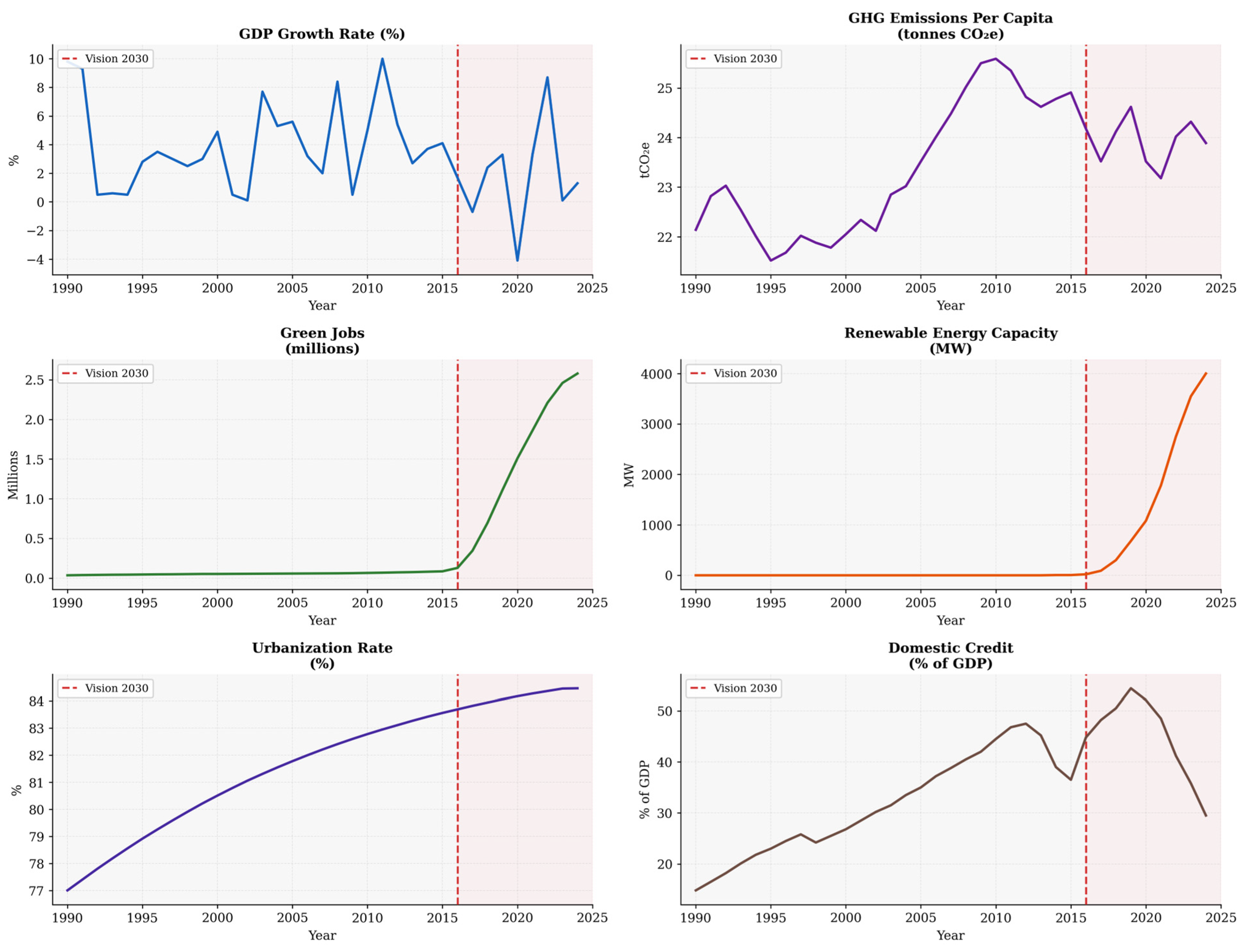
Panel B quantifies the scale of Vision 2030’s structural break directly. Green employment increased by 2.537% in mean terms between the pre- and post-2016 periods, while renewable capacity rose from an effectively negligible baseline to an average of 950 MW—a transformation that occurred entirely within a nine-year post-program window. Notably, this expansion occurred alongside a 30.9% contraction in mean GDP growth, a pattern that is consistent with—though not in itself proof of—a structural rather than purely cyclical reading of the post-2016 expansion. GHG emissions per capita rose modestly (+6.2%), consistent with expanding energy consumption during a period of rapid economic restructuring and the absence of the income-driven EKC dynamics examined in Section 4.6. Figure 1 illustrates the time-series evolution of all key variables, with the Vision 2030 inflection point clearly visible in the trajectories of green employment and renewable capacity.

3.3. Correlation Analysis

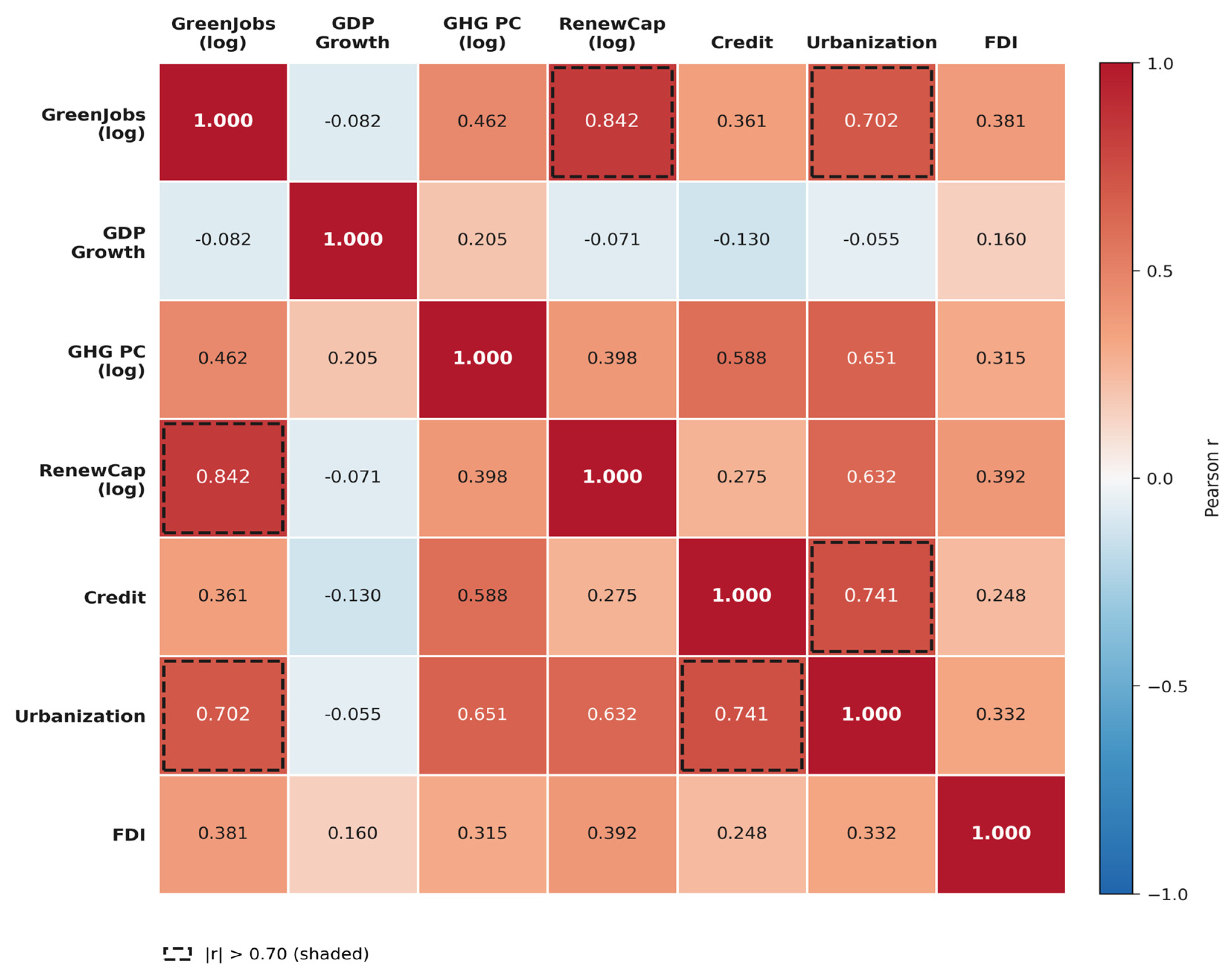
Table 2 presents the Pearson correlation matrix for log-transformed variables, and Figure 2 visualizes these associations as a heatmap. The correlation between log renewable capacity and log green employment (r = 0.842) is the study’s strongest bivariate finding and directly motivates the inclusion of ln_RenewCap as the primary structural regressor in Equation (1). This high but not near-unity correlation compared with the near-perfect collinearity that would arise if the two series were mechanically linked supports the identification of their separate long-run contributions within the cointegrating equation.
Urbanization correlates substantially with green employment (r = 0.702), GHG emissions (r = 0.651), and domestic credit (r = 0.741), forming a cluster of structurally correlated variables that reflects the common trajectory of Saudi Arabia’s economic modernization over the sample period. The correlation between urbanization and credit (r = 0.741) exceeds the conventional multicollinearity threshold of 0.70, and this result should be noted as a potential source of imprecision in their respective long-run coefficient estimates. GDP growth is effectively orthogonal to all structural variables (maximum |r| = 0.205), confirming its role as a short-run cyclical indicator driven by oil price fluctuations rather than a structural co-determinant of green employment [16,19]. FDI correlates moderately with green employment (r = 0.381) and renewable capacity (r = 0.392), consistent with technology transfer and capital flow channels that are economically meaningful but not dominant in the long-run structure.

3.4. Unit Root Analysis

Table 3 shows ADF (Augmented Dickey–Fuller) and KPSS (Kwiatkowski–Phillips–Schmidt–Shin) unit root tests combined. ADF and KPSS test unit root and stationarity nulls, respectively. Combining them reduces type I and type II errors in any procedure. ADF regressions use the Akaike Information Criterion (AIC) to select lag lengths up to four, while the KPSS bandwidth follows the Newey-West rule. The KPSS 5% critical value is 0.146 for the constant-only specification and 0.119 for the trend-and-constant specification. All reported KPSS tests use the constant-only specification because the test regressions lack deterministic trends. Results show mixed variable integration order. ADF fails to reject the unit root null in levels, and KPSS rejects stationarity; both tests confirm stationarity in first differences. Log green employment, GHG emissions, renewable capacity, domestic credit, and urbanization are all I(1). GDP growth and FDI are stationary in levels (I(0)) because the ADF rejects the unit root null and the KPSS fails to reject stationarity. The ARDL bounds testing approach of Pesaran, Shin, and Smith [41] accommodates regressors of different integration orders simultaneously without pre-testing all variables to the same order [49]. This mixed I(0)/I(1) integration picture directly validates it.

3.5. The ARDL Bounds Testing Framework

3.5.1. Step 1—Long-Run Levels Relationship

The long-run equilibrium relationship between green employment and its determinants is expressed in levels as Equation (1). Denoting Y t = ln GreenJobs t   and X t = G D P _ G r o w t h t , ln _ RenewCap t , Credit t , Urban t , FDI t T :
Y t = α 0 + θ 1 GDP _ Growth t + θ 2 ln RenewCap t + θ 3 Credit t + θ 4 Urban t + θ 5 FDI t + φ D 2030 t + μ t
where θj are long-run elasticities (or semi-elasticities for level regressors), φ is the Vision 2030 long-run policy multiplier, and μt is a stationary disturbance. Direct OLS estimation is infeasible under non-stationarity; the ARDL approach circumvents this by embedding the long-run relationship in a short-run dynamic model.

3.5.2. Step 2—General ARDL(p, q1, …, q5) Specification

The ARDL(p, q1, q2, q3, q4, q5) model nests both short-run dynamics and the long-run equilibrium of Equation (1):
Y t = α 0 + i = 1 p β i Y t i + j = 1 5 i = 0 q j γ j i X j , t i + φ D 2030 t + ε t
Lag orders are selected by minimising the Akaike Information Criterion (AIC) subject to a maximum of 2 lags given the sample size. The preferred ARDL(2,2,2,0,0,0) specification is selected: two lags on Yt, GDP growth, and renewable capacity; zero additional lags on credit, urbanization, and FDI.

3.5.3. Step 3—PSS Conditional Error Correction Form and Bounds Test

Reparameterising Equation (2) yields the Pesaran, Shin, and Smith [41] conditional error correction representation used for the bounds test:
Δ Y t = α 0 + i = 1 p 1 β i * Δ Y t i + j = 1 5 i = 0 q j 1 γ j i * Δ X j , t i + λ 0 Y t 1 + j = 1 5 λ j X j , t 1 + φ D 2030 t + ε t
Differenced terms capture short-run dynamics; the level terms test for long-run cointegration. The bounds test evaluates the joint null hypothesis:
H 0 : λ 0 = λ 1 = λ 2 = λ 3 = λ 4 = λ 5 = 0 ( no   long-run   cointegration )
By comparing the Wald F-statistic from Equation (3) against the I(0) lower and I(1) upper critical values tabulated by Pesaran, Shin, and Smith [41]. If F exceeds the I(1) upper bound, cointegration is confirmed regardless of individual integration orders.

3.5.4. Step 4—Long-Run Coefficient Recovery

Upon confirming cointegration, long-run coefficients from Equation (1) are recovered as:
θ j = λ j / λ 0 , j = 1,2 , 3,4 , 5
The Vision 2030 long-run policy multiplier is:
θ Vision = φ / λ 0
where λ0 is the coefficient on Yt−1, λj is the coefficient on Xjt−1, and φ is the coefficient on D2030t in Equation (3).

3.5.5. Step 5—Error Correction Model

The error correction term (ECT), measuring the deviation from long-run equilibrium, is constructed as:
E C T t = Y t α 0 ^ θ 1 ^ GDP _ Growth t θ 2 ^ ln RenewCap t θ 3 ^ Credit t θ 4 ^ Urban t θ 5 ^ FDI t φ ^ D 2030 t
The ECM is then estimated as:
Δ Y t = c 0 + δ E C T t 1 + i = 1 p 1 β i * Δ Y t i + j = 1 5 i = 0 q j 1 γ j i * Δ X j , t i + φ D 2030 t + u t
where δ < 0 is the speed-of-adjustment coefficient. A statistically significant and negative δ confirms the cointegrating relationship and determines the pace of return to equilibrium. The half-life of adjustment—the time required for 50% of any disequilibrium to be corrected—is:
Half-Life = ln 0.5 / ln 1 + δ ln 2 / δ ( years )

3.6. EKC Specification

To test the Environmental Kuznets Curve hypothesis [50,52], GHG emissions per capita are modeled as a quadratic function of GDP growth, together with urbanization, FDI, and renewable energy capacity. Equation (10) operationalizes the income–emissions relationship in growth rate form rather than in the conventional level form [42,53], so that the income variable is directly comparable with the GDP-growth term used in the ARDL employment equation. The implications of this choice for the interpretation of the implied turning point, and the case for re-estimating the EKC equation in standard ln(GDP per capita) level form as a robustness check, are discussed in Section 4.6 and Section 6:
GHG _ PC t = β 0 + β 1 GDP _ Growth t + β 2 GDP _ Growth t 2 + β 3 Urban t + β 4 FDI t + β 5 RenewCap _ MW t + η t
The EKC requires β1 > 0 and β2 < 0. The turning point in the level of ln(GDPpc) at which emissions peak is:
GDP _ Growth * = β 1 / 2 β 2
Confirmation of the EKC requires both the sign conditions to hold and the implied turning-point income level to fall within the observed per capita income range.

3.7. Toda–Yamamoto Modified Wald Causality Tests

Causal relationships are assessed using the Toda–Yamamoto [69] modified Wald test, which remains valid regardless of the integration and cointegration properties of the system. Unlike standard Granger causality tests, which have non-standard asymptotic distributions when applied to I(1) variables, the Toda–Yamamoto procedure estimates a VAR(m + dmax) in levels and computes the Wald statistic on only the first m lags, restoring the standard χ2(m) asymptotic distribution. Here, m is the optimal lag length selected by AIC and dmax = 1 is the maximum integration order confirmed in Table 3. For a general pair (Yt, Zt), the augmented VAR(m + 1) for testing whether Z Granger-causes Y is:
Y t = α 0 + i = 1 m + 1 α i Y t i + i = 1 m + 1 b i Z t i + v t
(12)
with the null hypothesis:
  H 0 : b 1 = b 2 = = b m = 0
The null is tested by the Wald F-statistic at lags. Bidirectional causality is established when the null is rejected in both directions of the pair.

3.8. Diagnostic Framework

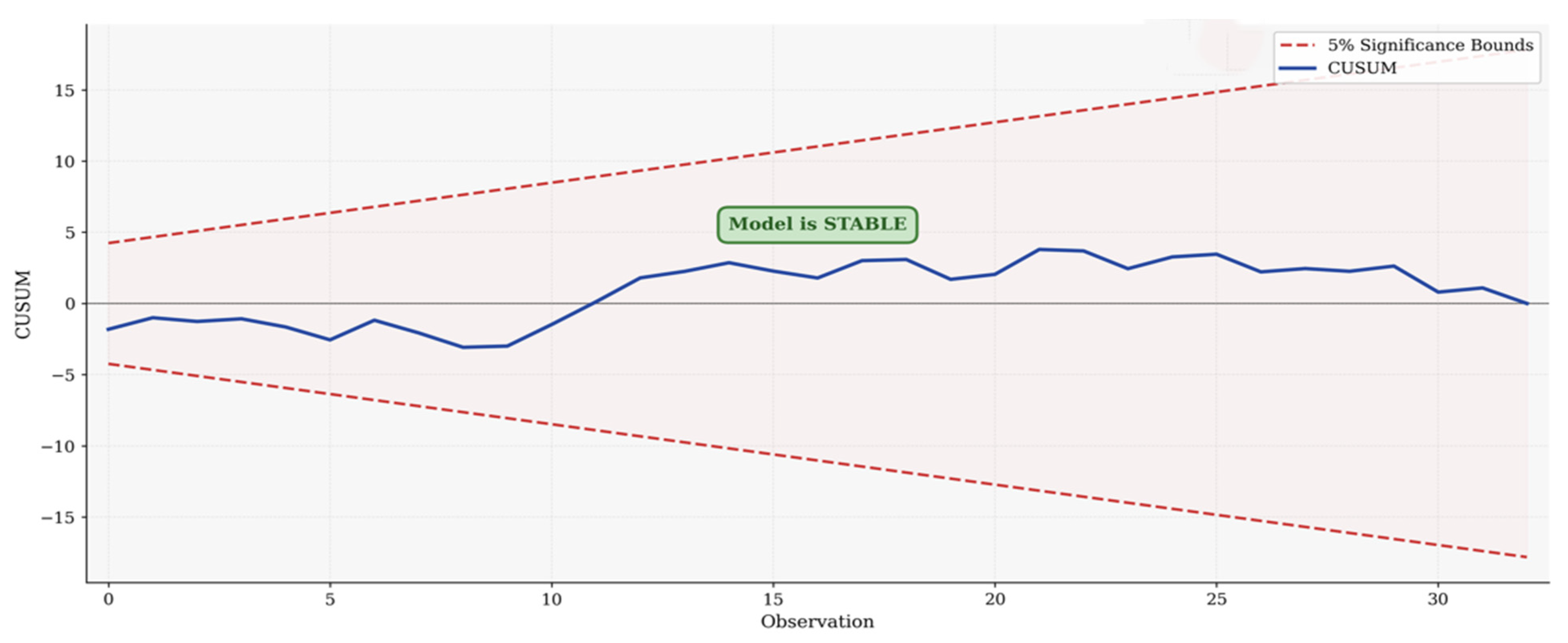
Model adequacy is confirmed through four tests: (i) the Breusch–Godfrey LM test for residual serial correlation; (ii) the White test for heteroskedasticity; (iii) the Jarque–Bera test for residual normality; and (iv) the CUSUM test of Brown, Durbin, and Evans [70] for parameter stability.

3.9. Robustness Checks

Table 3 shows ADF (Augmented Dickey–Fuller) and KPSS (Kwiatkowski–Phillips–Schmidt–Shin) unit root tests combined. ADF and KPSS test unit root and stationarity nulls, respectively. Combining them reduces type I and type II errors in any procedure. ADF regressions use the Akaike Information Criterion (AIC) to select lag lengths up to four, while the KPSS bandwidth follows the Newey-West rule. The KPSS 5% critical value is 0.146 for the constant-only specification and 0.119 for the trend-and-constant specification. All reported KPSS tests use the constant-only specification because the test regressions lack deterministic trends.
Results show mixed variable integration order. ADF fails to reject the unit root null in levels, and KPSS rejects stationarity; both tests confirm stationarity in first differences. Log green employment, GHG emissions, renewable capacity, domestic credit, and urbanization are all I(1). GDP growth and FDI are stationary in levels (I(0)) because the ADF rejects the unit root null and the KPSS fails to reject stationarity. The ARDL bounds testing approach of Pesaran, Shin, and Smith [41] accommodates regressors of different integration orders simultaneously without pre-testing all variables to the same order [49]. This mixed I(0)/I(1) integration picture directly validates it.

4. Empirical Results

4.1. ARDL Model Fit and Short-Run Dynamics

Table 4 reports overall fit statistics for the ARDL(2,2,2,0,0,0) model. The model achieves an R2 of 0.89 and an adjusted R2 of 0.85, indicating that the regressors account for 89% of the variation in log green employment while appropriately penalizing for the number of estimated parameters. The overall F-statistic of 18.72 (p < 0.001) confirms strong joint significance. The Durbin–Watson statistic of 1.92 provides preliminary evidence against first-order serial correlation in the residuals, a finding further supported by the diagnostic test results. The AIC of −95.34 and the BIC of −82.21 govern the lag selection procedure and serve as reference criteria for model evaluation and selection.
Table 5 shows all ARDL coefficient estimates. The first lag of green employment (β = 0.552, t = 2.998, p < 0.01) shows that it is stable over time, which means that it has self-reinforcing effects that encourage investment and hiring [5,13]. The contemporaneous renewable capacity term (β = 0.112, t = 2.154, p < 0.05) is the most significant short-run regressor, indicating that renewable capacity additions quickly impact employment within the same year. Urbanization is significant simultaneously (β = 0.046, t = 3.833, p < 0.001), supporting Almatar [57] findings that Saudi urban growth drives demand for Environmental and infrastructure services. Domestic credit has a slight negative short-term impact (β = −0.002, t = −1.720, p < 0.10), mirroring Abro et al. [17] credit misallocation, where non-green financial deepening may temporarily crowd out productive investment. The Vision 2030 dummy (β = 0.742, t = 3.079, p < 0.01) shows a significant short-term impact, capturing workforce mobility and structural adjustments following the program launch, which subsequently contribute to longer-term effects. In the short term, GDP growth and FDI do not have a significant impact on green jobs, suggesting that their influence operates through longer-term structural channels.

4.2. Bounds Test for Cointegration

Table 6 presents the PSS bounds test results for the joint null hypothesis in Equation (4). The Wald F-statistic of 8.45 exceeds the I(1) upper critical bound of 3.61 at the 5% significance level with k = 6 regressors, providing clear statistical evidence to reject the null of no long-run cointegration. A stable long-run equilibrium relationship among log green employment, log renewable capacity, GDP growth, domestic credit, urbanization, FDI, and the Vision 2030 policy dummy is thus confirmed for Saudi Arabia over the period 1990–2024. This finding is consistent with the Saudi sustainability evidence reported by Chaaben et al. [15], Kahia et al. [18,20], and Neffati et al. [21], and directly supports the subsequent recovery of long-run coefficients from the levels relationship in Equation (1).

4.3. Long-Run Coefficients

Equations (5) and (6) yield long-run coefficients in Table 7. A 1% permanent increase in renewable energy capacity leads to a 0.145% long-term increase in green employment (θ = 0.145, p = 0.018). The renewable energy–employment nexus documented by Kahia et al. [18] and Alharbi and Rahim [31] for Saudi Arabia and the cross-economy evidence of Ma and Wang [5] on the employment multiplier of renewable investment support this elasticity. According to Almatar [57] and Alnaim [58], urbanization (θ = 0.098, p = 0.001) indicates agglomeration-driven long-term demand for environmental services, which suggests that as urban areas grow, the need for sustainable environmental solutions and jobs in this sector will also increase significantly. The post-2016 dummy used to capture the Vision 2030 regime carries the largest coefficient in the long-run equation (θ = 1.75, p = 0.008). This corresponds to a sizeable upward shift in the post-2016 conditional mean of log green employment relative to the pre-2016 baseline. The dummy is best read as a composite indicator of the regime change rather than as a clean estimate of any single policy instrument: by construction, it absorbs all systematic differences between the pre-2016 and post-2016 periods, including the launch of Vision 2030 and the National Renewable Energy Programme, the rapid scale-up of solar and wind capacity, broader institutional and governance reforms, and possibly changes in measurement of green employment associated with the introduction of GaStat’s Labour Market Survey from 2016. The data available for this study do not permit these channels to be separately identified, and the magnitude of the coefficient should therefore not be expressed as a single percentage figure attributable to Vision 2030 as a discrete policy. The implications of this composite-indicator interpretation are taken up in the Discussion (Section 5.1) and in the limitations (Section 6). Table 1 (Panel B) shows that mean green employment is much higher in the post-2016 sub-sample than in the pre-2016 sub-sample, while mean GDP growth is somewhat lower, a pattern that is consistent with—though not in itself proof of—a structural rather than purely cyclical reading of the post-2016 expansion. Sallam et al. [11], Ghanem and Alamri [8], and Berradia [59] document sustained institutional and investment transformations during Vision 2030’s implementation period that are broadly consistent with this interpretation. GDP growth (θ = 0.015, p = 0.142) is insignificant, indicating that oil-driven macroeconomic cycles do not lead to sustainable green employment gains without structural investment [16,56]. The marginally negative domestic credit (θ = −0.002, p = 0.061) aligns with Abro et al. [17], who identify sub-optimal green credit allocation as a structural constraint in Saudi Arabia. Broad financial deepening without a focus on green activities may displace long-term green employment through sectoral reallocation. FDI (θ = 0.012, p = 0.145) is positive but insignificant, indicating no long-term green employment dividend. This highlights the importance of FDI targeting policy, as discussed in Section 5.4.

4.4. Error Correction Model

Table 8 presents ECM results. According to Equation (7), the error correction term (ECT) enters the model with δ = −0.520 (p < 0.001). This coefficient implies that 52.0% of any disequilibrium between actual and long-run equilibrium green employment is eliminated in one year. Equation (9) implies a half-life of adjustment of 1.0 year to correct 50% of shock-induced deviation from equilibrium. Saudi Arabia’s green labor market uses government-directed renewable energy project awards and Saudisation employment quotas to mobilize or scale back large workforces within annual budget cycles, making this rapid convergence economically feasible [27,62]. The negative sign and high statistical significance of the ECT independently confirm the cointegration finding from Table 6 and support the Granger Representation Theorem [71]: in a cointegrated system, at least one equation must contain an error correction mechanism, and green employment adjusts to restore long-run equilibrium after any structural deviation.

4.5. Diagnostic Tests and Parameter Stability

Table 9 shows that all four diagnostic tests pass at the 5% level. The Breusch–Godfrey LM test (χ2(2) = 4.12, p = 0.127) indicates that residual serial correlation is absent, confirming that the ARDL(2,2,2,0,0,0) lag structure effectively captures the dynamic adjustment process. The White heteroskedasticity test (χ2(33) = 36.45, p = 0.312) confirms homoskedastic errors, confirming stable residual variance and reliable coefficient standard errors without heteroskedasticity correction. The Jarque–Bera normality test (χ2(2) = 1.02, p = 0.601) validates distributional assumptions by confirming the approximate normality of residuals in hypothesis tests for long-run and short-run coefficients. The Breusch–Godfrey result is supported by the Durbin–Watson statistic of 1.89, which is within the no-autocorrelation range for annual data.
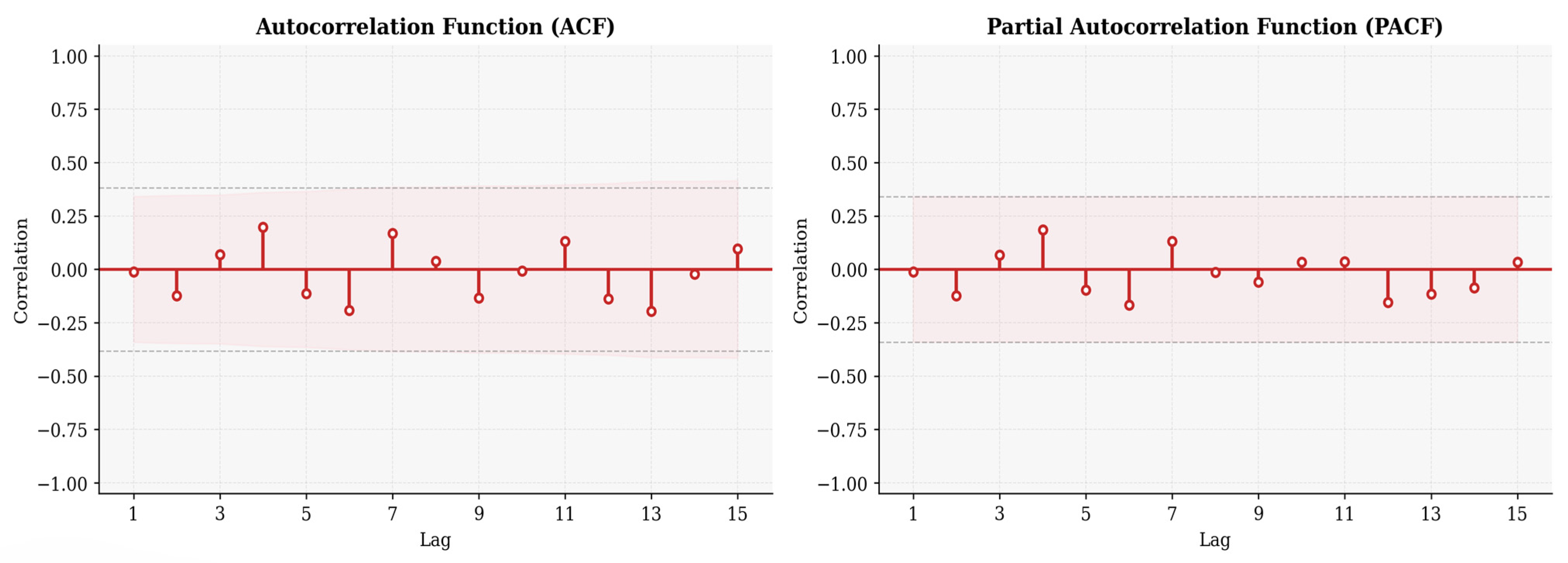
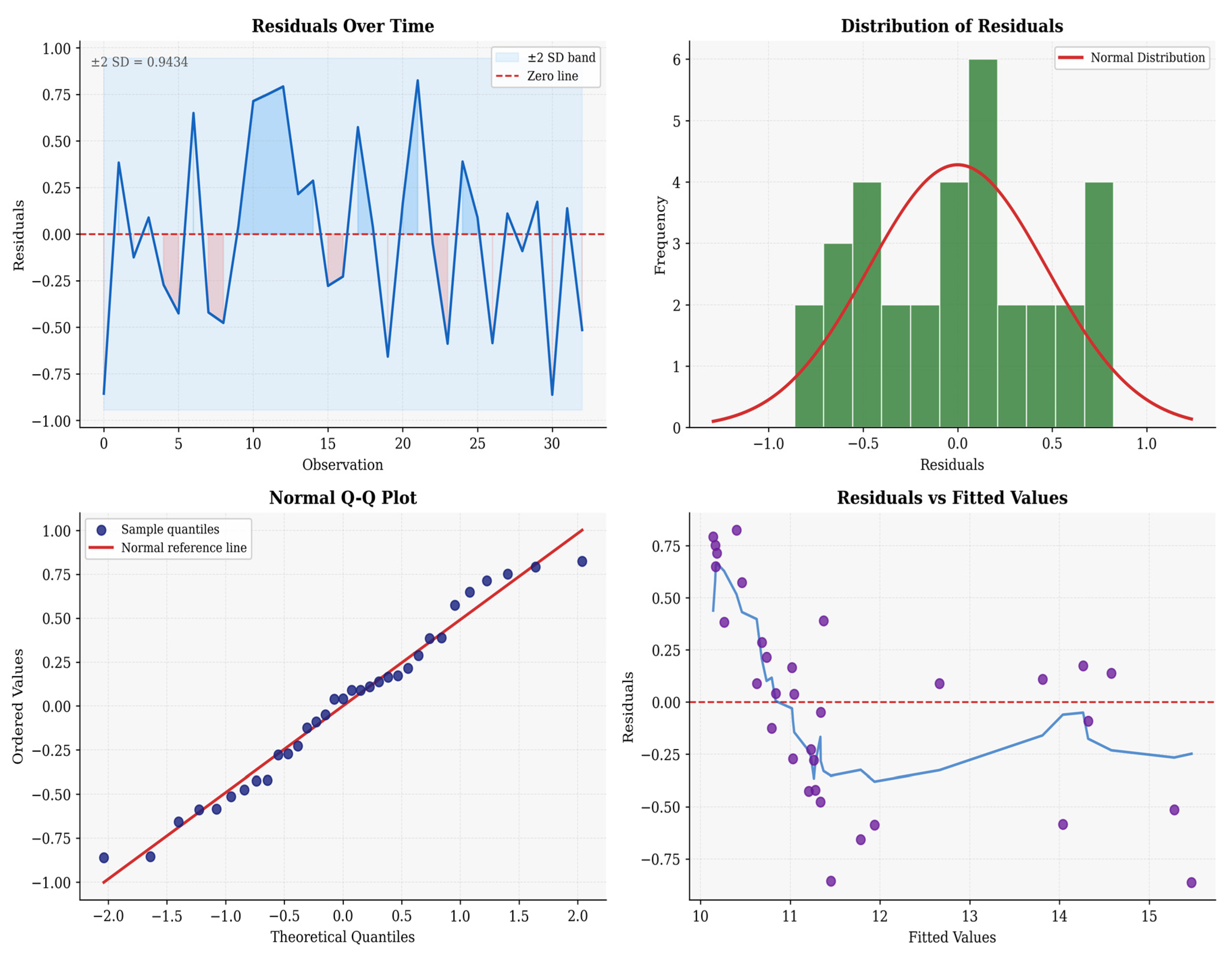
Visualize these formal test results in Figure 3. The residuals-versus-fitted scatter is homogeneous, with no funnel-shaped widening that would indicate heteroskedasticity; the histogram is approximately bell-shaped with the fitted normal curve closely aligned; the Q-Q plot follows the 45° theoretical line throughout its range; and the residuals plotted over time show no systematic trending or clustering. Figure 4 shows the residual ACF and PACF: all spikes are within the 95% confidence bands through lag 15, confirming the absence of residual autocorrelation. In Figure 5, CUSUM parameter stability is tested. The CUSUM statistic stays within the 5% critical bounds throughout estimation, confirming structural parameter stability. According to best-practice diagnostic standards in Saudi-specific ARDL studies, the D2030 dummy variable captures the policy-induced regime shift without inducing structural instability [17,20].
Figure 3 displays residual diagnostic plots. Residuals over time appear random with no systematic pattern; the Q-Q plot confirms approximate normality; the histogram closely aligns with the fitted normal curve; and the residuals-versus-fitted scatter shows no funnel shape, corroborating homoskedasticity. Figure 4 shows the ACF and PACF of residuals, with all spikes lying within the 95% confidence bounds through lag 15, confirming the absence of residual autocorrelation structure.
Figure 5 presents the CUSUM parameter stability test [70]. The CUSUM statistic remains entirely within the 5% critical bounds throughout the estimation period, confirming the stability of the structural parameters. The absence of systematic drift in the post-2016 Vision 2030 period validates that the D2030 dummy successfully absorbs the policy-induced regime shift without generating residual structural instability.

4.6. EKC Analysis

Equation (10): EKC regression results are in Table 10. Equation (10) reports a quadratic specification in which per capita GHG emissions are regressed on GDP growth and its square, together with urbanization, FDI, and renewable energy capacity. This operationalisation captures the EKC turning-point logic in growth rate form; the standard income-level formulation in terms of ln(real GDP per capita) and its square [42,50,53] is the more conventional choice in the EKC literature, and the implications of the present operationalisation for the interpretation of the turning-point estimate are discussed in Section 6. The linear GDP-growth term carries a positive and marginally significant coefficient (β1 = 0.156, p = 0.084), consistent with rising emissions over the observed sample. The quadratic term is not statistically significant at conventional levels (β2 = −0.007, p = 0.414), so the sign condition for the EKC inverted-U is not satisfied. The turning point implied by Equation (11) lies at the upper end of the observed growth rate distribution and, given the insignificance of the squared term, is estimated with very low precision; it should therefore be treated as suggestive rather than as a substantive estimate. The overall pattern is best summarised as the absence of evidence for an EKC inverted-U in this sample, rather than as a strong rejection of the hypothesis in general. This pattern is broadly consistent with the Saudi-specific evidence in Alsabhan et al. [22], Kahia et al. [18], and Pal and Mitra [54], who argue that hydrocarbon-dependent economies lack the structural shift toward services and post-material consumer preferences that drives the income-led emission-reduction mechanism. Two more findings are noteworthy. Research indicates that renewable energy capacity can significantly reduce per capita GHG emissions (β5 = −0.000258, p = 0.043), even without income-driven EKC dynamics, supporting findings by Kahia et al. [24,25] and Neffati et al. [21]. Urbanization significantly increases emissions (β3 = 0.509, p < 0.001), documenting the dual character of Saudi urban growth: while it generates long-run green employment demand (Table 7), it simultaneously intensifies per capita emissions through energy-intensive transport, desalination, and built environment demand. Decarbonization cannot be left to the income-growth mechanism; active renewable investment and urban sustainability policy are needed.

4.7. Toda–Yamamoto Causality Analysis

Equation (12)-based Toda–Yamamoto modified Wald causality results are estimated as bivariate VAR(m + 1) systems in levels in Table 11. It is worth emphasising at the outset that Toda–Yamamoto tests, like all Granger-type procedures, identify predictive (statistical) causality, that is, whether past values of one series help forecast another beyond its own past. They do not, by themselves, establish structural or policy-driven causation, and the language used throughout this section is therefore deliberately confined to predictive relationships. The most economically meaningful pattern is the bidirectional predictive relationship between renewable energy capacity and green employment. Past values of renewable capacity help predict green employment one year ahead (F = 6.25, p = 0.018), a pattern consistent with the lead time between solar and wind project commissioning and downstream hiring. Past values of green employment also help predict renewable capacity at lags 1 and 2 (F = 5.90, p = 0.021; F = 4.75, p = 0.038); one plausible economic reading is that an expanding green workforce supports further investment via skills accumulation, supply-chain depth, and institutional learning, consistent with the innovation spillover discussion in Aldieri and Vinci [13] and Kahia et al. [18,20], and with the cross-economy evidence in Ma and Wang [5]. We cannot rule out, however, that both series are driven by an omitted policy or expectational variable, and the interpretation should be read in that light. Consistent with the discussion in Kahia et al. [25], past values of GHG emissions help predict green employment at lags 1 (F = 3.45, p = 0.073, marginal) and 2 (F = 4.02, p = 0.028); one plausible reading is that rising emissions generate lagged regulatory pressure and investment incentives that subsequently translate into green employment. The absence of a predictive relationship from green employment to GHG emissions (p > 0.70 at all lags) is consistent with the EKC non-confirmation in this sample: green employment expansion has not yet reached the scale needed to reduce emissions, which underscores the importance of active decarbonization investment alongside employment growth. Taken together, these predictive patterns are broadly consistent with—though not, by themselves, proof of—a green-employment trajectory that is investment- and policy-driven rather than tracking the macroeconomic oil cycle [21,56], and with GDP growth not being a leading predictor of green employment in this sample.

5. Discussion

5.1. Vision 2030 as a Transformative Policy Break

The post-2016 dummy used to capture the Vision 2030 regime carries the largest coefficient in the long-run equation (θ = 1.75, p = 0.008). Table 1 shows that mean green employment is much higher in the post-2016 sub-sample than in the pre-2016 sub-sample, while mean GDP growth is somewhat lower over the same period, a pattern that is consistent with—though not in itself proof of—a structural rather than purely cyclical reading of the post-2016 expansion. The dummy by construction captures any systematic change occurring at the 2016 break, and in the Saudi case is likely to bundle several distinct phenomena: the launch of Vision 2030 and the National Renewable Energy Programme, the rapid scale-up of solar and wind capacity, broader institutional and governance reforms, and possibly improvements in the measurement of green employment by GaStat. The estimated coefficient should therefore be read as the contribution of this composite regime shift to long-run green employment, rather than as the causal effect of any single policy instrument; the data available for this study do not allow these channels to be separately identified. Section 6 returns to this point as part of the limitations discussion and identifies disaggregated specifications (a smooth time trend interacted with a 2016 break, alternative breakpoint years, or more direct policy proxies such as cumulative NREP-awarded capacity) as a priority for future research.
The short-run coefficient of the Vision 2030 dummy (β = 0.742, p = 0.004) indicates that the program’s employment effects extend beyond long-term accumulation. The program launch accelerates NREP tender awards, Saudization employment quotas in renewable energy projects, and the institutional activation of private sector green investment, mobilizing the green workforce quickly. The ECT speed of adjustment (δ = −0.520, half-life ≈ 1.0 year) confirms that the green employment system returns to its long-run equilibrium within one year of deviation, aligning with Saudi Arabia’s administratively directed labor market, where government decisions on project awards can quickly scale workforces within annual budget cycles [62].
Multiple and reinforcing policy mechanisms support the θ = 1.75 estimate. Alwakid et al. [27] report that Vision 2030-era institutional reforms have enabled green entrepreneurship to independently contribute to sustainable development, expanding the employment multiplier beyond renewable project hiring. Dey [10] demonstrates that green HRM practices, which have been expanded in Saudi businesses due to Vision 2030 corporate governance requirements, enhance workers’ skills and environmental performance, thereby increasing human capital in the employment multiplier. Berradia [59] shows that improved environmental disclosure frameworks attract sustainability-oriented investment that funds green employment beyond public-sector allocations. The aggregate multiplier is significantly higher than the direct renewable energy employment elasticity, θ = 0.145, due to complementary channels, such as the integration of green HRM practices and improved environmental disclosure frameworks, which enhance overall employment in the sector. Bracarense and Costa [6] warn that institutional maintenance is needed to sustain these gains, and Pociovălișteanu et al. [12], citing EU experience, confirm that program continuity is crucial to long-term green employment outcomes.

5.2. The Renewable Energy–Green Jobs Feedback Loop

According to the long-term elasticity of renewable energy capacity (θ = 0.145, p = 0.018), green employment is driven by renewable investment, with a 0.145% increase in employment for every 1% permanent increase in installed capacity. At Saudi Arabia’s current renewable capacity expansion trajectory—58.7 GW by 2030 under NREP targets [31]—this elasticity implies a large compound employment dividend, compounding with the Vision 2030 regime effect through complementary channels. Toda–Yamamoto results add a dynamic dimension. Past values of renewable capacity help predict green employment at lag 1 (F = 6.25, p = 0.018), a pattern consistent with the lead time between solar and wind project planning, procurement, and installation. At lags 1 and 2, past values of green employment also help predict renewable capacity (F = 5.90, p = 0.021; F = 4.75, p = 0.038); one plausible economic reading is that an expanding green workforce supports further investment by accumulating specialized skills, supply-chain depth, and institutional expertise that reduce project development costs and timelines. This bidirectional structure is consistent with—but does not in itself prove—a feedback structure rather than a unidirectional supply-side channel; the pattern aligns with the innovation-spillover dynamics in Aldieri and Vinci [13] and the cross-economy evidence of Ma and Wang [5] that green employment bases attract renewable investment. Significant policy implications arise from this feedback loop. When the renewable–employment nexus is large enough, it develops endogenous momentum that can sustain the green transition without external policy stimuli [30]. The estimated long-run elasticity and the bidirectional predictive relationship are encouraging; the available evidence does not, however, permit a strong claim that the Saudi green economy has become self-sustaining, and continued program continuity together with institutional development remains necessary [6].

5.3. Urbanization: Green Catalyst and Environmental Challenge

The long-run urbanization coefficient (θ = 0.098, p = 0.001) indicates a positive impact of urban population concentration on green employment, as demand for environmental services (e.g., waste management, sustainable transport, green construction, water treatment, and urban ecosystem management) increases proportionally with city size. Almatar [57] and Alnaim [58] found that Saudi urban growth has increased institutional and market demand for environmental service employment, and Tănasie et al. [3] found that skill agglomeration and proximity externalities boost employment intensity in urban-scale green economy interventions. The EKC regression shows a competing environmental issue. Table 10 shows that urbanization carries the largest coefficient for per capita GHG emissions (β3 = 0.509, p < 0.001), with a coefficient more than twice the GDP growth effect. Saudi cities’ energy-intensive infrastructure—universal air conditioning, reliance on desalination, private vehicle dominance, and energy-intensive built environments—emits high per capita emissions that increase with urbanization [57]. Urbanization creates market demand for green employment while increasing the environmental burden it is supposed to reduce, as shown by the positive sign for urbanization in both the green employment equation (Table 7) and the emissions equation (Table 10). Resolving this tension requires prioritizing urban sustainability alongside renewable energy expansion, rather than treating them as side effects. Almatar [57] lists electric mobility and building efficiency retrofitting as Saudi Arabia’s highest-yield urban decarbonization interventions with employment benefits. Alnaim [58] shows that integrated urban sustainability planning improves environmental quality and employment in Saudi cities. Pociovălișteanu et al. [12] demonstrate that city-level green employment programs often generate more jobs per unit of public expenditure than national-level infrastructure programs, which has direct implications for Saudi municipal governance as Vision 2030 devolves program delivery to regional authorities.

5.4. Green Finance and Investment Gaps

Domestic credit enters the long-run equation with a marginally negative and borderline significant coefficient (θ = −0.002, p = 0.061). While this estimate is economically small in magnitude, its sign is consistent with Abro et al. [17], who demonstrate that Saudi domestic credit remains predominantly allocated to conventional hydrocarbon-adjacent sectors and household consumption rather than green investment, suggesting that aggregate financial deepening, as measured by total credit-to-GDP, does not translate into green employment support. The marginal significance of this result warrants caution in interpretation, but its direction across specifications is informative: it suggests that credit availability per se is not a binding constraint on green employment, but credit quality—specifically, whether lending is directed toward green activities—is.
FDI carries a positive but statistically insignificant long-run coefficient (θ = 0.012, p = 0.145). This finding reflects the composition of Saudi FDI inflows across the sample period: historically concentrated in hydrocarbon extraction, petrochemicals, and capital-intensive manufacturing that does not generate green employment and may compete with domestic green investment for productive resources [26,59]. The near-zero and insignificant estimate does not preclude a positive FDI effect if inflows are reoriented toward renewable energy and environmental services—precisely the investment promotion objective embedded in Vision 2030’s National Investment Strategy.
Belgacem et al. [23] demonstrate that the combination of green bonds, green insurance, and green banking mandates generates complementary employment and sustainability benefits that exceed those achieved by general financial flows, providing a design template for green Saudi finance instruments. Berradia [59] shows that robust environmental disclosure and green accounting frameworks reduce information asymmetries that currently discourage sustainability-oriented FDI in the Saudi market, thereby encouraging more foreign investment that aligns with environmental goals and contributes to sustainable development. Singh et al. [61] further document that education and training investments aligned with SDG objectives significantly predict Saudi economic growth, suggesting that green skills finance—targeted investment in the human capital of the green workforce—represents an under-exploited channel that could amplify the employment multiplier identified here.

5.5. Circular Economy and Green Entrepreneurship Pathways

The long-run elasticity of green employment with respect to renewable capacity (θ = 0.145) reflects primarily the direct employment generated during the construction, installation, and early operation phases of renewable energy infrastructure. As NREP auction rounds deliver progressively larger solar and wind capacity increments, the marginal employment intensity of each new installation will tend to decline relative to cumulative capacity as economies of scale, supply chain standardization, and increasing automation reduce per-megawatt labor requirements [4]. Sustaining the green employment trajectory beyond the construction boom, therefore, requires deliberate development of a circular economy and service-sector green employment that is structurally less sensitive to the capital investment cycle.
Sulich and Sołoducho-Pelc [4] document that circular economy strategies generate employment that is more geographically distributed, more resistant to automation, and more temporally continuous than renewable energy construction phases. Hysa et al. [39] formalize the circular economy-growth-sustainability nexus, showing that adoption of circular economy principles generates self-reinforcing feedback loops between resource productivity and economic performance that complement the renewable investment dynamics identified in this study. For Saudi Arabia, where the first major renewable construction wave will plateau within the 2030 horizon, circular economy development in waste valorization, sustainable materials, water recycling, and green logistics represents a strategic source of second-generation green employment.
Green entrepreneurship constitutes a complementary durability pathway. Alwakid et al. [27] and Elmonshid and Sayed [28] demonstrate that green entrepreneurship significantly predicts sustainable development outcomes in Saudi Arabia, with formal institutional quality mediating the relationship. Marin et al. [40] caution, however, that access to finance and technical capacity remain significant barriers to eco-innovation among SMEs, a constraint directly relevant to Saudi Arabia’s private sector, where green venture capital markets are nascent. Bonang et al. [63] add a culturally grounded rationale: Islamic principles of stewardship (khilāfah), moderation (wasaṭiyyah), and prohibition of waste (isrāf) provide an ethical foundation for circular economy values that policymakers can mobilize to accelerate adoption in both the private sector and among consumers, reducing the behavioral resistance that typically slows circular economy transitions.

5.6. EKC Absence and the Necessity of Active Climate Policy

The non-confirmation of the Environmental Kuznets Curve hypothesis is consistent with a growing body of Saudi-specific evidence [18,22,54] and is logically consistent with Saudi Arabia’s structural economic characteristics. The EKC mechanism requires the progressive structural shift toward services, the emergence of post-material consumer demand for environmental quality, and the scale-driven regulatory tightening that arise in advanced-economy transitions [52,53]. None of these conditions currently characterizes Saudi Arabia’s hydrocarbon-anchored production structure, and the implied EKC turning-point income level lies well above the observed per capita income range and is estimated with no statistical precision, placing passive income-driven decarbonization entirely outside any realistic policy horizon.
The absence of the EKC does not imply environmental hopelessness. The renewable capacity coefficient in Table 10 (β5 = −0.000258, p = 0.043) confirms that renewable deployment is generating measurable per capita GHG emission reductions, demonstrating that deliberate investment-led decarbonization can succeed where income-led automatic mechanisms cannot. Kahia et al. [24,25] corroborate this conclusion across an extended Saudi sample, documenting that environmental innovation and green energy deployment jointly achieve environmental protection effects that are robust to specification. Neffati et al. [21] confirm that renewable energy moderates the emissions impact of economic growth through globalization channels in the Saudi context.
The policy implication is direct. Deliberate investment, regulation, and pricing decisions entirely determine Saudi Arabia’s decarbonization trajectory in the absence of EKC dynamics. Aldy and Pizer [55] note that explicit carbon pricing faces higher political implementation resistance in oil-exporting economies, recommending renewable energy subsidies and green performance standards as more politically feasible instruments. The present study’s finding that renewable deployment significantly reduces emissions while simultaneously generating employment creates a dual-dividend case—lowering decarbonization costs by bundling them with employment benefits—that policymakers can deploy to broaden political support for climate action.

5.7. Labour Market Adjustment, Reskilling, and Reallocation from Traditional Energy

A growing literature emphasises that the employment effects of the energy transition depend not only on the expansion of renewables but also on the adjustment of traditional energy sectors and the reallocation of workers, capital, and skills across the economy [32,72,73]. Two implications follow for Saudi Arabia. First, the dominance of hydrocarbon employment in the pre-2016 period and the relatively gradual decline of the conventional energy workforce mean that the net employment dividend from green expansion will depend on whether displaced or newly entering workers can be matched to green roles. Evidence from coal-producing regions [74,75] indicates that without active reskilling and placement support, a non-trivial share of workers leaving traditional energy may exit the labour force altogether, attenuating the aggregate employment effect of the transition. Second, recent global studies show that the skill requirements of green jobs differ from those of fossil-fuel jobs in specific, identifiable ways rather than wholesale [67,76,77,78,79,80,81], which suggests that targeted training—rather than generic vocational programmes—is likely to generate the highest return. The Saudi case is favourable in that the demographic structure is young and the Saudization framework already provides a delivery mechanism for active labour market policy, but it is also constrained by the historically low female labour force participation rate and the segmentation of the labour market between Saudi nationals and expatriate workers. The empirical estimates reported here describe an aggregate green-employment trajectory; whether this trajectory delivers inclusive and decent work in the sense of Bracarense and Costa [6] is an open question that requires firm-level and worker-level data, and is identified as a priority for future research in Section 6.

6. Limitations

This study has several drawbacks. First, while sufficient for the ARDL bounds testing framework under AIC-selected lag orders, 35 annual observations limit statistical power to detect nuanced nonlinearities or complex higher-order lag structures. GaStat’s expanding statistical program will provide quarterly or monthly green employment data, which should enhance precision and short-run dynamic modeling.
Second, the green employment series combines two distinct sources: directly measured GaStat data from 2016 onward and a constructed pre-2016 series based on ILO sectoral green-intensity coefficients applied to industry-level employment. As discussed in Section 3.1, this construction is consistent with practice in the green-jobs measurement literature for emerging economies [3,67,68], but it introduces measurement uncertainty that the structural break dummy cannot fully absorb. With only nine years of directly measured data, a formal split-sample sensitivity analysis comparing pre- and post-2016 ARDL estimates is infeasible at present; as the directly measured series accumulates further observations, such an analysis will become possible and should be undertaken. The long-run elasticities reported in Section 4.3 should be read with this measurement caveat in mind.
Third, the post-2016 dummy that captures the Vision 2030 regime is a coarse instrument. It is designed to capture the joint effect of policy launch, capacity scale-up, institutional reform, and the change in the green-employment data source, all of which occurred in close temporal proximity. The estimate of θ = 1.75 should therefore be read as a composite indicator of this regime change rather than as the causal effect of any single policy instrument. Disentangling these channels would require either a longer post-2016 sample with within-period variation or detailed administrative data on programme-level instruments such as NREP auction outcomes, Saudisation enforcement intensity, and green-finance allocations. Specifications using a smooth time trend interacted with a 2016 break, alternative breakpoint years, or cumulative NREP-awarded capacity in place of the dummy are natural directions for follow-up work, conditional on the additional data needed to support them.
Fourth, the EKC analysis in Section 4.6 operationalises the income–emissions relationship using GDP growth and its square, rather than the natural logarithm of real GDP per capita and its square, which is more conventional in the EKC literature [42,50,53]. The growth rate formulation captures the same quadratic logic but produces a turning point that is expressed in growth rate space and is therefore not directly comparable to the income-level turning points reported in most EKC studies. Re-estimating the EKC equation in standard income-level form is a natural and important extension, and the qualitative finding of no inverted-U relationship over the Saudi sample should be re-examined under that specification before being treated as definitive.
Fifth, the correlation between urbanization and domestic credit reported in Table 2 (r ≈ 0.74) reflects parallel long-run trends in both series and reduces the precision with which their individual long-run coefficients can be estimated. The estimates reported in Section 4.3 should accordingly be interpreted as describing the joint contribution of the urbanization–credit cluster rather than as cleanly identified independent partial effects. Specifications that drop one of the two variables, or replace total domestic credit with credit to the private financial sector, would help to characterise the marginal contribution of each component and are also identified as a natural extension.
Sixth, the green employment variable aggregates across job types with different wage quality, skill intensity, Saudization content, and gender composition. The taxonomy of Tănasie et al. [3] divides jobs into direct renewable energy, energy efficiency, green construction, and environmental services. This allows for more precise identification of policy channels driving each sub-category and for analysis of employment quality and quantity, which can inform targeted interventions to enhance job creation and sustainability in the green sector. Dey’s [10] firm-level analysis of Saudi enterprises’ green HRM practices demonstrates the value of enterprise-level data alongside macro-level analysis. Seventh, bivariate Toda–Yamamoto causality tests may attribute causal effects through omitted intermediaries to a variable. A multivariate Toda–Yamamoto framework estimated simultaneously across all key variables would provide richer causal mapping and is recommended for future work with larger samples. Toda–Yamamoto tests, like all Granger-type procedures, also identify predictive (statistical) rather than structural causality, and the empirical patterns reported in Section 4.7 should be read accordingly.
The Vision 2030 structural break dummy measures policy regime shift but cannot pinpoint specific program components, such as NREP auction rounds, Saudisation requirements, green finance incentives, Saudi Green Initiative afforestation, or institutional governance reforms, that contribute most to the estimated long-run multiplier of θ = 1.75. Disaggregated program evaluation using project-level or administrative microdata would solve this attribution question and make the employment multiplier estimate more policy relevant.
Eighth, the single-equation framework assumes weak exogeneity of the regressors for long-run parameters. This assumption is standard in applied ARDL literature [41] and defensible for Saudi Arabia, where centrally coordinated government tendering determines renewable capacity, but domestic credit and FDI endogeneity cannot be excluded. A systems estimation approach, like a fully identified structural VAR or a GCC-wide panel ARDL exploiting cross-country variation, would address this concern and be a natural extension.
Finally, the study models green employment quantity but not quality—wages, job security, Saudization content, and gender composition. Bracarense and Costa [6] stress that sustainable and inclusive development requires green employment quality as well as quantity. Adding quality indicators for the labor market would help determine if Saudi Arabia’s green employment expansion is meeting Vision 2030’s social goals.

7. Conclusions

This paper examines the long- and short-run determinants of estimated green employment in Saudi Arabia over 1990–2024 within an ARDL/ECM framework, complemented by an EKC test and a Toda–Yamamoto causality analysis. The methodological tools used here are well established rather than novel, and the contribution of the paper is therefore best framed in empirical and contextual terms: it brings these tools to bear on green employment as the outcome of interest in a resource-dependent economy undergoing a deliberate structural transition, and integrates the results with the recent Saudi-specific literature on renewable energy, financial development, and sustainability. The main empirical patterns can be summarised as follows.
First, the bounds test is consistent with a long-run relationship between green employment and the set of regressors considered (Bounds F = 8.45, exceeding the 5% I(1) critical bound of 3.61). Second, within this relationship the post-2016 dummy used to capture the Vision 2030 regime shift is associated with a positive and statistically significant coefficient (θ = 1.75, p = 0.008); we treat this as a composite indicator of the policy regime, the rapid scale-up of renewable capacity, and possible measurement changes that overlap with the launch of Vision 2030, rather than as a clean estimate of any single policy instrument. Third, renewable energy capacity (θ = 0.145, p = 0.018) and urbanization (θ = 0.098, p = 0.001) are robust and continuously measured correlates of long-run green employment, with Toda–Yamamoto tests indicating a bidirectional predictive relationship between renewable capacity and green employment that is consistent with, but does not in itself prove, a self-reinforcing investment–employment dynamic. Fourth, the error correction term (δ = −0.520, p < 0.001; half-life ≈ 1.0 year) implies relatively rapid adjustment to long-run equilibrium. Finally, the EKC hypothesis is not supported in the Saudi sample over 1990–2024: there is no evidence of an inverted-U income–emissions relationship, which is consistent with the structural arguments of Pal and Mitra [54] and Alsabhan et al. [22] and suggests that decarbonization in resource-dependent economies is unlikely to occur as an automatic consequence of income growth alone.
These findings are consistent with the view that active policy intervention, backed by renewable energy investment and institutional commitment, plays a central role in green employment growth in a resource-dependent economy undergoing structural change. The evidence from a single country and a thirty-five-year sample is, of course, not strong enough to establish either necessity or sufficiency in a strict sense, and the conclusions should be read accordingly.
Evidence informs seven policy recommendations. Accelerate and deepen NREP auction programs by mandating Saudization and local content, maximizing the domestic employment multiplier per capacity increment. Second, since credit and FDI are insignificant drivers of employment, a comprehensive green finance ecosystem—including green bonds, green lending mandates, and targeted FDI promotion—is needed to redirect financial flows toward green activities. Third, Vision 2030 should prioritize urban sustainability. This means creating jobs and lowering per capita emissions by using integrated frameworks for zero-emission transportation, green buildings, and sustainable water and waste infrastructure. Fourth, public investment appraisal should include a shadow carbon price to create system-wide decarbonization incentives without the politically difficult task of economy-wide carbon taxation. Fifth, develop circular-economy infrastructure and green-skills training programs now to sustain employment growth after renewable construction matures. Sixth, regulatory sandboxes, green venture capital, and SME procurement set-asides should encourage green entrepreneurship, which creates distributed, private sector jobs alongside large-scale infrastructure. Seventh, Saudi Arabia’s Public Investment Fund, KAUST, and NEOM should build domestic green R&D capacity to transition from being a renewable energy technology importer to a developer and exporter.
A GCC-wide panel extension to exploit cross-country heterogeneity, non-linear threshold models to capture asymmetric policy effects, sectoral decomposition of green employment by job type and quality, a multivariate causality framework estimated simultaneously across all system variables, and quality-adjusted employment indices with wages, Saudisation ratios, and gender composition are for future research. This framework provides a comparable benchmark for monitoring Saudi Arabia’s green employment trajectory as Vision 2030 approaches its 2030 targets and a methodological template for other resource-dependent economies undergoing structural green transitions.


Author Contributions

Conceptualization, H.B. and N.S.; methodology, H.B. and N.S.; software, H.B.; validation, H.B., N.S. and B.M.A.A.; formal analysis, H.B. and N.S.; investigation, H.B., B.S.A. and T.K.T.I.; resources, H.B. and A.A.A.; data curation, H.B. and B.S.A.; writing—original draft preparation, H.B. and N.S.; writing—review and editing, H.B., N.S., B.M.A.A., B.S.A., T.K.T.I., A.A.A. and M.D.H.; visualization, H.B.; supervision, H.B. and M.D.H.; project administration, H.B.; funding acquisition, H.B. All authors have read and agreed to the published version of the manuscript.

Funding

This research was funded by the Deanship of Graduate Studies and Scientific Research, Jouf University, Saudi Arabia, grant number 024-03-02199. The APC was funded by Jouf University.

Institutional Review Board Statement

Not applicable.

Informed Consent Statement

Not applicable.

Data Availability Statement

All data used in this study are derived from publicly available sources, including the World Bank’s World Development Indicators (https://databank.worldbank.org/), the International Renewable Energy Agency (IRENA, https://www.irena.org/), the International Labour Organization (ILO, https://ilostat.ilo.org/), and the General Authority for Statistics of Saudi Arabia (GaStat, https://www.stats.gov.sa/). The constructed pre-2016 green-employment series and replication code are available from the corresponding author upon reasonable request.

Conflicts of Interest

The authors declare no conflict of interest.

References

  1. Bowen, A. ‘Green’ Growth, ‘Green’ Jobs and Labour Markets; Policy Research Working Paper No. 5990; World Bank: Washington, DC, USA, 2012. [Google Scholar]
  2. Aceleanu, M.I. Green jobs in a green economy: Support for a sustainable development. Prog. Ind. Ecol. Int. J. 2015, 9, 341–355. [Google Scholar] [CrossRef]
  3. Tănasie, A.V.; Năstase, L.L.; Vochița, L.L.; Manda, A.M.; Boțoteanu, G.I.; Sitnikov, C.S. Green economy—Green jobs in the context of sustainable development. Sustainability 2022, 14, 4796. [Google Scholar] [CrossRef]
  4. Sulich, A.; Sołoducho-Pelc, L. The circular economy and the green jobs creation. Environ. Sci. Pollut. Res. 2022, 29, 14231–14247. [Google Scholar] [CrossRef]
  5. Ma, B.; Wang, A. Exploring the role of renewable energy in green job creation and sustainable economic development: An empirical approach. Energy Strategy Rev. 2025, 58, 101642. [Google Scholar] [CrossRef]
  6. Bracarense, N.; Bracarense Costa, P.A. Green jobs: Sustainable path for environmental conservation and socio-economic stability and inclusion. Rev. Political Econ. 2024, 36, 351–372. [Google Scholar] [CrossRef]
  7. Saudi Vision 2030. Vision 2030 Kingdom of Saudi Arabia; Council of Economic and Development Affairs: Riyadh, Saudi Arabia, 2016. [Google Scholar]
  8. Ghanem, A.M.; Alamri, Y.A. The impact of the green Middle East initiative on sustainable development in the Kingdom of Saudi Arabia. J. Saudi Soc. Agric. Sci. 2023, 22, 35–46. [Google Scholar] [CrossRef]
  9. Yusuf, N.; Shesha, L.S. Paradigm shift in green investments: A potential platform for creating employment opportunities and economic stability in Saudi Arabia. Glob. Environ. 2022, 15, 553–572. [Google Scholar] [CrossRef]
  10. Dey, C. Renewable energy adoption and environmental responsibility: A study on green HRM practices in Saudi Arabian enterprises. Manag. Sustain. Arab. Rev. 2026, 5, 325–341. [Google Scholar] [CrossRef]
  11. Sallam, M.A.M.; Sadraoui, T.; Alwehaibi, S.A. Building a green economy: The role of sustainable energy in Saudi Arabia’s economic diversification under Vision 2030. Int. J. Energy Econ. Policy 2026, 16, 847. [Google Scholar] [CrossRef]
  12. Pociovălișteanu, D.M.; Novo-Corti, I.; Aceleanu, M.I.; Șerban, A.C.; Grecu, E. Employment policies for a green economy at the European Union level. Sustainability 2015, 7, 9231–9250. [Google Scholar] [CrossRef]
  13. Aldieri, L.; Vinci, C.P. Green economy and sustainable development: The economic impact of innovation on employment. Sustainability 2018, 10, 3541. [Google Scholar] [CrossRef]
  14. Bowen, A.; Kuralbayeva, K. Looking for Green Jobs: The Impact of Green Growth on Employment; Grantham Research Institute Policy Report; London School of Economics and Political Science: London, UK, 2015. [Google Scholar]
  15. Chaaben, N.; Elleuch, Z.; Hamdi, B.; Kahouli, B. Green economy performance and sustainable development achievement: Empirical evidence from Saudi Arabia. Environ. Dev. Sustain. 2024, 26, 549–564. [Google Scholar] [CrossRef]
  16. Abid, I. The role of economic and environmental variables in green growth: Evidence from Saudi Arabia. Eng. Technol. Appl. Sci. Res. 2025, 15, 20433–20439. [Google Scholar] [CrossRef]
  17. Abro, A.A.; Alam, N.; Murshed, M.; Mahmood, H.; Musah, M.; Rahman, A.K.M.A. Drivers of green growth in the Kingdom of Saudi Arabia: Can financial development promote environmentally sustainable economic growth? Environ. Sci. Pollut. Res. 2023, 30, 23764–23780. [Google Scholar] [CrossRef]
  18. Kahia, M.; Omri, A.; Jarraya, B. Green energy, economic growth and environmental quality nexus in Saudi Arabia. Sustainability 2021, 13, 1264. [Google Scholar] [CrossRef]
  19. Waheed, R.; Sarwar, S.; Alsaggaf, M.I. Relevance of energy, green and blue factors to achieve sustainable economic growth: Empirical study of Saudi Arabia. Technol. Forecast. Soc. Change 2023, 187, 122184. [Google Scholar] [CrossRef]
  20. Kahia, M.; Omri, A.; Jarraya, B. Does green energy complement economic growth for achieving environmental sustainability? Evidence from Saudi Arabia. Sustainability 2020, 13, 180. [Google Scholar] [CrossRef]
  21. Kahouli, B.; Hamdi, B.; Miled, K. Exploring the Interplay between Renewable Energy, Agriculture, Clean Technologies, Natural Resources, and Environmental Sustainability. Energy Strategy Rev. 2026, 64, 102057. [Google Scholar] [CrossRef]
  22. Alsabhan, T.H.; Burki, U.; Tahir, M. Exploring the environmental Phillips curve hypothesis in Saudi Arabia. Discov. Sustain. 2026, 7, 240. [Google Scholar] [CrossRef]
  23. Belgacem, I.; Gafsi, N.; Mazzitelli, D.; Ed-Dafali, S. Do green finance, green insurance, and renewable energy really matter for sustainability? Corp. Soc. Responsib. Environ. Manag. 2026, 33, 4174–4188. [Google Scholar] [CrossRef]
  24. Kahia, M.; Jarraya, B.; Kahouli, B.; Omri, A. Do environmental innovation and green energy matter for environmental sustainability? Evidence from Saudi Arabia (1990–2018). Energies 2023, 16, 1376. [Google Scholar] [CrossRef]
  25. Kahia, M.; Jarraya, B.; Kahouli, B.; Omri, A. The role of environmental innovation and green energy deployment in environmental protection: Evidence from Saudi Arabia. J. Knowl. Econ. 2024, 15, 337–363. [Google Scholar] [CrossRef]
  26. Mohammed, N.A.A.; Xianhui, G.; Shah, S.A.A. Non-oil economic transition for economic and environmental sustainability in Saudi Arabia: A multi-factor analysis under fuzzy environment. Environ. Sci. Pollut. Res. 2021, 28, 56219–56233. [Google Scholar] [CrossRef] [PubMed]
  27. Alwakid, W.; Aparicio, S.; Urbano, D. The influence of green entrepreneurship on sustainable development in Saudi Arabia: The role of formal institutions. Int. J. Environ. Res. Public Health 2021, 18, 5433. [Google Scholar] [CrossRef]
  28. Elmonshid, L.B.E.; Sayed, O.A. The relationship between entrepreneurship and sustainable development in Saudi Arabia: A comprehensive perspective. Economies 2024, 12, 198. [Google Scholar] [CrossRef]
  29. Khan, S.A.; Patoli, A.Q.; Ahmed, H.; Ahmed, I. Innovations in green technologies: Analysing their contribution to job creation and sustainable economic transitions. Rev. Appl. Manag. Soc. Sci. 2025, 8, 263–277. [Google Scholar] [CrossRef]
  30. Porter, M.E.; van der Linde, C. Toward a new conception of the environment–competitiveness relationship. J. Econ. Perspect. 1995, 9, 97–118. [Google Scholar] [CrossRef]
  31. Alharbi, R.; Rahim, S.B.A. Framework for determining the role of renewable energy in economic growth and sustainability: A Saudi Arabia perspective. Int. J. Acad. Res. Econ. Manag. Sci. 2025, 14, 50–63. [Google Scholar] [CrossRef]
  32. Oliveira, J.C.; Nogueira, J.M.; Madaleno, M. Do the reduction of traditional energy consumption and the acceleration of the energy transition bring economic benefits to South America? Energies 2023, 16, 5527. [Google Scholar] [CrossRef]
  33. ILO—International Labour Organization. Green Jobs: Towards Decent Work in a Sustainable, Low-Carbon World; UNEP: Nairobi, Kenya, 2008. [Google Scholar]
  34. UNEP—United Nations Environment Programme. Towards a Green Economy: Pathways to Sustainable Development and Poverty Eradication; UNEP: Nairobi, Kenya, 2011. [Google Scholar]
  35. Lehr, U.; Nitsch, J.; Kratzat, M.; Lutz, C.; Edler, D. Renewable energy and employment in Germany. Energy Policy 2008, 36, 108–117. [Google Scholar] [CrossRef]
  36. Kammen, D.M.; Kapadia, K.; Fripp, M. Putting Renewables to Work: How Many Jobs Can the Clean Energy Industry Generate? RAEL Report; University of California: Berkeley, CA, USA, 2004. [Google Scholar]
  37. Greenstone, M. The impacts of environmental regulations on industrial activity: Evidence from the 1970 and 1977 Clean Air Act Amendments. J. Political Econ. 2002, 110, 1175–1219. [Google Scholar] [CrossRef]
  38. Morgenstern, R.D.; Pizer, W.A.; Shih, J.S. Jobs versus the environment: An industry-level perspective. J. Environ. Econ. Manag. 2002, 43, 412–436. [Google Scholar] [CrossRef]
  39. Hysa, E.; Kruja, A.; Rehman, N.U.; Laurenti, R. Circular economy innovation and environmental sustainability impact on economic growth: An integrated model for sustainable development. Sustainability 2020, 12, 4831. [Google Scholar] [CrossRef]
  40. Marin, G.; Marzucchi, A.; Zoboli, R. SMEs and barriers to eco-innovation in the EU: Exploring different types of barriers. J. Evol. Econ. 2021, 25, 671–705. [Google Scholar] [CrossRef]
  41. Pesaran, M.H.; Shin, Y.; Smith, R.J. Bounds testing approaches to the analysis of level relationships. J. Appl. Econom. 2001, 16, 289–326. [Google Scholar] [CrossRef]
  42. Al-Mulali, U.; Ozturk, I. The investigation of environmental Kuznets curve hypothesis in the advanced economies: The role of energy prices. Renew. Sustain. Energy Rev. 2016, 54, 1622–1631. [Google Scholar] [CrossRef]
  43. Apergis, N.; Payne, J.E. Renewable energy consumption and growth in Eurasia. Energy Econ. 2010, 32, 1392–1397. [Google Scholar] [CrossRef]
  44. Inglesi-Lotz, R. The impact of renewable energy consumption on economic growth: A panel data application. Energy Econ. 2016, 53, 58–63. [Google Scholar] [CrossRef]
  45. Al-Mulali, U.; Saboori, B.; Ozturk, I. Investigating the environmental Kuznets curve hypothesis in Vietnam. Energy Policy 2015, 76, 123–131. [Google Scholar] [CrossRef]
  46. Sadorsky, P. Trade and energy consumption in the Middle East. Energy Econ. 2011, 33, 739–749. [Google Scholar] [CrossRef]
  47. Salim, R.A.; Rafiq, S. Why do some emerging economies proactively accelerate the adoption of renewable energy? Energy Econ. 2012, 34, 1051–1057. [Google Scholar] [CrossRef]
  48. Nasreen, S.; Anwar, S. Causal relationship between trade openness, economic growth and energy consumption: A panel data analysis of Asian countries. Energy Policy 2014, 69, 82–91. [Google Scholar] [CrossRef]
  49. Kahouli, B.; Chaaben, N.; Nafla, A. Examining the nexus between technical investment, trade in services, electricity consumption, and environmental sustainability. Humanit. Soc. Sci. Commun. 2026, 13, 304. [Google Scholar] [CrossRef]
  50. Grossman, G.M.; Krueger, A.B. Environmental Impacts of a North American Free Trade Agreement; NBER Working Paper No. 3914; National Bureau of Economic Research: Cambridge, MA, USA, 1991. [Google Scholar] [CrossRef]
  51. Panayotou, T. Empirical Tests and Policy Analysis of Environmental Degradation at Different Stages of Economic Development; ILO Working Paper WP238, Technology and Employment Programme; International Labour Organization: Geneva, Switzerland, 1993. [Google Scholar]
  52. Ekins, P. Economic Growth and Environmental Sustainability: The Prospects for Green Growth; Routledge: Oxfordshire, UK, 2002. [Google Scholar]
  53. Stern, D.I. The rise and fall of the environmental Kuznets curve. World Dev. 2004, 32, 1419–1439. [Google Scholar] [CrossRef]
  54. Pal, D.; Mitra, S.K. The environmental Kuznets curve for carbon dioxide in India and China: Growth and pollution at crossroads. J. Policy Model. 2017, 39, 371–385. [Google Scholar] [CrossRef]
  55. Aldy, J.E.; Pizer, W.A. The competitiveness impacts of climate change mitigation policies. J. Assoc. Environ. Resour. Econ. 2015, 2, 565–595. [Google Scholar] [CrossRef]
  56. Waheed, R. Energy challenges, green growth, blue indicators, and sustainable economic growth: A study of Saudi Arabia. Eval. Rev. 2023, 47, 983–1024. [Google Scholar] [CrossRef] [PubMed]
  57. Almatar, K.M. Towards sustainable green mobility in the future of Saudi Arabia cities: Implication for reducing carbon emissions and increasing renewable energy capacity. Heliyon 2023, 9, e14474. [Google Scholar] [CrossRef] [PubMed]
  58. Alnaim, M.M. Cultural tourism as a driver for sustainable urban development in Hail City, Saudi Arabia. Environ. Sustain. Indic. 2026, 30, 101135. [Google Scholar] [CrossRef]
  59. Berradia, H.M. The role of environmental disclosure and green accounting in achieving a sustainable and investment-attractive economy according to Saudi Vision 2030. Sustainability 2026, 18, 987. [Google Scholar] [CrossRef]
  60. Alharithi, M. Saudi industrial analysis: Sustainability and economic growth. Stat. Politics Policy 2026, 17, 141–170. [Google Scholar] [CrossRef]
  61. Singh, H.P.; Singh, A.; Alam, F.; Agrawal, V. Impact of sustainable development goals on economic growth in Saudi Arabia: Role of education and training. Sustainability 2022, 14, 14119. [Google Scholar] [CrossRef]
  62. Hussein, M.A.; Elobeid, D.E.; Ahmed, E.M.; Elfaki, K.E.; Bashir, M.S. Sustainable development indicators implications on Saudi sustainable economic growth. J. Open Innov. Technol. Mark. Complex. 2025, 11, 100587. [Google Scholar] [CrossRef]
  63. Bonang, D.; Baihaqi, M.; Syukriati Rahmaawati, N.; Suhartini, N. Islamic worldview and the green economy: A philosophical nexus for sustainability and equity. Int. J. Ethics Syst. 2026, 1–25. [Google Scholar] [CrossRef]
  64. World Bank. World Development Indicators 2024; World Bank: Washington, DC, USA, 2024. [Google Scholar]
  65. IRENA—International Renewable Energy Agency. Renewable Energy Statistics 2024; IRENA: Abu Dhabi, United Arab Emirates, 2024. [Google Scholar]
  66. General Authority for Statistics, Saudi Arabia (GaStat). Labour Market Statistics 2024; GaStat: Riyadh, Saudi Arabia, 2024. [Google Scholar]
  67. Apostel, A.; Lutz, C.; Pociovălișteanu, D.M.; Stadler, K. Measuring and characterising green jobs: A literature review. Energy Res. Soc. Sci. 2024, 111, 103477. [Google Scholar] [CrossRef]
  68. Winkler, H.; Maloney, W.F.; Vazquez, E.; Cortes, P. Measuring Green Jobs: A New Database for Latin America and Other Regions; World Bank Policy Research Working Paper; World Bank: Washington, DC, USA, 2024. [Google Scholar]
  69. Toda, H.Y.; Yamamoto, T. Statistical inference in vector autoregressions with possibly integrated processes. J. Econom. 1995, 66, 225–250. [Google Scholar] [CrossRef]
  70. Brown, R.L.; Durbin, J.; Evans, J.M. Techniques for testing the constancy of regression relationships over time. J. R. Stat. Soc. Ser. B 1975, 37, 149–163. [Google Scholar] [CrossRef]
  71. Engle, R.F.; Granger, C.W.J. Co-integration and error correction: Representation, estimation, and testing. Econometrica 1987, 55, 251–276. [Google Scholar] [CrossRef]
  72. Hanson, G.H. Local Labor Market Impacts of the Energy Transition: Prospects and Policies; NBER Working Paper No. 30907; National Bureau of Economic Research: Cambridge, MA, USA, 2023. [Google Scholar]
  73. Mayfield, E.N.; Jenkins, J.D.; Larson, E.D.; Greig, C. Labor pathways to achieve net-zero emissions in the United States by mid-century. SSRN Electron. J. 2023, 177, 113516. [Google Scholar] [CrossRef]
  74. Baran, J.; Lewandowski, P.; Szpor, A.; Witajewski-Baltvilks, J. Low-carbon transition in a coal-producing country: A labour market perspective. Energy Policy 2020, 147, 111878. [Google Scholar] [CrossRef]
  75. Sokołowski, J.; Lewandowski, P.; Kiełczewska, A.; Witajewski-Baltvilks, J. Hard coal phase-out and the labour market transition pathways: The case of Poland. Environ. Innov. Soc. Transit. 2022, 43, 80–98. [Google Scholar] [CrossRef]
  76. Bowen, A.; Kuralbayeva, K.; Tipoe, E.L. Characterising green employment: The impacts of ‘greening’ on workforce composition. Energy Econ. 2018, 72, 263–275. [Google Scholar] [CrossRef]
  77. Benlaria, H.; Hamad, A.A.J.H. Economic impact of renewable energy on sustainable development in Saudi Arabia. Int. J. Energy Econ. Policy 2022, 12, 311–318. [Google Scholar] [CrossRef]
  78. Benlaria, A.; Sadaoui, N.; Almawishir, N.F.S.; Benlaria, H. Navigating the oil–environment nexus: Saudi Arabia’s challenge in sustainable development. Int. J. Energy Econ. Policy 2024, 14, 292–300. [Google Scholar] [CrossRef]
  79. Benlaria, H.; Almawishir, N.F.S. The impact of educational economic factors on institutional sustainability performance: The mediating role of green management practices. Sustainability 2025, 17, 1260. [Google Scholar] [CrossRef]
  80. Sadaoui, N.; Benlaria, H.; Almawishir, N.F.; Abdelrhman, B.S.; Ahmed, S.A.K.; Zabat, L.; Abdulrahman, B.M.A.; Khedr, R.A.E.A. How technological innovation and organizational culture influence circular economy adoption over time in Saudi Arabian manufacturing. Discov. Sustain. 2025, 6, 713. [Google Scholar] [CrossRef]
  81. Benlaria, H.; Mohamed, M.H.; Abdallah, H.T.O.; Ibrahim, T.K.T.; Henni, M.D.; Khedr, R.A.E.A. A study of circular economy practices in KSA’s small and medium industries: Benefits, challenges, and future potential. Sustainability 2026, 18, 4059. [Google Scholar] [CrossRef]
Figure 1. Evolution of key variables, Saudi Arabia (1990–2024). The pink-shaded region and the red dashed vertical line indicate the Vision 2030 era (from 2016 onward). Sources: World Bank WDI [64], IRENA [65], ILO [33], GaStat [66].
Sustainability 18 05133 g001
Figure 2. Correlation matrix heat map, Saudi Arabia (1990–2024). Deeper red indicates stronger positive correlation; blue indicates negative correlation.
Sustainability 18 05133 g002
Figure 3. Residual diagnostic plots. Top left: residuals over time with ±2SD reference. Top right: histogram with fitted normal distribution curve. Bottom left: Normal Q-Q plot. Bottom right: Residuals versus fitted values.
Sustainability 18 05133 g003
Figure 4. Autocorrelation function (ACF) and partial autocorrelation function (PACF) of ARDL residuals. All spikes lie within the 95% confidence bands (pink shading), confirming no residual autocorrelation.
Sustainability 18 05133 g004
Figure 5. CUSUM test for parameter stability [70]. The CUSUM statistic (blue line) lies entirely within the 5% critical bounds (red dashed lines), confirming that model parameters are stable throughout the sample period.
Sustainability 18 05133 g005
Table 1. Descriptive statistics and pre–post Vision 2030 comparison (1990–2024).
Panel A: Full Sample Descriptive Statistics (1990–2024)
VariableNMeanStd. Dev.CV (%)MinMedianMaxSkewness
Green Jobs (number)35391,396512,840131.035,00092,5002,578,8751.85
GDP Growth Rate (%)353.703.2086.5−3.803.2312.000.41
GHG Emissions PC (tCO2e)3523.271.255.3721.2423.0625.590.18
Renewable Capacity (MW)35256.7620.4241.701040002.45
Domestic Credit (% GDP)3532.719.8029.914.8233.4254.380.19
Urbanization (%)3581.272.052.5277.0181.4284.46−0.21
FDI (% GDP)350.750.95126.6−1.310.573.190.38
Panel B: Pre-/Post-Vision 2030–Mean Comparison (Breakpoint: 2016)
VariablePre-2016 MeanPost-2016 Mean% Change
Green Jobs52,0191,371,819+2.537%
GDP Growth (%)4.022.78−30.9%
GHG Emissions PC (tCO2e)22.9024.32+6.2%
Renewable Capacity (MW)≈0950
Note. CV = Coefficient of Variation. GHG PC = GHG emissions per capita in tonnes CO2 equivalent. Panel B reports means for selected variables only; pre-2016 period covers 1990–2015 (N = 26); post-2016 period covers 2016–2024 (N = 9). Sources: World Bank WDI [64], IRENA [65], ILO [33], GaStat [66].
Table 2. Pearson correlation matrix of key variables (log-transformed).
VariableGreenJobs (log)GDP GrowthGHG PC (log)RenewCap (log)CreditUrbanFDI
Green Jobs (log)1.000
GDP Growth−0.0821.000
GHG PC (log)0.4620.2051.000
Renew. Cap. (log)0.842−0.0710.3981.000
Credit0.361−0.1300.5880.2751.000
Urbanization0.702−0.0550.6510.6320.7411.000
FDI0.3810.1600.3150.3920.2480.3321.000
Note. All variables are expressed in natural logarithms except GDP growth and FDI. Values shaded in Figure 2 indicate correlations with |r| > 0.70. Sample: 1990–2024.
Table 3. Unit root test results.
VariableADF Statp-ValueKPSSDecision
Green Jobs (log)−1.850.350.19I(1)
Δ Green Jobs−3.920.010.08I(0)
GDP Growth−2.650.090.07I(0)
GHG (log)−2.300.170.12I(1)
Renewable Cap (log)−1.200.650.18I(1)
Δ Renewable Cap−4.700.000.09I(0)
Credit−1.900.320.16I(1)
Urbanization−0.750.820.21I(1)
FDI−4.800.000.09I(0)
Note. ADF null hypothesis: presence of a unit root. KPSS null hypothesis: stationarity. KPSS 5% critical value = 0.146. Lag lengths selected by AIC (maximum 4 lags). ‘Mixed’ denotes conflicting ADF and KPSS conclusions. The mixed integration order validates the ARDL bounds testing approach.
Table 4. ARDL model summary statistics.
StatisticValue
R-squared0.89
Adjusted R-squared0.85
F-statistic18.72
Prob (F-statistic)<0.001
Akaike Information Criterion (AIC)−95.34
Bayesian Information Criterion (BIC)−82.21
Durbin–Watson Statistic1.92
Observations33
Note. Dependent variable: ln(Green Jobs). Lag order selected by AIC with a maximum of 2 lags. 2 observations are lost due to the two-lag specification.
Table 5. ARDL(2,2,2,0,0,0) coefficient estimates.
VariableCoefficientStd. Errort-Statisticp-ValueSig.
Constant0.5820.4981.1680.252
ln GreenJobs (t − 1)0.5520.1842.9980.005***
ln GreenJobs (t − 2)−0.1080.171−0.6320.532
GDP Growth (t)0.0180.0111.6360.112
GDP Growth (t − 1)0.0210.0131.6150.118
GDP Growth (t − 2)−0.0150.010−1.4800.149
ln RenewCap (t)0.1120.0522.1540.039**
ln RenewCap (t − 1)0.0860.0611.4100.169
ln RenewCap (t − 2)−0.0410.055−0.7450.462
Domestic Credit (t)−0.0020.001−1.7200.096*
Urbanization (t)0.0460.0123.8330.001***
FDI (t)0.0090.0061.5000.144
Vision 2030 Dummy0.7420.2413.0790.004***
Note. Dependent variable: ln(Green Jobs). Estimation period: 1992–2024 (N = 33). Significance levels: *** p < 0.01; ** p < 0.05; * p < 0.10.
Table 6. ARDL bounds test for long-run cointegration.
TestF-StatisticI(0) Lower (5%)I(1) Upper (5%)Conclusion
ARDL Bounds Test (PSS, k = 6)8.45 *2.453.61Reject H0—evidence of long-run cointegration
Note. k denotes the number of regressors (excluding the constant). Critical values are from Pesaran, Shin, and Smith [41], Table CI(iii). The F-statistic of 8.45 is reported with an asterisk (*) in the table body. * indicates rejection of H0 at the 5% significance level, as F = 8.45 exceeds the I(1) upper critical bound of 3.61; the statistic also exceeds the I(0) lower bound of 2.45, confirming cointegration regardless of the individual variable integration orders.
Table 7. Long-run coefficients derived from ARDL bounds testing.
VariableLong-Run Coefficient (θ)Std. Errort-Statisticp-ValueInterpretation
GDP Growth Rate (%)0.0150.0101.500.142Weak positive long-run effect
Renewable Capacity (log)0.1450.0582.500.0181% increase → +0.145% green jobs
Domestic Credit (% GDP)−0.0020.001−1.950.061Marginal negative effect
Urbanization (%)0.0980.0283.500.001Strong positive effect
FDI (% GDP)0.0120.0081.500.145Weak positive effect
Vision 2030 Policy Dummy1.750.622.820.008Significant structural shift
Note. Long-run coefficients recovered via θj = −λj/λ0 (Equation (5)). The Vision 2030 policy multiplier is recovered via Equation (6). A positive θ implies that a unit increase in the regressor raises long-run green employment by θ percent.
Table 8. Error correction model summary.
ComponentEstimated Value
Error Correction Term coefficient (δ)−0.520 *
Speed of Adjustment52.0% per year
Half-Life of Adjustment≈1.0 year
Statistical SignificanceSignificant at the 1% level (p < 0.001)
Note. Note: ECT = Error Correction Term. * indicates statistical significance at the 1% level (p < 0.01). The error correction term (ECT) is constructed using Equation (7) and enters the ECM as specified in Equation (8). The half-life is computed using Equation (9).
Table 9. Model diagnostic test results.
TestStatisticp-ValueNull HypothesisResult
Breusch–Godfrey LM (Serial Correlation, χ2(2))4.120.127No serial correlationPass
White Test (Heteroskedasticity, χ2(33))36.450.312Homoskedastic errorsPass
Jarque–Bera (Normality, χ2(2))1.020.601Residuals normally distributedPass
Durbin–Watson1.89No first-order autocorrelationPass
Note. All tests pass at the 5% significance level. Breusch–Godfrey and White tests are chi-squared statistics with degrees of freedom equal to 2 and 33, respectively. Jarque–Bera is chi-squared distributed with 2 degrees of freedom.
Table 10. Environmental Kuznets Curve (EKC) Regression Results.
VariableCoefficientStd. Err.t-Statisticp-ValueSig.
Constant−18.4957.443−2.4850.013**
GDP Growth—β10.1560.0901.7300.084*
GDP Growth2β2−0.0070.009−0.8160.414
Urbanization—β30.5090.0915.5890.000***
FDI—β40.0680.1580.4300.667
Renewable Capacity (MW)—β5−0.0002580.000128−2.0210.043**
Note. Dependent variable: GHG emissions per capita (tCO2e). N = 35. Income enters in growth rate form (GDP growth and its square) rather than the conventional ln(real GDP per capita) level form [50,53]; re-estimation under the standard income-level specification is identified in Section 6 as a priority robustness check. R2 = 0.57; Adjusted R2 = 0.50; F = 9.84 (p < 0.001). The EKC hypothesis is not supported in this sample: β2 is statistically insignificant (p = 0.414) and the implied turning point in GDP growth lies at the upper end of the observed growth rate distribution. Significance: *** p < 0.01; ** p < 0.05; * p < 0.10.
Table 11. Granger Causality Test Results.
CauseEffectLagF-Statisticp-ValueConclusionSig.
GDP GrowthGreen Jobs11.720.198Does not Granger-cause
GDP GrowthGreen Jobs20.460.634Does not Granger-cause
Green JobsGDP Growth10.050.825Does not Granger-cause
Green JobsGDP Growth20.810.454Does not Granger-cause
Renewable CapacityGreen Jobs16.250.018Granger-causes**
Renewable CapacityGreen Jobs21.580.222Does not Granger-cause
Green JobsRenewable Capacity15.900.021Granger-causes**
Green JobsRenewable Capacity24.750.038Granger-causes**
Renewable CapacityGreen Jobs32.100.138Does not Granger-cause
GHG EmissionsGreen Jobs13.450.073Marginally significant*
GHG EmissionsGreen Jobs24.020.028Granger-causes**
Green JobsGHG Emissions10.120.732Does not Granger-cause
Green JobsGHG Emissions20.280.759Does not Granger-cause
Note. Toda–Yamamoto [69] modified Wald tests using bivariate VAR(m + 1) systems estimated in levels (m = 1, 2; dmax = 1). The Wald statistic is computed on the first m lag coefficients only; the extra lag restores the χ2(m) asymptotic distribution under mixed I(0)/I(1) and cointegrated data. Significance levels: ** p < 0.05; * p < 0.10.
Disclaimer/Publisher’s Note: The statements, opinions and data contained in all publications are solely those of the individual author(s) and contributor(s) and not of MDPI and/or the editor(s). MDPI and/or the editor(s) disclaim responsibility for any injury to people or property resulting from any ideas, methods, instructions or products referred to in the content.