1. Introduction
Artificial intelligence (AI) is rapidly reshaping modern society, making AI literacy an increasingly essential competency for preventing social exclusion in the coming decades [
1]. Yet if its integration fails to account for structural inequalities, it risks widening existing divides rather than closing them. This risk is sharpest in rural contexts, where implementation faces a double divide: the reliance of current tools on unavailable connectivity and their mismatch with the heterogeneous realities of rural classrooms [
2,
3].
This double divide poses a fundamental pedagogical challenge for AI literacy in rural schools, given the heterogeneous nature of rural education [
4]. This heterogeneity manifests through varying infrastructure, geographic isolation, and distinct cultural contexts; complexities that are further intensified in multigrade rural schools, where a single teacher simultaneously instructs students of various ages and grade levels within an already saturated curriculum. Given these constraints, introducing AI as an isolated subject is highly impractical. The challenge, therefore, is not merely one of access, but of designing a framework where AI literacy complements rather than competes with the rural educator’s existing workload [
5].
Current approaches to AI education often fail to address these specific rural constraints [
6]. On one hand, platforms like Google Teachable Machine or cloud-based block coding rely on internet connectivity and powerful hardware, rendering them inaccessible in offline rural environments. On the other hand, existing tools tend to treat AI as an isolated discipline (e.g., a dedicated “coding hour”), requiring specific preparation time that rural teachers do not have [
7,
8]. Furthermore, these tools rarely provide the scaffolding to explain abstract concepts, such as algorithmic bias or pattern recognition in biology, leaving teachers to manually bridge the gap between the technical tool and the standard curriculum.
Consequently, a significant gap exists in both the literature and practice regarding how to teach this subject, traditionally delivered through online systems, in rural settings and within multigrade teaching. Although the need has been widely documented [
9,
10,
11], to the best of our knowledge, there is no evidence of an alternative approach that addresses how to teach AI while integrating it within the diverse realities of rural settings, leaving this as an open challenge for the field.
To address this gap, we developed an offline mobile application to teach AI literacy as an alternative to current cloud or internet-required solutions in rural schools. The application supports diverse rural settings through its alignment with curricular content and integrated subjects, offering adapted activities that allow children of different ages to work on the same subject with difficulty levels and goals tailored to their age, directly contributing to the United Nations 2030 Agenda [
1] for Sustainable Development’s goal of ensuring inclusive and equitable quality education for all.
This article presents the design of this application and evaluates it through a pilot study with rural teachers. We focus on teachers as primary evaluators to assess whether the application meets the contextual and pedagogical requirements of heterogeneous rural schools, and to identify the challenges and opportunities they foresee for integrating AI literacy into their practice. The evaluation is structured around the following research questions:
- RQ1.
Does a purpose-built, offline mobile application respond to the contextual relevance and pedagogical utility demands of rural teachers for integrating AI literacy?
- RQ2.
From their experience with the offline application, what challenges and opportunities do rural teachers identify for integrating AI literacy into their educational practice?
The remainder of this paper is organized as follows.
Section 2 presents the theoretical framework.
Section 3 details the materials and methods used.
Section 4 reports the findings from the pilot study.
Section 5 discusses these findings,
Section 6 addresses the study’s limitations, and finally,
Section 7 provides the conclusions.
2. Theoretical Framework
2.1. Rural Education: Context and Challenges
Rural education constitutes a distinctive schooling model worldwide. It is estimated that nearly half of all primary education institutions globally are located in rural areas, a figure that exceeds 60% in regions of Asia, Africa, and Latin America [
1,
5]. Unlike urban settings, the defining characteristic of these schools lies in their social function; they do not merely fulfill a pedagogical role but also serve as the central axis of the community’s institutional and economic life [
12,
13].
Consequently, the work of teachers in these centers transcends traditional instruction and becomes a multidimensional management of local well-being. The rural teacher is an essential figure who provides support for basic needs ranging from water management and road connectivity to the financing of school materials; in many cases, teachers reside permanently near the school to ensure student attendance and to mitigate the difficulties of daily commuting [
5].
Teaching in rural contexts is shaped by multidimensional challenges arising from complex socio-administrative conditions and the unique characteristics of the territory. In this setting, geographic, cultural, and socioeconomic factors create a context of unique demands that define the technical and human complexity of pedagogical practice in the region [
14]. Territorial dispersion creates a structural fracture in access to basic services and technology, deepening inequality. Data from the UNESCO GEM 2023 Report [
15] indicate that only 40% of primary schools worldwide have internet connectivity and 25% still lack basic electricity; a deficit concentrated almost exclusively in remote rural areas. These statistics reflect a complex challenge where high maintenance costs of equipment transform the promise of technology into a factor of exclusion. According to the same report, with barely 7% of households owning a computer in low-income countries, rural schools, often deprived of the infrastructure needed to operate technology kits or software, struggle to compensate for domestic deficiencies, thereby perpetuating a cycle of digital poverty in the face of growing urban sophistication.
At the administrative level, rural schools frequently operate under conditions of insufficient state funding [
16,
17]. This financial precariousness, compounded by declining enrollment in isolated regions due to population loss, places their institutional continuity at risk. Nevertheless, this phenomenon extends beyond the purely administrative; it ultimately represents the breakdown of the local social fabric [
5].
Against this backdrop, the technical and administrative dimensions directly shape pedagogical practice, as seen in the frequent use of the multigrade model. In such models, the teacher must simultaneously address a profound diversity of ages, abilities, and interests, which constitutes a constant educational challenge. Accordingly, this heterogeneous reality demands instructional approaches and tools specifically designed to operate within the diversity of the territory, rather than presupposing the standardized conditions that characterize urban settings [
18].
2.2. AI Literacy in Rural Education
While AI represents a transformative opportunity to improve the accessibility and quality of education, it also poses an imminent threat of exacerbating digital equity gaps if not implemented appropriately [
2,
7]. Currently, its integration into education is hindered by the disparity between rapid technological advancement and insufficient teacher preparation [
1], a situation compounded by unequal access to these tools [
5]. This challenge is particularly acute in rural areas, where the persistent gap in infrastructure and training reinforces existing socioeconomic disparities [
17,
19].
Against this backdrop, rural schools face a dual challenge stemming from their heterogeneous nature. These institutions exhibit profound diversity in cultural, geographic, socioeconomic, and administrative terms, ranging from relatively large centers to small multigrade facilities [
5]. Given this complexity, pedagogical innovation emerges as a fundamental driver for ensuring social justice in these regions [
18]. However, this progress is stalled by historical gaps in digital literacy [
10,
18], which generate insecurity and workload pressure among teachers, relegating the use of technology to purely instrumental or basic tasks [
8,
17].
AI literacy inherits these historical barriers while introducing new complexities [
1,
5]. It requires the development of competencies that encompass not only the understanding of AI systems but also the evaluation of their ethical implications and their orientation toward the public good [
20,
21]. To address these requirements, recent efforts in teacher preparation have been structured around frameworks based on the Technological Pedagogical Content Knowledge (TPACK) model, integrating dimensions such as AI content knowledge, AI technological knowledge, pedagogical innovation, and ethics [
22,
23]. Within this context, it has been emphasized that training cannot be limited to the instrumental use of software; it must ensure a deep understanding of algorithms and their practical applications to build equitable and responsible learning environments [
24].
At the global level, the UNESCO competency framework [
1] offers a progressive structure designed to safeguard human agency. These guidelines hold particular strategic value in rural contexts, since they demand a comprehensive understanding of the AI ecosystem that can be addressed through algorithmic thinking, educational robotics, and “unplugged” methodologies; indispensable resources where connectivity is unstable.
Within the field of teacher training, recent research has prioritized diagnosing the needs of rural teachers and assessing their AI literacy levels to better understand the challenges imposed by this environment [
11,
25]. Despite existing structural barriers, evidence suggests that rural teachers perceive AI as a promising tool. For instance, in Chilean primary schools, educators value AI as a means to personalize learning, optimize pedagogical management, and reduce administrative workloads, rather than viewing it as a threat to their profession [
5]. This positive disposition aligns with findings in rural settings in Catalonia, where over half of the teaching staff report moderate to high self-perceived knowledge [
26]. Nevertheless, there is a significant contrast between this declared enthusiasm and practical application, indicating a potentially superficial adoption.
At the systemic level, technological and institutional factors restrict the use of AI and complicate the standardized diagnosis of digital competencies in isolated areas [
27]. Pedagogically, teachers express deep concerns regarding data privacy, algorithmic biases, academic integrity, and the risk of diminishing students’ critical thinking [
7,
26]. Consequently, technical skills often lack solid didactic backing, relegating AI use to simple text generation and neglecting advanced functions such as simulations [
26].
The literature is unequivocal: if basic technological infrastructure is not addressed, AI will simply widen the inequality between urban and rural schools [
2,
11]. Genuine teacher preparation does not arise from forced technical adoption, but from integration based on understanding and respect for the local adaptation pace [
10]. To close these gaps, it is imperative to move beyond theory and design specific interventions grounded in rural classroom didactics. This requires the creation of local infrastructures, the development of “offline” or low-bandwidth technological resources, and the articulation of flexible AI curricula that respond to the reality of small, isolated schools [
5,
28]. Only through the design of interdisciplinary digital resources tailored to diverse rural settings and the promotion of teacher collaboration networks can truly sustainable and equitable AI literacy be consolidated [
17,
21].
2.3. Artificial Intelligence in Limited Resource Contexts
The recent advancements in AI are undeniable, particularly in Machine Learning (ML), a subfield focused on systems that learn from data. Catalyzed by the utilization of Graphics Processing Units (GPUs) for both training and inference, AI capabilities have expanded exponentially; specifically, training refers to the initial process of teaching machines through data-driven examples, whereas inference is the subsequent application of these previously trained models to solve specific tasks. From the breakthrough performance on the ImageNet dataset in 2012 [
29], which demonstrated the power of deep learning, to the current era of Large Language Models (LLMs) [
4], this rapid progress highlights the transformative potential of these technologies (e.g., [
30,
31]).
However, these advancements rely heavily on massive datasets and costly hardware. State-of-the-art models, particularly LLMs, require terabytes of training data and specialized data centers costing millions of dollars to build and maintain [
32]. The prevailing paradigm in AI development has thus focused on scaling up; consequently, leveraging more data and larger architectures inherently demands prohibitive computational resources.
Consequently, cutting-edge AI solutions often remain inaccessible to the general public on a local scale. Access typically depends on cloud-based internet services that provide computational power via subscription models (e.g., [
33,
34]). Even establishing local environments to train custom models requires substantial financial investment in high-end GPUs. This burden places such tools out of reach for resource-constrained users and communities, particularly in rural areas facing connectivity limitations and prohibitive costs.
An alternative approach that mitigates the need for high computational power and cloud dependency is edge computing. In this paradigm, computation is performed locally on devices with limited hardware, independent of external services. Edge computing is predominantly utilized for inference, employing strategies designed to balance performance with hardware constraints to run optimized versions of state-of-the-art models. For instance, knowledge distillation [
35] trains a compact model to mimic a larger one, enabling complex tasks on low-end devices. Similarly, model quantization reduces memory footprint and accelerates inference by lowering the precision of the model’s weights (e.g., [
36]). While these techniques entail a performance trade-off and may not match the accuracy of the original models, they are highly successful in specific tasks. This offline capability makes edge computing highly suitable for rural AI literacy programs, as it fulfills the critical requirement of rural educators to operate without reliable internet access [
5].
Nevertheless, even within edge computing, the standard training processes required for a comprehensive AI literacy curriculum remain too computationally demanding for low-cost devices. Therefore, rather than relying exclusively on state-of-the-art deep learning models, a balanced approach is necessary to enable students to train and test models locally. Techniques such as one-shot [
37] and few-shot [
38] learning enable effective training with very few examples, significantly reducing both the need for large datasets and the associated computational demand. Furthermore, integrating classical machine learning algorithms, including Support Vector Machines (SVM) [
39] and Random Forests [
40], offers a highly affordable alternative to resource-intensive cloud services. These algorithms are efficient on standard CPUs, do not necessitate GPU acceleration, and allow core AI concepts to be taught effectively at a smaller scale. Ultimately, a hybrid approach combining classical machine learning with optimized modern techniques is essential to provide a feasible, sustainable, and accessible solution for AI literacy in rural education.
3. Materials and Methods
This study adopted a mixed-methods approach, i.e., a SUS scale usability assessment [
41] along with an inductive thematic analysis to examine the perceptions of rural teachers regarding the proposed offline application. The following subsections describe the application and its instructional design, the research context and participants, the instruments used for data collection, and the analytic procedures applied to address each research question.
3.1. The Offline Application
To address the critical shortage of AI literacy tools specifically tailored for rural settings, this study introduces a mobile application designed for autonomous local execution. By implementing machine learning and search algorithms directly on the device, the system provides a comprehensive pedagogical environment, including image classification, face recognition, and path planning, without requiring internet access. This architecture is structured as a dual-layer framework: a curriculum of 24 activities organized into three units across five Big Ideas in AI [
42] and a locally executed processing engine for real-time AI and algorithmic tasks.
This design prioritizes authentic experimentation over pre-programmed simulations. By hosting the complete ML and problem-solving process locally, the application creates an active-learning environment where students manage everything from data labeling and feature extraction to training and inference. Students receive immediate, authentic results based on their own parameters and training decisions, allowing them to witness the direct consequences of their inputs. This experimental methodology transforms abstract AI and algorithmic concepts into situated learning experiences adapted to the unique reality of the rural classroom.
3.1.1. AI and ML Engine
To ensure the application remains responsive in offline, resource-constrained environments, we developed a locally executed processing engine. This engine supports training and inference for diverse AI tasks, including image and tabular classification, face recognition, and path planning. Rather than employing resource-intensive deep learning models that require significant computational power, we prioritized a hybrid architecture that enables “few-shot learning” [
38]. This approach allows the system to achieve functional accuracy with minimal training data (typically fewer than 15 samples), which ensures that students engage in authentic experimentation and receive immediate results without the disengagement caused by long processing delays.
The engine’s architecture is structured around four primary functional areas, beginning with image training and classification. For visual tasks, the system utilizes a lightweight, pre-trained convolutional neural network, ShuffleNet [
43], as a feature extractor. During the training phase, students capture or select a small set of images and assign them to categories (e.g., “garbage” versus “not garbage”). The model then converts each image into a numerical representation known as a feature vector, which is stored in a local database. Since training consists only of computing and storing these vectors, the process completes in negligible time. During inference, the engine calculates the Euclidean distance between a new, unseen image’s vector and the stored vectors, assigning the same category as the nearest match. This 1-Nearest Neighbor (1-NN) approach [
44] provides a fast, transparent method for students to observe how visual patterns are mathematically compared and classified. Although it does not generalize well from very small training sets, this limitation can be pedagogically beneficial: students directly observe how data quantity and quality affect model behavior. However, capitalizing on this requires that teachers have a basic understanding of the technique, so they can guide classroom discussion rather than leaving unexpected outputs unexplained.
Building upon this visual recognition logic, the face detection and recognition module introduces the concept of similarity thresholds. While it employs a specialized feature extraction model optimized for faces [
45], the classification process builds upon the distance-based logic used for images. However, it does not simply assign the closest identity by default. Instead, it requires the mathematical similarity to exceed a specific threshold (e.g., over 90% similarity) to confirm a match. If the closest match falls below this threshold, the system flags the face as “unknown.” This distinction allows educators to introduce concepts of biometric precision, algorithmic confidence, and security within a situated learning experience.
For data-driven decision-making, the engine processes non-visual information through tabular data classification using simple binary encoding (0 or 1). In this modality, students can train the system based on specific conditions (e.g., weather variables such as “is it cloudy?” or “is it windy?”) to predict an outcome, such as whether to use an umbrella. This approach is computationally efficient and helps students understand the foundational logic of conditional reasoning. It demonstrates how simple data patterns drive predictions, abstracting away the mathematical complexity involved in high-dimensional image processing.
Finally, to illustrate that artificial intelligence extends beyond machine learning, the engine implements the A* algorithm [
46] for path planning. This search-based AI module allows students to define a goal and set environmental constraints, such as road blockages or varying terrain costs. The system then dynamically calculates the optimal route in real time. By contrasting this with the data-driven modules, students learn that AI encompasses both learning from datasets and algorithmic reasoning to solve complex logistical problems.
By hosting these diverse capabilities entirely on the device, the application transforms abstract AI concepts into a tangible active-learning environment. This allows rural students to directly observe the relationship between their inputs and the system’s computational outputs.
To evaluate the computational efficiency of the local machine learning engine, performance benchmarks were conducted across three tablet categories representative of different hardware capabilities: low-end (Samsung Galaxy Tab A9, MediaTek Helio G99, 4 GB RAM), mid-range (Samsung Galaxy Tab S10 FE, Exynos 1580, 8 GB RAM), and high-end (Samsung Galaxy Tab S9 Ultra, Snapdragon 8 Gen 2, 12 GB RAM). Each measurement was averaged over 100 runs following 3 warm-up iterations, using an input image resolution of 640 × 480 pixels for visual tasks.
Table 1 shows the results of our benchmark. The engine maintains sub-second responsiveness across all core tasks, ensuring that the application remains viable even on older or lower-specification devices.
For the A* path planning module, benchmarks on a 100 × 100 grid yielded execution times of 45.91 ms on the low-end device, 25.02 ms on the mid-range device, and 19.79 ms on the high-end device, all well under one second.
3.1.2. Instructional Design
The design is articulated around three strategic pillars that balance technological innovation with the diversity of the rural classroom:
Progressive learning and circulation of knowledge: A didactic sequence based on core ideas is utilized to allow the circulation of knowledge among students of different levels [
47,
48]. This progression is structured through the UNESCO literacy domains [
6] and the Big Ideas in AI [
42]. These frameworks act as a progressive conceptual roadmap that enables students to gradually understand how machines perceive, reason, and affect their environment, transforming technical abstractions into situated learning.
Preservation of disciplinary purpose: The linked curricular contents must not lose the purpose they pursue within their own discipline, nor their specific ways of doing or thinking when integrated with AI [
49,
50].
Meaningful and relevant integration: Knowledge, skills, and attitudes are developed in contexts that are meaningful to the rural student, establishing links with their local territory as well as at a global level [
17,
18]. This cohesion prevents fragmentation and presents digital literacy as a natural extension of the territory.
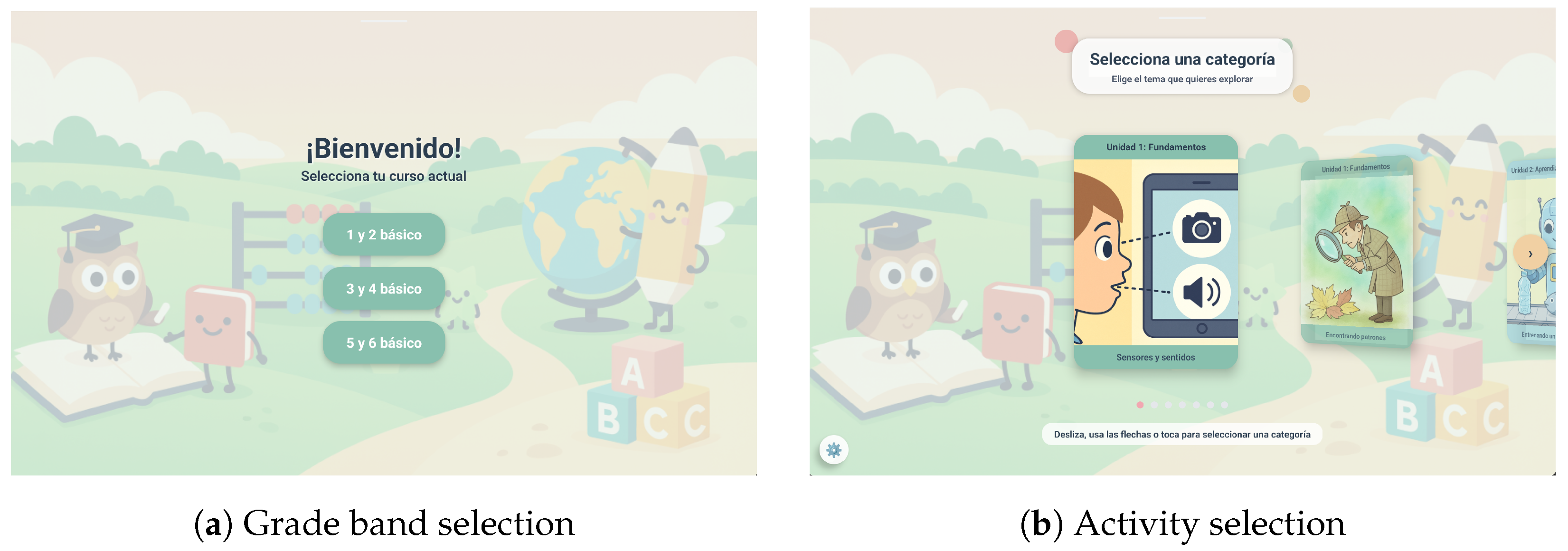
Based on these principles, 24 activities within the application were developed, organized into three units aligned with the core axes of AI literacy (see
Table 2). Within the progression structured by the UNESCO domains and Big Ideas described above, the application filters the available activities by grade band (1st–2nd, 3rd–4th, and 5th–6th), presenting each group with a distinct subset selected according to two criteria: cognitive difficulty and alignment with grade-specific learning objectives from the national curriculum. For example, only the 5th–6th grade band works with tabular data classification, as it requires a higher level of abstract reasoning about conditional variables. This design is intended to support a single teacher in orchestrating simultaneous, differentiated work within the same classroom session (see
Figure 1).
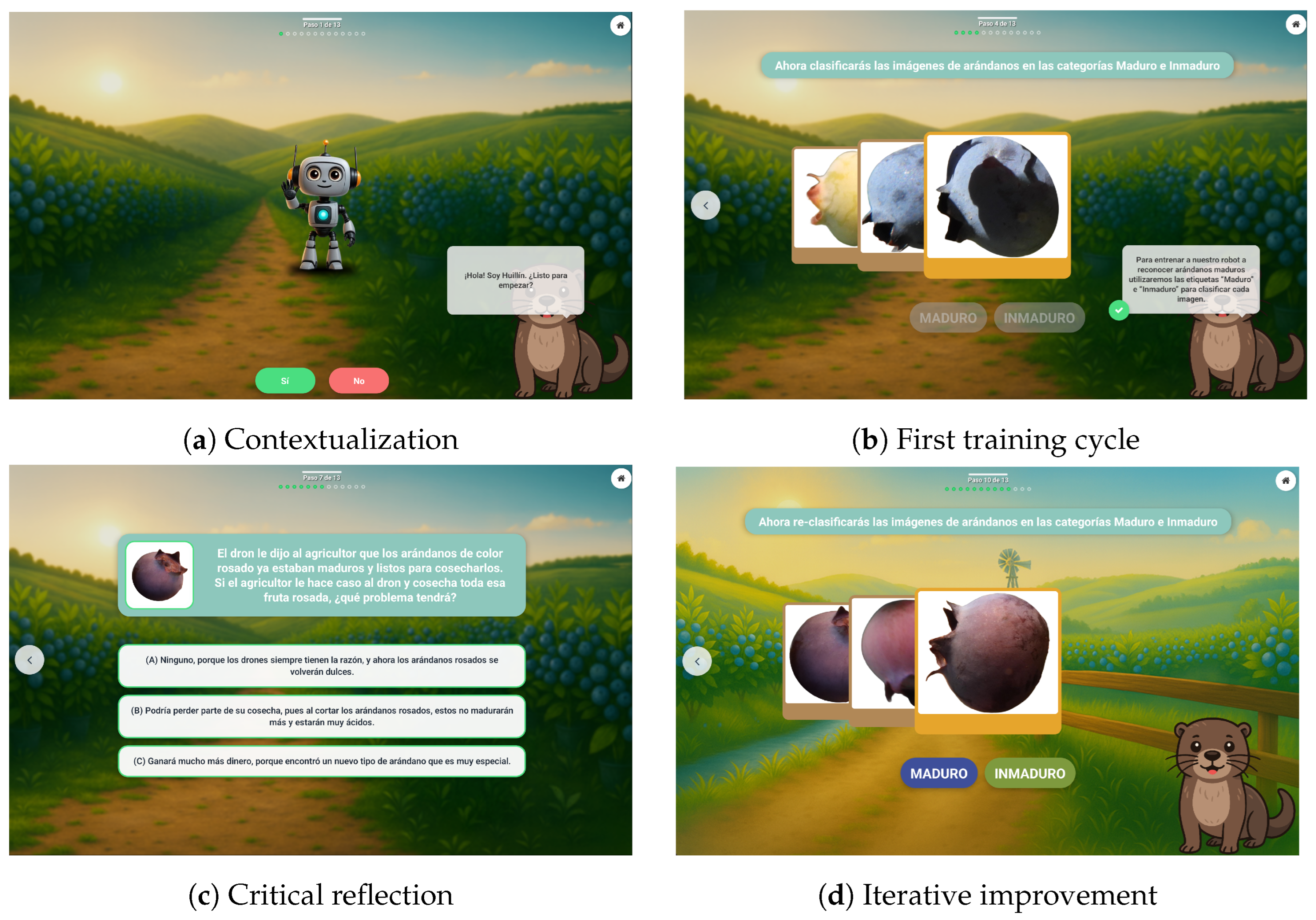
Each activity follows a structured, step-by-step sequence guided by an in-app avatar that provides narrated instructions and contextualizes the task within a real-world scenario. To illustrate, the “Blueberry Classification” activity (Social Impact unit, approximately 15–20 min) proceeds through four phases (
Figure 2): (1) “Contextualization”, where the avatar introduces the problem of automated harvest selection and a short video shows a real agricultural use case; (2) “First training cycle”, where students label a small set of images as “ripe” or “unripe,” train the on-device model, and observe its classification on new test images; (3) “Critical reflection”, where a quiz prompts students to reason about the consequences of a misclassification (e.g., harvesting unripe fruit); and (4) “Iterative improvement”, where students expand the training set with additional images, retrain the model, and compare its accuracy against the first cycle. This iterative train–test–reflect structure is common across the activities and allows students to experience the full machine learning workflow within a single session.
The three units operationalize the design pillars in a complementary manner. The sequential progression from AI Fundamentals through Understanding AI to Ethics and Social Impact embodies the first pillar, guiding students from sensory perception to model training and ultimately to critical evaluation. The second pillar is reflected in the selection of activities whose topics preserve disciplinary learning objectives: for example, leaf pattern recognition reinforces natural sciences content, while traffic sign datasets connect to civic education. The third pillar is realized through activities grounded in the students’ local environment, such as classifying native flora and fauna or sorting blueberries, a crop central to the regional economy.
3.2. Research Context
The study is situated in the region of Los Lagos, Chile, a region that concentrates the second-largest number of rural schools in the country. This context is characterized by a high prevalence of primary school education (75%) and most of them in multigrade settings (63%), where a single teacher must work with up to six grade levels in the same classroom [
14]. In most of these schools, a single teacher assumes multiple roles, including administrative, community, and pedagogical; a multifunctional workload that increases with the geography and isolation of each school. Given the distances and connectivity issues, some teachers sleep and live at their schools, assuming logistical tasks such as collecting students from their homes and transporting them to school daily [
5,
51].
Participants were recruited through the Provincial Departments of Education of the Los Lagos Region for a workshop on AI literacy. Upon arrival, written informed consent was obtained from all volunteers in accordance with the Declaration of Helsinki. This study received formal approval from the Ethics and Bioethics Committee of the Universidad Austral de Chile on 21 June 2024. To maintain confidentiality, the second author anonymized all personal data, identifying each participant solely through a numerical code.
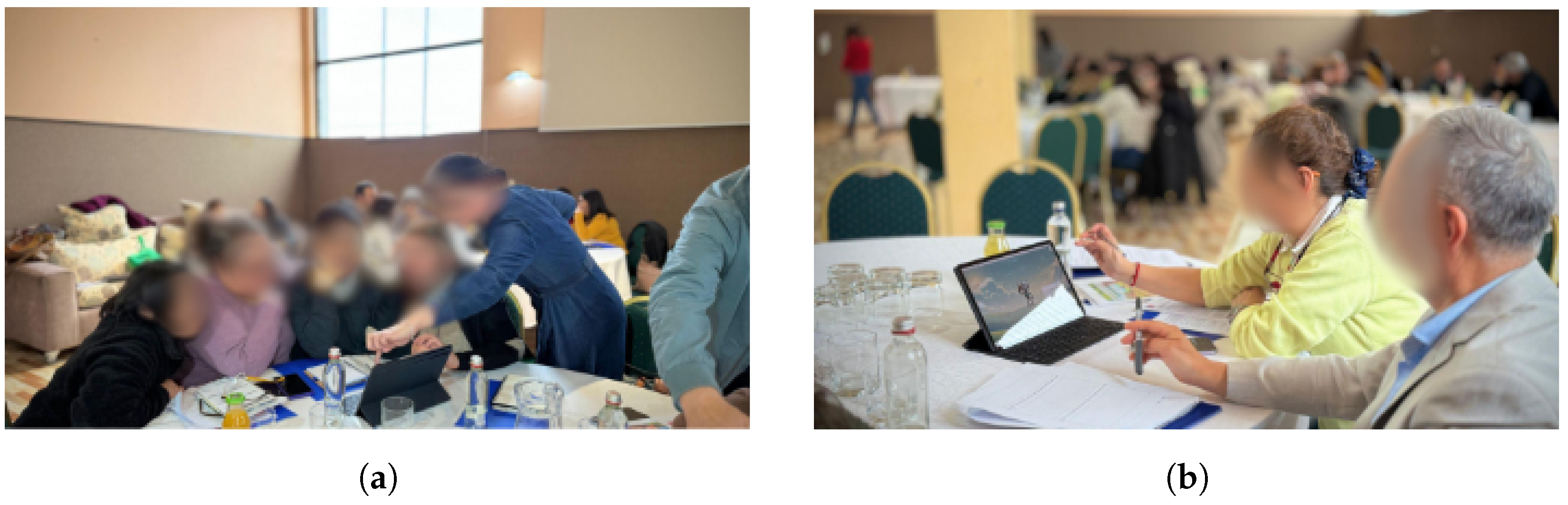
The workshop was conducted over two sessions with different groups of teachers during August and September 2025 (see
Figure 3). These sessions took place in the provinces of Chiloé and Llanquihue, attracting participants from across these and neighboring provinces. The first session included 40 participants, while the second involved 56, both following a participatory assessment format for educational materials [
52]. Each workshop lasted four hours and was structured in three main blocks. The first block consisted of a talk introducing the basic principles of artificial intelligence, demystifying its working mechanisms, and illustrating its everyday use. The second block focused on a practical experience using a model lesson. In this phase, teachers assumed the role of students, working in teams organized by three distinct educational levels. They interacted with the AI application using one tablet for every four teachers, completing activities aligned with the national curriculum. Importantly, during this practical phase, no specific support measures or technical assistance were provided to teachers. This was a deliberate methodological choice, as the primary objective was to evaluate whether the application’s baseline design is inherently intuitive and easy to use, without relying on external help. The third block involved a collaborative pedagogical reflection on the potential and limitations of the proposed application within a rural context.
3.3. Participants
The study used a non-probability convenience sample. An invitation to participate voluntarily was sent to teachers from multiple rural schools in the Region of Los Lagos. The final sample consisted of 96 rural teachers, with a detailed demographic breakdown provided in
Table 3. The teachers had diverse backgrounds, reflected in their wide age range and varying years of experience in the classroom.
The sociodemographic profile of the sample is summarized in
Table 3. The current teaching modalities reflect the diversity of the rural context: while 53.1% of the teachers instruct a single grade at the time of the study, 40.6% work in multigrade scenarios with two or more grades simultaneously. In the Los Lagos region, single-grade and multigrade schools coexist within the same rural communities, and teachers frequently transition between both modalities across their careers [
5,
51]. The sample therefore captures the range of rural teaching profiles that the application is designed to serve. Regarding technology access, 49% of participants reported insufficient or poorly maintained resources and 25% reported a total lack of them. Self-perceived digital competence, however, was high (75% in the upper ranges), with frequent technology use (46.9% daily and 31.3% weekly). Regarding AI, 86.5% of participants had not taken formal AI training in the last two years, yet 64.6% reported using AI tools in their work, primarily generative ones.
The sample of 96 teachers is notable within the rural context, given the vast geographic distances separating these schools and the logistical challenge of assembling this many teachers. Its composition captures the variations in infrastructure and the gap between training and teaching practice reported in similar studies [
5].
3.4. Instruments
This section describes the unified instrument used to address both research questions and characterize the sample, structured into five parts (see
Table 4).
The 10-item SUS [
41] provides a quantitative assessment of the application’s overall usability, validating whether its offline architecture eliminated technical friction and thus ruled out usability as a confounding factor in teachers’ pedagogical perceptions. Subsequently, qualitative items adapted from Jiménez et al. [
52] evaluate the application’s fit for the rural context by probing its capacity to manage classroom heterogeneity (e.g., “Does the application respond to the heterogeneity present in your classroom? Why?”) and pedagogical utility by examining its efficacy in fostering student agency (e.g., “In what way does the app promote active learning?”). Together, Parts 2–4 address RQ1. Finally, Part 5 addresses RQ2 through two open-ended questions that elicit teachers’ perceptions of the challenges and opportunities of integrating AI literacy in rural settings (e.g., “What are the main challenges that the use of this application poses for rural multigrade education?”).
3.5. Data Analysis
Data processing sequentially addressed the study objectives following a two-stage logic. Initially, a descriptive statistical analysis characterized the participants using data from Part 1. This step calculated frequencies, standard deviations, and percentages to ground the findings in the rural context. With this baseline established, the analysis focused on RQ1. It integrated data from Parts 2–4 to evaluate technical gap mitigation, contextual relevance, and appropriateness.
The quantitative component relied on SUS [
41] scores from Part 2. We calculated these scores following the standard protocol. This involved summing the contributions of even and odd items and multiplying by 2.5. The calculation yielded a usability index ranging from 0 to 100. Data treatment followed the guidelines of Lewis and Sauro [
53], questionnaires with more than three omissions underwent casewise deletion, while minor omissions received neutral-value imputation. To complement this, a qualitative thematic approach was used to examine the open-ended responses in Parts 3 and 4, based on the framework by Braun and Clarke [
54]. Both the quantitative processing and the qualitative thematic analysis were conducted using Microsoft Excel, which facilitated the SUS calculations and the systematic organization of the qualitative data.
The qualitative phase was conducted through an inductive thematic analysis to generate emerging categories. The process began with the open coding of each discrete response, performed independently by two members of the research team to ensure analytical rigor. Following the approach described by Guest et al. [
55], the data were synthesized using in vivo coding, maintaining a close adherence to the participants’ original language. To ensure inter-coder consistency and the reliability of the findings, the researchers held iterative meetings to compare results and refine a shared Excel-based codebook containing operational definitions. This consensus-based approach served as the reliability strategy for the qualitative analysis. For instance, when addressing classroom heterogeneity, a teacher noted: “Yes, because it is based on a common core and gradually grows in difficulty” (Participant No. 2); this was systematically coded as “positive valuation of progressive learning” after team consensus.
Finally, axial coding identified similarities and divergences among the emerging codes. This procedure grouped codes with conceptual affinities into higher-order categories. For example, terms such as “technological equipment,” “technological infrastructure,” and “sustainable technology” were consolidated. They formed the broader category “Technical Needs.” This grouping facilitated a comprehensive interpretation of the challenges reported by the teachers. To address RQ2, we applied the same inductive qualitative analysis procedure (open coding, in vivo synthesis, and axial categorization) to the open-ended responses collected in Part 5 of the instrument.
4. Results
This section presents the findings of the pilot study, organized according to the two primary research questions guiding this investigation.
4.1. RQ1: Contextual Relevance and Pedagogical Utility of the Offline Application
To address the first research question (RQ1), the analysis is divided into two sequential parts. First, we report the usability results of the offline application using the SUS. Then, we present the qualitative findings regarding the application’s pedagogical relevance and utility within the rural context.
4.2. Usability and Technical Feasibility
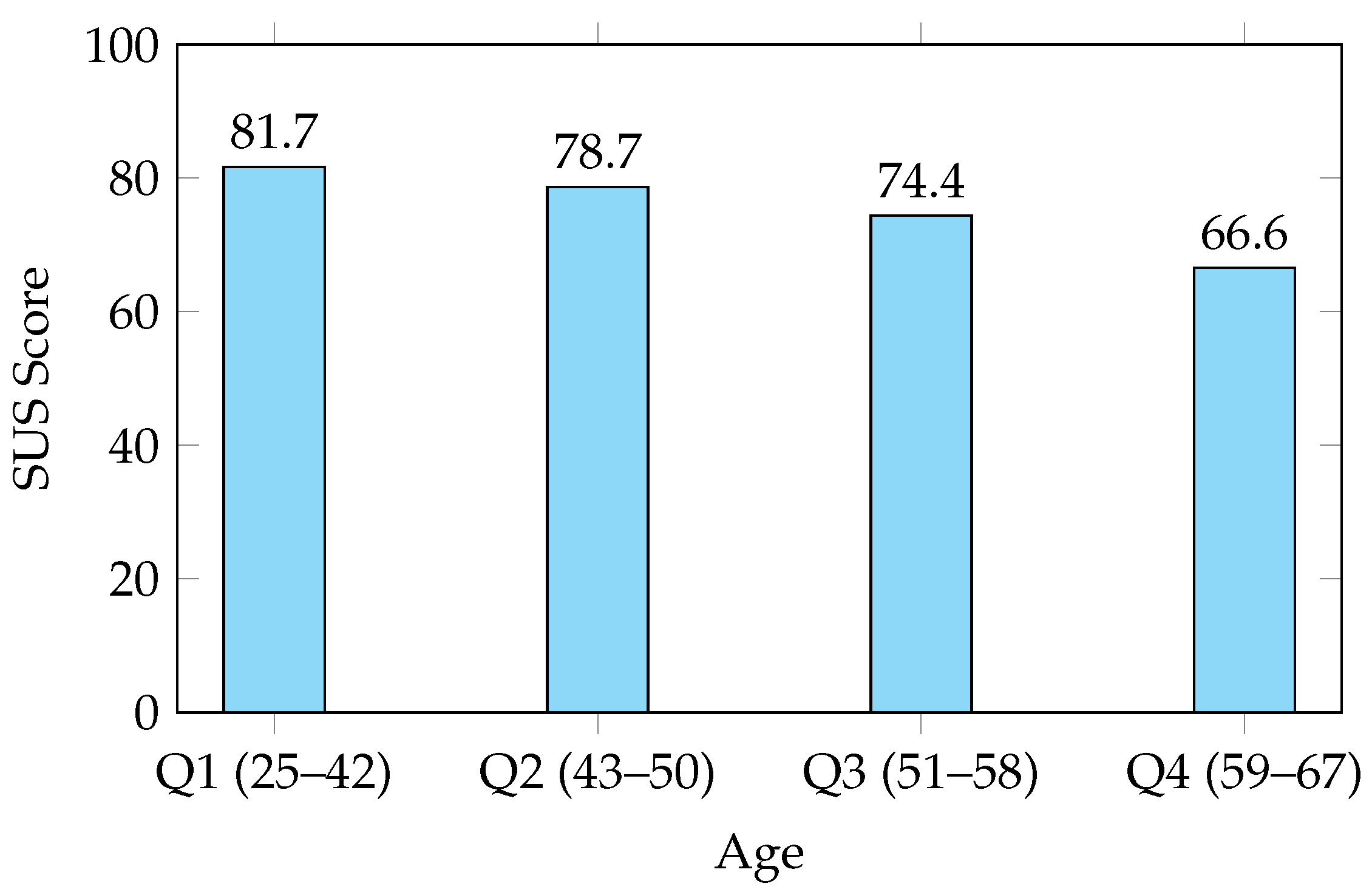
From the sample of 96 participants, the calculation of the SUS scale yielded an overall average score of 76.1 (SD = 16.3, 95% CI [72.8, 79.4]).
When contrasting this result with reference ranges from the literature [
41,
53], the tool falls within the “acceptability” zone, qualitatively classified as “good.” This score places the application above the average SUS benchmark of 68 [
53].
When analyzed by age group through a quartile-based stratification, the results reveal an apparent trend of decreasing SUS scores with age, with the oldest group falling marginally below the average SUS benchmark value (see
Figure 4).
4.3. Contextual Relevance and Pedagogical Utility
In this section, we evaluate the responses of the teachers across two dimensions and seven descriptors, categorizing the frequency of each response type. The consolidated results are presented in
Table 5. Percentages reported in the text are calculated over valid respondents (total minus NR per item) and are accompanied by the corresponding valid
n.
A detailed analysis of each descriptor reveals qualitative insights that can be grouped into two core dimensions: contextual relevance and pedagogical utility.
Within the dimension of relevance, 92.0% of valid respondents ( of 88) confirmed that the application addresses classroom heterogeneity. Teachers attributed this to the progressive difficulty structure built around a common thematic trunk, which allows students to advance at their own pace across grade levels. Similarly, 91.6% ( of 83) considered that the application proposes challenges pertinent to student diversity, noting cognitive and curricular alignment as the primary reason. Regarding AI literacy support, 95.2% ( of 83) reported that the application supports the teaching of AI literacy, highlighting its accessible offline experience and its capacity to prepare students for future technological challenges. Finally, 94.8% ( of 77) confirmed that the application promotes the circulation of knowledge, with teachers noting that the activities create structured spaces for teamwork and multilevel exchange. A minority of respondents identified limitations, including the need for adjustable text sizes and more cognitively demanding tasks for higher grades.
Within the dimension of pedagogical utility, 95.6% of valid respondents ( of 68) agreed that the application promotes understanding of AI concepts. Teachers cited the intuitive interface, clear step-by-step instructions, and the “learning by doing” approach as the primary facilitators of conceptual understanding. An active role in learning was confirmed by 95.9% of valid respondents ( of 74), who believed that students would engage in experimentation and reflection, particularly during the AI training phase, fostering autonomy and motivation. Finally, 93.1% ( of 72) reported that the application favors curricular alignment. The majority identified it as a legitimate learning activity integrating both 21st-century skills and specific learning objectives (LOs), while a smaller group indicated only partial alignment, suggesting expansion to additional subjects and transversal learning objectives (TLOs).
A detailed qualitative analysis addressing RQ1 is provided in
Appendix A.
4.4. RQ2: Challenges and Opportunities for Integrating AI Literacy in Rural Multigrade Education
The challenges identified by teachers are summarized in
Table 6. Technical needs dominated, accounting for 68.0% of valid coded responses (
of 103). Within this dimension, hardware scarcity was the most frequently cited challenge (52.4%,
of 103), with teachers reporting limited access to computers and tablets, often in poor condition or insufficient for the number of students. Connectivity and infrastructure gaps were the second-most-cited technical concern (14.6%,
of 103), with internet access described as null, irregular, or unstable, particularly in insular contexts. Participation needs accounted for 20.4% of valid coded responses (
of 103). Teacher training was the dominant concern within this dimension (19.4%,
of 103), with teachers identifying the need for technological appropriation across three dimensions: knowledge of AI systems, pedagogical intentionality in multigrade planning, and ethical responsibility. Pedagogical needs were less frequent (11.7%,
of 103), with situated AI literacy and curricular integration each receiving equal attention (5.8%,
of 103). Of the 96 participants, 14.6% (
) did not respond to this section.
The opportunities identified by teachers are summarized in
Table 7. Pedagogical needs dominated, accounting for 78.3% of valid coded responses (
of 92). Teaching support for classroom heterogeneity received the highest frequency within this dimension (31.5%,
of 92), followed by digital divide reduction and preparation for future technological demands (22.8%,
of 92), and holistic student development fostering collaboration and creativity (18.5%,
of 92). Student agency through interactive dynamics was less frequently cited (5.4%,
of 92). Usability emerged as a distinct opportunity (20.7%,
of 92), with teachers noting a contextually appropriate and motivating interface design. Technical opportunity was nearly absent (1.1%,
of 92). Of the 96 participants, 20.8% (
) did not respond to this section.
A detailed qualitative analysis addressing RQ2 is provided in
Appendix B.
5. Discussion
5.1. RQ1: Contextual Relevance and Pedagogical Utility of the Offline Application
The SUS score of 76.1 (SD = 16.3), classified as “good” and above the average benchmark of 68 [
53], confirms that the application provides a usable foundation that supports assessment of its possible pedagogical impact. However, when analyzed by age group, SUS scores showed an apparent trend of decline across increasing age quartiles, with the oldest group (ages 59–67) scoring marginally below the average benchmark. While the qualitative data did not specify the underlying factors for this variance, this pattern is consistent with potential generational differences in technological familiarity, though further analysis is required to confirm it. Given that rural teaching populations tend to be older than their urban counterparts, further studies are required to better understand this disparity. Such insights will inform whether future interventions should focus on tailoring the application’s interface to the specific usability needs of older educators, or rather on providing them with targeted pedagogical and technical support during implementation. Additionally, in the qualitative analysis, teachers identified several areas for design refinement. They noted that the interface could better utilize screen space, incorporate larger fonts, and enhance overall accessibility; concerns primarily raised based on their expectations of student needs. Teachers also suggested the need for more cognitively demanding activities for older students, perceiving that current difficulty levels might not sufficiently challenge higher grades.
The offline architecture proved central to the application’s fit for the rural context. The ability to operate without internet connectivity not only addresses the structural barriers documented in the literature [
3,
5,
51] but was also perceived by teachers as a resource that could support managing multiple grades simultaneously, directly addressing the double divide of insufficient infrastructure and absent pedagogical strategies that characterize rural AI education [
2]. This design decouples pedagogical activity from connectivity, a precondition for any tool intended for contexts where internet access is absent, irregular, or unstable [
19].
Within the dimension of contextual relevance, the application’s ability to address classroom heterogeneity through a common thematic trunk with differentiated difficulty levels received consistent validation across all four relevance descriptors. Teachers believed the capacity to foster teamwork and knowledge circulation among mixed-age groups to be particularly significant in the multigrade context, responding directly to the core need in rural education for tools designed around its particular realities [
17,
18].
Regarding pedagogical utility, the “learning by doing” methodology embedded in the application makes abstract AI concepts tangible through direct experimentation. The iterative train–test–reflect structure positions the tool as a scaffold for autonomous learning, consistent with the active learning principles of the AI4K12 framework [
42], and teachers perceived it as having the potential to shift classroom dynamics toward higher student engagement. Strong curricular alignment confirms that this approach integrates within existing content rather than displacing it, addressing the persistent concern that AI literacy competes with the standard curriculum [
24,
48]. This active learning approach builds on paradigms present in tools such as Google Teachable Machine; however, the proposed application advances beyond those platforms in two key respects: it operates without internet connectivity, addressing the infrastructure conditions documented by [
5,
28], and it integrates AI literacy within the existing curriculum rather than treating it as an isolated subject, directly responding to the time and preparation constraints that rural teachers face [
7,
8]. Teachers who indicated only partial integration identified the need to expand the application’s scope to additional subjects and transversal learning objectives, reflecting the broader demand in rural education for resources specifically designed to span multiple curricular areas [
17,
18].
The evidence for RQ1 confirms that the application satisfies the contextual relevance and pedagogical utility requirements of rural teachers, with usability, offline architecture, and the train–test–reflect methodology as the primary contributors.
These assessments, however, reflect teacher-projected potential; the distinction between perceived pedagogical fit and demonstrated learning outcomes remains to be addressed in future student-facing evaluations.
5.2. RQ2: Challenges and Opportunities for Integrating AI Literacy
The results of this study suggest that AI literacy in rural settings reveals a critical tension between material limitations and the horizon of pedagogical possibilities. This section discusses how the technical proposal of an offline application addresses the double divide identified in the literature that characterizes rural schools.
Unlike urban environments, where recent literature indicates that teacher concerns have transitioned toward ethical dilemmas and methodological refinements [
22,
26], our findings indicate that in rural contexts similar to those examined here, the discussion remains anchored in the struggle for basic access. Teachers reported challenges predominantly marked by a technical dimension, characterized by hardware scarcity and structural deficiencies. This pattern is consistent with documented barriers in rural educational systems globally [
2,
11], where technical precariousness acts as a primary exclusionary filter. This finding provides evidence suggesting that the digital divide in these contexts must be addressed, first and foremost, as a material inequity rather than a lack of teacher training.
Although previous studies have underscored that the offline nature of technological tools is a key factor in reducing the digital divide [
5,
28], the findings of this research suggest that the challenge transcends mere connectivity. While the autonomous nature of the application, based on the edge computing paradigm and lightweight on-device algorithms, is positively valued, its impact remains conditioned by an underlying material precariousness that software alone cannot resolve. Thus, mitigating the divide should not be conditioned solely on the availability of offline resources but should also consider the development of multiplatform solutions that respond comprehensively to both hardware scarcity and the complex didactic heterogeneity of rural schools [
4].
These findings also speak to the broader question of hardware–software synergy in rural AI literacy. The offline architecture addresses connectivity barriers, yet its reach remains conditioned by device availability. Evidence that purpose-built software is both usable and pedagogically suited to the rural context may strengthen the case for hardware-oriented interventions; government tablet programs and shared mobile device labs represent pathways through which offline solutions of this kind could reach schools that currently lack sufficient devices. Software design and hardware policy are, in this regard, complementary rather than independent responses to the double divide.
A particularly revealing finding is the dichotomy in teacher perception regarding the challenges and opportunities of AI. While most participants place the main obstacles within the technical dimension, they project the transformative potential of the application almost exclusively on the pedagogical level. Teachers valued the tool as a strategic resource to address classroom diversity, promoting student agency through curricular integration that fosters holistic development. In this sense, the application’s capacity to offer progressive learning was one of the aspects most highlighted by educators; teachers believed this functionality would allow students to acquire competencies adjusted sequentially to individual rhythms, thus responding to one of the great challenges of rural didactics [
4]. This assessment coincides with research in Latin America where it has been demonstrated that technology, when used as a didactic support and not just as a technical end, acts as a fundamental catalyst for student autonomy [
18].
The results of this study provide evidence that reinforces the thesis that AI has the potential to act as “dynamic scaffolding”, enabling levels of personalization that rural teachers, due to administrative workload and the diversity of grades within a single classroom, can hardly manage manually [
5,
8]. By prioritizing progressive learning and the design of activities adapted to different difficulty levels within the same topic, the proposed solution not only addresses “how to teach AI” but also constitutes a pedagogical management resource that teachers perceive as potentially reducing pressure on multigrade instruction [
7]. This suggests that, in contexts sharing the structural characteristics of the schools studied here, AI literacy is more likely to be sustainable when it is intrinsically linked to the operational needs of the rural school.
6. Limitations
Several limitations should be considered when interpreting these results. The sample consisted of teachers who voluntarily accepted the invitation to participate in the workshops, suggesting a pre-existing interest in technology and AI or, more broadly, a willingness to adopt educational innovations and novel pedagogical strategies. This self-selection introduces a potential bias, as the perceptions reported here may be more favorable than those of teachers who are reluctant or opposed to integrating technology in the classroom. Participants in voluntary, technology-oriented workshops likely represent an early-adopter segment of the rural teaching population; consequently, the perspectives of teachers most marginalized by the digital divide remain unknown. Consequently, the findings may overestimate the receptivity of the broader rural teaching population toward the application and AI literacy initiatives in general, reflecting the views of a technology-interested subset rather than universal acceptance among rural educators.
A related constraint concerns the geographic scope of the sample. Although 96 teachers is a notable number for the rural context and compares favorably with similar studies in the literature, recruitment was concentrated in a single region of Chile (Los Lagos) to make participation logistically feasible. While the sample captures a wide range of school types, infrastructure conditions, and teaching situations, other geographic zones in Chile and beyond may present realities not represented here. These findings should therefore not be generalized beyond rural contexts sharing similar characteristics.
The applicability of an offline mobile application as a vehicle for AI literacy also depends on the availability of tablet devices. In the Chilean context, government programs have provided tablets to a portion of rural schools, making this type of intervention feasible in those settings. However, this reality applies only to a fraction of rural schools in Chile, and at a global scale, many rural settings lack even basic technological devices. This contextual dependence reinforces one of the central conclusions of this article: that solutions for AI literacy must be holistic, addressing as many contexts as possible to confront the digital divide rather than relying on a single technological format.
The study focused exclusively on teacher perceptions and their projections regarding how the application would function if used by students. This is the intended procedure before deploying educational technology with children, as it allows the tool to be evaluated and adapted based on professional judgment prior to classroom use. However, teacher perceptions do not substitute for direct evidence of student learning, engagement, or experience with the application, and agreement rates such as those reported for AI concept promotion (95.6%) and classroom heterogeneity responsiveness (92.0%) should be read as expressions of pedagogical judgment about potential impact rather than measured outcomes. Establishing whether this potential materializes in student learning is the natural next step for this line of research. Future work should evaluate the application with student cohorts to determine whether the pedagogical potential identified by teachers translates into measurable outcomes from the learners’ perspective. The workshop also used a ratio of one tablet per group of four teachers, which may have limited the opportunity for some participants to fully experience the application individually. This constraint was due to the limited number of devices available and may have influenced the depth of interaction that certain teachers had with the tool, potentially affecting their assessments.
Lastly, several open-ended items exhibited high non-response rates, most critically 29.2% for the descriptor “Promotes understanding of AI concepts” (Part 4) and 20.8% for the opportunities question (Part 5), which reduce the interpretive confidence of findings associated with those items. While the exact reasons for non-response cannot be determined, plausible explanations include that some teachers did not fully understand the questions, chose not to respond, or disengaged because their schools lack the technological prerequisites discussed in the application, making the questions feel less relevant to their immediate reality.
7. Conclusions
This study evaluated a purpose-built offline mobile application designed to address the double divide constraining AI literacy in rural education: the reliance of existing tools on unavailable connectivity and their mismatch with the heterogeneous realities of rural classrooms. The evaluation was conducted through participatory workshops with 96 rural teachers in Los Lagos, Chile.
The application achieved acceptable usability (SUS = 76.1, SD = 16.3), and teachers reported that its offline architecture and progressive difficulty structure are suitable for the rural context, describing it as responsive to classroom heterogeneity and promoting understanding of AI concepts. These findings, drawn from a sample of rural teachers with predominantly self-reported digital competence (75%), suggest that purpose-built offline applications can overcome some of the connectivity and pedagogical barriers that currently exclude rural schools from AI literacy initiatives. However, the evaluation also revealed a substantial digital gap: teachers identified hardware scarcity, infrastructure deficiencies, and the absence of specialized training as primary challenges. A tablet-based application may serve a subset of rural schools, but sustainable AI literacy requires a holistic strategy combining multiplatform alternatives that reach as many heterogeneous contexts as possible, policies that incentivize the acquisition of technological devices, and sustained investment from governments to reduce the digital divide.
Future work will evaluate the application directly with student cohorts to assess its learning utility and determine whether the pedagogical potential identified by teachers translates into measurable gains in children’s AI literacy.
Author Contributions
Conceptualization, C.A.A., A.C. and E.S.; methodology, C.A.A., A.C., E.S. and J.M.P.; validation, C.A.A. and A.C.; formal analysis, A.C., J.M.P. and C.A.A.; investigation, A.C., C.A.A. and J.M.P.; resources, C.A., A.C. and J.M.P.; data curation, C.A.A. and A.C.; writing—original draft preparation, A.C. and C.A.A.; writing—review and editing, C.A., A.C. and E.S.; project administration, E.S. and A.C.; funding acquisition, A.C. and C.A. All authors have read and agreed to the published version of the manuscript.
Funding
This work was supported by the National Research and Development Agency (ANID) through grants FONDEF ID24I10077 and FONDEF ID25I10106.
Institutional Review Board Statement
The study was conducted in accordance with the Declaration of Helsinki and approved by the Ethics and Bioethics Committee of Universidad Austral de Chile (approval date: 21 June 2024; no protocol number is assigned by this committee).
Informed Consent Statement
Informed consent was obtained from all subjects involved in the study.
Data Availability Statement
The data that support the findings of this study are available from the corresponding author upon reasonable request. Due to ethical concerns surrounding participant privacy and the specific terms of the informed consent, the data cannot be made publicly available.
Acknowledgments
The authors would like to acknowledge the technical team involved in the construction of the application: Alejandra Aguilera, Alan Silva, Dante Quezada, Karina Barrientos, Felipe Prieto, Cesar Navarrete, Daniel Estrada, and Paulo Contreras.
Conflicts of Interest
The authors declare no conflicts of interest.
Abbreviations
The following abbreviations are used in this manuscript:
| AI | Artificial Intelligence |
| GPU | Graphics Processing Unit |
| LLM | Large Language Model |
| LO | Learning Objective |
| ML | Machine Learning |
| RQ | Research Question |
| SUS | System Usability Scale |
| SVM | Support Vector Machine |
| TPACK | Technological Pedagogical Content Knowledge |
Appendix A. Qualitative Analysis Details (RQ1)
This appendix provides the detailed sub-indices and categories resulting from the qualitative thematic analysis of the teachers’ responses regarding Research Question 1 (RQ1).
Table A1.
Dimension: Relevance—Attention to Heterogeneity. Ways in which it responds to classroom heterogeneity.
Table A1.
Dimension: Relevance—Attention to Heterogeneity. Ways in which it responds to classroom heterogeneity.
| Category/Form of Response | n |
|---|
| Learning in progression: The structuring of content through progressive difficulty is valued. Starting from a common thematic axis or trunk, the tool addresses heterogeneity by allowing students to advance in the development of their skills according to their level. | 32 |
| Contextual and pedagogical relevance: Responds to diversity by aligning directly with the sociocultural context, interests, capacities, and motivations of the students. From a pedagogical approach, it considers activities to be meaningful and coherent with the reality of the learners. | 19 |
| Usability: Emphasizes that the application is intuitive, friendly, and highly adaptable to real classroom conditions, which facilitates its practical implementation and stimulates a dynamic, autonomous, and active role. | 19 |
| General Positive Assessment (Without Justification) | 5 |
| Accessibility challenges: Notes that it is largely fulfilled, but specific adaptations are required to guarantee access. This includes adjustments for students with low vision and supports for those in higher grades who have not yet consolidated reading (non-readers). | 4 |
| Cognitive demand challenges: States that it is necessary to increase the level of the challenge proposed to students, especially in higher grades. | 3 |
| Curricular Integration: Highlights the tool’s capacity to articulate and connect diverse knowledge. From a curricular perspective, it responds to classroom diversity by promoting transversality, integrating objectives and learning from different areas of the national curriculum. | 2 |
| Equipment challenges: Notes that yes, but it is required to address the lack of resources for its implementation. | 2 |
| Mitigation of gender biases and promotion of equity: Identifies that the application actively contributes to equity and inclusion within the classroom. It offers representations, dynamics, or content that help deconstruct and reduce traditional gender stereotypes or biases, fostering equal participation in STEM areas. | 1 |
| Total Arguments | 87 |
Table A2.
Dimension: Relevance—Reasons why the challenges are pertinent to the diversity of the students.
Table A2.
Dimension: Relevance—Reasons why the challenges are pertinent to the diversity of the students.
| Category/Reason | n |
|---|
| Cognitive and curricular alignment: Pertinent to their age, level, interests, and curriculum, promoting assertive and clear ideas, with varied resources and in different formats. Follows a progression from lower to higher complexity. | 49 |
| Promotion of active participation and collaborative work: Variety of activities promotes an active and participatory role. Facilitates spaces where students can get involved, observe, dialogue, comment, and put their skills into practice jointly. | 9 |
| General Positive Assessment:
Without Justification | 7 |
| Inclusion and challenges adaptable to diversity: Highlights the inclusive nature of the tool by not discriminating between different learning paces. Values that it proposes challenges pertinent to classroom diversity, allowing everyone to participate while offering, at the same time, challenges that stimulate more advanced students. | 4 |
| Pedagogical and didactic support: More playful and entertaining classes with pedagogical and didactic support. | 3 |
| Equipment challenges: Notes that yes, but emphasizes the need to ensure the availability of technological equipment for the development of activities. | 2 |
| Design challenges: Notes that it requires the optimization of multimedia elements (audio and images). | 1 |
| Cognitive demand challenges: Notes that yes, but it requires the incorporation of challenges with a higher level of difficulty. | 1 |
| Total Arguments | 76 |
Table A3.
Dimension: Pedagogical Utility—Support for teaching management. Reasons why it supports teacher management for AI teaching.
Table A3.
Dimension: Pedagogical Utility—Support for teaching management. Reasons why it supports teacher management for AI teaching.
| Category/Reason | n |
|---|
| Accessible and offline technological experience: Offers a friendly, motivating, practical, and interactive environment to understand technology, highlighting its operation without the need for connectivity, which benefits both students and teachers. | 33 |
| Preparation for the challenges of the future: Provides opportunities for students to develop 21st-century skills and acquire the necessary tools to face the challenges posed by Artificial Intelligence. | 17 |
| Facilitation of Multigrade Didactics: Favors the differentiation of learning, supports the selection of pertinent content for each level, and facilitates simultaneous work with several grades. | 16 |
| Optimization of teaching time and effort: Highlights the direct support to the teacher by decreasing the time dedicated to planning, creation of educational material, and control of digital content. | 7 |
| Curricular integration: Acts as a direct support to curricular work, promoting the integration of different subjects, the development of values, and the acquisition of other learning. | 7 |
| General Positive Assessment (Without Justification) | 3 |
| Equipment challenges: Notes that yes, but the need to have necessary resources. | 2 |
| Teacher preparation challenges: Notes that yes, but the need for prior teacher training to ensure effective use of the application. | 2 |
| Cognitive demand challenges: Notes that yes, but the need for more complex activities and a greater expansion and planning proposal. | 2 |
| Total Arguments | 89 |
Table A4.
Dimension: Pedagogical Utility—Circulation of knowledge. Ways in which it promotes the circulation of knowledge.
Table A4.
Dimension: Pedagogical Utility—Circulation of knowledge. Ways in which it promotes the circulation of knowledge.
| Category/Form of Response | n |
|---|
| Teamwork and multilevel exchange: The designed activities foster teamwork and the active participation of students of various levels. The circulation of knowledge occurs by providing structured spaces for discussion, debate, and the crossing of ideas, maintaining challenges consistent with the competencies of each participant. | 48 |
| Guided discovery and reflection: Promotes the construction of knowledge through an interactive approach based on discovery. Facilitates that students deepen and expand their original ideas, generating spaces for interaction and active reflection, particularly during analysis and classification exercises. | 15 |
| General Positive Assessment: Without Justification | 7 |
| Didactic flexibility and interactivity: The circulation of knowledge is facilitated by the eye-catching and interactive design of the tool, which allows for dynamic learning by fluidly alternating between individual and group work modalities, adapting to the needs of the moment. | 5 |
| Total Arguments | 75 |
Table A5.
Dimension: Pedagogical Utility—Understanding of the key concepts addressed. Reasons why it promotes the understanding of key concepts.
Table A5.
Dimension: Pedagogical Utility—Understanding of the key concepts addressed. Reasons why it promotes the understanding of key concepts.
| Category/Reason | n |
|---|
| Pedagogical and instructional design: The material is intuitive. It uses appropriate language and delivers clear step-by-step information and instructions, maintaining a progression and difficulty adjusted to each learning level, which favors the understanding of the concepts addressed. | 25 |
| General Positive Assessment: Without Justification | 14 |
| Understanding through practice: The understanding of concepts is facilitated because the approach allows understanding how AI works in a practical way, through “learning by doing.” | 12 |
| Teacher preparation challenges: It is considered that yes, but needs for teacher training are identified to master the tool and make good use of the resources. | 5 |
| Curricular relevance: The proposal considers elements specific to the context and the educational system, linking directly with the curriculum, which favors the understanding of the addressed concepts. | 4 |
| Cognitive demand challenges: It is identified that the content addressed should be deeper and offer complementary material to enrich the experience. | 3 |
| Teaching flexibility: The material is positive because it gives the teacher the option and freedom to complement the contents. | 2 |
| Total Arguments | 65 |
Table A6.
Dimension: Pedagogical Utility—Active role in learning. Reasons why it promotes an active role in learning.
Table A6.
Dimension: Pedagogical Utility—Active role in learning. Reasons why it promotes an active role in learning.
| Category/Reason | n |
|---|
| Active learning through experimentation and reflection: Students assume an active role by solving challenges based on their previous knowledge and interests. The application promotes reflection and discussion, fostering practical learning where students experiment and learn through trial and error when training the AI. | 37 |
| Autonomy, motivation, and student participation: The tool promotes autonomous learning and a change of roles in the classroom, driving participation and student commitment. This is achieved because the application environment is motivating, friendly, and very easy to use. | 24 |
| General Positive Assessment: Without Justification | 4 |
| Proper use of technology: The application fosters an active role by guiding students to learn to use technology in a good way, promoting a positive approach to digital tools. | 2 |
| Integration and complement of learning: The application works as a complement to the student’s learning process, facilitating its fluid integration with other educational dynamics. | 2 |
| Cognitive demand challenges: The need to incorporate complementary activities to complement the use of the application is raised. | 2 |
| Design challenges: It is required to include a greater number of images or enable the option for users to upload their own to make it more dynamic. | 1 |
| Accessibility Challenges: Incorporating more audio and less text. | 1 |
| Total Arguments | 73 |
Table A7.
Dimension: Pedagogical Utility—Curricular integration. Reasons why it favors the integration of learning and curricular alignment.
Table A7.
Dimension: Pedagogical Utility—Curricular integration. Reasons why it favors the integration of learning and curricular alignment.
| Category/Reason | n |
|---|
| Comprehensive curricular alignment and skill development: The application effectively integrates the learning of the national curriculum. It consolidates itself as a true learning activity by requiring students to constantly apply both 21st-century skills and those that are the focus of various Learning Objectives. The contents and challenges are coherently aligned with the current thematic axes and evaluation indicators. | 51 |
| Partial curricular integration and expansion challenges: Integrates it partially. To achieve full curricular integration, the application needs to expand into other subjects and Transversal Learning Objectives (TLOs). Furthermore, it must improve the progression of difficulty and the amount of objectives per level, incorporating greater local contextualization. | 10 |
| General Positive Assessment (Without Justification) | 6 |
| Total Arguments | 67 |
Appendix B. Qualitative Analysis Details (RQ2)
This appendix provides the detailed qualitative data resulting from the thematic analysis of teachers’ responses regarding Research Question 2 (RQ2). The findings are divided into Challenges and Opportunities, further categorized by their respective dimensions.
Appendix B.1. Challenges and Needs Identified by Teachers
Table A8.
Dimension: Technical Needs (Challenges). Needs related to equipment, infrastructure, and sustainability.
Table A8.
Dimension: Technical Needs (Challenges). Needs related to equipment, infrastructure, and sustainability.
| Dimension | Descriptor | Qualitative Summary | n |
|---|
| Technical Needs | Technological equipment | Refers to the scarcity and deficiencies of technological resources available to teachers, highlighting limited access to computers and tablets. Available devices are often in poor condition or insufficient for the number of children, preventing individual work. | 54 |
| Technological infrastructure | Points out the lack of base infrastructure and physical spaces (labs) as a main gap. Critically highlights connectivity problems (null, irregular, or unstable internet), especially in island contexts where bad weather hinders the signal. | 15 |
| Sustainable technology | Captures the concern of a participant to help reduce pollution, reflecting a stance of ecological care and protection toward this technology. | 1 |
Table A9.
Dimension: Participation Needs (Challenges). Needs related to training and institutional support.
Table A9.
Dimension: Participation Needs (Challenges). Needs related to training and institutional support.
| Dimension | Descriptor | Qualitative Summary | n |
|---|
| Participation Needs | Teacher training
and collaboration for AI teaching | Highlights the need for training and collaborative work as fundamental. The main challenge is achieving technological appropriation across three dimensions: knowledge (understanding tools), pedagogical (intentional use in multigrade planning), and ethical (responsible use and data privacy). | 20 |
| Management commitment for implementation | Highlights the need to have the active support and backing of the sustaining educational entity. | 1 |
Table A10.
Dimension: Pedagogical Needs (Challenges). Needs related to literacy and curriculum.
Table A10.
Dimension: Pedagogical Needs (Challenges). Needs related to literacy and curriculum.
| Dimension | Descriptor | Qualitative Summary | n |
|---|
| Pedagogical Needs | Situated AI literacy | Need to bring tools closer to everyone equitably from early ages. Emphasizes that students should not lose contact with their environment, ensuring technology acts as a complement to their territorial reality rather than replacing direct interaction. | 6 |
| Curricular integration | Difficulty in bringing the official program down to the practical reality of the rural classroom and time management. Expresses the need to unify teaching and plan integratedly to facilitate daily pedagogical work in multigrade courses. | 6 |
Table A11.
Unclassified Challenges.
Table A11.
Unclassified Challenges.
| Dimension | Qualitative Summary | n |
|---|
| Unclassified | Participants did not provide a specific answer or provided unclassifiable content. | 14 |
Appendix B.2. Opportunities Identified by Teachers
Table A12.
Dimension: Pedagogical Needs (Opportunities). Potential benefits for teaching and learning.
Table A12.
Dimension: Pedagogical Needs (Opportunities). Potential benefits for teaching and learning.
| Dimension | Descriptor | Qualitative Summary | n |
|---|
| Pedagogical Needs | Teaching support for heterogeneity | Values the tool as a direct facilitator of rural pedagogical work. The provision of contextualized activities aligned with Learning Objectives (LO) allows teachers to plan integratedly and effectively address the diversity of rhythms in heterogeneous classrooms. | 29 |
| Digital divide reduction and future prep. | Benefits of democratizing access to AI in rural schools. Potential to provide literacy in the ethical and practical use of these tools, preparing students for tomorrow’s technological challenges and fostering global integration. | 21 |
| Holistic student development | Potential to promote comprehensive development and learning of different natures alongside technological skills. Fosters collaborative work, creativity, research, and critical awareness of real-world problems. | 17 |
| Active role and student agency | Highlights the paradigm shift where the student assumes control of their process. Interactive content and innovative dynamics (e.g., student teaching the AI) foster empowerment and active construction of learning. | 5 |
Table A13.
Dimension: Technical Needs and Usability (Opportunities).
Table A13.
Dimension: Technical Needs and Usability (Opportunities).
| Dimension | Descriptor | Qualitative Summary | n |
|---|
| Usability | Contextualized and accessible design | Focuses on the user-friendly interface and ease of use. Highlights the innovative, playful, and motivating design specifically adapted to attract students within the reality of the rural context. | 19 |
| Technical Needs | Opportunity to acquire equipment | Highlights the application’s potential as a reason or catalyst to secure technological devices for every child. | 1 |
Table A14.
Unclassified Opportunities.
Table A14.
Unclassified Opportunities.
| Dimension | Qualitative Summary | n |
|---|
| Unclassified | Participants did not provide a specific answer or provided unclassifiable content. | 20 |
References
- UNESCO; Miao, F.; Shiohira, K.; Lao, N. AI Competency Framework for Students; UNESCO: Paris, France, 2024; 80p. [Google Scholar] [CrossRef]
- Yadav, V.; Tripathi, A.; Kumar, S. Leveraging Artificial Intelligence for Rural Education: A Systematic Review of Transforming Learning Opportunities and Bridging the Urban-Rural Divide. J. Adv. Artif. Intell. Eng. Technol. 2025, 1, 11. [Google Scholar] [CrossRef]
- Rundel, C.; Salemink, K. Bridging Digital Inequalities in Rural Schools in Germany: A Geographical Lottery? Educ. Sci. 2021, 11, 181. [Google Scholar] [CrossRef]
- Sajjadi Mohammadabadi, S.M.; Kara, B.C.; Eyupoglu, C.; Uzay, C.; Tosun, M.S.; Karakuş, O. A Survey of Large Language Models: Evolution, Architectures, Adaptation, Benchmarking, Applications, Challenges, and Societal Implications. Electronics 2025, 14, 3580. [Google Scholar] [CrossRef]
- Castro, A.; Díaz, B.; Aguilera, C.; Prat, M.; Chávez-Herting, D. Identifying Rural Elementary Teachers’ Perception Challenges and Opportunities in Integrating Artificial Intelligence in Teaching Practices. Sustainability 2025, 17, 2748. [Google Scholar] [CrossRef]
- UNESCO. Currículos de IA Para la Enseñanza Preescolar, Primaria y Secundaria: Un Mapeo de los Currículos de IA Aprobados por los Gobiernos; UNESCO: Paris, France, 2023. [Google Scholar]
- Mangione, G.R.J.; Pieri, M.; De Santis, F. Revitalizing education in rural and small schools: The role of AI in teachers’ professional development. Ital. J. Educ. Technol. 2024, 32, 21–35. [Google Scholar] [CrossRef]
- Álvarez Álvarez, C.; García-Prieto, F.J. Brecha digital y nuevas formas académicas en la escuela rural española durante el confinamiento. Educar 2021, 57, 397–411. [Google Scholar] [CrossRef]
- Haryanto, E.; Wardani, D.O.K. We still have not prepared yet: Indonesian Rural Teacher Perception in Teaching English Using AI. Proc. Acad. Univ. Jambi 2026, 2, 97–110. [Google Scholar]
- Soekamto, H.; Nikolaeva, I.; Abbood, A.A.A.; Grachev, D.; Kosov, M.; Yumashev, A.; Nikitina, N. Professional development of rural teachers based on digital literacy. Emerg. Sci. J. 2022, 6, 1525–1540. [Google Scholar] [CrossRef]
- Céspedes, M.S.; Vega, S.L.O.; Ardila, O.M.S.; Rodríguez, O.L. Perspectivas Docentes sobre la Inteligencia Artificial en la Educación Básica Secundaria: Análisis Crítico desde la Ruralidad. Cienc. Lat. Rev. CientíFica Multidiscip. 2025, 9, 7743–7762. [Google Scholar]
- Schafft, K.A. Rural Education As Rural Development: Understanding the Rural School–Community Well-Being Linkage in a 21st-Century Policy Context. Peabody J. Educ. 2016, 91, 137–154. [Google Scholar] [CrossRef]
- Seelig, J.L.; McCabe, K.M. Why teachers stay: Shaping a new narrative on rural teacher retention. J. Res. Rural. Educ. 2021, 37, 1–16. [Google Scholar] [CrossRef]
- Centro de Estudios MINEDUC. Evidencias N°61–Análisis de la Educación Rural en Chile; Technical Report 61; Ministerio de Educación de Chile: Santiago, Chile, 2024.
- Global Education Monitoring Report Team. Informe GEM 2023: Tecnología en la Educación: ¿una Herramienta en los Términos de Quién? Global Education Monitoring Report; UNESCO: Paris, France, 2023; 7p. [Google Scholar] [CrossRef]
- Du Plessis, P.; Mestry, R. Teachers for rural schools—A challenge for South Africa. S. Afr. J. Educ. 2019, 39. [Google Scholar] [CrossRef]
- Carrete-Marín, N.; Domingo-Peñafiel, L. Los recursos tecnológicos en las aulas multigrado de la escuela rural: Una revisión sistemática. Rev. Bras. Educ. Campo 2021, 6, e13452. [Google Scholar] [CrossRef]
- Abós Olivares, P. La escuela ubicada en territorios rurales: Una escuela diferente, un reto pedagógico. Aula 2020, 26, 41–52. [Google Scholar] [CrossRef]
- Mwansa, G.; Ngandu, M.R.; Mkwambi, Z. Bridging the digital divide: Exploring the challenges and solutions for digital exclusion in rural South Africa. Discov. Glob. Soc. 2025, 3, 54. [Google Scholar] [CrossRef]
- Miao, F.; Holmes, W. Synthesis Report of International Forum on AI and the Futures of Education, Developing Competencies for the AI Era; UNESCO: Paris, France, 2020. [Google Scholar]
- Zhao, L.; Wu, X.; Luo, H. Developing AI literacy for primary and middle school teachers in China: Based on a structural equation modeling analysis. Sustainability 2022, 14, 14549. [Google Scholar] [CrossRef]
- Celik, I. Towards Intelligent-TPACK: An empirical study on teachers’ professional knowledge to ethically integrate artificial intelligence (AI)-based tools into education. Comput. Hum. Behav. 2023, 136, 107468. [Google Scholar] [CrossRef]
- Younis, B. Effectiveness of a professional development program based on the instructional design framework for AI literacy in developing AI literacy skills among pre-service teachers. J. Digit. Learn. Teach. Educ. 2024, 40, 142–158. [Google Scholar] [CrossRef]
- Daher, R. Integrating AI literacy into teacher education: A critical perspective paper. Discov. Artif. Intell. 2025, 5, 217. [Google Scholar] [CrossRef]
- Lopez, S.; Sarada, V.; Praveen, R.V.S.; Pandey, A.; Khuntia, M.; Haralayya, D.B. Artificial intelligence challenges and role for sustainable education in india: Problems and prospects. Libr. Prog. Int. 2024, 44, 18261–18271. [Google Scholar] [CrossRef]
- López Costa, M. Artificial Intelligence and Data Literacy in Rural Schools’ Teaching Practices: Knowledge, Use, and Challenges. Educ. Sci. 2025, 15, 352. [Google Scholar] [CrossRef]
- Xie, B. Navigating the Challenges of AI Literacy Assessment for Rural Educators in Western China: Towards an Automated Evaluation System. In Proceedings of the 2024 2nd International Conference on Information Education and Artificial Intelligence (ICIEAI ’24); Association for Computing Machinery: New York, NY, USA, 2025; pp. 499–505. [Google Scholar] [CrossRef]
- Rahim, S.; Sahar, G.; Jabeen, G.; Khatoon, S. Harnessing generative AI: Reviewing applications, challenges, and solutions for out-of-school children in developing regions. Sustain. Futur. 2025, 10, 101206. [Google Scholar] [CrossRef]
- Krizhevsky, A.; Sutskever, I.; Hinton, G.E. ImageNet classification with deep convolutional neural networks. In Proceedings of the NIPS’12, 26th International Conference on Neural Information Processing Systems—Volume 1, Lake Tahoe, NV, USA, 3–6 December 2012; pp. 1097–1105. [Google Scholar]
- Zhang, K.; Meng, X.; Yan, X.; Ji, J.; Liu, J.; Xu, H.; Zhang, H.; Liu, D.; Wang, J.; Wang, X.; et al. Revolutionizing Health Care: The Transformative Impact of Large Language Models in Medicine. J. Med. Internet Res. 2025, 27, e59069. [Google Scholar] [CrossRef]
- Elshaer, I.A.; AlNajdi, S.M.; Salem, M.A. Measuring the Impact of Large Language Models on Academic Success and Quality of Life Among Students with Visual Disability: An Assistive Technology Perspective. Bioengineering 2025, 12, 1056. [Google Scholar] [CrossRef]
- DeepSeek-AI; Liu, A.; Feng, B.; Xue, B.; Wang, B.; Wu, B.; Lu, C.; Zhao, C.; Deng, C.; Zhang, C.; et al. DeepSeek-V3 Technical Report. arXiv 2025, arXiv:2412.19437. [Google Scholar] [CrossRef]
- Anthropic. Claude Code, 2026. Available online: https://www.anthropic.com/claude-code (accessed on 8 April 2026).
- OpenAI. ChatGPT, 2026. Available online: https://chatgpt.com (accessed on 8 April 2026).
- Hinton, G.; Vinyals, O.; Dean, J. Distilling the Knowledge in a Neural Network. arXiv 2015, arXiv:1503.02531. [Google Scholar] [CrossRef]
- Kurtic, E.; Marques, A.N.; Pandit, S.; Kurtz, M.; Alistarh, D. “Give Me BF16 or Give Me Death”? Accuracy-Performance Trade-Offs in LLM Quantization. In Proceedings of the 63rd Annual Meeting of the Association for Computational Linguistics (Volume 1: Long Papers), Vienna, Austria; Association for Computational Linguistics: Stroudsburg, PA, USA, 2025; pp. 26872–26886. [Google Scholar] [CrossRef]
- Fei-Fei, L.; Fergus, R.; Perona, P. One-shot learning of object categories. IEEE Trans. Pattern Anal. Mach. Intell. 2006, 28, 594–611. [Google Scholar] [CrossRef] [PubMed]
- Snell, J.; Swersky, K.; Zemel, R.S. Prototypical Networks for Few-shot Learning. arXiv 2017, arXiv:1703.05175. [Google Scholar] [CrossRef]
- Cortes, C.; Vapnik, V. Support-vector networks. Mach. Learn. 1995, 20, 273–297. [Google Scholar] [CrossRef]
- Breiman, L. Random Forests. Mach. Learn. 2001, 45, 5–32. [Google Scholar] [CrossRef]
- Peres, S.C.; Pham, T.; Phillips, R. Validation of the System Usability Scale (SUS): SUS in the Wild. In Proceedings of the Human Factors and Ergonomics Society Annual Meeting; Sage Publications: Los Angeles, CA, USA, 2013; Volume 57, pp. 192–196. [Google Scholar]
- AI4K12. The Five Big Ideas in AI. 2018. Available online: https://ai4k12.org (accessed on 8 April 2026).
- Zhang, X.; Zhou, X.; Lin, M.; Sun, J. ShuffleNet: An Extremely Efficient Convolutional Neural Network for Mobile Devices. In Proceedings of the 2018 IEEE/CVF Conference on Computer Vision and Pattern Recognition (CVPR), Salt Lake City, UT, USA, 18–23 June 2018; pp. 6848–6856. [Google Scholar] [CrossRef]
- Mucherino, A.; Papajorgji, P.J.; Pardalos, P.M. k-Nearest Neighbor Classification. In Data Mining in Agriculture; Springer: New York, NY, 2009; pp. 83–106. [Google Scholar] [CrossRef]
- Schroff, F.; Kalenichenko, D.; Philbin, J. FaceNet: A Unified Embedding for Face Recognition and Clustering. In Proceedings of the 2015 IEEE Conference on Computer Vision and Pattern Recognition (CVPR); IEEE Computer Society: Los Alamitos, CA, USA, 2015; pp. 815–823. [Google Scholar] [CrossRef]
- Hart, P.E.; Nilsson, N.J.; Raphael, B. A Formal Basis for the Heuristic Determination of Minimum Cost Paths. IEEE Trans. Syst. Sci. Cybern. 1968, 4, 100–107. [Google Scholar] [CrossRef]
- Castro, A.; Jiménez, R.; Medina, J. Diseño de unidades STEM integradas: Una propuesta para responder a los desafíos del aula multigrado. Rev. CientíFica 2021, 42, 339–352. [Google Scholar] [CrossRef]
- Castro, A.N.; Aguilera, C.A.; Medina, J.A.; Prat, M. Hacia un currículo integrado: Conectando la alfabetización en inteligencia artificial con la educación tecnológica en la educación básica en Chile. Inf. Tecnológica 2024, 35, 39–48. [Google Scholar] [CrossRef]
- Chalmers, C.; Carter, M.L.; Cooper, T.; Nason, R. Implementing “Big Ideas” to Advance the Teaching and Learning of Science, Technology, Engineering, and Mathematics (STEM). Int. J. Sci. Math. Educ. 2017, 15, 25–43. [Google Scholar] [CrossRef]
- English, L.D. STEM education K-12: Perspectives on integration. Int. J. Stem Educ. 2016, 3, 3. [Google Scholar] [CrossRef]
- Brumat, M.R.; Baca, C.B. Prácticas docentes en contextos de ruralidad. Un estudio en escuelas rurales del norte de Córdoba. Educ. Form. E Investig. 2015, 2, 10–28. [Google Scholar]
- Jiménez-Villarroel, R.; Medina-Paredes, J.; Castro-Inostroza, A.; Chávez-Herting, D.; Castrelo-Silva, N. Valoración de docentes multigrado sobre un marco que orienta el diseño de unidades STEM integradas. Rev. Científica 2022, 45, 328–344. [Google Scholar] [CrossRef]
- Lewis, J.R.; Sauro, J. The Factor Structure of the System Usability Scale. In Human Centered Design. HCD 2009; Lecture Notes in Computer Science; Kurosu, M., Ed.; Springer: Berlin/Heidelberg, Germany, 2009; Volume 5619, pp. 94–103. [Google Scholar] [CrossRef]
- Braun, V.; Clarke, V. Using thematic analysis in psychology. Qual. Res. Psychol. 2006, 3, 77–101. [Google Scholar] [CrossRef]
- Guest, G.; MacQueen, K.M.; Namey, E.E. Planning and Preparing the Analysis. In Applied Thematic Analysis; SAGE Publications, Inc.: Thousand Oaks, CA, 2012; pp. 21–48. [Google Scholar] [CrossRef]
| Disclaimer/Publisher’s Note: The statements, opinions and data contained in all publications are solely those of the individual author(s) and contributor(s) and not of MDPI and/or the editor(s). MDPI and/or the editor(s) disclaim responsibility for any injury to people or property resulting from any ideas, methods, instructions or products referred to in the content. |





 ,
,