Article

Leaderships That Emerge: Profile and Performance of Promoters in Farmer-to-Farmer Processes in Casanare, Colombia


by
Gloria Estefanía Pastrana-Aguirre
1,
Ciro Ortiz-Valdes
2 and
Johann Shocker Restrepo Rubio
3,*
1
Research Group Biodiversidad y Dinámica de Ecosistemas Tropicales—GIBDET, Universidad del Tolima, Ibagué 730006, Colombia
2
Grupo de Investigación en Ciencias Veterinarias—GINCIVET, Universidad Internacional del Trópico Americano, Yopal 850002, Colombia
3
Research Group Territorios, Agroecología y Sistemas Agroalimentarios—TERRAS, Universidad Nacional de Colombia, Bogotá D.C. 111321, Colombia
*
Author to whom correspondence should be addressed.
Sustainability 2026, 18(10), 5034; https://doi.org/10.3390/su18105034 (registering DOI)
Submission received: 17 February 2026 / Revised: 25 April 2026 / Accepted: 4 May 2026 / Published: 16 May 2026

Abstract

The Farmer-to-Farmer (FtF) methodology has demonstrated effectiveness in promoting sustainable agriculture through horizontal knowledge exchange; however, its implementation in territories with emerging peasant organizational bases remains understudied. This study examines the profile and training performance of eight rural promoters in FtF encounters focused on plantain cultivation and agroecological practices in southern Casanare, Colombia. Performance was evaluated across four dimensions (communication and mediation, inclusion and attitude, methodology, and cultural belonging) using three complementary instruments: an expert evaluation matrix, a self-evaluation form, and an attendee perception survey (Likert scale 1–5). High overall performance was observed (median: 4.32), with medium scores in expressive capacity, enthusiasm and motivation, and session planning. Three promoter groups emerged based on agroecological transition level and global performance. Groups 1 and 2 achieved high scores (>4.0), while Group 3 showed opportunities for methodological strengthening. Expert evaluations revealed variability not captured by self-evaluation or community perceptions, underscoring the value of complementary evaluation approaches. These findings suggest that promoter effectiveness may depend less on formal education than on practical knowledge, community recognition, and relational competencies, and that targeted evaluation tools can support the pedagogical strengthening of farmer promoters.

1. Introduction

The global food system, shaped by modern agroindustrial agriculture, has produced adverse environmental, social, and economic impacts [1,2]. In response, agroecological transitions have emerged as a transformative alternative, employing ecological principles to design and manage sustainable agroecosystems [3]. Essential to this approach is the active role of farmers, who utilize situated knowledge, address community-specific needs, and facilitate the integrated implementation of change processes [4].
The Farmer-to-Farmer (FtF) methodology—known as Peasant-to-Peasant (PtP) or Campesino a Campesino (CaC) in Latin America—is a horizontal, participatory, and pedagogical approach that has demonstrated effectiveness throughout diverse agricultural contexts, including agroforestry [5], sustainable land management [6,7,8,9], food systems [10,11], and the diffusion of agricultural innovations [12,13,14]. This methodology is based on the exchange of local experiences and the collective construction of knowledge among farmers through practical experimentation [15]. Most empirical evidence on FtF effectiveness has been generated in contexts with well-established organizational infrastructures or time-hallowed experiences [6,7,11,15], leaving its applicability in territories with burgeoning peasant organizational bases—such as the Colombian Llanos—comparatively understudied.
Although agroecology has been consolidating as an alternative to conventional agriculture in Colombia since its early beginnings in the 1970s [16], this development has not been uniform across the country. The department of Casanare does not appear to present the consolidated conditions typical of established agroecological movements—such as territorial organizational networks or a historical tradition of peasant mobilization for agroecology (with no reports in the national agroecological mapping for this region) [17]. Nevertheless, there are peasants in the territory who practice sustainable strategies adapted to the specific socio-ecological conditions of ‘Los Llanos’ (Orinoquian savanna), representing a potential base for future agroecological processes.
In this context, initial exercises of visibility, encounter, and exchange among these practitioners [18] can lay the foundations for future processes of greater scope [19]. Understanding how participants perceive these first horizontal exchanges is relevant to informing the design of strategies that strengthen farmer protagonism in local processes [20]. In particular, understanding participants’ perceptions of collective knowledge-building, agricultural practices, and the exchange methodology itself can guide appropriate accompaniment of emerging processes built from peasant bases [4]. This is especially pertinent in territories like Casanare, where agroecological processes are nascent, and the cultural and organizational conditions that sustain promoter-led learning differ markedly from those reported in the literature.
A body of literature has examined the qualities that farmers value in extension agents to facilitate adoption and productive relationships [21,22,23]. While the pedagogical (andragogical) component deployed by farmer-extensionists or promoters is not equivalent to that of conventional extension agents, certain dimensions of the knowledge-exchange process in FtF settings are grounded in social learning theory [24,25]. In this framework, the promoter’s performance can be conceptualized as the observable enactment of social learning competencies: the capacity to facilitate peer knowledge construction, to mobilize experiential learning, and to sustain participation within a community of practice [25]. Cultural belonging—operationalized here as the degree to which the promoter shares the socio-ecological and identity referents of the community—is theorized as a key enabling condition for trust, legitimacy, and effective pedagogical exchange in FtF settings [4]. Assessing these competencies across the compound dimensions of promoters will allow facilitators and coordinators in FtF schemes to strengthen and scale transition processes [26,27]. To date, no similar analysis of promoter performance has been conducted within FtF settings.
Against this background, the present study examines the profile and performance of rural promoters in an FtF-based training process on agroforestry systems with plantain in the southern part of the Casanare department, Colombia. We address the following research questions: (1) How do participants evaluate promoter performance along the pedagogical dimensions of FtF exchange processes? (2) What is the relationship between promoter profile attributes and perceived performance? By situating these questions within social learning theory and the FtF effectiveness literature, this study contributes to identifying areas of improvement of farmer promoters’ pedagogical aspects and their productive systems within the agroecological paradigm and to exploring how FtF methodology might help disseminate local knowledge through horizontal exchange processes under conditions that differ from the well-documented FtF strongholds.

2. Materials and Methods

2.1. Study Location

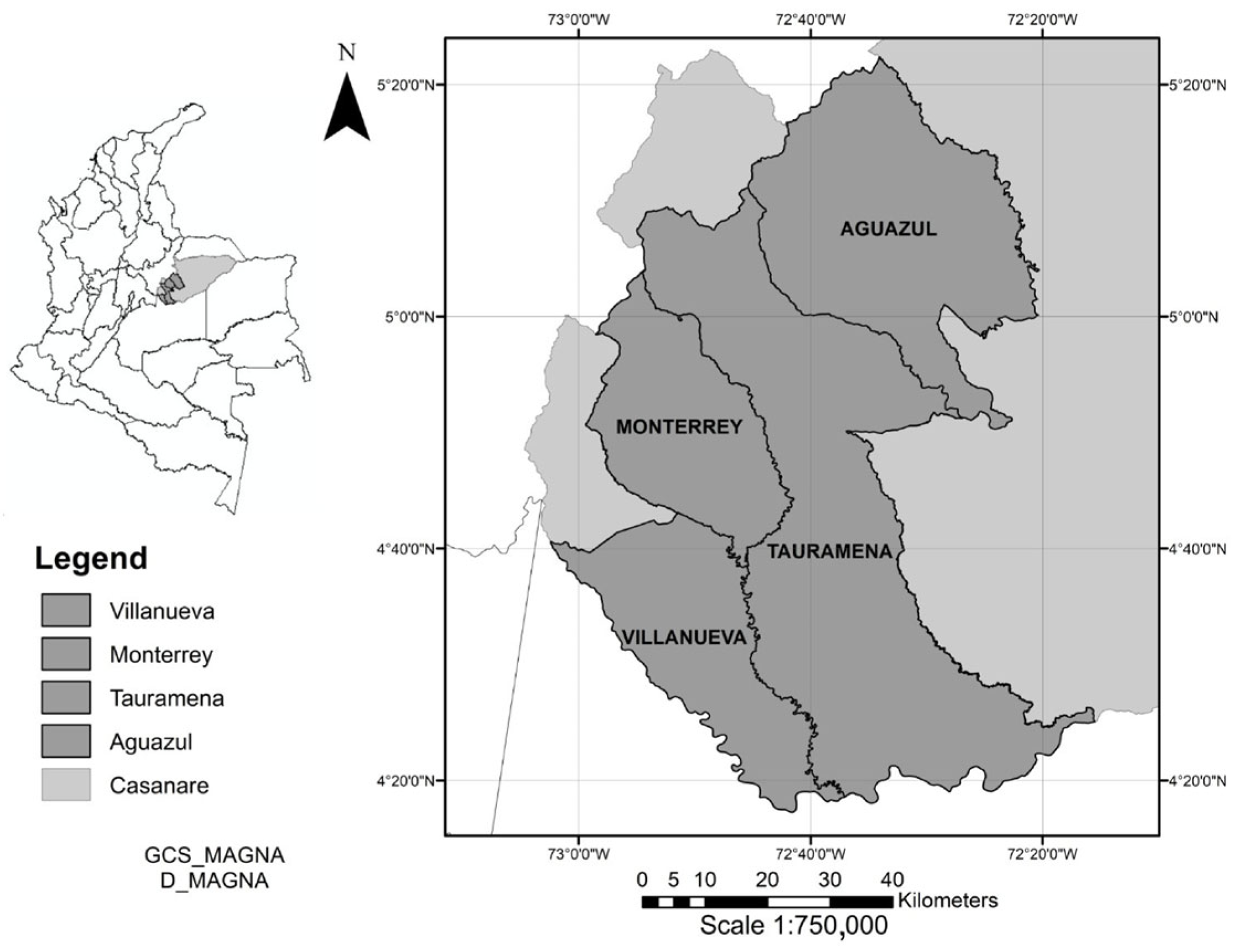
This study was carried out between June and November 2025 in the department of Casanare, Colombia, specifically in the municipalities of Aguazul, Monterrey, Tauramena, and Villanueva, Casanare (Figure 1). The study areas were located within landscape units of the piedmont foothills (piedemonte llanero) and the non-flooding savanna, spanning an altitudinal gradient of 110–700 m a.s.l. [28]. Agricultural and livestock production systems predominate in this region, with cattle ranching being the most extensive activity [29]. Agriculture is based on short-cycle crops such as rice, maize, beans, and vegetables, as well as permanent crops such as plantain, citrus, and oil palm, established mainly in valleys and areas of greater fertility in the piedmont. In the departmental context, the economy is primarily sustained by petroleum extraction (45.2%), followed by livestock activities (11.3%) and agriculture (8.5%) [28].

2.2. Selection of Farmer Promoters and Development of Farmer-to-Farmer Encounters

This study included eight rural promoters who expressed their willingness to lead training encounters within the framework of the Farmer-to-Farmer process. Participation arose from the social base of the project ‘Fortalecimiento de los sistemas de producción agrícola mediante el desarrollo de una estrategia de innovación a través de modelos agroecológicos que impulsen la seguridad alimentaria de las familias del departamento de Casanare’ (’SEGALI’ in short), comprising 40 rural producers (21 women and 19 men) distributed equally across the municipalities of Aguazul, Tauramena, Monterrey, and Villanueva in the department of Casanare. In this context, two promoters per municipality emerged, expressing a willingness to lead training encounters on topics they had mastered, including agroecological practices, integrated plantain management, and the preparation of bio-inputs for agricultural use.
Training encounters were held on each promoter’s own farm property, lasting approximately three hours (9:00 a.m. to 12:00 p.m.). Each promoter had autonomy to structure their session in accordance with the principles of the FtF methodology, which stresses practical demonstration and horizontal knowledge exchange [30]. To this end, they used resources from their own farm, management examples, and production experiences to illustrate the content. Each encounter was conducted through direct exposition, dialogue with participants, and demonstration of productive practices carried out on their agricultural unit.

2.3. Characterization of the Farmer Promoter Profile

A semi-structured interview was conducted with the promoters prior to the encounter to document basic sociodemographic information (age, gender, origin, educational level) and aspects related to their productive experience, agroecological transition, and level of familiarity with community facilitation activities. This interview provided initial insight into the participants’ profiles before their participation in the training encounter. Likewise, a participatory observation process was carried out in the promoters’ agroecosystems to observe socio-productive and organizational dynamics from an agroecological perspective.

2.4. Information Collection and Evaluation of Farmer Promoter Performance

The performance of rural promoters was measured through three complementary, previously validated evaluation instruments. Initially, a matrix was constructed based on conceptual and methodological references (Table 1), integrating four core dimensions of the training process (communication and mediation, inclusion and attitude, methodology, and cultural belonging) and fourteen indicators scored on a Likert scale (1–5). This instrument was applied by two expert evaluators with the technical capacity to assess andragogical performance in community contexts, ensuring a technically grounded external evaluation consistent with competency-based and participatory educational evaluation approaches based on horizontal knowledge exchange, peasant experience, and collective action [27,31].
The matrix was subjected to content validation by two academic panelists, semantic review, and a pilot test with rural promoters not included in the final sample, allowing for the assessment of indicator clarity and field applicability, as recommended by standards for instrument validation in applied research [32]. Based on the pilot test, minor adjustments were made to the wording and conceptual differentiation of some indicators, strengthening the clarity and consistency of the instrument prior to its application. Given the matrix’s multidimensional consistency, the instrument’s reliability was primarily supported by the conceptual coherence of its dimensions and expert validation.
Understanding the FtF process as an exercise in horizontal education directed toward the collective structuring of practical, political, and philosophical principles of peasant agroecological agriculture [30], perception surveys were applied to attendees and self-evaluation forms to promoters, where responses were scored on a Likert scale from 1 to 5, where 1 = Very poor, 2 = Poor, 3 = Fair, 4 = Good, and 5 = Very good (Table 2). These instruments were conceptually derived from the expert matrix but formulated in synthetic, culturally pertinent language to enhance ecological validity and community comprehension, in accordance with methodological recommendations for rural participatory processes [33]. Their purpose was not to replicate the level of technical disaggregation of the expert instrument, but to capture the communicative experience, the socio-affective climate, and the perceived andragogical clarity during the encounter. In this sense, community perceptions and the critical reflection of promoters do not constitute accessory elements but structural components of the training process from the FtF perspective, where producers are active subjects and legitimate evaluators of agroecological learning [30,34].
Table 1. Matrix of the socio-pedagogical performance evaluation of promoters in the Farmer-to-Farmer (FtF) strategy, with dimensions, indicators and scoring criteria, applied in Casanare, Colombia.
DimensionIndicatorScoring (Likert Scale 1–5)References
Communication and mediationClarity in explanation (use of understandable examples)1. Explains in a confusing manner and does not use examples to help understand, despite promoter trying to explain it
2. The content’s explanation possesses limited clarity and the examples used do not help or are not adequate.
3. Explains with some clarity, uses some examples, but the language is sometimes difficult to understand.
4. Explains in a clear and organized manner, using examples that help to understand well.
5. Explains very clearly, using very appropriate examples that are easy for everyone to understand.
[23]
Expressive capacity (verbal fluency, tone and use of strategies to convey ideas)1. Does not manage to express their ideas clearly. Their voice tone is inadequate (very low, monotonous or barely audible), which hinders comprehension, though the ideas or contents are relevant.
2. Expresses some ideas, but their fluency is limited and the tone of voice does not facilitate adequate understanding by others.
3. Communicates ideas with some clarity, although he/she uses few expressive resources and their tone of voice is variable or inconsistent.
4. Communicates clearly and respectfully, with good verbal fluency and an adequate tone of voice. He/she uses some strategies that facilitate comprehension.
5. Communicates with excellent clarity, fluency and confidence. Their tone of voice is appropriate, modulating intensity and rhythm. Employs expressive strategies that fully facilitate the group’s comprehension.
[35]
Receptivity (willingness to listen and welcome ideas from others)1. Does not listen attentively nor respect others’ ideas. Speaks in an imposing manner, without allowing dialogue.
2. Gives more value to their own ideas, without considering what others say. Does not favor communication.
3. Listens attentively and considers what others say but still does not manage to express their ideas constructively.
4. Listens to others with respect, considers their ideas and occasionally expresses their own in a proactive manner.
5. Listens actively on a constant basis, respects all opinions and expresses their ideas clearly and constructively.
[36]
Fostering participation (ability to generate interaction, opens spaces for everyone to participate and express their ideas respectfully)1. Does not promote participation, ignores opinions.
2. Promotes minimal participation, partial listening.
3. Promotes moderate participation, asks basic questions.
4. Fosters broad participation, listens and responds to contributions.
5. Protagonistic participation of farmers, excellent listening and collective construction.
[23]
Articulation of knowledge1. Imposes their knowledge, does not accept others.
2. Listens to others but believes that only their knowledge is valid.
3. Accepts what others say but finds it difficult to change their opinion regarding their knowledge.
4. Recognizes others’ contributions and is willing to learn.
5. Learns with others, shares with humility and respects all knowledge.
[21]
Inclusion and
attitude
Inclusion (Actively promotes participation and respect toward people traditionally excluded in the community environment.)1. Shows exclusionary or dismissive attitudes toward women and youth. Does not take them into account nor motivates them to participate.
2. Shows occasional respect but does not actively promote their participation. Their attitude may reinforce traditional roles that limit inclusion.
3. Has a respectful attitude and allows basic participation of women and youth, although without seeking their protagonism.
4. Acts with respect and intentionally promotes significant participation of women and youth.
5. Demonstrates absolute respect, fosters equality and actively motivates equitable, visible and constant participation of women and youth.
[37]
Charisma and connection with the group (Socio-affective bonding with the group, closeness, trust and quality of interpersonal treatment)1. Appears distant or not very accessible. Does not establish emotional connection nor generate an atmosphere of trust.
2. Attempts to relate but does not manage to build closeness. The group’s trust toward them is limited or unstable.
3. Maintains friendly and respectful treatment, although closeness with the group is partial and is not consolidated with all participants.
4. Relates in a warm manner, listens actively and converses easily. Generates trust in most of the group.
5. Establishes a solid socio-affective connection with the entire group. He/she is close and empathetic, creating a safe, respectful and welcoming environment for everyone.
[21,38,39]
Enthusiasm and motivation (Positive attitude, energy and willingness shown when sharing what they know)1. Appears unmotivated or participates without interest.
2. Fulfills their role, but without showing much interest or enthusiasm.
3. Appears committed, but with a variable attitude.
4. Participates willingly, encourages the group and transmits good attitude.
5. Shows joy and commitment. Motivates and spreads enthusiasm to the group.
[21,38]
Trust (The group feels comfortable, heard and free to speak with them)1. People prefer not to speak with them.
2. People hesitate to share their ideas or concerns.
3. Some people approach them, but others feel insecure.
4. Generates trust in most of the group.
5. The group feels free to speak, share and ask for support without fear.
[21,38]
MethodologyUse of didactic demonstrations1. Does not use didactic demonstrations.
2. Uses a minimum of demonstrations.
3. Applies some demonstrative practices.
4. Outstanding use of demonstrative practices.
5. Methodological excellence with demonstrative practices.
[22,24]
Methodological coherence1. Unidirectional teaching approach.
2. Little participatory teaching approach.
3. Links elements of the participatory approach. However, unidirectional transmission still predominates.
4. Outstanding use of participatory methodology elements, with horizontality.
5. Excellent horizontality, with farmer protagonism.
[22,24]
Planning and organization of the session1. There is no prior planning, nor methodological structure.
2. Reduced planning and organization, improvisation stands out.
3. Planning and organization are basic, with limited pedagogical flow.
4. Planning and organization are outstanding, with good pedagogical flow.
5. Excellent planning and organization, with high pedagogical flow.
[22,39]
Cultural belongingLocal knowledge (Integrates peasant and traditional knowledge)1. Does not recognize local knowledge; imposes conventional knowledge.
2. Mentions local knowledge but does not incorporate it in their teaching.
3. Recognizes some traditional knowledge and attempts to integrate it.
4. Actively integrates peasant knowledge in their explanations and practices.
5. Promotes the exchange of knowledge among farmers. Strengthens local knowledge.
[40]
Cultural practices of the territory (relates topics to local customs, beliefs or productive practices)1. Uses practices foreign to the context or unrelated to the territory.
2. Uses few practices from the territory, and without connection to local culture.
3. Uses practices with some relationship to the local environment.
4. Employs practices directly related to the territory.
5. Constantly articulates technical topics with practices, beliefs and values of the territory.
[40]
To prevent interpretation biases and possible overlaps among some matrix indicators, a prior induction was conducted with the expert evaluators. This session clarified conceptual differences between potentially similar terms, such as ‘inclusion,’ understood as the participation of all persons without discrimination [41], and ‘promotion of participation,’ which refers to the group’s general participation during the session. Likewise, the distinction was explained between ‘charisma and connection,’ referring to the promoter’s personal attributes for generating affective closeness, and ‘trust,’ understood as the group’s perception of their freedom to express themselves without fear. This prior orientation enabled minimizing the halo effect in evaluations and ensured that each indicator was rated independently and consistently with its working definition.
Table 2. Self-assessment and perception questionnaire for promoters and participants in the Farmer-to-Farmer strategy in Casanare, Colombia.
DimensionSelf-Evaluation QuestionnaireAttendee Perception Questionnaire
Communication and mediation1. Did I explain clearly and with easy-to-understand examples?
2. Did I make myself well understood when speaking?
3. Did I listen to people with respect and attention?
4. Did I allow everyone to speak and participate?
1. Did the promoter explain clearly? Was it easy to understand?
2. Did they use examples from rural life?
3. Did they allow people to speak and ask questions?
4. Did they listen respectfully to others’ ideas?
Inclusion and attitude1. Did I consider women, youth, and everyone equally?
2. Did I show enthusiasm and eagerness when teaching (energy and positive attitude)?
3. Did people feel confident speaking with me?
1. Did they treat all people well? (women, youth, elders)
2. Did you feel confident speaking with him/her?
3. Did they show enthusiasm and encouragement to teach? (motivated the group)
Methodology1. Did I share the topic in a simple and engaging manner?
2. Did I prepare well and organize the session?
3. Did I use practical examples close to peasant life?
1. Did they do practical demonstrations?
2. Did you feel that everyone learned together, and not just by listening to the promoter?
3. Was the session well organized?
Cultural belonging1. Did I recognize and value peasant knowledge?
2. Did I relate the topic to the practices of the territory? (customs, soil, local crops)
1. Did they respect and value peasant knowledge?
2. Did they relate the topic to the practices of the territory? (customs, soils, local crops)?

2.5. Information Analysis

The data were analyzed using a case study approach [42], a descriptive-interpretive design consistent with the contextual, situated, and community-based character of the FtF methodology [30]. This methodological approach stresses analytical depth and contextual understanding of complex phenomena, rather than statistical generalization from large population samples. In this sense, although the small number of participants is consistent with the case study design, it constitutes a limitation for broader inference and should be considered when interpreting the results [43]. Similarly, since each training encounter was developed on the promoter’s own property and under their real conditions—including their practical experience, andragogical resources, and participant characteristics—each promoter was treated as an independent analytical unit. In this sense, territorial, thematic, and sociodemographic variations were considered constitutive properties of the FtF process and, therefore, integral to the analysis.
Promoter performance was analyzed using the socio-pedagogical performance matrix (Table 1). The ratings issued by the two expert evaluators were integrated using equivalent weighting, assigning equal weight to each, to obtain a consolidated score for each indicator and dimension. Given the multidimensional structure of the evaluation tool, a global performance assessment index was constructed by calculating the mean of the total and per-dimension indicators, following methodologies such as those proposed by Castaño-Ramírez et al. [35] and Castaño-Ramírez et al. [36]. This procedure is also supported by Huh & Gim [44] and Koo & Yang [45], who emphasize that composite Likert scales organized into sub-dimensions, aggregated from multiple items, allow for the representation of complex constructs and facilitate their interpretation in evaluation processes. Complementarily, the self-evaluation surveys and attendee perception surveys were analyzed using the global and per-dimension performance index, yielding a synthetic valuation of self-recognized and perceived performance as a complementary input to expert evaluation.
Considering that promotion processes constitute a structural component of agroecology and that, through the adoption of its principles, they can influence the socio-pedagogical performance of promoters, an agroecological profile was estimated through an agroecological transition index based on the level of adoption of agroecological principles. This approach allowed for the identification of the incorporation of practices and agroecological foundations into production systems, understanding the agroecological transition as a gradual, multidimensional process integrating technical, social, and organizational transformations in agroecosystems [46]. Although the transition level does not strictly constitute a sociodemographic characteristic of the promoter’s profile, its inclusion is pertinent, given that adopting these principles can strengthen practical experience, community legitimacy, and knowledge-sharing capacity—central elements in the performance of promoters in Farmer-to-Farmer processes [47].
The agroecological transition index of the promoters was established through an analytical rubric based on agroecological principles adapted from the farm planning instrument for agroecological transition developed by ADR, MinAgricultura & FAO [47], through which theoretical principles were operationalized into observable practices and behaviors within production systems and socio-organizational dynamics: (1) soil management, (2) productive diversity, (3) care for nature, (4) animal welfare, (5) solidarity economies, (6) knowledge dialogue, and (7) social organization. Each principle was classified into three implementation levels: no adoption (0), partial adoption (0.5), and consolidated adoption (1), defined according to previously established criteria supported by structural elements described in the methodological guide (Table 3). Assessment was based on evidence from interviews and field observations, reducing subjectivity and preserving consistency and traceability in the analytical process. The index was calculated from the ratio between the sum of assigned values and the total number of evaluated principles, yielding values between 0 and 1 for each promoter, which were subsequently grouped into three agroecological transition levels—low (0–0.33), medium (0.34–0.66), and high (0.67–1)—to facilitate the comparative analysis of the agroecological profile and its relationship with promoter performance.
To identify patterns in promoter profile and performance, an integration matrix was elaborated in a spreadsheet (Microsoft Excel 2019), consolidating all variables collected and estimated for each participant: sociodemographic characteristics (age, sex, and educational level), productive characteristics (agroecological transition level), and the global performance index, classified as low (<3), medium (3-3,9) and high (>4). From this matrix, a comparative review was conducted to identify the variables with the greatest discriminating capacity among promoters. This analysis established that the agroecological transition level and the global training performance index were the variables that best expressed differentiated patterns among farmer promoters. Based on these variables, a synthetic matrix was elaborated, from which groups of promoters with distinct characteristics were identified, consistent with typification approaches in case study research [42,48].
Finally, the resulting global and per-dimension assessment indices were analyzed using descriptive statistics (median and interquartile range), and the results were organized into tables and figures to facilitate interpretation. To explore the potential influence of prior acquaintance (in years) between participants and promoters, attendees were grouped into three levels defined from the data distribution (terciles) (labeled low, medium, and high acquaintance time), enabling an exploratory comparison of the global assessment index across groups. All analyses were conducted in RStudio (2025.05.1 version) [49], using the dplyr and tidyr packages for descriptive statistics and ggplot2 for figure elaboration.

3. Results

3.1. Characteristics of Farmer Promoters

The sociodemographic characteristics revealed internal variation in educational level, age, and gender. A marked male predominance was found (87.5%), with only one woman in the group. Regarding age, the prevalence of middle-aged and older profiles was evident: half of the promoters were between 39 and 48 years old, 25.0% were between 49 and 58 years old, and another 25.0% were 59 years old or older. All identified themselves as being of peasant origin with diverse educational levels: 50% attained primary school, 12.5% reported secondary school, another 12.5% reported no formal schooling, 12.5% received technical training in preschool education, and 12.5% studied electromechanical technology. This composition reveals internal variation in terms of educational level, age, and gender within the group of promoters (Table 4).
All promoters reported lacking prior experience in peasant teaching processes and expressed some insecurity when speaking in public. Nevertheless, they agreed that their productive trajectories constitute a valuable resource for the community. The group self-identified as farmers in transition from conventional production models toward agroecological approaches, with partial incorporation of agroecological practices evident in their agroecosystems. In this context, 50.0% chose to share experiences related to integrated agronomic management of plantain; 25.0% addressed biopreparations (insecticides and fertilizers); 12.5% combined content on agroecology and bio-inputs; and another 12.5% focused on specific aspects of plantain planting. Integrated agronomic management of plantain included establishment and maintenance processes, such as planting, leaf pruning, deflowering, and the application of a mixed nutritional management program (organic and chemical). Regarding planting of plant material, criteria for seed selection, preventive disinfection, and implementation of minimum tillage techniques were discussed.
The results of the agroecological transition level showed a predominance of the high level, reached by 62.5% of participants. Additionally, 37.5% were at a medium level, while no participant was classified at the low level.

3.2. Training Performance Under the FtF Methodology

Promoters achieved a high global performance assessment index, expressed with a median of 4.32. Likewise, the andragogical and socio-affective components evaluated for the promoters showed medians above 4.00 (Table 5). This indicates that they employed effective communication strategies and andragogical resources that facilitated learning and promoted genuine peasant knowledge exchange. Attitudinal and socio-affective strengths were also highlighted, reflected in the capacity to actively engage participants and build mutual trust. From a methodological standpoint, the use of their own productive experiences and demonstrative showcases as facilitators of meaningful learning stood out, strengthening the methodological structure of the encounters. Finally, a marked cultural rootedness was evident, expressed in intergenerational experiences and the close relationship between cultural beliefs and productive practices, with reference to the context of ‘Los Llanos’ territory.
In the individual analysis of indicators, it was observed that, while strengths predominated, some indicators—specifically expressive capacity, enthusiasm and motivation, and session planning and organization—reached a medium level (medians of 3.50, 3.75, and 3.50, respectively). These differences were associated with slight limitations in oral expression and communicative clarity, particularly in vocalization, verbal fluency, rhythm, and voice modulation, which occasionally made it difficult to convey the message precisely. Likewise, promoter enthusiasm and charisma showed heterogeneity, evidencing differences in motivation and personal style when leading activities. Finally, session planning and organization also showed variability: some promoters structured their methodologies and thematic sequences, while others adopted more ad hoc, less organized strategies.

3.3. Promoter Profile and Performance in FtF Encounters

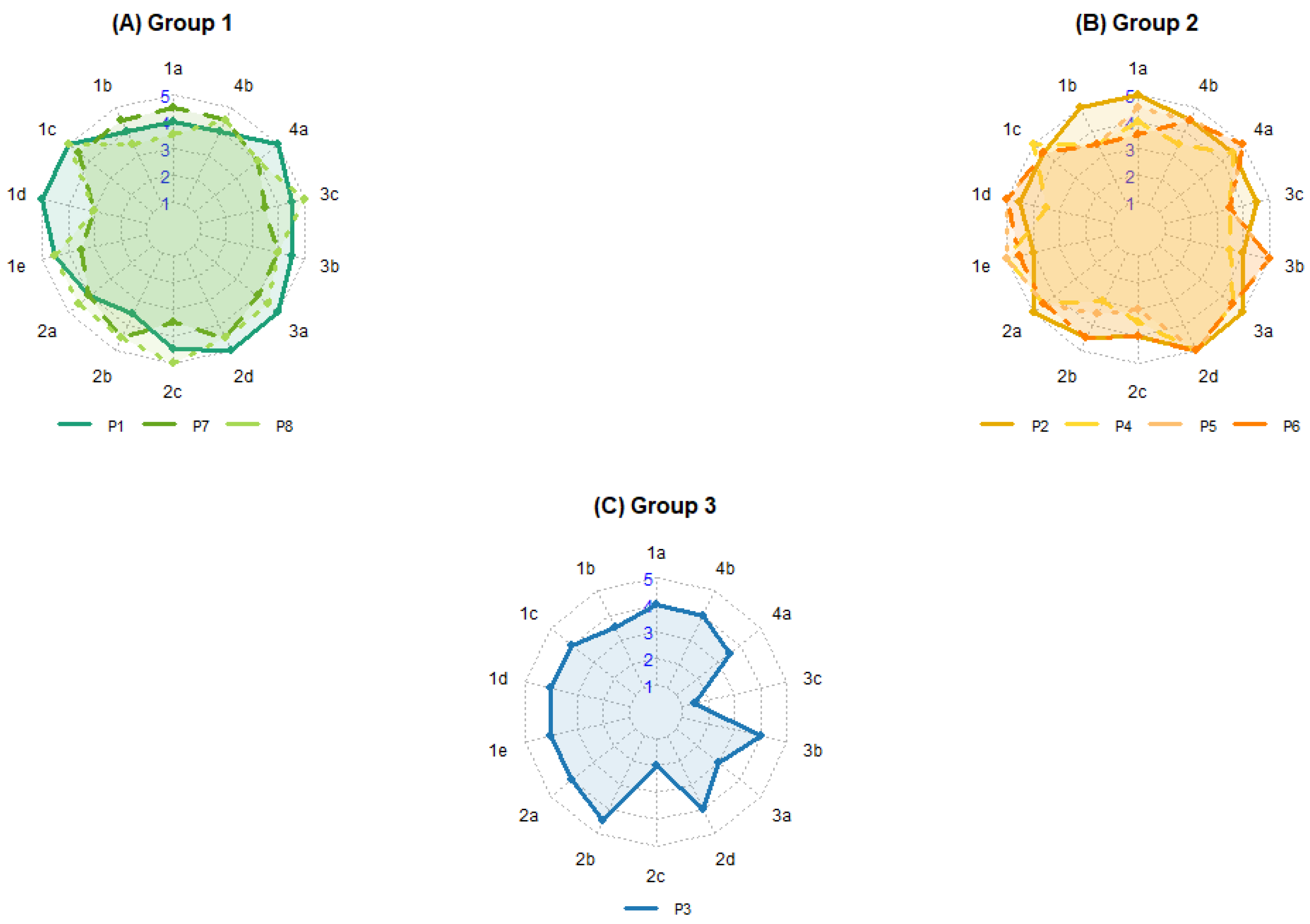
The comparative case analysis identified that agroecological transition level and training performance were the variables with the greatest relevance for the interpretive differentiation of promoters during the grouping process. In contrast, sociodemographic variables such as age, sex, and educational level showed high variability among participants, limiting their integration into constructing comparable profiles and their association with training performance. Based on this analysis, three groups of promoters with differentiated characteristics were identified (Table 6) (Figure 2).
  • Group 1: Promoters with a high agroecological transition level and high training performance.
This group comprised 37.5% of the participants (two men and one woman) with ages between 45 and 65 years old. Regarding educational background, the men had a primary school education level, while the woman had a technical degree in preschool education. In terms of agroecological profile, the promoters in this group showed advanced transition levels (between 0.71 and 0.86), evidenced by consolidated adoption of practices oriented toward ecosystem conservation, animal health and welfare, soil management, productive diversification of their agroecosystems, and social organization. However, they reflected partial adoption in linking spaces for the exchange of traditional knowledge and solidarity economy processes, partially expressing a rootedness in conventional market and product commercialization.
Regarding FtF encounters, topics addressed included agronomic management of plantain, agroecology, and the preparation of bio-inputs. Within this group, P1 obtained the highest global performance score (4.50 vs. 4.00 and 4.20) relative to P2 and P3, respectively. This was also expressed in the fact that 93% of evaluated indicators were scored >4.0; however, in the connection and charisma dimension, a score classified as medium (3.80) was recorded. Promoters P7 and P8, although reflecting excellent overall performance expressed in scores above 4 in 53.3% and 66.6% of indicators, respectively, also showed indicators with moderate scores associated with clarity in topic explanation (1a), promotion of participation (1d), inclusion (2a), and planning and organization (3c).
  • Group 2: Promoters with a medium agroecological transition level and high training performance.
The second group consisted of 50% of the promoters, all of them men. In terms of educational level, high formative heterogeneity was observed, ranging from no formal education to primary, secondary, and a technology degree in electromechanics, with ages ranging from 56 to 65 years. They were characterized by intermediate agroecological transition levels (0.36–0.64), driven by the consolidated adoption of social organization and participatory governance processes, as all promoters participate in community action board activities and are affiliated with one or more associations. Partial implementation of practices such as productive diversification, animal health and welfare, soil care, transfer of ancestral knowledge, and solidarity economies was observed; incipient levels were still evident in the integration of the forestry component into production systems and in the conservation of forested areas. Pesticide and agrochemical use also persists.
In Farmer-to-Farmer encounters, most promoters oriented their sessions toward the agronomic management of plantain, except for one case in which the preparation of biopreparations was addressed. In terms of scores, a high overall assessment was observed (4.04–4.57). All promoters showed high shared scores (>4.00) in 40.0% of indicators: receptivity (1c), promotion of participation (1d), inclusion (2a), trust (2d), use of didactic demonstrations (3a), and local knowledge (4a). In contrast, scores were moderate (3.0–3.50) for P2, P4, and P5 across indicators such as effective communication (1b), group connection and charisma (2b), enthusiasm and motivation (2c), and planning and organization (3c). In general, these promoters demonstrated broad capacity to share knowledge among producers in FtF processes, though they still have moderate scores in some training competencies.
  • Group 3: Promoter with a medium agroecological transition level and medium training performance.
The third group comprised 12.5% of the promoters and was represented by a 60-year-old man with a basic educational level, whose training process focused specifically on plantain planting. Regarding the agroecological profile, he presented a medium level of agroecological transition, with a score of 0.57. Nevertheless, consolidated adoption was evidenced in animal health and welfare and social organization processes. Adoption was moderate in the productive diversification of his agroecosystem, care for nature, solidarity economy processes, and the transfer of local or traditional knowledge; the primary product marketing channel is through intermediaries, although he occasionally participates in peasant markets. Regarding soil management and conservation, chemical synthesis inputs are still used; however, initial progress in incorporating agroecological alternatives, such as the learning and application of biopreparations, is evident.
This promoter showed satisfactory performance in aspects related to respect for attendees’ opinions and contributions (4.0), close interaction (4.5), and the articulation of the territory’s cultural knowledge with the group (4.0). His relationship with people was warm and open, although in the communication and mediation dimension, he received a medium score (3.90). While he was able to convey some ideas clearly, his expression was not always fluent. In terms of attitude, he showed limited enthusiasm, which affected the encounter’s dynamics and reduced attendee participation. Even so, he shared valuable knowledge derived from his rural experience and from intergenerational transmission, integrating the territory and traditional practices into his teaching.

3.4. Community and Self-Valued Perception of the FtF Encounters

In the self-evaluation, promoters placed their responses at the highest level of the scale across all andragogical dimensions (median: 5.00): inclusion and attitude; cultural belonging; dimensions directly linked to the socio-affective climate, the recognition of local knowledge, communication, and mediation; and methodology. Likewise, no variability was observed in the interquartile range (IQR: 0.00), indicating that promoters perceived themselves as uniformly performing the aspects related to respectful treatment, the integration of territorial cultural practices, and the construction of an adequate environment for knowledge exchange.
On the other hand, attendee perceptions also reflected high scores throughout all dimensions, albeit with slightly greater variability. The communication and mediation dimension showed a median of 4.75 (IQR: 0.50), while inclusion and attitude, methodology, and cultural belonging recorded medians of 5.00, with interquartile ranges of 0.33, 0.66, and 0.50, respectively; these variations were higher than those found in the self-perception surveys.
The global index scores remained consistently high regardless of how long participants had known the promoters. When comparing the different levels of prior acquaintance time, the medians showed minimal variation: 4.58, 4.88, and 4.92 for the groups with the lowest, intermediate, and longest acquaintance time, respectively.

4. Discussion

The methodological design of this study was based on a mixed-methods approach (quantitative and qualitative) aimed at structuring systematic observation of complex social phenomena associated with the performance of rural promoters. In contrast, training processes with a social foundation have traditionally been approached from qualitative perspectives, centered on the interpretive depth of experiences and meanings [50,51,52]. In this case, the incorporation of descriptive quantitative tools addressed the need to organize, compare, and make explicit the evaluation patterns emerging from different evaluative sources. In this context, numerical valuations were explicitly conceived as instrumental analytical devices that enabled the identification of variability levels, contrasts among actors, and general regularities in the process. Complementarily, qualitative analyses enabled a deep, contextualized interpretation of these patterns, supporting the identification of explanatory configurations, relational dynamics, and the meanings actors attributed to the training process. This methodological articulation thus contributed to the in-depth understanding of the FtF process without decontextualizing the analyzed social experience.
A male predominance in leadership roles (87.5%) was reflected, despite women representing 52.1% of the project’s social base. This result indicates lower female participation in promoter roles within the analyzed process, although the present study does not allow for establishing the underlying causes. Previous studies have documented gender inequalities that can limit women’s participation in decision-making spaces and leadership in rural contexts [53,54]. However, these factors were not directly assessed in this research. In this sense, the low female participation identified does not necessarily reflect an absence of capacities or interest but may be associated with structural and symbolic barriers that condition their confidence, visibility, and recognition as leaders. Nevertheless, although limited, the presence of women in leadership roles constitutes a signal of incipient processes of organizational transformation, especially relevant in agroecological transition contexts, where social and political dimensions play a central role [55]. From this perspective, the finding shows both a weakness of the process—related to the limited inclusion of women in leadership positions—and a strategic opportunity to strengthen training and organizational processes by designing actions that favor the participation, recognition, and progressive exercise of female leadership, thus contributing to the sustainability and depth of the transformations promoted.
All participating promoters were middle-aged or older, indicating low youth engagement and suggesting weak generational succession. Limited documentation on this in Colombia is associated with structural factors, such as the low profitability of peasant agriculture, the instability of rural incomes, the limited availability of local employment, and the scarcity of educational opportunities in rural territories—conditions that incentivize youth migration to cities [56,57]. These dynamics are inscribed in broader sociohistorical processes that have influenced a generational gap in rural areas, relegating family farming to a state of economic and political marginality [58]. Added to this are the weaknesses of public policies directed at rural youth, the fragmentation of technical support networks, and limited spaces for youth participation and leadership in productive and training processes, which undermine the renewal and sustainability of rural initiatives.
Promoter educational levels showed high variability, ranging from participants without formal education to those with technical training. This result suggests that peasant promotion does not necessarily depend on formal education, but on practical knowledge, productive experience, and community recognition—fundamental elements in Farmer-to-Farmer processes [10,15]. Several studies have noted that rural promoters typically build their leadership from empirical learning and experimentation in their own agroecosystems, which favors the appropriation and horizontal transmission of knowledge [4]. Experiences such as those of the Andean Kamayoq show that the recognition of the promoter does not depend on their educational level or age, but on their capacity to observe, experiment, accompany, and teach from daily productive practice, in accordance with the values and knowledge of the territory [59]. In this sense, educational diversity can be seen as a strength, reflecting the inclusive nature of peasant promotion and its potential to broaden the social base of agroecological processes.
The results evidenced differences between the socio-pedagogical performance evaluation conducted by experts and the scores from participants and promoters’ self-evaluation, reflecting differentiated modes of valuation within the FtF process. While self-evaluation and community perception showed high, homogeneous scores, associated with self-recognition of the role and the legitimacy of horizontal exchange, expert evaluation identified variations in socio-pedagogical competencies and opportunities for improvement in training performance [23,36]. This differentiation does not imply a hierarchy among forms of knowledge but rather evidences the complementarity between peasant empirical experience and technical-pedagogical analysis, supporting a broader understanding of the training process and supporting the relevance of using multiple evaluation instruments in horizontal learning processes [39,52]. The role of facilitators and coordinators in the FtF methodology proposed by the ANAP [15,27] can be improved by identifying areas for strengthening promoters during the unfolding process to allow better engagement and scaling to other regions or communities.
In this context, the methodological approach of this study is relevant in integrating community empirical valuation with expert evaluation, approaches that have traditionally been perceived as contradictory within rural extension processes. However, recent literature suggests that integrating local knowledge with analytical tools strengthens learning processes and the sustainability of agroecological innovations [4,11]. Although producers possess broad practical knowledge of the territory, incorporating more specific training criteria aligned with a rural and sustainable vision can enhance the effectiveness of peasant exchange, enabling the consolidation of more structured processes without losing the horizontal and participatory essence of the FtF methodology. From this perspective, the identification of differentiated promoter profiles enabled analysis of how these capacities are expressed at different levels of agroecological transition and training performance.
Group 1, characterized by a high agroecological transition level and high training performance, represents a strategic core for dynamizing knowledge exchange in Farmer-to-Farmer processes. The combination of productive experience, community recognition, and socio-pedagogical skills has been identified as a key factor for agroecological scaling and the transformation of conventional production systems [10,11,15]. These promoters can act as knowledge multipliers and facilitators of horizontal learning. Nevertheless, the results show opportunities for improvement in specific training competencies, which aligns with Landini [38], who notes that the pedagogical strengthening of rural promoters increases the effectiveness of peasant extension and the consolidation of territorial agroecological processes.
Group 2 showed high training performance but intermediate levels of agroecological transition, suggesting a profile with significant potential for knowledge transfer, though with challenges in the depth of the agroecological content shared. Studies on peasant extension have noted that communicative capacity and participatory facilitation are not always accompanied by consolidated adoption of agroecological principles [7,27]. In this sense, strengthening the appropriation of agroecological foundations is key so that knowledge transfer contributes to sustainable transformations. The literature indicates that the agroecological transition implies not only technical changes, but also the incorporation of ecological, social, and organizational principles that promote sustainable territorial development [2,60].
Group 3, represented by a promoter with intermediate performance and agroecological transition, reflects an emerging profile within the Farmer-to-Farmer process. Although it offers greater opportunities for strengthening, his participation evidences the progressive construction of peasant leadership, a characteristic intrinsic to these processes [4,10]. The inclusion of promoters at different developmental levels broadens the social base and strengthens horizontal learning networks, where more experienced actors accompany those in early stages [11]. This diversity of profiles favors the gradual consolidation of local capacities and contributes to the sustainability of agroecological processes in the territory.
Although the overall performance of the promoters was high, some dimensions associated with training competencies—such as session planning and organization, expressive capacity, and enthusiasm and motivation—showed moderate scores, suggesting opportunities for improvement. These competencies have been identified as key elements in participatory rural extension processes, as they influence message clarity, learning dynamics, and participants’ knowledge appropriation [35,38]. Strengthening these skills could enhance promoters’ capacity to facilitate more structured, participatory, and effective exchanges. However, the development of these competencies must be accompanied by agroecological transition and consolidation processes, since the effectiveness of peasant promotion depends on pedagogical skills, productive experience, coherence with shared agroecological principles, and relational developments within their communities [11,15].
The present study focuses on the main pedagogical moment of the FtF methodology: the hands-on workshop, in which host farmers share their knowledge and experiences with peers [26,61]. However, this focus entails limitations. Specifically, the study does not address how the performance matrix results can be fed back into the structural and organizational processes of the FtF methodology, nor whether improvements in training competencies translate into measurable changes in agroecological practices over time. Future research should examine the iterative use of evaluation tools within multi-cycle FtF processes to better understand how pedagogical strengthening supports the consolidation of agroecological transitions.
One limitation of this study is the small sample size (n = 8), which restricts the scope of quantitative analyses and prevents statistical generalization of the results. Therefore, the findings should be interpreted with caution and considering the specific context analyzed. Nevertheless, the results provide relevant analytical insights for understanding the dynamics of agroecological and participatory extension processes, particularly in contexts with emerging organizational bases [30,41]. In this sense, the findings offer analytical references that can be contrasted in other territories with similar conditions. Future studies with larger sample sizes, comparative designs, and longitudinal approaches are recommended.
Collectively, the results indicated that the profiles and performance of the promoters in the Farmer-to-Farmer investigated here do not respond to homogeneous conditions but rather to the coexistence of different levels of experience, agroecological transition, and training competencies. This diversity reflects the dynamic nature of peasant promotion and its potential to strengthen horizontal learning processes and territorial transformation. In this sense, identifying differentiated groups within sociodemographic variable communities may support the consolidation of extension and innovative initiatives grounded in agroecological frameworks.

5. Conclusions

The results show that peasant promoters, without prior teaching experience, achieved outstanding training outcomes, supported primarily by their practical knowledge and productive experience. This evidences that leadership in the Farmer-to-Farmer methodology arises from the daily experience of the territory and not necessarily from formal academic training. Likewise, the differences found among groups of promoters reflect that each farmer contributes from their own trajectories, which highlights the importance of accompanying these processes in a flexible and gradual manner, strengthening existing capacities without losing the horizontal and participatory essence of the approach.
The comparison among expert evaluation, promoter self-evaluation, and attendee perception provided complementary perspectives on the training process. While the community valued the exchange of knowledge and the trust-building climate, expert evaluation identified aspects that could be strengthened, such as methodological planning and communication in some cases. These findings suggest that Farmer-to-Farmer processes in emerging contexts, such as southern Casanare, have high consolidation potential if peasant leadership is promoted, the participation of women and youth is expanded, and continuous exchange spaces are maintained to strengthen the collective construction of agroecological knowledge.

Author Contributions

Conceptualization, J.S.R.R., G.E.P.-A. and C.O.-V.; methodology, J.S.R.R., G.E.P.-A. and C.O.-V.; software, C.O.-V.; validation, C.O.-V., G.E.P.-A. and J.S.R.R.; formal analysis, G.E.P.-A. and C.O.-V.; investigation, J.S.R.R., G.E.P.-A. and C.O.-V.; data curation, G.E.P.-A. and C.O.-V.; writing—original draft preparation, G.E.P.-A. and C.O.-V.; writing—review and editing, J.S.R.R., G.E.P.-A. and C.O.-V.; visualization, G.E.P.-A. and C.O.-V.; supervision, J.S.R.R.; project administration, J.S.R.R. All authors have read and agreed to the published version of the manuscript.

Funding

This study was funded through resources from the ‘Sistema General de Regalías’ (SGR) of Colombia, through the project “Fortalecimiento de los Sistemas de Producción Agrícola mediante el desarrollo de una estrategia de innovación a través de modelos agroecológicos que impulsen la Seguridad Alimentaria de las familias del Departamento de. Casanare”, BPIN code 2024000100006; approved in the OCAD of Science, Technology and Innovation; executed by the ‘Fundación de Innovación e Investigación Ernesto Schiefelbein’ in alliance with Monterrey Municipal Government (Casanare, Colombia), and the ‘Universidad Francisco de Paula Santander—Sede Ocaña’; and with resource management and supervision of the ‘Ministerio de Ciencia, Tecnología e Innovación’ of the Republic of Colombia.

Institutional Review Board Statement

This study employed non-interventional methods based on anonymous questionnaires administered to Farmer-to-Farmer (FtF) participants and farmer promoters, as well as structured interviews with Farmer promoters. Verbal informed consent was obtained from Farmer promoters prior to data collection. During the consent process, researchers explicitly informed participants that: (1) their participation would be confidential, (2) the study posed no anticipated risks or direct benefits, (3) no compensation would be provided, (4) participation was entirely voluntary, and (5) they could withdraw at any time or request additional information without penalty. All personal data were handled in accordance with Colombian Law 1581 of 2012 regarding the protection of personal data.

Informed Consent Statement

Verbal Informed consent was obtained from all subjects (Farmer promoters) involved in the study. Script of the consent information read to participants previously to proceed with interviews is provided (in Spanish and English) as a pdf file named “Informed consent statement-SEGALI Project”.

Data Availability Statement

The data presented in this study are available on request from the corresponding author due to privacy restrictions in accordance with the Informed Consent Statement established among researchers and study participants. Data will be anonymized when shared upon request.

Acknowledgments

We deeply thank the families of the municipalities of Aguazul, Villanueva, Monterrey, and Tauramena who participated in this research, sharing their knowledge, experiences, and time, and allowing the strengthening of their communities through the Farmer–Farmer methodology. We also thank the members of the ‘Fundación de Innovación e Investigación Ernesto Schiefelbein’, who, with their constant support, allowed the realization of field activities, especially Yeison Gallo and Danna Gisell Fajardo. Likewise, we give our gratitude to Yeeny Lozano and other professionals from Universidad Francisco de Paula Santander–Ocaña for their constant guidance in consolidating this research. Finally, we thank the project professionals in each municipality for the technical and logistical support in conducting meetings with the communities.

Conflicts of Interest

The authors declare no conflicts of interest.

Abbreviations

The following abbreviations are used in this manuscript:
FtFFarmer-to-Farmer

References

  1. Altieri, M.A.; Nicholls, C.I. The adaptation and mitigation potential of traditional agriculture in a changing climate. Clim. Change 2017, 140, 33–45. [Google Scholar] [CrossRef]
  2. Wezel, A.; Herren, B.G.; Kerr, R.B.; Barrios, E.; Rodrigues, A.L.; Sinclair, F. Agroecological principles and elements and their implications for transitioning to sustainable food systems. A review. Agron. Sustain. Dev. 2020, 40, 40. [Google Scholar] [CrossRef]
  3. Méndez, V.E.; Bacon, C.M.; Cohen, R. Agroecology as a transdisciplinary, participatory, and action-oriented approach. Agroecol. Sustain. Food Syst. 2013, 37, 3–18. [Google Scholar] [CrossRef]
  4. McCune, N.; Rosset, P.M.; Cruz Salazar, T.; Morales, A.; Saldívar Moreno, A. Mediated territoriality: Rural workers and the efforts to scale out agroecology in Nicaragua. J. Peasant Stud. 2017, 44, 354–376. [Google Scholar] [CrossRef]
  5. Martini, E.; Roshetko, J.M.; Paramita, E. Can farmer-to-farmer communication boost the dissemination of agroforestry innovations? A case study from Sulawesi, Indonesia. Agrofor. Syst. 2017, 91, 811–824. [Google Scholar] [CrossRef]
  6. Fisher, M.; Holden, S.T.; Thierfelder, C.; Katengeza, S.P. Awareness and adoption of conservation agriculture in Malawi: What difference can farmer-to-farmer extension make? Int. J. Agric. Sustain. 2018, 16, 310–325. [Google Scholar] [CrossRef]
  7. Kansanga, M.M.; Kerr, R.B.; Lupafya, E.; Dakishoni, L.; Luginaah, I. Does participatory farmer-to-farmer training improve the adoption of sustainable land management practices? Land Use Policy 2021, 108, 105477. [Google Scholar] [CrossRef]
  8. Dosso, F.; Gouroubera, M.W.; Idrissou, L.; Moumouni-Mousa, I. The combination of extension approaches strengthens farmers’ innovativeness in sustainable land management. Environ. Dev. Sustain. 2024, 26, 10043–10062. [Google Scholar] [CrossRef]
  9. Li, F.; Ren, J.; Li, Z.; Qian, L.; Yin, C. Revealing the role of farmer-to-farmer extension in promoting sustainable agricultural practices in China: A case of rice-green manure rotation system diffusion. J. Clean. Prod. 2024, 485, 144365. [Google Scholar] [CrossRef]
  10. Holt-Giménez, E. Campesino a Campesino: Voices from Latin America’s Farmer to Farmer Movement for Sustainable Agriculture; Food First Books: Oakland, CA, USA, 2006. [Google Scholar]
  11. Mier y Terán Giménez Cacho, M.; Giraldo, O.F.; Aldaroso, M.; Morales, H.; Ferguson, B.G.; Rosset, P.; Khadse, A.; Campos, C. Bringing agroecology to scale: Key drivers and emblematic cases. Agroecol. Sustain. Food Syst. 2018, 42, 637–665. [Google Scholar] [CrossRef]
  12. Hörner, D.; Bouguen, A.; Frölich, M.; Wollni, M. Knowledge and adoption of complex agricultural technologies: Evidence from an extension experiment. World Bank Econ. Rev. 2022, 36, 68–90. [Google Scholar] [CrossRef]
  13. Okori, P.; Munthali, W.; Msere, H.; Charlie, H.; Chitaya, S.; Sichali, F.; Chilumpha, E.; Chirwa, T.; Seetha, A.; Chinyamuyamu, B.; et al. Improving efficiency of knowledge and technology diffusion using community seed banks and farmer-to-farmer extension: Experiences from Malawi. Agric. Food Syst. 2020, 11, 38. [Google Scholar] [CrossRef]
  14. Mardiharini, M.; Jamal, E.; Rohaeni, E.S.; Indrawanto, C.; Indraningsih, K.S.; Gunawan, E.; Ramadhan, R.P.; Fahmid, I.M.; Wardana, Ï.P.; Ariningsih, E. Indonesian rice farmers’ percepcionts of different sources of information and their effect on farmer capability. Open Agric. 2023, 8, 20220200. [Google Scholar] [CrossRef]
  15. Rosset, P.M.; Machín Sosa, B.; Roque Jaime, A.M.; Ávila Lozano, D.R. The Campesino-to-Campesino agroecology movement of ANAP in Cuba: Social process methodology in the construction of sustainable peasant agriculture and food sovereignty. J. Peasant Stud. 2011, 38, 161–191. [Google Scholar] [CrossRef]
  16. Rivera, C.C.; Sicard, T.L. Anotaciones para una historia de la Agroecología en Colombia. Gest. Y Ambiente 2013, 16, 73–89. [Google Scholar]
  17. Movimiento Agroecológico Colombiano. Mapeo Agroecológico. 2025. Available online: https://movimientoagroecologico.co/mapeoagroecologico/ (accessed on 1 February 2026).
  18. Feo, E.; Burssens, S.; Mareen, H.; Spanoghe, P. Shedding light into the need of knowledge sharing in H2020 thematic networks for the agriculture and forestry innovation. Sustainability 2022, 14, 3951. [Google Scholar] [CrossRef]
  19. Anderson, C.R.; Bruil, J.; Chappell, M.J.; Kiss, C.; Pimbert, M.P. From transition to domains of transformation: Getting to sustainable and just food systems through agroecology. Sustainability 2019, 11, 5272. [Google Scholar] [CrossRef]
  20. Altieri, M.A.; Kang Bartlett, A.; Callenius, A.; Campeau, C.; Elsasser, K.; Hagerman, P.; Kenny, G.; Lambrechts, K.; Miga, W.; Prado, J.P.; et al. Nourishing the World Sustainably: Scaling Up Agroecology; EEA (Ecumenical Advocacy Alliance): Geneva, Switzerland, 2012. [Google Scholar]
  21. Russo, R. Capacidades y Competencias del Extensionista Agropecuario y Forestal en la Globalización. Rev. Comun. 2009, 18, 86–91. [Google Scholar]
  22. Food and Agriculture Organization of the United Nations [FAO]. Guía Metodológica de Escuelas de Campo para Facilitadores y Facilitadoras en el Proceso de Extensión Agropecuaria; FAO: Rome, Italy, 2011. Available online: https://openknowledge.fao.org/server/api/core/bitstreams/73ba262a-0e22-4dc7-a034-0e6aa58d7d36/content (accessed on 1 February 2026).
  23. Flanagan, B.; Boren-Alpizar, A.; Wingenbach, G.; Lawver, D.; Strong, R. Evaluating Agroforestry Extension Workers’ Technical and Human Relation Competencies: A Ranked Discrepancy Model Needs Assessment. Sustainability 2023, 15, 14100. [Google Scholar] [CrossRef]
  24. Martínez-Mendoza, F.Z.; Bakker, N.; Gómez-Hernández, L. Herramientas para la Metodología Campesino a Campesino innovación pedagógica para construir saberes agroecológicos. LEISA—Rev. Agroecol. 2010, 26, 9–11. [Google Scholar]
  25. Wenger, E. Communities of Practice: Learning, Meaning, and Identity; Cambridge University Press: Cambridge, UK, 1998. [Google Scholar] [CrossRef]
  26. Val, V.; Rosset, P.M.; Zamora Lomelí, C.; Giraldo, O.F.; Rocheleau, D. Agroecology and La Via Campesina I. The symbolic and material construction of agroecology through the dispositive of “peasant-to-peasant” processes. Agroecol. Sustain. Food Syst. 2019, 43, 872–894. [Google Scholar] [CrossRef]
  27. Bernal, D.; Giraldo, O.F.; Rosset, P.M.; Lopez-Corona, O.; Perez-Cassarino, J. Campesino a Campesino (peasant to peasant) processes versus conventional extension: A comparative model to examine agroecological scaling. Agroecol. Sustain. Food Syst. 2023, 47, 520–547. [Google Scholar] [CrossRef]
  28. Usma, J.S.; Trujillo, F. (Eds.) Biodiversidad del Departamento de Casanare: Identificación de Ecosistemas Estratégicos; Gobernación de Casanare, WWF Colombia: Bogotá D.C., Colombia, 2011; Available online: https://d2ouvy59p0dg6k.cloudfront.net/downloads/libro_casanare_pdf_final_baja.pdf (accessed on 1 February 2026).
  29. Garavito, O.E.; Vergara, W.; Mora, C.; Guerrero, S.; Forigua, P.; Rendón, J. Casanare: Estructura Socioeconómica y Lecturas Territoriales; Ediciones Unisalle: Bogotá D.C., Colombia, 2022; Available online: https://lasalle.edu.co/es/casanare-estructura-socioeconomica-y-lecturas-territoriales (accessed on 1 February 2026).
  30. Val, V.; Rosset, P.M. Campesina a Campesino: Educación campesina para la resistencia y la transformación agroecológica. Rev. Bras. Educ. Campo 2020, 5, 1–25. [Google Scholar] [CrossRef]
  31. Ríos, D.; Herrera, D. The challenges of competence-based assessment in the educational field. Educ. E Pesqui. 2017, 43, 1073–1086. [Google Scholar] [CrossRef]
  32. Taherdoost, H. Validity and Reliability of the Research Instrument; How to Test the Validation of a Questionnaire/Survey in a Research. Int. J. Acad. Res. Manag. 2016, 5, 28–36. [Google Scholar] [CrossRef]
  33. Ranganathan, P.; Caduff, C.; Frampton, C.M.A. Designing and validating a research questionnaire—Part 2. Perspect. Clin. Res. 2024, 15, 42–45. [Google Scholar] [CrossRef]
  34. Fernandes, I.F.; Barbosa, L.P.; Dos Santos Damasceno, C.; Rosset, P.M. Inventory of Agroecological Practices as part of the “Peasant to Peasant” Methodology in Ceará: An instrument to decolonize a territory and (re)value peasant knowledge. Desenvolv. E Meio Ambiente 2021, 58, 551–578. [Google Scholar] [CrossRef]
  35. Castaño-Ramírez, C.M.; Rodríguez Espinosa, H.; Pérez Peña, R.E. Diseño de un índice para medir la percepción de las competencias básicas del extensionista agropecuario. Jangwa Pana 2021, 20, 540–559. [Google Scholar] [CrossRef]
  36. Castaño-Ramírez, C.M.; Rodríguez-Espinosa, H.; Pérez, R.E. Extensionist competencies index: A tool for the development of extensionist capacities? Rev. Econ. E Sociol. Rural. 2024, 62, e265808. [Google Scholar] [CrossRef]
  37. Gumucio, T.; Hansen, J.; Carr, E.R.; Huyer, S.; Chiputwa, B.; Simelton, E.; Partey, S.; Schwager, S. Enhancing climate services design and implementation through gender-responsive evaluation. Front. Clim. 2022, 2, 908602. [Google Scholar] [CrossRef]
  38. Landini, F. How to be a good rural extensionist. Reflections and contributions of Argentine practitioners. J. Rural Stud. 2016, 43, 193–202. [Google Scholar] [CrossRef]
  39. Valencia Benítez, J.C.; Carmenates Barrios, O.A. Capacitación a los actores comunitarios: Necesidad para garantizar una cultura agraria y sostenible en Ecuador. Rev. Univ. Y Soc. 2022, 14, 451–464. [Google Scholar]
  40. López, D.; Guzmán, G. “Si la tierra tiene sazón…” El tradicional campesino como movilizador de procesos de transición agroecológica. Agroecología 2012, 7, 7–20. [Google Scholar]
  41. Ministerio de Educación Nacional [MEN]. Inclusión y Equidad: Hacia la Construcción de una Política de Educación Inclusiva para Colombia; Ministerio de Educación Nacional: Bogotá D.C., Colombia, 2022. Available online: https://www.mineducacion.gov.co/1780/articles-363488_recurso_17.pdf (accessed on 1 February 2026).
  42. Flyvbjerg, B. Cinco malentendidos acerca de la investigación mediante los estudios de caso. Reis. Rev. Española De Investig. Sociológicas 2004, 106, 33–62. [Google Scholar] [CrossRef]
  43. Forrest-Lawrence, P. Investigación de estudios de caso. In Manual de Métodos de Investigación en Ciencias Sociales de la Salud; Liamputtong, P., Ed.; Springer: Singapore, 2018. [Google Scholar] [CrossRef]
  44. Huh, I.; Gim, J. Exploration of Likert scale in terms of continuous variable with parametric statistical methods. BMC Med. Res. Methodol. 2025, 25, 218. [Google Scholar] [CrossRef]
  45. Koo, M.; Yang, S.-W. Escala tipo Likert. Enciclopedia 2025, 5, 18. [Google Scholar] [CrossRef]
  46. Fonseca, A.F.; Polita, F.; Madureira, L. How Agroecological Transition Frameworks Are Reshaping Agroecology: A Review. Land 2024, 13, 1930. [Google Scholar] [CrossRef]
  47. Agencia de Desarrollo Rural (ADR); Ministerio de Agricultura y Desarrollo Rural (MinAgricultura); Organización de las Naciones Unidas para la Alimentación y la Agricultura [FAO]. Instrumento de Planificación Predial para la Transición Agroecológica (IPPTA); ADR: Bogotá D.C., Colombia, 2024. Available online: https://www.adr.gov.co/instrumento-de-planificacion-predial-para-la-transicion-agroecologica-ippta/ (accessed on 1 February 2026).
  48. Kluge, S. Empirically grounded construction of types and typologies in qualitative social research. Empirically grounded construction of types and typologies in qualitative social research. Forum Qual. Sozialforschung/Forum Qual. Soc. Res. 2000, 1, 14. [Google Scholar]
  49. R Core Team. R: A Language and Environment for Statistical Computing; (Version 4.4.0) [Software]; R Foundation for Statistical Computing: Vienna, Austria, 2024; Available online: https://www.r-project.org/ (accessed on 22 April 2026).
  50. Chouinard, J.A.; Cousins, J.B. The journey from rhetoric to reality: Participatory evaluation in a development context. Educ. Assess. Eval. Account. 2015, 27, 5–39. [Google Scholar] [CrossRef]
  51. Garaway, G.B. Participatory evaluation. Stud. Educ. Eval. 1995, 21, 85–102. [Google Scholar] [CrossRef]
  52. Renga, I.P. Situated Learning Within Practice, Culture, and Community: Jean Lave’s Political Project. In The Palgrave Handbook of Educational Thinkers; Geier, B.A., Ed.; Springer International Publishing: Berlin/Heidelberg, Germany, 2022; pp. 1–17. [Google Scholar] [CrossRef]
  53. Albornoz-Arias, N.; Rojas-Sanguino, C.; Santafe-Rojas, A.K. Rural Women’s Leadership Within the Cocoa Production Chain in Tibú, Norte de Santander, Colombia: A Gender Perspective. Agriculture 2025, 15, 370. [Google Scholar] [CrossRef]
  54. Sinclair, K.; Thompson-Colón, T.; Bastidas-Granja, A.M.; Del Castillo Matamoros, S.E.; Olaya, E.; Melgar-Quiñonez, H. Women’s autonomy and food security: Connecting the dots from the perspective of Indigenous women in rural Colombia. SSM—Qual. Res. Health 2022, 2, 100078. [Google Scholar] [CrossRef]
  55. Rosset, P.; Val, V.; Barbosa, L.P.; McCune, N. Agroecology and La Via Campesina II. Peasant agroecology schools and the formation of a sociohistorical and political subject. Agroecol. Sustain. Food Syst. 2019, 43, 895–914. [Google Scholar] [CrossRef]
  56. Díaz Baca, M.F.; Moreno Lerma, L.; Burkart, S.; Triana Ángel, N. Why do rural youth migrate? Evidence from Colombia and Guatemala. Front. Sociol. 2024, 9, 1439256. [Google Scholar] [CrossRef]
  57. Peña-Torres, J.A.; Reina-Rozo, J.D. Agroecology and communal innovation: LabCampesino, a pedagogical experience from the rural youth in Sumapaz Colombia. Curr. Res. Environ. Sustain. 2022, 4, 100162. [Google Scholar] [CrossRef]
  58. Bavorová, M.; Ullah, A.; Garcia, Y.A.; Cavicchioli, D. Factors influencing farm succession decisions: Evidence from coffee farmers of Colombia. Environ. Dev. Sustain. 2025, 27, 13215–13234. [Google Scholar] [CrossRef]
  59. Solís Mora, J. La capacitación campesina como instrumento de transformación del agro andino. Anthropologica 2016, 34, 53–82. [Google Scholar] [CrossRef]
  60. Gliessman, S.R. Agroecology: The Ecology of Sustainable Food Systems, 3rd ed.; CRC Press: Boca Raton, FL, USA, 2015. [Google Scholar]
  61. Rosset, P.M.; Fernandes, I.F.; Barbosa, L.P.; Damasceno, C.S.; Wisartsakul, W. Unlearning the green revolution: Inventory of agroecological practices in Ceará, Brazil, an instrument for decolonizing territory and (re)valuing peasant knowledge. Environ. Sci. Policy 2025, 165, 104022. [Google Scholar] [CrossRef]
Figure 1. Location of the area where the Farmer-to-Farmer processes were developed in Casanare, Colombia.
Sustainability 18 05034 g001
Figure 2. External evaluation by indicator for promoters grouped by agroecological transition level and performance. (A) Group 1: promoters with high agroecological transition level and high performance; (B) Group 2: promoters with medium agroecological transition level and high performance; (C) Group 3: promoters with medium agroecological transition level and medium performance. Indicators: 1a, clarity in topic explanation; 1b, effective communication; 1c, receptivity; 1d, promotion of participation; 1e, articulation of knowledge; 2a, inclusion; 2b, group connection and charisma; 2c, enthusiasm and motivation; 2d, trust; 3a, use of didactic demonstrations; 3b, methodological coherence; 3c, planning and organization; 4a, local knowledge; 4b, cultural practices. Values correspond to a scale of 1 (low) to 5 (high).
Sustainability 18 05034 g002
Table 3. Rubric for the assessment of the agroecological transition level of the promoters.
Agroecological PrincipleNo Adoption (0.0)Partial Adoption (0.5)Consolidated Adoption (1.0)
Living and fertile soilDoes not apply soil management practicesImplements some practices incipientlyImplements practices in a clear and sustained manner
Productive diversityLow diversity production systemPartial diversificationClear diversification of the production system
Care for natureNo evidence of conservation actionsSpecific conservation actionsComprehensive conservation management
Animal health and welfareConventional managementPartial improvements in animal welfareComprehensive animal welfare management
Solidarity economiesConventional marketingOccasional participation in local circuitsActive participation in solidarity economies
Knowledge dialogueDoes not share knowledgeOccasionally participates in exchangesActively shares knowledge
Social organizationDoes not participate in organizationsOccasional participationActive participation in organizations
Table 4. Characteristics of promoters involved in the Farmer-to-Farmer encounters in Casanare.
VariableCategoryf%
MunicipalityVillanueva225.0
MunicipalityMonterrey225.0
MunicipalityTauramena225.0
MunicipalityAguazul225.0
EducationNo formal schooling112.5
EducationPrimary school450.0
EducationSecondary school112.5
EducationTechnical training112.5
EducationTechnological training112.5
Age (years)39–48450.0
Age (years)49–58225.0
Age (years)>59225.0
TopicAgroecology and bio-based products112.5
TopicPlanting plantain112.5
TopicAgronomic management of plantain450.0
TopicBiopreparations225.0
Agroecological transition levelLow00.0
Agroecological transition levelMedium337.5
Agroecological transition levelHigh562.5
Table 5. Descriptive statistics (median and interquartile range) of the dimensions and indicators of training performance.
DimensionMedianIndicatorMedianIQR
Communication and mediation4.50Clarity in explanation4.000.62
Expressive capacity3.500.62
Receptivity4.500.50
Fostering participation4.251.62
Articulation of knowledge4.500.62
Inclusion and attitude4.50Inclusion4.500.50
Charisma and connection with the group4.501.00
Enthusiasm and motivation3.750.75
Trust5.000.50
Methodology4.25Use of didactic demonstrations4.500.25
Methodological coherence4.000.62
Planning and organization of the session3.501.00
Cultural belonging4.50Local knowledge4.501.00
Cultural practices of the territory4.500.50
IQR: Interquartile range.
Table 6. Synthetic and grouping matrix of farmer promoters according to agroecological transition level and global performance level.
PromoterAgroecological Transition IndexAgroecological Transition LevelGlobal Performance Assessment IndexGlobal Performance LevelGroup
P10.86High4.50HighGroup 1
P20.36Medium4.04HighGroup 2
P30.57Medium4.20HighGroup 2
P40.50Medium4.10HighGroup 2
P50.50Medium4.15HighGroup 2
P60.64Medium3.90MediumGroup 3
P70.79High4.00HighGroup 1
P80.71High4.20HighGroup 1
Disclaimer/Publisher’s Note: The statements, opinions and data contained in all publications are solely those of the individual author(s) and contributor(s) and not of MDPI and/or the editor(s). MDPI and/or the editor(s) disclaim responsibility for any injury to people or property resulting from any ideas, methods, instructions or products referred to in the content.