Article

How Fintech Affects Urban Sustainable Development: Evidence from the Perspective of Urban Economic Resilience in China


College of Economics, Sichuan Agricultural University, Chengdu 611130, China
*
Author to whom correspondence should be addressed.
Sustainability 2026, 18(10), 5028; https://doi.org/10.3390/su18105028 (registering DOI)
Submission received: 8 April 2026 / Revised: 8 May 2026 / Accepted: 12 May 2026 / Published: 16 May 2026
(This article belongs to the Section Economic and Business Aspects of Sustainability)

Abstract

Sustainability has become a core guiding principle for high-quality urban development. As a key dimension of urban resilience, economic resilience is of utmost importance. It directly relates to a city’s capacity to maintain stable operations and sustainable development when confronting shocks, serving as a crucial foundation for safeguarding economic health and public welfare. Through bolstering risk management, accelerating industrial upgrading, and enhancing the efficiency of resource allocation, financial technology (fintech) empowers urban economic resilience. This plays a pivotal role in accelerating the transition to new engines of national economic growth and promoting sustainable urban economic development. This paper selects panel data from 281 prefecture-level cities covering the period from 2009 to 2023 to examine the impact of fintech on urban economic resilience. It further examines the moderating role of industrial agglomeration in this relationship, analyzes heterogeneity in urban economic resilience, and investigates the spatial spillover effects of fintech on it. The results demonstrate that fintech significantly promotes the enhancement of urban economic resilience. This finding remains valid after multiple robustness tests and endogeneity treatments are conducted; the role of fintech in promoting urban economic resilience is more pronounced in cities with a higher degree of industrial agglomeration, and fintech can generate spatial spillover effects, leading to a marked improvement in the economic resilience of neighboring areas.

1. Introduction

Sustainable development refers to a model of development that meets the needs of the present without compromising the capacity of future generations to meet their own needs. As a core concept in intergenerational equity and the long-term well-being of humanity, sustainable development has become a central guiding principle for national medium- and long-term strategies. The concept of resilience originally denoted a system’s capacity to withstand perturbations and return swiftly to its pre-disturbance trajectory when operating close to equilibrium [1], and it has since been recognized as an indispensable underpinning of urban sustainability [2]. As a key measure of a city’s sustainable development capacity, it embodies both the pursuit of long-term well-being and the ability to respond dynamically to short-term disturbances [3]. Building inclusive, safe, resilient, and sustainable cities is explicitly established as a core urban development objective within the United Nations 2030 Sustainable Development Goals (SDGs). This requires cities to build resilience for inclusive growth, security, and shock absorption. Given its role as a key dimension, economic resilience directly shapes urban economic security and long-term stability.
Following Martin (2012), urban economic resilience is understood as a multidimensional adaptive property whereby an urban economy navigates disturbances via four sequential dimensions, initial sensitivity, absorptive resistance, adaptive reconfiguration, and restorative recovery, that jointly preserve systemic equilibrium [4]. In modern society, cities are high-risk disaster areas, and localized risks can easily spread into systemic crises. To address these challenges, the government is committed to enhancing urban resilience and recovery capacity, and safeguarding the stable and orderly development of cities [5]. As an important subsystem of urban resilience, urban economic resilience is a crucial foundation and fundamental guarantee for promoting the construction of resilient and safe cities [6]. Internationally, the resilience agenda—centered on fostering urban spaces that are simultaneously inclusive, secure, and sustainable—has moved from conceptual discourse to on-the-ground implementation, making it a defining theme in contemporary urban governance. Illustrative cases include the U.S. strategic emphasis on national resilience, which envisions a society capable of anticipating, withstanding, responding to, and bouncing back from threats, and Japan’s national vision of a “strong and resilient homeland, economy, and society.” Tokyo has formulated the Tokyo Metropolitan Territorial Plan for Territorial Resilience, which establishes corresponding countermeasures to increase resilience to disaster risks. China’s 15th Five-Year Plan guidelines (2026–2030) call for fully harnessing urban capacities, vigorously promoting urban regeneration, and cultivating human-centric modern municipalities that integrate innovation, livability, aesthetic quality, resilience, cultural depth, and intelligent infrastructure. In 2025, the Central Urban Work Conference emphasizes the same goal of building such modern cities to promote high-quality urban development, which highlights the critical role and long-term orientation of resilient city development within the national strategy.
At present, while the urban economy is under pressure, it still needs to cope with multiple threats, such as uncertain perturbations of exogenous risks and continuous variation in endogenous structures, and maintaining stable economic operations is important for ensuring that the urban economy realizes reasonable quantitative growth and effective qualitative improvement [7]. The spatial and scale heterogeneity inherent in multidimensional economic resilience can offer a basis for tailoring sustainable development policies. Therefore, it is necessary to study the economic resilience of cities in facing future uncertainties and multiple risks. Integrating sustainable development principles into urban resilience building is now an inevitable path for urban development [2]. This can provide a scientific basis for urban policy formulation and risk management. In turn, it can foster sustainable urban economic development by enhancing the adaptive and restorative capacities of cities, and ultimately safeguard the prosperity of cities and the well-being of residents. In 2025, Guidelines of the General Office of the State Council on Effectively Writing the Five Major Chapters on Finance propose the following: “Deepening the integration of technology, industry, and finance”. The integration of finance, technology, and industrial development, along with the use of emerging approaches such as fintech, offers a crucial pathway for empowering urban economic resilience. In contrast to conventional financial intermediation, fintech deploys an array of digital instruments—distributed ledger systems, blockchain protocols, machine-learning algorithms, and artificial intelligence—to amass and process vast information streams. The resulting intelligence is converted into actionable signals that guide urban economic decision-making and amplify cities’ comparative strengths in innovation [8]. It has established itself as a vital force in promoting economic transformation and contributes to urban economic resilience in two ways [9]. Through the first channel, fintech refines financial service delivery by compressing transaction expenses, deepening capital market liquidity, and broadening financial access. These improvements stimulate entrepreneurial activity and innovative ventures, which in turn enrich the diversity and dynamism of urban economic systems. The expanded inclusiveness ensures that disadvantaged households and micro-enterprises receive continued financial support during downturns, thereby fortifying the economy’s capacity to absorb shocks [10,11]. On the other hand, financial technology relies on the moderating effects of industrial agglomeration, such as economies of scale, knowledge spillovers, and resource allocation. This helps fintech fully unlock its potential to empower urban economic resilience [12]. In turn, industrial agglomeration is instrumental in enhancing the resilience of the urban economy. It enhances the overall resilience of the urban economic system by strengthening the competitiveness of enterprises, attracting capital and talent, increasing regional innovation capacity, and allowing enterprises to collaborate and cooperate with related industries to cope with risks [13]. Therefore, financial technology enhances a city’s risk resistance by optimizing financial services, while industrial agglomeration moderates the effectiveness of fintech in promoting economic resilience. Together, they provide sustainable financial support for enhancing economic resilience. Studying this mechanism can inform new strategies for sustainable urban development and help policymakers to formulate targeted resilience enhancement strategies.
Existing studies have explored the impact of fintech on economic resilience from various perspectives, covering such aspects as industrial agglomeration [14] and digital finance [15]. There is preliminary evidence supporting a positive role of fintech in urban development. Yet the prevailing scholarship typically addresses financial clustering and industrial concentration in isolation, examining each factor’s direct bearing on resilience while overlooking potential interactive dynamics. A comprehensive account of the channels through which fintech bolsters urban economic resilience—and of the part played by industrial agglomeration within those channels—remains underdeveloped. In more detail, three research gaps are particularly noteworthy. First, prevailing research concentrated primarily on the direct effects of fintech on economic growth or financial efficiency. Less attention has been paid to the resilience transmission mechanisms. For instance, easing financing constraints for low-income groups and small and micro enterprises, and promoting urban economic diversity and risk resistance. Second, industrial agglomeration is a critical spatial form of urban economic development, yet its moderating role in fintech’s resilience-enhancing process has been largely ignored [16,17]. Whether and in what direction industrial agglomeration strengthens or weakens the positive influence of fintech on urban economic resilience remains both theoretically undertheorized and empirically underexamined. Third, the spatial spillover effects of fintech on urban resilience, as well as its interplay with the moderating function of industrial agglomeration, have also received insufficient attention in current research.
In summary, urban economic resilience has become a critical indicator for measuring a city’s ability to maintain sustainable and stable development in response to external shocks in today’s rapidly developing economic environment. Digitalization covers many elements, including banking, online communications, cloud services, and video distribution. Its impact is multifaceted. However, this paper focuses on fintech, not on digitalization in the broad sense. This is based on theoretical and practical considerations. Fintech optimizes resource allocation and mitigates information asymmetry. Through these functions, it directly links to the resilience, recovery, and reconstruction of urban economies. Fintech is also a key policy tool for building resilient cities worldwide, so research findings on fintech are more easily translated into practice. Therefore, it is both theoretically important and realistic to investigate in depth the impact of financial technology on urban economic resilience. In this paper, we draw on a dataset of Chinese prefecture-level cities spanning the years 2009 to 2023 and analyze the effect of financial technology on the economic resilience of cities. A multidimensional index system is constructed from three dimensions [18,19], encompassing the capacities for resistance and recovery, adaptation and adjustment, and transformation and development. The entropy value method is employed to obtain a comprehensive index of urban economic resilience. This paper focuses on the impact of financial technology on urban economic resilience and reveals the specific paths and extent of its impact on urban economic resilience. It also examines the moderating role of industrial agglomeration on the correlation between fintech and urban economic resilience, aiming to offer theoretical support and policy suggestions for sustainable urban economic development.
This study advances the literature along three margins. First, it integrates industrial agglomeration as an explicit moderating factor within the fintech–resilience analytical framework—a dimension that prior work has seldom formalized. Second, rather than relying on coarse city typologies, the heterogeneity analysis differentiates cities by agglomeration membership, developmental stage, and population scale, yielding empirical insights that can inform place-based policy design. Third, the spatial spillover estimates uncover the trans-regional conduits through which local fintech development shapes resilience in neighboring cities, thus offering a theoretical basis for coordinated, cross-jurisdictional resilience-building strategies.

2. Literature Review

One stream of scholarship concentrates on urban economic resilience per se. Amid growing economic complexity and volatility, this construct has attracted sustained scholarly interest. Deriving from the physical notion of “toughness,” its early formulations stressed disturbance resistance and restoration velocity for systems situated near a stable equilibrium [1]. Finally, Martin (2012) reported that urban economic resilience refers to a four-dimensional adjustment force of urban economic systems to respond to shocks, encompassing vulnerability, resilience, adaptation to shocks, and the ability to recover from shocks and maintain the stability of the system [4]. The current research on urban economic resilience focuses mainly on measurement methods and influencing factors [20].
With respect to operationalization, the empirical literature converges on two principal strategies: building a multidimensional composite indicator system, or deriving a summary metric from a small set of core variables. Lin, Z et al. (2025) used the projection pursuit model to generate index weights for a multidimensional analysis of resilience, encompassing the abilities of resistance, stress, recovery, and innovation [21]. Zhang and Yao (2023) operationalized resilience through a tripartite framework spanning resistive-recovery, adaptive-adjustive, and transformative-developmental capacities, aggregating component weights via the entropy weighting technique [18]. Han et al. (2021) gauged regional economic resilience through a sensitivity indicator derived from the cumulative growth trajectory of industrial value added, treating deviations from this trajectory as signals of reduced resilience [19]. Chenchen Shi and Jinjing Lu (2024) used the GDP growth rate change indicator and constructed an economic resilience index from sensitivity and adaptability dimensions to measure regional economic resilience [22].
In terms of influencing factors. At the socioeconomic level, Ramezani et al. (2021) examined the interplay between urban resilience and urban poverty, finding that low-income areas that are not subjectively poor exhibit higher levels of urban resilience [23]. Similarly, Yang and Wang (2024) concluded that cities in eastern China, such as Shanghai and Zhejiang, exhibit higher levels of urban resilience [24]. Yu et al. (2024) found that high-tech zones policies significantly improved economic resilience among large-sized cities [25]. At the policy innovation level, loose innovation policies can inject innovation driving forces into urban economic resilience, such as the innovative cities pilot policy [26] and the construction of smart cities policy [27]. In recent years, the digital economy and fintech have gained prominence as emerging frontiers in resilience research. The digital economy can enhance the reorganization of elemental resources and operational efficiency, as well as the resilience and innovation transformation of the economy [15]. In addition, He Guosheng and Yan Jiani (2023) demonstrate that digital finance can empower and accelerate its spatial spillover effects [28]. Zhao et al. (2025) demonstrate that digital finance strengthens urban economic resilience via the mediating role of technological innovation [29].
A second research cluster addresses the intersection of sustainability and urban resilience. These twin pillars of urban science have progressed from being treated as distinct constructs toward a more unified, system-oriented understanding of their conceptual linkages [30,31]. Urban sustainability, nested within the larger sustainable development paradigm, spans environmental integrity, economic viability, and social equity. Its canonical formulation appears in the 1987 UN report Our Common Future, which envisions progress that “meets the needs of the present without compromising the ability of future generations to meet their own needs.” However, its high level of abstraction limits its operational value in specific contexts. Wu (2014) reconceptualized urban sustainability as “an adaptive process that promotes and maintains positive feedback loops between ecosystem services and human well-being through coordinated ecological, economic, and social actions,” thereby enhancing its applicability in specific contexts [30]. In the theoretical evolution of the relationship between sustainability and resilience, the deepening of empirical research and integrated perspectives has become a significant trend. Redman (2014) thought that integrating the two concepts requires defining their functional roles within specific contexts, giving rise to the maintenance of independent deepening or the exploration of combined approaches as two parallel pathways [31]. Romero-Lankao, P. (2016) synthesized them, suggesting their combined applicability to research and practice across entire urban systems [32]. Through comparative urban studies, Krellenberg, K. (2019) revealed integration gaps and inadequate indicator systems in efforts to combine sustainable development principles with resilience building [33]. This finding emphasizes the need to systematically embed resilience thinking into sustainable development strategies. Zeng, X et al. (2022) advanced an integrated view, arguing that “resilience should be regarded as one of the key capacities for achieving sustainability,” thereby framing resilience as an essential component of broader sustainable development goals [2].
The third branch explores financial technology. Against the backdrop of slowing worldwide economic expansion, fintech has surfaced as a novel mechanism for overcoming structural bottlenecks [34]. The relationship between technological progress and financial capital is one of mutual reinforcement: each wave of technological transformation has drawn on financial backing, while simultaneously catalyzing advancements in financial practice and spurring further innovation in the sector [35]. At its core, fintech is technology-driven: it leverages contemporary information technologies to enable, augment, or fundamentally reshape financial service offerings [36]. Financial technology can improve traditional finance through technological advancements, increasing the “quantity” of financial services and encouraging human capital development [37], optimizing resource allocation [38], promoting industrial structure upgrading, and enhancing regional total factor productivity [39]. Fintech can also enhance the accuracy of risk assessment, risk control, and risk management for financial institutions such as banks [40], and improve their risk-bearing capacity [41] while facilitating access to credit for micro-level entities and reducing borrowing costs [42]. In addition, it can weaken the hindering effect of financial friction on capital allocation, which in turn can improve economic resilience [43] and promote the development of financial services in the direction of convenience, low cost, universality, and safety [44].
The fourth branch focuses on industrial agglomeration and economic resilience. The existing research on industrial agglomeration and urban economic resilience focuses on single-industry agglomeration and collaborative industrial agglomeration. With respect to single-industry agglomeration, Deng Youyi and Sun Hui (2022) explored the “inverted U-shaped” relationship between industrial agglomeration and urban economic resilience [14]. Liu Rui and Zhang Wei-jing (2021) argued that manufacturing industry agglomeration can significantly enhance the resilience of the manufacturing industry, but heterogeneity exists across city sizes [45]. While the impact is statistically significant in large cities, it is negligible in small and medium-sized cities, and the promotion effect of small and medium-sized cities is not significant. Zheng Mengze and Li Fuqiang (2024) used a panel threshold model to explore how industrial agglomeration in productive services exhibits nonlinear characteristics and regional heterogeneity in enhancing urban economic resilience [16]. On the other hand, Chen Yi-Wei and Guo Cong-Bin (2024) argued that single-industry agglomeration is more vulnerable to external risks and that diversified industry agglomeration can effectively distribute external risks and improve the industry’s ability to cope with risk [17]. Guo Weijun and Huang Fanhua (2020) used the entropy value method and principal component analysis to measure an economic growth quality index and empirically examined the role of synergistic agglomeration of high-tech industries and productive service industries in improving the quality of economic growth [46]. In addition, with respect to industrial synergy and clustering, Fang Lei and Zhang Xuewei (2023) used a dynamic spatial Durbin model (DSDM) to examine the relationship between science and technological financial ecology and economic resilience and reported that industry synergistic agglomeration exerts a mediating effect on the process through which technological financial ecology affects economic resilience [47].
Taken together, the body of work on urban economic resilience has concentrated heavily on index construction and the identification of determinants, yet relatively few inquiries have approached the enhancement of resilience through a granular analytical lens. Although a sizable literature documents the digitally driven enhancement of urban economic resilience, the specific contribution of fintech—a constituent element of the broader digital economy—has received comparatively little empirical scrutiny. Given fintech’s documented capacity to reallocate resources toward higher-value uses, upgrade industrial configurations, and lift regional total factor productivity, bringing it explicitly into the resilience analytical framework is both timely and warranted. Moreover, industrial agglomeration, as an important regulatory variable, can further strengthen the positive impact of financial technology on urban economic resilience through its agglomeration effect and synergistic mechanism. Industrial agglomeration can not only optimize the allocation of resources but also enhance the overall risk resistance of the regional economy through knowledge spillover and economies of scale. A theoretical consensus has emerged in existing research that framing sustainability as the goal, resilience as the pathway, and digital technology as the new engine. While most remaining largely at the theoretical level, the literature lacks systematic, quantitative measurement of resilience, especially urban economic resilience. The question of how to translate resilience from an abstract concept into actionable and assessable indicators of urban sustainable development capacity remains an urgent priority requiring further discussion and breakthroughs. Therefore, an in-depth exploration of the synergistic mechanism between fintech and industrial agglomeration will offer more comprehensive theoretical support and a policy basis for enhancing the resilience of the urban economy and contribute to urban sustainability.

3. Theoretical Analysis and Research Hypotheses

3.1. Fintech and Urban Economic Resilience

The Financial Stability Board characterizes fintech as technology-enabled innovation in financial services. Drawing on a suite of advanced digital tools—cloud architectures, large-scale data analytics, distributed ledgers, and machine intelligence—fintech streamlines legacy financial operations and curtails their associated costs. Schumpeterian innovation theory positions novelty as the primary engine of economic progress. Central to this framework is the notion of “creative destruction”: innovation dismantles existing equilibria, setting off structural realignments that impose transitional costs, yet it simultaneously equips the economy to exit downturns and embark on paths of upgrading and durable recovery. By driving the rise of emerging sectors such as internet finance and fintech services, fintech has injected new vitality into urban economies [37]. For individual residents, financial technology can improve their welfare level [48]. Zoomed out to the whole city level, fintech not only plays a unique role for urban financial institutions, the real economy and industry but is also intricately connected to the resilience of the urban economy. Urban economic resilience refers to the ability of a city to recover promptly and adapt to changes in response to external shocks such as economic crises and natural disasters. Fintech enhances risk management, improves credit access, fosters innovation and entrepreneurship, and promotes industrial upgrading. These capabilities equip cities with greater absorptive and adaptive capacities when confronted with diverse uncertainties, thereby ensuring the sustainable development of cities.
Viewed through a risk governance lens, fintech acts as a systemic buffer that reconciles resilience-building with sustainability objectives. It does so by reinforcing financial-sector stability, elevating informational transparency, and sharpening early-warning capabilities against emerging threats. As the core of a city’s financial system, commercial banks are able to identify risks through big data, AI and other financial technologies [49,50] to reduce their own individual risks and inhibit systemic risks [49]. Other traditional financial institutions can also use big data, blockchain and other financial technology tools to ease information asymmetry, reduce information barriers [50], and effectively improve the liquidity and security of funds in the financial system [51], thus improving the risk identification and resilience capabilities of the urban economy.
Financial development theory posits that a well-functioning financial architecture fosters sustained expansion and bolsters shock-absorption capacity. The operative mechanisms include mitigating informational frictions, compressing transaction expenses, and steering capital toward its most productive deployments. As a new type of financial development, fintech helps bridge information gaps and increase credit availability. Under conventional financial arrangements, small and medium enterprises together with lower-income segments frequently face binding credit restrictions owing to insufficient pledgeable assets and thin credit records. Fintech addresses these impediments through multiple complementary mechanisms. First, for the real economy, as important pillars supporting the urban economy, the use of financial technology can increase credit constraints in terms of “quantity” and “quality” and significantly promote the total factor productivity of micro enterprises [52], enhancing their profitability and risk resistance. When real enterprises face a crisis, fintech can increase their financial leverage, thus strengthening their resilience [53,54]. This helps prevent business bankruptcies caused by cash flow shortages, protects job stability, and thus accelerates the city’s economic recovery. In addition, given its technological advantages, financial technology can realize the mining, analysis, integration and processing of massive amounts of data, broaden the channels of information acquisition, improve the accuracy of information [55], realize the comprehensive and accurate combination and analysis of all types of subjects, and effectively reduce the information asymmetry between banks and enterprises. Precision customer profiling enables incumbent financial intermediaries to better evaluate creditworthiness among traditionally underserved segments, thereby channeling stable entrepreneurial funding to smaller and financially fragile enterprises that were previously excluded from formal credit markets. In addition, fintech can optimize industrial structures, helping traditional industries upgrade and transform. It can also promote the flow of resources from low-efficiency sectors to high-efficiency sectors, thereby improving their scientific and technological level and competitiveness. At the same time, fintech boosts a city’s willingness and ability to innovate. It encourages innovation and entrepreneurship, thereby increasing economic vitality. Ultimately, these effects contribute to greater urban economic resilience [35,36,56]. On the basis of the preceding analysis, this paper proposes the following hypothesis:
Hypothesis 1.
When all other factors are held constant, financial technology positively affects urban economic resilience.
Hypothesis 1a.
Fintech indirectly enhances urban economic resilience by improving credit availability.
Hypothesis 1b.
Fintech indirectly enhances urban economic resilience through enhanced innovation activity.

3.2. Moderating Effects of Industrial Agglomeration

Industrial agglomeration plays a vital role in influencing the relationship between fintech and urban economic resilience. Industrial agglomeration refers to the centralized aggregation of many independent individual firms or institutions in a certain geographic space through the division of labor in the industry. Such agglomeration promotes closer connections among upstream and downstream enterprises in the industry. This fosters stronger input–output connections and economies of scale and reduces the transaction and production costs between the upstream and downstream enterprises, thus driving economic growth [57]. On the one hand, in the context of industrial agglomeration, it is easier for enterprises to access the externalities of knowledge to carry out technological exchanges and information sharing [58]. When an industry is subjected to external shocks, the related industries can cope by compensating for the lack of market supply or demand and by transforming their business models, thus enhancing the resilience of the entire urban economy [13]. In addition, through learning, matching and sharing effects, industrial agglomeration can enhance the competitiveness of firms so that they can better withstand shocks, thus improving the resilience of the regional economy [59,60]. On the other hand, financial technology can further reinforce the synergistic effect of industrial agglomeration by improving financial service efficiency and lowering financing costs, thus more effectively strengthening a city’s economic resilience [34]. Therefore, in addition to its direct effect on urban economic resilience, industrial agglomeration further amplifies the positive effect of fintech through synergistic interactions. On the basis of the foregoing analysis, this paper proposes the following hypothesis:
Hypothesis 2.
Industrial agglomeration serves as a positive moderator of the relationship between financial technology and urban economic resilience.

4. Research Design

4.1. Sample Selection and Data Sources

The global financial crisis of 2008 triggered a severe worldwide economic recession. The following year, 2009, became a pivotal year for resilient recovery in the post financial crisis era. The same year witnessed the official commercial launch of China’s 3G network and the introduction of Alipay’s standalone mobile payment app in China, marking the shift of fintech toward “scenario-embedded” technological diffusion. On this basis, our research sample includes 281 Chinese cities at the prefecture level and above for the years 2009–2023. Because some prefecture-level cities experienced changes in administrative divisions or had a significant amount of missing data during the sample period, this paper excludes all the prefecture-level cities in the Tibet Autonomous Region (TAR) and some prefecture-level cities in other provinces. The data are sourced from the China City Statistical Yearbook, the Statistical Yearbook of each province and city, and the China Statistical Yearbook for Regional Economy. Some of the data are obtained from the annual statistical bulletins of the cities. Minor missing values were filled using linear interpolation.

4.2. Variable Definitions

4.2.1. Explanatory Variable

Financial technology (fi): In this study, we screen the number of fintech companies at the prefectural level. We employ the natural logarithm of “the number of financial technology companies in prefecture-level cities plus one” as a proxy for fintech. To identify fintech companies, we draw on the research of [52,53]. First, we search for fintech-related keywords such as “financial technology”, “big data”, and “artificial intelligence” through the Tianyancha website, retaining company samples whose names are listed and whose operational status is either “active” or “in operation”; then, on the basis of the Basel Committee on Banking Supervision’s classification of fintech business models, we perform fuzzy matching for keywords related to finance within companies’ business scopes, such as “finance” and “credit”, and retain successfully matched samples; finally, the annual number of fintech companies in each prefecture-level city across provinces is tallied to measure local fintech development levels. Higher values of this indicator correspond to a greater level of fintech development.

4.2.2. Explained Variable

City Economic Resilience (res): The existing studies have employed diverse approaches to measure economic resilience, depending on their specific focus. Scholars have mainly adopted a single sensitivity index, evaluation index system construction and counterfactual estimation methods for measurement. This paper draws upon the concept of the urban economic resilience of “the urban economic system’s capacity to respond to shocks encompasses vulnerability, resilience, adaptation to shocks, recovery from shocks, and maintaining system stability”. Drawing on the approach of Zhang Liao and Yao Lei (2023) [18] and considering the availability of city-level data, a multidimensional indicator system is constructed from three dimensions, comprising resistance and recovery, adaptation and adjustment, and transformation and development capabilities, as presented in Table 1.
Urban economic resilience is measured using 15 indicators across three dimensions: (1) Resistance and Recovery to capture stability and recovery under shocks. (2) Adaptation and Adjustment to reflect post-shock resource reallocation and structural optimization. (3) Transformation and Development to represent innovation-driven and long-term adaptive capacity. A composite index of urban economic resilience is constructed using the entropy method.

4.2.3. Moderating Variable

Industrial agglomeration level (aggl): The existing measures of industrial agglomeration levels in academia predominantly utilize ratios of value added in the corresponding industries to the administrative area or ratios of employment of the corresponding industries to the size of the administrative area. Some scholars have employed geographic concentration to measure the level of industrial agglomeration in high-end manufacturing, whereas others have used location entropy methods for calculation. Considering data availability and the need to measure the overall development level of urban industrial agglomeration [45,46], this paper refers to the research of Zheng Jianing et al. (2024) [60,61] and adopts the ratio of the employed population to the administrative area across cities to assess the degree of concentration of industries in geographic space.

4.2.4. Mediating Variables

Credit availability (credit): Measured by the ratio of the year-end balance of all loans from financial institutions to its gross domestic product (GDP), which is a metric widely used by domestic scholars.
Innovation activity (innov): To avoid population size bias and ensure comparability across cities, this paper innovation activity (innov) is proxied by patent applications per 10,000 residents.

4.2.5. Control Variables

This paper selects the following control variables: economic development (ecod) is measured using the real growth rate of local GDP; industrial structure (inst) is measured by the ratio of added value in the tertiary industry to that in the secondary industry; population density (pop) is expressed by the ratio of permanent residents to land area in the city that year; capital production (pk) is defined as the ratio between annual fixed capital stock and local GDP; the extent of government regulation (gov) is expressed by the ratio of the government’s general public budget financial expenditure to the gross regional product; income level (income) is expressed by the log of the average salary of local employees; and the market scale (market) is expressed by the market scale using the share of the total retail sales of social consumer goods to GDP. All variables mentioned above are listed in Table 2.

4.3. Model Setting

To test the impact of fintech on urban economic resilience, this paper sets the benchmark Model (1) as follows for Hypothesis 1:
r e s i , t = 0 + 1 f i i , t + γ c o n t r o l s i , t + μ i + θ t + ε i , t
To further validate the regulatory role of industrial agglomeration, an interaction term of fintech and the industrial agglomeration level index is introduced to construct the mechanism test Model (2) as follows:
r e s i , t = β 0 + β 1 f i i , t + β 2 f i i , t × a g g l i , t + β 3 a g g l i , t + γ c o n t r o l s i , t + μ i + θ t + ε i , t
where r e s i , t represents city economic resilience, f i i , t is the level of fintech, a g g l i , t denotes the level of industrial agglomeration, and c o n t r o l s i , t denotes a series of control variables; the subscripts i and t denote prefecture-level cities and years, respectively. μ i denotes individual fixed effects, θ t denotes year fixed effects, and ε i , t denotes random error terms.
To test mediation effects, a two-step approach is adopted to estimates. Models (3) and (4) both follow the two-step mediation testing framework as follows:
M e d i a t o r i , t = θ 0 + θ 1 f i i , t + γ c o n t r o l s i , t + μ i + θ t + ε i , t
r e s i , t = λ 0 + λ 1 f i i , t + λ 2 M e d i a t o r i , t + γ c o n t r o l s i , t + μ i + θ t + ε i , t
All regressions include city and year fixed effects, where M e d i a t o r i , t represents credit availability and innovation activity, other variables are consistent with Model (2).

5. Empirical Analysis

5.1. Descriptive Statistics

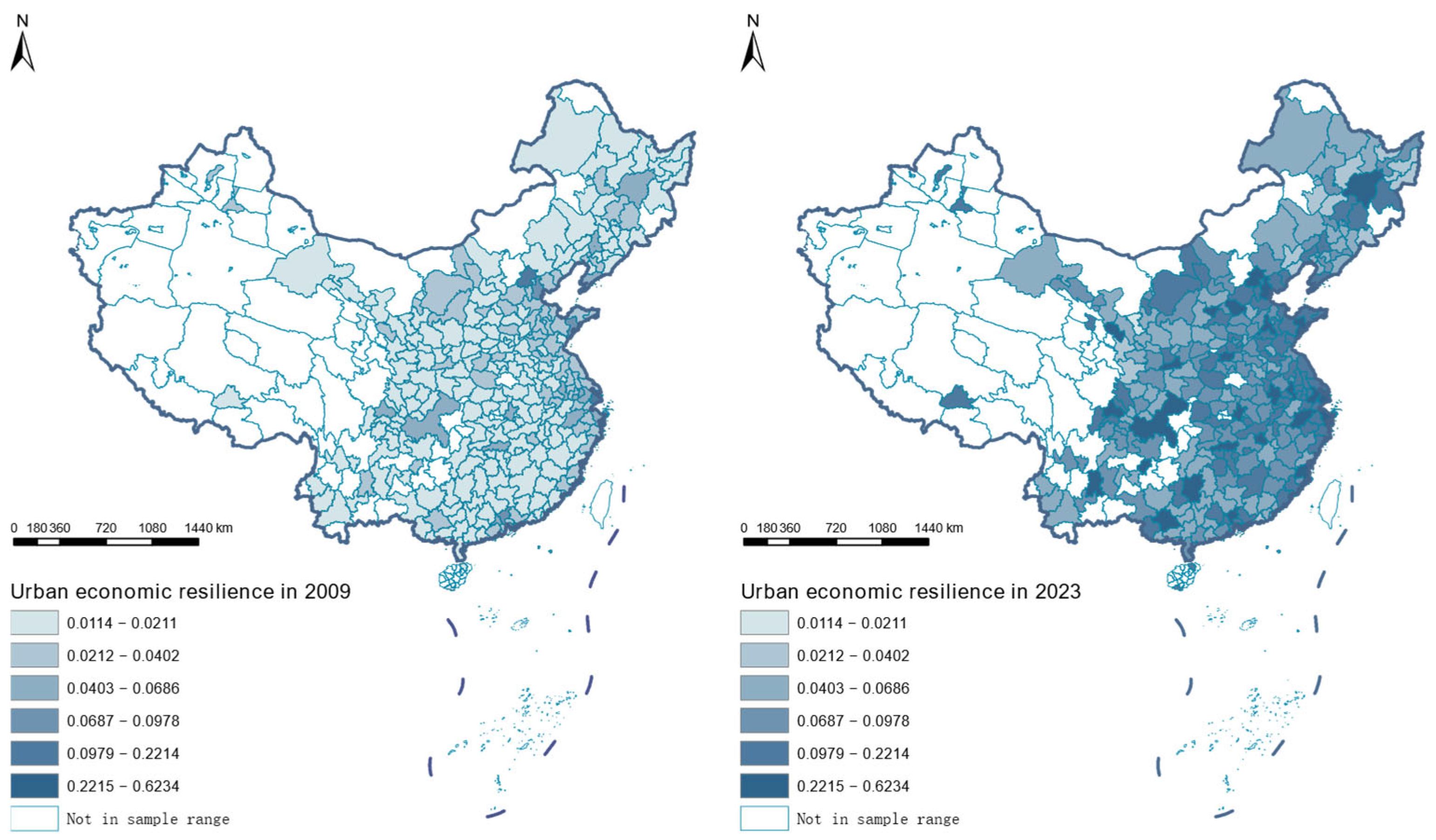
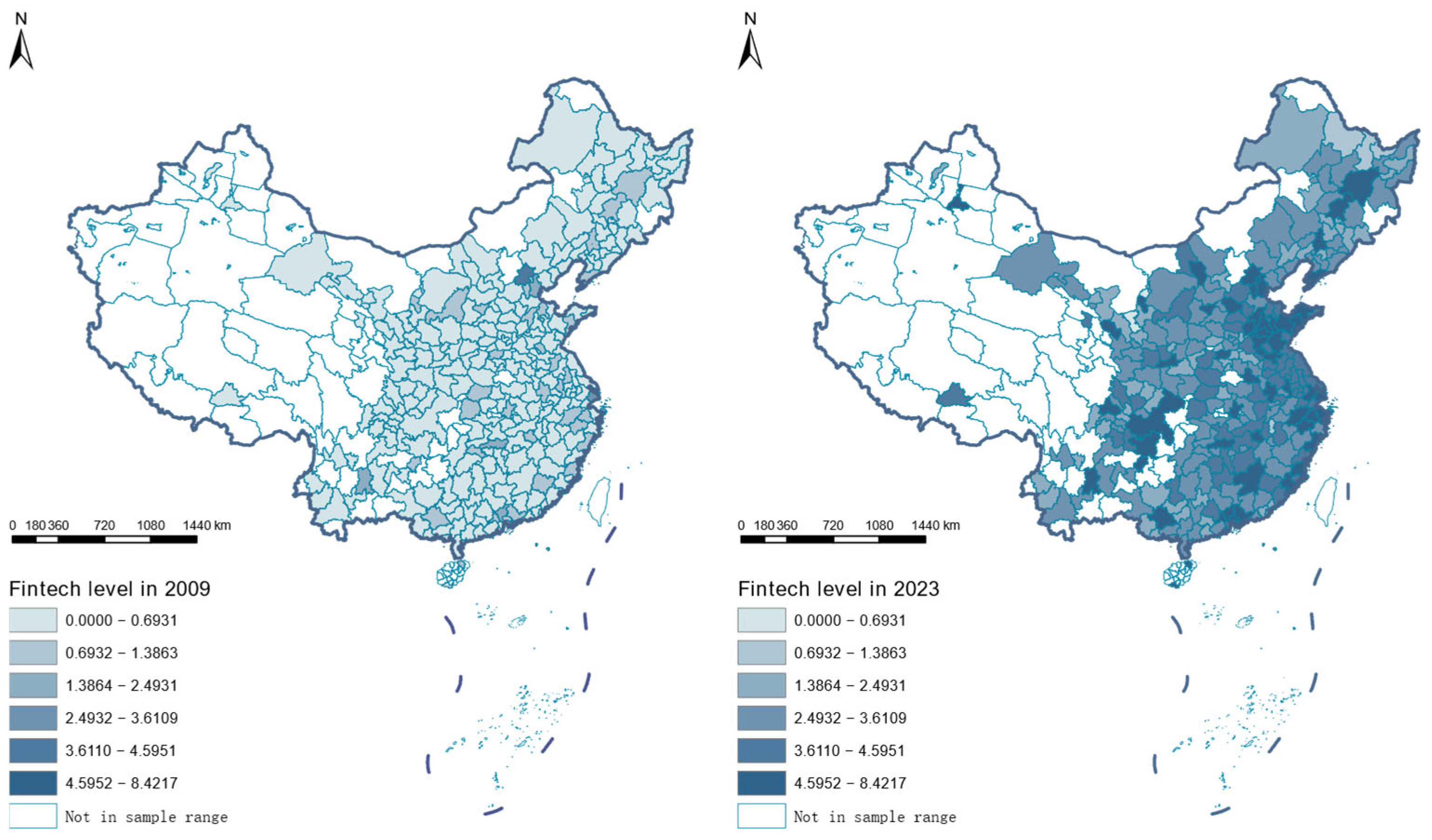
The regression results for the variables are shown in Table 3. The mean and standard deviation of urban economic resilience (res) are 0.0514 and 0.0564, respectively. It has a minimum value of 0.0115 and a maximum value of 0.6234. These findings indicate that urban economic resilience varies substantially across cities. The mean value of financial technology (fi) is 1.6228, and the standard deviation is 1.6670, with a large difference between the minimum value and the maximum value, indicating that there are also large differences in the level of financial technology development across cities, which is essentially consistent with the findings of existing studies. Among the other control variables, economic development (ecod) ranges from a maximum of 0.2600 to a minimum of −0.2063, indicating varying growth rates across different regions, with some inland areas even exhibiting negative development trends. Population density (pop) averages 0.0486. The mean value of industrial structure (inst) is 1.0588, with a standard deviation of 0.5899, indicating significant variations in industrial composition. Capital production has a mean of 0.8026, and the extent of government regulation (gov) averages 0.1980. The income level variable has a standard deviation of 0.4654, indicating significant variability. The average market size is 0.3768. The average industrial agglomeration level of the moderator variable is 0.0320, which is essentially the same as the conclusion of the existing studies.

5.2. Benchmark Regression

The results of the impact of fintech on urban economic resilience are shown in Table 4. Column (1) represents the regression results that add only the level of fintech. The coefficient of fi is 0.0186, which is significant at the 1% level. This finding indicates that a higher level of fintech positively affects urban economic resilience. Specifically, an increase in fintech development at the prefectural city level can effectively strengthen the growth of urban economic resilience. Column (2) shows the regression results with a series of control variables added, namely, economic development (ecod), population density (pop), industrial structure (inst), capital production (pk), extent of government regulation (gov), income level (income) and market size (market). The estimated coefficients of fi are still significantly positive. The coefficient of fi is 0.0138, which is significant at the 1% level. Consistent with the regression results in Column (1), the above results verify Hypothesis 1.
Raising fintech by one standard deviation corresponds to an increase of 0.0138 standard deviations in urban economic resilience, indicating a statistically significant and economically non-trivial impact. Fintech plays a significant role in enhancing urban economic resilience, probably because it effectively enhances the resilience of the urban economy by improving financial efficiency, promoting industrial structure upgrading [39], optimizing resource allocation [52] and driving innovation and entrepreneurship, leading to a marked improvement in urban economic resilience. Specifically, it helps financial institutions identify and manage risks, lower credit costs, and enhance capital liquidity; promotes the emergence of emerging industries and the transformation of traditional sectors, thereby improving total factor productivity; optimizes resource allocation, reduces information asymmetry, and strengthens market transparency; and reduces the threshold for entrepreneurship, supports small and micro enterprises, and stimulates economic vitality [10,42], all of which in turn contribute to the development of a more resilient urban economy.

5.3. Mechanism Analysis

5.3.1. Moderating Effect Test

The regression results of the moderating effect of the industrial agglomeration level are shown in Table 5. Column (1) shows that without adding control variables, the coefficients for fi and the interaction term between fi and aggl (fi*aggl) are 0.0125 and 0.4862, respectively, with both significant at the 1% level. Column (2) shows that with the addition of control variables, the coefficient of fi is 0.0121 and the coefficient of fi*aggl is 0.2849, both of which are significant at the 1% level. Across specifications with and without covariates, the fintech coefficient remains reliably positive, and the interaction term (fintech × industrial agglomeration) attains statistical significance. This pattern confirms that denser industrial clustering magnifies the favorable effect of fintech on urban economic resilience [14,16]. These results support Hypothesis 2.
The moderating influence of industrial agglomeration appears to work through multiple reinforcing channels. To begin with, spatial clustering enhances the joint allocation of information, technological know-how, human talent, and financial capital—it fosters interfirm technology diffusion and knowledge circulation while unlocking substantial scale economies. Furthermore, the evidence may demonstrate that these conditions reduce the average cost of adopting fintech, allowing platforms to serve many small and medium-sized enterprises at lower marginal cost and thereby enhancing regional risk-resilience. Given that spillovers of innovation resources such as knowledge and talent appear to accelerate the diffusion of digital financial technologies, the results could suggest that raising region’s fintech capability improves financial service efficiency while reducing financing costs. Agglomeration clusters optimize resource allocation efficiently. Fintech directs capital to high-productivity firms and enables rapid reallocation during shocks. This supports the evidence that interconnected firms use collaborative networks to bridge supply–demand gaps and adjust business models [13]. In light of these key results, the evidence could demonstrate that risk synergy through supply chain networks reduces the risk of cascading defaults across the regional economy. The combined effect of these factors may suggest that these mechanisms together strengthen the fintech-resilience link and enhance a city’s ability to withstand external shocks. And the data could indicate that the enabling effect of fintech appears more pronounced in cities with high industrial agglomeration. Fintech effects show agglomeration links resilience.

5.3.2. Mediating Effect Test

The regression results of the mediating effect are shown in Table 6. The total effect of fintech (fi) on urban economic resilience (res) is 0.0138 (p < 0.01) in the baseline regression. The two mediation paths are examined separately.
  • Credit Availability Channel
Column (1) shows that the coefficient of fi on credit is 0.1260. It is significant at the 1% level. This indicates that fintech alleviates financing constraints and enhances urban credit availability. This verifies Hypothesis 1a.
Fintech expands credit access by attenuating informational imbalances between lenders and borrowers and by streamlining loan origination workflows. During adverse episodes, this expanded access furnishes enterprises with liquidity buffers that prevent cash-flow interruptions and speed up post-shock recuperation. Notably, the credit-mediated indirect channel constitutes merely 3.01% of the overall effect. This modest effect may be because credit expansion is broad in scope but limited per transaction. Also, during crises, funds tend to flow toward enterprises with stable operations.
2.
Innovation Activity Channel
Following the same approach, Column (2) shows that the coefficient of fi on innov is 0.3801 (significant at 1%). This indicates that fintech has significantly driven corporate innovation. This validates Hypothesis 1b.
Fintech reduces the funding hurdles that typically constrain innovative ventures, thereby encouraging greater R&D expenditure and patenting activity. The resulting boost to urban innovation is substantial. Relative to the credit-access pathway, the innovation-driven mechanism accounts for a far larger share of the total effect, positioning it as the dominant conduit through which fintech reinforces resilience. This pathway facilitates industrial structure upgrading and adaptive restructuring. It enables cities to transform their economic structure more rapidly after a shock, thereby enhancing long-term resilience.
The above results consistently show that the core mechanism lies in a dual transmission framework. Innovation-driven growth is the primary driver, and financing support is secondary.

5.4. Heterogeneity Grouping Test

  • Urban Agglomerations Heterogeneity
Urban agglomerations constitute a mature spatial-organizational configuration that reflects advanced stages of regional economic integration. The magnitude of fintech’s contribution to resilience in a given setting hinges on contextual conditions—including the density of productive resources, the quality of hard and soft infrastructure, and the strength of policy commitment. Drawing upon the research of Liu Li and Lu Sen (2023) [62], the sample is divided into two groups on the basis of whether they belong to the Beijing–Tianjin–Hebei region, Yangtze River Delta, and Pearl River Delta urban agglomerations. A heterogeneity analysis is subsequently conducted using the two groups: one group comprises cities within the three major urban agglomerations noted above, and the other group consists of cities outside these agglomerations. As shown in Columns (1) and (2) of Table 7, fintech has a significantly positive effect on urban economic resilience across both sample groups. However, in terms of the coefficients, fintech demonstrates a stronger promotional effect on urban economic resilience in the three major urban agglomerations. Fisher’s permutation test yields a p value of 0.021 for the difference in the coefficients between the two groups, which is significant at the 5% level. This indicates that whether a city belongs to one of the three major urban agglomerations introduces significant heterogeneity into the regression. Compared with non-agglomerated regions, urban clusters facilitate the efficient aggregation and dynamic optimization of capital, technology, and talent within a geographic space. This fosters the exchange of fintech technologies and enhances information transmission, thereby improving the speed and accuracy of resource allocation and bolstering resilience against economic risks. Consequently, urban agglomerations amplify economies of scale and establish industrially collaborative networks characterized by functional complementarity and a specialized division of labor among cities, comprehensively strengthening the economic resilience of the entire agglomeration.
2.
Economic Development Level Heterogeneity
On the basis of the annual average regional GDP, the sample is divided into higher and lower economic development level groups for a heterogeneity analysis. The results are shown in Columns (3) and (4) of Table 7. The results show that the impact of fintech on urban economic resilience is significantly positive in regions with both high and low levels of economic development. However, the coefficient estimates indicate that the role of fintech in enhancing resilience is more pronounced in the three major urban agglomerations, with a notably stronger effect observed in regions with greater economic development [24,25]. The results of the Fisher permutation test reveal a statistically significant difference in the coefficients at the 1% level, indicating significant heterogeneity in the effect of fintech on urban economic resilience across regions with different economic development levels. Economically advanced regions enjoy deeper foundational endowments, more sophisticated physical and digital infrastructure, and stronger indigenous technological capacity. These preconditions have enabled earlier, faster uptake of fintech solutions, allowing such regions to extract greater value from fintech in terms of information dissemination, risk mitigation, and resource deployment—dynamics that further promote industrial colocation and structural modernization. Furthermore, economically advanced regions demonstrate stronger demand for and greater acceptance of fintech, thereby facilitating its penetration and reducing market resistance to some extent. Additionally, governments in more developed economies are more likely to prioritize fintech development, providing stronger policy support and a favorable regulatory environment to foster healthy growth. In cities with weaker economic resilience, on the other hand, it may be difficult to provide adequate support for fintech development because of limited government resources and insufficient regulatory capacity, thereby undermining its potential to strengthen local economic resilience.
3.
City Size Heterogeneity
On the basis of the Notice on Adjusting the Classification Standards of Urban Scale by the State Council of China, the selected sample is divided into type I small cities, type II small cities, medium cities, type I large cities, type II large cities, megacities and supermegacities. On this basis, the first three cities listed above (i.e., type I small cities, type II small cities, and medium cities) are categorized as small-scale cities; type I large cities and type II large cities are categorized as medium-scale cities; and the last two cities (i.e., megacities and supermegacities) are categorized as large-scale cities. A regression analysis is carried out on the basis of this division criterion, and the results are shown in Columns (5) to (7) of Table 7. From the regression results, the coefficient of fintech is statistically insignificant for small-scale cities but significantly positive for medium- and large-scale cities. Furthermore, the differences in the coefficients across the three city groups are statistically significant, indicating that the effect of fintech is significantly heterogeneous across cities of different sizes. In other words, the positive effect of fintech on urban economic resilience exhibits a notable size-dependent gradient. The negative coefficient observed for smaller cities suggests that in these settings, foundational infrastructure, skilled labor supply, and viable use cases for fintech are still nascent. Consequently, the incremental benefit of fintech for economic resilience has not yet materialized in a statistically detectable manner. Alternatively, other factors may be weakening the impact of fintech on urban economic resilience. The positive regression coefficients for medium- and large-scale cities indicate that fintech contributes positively to economic resilience in these cities. This result may be attributable to these cities’ superior infrastructure, richer human capital and more mature market environments, which translate fintech’s efficiency gains and risk-mitigation capabilities into a substantial increase in resilience.

5.5. Robustness Tests

In this paper, we refer to the paper by Martin and Shi Yutang et al. [63] and adopt the following robustness tests, To keep the text concise and easy to read, please refer to the appendix for detailed results:
Replacement of the variables: The results remain consistent with the baseline findings, confirming robustness. (Table A1 in the Appendix A.)
Tailing the data: After 1% winsorization, the coefficient of fintech remains stable and significantly positive, indicating that the results are insensitive to extreme values. (Table A1 in the Appendix A.)
Excluding the sample of municipalities directly under the control of the central government: After removing Beijing, Tianjin, Shanghai, and Chongqing, the core findings remain unchanged. (Table A1 in the Appendix A.)
Alternative Fixed-Effects Specification: Replacing city fixed effects with province fixed effects yields a coefficient that remains significantly positive, confirming that the main conclusions are robust to alternative fixed-effect granularity. (Table A1 in the Appendix A.)
Variance inflation factors (VIFs): All VIF values are well below the threshold of 10, indicating no severe multicollinearity; thus, treating industrial agglomeration as a moderating variable is methodologically sound. (Table A2 in the Appendix A.)

5.6. Endogeneity Problems

5.6.1. Instrumental Variable (IV) Test

High-level urban economic resilience implies greater risk tolerance, stronger innovation capabilities, and better optimized industrial allocation, which may exert a countervailing influence on the fintech industry [61,63]. Additionally, omitted variables may influence the empirical analysis, leading to biased regression coefficients for fintech variables. To ease estimation errors caused by endogeneity problems, this paper adopts the instrumental variable method.
First, drawing on the research by Tian Yao and Guo Lihong (2022) [64], we consider the geographical distance from the city to Hangzhou. On the one hand, Hangzhou is home to the Global Digital Finance Center and the birthplace of the Alipay application. It boasts advanced fintech development and strong spillover effects. The closer a city is to Hangzhou, the more likely it is to possess higher fintech capabilities. This satisfies the correlation hypothesis. On the other hand, the geographical distance from Hangzhou neither affects a city’s economic resilience nor varies systematically with its level of fintech development, thus satisfying the exogeneity assumption. Nevertheless, the distance of the city to Hangzhou remains constant over time. Drawing upon the study by Gong Qinlin and Zhang Bingbing (2023) [65], we adopt “ten thousand kilometers” as the unit for the distance of the city to Hangzhou. By multiplying this distance by the cubic term of the time trend, we generate panel data to serve as instrumental variable for testing.

5.6.2. Quasinatural Experiment

To further address the endogeneity concerns arising from sample selection bias and omitted variables, this paper employs a quasinatural experimental method, adopting the methodological approach introduced by Zhiying Ji et al. (2024) [66]. Leveraging the introduction of a fintech policy as an exogenous shock, this paper follows the approach of Zhou Shaofu et al. (2023) [56] to investigate the relationship between fintech and urban economic resilience more accurately. In 2011, five Chinese ministries and commissions jointly released the “Notice on Launching the Pilot Reforms for Promoting the Integration of Science and Technology with Finance (S&T Finance)”, which designated 16 regions as the inaugural batch of pilot zones; in 2016, the “Implementation Plan for Promoting the Integration of Science and Technology with Finance” was issued, designating nine cities as the second batch of pilot programs for the integration of science–technology and finance. This initiative served to further catalyze the development and refinement of China’s fintech sector. From an institutional theory perspective, this top-down institutional provision exogenously shapes the urban fintech environment. This offers a quasi-natural experiment to identify fintech’s causal effects on resilience. Following Beck et al. (2010) [67], a multiperiod DID model is constructed based on the two batches of the sci–tech finance pilot policy in 2011 and 2016, which helps to mitigate reverse causality as follows:
r e s i , t = φ 0 + φ 1 d i d i , t + φ 2 c o n t r o l s i , t + μ i + θ t + ε i , t  
where r e s i , t represents economic resilience and d i d i , t represents the double difference estimator. For city i selected as a pilot for integrated sci–tech and finance in year t , the treatment indicator d i d i , t takes a value of 1 from year t onward and 0 otherwise. The remaining variables are defined as in Equation (1). The results of the multiperiod DID estimation are reported in Column (3) of Table A3 in the Appendix A. The DID coefficient is 0.0314 (p < 0.01), confirming that the sci–tech finance pilot policy significantly enhances urban economic resilience.
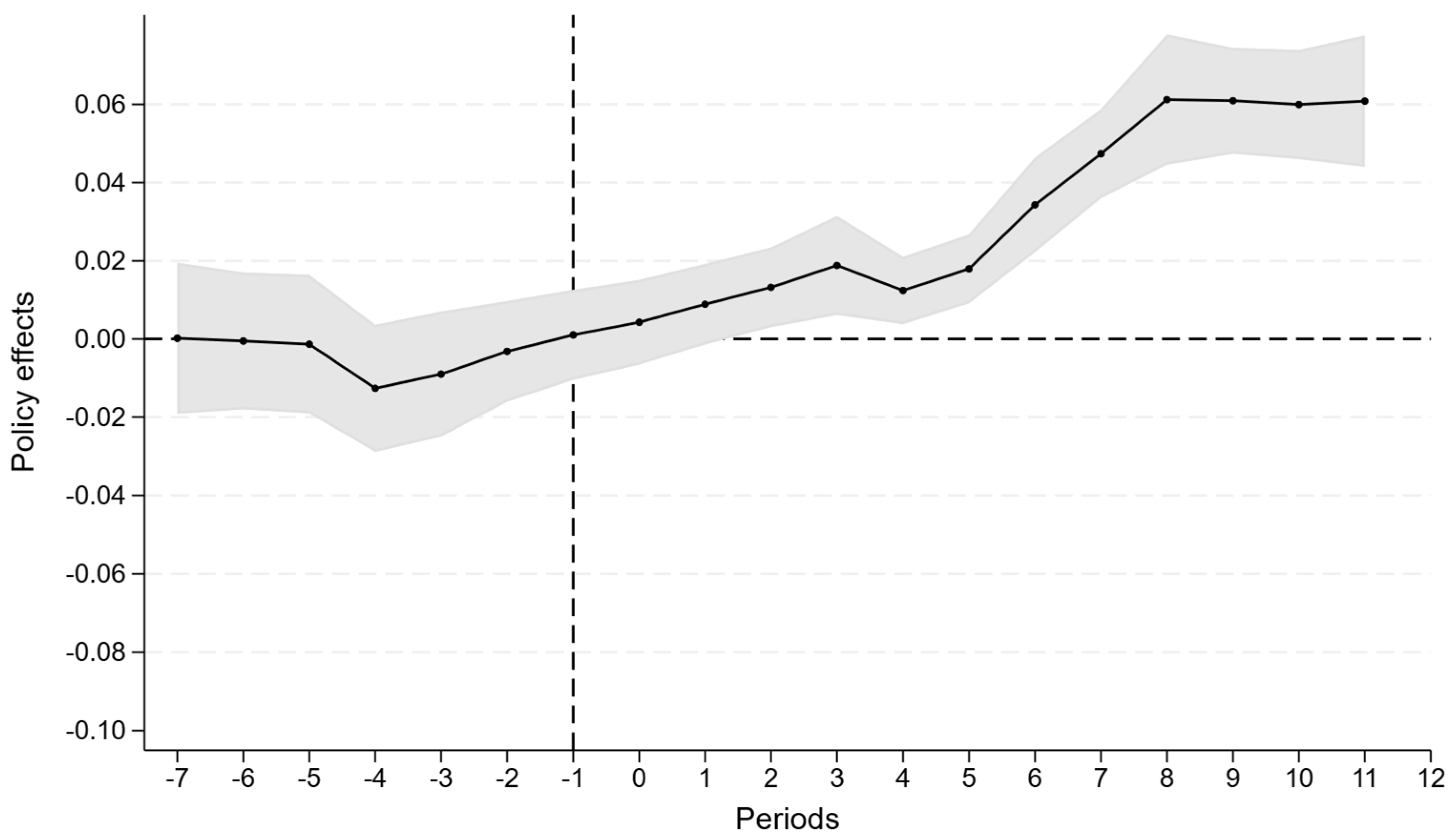
The validity of the DID model requires that the treatment and control groups would have followed parallel trends prior to the policy change. The pretreatment coefficients are not statistically significant, satisfying the parallel trend assumption (see Figure A1 in the Appendix B for details).
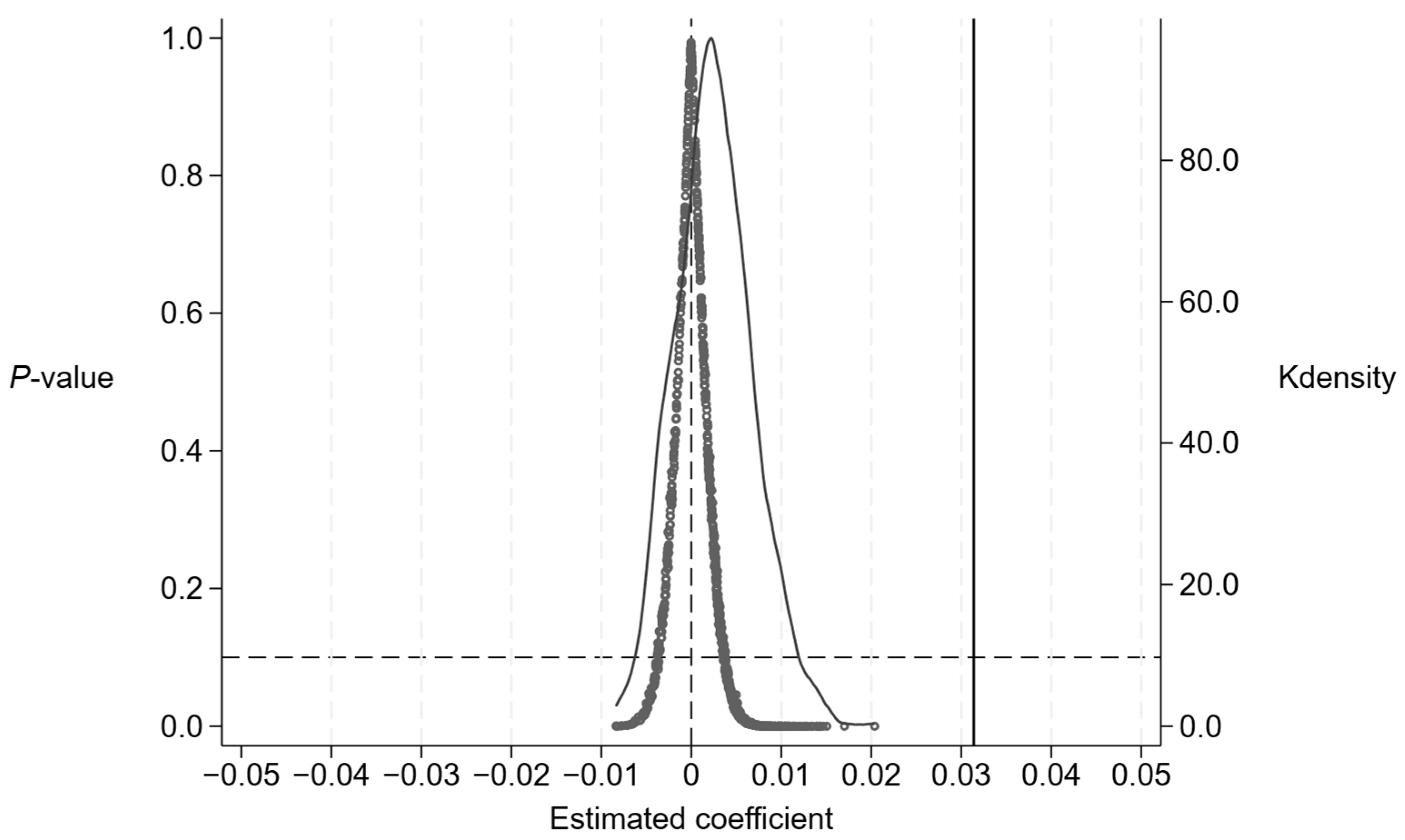
This paper further employs a placebo test to rule out potential unobservable factors and other omitted variables that may interfere with the multiperiod DID model. The pseudo coefficients cluster around zero and are significantly different from the true parameter (0.0314), confirming that the DID estimates are not driven by unobservable factors (see Figure A2 in the Appendix B for details).

6. Further Discussion: Spatial Spillover Effects Analysis

Fintech can accelerate information diffusion across metropolitan boundaries, channel financial resources toward adjacent jurisdictions, upgrade the financial ecosystem in surrounding areas, and ease the credit constraints that amplify the damage from external disturbances. By raising firm-level total factor productivity and steering industrial composition toward higher-value activities, these cross-city flows systematically strengthen the economic resilience of neighboring urban centers.
To further validate spatial spillover effects, this paper calculates the inverse distance between two locations to construct a geographic distance matrix. Drawing on the research of Li Jing et al. (2010) [68], the average GDP per capita for each prefecture-level city from 2009 to 2023 is calculated to form a diagonal matrix. This diagonal matrix is then nested and multiplied by the inverse distance squared matrix to construct an economic geography matrix to empirically test for the existence of spatial spillover effects of urban economic resilience. LM, Hausman, Wald and LR tests were performed on the spatial measurement model, and this paper ultimately selects the spatial Durbin model (SDM) with two-way fixed effects as the fundamental model for examining spatial spillover effects. Considering the comparison and robustness of the regression results, the spatial autoregressive model (SAR) and spatial error model (SEM) are added to the regression. The model is constructed as follows:
r e s i , t = α 0 + ρ W × r e s i , t + δ 1 W × f i i , t + α 1 f i i , t + δ 2 W × c o n t r o l s i , t + α 2 c o n t r o l s i , t + μ i + θ t + ε i , t  
r e s i , t = α 0 + ρ W × r e s i , t + α 1 f i i , t + α 2 c o n t r o l s i , t + μ i + θ t + ε i , t  
r e s i , t = α 0 + α 1 f i i , t + α 2 c o n t r o l s i , t + μ i + θ t + ε i , t ε i , t = λ W × ε i , t + v 1 , i t  
Equations (6)–(8) represent the spatial Durbin model (SDM), spatial autoregressive model (SAR), and spatial error model (SEM), respectively. In these equations, ρ denotes the spatial autocorrelation coefficient, W refers to the spatial weight matrix, δ 1 denotes the spatial interaction coefficient for fintech, δ 2 denotes the coefficients of the spatial interaction terms specified for the control, and λ denotes the spatial interaction coefficient for the error term. The remaining variables are defined as in Equation (1). When ρ 0 ,   δ 1 0 ,   δ 2 0 ,   a n d   λ = 0 , it corresponds to the SDM in Equation (6); when λ = 0 ,   δ 1 = δ 2 = 0   a n d   ρ 0 , it corresponds to the SAR model in Equation (7); and when ρ = 0 ,   δ 1 = δ 2 = 0   a n d   λ 0 , it corresponds to the SEM in Equation (8).
The regression results are shown in Table 8, with Columns (1) and (2) reporting the estimates for the SDM. The interaction coefficients for fintech with the geographic distance matrix and economic geography matrix are both significantly positive. Fintech has a direct effect of 0.0120 (p < 0.01) on local urban economic resilience and an indirect spillover effect of 0.0117 (p < 0.01) on neighboring cities. Thus, a one-unit increase in local fintech raises local resilience by 0.0120 units and, through knowledge spillovers, capital flows, and competition, raises neighboring resilience by 0.0117 units. The indirect effect accounts for about 49.4% of the total effect. These estimates reveal that fintech development in proximate cities produces discernible spatial externalities that feed back into local resilience. Decomposing the effect via partial derivatives confirms that the total, direct, and indirect components are each positive and statistically significant. These findings indicate that fintech enhances local economic resilience and generates positive spatial spillovers, thereby contributing significantly to the economic resilience of cities in neighboring regions. Examining inter-city transmission mechanisms, local fintech affects the resilience of neighboring cities through two primary channels: a direct spillover channel and an indirect reinforcement channel. First, the direct spillover channel. By leveraging regional economic cooperation and technology transmission networks, local fintech can create spillover effects through technological diffusion, knowledge sharing, and resource coordination. This process enhances financial innovation capacity and service efficiency in surrounding regions, ultimately contributing to improving the economic resilience of neighboring cities. Second, the indirect reinforcement pathway is that regional fintech can increase local urban economic resilience, thereby enabling it to leverage intercity economic linkages and synergistic interactions. Through the spatial autocorrelation of urban economic resilience, this effect spills over to enhance resilience in neighboring urban areas.
The regression results for the SAR model are presented in Columns (3) and (4). The coefficients of ρ are significantly positive at the 1% level, indicating that urban economic resilience is significantly spatially dependent across cities. As economies develop, economic activities across cities become increasingly interconnected, resulting in interlocked economic structures and significantly correlated growth. Economic shocks experienced by one city can easily be transmitted systemically to neighboring cities. Correspondingly, the city’s capacity to withstand and recover from such shocks can positively drive the economic development of its surrounding areas. In other words, the economic resilience of cities is mutually influenced by spatial spillover effects.
The SEM regression results are shown in Columns (5) and (6). The coefficient of λ is significantly positive at the 1% level. This finding indicates that one-time events significantly promote urban economic resilience [12,51], such as the breakthrough of fintech technology, so that it can enable the spillover of financial resources, fintech technology, talent and other elements. It can accelerate intercity information exchange and feedback, facilitate the spillover of financial resources, enhance the operational capacity and recovery ability of small and micro enterprises across cities, and stimulate the willingness for overall industrial innovation and increase urban economic standards. This allows surrounding cities to integrate resources more effectively and enhance their response capabilities when facing external shocks, which can lay a solid foundation for constructing a sustainable urban economic development framework.

7. Conclusions and Policy Implications

This study brings fintech and urban economic resilience into a unified analytical setting, combining theoretical reasoning with econometric evidence drawn from a panel of 281 Chinese prefectural-level cities spanning 2009–2023, to elucidate both the direct influence of fintech and the moderating role of industrial agglomeration. The main conclusions are as follows: (1) the results of the benchmark regression show that fintech can significantly improve urban economic resilience, and the conclusion still holds after a series of robustness tests are conducted; (2) the moderating effect analysis indicates a significant positive role of industrial agglomeration in the fintech–resilience relationship, which makes fintech’s enhancing effect more pronounced in cities with higher levels of agglomeration; (3) the results of the heterogeneity analysis reveal that the promoting effect of fintech on urban economic resilience is more obvious in cities within the three major urban agglomerations, cities with higher economic levels and medium-scale and large-scale cities; (4) the results of the spatial spillover effect analysis reveal that fintech increases urban economic resilience via improved regional coordination and that the level of urban economic resilience is not only exogenously affected by the development of fintech in neighboring cities but also spatially dependent on interactions in the development of urban economic resilience.
This study offers a useful complement to the existing literature. First, the baseline results are consistent with Zhou et al. (2025) [56] and the broader literature on fintech’s role in enhancing urban economic resilience. However, this study goes a step further by uncovering a positive moderating effect of industrial agglomeration and identifying two mediating pathways: innovation activity and credit availability. Second, the spatial spillover findings support the argument made by He and Yan (2023) [28] that fintech has regional spillover effects. Third, the heterogeneity analysis shows that fintech’s impacts are stronger in the three largest urban agglomerations and in large and medium-sized cities. This finding resonates with the discussion by Shi and Lu (2024) [22] on resilience differences under digital transformation. Overall, building on prior research, this study extends the role of industrial agglomeration from a direct effect to a moderating mechanism and provides a quantitative assessment of spatial spillovers.
On the basis of the conclusions above, this paper proposes the following implications:
  • Policymakers should create enabling conditions for fintech to realize its full potential as a resilience-enhancing force. Concrete steps include launching dedicated fintech pilot zones, upgrading digital financial infrastructure, dismantling data barriers that isolate financial institutions from real-economy actors, and strengthening the connective tissue between finance and production. Such interventions would curb systemic financial vulnerabilities, underpin macroeconomic stability, and deliver durable support for urban economic resilience. By promoting the deep adoption of technologies such as cloud computing, blockchain, and AI in finance, an efficient, secure, and intelligent foundational architecture can be built, which will ultimately improve the responsiveness and precision of financial services. Moreover, strengthening the fintech infrastructure is a key government priority. It enables real-time risk monitoring and dynamic management through technological means. By leveraging the capacity of fintech to improve efficiency, foster service innovation, and mitigate risks, this approach promotes high-quality economic development while enhancing the ability of cities to withstand, recover from, and adapt to economic shocks.
  • A strategically optimized industrial geography can amplify agglomeration multipliers and strengthen innovation-led growth. We recommend creating integrated demonstration districts—modeled on Shanghai’s Zhangjiang and Shenzhen’s Nanshan—where fintech capabilities are deliberately colocated with dense industrial clusters. Within these zones, tailored financial instruments (e.g., supply-chain finance) merit priority pilot deployment. These zones should be located in regions with high levels of industrial clustering. Zhangjiang in Shanghai and Nanshan in Shenzhen are typical examples. Within these zones, customized products such as supply chain finance should be piloted as a priority. This approach will translate the moderating role of industrial clustering from theory into practice. By improving resource allocation efficiency, promoting collaborative technological innovation, and optimizing factor mobility, industrial agglomeration reinforces the positive impact of fintech on urban economic resilience through a multiplier effect. To this end, governments should optimize the industrial spatial layout by guiding the clustering of relevant industries, enhancing industrial park facilities, and promoting interfirm cooperation, thereby cultivating strong industrial agglomeration effects. Concurrently, fintech firms should be encouraged to collaborate with physical enterprises in industrial agglomeration, provide customized solutions, and establish fintech innovation labs or pilot projects to explore application scenarios, thereby exploring application scenarios and driving deeper fintech–industrial integration and achieving a high-quality, sustainable urban development paradigm.
  • A differentiated, place-sensitive policy architecture is needed to bridge developmental gaps. In metropolitan clusters, advanced-economy regions, and medium-to-large urban centers, the priority should be deepening the symbiosis between fintech and high-end manufacturing as well as innovation-intensive sectors, capitalizing on existing advantages while ramping up R&D-oriented applications. On the one hand, nonurban agglomerations, regions with lower economic levels and small-scale cities should encourage interregional exchanges to foster economic zones that promote resource circulation. On the other hand, they should improve the construction of fintech infrastructure and increase the publicity and promotion of fintech, such as by organizing technical training and introducing proven applications, to create a favorable environment for fintech development. Therefore, these measures will help improve the efficiency of cities’ fintech utilization, thus enhancing their economic resilience.
  • Cross-jurisdictional coordination should be actively cultivated to harness spatial spillovers. The significantly positive spatial autoregressive parameter motivates several actionable measures. First, industrial relocation initiatives should be coupled with fintech-enabled financial incentives: prosperous cities can identify sectors suitable for outward transfer and provide subsidized fintech credit to receiving firms, thereby linking domestic industrial upgrading with deliberate positive externalities. Second, build a smart platform to quantify cross-city flows of capital, information, and technology, turning spatial spillovers into measurable indicators. Third, use policy guidance to dismantle institutional barriers. Strengthen positive externalities through technology transfer and talent exchange, establishing a rational spatial layout for fintech. Fourth, create a cross-city risk sharing fund. Allocate resources as needed to convert negative spillovers from regional shocks into shared risk mitigation, reducing systemic risk. These actions will foster intercity coordination and fully exploit the positive spatial spillover effects identified in this study.

8. Limitations and Future Research

However, some limitations to this study should be acknowledged.
First, regarding the limitations of the variables, this study uses the number of fintech companies as a proxy indicator of the sector’s development. This indicator has the limitation of being one-dimensional. While it reflects only the size of the industry, it does not capture fundamental characteristics such as the quality of companies or technological innovation. Due to constraints on data availability, a more comprehensive composite indicator has not been adopted. Furthermore, the weighting of economic resilience indicators involves a degree of subjectivity. In terms of various variables, although they are controlled for at the city level, potential factors such as urban governance and the quality of infrastructure may still be overlooked. In future research, the adoption of multidimensional indicators could be considered to improve measurement accuracy and reduce estimation bias.
Second, limitations of the macroeconomic context. This study is situated within China’s specific environment, which limits direct applicability to other countries and regions. Future research could include economies with substantially different macroeconomic conditions to conduct cross-country comparisons and test long-term effects, thereby enhancing generalizability. Moreover, the geographical scope is confined to China, so further verification in other contexts is needed.
Third, limitations concerning spatial spillovers. Concerning spatial spillovers, while inter-city effects are examined, the heterogeneity of transmission mechanisms across different urban networks is not fully explored, such as mechanisms between city clusters and non-clusters or under varying geographic distances. Future research could adopt more refined spatial weight matrices to address this issue.
Furthermore, this study finds a negative main effect of industrial agglomeration in the moderation model, whose economic interpretation depends on the level of fintech. Although no entirely new explanatory model is proposed, this study provides empirical evidence that integrates and extends existing frameworks. Future research could employ threshold regression models to further examine the nonlinear effect of industrial agglomeration on urban economic resilience across different levels of fintech development.

Author Contributions

Conceptualization, G.G. and Z.Z.; methodology, Z.Z.; software, G.G.; validation, G.G.; formal analysis, Z.Z.; investigation, Y.Y.; resources, G.G.; data curation, G.G.; writing—original draft preparation, G.G., Y.Y., H.L. and J.L.; writing—review and editing, G.G., Y.Y. and H.L.; visualization, H.L. and J.L.; supervision, Y.L.; project administration, Y.L.; funding acquisition, Y.L. All authors have read and agreed to the published version of the manuscript.

Funding

The work was supported by Sichuan Planning Office of Philosophy and Social Science (SC25ST002).

Institutional Review Board Statement

Not applicable.

Informed Consent Statement

Not applicable.

Data Availability Statement

The data can be obtained from the corresponding authors upon a reasonable request.

Conflicts of Interest

The authors declare no conflicts of interest.

Appendix A

Replacement of the variables: The regression is re-estimated as a proxy for fintech, with the China Digital Financial Index, which is jointly released by the Institute of Digital Finance at Peking University and Ant Research Institute. As the Digital Financial Index has been calculated since 2011, the regression analysis employs data from 281 prefecture-level cities covering the period from 2011–2023. As shown in Column (1) of Table A1, the results are consistent with the findings in Table 4. This finding indicates that the results are robust.
Tailing the data: Considering the impact of extreme data in the regression, the original data are subjected to a tailing process of 1% up and down. The regression results are shown in Column (2) of Table A1. The coefficient of fintech’s economic resilience enhancement effect remains stable at 0.0120 and continues to be significantly positive. This finding indicates that the significance level and direction remain unchanged and that the results are insensitive to extreme values.
Excluding the sample of municipalities directly under the control of the central government: Considering that the development of fintech is affected by geographic location and municipalities under the control of the central government have unique policy environments, resource allocations and management systems, which may result in significant differences from those of other cities, the benchmark regression results may be biased. Therefore, the samples from four municipalities, namely, Beijing, Tianjin, Shanghai and Chongqing, are excluded and the regression results are presented in Column (3).
Alternative Fixed-Effects Specification: To examine whether the benchmark findings are sensitive to city-level fixed-effect controls, the model was re-estimated by replacing city fixed effects with province fixed effects. As shown in column (4) of Table A1. Robustness test results, the coefficient of fi is 0.0171, which is slightly higher than the benchmark coefficient of 0.0138. It remains significantly positive at the 1% level. The sign and significance of the coefficient are highly consistent with those of the benchmark model, indicating no substantial change. These results confirm that the main conclusions are robust to alternative fixed-effect granularity and are not driven solely by city-specific unobservables.
Table A1. Robustness test results.
(1)
Replacement of the Variables
(2)
Shrinkage 1%
(3)
Excluding Municipality Samples
(4)
Alternative Fixed-Effects Specification
fi0.0011 ***
(16.6603)
0.0120 ***
(19.1501)
0.0122 ***
(19.1002)
0.0171 ***
(33.0079)
Constant−0.2658 ***
(−8.2850)
−0.0073
(−0.2010)
−0.0704 ***
(−2.8749)
−0.2001 ***
(−7.7463)
ControlsYesYesYesYes
City FEYesYesYesNo
Province FENoNoNoYes
Year FEYesYesYesYes
N3653421541554215
R20.87150.86170.84370.783
Note: *** represent significance at the 1% level, with the t values in parentheses.
To verify the robustness of the model specification, a multicollinearity test for all explanatory variables is conducted. Since the main reghdfe model does not directly provide variance inflation factors (VIFs), we obtained them from a pooled OLS regression. As shown in Table A2 in Appendix A, the results indicate that the VIF values for all independent variables are well below the conventional threshold of 10. Specifically, the VIF for the core explanatory variable fi is 3.240; the VIF for the interaction term between Fintech and industrial agglomeration (fi*aggl) is 3.100; and the VIFs for the remaining control variables fall in the interval of 1.200 to 3.270, with an overall mean VIF of 2.230. Taken together, these figures suggest that the model containing only the Fintech main effect and its interaction term is free from severe multicollinearity. Therefore, it is methodologically sound to treat industrial agglomeration as a moderating variable. The regression results are reliable.
Table A2. Variance inflation factors (VIFs).
VariableVIF
fi3.240
fi*aggl3.100
ecod1.670
inst1.820
pop3.270
pk1.150
gov1.630
income3.000
market1.200
Mean2.230
The results of the instrumental variable test are shown in Columns (1), (2), (3), and (4) of Table A3 in the Appendix A. After accounting for the endogeneity of the variables, the instrumental variable “distance from the city to Hangzhou” is positively correlated with fintech at the 1 percent significance level. This result points to a strong link between the IV and fintech. In the second stage, the impact of fintech on the improvement of urban economic resilience is still significantly positive at the 1% level. Moreover, the Kleibergen–Paap rk LM statistic has a p value of 0.000, leading to the rejection of the original hypothesis of “insufficient identification of instrumental variables”; the Kleibergen–Paap rk Wald F statistic is well above the 10% level Stock–Yogo critical value. The test of weak identification of IVs is passed. This finding indicates that after controlling for endogeneity effects, fintech still significantly enhances urban economic resilience.
The results of the multiperiod DID estimation are reported in Column (3) of Table A3 in the Appendix A. The coefficient of did is 0.0314, which is significantly positive at the 1% level. This finding demonstrates that pilot programs that integrate science–technology and finance significantly promote urban economic resilience and that fintech effectively strengthens it.
Table A3. Endogeneity test results.
VariablesInstrumental Variable MethodQuasinatural Experiment
(1)
Explanatory Variable: fi
(2)
Explained Variable: res
(3)
Explained Variable: res
fi 0.0596 ***
(9.2201)
IV: Distance of the city to Hangzhou−0.00198 ***
(−10.5717)
did 0.0314 ***
(7.7954)
Constant5.5159 ***
(6.0621)
−0.1995 ***
(−3.0465)
−0.0674 ***
(−3.5100)
ControlsYesYesYes
Individual FEYesYesYes
Year FEYesYesYes
Kleibergen–Paap rk LM125.788
[0.0000]
Kleibergen–Paap rk Wald F111.761
{16.38}
N421542154215
R2 0.70960.8516
Note: *** represent significance at the 1% level, with the t values in parentheses. The values in [ ] are the p values, and the values in { } are the critical values at the 10% level of the Stock–Yogo weak identification test.

Appendix B

The validity of the DID model requires that the treatment and control groups would have followed parallel trends prior to the policy change. This finding suggests that no statistically significant preexisting difference in urban economic resilience was observed between the pilot and nonpilot cities prior to the implementation of the sci—tech finance integration policy. Therefore, a parallel trend test is conducted. Figure A1 in Appendix B presents the estimation results under a 95% confidence interval in the parallel trend test using the period preceding the policy implementation as the base period. The results show that during the pre-policy period, there was no significant difference in urban economic resilience between the pilot cities and nonpilot cities, with the expected impact being negative. During the rollout of the pilot policy, no significant difference in urban economic resilience emerged between the pilot cities and nonpilot cities in the short term because of the time lag effect. The policy subsequently exerted a substantial positive effect, which is consistent with the expected impact of fintech on urban economic resilience. Thus, the parallel trend hypothesis holds.
Figure A1. Parallel trend test results.
Sustainability 18 05028 g0a1
This paper further employs a placebo test to rule out potential unobservable factors and other omitted variables that may interfere with the multiperiod DID model. First, cities were randomly selected from the sample cities, matching the number of pilot projects, to serve as the experimental group. These were then cross-multiplied with policy periods randomly chosen between 2009 and 2023 to construct the policy time dummy variables. On the basis of Model (5), regression analysis was performed and repeated 1000 times, and the results are shown Figure A2 in Appendix B. The estimated coefficients from spurious regressions are predominantly clustered around zero, sharply contrasting with the true parameter value of 0.0314. With most pseudo−regression P values well above 0.1 and following a roughly normal distribution, the placebo test is thereby satisfied. This result provides additional validation for the robust conclusion that fintech promotes urban economic resilience.
Figure A2. Placebo test results.
Sustainability 18 05028 g0a2

Appendix C

The distribution of economic resilience and fintech development levels across 281 prefecture-level cities in 2009 and 2023 is shown in Figure A3 and Figure A4, respectively.
Figure A3. Urban economic resilience distribution maps for 2009 and 2023. Note: This figure was drawn on the basis of the standard map (No. GS(2024)0650) provided by the Ministry of Natural Resources of the People’s Republic of China. The same source applies to Figure A4.
Sustainability 18 05028 g0a3
Figure A4. Financial technology maps for 2009 and 2023.
Sustainability 18 05028 g0a4
This paper adopts the global Moran’s I index method to calculate the spatial autocorrelation of urban economic resilience and fintech for each year under the geographic distance matrix and economic geography matrix to verify whether there is a spatial effect between them. As shown in Table A4, Moran’s I values for urban economic resilience and fintech are significantly positive at the 1% level. These findings indicate that the urban economic resilience and fintech that cover 281 prefecture-level cities in China over the period 2009–2023 obviously increase and significantly positive spatial autocorrelations exist, which provides preliminary evidence for the spatial spillover effects of both urban economic resilience and fintech. This indicates that cities with advanced fintech are often located near each other, and similarly for resilient cities. Such spatial dependence means a city’s fintech development can influence neighboring cities’ resilience through knowledge spillovers and capital flows.
Table A4. Spatial spillover results: City economic resilience levels and global Moran’s I values from 2010–2020.
Yearresfi
Geographic Distance MatrixEconomic Geography MatrixGeographic Distance MatrixEconomic Geography Matrix
Moran’s Ip ValueMoran’s Ip ValueMoran’s Ip ValueMoran’s Ip Value
20090.04760.00000.17450.00000.01210.00180.07280.0000
20100.04760.00000.16800.00000.01660.00010.06160.0006
20110.04700.00000.16890.00000.01750.00000.05910.0010
20120.04400.00000.16030.00000.01680.00010.05830.0012
20130.04320.00000.15780.00000.02460.00000.08640.0000
20140.04080.00000.14870.00000.02610.00000.08920.0000
20150.04230.00000.15680.00000.02960.00000.09870.0000
20160.04490.00000.17130.00000.03070.00000.10400.0000
20170.04800.00000.18560.00000.03950.00000.12640.0000
20180.04860.00000.18740.00000.04540.00000.14070.0000
20190.04690.00000.17780.00000.04680.00000.13510.0000
20200.02790.00000.09970.00000.05030.00000.14390.0000
20210.05100.00000.19160.00000.04900.00000.14390.0000
20220.05070.00000.18670.00000.04930.00000.14590.0000
20230.02780.00000.09610.00000.04970.00000.14480.0000

References

  1. Holling, C.S. Resilience and stability of ecological systems. Annu. Rev. Ecol. Syst. 1973, 4, 1–23. [Google Scholar] [CrossRef]
  2. Zeng, X.; Yu, Y.; Yang, S.; Lv, Y.; Sarker, M.N.I. Urban Resilience for Urban Sustainability: Concepts, Dimensions, and Perspectives. Sustainability 2022, 14, 2481. [Google Scholar] [CrossRef]
  3. Derissen, S.; Quaas, M.F.; Baumgärtner, S. The relationship between resilience and sustainability of ecological-economic systems. Ecol. Econ. 2011, 70, 1121–1128. [Google Scholar] [CrossRef]
  4. Martin, R. Regional economic resilience, hysteresis and recessionary shocks. J. Econ. Geogr. 2012, 12, 1–32. [Google Scholar] [CrossRef]
  5. Kamila, B.; Peter, N.; Guevara, P. Urban resilience patterns after an external shock: An exploratory study. Int. J. Disaster Risk Reduct. 2018, 31, 381–392. [Google Scholar] [CrossRef]
  6. Brada, J.C.; Gajewski, P.; Kutan, A.M. Economic resiliency and recovery, lessons from the financial crisis for the COVID-19 pandemic: A regional perspective from Central and Eastern Europe. Int. Rev. Financ. Anal. 2021, 74, 101658. [Google Scholar] [CrossRef]
  7. Zheng, W.; Luo, R.; Du, J. Research on the Enhancing Effect of the Tax Structure Optimization on Urban Economic Resilience: An Analysis Based on Capital and Labor Allocation Efficiency. Mod. Financ. Econ.-J. Tianjin Univ. Financ. Econ. 2024, 44, 86–102. [Google Scholar] [CrossRef]
  8. Suryono, R.R.; Budi, I.; Purwandari, B. Challenges and trends of financial technology (Fintech): A systematic literature review. Information 2020, 11, 590. [Google Scholar] [CrossRef]
  9. Liao, Z.; Wang, L. Fintech and Industrial Structure Upgrading of Beijing-Tianjin-Hebei Region. Soc. Sci. Beijing 2023, 5, 22–32. [Google Scholar] [CrossRef]
  10. Niu, D.; Li, K.; Huang, M.H. Financial Technology Development and Its Competitiveness in Southeast Asia. Southeast Asian Aff. 2023, 3, 82–95. [Google Scholar] [CrossRef]
  11. Zhang, X. Financial Development and Common Prosperity: A Research Framework. Econ. Perspect. 2021, 12, 25–39. [Google Scholar]
  12. Zhen, Z.; Zhao, R. Research on the Spatial Spillover Effect of Financial Industry Agglomeration on Regional Economic Resilience. Contemp. Econ. Manag. 2021, 43, 89–97. [Google Scholar] [CrossRef]
  13. Jia, Y.; Tang, Z. The Impact of Talent Agglomeration and Industrial Agglomeration on Urban Economic Resilience: A Case Study of 100 Cities in the Yellow River Basin. Shandong Macroecon. 2024, 4, 45–54. [Google Scholar]
  14. Deng, Y.; Sun, H. The Effect of Industrial Agglomeration on Economic Resilience and Its Mechanism. Soft Sci. 2022, 36, 48–54+61. [Google Scholar] [CrossRef]
  15. Zhu, J.; Sun, H. Does the Digital Economy Enhance Urban Economic Resilience? Mod. Econ. Res. 2021, 10, 1–13. [Google Scholar] [CrossRef]
  16. Zheng, M.; Li, F. Agglomeration of Producer Services and Urban Economic Resilience: Theoretical Basis and Empirical Evidence. Stat. Decis. 2024, 40, 126–131. [Google Scholar] [CrossRef]
  17. Chen, Y.; Guo, C. Industrial diversification agglomeration, human capital, and urban economic resilience. Stat. Decis. 2024, 40, 93–97. [Google Scholar] [CrossRef]
  18. Liao, Z.; Lei, Y. Research on the Impact of Digital Technology Innovation on Urban Economic Resilience: Empirical Evidence from 278 Cities at Prefecture Level and Above in China. J. Manag. 2023, 36, 38–59. [Google Scholar] [CrossRef]
  19. Han, A.; Li, M.; Gao, Z. Measurement on Economic Resilience Under Epidemic Impact and Analysis on the Influencing Factors. Stat. Decis. 2021, 37, 85–89. [Google Scholar] [CrossRef]
  20. Zhang, Z.; Xu, P. Can Data Factor Agglomeration Enhance Urban Economic Resilience: An Empirical Evidence from the Construction of Comprehensive Big Data Pilot Zones. Macroeconomics 2024, 16, 59–76. [Google Scholar]
  21. Lin, Z.; Lin, S.; Chen, J. Evaluating Urban Economic Resilience in the Face of Major Public Health Emergencies: A Spatio-temporal Analysis. Land 2025, 14, 1977. [Google Scholar] [CrossRef]
  22. Shi, C.; Lu, J. Unlocking Economic Resilience: A New Methodological Approach and Empirical Examination under Digital Transformation. Land 2024, 13, 621. [Google Scholar] [CrossRef]
  23. Ramezani, R.; Farshchin, A. Urban resilience and its relationship with urban poverty. J. Urban Plan. Dev. 2021, 147, 05021042. [Google Scholar] [CrossRef]
  24. Yang, T.; Wang, L. Did Urban Resilience Improve during 2005–2021? Evidence from 31 Chinese Provinces. Land 2024, 13, 397. [Google Scholar] [CrossRef]
  25. Yu, R.; Xia, X.; Huang, T.; Zhang, S.; Zhou, W. Has the Establishment of High-Tech Zones Improved Urban Economic Resilience? Evidence from Prefecture-Level Cities in China. Land 2024, 13, 241. [Google Scholar] [CrossRef]
  26. Chang, Z.; Hab, F.; Zhong, L. Does the National Innovative City Pilot Policy Increase Economic Resilience—Evidence from the Quasi-natural Experiment. Econ. Probl. 2023, 04, 105–112. [Google Scholar] [CrossRef]
  27. Liu, Y.; Wang, Y.; Deng, W. Impact of Smart City Construction on the Resilience of Urban Economy in China. Econ. Geogr. 2024, 44, 135–143+185. [Google Scholar]
  28. He, G.; Yan, J. The Impact of Digital Finance on the Urban Economic Resilience—Empirical Analysis Based on Spatial Econometric Model. Inq. Econ. Issues 2023, 3, 97–110. [Google Scholar]
  29. Zhao, L.; Shi, J.; Tao, Y. The impact and mechanism of digital finance on urban economic resilience. Int. Rev. Financ. Anal. 2025, 106, 104468. [Google Scholar] [CrossRef]
  30. Wu, J. Urban ecology and sustainability: The state-of-the-science and future directions. Landsc. Urban Plan. 2014, 125, 209–221. [Google Scholar] [CrossRef]
  31. Redman, C.L. Should sustainability and resilience be combined or remain distinct pursuits? Ecol. Soc. 2014, 19, 37. [Google Scholar] [CrossRef]
  32. Romero-Lankao, P.; Gnatz, D.M.; Wilhelmi, O.; Hayden, M. Urban Sustainability and Resilience: From Theory to Practice. Sustainability 2016, 8, 1224. [Google Scholar] [CrossRef]
  33. Krellenberg, K.; Bergsträßer, H.; Bykova, D.; Kress, N.; Tyndall, K. Urban Sustainability Strategies Guided by the SDGs—A Tale of Four Cities. Sustainability 2019, 11, 1116. [Google Scholar] [CrossRef]
  34. Bei, H.; Tang, M.; Zhang, C. Financial technology, regional financial agglomeration, and urban economic resilience. Financ. Res. Lett. 2024, 68, 105990. [Google Scholar] [CrossRef]
  35. Perez, C. Technological revolutions and techno-economic paradigms. Camb. J. Econ. 2009, 34, 185–202. [Google Scholar] [CrossRef]
  36. Chen, M.A.; Wu, Q.; Yang, B. How Valuable Is FinTech Innovation? Rev. Financ. Stud. 2019, 32, 2062–2106. [Google Scholar] [CrossRef]
  37. Yang, R.; Liu, Z. Fintech and Urban Entrepreneurial Activity. Financ. Res. Lett. 2025, 75, 106661. [Google Scholar] [CrossRef]
  38. Tang, S.; Lai, X.; Huang, R. How Can Fintech Innovation Affect TFP: Facilitating or Inhibiting?—Theoretical Analysis Framework and Regional Practice. China Soft Sci. 2019, 7, 134–144. [Google Scholar]
  39. Li, H.; Zhang, J. The Impacts of Financial Technology on Industrial Structure Optimization and Industrial Upgrading. Stat. Res. 2022, 39, 102–118. [Google Scholar] [CrossRef]
  40. Ma, W.; Yu, M.; Fan, R. Could Bank Fintech Development Reduce Firms’ Credit Default Risk? Mod. Financ. Econ.-J. Tianjin Univ. Financ. Econ. 2024, 44, 73–92. [Google Scholar] [CrossRef]
  41. Jin, H.; Li, H.; Liu, Y. FinTech, Banking Risks and Market Crowding-out Effect. J. Financ. Econ. 2020, 46, 52–65. [Google Scholar] [CrossRef]
  42. Liu, J.; Zhang, Y. Financial Technology, Strict Environmental Regulation and Development of Regional Industrial Green. Theory Pract. Financ. Econ. 2022, 43, 123–131. [Google Scholar] [CrossRef]
  43. Cheng, Y.; Yu, M.; Li, B. How does Fintech Promote the Optimization of Corporate Capital Structure? Financ. Regul. Res. 2024, 2, 77–97. [Google Scholar] [CrossRef]
  44. Wu, C.; Lin, Y. Current research status and prospects of FinTech. J. Manag. Sci. China 2024, 27, 1–20. [Google Scholar]
  45. Liu, R.; Zhang, W. Can Spatial Agglomeration Enhance the Resilience of China’s Manufacturing Industry—From the Perspective of Industrial Adaptive Structure Adjustment. Contemp. Financ. Econ. 2021, 11, 16–27. [Google Scholar] [CrossRef]
  46. Guo, W.; Huang, F. How does the co-agglomeration of high-tech industries and producer services affect the quality of economic growth? Ind. Econ. Res. 2020, 6, 128–142. [Google Scholar] [CrossRef]
  47. Fang, L.; Zhang, X. Spatial effect and influencing mechanism of sci-technology finance ecology on regional economic resilience. China Soft Sci. 2023, 6, 117–128. [Google Scholar]
  48. Qiu, H.; Huang, Y.; Ji, Y. How does FinTech Development Affect Traditional Banking in China? J. Financ. Res. 2018, 11, 17–29. [Google Scholar]
  49. Schumpeter, J.A. The Theory of Economic Development, 1st ed.; Routledge: London, UK, 2021. [Google Scholar] [CrossRef]
  50. Dong, X.; Wu, Z.; Chen, Q. The Effect of Fintech Development on Commercial Banks’ Risk Prevention and Control—An Empirical Analysis Based on the Evidence of 176 Commercial Banks in China. Jiangsu Soc. Sci. 2023, 1, 84–94+242–243. [Google Scholar] [CrossRef]
  51. Benkraiem, R.; Garfatta, R.; Lakhal, F.; Zorgati, I. Financial contagion intensity during the COVID-19 outbreak: A copula approach. Int. Rev. Financ. Anal. 2022, 81, 102136. [Google Scholar] [CrossRef]
  52. Gao, H.; Fang, J.; Li, M. The power of FinTech in risk management: Evidence from China’s banking institutions. Syst. Eng. Theory Pract. 2022, 42, 3201–3215. [Google Scholar]
  53. Song, M.; Zhou, P.; Si, H. Financial Technology and Enterprise Total Factor Productivity—Perspective of “Enabling” and Credit Rationing. China Ind. Econ. 2021, 4, 138–155. [Google Scholar] [CrossRef]
  54. Wang, H.; Cao, Q.; Cao, Y. FinTech Empowerment and Real Economy Repair—Based on the Covid-19 Shock. Nankai Bus. Rev. 2024, 27, 16–26. [Google Scholar]
  55. Shen, Y.; Guo, P. Internet Finance, Technology Spillover and Commercial Banks TFP. J. Financ. Res. 2015, 3, 160–175. [Google Scholar]
  56. Zhou, S.; Ye, N.; Zhan, W. Research on the Impact of Pilot Policies on Combining Technology and Finance on Regional Innovation—Based on the Perspective of Fintech. Economist 2023, 8, 95–106. [Google Scholar] [CrossRef]
  57. Zhou, J.; Xia, N.; Zhang, Y. Digital Finance and Urban Economic Resilience: A Perspective Based on Innovation Activity. Stat. Decis. 2025, 41, 120–124. [Google Scholar] [CrossRef]
  58. Sun, H.; Wang, Y.; Chen, T. Has Industrial Agglomeration Raised the Efficiency of Urban Green Economy? J. Jiangsu Univ. (Soc. Sci. Ed.) 2022, 24, 51–64. [Google Scholar] [CrossRef]
  59. Buccella, D.; Fanti, L.; Gori, L. Network externalities, product compatibility and process innovation. Econ. Innov. New Technol. 2023, 32, 1156–1189. [Google Scholar] [CrossRef]
  60. Cuadrado-Roura, J.R.; Maroto, A. Unbalanced regional resilience to the economic crisis in Spain: A tale of specialisation and productivity. Camb. J. Reg. Econ. Soc. 2016, 9, 153–178. [Google Scholar] [CrossRef]
  61. Zheng, J.; Nie, Y.; Ma, X.J. Research on the Effects and Mechanisms of Digital Trade on the Optimal Layout of New Urbanization. China Bus. Mark. 2025, 39, 60–72. [Google Scholar] [CrossRef]
  62. Liu, L.; Lu, S. Digital Economy, Financial Development and Economic Resilience. Financ. Trade Res. 2023, 34, 67–83. [Google Scholar] [CrossRef]
  63. Martin, R.; Sunley, P. On the notion of regional economic resilience: Conceptualization and explanation. J. Econ. Geogr. 2015, 15, 1–42. [Google Scholar] [CrossRef]
  64. Tian, Y.; Guo, L. Does Digital Financial Inclusion Alleviate Income Gap? Empirical Evidence from China Family Panel Studies. Mod. Econ. Sci. 2022, 44, 57–70. [Google Scholar]
  65. Gong, Q.; Zhang, B. A Study on the Impact of Digital Finance on Urban Economic Resilience. J. Yunnan Univ. Financ. Econ. 2023, 39, 68–84. [Google Scholar] [CrossRef]
  66. Ji, Z.; Huang, Y. Does digital transformation promote economic resilience? Urban-level evidence from China. Heliyon 2024, 10, 26461. [Google Scholar] [CrossRef] [PubMed]
  67. Beck, T.; Levine, R.; Levkov, A. Big Bad Banks? The Winners and Losers from Bank Deregulation in the United States. J. Financ. 2010, 65, 1637–1667. [Google Scholar] [CrossRef]
  68. Li, J.; Tan, Q.; Bai, J. Spatial Econometric Analysis on Region Innovation Production in China—An Empirical Study Based on Static and Dynamic Spatial Panel Models. J. Manag. World 2010, 07, 43–55+65. [Google Scholar] [CrossRef]
Table 1. Comprehensive evaluation index system for urban economic resilience.
Primary IndicatorsSecondary IndicatorsTertiary IndicatorsWeightsAttributes
Urban economic resilienceResistance and RecoveryGDP per capita (yuan)0.0325Positive
Disposable income of urban residents (yuan)0.0188Positive
Savings balance of urban and rural residents (yuan)0.0776Positive
Registered unemployment in cities and towns (person)0.0003Negative
Proportion of total imports and exports to GDP (%)0.0043Negative
Adaptation and AdjustmentLocal fiscal revenue and expenditure ratio (%)0.0120Positive
Total retail sales of social consumption (10,000 yuan)0.0774Positive
Proportion of the tertiary industry in GDP (%)0.0042Positive
Deposit loan ratio of financial institutions at the end of the year (%)0.0105Positive
Investment in fixed assets (10,000 yuan)0.0683Positive
Transformation and DevelopmentNumber of patents authorized (pieces)0.1930Positive
Number of students in ordinary colleges and universities (person)0.2651Positive
Fiscal science expenditure (10,000 yuan)0.1710Positive
Fiscal expenditure on education (10,000 yuan)0.0651Positive
Table 2. Variable definition table.
CategoriesNameMeasurement MethodUnit
Explanatory variableFinancial technology (fi)The natural logarithm of the number of financial technology companies in prefecture-level cities +1
Explained variableCity economic resilience (res)Three dimensions: resistance and recovery, adaptation and adjustment, and transformation and development, measured using the entropy value method to obtain a comprehensive index of urban economic resilience
Control variablesEconomic development (ecod)The real growth rate of the local GDP (decimal form)
Industrial structure (inst)The ratio of added value in the tertiary industry to that in the secondary industry%
Population density (pop)The ratio of permanent residents to land area in the city that year10,000 people per square kilometer
Capital production (pk)The ratio of annual fixed capital stock to local GDP
Extent of government regulation (gov)The ratio of the government’s general public budget financial expenditure to the gross regional product%
Income level (income)The log of the average salary of local employees
The market scale (market)The share of the total retail sales of social consumer goods to GDP%
Moderating variableIndustrial agglomeration level (aggl)The ratio of the employed population to the administrative area across cities10,000 people per square kilometer
Mediating variableCredit availability
(credit)
The ratio of year-end loan balance of financial institutions to GDP%
Innovation activity
(innov)
Patent applications per 10,000 permanent residentsapplications per 10,000 persons
Table 3. Descriptive statistics for the main variables.
VariablesObsMeanStd. DevMinMax
res42150.05140.05640.01150.6234
fi42151.62281.66700.00008.4216
ecod42150.08310.0441−0.20630.2600
pop42150.04860.06360.00060.8854
inst42151.05880.58990.10875.6908
pk42150.80260.32590.00002.9924
gov42150.19800.10480.03531.5906
income421510.93490.46545.764412.6780
market42150.37680.10760.04891.0126
aggl42150.00670.01640.00000.2572
Table 4. Benchmark regression results.
Variables(1)
res
(2)
res
fi0.0186 ***
(23.5104)
0.0138 ***
(19.4736)
ecod 0.0228
(1.5919)
pop 1.0067 ***
(33.1158)
inst 0.0113 ***
(7.2661)
pk −0.0046 **
(−2.4758)
gov −0.0452 ***
(−5.3447)
income 0.0056 **
(2.2289)
market −0.0110 *
(−1.7538)
Constant0.0213 ***
(15.8678)
−0.0778 ***
(−2.8057)
N42154215
R20.81570.8589
City FEYesYes
Year FEYesYes
Note: *, **, and *** represent significance at the 10%, 5%, and 1% levels, respectively, with the t values in parentheses.
Table 5. Test results of the moderating effect of industrial agglomeration.
Variables(1)
res
(2)
res
fi0.0125 ***
(17.1860)
0.0121 ***
(17.2732)
fi*aggl0.4862 ***
(32.7520)
0.2849 ***
(15.8095)
aggl−3.0544 ***
(−26.8642)
−2.0990 ***
(−17.3585)
Constant0.0416 ***
(30.3011)
−0.0245
(−0.9116)
ControlsNoYes
N42154215
R20.85550.8691
City FEYesYes
Year FEYesYes
Note: *** represent significance at the 1% level, with the t values in parentheses.
Table 6. Test results of the mediating effect.
Variables(1)
Credit
(3)
Innov
fi0.1260 ***0.3801 ***
(17.3717)(16.9268)
Constant−2.0345 ***−13.0881 ***
(−7.2392)(−15.0246)
ControlsYESYES
N42154212
R20.4720.602
Cityid FEYESYES
Year FEYESYES
Note: *** represent significance at the 1% level, with the t values in parentheses.
Table 7. Results of the heterogeneity grouping tests.
VariablesExplained Variable: Urban Economic Resilience (res)
Urban AgglomerationsLevel of Economic DevelopmentCity Size
(1)(2)(3)(4)(5)(6)(7)
Cities Within the Three Major Urban AgglomerationsCities Outside the Three Major Urban AgglomerationsHigher Economic Development LevelLower Economic Development LevelSmall-ScaleMedium-ScaleLarge-Scale
fi0.0115 ***
(5.2870)
0.0096 ***
(12.1163)
0.0067 ***
(3.0855)
0.0050 ***
(8.9650)
0.0003
(0.1578)
0.0059 ***
(9.9931)
0.0079 ***
(4.2984)
Constant−0.0013
(−0.0083)
−0.0558 **
(−2.2354)
−0.4252 **
(−2.3183)
−0.0098
(−0.7405)
−0.1804 **
(−2.3249)
−0.0074
(−0.2442)
−0.0661 **
(−2.1040)
ControlsYesYesYesYesYesYesYes
City FEYesYesYesYesYesYesYes
Year FEYesYesYesYesYesYesYes
Between-group coefficient
difference (p value)
0.0210.003
N72034951111310417127361308
R20.91670.81300.90510.78800.82420.79480.8947
Note: **, and *** represent significance at the 5%, and 1% levels, respectively, with the t values in parentheses.
Table 8. Spatial spillover effects: spatial econometric model test results.
SDMSARSEM
(1)(2)(3)(4)(5)(6)
Geographic Distance MatrixEconomic Geography MatrixGeographic Distance MatrixEconomic Geography MatrixGeographic Distance MatrixEconomic Geography Matrix
resresresresresres
fi0.0114 ***
(16.419)
0.0118 ***
(16.590)
0.0130 ***
(8.909)
0.0132 ***
(9.180)
0.0128 ***
(9.213)
0.0129 ***
(9.814)
W × fi0.0293 ***
(3.883)
0.0045 *
(1.859)
ρ0.4967 ***
(5.073)
0.3000 ***
(8.281)
0.7017 ***
(6.179)
0.1835 **
(1.979)
λ 0.7913 ***
(12.491)
0.3758 ***
(3.683)
ControlsYesYesYesYesYesYes
Direct effect0.0117 ***
(16.352)
0.0120 ***
(16.504)
Indirect effect0.0738 ***
(3.691)
0.0117 ***
(3.824)
Total effect0.0854 ***
(4.275)
0.0237 ***
(7.726)
City FEYesYesYesYesYesYes
Year FEYesYesYesYesYesYes
N421542154215421542154215
R20.53060.53360.53820.50280.50020.4976
Note: *, **, and *** represent significance at the 10%, 5%, and 1% levels, respectively, with the z values in parentheses.
Disclaimer/Publisher’s Note: The statements, opinions and data contained in all publications are solely those of the individual author(s) and contributor(s) and not of MDPI and/or the editor(s). MDPI and/or the editor(s) disclaim responsibility for any injury to people or property resulting from any ideas, methods, instructions or products referred to in the content.