1. Introduction
The circular economy has emerged as a conceptual and operational response to the limitations of the linear model of production and consumption, which is based on the continuous extraction of resources, intensive transformation of materials, and final disposal of waste [
1,
2]. In contrast to this model, the circular economy seeks to reorganize production systems by extending the cycles of use of materials and energy, thereby allowing a reconsideration of the relationship between economic growth, resource use, and waste generation [
3,
4,
5,
6]. Consequently, this approach has been progressively incorporated into international agendas related to sustainable development, as well as into regulatory frameworks promoted by multilateral organizations and regional cooperation forums.
Latin America and the Caribbean (LAC) plays a pivotal role in the global geopolitical and economic landscape, primarily due to its vast endowment of natural resources. The region hosts a significant portion of the world’s biodiversity, freshwater reserves, and critical minerals essential for the global energy transition, alongside being a major powerhouse for agricultural production [
7,
8]. Historically, the economic development of LAC has been heavily anchored in extractive industries and the export of primary commodities. Consequently, the transition towards a circular economy in this region is not merely a local environmental concern, but a global imperative. Implementing circular strategies in Latin America and the Caribbean holds the potential to mitigate global supply chain pressures, significantly reduce greenhouse gas emissions associated with raw material extraction, and offer a scalable model for decoupling economic growth from environmental degradation in the Global South [
9,
10].
Furthermore, examining the circular economy in Latin America and the Caribbean requires acknowledging the profound heterogeneity that characterizes the region. Far from being a monolithic block, LAC encompasses countries with stark differences in economic development, institutional capacity, and technological infrastructure [
11]. While larger economies like Brazil, Mexico, Colombia, and Chile have begun to formalize circular economy strategies and integrate them into national public policies, other nations—particularly smaller economies in Central America and the Caribbean—face more pressing structural barriers, such as high rates of labor informality and inadequate waste management systems [
7,
12]. These pronounced socio-economic and regulatory asymmetries generate diverse trajectories of circular economy adoption and create specific knowledge gaps. Understanding these contextual differences is crucial to avoid importing one-size-fits-all solutions from the Global North and to foster research that addresses the unique realities and localized needs of the varying Latin American production and consumption systems [
8].
However, in the Latin American and the Caribbean context, the discussion on the circular economy is inserted into productive structures characterized by dependence on natural resources, the persistence of informal economies, and pressure on environmental systems [
13,
14,
15]. Under these conditions, the adoption of circular approaches is not only related to production efficiency, but also to the reorganization of consumption practices, waste management, and the formulation of public policies [
16,
17,
18]. In this regard, interest in the circular economy has increased in both academic and institutional circles, leading to an expansion in the volume of studies focused on analyzing its viability and scope in the region.
Nevertheless, despite the growth of literature on the circular economy, scientific production in Latin America and the Caribbean has limitations in terms of systematization and analytical articulation [
14,
19,
20,
21]. A significant part of studies focuses on specific sectors, local experiences, or policy analysis, which limits the possibility of identifying general patterns in the evolution of the field. As a result, there still exists a fragmentation of knowledge that hinders understanding of research dynamics, dominant approaches, and accumulated contributions to the regional debate. Likewise, there is a gap in research that integrates quantitative analysis of scientific production with a qualitative review of theoretical and empirical content. The absence of this type of study limits the ability to evaluate, in a joint manner, both the structure of the academic field and the conceptual orientation of published works. Therefore, it is necessary to address this research problem using an approach that allows for examining the evolution of the literature and, at the same time, analyzing the substantive contributions of studies on the circular economy in Latin America and the Caribbean.
In this framework, the bibliometric approach is an appropriate tool for identifying publication trends, the temporal distribution of studies, territorial distribution, the presence of authors, and the main institutions involved in knowledge generation [
22,
23]. Through the use of quantitative indicators, this approach allows us to examine the configuration of the research field on circular economy, as well as to detect thematic concentrations and geographical gaps. In this way, bibliometrics provides a structural view of the development of research in the region. Complementarily, the qualitative approach, based on a systematic review of the literature, allows to analyze the conceptual frameworks, methodological strategies, and main findings reported by the selected studies [
24,
25,
26,
27,
28]. This approach helps to understand how the circular economy is defined, how it relates to production and consumption processes, and what implications derive from it for sustainability in Latin America and the Caribbean. Altogether, the combination of both approaches strengthens the analysis of the field and allows for an integrated interpretation of the results.
The overall objective of the study is to analyze the circular economy as an approach to production and consumption in Latin America and the Caribbean, based on a bibliometric and qualitative approach to scientific literature. Specifically, the secondary objectives are:
- (i)
To identify the main bibliometric results of scientific production on the circular economy in Latin America and the Caribbean, considering temporal trends, countries, authors, and territorial distribution;
- (ii)
To examine the theoretical and methodological approaches present in the reviewed literature, as well as the results associated with the literature review;
- (iii)
To identify research gaps and lines of study that will guide future research and public policy design in the region.
In relation to the proposed objectives, the study seeks to answer the following research questions: What are the main trends in scientific production on the circular economy in Latin America and the Caribbean? What theoretical and methodological approaches predominate in the literature, and what results can be derived from the reviewing published studies? Which research gaps persist in the literature on the circular economy regarding production and consumption systems in the region?
2. Theoretical Framework
The circular economy (CE) has emerged as a critical response to the linear model of “extraction, manufacture, use, and disposal,” which has reached its physical and environmental limits. According to the Ellen MacArthur Foundation [
29], this paradigm is defined as an industrial system that is restorative or regenerative by intention and design. Its goal is that products, components, and materials maintain their maximum usefulness and value at all times, distinguishing between biological and technical cycles. The theoretical bases of this concept date back to the work of Pearce and Turner [
30], who introduced the notion that the economy should be understood as a closed system in which the relationship between resources, products, and waste is not linear but cyclical. This perspective establishes that environmental degradation is a direct consequence of not recognizing the biosphere’s absorption limits. Thus, CE is not only a waste management strategy, but also a macroeconomic model that seeks to decouple economic growth from the consumption of finite resources.
In the field of production, the transition to circularity requires a reconfiguration of value chains and product design. Ghisellini et al. [
31] argue that the effective implementation of CE requires technological and organizational innovations that prioritize resource efficiency. This involves adopting eco-design strategies, where durability, reparability, and recyclability are integrated from the product’s conception, transforming production efficiency into a sustainable competitive advantage.
In contrast to the Global North, where the transition to a circular economy is often driven by advanced technological innovation, stringent environmental regulations, and highly structured waste management systems [
32], the Global South—and specifically Latin America and the Caribbean (LAC)—presents a distinct paradigm. In this region, circularity is frequently intertwined with socio-economic survival strategies, such as informal waste picking, grassroots repair networks, and traditional practices of resource optimization born out of necessity rather than environmental policy [
33]. This informal sector, while highlighting systemic vulnerabilities, acts as a crucial, albeit unrecognized, engine of circularity. Furthermore, the inclusion of the Caribbean introduces unique geographical and economic vulnerabilities, such as a high dependence on imported goods, limited landmass for waste disposal, and acute susceptibility to climate change impacts [
34]. Therefore, a theoretical framework for the circular economy in LAC must transcend Eurocentric models, integrating these socio-economic idiosyncrasies, the realities of the informal economy, and the specific structural limitations of developing nations.
A fundamental pillar in this change is the transition from property to access, known as the “performance economy.” Stahel [
35] argues that service-based business models (servitization) allow companies to retain ownership of materials and focus on selling usage or performance. This approach encourages producers to create more durable and easier-to-maintain goods, aligning economic benefits with resource conservation and reducing the industrial carbon footprint.
With regard to consumption, the CE calls for a systemic change in the behavior of agents. Kirchherr et al. [
1] mention that for the model to be successful, it is necessary to respect a hierarchy of strategies known as the “9Rs” (refuse, reduce, reuse, repair, among others). In this hierarchy, recycling is considered the last resort, as it consumes energy and degrades the quality of materials. Therefore, circular consumption involves moving towards a culture of sufficiency and shared responsibility between citizens and the state.
However, the application of these concepts in Latin America presents structural particularities. The Economic Commission for Latin America and the Caribbean (ECLAC) [
36] points out that the region has a productive structure that is highly dependent on the extraction of natural resources and the export of raw materials. This characteristic, far from being an impediment, represents an opportunity to lead a “major environmental push” that will enable the economy to diversify through the bioeconomy and the recovery of industrial and agricultural waste.
On the other hand, a critical challenge in the region is the social dimension of circularity. Authors such as Schröder et al. [
37] warn that, in the global south, CE cannot be limited to technical efficiency, but must be a fair transition. In Latin America and the Caribbean, this involves formally integrating base recyclers and supporting small and medium-sized enterprises (SMEs), which form the backbone of the regional business fabric and face greater technological and financial barriers to adopting circular processes.
Likewise, governance and the regulatory framework play a decisive role. The Regional Circular Economy Alliance [
38] underlines that the fragmentation of public policies in Latin American and the Caribbean countries hinders the creation of secondary markets for materials. Therefore, It is essential to advance the development of laws of extended producer responsibility (EPR) and the promotion of recruitment of green public, tools that can boost the demand for circular products and establish cleaner production standards at the national and regional level.
Finally, the circular economy in Latin America and the Caribbean must be understood as a strategic tool for achieving the Sustainable Development Goals (SDGs) and the commitments of the Paris Agreement. On integrating circularity in national planning, the countries of the region not only mitigate environmental risks, but also strengthen their economic resilience in the face of resource price volatility. The circular transition, therefore, is consolidating as the engine of development that seeks to balance economic prosperity with social equity and ecological integrity.
The conceptual alignment between the circular economy and the Sustainable Development Goals (SDGs) is fundamental; however, in the Latin American and the Caribbean context, this relationship requires a nuanced, multidimensional approach. While the circular economy is directly linked to SDG 12 (Responsible Consumption and Production), its implementation in LAC serves as a broader catalyst for multiple sustainable development targets. For instance, integrating and formalizing the work of informal waste pickers within circular value chains directly addresses SDG 1 (No Poverty) and SDG 8 (Decent Work and Economic Growth) by providing inclusive economic opportunities. Additionally, transitioning away from linear extractive models towards circular bioeconomy practices is critical for achieving SDG 13 (Climate Action) and SDG 15 (Life on Land), given the region’s vast and vulnerable biodiversity. Consequently, viewing the circular economy strictly through an environmental or economic lens is insufficient for the Global South; it must be theorized as an integrated mechanism for socio-economic inclusion and poverty alleviation, which constitutes a primary theoretical contribution of studying this region.
3. Materials and Methods
The study adopts a descriptive and analytical research design, with a mixed systematic review approach, which integrates bibliometric techniques and qualitative analysis of scientific literature [
21,
22,
23,
24]. This design allows us to examine academic production of the circular economy in Latin America and the Caribbean from a quantitative perspective, oriented to describing patterns, trends, and knowledge structures, and from a qualitative perspective, focused on the analysis of theoretical and methodological approaches and substantive results. The combination of both approaches responds to the objective of understanding the evolution of the field, as well as identifying research gaps and lines of study relevant to the formulation of public policies in the region.
The scientific literature was identified using international academic databases selected for their coverage of social sciences, environmental studies, and economics. The Scopus, Web of Science (WoS), SciELO, and Redalyc databases were used in order to capture both indexed production in global circuits and that of a regional nature. The combination of mainstream global databases (Scopus and WoS) with prominent regional indices (SciELO and Redalyc) is a widely recommended methodological strategy in bibliometric studies to mitigate geographic and linguistic biases, ensuring a genuinely comprehensive coverage of scientific production in the Global South [
25,
26]. This strategy allowed for the inclusion of studies published in Spanish, Portuguese, and English, which is relevant for the analysis of the Latin American and the Caribbean context.
The search strategy was structured using equations that combined key terms associated with the circular economy and the region under study, using Boolean operators and specific filters by document type and time period. The search was restricted to scientific articles published between 2015 and 2025, a period that coincides with the consolidation of the circular economy approach in the academic and public policy agenda. The design of these search equations and the definition of the temporal parameters followed established methodological guidelines for systematic literature reviews, ensuring the reproducibility of the study and minimizing selection bias during the initial retrieval phase [
27].
Table 1 presents the databases consulted, the search equations used, and the filters applied.
The inclusion criteria considered peer-reviewed scientific articles that addressed the circular economy as an approach to production, consumption, resource management, or public policy in Latin American countries. Likewise, empirical, theoretical, and review studies that presented results, conceptual frameworks, or methodological proposals explicitly linked to the region were included. The exclusion criteria considered duplicate documents, conference proceedings, book chapters, technical reports, and articles that mention the circular economy tangentially without developing substantive analyses. Also excluded were studies focused exclusively on regions outside Latin America and the Caribbean and those that did not allow access to the full text.
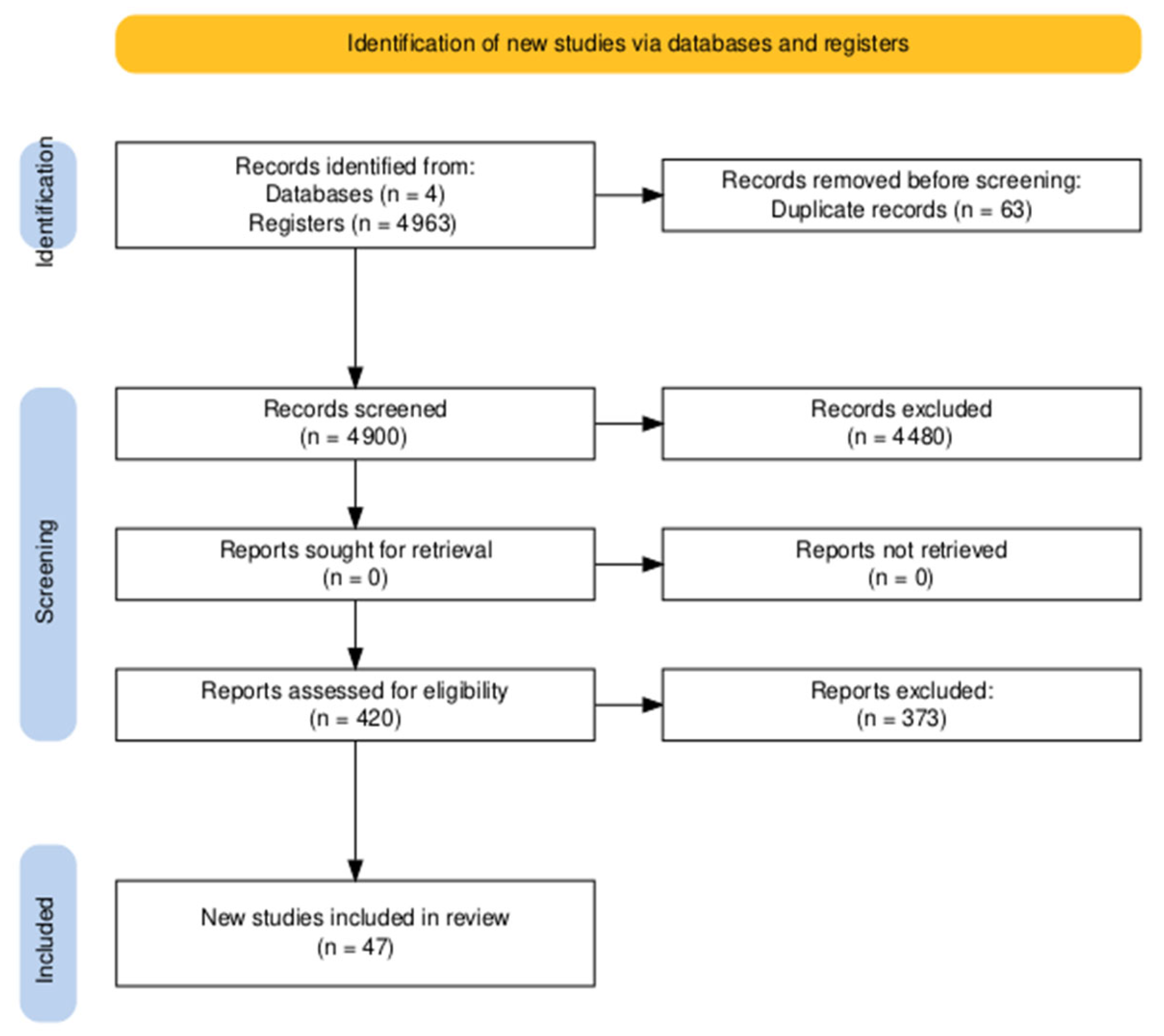
The selection process followed the guidelines of the PRISMA protocol (
Figure 1) (
Supplementary Materials). In the identification phase, 4963 records were retrieved from the selected databases. After removing 63 duplicate documents, the titles and abstracts of 4900 records were reviewed, of which 4480 were excluded because they did not meet the inclusion criteria. The full text was evaluated for 420 articles, leading to the exclusion of an additional 373 studies. Finally, 47 full-text articles met the eligibility criteria and were included in the qualitative synthesis. The bibliometric dataset consisted of the 4900 unique records retained after duplicate removal and metadata cleaning, which were used to map publication trends, authorship, countries, journals, and keywords.
For the bibliometric component, the unit of analysis was the bibliographic record rather than the full text. Therefore, all unique records retrieved from the databases after duplicate removal were included in the bibliometric dataset, regardless of whether they were later excluded from the qualitative synthesis. This distinction is methodologically justified because bibliometric analysis aims to describe the structure and dynamics of the literature, whereas qualitative synthesis requires full-text eligibility and substantive relevance.
The bibliometric analysis was carried out on all the articles identified in the initial phase of the PRISMA process (
Table S1), with the objective of capturing the structure integrally and dynamics of scientific production of the circular economy in Latin America and the Caribbean. In the first stage, the metadata was systematized and refined using Microsoft Excel, which allowed the analysis of temporal trends, distribution by country, authors, and subject areas.
The qualitative synthesis was restricted to the 47 full-text articles that passed screening and met all inclusion criteria (
Table S2). This corpus was analyzed through a structured four-step procedure. First, the corpus was prepared and refined. Second, the bibliometric data was organized using Microsoft Excel. Third, the texts were subjected to a qualitative coding process using ATLAS.ti 25 software. Finally, a thematic interpretation was conducted to identify theoretical approaches, methodological designs, and main findings.
To address the research questions, the 47 studies were categorized according to their primary analytical focus (
Table 2). Specifically, 13 studies addressed production systems (including industrial and agro-industrial CE), 5 focused on consumption, 6 analyzed public policy and governance, and 4 were primarily focused on inclusive and territorial CE. Additionally, a specific subset of 19 studies was included explicitly as contextual support to interpret the macro-structural limitation, environmental vulnerabilities, and governance conditions relevant to circular economy transitions in the region.
4. Results
4.1. Bibliometric Results
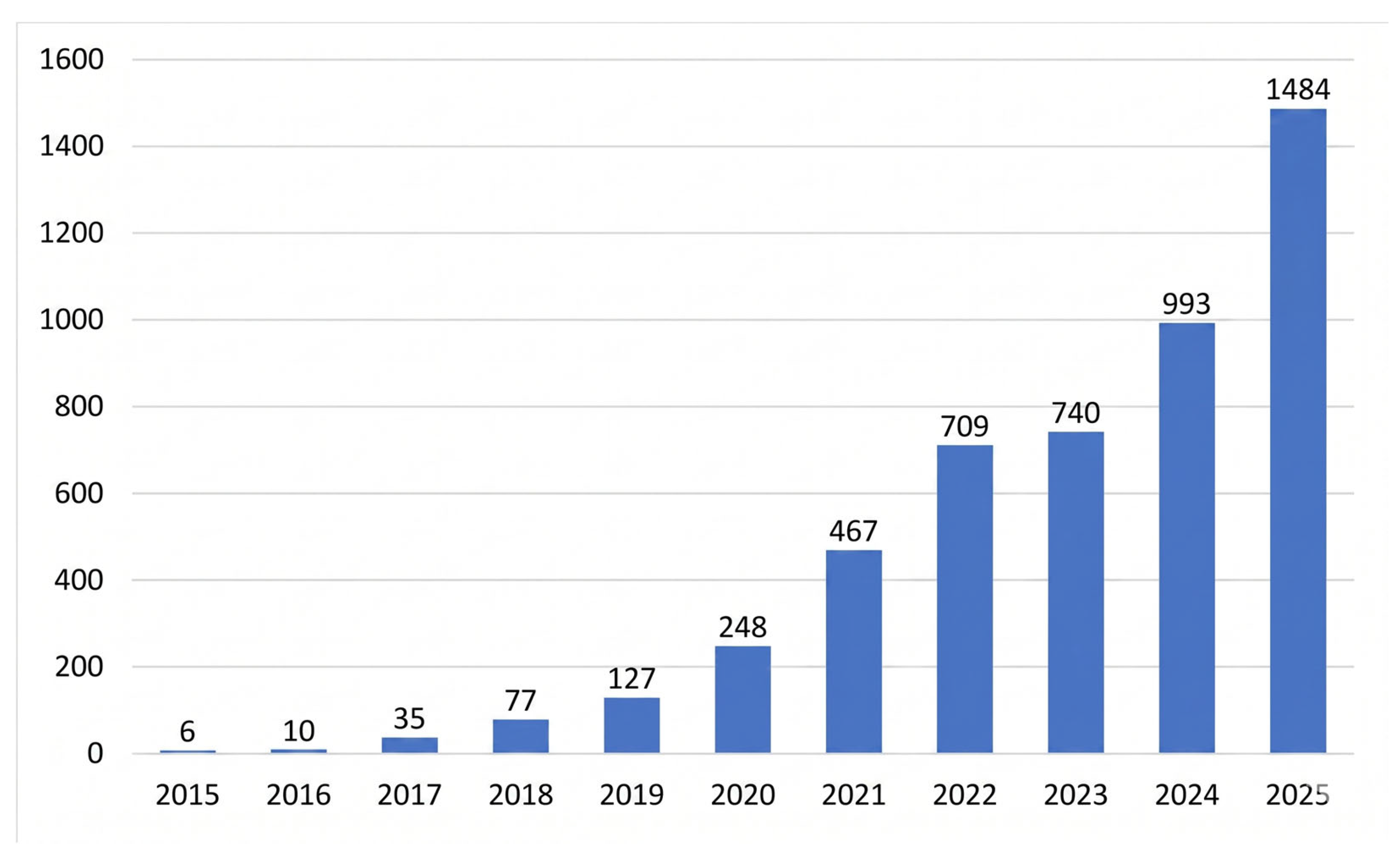
In percentage terms, the results show sustained and accelerated growth of the phenomenon analyzed between 2015 and 2025 (
Figure 2), although with variations in intensity. In the initial period, the increase was particularly pronounced, with a 66.7% rise between 2015 and 2016, followed by 250% growth between 2016 and 2017. Subsequently, between 2017 and 2018, growth reached 120%, while between 2018 and 2019 there was an increase of 64.9%. From 2019 onwards, growth remained significant, with increases of 95.3% in 2020 and 88.3% in 2021. However, between 2022 and 2023, the increase slowed considerably to 4.4%, before resuming an upward trend in 2024 (34.2%) and 2025 (49.4%).
From an analytical perspective, this quantitative evolution suggests a progressive expansion and growing consolidation of the topic in the literature over the last decade, with a clearly identified turning point from 2020 onwards. The strong growth observed between 2017 and 2022 could be associated with greater academic and political visibility of the approach, as well as the push generated by international agendas linked to sustainability and the circular economy. However, the slowdown recorded in 2023, and the subsequent recovery in 2024 and 2025, indicate a possible maturation phase for the field, characterized by more stable but still expanding production.
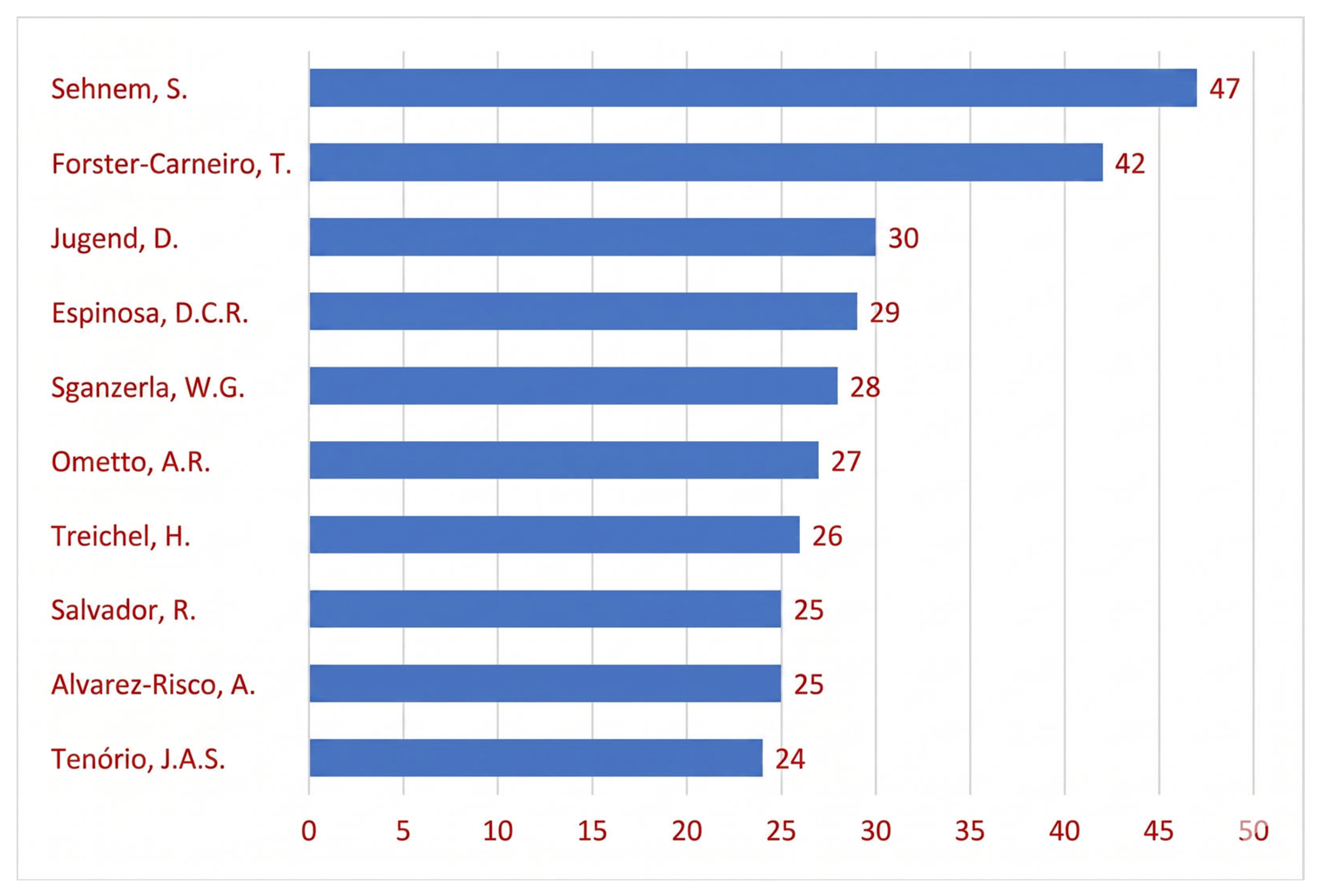
The results show a significant concentration of scientific production in a small group of authors (
Figure 3). In this regard, Sehmem stands out as the author with the highest number of publications, with a total of 47 documents, followed by Forster-Carneiro, who has 42 contributions. At a considerable distance are Jugend (30), Espinosa (29), and Sganzerla (28), forming a second tier of academic productivity. Likewise, Ometto (27) and Treichel (26) have a constant presence in the literature, while Salvador and Alvarez-Risco share the same level of production with 25 publications each. Finally, Tenório has 24 documents, closing the group of most productive authors identified in the analysis. Taken together, these results show the existence of consolidated research centers that have contributed consistently to the development of the field, suggesting a relatively concentrated authorial structure within the analyzed literature.
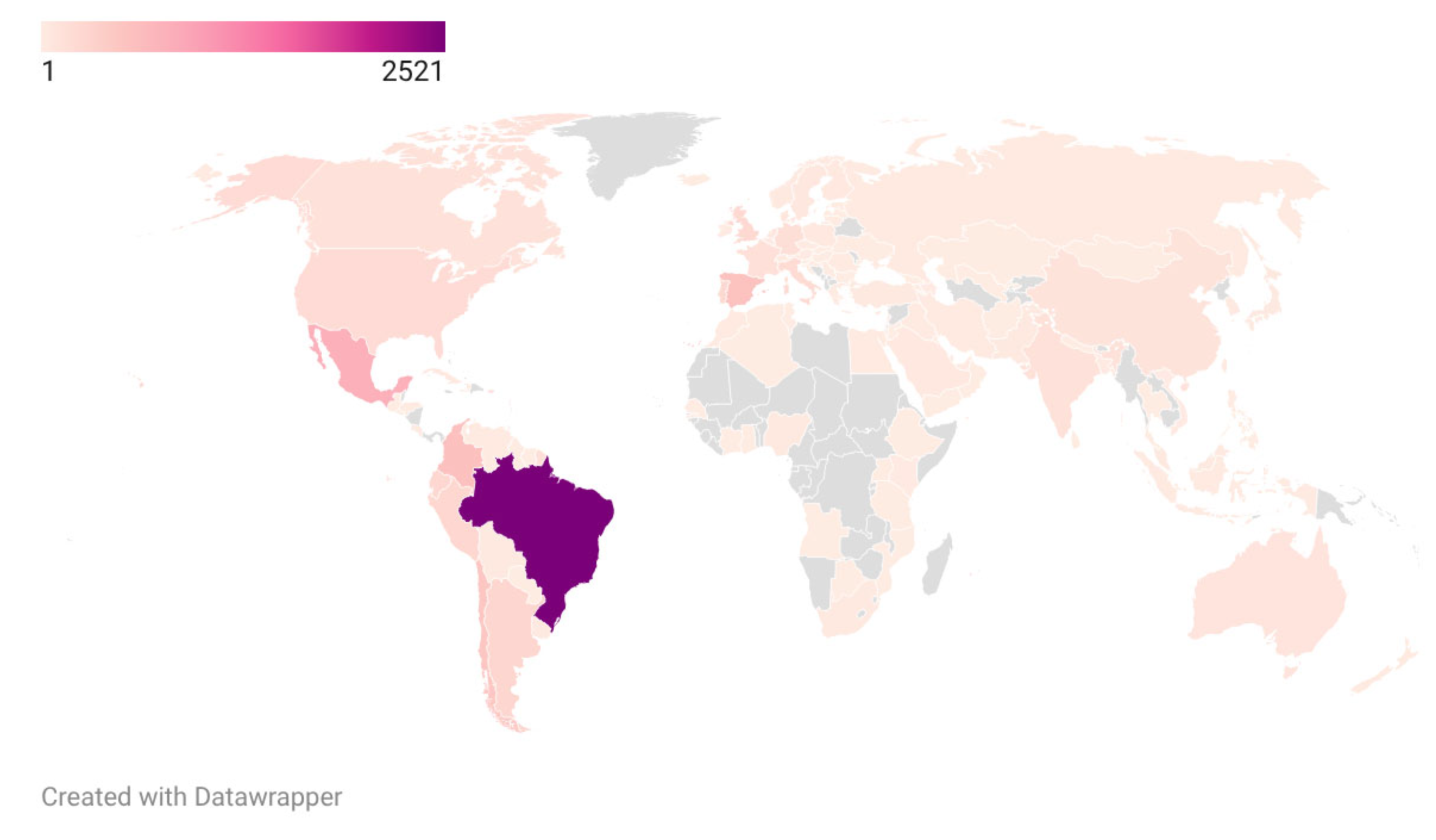
The quantitative results show a marked institutional concentration of scientific production in Latin America and the Caribbean (
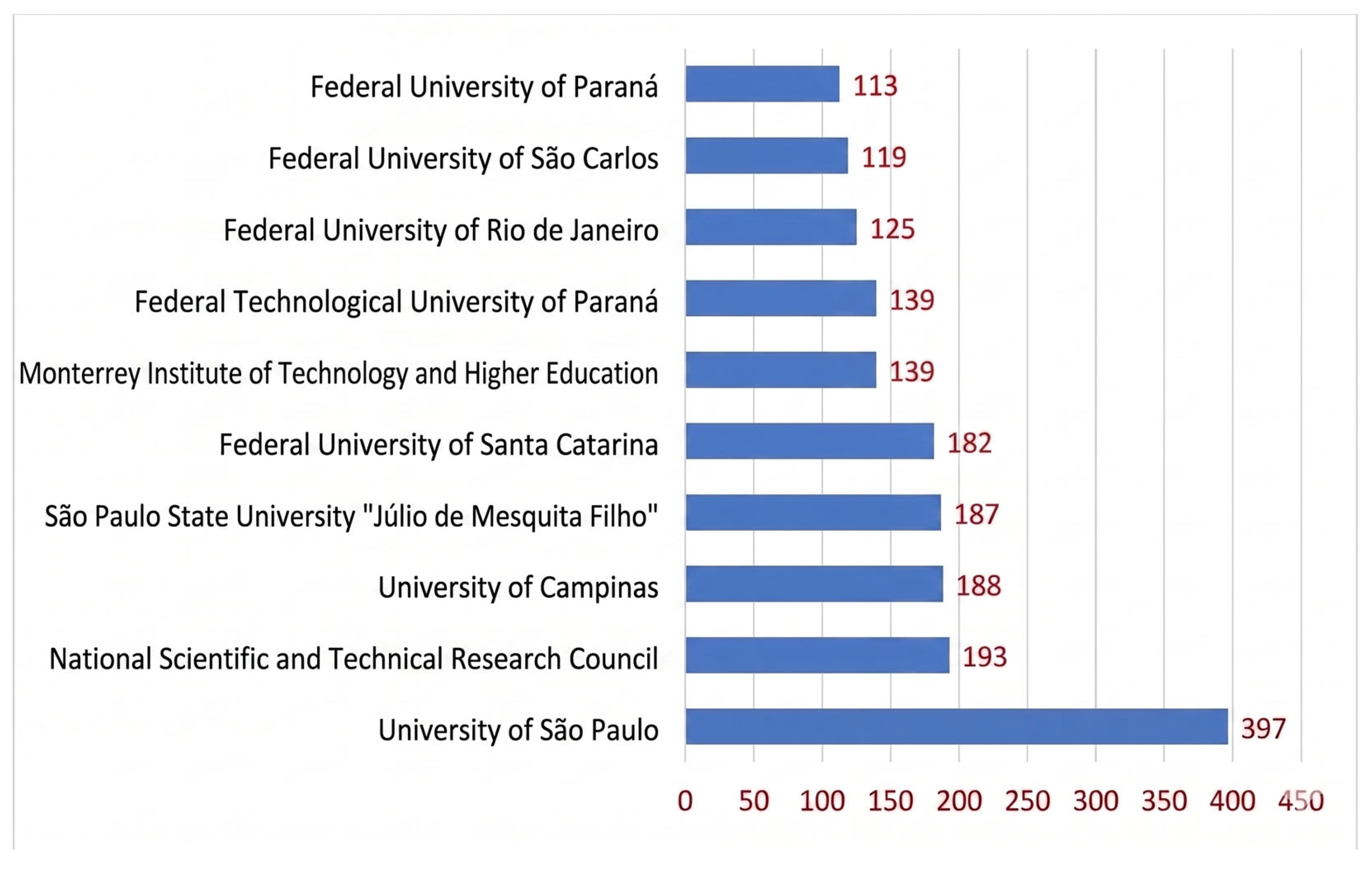
Figure 4), confirming the leading role of the global south in the development of the field analyzed. In this regard, the University of São Paulo stands out significantly with 397 documents, positioning itself as the institution with the highest production in the region (
Figure 5). Similarly, Argentina’s National Scientific and Technical Research Council (Conicet) (193), the State University of Campinas (188), the São Paulo State University Júlio de Mesquita Filho (187), and the Federal University of Santa Catarina (182) form a solid core of highly productive Latin American and the Caribbean institutions. These are joined by the Federal Technological University of Paraná and the Monterrey Institute of Technology, both with 139 documents, as well as the Federal University of Rio de Janeiro (125), the Federal University of São Carlos (119), and the Federal University of Paraná (113). This pronounced institutional concentration can be attributed to several structural factors. Historically, large public universities in Brazil and national research councils like Argentina’s CONICET have concentrated the majority of state funding for science and technology. Furthermore, these specific institutions host the region’s most consolidated and prestigious postgraduate programs in environmental engineering, sustainability, and applied sciences, providing the necessary academic infrastructure and specialized research networks to lead high-impact scientific production on the circular economy.
From an analytical perspective, these results highlight the active role of the global south in generating knowledge about the circular economy when the focus of analysis is on Latin America and the Caribbean. Systematic reviews focusing on the Global North consistently demonstrate that circular economy research is heavily driven by corporate-academic partnerships, high-tech industrial innovation, and stringent regulatory frameworks such as the European Green Deal. In contrast to these North-dominated approaches, the evidence from this study suggests that Latin American academic production is mainly articulated from state-funded local universities and public research centers. This dynamic reinforces the construction of analytical frameworks that are situated and highly sensitive to the socio-economic and environmental particularities of the region, such as resource constraints and informal economies. Consequently, this institutional concentration can be interpreted as a process of consolidation of endogenous scientific capacities, which contribute to positioning Latin America and the Caribbean not only as an object of study, but also as an active space for academic production and leadership in the debate on the circular economy.
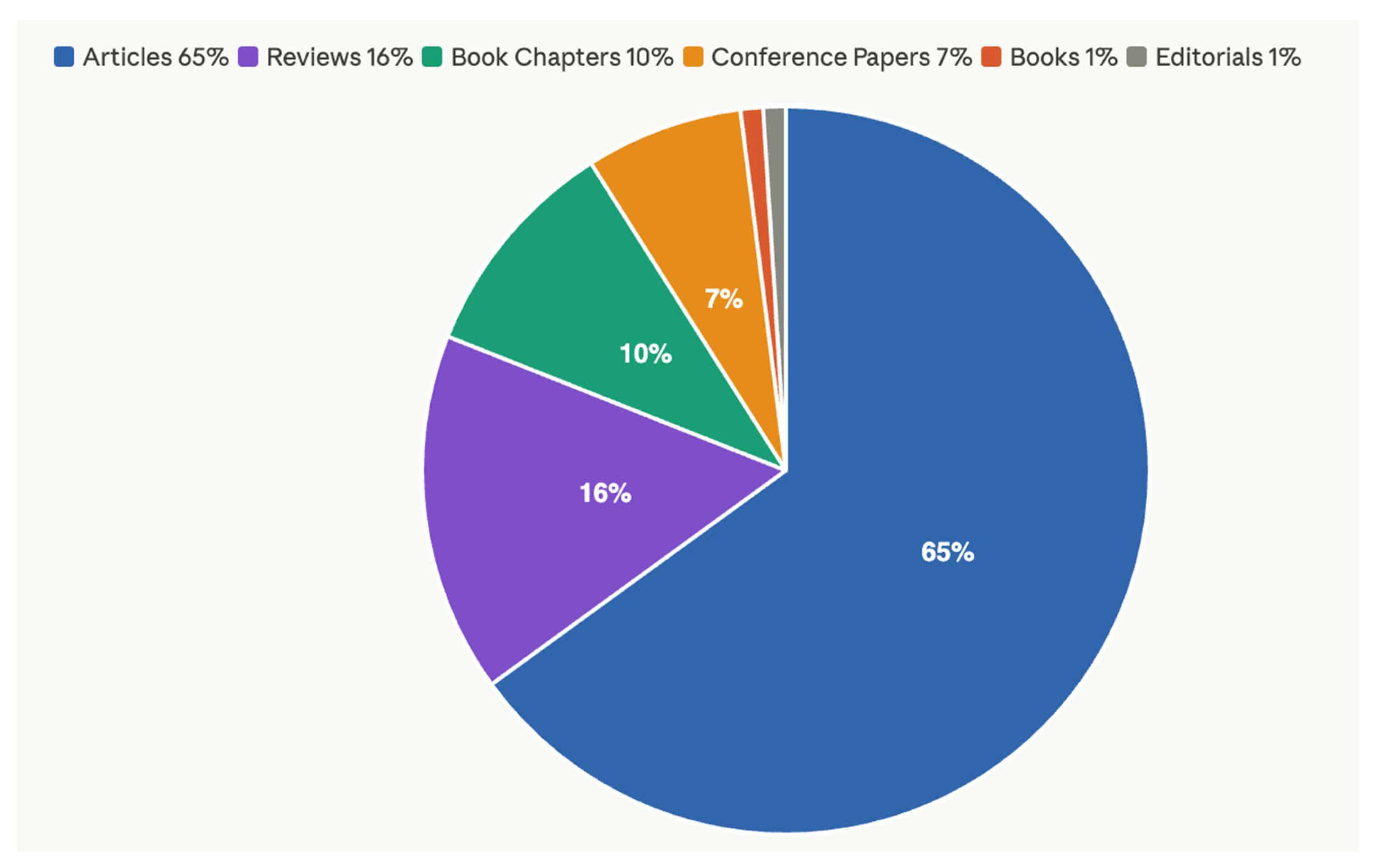
Figure 6 shows the distribution of the 11 categories of documents that form the bibliometric review sample. The predominant type is the article, which represents 65% of total scientific production, followed by reviews (16%) and book chapters (10%). On a smaller scale, conference papers account for 7%, while longer formats such as books and institutional formats such as editorials represent just 1% each. The remaining categories (notes, errata, letters, and data articles) have a marginal or negligible statistical presence, which limits the scope of the study to focus almost exclusively on four main formats.
The absolute predominance of original articles (65%) confirms that the field of study is in a phase of active production of primary knowledge, where peer review through indexed journals is the primary channel. Likewise, 16% of reviews is a considerable figure that suggests that the topic has already reached a sufficient level of maturity to allow the synthesis and critical analysis of previous literature. Furthermore, the presence of book chapters and conference papers—which account for 17%—indicates that, although knowledge is centralized in journals, there is a significant branch toward more extensive theoretical debates and discussion in academic or technical forums. Overall, this distribution grants weight to the review, demonstrating that it is based primarily on sources of high impact and scientific rigor.
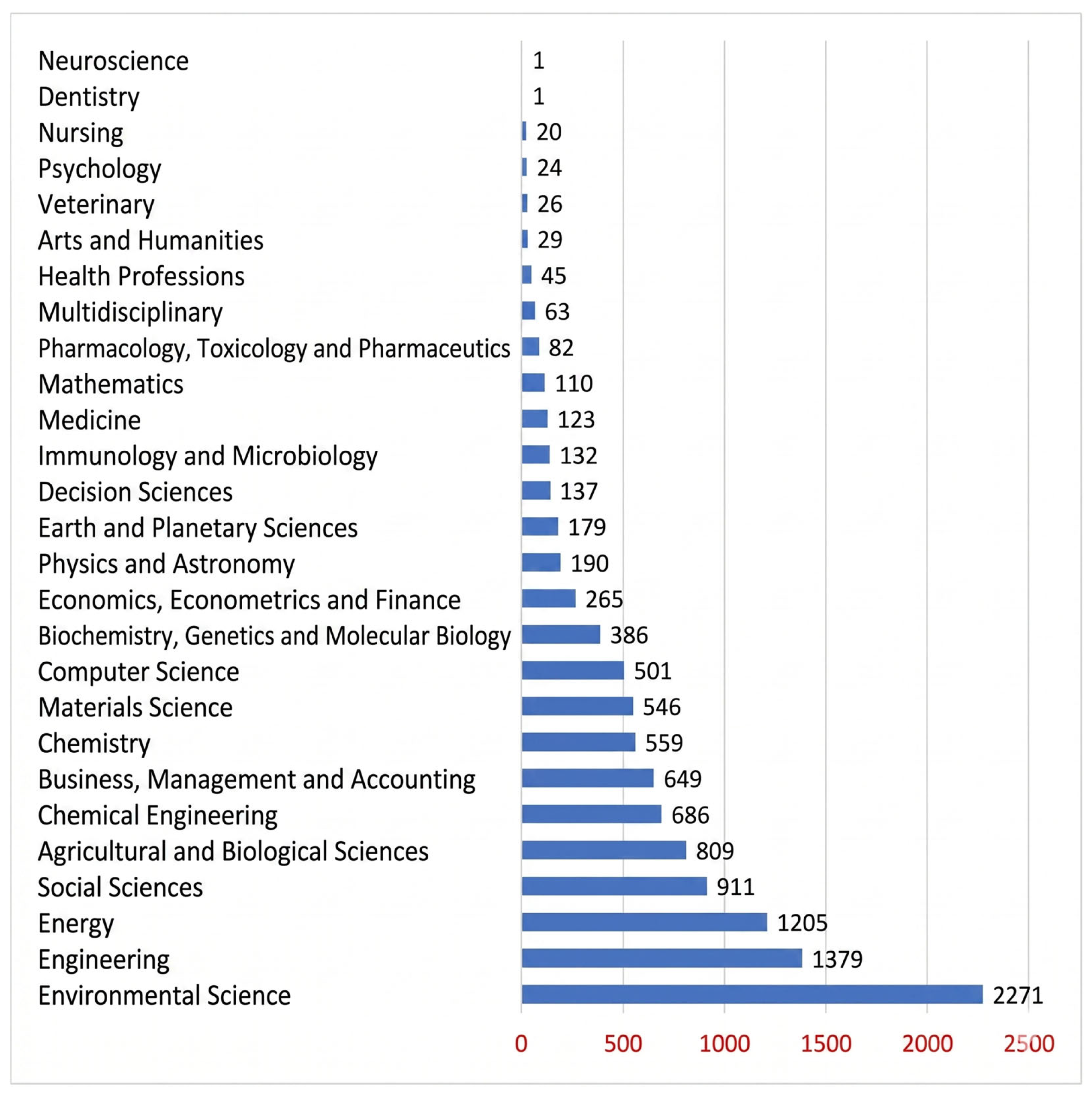
As can be seen in
Figure 7, it is possible to affirm that there is a clear pre-eminence of environmental and technological sciences in the document corpus. The leading category is environmental science with a total of 2271 documents, followed significantly by ‘engineering’ (1379) and “energy” (1205). In second place in terms of importance are the social sciences, with 911 publications, along with the biological sciences, chemical engineering, and business management, which range between 600 and 800 documents. In contrast, areas related to health sciences, such as dentistry or neuroscience, have an anecdotal presence with only one or a few records, marking the limit of the thematic relevance of the sample.
From a bibliometric perspective, the dominance of environmental science (which almost double of second category) suggests that the core of the research is strongly linked to sustainability or environmental impact. However, the strong presence of areas such as engineering, energy, and social sciences indicates that this is a highly interdisciplinary field of study. This convergence suggests that the phenomenon analyzed is not only addressed from a technical or ecological perspective, but also integrates political, social, and planning dimensions. The diversity of disciplines captured in the graph reinforces the thesis that the subject of study is cross-cutting in nature, where technological solutions (engineering and energy) are intertwined with governance frameworks and social dynamics.
4.2. Results of the Qualitative Literature Review
4.2.1. Dominant Theoretical Framings and Conceptual Lenses
The qualitative synthesis reveals that the theoretical frameworks in the Latin American and the Caribbean literature can be organized into four differentiated interpretive clusters: (1) CE as an environmental efficiency logic (emphasizing eco-design and waste reduction); (2) CE as socio-institutional adaptation (highlighting governance fragmentation and SME barriers); (3) CE as inclusive territorial practice (focusing on grassroots recyclers and informality); and (4) CE as a bioeconomic opportunity under structural dependency (relating circularity to agricultural residues).
First, the qualitative systematic review of the literature allowed us to identify the main theoretical approaches and conceptual frameworks used in studies on the circular economy in Latin America and the Caribbean. In this regard, the results show a clear conceptual heterogeneity, given that no predominant theoretical framework has been identified. On the contrary, the studies analyzed tend to relate different approaches in a complementary manner. Likewise, this diversity reflects an explicit effort to contextualize the circular economy according to the structural, productive, and social conditions specific to the region.
On the other hand, one of the most recurrent patterns identified in the reviewed literature corresponds to the link between the circular economy and the sustainable development approach [
14,
39,
40,
41]. In particular, most of the publications analyzed consider circularity as a strategy oriented to the balanced integration of economic, environmental, and social objectives. In this way, the qualitative results show that the authors emphasize efficiency in the use of resources and waste reduction [
42,
43,
44]. In addition, they highlight the generation of social benefits, especially in terms of employment and strengthening local economies [
9,
13,
45,
46].
Additionally, another conceptual framework widely used in the studies analyzed is that of industrial ecology [
47], especially in research focused on specific productive sectors and waste management. From this perspective, the systematic review shows that this approach is used to analyze material and energy flows, promoting cooperation between different economic actors [
48,
49,
50,
51,
52].
Similarly, qualitative summary allowed us to identify the incorporation of conceptual frameworks from ecological economics and political economics. In fact, these approaches are mainly used to problematize the linear economic model and question the extractive dynamics that predominate in the region. Consequently, the studies reviewed highlight the importance of considering ecological limits and inequalities in access to and control of natural resources [
48,
49,
53,
54,
55], positioning the circular economy as a critical and transformative proposal.
In addition, the systematic review highlights a growing use of approaches related to innovation and socio-technical transitions [
56,
57,
58]. From this perspective, the studies analyzed conceptualize the circular economy as a process of systemic change involving technological, institutional, and cultural dimensions [
12,
14,
59,
60]. In this frame, the results highlight the strategic role of public policies, academic institutions, and small and medium-sized businesses as key players in the adoption and spread of circular practices in Latin America and the Caribbean [
11,
61].
Finally, the qualitative results point to a strong presence of territorial approaches and the social and solidarity economy in the literature reviewed. In particular, the studies analyzed recognize local and community practices, such as those developed by grassroots recyclers and cooperatives, as fundamental components of the circular economy in the region. Thus, this finding suggests that the conceptual frameworks used tend to integrate pre-existing experiences, consolidating a vision of the circular economy built from the territory and adapted to local realities.
4.2.2. Dominant Methodological Designs in the Literature
Regarding the methodological designs, the documentary corpus consists mainly of empirical original articles (65%), confirming that the field of study is in a phase of active production of primary knowledge where peer review through indexed journals is the primary channel. Additionally, reviewed articles represent a significant portion of the literature (16%). This is a considerable figure demonstrating that the topic has reached a sufficient level of maturity to enable critical synthesis and the identification of patterns in the development of the field within the region.
4.2.3. Main Thematic Findings on Production and Consumption
In line with the theoretical approaches and conceptual frameworks previously identified, the qualitative systematic review allowed us to analyze how the circular economy has been applied in production and consumption systems in Latin America and the Caribbean. In this regard, the results show that the literature reviewed focuses on empirical experiences oriented to optimizing the use of resources, reducing waste, and reconfiguring production processes. Likewise, the studies analyzed highlight the adaptation of circular economy principles to the specific conditions of the region’s productive sectors and consumer markets.
On the other hand, one of the main lines of application identified in the literature corresponds to the implementation of circular practices in industrial production systems [
62,
63,
64,
65]. In particular, the studies reviewed document strategies such as eco-design, reuse of by-products, remanufacturing, and energy efficiency. In this way, qualitative results show that these practices are approached as mechanisms to improve business competitiveness and reduce environmental impact [
66,
67,
68].
Likewise, the systematic review shows a growing interest in the application of the circular economy in primary and agro-industrial sectors. In this context, initiatives oriented to the use of agricultural waste, biomass recovery, and the implementation of closed nutrient cycles are described [
7,
69,
70,
71].
Similarly, the literature reviewed addresses the application of the circular economy in consumption systems, particularly through responsible consumption strategies, circular business models, and the collaborative economy [
40,
72,
73,
74]. In this regard, studies highlight practices such as extending the life cycle of products, repair, rental, and exchange.
In addition, the systematic review highlights the role of public policies and regulatory frameworks in the promotion of the circular economy in production and consumption systems [
10,
11,
75]. In particular, studies indicate that the existence of economic incentives, environmental regulations, and support programs is decisive for the implementation of circular practices.
4.2.4. Gaps and Underdeveloped Areas
Despite the thematic findings identified, the literature consistently points to the existence of critical gaps and underdeveloped areas that limit the transition. At the governance level, studies reveal structural limitations, such as deficiencies in infrastructure, and a persistent institutional fragmentation and limited coherence between sectoral policies, which condition the viability of these models in the Latin American and the Caribbean context and hinders the consolidation of comprehensive approaches [
53,
54,
55,
56].
In terms of industrial application, it is noted that their adoption is mainly concentrated in large companies or pilot projects, leaving a gap in the integration of small and medium-sized enterprises. Furthermore, in primary and agro-industrial sectors, the results indicate that these experiences face challenges related to the lack of technical assistance, financing, and coordination between productive actors, which limits their scalability.
Regarding consumption systems, qualitative results reveal that the adoption of these practices by consumers is still incipient and is conditioned by cultural and economic factors and access to information [
76,
77,
78].
Finally, the qualitative results suggest that the application of the circular economy in production and consumption systems in Latin America and the Caribbean is characterized by heterogeneous and unequal development. Consequently, the literature reviewed agrees that, although significant progress has been made at the local and sectoral levels, structural gaps remain that limit its generalization. Thus, there is a clear need to strengthen coordination between actors and to integrate the production and consumption dimensions into systemic circular economy strategies.
5. Discussion
The evolution of scientific production in Latin America and the Caribbean over time reveals a trajectory of accelerated consolidation, with exponential growth reaching peaks of up to 250% between 2016 and 2017. This peak, which maintained significant growth until 2022, suggests that the field has transcended initial academic interest to become a relevant focus of regional sustainability agendas. The predominance of original articles (65%) indicates that the field is in a phase of active generation of primary knowledge and scientific validation. However, the notable presence of review articles (16%) is an indicator of maturity, demonstrating that there is sufficient literature to enable critical synthesis and the identification of patterns in the development of the field.
From a structural perspective, the results show a clear institutional concentration led by the Global South, where universities in Brazil (University of São Paulo with 397 documents) and Argentina (Conicet with 193) act as the main drivers of knowledge. This regional focus is important, as it allows for the construction of analytical frameworks that respond to local socioeconomic particularities, rather than simply replicating models from the Global North. These findings align with—and expand upon—previous bibliometric analyses. For instance, while studies like refs. [
79,
80] have mapped the global trajectory of circular economy research, often highlighting the dominance of European and Chinese institutions, our results provide a granular, region-specific counterpoint. We identify that within Latin America and the Caribbean, a consolidated research environment exist. Furthermore, whereas global reviews often identify technological innovation as the primary driver of circularity [
81], our analysis points to a stronger emphasis on socio-environmental integration and the management of biological resources, which may reflect a distinct trajectory of the field in this region.
Likewise, the dominance of environmental sciences, together with the strong participation of engineering and social sciences, confirms the inherently interdisciplinary nature of the circular economy. This convergence suggests that the phenomenon cannot be addressed only as a technical challenge of resource management, but as a systemic transformation that integrates political, technological, and governance dimensions. However, the transition from the linear “extract–produce–waste” model to a regenerative system, as proposed by the Ellen MacArthur Foundation [
29], is finding a growing support in Latin America and the Caribbean. While global theory suggests a conceptual and operational paradigm shift, the bibliometric results of this study confirm that the region has experienced accelerated growth in its scientific production between 2015 and 2025. This academic peak, led by authors such as Sehmem & Forster-Carneiro, may indicate that the circular economy is not only an external theoretical trend, but also a field of study in active consolidation within Latin American and the Caribbean research structures.
In terms of theoretical foundations, Pearce & Turner’s original notion [
30] of closed systems and biosphere limits has evolved in the region toward integration with the sustainable development approach. Qualitative results reveal that contemporary authors such as Ferraz & Pyka [
40] and Ospina-Mateus et al. [
20] no longer analyze circularity only as a technical cycle, but as a balanced strategy for achieving economic and social objectives. This regional adaptation reinforces the idea that CE in the Global South is conceptualized as a tool for economic resilience in the face of resource volatility.
With regard to industrial production, the theoretical literature of Ghisellini et al. [
31] and Stahel [
35] emphasizes resource efficiency and servitization models. In the context analyzed, this approach translates into practical applications of eco-design and remanufacturing, documented by Faria et al. [
62] and Martín-Díez et al. [
63]. However, there is a critical contrast: while the theory assumes systemic adoption, the findings of this review indicate that, in Latin America and the Caribbean, these practices are mainly concentrated in large companies or pilot projects, leaving SMEs with technological and financial barriers that remain unresolved.
ECLAC [
36] identifies dependence on natural resources as a structural characteristic of the region. The results of the review validate this observation, but also show that authors such as Aguado et al. [
13] and Zapata-Morales & Moreno-Andrade [
71] are transforming this vulnerability into an opportunity through the bioeconomy and the recovery of agricultural waste. This suggests that the application of CE in Latin America and the Caribbean may be contributing to the decoupling proposed by the theory through innovation in primary sectors, moving away from a purely industrial model to adopt one based on local biological wealth.
A distinguishing feature in the region is the social dimension, which Schröder et al. [
37] define as a “just transition.” Qualitative findings suggest that Latin American and the Caribbean literature integrates base recyclers and cooperatives as relevant actors in the system, according to reports by Valencia et al. [
46] and Galatti & Baruque-Ramos [
45]. This territorial and social economy approach contrasts with the more technocratic visions of the Global North, and may reflect a vision of circularity built on the reality of informality and community action.
In the field of consumption, the hierarchy of the “9Rs” of Kirchherr et al. [
1] positions recycling as the last option. However, the evidence collected by Henao-Hincapié et al. [
76] and Cordova-Pizarro et al. [
75] shows that the adoption of reduction or repair practices in Latin America and the Caribbean is still in its infancy and is limited by cultural factors and access to information. This indicates a significant gap between the theory of sufficiency culture and the reality of regional consumer markets, where circularity continues to be perceived predominantly through final waste management.
Governance is another point of tension. While the Regional Circular Economy Alliance [
38] advocates for regulatory frameworks such as extended producer responsibility, the results of studies such as those by Alcántara-Ayala et al. [
53] and Nava [
55] point to persistent institutional fragmentation and vulnerability in local governance. This lack of coherence between sectoral policies mentioned in the results hinders the creation of secondary markets for materials, which theory considers essential for the success of the circular model.
Finally, the importance of institutions such as the University of São Paulo and Conicet underlines that the production of knowledge on CE in the region is an endogenous process. Although environmental sciences and engineering continue to dominate the subject matter, the growing interdisciplinarity detected suggests that Latin America and the Caribbean are developing research agendas that differ in emphasis from dominant Global North framings. This maturation of the field, despite the recent slowdown in production, positions the region as a potentially emerging reference in the global debate on circular sustainability.
Therefore, the primary contribution of this study lies in bridging the methodological gap present in previous bibliometric works, which often limit themselves to quantitative mappings of the field [
82]. By integrating a quantitative structural analysis with an in-depth qualitative review of theoretical frameworks, this paper reveals not just who is publishing or how much, but what substantive narratives are shaping the Latin American and the Caribbean circular economy. This mixed approach highlights a critical paradigm shift: while Northern literature heavily focuses on high-tech industrial symbiosis, this study suggests that Latin American and the Caribbean scientific production conceptualizes the circular economy fundamentally as a tool for socio-economic resilience, the formalization of informal labor, and the sustainable exploitation of the bioeconomy.
Based on the findings and gaps identified, future research should prioritize the development of strategies for the effective integration of small and medium-sized enterprises (SMEs) into circular circuits, given that adoption is currently concentrated in large corporations. It is important to go deeper into the analysis of governance and the harmonization of regulatory frameworks, such as extended producer responsibility, in order to overcome the current institutional fragmentation that is holding back the creation of secondary materials markets. Likewise, greater focus is needed on Latin American and the Caribbean consumer behavior, which means exploring the cultural and economic factors that limit the transition from recycling to higher-level strategies such as rejection, repair, and exchange. Finally, research should be oriented to the scalability of projects in agro-industrial sectors and the inclusive formalization of base recyclers to ensure that the circular transition in the region is not only technically efficient but also socially just.
6. Conclusions
Scientific production about the circular economy in Latin America and the Caribbean has experienced rapid consolidation between 2015 and 2025, with peaks of exponential growth of up to 250% in its initial stages. Bibliometric results reveal a marked institutional concentration led by the global south, where the University of São Paulo and Argentina’s Conicet emerge as the main centers of knowledge generation. This trend shows that the region is not only replicating external models, but has also developed endogenous scientific capabilities to position circularity as a strategic focus in local sustainability agendas.
Beyond these quantitative trends, the original contribution of this article lies in its mixed-methods approach, which bridges the gap between statistical mapping and substantive theoretical analysis. While previous bibliometric studies on the circular economy have largely focused on global, technology-driven trends dominated by the Global North, this study provides a localized, qualitative dissection of the Latin American and the Caribbean narrative. By doing so, this article demonstrates that scientific production in the region does not merely import environmental concepts, but adapts them to local realities; it emphasizes circularity as a mechanism for socio-economic inclusion, informal sector formalization, and bio-based economic resilience, offering a distinct theoretical framework for the Global South.
Consequently, in terms of theoretical approaches, the literature shows a conceptual heterogeneity that integrates the circular economy with sustainable development, industrial ecology, and the social and solidarity economy. Unlike the strictly technical views of the global north, Latin America and the Caribbean prioritizes a fair transition that actively incorporates base recyclers and cooperatives as key players in the system. Methodologically, the predominance of original and review articles confirms that the field is in a phase of active production of primary knowledge with a sufficient level of maturity for critical analysis.
With regard to application in production and consumption systems, progress has been unequal. While in the industrial and agro-industrial sectors there are documented successful strategies for eco-design, remanufacturing, and biomass recovery, these are mainly concentrated in large companies or pilot projects. On the other hand, in the area of consumption, repair and reuse practices are still incipient; moreover, they are limited by cultural and economic factors, and by a lack of access to information that prevents a full transition to a culture of sufficiency.
Finally, the research identifies critical gaps that should guide future public policies and lines of study. It is imperative, therefore, to develop strategies that allow the effective integration of SMEs into circular circuits, as well as harmonize regulatory frameworks, such as extended producer responsibility, to reduce institutional fragmentation. It is also necessary to gain a deeper understanding of consumer behavior and ensure the scalability of agro-industrial solutions to guarantee that the transition to a circular economy in the region is technically efficient and socially inclusive.




 ,
,