Optimization of Cold-Chain Logistics Unitization Strategies Under Dynamic Temperature Constraints

Abstract
1. Introduction
2. Cold-Chain Unitized Logistics Optimization Model with Dynamic Temperature Constraint
2.1. Cold-Chain System Description and Integrated Optimization Framework
2.2. Heat-Transfer Dynamics and Modeling of Product Quality Deterioration
2.3. Mathematical Model for Unitized Loading and Heuristic Solution
2.3.1. Mathematical Formulation of the CCULP
- I: set of perishable SKUs, indexed by i;
- B: set of candidate insulated containers, indexed by b;
- P: set of candidate pallets, indexed by p;
- K: set of candidate vehicles, indexed by k;
- S = {0, 1, 2}: set of container types (standard cardboard, EPS, EPP), indexed by s;
- T = {0, 1,…, Tend}: set of discretized time steps, indexed by t.
| Symbol | Description |
| vi, wi | volume (m3) and weight (kg) of SKU i |
| πi | unit value of SKU i (CNY/kg) |
| Timin, Timax | allowable temperature range of SKU i (°C) |
| Ti0 | initial temperature of SKU i (°C) |
| Q10,i | temperature coefficient of SKU i |
| τi | thermal time constant of SKU i (min) |
| Vbmax, Wbmax | volume and weight capacity of container b |
| Rs | thermal resistance of container type s (m2·K/W) |
| cs | per-trip cost of container type s (CNY) |
| Vpmax, Hpmax | volume and stacking-height capacity of pallet p |
| Vkmax, Wkmax | compartment volume and payload of vehicle k |
| τv | vehicle-compartment thermal time constant (min) |
| ckveh, cppal | per-trip cost of vehicle k and pallet p (CNY) |
| cop, cpen | operating cost rate (CNY/min) and penalty rate (CNY/min·product) |
| Tamb | ambient temperature (°C) |
| Tref, kref | reference temperature and baseline decay rate of the Q10 model |
| Δt | simulation time step (min) |
- : 1 if SKU i is assigned to container b; 0 otherwise;
- : 1 if container b is placed on pallet p; 0 otherwise;
- : 1 if pallet p is loaded on vehicle k; 0 otherwise;
- : 1 if container b is of type s∈S; 0 otherwise;
- : 1 if container b/pallet p/vehicle k is used;
- : temperature of SKU i, container b, and vehicle compartment at time step t (°C);
- : cumulative damage index of SKU I;
- : temperature-violation slack of SKU i at time t (°C·step).
- (i)
- Assignment and hierarchy.
- (ii)
- Container-type selection.
- (iii)
- Capacity limits.
- (iv)
- Temperature dynamics (discretized forward-Euler form of Equations (1), (2), and (5)).
- (v)
- Temperature compliance and slack.
- (vi)
- Cumulative damage index (discretized form of Equation (8)).
2.3.2. Discretization and Numerical Stability
2.4. Solution Algorithm Design
2.4.1. Algorithm Framework
2.4.2. Algorithm Procedure
| Algorithm 1. Temperature-Aware Heuristic Search (TAHA) |
| Input: Set of items I, containers B, vehicles K; Parameters τ, Rb, Q10 Output: Optimal or near-optimal loading plan S* Phase 1: Initialization 1: Sort items i ∈ I by temperature sensitivity Timax in ascending order 2: Scurr ← ConstructInitialSolution(I, rule = FFD) 3: Ttraj ← PredictTemperature(Scurr) ▷ via (C9)–(C11) 4: Zbest ← CalculateTotalCost(Scurr, Ttraj) 5: Sbest ← Scurr Phase 2: Iterative Improvement 6: while iter < Nitermax(=500) and noimp < noimpmax(=100) do 7: Select neighborhood operator ω ∈ {Swap, Upgrade, Regroup} 8: Snew ← ApplyOperator(Scurr, ω) //Core mechanism: Dynamic temperature feedback 9: Ttraj ← PredictTemperature(Snew) ▷ via (C9)–(C11) 10: Dnew ← CalculateDamageIndex(Ttraj) ▷ via Equation (8) 11: Znew ← CalculateTotalCost(Snew, Ttraj, Dnew) 12: if Znew < Zbest then (strict improvement) 13: Sbest ← Snew; Zbest ← Znew; Scurr ← Snew 14: Reset noimprove counter 15: else 16: noimprove ← noimprove + 1 17: iter ← iter + 1 18: return Sbest |
3. Numerical Experiments and Results Analysis
3.1. Scenario Description and Operational Setting
3.2. Parameter Settings and Data Sources
3.2.1. Product Thermal and Quality-Decay Parameters
3.2.2. Insulated Container Specifications
- Type 0 (Standard Box): Corrugated cardboard with minimal insulation, effective resistance R0 = 0.15 m2·K/W, cost CNY 2/use;
- Type 1 (EPS Container): Expanded polystyrene (25 mm), effective resistance R1 = 0.45 m2·K/W (improvement factor κ = 2.0), cost CNY 8/use;
- Type 2 (EPP Container): Professional expanded polypropylene (40 mm), effective resistance R2 = 0.75 m2·K/W (improvement factor κ = 4.0), cost CNY 15/use.
3.2.3. Vehicle and Disturbance Parameters
3.3. Experimental Design
3.3.1. Test Instances and Scale Settings
- Small (S): 20 SKU types, 50 order lines, 5 stops. This scale allows for validation against exact solutions;
- Medium (M): 50 SKU types, 150 order lines, 10 stops, representing typical daily operations;
- Large (L): 100 SKU types, 300 order lines, 15 stops, testing scalability. For each scale, 10 random instances were generated using fixed random seeds (seeds 1–10) to guarantee reproducibility. Product dimensions and category assignments were sampled from uniform distributions.
3.3.2. Benchmark Algorithms
- FFD-Only: A First-Fit Decreasing heuristic that generates loading plans based solely on geometric feasibility and weight constraints, ignoring thermodynamic feedback.
- GA (Genetic Algorithm): A standard genetic algorithm (population size 100, crossover rate 0.8, mutation rate 0.1). To ensure a fair comparison, the GA uses the same total cost function Z (including temperature penalties) as its fitness function, but it lacks the integrated, step-by-step temperature trajectory prediction loop used in TAHA’s neighborhood search. The GA hyperparameters (population size, crossover rate, mutation rate, tournament size, and elitism count) are held at values that are standard in the metaheuristic-for-cold-chain literature [10] and are not tuned per instance; this fixed-parameter choice is deliberate, as instance-specific tuning would conflate genuine algorithmic capability with parameter-search effort, undermining the search-efficiency comparison reported in Section 3.4.1. Complete parameter values, initialization scheme, selection operator, and termination statistics for both TAHA and GA are summarized in Table 3.
- MILP-CBC The exact solution to the MILP formulation derived in Section 2.3.1, implemented in Python using PuLP, and solved with the open-source CBC solver. We exploit a structural property of the cold-chain heat-transfer model: from Equations (2) and (4), the container internal temperature Tb(t)—and, therefore, each product’s thermal trajectory Ti(t) via (C11)—depends only on the container type s, not on the specific co-located SKUs. This decoupling allows the cumulative damage index Di,s and the corresponding spoilage and penalty cost contributions to be pre-computed as constants for each (product, container-type) pair, obviating the SOS2 piecewise-linear approximation of (C14). The resulting model is solved as a pure linear MILP. To tighten the LP relaxation, we add the valid inequality Σb,s zi,b,s = 1 ∀i; to eliminate symmetric solutions, we additionally enforce yb ≤ yb−1, wp ≤ wp−1, and vk ≤ vk−1. With these enhancements, all 10 Small-scale instances are solved to proven optimality (MIPGap = 0.0%) in 1.56 ± 0.29 s on average, well within the 60 s time limit. MILP is applied only to small instances; on medium and large, instances it remains computationally intractable, as expected for this NP-hard problem.
3.3.3. Performance Metrics
3.3.4. Simulation Time Step and Numerical Stability Verification
3.4. Results and Analysis
3.4.1. Overall Performance Comparison
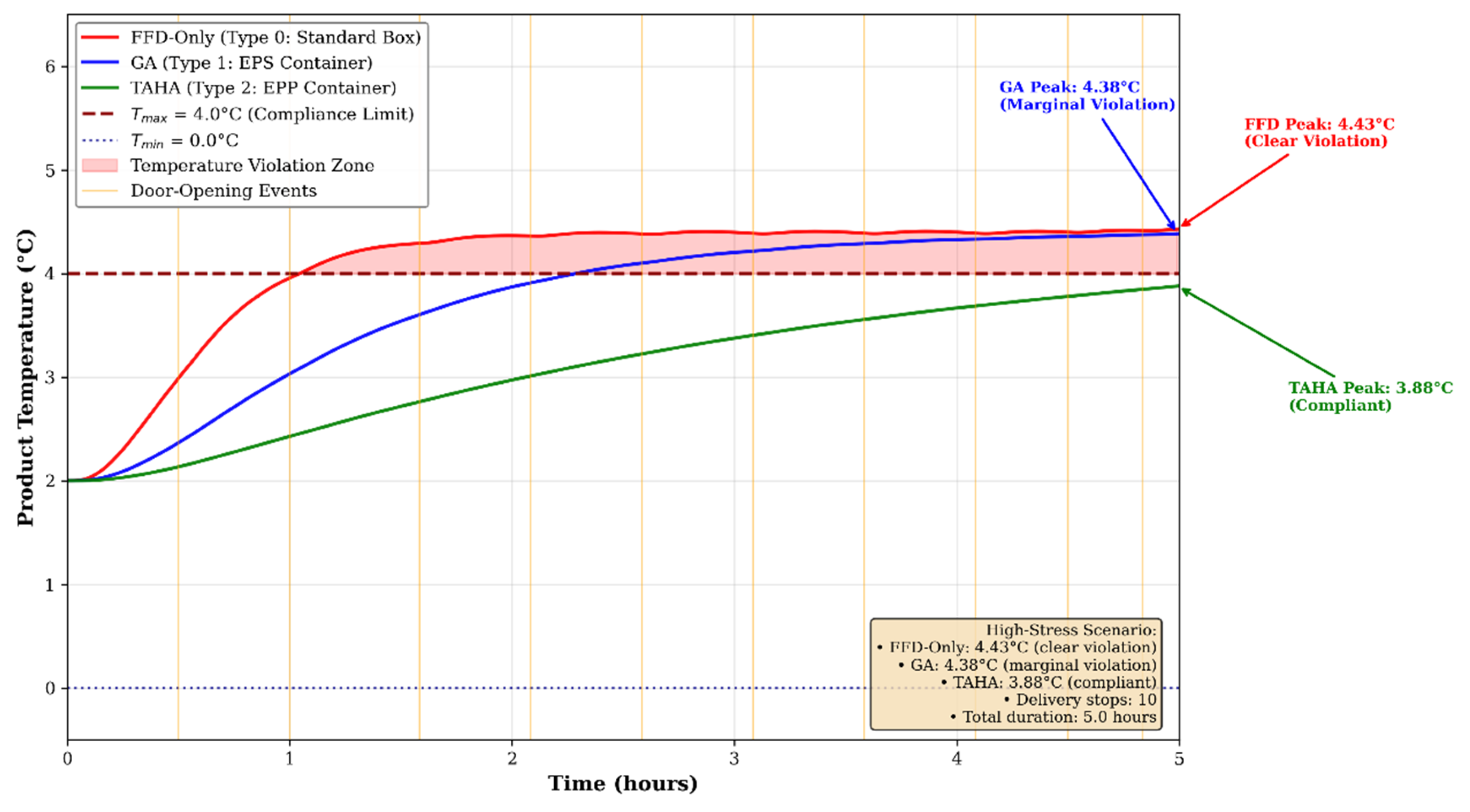
3.4.2. Temperature Trajectory and Compliance Analysis
3.4.3. Container Type Selection Patterns
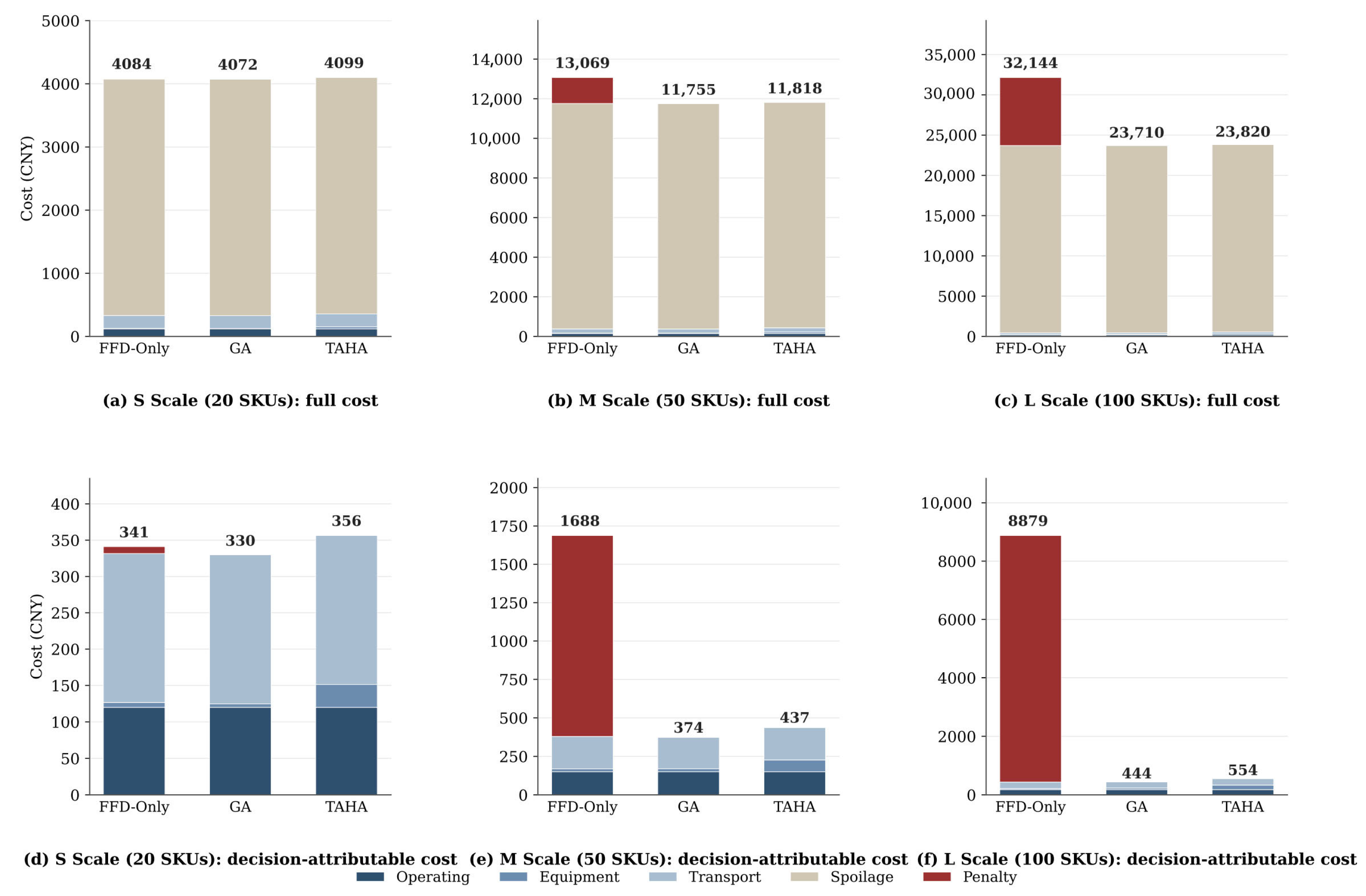
3.4.4. Cost Structure Breakdown
3.5. Sensitivity Analysis
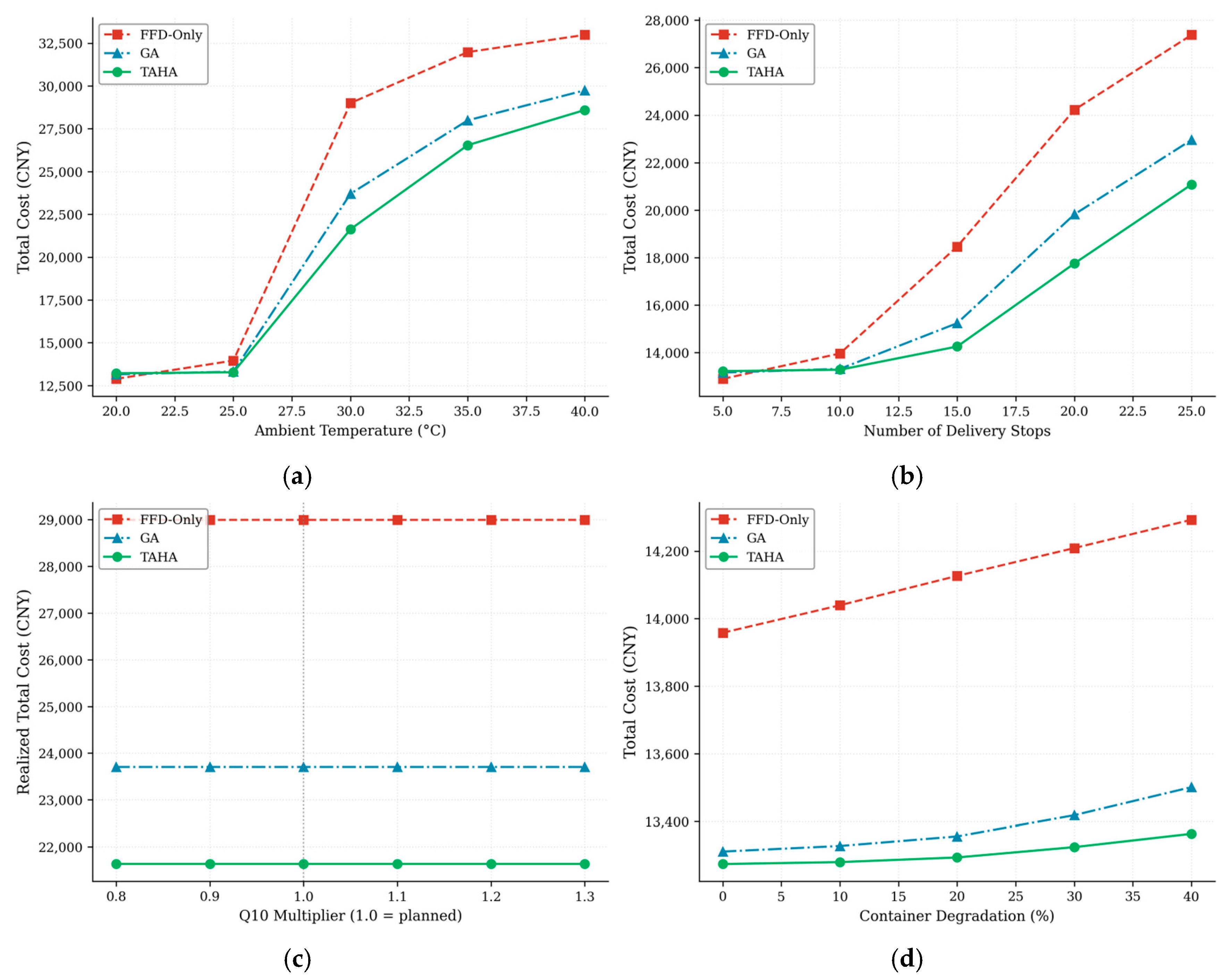
3.5.1. Effect of Ambient Temperature and Door-Opening Frequency
3.5.2. Effect of Parameter Uncertainty
3.5.3. Effect of Container Degradation
3.5.4. Effect of Stochastic Door-Opening Durations
3.5.5. Effect of Clustered Stop Patterns
4. Discussion
4.1. The Value of Coupling Thermodynamic Feedback with Combinatorial Search
4.2. Sensitivity-Based Container Polarization
4.3. Economic Implications of the Cost Structure
4.4. Robustness Under Environmental and Parametric Uncertainty
5. Conclusions
Author Contributions
Funding
Institutional Review Board Statement
Informed Consent Statement
Data Availability Statement
Conflicts of Interest
Appendix A. Proof of NP-Hardness
Appendix A.1. The Reference Problem (3D-BPP)
Appendix A.2. Construction of a Special Instance of CCULP
- Neutralization of Temperature Constraints: Assume the ambient temperature Tamb is constant and strictly equals the optimal storage temperature of all goods (Tamb = Tref). Under this condition, the temperature difference ΔT = 0, meaning no heat exchange occurs (Equations (1) and (5) in the main text become zero). Consequently, the quality decay rate k(T) remains at its minimum base value, and the spoilage cost Costspoil becomes a constant (or zero) regardless of the loading configuration. The temperature compliance constraints are thus automatically satisfied. These parameter values define a special-case instance of the general CCULP rather than a relaxation of its structure: the thermodynamic and multi-echelon constraints remain formally present, but become parametrically inactive on this input class.
- Simplification of Cost Structure: Let the unit value of goods πi = 0 (eliminating quality loss considerations) and the transportation operational costs Costop = 0. Let the fixed cost of using a vehicle (or the highest-level loading unit) be CK = 1, and the costs of all other lower-level units (pallets, boxes) be zero. The objective function Z (Equation (9)) then degenerates to minimizing the number of utilized vehicles/containers.
- Simplification of Hierarchy: Consider a simplified two-level hierarchy where goods are loaded directly into standard containers (equivalent to “bins”), ignoring the intermediate palletization stage.
Appendix A.3. Reduction Logic
- Input: A set of goods with dimensions (li, wi, hi) and a set of containers with capacity (L, W, H);
- Constraints: Geometric non-overlap and containment boundaries;
- Objective: Minimize the total number of containers used.
Appendix A.4. Conclusions
References
- Iyer, P.; Robb, D. Cold chain optimisation models: A systematic literature review. Comput. Ind. Eng. 2025, 204, 110972. [Google Scholar] [CrossRef]
- Labuza, T.P.; Fu, B. Growth kinetics for shelf-life prediction: Theory and practice. J. Ind. Microbiol. 1993, 12, 309–323. [Google Scholar] [CrossRef]
- Tsironi, T.; Ronnow, P.; Giannoglou, M.; Taoukis, P. Developing suitable smart TTI labels to match specific monitoring requirements: The case of Vibrio spp. growth during transportation of oysters. Food Control 2017, 73, 51–56. [Google Scholar] [CrossRef]
- Liu, Y.; Tao, F.; Zhu, R. Vehicle-routing problem for low-carbon cold chain logistics based on the idea of cost–benefit. Complex Intell. Syst. 2025, 11, 157. [Google Scholar] [CrossRef]
- Wu, K.; Lu, Z.; Bai, E. Optimization of cold chain logistics distribution path considering traffic condition and replenishment along the way. PLoS ONE 2025, 20, e0305982. [Google Scholar]
- Jiang, X.; Liu, X.; Pan, F.; Han, Z. Optimizing cold chain distribution routes considering dynamic demand: A low-emission perspective. Sustainability 2024, 16, 2013. [Google Scholar] [CrossRef]
- Ding, Y.; Zhang, L.; Kuo, Y.-H.; Zhang, L. Cold chain routing for product freshness and low carbon emissions: A target-oriented robust optimization approach. Transp. Res. Part E Logist. Transp. Rev. 2025, 199, 104138. [Google Scholar] [CrossRef]
- Qiu, F.; Zhang, G.; Chen, P.-K.; Wang, C.; Pan, Y.; Sheng, X.; Kong, D. A novel multi-objective model for the cold chain logistics considering multiple effects. Sustainability 2020, 12, 8068. [Google Scholar] [CrossRef]
- Ghasemkhani, A.; Tavakkoli-Moghaddam, R.; Rahimi, Y.; Shahnejat-Bushehri, S.; Tavakkoli-Moghaddam, H. Integrated production-inventory-routing problem for multi-perishable products under uncertainty by meta-heuristic algorithms. Int. J. Prod. Res. 2022, 60, 2766–2786. [Google Scholar] [CrossRef]
- Faramarzi-Oghani, S.; Dolati Neghabadi, P.; Talbi, E.-G.; Tavakkoli-Moghaddam, R. Meta-heuristics for sustainable supply chain management: A review. Int. J. Prod. Res. 2023, 61, 1979–2009. [Google Scholar] [CrossRef]
- Guo, N.; Qian, B.; Na, J.; Hu, R.; Mao, J.-L. A three-dimensional ant colony optimization algorithm for multi-compartment vehicle routing problem considering carbon emissions. Appl. Soft Comput. 2022, 127, 109326. [Google Scholar] [CrossRef]
- Glock, C.H. Decision support models for managing returnable transport items in supply chains: A systematic literature review. Int. J. Prod. Econ. 2017, 183, 561–569. [Google Scholar] [CrossRef]
- Yang, Y.; Wu, Z.; Hao, X.; Liu, H.; Qi, M. Two-layer heuristic for the three-dimensional bin design and packing problem. Eng. Optim. 2024, 56, 1601–1638. [Google Scholar] [CrossRef]
- Zhu, W.; Chen, S.; Dai, M.; Tao, J. Solving a 3D bin packing problem with stacking constraints. Comput. Ind. Eng. 2024, 188, 109814. [Google Scholar] [CrossRef]
- Katsanakis, N.; Ibn-Mohammed, T.; Moradlou, H.; Godsell, J. Circular economy strategies for life cycle management of returnable transport items. Sustain. Prod. Consum. 2023, 43, 333–348. [Google Scholar] [CrossRef]
- Zhang, Y.; Kou, X.; Liu, H.; Zhang, S.; Qie, L. IoT-enabled sustainable and cost-efficient returnable transport management strategies in multimodal transport systems. Sustainability 2022, 14, 11668. [Google Scholar] [CrossRef]
- Tsang, Y.; Ma, H.; Tan, K.; Lee, C. A joint sustainable order-packing vehicle routing optimisation for the cold chain e-fulfilment. Ann. Oper. Res. 2025, 355, 805–828. [Google Scholar] [CrossRef]
- Kucharek, M.; Yang, L.; Wang, K. Assessment of insulating package performance by mathematical modelling. Packag. Technol. Sci. 2020, 33, 65–73. [Google Scholar] [CrossRef]
- Calati, M.; Hooman, K.; Mancin, S. Thermal storage based on phase change materials (PCMs) for refrigerated transport and distribution applications along the cold chain: A review. Int. J. Thermofluids 2022, 16, 100224. [Google Scholar] [CrossRef]
- Burgess, S.; Wang, X.; Rahbari, A.; Hangi, M. Optimisation of a portable phase-change material (PCM) storage system for emerging cold-chain delivery applications. J. Energy Storage 2022, 52, 104855. [Google Scholar] [CrossRef]
- Li, M.; Xie, B.; Li, Y.; Cao, P.; Leng, G.; Li, C. Emerging phase change cold storage technology for fresh products cold chain logistics. J. Energy Storage 2024, 88, 111531. [Google Scholar] [CrossRef]
- Qi, B.; Li, G. The evolution of the cold chain logistics vehicle routing problem: A bibliometric and visualization revie. Digit. Transp. Saf. 2024, 3, 92–114. [Google Scholar] [CrossRef]
- Müller, W.A.; Ferreira, S.B.; Botelho da Silva, S. Enhancing Food Safety in the Cold Chain Through Internet of Things and Artificial Intelligence. J. Food Sci. 2026, 91, e70871. [Google Scholar] [CrossRef]
- De Micheaux, T.L.; Ducoulombier, M.; Moureh, J.; Sartre, V.; Bonjour, J. Experimental and numerical investigation of the infiltration heat load during the opening of a refrigerated truck body. Int. J. Refrig. 2015, 54, 170–189. [Google Scholar] [CrossRef]
- Estrada-Flores, S.; Eddy, A. Thermal performance indicators for refrigerated road vehicles. Int. J. Refrig. 2006, 29, 889–898. [Google Scholar] [CrossRef]
- Gillespie, J.; da Costa, T.P.; Cama-Moncunill, X.; Cadden, T.; Condell, J.; Cowderoy, T.; Ramsey, E.; Murphy, F.; Kull, M.; Gallagher, R. Real-time anomaly detection in cold chain transportation using IoT technology. Sustainability 2023, 15, 2255. [Google Scholar] [CrossRef]
- Alherimi, N.; Ben-Daya, M. A Systematic Review on the Intersection of the Cold Chain and Digital Transformation. Sustainability 2025, 17, 11202. [Google Scholar] [CrossRef]
- Ndraha, N.; Hsiao, H.-I.; Vlajic, J.; Yang, M.-F.; Lin, H.-T.V. Time-temperature abuse in the food cold chain: Review of issues, challenges, and recommendations. Food Control 2018, 89, 12–21. [Google Scholar] [CrossRef]
- Mercier, S.; Villeneuve, S.; Mondor, M.; Uysal, I. Time–temperature management along the food cold chain: A review of recent developments. Compr. Rev. Food Sci. Food Saf. 2017, 16, 647–667. [Google Scholar] [CrossRef] [PubMed]
- Bishara, R.H. Cold chain management–an essential component of the global pharmaceutical supply chain. Am. Pharm. Rev. 2006, 9, 105–109. [Google Scholar]
- Xiao, S.; Peng, P.; Yu, S.; Puchinger, J. Route optimisation for sustainable cold chain logistics: A collaborative distribution model considering on-demand reuse of returnable transport items. Int. J. Prod. Res. 2025, 63, 7505–7524. [Google Scholar] [CrossRef]
- Rodrigue, J.-P. The Geography of Transport Systems; Routledge: Abingdon, UK, 2020. [Google Scholar]
- Ascher, U.M.; Petzold, L.R. Computer Methods for Ordinary Differential Equations and Differential-Algebraic Equations; SIAM: Philadelphia, PA, USA, 1998. [Google Scholar]
- GB 1589–2016; Limits of Dimensions, Axle Load and Masses for Motor Vehicles, Trailers and Combination Vehicles. General Administration of Quality Supervision, Inspection and Quarantine of the PRC & Standardization Administration of China: Beijing, China, 2016.
- Thermo King. TK80004 V–VX Series, Version 3.4. 2025. Available online: https://www.thermoking.nl/wp-content/uploads/2025/03/TK80004_V-VX-Series_01-2025_EN_V3.4-1.pdf (accessed on 24 February 2026).
- ISO 6780:2003; Flat Pallets for Intercontinental Materials Handling—Principal Dimensions and Tolerances. International Organization for Standardization: Geneva, Switzerland, 2003.
- GB/T 4892–2021; Dimensions of Rigid Rectangular Transport Packages. State Administration for Market Regulation & Standardization Administration of China: Beijing, China, 2021.



| Study | Focus | VRP | 3D-BPP | Thermal Dyn. | Q10 Decay | Multi-Level | Endog. Feedback |
|---|---|---|---|---|---|---|---|
| Liu et al. [4] | Low-carbon cold-chain VRP | ✓ | — | — | — | — | — |
| Wu et al. [5] | Cold-chain VRP with traffic and replenishment | ✓ | — | — | — | — | — |
| Jiang et al. [6] | Low-emission routing with dynamic demand | ✓ | — | — | — | — | — |
| Ding et al. [7] | Target-oriented robust cold-chain VRP | ✓ | — | — | — | — | — |
| Yang et al. [13] | 3D bin design and packing heuristic | — | ✓ | — | — | — | — |
| Zhu et al. [14] | 3D bin packing with stacking constraints | — | ✓ | — | — | — | — |
| Tsang et al. [17] | Joint packaging selection + multi-temp delivery | ✓ | — | — | — | — | — |
| Kucharek et al. [18] | Insulated-package heat-transfer model | — | — | ✓ | — | — | — |
| Calati et al. [19] | PCM-based refrigerated transport (review) | — | — | ✓ | — | — | — |
| Burgess et al. [20] | PCM cold-chain delivery box optimization | — | — | ✓ | — | — | — |
| This study (CCULP) | Joint loading–temperature-control optimization | — | ✓ | ✓ | ✓ | ✓ | ✓ |
| Category | Symbol | Description | Value (s) | Unit | Source |
|---|---|---|---|---|---|
| 1. Product Attributes | Q10 | Temperature coefficient | Meat: 2.8; Dairy: 2.3; Veg: 2.0 | - | [2] |
| Tmin, Tmax | Allowable temperature range | Meat: 0–4; Dairy: 2–6; Veg: 4–10 | °C | [28,32] | |
| πi | Unit value of goods | Meat: 80; Dairy: 40; Veg: 15 | CNY/kg | Wholesale benchmark, Beijing Xinfadi 2024 | |
| 2. Insulated Containers | Rb(s) | Effective thermal resistance | Type 0: 0.15; Type 1: 0.45; Type 2: 0.75 | m2·K/W | Calibrated to [18,19]; see Section 2.2 |
| κ | Resistance improvement factor | Type 1: 2.0; Type 2: 4.0 | - | Calculated from row 4 | |
| cs(s) | Usage cost per trip | Type 0: 2; Type 1: 8; Type 2: 15 | CNY/box | Supplier quotation range, 2024 | |
| 3. Logistics Resources | Dimveh | Vehicle internal dimensions (L × W × H) | 4.2 × 1.8 × 2.0 | m | GB 1589–2016 [34] (light refrigerated truck class) |
| VK | Vehicle compartment volume | 15.0 | m3 | Derived from row 7 | |
| WK | Vehicle maximum payload | 2500 | kg | [34] | |
| Pcool | Refrigeration cooling power | 3.5 | kW | [35] | |
| τv | Compartment thermal time constant | 45 | min | [25] | |
| Dimpal | Standard pallet dimensions | 1200 × 1000 | mm | ISO 6780:2003 [36] | |
| Hpalmax | Maximum pallet stacking height | 1.2 | m | GB/T 4892–2021 [37] | |
| 4. Environment & Ops | Tamb | Ambient temperature (Base case) | 25 | °C | CMA Beijing station, 2020–2024 summer daily mean |
| q0 | Door-opening temperature rise rate | 2.5 | °C/min | [24] | |
| Δtdoor | Average duration per stop | 3 | min | [24]; typical urban last-mile mean | |
| Nstop | Number of delivery stops | S: 5; M: 10; L: 15 | - | Scenario design (Section 3.3.1) |
| Parameter | TAHA | GA | FFD-Only |
|---|---|---|---|
| Search strategy | Single start local search | Population-based evolutionary | Greedy constructive |
| Initial solution | FFD by Timax ascending | Random + FFD hybrid (10%) | FFD by volume |
| Population/candidate size | 1 (single incumbent) | 100 chromosomes | — |
| Neighborhood/operators | Swap, Upgrade, Regroup (uniform selection) | Tournament selection (size 3), single-point crossover, bit-flip mutation | — |
| Crossover rate | — | 0.80 | — |
| Mutation rate | — | 0.10 | — |
| Elitism | — | Top 5 preserved per generation | — |
| Acceptance rule | Strict improvement on Zbest | Parent replacement by offspring if fitter | Greedy |
| Hard iteration ceiling | 500 iterations | 200 generations | 1 pass |
| Soft convergence trigger | 100 non-improving iterations | 50 non-improving generations | — |
| Fitness function | Same total cost Z (Equation (9)) | Same total cost Z (Equation (9)) | Z without penalty feedback |
| Random seeds | 1–10 per scale | 1–10 per scale | 1–10 per scale |
| Independent runs per instance | 1 | 1 | 1 |
| Implementation | Python 3.10 + NumPy | Python 3.10 + NumPy | Python 3.10 |
| Termination (Large scale, mean over 10 seeds) | 100 iterations (soft-converged in 30/30 runs) | 95 generations (early stopped; range 71–125) | Single pass |
| Scale | Algorithm | Total Cost (Z) (CNY) | Violation Rate (%) | Spoilage Ratio (%) | CPU Time (s) |
|---|---|---|---|---|---|
| Small | MILP-CBC | 4072.63 ± 764.12 | 0.0 ± 0.0 | 91.6 ± 1.5 | 1.56 ± 0.29 |
| (20 SKU) | FFD-Only | 4083.7 ± 780.0 | 0.04 ± 0.1 | 91.4 ± 1.4 | 0.004 ± 0.0 |
| GA | 4072.83 ± 763.92 | 0.0 ± 0.0 | 91.6 ± 1.6 | 16.0 ± 0.9 | |
| TAHA | 4099.0 ± 768.0 | 0.0 ± 0.0 | 91.0 ± 1.6 | 0.3 ± 0.1 | |
| Medium | FFD-Only | 13,068.7 ± 1751.0 | 1.7 ± 1.6 | 87.6 ± 8.0 | 0.017 ± 0.0 |
| (50 SKU) | GA | 11,754.9 ± 1387.5 | 0.0 ± 0.0 | 96.8 ± 0.4 | 66.7 ± 15.3 |
| TAHA | 11,818.3 ± 1396.0 | 0.0 ± 0.0 | 96.3 ± 0.4 | 1.4 ± 0.1 | |
| Large | FFD-Only | 32,144.5 ± 4583.9 | 4.7 ± 2.4 | 73.4 ± 9.0 | 0.043 ± 0.0 |
| (100 SKU) | GA | 23,709.7 ± 1551.7 | 0.0 ± 0.0 | 98.1 ± 0.1 | 203.0 ± 41.1 |
| TAHA | 23,819.8 ± 1556.6 | 0.0 ± 0.0 | 97.7 ± 0.1 | 3.3 ± 0.2 |
- (i)
- MILP-CBC: implemented in Python using PuLP and the open-source CBC solver. All 10 small-scale instances are solved to proven optimality (MIPGap = 0.0%) with a mean wall-clock time of 1.56 s (max 2.00 s) under a 60 s time limit. The pre-computation of (product, container-type) spoilage and penalty cost coefficients (Section 3.3.2) avoids the SOS2 piecewise-linearization of (C14) and is mathematically equivalent to the MILP formulation derived in Section 2.3.1.
- (ii)
- MILP is computationally intractable for Medium and Large instances and is therefore omitted from these scales, as stated in Section 3.3.2.
- (iii)
- On nine of the 10 Small-scale instances, GA matches the MILP-CBC proven optimum exactly; on instance 8, GA returns a near-optimal feasible solution differing from MILP by only CNY 2 (0.06%). The aggregate mean gap of GA relative to the proven optimum is +0.005%.
- (iv)
- All values are mean ± standard deviation across 10 random seeds (seeds 1–10). Standard deviations use the (n − 1) sample-size denominator.
- (v)
- Cross-scale verification of the GA implementation. Re-running the feasibility-repaired GA across all three problem scales confirms that the Medium and Large GA values in Table 4 are unchanged: mean total cost differences are below CNY 1 (i.e., <0.005%) at both scales. This robustness arises from the per-trip flat container-cost structure of Equation (9), under which the feasibility repair (overflowing excess SKUs into an additional same-type container) leaves the equipment-cost term essentially invariant, and the spoilage and penalty terms—which depend only on container type, not on packing density—remain identical.
| Metric | TAHA | GA | Ratio (GA/TAHA) |
|---|---|---|---|
| Function evaluations (FE) | 77 ± 5.3 | 9570 ± 1857 | 124.0× |
| Wall time (s) | 3.29 ± 0.36 | 207.46 ± 42.40 | 63.1× |
| Time per FE (ms) | 42.54 ± 3.17 | 21.71 ± 2.16 | 0.51× |
| Best total cost (CNY) | 23,819.78 ± 1556.64 | 23,709.68 ± 1551.68 | 1.00× |
| FE Budget | TAHA Best (CNY) | GA Best (CNY) | GA − TAHA (CNY) | No. Seeds Still Running (GA) |
|---|---|---|---|---|
| 50 | 23,819.78 | 23,737.28 | −82.50 | 10/10 |
| 100 | 23,819.78 | 23,737.28 | −82.50 | 10/10 |
| 500 | 23,819.78 | 23,732.78 | −87.00 | 10/10 |
| 1000 | 23,819.78 | 23,727.48 | −92.30 | 10/10 |
| 2000 | 23,819.78 | 23,722.78 | −97.00 | 10/10 |
| 5000 | 23,819.78 | 23,712.58 | −107.20 | 10/10 |
| 10,000 | 23,819.78 | 23,709.68 | −110.10 | 4/10 |
| Category | Sensitivity | Algorithm | Type 0 (%) | Type 1 (%) | Type 2 (%) |
|---|---|---|---|---|---|
| Meat | High (Q10 = 2.8) | FFD-Only | 100.0 | 0.0 | 0.0 |
| GA | 14.6 | 45.2 | 40.2 | ||
| TAHA | 4.8 | 22.8 | 72.4 | ||
| Dairy | Medium (Q10 = 2.3) | FFD-Only | 100.0 | 0.0 | 0.0 |
| GA | 31.0 | 48.1 | 20.9 | ||
| TAHA | 14.9 | 60.7 | 24.4 | ||
| Vegetable | Low (Q10 = 2.0) | FFD-Only | 100.0 | 0.0 | 0.0 |
| GA | 68.7 | 25.9 | 5.4 | ||
| TAHA | 75.1 | 20.1 | 4.8 |
| Scenario | Duration Distribution | Mean Cost (CNY) | Δ vs. S0 (%) | Cost CV (%) | Mean Violation Rate (%) | Worst-Case Violation Rate (%) | Max Peak T (°C) |
|---|---|---|---|---|---|---|---|
| S0 | 3.00 min (deterministic) | 23,819.78 | 0.00 | 6.20 | 0.000 | 0.000 | 9.97 |
| S1 | Uniform [2.5, 3.5] min | 23,846.47 | +0.11 | 6.07 | 0.015 | 1.63 | 9.97 |
| S2 | Uniform [2.0, 4.0] min | 23,871.09 | +0.22 | 6.11 | 0.029 | 4.26 | 9.97 |
| S3 | Uniform [1.5, 4.5] min | 23,965.43 | +0.61 | 6.58 | 0.081 | 6.37 | 9.97 |
| Scenario | Stop Pattern | Mean Cost (CNY) | Δ vs. U0 (%) | Cost CV (%) | Mean Violation Rate (%) | Worst-Case Violation Rate (%) | Max Peak T (°C) |
|---|---|---|---|---|---|---|---|
| U0 | Uniform(30, 330) min | 23,968.83 | 0.00 | 6.74 | 0.083 | 4.61 | 9.97 |
| C1 | 2 clusters, 30 min window | 24,404.23 | +1.82 | 9.47 | 0.325 | 6.78 | 9.97 |
| C2 | 3 clusters, 20 min window | 23,929.01 | −0.17 | 6.73 | 0.061 | 4.63 | 9.97 |
| C3 | 5 clusters, 15 min window | 24,306.56 | +1.41 | 8.76 | 0.270 | 6.72 | 9.97 |
Disclaimer/Publisher’s Note: The statements, opinions and data contained in all publications are solely those of the individual author(s) and contributor(s) and not of MDPI and/or the editor(s). MDPI and/or the editor(s) disclaim responsibility for any injury to people or property resulting from any ideas, methods, instructions or products referred to in the content. |
© 2026 by the authors. Licensee MDPI, Basel, Switzerland. This article is an open access article distributed under the terms and conditions of the Creative Commons Attribution (CC BY) license.
Share and Cite
Wang, J.; Zhao, X.; Du, X.; Li, J.; Xu, S. Optimization of Cold-Chain Logistics Unitization Strategies Under Dynamic Temperature Constraints. Sustainability 2026, 18, 5002. https://doi.org/10.3390/su18105002
Wang J, Zhao X, Du X, Li J, Xu S. Optimization of Cold-Chain Logistics Unitization Strategies Under Dynamic Temperature Constraints. Sustainability. 2026; 18(10):5002. https://doi.org/10.3390/su18105002
Chicago/Turabian StyleWang, Jing, Xianfeng Zhao, Xueqiang Du, Jichun Li, and Shibo Xu. 2026. "Optimization of Cold-Chain Logistics Unitization Strategies Under Dynamic Temperature Constraints" Sustainability 18, no. 10: 5002. https://doi.org/10.3390/su18105002
APA StyleWang, J., Zhao, X., Du, X., Li, J., & Xu, S. (2026). Optimization of Cold-Chain Logistics Unitization Strategies Under Dynamic Temperature Constraints. Sustainability, 18(10), 5002. https://doi.org/10.3390/su18105002