2.1. ESG Performance and Firm Performance
ESG performance can be understood as an important signal through which firms convey their sustainability capabilities, level of responsibility fulfillment, and governance quality to external stakeholders. In an environment characterized by information asymmetry, higher ESG performance helps reduce the uncertainty of external actors, such as investors, creditors, government agencies, and consumers, regarding firms’ long-term development capabilities, while strengthening their trust and support. From the perspective of signaling theory, ESG performance reflects firms’ commitment to responsible management and sustainable development, thereby improving external stakeholders’ evaluation of firms and shaping their resource-allocation decisions. Meanwhile, the resource-based view and stakeholder theory provide complementary perspectives that further explain how ESG performance enhances firms’ long-term competitive advantage and sustainable value creation by accumulating strategic intangible resources, improving stakeholder relationships, and optimizing internal governance structures [
4]. As a comprehensive manifestation of firms’ environmental responsibility, social responsibility, and corporate governance practices, ESG performance shapes firms’ relationships with stakeholders, influences their access to critical resources, and optimizes internal governance structures, thereby exerting an overall impact on firm performance.
Existing studies generally suggest that ESG performance can enhance firm performance by improving operational efficiency, reducing transaction costs, strengthening stakeholder trust, and lowering financing constraints. First, superior ESG performance improves operational efficiency and resource allocation efficiency. Continuous investments in environmental management, employee relations, and governance mechanisms help firms mitigate environmental and social risks, reduce operational uncertainty, and improve internal management processes, thereby enhancing productivity and investment efficiency [
20,
21,
22]. Second, ESG practices strengthen trust between firms and external stakeholders, alleviate information asymmetry, and reduce transaction costs, thereby enhancing firms’ access to external financing and commercial resources [
11,
12,
23]. Third, sound governance practices curb managerial opportunism, improve incentive mechanisms, and enhance decision-making quality and capital allocation efficiency, which promotes long-term firm performance [
24,
25].
However, the relationship between ESG performance and financial performance remains controversial. Some studies argue that ESG activities may impose additional costs on firms and crowd out resources that could otherwise be allocated to core business operations. Specifically, due to the strong externality attributes of corporate social responsibility activities, they may conflict with firms’ value-maximization objectives [
7]. Other studies find that ESG performance has a significantly negative effect on corporate financial performance measured by ROA, supporting the trade-off view that ESG investment may increase operating costs [
8]. Adding to this complexity, recent evidence shows that earnings management further obscures the ESG–performance link [
26]. In addition, the environmental, social, and governance dimensions of ESG may negatively affect corporate financial performance, although ESG performance can improve non-financial performance [
9]. Similarly, environmental disclosure may have a negative impact on corporate financial performance, while different ESG dimensions may also exert heterogeneous effects on firm performance [
27]. Moreover, only moderate ESG levels are associated with reduced manipulation, whereas social and governance scores may coincide with heightened opportunistic reporting [
28], which may contribute to lower financial performance. Additionally, earnings management significantly undermines corporate sustainability, directly eroding the basis for ESG value creation [
29]. These findings suggest that ESG performance does not necessarily generate immediate financial benefits, and its economic consequences may depend on specific institutional, organizational, informational conditions and earnings management.
One important reason for the mixed findings lies in ESG measurement and signal credibility. ESG ratings may vary across rating agencies because of differences in evaluation criteria, indicator weights, and data sources [
30]. Such ESG rating discrepancies may weaken the credibility of ESG signals and make it more difficult for external stakeholders to accurately evaluate firms’ true sustainability performance. Moreover, firms may engage in strategic ESG presentation, such as greenwashing or cross-washing, by selectively emphasizing certain ESG dimensions while concealing weaknesses in others. Recent empirical evidence indicates that corporate ESG greenwashing significantly undermines financial sustainable development performance [
31]. Firms with higher customer concentration are more likely to engage in ESG greenwashing to cater to major customers’ ESG preferences, particularly when facing financial constraints [
32]. Furthermore, there exists a significant positive correlation between corporate ESG performance and greenwashing behavior, suggesting that high ESG scores do not necessarily guarantee authentic sustainability commitment [
33]. Such behavior may reduce the credibility of ESG signals and weaken the positive relationship between ESG performance and firm performance [
34].
In the context of state-owned enterprises (SOEs), the signals of responsibility fulfillment, governance quality, and sustainable development conveyed by ESG performance carry stronger institutional implications. SOEs not only pursue economic objectives but also social responsibility, policy responsiveness, and public missions; therefore, their ESG practices are more likely to be shaped by institutional policies and governance mechanisms. Recent studies show that ESG-related policies can significantly promote SOEs’ ESG development and enhance their sustainable development capability by reducing financing costs and other mechanisms [
35]. Dividend-right incentive reform in central SOEs can also improve SOEs’ ESG performance by enhancing employee value creation and increasing public green attention [
36]. Therefore, ESG practices in SOEs not only strengthen organizational legitimacy and policy responsiveness but also affect firm performance by improving information transparency, governance quality, and access to critical resources [
37,
38]. Meanwhile, whether ESG performance can be transformed into financial benefits may depend on the credibility of ESG signals, corporate reputational capital, and external stakeholder recognition. This makes Chinese listed SOEs a suitable context for examining the performance consequences of ESG performance and its boundary conditions.
In sum, ESG performance, as an important manifestation of firms’ sustainable development practices, is expected to positively affect firm performance. Accordingly, we propose the following hypothesis:
H1. ESG performance is positively associated with firm performance in state-owned enterprises.
2.2. ESG Performance, Risk-Taking, and Firm Performance
Corporate risk-taking refers to the degree to which firms are willing to bear uncertainty in pursuit of returns and is a key determinant of long-term firm performance [
24]. Prior research suggests that superior ESG performance is associated with higher corporate risk-taking [
37].
First, superior ESG performance can signal to the market, government agencies, and other stakeholders that firms possess strong capabilities in compliant operations, responsibility fulfillment, and risk management. This enhances corporate legitimacy, reduces the likelihood of environmental, social, and regulatory risks, and mitigates potential losses [
3,
39]. Corporate investments in social responsibility activities (e.g., philanthropy and environmental initiatives) generate social capital and create an “insurance-like” effect. When facing market volatility or policy uncertainty, firms can obtain stakeholder support and critical resources, which enhances their risk-taking capacity [
40]. For SOEs, ESG performance is particularly important, as it helps firms balance economic objectives with social and policy mandates while coping with market risks [
41].
Second, from the perspective of internal governance mechanisms, ESG practices help strengthen monitoring and constraints, curb managerial risk aversion and opportunistic behavior, and thereby increase firms’ overall risk-taking levels [
42]. When implementing ESG strategies, managers tend to adopt a long-term orientation and allocate more resources to projects with long-term return potential, such as technological innovation and green investments, which further enhances firms’ profitability and performance [
43].
Therefore, we propose:
H2. ESG performance improves firm performance by increasing corporate risk-taking.
2.3. ESG Performance, Financial Constraints, and Firm Performance
Financial constraints are a critical factor restricting firms’ sustainable development and performance improvement [
44]. Prior studies generally argue that financial constraints weaken firm performance by increasing operating costs [
45] and restricting external financing channels [
46]. However, some studies suggest that, under certain conditions, superior ESG performance can alleviate financial constraints and thereby improve firm performance [
47,
48].
The fundamental cause of financial constraints lies in information asymmetry between firms and external capital providers. ESG practices have a significant signaling function, conveying positive information about firms’ operational stability, long-term strategic orientation, and risk management capabilities to external capital providers, such as investors, creditors, and suppliers, thereby reducing information asymmetry [
49]. At the same time, ESG practices can strengthen internal governance mechanisms, constrain managerial opportunism, and improve disclosure transparency, which further enhances the credibility of ESG signals, improves firms’ information environment, and increases the trust of external capital providers [
11]. As information asymmetry decreases, firms can more easily obtain funding from investors, creditors, and suppliers, thereby alleviating financial constraints, expanding investment, and improving firm performance.
The alleviation of financial constraints creates favorable conditions for firms to acquire critical resources, increase investment, and enhance performance. Thus, we propose:
H3. ESG performance improves firm performance by alleviating financial constraints.
2.4. Corporate Reputation as a Mediator Between ESG Performance and Firm Performance
Corporate reputation is an accumulative evaluation formed by external stakeholders based on firms’ long-term behavior and continuous information disclosure, reflecting the market’s overall judgment of firms’ reliability, responsibility, and governance quality. Prior research shows that ESG practices contribute to reputation building [
50,
51], and higher corporate reputation further enhances firm performance [
52].
ESG performance conveys key information about firms’ long-term orientation, ethical standards, and governance quality to external stakeholders [
14,
53]. When such information is continuously received and recognized by stakeholders such as investors, consumers, suppliers, and government agencies, corporate reputation is enhanced. Investments in employee welfare, social initiatives, and consumer protection enhance societal trust and corporate reputation. Firms with strong reputations can attract more investors, business partners, and consumers, thereby improving firm performance.
Moreover, government agencies are also important recipients of ESG information from SOEs. Improved ESG performance sends positive signals to government agencies regarding firms’ active fulfillment of environmental and social responsibilities, thereby enhancing their reputation within governmental systems [
16]. High corporate reputation not only facilitates access to policy support and financing opportunities but also enables firms to obtain more resources, thereby promoting firm performance [
54].
Accordingly, we propose:
H4. ESG performance improves firm performance through the mediating role of corporate reputation.
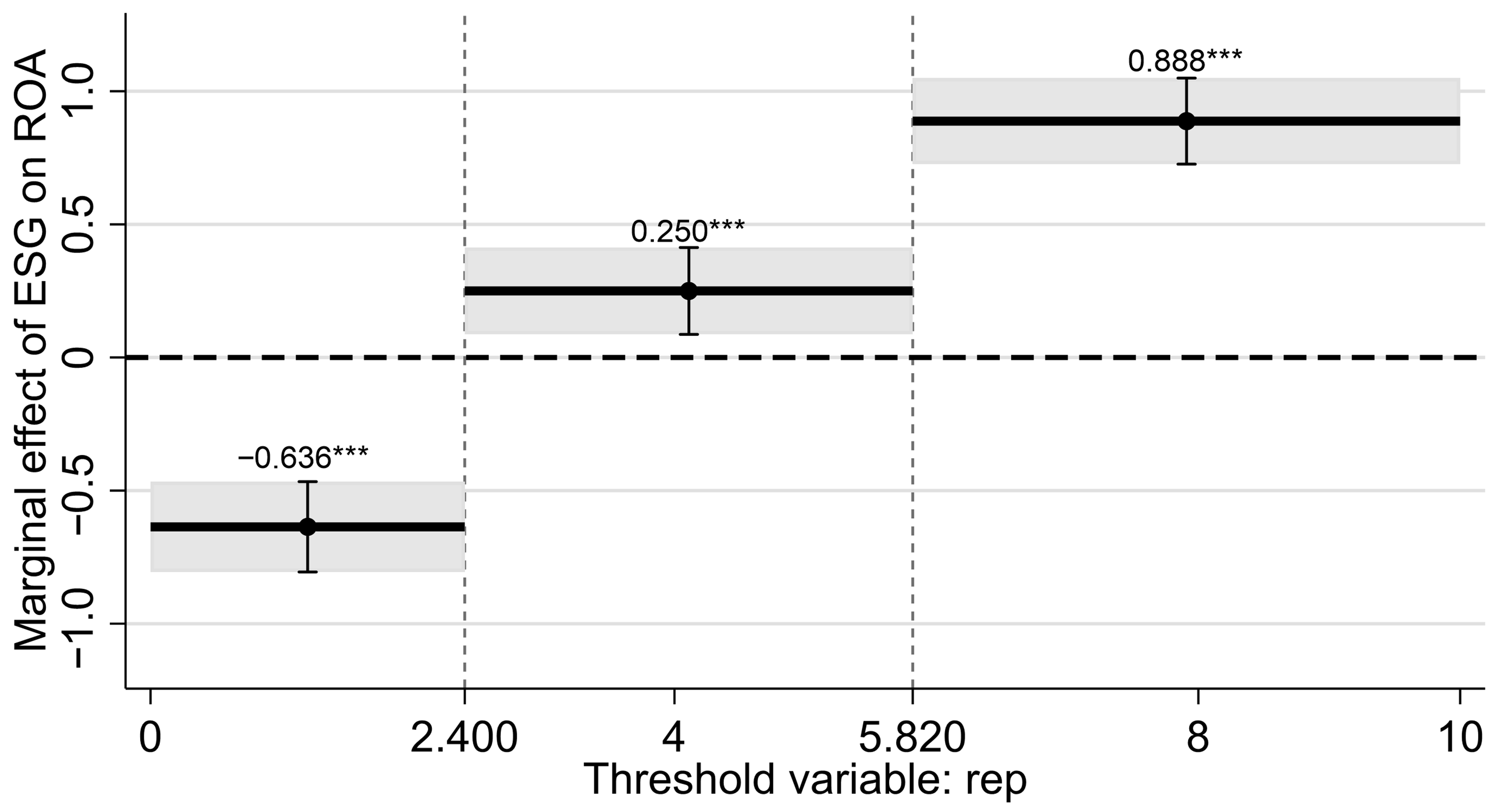
2.5. Threshold Effect of Corporate Reputation: A Nonlinear Relationship Between ESG Performance and Firm Performance
Prior studies suggest that the relationship between ESG performance and firm performance may be nonlinear across different contexts [
5,
6,
17]. Some studies argue that ESG investments may suppress firm performance due to increased costs and resource crowding-out effects [
8,
9], whereas others find that ESG practices reduce transaction costs and facilitate cooperation, thereby enhancing firm performance [
55]. These mixed findings indicate that the economic consequences of ESG performance may depend on firms’ reputational conditions.
Corporate reputation influences how external stakeholders interpret and evaluate ESG signals. When firms have low reputational standing, their ESG disclosures and practices may be perceived as symbolic actions or “greenwashing”, leading stakeholders to question their authenticity and value [
56]. In such cases, the costs associated with ESG investments (e.g., environmental management, social responsibility, and governance improvements) may not translate into immediate economic benefits [
57]. Moreover, low-reputation firms face greater barriers in resource acquisition, and ESG practices may crowd out productive resources, thereby suppressing firm performance [
58].
As corporate reputation improves, the positive effects of ESG practices gradually emerge. Once corporate reputation reaches a certain level, ESG performance significantly enhances firm performance, indicating that corporate reputation plays a critical role in strengthening the credibility of ESG signals [
59,
60,
61]. High-reputation firms can enhance stakeholder trust through ESG practices related to environmental protection, employee rights protection, investor value creation, and agency problem mitigation [
62]. This enhanced trust facilitates access to financing, market expansion, and high-quality development resources [
63]. Therefore, the impact of ESG performance on firm performance exhibits a nonlinear pattern contingent on corporate reputation, with a stronger positive effect beyond a reputational threshold.
Based on the above analysis, we propose:
H5. The relationship between ESG performance and firm performance is nonlinear, with a significant threshold effect contingent on corporate reputation.