1. Introduction
Human activities have exerted profound impacts on the Earth’s natural systems and human livelihoods. In particular, rising carbon dioxide emissions and the reduction of carbon sink spaces have exposed the world to substantial survival risks associated with climate change, including extreme heat [
1], water scarcity [
2], sea-level rise [
3], intense precipitation [
4], and food insecurity [
5]. Among these issues, urban development patterns are closely linked to sustainable development under the growing threats posed by climate change.
Increasing population pressure on land, driven by migration and suburbanization, leads to land-use change and the conversion of productive agricultural land [
6]. Disorderly urban expansion and urban sprawl extend commuting distances, raise infrastructure provision costs, and increase dependence on private vehicles, thereby intensifying carbon emissions from transportation and residential energy use [
7,
8,
9]. In particular, according to the latest statistics released by the United Nations Environment Programme (UNEP) and the Global Alliance for Buildings and Construction (GlobalABC) [
10], the global buildings and construction sector accounted for approximately 32% of global energy consumption and 34% of global carbon dioxide emissions in 2023, underscoring its substantial contribution to climate change. In addition, urban expansion often results in the conversion and loss of agricultural and forest land, thereby threatening food security [
11,
12,
13], while simultaneously weakening the carbon sequestration capacity of existing land cover and its contribution to climate regulation [
14,
15]. Unplanned urban expansion has also been shown to cause deforestation, arable land degradation, soil erosion, and the loss of productive rural land. Beyond worsening the livelihoods of hinterland communities, it places greater pressure on local governments to provide public services, thereby giving rise to multiple socio-environmental problems [
16,
17].
To address the systemic risks posed by climate change, the United Nations adopted the 2030 Agenda for Sustainable Development in 2015, setting out 17 Sustainable Development Goals (SDGs) with the aim of fostering a more equitable, peaceful, and sustainable future worldwide. In response to the urban and rural development issues outlined above, SDG 11 seeks to “make cities and human settlements inclusive, safe, resilient and sustainable.” This goal was established to address the problems arising from rapid global urbanization, including land consumption, social inequality, environmental degradation, and disaster risk, and to promote a more integrated and sustainable model of urban development. To facilitate evaluation and implementation, SDG 11 includes a number of targets and indicators. Among them, SDG Indicator 11.3.1 is defined by the United Nations as the ratio of land consumption rate (LCR) to population growth rate (PGR), serving as a measure of land use efficiency. This indicator has been proposed as a monitoring tool for changes in built-up areas associated with urban development [
18]. Its central purpose is to assess whether the expansion of the built environment remains relatively balanced with population growth [
19], thereby identifying whether urban development follows a compact, restrained, and efficient spatial growth pattern. In particular, reducing average urban land consumption per capita can contribute to climate change mitigation while simultaneously advancing multiple social, economic, and environmental objectives [
20] (p. 1). Therefore, understanding the patterns and drivers of change in horizontally expanding built-up areas is of critical importance for urban planning and the implementation of sustainable development policies.
Although SDG Indicator 11.3.1 provides a convenient basis for rapid comparison across cities, it also has important interpretive limitations. First, even when the LCRPGR value does not appear particularly high, the actual spatial pattern may still be unsustainable. For example, urban expansion may take a fragmented yet linear form, resulting in the fragmentation and patchization of agricultural land, which suggests that the ratio alone is insufficient to capture the dynamics of peri-urban sprawl [
21]. Second, because LCRPGR is calculated using logarithmic transformation and a ratio structure, it is highly sensitive to population data and may even produce reversals in directional interpretation [
22]. As Angel et al. [
20] (p. 5) noted, “It is difficult to interpret the negative values for Indicator 11.3.1 beyond noting that even cities that lose populations continue to expand and, therefore, by definition, land consumption there becomes less efficient. It is not clear, however, whether a larger negative value for a city is preferable to a smaller one.” Under conditions of population decline or low population growth, the conventional LCRPGR framework often becomes difficult to interpret, and this indicator alone is insufficient for evaluating urban land use efficiency [
23]. Accordingly, research on land consumption must explicitly take into account the contexts of suburbanization and population decline [
24]. It is important to note that population decline does not necessarily imply a corresponding contraction in demand for built-up land. Influenced by factors such as shrinking household size, industrial land development, transportation infrastructure investment, preferences for low-density housing, and local development policies, areas experiencing population stagnation or decline may still undergo continued land development and built-up area expansion, thereby posing a major interpretive challenge to conventional land use efficiency indicators that are primarily based on population growth.
In cases of zero or negative population growth—for example, when the population declines during the study period, or when the built-up area contracts due to natural disasters—the United Nations Human Settlements Programme [
25] recommends interpreting LCR and PGR separately and using the suggested secondary indicators, such as per capita built-up area and built-up area change, to explain their trends. Other supplementary indicators, including the rate of change in per capita land consumption and density change rate [
20], urban expansion speed, urban expansion intensity, compactness [
26], EGRLCR (economic growth rate to land consumption rate ratio) [
27], as well as uncertainty analysis and equity assessment [
22], have also been proposed to address the interpretive limitations of LCRPGR. In response to these challenges, this study further employs supplementary indicators to better evaluate patterns of urban expansion under population decline, assess whether such expansion reflects efficient land use, and enhance the interpretation of SDG Indicator 11.3.1.
Urban land expansion is typically shaped by demographic, economic, political, and geographic factors, including the supply of residential land, land prices, industrial investment, and residents’ lifestyles [
17,
28]. Whether land consumption can be considered sustainable depends not only on the compactness of its spatial form, but also on the location in which it occurs, the value of the natural resources affected, the direction of public policy, and its combined economic, social, and environmental impacts [
29]. Notably, in small and medium-sized cities, where land prices are generally lower and horizontal expansion tends to be more pronounced than in large metropolitan areas, LCRPGR values are more likely to exceed 1 and thus deviate from the sustainability target [
28,
30]. For this reason, Wang et al. [
31] specifically recommended strengthening research on small and medium-sized cities. Therefore, LCRPGR alone is insufficient to fully explain the quality of sustainable urban development. As Santillan et al. [
32], Singh et al. [
33], and Jiang et al. [
27] have all emphasized, LCRPGR should be analyzed in conjunction with additional socioeconomic and geographic variables in order to more accurately identify the multidimensional sustainability issues that may underlie seemingly efficient outcomes.
Recent research on shrinking cities suggests that demographic decline is becoming increasingly common across mature urban systems. Comparative studies in Europe show that many cities have experienced shrinkage and that urban expansion or sprawl may persist even under weak or negative population growth [
34,
35,
36,
37]. This raises an important theoretical issue for SDG Indicator 11.3.1: when population growth approaches zero or becomes negative, the relationship between LCR and PGR becomes unstable, and the ratio alone may fail to distinguish efficient spatial adjustment from shrinkage-related sprawl. However, existing studies on SDG Indicator 11.3.1 have mainly focused on metropolitan areas, rapidly urbanizing regions, or cross-national comparisons, while its applicability in low-growth or shrinking, non-metropolitan regions remains underexplored.
To address this gap, this study focuses on Yunlin Prefecture and Chiayi Prefecture in Taiwan. It analyzes the interaction between built-up area expansion and population change across different periods using LCR, PGR, and LCRPGR as the main indicators, together with supplementary indicators, spatial patterns, and socioeconomic factors. The study asks whether SDG Indicator 11.3.1 is sufficient for evaluating land use efficiency in non-metropolitan agricultural prefectures, and whether additional evidence is needed to interpret the indicator under conditions of population decline. In doing so, it contributes empirical evidence on the limits and applicability of LCRPGR in shrinking agricultural regions and provides insights for land governance, farmland protection, and spatial planning.
2. Materials and Methods
2.1. Study Area
This study focuses on Yunlin Prefecture and Chiayi Prefecture in Taiwan. Both prefectures are located in southwestern Taiwan and can generally be characterized as non-metropolitan prefectures with significant agricultural functions.
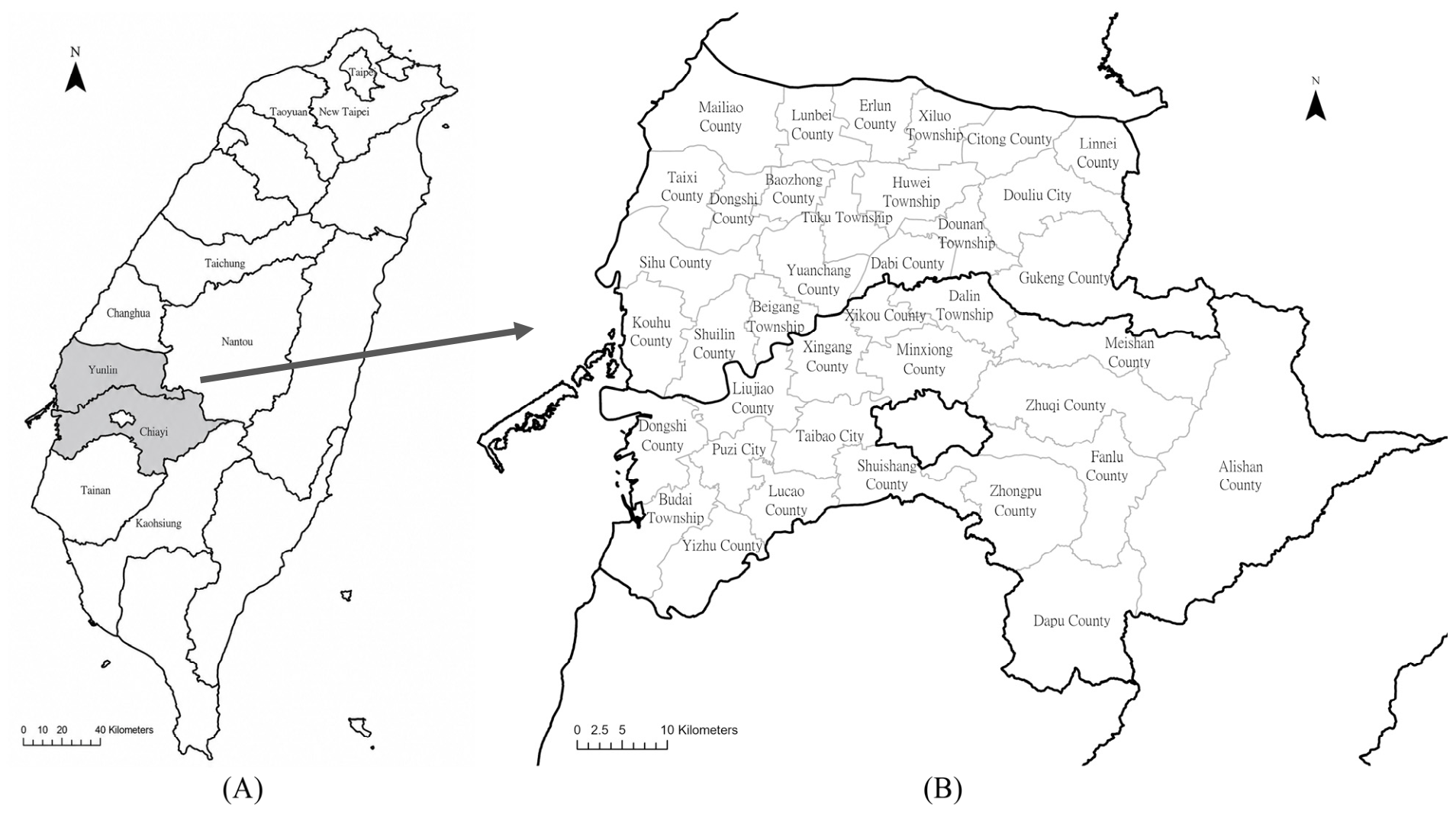
Figure 1 shows the location of the two study areas in Taiwan, together with the county-level administrative units (including cities and townships) in Yunlin Prefecture and Chiayi Prefecture used in the analysis.
Compared with the major metropolitan areas of Taipei, Taichung, and Kaohsiung, Yunlin and Chiayi exhibit lower levels of urbanization, lower land prices, and several notable socioeconomic characteristics, including population aging and a relatively high proportion of older housing stock. Their spatial development patterns are also more closely associated with agricultural production, rural settlements, and the development of small and medium-sized towns. Nevertheless, in recent years, both prefectures have continued to experience built-up area expansion in certain locations under the influence of factors such as industrial facility allocation, transportation infrastructure development, public facility investment, and changing residential preferences.
Yunlin Prefecture and Chiayi Prefecture are appropriate empirical settings for examining the applicability of SDG Indicator 11.3.1 under conditions of population stagnation or decline for three main reasons. First, both prefectures have long been important agricultural production areas in Taiwan, and the conversion of farmland to built-up land has significant influence on food production, ecological functions, and spatial sustainability. Second, compared with highly urbanized metropolitan areas, Yunlin and Chiayi are more representative of the spatial characteristics of non-metropolitan, agriculture-based regions, which have received relatively limited attention in the literature on land use efficiency. Third, both prefectures have exhibited negative population growth in recent years, making them particularly suitable for assessing whether the conventional LCRPGR indicator can still effectively reflect land use efficiency in shrinking or low-growth contexts.
It should be noted that the original methodology of SDG Indicator 11.3.1 was primarily designed for cities or urban areas as the unit of observation. Recent empirical studies have likewise tended to adopt functional urban areas (FUAs) or comparable delineations of urban space [
30,
38] in order to improve the consistency of cross-regional comparisons. The metadata for SDG Indicator 11.3.1 also state that the indicator should, in principle, be based on urban areas, and recommend the use of gridded population data in conjunction with built-up area data to improve the consistency between urban boundaries and population estimates when census units are overly large or spatial boundaries are inconsistent. Accordingly, this study does not treat prefecture-level LCRPGR values as fully equivalent to the internationally standardized FUA-based results. Rather, it applies the indicator as a localized adaptation to examine the applicability and limitations of SDG Indicator 11.3.1 in non-metropolitan agricultural prefectures in Taiwan, while also providing a reference for local governments in advancing sustainable urban–rural governance.
To address the potential boundary bias associated with administrative units, this study compares SDG Indicator 11.3.1 across two administrative scales: the prefecture level and the county level. The prefecture level is used to present the overall territorial trend of each study area, while the county level is used to capture intra-prefecture heterogeneity that may be obscured by aggregate values. The purpose of this design is not to approximate functional urban area boundaries through a separate density-based delineation, but rather to assess how the interpretation of LCR, PGR, and LCRPGR may vary across spatial scales in non-metropolitan agricultural prefectures. Because previous studies have shown that the delineation of spatial units can influence both the comparability and interpretation of land-use efficiency, this study treats scale differences themselves as part of the research question rather than merely as a source of methodological error. In practice, this means assessing whether prefecture-level averages and county-level disaggregation lead to different interpretations of LCRPGR, and whether county-level analysis can reveal local trajectories that are not visible at the aggregate scale.
2.2. Data
This study integrates demographic, built-up land, and land-use data to examine the applicability and interpretive limitations of SDG Indicator 11.3.1 in non-metropolitan agricultural prefectures experiencing population decline. Population-related variables, including total population, number of households, and average household size, were compiled from official household registration statistics and publicly available government statistical sources for Yunlin Prefecture and Chiayi Prefecture (
Table 1). These data were assembled at the county level for the period 2010–2025 and were used to calculate the population growth rate (PGR), while also providing contextual evidence on changing residential demand under conditions of demographic shrinkage. It should be noted, however, that household registration statistics may not fully coincide with the de facto resident population because of labor out-migration, commuting, educational mobility, and other forms of temporary or long-term population movement. Nevertheless, they remain the most consistent and spatially comparable long-term demographic series available at the county level in Taiwan, and are therefore used as the primary demographic source in this study. This limitation should be kept in mind when interpreting demographic change, especially in areas where formal registration change does not fully reflect actual residential dynamics.
Built-up area data were derived from the Global Human Settlement Layer (GHSL), an open and globally consistent geospatial dataset designed to represent built-up surfaces across time and space. In this study, GHSL raster data were processed in ArcGIS Pro 3.1.1 (Esri, Redlands, CA, USA) and spatially overlaid with prefecture- and county-level administrative boundaries. Built-up values for raster cells located within each administrative unit were aggregated to estimate the total built-up area of each prefecture and county for the observation years included in the analysis. These estimates were subsequently used to calculate the land consumption rate (LCR), per capita built-up area (PBUA), and population density within built-up areas (DBU).
To contextualize broader structural land conversion, this study also refers to land-use survey statistics released by Taiwan’s Ministry of the Interior. These data are used to identify long-term changes among major land-use categories, such as agricultural land, transportation land, public-use land, and built-up land. Because the temporal coverage and classification logic of these survey data differ from those of the GHSL-based built-up data, they are not treated as a direct validation source for LCR estimation. Rather, they are used as supplementary contextual evidence for interpreting whether observed built-up expansion is associated with wider patterns of land conversion.
The county was adopted as the finer analytical unit because it captures intra-prefecture heterogeneity more effectively than prefecture-level averages alone. County-scale analysis makes it possible to identify whether land expansion is concentrated in prefectural administrative centers, industrial locations, transport corridors, peripheral settlements, or mountainous counties. Prefecture-level results are also presented in order to retain comparability with broader territorial trends and to demonstrate how aggregate values may obscure substantial local variation.
This study should not be interpreted as a strict replication of the official international monitoring protocol for SDG Indicator 11.3.1, which was primarily designed for cities, urban agglomerations, or functionally delineated urban areas. Instead, the present analysis applies the indicator to local administrative units in a non-metropolitan agricultural context in order to assess its interpretive applicability and limitations under conditions of population decline, dispersed settlement structure, and mixed urban–rural land systems.
2.3. Measurement of SDG Indicator 11.3.1
SDG indicator 11.3.1 is defined as the ratio of land consumption rate (LCR) to population growth rate (PGR), and is commonly used to evaluate land use efficiency in relation to urban expansion. Following the United Nations methodological framework [
25], this study calculates LCR and PGR using logarithmic growth expressions:
where Urbt and Urbt+n denote built-up area at the beginning and end of the study period, respectively; Popt and Popt+n represent population at the beginning and end of the study period; and y is the number of years between the two observations.
In general, an LCRPGR value greater than 1 indicates that built-up area is expanding faster than population, suggesting relatively lower land use efficiency. A value between 0 and 1 suggests that built-up area is growing more slowly than population, implying relatively more compact development. Accordingly, UN-Habitat suggests that the ideal LCRPGR value is 1. However, it should be noted that this does not necessarily indicate an optimal balance between urban spatial growth and population growth, because it implies that each additional unit of population is accompanied by one unit of new development [
25]. When population growth approaches zero or becomes negative, the ratio becomes increasingly difficult to interpret because the denominator becomes unstable or changes sign. In such cases, a negative LCRPGR value should not be interpreted as evidence of efficient land use; rather, it indicates that built-up land continued to expand despite demographic decline.
For this reason, LCRPGR is not interpreted in isolation in the present study. Instead, LCR and PGR are first examined separately, after which the ratio is interpreted together with supplementary indicators and county-level spatial variation. This approach avoids over-reliance on a single composite value under shrinking-population conditions.
To examine whether the interpretation of SDG Indicator 11.3.1 is sensitive to the selected observation period, this study further conducted a time-scale sensitivity analysis. In addition to the full study period of 2010–2025, LCR, PGR, and LCRPGR were recalculated for two overlapping ten-year intervals, 2010–2020 and 2015–2025. This analysis was used to assess whether the main pattern of built-up expansion under weak or negative population growth remained stable across different temporal scales, and whether changes in the denominator of LCRPGR affected the magnitude or interpretation of the ratio.
2.4. Supplementary Indicators
To address the interpretive limitations of SDG indicator 11.3.1, this study employs several supplementary indicators that help reveal the actual spatial implications of land expansion.
First, following the UN SDG 11.3.1 metadata [
25], per capita built-up area (PBUA) is used to measure the amount of built-up land occupied per resident:
An increase in per capita built-up area indicates that more built-up land is being consumed per person, which may reflect lower land use efficiency, especially in areas with stagnant or declining population.
Second, following the UN SDG 11.3.1 metadata [
25], built-up area change (∆Urb) is used to capture the absolute growth of built-up land during each period:
This indicator helps clarify whether a negative or unstable LCRPGR value results from actual land shrinkage or from continued spatial expansion under demographic decline.
Third, to facilitate the interpretation of densification and dilution trends in built-up areas, this study further derives population density in built-up areas (DBU) as the inverse of the built-up area per capita indicator proposed in the UN-Habitat/SDG 11.3.1 metadata [
25]. DBU is calculated to assess whether built-up expansion is accompanied by densification or dilution:
A decrease in density suggests that the same or larger built-up area is accommodating fewer people, which may reflect urban sprawl, low-density development, or land oversupply.
These indicators are not intended to replace SDG Indicator 11.3.1. Rather, they provide an interpretive framework for identifying distinct development trajectories under demographic decline. In this framework, continued built-up expansion combined with rising PBUA and declining DBU is interpreted as evidence of land dilution or shrinkage-related sprawl, even when the LCRPGR value is negative. Conversely, stable PBUA or rising DBU would suggest a relatively more compact pattern of spatial adjustment.
Accordingly, the study interprets land-development trajectories by jointly examining: (1) the direction and magnitude of LCR and PGR, (2) changes in PBUA and DBU, and (3) county-level spatial heterogeneity. This combined approach allows the analysis to move beyond the ratio alone and to provide a more context-sensitive assessment of land-use efficiency in shrinking regions.
2.5. Socioeconomic Interpretation
Built-up expansion is not determined by population change alone. This study therefore incorporates household-related variables, particularly the number of households and average household size, as contextual indicators of changing residential demand. Public facility investment is also included as contextual evidence. These factors are not treated as formal explanatory variables, because the present study is not designed as a causal or regression-based model. Instead, it provides an indicator-based spatial assessment of the applicability and interpretive limitations of SDG Indicator 11.3.1 under population decline. In this context, a decline in average household size may be associated with a relative increase or stabilization in the number of households, thereby sustaining demand for additional housing units, related infrastructure, and settlement land even when the total population is decreasing [
39,
40].
In the present study, household statistics are used to assess whether observed built-up expansion is consistent with demographic restructuring at the household level; they are not used to establish formal causal relationships. Similarly, land-use conversion data are interpreted as contextual evidence rather than as direct causal proof. This distinction is important in order to avoid overstating the explanatory scope of the findings.
Overall, the analysis combines the ratio indicator, supplementary indicators, county-level spatial variation, and contextual socioeconomic evidence in order to assess whether SDG Indicator 11.3.1 is sufficient on its own to explain land-use efficiency in low-growth and shrinking regions.
2.6. Spatial Autocorrelation and Hot Spot Analysis
To further examine whether land consumption exhibited spatial dependence and local clustering, this study conducted spatial autocorrelation and hot spot analyses using the land consumption rate (LCR) at the county-level administrative unit. Global Moran’s I was first used to test the overall spatial autocorrelation of LCR. A positive and statistically significant Moran’s I indicates that administrative units with similar levels of land consumption tend to be spatially clustered rather than randomly distributed.
Anselin Local Moran’s I was then applied to identify local clusters and spatial outliers of LCR. The resulting cluster types include High–High clusters, where high-LCR units are surrounded by neighboring high-LCR units; Low–Low clusters, where low-LCR units are surrounded by neighboring low-LCR units; and High–Low or Low–High outliers, where local LCR values differ from those of surrounding units. In addition, Getis-Ord Gi* hot spot analysis was used to detect statistically significant hot and cold spots of LCR.
The spatial analyses were conducted in ArcGIS Pro 3.1.1 (Esri, Redlands, CA, USA) using a first-order contiguity-based spatial relationship among county-level administrative units. These analyses were intended to assess the spatial structure of land consumption and to complement the indicator-based interpretation of SDG Indicator 11.3.1.
3. Results
3.1. Analysis of LCR, PGR, and LCRPGR
The analytical results are presented in
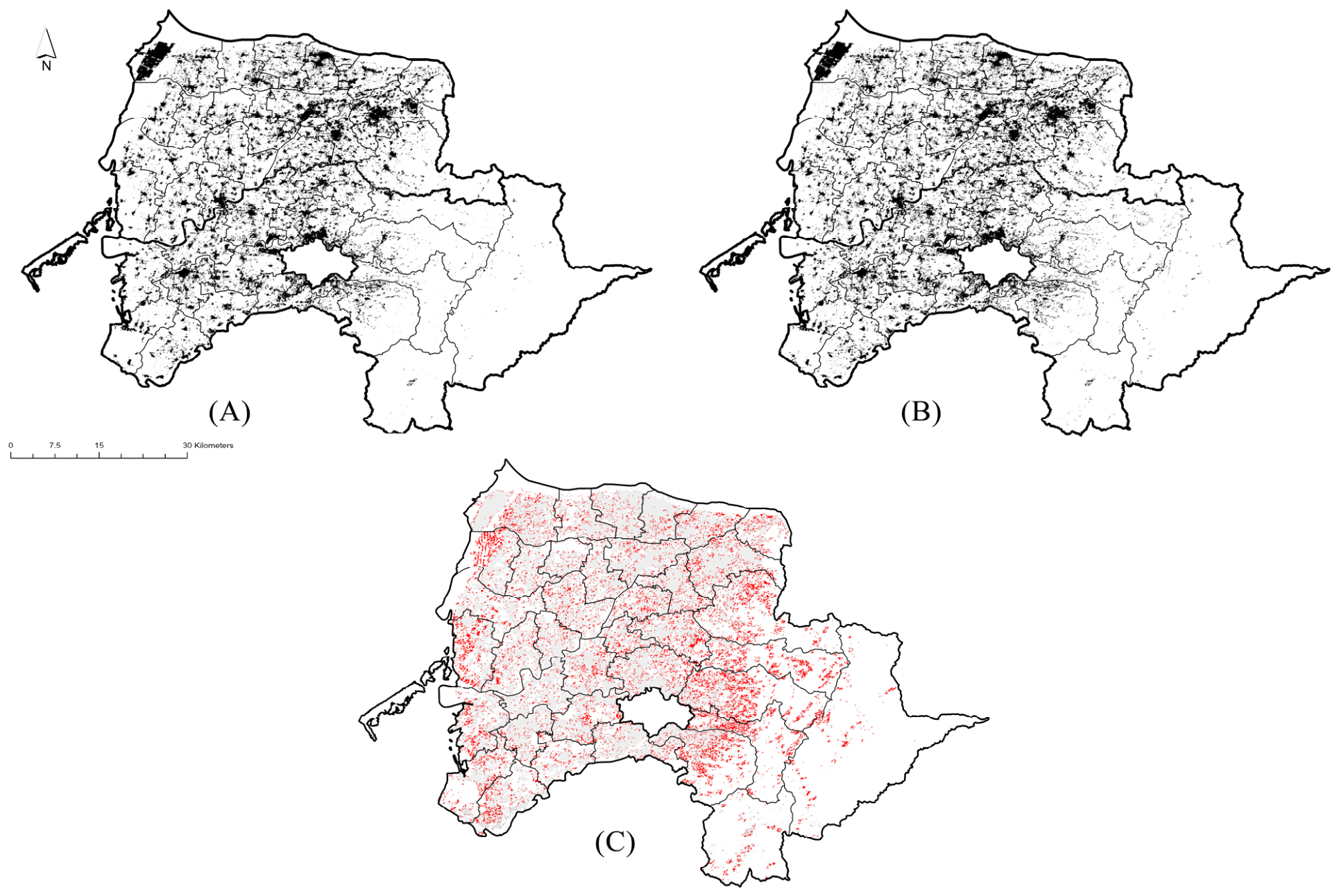
Table 2. Between 2010 and 2025, the rate of population change was −9.29% in Yunlin Prefecture and −12.90% in Chiayi Prefecture. In contrast, the built-up area in both prefectures showed an increasing trend over the same period (
Figure 2), with growth rates of 15.31% in Yunlin Prefecture and 21.84% in Chiayi Prefecture. As shown in
Figure 2, the newly expanded built-up areas highlighted in red were widely distributed across the study area between 2010 and 2025, indicating that built-up expansion was not limited to a single urban core. These findings indicate that land development and population change in the two prefectures did not remain fully synchronized. The expansion of built-up areas was therefore not driven solely by population growth, but was likely influenced by other socioeconomic or institutional factors.
To further compare land use efficiency in the two prefectures across different periods, this study calculated the land consumption rate (LCR), population growth rate (PGR), and their ratio (LCRPGR). Over the 2010–2025 period, Yunlin Prefecture recorded a PGR of −0.0065, an LCR of 0.0095, and an LCRPGR of −1.4608, whereas the corresponding values for Chiayi Prefecture were −0.0092, 0.0132, and −1.4303, respectively. Because PGR is negative while LCR remains positive in both prefectures, their LCRPGR values are negative. However, this result does not indicate an improvement in land use efficiency; rather, it reflects the continued expansion of built-up areas despite population decline. In other words, the combination of LCR and PGR demonstrates that reliance on a single ratio may lead to interpretive difficulties under conditions of low growth or population loss.
Taken together, the comparison of the two prefectures shows that interpreting land use efficiency solely on the basis of LCRPGR can easily overlook the numerical distortion caused by variation in the denominator. For this reason, while presenting LCRPGR, this study also retains the individual values of LCR and PGR in order to provide a more complete basis for interpretation. This approach is also consistent with recent studies cautioning against interpreting SDG Indicator 11.3.1 in isolation from its component measures, particularly in analyses involving multiple spatial scales or special demographic contexts.
3.2. Time-Scale Sensitivity of LCR, PGR, and LCRPGR
To examine whether the interpretation of SDG Indicator 11.3.1 is affected by the selected observation period, this study recalculated LCR, PGR, and LCRPGR for different time spans, including 2010–2020, 2015–2025, and the full period of 2010–2025 (
Table 3). The results show that the numerical magnitude of LCRPGR varies across time scales. In Yunlin, LCRPGR changed from −1.7889 during 2010–2020 to −1.0707 during 2015–2025, compared with −1.4608 for the full 2010–2025 period. In Chiayi, LCRPGR similarly changed from −1.8242 during 2010–2020 to −1.1720 during 2015–2025, compared with −1.4303 for the full period.
Despite these numerical differences, the overall direction of change remains consistent across all tested periods. Both Yunlin and Chiayi experienced negative population growth and positive land consumption rates in every observation period. In Yunlin, population declined by 5.68% during 2010–2020 and 6.95% during 2015–2025, while built-up area increased by 11.03% and 8.02%, respectively. In Chiayi, population declined by 8.06% and 8.98% during the same two periods, while built-up area increased by 16.56% and 11.65%. These results confirm that the main finding is not an artifact of the selected 2010–2025 observation period. Rather, they reinforce the argument that LCRPGR should not be interpreted in isolation in shrinking or low-growth regions. A negative LCRPGR value must be examined together with its component measures, LCR and PGR, as well as supplementary indicators such as PBUA, DBU, and absolute built-up area change.
3.3. Analysis of Supplementary Indicators: Per Capita Built-Up Area and Changes in Population Density Within Built-Up Areas
To address the interpretive limitations of LCRPGR under conditions of low growth or population loss, this study further calculates per capita built-up area and changes in population density within built-up areas. As shown in
Table 4, between 2010 and 2025, per capita built-up area in Yunlin Prefecture increased from 103.244 m
2/person to 131.237 m
2/person, representing a growth of 27.11%, while in Chiayi Prefecture it increased from 95.023 m
2/person to 132.916 m
2/person, representing a growth of 39.88%. At the same time, population density within built-up areas declined in both prefectures. These results indicate that, even without corresponding growth in total population, the average built-up area allocated per resident continued to increase, suggesting that the pressure of land consumption was not alleviated by population decline. In other words, the supplementary indicators confirm an unsustainable trend of declining land use efficiency. This finding is consistent with recent research on SDG Indicator 11.3.1, which has shown that, in certain contexts, per capita built-up area or changes in built-up area density may be more readily interpretable than LCRPGR alone in revealing the actual meaning of land development processes [
20,
41].
3.4. Spatial Differences in Land Expansion and Population Change at the County Level
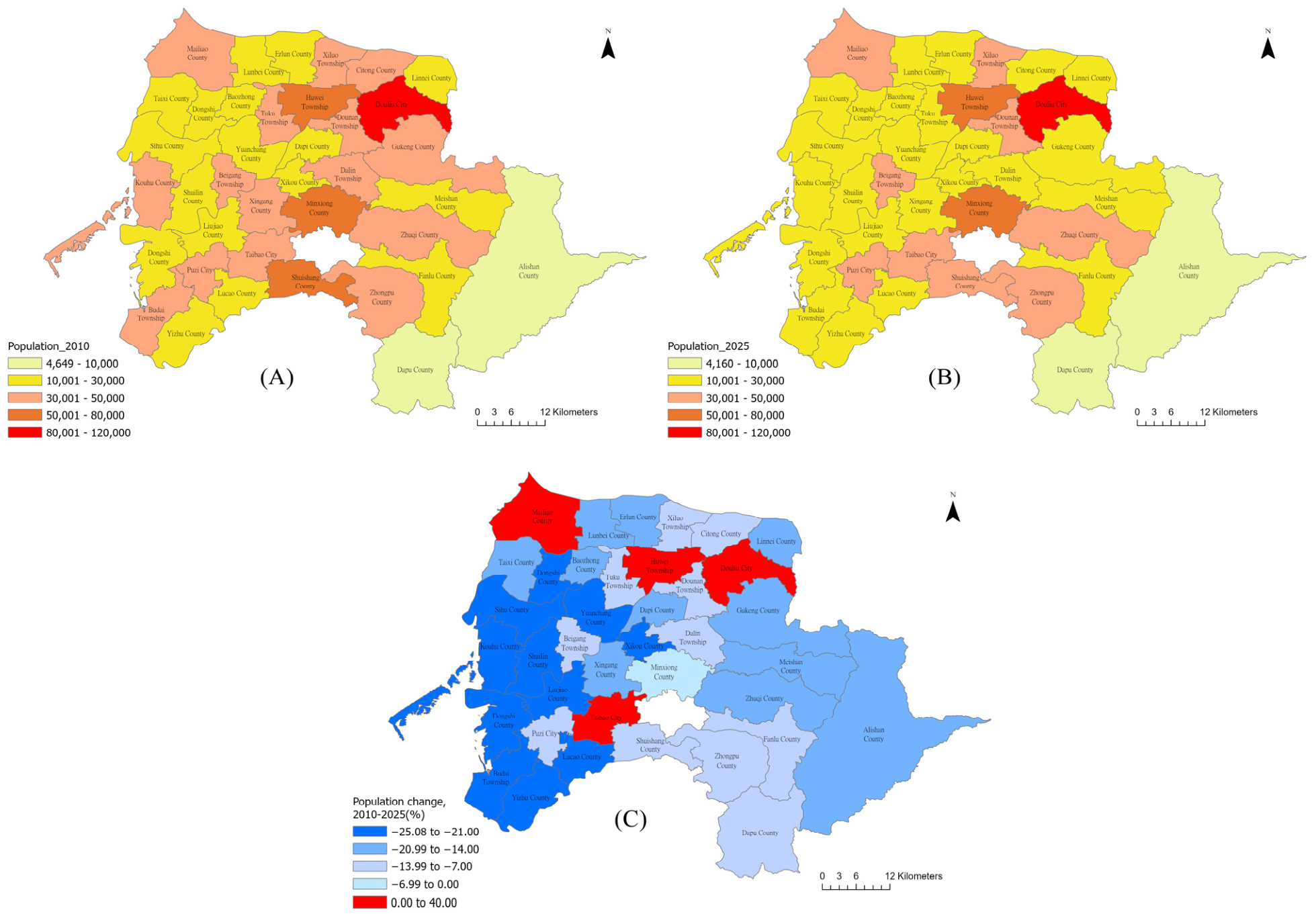
To provide a clearer spatial interpretation of demographic change, this study first mapped the distributions of population in 2010 and 2025, together with the population change rate during 2010–2025, at the county-level administrative unit (
Figure 3). The maps show that population decline was widespread across most parts of Yunlin and Chiayi Prefectures. Population loss was particularly evident in many coastal, rural, and mountainous administrative units, while population growth was limited to a smaller number of local centers or development-oriented areas, such as Mailiao, Douliu, Huwei, and Taibao. This spatial visualization confirms that population decline was not confined to a few isolated localities, but represented a broader demographic pattern across the study area.
Building on this demographic visualization, this study further conducts a more fine-grained analysis at the level of 38 county-level administrative units to examine the relationship between population change and built-up area expansion. As shown in
Appendix A Table A2, negative population growth did not constrain built-up area expansion in most local administrative units; instead, a clear decoupling pattern of “population shrinkage–land expansion” emerged. In several mountainous or peripheral counties in Chiayi Prefecture, the extent of built-up area expansion was particularly obvious despite continued population loss. For example, in Alishan County, built-up area increased by 92.63% while the population decreased by 17.07%; per capita built-up area increased by 132.29%, and population density declined by 56.95%. In Meishan County, built-up area increased by 65.38% while the population decreased by 20.60%; per capita built-up area increased by 108.30%, and population density declined by 51.99%. These counties may therefore be characterized as cases of particularly severe low-density expansion.
By contrast, three core towns—Douliu, Huwei, and Taibao—also exhibited simultaneous growth in both population and built-up area; however, built-up expansion substantially outpaced population growth, suggesting a clear trend toward urban sprawl. In Douliu City, built-up area increased by 17.03% and population by 2.04%, yielding an LCR/PGR of 7.7987; per capita built-up area increased by 14.69%, while population density declined by 12.81%. In Huwei Township, built-up area increased by 13.25% and population by 1.89%, with an LCR/PGR of 6.6415; per capita built-up area increased by 11.15%, and population density declined by 10.03%. In Taibao City, built-up area increased by 16.22% and population by 8.83%, producing an LCR/PGR of 1.7768; per capita built-up area increased by 6.79%, and population density declined by 6.36%.
Mailiao County represents another notable case, but with a different trajectory. Although its built-up area increased by 9.26%, its population grew by as much as 31.83%, resulting in an LCR/PGR of only 0.3205. At the same time, per capita built-up area declined by 17.12%, while population density within built-up areas increased by 20.65%, indicating that most of the additional population was absorbed within existing built-up space and reflecting a relatively compact development pattern. These findings suggest that land expansion at the intra-prefecture level did not occur uniformly, but rather exhibited strong spatial locality. Therefore, reliance on prefecture-level averages alone is likely to underestimate internal heterogeneity. County-level analysis further reveals that, even within the same prefecture, different localities may simultaneously display spatial development patterns characterized by growth, expansion, and shrinkage.
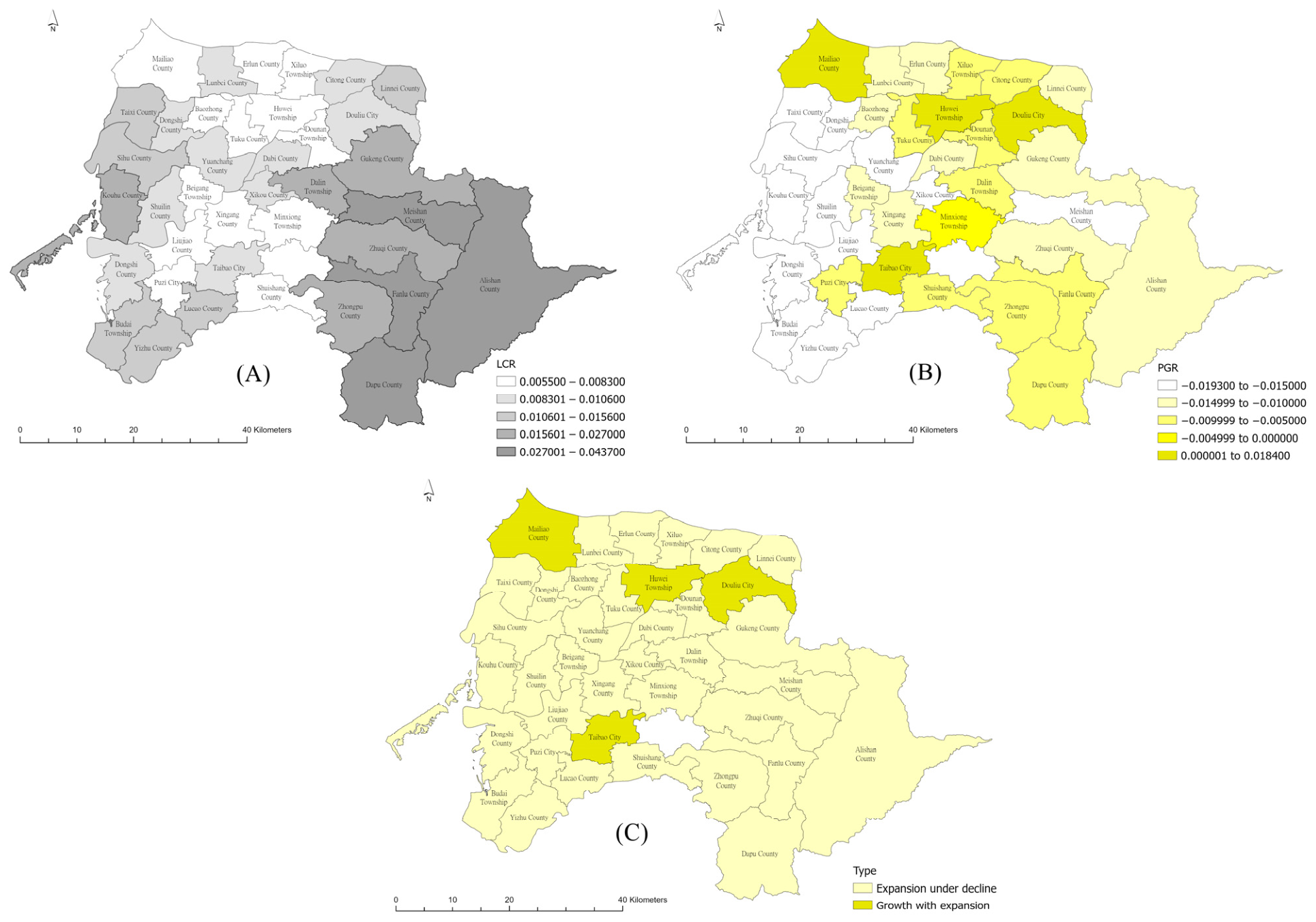
To visualize these county-level differences more explicitly,
Figure 4 maps the county-level distributions of LCR and PGR together with a combined demographic–spatial trajectory typology. The figure shows that relatively high LCR values are spread across several counties rather than concentrated in a single urban core, while negative PGR predominates across most counties. The combined typology further indicates that population shrinkage–land expansion was the dominant trajectory across the study area, although several localities followed distinct growth-oriented or compact development paths.
This county-level comparison also clarifies the scale sensitivity of SDG Indicator 11.3.1. At the prefecture level, Yunlin and Chiayi both recorded negative LCRPGR values, which indicate the overall coexistence of built-up expansion and population decline. However,
Appendix A Table A2 shows that these aggregate values conceal markedly different local trajectories. For example, while Yunlin recorded a negative LCRPGR (−1.4608), Mailiao shows a relatively low positive value (0.3205), indicating comparatively compact absorption of population growth, whereas Douliu and Huwei recorded much higher positive values (7.7987 and 6.6415), suggesting more sprawling forms of expansion. A similar contrast appears in Chiayi: the prefecture-level value is negative (−1.4303), yet Taibao recorded a positive LCRPGR (1.7768), while Fanlu and Alishan show strongly negative values (−5.9798 and −3.5019) associated with continued built-up expansion under population decline. These examples show that prefecture-level averages identify the overall imbalance between land expansion and population change, whereas county-level analysis reveals the distinct local trajectories concealed by those averages.
3.5. Spatial Autocorrelation and Hot Spot Patterns of Land Consumption
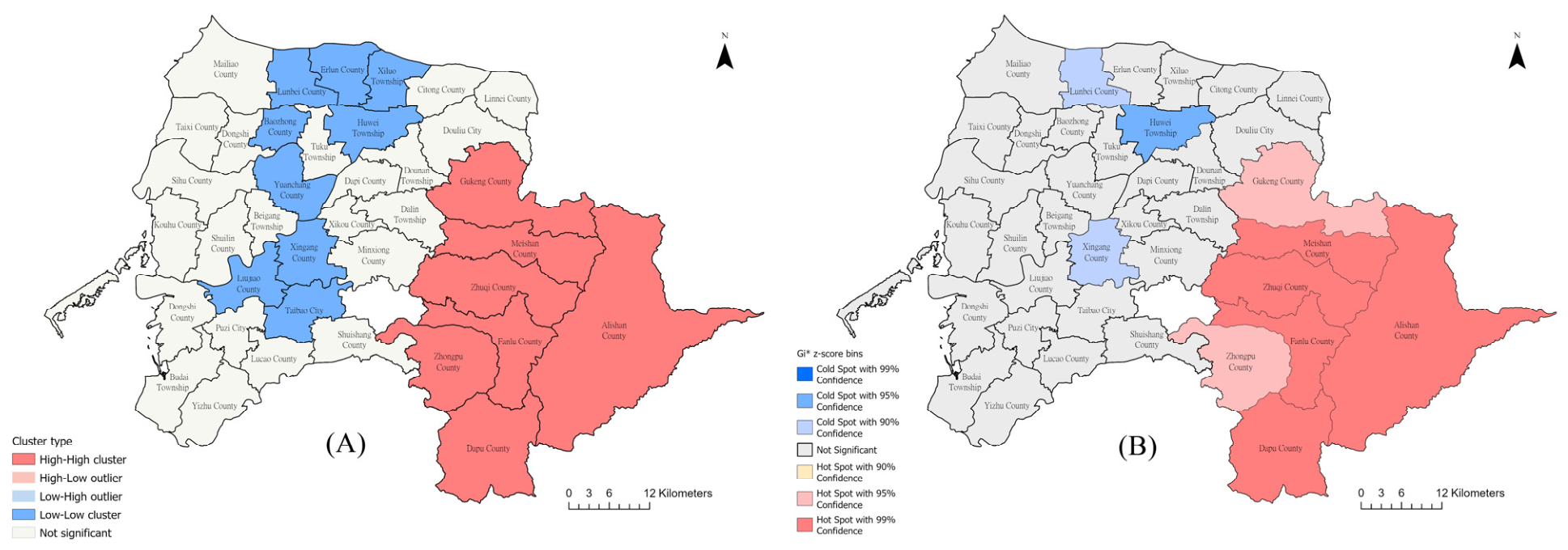
To further assess the spatial structure of land consumption, this study applied Global Moran’s I, Anselin Local Moran’s I, and Getis-Ord Gi* hot spot analysis to LCR. The Global Moran’s I result indicates a strong and statistically significant positive spatial autocorrelation. Moran’s I value was 0.6748, substantially higher than the expected value under spatial randomness (−0.0270), with a z-score of 7.1132 and a p-value below 0.001. This result suggests that LCR was not randomly distributed across county-level administrative units, but exhibited a clear clustered spatial pattern.
The Anselin Local Moran’s I results further reveal the local clustering structure of LCR (
Figure 5A). Significant High–High clusters were mainly located in the eastern and southeastern parts of the study area, particularly in the mountainous and peripheral areas of Chiayi Prefecture, including areas around Meishan, Zhuqi, Fanlu, Alishan, Zhongpu, and Dapu. These areas represent local clusters where relatively high LCR values are surrounded by neighboring units with similarly high LCR values. In contrast, significant Low–Low clusters were observed in parts of Yunlin Prefecture and adjacent western Chiayi areas, including areas around Erlun, Lunbei, Xiluo, Baozhong, Huwei, Yuanchang, Xingang, Liujiao, and Taibao. These clusters indicate areas where relatively low LCR values are spatially concentrated.
The Getis–Ord Gi* hot spot analysis produced a similar spatial pattern (
Figure 5B). Statistically significant hot spots of high LCR were concentrated in eastern and southeastern Chiayi, while cold spots of low LCR appeared in parts of central and northern Yunlin and adjacent western Chiayi. The consistency between the Local Moran’s I and Getis–Ord Gi* results indicates that the spatial distribution of LCR was not random, but characterized by identifiable local clusters of high and low land consumption. These findings provide additional spatial statistical evidence for the intra-prefecture heterogeneity identified in
Figure 4 and further confirm the clustered structure of LCR shown in
Figure 5.
3.6. Changes and Conversions Among Land Use Categories
To further examine changes among major land-use categories, this study also analyzes the Ministry of the Interior’s land-use survey data for 2008–2023 (
Table 5). In both prefectures, agricultural land declined, while land for buildings and public use increased. The decline in agricultural land was more pronounced in Chiayi (−10.56%) than in Yunlin (−6.11%). Chiayi also recorded especially notable increases in transportation land (39.35%) and water conservancy land (43.13%), suggesting that land-use change in the study area has been associated not only with built-up expansion, but also with broader structural transformation in infrastructure and public-use space. These results provide contextual evidence that continued built-up expansion under population decline was accompanied by substantive land conversion, particularly in Chiayi Prefecture.
4. Discussion
The findings of this study suggest that SDG Indicator 11.3.1 becomes substantially more difficult to interpret in regions characterized by population decline, dispersed settlement structures, and mixed urban–rural land systems. At the prefecture level, both Yunlin and Chiayi exhibited simultaneous population decline and built-up expansion during 2010–2025, resulting in negative LCRPGR values. At the county level, this pattern was even more pronounced, with most counties showing continued expansion of built-up land despite population loss. These results indicate that the numerical sign of LCRPGR alone is insufficient to distinguish among qualitatively different forms of spatial change in shrinking regions. The time-scale sensitivity analysis further supports this interpretation. Although the magnitude of LCRPGR varied across the 2010–2020, 2015–2025, and 2010–2025 periods, both prefectures consistently showed positive LCR and negative PGR across all tested time spans. This confirms that the coexistence of built-up expansion and population decline is not dependent on a single observation period.
A key implication is that negative LCRPGR values should not be interpreted as evidence of improved land-use efficiency. In the present case, separate examination of LCR and PGR shows that built-up area continued to increase while population declined. When interpreted together with rising per capita built-up area and declining population density within built-up areas, the results point to a process of land dilution characterized by inefficient density, rather than spatial consolidation. In other words, demographic shrinkage did not alleviate land consumption pressure; rather, it was accompanied by an increase in built-up land per resident, a decline in population concentration within developed areas, and a consequent loss of carbon sequestration capacity.
The empirical results of this study reveal a significant demographic-spatial decoupling in Yunlin and Chiayi Prefectures, where built-up areas expanded by 15.31% and 21.84%, respectively, despite a steady decline in total population. This phenomenon challenges the conventional interpretation of SDG Indicator 11.3.1, as the resulting negative LCRPGR values do not signify improved land-use efficiency, but rather a process of shrinkage-related sprawl.
One important contextual factor associated with continued land consumption is the structural transformation of households. Although the total population is decreasing, the shrinking average household size—declining from over 3.0 to approximately 2.4 persons per household between 2010 and 2025 —may be associated with a relative increase or stabilization in the number of households. This demographic restructuring generates a persistent demand for residential units and fragmented infrastructure, even in regions categorized as ‘shrinking’.
When combined with the observed rise in per capita built-up area (PBUA) and the decline in population density within built-up areas (DBU), these findings suggest that land is being diluted across the landscape. From a sustainability perspective, this trajectory implies not only lower settlement efficiency and a rising infrastructure burden per resident, but also tangible environmental costs. As shown in
Table 4, agricultural land declined in both prefectures during the study period, with a particularly marked decline in Chiayi (−10.56%), while land used for buildings, public facilities, transportation, and water conservancy generally increased. This pattern indicates that shrinkage-related sprawl in these non-metropolitan agricultural prefectures is not merely a matter of spatial inefficiency; it is also associated with the conversion of valuable agricultural land and the weakening of long-term territorial sustainability. Accordingly, the interpretation of negative LCRPGR values in shrinking regions should be linked not only to changing density conditions, but also to the broader resource implications of land-use conversion.
Beyond household restructuring and the observed pattern of land-use conversion, continued built-up expansion under population decline may also be influenced by institutional path dependencies and political-economic pressures embedded in local land governance. In Taiwan, land development in rural–urban fringes is strongly shaped by statutory spatial planning and land-use control systems. According to the current statutory spatial plans for Yunlin and Chiayi Prefectures, substantial areas remain designated for urban–rural development despite population decline, and large-scale future development areas have been designated to accommodate the expansion of existing urban planning districts, the development of industrial parks, and the establishment of science parks [
42,
43]. These planning arrangements reflect the institutionalization of industrial land allocation and infrastructure-led growth, and may help explain why agricultural land continues to face conversion pressure in shrinking regions. These examples suggest that shrinkage-related sprawl should not be understood merely as a demographic outcome, but also as a possible institutional consequence of growth-oriented planning practices. This interpretation is consistent with previous studies on Taiwan’s agricultural land governance. Lee et al. found that Taiwan’s past agricultural land policy emphasized the release of agricultural land to meet economic development and demand for land, and that the loosening of agricultural land transaction restrictions facilitated capital inflows and non-agricultural uses in urban-fringe areas [
44]. Together with Lu and Cheng’s finding that zoning policy did not fully achieve farmland protection during the policy transition [
45], these studies suggest that agricultural land in Taiwan may be exposed to competing pressures from urbanization, demand for industrial and residential land, land conversion expectations, and institutional changes.
As shown in
Figure 4, the county-level results further demonstrate that land expansion in non-metropolitan prefectures was spatially selective rather than uniform. Relatively high LCR values were distributed across several counties rather than concentrated in a single urban core, while negative PGR predominated across most counties. These patterns indicate that built-up expansion under population decline was the dominant trajectory across the study area, although several localities followed distinct development paths. In Chiayi, mountainous or peripheral counties such as Alishan, Meishan, and Fanlu showed relatively high LCR despite negative PGR. This pattern may be associated with tourism-related development, road and public-facility provision in mountainous areas, and dispersed low-density settlement structures. By contrast, Mailiao, Douliu, Huwei, and Taibao showed simultaneous growth in both population and built-up area, although their trajectories likely reflect different local development dynamics, such as industrial concentration, employment attraction, administrative functions, and transport-oriented development.
The spatial autocorrelation and hot spot results further support this interpretation by showing that LCR was not spatially random, but exhibited identifiable local clustering patterns. As shown in
Figure 5, the High–High clusters and hot spots in eastern and southeastern Chiayi suggest that high land consumption was spatially concentrated in mountainous and peripheral areas, where population decline and dispersed settlement structures were also evident. By contrast, the Low–Low clusters and cold spots in parts of Yunlin and western Chiayi indicate areas where land consumption was relatively limited and spatially clustered. These results strengthen the argument that intra-prefecture heterogeneity cannot be fully captured by prefecture-level LCRPGR values alone.
The contrast between Mailiao and Alishan further suggests that these local trajectories should not be interpreted merely as isolated exceptions, but as indicators of broader risks of spatial injustice. Mailiao’s industrial growth is associated with population increase and a relatively compact absorption of built-up expansion, whereas Alishan experienced severe land dilution, with continued built-up expansion occurring alongside population decline. Such divergent trajectories imply that the benefits of growth-oriented development and the burdens of spatial dilution may be unevenly distributed across localities. Growth-oriented areas may benefit from employment opportunities and development gains, while peripheral or mountainous shrinking areas may face higher per capita infrastructure costs, weaker service efficiency, and greater pressure on agricultural or ecological land.
These findings support a broader methodological argument: in shrinking regions, SDG Indicator 11.3.1 should be treated as a diagnostic starting point rather than as a self-sufficient measure of sustainability. The indicator remains useful in highlighting the imbalance between land growth and population change. However, its interpretive value declines markedly when population growth is weak, zero, or negative. Under such conditions, the separate behavior of LCR and PGR, together with supplementary indicators such as PBUA and DBU, becomes more informative than the ratio alone.
The results also suggest that demographic shrinkage does not necessarily imply a corresponding decline in spatial demand. One plausible interpretation is that shrinking household size, changes in residential preferences, infrastructure provision, industrial allocation, and public investment may continue to generate demand for land development even where the total population is falling. However, the present study does not claim to demonstrate the causal effect of these factors. Rather, household statistics and land-use conversion evidence are used to show that continued built-up expansion is consistent with broader processes of demographic restructuring and territorial change.
From a planning perspective, these findings raise concerns regarding shrinkage-related sprawl in agricultural prefectures. Where built-up expansion continues despite population decline, the likely consequences include a greater infrastructure burden per resident, lower settlement efficiency, and increasing pressure on agricultural or other non-built land. In the present case, the observed decline in agricultural land—especially the 10.56% reduction in Chiayi—further suggests that inefficient land expansion is already being accompanied by substantive land-use conversion. In this regard, land-use efficiency in shrinking regions should be assessed not only in terms of urban form, but also in relation to farmland preservation, resource consumption, and long-term territorial sustainability. The fiscal implications of land dilution are particularly important in shrinking regions. As settlement patterns become more dispersed and built-up density declines, local governments may still be required to maintain roads, utilities, drainage systems, schools, healthcare facilities, and administrative services across an expanding built-up footprint. When the resident population decreases, these fixed or semi-fixed service obligations may increase the per capita cost of infrastructure maintenance and public-service delivery. Therefore, land dilution should be understood not only as a problem of spatial inefficiency, but also as a long-term fiscal sustainability concern.
Although this study incorporates statutory spatial plans, land-use conversion patterns, and socioeconomic evidence to contextualize the role of policy and institutional mechanisms, it does not estimate the causal effects of specific policy implementation. Future research could extend this indicator-based framework by constructing explicit policy variables, such as the timing, location, intensity, and type of zoning changes, infrastructure investment, or industrial land designation. With longer panel data and more detailed policy implementation records, mediation models or other causal inference approaches could be used to examine how policy interventions affect land consumption through intermediate mechanisms such as land prices, industrial investment, household formation, or infrastructure provision.
More broadly, this case study contributes to the literature by shifting attention from rapidly growing metropolitan areas to non-metropolitan agricultural prefectures, which remain relatively underrepresented in SDG 11.3.1 research. The findings suggest that applying urban land-efficiency indicators in such settings requires greater attention to spatial scale, demographic regime, and the relationship between built-up growth and land conversion. In this sense, the study contributes not by rejecting SDG Indicator 11.3.1, but by demonstrating the need for a more context-sensitive framework for its local interpretation.
5. Conclusions
This study examined the applicability of SDG Indicator 11.3.1 in Yunlin and Chiayi, two non-metropolitan agricultural prefectures in Taiwan, under conditions of population decline. Between 2010 and 2025, both prefectures experienced continued built-up expansion despite demographic shrinkage, producing negative LCRPGR values at the prefecture level and predominantly negative values at the county level. These findings show that in shrinking regions, LCRPGR becomes difficult to interpret when used alone, and that negative values should not be treated as evidence of efficient land use. When interpreted together with LCR, PGR, per capita built-up area (PBUA), and population density within built-up areas (DBU), the results instead point to land dilution or shrinkage-related sprawl, marked by increasing land consumption per resident and weakening settlement density. This interpretation is further reinforced by the observed decline in agricultural land in both prefectures, especially the more than 10% loss in Chiayi, indicating that inefficient land expansion under population decline is not only a matter of spatial dilution, but also one of substantive resource conversion and farmland encroachment.
To address these challenges within the context of spatial governance in Taiwan, this study proposes several policy directions aimed not only at improving the interpretation of land-use efficiency, but also at guiding development toward more compact, resource-conscious, and farmland-sensitive forms of territorial management:
Refinement of spatial planning indicators: Regional authorities should move beyond population-based growth models. Statutory monitoring frameworks should integrate supplementary indicators such as PBUA and built-up area change () alongside LCRPGR to accurately diagnose land-use efficiency in shrinking contexts.
Prioritization of farmland preservation: Given that agricultural land declined in both prefectures between 2008 and 2023, and by more than 10% in Chiayi, spatial planning should not only restrict the scattered conversion of high-quality farmland, but also adopt more specific governance tools. These may include stricter review standards for farmland conversion in areas already experiencing population decline, prioritization of infill development and redevelopment within existing settlement cores, channeling new development toward already serviced areas rather than dispersed rural expansion, and incentive-based mechanisms to maintain productive agricultural use. In this way, farmland preservation can be pursued through both regulatory control and spatial steering, thereby reducing further encroachment on productive rural land.
Appropriate scale of infrastructure: Planners should recognize that demographic–spatial decoupling driven by shrinking household size may sustain land demand even as total population declines. In dispersed built-up areas, a smart-shrinkage approach should therefore go beyond the general idea of consolidating public services. It should also be understood as a fiscal sustainability strategy that reduces the long-term per capita burden of maintaining infrastructure in diluted settlement patterns. Rather than extending new infrastructure into areas with declining density, planning authorities should prioritize already serviced areas, key service centers, and the selective resizing of existing networks. More concretely, this may involve concentrating schools, healthcare, and administrative services in key service centers, avoiding further extension of low-efficiency infrastructure into scattered settlements, prioritizing the maintenance and selective resizing of existing networks over continued expansion, and adopting more flexible service delivery where permanent infrastructure expansion is no longer efficient. This is particularly relevant in cases such as Alishan, where the substantial decline in DBU suggests that continued built-up expansion has been accompanied by weakening settlement concentration.
In summary, while SDG Indicator 11.3.1 remains a useful diagnostic reference, its application in non-metropolitan and shrinking contexts must be supplemented by additional indicators and territorial contexts. The spatial autocorrelation and hot spot analyses further show that land consumption in shrinking regions is not only a matter of aggregate indicator interpretation, but also a spatially clustered process with identifiable local hot spots and cold spots. This finding reinforces the need to localize the interpretation of SDG Indicator 11.3.1 by using supplementary indicators and spatial diagnostic tools. The main contribution of this study lies in demonstrating the need for a more context-sensitive framework that accounts for negative population growth, dispersed settlements, and mixed urban–rural land systems. Localizing SDG Indicator 11.3.1 in this way is particularly important in the era of demographic decline, because the same numerical indicator may conceal divergent local trajectories, unequal infrastructure burdens, and different risks of farmland conversion. By extending the discussion beyond rapidly growing metropolitan areas, this study provides empirical evidence that population decline does not necessarily reduce land consumption pressure, necessitating a shift toward more resilient and sustainable rural development strategies.