Revitalising Heritage Villages in Asia: Multi-Dimensional Approaches to Cultural Landscape Preservation—A Case Study of Qiaonan Village, China

Abstract
1. Introduction
1.1. Background and Motivation
1.2. Research Gaps and Contributions
1.3. Research Questions
1.4. Research Objectives
2. Literature Review
2.1. Heritage Conservation and Cultural Landscape Governance
2.2. Sustainable Tourism/Over-Tourism and Cultural Authenticity
2.3. Community Participation
3. Methodology
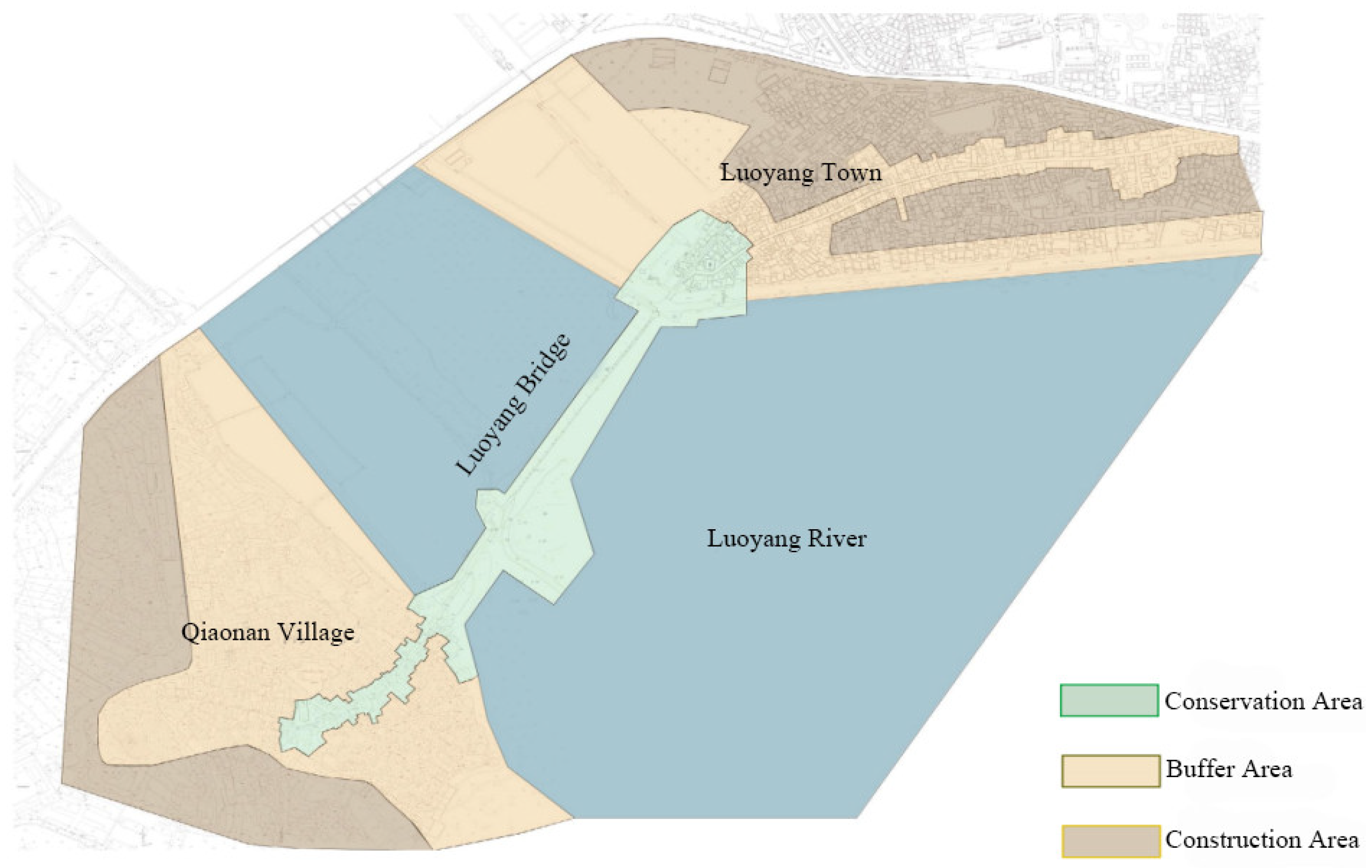
3.1. Case Study: Qiaonan Village Context
3.2. Data Collection
3.3. Data Analysis
3.4. Comparative Cases
4. Results
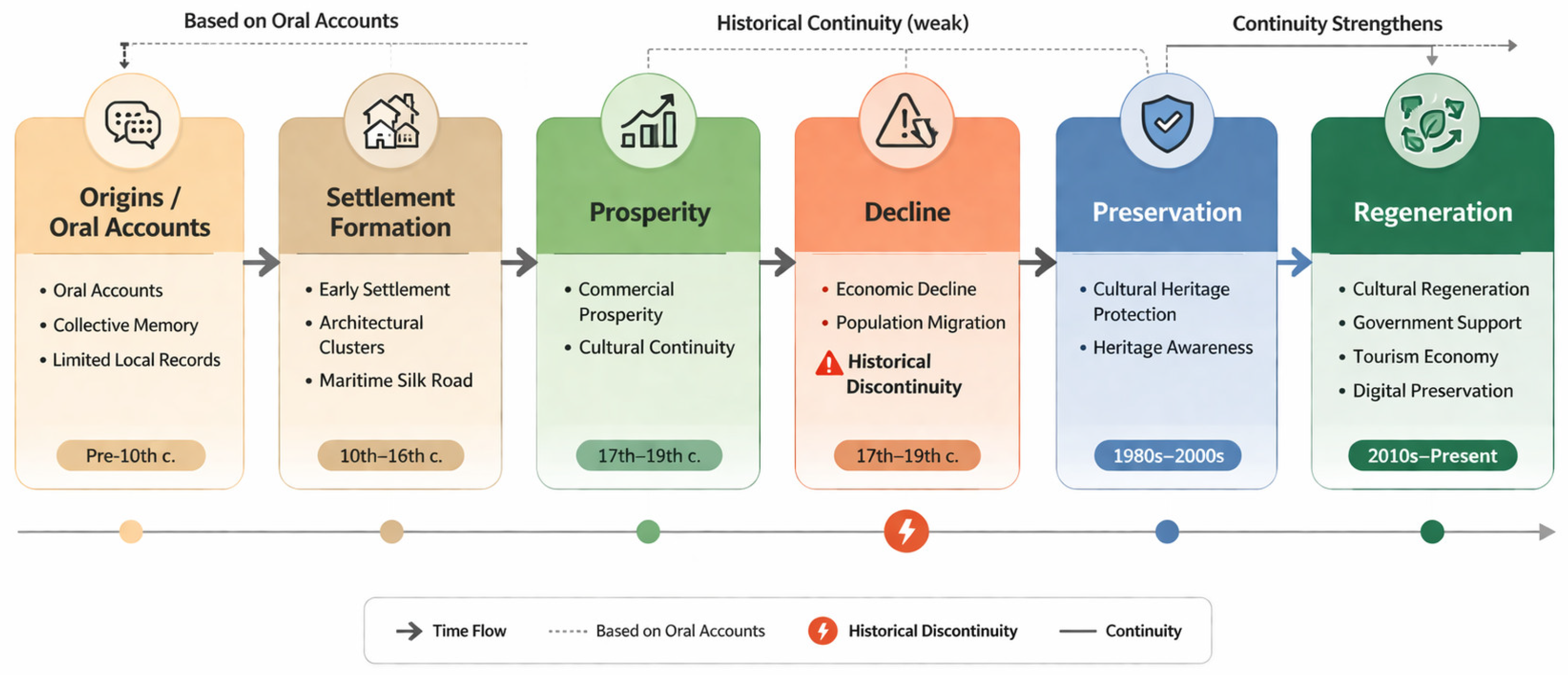
4.1. Historical Evolution and Heritage Values of Qiaonan
4.1.1. Source Description, Provenance, and Accessibility
4.1.2. Phase-by-Phase Interpretation and Evidentiary Support
4.2. Current Historical and Cultural Resources and Key Issues
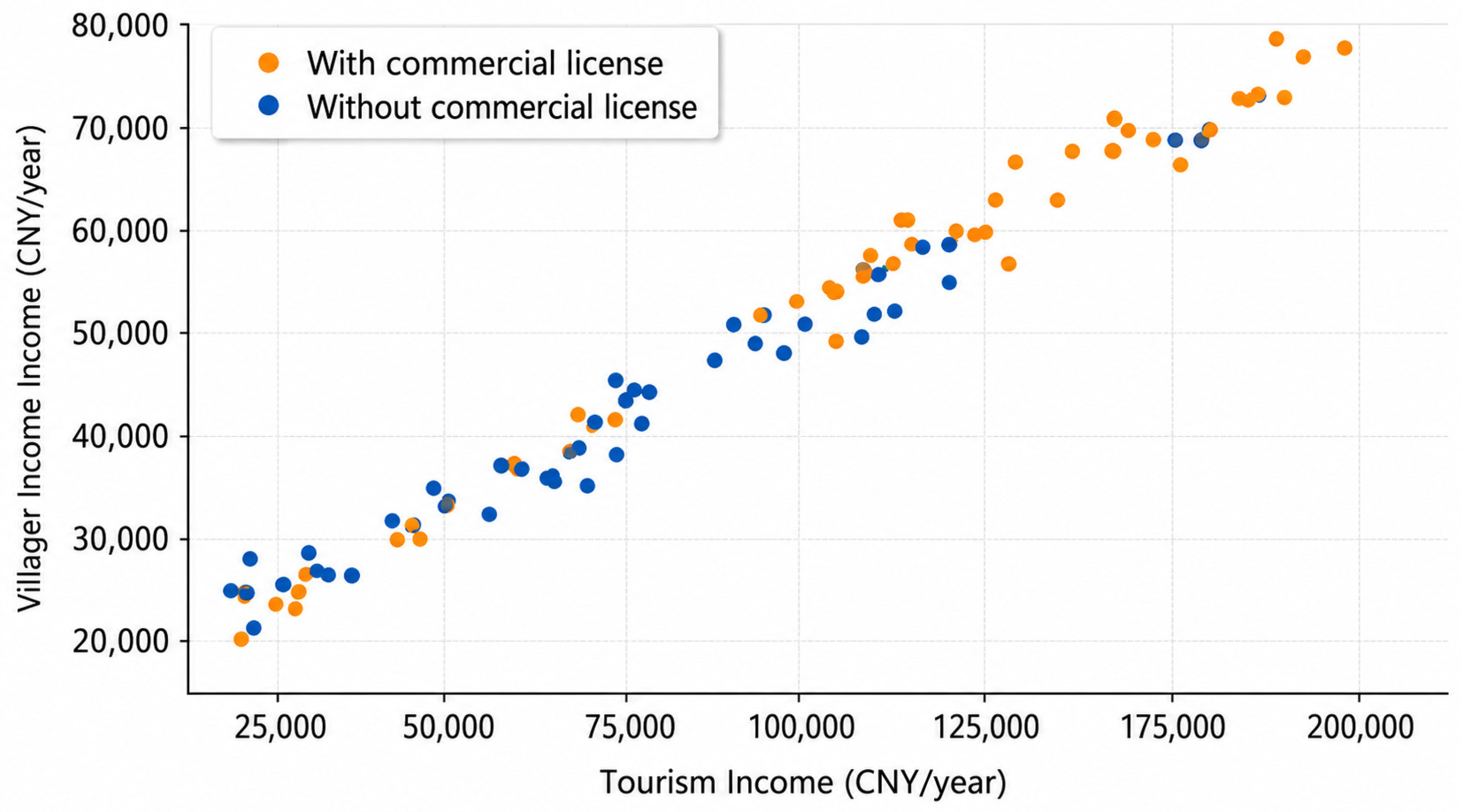
4.3. Tourism Development Impacts and Income Relationship
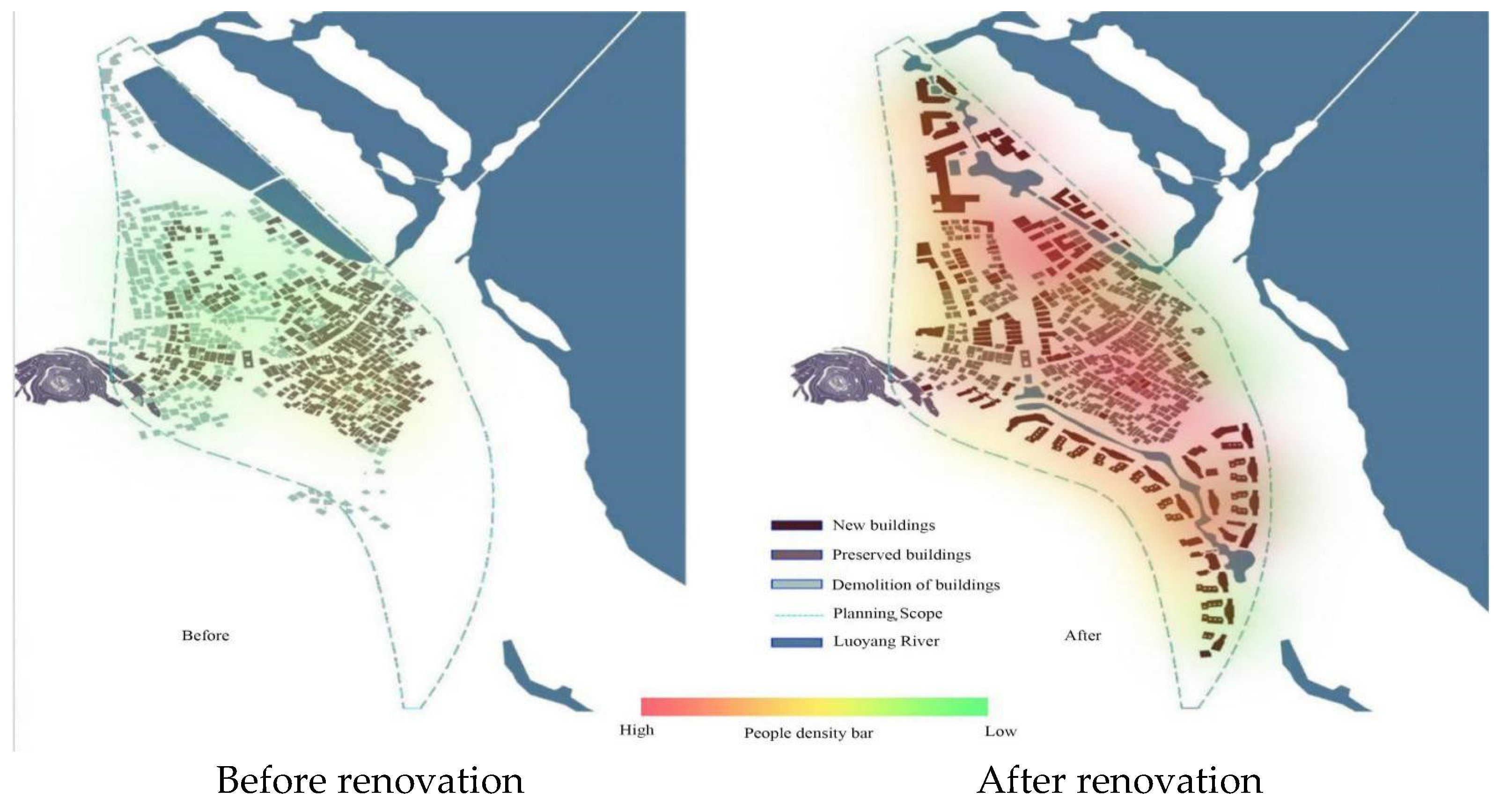
4.4. Traffic/Mobility Changes Before and After Renovation
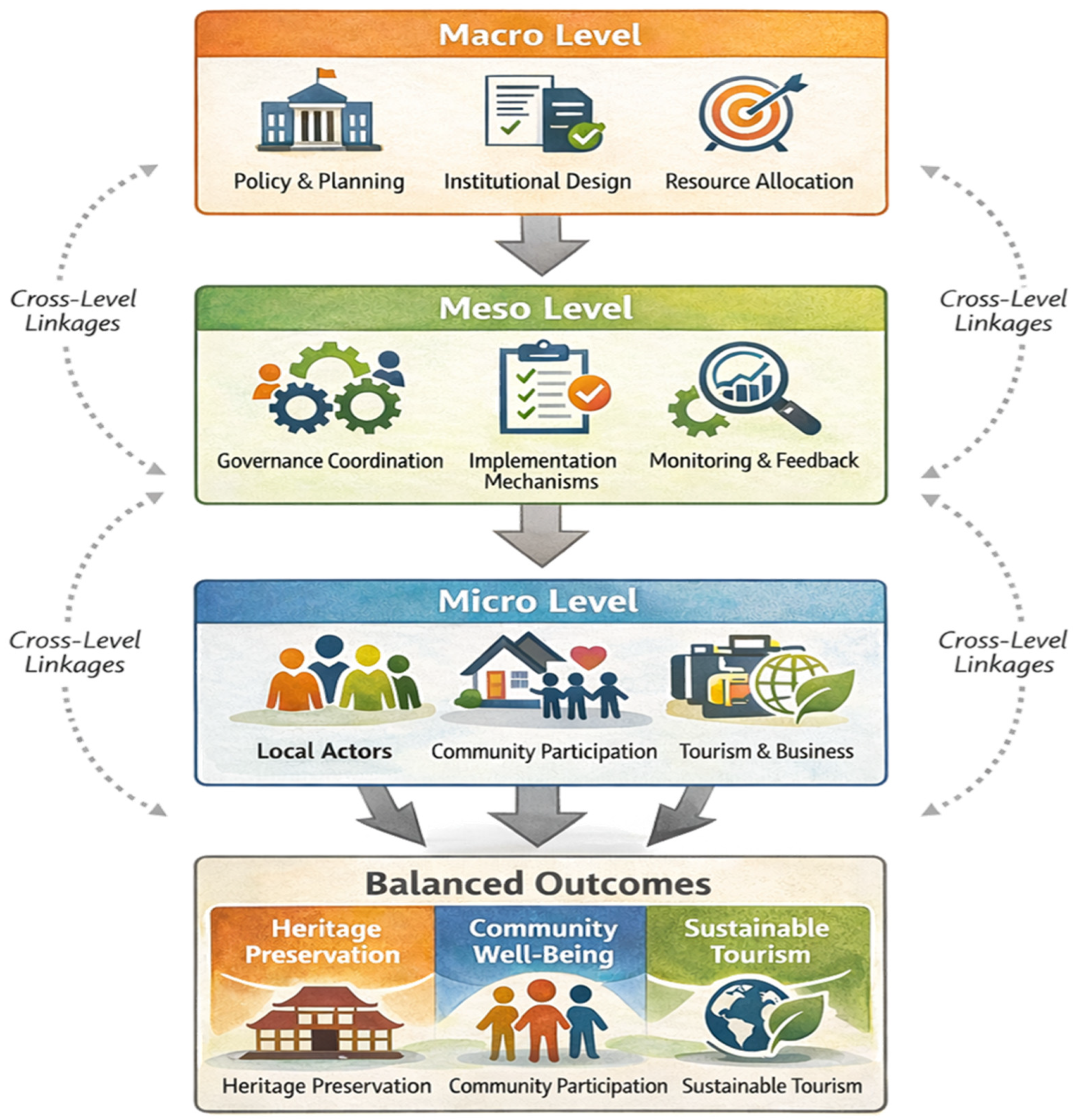
4.5. Conceptual Framework: Macro–Meso–Micro
5. Discussion
5.1. Theoretical Contributions of the Macro–Meso–Micro Framework
5.2. Framework-to-Action Strategies (Macro–Meso–Micro)
5.3. Trade-Offs and Negative Outcomes
5.4. Transferability and Comparative Insights
5.5. Community Participation Model Implications
6. Conclusions
6.1. Key Findings
6.2. Policy and Planning Recommendations
6.3. Limitations and Future Research
Author Contributions
Funding
Institutional Review Board Statement
Informed Consent Statement
Data Availability Statement
Conflicts of Interest
References
- Athira, C.; Prathapan, M. Understanding tourism gentrification: A systematic review and future outlook. Tour. Plan. Dev. 2026, in press. [Google Scholar] [CrossRef]
- Zhang, Y.Q.; Hanna, P.; Vanclay, F. The social and environmental impacts on local residents from tourist accommodation near protected areas. Environ. Manag. 2026, 76, 83. [Google Scholar] [CrossRef]
- Lenao, M.; Saarinen, J. Integrated rural tourism as a tool for community tourism development: Exploring culture and heritage projects in the North-East District of Botswana. South Afr. Geogr. J. 2015, 97, 203–216. [Google Scholar] [CrossRef]
- Kiessling, N.; Pütz, M. Assessing spatial planning outcomes: A novel framework based on conformance and governance capacities. Plan. Theory Pract. 2021, 22, 414–432. [Google Scholar] [CrossRef]
- Cole, S. Synergy and congestion in the tourist destination life cycle. Tour. Manag. 2012, 33, 1128–1140. [Google Scholar] [CrossRef]
- Amado, M.; Rodrigues, E. Sustainable tourism planning: A strategy for Oecusse-Ambeno, East Timor. Urban Sci. 2021, 5, 73. [Google Scholar] [CrossRef]
- Buonincontri, P.; Micera, R.; Murillo-Romero, M.; Pianese, T. Where does sustainability stand in underground tourism? A literature review. Sustainability 2021, 13, 12745. [Google Scholar] [CrossRef]
- Li, S.; Liu, L.; Peng, C. Energy strategy pattern for climate responsive architecture: Workflow in the early stages of design. Archit. Sci. Rev. 2020, 63, 494–506. [Google Scholar] [CrossRef]
- Li, Y.; Wang, P.; Zhai, B.; Villa, D.; Spinelli, L.; Xiao, C.; Huang, C.; Xu, Y.; Lorenzi, A. Multi-scale remote sensing analysis of terrain-resilience coupling in mountainous traditional villages: A case study of the Qinba Mountains, China. Land 2025, 14, 2299. [Google Scholar] [CrossRef]
- da Silveira, G.J.C. Improving trade-offs in manufacturing: Method and illustration. Int. J. Prod. Econ. 2005, 95, 27–38. [Google Scholar] [CrossRef]
- Gutierrez, D.; Calado, H.; Newton, A. Sustainable solutions: Exploring trade-offs in marine protected areas from six European case sites. NPJ Ocean Sustain. 2025, 4, 68. [Google Scholar] [CrossRef]
- López-Sampson, A.; Lanzas, G.; Sepúlveda, N.; Orozco-Aguilar, L. Local mechanism of engagement in rural landscapes in the Nicaragua-Honduras sentinel landscape: Examples of a local farmers’ organisation and a multi-actor platform. Bois Forêts Des. Trop. 2024, 360, 9–25. [Google Scholar] [CrossRef]
- García-Esparza, J.A. Are World Heritage concepts of integrity and authenticity lacking in dynamism? A critical approach to Mediterranean aututopic landscapes. Landsc. Res. 2018, 43, 817–830. [Google Scholar] [CrossRef]
- Wang, Y.; Hu, W.; Liu, X. Production of space in rural China: Village revitalization and cultural landscape transformation in Chongqing, China. J. Asian Archit. Build. Eng. 2025, in press. [Google Scholar] [CrossRef]
- Allkja, L.; Dhrami, K. Territorial governance of cultural heritage through spatial planning in Albania and Kosovo. Eur. Spat. Res. Policy 2021, 28, 43–62. [Google Scholar] [CrossRef]
- Katapidi, I. Heritage policy meets community praxis: Widening conservation approaches in the traditional villages of central Greece. J. Rural Stud. 2021, 81, 47–58. [Google Scholar] [CrossRef]
- Malagón, B.G. Management plans as instruments for heritage conservation: The case of the city of Avila and its implementation. Vegueta Anu. Fac. Geogr. E Hist. 2026, 26, 287–315. [Google Scholar] [CrossRef]
- Widź, M.; Brzezińska-Wójcik, T. Assessment of the overtourism phenomenon risk in Tunisia in relation to the tourism area life cycle concept. Sustainability 2020, 12, 2004. [Google Scholar] [CrossRef]
- Butler, R. Managing tourism-A missing element? PASOS. Rev. Tur. Y Patrim. Cult. 2022, 20, 255–263. [Google Scholar] [CrossRef]
- Ioannides, D.; Roslmaier, M.; van der Zee, E. Airbnb as an instigator of “tourism bubble” expansion in Utrecht’s Lombok neighbourhood. Tour. Geogr. 2019, 21, 822–840. [Google Scholar] [CrossRef]
- Dragouni, M.; Fouseki, K. Drivers of community participation in heritage tourism planning: An empirical investigation. J. Herit. Tour. 2018, 13, 237–256. [Google Scholar] [CrossRef]
- van Knippenberg, K.; Boonstra, B.; Boelens, L. Communities, heritage and planning: Towards a co-evolutionary heritage approach. Plan. Theory Pract. 2022, 23, 26–42. [Google Scholar] [CrossRef]
- Ghaderi, Z.; Shahabi, E.; Fennell, D.; Khoshkam, M. Increasing community environmental awareness, participation in conservation, and livelihood enhancement through tourism. Local Environ. 2022, 27, 605–621. [Google Scholar] [CrossRef]
- Wang, Q.C.; Liu, X.; Li, Y.B. Community resilience in city emergency: Exploring the roles of environmental perception, social justice and community attachment in subjective well-being of vulnerable residents. Sustain. Cities Soc. 2023, 97, 104745. [Google Scholar] [CrossRef]
- Acuin, C.S.; Pelto, G. Developing indicators for complementary feeding: Issues for operationalization at local levels. FASEB J. 2006, 20, A1050. [Google Scholar] [CrossRef]
- Dahm, R.; Meijer, K.; van Schaik, L. What climate? The different meaning of climate indicators in violent conflict studies. Clim. Change 2023, 176, 145. [Google Scholar] [CrossRef]
- Cook, D.; Saviolidis, N.; Davídsdóttir, B.; Jóhannsdóttir, L.; Ólafsson, S. Synergies and trade-offs in the Sustainable Development Goals: The implications of the Icelandic tourism sector. Sustainability 2019, 11, 4223. [Google Scholar] [CrossRef]
- Zhao, Z.Q.; Cai, M.; Connor, T.; Chung, M.G.; Liu, J.G. Metacoupled tourism and wildlife translocations affect synergies and trade-offs among Sustainable Development Goals across spillover systems. Sustainability 2020, 12, 7677. [Google Scholar] [CrossRef]
- Chibanda, D.; Verhey, R.; Lund, C. Scaling up interventions for depression in sub-Saharan Africa: Lessons from Zimbabwe. Glob. Ment. Health 2016, 3, e13. [Google Scholar] [CrossRef] [PubMed]
- Gao, M.Y.; Tian, Y. Construction of public participation cloud platform for industrial heritage protection under the background of smart city. In Proceedings of the 2020 International Conference on Artificial Intelligence and Computer Engineering (ICAICE 2020), Beijing, China, 23–25 October 2020; pp. 124–129. [Google Scholar] [CrossRef]
- Zhang, Y.; Li, X.; Su, Q.; Hu, X. Exploring a theme park’s tourism carrying capacity: A demand-side analysis. Tour. Manag. 2017, 59, 564–578. [Google Scholar] [CrossRef]
- Janssen, C. Understanding people-centered planning practice in Europe: An institutionalist comparison between urban development projects in Vienna and Helsingborg. Plan. Pract. Res. 2024, 39, 498–524. [Google Scholar] [CrossRef]
- Zhang, N.; Zhu, L.; Sun, Y.; Shi, Z.; Chen, Q.; Deng, H. Spatial temporal evolution characteristics of defensive traditional community in Southwest China with a case study of Chengzi village in Yunnan. NPJ Herit. Sci. 2025, 13, 178. [Google Scholar] [CrossRef]
- Groves, C.; Munday, M.; Yakovleva, N. Fighting the pipe: Neoliberal governance and barriers to effective community participation in energy infrastructure planning. Environ. Plan. C Gov. Policy 2013, 31, 340–356. [Google Scholar] [CrossRef]
- Cascone, G.; Guarnaccia, P.; Timpanaro, G. Innovation in inner areas: How Living Labs support green transition and bio-district success. Environ. Sustain. Indic. 2025, 28, 100969. [Google Scholar] [CrossRef]
- Dane, G.; Borgers, A.; Kaya, D.I.; Feng, T. Visitor flows at a large-scale cultural event: GPS tracking at Dutch Design Week. ISPRS Int. J. Geo-Inf. 2020, 9, 661. [Google Scholar] [CrossRef]
- Cvelbar, L.K.; Mayr, M.; Vavpotic, D. Geographical mapping of visitor flow in tourism: A user-generated content approach. Tour. Econ. 2018, 24, 701–719. [Google Scholar] [CrossRef]
- Xie, L.L.; Lin, G.X.; Luo, Y.F. Investigating the impact of multiple governance mechanisms on new infrastructure projects performance: Evidence from China. Eng. Constr. Archit. Manag. 2025, 32, 6027–6044. [Google Scholar] [CrossRef]
- Xiao, L.; Pang, S.S.; Wang, X.; Fan, L.; Mokhtar, N.A.; Sulaiman, M.K.A.M. From parametric design to rural sustainability: Integrating timber construction and craft revitalization in the IN BAMBOO project, Sichuan, China. J. Asian Archit. Build. Eng. 2025, in press. [Google Scholar] [CrossRef]








| Participant Group | Number of Participants | Themes/Topics Covered |
|---|---|---|
| Residents | 15 | Perceptions of heritage value, experiences with tourism impacts, and views on benefit distribution |
| Local Business Owners | 5 | Experiences with tourism impacts, involvement in decision-making, and benefit distribution |
| Heritage Managers/Experts | 5 | Perceptions of heritage value, involvement in decision-making, and heritage preservation strategies |
| Total | 25 | - |
| Source Category | Sample Size | Key Information Extracted | Accessibility |
|---|---|---|---|
| Genealogies (19th c.) | 2 volumes | Lineage charts, ancestral hall records, and canal alignments | Open access (Nanyang Root-Seeking Platform; Shanghai Library) |
| Oral histories | 25 interviews | Migration narratives, layout changes, and ritual transmission | Anonymised transcripts |
| Architectural survey | 126 buildings | Material stratigraphy, repair layers, and incompatible repairs (37%) | Full dataset |
| Analytical Level | Conceptual Dimension | Measurable Indicator | Data Source | Analytical Method | Results Section |
|---|---|---|---|---|---|
| Macro | Commercialisation pressure | Rate of change in commercial land use (2019–2022) | GIS (Luoyang District Planning Dept + Gaofen-2 0.8 m) + field validation | Change detection, kernel density estimation | Section 4.3 |
| Macro | Spatial congestion | Peak-hour pedestrian density (persons/hour) | Field observation + geotagged photo density + mobile heat map | Descriptive statistics, hotspot detection | Section 4.4 |
| Meso | Governance coordination | Rule clarity (qualitative coding), stakeholder network density | Document analysis + elite interviews (n = 5) | Thematic coding (NVivo, hybrid inductive–deductive) | Section 5.1 |
| Micro | Perceived fairness | % of residents perceiving fair benefit distribution | Household survey (n = 100, Likert 5-point scale) | Descriptive statistics, t-test, regression analysis | Section 4.3 |
| Micro | Participation effectiveness | Ratio of awareness of planning meetings to views taken into account | Household survey (n = 100) + interviews (n = 25) | Cross-tabulation, group comparison | Section 2.3 and Section 4.3 |
| Micro | Building authenticity | % of traditional buildings with incompatible repairs (cement mortar, glazed facades) | Field observation + building-by-building survey (n = 126) | Descriptive statistics | Section 4.2 |
| Case Study | Location | Heritage Conservation Background | Challenges | Strategies and Measures |
|---|---|---|---|---|
| Pingyao Ancient Town | Shanxi, China | World Heritage Site since 1977, the Ming and Qing architecture | Balancing preservation with tourism development | Government investment in tourism and activities |
| Hong and Xidi Villages | Anhui, China | World Heritage Site since 2000, blending traditional architecture with nature | Balancing heritage protection with local economic development | Protecting heritage while promoting local business and tourism |
| Zhujiajiao | Shanghai, China | An ancient water town with 1700 years of history | Integrating preservation with urban development | Renovating old buildings and preserving historic streets |
| Sarlat | Dordogne, France | Preserves medieval buildings and enhances cultural landscapes | Maintaining the quality of life while preserving buildings | Preservation of historic structures, enhancing cultural activities |
| Esslingen | Baden-Wuerttemberg, Germany | Rich in heritage with modern infrastructure | Balancing preservation with urban expansion | Blending traditional protection with modern development |
| Historical Phase | Key Supporting Evidence | Evidence Type |
|---|---|---|
| Phase 1 (pre-10th c.) | Oral accounts (elders) and genealogical preface | Oral and genealogical |
| Phase 2 (10th–17th c.) | Bridge inscriptions; canal records (genealogy); 12 pre-18th-c. buildings | Inscriptions, archival, and architectural |
| Phase 3 (17th–19th c.) | Genealogical gap (generations 12–14); repair layers in 23 buildings | Archival omission and material stratigraphy |
| Phase 4 (1980s–present) | Planning archives (1998–2022); aerial photos (1985–2022); field survey | Documentary, remote sensing, and field data |
| Protection Level | Number | Examples | Representative Features | Recent Interventions |
|---|---|---|---|---|
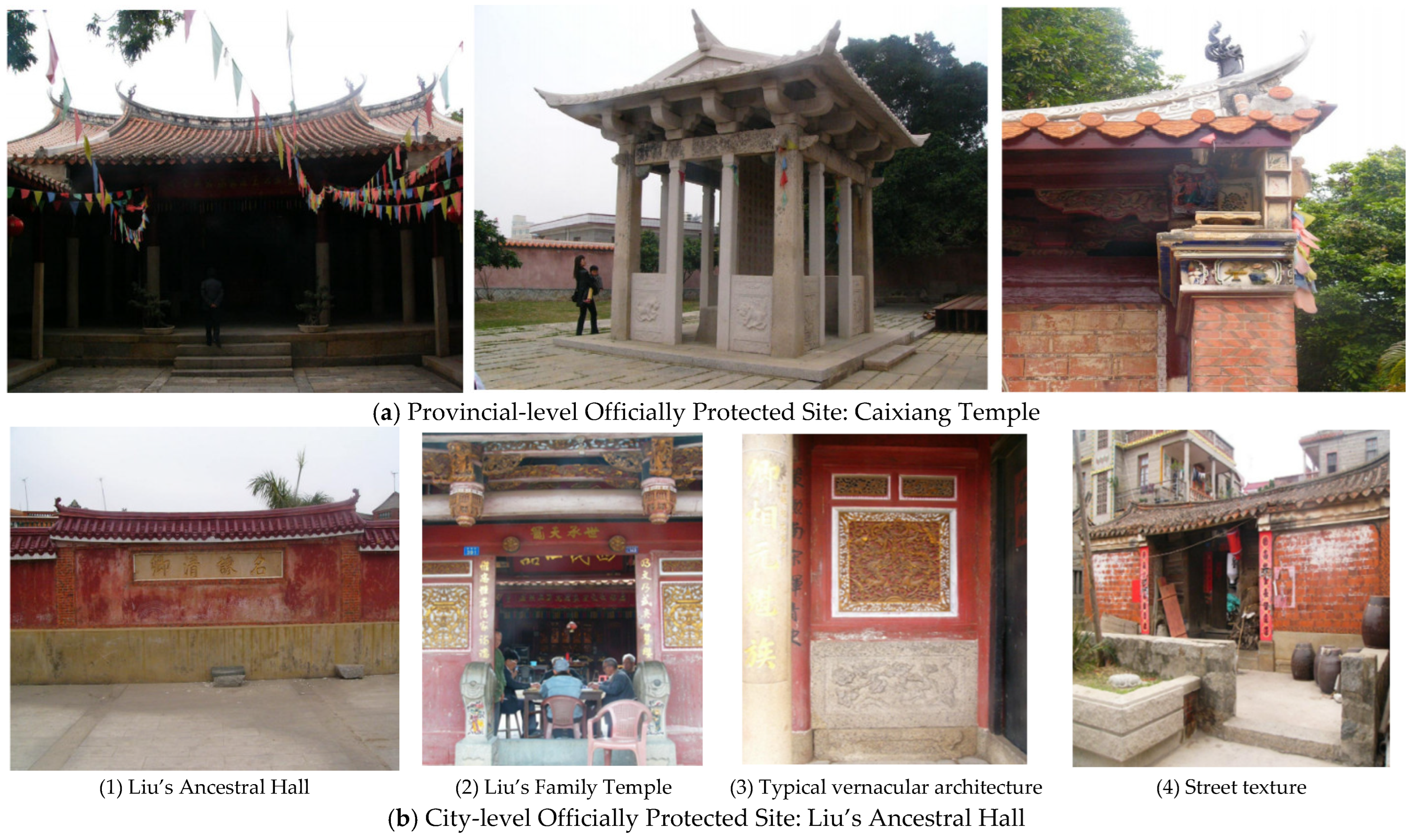
| Cultural heritage protection units | 2 | Caixiang Temple (Provincial); Liu’s Ancestral Hall (City) | Song-Qing architecture; commemorative temple for Cai Xiang (1041–1048); stone–wood structure | 2023 restoration (Caixiang); restored late Qing and 1997 (Liu’s) |
| Registered immovable cultural relics | 5 | Including Liu’s Family Temple, Liu’s Small Ancestral Hall | Ming-Qing vernacular architecture | Partially renovated |
| Listed historical buildings | 8 | Including Yuqinglou | Sino-Western eclectic style (1930s) | Acquired + leased model |
| Traditional style buildings (protected) | 21 | Various vernacular dwellings | Red brick, stone, mixed construction; Min Nan style | Subject to “repair as old” guidelines |
| Candidate traditional buildings | 40 | — | To be surveyed and assessed | Listed in the protection inventory |
| Variable | Coefficient (B) | Std. Error | p-Value | 95% CI |
|---|---|---|---|---|
| Commercial licence (1 = yes) | 0.27 | 0.08 | <0.01 | [0.11, 0.43] |
| Housing located in heritage core (1 = yes) | 0.18 | 0.07 | <0.05 | [0.04, 0.32] |
| Household size (persons) | 0.02 | 0.03 | 0.42 | [−0.04, 0.08] |
| Head of household age (years) | −0.01 | 0.01 | 0.31 | [−0.03, 0.01] |
| Constant | 1.42 | 0.21 | <0.001 | [1.01, 1.83] |
Disclaimer/Publisher’s Note: The statements, opinions and data contained in all publications are solely those of the individual author(s) and contributor(s) and not of MDPI and/or the editor(s). MDPI and/or the editor(s) disclaim responsibility for any injury to people or property resulting from any ideas, methods, instructions or products referred to in the content. |
© 2026 by the authors. Licensee MDPI, Basel, Switzerland. This article is an open access article distributed under the terms and conditions of the Creative Commons Attribution (CC BY) license.
Share and Cite
Zhou, Y.; Xiao, L.; Mokhtar, N.A.; Mat Sulaiman, M.K.A. Revitalising Heritage Villages in Asia: Multi-Dimensional Approaches to Cultural Landscape Preservation—A Case Study of Qiaonan Village, China. Sustainability 2026, 18, 4970. https://doi.org/10.3390/su18104970
Zhou Y, Xiao L, Mokhtar NA, Mat Sulaiman MKA. Revitalising Heritage Villages in Asia: Multi-Dimensional Approaches to Cultural Landscape Preservation—A Case Study of Qiaonan Village, China. Sustainability. 2026; 18(10):4970. https://doi.org/10.3390/su18104970
Chicago/Turabian StyleZhou, Yuting, Lin Xiao, Noor Aisyah Mokhtar, and Mohd Khairul Azhar Mat Sulaiman. 2026. "Revitalising Heritage Villages in Asia: Multi-Dimensional Approaches to Cultural Landscape Preservation—A Case Study of Qiaonan Village, China" Sustainability 18, no. 10: 4970. https://doi.org/10.3390/su18104970
APA StyleZhou, Y., Xiao, L., Mokhtar, N. A., & Mat Sulaiman, M. K. A. (2026). Revitalising Heritage Villages in Asia: Multi-Dimensional Approaches to Cultural Landscape Preservation—A Case Study of Qiaonan Village, China. Sustainability, 18(10), 4970. https://doi.org/10.3390/su18104970