1. Introduction
The global economy has long been driven by linear production and consumption models, in which raw materials are extracted, processed, used, and eventually discarded as waste [
1]. This “take-make-dispose” pattern accelerates resource depletion and environmental degradation, raising urgent sustainability concerns. In response, the circular economy (CE) has emerged as a systems-level approach that supports closed-loop flows in which materials are recycled, reused, and refurbished, thereby extending service life and reducing waste [
2]. Unlike the conventional linear model, CE emphasises sustainability at every stage of production, thereby enhancing resource efficiency and reducing environmental impact. This paradigm shift is fundamental both environmentally and financially, as global projections suggest the world population will approach 9 billion by 2050, drastically increasing demand for raw materials and sustainable resource management [
1].
Among sectors poised for transformation, the construction industry stands out as both a major consumer of raw materials (about 40 percent of global extraction) and a significant generator of waste (about 35 percent of total waste in the EU) [
3]. In parallel with system-level strategies such as modularity and reuse, circular construction research also includes material-level innovations aimed at reducing virgin resource demand, for example through the incorporation of recycled concrete-derived constituents into high-performance cementitious materials [
4]. In this context, modular construction (MC) is frequently highlighted as a promising route to translate CE principles into practice [
2]. MC involves manufacturing building components or volumetric units off-site in controlled environments, where material use can be optimised, waste minimised, and quality more reliably monitored [
1]. This approach shortens construction schedules and could lower greenhouse-gas emissions by up to 30 percent compared with traditional techniques [
5].
Crucially, MC is particularly relevant to CE outcomes compared with conventional in situ construction because it shifts buildings from predominantly “assembled-once” artefacts to systems of separable units with repeatable interfaces. Traditional construction commonly relies on irreversible joints, wet trades, and bespoke details that hinder non-destructive disassembly and make component recovery costly and uncertain. By contrast, MC can embed design-for-disassembly logic through standardised connections and modular coordination, making it more feasible to retain value via higher-order CE strategies such as reuse, refurbishment, reconfiguration, and repurposing of assemblies rather than defaulting to lower-value end-of-life treatments [
1]. In principle, this creates a pathway from circular intent (design and procurement) to circular action (redeploying modules and components across multiple use cycles), which is substantially more difficult to operationalise in conventional approaches.
In this review, modular construction is used in a bounded sense. It refers to off-site manufactured building systems such as panelised, pod-based, or volumetric modules that are assembled on-site through repeatable and, where relevant, separable interfaces. The term is not used here as a synonym for all forms of prefabrication or industrialised construction. Instead, it refers specifically to modular systems whose design logic and connection strategy materially influence higher-value circular economy strategies, including design for disassembly, reuse, repurposing, and reconfiguration. This boundary is important because the relevance of modular construction to circular economy outcomes in this study derives not only from factory-based production efficiencies, but also from the potential to retain functional and material value across multiple life-cycle transitions.
Furthermore, MC’s emphasis on standardised connections and separable assemblies facilitates reuse, refurbishment, disassembly, reconfiguration, and repurposing—all core mechanisms for life-cycle extension under CE [
1]. However, these benefits are not automatic: large-scale implementation is complicated by interlocking technical, financial, and regulatory dimensions. From a technical standpoint, design standardisation is important for the compatibility of modular units but can constrain architectural flexibility [
6]. Additionally, logistical challenges including the transport and assembly of large prefabricated units require detailed planning and specialised infrastructure to avoid delays and material damage [
7]. Even in controlled factory settings, quality-control issues can arise, affecting durability and structural integrity [
8].
Financial constraints also hinder scalability. Custom machinery, skilled labour, and the large initial investment required for factory set-up are not always offset by subsidies or procurement incentives [
9,
10]. Unlike standard construction, which often enables phased spending, MC concentrates capital expenditure early (factory, equipment, workforce), heightening perceived financial risk [
1]. Combined with fragmented supply chains and limited accumulated experience, these factors can stall adoption and deter investment in modular solutions [
10,
11].
Regulatory factors add further friction. When building codes are rigid or not adapted to off-site methods, modular deployment can be discouraged, particularly in affordable housing contexts [
12]. Existing regulations are frequently written with conventional construction in mind, creating barriers when modular designs seek compliance [
13]. In developing regions, a lack of regulatory clarity further complicates approvals, stalling projects and deterring investment [
1]. Prior work has grouped these barriers and underscored their interdependence: solving one problem in isolation can have limited effect because constraints interact across the life-cycle [
6].
While MC is often theorised as a facilitator of sustainability, the literature has tended to treat MC’s efficiency and environmental benefits separately, rather than through an integrative systems lens that links implementation pathways to CE strategies [
1,
2]. Moreover, CE-enabling attributes such as strategic disassembly, reuse, multifunctionality, and repurposing of modular units remain relatively under-investigated despite their importance for life-cycle extension and waste minimisation [
2]. Persistent misconceptions about the quality and durability of modular buildings further impede stakeholder acceptance [
10]. Together with fragmented research efforts, these issues have limited the sector’s ability to harness MC as a driver of circularity. An organised analysis is needed that not only identifies barriers but also examines how they relate to one another within a CE context.
This review addresses these limitations by systematically examining how modular construction can be effectively integrated into a circular economy framework. We address the following research questions:
- 1.
What are the primary barriers to the adoption of modular construction within circular economy strategies?
- 2.
How do interactions among these barriers condition the scalability of modular construction across diverse economic and regulatory contexts?
- 3.
Which strategies and enablers can mitigate these barriers and support greater integration of modular construction into sustainable, circular building practice?
In answering these questions, the review clarifies where current practice is constrained, where leverage points exist, and how MC can be optimised within CE principles to advance sustainable development in the construction industry.
3. Research Method
This study employs a systematic literature review (SLR) supported by bibliometric mapping and systems-oriented synthesis to examine how modular construction (MC), with particular emphasis on building multifunctionality, can mitigate barriers to circular economy (CE) strategies in the built environment. The review is positioned within the broader shift from linear, resource-intensive delivery models towards regenerative systems that retain material and functional value across multiple use cycles.
The review pursues two overarching objectives:
Barrier identification:mapping obstacles that hinder CE adoption in construction and grouping them into six high-level categories according to their underlying nature.
Enabler exploration: examining how MC practices, especially multifunctionality, can alleviate these barriers and how such practices integrate with CE strategies including reuse, design for disassembly (DfD), repurposing, and life-cycle optimisation.
A dual analytical lens was applied:
Conceptual lens: focusing on CE strategies directly linked to waste minimisation, material value retention, and whole-life carbon reduction.
Contextual lens: focusing on MC as an industrial delivery system (off-site manufacture, logistics, assembly, supply-chain configuration, and approvals) and interpreting multifunctionality as a cross-cutting mechanism that can generate system-level leverage across multiple barrier domains.
3.1. SLR Protocol and Design
This systematic review was conducted and reported in accordance with the PRISMA 2020 (Preferred Reporting Items for Systematic Reviews and Meta-Analyses) guidelines. The review was conducted in four sequential stages: planning, identification, selection, and analysis, with bibliometric mapping and systems-oriented synthesis used as complementary analytical procedures after study selection.
3.1.1. Planning the Scope
Review boundaries were defined along two dimensions:
Barrier scope: barriers were scoped using a two-step procedure. First, six provisional categories were seeded deductively from recurrent typologies in CE and construction implementation research (technical/design, financial/economic, regulatory/institutional, organisational/stakeholder, quality assurance, and knowledge/capability). Second, category labels and boundaries were refined inductively through pilot coding of a subset of papers to consolidate overlapping terms and ensure the final categories captured the dominant mechanisms reported in the evidence base.
Enabler scope: the enabling mechanisms were centred on modular construction practices and features, particularly multifunctionality, which can mitigate barriers by supporting adaptability, recoverability, repeatable assembly/disassembly, and value-retaining reconfiguration across use cycles.
3.1.2. Literature Identification
Records were retrieved from the Web of Science Core Collection, and a duplicate check was conducted prior to screening; no duplicate records were identified. WoS was selected due to its stable indexing metadata, transparent citation fields, and compatibility with bibliometric workflows (e.g., VOSviewer version 1.6.20 exports). At the same time, WoS can under-represent some engineering- and practice-oriented outlets that may be indexed more extensively in Scopus or Engineering Village. Accordingly, bibliometric results in this study are interpreted as a structured map of the WoS-indexed knowledge base rather than an exhaustive census of all construction publications, and findings are triangulated using supplementary authoritative sources for contextual validation.
The search was restricted to English-language, peer-reviewed journal articles published between 2011 and August 2025. The final query yielded an initial corpus of 124 records.
Search string. To ensure reproducibility, the full Web of Science search string is reported below. The search was executed in Web of Science using topic fields (TS) as follows:
TS=(“circular economy”) AND (TS=(“modular construction”) OR TS=(“multifunctionality”)).
3.1.3. Study Selection
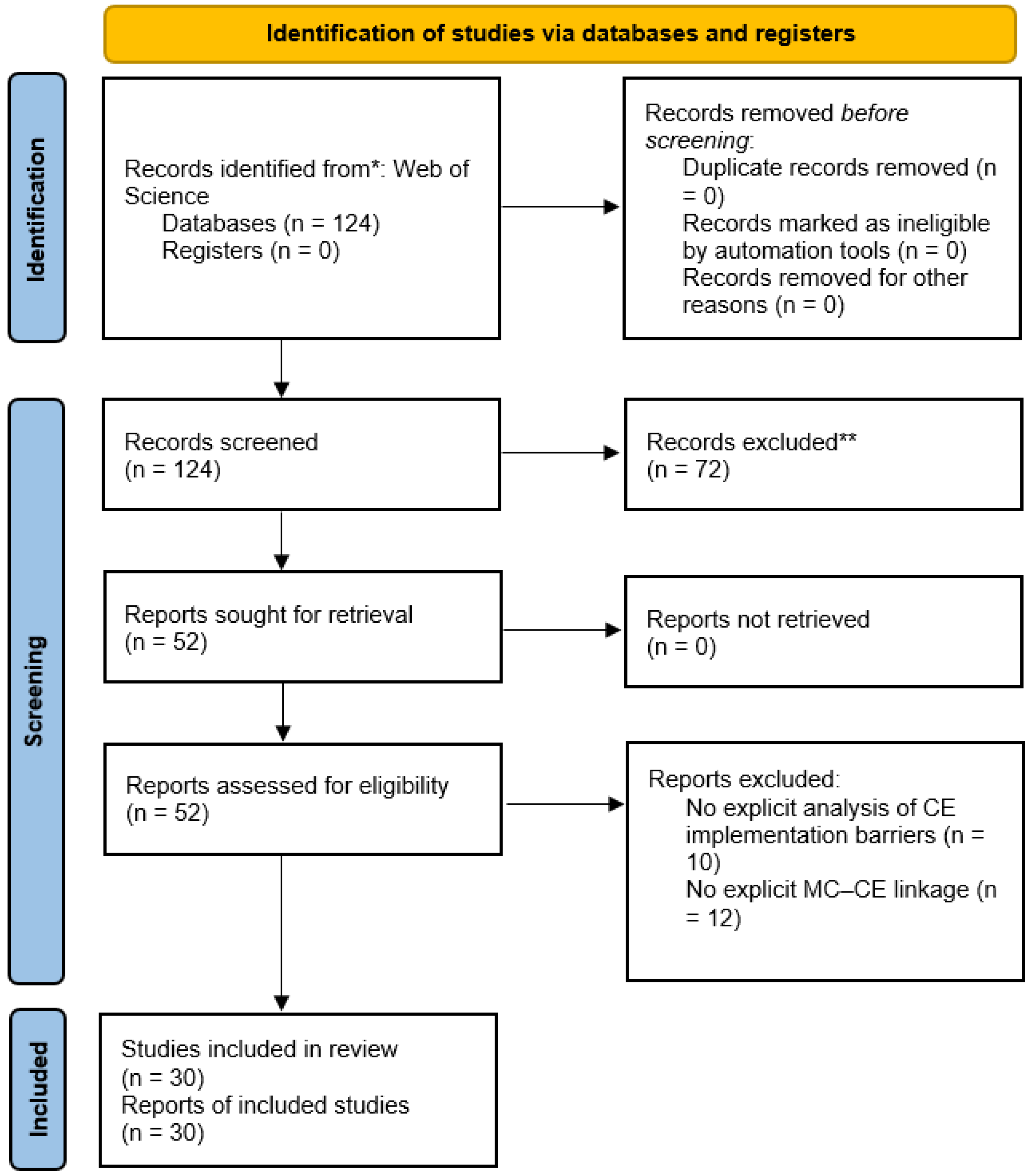
Records underwent a two-stage screening aligned to the review’s dual synthesis design. First, title and abstract screening removed records that discussed CE or modular/off-site construction only in general terms, without explicit treatment of implementation barriers and mitigation mechanisms (). Second, full-text screening required (i) explicit analysis of at least one CE implementation barrier in the construction/built-environment context and (ii) explicit linkage of modular construction (including off-site delivery or modular reconfiguration) to barrier mitigation and/or CE strategies (multifunctionality, reuse, repurposing, or DfD). This stage excluded , yielding studies that formed the evidential base for thematic coding, severity assessment, and systems mapping. The full corpus was retained for bibliometric mapping to characterise the broader field structure and citation lineages, and to situate the in-depth findings within adjacent modular/off-site and CE scholarship.
To reduce bias in the review process, study identification and selection were guided by a predefined search string, explicit eligibility criteria, and a two-stage screening procedure. Title/abstract screening and full-text assessment were conducted by the first author using predefined eligibility criteria, and no automation tools were used. The coding framework and interpretation were discussed with the co-author during supervision and manuscript development to improve consistency and transparency. Although the review did not involve independent dual screening, the use of predefined procedures and explicit coding rules was intended to improve traceability and reduce subjective bias. The study identification and selection process is summarised in the PRISMA 2020 flow diagram (
Figure 1).
This review was not registered in PROSPERO. No review protocol was publicly deposited.
3.1.4. Analysis
A mixed-method synthesis combined:
Bibliometric mapping of the 124-record corpus (2011–August 2025) to analyse publication patterns and intellectual structure (bibliographic coupling, co-citation, and keyword co-occurrence).
Thematic synthesis and systems mapping of the 30-study SLR set to identify barriers, classify them into six categories, assess severity relative to CE strategies, and model interdependencies as reinforcing feedback structures.
The bibliometric analysis and the SLR serve complementary purposes in this study. The bibliometric layer uses the full 124-record corpus to map publication trends, citation lineages, and thematic structure across the wider MC–CE field, while the SLR layer uses the 30 included studies for detailed barrier coding, severity assessment, and systems interpretation. Combining the two methods situates the in-depth findings within the broader intellectual landscape rather than treating field mapping and evidence synthesis as separate exercises. A formal risk-of-bias assessment tool was not applied because the review synthesised heterogeneous conceptual, review, and empirical studies to examine barriers, enablers, and systems interactions rather than estimate pooled intervention effects.
To strengthen interpretation, the peer-reviewed dataset was supplemented with authoritative policy reports and industry sources to validate practice-facing constraints. These
Supplementary Materials were used for contextual triangulation only, while bibliometric mapping and core thematic and systems claims remained anchored in the included SLR studies.
3.2. Barrier Identification and Severity Assessment
Barrier Coding and Categorisation
Barrier severity was assessed as an impact rating at the barrier–strategy pair level, indicating how strongly each barrier constrains implementation of a given CE strategy in modular construction.The High/Moderate/Low rating system was developed specifically for this review as a structured interpretive rubric rather than adopted from a single pre-existing scale. It was derived from comparative reading of the 30 included studies and used to translate recurring evidence on constraint intensity, consistency across contexts, and strategy-specific effects into a transparent barrier–strategy rating framework. Ratings were grounded in the 30 included SLR studies, with sector reports and case examples used only for contextual validation. Each barrier–strategy cell was assigned a High, Moderate, or Low rating according to a predefined interpretation rubric, and each rating was supported by an evidence-based justification from the included studies. The full interpretation rubric and rating matrix are presented in the Results section.
3.3. Systems Mapping Protocol
A systems-oriented approach was applied to model interdependencies among barriers and to identify reinforcing feedback structures. To ensure transparency and reduce interpretive ambiguity, systems mapping followed the operational steps below:
- 1.
Extract causal statements: from each included study, identify statements that imply cause–effect relationships among barriers, enablers, or outcomes.
- 2.
Translate into signed links: encode each relationship as a directed link between two constructs with a qualitative sign (+/−), indicating whether an increase in one tends to increase or decrease the other.
- 3.
Consolidate constructs: merge synonymous terms into a consistent construct dictionary (i.e., the recurrent barriers/enablers) and record supporting sources for each link.
- 4.
Identify feedback structures: trace closed causal chains among constructs to identify reinforcing cycles, retaining only those supported by multiple evidence statements or convergent reasoning across studies.
- 5.
Validate and refine: check each retained loop against the coded excerpts to ensure directional consistency and to avoid over-generalisation.
This mapping was then used to analyse how multifunctionality interacts with other CE strategies and barrier types within the modular construction context.
3.4. Derivation of Multifunctionality Pathways
Multifunctionality pathways were derived inductively rather than defined a priori because multifunctionality is discussed less consistently, and often indirectly via adaptability and reconfiguration, within the screened evidence base. We extracted and coded multifunctionality-related excerpts from the included studies, focusing on statements that linked adaptable or reconfigurable modular design to CE strategies (reuse, repurposing, and design-for-disassembly) and associated outcomes. Recurring mechanisms were consolidated into candidate pathway types and retained where they (i) recurred across at least two included studies and (ii) could be specified as an implementable intervention (design/technical, digital, organisational, or governance). Pathways were then refined to remove overlap and ensure conceptual distinctness and a clear intervention-to-outcome mechanism supported by the coded evidence. Final pathway labels and illustrative examples are reported in the Results section.
3.5. Economic and Regulatory Context
To address economic and regulatory variation relevant to RQ2, a targeted contextual review was conducted in parallel with the SLR. This included authoritative government and regulator publications, applicable standards and guidance, and reputable industry and policy reports. These sources were used to characterise contextual conditions that shape modular construction and circular implementation (e.g., approval pathways, certification requirements, liability/insurance expectations, procurement guidance, and indicators of market and supply-chain maturity) and to support interpretation of how barrier salience and mitigation feasibility may differ across settings.
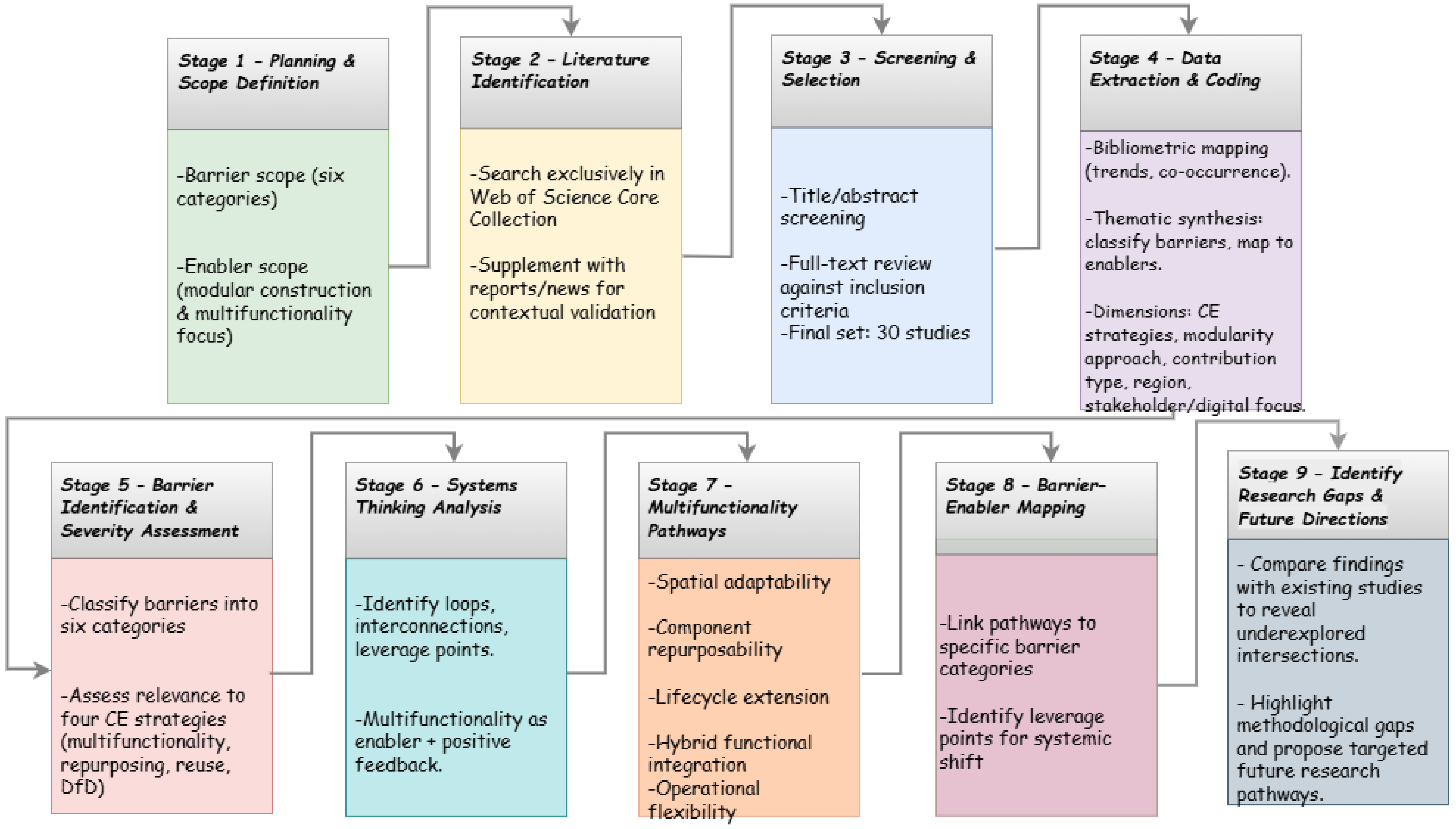
The overall review workflow is summarised in
Figure 2.
4. Results: Main Characteristics of the Literature Studied
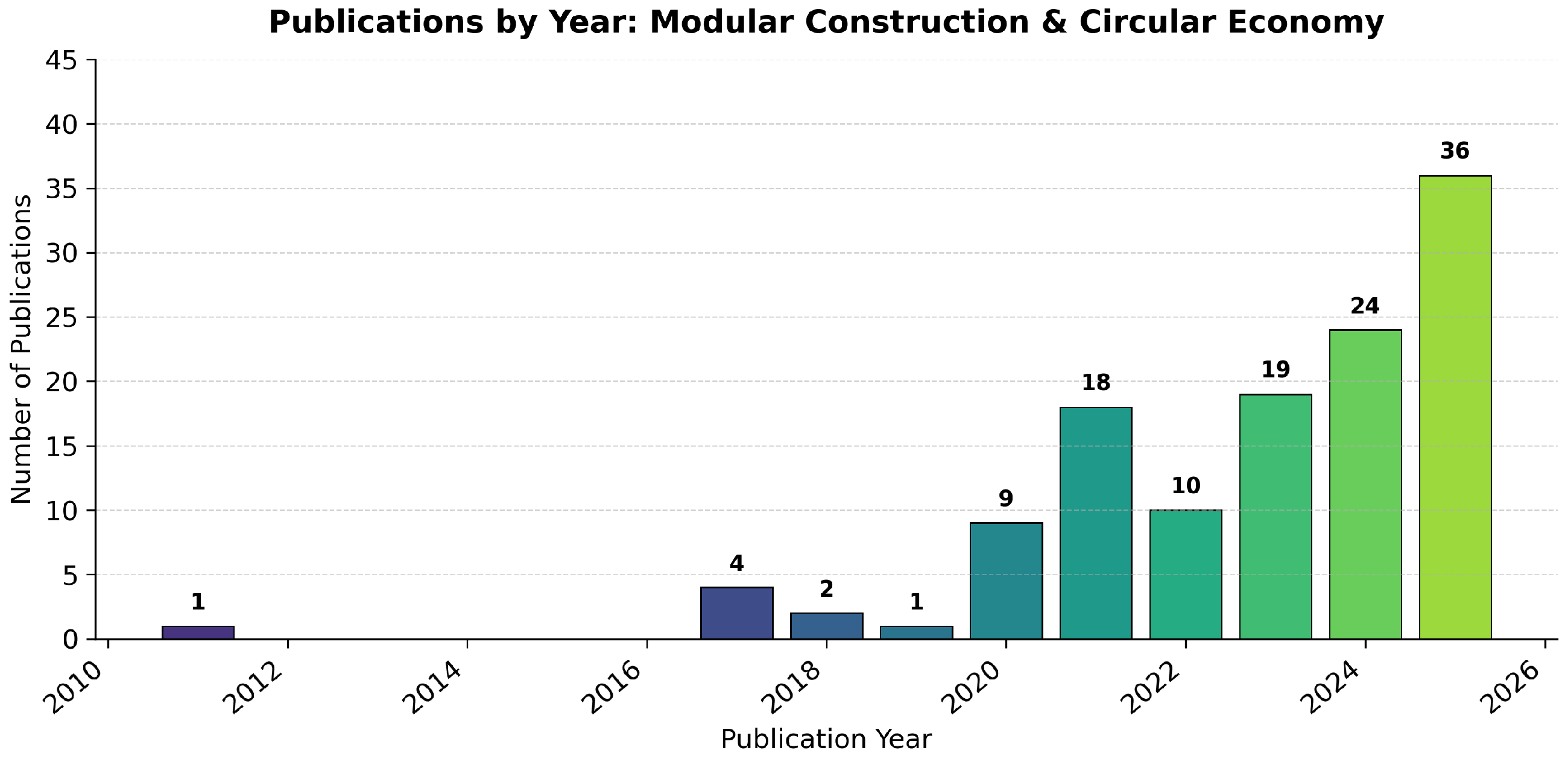
To build a comprehensive picture of how modular construction supports circular economy (CE) strategies in the built environment, we analysed 124 studies retrieved from the Web of Science (WoS) Core Collection published between 2011 and 2025 (
Figure 3). Our bibliometric scan combines descriptive trends with conceptual mapping of keywords, citation patterns, and thematic foci to show how the field has evolved and where critical research gaps remain.
The publication trend (
Figure 3) is sparse before 2017, then rises steadily from 2020 onward, with the sharpest growth after 2021 and a peak in 2025 (more than 35 publications). This acceleration mirrors policy momentum (e.g., circular economy action plans, net-zero commitments) and practical shifts towards rapid, off-site, resource-efficient delivery. Regional diversification is evident: Asia is a key engine-policy-led uptake in China and city-level PPVC initiatives in Hong Kong and Singapore link modular/off-site methods to lower emissions, while early Sub-Saharan African work, coupled with a very large housing deficit, points to a nascent shift toward scalable, lower-carbon delivery options [
23,
24]. We hypothesise that the post-2015 upswing reflects key agenda-setting triggers, most notably the UK call to “modernise or die” (2016) for modular methods and the wider diffusion of the circular-economy “butterfly” framework (Ellen MacArthur Foundation, 2012). The absence of studies between 2010 and 2016 indicates a lag between these signals and academic uptake in construction, plausibly due to longer design procurement cycles, capital intensity, and risk governance; by contrast, manufacturing with shorter product cycles and tighter process control typically adopts new approaches more quickly.
To identify what the literature emphasises, we assessed the frequency of key CE strategies and related enablers across the corpus. This lens distinguishes where evidence is concentrated versus where important mechanisms remain under-examined. Because individual studies may address more than one circular economy strategy, the categories reported in
Table 1 are not mutually exclusive, and the percentages therefore represent the proportion of the full corpus in which each strategy appears rather than values expected to sum to 100%. Life-cycle Assessment and Reuse emerged as the dominant strategies, appearing in 47 papers (37.9%) and 45 papers (36.3%), respectively. The prominence of Life-cycle Assessment highlights a strong emphasis on environmental quantification in the literature, while the high reuse coverage underscores continued attention to material recovery and circular design. Design for Disassembly is also well represented (33 papers, 26.6%), consistent with interest in modular approaches that facilitate component recovery and reduce demolition waste. Stakeholder Integration (28 papers, 22.6%) and BIM/Digital Tools (16 papers, 12.9%) show moderate presence, signalling attention to governance and digital methods, though the latter remains less common. Repurposing is discussed in only 4 papers (3.2%), and Multifunctionality appears in just 2 papers (1.6%), suggesting that strategies focused on extending use through adaptive reuse or embedding versatility into design are comparatively underexplored. Overall, the distribution indicates that the literature remains weighted toward environmental measurement and material and technical loops, with less attention to operational, social, and multifunctional design enablers of a circular built environment (
Table 1).
4.1. Bibliographic Coupling Analysis
To probe emerging directions, we conducted a document-level bibliographic coupling analysis in VOSviewer (
Figure 4). The revised map indicates that recent work clusters around practical implementation questions in modular construction and the circular economy (CE), notably stakeholder resistance, regulatory misalignment, carbon reduction, and the logistical challenges associated with reuse and repurposing.
VOSviewer Parameterisation (Thresholds, Normalisation, and Clustering)
The coupling network was constructed with unit of analysis = documents and counting method = full counting. A minimum citation threshold of five citations per document was applied, and 44 documents were retained for mapping and ranking (
Table 2). Coupling links between retained documents were normalised using the association strength method, which is the VOSviewer default normalisation for similarity mapping. For community detection, clusters were generated using VOSviewer’s clustering routine, with the resolution parameter set to 1.0 and minimum cluster size set to 1. For visualisation, the layout was produced with the VOS mapping technique using the standard layout parameters for document networks, attraction = 2 and repulsion = 0. No additional minimum-link-strength pruning was applied beyond the citation threshold, so all coupling links among retained documents were preserved.
As summarised in
Table 2, the author–year entries are VOSviewer document labels rather than formal in-text reference citations. The nodes labelled Garusinghe (2023) (TLS: 119), Lee (2023) (TLS: 118), Jayawardana (2023b) (TLS: 109), and Minunno (2020) (TLS: 108) are among the most tightly coupled contributions in the network. Turner (2021) (95), Shufrin (2023) (94), O’Grady (2021) (89), Antwi-Afari (2021) (89), and Sajid (2024) (88) also occupy prominent positions, reinforcing the implementation-oriented core of the field. Recent contributions, particularly from 2024, including Yang (2024), Rayhan (2024), Chen (2024), Gutierrez (2024), and Barta (2024), are also represented in the network, which continues to cluster around modular delivery challenges, stakeholder dynamics, and CE implementation barriers. Foundational studies, such as Minunno et al. [
18] and Panda et al. [
15], remain influential anchors, whereas digital-integration studies such as Succar (2020) and Kucukvar (2021) show lower coupling intensity (TLS: 18 and 6), indicating that digitalisation remains comparatively less integrated into the main implementation-focused research front.
Method note (coupling vs. co-citation). Both can be computed at the author level but capture different relations. Bibliographic coupling links authors whose papers cite the same references, which provides a near-term research-front signal available immediately, whereas co-citation links authors that are cited together by later papers, which provides a slower field-structure signal that accumulates over time. We use coupling here to surface emerging implementation themes; co-citation is reported separately to map established schools of thought.
4.2. Co-Citation Analysis
To assess the intellectual structure underpinning the intersection of modular construction and the circular economy (CE), we conducted a co-citation analysis in VOSviewer (
Figure 5). Co-citation analysis identifies influential author groupings that are frequently cited together, thereby revealing the intellectual “schools of thought” shaping a research domain.
VOSviewer settings (reproducibility). We used: Type of analysis: Co-citation; Unit of analysis:Cited authors; Counting method: Full counting; Minimum citations per author: 10 (to reduce noise from one-off citations); Normalization: Association strength; Clustering resolution: 1.0 (VOSviewer default); Link threshold: links retained at the VOSviewer default (co-citation link strength
). These thresholds yield a stable map while preserving the dominant intellectual structure summarised in
Table 3.
The resulting network highlights four dominant clusters. The first cluster consolidates foundational CE scholarship and systems-level framing of circularity, represented by authors such as Ghisellini, Geissdoerfer, Bocken, Pomponi, Eberhardt, Hossain, and the Ellen MacArthur Foundation. These authors exhibit high total link strength (e.g., Hossain: 429; Eberhardt: 367; Ghisellini: 295; Pomponi: 207; EMF: 204), indicating their central role in establishing CE definitions, principles, and systemic problem framings that are repeatedly mobilised across modular construction studies (
Table 3).
The second cluster is anchored in technical and modular innovation streams, linking off-site construction and modular performance to empirical assessment—particularly through life-cycle methods and engineering evaluation. Key authors such as Kamali (TLS 593), Pan (289), Tam (237), Li (192), and Lu (187) form a dense methodological backbone for quantifying impacts and performance trade-offs in modular systems. This cluster reflects the field’s strong emphasis on measurement-led contributions and the translation of CE concepts into assessable engineering propositions.
A third cluster, with Minunno et al. [
18] as a major connective anchor (TLS 444), bridges technical assessment to policy implementation and adoption-oriented contributions. Associated authors (e.g., Kirchherr: 312; Sanchez: 204; Rausch: 133; Shooshtarian: 104; Kabirifar: 106) indicate increasing attention to governance, implementation feasibility, and the socio-economic conditions required for circular modular practices to scale beyond pilots.
A smaller but clearly identifiable fourth cluster captures standards and institutional actors (e.g., European Commission: 136; ISO: 104; CEN: 38). The comparatively sparse positioning of these nodes relative to the main academic clusters suggests that formal standards and codified guidance remain less integrated into mainstream academic argumentation—even though they are frequently cited as boundary conditions for adoption and legitimacy. In this context, digitally enabled information management (including BIM-related scholarship) appears as a supporting rather than dominant intellectual strand: it is present in the wider domain, but does not yet form a primary co-citation “core” comparable to CE foundations or LCA-led modular assessment. This pattern is consistent with a field where digital tools are often treated as enablers of traceability and coordination rather than as the central theoretical engine of circular modular research.
Overall, the co-citation structure indicates a research landscape that is intellectually rich but still partially compartmentalised: CE conceptual foundations, engineering assessment, and policy/standards discussions remain more strongly connected internally than across clusters. This fragmentation implies that advancing CE outcomes through modular construction will require stronger integration across conceptual, technical, and institutional strands, particularly to translate measurement-led evidence into scalable regulatory and market practice.
4.3. Keyword Co-Occurrence Analysis
Finally, to examine how the literature conceptualises the relationship between modular construction and circular economy strategies, we generated an author-keyword co-occurrence map in VOSviewer (
Figure 6).
VOSviewer settings. We used: Type of analysis: Co-occurrence; Unit of analysis: Author keywords; Counting method: Full counting; Minimum keyword occurrences: 5 (as reflected in the map); Normalization: Association strength; Clustering resolution: 1.0 (default); Link threshold: links retained at the VOSviewer default (co-occurrence link strength ). This configuration filters idiosyncratic terms while retaining the dominant conceptual structure.
The map reveals three prominent thematic clusters. The first cluster, anchored by “circular economy” (58 occurrences; TLS 168), reflects strategic and performance-oriented framings of circularity. Strongly linked terms include “design” (26; 105), “performance” (20; 68), and “life-cycle assessment” (10; 30), alongside “prefabrication” (9; 28) and “construction and demolition waste” (6; 18). This pattern indicates that circularity is operationalised primarily through design and measurable environmental performance, with LCA frequently serving as the dominant evaluative lens. Although a “sustainability” node appears on the map, its lower prominence among the top keywords in
Table 4 likely reflects author keyword practices that privilege operational descriptors (e.g., LCA, design for disassembly, construction and demolition waste) over umbrella terms, consistent with established CE scholarship [
16].
The second cluster focuses on the technical and logistical implementation of modular construction, including “modular construction” (20; 70), “off-site construction” (6; 23), “prefabrication” (9; 28), “buildings” (12; 60), and “concrete” (6; 27). The positioning of “modular construction” at the interface between clusters suggests it acts as a conceptual connector: it links CE performance framings to operational construction practices, reflecting how modularity is discussed both as a product system and as a delivery process with implications for waste reduction, schedule efficiency, and life-cycle impacts.
The third cluster highlights institutional, digital, and systemic enablers and constraints shaping CE feasibility in modular construction. Key terms include “barriers” (8; 41), “reuse” (9; 44), “deconstruction” (9; 44), and “design for disassembly” (5; 21). “BIM” (8; 38) appears within this cluster, indicating that digital information management is consistently associated with implementation concerns such as traceability, coordination, and end-of-life planning. However, its moderate frequency and its embedding within an “enablers/constraints” cluster (rather than dominating the performance or technical clusters) suggests that BIM is typically treated as an enabling infrastructure for circular implementation, not as the primary conceptual focus of the field. In other words, digital tools are present and relevant, but the literature remains more strongly driven by LCA/performance measurement and physical circular strategies (reuse, deconstruction, design for disassembly).
Taken together, the clusters illustrate a thematised yet fragmented research landscape. Strong linkages exist within clusters, but cross-cluster integration remains comparatively limited. Bridging terms (notably “design”, “modular construction”, and LCA/life-cycle assessment) appear across clusters but are less dense than intra-cluster ties. This fragmentation aligns with the co-citation structure and indicates that future work should connect performance measurement, technical delivery systems, and institutional/digital enablers more explicitly so that modularity functions as a coherent systems-level mechanism for operationalising circular economy principles across the built-environment life cycle.
5. Analysis of the Barriers to the Adoption of Modular Construction
While modular construction (MC) is frequently positioned as a delivery route that can enable circular economy (CE) outcomes, the screened evidence base indicates that adoption and circular performance remain uneven because implementation is constrained by persistent, system-level barriers. These barriers are interdependent rather than isolated and can reinforce one another across project cycles, obstructing CE-aligned practice. Across the included SLR studies, ten recurrent barriers are consolidated into six thematic clusters: technical, financial, regulatory, stakeholder/organisational, quality assurance, and institutional/knowledge-based challenges [
15,
25,
26,
27]. Each barrier directly or indirectly undermines one or more MC-relevant CE strategies, including reuse, repurposing, design for disassembly (DfD), and multifunctionality/adaptability [
15,
28,
29].
A unifying systems frame is adopted here, in which MC–CE adoption is treated as a coupled socio-technical and institutional system. The socio-technical dimension captures how design decisions, logistics, manufacturing, and quality assurance interact with organisational choices such as procurement routes, coordination practices, and workforce capability [
25,
26,
27]. The institutional dimension captures the external rules and legitimacy conditions that determine whether modular and circular solutions are accepted in practice, including codes, standards and certification routes, and acceptance of second-life components [
25,
27,
30]. Under this framing, barriers can become mutually reinforcing. For example, limited standards and unclear acceptance pathways increase approval uncertainty, uncertainty increases perceived risk, higher perceived risk reduces adoption and pipeline stability, and low uptake slows learning and standard development, leaving the original standards gap unresolved [
25,
27,
30]. This helps explain why isolated interventions often deliver only local gains unless reinforcing feedbacks are weakened [
25,
29].
5.1. Technical Barriers
5.1.1. Logistical Complexities in Transportation and Assembly
Moving and installing modular units introduces logistics risks that can become decisive where modules require constrained access, specialised lifting plans, or tightly sequenced deliveries [
25,
27]. While just-in-time delivery can reduce laydown requirements, it can also increase sensitivity to disruption, with knock-on effects on programme and cost [
26,
27]. Critically for CE, each additional circular loop, including disassembly, transport, storage, and reassembly, compounds handling requirements and increases the risk of damage, tolerance loss, and rework [
18,
29]. Recent work on heavy-lifting localisation in modular integrated construction further underlines the importance of digitally supported lifting and installation planning, particularly where positioning accuracy, handling control, and on-site safety affect modular assembly performance [
31]. Multi-cycle and LCA-oriented studies further show that outcomes depend strongly on assumptions about reuse rates, transport intensity, and recovery condition, which elevates perceived risk and can erode expected environmental gains if reverse logistics are not well managed [
1,
18,
29,
32].
Logistics constraints translate into higher transport costs and schedule volatility, increased risk of module damage, and reduced feasibility of reuse and repurposing when repeated loops become impractical or too risky [
18,
25,
29,
33]. Logistics impose a Moderate constraint on multifunctionality because many functional changes can be achieved through internal reconfiguration without repeated long-distance moves. By contrast, logistics are typically High for repurposing, reuse, and disassembly, since transport costs, damage exposure, lifting constraints, storage, and reverse-logistics planning often determine feasibility and economics [
18,
25,
27,
29].
5.1.2. Design Limitations and Aesthetic Constraints
Modular efficiency is often associated with standardisation, but overly rigid typologies can reduce adaptability and hinder circular outcomes where future change of use, reconfiguration, or component substitution is required [
15,
28,
34]. Where modular systems are bespoke or non-interoperable, the scope for repurposing and cross-project reuse narrows because interfaces, dimensions, and connections do not reliably align across contexts [
28,
35,
36]. Conversely, studies focusing on circular manufacturing and assembly and connection design emphasise that reversible detailing and interface compatibility expand viable reuse and reconfiguration pathways [
34,
36].
These constraints manifest as reduced multifunctionality through fewer viable reconfigurations over time, lower adaptability because fixed grids and interface typologies limit layout adjustments, hindered disassembly potential because non-reversible joints and bespoke interfaces impede separation and reconnection, decreased feasibility of reuse and repurposing because interoperability gaps reduce matching and increase rework, and higher retrofit or reconfiguration costs due to lock-in [
15,
28,
34,
36].
Design adaptability and interoperability are High for multifunctionality and repurposing because they determine whether future reconfiguration is feasible without major redesign. For reuse, the impact is commonly Moderate, since modules may be redeployed as-is in some cases, but interoperability broadens viable matches and reduces rework. For disassembly, the impact is typically High to
Critical, because non-reversible joints and bespoke interfaces become rate-limiting when components cannot separate and reconnect reliably for second-life use [
28,
34,
36].
5.2. Financial Barriers
5.2.1. High Initial Capital Costs
Across the screened evidence base, financial barriers are most frequently framed as early-stage adoption constraints linked to enabling investments, including interfaces, QA systems, traceability, and reversible detailing allowances, pipeline uncertainty, and risk premia rather than as a simple unit-cost comparison [
25,
26,
27]. Studies assessing circular modular strategies emphasise that enabling investments tend to be incurred early, while benefits accrue across later cycles [
1,
18,
29,
37].
These conditions can delay market scaling by increasing early financing burdens and amplifying pipeline utilisation risk, which sustains conservative investment decisions [
25,
27]. They also interact with ROI uncertainty by increasing sensitivity to assumptions about reuse rates, residual value, and acceptance conditions [
29,
32,
37].
Up-front cost is primarily an entry-gate constraint. It is typically Moderate for repurposing when additional enabling systems must be funded early, but more often Low for multifunctionality once adaptable design rules and interfaces are in place. For reuse and disassembly, initial premiums tend to delay uptake rather than remove feasibility, since costs can be amortised across cycles if acceptance pathways and logistics are workable [
18,
25,
29,
37].
5.2.2. Perceived Uncertainty in ROI and Life-Cycle Costing
A recurring constraint is uncertainty in ROI and life-cycle valuation, especially where conventional appraisal does not reliably represent multi-cycle benefits and liabilities [
29,
37]. This uncertainty weakens the investment case for early design measures that enable reuse or repurposing and reinforces conservative procurement choices where second-life acceptance conditions remain unclear [
25,
27,
30]. Studies applying LCA and multi-cycle framing also show that outcomes depend strongly on assumptions about reuse rates, transport intensity, and recovery condition, which increases perceived risk for decision-makers [
1,
18,
29,
32].
These conditions discourage long-term CE investment, delay adoption of adaptable designs and traceability systems, and encourage conservative assumptions about residual value and reuse rates [
25,
29,
37].
Credible ROI projections are typically High for multifunctionality, repurposing, and reuse, because these strategies often require early investment for benefits realised across later cycles. For disassembly, the effect is more commonly Moderate, as disassembly feasibility is heavily shaped by design and QA, while returns remain contingent on acceptance pathways and secondary-market conditions [
25,
27,
29,
37].
5.3. Regulatory Barriers
5.3.1. Misalignment with Building Codes and Planning Systems
Institutional and regulatory barriers are repeatedly reported as stronger constraints on circular redeployment than on modular delivery per se. The screened evidence highlights approval uncertainty and conservative acceptance pathways for second-life or reconfigured applications, particularly where standards and certification routes are unclear or inconsistent [
25,
27,
30]. Where compliance expectations are ambiguous, additional testing, documentation, and risk transfer requirements can accumulate, slowing adoption and discouraging reuse-oriented decisions [
2,
27,
30].
These frictions drive approval delays, compliance uncertainty, and slower uptake of demountable or reconfigurable solutions, especially in first-of-a-kind applications [
25,
27,
30].
Regulation typically restrains multifunctionality at a Moderate level because many changes can be designed within existing compliance pathways. By contrast, it exerts a High constraint on repurposing, reuse, and disassembly, where second-life approval, liability, and verification requirements commonly become rate-limiting [
2,
25,
27,
30].
5.3.2. Lack of Standardisation and Certification Protocols
Across the screened studies, gaps in standards and certification are closely tied to acceptance risk for recovered components and second-life modules [
25,
27,
30]. Where verification practices and documentation are inconsistent, QA burdens increase and stakeholders default to conservative acceptance positions, limiting routine reuse and disassembly-based value retention [
1,
27].
Cross-border standard incompatibility introduces an additional systemic barrier to the scalability of circular modular supply chains. Where jurisdictions apply different structural, fire, acoustic, transport, certification, or documentation requirements, modules and components that are compliant in one market may require redesign, retesting, or recertification before they can be redeployed in another. This weakens interoperability across regions, increases transaction costs, slows approval processes, and reduces the predictability of second-life use. For CE strategies such as reuse, repurposing, and design for disassembly, the absence of internationally aligned acceptance pathways can therefore restrict the movement of recovered modules and components across borders, limit the formation of larger secondary markets, and reduce the economic viability of circular modular practices at scale [
25,
27,
30].
These gaps reduce scalability and predictability by increasing verification effort, approval uncertainty, and perceived liability exposure for second-life use [
25,
27,
30].
Certification and standards gaps are typically High for reuse and disassembly, Moderate for repurposing, and Low for multifunctionality at concept stage, with constraints becoming stronger at the point of verification and approval for second-life deployment [
25,
27,
30].
5.4. Stakeholder and Organisational Barriers
5.4.1. Fragmented Engagement Across the Project Life-Cycle
MC–CE outcomes depend on early and continuous coordination across design, fabrication, transport, assembly, and end-of-life actors. The screened evidence consistently highlights fragmentation and discontinuous responsibility as dominant barriers because circular strategies require continuity of intent, information, and accountability across phases [
25,
26,
27,
30]. Where manufacturers and recovery actors are absent from early decision-making, brief, interface, and procurement choices tend to lock in single-life solutions [
25,
29].
Fragmentation drives loss of life-cycle continuity, weak information hand-offs, and inconsistent embedding of DfD and reuse requirements at brief and concept stage [
25,
26,
27].
Early life-cycle coordination is typically High for multifunctionality, reuse, and repurposing, because decisions about grids, interfaces, responsibilities, and documentation are cheapest and most influential early. For disassembly, the effect is often Moderate, since some value can be recovered later, but typically with higher cost and lower certainty once lock-in has occurred [
25,
27,
30].
5.4.2. Limited Awareness and Resistance to Change
Institutional inertia and limited familiarity with circular modular workflows remain persistent adoption constraints in the screened literature, particularly where stakeholders perceive second-life use as unfamiliar or risky [
15,
25,
26,
37]. These constraints act as early gatekeepers by shaping whether adaptable design options and reuse pathways are specified and valued at the outset [
29,
37].
Low awareness and resistance to change reduce demand for circular modular options and sustain conservative specification and approval behaviour [
15,
25,
26].
Awareness and acceptance are typically High for multifunctionality and reuse because they influence brief and procurement screening. For repurposing and disassembly, the effect is more commonly Moderate, adding time and coordination burden rather than removing feasibility where enabling design and assurance practices are present [
15,
25,
26,
37].
5.5. Quality Assurance and Workmanship Challenges
Inconsistent Workmanship and QA Protocols
Across the screened evidence base, quality assurance is repeatedly linked to second-life feasibility. Repurposing, reuse, and disassembly require confidence in component condition, tolerances, and performance, and QA deficiencies increase rework risk, liability exposure, and stakeholder reluctance to accept recovered components [
18,
27,
38]. Evidence also indicates that quality and verification requirements become stricter as the intended number of cycles increases, raising the importance of traceability and reliable documentation [
29].
QA deficiencies undermine confidence in reuse and repurposing, increase verification burden, and reinforce conservative underwriting and approval behaviour for second-life use [
18,
27,
38].
QA lapses exert High severity on repurposing, reuse, and disassembly because assurance and verification are prerequisites for redeployment. For multifunctionality, the impact is more commonly Moderate, since poor QA can raise rework and reduce confidence, but it does not usually eliminate the feasibility of adaptable design intent [
1,
18,
27].
5.6. Institutional and Knowledge-Based Barriers
Education Deficits and Knowledge Fragmentation
A recurring constraint is limited capability and fragmented knowledge about circular modular delivery, including uncertainty about metrics, verification, and multi-cycle evaluation [
15,
25,
26]. Studies focusing on digital and information-enabled circularity further underline that information readiness and traceability capability are enabling conditions for reuse-oriented decisions and acceptance of second-life components [
39,
40]. Bibliometric and synthesis studies also suggest that relevant knowledge is dispersed across modular, CE, LCA, and digitalisation streams, reinforcing fragmentation and slowing consolidation into routine practice [
41,
42].
A critical part of this skills gap concerns digital literacy in life-cycle-oriented construction workflows. Circular modular delivery increasingly depends on the ability to create, manage, interpret, and exchange structured digital information across design, manufacture, assembly, operation, adaptation, and end-of-life stages. This includes capabilities related to BIM-enabled information management, digital twins, material passports, traceability systems, and digitally supported quality assurance records. Where traditional construction workforces and project teams lack these specialised skills, components and modules become harder to identify, verify, document, and assess for second-life use. As a result, high-level circular strategies such as reuse, repurposing, design for disassembly, and multifunctional adaptation become more difficult to operationalise in practice because the information needed to support compliance, condition assessment, recovery planning, and cross-phase coordination is incomplete, inconsistent, or unavailable [
1,
25,
43].
Capability gaps reduce consistent implementation of CE-oriented modular design and limit the ability to plan and verify reuse, repurposing, and disassembly workflows [
25,
27,
44].
Education and knowledge gaps have a High impact on multifunctionality, reuse, and repurposing because these depend on design foresight, multi-cycle evaluation, and stakeholder understanding to be specified and valued early. The effect on disassembly is more commonly Moderate, since protocols can be applied, but limited capability and weak acceptance practices reduce consistency and trust, constraining mainstream uptake [
15,
25,
27].
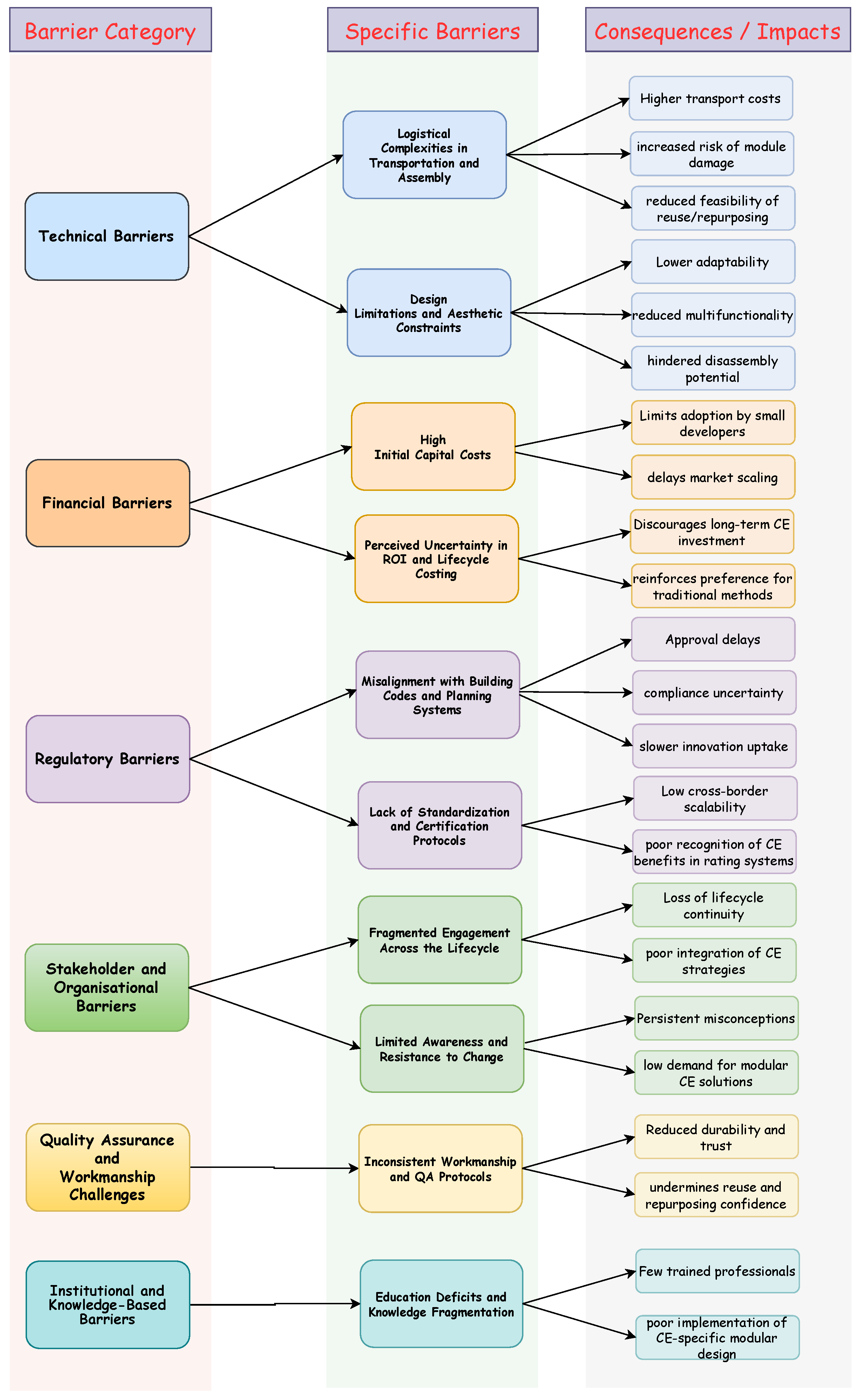
Figure 7 summarises the key barrier categories, specific barriers, and their main consequences for circular economy implementation in modular construction.
5.7. Mapping of Barriers Against Circular Economy Strategies in Modular Construction
Barrier severity was evaluated at the
barrier–strategy pair level to indicate how strongly each barrier constrains implementation of a given circular economy (CE) strategy in modular construction. Judgements were grounded in the 30 included SLR studies, while sector reports and case examples were used only for contextual validation and did not affect the assigned ratings. Using the High/Moderate/Low rubric in
Table 5, each barrier–strategy cell in
Table 6 was assigned an evidence-based rating supported by justification from the included studies.
Table 6 translates this rubric into a comparative view of how the ten recurrent barriers affect multifunctionality, repurposing, reuse, and design for disassembly in the screened evidence base.
Interpreting
Table 6, the most consequential constraints on circular outcomes are more often related to coordination, capability, assurance, and recognition than to raw cost alone. Early life-cycle integration among clients, designers, manufacturers, and contractors, together with workforce capability and quality assurance or traceability, frequently registers as High for multifunctionality, repurposing, and reuse within the screened evidence base. In contrast, design for disassembly appears comparatively less sensitive overall, but its severity rises to High where standards, certification, or workmanship are weak.
Repurposing emerges as especially sensitive to interacting constraints. Logistics and handling, stakeholder fragmentation, ROI and life-cycle costing uncertainty, quality assurance and traceability, and institutional knowledge all register as High, indicating that repurposing depends heavily on reliable reverse logistics, credible second-life valuation, and sustained cross-party coordination. Reuse follows a similar pattern, with High severity for logistics, QA or traceability, and ROI uncertainty, while regulatory recognition through standards and certification also becomes more influential because acceptance rules and evidence requirements determine whether reused components are permissible. Multifunctionality is constrained most strongly by design lock-in and stakeholder or organisational barriers, showing that early interface choices and siloed delivery structures most strongly limit later reconfiguration options. DfD appears more controllable through design choice in relative terms, but its severity rises sharply where certification, standards, and workmanship are weak, because disassembly depends on recognised detailing and consistent build quality.
A second pattern concerns the difference between delay pressures and persistent constraints. Financial CAPEX pressures are generally Low to Moderate across most strategies, which suggests that they more often delay adoption than eliminate feasibility. By contrast, ROI and life-cycle costing uncertainty remains High for three strategies, indicating a deeper information and valuation problem rather than a simple cost issue. Coordination barriers, QA and workmanship challenges, and institutional or knowledge-based barriers also appear as persistent High constraints across multiple strategies, suggesting that the strongest barriers are those that disrupt continuity, trust, and evidentiary confidence across the life cycle.
These ratings should not, however, be interpreted as universally fixed across all settings. Barrier severity is shaped by the maturity of the surrounding ecosystem and regulatory environment. The screened evidence base is drawn predominantly from studies in economically mature, often OECD, settings, where MMC capacity, pipeline stability, and institutional arrangements for quality assurance and compliance are relatively well established. In such markets, cost and logistics constraints can be moderated through scale, predictable demand, and repeatable processes. In less mature settings, the same barriers may become binding constraints because limited capacity, sparse supplier networks, and weak secondary markets amplify risk and volatility. Regulatory conditions also matter. Prescriptive codes and fragmented local approval routes typically increase uncertainty for novel modular details and for second-life components, whereas performance-based pathways and recognised certification can lower transaction costs and accelerate reuse and repurposing. Construction culture further moderates severity. Where procurement norms support early integration and standardisation, and where stakeholders are more willing to learn through iteration, coordination barriers tend to weaken. Where risk appetite is low and bespoke delivery remains the default, resistance to change and fragmentation become more persistent and system-wide.
Taken together,
Table 6 points to two broad priorities:
- 1.
Front-loaded integration of design and supply-chain actors to reduce downstream fragmentation and design lock-in, which appear as dominant drivers of High severity for multifunctionality, repurposing, and reuse.
- 2.
Systematic capability and assurance through workforce skills, robust QA and traceability, and recognised standards and certification for second-life use, which are essential for moving DfD and reuse from relatively high-risk domains into routinely acceptable practice.
Cost barriers remain relevant, but the evidence in
Table 6 indicates that they are secondary to these structural and capability-related factors. In other words, addressing coordination, assurance, and knowledge shifts the overall severity profile, whereas finance mainly affects timing.
6. Systems Perspective: From Barriers to Multifunctionality Pathways
As outlined in
Section 2.2,
multifunctionality is the capacity of modular systems to accommodate different uses over time, allowing spaces to be reconfigured, repurposed, and adapted without major structural intervention. This property underpins CE strategies such as reuse, repurposing, and life-cycle extension, and it can also act as a resilience mechanism in crisis contexts. During COVID-19, for example, emergency modular hospitals in Wuhan (Huoshenshan and Leishenshan) were delivered in little more than a week using prefabricated units and supporting digital coordination technologies [
46]. In the UK, NHS Nightingale facilities, including ExCeL London, were operational within nine days [
47,
48], and were later repurposed for non-COVID care and vaccination [
49,
50]. These rapid transformations reduced waste by avoiding full rebuilding and reduced carbon through asset reuse, while maintaining service continuity.
Yet, as discussed in
Section 5, the potential of multifunctionality is constrained by systemic barriers. In a tightly coupled socio-technical setting, the persistence or removal of one barrier can cascade across others, reinforcing inertia or enabling progress [
26]. Addressing barriers in isolation is therefore insufficient; understanding feedback loops is essential to unlock more durable change [
51].
These reinforcing loops reflect socio-technical lock-in. Established routines, risk allocation practices, and supply-chain structures are tuned to conventional single-life delivery, so uncertainty raises perceived risk, increases due diligence and contingencies, reduces uptake and learning, and in turn sustains uncertainty. Many barriers are also institutional. Adoption depends on formal rules such as codes, standards, certification, and insurance, as well as on professional norms and legitimacy, including whether reused or reconfigurable modules are regarded as safe and acceptable in practice. When legitimacy is weak, regulators and insurers tend to default to caution, approvals become harder, demand falls, and standardisation slows, thereby reinforcing the lock-in.
To make these interdependencies explicit, we adopt a systems-thinking lens and conceptualise two complementary maps:
Barrier Network: interlocking constraints (e.g., logistics, design lock-in, financing, approvals, capability, QA/traceability) whose interactions sustain linear, wasteful practices.
Enabler Network: interconnected multifunctionality pathways (design for adaptability, standardised interfaces, digital traceability/material passports, collaborative delivery, policy/certification alignment) that can disrupt those constraints and create reinforcing improvements.
6.1. Barrier Interconnections
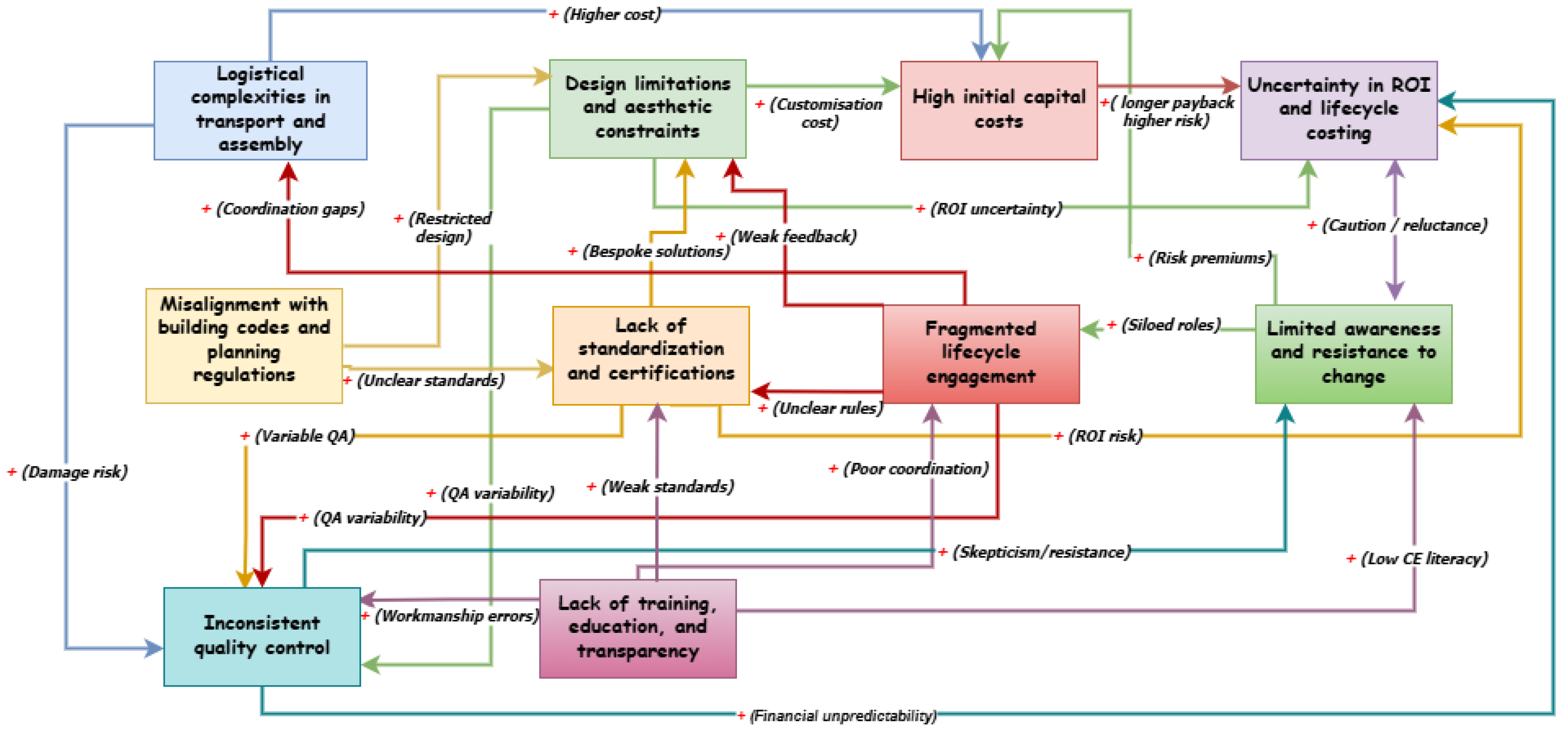
Figure 8 maps the interconnections among ten barriers, organised into six clusters. Solid arrows denote direct, first-order influence, while “+” marks same-direction effects. Brief labels identify the dominant mechanism on each link, for example “customisation cost”, “QA variability”, and “restricted design”. Reinforcing loops are therefore interpreted as chains of these direct annotated links rather than as standalone abstractions.
- 1.
Technical Design Limitations: Includes nodes: T1 Logistics (transport/assembly); T2 Design and interoperability; aesthetics.
Technical design limitations in modular CE can be grouped into two related factors: logistical complexities in transport and assembly, and design limitations with aesthetic constraints. First, moving large prefabricated elements and coordinating on-site assembly require specialised equipment and permits, which raise initial capital costs and schedule risk [
7]. Handling, tolerance, and interface issues can also increase rework, contributing to inconsistent quality control. Through the high-initial-capital-cost pathway, these pressures feed into uncertainty in ROI and life-cycle costing. That uncertainty, in turn, increases resistance to change, which can drive further cost growth through added contingencies and delays. Second, design limitations and aesthetic constraints connect directly to high initial capital costs, for example through bespoke detailing and non-standard finishes, and also to uncertainty in ROI and life-cycle costing, consistent with early observations on modular systemisation and perceived limitations [
11]. Through this uncertainty pathway, these constraints amplify limited awareness and resistance to change. Resistance then contributes to fragmented life-cycle engagement among manufacturers, contractors, and clients, which feeds back into design limitations by weakening feedback loops, standardisation, and reuse-ready detailing.
Taken together, these relations form an integrated reinforcing pathway. Logistical complexities in transport and assembly can increase high initial capital costs, which intensify uncertainty in ROI and life-cycle costing, strengthen resistance to change, and in turn contribute to further cost escalation. In parallel, design limitations and aesthetic constraints can intensify both high initial capital costs and ROI uncertainty, which reinforce limited awareness and resistance to change, contribute to fragmented life-cycle engagement, and ultimately feed back into design limitations. Overall, these technical barriers extend beyond engineering details and reflect broader system-level interdependencies with financial, regulatory, and cultural factors [
8].
- 2.
Financial Constraints: Includes nodes: F1 High CAPEX; F2 ROI/LCC uncertainty.
Financial constraints are best represented as two tightly coupled factors: high initial capital costs and uncertainty in ROI and life-cycle costing. High initial capital costs arise from investment in prefabrication facilities, specialised handling and transport equipment, and digital design and coordination systems, concentrating expenditure earlier than in conventional delivery [
52]. This early CAPEX and exposure to cost and schedule volatility feed directly into uncertainty in ROI and life-cycle costing, particularly where appraisal methods under-value multi-cycle benefits such as reduced waste, faster delivery, and avoided carbon [
7]. In turn, uncertainty in ROI amplifies limited awareness and resistance to change among clients, lenders, and delivery partners. Heightened resistance fragments life-cycle engagement by weakening continuity between manufacturers, contractors, and asset owners. This constrains feedback, standardisation, and reuse-ready detailing, exacerbates design limitations and aesthetic constraints, and in turn pushes high initial capital costs higher through bespoke solutions, added contingencies, and approvals risk. The resulting reinforcing system can therefore be read as a cycle in which high initial capital costs intensify uncertainty in ROI and life-cycle costing, which strengthens limited awareness and resistance to change, contributes to fragmented life-cycle engagement, exacerbates design limitations and aesthetic constraints, and ultimately feeds back into higher initial capital costs. Overall, the capital barrier is systemic and co-evolves with standardisation, cultural acceptance, and supply-chain engagement [
8].
- 3.
Regulatory Misalignment: Includes nodes: R1 Codes/planning; R2 Standards/ certification.
Regulatory misalignment is best represented as two coupled factors: misalignment with building codes and planning regulations, and lack of standardisation and certification. These factors reinforce one another. Fragmented or non-recognised standards make code interpretation more conservative and approvals slower, while divergent code and planning requirements discourage the uptake of common standards and certification routes [
53,
54]. Misalignment with codes and planning constrains design choices and approval pathways, connecting directly to design limitations and aesthetic constraints. In parallel, lack of standardisation and certification contributes to inconsistent quality control, because equivalence is harder to demonstrate, and to uncertainty in ROI and life-cycle costing, because due diligence, insurance, and warranty provisions become more onerous. It also feeds into design limitations and aesthetic constraints. Because both pathways converge on design limitations, they increase high initial capital costs through bespoke detailing, mock-ups, and rework, which in turn further increase uncertainty in ROI and life-cycle costing. That uncertainty sustains cautious approvals and slows standard-setting, thereby maintaining both code and planning misalignment and the lack of certification [
8,
9].
Read as a single reinforcing loop, misalignment with building codes and planning regulations interacts with lack of standardisation and certification, which intensifies design limitations and aesthetic constraints, raises high initial capital costs, increases uncertainty in ROI and life-cycle costing, and ultimately contributes to slower approvals and delayed standardisation, thereby reproducing the original regulatory misalignment.
- 4.
Stakeholder Fragmentation: Includes nodes: S1 Fragmented life-cycle engagement; S2 Awareness/resistance to change.
Stakeholder fragmentation is best represented as two coupled factors: fragmented life-cycle engagement, and limited awareness and resistance to change. Fragmented life-cycle engagement, reflected in weak continuity between designers, manufacturers, contractors, operators, and end-of-life actors, creates silos that hinder collaboration and shared learning. This directly amplifies lack of standardisation and certification through fewer shared interfaces and acceptance routes, design limitations and aesthetic constraints through bespoke and reuse-unfriendly detailing, logistical complexities in transport and assembly through poor hand-offs and planning, and inconsistent quality control through greater rework and variability [
8]. Limited awareness and resistance to change heighten perceived risk and favour conventional procurement, which both reinforces fragmented life-cycle engagement through late or missing early involvement and increases high initial capital costs through contingencies, mock-ups, and duplicated checks [
53]. Elevated CAPEX and conservative appraisals then increase uncertainty in ROI and life-cycle costing [
7], further entrenching resistance.
Read as a single reinforcing loop, fragmented life-cycle engagement amplifies lack of standardisation and certification, logistical complexities, and inconsistent quality control, which intensify design limitations and aesthetic constraints, raise high initial capital costs, increase uncertainty in ROI and life-cycle costing, and strengthen limited awareness and resistance to change, thereby feeding back into fragmented life-cycle engagement. In parallel, limited awareness and resistance to change also contributes directly to fragmented life-cycle engagement and to higher initial capital costs, tightening the loop further.
- 5.
Quality Assurance Issues: Includes nodes: Q1 QA/Inconsistent quality control and traceability.
Inconsistent quality control remains a persistent barrier to embedding CE principles in modular delivery. Unlike conventional projects, where on-site adjustments can mask defects, modular delivery relies on factory prefabrication and precise assembly, so any lapse in design, manufacturing, or logistics is magnified during transport and installation, making robust and standardised quality assurance essential [
8]. QA weaknesses directly depress client confidence and drive rework, thereby increasing uncertainty in ROI and life-cycle costing, which is a critical hurdle for project initiation and project approval. They also heighten limited awareness and resistance to change, as stakeholders hesitate to adopt rigorous monitoring, traceability, and certification regimes. Through this resistance, fragmented life-cycle engagement persists through late or missing involvement across design, manufacture, assembly, and deconstruction, which in turn amplifies design limitations and aesthetic constraints and undermines recoverability and reuse [
55]. Read as a single reinforcing system, inconsistent quality control increases uncertainty in ROI and life-cycle costing and strengthens limited awareness and resistance to change. These conditions contribute to fragmented life-cycle engagement, which intensifies design limitations and aesthetic constraints and ultimately feeds back into inconsistent quality control.
- 6.
Knowledge and Skills Gap: Includes nodes: I1 Lack of training, education, and transparency.
Knowledge and skills gaps are captured here as a single first-order factor, namely, a lack of training, education, and transparency. This deficit spans digital design, logistics, factory-led quality assurance, and life-cycle thinking, and remains underdeveloped in many regions [
56]. It directly amplifies limited awareness and resistance to change, as stakeholders remain unfamiliar with modular and circular economy practices, drives fragmented life-cycle engagement through weak early integration across design, manufacture, assembly, and deconstruction, contributes to a lack of standardisation and certification through the absence of shared interfaces and acceptance routes, and produces inconsistent quality control through greater variability and rework [
8,
57]. Because these effects converge on design decision-making, they intensify design limitations and aesthetic constraints, which in turn increase high initial capital costs.
Read as a single reinforcing pathway, lack of training, education, and transparency strengthens limited awareness and resistance to change, which contributes to fragmented life-cycle engagement. This, in turn, reinforces the lack of standardisation and certification and inconsistent quality control, intensifies design limitations and aesthetic constraints, raises high initial capital costs, and ultimately feeds back into constrained budgets and low prioritisation of skills development, thereby reproducing the original knowledge and skills gap.
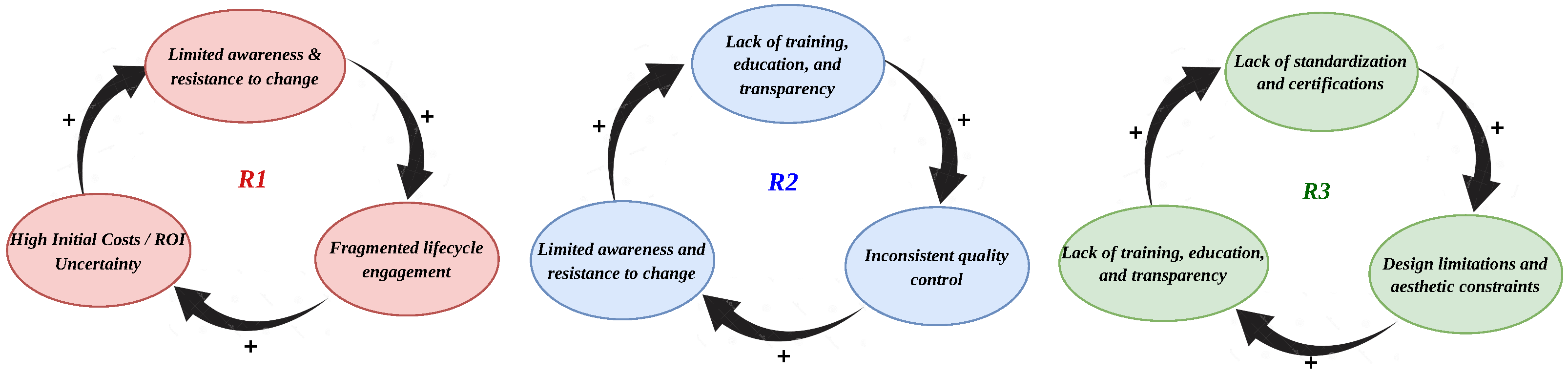
From
Figure 9, three reinforcing loops emerge that trap the system in underperformance:
R1 (reinforcing). High initial costs and uncertainty about return on investment reduce confidence and slow uptake, which sustains limited awareness and resistance to change. As resistance increases, stakeholders engage later and less consistently, leading to fragmented life-cycle engagement. Fragmentation then increases contingencies, rework, and transaction costs, reinforcing high initial costs and uncertainty about return on investment.
Causal chain (
Figure 9): High Initial Costs / ROI Uncertainty
Limited awareness and resistance to change
Fragmented life-cycle engagement
High Initial Costs / ROI Uncertainty.
R2 (reinforcing). A lack of training, education, and transparency creates variability in methods, documentation, and hand-offs, resulting in inconsistent quality control. Uneven quality and weak feedback signals then reinforce limited awareness and resistance to change by reducing trust in outcomes and lowering willingness to invest in skills, process discipline, and information sharing. This sustains the original lack of training, education, and transparency.
Causal chain (
Figure 9): Lack of training, education, and transparency
Inconsistent quality control
Limited awareness and resistance to change
Lack of training, education, and transparency.
R3 (reinforcing). A lack of standardization and certifications restricts accepted solutions and credible routes for demonstrating performance, leading to design limitations and aesthetic constraints. Constrained design options encourage project-specific workarounds and reduce shared learning, which reinforces the lack of training, education, and transparency. With weak shared knowledge and fragmented evidence pathways, the sector struggles to converge on common interfaces and robust certification routes, sustaining the lack of standardization and certifications.
Causal chain (
Figure 9): Lack of standardization and certifications
Design limitations and aesthetic constraints
Lack of training, education, and transparency
Lack of standardization and certifications.
These reinforcing structures align with socio-technical transition accounts in which early-stage innovations face path dependence and increasing returns to incumbency. R1 captures a learning-and-scale dynamic, where limited uptake restricts learning by doing and pipeline stability, thereby sustaining high costs and perceived risk. R2 reflects capability formation, in which weak training and limited transparency undermine process reliability and quality control, while variable outcomes reduce confidence and willingness to invest in the capabilities needed to stabilise performance. R3 reflects institutional reinforcement, where underdeveloped interfaces, certification routes, and evidence pathways lead regulators, insurers, and procurement actors to default to established compliant solutions, thereby constraining experimentation and slowing standardisation. Together, these reinforcing dynamics indicate a coupled socio-technical and institutional lock-in that stabilises conventional delivery unless deliberately disrupted.
The strength of these loops varies across settings according to market maturity and regulatory conditions. R3 is typically stronger where codes are highly prescriptive and reuse certification routes are weak. R2 becomes more pronounced where training systems and quality assurance capability are limited. R1 is stronger in early-stage modular markets where pipeline volatility constrains economies of scale and learning by doing. Consequently, the most effective intervention points, and the time needed for them to generate visible effects, are context-dependent, so one-size-fits-all prescriptions should be avoided.
Note: “+” on the links denotes same-direction (reinforcing) effects; each loop is self-reinforcing until an external intervention breaks it.
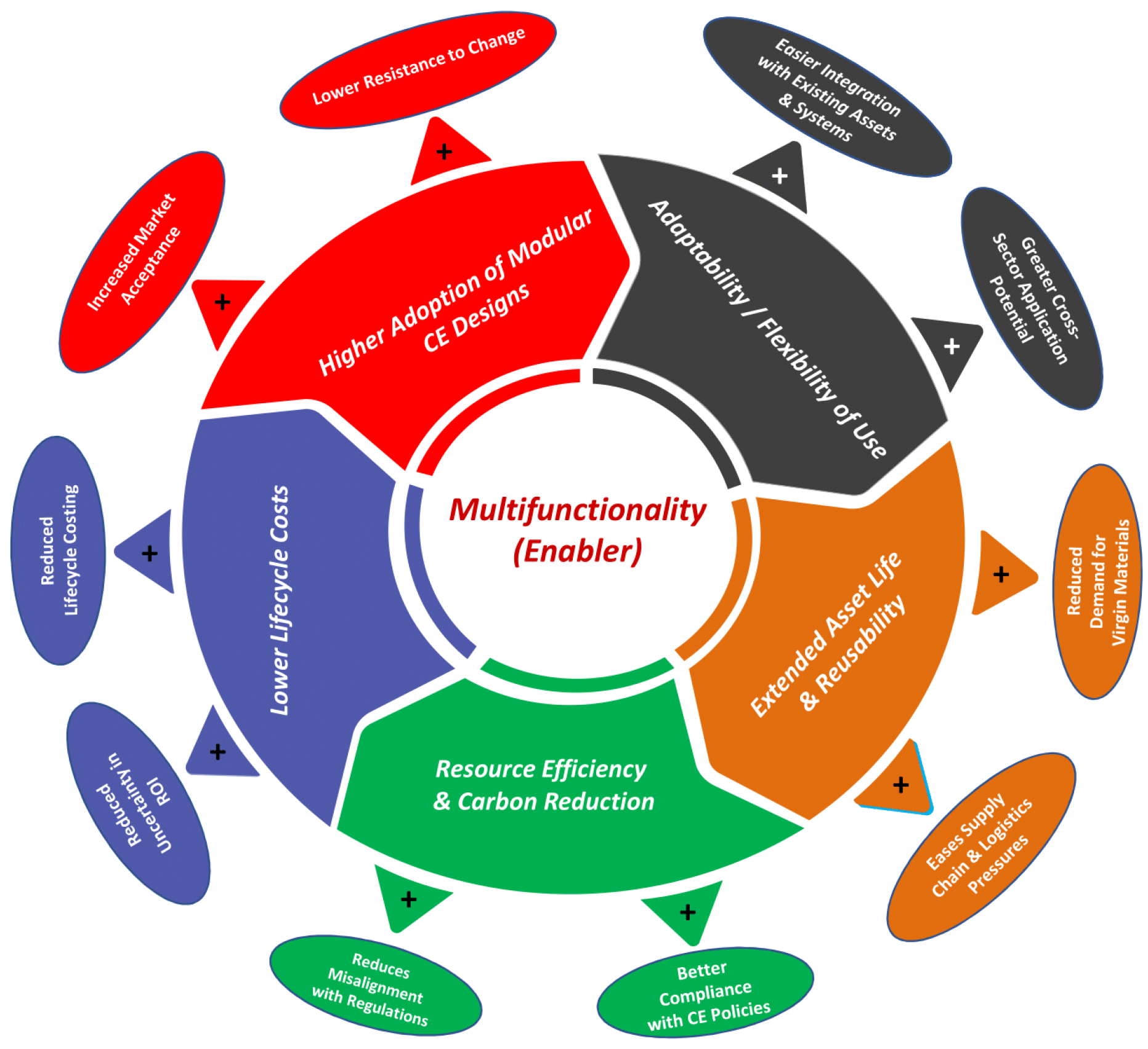
6.2. Multifunctionality: A Positive Feedback System
Figure 10 maps the
enabler network that emerges when multifunctionality is embedded in modular construction.
The five nodes: (1)
adoption, (2)
adaptability, (3)
extended asset life, (4)
resource and carbon efficiency, and (5)
lower life-cycle costs are distilled from our synthesis and case evidence.
Adaptability is tied to interface choices, DfMA/DfD features, and interoperable grids [
18,
58]. Across CE studies,
extended asset life is the main value preservation mechanism [
59]. LCAs show that delaying replacement and enabling component reuse deliver
resource and carbon benefits via avoided new production and waste [
19,
60,
61], directly supporting climate mitigation through lower whole-life emissions. Cost syntheses connect these technical gains to
lower life-cycle costs, especially when early premiums are amortised over multiple reuse/repurposing loops [
60,
62,
63]. Visible performance on flexibility, carbon, and cost then increases
adoption by strengthening stakeholder confidence [
64]. Example of the cycle in practice:
Adaptability rises when modules can be reconfigured with minimal disruption, e.g., converting classrooms into community hubs or adapting healthcare spaces during emergencies, avoiding demolition and preserving asset value [
65].
Greater adaptability yields
extended asset life: modules stay productive beyond the initial horizon, cutting replacement frequency and demand for virgin materials [
59].
Extending service life reduces
life-cycle carbon and costs: fewer replacements and less waste lower embodied impacts and outlays [
60].
Lower costs plus visible carbon savings spur further investment in interoperable interfaces, reversible connections, and modular product–service systems, reinforcing flexibility [
64].
As adoption grows,
throughput and economies of scale strengthen supply chains, reduce unit costs, and improve insurer/investor confidence and policy/standards alignment, feeding back into higher adoption (
Figure 10).
From this enabler network, five primary multifunctionality pathways follow (
Section 6.3).
This is not merely the reverse of the barrier network; it is a distinct system dynamic in which positive feedback accelerates improvement rather than reinforces stagnation. From this enabler network, we identify five primary multifunctionality pathways, outlined in
Section 6.3.
Figure note (outer ring). The outer ring in
Figure 10 shows second-order effects activated by the five inner nodes:
Lower Resistance to Change,
Increased Market Acceptance,
Reduced life-cycle Costing,
Reduced Uncertainty in ROI,
Easier Integration with Existing Assets and Systems,
Greater Cross-Sector Application Potential,
Reduced Demand for Virgin Materials,
Eases Supply Chain Logistics Pressures,
Reduces Misalignment with Regulations, and
Better Compliance with CE Policies. Each connects with a “+” and feeds back to reinforce
Higher Adoption of Modular CE Designs.
6.3. Five Primary Multifunctionality Pathways
The five pathways are derived by grouping the enabling mechanisms visible in the multifunctionality network (
Figure 10) into five distinct intervention families. Each family (i) targets a different mechanism (design, compatibility, information/traceability, coordination, and institutional acceptance), (ii) weakens at least one reinforcing barrier loop (R1–R3), and (iii) is repeatedly identified in the screened evidence as necessary for adaptability and circular reuse. This provides a clear, non-overlapping basis for the five pathways rather than an arbitrary list.
From the enabler network, five primary pathways emerge that can systematically erode the barrier loops and embed multifunctionality into industry practice:
- 1.
Design for Adaptability and Flexibility: Modular systems that can be disassembled, reconfigured, and repurposed to meet changing needs without generating excessive waste [
66].
- 2.
Standardised Modular Interfaces: Developing interoperable connection standards enables components from different suppliers to integrate seamlessly, reducing market fragmentation and mitigating cost uncertainty [
64].
- 3.
Digital Twin and Material Passport Integration: Integrating digital twins with material passports enables life-cycle monitoring, predictive maintenance, and verified data tracking, leading to improved reuse decisions, better performance insights, and enhanced circularity [
67].
- 4.
Stakeholder Collaboration Platforms: Creating dedicated knowledge-sharing platforms, joint procurement mechanisms, and coordinated life-cycle planning spaces builds trust and collective investment. These collaborative environments help mitigate fragmentation, align goals across the supply chain, and support modular and circular construction workflows [
68].
- 5.
Policy and Certification Alignment: Collaborating with regulators and standards bodies to integrate modular circular economy (CE) principles into official building codes, procurement rules, and certification schemes ensures that compliance pathways are clear, consistent, and incentivised. Embedding CE-focused requirements in certification frameworks provides legitimacy, reduces adoption risks, and accelerates mainstreaming of modular innovation [
69].
6.4. Mapping Barriers to Enablers
To consolidate the findings from the literature and stakeholder analysis,
Table 7 maps the key barriers against corresponding enablers. This structured overview provides a direct line of sight between the systemic challenges limiting modular adoption in the circular economy and the strategies or mechanisms most likely to mitigate them.
As shown in
Table 7, three precise insights emerge. First, R3 (regulatory misalignment and technical design barriers) is best countered by
Policy and Certification Alignment and
Design for Adaptability and Flexibility, underpinned by
Digital Twin and Material Passport Integration that supplies serialised evidence for reuse and disassembly; together these preserve reconfiguration options at brief/concept and reduce approval risk. Second, R2 (quality assurance issues and the skills gap) responds to
Digital Twin and Material Passport Integration, which stabilises workmanship, makes learning transparent, and raises stakeholder confidence, and to
Design for Adaptability and Flexibility, which reduces interface complexity and supports repeatable QA. Third, R1 (stakeholder fragmentation and financial constraints, including high up-front costs) is addressed by
Stakeholder Collaboration Platforms/ECI and
Standardised Modular Interfaces; these lower coordination and counterparty risk, enable bundled procurement, improve factory utilisation, and reduce unit costs. Collectively, the mapping confirms that no single enabler is sufficient in isolation: a
systemic, front-loaded response is required, combining collaboration platforms, common technical standards, digital traceability, and aligned policy and certification, so that the positive feedbacks of multifunctionality dominate over the reinforcing constraint loops.
6.5. Leverage Points for Systemic Shift
Guided by a systems lens on leverage points [
51,
70], we propose three
compound interventions that act across multiple feedbacks, dampening R1–R3 while reinforcing the multifunctionality cycle.
Interface standardisation + digital twin/material passports. Open, common interfaces make modules interoperable across suppliers, lowering switching costs, widening the pool of compatible components, and enabling secondary markets [
64]. Coupled with verifiable information—digital twins tracking location/condition/performance and serialised material passports—reuse becomes auditable and approvals more predictable [
67]. Systemically, interoperability and traceability raise throughput and economies of scale (weakening R1), provide QA evidence that supports training and consistent workmanship (weakening R2), and reduce evidentiary burdens for regulators and insurers (weakening R3).
Collaboration platforms + policy/certification alignment. Digital/contractual platforms for joint procurement, shared scheduling, and life-cycle planning build trust and pipeline visibility across client–designer–manufacturer–contractor networks, mitigating fragmentation and enabling coordinated investment [
68]. When paired with clear acceptance rules in codes and certification (criteria for reused modules, pre-accepted details, outcome-based procurement), regulatory uncertainty gives way to more predictable compliance pathways and incentives [
69]. This supports steadier factory utilisation and damped unit-cost volatility (R1), structured learning loops (R2), and shorter approvals focused on how compliance is demonstrated (R3).
Adaptability-by-design as mandate. Embedding multifunctionality by default-reversible connections, adaptable grids, soft zones for services, and project-level disassembly plans shifts the design target from one-off optimisation to long-term reconfigurability [
66]. Codifying these requirements in briefs, permits, and certifications raises expected residual value and normalises second-life use (improving the ROI calculus in R1), while repeatable connection/detail libraries support workmanship consistency and targeted training (R2) and reduce technical friction that sustains regulatory caution (R3).
Taken together, these leverage points do more than trim costs at the margin: interface standards plus digital traceability reorganise information and compatibility; collaboration plus policy alignment reset the system’s rules of acceptance and investment; and adaptability mandates reorient the sector’s design goal. This systems-level shift also aligns with the barrier–strategy severity pattern in
Table 6. The severity ratings indicate that the most consequential constraints are not isolated “cost” frictions, but persistent coordination, assurance, and institutional lock-in barriers that repeatedly limit multifunctionality, repurposing, reuse, and DfD. By intervening upstream on shared enabling conditions early integration and responsibility allocation, verifiable quality and traceability, and predictable acceptance pathways, these leverage points target the highest-severity barrier clusters while also improving the feasibility conditions for multiple circular modular strategies simultaneously. The combined effect is to flip the dominant feedback from constraint to capability, making sustainable, multifunctional modular construction the default rather than the exception and advancing climate mitigation by lowering embodied and operational carbon through reuse, extended service life, and more efficient delivery.
7. Research Gap
Despite growing advocacy for modular construction as a pathway to circularity, the scholarship remains fragmented in explaining the
systemic feedback that sustains underperformance. Much of the literature isolates technological innovation or supply-chain efficiency from the coupled dynamics of finance, skills, regulation, and procurement that collectively determine whether circular modular solutions can scale [
1,
18,
19]. While conceptual CE work calls for system-level change [
14,
16], empirical studies rarely operationalise the reinforcing loops that connect ROI uncertainty, capability gaps, fragmented delivery, and regulatory misfit [
6,
55,
71].
A second gap is that these feedbacks are often discussed as if they are uniform, yet their strength and practical consequences plausibly differ across regulatory, economic, and geographic contexts, a critical issue for cross-context research questions. For example, approval and certification frictions are likely to dominate in settings with prescriptive codes and limited routes for recognising reused components; financing and pipeline volatility may be more binding in early-stage modular markets with thin supply capacity; and skills/QA constraints may be decisive where training systems and specialist capability are underdeveloped. However, the literature rarely offers comparative, context-explicit analysis that explains which loop is dominant where, and why, making it difficult to derive robust, transferable insights for policy and practice.
Third, the gap is not only digital. Digital traceability tools (including material passports and related component records) are increasingly acknowledged as enablers because they can improve information quality, reduce perceived risk, and support end-of-life decision-making [
18,
67]. Yet the evidence base remains limited on
how traceability interacts with the broader socio-technical and institutional barriers that repeatedly appear in modular CE adoption: organisational incentives and risk allocation, business models for take-back and leasing, procurement rules that reward lowest CAPEX over whole-life value, coordination failures across project phases, and the development (or absence) of secondary markets [
6,
71]. In other words, digital records may be a necessary enabler in some contexts, but they are unlikely to be sufficient without complementary changes in incentives, governance, and market institutions.
What is missing, therefore, is a body of
empirical, comparative, and longitudinal research that tests how different interventions, including digital traceability, procurement and contracting reforms, capability-building, standardisation and certification routes, and circular business models, act on the dominant feedback loops in different contexts. Specifically, future work should track outcomes over multiple cycles, including reuse and repurposing frequency, time to approval, certification outcomes, residual-value realisation, disassembly time, and life-cycle carbon deltas, while also documenting the surrounding conditions, such as regulatory regime, market maturity, procurement model, and cultural risk norms, that enable or inhibit adoption [
51,
70]. This type of context-aware evidence is essential to move beyond one-size-fits-all prescriptions and to clarify which levers are most effective, for whom, and under what institutional and market conditions.
8. Conclusions
This review set out to explain
why modular construction (MC) has not yet delivered its full circular-economy (CE) potential and
how it could. Drawing on an SLR of 30 studies (from a corpus of 124 records, 2011–2025) and a barrier–strategy severity assessment (
Table 5 and
Table 6), we identified three self-reinforcing loops that sustain underperformance: (i) a
financial–stakeholder–supply-chain loop in which ROI uncertainty and low awareness suppress adoption and scale; (ii) a
knowledge–quality loop in which skills deficits depress workmanship and confidence, discouraging further capability investment; and (iii) a
regulatory–design loop in which misaligned codes and limited demonstrators mutually justify caution (
Figure 9). Left intact, these feedbacks perpetuate fragmented delivery and narrow the feasible space for reuse, repurposing, and design for disassembly.
At the same time, a systems perspective shows that multifunctionality can organise a
virtuous enabler network (
Figure 10): adaptability improves, assets remain productive longer, resource and carbon intensities fall, and life-cycle costs decline, directly supporting climate mitigation through lower whole-life emissions-effects that, in turn, raise adoption and build confidence. Mapping barriers to enablers (
Table 7) highlighted five practical pathways-adaptability-by-design, standardised interfaces, digital twin and material passports, collaboration platforms, and policy/certification alignment-that jointly erode the dominant loops and normalise circular practice.
The implications are structural rather than incremental. First, interface standardisation combined with digital traceability makes modules compatible and their histories verifiable, unlocking secondary markets, auditable QA, and faster approvals. Second, collaboration platforms aligned with policy and certification convert one-off pilots into repeatable programmes by providing predictable acceptance rules and stable pipelines for investment. Third, adaptability-by-design mandates reset “what good looks like,” codifying reversible connections, adaptable grids, and deconstruction planning so that circular outcomes are deliverable by default. In systems terms, these levers act on information flows and rules and partly on goals, precisely where leverage is highest.
For practice, the priority is to embed these levers in briefs, contracts, and compliance: require material passports at handover; publish open interface specifications; use outcome-based procurement that prices adaptability; adopt pre-accepted details and fast-track reviews for passported components. Track performance with decision-relevant indicators (e.g., reuse/repurpose rate, disassembly time per m2, time-to-approval, realised residual value, life-cycle carbon and cost-in-use) so that evidence compounds into policy and finance decisions.
For research, the agenda should move beyond conceptual advocacy to empirical, cross-sector, longitudinal validation of digital material-passport systems (including BIM-enabled implementations) and interface standards: do these interventions measurably flip the polarity of the three loops? Studies should follow assets through multiple configuration cycles and quantify changes in approval predictability, QA outcomes, residual-value realisation, and carbon/cost trajectories, with comparative work across regulatory contexts to isolate the role of certification and liability frameworks. Because the strength of R1–R3 depends on regulatory regime, market maturity, and construction culture, comparative designs are essential to avoid one-size-fits-all conclusions.
Finally, we note limitations: severity ratings reflect qualitative judgement; the evidence base is primarily English-language and Web of Science -indexed; and the system maps are conceptual rather than simulated. Even so, the convergence across sources is clear: MC’s contribution to CE depends less on isolated technologies than on how the system is wired. Rewiring information flows (passports/twins), rules (standards/certification/procurement), and goals (adaptability mandates) shifts the dominant feedback from constraint to capability, positioning modular construction as a credible, scalable pathway to circular, net-zero buildings and contributing measurably to climate goals.