1. Introduction
Digital transformation is fundamentally reshaping economic and social systems and has profound implications for both farming practices and the transition toward sustainable development. Against this backdrop, adopting green production technologies serves not only as an effective approach to environmental governance but also a critical component of sustainable agricultural transformation [
1,
2]. Promoting green agriculture requires technological innovation as a driving force, and scholars generally emphasize both the foundational role of green technologies in supporting sustainable agricultural transitions [
3] while highlighting the importance of strengthening farmers’ motivation to adopt such technologies [
4]. Despite these efforts, farmers’ adoption of green technologies remains limited due to high costs, uncertain risks, and information constraints [
5]. Amid the rapid expansion of the digital economy, digital technologies have become more prevalent in farmers’ production and daily life, transforming cognitive patterns and behavioral habits. Digital literacy, as an important form of human capital in the digital age, reflects individuals’ ability to access, process, and use digital information, and acts as a key link between digital technologies and behavioral outcomes. Farmers, as the primary micro-level agents in agricultural production systems, rely on digital literacy to mitigate information asymmetries and insufficiencies encountered in factor markets. Understanding the mechanisms and pathways through which digital literacy stimulates green technology adoption is therefore essential for advancing sustainable agricultural transformation and high-quality development.
Existing studies have examined determinants of farmers’ green technology adoption through multiple perspectives. Broadly, these factors are categorized into intrinsic attributes, including aging [
6], cognition [
7,
8], and risk perception [
9,
10], and external environmental factors, such as social capital [
11], government regulation [
12], ecological compensation [
13], and cooperative participation [
14]. Together, these dimensions provide a core analytical framework for examining adoption behaviors. With the proliferation of digital technologies in agriculture, scholars have increasingly explored the linkages between digital elements and green transformation. Research has highlighted the roles of the digital economy [
15], digital technologies [
16], and digital tools [
17] in promoting sustainable production practices. Evidence suggests that digitalization improves information flow, optimizes resource allocation, and encourages environmentally friendly behaviors among farmers. The concept of digital literacy has evolved alongside technological advances and rising public digital competence. While no universally accepted definition exists, digital literacy is generally recognized as a composite of abilities and attitudes enabling individuals to effectively utilize digital tools in learning, work, and daily life [
18,
19]. Empirical studies demonstrate that digital literacy facilitates behavior changes, such as reducing fertilizer usage [
20], optimizing cropping structures [
21], and adopting environmentally conscious practices [
22], with credit accessibility [
23], social capital [
24], and cognition [
25,
26,
27] serving as mediating mechanisms.
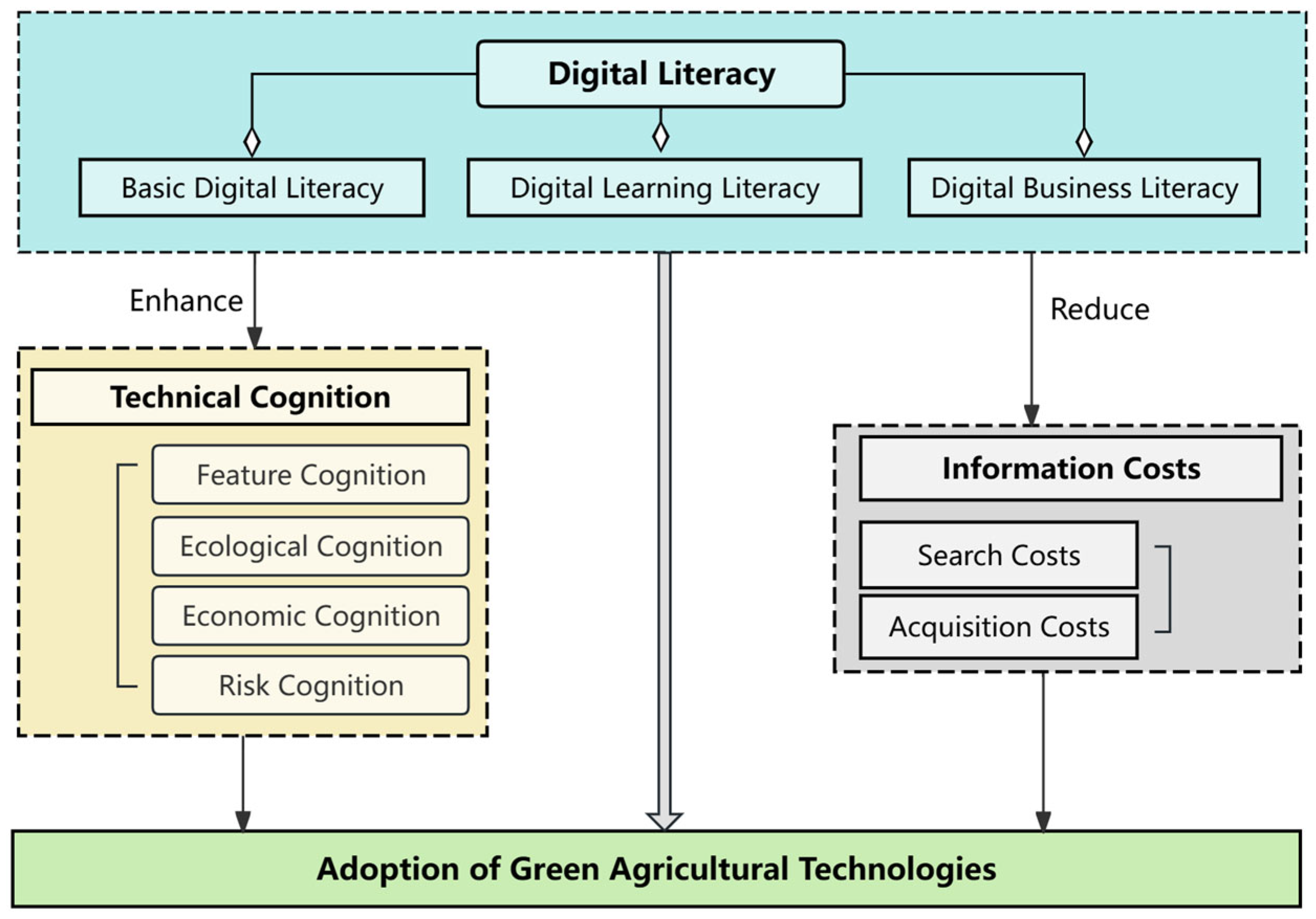
This study offers significant innovations and theoretical contributions to the field of digital literacy and its impact on the adoption of green agricultural technologies. First, while a wealth of literature has examined the relationship between digital literacy, technological cognition, and the adoption of green agricultural technologies, most of the existing research has focused on general agricultural technologies or traditional crops. There is a noticeable gap in studies specifically addressing the context of specialty crops, such as ginseng farming. Ginseng, as a distinctive agricultural product in Jilin Province, involves high technical barriers and ecological requirements, and farmers’ adoption decisions are often influenced by information asymmetry and risk uncertainty. By focusing on ginseng farmers in Jilin Province, this study fills the gap in the literature on green agricultural technology adoption, particularly the role of digital literacy in specialty crop contexts, which has not been sufficiently explored. Second, from the perspective of cognitive empowerment, this study introduces and validates the pathway through which digital literacy enhances farmers’ multidimensional technological cognition—including technological attribute cognition, ecological cognition, economic cognition, and risk cognition—to facilitate the adoption of green production technologies. This theoretical framework innovatively emphasizes the profound influence of digital literacy on the cognitive processes of farmers, surpassing the traditional view of digital literacy as merely an information acquisition tool. It offers a new perspective on the promotion of green agricultural technologies. Moreover, by developing a three-dimensional digital literacy measurement system (comprising basic digital literacy, digital learning literacy, and digital business literacy), this study provides an operational model for quantifying digital literacy, advancing its application within the human capital theory. Finally, this study conducts a heterogeneity analysis of ginseng farmers in Jilin Province, further verifying the universal effects of digital literacy on technology adoption across different generational cohorts, farm scales, and cooperative participation. This finding challenges the emphasis on differences between farmer groups in many existing studies, offering important evidence of the broad applicability of digital literacy as a foundational capability for agricultural green transformation.
In conclusion, this study not only deepens the theoretical understanding of the relationship between digital literacy, technological cognition, and green technology adoption but also provides practical empirical insights for agricultural policy-making in Jilin Province and similar regions. The findings offer significant policy implications, especially in the context of digital rural development and sustainable agricultural transformation, contributing to the long-term sustainability of agricultural practices.
4. Empirical Results and Discussion
Building on the baseline regression results, this study further examines the impact of digital literacy on farmers’ adoption of green production technologies from four perspectives: endogeneity treatment, robustness checks, mechanism analysis, and heterogeneity analysis. Specifically, an instrumental variable (IV) approach is employed to address potential endogeneity concerns. A set of robustness checks is performed to verify the reliability of the empirical results. Furthermore, the underlying mechanisms are explored from the perspectives of technological cognition and information costs, while heterogeneity analysis is performed across different groups of farmers with distinct characteristics. Through these complementary analyses, this section aims not only to strengthen causal inference but also to reveal the underlying mechanisms by which digital literacy shapes farmers’ adoption of green production practices, as well as to clarify the conditions under which these effects are most pronounced.
4.1. Main Effects Analysis
4.1.1. Baseline Regression Results
The baseline regression results show that, after controlling for individual characteristics, production and management factors, and regional fixed effects, digital literacy has a statistically significant positive effect on farmers’ adoption of green production technologies at the 1% significance level (
Table 4). Higher levels of farmers’ digital literacy are associated with the adoption of a broader range of green production technologies, providing preliminary support for the hypothesis that digital literacy promotes agricultural green transformation.
Further analysis of the multidimensional structure of digital literacy (Models 2–4) examines the effects of basic digital literacy, digital learning literacy, and digital business literacy separately. All three dimensions are statistically significant at the 1% level, with digital learning literacy showing the largest coefficient (4.3779), followed by digital foundational literacy (4.2265) and digital business literacy (3.6436). These results suggest that while all dimensions contribute to facilitating farmers’ green production decisions, their relative effects differ. This effect may stem from digital literacy’s ability to enhance farmers’ access to information and understanding of technologies, thereby lowering barriers to adoption.
Regarding control variables, off-farm employment consistently exhibits a negative and statistically significant effect on green technology adoption (coefficient ≈ −0.28, significant at the 5% level), indicating that time and labor constraints faced by part-time farmers may limit their adoption behavior. Conversely, participation in technical training shows a robust, positive, and statistically significant effect across all model specifications (coefficients ranging from 0.58 to 0.68 at the 1% significance level), highlighting that training enhances farmers’ technical awareness and their capacity to apply technologies, thereby promoting adoption. Farm size shows a modest positive effect, reaching significance at the 10% level in some specifications (e.g., Models 1 and 3). However, some control variables, including gender, age, education, health status, and cooperative participation, do not exhibit statistically significant effects. While these factors are typically considered important in adoption studies, their limited influence in this context may be due to the homogeneity of our sample, where farmers’ demographic characteristics are relatively uniform. Moreover, the significant role of digital literacy and technical training may have overshadowed the effects of these factors.
Regarding model fit, while the pseudo R2 values range from 0.09 to 0.12, which is typical of cross-sectional survey data, we acknowledge that unobserved factors, such as household income or government subsidies, may influence adoption decisions. These factors were not included in the model due to data limitations, but future research could incorporate them for a more comprehensive understanding of adoption behavior. Despite the insignificance of some control variables, the overall model remains robust. The pseudo R2 values, along with the statistically significant effects of digital literacy, technical training, off-farm employment, and farm operation scale, suggest that the key determinants of green technology adoption are well captured.
Overall, the models are jointly significant (Prob > chi2 = 0.0000), indicating moderate explanatory power. Taken together, the findings demonstrate that digital literacy and its sub-components exert a consistently positive influence on farmers’ adoption of green production technologies.
4.1.2. Addressing Endogeneity
Given the potential bidirectional causality between digital literacy and green technology adoption, as well as potential omitted variable bias, baseline estimates may suffer from endogeneity concerns. To mitigate this issue, an instrumental variable Probit (IV-Probit) model is applied, using township digital governance capacity as an instrument for digital literacy. This variable captures the total number of digital public services provided at the township level, including e-government services, smart Party-building platforms, digital village administration, digital cultural services, and telemedicine systems [
35]. The validity of this instrument is grounded in the institutional features of rural governance in China, where digital governance primarily facilitates farmers’ exposure to digital environments through enhanced infrastructure and service accessibility. The diffusion of green agricultural technologies, however, depends predominantly on agricultural extension systems and market-based mechanisms rather than digital governance itself. Consequently, we expect the influence of township digital governance on green technology adoption to be mediated primarily through digital literacy, rather than through a direct channel.
To further reduce potential confounding bias, we control for participation in agricultural technical training and cooperative membership. Under this setting, the effect of township digital governance capacity on green technology adoption is reasonably interpreted as operating through digital literacy, rather than reflecting a direct institutional effect. In estimation, the reference group (Tonghua City) exhibits no variation in the dependent variable, leading to perfect prediction for the regional dummy (Baishan City). This is a mechanical result in the IV-Probit model, and we exclude these observations to avoid separation. Therefore, the final sample consists of 227 farm households from Baishan City and Yanbian Korean Autonomous Prefecture, which represent key ginseng-producing regions in Jilin Province. Importantly, this subsample shows no systematic differences from the full sample in observable characteristics, such as farm size, household head age, and education level, ensuring that it remains broadly representative of ginseng-producing households in the region. However, we acknowledge that the IV estimates identify a Local Average Treatment Effect (LATE) for these core production regions.
The first-stage results (
Table 5) demonstrate that the instrumental variable is strongly correlated with digital literacy in all specifications, satisfying the relevance condition. The first-stage F-statistics in Models (1) and (2) are 13.79 and 22.20, respectively, exceeding the conventional threshold of 10 (Stock and Yogo [
56]), which suggests that weak-instrument concerns are minimized in these specifications. In Models (3) and (4), the F-statistics are lower (9.34 and 6.18), indicating potential concerns with weak instruments. To address this, we perform the Anderson–Rubin (AR) test, which is robust to weak instruments and does not rely on instrument strength assumptions. The AR test results consistently show that the causal effect of digital literacy on green technology adoption remains statistically significant across all specifications, with confidence intervals excluding zero.
While some specifications exhibit weaker instruments, the AR tests indicate that the main findings are robust under weak-instrument-robust inference. However, the relatively low F-statistics in Model (4) suggest that the estimated effects for digital business literacy in this specification may be less precisely estimated. We acknowledge that stronger instruments would improve the precision of these estimates and suggest that future research may benefit from exploring alternative instruments to strengthen causal identification.
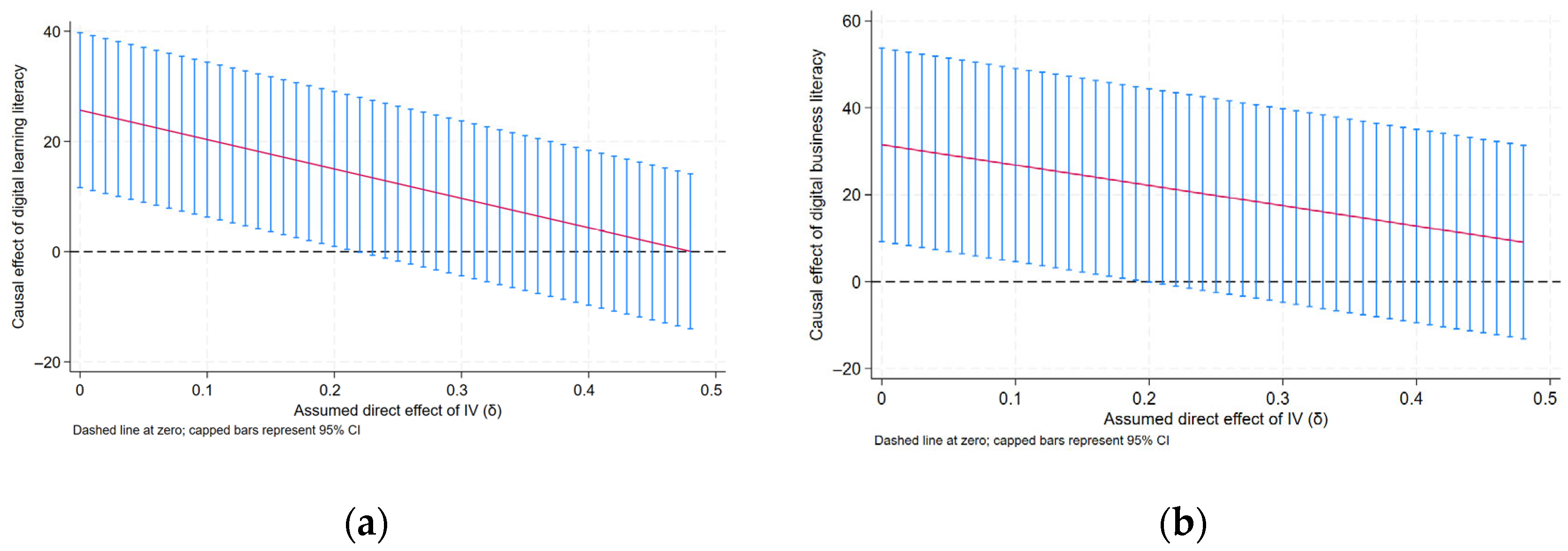
To further evaluate the plausibility of the exclusion restriction, we conduct a sensitivity analysis following Conley et al. (2012) [
57], which allows for the possibility that township digital governance may directly affect green technology adoption. We vary the direct effect (δ) within the range of [0, 0.481], constructing adjusted 2SLS estimates and 95% confidence intervals. The results show that the estimated effects of both digital literacy and digital business literacy remain positive and statistically significant unless δ exceeds approximately 0.10, which corresponds to about 20% of the reduced-form effect. Given that the primary role of township digital governance is to enhance public service delivery and digital infrastructure, while green technology diffusion depends largely on agricultural extension and market incentives, such a large direct effect of township governance is unlikely under the prevailing institutional conditions. Thus, the exclusion restriction remains plausible in this context, and the instrument’s exogeneity is considered credible. For further details, see
Figure 2 and
Appendix Table A3, which present the union of confidence intervals from the sensitivity analysis.
Overall, the IV-Probit results provide consistent evidence of a positive causal relationship between digital literacy and green technology adoption. Although some specifications show weak-instrument concerns, the findings remain robust under weak-instrument-robust inference and sensitivity analysis. These results highlight the critical role of digital literacy in facilitating agricultural green transformation in rural China. Therefore, the exclusion restriction is plausible under the institutional conditions in rural Jilin, and the instrument is considered exogenous.
4.2. Robustness Checks
To further evaluate the robustness of the baseline findings, this research performs a series of tests from three perspectives: variable measurement, model specification, and data treatment. First, regarding variable measurement, an alternative objective weighting method—the coefficient of variation (CV) method—is used to reconstruct the digital literacy index, followed by re-estimation of the regression models. Second, in terms of model specification, an OLS model is used instead of the ordered Probit model to test the sensitivity of the results. Third, continuous variables are winsorized at the 1st and 99th percentiles to mitigate the influence of outliers. The results consistently show that, regardless of the measurement method, model specification, or data treatment, digital literacy remains positively and significantly associated with farmers’ adoption of green production technologies (
p < 0.01). Both the direction and significance of the estimates remain largely unchanged, supporting the robustness of the empirical results (
Table 6).
4.3. Mechanisms
To shed light on the underlying mechanisms linking digital literacy to farmers’ adoption of green production technologies, this research examines two potential channels: the cognitive pathway and the information cost pathway. Methodologically, a stepwise regression approach is first employed by sequentially introducing six potential mediators—attribute cognition, ecological cognition, economic cognition, risk cognition, search cost, and acquisition cost—to examine changes in the coefficient of the key explanatory variable (As shown in
Table 7). Subsequently, a Bootstrap procedure with 5000 replications is conducted to estimate bias-corrected 95% confidence intervals for the indirect effects, offering a more robust test of the mediation effects (
Table 8 presents the results).
The results indicate that digital literacy exerts a positive and statistically significant influence on the adoption of green technologies, primarily operating through the cognitive pathway. After introducing the various cognitive variables, the estimated coefficient of digital literacy decreases to varying magnitudes, and the Bootstrap results confirm that the corresponding indirect effects are statistically significant. This suggests that attribute cognition, ecological cognition, economic cognition, and risk cognition all serve as significant partial mediators. In other words, digital literacy appears to promote green technology adoption by enhancing farmers’ understanding of technological attributes, ecological benefits, economic returns, and risk controllability.
In contrast, although information cost variables are significantly associated with technology adoption in the stepwise regression results, the Bootstrap analysis shows that the bias-corrected 95% confidence intervals for both search cost and acquisition cost include zero, suggesting that their indirect effects are not statistically significant. This implies that relying solely on coefficient changes in stepwise regression may lead to misleading conclusions regarding mediation effects, whereas the Bootstrap approach provides more robust statistical inference [
58]. Considering the relatively well-developed information infrastructure in Jilin Province, where the internet broadband penetration rate is 84.3% [
59], it is likely that traditional information channels, such as government promotional services, agricultural extension services, and local media, already meet farmers’ needs. This widespread access to information likely reduces the marginal role of digital literacy in lowering information costs. In comparison, the cognitive empowerment effect of digital literacy appears to be more critical.
Overall, the evidence indicates that digital literacy appears to facilitate farmers’ adoption of green production technologies primarily via a cognitive enhancement mechanism, rather than through information cost reduction. However, due to the cross-sectional nature of the data and reliance on self-reported survey responses, these findings should be interpreted with caution regarding causal inference.
4.4. Heterogeneity Analysis
To further investigate group-level heterogeneity in the relationship between digital literacy and farmers’ adoption of green production technologies, the present study conducts subgroup analysis along three dimensions: generational characteristics, farm size, and cooperative participation. The dependent variable, measured as the count of green technologies adopted (0–5), was originally estimated using an ordered Probit model. However, subgrouping reduces sample sizes and may lead to limited within-group variation in certain variables (e.g., cooperative participation becoming constant), potentially causing convergence issues or instability in maximum likelihood estimation. Following Angrist and Pischke (2009) and Wooldridge (2010) [
60,
61], a Linear Probability Model (LPM) is adopted for subgroup regressions, which allows coefficients to be directly interpreted as marginal effects, facilitates cross-group comparisons, and provides more stable estimates in smaller samples. When combined with Bootstrap standard errors and Fisher-type combined tests, it enables valid inference on coefficient differences across groups.
Appendix A confirms that the coefficient signs from the LPM are consistent with the marginal effects from the ordered Probit model, supporting the robustness of this approach. The LPM results are reported in
Table 9.
The empirical evidence consistently shows a positive and statistically significant effect of digital literacy on green technology adoption across all subgroups. However, in terms of generational differences, the Fisher test for coefficient differences shows a p-value of 0.068, which indicates weak statistical significance (p < 0.10), implying that the evidence for generational differences is limited. Similarly, there is no significant difference in the impact of digital literacy between large-scale and small-scale farmers (p = 0.244), nor between cooperative participants and non-participants (p = 0.492).
This suggests that while generational characteristics, farm size, and cooperative participation exhibit some variation, these factors do not significantly moderate the relationship between digital literacy and green technology adoption. As such, Hypothesis 4 is not supported, indicating that the impact of digital literacy on green technology adoption does not vary systematically across different farmer groups.
Potential Explanations for the Absence of Heterogeneity:
Regional Concentration: The sample is drawn from the core ginseng-producing areas of Jilin Province (Tonghua, Baishan, and Yanbian), where natural, economic, and institutional conditions are highly similar. These regions exhibit homogeneous ecological environments, standardized technical extension systems, and similar market structures for ginseng products. As a result, regional concentration reduces variability across samples and limits the moderating role of individual factors such as age, farm size, and organizational participation.
Industry Specialization: Ginseng cultivation is highly specialized, requiring significant technical expertise, long production cycles, and substantial investment risks. Unlike staple crop farming, ginseng cultivation is more reliant on systematic knowledge and has less variability in decision-making due to the technical demands. As digital literacy improves, farmers’ decision-making becomes more aligned, resulting in reduced observable heterogeneity.
Digital Inclusiveness: Digital literacy serves as a universal capability that improves access to information, cutting across age groups, farm sizes, and cooperative participation. Digital tools have narrowed the generational divide, enhanced access for both smallholders and large-scale farmers, and complemented cooperative information channels, leading to a general empowerment effect that weakens differences between groups.
In conclusion, the lack of significant heterogeneity in this study can be attributed to these factors, suggesting that digital literacy plays a broadly applicable role in promoting green technology adoption, regardless of individual characteristics or production conditions.
5. Conclusions and Implications
5.1. Main Findings
Based on survey data from 422 ginseng farmers in Jilin Province, this study systematically investigates the impact of digital literacy on farmers’ adoption of green production technologies and its underlying mechanisms, employing an ordered Probit model, instrumental variable (IV) approach, mediation analysis, and heterogeneity tests. The reliability and validity tests of the digital literacy scale (
Appendix Table A1) indicate that the scale demonstrates strong reliability (Cronbach’s α = 0.891) and structural validity (cumulative variance explained = 71.29%), providing a solid foundation for the subsequent analysis. The key findings are as follows:
First, digital literacy significantly encourages farmers to adopt green production technologies. After accounting for individual characteristics, production and management factors, and regional fixed effects, digital literacy has a significant positive effect on green technology adoption at the 1% significance level. The causal effect remains robust after addressing potential endogeneity using an instrumental variable approach (IV-Probit estimates are significant in most specifications; sensitivity analysis in
Appendix Table A3 further supports the robustness of the causal inference). Examining the multidimensional structure of digital literacy, all three dimensions—digital learning literacy (coefficient = 4.38), Basic Digital Literacy (coefficient = 4.23), and digital business literacy (coefficient = 3.64)—show significant positive effects, with digital learning literacy having the strongest impact. This result highlights that digital literacy, as a form of cognitive human capital, plays a pivotal role in driving agricultural green transformation.
Second, digital literacy primarily operates through the “cognitive empowerment” pathway rather than the “information cost reduction” pathway. Mediation analysis reveals that the four dimensions of technological cognition—technological attributes cognition, ecological cognition, economic cognition, and risk cognition—serve as significant mediators, with all Bootstrap 95% confidence intervals excluding zero (see
Table 8 in the main text).
Appendix Table A2 shows that the correlations between these four dimensions range from 0.279 to 0.634, indicating good discriminant validity and making them suitable as independent mediators. The share of the mediation effect varies between 13.8% and 22.3%. In contrast, the mediation effects of information search costs and information acquisition costs were not statistically significant (Bootstrap confidence intervals included zero). This finding suggests that merely lowering the information acquisition threshold is insufficient to drive farmers’ adoption of green technologies. More importantly, digital literacy empowers farmers by enhancing their understanding of technological principles, ecological benefits, economic returns, and risk management. Notably, traditional stepwise regression showed significant results for the information cost pathway, but Bootstrap testing did not confirm these findings, indicating that relying solely on coefficient changes may lead to erroneous conclusions about mediation effects.
Third, the promoting effect of digital literacy does not exhibit significant heterogeneity across different farmer groups. Heterogeneity analysis based on generational differences, farm scale, and cooperative participation shows that digital literacy has a significant positive effect in all subgroups. However, the differences in coefficients across groups were not statistically significant (Fisher test
p-values of 0.068, 0.244, and 0.492, respectively).
Appendix Table A4 reports the ordered Probit model estimates for subgroup analysis, and the direction and magnitude of the coefficients are highly consistent with the linear probability model estimates in
Table 9, confirming the robustness of the conclusion across model specifications. This “no heterogeneity” result can be explained from three perspectives: first, the sample is concentrated in the core ginseng-producing areas of Jilin Province (Tonghua, Baishan, and Yanbian), where natural, economic, and institutional conditions are highly homogeneous; second, ginseng cultivation is highly specialized, with a relatively uniform technological approach and limited decision-making space; third, digital literacy, as a universal capability, is inclusive, bridging generational gaps and empowering both smallholders and large-scale farmers. This finding suggests that the promoting effect of digital literacy is broadly applicable and does not vary significantly across different farmer characteristics or production conditions.
5.2. Limitations
This study has several limitations that should be considered when interpreting the findings:
Cross-sectional Data: The study uses cross-sectional data, limiting the ability to draw causal inferences. While an instrumental variable approach was employed to address potential endogeneity, future research using longitudinal panel data could better capture the long-term effects of digital literacy on technology adoption.
Self-reported Measures: The reliance on self-reported data introduces the potential for response bias. Future studies could incorporate objective measures (e.g., digital proficiency tests or third-party evaluations) to ensure more reliable data.
Residual Endogeneity: Despite efforts to address endogeneity, unobserved factors, such as household income, may still influence both digital literacy and adoption. Additional confounding variables should be considered in future research.
Limited Generalizability: This study focuses on ginseng farmers in Jilin Province, which limits its generalizability. Future research should examine diverse agricultural sectors or regions to assess the broader applicability of the findings.
These limitations should be kept in mind when interpreting the study’s conclusions. Further research is necessary to enhance the robustness and generalizability of the results.
5.3. Policy Implications
The results offer several important policy implications to promote sustainable agricultural practices, particularly in specialty crop sectors such as ginseng.
Investing in Digital Literacy: Policymakers should prioritize the enhancement of farmers’ digital literacy as a critical pathway for adopting green production technologies. Strengthening rural digital infrastructure and offering targeted digital literacy training programs are essential to improve farmers’ skills in information gathering, online learning, and the practical application of digital tools. This would facilitate farmers’ access to green technologies and enhance their decision-making abilities.
Focus on Cognitive Empowerment: Since digital literacy influences adoption through cognitive enhancement, policy programs should focus on improving farmers’ technological understanding. Training content should be application-oriented, with visualized and scenario-based materials that highlight the technical, ecological, and economic aspects of green technologies. This will help farmers make informed decisions about which technologies to adopt and how to evaluate their potential benefits.
Inclusive Policies for All Farmers: Digital literacy shows a relatively uniform impact across age groups, farm sizes, and participation in cooperatives. Given this, digital literacy interventions should target the wider farming population while addressing potential gaps, especially for smallholders and older farmers. In particular, integrating digital tools with cooperative structures could amplify the effectiveness of the interventions, providing a support network for knowledge dissemination.
Prioritize Cognitive Development Over Information Cost Reduction: In regions like Jilin, where information infrastructure is relatively well-developed, focusing on reducing information costs alone may not yield significant benefits. Policies should therefore emphasize enhancing farmers’ ability to critically evaluate digital information and make better technology adoption decisions. Cognitive empowerment—understanding the underlying principles, benefits, and risks—should be the central focus of intervention programs aimed at promoting sustainable agricultural practices.
These recommendations aim to leverage digital literacy as a tool for broadening access to green technologies and fostering agricultural transformation in rural China, contributing to long-term sustainability in agricultural practices.
5.4. Research Outlook
Enhancing farmers’ digital literacy is crucial for promoting green production technologies and advancing both agricultural development and rural ecological revitalization. This study provides valuable insights into the role of digital literacy in agricultural transformation. However, acknowledging the limitations discussed in
Section 5.2, several avenues for future research could deepen our understanding of the mechanisms through which digital literacy influences technology adoption.
First, longitudinal studies using panel data would be essential for examining the long-term effects of digital literacy on technology adoption. The cross-sectional nature of this study limits our understanding of how digital literacy influences adoption behavior over time. Longitudinal data would allow for capturing dynamic changes and causal relationships across different stages of adoption.
Second, to address the self-reported measures in this study, future research should incorporate objective assessments of digital literacy and technology adoption (e.g., digital proficiency tests or third-party evaluations). This would mitigate response bias and provide more accurate insights into farmers’ actual digital capabilities and adoption behaviors.
Third, future studies should account for residual endogeneity by incorporating additional confounding variables that may influence both digital literacy and technology adoption, such as access to agricultural support services or household income. This would improve the precision of causal inferences.
Finally, generalizability could be enhanced by expanding the research to include a wider range of agricultural sectors and regions. This study focused on ginseng farmers in Jilin Province, which may limit the applicability of the findings. Exploring other agricultural contexts, both within China and globally, would help assess the broader relevance of the results. Additionally, integrating field-based performance evaluations (e.g., farm productivity, sustainability metrics) with digital literacy measures would offer a more comprehensive view of the adoption process [
62].
By addressing these limitations, future research could provide deeper insights into how digital literacy drives the adoption and long-term impact of green technologies, supporting sustainable agricultural transformation and rural development across diverse contexts. Such studies could also inform targeted policies to enhance the adoption of green technologies in agriculture.