Review

Understanding Second-Hand Clothing Consumption: A Literature Review and Proposed Conceptual Model


Faculty of Economics, Universidad de Valencia, Avda. de los Naranjos s/n, 46022 Valencia, Spain
*
Author to whom correspondence should be addressed.
Sustainability 2026, 18(10), 4795; https://doi.org/10.3390/su18104795 (registering DOI)
Submission received: 26 February 2026 / Revised: 22 April 2026 / Accepted: 30 April 2026 / Published: 11 May 2026

Abstract

Second-hand clothing is increasingly promoted as a sustainable alternative to reduce the fashion industry’s environmental impact, yet evidence on why consumers purchase second-hand apparel remains fragmented across disciplines. This literature review synthesizes prior research to identify the main motivational drivers and inhibitors of second-hand clothing purchasing and to translate them into a coherent conceptual explanation. We reviewed and conceptually integrated the academic literature on second-hand apparel consumption, focusing on how studies define, operationalize, and relate sustainability concerns, economic value, uniqueness and identity motives, and socio-cultural influences to purchase intention and behavior. The reviewed evidence indicates that pro-environmental values often coexist with utilitarian and symbolic motives, while barriers frequently involve perceived risk (e.g., quality and hygiene), effort, and access constraints. Building on this synthesis, we propose an integrative model that organizes key antecedents and mechanisms leading to purchase intention and repeat purchasing, highlighting enabling conditions and boundary factors that may strengthen or weaken these relationships. This review consolidates dispersed findings, clarifies theoretical gaps, and provides a testable framework to guide future empirical research and managerial interventions aimed at scaling circular fashion adoption.

1. Introduction

Fashion is widely recognized as one of the world’s most environmentally damaging industries, contributing substantially to greenhouse gas emissions, intensive water use, and the generation of massive textile waste [1]. When this waste accumulates under weak management systems, the environmental and social consequences tend to disproportionately affect urban and vulnerable communities [2]. These pressures have intensified global interest in alternative models capable of reducing environmental damage while promoting more responsible consumption patterns [3].
A promising response is the growing market for second-hand clothing, defined here as garments that have been previously used regardless of their age or original purchase channel [4]. Although often framed as a contemporary sustainability trend, second-hand exchange has deep historical roots, particularly in Europe, where garments were frequently resold, repaired, or inherited during periods of scarcity when access to new clothing was limited. Until the early twentieth century, maintaining, repairing, and reusing clothing remained a widespread practice, before industrialization and mass production shifted fashion consumption toward speed, abundance, and disposability [5]. In this sense, the contemporary expansion of second-hand markets reflects a renewed interest in extracting value from garments beyond first ownership, with implications for waste reduction and resource efficiency [6].
Recent evidence also suggests that this is not a marginal phenomenon. Industry estimates indicate that second-hand apparel accounted for roughly 10% of global apparel spending in 2025 and may reach USD 393 billion by 2030, while academic analyses document sustained expansion in global second-hand clothing flows over the 1995–2022 period, with developed economies such as the United States, the United Kingdom, and Germany remaining major exporters and several African countries becoming major import destinations [7]. Taken together, these patterns suggest that second-hand clothing has become a globally relevant consumption phenomenon, although its scale and meanings vary considerably across regions.
This resurgence contrasts with the linear model of “produce–use–dispose” and advocates reuse, recycling, and reintegration of materials [5]. In the fashion sector, circular strategies include textile recycling, upcycling, and second-hand purchases, all aimed at extending product lifecycles and minimizing waste [1,6,8]. These practices align with the United Nations’ Sustainable Development Goal 12 on responsible production and consumption [9]. Accordingly, research has explored why consumers engage in second-hand shopping, identifying drivers such as environmental concern, economic savings, nostalgia, identity construction, and social differentiation [6,10], and framing second-hand consumption as a potential form of resistance to fast fashion within circular economy principles [8].
However, despite expanding evidence, the literature remains fragmented and uneven across contexts. Much prior work examines ethical, economic, or psychological factors in isolation, limiting the ability to explain second-hand consumption as a multi-determined behavior shaped by both internal motivations and external constraints [11]. In addition, the empirical landscape is strongly concentrated in Europe, North America, and parts of Asia, leaving other regions underrepresented and limiting generalizability of dominant explanations [12,13]. Scholars have repeatedly called for broader perspectives. Ferraro [12] and Liu et al., [14] recommend incorporating psychographic and demographic differences to reflect heterogeneous motivations and decision processes, while Herjanto [13] emphasizes the need for studies in emerging economies where cultural meanings, market infrastructure, and traditions of reuse may systematically shape consumer behavior. Recent discussions similarly highlight that current models often fail to capture the complexity of sustainable fashion decisions and require more integrative and context-sensitive frameworks [1,2].
These gaps are particularly salient in Hispano America, where empirical research on circular fashion consumer behavior remains scarce despite acute environmental challenges and rising textile waste [15]. In this region, second-hand consumption can be intertwined with informal economies and social dynamics such as stigma and class meanings, potentially altering both motivations and constraints relative to settings where most theories have been tested [16]. This point is especially relevant in lower-income or highly unequal contexts, where second-hand clothing may be purchased primarily because of affordability pressures or economic necessity rather than as an explicitly environmental choice [15,16]. Methodological limitations further restrict inference, as prior work has often relied on localized qualitative designs, metropolitan samples, or restricted demographic coverage, reinforcing the need for large-scale quantitative studies that can validate findings beyond narrow contexts [17].
A central challenge in this domain is the intention–behavior gap in sustainable consumption, meaning that pro-environmental values and intentions do not consistently translate into actual behavior [18]. In the context of second-hand clothing, this gap becomes theoretically relevant because single-lens explanations tend to be incomplete: models based only on rational determinants or only on moral determinants are often insufficient when used in isolation [19]. Reflecting this limitation, recent applications argue that research needs richer antecedent configurations to represent the full motivational architecture underlying second-hand consumption [20]. Similar calls to broaden and strengthen the set of antecedents have been reiterated in subsequent studies [21] and reinforced by more recent evidence [22]. Converging with this rationale, Koay et al. [20] empirically benchmark five theoretical models and show that an extended TPB provides the strongest in-sample and out-of-sample prediction of second-hand clothing purchase intentions, outperforming TPB, consumption values, perceived risk, and norm activation frame-works suggesting that expanding the antecedent set beyond a single theoretical lens improves explanatory completeness and predictive validity.
In response, this literature review consolidates and critically evaluates the fragmented evidence through a hybrid VBN–TPB framework, specifying how constructs map to each theory within the conceptual framework and clarifies how this proposal advances beyond the isolated use of these theories. VBN offers a structured explanation of the moral pathway linking values and environmental beliefs to personal norms that motivate pro-environmental action [23]. TPB complements this view by explaining how attitudes, subjective norms, and perceived behavioral control shape intention and behavior [24]. Rather than simply combining two established perspectives, the proposed model contributes by offering a more integrative and context-sensitive explanation of second-hand clothing consumption, recognizing that this behavior is shaped by both moral drivers and reasoned evaluations. Aligned with comparative evidence supporting theory extension in second-hand contexts [21], the proposed hybridization is designed to capture both moral (value–belief–norm) and reasoned (attitudinal and control-based) pathways within a single integrative architecture, rather than privileging either logic in isolation. More specifically, the novelty of the model lies in explaining second-hand clothing consumption not only through intention formation, but also through the boundary conditions that shape when pro-environmental motives are more likely to translate into actual purchase. In this way, the framework extends beyond TPB–VBN integration by incorporating a context-sensitive structure in which moral, attitudinal, and conditional mechanisms operate jointly rather than as isolated predictors. Accordingly, the proposed framework should be interpreted as context-sensitive rather than universal, as it seeks to organize sustainability-related drivers identified in the literature while recognizing that the relative weight of environmental, economic, and social motives may vary across countries and levels of economic development [12,13,14,16]. Building on these foundations, the review proposes an integrative framework intended to organize prior findings and guide future empirical testing, with particular attention to underrepresented contexts in Hispanic America [21]. Thus, the model is presented not as a replacement of TPB or VBN, but as an extension that improves explanatory breadth and contextual relevance in the study of second-hand clothing consumption.
Beyond its theoretical contribution, this framework is also relevant from a sustainability perspective because understanding the drivers and barriers of second-hand clothing consumption helps clarify the behavioral conditions under which garment lifecycles may be extended. Although a conceptual model cannot by itself reduce textile waste, it can inform future interventions, market strategies, and policy efforts aimed at increasing second-hand adoption and, indirectly, reducing premature disposal and waste generation in the fashion sector.
This positioning is consistent with earlier recommendations to expand theoretical and contextual coverage in second-hand and sustainable consumption research [1]. It also aligns with the need to strengthen evidence in emerging economies, where prevailing explanations may not transfer directly across contexts [2]. Recent work continues to emphasize the importance of integrative and context-attuned approaches for sustainable fashion consumption [3]. Similar demands for more comprehensive models have also been highlighted in contemporary discussions of sustainable fashion research [4].

2. Relevant Sections

2.1. Second-Hand Clothing

Second-hand consumption refers to acquiring products that have previously belonged to someone else, irrespective of their prior use [25]. In fashion markets, second-hand models are commonly discussed within collaborative consumption, which includes practices such as renting, lending, swapping, and bartering [26]. Commercialized exchange is often treated as a defining element of these systems because it enables value creation through shared use. From a circular economy perspective, second-hand fashion supports resource efficiency by extending product lifecycles and reducing the demand for virgin materials [27]. This positioning is reinforced by the view that reuse-oriented models contribute to waste reduction and sustainability objectives in fashion consumption [28]. Related circular strategies such as reuse and recycling have also been discussed as mechanisms to extend product value and reduce textile waste, with policy approaches further encouraging such practices [29]. The second-hand market has progressively formalized over time. Yang et al. [26] note that some second-hand stores became recognized as legitimate businesses from the 1960s onward. Historically, second-hand clothing has moved through phases of expansion, decline, stigmatization, and renewed popularity [30]. Nevertheless, adoption has been persistently shaped by psychological barriers associated with prior ownership. Belk [31] identifies hygiene-related resistance as a salient concern, while Hansen [32] discusses contamination perceptions as an enduring obstacle.
Despite market growth, adoption remains constrained by knowledge-related barriers. Goworek et al. [33] argue that consumers often lack clarity regarding sustainable fashion, limiting engagement even when alternatives exist. Pal and Gander [34] identify limited consumer knowledge as a critical obstacle. In contrast, Grasso et al. [35] point to environmental awareness as a relevant driver of preference for second-hand alternatives. Fletcher and Tham [36] further connect ecological literacy to more consistent engagement with sustainability-oriented fashion practices. Motivations for second-hand clothing are consistently described as multidimensional. Guiot and Roux [10] discuss how second-hand purchasing combines different motivational logics rather than reflecting a single determinant. Cervellon et al. [4] similarly position second-hand fashion as shaped by both sustainability-related motives and consumption value. Environmental concern is repeatedly identified as a driver in second-hand contexts [37], and growing sensitivity to the environmental impact of fashion has been linked to increased interest in second-hand options [38]. Ethical concerns related to labor conditions have also gained relevance in consumer decision-making [39]. Hedonic and symbolic motives also remain central, as Tuttle [40] highlights “treasure hunting” as a salient consumption experience. Rodrigues et al. [41] suggest that exclusivity-oriented motivations can be particularly relevant among younger consumers. Laitala and Klepp [42] discuss identity-related meanings that shape second-hand choices beyond ecological reasoning. Finally, economic value and affordability continue to play a role in enabling access and variety [9], with economic and psychological benefits further discussed in later work [43].

2.2. Constructs Based on Literature Review

The fashion industry is among the major contributors to environmental impacts, generating nearly 10% of global carbon emissions [27]. Within this context, second-hand clothing emerges as a sustainable practice that reduces new production and preserves scarce resources [6]. In sustainable consumption research, the Theory of Planned Behavior (TPB) [23] is one of the most widely used frameworks for predicting environmentally responsible intentions [3]. TPB posits that behavior is shaped by intentions, which depend on attitudes, subjective norms, and perceived behavioral control. Yet, Sepe et al. [2] argue that some constructs, such as subjective norms, may operate as antecedents of green behavioral intention [44,45,46].
Other constructs explored in the literature, such as need for uniqueness, need for status, and fashion motivation, fall outside this study’s focus. While individuality and self-expression influence second-hand purchases [3,19], and hedonistic motives linked to pleasure, aesthetics, and self-image also play a role [4,12], these dimensions are less relevant to environmental concerns, which form the core of this model.
Conversely, constructs directly tied to sustainability: ecological concern, mindful consumption, green behavioral intention, environmental beliefs and attitudes, green lifestyle, price sensitivity, and values are central. However, this centrality should be understood within the scope of the sustainability-oriented literature reviewed and not as implying that these motives are equally primary across all countries. In settings characterized by lower purchasing power, informal retail structures, or stronger budget constraints, affordability and necessity may precede environmental concern, whereas in higher-income markets sustainability, lifestyle, and value congruence may become more salient [13,15,16]. Their inclusion is consistent with TPB and the Knowledge–Attitude–Behavior (KAB) model [31], ensuring conceptual coherence. These constructs have also been validated across cultural and economic contexts, enabling comparative cross-market analysis [47].
Table 1 synthesizes these constructs, their definitions, and key theoretical contributions. It provides a concise overview of the conceptual bases informing the proposed model, illustrating both the breadth and multidimensionality of second-hand clothing consumption.

2.3. Second-Hand Clothing Buying Behavior Model

2.3.1. Direct Relationships

  • Ecological Concern
Ecological concern was originally introduced to explain environmentally responsible behavior [54]. It refers to consumers’ attitudes toward their ecosystem, grounded in the understanding that products have life cycles and that production and consumption can generate negative environmental impacts [55,56]. This awareness encourages a shift from traditional consumption patterns toward more sustainable practices [57] and is frequently associated with preferences for eco-labeled products [58,59]. Importantly, ecological concern goes beyond choosing “green” options, since it also implies restricting purchasing to what is necessary, emphasizing reduced consumption as part of ecological behavior [60]. Across the literature, ecological concern is consistently linked to the development of ecological habits and to stronger responsible purchasing intentions [61,62,63,64]. In the second-hand clothing context, the evidence converges in showing that consumers with higher ecological concern are more likely to evaluate second-hand purchases favorably and to report stronger purchase intentions across different settings [19,65,66]. Although Perry and Chung [60] argue that eco-friendly purchases alone are insufficient to constitute ecological behavior, their results partially support the role of ecological concern in second-hand clothing adoption. Overall, consumers with stronger ecological concern tend to reinforce their intention to engage in green behavior.
  • Mindful Consumption
Mindfulness, rooted in Buddhist traditions, is commonly described as an intentional and non-judgmental awareness of the present moment [67]. In the consumption domain, mindfulness has been conceptualized as a mechanism that strengthens coherence between consumers’ values, expectations, and purchasing decisions [68]. This perspective also implies an orientation toward future consequences of consumption for oneself, the community, and nature [67]. Consistent with this framing, the literature increasingly treats mindful consumption as a driver of sustainable consumption and as a mechanism of value-consistent decision-making [69,70]. In fashion contexts, it is associated with more deliberate and restrained consumption by discouraging unnecessary, impulsive, or socially driven purchases [71]. Evidence in second-hand fashion points in the same direction: favorable attitudes toward second-hand products, stronger purchase intention, and lower impulsive buying tendencies are recurrently associated with mindful consumption [72,73,74]. Recent work also suggests that this mechanism helps explain participation in second-hand markets beyond purely economic motives, as consumers align their purchases with broader sustainability goals [68,75].
From this perspective, mindful consumption helps explain engagement with second-hand markets beyond purely economic motives by supporting deliberate purchasing that remains aligned with pro-environmental values [68]. Ultimately, this value-consistent and future-oriented orientation provides a cognitive bridge through which sustainability goals can translate into planned and favorable second-hand purchase intentions [67].
  • Green Behavior Intention
Green Behavior Intention captures an individual’s willingness or likelihood to engage in environmentally responsible behavior and is commonly defined as the likelihood of performing a specific pro-environmental action [76]. This intention is closely tied to identity processes because consumers often perceive possessions as extensions of the self, which shapes how consumption choices align with personal identity [30]. In turn, identity-linked meanings embedded in consumption can influence the disposition to adopt green practices [18]. Self-identity can function as a mechanism that translates personal values into concrete motivations, reflecting the beliefs that underpin sustainable choices [76]. In consumer contexts, Green Behavior Intention is expressed as the willingness to purchase green products and services as a way to protect the planet [77]. It also reflects a broader effort to preserve the natural environment through everyday consumption decisions [44]. From a behavioral theory perspective, this intention is shaped by attitudes, perceived norms, and control beliefs, in line with the Theory of Planned Behavior [24,44,78,79]. It may also be strengthened by compensatory sustainability motives and by mindfulness-related moral-identity processes that make pro-environmental action feel more personally meaningful [51,80,81,82]. At the same time, the translation of intention into actual purchasing depends on marketplace conditions such as credibility and perceived reliability [83,84]. In circular consumption research, the evidence consistently supports Green Behavior Intention as a necessary proximal antecedent of sustainable purchasing, including second-hand clothing acquisition [85].

2.3.2. Moderating Relationships

In the proposed model, moderating variables are introduced to capture the conditional nature of second-hand clothing consumption. Prior literature suggests that sustainable fashion decisions are not determined only by favorable ecological attitudes or intentions, but also by the personal and contextual conditions that amplify or weaken their behavioral effect [2,18,21]. Consistent with this logic, green lifestyle, price sensitivity, and values are conceptualized as boundary conditions that help explain when sustainability-related orientations are more likely to translate into stronger second-hand clothing purchasing outcomes [24,51,64]. Theoretically, these moderators do not generate sustainability-oriented dispositions by themselves; rather, they alter the strength with which such dispositions are converted into intention and purchase behavior. In this sense, the proposed boundary conditions help explain why similar levels of ecological concern or green intention may produce different second-hand clothing outcomes across consumers exposed to different value structures, lifestyles, or economic priorities [24,51].
  • Environmental Beliefs and Attitudes
Environmental beliefs and attitudes reflect individuals’ concern for the environment, particularly regarding humanity’s ability to disrupt the natural balance, the limits of development for human societies, and humanity’s right to dominate nature [50]. In line with the Knowledge-Attitude-Behavior (KAB) Model, these beliefs are related to ecological concern and mindful consumption [49,51]. From a theoretical standpoint, they can be understood as an interpretive frame through which consumers assign meaning to their ecological concerns and mindful consumption choices. When individuals more strongly endorse the fragility of nature and the consequences of human action, ecological concern and mindful consumption become more morally salient and cognitively coherent, thereby exerting a stronger effect on Green Behavior Intention [46,49,50,51]. For this reason, environmental beliefs and attitudes are not only descriptive indicators of environmental awareness, but also boundary conditions that can reinforce the extent to which ecological concern and mindful consumption become behaviorally meaningful and translate into Green Behavior Intention. Evidence from second-hand clothing research supports the relevance of environmental concern in shaping purchase-related responses and highlights the importance of examining these relationships across cultural contexts [65].
Accordingly, environmental beliefs and attitudes are not treated here merely as background opinions, but as a moderating condition that can amplify the motivational force of sustainability-related antecedents. Under this logic, consumers who not only care about environmental issues but also hold a stronger ecological worldview should be more likely to translate such concern into a deliberate Green Behavior Intention toward second-hand clothing [46,50].
  • Green Lifestyle
The relationship between green intention and green behavior remains inconclusive, partly due to the intention–behavior gap. Under Ajzen’s [24] Theory of Planned Behavior, intention should predict behavior [63], including second-hand clothing consumption. However, this translation is not uniform across individuals. Therefore, this review proposes green lifestyle as a moderator of the intention–behavior relationship: when consumers hold stronger eco-friendly routines and habitual consumption patterns, green intentions are more likely to translate into actual sustainable behavior, whereas for consumers with a weaker green lifestyle, intentions are less consistently enacted [62]. Conceptually, this moderating role is justified because lifestyle reflects a relatively stable pattern of everyday practices rather than a temporary evaluation. For this reason, green lifestyle can strengthen or weaken the extent to which green intention is translated into actual second-hand clothing behavior. Consumers may express favorable sustainable intentions, but when these intentions are not embedded in routines such as environmentally friendly purchasing, waste reduction, and ongoing engagement with environmental is-sues, their enactment is likely to be less consistent [51,62,86]. Conversely, when sustainability is part of daily life, second-hand purchasing becomes more behaviorally congruent and easier to maintain over time [87]. This moderating role is theoretically consistent with the idea that lifestyles function as enacted patterns of consumption rather than isolated preferences. Therefore, when green intention is supported by pre-existing routines, the behavioral cost of acting sustainably is reduced and second-hand purchasing becomes a more accessible and repeatable option [51,86,87].
A green lifestyle involves careful consideration of the environmental impact of daily activities and incorporates meaningful actions aligned with sustainability. Being style-conscious is closely related to self-expression, where consumers showcase their own taste and interests through their outward style. This style-consciousness is a core factor in second-hand consumption, where identity is constructed around personal style [20]. In this sense, a green lifestyle includes ecological consumption habits [62] and can be seen as everyday green activities, both of which are directly linked to behavioral intentions [86].
Green style is significantly associated with sustainable decisions regarding clothing, including second-hand shopping and recycling [87]. In fact, Guiot and Roux [9] found that one of the key motivations for second-hand shopping is consumers’ desire to express their unique identity. Second-hand goods allow consumers to showcase their individuality and originality, which is often identified as a primary motivation for purchasing second-hand items [4]. Thus, those who are mindful of their style are more likely to engage in second-hand shopping, as it provides a means of self-expression while adhering to their environmental values [10].
  • Price Sensitivity
Price sensitivity refers to consumers’ perception of product cost and their willingness to pay a specific amount [88]. Individuals with high price sensitivity reduce demand as prices increase, whereas those with low sensitivity react less strongly to price fluctuations [38,89]. In developing economies, factors such as income disparities, limited financial resources, and varying ethical values toward eco-friendly fashion substantially shape sustainable consumption [90]. Accordingly, price sensitivity is considered a moderating variable because second-hand clothing combines environmental responsibility with economic utility [4,10]. From this perspective, the effect of sustainability-oriented motives on second-hand purchasing should be stronger among consumers who place greater importance on affordability, savings, and bargain-seeking [38,90,91]. Prior research consistently portrays second-hand consumers as bargain-oriented and frugal shoppers, and empirical evidence indicates that price sensitivity is positively associated with second-hand shopping frequency [4,9,37,91]. Therefore, price sensitivity helps explain when pro-environmental orientations are more likely to translate into actual second-hand purchasing behavior rather than remain abstract preferences [88,89].
  • Values
A key contribution to understanding environmental attitudes and behaviors is the Value-Basis Theory by Stern and Dietz [92], grounded in Schwartz’s [93] value model. According to this theory, such attitudes arise from awareness of harm to valued objects [94]. Values play a crucial role in shaping sustainable consumer behavior [18], and are theoretically appropriate as moderators because they operate as higher-order guiding principles that shape how consumers interpret and prioritize sustainability-related beliefs and intentions [92,93,94,95]. Rather than functioning only as a direct predictor, values can condition the strength with which ecological concern and green behavioral intention are translated into second-hand clothing purchasing. When biospheric and altruistic values are stronger, sustainability-related motives are likely to carry greater personal relevance and therefore exert a stronger influence on second-hand purchasing decisions [18,52,64]. By contrast, when such values are weaker or displaced by competing consumption priorities, the same pro-environmental orientations may have a more limited effect on behavioral outcomes [76,96]. Accordingly, values are theoretically meaningful moderators because they can intensify or attenuate the motivational relevance of ecological concern and green intention before these are expressed in second-hand clothing purchasing preferences [18,76,92,93].
Consumer values are generally categorized as biospheric (environmental concern), altruistic (morality and social norms), egoistic (self-interest), and hedonic (pleasure seeking) [95]. These serve as internal standards that shape attitudes and purchasing behavior [80]. In the context of second-hand clothing, values guide identity expression and decision-making [64,96]. While studies in Europe and the U.S. have explored resale and recycling behaviors [9], research in Hispano America remains limited. Becker-Leifhold [52] and Vlastelica et al. [97] highlight the need to examine these dynamics across nationalities and genders, especially among Generation Z. Hong et al. [64] further recommend incorporating values as a central variable in studies on second-hand fashion consumption.

2.3.3. Control Relationships

  • Generational Cohort
Generational cohorts are groups of individuals born in the same period who experience similar external events during late adolescence and early adulthood [98]. Building on this view, Inglehart [99] proposes that these shared social, economic, political, and cultural conditions shape relatively stable value priorities within cohorts. Crucial milestones ranging from wars to shifts in resource distribution or symbolic events such as Martin Luther King’s leadership or the Woodstock Festival leave a lasting imprint on attitudes and beliefs [100], making cohort membership a meaningful lens for understanding heterogeneity in consumer judgments and decision-making.
Generations also influence environmental perceptions and sustainability. Younger cohorts tend to show stronger engagement with ecological issues due to the social and educational contexts in which they grew up, which can translate into distinct consumption decisions and sustainable practices [101]. Over time, these formative experiences consolidate values, preferences, and expectations that persist throughout life, strengthening a distinct generational identity that shapes marketplace behavior and response to marketing stimuli [102].
In the specific domain of second-hand clothing, cohort effects are particularly relevant because generations may differ not only in sustainability orientations but also in the barriers that suppress purchase intentions. For example, Koay and Cheah [45], compared Gen Z, Gen Y, Gen X, and Baby Boomers and found that perceived risk operates differently across cohorts: aesthetic risk significantly reduced purchase intention for Gen Z but not for Gen Y, Gen X, or Baby Boomers; functional risk negatively affected intentions for Gen Z and Gen Y but not for Gen X or Baby Boomers; psychological risk significantly reduced intentions across all generations; sanitary risk significantly reduced intention for Gen X but not for Gen Z, Gen Y, or Baby Boomers; and financial risk did not show a significant negative effect in this context, consistent with the typically lower prices of second-hand clothing [45]. Taken together, these findings support treating generational cohort as a theoretically grounded source of heterogeneity in the determinants of second-hand clothing purchase intentions and, accordingly, as a relevant segmentation lens in consumer behavior models [45].

2.4. Model Development

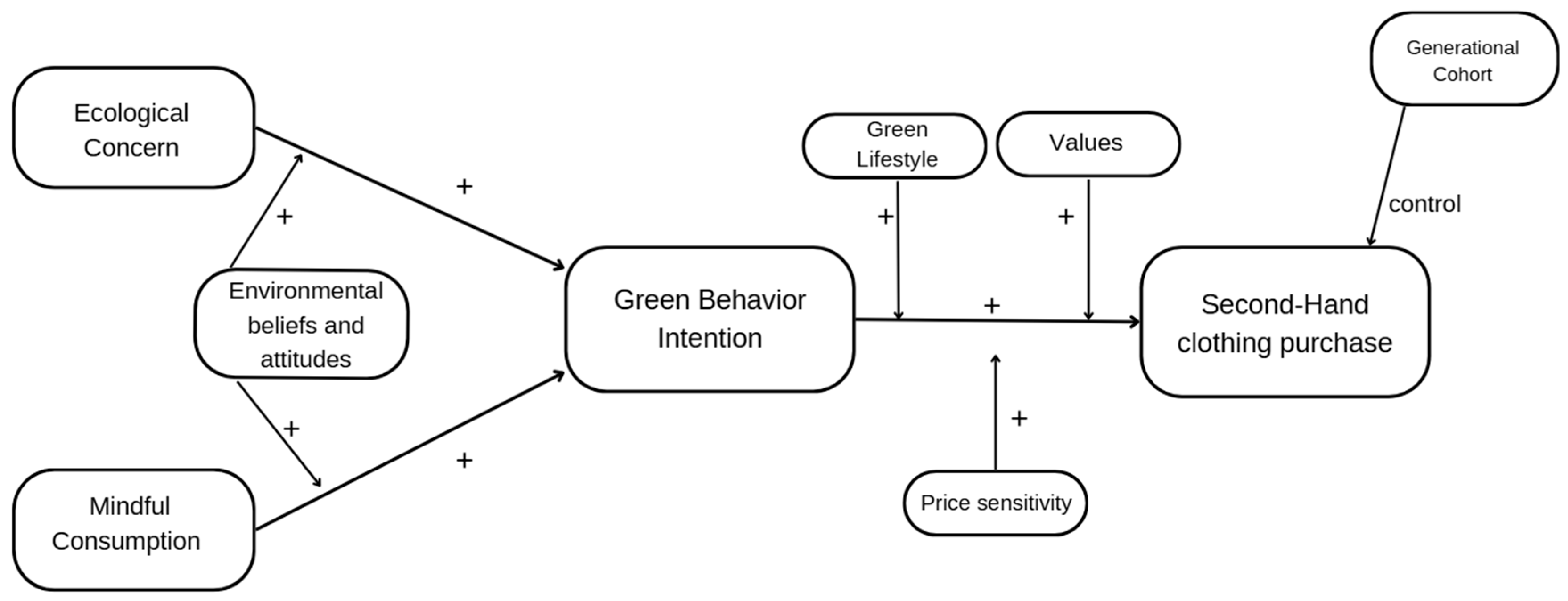
In relation to the literature review concerning constructs associated with the purchase of second-hand clothing, the Second-Hand Clothing Buying Behavior Model is proposed, as illustrated in Figure 1. This model integrates key constructs identified in previous studies, providing a comprehensive framework to better understand the factors influencing consumer behavior. More specifically, Figure 1 is structured around three complementary layers. First, ecological concern and mindful consumption are modeled as direct antecedents of green behavior intention. This relationship reflects the idea that environmental concern can foster sustainable purchase tendencies in second-hand contexts [19,63], while mindful consumption contributes a more deliberate and self-regulated orientation toward responsible choices [67,73]. Second, environmental beliefs and attitudes are positioned as moderating conditions that may strengthen the effects of ecological concern and mindful consumption on green behavior intention.
This assumption is grounded in the view that broader environmental worldviews shape how individuals interpret and act upon sustainability-related concerns [46,50], and it is also consistent with prior evidence suggesting that ecological attitudes can reinforce sustainable consumption responses in second-hand markets [65]. In addition, green lifestyle, values, and price sensitivity are proposed as boundary factors influencing the extent to which green behavior intention is translated into actual second-hand clothing purchase. A green lifestyle may facilitate behavioral consistency by aligning everyday routines with sustainability-oriented intentions [62]. Values are included because they provide deeper motivational orientations that can reinforce commitment to environmentally responsible consumption [18,52]. Price sensitivity is also relevant because second-hand purchasing is often shaped not only by sustainability motives but also by affordability and bargain-seeking considerations [10,38].
Taken together, these moderators operate at different analytical levels within the model: environmental beliefs and attitudes reinforce the cognitive-moral interpretation of sustainability concerns; green lifestyle favors behavioral enactment through routine congruence; values increase the personal relevance of pro-environmental motives; and price sensitivity enhances the practical appeal of second-hand consumption through economic utility [50,51,62]. Third, generational cohort is incorporated as a control variable to account for heterogeneity across consumer groups. Cohort theory suggests that people born in different historical periods develop relatively stable value priorities and consumption patterns [98,99]. This is especially relevant in second-hand clothing research, where previous evidence shows that perceived risks and purchase barriers may vary across generations [45].
As shown in Figure 1, the positive signs indicate hypothesized reinforcing effects between the connected constructs, while the control path associated with generational cohort indicates expected variation in second-hand clothing purchase across age-based consumer segments rather than a focal explanatory pathway. This structure makes explicit that the proposed model explains purchase behavior not only through direct intention formation, but also through contextual conditions that can strengthen or weaken the transition from pro-environmental orientations to actual second-hand clothing purchase. Accordingly, the model does not assume that favorable ecological dispositions will produce homogeneous purchasing outcomes, but rather that their effect depends on whether consumers interpret sustainability as meaningful, live it as part of their daily routines, and perceive second-hand clothing as consistent with both their values and their economic priorities [18,51,64].
As shown in Figure 1, the positive signs indicate hypothesized reinforcing effects between the connected constructs, while the control path associated with generational cohort indicates expected variation in second-hand clothing purchase across age-based consumer segments rather than a focal explanatory pathway. This structure makes explicit that the proposed model explains purchase behavior not only through direct intention formation, but also through contextual conditions that can strengthen or weaken the transition from pro-environmental orientations to actual second-hand clothing purchase.

2.5. Measurement Items Based on Literature Review

Item Generation

To operationalize the conceptual model of second-hand clothing purchasing behavior, we developed a structured measurement instrument grounded in an extensive literature review. Established scales were selected based on their theoretical alignment and empirical use, and then carefully adapted to the second-hand clothing context to ensure content validity and contextual relevance [103]. Ecological Concern was measured using the classic Weigel and Weigel [104] scale, which has been validated for ecological research [105], and complemented with contextual refinements consistent with the modified version applied by Chuah et al. [48] to better capture environmental attitudes expressed in second-hand markets. Mindful Consumption Behavior was assessed through the scale proposed by Sheth et al. [49], revised following prior adaptations to reflect deliberate purchasing, conscious engagement, and reflective decision-making characteristic of second-hand clothing consumption [71,73]. Environmental Beliefs and Attitudes were captured using a shortened version of the New Ecological Paradigm scale [50]; consistent with recent evidence in second-hand clothing research, the original 15-item instrument was reduced to four items following the validated approach reported by Hong et al. [64], with additional support for its reliability in ecological consumption studies provided by Cruz and Manata [105]. Green Behavior Intention items were adapted from Smith et al. [18] and tailored to sustainability-driven decisions in second-hand contexts, explicitly incorporating key antecedent’s subjective norm, preservation attitude, and perceived behavioral control previously highlighted in the literature [44,106]. Price Sensitivity was measured using the Guiot and Roux [10] scale, which has been validated in related consumption settings [12,19], and further adjusted to reflect affordability concerns specific to second-hand fashion in line with Sepe et al. [2]. In addition, Green Lifestyle was included as a moderating variable using the scale proposed by Chi and Zeng [107]; following item selection approaches discussed by Genoveva and Syahrivar [51], five indicators centered on environmental care were retained to strengthen cross-cultural relevance in the analysis of second-hand purchasing behavior. Finally, the Values scale was adapted from Hong et al. [64] and tailored to second-hand clothing consumption to capture the role of sustainability motives alongside identity-related and symbolic meanings that can shape consumer choices in reuse markets. All adapted items and their corresponding sources are summarized in Table 2, which details the specific modifications implemented for each construct and the empirical basis supporting their use in this study. Although the present article does not report primary data collection or statistical testing, these proposed items are included to facilitate future empirical operationalization and validation of the conceptual model.

3. Discussion

As a conceptual study, this review does not report primary empirical findings; rather, it proposes a theoretically grounded framework to organize the fragmented literature on second-hand clothing consumption. In this sense, the discussion clarifies how the model connects the main arguments developed in the previous sections. Although this study provides a comprehensive overview of second-hand clothing purchasing behavior, several limitations must be acknowledged. First, the model is primarily grounded in existing literature, which restricts its ability to fully capture the dynamic and evolving nature of consumer behavior. As the analysis is based on secondary sources, the findings may not completely reflect the complexity of real-life purchasing decisions across different cultural and socio-economic contexts. Accordingly, the proposed model should be understood as a conceptual framework rather than as an empirically tested model.
The review also suggests that second-hand clothing consumption should be understood as a multidimensional form of sustainable consumption rather than as the result of a single motivation. Consistent with the intention–behavior gap discussed earlier, consumers may express ecological concern and favorable sustainability-related intentions, yet still refrain from purchasing second-hand clothing because of barriers such as hygiene concerns, effort, affordability, convenience, or negative symbolic meanings. This is precisely why the proposed model integrates environmental, cognitive, and contextual factors instead of relying on a single explanatory lens.
Second, most of the studies included in this review are concentrated in developed regions, creating a geographic imbalance. This lack of representation from emerging economies limits the generalizability of the model and underscores the need for localized research that accounts for cultural values, economic constraints, and social norms that shape second-hand consumption. This issue is especially relevant for Hispano America, where second-hand clothing consumption may also be shaped by affordability, informal market dynamics, and socially embedded meanings such as stigma or identity.
From a practical perspective, the discussion suggests that promoting second-hand clothing consumption requires more than emphasizing environmental benefits alone. Consumers may also respond to affordability, lifestyle compatibility, and value congruence. Accordingly, second-hand clothing can be positioned not only as an environmentally responsible alternative, but also as an accessible and meaningful consumption option.
Third, while the constructs integrated into the model, such as ecological concern, mindful consumption, and green behavior intention, provide a solid foundation, other relevant variables such as fashion orientation, identity expression, or generational differences were not extensively examined. This exclusion may reduce the explanatory power of the model in capturing the full range of motivations and barriers influencing second-hand clothing consumption. At the same time, the framework helps clarify the role of the main constructs discussed in the manuscript: ecological concern and mindful consumption contribute to green behavior intention, whereas environmental beliefs and attitudes, green lifestyle, values, and price sensitivity may strengthen or weaken how such intentions are translated into actual second-hand clothing purchase.
Finally, the reliance on cross-sectional data in most of the referenced studies prevents the establishment of causal relationships between attitudes and behaviors. Longitudinal and experimental research designs are recommended to validate the proposed relationships and to assess how second-hand consumption evolves over time within the circular economy framework. Future research should therefore empirically test the proposed relationships through survey-based designs, structural equation modeling, and, where possible, longitudinal or cross-cultural approaches.

4. Conclusions

The proposed model advances understanding of second-hand clothing purchasing by jointly modeling ecological concern, mindful consumption, environmental beliefs, and green behavior intention within a single explanatory framework. By integrating attitudinal and self-regulatory antecedents with intention formation, the model offers a coherent account of how sustainability-related cognitions translate into purchase decisions, thereby strengthening theory development on sustainable consumption within the circular economy and clarifying the mechanisms that underlie intention-to-acquisition processes. As a conceptual contribution, the model is intended to organize fragmented evidence and clarify the main mechanisms that may support second-hand clothing adoption, rather than to provide direct empirical verification within a single dataset.
Prior research shows that global second-hand clothing consumption has expanded and diversified, yet much of the literature has emphasized historical trends, disposal practices, and macro-level impacts. While valuable, these streams often under-specify the motivational architecture that drives consumer choice. This study addresses that gap by foregrounding the interplay between environmental beliefs and behavioral outcomes and by articulating how ecological orientations and mindful consumption jointly shape the decision pathway toward second-hand acquisition. By making these mechanisms more explicit, the framework also clarifies why second-hand clothing matters within circular economy debates: wider consumer adoption can help extend garment lifecycles and reduce premature disposal, even though the present study does not directly estimate waste reduction effects.
Practically, the model offers actionable guidance for second-hand retailers and sustainability-oriented firms. Aligning brand communications and in-store/digital experiences with ecological values and mindful decision-making can strengthen purchase intentions and support the routinization of second-hand consumption. In parallel, policy makers can leverage these insights to design interventions that reduce barriers to sustainable consumption and accelerate circular practices (reuse and recycling), helping mitigate the environmental burdens associated with overproduction and overconsumption. Overall, the study contributes conceptually and managerially by positioning second-hand clothing not as a marginal alternative, but as a scalable behavioral pathway for advancing circular economy goals. More specifically, the proposed framework may help retailers and sustainability-oriented firms design more targeted communication and positioning strategies by considering not only ecological motives, but also affordability, lifestyle compatibility, and value congruence. Likewise, policy makers may use these insights to develop context-sensitive interventions that reduce barriers to second-hand consumption and promote circular practices more effectively across different market conditions. In this way, the practical significance of the study lies in translating fragmented evidence into a clearer conceptual basis for future research and more informed managerial and policy action.

Author Contributions

Conceptualization, K.P. and M.R.-V.; Methodology, K.P. and M.R.-V.; Investigation, K.P. and M.R.-V.; Formal analysis, K.P. and M.R.-V.; Writing—original draft preparation, K.P. and M.R.-V.; Writing—review and editing, K.P. and M.R.-V.; Visualization, K.P. and M.R.-V.; Supervision, K.P. and M.R.-V. All authors have read and agreed to the published version of the manuscript.

Funding

This research received no external funding.

Institutional Review Board Statement

Not applicable.

Informed Consent Statement

Not applicable.

Data Availability Statement

Not applicable.

Conflicts of Interest

The authors declare no conflicts of interest.

References

  1. Wang, C.; Zhang, X.; Hu, X.; Lim, M.K.; Xu, Y.; Chang, P.C.; Ghadimi, P. Dynamics and drivers of global secondhand clothing trade: Implications for sustainable energy and circular economy in fashion. Renew. Sustain. Energy Rev. 2025, 209, 115116. [Google Scholar] [CrossRef]
  2. Sepe, F.; Valerio, M.; Anna, P.; Mario, T. Fashion and sustainability: Evidence from the consumption of second-hand clothes. Corp. Soc. Responsib. Environ. Manag. 2025, 32, 947–962. [Google Scholar] [CrossRef]
  3. Auxtova, K.; Schreven, S.; Wishart, L.J. Refashioning Second-Hand Clothes Consumption Through Pleasure, Pain, Seduction and Conversion: A Virtue Ethics Perspective. J. Bus. Ethics 2025, 196, 863–881. [Google Scholar] [CrossRef]
  4. Cervellon, M.; Carey, L.; Harms, T. Something old, something used: Determinants of women’s purchase of vintage fashion vs second-hand fashion. Int. J. Retail. Distrib. Manag. 2012, 40, 956–974. [Google Scholar] [CrossRef]
  5. Pearce, D.W.; Turner, R.K. Economics of Natural Resources and the Environment; JHU Press: Baltimore, MD, USA, 1989; 404p. [Google Scholar]
  6. Geissdoerfer, M.; Savaget, P.; Bocken, N.M.P.; Hultink, E.J. The Circular Economy—A new sustainability paradigm? J. Clean. Prod. 2017, 143, 757–768. [Google Scholar] [CrossRef]
  7. ThredUp’s 14th Annual Resale Report Reveals New Era of Structural Competition and AI-Driven Discovery. Available online: https://ir.thredup.com/node/11491/pdf (accessed on 4 February 2026).
  8. Lieder, M.; Rashid, A. Towards circular economy implementation: A comprehensive review in context of manufacturing industry. J. Clean. Prod. 2016, 115, 36–51. [Google Scholar] [CrossRef]
  9. Vehmas, K.; Raudaskoski, A.; Heikkilä, P.; Harlin, A.; Mensonen, A. Consumer attitudes and communication in circular fashion. J. Fash. Mark. Manag. 2018, 22, 286–300. [Google Scholar] [CrossRef]
  10. Guiot, D.; Roux, D. A Second-hand Shoppers’ Motivation Scale: Antecedents, Consequences, and Implications for Retailers. J. Retail. 2010, 86, 355–371. [Google Scholar] [CrossRef]
  11. Murtas, G.; Pedeliento, G. Investigating the Customer Journey in Second-Hand Fashion Platforms: Implications for Luxury Brand Management. J. Consum. Behav. 2025, 24, 655–672. [Google Scholar] [CrossRef]
  12. Ferraro, C.; Sands, S.; Brace-Govan, J. The role of fashionability in second-hand shopping motivations. J. Retail. Consum. Serv. 2016, 32, 262–268. [Google Scholar] [CrossRef]
  13. Herjanto, H.; Scheller-Sampson, J.; Erickson, E. The increasing phenomenon of second-hand clothes purchase: Insights from the literature. J. Manaj. Dan Kewirausahaan 2016, 18, 1–15. [Google Scholar] [CrossRef]
  14. Liu, S.; Liu, C.; Lang, C. Consumer Engagement in Fashion Circularity in China: Exploring Consumer Online Fashion Resale through the Lens of Social Practice Theory. Sustainability 2024, 16, 4733. [Google Scholar] [CrossRef]
  15. Pereira, A.M.; Ceballos, L.M.; Mejía-Gil, M.C.; Pereira, A.M.; Ceballos, L.M.; Mejía-Gil, M.C. Second opportunities for clothing products: Motivations to purchase second-hand clothes. Tec. Empres. 2024, 18, 101–117. [Google Scholar] [CrossRef]
  16. Amaral, J.H.G.; Spers, E.E. Motivations on the choice of post-consumer clothing disposal routes by Brazilian consumers. Acad. Environ. Sci. Sustain. 2025, 2. [Google Scholar] [CrossRef]
  17. Mizrachi, M.P.; Sharon, O. Secondhand fashion consumers exhibit fast fashion behaviors despite sustainability narratives. Sci. Rep. 2025, 15, 34968. [Google Scholar] [CrossRef]
  18. Smith, J.R.; Terry, D.J.; Manstead, A.S.R.; Louis, W.R.; Kotterman, D.; Wolfs, J. The Attitude–Behavior Relationship in Consumer Conduct: The Role of Norms, Past Behavior, and Self-Identity. J. Soc. Psychol. 2008, 148, 311–334. [Google Scholar] [CrossRef] [PubMed]
  19. Xu, Y.; Chen, Y.; Burman, R.; Zhao, H. Second-hand clothing consumption: A cross-cultural comparison between American and Chinese young consumers. Int. J. Consum. Stud. 2014, 38, 670–677. [Google Scholar] [CrossRef]
  20. Zaman, M.; Park, H.; Kim, Y.K.; Park, S.H. Consumer orientations of second-hand clothing shoppers. J. Glob. Fash. Mark. 2019, 10, 163–176. [Google Scholar] [CrossRef]
  21. Koay, K.Y.; Cheah, C.W.; Mutum, D.S. Understanding second-hand clothing purchases: A comparison of five theoretical models. Int. J. Retail. Distrib. Manag. 2026, 54, 274–297. [Google Scholar] [CrossRef]
  22. Yang, J.; Al Mamun, A.; Reza, M.N.H.; Yang, M.; Aziz, N.A. Predicting the significance of consumer environmental values, beliefs, and norms for sustainable fashion behaviors: The case of second-hand clothing. Asia Pac. Manag. Rev. 2024, 29, 179–194. [Google Scholar] [CrossRef]
  23. Stern, P.C. New Environmental Theories: Toward a Coherent Theory of Environmentally Significant Behavior. J. Soc. Issues 2000, 56, 407–424. [Google Scholar] [CrossRef]
  24. Ajzen, I. The theory of planned behavior. Organ. Behav. Hum. Decis. Process. 1991, 50, 179–211. [Google Scholar] [CrossRef]
  25. Machado, M.A.D.; de Almeida, S.O.; Bollick, L.C.; Bragagnolo, G. Second-hand fashion market: Consumer role in circular economy. J. Fash. Mark. Manag. 2019, 23, 382–395. [Google Scholar] [CrossRef]
  26. Yang, S.; Song, Y.; Tong, S. Sustainable Retailing in the Fashion Industry: A Systematic Literature Review. Sustainability 2017, 9, 1266. [Google Scholar] [CrossRef]
  27. Niinimäki, K.; Peters, G.; Dahlbo, H.; Perry, P.; Rissanen, T.; Gwilt, A. The environmental price of fast fashion. Nat. Rev. Earth Environ. 2020, 1, 189–200. [Google Scholar] [CrossRef]
  28. Gopalakrishnan, S.; Matthews, D. Collaborative consumption: A business model analysis of second-hand fashion. J. Fash. Mark. Manag. 2018, 22, 354–368. [Google Scholar] [CrossRef]
  29. Charbonneau, J.S.; Makela, C.J.; Timpson, W.M.; Davies, T.G.; Eckman, M. Social Responsibility and Women’s Acquisition of Secondhand Clothing. 2008. Available online: http://hdl.handle.net/10217/3202 (accessed on 25 February 2026).
  30. Weinstein, J.F. Reframe, Reuse, Re-Style: Deconstructing the Sustainable Second-Hand Consumer. Bachelor’s Thesis, Wesleyan University, Middletown, CT, USA, 2014. [Google Scholar] [CrossRef]
  31. Belk, R.W. Possessions and the Extended Self. J. Consum. Res. 1988, 15, 139–168. [Google Scholar] [CrossRef]
  32. Hansen, K.T. Second-hand clothing encounters in Zambia: Global discourses, Western commodities, and local histories. Africa 1999, 69, 343–365. [Google Scholar] [CrossRef]
  33. Goworek, H.; Fisher, T.; Cooper, T.; Woodward, S.; Hiller, A. The sustainable clothing market: An evaluation of potential strategies for UK retailers. Int. J. Retail. Distrib. Manag. 2012, 40, 935–955. [Google Scholar] [CrossRef]
  34. Pal, R.; Gander, J. Modelling environmental value: An examination of sustainable business models within the fashion industry. J. Clean. Prod. 2018, 184, 251–263. [Google Scholar] [CrossRef]
  35. Grasso, M.M.; McEnally, M.; Widdows, R.; Herr, D.G. Consumer Behavior toward Recycled Textile Products. J. Text. Inst. 2000, 91, 94–106. [Google Scholar] [CrossRef]
  36. Fletcher, K.; Tham, M. Earth Logic: Fashion Action Research Plan; The JJ Charitable Trust: London, UK, 2019; Available online: https://www.earthlogic.info (accessed on 26 February 2026).
  37. Bianchi, C.; Birtwistle, G. Consumer clothing disposal behaviour: A comparative study. Int. J. Consum. Stud. 2012, 36, 335–341. [Google Scholar] [CrossRef]
  38. Yan, R.N.; Bae, S.Y.; Xu, H. Second-hand clothing shopping among college students: The role of psychographic characteristics. Young Consum. Insight Ideas Responsible Mark. 2015, 16, 85–98. [Google Scholar] [CrossRef]
  39. Stringer, T.; Mortimer, G.; Payne, A.R. Do ethical concerns and personal values influence the purchase intention of fast-fashion clothing? J. Fash. Mark. Manag. 2020, 24, 99–120. [Google Scholar] [CrossRef]
  40. Tuttle, B. TIME. The Rise of Snobby Secondhand Fashion Retail | TIME.com. 25 February 2014. Available online: https://business.time.com/2014/02/25/the-rise-of-snobby-secondhand-fashion-retail/ (accessed on 26 February 2026).
  41. Rodrigues, M.; Proença, J.F.; Macedo, R. Determinants of the Purchase of Secondhand Products: An Approach by the Theory of Planned Behaviour. Sustainability 2023, 15, 10912. [Google Scholar] [CrossRef]
  42. Laitala, K.; Klepp, I.G. Motivations for and against second-hand clothing acquisition. Cloth. Cult. 2018, 5, 247–262. [Google Scholar] [CrossRef]
  43. Kim, J.J.; Hwang, J. Merging the norm activation model and the theory of planned behavior in the context of drone food delivery services: Does the level of product knowledge really matter? J. Hosp. Tour. Manag. 2020, 42, 1–11. [Google Scholar] [CrossRef]
  44. Mancha, R.M.; Yoder, C.Y. Cultural antecedents of green behavioral intent: An environmental theory of planned behavior. J. Environ. Psychol. 2015, 43, 145–154. [Google Scholar] [CrossRef]
  45. Koay, K.Y.; Cheah, C.W. Effects of perceived risk on consumers’ intentions to purchase second-hand clothing: A comparison across four generations. Asia Pac. J. Mark. Logist. 2025, 37, 3626–3644. [Google Scholar] [CrossRef]
  46. Amérigo, M.; González, A. Los valores y las creencias medioambientales en relación con las decisiones sobre dilemas ecológicos. Stud. Psychol. 2001, 22, 65–73. [Google Scholar] [CrossRef]
  47. D’Adamo, I.; Lupi, G.; Morone, P.; Settembre-Blundo, D. Towards the circular economy in the fashion industry: The second-hand market as a best practice of sustainable responsibility for businesses and consumers. Environ. Sci. Pollut. Res. 2022, 29, 46620–46633. [Google Scholar] [CrossRef]
  48. Chuah, S.H.W.; El-Manstrly, D.; Tseng, M.L.; Ramayah, T. Sustaining customer engagement behavior through corporate social responsibility: The roles of environmental concern and green trust. J. Clean. Prod. 2020, 262, 121348. [Google Scholar] [CrossRef]
  49. Sheth, J.N.; Sethia, N.K.; Srinivas, S. Mindful consumption: A customer-centric approach to sustainability. J. Acad. Mark. Sci. 2011, 39, 21–39. [Google Scholar] [CrossRef]
  50. Dunlap, R.E.; Van Liere, K.D.; Mertig, A.G.; Jones, R.E. New Trends in Measuring Environmental Attitudes: Measuring Endorsement of the New Ecological Paradigm: A Revised NEP Scale. J. Soc. Issues 2000, 56, 425–442. [Google Scholar] [CrossRef]
  51. Genoveva, G.; Syahrivar, J. Green Lifestyle among Indonesian Millennials: A Comparative Study between Asia and Europe. J. Environ. Account. Manag. 2020, 8, 397–413. [Google Scholar] [CrossRef]
  52. Becker-Leifhold, C.; Iran, S. Collaborative fashion consumption—Drivers, barriers and future pathways. J. Fash. Mark. Manag. 2018, 22, 189–208. [Google Scholar] [CrossRef]
  53. Gilal, F.G.; Gilal, N.G.; Tariq, B.; Gilal, R.G.; Gilal, R.G.; Gong, Z.; Channa, N.A. Intergenerational differences in fans’ motivation to watch the T20 world cup: A generation cohort theory perspective. Int. J. Sports Mark. Spons. 2020, 22, 197–219. [Google Scholar] [CrossRef]
  54. Antil, J.H. Socially Responsible Consumers: Profile and Implications for Public Policy. J. Macromark. 1984, 4, 18–39. [Google Scholar] [CrossRef]
  55. Joshi, Y.; Rahman, Z. Investigating the determinants of consumers’ sustainable purchase behaviour. Sustain. Prod. Consum. 2017, 10, 110–120. [Google Scholar] [CrossRef]
  56. Heo, J.; Muralidharan, S. What triggers young Millennials to purchase eco-friendly products?: The interrelationships among knowledge, perceived consumer effectiveness, and environmental concern. J. Mark. Commun. 2019, 25, 421–437. [Google Scholar] [CrossRef]
  57. Kirmani, M.D.; Khan, M.N. Decoding willingness of Indian consumers to pay a premium on green products. South Asian J. Bus. Stud. 2018, 7, 73–90. [Google Scholar] [CrossRef]
  58. Shen, J. Understanding the Determinants of Consumers’ Willingness to Pay for Eco-Labeled Products: An Empirical Analysis of the China Environmental Label. J. Serv. Sci. Manag. 2012, 5, 87–94. [Google Scholar] [CrossRef]
  59. Yu, T.Y.; Yu, T.K.; Chao, C.M. Understanding Taiwanese undergraduate students’ pro-environmental behavioral intention towards green products in the fight against climate change. J. Clean. Prod. 2017, 161, 390–402. [Google Scholar] [CrossRef]
  60. Perry, A.; Chung, T. Understand attitude-behavior gaps and benefit-behavior connections in Eco-Apparel. J. Fash. Mark. Manag. 2016, 20, 105–119. [Google Scholar] [CrossRef]
  61. Epstein, M.J. Making Sustainability Work: Best Practices in Managing and Measuring Corporate Social, Environmental and Economic Impacts; Routledge: London, UK, 2018; 288p. [Google Scholar] [CrossRef]
  62. Florenthal, B.; Arling, P. Do Green Lifestyle Consumers Appreciate Low Involvement Green Products? Mark. Manag. J. 2011, 21, 35–45. [Google Scholar] [CrossRef]
  63. Yuriev, A.; Dahmen, M.; Paillé, P.; Boiral, O.; Guillaumie, L. Pro-environmental behaviors through the lens of the theory of planned behavior: A scoping review. Resour. Conserv. Recycl. 2020, 155, 104660. [Google Scholar] [CrossRef]
  64. Hong, Y.; Al Mamun, A.; Yang, Q.; Masukujjaman, M. Predicting sustainable fashion consumption intentions and practices. Sci. Rep. 2024, 14, 1706. [Google Scholar] [CrossRef]
  65. Syahrivar, J.; Kusuma, K.; Pahlevi, R.A.; Wei, Y.; Chairy, C.; Genoveva, G. No longer look down: Investigating second-hand clothing purchase in Indonesia. Int. Rev. Public Nonprofit Mark. 2023, 20, 319–339. [Google Scholar] [CrossRef]
  66. Wei, X.; Jung, S. Understanding Chinese Consumers’ Intention to Purchase Sustainable Fashion Products: The Moderating Role of Face-Saving Orientation. Sustainability 2017, 9, 1570. [Google Scholar] [CrossRef]
  67. Pusaksrikit, T.; Pongsakornrungsilp, S.; Pongsakornrungsilp, P. The Development of the Mindful Consumption Process through the Sufficiency Economy. Adv. Consum. Res. 2013, 41, 332. [Google Scholar]
  68. Peterson, M.; Simkins, T. Consumers’ processing of mindful commercial car sharing. Bus. Strategy Environ. 2019, 28, 457–465. [Google Scholar] [CrossRef]
  69. Fischer, D.; Stanszus, L.; Geiger, S.; Grossman, P.; Schrader, U. Mindfulness and sustainable consumption: A systematic literature review of research approaches and findings. J. Clean. Prod. 2017, 162, 544–558. [Google Scholar] [CrossRef]
  70. Gupta, S.; Verma, H. Mindful Consumption Behaviour: Scale Development and Validation [SSRN Scholarly Paper]; Social Science Research Network: Rochester, NY, USA, 2019; Available online: https://papers.ssrn.com/abstract=3907446 (accessed on 25 February 2026).
  71. Mohammad, J.; Quoquab, F.; Mohamed Sadom, N.Z. Mindful consumption of second-hand clothing: The role of eWOM, attitude and consumer engagement. J. Fash. Mark. Manag. 2020, 25, 482–510. [Google Scholar] [CrossRef]
  72. Gabriella, D.; Hardjanto, R.; Mawaridi, M.; Harits, M.; Purnami, L. Mindful consumption behavior on second-hand fashion products: Intervariable influence analysis of stimulus-organism-response (S-O-R) model. ASEAN Mark. J. 2021, 13, 6. [Google Scholar] [CrossRef]
  73. Zahid, N.M.; Khan, J.; Tao, M. Exploring mindful consumption, ego involvement, and social norms influencing second-hand clothing purchase. Curr. Psychol. 2023, 42, 13960–13974. [Google Scholar] [CrossRef]
  74. Nawaz, S.; Jiang, Y.; Nawaz, M.Z.; Manzoor, S.F.; Zhang, R. Mindful Consumption, Ego-Involvement, and Social Norms Impact on Buying SHC: Role of Platform Trust and Impulsive Buying Tendency. Sage Open 2021, 11, 21582440211056621. [Google Scholar] [CrossRef]
  75. Mazanec, J.; Harantová, V. Gen Z and Their Sustainable Shopping Behavior in the Second-Hand Clothing Segment: Case Study of the Slovak Republic. Sustainability 2024, 16, 3129. [Google Scholar] [CrossRef]
  76. Dermody, J.; Hanmer-Lloyd, S.; Koenig-Lewis, N.; Zhao, A.L. Advancing sustainable consumption in the UK and China: The mediating effect of pro-environmental self-identity. J. Mark. Manag. 2015, 31, 1472–1502. [Google Scholar] [CrossRef]
  77. Chan, R.Y.K.; Lau, L.B.Y. Explaining Green Purchasing Behavior: A Cross-Cultural Study on American and Chinese Consumers. J. Int. Consum. Mark. 2001, 14, 9–40. [Google Scholar] [CrossRef]
  78. Urien, B.; Kilbourne, W. Generativity and self-enhancement values in eco-friendly behavioral intentions and environmentally responsible consumption behavior. Psychol. Mark. 2011, 28, 69–90. [Google Scholar] [CrossRef]
  79. Rex, J.; Lobo, A.; Leckie, C. Evaluating the Drivers of Sustainable Behavioral Intentions: An Application and Extension of the Theory of Planned Behavior. J. Nonprofit Public Sect. Mark. 2015, 27, 263–284. [Google Scholar] [CrossRef]
  80. Steg, L. Values, Norms, and Intrinsic Motivation to Act Proenvironmentally. Annu. Rev. Environ. Resour. 2016, 41, 277–292. [Google Scholar] [CrossRef]
  81. Daniel, C.; Gentina, E.; Kaur, T. Mindfulness and green purchase intention: A mediated moderation model uncovering the role of ethical self-identity. Ecol. Econ. 2023, 209, 107810. [Google Scholar] [CrossRef]
  82. Tang, Y.; Geng, L.; Schultz, P.W.; Zhou, K.; Xiang, P. The effects of mindful learning on pro-environmental behavior: A self-expansion perspective. Conscious. Cogn. 2017, 51, 140–148. [Google Scholar] [CrossRef]
  83. Taufique, K.M.d.R.; Vaithianathan, S. A fresh look at understanding Green consumer behavior among young urban Indian consumers through the lens of Theory of Planned Behavior. J. Clean. Prod. 2018, 183, 46–55. [Google Scholar] [CrossRef]
  84. Nuttavuthisit, K.; Thøgersen, J. The Importance of Consumer Trust for the Emergence of a Market for Green Products: The Case of Organic Food. J. Bus. Ethics 2017, 140, 323–337. [Google Scholar] [CrossRef]
  85. Prisco, A.; Ricciardi, I.; Percuoco, M.; Basile, V. Sustainability-driven fashion: Unpacking generation Z’s second-hand clothing purchase intentions. J. Retail. Consum. Serv. 2025, 85, 104306. [Google Scholar] [CrossRef]
  86. Divine, R.L.; Lepisto, L. Analysis of the healthy lifestyle consumer. J. Consum. Mark. 2005, 22, 275–283. [Google Scholar] [CrossRef]
  87. Cho, E.; Gupta, S.; Kim, Y.K. Style consumption: Its drivers and role in sustainable apparel consumption. Int. J. Consum. Stud. 2015, 39, 661–669. [Google Scholar] [CrossRef]
  88. Dominique-Ferreira, S.; Vasconcelos, H.; Proença, J.F. Determinants of customer price sensitivity: An empirical analysis. J. Serv. Mark. 2016, 30, 327–340. [Google Scholar] [CrossRef]
  89. Goldsmith, R.E.; Newell, S.J. Innovativeness and price sensitivity: Managerial, theoretical and methodological issues. J. Prod. Brand Manag. 1997, 6, 163–174. [Google Scholar] [CrossRef]
  90. Su, J.; Watchravesringkan, K.; Zhou, J.; Gil, M. Sustainable clothing: Perspectives from US and Chinese young Millennials. Int. J. Retail. Distrib. Manag. 2019, 47, 1141–1162. [Google Scholar] [CrossRef]
  91. Williams, C.C.; Paddock, C. The meanings of informal and second-hand retail channels: Some evidence from Leicester. Int. Rev. Retail. Distrib. Consum. Res. 2003, 13, 317–336. [Google Scholar] [CrossRef]
  92. Stern, P.C.; Dietz, T. The Value Basis of Environmental Concern. J. Soc. Issues 1994, 50, 65–84. [Google Scholar] [CrossRef]
  93. Schwartz, S.H. Universals in the Content and Structure of Values: Theoretical Advances and Empirical Tests in 20 Countries. In Advances in Experimental Social Psychology; Academic Press: Cambridge, MA, USA, 1992; pp. 1–65. Available online: https://www.sciencedirect.com/science/chapter/bookseries/abs/pii/S0065260108602816 (accessed on 25 February 2026).
  94. Schultz, P.W.; Zelezny, L.C. Values and Proenvironmental Behavior: A Five-Country Survey. J. Cross-Cult. Psychol. 1998, 29, 540–558. [Google Scholar] [CrossRef]
  95. Bouman, T.; Steg, L.; Kiers, H.A.L. Measuring Values in Environmental Research: A Test of an Environmental Portrait Value Questionnaire. Front. Psychol. 2018, 9, 564. [Google Scholar] [CrossRef]
  96. Isla, V.L. Investigating second-hand fashion trade and consumption in the Philippines: Expanding existing discourses. J. Consum. Cult. 2013, 13, 221–240. [Google Scholar] [CrossRef]
  97. Vlastelica, T.; Kostić-Stanković, M.; Krstić, J.; Rajić, T. Generation Z’s Intentions Towards SustainableClothing Disposal: Extending the Theoryof Planned Behavior. Pol. J. Environ. Stud. 2023, 32, 2345–2360. [Google Scholar] [CrossRef]
  98. Howe, N.; Strauss, W. Millennials Rising: The Next Great Generation; Knopf Doubleday Publishing Group: New York, NY, USA, 2009; 428p. [Google Scholar]
  99. Inglehart, R. The Silent Revolution: Changing Values and Political Styles Among Western Publics; Princeton University Press: Princeton, NJ, USA, 2015; 496p. [Google Scholar]
  100. Sessa, V.I.; Kabacoff, R.I.; Deal, J.; Brown, H. Generational Differences in Leader Values and Leadership Behaviors. Psychol.-Manag. J. 2007, 10, 47–74. [Google Scholar] [CrossRef]
  101. Pinho, M.; Gomes, S. Environmental sustainability from a generational lens—A study comparing generation X, Y, and Z ecological commitment. Bus. Soc. Rev. 2024, 129, 349–372. [Google Scholar] [CrossRef]
  102. Schewe, C.D.; Meredith, G. Segmenting global markets by generational cohorts: Determining motivations by age. J. Consum. Behav. 2004, 4, 51–63. [Google Scholar] [CrossRef]
  103. Hamari, J.; Sjöklint, M.; Ukkonen, A. The sharing economy: Why people participate in collaborative consumption. J. Assoc. Inf. Sci. Technol. 2016, 67, 2047–2059. [Google Scholar] [CrossRef]
  104. Weigel, R.; Weigel, J. Environmental Concern: The Development of a Measure. Environ. Behav. 1978, 10, 3–15. [Google Scholar] [CrossRef]
  105. Cruz, S.M.; Manata, B. Measurement of Environmental Concern: A Review and Analysis. Front. Psychol. 2020, 11, 363. [Google Scholar] [CrossRef] [PubMed]
  106. Becerra, E.P.; Carrete, L.; Arroyo, P. A study of the antecedents and effects of green self-identity on green behavioral intentions of young adults. J. Bus. Res. 2023, 155, 113380. [Google Scholar] [CrossRef]
  107. Chi, T.; Zheng, Y. Understanding environmentally friendly apparel consumption: An empirical study of Chinese consumers. Int. J. Sustain. Soc. 2016, 8, 206–227. [Google Scholar] [CrossRef]
Figure 1. Proposed conceptual model of second-hand clothing buying behavior.
Sustainability 18 04795 g001
Table 1. Constructs based on literature review.
AuthorConstructsContribution
Chuah et al. [48]Ecological ConcernConcern for environmental issues refers to the level of consumer awareness regarding natural damage issues and the willingness to be part of the solution to these problems, along with efforts to conserve nature.
Sheth et al. [49] Mindful Consumption BehaviorIt implies a mindset of self-care, community care, and nature care, which translates into a consumption behavior that moderates acquisitive, repetitive, and aspirational consumption.
Smith et al. [18]Green Behavior IntentionLikelihood/willingness to perform specific pro-environmental actions as extensions of themselves or part of their own identity, and this drives their intentions for green behavior.
Dunlap et al. [50]Environmental beliefs and attitudesIt reflects an environmental concern and attitude, especially regarding humanity’s ability to disturb the natural balance, the limits of human societies’ development, and humanity’s right to dominate over the rest of nature
Genoveva and Syahrivar [51] Green lifestyleThe ecological lifestyle refers to the actions and decisions that individuals take to reduce their environmental impact and promote sustainability in various aspects of their lives, such as resource consumption, waste generation, and the choice of eco-friendly products and services.
Xu et al. [19] Price sensitivityThe purchase of second-hand clothing offers customers financial benefits. Bargain prices are a significant reason why people buy second-hand clothing.
Becker-Leifhold [52]ValuesInvestigations into the values that lead consumers to engage in collaborative consumption, such as biosphere values (environmental consciousness) and altruistic values (morality and norms), have been conducted.
Gilal et al. [53]Generational CohortGenerational cohorts are defined as groups of individuals who were born during the same period and travel through life together, thus experiencing similar external events in their late adolescence and early adulthood. The pivotal moments these groups experience influence their values, attitudes, preferences, expectations, and purchasing behaviors; as a result, these factors remain constant throughout the generation’s lifespan and constitute a generational identity.
Source: Author’s own elaboration.
Table 2. Adapted Measurement Items for Second-Hand Clothing Purchasing Behavior Scales.
ConstructItemAuthor
Effective Second-Hand Clothing PurchaseESHCP1: Buying second-hand clothes helps save natural resources.Hamari et al. [103]
ESHCP2: Buying second-hand clothes is a sustainable mode of consumption
ESHCP3: Buying second-hand clothes is energy-efficient
ESHCP4: Buying second-hand clothes is environmentally friendly.
Ecological ConcernEC1: I would be willing to make personal sacrifices to reduce the rate of pollution, even though the immediate results may not seem significantWeigel and Weigel [104]
EC2: Pollution does not personally affect my life.
EC3: The industry is making every possible effort to develop effective anti-pollution technology.
Mindful ConsumptionMCB1: I avoid buying too many products to save storage space.Zahid et al. [73]
MCB2: I prefer buying reusable products over disposable ones
MCB3: I don’t upgrade to the latest version of a product if my current product is still working.
MCB4: I repair most products rather than throw them away.
MCB5: I try to reuse a product in some way.
MCB6: If a product doesn’t serve me, I give it away instead of throwing it in the trash.
Environmental beliefs and attitudesEBA 1: When humans interfere with nature, they often produce disastrous consequencesDunlap et al. [50]
EBA 2: Humans are seriously abusing the environment
EBA 3: The balance of nature is very delicate and easily disrupted
EBA 4: If things continue as they are, we will soon face a major ecological catastrophe
Green Behavior IntentionGBI1: I will intend to engage in environmentally friendly behavior in the forthcoming monthSmith et al. [17]; Becerra et al. [106]
GBI2: I will try to reduce my carbon footprint in the next month
GBI3: I plan to stop wasting natural resources in the next month.
Price sensitivityPS1: I like to buy products/brands that I feel I am paying less for.Sepe et al. [2]; Guiot and Roux [10]
PS2: I feel great satisfaction when I know I am getting something for a lower price.
PS3: I always try to find the best deals when purchasing a product/brand
Green LifestyleGL1: I prefer to buy environmentally friendly productsChi et al. [107]
GL2: I use public transportation or bike instead of driving a car.
GL3: I am conscious of reducing the amount of waste I generate.
GL4: I engage in activities that promote environmental sustainability.
GL5: I seek to learn more about environmental issues and solutions.
V1: I am concerned about wasting the resources of our planet
ValuesV2: I would describe myself as environmentally responsibleHong et al. [64]
V3: I am willing to be inconvenienced in order to take actions that are more environmentally friendly
Source: Author’s own elaboration.
Disclaimer/Publisher’s Note: The statements, opinions and data contained in all publications are solely those of the individual author(s) and contributor(s) and not of MDPI and/or the editor(s). MDPI and/or the editor(s) disclaim responsibility for any injury to people or property resulting from any ideas, methods, instructions or products referred to in the content.