Toward Sustainable and Equitable Heat Mitigation: Interpretable Machine Learning for Urban Heat Governance in Houston


Abstract
1. Introduction
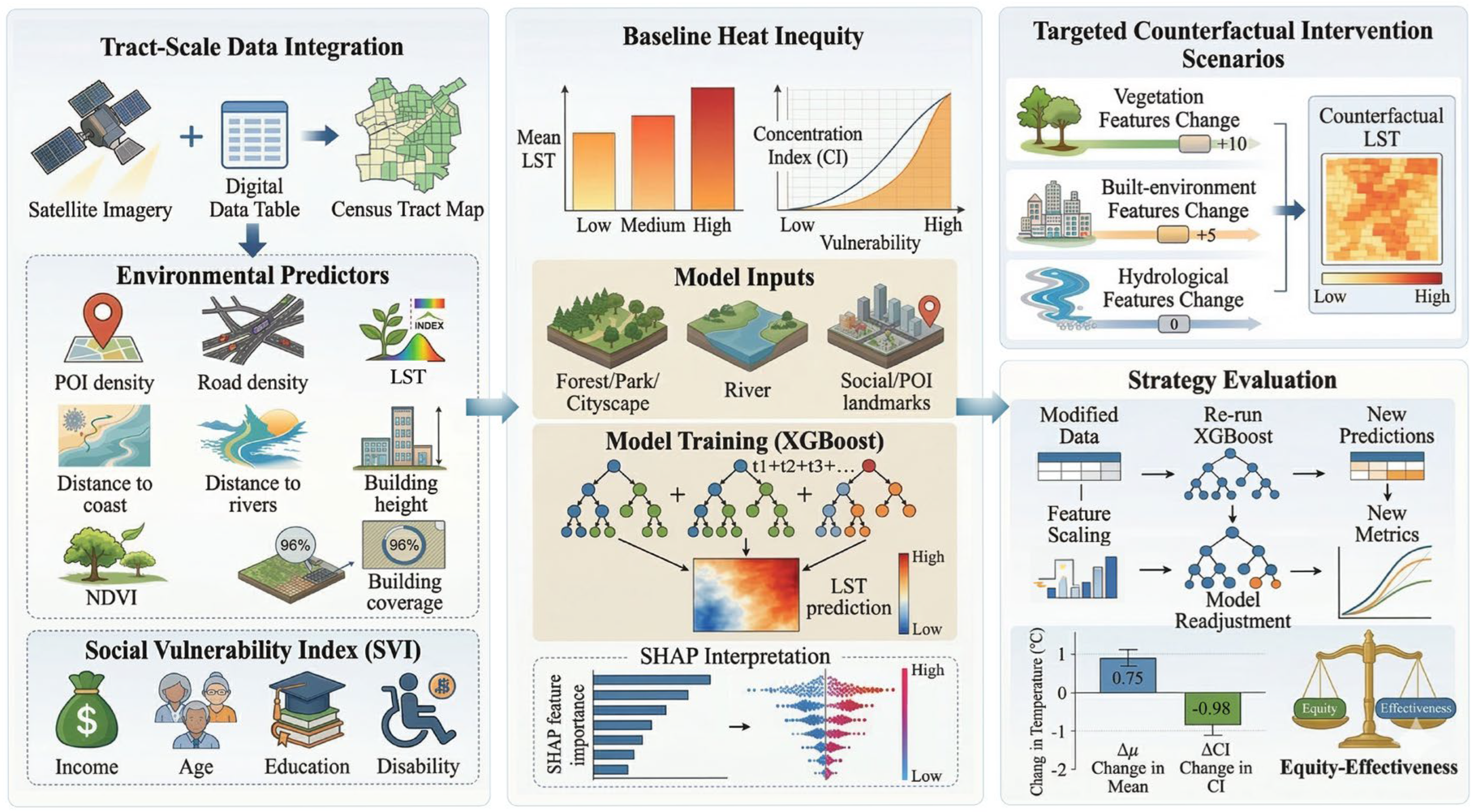
- How is summer surface heat exposure distributed along Houston’s social vulnerability gradient, and to what extent is heat disproportionately concentrated in more vulnerable census tracts?
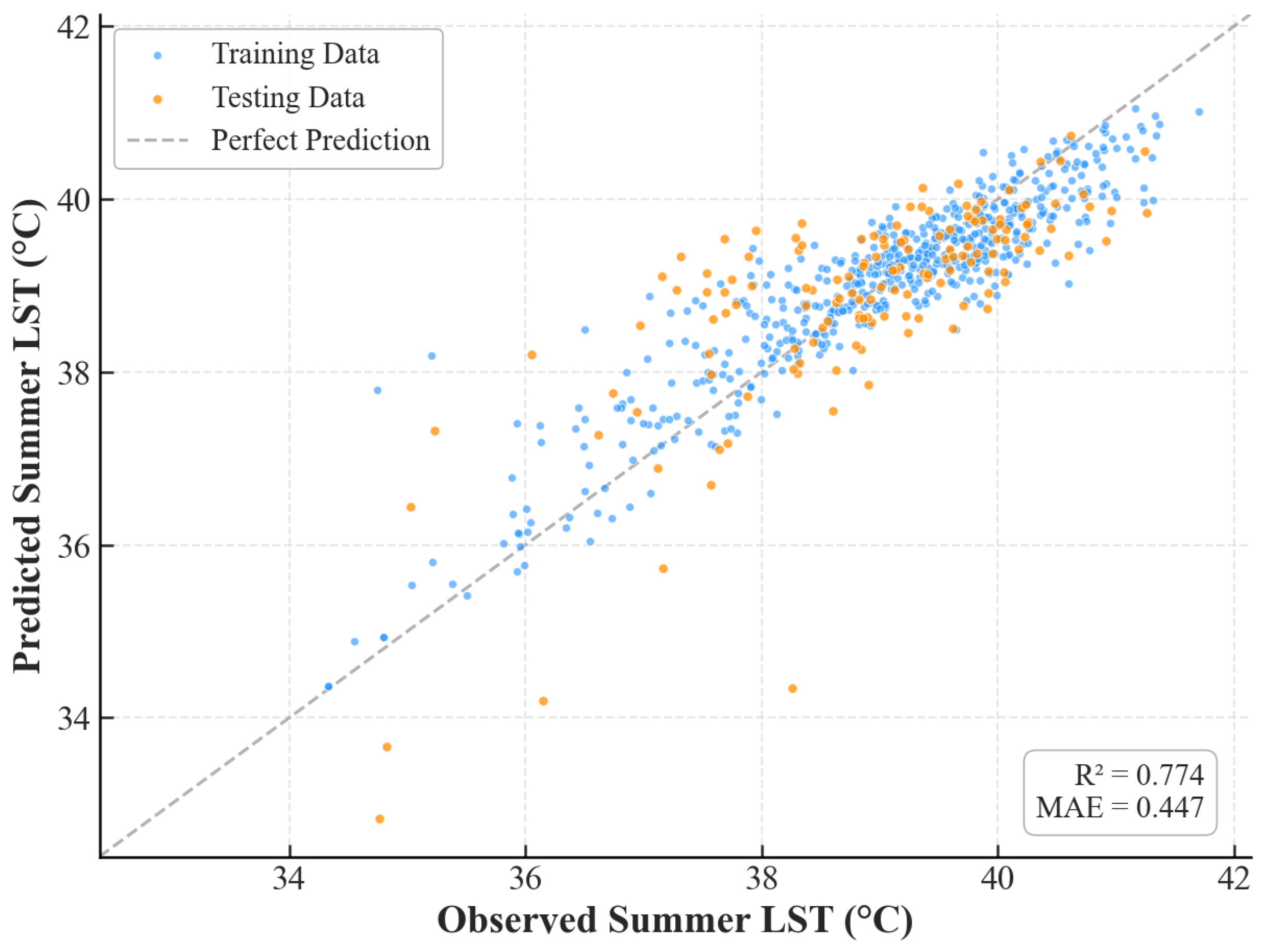
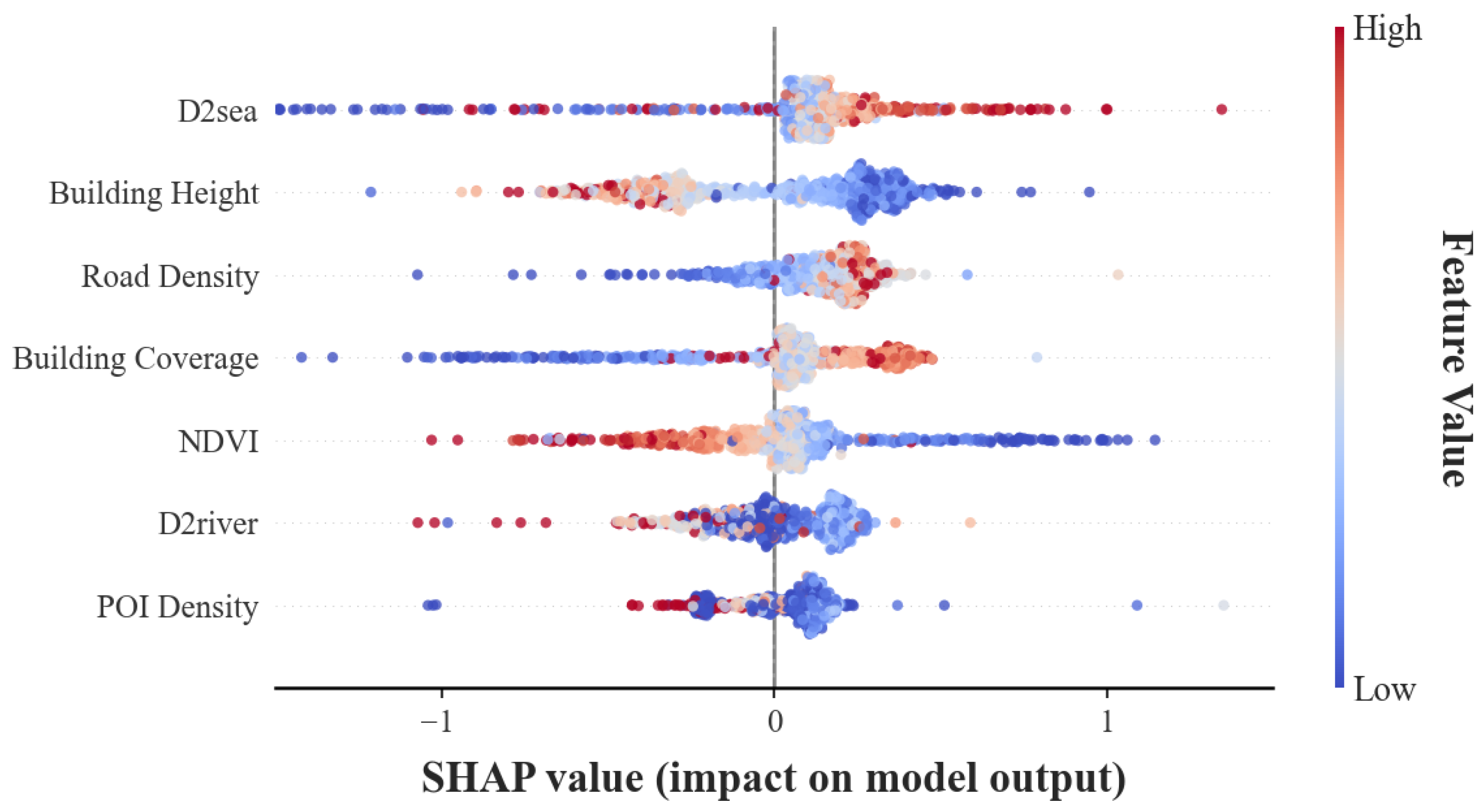
- Can an interpretable machine-learning model reliably capture tract-scale heat exposure using a parsimonious set of natural and built-environment predictors, and what are the dominant drivers of spatial heat variation?
- Under equity-targeted intervention scenarios applied in high-vulnerability neighborhoods, which planning levers generate win–win outcomes by simultaneously reducing mean heat exposure and improving equity, and which levers create trade-offs or lose–lose effects?
2. Datasets and Methodology
2.1. Study Area and Data Collection
2.2. Natural and Built-Environment Feature Construction
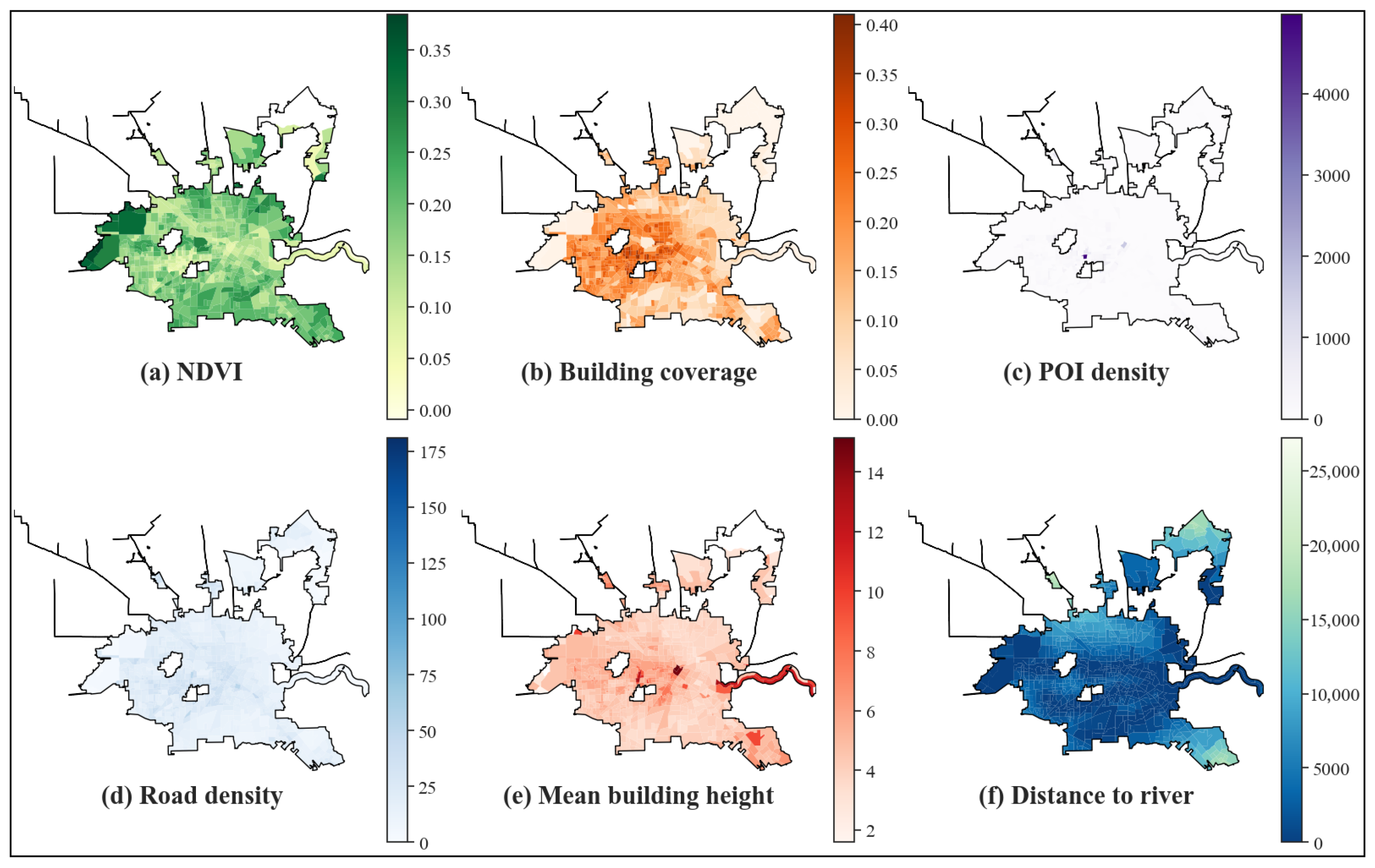
- Building coverage and mean building height: Using Microsoft/GlobalML Building Footprints, we delineated building footprints and computed the building coverage ratio (building footprint area/tract area). Building height attributes from the same dataset were summarized to obtain tract-level mean building height (Bldg Coverage, Bldg Height) [38].
- Road density: Based on curated OSM road data (downloaded via OpenStreetMap), we calculated total road length per unit area (km/km2) as a proxy for transport infrastructure density and impervious-surface development intensity (Road Density) [39].
2.3. Social Vulnerability and Inequality Measurement of Urban Heat Exposure
2.4. Interpretable Machine-Learning Modeling of Urban Heat Exposure
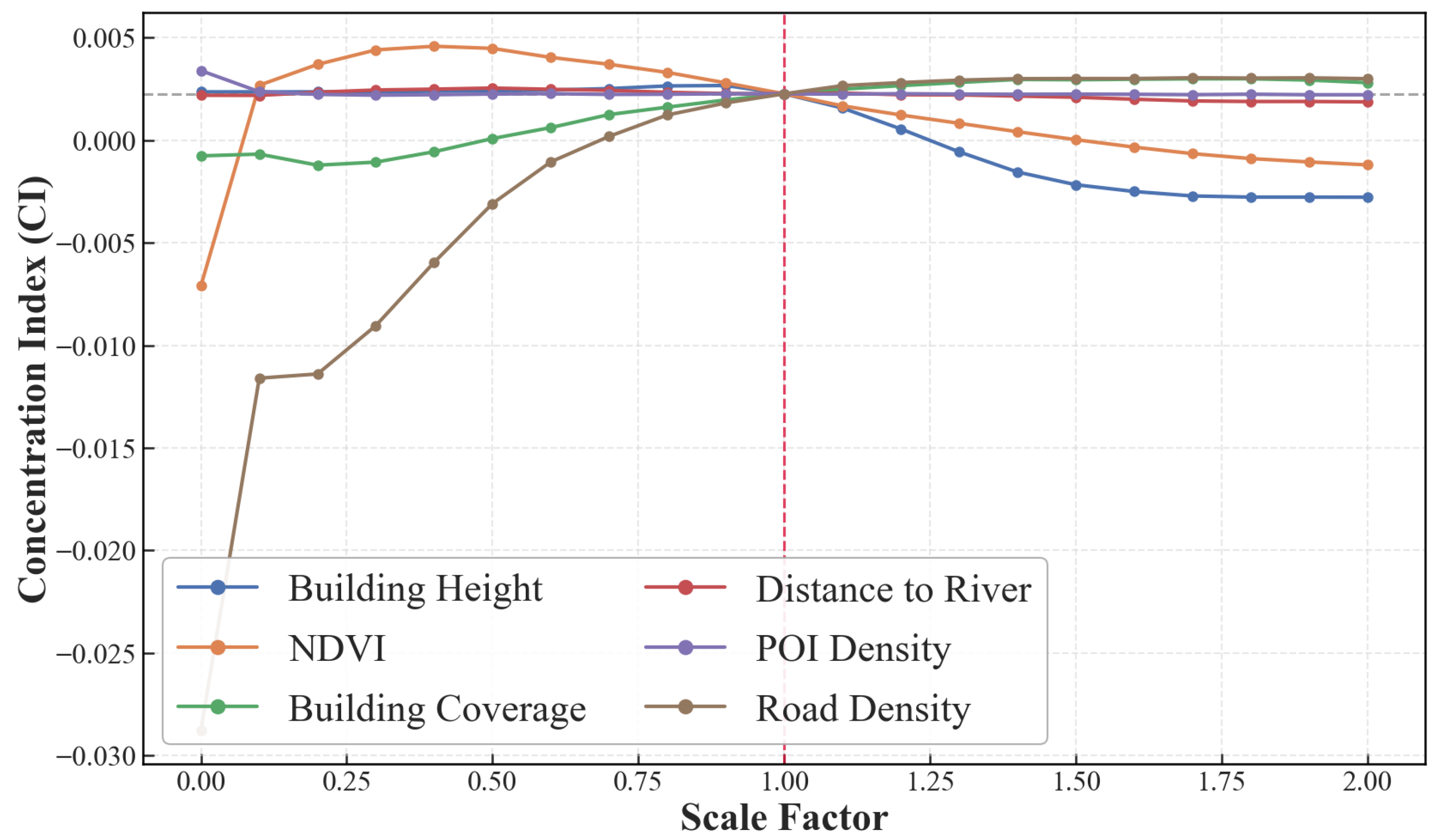
2.5. Scaling-Factor Specification for Intervention Scenario Simulations
3. Results
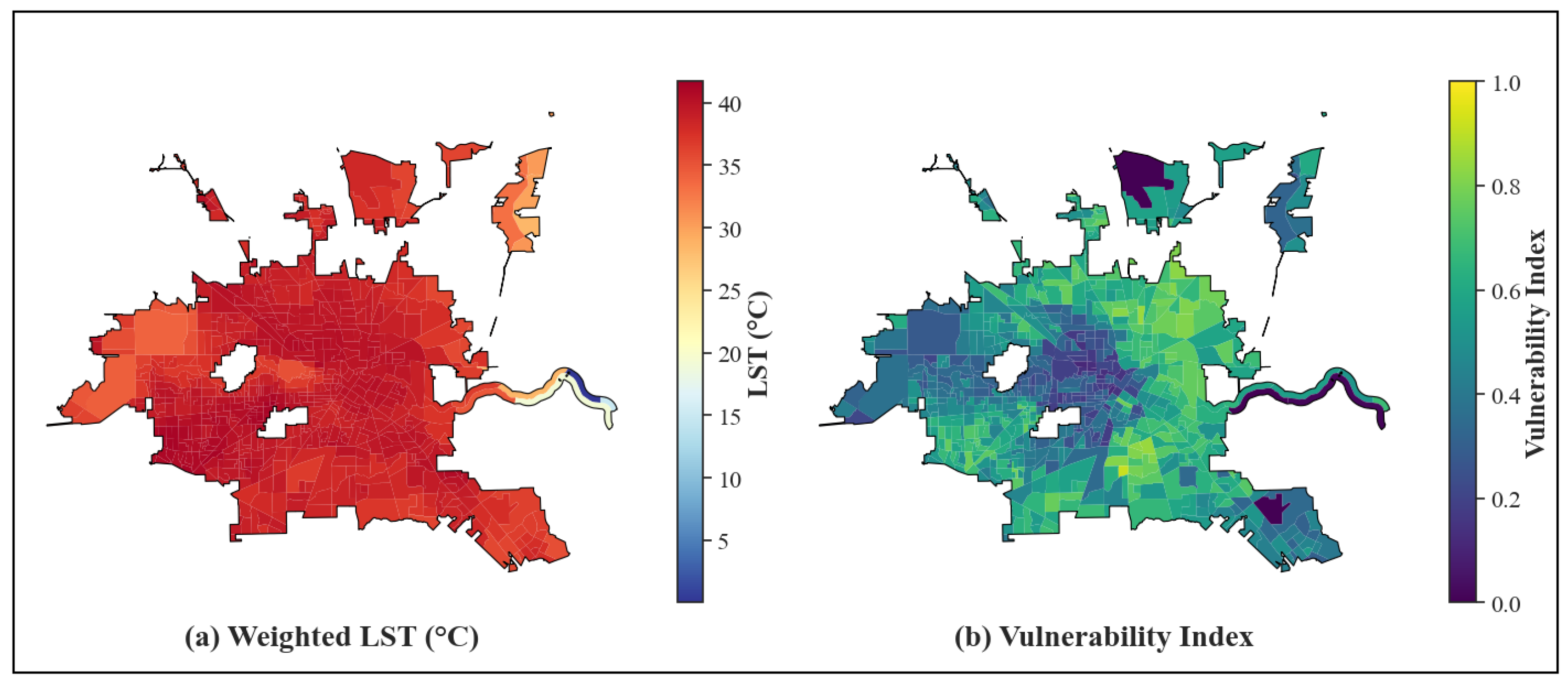
3.1. Inequality in Urban Heat Exposure
3.2. Interpreting the Roles of Urban Factors in Heat Exposure
4. Evaluating the Effectiveness of Various Urban Development Strategies
4.1. Annual-Scale Evaluation of Key Factors Shaping Heat-Exposure Inequity
4.2. Intervention-Intensity Responses and Asymmetry
4.3. Strategy Ranking and Recommendations Under a Dual “Cooling–Equity” Objective
5. Conclusions
Author Contributions
Funding
Institutional Review Board Statement
Informed Consent Statement
Data Availability Statement
Conflicts of Interest
Abbreviations
| NDVI | Normalized Difference Vegetation Index |
| POI | Points of Interest. |
| LST | Land Surface Temperature |
References
- Bell, M.L.; Gasparrini, A.; Benjamin, G.C. Climate change, extreme heat, and health. N. Engl. J. Med. 2024, 390, 1793–1801. [Google Scholar] [CrossRef]
- Raymond, C.; Matthews, T.; Horton, R.M. The emergence of heat and humidity too severe for human tolerance. Sci. Adv. 2020, 6, eaaw1838. [Google Scholar] [CrossRef]
- Manoli, G.; Fatichi, S.; Bou-Zeid, E.; Katul, G.G. Seasonal hysteresis of surface urban heat islands. Proc. Natl. Acad. Sci. USA 2019, 116, 17377–17382. [Google Scholar] [CrossRef]
- Zhou, B.; Rybski, D.; Kropp, J.P. The role of city size and urban form in the surface urban heat island. Sci. Rep. 2017, 7, 4791. [Google Scholar] [CrossRef] [PubMed]
- Peng, J.; Jia, J.; Liu, Y.; Li, H.; Wu, J. Seasonal contrast of the dominant factors for the spatial distribution of land surface temperature in urban areas. Remote Sens. Environ. 2018, 215, 255–267. [Google Scholar] [CrossRef]
- Yang, Q.; Huang, X.; Tang, Q. The footprint of urban heat island effect in 302 Chinese cities. Sci. Total Environ. 2019, 655, 652–662. [Google Scholar] [CrossRef]
- Hsu, A.; Chakraborty, T.; Manya, D.; Sheriff, G.; Feierman, A.; Deanes, L. Disproportionate exposure to urban heat island intensity across major US cities. Nat. Commun. 2021, 12, 2721. [Google Scholar] [CrossRef]
- Tuholske, C.; Caylor, K.; Funk, C.; Verdin, A.; Sweeney, S.; Grace, K.; Peterson, P.; Evans, T. Global urban population exposure to extreme heat. Proc. Natl. Acad. Sci. USA 2021, 118, e2024792118. [Google Scholar] [CrossRef]
- Vicedo-Cabrera, A.M.; Scovronick, N.; Sera, F.; Royé, D.; Schneider, R.; Tobias, A.; Astrom, C.; Guo, Y.; Honda, Y.; Hondula, D.M.; et al. The burden of heat-related mortality attributable to recent human-induced climate change. Nat. Clim. Chang. 2021, 11, 492–500. [Google Scholar] [CrossRef] [PubMed]
- Ebi, K.L.; Capon, A.; Berry, P.; Broderick, C.; Dear, K.; Hanigan, I.; Honda, Y.; Kovats, R.S.; Ma, W.; Malik, A.; et al. Hot weather and heat extremes: Health risks. Lancet 2021, 398, 698–708. [Google Scholar] [CrossRef] [PubMed]
- Jesdale, B.M.; Morello-Frosch, R.; Cushing, L. The racial/ethnic distribution of heat risk-related land cover in relation to residential segregation. Environ. Health Perspect. 2013, 121, 811–817. [Google Scholar] [CrossRef]
- Voelkel, J.; Hellman, D.; Sakuma, R.; Shandas, V. Assessing vulnerability to urban heat: A study of disproportionate heat exposure and access to relief by socio-demographic status in Portland, Oregon. Int. J. Environ. Res. Public Health 2018, 15, 640. [Google Scholar] [CrossRef]
- Mitchell, B.C.; Chakraborty, J. Landscapes of thermal inequity: Disproportionate exposure to urban heat in the three largest US cities. Environ. Res. Lett. 2015, 10, 115005. [Google Scholar] [CrossRef]
- Dialesandro, J.; Brazil, N.; Wheeler, S.; Abunnasr, Y. Dimensions of thermal inequity: Neighborhood social demographics and urban heat in the Southwestern US. Int. J. Environ. Res. Public Health 2021, 18, 941. [Google Scholar] [CrossRef]
- Rodríguez Antuñano, I. ¿Derecho a la Ciudad? Una Mirada a la Distribución de Los Espacios Verdes en Barcelona, Desde la Perspectiva de Justicia Ambiental. Master’s Thesis, Universitat Politècnica de Catalunya (UPC), Barcelona, Spain, 2019. Available online: https://hdl.handle.net/2117/179480 (accessed on 1 January 2025).
- Rodríguez Antuñano, I. Repensar el urbanismo como solución al cambio climático: Caso de estudio: Área Metropolitana Asturiana. In IV Congreso ISUF-H: Metrópolis en Recomposición: Prospectivas Proyectuales en el Siglo XXI: Forma Urbis y Territorios Metropolitanos; DUOT, UPC: Barcelona, Spain, 2020; pp. 1–22. Available online: https://upcommons.upc.edu/entities/publication/4161c594-f5a9-4aea-b70d-b4d4bc1b1e8a (accessed on 1 January 2025).
- Rodríguez-Antuñano, I.; Barros, B.; Martínez-Sánchez, J.; Riveiro, B. Urban infrastructure vulnerability to climate-induced risks: A probabilistic modeling approach using remote sensing as a tool in urban planning. Infrastructures 2024, 9, 107. [Google Scholar] [CrossRef]
- Mohai, P.; Pellow, D.; Roberts, J.T. Environmental justice. Annu. Rev. Environ. Resour. 2009, 34, 405–430. [Google Scholar] [CrossRef]
- Chakraborty, T.; Hsu, A.; Manya, D.; Sheriff, G. Disproportionately higher exposure to urban heat in lower-income neighborhoods: A multi-city perspective. Environ. Res. Lett. 2019, 14, 105003. [Google Scholar] [CrossRef]
- Meerow, S.; Keith, L. Planning for extreme heat: A national survey of US planners. J. Am. Plan. Assoc. 2022, 88, 158–171. [Google Scholar] [CrossRef]
- Lanza, K.V.; Jones, J.; Acuna, F.; McSherry, T.; Peters, E. Heat vulnerability of Latino and Black residents in a low-income community and their recommended adaptation strategies: A qualitative study. Urban Clim. 2023, 51, 101656. [Google Scholar] [CrossRef]
- Kim, Y.; Li, D.; Xu, Y.; Zhang, Y.; Li, X.; Muhlenforth, L.; Xue, S.; Brown, R. Heat vulnerability and street-level outdoor thermal comfort in the city of Houston: Application of google street view image derived SVFs. Urban Clim. 2023, 51, 101617. [Google Scholar] [CrossRef]
- Heaton, M.J.; Sain, S.R.; Greasby, T.A.; Uejio, C.K.; Hayden, M.H.; Monaghan, A.J.; Boehnert, J.; Sampson, K.; Banerjee, D.; Nepal, V.; et al. Characterizing urban vulnerability to heat stress using a spatially varying coefficient model. Spat. Spatio-Temporal Epidemiol. 2014, 8, 23–33. [Google Scholar] [CrossRef]
- Chen, M.; Chen, L.; Zhou, Y.; Ren, C. Rising vulnerability of compound risk inequality to ageing and extreme heatwave exposure in global cities. npj Urban Sustain. 2023, 3, 38. [Google Scholar] [CrossRef]
- Pappalardo, S.E.; Zanetti, C.; Todeschi, V. Mapping urban heat islands and heat-related risk during heat waves from a climate justice perspective: A case study in the municipality of Padua (Italy) for inclusive adaptation policies. Landsc. Urban Plan. 2023, 238, 104831. [Google Scholar] [CrossRef]
- Blackford, A.; Cowan, T.; Nair, U.; Phillips, C.; Kaulfus, A.; Freitag, B. Synergy of urban heat, pollution, and social vulnerability in one of America’s most rapidly growing cities: Houston, we have a problem. GeoHealth 2024, 8, e2024GH001079. [Google Scholar] [CrossRef]
- Oukawa, G.Y.; Kne, P.; Targino, A.C. Fine-scale modeling of the urban heat island: A comparison of multiple linear regression and random forest approaches. Sci. Total Environ. 2022, 815, 152836. [Google Scholar] [CrossRef] [PubMed]
- Li, F.; Yigitcanlar, T.; Nepal, M.; Nguyen, K.; Dur, F. Machine learning and remote sensing integration for leveraging urban sustainability: A review and framework. Sustain. Cities Soc. 2023, 96, 104653. [Google Scholar] [CrossRef]
- Mashhoodi, B. Environmental justice and surface temperature: Income, ethnic, gender, and age inequalities. Sustain. Cities Soc. 2021, 68, 102810. [Google Scholar] [CrossRef]
- Wagstaff, A.; Paci, P.; van Doorslaer, E. On the measurement of inequalities in health. Soc. Sci. Med. 1991, 33, 545–557. [Google Scholar] [CrossRef]
- Kakwani, N.; Wagstaff, A.; Van Doorslaer, E. Socioeconomic inequalities in health: Measurement, computation, and statistical inference. J. Econom. 1997, 77, 87–103. [Google Scholar] [CrossRef]
- Wu, Y.; Tong, S.; Li, S.; Pan, X.; Kimlin, M.G.; Phung, D. Estimating the urban heat-related mortality burden due to greenness: A global modelling study. Lancet Planet. Health 2025, 9, e443–e454. [Google Scholar] [CrossRef] [PubMed]
- Krayenhoff, E.S.; Moustaoui, M.; Broadbent, A.M.; Gupta, V.; Georgescu, M. Diurnal interaction between urban expansion, climate change and adaptation in US cities. Nat. Clim. Chang. 2018, 8, 1097–1103. [Google Scholar] [CrossRef]
- Lundberg, S.M.; Lee, S.I. A unified approach to interpreting model predictions. In Advances in Neural Information Processing Systems 30; Guyon, I., Luxburg, U.V., Bengio, S., Wallach, H., Fergus, R., Vishwanathan, S., Garnett, R., Eds.; Curran Associates, Inc.: Red Hook, NY, USA, 2017; pp. 4765–4774. [Google Scholar]
- Wang, Y.; Murayama, Y.; Liu, F.; Zhang, X.; Hou, H.; Morimoto, T.; Derdouri, A. Impact of urban morphology on land surface temperature. City Environ. Interact. 2025, 28, 100227. [Google Scholar] [CrossRef]
- Gorelick, N.; Hancher, M.; Dixon, M.; Ilyushchenko, S.; Thau, D.; Moore, R. Google Earth Engine: Planetary-scale geospatial analysis for everyone. Remote Sens. Environ. 2017, 202, 18–27. [Google Scholar] [CrossRef]
- [Project-Provided Hydrological Datasets]. Municipal High-Resolution Hydrology Vector Datasets: River Polyline Layer and Coastline Polygon Layer; [Internal Data Repository]. Available online: https://www.arcgis.com/home/item.html?id=8c112330556445d1856edd9020ca6ba1 (accessed on 1 January 2025).
- Microsoft. Microsoft GlobalML Building Footprints [Dataset]. 2022. Available online: https://github.com/microsoft/GlobalMLBuildingFootprints (accessed on 1 January 2025).
- OpenStreetMap Contributors. OpenStreetMap [Dataset]; OpenStreetMap Foundation: Cambridge, UK, 2022; Available online: https://www.openstreetmap.org (accessed on 1 January 2025).
- Centers for Disease Control and Prevention/Agency for Toxic Substances and Disease Registry. CDC/ATSDR Social Vulnerability Index [Dataset]. 2022. Available online: https://www.atsdr.cdc.gov/place-health/php/svi/svi-data-documentation-download.html (accessed on 1 January 2025).
- Flanagan, B.E.; Gregory, E.W.; Hallisey, E.J.; Heitgerd, J.L.; Lewis, B. A social vulnerability index for disaster management. J. Homel. Secur. Emerg. Manag. 2011, 8, 1–22. [Google Scholar] [CrossRef]
- Zhao, H.; Cui, Y.; Wang, J.; Hao, S.; Tian, J.; Liu, L.; Li, A.; Zhang, S. A multiscale and seasonal model for urban surface temperature prediction based on landscape, land use and spectral indices. Sustain. Cities Soc. 2025, 131, 106783. [Google Scholar] [CrossRef]
- Chen, T.; Guestrin, C. XGBoost: A scalable tree boosting system. In Proceedings of the 22nd ACM SIGKDD International Conference on Knowledge Discovery and Data Mining; ACM: New York, NY, USA, 2016; pp. 785–794. [Google Scholar] [CrossRef]
- Tanoori, G.; Soltani, A.; Modiri, A. Machine learning for urban heat island (UHI) analysis: Predicting land surface temperature (LST) in urban environments. Urban Clim. 2024, 55, 101962. [Google Scholar] [CrossRef]
- Borsky, S.; Fesselmeyer, E.; Vogelsang, L. Urban heat and within-city residential sorting. J. Environ. Econ. Manag. 2024, 127, 103014. [Google Scholar] [CrossRef]
- Zhou, Q.; Wang, S.; Liu, Y. Exploring the accuracy and completeness patterns of global land-cover/land-use data in OpenStreetMap. Appl. Geogr. 2022, 145, 102742. [Google Scholar] [CrossRef]




| Feature | Source | Mean | Range | Description |
|---|---|---|---|---|
| LST | MODIS MOD11A2 (Google Earth Engine) | 38.640 | [0.000, 41.699] | Daytime land surface temperature (LST) in summer 2022 (June–August), aggregated to the census-tract level using area-weighted averaging. |
| NDVI | Sentinel-2 Level-2A (Google Earth Engine) | 0.165 | [−0.009, 0.384] | Mean summer NDVI, derived using cloud masking and temporal compositing, then area-weighted aggregated to the tract level. |
| D2river | Municipal high-resolution hydrology vector datasets | 4391.131 | [0.000, 27,205.973] | Euclidean distance from the tract centroid to the nearest river. |
| D2sea | Municipal high-resolution hydrology vector datasets | 31,790.585 | [0.000, 69,629.555] | Euclidean distance from the tract centroid to the nearest coastline. |
| Building Coverage | GlobalML Building Footprints | 0.148 | [0.000, 0.410] | Building footprint area within the tract/tract area (i.e., building coverage ratio). |
| Building Height | GlobalML Building Footprints | 4.936 | [1.594, 15.133] | Mean building height, summarized from building height attributes within the tract. |
| POI Density | OpenStreetMap | 68.745 | [0.000, 4973.096] | POI density (count/km2), used as a proxy for activity intensity and land-use/functional mix. |
| Road Density | OpenStreetMap | 22.989 | [0.000, 180.897] | Road density (km/km2), defined as total road length per unit area, representing transport infrastructure intensity and impervious-surface development. |
| Low Vulnerability | Medium Vulnerability | High Vulnerability | |
|---|---|---|---|
| Mean LST (Unit: °C) | 38.60 | 38.70 | 39.10 |
| Kruskal–Wallis, H = 6.48 (p < 0.05). | |||
| Model | R2 | MAE (°C) | RMSE (°C) |
|---|---|---|---|
| Multiple Linear Regression | 0.341 | 0.919 | 1.176 |
| Random Forest | 0.594 | 0.692 | 0.923 |
| XGBoost | 0.626 | 0.664 | 0.886 |
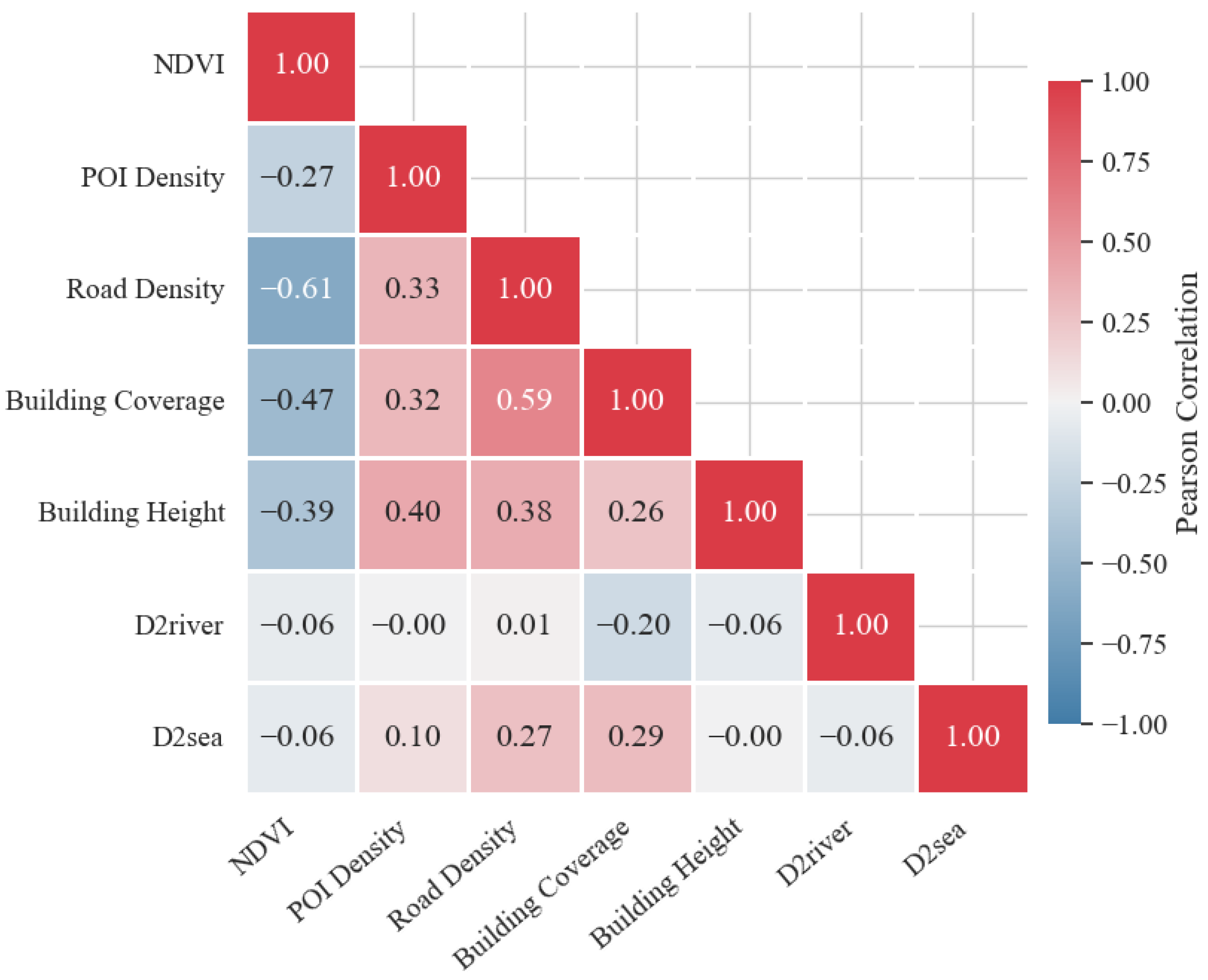
| Predictor | VIF |
|---|---|
| Road density | 2.148 |
| Building coverage | 1.821 |
| NDVI | 1.796 |
| Building height | 1.376 |
| POI density | 1.281 |
| Distance to sea | 1.152 |
| Distance to river | 1.095 |
| NDVI | D2river | Building Height | Building Coverage | Road Density | POI Density | |
|---|---|---|---|---|---|---|
| Δμ | −0.17783 | −0.01827 | −0.33581 | 0.03637 | 0.06214 | −0.00109 |
| ΔCI | −0.00223 | −0.00017 | −0.00443 | 0.00069 | 0.00074 | −0.00002 |
Disclaimer/Publisher’s Note: The statements, opinions and data contained in all publications are solely those of the individual author(s) and contributor(s) and not of MDPI and/or the editor(s). MDPI and/or the editor(s) disclaim responsibility for any injury to people or property resulting from any ideas, methods, instructions or products referred to in the content. |
© 2026 by the authors. Licensee MDPI, Basel, Switzerland. This article is an open access article distributed under the terms and conditions of the Creative Commons Attribution (CC BY) license.
Share and Cite
Sun, Y.; Chen, X.; Zhao, Q.; Xie, J.; Liu, Z. Toward Sustainable and Equitable Heat Mitigation: Interpretable Machine Learning for Urban Heat Governance in Houston. Sustainability 2026, 18, 4772. https://doi.org/10.3390/su18104772
Sun Y, Chen X, Zhao Q, Xie J, Liu Z. Toward Sustainable and Equitable Heat Mitigation: Interpretable Machine Learning for Urban Heat Governance in Houston. Sustainability. 2026; 18(10):4772. https://doi.org/10.3390/su18104772
Chicago/Turabian StyleSun, Yunhao, Xiaoyue Chen, Qiguang Zhao, Jingxue Xie, and Zhewei Liu. 2026. "Toward Sustainable and Equitable Heat Mitigation: Interpretable Machine Learning for Urban Heat Governance in Houston" Sustainability 18, no. 10: 4772. https://doi.org/10.3390/su18104772
APA StyleSun, Y., Chen, X., Zhao, Q., Xie, J., & Liu, Z. (2026). Toward Sustainable and Equitable Heat Mitigation: Interpretable Machine Learning for Urban Heat Governance in Houston. Sustainability, 18(10), 4772. https://doi.org/10.3390/su18104772