1. Introduction and Literature Review
Culture and tourism are inherently interconnected. Cultural landscapes, heritage sites, and events serve as key drivers of tourism, while tourism, in turn, facilitates the preservation, transmission, and revitalization of culture (Greg Richards, 2018) [
1]. The expansion of cultural tourism, in both production and consumption, generates substantial economic and social benefits for destinations. However, unchecked tourism development may erode cultural authenticity, place pressure on local environments, and ultimately constrain the sustainable development of the tourism sector (Lu et al., 2023) [
2]. New-quality productive forces (NQPF) represent an advanced form of productive capacity characterized by innovation-driven growth and a focus on efficiency, equity, and sustainability (Chen et al., 2025) [
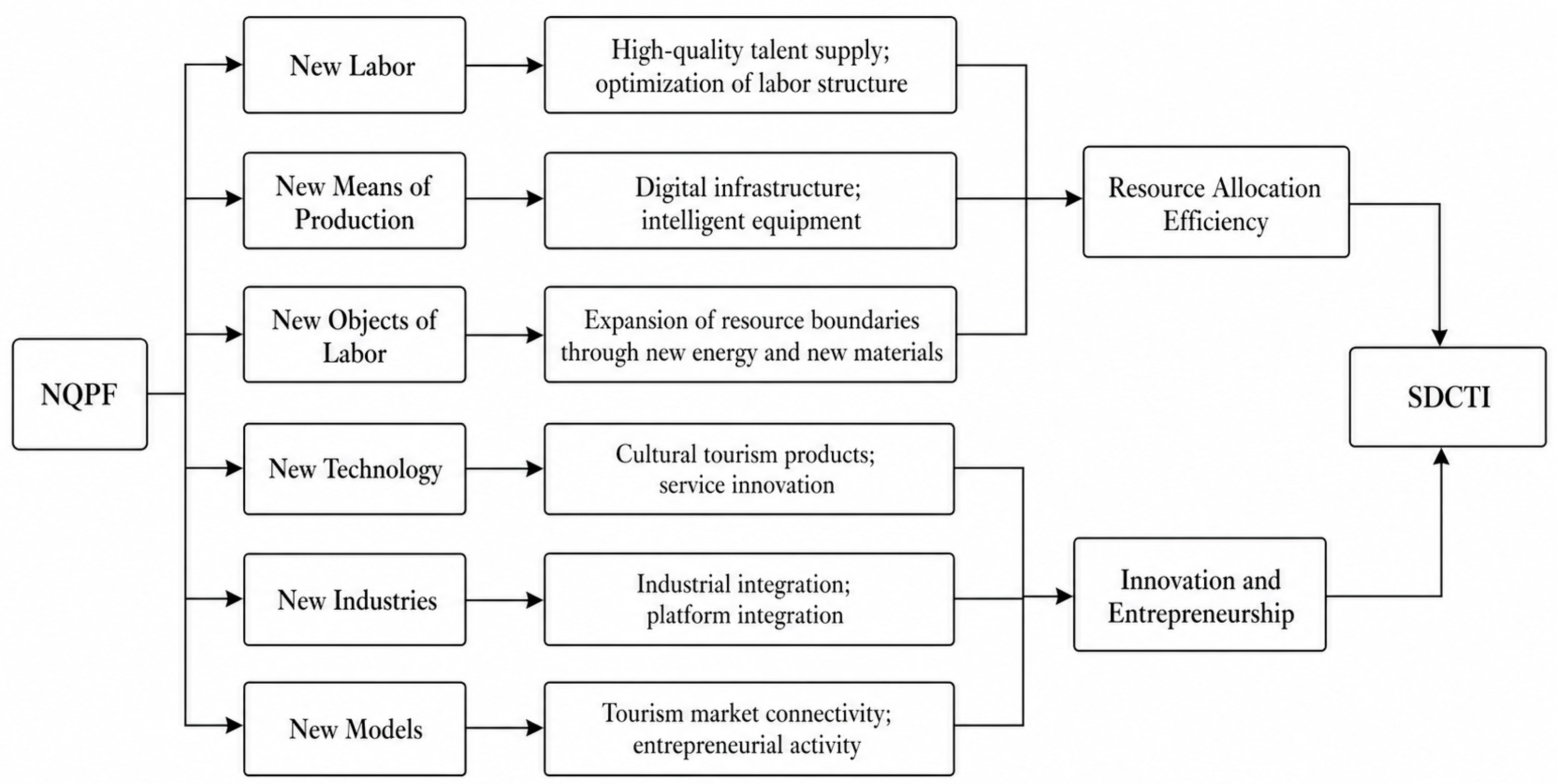
3]. By improving resource allocation efficiency, promoting industrial upgrading, and supporting environmentally friendly development [
4], NQPF create new opportunities for the sustainable integration of culture and tourism. In particular, emerging digital technologies enable new forms of cultural dissemination, while digital platforms have fostered the development of smart tourism systems, significantly enhancing the value of cultural and tourism resources.
Nevertheless, the development of digital infrastructure also introduces a range of challenges, including environmental pressures, the over-commercialization of culture, and widening digital divides. Against this backdrop, a systematic examination of the impact of NQPF on the sustainable development of culture–tourism integration (SDCTI) is of considerable theoretical and practical importance.
NQPF represent an advanced form of productivity characterized by innovation-driven development and continuous industrial transformation and upgrading. They emphasize the accumulation of human capital while seeking to balance economic growth with resource and environmental sustainability [
5,
6,
7]. In this regard, NQPF provide valuable insights into improving energy efficiency, mitigating climate pressures, and alleviating poverty on a global scale [
8,
9]. With respect to measurement, existing studies have adopted either single-indicator approaches [
10] or composite index methods. The latter typically include entropy-based measures, entropy-weighted techniques such as TOPSIS, as well as productivity-oriented approaches like the Malmquist index and the SBM model [
11,
12,
13]. These approaches, typically constructed around labor, means of production, and objects of labor, have improved the characterization of the spatiotemporal evolution of NQPF. However, they tend to emphasize static efficiency and are less capable of capturing the structural and systemic features inherent in NQPF. In terms of empirical effects, existing research has primarily focused on the agricultural, manufacturing, employment, and energy sectors, while relatively limited attention has been paid to the service sector particularly the culture and tourism domain. In agriculture, NQPF significantly promotes high-quality development and modernization, with stronger effects observed in less-developed and resource-constrained regions (Lin et al., 2024; Huang et al., 2024) [
14,
15]. In manufacturing, NQPF facilitate intelligent transformation, enhance industrial resilience, and act as a key mediating force in synergistic agglomeration (Liu and He, 2024; Cui, 2025) [
11,
16]. In the labor market, NQPF improve employment quality by increasing labor productivity (Shi, 2026) [
17]. In the energy and environmental domain, NQPF drive green and low-carbon transitions, promote green development, and foster inclusive green growth (Zhang et al., 2024; Xu et al., 2024; Wang and Chen, 2024) [
18,
19,
20]. Regarding mechanisms, prior studies have mainly examined channels such as technological innovation, industrial upgrading, economic development, and government intervention. However, relatively little attention has been given to the roles of entrepreneurial activity and factor allocation, which are crucial for translating technological advances into real economic outcomes. In terms of heterogeneity, existing analyses primarily focus on geographical or economic differences, while insufficient attention has been paid to variations in artificial intelligence infrastructure, tourism resource endowments, and transportation conditions.
From the perspective of culture–tourism integration, culture and tourism are fundamentally rooted in the human spiritual domain (Elavarasan et al., 2022) [
21]. Cultural resources are preserved and revitalized through tourism, while tourism gains depth and identity through cultural embedding, forming a dynamic process of mutual reinforcement. SDCTI refers to a state in which cultural and tourism systems achieve coordinated development while continuously generating economic, social, and ecological benefits (Zhao et al., 2023) [
22]. This contributes to community sustainability and more resilient tourism systems (Canavan, 2016; Mzembe et al., 2023) [
23,
24]. Existing studies have applied coupling–coordination models to evaluate eco-cultural tourism systems and identify key drivers of coordinated development (Lu et al., 2023) [
2]. Meanwhile, the rapid advancement of information and communication technologies (ICT) has broadened access to tourism services and enhanced firms’ marketing capabilities (Ukpabi and Karjaluoto, 2016; Alkan et al., 2025) [
25,
26]. Emerging technologies are also found to reshape tourism systems through stages of opportunity, disruption, integration, and appropriation (Gössling, 2021) [
27]. However, current research often treats NQPF, culture–tourism integration, and sustainability as a simple additive relationship, lacking a coherent theoretical framework to explain their complex interdependencies. In particular, empirical evidence on the direct impact of NQPF on SDCTI remains limited, and the underlying transmission mechanisms have not been sufficiently explored.
In summary, although existing studies have examined the concept, measurement, and impacts of NQPF, relatively limited attention has been paid to the service sector, particularly in the context of cultural tourism. Against this backdrop, this study makes several contributions. First, by integrating NQPF and the sustainable development of culture–tourism integration (SDCTI) into a unified analytical framework, this study extends the theoretical scope of NQPF research. Second, by applying Jenkins’ natural breakpoint decomposition method to examine the dynamic evolution of SDCTI, it moves beyond the predominantly static analyses in the existing literature. In addition, by constructing an evaluation index system that captures the emerging characteristics of NQPF from the perspectives of foundational support and technological penetration, this study enriches the measurement of labor, means of production, and objects of labor. Third, while prior research has paid limited attention to the mediating roles of factor allocation and entrepreneurial activity, this study investigates the mechanisms through which NQPF influences SDCTI across multiple dimensions, including labor allocation, capital allocation, innovation, and entrepreneurship. Finally, whereas most existing studies focus on geographic or economic heterogeneity, this study further explores heterogeneity from the perspective of NQPF and SDCTI characteristics, specifically examining differences in AI development levels, tourism resource endowments, and transportation infrastructure.
5. Conclusions and Discussion
5.1. Conclusions
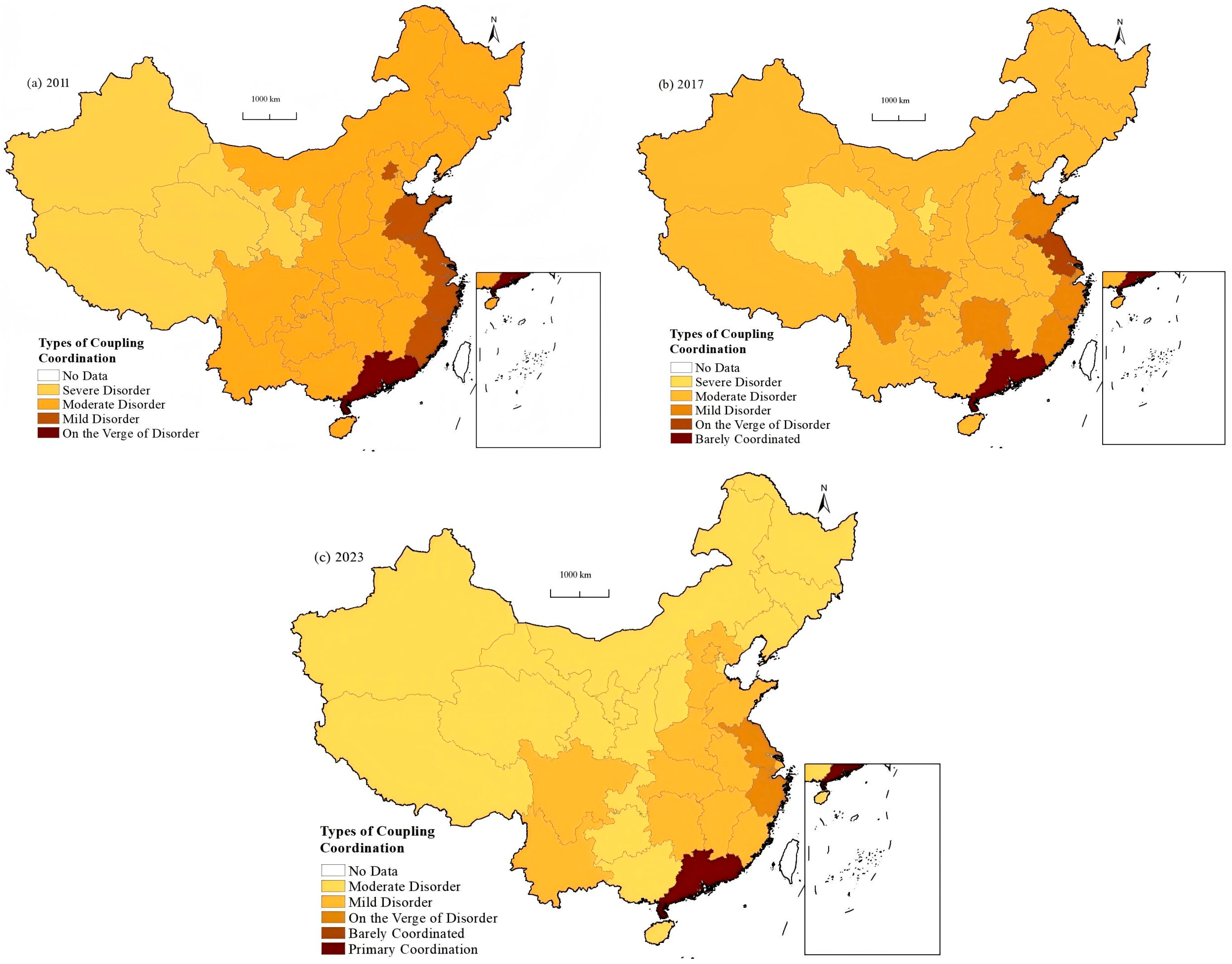
Using panel data for 31 provinces and municipalities in China from 2011 to 2023, this study examined the relationship between NQPF and SDCTI by employing the entropy method, a coupling coordination index, and system GMM estimation. The main findings are as follows. (1) SDCTI exhibits a steady upward trend across regions, gradually shifting from imbalance toward a more coordinated state. (2) NQPF has a significant positive effect on SDCTI. (3) Innovation, entrepreneurship, and labor mismatch act as important mediating channels through which NQPF influences SDCTI, whereas the mediating effect of capital mismatch is not statistically significant. (4) The impact of NQPF is more pronounced in regions with higher levels of artificial intelligence, lower tourism resource endowments, and weaker transportation infrastructure, suggesting the presence of technological synergy and resource transportation substitution effects.
5.2. Study Limitations
This study extends the application of NQPF to the cultural tourism service sector, thereby broadening the scope of existing research. However, several limitations should be acknowledged. The use of macro level data may obscure important micro level dynamics and heterogeneity. In addition, due to data availability constraints, the constructed indicators for NQPF may not fully capture its emerging dimensions, while the measurement of SDCTI may not adequately reflect intangible outputs, such as cultural value and visitor experience. Furthermore, the use of composite indicators to measure both NQPF and SDCTI may limit the ability to clearly identify the causal relationship between them. Although this study attempts to mitigate potential bidirectional causality through the instrumental variable approach, there remains room for further improvement in causal inference.
Future research could strengthen causal identification by exploiting exogenous policy shocks and adopting quasi-experimental approaches, such as event study designs or difference-in-differences methods. In addition, the use of micro level data at the city, firm, or scenic area level, combined with field surveys, would help reduce macro level aggregation bias and enable a more nuanced exploration of the micro level mechanisms through which NQPF influence the SDCTI.
5.3. Policy Implications
Given the significant role of NQPF in promoting SDCTI, policy design should be aligned with the identified mechanisms and heterogeneity patterns.
At the national level, governments should increase investment in digital technologies such as artificial intelligence, big data, and smart service systems within the cultural and tourism sectors. By leveraging digital platforms to integrate cultural resources with tourism products, a development pathway can be established that transforms cultural assets into tourism experiences and market value, thereby enhancing the overall synergy of SDCTI. At the cultural subsystem level, emphasis should be placed on promoting the digital transformation and dissemination of cultural resources, supporting the development of cultural and creative industries, and enhancing the innovation capacity and market appeal of cultural products, thereby achieving a dual improvement in cultural and economic value. At the tourism subsystem level, priority should be given to accelerating the development of smart tourism systems, upgrading digital management and service capabilities of scenic areas, and improving operational efficiency, so as to enhance the sustainability and competitiveness of the tourism sector.
From a mechanistic perspective, innovation and entrepreneurship serve as key mediating channels through which NQPF influences SDCTI, with entrepreneurial activity exhibiting a particularly strong mediating effect. Accordingly, enhancing R&D collaboration and fostering innovation are essential for advancing SDCTI. This requires promoting the development of frontier fields such as urban artificial intelligence, blockchain, and virtual reality, thereby providing sustained technological support for cultural and tourism enterprises. In addition, greater emphasis should be placed on entrepreneurial activity within the cultural and tourism sector. Policy instruments such as tax incentives and start-up subsidies can encourage firms to adopt digital technologies, innovate marketing models, and expand market reach. Given the significant mediating role of labor mismatch, it is also important to improve cross-regional talent mobility, strengthen workforce training in the cultural and tourism industries, and better align skills with market demand in order to alleviate labor misallocation. By contrast, as the mediating role of capital allocation is not statistically significant, policy design should avoid an excessive reliance on financial expansion alone.
Taking into account regional heterogeneity in NQPF, differentiated policy approaches are required. In regions with high levels of artificial intelligence, efforts should focus on deepening the integration of AI into the cultural and tourism industries, promoting digital sharing of resources, and enhancing technology-enabled user experiences. In contrast, regions with lower levels of AI development should prioritize the construction of digital infrastructure, including 5G networks, big data centers, and cloud computing platforms, while leveraging interregional cooperation and technical support to accelerate digital transformation. Furthermore, considering the resource and transportation substitution effects of NQPF, policy priorities should vary accordingly. In resource-scarce regions, emphasis should be placed on developing innovative tourism services, such as smart guided tours and virtual experiences, and on expanding the dissemination of cultural tourism products through digital platforms. In resource-rich regions, efforts should focus on upgrading the quality of cultural and tourism products and services, aligning them with evolving consumption patterns, and offering more personalized experiences. In areas with underdeveloped transportation infrastructure, big data and artificial intelligence can be leveraged to promote local tourism offerings and improve resource allocation. Conversely, in regions with well-developed transport systems, data platforms should be used to optimize visitor flows and service experiences, facilitating a shift from scale-driven expansion to quality-oriented development.



_Li.png)