The Sustainability of E-Learning in UAE Higher Education: Digital Transformation, Inequality, and Student Well-Being in the Time Crisis


Abstract
1. Introduction
1.1. E-Learning Impacts During the Pandemic
1.2. The Interactions Between Psychological, Behavioral, and Social Impacts
1.3. Crisis Management Strategies and E-Learning Experience in the UAE
2. Materials and Methods
2.1. Study Design and Sustainability Framework
2.2. Study Context and Period
2.3. Participants and Sampling Strategy
- -
- Group 1 (G1; n = 76): Social and Cultural Change class (academic year 2020–2021).
- -
- Group 2 (G2; n = 152): Two Social Psychology classes (academic year 2021–2022).
2.4. Data Collection Procedures
- (a)
- What are the psychological, behavioral, and social impacts of the e-learning environment (both positive and negative)?
- (b)
- What is the impact of e-learning during the COVID-19 crisis on academic performance?
- (c)
- What are your perceptions of the current educational process, and what are your expectations for the post-COVID-19 phase?
- (d)
- Do you prefer online, on-campus, or hybrid learning?
2.5. Data Analysis Tools
2.6. Ethical Considerations
3. Results
3.1. Demographic Characteristics
3.2. Descriptive Analysis: Positive and Negative Impacts of E-Learning
- (a)
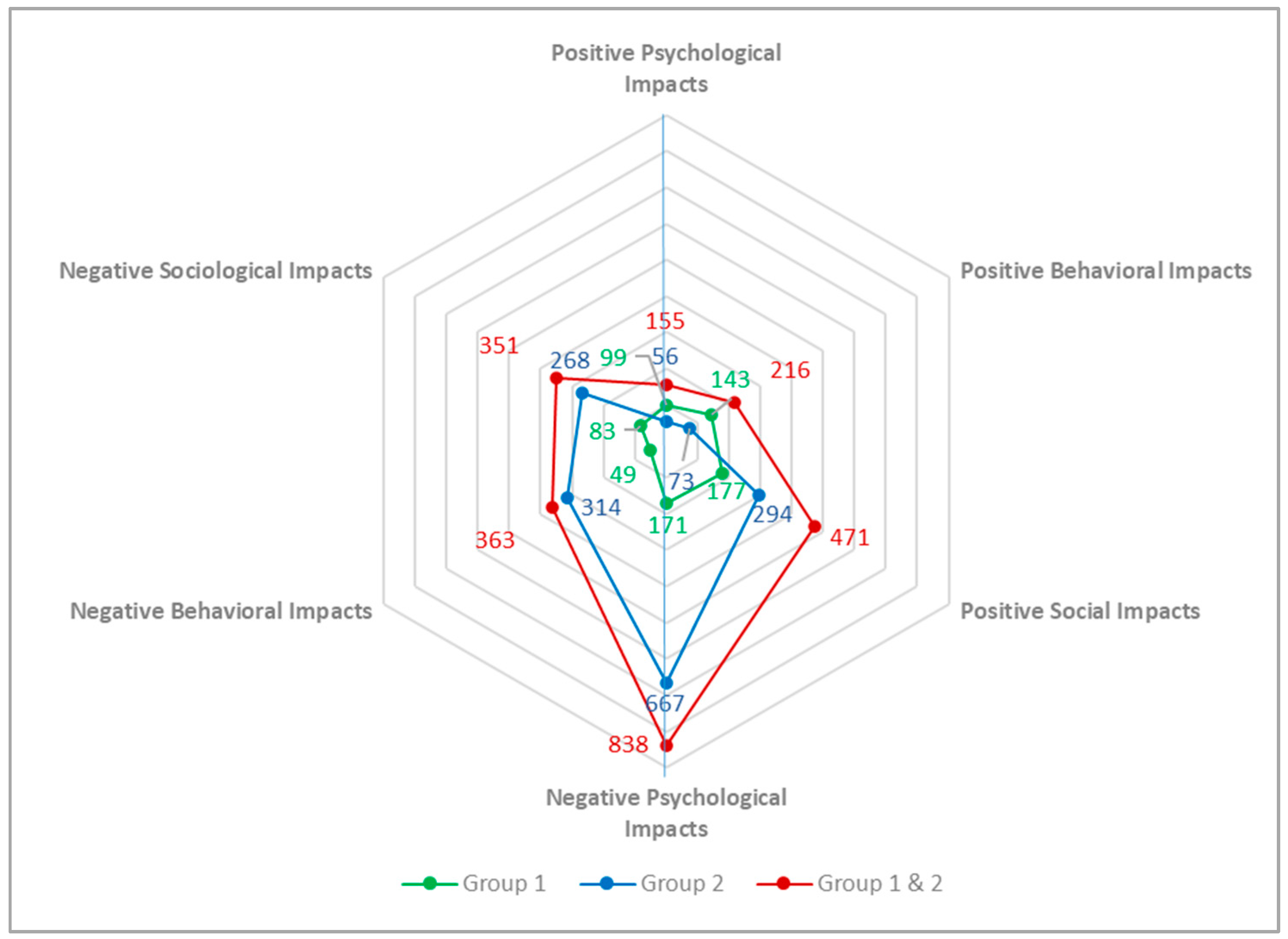
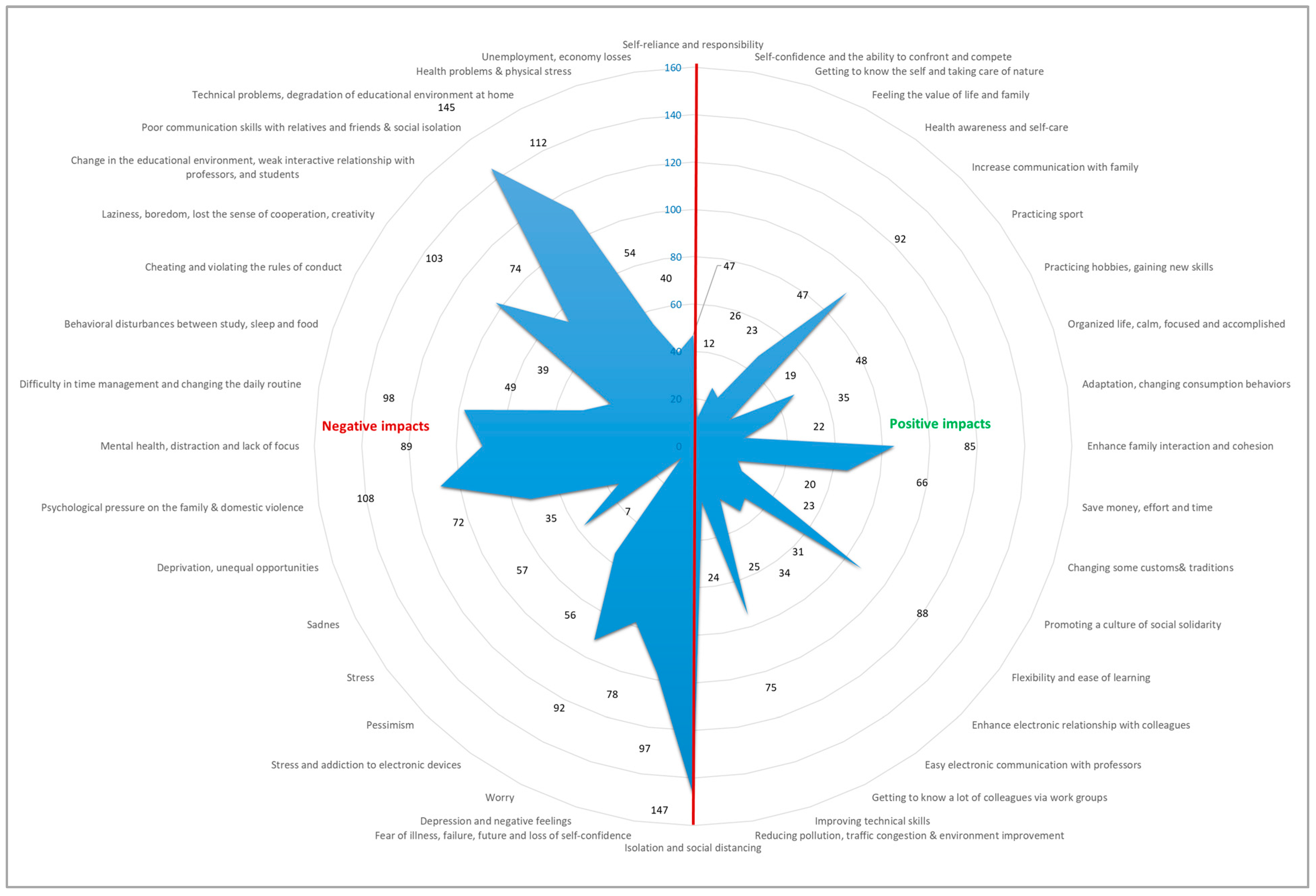
- Psychological Impacts: The findings in Table 2 highlighted Positive Psychological Impacts (PPIs) among the two groups, showing notable differences. In G1, 52.6% reported high health awareness and self-care, compared to 4.6% in G2. Self-reliance and responsibility were significant in both (22.4% in G1, 19.7% in G2). Family and life appreciation were higher in G1 (27.6%) than in G2 (1.3%). Overall, PPIs affected (63.87% of G1), dropping to (36.12% in G2), reflecting reduced health awareness and self-care in the second year of e-learning. The findings revealed eleven Negative Psychological Impacts (NPIs). Isolation and social distancing were reported by 73.7% of G2 and 46.1% of G1, showing an increase in NPIs in the second year. Family pressures and domestic violence rose sharply, with 65.1% in G2 compared to 11.8% in G1. Mental health issues, such as disruption and lack of focus, were higher in G2 (57.2%) than in G1 (2.6%). Worry levels were (49.3% in G2 versus 22.4% in G1), while depression and negative emotions were affected (46.1% of G2 compared to 10.5% of G1). Fear of illness, failure, future uncertainties, and loss of self-confidence impacted both (41.4% in G2 and 44.7% in G1). The overall NPI score was significantly higher in G2 (79.59%), nearly triple that of G1 (20.40%), indicating deteriorating psychological well-being and adaptation difficulties in the second year of e-learning.
- (b)
- Behavioral Impacts: Five Positive Behavioral Impacts (PBIs) were recorded with notable differences. In G1, family communication increased significantly to 71.1%, but dropped to 25% in G2, indicating potential family tensions. Hobbies and skill development were higher in G1 (44.7%) than in G2 (9.2%), indicating greater personal growth in the first year. Changes in consumer behavior were more pronounced in G1 (26.3% fell to 1.3% in G2). Overall, G1 showed higher PBIs (66.20%) than G2 (33.79%), indicating better adaptation in G1. However, five Negative Behavioral Impacts (NBIs) were identified: laziness, boredom, reliance on others, reduced cooperation, creativity, and motivation. NBIs were significantly higher in G2 (63.2%) than in G1 (9.2%). Time management challenges affected (49.3% of G2, 30.3% of G1), with changes in the educational environment and reduced interactions (38.8% of G2 and 19.7% of G1). Disorganization was more common in G2 (29.6%) than in G1 (5.3%). Overall, NBIs were more prevalent in G2 (86.5%) compared to G1 (13.49%), reflecting behavioral changes in the second year of the e-learning experience.
- (c)
- Social Impacts: Ten Positive Social Impacts (PSIs) were recognized. Family cohesion was higher in G1 (64.5%) than in G2 (23.7%), indicating family conflicts in G2. Flexibility and ease of access (G2: 45.4% vs. 25% in G1) indicate adaptation to the opportuneness of e-learning. Technical skill improvement was greater in G2 (36.2%) than in G1 (26.3%), while economic benefits, like cost savings, were noted by (33.6% of G2 versus 19.7% of G1). Social benefits were prioritized, such as family cohesion for G1, while G2 focused on practical advantages, such as financial savings and skill development. PSIs accounted for 55.93% of total impacts (62.42% in G2, 37.57% in G1), followed by PBIs (25.71%) and PPIs (18.4%). G2 showed stronger integration through social networks, whereas G1 emphasized family interaction. Negative Social Impacts (NSIs), including technical issues, unsuitable home environments, loss of practical learning, and declining academic performance, were higher in G2 (76.35%) than in G1 (23.64%). Poor communication skills, social shyness, and difficulty forming relationships affected 66.4% of G2 students, emphasizing the importance of social interaction for well-being and academic success. Health issues, such as physical stress and weight gain, were more common in G2 (33.6%) than in G1 (3.9%), highlighting the adverse effects of prolonged e-learning.
3.3. The Comprehensive Analysis of the Independent Sample t-Test
3.4. Students’ Academic Performance Trends
- (a)
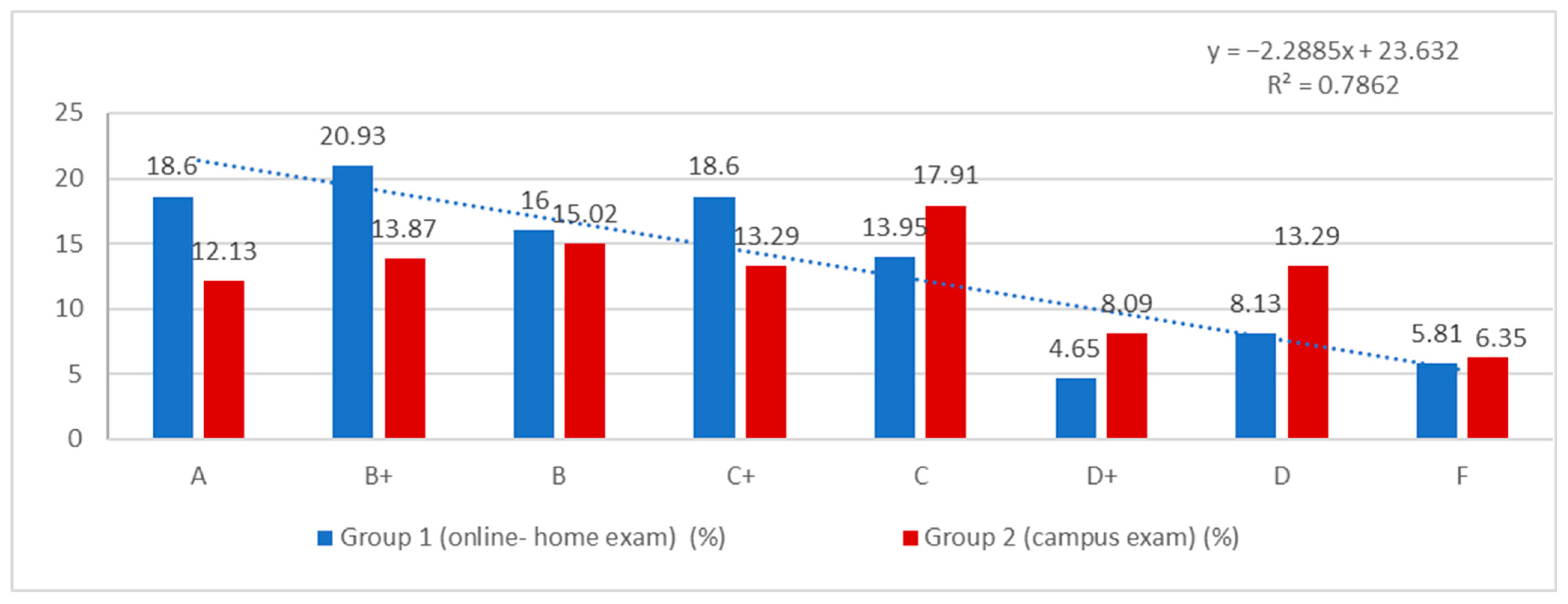
- Higher Grades (A and B+): G1 recorded a higher percentage of top-performing students, with 18.6% achieving an A and 20.93% a B+, totaling approximately 39.5%. In contrast, G2 had 12.13% earning an A and 13.87% a B+, totaling around 26%. This suggests that students in the online exam setting performed better at the upper end of the grade scale, possibly due to a more flexible or less stressful environment.
- (b)
- Mid-Range Grades (B to C): The proportions of students receiving B and C+ grades were relatively similar across both groups. G1 reported 16% in B and 18.6% in C+, while G2 had 15.02% in B and 13.29% in C+. However, G2 showed a higher percentage in the C category (17.91%) compared to G1 (13.95%), indicating a slight shift toward average performance in the on-campus group.
- (c)
- Lower Grades (D+, D, and F): G2 exhibited a notably higher proportion of lower grades, with 8.09% in D+, 13.29% in D, and 6.35% in F, totaling approximately 27.7%. Meanwhile, G1 showed 4.65% in D+, 8.13% in D, and 5.81% in F, totaling around 18.6%. This suggests that campus-based assessments may be associated with a higher incidence of low performance or failure.
3.5. Students’ Perceptions and Preferences for the Post-Pandemic Era
3.5.1. Preference for On-Campus Education
3.5.2. E-Learning Preference
3.5.3. Hybrid: On-Campus and Online Learning
4. Discussion
4.1. The Multidimensional Impacts of E-Learning During the Pandemic
4.2. Academic Performance Between Resilience and Sustainability
4.3. E-Learning for the Post-Pandemic Era and in Times of Crisis
4.4. The Sustainability of E-Learning Redefining Strategies Toward a New Sustainable Educational Paradigm
5. Conclusions
6. Implications of the Study and Suggestions
7. Limitations and Future Studies
Funding
Institutional Review Board Statement
Informed Consent Statement
Data Availability Statement
Acknowledgments
Conflicts of Interest
References
- World Health Organization (WHO). Novel Coronavirus (2019-nCoV): Situation Report, 11; WHO: Geneva, Switzerland, 2020; Available online: https://apps.who.int/iris/bitstream/handle/10665/330776/nCoVsitrep31Jan2020-eng.pdf (accessed on 21 November 2020).
- World Health Organization (WHO). Critical Preparedness, Readiness and Response Actions for COVID-19: Interim Guidance; WHO: Geneva, Switzerland, 2021; Available online: https://www.who.int/publications/i/item/critical-preparedness-readiness-and-response-actions-for-covid-19 (accessed on 14 March 2021).
- World Health Organization (WHO). WHO Coronavirus (COVID-19) Dashboard; WHO: Geneva, Switzerland, 2026; Available online: https://data.who.int/dashboards/covid19/cases?n=o (accessed on 21 January 2026).
- Maya, R. Social and Spatial Inequalities during COVID-19: Evidence from France and the Need for a New Sustainable Urban and Regional Development Paradigm. Sustainability 2024, 16, 3501. [Google Scholar] [CrossRef]
- United Nations. Policy Brief: Education During COVID-19 and Beyond; United Nations: New York, NY, USA, 2020; Available online: https://www.un.org/development/desa/dspd/wp-content/uploads/sites/22/2020/08/sg_policy_brief_covid-19_and_education_august_2020.pdf (accessed on 10 March 2021).
- Global University Network for Innovation (GUNI). Implementing the 2030 Agenda at Higher Education Institutions: Challenges and Responses; GUNI: Barcelona, Spain, 2019; Available online: https://www.hes-so.ch/fileadmin/documents/HES-SO/Documents_HES-SO/pdf/la_HES-SO/developpement-durable/GLOBAL-UNIVERSITY-NETWORK-FOR-INNOVATION-12023.pdf (accessed on 12 July 2023).
- Metcalfe, A.S. Visualizing the COVID-19 pandemic response in Canadian higher education: An extended photo essay. Stud. High. Educ. 2021, 46, 5–18. [Google Scholar] [CrossRef]
- Jung, J.; Horta, H.; Postiglione, G.A. Living in uncertainty: The COVID-19 pandemic and higher education in Hong Kong. Stud. High. Educ. 2021, 46, 107–120. [Google Scholar] [CrossRef]
- Garnett, J. The pandemic teaching journey: Challenges, lessons learned, and opportunities. J. Curric. Teach. Learn. Leadersh. Educ. 2021, 6, 6. [Google Scholar] [CrossRef]
- Elfirdoussi, S.; Lachgar, M.; Kabaili, H.; Rochdi, A.; Goujdami, D.; Firdoussi, L.E. Assessing distance learning in higher education during the COVID-19 pandemic. Educ. Res. Int. 2020, 2020, 8890633. [Google Scholar] [CrossRef]
- Browning, M.H.E.M.; Larson, L.R.; Sharaievska, I.; Rigolon, A.; McAnirlin, O.; Mullenbach, L.; Cloutier, S.; Vu, T.M.; Thomsen, J.; Reigner, N.; et al. Psychological impacts from COVID-19 among university students: Risk factors across seven states in the United States. PLoS ONE 2021, 16, e0245327. [Google Scholar] [CrossRef]
- Cao, W.; Fang, Z.; Hou, G.; Han, M.; Xu, X.; Dong, J.; Zheng, J. The psychological impact of the COVID-19 epidemic on college students in China. Psychiatry Res. 2020, 287, 112934. [Google Scholar] [CrossRef] [PubMed]
- Ullah, R.; Amin, S. The psychological impact of COVID-19 on medical students. Psychiatry Res. 2020, 288, 113020. [Google Scholar] [CrossRef]
- Al-Salman, S.; Haider, A.S.; Saed, H. The psychological impact of COVID-19 e-learning digital tools on Jordanian university students’ well-being. J. Ment. Health Train. Educ. Pract. 2022, 17, 342–354. [Google Scholar] [CrossRef]
- Meo, S.A.; Abukhalaf, A.A.; Alomar, A.A.; Sattar, K.; Klonoff, D.C. COVID-19 pandemic: Impact of quarantine on medical students’ mental well-being and learning behaviors. Pak. J. Med. Sci. 2020, 36, S43–S48. [Google Scholar] [CrossRef]
- Alsoufi, A.; Alsuyihili, A.; Msherghi, A.; Elhadi, A.; Atiyah, H.; Ashini, A.; Ashwieb, A.; Ghula, M.; Hasan, H.B.; Abudabuos, S.; et al. Impact of the COVID-19 pandemic on medical education: Medical students’ knowledge, attitudes, and practices regarding electronic learning. PLoS ONE 2020, 15, e0242905. [Google Scholar] [CrossRef]
- Vythilingam, D.I.; Prakash, A.; Nourianpour, M.; Atiomo, W.U. A scoping review of the literature on the impact of COVID-19 quarantine on the psychological well-being of medical students. BMC Med. Educ. 2022, 22, 770. [Google Scholar] [CrossRef]
- Al-Okaily, M.; Magatef, S.; Al-Okaily, A.; Shiyyab, F.S. Exploring the factors that influence academic performance in Jordanian higher education institutions. Heliyon 2024, 10, e33783. [Google Scholar] [CrossRef]
- Peca, L.; Dumbraveanu, R.; Ţurcanu, D. The sustainability of e-learning in higher education. J. Soc. Sci. 2024, 7, 111–129. [Google Scholar] [CrossRef] [PubMed]
- United Nations. Transforming Our World: The 2030 Agenda for Sustainable Development; United Nations: New York, NY, USA, 2015; Available online: https://sustainabledevelopment.un.org/post2015/transformingourworld/publication (accessed on 21 January 2026).
- United Nations Development Programme (UNDP). Human Development Report 1990: Concept and Measurement of Human Development; UNDP: New York, NY, USA, 1990; Available online: https://hdr.undp.org/content/human-development-report-1990 (accessed on 21 March 2021).
- Cochrane, S.H.; O’Hara, D.J.; Leslie, J. The Effects of Education on Health: A Background Study for World Development Report 1980; World Bank: Washington, DC, USA, 1980; Available online: https://documents.worldbank.org/en/publication/documents-reports/documentdetail/148951468764703628 (accessed on 15 April 2021).
- UNESCO. Education for Sustainable Development Goals: Learning Objectives; UNESCO: Paris, France, 2017; Available online: http://unesdoc.unesco.org/images/0024/002474/247444e.pdf (accessed on 12 March 2023).
- Abidoy, B.; Felix, J.; Kapto, S.; Patterson, L. Leaving No One Behind: Impact of COVID-19 on the Sustainable Development Goals (SDGs); United Nations Development Programme and Frederick S. Pardee Center for International Futures: New York, NY, USA; Denver, CO, USA, 2021; Available online: https://www.undp.org/publications/leaving-no-one-behind-impact-covid-19-sustainable-development-goals-sdgs (accessed on 10 March 2024).
- Cheikh Ismail, L.; Mohamad, M.N.; Bataineh, M.F.; Ajab, A.; Al-Marzouqi, A.M.; Jarrar, A.H.; Abu Jamous, D.O.; Ali, H.I.; Al Sabbah, H.; Hasan, H.; et al. Impact of the coronavirus pandemic (COVID-19) lockdown on mental health and well-being in the United Arab Emirates. Front. Psychiatry 2021, 12, 633230. [Google Scholar] [CrossRef] [PubMed]
- Alsuwaidi, A.R.; Al Hosani, F.I.; ElGhazali, G.; Al-Ramadi, B.K. Author correction: The COVID-19 response in the United Arab Emirates: Challenges and opportunities. Nat. Immunol. 2021, 22, 1186. [Google Scholar] [CrossRef]
- AlBlooshi, S.; Smail, L.; Albedwawi, A.; Wahedi, M.A.; AlSafi, M. The effect of COVID-19 on the academic performance of Zayed University students in the United Arab Emirates. All Work. 2023, 14, 6100. Available online: https://zuscholars.zu.ac.ae/works/6100 (accessed on 5 October 2024).
- Harvey, D. Front matter. In Social Justice and the City, Rev. ed.; University of Georgia Press: Athens, GA, USA, 1973; pp. 1–4. Available online: http://www.jstor.org/stable/j.ctt46nm9v.1 (accessed on 21 March 2021).
- Oxford Learner’s Dictionaries. Impact. 2022. Available online: https://www.oxfordlearnersdictionaries.com/definition/english/impact_1 (accessed on 10 September 2021).
- Organization for Economic Co-operation and Development (OECD). Glossary of Key Terms in Evaluation and Results-Based Management; OECD: Paris, France, 2002; Available online: https://www.oecd.org/dac/evaluation/dcdndep/39088226.pdf (accessed on 17 March 2022).
- United Nations Development Group (UNDG). Results-Based Management Handbook; United Nations: New York, NY, USA, 2011; Available online: https://unsdg.un.org/resources/unsdg-results-based-management-handbook (accessed on 3 October 2023).
- Kolb, D.A. Experiential Learning: Experience as the Source of Learning and Development; Prentice-Hall: Englewood Cliffs, NJ, USA, 1984. [Google Scholar]
- European Commission. eLearning: Designing Tomorrow’s Education; European Commission: Brussels, Belgium, 2001; Available online: https://ec.europa.eu/archives/publications/booklets/others/03/txt_en.pdf (accessed on 21 September 2022).
- Organization for Economic Co-operation and Development (OECD). E-Learning in Tertiary Education: Where Do We Stand? OECD: Paris, France, 2005; Available online: https://www.oecd.org/content/dam/oecd/en/publications/reports/2005/06/e-learning-in-tertiary-education_g1gh57df/9789264009219-en.pdf (accessed on 21 March 2021).
- Office for National Statistics (ONS). Domestic abuse during the coronavirus (COVID-19) pandemic, England and Wales: November 2020. Off. Natl. Stat. 2020, 25. Available online: https://www.ons.gov.uk/peoplepopulationandcommunity/crimeandjustice/ (accessed on 20 October 2024).
- Arkorful, V.; Abaidoo, N. The role of e-learning, the advantages and disadvantages of its adoption in higher education. Int. J. Educ. Res. 2014, 2, 397–410. [Google Scholar]
- Commonwealth of Learning. Guidelines on Distance Education During COVID-19; Commonwealth of Learning.: Vancouver, BC, Canada, 2020; Available online: https://oasis.col.org/colserver/api/core/bitstreams/068cb6c9-ca15-4463-b044-bdc5ba8c3262/content (accessed on 10 September 2021).
- Finkel, A. Differential Learning Outcomes for Online Versus In-Class Education: A Report to the Minister of Education; Australian Government: Canberra, Australia, 2020; Available online: https://apo.org.au/sites/default/files/resource-files/2020-05/apo-nid303772.pdf (accessed on 10 September 2022).
- Guest, M.; Maya, R.; Di Trani, A. Reinventing the pedagogy: About architectural and urban utopias. The experience of teaching the humanities and social sciences in a school of architecture during a pandemic. FAMagazine 2021, 136–143. [Google Scholar] [CrossRef]
- Hawryluck, L.; Gold, W.L.; Robinson, S.; Pogorski, S.; Galea, S.; Styra, R. SARS control and psychological effects of quarantine, Toronto, Canada. Emerg. Infect. Dis. 2004, 10, 1206–1212. [Google Scholar] [CrossRef]
- Lee, S.; Chan, L.Y.Y.; Chau, A.M.Y.; Kwok, K.P.S.; Kleinman, A. The experience of SARS-related stigma at Amoy Gardens. Soc. Sci. Med. 2005, 61, 2038–2046. [Google Scholar] [CrossRef]
- Kim, A.C.H.; Du, J.; Andrew, D.P.S. Changes in physical activity and depressive symptoms during COVID-19 lockdown: United States adult age groups. Front. Psychol. 2022, 13, 769930. [Google Scholar] [CrossRef] [PubMed]
- Lissak, G. Adverse physiological and psychological effects of screen time on children and adolescents: Literature review and case study. Environ. Res. 2018, 164, 149–157. [Google Scholar] [CrossRef]
- Sameer, A.S.; Khan, M.A.; Nissar, S.; Banday, M.Z. Assessment of mental health and coping strategies among the general population during COVID-19 lockdown: A cross-sectional study. Ethics Med. Public Health 2020, 15, 100571. [Google Scholar] [CrossRef] [PubMed]
- Song, L.; Singleton, E.S.; Hill, J.R.; Koh, M.H. Improving online learning: Student perceptions of useful and challenging characteristics. Internet High. Educ. 2004, 7, 59–70. [Google Scholar] [CrossRef]
- Brooks, S.K.; Webster, R.K.; Smith, L.E.; Woodland, L.; Wessely, S.; Greenberg, N.; Rubin, G.J. The psychological impact of quarantine and how to reduce it: Rapid review of the evidence. Lancet 2020, 395, 912–920. [Google Scholar] [CrossRef]
- American College of Pediatricians. The Impact of Media Use and Screen Time on Children, Adolescents, and Families; American College of Pediatricians: Gainesville, FL, USA, 2016; Available online: https://acpeds.org/wp-content/uploads/2025/04/11.9.16-The-Impact-of-Media-Use-and-Screen-Time-on-Children-updated-with-ref-64.pdf (accessed on 10 March 2024).
- Raes, A.; Detienne, L.; Windey, I.; Depaepe, F. A systematic literature review on synchronous hybrid learning: Gaps identified. Learn. Environ. Res. 2020, 23, 269–290. [Google Scholar] [CrossRef]
- Selye, H. The Stress of Life; McGraw-Hill: New York, NY, USA, 1956. [Google Scholar]
- Selye, H. Stress in Health and Disease; Butterworth: Boston, MA, USA, 1976. [Google Scholar]
- Finsterbusch, K. Psychological impact theory and social impacts. Impact Assess. 1982, 1, 71–89. [Google Scholar] [CrossRef]
- Lazarus, R.S. Theory-based stress measurement. Psychol. Inq. 1990, 1, 3–13. [Google Scholar] [CrossRef] [PubMed]
- Lazarus, R.S. From psychological stress to emotions: A history of changing outlooks. Annu. Rev. Psychol. 1993, 44, 1–22. [Google Scholar] [CrossRef]
- Latané, B. The psychology of social impact. Am. Psychol. 1981, 36, 343–356. [Google Scholar] [CrossRef]
- Finsterbusch, K. Estimating policy consequences for individuals, organizations, and communities. In Methodology of Social Impact Assessment; Finsterbusch, K., Wolf, C.P., Eds.; Dowden, Hutchinson and Ross: Stroudsburg, PA, USA, 1977; pp. 13–20. [Google Scholar]
- Alghamdi, A.A. Impact of the COVID-19 pandemic on the social and educational aspects of Saudi university students’ lives. PLoS ONE 2021, 16, e0250026. [Google Scholar] [CrossRef]
- Altalhi, W.A.; Allah, A.A.; Algethami, N.E.; Algethami, R.A.; AlAyyubi, R.H.; Ahmed Atalla, A.A. Impact of COVID-19 on psychological and academic performance of medical students in Saudi Arabia. J. Fam. Med. Prim. Care 2021, 10, 3857–3862. [Google Scholar] [CrossRef]
- Atlam, E.-S.; Ewis, A.; El-Raouf, M.M.A.; Ghoneim, O.; Gad, I. A new approach to identifying the psychological impact of COVID-19 on university students’ academic performance. Alex. Eng. J. 2022, 61, 5223–5233. [Google Scholar] [CrossRef]
- Commodari, E.; La Rosa, V.L.; Carnemolla, G.; Parisi, J. The psychological impact of lockdown on Italian university students during the first wave of COVID-19. Mediterr. J. Clin. Psychol. 2021, 9, 1–19. [Google Scholar]
- Clabaugh, A.; Duque, J.F.; Fields, L.J. Academic stress and emotional well-being in United States college students following onset of the COVID-19 pandemic. Front. Psychol. 2021, 12, 628787. [Google Scholar] [CrossRef] [PubMed]
- Curelaru, M.; Curelaru, V.; Cristea, M. Students’ perceptions of online learning during the COVID-19 pandemic: A qualitative approach. Sustainability 2022, 14, 8138. [Google Scholar] [CrossRef]
- Al Rawashdeh, A.Z.; Mohammed, E.Y.; Al Arab, A.R.; Alara, M.; Al-Rawashdeh, B. Advantages and disadvantages of e-learning in university education: Students’ perspectives. Electron. J. e-Learn. 2021, 19, 107–117. [Google Scholar] [CrossRef]
- UNESCO. Education Post-COVID-19: Global Education Meeting Declaration (ED/ADG/2020/03); UNESCO: Paris, France, 2020; Available online: https://unesdoc.unesco.org/ark:/48223/pf0000374704 (accessed on 23 September 2023).
- National Emergency Crisis and Disasters Management Authority (NCEMA). 2022. Available online: https://www.ncema.gov.ae (accessed on 18 October 2023).
- Ministry of Health and Prevention (MOHAP). COVID-19 Updates. 2022. Available online: https://mohap.gov.ae/en/covid-19/covid-19-updates (accessed on 18 October 2023).
- Al Hosany, F.; Ganesan, S.; Al Memari, S.; Al Mazrouei, S.; Ahamed, F.; Koshy, A.; Zaher, W. Response to COVID-19 pandemic in the UAE: A public health perspective. J. Glob. Health 2021, 11, 03050. [Google Scholar] [CrossRef]
- The United Arab Emirates Government Portal. Primary Governmental Efforts to Contain COVID-19. 2020. Available online: https://u.ae/en/information-and-services/justice-safety-andthe-law/handling-the-covid-19-outbreak/government-efforts-to-contain-covid-19 (accessed on 26 October 2023).
- Sachs, J.D.; Lafortune, G.; Fuller, G. Sustainable Development Report 2024: The SDGs and the UN Summit of the Future; SDSN: Paris, France; Dublin University Press: Dublin, Ireland, 2024; Available online: https://files.unsdsn.org/sustainable-development-report-2024.pdf (accessed on 21 March 2024).
- Times Higher Education (THE). The World University Rankings. 2022. Available online: https://www.timeshighereducation.com/world-university-rankings/university-sharjah (accessed on 27 December 2023).
- University of Sharjah (UOS). At a Glance: Facts and Figures. 2024. Available online: https://www.sharjah.ac.ae/-/media/project/uos/sites/uos/media-hub/facts_figures_en.pdf (accessed on 22 October 2024).
- Livari, N.; Sharma, S.; Ventä-Olkkonen, L. Digital transformation of everyday life during COVID-19. Int. J. Inf. Manag. 2020, 55, 102183. [Google Scholar] [CrossRef]
- Korkmaz, G.; Toraman, Ç. Are we ready for post-COVID-19 educational practice? Int. J. Technol. Educ. Sci. 2020, 4, 293–309. [Google Scholar] [CrossRef]
- Piaget, J. Science of Education and the Psychology of the Child; Orion Press: New York, NY, USA, 1970. [Google Scholar]
- Munhall, P.L. Perception. In The SAGE Encyclopedia of Qualitative Research Methods; Given, L.M., Ed.; SAGE: Thousand Oaks, CA, USA, 2008; pp. 606–607. [Google Scholar]
- Dany, L.; Urdapilleta, I.; Lo Monaco, G. Free associations and social representations. Qual. Quant. 2015, 49, 489–507. [Google Scholar] [CrossRef]
- Abric, J.-C. La recherche du noyau central et la zone muette des représentations sociales. In Méthodes d’Études des Représentations Sociales; Abric, J.-C., Ed.; Érès: Ramonville-Saint-Agne, France, 2003; pp. 59–80. [Google Scholar]
- Tashakkori, A.; Teddlie, C. Mixed Methodology: Combining Qualitative and Quantitative Approaches; SAGE: Thousand Oaks, CA, USA, 1998. [Google Scholar]
- Greenland, S.; Senn, S.J.; Rothman, K.J.; Carlin, J.B.; Poole, C.; Goodman, S.N.; Altman, D.G. Statistical tests, p-values, confidence intervals, and power: A guide to misinterpretations. Eur. J. Epidemiol. 2016, 31, 337–350. [Google Scholar] [CrossRef] [PubMed]
- Braun, V.; Clarke, V. Using thematic analysis in psychology. Qual. Res. Psychol. 2006, 3, 77–101. [Google Scholar] [CrossRef]
- Terry, G.; Hayfield, N.; Clarke, V.; Braun, V. Thematic analysis. In The SAGE Handbook of Qualitative Research in Psychology; Willig, C., Rogers, W.S., Eds.; SAGE: London, UK, 2017; pp. 17–36. [Google Scholar] [CrossRef]
- Dong, L.; Bouey, J. Public mental health crisis during COVID-19 pandemic, China. Emerg. Infect. Dis. 2020, 26, 1616–1618. [Google Scholar] [CrossRef]
- Giorgi, G.; Lecca, L.I.; Alessio, F.; Finstad, G.L.; Bondanini, G.; Lulli, L.G.; Arcangeli, G.; Mucci, N. COVID-19-related mental health effects in the workplace: A narrative review. Int. J. Environ. Res. Public Health 2020, 17, 7857. [Google Scholar] [CrossRef]
- Usher, K.; Bhullar, N.; Durkin, J.; Gyamfi, N.; Jackson, D. Family violence and COVID-19: Increased vulnerability and reduced options for support. Int. J. Ment. Health Nurs. 2020, 29, 549–552. [Google Scholar] [CrossRef]
- Caird, S.; Lane, A.; Swithenby, E.; Roy, R.; Potter, S. Design of higher education teaching models and carbon impacts. Int. J. Sustain. High. Educ. 2015, 16, 96–111. [Google Scholar] [CrossRef]
- Carr, A.; Modesto, S.; Balasubramanian, K.; Ortlieb, K.; Lesperance, J. Delivery mode and learner emissions: A comparative study from Botswana. In Climate Change and the Role of Education; Leal Filho, W., Hemstock, S., Eds.; Climate Change Management; Springer: Cham, Switzerland, 2019. [Google Scholar] [CrossRef]
- Corrigan-Gibbs, H.; Gupta, N.; Northcutt, C.; Cutrell, E.; Thies, W. Deterring cheating in online environments. ACM Trans. Comput.-Hum. Interact. 2015, 22, 1–23. [Google Scholar] [CrossRef]
- Harwell, D. Cheating-detection companies made millions during the pandemic. Now students are fighting back. In Ethics of Data and Analytics; Auerbach Publications: Boca Raton, FL, USA, 2020; pp. 410–417. [Google Scholar] [CrossRef]
- Hu, Y.H. Effects of the COVID-19 pandemic on the online learning behaviors of university students in Taiwan. Educ. Inf. Technol. 2022, 27, 469–491. [Google Scholar] [CrossRef]
- Cofini, V.; Perilli, E.; Moretti, A.; Bianchini, V.; Perazzini, M.; Muselli, M.; Lanzi, S.; Tobia, L.; Fabiani, L.; Necozione, S. E-learning satisfaction, stress, quality of life, and coping: A cross-sectional study in Italian university students a year after the COVID-19 pandemic began. Int. J. Environ. Res. Public Health 2022, 19, 8214. [Google Scholar] [CrossRef]
- Asarta, C.J.; Schmidt, J.R. The effects of online and blended experience on outcomes in a blended learning environment. Internet High. Educ. 2020, 44, 100708. [Google Scholar] [CrossRef]
- Hasan, N.; Bao, Y. Impact of “e-learning crack-up” perception on psychological distress among college students during the COVID-19 pandemic: A mediating role of “fear of academic year loss”. Child. Youth Serv. Rev. 2020, 118, 105355. [Google Scholar] [CrossRef] [PubMed]
- Wingo, N.P.; Ivankova, N.V.; Moss, J.A. Faculty perceptions about teaching online: Exploring the literature using the technology acceptance model as an organizing framework. Online Learn. 2017, 21, 15–35. [Google Scholar] [CrossRef]
- Vicario, C.M.; Mucciardi, M.; Perconti, P.; Lucifora, C.; Nitsche, M.A.; Avenanti, A. The impact of the COVID-19 pandemic on academic performance: A comparative analysis of face-to-face and online assessment. Front. Psychol. 2024, 14, 1299136. [Google Scholar] [CrossRef]
- Rashid, S.; Yadav, S.S. Impact of COVID-19 pandemic on higher education and research. Indian J. Hum. Dev. 2020, 14, 340–343. [Google Scholar] [CrossRef]
- Bulut, M.; Gökoğlan, K.; Serçek, S. Factors Affecting the Effectiveness of Sustainable Vocational Education: A Study on Academics in Turkey. Sustainability 2026, 18, 1877. [Google Scholar] [CrossRef]
- Andrews, J.; Higson, H. Graduate employability, ‘soft skills’ versus ‘hard’ business knowledge. High. Educ. Eur. 2008, 33, 411–422. [Google Scholar] [CrossRef]
- Goleman, D. Emotional Intelligence; Bantam Books: New York, NY, USA, 1995; Available online: https://donainfo.wordpress.com/wp-content/uploads/2017/09/emotional-intelligence-daniel-goleman.pdf (accessed on 21 April 2026).
- van Laar, E.; van Deursen, A.J.A.M.; van Dijk, J.A.G.M.; de Haan, J. The relation between 21st-century skills and digital skills. Comput. Hum. Behav. 2017, 72, 577–588. [Google Scholar] [CrossRef]
- World Economic Forum. The Future of Jobs Report 2020; World Economic Forum: Geneva, Switzerland, 2020; Available online: https://www.weforum.org/reports/the-future-of-jobs-report-2020 (accessed on 12 April 2026).
- OECD. OECD Digital Education Outlook 2026: Exploring Effective Uses of Generative AI in Education; OECD Publishing: Paris, France, 2026. [Google Scholar] [CrossRef]



| Variables | G1 | G2 | Total | G1 (Mean) | G2 (Mean) | G1 Std. Deviation | G2 Std. Deviation | Combined (Mean) | Std. Deviation | |
|---|---|---|---|---|---|---|---|---|---|---|
| Gender | Female | 56 | 92 | 148 | ||||||
| Male | 20 | 60 | 80 | 1.26 | 1.39 | 0.443 | 0.490 | 1.35 | 0.478 | |
| Specialization | Communication | 30 | 63 | 93 | ||||||
| Sociology | 46 | 89 | 135 | 1.61 | 1.59 | 0.492 | 0.494 | 1.59 | 0.493 | |
| Branch * | Sharjah | 44 | 76 | 120 | ||||||
| Al Dhaid | 11 | 35 | 46 | |||||||
| Khorfakkan | 20 | 36 | 56 | |||||||
| Kalba | 1 | 5 | 6 | 1.71 | 1.80 | 0.907 | 0.914 | 1.77 | 0.910 | |
| Academic year | First | 40 | 60 | 100 | ||||||
| Second | 19 | 48 | 67 | |||||||
| Third | 14 | 27 | 41 | |||||||
| Fourth | 3 | 17 | 20 | 1.74 | 2.01 | 0.900 | 1.013 | 1.92 | 0.983 | |
| Total % | 76 33.3 | 152 66.7 | 228 100 |
| Variables | G1 (76) | G2 (152) | G1 & 2 (228) | ||||
|---|---|---|---|---|---|---|---|
| n | % | n | % | n | % | ||
| PPIs | 1. Self-reliance and responsibility | 17 | 22.4 | 30 | 19.7 | 47 | 20.6 |
| 2. Self-confidence and the ability to confront and compete | 3 | 3.9 | 9 | 5.9 | 12 | 11.4 | |
| 3. Getting to know the self and taking care of nature | 18 | 23.7 | 8 | 5.3 | 26 | 5.3 | |
| 4. Feeling the value of life and family | 21 | 27.6 | 2 | 1.3 | 23 | 10.1 | |
| 5. Health awareness and self-care | 40 | 52.6 | 7 | 4.6 | 47 | 20.6 | |
| Total PPIs: | 99 | 63.87 | 56 | 36.12 | 155 | 18.4 | |
| PBIs | 6. Increase communication between family members | 54 | 71.1 | 38 | 25 | 92 | 40.4 |
| 7. Practicing sports activities | 15 | 19.7 | 4 | 2.6 | 19 | 8.3 | |
| 8. Practicing hobbies and gaining new skills | 34 | 44.7 | 14 | 9.2 | 48 | 21.1 | |
| 9. Our lives become more organized, calm, focused, and accomplished | 20 | 26.3 | 15 | 9.9 | 35 | 15.4 | |
| 10. Adaptation, changing consumer behaviors, and avoiding luxuries | 20 | 26.3 | 2 | 1.3 | 22 | 9.6 | |
| Total PBIs: | 143 | 66.20 | 73 | 33.79 | 216 | 25.65 | |
| PSIs | 11. Enhance family interaction and cohesion | 49 | 64.5 | 36 | 23.7 | 85 | 37.3 |
| 12. Save money, effort, and time | 15 | 19.7 | 51 | 33.6 | 66 | 28.9 | |
| 13. Changing some customs and traditions, speeding up marriage to save costs | 19 | 25 | 1 | 0.7 | 20 | 8.8 | |
| 14. Promoting a culture of social solidarity and adaptability | 12 | 15.8 | 11 | 7.2 | 23 | 10.1 | |
| 15. Flexibility and facility of learning and obtaining the scientific materials | 19 | 25 | 69 | 45.4 | 88 | 38.6 | |
| 16. Enhance relationships with colleagues, cooperate, and experience exchange | 14 | 18.4 | 17 | 11.2 | 31 | 13.6 | |
| 17. Facility of electronic communication with professors at any time | 8 | 10.5 | 26 | 17.1 | 34 | 14.9 | |
| 18. Getting to know a lot of colleagues through workgroups | 4 | 5.3 | 21 | 13.8 | 25 | 11 | |
| 19. Improving technical skills and employing technology in the community | 20 | 26.3 | 55 | 36.2 | 75 | 32.9 | |
| 20. Reducing pollution, traffic congestion, and improving the environment | 17 | 22.4 | 7 | 4.6 | 24 | 10.5 | |
| Total PSIs: | 177 | 37.57 | 294 | 62.42 | 471 | 55.93 | |
| Total PPIs, PBIs, PSIs | 419 | 49.76 | 423 | 50.23 | 842 | 35.17 | |
| NPIs | 21. Isolation and social distancing | 35 | 46.1 | 112 | 73.7 | 147 | 64.5 |
| 22. Fear of illness, failure, the future, and loss of self-confidence | 34 | 44.7 | 63 | 41.4 | 97 | 57.5 | |
| 23. Depression and negative feelings | 8 | 10.5 | 70 | 46.1 | 78 | 34.2 | |
| 24. Worry | 17 | 22.4 | 75 | 49.3 | 92 | 40.4 | |
| 25. Addiction to electronic devices | 3 | 3.9 | 53 | 34.9 | 56 | 24.6 | |
| 26. Pessimism | 7 | 9.2 | 0 | 0 | 7 | 3.1 | |
| 27. Stress | 7 | 9.2 | 50 | 32.9 | 57 | 25 | |
| 28. Sadness because of the death of relatives and friends | 15 | 19.7 | 20 | 13.2 | 35 | 15.4 | |
| 29. Deprivation, unequal opportunities, restricted access to public spaces | 34 | 44.7 | 38 | 25 | 72 | 31.6 | |
| 30. Psychological pressure, family (domestic violence), increases the burden on the student; exams have become more difficult | 9 | 11.8 | 99 | 65.1 | 108 | 47.4 | |
| 31. Mental health, distraction, and lack of focus | 2 | 2.6 | 87 | 57.2 | 89 | 39 | |
| Total NPIs: | 171 | 20.40 | 667 | 79.59 | 838 | 53.99 | |
| NBIs | 32. Difficulty of managing time and daily routine, conduct disorder | 23 | 30.3 | 75 | 49.3 | 98 | 43 |
| 33. Poor ability to organize behavioral disturbances (study, sleep, food) | 4 | 5.3 | 45 | 29.6 | 49 | 21.5 | |
| 34. Cheating and violating the rules of conduct in the exam | 0 | 0 | 39 | 25.7 | 39 | 17.1 | |
| 35. Laziness, boredom, indifference, and dependence on others, less (cooperation, creativity, participation, and educational motivation) | 7 | 9.2 | 96 | 63.2 | 103 | 45.2 | |
| 36. Change in the educational environment, weak interactive relationship with professors, and the ability to accurately assess students | 15 | 19.7 | 59 | 38.8 | 74 | 32.5 | |
| Total NBIs: | 49 | 13.49 | 314 | 86.50 | 363 | 23.38 | |
| NSIs | 37. Poor communication, social isolation, and shyness | 44 | 57.9 | 101 | 66.4 | 145 | 63.6 |
| 38. Technical issues, unsuitable home learning environments, reduced practical engagement, and declining academic performance | 10 | 13.2 | 102 | 67.1 | 112 | 49.1 | |
| 39. Health problems, physical stress, weight gain, and long screen sitting | 3 | 3.9 | 51 | 33.6 | 54 | 23.7 | |
| 40. Economic impact due to unemployment and losses in resources | 26 | 34.2 | 14 | 9.2 | 40 | 17.5 | |
| Total NSIs: | 83 | 23.64 | 268 | 76.35 | 351 | 22.61 | |
| Total NPIs, NBIs, NSIs | 303 | 41.96% | 1249 | 74.70% | 1552 | 64.82 | |
| Levene’s Test for Equality of Variances | t-Test for Equality of Means | ||||||||||
|---|---|---|---|---|---|---|---|---|---|---|---|
| F | Sig. | t | df | Significance | Mean Difference | Std. Error Difference | 95% Confidence Interval of the Difference | ||||
| One-Sided p | Two-Sided p | Lower | Upper | ||||||||
| Degrees | Equal variances assumed | 4.155 | 0.042 | 3.124 | 268 | <0.001 | 0.002 | 7.211 | 2.308 | 2.666 | 11.755 |
| Equal variances not assumed | 3.675 | 250.871 | <0.001 | <0.001 | 7.211 | 1.962 | 3.347 | 11.075 | |||
| Psychological Impacts | ||||
|---|---|---|---|---|
| Variable | Significance | Mean Difference | Group with Higher Score | Interpretation |
| <0.001 | 0.355 |  Group 2 Group 2 | Experienced significantly higher depression and negative feelings. |
| Stress | <0.001 | −0.237 | Group 2 | Reported significantly higher stress levels. |
| Worry | 0.007 | −0.270 | Group 2 | Recorded significant pessimism. |
| Psychological pressure (e.g., exams harder) | <0.001 | −0.533 | Group 2 | Reported much higher psychological pressure. |
| Mental health, distraction, and lack of focus | <0.001 | −0.543 | Group 2 | Experienced significantly more distractions and mental health issues. |
| ||||
| Health awareness and self-care | <0.001 | 0.480 |  Group 1 Group 1 | Recorded better health awareness and self-care. |
| Increase communication between family members | <0.001 | 0.461 | Group 1 | Showed more family communication. |
| Practicing hobbies and skills | <0.001 | 0.355 | Group 1 | Noted more engagement in hobbies and skills. |
| Practicing sport activities | <0.001 | 0.187 | Group 1 | Recorded more sports participation. |
| Enhance family interaction and cohesion | <0.001 | 0.414 | Group 1 | Presented higher family cohesion. |
| Adaptation, consumption behavior changes | <0.001 | 0.250 | Group 1 | Showed more adaptation. |
| ||||
| Isolation and social distancing | <0.001 | 0.263 | Group 1 | Reported more isolation and social distancing. |
| Cheating and violating exam conduct | <0.001 | −0.250 | Group 2 | Engaged more in cheating behaviors. |
| Laziness, boredom, indifference | <0.001 | −0.548 | Group 2 | Showed much higher laziness and boredom. |
| ||||
| Technical problems and impractical tools | <0.001 | −0.539 | Group 2 | Faced significantly more technical and learning difficulties. |
| Difficulty managing time and daily routine | 0.006 | 0.191 | Group 2 | Struggled more with daily time management. |
| Poor ability to organize between study, food, and sleep | <0.001 | −0.243 | Group 2 | Reported worse organizational skills. |
| Change in the perception of the educational environment | 0.002 | −0.191 | Group 2 | Perceived more negative educational changes. |
| ||||
| Unemployment and economic impact perception | <0.001 | 0.249 | Group 1 | Perceived the economic impact as more severe. |
| Deprivation and unequal opportunities | <0.001 | 0.197 | Group 1 | Perceived more deprivation. |
| Reducing pollution, improving the environment | <0.001 | 0.178 | Group 1 | Showed more environmental awareness. |
| ||||
| Self-reliance and responsibility | 0.025 |  No difference No difference | No significant difference. | |
| Self-confidence, ability to compete | −0.02 | No difference | No significant difference. | |
| Fear of illness, failure, and loss of self-confidence | 0.07 | No difference | ||
| Remote electronic communication skills | 0.072 | No difference | ||
| Ease of communication with professors | 0.066 | No difference | ||
| Getting to know colleagues via work groups | 0.086 | No difference | ||
| Sadness due to loss of relatives and friends | 0.012 | 0.066 | No difference | |
Group 1 scored higher| Group 2 scored higher| No significant difference. Source: Author.| Variables | On-Campus | E-Learning | Hybrid | No Opinion | Total | |||||
|---|---|---|---|---|---|---|---|---|---|---|
| Preference | n | % | n | % | n | % | n | % | n | |
| 64 | 42.1 | 23 | 15.13 | 6 | 3.94 | 59 | 38.81 | 152 | ||
| Gender | Female | 42 | 27.6 | 14 | 9.2 | 4 | 2.6 | 32 | 21.1 | 92 |
| Male | 22 | 14.5 | 9 | 15.0 | 2 | 1.3 | 27 | 17.8 | 60 | |
| Academic year | First year | 29 | 19.1 | 9 | 5.9 | 1 | 0.7 | 21 | 13.8 | 60 |
| Second year | 22 | 14.5 | 11 | 7.2 | 2 | 1.3 | 13 | 8.6 | 48 | |
| Third year | 8 | 5.3 | 2 | 1.3 | 1 | 0.7 | 16 | 10.5 | 27 | |
| Fourth year | 5 | 3.3 | 1 | 0.7 | 2 | 1.3 | 9 | 5.9 | 17 | |
| Branch | Sharjah | 35 | 23.0 | 12 | 7.9 | 2 | 1.3 | 27 | 17.8 | 76 |
| Al Dhaid | 16 | 10.5 | 4 | 2.6 | 1 | 0.7 | 14 | 9.2 | 35 | |
| Khorfakkan | 11 | 7.2 | 7 | 4.6 | 2 | 1.3 | 16 | 10.5 | 36 | |
| Kalba | 2 | 1.3 | 0 | 0 | 2 | 1.3 | 1 | 0.7 | 5 | |
| Specialization | College of Communication | 24 | 15.8 | 7 | 4.6 | 2 | 1.3 | 30 | 19.7 | 63 |
| Department of Sociology | 40 | 26.3 | 16 | 10.5 | 4 | 2.6 | 29 | 19.1 | 89 | |
Disclaimer/Publisher’s Note: The statements, opinions and data contained in all publications are solely those of the individual author(s) and contributor(s) and not of MDPI and/or the editor(s). MDPI and/or the editor(s) disclaim responsibility for any injury to people or property resulting from any ideas, methods, instructions or products referred to in the content. |
© 2026 by the author. Licensee MDPI, Basel, Switzerland. This article is an open access article distributed under the terms and conditions of the Creative Commons Attribution (CC BY) license.
Share and Cite
Maya, R. The Sustainability of E-Learning in UAE Higher Education: Digital Transformation, Inequality, and Student Well-Being in the Time Crisis. Sustainability 2026, 18, 4755. https://doi.org/10.3390/su18104755
Maya R. The Sustainability of E-Learning in UAE Higher Education: Digital Transformation, Inequality, and Student Well-Being in the Time Crisis. Sustainability. 2026; 18(10):4755. https://doi.org/10.3390/su18104755
Chicago/Turabian StyleMaya, Roula. 2026. "The Sustainability of E-Learning in UAE Higher Education: Digital Transformation, Inequality, and Student Well-Being in the Time Crisis" Sustainability 18, no. 10: 4755. https://doi.org/10.3390/su18104755
APA StyleMaya, R. (2026). The Sustainability of E-Learning in UAE Higher Education: Digital Transformation, Inequality, and Student Well-Being in the Time Crisis. Sustainability, 18(10), 4755. https://doi.org/10.3390/su18104755