Article

Geosite Digital Popularity Index: A Data-Driven Framework for Geoheritage Assessment to Support Geotourism Development

Department of Geo and Mining Tourism, Institute of Earth Resources, Faculty of Mining, Ecology, Process Control and Geotechnologies, Technical University of Košice, Letná 9, 042 00 Košice, Slovakia
*
Author to whom correspondence should be addressed.
Sustainability 2026, 18(10), 4744; https://doi.org/10.3390/su18104744
Submission received: 20 March 2026 / Revised: 22 April 2026 / Accepted: 5 May 2026 / Published: 9 May 2026

Abstract

As the tourism sector increasingly integrates data-driven planning, the potential of geoheritage for regional development remains underrealised due to the persistent absence of standardised visitor statistics and metrics. This paper presents a scalable framework that utilises open-access digital indicators, such as user reviews, ratings, and geotagged photographs, to develop a Geosite Digital Popularity Index (GDPI) for assessing visibility and appeal. Implemented across 19 sites in the Košice region of eastern Slovakia, the methodology shows that user ratings are the most significant predictor of perceived geotourism value and that digital presence can effectively counteract physical remoteness, providing practical insights for heritage professionals and planners operating in environments with limited data. The approach is cost-effective, transferable, and adaptable for other regions seeking to valorise underrecognized geoheritage assets. Consequently, this research proposes a methodological framework utilising open digital traces, such as reviews, photographs, and ratings, to transform raw digital traces into actionable, scalable indicators. Its applicability in data-scarce contexts underscores its potential to serve as a cost-effective, globally replicable tool for researchers and planners.

1. Introduction

Geotourism—defined as tourism that emphasises the geological character of a destination, including landforms, processes, and interpretive narratives—has gained prominence as a driver of sustainable territorial development [1]. However, many geosites remain underutilised, while the lack of systematic visitor monitoring and limited interpretive infrastructure constrain the ability of managers to effectively assess, develop, and promote these sites [2]. At the same time, the growth of open digital platforms (e.g., Google Maps, Tripadvisor) has produced large amounts of user-generated content that increasingly reflect patterns of public interest and spatial attention.
This influx of user-generated data signifies a paradigm shift in the construction and perception of destination images [3]. Such content and its effective utilisation possess the potential to bridge the gap between a geosite’s physical presence and its digital visibility, thereby enhancing awareness among potential visitors and supporting geotourism development initiatives.
Geosites, encompassing various unique geological or geomorphological features [4,5], serve as the primary source for geotourism development [6,7,8,9]. They are often among the main motivations for visiting a specific place or destination across different nature-based tourism types. To express the different values of such locations, several geosite assessment methods have been introduced [5,10,11,12,13,14,15]. Despite some of these methods being declared for geotourism purposes (e.g., Kubalíková and Kirchner [12]; Suzuki and Takagi [15]), their effective use in geotourism development remains limited, as existing frameworks are primarily designed for expert evaluation and are not consistently translated into operational tourism planning tools [16], which highlights a persistent gap between assessment outputs and practical implementation. In particular, systematic monitoring of geosite use is not commonly embedded within tourism decision-making frameworks, which further constrains the practical application of assessment outputs, even though visitor behaviour itself is not directly influenced by awareness of such monitoring systems.
Contemporary spatial behaviour and tourism theory suggest that destination choice is influenced not only by cost or accessibility but also by symbolic meaning and perceptual prominence [17,18,19]. In this context, given the importance and extent of utilisation of various online tools and social media platforms, the digital presence of a location, particularly its visual representation, has evolved into a critical element in the decision-making process prior to visitation [20,21,22]. Consequently, photographic density may function as a metric for perceived attractiveness and the potential for social sharing, effectively serving as a proxy indicator that links a geosite’s physical existence and its digital visibility.
User reviews and ratings offer both qualitative insights and serve as mechanisms for collective validation [23,24,25]. While geographic distance has traditionally influenced visitation patterns [26,27,28], its effect may be mitigated by the site’s distinctiveness or the robustness of its narrative identity.
The relevance of extracting users’ digital footprints for gaining low-cost input data on visitor experiences has become well established within tourism research [29,30,31]. However, in the context of geoheritage-related tourism studies and development, this approach has received limited attention in the literature. Pijet-Migoń and Migoń [32] used TripAdvisor to investigate visitor perceptions and evaluations of five localities with geothermal phenomena in New Zealand. Sidor et al. [33], also using TripAdvisor data, have shown how such techniques can be used to construct and strengthen the online identity of geoheritage, both as tourism resources and even assets.
This study is founded on the premise that these multifaceted indicators, such as visual salience, user engagement, perceived quality, and spatial accessibility, can be integrally combined into a weighted index that may contribute to the assessment of a site’s relative developmental potential.
The paper presents a systematic methodology for extracting, normalising, and aggregating digital signals into a Geosite Digital Popularity Index (GDPI), thereby facilitating comparative analysis and prioritisation of geotourism sites. Although fundamental inferential statistical techniques are employed to assess the coherence of the index, the primary innovation lies in the integration of diverse digital indicators (user-generated content from geosites visitors available online) within a unified assessment framework.
The proposed novel model aims to assist destination managers, planners, and researchers in identifying underrecognized geosites with latent interpretive and developmental potential.

2. Materials and Methods

Traditional geosite or geoheritage assessment methodologies, such as the frameworks proposed by Kubalíková [11], Brilha [5] or Tomić and Božić [13], are essential for identifying the intrinsic scientific and educational potential of a region. However, as highlighted by Štrba et al. [16], a persistent challenge in geoheritage management is the disparity between these expert-led normative evaluations and the actualised potential of a site from a visitor’s perspective.
While expert assessments utilise measurable physical quantities to select localities suited for development, they are often disconnected from the current functional performance of a site, including its digital tourism market. In contrast, proposed GDPI is intended not as a replacement for these expert evaluations, but as a complementary metric allowing practical use.
As previously indicated, the construction of the GDPI relies on four variables: (1) the number of user-generated reviews (R), (2) the average user rating (S), (3) the total number of aggregated photographs (P), and (4) the distance from the specified location, such as an urban area or city centre (D).
Site reviews and star ratings can be considered a significant factor affecting a place’s visit. According to Guo and Pesonen [34], online travel reviews are critical in shaping the cognitive (factual) and affective (emotional) dimensions of a destination’s image. In this regard, within the proposed GDPI framework, the volume of reviews (R) functions as a proxy for the reduction in information uncertainty, providing the ‘social proof’ necessary for a tourist to transition from awareness to intent. Meanwhile, the average rating (S) represents the consolidated evaluative image, serving as a cognitive anchor that reflects the site’s ability to meet the ‘lived’ expectations of past visitors.
Photographs serve as crucial cognitive tools that communicate information more effectively than text by capturing a destination’s image through a combination of objective site attributes and subjective visitor perceptions. Wang et al. [35] demonstrate that high-quality visual experiences significantly improve a site’s appeal, with tourists’ visual preferences, emphasising authentic, ‘lived’ experiences over idealised promotional images, promoting organic sharing and fostering peer-to-peer trust.
In the digital age, routing algorithms translate spatial distances into ‘travel time,’ which functions as the primary psychological threshold for individuals. Additionally, road distance serves as a reliable proxy for this temporal cost, being unaffected by transient factors such as traffic congestion or weather conditions that can distort time-based measurements. Although temporal factors are significant, physical road distance offers a more consistent and objective measure for standardised index. The integration of road distance as a deterministic variable aligns with the ‘Accessibility Development’ framework proposed by Lakshmanan [36], who asserts that spatial interactions and regional value are fundamentally influenced by transport infrastructure connecting peripheral assets to central logistical hubs. Building on Kendall’s [37] theoretical framework, a specific location, such as an urban area or city centre, is considered not merely as a coordinate but as the ‘infrastructural heart’ of the broader region. As Kendall suggests, the city functions as a ‘synecdoche’ for the region, representing the primary brand and logistical gateway that shapes public perception and access to peripheral assets. Additionally, Li et al. [38] suggest that tourist decision-making is driven by perceived temporal cost. In the absence of static digital ‘time’ data, road network distance serves as the most reliable objective representative for this perceived cost.
The final score aims to serve as a scalable framework that utilises open-access, user-generated digital inputs as proxies for underlying site attractiveness and potential visibility.
The methodological approach consists of the following three phases:
  • Data operationalisation and preprocessing—including data collection, normalisation and transformation;
  • GDPI definition—including index weighting, GDPI final calculation;
  • Validation and application.
Together, these steps form a standardised and reproducible workflow for translating heterogeneous digital indicators into a single composite measure of geosite popularity.

2.1. Data Operationalisation and Preprocessing

To collect the data, the specific digital platform(s) (e.g., Google Maps, TripAdvisor, etc.) that will be the source for R, S, and P should be determined. In this regard, it is necessary to secure access or develop scraping tools to ensure compliance with the terms of service.
Data were collected manually from Google Maps for selected geosites in April 2026 to ensure consistency across observations over time.
The choice of Google Maps as the data source was made because, compared with TripAdvisor, it captures a more diverse, naturally occurring sample of local visitors and tourists, thereby offering a more representative indicator of actual site popularity. The preference for Google Maps is supported by Mellinas and Sicilia [39], who demonstrate that Google accumulates reviews at a rate significantly higher than TripAdvisor. This is due to a lower ‘interaction barrier’ (allowing star-only ratings), which captures ‘ambient’ feedback from locals and domestic visitors. This naturally occurring sample reduces the selection bias inherent in TripAdvisor, which is skewed toward deliberate international travellers. For an index assessing regional development, capturing this broader ‘digital trace’ of local appreciation is empirically more representative. Furthermore, as discussed by Wang et al. [35], Google Maps are more likely to capture authentic, ‘lived’ experiences and scene-based content. This contrasts with social media platforms such as Instagram or TikTok, which often cater to idealised or highly curated travel content [40], potentially masking the state of geosite.
The preprocessing phase was designed to transform raw digital indicators into a standardised index while preserving the inherent variance of the dataset. A key principle of this approach is the retention of extreme data.
Within the defined methodological framework, extreme values are regarded as valid indicators of exceptional (un)popularity or specialised appeal rather than statistical noise. Consequently, no abnormal or extreme data were eliminated. Instead, these values were mathematically incorporated to delineate the upper and lower boundaries of the regional digital landscape.
To ensure these extremes did not disproportionately skew the results while maintaining their relative positioning, the following steps were performed:
  • Z-score standardisation;
  • objective index weighting via Principal Component Analysis.
As the four selected variables (R, S, P, and D) exist on fundamentally different scales and units (e.g., number of reviews (e.g., 50,000+) vs. 5-point rating scale), and their simple direct combination will result in mathematically meaningless and functionally biased outputs, their normalisation, forcing all variables onto a common, comparable scale, is required.
To accurately represent the varying significance of each factor, it is essential that each variable is assigned a specific weight. These weights are intrinsically linked to the normalisation process of the selected variables, as normalisation decouples the weight from the scale. By first scaling all variables to a comparable range, the resulting score genuinely reflects the assigned weights rather than the measurement units. In the absence of normalisation, the weights would exert only a marginal influence on the final GDPI score, as the scale differences between variables (e.g., R and S) would predominantly determine the ultimate index value.
For this purpose, Z-score standardisation was employed. This method scales the values according to their natural dispersion. While z-scores do not ensure a fixed range as the min–max method does [41], they normalise the scales such that the values are comparable based on their standard deviation, thereby preventing any single variable from disproportionately influencing the analysis due to its magnitude [42].
Since distance, as one of the selected variables, is expected to have an inverse relationship with the overall attractiveness (lower distance results in a higher score), the D should be transformed (by assigning a negative value) so that its normalised value positively correlates with the final GDPI score.
To objectively determine the importance of individual variables, Principal Component Analysis (PCA) was employed. PCA is a multivariate statistical technique utilised to reduce dataset dimensionality while minimising information loss by generating new uncorrelated variables, known as principal components, which are linear combinations of the original variables [43]. Through this methodology, the first principal component (PC1) signifies the single linear combination of standardised variables that captures the greatest proportion of the total variation in the dataset. The weights assigned to each variable are derived from the PC1 factor loadings. An important advantage of utilising these loadings as weights is their optimal configuration to maximise the variance of the units, thereby facilitating the most objective calculation of the final GDPI value.
Using multiple components (e.g., PC1 and PC2) to form a single composite index yields a new score in which each variable’s final weight is the weighted average of its loadings across all retained components. The weight assigned to each component (PCj) in this average is its proportion of the total variance explained by all components retained. This ensures the components that explain more variance have a greater influence on the final weights. To determine the optimal number of PCs, the Kaiser–Guttman rule can be applied, retaining all PCs with eigenvalues greater than 1 [44].
The general calculation for the final weight (wi) of variable i is:
w i = j = 1 k ( λ j j = 1 k λ j · e j i ) ,
where λj is the eigenvalue of PCj and eji is the loading of variable i on PCj. The eigenvalues (λ) are found by solving the characteristic equation of the correlation matrix, which contains the correlation coefficients for your standardised variables P, R, S, and D. The loadings provide the actual coefficients or weights that define the linear equation for each principal component. For statistical analysis, XLSTAT (version 2025.27.1) within MS Excel was used.

2.2. GDPI Definition

Following the above-mentioned methodological approach, the final value of GDPI is then defined by the formula:
G D P I = w R · R n + w s · S n + w P · P n w D · D n t
where:
  • Rn is the normalised value of the number of reviews,
  • Sn is the normalised value of the mean user rating on a 5-star scale,
  • Pn is the normalised number of photographs,
  • Dnt is the normalised and transformed distance (in kilometres) from the defined location (e.g., city),
  • wR is the weight of R,
  • wS is the weight of S,
  • wP is the weight of P,
  • wD is the weight of D.
The final GDPI score aims to serve as a scalable framework that utilises open-access, user-generated digital inputs as proxies for underlying site attractiveness and potential visibility.

2.3. Characteristics of Sites Used in Application Case Study

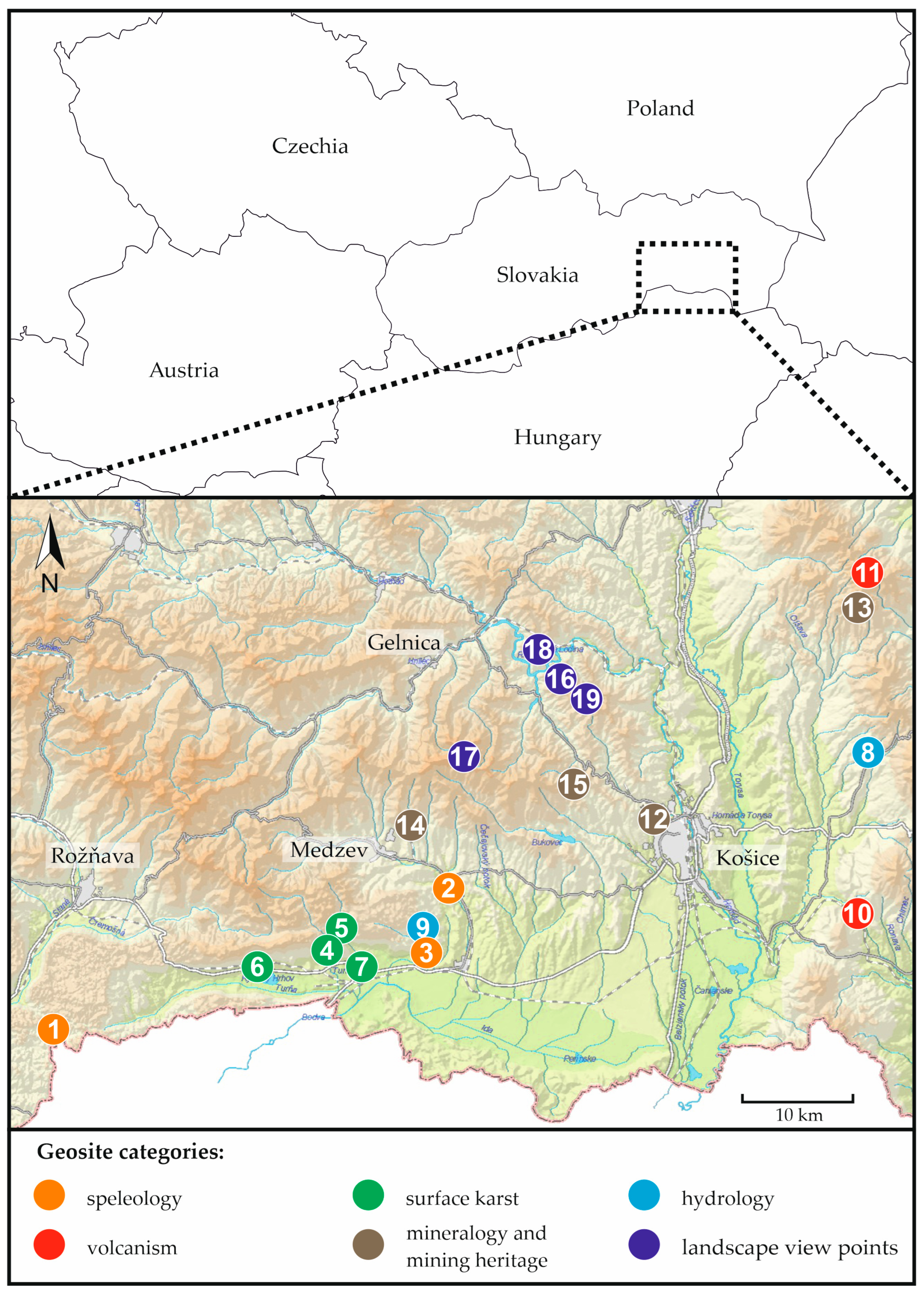
To evaluate the defined GDPI, geotourism-relevant sites within the Košice region of eastern Slovakia (Table 1, Figure 1) were selected based on the authors’ expertise in geotourism, existing regional geosite inventories, and data availability. For each selected geosite, publicly available variables were extracted, including the number of user-generated reviews, the average user rating on a 5-star scale, the number of geotagged photographs, and the distance from Košice city centre in kilometres.
Table 1 summarises the retrieved data information of selected geosites in the case study. As shown in the table, the variables differ widely in scale and units.
To synthesise the diverse characteristics of these 19 localities and provide a logical basis for the subsequent GDPI analysis, the sites were categorised into six thematic categories (Table 2). This classification facilitates pre-analysis, where the digital performance of each site can be interpreted through its geoheritage and functional identity. By grouping sites with shared geological/geomorphological or anthropogenic traits, it becomes possible to determine whether a site’s digital signature is a characteristic of its thematic archetype (e.g., the high visual salience of viewpoints) or represents an intra-category outlier (e.g., the functional utility of certain hydrological sites versus the aesthetic spectacle of others).

2.3.1. Speleological Geosites

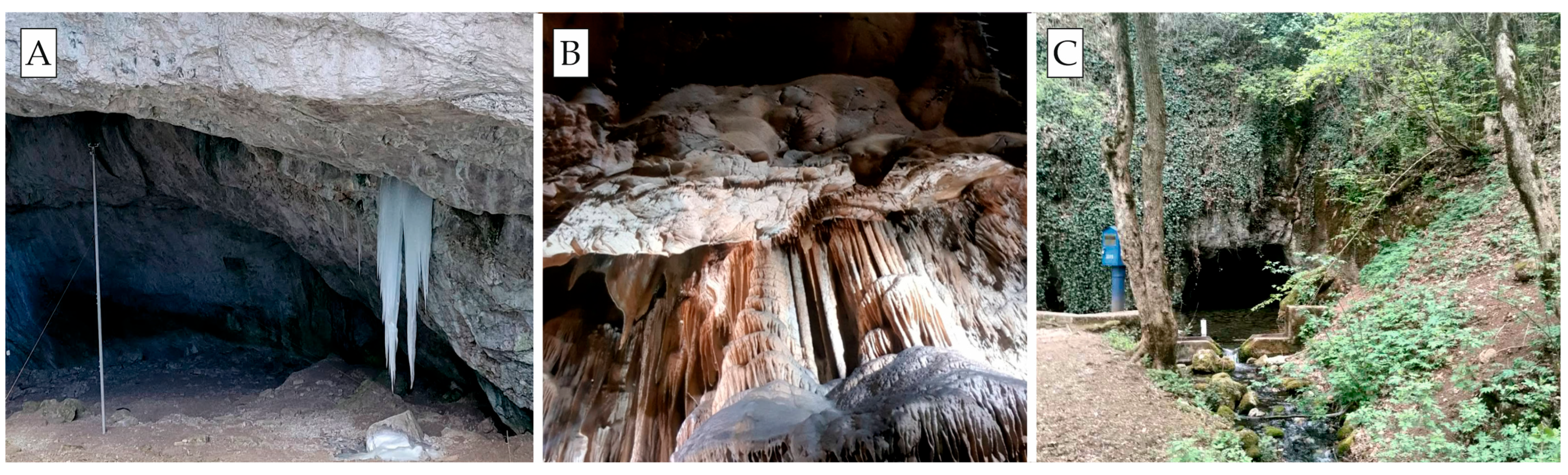
Silická ľadnica Cave (Figure 2A) is situated within a collapsed doline-like depression, this chasm functions as a perennial subterranean glaciological trap due to its stagnant microclimate and negative thermal inversion. The site demonstrates the intersection of karst hydrogeology and climatology, where the accumulation of winter air masses allows for the preservation of ice at a remarkably low altitude (the lowest-lying perennial ice cave up to 50 degrees north latitude in the temperate climatic zone). This ice Cave is a part of the site Caves of Aggtelek and Slovak Karst, inscribed in the World Heritage List in 1995 [46].
Jasovská jaskyňa Cave (Figure 2B) is a UNESCO-protected site located within the Steinalm limestones and dolomites [47], and exhibits a complex, multi-level morphology formed by water penetrating the rock environment from the Bodva River. The cave is a very good example of a location for clarifying the connections between speleogenesis and the development of valleys in the eastern part of the Slovak Karst and the surrounding area, featuring high-density dripstone formations and significant archaeological horizons [48].
Drienovská jaskyňa Cave (Figure 2C) is situated on the southern margin of the Jasov Plateau, north of the village of Drienovec at the mouth of the Miglinc Valley. The cave represents a spring-fed fluvial cave developed in Mesozoic Middle Triassic light Wetterstein limestones of the Silica Nappe. An underground stream flows through the lower parts of the cave, forming subterranean lakes, cascades, and small waterfalls in certain sections. Pronounced fluvial modelling is evidenced by ceiling and lateral channels, as well as floor-incised stream notches and erosional depressions. It ranks among the most significant chiropterological localities in Slovakia. Together with Jasovská jaskyňa, it forms a coherent system of subterranean refuges along the eastern margin of the Slovak Karst, supporting important assemblages of several bat species. Archaeological finds have also been discovered in the cave, dating to the Neolithic (Bukovohorská Culture) and the Bronze Age (Piliny Culture) [49].

2.3.2. Surface Karst Geosites

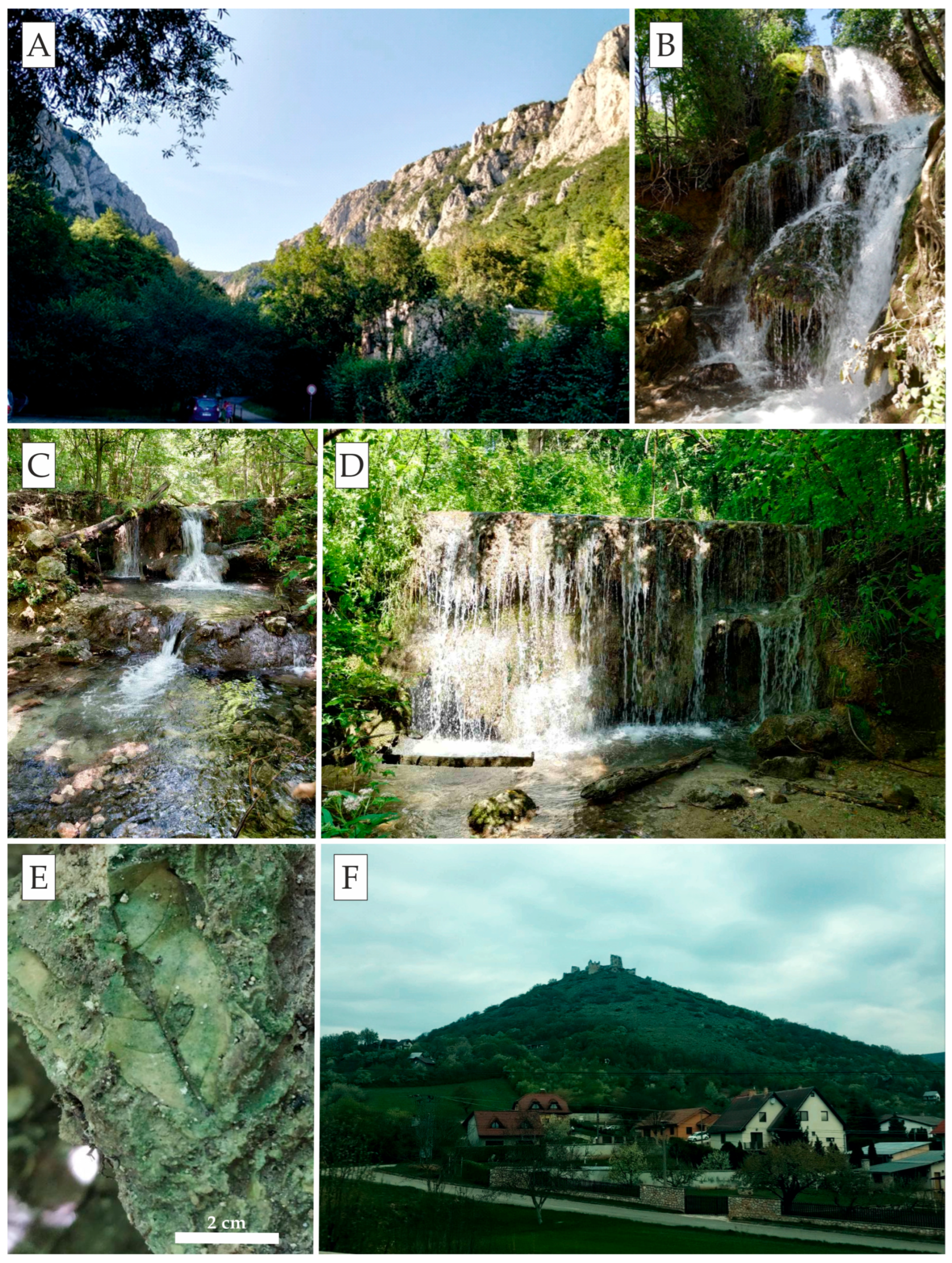
Zádielska tiesňava (Figure 3A), popular tourist canyon, spans a length of four kilometres. Its width at the base ranges from 20 to 100 m, with some sections reaching depths of up to 300 m. The bedrock primarily consists of Triassic limestone and dolomite formations. Approximately at the middle, there is an isolated rock tower called Cukrová homoľa (‘Sugar Loaf’), sought after by climbers. The upper region of the valley features several springs and numerous caves. The most picturesque view unfolds at the entrance of the valley [50].
Hrhovský vodopád (Figure 3B), a 14 m waterfall, is situated on a massive travertine mound, one of the largest such accumulations in the Slovak Karst region. The site demonstrates the long-term depositional capacity of karst springs, where mineral-rich waters have historically transformed the local topography into a series of prograding stepped platforms. The site provides excellent exposures for studying the internal structure of porous carbonate rocks developed on quarry faces [51].
Hájske vodopády (Figure 3C,D), cascades, are characterised by the rapid precipitation of calcium carbonate, resulting in the formation of extensive calcareous tufa terraces. The site is a dynamic example of contemporary biochemical sedimentation, where the degasification of karst waters facilitates the encrustation of organic matter. There are 9 waterfalls in the area, ranging in height from 1.2 m to 6.6 m [52]. Various plant fossils and leaf impressions can be found within the tufas near the waterfalls (Figure 3E).
Turňa Castle Hill (Figure 3F) is a karst hill situated at an elevation of 375 m within the Slovenský Kras National Park. At its summit stand the remnants of a medieval guard castle dating back to the 13th century. The surrounding region is designated as a national natural reserve owing to its scientific significance as a floristic and faunistic site. This hill is an integral part of an extensive ridge typical of karst landscapes. Known as the Turniansky Ridge, this lengthy formation extends approximately 3.8 km and is positioned between Zádielsky Kameň (601 m a.s.l.) and Turňa Castle Hill (375 m above sea level). The geological features of this area include various fissures, cavities, sinkholes, and other karst phenomena, all of which exemplify the formidable power of natural processes and are characteristic of karst topography [53].

2.3.3. Hydrological Geosites

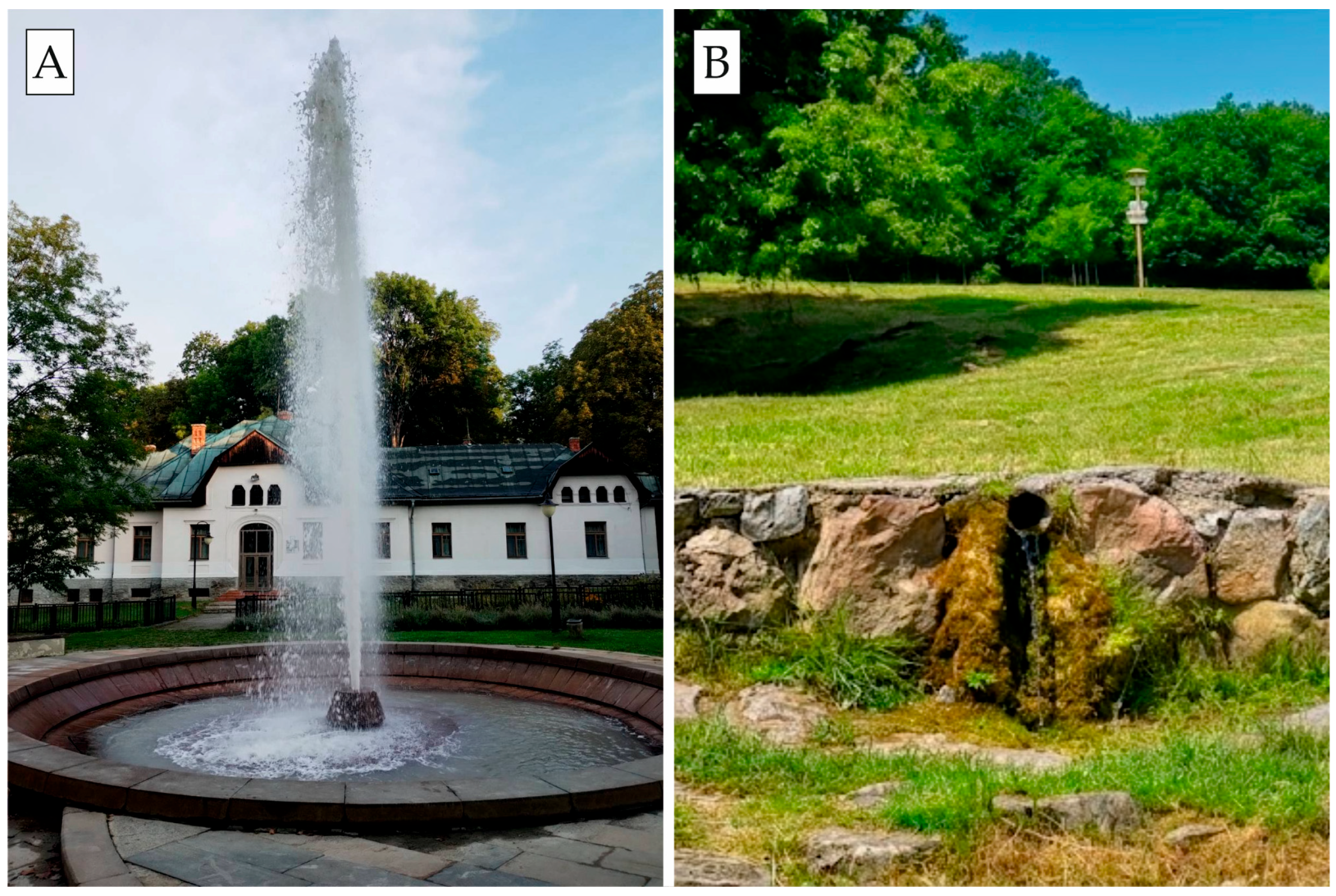
Herľany Geyser (Figure 4A), unique hydrogeological location, is a post-volcanic cold-water geyser, driven by the pressure of liberated carbon dioxide rather than geothermal heat. Originating from an artesian borehole into the Neogene volcanic basement, it periodically erupts mineralised water, providing a rare window into the post-magmatic degassing of the Slanské vrchy [54]. It is one of the few phenomena of its kind globally, representing a rare intersection of human engineering and natural carbon dioxide hydraulics.
Ladislavova vyvieračka (Figure 4B), a strong spring, is situated on the Jasovská Plain within the cadastral territory of Debraď, located inside Slovenský Karst National Park. The spring emerges from an environment comprising Mesozoic carbonate rocks at an elevation of 420 m above sea level. Historically regarded as miraculous, it has long served as a traditional pilgrimage site. Visitors and pilgrims frequently visit this location to collect water and seek tranquillity [55].

2.3.4. Volcanic Geosites

Regeta, located south of the Bogota stratovolcano [56], comprises Neogene andesitic rocks and pyroclastics that exemplify the extrusive volcanic activity of the Eastern Slovakian volcanic arc. The complex allows observation of volcanic morphology and volcaniclastics, related to the petrographic composition of the Slanské vrchy [57]. The location also impresses with its huge oak trees, whose age is estimated to be at least 400 years, according to various sources, but probably even more [58].
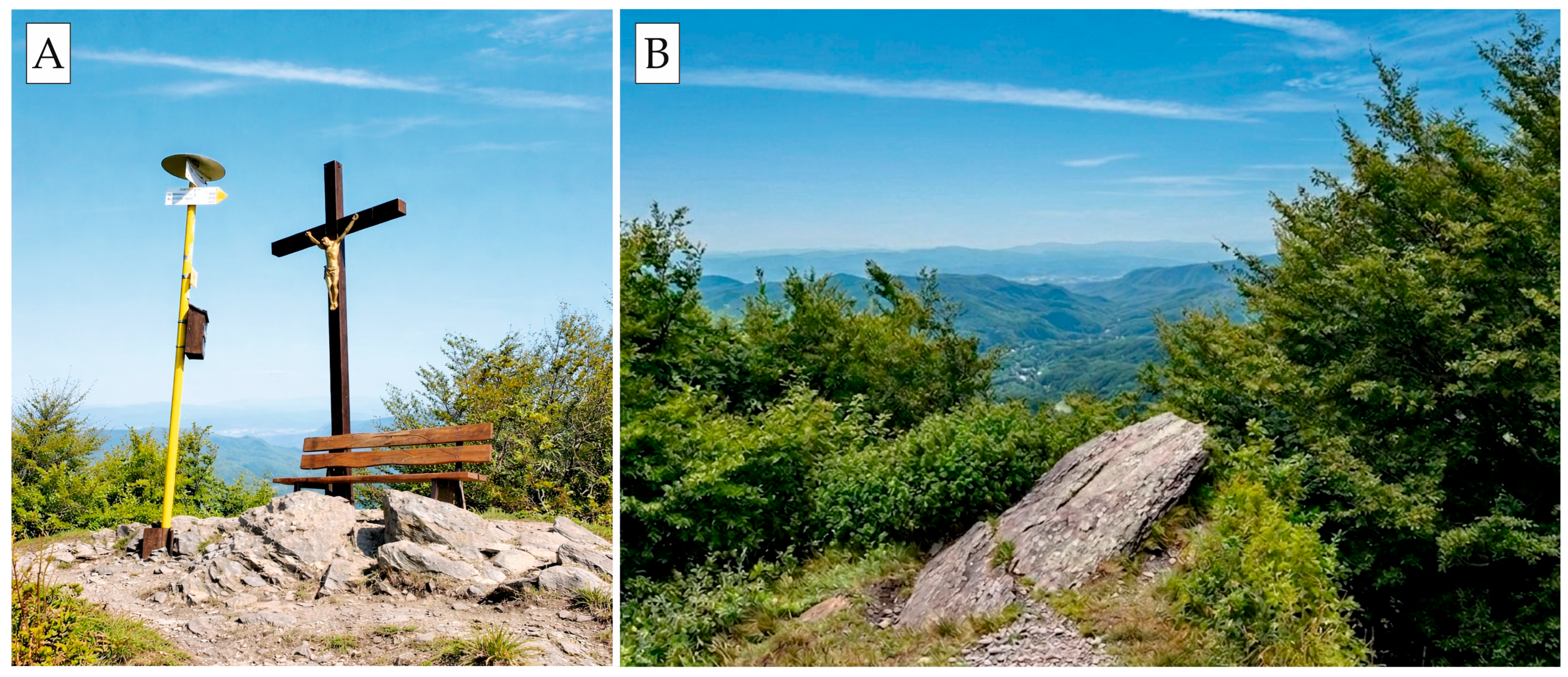
As the highest stratovolcanic remnant of the Slanské vrchy Mts. range, Šimonka features a summit area dominated by volcanic rocks and landforms. The peak provides a panoramic view (Figure 5) of the alignment of the volcanic chain, which was formed through subduction-related magmatism [59]. Its slopes and features are significant for understanding the post-volcanic landforms and landscape development in this part of the Western Carpathians.

2.3.5. Mineralogical and Mining Heritage Geosites

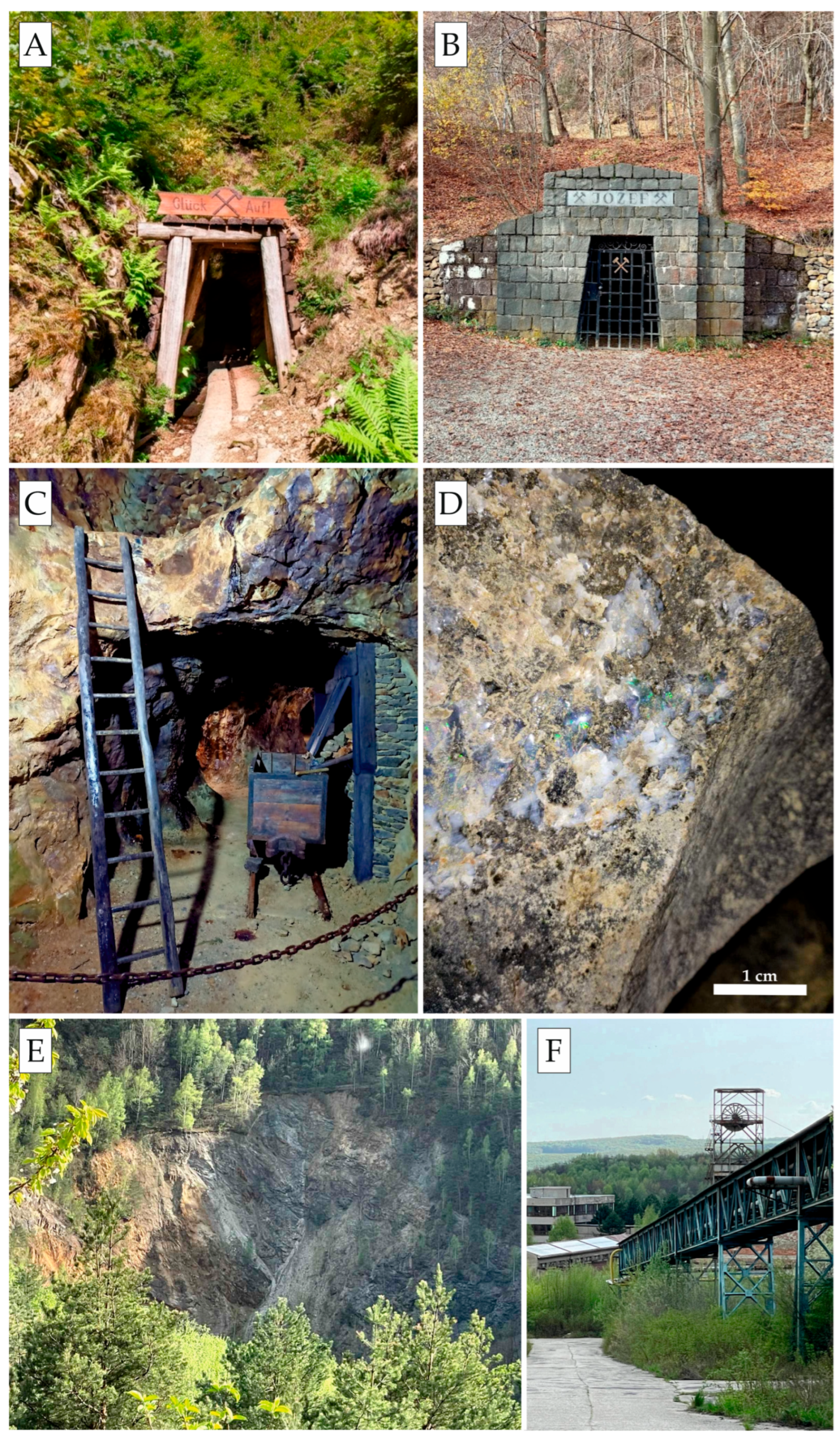
The Vyšný Medzev district is characterised by hydrothermal vein-type mineralisation, specifically siderite ores hosted within Palaeozoic phyllites. The veins of this area belong to the oldest exploited veins in the territory of the Spiš-Gemer Ore Mts. with remnants of historical mining (Figure 6A) [60]. The deposits were the catalyst for centuries of metallurgical industrialisation, shaping the socio-economic development of the region. The area is a prime example of the relationship between primary ore geology and societal evolution.
Dubník Opal Mines are located within the area of the stratovolcano of the Slanské vrchy Mts., Zlatá Baňa of Neogene age, where hydrothermally altered andesites provided the specific chemical environment necessary for precious opal formation. This location of international importance is considered the world’s oldest precious opal mine, the only known source of precious opal in the world until the 19th-century discoveries in Mexico and Australia and the only one on European territory. Since reopening to the public in 2015, the mines have become a place for educational and adventure geoheritage-related tourism activities (Figure 6B–D) [61,62].
Bankov (abandoned mine) provides an exceptional exposure of the magnesite mineralisation hosted within Carboniferous carbonate sequences. The mine faces reveal the metasomatic processes that transformed original rock into magnesite, a key event in the region’s deposit-forming history along the significant Košice–Margecany fault zone. Deposits near Košice, according to the quantity of raw material, belong to the biggest magnesite deposits in the country [60]. It remains a premier location for mineralogical field studies and for observing industrial-scale geological excavations (Figure 6E) and industrial heritage (Figure 6F) [63] with potential tourism use [64]. According to Gaál et al. [65], two caves were surveyed at the sixth mining level of the Bankov deposit.
Jahodná is a recreational centre used mainly for hiking and cycling in the summer. It is the starting point for many trails of varying difficulty. In winter, it is an important ski centre for many residents of Košice and the surrounding area. Geologically, an important uranium-molybdenum deposit is located here, within the Permian Huta volcanosedimentary complex, consisting of mafic and felsic volcanics, tuffs and tuffites, deposited contemporaneously with sandstones and mudrocks under arid to humid conditions. The main ore-forming minerals are uraninite, coffinite, molybdenite and apatite [66].

2.3.6. Landscape Viewpoint Geosites

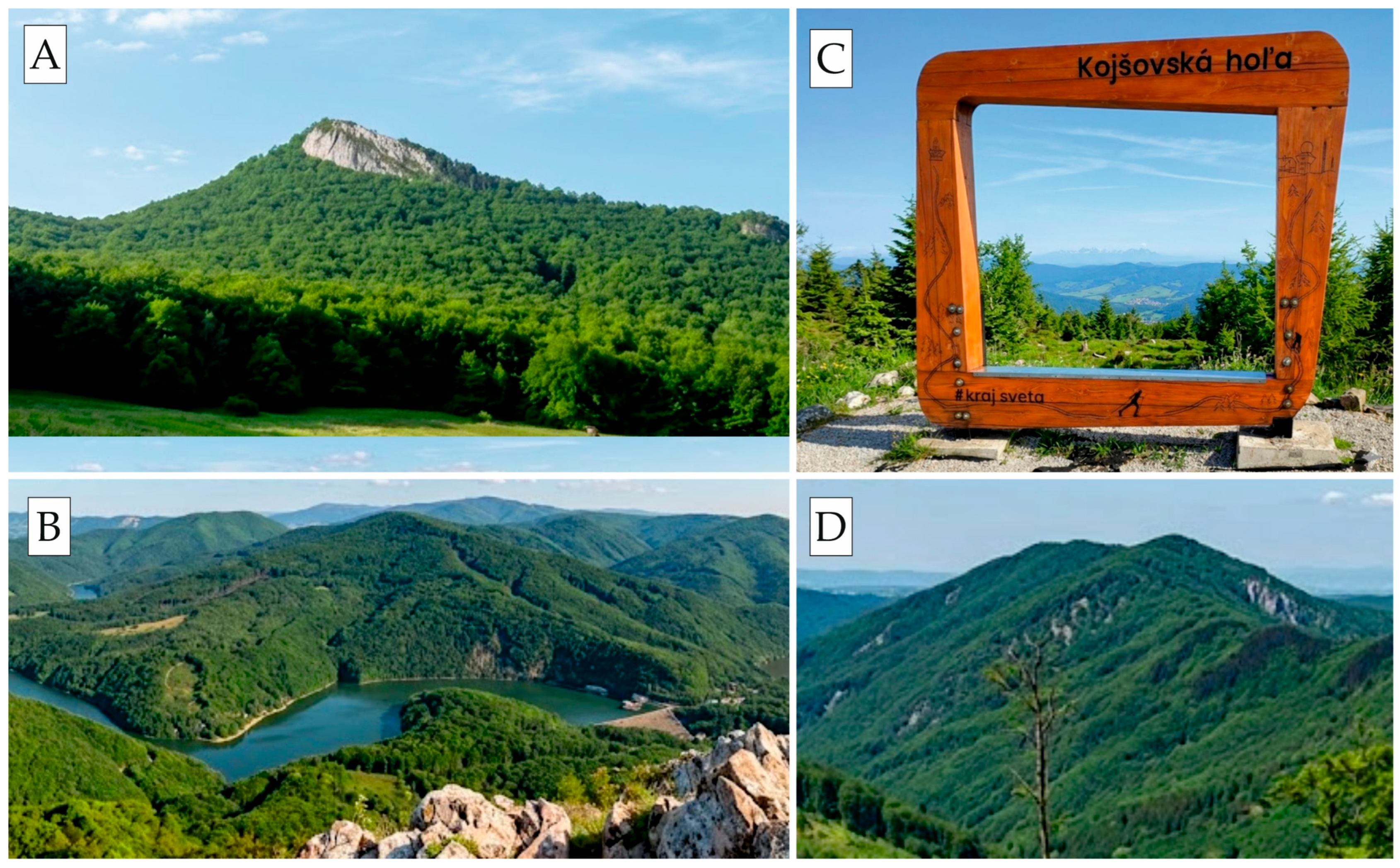
The Sivec peak (Figure 7A), characterised by its elongated limestone ridge, represents a core element of the Ružín Karst, the smallest karstic territory in Slovakia. This location, designated a National Nature Reserve, features significant karstic phenomena, including 10 caves in the Malý Ružinok valley. The locality is defined by a unique synthesis of thermophilic vegetation and montane elements, hosting rare flora such as Pulsatilla patens and Primula auricula alongside preserved beech–fir forest communities. Furthermore, the steep northern cliffs serve as a critical nesting habitat for protected raptors, including the golden eagle (Aquila chrysaetos). From a geomorphological perspective, the site offers a strategic vantage point overlooking the Ružín reservoir and the diverse mountain ranges of the Western Carpathians (Figure 7B) [67,68,69].
Kojšovská hoľa (1245.7 m above sea level) is a massive hill in the Volovské vrchy mountain range, part of the Slovenské rudohorie landscape unit. It lies above the village of Zlatá Idka, approximately 8 km south of Gelnica. It is the highest peak of the eponymous geomorphological subunit. It has a massive, smoothly modelled relief. In the surrounding area, there are four settlements with a long history of mining and smelting traditions (Zlatá Idka, Opátka, Košická Belá, Kojšov). The summit is covered only by low vegetation, which allows for a panoramic view. Under suitable conditions, it is possible to observe the surrounding peaks as well as other mountain ranges such as the Slanské vrchy, Čierna hora, Čergov, Branisko, Levočské vrchy, High Tatra Mts., the eastern part of the Low Tatra Mts., and many peaks of northern Hungary. The installed photopoint (Figure 7C) is located here. This location, popular with tourists, thus serves as an important viewpoint from which one can observe the landscapes and landforms of various parts of this region [70]. On the northern slope, near the red tourist trail heading towards Kojšov, there is a remnant of a forest covering an area of 15 hectares, which in 2017 was incorporated into the European protected area system NATURA 2000 [71].
Bujanov (756 m above sea level) is a hill within the Čierna Hora mountain range, a distinctive landscape unit of the Slovenské Rudohorie. It is located near the village of Margecany, approximately 8 km east of Gelnica. Bujanov lies in a massif overlooking the Hornád valley and the Ružín water reservoir. The summit is enveloped by continuous forest cover, which obstructs visibility. However, from areas with sparse vegetation, it is possible to observe the surrounding peaks of the mountain range, as well as Branisko, the Slanské and Volovské hills, and the Tatra Mountains. Beneath the hill lies the longest double-track railway tunnel in Slovakia, with a length of 3410.7 m [72]. Geologically, this region is part of the so-called Bujanov Complex, primarily composed of Palaeozoic gneisses, migmatites, and granodiorites. Additionally, a tectonic contact between the Veporic and Gemeric units is located here [73].
Čierna Hora (Figure 7D), rising to an elevation of 1025 m above sea level, serves as a prominent viewpoint within the eponymous mountain range. Together with Roháčka Peak, which reaches 1028 m above sea level, these are the sole peaks in the range surpassing 1000 m in elevation. At the summit, a substantial metal cross featuring an image of Christ and a wooden statue of a pagan Madonna are present. This site functions primarily as a place of thanksgiving rather than a conventional pilgrimage destination. A few metres northwest of Čierna Hora’s summit lies Rozsypaná Skala, a dominant rocky massif characterised by impressive cliffs, stones, and boulders approximately 150 m in length and between 10 and 30 m in height. This formation offers commanding views towards the north and northeast [74].

3. Results

To compute the GDPI values, the initial step, following the methodological approach, involved calculating the mean and standard deviation of the variables (Table 3) to facilitate Z-score normalisation (Table 4).
The descriptive statistics reveal a dataset characterised by heteroscedasticity (variable levels of variance) across different digital indicators. The high standard deviation in photographs (σ = 763.16) relative to its mean (μ = 826.53) suggests a highly skewed distribution where a few “digital anchors” (sites with extreme visual output) dominate the landscape. Conversely, the low variance in user ratings (μ = 4.64, σ = 0.21) indicates a ‘ceiling effect’, where most geosites are perceived positively, making the identification of statistical outliers in quality more challenging but more significant when they occur.
The application of Z-score normalisation transforms raw counts into relative positional metrics (μ = 0 and σ = 1). Several sites exhibit a divergence between volume and quality. For example, Jahodná shows high volume (Pn = 1.28, Rn = 1.86) but low rating (Sn = −2.12), suggesting mass-market appeal with low average satisfaction. Similar results can be seen in the case of Herľany Geyser (Pn = 1.52, Rn = 2.02, Sn = −1.16). Bujanov, on the other hand, displays a negative volume score (Pn = −1.06, Rn = −0.93) but a highly significant sentiment score based on the rating (Sn = 1.72), which is nearly two standard deviations above the mean. This identifies a geosite highly valued by those who find and visit it, but lacking broad digital visibility. A similar pattern can be observed in the case of Šimonka (Pn = −0.70, Rn = −0.33 and Sn = 0.76), which can be considered a surprising outcome, as this site is, in general, a well-known tourist location, yet the data show it has low digital visibility, as reflected in the number of reviews. In other words, physical importance and overall awareness of a site do not always reflect into digital footprint. In the era of modern tourism, this might create a challenging situation for geotourism and regional tourism development. If a site is not ‘visible’ on digital platforms, it may be bypassed by younger, digitally native travellers or international tourists who rely exclusively on online reviews and ratings to plan their itineraries.
The identification of a geosite characterised by high experiential quality and regional or national awareness but disproportionately low digital visibility suggests a critical ‘digital-physical gap’, necessitating a strategic shift in tourism development priorities. For such locations, where superior user satisfaction—indicated by high rating scores—confirms the existence of a high-performing ‘geoproduct’; capital investment should be redirected from traditional physical infrastructure toward digital translation and engagement strategies. By fostering visual salience and encouraging social sharing through digital checkpoints or ’instagrammable’ interventions, managers can convert latent interpretive potential into a robust digital footprint. This approach effectively mitigates the impact of ‘distance decay’ and prevents nationally significant sites from succumbing to ‘digital invisibility’, which otherwise acts as a barrier to contemporary destination choice. Ultimately, this data-driven framework enables regional planners to distinguish between mass-market anchors and high-quality niche sites, ensuring that interventions address a location’s digital deficit rather than merely its physical accessibility.
Based on the PCA results (Table 5) and applying the Kaiser-Guttman rule [35], PC1 and PC2 (with eigenvalues greater than one) were taken into account for the further calculation of data-driven weights of GPDI variables. The retention of two components (PC1 and PC2) under the Kaiser-Guttman criterion indicates that the digital popularity index is multidimensional. A cumulative variance explanation of 82.54% is robust for social-digital data, suggesting that the four selected variables are effective proxies for the underlying latent variable of ‘site attractiveness’. The raw values of the respective weights were subsequently normalised so that their sum equals 1 (100%) (Table 6).
Analysis results indicate that photos and reviews have the greatest influence, accounting for 29% of the final GDPI value, whereas the distance parameter has the least influence of 21%. The variable of user ratings (expressed via stars ranging from 1 to 5) has a weight of 21.6% to the final GDPI. Based on this data, the final GDPI formula, based on which the final GDPI values (Table 6) were calculated, can be articulated as follows:
G D P I = 0.285 · P n + 0.289 · R n + 0.216 · S n 0.210 · D n t

4. Discussion

4.1. Conceptual Validation

The robustness of the GDPI results, explaining 82.54% of total variance, reinforces the premise that user-generated digital traces are not merely noise but can be interpreted as structured signals that function as partial proxies for site attractiveness. This alignment with collective validation mechanisms described by Sánchez-Franco [24] and Soltani-Nejad et al. [25] suggests that the public’s digital footprint offers a bottom–up complementary metric to traditional (expert) assessment models introduced by, e.g., Brilha [5], Kubalíková [11] or Reynard et al. [14], which have struggled to translate scientific value into tourism development.
While the final GDPI is based on quantitative digital traces, it reflects the collective subjectivity of individual visitors—their choices of where to go, what to photograph, and how to rate an experience in the absence of explicitly predefined academic evaluation criteria. By allowing the dataset’s statistical structure to inform the weighting of variables through PCA-based decomposition, the model aligns more closely with patterns observed in contemporary digital decision-making environments than with purely scientific evaluations. Consequently, it may offer a complementary tool for comparative assessment of geoheritage values, geosite inventorying and categorisation, particularly as a tool for tourism development initiatives and destination management organisations (DMOs).
It is important to note that expert-based assessment frameworks and GDPI operate at different analytical levels, with the former focusing on potential geoheritage value and the latter reflecting observed visitor behaviour and site performance.

4.2. The Role of Distance (D) in the GDPI

The GDPI combines indicators of digital engagement (photos, reviews, and user ratings) with a measure of spatial accessibility expressed as distance. While digital indicators reflect user-generated online activity and perception, distance represents an exogenous spatial constraint that shapes the accessibility of sites and therefore conditions the likelihood of visitation and subsequent online representation. It is thus conceptualised as a complementary contextual dimension rather than part of the digital footprint domain.
Distance was calculated with respect to the city of Košice, selected as a fixed reference point to provide a consistent and reproducible spatial benchmark for comparing relative accessibility across sites within the study area. Although actual visitor origins are spatially heterogeneous, the use of a single reference does not imply any assumption about the provenance of users generating digital content. Instead, it serves solely to operationalise accessibility in a standardised manner in the absence of detailed mobility or origin–destination data.
To evaluate the sensitivity of the index to this specification, an alternative version excluding distance was computed, based on the same PCA-derived weighting scheme applied to the digital variables only (ratings: 36.8%, reviews: 32.1%, photos: 31.1%). The comparison (Table 7) shows that the ranking of the highest-performing sites remains largely stable, while variations are more pronounced in the mid- and lower-ranked locations, where some sites exhibit substantial rank shifts. Without distance, the index becomes more evenly distributed across digital indicators, with a slightly higher contribution of user ratings, followed by volume-based digital indicators represented by the number of photos and reviews. This results in a greater emphasis on popularity signals and reduced differentiation among sites with similar levels of digital engagement.
Overall, the inclusion of distance does not dominate the structure of the GDPI but introduces an independent spatial dimension that moderates the effect of digital intensity. This contributes to a more balanced representation of geotourism potential by integrating both digitally derived signals and spatial accessibility within a single composite framework.
In this framework, distance functions as a moderating variable that contextualises the significance of digital traces. A photo taken at a remote mountain peak (high distance) may therefore be interpreted as a relatively stronger signal of site attractiveness than a photo taken at a city-centre park (low distance), as it implies that the visitor has overcome greater spatial friction to generate that digital footprint.
The use of a single reference point (the city of Košice in this paper) does not imply that it represents the actual origin of visitors. Rather, it serves as a standardised spatial anchor, enabling consistent comparison of relative accessibility across sites within the study area. The GDPI framework does not attempt to reconstruct visitor mobility patterns, which would require detailed origin–destination data that are typically unavailable in open-source environments. Instead, distance is operationalised as a controlled proxy for spatial friction, thereby integrating accessibility into the composite index. In regions characterised by polycentric settlement structures or multiple tourism gateways, this approach can be adapted by incorporating multiple reference points. The present implementation, therefore, represents a simplified but reproducible solution suitable for data-limited contexts, rather than a fixed model of visitor movement.

4.3. Defining the GDPI Framework and ‘Digital Invisibility’

The GDPI functions as a normalised performance indicator, wherein a score of 0.00 signifies the regional average. A site with a high GDPI is statistically associated with exceeding spatial friction (distance effects) through enhanced experiential quality (ratings) and high digital engagement (photos/reviews). In this context, higher GDPI values indicate relatively stronger performance across the observed digital and spatial variables within the dataset, rather than direct behavioural causation. Consequently, positive scores identify ‘digital leaders’ who appear to overcome spatial friction through a combination of visual salience and enhanced experiential quality.
Conversely, negative scores indicate sites with relatively lower levels of digital engagement and/or accessibility compared to the regional average. These results may be interpreted as a form of ‘digital invisibility’, understood here as a descriptive condition referring to a limited presence in user-generated digital datasets (such as photographs, reviews, and ratings). This term is used strictly as an analytical description of digital representation and does not imply that increased visibility is inherently desirable from a conservation or sustainability perspective. The absence of an online footprint, including photographs, reviews, and ratings, may act as a practical constraint in contemporary destination selection processes, while simultaneously contributing to reduced visitation pressure, which may be beneficial from a conservation perspective in sensitive or low-capacity environments. Their limited online presence may impede their visibility and competitiveness within geotourism markets.
However, digital invisibility may also contribute to passive conservation effects by limiting visitation pressure and thereby reducing anthropogenic impacts on sensitive geoheritage sites. On the other hand, increased digital visibility may also intensify visitation pressure and contribute to spatial concentration effects, particularly in already popular geosites, highlighting the need to interpret GDPI outputs alongside carrying capacity and sustainability considerations.
The tension between digital visibility and overtourism is a critical consideration in modern geosite management. While ‘digital invisibility’ may seem to offer protection, research in similar European contexts [75] suggests that a lack of digital information leads to ‘spatial concentration,’ where visitors cluster at a few famous landmarks, exceeding their carrying capacity. By utilising the GDPI to identify sites with high qualitative potential but low current visibility, planners can move toward a model of visitor dispersion. This approach uses digital data to balance the regional ‘load,’ protecting sensitive hotspots while providing the economic justification for the maintenance of distant geosites [38].
By providing the tools for digital engagement (like photo points), visitors can become ‘co-creators’ of the site’s value, which is essential for securing the overall awareness for the support needed for geoconservation [76]. Conti and Lexhagen [77] demonstrate that online photography in nature-based tourism is a circular value-creation process. Staging ‘photo points’ can therefore be considered a management tool to ensure that the co-created digital footprint reflects the high multidimensional value of the geoheritage asset, rather than purely aesthetic or superficial consumption. In this context, such interventions should be understood as mechanisms that can potentially influence the generation and structure of digital engagement data, rather than as direct drivers of visitation behaviour. This digital trace serves as an intersubjective signal of the site’s importance, which is critical for its integration into regional development and conservation frameworks.

4.4. Empirical Findings: The Digital–Physical Gap

The comparison between the initial thematic expectations (Table 2) and the data-driven GDPI results (Table 6) reveals a significant digital–physical gap in the selected geosite profiles. While high-visibility categories like surface karst and hydrology largely met expectations—with Zádielska tiesňava Canyon (1.037) and Herľany Geyser (0.826) emerging as digital leaders—other scientifically significant categories exhibited substantial discrepancies.
For instance, while the speleology category was expected to be highly engaging due to its UNESCO status, results were mixed. Jasovská jaskyňa performed strongly, while Silická ľadnica exhibited relatively low digital engagement, with a negative score of −0.478. This suggests that international scientific recognition does not automatically translate into a functional digital footprint.
Furthermore, the results for the “landscape and viewpoints” and “mining heritage” categories underscore the index’s utility in identifying “hidden gems”. Sites like Bujanov or Šimonka, which possess relatively high visitor satisfaction scores (e.g., Sn > 1.0 represents a value at least one standard deviation above the mean, categorising these sites within the top tier of visitor satisfaction) but low digital volumes (Rn), ended up with negative overall GDPI scores. In these cases, the empirical data diverges from the theoretical expectation of high popularity, revealing that these sites are highly rated by visitors but underrepresented in the broader digital visibility context.
By allowing the dataset’s statistical structure to inform variable weighting, the GDPI indicates that visual salience and social proof, rather than just perceived quality or scientific value, may be strongly associated with contemporary geotourism popularity in this dataset.

4.5. Classification of Geosite Profiles

Beyond the overall index, examining individual normalised variables (Pn, Rn, Sn, Dn) offers a more comprehensive understanding of a site’s status. The potential profiles identified in this context can be interpreted as follows:
  • The ‘Hidden Gem’ profile (Sn ≫ Rn or Sn ≫ Pn): Characterised by high user ratings and/or a substantial number of photographs, accompanied by a low volume of reviews. This suggests a high-quality visitor experience that is, however, limited in online visibility and broader market recognition.
  • The ‘Mass-Market’ profile (Rn ≫ Sn): High review volume with average or mediocre ratings. This suggests high traffic but potentially low satisfaction or a lack of specialised interest.
  • The ‘Visually Skewed’ profile (Pn ≫ Sn): The site demonstrates high visual salience (Pn) in conjunction with average or below-average rating (Sn), indicating that although the site functions as a significant driver of digital volume, it does not necessarily possess substantial qualitative depth.
  • The ‘Remote Attraction’ profile (characterised by high GDPI and high Dn): Pertains to a site that sustains popularity despite being located at a considerable distance from urban centres, thereby reflecting a highly distinctive narrative identity.
The ‘Remote Attractions’ profile, which identifies sites with relatively high GDPI scores despite considerable distance from urban centres, provides empirical evidence that digital visibility can effectively mitigate the challenges associated with geographic separation. While several authors (e.g., [26,29,78]) underscore geographic distance as a significant factor influencing travel behaviour, the proposed framework indicates that a compelling digital narrative combined with high visual salience can reduce the constraining effect of geographical distance.
In accordance with established theoretical frameworks of geotourism [1,79], it can be asserted that a geosite possessing a substantial digital footprint generated by users reduces the obstacle of geographical distance from population centres. Consequently, physical remoteness becomes less of a critical constraint to development. Rather, the pivotal factor for the success of geotourism lies in the capacity of a geosite to generate a strong and consistent digital presence, thereby partially offsetting the challenge of remoteness. However, while digital saturation mitigates remoteness, it simultaneously challenges the principle of geotourism sustainability [80]. Specifically, the heightened interest in geosites necessitates the implementation of rigorous geoconservation measures to protect their abiotic values [81,82].

4.6. Managerial Implications

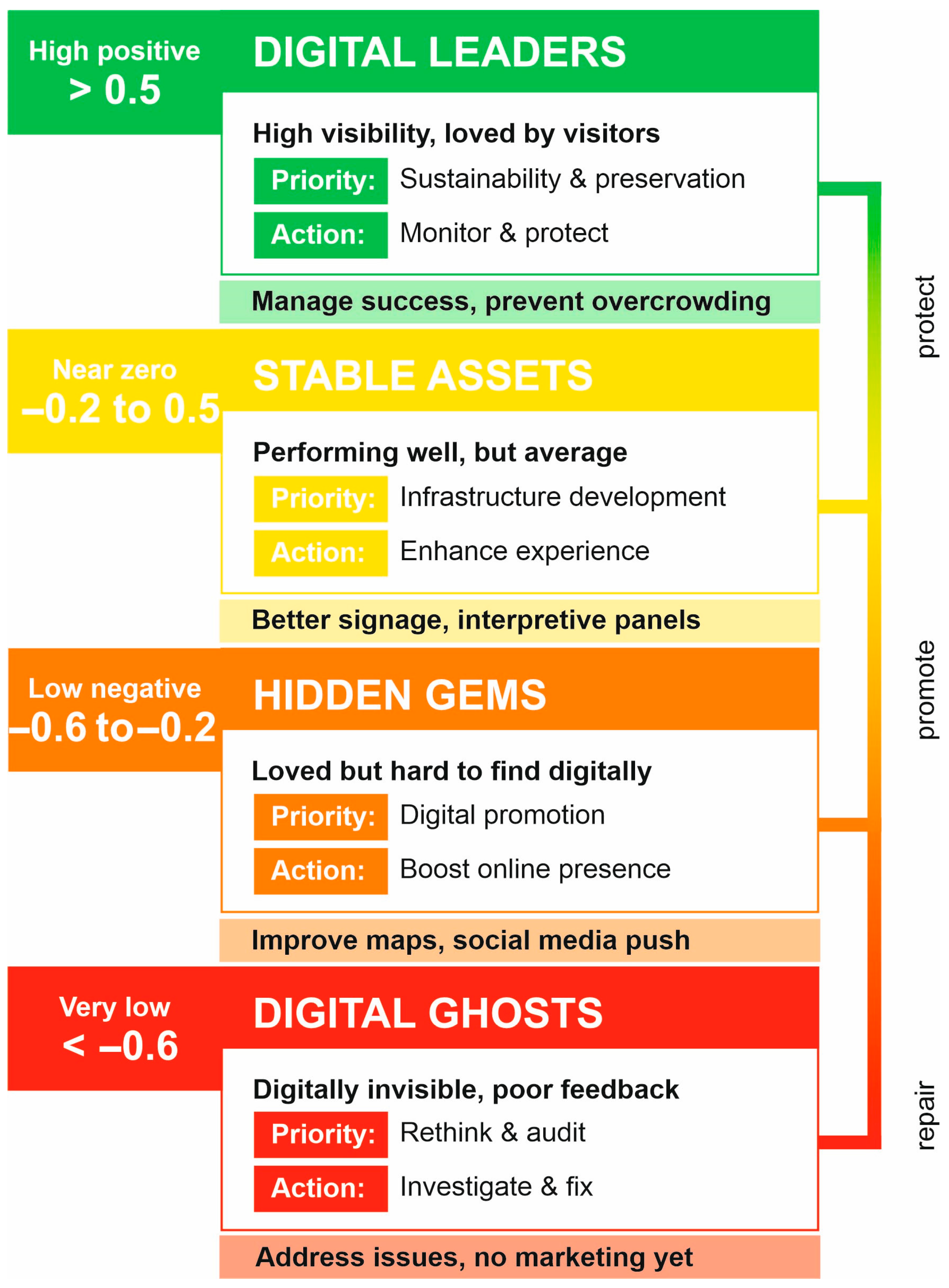
The limited practical applicability of traditional assessment results for effective geotourism development often stems from a lack of actionable data. The GDPI contributes to bridging this gap by identifying whether a site’s deficit is qualitative or quantitative. In this context, GDPI should be understood as an exploratory decision-support tool that translates multidimensional digital inputs into interpretable indicators. By converting raw digital inputs into actionable indicators, this methodology directly addresses the critical gaps in effective geotourism development planning identified by Ólafsdóttir and Tverijonaite [83] or Gupta et al. [84]. To transform GDPI scores into actionable strategies for regional managers, it is necessary to translate the numerical data into a more comprehensible format, such as a traffic light system. This approach converts complex multivariate information into a clear and actionable PPR Framework: Protect, Promote, or Repair (Table 8, Figure 8).
GDPI-based recommendations should not be interpreted as a uniform call for increased visitation. Instead, they should be understood as guidance for differentiated management strategies, where some sites may require increased visibility, while others may benefit from controlled exposure or conservation-oriented restriction.
In this sense, GDPI should not be interpreted as an instrument for maximising tourism flows, but rather as a diagnostic tool for understanding uneven digital representation patterns that may inform both development and conservation-oriented decision-making.
Addressing the ‘Digital-Physical Gap’ (Protect/Promote): This involves leveraging high-quality sites, such as Šimonka or Bujanov, that receive elite ratings (relatively high Sn) despite low digital volume. This can be achieved by reallocating digital marketing budgets toward initiatives like high-quality photography or digital interpretation applications rather than physical infrastructure.
Calibrating infrastructure expenditure (Repair): This involves concentrating on locations with high visitor traffic yet low satisfaction scores, exemplified by Jahodná or Herľany Geyser. There, digital signals can serve as indicators of physical problems, such as litter, insufficient parking facilities, or damaged trails, thereby substantiating targeted maintenance investments.
Narrative redesign (Promote): For sites with low engagement, such as Bankov, Regeta or Čierna Hora, this requires shifting from conventional promotional strategies to developing engaging geo-interpretative narratives.
Ultimately, the GDPI offers a complementary analytical framework for addressing the lack of traditional visitor statistics. Rather than replacing conventional monitoring approaches, it is intended to complement them by providing additional, data-driven insights into digital engagement patterns and relative site performance. By distinguishing whether a site’s deficiency is quantitative, driven by low digital engagement, or qualitative (low star ratings), managers can implement targeted interventions to address the specific digital gap of a location, rather than focusing solely on its physical accessibility.
Based on the above text, it can be stated that GDPI represents a comprehensive, multidimensional, data-driven assessment framework used to quantify the digital visibility and public appeal of geoheritage sites. It is constructed from open data, including user-generated reviews, ratings, and the volume of geotagged media, thereby serving as a proxy for the digitally expressed popularity of geosites and supporting geotourism development. This contributes to a more comprehensive understanding of geoheritage site attractiveness by integrating digital data with traditional intention-based approaches to geosite assessments [5,10,11,12,13,14,15] and geoheritage visitor studies [85,86,87,88,89,90].
Overall, GDPI should be understood as a complementary analytical framework that integrates digitally derived indicators with established evaluation approaches, rather than replacing conventional geosite or geoheritage assessment methods.
While the GDPI framework is designed for universal application across diverse geoheritage contexts, the specific weights derived in the presented case study are inherently data-dependent. Because these weights are generated through Principal Component Analysis, they reflect the unique digital behaviour and spatial characteristics of the selected region. Consequently, for the GDPI to maintain internal validity when applied to other geographical regions, the methodology requires a local recalibration of weights. This adaptive nature ensures that the index remains sensitive to regional variations in traveller preferences and digital presence, shifting from a rigid formula to a flexible, data-responsive diagnostic tool reflecting real-world conditions.

5. Conclusions

The Geosite Digital Popularity Index (GDPI) represents a pragmatic, low-cost framework for prioritising heritage sites, particularly in data-deficient environments. By reconceptualising digital engagement as a proxy for geotourism potential, this methodology addresses critical gaps in heritage planning.
A core strength of the framework is its data-driven weighting strategy. By allowing the statistical structure of the dataset to dictate the relative importance of indicators, the model reduces researcher bias and aligns with observed patterns in digital engagement behaviour. This contributes to a flexible, context-sensitive representation of site performance within the analysed dataset. Furthermore, the use of Z-score normalisation provides diagnostic precision, allowing managers to distinguish between relative over- and under-performance across sites and to identify whether a site may benefit from physical infrastructure improvements or enhanced digital engagement strategies.
However, several methodological constraints warrant consideration:
  • Digital exclusion bias: The index may statistically penalise remote sites that lack a substantial online footprint or social media presence.
  • Data volatility: The metric is sensitive to seasonal variation and platform-specific effects, including short-term popularity spikes.
  • Validation: The framework does not currently incorporate direct visitation data, such as ticket sales or visitor counts, limiting behavioural verification.
  • Transferability: While the methodological framework is transferable and broadly applicable, indicator weights require local recalibration through PCA to maintain contextual validity across different regions.
Future research should prioritise longitudinal analysis to assess temporal stability and incorporate cross-platform validation to reduce platform-specific bias. A promising direction involves the development of hybrid assessment models combining GDPI—representing digitally expressed public interest—with traditional geosite evaluation approaches—representing scientific and educational value. Such a Geosite Priority Matrix could support more balanced regional planning by integrating conservation priorities with tourism development strategies.

Author Contributions

Conceptualization, B.K. and Ľ.Š.; methodology, B.K. and Ľ.Š.; software, B.K., Ľ.Š. and C.S.; validation, B.K., Ľ.Š. and C.S.; formal analysis, B.K., Ľ.Š. and C.S.; investigation, B.K., Ľ.Š. and C.S.; resources, B.K., Ľ.Š. and C.S.; data curation, B.K., Ľ.Š. and C.S.; writing—original draft preparation, B.K., Ľ.Š. and C.S.; writing—review and editing, B.K., Ľ.Š. and C.S.; visualization, Ľ.Š.; supervision, Ľ.Š.; project administration, B.K. and Ľ.Š.; funding acquisition, Ľ.Š. All authors have read and agreed to the published version of the manuscript.

Funding

This work was supported by the Slovak Research and Development Agency under the project No. APVV-24-0554.

Institutional Review Board Statement

Not applicable.

Informed Consent Statement

Not applicable.

Data Availability Statement

The data that support the findings of this study are available from the corresponding author upon reasonable request.

Acknowledgments

During the preparation of this manuscript/study, the authors used Grammarly Pro (v1.2.2.226.1855) to improve the quality of the English language. The authors have reviewed and edited the output and take full responsibility for the content of this publication.

Conflicts of Interest

The authors declare no conflicts of interest.

References

  1. Dowling, R.; Newsome, D. Handbook of Geotourism; Edward Elgar Publishing: Cheltenham, UK, 2018. [Google Scholar]
  2. Pál, M.; Albert, G. Advancing Geosite Evaluation Through Continuous Visitor-Centric Assessment. Geoheritage 2025, 17, 65. [Google Scholar] [CrossRef]
  3. Wang, J.; Li, Y.; Wu, B.; Wang, Y. Tourism destination image based on tourism user generated content on internet. Tour. Rev. 2021, 76, 125–137. [Google Scholar] [CrossRef]
  4. Reynard, E. Geosites. In Encyclopedia of Geomorphology; Goudie, A.S., Ed.; Routledge: London, UK, 2004; p. 440. [Google Scholar]
  5. Brilha, J. Inventory and Quantitative Assessment of Geosites and Geodiversity Sites: A Review. Geoheritage 2016, 8, 119–134. [Google Scholar] [CrossRef]
  6. Hose, T.A. Selling the Story of Britain’s Stone. Environ. Interpret. 1995, 10, 10–12. [Google Scholar]
  7. Newsome, D.; Dowling, R.K. Geotourism: The Tourism of Geology and Landscape; Goodfellow Publishers: Oxford, UK, 2010. [Google Scholar]
  8. Štrba, L.; Kolačkovská, J.; Kudelas, D.; Kršák, B.; Sidor, C. Geoheritage and Geotourism Contribution to Tourism Development in Protected Areas. Sustainability 2020, 12, 2979. [Google Scholar] [CrossRef]
  9. Carrión-Mero, P.; Borja-Bernal, C.; Herrera-Franco, G.; Morante-Carballo, F.; Jaya-Montalvo, M.; Maldonado-Zamora, A.; Paz-Salas, N.; Berrezueta, E. Geosites and Geotourism in the Local Development of Communities of the Andes Mountains. A Case Study. Sustainability 2021, 13, 4624. [Google Scholar] [CrossRef]
  10. Fassoulas, C.; Mouriki, D.; Dimitriou-Nikolakis, P.; Iliopoulos, G. Quantitative Assessment of Geotopes as an Effective Tool for Geoheritage Management. Geoheritage 2012, 4, 177–193. [Google Scholar] [CrossRef]
  11. Kubalíková, L. Geomorphosite assessment for geotourism purposes. Czech J. Tour. 2013, 2, 80–104. [Google Scholar] [CrossRef]
  12. Kubalíková, L.; Kirchner, K. Geosite and geomorphosite assessment as a tool for geoconservation and geotourism purposes: A case study from Vizovicka vrchovina highland (eastern part of the Czech Republic). Geoheritage 2016, 8, 5–14. [Google Scholar] [CrossRef]
  13. Tomić, N.; Božić, S. A modified geosite assessment model (M-GAM) and its application on the Lazar Canyon area (Serbia). Int. J. Environ. Res. 2014, 8, 1041–1052. [Google Scholar]
  14. Reynard, E.; Perret, A.; Bussard, J.; Martin, S. Integrated Approach for the Inventory and Management of Geomorphological Heritage at the Regional Scale. Geoheritage 2016, 8, 43–60. [Google Scholar] [CrossRef]
  15. Suzuki, D.A.; Takagi, H. Evaluation of Geosite for Sustainable Planning and Management in Geotourism. Geoheritage 2018, 10, 123–135. [Google Scholar] [CrossRef]
  16. Štrba, Ľ.; Vravcová, A.; Podoláková, M.; Varcholová, L.; Kršák, B. Linking Geoheritage or Geosite Assessment Results with Geotourism Potential and Development: A Literature Review. Sustainability 2023, 15, 9539. [Google Scholar] [CrossRef]
  17. Kozak, M.; Rimmington, M. Measuring tourist destination competitiveness: Conceptual considerations and empirical findings. Int. J. Hosp. Manag. 1999, 18, 273–283. [Google Scholar] [CrossRef]
  18. Karl, M.; Schmude, J. Understanding the role of risk (perception) in destination choice: A literature review and synthesis. Tourism 2017, 65, 138–155. [Google Scholar]
  19. Alvarado-Sizzo, I. Spatial representations, heritage and territorial-synecdoche in contemporary tourism. Tour. Geogr. 2023, 25, 467–486. [Google Scholar] [CrossRef]
  20. Hays, S.; Page, S.J.; Buhalis, D. Social media as a destination marketing tool: Its use by national tourism organisations. Curr. Issues Tour. 2013, 16, 211–239. [Google Scholar] [CrossRef]
  21. Ghorbani, A.; Mousazadeh, H.; Golafshan, A.; Akbarzadeh Almani, F.; Dávid, L.D. Tourists-generated photographs in online media and tourism destination choice: The case of Shiraz metropolis in Iran. Cogent Soc. Sci. 2023, 9, 2225336. [Google Scholar] [CrossRef]
  22. Keelson, S.A.; Bruce, E.; Egala, S.B.; Amoah, J.; Bashiru Jibril, A. Driving forces of social media and its impact on tourists’ destination decisions: A uses and gratification theory. Cogent Soc. Sci. 2024, 10, 2318878. [Google Scholar] [CrossRef]
  23. Xiang, Z.; Du, Q.; Ma, Y.; Fan, W. A comparative analysis of major online review platforms: Implications for social media analytics in hospitality and tourism. Tour. Manag. 2017, 58, 51–65. [Google Scholar] [CrossRef]
  24. Sánchez-Franco, M.J.; Sierra Rey-Tienda, M. The role of user-generated content in tourism decision-making: An exemplary study of Andalusia, Spain. Manag. Decis. 2024, 62, 2292–2328. [Google Scholar] [CrossRef]
  25. Soltani-Nejad, N.; Rastegar, R.; Shahriari-Mehr, G.; Taheri-Azad, F. Conceptualizing Tourist Journey: Qualitative Analysis of Tourist Experiences on TripAdvisor. J. Qual. Assur. Tour. Hosp. 2024, 25, 343–364. [Google Scholar] [CrossRef]
  26. Park, D.; Kim, J.; Kim, W.G.; Park, H. Does distance matter? Examining the distance effect on tourists’ multi-attraction travel behaviors. J. Travel Tour. Mark. 2019, 36, 692–709. [Google Scholar] [CrossRef]
  27. Xue, L.; Zhang, Y. The effect of distance on tourist behavior: A study based on social media data. Ann. Tour. Res. 2020, 82, 102916. [Google Scholar] [CrossRef]
  28. Rosselló-Nadal, J.; Santana-Gallego, M. Toward a smaller world. The distance puzzle and international border for tourism. J. Transp. Geogr. 2024, 115, 103809. [Google Scholar] [CrossRef]
  29. Zhuang, Y.; Kim, J. A bert-based multi-criteria recommender system for hotel promotion management. Sustainability 2021, 13, 8039. [Google Scholar] [CrossRef]
  30. Chen, Y.; Zhong, Y.; Yu, S.; Xiao, Y.; Chen, S. Exploring bidirectional performance of hotel attributes through online reviews based on sentiment analysis and Kano-IPA model. Appl. Sci. 2022, 12, 692. [Google Scholar] [CrossRef]
  31. Liu, Y.; Li, J. An online hotel selection method with three-dimensional analysis of reviews’ helpfulness. Int. J. Fuzzy Syst. Appl. 2024, 13, 1–25. [Google Scholar] [CrossRef]
  32. Pijet-Migoń, E.; Migoń, P. Geothermal fields of New Zealand in tourism industry-the case of complementary assets and competitive products. Geotourism/Geoturystyka 2015, 42–43, 3. [Google Scholar] [CrossRef]
  33. Sidor, C.; Hamdan, C.; Štrba, Ľ.; Kršák, B. On the Road Towards Identifying and Aggregating Experiences in Destinations via Secondary Online Data: The Case of Slovak Geoheritage at TripAdvisor in Relation to DMOs. Geoheritage 2025, 17, 91. [Google Scholar] [CrossRef]
  34. Guo, X.; Pesonen, J.A. The role of online travel reviews in evolving tourists’ perceived destination image. Scand. J. Hosp. Tour. 2022, 22, 372–392. [Google Scholar] [CrossRef]
  35. Wang, X.; Mou, N.; Zhu, S.; Yang, T.; Zhang, X.; Zhang, Y. How to perceive tourism destination image? A visual content analysis based on inbound tourists’ photos. J. Destin. Mark. Manag. 2024, 33, 100923. [Google Scholar] [CrossRef]
  36. Lakshmanan, T.R. The broader economic consequences of transport infrastructure investments. J. Transp. Geogr. 2011, 19, 1–12. [Google Scholar] [CrossRef]
  37. Kendall, P. Between big city and authentic village: Branding the small Chinese city. City 2015, 19, 665–680. [Google Scholar] [CrossRef]
  38. Li, Y.; Song, Y.; Fang, S. Time perception and tourist behavioral decision when travelling. Curr. Issues Tour. 2023, 26, 533–539. [Google Scholar] [CrossRef]
  39. Mellinas, J.P.; Sicilia, M. Comparing Google reviews and TripAdvisor to help researchers select the more appropriate information source. Consum. Behav. Tour. Hosp. 2024, 19, 646–655. [Google Scholar] [CrossRef]
  40. Du, X.; Liechty, T.; Santos, C.A.; Park, J. ‘I want to record and share my wonderful journey’: Chinese Millennials’ production and sharing of short-form travel videos on TikTok or Douyin. Curr. Issues Tour. 2022, 25, 3412–3424. [Google Scholar] [CrossRef]
  41. Han, J.; Kamber, M.; Pei, J. Data Mining: Concepts and Techniques; Morgan Kaufmann: Burlington, MA, USA, 2011. [Google Scholar]
  42. Hair, J.F.; Black, W.C.; Babin, B.J.; Anderson, R.E. Multivariate Data Analysis, 8th ed.; Cengage Learning EMEA: Hampshire, UK, 2018. [Google Scholar]
  43. Greenacre, M.; Groenen, P.J.F.; Hastie, T.; D’Enza, I.; Markos, A.; Tuzhilina, E. Principal component analysis. Nat. Rev. Methods Primers 2022, 2, 100. [Google Scholar] [CrossRef]
  44. Kaiser, H.F. The application of electronic computers to factor analysis. Educ. Psychol. Meas. 1960, 20, 141–151. [Google Scholar] [CrossRef]
  45. SAŽP. Atlas Krajiny Slovenskej Republiky. Available online: https://app.sazp.sk/atlassr/ (accessed on 10 February 2026).
  46. Bella, P.; Zelinka, J. Chapter 29—Ice Caves in Slovakia. In Ice Caves; Perşoiu, A., Lauritzen, S.E., Eds.; Elsevier: Amsterdam, The Netherlands, 2018; pp. 657–689. [Google Scholar]
  47. Zacharov, M. Jasovská jaskyňa—Listostratigrafia a tektonika. Acta Montan. Slovaca 1998, 3, 115–122. [Google Scholar]
  48. Bella, P.; Bosák, P.; Zacharov, M. Morfologické indikátory výstupného prúdenia vody vo vzťahu ku genéze Jasovskej jaskyne. Slov. Kras/Acta Carstologica Slovaca 2012, 50, 135–148. [Google Scholar]
  49. Slovak Caves Administration. Drienovská Jaskyňa. Available online: https://www.ssj.sk/sk/clanok/113-drienovska-jaskyna (accessed on 9 March 2026).
  50. Mišík, M. Geologické Exkurzie po Slovensku; SPN: Bratislava, Slovakia, 1976. [Google Scholar]
  51. Pivko, D.; Vojtko, R. A review of travertines and tufas in Slovakia: Geomorphology, environments, tectonic pattern, and age distribution. Acta Geol. Slovaca 2021, 13, 49–78. [Google Scholar]
  52. Gessert, A.; Straková, V. Geomorfologické pomery a inventarizácia lokalít penovcov a travertínov vo východnej časti Slovenského krasu. Geomorphol. Slovaca Bohem. 2017, 1, 7–21. [Google Scholar]
  53. Slovenský Kras. Hradné Vyhliadky na Turnianskom Hrebeni. Available online: https://www.slovensky-kras.eu/info/kam-do-prirody/hradne-vyhliadky-na-turnianskom-hrebeni/ (accessed on 10 March 2026).
  54. Dobra, E.; Pinka, J. Herliansky Gejzír a Prírodné Bohatstvo v Okolí; Elfa: Košice, Slovakia, 2004. [Google Scholar]
  55. Slovenský Kras. Kaplnka sv. Ladislava—Rastlinný Kostol Sv. Ladislava. Available online: https://www.slovensky-kras.eu/info/kam-za-pamiatkami/kaplnka-sv-ladislava-jasovska-planina/ (accessed on 10 March 2026).
  56. Túnyi, I.; Márton, E.; Žec, B.; Vass, D. Paleomagnetizmus neovulkanitov Vihorlatských vrchov. Miner. Slovaca 2005, 37, 268–271. [Google Scholar]
  57. Kaličiak, M.; Baňacký, V.; Janočko, J.; Karoli, S.; Petro, Ľ.; Spišák, Z.; Vozár, J.; Žec, B.; Ivanička, J.; Vass, D. Geological Map of the Slanské Vrchy Mts. and Košice Depression—Southern Part 1:50000; State Geological Institute of Dionýz Štúr: Bratislava, Slovakia, 1996. [Google Scholar]
  58. Košický Samosprávny Kraj. Regeta. Available online: https://www.kosickazupa.sk/smart-region/region-abov/priroda-regionu-abov/regeta-a453-1397 (accessed on 1 March 2026).
  59. Molnár, F.; Nagymarosy, A.; Jeleň, S.; Bačo, P. Minerals and wines: Tokaj Mts., Hungary and Slanské vrchy Mts., Slovakia. Acta Mineral.-Petrogr. Field Guide Ser. 2010, 15, 1–40. [Google Scholar]
  60. Grecula, P.; Abonyi, A.; Abonyiová, M.; Antaš, J.; Bartalský, B.; Bartalský, J.; Dianiška, I.; Drnzík, E.; Ďuďa, R.; Gargulák, M.; et al. Mineral Deposits of the Slovak Ore Mountains; Geocomplex: Bratislava, Slovakia, 1995; Volume 1. [Google Scholar]
  61. Semrád, P.; Kováč, J. Dubnícke Opálové Bane; Vydavateľstvo Michala Vaška: Prešov, Slovakia, 2000; 153p. [Google Scholar]
  62. Palgutová, S.; Štrba, Ľ. Geoheritage of the Precious Opal Bearing Zone in Libanka Mining District (Slovakia) and Its Geotourism and Geoeducation Potential. Land 2022, 11, 2293. [Google Scholar] [CrossRef]
  63. Ilkovič, J.; Ilkovičová, Ľ. Industrial Heritage Regeneration. Way of Old Industry Identity. In Central Europe Towards Sustainable Building 2013; Czech Technical University: Prague, Czech Republic, 2013; pp. 1–9. [Google Scholar]
  64. Hvizdák, L.; Hvizdáková, J.; Molokáč, M.; Molokáčová, L. Mine Bankov and mining tourism. Acta Geotouristica 2012, 3, 48–54. [Google Scholar]
  65. Gaál, Ľ.; Németh, Z.; Bella, P.; Koděra, P. Caves in magnesite—A rare phenomenon of karstification—The case study from Slovakia. Miner. Slovaca 2017, 49, 157–168. [Google Scholar]
  66. Kohút, M.; Trubač, J.; Novotný, L.; Ackerman, L.; Demko, R.; Bartalský, B.; Erban, V. Geology and Re–Os molybdenite geochronology of the Kurišková U–Mo deposit (Western Carpathians, Slovakia). J. Geosci. 2013, 58, 271–282. [Google Scholar] [CrossRef]
  67. Farkašovský, R.; Németh, Z. SGS field seminary: Ružín karst (Eastern Slovakia). Miner. Slovaca 2009, 2, 196. [Google Scholar]
  68. KETURIST. Vrch Sivec (781 m n. m.). Available online: https://www.keturist.sk/info/vrch-sivec-781-m-n-m/ (accessed on 10 March 2026).
  69. Košice Region Tourism. Vrch Sivec. Available online: https://www.kosiceregion.com/en/poi/vrch-sivec/ (accessed on 10 March 2026).
  70. Obec Kojšov. Kojšovská hoľa. Available online: https://www.kojsov.sk/?page_id=95 (accessed on 1 March 2026).
  71. Volovské Vrchy. Pralesový zvyšok Kojšovská hoľa. Available online: https://volovske.sk/spot/pralesovy-zvysok-kojsovska-hola/ (accessed on 1 March 2026).
  72. KETURIST. Bujanovský Tunel. Available online: https://www.keturist.sk/info/bujanovsky-tunel/ (accessed on 9 March 2026).
  73. Jacko, S. Významné geologické lokality veporika Čiernej hory. Acta Montan. Slovaca 1996, 1, 209–213. [Google Scholar]
  74. KETURIST. Vrch Čierna Hora 1025 m n. m. a Rozsypaná Skala. Available online: https://www.keturist.sk/info/vrch-cierna-hora-1025-m-n-m-a-rozsypana-skala/ (accessed on 10 March 2026).
  75. Drápela, E.; Pánek, J.; Boháč, A.; Böhm, H. Overtourism in the Bohemian Paradise UNESCO Global Geopark: Identifying Affected Sites Through Participatory Mapping. Geoheritage 2025, 17, 53. [Google Scholar] [CrossRef]
  76. Gordon, J.E. Geodiversity, geoheritage and geoconservation for society. Int. J. Geoheritage Parks 2019, 7, 226–236. [Google Scholar] [CrossRef]
  77. Conti, E.; Lexhagen, M. Instagramming nature-based tourism experiences: A netnographic study of online photography and value creation. Tour. Manag. Perspect. 2020, 34, 100650. [Google Scholar] [CrossRef]
  78. Gregorová, B.; Korec, P. Cestovný ruch ako významná súčasť rozvojového potenciálu regiónu východné Slovensko. Acta Geogr. Univ. Comen. 2017, 61, 183–200. [Google Scholar]
  79. Hose, T.A. 3G’s for Modern Geotourism. Geoheritage 2012, 4, 7–24. [Google Scholar] [CrossRef]
  80. Dowling, R.K. Geotourism’s Global Growth. Geoheritage 2011, 3, 1–13. [Google Scholar] [CrossRef]
  81. Anougmar, S.; Meesters, A.; van Ree, D.; Compernolle, T. The dilemma of valuing geodiversity: Geoconservation versus geotourism. Philos. Trans. R. Soc. A Math. Phys. Eng. Sci. 2024, 382, 20230049. [Google Scholar] [CrossRef] [PubMed]
  82. Kubalíková, L.; Drápela, E.; Kirchner, K.; Bajer, A.; Balková, M.; Kuda, F. Urban geotourism development and geoconservation: Is it possible to find a balance? Environ. Sci. Policy 2021, 121, 1–10. [Google Scholar] [CrossRef]
  83. Ólafsdóttir, R.; Tverijonaite, E. Geotourism: A Systematic Literature Review. Geosciences 2018, 8, 234. [Google Scholar] [CrossRef]
  84. Gupta, V.; Anand, S.; Wei, D.; Wang, G.; Tripathi, S.C. Exploring applied sustainable strategies through geoheritage and geotourism: A systematic literature review. Int. J. Geoheritage Parks 2024, 12, 660–677. [Google Scholar] [CrossRef]
  85. Hurtado, H.; Dowling, R.; Sanders, D. An Exploratory Study to Develop a Geotourism Typology Model. Int. J. Tour. Res. 2014, 16, 608–613. [Google Scholar] [CrossRef]
  86. Allan, M.; Shavanddasht, M. Rural geotourists segmentation by motivation in weekends and weekdays. Tour. Hosp. Res. 2019, 19, 74–84. [Google Scholar] [CrossRef]
  87. Štrba, Ľ. Analysis of criteria affecting geosite visits by general public: A case of Slovak (geo) tourists. Geoheritage 2019, 11, 291–300. [Google Scholar] [CrossRef]
  88. Tomić, N.; Marjanović, M. Towards a Better Understanding of Motivation and Constraints for Domestic Geotourists: The Case of the Middle and Lower Danube Region in Serbia. Sustainability 2022, 14, 3285. [Google Scholar] [CrossRef]
  89. Amaro, S.; Chaves, N.B.; Henriques, C.; Barroco, C. Motivation-Based Segmentation of Visitors to a UNESCO Global Geopark. Geoheritage 2023, 15, 79. [Google Scholar] [CrossRef]
  90. Marjanović, M.; Tomić, N.; Antić, A.; Tomić, T. Travel Behaviour Insights among Geotourists in Serbia—Case Study of Zaječar District. Sustainability 2023, 15, 15969. [Google Scholar] [CrossRef]
Figure 1. Location of selected geosites (base map source: [45]).
Sustainability 18 04744 g001
Figure 2. Selected speleological geosites, (A): Silická ľadnica Cave, (B): Jasovská jaskyňa Cave, (C): Drienovská jaskyňa Cave.
Sustainability 18 04744 g002
Figure 3. Selected surface karst geosites, (A): Zádielska tiesňava, (B): Hrhovský vodopád, (C,D): Hájske vodopády, (E): leaf impression in tufa from the area of Hájske vodopády, (F): Turňa Castle Hill.
Sustainability 18 04744 g003
Figure 4. Selected hydrological geosites, (A): Herľany Geyser, (B): Ladislavova vyvieračka.
Sustainability 18 04744 g004
Figure 5. Volcanic geosite Šimonka, (A): photopoint with andesite oucropping rock, (B): panoramic view towards Tatra Mts.
Sustainability 18 04744 g005
Figure 6. Selected mineralogical and mining heritge geosites, (A): Remnants of a historical adit in Vyšný Medzev; (B): Entrance to the visitor mine at the Dubník opal mines; (C): Interior of the visitor mine at the Dubník opal mines; (D): Precious opal from the Dubník opal mines; (E): Abandoned mining area in Bankov; (F): Industrial heritage at the Bankov mine.
Sustainability 18 04744 g006
Figure 7. Selected landscape viewpoint geosites, (A): Sivec, (B): view from Sivec, (C): photopoint at Kojšovská hoľa, (D): Čierna hora.
Sustainability 18 04744 g007
Figure 8. Traffic light management framework for geosites based on their GDPI scores.
Sustainability 18 04744 g008
Table 1. Data on selected geosites located in the vicinity of the city of Košice (eastern Slovakia).
IDLocationReviews (R)User Rating (S)Photos (P)Distance (D) (km)
1Silická ľadnica Cave3814.6118069.8
2Jasovská jaskyňa Cave14094.7183828.4
3Drienovská jaskyňa Cave114.75233.1
4Zádielska tiesňava Canyon16024.9185641.4
5Hájske vodopády (waterfalls)9224.628341.5
6Hrhovský vodopád (waterfall)8944.728847.3
7Turňa Castle Hill7784.8141937.6
8Herľany Geyser18604.4198531.2
9Ladislavova vyvieračka784.722340.9
10Regeta 274.51226.5
11Šimonka3854.829369.3
12Bankov (abandoned quarry)144.2514.5
13Dubnik Opal Mines2574.7133235.9
14Vyšný Medzev—old mines194.57334.4
15Jahodná 17654.2180715.6
16Sivec6224.9181228.5
17Kojšovská hoľa1814.7111329.5
18Bujanov651541.9
19Čierna hora 124.67220.9
Note: Distance is measured from the city centre using existing road infrastructure.
Table 2. Thematic classification of the studied geosites.
CategoryGeositesPrimary Feature(s)Expected Digital Trace; Reason
speleologySilická ľadnica Cave
Jasovská jaskyňa Cave
Drienovská jaskyňa Cave
caves,
underground karst,
speleogenesis
high R, high S;
UNESCO World Heritage
surface karstZádielska tiesňava Canyon, Hájske vodpády (waterfalls)
Hrhovský vodopád (waterfall) Turňa Castle Hill
landscapes,
travertines,
landform evolution
high P, high S;
visual and aesthetic appeal.
hydrologyHerľany Geyser
Ladislavova vyvieračka
post-magmatic degassing, springshigh R; focal points (spectacle vs. function).
volcanismRegeta
Šimonka
magmatism,
volcanic morphology
moderate S;
scientific values.
mineralogy and mining heritageBankov
Dubník Opal Mines
Vyšný Medzev
Jahodná
mineralisation,
ore deposits
historical mining
low R, latent S:
under-represented
in digital space.
landscape
view points
Sivec
Kojšovská hoľa
Bujanov
Čierna Hora
landscape (geomorphology)
regional panoramas
very high P;
primarily aesthetic and vantage motivation.
Table 3. Mean and standard deviation of selected variables.
VariableMean (μ)Standard Deviation (σ)
Photos (P)826.53763.16
Reviews (R)590.68629.90
User rating (S)4.640.21
Distance (D)35.6915.24
Table 4. Normalised values of data on selected geosites located in the vicinity of the city of Košice (eastern Slovakia).
IDLocationRnSnPnDn
1Silická ľadnica Cave−0.33−0.200.462.24
2Jasovská jaskyňa Cave1.300.281.33−0.48
3Drienovská jaskyňa Cave−0.920.28−1.01−0.17
4Zádielska tiesňava Canyon1.611.241.350.37
5Hájske vodopády (waterfalls)0.53−0.20−0.710.38
6Hrhovský vodopád (waterfall)0.480.28−0.710.76
7Turňa Castle Hill0.300.760.780.12
8Herľany Geyser2.2−1.161.52−0.29
9Ladislavova vyvieračka−0.810.28−0.790.34
10Regeta −0.89−0.68−1.07−0.60
11Šimonka−0.330.76−0.702.20
12Bankov (abandoned quarry)−0.92−2.12−1.02−2.05
13Dubník Opal Mines−0.530.280.660.01
14Vyšný Medzev–old mines−0.91−0.68−0.99−0.08
15Jahodná 1.86−2.121.28−1.32
16Sivec 0.051.241.29−0.47
17Kojšovská hoľa−0.650.280.38−0.41
18Bujanov−0.931.72−1.060.41
19Čierna hora −0.92−0.20−0.99−0.97
Table 5. Principal Component Analysis results.
PC1PC2PC3PC4
Eigenvalue1.8081.4940.5110.187
Variability (%)45.2137.3312.764.670
Table 6. The final GDPI scores of the selected 19 geosites within the Košice region.
LocationGDPI
Zádielska tiesňava Canyon1.037
Jasovská jaskyňa Cave0.914
Herľany Geyser0.826
Sivec0.749
Jahodná0.724
Turňa Castle Hill0.444
Dubník Opal Mines0.093
Kojšovská hoľa0.064
Hrhovský vodopád (waterfall)−0.162
Hájske vodopády (waterfalls)−0.175
Bujanov−0.286
Čierna hora−0.387
Drienovecká jaskyňa Cave−0.459
Ladislavova vyvieračka−0.472
Silická ľadnica Cave−0.478
Bankov (abandoned quarry)−0.582
Regeta—volcanic complex−0.583
Šimonka−0.593
Vyšný Medzev—old mines−0.673
Table 7. Comparison of GDPI and GDPI* (excluding distance) scores and ranking.
LocationGDPIGDPI *DifferenceRanking *Ranking
Change
Zádielska tiesňava Canyon1.0371.390−0.3531-
Jasovská jaskyňa Cave0.9140.931−0.0172-
Herľany Geyser0.8260.6920.1344−1
Sivec0.7490.873−0.12431
Jahodná0.7240.2180.5066−1
Turňa Castle Hill0.4440.616−0.17251
Dubník Opal Mines0.0930.138−0.0457-
Kojšovská hoľa0.0640.0100.0549−1
Hrhovský vodopád (waterfall)−0.1620.037−0.19981
Hájske vodopády (waterfalls)−0.175−0.127−0.04813−3
Bujanov−0.2860.003−0.289101
Čierna hora−0.387−0.6770.29016−4
Drienovecká jaskyňa Cave−0.459−0.5090.05015−2
Ladislavova vyvieračka−0.472−0.405−0.06714-
Silická ľadnica Cave−0.478−0.037−0.441114
Bankov (abandoned quarry)−0.582−1.3900.808193
Regeta—volcanic complex−0.583−0.8700.28718−1
Šimonka−0.593−0.044−0.549126
Vyšný Medzev—old mines−0.673−0.8500.177172
Note: * represents the index values calculated excluding the distance (D) variable.
Table 8. Managerial recommendations based on the GDPI score.
GDPI ScoreCategoryWhat the Data SaysPriorityRecommended Action
Green: high positive (more than 0.5)digital leadersThe site has high visibility and visitors love the experience.Sustainability and preservation
(protect)
Site preservation: Focus on managing success. Monitor for degradation or overcrowding. No more marketing is needed.
Yellow: near zero
(−0.2 to 0.5)
stable assetsThe site is performing well but is average in the digital market.Infrastructure development
(promote * and protect)
Experience enhancement: Add small interpretive panels or better signage to push the site toward “Leader” status.
Orange: low negative
(−0.6 to −0.2)
hidden gemsVisitors who go there love it, but very few people see it online.Digital translation and promotion
(promote *)
Digital translation: Create photo points, fix Google Maps pins and encourage social media tags.
Red: very low
(less than −0.6)
digital ghostsThe site is digitally invisible or has poor visitor feedback.Rethinking and re-evaluation
(repair)
Audit: Investigate why. Is it hard to reach? Is the story boring? Do not spend on marketing until the site is fixed.
* Note: Any actions aimed at increasing visibility should be aligned with local conservation policies and visitor management strategies, as increased digital exposure may lead to higher visitation pressure.
Disclaimer/Publisher’s Note: The statements, opinions and data contained in all publications are solely those of the individual author(s) and contributor(s) and not of MDPI and/or the editor(s). MDPI and/or the editor(s) disclaim responsibility for any injury to people or property resulting from any ideas, methods, instructions or products referred to in the content.