Article

How Environmental Taxation Drives Corporate Green Investment: Evidence from Innovation, Financing, and Heterogeneous Impacts of Pollution Intensity

College of Statistics and Data Science, Lanzhou University of Finance and Economics, Lanzhou 730020, China
*
Author to whom correspondence should be addressed.
Sustainability 2026, 18(10), 4733; https://doi.org/10.3390/su18104733
Submission received: 31 March 2026 / Revised: 4 May 2026 / Accepted: 7 May 2026 / Published: 9 May 2026
(This article belongs to the Section Economic and Business Aspects of Sustainability)

Abstract

Environmental taxation, as a market-based regulatory instrument, has the potential to internalize pollution externalities while also promoting the shared goals of environmental protection and economic development. This study investigates the impact of China’s Environmental Protection Tax in 2018 on corporate green investment using a Difference-in-Differences (DID) model and a dataset of A-share listed businesses from 2012 to 2023. Our empirical results show that environmental taxation strongly increases green investment among heavy-polluting enterprises, a finding that holds significant across a range of robustness tests. According to mechanism analysis, the policy functions through two principal channels: an innovation effect that encourages technical upgrades and a financing effect that reduces information asymmetry and credit constraints. Furthermore, the policy has a threshold characteristic: enterprises with higher pollution intensity show more pronounced improvements in ESG performance and investment incentives. This paper gives policy evidence for integrating environmental taxation with green finance to enhance sustainable development, as well as theoretical insights and practical implications for accelerating business low-carbon transition under environmental regulation.

1. Introduction

In the contemporary era, marked by intensifying climate change, accelerating biodiversity loss, and growing socio-economic imbalances, sustainable development has evolved from a normative objective into a central strategic priority for governments and firms worldwide. The global consensus embodied in the United Nations Sustainable Development Goals (SDGs) and the Paris Agreement reflects a fundamental transformation in the development paradigm, emphasizing the integration of environmental and economic objectives. Within this framework, firms play an important role as both big contributors to environmental externalities and vital agents of green transformation, with their investment decisions having a significant impact on long-term sustainability results [1]. In response, market-based environmental policies, particularly environmental taxation, have become widely used to encourage cleaner production and resource reallocation. China’s adoption of the Environmental Protection Tax Law in 2018 is an important quasi-natural experiment in this regard. Environmental taxes may stimulate corporations to invest in green technologies by raising the cost of pollution, but they may also create financial barriers to such investment [2,3].
Against this backdrop, this study examines the impact of the environmental protection tax on corporate green investment and its underlying mechanisms. A review of the existing literature reveals that opinions on the impact of environmental tax reforms on the investment behavior of enterprises vary widely. A growing body of literature generally finds a positive effect. Environmental tax reform is shown to significantly increase firms’ environmental investment and promote green transformation [4,5,6]. In particular, firms in heavily polluting industries or with higher emission intensity tend to exhibit stronger investment responses under stricter environmental regulation. Beyond the tax reform itself, a broader set of studies also confirms that environmental regulation can stimulate corporate environmental investment and improve green performance [7,8,9]. At the same time, another body of research emphasizes the potentially negative or diverse implications of environmental taxation. Environmental taxes may discourage corporate investment by tightening funding limitations, especially for businesses with limited access to external finance [10,11]. The environmental fee-to-tax reform has also been shown to lower investment efficiency, raising the likelihood of overinvestment or resource misallocation [12]. Furthermore, regulatory pressure may lead corporations to engage in symbolic environmental initiatives, such as greenwashing, rather than substantive green investment [13]. While these studies provide valuable empirical evidence on the effects of environmental taxation, they are primarily concerned with measuring average treatment effects and pay little attention to the underlying transmission pathways, leaving the question of how environmental taxes affect corporate green investment unexplored.
A related stream of studies looks into the mechanisms by which environmental regulation influences company conduct, with a focus on technical innovation and financial conditions. Environmental taxation has been shown to drive green innovation by raising the marginal cost of pollution and changing enterprises’ relative incentive structures, so driving investment in cleaner technologies and manufacturing processes [14,15,16]. Furthermore, increased environmental regulatory intensity has been proven to improve enterprises’ green performance via channels such as green financing development and innovation enhancement [17,18]. At the same time, financing conditions play a crucial role in mediating firms’ responses to environmental policies, as environmental taxation may interact with financing constraints and affect firms’ investment capacity. Beyond these channels, a growing body of literature also documents that environmental taxation contributes to improvements in ESG performance and corporate environmental governance, reflecting broader strategic adjustments by firms under regulatory pressure [19,20,21]. Despite these important insights, existing studies tend to focus on a single transmission mechanism without integrating them into a unified analytical framework. This fragmented estimation limits the ability to reconcile the mixed empirical findings in the literature, particularly the coexistence of positive incentive effects and negative constraint effects.
Furthermore, recent research examining the effects of environmental protection tax reform primarily uses industry-level classifications, in which enterprises are separated into treatment and control groups based on whether they work in highly polluting industries [22,23,24,25]. This binary classification framework has been widely used in empirical studies and offers an easy identification technique for policy evaluation. Additionally, a growing body of literature investigates heterogeneous policy effects across firms with various characteristics, such as ownership structure, firm size, and regional development level, demonstrating that institutional environment and firm heterogeneity play important roles in shaping corporate responses to environmental regulation [26,27,28]. However, such classifications remain relatively coarse and may mask substantial within-group variation. Given that the environmental protection tax is directly levied based on pollutant emissions, firms with different pollution intensities are likely to face substantially different tax burdens, regulatory pressures, and adjustment costs. As a result, relying solely on binary classification may obscure more nuanced behavioral responses and potentially conceal nonlinear or threshold effects of environmental taxation.
Taken together, despite a growing corpus of work on the relationship between environmental legislation and corporate performance, a detailed knowledge of green investment remains fragmented. Existing research, in particular, focuses on average policy effects while giving limited attention to the underlying mechanisms and finer dimensions of variability, particularly differences in pollution intensity. Against this setting, our work makes three significant contributions. First, it conducts a systematic analysis of the influence of environmental protection taxes on company green investment, focusing primarily on firms in pollution-intensive industries and directly correlating policy shocks to firm environmental behavior. Second, building on the existing literature’s single-mechanism perspective, this paper develops an integrated analytical framework that identifies the dual transmission channels of technological innovation and financing constraints, providing a more comprehensive explanation for the mixed empirical findings. Third, and more importantly, this study contributes to the literature on heterogeneity by going beyond the traditional binary classification of heavily polluting businesses and explicitly including pollution intensity as a key analytical factor. This reveals more subtle and potentially nonlinear reactions to environmental taxation, offering new information on how policy effects change between enterprises with various environmental features. These contributions not only enrich the micro-level understanding of environmental regulation but also offer important policy implications for optimizing environmental tax design and promoting sustainable corporate development.

2. Theoretical Analysis and Research Hypotheses

Environmental pollution is widely recognized in economics as a classic manifestation of negative externalities, where the social marginal cost of production diverges from the private marginal cost borne by firms. In the absence of robust institutional constraints, profit-maximizing firms generally lack the incentive to internalize the ecological damages caused by their emissions, which may result in overexploitation of shared environmental resources. From this perspective, environmental taxation represents a core instrument of market-based environmental regulation designed to correct such market failures. By linking pollutant emissions directly to fiscal liabilities, environmental taxes internalize the social costs of pollution into firms’ production decisions [29].
The implementation of the Environmental Protection Tax marked a significant institutional shift in environmental governance—from the previous pollutant discharge fee system toward a standardized, tax-based regulatory framework. Under the earlier fee-based system, local governments often exercised substantial administrative discretion, which occasionally led to inconsistent enforcement and weakened regulatory effectiveness. By contrast, the environmental tax reform introduced a more transparent and law-based mechanism that strengthened the rigidity and credibility of environmental compliance. As a typical market-oriented environmental policy instrument, environmental taxes internalize the external costs of pollution by directly linking emissions to tax burdens. On the one hand, the tax system improves environmental quality by strengthening fiscal constraints on pollution [30]; on the other hand, the rising cost of pollutant emissions compels businesses to reconsider the viability of their traditional extensive expansion models, pushing a shift to greener and lower-carbon production techniques [31].
For heavily polluting firms, production activities are typically characterized by high resource consumption, high emission intensity, and elevated environmental compliance risks, making them particularly sensitive to environmental regulatory shocks. With the transition from the pollutant discharge fee system to the environmental tax regime, the marginal cost of emissions faced by these firms has risen substantially. To reduce long-term tax burdens and compliance risks, firms are likely to undertake adaptive adjustments, such as increasing investment in environmental protection equipment, upgrading production processes, and adopting cleaner technologies. These responses directly stimulate an expansion of green investment expenditures [10]. In the long run, green investment not only helps to reduce pollution but also improves enterprises’ environmental performance and ESG outcomes, increasing firm value and market evaluations. Moreover, the marginal environmental benefits of green investment tend to be higher in heavily polluting industries, making its role in strengthening firms’ sustainable development capacity particularly significant [32]. As a result of the dual processes of persistent cost pressure and institutional incentives created by environmental taxation, heavily polluting enterprises are more motivated to boost green investment in order to achieve regulatory compliance and performance improvement. Based on this rationale, the study presents the following hypothesis:
Hypothesis 1 (H1):
The implementation of environmental taxation stimulates green investment among heavy-polluting firms.
Heavily polluting firms typically rely on resource-intensive production modes characterized by the externalization of environmental costs and relatively lagging pollution control practices. According to the Porter Hypothesis, well-designed environmental legislation can encourage technical innovation, reduce compliance costs, and eventually increase corporate competitiveness. From this perspective, environmental taxation can function as an institutional catalyst for innovation, particularly for firms in heavily polluting industries that face stronger regulatory pressures [15]. Expanding on this, drawing on Resource Orchestration Theory, as articulated by Sirmon et al. (2011) [33], environmental taxation may function as an institutional mechanism that induces strategic resource reconfiguration, thereby compelling firms to incorporate environmental considerations into their resource portfolios as a means of cultivating long-term competitive advantage and sustainability.
The implementation of environmental taxation links pollutant emissions directly to tax liabilities, thereby creating a clear “tax–emission linkage” in which higher emissions lead to higher fiscal burdens. This mechanism establishes a rigid economic constraint that forces firms to reconsider traditional extensive growth strategies. For heavily polluting enterprises, whose production processes are often characterized by high energy consumption and substantial pollutant discharge, the environmental tax significantly increases the marginal cost of emissions. As a result, firms are compelled to accelerate the phase-out of obsolete capacity and seek technological substitutes. In this context, these enterprises generate an endogenous demand for green investment, as acquiring green technological assets becomes an existential imperative to mitigate escalating fiscal liabilities and secure organizational viability [34].
Beyond the immediate technological substitution effect, environmental taxes may also generate an innovation compensation effect. In the short term, the imposition of environmental taxes may increase firms’ production costs and compress profit margins. However, environmental taxation-induced regulatory pressure might encourage enterprises to enhance production efficiency through technological innovation and process optimization. By enhancing resource utilization efficiency and reducing waste generation, firms can lower the pollution cost per unit of output and partially or fully offset the tax burden associated with environmental compliance [35]. This process reflects the accumulation of strategic green assets that protect the company from upcoming market instability and regulatory shocks [36]. Businesses are further motivated to increase their green capital expenditures since the expected return on green project assets is more advantageous than traditional investments [37,38]. Accordingly, this study proposes the following hypothesis:
Hypothesis 2 (H2):
Environmental taxation fosters green investment in heavy-polluting firms by incentivizing technological innovation.
Financing restrictions are a crucial impediment to corporate green transformation, particularly among enterprises in substantially polluting industries. Green investment typically requires substantial capital expenditures and long payback periods; thus, firms must possess stable access to external financing. According to Signaling Theory, financial institutions often take a cautious approach to high-polluters due to information asymmetry, increasing risk premiums [39]. Within this context, and the link between corporate social responsibility and access to finance [40], environmental tax compliance functions as a credible and verifiable signal of a firm’s environmental engagement. This positive signal helps mitigate capital constraints by reducing the risk premium demanded by risk-averse lenders.
More specifically, the impact of environmental taxation on financing constraints operates through both short-term pressure and long-term adjustment mechanisms. In the short term, the imposition of environmental taxes increases firms’ tax burdens and may compress operating cash flows, thereby intensifying financing pressure and potentially constraining investment expenditures [12,41]. In the long run, however, environmental taxes enhance the observability of firms’ environmental behavior by improving the transparency of environmental performance indicators and pollution cost disclosures. Drawing on the Stakeholder Influence Capacity (SIC) framework [42], we argue that such increased transparency enables firms to gradually build the capability to influence key stakeholders—particularly financial institutions—by credibly demonstrating their commitment to sustainability. This accumulated SIC strengthens firms’ reputation and credibility in capital markets, thereby expanding their investor base and improving financing conditions [42,43,44].
At the same time, the environmental tax reform interacts closely with China’s broader green finance strategy. In recent years, the development of green finance and green credit policies has increasingly incorporated environmental performance indicators into financial decision-making processes. Banks and institutional investors frequently consider environmental tax compliance and environmental performance as important criteria for granting green loans, issuing green bonds, or providing preferential financing terms. This policy synergy effectively converts tax compliance into a strategic asset that strengthens a firm’s Stakeholder Influence Capacity, thereby alleviating financial frictions and lowering the threshold for green capital expenditures [40,45,46]. Based on the above analysis, this study proposes the following hypothesis:
Hypothesis 3 (H3):
Environmental taxation promotes green investment in heavy-polluting firms by alleviating financing constraints.
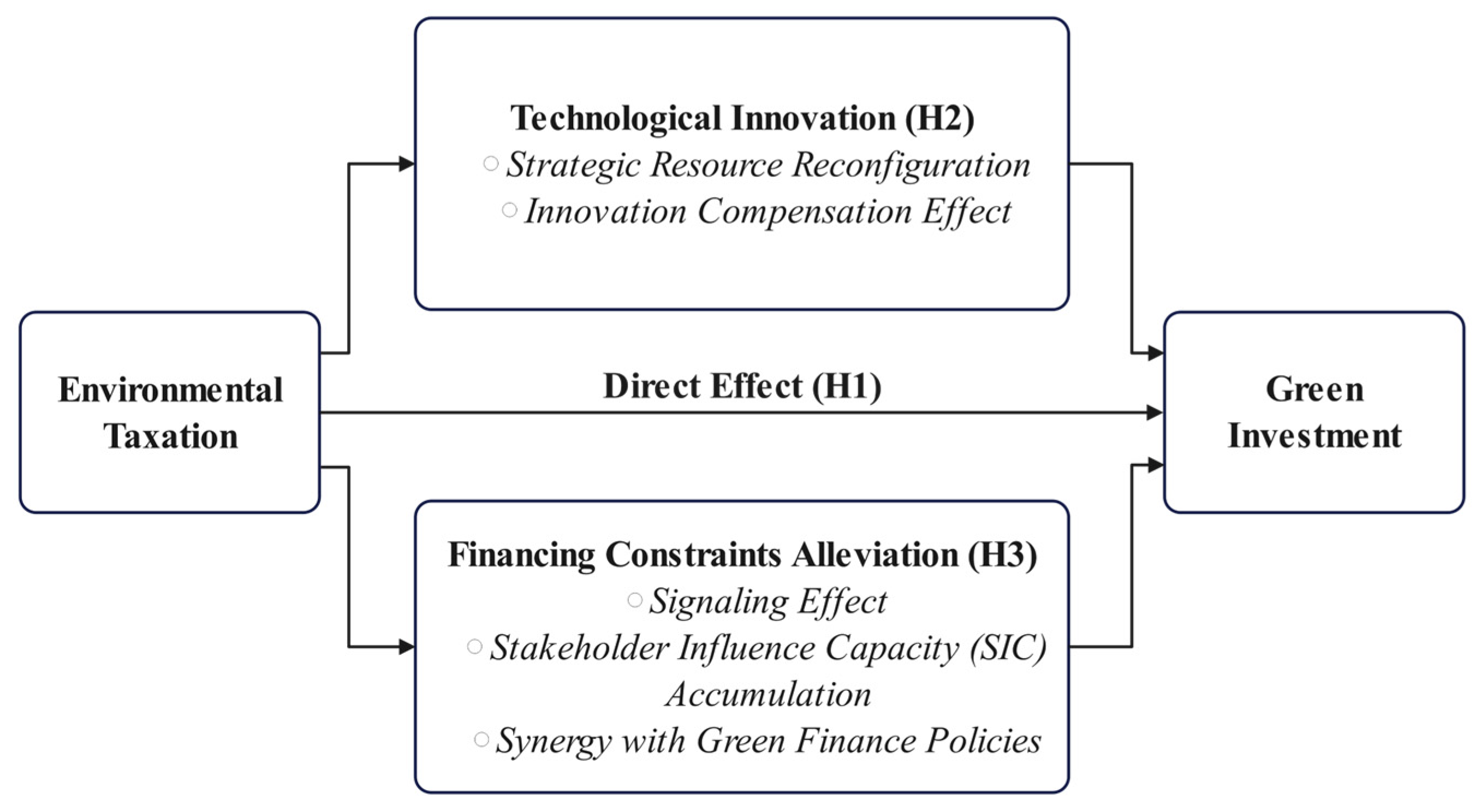
In summary, Figure 1 depicts the mechanisms by which environmental taxation influences green investment in heavily polluting firms.

3. Research Design

3.1. Sample Selection and Data Sources

The formal enactment of the Environmental Protection Tax Law on 1 January 2018 provides a quasi-natural experiment to scrutinize the transition from pollutant fees to a standardized taxation regime. To capture a comprehensive picture of this institutional shift, we utilize a dataset of Chinese A-share listed companies spanning from 2012 to 2023. This twelve-year window, centered around the 2018 reform, allows for a robust assessment of both pre-policy trends and post-policy structural adjustments. To identify firms engaging in green investment activities, we manually collect the “Construction in Progress” (CIP) notes within corporate annual reports, filtering for projects explicitly dedicated to environmental protection. After consolidating these project-level data, we refined the sample through a series of filters: omitting financial and insurance enterprises, removing “Special Treatment” (ST) firms to eliminate the noise of financial hardship, and dropping observations with significant missing values. Data for this study were gathered from enterprises’ annual reports, the CSMAR Database, the China Statistical Yearbook, and the China Environmental Statistical Yearbook, among others. To reduce the impact of extreme values, all continuous variables are winsorized at 1% in both tails.

3.2. Variable Definitions

3.2.1. Dependent Variable

To reasonably measure a firm’s commitment to green transformation, the dependent variable, Invst, is constructed by aggregating the capital expenditures identified in the aforementioned CIP notes. These expenditures encompass a wide array of green investments, including but not limited to desulfurization equipment, denitrification facilities, wastewater treatment systems, exhaust gas treatment facilities, dust removal equipment, energy-saving renovation projects, and clean energy production facilities. To neutralize the confounding influence of corporate scale, we normalize the annual green investment by the firm’s total end-of-year assets. For ease of interpretation in the subsequent regression analysis, this ratio is scaled by 100. Appendix A provides detailed instructions for the identification and calculation process.

3.2.2. Key Explanatory Variable

This analysis takes the Environmental Protection Tax Law’s implementation in 2018 as an exogenous policy shock and conducts a quasi-natural experiment. Drawing on the Industry Classification Management List for Environmental Protection Verification of Listed Companies issued by the Ministry of Environmental Protection of China, we designated fourteen sectors—including thermal power, metallurgy, and chemical production—as the treatment group (Treated = 1) [47]. These heavily polluting enterprises are the primary subjects of the environmental tax’s regulatory pressure. Other firms constitute the control group (Treated = 0). By interacting this group dummy with a temporal indicator (After), which demarcates the period starting in 2018, we isolate the DID estimator (Treated × After). This term describes the net treatment effect of the environmental tax change, focusing on the firms that are most sensitive to emission costs. Table 1 shows the definitions and measurement approaches for major variables.

3.2.3. Control Variables

To distinguish the impact of policy from other company-specific investment drivers, we incorporated a set of control variables, drawing on previous research. These indicators measure a company’s market value (TobinQ), listing maturity (Age), and internal liquidity (Cash). We also include financial leverage (Lev), growth potential (Growth), and operational profitability (ROA) [4,15]. Furthermore, recognizing that corporate governance and ownership structures significantly shape investment horizons, we include indicators for state ownership (SOE), CEO–chair duality (Duality), and board composition (Board) [48]. Table 2 presents the descriptive statistics, providing a preliminary overview of the sample characteristics and distributional properties of the key variables.

3.3. Model Specification

To thoroughly examine the impact of the environmental tax reform, we use a difference-in-differences (DID) model with two-way fixed effects. This specification, as defined in Equation (1), controls for time-invariant firm characteristics and time shocks shared by all firms:
I n v s t i , t = β 0 + β 1 T r e a t e d i × A f t e r t + ρ C o n t r o l i , t + μ i + ω t + ε i , t
In this setup, Invsti,t represents the level of green investment for firm i in year t. Treatedi denotes the group dummy variable, which equals 1 for heavily polluting firms and 0 otherwise. Aftert is the time dummy variable, taking the value of 1 for the post-2018 period and 0 otherwise. The interaction term Treatedi × Aftert represents the DID estimator, and the coefficient β1 captures the net impact of the environmental tax reform on firms in the treatment group. Controli,t denotes the vector of control variables. μi represents firm fixed effects, ωt denotes time fixed effects, and εi,t is the stochastic error term.
But through what channels does this policy pressure actually operate? To address the theoretical mechanisms proposed in Hypotheses 2 and 3, we follow the classical approach of Baron and Kenny (1986) [49]. By constructing Equations (2) and (3), we comprehensively investigate whether technological innovation and the reduction in financial limitations serve as the underlying conduits for the observed policy effects.
M e d i , t = β 0 + β 1 T r e a t e d i × A f t e r t + ρ C o n t r o l i , t + μ i + ω t + ε i , t
I n v s t i , t = β 0 + β 1 T r e a t e d i × A f t e r t + β 2 M i , t + ρ C o n t r o l i , t + μ i + ω t + ε i , t
Medi,t represents the mediating variable in these models, which includes technical innovation and financial constraints. The definitions of other variables remain consistent with those in Equation (1).

4. Empirical Analysis

4.1. Parallel Trend Test

The parallel trend assumption, which holds that the treatment and control groups would have followed synchronized trajectories in the absence of the policy intervention, is crucial to the internal validity of the DID estimator. We use an event-study methodology that enables a dynamic deconstruction of the policy effect to confirm this. The following is the empirical specification:
I n v s t i , t = β 0 + 2012 2023 β t T i m e t × T r e a t e d i + ρ C o n t r o l i , t + μ i + ω t + ε i , t
Timet, a time dummy variable in this model, is equal to 1 when the observation falls inside year t and 0 otherwise. The interaction term between Treated and the year 2017 (pre_1) is removed from the regression since the year right before the policy’s introduction serves as the baseline period. The annual difference in green investment between the treatment and control groups is captured by the coefficient βt. The parallel trend assumption is supported if the computed βt coefficients in the pre-policy periods are statistically insignificant, indicating that the two groups had comparable trends before the policy.
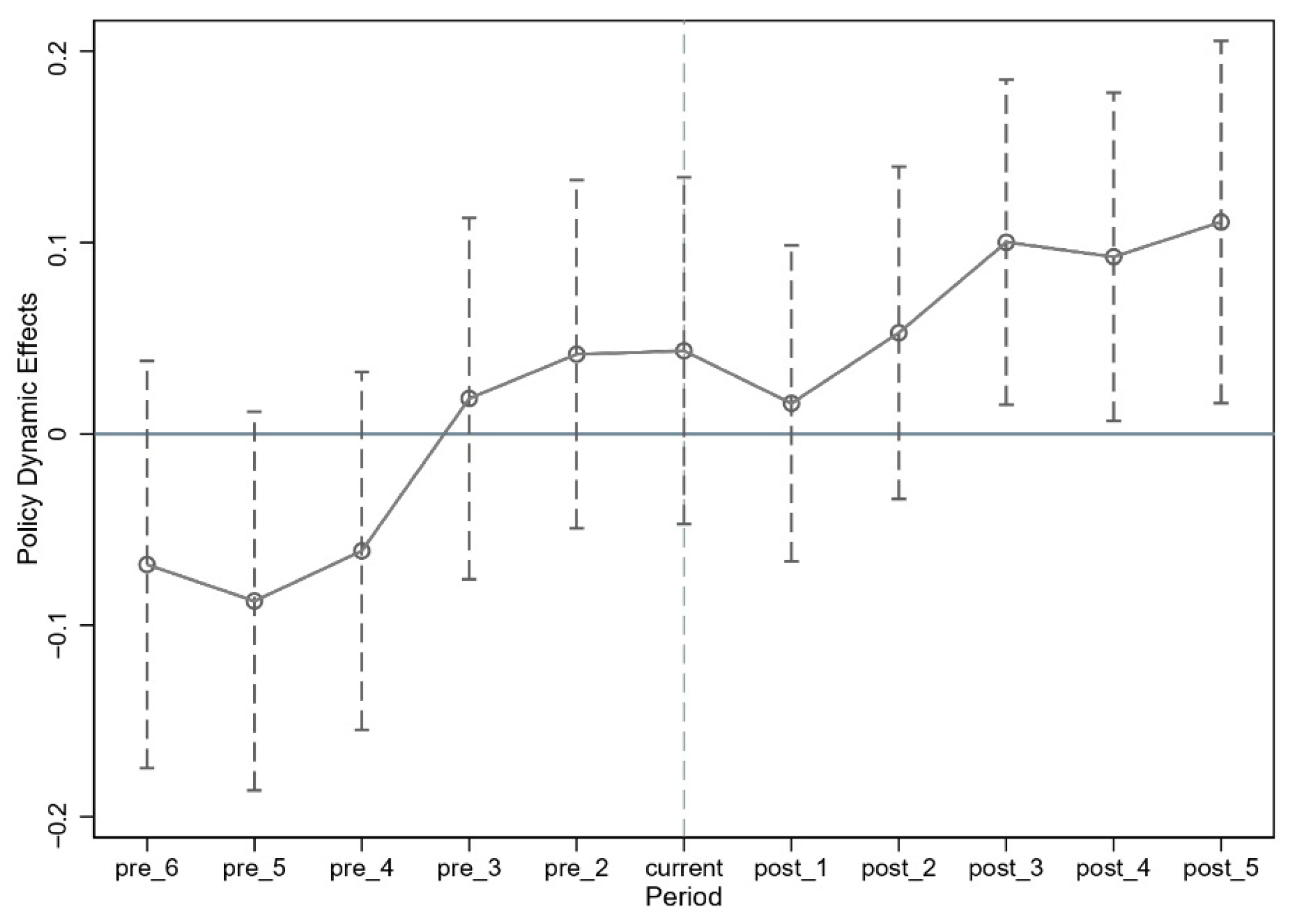
As shown in Figure 2, the estimated coefficients for the pre-reform years are statistically identical to zero, with 95% confidence intervals consistently straddling the horizontal axis. The lack of pre-treatment divergence provides persuasive evidence that the parallel trend assumption applies. What’s more, the policy’s effects show a clear time-lag effect. In the immediate two years following the environmental taxation’s implementation, the coefficients remain positive but statistically insignificant. However, starting from the third year, the estimates achieve significance and demonstrate a burgeoning upward trend. The results remain robust when using an alternative baseline period, with the corresponding event study estimates reported in Appendix B.

4.2. Baseline Regression Analysis

This study employs Equation (1) to empirically evaluate the influence of environmental tax reform on corporate green investment, with the results reported in Table 3. Column (1) shows a significant positive correlation between environmental taxation and capital allocation for green ventures, with the coefficient of Treated × After significant at the 1% level. In Column (2), which includes all firm-level control variables, the coefficient of Treated × After is 0.0953 and remains significant at the 1% level, indicating that the inclusion of controls does not materially affect the estimated effect. This result suggests that, following the implementation of the 2018 Environmental Protection Tax, the green investment intensity of heavily polluting firms increased by approximately 0.095 percentage points. This provides robust empirical evidence that the shift from pollution fees to environmental taxes effectively promotes green investment, thereby supporting H1 and validating the theoretical expectation that market-based environmental policy instruments can catalyze substantive corporate sustainable transformation.

4.3. Robustness Tests

4.3.1. Placebo Test

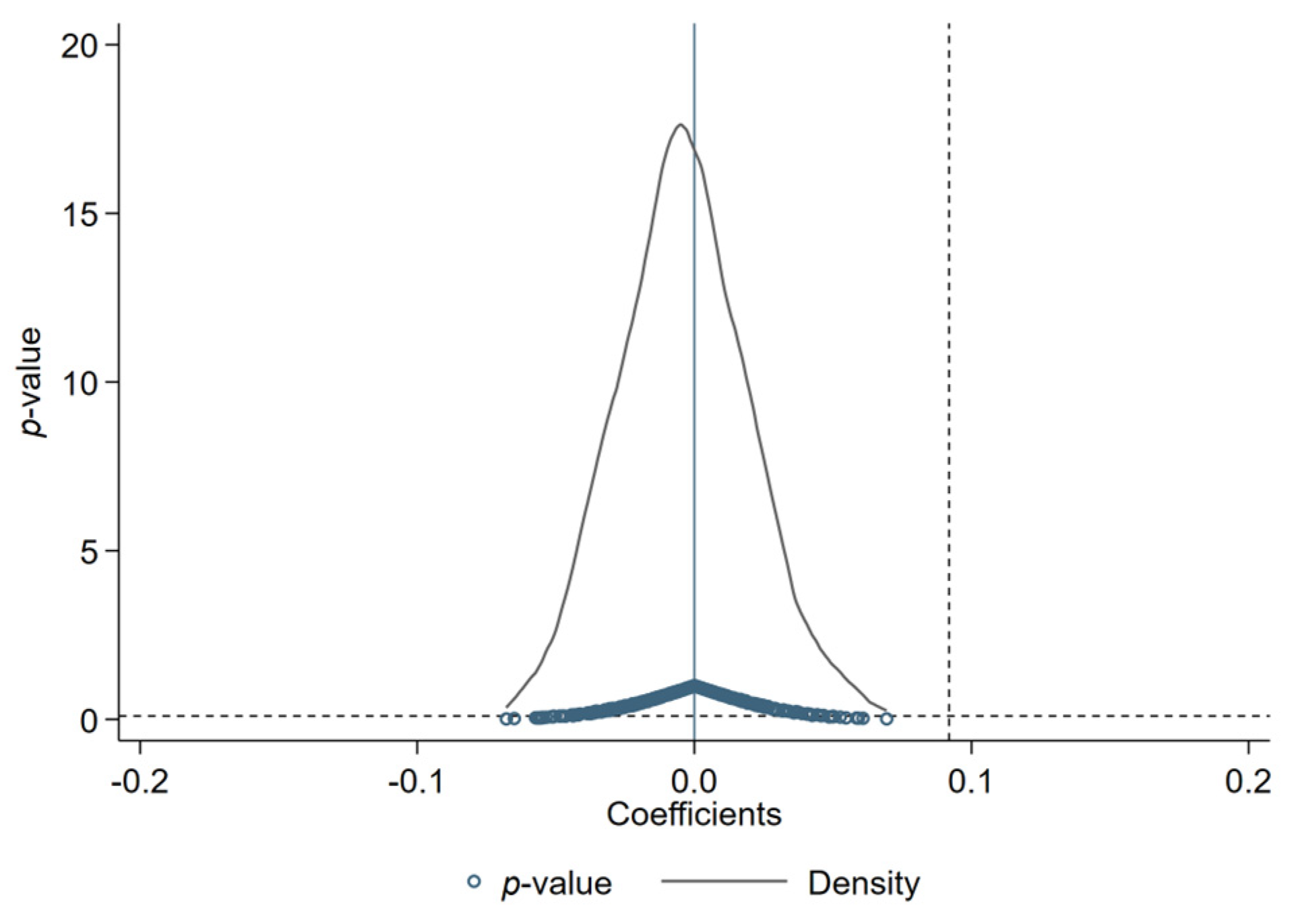
Could our findings be merely the result of random fluctuations or unobserved shocks? To address this concern, we run a placebo test in 500 simulations, randomly assigning businesses “pseudo-treatment” status. If the calculated policy effect is not influenced by irrelevant factors, the coefficient of the pseudo-interaction term should be statistically negligible. Figure 3 depicts the kernel density of these fictional coefficients, along with their p-values. The resulting distribution is tightly centered around zero, following a normal distribution pattern that stands in stark contrast to our actual estimate of 0.0953. Since our true coefficient lies in the extreme right tail of the simulated distribution, we can reasonably reject the possibility that the observed policy effect is driven by chance.

4.3.2. PSM-DID

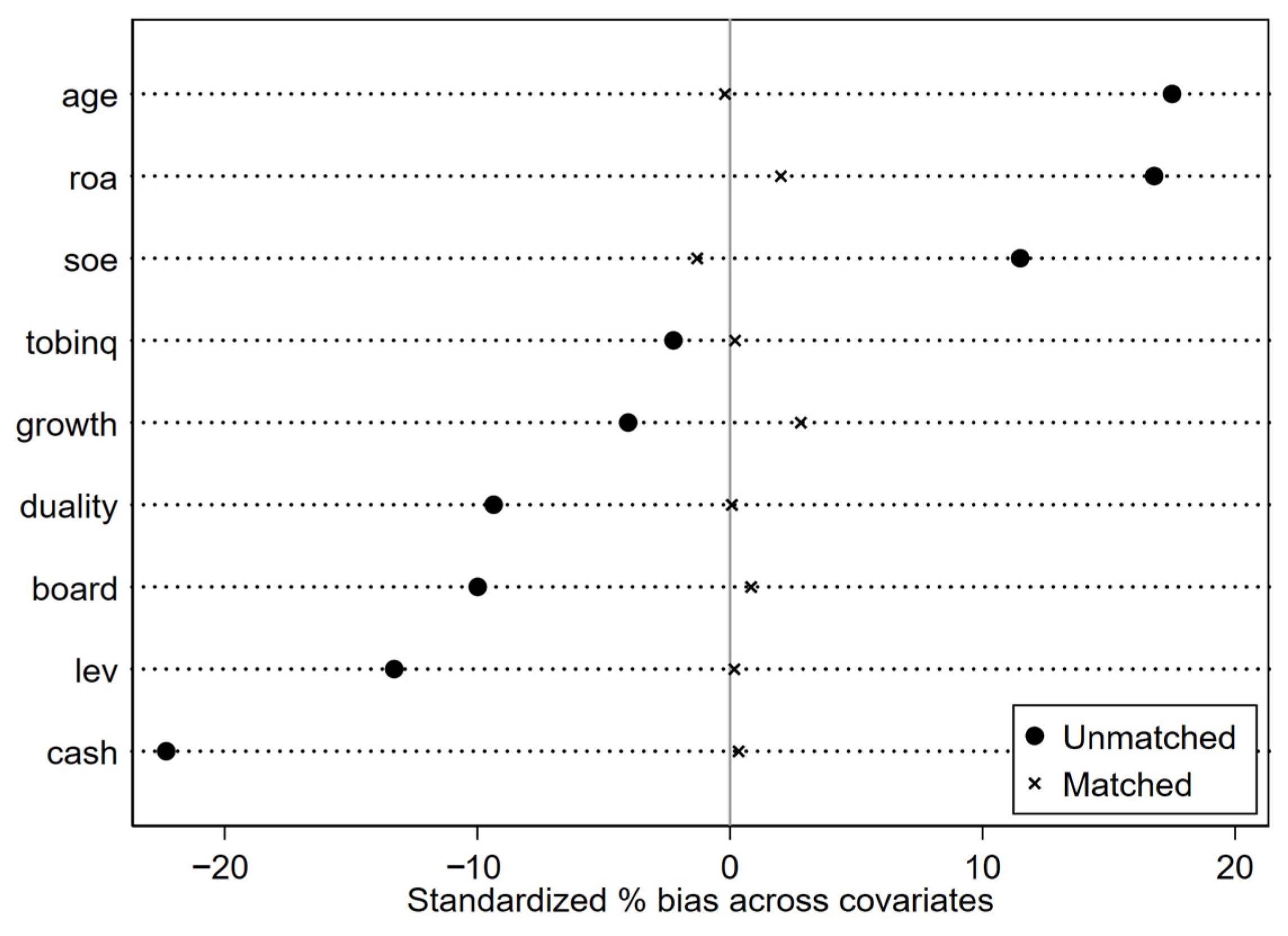
One potential critique of our industry-based grouping is the non-random nature of the treatment assignment. If heavy-polluting firms differ systematically from the control group in ways that correlate with investment trends, our estimates could be biased. We tackle this problem by using the Propensity Score Matching (PSM) approach. Using TobinQ, Age, and other business characteristics as covariates, we used a 1:1 nearest-neighbor matching technique to create a comparable control group. Observations that do not meet the common support requirement are eliminated, yielding a new matched sample. Post-matching balance tests revealed a significant reduction in standardized bias of the variables, indicating that the treatment and control groups achieve appropriate balance, and detailed results are reported in Appendix C. As shown in Figure A1, the standardized bias for most covariates declines from above 10% to below 5% after matching. This reduction suggests that the PSM procedure improves the balance of observable characteristics between heavy-polluting and non-heavy-polluting firms, particularly with respect to firm age, profitability, and internal liquidity. By enhancing comparability along these dimensions, the matching procedure helps to alleviate concerns that the estimated effects may be influenced by pre-existing differences in observable firm characteristics. Table 4 (Column 2) shows a significant positive coefficient for Treated × After at the 1% level, the consistency between the matched results and the baseline findings further indicates that the observed effects are not artifacts of selection bias.

4.3.3. Additional Robustness Checks

To further solidify our conclusions, we conducted three supplementary checks: The measurement of green investment was replaced. Shareholders’ equity, defined as net assets after subtracting liabilities from total assets, directly reflects a firm’s capital base and may influence the scale of green investment. Recognizing that total assets may not be the only appropriate denominator for normalization, we rescaled green investment using shareholders’ equity [48,50]. The results in Column (3) remain significantly positive at the 1% level, indicating that our findings are unaffected by the scaling factor used.
What’s more, potential interference from other policies is controlled for. China’s environmental regulatory landscape is diverse. We specifically controlled for pertinent pilot initiatives, such as the Low-Carbon City Pilot and the Carbon Emissions Trading Pilot, that might affect businesses’ decisions to make green investments in order to make sure we are capturing the precise impact of the environmental tax reform. The baseline regression includes dummy variables that represent these policies. In particular, Citylcpost shows if a company’s home city takes part in the Low-Carbon City Pilot in a particular year (1 = yes, 0 = no). CEApost indicates whether the firm’s city participates in the Carbon Emissions Trading Pilot in a given year (1 = yes, 0 = no). Even after filtering out the influence of these overlapping policies (Column 4), the coefficient of interest remains remarkably robust in both magnitude and significance. This reinforces the argument that the environmental tax acts as a distinct and potent institutional driver for green investment.
Finally, to account for regional variation in policy implementation, we further exploit differences in environmental tax intensity across provinces. Under China’s Environmental Protection Tax Law, provincial governments are granted discretion to set tax rates within a legally prescribed range, allowing them to tailor tax standards according to local environmental conditions and economic development levels. As a result, firms located in different provinces face heterogeneous changes in pollution costs following the reform. To capture this variation, we construct a dummy variable, Tax, which equals 1 if a firm is located in a province with a relatively high environmental tax rate, and 0 otherwise (low-tax-rate provinces include Zhejiang, Hubei, Fujian, Jilin, Anhui, Jiangxi, Shaanxi, Gansu, Xinjiang, Tibet, Ningxia, Qinghai, Inner Mongolia, Hei-longjiang, Yunnan, Liaoning, Tianjin, Shanghai, and Guangdong; high-tax-rate provinces include Hebei, Jiangsu, Shandong, Henan, Hunan, Sichuan, Chongqing, Guizhou, Hainan, Guangxi, Shanxi, and Beijing). We then incorporate a triple interaction term, Treated × After × Tax, to investigate the impact of tax rate differences. The estimation results (Column 5) show that the coefficient on the triple interaction term remains positive and statistically significant at the 1% level. This finding indicates that heavily polluting firms located in high-tax regions experience a larger increase in green investment following the reform. It not only reinforces the baseline results but also highlights the important role of policy intensity in shaping firms’ behavioral responses, thereby further strengthening the identification strategy.

5. Mechanism Analysis

5.1. Technological Innovation

How does a law-based tax reform translate into tangible capital outlays for green projects? According to the Porter Hypothesis, the primary conduit is the stimulation of indigenous technological capabilities. The environmental tax reform significantly elevates the shadow price of pollution, effectively compelling firms to seek productivity-enhancing solutions to offset rising fiscal burdens. This study uses R&D intensity, which is the ratio of R&D investment to operational revenue, as a stand-in for the company’s innovative commitment in order to capture this internal adaptive reaction.
The empirical results in Column (1) of Table 5 reveal that the coefficient of Treated × After on RD is 0.0017, significant at the 1% level. This confirms that the transition to an environmental tax has indeed functioned as an institutional catalyst, triggering a substantive surge in R&D investment among heavy-polluting enterprises. When this innovation proxy is subsequently integrated into the baseline model in Column (2), the DID estimator remains significantly positive. This pattern provides suggestive evidence that technological innovation operates as a plausible transmission channel. In this framework, the innovation compensation generated through R&D activities potentially facilitates and justifies expanded green investment. These findings are consistent with H2, aligning with the view that environmental taxation drives green transformation by pivoting firms toward a more innovation-led growth trajectory.

5.2. Financing Constraints

Beyond internal technical upgrades, the feasibility of green investment is often dictated by the external financing environment. Heavy-polluting firms, characterized by elevated environmental risk profiles and potential regulatory liabilities, often encounter systematic credit discrimination in capital markets. To quantitatively capture these market frictions, we follow prior studies [51,52] and employ the Financing Constraint Index (FC index) as a proxy for firms’ financing constraints. Common alternatives include the KZ, WW, and SA indices. The SA index is primarily constructed based on firm size and age, which are unlikely to be directly affected by environmental tax policies, thus limiting its suitability in this context. Meanwhile, both the KZ and WW indices, as well as the FC index, rely on endogenous financial variables. However, compared with the KZ and WW indices, the FC index is calibrated to the characteristics of Chinese listed firms generated by the CSMAR database [52]. Therefore, although it shares similar limitations, the FC index is relatively more suitable for capturing financing constraints in our sample within the Chinese institutional setting. Its construction draws on the methodology of Hadlock and Pierce (2009) [53], and the estimation procedure is roughly as follows:
Initially, three key exogenous indicators—firm size, firm age, and cash dividend payout ratio—are standardized annually. Firms are ranked each year based on the average values of the standardized variables, and the upper and lower terciles serve as cutoff thresholds for the financing constraint dummy variable, QUFC. Firms above the 66th percentile have modest financing limitations (QUFC = 0), whereas those below the 33rd percentile face substantial financing constraints (QUFC = 1). A Logit model is then constructed to determine the likelihood that a corporation will face financial limitations each year. The expected probability is defined as the financial constraint index (FC), which ranges from 0 to 1, with higher values suggesting more severe financing limitations. The model definition is presented in Equations (5) and (6):
P Q U F C i , t = 1 Z i , t = e Z i , t 1 + e Z i , t
Z i , t = α 0 + α 1 S i z e i , t + α 2 L e v i , t + α 3 C a s h D i v T A i , t + α 4 M B i , t + α 5 N W C T A i , t + α 6 E B T I T A i , t
where Sizei,t denotes the natural logarithm of total assets, Levi,t represents the leverage ratio, CashDivi,t is cash dividends, MBi,t is the market-to-book ratio, NWCi,t denotes net working capital, EBITi,t refers to earnings before interest and taxes, and TAi,t represents total assets.
Column (3) shows that the coefficient of Treated × After is −0.0201, indicating a significant negative effect at the 1% level. This suggests that environmental taxation may contribute to reducing the degree of financing constraints faced by enterprises while improving their financing conditions. Far from being a cost burden, the standardized tax regime appears to improve the transparency of corporate environmental performance, minimizing information asymmetry between enterprises and lenders. The results in column (4) further support the logic that this reduction in financial friction could serve as a critical precursor to green capital formation. It can be argued that the environmental tax is associated with the alleviation of firms’ financial difficulties during the financing process. This process appears to provide the essential capital backing for heavily polluting firms to undertake capital-intensive green projects.
To further substantiate this financial easing mechanism, we turn our attention to the evolution of the firm’s financing structure. We decompose external capital into debt and equity components to identify whether the reform alters the firm’s reliance on specific funding channels. Equity financing is calculated as the ratio of the annual increase in the difference between shareholders’ equity and retained earnings to total assets, whereas debt financing is calculated as the ratio of the annual increase in the sum of current and non-current liabilities to total assets [54]. The share of debt financing in total financing is then used to characterize firms’ financing structure, denoted as Struct. The results reported in columns (5) and (6) indicate a significant increase in the proportion of debt financing. This shift toward debt, often characterized by more stable and lower-cost credit resources in the context of China’s burgeoning green credit market, suggests that firms may leverage their improved environmental performance to secure institutional backing. Such support could potentially shield firms from the volatility of capital markets, ensuring a steady stream of funding for green investments. Collectively, these multifaceted results are consistent with the logic of H3, illustrating that environmental taxation fosters greening not only through innovation but also by potentially improving the financing conditions of heavily polluting firms.

6. Further Analysis

6.1. The Heterogeneous Impacts of Pollution Intensity

While the baseline results establish a compelling link between the environmental tax reform and green investment, a binary classification into “heavy” versus “non-heavy” polluters potentially masks a more nuanced, non-linear response. Firms are not monolithic in their ecological footprint; their sensitivity to fiscal environmental instruments is inherently tied to the marginal cost of their emissions. Theoretically, firms at the end of the pollution spectrum encounter the most formidable regulatory headwinds and fiscal burdens, arguably necessitating a more aggressive reallocation of capital toward green assets. Conversely, for entities with marginal emission profiles, the tax burden may remain below the critical threshold required to trigger a substantive shift in investment strategy. To test this “threshold hypothesis,” we move beyond binary grouping and categorize firms into a four-tier hierarchy—severely, moderately, lightly, and non-polluting—leveraging the pollution emission coefficient method [55]. Four major pollutants—industrial smoke (dust), industrial sulfur dioxide, industrial wastewater, and industrial solid waste—are selected to calculate pollutant emissions per unit of output for each industry:
U D i , j = D i , j / P i
where Di,j denotes the emission level of pollutant j in industry i, and Pi represents the total output value of industry i.
Next, UDi,j is linearly standardized:
U D i , j s = U D i , j m i n U D j / m a x U D j m i n U D j
where max(UDj) and min(UDj) denote the maximum and minimum values of pollutant j across all industries, respectively.
Subsequently, the standardized emissions per unit of output for all pollutants in industry i are aggregated to obtain the pollution emission coefficient for that industry:
γ i = j = 1 n U D i , j s
Industries are then ranked according to the magnitude of the pollution emission coefficient, from highest to lowest. Firms are thus divided into four categories: severely polluting, moderately polluting, lightly polluting, and non-polluting [56]. Three important interaction terms are created: Pollu1 × After, Pollu2 × After, and Pollu3 × After. Pollu1 captures the difference between heavily polluting and non-polluting enterprises, Pollu2 catches the difference between moderately polluting and non-polluting firms, and Pollu3 captures the difference between lightly polluting and non-polluting firms. To examine changes in green investment before and after policy implementation among enterprises with varying pollution intensities, regressions are run separately for these three interaction factors.
As reported in Table 6, columns (1), (2), and (3) present the differences in green investment levels between severely polluting, moderately polluting, and lightly polluting firms and non-polluting firms, revealing a stark divergence in policy responsiveness. While the coefficients for moderately and lightly polluting firms fail to reach statistical significance, the interaction term for the most carbon-intensive cohort (Pollu1 × After) is positive and significant at the 1% level, showing that green investment by severely polluting firms increased significantly relative to non-polluting firms following the implementation of the environmental tax policy. This divergence unveils a definitive threshold characteristic in environmental taxation: the incentive to “invest green” only crystallizes when the tax-induced cost of pollution becomes a dominant factor in the firm’s cost structure. For the most severe polluters, environmental taxation effectively shifts the equilibrium, making green investment a rational economic necessity.

6.2. Green Investment and ESG: A Synergistic Perspective

Does this tax-induced rise in green investment translate into a broader organizational transformation? To answer this, we extend our inquiry to corporate ESG performance—a holistic barometer of environmental stewardship, social responsibility, and governance integrity. In the modern capital market, ESG scores function as a vital signaling mechanism, influencing investor sentiment and corporate valuation. We posit that environmental taxation acts as an institutional nudge, compelling firms not only to modernize their equipment but also to refine their internal governance and disclosure transparency, thereby improving ESG outcomes [19]. Similar to green investment, firms with different levels of pollution intensity may exhibit heterogeneous responses to environmental taxation in terms of ESG performance. Severely polluting firms often face greater historical environmental liabilities and stronger external monitoring pressure, resulting in relatively lower ESG scores. The implementation of environmental taxation may therefore provide stronger incentives for these firms to improve their governance and sustainability practices [57]. In contrast, lightly polluting firms typically face lower environmental risks, and the policy impact on their ESG performance may be relatively limited.
Columns (4)–(6) of Table 6 report regression results with ESG as the dependent variable. For severely polluting firms, the coefficient of Pollu1 × After is significantly positive at the 1% level, suggesting that environmental taxation corresponds to a significant leap in overall ESG ratings. This finding is highly consistent with the regression results for green investment, and this synergy suggests that for high-intensity polluters, the environmental tax reform triggers a multi-dimensional sustainability transition. Interestingly, while moderately polluting firms show an insignificant response in terms of large-scale capital investment, they exhibit a significant improvement in ESG scores (Pollu2 × After). This nuance is particularly illuminating: it implies that firms facing moderate tax pressures may opt for “soft” organizational adjustments—such as enhancing environmental management systems or improving social responsibility reporting—which, while less capital-intensive than new production lines, nonetheless bolster their sustainability credentials. In contrast, the coefficient of Pollu3 × After for lightly polluting firms is not statistically significant, indicating that environmental taxation has limited effects on their ESG performance.
In summation, the environmental tax policy exhibits a graduated impact that is highly contingent upon a firm’s initial pollution intensity. By internalizing ecological costs, the environmental tax reform exhibits significant effects, particularly for those firms previously burdened by high environmental liabilities. These findings suggest that environmental taxation, by strengthening environmental cost constraints and governance incentives, promotes both green capital investment and broader, sustainability-oriented adjustments in environmental responsibility and governance practices. In doing so, environmental taxation provides essential institutional support for firms’ robust ESG outcomes and facilitates a substantive transition toward long-term sustainable development.

7. Conclusions and Policy Recommendations

7.1. Main Findings and Discussion

This study examines the impact of China’s Environmental Protection Tax reform on corporate green investment, with a focus on its underlying mechanisms and heterogeneous effects. Using a difference-in-differences framework, central to our findings is the confirmation that environmental taxation significantly stimulates green investment, supporting H1. This result is consistent with prior studies emphasizing the incentive effects of environmental regulation [3,5]. Beyond simply reaffirming the Porter Hypothesis, our findings suggest that environmental taxation operates as a market-based instrument that reshapes firms’ resource allocation decisions.
The mechanism analysis supports H2, showing that technological innovation serves as a key transmission channel. This finding aligns with Deng et al. (2023) [14] and Cheng et al. (2022) [10], who indicate that environmental taxation induces firms to reallocate internal resources toward cleaner technologies and efficiency improvements, thereby translating regulatory pressure into sustained green investment. Innovation, in this sense, should be understood not merely as an outcome but as a central adaptive mechanism through which firms internalize policy shocks. Regarding financing channels, our results suggest that environmental taxes improve financing conditions by alleviating financing constraints and increasing the proportion of debt financing, supporting H3. This is in line with Xu et al. (2024) [17] and Masoud (2025) [18], who link environmental performance with improved access to green finance. In contrast to Xie et al. (2023) [12], who emphasize the crowding-out effect of tax burdens on liquidity, we contribute a dynamic interpretation: short-term financial pressure may be balanced or even superseded by the benefits of improved institutional legitimacy over a longer horizon. Consistent with the CSR–finance view established by Cheng et al. (2014) [40], environmental tax compliance appears to serve as a credible signal of a firm’s environmental commitment, potentially facilitating broader access to external capital. This perspective may offer a plausible explanation for the inconsistent findings in existing research by highlighting the dynamic tension between immediate fiscal costs and potential long-term gains in reputation and financing capacity.
The impact of environmental taxation is further nuanced by the heterogeneous pollution intensity of firms. This finding advances the existing literature, which typically relies on binary classifications of heavily polluting industries, by introducing a more refined classification measure. Moreover, relative to Zhao et al. (2023) [4], who highlight a “scale–efficiency” trade-off characterized by overinvestment and declining efficiency, this study extends its focus beyond investment to broader organizational outcomes, demonstrating that environmental taxation fosters significant improvements in ESG performance. This implies that market-based environmental regulation could trigger a synergy effect—whereby increased green capital outlays are accompanied by enhanced governance integrity and environmental accountability—thus facilitating a holistic transition toward long-term corporate sustainability.
Despite these contributions, several limitations should be acknowledged. First, although the manually collected CIP data provides a detailed proxy for corporate green investment, the identification of environmentally related expenditures inevitably involves a degree of subjective judgment, which may introduce measurement error. Second, while the DID framework is well suited for policy evaluation, potential biases may arise when treatment effects vary across groups or over time under a two-way fixed effects specification. Although our robustness checks indicate that the main results remain stable, future research could employ alternative estimators that are more robust to such heterogeneity to further strengthen causal identification. Additionally, although this study primarily exploits variation across industries to identify the policy effect, environmental tax rates also differ across regions, providing additional cross-sectional variation. While this study partially incorporates such variation through a triple-interaction specification in the robustness analysis, subsequent research could further exploit regional policy intensity to strengthen identification and explore more nuanced effects. Moreover, future research could extend this study by exploring additional mechanisms, such as managerial incentives, corporate governance, or supply chain pressures. Finally, as environmental information disclosure systems mature, subsequent studies could utilize more precise firm-level emission data to mitigate potential industry-level misclassification bias. The use of more granular environmental data or alternative identification strategies would help deepen the understanding of how environmental policies influence firm behavior across different institutional contexts.

7.2. Policy Recommendations

The empirical evidence synthesized in this study offers a robust theoretical framework for refining environmental and economic policies. To further harness the potential of market-based instruments, we propose the following multi-dimensional policy recommendations.
To begin with, the environmental tax system should be optimized to balance regulatory stringency with incentive compatibility. While maintaining the binding nature of environmental taxation, policymakers may gradually expand the tax base to cover a broader range of pollutants, thereby improving the alignment between production costs and environmental externalities. At the same time, complementary fiscal instruments—such as targeted tax credits and subsidies for green innovation—should be strengthened to offset short-term financial pressure and support firms’ technological upgrading. This combination helps shift firms from passive compliance toward proactive green transformation.
Furthermore, policy design should explicitly account for firm heterogeneity, particularly differences in pollution intensity. Rather than relying on a uniform regulatory framework, a differentiated approach is more effective. For highly polluting and capital-intensive sectors, stronger tax signals should be paired with long-term financial support to facilitate large-scale technological retrofitting. In contrast, for firms with lower pollution intensity, policy emphasis should focus on improving environmental information disclosure and ESG evaluation systems, thereby enhancing market-based incentives through reputational and valuation channels. Such a differentiated strategy allows environmental taxation to function as a more precise policy instrument.
Finally, the effectiveness of environmental taxation critically depends on its integration with the green finance system. Financial institutions should be encouraged to incorporate environmental tax compliance and environmental performance indicators into credit evaluation and capital allocation decisions. By linking tax compliance with financing conditions, policymakers can strengthen the signaling role of environmental taxation and reduce information asymmetry in capital markets. This policy coordination not only alleviates financing constraints but also reinforces the incentive for firms to undertake green investment.


Author Contributions

Conceptualization, J.L. and Y.W.; methodology, J.L.; software, J.L.; formal analysis, J.L.; data curation, J.L.; writing—original draft preparation, J.L.; writing—review and editing, J.L. and Y.W.; visualization, J.L.; supervision, Y.W.; project administration, Y.W. All authors have read and agreed to the published version of the manuscript.

Funding

This research was funded by the National Social Science Foundation of China, grant number 22BTJ002; the “Innovation Star” Project for Postgraduates of Universities in Gansu Province, China, grant number 2025CXZX-870; and the Industrial Support Plan Project of Universities in Gansu Province, China, grant number 2022CYZC-56.

Institutional Review Board Statement

Not applicable.

Informed Consent Statement

Not applicable.

Data Availability Statement

The data presented in this study are available on request from the corresponding author.

Acknowledgments

The authors would like to express their sincere gratitude to all individuals who participated in and supported the preparation of this manuscript.

Conflicts of Interest

The authors declare no conflicts of interest.

Appendix A. Illustration of Green Investment Measurement

Green investment is identified from “Construction in Progress” project descriptions using a structured classification framework. Specifically, projects are classified as environmental investment if they fall into predefined categories, including environmental protection facilities and equipment, wastewater and waste gas treatment systems, dust and solid waste treatment, energy-saving and clean energy projects, environmental R&D, monitoring systems, and other pollution control or ecological restoration expenditures. In total, 26 categories are considered to ensure comprehensive coverage. This classification is complemented by keyword-based screening (e.g., “wastewater treatment”, “desulfurization”, “energy-saving”, “clean energy”), and only projects with explicit environmental objectives are retained. At the firm-year level, green investment is calculated by aggregating the investment amounts of all identified environmental projects:
G I i , t = j = 1 N I n v e s t m e n t i , t ( j )
where I n v e s t m e n t i , t j denotes the investment amount of project j for firm i in year t, and N is the number of projects classified as green investment.
The baseline dependent variable is constructed by normalizing green investment by total assets:
I n v s t i , t = G I i , t T o t a l A s s e t s i , t × 100
For robustness, an alternative measure is constructed by scaling green investment with shareholders’ equity. Shareholders’ equity is defined as total assets minus total liabilities, reflecting the firm’s net capital base. The alternative measure is calculated as:
I n v s t _ e q i , t = G I i , t E q u i t y i , t × 100
This alternative indicator accounts for differences in corporate capital structures and provides a complementary perspective for standardizing green investments. All firm-level variables are constructed consistently across observations to ensure comparability.

Appendix B. Alternative Baseline Estimation

Table A1. Event Study Estimates with Different Baseline Periods.
(1)(2)
Baseline: Ref = t − 1Alternative Base: Ref = t − 2
pre_6−0.0682 (−1.41)−0.1099 (−1.34)
pre_5−0.0873 (−1.05)−0.1290 (−1.18)
pre_4−0.0611 (−1.33)−0.1027 (−1.60)
pre_30.0185 (0.40)−0.0231 (−0.49)
pre_20.0416 (0.90)(omitted)
pre_1(omitted)−0.0416 (−0.90)
current0.0434 (0.99)0.0018 (0.04)
post_10.0160 (0.38)−0.0257 (−0.58)
post_20.0528 (1.24)0.0112 (0.26)
post_30.1001 ** (2.38)0.0585 ** (2.23)
post_40.0925 ** (2.22)0.0509 ** (2.19)
post_50.1107 *** (2.66)0.0691 ** (2.34)
Pre-trend joint test (p-value)0.42730.3859
ControlsYesYes
Firm FEYesYes
Year FEYesYes
N31,04631,046
R20.45630.4563
Notes: This table reports the results of the event study analysis. Column (1) uses 2017 (t − 1) as the reference year, while Column (2) uses 2016 (t − 2) as the reference year. Robust t statistics in parentheses, ** p < 0.05, *** p < 0.01.

Appendix C. Balance Test Results

Figure A1. Balance test results.
Sustainability 18 04733 g0a1

References

  1. Henisz, W.; Koller, T.; Nuttall, R. Five ways that ESG creates value. McKinsey Q. 2019, 4, 1–12. [Google Scholar]
  2. Porter, M.E.; Linde, C.V.D. Toward a new conception of the environment-competitiveness relationship. J. Econ. Perspect. 1995, 9, 97–118. [Google Scholar] [CrossRef]
  3. Liu, G.; Yang, Z.; Zhang, F.; Zhang, N. Environmental tax reform and environmental investment: A quasi-natural experiment based on China’s Environmental Protection Tax Law. Energy Econ. 2022, 106, 106000. [Google Scholar] [CrossRef]
  4. Zhao, L.; Tang, Y.; Liu, Y. How does environmental tax influence the scale and efficiency of green investment among China’s heavily polluting enterprises? Sustainability 2023, 15, 15021. [Google Scholar] [CrossRef]
  5. Guo, B.; Feng, W.; Yu, Y.; Zhang, H.; Hu, F. Can environmental tax improve environmental investment? Evidence from a quasi-natural experiment in China. Environ. Sci. Pollut. Res. 2023, 30, 113846–113858. [Google Scholar] [CrossRef] [PubMed]
  6. Cui, G. How do environmental taxes affect the environmental investment of high-emission enterprises: Evidence from China. J. Environ. Manag. 2024, 370, 122629. [Google Scholar] [CrossRef] [PubMed]
  7. Mei, K.; Zhang, Z. Environmental regulation, green investment and corporate green governance: Evidence from China’s new environmental protection law. Financ. Res. Lett. 2025, 76, 106979. [Google Scholar] [CrossRef]
  8. Han, X.; Cai, Q. Environmental regulation, green credit, and corporate environmental investment. Innov. Green Dev. 2024, 3, 100135. [Google Scholar] [CrossRef]
  9. Zhang, J.; Hua, H.; Yang, L.; Nie, Z. Impact of China’s environmental protection tax on green total factor productivity: Based on the perspective of digital transformation. Front. Environ. Sci. 2024, 12, 1484910. [Google Scholar] [CrossRef]
  10. Cheng, Z.; Chen, X.; Wen, H. How does environmental protection tax affect corporate environmental investment? Evidence from Chinese listed enterprises. Sustainability 2022, 14, 2932. [Google Scholar] [CrossRef]
  11. Chang, L.; Zheng, B.; Tan, N.; Zheng, H. Unlocking green capital: Financial constraints and environmental investments in China. J. Asian Econ. 2026, 102, 102075. [Google Scholar] [CrossRef]
  12. Xie, L.; Zuo, S.; Xie, Z. Environmental protection fee-to-tax and enterprise investment efficiency: Evidence from China. Res. Int. Bus. Financ. 2023, 66, 102057. [Google Scholar] [CrossRef]
  13. Hu, S.; Wang, A.; Du, K. Environmental tax reform and greenwashing: Evidence from Chinese listed companies. Energy Econ. 2023, 116, 106873. [Google Scholar] [CrossRef]
  14. Deng, J.; Yang, J.; Liu, Z.; Tan, Q. Environmental protection tax and green innovation of heavily polluting enterprises: A quasi-natural experiment. PLoS ONE 2023, 18, e0286253. [Google Scholar] [CrossRef]
  15. Su, X.; Huang, C.; Mirza, S.; Zhang, C. From pollution to solution: How environmental protection tax shapes green technological innovation? Clean Technol. Environ. Policy 2025, 27, 7339–7371. [Google Scholar] [CrossRef]
  16. Wang, X.; Wang, S.; Wu, K.; Zhai, C.; Li, Y. Environmental protection tax and enterprises’ green technology innovation: Evidence from China. Int. Rev. Econ. Financ. 2024, 96, 103617. [Google Scholar] [CrossRef]
  17. Xu, X.; Wang, S.; Li, J.; Qiao, T. Environmental regulatory intensity, green finance and corporate green sustainable development performance. Heliyon 2024, 10, e30114. [Google Scholar] [CrossRef] [PubMed]
  18. Masoud, N. Driving green innovation: Assessing the impact of environmental tax policies and green finance on heavily polluting industries. Soc. Transform. Chin. Soc. 2025, 21, 111–139. [Google Scholar] [CrossRef]
  19. He, Y.; Zhao, X.; Zheng, H. How does the environmental protection tax law affect firm ESG? Evidence from the Chinese stock markets. Energy Econ. 2023, 127, 107067. [Google Scholar] [CrossRef]
  20. Wang, X.; Ye, Y. Environmental protection tax and firms’ ESG investment: Evidence from China. Econ. Model. 2023, 122, 106621. [Google Scholar] [CrossRef]
  21. Li, Y.; Hua, Z. Environmental protection tax law and corporate ESG performance. Financ. Res. Lett. 2024, 64, 105423. [Google Scholar] [CrossRef]
  22. Wen, H.; Deng, W.; Guo, Q. The effects of the environmental tax on heavily polluting firms in China. PLoS ONE 2021, 16, e0261342. [Google Scholar] [CrossRef] [PubMed]
  23. Huang, S.; Lin, H.; Zhou, Y.; Ji, H.; Zhu, N. The influence of replacing environmental protection fees with taxes on enterprise green innovation—Evidence from China’s heavily polluting industries. Sustainability 2022, 14, 6850. [Google Scholar] [CrossRef]
  24. He, Y.; Zhu, X.; Zheng, H. The influence of environmental protection tax law on total factor productivity: Evidence from listed firms in China. Energy Econ. 2022, 113, 106248. [Google Scholar] [CrossRef]
  25. Liu, T.; Fang, Y.; Shi, Q.; Ren, L. Effect of the new environmental protection law on the market competitiveness of China’s heavily polluting enterprises. Sustainability 2023, 15, 10311. [Google Scholar] [CrossRef]
  26. Huang, Y.; Liu, C.; Wang, L.; Qi, Y. The impact of environmental protection tax on corporate ESG performance and green behavior. Res. Int. Bus. Financ. 2025, 75, 102772. [Google Scholar] [CrossRef]
  27. Du, G.; Zhou, C.; Ma, Y. Impact mechanism of environmental protection tax policy on enterprises’ green technology innovation with quantity and quality from the micro-enterprise perspective. Environ. Sci. Pollut. Res. 2023, 30, 80713–80731. [Google Scholar] [CrossRef]
  28. Yin, Q.; Yang, B.; Meng, C.; Xu, W.; Liu, Z. Environmental protection tax and corporate green innovation: Evidence from China. Sustainability 2025, 17, 9871. [Google Scholar] [CrossRef]
  29. Pigou, A. The Economics of Welfare; Routledge: New York, NY, USA, 2017. [Google Scholar]
  30. Duan, S.; Li, J.; Zhang, X.; Lu, Y. Corporate sustainability: The role of environmental taxes in ESG performance. Environ. Dev. Sustain. 2024, 28, 5529–5549. [Google Scholar] [CrossRef]
  31. Shi, X.; Jiang, Z.; Bai, D.; Fahad, S.; Irfan, M. Impact of green tax reforms on corporate environmental performance and economic growth: Do green reforms promote the environmental performance in heavily polluted enterprises? Environ. Sci. Pollut. Res. 2023, 30, 56054–56072. [Google Scholar] [CrossRef]
  32. Ren, S.; Hao, Y.; Wu, H. How does green investment affect environmental pollution? Evidence from China. Environ. Resour. Econ. 2022, 81, 25–51. [Google Scholar] [CrossRef]
  33. Sirmon, D.G.; Hitt, M.A.; Ireland, R.D.; Gilbert, B.A. Resource orchestration to create competitive advantage: Breadth, depth, and life cycle effects. J. Manag. 2011, 37, 1390–1412. [Google Scholar] [CrossRef]
  34. Long, F.; Lin, F.; Ge, C. Impact of China’s environmental protection tax on corporate performance: Empirical evidence from heavily polluting industries. Environ. Impact Assess. Rev. 2022, 97, 106892. [Google Scholar] [CrossRef]
  35. Zhou, Y.; Su, Q. Environmental protection tax, management efficiency, and enterprise green technology innovation. Financ. Res. Lett. 2025, 75, 106860. [Google Scholar] [CrossRef]
  36. Hart, S.L.; Dowell, G. A natural-resource-based view of the firm: Fifteen years after. J. Manag. 2011, 37, 1464–1479. [Google Scholar] [CrossRef]
  37. Fan, X.; Wang, Z.; Wu, S.; Li, K. Environmental investment and green innovation in polluting enterprises: Evidence from heavily polluting listed firms in China. J. Environ. Manag. 2025, 393, 127177. [Google Scholar] [CrossRef] [PubMed]
  38. Zhang, X.; Song, Y.; Zhang, M. Exploring the relationship between green investment and green innovation: Evidence from Chinese corporate performance. J. Clean. Prod. 2023, 412, 137444. [Google Scholar] [CrossRef]
  39. Yang, J.; Shi, D.; Yang, W. Stringent environmental regulation and capital structure: The effect of NEPL on deleveraging the high polluting firms. Int. Rev. Econ. Financ. 2022, 79, 643–656. [Google Scholar] [CrossRef]
  40. Cheng, B.; Ioannou, I.; Serafeim, G. Corporate social responsibility and access to finance. Strateg. Manag. J. 2014, 35, 1–23. [Google Scholar] [CrossRef]
  41. He, L.; Xu, L.; Duan, K.; Rao, Y.; Zheng, C. Does tax enforcement reduce corporate environmental investment? evidence from a quasi-natural experiment. Front. Environ. Sci. 2024, 12, 1374529. [Google Scholar] [CrossRef]
  42. Barnett, M.L. Stakeholder influence capacity and the variability of financial returns to corporate social responsibility. Acad. Manag. Rev. 2007, 32, 794–816. [Google Scholar] [CrossRef]
  43. Zhai, Y.; Cai, Z.; Lin, H.; Yuan, M.; Mao, Y.; Yu, M. Does better ESG induce better corporate green innovation: The mediating role of financing constraints. Corp. Soc. Responsib. Environ. Manag. 2022, 29, 1513–1526. [Google Scholar] [CrossRef]
  44. Liu, Z.; Li, W.; Hao, C.; Liu, H. Corporate environmental performance and financing constraints: An empirical study in the Chinese context. Corp. Soc. Responsib. Environ. Manag. 2021, 28, 616–629. [Google Scholar] [CrossRef]
  45. Gao, D.; Zhou, X.; Wan, J. Unlocking sustainability potential: The impact of green finance reform on corporate ESG performance. Corp. Soc. Responsib. Environ. Manag. 2024, 31, 4211–4226. [Google Scholar] [CrossRef]
  46. Zhang, J.; Wu, M.; Chen, T.; Gao, B. Green credit, financing constraints, and corporate investment: From the perspectives of scale and efficiency. N. Am. J. Econ. Financ. 2024, 73, 102188. [Google Scholar] [CrossRef]
  47. Ji, S.F.; Teng, Z.L. Green tax changes and corporate ESG performance. J. Stat. Inf. 2024, 39, 74–88. (In Chinese) [Google Scholar] [CrossRef]
  48. Xie, D.M. Local supervision, vertical supervision and corporate environmental protection investment—An empirical study based on listed A-share heavily polluting enterprises. Account. Res. 2020, 11, 170–186. (In Chinese) [Google Scholar] [CrossRef]
  49. Baron, R.M.; Kenny, D.A. The moderator–mediator variable distinction in social psychological research: Conceptual, strategic, and statistical considerations. J. Pers. Soc. Psychol. 1986, 51, 1173–1182. [Google Scholar] [CrossRef]
  50. Huang, L.; Lei, Z. How environmental regulation affect corporate green investment: Evidence from China. J. Clean. Prod. 2021, 279, 123560. [Google Scholar] [CrossRef]
  51. Shi, Y.; Li, J.; Liu, R. Financing constraints and share pledges: Evidence from the share pledge reform in China. J. Corp. Financ. 2023, 78, 102337. [Google Scholar] [CrossRef]
  52. Wang, L.; Wang, L.; Xiong, Y.; Xie, S. Financial constraints under carbon emissions trading: A quasi-natural experiment approach. Int. J. Prod. Res. 2025, 63, 8414–8428. [Google Scholar] [CrossRef]
  53. Hadlock, C.J.; Pierce, J.R. New evidence on measuring financial constraints: Moving beyond the KZ index. Rev. Financ. Stud. 2010, 23, 1909–1940. [Google Scholar] [CrossRef]
  54. McLean, R.D.; Zhao, M. The business cycle, investor sentiment, and costly external finance. J. Financ. 2014, 69, 1377–1409. [Google Scholar] [CrossRef]
  55. Wang, G.S.; Qi, L.X. Environmental regulation influence on technology innovation—Evidence from industry panel data based on pollution intensity heterogeneity. J. North China Univ. Water Resour. Electr. Power (Soc. Sci.) 2017, 33, 31–35. (In Chinese) [Google Scholar] [CrossRef]
  56. Jin, Y.L.; Gu, J.R.; Zeng, H.X. Does environmental protection fee-to-tax affect corporate performance? Account. Res. 2020, 5, 117–133. (In Chinese) [Google Scholar] [CrossRef]
  57. Li, J.; Li, S. Environmental protection tax, corporate ESG performance, and green technological innovation. Front. Environ. Sci. 2022, 10, 982132. [Google Scholar] [CrossRef]
Figure 1. Theoretical mechanism.
Sustainability 18 04733 g001
Figure 2. Parallel trend test results.
Sustainability 18 04733 g002
Figure 3. Placebo test results.
Sustainability 18 04733 g003
Table 1. Primary variable definitions.
TypeNameSymbolDefinition
Dependent VariableGreen InvestmentInvstTotal green capital expenditures (e.g., desulfurization, wastewater treatment) normalized by total end-of-year assets and scaled by 100.
Independent VariableDID InteractionTreated × AfterThe interaction term of the group dummy and the time dummy. Treated = 1 for heavy-polluting firms; After = 1 for years 2018 and later.
Control VariablesTobin’s QTobinQRatio of the market value of equity to the replacement cost of total assets.
Firm AgeAgeNatural logarithm of years since listing
Cash HoldingsCashRatio of cash balance to total assets
LeverageLevTotal liabilities divided by total assets
Growth PotentialGrowthAnnual growth rate of total assets
Return on AssetsRoaNet profit divided by total assets
State OwnershipSoeDummy variable: 1 if the firm is state-owned, 0 otherwise
CEO–Chair DualityDualityDummy variable: 1 if the chairman and CEO are the same person, 0 otherwise
Board SizeBoardNatural logarithm of the number of board directors
Table 2. Descriptive statistics.
VariableNMeanSDMinMax
Invst31,0460.21290.89290.00006.7477
Treated × After31,0460.18950.39190.00001.0000
TobinQ31,0462.04921.33090.82548.7528
Age31,0462.20630.77010.69313.4965
Cash31,0460.14920.11260.00340.5607
Lev31,0460.43570.20270.06180.9183
Growth31,0460.11450.2173−0.31671.1683
Roa31,0460.03040.0666−0.29220.1933
Soe31,0460.34980.47690.00001.0000
Duality31,0460.27290.44540.00001.0000
Board31,0461.72420.94870.00002.9444
Table 3. Results of the benchmark regression.
(1)(2)
Treated × After0.0958 ***0.0953 ***
(4.63)(4.61)
TobinQ −0.0044
(−1.00)
Age 0.0206
(0.92)
Cash −0.1186 **
(−2.48)
Lev 0.1071 **
(2.15)
Growth 0.1795 ***
(6.42)
Roa −0.0857
(−1.08)
Soe 0.0070 (0.22)
(0.22)
Duality 0.0247
(1.62)
Board −0.0382
(−0.76)
_cons0.1947 *** (35.08)0.1683
(1.62)
Firm FEYesYes
Year FEYesYes
N31,04631,046
R20.38860.3904
Robust t statistics in parentheses, ** p < 0.05, *** p < 0.01.
Table 4. Test of robustness.
(1)(2)(3)(4)(5)
DIDPSM-DIDAlternative Dependent VariableControlling for Other PoliciesTax Rate Heterogeneity
Treated × After0.0953 ***0.0958 ***0.2227 ***0.0953 ***
(4.61)(4.63)(4.52)(4.61)
Treated × After × Tax 0.0803 ***
(3.35)
Citylcpost 0.0454 *0.0470 *
(1.85)(1.91)
CEApost −0.0261−0.0324
(−0.81)(−1.01)
ControlsYesYesYesYesYes
Firm FEYesYesYesYesYes
Year FEYesYesYesYesYes
N31,04631,04031,04631,04631,046
R20.39040.39050.40620.39040.3902
Robust t statistics in parentheses, * p < 0.1, *** p < 0.01.
Table 5. Results of the mechanism analysis.
(1)(2)(3)(4)(5)(6)
RDInvstFCInvstStructInvst
Treated × After0.0017 ***0.0949 ***−0.0201 ***0.0923 ***0.0126 ***0.0937 ***
(3.25)(4.59)(−6.26)(4.46)(7.56)(4.53)
RD 0.2226 *
(1.66)
FC −0.1481 ***
(−4.16)
Struct 0.1264 *
(1.71)
ControlsYesYesYesYesYesYes
Firm FEYesYesYesYesYesYes
Year FEYesYesYesYesYesYes
N31,04631,04631,04631,04631,04631,046
R20.74790.39040.83680.39070.70910.3904
Robust t statistics in parentheses, * p < 0.1, *** p < 0.01.
Table 6. Results of the heterogeneity test by pollution intensity.
(1)(2)(3)(4)(5)(6)
InvstESG
Severely PollutingModerately PollutingLightly PollutingSeverely PollutingModerately PollutingLightly Polluting
Pollu1 × After0.0959 *** 0.0718 ***
(3.20) (2.71)
Pollu2 × After 0.0320 0.0728 **
(1.47) (2.30)
Pollu3 × After −0.0307 −0.0275
(−1.47) (−0.94)
ControlsYesYesYesYesYesYes
Firm FEYesYesYesYesYesYes
Year FEYesYesYesYesYesYes
N15,87014,57419,42215,87014,57419,422
R20.40810.35370.39860.46480.46800.4484
Robust t statistics in parentheses, ** p < 0.05, *** p < 0.01.
Disclaimer/Publisher’s Note: The statements, opinions and data contained in all publications are solely those of the individual author(s) and contributor(s) and not of MDPI and/or the editor(s). MDPI and/or the editor(s) disclaim responsibility for any injury to people or property resulting from any ideas, methods, instructions or products referred to in the content.