Article

Understanding Purchase Intentions Toward Food Waste Fashion: The Fashion Innovation Adoption Model (FIAM)


by
Valentina Carfora
1,*,
Italo Azzena
2,
Simone Festa
2 and
Sara Pompili
2
1
Department of Psychology, Catholic University of the Sacred Heart, 20123 Milan, Italy
2
Department of International Humanistic and Social Sciences, University of International Studies of Rome, 00147 Rome, Italy
*
Author to whom correspondence should be addressed.
Sustainability 2026, 18(10), 4712; https://doi.org/10.3390/su18104712
Submission received: 7 April 2026 / Revised: 30 April 2026 / Accepted: 6 May 2026 / Published: 9 May 2026
(This article belongs to the Section Psychology of Sustainability and Sustainable Development)

Abstract

Food waste fashion—garments produced from agricultural and food industry by-products, such as fruit peels, coffee grounds, and grape marc—represents a radical yet understudied innovation within the circular economy. This study proposes the Fashion Innovation Adoption Model, a novel framework that organizes consumer adoption of fashion innovations across three hierarchical levels: a distal level comprising sociodemographic characteristics, an intermediate cognitive–evaluative level comprising consumer decision-making styles and functional product attribute evaluations, and a proximal psychosocial level comprising attitudes, static and dynamic social norms, and past fashion purchasing behavior. The model is applied for the first time to food waste fashion as a paradigmatic case of radical circular innovation in the textile sector. Hypotheses were tested via structural equation modeling on a sample of 396 Italian consumers. Purchase intention was directly predicted by attitudes, static and dynamic norms, and general fashion purchasing, whereas sustainable fashion purchasing showed no effect. Among product attributes, only sustainability information influenced both attitudes and intentions. Perfectionism and hedonism were positively associated with intention through sustainability information, while impulsivity and habit were negatively associated with intention. Sociodemographics influenced intention only indirectly, via cognitive and normative mechanisms. These findings reveal complex pathways linking psychological profiles and perceived product attributes to circular fashion adoption, with implications for communication strategies emphasizing sustainability information and targeting heterogeneous consumer motivations.

1. Introduction

Sustainable fashion has gained relevance as a response to the environmental costs of the textile industry [1]. Within circular economy frameworks, which promote closed-loop systems aimed at minimizing waste and extending material lifecycles [2], the textile sector is increasingly repositioning itself as a domain of resource recovery and regenerative innovation [3]. In this context, innovations like bio-based textiles from food waste offer promising circular solutions [4], enabling the transformation of agricultural and food industry by-products—such as fruit peels, coffee grounds, and grape marc—into functional fibers and fabrics [5].
Unlike broader sustainable fashion—which encompasses ethical sourcing, fair trade, organic materials, and garment longevity—food waste fashion (hereafter FWF) represents a more specific and radical innovation, involving the active transformation of food industry by-products into textile inputs. Despite increasing industrial experimentation in this space—as evidenced by pioneering companies, such as Piñatex (pineapple leaves), Frumat (apple peels), Vegea (grape marc), and Orange Fiber (citrus by-products), transforming food and agricultural by-products into commercial textile products [6]—systematic consumer-facing data remain scarce. This distinction is empirically relevant: while sustainable fashion consumers may already hold established preferences and behavioral routines, FWF confronts them with genuinely novel materials and production processes that existing sustainable fashion research cannot fully explain.
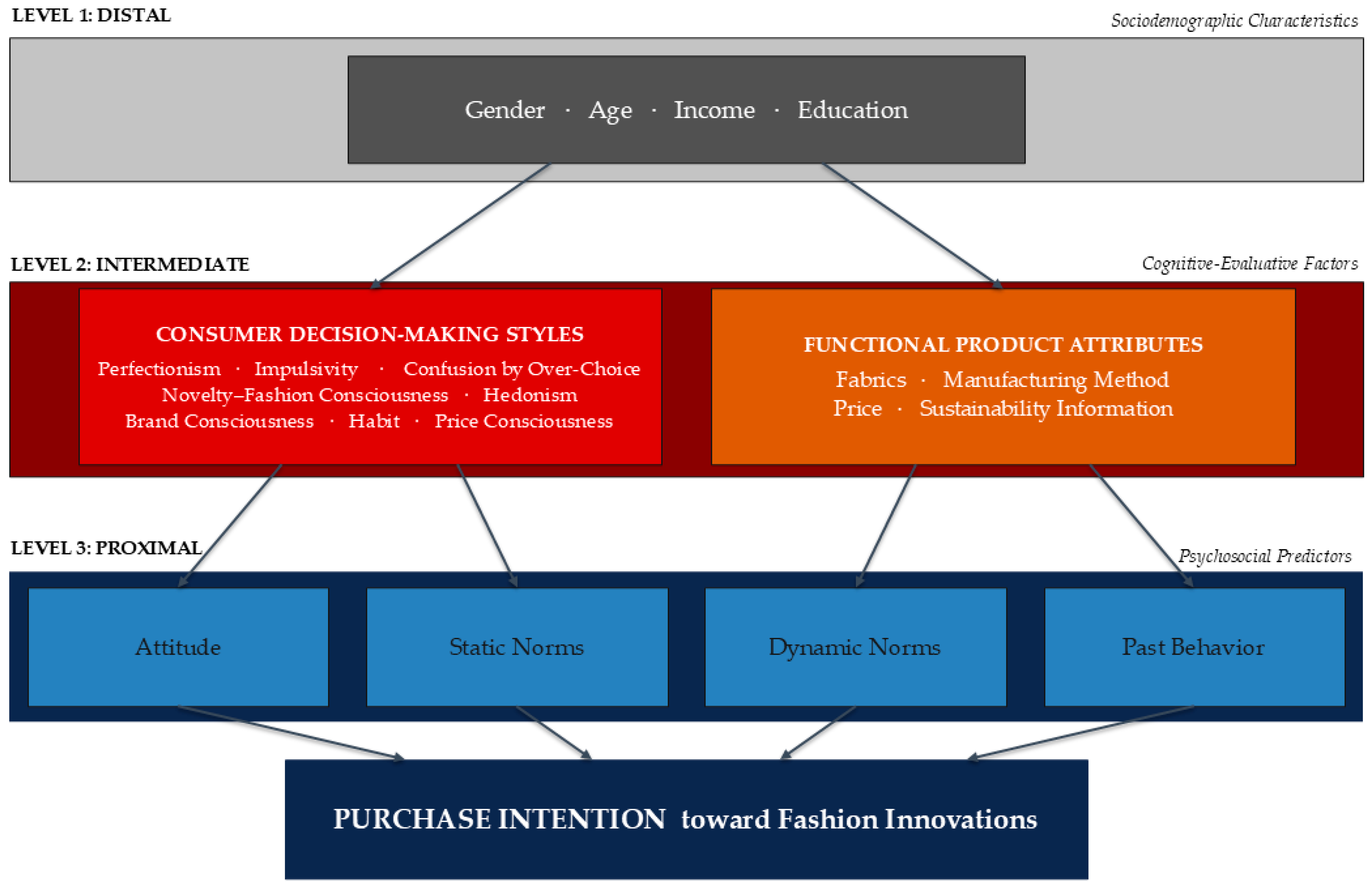
Consumer behavior toward sustainable fashion remains ambivalent. Positive values are linked to recycled products [7], but concerns persist over aesthetics and safety when materials are unconventional [8]. In the case of FWF, these barriers may be further amplified by the radical novelty of the material origin, making demand-side acceptance a critical condition for the diffusion of such innovations. However, little is known about what shapes purchase intentions toward FWF specifically. Understanding consumer responses to FWF is particularly urgent given its dual environmental potential: transforming food industry by-products—which represent one-third of global food production lost or wasted annually [9]—into textile inputs simultaneously addresses food waste valorization and reduces the demand for virgin materials in fashion production. Yet the consumer-side dynamics of this innovation remain entirely unexplored. This study addresses that gap by proposing the Fashion Innovation Adoption Model (FIAM)—a new theoretical framework, introduced here for the first time, which organizes the predictors of fashion innovation adoption across three hierarchical levels: a distal level (sociodemographic characteristics), an intermediate cognitive–evaluative level (consumer decision-making styles and functional product attribute evaluations), and a proximal psychosocial level (attitudes, social norms, and past behavior) that directly predicts purchase intention. The FIAM extends to the fashion domain a multilevel logic that has proven effective in explaining the acceptance of other novel sustainable products—most notably novel foods, where consumer adoption similarly hinges on the integration of innovation with familiarity [10]. FWF is adopted as the empirical case study to test the model, given that it represents one of the most radical material innovations currently emerging within circular fashion.

1.1. The Proximal Level: Psychosocial Predictors of Purchase Intention

At the proximal level, the FIAM identifies three psychosocial antecedents of purchase intention—attitudes, social norms, and past behavior—drawing on the theory of planned behavior, which has consistently identified them as the primary predictors of behavioral intention [11]. Attitudes represent individuals’ overall evaluations of the behavior and are among the most robust predictors of sustainable consumption intentions [11]. In the context of unconventional materials, such as textiles derived from food waste, positive attitudes have been consistently linked to both intention and behavior (e.g., [12]).
Social influence has also been identified as a key determinant of eco-fashion purchase intention. Social norms can be distinguished into injunctive norms (i.e., what individuals perceive as socially approved or disapproved) and descriptive norms (i.e., what others actually do) [13]. Prior studies showed that descriptive norms are associated with purchase intentions related to sustainable fashion, whereas injunctive norms have demonstrated a more context-dependent and less consistent influence [14,15,16,17].
Both injunctive and descriptive norms are referred to as ‘static’ norms because they refer to stable perceptions of what is socially approved or commonly done. ‘Dynamic’ norms, by contrast, refer to perceptions that the normative behavior is changing over time [18,19].
Unlike static norms, which reflect current social consensus, dynamic norms communicate an emerging trend—signaling to individuals that others are beginning to change their behavior, which can motivate early adoption of novel sustainable practices even when these are not yet the norm [20,21]. This mechanism is particularly relevant in the context of FWF, where social adoption is still nascent and consumers may lack clear behavioral referents.
Past behavior also plays a significant role in shaping future intentions. In the fashion domain, two dimensions are particularly relevant: general fashion purchasing and the frequency of sustainable fashion purchases. While high levels of general purchasing may reflect impulsive or status-driven motives, the frequency of sustainable fashion purchases is more consistently associated with future intentions [22].
Attitudes, social norms, and past behavior are key predictors of sustainable fashion intentions, but their role in the FWF remains underexplored. Understanding the predictiveness of these factors requires considering the influence of product attributes, decision-making styles, and sociodemographics.

1.2. The Intermediate Level: Functional Product Attributes

Consumers’ evaluation of sustainable fashion items is strongly influenced by specific functional product attributes. This study focused on four key attributes—manufacturing method, fabric, sustainability information, and price—as they are especially relevant for assessing the quality and acceptability of garments made from unconventional materials [23,24]. Fabrics and manufacturing methods reflect the origin and processing of food waste, encompassing, for instance, the fermentation of fruit by-products into cellulosic fibers, or the extraction of proteins from coffee grounds or grape marc—while sustainability information captures consumers’ attention to environmental transparency. Price remains a critical factor in determining acceptance of upcycled materials [25]. In this study, aesthetic features, such as style or fit, were excluded, as they relate more to hedonic preferences and identity expression [26,27], rather than to the evaluation of sustainability-related innovations. Previous research has demonstrated that functional attributes—such as production methods, materials, and sustainability information—significantly shape consumer perceptions and purchasing decisions [25,28].
Manufacturing methods and fabrics are central to how consumers assess quality and sustainability, especially when evaluating innovative materials like those derived from food waste [29]. Transparency regarding sustainability information has been associated with greater trust and intention to purchase, with full disclosure linked to perceived value and willingness to pay [30]. However, price remains a dominant factor: despite pro-environmental intentions, many consumers are highly price-sensitive, and higher costs can inhibit sustainable purchasing [25,31], underscoring the importance of affordability in fostering adoption. Thus, understanding which functional product attributes consumers prioritize will help clarify how attitudes and intentions toward FWF are formed.

1.3. The Intermediate Level: Consumer Decision-Making Styles

The importance consumers place on product attributes, as well as the formation of attitudes, perceived norms, and behavioral patterns, is shaped by underlying cognitive tendencies captured by consumer decision-making styles. Originally conceptualized by Sproles and Kendall [32] as relatively stable mental orientations characterizing a consumer’s approach to making choices, decision-making styles reflect habitual patterns of cognition and affect that individuals bring to purchasing situations [32]. These styles are trait-like in nature—consistent across product categories and over time—and have been shown to influence both the weight attributed to specific product attributes and the formation of attitudes and behavioral intentions in sustainable consumption contexts [32].
These relatively stable styles offer a useful lens for understanding how individuals engage with sustainable fashion. Perfectionism involves careful evaluation and high standards; in sustainable fashion, it often translates into attention to ethical quality and production integrity [33]. Brand consciousness, typically linked to prestige in conventional fashion, may limit openness to unconventional materials when perceived as lacking status [34]. Hedonism reflects the pleasure of shopping—linked to novelty in fast fashion but to ethical gratification in sustainable contexts [35]. Novelty-fashion consciousness drives preference for trendiness and change, often aligning with fast fashion and conflicting with the durability valued in sustainable choices [30]. Price consciousness may indicate a search for low cost in conventional fashion, or long-term value in sustainable contexts [31]. Confusion, arising from excessive or contradictory information, may hinder confident decision-making, particularly in the complex landscape of sustainability claims [36]. Impulsivity, associated with spontaneous purchases, can undermine deliberate, sustainability-driven decisions [37]. Finally, habitual decision-making may support sustainable behaviors when integrated into routines but may also perpetuate unsustainable consumption if those habits are not aligned with environmental values. Considering all eight styles, this study examines how decision-making tendencies are associated with the evaluation of food waste garments and sustainable fashion adoption.

1.4. The Distal Level: Sociodemographic Characteristics

While consumer decision-making styles represent stable cognitive orientations, they—as well as consumers’ evaluations of product attributes, attitudes, norms, and behaviors—are shaped by sociodemographic factors. Age, gender, education, and income play a central role in shaping engagement with sustainable fashion across multiple levels.
Younger consumers, particularly Gen Z and Millennials, tend to show stronger environmental concern and higher responsiveness to sustainability cues, while also displaying more impulsive, hedonistic, and novelty-seeking tendencies [38,39]. These mixed orientations are influenced by peer norms and social media activism, which also increase their receptiveness to sustainability-related product attributes and premium pricing [40].
Gender differences are also evident: women generally report stronger ethical attitudes, are more influenced by social norms, and place greater importance on sustainability cues in purchasing, whereas men tend to focus more on durability and cost-effectiveness, and adopt more practical, habitual styles [41,42,43]. Income and education further shape decision-making styles and attribute evaluations. Higher education is associated with greater brand orientation in conventional fashion and higher environmental responsibility in sustainable fashion, while confusion is not limited to less educated consumers—greenwashing and inconsistent messaging affect even informed audiences [34,44]. Education also promotes stronger attitudes and norm internalization regarding sustainability [45].
The role of sociodemographics in shaping decision-making styles remains understudied in the FWF context, making their analysis key to understanding consumer responses.

2. The Present Study

To our knowledge, this is among the first studies to examine purchase intentions toward FWF through an integrated proximal-distal framework. While prior research has examined sustainable fashion consumption in general, the specific case of FWF—as a radical material innovation involving the transformation of food by-products into textile inputs—has received virtually no empirical attention from a consumer psychology perspective.
To address this gap, we introduce the Fashion Innovation Adoption Model (FIAM), a new conceptual framework proposed here for the first time, which we then test empirically using FWF as a case study (Figure 1). The FIAM is designed as a general model of fashion innovation adoption and organizes predictors across three hierarchical levels: (1) a distal level comprising sociodemographic characteristics, which shape (2) an intermediate cognitive–evaluative level comprising consumer decision-making styles and functional product attribute evaluations, which in turn influence (3) a proximal psychosocial level comprising attitudes, social norms, and past behavior—directly predicting purchase intention toward novel sustainable fashion innovations. FWF was selected as the empirical case study because, as a radical material innovation still in its early diffusion stage, it constitutes a particularly informative test bed for a model intended to capture consumer adoption of fashion innovations.
Building on the FIAM, this study formalizes four hypotheses concerning the proximal level and the role of sustainability information and addresses four research questions exploring how the intermediate and distal levels shape proximal predictors and ultimately purchase intention. The hypotheses and research questions are organized in parallel with the three hierarchical levels of the model.
Proximal level. Building on robust evidence supporting their predictive role in sustainable consumption (e.g., [17,25]), we hypothesized that purchase intention is predicted by positive attitude toward FWF (H1), static (H2a) and dynamic social norms (H2b), and general (H3a) and sustainable fashion purchasing (H3b).
Intermediate level—Functional Product Attributes. Previous research has shown that sustainability-related product attributes can directly shape consumer responses—particularly when such information serves as a cue for ethical or environmental values during decision-making processes [46]. We, therefore, hypothesized that the importance attributed to sustainability-related information positively predicts (H4a) attitudes toward FWF, (H4b) general fashion purchasing, (H4c) sustainable fashion purchasing, and (H4d) purchase intention.
Because the role of the remaining functional attributes (manufacturing method, fabric, and price) in shaping FWF-related responses has not yet been systematically examined, we further asked how does the importance attributed to product attributes influence attitudes (RQ1a), past fashion purchasing (RQ1b), and ultimately purchase intention (RQ1c)?
Intermediate level—Consumer Decision-Making Styles. As consumer decision-making styles capture stable cognitive tendencies in how individuals process information and approach consumption decisions, the FIAM posits that they shape both functional product attribute evaluations and proximal psychosocial predictors. We, therefore, asked how do consumer decision-making styles influence the importance attributed to product attributes (RQ2), as well as attitudes (RQ3a), social norms (RQ3b), and past purchasing behaviors (RQ3c), and ultimately purchase intention (RQ3d)?
Distal level—Sociodemographic Characteristics. Finally, the FIAM treats sociodemographic characteristics as the most upstream antecedents, indirectly shaping intention through their effects on cognitive–evaluative and proximal mechanisms. We, therefore, asked how do sociodemographic characteristics influence consumer decision-making styles (RQ4a), the importance of product attributes (RQ4b), attitudes (RQ4c), norms (RQ4d), past purchasing behaviors (RQ4e), and ultimately purchase intention (RQ4f)?
Indirect effects were reported throughout to clarify how distal variables are associated with intention via mediators, offering insight into the formation of sustainability-related decisions and highlighting targets for interventions.

3. Methods

3.1. Participants and Procedure

The study received ethical approval (ID–21.2024) and followed a priori power analysis to ensure an adequate sample size for structural equation modeling (SEM).
Assuming a medium effect size (f2 = 0.30), power = 0.80, and α = 0.05, the minimum required sample was 204 to detect effects and 189 for reliable model estimation. The final sample of 396 participants exceeded both thresholds.
Data were collected in September 2024 via snowball sampling, supported by students from a Social Psychology course at the University of International Studies of Rome.
Participants were recruited through students’ social and academic networks, participation was voluntary and uncompensated, and informed consent was obtained.
Participants had a mean age of 34.73 years (SD = 14.45; range: 18–90).
Regarding sex assigned at birth, 50.7% identified as female (n = 220), 41.9% as male (n = 182), and 7.4% (n = 32) preferred not to disclose. Educational levels included 7.4% with only compulsory schooling, 41.0% with a high school diploma, and 51.6% with a university degree or higher. Monthly net income was reported as low by 28.6% (≤EUR 1250), medium by 58.3% (EUR 1250.01–4583.33), and high by 8.1% (>EUR 4583.33), while 5.1% did not disclose this information.

3.2. Measures

Before responding to the FWF-specific items, all participants read a standardized introductory text describing food waste fashion. The text defined FWF as garments and accessories produced from food industry by-products—such as fruit peels, coffee grounds, and grape marc—converted into fabrics and alternative leathers. It also presented three concrete examples of existing commercial products (a Saint Laurent bag in apple-derived fabric, Pine Kazi shoes in pineapple leaf fiber, and the Orange Fiber x H&M Conscious Exclusive collection in citrus-derived fabric), accompanied by product images. This ensured a shared understanding of the concept across all participants prior to the assessment of attitudes, norms, and purchase intentions. Purchase intention toward FWF was measured using three items adapted from Carfora et al. [16], rated on a 7-point Likert scale (1 = completely disagree, 7 = completely agree). Cronbach’s α = 0.949.
Attitude toward FWF was assessed through four semantic differential items adapted from Carfora et al. [16], rated on a 7-point bipolar scale. Cronbach’s α = 0.857.
Static norms were measured using four items adapted from Carfora et al. [16], rated on a 7-point Likert scale (1 = completely disagree, 7 = completely agree). Specifically, two items captured injunctive norms (i.e., what significant others think one should do) and two items captured descriptive norms (i.e., what significant others actually do). Given their high empirical correlation (r = 0.987), which indicates empirical indistinguishability and would introduce severe multicollinearity if treated separately [47], the four items were operationalized as a single latent construct combining both static norm types. Cronbach’s α = 0.898.
Dynamic norms were measured with two items rated on the same 7-point Likert scale adapted from Carfora et al. [16].
General fashion purchasing was operationalized as past fashion purchasing in the last year and assessed through two categorical items asking participants to estimate how many clothing items and accessories they purchased in the last year. Response options were divided into five intervals (e.g., “less than 10”, “between 10 and 30”, up to “more than 91”).
Sustainable fashion purchasing was measured with a single item asking how often participants had purchased sustainable fashion products in the past year. Responses were provided on a 5-point frequency scale ranging from 1 (never) to 5 (always).
Importance of fashion product attributes was measured by asking participants: “When you think about fashion purchasing, what guides your decision?” The attributes assessed were manufacturing methods, fabric, sustainability information, and price. Each item was rated on a 5-point scale ranging from 1 (not at all) to 5 (very much).
Consumer decision-making styles were measured using two items per construct, adapted from the Consumer Styles Inventory [32,48]. These included perfectionism, brand consciousness, novelty-fashion consciousness, hedonism, price consciousness, impulsivity, confusion by over-choice, and habit. Items were rated on a 7-point Likert scale ranging from 1 “completely disagree” to 7 “completely agree”.
As for sociodemographic characteristics, we measured gender (0 = male, 1 = female, 3 = prefer not to disclose, 4 = non-binary, genderqueer, self-describe), age as a numerical value, education level (1 = elementary school certificate, 2 = middle school certificate, 3 = high school without diploma, 4 = high school diploma, 5 = university attendance without degree, 6 = bachelor’s degree, 7 = master’s degree or equivalent single-cycle degree, 8 = prefer not to disclose), and income (1 = up to EUR 1250.00, 2 = from EUR 1250.01 to 2333.33, 3 = from EUR 2333.34 to 4583.33, 4 = from EUR 4583.34 to 6250.00, 5 = over EUR 6250.00).

3.3. Data Analysis

To test our hypotheses and research questions, we employed a hybrid structural equation model that combines confirmatory factor analysis and path analysis, following the approach suggested by Hancock and Samuelsen [49]. The model was estimated using Mplus 8, with maximum likelihood estimation (ML). To assess the significance of indirect effects, a bootstrap procedure with 5000 resamples was employed and 95% bias-corrected confidence intervals were computed. To assess the internal consistency of each latent construct, we computed composite reliability. For constructs measured with three or more items, Cronbach’s α is also reported. Convergent and discriminant validity were evaluated using the average variance extracted (AVE) and the Fornell and Larcker [50] criterion. Variance explained by the model was assessed through R2 for all endogenous variables. To formally evaluate the incremental contribution of each hierarchical level of the FIAM, we conducted a sequential nested model comparison. Specifically, three nested models were estimated and compared: M1, retaining only proximal psychosocial predictors and functional product attributes; M2, additionally including consumer decision-making styles (intermediate cognitive–evaluative level); M3, the full FIAM additionally including sociodemographic characteristics (distal level). Each model was strictly nested in the next, allowing valid χ2 difference tests, and Δχ2, ΔCFI, ΔRMSEA, and ΔSRMR were used to evaluate fit improvement, with ΔCFI > 0.010 and ΔRMSEA > 0.015 considered as indicating meaningful improvement. The overall model fit was evaluated using the following indices: comparative fit index (CFI), Tucker–Lewis’s index (TLI), the root mean square error of approximation (RMSEA), and the standardized root mean square residual (SRMR). Following conventional guidelines, CFI and TLI values above 0.90 were considered indicative of an acceptable fit, while RMSEA values below 0.05 indicated good model fit [51,52].

4. Results

4.1. Measurement Model: Reliability and Validity

All constructs showed acceptable internal consistency, with composite reliability (CR) values above 0.70. Convergent validity was supported by average variance extracted (AVE) values above 0.50, and discriminant validity was confirmed using the Fornell and Larcker [50] criterion: the square root of each construct’s AVE was greater than its correlations with any other latent variable (Table 1 and Table A1). We then tested the hypothesized hybrid structural equation model, which included both measurement and structural components. The model showed a good overall fit to the data: χ2(518) = 941.17, p < 0.001, CFI = 0.95, TLI = 0.92, RMSEA = 0.045, 90% CI [0.041, 0.050], SRMR = 0.038. Standardized coefficients, standard errors, and p-values for all directly tested paths in the structural model are reported in, Table A2.
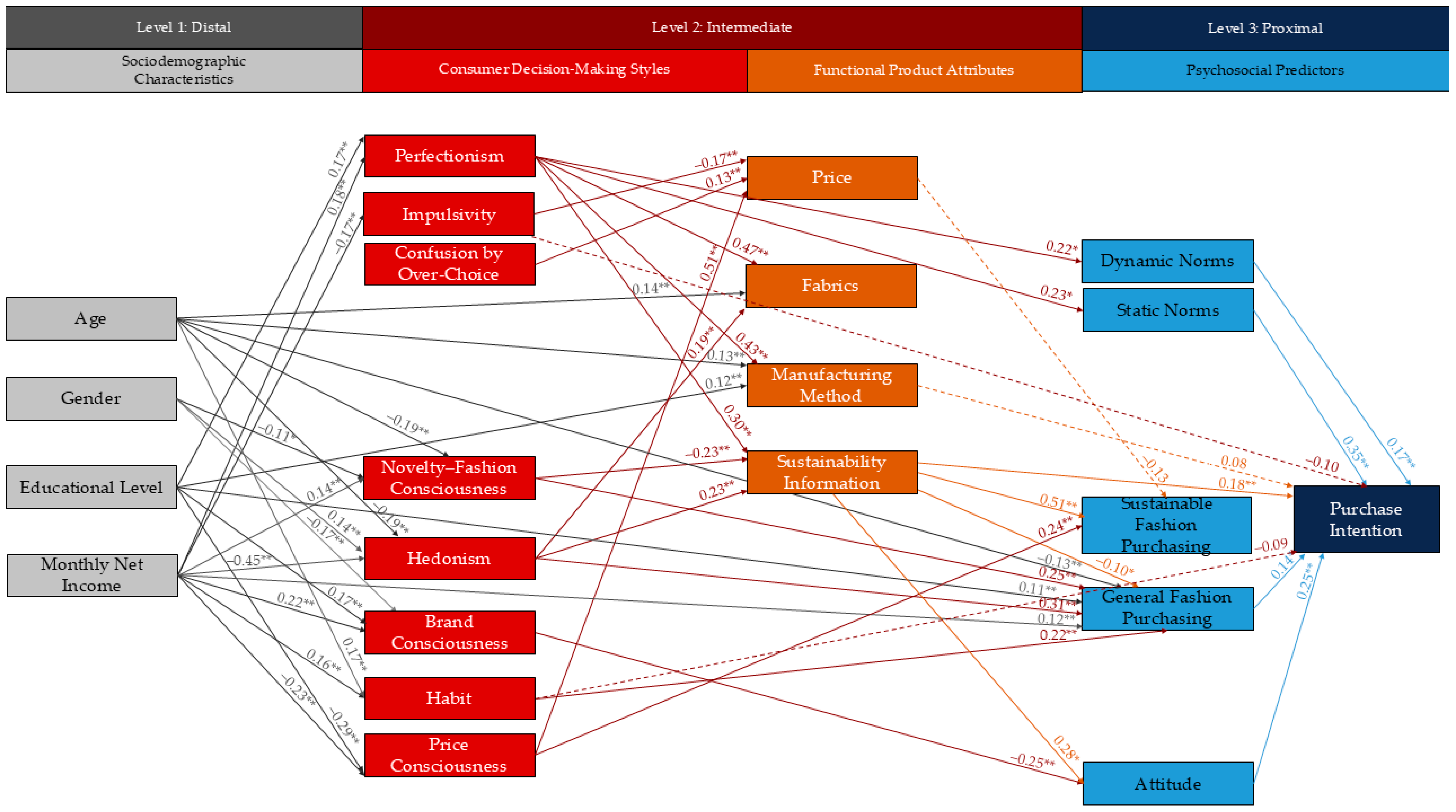
All factor loadings were statistically significant and above 0.63. All significant direct effects are presented in Figure 2.

4.2. Hierarchical Nested Model Comparison

To formally evaluate the contribution of each hierarchical level of the FIAM, the full model (M3) was compared with two nested models: M1, retaining only proximal psychosocial predictors and functional product attributes, and M2, additionally including consumer decision-making styles. Each sequential addition produced a significant improvement in model fit. The addition of decision-making styles (M1 → M2) significantly improved fit: Δχ2(80) = 475.15, p < 0.001, ΔCFI = +.048, ΔRMSEA = −0.010, ΔSRMR = −0.043, demonstrating the incremental contribution of the intermediate cognitive–evaluative level. The further addition of sociodemographic characteristics (M2 → M3) also significantly improved fit: Δχ2(72) = 323.63, p < 0.001, ΔCFI = +0.032, ΔRMSEA = −0.009, ΔSRMR = −0.026, demonstrating the incremental contribution of the distal level. Compared with M1, the full FIAM (M3) produced a substantially better overall fit: Δχ2(152) = 798.78, p < 0.001, ΔCFI = +0.080, ΔRMSEA = −0.019, ΔSRMR = −0.069. These results provide formal evidence that each of the three hierarchical levels of the FIAM contribute uniquely and significantly to explaining purchase intention toward FWF, supporting the layered architecture of the proposed model. The final structural model explained substantial variance across all endogenous variables. For the key outcome, purchase intention accounted for R2 = 0.678. For the proximal psychosocial predictors, attitude yielded R2 = 0.220, static norms R2 = 0.075, and dynamic norms R2 = 0.070. For past purchasing behaviors, general fashion purchasing showed R2 = 0.455 and sustainable fashion purchasing R2 = 0.409. For consumer decision-making styles, variance explained was as follows: perfectionism R2 = 0.076, brand consciousness R2 = 0.129, novelty-fashion consciousness R2 = 0.101, hedonism R2 = 0.255, price consciousness R2 = 0.165, impulsivity R2 = 0.046, confusion by over-choice R2 = 0.017, and habit R2 = 0.069. For functional product attributes, manufacturing method showed R2 = 0.242, fabrics R2 = 0.258, sustainability information R2 = 0.138, and price R2 = 0.346.

4.3. Hypotheses Testing

As for our main hypotheses, consumers’ purchase intention was predicted by participants’ attitudes, static and dynamic norms, and general fashion purchasing, confirming H1, H2a, H2b, and H3a. Sustainable fashion purchasing was not associated with future intentions, not supporting H3b.
Among the product attributes, only the importance of sustainable information predicted attitudes, general fashion purchasing, sustainable fashion purchasing, and purchase intention, supporting H4a, H4c, and H4d. Contrary to H4b, sustainability information was negatively and marginally associated with general fashion purchasing (β = −0.10, p = 0.058), suggesting that greater attention to sustainability cues may be linked to more restrained general consumption rather than increased purchasing frequency.

4.4. Research Questions

4.4.1. Functional Product Attributes (RQ1)

As for our research questions, no other attributes significantly predicted consumers’ attitudes toward FWF (RQ1a). The importance attributed to sustainability information negatively influenced general fashion purchasing; instead, the importance of price negatively predicted sustainable fashion purchasing (RQ1b). Finally, only manufacturing methods influenced purchase intentions (RQ1c).

4.4.2. Consumer Decision-Making Styles (RQ2–RQ3)

Perfectionism was positively associated with the importance of the manufacturing method, while both perfectionism and hedonism were linked to greater importance attributed to fabrics and sustainability information; in contrast, novelty-fashion consciousness was negatively associated with sustainability information and price consciousness, and confusion due to over-choice positively predicted the importance of price, whereas impulsivity showed a negative association (RQ2).
Only brand consciousness was negatively linked to consumers’ attitudes. Only perfectionism was significantly associated with both static and dynamic norms (RQ3b). Moreover, novelty-fashion consciousness, hedonism, and habitual style were associated with greater general fashion purchasing, while only price consciousness was associated with sustainable fashion purchasing (RQ3c). Finally, both impulsive and habitual decision-making styles showed marginal negative direct effects on purchase intentions (RQ3d).
As for the indirect effect of consumer decision-making styles on purchase intention, perfectionism indirectly influenced intention via sustainability information, and this effect was further enhanced when mediated by attitudes. Hedonism was positively related to intention through sustainability information and via sustainability information and then attitude.

4.4.3. Sociodemographic Characteristics (RQ4)

As for the verification of RQ4(a–f), the beta coefficients and confidence intervals for each indirect effect of the sociodemographic variables are reported in Appendix A, Table A3.

5. Discussion

This study introduced the Fashion Innovation Adoption Model (FIAM)—a new integrated framework proposed here for the first time—and tested it on FWF as a case study, illustrating how distal individual variables (decision-making styles and sociodemographics) influence intentions both directly and indirectly through proximal predictors. The hierarchical nested model comparison provided incremental empirical evidence that each level of the FIAM—proximal, intermediate cognitive–evaluative, and distal—contributes uniquely to explaining purchase intention toward FWF, supporting the value of the layered architecture proposed in this model.

5.1. The Proximal Level: Predictors of Purchase Intention

Positive attitudes, static norms, and dynamic norms predicted the consumers’ intention, consistent with prior studies on sustainable consumption [17,53]. Regarding static norms, their operationalization as a single construct merits comment. Although injunctive and descriptive norms are theoretically distinct [13], research suggests that this distinction is far from clear in people’s cognition—both norm types tend to activate the same behavioral schemas and are frequently conflated in recall tasks [54]. The high empirical correlation between the two components (r = 0.987) further violated the discriminant validity criterion of Fornell and Larcker [50], making their treatment as separate constructs methodologically unjustifiable. Their merger into a single ‘static norms’ construct was, therefore, supported on both cognitive and psychometric grounds.
Interestingly, general—but not sustainable—fashion purchasing was associated with intention, suggesting that familiarity with sustainable fashion does not necessarily translate to openness toward unfamiliar innovations, as also noted by van Gogh et al. [55]. This finding may reflect the novelty barrier inherent to FWF: consumers with prior sustainable fashion experience may hold established mental schemas about what sustainable clothing looks like, making food-waste-derived materials cognitively incongruent with their expectations [56]. Additionally, product-specific perceived risks—particularly aesthetic concerns—may attenuate the transfer of general sustainability dispositions to this specific context [8]. Prior sustainable fashion purchasing may capture habitual or value-driven behavior within familiar product categories but does not automatically extend to genuinely novel innovations where uncertainty and unfamiliarity introduce additional psychological barriers. This interpretation is consistent with evidence that even among consumers with established sustainable fashion orientations, product-specific perceived risks—particularly aesthetic concerns—can attenuate the translation of general sustainability dispositions into actual purchasing behavior for specific product types [57]. In the case of FWF, the radical novelty of the material origin may introduce additional cognitive barriers that further weaken this transfer. Future research could explore whether moderating factors—such as environmental self-identity or prior knowledge of bio-based materials—condition the relationship between general sustainable behavior and openness to FWF specifically.

5.2. The Intermediate Level: Decision-Making Styles and Product Attributes

Among product attributes, only sustainability-related information significantly predicted both attitude and intention, reinforcing the importance of transparent ethical communication [12,46]. This preference was negatively and marginally associated with general fashion purchasing, contrary to our expectations but in line with evidence linking ethical awareness to more restrained consumption [28]. Additionally, the importance of manufacturing method marginally and positively influenced purchase intention, reflecting consumer concerns with transparency, quality, and ethics.
Our findings confirm that consumer decision-making styles are associated with the evaluation of fashion product attributes. Perfectionists—consumers characterized by high standards and careful evaluation [33]—valued manufacturing methods, likely as indicators of quality and ethical standards, and, along with hedonists—who tend toward pleasure-seeking and sensory gratification in shopping [35]—attributed importance to fabrics, probably perfectionists for their durability and quality, and hedonists for sensory and aesthetic appeal. Both styles also valued sustainability information, suggesting their preferences stem from a combination of cognitive motivations—like seeking transparency and ethical assurance—and affective motivations, like the emotional reward of making ethical choices. In contrast, novelty-fashion consciousness—reflecting a preference for trendiness and change [30]—was negatively associated with sustainability, reflecting a preference for trendiness over ethics [23,24,26,27].
Price-conscious consumers—oriented toward cost minimization [31]—prioritized cost, while impulsive consumers—characterized by spontaneous, unplanned purchasing—were less price-sensitive, as spontaneity often overrides deliberation [37]. Finally, consumers experiencing choice overload, i.e., confusion by over-choice, arising from excessive or contradictory information [36], tended to rely more on price as a simplifying heuristic [58]. Furthermore, the positive indirect effect of confusion by over-choice on sustainable fashion purchasing via sustainability information suggests a complementary resolution mechanism: consumers overwhelmed by choice complexity may use sustainability information as a simplifying heuristic decision, allowing them to bypass extensive deliberation by relying on a single salient cue [58]. This finding highlights the potential of clear and accessible sustainability labeling to support decision-making even among cognitively overloaded consumers.
These associations gave rise to significant indirect effects: perfectionism and hedonism enhanced sustainable fashion purchasing via sustainability information, suggesting that both quality-focused and pleasure-oriented consumers are responsive to ethical cues. Even impulsive and confused decision-makers exhibited positive indirect effects on sustainable fashion purchasing via sustainability information, indicating that accessible, clear information can promote sustainable choices across diverse cognitive profiles.
Among decision-making styles, only price consciousness significantly predicted sustainable fashion purchasing. This finding may appear counterintuitive, but it is consistent with evidence suggesting that price-sensitive consumers may reframe sustainability as a long-term economic investment—prioritizing durability and value-for-money over short-term cost savings [31]. In the FWF context, sustainability information may signal product quality and longevity, making it appealing to cost-conscious consumers seeking durable rather than disposable fashion. No other styles were significantly associated with sustainable fashion behavior.
Brand consciousness—typically linked to prestige and status-oriented consumption [34]—was negatively associated with attitudes, suggesting that individuals with a preference for prestige and traditional brand cues may be less receptive to unconventional fashion alternatives, in line with research highlighting that brand-oriented consumers often perceive sustainable or experimental fashion as lacking in status or aesthetic appeal [55,59]. Perfectionism was positively associated with both static and dynamic norms, suggesting a heightened sensitivity to established expectations and evolving social cues related to FWF. Novelty-fashion consciousness, hedonism, and habitual decision-making were positively associated with general fashion purchasing. This is broadly consistent with research showing that experiential and enjoyment-related motivations, such as fun-seeking, play an important role in fashion consumption contexts, including secondhand fashion consumption [60].
For sustainable fashion, only price consciousness emerged as a positive predictor [31], while impulsivity and habitual styles were negatively associated with purchase intentions. This finding may reflect a tension between automatic and deliberative processing: habitual consumers tend to rely on consolidated behavioral scripts with minimal cognitive engagement, whereas FWF—as a novel product category with emerging normative cues—requires a degree of reflective evaluation that habitual shoppers may be less inclined to undertake. Similarly, impulsivity, characterized by spontaneous affect-driven purchasing, may be less compatible with the deliberate consideration of sustainability-related attributes that FWF adoption appears to require.
These patterns generated notable indirect effects on purchase intention: perfectionism enhanced intention via sustainability information and attitude, while impulsivity and habitual decision-making showed marginal negative indirect effects via their association with lower normative and attitudinal engagement. Indirect effects on sustainable fashion purchasing were driven primarily by perfectionism and hedonism through sustainability information, reinforcing the role of value- and pleasure-oriented motivations in shaping sustainable behavior.

5.3. The Distal Level: Sociodemographic Influences

Our findings show that sociodemographic variables distinctly predict both decision-making styles and perceptions of fashion product attributes. Higher education and income were associated with perfectionism and brand consciousness, confirming that more privileged consumers tend to value quality and branded products to express social status [44]. Interestingly, men reported higher brand consciousness than women, possibly reflecting evolving trends in male-oriented fashion marketing [61]. In line with past research, women and younger individuals exhibited stronger novelty-fashion consciousness and hedonism [39]. Habitual shopping was more frequent among younger and wealthier consumers, which partially contrasts with evidence linking Gen Z to novelty-seeking behavior [39]. Lower education and income were associated with greater price consciousness, while higher education reduced impulsivity, consistent with the idea that greater cognitive control limits spontaneous purchases [37,44].
Older and more educated participants placed greater importance on manufacturing methods and fabric quality, suggesting a more informed and ethically oriented evaluation process—despite contrasting evidence that younger consumers are more responsive to sustainability messaging [38,44]. This may reflect generational differences between support for sustainability in principle versus attention to tangible product cues. Sustainability information and price, however, were considered important across all groups [25]. Education and income indirectly promoted favorable attitudes and social norms via perfectionism, suggesting that high-status individuals may be more receptive to FWF when driven by quality-focused motivations.
Age was negatively associated with general fashion purchasing frequency, consistent with evidence that younger consumers show stronger fashion involvement driven by identity expression and peer influence [38,39]. Conversely, education was positively associated with general fashion purchasing, possibly reflecting greater cultural capital among more educated individuals, which facilitates more frequent engagement with fashion as a form of self-expression and social signaling [44]. These findings suggest that access to economic and cultural resources facilitates engagement with fashion as a leisure and identity-expression activity, regardless of sustainability orientation.
Women’s lower fashion consumption was explained by lower hedonism and novelty-seeking, a pattern also found among older participants [38,43]. Higher income increased fashion purchasing via stronger hedonic and novelty orientations [60]. Sustainable fashion engagement was indirectly predicted by hedonism: women and older adults, generally lower in this trait, valued sustainability cues less [25,43]. Education showed a dual effect—discouraging sustainable purchasing due to reduced price sensitivity yet encouraging it through perfectionism and attention to ethical quality [36]. A similar duality was observed for income.
Indirect effects revealed that higher income, although associated with reduced price sensitivity, supported more reflective, value-driven purchasing—consistent with findings that affluent consumers are motivated by ethics, product quality, and the overall shopping experience [28,35]. These results confirm that sustainable fashion engagement is associated with a combination of ethical values, experiential motivations, and information salience [34,35,36]. While no direct effects were found between sociodemographics and intention to purchase fashion made from food waste, indirect pathways showed that decision-making styles and perceived attribute importance were associated with intention through attitudes, norms, and past behavior—highlighting the importance of cognitive and normative mechanisms in shaping consumer behavior.

5.4. Limitations and Future Directions

Despite its contributions, this study has some limitations. The reliance on self-report measures may have introduced biases, such as social desirability or recall inaccuracies. The use of an Italian sample also limits generalizability. Snowball sampling may introduce self-selection bias, as participants who share the survey within their networks are likely to share similar values and attitudes toward sustainability. In particular, recruitment through students’ academic and social networks may have favored younger, more educated, and more digitally connected participants, further narrowing the demographic range of the sample. Moreover, the sample showed a relatively high level of educational attainment, which may overrepresent environmentally conscious and information-sensitive consumers, potentially inflating the observed effects of sustainability information on attitudes and intentions. Cultural factors further constrain external validity, as sustainable fashion attitudes and behaviors vary considerably across national and cultural contexts [62]. Future research should replicate these findings in cross-cultural designs, including contexts with different levels of sustainability awareness, circular economy adoption, and fashion market maturity. The cross-sectional design prevents causal inference, highlighting the need for longitudinal research, and reverse causality cannot be excluded for several paths in the model—for instance, stronger purchase intentions toward FWF may themselves shape social norm perceptions or attitudes rather than the reverse. Future research should employ longitudinal or experimental designs to verify the directionality of critical paths. Furthermore, some constructs—including dynamic norms and all eight consumer decision-making styles—were assessed with only two items each, a choice driven by the need to limit overall questionnaire length given the large number of constructs included in the model. While factor loadings and composite reliability values were acceptable for all constructs, future research focusing on a smaller set of constructs could employ more comprehensive multi-item scales to enhance measurement robustness. While this represents a first attempt to integrate proximal and distal predictors within a layered model explaining purchase intention toward FWF, several relevant constructs were excluded for the sake of parsimony, such as environmental concern, emotional factors (e.g., anticipated emotions) [42,63], and pro-environmental identity and motives [15,16]. Future studies should incorporate these variables and explore consumption styles, as prior research has shown that consumers’ environmental attitudes can translate into responsible fashion choices when supported by recycling behaviors [38].

5.5. Practical Implications

The study offers valuable insights for promoting sustainable fashion purchasing, especially regarding innovative alternatives. Transparent and compelling communication about sustainability attributes—such as environmental impact, ethical sourcing, and production methods—is essential to increase consumer engagement. Addressing psychological and behavioral barriers, such as impulsiveness and habitual purchasing, may foster more reflective decisions. Sustainable products should be strategically positioned to appeal to less sustainability-driven consumers. For instance, novelty-conscious individuals may respond to narratives emphasizing innovation or unique design, while brand-conscious consumers may be more receptive if these products are framed as prestigious. While sustainability-oriented consumers remain key adopters, targeting less engaged consumers represents a meaningful opportunity through effective communication strategies. Social influence also plays a crucial role: campaigns highlighting changing societal behaviors or peer endorsement can reinforce the perception that buying FWF is increasingly accepted. At the policy level, these findings suggest several actionable instruments. Mandatory or voluntary sustainability labeling schemes—clearly communicating the circular origin of materials, production methods, and environmental impact—could reduce information asymmetry and support more informed consumer decisions, particularly among perfectionist and hedonistic consumer segments who respond strongly to sustainability cues. Extended producer responsibility frameworks and green public procurement policies could further incentivize manufacturers to invest in food-waste-derived textiles, reducing costs and improving market accessibility. Finally, awareness campaigns co-designed with public institutions and aligned with dynamic norm messaging—emphasizing that adoption of circular fashion is growing across society—could accelerate normative shifts and broaden the consumer base beyond early adopters.
Finally, producers and designers should integrate innovation and sustainability, with tactile, aesthetic, and functional qualities to enhance credibility and desirability, facilitating a broader transition toward circular and ethical consumption.

6. Conclusions

This study proposes the Fashion Innovation Adoption Model (FIAM)—a new theoretical framework introduced here for the first time, which combines proximal psychosocial predictors, functional product attributes, consumer decision-making styles, and sociodemographic characteristics within a single structural equation model—and provides its first empirical test through FWF, a radical yet underexplored circular economy innovation at the intersection of two pressing environmental challenges: food waste valorization and textile industry pollution. By doing so, the study advances the theoretical understanding of sustainable consumer behavior beyond conventional sustainable fashion contexts and offers a generalizable model that future research can apply to other emerging fashion innovations. Although tested here on FWF, the FIAM is designed as a general model of fashion innovation adoption and can be applied to other novel materials and circular fashion categories—such as recycled-fiber textiles, lab-grown leather, and biofabricated garments—extending its relevance well beyond the specific case study examined in the present work.
In its first empirical application to the FWF case, the FIAM proved highly effective, explaining 67.8% of the variance in purchase intention and outperforming a restricted model in formal nested model comparison. The finding that prior sustainable fashion purchasing does not transfer to FWF intention challenges assumptions of behavioral spillover in sustainable consumption research and points to the novelty barrier as a theoretically important boundary condition for sustainable behavior generalization. The centrality of sustainability information across all consumer profiles further establishes ethical communication transparency as a cornerstone of circular fashion marketing.
Beyond its empirical contributions, this study demonstrates the value of integrating consumer decision-making styles—a largely underexplored construct in sustainable fashion research—as distal predictors that shape normative, attitudinal, and behavioral pathways toward novel sustainable innovations. These findings open promising avenues for future research: cross-cultural replication to assess generalizability beyond Italian consumers, experimental designs to test the causal role of dynamic norm messaging and sustainability labeling, longitudinal studies to track how FWF attitudes evolve as the product category matures, and investigation of moderating factors—such as environmental self-identity and bio-material familiarity—that may condition the transfer of sustainable behavior to radical product innovations.

Author Contributions

Conceptualization, V.C., I.A., S.F. and S.P.; methodology, V.C., I.A., S.F. and S.P.; formal analysis, V.C.; investigation, V.C., I.A., S.F. and S.P.; data curation, V.C. and S.F.; writing—original draft preparation, I.A., S.F., S.P. and VC.; writing—review and editing, I.A., S.F., S.P. and V.C.; visualization, I.A., S.F., S.P. and V.C.; supervision, V.C.; project administration, V.C. All authors have read and agreed to the published version of the manuscript.

Funding

This research received no external funding.

Institutional Review Board Statement

This study was conducted in accordance with the Declaration of Helsinki and approved by the Ethics Committee of the University of International Studies of Rome (ID 21/2024).

Informed Consent Statement

Informed consent was obtained from all subjects involved in the study.

Data Availability Statement

The data presented in this study are available from the corresponding author upon request.

Acknowledgments

During the preparation of this manuscript, the authors used ChatGPT (GPT-4, OpenAI) for grammar and language editing purposes only. The authors have reviewed and edited the output and take full responsibility for the content of this publication.

Conflicts of Interest

The authors report that there are no competing interests to declare.

Appendix A

Table A1. Measurement model: standardized factor loadings of all constructs.
ConstructItemλ
Fashion Purchasing In the past 12 months, approximately how many clothing items have you purchased?0.866
In the past 12 months, approximately how many fashion accessories have you purchased?0.683
PerfectionismIn general, I usually try to buy the best overall quality.0.831
Getting very good quality is very important to me. 0.889
Brand ConsciousnessThe more expensive brands are usually my choices.0.826
I prefer buying the best-selling brands.0.862
Novelty-Fashion ConsciousnessI usually have one or more outfits of the very newest style.0.939
Fashionable, attractive styling is very important to me.0.896
HedonismShopping is not a pleasant activity to me.0.956
Going shopping is one of the enjoyable activities of my life.0.872
Price ConsciousnessI buy as much as possible at sale prices.0.622
The lower price products are usually my choice.0.824
ImpulsivityOften, I make careless purchases I later wish I had not.0.780
I am impulsive when purchasing.0.754
Confusion by Over-ChoiceThere are so many brands to choose from that often I feel confused.0.889
Sometimes it’s hard to choose which stores to shop.0.782
HabitI have favorite brands I buy over and over.0.931
Once I find a product or brand I like, I stick with it.0.673
AttitudeBuying fashion made from food waste is unsatisfying/satisfying.0.786
Buying fashion made from food waste is unpleasant/pleasant.0.793
Buying fashion made from food waste is useless/useful.0.777
Buying fashion made from food waste is unwise/wise.0.762
Static Norms Most of the people I know (family, friends…) think I should buy fashion made from food waste0.832
Most of the people I know (family, friends…) would like me to buy fashion made from food waste0.861
Most of the people I know (family, friends…) buy fashion produced from food waste.0.811
Most of the people I know (family, friends…) would like to buy fashion produced from food waste.0.823
Dynamic NormsMore and more people are buying fashion produced from food waste0.789
The purchase of fashion produced from food waste is increasing.0.869
Purchase IntentionI intend to buy fashion made from food waste.0.923
I plan to purchase fashion made from food waste.0.932
I will probably choose fashion made from food waste.0.930
Note: λ = standardized factor loading.
Table A2. Standardized coefficients (β), standard errors (SE), p-values, and 95% confidence intervals for all directly tested paths in the structural model.
PathβSEp95% CI
Predictors of Purchase Intention
Attitude → Purchase Intention (H1)0.2490.060<0.0010.130, 0.369
Static Norms → Purchase Intention (H2a)0.3520.062<0.0010.233, 0.471
Dynamic Norms → Purchase Intention (H2b)0.1740.0630.0050.051, 0.299
General Fashion Purchasing → Purchase Intention (H3a)0.1430.0680.0350.009, 0.276
Sustainable Fashion Purchasing → Purchase Intention (H3b)0.0610.0510.231−0.039, 0.158
Sustainability Information → Purchase Intention (H4d)0.1830.0540.0010.073, 0.286
Manufacturing Method → Purchase Intention (RQ1c)0.0810.0480.092−0.018, 0.175
Fabrics → Purchase Intention (RQ1c)−0.0030.0460.954−0.092, 0.091
Price → Purchase Intention (RQ1c)−0.0550.0620.378−0.186, 0.060
Perfectionism → Purchase Intention (RQ3d)0.0330.0710.640−0.107, 0.170
Brand Consciousness → Purchase Intention (RQ3d)0.0010.0920.993−0.185, 0.183
Novelty-Fashion Consciousness → Purchase Intention (RQ3d)0.1220.0820.139−0.040, 0.290
Hedonism → Purchase Intention (RQ3d)−0.0820.0720.256−0.226, 0.055
Price Consciousness → Purchase Intention (RQ3d)0.0700.0980.478−0.120, 0.274
Impulsivity → Purchase Intention (RQ3d)−0.1000.0610.100−0.213, 0.028
Confusion by Over-Choice → Purchase Intention (RQ3d)−0.0450.0490.359−0.141, 0.058
Habit → Purchase Intention (RQ3d)−0.0870.0530.096−0.185, 0.015
Gender → Purchase Intention (RQ4f)−0.0420.0460.359−0.137, 0.044
Age → Purchase Intention (RQ4f)−0.0550.0410.178−0.134, 0.027
Education → Purchase Intention (RQ4f)−0.0300.0420.475−0.107, 0.057
Income → Purchase Intention (RQ4f)−0.0250.0430.564−0.112, 0.058
Predictors of Attitude
Sustainability Information → Attitude (H4a)0.2820.068<0.0010.145, 0.411
Perfectionism → Attitude (RQ3a)0.1500.1000.132−0.043, 0.347
Brand Consciousness → Attitude (RQ3a)−0.2460.1380.076−0.532, 0.010
Novelty-Fashion Consciousness → Attitude (RQ3a)0.1700.1230.166−0.070, 0.416
Hedonism → Attitude (RQ3a)0.0850.1060.426−0.134, 0.291
Price Consciousness → Attitude (RQ3a)−0.1190.0980.225−0.315, 0.070
Impulsivity → Attitude (RQ3a)−0.0880.0870.315−0.253, 0.096
Confusion by Over-Choice → Attitude (RQ3a)0.0760.0660.249−0.058, 0.202
Habit → Attitude (RQ3a)−0.1300.0850.126−0.291, 0.035
Gender → Attitude (RQ4c)0.0320.0680.640−0.098, 0.166
Age → Attitude (RQ4c)0.0090.0600.876−0.102, 0.131
Education → Attitude (RQ4c)0.0400.0620.518−0.082, 0.163
Income → Attitude (RQ4c)−0.0370.0610.541−0.157, 0.082
Predictors of Static Norms
Perfectionism → Static Norms (RQ3b)0.2240.0890.0120.043, 0.397
Brand Consciousness → Static Norms (RQ3b)−0.0550.1240.655−0.293, 0.198
Novelty-Fashion Consciousness → Static Norms (RQ3b)0.0900.1150.435−0.139, 0.311
Hedonism → Static Norms (RQ3b)0.0630.1080.562−0.151, 0.280
Price Consciousness → Static Norms (RQ3b)0.0170.1110.880−0.209, 0.229
Impulsivity → Static Norms (RQ3b)0.0660.0770.392−0.085, 0.220
Confusion by Over-Choice → Static Norms (RQ3b)0.0930.0710.190−0.034, 0.239
Habit → Static Norms (RQ3b)−0.0850.0850.320−0.261, 0.067
Gender → Static Norms (RQ4d)0.0450.0700.517−0.090, 0.185
Age → Static Norms (RQ4d)0.0460.0680.498−0.083, 0.184
Education → Static Norms (RQ4d)0.0680.0660.305−0.057, 0.198
Income → Static Norms (RQ4d)−0.0050.0600.929−0.125, 0.111
Predictors of Dynamic Norms
Perfectionism → Dynamic Norms (RQ3b)0.2300.0970.0180.042, 0.426
Brand Consciousness → Dynamic Norms (RQ3b)−0.1100.1500.460−0.397, 0.193
Novelty-Fashion Consciousness → Dynamic Norms (RQ3b)0.1950.1280.127−0.059, 0.438
Hedonism → Dynamic Norms (RQ3b)−0.0640.1200.592−0.303, 0.173
Price Consciousness → Dynamic Norms (RQ3b)0.0580.1200.626−0.171, 0.301
Impulsivity → Dynamic Norms (RQ3b)−0.1460.0950.124−0.328, 0.028
Confusion by Over-Choice → Dynamic Norms (RQ3b)0.0950.0780.218−0.049, 0.249
Habit → Dynamic Norms (RQ3b)−0.0200.0840.810−0.195, 0.141
Gender → Dynamic Norms (RQ4d)0.0230.0740.753−0.125, 0.167
Age → Dynamic Norms (RQ4d)0.0250.0710.729−0.118, 0.164
Education → Dynamic Norms (RQ4d)0.0260.0730.721−0.111, 0.173
Income → Dynamic Norms (RQ4d)−0.0150.0630.806−0.140, 0.104
Predictors of General Fashion Purchasing
Sustainability Information → General Fashion Purchasing (H4b)−0.1020.0530.055−0.200, 0.007
Manufacturing Method → General Fashion Purchasing (RQ1b)0.0110.0600.861−0.113, 0.121
Fabrics → General Fashion Purchasing (RQ1b)0.0190.0640.765−0.111, 0.140
Price → General Fashion Purchasing (RQ1b)−0.0610.0680.370−0.198, 0.075
Perfectionism → General Fashion Purchasing (RQ3c)−0.0620.0970.520−0.245, 0.132
Brand Consciousness → General Fashion Purchasing (RQ3c)−0.1410.1260.264−0.398, 0.102
Novelty-Fashion Consciousness → General Fashion Purchasing (RQ3c)0.2550.1050.0160.067, 0.475
Hedonism → General Fashion Purchasing (RQ3c)0.3090.0990.0020.114, 0.503
Price Consciousness → General Fashion Purchasing (RQ3c)0.0200.1060.850−0.189, 0.225
Impulsivity → General Fashion Purchasing (RQ3c)0.0700.0760.360−0.072, 0.223
Confusion by Over-Choice → General Fashion Purchasing (RQ3c)0.0220.0610.716−0.096, 0.148
Habit → General Fashion Purchasing (RQ3c)0.2170.0790.0060.034, 0.345
Gender → General Fashion Purchasing (RQ4e)−0.0990.0790.214−0.249, 0.063
Age → General Fashion Purchasing (RQ4e)−0.1270.0570.026−0.235, −0.013
Education → General Fashion Purchasing (RQ4e)0.1090.0550.049−0.001, 0.216
Income → General Fashion Purchasing (RQ4e)0.1220.0630.053−0.001, 0.246
Predictors of Sustainable Fashion Purchasing
Sustainability Information → Sustainable Fashion Purchasing (H4c)0.5100.047<0.0010.414, 0.598
Manufacturing Method → Sustainable Fashion Purchasing (RQ1b)0.0870.0540.105−0.020, 0.191
Fabrics → Sustainable Fashion Purchasing (RQ1b)−0.0810.0510.113−0.180, 0.021
Price → Sustainable Fashion Purchasing (RQ1b)−0.1260.0670.061−0.268, −0.003
Perfectionism → Sustainable Fashion Purchasing (RQ3c)0.1280.0840.129−0.026, 0.301
Brand Consciousness → Sustainable Fashion Purchasing (RQ3c)−0.0030.1050.976−0.200, 0.217
Novelty-Fashion Consciousness → Sustainable Fashion Purchasing (RQ3c)0.1460.1030.156−0.060, 0.352
Hedonism → Sustainable Fashion Purchasing (RQ3c)−0.0390.0900.666−0.223, 0.126
Price Consciousness → Sustainable Fashion Purchasing (RQ3c)0.2390.1110.0310.047, 0.481
Impulsivity → Sustainable Fashion Purchasing (RQ3c)−0.0730.0610.230−0.199, 0.037
Confusion by Over-Choice → Sustainable Fashion Purchasing (RQ3c)−0.0350.0530.510−0.143, 0.069
Habit → Sustainable Fashion Purchasing (RQ3c)0.0400.0610.517−0.096, 0.146
Gender → Sustainable Fashion Purchasing (RQ4e)−0.0410.0570.476−0.154, 0.073
Age → Sustainable Fashion Purchasing (RQ4e)−0.0750.0510.142−0.173, 0.026
Education → Sustainable Fashion Purchasing (RQ4e)0.0900.0500.073−0.008, 0.195
Income → Sustainable Fashion Purchasing (RQ4e)0.0690.0580.230−0.042, 0.183
Predictors of Decision-Making Styles (RQ4a)
Gender → Perfectionism0.0100.0560.858−0.101, 0.119
Age → Perfectionism−0.0530.0620.395−0.170, 0.072
Education → Perfectionism0.1700.0610.0050.046, 0.285
Income → Perfectionism0.1780.047<0.0010.083, 0.266
Gender → Brand Consciousness0.1700.0560.0020.057, 0.277
Age → Brand Consciousness−0.0420.0610.493−0.160, 0.083
Education → Brand Consciousness0.1710.0590.0040.054, 0.284
Income → Brand Consciousness0.2220.057<0.0010.110, 0.336
Gender → Novelty-Fashion Consciousness−0.1870.052<0.001−0.289, −0.082
Age → Novelty-Fashion Consciousness−0.1070.0570.059−0.216, 0.008
Education → Novelty-Fashion Consciousness0.0890.0540.102−0.018, 0.194
Income → Novelty-Fashion Consciousness0.2270.053<0.0010.122, 0.332
Gender → Hedonism−0.4450.043<0.001−0.526, −0.359
Age → Hedonism−0.1890.053<0.001−0.294, −0.085
Education → Hedonism0.0510.0510.317−0.052, 0.152
Income → Hedonism0.1350.0480.0050.040, 0.230
Gender → Price Consciousness−0.0120.0570.837−0.123, 0.101
Age → Price Consciousness−0.0280.0640.667−0.156, 0.097
Education → Price Consciousness−0.2940.061<0.001−0.409, −0.173
Income → Price Consciousness−0.2320.059<0.001−0.347, −0.119
Gender → Impulsivity0.0500.0700.473−0.100, 0.171
Age → Impulsivity0.0590.0590.316−0.064, 0.167
Education → Impulsivity−0.1720.0660.009−0.284, −0.029
Income → Impulsivity−0.0240.0690.726−0.147, 0.125
Gender → Confusion by Over-Choice0.0860.0600.152−0.051, 0.187
Age → Confusion by Over-Choice−0.0790.0710.269−0.225, 0.051
Education → Confusion by Over-Choice−0.0880.0670.188−0.223, 0.036
Income → Confusion by Over-Choice−0.0050.0620.931−0.128, 0.114
Gender → Habit0.0720.0580.219−0.043, 0.184
Age → Habit−0.1700.0670.011−0.281, −0.022
Education → Habit0.0880.0620.156−0.037, 0.204
Income → Habit0.1580.0610.0090.018, 0.260
Predictors of Manufacturing Method (RQ2, RQ4b)
Perfectionism → Manufacturing Method (RQ2)0.4290.081<0.0010.261, 0.580
Brand Consciousness → Manufacturing Method (RQ2)−0.0050.1140.965−0.225, 0.224
Novelty-Fashion Consciousness → Manufacturing Method (RQ2)−0.0640.1030.534−0.263, 0.135
Hedonism → Manufacturing Method (RQ2)0.0950.0870.272−0.076, 0.264
Price Consciousness → Manufacturing Method (RQ2)−0.0330.0890.714−0.212, 0.143
Impulsivity → Manufacturing Method (RQ2)0.0960.0750.197−0.053, 0.245
Confusion by Over-Choice → Manufacturing Method (RQ2)−0.0790.0650.228−0.201, 0.056
Habit → Manufacturing Method (RQ2)−0.0830.0660.208−0.203, 0.056
Gender → Manufacturing Method (RQ4b)0.0060.0630.919−0.118, 0.132
Age → Manufacturing Method (RQ4b)0.1300.0510.0110.032, 0.232
Education → Manufacturing Method (RQ4b)0.1210.0540.0240.013, 0.225
Income → Manufacturing Method (RQ4b)0.0430.0480.375−0.056, 0.134
Predictors of Fabrics (RQ2, RQ4b)
Perfectionism → Fabrics (RQ2)0.4730.073<0.0010.339, 0.631
Brand Consciousness → Fabrics (RQ2)−0.0800.1130.477−0.319, 0.127
Novelty-Fashion Consciousness → Fabrics (RQ2)−0.0740.0990.455−0.266, 0.120
Hedonism → Fabrics (RQ2)0.1900.0870.0290.020, 0.361
Price Consciousness → Fabrics (RQ2)0.0470.0870.591−0.125, 0.215
Impulsivity → Fabrics (RQ2)−0.0230.0680.729−0.158, 0.116
Confusion by Over-Choice → Fabrics (RQ2)−0.0190.0600.752−0.144, 0.095
Habit → Fabrics (RQ2)0.0090.0630.884−0.106, 0.139
Gender → Fabrics (RQ4b)−0.0400.0620.523−0.159, 0.086
Age → Fabrics (RQ4b)0.1400.0530.0080.031, 0.238
Education → Fabrics (RQ4b)0.0870.0520.093−0.014, 0.189
Income → Fabrics (RQ4b)0.0240.0510.637−0.076, 0.124
Predictors of Sustainability Information (RQ2, RQ4b)
Perfectionism → Sustainability Information (RQ2)0.3030.083<0.0010.146, 0.472
Brand Consciousness → Sustainability Information (RQ2)−0.0030.1190.980−0.238, 0.234
Novelty-Fashion Consciousness → Sustainability Information (RQ2)−0.2290.1080.034−0.448, −0.023
Hedonism → Sustainability Information (RQ2)0.2290.1090.0370.013, 0.442
Price Consciousness → Sustainability Information (RQ2)0.0280.0970.773−0.171, 0.213
Impulsivity → Sustainability Information (RQ2)−0.0370.0730.606−0.175, 0.119
Confusion by Over-Choice → Sustainability Information (RQ2)0.0800.0660.225−0.039, 0.216
Habit → Sustainability Information (RQ2)−0.0060.0820.946−0.186, 0.130
Gender → Sustainability Information (RQ4b)−0.0440.0720.534−0.186, 0.093
Age → Sustainability Information (RQ4b)0.0830.0560.138−0.030, 0.192
Education → Sustainability Information (RQ4b)0.0870.0530.102−0.015, 0.194
Income → Sustainability Information (RQ4b)−0.0560.0540.300−0.161, 0.051
Predictors of Price (RQ2, RQ4b)
Perfectionism → Price (RQ2)0.0570.0910.529−0.101, 0.251
Brand Consciousness → Price (RQ2)−0.0620.1240.618−0.322, 0.172
Novelty-Fashion Consciousness → Price (RQ2)−0.0760.1070.477−0.287, 0.137
Hedonism → Price (RQ2)−0.0240.1040.818−0.232, 0.181
Price Consciousness → Price (RQ2)0.5150.105<0.0010.333, 0.746
Impulsivity → Price (RQ2)−0.1720.0880.051−0.324, 0.022
Confusion by Over-Choice → Price (RQ2)0.1340.0720.063−0.045, 0.238
Habit → Price (RQ2)−0.0230.0640.724−0.147, 0.102
Gender → Price (RQ4b)−0.0530.0670.433−0.183, 0.083
Age → Price (RQ4b)0.0030.0520.955−0.105, 0.101
Education → Price (RQ4b)0.0800.0570.166−0.026, 0.199
Income → Price (RQ4b)0.0040.0550.934−0.097, 0.115
Note: Bold values indicate statistically significant paths (p < 0.05). Gender coded as 0 = male, 1 = female.
Table A3. Significant indirect effects linking distal and proximal predictors to purchase intention and other proximal variables.
PathB95% CI
Effects on Attitude and Social Norms
Education → Perfectionism → Attitude0.0270.002, 0.068
Income → Perfectionism → Attitude0.0420.006, 0.089
Education → Perfectionism → Static Norms0.0380.004, 0.090
Income → Perfectionism → Static Norms0.0400.007, 0.084
Education → Perfectionism → Dynamic Norms0.0390.003, 0.095
Income → Perfectionism → Dynamic Norms0.0410.006, 0.088
Effects on General Fashion Purchasing
Gender → Hedonism → General Fashion Purchasing−0.137−0.234, −0.050
Gender → Novelty-Fashion Consciousness → General Fashion Purchasing−0.048−0.109, −0.010
Age → Hedonism → General Fashion Purchasing−0.058−0.117, −0.016
Income → Novelty-Fashion Consciousness → General Fashion Purchasing0.0580.014, 0.119
Income → Hedonism → General Fashion Purchasing0.0420.008, 0.089
Effects on Sustainable Fashion Purchasing
Perfectionism → Sustainability Information → Sustainable Fashion Purchasing0.1550.073, 0.247
Hedonism → Sustainability Information → Sustainable Fashion Purchasing0.1170.006, 0.229
Hedonism → General Fashion Purchasing → Sustainable Fashion Purchasing0.0160.000, 0.073
Price Consciousness → Price → Sustainable Fashion Purchasing−0.065−0.171, −0.002
Impulsivity → Price → Sustainable Fashion Purchasing0.0220.003, 0.061
Confusion by Over-Choice → Sustainability Information → Sustainable Fashion Purchasing0.0410.020, 0.112
Gender → Hedonism → Sustainability Information → Sustainable Fashion Purchasing−0.052−0.106, −0.003
Age → Hedonism → Sustainability Information → Sustainable Fashion Purchasing−0.022−0.052, −0.001
Education → Price Consciousness → Sustainable Fashion Purchasing−0.070−0.166, −0.012
Education → Perfectionism → Sustainability Information → Sustainable Fashion Purchasing0.0260.005, 0.056
Education → Price → Price Consciousness → Sustainable Fashion Purchasing0.0190.001, 0.055
Income → Price Consciousness → Sustainable Fashion Purchasing−0.055−0.133, −0.010
Income → Price → Sustainable Fashion Purchasing0.0150.001, 0.046
Income → Perfectionism → Sustainability Information → Sustainable Fashion Purchasing0.0270.009, 0.054
Income → Hedonism → Sustainability Information → Sustainable Fashion Purchasing0.0160.001, 0.039
Effects on Purchase Intention
Perfectionism → Sustainability Information → Purchase Intention0.0550.016, 0.108
Perfectionism → Sustainability Information → Attitude → Purchase Intention0.0210.006, 0.044
Hedonism → Sustainability Information → Purchase Intention0.0420.002, 0.098
Hedonism → Sustainability Information → Attitude → Purchase Intention0.0160.001, 0.040
Gender → Hedonism → Sustainability Information → Purchase Intention−0.019−0.045, −0.001
Gender → Novelty-Fashion Consciousness → Static Norms → Purchase Intention−0.015−0.038, −0.001
Gender → Novelty-Fashion Consciousness → Sustainability Information → Static Norms → Purchase Intention0.0070.001, 0.018
Gender → Hedonism → Sustainability Information → Static Norms → Purchase Intention−0.016−0.036, −0.001
Age → Novelty-Fashion Consciousness → General Fashion Purchasing → Purchase Intention0.0020.001, 0.008
Age → Sustainability Information → Static Norms → Purchase Intention0.0020.001, 0.006
Education → Perfectionism → Sustainability Information → Purchase Intention0.0090.001, 0.023
Education → Impulsivity → Dynamic Norms → Purchase Intention0.0050.001, 0.015
Education → Price Consciousness → Price → Dynamic Norms → Purchase Intention0.0050.001, 0.013
Income → Novelty-Fashion Consciousness → Static Norms → Purchase Intention0.0190.002, 0.042
Income → Perfectionism → Sustainability Information → Static Norms → Purchase Intention0.0100.002, 0.018
Income → Price Consciousness → Price → Static Norms → Purchase Intention0.0080.002, 0.020
Income → Hedonism → Sustainability Information → Purchase Intention0.0060.001, 0.016
Income → Hedonism → General Fashion Purchasing → Purchase Intention0.0060.001, 0.017
Income → Novelty-Fashion Consciousness → General Fashion Purchasing → Purchase Intention0.0080.001, 0.022
Income → Novelty-Fashion Consciousness → Sustainability Information → Purchase Intention−0.010−0.025, −0.001
Income → Habit → General Fashion Purchasing → Purchase Intention0.0050.001, 0.013
Note: B = unstandardized coefficients; CI = confidence interval.

References

  1. Leal Filho, W.; Dinis, M.A.P.; Liakh, O.; Paço, A.; Dennis, K.; Shollo, F.; Sidsaph, H. Reducing the carbon footprint of the textile sector: An overview of impacts and solutions. Text. Res. J. 2024, 94, 1798–1814. [Google Scholar] [CrossRef]
  2. Stahel, W.R. The Circular Economy. Nature 2016, 531, 435–438. [Google Scholar] [CrossRef]
  3. Niinimäki, K.; Peters, G.; Dahlbo, H.; Perry, P.; Rissanen, T.; Gwilt, A. The Environmental Price of Fast Fashion. Nat. Rev. Earth Environ. 2020, 1, 189–200. [Google Scholar] [CrossRef]
  4. Nofal, R.M. Biodegradable textiles, recycling, and sustainability achievement. In Handbook of Biodegradable Materials; Ali, G.A.M., Makhlouf, A.S.H., Eds.; Springer: Cham, Switzerland, 2022; pp. 1–37. [Google Scholar]
  5. Deckers, J.; Manshoven, S.; Mortensen, L.F. The Role of Bio-Based Textile Fibres in a Circular and Sustainable Textiles System; ETC/CE Report 2023/5; European Topic Centre on Circular Economy and Resource Use: Mol, Belgium, 2023; Available online: https://www.eionet.europa.eu/etcs/etc-ce/products/etc-ce-report-2023-5-the-role-of-bio-based-textile-fibres-in-a-circular-and-sustainable-textiles-system (accessed on 30 April 2026).
  6. Burnstine, A.; Camargo, A. Fashioning the Future: Bio-Based Textiles, Circular Innovation, and Sustainability in Emerging Markets. Clean. Circ. Bioeconomy 2025, 12, 100194. [Google Scholar] [CrossRef]
  7. Wagner, M.M.; Heinzel, T. Human perceptions of recycled textiles and circular fashion: A systematic literature review. Sustainability 2020, 12, 10599. [Google Scholar] [CrossRef]
  8. Sueda, R.; Seo, Y. Understanding consumer perception of sustainable fashion in Japan: Insights based on recycled and secondhand clothing. Sustainability 2024, 16, 10223. [Google Scholar] [CrossRef]
  9. Gustavsson, J.; Cederberg, C.; Sonesson, U.; van Otterdijk, R.; Meybeck, A. Global Food Losses and Food Waste: Extent, Causes and Prevention; Food and Agriculture Organization of the United Nations (FAO): Rome, Italy, 2011; Available online: https://www.fao.org/4/mb060e/mb060e00.htm (accessed on 30 April 2026).
  10. Carfora, V.; Catellani, P. The Multidimensional Food Choice Model: The Case of the Acceptance of Novel Foods Integrating Innovation with Familiarity. Appetite 2026, 221, 108489. [Google Scholar] [CrossRef] [PubMed]
  11. Ajzen, I. The theory of planned behavior. Organ. Behav. Hum. Decis. Process. 1991, 50, 179–211. [Google Scholar] [CrossRef]
  12. Ahmed, B.; El-Gohary, H.; Khan, R.; Gul, M.A.; Hussain, A.; Shah, S.M.A. The influence of behavioral and ESG drivers on consumer intentions for online fashion renting: A pathway toward sustainable consumption in China’s fashion industry. Sustainability 2024, 16, 9723. [Google Scholar] [CrossRef]
  13. Han, T.I.; Stoel, L. The effect of social norms and product knowledge on purchase of organic cotton and fair-trade apparel. J. Glob. Fash. Mark. 2016, 7, 89–102. [Google Scholar] [CrossRef]
  14. Dewanto, K.N.; Belgiawan, P.F. The influence of social norms and attitude in sustainable fashion product purchase behaviour. Am. Int. J. Bus. Manag. 2020, 3, 64–75. [Google Scholar]
  15. Carfora, V.; Buscicchio, G.; Catellani, P. Integrating personal and pro-environmental motives to explain Italian women’s purchase of sustainable clothing. Sustainability 2021, 13, 10841. [Google Scholar] [CrossRef]
  16. Carfora, V.; Buscicchio, G.; Catellani, P. Proenvironmental self-identity as a moderator of psychosocial predictors in the purchase of sustainable clothing. Sci. Rep. 2024, 14, 23968. [Google Scholar] [CrossRef] [PubMed]
  17. Koay, K.Y.; Lim, W.M.; Khoo, K.L.; Xavier, J.A.; Poon, W.C. Consumers’ motivation to purchase second-hand clothing: A multimethod investigation anchored on belief elicitation and theory of planned behavior. J. Prod. Brand Manag. 2024, 33, 502–515. [Google Scholar] [CrossRef]
  18. Bergquist, M.; Nilsson, A.; Schultz, W.P. A meta-analysis of field-experiments using social norms to promote pro-environmental behaviors. Glob. Environ. Change 2019, 59, 101941. [Google Scholar] [CrossRef]
  19. Sparkman, G.; Howe, L.; Walton, G. How social norms are often a barrier to addressing climate change but can be part of the solution. Behav. Public Policy 2021, 5, 528–555. [Google Scholar] [CrossRef]
  20. Carfora, V.; Zeiske, N.; van der Werff, E.; Steg, L.; Catellani, P. Adding Dynamic Norm to Environmental Information in Messages Promoting the Reduction of Meat Consumption. Environ. Commun. 2022, 16, 926–940. [Google Scholar] [CrossRef]
  21. Carfora, V.; Catellani, P. Legumes or Meat? The Effectiveness of Recommendation Messages towards a Plant-Based Diet Depends on People’s Identification with Flexitarians. Nutrients 2022, 15, 15. [Google Scholar] [CrossRef] [PubMed]
  22. Gwozdz, W.; Nielsen, K.S.; Müller, T. An environmental perspective on clothing consumption: Consumer segments and their behavioral patterns. Sustainability 2017, 9, 762. [Google Scholar] [CrossRef]
  23. McNeill, L.; Moore, R. Sustainable fashion consumption and the fast fashion conundrum: Fashionable consumers and attitudes to sustainability in clothing choice. Int. J. Consum. Stud. 2015, 39, 212–222. [Google Scholar] [CrossRef]
  24. Shen, B.; Wang, Y.; Lo, C.K.; Shum, M. The impact of ethical fashion on consumer purchase behavior. J. Fash. Mark. Manag. 2012, 16, 234–245. [Google Scholar]
  25. Dangelico, R.M.; Alvino, L.; Fraccascia, L. Investigating the antecedents of consumer behavioral intention for sustainable fashion products: Evidence from a large survey of Italian consumers. Technol. Forecast. Soc. Change 2022, 185, 122010. [Google Scholar] [CrossRef]
  26. Arnold, M.J.; Reynolds, K.E. Hedonic shopping motivations. J. Retail. 2003, 79, 77–95. [Google Scholar] [CrossRef]
  27. Joy, A.; Sherry, J.F.; Venkatesh, A.; Wang, J.; Chan, R. Fast fashion, sustainability, and the ethical appeal of luxury brands. Fash. Theory 2012, 16, 273–295. [Google Scholar] [CrossRef]
  28. Floriano, M.D.P.; Matos, C.A.D. Understanding Brazilians’ intentions in consuming sustainable fashion. BBR Braz. Bus. Rev. 2022, 19, 525–545. [Google Scholar] [CrossRef]
  29. Grazzini, L.; Acuti, D.; Aiello, G. Solving the puzzle of sustainable fashion consumption: The role of consumers’ implicit attitudes and perceived warmth. J. Clean. Prod. 2021, 287, 125579. [Google Scholar] [CrossRef]
  30. Blas Riesgo, S.; Lavanga, M.; Codina, M. Drivers and barriers for sustainable fashion consumption in Spain: A comparison between sustainable and non-sustainable consumers. Int. J. Fash. Des. Technol. Educ. 2023, 16, 1–13. [Google Scholar] [CrossRef]
  31. Bumin, Z.; Bumin, M. Analysis of consumer preferences in sustainable fashion consumption. J. Innov. Sustain. 2024, 8, 01. [Google Scholar] [CrossRef]
  32. Sproles, G.B.; Kendall, E.L. A methodology for profiling consumers’ decision-making styles. J. Consum. Aff. 1986, 20, 267–279. [Google Scholar] [CrossRef]
  33. Puiu, I.A. The effect of the consumer decision-making process on the perceived value toward slow fashion. Three Seas Econ. J. 2021, 2, 1–7. [Google Scholar] [CrossRef]
  34. Lichy, J.; Ryding, D.; Rudawska, E.; Vignali, G. Resale as sustainable social innovation: Understanding shifts in consumer decision-making and shopping orientations for high-end secondhand clothing. Soc. Enterp. J. 2023, 22, 413–438. [Google Scholar] [CrossRef]
  35. Lin, C.A.; Wang, X.; Yang, Y. Sustainable apparel consumption: Personal norms, CSR expectations, and hedonic vs. utilitarian shopping value. Sustainability 2023, 15, 9116. [Google Scholar] [CrossRef]
  36. Del Fabbro, G. Sustainable fashion and the role of personality traits in determining the purchase likelihood and the willingness to pay for sustainable apparel. Int. J. Consum. Stud. 2022, 46, 903–916. [Google Scholar]
  37. Verplanken, B.; Herabadi, A. Individual differences in impulse buying tendency: Feeling and no thinking. Eur. J. Pers. 2001, 15, S71–S83. [Google Scholar] [CrossRef]
  38. Mason, M.C.; Pauluzzo, R.; Umar, R.M. Recycling habits and environmental responses to fast-fashion consumption: Enhancing the theory of planned behavior to predict Generation Y consumers’ purchase decisions. Waste Manag. 2022, 139, 146–157. [Google Scholar] [CrossRef]
  39. Zhang, Y.; Liu, C.; Lyu, Y. Profiling consumers: Examination of Chinese Gen Z consumers’ sustainable fashion consumption. Sustainability 2023, 15, 8447. [Google Scholar] [CrossRef]
  40. Jung, H.J.; Choi, Y.J.; Oh, K.W. Influencing factors of Chinese consumers’ purchase intention to sustainable apparel products: Exploring consumer “attitude-behavioral intention” gap. Sustainability 2020, 12, 1770. [Google Scholar] [CrossRef]
  41. Harris, F.; Roby, H.; Dibb, S. Sustainable clothing: Challenges, barriers and interventions for encouraging more sustainable consumer behaviour. Int. J. Consum. Stud. 2016, 40, 309–318. [Google Scholar] [CrossRef]
  42. Han, J.; Woodside, A.G.; Ko, E. Does consumer knowledge about sustainable-fashion impact intention-to-buy? Asia Pac. J. Mark. Logist. 2024, 36, 2390–2410. [Google Scholar] [CrossRef]
  43. Abdel Wahab, H.; Diaa, N.M.; Ahmed Nagaty, S. Demographic characteristics and consumer decision-making styles: Do they impact fashion product involvement? Cogent Bus. Manag. 2023, 10, 2208430. [Google Scholar] [CrossRef]
  44. Gazzola, P.; Pavione, E.; Pezzetti, R.; Grechi, D. Trends in the fashion industry: A sustainable consumer behaviour perspective. J. Glob. Fash. Mark. 2020, 11, 235–250. [Google Scholar]
  45. Yang, J.; Al Mamun, A.; Reza, M.N.H.; Yang, M.; Abd Aziz, N. Predicting the significance of consumer environmental values, beliefs, and norms for sustainable fashion behaviors: The case of second-hand clothing. Asia Pac. Manag. Rev. 2024, 29, 179–194. [Google Scholar] [CrossRef]
  46. Klemm, C.; Kaufman, S. The importance of circular attributes for consumer choice of fashion and textile products in Australia. Sustain. Prod. Consum. 2024, 45, 538–550. [Google Scholar] [CrossRef]
  47. Hair, J.F.; Risher, J.J.; Sarstedt, M.; Ringle, C.M. When to Use and How to Report the Results of PLS-SEM. Eur. Bus. Rev. 2019, 31, 2–24. [Google Scholar] [CrossRef]
  48. Eom, H.J.; Youn, N.; Lee, M.J. Validation of Consumer Styles Inventory for consumer decision making styles. J. Consum. Aff. 2020, 54, 836–853. [Google Scholar] [CrossRef]
  49. Hancock, G.R.; Samuelsen, K.M. Advances in latent Variable Mixture Models; IAP: Charlotte, NC, USA, 2007. [Google Scholar]
  50. Fornell, C.; Larcker, D.F. Evaluating structural equation models with unobservable variables and measurement error. J. Mark. Res. 1981, 18, 39–50. [Google Scholar] [CrossRef]
  51. Byrne, B.M. Structural equation modeling with AMOS, EQS, and LISREL: Comparative approaches to testing for the factorial validity of a measuring instrument. Int. J. Test. 2001, 1, 55–86. [Google Scholar] [CrossRef]
  52. Hu, L.T.; Bentler, P.M.; Kano, Y. Can test statistics in covariance structure analysis be trusted? Psychol. Bull. 1992, 112, 351. [Google Scholar] [CrossRef]
  53. Soleymanpor, M.; Norouzi, R. Examining the mediating role of subjective norms in the relationship between green marketing tools and green purchase intention in order to preserve the natural environment. J. Environ. Sci. Stud. 2025, 10, 9839–9852. [Google Scholar]
  54. Eriksson, K.; Strimling, P.; Coultas, J.C. Bidirectional associations between descriptive and injunctive norms. Organ. Behav. Hum. Decis. Process. 2015, 127, 59–69. [Google Scholar] [CrossRef]
  55. van Gogh, R.; Bats, Y.; Walrave, M.; Poels, K. Could you show me the path(s) to slow fashion consumption? An application of the prototype willingness model. J. Fash. Mark. Manag. 2025, 29, 286–303. [Google Scholar] [CrossRef]
  56. Taylor, N.; Noseworthy, T.J. Compensating for Innovation: Extreme Product Incongruity Encourages Consumers to Affirm Unrelated Consumption Schemas. J. Consum. Psychol. 2020, 30, 77–95. [Google Scholar] [CrossRef]
  57. Rausch, T.M.; Kopplin, C.S. Bridge the gap: Consumers’ purchase intention and behavior regarding sustainable clothing. J. Clean. Prod. 2021, 278, 123882. [Google Scholar] [CrossRef]
  58. Bettman, J.R.; Luce, M.F.; Payne, J.W. Constructive consumer choice processes. J. Consum. Res. 1998, 25, 187–217. [Google Scholar] [CrossRef]
  59. Wu, Y.; Lee, Y.-S. A study on the impact of consumption value of sustainable fashion products on purchase intention based on the theory of planned behavior. Sustainability 2025, 17, 4278. [Google Scholar] [CrossRef]
  60. Kim, N.L.; Kim, T.H. Why buy used clothing during the pandemic? Examining the impact of COVID-19 on consumers’ secondhand fashion consumption motivations. Int. Rev. Retail. Distrib. Consum. Res. 2022, 32, 151–166. [Google Scholar] [CrossRef]
  61. Carrasco-Santos, M.J.; Cristófol-Rodríguez, C.; Begdouri-Rodríguez, I. Evolution of men’s image in fashion advertising: Breaking stereotypes and embracing diversity. J. Theor. Appl. Electron. Commer. Res. 2024, 19, 188–208. [Google Scholar] [CrossRef]
  62. Jung, H.J.; Oh, K.W.; Kim, H.M. Country differences in determinants of behavioral intention towards sustainable apparel products. Sustainability 2021, 13, 558. [Google Scholar] [CrossRef]
  63. Grappi, S.; Bergianti, F.; Gabrielli, V.; Baghi, I. The effect of message framing on young adult consumers’ sustainable fashion consumption: The role of anticipated emotions and perceived ethicality. J. Bus. Res. 2024, 170, 114341. [Google Scholar] [CrossRef]
Figure 1. The Fashion Innovation Adoption Model (FIAM)—a three-level conceptual framework of consumer adoption of fashion innovations.
Sustainability 18 04712 g001
Figure 2. Significant direct effects on purchase intention toward food waste fashion. Note: Standardized coefficients are reported. Solid lines indicate statistically significant paths (p < 0.05), while dashed lines indicate marginally significant paths (p < 0.10). * p < 0.05; ** p < 0.01.
Sustainability 18 04712 g002
Table 1. Reliability and convergent and discriminant validity of the latent variables.
ConstructCRAVE√AVEHighest Correlation with Another Latent Variable
Perfectionism0.850.740.860.54 (Brand Consciousness)
Brand Consciousness0.830.710.840.67 (Novelty-Fashion Consciousness)
Novelty-Fashion Consciousness0.910.840.920.68 (Hedonism)
Hedonism0.910.840.920.21 (Habit)
Price Consciousness0.690.530.730.30 (Confusion by Over-Choice)
Impulsivity0.740.590.770.34 (Confusion by Over-Choice)
Confusion by Over-Choice0.820.700.840.11 (Static Norms)
Habit0.790.660.810.05 (Attitude)
General Fashion Purchasing 0.750.610.780.54 (Novelty-Fashion Consciousness)
Attitude 0.860.610.780.38 (Dynamic Norms)
Static Norms 0.900.690.830.76 (Dynamic Norms)
Dynamic Norms 0.820.690.830.76 (Static Norms)
Purchasing Intention 0.950.860.930.84 (Attitude)
Note: CR = composite reliability; AVE = average variance extracted, and the square root of AVE (√AVE). The highest correlation with another latent variable is shown in parentheses.
Disclaimer/Publisher’s Note: The statements, opinions and data contained in all publications are solely those of the individual author(s) and contributor(s) and not of MDPI and/or the editor(s). MDPI and/or the editor(s) disclaim responsibility for any injury to people or property resulting from any ideas, methods, instructions or products referred to in the content.