Article

Assessing the Supply and Demand for Cultural Ecosystem Services in Urban Green Space Based on Actual Service Utility to Support Sustainable Urban Development

1
College of Forestry, Shenyang Agricultural University, Shenyang 110016, China
2
CAS Key Laboratory of Forest Ecology and Silviculture, Institute of Applied Ecology, Chines Academy of Sciences, Shenyang 110016, China
3
College of Resources and Environment, University of Chinese Academy of Sciences, Beijing 100049, China
4
School of Architecture, Southwest Minzu University, 168 Dajian Road, Chengdu 610225, China
5
Shenyang Arboretum, Chinese Academy of Sciences, Shenyang 110016, China
6
Liaoning Shenyang Urban Ecosystem National Observation and Research Station, Shenyang 110164, China
*
Author to whom correspondence should be addressed.
Sustainability 2026, 18(1), 98; https://doi.org/10.3390/su18010098 (registering DOI)
Submission received: 25 October 2025 / Revised: 12 December 2025 / Accepted: 15 December 2025 / Published: 21 December 2025

Abstract

Cultural ecosystem services (CESs) play a critical role in urban residents’ well-being, yet conventional evaluations rely heavily on green-space area and overlook how facility quality and basic services influence the delivery of actual cultural benefits. To address this methodological gap, this study develops a three-tier evaluation framework—service potential, actual supply capacity, and actual service utility—to quantify multistage attenuation in CES provision across 95 parks in seven central districts of Shenyang, China. The framework integrates 114 quantitative and qualitative indicators from field surveys, national facility standards, and perception-based assessments, enabling a scientifically robust and replicable assessment of how cultural benefits are transformed from ecological structure to human experience. Results reveal that single-index, area-based assessments substantially overestimate CES supply: district-level supply–demand ratios drop from 66 to 195% to only 11–55% once quality and basic services are incorporated. Comprehensive and special parks retain the highest CES potential, whereas community and linear parks undergo significant losses due to aging facilities, insufficient maintenance, and inadequate infrastructure. Education and cultural services exhibit the most severe shortages, with deficits reaching 59–84%, underscoring structural limitations in learning-oriented spaces. By distinguishing structural (quantity), functional (quality), and experiential (basic service) constraints, the framework provides clear diagnostic guidance for targeted planning and management. Its multistage structure also reflects broader principles of sustainable urban development: improving CES requires not only expanding ecological elements but also enhancing service quality, strengthening infrastructure, and promoting equitable access to cultural benefits. The framework’s generalizability makes it applicable to high-density cities worldwide facing land scarcity and green-space inequality, supporting efforts aligned with SDG 11 to build inclusive, resilient, and culturally vibrant urban environments.

1. Introduction

Ecosystem services are “the benefits that people get from the ecosystem” [1], which are divided into four categories: provisioning, supporting, regulating, and cultural services. Over the past 20 years, and especially over the past decade, ecosystem services have become a recognized decision-making tool for various ecological and social issues [2], while also being an important part of supporting the achievement of the United Nations Sustainable Development Goals (SDGs) [3]. Cultural ecosystem services (CES) are a type of ecosystem service that differs from the other three types; CES refer to the non-material benefits that humans obtain from ecosystems [1], and an interrelated relationship exists among the different service types. CESs play an important role in the mental and physical well-being of urban residents [4,5]. CES may even be the most important ecosystem service for city dwellers [6,7].
As urban populations increase, the current provision of urban green spaces is no longer adequate to meet residents’ needs. However, the total green space in most cities, particularly in central urban areas, remains relatively fixed. Given the impracticality of expanding the physical area allotted to green space, addressing how to enhance the capacity of existing green spaces to provide CES has become an urgent issue. We contend that evaluating the CES supply capacity of a city’s green spaces hinges not only on the size of the green space but also on the quantity and quality of elements capable of delivering CES [8]. Nevertheless, many studies still focus primarily on green space area or configuration [9], while only a few consider facility-based or qualitative factors [10,11].
A few scholars have noticed the importance of facility quality and included it in their evaluation. For example, they have considered the quantity, type, and quality of entertainment facilities when evaluating entertainment services [5,12]. Yan and Tao [13] examined the safety of facilities, parking convenience, and the guidance system when evaluating the service quality of the CES. There are also reports on the quality of the natural landscape [14] or child- [15] and elder-friendly [16,17,18] activity spaces and facilities, but generally such studies are not systematic quality assessments. Rather, they tend to be partial considerations mixed in with the indicators of quantity or quantity used as a representation of quality [15]. Some relatively systematic green space quality assessment tools have also been developed, including the urban green space quality assessment tool (RECITAL) [19], public open space quality assessment tool (POST) [20], community green space tool (NGST) [21], and natural environment scoring tool (NEST) [22], but they have not been adapted as the basis for CES evaluation.
Beyond material elements, basic service facilities such as guide systems, lighting, parking, and restrooms indirectly enhance visitors’ cultural experiences. Guide systems reduce anxiety for unfamiliar users [23], nighttime lighting improves safety and visual appeal [24], parking facilities influence visitation frequency [25], and restrooms improve comfort and public health [26]. These facilities, although not direct CES elements, reduce the physical and emotional “cost” of access, thereby increasing visitors’ capacity to appreciate cultural and aesthetic benefits [27,28]. Improved infrastructure enhances perception and demand, enabling users to allocate more attention to CES rather than logistical constraints. However, the quality and adequacy of both CES-related and basic service elements remain largely overlooked, which leads to an underestimation of perceived CES value.
It is therefore crucial to develop a unified framework capable of integrating multiple CES types, as well as their quantity and quality dimensions, within a coherent evaluation system. Such a framework should incorporate comprehensive quality indicators for landscape and service elements, link ecosystem supply with human perception, and consider the flow of ecosystem services from nature to people [29,30,31]. By bridging these links, CES research can better reveal the intricate relationships between ecosystems and human well-being and provide scientific support for sustainable urban ecological planning [32].
Building on these gaps, this study develops a three-tier CES evaluation framework that connects service potential, actual supply capacity, and actual service utility within urban green spaces. This framework systematically integrates the quantity and quality dimensions of CES elements and basic service facilities, emphasizing the role of infrastructure and environmental quality in shaping cultural experiences. It provides a replicable and operational structure for assessing CES provision efficiency at the urban scale.
This study hypothesizes that the capacity of urban green spaces to provide CES is jointly determined by both the quantity and quality of landscape and service elements, that basic service quality indirectly influences CES perception by enhancing accessibility, comfort, and safety, and that the integration of quantitative and qualitative indicators offers a more accurate and comprehensive reflection of actual service utility than traditional single-index approaches.
Accordingly, the objectives of this study are to:
(1) Construct a comprehensive and operational CES evaluation framework for urban parks;
(2) Quantify the spatial differentiation of CES supply and demand using multi-source data;
(3) Identify optimization directions for improving CES efficiency and equity to support sustainable urban development.
Ultimately, this research contributes to sustainable city planning by providing a replicable, data-driven approach that links ecological structure, human perception, and social well-being, offering practical insights for optimizing urban green space management and design.

2. Materials and Methods

2.1. Constructing the Assessment Framework

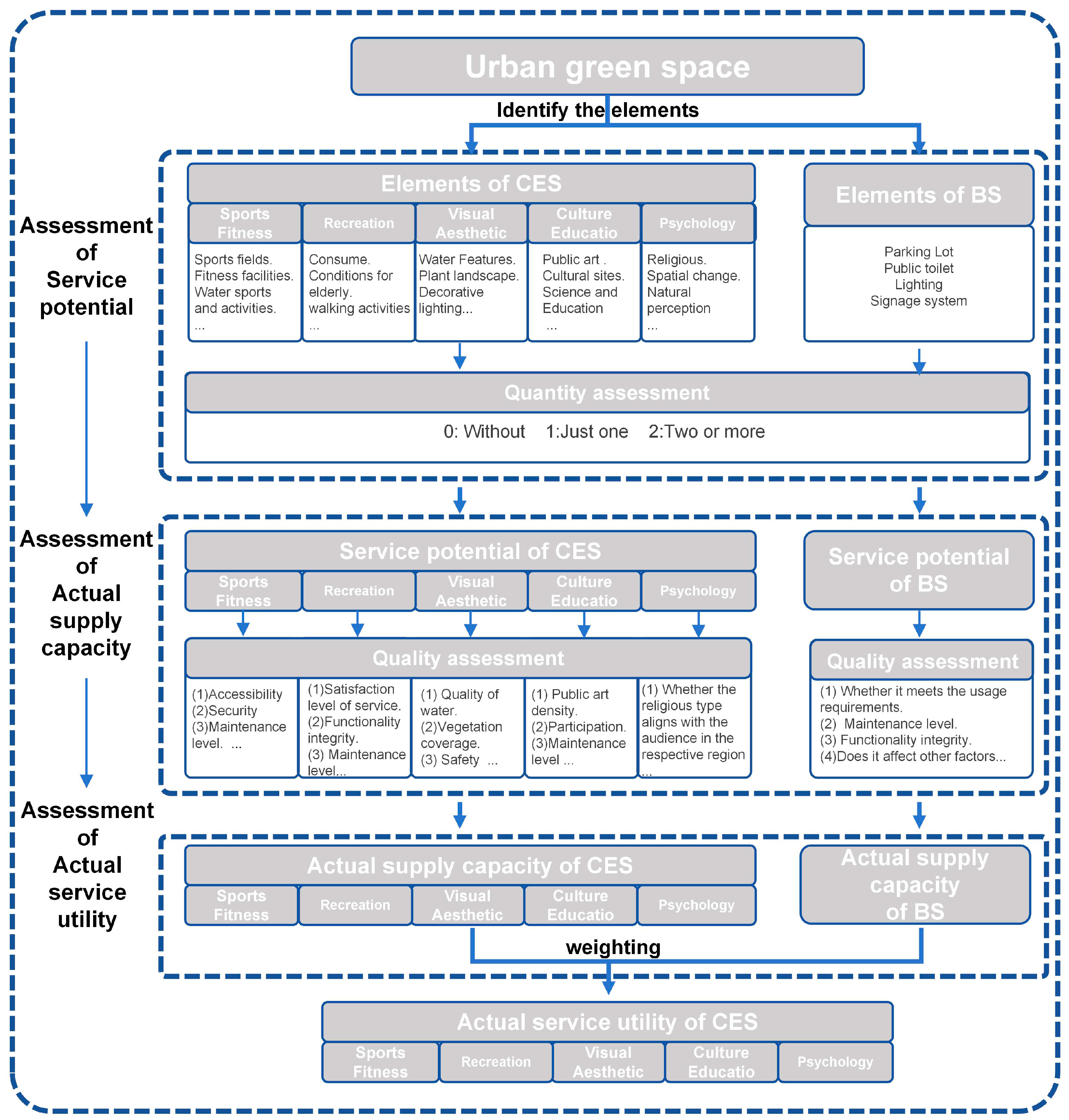
The green space CES evaluation framework (Figure 1) essentially integrates both area-based assessment methods and comprehensive quality evaluation. In this framework, we believe that the amount of CES people obtain from green spaces is influenced by two factors: the actual CES provided by green spaces and people’s current state of acceptance. Assessment of the quantity and quality of CES elements represents the actual CES provided by green spaces, while the assessment of the quantity and quality of basic service elements determines acceptance status. By combining these two dimensions through a weighting process, the framework derives the actual CES service utility, representing the effective cultural benefits perceived by visitors. This three-tier structure—comprising service potential (SP), actual supply capacity (ASC), and actual service utility (ASU) forms the operational basis of the CES evaluation framework used in this study.

2.2. Indicator Selection and System Construction

The indicator system for evaluating Cultural Ecosystem Services (CESs) in urban green spaces was developed following the definition of CES in the Millennium Ecosystem Assessment and a synthesis of existing CES evaluation frameworks [33,34,35,36,37,38,39,40,41,42] based on universality, operability, and relevance to urban parks. CES in this study are classified into five service categories: sports and fitness, leisure and recreation, visual and aesthetic enjoyment, education and cultural experience, and spiritual and psychological benefits.
Each CES category includes two dimensions of indicators: quantity indicators, which describe the presence and abundance of CES-related elements such as courts, fitness equipment, play facilities, water features, horticultural landscapes, cultural displays, and quiet spaces; and quality indicators, which assess whether these elements meet functional requirements in terms of design compliance, safety, maintenance condition, cleanliness, and usability. These indicators were selected from previous studies and public facility standards (Appendix A Table A1) [13,33,34,35,36,37,38,39,40,41,42,43,44], while items that were redundant or irrelevant to local contexts were removed to ensure general applicability.
Basic service facilities—including lighting, signage, restrooms, and parking—are treated as an independent category, as they influence accessibility, comfort, and the continuity of CES delivery but do not directly provide cultural services. As with CES elements, basic services elements contain both quantity and quality indicators but are evaluated separately to maintain conceptual clarity.
The resulting system comprises 26 CES quantity indicators, 68 CES quality indicators, 4 basic service quantity indicators, and 16 basic service quality indicators (Appendix A Table A2), forming a comprehensive and operational structure for assessing CES supply in urban parks.

2.3. Assessing and Calculating the Actual Service Utility of Green Space CES

The calculation of the actual service utility of CES for green spaces can be divided into three steps (Figure 2), which assess: service potential, actual supply capacity, and actual service utility. These have a progressive relationship, with their outcomes reflecting the supply ceiling and actual supply capacity, as well as the actual service utility conveyed to visitors. Their results have, however, different meanings.
  • Supply potential: This indicates the upper limit of CES supply in green spaces. It is derived based on the quantity of CES elements present in the green spaces. The result represents whether the CES supply quantity in green spaces is sufficient.
  • Actual supply capacity: This represents the actual CES supply capacity. It is obtained by conducting a quality assessment and weighting each CES supply element on the basis of the supply potential.
  • Actual service utility: This represents the actual CES supply efficiency that green spaces can provide to people. It is obtained by weighting the actual supply capacity of CES and the actual supply capacity of the basic services.

2.3.1. Service Potential

SP is derived solely from the quantity of CES elements. Each element is assigned a score (0, 0.6, or 1) (Table 1), and the SP of each CES category is calculated as the mean score of all corresponding elements.
C E S p o t e n t i a l = ( y v 1 + y v 2 + y v n ) n
where CESpotential represents the service potential of each type of CES; yv represents the quantity evaluation score of each CES element involved in the service (Table 1); and n represents the number of CES element types involved in the service.

2.3.2. Actual Supply Capacity

ASC incorporates quality evaluation. For each CES element, quality is assessed across multiple criteria (design compliance, safety, maintenance, accessibility, usage condition). The quality score is the average of all criteria (Formula (2)), and ASC is obtained by weighting quality scores with SP (Formula (3)).
S v = ( q v 1 + q v 2 + q v m ) m
C E S a c t s u p p l y = j = 1 n y j i = 1 m S v i j m n
where CESactsupply represents the actual supply capacity of a certain CES; Sv represents the quality assessment score of a CES element; q represents the score of each indicator in the quality assessment; m represents the number of quality assessment indexes for an element; j represents the classification of quality indexes; and i represents the classification of elements.

2.3.3. Actual Service Utility

ASU combines the ASC of CES and the ASC of basic services. Basic-service potential and quality are evaluated using the same procedures as CES elements. ASU reflects the final effective cultural benefits delivered to park users.
C E S a s u = C E S a c t s u p p l y × B S a c t s u p p l y
where CESasu indicates the actual service utility for the CES; BSactsupply represents the actual supply capacity of a certain basic service.

2.4. Assessing CES Supply and Demand in Urban Green Spaces

CES demand was approximated using the per capita green space standard of 20 m2 recommended by the United Nations [45]. CES supply and demand were calculated under both the ASU-based framework and a traditional single-index (area-based) approach to enable comparison.

2.4.1. Calculating CES Supply and Demand Based on Actual Service Utility

E S S c e s = ( C E S a s u 1 + C E S a s u 2 + C E S a s u n ) n × a r e a d i s t r i c t
E S D c e s = a r e a p e r m 2 × p o p d i s t r i c t × 1
where ESSces denotes the CES supply, and ESDces denotes the demand for CES. CESasu denotes the actual service utility of the CES. The areaper denotes per capita green space. popdistrict and areadistrict denote the population and green space area, respectively, of each district. The 1 denotes an ideal service utility.

2.4.2. Calculating CES Supply and Demand Based on a Single Index

E S S c e s = a r e a d i s t r i c t
E S D c e s = a r e a p e r × p o p d i s t r i c t
where ESSces denotes the CES supply, and ESDces denotes the demand for CES. areaper denotes per capita green space. popdistrict and areadistrict denote the population and green space area of each district, respectively.

2.5. Impact of the Evaluation Framework on the Results

The framework evaluates how each stage—SP, ASC, and ASU—modifies CES performance. By comparing results between successive stages, the degree of attenuation or improvement can be quantified, revealing whether shortages stem primarily from element quantity, element quality, or basic services.
E f f e c t q u a n t i t y = 1 C E S p o t e n t i a l
E f f e c t q u a l i t y = C E S p o t e n t i a l C E S a c t s u p p l y C E S p o t e n t i a l
E f f e c t B S = C E S c a t s u p p l y C E S a s u C E S a c t s u p p l y
where Effectquantity, Effectquality, and EffectBS denote the effects from the quantity assessment of elements, the quality assessment of elements, and the assessment of basic services, respectively, on the assessment results of the previous step in the three assessment links of supply potential, actual supply capacity, and actual service utility. The numeral 1 represents the ideal service utility of the CES supply without any weighting.

2.6. Selection of Sample Sites

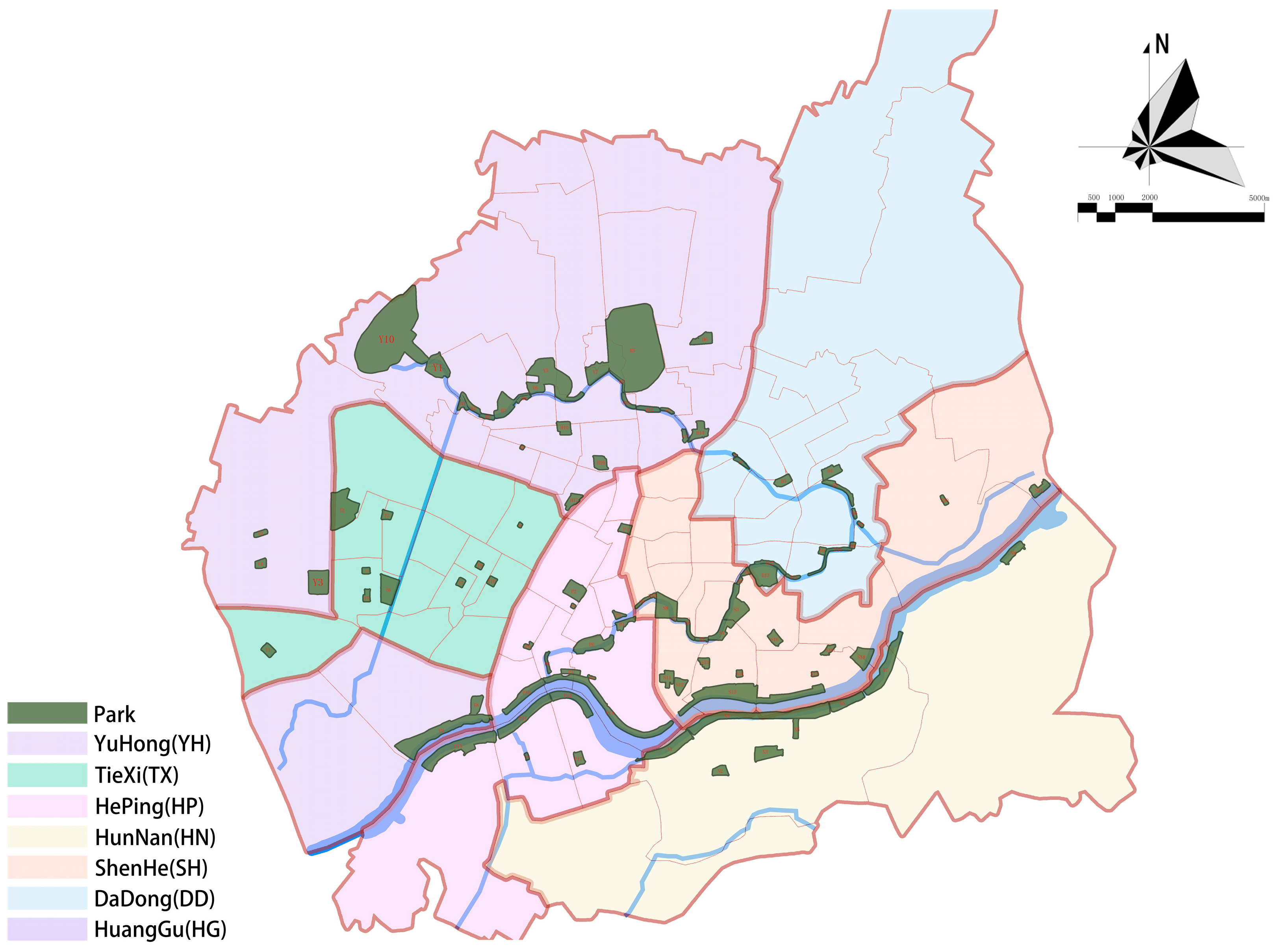
Shenyang City, located in the southern part of Northeast China and central Liaoning Province, covers 12,860 km2 and has a permanent population of approximately 9.2 million. As the capital of Liaoning and the core city of the Shenyang Metropolitan Area, Shenyang serves as a regional center of politics, economy, culture, and transportation. It is also recognized as a National Environmental Protection Model City, National Forest City, and National Garden City, making it representative of northern Chinese urban systems. Like many global metropolitan regions, Shenyang experiences substantial mismatches between ecosystem service supply and demand across its urban districts [44]. According to the 2021 Statistical Yearbook, the city includes 144 parks of various types. Seven central districts—Yuhong (YH), Huanggu (HG), Dadong (DD), Tiexi (TX), Heping (HP), Shenhe (SH), and Hunnan (HN)—constitute the core study area. A total of 95 parks capable of providing multiple CES were selected for evaluation (Figure 3).

2.7. Data Collection and Treatment

Data collection integrated field surveys, multi-source spatial data, and subjective perception information to accurately represent CES conditions in urban parks. Field surveys served as the primary source for evaluating the quantity and quality of CES elements and basic service facilities. Two trained teams conducted parallel assessments using standardized criteria, with any inconsistencies resolved through re-inspection to minimize observer bias. Human-perspective observations recorded visibility, accessibility, and environmental ambience. Subjective perception indicators—such as safety, comfort, and aesthetic satisfaction—were collected through questionnaires. Approximately 950 valid responses (around 10 per park) were obtained using a 5-point Likert scale. Mean values were incorporated directly as qualitative indicators instead of being used as correction coefficients for ASU, ensuring consistency within the evaluation structure. The full questionnaire can be found in the Supplementary File.
Spatial datasets included ESA 10 m Land Cover products and 100 m WorldPop population data corrected using the Seventh National Census. All spatial data were projected to WGS 1984 UTM Zone 51N and resampled to 10 m resolution. Spatial analysis procedures—including clipping, masking, and zonal statistics—were performed in ArcGIS 10.8 and R (terra v1.7–55).
All quantitative and qualitative indicators were normalized to a 0–1 scale using the min–max method to ensure comparability. Because indicators were numerous and complementary, equal weighting was adopted to avoid subjective bias and maintain structural transparency. Cross-validation between field survey results and remote sensing outputs was conducted. Values exceeding three standard deviations (>3σ) were reviewed through field photographs, survey notes, and official facility descriptions to ensure data reliability.

3. Results

3.1. Actual Service Utility of Different Park Types

3.1.1. Results of Supply Potential

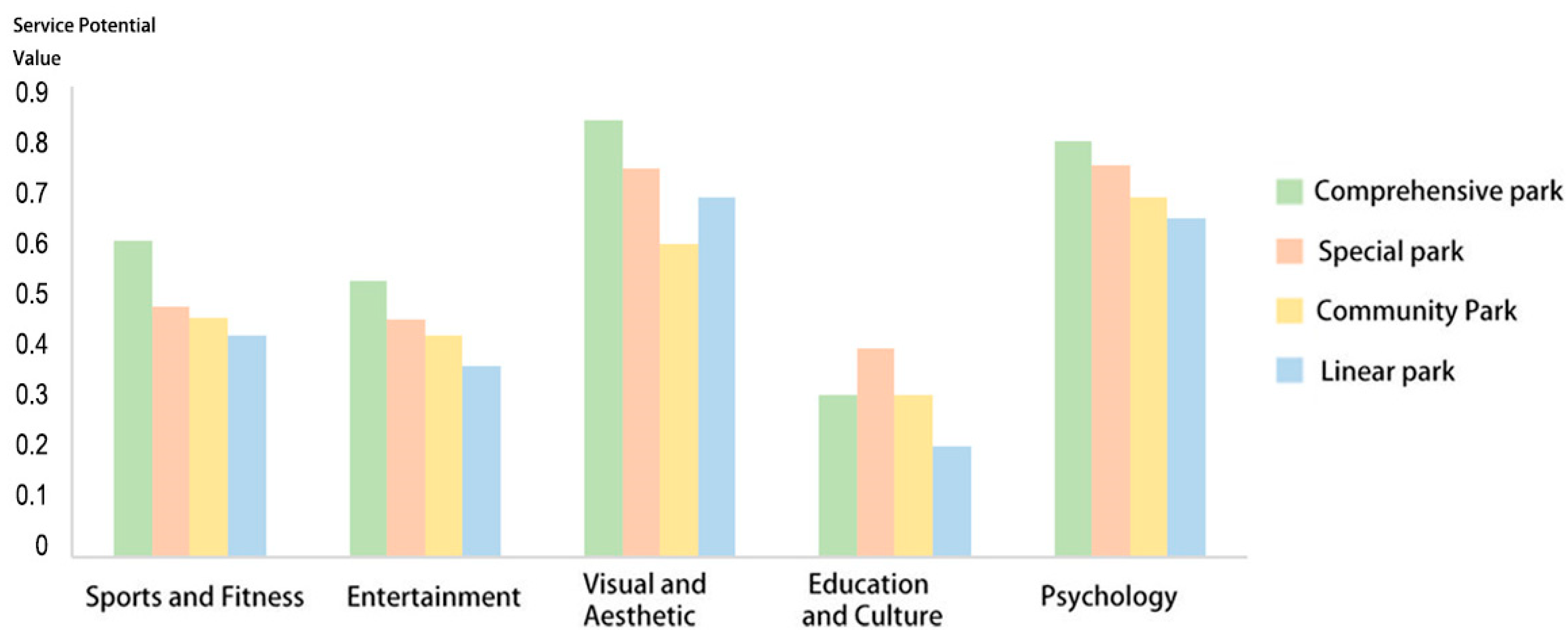
The CES supply potential of different park types shows clear gradients across service categories (Table 2; Figure 4). Comprehensive parks exhibit the highest overall potential, with mean scores of 0.61 for sports and fitness, 0.53 for recreation, 0.84 for visual aesthetics, 0.31 for culture and education, and 0.80 for psychological services. Special parks rank second, with aesthetic (0.74) and psychological (0.75) potential close to those of comprehensive parks, but lower values for sports (0.48) and recreation (0.45). Community parks display moderate potential, with scores of 0.46 (sports), 0.42 (recreation), 0.60 (aesthetics), 0.31 (culture and education), and 0.69 (psychological). Linear parks have the lowest potential overall, with values of 0.42, 0.37, 0.69, 0.21, and 0.65, respectively, and particularly weak performance in cultural–educational services. The relatively small within-type standard deviations (e.g., SD = 0.03–0.08 for most indicators) indicate that parks of the same type tend to share similar CES configurations, while systematic differences among types reflect their distinct design objectives and spatial structures.

3.1.2. Results of Actual Supply Capacity

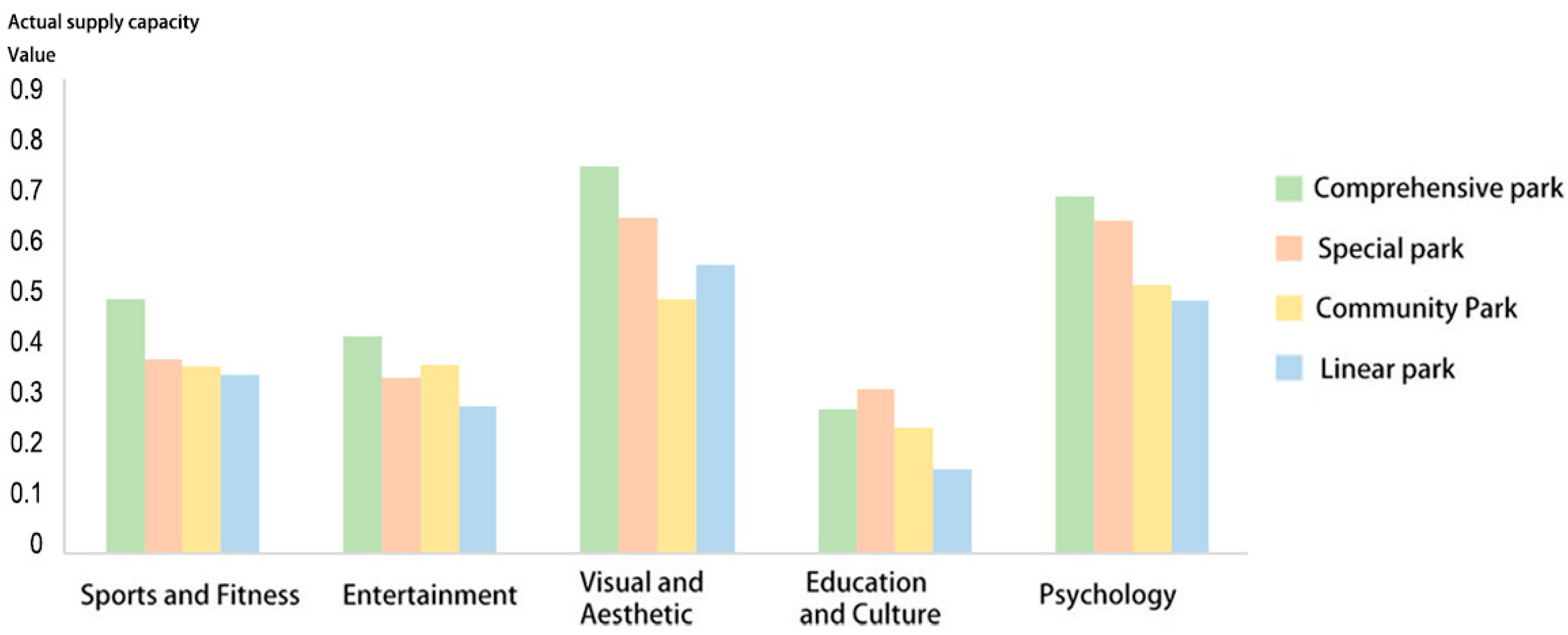
When element quality is taken into account, the actual supply capacity of CES decreases for all park types, and the stratification among types becomes more apparent (Table 3; Figure 5). Comprehensive parks still maintain the highest capacity, with mean scores of 0.49 for sports, 0.41 for recreation, 0.74 for aesthetics, 0.28 for culture and education, and 0.68 for psychological services. Special parks follow with 0.37, 0.33, 0.64, 0.31, and 0.64, respectively, indicating that their designed landscapes and thematic features are supported by relatively good maintenance. Community parks show lower capacities of 0.36 (sports), 0.36 (recreation), 0.49 (aesthetics), 0.24 (culture and education), and 0.51 (psychological), while linear parks perform weakest, at 0.34, 0.28, 0.55, 0.16, and 0.48, respectively. Compared with the potential stage, aesthetic and psychological services in community and linear parks experience notable reductions, suggesting that quality deficiencies and incomplete facilities substantially constrain their effective CES supply.

3.1.3. Results of Actual Service Utility

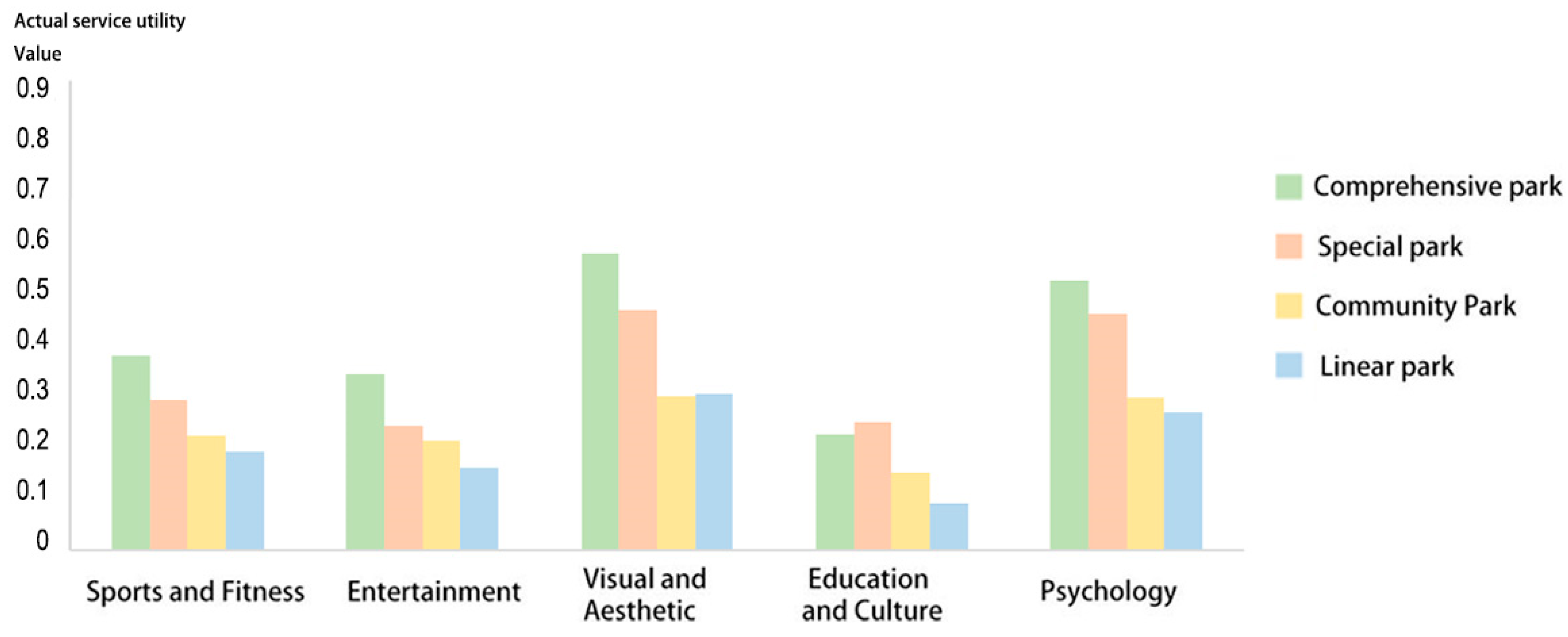
After further incorporating basic service conditions, the actual service utility of CES declines again, revealing the extent to which infrastructure and supporting services limit residents’ ability to access and enjoy CES (Table 4; Figure 6). Comprehensive parks retain the highest utility, with mean values of 0.38 for sports, 0.34 for recreation, 0.58 for visual aesthetics, 0.22 for culture and education, and 0.52 for psychological services, indicating that their lighting, signage, rest areas, and other basic services generally support the realization of cultural benefits. Special parks show intermediate utility (0.29, 0.24, 0.47, 0.25, and 0.46), with aesthetic and psychological services remaining relatively strong but lower scores for sports and recreation. Community parks fall to 0.22 (sports), 0.21 (recreation), 0.30 (aesthetics), 0.15 (culture and education), and 0.30 (psychological), while linear parks exhibit the lowest utilities at 0.19, 0.16, 0.30, 0.09, and 0.27, respectively. The comparison across stages indicates that linear and community parks are most affected by quality and basic service constraints, whereas comprehensive parks show the strongest resilience across the entire evaluation chain.

3.2. CES’s Supply and Demand in Shenyang

3.2.1. Assessment Based on a Single Index

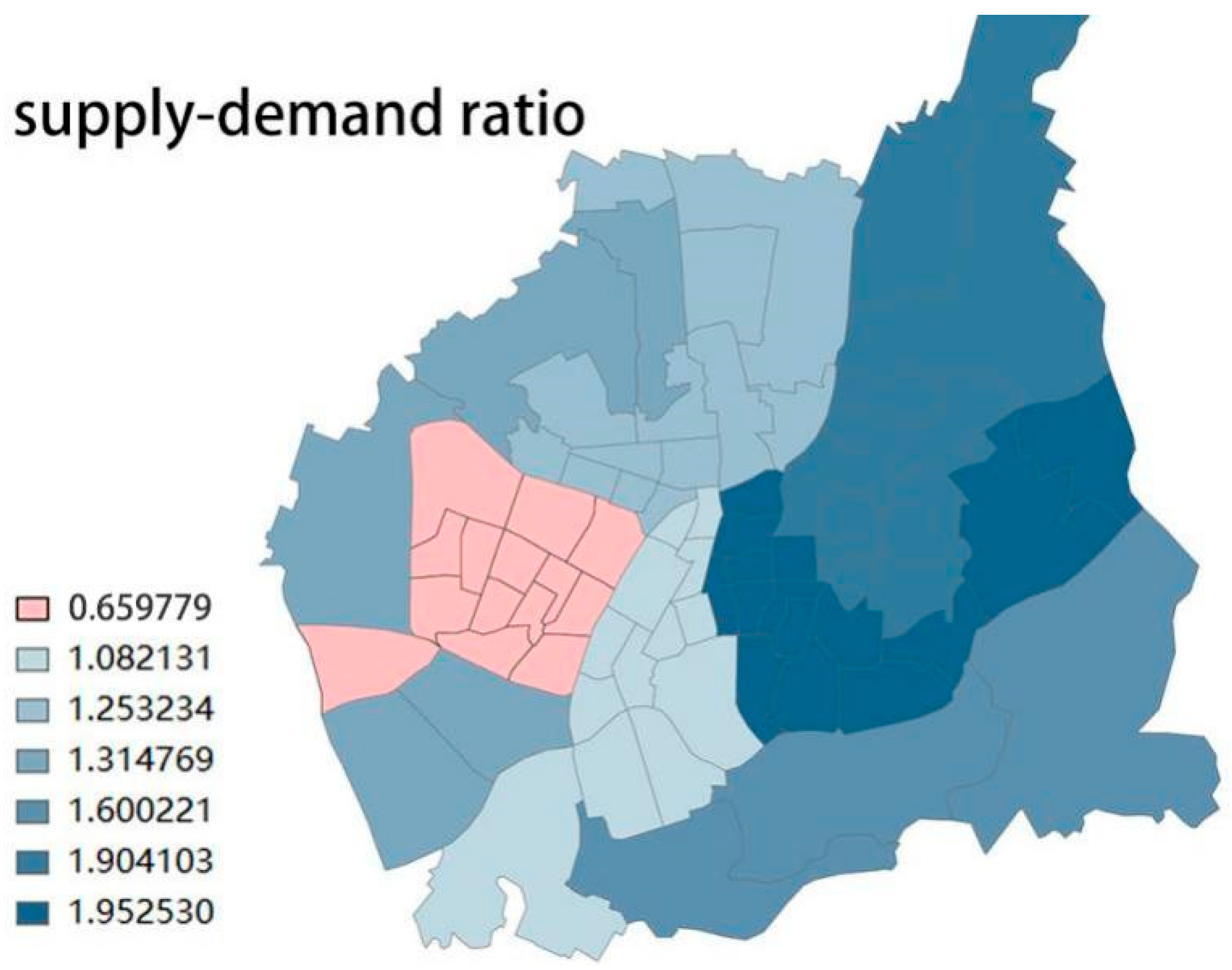
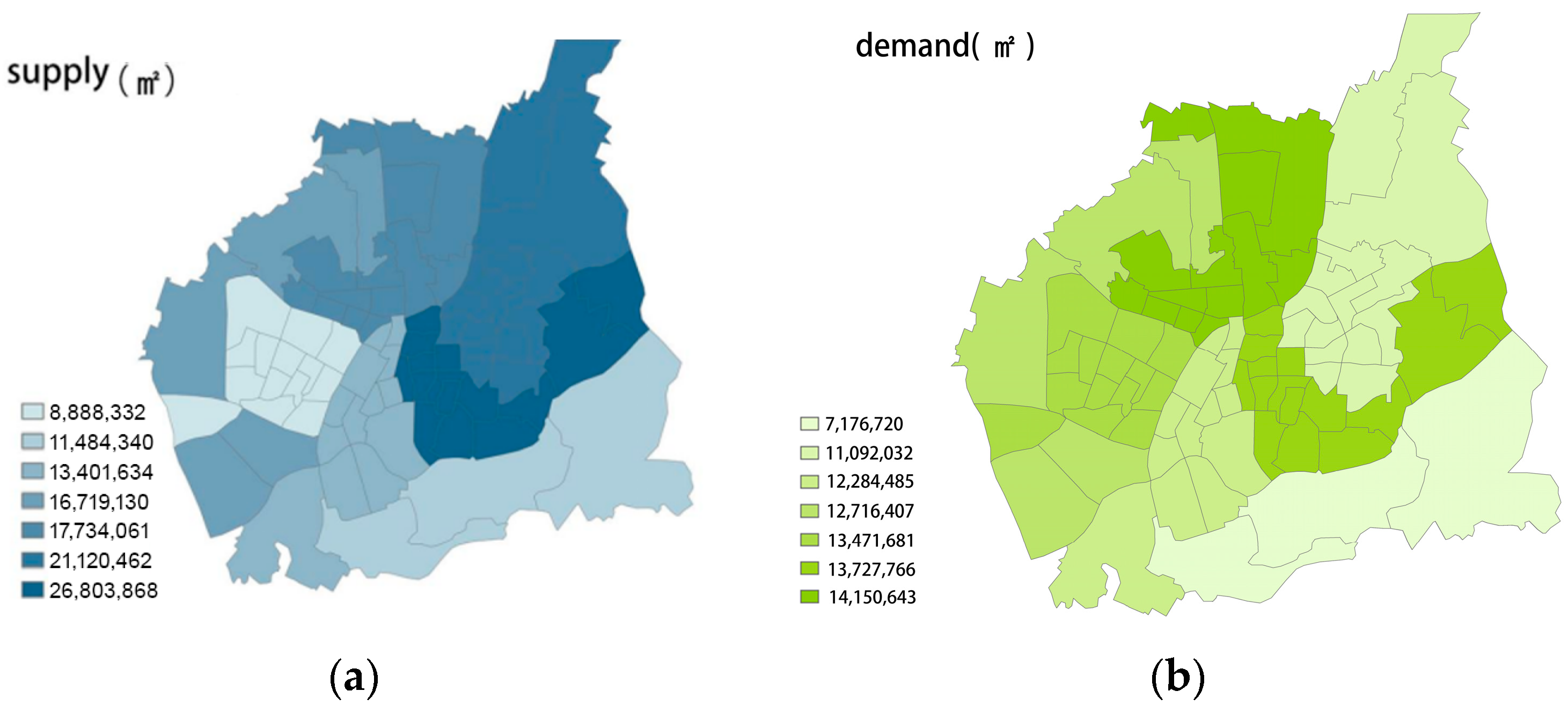
Based on the single-indicator assessment using green space area as the sole measure, notable differences emerge among the seven districts of Shenyang (Figure 7; Table 5). CES supply varies from a maximum of 26.8 km2 in SH to a minimum of 8.9 km2 in TX, reflecting the uneven spatial distribution of large green spaces. CES demand ranges from 7.2 km2 in HN to 14.2 km2 in HG, showing that population density strongly affects the estimated need for services. The resulting supply–demand ratios reveal clear inequality among districts. SH and DD exhibit the highest ratios (195% and 190%), suggesting substantial surplus capacity (Figure 8). In contrast, TX shows a severe deficit (66%), indicating insufficient green space relative to its population.
Moderately balanced districts include Heping (HP) at 108%, and Yuhong (YH) at 131%, reflecting an approximately matched relationship between area-based supply and estimated demand. Meanwhile, HG and HN remain slightly below optimal levels (75% and 98%). Overall, the single-index approach highlights inequality in green space allocation, yet it lacks the capacity to reveal how facility condition, service quality, and infrastructure influence actual CES performance.

3.2.2. Assessment Based on the Actual Service Utility Evaluation Framework

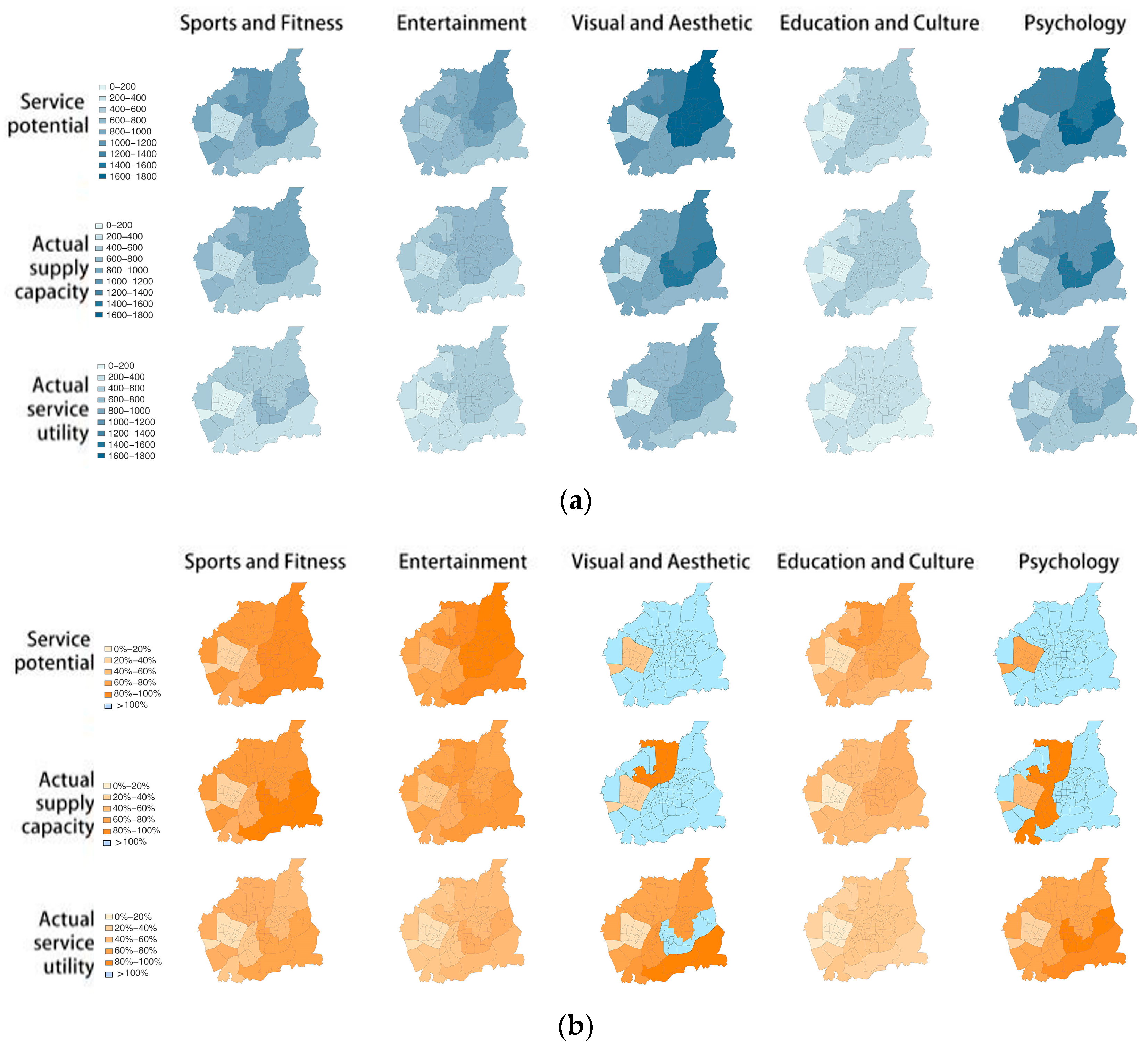
When CES supply is evaluated through the full actual service utility framework, district-level differences become more evident because the framework incorporates quantity, quality, and basic service support (Figure 9; Table 6). At the service-potential stage, SH and DD retain relatively high ratios (92 and 105%), while TX remains the lowest (29%). After integrating quality factors, scores decline notably—DD decreases from 105% to 83%, and SH drops from 92% to 75%, indicating that aging or poorly maintained facilities lower actual supply capacity.
The final stage—actual service utility—shows further reduction due to insufficient basic services. TX declines dramatically from 29% (SP) and 22% (ASC) to only 11%, the lowest among all districts, largely due to deficiencies in lighting, signage, restrooms, and seating. HN and HG also drop to 36% and 47%, respectively. In comparison, DD and SH retain comparatively higher levels (55% and 50%), demonstrating stronger infrastructure support and more complete facility systems. These results clearly show that districts with similar green space areas (e.g., HP and DD) can differ greatly in CES perception due to differences in quality and basic service provision.

3.3. Impact of the Framework on the Evaluation Results

3.3.1. CES Supply Capacity Assessment

According to the weighted impact ratios (Table 7), it can be observed that the parks least affected by quality assessments are comprehensive parks (16%) and specialized parks (20%), followed by community parks (21%) and linear parks (22%). Regarding the impact of basic services, comprehensive parks and specialized parks are least affected, with ratios of 21% and 26%, respectively, followed by community parks and linear parks, with ratios of 40% and 44%, respectively.
Overall, the results reveal distinct bottleneck types:
Comprehensive and Special parks are primarily limited by quantity (38% and 44%) rather than quality or basic services.
Community parks are primarily constrained by the combined effects of quantity (50%) and basic services (40%).
Linear parks face the most severe multi-stage attenuation (53% → 22% → 44%), making them the most vulnerable park type under the full evaluation framework.
These patterns confirm that the three-tier framework effectively distinguishes structural (quantity), functional (quality), and experiential (basic service) limitations, enabling targeted strategies for different park types.

3.3.2. CES Supply and Demand Assessment

Among the seven municipal districts, the CES supply was most affected by element quantity in TX and SH, with ratios of 56% and 53%, respectively. The CES supply in the other five districts was influenced by elements with ratios above 40%. The quality of CES elements has the greatest impact on TX at 30%, followed by HG at 22%, and the remaining districts ranged from 15% to 20%. The impacts of basic services on CES supply are most significant in TX and YH, accounting for 44% and 38%, respectively. The influences of basic services on CES supply in the remaining four municipal districts ranged from 30% to 35% (Table 8).
In general, the types and quantity of landscape elements that can provide CES have the greatest impact on the CES supply, while when evaluating the service potential of the quantity of CES elements, aesthetic service is the least affected. According to the overall supply–demand ratio results for the seven districts (Table 6), visual aesthetic service generally has the highest supply–demand ratio in each district. Education and cultural services are significantly affected in the service potential assessment. The quantity of CES elements affected education and cultural services in TX at 84%, and in HG, SH, and TX at approximately 75%. Even the lowest ratio, found in HG, is 59%. This underscores that there is a serious shortage of elements for education and cultural services. Increasing the CES elements and facilities related to this CES type could be effective in elevating the overall CES level.
Based on the above results, we identified three main findings. First, comprehensive parks and specialized parks exhibit significantly higher CES supply potential than community and linear parks, yet quality deficiencies in elements and basic services reduce the actual utility by 30–44%. Second, the new framework reveals that the CES supply–demand ratios across the administrative districts (11–55%) are markedly lower than results from traditional area-based assessments (66–195%), which highlights the presence of a significant mismatch in supply and demand. Third, education and cultural services are most severely affected by a shortage of elements (deficit rates of 59–84%), while basic service quality exerts the greatest influence on the utility of linear parks (contribution rate: 44%).

4. Discussion

4.1. Actual CES Service Utility Evaluation Results in Different Park Types

Different types of parks exhibit markedly different cultural ecosystem service (CES) profiles due to variations in spatial scale, landscape composition, functional configuration, and facility conditions. The results of this study show that comprehensive parks consistently deliver the highest levels of CES across all service dimensions. Their performance reflects the combined effect of diverse vegetation structures, multifunctional spaces, and relatively mature recreational and cultural facilities. Similar patterns have been observed in comparative studies from Central Europe and East Asia, where large, multifunctional parks tend to accommodate a wider spectrum of cultural and recreational activities and attract more diverse user groups [46]. Special parks demonstrate particularly strong performance in education and cultural services owing to their thematic design, curated spatial arrangements, and the presence of interpretive installations. Such design-driven cultural benefits have also been documented in thematic parks and heritage-oriented green spaces, where curated experiences substantially strengthen cultural attachment and learning-oriented engagement [47].
In contrast, community parks, despite their limited size, play an important role in meeting residents’ daily recreational and psychological needs. Their proximity and accessibility contribute to high visit frequency, making them especially valuable for stress relief, short-duration activities, and neighborhood-level social interaction. These patterns are consistent with a growing body of research showing that accessible local green spaces substantially enhance daily well-being and foster social cohesion within residential communities [48]. Linear parks, however, exhibit the lowest CES levels overall. Their narrow spatial configuration and constrained facilities limit opportunities for extended stays, cultural experiences, and interpretive activities. Although linear parks often provide strong aesthetic value and route-based recreation, their limited infrastructure restricts their potential to support cultural learning or social events. This finding aligns with previous research showing that greenways and corridor parks, while effective for mobility and visual experience, seldom deliver the depth of cultural engagement found in broader park typologies [49].
In summary, the performance of different park types illustrates how CES delivery depends not only on ecological factors but also on spatial form, functional structure, and the intentional design of cultural and interpretive amenities. Understanding these differences is essential for refining park-specific planning strategies and optimizing cultural benefits across the urban green-space system.

4.2. Urban Green Space: Supply and Demand Results

The spatial heterogeneity of CES performance observed across Shenyang’s districts reflects bigger structural differences in urban form, socio-ecological conditions, and public-service provision. Rather than merely indicating variation in green space quantity, the disparities uncovered in this study highlight the multidimensional nature of CES delivery, in which physical elements, facility quality, and basic infrastructure interact to shape residents’ cultural and psychological experiences. This aligns with a growing body of literature emphasizing that CES are co-produced by ecological structures and built-environment conditions rather than ecological assets alone [50,51].
A key insight from the evaluation framework is that quantity deficits are only the first layer of limitation. Although commonly used in traditional CES assessments, quantity-only indicators overlook functional degradation, aesthetic deterioration, and usability constraints. The strong attenuation revealed in the quality and basic-service stages confirms earlier criticisms that area-based proxies systematically overestimate CES benefits [52,53]. The findings also support research showing that residents’ interactions with green spaces depend heavily on facility integrity, maintenance, and environmental safety, all of which influence restorative experiences and psychological satisfaction [54,55].
The strong influence of basic services—such as lighting, signage, parking, and restrooms—further demonstrates that CES are inseparable from everyday spatial practices and accessibility conditions. Infrastructure deficiencies reduce not only the actual utility of cultural services but also the willingness of residents to visit parks, thereby amplifying socio-spatial inequalities [56].
Importantly, the district-specific bottlenecks identified in this study indicate that CES inequities are not uniform in origin. Some districts are constrained by insufficient CES elements, while others are limited by degraded quality or service shortages. This finding suggests that generic greening strategies are unlikely to be effective; instead, CES enhancement requires tailored interventions, such as targeted facility renewal, service upgrades, or structural reconfiguration, depending on local conditions. From a sustainability perspective, incorporating multidimensional CES assessments into planning can promote more equitable access to cultural benefits, enhance urban resilience, and directly support SDG 11 by fostering inclusive, healthy, and culturally vibrant cities.

4.3. Actual Service Utility Evaluation Framework for CES

Cultural ecosystem services (CES) differ from provisioning and regulating services in that they rely heavily on the interaction between ecological structures, built facilities, and human perception. The present study contributes to the theoretical understanding of CES by framing its delivery as a multi-stage process consisting of service potential, actual supply capacity, and realized service utility. This structure makes visible a series of attenuation processes that typically remain obscured in conventional evaluations that rely primarily on green-space area or vegetation metrics.
The multi-stage logic aligns with contemporary perspectives that view CES as outcomes of co-production between ecological environments and social–institutional systems [57,58]. Unlike studies that primarily focus on demand preferences [59,60,61,62], the assessment framework based on actual service utility provides an in-depth evaluation from the supply side. Our results show that the translation from potential to utility is strongly conditioned by the quality of service-related elements—such as interpretive facilities, recreational infrastructure, and landscape maintenance—rather than by ecological resources alone. Such findings reinforce the argument that cultural experiences are enabled by a combination of ecological affordances and institutional or infrastructural support, a trend increasingly observed in CES studies from Europe, East Asia, and North America [63,64].
One of the most important implications concerns the pivotal role of basic service facilities—such as lighting, sanitation, seating, accessibility, and signage—as mediators of CES realization [46]. Previous empirical research has shown that such facilities shape visitors’ sense of comfort, safety, and engagement, thereby affecting whether potential cultural benefits can be transformed into meaningful experiences [63,64]. Under conditions marked by heat, rainfall, or high visitor density, basic infrastructure becomes even more critical [64,65]. Our findings reinforce this by showing that districts with limited basic services, such as TX and YH, experience substantial losses in realized utility regardless of their underlying ecological or spatial conditions.
The framework also clarifies how structural constraints and functional deficiencies interact. Some districts, particularly those with limited land availability or fragmented green-space distribution, face structural shortages that restrict cultural service capacity from the outset. In such cases, adding micro-green spaces, rooftop green areas, or pocket-park interventions may be necessary. Conversely, in districts where service quality, maintenance, or facility age are the primary limiting factors, targeted upgrades can yield substantial improvements. Examples include renewing interpretive signage, improving pathway lighting, expanding cultural programming, or enhancing accessibility for elderly and disabled users.
The results further demonstrate that cultural and educational services are the most sensitive to design and programming inputs. Their deficits, observed across multiple districts, signal the need for more intentional creation of learning-oriented spaces. Overall, the framework shifts CES assessment from abstract description toward an actionable, diagnostic-to-intervention model. By clearly identifying where cultural benefits weaken in the service chain and which components exert the strongest influence on service realization, the framework provides a robust foundation for evidence-based planning, enabling cities to optimize cultural benefits in an equitable and sustainable manner.

4.4. Advantages and Limitations of the Framework

The three-tiered evaluation framework demonstrates significant applicability in urban green space management. Its primary strength lies in precisely diagnosing the root causes of imbalances in supply and demand, which is particularly valuable in high-density urban renewal zones and aging district renovations (e.g., HP and TX). It effectively exposes the illusion of sufficient green space perpetuated by traditional area-based metrics by quantifying structural shortages—exemplified by Shenyang’s districts showing 108–195% area surplus yet only 11–55% actual utility. The framework further dissects three critical attenuation layers: quantity gaps (e.g., 59–84% deficit in science/education facilities), quality defects (e.g., facility aging and safety non-compliance), and basic service failures (e.g., substantial utility loss in linear parks due to missing restrooms and signage). This granular diagnosis enables differentiated planning decisions for cities with limited budgets. By attributing deficiencies to specific layers (e.g., prioritizing quantity supplementation in TX versus quality upgrades in HP), the framework also offers multi-scale compatibility: at the micro level (single parks), it identifies facility-specific shortcomings; at the meso level (districts), it reveals regional imbalances; and at the macro level (the whole city), it informs system-wide standards and prioritization in green space planning.
At the same time, several operational constraints require attention. High implementation costs stem from assessing a large number of quality indicators for CES and basic services. The current weighting system assumes equal importance across CES elements, overlooking user preferences (e.g., older adults favoring recreation versus younger groups prioritizing sports). Integrating demand-side data (e.g., surveys or mobile phone location data) and spatial heterogeneity (e.g., placing greater emphasis on aesthetic services in commercial zones) would enhance accuracy. Cross-cultural applicability is also challenged by China-centric indicators, such as classical garden elements (mountain–water–plant–architecture compositions) and national standards [66]. Adopting a modular design—allowing substitution with local tools like POST in Western contexts—and flexible metrics (e.g., replacing specific religious content with culturally relevant spiritual spaces) could broaden the framework’s applicability across different cultural and institutional environments.

5. Conclusions

Because CESs are ultimately directed toward a human audience, it is crucial to understand the process through which CES elements are linked to people. Evaluating key stages in this process allows for the quantification of losses in service quantity during transmission, enabling a more accurate assessment of the actual services received and a realistic determination of CES provision in urban areas. The assessment results have been validated against the observed conditions in Shenyang’s parks.
Building on these findings, the results of this study also echo several persistent challenges in current CES evaluation practices. First, an overemphasis on quantity while neglecting quality and functionality has led to incomplete and sometimes misleading assessments. Second, quality-related factors are often treated in isolation, lacking a unified and quantifiable framework capable of capturing their combined influence on CES outcomes. Third, the indirect mechanisms—through which infrastructure and environmental quality shape CES perception—remain insufficiently modeled or quantified. Recognizing these methodological gaps further highlights the necessity of a more integrated and operational CES evaluation framework.
This study established a three-tiered evaluation framework integrating quantity, quality, and basic services. The first step involves a comprehensive assessment of supply and demand. In addition to the original quantity indicators, our system includes quality and basic service indicators, ensuring a more comprehensive and realistic assessment of supply and demand. The second step is a professional quality evaluation. The quality assessments for each element adhere to industrial standards and employ diverse evaluation tools, reducing the influence of subjective factors and enhancing the professionalism of the results. The third step is the analysis of three evaluation components. By dissecting the quantity, quality, and basic service components in the evaluation process, we can compare results at different stages of the weighting calculation, identify the stage that exerts the strongest impact on supply and demand, and highlight key issues requiring improvement.
By deconstructing the service delivery chain, this framework exposes hidden attenuation layers—specifically, quality defects and basic service deficiencies—that remain undetectable in traditional area-based assessments. The core value of the framework lies in transforming the abstract goal of improving CES into a quantifiable pathway for action: supplementing quantity, enhancing quality, and strengthening basic services. It thus provides a precise map for navigating the renewal and optimization of urban green spaces in high-density cities, ensuring that improvements target not only quantity but also quality and basic service facilities. In addition, this multi-stage and multi-dimensional structure aligns with key principles of urban sustainability, particularly long-term ecological resilience, equitable access to cultural benefits, and efficient resource allocation. Strengthening the quantity–quality–service continuum supports sustainable green-space governance by promoting balanced development, reducing environmental inequities, and ensuring that cultural ecosystem benefits can be maintained and transmitted across generations.

Supplementary Materials

The following supporting information can be downloaded at: https://www.mdpi.com/article/10.3390/su18010098/s1, Survey questionnaires.

Author Contributions

Conceptualization, Z.Z. and J.Y. (Jing Yao); methodology, Z.Z. and J.Y. (Jing Yao); software, Z.Z.; validation, Z.Z. and J.Y. (Jing Yao); formal analysis, Z.Z.; investigation, Z.Z.; resources, W.C., Y.Z., J.Y. (Jing Yao) and J.Y. (Jinghua Yu); data curation, Z.Z.; writing—original draft preparation, Z.Z. and J.Y. (Jing Yao); writing—review and editing, Z.Z.; visualization, Z.Z.; supervision, J.Y. (Jing Yao); project administration, J.Y. (Jing Yao) and X.H.; funding acquisition, X.H. All authors have read and agreed to the published version of the manuscript.

Funding

This research was funded by the National Natural Science Foundation of China, grant number 3213000429.

Institutional Review Board Statement

Ethical review and approval were waived for this study by the Research Ethics/Research Integrity Committee of the Shenyang Institute of Applied Ecology, Chinese Academy of Sciences, in accordance with the national Measures for Ethical Review of Science & Technology Activities (Trial) (2023). The study qualified for exemption because it involved minimal-risk, anonymous questionnaire data without the collection of identifiable personal information.

Informed Consent Statement

Informed consent was obtained from all subjects involved in the study.

Data Availability Statement

The original contributions presented in this study are included in the article/Supplementary Materials. Further inquiries can be directed to the corresponding author.

Acknowledgments

The first author also wishes to thank Pengfang Zhu of Shenyang Agricultural University for his help in his studies.

Conflicts of Interest

The authors declare no conflicts of interest.

Abbreviations

The following abbreviations are used in this manuscript:
MEAMillennium Ecosystem Assessment
SDGsSustainable Development Goals
CESCultural ecosystem services
ESVSEcosystem Services Valuation System
RECITALUrban green space quality assessment tool
POSTPublic open space quality assessment tool
CPATCommunity park assessment tool
NESTNatural environment scoring tool
NGSTNeighbourhood green space tool
YHYuhong District
HGHuanggu District
DDDadong District
TXTiexi District
HPHeping District
SHShenhe District
HNHunnan District

Appendix A

Table A1. Indicator classification systems of existing research cases.
Service TypeEvaluation CriteriaCase
EntertainmentArea of recreational land[36]
Recreational land area per unit[37]
Accessibility of the entertainment area[38]
Area of fishable waters, length of walking and cycling paths for tourists[35]
Number, type, and quality of entertainment facilities[39]
Per capita green space area[40]
Abundance of amusement facilities[14]
Number of recreational activities
Parent–child experience
Parking facilities, convenience of parking
Guidance facilities
Location of entrances and exits
Topography and landforms[42]
Resource distribution
Service facilities
Place function
Tourism carrying capacity[43]
Unique natural resources (whales, dolphins, pinnipeds, and otters in public and private reserves)
Length of stay[41]
Consumption level
SpiritualViewing range of natural landscapes[39]
Opportunity to enjoy tranquility
Degree of visibility of green vegetation
Diversity of vegetation types
Sense of safety
Sense of free space
Inspiration for music and art, belief in God
Presence of trash, waste, animal droppings, overall view and scenery, presence of vegetation and trees, presence of water bodies, facility design, openness
Scenic attractiveness[14]
Scenic interest
Scenic appeal
Scenic guidance, whether the landscape can accurately guide
Greenery coverage
Number and variety of green plants
Form of mountains and rivers[42]
Vegetation landscape
Natural mechanisms
Architectural style
Photo capture points can be uploaded to panoramic views
Popular Science Education ServicesScientific knowledge from thematic activities, acquisition of scientific knowledge[43]
Entertainment of thematic activities
Participability of thematic activities
Species observation
Sports ServicesFitness facilities, number of fitness facilities meets demand[14]
Greenways
Facility safety
Horseback riding, cycling, off-road
Social Relationship ServicesRain shelters
Benches, pavilions, bathrooms
Facilitates social activities
Cultural Perception Services (Religious Beliefs, Cultural Heritage, Spirituality, History, Sense of Place)Historical events[42]
Local traditions
Cultural relics
Interpretation system
Archeological sites[43]
Ancestral land
Sculptures[44]
Architecture
Table A2. Evaluate indexes.
Type of ServiceElementsQuantity Assessment IndicatorsQuality Assessment IndicatorsMethods
Sports and FitnessActivity fields (playgrounds, soccer fields, basketball courts, table tennis courts, etc.)0: without
1: just one
2: Two or more
(1) Whether it meets the design specification standards
(2) Facility accessibility (field of view accessibility, barrier-free)
(3) Facility space independence
(4) Facility safety (whether it meets safety specifications and standards)
(5) The degree of maintenance of the facility (whether there are negative factors such as damage, lack of function, and graffiti)
(6) Facility participation (facility opening hours, free of charge)
(7) Whether the facilities are complete
Field investigation (according to different facilities compared with relevant norms)
Sports and fitness facilities (street fitness equipment)0: without
1: just one
2: Two or more
Facilities for running and hiking0: without
1: have
Water sports and activities0: without
1: just one
2: Two or more
Children’s play facilities0: without
1: just one
2: Two or more
Leisure and entertainmentCatering, restaurants,
Concession stand
0: without
1: just one
2: Two or more
(1) Whether the service carrying capacity can meet the public demand in the green space
(2) Satisfaction degree of service quality
Field investigation and Questionnaire survey
Stage0: without
1: have
(1) Whether the stage volume can meet the needs of the public in the green space
(2) Whether the stage has spatial independence
(3) Stage maintenance (whether there are negative factors such as damage, function loss, security risks, graffiti Posting)
(4) whether the stage is in harmony with the surrounding landscape
Field investigation and Target group visit
Activity places for the elderly (chess and card, Tai Chi)0: without
1: just one
2: Two or more
(1) Whether the facilities are perfect
(2) The maintenance of the facilities (whether there are negative factors such as damage, function loss, security risks, graffiti Posting)
Field investigation and Target group visit
Walking conditions0: without
1: have
(1) The independence of the walking route (to avoid the mixing of people and vehicles)
(2) Multi-level and multi-path walking routes
(3) Continuity of walking flow lines (loop, barrier-free)
Satellite map, Field investigation
Potential multifunctional space0: without
1: just one
2: Two or more
The degree of fit between the potential multi-functional space and the specific activityField investigation
Service center0: without
1: have
(1) Whether the operation hours, duration and functions of the service center meet the needs
(2) Service quality of service center (can be obtained through questionnaire survey)
Field investigation and Questionnaire survey
Visual and aestheticWater Features0: without
1: just one
2: Two or more
(1) Water feature quality (clear, odor-free)
(2) Whether the surrounding environment is in harmony with the water landscape (landscape style, volume)
(3) Water feature service duration (artificial water feature (fountain, drop, etc.): opening time and duration, natural water feature: dry season, frost period) accounts for 50% of the annual business hours
Field investigation, Related research
Topographic landscape0: without
1: have
(1) Whether the micro-terrain landscape conforms to the rule of formal beauty
(2) The maintenance level of microtopographic landscape (whether the pavement is damaged, whether the grass is in good condition, etc.)
Field investigation, Human viewing Angle framing, Satellite plan
Plant landscape0: without
1: have
(1) Whether the vegetation coverage is greater than 70%
(2) Vegetation continuity (plant landscape design and form are coherent, not abrupt)
(3) Vegetation skyline (the connection and relief level with the vista and urban skyline)
(4) Plant collocation (visual balance, line of sight guidance, matching form in line with formal beauty rule)
(5) plant diversity
(6) Plant color (seasonal appearance, rich and complementary colors)
(7) Plant maintenance (plant pruning, Whether the plant has problems such as poor growth, disease, etc.)
Field investigation, Human viewing Angle framing, Satellite plan
Public art (sculpture, landscape architecture)0: without
1: just one
2: Two or more
(1) Whether it conforms to the audience’s aesthetic tendencies
(2) the level of public art expression (location (whether it is used for a spot scene or a space line of sight); Whether the ratio between volume and viewing distance is reasonable)
(3) Maintenance degree (whether there are negative factors such as damage and graffiti)
Field investigation and Questionnaire survey
Decorative lighting0: without
1: have
(1) Decorative lighting opening time (days)
(2) Maintenance level of decorative lighting (whether there are negative factors such as damage and lack of functionality)
(3) Whether it is harmonious with the surrounding environment (whether there are exposed wires affecting the surrounding landscape effect, whether the lighting facilities are slightly abrupt with the surrounding scenery during the day)
(4) safety (whether it can be contacted, whether there are leakage problems, etc.)
Field investigation, and Target population visit
views0: without
1: just one
2: Two or more
(1) Accessibility of viewing spots (distance, accessibility)
(2) Scenic spot quality (whether it conforms to the beauty in form rule)
(3) Whether the scenery changes (with the season, weather and other factors)
Field investigation and Related research
Culture, Science and EducationPublic art (sculpture, landscape architecture)0: without
1: just one
2: Two or more
(1) Density of public art
(2) View of public art appreciation (volume and viewing distance)
(3) Maintenance degree (whether there are negative factors such as damage and graffiti)
Satellite map, Field investigation, Questionnaire survey
Cultural sites (cultural sites, historical sites, etc.)0: without
1: just one
2: Two or more
(1) The degree of preservation of the site
(2) the repair level of the site
(3) Whether there is site landscape design
(4) Participation (whether it is possible to get up close and open for free)
Field investigation, Questionnaire survey
Historical events0: without
1: have
(1) The degree of fame of the historical event (whether the public is familiar with it or has a little understanding of it)
(2) completeness of the event (whether the event is missing information, such as some characters, sometimes unknowable, etc.)
(3) the authenticity of the event (whether there are historical records)
Field investigation (relevant investigation of the uncertain historical content involved, to determine its authenticity)
Science and education content (animal and plant education, history education, culture education)0: without
1: have
(1) Whether the content of science and education is comprehensive (whether some fields have not been covered)
(2) The degree of participation in science and education services (whether relevant science and education activities have been organized)
(3) Participation of science and education content (whether it is free and open, and whether it can be contacted at close range)
Field investigation and Target group visit
spiritual and psychologyReligious cultural content0: without
1: have
(1) Whether the religious type is consistent with the regional audience where the green space is located
(2) There is no religious conflict when multiple religions coexist in the green space
(3) whether there is interference with non-religious believers
Field investigation and Questionnaire survey
Sense of Security0: without
1: just one
2: Two or more
(1) Whether closed-circuit monitoring is installed
(2) Whether there are security personnel
(3) Whether there are blind spots in sight
(4) Whether there is functional lighting at night
Field investigation and Questionnaire survey
Spatial change (volume, landscape elements, etc.)0: without
1: just one
2: Two or more
(1) Whether the spatial changes are obvious
(2) Whether the spatial characteristics are clear
Satellite map, Field investigation
Natural perception (Underwoods, waterfront, grassland, etc.)0: without
1: just one
2: Two or more
(1) Whether the perceptual elements are prominent (the proportion of the same type of elements (visual elements and non-visual elements) is more than 70%)
(2) Quality of perceived elements (landscape quality, element quality)
Field investigation
Social places0: without
1: have
(1) Level of maintenance (whether the facilities in the venue are adequate, no
Is there damage, lack of function, whether there are negative factors such as graffiti?
Field investigation
Green space infrastructureLighting0: without
1: have
(1) Whether the functional lighting distribution is reasonable (night activity requirements)
(2) Whether the brightness of functional lighting meets the standards
(3) Whether functional lighting affects other landscape elements
(4) Whether the functional lighting facilities are harmonious with the surrounding landscape
Field investigation, (according to the nature of different sites and different specifications of lighting facilities query lighting specifications)
Signage system0: without
1: have
(1) Identify whether the information conveyed by the system is clear and clear
(2) Whether the design style of the sign system is coordinated with the green space style
(3) Whether the sign system is in harmony with other landscape elements and does not interfere with each other
Field investigation and Questionnaire survey
Parking Lot0: without
1: have
(1) Whether the number of parking Spaces in the parking lot can meet the needs of the public in the green space
(2) Maintenance level (whether there are negative factors such as pavement damage, lack of functions, and graffiti)
(3) Whether the parking lot has a clear and standardized parking space plan
(4) Whether the flow line of the parking lot is clear and consistent
(5) Whether the parking lot guidance system is clear
Field investigation and Questionnaire survey
Public toilet0: No public restrooms
1: There is a public bathroom
2: There are two or more public toilets
(1) Whether the public toilet is clean (no obvious odor, no dirt)
(2) The maintenance level of public toilets (whether there is damage, whether there is lack of function, whether there are negative factors such as graffiti posted)
(3) Whether the bathroom is free
(4) Whether the bathroom is fully functional (whether it includes hand washing pool, mother and baby room and other functions)
Field investigation

References

  1. Millennium Ecosystem Assessment. Ecosystems and Human Well-Being: Current State and Trends; Island Press: Washington, DC, USA, 2005. [Google Scholar]
  2. Dickinson, D.C.; Hobbs, R.J. Cultural ecosystem services: Characteristics, challenges and lessons for urban green space research. Ecosyst. Serv. 2017, 25, 179–194. [Google Scholar] [CrossRef]
  3. Xu, Z.; Peng, J.; Qiu, S.; Liu, Y.; Dong, J.; Zhang, H. Responses of spatial relationships between ecosystem services and the Sustainable Development Goals to urbanization. Sci. Total Environ. 2022, 850, 157868. [Google Scholar] [CrossRef] [PubMed]
  4. Filho, W.L.; Barbir, J.; Sima, M.; Kalbus, A.; Nagy, G.J.; Paletta, A.; Villamizar, A.; Martinez, R.; Azeiteiro, U.M.; Pereira, M.J.; et al. Reviewing the role of ecosystems services in the sustainability of the urban environment: A multi-country analysis. J. Clean. Prod. 2020, 262, 121338. [Google Scholar] [CrossRef]
  5. Plieninger, T.; Dijks, S.; Oteros-Rozas, E.; Bieling, C. Assessing, mapping, and quantifying cultural ecosystem services at community level. Land Use Policy 2013, 33, 118–129. [Google Scholar] [CrossRef]
  6. Kremer, P.; Hamstead, Z.; Haase, D.; McPhearson, T.; Frantzeskaki, N.; Andersson, E.; Kabisch, N.; Larondelle, N.; Rall, E.L.; Voigt, A.; et al. Key insights for the future of urban ecosystem services research. Ecol. Soc. 2016, 21, 29. [Google Scholar] [CrossRef]
  7. Larson, L.R.; Keith, S.J.; Fernandez, M.; Hallo, J.C.; Shafer, C.S.; Jennings, V. Ecosystem services and urban greenways: What’s the public’s perspective? Ecosyst. Serv. 2016, 22, 111–116. [Google Scholar] [CrossRef]
  8. Wu, W.; Ding, K. Optimization Strategy for Parks and Green Spaces in Shenyang City: Improving the Supply Quality and Accessibility. Int. J. Environ. Res. Public Health 2022, 19, 4443. [Google Scholar] [CrossRef]
  9. Larondelle, N.; Lauf, S. Balancing demand and supply of multiple urban ecosystem services on different spatial scales. Ecosyst. Serv. 2016, 22, 18–31. [Google Scholar] [CrossRef]
  10. Krellenberg, K.; Artmann, M.; Stanley, C.; Hecht, R. What to do in, and what to expect from, urban green spaces—Indicator-based approach to assess cultural ecosystem services. Urban For. Urban Green. 2021, 59, 126986. [Google Scholar] [CrossRef]
  11. Hegetschweiler, K.T.; de Vries, S.; Arnberger, A.; Bell, S.; Brennan, M.; Siter, N.; Olafsson, A.S.; Voigt, A.; Hunziker, M. Linking demand and supply factors in identifying cultural ecosystem services of urban green infrastructures: A review of European studies. Urban For. Urban Green. 2017, 21, 48–59. [Google Scholar] [CrossRef]
  12. Kabisch, N.; Kraemer, R. Physical activity patterns in two differently characterised urban parks under conditions of summer heat. Environ. Sci. Policy 2020, 107, 56–65. [Google Scholar] [CrossRef]
  13. Yan, Y.; Tao, Z. Research on the Cultural Service Quality of Urban Park Ecosystems. J. Urban Sci. 2022, 2, 58–68. (In Chinese) [Google Scholar]
  14. Nigussie, S.; Liu, L.; Yeshitela, K. Indicator development for assessing recreational ecosystem service capacity of urban green spaces—A participatory approach. Ecol. Indic. 2021, 121, 107026. [Google Scholar] [CrossRef]
  15. Flowers, E.P.; Timperio, A.; Hesketh, K.D.; Veitch, J. Examining the Features of Parks That Children Visit During Three Stages of Childhood. Int. J. Environ. Res. Public Health 2019, 16, 1658. [Google Scholar] [CrossRef] [PubMed]
  16. Artmann, M.; Chen, X.; Iojă, C.; Hof, A.; Onose, D.; Poniży, L.; Lamovšek, A.Z.; Breuste, J. The role of urban green spaces in care facilities for elderly people across European cities. Urban For. Urban Green. 2017, 27, 203–213. [Google Scholar] [CrossRef]
  17. Chang, P.-J. Effects of the built and social features of urban greenways on the outdoor activity of older adults. Landsc. Urban Plan. 2020, 204, 103929. [Google Scholar] [CrossRef]
  18. Zhai, Y.; Li, D.; Wu, C.; Wu, H. Urban park facility use and intensity of seniors’ physical activity—An examination combining accelerometer and GPS tracking. Landsc. Urban Plan. 2021, 205, 103950. [Google Scholar] [CrossRef]
  19. Knobel, P.; Dadvand, P.; Alonso, L.; Costa, L.; Español, M.; Maneja, R. Development of the urban green space quality assessment tool (RECITAL). Urban For. Urban Green. 2021, 57, 126895. [Google Scholar] [CrossRef]
  20. Giles-Corti, B.; Broomhall, M.H.; Knuiman, M.; Collins, C.; Douglas, K.; Ng, K.; Lange, A.; Donovan, R.J. Increasing walking. Am. J. Prev. Med. 2005, 28, 169–176. [Google Scholar] [CrossRef]
  21. Gidlow, C.J.; Ellis, N.J.; Bostock, S. Development of the Neighbourhood Green Space Tool (NGST). Landsc. Urban Plan. 2012, 106, 347–358. [Google Scholar] [CrossRef]
  22. Gidlow, C.; van Kempen, E.; Smith, G.; Triguero-Mas, M.; Kruize, H.; Gražulevičienė, R.; Ellis, N.; Hurst, G.; Masterson, D.; Cirach, M.; et al. Development of the natural environment scoring tool (NEST). Urban For. Urban Green. 2018, 29, 322–333. [Google Scholar] [CrossRef]
  23. Ryan, D.J.; Hardwicke, J.; Hill, K.M. Delapré Walk project: Are signposted walking routes an effective intervention to increase engagement in urban parks?—Natural experimental study. Health Place 2023, 83, 103049. [Google Scholar] [CrossRef]
  24. Lis, A.; Zienowicz, M.; Kukowska, D.; Zalewska, K.; Iwankowski, P.; Shestak, V. How to light up the night? The impact of city park lighting on visitors’ sense of safety and preferences. Urban For. Urban Green. 2023, 89, 128124. [Google Scholar] [CrossRef]
  25. Weitowitz, D.C.; Panter, C.; Hoskin, R.; Liley, D. Parking provision at nature conservation sites and its implications for visitor use. Landsc. Urban Plan. 2019, 190, 103597. [Google Scholar] [CrossRef]
  26. Dehury, R.K.; Swayne, M.R.E.; Calzo, J.P.; Felner, J.K.; Welsh Carroll, M. Developing evidence for building sanitation justice: A multi methods approach to understanding public restroom quantity, quality, accessibility, and user experiences. PLoS ONE 2023, 18, e0288525. [Google Scholar] [CrossRef]
  27. Zhou, G.; Liu, Y.; Hu, J.; Cao, X. The effect of tourist-to-tourist interaction on tourists’ behavior: The mediating effects of positive emotions and memorable tourism experiences. J. Hosp. Tour. Manag. 2023, 55, 161–168. [Google Scholar] [CrossRef]
  28. Rezaei, N.; Huang, W.-J.; Hung, K. Tourist’s achievement emotions and memorable experience in visiting the Middle East. Tour. Manag. Perspect. 2023, 47, 101129. [Google Scholar] [CrossRef]
  29. Xiao, Y.; Xie, G.; Lu, C.; Xu, J. Involvement of ecosystem service flows in human wellbeing based on the relationship between supply and demand. Acta Ecol. Sin. 2016, 36, 3096–3102. [Google Scholar] [CrossRef]
  30. Bagstad, K.J.; Johnson, G.W.; Voigt, B.; Villa, F. Spatial dynamics of ecosystem service flows: A comprehensive approach to quantifying actual services. Ecosyst. Serv. 2013, 4, 117–125. [Google Scholar] [CrossRef]
  31. Bagstad, K.J.; Villa, F.; Batker, D.; Harrison-Cox, J.; Voigt, B.; Johnson, G.W. From theoretical to actual ecosystem services: Mapping beneficiaries and spatial flows in ecosystem service assessments. Ecol. Soc. 2014, 19, 64. [Google Scholar] [CrossRef]
  32. Yao, J.; Chen, W.; He, X. The latest progress in ecosystem service flow research methods. Chin. J. Appl. Ecol. 2018, 29, 335–342. [Google Scholar] [CrossRef]
  33. Sanon, S.; Hein, T.; Douven, W.; Winkler, P. Quantifying ecosystem service trade-offs: The case of an urban floodplain in Vienna, Austria. J. Environ. Manag. 2012, 111, 159–172. [Google Scholar] [CrossRef]
  34. Gill, S.E.; Handley, J.F.; Ennos, A.R.; Pauleit, S.; Theuray, N.; Lindley, S.J. Characterising the urban environment of UK cities and towns: A template for landscape planning. Landsc. Urban Plan. 2008, 87, 210–222. [Google Scholar] [CrossRef]
  35. Larondelle, N.; Haase, D. Urban ecosystem services assessment along a rural-urban gradient: A cross-analysis of European cities. Ecol. Indic. 2013, 29, 179–190. [Google Scholar] [CrossRef]
  36. Barbosa, O.; Tratalos, J.A.; Armsworth, P.R.; Davies, R.G.; Fuller, R.A.; Johnson, P.; Gaston, K.J. Who benefits from access to green space? A case study from Sheffield, UK. Landsc. Urban Plan. 2007, 83, 187–195. [Google Scholar] [CrossRef]
  37. Radford, K.G.; James, P. Changes in the value of ecosystem services along a rural–urban gradient: A case study of Greater Manchester, UK. Landsc. Urban Plan. 2013, 109, 117–127. [Google Scholar] [CrossRef]
  38. Haase, D.; Schwarz, N.; Strohbach, M.; Kroll, F.; Seppelt, R. Synergies, Trade-offs, and Losses of Ecosystem Services in Urban Regions: An Integrated Multiscale Framework Applied to the Leipzig-Halle Region, Germany. Ecol. Soc. 2012, 17, 22. [Google Scholar] [CrossRef]
  39. Dai, P.; Zhang, S.; Gong, Y.; Zhou, Y.; Hou, H. A crowd-sourced valuation of recreational ecosystem services using mobile signal data applied to a restored wetland in China. Ecol. Econ. 2022, 192, 107249. [Google Scholar] [CrossRef]
  40. Mao, H.; Yang, P. Study on Rural Rejuvenation Strategy Based on Cultural Ecosystem Services: A Case Study of Longwang Village, Beibei District, Chongqing. Landsc. Archit. Acad. J. 2022, 39, 39–47. [Google Scholar]
  41. Nahuelhual, L.; Vergara, X.; Kusch, A.; Campos, G.; Droguett, D. Mapping ecosystem services for marine spatial planning: Recreation opportunities in Sub-Antarctic Chile. Mar. Policy 2017, 81, 211–218. [Google Scholar] [CrossRef]
  42. Huai, S.; Chen, F.; Liu, S.; Canters, F.; Van de Voorde, T. Using social media photos and computer vision to assess cultural ecosystem services and landscape features in urban parks. Ecosyst. Serv. 2022, 57, 101475. [Google Scholar] [CrossRef]
  43. Zhang, W.; Zhu, L.; Zhang, Z.; Zhang, Z.; Lu, L. A Sustainable Evaluation Method for a Tourism Public Wayfinding System: A Case Study of Shanghai Disneyland Resort. Sustainability 2020, 12, 8489. [Google Scholar] [CrossRef]
  44. Mo, L.; Chen, J.; Xie, Y. Assessment of landscape resource using the scenic beauty estimation method at compound ecological system. Environ. Sci. Pollut. Res. 2020, 28, 5892–5899. [Google Scholar] [CrossRef] [PubMed]
  45. Yao, J.; Chen, N.; Liu, M.; Chen, W.; He, X. An analysis of the co-benefits of the supply-demand for multiple ecosystem services for guiding sustainable urban development. Ecol. Indic. 2023, 147, 109917. [Google Scholar] [CrossRef]
  46. Zwierzchowska, I.; Hof, A.; Iojă, I.-C.; Mueller, C.; Poniży, L.; Breuste, J.; Mizgajski, A. Multi-scale assessment of cultural ecosystem services of parks in Central European cities. Urban For. Urban Green. 2018, 30, 84–97. [Google Scholar] [CrossRef]
  47. Hou, J.; Grohmann, D. Integrating community gardens into urban parks: Lessons in planning, design and partnership from Seattle. Urban For. Urban Green. 2018, 33, 46–55. [Google Scholar] [CrossRef]
  48. Nesbitt, L.; Meitner, M.J.; Girling, C.; Sheppard, S.R.J.; Lu, Y. Who has access to urban vegetation? A spatial analysis of distributional green equity in 10 US cities. Landsc. Urban Plan. 2019, 181, 51–79. [Google Scholar] [CrossRef]
  49. Shafer, C.S.; Lee, B.K.; Turner, S. A tale of three greenway trails: User perceptions related to quality of life. Landsc. Urban Plan. 2000, 49, 163–178. [Google Scholar] [CrossRef]
  50. Breyne, J.; Dufrêne, M.; Maréchal, K. How integrating ‘socio-cultural values’ into ecosystem services evaluations can give meaning to value indicators. Ecosyst. Serv. 2021, 49, 101278. [Google Scholar] [CrossRef]
  51. Gottwald, S.; Albert, C.; Fagerholm, N. Combining sense of place theory with the ecosystem services concept: Empirical insights and reflections from a participatory mapping study. Landsc. Ecol. 2021, 37, 633–655. [Google Scholar] [CrossRef]
  52. Haase, D.; Larondelle, N.; Andersson, E.; Artmann, M.; Borgström, S.; Breuste, J.; Gomez-Baggethun, E.; Gren, Å.; Hamstead, Z.; Hansen, R.; et al. A Quantitative Review of Urban Ecosystem Service Assessments: Concepts, Models, and Implementation. Ambio 2014, 43, 413–433. [Google Scholar] [CrossRef] [PubMed]
  53. Jaligot, R.; Hasler, S.; Chenal, J. National assessment of cultural ecosystem services: Participatory mapping in Switzerland. Ambio 2019, 48, 1219–1233. [Google Scholar] [CrossRef]
  54. Shao, C.; Chung, W. The impact of park environmental characteristics and visitor perceptions on visitor emotions from a cross-cultural perspective. Urban For. Urban Green. 2024, 102, 128575. [Google Scholar] [CrossRef]
  55. Yang, L.; Wu, Q.; Lyu, J. Which affects park satisfaction more, environmental features or spatial pattern? Landsc. Ecol. 2025, 40, 60. [Google Scholar] [CrossRef]
  56. Roberts, H.; Kellar, I.; Conner, M.; Gidlow, C.; Kelly, B.; Nieuwenhuijsen, M.; McEachan, R. Associations between park features, park satisfaction and park use in a multi-ethnic deprived urban area. Urban For. Urban Green. 2019, 46, 126485. [Google Scholar] [CrossRef]
  57. Chan, K.M.A.; Satterfield, T.; Goldstein, J. Rethinking ecosystem services to better address and navigate cultural values. Ecol. Econ. 2012, 74, 8–18. [Google Scholar] [CrossRef]
  58. Haines-Young, R.; Potschin-Young, M. Revision of the Common International Classification for Ecosystem Services (CICES V5.1): A Policy Brief. One Ecosyst. 2018, 3, 27108. [Google Scholar] [CrossRef]
  59. Bidegain, Í.; López-Santiago, C.A.; González, J.A.; Martínez-Sastre, R.; Ravera, F.; Cerda, C. Social Valuation of Mediterranean Cultural Landscapes: Exploring Landscape Preferences and Ecosystem Services Perceptions through a Visual Approach. Land 2020, 9, 390. [Google Scholar] [CrossRef]
  60. Ghermandi, A. Geolocated social media data counts as a proxy for recreational visits in natural areas: A meta-analysis. J. Environ. Manag. 2022, 317, 115325. [Google Scholar] [CrossRef]
  61. Oviedo, M.; Drescher, M.; Dean, J. Urban greenspace access, uses, and values: A case study of user perceptions in metropolitan ravine parks. Urban For. Urban Green. 2022, 70, 127522. [Google Scholar] [CrossRef]
  62. Su, Y.; Zhu, C.; Lin, L.; Wang, C.; Jin, C.; Cao, J.; Li, T.; Su, C. Assessing the Cultural Ecosystem Services Value of Protected Areas Considering Stakeholders’ Preferences and Trade-Offs-Taking the Xin’an River Landscape Corridor Scenic Area as an Example. Int. J. Environ. Res. Public Health 2022, 19, 13968. [Google Scholar] [CrossRef]
  63. Walden-Schreiner, C.; Leung, Y.-F.; Tateosian, L. Digital footprints: Incorporating crowdsourced geographic information for protected area management. Appl. Geogr. 2018, 90, 44–54. [Google Scholar] [CrossRef]
  64. Wilkins, E.J.; Howe, P.D.; Smith, J.W. Social media reveal ecoregional variation in how weather influences visitor behavior in U.S. National Park Service units. Sci. Rep. 2021, 11, 2403. [Google Scholar] [CrossRef]
  65. Dube, K.; Nhamo, G. Evidence and impact of climate change on South African national parks. Potential implications for tourism in the Kruger National Park. Environ. Dev. 2020, 33, 100485. [Google Scholar] [CrossRef]
  66. GB19272; Safety for Outdoor Body-Building Equipment—General Requirements (GB 19272-2024). Standardization Administration of China (SAC): Beijing, China, 2024. Available online: https://www.gb-gbt.com/PDF/Chinese.aspx/GB19272-2024 (accessed on 12 December 2025).
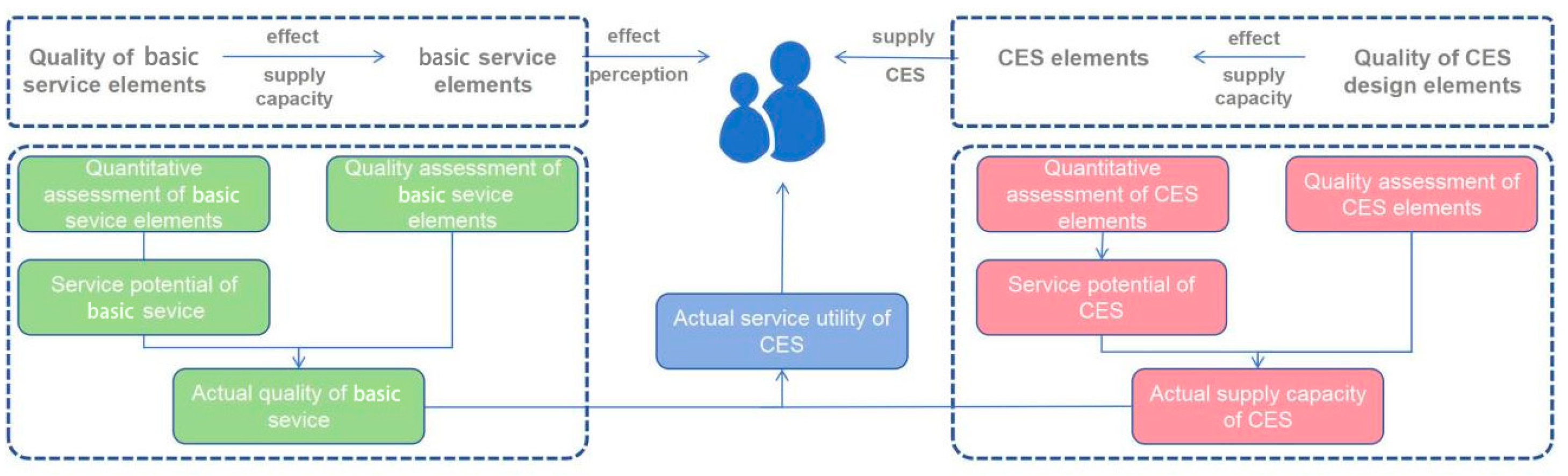
Figure 1. Evaluation framework for actual service utility of CES.
Sustainability 18 00098 g001
Figure 2. The evaluation framework of CES actual service utility.
Sustainability 18 00098 g002
Figure 3. Distribution of sample points in the downtown area of Shenyang.
Sustainability 18 00098 g003
Figure 4. Comparison of the CES supply potential of the four types of parks.
Sustainability 18 00098 g004
Figure 5. Comparison of the CES actual supply capacity of the four types of parks.
Sustainability 18 00098 g005
Figure 6. Comparison of the CES actual service utility of the four types of parks.
Sustainability 18 00098 g006
Figure 7. Area supply (a) and demand (b) for green spaces in different districts of Shenyang.
Sustainability 18 00098 g007
Figure 8. Area supply–demand ratios of green spaces in different districts of Shenyang.
Sustainability 18 00098 g008
Figure 9. Cultural ecosystem service (CES) supply quantity (a) and supply–demand ratio (b) of the seven districts in Shenyang, as evaluated using the assessment framework.
Sustainability 18 00098 g009
Table 1. Quantity assessment score criteria.
Assessment CriteriaScore
The element does not exist.0
The element which exists but does not meet the use quantity or volume.0.6
The element which exists and meets the use quantity or volume, respectively.1
Table 2. CES’s supply potential of the four types of parks.
Types of ParksStatistical TypeSports Fitness RecreationVisual AestheticsCulture and Education Psychological
comprehensive parksAverage0.610.53 0.84 0.31 0.80
SD0.03 0.04 0.04 0.05 0.05
special ParksAverage0.48 0.45 0.74 0.40 0.75
SD0.08 0.04 0.05 0.09 0.02
Community ParkAverages0.46 0.42 0.60 0.31 0.69
SD0.05 0.04 0.05 0.07 0.02
Linear ParkAverages0.42 0.37 0.69 0.21 0.65
SD0.06 0.04 0.06 0.02 0.04
SD: Standard Deviation.
Table 3. CES’s actual supply capacity of the four types of parks.
Types of ParksStatistical TypeSports Fitness RecreationVisual AestheticsCulture and Education Psychological
Comprehensive ParkAverage0.490.410.740.280.68
SD0.030.030.030.060.01
Special ParkAverage0.370.330.640.310.64
SD0.060.020.040.050.03
Community ParkAverages0.360.360.490.240.51
SD0.040.030.070.050.03
Linear ParkAverages0.340.280.550.160.48
SD0.040.030.060.010.03
SD: Standard Deviation.
Table 4. CES’s actual service utility of the four types of parks.
Types of ParksStatistical TypeSports Fitness RecreationVisual AestheticsCulture and Education Psychological
Comprehensive ParkAverage0.38 0.34 0.58 0.22 0.52
SD0.03 0.03 0.05 0.05 0.02
Special ParkAverage0.29 0.24 0.47 0.25 0.46
SD0.05 0.02 0.06 0.05 0.05
Community ParkAverages0.22 0.21 0.30 0.15 0.30
SD0.04 0.03 0.06 0.03 0.04
Linear ParkAverages0.19 0.16 0.30 0.09 0.27
SD0.02 0.02 0.04 0.01 0.02
SD: Standard Deviation.
Table 5. CES’s supply, demand, and supply–demand ratio based on a single indicator.
DDHGHNHPSHTXYH
CES Supply (km2)21.117.711.513.426.88.916.7
CES Demand (km2)11.114.27.212.413.713.512.7
CES Supply–Demand Ratio190%125%160%108%195%66%131%
Table 6. CES supply–demand ratios of all districts of Shenyang under the different steps of the actual service utility evaluation framework.
Municipal DistrictSportRecreationAesthetic Education and CulturePsychological Average Value
Service potential
(quantity)
DD86%92%151%64%134%105%
HP73%64%91%52%88%73%
HG82%62%120%35%118%84%
HN52%50%80%41%77%60%
SH80%70%130%46%135%92%
TX30%30%28%11%48%29%
YH72%49%89%34%99%68%
Actual supply capacity
(quality)
DD73%67%123%50%103%83%
HP57%51%70%36%72%57%
HG68%52%106%32%95%71%
HN38%40%74%35%66%51%
SH65%54%112%40%104%75%
TX20%26%19%6%32%20%
YH57%44%75%30%77%57%
Actual service utility (basic service)DD48%46%79%35%65%55%
HP37%34%48%27%49%39%
HG47%33%70%20%62%47%
HN28%28%52%26%45%36%
SH45%37%73%27%68%50%
TX12%13%12%4%16%11%
YH37%28%47%18%47%35%
Table 7. CES supply capacity for each type of park affected by different steps in the actual service utility evaluation framework.
Park TypePotential AssessmentActual Supply CapacityActual Supply Utility
Sport and FitnessRecreationAestheticEducation and CulturePsychologicalEffect *Sport and FitnessRecreationAestheticEducation and CulturePsychologicalEffect *Sport and FitnessRecreationAestheticEducation and CulturePsychologicalEffect *
Comprehensive park0.610.530.840.310.838%0.490.410.740.280.6816%0.380.340.580.220.5221%
Special class park0.480.450.740.40.7544%0.370.330.640.310.6420%0.290.240.470.250.4626%
Community park0.460.420.60.310.6950%0.360.360.490.240.5121%0.220.210.30.150.340%
Linear park0.420.370.690.210.6553%0.340.280.550.160.4822%0.190.160.30.090.2744%
* Effect: The impact of the new weighting on the results of the upper step assessment.
Table 8. CES supply–demand ratio of each district affected by different steps in the actual service utility evaluation framework.
Municipal DistrictSportRecreationAesthetic Education and CulturePsychological Average Value
Service potential
(quantity)
DD55%51%21%67%30%45%
HP41%49%27%59%30%41%
HG49%61%25%78%27%48%
HN52%53%26%62%29%44%
SH59%64%33%76%31%53%
TX55%54%58%84%28%56%
YH45%63%32%74%25%48%
Actual supply capacity
(quality)
DD15%27%18%21%23%21%
HP23%20%23%30%17%22%
HG17%17%12%9%19%16%
HN27%21%7%13%15%16%
SH19%23%14%14%23%19%
TX32%15%32%46%33%30%
YH21%9%15%10%22%17%
Actual service utility (basic service)DD34%31%36%30%36%34%
HP35%34%32%26%32%32%
HG31%36%34%37%34%34%
HN27%29%30%28%31%30%
SH31%31%35%33%35%33%
TX40%48%37%31%49%44%
YH36%37%37%39%39%38%
Disclaimer/Publisher’s Note: The statements, opinions and data contained in all publications are solely those of the individual author(s) and contributor(s) and not of MDPI and/or the editor(s). MDPI and/or the editor(s) disclaim responsibility for any injury to people or property resulting from any ideas, methods, instructions or products referred to in the content.