Sustainable Business Model Innovation in Social Enterprises: An Institutional Logic Perspective




Abstract
1. Introduction
2. Background
2.1. Institutional Logic of SEs
2.2. Sustainable Business Model Innovation in SEs
2.3. Resource Orchestration in SEs
3. Methodology
3.1. Research Approach
3.2. Case Selection
3.3. Data Collection
- (1)
- Official corporate documents. A systematic content analysis method was employed to obtain ten articles relevant to the research questions from the official website of CY (http://www.canyousoftware.com/index.aspx, accessed on 20 August 2025) and the official website of the Zheng Weining Charity Foundation (http://www.zwncf.org.cn/, accessed on 26 August 2025). The information primarily includes CY’s mission statements, development history, market partnership announcements, and technical collaboration projects.
- (2)
- Academic publications. A thematic search method was adopted. Systematic searches were conducted on platforms such as CNKI, Wanfang, Web of Science, and Google Scholar. These keywords, such as “social enterprise,” “CY,” “business model innovation,” and “institutional logic”, were used. The literature included in the study focused on CY’s sustainable development or institutional logic research, while literature irrelevant to the research theme was excluded. A total of 13 academic papers were included.
- (3)
- Patent information. A keyword search method was used to collect one patent document related to CY. We searched authoritative databases such as the National Intellectual Property Administration (https://www.cnipa.gov.cn/, accessed on 1 September 2025) and the WIPO Patentscope platform (https://patentscope.wipo.int/, accessed on 6 September 2025), and achieved 39 patent records.
- (1)
- Interview transcripts. We obtained five publicly available character interviews and two face-to-face interviews. The founder’s statement mainly originated from character interviews. For example, “Zheng Weining: Every Life Should Bloom” was from CC Forum (https://tv.sohu.com/v/dXMvMjYzMTIxMDE0Lzk2MzExNzg3LnNodG1s.html, accessed on 12 September 2025). Although the questions in these interviews were not designed for this study, they provided rich information relevant to the research topic. During the face-to-face interviews, participants were informed of the research purpose, confidentiality measures, audio recording arrangements, the principle of voluntary participation, and the right to withdraw at any time. All interviewees signed informed consent forms. Each interview lasted 60–90 min. It was audio-recorded with permission, transcribed verbatim, and verified by the interviewees. In authorized interview records, all personal identifiers were anonymized.
- (2)
- News reports. A total of 18 newspaper articles were collected. They were verified by cross-referencing publication dates, media credibility, and consistency with other data sources. For example, the article “Focus on CY: From a Small Workshop to the World’s Largest High-Tech Social Enterprise Cluster” was published by Phoenix Net on 12 March 2018 (https://news.ifeng.com/c/7fZqxBohPdF, accessed on 20 September 2025).
- (3)
- Corporate introduction videos. Seven videos were downloaded from platforms such as Mango TV, CCTV.com, and Sohu Video (see Table S1). They were transcribed, organized, and coded. Examples include “Five Disabled Individuals Founded a Tech Company, Now Providing High-End Employment for Over 5000 Disabled Individuals” (https://www.mgtv.com/b/407406/17833819.html?cxid=p9cw5wcr3, accessed on 30 September 2025). All videos originated from verifiable public channels, with transparent release dates and source accounts.
3.4. Data Analysis
4. Findings
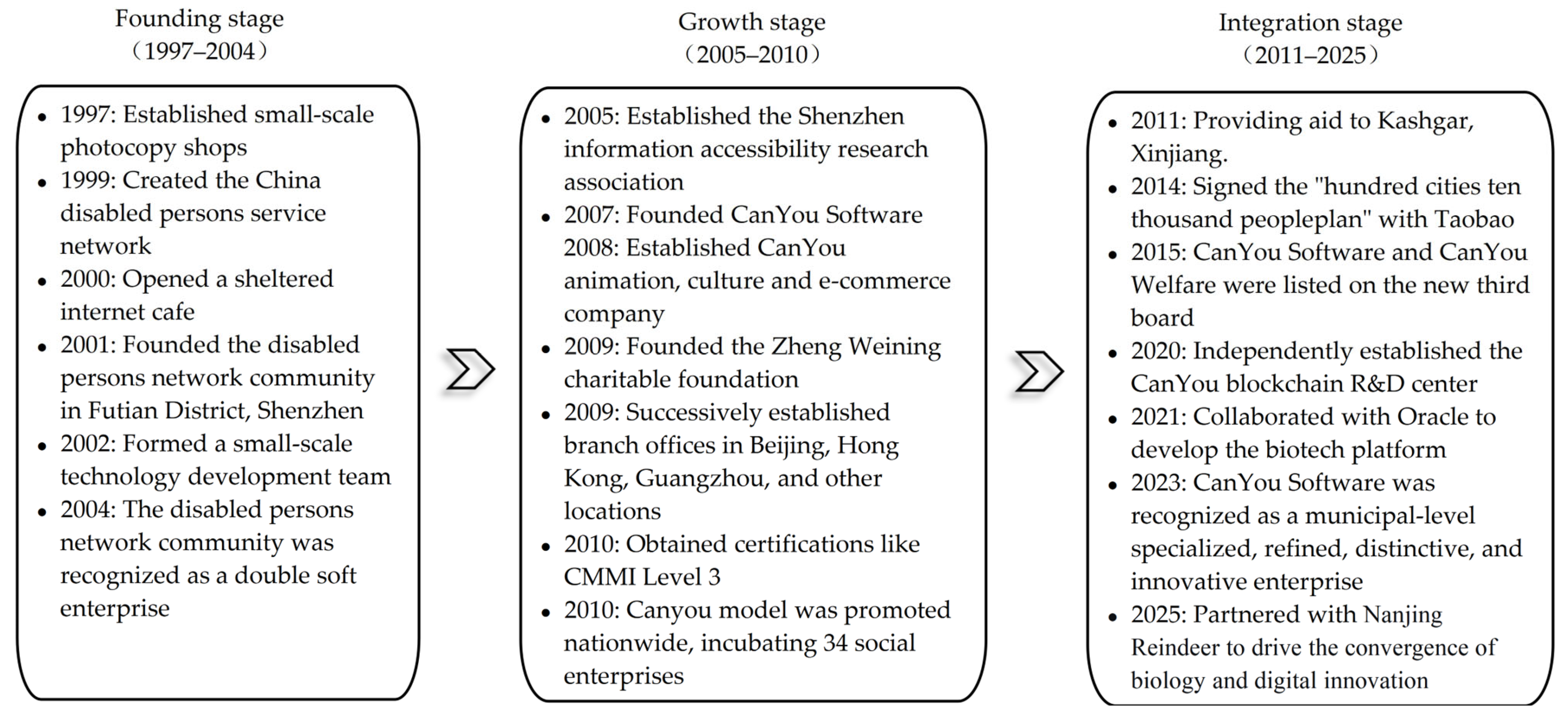
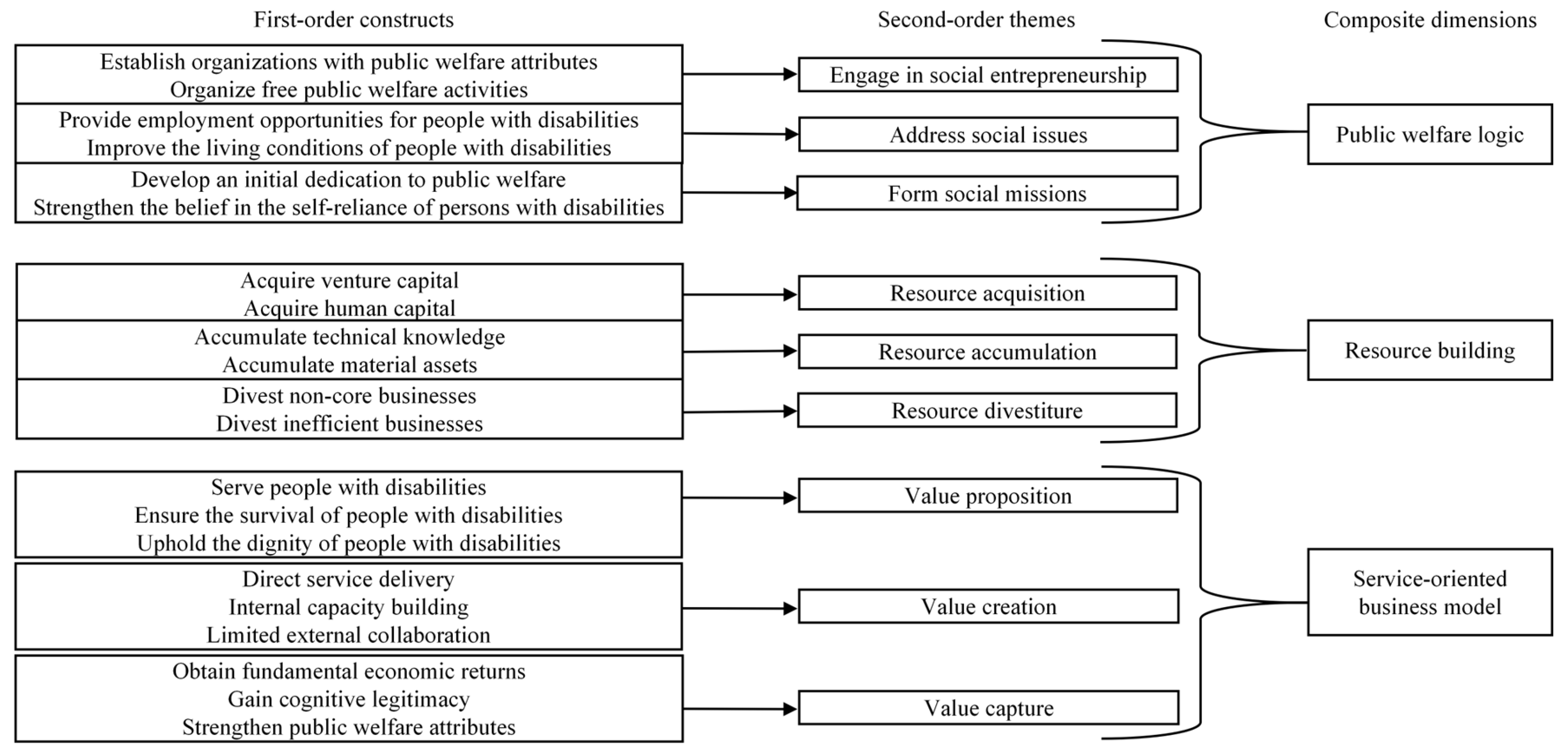
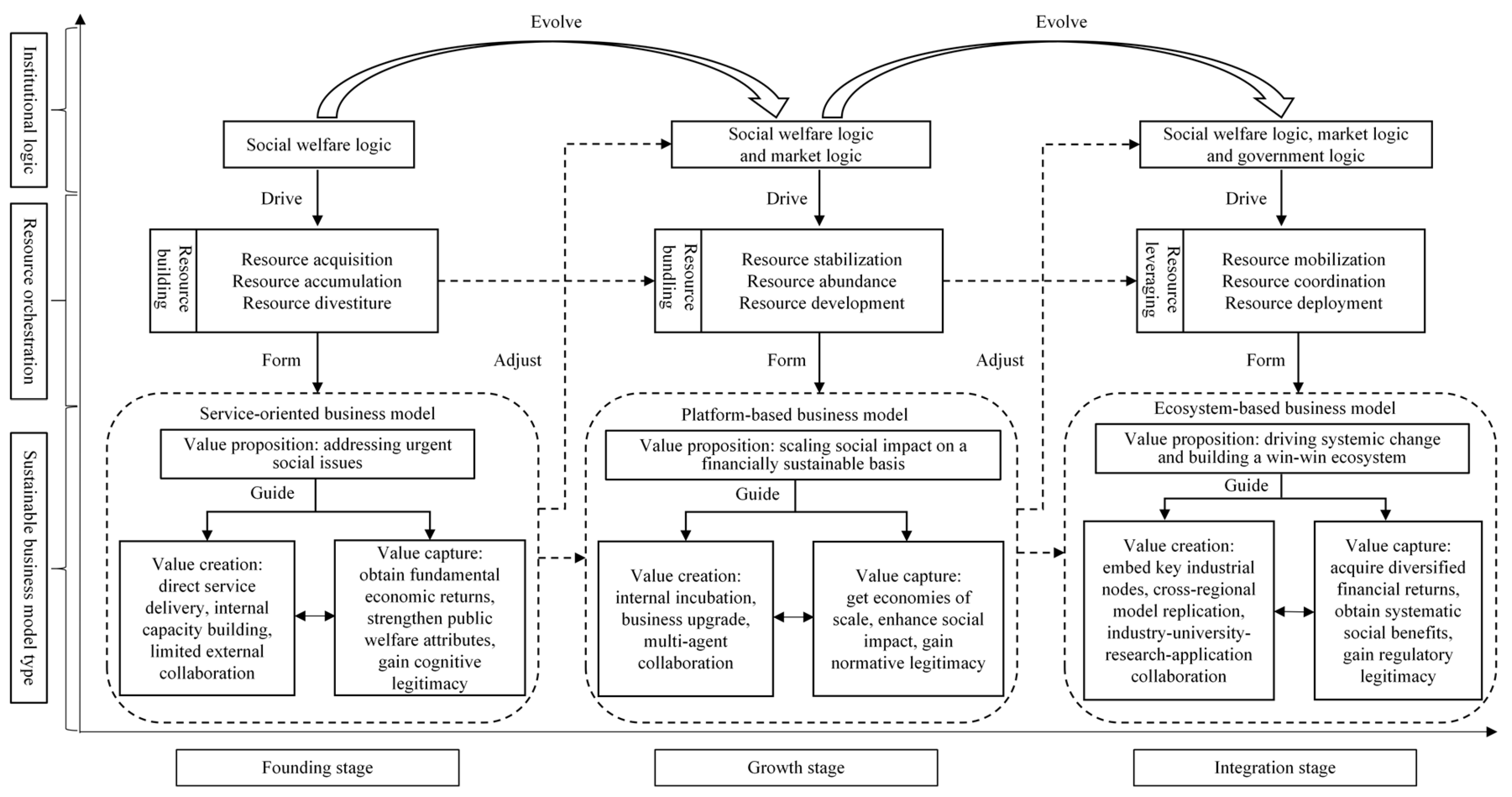
4.1. Founding Stage: Service-Oriented Business Model Driven by Public Welfare Logic
4.1.1. Single Institutional Logic: Public Welfare Logic
“Leveraging the power of the internet, we can break free from the fate of relying on families, society, or the state for support. By creating employment opportunities for people with disabilities, we enable them to participate in social labor, exchange value, and live with dignity.”(founder of CY, character interview)
4.1.2. Resource Orchestration Strategy: Resource Building
“In 1997, I had a computer and envisioned starting a computer interest group. I contacted the Shenzhen Volunteer Association and recruited four active individuals with disabilities from their network.”(founder of CY, character interview)
“I heard through the grapevine about a disabled person named Liu Yong who used to work at a typing agency, typing 200 characters per minute. Seeing his proficiency, I thought he had potential.”(founder of CY, character interview)
“In the early days, our employees had relatively low educational backgrounds. With no qualified mentors available, we studied relentlessly day and night, poring over books on internet technology. Once one person mastered a skill, they would share it continuously until every employee was trained.”(senior management A of CY, character interview)
4.1.3. Sustainable Business Model Type: Service-Oriented Business Model
“The Chinese name “Canyou” means “friends of persons with disabilities,” while its English connotation is “you can.” Thus, CY’s mission is to solve employment challenges for persons with disabilities, enabling each to live with dignity and joy.”(official corporate document, CY official website)
“Thanks to its comprehensive, timely, and service-oriented content delivered in an engaging format, the China Disabled Persons Service Network operated smoothly. Within its first year, it set the record for the highest click-through rate among global disability welfare websites.”(news report, Shenzhen Economic Daily)
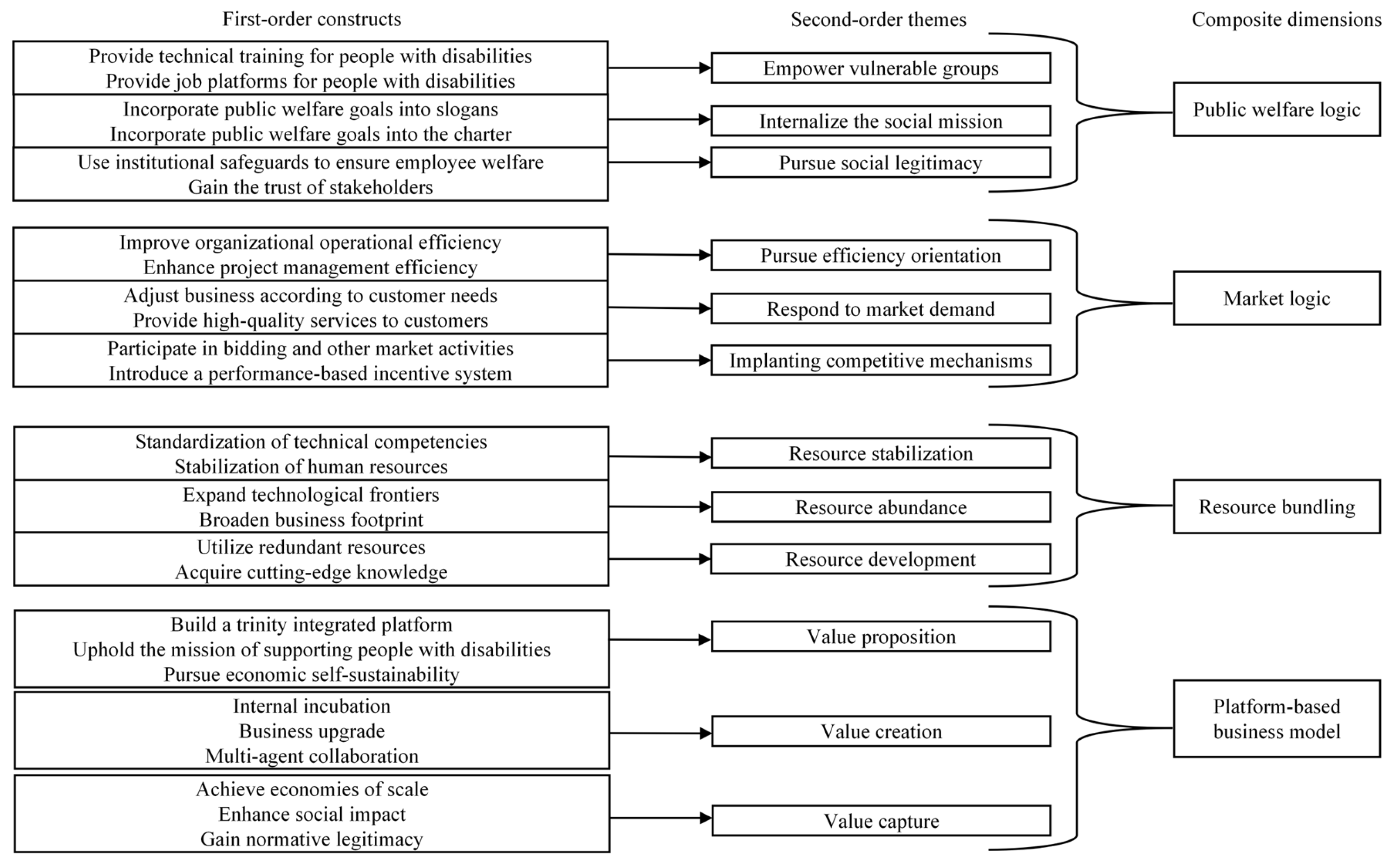
4.2. Growth Stage: Platform-Based Business Model Driven by Dual Institutional Logics
4.2.1. Dual Institutional Logics: Public Welfare Logic and Market Logic
“After founding the Zheng Weining Charitable Foundation in 2009, CY launched a SE incubation program to address social issues through commercial means. By developing competitive products and services, we achieve sustainable operations, create social value, and advance societal progress.”(news report, China Philanthropy Times)
4.2.2. Resource Orchestration Strategy: Resource Bundling
“Through computer networks, people with disabilities can overcome their physical limitations. They dedicate more time and energy to software development than non-disabled counterparts. This enables them to provide high-quality outsourcing services to companies like IBM, Huawei, Intel, and Microsoft.”(news report, China Quality News Network)
“After obtaining certifications like CMMI Level 3, Canyou Software Co., Ltd. (Shenzhen, China) secured aerospace engineering software projects from national ministries.”(founder of CY, character interview)
“Shenzhen Zheng Weining Charity Foundation’s High-Tech Training and Employment Program for Disabled Youth also gained significant support from social organizations.”(news report, Phoenix News)
“CY’s animation designers frequently visited our company website, demonstrating remarkable learning enthusiasm and passion. Therefore, I invited them to Shanghai for complimentary advanced training. Within less than six months, they completed all courses and then taught their peers.”(former global vice president of Autodesk, character interview)
4.2.3. Sustainable Business Model Type: Platform-Based Business Model
“Currently, CY has established a comprehensive platform encompassing a charitable foundation, a cluster of social organizations, and a cluster of SEs. This not only creates employment opportunities for thousands of people with disabilities but also consistently delivers high-quality products and services to clients.”(official corporate document, CY official website)
“Supported by the Shenzhen Volunteer Association, the fleet employs volunteer drivers who provide compassionate transportation services to individuals with disabilities through hotline reservations. With technical upgrades from partner companies, all five minivans are equipped with lift platforms for wheelchair accessibility.”(ordinary employee of CY, face-to-face interview)
“Unlike typical companies, CY reinvests all earnings into hiring more employees with disabilities—we retain no profits.”(founder of CY, character interview)
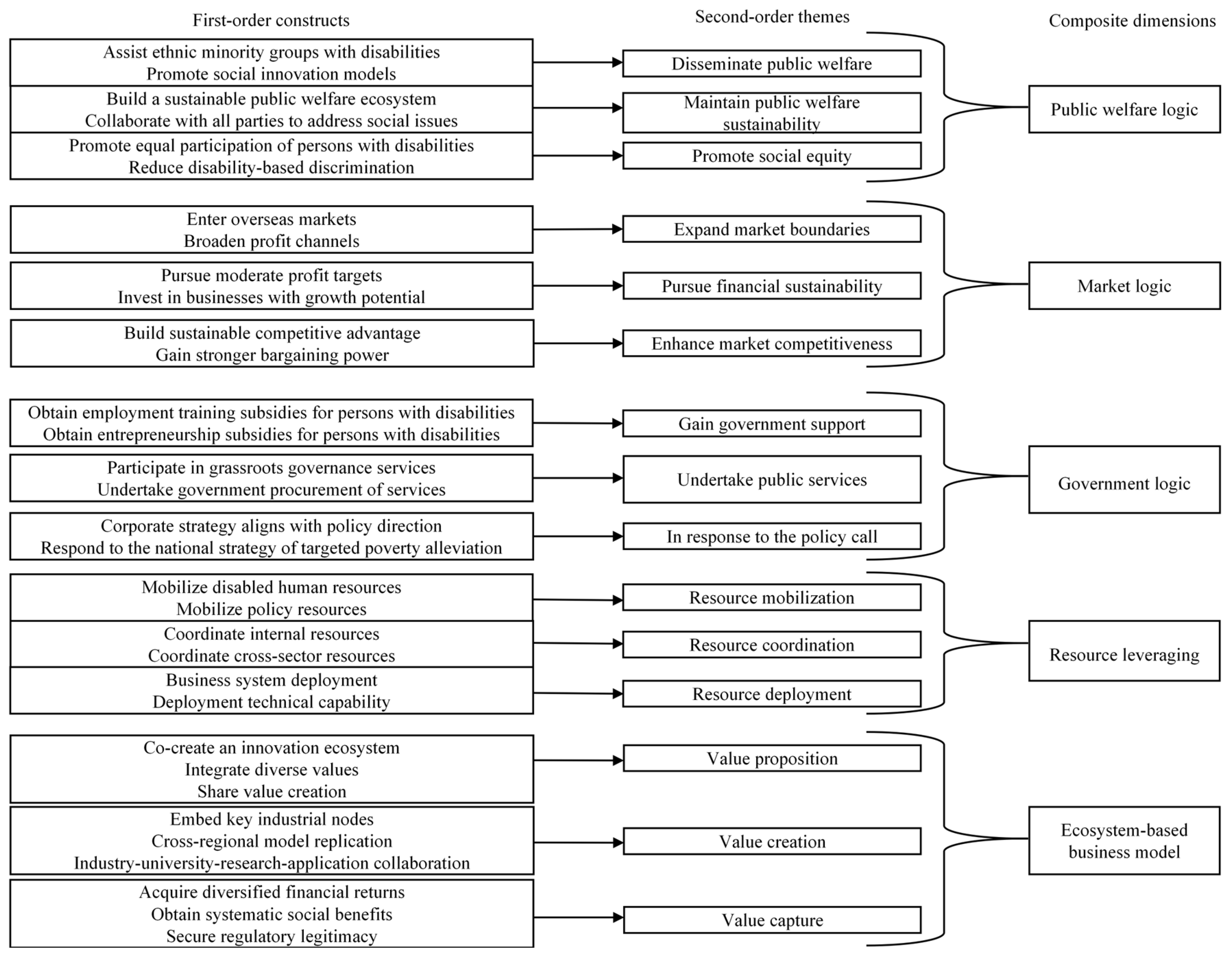
4.3. Integration Stage: Ecosystem-Based Business Models Guided by Multiple Institutional Logics
4.3.1. Multiple Institutional Logics: Public Welfare, Market, and Government Logics
“CY will fulfill its mission of “promoting equal participation and inclusive sharing for people with disabilities.” It will integrate resources for persons with disabilities to undertake global high-tech outsourcing projects and replicate its sustainable social innovation model nationwide.”(official corporate document, CY official website)
“Over the past decade, Shenzhen has successively introduced multiple policies related to disability affairs, prioritizing CY in support measures and project funding. “(news report, China Quality News Network)
“To give back to society, we responded to the municipal Party committee and government’s call by dispatching key employees to Xinjiang to establish Kashgar Canyou.”(senior management A of CY, character interview)
4.3.2. Resource Orchestration Strategy: Resource Leveraging
“Boya Xinxing will once again invest to collaborate with Canyou Software in building an information platform, driving management model upgrades, enhancing efficiency, reducing costs, and taking substantial steps toward intelligent and automated operations.”(official corporate document, CY official website)
“In January 2024, Canyou Bio, as a collaborating institution, secured approval for the major project “Prospective Intervention Study for the Prevention and Treatment of Diabetic Macrovascular Complications” under the National Key R&D Program/Science and Technology Innovation 2030, jointly proposed with West China Hospital of Sichuan University.”(official corporate document, CY official website)
“By deeply integrating IoT, digital twins, blockchain, and biotechnology, we have developed the proprietary ‘Digital Twin Operations Platform for Cellular Drug Factories’.”(senior management B of CY, face-to-face interview)
4.3.3. Sustainable Business Model Type: Ecosystem-Based Business Model
“CY believe people with disabilities and non-disabled individuals are equal and can achieve independent economic status and income through employment. Moving forward, CanYou Software will embrace the new wave of digital development, focusing on green technological innovation and customer-value services. We will collaborate with all parties to jointly build an ecosystem chain for innovative and integrated development.”(official corporate document, CY official website)
“Having preliminarily realized the vision of high-tech employment for persons with disabilities, CY will advance boldly by engaging in deep technological collaborations with top domestic research institutions. This will better address the multifaceted demands of diversifying charitable initiatives and maximizing social benefits, enabling high technology, philanthropy and environmental sustainability to coexist and thrive.”(official corporate document, ZHENG WEINING CHARITY FOUNDATION official website)
“After over two decades of dedicated effort, CY has successfully established and developed a world-class high-tech employment platform for persons with disabilities. In the future, while advancing the cause of disability assistance, we are committed to integrating green development principles throughout the entire industry chain, contributing to environmental sustainability.”(official corporate document, Zheng Weining Charity Foundation official website)
5. Discussion
5.1. Institutional Logics Evolution in SEs
5.2. Resource Orchestration Strategies in SEs
5.3. Sustainable Business Model Innovation Pathways in SEs
6. Conclusions
6.1. Theoretical Implications
6.2. Practical Implications
6.3. Research Limitations and Future Directions
Supplementary Materials
Author Contributions
Funding
Institutional Review Board Statement
Informed Consent Statement
Data Availability Statement
Conflicts of Interest
References
- Klarin, A.; Suseno, Y. An Integrative Literature Review of Social Entrepreneurship Research: Mapping the Literature and Future Research Directions. Bus. Soc. 2023, 62, 565–611. [Google Scholar] [CrossRef]
- Calò, F.; Sancino, A.; Scognamiglio, F. Social enterprise and social entrepreneurship in the Public Administration (PA) scholar field: A bibliometric analysis and some conceptual considerations. Public Manag. Rev. 2024, 26, 3013–3039. [Google Scholar] [CrossRef]
- Pache, A.C.; Santos, F. Inside the Hybrid Organization: Selective Coupling as a Response to Competing Institutional Logics. Acad. Manag. J. 2013, 56, 972–1001. [Google Scholar] [CrossRef]
- Weerawardena, J.; Mort, G.S.; Salunke, S.; Knight, G.; Liesch, P.W. Editorial and Research Agenda: JBR Special Issue on Business Model Innovation in Social Purpose Organizations. J. Bus. Res. 2021, 125, 592–596. [Google Scholar] [CrossRef]
- Bacq, S.; Janssen, F. The Multiple Faces of Social Entrepreneurship: A Review of Definitional Issues Based on Geographical and Thematic Criteria. Entrep. Reg. Dev. 2011, 23, 373–403. [Google Scholar] [CrossRef]
- Canestrino, R.; Ćwiklicki, M.; Magliocca, P.; Pawełek, B. Understanding Social Entrepreneurship: A Cultural Perspective in Business Research. J. Bus. Res. 2020, 110, 132–143. [Google Scholar] [CrossRef]
- Doherty, B.; Haugh, H.; Lyon, F. Social Enterprises as Hybrid Organizations: A Review and Research Agenda. Int. J. Manag. Rev. 2014, 16, 417–436. [Google Scholar] [CrossRef]
- Battilana, J.; Lee, M. Advancing Research on Hybrid Organizing—Insights from the Study of Social Enterprises. Acad. Manag. Ann. 2014, 8, 397–441. [Google Scholar] [CrossRef]
- Ocasio, W.; Radoynovska, N. Strategy and Commitments to Institutional Logics: Organizational Heterogeneity in Business Models and Governance. Strateg. Organ. 2016, 14, 287–309. [Google Scholar] [CrossRef]
- Reay, T.; Hinings, C.R. Managing the Rivalry of Competing Institutional Logics. Organ. Stud. 2009, 30, 629–652. [Google Scholar] [CrossRef]
- Battilana, J.; Sengul, M.; Pache, A.C.; Model, J. Harnessing Productive Tensions in Hybrid Organizations: The Case of Work Integration Social Enterprises. Acad. Manag. J. 2015, 58, 1658–1685. [Google Scholar] [CrossRef]
- Xu, Y.; Zhu, C. The Strategic Evolution of Institutional Logics Across Social Entrepreneurial Process: A Multiple Case Study. Entrep. Res. J. 2025, 15, 429–457. [Google Scholar] [CrossRef]
- Fu, J.S.; Zhang, Y.; Li, X.; Wang, Q. Institutional Complexity and Social Innovation: The Case of Chinese Social Enterprises. J. Bus. Ethics 2025, 182, 1–20. [Google Scholar] [CrossRef]
- Ferry, L.; Wegorowski, P.; Andrews, R. Hybridity, Institutional Logics and Value Creation Mechanisms in the Corporatisation of Social Care. Br. Account. Rev. 2024, 56, 101244. [Google Scholar] [CrossRef]
- Jakob, E.A.; Sundermeier, J. A Taxonomy of Hybrid Value Logics—How Social Enterprises Combine Institutional Logics Differently. Bus. Soc. 2025, 0, 1–40. [Google Scholar] [CrossRef]
- Son, H.; Lee, J.; Chung, Y. Value Creation Mechanism of Social Enterprises in Manufacturing Industry: Empirical Evidence from Korea. Sustainability 2018, 10, 46. [Google Scholar] [CrossRef]
- Treptow, I.C.; Kneipp, J.M.; Gomes, C.M.; Kruglianskas, I.; Favarin, R.R.; Fernandez-Jardón, C.M. Business Model Innovation for Sustainable Value Creation in Construction Companies. Sustainability 2022, 14, 10101. [Google Scholar] [CrossRef]
- Choi, S.B.; Lee, S.M.; Lee, H.; Lee, S.Y. Entrepreneurial Orientation, Resource Orchestration Capability, and Environmental Dynamics: Enhancing Firm Performance. Sustainability 2020, 12, 5415. [Google Scholar] [CrossRef]
- Davies, I.A.; Doherty, B. Balancing a Hybrid Business Model: The Search for Equilibrium at Cafédirect. J. Bus. Ethics 2019, 157, 1043–1066. [Google Scholar] [CrossRef]
- Mosca, L.; Gianecchini, M.; Campagnolo, D. Organizational Life Cycle Models: A Design Perspective. J. Org. Des. 2021, 10, 3–18. [Google Scholar] [CrossRef]
- Bretos, I.; Bouchard, M.J.; Zevi, A. Institutional and Organizational Trajectories in Social Economy Enterprises: Resilience, Transformation and Regeneration. Ann. Public Coop. Econ. 2020, 91, 351–358. [Google Scholar] [CrossRef]
- Chen, X.; He, Y.; Wang, L.; Xiong, J.; Jiang, R.J. The Legitimization Process of Social Enterprises across Developmental Stages: Two Case Studies. J. Bus. Res. 2022, 148, 203–215. [Google Scholar] [CrossRef]
- Bacq, S.; Eddleston, K.A. A Resource-Based View of Social Entrepreneurship: How Stewardship Culture Benefits Scale of Social Impact. J. Bus. Ethics 2018, 152, 589–611. [Google Scholar] [CrossRef]
- De Silva, M.; Al-Tabbaa, O.; Khan, Z. Business Model Innovation by International Social Purpose Organizations: The Role of Dynamic Capabilities. J. Bus. Res. 2021, 125, 733–749. [Google Scholar] [CrossRef]
- Yu, X. Social Enterprise in China: Driving Forces, Development Patterns and Legal Framework. Soc. Enterp. J. 2011, 7, 9–32. [Google Scholar] [CrossRef]
- Thornton, P.H. The Rise of the Corporation in a Craft Industry: Conflict and Conformity in Institutional Logics. Acad. Manag. J. 2002, 45, 81–101. [Google Scholar] [CrossRef]
- Thornton, P.H.; Ocasio, W. Institutional Logics. In The Sage Handbook of Organizational Institutionalism; Greenwood, R., Oliver, C., Sahlin, K., Suddaby, R., Eds.; Sage Publications: London, UK, 2008; Volume 3, pp. 99–128. [Google Scholar]
- Besharov, M.L.; Smith, W.K. Multiple Institutional Logics in Organizations: Explaining Their Varied Nature and Implications. Acad. Manag. Rev. 2014, 39, 364–381. [Google Scholar] [CrossRef]
- Pache, A.C.; Santos, F.M. When Worlds Keep on Colliding: Exploring the Consequences of Organizational Responses to Conflicting Institutional Demands. Acad. Manag. Rev. 2021, 46, 640–659. [Google Scholar] [CrossRef]
- Battilana, J.; Dorado, S. Building Sustainable Hybrid Organizations: The Case of Commercial Microfinance Organizations. Acad. Manag. J. 2010, 53, 1419–1440. [Google Scholar] [CrossRef]
- Agarwal, N.; Chakrabarti, R.; Prabhu, J.C.; Saranga, H. Managing Dilemmas of Resource Mobilization through Jugaad: A Multi-Method Study of Social Enterprises in Indian Healthcare. Strat. Entrepr. J. 2020, 14, 419–443. [Google Scholar] [CrossRef]
- Xing, Y.; Liu, Y.; Lattemann, C. Institutional Logics and Social Enterprises: Entry Mode Choices of Foreign Hospitals in China. J. World Bus. 2020, 55, 100974. [Google Scholar] [CrossRef]
- Parthiban, R.; Qureshi, I.; Bandyopadhyay, S.; Bhatt, B.; Jaikumar, S. Leveraging ICT to Overcome Complementary Institutional Voids: Insights from Institutional Work by a Social Enterprise to Help Marginalized. Inf. Syst. Front. 2020, 22, 633–653. [Google Scholar] [CrossRef]
- Liu, Y.; Zhang, C.; Jing, R. Coping with Multiple Institutional Logics: Temporal Process of Institutional Work during the Emergence of the One Foundation in China. Manag. Organ. Rev. 2016, 12, 387–416. [Google Scholar] [CrossRef]
- Smith, W.K.; Gonin, M.; Besharov, M.L. Managing Social-Business Tensions: A Review and Research Agenda for Social Enterprise. Bus. Ethics Q. 2013, 23, 407–442. [Google Scholar] [CrossRef]
- Geissdoerfer, M.; Vladimirova, D.; Evans, S. Sustainable Business Model Innovation: A Review. J. Clean. Prod. 2018, 198, 401–416. [Google Scholar] [CrossRef]
- Bocken, N.M.P.; Schuit, C.S.C.; Kraaijenhagen, C. Experimenting with a Circular Business Model: Lessons from Eight Cases. Environ. Innov. Soc. Transit. 2019, 28, 79–95. [Google Scholar] [CrossRef]
- Foss, N.J.; Saebi, T. Business Models and Business Model Innovation: Between Wicked and Paradigmatic Problems. Long Range Plan. 2018, 51, 9–21. [Google Scholar] [CrossRef]
- Lüdeke-Freund, F.; Carroux, S.; Joyce, A.; Massa, L.; Breuer, H. The Sustainable Business Model Pattern Taxonomy—45 Patterns to Support Sustainability-Oriented Business Model Innovation. Sustain. Prod. Consum. 2018, 15, 145–162. [Google Scholar] [CrossRef]
- Bocken, N.M.P.; Geradts, T.H.J. Barriers and Drivers to Sustainable Business Model Innovation: Organization Design and Dynamic Capabilities. Long Range Plan. 2020, 53, 101950. [Google Scholar] [CrossRef]
- Armstrong, R.M.; Grobbelaar, S.S.S. Sustainable business models for social enterprises in developing countries: A conceptual framework. Manag. Rev. Q. 2023, 73, 787–840. [Google Scholar] [CrossRef]
- Täuscher, K.; Laudien, S.M. Understanding platform business models: A mixed methods study of marketplaces. Eur. Manag. J. 2018, 36, 319–329. [Google Scholar] [CrossRef]
- Sun, F.; Li, J.; Bai, F.P. Mechanism of digital business model innovation for common prosperity: Based on resource orchestration perspective. Chin. Manag. Stud. 2025, 19, 734–757. [Google Scholar] [CrossRef]
- Pellikka, J.; Lähdesmäki, B. Designing sustainable ecosystem business models in the regional context. J. Innov. Manag. 2024, 12, 197–218. [Google Scholar] [CrossRef]
- Drencheva, A.; Au, W.C. Bringing the family logic in: From duality to plurality in social enterprises. J. Bus. Ethics 2023, 182, 77–93. [Google Scholar] [CrossRef]
- Komatsu Cipriani, T.; Deserti, A.; Kleverbeck, M.; Rizzo, F.; Terstriep, J. Business models & social innovation: Mission-driven versus profit-driven organisations. Int. Rev. Appl. Econ. 2020, 34, 541–566. [Google Scholar] [CrossRef]
- Santos, F.; Pache, A.C.; Birkholz, C. Making hybrids work: Aligning business models and organizational design for SEs. Calif. Manag. Rev. 2015, 57, 36–58. [Google Scholar] [CrossRef]
- McMullen, J.S.; Warnick, B.J. Should we require every new venture to be a hybrid organization? J. Manag. Stud. 2016, 53, 630–662. [Google Scholar] [CrossRef]
- Roundy, P.T.; Brockman, B.K.; Bradshaw, M. The resilience of entrepreneurial ecosystems. J. Bus. Ventur. Insights 2018, 8, 99–104. [Google Scholar] [CrossRef]
- Sirmon, D.G.; Hitt, M.A.; Ireland, R.D. Resource orchestration to create competitive advantage: Breadth, depth, and life cycle effects. J. Manag. 2011, 37, 1390–1412. [Google Scholar] [CrossRef]
- Di Domenico, M.; Haugh, H.; Tracey, P. Social bricolage: Theorizing social value creation in social enterprises. Entrepren. Theory Pract. 2010, 34, 681–703. [Google Scholar] [CrossRef]
- Teece, D.J. Business models and dynamic capabilities. Long Range Plan. 2018, 51, 40–49. [Google Scholar] [CrossRef]
- Khan, K.U.; Atlas, F.; Ghani, U.; Akhtar, S.; Khan, F. Impact of intangible resources (dominant logic) on SMEs innovation performance, the mediating role of dynamic managerial capabilities: Evidence from China. Eur. J. Innov. Manag. 2021, 24, 1679–1699. [Google Scholar] [CrossRef]
- Vurro, C.; Dacin, M.T.; Perrini, F. Institutional antecedents of partnering for social change: How institutional logics shape cross-sector social partnerships. J. Bus. Ethics 2010, 94, 39–53. [Google Scholar] [CrossRef]
- Helfat, C.E.; Martin, J.A. Dynamic managerial capabilities: Review and assessment of managerial impact on strategic change. J. Manag. 2015, 41, 1281–1312. [Google Scholar] [CrossRef]
- Carnes, C.M.; Chirico, F.; Hitt, M.A.; Huh, D.W.; Pisano, V. Resource orchestration for innovation: Structuring and bundling resources in growth- and maturity-stage firms. Long Range Plan. 2017, 50, 472–486. [Google Scholar] [CrossRef]
- Sirmon, D.G.; Hitt, M.A.; Ireland, R.D. Managing firm resources in dynamic environments to create value: Looking inside the black box. Acad. Manag. Rev. 2007, 32, 273–292. [Google Scholar] [CrossRef]
- Kor, Y.Y.; Mesko, A. Dynamic managerial capabilities: Configuration and orchestration of top executives’ capabilities and the firm’s dominant logic. Strat. Manag. J. 2013, 34, 233–244. [Google Scholar] [CrossRef]
- Bohn, H.J., Jr.; Roelfs, D.J. How hybrid institutional logics matter: The importance of trust and embeddedness in neighborhood revitalization collaborations. J. Appl. Soc. Sci. 2020, 14, 145–161. [Google Scholar] [CrossRef]
- Dufays, F.; Huybrechts, B. Where do hybrids come from? Entrepreneurial team heterogeneity as an avenue for the emergence of hybrid organizations. Int. Small Bus. J. 2016, 34, 777–796. [Google Scholar] [CrossRef]
- Lumpkin, G.T.; Moss, T.W.; Gras, D.M.; Kato, S.; Amezcua, A.S. Entrepreneurial processes in social contexts: How are they different, if at all? Small Bus. Econ. 2013, 40, 761–783. [Google Scholar] [CrossRef]
- Eisenhardt, K.M.; Graebner, M.E. Theory building from cases: Opportunities and challenges. Acad. Manag. J. 2007, 50, 25–32. [Google Scholar] [CrossRef]
- Råbu, M.; Binder, P.E. The single case study is a crucial bridge between research and practice. J. Contemp. Psychot. 2025, 55, 119–126. [Google Scholar] [CrossRef]
- Kozlowski, S.W.; Chao, G.T.; Grand, J.A.; Braun, M.T.; Kuljanin, G. Advancing multilevel research design: Capturing the dynamics of emergence. Organ. Res. Methods 2013, 16, 581–615. [Google Scholar] [CrossRef]
- Geels, F.W. Technological transitions as evolutionary reconfiguration processes: A multi-level perspective and a case-study. Res. Policy 2002, 31, 1257–1274. [Google Scholar] [CrossRef]
- Rabinovich, E.; Cheon, S. Expanding Horizons and Deepening Understanding via the Use of Secondary Data Sources. J. Bus. Logist. 2011, 32, 303–316. [Google Scholar] [CrossRef]
- Yin, R.K. Case Study Research and Applications: Design and Methods, 6th ed.; Sage Publications: London, UK, 2018; pp. 68–92. [Google Scholar]
- Gioia, D.A.; Corley, K.G.; Hamilton, A.L. Seeking Qualitative Rigor in Inductive Research: Notes on the Gioia Methodology. Organ. Res. Methods 2013, 16, 15–31. [Google Scholar] [CrossRef]
- Laasch, O. Beyond the Purely Commercial Business Model: Organizational Value Logics and the Heterogeneity of Sustainability Business Models. Long Range Plan. 2018, 51, 158–183. [Google Scholar] [CrossRef]
- Spanuth, A.; Urbano, D. Exploring Social Enterprise Legitimacy Within Ecosystems From an Institutional Approach: A Systematic Literature Review and Research Agenda. Int. J. Manag. Rev. 2024, 26, 211–231. [Google Scholar] [CrossRef]
- Greenwood, R.; Raynard, M.; Kodeih, F.; Micelotta, E.R.; Lounsbury, M. Institutional Complexity and Organizational Responses. Acad. Manag. Ann. 2011, 5, 317–371. [Google Scholar] [CrossRef]
- Marques, C.; Carvalho, H. How Do Social Enterprises Respond Operationally to Conflicting Demands? A Resource-Based View. J. Small Bus. Enterp. Dev. 2024, 31, 542–560. [Google Scholar] [CrossRef]
- Busch, C.; Barkema, H. Align or Perish: Social Enterprise Network Orchestration in Sub-Saharan Africa. J. Bus. Ventur. 2022, 37, 106187. [Google Scholar] [CrossRef]
- Bocken, N.M.P.; de Pauw, I.; Bakker, C.; van der Grinten, B. Leveraging Social and Intellectual Capital for Social Entrepreneurship: A Model for Sustainable Business Practices in an Uncertain Environment. Sustainability 2025, 18, 46. [Google Scholar] [CrossRef]
- Gawer, A. Bridging Differing Perspectives on Technological Platforms: Toward an Integrative Framework. Res. Policy 2014, 43, 1239–1249. [Google Scholar] [CrossRef]
- Gümüsay, A.A.; Smets, M.; Morris, T. “God at Work”: Engaging Central and Incompatible Institutional Logics Through Elastic Hybridity. Acad. Manag. J. 2020, 63, 124–154. [Google Scholar] [CrossRef]
- Persaud, A.W.; Nelson, H.W.; Satterfield, T. Reconciling Institutional Logics Within First Nations Forestry-Based SEs. Organ. Environ. 2022, 35, 394–413. [Google Scholar] [CrossRef]
- Yi, L.-H.; Weng, J.; Hsieh, Y.-C.A.; Tsai, W.-J. Exploring Diversity of Hybrid Business Models: Institutional Logic Perspective on Social Enterprises. Acad. Manag. Proc. 2022, 2022, 15511. [Google Scholar] [CrossRef]



| Data Type | Specific Data | Data Acquisition Method | Data Volume |
|---|---|---|---|
| Literature materials | Official corporate documents | CY official website, website of Zheng Weining Charity Foundation | 10 introductory articles |
| Academic publications | CNKI, Wanfang, WOS, and other literature retrieval platforms | 13 academic papers | |
| Patent information | Domestic and international patent database service platforms | 1 patent document | |
| Archival records | Interview transcripts | Character interviews and Face-to-Face interviewing | 7 transcribed texts |
| News reports | Xinhua Net, Guangzhou Daily, Phoenix Net, and other media outlets | 18 news articles | |
| Promotional videos | Mango TV, CCTV.com, Sohu Video, and other platforms | 7 video recordings |
Disclaimer/Publisher’s Note: The statements, opinions and data contained in all publications are solely those of the individual author(s) and contributor(s) and not of MDPI and/or the editor(s). MDPI and/or the editor(s) disclaim responsibility for any injury to people or property resulting from any ideas, methods, instructions or products referred to in the content. |
© 2025 by the authors. Licensee MDPI, Basel, Switzerland. This article is an open access article distributed under the terms and conditions of the Creative Commons Attribution (CC BY) license.
Share and Cite
Duan, H.; Wei, Y.; Wang, Z.; Huang, J. Sustainable Business Model Innovation in Social Enterprises: An Institutional Logic Perspective. Sustainability 2026, 18, 97. https://doi.org/10.3390/su18010097
Duan H, Wei Y, Wang Z, Huang J. Sustainable Business Model Innovation in Social Enterprises: An Institutional Logic Perspective. Sustainability. 2026; 18(1):97. https://doi.org/10.3390/su18010097
Chicago/Turabian StyleDuan, Haixia, Yuxuan Wei, Zhaochen Wang, and Jie Huang. 2026. "Sustainable Business Model Innovation in Social Enterprises: An Institutional Logic Perspective" Sustainability 18, no. 1: 97. https://doi.org/10.3390/su18010097
APA StyleDuan, H., Wei, Y., Wang, Z., & Huang, J. (2026). Sustainable Business Model Innovation in Social Enterprises: An Institutional Logic Perspective. Sustainability, 18(1), 97. https://doi.org/10.3390/su18010097