Article

Financial Structure, Technological Innovation, and Environmental Pressure in the European Union: Evidence from a PMG Panel ARDL Model


1
Department of Finance and Banking, Faculty of Applied Sciences, Akdeniz University, Antalya 07600, Turkey
2
Department of Accounting and Taxation, Nevşehir Vocational School, Nevşehir Hacı Bektaş Veli University, Nevşehir 50300, Turkey
3
Department of Finance, Banking, and Insurance, Vocational School of Social Sciences, Akdeniz University, Antalya 07600, Turkey
*
Author to whom correspondence should be addressed.
Sustainability 2026, 18(1), 551; https://doi.org/10.3390/su18010551
Submission received: 23 November 2025 / Revised: 21 December 2025 / Accepted: 28 December 2025 / Published: 5 January 2026
(This article belongs to the Special Issue Energy and Environment: Policy, Economics and Modeling)

Abstract

This study examines the association between financial structure components—financial access, depth, and efficiency—technological innovation, and environmental pressure in the European Union over the period 1992–2021, with the EU energy transition serving as the broader policy context. To capture the multidimensional nature of environmental pressure, a composite Environmental Pressure Index (EPI) is constructed using Principal Component Analysis (PCA), integrating indicators of air pollution, biocapacity, ecological footprint, and income-related economic activity. Employing a Pooled Mean Group (PMG) estimator within a panel ARDL framework, the results indicate that financial access is positively associated with environmental pressure in both the short and long run, whereas financial depth and financial efficiency are linked to lower environmental pressure over the long term. Technological innovation exhibits a time-varying relationship: innovation-related activities are associated with higher environmental pressure in the short run, reflecting transitional adjustment costs, but with reduced pressure in the long run as cleaner and more efficient technologies diffuse. Urbanization and population growth are also found to contribute positively to environmental pressure, pointing to persistent demographic challenges within the EU. From a policy perspective, the findings highlight the importance of aligning financial governance with the objectives of the European Green Deal by incorporating environmental efficiency considerations into credit allocation, supporting innovation-oriented investments, and promoting integrated spatial and environmental planning. Overall, the study suggests that coordinated financial development and innovation policies can contribute to mitigating environmental pressure in the European Union over time.

1. Introduction

In the 21st century, the environmental costs of economic growth have necessitated a global re-evaluation of sustainability and environmental performance concepts. Environmental sustainability represents a holistic approach aimed at safeguarding natural resources and maintaining ecosystem services while ensuring long-term social welfare [1]. Within this framework, environmental performance has emerged as a multidimensional concept reflecting the extent to which countries or institutions manage environmental pressures while pursuing economic and social objectives, particularly in line with the United Nations’ Sustainable Development Goals (SDGs) [2]. Recent studies emphasize that sustainability-oriented policies should be evaluated not in isolation, but alongside economic and social dimensions, highlighting their role in shaping long-term development outcomes for both firms and nation-states [3].
At the policy level, environmental performance indicators—such as ecosystem vitality, resource efficiency, and environmental health—have become increasingly important tools for monitoring environmental pressure and guiding public decision-making [4]. At the same time, the accelerating transition toward cleaner energy systems, driven by the European Union’s (EU) climate and energy agenda, has reinforced the policy relevance of environmental sustainability. Through the European Green Deal, the EU has embedded environmental objectives into its broader economic and institutional framework, with a strong emphasis on renewable energy expansion, infrastructure modernization, and the reduction in carbon-intensive production systems. In this context, the EU has adopted a zero-pollution target for 2030 and introduced a comprehensive action plan aimed at reducing air, water, and soil pollution [5].
The concepts of environmental vulnerability and environmental performance have been widely discussed in the literature as related but analytically distinct perspectives for understanding environmental outcomes. Environmental vulnerability generally refers to the degree to which a system is exposed and sensitive to environmental stressors, as well as its capacity to cope with such pressures [6,7]. Environmental performance, by contrast, reflects observable outcomes related to pollution levels, resource use, and ecosystem conditions. While vulnerability-oriented frameworks offer valuable insights into exposure and adaptive capacity, many empirical studies adopt outcome-based indicators that capture realized environmental pressure, particularly when comparative cross-country assessments are conducted [8,9,10,11].
In recent years, a growing body of literature has focused on developing composite indicators to assess environmental performance and sustainability within the SDG framework [12]. These studies highlight the importance of financial development and technological innovation as key drivers shaping environmental outcomes, particularly through their influence on investment patterns, production structures, and innovation dynamics [13]. However, most existing research has concentrated on environmental quality or sustainability indicators, while comparatively less attention has been paid to how financial and technological structures relate to multidimensional measures of environmental pressure.
Against this background, the main motivation of this study is to examine how financial system characteristics and technological innovation are associated with environmental pressure in the European Union. Rather than focusing on environmental vulnerability in a conceptual sense, the study adopts an outcome-based perspective by constructing a multidimensional Environmental Pressure Index that captures air pollution, biocapacity, ecological footprint, and economic productivity. This approach allows for a comparative assessment of environmental stress across EU member states while remaining closely aligned with observable environmental outcomes.
The study makes three main contributions to the literature. First, it constructs a composite Environmental Pressure Index for EU countries using Principal Component Analysis (PCA), offering a more comprehensive measure than single-indicator approaches. Second, it examines the short- and long-run associations between environmental pressure, financial development—disaggregated into access, depth, and efficiency—and technological innovation using a panel ARDL framework and the Dumitrescu–Hurlin panel causality test [14]. Third, by incorporating demographic factors such as urbanization and population growth, the analysis provides a broader perspective on the environmental challenges faced by EU countries within the policy context of the European Green Deal.
Using panel data for EU member states covering the period from 1992 to 2021, the study empirically investigates how financial structures and innovation dynamics are linked to environmental pressure. In the first stage, the Environmental Pressure Index is constructed through PCA using indicators related to air pollution, biocapacity, ecological footprint, and economic productivity [15]. In the second stage, panel ARDL methods are employed to analyze short- and long-run relationships between environmental pressure and financial as well as technological variables, while accounting for cross-country heterogeneity [16]. Finally, the Dumitrescu–Hurlin panel causality test is applied to explore the direction of predictive relationships among the variables in a heterogeneous panel setting [17].
The remainder of the paper is structured as follows. Section 2 presents the data and empirical model, Section 3 outlines the PCA, panel ARDL, and Dumitrescu–Hurlin methodologies, Section 4 discusses the empirical findings, and the Section 6 concludes.

2. Literature Review

The academic literature on environmental outcomes has predominantly focused on identifying the macroeconomic, financial, and technological drivers of environmental degradation and sustainability. In this context, environmental outcomes are commonly proxied by indicators such as carbon dioxide emissions, greenhouse gas emissions, ecological footprint, and other pollution-related measures, alongside broader macroeconomic variables including economic growth, financial development, and technological change. One of the most influential strands of this literature examines the relationship between economic growth and environmental degradation through the Environmental Kuznets Curve (EKC) framework, originally formalized by Grossman and Krueger [18]. According to this hypothesis, environmental degradation initially increases with economic growth but begins to decline after a certain income threshold is reached.
Following this seminal contribution, numerous studies have tested the validity of the EKC hypothesis across different countries and pollutants, including Shafik [19], Selden and Song [20], Stern [21], Zarzoso and Morancho [22], Lieb [23], and Leitao [24]. While the empirical evidence remains mixed, this literature has established a foundational understanding of how economic expansion interacts with environmental pressure over different stages of development. However, rather than revisiting the EKC hypothesis, the present study builds on this literature by shifting the analytical focus toward multidimensional measurement of environmental pressure and its financial and technological determinants.
A second major strand of research emphasizes the construction of composite indices to capture environmental outcomes more comprehensively. Early efforts by the United Nations Environment Programme (UNEP) and the South Pacific Applied Geoscience Commission (SOPAC) [25] highlighted the need to move beyond single-indicator approaches toward multidimensional assessments of environmental stress. Subsequent studies developed composite indices incorporating ecological footprint, pollution indicators, and broader environmental conditions. Fakher [26], for instance, constructed an environmental degradation index using Bayesian model averaging techniques and demonstrated that variables such as income, energy consumption, and population density exert significant pressure on ecological systems. Similarly, Latif [27] proposed a Comprehensive Environmental Performance Index (CEPI) that integrates ecological footprint, environmental quality, sustainability, and pressure on nature, showing that ecological footprint and environmental quality are central dimensions of environmental outcomes.
These index-based approaches underscore the value of composite measures in capturing the multifaceted nature of environmental pressure. At the same time, they reveal substantial heterogeneity across countries and regions, particularly with respect to demographic factors. The literature offers contrasting views on the role of urbanization and population growth. While some studies argue that rising urbanization intensifies environmental pressure by increasing energy demand and pollution [28,29,30], others suggest that urban concentration may improve resource efficiency through economies of scale in infrastructure, transportation, and energy use [31]. Economic policy uncertainty, green innovation and financial development contributed to green economic growth [32]. This ambiguity supports the inclusion of demographic variables as controls when assessing environmental pressure across countries.
A growing body of literature further examines the role of financial system development in shaping environmental outcomes. On the one hand, financial development can exacerbate environmental pressure by facilitating credit expansion, scale effects, and energy-intensive production [33,34,35,36]. It was observed that energy consumption increased with financial development and as a result, carbon dioxide emissions also increased [37]. On the other hand, well-functioning financial systems may reduce environmental pressure by supporting investments in clean technologies, improving corporate environmental responsibility, and facilitating the diffusion of greener production processes [34,38,39,40,41,42]. Empirical evidence remains mixed across regions and development levels. Studies covering large cross-country samples have shown that financial deepening can contribute to lower emissions under certain institutional conditions [41,42], while others document adverse environmental effects in economies with weak regulatory frameworks [43,44,45,46]. This divergence suggests that the environmental impact of finance depends critically on its structural composition rather than its aggregate size. In addition, empirical findings support the existence of the EKC hypothesis in fragile economies [47].
In parallel, technological innovation has emerged as a key factor influencing environmental outcomes. A substantial literature documents the potential of innovation to reduce environmental pressure through energy-efficient technologies, pollution abatement, and renewable energy deployment [48,49,50,51]. However, recent studies also emphasize the dynamic and stage-dependent nature of this relationship. While technological innovation may reduce emissions and ecological pressure in the long run, short-run increases in energy use and transition costs can temporarily intensify environmental pressure [52,53,54,55,56,57]. Furthermore, it was found that technological innovation and alternative energy sources improve environmental quality, while financial development and economic growth deteriorate environmental quality [58]. These findings highlight the importance of distinguishing between short- and long-run effects when evaluating the environmental implications of innovation.
When evaluated collectively, the existing literature reveals two important gaps. First, most studies focus on single environmental indicators—particularly carbon dioxide emissions—rather than multidimensional measures of environmental pressure. Second, while financial development and technological innovation are often examined separately, their joint and differentiated effects on environmental pressure remain underexplored, especially within the context of the European Union. Addressing these gaps, the present study constructs a composite Environmental Pressure Index based on environmental and economic indicators and empirically examines how financial access, depth, efficiency, and technological innovation are associated with environmental pressure across EU member states. By doing so, the study contributes to the literature by offering a multidimensional and dynamic perspective on the finance–innovation–environment nexus without extending interpretations beyond the empirical scope of the index.

3. Data and Methodological Framework

3.1. Data and Model Specification

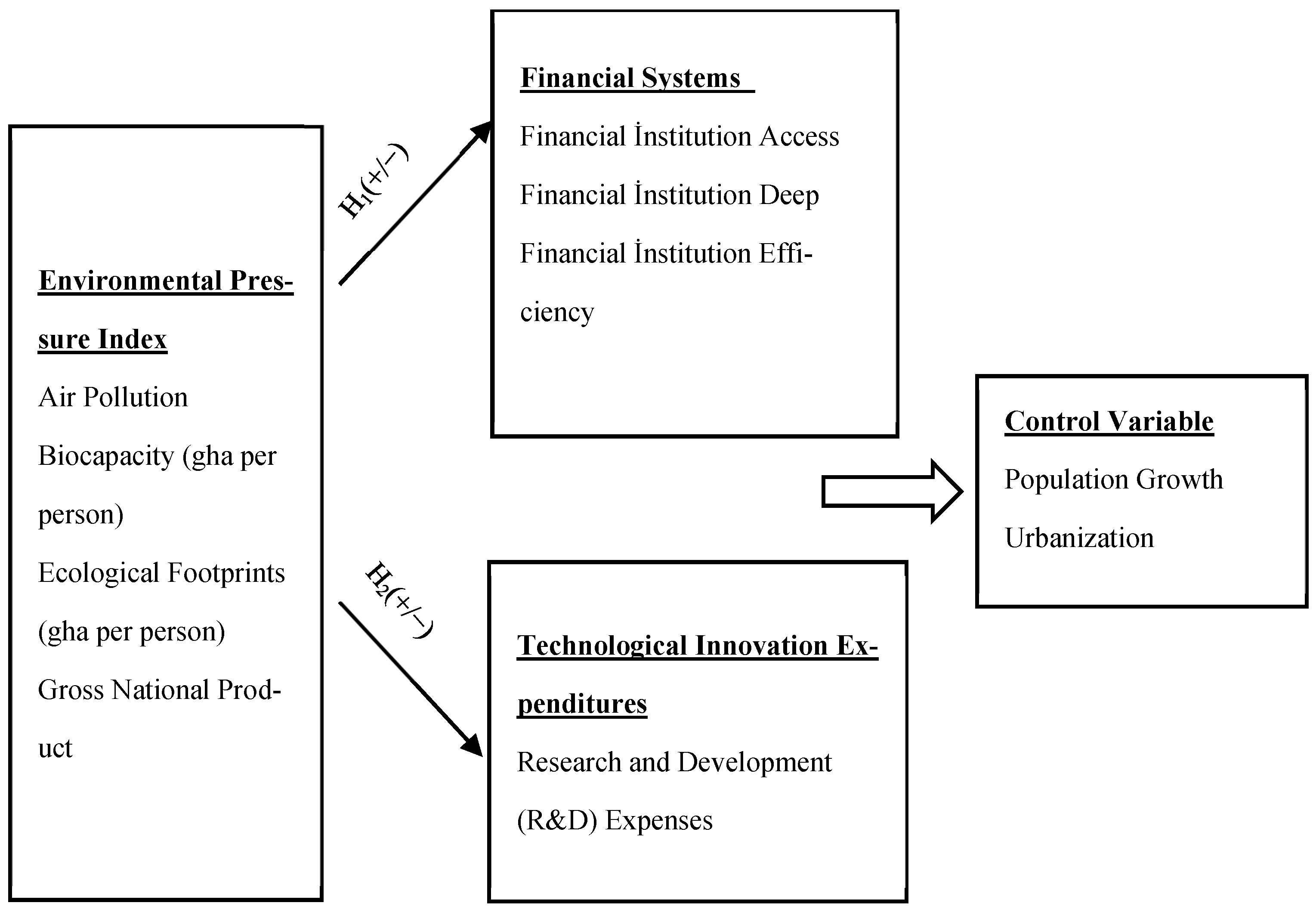
In this study, panel data covering the period from 1992 to 2021 for 27 European Union (EU) member states are utilized to investigate the impact of countries’ financial institutions and the diffusion of technological innovation on Environmental pressure. The empirical model employed in the study has been developed based on various prior studies that examine the relationship between Environmental pressure, financial institutions, and technological innovation. The model used in the analysis is presented below.
E P I i t = β i 0 + β i 1 F I A i t + β i 2 F I D i t + β i 3 F I E i t + β i 4 T I i t + β i 5 U R B i t + β i 6 P G W i t + ε i t
In this context, EPI denotes the Environmental pressure index; FIA represents financial institutions’ access; FID indicates financial institutions’ depth; FIE refers to financial institutions’ efficiency; TI stands for technological innovation expenditures; URB is the urbanization rate; PGW denotes the population growth rate; i refers to countries; t indicates the time period; and ε is the error term. The dependent variable, EPI, is constructed as a composite index of air pollution (AIR), biocapacity (BIO), ecological footprints (EF), and gross national product (GNP). The data for these variables were obtained from the World Development Indicators (WDI) and the Global Footprint Network database. The independent variables FIA, FID, and FIE are derived from the International Monetary Fund (IMF) database. Another key independent variable, technological innovation (TI), is measured using countries’ research and development (R&D) expenditures, with data also retrieved from the WDI database. The control variables, URB and PGW, were similarly obtained from the WDI database. The model and research hypotheses employed in the study are illustrated in Figure 1.
The initial efforts to develop composite indices assessing environmental stress and vulnerability were undertaken in 2000 by the United Nations Environment Programme (UNEP) and the South Pacific Applied Geoscience Commission (SOPAC). Building on this strand of the literature, the model employed in this study constructs an Environmental Pressure Index (EPI) based on the frameworks proposed by Fakher [26] and Latif [27], which emphasize outcome-based indicators such as environmental degradation and ecosystem health. In the model employed in this study, the Environmental Pressure Index (EPI) was constructed based on the frameworks proposed by Fakher [26] and Latif [27], which take into account dimensions such as the level of environmental degradation and the health of ecological systems. In this study, the Environmental Pressure Index is employed to capture the cumulative impact of human, economic, and social activities on the natural environment across countries. The primary objective of constructing this index is to quantify the level of environmental pressure and to underscore the necessity of designing financial and innovation policies that are aligned with countries’ respective environmental pressure profiles.

3.2. Econometric Methodology

In this study, the Principal Component Analysis (PCA) method, originally developed by Hotelling [59], is employed to construct the Environmental Pressure Index. PCA is preferred over alternative weighting schemes because it derives weights endogenously from the data, reduces subjectivity, and efficiently summarizes information from correlated indicators into a single composite index. PCA is a multivariate statistical technique that transforms a set of p original variables into a smaller number of new linear components, which capture most of the variation in the data [60]. The number of principal components that can be extracted from a data matrix is at most equal to p [60]. The fundamental equation of the PCA method is presented in Equation (2).
The use of PCA in this study does not aim at methodological innovation but at transparent and objective index construction. Compared to ad hoc or equal-weight aggregation methods, PCA allows the underlying data structure to determine the relative contribution of each indicator, thereby minimizing arbitrariness in weighting. This approach is particularly suitable for multidimensional environmental indicators that are highly correlated, as it ensures dimensionality reduction while preserving the dominant variation in the data. Accordingly, the resulting Environmental Pressure Index should be interpreted as an outcome-based composite measure reflecting observed environmental stress rather than latent vulnerability or adaptive capacity.
P C 1 = a 11 X 1 + a 12 X 2 + + a 1 p X P P C 2 = a 21 X 1 + a 22 X 2 + + a 2 p X P P C P = a P 1 X 1 + a P 2 X 2 + + a P p X P
In the equation, P C 1 , P C 2 …, P C P _p represent the p principal components, and aij denotes the weight of the j-th variable in the i-th principal component. A key condition of the PCA method is that the sum of the squared weights (PC loadings) must equal 1. Therefore, the variables used to construct the index must be normalized prior to analysis. In this study, the Min–Max normalization technique, which is widely used in the literature, is applied. Min–Max normalization preserves the relative variation across observations and prevents scale-driven bias in the PCA results. It also ensures comparability between indicators measured in different units and is consistent with standard practice in creating the composite index. The final composite index is constructed as a PCA-based weighted linear combination of these normalized variables. The Min–Max normalization procedure is expressed in Equation (3).
X n = X i X m i n X m a x X m i n
In the equation, Xn represents the normalized value, Xi denotes the input value, X m i n is the minimum value in the dataset, and X m a x is the maximum value in the dataset. In this study, the relationships between the variables were analyzed using the Panel ARDL method developed by Pesaran et al. [61]. After performing the necessary diagnostic tests for estimating the Panel ARDL model, the Pooled Mean Group (PMG) estimator was used. The PMG estimator allows for the estimation of different intercepts, error variances, and short-term dynamics for each cross-sectional unit in the panel. It also enables the estimation of a consistent long-term coefficient across countries. Even if the variables are stationary at the levels, the Panel ARDL framework is used as a dynamic specification that allows for lagged levels and captures both short-term dynamics and long-term relationships. In this study, the ARDL model is interpreted not only as a cointegration model but also as a flexible dynamic framework. While cross-sectional dependence is detected, the inclusion of country-specific effects and time dummies helps to absorb common shocks. Nevertheless, the PMG estimator does not fully control unobserved common correlated factors, which is acknowledged as a limitation. Additionally, the cointegration relationship among the variables was examined using the bounds testing approach. For this purpose, an unrestricted error correction model (UECM) was constructed. The bounds test and the error correction model are presented in Equations (4) and (5), respectively.
E P I i , t = α 0 + i = 1 m β 1 i t E P I i , t i + i = 0 n β 2 i t F I A i , t i + i = 0 p β 3 i t F I D i , t i + i = 0 r β 4 i t F I E i , t i + i = 0 h β 5 i t T I i , t i + i = 0 X β 6 i t U R B i , t i + i = 0 Y β 7 i t P G W i , t i + S 1 E P I i , t 1 + S 2 F I A i , t 1 + S 3 F I D i , t 1 + S 4 F I E i , t 1 + S 5 T I i , t 1 + S 6 U R B i , t 1 + S 7 P G W i , t 1 + μ t
The econometric models incorporating the error correction term (ECT) are presented below.
E C T i , t = E P I i t i = 1 m F 1 i E P I i , t 1 i = 0 n F 2 i F I A i , t 1 i = 0 p F 3 i F I D i , t 1 i = 0 r F 4 i F I E i , t 1 i = 0 h F 5 i T I i , t 1 i = 1 X F 6 i U R B i , t 1 i = 1 Y F 7 i P G W i , t 1
In the equation, α denotes the constant term; ∆ represents the first differences in the variables; S1, S2, S3, S4, S5 are the long-run coefficients; and μt is the error term. The parameters m, n, p, r, h, x, y indicate the lag lengths of the respective variables. ECTi,t−1 is the error correction term, while γ represents the adjustment parameter that measures the speed at which the system returns to equilibrium. Following the analysis of short-run and long-run effects, the Dumitrescu and Hurlin [17] panel causality test was applied, as shown in Equation (6).
Y t = α i + k = 1 K Y i k Y i , t k + k = 1 K β i k X i , t k + ϵ i , t    
In the equation, α denotes the constant term; X and Y represent the variables for which the causality relationship is being tested; K indicates the lag length of the variables; and ε refers to the error term.

4. Results

4.1. Environmental Pressure Index (EPI) with PCA Method

In order to construct the Environmental Pressure Index in this study, the index variables were normalized using the Min–Max normalization method. In this approach, variables are normalized using the min–max procedure, which rescales each variable to lie within the [0, 1] interval. Following normalization, the eigenvalues of the variables were calculated. In Principal Component Analysis (PCA), eigenvalues indicate the proportion of information each variable contributes to the index. According to the Kaiser criterion, it is recommended to retain all factors with eigenvalues greater than 1. Any factor with an eigenvalue below this threshold is considered to explain less of the common variance and is therefore excluded. Table 1 presents the eigenvalues and cumulative variance ratios of the variables included in the analysis.
According to the analysis results presented in Table 1, two factors with eigenvalues greater than 1 were identified. The cumulative variance explained by these two factors is 67.63%. The cumulative variance ratio represents the proportion of total variance in the index explained by the retained components. Based on the findings, these two factors collectively account for 67.63% of the total variance. The eigenvectors (factor loadings) of the variables corresponding to each principal component are provided in Table 2.
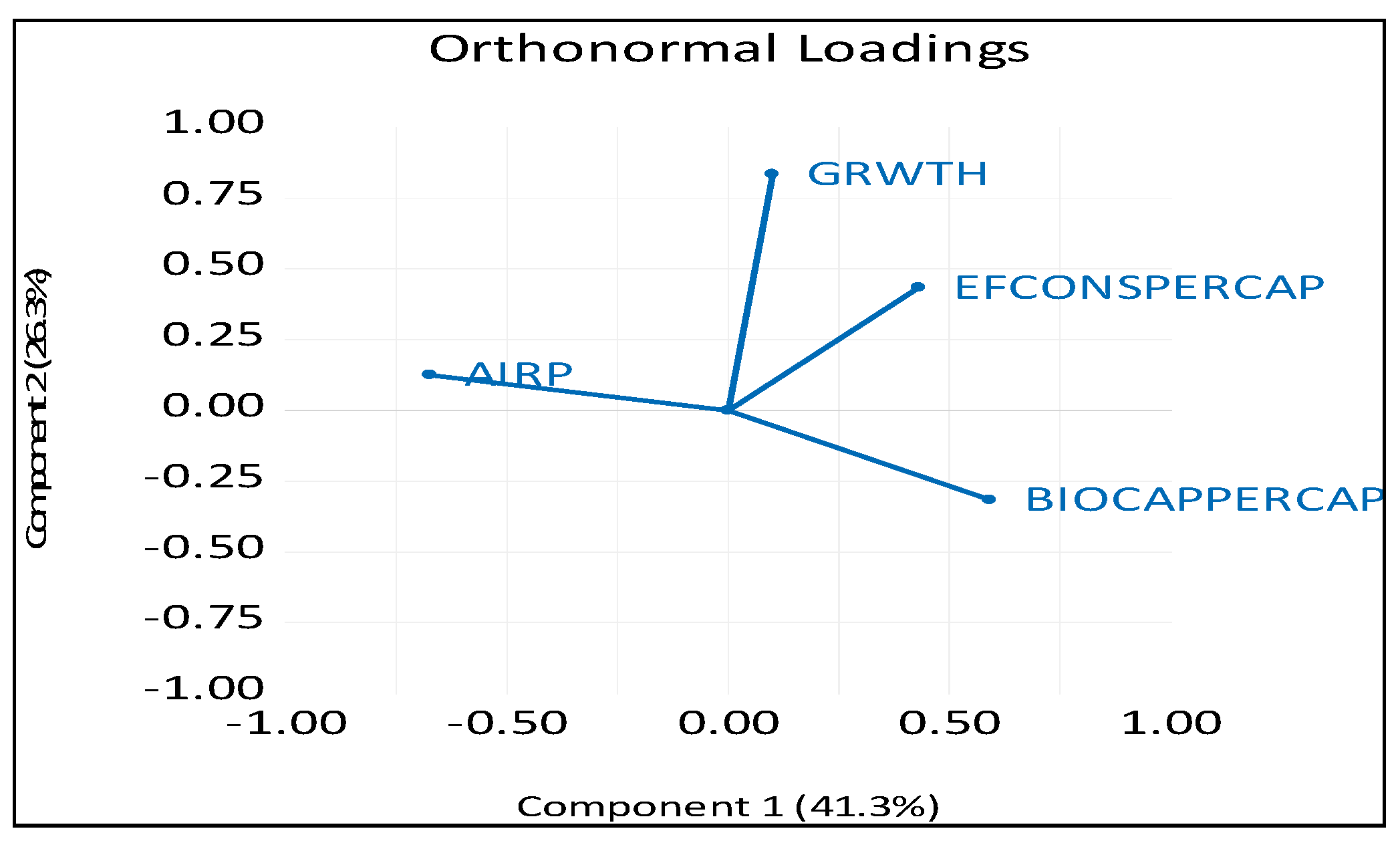
Eigenvectors are used to calculate the index weights. A positive eigenvector value indicates a direct relationship with the principal component (PC), whereas a negative value reflects an inverse relationship. According to Table 2, the variables with the highest factor loadings in PC1 are, respectively: AIR (−67.73%), BIO (59.17%), and EF (43.10%). In PC2, the variables with the highest loadings are: GNP (83.44%), EF (43.38%), and BIO (−31.57%). The squared values of the eigenvectors represent the proportion of variance each variable explains within the corresponding principal component. In PC1, AIR explains 45.37% of the variance, while in PC2, GNP accounts for 69.62% of the variance. The primary directions of the index variables, based on the principal components, are illustrated in Figure 2 as an Orthonormal Loadings graph.
According to Figure 2, the variables biocapacity, ecological footprint, and gross national product (GNP) exhibit a positive relationship with one another within the index, whereas air pollution shows a negative relationship with these variables. Biocapacity reflects a region’s ability to produce renewable natural resources and is one of the key components used in the calculation of the ecological footprint. Therefore, a positive correlation between these two variables is an expected outcome. Likewise, the negative association between air pollution and these variables is also consistent with theoretical expectations. To enhance the interpretability and clarity of the principal components (PCs), a rotation procedure was applied. Rotation increases the factor loadings of variables without altering their underlying mathematical properties. In this study, the Varimax method, which is one of the most commonly used orthogonal rotation techniques, was employed. The results of the rotation are presented in Table 3.
According to Table 3, the rotation results show that in Factor 1, the variables contributing the highest factor loadings are AIR (−66.95%), BIO (59.99%), and EF (28.33%). In Factor 2, the highest contributors are EF (31.89%), NGNP (22.56%), and AIR (−13.42%). Similar to the orthonormal results, AIR continues to contribute negatively to the index. In the final stage of the PCA process, the weights of the principal component matrix were calculated. The method used to compute these matrix weights is presented in Equation (4).
E P I = 41.31 67.63 P C 1 + 26.31 67.63 P C 2
The index weights of the variables were calculated by multiplying the previously computed cumulative variance ratios of the factors by the factor loadings of the respective variables. The resulting index weights are presented in Table 4.
According to Table 4, the variables with the highest factor weights in the index are, respectively: AIR (46.11%), BIO (37.96%), and EF (29.70%). Given that air pollution, biocapacity, and ecological footprint are core determinants of observed environmental pressure across countries, the relatively high weights assigned to AIR, BIO, and EF in the composite index are fully consistent with the underlying conceptual framework and empirical expectations.

4.2. Panel Analyses

Prior to the panel analysis, descriptive statistics of the variables to be used in the model were calculated. The descriptive statistics for both the dependent and independent variables included in the model are presented in Table 5.
According to Table 5, the mean and median values of the variables are relatively close to each other, indicating that the data are clustered around the center. The variable with the highest standard deviation is the urbanization rate, which is one of the control variables, suggesting that it has the widest distribution in the model. The kurtosis values range between 2.14 and 7.70, indicating that the distributions exhibit asymmetrical characteristics. Regarding skewness, most variables display positive skewness, meaning the distributions are left-skewed.
To detect the presence of multicollinearity in the panel model used in this study, both Spearman correlation analysis and Variance Inflation Factor (VIF) tests were conducted. High levels of correlation among variables may lead to biased or unreliable results in regression analysis. Therefore, variables that may cause multicollinearity should be excluded from the model. According to Gujarati [62], a correlation coefficient above 0.80 among explanatory variables suggests the presence of multicollinearity. Hence, proceeding with variables having correlation values below this threshold is expected to yield more reliable results. In addition to correlation analysis, the VIF test is commonly used in the literature to detect multicollinearity. According to Curto and Pinto [63], if the VIF value is equal to or less than 10, it indicates the absence of multicollinearity among the explanatory variables. The correlation matrix and VIF values are presented in Table 6.
According to Table 6, the highest correlation coefficient among the variables was calculated as 0.6677, observed between financial depth and technological innovation. The existence of a relationship between a country’s financial depth and its level of technological innovation is an expected result. Investment in innovation facilitates the development and diffusion of technological and innovative products. Meanwhile, financial depth plays a key role in effectively promoting innovation by reducing financing costs, allocating scarce resources efficiently, evaluating innovative projects, and managing associated risks. The fact that all correlation coefficients remain below the 0.80 threshold indicates that the model is not subject to multicollinearity. The VIF values reported in Table 6 range from 1.0433 to 1.4141, further confirming the absence of multicollinearity. Therefore, all selected variables were retained in the model and included in the analysis.
Prior to conducting panel regression, diagnostic tests were carried out to determine the appropriate unit root tests and to ensure the validity of the selected regression methodology. Identifying the presence of cross-sectional dependence and heteroskedasticity among the variables is crucial for ensuring the accuracy and reliability of the empirical findings. When such conditions exist, the chosen analysis must account for them to avoid biased results [64,65]. The results of these diagnostic tests are presented in Table 7.
According to the cross-sectional dependence test results presented in Table 7, the p-values for the variables used in the model are less than 0.05, indicating the presence of cross-sectional dependence among countries. Additionally, the results of the heteroskedasticity test confirm the existence of heteroskedasticity within the model. Given the presence of cross-sectional dependence identified in the diagnostic tests, the study employed a second-generation unit root test—the CADF-CIPS test developed by Pesaran [66]—instead of first-generation unit root tests for stationarity assessment. The null hypothesis (H0) of the CADF-CIPS test states that “a unit root exists in the series.” If the p-values are less than 0.05, the null hypothesis is rejected, indicating that the series is stationary. The statistical values and p-values obtained from the unit root tests are presented in Table 8.
According to the CADF-CIPS test results presented in Table 8, all variables used in the model have p-values less than 0.05, indicating that the variables are stationary at the level. In other words, it has been concluded that the series does not contain unit roots. After confirming the stationarity of the series, Pedroni [67] and Kao [68] panel cointegration tests were conducted to determine the existence of a long-run relationship among the variables. The results of these tests are reported in Table 9 and Table 10, respectively.
According to Table 9, the results of the Pedroni [67] cointegration test, specifically the panel PP-statistic and panel ADF-statistic from within-dimension tests, as well as the group PP-statistic and group ADF-statistic from between-dimension tests, indicate that the null hypothesis of “no cointegration among the variables” is rejected. In other words, there is evidence of a long-run relationship among the variables. The results of the Kao [68] cointegration test further support the findings of the Pedroni test by confirming the existence of cointegration among the variables.
In order to determine the optimal lag length, a Vector Autoregressive (VAR) model was employed. Based on the Akaike Information Criterion (AIC), the optimal lag length was identified as two lags. To decide between the use of the Pooled Mean Group (PMG) and Mean Group (MG) estimators, a Hausman test was conducted. According to the results presented in Table 11, the null hypothesis of coefficient homogeneity could not be rejected, indicating that the PMG estimator is appropriate. Therefore, the PMG estimator was selected for the analysis. The short-run and long-run estimation results from the PMG-ARDL model are reported in Table 11.
According to the PMG panel ARDL results presented in Table 11, a statistically significant and positive long-run relationship is observed between the environmental pressure index and financial access. This finding indicates that higher levels of financial access are associated with increased environmental pressure in the long run. Conversely, financial depth and financial efficiency exhibit statistically significant and negative long-run associations with the environmental pressure index, indicating that higher levels of financial depth and financial efficiency are associated with lower environmental pressure over the long run. Additionally, technological innovation exhibits a statistically significant and negative long-run association with environmental pressure, indicating that higher levels of technological innovation are associated with reduced environmental pressure in the long run. Regarding the control variables, both urbanization and population growth are found to be positively and statistically significantly associated with environmental pressure in the long run, indicating that higher levels of urbanization and population growth correspond to increased environmental pressure. In the short run, the error correction term (ECT) is negative and statistically significant, indicating that deviations from the long-term equilibrium are corrected over time. The ECT coefficient is estimated at −0.95, implying that approximately 95% of the disequilibrium from the previous period is adjusted within the current period. Consistent with the long-run findings, the short-run results indicate a statistically significant and positive association between financial access and environmental pressure, suggesting that higher levels of financial access are associated with increased environmental pressure in the short run. These findings suggest that while increasing access to financial services facilitates the availability of instruments for individuals and firms, uncontrolled financial expansion may exacerbate environmental pressure. In contrast to the long-run findings, the short-run results indicate a statistically significant and positive association between financial depth and environmental pressure, suggesting that higher levels of financial depth are associated with increased environmental pressure in the short run. Taken together, the short- and long-run findings suggest a non-linear relationship between financial depth and environmental performance. In the short run, increases in financial depth are associated with higher environmental pressure, potentially reflecting scale effects whereby expanded financial activity initially facilitates energy-intensive production, consumption, and investment. However, in the long run, greater financial depth appears to contribute to improved environmental outcomes, consistent with a transition toward more efficient capital allocation, enhanced access to green financing instruments, and the diffusion of cleaner technologies. This pattern implies the presence of a U-shaped relationship, whereby financial deepening initially exacerbates environmental pressure but ultimately supports environmental sustainability once a certain level of financial development is attained. Furthermore, financial efficiency shows a statistically significant and negative relationship with environmental pressure in the short term, indicating that higher levels of financial efficiency are associated with lower environmental pressure. This finding suggests that improvements in financial efficiency contribute to reduced environmental pressure by increasing the allocation and use of natural resources. Unlike the long-run results, the short-run analysis indicates a statistically significant and positive association between technological innovation expenditures and environmental pressure, suggesting that higher levels of innovation spending are linked to increased environmental pressure in the short term. These results suggest that while R&D investments made during the transition to environmentally friendly technologies may initially increase environmental pressure, green innovation contributes to reduced environmental pressure in the long term. Taken together, these findings indicate a non-linear adjustment pattern in which technological innovation initially intensifies environmental pressure but gradually mitigates it over time as efficiency gains and low-carbon technologies diffuse. Regarding the control variables in the short-run model, urbanization is positively but not statistically significantly associated with environmental pressure, whereas population growth exhibits a statistically significant and positive association. These findings support the hypothesis that increases in urbanization and population growth raise energy demand, potentially increasing pollution and environmental degradation. The results of the Dumitrescu-Hurlin [17] panel causality test are presented in Table 12.
According to the panel causality test results developed by Dumitrescu and Hurlin [17] and presented in Table 12, there exists a unidirectional causality running from financial access to environmental pressure at the 1% significance level. This indicates that increases in financial access influence environmental pressure, whereas environmental pressure does not have a significant effect on financial access. The second causal relationship identified in the model is a bidirectional causality between financial depth and environmental pressure, also significant at the 1% level. This suggests that as financial depth increases, it may initially exert greater pressure on the environment. However, over time, it may contribute to reducing environmental pressure by allocating more resources toward sustainable investments. Conversely, increases in environmental risks may negatively impact financial depth by influencing investment dynamics and risk perceptions. The third causal relationship in the model is observed between financial efficiency and environmental pressure, with a bidirectional relationship significant at the 5% and 1% levels, respectively. The mutual interaction between financial efficiency and environmental pressure implies that the efficient allocation of financial resources and proper investment targeting affect environmental conditions, while environmental sustainability objectives, in turn, influence countries’ financial decisions. A fourth bidirectional causal relationship, significant at the 5% and 1% significance levels, was found between technological innovation and environmental pressure. This reciprocal relationship indicates that environmental threats and risks stimulate technological advancement, while technological innovation contributes to environmental transformation and sustainability. Regarding the control variables, the analysis reveals a bidirectional relationship between urbanization and environmental pressure, and a unidirectional relationship from population growth to environmental pressure. These findings suggest that unplanned and rapid urbanization can increase environmental pressures, while environmental pressure may also influence urban expansion patterns. Furthermore, population growth is found to drive environmental pressure, likely due to increased energy demand, pollution, and ecological degradation.

5. Policy Recommendations

Global environmental pressure is shaped by the structure of national financial systems, the effectiveness of institutional governance, and ongoing ecological degradation [40,48]. By distinguishing between financial access, depth, and efficiency, our findings show that unregulated expansion of financial access is associated with higher environmental pressure in both the short and long run. This highlights a persistent gap in the literature, namely that financial inclusion policies may overlook environmental externalities despite their macroeconomic benefits [35,44]. In contrast, financial depth and financial efficiency—more institutionalized dimensions of financial development—are linked to lower levels of environmental pressure, suggesting that well-functioning financial systems can facilitate more sustainable investment patterns [69]. Importantly, these beneficial effects are not uniform across the European Union. In several Eastern European countries, weaker institutional oversight and less developed financial systems limit the environmental gains from financial deepening, underscoring the need for country-specific sustainable finance strategies that reflect differences in market maturity and governance capacity [70].
The environmental implications of financial systems depend not only on the availability of financial resources but also on how effectively those resources are allocated. Embedding “green efficiency” criteria into EU-wide credit allocation frameworks could help redirect capital toward sectors with lower environmental impact. Deeper and more efficient financial markets may enhance the financing of renewable energy infrastructure and energy-efficient technologies, thereby contributing to a gradual reduction in environmental pressure over time. In this respect, the financial system can move beyond a passive role and become an active instrument supporting the policy objectives of the European Green Deal, particularly in mobilizing private investment for clean energy, grid modernization, and low-carbon technological upgrading [71,72,73,74].
Our results further indicate that technological innovation is associated with environmental pressure in a stage-dependent manner. In the short run, increased investment in emerging technologies may coincide with higher environmental pressure due to infrastructure upgrading, temporary increases in energy demand, and adjustment costs. Over the longer term, however, the diffusion of cleaner technologies and efficiency-enhancing innovations is linked to lower environmental pressure. Over the longer term, however, the diffusion of cleaner technologies and efficiency-enhancing innovations is linked to lower environmental pressure, particularly as innovation supports renewable capacity expansion and energy efficiency improvements under the EU energy transition [75,76]. This pattern is consistent with evidence from advanced and emerging economies showing that green technologies may initially raise environmental stress but contribute to more sustainable outcomes as adoption matures [57,77,78]. From a policy perspective, these findings suggest that EU R&D support should focus not only on the scale of funding but also on performance-based criteria aligned with measurable environmental outcomes. Transitional policy instruments, such as temporary carbon offset mechanisms, may also help mitigate short-term environmental pressures during early stages of technological deployment.
Finally, demographic dynamics and urban development policies play an important role in shaping environmental pressure across EU countries. Our findings show that population growth and urbanization are associated with persistent increases in environmental pressure, reflecting higher resource use and land-use intensity. Previous studies similarly document that demographic pressures and urban expansion have intensified environmental stress in Europe, while technological progress can partially offset these effects [79,80]. These results point to the importance of integrated spatial planning strategies, including green belt preservation, promotion of low-carbon transport systems, and zoning regulations that support sustainable urban development. Incorporating energy-efficient building standards and resilient infrastructure into urban planning frameworks may further help mitigate the combined pressures arising from population growth, urban expansion, and environmental stress [81,82].

6. Conclusions

This study employs panel data from 27 EU member countries over the period 1992–2021 to examine how financial structure components and technological innovation are associated with environmental pressure. Using principal component analysis, we construct a composite Environmental Pressure Index (EPI) based on air pollution, ecological footprint, biocapacity, and per capita GNI, providing a multidimensional representation of environmental stress across EU economies. The PMG panel ARDL results indicate that deeper and more efficient financial systems are associated with lower environmental pressure in the long run, whereas rapid expansion of financial access is linked to higher environmental pressure in both the short and long term. These findings suggest that the quality of financial intermediation plays a more important role than the sheer expansion of finance in shaping environmental outcomes, challenging the notion that financial deepening is inherently sustainable [69,70].
The results further reveal a time-dependent relationship between technological innovation and environmental pressure. In the short run, increased investment in emerging technologies is associated with higher environmental pressure, reflecting adjustment costs related to infrastructure upgrading and temporary increases in energy demand. Over the longer term, however, the diffusion of cleaner and more efficient technologies is linked to a reduction in environmental pressure. Within the broader policy context of the EU energy transition, these long-run associations are consistent with the role of innovation in supporting lower-carbon production systems and more efficient resource use, even though the analysis does not directly model energy-mix variables. Similar temporal patterns have been documented in advanced and emerging economies, where technological innovation contributes to improved environmental outcomes over time despite short-term pressures [77,78].
In addition, the findings confirm that population growth and urbanization are persistently associated with higher environmental pressure, reinforcing concerns about the environmental implications of demographic expansion and urban development [79,80]. These dynamics highlight the importance of integrated urban and spatial planning strategies, including energy-efficient infrastructure, low-carbon transport systems, and resilient urban design, to mitigate the environmental pressures associated with rapid urban growth.
From a policy perspective, the results point to three actionable directions. First, financial inclusion initiatives should be aligned with environmental performance indicators and incorporated into risk-adjusted lending frameworks to prevent unintended environmental pressures. Second, R&D support schemes should emphasize performance-based criteria tied to measurable environmental outcomes rather than funding volume alone, while transitional policy instruments may help offset short-term environmental pressures during early deployment stages. Third, spatial development policies in rapidly growing urban areas should prioritize nature-based solutions and sustainable mobility systems to alleviate long-term environmental pressure.
Finally, this study has several limitations. The analysis does not distinguish between industrial sectors, nor does it incorporate more granular indicators such as carbon pricing, ESG scores, regulatory intensity, or climate-related shocks. Future research addressing these dimensions could provide a more detailed understanding of how financial structures and innovation policies interact with environmental pressure across different sectors and institutional settings.

Author Contributions

Conceptualization, F.Y., U.Ü. and A.K.; Data curation, F.Y.; Formal analysis, F.Y.; Funding acquisition, F.Y.; Methodology, F.Y.; Supervision, Ö.Ç.; Writing—original draft, N.A. and A.K.; Writing—review and editing, U.Ü. A.K., Ö.Ç.; Visualization, F.Y. and U.Ü. All authors have read and agreed to the published version of the manuscript.

Funding

This research received no external funding.

Institutional Review Board Statement

Not applicable.

Informed Consent Statement

Not applicable.

Data Availability Statement

The data that support the findings of this study are available from the corresponding author upon reasonable request.

Conflicts of Interest

The authors declare no conflicts of interest.

References

  1. Buchari, R.A.; Muhtar, E.A.; Aiyub, K.; Abdillah, A.; Miradhia, D.; Muharam, R.S. Global Research Trends in Sustainability and Environmental Issues: A Sustainable Environment and Future Directions. J. Popul. Soc. Stud. 2024, 33, 762–783. [Google Scholar] [CrossRef]
  2. United Nations. Transforming our World: The 2030 Agenda for Sustainable Development; United Nations: New York, NY, USA, 2015; Available online: https://sdgs.un.org/goals (accessed on 1 September 2025).
  3. Bebbington, J.; Unerman, J. Achieving the United Nations Sustainable Development Goals: An enabling role for accounting research. Accounting Audit. Account. J. 2018, 31, 2–24. [Google Scholar] [CrossRef]
  4. Mayer, A.L. Strengths and weaknesses of common sustainability indices for multidimensional systems. Environ. Int. 2008, 34, 277–291. [Google Scholar] [CrossRef]
  5. European Commission. Zero Pollution Action Plan; European Commission. Available online: https://environment.ec.europa.eu/strategy/zero-pollution-action-plan_en (accessed on 1 September 2025).
  6. Cutter, S.L.; Finch, C. Temporal and spatial changes in social vulnerability to natural hazards. Proc. Natl. Acad. Sci. USA 2008, 105, 2301–2306. [Google Scholar] [CrossRef]
  7. McLaughlin, P.; Dietz, T. Structure, agency and environment: Toward an integrated perspective on vulnerability. Glob. Environ. Change 2008, 18, 99–111. [Google Scholar] [CrossRef]
  8. de Figueirêdo, M.C.B.; Rodrigues, G.S.; Caldeira-Pires, A.; Rosa, M.d.F.; de Aragão, F.A.S.; Vieira, V.d.P.P.B.; Mota, F.S.B. Environmental performance evaluation of agro-industrial innovations—Part 2: Methodological approach for performing vulnerability analysis of watersheds. J. Clean. Prod. 2010, 18, 1376–1385. [Google Scholar] [CrossRef]
  9. Turner, B.L., II; Kasperson, R.E.; Matson, P.A.; McCarthy, J.J.; Corell, R.W.; Christensen, L.; Eckley, N.; Kasperson, J.X.; Luers, A.; Martello, M.L.; et al. A framework for vulnerability analysis in sustainability science. Proc. Natl. Acad. Sci. USA 2003, 100, 8074–8079. [Google Scholar] [CrossRef] [PubMed]
  10. Mcfadden, L. Vulnerability analysis in environmental management: Widening and deepening its approach. Environ. Conserv. 2007, 34, 195–204. [Google Scholar] [CrossRef]
  11. Castillo, M.F. Environmental vulnerability as a public priority: The view of local economic elites. Risk Hazards Crisis Public Policy 2024, 16, e12298. [Google Scholar] [CrossRef]
  12. Guijarro, F. A Multicriteria Model for the Assessment of Countries’ Environmental Performance. Int. J. Environ. Res. Public Health 2019, 16, 2868. [Google Scholar] [CrossRef]
  13. Liang, F. The Impact of Financial Innovation on Environmental Protection: Literature Review and Case Study. Financ. Econ. 2024, 2, 1–10. [Google Scholar] [CrossRef]
  14. Alshehry, A.; Belloumi, M. The Symmetric and Asymmetric Impacts of Energy Consumption and Economic Growth on Environmental Sustainability. Sustainability 2023, 16, 205. [Google Scholar] [CrossRef]
  15. Shmelev, S. Multidimensional Assessment of Sustainability: Harmony vs. the Turning Point. In Green Economy Reader: Lectures in Ecological Economics and Sustainability; Springer International Publishing: Cham, Switzerland, 2017; pp. 67–98. [Google Scholar] [CrossRef]
  16. Khoualfia, A.; Bardi, W. The effect of climate change on economic growth in European countries: An empirical evidence from Panel ARDL approach. Environ. Sci. Pollut. Res. 2024, 32, 736–748. [Google Scholar] [CrossRef]
  17. Dumitrescu, E.-I.; Hurlin, C. Testing for Granger non-causality in heterogeneous panels. Econ. Model. 2012, 29, 1450–1460. [Google Scholar] [CrossRef]
  18. Grossman, G.; Krueger, A. Environmental Impacts of a North American Free Trade Agreement; National Bureau of Economic Research, Inc.: Cambridge, MA, USA, 1991. [Google Scholar]
  19. Shafik, N. Economic Development and Environmental Quality: An Econometric Analysis. Oxf. Econ. Pap. 1994, 46, 757–773. [Google Scholar] [CrossRef]
  20. Selden, T.M.; Song, D. Environmental Quality and Development: Is There a Kuznets Curve for Air Pollution Emissions? J. Environ. Econ. Manag. 1994, 27, 147–162. [Google Scholar] [CrossRef]
  21. Stern, D.I. The environmental Kuznets curve after 25 years. J. Bioeconomics 2017, 19, 7–28. [Google Scholar] [CrossRef]
  22. Martínez-Zarzoso, I.; Bengochea-Morancho, A. Pooled mean group estimation of an environmental Kuznets curve for CO2. Econ. Lett. 2004, 82, 121–126. [Google Scholar] [CrossRef]
  23. Lieb, C.M. The Environmental Kuznets Curve and Flow versus Stock Pollution: The Neglect of Future Damages. Environ. Resour. Econ. 2004, 29, 483–506. [Google Scholar] [CrossRef]
  24. Leitão, A. Corruption and the environmental Kuznets Curve: Empirical evidence for sulfur. Ecol. Econ. 2010, 69, 2191–2201. [Google Scholar] [CrossRef]
  25. Suva, F. Guidelines for Water and Sanitation Utilities Risk Management Planning; SOPAC: Suva, Fiji, 2000. [Google Scholar]
  26. Fakher, H.-A. Investigating the determinant factors of environmental quality (based on ecological carbon footprint index). Environ. Sci. Pollut. Res. 2019, 26, 10276–10291. [Google Scholar] [CrossRef]
  27. Latif, N. Comprehensive environmental performance index (CEPI): An intuitive indicator to evaluate the environmental quality over time. Environ. Res. Commun. 2022, 4, 075016. [Google Scholar] [CrossRef]
  28. Panayotou, T. Empirical Tests and Policy Analysis of Environmental Degradation at Different Stages of Economic Development; International Labour Organization: Geneva, Switzerland, 1993. [Google Scholar]
  29. Li, S.; Ma, Y. Urbanization, Economic Development and Environmental Change. Sustainability 2014, 6, 5143–5161. [Google Scholar] [CrossRef]
  30. Rahman, M.M. Do population density, economic growth, energy use and exports adversely affect environmental quality in Asian populous countries? Renew. Sustain. Energy Rev. 2017, 77, 506–514. [Google Scholar] [CrossRef]
  31. Fotros, M.H.; Abolfazl, N.; Pirooz Mohammadi, F. A Study of the Relationship Between Air Pollution, Energy Intensity and Economic Openness in Iran. 2013. Available online: http://ejip.ir/files/site1/user_files_9c6c09/godadmin-A-10-2-295-4cf16cd.pdf (accessed on 7 November 2025).
  32. Anwar, A.; Huong, N.T.T.; Sharif, A.; Kilinc-Ata, N.; Çitil, M.; Demirtaş, F. Is a green world real or a dream? A look at green growth from green innovation and financial development: Evidence from fragile economies. Geol. J. 2023, 59, 98–112. [Google Scholar] [CrossRef]
  33. Kahouli, B. The short and long run causality relationship among economic growth, energy consumption and financial development: Evidence from South Mediterranean Countries (SMCs). Energy Econ. 2017, 68, 19–30. [Google Scholar] [CrossRef]
  34. Zeng, K.; Eastin, J. Do Developing Countries Invest Up? The Environmental Effects of Foreign Direct Investment from Less-Developed Countries. World Dev. 2012, 40, 2221–2233. [Google Scholar] [CrossRef]
  35. Acheampong, A.O.; Adams, S.; Boateng, E. Do globalization and renewable energy contribute to carbon emissions mitigation in Sub-Saharan Africa? Sci. Total. Environ. 2019, 677, 436–446. [Google Scholar] [CrossRef]
  36. Alsagr, N.; van Hemmen, S. The impact of financial development and geopolitical risk on renewable energy consumption: Evidence from emerging markets. Environ. Sci. Pollut. Res. 2021, 28, 25906–25919. [Google Scholar] [CrossRef]
  37. Sadorsky, P. The impact of financial development on energy consumption in emerging economies. Energy Policy 2010, 38, 2528–2535. [Google Scholar] [CrossRef]
  38. Aye, G.C.; Edoja, P.E. Effect of economic growth on CO2 emission in developing countries: Evidence from a dynamic panel threshold model. Cogent Econ. Financ. 2017, 5, 1379239. [Google Scholar] [CrossRef]
  39. Yuxiang, K.; Chen, Z. Financial development and environmental performance: Evidence from China. Environ. Dev. Econ. 2010, 16, 93–111. [Google Scholar] [CrossRef]
  40. Samreen, I.; Majeed, M.T. Spatial econometric model of the spillover effects of financial development on carbon emis-sions: A global analysis. Pak. J. Commer. Soc. Sci. (PJCSS) 2020, 14, 569–602. [Google Scholar]
  41. Al-Mulali, U.; Tang, C.F.; Ozturk, I. Does financial development reduce environmental degradation? Evidence from a panel study of 129 countries. Environ. Sci. Pollut. Res. 2015, 22, 14891–14900. [Google Scholar] [CrossRef]
  42. Li, X.; Ozturk, I.; Majeed, M.T.; Hafeez, M.; Ullah, S. Considering the asymmetric effect of financial deepening on environmental quality in BRICS economies: Policy options for the green economy. J. Clean. Prod. 2022, 331, 129909. [Google Scholar] [CrossRef]
  43. Tsaurai, K. The impact of financial development on carbon emissions in Africa. Int. J. Energy Econ. Policy 2019, 9, 144–153. [Google Scholar] [CrossRef]
  44. Baloch, M.A.; Zhang, J.; Iqbal, K.; Iqbal, Z. The effect of financial development on ecological footprint in BRI countries: Evidence from panel data estimation. Environ. Sci. Pollut. Res. 2019, 26, 6199–6208. [Google Scholar] [CrossRef] [PubMed]
  45. Zafar, A.; Majeed, M.T.; Nosheen, M.; Iqbal, J. Globalization, financial development, and environmental sustainability: Evidence from heterogenous income groups of Asia. Environ. Sci. Pollut. Res. 2021, 28, 50430–50446. [Google Scholar] [CrossRef] [PubMed]
  46. Tahir, T.; Luni, T.; Majeed, M.T.; Zafar, A. The impact of financial development and globalization on environmental quality: Evidence from South Asian economies. Environ. Sci. Pollut. Res. 2020, 28, 8088–8101. [Google Scholar] [CrossRef]
  47. Anwar, A.; Barut, A.; Pala, F.; Kilinc-Ata, N.; Kaya, E.; Lien, D.T.Q. A different look at the environmental Kuznets curve from the perspective of environmental deterioration and economic policy uncertainty: Evidence from fragile countries. Environ. Sci. Pollut. Res. 2023, 31, 46235–46254. [Google Scholar] [CrossRef]
  48. Tamazian, A.; Chousa, J.P.; Vadlamannati, K.C. Does higher economic and financial development lead to environmental degradation: Evidence from BRIC countries. Energy Policy 2009, 37, 246–253. [Google Scholar] [CrossRef]
  49. Ali, W.; Abdullah, A.; Azam, M. The Dynamic Linkage between Technological Innovation and carbon dioxide emissions in Malaysia: An Autoregressive Distributed Lagged Bound Approach. Int. J. Energy Econ. Policy 2016, 6, 389–400. [Google Scholar]
  50. Ahmed, A.; Uddin, G.S.; Sohag, K. Biomass energy, technological progress and the environmental Kuznets curve: Evidence from selected European countries. Biomass Bioenergy 2016, 90, 202–208. [Google Scholar] [CrossRef]
  51. Santra, S. The effect of technological innovation on production-based energy and CO2 emission productivity: Evidence from BRICS countries. Afr. J. Sci. Technol. Innov. Dev. 2017, 9, 503–512. [Google Scholar] [CrossRef]
  52. Yii, K.-J.; Geetha, C. The Nexus between Technology Innovation and CO2 Emissions in Malaysia: Evidence from Granger Causality Test. Energy Procedia 2017, 105, 3118–3124. [Google Scholar] [CrossRef]
  53. Samargandi, N. Sector value addition, technology and CO2 emissions in Saudi Arabia. Renew. Sustain. Energy Rev. 2017, 78, 868–877. [Google Scholar] [CrossRef]
  54. Demir, C.; Cergibozan, R.; Ari, A. Environmental dimension of innovation: Time series evidence from Turkey. Environ. Dev. Sustain. 2019, 22, 2497–2516. [Google Scholar] [CrossRef]
  55. Chen, W.; Lei, Y. The impacts of renewable energy and technological innovation on environment-energy-growth nexus: New evidence from a panel quantile regression. Renew. Energy 2018, 123, 1–14. [Google Scholar] [CrossRef]
  56. Fernández, Y.F.; López, M.F.; Blanco, B.O. Innovation for sustainability: The impact of R&D spending on CO2 emissions. J. Clean. Prod. 2018, 172, 3459–3467. [Google Scholar] [CrossRef]
  57. Dauda, L.; Long, X.; Mensah, C.N.; Salman, M. The effects of economic growth and innovation on CO2 emissions in different regions. Environ. Sci. Pollut. Res. 2019, 26, 15028–15038. [Google Scholar] [CrossRef] [PubMed]
  58. Ibrahiem, D.M. Do technological innovations and financial development improve environmental quality in Egypt? Environ. Sci. Pollut. Res. 2020, 27, 10869–10881. [Google Scholar] [CrossRef]
  59. Hotelling, H. Analysis of a complex of statistical variables into principal components. J. Educ. Psychol. 1933, 24, 417–441. [Google Scholar] [CrossRef]
  60. Johnson, R.; Wichern, D. Applied Multivariate Statistical Analysis. 2002. Available online: https://www.academia.edu/download/31202179/Dr_Alodat_STAT_459_L01_Spring_2012.pdf (accessed on 7 November 2025).
  61. Pesaran, M.H.; Shin, Y.; Smith, R.P. Pooled Mean Group Estimation of Dynamic Heterogeneous Panels. J. Am. Stat. Assoc. 1999, 94, 621–634. [Google Scholar] [CrossRef]
  62. Gujarati, D.N. Basic Econometrics; The Mc-Graw Hill: New York, NY, USA, 2004. [Google Scholar]
  63. Curto, J.D.; Pinto, J.C. The corrected VIF (CVIF). J. Appl. Stat. 2010, 38, 1499–1507. [Google Scholar] [CrossRef]
  64. Breusch, T.S.; Pagan, A.R. A Simple Test for Heteroscedasticity and Random Coefficient Variation. Econometrica 1979, 47, 1287. [Google Scholar] [CrossRef]
  65. Pesaran, M.H.; Schuermann, T.; Weiner, S.M. Modeling Regional Interdependencies Using a Global Error-Correcting Macroeconometric Model. J. Bus. Econ. Stat. 2004, 22, 129–162. [Google Scholar] [CrossRef]
  66. Pesaran, M.H. A simple panel unit root test in the presence of cross-section dependence. J. Appl. Econ. 2007, 22, 265–312. [Google Scholar] [CrossRef]
  67. Pedroni, P. Critical Values for Cointegration Tests in Heterogeneous Panels with Multiple Regressors. Oxf. Bull. Econ. Stat. 1999, 61, 653–670. [Google Scholar] [CrossRef]
  68. Kao, C. Spurious regression and residual-based tests for cointegration in panel data. J. Econ. 1999, 90, 1–44. [Google Scholar] [CrossRef]
  69. Yiadom, E.B.; Mensah, L.; Bokpin, G.A. Environmental risk and foreign direct investment: The role of financial deepening, access and efficiency. Sustain. Account. Manag. Policy J. 2023, 14, 369–395. [Google Scholar] [CrossRef]
  70. Tudorache, C. Sustainability in the Romanian banking sector. J. Financial Stud. 2023, 9, 308–323. [Google Scholar] [CrossRef]
  71. Xia, L.; Liu, Y.; Yang, X. The response of green finance toward the sustainable environment: The role of renewable energy development and institutional quality. Environ. Sci. Pollut. Res. 2023, 30, 59249–59261. [Google Scholar] [CrossRef] [PubMed]
  72. Shi, X.; Shi, D. Impact of green finance on renewable energy technology innovation: Empirical evidence from China. Sustainability 2025, 17, 2201. [Google Scholar] [CrossRef]
  73. Hainsch, K.; Löffler, K.; Burandt, T.; Auer, H.; del Granado, P.C.; Pisciella, P.; Zwickl-Bernhard, S. Energy transition scenarios: What policies, societal attitudes, and technology developments will realize the EU Green Deal? Energy 2022, 239, 122067. [Google Scholar] [CrossRef]
  74. Rządkowska, A.E. Quantitatively estimating the impact of the European Green Deal on the clean energy transformation in the European Union with a focus on the breakthrough of the share of renewable energy in the electricity generation sector. Polityka Energetyczna-Energy Policy J. 2022, 25, 45–66. [Google Scholar] [CrossRef]
  75. Gasser, M.; Pezzutto, S.; Sparber, W.; Wilczynski, E. Public research and development funding for renewable energy technologies in Europe: A cross-country analysis. Sustainability 2022, 14, 5557. [Google Scholar] [CrossRef]
  76. Verdolini, E.; Sovacool, B.K.; Drummond, P. Channeling diverse innovation pressures to support European sustainability transitions. Environ. Res. Lett. 2021, 16, 061001. [Google Scholar] [CrossRef]
  77. Elhassan, T. Green Technology Innovation, Green Financing, and Economic Growth in G7 Countries: Implications for Environmental Sustainability. ECONOMICS 2025, 13, 69–91. [Google Scholar] [CrossRef]
  78. Khan, A.; Awais, M.; Majeed, K.B.; Beenish, H.; Rashad, M. Assessing the Impact of Technological Innovations and Trade Openness on Environmental Sustainability: An Empirical Study of South Asian Economies Using Panel ARDL Approach. Bull. Bus. Econ. (BBE) 2024, 13, 243–250. [Google Scholar] [CrossRef]
  79. Pham, N.M.; Huynh, T.L.D.; Nasir, M.A. Environmental consequences of population, affluence and technological progress for European countries: A Malthusian view. J. Environ. Manag. 2020, 260, 110143. [Google Scholar] [CrossRef]
  80. Weber, H.; Sciubba, J.D. The Effect of Population Growth on the Environment: Evidence from European Regions. Eur. J. Popul. 2018, 35, 379–402. [Google Scholar] [CrossRef] [PubMed]
  81. Umoh, A.A.; Ohenhen, P.E.; Chidolue, O.; Ngozichukwu, B.; Fafure, A.V.; Ibekwe, K.I. Incorporating energy efficiency in urban planning: A review of policies and best practices. Eng. Sci. Technol. J. 2024, 5, 83–98. [Google Scholar] [CrossRef]
  82. Singla, A. Sustainable urban infrastructure: Innovations in green building technologies and urban planning. Univers. Res. Rep. 2024, 11, 106–112. [Google Scholar] [CrossRef]
Figure 1. Research Model and Hypotheses.
Sustainability 18 00551 g001
Figure 2. Orthonormal Loadings.
Sustainability 18 00551 g002
Table 1. Eigenvalues of the PC.
NumberValueDifferenceProportionCumulative ValueCumulative
Proportion
PC 11.6525300.5999590.41311.6525300.4131
PC 21.0525720.1977380.26312.7051020.6763
PC 30.8548330.4147690.21373.5599350.8900
PC 40.440065---0.11004.0000001.0000
Table 2. Eigenvectors of the PC.
VariablePC 1PC 2
AIR−0.6736210.125842
BIO0.591704−0.315743
EF0.4310990.433805
GNP0.1013650.834436
Table 3. Varimax Factor matrix.
VariableFactor 1Factor 2
AIR−0.669585−0.134277
BIO0.599911−0.034170
EF0.2833780.318978
GNP0.0146020.225656
Table 4. Weighting of Index Components.
VariableWeights
AIR0.4611
BIO0.3796
EF0.2970
GNP0.0966
Table 5. Descriptive Statistics.
VariablesEPIFIAFIDFIETIURBPGW
Mean0.08330.61520.45280.55971.396971.47660.2067
Median−0.10590.61550.42470.56791.195469.46950.2404
Std. Dev.1.16850.23740.24780.09690.881212.45930.8382
Skewness0.3708−0.13940.3644−1.09410.81000.25420.0113
Kurtosis2.95742.19942.14287.70412.68772.22895.0294
Jar. Bera18.62724.25442.733908.4591.87128.790139.02
Obs.810810810810810810810
Table 6. Spearman Correlation and VIF Values.
EPIFIAFIDFIETIURBPGW
EPI1.0000
FIA0.11241.0000
FID−0.55470.31501.0000
FIE−0.37710.18960.39001.0000
TI−0.5107−0.07890.66770.33441.0000
URB0.47950.08860.49020.35520.40401.0000
PGW0.30500.21890.44300.20330.16090.32771.0000
VIF 1.41411.31861.27091.13071.04331.0495
Table 7. Diagnostic Tests.
TestsStat. ValueProb.
B-P LM Test2055.5590.000 *
P-S LM Test (2004)64.334420.000 *
B-C-S LM Test63.868900.000 *
Pesaran (2004) CD Test39.708710.0000 *
MW (2000) Test 5.1258900.000 *
Note: * indicates that the variables are statistically significant at the 0.01 level.
Table 8. Results of the CADF-CIPS Unit Root Test.
VariablesZt-Bar (Prob.)
EPI−4.33192 (<0.01) *
FIA−2.46156 (<0.01) *
FID−2.80326 (<0.01) *
FIE−3.18172 (<0.01) *
TI−2.63923 (<0.01) *
URB−4.70470 (<0.01) *
PGW−2.86699 (<0.01) *
Note: * indicates statistical significance at the 0.01 level.
Table 9. Results of the Pedroni (1999) [67] Cointegration Test.
StatsStat ValueProb.
Panel v-Statistic−0.1716980.5682
Panel rho-Statistic0.5747010.7173
Panel PP-Statistic−13.095680.0000 *
Panel ADF-Statistic−4.8742350.0000 *
Group rho-Statistic1.3242370.9073
Group PP-Statistic−19.289370.0000 *
Group ADF-Statistic−5.2989840.0000 *
Note: * indicates statistical significance at the 0.01 level.
Table 10. Results of the Kao (1999) [68] Cointegration Test.
Statst-StatProb.
ADF−6.9403800.0000 *
Note: * indicates statistical significance at the 0.01 level.
Table 11. PMG ARDL Test Results.
VariableCoef.p Value
Long-run Coef.
FIA0.4500490.0000 *
FID−0.3122180.0116 **
FIE−3.9278630.0000 *
TI−0.2374290.0000 *
URB0.2065930.0005 *
PGW0.2617190.0000 *
Short-run Coef.
ECT (−1)−0.9563680.0000 *
∆FIA1.2887850.0005 *
∆FID3.4850280.0261 **
∆FIE−0.0586760.5427
∆TI0.4357450.0996 ***
∆URB0.3574350.9642
∆PGW0.6918340.0523 ***
Constant−3.9637650.0000 *
Hausman Test 8.9640390.1756
Note: *, **, and *** indicate statistical significance at the 0.001, 0.05, and 0.01 levels, respectively. The lag length was determined based on the Akaike Information Criterion (AIC).
Table 12. Results of the Dumitrescu-Hurlin Panel Causality Test.
Causality DirectionNull Hypothesis (H0)Prob.W-Stat.Zbar-Stat.Decision
FIA → EPIFIA ═≠═> EF0.0000 *4.607475.21113Reject H0
EPI → FIAEF ═≠═> FIA0.50532.499460.66618Accept H0
FID → EPIFID ═≠═> EF0.0002 *3.904663.69584Reject H0
EPI → FIDEF ═≠═> FID0.0000 *5.239186.57312Reject H0
FIE → EPIFIE ═≠═> EF0.0130 **3.342642.48412Reject H0
EPI → FIEEF ═≠═> FIE0.0001 *3.977303.85247Reject H0
TI → EPITI ═≠═> EF0.0457 **3.140132.04748Reject H0
EPI → TIEF ═≠═> TI0.0067 *3.448392.71211Reject H0
URB → EPIURB ═≠═> EF0.0000 *4.520675.02399Reject H0
EPI → URBEF ═≠═> URB0.0144 **3.325762.44771Reject H0
PGW → EPIPGW ═≠═> EF0.67422.385480.42044Accept H0
EPI → PGWEF ═≠═> PGW0.0000 *4.335414.62455Reject H0
Note: indicates the direction of causality. * and ** denote statistical significance at the 0.001 and 0.05 levels, respectively.
Disclaimer/Publisher’s Note: The statements, opinions and data contained in all publications are solely those of the individual author(s) and contributor(s) and not of MDPI and/or the editor(s). MDPI and/or the editor(s) disclaim responsibility for any injury to people or property resulting from any ideas, methods, instructions or products referred to in the content.