2. Materials and Methods
This study develops a refined theoretical framework to explain Circular Economy (CE) adoption among small and medium-sized logistics enterprises (SMEs) in an emerging economy. Although the Technology-Organization-Environment (TOE) framework provides a robust overarching structure for analyzing innovation adoption [
9], we argue that its standard application is often too generic to capture the specific and nuanced dynamics influencing resource-constrained firms in high pressure environments. To address this, we strategically integrate the Resource-Based View (RBV) [
10] and Institutional Theory not merely as descriptive additions, but as essential theoretical lenses that help clarify the mechanisms at play within the TOE contexts.
Our key theoretical contribution emerges from this synergistic integration. Rather than treating determinants as an additive set of factors, we propose that CE adoption among logistics SMEs is shaped by the interaction between their internal capabilities and the external pressures they encounter. Specifically, RBV is employed to conceptualize the organizational context as a bundle of core internal capabilities such as financial resources and top management support that influence a firm’s capacity to absorb and implement complex sustainability-oriented innovations [
11]. This allows us to theorize how resource endowments act as either a critical enabler or constraint. Simultaneously, we use Institutional Theory to conceptualize the environmental context into specific isomorphic pressures coercive (regulatory), mimetic (competitive), and normative (customer) that shape a firm’s strategic intent [
12,
13].
By synthesizing these perspectives, we advance a more precise theoretical proposition: the internal capabilities of a logistics SME (explained by RBV) mediate its response to the technological characteristics of CE and the institutional pressures from its environment (explained by TOE and Institutional Theory). This integrated model enables us to investigate a more focused research question: How do the internal capabilities of logistics SMEs influence their adoption of circular economy practices in response to a complex configuration of institutional pressures within an emerging economy? This approach offers a more substantive contribution than the straightforward application of existing frameworks, as it elucidates the specific mechanisms governing sustainability-oriented innovation in contexts characterized by both resource constraints and heightened external pressures.
The CE represents a paradigm shift from the traditional linear model of “take-make-dispose” to a closed-loop system [
2]. Within the logistics sector, CE adoption extends beyond waste management to encompass innovative practices such as reverse logistics, resource optimization, asset sharing, and sustainable packaging [
4]. Accordingly, this study conceptualizes CE adoption as a multidimensional construct, reflecting the extent to which logistics SMEs integrate these circular practices into their operational activities.
2.1. Perceived Benefits (PB) and Circular Economy
Perceived relative advantage, meaning the extent to which an innovation is viewed as superior to the idea it replaces, represents one of the most consistent and powerful predictors of the rate of adoption [
14]. In the context of CE implementation, perceived benefits extend beyond economic aspects to encompass environmental and social advantages, thereby constituting the triple bottom line of sustainability.
Previous studies have demonstrated that perceived economic benefits such as reduced operational costs serve as a key driver for firms to adopt environmentally friendly practices [
7]. For logistics SMEs, these benefits are particularly tangible; for instance, optimizing transport routes directly cuts fuel expenses, while packaging reuse contributes to decreased procurement costs. Furthermore, CE—related practices such as reverse logistics can generate new revenue streams [
15]. Beyond direct financial gains, intangible benefits, such as enhanced corporate image and reputation also play an important role [
16].
However, the translation of these general benefits into actionable motivation for logistics SMEs in an emerging economy like Vietnam requires specific contextualization. Firstly, the Vietnamese logistics market is characterized by intense price competition, which could paradoxically amplify the importance of cost-saving benefits. For firms operating with narrow profit margins, even small efficiency gains (such as fuel savings through backhauling) can substantially improve profitability. Second, as Vietnamese manufacturers increasingly participate in global supply chains, their logistics partners are progressively expected to comply with the sustainability standards of multinational clients. A study in another emerging economy confirmed that stakeholder pressures and the potential for improved operational efficiency constitute key perceived benefits [
17]. For Vietnamese logistics SMEs, these benefits therefore involve not only enhanced internal efficiency but also the ability to secure and retain contracts with international partners—a particularly strong and context-specific motivator.
When managers of logistics SMEs in Vietnam clearly recognize that adopting CE is not merely an abstract corporate responsibility but a strategic investment that delivers immediate cost efficiencies, secures access to demanding markets, and enhances competitiveness, they are more motivated to overcome barriers and commit to implementation.
Based on this perspective, the following research hypothesis is proposed:
H1. Perceived Benefits (PB) have a positive effect on the level of CE adoption among logistics SMEs.
2.2. Perceived Complexity (PC) and Circular Economy
Alongside perceived benefits, Rogers’ Diffusion of Innovation Theory [
18] also identifies perceived complexity as a key barrier to innovation adoption. Complexity is defined as “the degree to which an innovation is perceived as relatively difficult to understand and use.” When an innovation is perceived as overly complex, it increases uncertainty and perceived risk, thereby slowing down or even preventing adoption, particularly in resource-constrained organizations such as SMEs.
The implementation of CE practices in the logistics sector inherently involves significant complexity. It is not simply a matter of replacing outdated equipment with new ones but requires a systemic transformation in organizational mindset and operational processes. For instance, establishing an effective reverse logistics system necessitates a complete redesign of the supply chain, from product collection from end-users, sorting, and reverse transportation to repair, remanufacturing, or recycling processes [
19]. This entails managing heterogeneous product flows, complex information streams, and coordination with multiple new partners.
Moreover, the adoption of CE practices in logistics frequently entails the integration of advanced technologies such as reverse logistics management software (version 2024), IoT- or blockchain-enabled tracking systems, and sophisticated sorting or recycling equipment. However, logistics SMEs often face significant constraints in this regard, as they typically lack technological expertise, highly skilled personnel, and the financial resources required to access, deploy, and maintain such systems effectively [
20]. Consistent with these findings, Mangla et al. [
21] emphasized that limited technical knowledge and the inherent complexity of process redesign constitute major barriers to CE implementation across supply chains.
When managers of logistics SMEs perceive CE initiatives as excessively complex, requiring substantial structural transformation, significant technological investment, and competencies that their current workforce does not yet possess, they are more likely to postpone or even reject adoption. These perceptions amplify the anticipated risks of failure and raise the perceived costs of organizational change, thereby reinforcing a tendency to maintain existing and more familiar operational routines.
Based on this perspective, the following hypothesis is proposed:
H2. Perceived Complexity (PC) has a negative effect on the level of CE adoption among logistics SMEs.
2.3. Top Management Commitment (TMC) and Circular Economy
Top management commitment is widely recognized in the management literature as one of the most critical internal factors determining the success of any strategic change initiative—from information system implementation to sustainability-oriented transformation [
9]. The RBV also implicitly emphasizes this role, as top managers are the key decision-makers who allocate and mobilize essential organizational resources [
10]. Such commitment extends beyond verbal endorsement and is manifested through concrete actions that create the conditions necessary for change.
In the context of CE adoption, the role of top management becomes even more essential, especially for SMEs where decision-making is often centralized. First, transitioning toward CE requires a long-term vision and a willingness to accept initial costs and risks. Committed leaders articulate this vision, helping the entire organization understand the rationale behind the change, overcome natural resistance, and focus on sustainable goals rather than short-term financial gains [
13].
Second, top management commitment is demonstrated through the allocation of critical resources. CE adoption often demands investment in new technologies, employee retraining, and the redesign of logistics processes. Without top-level approval and financial support, these initiatives are unlikely to be successfully implemented [
22]. Moreover, committed leaders actively seek collaboration opportunities, build partnerships across supply chains, and participate in industry initiatives to promote CE transformation.
Finally, top management commitment fosters and reinforces a sustainability-oriented organizational culture. When employees perceive that their leaders genuinely value and prioritize green initiatives, they are more likely to participate actively, contribute ideas, and comply with new procedures. Empirical research by [
11] on green logistics confirmed that management support has a direct and positive effect on the implementation of green practices within logistics firms. Conversely, a lack of commitment or an indifferent attitude from leadership sends a negative signal, rendering CE initiatives symbolic rather than substantive.
Based on this perspective, the following research hypothesis is proposed:
H3. Top Management Commitment (TMC) has a positive effect on the level of CE adoption among logistics SMEs.
2.4. Financial Capability (FC) and Circular Economy
Financial resources are among the most critical tangible assets identified in RBV, directly influencing a firm’s ability to invest, innovate, and pursue long-term strategic objectives [
23]. For small and medium-sized enterprises, financial constraints are often cited as a primary barrier to innovation, particularly for sustainability-oriented initiatives like the CE [
7,
17]. Transitioning toward CE practices typically requires substantial upfront investments in areas such as fuel-efficient transportation fleets, reverse logistics systems, and smart warehouse technologies [
3].
While financial limitations are a common challenge for SMEs globally, their impact is particularly acute for logistics SMEs in Vietnam due to several structural factors. First, the Vietnamese logistics sector is highly fragmented, with intense competition driving down service prices and profit margins. This persistent pressure on profitability limits the availability of internal funds for reinvestment in long-term or strategic sustainability initiatives such as CE adoption. Second, access to external finance remains notoriously difficult. Smaller enterprises in Vietnam frequently encounter higher interest rates, stricter collateral requirements, and generally risk-averse lending practices compared to larger firms. In addition, dedicated “green credit” schemes or financial incentives tailored to the logistics sector are still limited in availability and accessibility, further constraining SMEs’ ability to pursue sustainability-oriented investments.
Empirical studies in similar emerging economies have confirmed this reality. Lin & Ho [
24] found that financial capability was a key determinant for implementing green supply chain practices. More specifically, a study on barriers to green logistics in developing countries identified high investment costs and lack of financial resources as the most significant obstacles [
17]. For Vietnamese logistics SMEs, even a well-intentioned manager who recognizes the benefits of CE may be unable to secure the necessary capital to replace an old truck or invest in a waste management system. Therefore, the actual availability of financial resources acts as a direct and pragmatic gatekeeper for CE implementation. When logistics SMEs possess robust financial capability, they are better positioned to invest in required technologies, absorb initial risks, and withstand the delayed realization of long-term sustainability returns.
Based on this perspective, the following research hypothesis is proposed:
H4. Financial Capability (FC) has a positive effect on the level of CE adoption among logistics SMEs.
2.5. Regulatory Pressure (RP) and Circular Economy
Institutional Theory posits that organizations operate within environments shaped by formal rules, norms, and shared beliefs, and their behaviors are significantly influenced by the need to conform to these institutional pressures to achieve legitimacy and survival [
12]. Among these pressures, coercive pressure which mainly comes from government regulations and legal frameworks is considered one of the strongest drivers of organizational change, particularly in environmental management.
In the logistics sector, regulatory pressure manifests in various forms. Governments may impose stringent emission standards for transport vehicles, regulations on waste management (including packaging waste), or safety requirements for transportation and warehousing [
13]. Non-compliance may lead to heavy financial penalties, operational suspension, or even legal prosecution, creating a compelling incentive for firms to alter their behavior. For example, Extended Producer Responsibility (EPR) policies in many countries have forced companies to establish reverse logistics systems for product take-back and recycling.
Beyond “stick” measures, governments may also implement “carrot” policies to encourage CE adoption. These include tax incentives for clean technology investments, low-interest green credit programs, subsidies for electric vehicle adoption, or public procurement regulations that favor sustainable logistics providers [
7]. Such policies help alleviate financial burdens and make CE investments more attractive for SMEs.
Empirical research in emerging economies, including Vietnam, has consistently found that regulatory pressure is one of the strongest drivers of green supply chain management (GSCM) adoption [
3,
24]. As environmental legal frameworks mature and enforcement becomes stricter, logistics SMEs can no longer overlook environmental compliance. Instead, integrating CE practices becomes an essential requirement for regulatory conformity, operational legitimacy, and long-term strategic survival.
Based on this perspective, the following research hypothesis is proposed:
H5. Regulatory Pressure (RP) has a positive effect on the level of CE adoption among logistics SMEs.
2.6. Customer Pressure (CP) and Circular Economy
Within the framework of Institutional Theory, customer pressure represents a powerful form of normative pressure, in which stakeholder expectations and social norms shape organizational behavior [
25]. In the modern business context, end consumers and business clients (B2B) are increasingly emerging as a key force driving sustainability throughout supply chains. They are not only concerned with price and service quality but also with the environmental and social impacts of the firms they engage with.
For logistics SMEs, such pressure is particularly evident when serving multinational corporations or large exporting enterprises. These companies must comply with stringent sustainability standards imposed by their own corporate policies or by demanding markets such as the European Union (EU), North America, and Japan. Consequently, they often cascade these requirements down their supply chains, including logistics partners [
13]. Typical requirements may include carbon emission reporting, the use of eco-friendly packaging, adherence to green certifications of ISO 14001 [
26], or capabilities for reverse logistics operations. Failure to meet such standards can result in the loss of major contracts or exclusion from global supply chains.
Even at the consumer level, environmental awareness is growing rapidly. Consumers increasingly prefer brands and e-commerce platforms that demonstrate commitments to green delivery options, recycled or minimal packaging, and take-back or refurbishment programs. This exerts indirect pressure on logistics SMEs that collaborate with these retail and distribution partners.
A growing body of empirical evidence confirms the positive relationship between customer pressure and the adoption of green practices. Zhu found that international customer demands were among the main drivers of GSCM in Chinese manufacturing firms [
22]. Similarly, Lai et al. demonstrated that logistics companies were more likely to implement green initiatives when explicitly required by their customers [
11]. For logistics SMEs, meeting customer sustainability demands is not only a matter of compliance but also a strategic opportunity to build long-term partnerships, differentiate services, and strengthen competitiveness.
Based on this perspective, the following research hypothesis is proposed:
H6. Customer Pressure (CP) has a positive effect on the level of CE adoption among logistics SMEs.
2.7. Competitive Pressure (COMP) and Circular Economy
Within Institutional Theory, mimetic pressure refers to the tendency of organizations operating within the same industry to imitate the structures, processes, and practices of competitors that are perceived as successful or legitimate [
12]. In a dynamic and uncertain business environment, mimicking industry leaders is often viewed as a rational strategy to minimize risks and maintain competitiveness. Such pressure acts as a critical driver for the diffusion of innovations, including sustainability-oriented practices such as the CE.
In an inherently competitive and fast-changing logistics sector, this pressure becomes particularly evident. When one or a few pioneering firms adopt CE practices and achieve competitive advantages, others in the industry often feel compelled to follow. These advantages may stem from (1) reduced operational costs through resource efficiency, (2) the ability to attract environmentally conscious customers, (3) enhanced brand reputation through green differentiation, or (4) better compliance with anticipated future regulations [
13].
For SMEs, competitive pressure can serve as a strong motivator. When direct competitors begin offering low-carbon delivery services, reusable packaging, or obtain green logistics certifications, other SMEs risk losing market share unless they make similar moves. Consequently, CE adoption shifts from being a “nice-to-have” option to a “must-have” strategic requirement for survival and competitiveness.
Empirical studies have reinforced the role of competitive pressure as a driver of environmental initiatives. Lin and Ho [
24] found that competitive pressure had a significant positive influence on the adoption of GSCM practices among firms. Similarly, firms perceiving stronger competitive pressure were more proactive in implementing environmental practices [
7]. For logistics SMEs, once CE adoption becomes an emerging industry standard and a key competitive tool, they are more motivated to invest in and deploy similar CE initiatives to maintain their competitive position.
Based on this perspective, the following research hypothesis is proposed:
H7. Competitive Pressure (COMP) has a positive effect on the level of CE adoption among logistics SMEs.
2.8. Supply Chain Partner Support (SCPS) and Circular Economy
The adoption of CE practices is inherently systemic rather than individual, requiring close coordination and collaboration among supply chain members [
3]. Consequently, support from supply chain partners, including both customers and suppliers—constitutes a crucial external factor that can act as both a driving force and a facilitating condition for successful CE implementation, especially among small and medium-sized logistics enterprises (SMEs).
Partner support can take multiple forms. From the customer side, support goes beyond imposing sustainability requirements to include active collaboration in joint initiatives. For instance, a major customer may collaborate with its logistics partner to design an efficient reverse logistics system, share data on returned products, or co-invest in reusable packaging solutions [
27]. Such cooperation reduces financial and technical burdens on logistics SMEs and enhances the feasibility of CE projects.
Similarly, supplier support plays an equally vital role. Suppliers may provide recycled materials, environmentally friendly product designs, or maintenance services that extend the lifecycle of logistics assets. When logistics SMEs can easily access sustainable inputs and technical solutions from their suppliers, the barriers to CE adoption are substantially lowered.
Prior research in GSCM emphasizes the significance of such collaboration. Azevedo found that cooperation with both customers and suppliers positively affects firms’ environmental performance [
28]. Likewise, collaboration across the supply chain is a critical enabler for implementing reverse logistics practices [
29]. For logistics SMEs that are typically constrained by limited resources and technical know-how, external support in the form of information sharing, joint problem-solving, and technical assistance from larger supply chain partners provides invaluable resources for CE transformation.
When logistics SMEs receive strong commitment and practical support from their partners, they are more confident and capable of executing CE initiatives effectively and sustainably.
Based on this perspective, the following research hypothesis is proposed:
H8. Supply Chain Partner Support (SCPS) has a positive effect on the level of CE adoption among logistics SMEs.
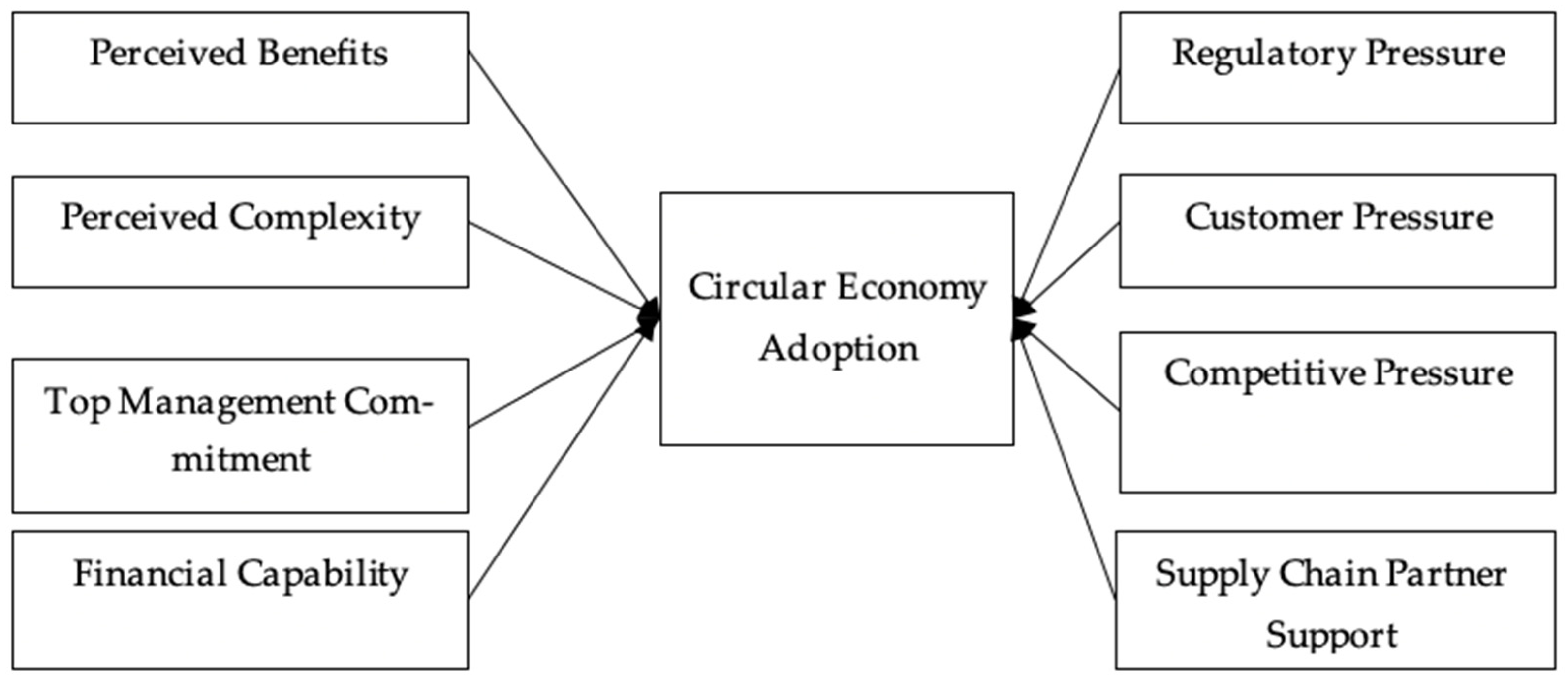
From the abovementioned discussions, a research model is developed as shown in
Figure 1:
4. Results
Common Method Bias Assessment: Harman’s single-factor test was conducted by performing an unrotated principal component factor analysis on all measurement items. The results showed that the single factor extracted accounted for only 28.039% of the total variance. As this value is well below the 50% threshold, it suggests that common method bias is not a significant concern in this study.
To test the proposed hypotheses, the author conducted a multiple linear regression analysis. Prior to examining the individual regression coefficients, the essential assumptions of the model were assessed. The Durbin–Watson statistic was 1.717, which falls within the acceptable range of 1.5 to 2.5, indicating that there was no serious first-order autocorrelation in the data. In addition, the Variance Inflation Factor (VIF) values for all independent variables were below the threshold of 5, suggesting that no significant multicollinearity existed among the independent variables.
The results of the ANOVA in
Table 2 indicate that the overall regression model is highly significant (F(8, 151) = 59.927,
p < 0.001). This confirms that the combination of independent variables (drivers and barriers) provides a statistically significant explanation for the variation in the dependent variable (the level of CE adoption). As shown in
Table 3, the multiple correlation coefficient (R) is 0.872, suggesting a strong linear relationship between the set of independent variables and the dependent variable. More importantly, the adjusted coefficient of determination (Adjusted R
2) is 0.748, implying that the proposed model explains approximately 74.8% of the variation in the level of CE adoption among logistics SMEs in Vietnam. This represents a high level of explanatory power, indicating the model’s strong fit and predictive capability.
The results of the multiple linear regression analysis, presented in
Table 4, were used to test the proposed hypotheses. Among the eight independent variables included in the model, five were found to be statistically significant at the 95% confidence level (Sig. < 0.05), while the remaining three variables showed no significant effect on the level of CE adoption. The specific results are as follows:
The regression results reveal that support from supply chain partners (SCPS) exerts the strongest and most positive influence on the level of CE adoption among logistics SMEs in Vietnam (β = 0.355;
p < 0.001). This finding not only provides strong support for H8 but also highlights a critical insight: in resource-constrained business environments, collaboration and support from external partners serve as a pivotal driving force, often surpassing internal factors or other external pressures. This result is consistent with previous studies emphasizing that the adoption of sustainable initiatives is not an isolated effort but requires coordinated actions across the entire supply chain [
3].
In Vietnam, this observation is particularly valid as many logistics SMEs embark on their “green transformation” journey primarily under the guidance and requirements of major clients, especially multinational corporations and export-oriented firms. Such support manifests not only as pressure but also through technical knowledge sharing, co-designing reverse logistics processes, or developing common standards for sustainable packaging. Furthermore, the rise of shared-economy models in logistics, such as collaborative efforts to reduce empty truck runs, illustrates the role of partnership in enhancing resource efficiency.
Descriptive statistics further show that while SCPS has the highest impact, its mean scores remain relatively low (ranging from 2.61 to 3.24). This suggests that although the actual level of partner support is still limited, it remains the most decisive factor influencing CE adoption behavior. The implication is clear: even marginal increases in supply chain collaboration may serve as a powerful lever to accelerate green transformation among logistics SMEs. Therefore, building effective mechanisms for cooperation among supply chain actors should be a top priority for both policymakers and large enterprises aiming to promote sustainability in the logistics sector.
The regression results indicate that competitive pressure (COMP) has a positive and highly significant effect on the level of CE adoption among logistics SMEs in Vietnam (β = 0.331;
p < 0.001). With the second-highest standardized beta coefficient, this factor emerges as one of the strongest drivers of green transformation. The result strongly supports H7 and reinforces the role of mimetic pressure in Institutional Theory, particularly in highly competitive service industries such as logistics [
12].
In Vietnam’s evolving logistics market, competition is no longer confined to price. Pioneering firms, including large domestic and international logistics companies, are increasingly adopting sustainable and circular practices as a means of differentiation and brand positioning. Initiatives such as low-carbon delivery, the use of electric vehicles, recycled packaging, and environmental certification have created new industry benchmarks, pressuring SMEs to adapt in order to remain competitive. To avoid losing environmentally conscious clients and market share, SMEs are compelled to adopt similar CE initiatives.
Descriptive analysis supports this observation. The mean values for competitive pressure variables range from 2.96 to 3.42, with the highest scores for COMP3 (“We feel pressure to adopt CE to avoid falling behind…”, Mean = 3.42) and COMP1 (“Our main competitors have already adopted CE practices…”, Mean = 3.26). This demonstrates that Vietnamese logistics SMEs are highly aware of competitors’ green movements and perceive them as tangible market pressures. Unlike internal factors that can be postponed, competitive pressure is immediate and survival-oriented, making it a powerful driver that pushes managers to integrate CE practices into their business strategies to maintain and strengthen competitiveness.
The regression results show that top management commitment (TMC) has a positive and statistically significant effect on CE adoption among logistics SMEs in Vietnam (β = 0.237;
p < 0.001). This finding strongly supports H3, reaffirming the pivotal role of leadership in steering strategic change initiatives, consistent with prior research that underscores the importance of managerial commitment in implementing sustainability programs [
13,
22].
In SMEs, where strategic decisions are often concentrated in a few key individuals, leadership commitment becomes even more critical. CE adoption in Vietnam requires not merely operational adjustments but a long-term strategic orientation which is an outcome achievable only when top managers explicitly prioritize sustainability over short-term financial gains. Such commitment is reflected in communicating CE’s strategic importance to employees, fostering an innovation-oriented organizational culture, and actively participating in the approval and support of green initiatives.
Descriptive statistics show moderate mean values for TMC variables (TMC1 = 2.83, TMC2 = 2.62, TMC3 = 3.04). Although the overall commitment level is not particularly high, its strong statistical significance indicates that in firms where leaders demonstrate genuine engagement, CE adoption is substantially higher. Conversely, insufficient leadership commitment remains one of the most critical internal barriers preventing successful CE implementation. Therefore, raising awareness and strengthening managerial commitment among business owners and executives represent foundational prerequisites toward fostering CE practices in Vietnam’s logistics SME sector.
The regression results indicate that regulatory pressure (RP) has a positive and statistically significant impact on CE adoption among logistics SMEs in Vietnam (β = 0.164;
p = 0.002). This finding supports H5, reinforcing the role of coercive pressure in Institutional Theory as an essential driver of compliance and behavioral change in environmental practices [
12].
In Vietnam, a developing economy still refining its environmental regulatory framework, this result carries particular relevance. The introduction of stricter laws and regulations, such as the 2020 Environmental Protection Law with specific provisions on EPR, has established clearer and more enforceable compliance requirements. Logistics SMEs, as key links in the supply chain, cannot remain outside these regulatory obligations. The need to comply to avoid financial penalties, maintain operating licenses, and ensure business legitimacy acts as a compelling force, prompting firms to adopt CE-related practices such as waste management, fuel optimization, and reverse logistics systems.
Descriptive statistics show moderately high mean values for regulatory pressure variables (ranging from 2.88 to 3.13). Notably, RP4 (“We anticipate that environmental regulations will become increasingly stringent…”, Mean = 3.13) recorded the highest score, indicating firms’ awareness of tightening state control. Although regulatory pressure is not as strong a driver as market-related pressures (competition or partnerships), it establishes a baseline compliance threshold that all firms must meet. Hence, governmental policies and regulations serve as fundamental catalysts, creating an environment in which sustainable practices are no longer voluntary but progressively mandatory, thereby pushing logistics SMEs toward change.
The regression results show that customer pressure (CP) exerts a positive but marginally significant effect on CE adoption among logistics SMEs in Vietnam (β = 0.080; p = 0.055). This provides partial support for H6, suggesting that normative pressure from customers contributes to CE adoption, although its impact is weaker than other factors in the model.
In practice, customer pressure is most evident when logistics SMEs are part of supply chains serving multinational corporations or large exporters. These clients, subject to strict sustainability standards in global markets, often require logistics partners to meet specific environmental criteria such as emissions reporting, use of clean vehicles, and possession of environmental management certifications [
13]. Meeting these requirements becomes a prerequisite for securing and maintaining valuable contracts, thereby creating direct economic incentives for CE adoption.
Descriptive statistics show moderate mean values for customer pressure variables (ranging from 2.86 to 3.17). This suggests that while demand for green logistics is increasing, it is not yet widespread or consistent across the market, particularly among smaller domestic clients. The marginal significance (p = 0.055) likely reflects this reality: customer pressure is an emerging but not yet dominant driver of CE adoption. Nevertheless, as sustainability awareness strengthens and more large firms incorporate green criteria into supplier selection processes, customer pressure is expected to evolve into a more powerful and visible force accelerating CE adoption within Vietnam’s logistics sector.
Contrary to our initial hypotheses and much of the existing literature, this study found that PB (β = 0.018, p = 0.682), PC (β = 0.032, p = 0.480), and FC (β = 0.041, p = 0.320) did not have a statistically significant impact on the level of CE adoption among logistics SMEs in Vietnam. While the overarching dominance of external pressures offers a general explanation, a more contextualized analysis—grounded in the specific characteristics of Vietnam’s emerging economy and SME landscape—provides a deeper understanding. These non-significant findings suggest that for these firms, the decision-making process for sustainability initiatives is fundamentally shaped by external exigencies rather than internal evaluations of benefits or constraints.
Firstly, the non-significance of PB (H1) can be attributed to the prevalence of a compliance-driven rather than benefit-driven mindset. In Vietnam’s highly competitive logistics market, where logistics SMEs in Vietnam operate on thin profit margins, managerial focus is heavily skewed towards short-term survival. While managers may conceptually acknowledge the long-term benefits of CE, such as enhanced brand reputation or future cost savings, these advantages are often perceived as long-term and intangible relative to the immediate pressures of securing contracts (CP, H6) and avoiding regulatory penalties (RP, H5). As a result, responses to urgent external forces overshadow strategic considerations related to future benefits.
Secondly, the lack of impact from PC (H2) can be understood through the “learning-by-doing” and “pragmatic adoption” approach common among entrepreneurial Vietnamese SMLEs. Instead of being deterred by the holistic complexity of a full CE transformation, these firms tend to adopt incremental, manageable practices that are either demanded by partners or offer quick, tangible results (e.g., optimizing backhauling, basic packaging reuse). The strong, significant impact of SCPS (H8, β = 0.355, p < 0.001) reinforces this point, suggesting that complexity is often mitigated through collaboration. Larger clients or partners frequently provide the necessary technical guidance and standardized procedures, effectively lowering the complexity barrier and making the adoption of specific practices more accessible without requiring a full grasp of the entire CE system.
Finally, the most counter-intuitive finding the non-significance of FC (H4) highlights the importance of “resource-seeking” behavior over a static “resource-possessing” state. In Vietnam’s relationship-based business culture, opportunities and resources are often unlocked through strong partnerships rather than being solely dependent on a firm’s internal financial standing. A key customer may offer financial support for a joint CE project, or a collaborative venture could grant access to shared assets, bypassing the need for large upfront capital investment by the logistics SMEs in Vietnam. Furthermore, the significant influence of RP (H5, β = 0.164, p = 0.002) implies that when faced with mandatory compliance, firms are compelled to find the necessary financial means, regardless of their pre-existing financial situation. This suggests that financial adaptability and the ability to leverage external networks are more critical than the amount of internal capital readily available.
In conclusion, these non-significant results do not invalidate the importance of benefits, complexity, or financial resources in other contexts. Rather, they reveal a crucial contextual insight: for logistics SMEs in Vietnam in a dynamic and pressure-intensive emerging market like Vietnam, external environmental forces act as the primary, immediate catalysts for change, compelling firms to adapt pragmatically and leverage their network to overcome internal barriers (
Table 5).
6. Conclusions
In the context of a global economy increasingly oriented toward sustainability, the adoption of the CE plays a crucial role in the competitiveness and survival of logistics enterprises. Through data collection, processing, and synthesis supported by regression modeling, this study has identified and evaluated the key factors influencing CE adoption among logistics SMEs in Vietnam. The results indicate that five factors SCPS, COMP, TMC, RP, and CP all exert a positive influence on CE adoption. Among them, SCPS and COMP are the most influential drivers.
Theoretical Contributions: First, this research enriches the literature on sustainable innovation adoption by successfully developing and empirically validating an integrated theoretical model. By synthesizing the perspectives of three foundational frameworks (TOE, RBV, and Institutional Theory), the model demonstrates strong explanatory power (Adjusted R2 = 0.748), offering a more comprehensive explanation than studies relying on a single framework. Second, the study extends the applicability of these theories to a less-explored and specific context: service-based SMEs within an emerging economy, as opposed to large manufacturing firms in developed nations. The findings reveal the overpowering influence of the environmental context relative to internal factors, providing a crucial theoretical insight into how the drivers of CE adoption may differ across economic settings. Third, by offering a contextualized theoretical explanation for the non-significant results (PB, PC, FC) through concepts such as a “compliance-driven mindset,” a “learning-by-doing” approach, and “resource-seeking behavior,” this study offers a novel perspective. It suggests that in emerging markets, the influence of internal perceptions and resource endowments may be moderated by the intensity of external environmental pressures, a proposition that opens new avenues for theoretical exploration.
Practical Contributions and Policy Implications: Practically, this research offers meaningful insights by reflecting and evaluating the actual drivers and barriers faced by Vietnamese logistics SMEs. These findings provide a foundation for proposing effective strategies to facilitate the green transition. Five main recommendations have been highlighted: (1) Develop strategic supply chain partnerships to actively promote CE practices. (2) Treat sustainable competition as a non-negotiable requirement, integrating CE into competitive strategies. (3) Empower leadership to take a pioneering role, ensuring top management commitment is visible and actionable. (4) Promote government-led supply chain collaboration programs that encourage ecosystem-wide cooperation. (5) Leverage regulatory policies as a dual lever, combining incentives and enforcement to maximize the adoption of CE practices.
Limitations and Future Research: Despite its contributions, this study is subject to several limitations that provide clear directions for future research. First, the research design has inherent constraints. The cross-sectional nature of our data provides a static snapshot of the factors influencing CE adoption, limiting our ability to infer causality or capture temporal dynamics. Second, the reliance on self-reported measures from single respondents may be subject to potential biases, although our diagnostic tests indicated this was not a significant concern. Third, regarding generalizability, the findings are specific to the Vietnamese context and may not be directly transferable to other emerging economies with different institutional and market structures. Future research should address these limitations. A longitudinal research design is recommended to better understand causal relationships and how adoption evolves over time. Triangulating self-reported data with objective secondary data or insights from multiple respondents within each firm would enhance validity. Furthermore, comparative studies across different countries are needed to test the robustness of our model. Finally, future studies should employ more advanced analytical techniques such as Structural Equation Modeling (SEM) or Partial Least Squares-Structural Equation Modeling (PLS-SEM). This would allow for the testing of more complex mediating and moderating effects, for instance, examining whether internal capabilities like Top Management Commitment mediate the path from external pressures to CE adoption, or whether Supply Chain Partner Support moderates the impact of Perceived Complexity. By combining longitudinal designs with these sophisticated modeling techniques, future research can provide a deeper and more dynamic understanding of the mechanisms driving sustainable innovation in this sector.