Next Article in Journal
Corporeity and Ecological Awareness: An Experiential Study with Children and Adolescents
Previous Article in Journal
Bio-Based Self-Assembly and Hydrophobic Modification for Simultaneously Enhancing Flame Retardancy and Water Resistance of Wood
error_outline You can access the new MDPI.com website here. Explore and share your feedback with us.
 
 
Article

A Study on the Impact of Artificial Intelligence on Urban Green Total Factor Efficiency from the Perspective of Spatial Spillover and Threshold Effects

School of Economics, Shandong Normal University, Jinan 250300, China
*
Author to whom correspondence should be addressed.
Sustainability 2026, 18(1), 519; https://doi.org/10.3390/su18010519
Submission received: 5 December 2025 / Revised: 31 December 2025 / Accepted: 31 December 2025 / Published: 4 January 2026

Abstract

In recent years, the rapid advancement of artificial intelligence (AI) technology has exerted profound implications for urban green total factor efficiency (GTFE). Drawing on panel data of 279 Chinese cities from 2012 to 2021, this study empirically examines the impact of AI on urban GTFE from multi-dimensional perspectives including green finance and new-quality productive forces. The key findings are as follows: ➀ AI significantly enhances urban GTFE with a nonlinear threshold effect, and this conclusion remains robust after multiple robustness tests incorporating machine learning models and econometric approaches. ➁ Heterogeneity analysis reveals that AI exerts significantly heterogeneous effects across different regional locations, city sizes, urban hierarchies, and between transportation hubs/non-hubs and old industrial bases/non-bases. While an overall positive correlation is observed, the positive effect of AI is not statistically significant in western China, mega-cities, large cities, and central cities; conversely, an insignificant negative effect is detected in central-eastern China and old industrial bases. ➂ Mechanism tests demonstrate that AI facilitates GTFE improvement through channels such as upgrading green finance development and advancing new-quality productive forces. ➃ Spatial spillover effect analysis indicates that AI generates a positive spatial spillover effect on the GTFE of local cities. Based on these findings, targeted policy recommendations are proposed to promote urban GTFE enhancement and achieve sustainable development.

1. Introduction

The Report to the 20th National Congress of the Communist Party of China (CPC) highlights: “Promote the integrated and clustered development of strategic emerging industries, and foster several new growth drivers such as next-generation information technology and artificial intelligence”. Anchored in core technologies including industrial robots, large language models (LLMs), deep learning, and neural networks, artificial intelligence (AI) has emerged as a critical driver propelling digital industrialization and industrial digitalization in China [1]. In recent years, AI technology has permeated all sectors of economic and social development with unprecedented breadth and depth, solidifying its role as a core driver behind the global technological revolution and industrial transformation. Amid this wave of technological advancement, China has showcased robust development momentum. Data from the World Intellectual Property Organization (WIPO) shows that China has maintained the global top spot in AI-related patent applications for consecutive years, with internationally advanced capabilities particularly in critical technological domains including computer vision and natural language processing. Per the 2023 China AI Technology Transformation Industry Development White Paper by Frost & Sullivan, China’s AI industry achieved a market size of RMB 371.6 billion in 2022, accounting for roughly 20% of the global AI market and demonstrating a robust growth momentum.
Meanwhile, data from the U.S.-based economic research firm Rhodium Group (January 2022) indicates that urban carbon emissions in China account for approximately 80% of the national total, rendering cities the primary source of national carbon emissions. Cities with high carbon intensity face complex and multifaceted challenges—including biodiversity loss, soil and water pollution, and public health risks stemming from carbon emission sources—which have impeded the advancement of high-quality economic development in China [2]. This suite of ecological crises has galvanized the international community to converge on a consensus regarding sustainable development models, propelling the global economy toward a green and low-carbon transition. As spatial carriers of key economic activities and resource consumption, cities are confronted with dual pressures: resource and environmental constraints, and economic restructuring. Against this backdrop, advancing the shift of development paradigms toward green and low-carbon trajectories has become a global consensus, where enhancing energy efficiency and building a clean, low-carbon energy system serve as the core pathways to realize this shift.
Existing research on the economic impacts of artificial intelligence (AI) predominantly adopts two main strands. First, qualitative studies focus on technological diffusion and application, impacts on the labor market, and development trends of the intelligent industry [3]. Second, quantitative research constructs measurement frameworks based on the economic attributes of AI to assess its influences on household consumption, factor income distribution, and employment [4]. In the realm of green growth, scholars have predominantly explored AI’s contributions to green total factor efficiency (GTFE) or green economic efficiency from the perspective of intelligent manufacturing amid the big data era, and generally recognize green development as a core strategy for China’s economy to achieve quality improvement and efficiency enhancement [5]. By substantially reducing the threshold for information search, AI effectively empowers regional low-carbon innovation initiatives and exhibits core effectiveness in key areas such as optimal resource allocation, demand structure adjustment, and human capital development [5,6]. Confronted with rigid resource and environmental constraints, AI, as a key enabler, not only provides critical support for cross-regional allocation of low-carbon innovation resources and promotion of knowledge and technology spillovers [7] but also improves production efficiency by catalyzing upgrades in the labor structure, thereby fully unlocking digital dividends and accelerating the process of regional green transition [8]. By optimizing the operational efficiency of systems such as energy, transportation, and industry, AI reduces resource input and carbon emissions while boosting economic output, thus emerging as a core driver for the improvement of urban GTFE. Nevertheless, debates have emerged regarding AI’s potential to hinder the achievement of global “net-zero” emission targets. According to Google’s 2024 Environmental Report, driven by the expansion of AI-supported data centers, the company’s greenhouse gas emissions surged by 48% in 2023 compared to 2019. Microsoft also noted in May 2024 that its emissions have increased by nearly 30% since 2020, largely attributable to the construction of data centers. The Brookings Institution further indicated that energy consumption associated with AI training will tend to rise rather than decline over time. Therefore, in-depth exploration of how AI technology empowers urban green energy efficiency at the micro level—whether it accelerates or impedes the global attainment of “net-zero” emissions—not only holds significant theoretical value but also offers practical implications for the formulation of policies related to urban green and sustainable development.
While existing studies have yielded notable insights into the application of AI in urban green and low-carbon development, several research gaps remain: (1) Limitations in data-driven research approaches. Current relevant studies predominantly focus on the macro level, and a holistic analytical framework integrating diverse city typologies has not yet been fully established. Meanwhile, the heterogeneous nuances in the relationship between AI application and GTFE across cities with varying development foundations and resource endowments have not been thoroughly explored. (2) Gaps in mechanism analysis. Existing literature provides fragmented discussions on the intrinsic pathways of AI application, and systematic research on how AI facilitates the improvement of urban GTFE through key dimensions—such as advancing green finance development and fostering new-quality productive forces—remains scarce. (3) Insufficient exploration of spatial spillover effects. Existing studies have not examined the promotional effect of urban AI development on GTFE from a spatial perspective, and targeted thematic analysis and empirical verification of the spatial spillover effects and impact mechanisms generated across regions are still lacking.
Building on this, the present study utilizes panel data of 279 Chinese cities spanning 2012–2021 to conduct a series of empirical analyses. It integrates green finance development and new-quality productive forces (NPF) into the theoretical framework, and conducts an in-depth investigation into the impact of urban artificial intelligence (AI) application on green total factor efficiency (GTFE), aiming to provide actionable insights for the sustainable economic development of Chinese cities. Compared with existing literature, the innovations of this study are as follows: First, in terms of the theoretical framework, this study is the first to embed AI application into the dynamic evolution model of GTFE, thereby theoretically expanding the boundary of green productivity literature. It clarifies how AI improves low-carbon transition efficiency through mechanisms of resource allocation optimization and innovation-driven development, remedying the inadequate exploration of AI’s core role in green productivity in prior research. Second, regarding measurement methods, a multi-dimensional and comprehensive indicator system is constructed to overcome the limitation of relying on a single variable (e.g., AI patent counts) in existing studies, thus enhancing the accuracy and theoretical applicability of GTFE measurement. Third, in terms of identification strategy, this study innovatively combines machine learning approaches with econometric methods to ensure the rigor of causal identification, transcending the single econometric paradigm adopted in traditional literature. Fourth, concerning mechanism analysis, this study investigates the impact pathways of AI via channels including green finance and NPF, and adopts a path analysis model to examine the synergistic effects among multiple mechanisms, providing a complete causal chain theory for the literature on AI and green productivity. Fifth, from spatial and micro perspectives, this study fills the research gap regarding insufficient exploration of spatial spillover effects in existing literature by empirically examining the cross-regional spillover effect of AI application through the spatial Durbin model. At the micro level, a static game model is developed to analyze enterprises’ optimal decision-making under government green policies, thereby revealing how policy interventions guide enterprises’ AI development directions and supplementing the micro-foundation for macro empirical analysis.
These innovations not only deepen the theoretical depth of the literature on AI and green productivity but also provide operable empirical support for policy formulation.

2. Materials and Methods

2.1. Theoretical Analysis and Research Hypotheses

2.1.1. Direct Effects

Drawing on the Endogenous Growth Theory [9], artificial intelligence (AI), as a General Purpose Technology (GPT), directly drives the improvement of urban green total factor efficiency (GTFE) through the dual mechanisms of technological progress and factor allocation optimization. First, consistent with the production function theory, AI substantively transforms the factor input structure by embedding into industrial internet of things (IIoT) systems. As a form of biased technological progress, AI enables the “technological substitution” of natural capital (e.g., energy) by replacing energy-intensive and pollution-heavy extensive factor inputs via real-time monitoring and dynamic optimization of production processes, thereby reducing the carbon emission intensity per unit of output at the micro level [10]. Second, at the macro allocation level, AI restructures the traditional “capital-labor-energy” allocation structure through the in-depth integration of data factors with capital and labor. This mitigates factor misallocation induced by information asymmetry and significantly enhances total factor productivity [11].
However, AI’s productivity-enhancing effect is bounded by technological diffusion limits, exhibiting non-linear characteristics. Drawing on the Absorptive Capacity Theory, the conversion of new technologies into productive capacity depends on the recipient’s prior knowledge stock. As the core carrier of knowledge absorption, human capital exhibits a threshold effect: only when the human capital structure exceeds a specific threshold can organizations effectively identify, digest, and apply AI-induced green innovations [12,13]. Meanwhile, rooted in the Network Externality Theory, the maturity of digital infrastructure determines the scale effects and synergy effects of AI technology. In regions with underdeveloped digital infrastructure, high data processing and transmission costs impede technological penetration, rendering sustained systematic green optimization challenging [14]. In summary, this study proposes the following hypothesis:
Hypothesis 1.
AI application exerts a significant positive effect on the improvement of urban GTFE, with a non-linear threshold effect.

2.1.2. Indirect Effects

(1) The Impact Effect of Green Finance Level
Drawing on the Information Asymmetry Theory and Credit Rationing Theory, green financial markets have long been plagued by adverse selection and moral hazard stemming from inadequate environmental information disclosure. By mitigating information frictions, artificial intelligence (AI) application enhances the role of green finance in boosting green total factor efficiency (GTFE) through two complementary channels. On one hand, AI-powered big data analytics and knowledge graph technologies enable precise identification of corporate environmental risks, reducing the search and monitoring costs for financial institutions, rectifying asset pricing distortions, and channeling credit resources toward technologically advanced, environmentally friendly green enterprises [15]. On the other hand, in line with the Resource Allocation Efficiency Theory, the AI-enabled green financial system reallocates capital from high-carbon to low-carbon sectors through capital’s guiding function, achieving Pareto improvement. This capital reallocation not only lowers financing costs but also exerts a “compelling effect” that drives high-pollution enterprises to transition toward cleaner production, thereby improving the overall green output efficiency of urban economies [16,17]. Consequently, AI can indirectly promote GTFE by optimizing financial resource allocation and strengthening risk governance.
(2) Impact of New Quality Productive Forces
Drawing on Schumpeterian Innovation Theory and Evolutionary Economics, new-quality productive forces (NPF) represent an advanced form of productivity driven primarily by technological innovation, whose essence resides in the process of “creative destruction.” As the core engine of NPF, AI advances low-carbon transitions by reshaping the techno-economic paradigm. First, leveraging its deep learning and autonomous decision-making capabilities, AI accelerates the intelligent transformation of the entire lifecycle from R&D and design to manufacturing. This technological breakthrough significantly shortens the time lag in knowledge acquisition and transformation, facilitating the reallocation of labor from repetitive tasks to high-value-added innovative activities and laying a cognitive foundation for green technological breakthroughs [18,19]. Second, in line with the Industrial Structure Evolution Theory, AI-driven NPF expedites the replacement of traditional energy-intensive industries with emerging sectors characterized by high added value and low carbon emissions. This structural transformation reduces the economic system’s dependence on fossil energy, achieving decoupling between economic growth and carbon emissions by improving energy efficiency and optimizing the industrial structure, thereby fundamentally driving the leapfrog development of GTFE [20,21]. In summary, this study proposes the following hypothesis:
Hypothesis 2.
AI application promotes urban GTFE through two mechanisms: the green finance enhancement effect and the NPF improvement effect.

2.1.3. The Spatial Spillover Effect

Drawing on the New Economic Geography and Technology Diffusion Theory, the impact of artificial intelligence (AI) on green total factor efficiency (GTFE) exhibits spatial correlation features that transcend geographical borders. First, consistent with the demonstration-imitation effect, the green production models and management innovations attained by core cities via AI application demonstrate significant positive externalities. Through supply chain connections and labor mobility, advanced tacit knowledge and low-carbon technologies can diffuse across regions, prompting enterprises in adjacent areas to engage in imitative learning and thereby generating positive spatial spillover effects [22,23]. Second, rooted in the Agglomeration Economy Theory, AI enhances the spatial agglomeration and specialized division of labor in green industries. By aggregating high-quality talent and computing resources, core cities evolve into green innovation hubs; the consequent knowledge spillovers reduce the R&D costs and trial-and-error risks of surrounding regions, driving the synergistic improvement of GTFE across entire urban agglomerations [24,25]. In summary, this study proposes the following hypothesis:
Hypothesis 3.
AI application exerts a positive spatial spillover effect on the improvement of urban GTFE.
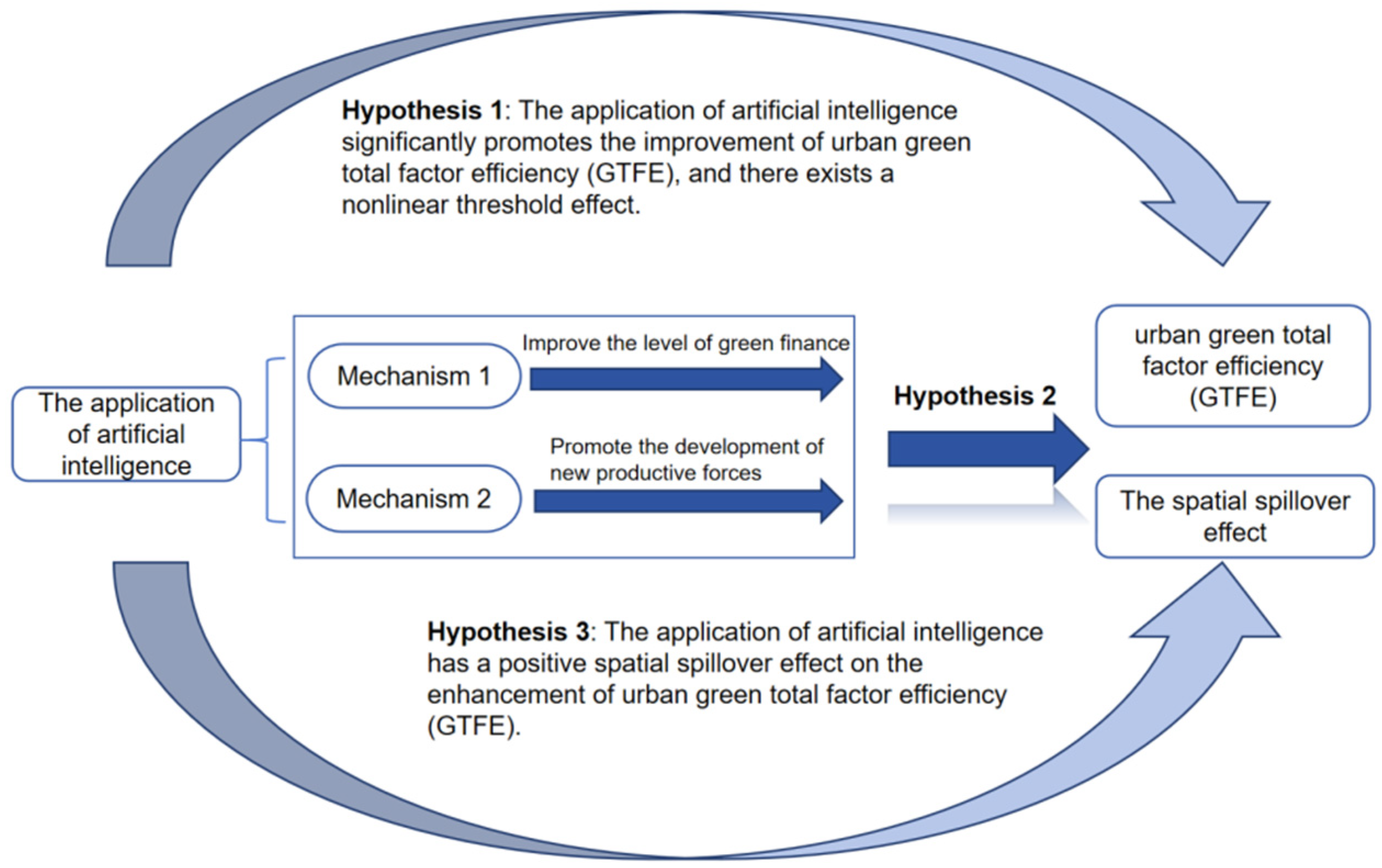
Overall, the application of artificial intelligence (AI) not only directly promotes the improvement of urban green total factor efficiency (GTFE) but also indirectly facilitates such improvement through channels including advancing urban green finance and boosting the development of new-quality productive forces (NPF), thereby supporting urban green and low-carbon transitions. The study further reveals that AI application exerts a significant positive spatial spillover effect on urban GTFE—specifically, AI development in a given city not only enhances local GTFE but also spreads to and drives the coordinated improvement of surrounding cities. Figure 1 below illustrates the research framework of this study.

2.2. Data Sources and Variable Selection

2.2.1. Data Source

This study examines the mechanism by which artificial intelligence (AI) technology influences urban green total factor efficiency (GTFE), employing panel data of Chinese prefecture-level cities for empirical investigation. In the data selection process, this study balances data availability and timeliness, resulting in a final research period of 2012–2021. Data sources include authoritative sources, including the International Federation of Robotics (IFR) Annual Statistical Report, the China City Statistical Yearbook, the China Financial Yearbook, and publicly available government reports of various municipalities. Among these, data from the China City Statistical Yearbook draws on the research of Mei Dawei et al. [26]. To mitigate the influence of outliers on the estimation outcomes, the raw data were subjected to standardized preprocessing prior to econometric analysis, with specific steps as follows: (1) excluding city samples with a data missing rate exceeding 15%; (2) imputing non-continuous missing values via linear interpolation. Following these procedures, this study ultimately constructs a balanced panel dataset comprising 279 prefecture-level cities, with a total of 2790 valid observations.

2.2.2. Variable Selection

(1) Dependent Variable:
The dependent variable in this study is urban-level green total factor efficiency (GTFE). It should be clarified upfront that the GTFE herein differs from the traditional total factor productivity growth rate derived from the Solow residual or growth accounting methods, as well as from single-dimensional carbon emission performance. In a strict economic sense, this indicator refers to “environmental technical efficiency” measured via frontier analysis methods by incorporating environmental pollutants as undesirable outputs into the production function, based on the Joint Production Theory. Its core logic lies in measuring the comprehensive distance of decision-making units (DMUs) relative to the production possibility frontier under multi-dimensional factor inputs and environmental constraints. Compared with traditional TFP, which only considers desirable outputs (i.e., GDP) and ignores the negative externalities of environmental pollution, the indicator in this study is rooted in the green growth theory [27] and the sustainable productivity framework [28,29]. It emphasizes the internalization of environmental externalities in the production function, meaning that the assessment of production efficiency depends not only on technological progress but also on the deduction of pollution costs [30,31]. In contrast to carbon emission performance—which typically overlooks endowment differences in factors such as capital and land—this indicator captures the penalty effect of undesirable outputs (e.g., industrial “three wastes”) during the transformation of inputs (e.g., capital, labor) into desirable outputs (e.g., GDP) through the DEA framework. Thus, it provides an operational tool that goes beyond single-dimensional carbon performance and reflects the comprehensive efficiency of factor allocation.
For the specific measurement, referring to the existing literature [30,31], this study adopts the Super-SBM (Super Slack-Based Measure) model with undesirable outputs. The rationale for selecting this model is that traditional DEA models (e.g., CCR, BCC) fail to effectively handle input and output slack variables and cannot further differentiate between multiple cities that simultaneously reach the frontier (with an efficiency value of 1). The Super-SBM model not only directly identifies input redundancy and output insufficiency through non-radial settings but, more importantly, allows efficiency values of effective DMUs to exceed 1. This enables strict ranking of high-efficiency urban samples and enhances the accuracy of regression analysis. The specific calculation formula is presented as follows.
m i n θ = 1 1 m i = 1 m s i x x i k 1 + 1 r 1 + r 2 ( s = 1 r 1 p s y d y d s k + q = 1 r 2 p q y u y q u k ) s . t . j = 1 ,   j k n x i j λ j + s i x = x i k ,   i = 1 ,   ,   m j = 1 ,   j k n y d s j λ j p s y d = y d s k ,   s = 1 ,   ,   r 1 j = 1 ,   j k n y q u j λ j + p q y u = y q u k ,   q = 1 ,   ,   r 2 x i k x k ,   y d s k y d k ,   y q u k y u k ,   λ j 0 ,   j = 1 ,   2 ,   ,   n
In the above formula, θ denotes the green total factor efficiency (GTFE) of the k-th decision-making unit (DMU, i.e., city); n represents the number of DMUs (279 cities); m is the number of input variables; r1 and r2 stand for the number of desirable outputs and undesirable outputs, respectively; x i k denotes an element of the input matrix; y d s k and y q u k represent elements of desirable outputs and undesirable outputs, respectively; λⱼ is the weight vector; s i x , p s y d and p q y u denote input slack, desirable output shortfall, and undesirable output slack, respectively.
Input indicators are selected based on production function theory (Cobb–Douglas framework), encompassing capital, labor, land, energy, and water resources to fully reflect resource endowment constraints. Among these, the capital stock is estimated using the perpetual inventory method (PIM):
K t = ( 1 δ ) K t 1 + I t P t
I t , P t , K t 1 and δ denote the nominal investment, price index, initial capital stock, and depreciation rate in year t, respectively. Given the data availability at the prefecture-level city scale, this study follows the methodology of existing literature [32] and uses total social fixed asset investment (TSFAI) as a proxy for current-period investment. The depreciation rate is set at 10.96%, while the price index is adjusted using the GDP deflator. The initial capital stock K 0 is calculated via the growth rate method:
K 0 = I 0 g + δ
Herein, g denotes the asset investment growth rate, set at 10%. Labor input is measured by year-end employment; land is proxied by built-up area; energy and water resources are characterized by total social electricity consumption and water consumption, respectively, reflecting the constraints of resource-intensive production.
To reflect real growth by excluding price effects, real GDP is adopted as the desirable output. Nominal GDP is adjusted to real values with 2011 as the base year using the GDP deflator of the province where each city is located. Given the limitations in statistical scope and timeliness of urban-level carbon emission data in China, and considering that industrial emissions constitute the primary source of environmental pollution, this study selects industrial SO2 emissions, industrial soot (dust) emissions, and industrial wastewater discharge as undesirable outputs to capture the external cost of environmental pollution. Missing values are addressed using interpolation and mean imputation methods. Detailed information on the specific indicators is presented in Table 1.
(2) Explanatory Variables:
The explanatory variable in this study is artificial intelligence (AI); yet, the subsequent empirical analysis focuses primarily on industry-specific AI applications rather than general-purpose AI. Specifically, this study employs industrial robot penetration density as its core econometric measure, aimed at capturing the intensity of AI adoption in the manufacturing sector. Drawing on the “Bartik instrumental variable” approach utilized by Acemoglu and Restrepo (2020) [33] to construct regional robot density indicators for the U.S. in their research on robots’ impact on the U.S. labor market, this study refers to existing literature [34] to develop a prefecture-level industrial robot penetration density indicator as a proxy for AI. First, a one-to-one correspondence was established between the industry classification in the International Federation of Robotics (IFR) data and that in China’s Second Economic Census data, thereby obtaining annual installation and stock data of industrial robots across various industries in China. Subsequently, by integrating industry-specific robot data and employment figures, the industrial-level industrial robot density was calculated. On this basis, 2008 was designated as the benchmark year to estimate the weights of industry-specific robot density for each city, and the industrial robot density of each city in different years was ultimately computed. The specific calculation method is presented as follows:
R o b o t j t = s = 1 S e m p l o y s , j , t = 2008 e m p l o y j , t = 2008 × A I s t e m p l o y s , t = 2008
Herein, s denotes the aggregate of manufacturing industries; R o b o t j t represents the industrial robot density of city j in year t; A I s t is the robot stock of industry s in year t; e m p l o y s , t = 2008 denotes the employment in industry s in 2008; e m p l o y s , j , t = 2008 refers to the employment in industry s of city j in 2008; A I s t / e m p l o y s , t = 2008 stands for the industry-level robot density in each year; and e m p l o y s , j , t = 2008 / e m p l o y s , t = 2008 is the ratio of employment in industry s of city j to the total employment in city j, which serves as the weight for the robot density of each industry. Finally, the industry-level industrial robot densities are weighted to derive the city-level industrial robot density.
(3) Control Variables:
To address omitted variable bias and enhance the accuracy and validity of the empirical results, this study draws on existing literature [35] to select the following control variables: ➀ Foreign Direct Investment (FDI), proxied by the number of foreign-invested enterprises; ➁ Financial Development Level (Fin), measured as the ratio of the balance of deposits and loans of financial institutions to GDP; ➂ Urbanization Level (Urban), proxied by the share of urban population in the total population; ➃ Degree of Openness (Open), measured as the ratio of total import and export trade to GDP; ➄ Urban Industrial Structure (Ind), proxied by the share of the added value of the tertiary industry in GDP.
(4) Mechanism Variables
➀ Green Finance (GF): Drawing on the methodological approach of existing studies [36], this study develops an evaluation framework for urban green finance encompassing seven dimensions: green credit, green investment, green insurance, green bonds, green support, green funds, and green equity. The entropy weight method is adopted to determine the weights of each indicator. Detailed definitions of the specific indicators are provided in Table 2.
➁ The New Type of Productive Force (NPF): New-quality productive forces (NPF) denote an advanced form of productivity primarily driven by innovation, moving beyond traditional economic growth models and productivity development pathways. Characterized by high technology, high efficiency, and high quality, NPF is congruent with the new development concept. Drawing on existing studies [37], the entropy weight method is adopted in this study to develop a comprehensive evaluation index system, which incorporates 27 indicators across three dimensions—laborers, means of labor, and objects of labor—grounded in the connotation of NPF.
First, the laborer dimension gauges the quality and capability of “knowledge workers,” encompassing: educational attainment (measured by average years of schooling); total human capital stock and per capita human capital (proxied by the total stock and per capita value of labor human capital); innovation and entrepreneurship vitality (indicated by the regional innovation and entrepreneurship index); employment structure (reflected by the share of researchers employed in high-tech industries); and labor productivity (calculated as the ratio of real gross domestic product to employment [38,39,40,41]).
Second, the means of labor dimension examines technological progress and scientific and technological innovation, encompassing: traditional infrastructure (measured by railway mileage, highway mileage, and transportation network density); digital development (proxied by optical cable density, e-commerce sales volume, number of internet broadband access ports, express delivery routes, number of mobile phone users, and per capita total telecommunications business volume [42,43,44]); scientific and technological innovation input (measured by the ratio of R&D expenditure to GDP); innovation quantity (indicated by the weighted number of authorized patents—including invention, utility model, and design patents—with weights of 0.5, 0.3, and 0.2, respectively); innovation quality (measured by the Fudan University Innovation Index); and economic benefit conversion (calculated as the turnover of the technology market [45,46,47]).
Third, the objects of labor dimension centers on strategic emerging industries and future industries, with indicators measured by the ratio of their output value to GDP, the number of e-commerce enterprises, the number of AI enterprises, and robot installation density [38,48,49,50]. This dimension also incorporates green environmental protection and pollution abatement indicators to capture informatized and green lifestyles. Detailed definitions of the specific indicators are provided in Table 3.
(5) Instrumental Variables:
➀ The Number of Artificial Intelligence Patent Applications (AIPA): Drawing on existing literature [51], the number of Artificial Intelligence Patent Applications (AIPA) is employed as an instrumental variable. AIPA can reflect a city’s AI innovation capability and technological accumulation, and is closely correlated with the level of AI development. Primarily capturing regional technological potential, this variable has no direct link to urban green total factor efficiency (GTFE), thereby satisfying the relevance and exogeneity requirements for instrumental variables and effectively addressing endogeneity issues.
➁ The Number of Artificial Intelligence Enterprises (AE): The number of Artificial Intelligence Enterprises (AE) reflects the concentration level of the AI industry at the regional level, exerting a direct impact on the popularization and practical application of relevant technologies locally. As an indicator of industrial foundational conditions, it has no direct causal link to urban green energy efficiency and can effectively mitigate the interference of reverse causality, thus making it appropriate to serve as an instrumental variable in the analytical framework.
These two variables represent a region’s technological reserve potential and industrial agglomeration base, respectively. They serve as prerequisites for the application of AI technology but do not directly participate in or modify the production process themselves. Consequently, they do not directly determine the conversion efficiency of economic output and carbon emissions (i.e., GTFE). GTFE improvement can only be achieved through the practical application of AI technology in specific fields such as energy and manufacturing, given the absence of direct causal pathways between these two variables and GTFE.

2.3. Model Selection and Model Construction

2.3.1. Model Selection

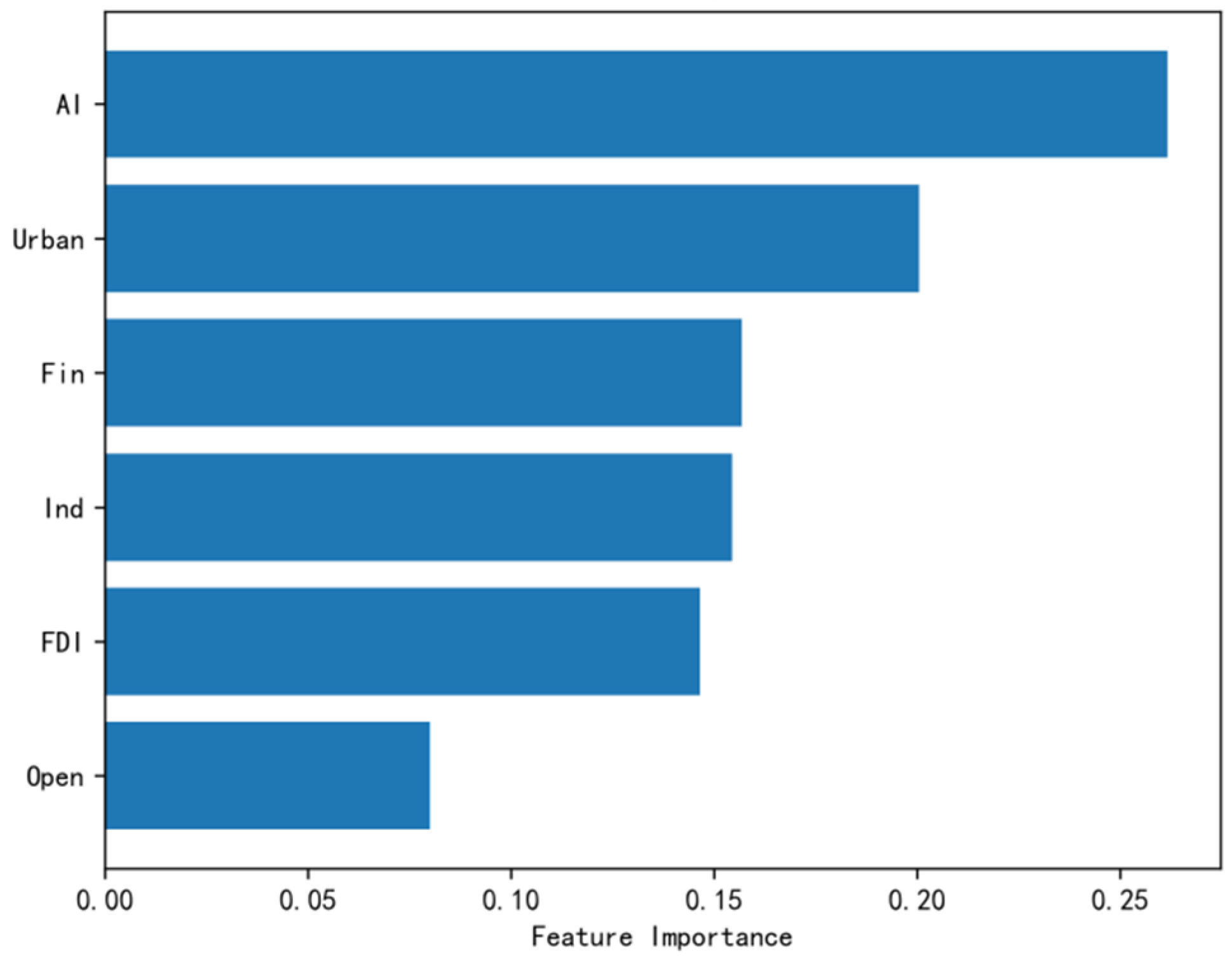
To test the research hypotheses proposed in this study, an analytical framework is constructed using panel data of 279 Chinese cities from 2012 to 2021. Prior to specifying the empirical model, a systematic test of the correlations among variables was conducted. The random forest algorithm was employed to assess the explanatory power of core explanatory variables and control variables, with the model goodness of fit reaching 0.784. This fully demonstrates that the selected variable system can comprehensively capture the variation characteristics of the dependent variable (i.e., urban green total factor efficiency, GTFE), effectively mitigating the potential risk of omitted variable bias. Further evaluation of the relative importance of each variable shows that the random forest regression identifies the key factors influencing urban GTFE, ranked by contribution as follows: artificial intelligence (AI), urbanization rate, financial development level, industrial structure optimization, and degree of openness (see Figure 2). The feature importance of AI in the gradient boosting decision tree (GBDT) is 0.235, the highest among all variables. This finding statistically verifies the theoretical rationality of treating AI as the core explanatory variable.
To determine the appropriate panel data model specification, this study employs the Hausman test to distinguish between the fixed effects model and the random effects model. As shown in Table 4, the test statistic is 146.7 (p < 0.01), indicating that the fixed effects model exhibits superior estimation consistency. Therefore, the subsequent empirical analysis adopts the fixed effects model for parameter estimation.

2.3.2. Model Construction

(1) Benchmark Regression Model
T F P i t = β 0 + β 1 A I i t + β j C o n t r o l s i t + μ i + λ t + ε i t
Herein, i and t denote city and year, respectively; T F P i t represents low-carbon total factor productivity; A I i t denotes the level of artificial intelligence development; C o n t r o l s i t stands for a set of control variables; μ i denotes city fixed effects; λ t denotes time fixed effects; and ε i t is the stochastic disturbance term.
(2) Threshold Effect Model
To verify the nonlinear impact of the level of artificial intelligence (AI) development on urban green total factor efficiency (GTFE), this study adopts the threshold model proposed by Hansen (1999) [52] to estimate its impact. The single threshold model is constructed as follows:
T F P i t = β 0 + β 1 A I i t · I ( q i , t γ ) + β 2 A I i t · I ( q i , t > γ ) + β j C o n t r o l s i t + μ i + λ t + ε i t
Herein, I() denotes an indicator function that takes a value of 1 if the condition in the parentheses is satisfied, and 0 otherwise; q i , t represents the threshold variable; γ is the specific threshold value; with other parameters defined as above. If the test results indicate the existence of a double threshold effect in the model, the single threshold model can be extended to a double threshold model:
T F P i t = β 0 + β 1 A I i t · I ( q i , t γ 1 ) + β 2 A I i t · I ( γ 1 < q i , t γ 2 ) + β 3 A I i t · I ( q i , t > γ 2 ) + β j C o n t r o l s i t + μ i + λ t + ε i t
If a triple threshold exists, and so forth.
(3) Mechanism Effect Model
To test the mechanism effects of green finance (GF) and new-quality productive forces (NPF), this study adopts the two-step approach proposed by Jiang (2022) [53], with the model specifications as follows:
M E D i t = α 0 + α 1 A I i t + α j C o n t r o l s i t + μ i + λ t + ε i t
T F P i t = γ 0 + γ 1 A I i t + γ 2 M E D i t + γ j C o n t r o l s i t + μ i + λ t + θ i t
Herein, M E D i t denotes the mediator variable; α 1 represents the coefficient capturing the impact of artificial intelligence development level on the mediator; C o n t r o l s i t stands for a set of control variables; μ i denotes city fixed effects; λ t denotes time fixed effects; and ε it and θ i t are stochastic disturbance terms, respectively. Regarding the judgment criteria for mediation effects: If α 1 is significant, γ 1 is insignificant, and γ 2 is significant, a full mediation effect is confirmed. If   γ 1 is significant with γ 2 also significant, a partial mediation effect is supported.
(4) Spatial Econometric Model
To verify the spatial spillover effect of the artificial intelligence (AI) development level on urban green total factor efficiency (GTFE), this study first constructs a spatial adjacency matrix for 279 cities, whose specific form is specified as follows:
W = w 11 w 1 n w n 1 w n n ,   w i j = 1 ,       when city i is adjacent to city j 0 ,     when city i is not adjacent to city j
Herein, the matrix element w i j indicates the adjacency status between cities. It is noteworthy that this spatial weight matrix is a symmetric matrix, with all elements on its main diagonal satisfying w 11 = = w n n = 0. Prior to empirical analysis, row-standardization is performed on the spatial weight matrix to normalize its row sums to 1. Multiplying the row-standardized matrix by the variables (i.e., spatial lag terms) enables the calculation of the average value of the variables in the neighboring regions of each city; however, the spatial weight matrix will no longer possess the property of symmetry after this process.
After conducting the spatial autocorrelation test, if an economic variable exhibits significant spatial correlation, using a linear model for regression analysis will lead to biases. Therefore, spatial econometric models should be employed to mitigate such biases. Common spatial econometric models include the Spatial Autoregressive Lag Model (SAR), Spatial Error Model (SEM), and Spatial Durbin Model (SDM). The SAR measures the spatial dependence of the local region’s dependent variable on that of neighboring regions: the spatial weight matrix acts on the dependent variable to form a spatial lag term, which serves as a new explanatory variable. The SEM quantifies the impact of the error terms of the dependent variable in neighboring regions on that in the local region. The SDM, by contrast, assesses the impact of the local region’s explanatory variables on the dependent variable in neighboring regions.
To select the appropriate spatial econometric model, two approaches are adopted: On one hand, starting from the SDM, the Wald test and Likelihood Ratio (LR) test are utilized to determine whether the SDM can be reduced to the SAR or SEM [54,55,56]. On the other hand, the selection is based on specific parameters in the regression results: a larger R-squared and Log-likelihood value, coupled with smaller Akaike Information Criterion (AIC) and Bayesian Information Criterion (BIC) values, indicates that the spatial econometric model has superior fitting performance and should thus be selected [57].
First, the LM test series is employed in this study. The results show that the LM statistic is 15.23 (p = 0.000), the Robust LM (lag) statistic is 12.45 (p = 0.000), the Robust LM (error) statistic is 8.76 (p = 0.000), and the difference between the two (R-LM) is 3.69 (p = 0.055). All these results significantly reject the null hypothesis of no spatial correlation, indicating that spatial models (SAR or SEM) should be adopted instead of the benchmark ordinary least squares (OLS) to address the spatial autocorrelation bias in the residuals.
After confirming the existence of spatial correlation, this study further compares the suitability of fixed effects and random effects models through the Hausman test. The p-value of the Hausman statistic is 0.0342, which significantly rejects the null hypothesis of random effects. Thus, the fixed effects model is selected to control for unobserved individual heterogeneity and time trends, ensuring the endogeneity consistency of the estimates.
Finally, a robustness test of the model is conducted, and the goodness of fit of the three spatial models is compared via the Wald and LR tests. The Wald test statistic is 23.67 (p = 0.000), and the LR test statistic is 21.89 (p = 0.000), both significantly rejecting the null hypothesis. This indicates that the SDM is significantly superior to the SAR and SEMs. Detailed test results are presented in Table 5, confirming the suitability and robustness of the Spatial Durbin Model and providing a reliable foundation for the subsequent analysis of the spatial spillover effects of AI applications.
Therefore, this study constructs the following Spatial Durbin Model (SDM):
T F P i t = α + δ j = 1 279 W i j T F P i t + β A I i t + γ C V i t + ρ W Y i t + θ j = 1 279 W i j A I i t + ξ j = 1 279 W i j C V i t + μ i + ε i t
Herein, α denotes the constant term; i and t represent different cities and years, respectively; δ , θ and ξ denote the coefficients of the spatial lag terms for the dependent variable, core explanatory variable, and other control variables (CV), respectively; W ij is an element of the spatial weight matrix constructed above; μ i denotes fixed effects; and ε i t is the stochastic disturbance term. Other variables are defined as above.

3. Results

3.1. Empirical Analysis

3.1.1. Descriptive Statistics and Collinearity Diagnosis

First, based on the data processing results, the descriptive statistics of all variables in this study are presented in Table 6.
Second, prior to conducting the formal baseline regression, a multicollinearity test is performed on each variable to examine the presence of multicollinearity. The test results are shown in Table 7. According to Table 7, the variance inflation factor (VIF) of each variable is less than 5, indicating that there is no serious multicollinearity issue.

3.1.2. Benchmark Regression

(1) Two-way Regression
First, this study employs two-way fixed effects to conduct baseline regression on Model (5), with the results presented in Table 8. According to the baseline regression findings, prior to incorporating control variables, artificial intelligence (AI) is positively significant for urban green total factor efficiency (GTFE) at the 1% significance level: for each one-unit increase in AI, GTFE rises by an average of 0.0004 units. After sequentially adding control variables, AI remains positively significant for GTFE at the 1% significance level, with a regression coefficient of 0.0002 when all control variables are included. This indicates that AI can promote urban GTFE, thus verifying Hypothesis 1.
(2) Threshold Effect
Two fundamental assumptions of the threshold regression model need to be verified: first, whether the threshold effect is significant; second, whether the threshold estimates are equal to their true values. This study conducts 300 repeated samplings using the Bootstrap method to perform single, double, and triple threshold tests sequentially, with results reported in Table 9.
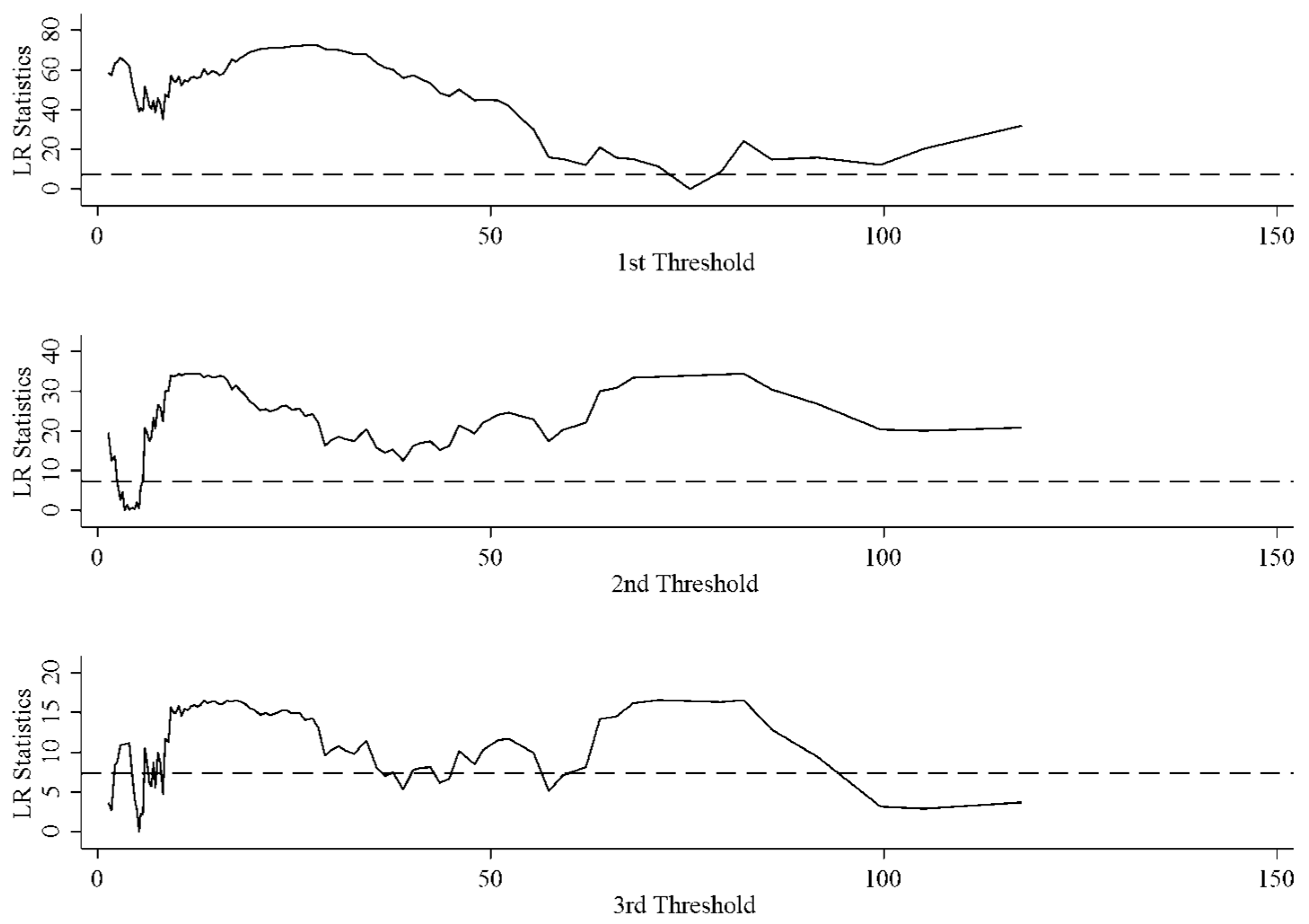
The F-statistics for the single and double thresholds are 86.13 and 34.39, respectively, both significant at the 1% significance level, while the p-value for the triple threshold is 0.0967, significant at the 10% significance level. Next, the threshold values are determined. Table 9 presents the threshold estimates: the first threshold value is 3.4282 (95% confidence interval [2.6745, 3.7321]); the second is 5.2750 (95% confidence interval [4.5883, 5.4515]); and the third is 75.3430 (95% confidence interval [71.3442, 79.2900]) with a relatively wide confidence interval (as also visualized in Figure 3). Thus, the double threshold model is deemed most suitable for the analysis in this study. Figure 3 employs the likelihood ratio (LR) function to test whether the threshold estimates equal their true values, offering an intuitive illustration of the threshold estimation and confidence interval construction. The horizontal axis represents the threshold variable (AI), and the vertical axis denotes the LR function value. It is evident that all threshold estimates lie below the LR critical value of 7.35, confirming the validity of the threshold values.
Table 10 presents the comparison results between the double threshold effect model and the ordinary linear regression model. According to the results in Column (2), in the initial stage of AI development, the impact coefficient of AI on GTFE is −0.0062, which is significantly negative at the 1% significance level. This may be attributed to high technology introduction costs and mismatches with existing production processes, leading enterprises to enter a transitional adjustment period. During this phase, investments fail to translate into efficiency gains; instead, GTFE is reduced due to resource crowding-out effects. After crossing the first threshold, the coefficient turns positive to 0.0020, significant at the 1% level. The technological dividend begins to materialize as enterprises complete technological adaptation and achieve economies of scale, with AI significantly improving resource allocation efficiency and low-carbon productivity. Upon exceeding the second threshold and entering the third stage, the coefficient decreases slightly to 0.0016 but remains highly significant at the 1% level. This aligns with the law of diminishing marginal returns in economics, indicating that the technology has entered a mature stage, where the rate of efficiency improvement from mere incremental investments slows down. This thus confirms a non-linear increasing relationship between artificial intelligence (AI) and urban green total factor efficiency (GTFE).
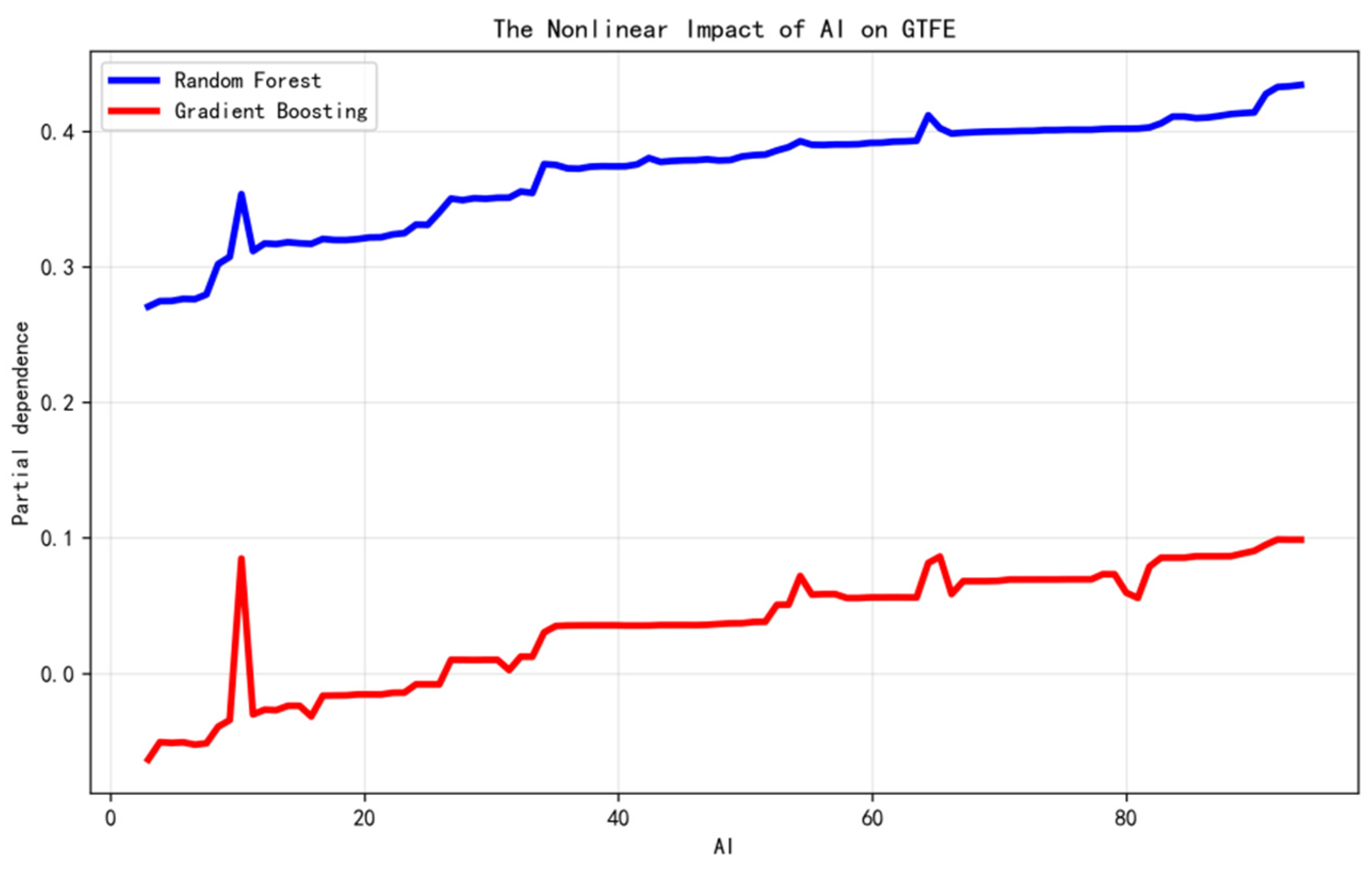
To further verify the nonlinear impact of artificial intelligence (AI) on green total factor efficiency (GTFE), this study introduces Random Forest (RF) and Gradient Boosting Decision Tree (GBDT) models based on the threshold effect analysis. These models are primarily employed to capture the potential nonlinear relationship between AI and GTFE, serving as supplementary robustness tests for the econometric baseline regression. Their purpose is to reveal dynamic nonlinear characteristics rather than establish causal inference.
Under the RF model, as the AI penetration density increases, the partial dependence values of GTFE show an overall continuous upward trend: rising rapidly at lower AI levels, then slowing down but remaining positive. This indicates that the promotional effect of AI strengthens with its development and tends to stabilize at higher stages (see Figure 4). For the GBDT model, as AI gradually improves, the average predicted values of GTFE shift from an initial negative value to a positive one and continue to rise. This suggests that early AI applications may involve adaptation costs or instability, while a significant positive promotion emerges once a certain scale is reached (see Figure 4). These nonlinear patterns complement the linear estimates of econometric regression and uncover the threshold dynamics of AI effects; however, caution should be exercised to avoid overinterpreting these patterns as causal mechanisms.
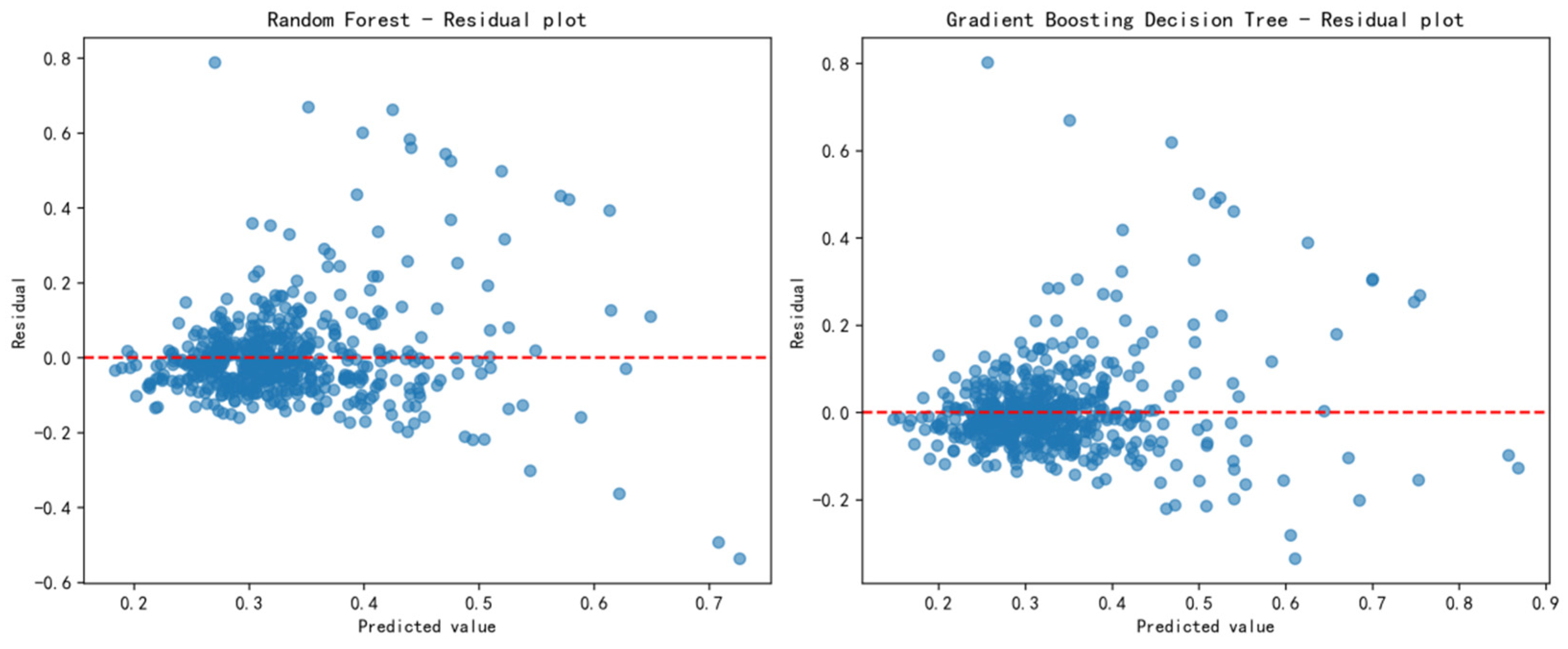
Furthermore, in terms of model performance, the GBDT outperforms the RF in detecting nonlinear effects, with an R2 of 0.504 and an RMSE of 0.108. It exhibits a more concentrated residual distribution with smaller fluctuations (see Figure 5 and Table 11), resulting in higher prediction accuracy than the RF. While the RF model is more robust in handling high-dimensional interactions, the GBDT’s gradient optimization is better suited for capturing gradual nonlinear trajectories. Through cross-validation between econometrics and machine learning, the positive effect of AI on GTFE receives consistent support, further enhancing the robustness of the baseline findings.

3.2. Robustness Test

3.2.1. Extreme Value Treatment

To ensure the reliability of the results, this study performs winsorization on all continuous variables in the model at the 1st and 99th percentiles to mitigate the impact of outliers. Meanwhile, given that the four municipalities directly under the Central Government (Beijing, Shanghai, Tianjin, and Chongqing) differ significantly from ordinary prefecture-level cities in terms of administrative rank, economic scale, and urban structure, these municipalities are excluded from the regression to ensure sample comparability, with only ordinary prefecture-level cities retained. The results in Table 12 show that after winsorization and exclusion of municipalities, the coefficient of AI remains positively significant at the 1% significance level, collectively confirming the robustness of the baseline regression findings.

3.2.2. Substitution of Core Variables

In the baseline regression, the core explanatory variable (AI) is measured by industrial robot penetration density based on the stock of industrial robots. For the robustness test, this study adheres to the construction logic of the Bartik instrumental variable approach but uses national industry-level industrial robot installation data to estimate provincial-level installation scales. Combined with the number of manufacturing employees in each city, a city-level industrial robot installation indicator is further constructed as a new AI proxy (AI2). Column (1) of Table 13 reports the corresponding regression results: AI2 exerts a positive effect on urbangreen total factor efficiency (GTFE) at the 10% significance level, with each one-unit increase in AI2 leading to an average 0.001-unit rise in GTFE. This further supports the fundamental conclusion that AI contributes to improving urban GTFE.
Furthermore, the indicator for urban GTFE in the baseline regression is derived from the super-efficiency SBM model. For the robustness test, this study remeasures GTFE (denoted as GTFE2) using the SBM directional distance function integrated with undesirable output processing and the Global Malmquist-Luenberger (GML) index under the assumption of variable returns to scale (VRS). As shown in Column (2) of Table 13, after replacing the dependent variable, AI still exhibits a significantly positive impact on GTFE at the 1% significance level: each one-unit increase in AI is associated with an average 0.0003-unit increase in GTFE2, indicating that the baseline conclusion remains valid.
When both the dependent variable and the core explanatory variable are replaced simultaneously, the regression results in Column (3) of Table 13 show that AI is positively significant for GTFE at the 1% significance level, with each one-unit increase in AI leading to an average 0.0013-unit increase in GTFE. In summary, the findings and conclusions of the baseline regression are consistently supported after replacing the core variables.

3.2.3. Excluding Policy Interference

To address potential confounding from other policies, such as the low-carbon city pilot policy and the key air pollution control zone policy, the impact of artificial intelligence (AI) on urbangreen total factor efficiency (GTFE) may be biased if such exogenous shocks are not effectively controlled [58]. To mitigate the influence of potential confounding factors on causal identification, this study constructs binary variables for the aforementioned two policies, respectively. Based on the difference-in-differences (DID) model, the interaction terms between regional dummy variables (for policy implementation) and time dummy variables are incorporated into the baseline regression model (5) to control for systematic differences arising from policy implementation. The estimation results after controlling for policy effects are presented in Table 14.
As shown in Table 14, after including the low-carbon city pilot policy variable, the impact of AI on GTFE remains positively significant at the 5% significance level, indicating that the promotional effect of AI on GTFE is independent of the interference from this policy. Similarly, after controlling for the key air pollution control zone policy, the positive impact of AI on GTFE remains significant at the 5% level. When both policy variables are controlled simultaneously, the positive effect of AI on GTFE remains robust and statistically significant at the 5% level, further confirming the reliability of the baseline regression conclusions.

3.3. Endogeneity Analysis

3.3.1. IV-2SLS

The regression results of the two-stage least squares (2SLS) method are presented in Table 15. According to the results, for IV1 (logarithm of AI patent applications), AI exerts a significantly positive impact on urban green total factor efficiency (GTFE) at the 1% significance level. For IV2 (logarithm of AI enterprises), the impact coefficient of AI on GTFE is 0.004, indicating a positive correlation between AI development and urban GTFE, which is statistically significant at the 1% level—thus re-verifying Hypothesis 1. Furthermore, the results of the underidentification test show that the Kleibergen-Paap rk LM statistics are all significantly greater than the critical value of 16.38 at the 1% significance level, confirming the correlation between the instrumental variables (IVs) and the endogenous explanatory variable (AI). The results of the weak instrument test indicate that the Kleibergen-Paap rk Wald F statistics significantly exceed the critical value of 16.38 at the 1% significance level, demonstrating that the model passes the weak instrument test satisfactorily. Meanwhile, the Hansen J statistic of the overidentification test is 1.010, with a corresponding p-value of 0.315 that exceeds 0.1. This fails to reject the null hypothesis that all instrumental variables (IVs) are exogenous.
Considering that AI patent applications and the number of AI enterprises may be correlated with local innovation capacity, industrial upgrading, or environmental governance, which could directly affect GTFE, this study introduces a more stringent instrumental variable: the number of fixed telephones per 100 people in 1984 (Phone). Regarding correlation, early telephone penetration laid the foundation for digital networks, facilitating the evolution of subsequent internet and AI infrastructure. Cities with high telephone density were more likely to attract investments in fiber optics and data centers, thereby enhancing AI penetration. In terms of exogeneity, the 1984 data predates both the establishment of China’s environmental policy framework (the revision of the Environmental Protection Law in 1989) and the rise of deep learning after 2010. It is uncorrelated with unobserved factors affecting GTFE during 2012–2021. Additionally, the distribution of fixed telephones was primarily determined by central planning rather than local economic performance, satisfying the condition of strict exogeneity. Column (3) of Table 15 presents the results of the robustness test. For the instrumental variable Phone, AI is positively significant for urban green total factor efficiency (GTFE) at the 1% significance level. The underidentification test results show that the Kleibergen-Paap rk LM statistic is significantly greater than the critical value of 16.38 at the 1% level, confirming the correlation between the instrumental variable and the endogenous explanatory variable (AI). The weak instrument test indicates that the Kleibergen-Paap rk Wald F statistic significantly exceeds the critical value of 16.38 at the 1% significance level. Furthermore, the Hansen J statistic of the overidentification test is 1.674, with a corresponding p-value of 0.367 (exceeding 0.1), which fails to reject the null hypothesis that all instrumental variables are exogenous. This thus re-verifies Hypothesis 1.

3.3.2. Change in Estimation Method

To address estimation bias potentially arising from the dynamic continuity characteristics of economic variables—such as serial correlation caused by historical factors or economic inertia—this study further adopts a dynamic panel model to identify potential endogeneity issues. Compared with the static panel specification, the dynamic model can better capture the dynamic adjustment process of the economic system by incorporating lagged terms of the dependent variable, thereby mitigating endogeneity interference induced by serial correlation.
This study employs the difference GMM approach for estimation. The first and second lagged terms of the explanatory variables are treated as endogenous variables, while control variables are regarded as exogenous variables to re-estimate the original panel data. As shown in Column (1) of Table 16, after accounting for the dynamic structure of the data, the coefficient of AI is 0.0002, which is statistically significant at the 10% level. This indicates that AI development still exerts a stable promotional effect on urban green total factor efficiency (GTFE). Furthermore, the key diagnostic test results of the model support the rationality of its specification: The autocorrelation (AR) tests indicate that the differenced residuals exhibit first-order autocorrelation (p-value = 0.099) but no second-order autocorrelation (p-value = 0.507), which satisfies the prerequisite for the model’s application. In the overidentification tests, the p-value of the Sargan test is 0.390, and that of the Hansen test is 0.638. Both fail to reject the null hypothesis that “all instrumental variables are valid,” indicating that the model is free from severe serial correlation and weak instrument issues. The regression results based on the dynamic GMM approach further reinforce the robustness of the core conclusions of this study.

3.3.3. Lagged Effects

As a form of digital infrastructure construction in cities, the application of artificial intelligence (AI) may have a lagged impact on urban green total factor efficiency (GTFE). This study thus conducts lag effect tests by incorporating AI development levels lagged by one period and two periods, respectively. According to the test results in Columns (2) and (3) of Table 16, AI remains positively significant for urban GTFE at the 1% significance level after introducing the first-order and second-order lagged terms of AI development. This indicates that after accounting for the lagged impact of AI adoption and application, the conclusion that AI can significantly promote urban GTFE remains robust.

3.3.4. Principal Component Analysis

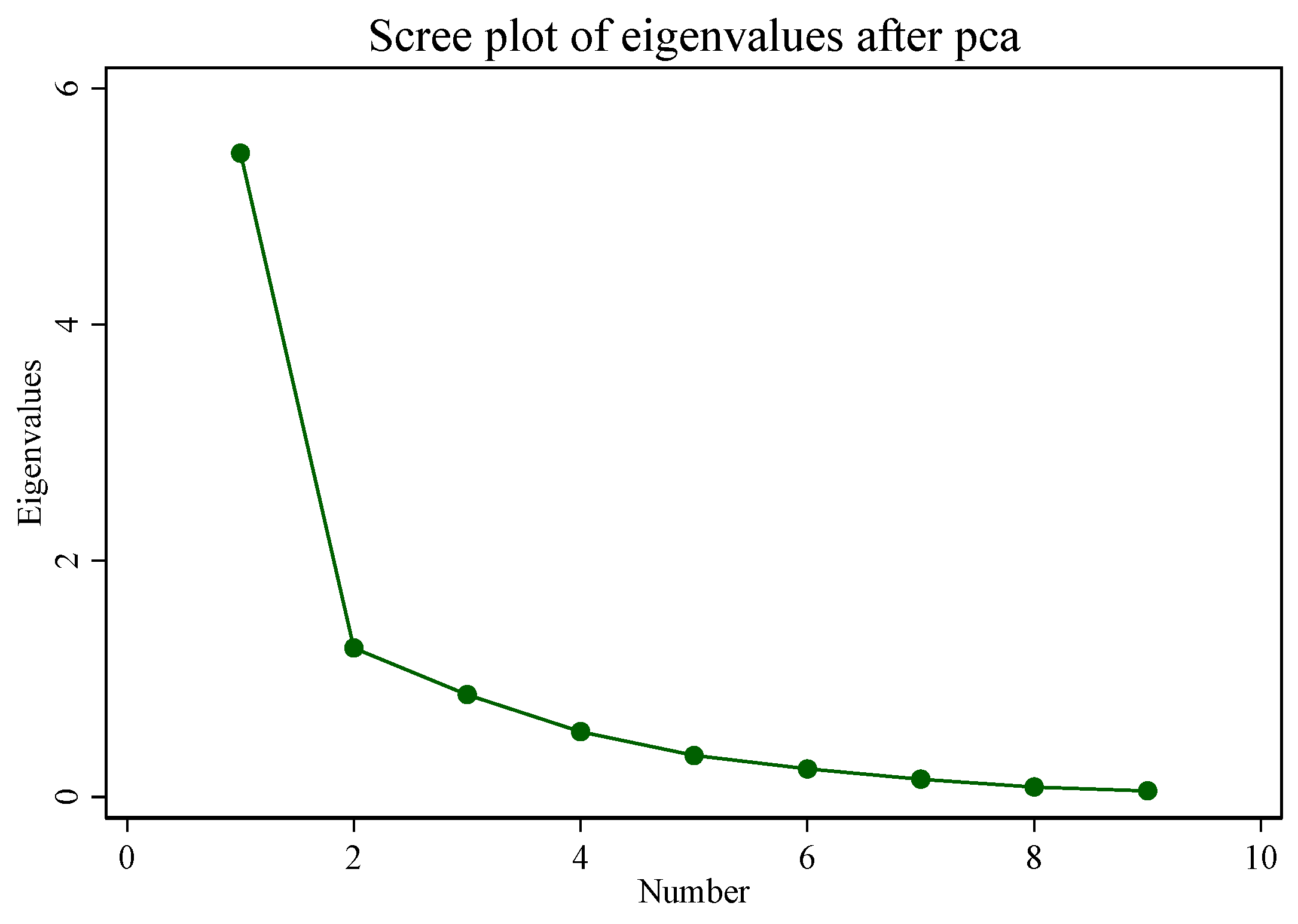
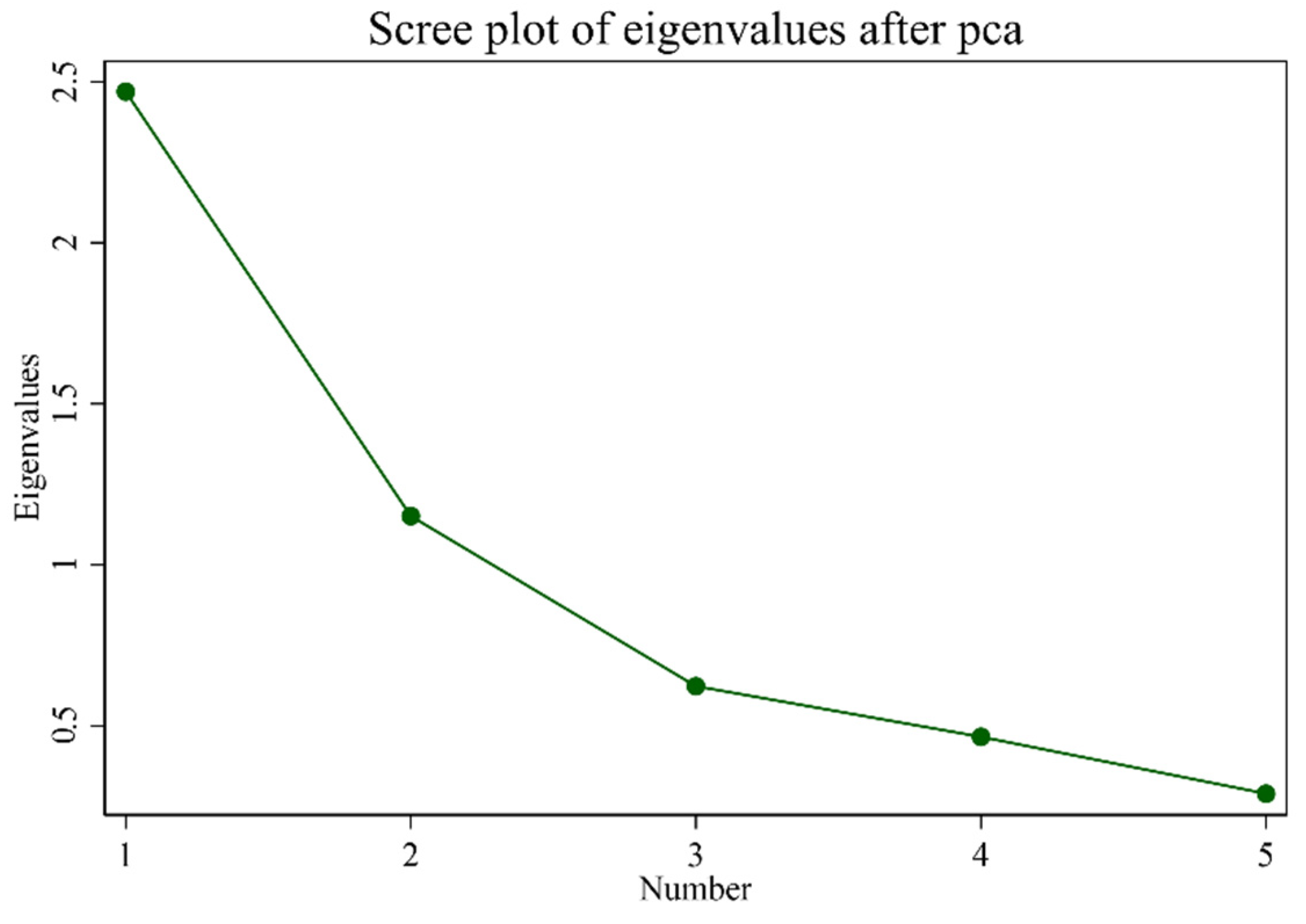
To address the issues of data noise and information confounding potentially introduced when measuring urban green total factor efficiency (GTFE) via the super-efficiency SBM method, this study incorporates principal component analysis (PCA)—a dimensionality reduction technique. This method effectively simplifies model complexity and mitigates overfitting risk by extracting core information and reducing redundant variables. Meanwhile, PCA can alleviate the interference of individual outlier observations on estimation results, thereby enhancing model robustness. Building on these advantages, PCA is adopted to avoid estimation bias caused by potential multicollinearity among original variables. Figure 6 and Figure 7 illustrate the variance attenuation of the variables after dimensionality reduction. The regression results in Table 17 show that with PCA-reconstructed variables, AI still exerts a significantly positive impact on urban GTFE at the 5% significance level, and the overall model goodness of fit remains high. This confirms the robustness of the baseline regression results and strengthens the credibility of the research conclusions.

3.4. Heterogeneity Analysis

3.4.1. Regional Heterogeneity

Given the significant differences across regions in terms of economic development stages, industrial layout, and technological foundations, these factors may systematically moderate the mechanism through which artificial intelligence (AI) affects urban green total factor efficiency (GTFE). To identify such regional heterogeneity, this study adopts a grouped regression approach, dividing the full sample by geographical or economic regions and estimating the impact of AI on GTFE in each subsample separately. This method can more accurately reveal the heterogeneous impacts of AI under different regional contexts, thereby providing empirical evidence for the formulation of regionally differentiated policies. The results of the regional heterogeneity regression are presented in Table 18.
According to the heterogeneity analysis results in Table 18, AI has a significantly negative impact on the GTFE of cities in Eastern and Central China at the 10% significance level. For Western China, AI exerts a positive promotional effect on urban GTFE but is not statistically significant. For Northeast China, AI shows a negative effect, which is also insignificant. This pattern may be attributed to the following mechanisms: In Eastern and Central China, current AI applications primarily focus on replacing traditional labor and improving production efficiency, where the resulting growth in energy consumption (rebound effect) outweighs energy-saving effects. Meanwhile, these regions are in a transitional period of industrial transformation, and the “creative destruction” process of technological innovation may temporarily inhibit the improvement of green efficiency. In Western China, AI applications may be more oriented toward optimizing resource allocation and developing low-emission industries, exhibiting a positive trend. However, due to low technology penetration, this positive impact has not yet reached statistical significance. In Northeast China, the constraints of a long-standing traditional industrial structure make it difficult for AI technology to be effectively integrated and promote green transformation, thus suppressing the improvement of GTFE.

3.4.2. Urban Scale Heterogeneity

Building on the premise that urban scale may lead to heterogeneous impacts of artificial intelligence (AI) on urban green total factor efficiency (GTFE), this study proposes the following mechanism: In large cities characterized by resource agglomeration, diversified industrial structures, and broad market hinterlands, AI technology can more fully empower enterprises to achieve environmental innovation, thereby driving the overall improvement of urban GTFE. In contrast, due to constraints on resource endowments and technological application capabilities, AI may have relatively limited impacts in smaller cities [59]. Drawing on existing literature [60] and in accordance with the “Notice of the State Council on Adjusting the Standards for Classifying Urban Scales”, this study categorizes cities into four types based on their scale: megacities, super-large cities, large cities, and medium-small cities. Specifically, megacities are defined as those with a permanent population of over 10 million, super-large cities with 5–10 million, large cities with 1–5 million, medium cities with 0.5–1 million, and small cities with less than 0.5 million. The regression results are presented in Table 19.
As shown in Table 19, for megacities and medium-small cities, the coefficients of AI are 0.0044 and 0.0003, respectively, and are positively significant for GTFE at the 5% and 1% significance levels. This is consistent with the characteristics of large cities (abundant resources, diversified industries, and broad markets) and medium-small cities (flexible industrial structure adjustment and late-development opportunities), indicating that AI applications in these cities help promote green transformation and improve low-carbon development efficiency.

3.4.3. Urban Levels Heterogeneity

Drawing on existing literature [44], cities with different administrative ranks often possess varying quantities of factor resources such as capital and labor, which influences the extent to which the effect on green total factor efficiency (GTFE) is exerted. Therefore, municipalities directly under the Central Government, provincial capitals, and sub-provincial cities are classified as central cities, while other cities are designated as peripheral cities. The results of the grouped baseline regression are presented in Table 20.
As shown in Table 20, AI development exerts a positive promotional effect on urban GTFE in both central and peripheral cities. Specifically, the effect is significant at the 5% level for peripheral cities but insignificant for central cities. This pattern may be attributed to the relatively mature and rigid industrial structures and energy systems in central cities: the efficiency-enhancing effect of AI is mostly manifested as marginal improvements, whose positive impacts are easily diluted by the high base and path dependence. In contrast, peripheral cities have relatively weak technological and management foundations; the introduction of AI can directly bring about subversive process optimization and energy consumption reduction, making the marginal improvement effect more prominent.

3.4.4. Transportation Heterogeneity

Compared with non-hub cities, the comprehensive transportation systems of transportation hub cities provide efficient innovation diffusion channels for artificial intelligence (AI) technology. This advantage not only accelerates the local application of green technologies but also multidimensionally and profoundly enhances the promotional effect of AI on green total factor efficiency (GTFE) at the regional level through significant spatial spillover effects. Therefore, this study classifies the sample cities into transportation hub cities and non-hub cities in accordance with the Medium and Long-Term Railway Network Plan (2016). The regression results are presented in Table 21.
As shown in the regression results, AI positively promotes the GTFE of transportation hub cities at the 5% significance level, and simultaneously exerts a positively significant impact on that of non-hub cities at the 1% significance level. By comparing the AI coefficients, it is found that the effect of AI is stronger in transportation hub cities than in non-hub cities.

3.4.5. Industrial Characteristic Heterogeneity

Compared with old industrial base cities, non-old industrial bases exhibit significant green and low-carbon late-development advantages in industrial structure and energy systems, as they are not trapped in path dependence from traditional high-carbon production capacity. This characteristic not only enables them to more smoothly integrate artificial intelligence (AI) technology into clean production and energy efficiency management but also allows them to leverage a flexible industrial ecosystem to form extensive demonstration and leading effects in regional green transformation. Therefore, drawing on existing literature [61] and in accordance with the National Plan for the Adjustment and Transformation of Old Industrial Bases (2013–2022), this study classifies the research samples into old industrial base cities and non-old industrial base cities. The regression results are presented in Table 22. As shown in the results, AI exerts a negative but insignificant impact on green total factor efficiency (GTFE) in old industrial base cities—AI development has not yet significantly improved GTFE, which may be attributed to structural rigidity or outdated infrastructure. In contrast, AI development in non-old industrial base cities positively promotes urban GTFE at the 1% significance level.

3.5. Mechanism Analysis

To verify Hypothesis 2 and explore the indirect impact of artificial intelligence (AI) on urban green total factor efficiency (GTFE), this study constructs a mediation effect model to examine the underlying mechanism through which AI influences GTFE. The results of the mechanism test are presented in Table 23.
Columns (1) and (2) illustrate the mediation effect of green finance. According to the results in Column (1), AI positively promotes the development of urban green finance at the 1% significance level, indicating that the application of AI can improve the level of urban green finance. In Column (2), AI remains positively significant for urban GTFE at the 1% significance level, while the coefficient of green finance is also significantly positive at the 1% level. It can be concluded that AI promotes urban GTFE by improving the urban green finance index. Given that green finance and the control variable (financial development level, Fin) are conceptually similar, their coexistence in the same model may lead to over-control bias or block part of the mediation pathway. Therefore, this study re-examines the mediation effect of green finance after excluding the financial development level (Fin) from the model. The results in Columns (3) and (4) show that the coefficient of AI on green finance remains 0.0002, the coefficient of AI on green total factor efficiency (GTFE) is 0.0013, and the mediation coefficient of green finance is 0.2222—with the significance level remaining unchanged. This indicates that the mediation effect is not a spurious regression caused by multicollinearity.
Columns (5) and (6) illustrate the mediation effect of new-quality productive forces (NPF). Column (5) shows that AI positively promotes the development of NPF at the 1% significance level, indicating that AI applications can enhance the level of new-quality productive forces in cities and validating the theoretical analysis. Meanwhile, in Column (6), AI significantly promotes the improvement of urban green total factor efficiency (GTFE) at the 1% significance level, with the coefficient of NPF being 1.7245 and also significantly positive at the 1% level—thus verifying Hypothesis 2.
In addition, this study further employs Sobel-Goodman and Bootstrap estimation methods to conduct robustness tests for the mediation effects. In the Sobel-Goodman tests, all p-values are 0.0000, which are significant at the 1% level, validating the existence of the mediation effects and confirming the validity of the two aforementioned mediation mechanisms. The Bootstrap estimation results show that none of the confidence intervals include 0, thus confirming the robustness and further corroborating the reliability of Hypothesis 2.
In addition to investigating the mechanistic effects of AI in promoting urban green total factor efficiency (GTFE), this study also incorporates the interaction term of the two mechanisms into the baseline regression model (3) to examine the impact of the interaction between the two mechanistic variables on the dependent variable. The regression results of the synergistic effect of the mechanisms are presented in Table 24, where “Interaction” denotes the interaction term between green finance and new-quality productive forces (NPF). According to the test results, the coefficient of Interaction is significantly positive at the 1% significance level, indicating that the synergistic effect between the selected mechanisms also jointly promotes urban GTFE.
In summary, based on the empirical regression results of the mechanism tests, Hypothesis 2 proposed in this study is fully validated.

3.6. Spatial Spillover Effect

3.6.1. Global Spatial Autocorrelation Test

(1) Global Spatial Autocorrelation Test
Commonly used statistics for testing global autocorrelation include Moran’s I and Geary’s C. This study selects the Moran’s I statistic for the test, and its calculation method is defined as follows:
I = i = 1 n j = 1 n w i j ( Y i Y ¯ ) ( Y j Y ¯ ) S 2 i = 1 n j = 1 n w i j
where S 2 = 1 n i = 1 n ( Y i Y ¯ ) 2 represents the sample variance of observations, Y ¯ = 1 n i = 1 n Y i denotes the sample mean of observations, and w i j stands for the elements in the spatial weight matrix. The global Moran’s I statistic ranges from [−1, 1]: a value greater than 0 indicates positive spatial autocorrelation, a value less than 0 indicates negative spatial autocorrelation, and a value equal to 0 indicates no spatial autocorrelation. This study conducts global Moran’s I tests for artificial intelligence (AI) and green total factor efficiency (GTFE) over the period 2012–2021, with the results presented in Table 25.
As shown in Table 25, the global Moran’s I statistics for both artificial intelligence (AI) and green total factor efficiency (GTFE) are positive and significant at varying significance levels across all years. This indicates a significant positive spatial autocorrelation—and thus distinct spatial agglomeration—among cities in terms of AI development and GTFE. Specifically, this is manifested as the agglomeration of cities with high development levels (High-High, HH) and the clustering of cities with low development levels (Low-Low, LL), thereby validating Hypothesis 3.
(2) Local Spatial Autocorrelation Test
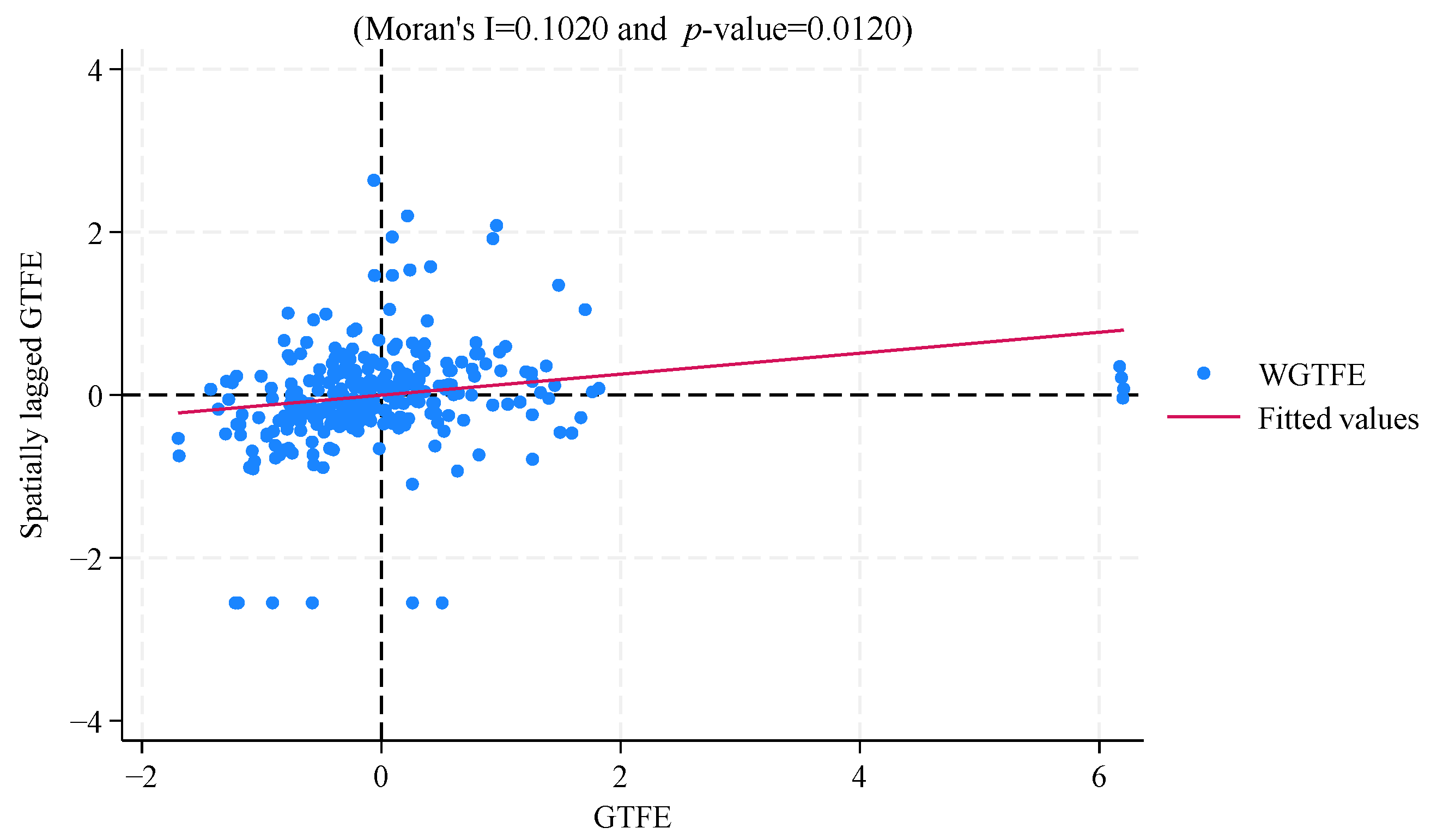
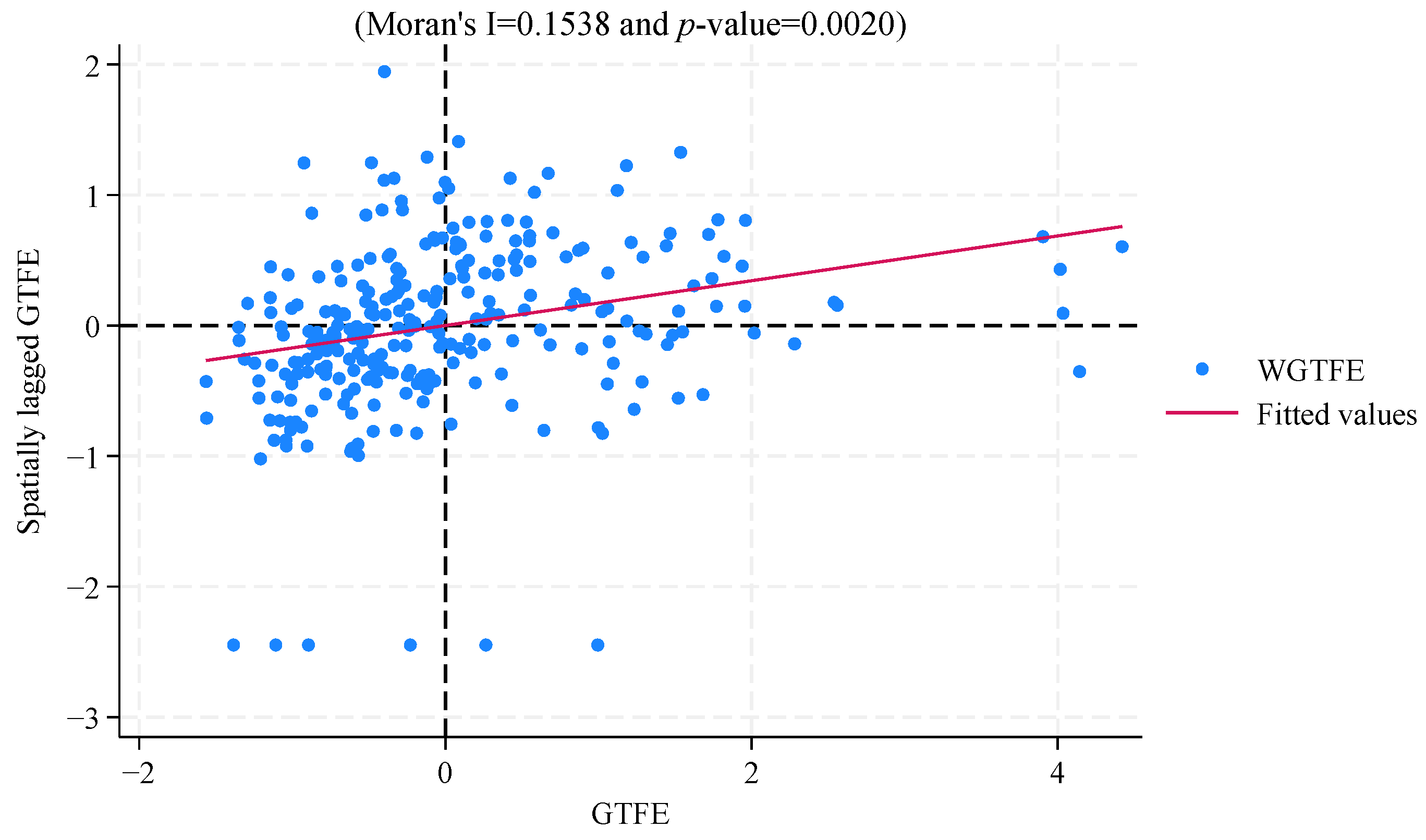
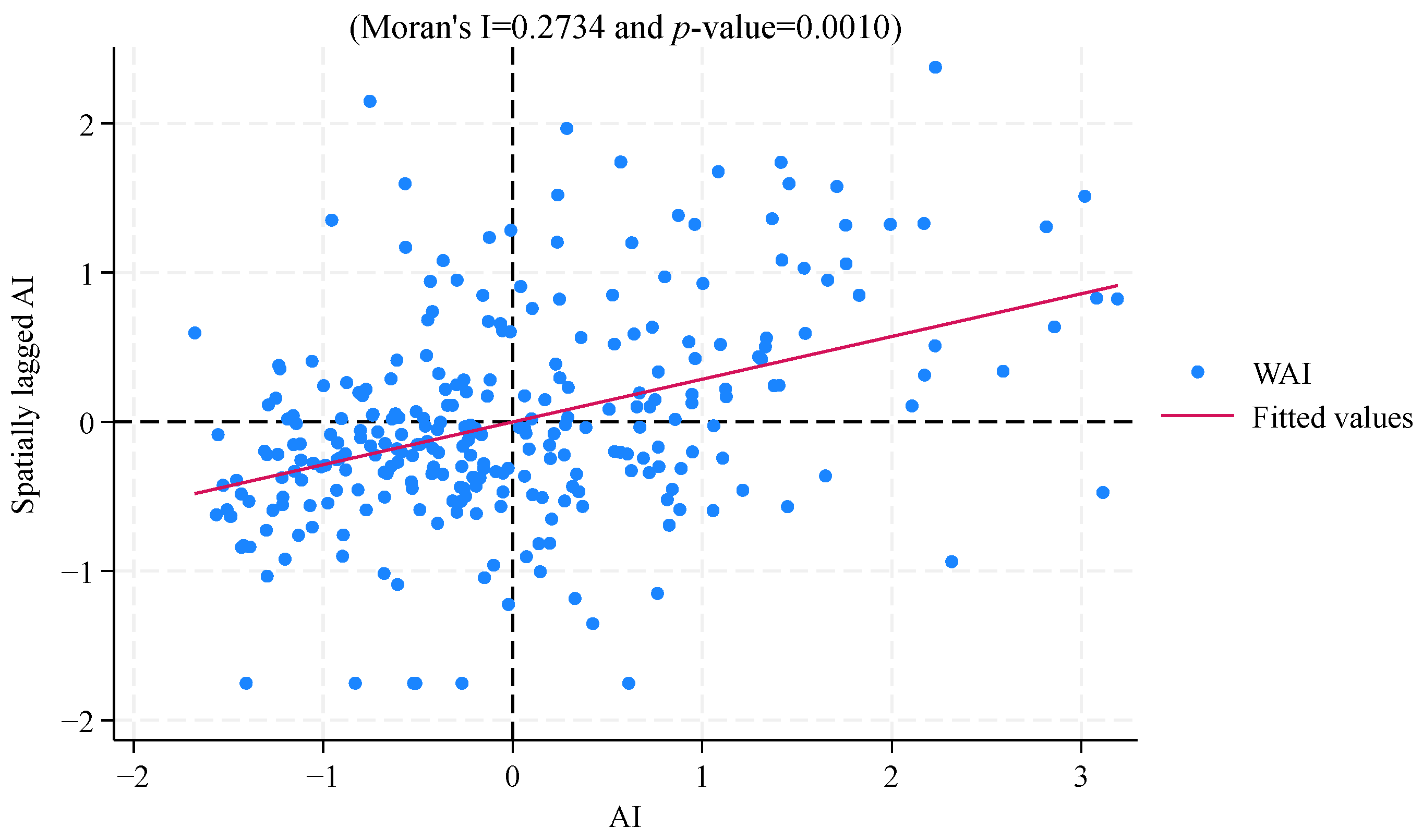
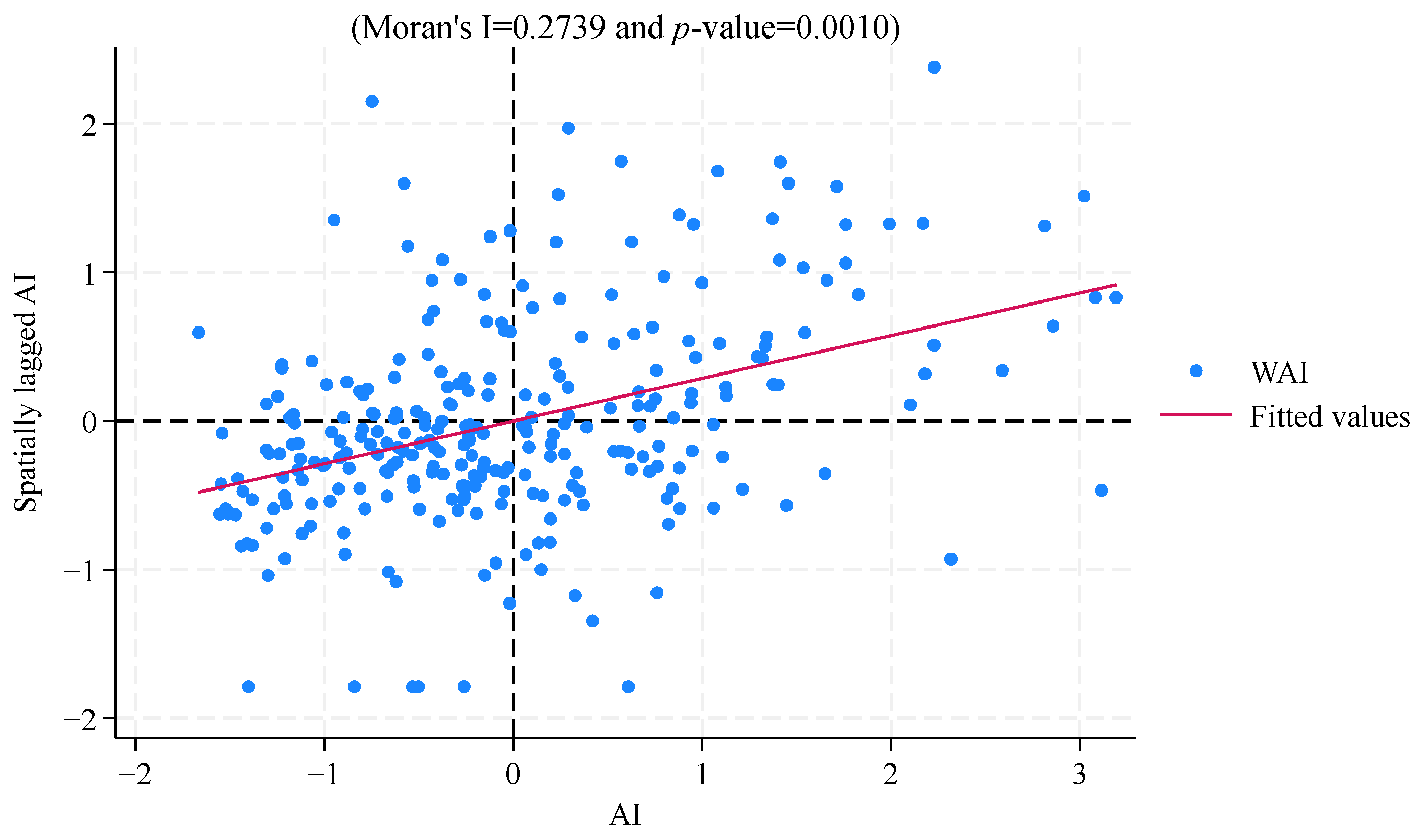
When studying whether there is spatial autocorrelation in local regions between cities, in addition to using the local Moran’s I statistic and Geary’s C statistic, Moran’s scatter plot can be used to visually examine the spatial clustering of local regions. Observations located in the first quadrant of the Moran scatter plot indicate a high-value-high-value clustering, while those in the third quadrant indicate a low-value-low-value clustering. Observations in the first and third quadrants indicate positive spatial autocorrelation, while those in the second and fourth quadrants suggest high-low value clustering, indicating negative spatial autocorrelation.
Due to the rise of open-source frameworks in 2015, which greatly lowered the development threshold for deep learning and accelerated technological iteration, the release of GPT-3 in 2020 became a key turning point in AI development. Therefore, this study selects the years 2015 and 2020 to examine urban low-carbon total factor productivity and artificial intelligence development levels as representative research subjects, and the following Moran scatter plots are presented.
As illustrated in Figure 8, Figure 9, Figure 10 and Figure 11, the vast majority of urban observations are distributed in the first and third quadrants, indicating that the development of artificial intelligence (AI) and green total factor efficiency (GTFE) across different cities exhibit significant positive spatial autocorrelation.

3.6.2. Spatial Econometric Model Regression

Table 26 presents the regression results of the Spatial Durbin Model (SDM), Spatial Error Model (SEM), and Spatial Lag Model (SLM), with green total factor efficiency (GTFE) as the dependent variable and the spatial contiguity weight matrix employed. Column (4) reports the spatial lag factors of the corresponding variables in the SDM. Since spatial econometric models incorporate the spatial lag of the dependent variable as an explanatory variable, estimation via Ordinary Least Squares (OLS) would be biased and inconsistent; thus, the Maximum Likelihood (ML) method is typically adopted.
As shown in Table 26, the SDM achieves a goodness-of-fit R2 of 0.2197 and a Log-likelihood value of 1813.92, both significantly higher than those of the other two models. Furthermore, the SDM yields the smallest Akaike Information Criterion (AIC) and Bayesian Information Criterion (BIC) values among the three models, indicating its superior fitting performance compared to the SLM and SEM. This is consistent with the results of the previous Wald test (see Table 5). Therefore, this study takes the SDM regression results as the benchmark for analysis.
Specifically, the estimated spatial lag coefficient ρ of the SDM is 0.226, which is significantly positive at the 1% level. This suggests that GTFE exhibits positive spatial autocorrelation among neighboring cities, meaning the GTFE of a given city is affected by changes in the GTFE of its adjacent cities. Both the spatial lag coefficient ρ of the SLM and the regression coefficient λ of the SEM are also significantly positive at the 1% level, indirectly confirming the robustness of the positive spatial autocorrelation. For the explanatory variable (AI), its coefficient is 0.0003, significantly positive at the 5% level, validating that AI promotes urban GTFE. The coefficient of its spatial lag term is 0.0017, significantly positive at the 1% level, indicating that AI development in a given city enhances the GTFE of neighboring cities. This may be attributed to the following mechanisms: AI development in the focal city facilitates the development of adjacent cities through knowledge spillover and regional synergy effects. Advanced low-carbon technologies and management models diffuse to surrounding areas via industrial chain collaboration and talent mobility, while the resulting green competitive pressure forces neighboring cities to accelerate their green transformation, thereby achieving synergistic progress in regional low-carbon development.

3.7. Game Theory Analysis

Based on the macro-econometric analysis, this study further constructs a “government-enterprise” static game model to dissect the intrinsic incentive mechanism of AI empowering green and low-carbon development from the perspective of micro-level decision-making, thereby providing theoretical supplement and micro-level validation for the macro empirical results.
First, we consider a static game consisting of a government (G) and a representative firm (F). The firm can choose whether to adopt AI for green production transformation, while the government can opt to provide policy incentives (e.g., green finance subsidies, tax reductions, and other measures). The strategies of both parties are as follows:
(1) Firm’s strategies
A1: Adopt AI technology for green transformation (incurs an investment cost Ca and gains green benefits Rg)
A2: Maintain traditional production (no additional costs and no green benefits)
(2) Government’s strategies
B1: Provide incentive policies (bears a fiscal cost Cg and obtains environmental benefits E and social welfare W)
B2: Not provide incentives (no costs and no additional benefits)
It is assumed that AI-enabled green transformation exhibits positive externalities, and government incentives can reduce the firm’s transformation costs. The payoff matrix is presented below (with the firm’s payoff listed first, followed by the government’s):
B 1 ( M o t i v a t i o n ) B 2 ( N o   m o t i v a t i o n ) A 1 ( T r a n s f o r m a t i o n ) A 2 ( N o   t r a n s f o r m a t i o n ) R g C a + S ,   E + W C g R g C a ,   E 0 ,   C g 0,0
where S denotes government subsidies or policy preferences, with S < Cg and Rg > Ca − S.
Based on the payoff matrix analysis, in the scenario of “firm transforms (A1) and government provides incentives (B1)”, the firm’s payoff is Rg − Ca + S, and the government’s payoff is E + W − Cg; In the scenario of “firm transforms (A1) and government does not provide incentives (B2)”, the firm’s payoff is Rg − Ca, and the government’s payoff is E (i.e., environmental benefits). This implies that as a representative of public interests, the government can freely enjoy the positive externalities generated by the firm’s green transformation; In the scenario of “firm does not transform (A2) and government provides incentives (B1)”, the firm’s payoff is 0, while the government bears the additional fiscal cost Cg; In the scenario of “firm does not transform (A2) and government does not provide incentives (B2)”, both the firm and the government achieve a payoff of 0.
The four outcomes in the matrix effectively reveal the core contradiction of the game. For the government: when Rg − Ca + S > 0, if the government chooses B1, the firm tends to select A1. The government decides whether to provide incentives by comparing E + W − Cg with 0. If E + W > Cg, (A1, B1) constitutes a Nash equilibrium—i.e., the firm transforms and the government provides incentives—where social welfare is maximized. However, for the firm: if Rg − Ca < 0, its optimal strategy is “not to transform” unless the government offers incentives S to alter its payoff. When Rg − Ca ≤ 0 but Rg − Ca + S > 0, government incentives become a critical condition for the firm’s transformation, demonstrating the “catalytic role” of government policies in promoting AI application for green transformation.
The “firm-government” static game model reveals that the feasibility of AI-enabled green transformation depends on the comparison between the firm’s green benefits Rg and transformation costs Ca. AI alters the game structure by improving green total factor productivity (i.e., increasing Rg) and reducing marginal abatement costs (i.e., decreasing Ca). Additionally, government policies can influence the equilibrium outcome by adjusting S and Ca in the payoff matrix. In summary, this game model from a micro perspective theoretically validates the empirical findings of this study, thereby confirming the reliability of the research conclusions.

4. Discussion

This study explores the impact of artificial intelligence (AI) development on urban green total factor efficiency (GTFE) from both macro and micro perspectives. At the micro level, it employs a two-way fixed effects model to analyze data from 279 cities in China. The study finds that AI significantly improves GTFE. For the measurement of AI development, this study uses industrial robot penetration density (Robot) as the primary econometric proxy variable. This indicator is constructed based on data from the International Federation of Robotics (IFR) and industry matching with China’s Economic Census: it calculates industry-level robot density for each city and predicts the annual panel series using the Bartik instrumental variable approach. This proxy effectively captures the actual application intensity of AI in the manufacturing sector, ensuring the accuracy and comparability of the regression analysis. Additionally, at the micro level, a static game model is constructed to analyze the interaction between firm and government behaviors. This model reveals how firms adjust their emission reduction strategies under different government policies, which in turn influences GTFE.

4.1. Research Significance

This study holds significant academic and practical value. First, through the comprehensive analysis integrating macro and micro perspectives, it provides an innovative theoretical framework for the development of artificial intelligence (AI) technology, addressing the research gaps in related fields. Based on this framework, this study not only helps expand the academic community’s understanding of AI development but also offers a systematic reference for policymakers. Secondly, this study reveals how AI development policies enhance urban green total factor efficiency (GTFE) through multiple pathways. The findings indicate that the improvement of green finance and the growth of new-quality productive forces (NPF) are the key channels. Further mechanism analysis verifies this causal relationship, providing solid theoretical support for policy design.
Furthermore, by exploring factors such as regional differences, urban scale, administrative rank, transportation characteristics, and industrial attributes, this study conducts an in-depth analysis of the heterogeneous impacts of AI development. The results show that AI development policies exhibit significant variations across different regional contexts, which provides a basis for precise policy optimization. Based on these heterogeneous outcomes, this study proposes operational policy adjustment recommendations, assisting decision-makers in formulating AI development policies in light of local conditions.
In terms of micro-mechanisms, this study innovatively introduces a static game theoretical model to examine the interaction between firms and the government in AI-driven green transformation. Built on the Nash equilibrium framework, this model reveals how the intensity of government policies alters the expected returns of firms’ AI investment decisions, promoting an equilibrium shift from traditional pathways to low-carbon pathways. This not only verifies the micro-foundations of the green finance and productivity mechanisms identified in the macro empirical analysis but also offers important implications for policy implementation.
In summary, this study innovatively investigates the impact of AI development on urban GTFE and its intrinsic mechanisms from both macro and micro perspectives. By applying the static game theoretical model, it provides a new observational perspective on the interaction between firms and the government during policy implementation, while further supplementing existing research on the micro-mechanisms of policy effects. This study enriches the theoretical system in this field and offers specific directions and practical guidance for future policy optimization.

4.2. Research Limitations

While this study makes significant contributions to understanding the impact of artificial intelligence (AI) development on urban green total factor efficiency (GTFE), it is not without limitations. First, the research is based on empirical data from Chinese pilot cities. Future studies could adopt an international perspective and conduct cross-country and cross-regional comparisons to examine potential variations in policy effects. Second, the static game theoretical model employed in this study fails to fully account for dynamic factors such as market uncertainty and policy changes. Future research may incorporate more complex dynamic game models to enhance the accuracy of analyzing firms’ strategic responses. Third, this study uses AI patent applications, the number of AI enterprises, and fixed telephone lines per 100 people in 1984 as instrumental variables (IVs). Although diagnostic tests support their validity, these variables may be directly related to local innovation capacity or industrial upgrading, potentially violating the exclusion restriction and leading to estimation bias. Future studies could introduce more stringent exogenous shocks to further mitigate such risks. Fourth, this study primarily examines the short-term effects of AI policies. Future research may explore their long-term effects and far-reaching impacts on green transformation. Fifth, the AI indicator in this study focuses on industrial robot penetration, reflecting industry-oriented AI applications while neglecting the potential influence of general-purpose AI (GPAI). Future studies could extend to the dimension of GPAI and conduct comparative analyses to investigate the heterogeneous effects of different AI types on low-carbon transition.

5. Conclusions and Policy Recommendations

In the era of rapid advancements in artificial intelligence (AI) technology, in-depth exploration of the opportunities and challenges it presents for the enhancement of urban green total factor efficiency (GTFE) is of profound significance for countries to adjust energy policies and advance green development. Using panel data of 279 Chinese cities spanning 2012–2021, this study integrates machine learning models and econometric methods to conduct an in-depth empirical investigation into the impact of AI on urban GTFE. The key findings are as follows:
➀ AI significantly enhances urban GTFE and exhibits a non-linear threshold effect. This conclusion remains robust after a series of robustness and endogeneity tests, including outlier processing, replacement of estimation approaches, instrumental variable two-stage least squares (IV-2SLS), and substitution of core variables.
➁ Heterogeneity analysis demonstrates that the impact of AI varies substantially across different regions, urban scales, and administrative ranks, as well as between transportation hub cities and non-hub cities, and between old industrial base cities and non-old industrial base cities. Nevertheless, it generally presents a positive correlation. The promoting effect of AI on GTFE is more pronounced in large cities, central cities, transportation hub cities, and non-old industrial base cities.
➂ Mechanism tests show that AI advances urban GTFE through multiple pathways, such as promoting green finance development and facilitating the development of new-quality productive forces (NPF). Analysis of the synergistic effect between green finance and NPF indicates that they exhibit a significant synergistic role, jointly driving the improvement of urban GTFE.
➃ Spatial spillover effect analysis reveals that the impact of AI on urban GTFE generates a positive spatial spillover effect on neighboring cities.
To supplement the micro-foundations of the macro empirical results, this study further develops a static game model to analyze firms’ decision-making behaviors under varying forms of government intervention. Equilibrium analysis shows that under strict policies, firms tend to invest in AI, leading to a Nash equilibrium and thus improving green total factor efficiency (GTFE); under loose policies, firms may opt not to invest, resulting in efficiency losses. This micro-level finding validates the policy pathway identified in the macro mechanism tests and demonstrates that government intervention can promote Pareto improvement in firms’ AI investment decisions by altering expected returns. This not only enhances the theoretical consistency of the empirical findings but also provides micro-level evidence for policy optimization.
Based on the aforementioned research findings, this study proposes the following policy recommendations:
First, implement differentiated and precision-oriented regional development strategies. Given the heterogeneous impacts of AI, policy formulation should avoid a “one-size-fits-all” approach. For large cities, central cities, and transportation hub cities, priority should be given to building hubs for AI-driven green technological innovation, constructing regional computing power centers and data platforms, and enhancing their radiation and leading capabilities. For medium and small-sized cities as well as old industrial bases, focus should be placed on facilitating the intelligent transformation and upgrading of traditional industries. Through targeted measures such as special subsidies and technology transfer, their deficits in digital infrastructure and human capital can be addressed, preventing them from being left behind in the green transition.
Second, strengthen foundational capacity building and break through key technological thresholds. In light of the non-linear threshold effect of AI, governments should endeavor to consolidate the fundamental conditions for unlocking its green dividends. On one hand, proactive steps should be taken to layout and optimize digital infrastructure such as 5G networks, data centers, and industrial Internet, so as to reduce the adoption costs of AI technology. On the other hand, substantial investment in human capital is imperative: higher education and vocational education systems should strengthen the development of interdisciplinary programs integrating green technology and AI, aiming to nurture interdisciplinary talents with both digital literacy and environmental awareness. This will enable the surpassing of the capacity threshold for technology absorption and adoption.
Third, construct an incentive-compatible green finance and innovation ecosystem. First, the green finance standard system should be refined, mandatory environmental information disclosure should be implemented, and AI technology should be leveraged to enhance the precision pricing and risk management capabilities of green credit and green bonds, thereby guiding market capital to flow spontaneously into green and low-carbon sectors. Second, special funds for AI-driven green technology R&D should be established to encourage enterprises, universities, and research institutes to form innovation consortia, jointly tackle key generic technologies, and accelerate the industrialization of green innovation achievements.
Fourth, establish regional coordination mechanisms to tap into positive spatial spillover effects. To translate local technological advantages into cross-regional green benefits, administrative barriers should be dismantled to promote coordinated development. It is recommended to establish coordinating authorities at the national and regional levels to formulate overall plans for the regional layout of AI-enabled green development. Cross-city platforms for AI-enabled green technology sharing, intercity carbon emission trading markets, and inter-regional ecological compensation mechanisms should be encouraged. This will enable both technology-spilling regions and beneficiary regions to share development dividends, and jointly build a community of shared future for low-carbon urban agglomerations.
Fifth, enhance data governance and regulatory frameworks to mitigate potential risks. While advancing AI-enabled green development, proactive efforts should be made to establish and refine the rules of the data factor market. The ownership, usage rights, and benefit rights of data should be clarified to facilitate the orderly flow of data while safeguarding privacy and security. Meanwhile, potential risks associated with AI—such as increased energy consumption and technological unemployment—should be comprehensively assessed, and contingency plans formulated. This ensures that AI development truly serves the goal of inclusive and sustainable green transformation.

Author Contributions

Project administration and writing original draft, X.D.; Methodology and funding acquisition, C.Q.; Conceptualization, supervision and writing review & editing, J.W. All authors have read and agreed to the published version of the manuscript.

Funding

This research was funded by Special Commissioned Project of the Shandong Provincial Social Science Planning Research (Major Commission) (research on Rural Revitalization: Theory, Practice, and Future), grant number 24AWTJ23. Additionally, this research is also funded by the Undergraduate Research Fund of Shandong Normal University (the research topic is: A Study on the Effect of Digital Inclusive Finance on Poverty Reduction and Income Increase in Rural Areas from the Perspective of Common Prosperity), with the grant number BKJJ2025012.

Institutional Review Board Statement

Not applicable.

Informed Consent Statement

Not applicable.

Data Availability Statement

The data presented in this study are openly available in China City Statistical Yearbook at 10.13239/j.bjsshkxy.cswt.180902, reference number 2011.

Conflicts of Interest

The authors declare no conflict of interest.

References

  1. Kuang, J.; Yang, K.; Shi, X.; Yao, Y. Spatial effect of provincial artificial intelligence development on green total factor productivity. Econ. Geogr. 2024, 44, 144–154. [Google Scholar]
  2. Chen, P.; Gao, J.; Ji, Z.; Liang, H.; Peng, Y. Do artificial intelligence applications affect carbon emission performance?—Evidence from panel data analysis of Chinese cities. Energies 2022, 15, 5730. [Google Scholar] [CrossRef]
  3. Ou, J.; Zheng, Z.; Ou, X.; Zhang, N. Smart city construction, artificial intelligence development, and the quality of export products: A study based on micro-level data of Chinese enterprises. Sustainability 2024, 16, 8640. [Google Scholar] [CrossRef]
  4. Acempglu, D.; Restrepo, P. Automation and new tasks: How technology displaces and reinstates labor. J. Econ. Perspect. 2019, 33, 3–30. [Google Scholar] [CrossRef]
  5. Xu, X.; Ren, X.; Chang, Z. Big data and green development. China Ind. Econ. 2019, 4, 5–22. [Google Scholar]
  6. Yi, L.; Zhang, W.; Ding, Y. Cloud Computing and Green Total Factor Productivity in Urban China: Evidence from a Spatial Difference-in-Differences Approach. Sustainability 2025, 17, 9828. [Google Scholar] [CrossRef]
  7. Liang, P.; Sun, X.H.; Qi, L.Z. Does artificial intelligence technology enhance green transformation of enterprises: Based on green innovation perspective. Environ. Dev. Sustain. 2024, 26, 21651–21687. [Google Scholar] [CrossRef]
  8. Mao, R. Industrial robot application and employment reallocation. China Econ. 2025, 20, 2–31. [Google Scholar]
  9. Romer, P. Endogenous technological-change. J. Political Econ. 1990, 98, S71–S102. [Google Scholar] [CrossRef]
  10. Li, X.; Li, S.; Cao, J.; Spulbar, A.C. Does artificial intelligence improve energy efficiency? Evidence from provincial data in China. Energy Econ. 2025, 142, 108149. [Google Scholar] [CrossRef]
  11. Yuan, S.; Pan, X.; Wang, M. Environmental regulation, resource misallocation, and industrial low-carbontransformation. Stat. Res. 2025, 42, 79–92. [Google Scholar]
  12. Chang, L.; Taghizadeh-Hesary, F.; Mohsin, M. Role of artificial intelligence on green economic development: Joint determinates of natural resources and green total factor productivity. Resour. Policy 2023, 82, 103508. [Google Scholar] [CrossRef]
  13. Cohen, L.; Daniel, A. Absorptive capacity: A new perspective on learning and innovation. Adm. Sci. Q. 1990, 35, 128–152. [Google Scholar] [CrossRef]
  14. Xu, F.; Peng, G. Internet infrastructure, digital development and urban energy efficiency. J. Digit. Econ. 2024, 3, 62–74. [Google Scholar] [CrossRef]
  15. Wang, Q.; Sun, T.; Li, R. Does Artificial Intelligence (AI) enhance green economy efficiency? The role of green finance, trade openness, and R&D investment. Humanit. Soc. Sci. Commun. 2025, 12, 1–22. [Google Scholar] [CrossRef]
  16. Liu, Y.; Liu, Z.; Zhang, Y. Research on the impact path of green finance on regional green total factor productivity: Based on fsQCA analysis. Secur. Futures China 2025, 3, 53–60+70. [Google Scholar]
  17. Meng, Y.; Yu, J.; Yu, Y.; Ren, Y. Impact of green finance on green total factor productivity: New evidence from improved synthetic control methods. J. Environ. Manag. 2024, 372, 123394. [Google Scholar] [CrossRef]
  18. Zhang, Z. Artificial intelligence, digital knowledge flow and new quality productivity. Stat. Decis. 2025, 19, 17–22. [Google Scholar]
  19. Jiang, W. Artificial intelligence, new quality productivity and high-quality development of finance. Stat. Decis. 2025, 41, 11–16. [Google Scholar]
  20. Xu, J.; Li, Z.; Han, X. Accelerating the development of new quality productive forces: Promoting ideas and policy suggestions. Reform 2025, 1, 40–52. [Google Scholar]
  21. Sun, X.; Li, M. Green technology innovation, new quality productivity and high-quality development of low-carbon economy. Stat. Decis. 2024, 40, 29–34. [Google Scholar]
  22. Xiang, X.; Yang, G. Factor market integration, spatial knowledge spillovers and low-carbon transition development. Ind. Econ. Res. 2023, 6, 128–142. [Google Scholar]
  23. Liu, S.; Yang, K.; Peng, Y.; Kuang, J. The spatial effect and mechanism of artificial intelligence development on total factor productivity. Sci. Technol. Manag. Res. 2025, 45, 44–52. [Google Scholar]
  24. Tan, Y.; Ren, B.; Shi, F. Research on the effect of artificial intelligence affecting synergistic industrial agglomeration. Economist 2023, 6, 66–77. [Google Scholar]
  25. Du, C.; Cao, X.; Ren, J. Research on the mechanism and effect of artificial intelligence on total factor productivity in China. Nankai Econ. Stud. 2024, 2, 3–24. [Google Scholar]
  26. Mei, D.; Xiu, C.; Feng, X.; Li, X.; Bai, L. Spatial and temporal change and its inner mechanism of china’s urban vulnerability: An analysis based on the Fifth Census and other resources data. Urban Probl. 2018, 9, 13–19. [Google Scholar]
  27. Hartwick, J.M. Intergenerational Equity and The Investing of Rents from Exhaustible Resources. Am. Econ. Rev. 1977, 67, 972–974. [Google Scholar]
  28. Malmquist, S. Index numbers and indifference surfaces. Trab. De Estad. 1953, 4, 209–242. [Google Scholar] [CrossRef]
  29. Fare, R.; Grosskopf, S.; Norris, M.; Zhang, Z. Productivity Growth, Technical Progress, and Efficiency Change in Industrialized Countries. Am. Econ. Rev. 1994, 84, 66–83. [Google Scholar]
  30. Zhu, J.; Li, J. Digital economy, technological innovation and urban green economy efficiency—Empirical analysis based on spatial econometric model and mediating effect. Inq. Into Econ. Issues 2023, 2, 65–80. [Google Scholar]
  31. Liu, Q.; Ma, Y.; Xu, S. Has the development of digital economy improved the efficiency of China’s green economy? China Popul. Resour. Environ. 2022, 32, 72–85. [Google Scholar]
  32. Ma, Y.; Liu, Q. Research on mechanism and effect of industrial agglomeration on green economic efficiency. Inq. Into Econ. Issues 2021, 7, 101–111. [Google Scholar]
  33. Acemoglu, D.; Restrepo, P. AIs and Jobs: Evidence from US Labor Markets. J. Political Econ. 2020, 128, 2188–2244. [Google Scholar] [CrossRef]
  34. Xu, J.; Ji, K.; Liu, X.; Xia, Y. Robotics application, gender wage gap, and common prosperity. J. Quant. Technol. Econ. 2022, 39, 134–156. [Google Scholar]
  35. Zhang, X. Artificial intelligence and low-carbon economics transformation: Mechanisms of action and empirical tests. J. Tech. Econ. Manag. 2025, 5, 44–50. [Google Scholar]
  36. Feng, N.; Yan, M.; Yan, M. Spatiotemporal evolution and influencing factors of new-quality productivity. Sustainability 2024, 16, 10852. [Google Scholar] [CrossRef]
  37. Zhang, Z.; Li, J.; Halik, T. Measurement and spatiotemporal evolution of the development level of China’s new quality productive forces. Stat. Decis. 2024, 40, 18–23. [Google Scholar]
  38. Wang, Y. New productive forces: A theoretical frame and index system. J. Northwest Univ. Philos. Social. Sci. Ed. 2024, 54, 35–44. [Google Scholar]
  39. Zhou, W.; Xu, L. On New quality productive forces: Connotations, characteristics, and key focus areas. Reform 2023, 10, 1–3. [Google Scholar]
  40. Qian, C.; Jiehua, L. How does aging of labor force impact labor productivity?: Analysis based on panel data of Chinese cities. Popul. Econ. 2024, 1, 34–46. [Google Scholar] [CrossRef]
  41. Li, H.; Tang, T. The regional gap in quality of labor based on human capital in China. J. Cent. Univ. Financ. Econ. 2015, 8, 72–80+86. [Google Scholar]
  42. Jiao, H.; Cui, Y.; Zhang, Y. Digital infrastructure construction and urban attraction for high-skilled migrant entrepreneurial talents. Econ. Res. J. 2023, 58, 150–166. [Google Scholar]
  43. Shen, K.; Lin, J.; Fu, Y. Network infrastructure construction, information accessibility and the innovation boundaries of enterprises. China Ind. Econ. 2023, 1, 57–75. [Google Scholar]
  44. Zhao, T.; Zhang, Z.; Liang, S.K. Digital economy, entrepreneurial activity and high-quality development: Empirical evidence from Chinese cities. Manag. World 2020, 36, 65–76. [Google Scholar]
  45. Hu, H. Theoretical logic and practical approach of general secretary Xi Jin-ping’s important discussion on new qualitative productivity. Economist 2023, 12, 16–25. [Google Scholar]
  46. Sun, Y.; Xu, C.; Xia, R. The analysis on the impact of different R&D input channels on the scientific and technological innovation: An empirical research based on the partial least square method. J. Financ. Res. 2009, 9, 165–174. [Google Scholar]
  47. Yang, M.; Zhang, H.; Sun, Y.; Li, Q. The study of the science and technology innovation ability in eight comprehensive economic areas of China. J. Quant. Technol. Econ. 2018, 35, 3–19. [Google Scholar]
  48. Huang, X.; Zhang, S. A study on the development path of China’s strategic emerging industries: Big market leading. China Ind. Econ. 2019, 11, 60–78. [Google Scholar]
  49. Liu, H.; Wang, Y.; Lei, M. Spatial agglomeration of strategic emerging industries in China. J. Quant. Technol. Econ. 2019, 36, 99–116. [Google Scholar]
  50. Zhu, Z.; Song, X.; Zhang, S.; Chen, L. Industrial policy, innovation behavior and firms’markups:research on the policy of strategic emerging industries. J. Financ. Res. 2021, 6, 59–75. [Google Scholar]
  51. Chen, N.; Cai, Y. AI Innovation and Coordinated Development of Regional Economy—Analysis of Technological Development and Regional Impact Using Patent Data. Res. Econ. Manag. 2023, 44, 16–40. [Google Scholar]
  52. Hansen, B.E. Threshold Effects in Non-dynamic Panels: Estimation, Testing and Inference. J. Econom. 1999, 93, 345–368. [Google Scholar] [CrossRef]
  53. Jiang, T. Mediation and moderation effects in empirical research on causal inference. China Ind. Econ. 2022, 5, 100–120. [Google Scholar]
  54. LeSage, J.; Pace, R.K. Introduction to Spatial Econometrics; Chapman and Hall/CRC: Boca Raton, FL, USA, 2009. [Google Scholar]
  55. Elhorst, J.P. Specification and Estimation of Spatial Panel Data Models. Int. Reg. Sci. Rev. 2003, 26, 244–268. [Google Scholar] [CrossRef]
  56. Li, Y.; Wang, M.; Liao, G.; Wang, J. Spatial spillover effect and threshold effect of digital financial inclusion on farmers’ income growth—Based on provincial data of China. Sustainability 2022, 14, 1838. [Google Scholar] [CrossRef]
  57. Li, J. Development of Inclusive Finance and Adjustment of Urban-Rural Income Distribution Imbalance: An Empirical Study Based on Spatial Econometric Models. Res. Int. Financ. 2017, 10, 14–23. [Google Scholar]
  58. Wang, L.; Shao, J. The energy saving effects of digital infrastructure construction: Empirical evidence from Chinese industry. Energy 2024, 294, 130778. [Google Scholar] [CrossRef]
  59. Ai, H.; Tan, X.; Mangla, S.K.; Emrouznejad, A.; Liu, F.; Song, M. Renewable energy transition and sustainable development: Evidence from China. Energy Econ. 2025, 143, 108232. [Google Scholar] [CrossRef]
  60. Jiang, R.; Yang, S.; Wen, J. The Opening of high-speed rail and high-quality economic development: Mechanisms and effects. Nankai Econ. Stud. 2023, 7, 70–89. [Google Scholar]
  61. Liu, Y.; Deng, N. Does the environmental protection tax effectively produce the quadruple dividend effect? China Population. Resour. Environ. 2023, 33, 35–46. [Google Scholar]
Figure 1. Research Framework.
Sustainability 18 00519 g001
Figure 2. Feature Importance.
Sustainability 18 00519 g002
Figure 3. Likelihood Ratio Function Plot.
Sustainability 18 00519 g003
Figure 4. The Nonlinear Impact of AI on GTFE.
Sustainability 18 00519 g004
Figure 5. Residuals of RF and GBDT for Testing Nonlinear Effects. Note: The red dashed line represents the baseline where the residual is 0.
Sustainability 18 00519 g005
Figure 6. Principal Component Analysis of GTFE.
Sustainability 18 00519 g006
Figure 7. Principal Component Analysis of Control Variables.
Sustainability 18 00519 g007
Figure 8. The Moran scatter plot of GTFE in 2015.
Sustainability 18 00519 g008
Figure 9. The Moran scatter plot of GTFE in 2020.
Sustainability 18 00519 g009
Figure 10. The Moran scatter plot of AI in 2015.
Sustainability 18 00519 g010
Figure 11. The Moran scatter plot of AI in 2020.
Sustainability 18 00519 g011
Table 1. The Measurement Indicators of green total factor efficiency.
Green Total Factor Efficiency Accounting Indicators.
Primary IndicatorSecondary IndicatorThree-Level IndicatorUnit
InputCapital inputCalculating capital stock using the perpetual inventory methodten thousand yuan
Labor inputYear-end number of employees in the cityten thousand people
Land inputbuilt-up areasquare kilometers
Energy inputtotal electricity consumptiontens of thousands of kilowatt-hours
Water resource inputtotal water consumptionbillion cubic meters.
Expected OutputEconomic outputActual regional GDP100 million yuan
Unexpected OutputThree wastes of industryIndustrial wastewater dischargeten thousand tons
Industrial SO2 emissionsten thousand tons
Industrial smoke and dust emissionsten thousand tons
Table 2. Measurement Indicators of Green Finance.
IndicatorMeaningUnitAttribute
Green CreditCredit amount for environmental protection projects in each province/total provincial credit%Positive
Green InvestmentInvestment in environmental pollution control/GDP%Positive
Green InsuranceRevenue from environmental liability insurance/total insurance premium income%Positive
Green BondsTotal issuance of green bonds/total bond issuance%Positive
Green SupportFiscal expenditure on environmental protection/total general budget expenditure%Positive
Green FundsTotal market value of green funds/total market value of all funds%Positive
Green EquityCarbon trading, energy rights trading, and emission rights trading/total equity market transactions%Positive
Table 3. Measurement Indicators of new quality productive forces.
Primary IndicatorSecondary IndicatorThree-Level IndicatorAttribute
LaborersEducation LevelAverage years of educationPositive
Total Human CapitalTotal human capital of the labor forcePositive
Per Capita Human CapitalPer capita human capital of the labor forcePositive
Innovation and Entrepreneurship ActivityRegional innovation and entrepreneurship indexPositive
Employment ConceptProportion of researchers in high-tech industriesPositive
Labor ProductivityReal GDP/number of employed personsPositive
Labor MaterialsTraditional InfrastructureRailway mileagePositive
Highway mileagePositive
Transportation network densityPositive
Digital DevelopmentOptical cable densityPositive
E-commerce sales volumePositive
Number of broadband internet access portsPositive
Express delivery routesPositive
Mobile phone usersPositive
Per capita telecommunications business volumePositive
Technological InnovationR&D expenditure/GDPPositive
Number of patent applications and authorizationsPositive
Innovation IndexPositive
Technology market transaction volumePositive
Labor ObjectsStrategic Emerging Industries and Future IndustriesRailway mileagePositive
Highway mileagePositive
Green Environmental Protection and Pollution ReductionForest coverage ratePositive
Hazardous waste treatment capacity for household wastePositive
Energy-saving and environmental protection expenditure/general public budget expenditurePositive
Comprehensive utilization of industrial solid wastePositive
Table 4. Hausman Test.
Variable(1)
FE
AI0.000246 **
(0.000107)
Fin−0.00108
(0.00231)
Urban−0.0985 ***
(0.0334)
Open0.0527 ***
(0.0194)
FDI−0.000272 ***
(3.80× 10⁻⁵)
Ind−3.35 × 10⁻⁵
(0.000418)
Constant0.348 ***
(0.0214)
Observations2790
Number of id279
R-squared0.448
Hausman146.7
p-value0.000
Note: Standard errors in parentheses, ** p < 0.05, *** p < 0.01.
Table 5. Selection of Spatial Econometric Models.
NameModel FormTest ConditionsLM StatisticR-LM
Statistic
Wald
Statistic
LR
Statistic
SDM Y = ρ W Y + X β + λ W X + ε λ = 0   &
λ = ρ β
23.67 ***21.89 ***
SAR Y = ρ WY + X + ε λ = 0 12.45 ***3.69 *
SEM Y = X β + μ ,     μ = θ W μ + ε λ = ρ β 8.76 ***
Note: * p < 0.1, *** p < 0.01.
Table 6. Descriptive Statistics.
VariableNMeanp50SDMinMax
GTFE27900.3370.3050.1460.08401.144
AI279030.3919.8929.980.325200.5
Fin27902.5892.2781.2350.63521.30
Urban27900.4920.4420.2030.1162.194
Open27900.1850.07700.30302.649
FDI279094.6114287.503292
Ind279043.2642.819.94711.4783.87
AIPA27907.6027.6181.1973.3329.885
AE27904.7644.5641.718010.72
Table 7. Collinearity diagnosis.
VariableVIF1/VIF
Ind1.9900.504
Fin1.8900.529
Open1.7400.575
FDI1.6400.611
Urban1.6100.620
AI1.1100.898
MeanVIF1.660
Table 8. Benchmark regression results.
Variable(1)(2)(3)(4)(5)(6)
GTFEGTFEGTFEGTFEGTFEGTFE
AI0.0004 ***0.0004 ***0.0003 ***0.0003 ***0.0002 **0.0002 **
(0.0001)(0.0001)(0.0001)(0.0001)(0.0001)(0.0001)
Fin −0.0008−0.0006−0.0007−0.0011−0.0011
(0.0023)(0.0023)(0.0023)(0.0023)(0.0023)
Urban −0.0946 ***−0.1080 ***−0.0986 ***−0.0985 ***
(0.0314)(0.0337)(0.0334)(0.0334)
Open 0.02050.0525 ***0.0527 ***
(0.0189)(0.0192)(0.0194)
FDI −0.0003 ***−0.0003 ***
(0.0000)(0.0000)
Ind −0.0000
(0.0004)
_cons0.2767 ***0.2784 ***0.3258 ***0.3282 ***0.3474 ***0.3484 ***
(0.0040)(0.0062)(0.0169)(0.0170)(0.0171)(0.0214)
N27902790279027902792790
R20.43400.43400.43600.43630.44770.4477
idYesYesYesYesYesYes
yearYesYesYesYesYesYes
Note: Standard errors in parentheses,** p < 0.05, *** p < 0.01.
Table 9. Threshold Effect Test Results.
ThresholdF-Valuep-ValueNumber of Bootstrap ReplicationsCritical ValueEstimator95% Confidence Interval
1%5%10%
Single Threshold86.130.000030027.704118.584414.042575.3430[71.3442, 79.2900]
Double Threshold34.490.006730025.965720.763616.73993.4282[2.6745, 3.7321]
Triple Threshold16.610.096730026.476816.739916.48935.2750[4.5883, 5.4515]
Table 10. Threshold Effect Regression Results.
Variable(1)(2)
GTFEGTFE
AI0.0002 **
(0.0001)
AI (q ≤ 3.4282) −0.0062 ***
(0.0019)
AI (3.4382 < q ≤ 5.2750) 0.0020 ***
(0.0001)
AI (q ≥ 5.2750) 0.0016 ***
(0.0001)
_cons0.3484 ***0.2931 ***
(0.0214)(0.0026)
N27902790
R20.44770.4036
Note: Standard errors in parentheses, ** p < 0.05, *** p < 0.01.
Table 11. Regression Results of Feature Variables.
ModelR2RMSENumber of FeaturesTraining Sample SizeTesting Sample Size
RF0.3130.12762232558
GBDT0.5040.10862232558
Table 12. Extreme Value Treatment Results.
Variable(1) Truncation of Tail(2) Excluding Municipalities Directly Under the Central Government
GTFE_wGTFE
AI_w0.0003 ***0.0003 **
(0.0001)(0.0001)
Fin_w0.0015−0.0008
(0.0022)(0.0023)
Urban_w−0.0695 **−0.1073 ***
(0.0304)(0.0335)
Open_w0.0387 **0.0819 ***
(0.0187)(0.0201)
FDI_w−0.0003 ***−0.0004 ***
(0.0001)(0.0000)
Ind_w−0.00020.0001
(0.0002)(0.0004)
_cons0.3282 ***0.3458 ***
(0.0174)(0.0211)
N27902750
R20.63770.4496
idYesYes
yearYesYes
Note: Standard errors in parentheses, ** p < 0.05, *** p < 0.01.
Table 13. Substitution of Core Variables Results.
Variable(1)(2)(3)
GTFEGTFE2GTFE2
AI20.0010 * 0.0013 ***
(0.0005) (0.0004)
Fin−0.00100.00200.0021
(0.0023)(0.0019)(0.0019)
Urban−0.0990 ***−0.1104 ***−0.1108 ***
(0.0335)(0.0273)(0.0273)
Open0.0522 ***0.0370 **0.0366 **
(0.0194)(0.0158)(0.0159)
FDI−0.0003 ***−0.0003 ***−0.0003 ***
(0.0000)(0.0000)(0.0000)
Ind−0.00010.00020.0001
(0.0004)(0.0003)(0.0003)
AI 0.0003 ***
(0.0001)
_cons0.3501 ***0.3180 ***0.3193 ***
(0.0214)(0.0174)(0.0175)
N279027902790
R20.44730.41970.4191
idYesYesYes
yearYesYesYes
Note: Standard errors in parentheses, * p < 0.1, ** p < 0.05, *** p < 0.01.
Table 14. Regression Results of Feature Variables.
Variable(1) Lowcar_Policy(2) Air_Policy(3) Both
GTFEGTFEGTFE
AI0.0003 **0.0002 **0.0003 **
(0.0001)(0.0001)(0.0001)
Lowcar_policy0.0376 *** 0.0386 ***
(0.0098) (0.0099)
Air_policy 0.00420.0035
(0.0048)(0.0060)
Fin−0.0080 *−0.0009−0.0079 *
(0.0046)(0.0023)(0.0046)
Urban−0.1055 ***−0.1005 ***−0.1060 ***
(0.0374)(0.0335)(0.0374)
Open0.0919 ***0.0517 ***0.0910 ***
(0.0235)(0.0195)(0.0235)
FDI−0.0004 ***−0.0003 ***−0.0004 ***
(0.0001)(0.0000)(0.0001)
Ind0.0009−0.00000.0008
(0.0005)(0.0004)(0.0006)
_cons0.3124 ***0.3499 ***0.3140 ***
(0.0252)(0.0215)(0.0254)
N279027902790
R20.40620.44780.4063
idYesYesYes
yearYesYesYes
Note: Standard errors in parentheses, * p < 0.1, ** p < 0.05, *** p < 0.01.
Table 15. Results of IV-2SLS.
Variable(1) AIPA(2) AE(3) Phone
GTFEGTFEGTFE
AI0.004 ***0.004 ***0.004 ***
(0.000)(0.000)(0.000)
Fin−0.018 ***−0.019 ***−0.031 ***
(0.005)(0.004)(0.007)
Urban0.072 ***0.072 ***0.072 ***
(0.024)(0.024)(0.024)
Open0.0020.0040.031 *
(0.014)(0.014)(0.016)
FDI0.000 ***0.000 ***0.000
(0.000)(0.000)(0.000)
Ind−0.0000.0000.005 ***
(0.001)(0.001)(0.001)
Identification test249.597
[0.0000]
361.242
[0.0000]
45.501
[0.0000]
Weak instrument test407.774
{16.38}
814.634
{16.38}
47.480
{16.38}
N279027902790
R20.82530.83440.8406
Note: [ ] and { } represent the identification test p-value and the 10% critical value for the weak instrument test, respectively. Standard errors in parentheses, * p < 0.1, *** p < 0.01.
Table 16. Change in Estimation Method and Lagged Effect Results.
Variable(1) Difference GMM(2) Lagged by One Period(3) Lagged by Two Periods
GTFEGTFEGTFE
L.AI 0.0004 ***
(0.0001)
L2.AI 0.0005 ***
(0.0002)
L.GTFE0.5406
(0.4078)
AI0.0002 *
(0.0001)
Fin−0.0029−0.0021−0.0021
(0.0019)(0.0024)(0.0024)
Urban−0.0293−0.0614 *0.0154
(0.0231)(0.0366)(0.0406)
Open0.01630.03050.0384
(0.0349)(0.0225)(0.0253)
FDI−0.0000−0.0003 ***−0.0003 ***
(0.0001)(0.0000)(0.0001)
Ind−0.0003−0.0001−0.0001
(0.0004)(0.0004)(0.0004)
_cons 0.3429 ***0.3087 ***
(0.0232)(0.0257)
N22325112232
AR(1)0.099--
AR(2)0.507--
Sargan0.390--
Hansen0.638--
R2-0.45240.4528
idYesYesYes
yearYesYesYes
Note: Standard errors in parentheses, * p < 0.1,*** p < 0.01.
Table 17. Results of Principal Component Analysis.
Variable(1)
PC_GTFE
AI0.0010 **
(0.0004)
PC_control−0.1053 ***
(0.0178)
_cons−0.0671 ***
(0.0185)
N2770
R20.0722
idYes
yearYes
Note: Standard errors in parentheses, ** p < 0.05, *** p < 0.01.
Table 18. Results of Regional Heterogeneity.
Variable(1) East(2) Central(3) West(4) Northeast
GTFEGTFEGTFEGTFE
AI−0.0004 *−0.0004 *0.0002−0.0000
(0.0002)(0.0002)(0.0002)(0.0003)
Fin−0.0180 **0.0093 *0.0035−0.0046 *
(0.0090)(0.0054)(0.0045)(0.0026)
Urban−0.06350.0732−0.1954 **−0.1566
(0.0714)(0.0489)(0.0790)(0.1197)
Open0.04610.08610.04530.0945
(0.0354)(0.0687)(0.0311)(0.0935)
FDI−0.0002 ***−0.0009 *0.00030.0002
(0.0001)(0.0005)(0.0004)(0.0002)
Ind0.00070.0031 ***−0.0011 **0.0006
(0.0014)(0.0007)(0.0005)(0.0008)
_cons0.4167 ***0.1379 ***0.3388 ***0.3061 ***
(0.0657)(0.0381)(0.0369)(0.0685)
N860790820320
R20.45380.54920.40600.5880
idYesYesYesYes
yearYesYesYesYes
Note: Standard errors in parentheses, * p < 0.1, ** p < 0.05, *** p < 0.01.
Table 19. Results of Urban Scale Heterogeneity.
Variable(1) Super Large(2) Extra Large(3) Large(4) Medium and Small
GTFEGTFEGTFEGTFE
AI0.0044 **0.00140.00010.0003 ***
(0.0019)(0.0010)(0.0002)(0.0001)
Fin−0.0449−0.0449 *−0.0171 **0.0018
(0.0362)(0.0243)(0.0068)(0.0022)
Urban0.23240.08460.1888 **−0.0198
(0.1502)(0.2294)(0.0894)(0.0463)
Open−0.5111 ***0.3476 ***0.0830 **0.0334
(0.1290)(0.0844)(0.0396)(0.0263)
FDI0.0004 ***−0.0001−0.0005 ***−0.0001
(0.0001)(0.0001)(0.0001)(0.0001)
Ind0.00410.0004−0.00100.0003
(0.0071)(0.0045)(0.0010)(0.0004)
_cons0.11010.29310.2909 ***0.2618 ***
(0.4740)(0.1885)(0.0618)(0.0246)
N701407901770
R20.78210.53440.46200.4707
idYesYesYesYes
yearYesYesYesYes
Note: Standard errors in parentheses, * p < 0.1, ** p < 0.05, *** p < 0.01.
Table 20. Results of Urban Levels Heterogeneity.
Variable(1) Center(2) Periphery
GTFEGTFE
AI0.00070.0002 **
(0.0006)(0.0001)
Fin−0.0118−0.0002
(0.0106)(0.0022)
Urban−0.10810.0131
(0.0929)(0.0401)
Open−0.1547 **0.0984 ***
(0.0717)(0.0193)
FDI−0.0001 *−0.0004 ***
(0.0001)(0.0001)
Ind0.0011−0.0001
(0.0023)(0.0004)
_cons0.4635 ***0.2864 ***
(0.1281)(0.0221)
N3502420
R20.38590.4864
idYesYes
yearYesYes
Note: Standard errors in parentheses, * p < 0.1, ** p < 0.05, *** p < 0.01.
Table 21. Results of Transportation Heterogeneity.
Variable(1) Transportation Hub(2) Non-Transportation Hub
GTFEGTFE
AI−0.00010.0004 ***
(0.0001)(0.0001)
Fin−0.00210.0004
(0.0018)(0.0042)
Urban−0.0017−0.0882 **
(0.0618)(0.0410)
Open0.1021 ***0.0469 *
(0.0330)(0.0240)
FDI−0.0013 ***−0.0002 ***
(0.0001)(0.0000)
Ind−0.00000.0003
(0.0004)(0.0006)
_cons0.2906 ***0.3406 ***
(0.0318)(0.0306)
N9201870
R20.65790.4142
idYesYes
yearYesYes
Note: Standard errors in parentheses, * p < 0.1, ** p < 0.05, *** p < 0.01.
Table 22. Results of Industrial Characteristic Heterogeneity.
Variable(1) Old Industrial Base(2) Non-Old Industrial Base
GTFEGTFE
AI−0.00010.0004 ***
(0.0001)(0.0001)
Fin−0.00210.0004
(0.0018)(0.0042)
Urban−0.0017−0.0882 **
(0.0618)(0.0410)
Open0.1021 ***0.0469 *
(0.0330)(0.0240)
FDI−0.0013 ***−0.0002 ***
(0.0001)(0.0000)
Ind−0.00000.0003
(0.0004)(0.0006)
_cons0.2906 ***0.3406 ***
(0.0318)(0.0306)
N9201870
R20.65790.4142
idYesYes
yearYesYes
Note: Standard errors in parentheses, * p < 0.1, ** p < 0.05, *** p < 0.01.
Table 23. Results of Mechanism Analysis.
Variable(1)(2)(3)(4)(5)(6)
GFGTFEGFGTFENPFGTFE
AI0.0002 ***0.0013 ***0.0002 ***0.0013 ***0.0001 ***0.0010 ***
(0.0000)(0.0001)(0.0000)(0.0001)(0.0000)(0.0001)
Fin0.0021 ***0.0009 −0.00010.0009
(0.0008)(0.0024) (0.0003)(0.0023)
Urban−0.0231 **−0.1121 ***−0.0229 *−0.1120 ***−0.0535 ***−0.0198
(0.0117)(0.0349)(0.0117)(0.0349)(0.0043)(0.0351)
Open0.00520.0630 ***0.00600.0632 ***−0.0262 ***0.1012 ***
(0.0068)(0.0197)(0.0068)(0.0197)(0.0025)(0.0195)
FDI−0.0000 *−0.0002 ***−0.0000 *−0.0002 ***−0.0001 ***−0.0001 ***
(0.0000)(0.0000)(0.0000)(0.0000)(0.0000)(0.0000)
Ind−0.0005 ***0.0021 ***−0.0005 ***0.0022 ***−0.00010.0019 ***
(0.0001)(0.0003)(0.0001)(0.0003)(0.0001)(0.0003)
GF 0.2201 *** 0.2222 ***
(0.0553) (0.0550)
NPF 1.7245 ***
(0.1464)
_cons0.3226 ***0.1945 ***0.3248 ***0.1944 ***0.0720 ***0.1548 ***
(0.0075)(0.0247)(0.0075)(0.0247)(0.0027)(0.0211)
N279027902790279027902790
R20.61550.39640.61440.39640.71000.4245
idYesYesYesYesYesYes
yearYesYesYesYesYesYes
Note: Standard errors in parentheses, * p < 0.1, ** p < 0.05, *** p < 0.01.
Table 24. Results of Mechanism Synergy.
Variable(1)(2)
InteractionGTFE
AI0.0000 ***0.0011 ***
(0.0000)(0.0001)
Fin0.0004 **−0.0001
(0.0002)(0.0023)
Urban−0.0341 ***−0.0118
(0.0026)(0.0352)
Open−0.0178 ***0.1077 ***
(0.0015)(0.0196)
FDI−0.0001 ***−0.0001 **
(0.0000)(0.0000)
Ind−0.0001 ***0.0023 ***
(0.0000)(0.0003)
Interaction 2.9754 ***
(0.2496)
_cons0.0394 ***0.1543 ***
(0.0017)(0.0211)
N27902790
R20.64380.4252
idYesYes
yearYesYes
Note: Standard errors in parentheses, ** p < 0.05, *** p < 0.01.
Table 25. Global Moran’s I statistic test.
YearAIGTFE
Moran’Ip-ValueMoran’Ip-Value
20120.2830.0000.1180.001
20130.2830.0000.1000.004
20140.2830.0000.0750.003
20150.2830.0000.0900.010
20160.2830.0000.0900.011
20170.2830.0000.1060.003
20180.2830.0000.0580.098
20190.2830.0000.1090.003
20200.2830.0000.1420.000
20210.2830.0000.0820.023
Table 26. Results of Spatial Econometric Model Regression.
Variable(1) SDM(2) SEM(3) SAR(4) Wx
GTFEGTFEGTFE
AI0.0003 **0.00020.00020.0017 ***
(0.0001)(0.0001)(0.0001)(0.0002)
Fin−0.0188 ***−0.0264 ***−0.0257 ***−0.0167 ***
(0.0030)(0.0028)(0.0028)(0.0050)
Urban0.1098 ***0.1121 ***0.1038 ***−0.0483
(0.0171)(0.0160)(0.0156)(0.0309)
Open−0.00560.0304 ***0.0293 ***0.1011 ***
(0.0128)(0.0111)(0.0107)(0.0235)
FDI0.0000 *0.0000 ***0.0000 ***−0.0000 **
(0.0000)(0.0000)(0.0000)(0.0000)
Ind0.0008 **0.0013 ***0.0012 ***0.0007
(0.0004)(0.0004)(0.0004)(0.0005)
ρ 0.0759 *** 0.1376 ***
(0.0292) (0.0273)
λ 0.0982 ***
(0.0294)
σ 2 0.0159 ***0.0167 ***0.0165 ***
(0.0004)(0.0004)(0.0004)
N279027902790
R20.21970.06830.0719
yearYesYesYes
ll1813.92051750.17551754.4513
aic−3599.8409−3484.3510−3492.9025
bic−3516.7678−3436.8806−3445.4322
Note: Standard errors in parentheses, * p < 0.1, ** p < 0.05, *** p < 0.01.
Disclaimer/Publisher’s Note: The statements, opinions and data contained in all publications are solely those of the individual author(s) and contributor(s) and not of MDPI and/or the editor(s). MDPI and/or the editor(s) disclaim responsibility for any injury to people or property resulting from any ideas, methods, instructions or products referred to in the content.