1. Introduction
1.1. Research Background and Conceptual Framework
Addressing climate change and pursuing high-quality economic growth require the financial system to channel capital toward cleaner and more efficient technologies and projects. At the core of this challenge is the need to improve green total factor productivity (GTFP), which has become a key indicator for assessing whether economic growth is compatible with environmental constraints and long-term sustainable development. Accordingly, by identifying the productivity and decarbonization channels of green credit bonds, this study informs how sustainable finance instruments can be designed and evaluated to advance sustainable development objectives. Within this context, green bonds have become a key instrument in global green finance. This paper focuses on a specific segment of this market: green credit bonds. This study examines how the issuance of green credit bonds affects provincial GTFP and through which mechanisms these effects operate. Existing studies document a “greenium” and positive real effects of green bond issuance [
1,
2]. Since the institutionalization of its green bond market around 2016, China has experienced rapid growth in green bond issuance [
2,
3]. This expansion has been accompanied by policy initiatives to standardize green project taxonomies, strengthen information disclosure and third-party verification, and promote low-carbon development pilot programs [
4]. As the green bond market continues to diversify, policymakers increasingly expect market-based instruments to complement administrative regulation by reallocating capital toward low-carbon technologies and infrastructure, thereby improving green productivity rather than only reducing emissions.
However, bond categories differ in regulatory stringency, certification quality, and transmission channels. Compared with bank-intermediated green credit, green credit bonds rely more heavily on capital-market pricing signals and investor preferences. Although they have become a market-oriented and widely accessible form of green financing in China, systematic evidence on their real effects on green productivity remains limited. Pronounced provincial heterogeneity implies that aggregate indicators may mask meaningful variation in both green financing supply and GTFP outcomes. Moreover, evidence based on aggregate issuance or composite green-finance indices makes it difficult to isolate the effect of a specific product category such as green credit bonds. These considerations motivate a province-level, product-specific analysis. Based on the conceptual framework, we develop three testable hypotheses.
H1. Green credit bonds increase provincial GTFP, with improvements expected to be driven mainly by technological change (TC) rather than efficiency change (EC), as bond financing primarily facilitates green innovation and technology diffusion.
H2. Public environmental attention directly improves GTFP, but it may attenuate the marginal effect of green credit bonds by intensifying scrutiny and screening standards, thereby conditioning the effectiveness of market-based green financing.
H3. The low-carbon transition of the energy mix (LCEM) mediates the effect of green credit bonds on GTFP by enabling cleaner production and reducing carbon intensity.
1.2. Literature Review
The existing literature can be organized into three interconnected streams. The first stream centers on green bonds and examines their market and real effects through the greenium, investor preferences, and post-issuance corporate behavior. Existing studies generally find that green bonds trade at a yield discount relative to comparable conventional bonds and attract longer-term and more environmentally oriented investors; after issuance, firms’ carbon intensity decreases and environmental ratings improve, and the Chinese market also exhibits significant bond- and stock-price reactions around issuance announcements [
5,
6]. The second stream constructs green finance development indices and analyzes the relationship between green finance and GTFP or green growth from macro or provincial perspectives. A widely shared conclusion is that green finance significantly improves green productivity mainly through technological change (TC) rather than efficiency change (EC), and policy-based green finance pilots have likewise been shown to increase GTFP or the level of green development [
7]. However, these two strands either focus on aggregate green bond issuance without differentiating bond categories or rely on composite indices that proxy for bundles of heterogeneous instruments, making it difficult to trace the distinct transmission channels of specific financial tools through technological and efficiency components. In China, bond categories such as financial bonds, corporate bonds, enterprise bonds, and non-financial enterprise medium-term notes (MTNs) and commercial papers (CPs) differ systematically in regulatory intensity, disclosure requirements, use-of-proceeds constraints, and the scope of external reviews [
4], implying potentially different mechanisms for technology diffusion and incentive alignment. Yet product-level distinctions of this sort have received limited attention, and systematic provincial-level evidence on green credit bonds is particularly scarce. This gap motivates a province-level, product-specific analysis that identifies the effect of green credit bonds on GTFP and clarifies the mechanisms and boundary conditions.
In measuring green performance and productivity, mainstream studies typically adopt an efficiency-frontier framework that incorporates both desirable and undesirable outputs under multiple inputs and outputs and decomposes overall productivity change into EC and TC. This decomposition is particularly useful for our setting because it allows us to test whether green credit bonds primarily shift the green production frontier rather than generate short-run EC [
8,
9]. Building on this framework, some studies introduce directional distance functions and corresponding productivity indices to describe intertemporal and interregional productivity differences and their evolution under environmental constraints [
8]. Subsequent work develops the Malmquist–Luenberger (ML) productivity index under a global technology frontier to mitigate frontier-cycling and infeasibility problems that may arise in intertemporal comparisons with traditional indices, thereby improving comparability across periods [
9]. These frontier-based and ML-type indices have become standard tools for measuring GTFP and form the methodological basis for this study.
More detailed research within the first strand characterizes the behavior of the green bond market. After controlling for credit risk and liquidity, green bonds typically trade at a small but statistically significant yield discount (the “greenium”), consistent with investors’ pro-environmental preferences [
10]. The magnitude of this premium and market liquidity varies systematically with third-party certification/verification, disclosure quality, and issuer characteristics, highlighting the role of information credibility in green bond pricing [
11]. Firm-level evidence further documents positive announcement effects and post-issuance improvements in environmental performance and green innovation investment, together with better medium- to long-term operating outcomes [
1]. However, this strand is largely conducted at the firm or aggregate level and rarely distinguishes among product categories such as green credit bonds or links them to provincial GTFP and its EC/TC components, leaving the product-specific and provincial mechanism evidence limited.
The third stream emphasizes identification strategies and transmission mechanisms that link green finance to green productivity. Some studies address endogeneity by using historical instrumental variables, treating early institutional arrangements, geographic conditions, or major historical events as exogenous shocks to contemporary financial variables [
12]. Later work, however, argues that such historical instruments often influence current economic outcomes through multiple persistent channels, making the exclusion restriction difficult to verify and potentially generating bias even when instruments appear exogenous. Other studies employ shift–share designs in which baseline structural characteristics proxy for regional exposure and time-series shocks capture common variation, enabling causal identification of trade, industrial, or policy shocks on regional performance under certain conditions, along with corresponding diagnostic and robustness checks [
13]. Studies directly related to our mechanism analysis show that the transition of the energy consumption mix from “high-carbon, coal-intensive” to “clean, low-carbon” is closely associated with declining energy intensity, stronger carbon-emission constraints, and improvements in the quality of green development. In terms of measurement, a common approach constructs indices of the low-carbon transition or decarbonization of the energy mix based on multi-dimensional vector angles or cosine similarity, and then examines the effects of factors such as green digital finance and industrial agglomeration on energy-mix upgrading [
14,
15]. These findings indicate that the low-carbon transition of the energy mix index (LCEM) serves as both a key channel through which green finance operates and an important determinant of GTFP, providing empirical support for treating the LCEM as a mediating mechanism between green credit bonds and GTFP. In addition, a growing body of work highlights the role of public scrutiny and information attention in shaping environmental governance intensity and firms’ green behavior, suggesting that social attention can condition the effectiveness of market-based green finance [
16]. This provides conceptual support for treating public environmental attention as a moderating factor in the green credit bond–GTFP relationship.
In summary, prior studies document green bond pricing and firm-level real effects, and show that aggregate green finance development is associated with higher GTFP, often through TC. However, causal and product-specific evidence on green credit bonds at the provincial level remains limited, and the mechanisms and contextual conditions are rarely examined jointly. By focusing on green credit bonds and combining a Bartik shift–share IV design with mechanism and moderation tests, this study provides a unified empirical account of whether, how, and when green credit bonds enhance provincial GTFP.
1.3. Research Design, Main Findings, and Paper Structure
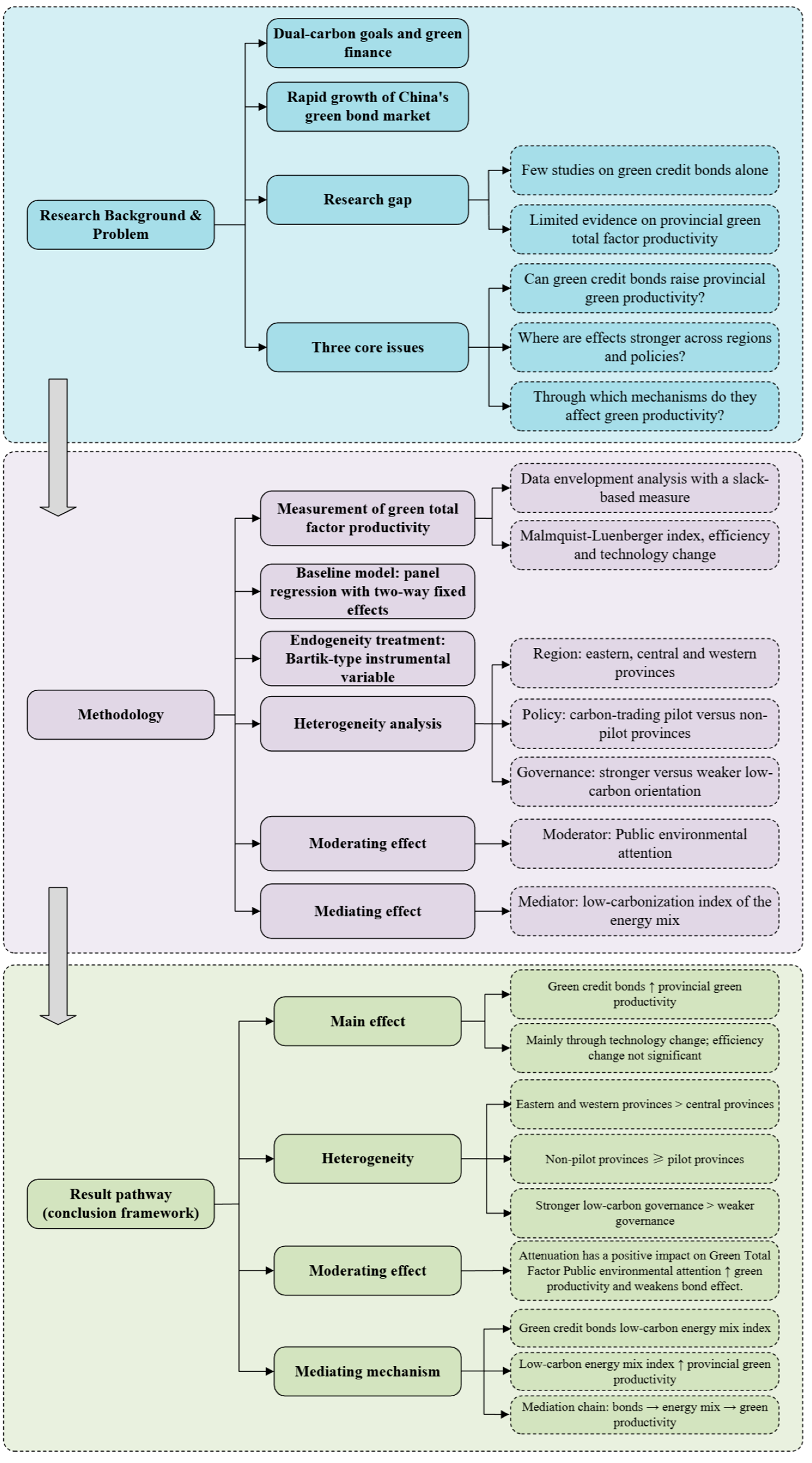
This study focuses on green credit bonds—green bonds issued by non-financial firms in the form of credit corporate bonds, medium-term notes (MTNs), and commercial papers (CPs)—using panel data for 29 Chinese provincial-level administrative regions from 2016 to 2023. This study constructs an SBM–ML measure of GTFP and its TC and EC components, and estimate province–year fixed-effects and Bartik-IV models with the log issuance count of green credit bonds as the core regressor. Mechanisms and conditional effects are examined through an LCEM-based mediation framework, grouped regressions by region, low-carbon pilot status, and governance orientation, and moderation by public environmental attention. Compared with studies based on composite green finance indices or aggregate green bond volumes, this design isolates the impact of green credit bonds on GTFP, clarifies when they are most effective, and generates product-, region-, and policy-level implications for optimizing China’s green credit bond market. The remainder of the paper introduces data and measurement, empirical results and discussion, and conclusions. The research roadmap is shown in
Figure 1.
2. Materials and Methods
2.1. Variable Definition
2.1.1. Dependent Variable: Green Total Factor Productivity (GTFP)
In recent years, the measurement of GTFP has evolved from the Solow residual approach and stochastic frontier analysis (SFA) to data envelopment analysis (DEA). Unlike parametric approaches that require strong functional-form assumptions, DEA can jointly accommodate desirable and undesirable outputs within a multi-input, multi-output framework. In this study, provincial GTFP is used as the dependent variable. The slacks-based measure (SBM) proposed by Tone (2001) [
17] is employed to characterize static green production efficiency at the provincial level under a non-oriented and variable returns to scale (VRS) setting. Compared with radial and uni-directional DEA models, the non-oriented SBM uses slack variables for inputs and (un)desirable outputs to measure redundancies and shortfalls without prespecifying adjustment in only “input contraction” or only “output expansion,” making it more suitable for environmental production processes where resource waste and pollution emissions coexist. The VRS assumption allows provinces of different sizes to exhibit different returns to scale, avoiding the misclassification of scale differences as technical-efficiency differences. To ensure comparability across years, all observations for all provinces over the period 2016–2023 are pooled to estimate a common frontier under a unified technology set. Efficiency scores for each province are computed, and a Malmquist–Luenberger (ML) productivity index consistent with the SBM scores is subsequently constructed. This allows intertemporal changes in GTFP to be further decomposed into EC and TC.
Assume that each province–year observation is a decision-making unit (DMU), with an input vector
, a desirable output vector
, and an undesirable output vector
. Data for all DMUs are organized into matrices
. For DMU 0, the efficiency score
is obtained from the following programming model:
where
denotes input redundancy,
denotes shortfalls in desirable outputs,
denotes excess undesirable outputs, and
is the weight vector. The efficiency score satisfies
. A value of
indicates that the DMU lies on the efficiency frontier; if
, the DMU is inefficient due to input waste, insufficient desirable outputs, or excessive undesirable outputs.
To facilitate subsequent ML decomposition and to maintain the convention that larger values represent higher efficiency, a monotonic transformation is applied to the SBM efficiency obtained from Equation (1), defining the efficiency measure evaluated under period-t technology as . Here, the superscript always indicates the “technology period used for evaluation,” while the arguments in parentheses correspond to the “data period being evaluated.” All subsequent intertemporal analyses of green productivity are based on this efficiency measure.
Based on
, the ML index is introduced to characterize the intertemporal evolution of green productivity and to distinguish between catch-up effects and frontier shifts. The ML index is based on the directional distance function and is suitable for joint production with accompanying pollutant emissions. Its intertemporal change can be decomposed into EC and TC, where EC measures a DMU’s movement toward the contemporaneous frontier and TC captures shifts in the frontier itself over time. Compared with the traditional Malmquist index, the ML index aligns better with non-radial SBM scores under environmental constraints and yields more consistent decompositions. The dynamic green productivity equation is given in Equation (2):
The decomposition formulas are shown in Equations (3) and (4):
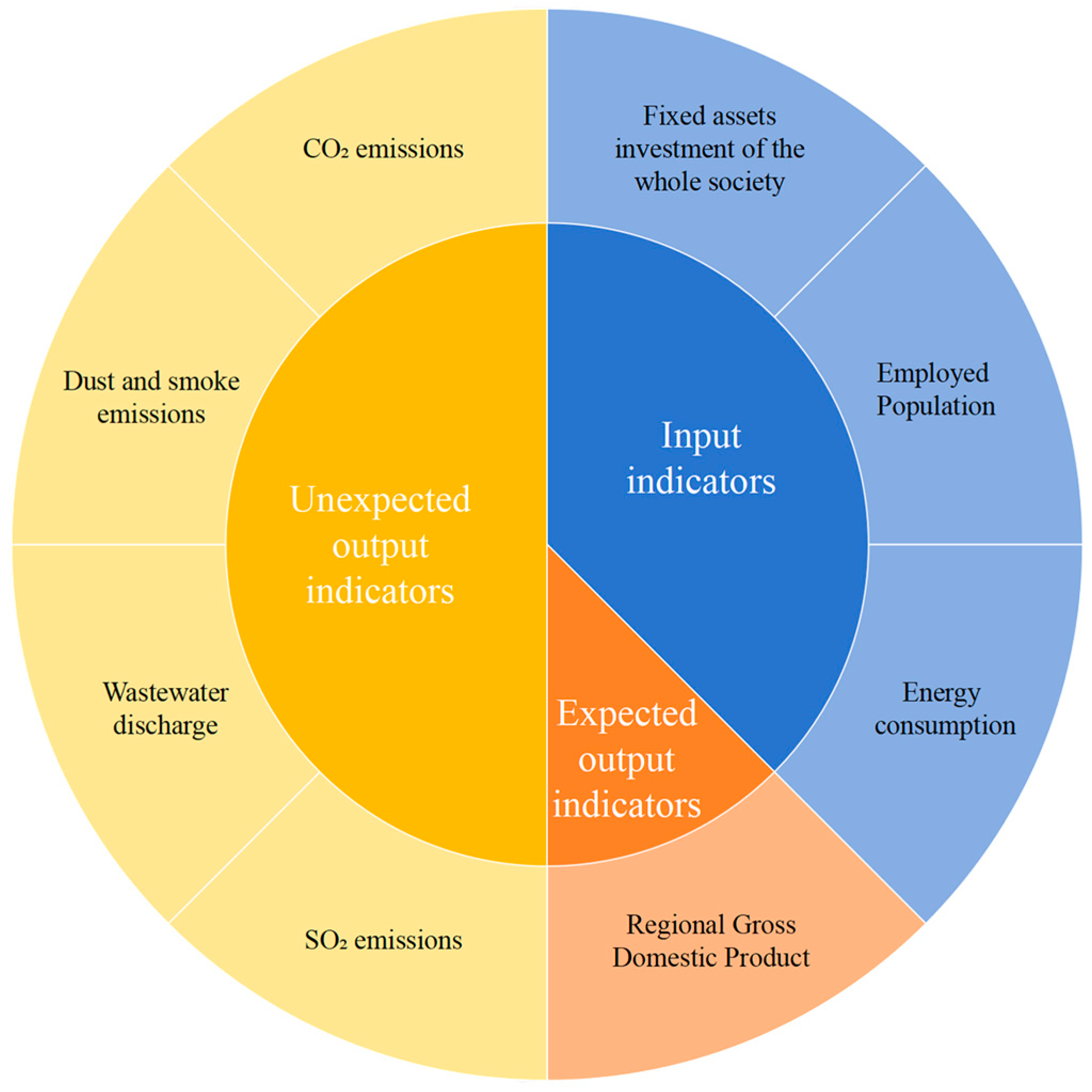
To construct the input–output system for GTFP, capital stock, labor, and energy consumption are selected as the three core input variables within the SBM–ML framework. Desirable output is measured by real GDP, which is consistent with the definition of productivity and standard practice in the literature [
18]. For undesirable outputs, considering the availability and policy relevance of statistics on China’s “industrial three wastes,” industrial wastewater discharge, sulfur dioxide (SO
2) emissions, and industrial smoke/dust (particulate) emissions are included to capture typical air and water pollution. These indicators have been widely used in recent studies to compute GTFP and have been empirically validated [
19]. In addition, to reflect carbon constraints and align with the “dual-carbon” policy objectives, carbon dioxide (CO
2) emissions are incorporated into the set of undesirable outputs. Multiple recent studies likewise treat wastewater, SO
2, smoke/dust, and CO
2 emissions jointly as undesirable outputs, thereby supporting this extended definition [
18,
20]. This indicator set reflects economic output while systematically capturing the constraints imposed by conventional pollutants and greenhouse-gas emissions on green productivity. The specific indicators are summarized in
Table 1, and the overall framework of indicator construction is presented in
Figure 2.
2.1.2. Explanatory Variable: Log of Green Credit Bond Issuance (lnGCB)
The core explanatory variable is lnGCB, the log of the green credit bond issuance count. Specifically, at the province–year level we count the number of newly issued green-labeled credit bonds in each year, covering corporate bonds (excluding convertible and exchangeable bonds), enterprise bonds, and interbank products (including MTNs, CPs, private placement notes (PPNs), and project-revenue notes). To reduce the influence of heavy tails and extreme values and to handle zero issuance in some provinces in the early years, we apply a log-like transformation
, which preserves logarithmic scaling while being robust to zeros and suitable for linear regressions. We denote this variable as lnGCB, calculated as follows:
where
is the number of green credit bonds issued in region
in year
. This indicator captures the log level of green credit bond issuance and emphasizes the “breadth” of green finance supply (the extensive margin). Compared with amount-based measures, it is less affected by fluctuations in a few large projects. Mechanistically, a larger number of green credit bonds can ease financing constraints for green projects, lower capital costs, and promote the adoption and diffusion of green technologies, thereby improving GTFP. We expect the coefficient on lnGCB to be positive on average, although heterogeneous patterns such as diminishing marginal effects or high-level crowding-out may emerge when financial resources become congested or project screening is insufficient.
2.1.3. Control Variables
Local tax revenue (tax): calculated as the share of annual local tax revenue in GDP for each province. Tax revenue proxies’ local fiscal capacity and government capacity, influencing public-goods provision and regulatory enforcement. Fiscal pressure may alter local governments’ environmental enforcement capacity and policy orientation, so we control for its systematic effect on green productivity [
21].
Government environmental governance expenditure (govern): measured as the logarithm of provincial fiscal expenditures on ecological and environmental governance. Extensive empirical evidence shows that environmental fiscal spending is significantly associated with pollution and carbon emissions and can reduce industrial pollution or regional carbon emissions, although effects are heterogeneous across regions; thus, it is included as a key fiscal-policy control [
22,
23].
Income gap (gap): constructed as the logarithm of the ratio in per capita disposable income between urban and rural residents. This measure is scale-invariant, mitigates the influence of extreme values, and allows coefficients to be interpreted as approximate percentage differences. Existing studies indicate that income inequality is closely related to carbon emissions and environmental quality [
24]; failing to control for it may confound green performance with distributional effects.
Government low-carbon attention (Carbon): based on publicly available texts such as annual provincial government announcements and government work reports, we count, at the province–year level, the number of documents containing keywords such as “carbon reduction,” “low carbon,” “carbon peak,” “carbon neutrality,” “emissions reduction,” and “green,” and take the logarithm as the indicator. This text-based measure reflects the attention and emphasis governments place on environmental issues; it has been used to proxy governmental environmental attention and shown to influence firms’ carbon-reduction behavior [
25].
Population density (dens): defined as total population divided by land area. Population density captures scale and agglomeration externalities and directly affects regional productivity, energy use, and emission structures. Prior research finds systematic relationships between density, productivity, and energy consumption; omitting it may introduce estimation bias. We therefore include population density as a basic demographic and spatial control [
26].
2.1.4. Instrumental Variables (IV)
To mitigate potential endogeneity in green credit bond issuance, we construct two Bartik (shift–share) IVs following an “exposure–shock” logic. Specifically, we use each province’s baseline financial-sector share to proxy pre-existing exposure to the sector, and weight contemporaneous national common shocks (excluding the province itself) by that share to map them into exogenous supply-side pushes for the province. In the standard identification framework, the validity of a Bartik instrument rests on two conditions: (i) the cross-sectional allocation of national shocks is approximately random, and (ii) the shares are drawn from a pre-policy baseline and are independent of the error term [
27].
Let
denote the “financial-sector share” of province
over 2013–2015 (the average ratio of financial-sector value added to regional GDP), which is treated as an exogenous long-run structural weight unrelated to subsequent shocks [
27]. To avoid mechanically importing a province’s own fluctuations into the common shock, we construct, for each year
, national aggregates that exclude the province itself.
We use each province’s 2013–2015 financial-sector share as baseline exposure and multiply it by the contemporaneous log of the national (excluding the province) issuance amount of green credit bonds to construct a Bartik IV. The logic is that annual expansions of the national green credit bond market constitute a common shock, while the extent to which provinces are affected is predetermined by their preexisting financial-sector weights. Provinces with a stronger financial base are better positioned to absorb market expansions and translate them into higher local issuance. Because the baseline shares are determined before the sample period and the national shock does not depend on short-run disturbances in any single province, and because we remove the province’s own contribution through a leave-one-out procedure, this variable can serve as an exogenous instrument. The specific formula is given in Equation (6):
In Equation (6),
is the national total issuance amount of green credit bonds in year
, excluding province
. A national-market expansion in a given year represents a common shock; provinces with stronger financial-sector foundations are more likely to accommodate this shock and connect more quickly to issuance opportunities, leading to higher local issuance counts and market activity. Since the baseline financial structure is fixed prior to the study period and the national shock is orthogonal to contemporaneous provincial changes,
generates exogenous variation in local issuance.
Using the same 2013–2015 financial-sector share to measure baseline exposure, we take the log of in national (excluding the province) financial-sector value added in year
as the common shock. This design exploits the stronger transmission of nationwide financial-cycle conditions in more exposed provinces to generate exogenous variation in local green credit bond issuance. The instrument is defined as Equation (7):
In Equation (7), denotes national financial-sector value added (or its growth rate) in year , excluding province . This shock captures common movements in nationwide financial conditions. Given the same shock, provinces with higher baseline financial shares have more efficient transmission channels through issuance, underwriting, and investor bases, and are therefore more strongly affected in their local green credit bond activity.
In short, the two Bartik IVs distribute national common fluctuations across provinces according to their baseline financial-sector exposure and remove each province’s own contribution using a leave-one-out construction, thereby generating exogenous variation in local green credit bond issuance that is less correlated with the error term. The identification logic is consistent with the standard shift–share design.
2.1.5. Moderating Variable
We construct a province–year measure of public environmental attention (atten). Using core keywords such as “environmental pollution,” we collect daily search-intensity data from Baidu and compute the annual average to form the yearly attention index. Search-based measures capture timely changes in public concern about pollution and air quality, and are closely linked to governance intensity as well as firms’ and households’ emission-reduction behavior, making them a valid proxy for public environmental attention [
28,
29].
In the model, we interact atten with the core explanatory variable (the log of green credit bond issuance lnGCB) to test whether the effect of lnGCB on GTFP is amplified or weakened when public attention to the environment is higher; the sign and magnitude are determined empirically. This Baidu-index–based approach has been widely applied in environmental and sustainability research [
30].
2.1.6. Mediating Variable
As the mediating variable for mechanism tests, we construct a LCEM index. Specifically, we represent each province’s energy consumption structure in year
by three categories (coal, oil and gas), and other energy sources, and use their respective consumption shares as components of a three-dimensional vector
. We then compute the angles between
and three benchmark vectors ordered from high-carbon to low-carbon consumption,
, and
, denoted
, as shown in Equation (8):
Finally, we weight the angles for year
to obtain the LCEM index, calculated as Equation (9):
This index has been widely used to measure the LCEM across provinces and to evaluate policy effects, and it exhibits strong explanatory power and intertemporal comparability [
14,
15].
2.2. Model Specification
2.2.1. Baseline Regression Model
To identify the effect of lnGCB on GTFP, we estimate a two-way fixed-effects model at the province–year level, controlling for unobserved time-invariant provincial heterogeneity and common shocks across years, while including the set of control variables. The baseline specification is:
where
and
index provinces and years, respectively;
is the vector of control variables;
denotes province fixed effects that absorb time-invariant institutional and geographic differences;
denotes year fixed effects that control for contemporaneous shocks such as macro policies and business cycles; and
is the error term. The coefficient
captures the within-province, over-time marginal effect of lnGCB on GTFP conditional on fixed effects and controls. We report province-clustered robust standard errors to address heteroskedasticity and serial correlation within provinces.
2.2.2. Moderation Model
The moderation model tests whether public environmental attention alters the strength of the effect of green credit bonds on GTFP. We add an interaction term within the two-way fixed-effects framework as follows:
where
captures the moderation effect. If
, atten strengthens the marginal impact of lnGCB on GTFP; if
, atten weakens it.
2.2.3. Mediation Model
To characterize the pathway through which green credit bonds affect GTFP via LCEM, we employ a standard two-step mediation model under two-way fixed effects:
Equation (12) is the mediator equation, where measures the marginal effect of lnGCB on LCEM. Equation (13) is the outcome equation, which evaluates the direct effect of lnGCB on GTFP () after controlling for LCEM, while captures the effect of LCEM on GTFP. If and , this indicates a positive transmission from greener financing to LCEM and then to higher productivity; if , the LCEM channel weakens or offsets the effect of lnGCB on GTFP. Both equations use the same sample and controls as the baseline regression to ensure interpretability and comparability.
Descriptive statistics are reported in
Table 2.
2.3. Data Sources
We construct a province–year panel dataset covering 29 provincial-level administrative regions from 2016 to 2023, excluding Hong Kong, Macao, Taiwan, Heilongjiang, and Qinghai. Heilongjiang and Qinghai are excluded because no green credit bond issuance records for these provinces are found in the Wind database during the sample period. Data on the issuance count (number of tranches) and issuance amount of green credit bonds are obtained from the Wind Financial Terminal (Wind) bond database and aggregated to the provincial level based on issuance announcements. Macroeconomic variables and controls are drawn from the China Statistical Yearbook published by the National Bureau of Statistics. Disaggregated energy consumption data and provincial energy balance sheets are taken from the China Energy Statistical Yearbook. Public environmental attention (atten) is based on the Baidu Index: we search topic terms such as “environmental pollution,” collect daily search intensity, and compute annual averages to form provincial time series. Government attention to carbon reduction (Carbon) is measured by annually counting, on each provincial government portal under sections such as “policy documents/government gazette/open government information,” the number of normative documents containing keywords including “carbon peak, carbon neutrality, low carbon, and carbon reduction,” and applying a unified search protocol consistent with the State Council policy document database on the Chinese Government Website to ensure comparability across provinces. We focus on 2016–2023 because China’s green bond market became institutionalized in the mid-2010s with standardized taxonomies and disclosure frameworks, and consistent province-level issuance and energy–environment statistics are available for this period. Both RStudio (version 4.4.2) and Stata (version SE 19.5) software were used for data processing, index construction, and econometric estimation. All data and code used in this study are provided in the
supplementary material.
3. Results
3.1. Baseline Regression
To evaluate the average effect of green credit bonds on GTFP, we first estimate the baseline two-way fixed-effects model. The results are reported in
Table 3. Column (2) uses GTFP as the dependent variable, while columns (3) and (4) correspond to EC and TC, respectively, allowing us to identify the sources of productivity change. The core explanatory variable is lnGCB. Control variables include Carbon, Gap, Tax, Dens, and Govern, capturing government attention to carbon reduction, development disparity, fiscal taxation conditions, population density, and government environmental governance expenditure. All specifications include province and year fixed effects to remove confounding factors that are invariant across provinces or over time. Thus, the estimated coefficients reflect the marginal effect of lnGCB on each outcome after controlling for covariates and spatiotemporal effects.
To determine the appropriate baseline specification, we first conduct a Hausman test for the GTFP regression, which rejects the null hypothesis of random effects (
p-value = 0.0073). We therefore adopt the two-way fixed-effects model in all subsequent analyses. Using province-clustered robust standard errors, the baseline results support H1: lnGCB is positively associated with provincial GTFP. Moreover, the evidence indicates that TC, rather than EC, is the dominant transmission channel. Specifically, the coefficient on lnGCB is positive and statistically significant in both the GTFP and TC regressions (0.1173 and 0.1145, respectively;
p < 0.01), whereas the corresponding estimate in the EC equation is negligible and statistically insignificant (0.0008,
p > 0.1). This pattern suggests that green credit bond issuance enhances green productivity primarily through shifting the green production frontier outward, rather than through short-term efficiency gains—a finding consistent with the literature indicating that green finance drives productivity improvements predominantly via TC [
31,
32]. Joint significance tests corroborate this interpretation: the GTFP and TC equations are jointly significant, while the EC equation is not (
p-value = 0.7770), further reinforcing the conclusion that TC is the primary mechanism.
Among the control variables, Carbon is positive and statistically significant in both the GTFP and TC regressions, indicating that stronger carbon governance is associated with higher green productivity. This finding is consistent with existing evidence showing that carbon trading pilot programs significantly enhance GTFP, primarily through TC [
33,
34]. The variable Gap exhibits a significantly negative coefficient in the GTFP equation, which aligns with studies documenting that widening urban–rural income disparities tend to suppress GTFP [
33,
35]. The remaining control variables are not statistically significant within this sample and time period. We therefore treat them as conditioning factors and focus our subsequent interpretation on the core H1 result and its dominant TC channel, while recognizing that their estimated effects may be sensitive to measurement specifications and the relatively short sample period.
3.2. Endogeneity Test
To mitigate potential reverse causality and omitted-variable bias, we introduce two Bartik (shift–share) IVs that capture exogenous shocks. The first IV is based on a common shock from nationwide expansion in the issuance amount of green credit bonds, reflecting heterogeneous exposure to demand-side shifts in green finance. The second IV uses a common shock from changes in nationwide financial-sector value added, reflecting heterogeneous exposure to supply-side shifts in financial conditions. Provincial exposure is predetermined by baseline financial structures. After controlling for province and year fixed effects, instrument relevance derives from cross-sectional differences in baseline shares, while exogeneity relies on the quasi-random nature of national shocks and the pre-determined baseline shares. The construction is described above. Empirically, we compute national shocks using a leave-one-out approach and report strong-instrument statistics such as the Kleibergen–Paap rk Wald F and Cragg–Donald F, as well as overidentification tests, to assess validity. This identification strategy follows standard shift–share designs widely used in the literature, including provincial-exposure approaches based on import competition [
36] and military procurement [
37]. The results of the two-stage least squares (2SLS) estimation, including both the first and second stages, are presented in
Table 4.
After addressing endogeneity, the core conclusion remains robust. Regardless of whether the instrument is constructed from nationwide expansion in green credit bond issuance or from nationwide financial-cycle conditions, the 2SLS coefficient on lnGCB is significantly positive. This indicates that, once potential reverse causality and omitted-variable bias are controlled for, lnGCB continues to promote GTFP, with a larger estimated magnitude. The Wu–Hausman tests are significant in both specifications, supporting the use of IV estimation.
In terms of instrument strength, the Cragg–Donald F statistic for IV1 is 8.75, below the conventional threshold of 10. However, its Kleibergen–Paap rk Wald F is 11.90, exceeding 10 and the Stock–Yogo 15% maximal size reference value (8.96), suggesting that IV1 is not weak under clustered-robust inference. For IV2, the Cragg–Donald F is 28.277 and the Kleibergen–Paap rk Wald F is 11.737, indicating adequate relevance. It is worth noting that the Cragg–Donald critical values are derived under the assumption that the error terms are independent and identically distributed and homoskedastic, whereas the Kleibergen–Paap statistic is robust to heteroskedasticity and clustering and is therefore more appropriate for our setting.
Overall, first-stage results and weak-identification diagnostics support the validity of both Bartik IVs as exogenous predictors. The direction and significance of the 2SLS estimates are consistent with the baseline regressions, indicating that the main findings are robust to endogeneity correction. The pattern of a relatively low Cragg–Donald F but acceptable Kleibergen–Paap F for IV1 is common under clustered-robust inference and reflects the differing assumptions behind these statistics.
3.3. Heterogeneity Analysis
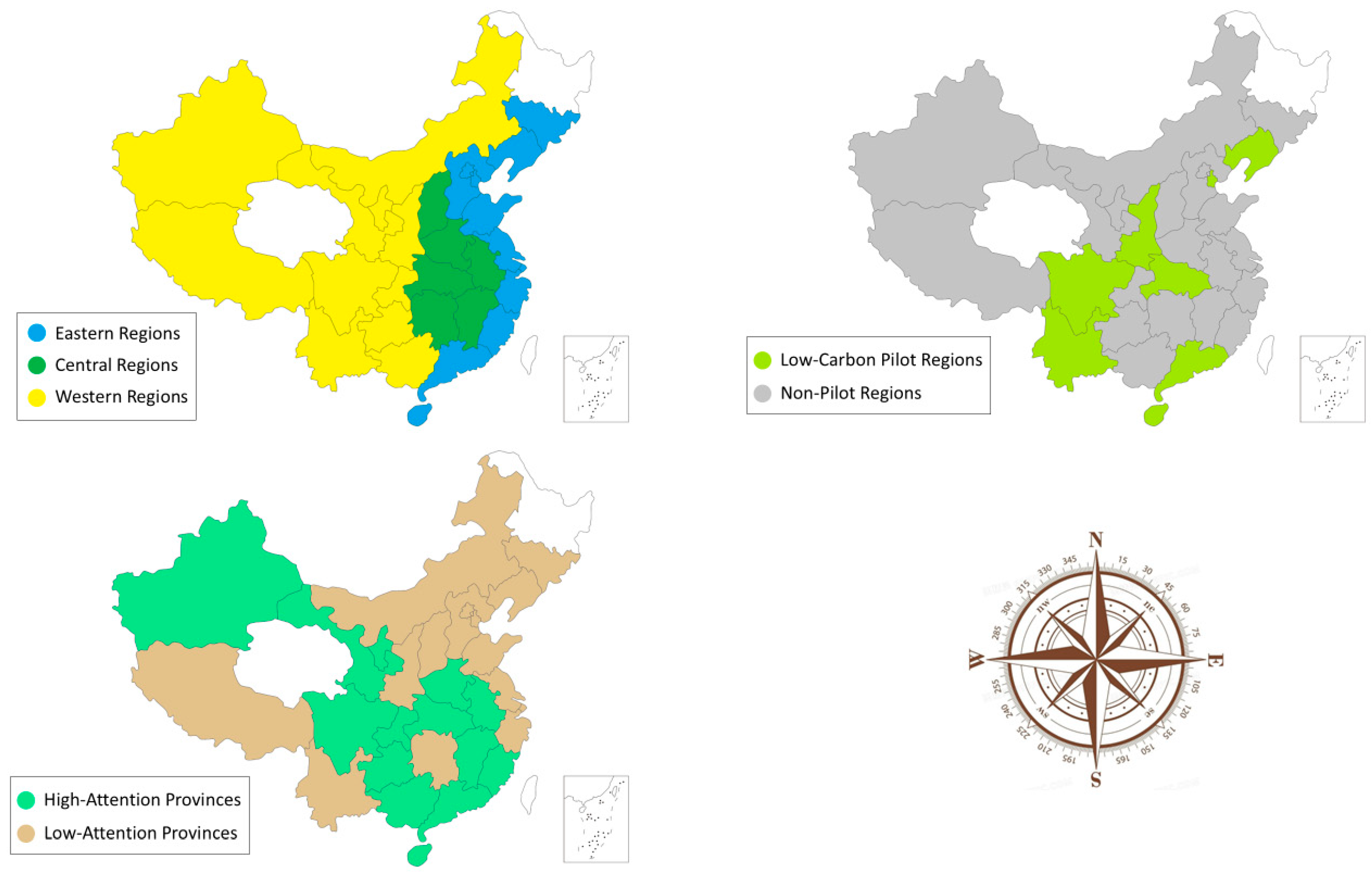
Our heterogeneity analysis is conducted along three dimensions. First, following the official east–central–west regional classification commonly used in the literature, we assign the sample provinces to eastern, central, and western groups to identify coefficient differences driven by economic gradients and institutional environments [
38,
39]. Second, based on standard policy-pilot grouping strategies, we use China’s carbon emissions trading pilot program as the criterion: provinces participating in the program are classified as the pilot group, with the remaining provinces as the non-pilot group, to test whether a low-carbon policy environment strengthens or weakens the effect of green credit bonds [
40,
41]. Third, following common practice, we compute each province’s average value of the low-carbon governance-orientation indicator, Carbon, over 2016–2023, obtain the sample median, and classify provinces above the median as “high attention” and those below as “low attention,” to compare heterogeneity associated with governance orientation [
42,
43]. The results are reported in
Table 5. In these grouped regressions, we retain the province–year two-way fixed-effects specification and employ province-clustered robust standard errors.
Figure 3 presents the map-based visualization of heterogeneity groups across Chinese provinces.
Table 5 shows substantial heterogeneity in the relationship between lnGCB and GTFP across regions and policy environments. When we group provinces by geography, we find statistically significant positive coefficients for the eastern and western regions, whereas the coefficient for the central region is not statistically significant. This pattern is consistent with existing evidence that green finance tends to be more effective in regions with higher levels of economic development and marketization [
44,
45], and is also in line with recent studies on carbon reduction that report stronger effects in the east and west but weaker effects in the center.
When we group provinces by policy pilots, the coefficients are significantly positive in both low-carbon pilot and non-pilot regions. The coefficient for the non-pilot group is significant at the 1% level, whereas that for the pilot group is significant at the 10% level and has a slightly larger point estimate. Prior studies generally find that carbon trading schemes and low-carbon pilots themselves improve regional green productivity or related green outcomes. In pilot regions, these policies have partly internalized financing and technological pathways for the green transition, making the marginal effect of green credit bonds more difficult to identify precisely. In contrast, where baseline policy support is weaker, the incremental contribution of green credit bonds to GTFP is more likely to be observed, consistent with the policy-mix literature, which argues that policy overlap can alter the marginal effectiveness of specific instruments [
46].
We further group regions by governance orientation, using the sample median of Carbon over 2016–2023 as the threshold. Under this classification, the lnGCB coefficients are significantly positive in both the high-attention and low-attention groups, with a larger effect in the high-attention group. This finding accords with evidence that stronger government environmental attention increases GTFP and complements policy instruments [
47,
48]. A stronger low-carbon governance orientation facilitates the translation of green credit bonds into technological progress and structural adjustment through policy, regulation, and public oversight, thereby yielding a more pronounced marginal effect.
Overall, except for the central region, we find a statistically significant positive effect of lnGCB on GTFP across all other groups (eastern and western regions, pilot and non-pilot regions, and high- versus low-attention governance groups). The effects are more robust and statistically stronger in the eastern and western regions, in non-pilot regions, and in high-attention governance regions. Relative to studies that report significant effects in the east but weaker effects in central and western areas, our finding of a significant and larger coefficient for the west may reflect recent improvements in green-finance infrastructure and green project pipelines in western provinces, as well as stronger demand for technological retrofits in resource-based regions. The non-significant result for the central region is consistent with observations that green-finance effects there are relatively weak and may even lag in emission-reduction outcomes, potentially because of a midstream, manufacturing-oriented industrial structure, lower penetration of green financial products, and differences in the timing of policy and funding implementation during the sample period.
3.4. Moderation Effect Analysis
To test whether the impact of green credit bonds on GTFP varies with public environmental attention, we conduct a moderation analysis. Building on the baseline specification, we interact the attention measure with the core explanatory variable and examine the statistical and economic significance of the interaction. Public environmental attention is measured by annual provincial search intensity from the Baidu Index, a widely used and validated approach in the environmental economics literature. Prior work suggests that public attention can influence environmental performance through channels such as public opinion oversight, media amplification, stronger enforcement, and increased governance investment, thereby potentially altering the marginal effects of green financial tools [
28,
30,
49,
50]. Evidence that public pressure improves GTFP via green innovation also supports atten as a plausible moderator. We therefore test whether the interaction between green credit bonds and atten is significant and report its estimated magnitude and explanatory power. Results are shown in
Table 6.
Table 6 reports tests of H2, which posits that public environmental attention directly improves GTFP while attenuating the marginal effect of green credit bonds. The estimates indicate that lnGCB and atten are each positively associated with GTFP and TC, while their coefficients are positive but insignificant in the EC equation. Taken together, these results suggest that both green credit bond issuance and public environmental attention independently raise provincial GTFP, and that the improvement operates primarily through TC rather than short-run EC.
More importantly, the interaction term lnGCB×atten is significantly negative in the GTFP equation, while it is not significant in either the EC or TC equations. This pattern suggests diminishing marginal returns or a substitution effect. In provinces with higher public environmental attention, firms and governments have already faced stronger regulatory pressure, social scrutiny, and support from other green financial tools (such as green credit and subsidies), leading to relatively high green technology investment and emission-reduction constraints. In this setting, green credit bonds still increase GTFP, but their marginal contribution is visibly smaller than in provinces with lower attention. Put differently, atten directly improves GTFP and TC, while also “front-loading” part of the gains from green transition, leaving a more limited incremental role for green credit bonds under high-attention conditions.
Within the observable range of our data, the marginal effect of lnGCB remains positive but declines as atten rises. Thus, our findings do not contradict the broader consensus that public attention improves environmental performance and promotes green transition. On one hand, public environmental attention enhances environmental outcomes, accelerates energy transition, and stimulates green technological innovation, consistent with Baidu-Index-based evidence that attention reduces pollution [
30,
51], and with the positive main effects of atten on GTFP and TC. On the other hand, the positive overall effect of green finance on GTFP is in line with recent province- and city-level studies identifying productivity gains from green finance policies or development [
52,
53]. Our results add that, at the macro level, the productivity-enhancing effects of public attention and green credit bonds are not simply additive; instead, a degree of substitutability exists because atten itself has already driven part of the green transition, weakening the marginal effect of green credit bonds in high-attention regions.
3.5. Mechanism Analysis
To identify the transmission pathway through which lnGCB affects GTFP, we use the provincial LCEM index as a mediating variable. On the one hand, existing studies at the industrial and provincial levels show that upgrading the energy consumption structure from “high-carbon, coal-intensive” toward “clean, low-carbon” is closely associated with improvements in GTFP and reductions in carbon emissions, and that gains in GTFP are mainly reflected in TC rather than in pure efficiency improvements [
54,
55]. Meanwhile, improved multi-dimensional vector-angle methods are widely used to construct indices of the low-carbon transition or decarbonization of the energy consumption mix, which describe the substitution of clean energy for traditional fossil fuels and provide a standard way to measure provincial LCEM, offering methodological guidance for our LCEM measure [
54,
55].
On the other hand, recent empirical research on green finance finds that green finance development significantly accelerates the transformation of the energy consumption structure from high-carbon to low-carbon forms. LCEM indices based on vector-angle methods are widely used in this literature either as dependent variables or as key mediators [
56,
57]. Taken together, one strand of studies establishes a stable positive association between LCEM and GTFP as well as emission-reduction performance [
54,
55], while the other shows that green finance can be an important driver of LCEM [
56,
57]. Accordingly, we introduce LCEM as the hypothesized mediating link between green credit bonds (lnGCB) and GTFP, viewing it as a refinement of the broader mechanism whereby green finance affects green productivity by guiding energy-structure adjustment, applied here to the specific instrument of green credit bonds.
Empirically, we first estimate the effect of lnGCB on LCEM using Equation (12), testing whether green credit bonds significantly promote LCEM after controlling for province and year fixed effects and relevant covariates. We then include both lnGCB and LCEM in the outcome equation in Equation (13), treating lnGCB as the core explanatory variable and LCEM as the mediator, thereby decomposing the total effect of lnGCB on GTFP into a direct effect and an indirect effect operating through LCEM. The statistical significance of the indirect effect is evaluated using Sobel–Aroian–Goodman product-of-coefficients tests, and we also report the conditional direct effect of lnGCB after controlling for LCEM. The estimation results are shown in
Table 7.
The mechanism analysis provides direct support for H3 by identifying a coherent transmission pathway: the expansion of green credit bonds strengthens LCEM, which in turn is positively associated with provincial GTFP, with this improvement operating predominantly through TC. Empirically, the results show that lnGCB is positively related to LCEM, and when LCEM is included in the outcome equation, LCEM remains a strong positive predictor of GTFP while the coefficient on lnGCB retains statistical significance—indicating partial rather than full mediation. Formal indirect-effect tests (Sobel, Aroian, and Goodman) consistently confirm a statistically significant mediated effect, and the decomposition further reveals that the mediated gains are primarily concentrated in TC, accompanied by a smaller but non-negligible contribution from EC. Overall, these findings align with a theoretical mechanism in which bond-financed capital allocation promotes cleaner energy structures, reduces carbon intensity, and enhances returns to green innovation and technology diffusion, thereby shifting the green production frontier outward.
This LCEM-based mediation pathway is externally consistent with the broader empirical literature. In particular, recent studies demonstrate that energy structure upgrading enhances GTFP primarily by promoting green technological progress, rather than by generating substantial gains in green technical efficiency—mirroring the TC-dominant mechanism observed in our mediation analysis [
58]. More broadly, our finding that green finance contributes to green productivity is aligned with national- and city-level causal evidence showing that green finance development and related policy initiatives increase GTFP, particularly in regions with stronger market institutions or more developed financial systems [
31,
52]. A parallel strand of research employing multi-period difference-in-differences and spatial econometric approaches further indicates that green finance facilitates the transition from high-carbon to low-carbon energy sources by alleviating financing constraints and fostering green innovation, thereby reinforcing the role of LCEM as a central mediating variable in the green finance–productivity nexus [
14]. Collectively, the identified pathway “lnGCB → LCEM → GTFP” and its concentration in TC are consistent with the established literature attributing productivity improvements from energy structure transformation largely to advances in technology, providing robust support for H3.
4. Discussion
Building on our province–year panel data, we find that green credit bonds are robustly associated with higher provincial GTFP, with the gains primarily driven by TC rather than short-run EC. This TC-dominant pattern is economically intuitive in the SBM–ML framework, which explicitly decomposes productivity dynamics under environmental constraints: bond financing is more likely to alleviate constraints on green innovation and equipment upgrading, thereby facilitating the diffusion of cleaner technologies that shift the production frontier outward, rather than merely improving managerial efficiency in the short term [
7,
8,
9]. Importantly, our main findings are robust across alternative specifications and remain qualitatively unchanged when addressing endogeneity through a Bartik-type shift–share identification strategy, reinforcing the interpretation that the observed relationship is not solely driven by reverse causality or time-varying omitted variables [
13]. In the following sections, we interpret these results by clarifying the boundary conditions revealed through heterogeneity and moderation analyses, and by elaborating on the LCEM-based transmission mechanism linking green credit bonds to frontier shifts in green productivity.
Our findings are broadly consistent with international evidence indicating that green bonds can generate both financial-market and real-economy effects. In particular, the documented “greenium” in green bond pricing suggests that pro-environmental investor preferences can translate into a lower cost of capital, thereby enhancing issuers’ incentives and capacity to invest in green innovation and cleaner technologies [
10]. This interpretation is further supported by studies showing that green bond issuance is associated with positive market reactions and subsequent improvements in firms’ environmental performance and green innovation, implying that bond-based green finance operates primarily through forward-looking investment and technological upgrading rather than short-run efficiency catch-up [
1]. Evidence from China further demonstrates that announcements of green bond issuance elicit significant responses in both bond and stock markets, underscoring the relevance of capital-market channels in the Chinese context [
6]. At the macro- and provincial levels, our TC-driven results align with a growing body of literature finding that green finance development enhances GTFP mainly through technological progress, rather than through more efficient reallocation of existing inputs [
7]. Importantly, our product-level focus on green credit bonds bridges these two strands of research by shifting from aggregate indices or generic green bonds to a more policy-actionable instrument. Moreover, it highlights that bond quality, disclosure standards, and third-party verification—factors known to influence green bond pricing and credibility—are likely critical in determining how effectively proceeds are channeled into technological upgrading and gains in green productivity [
4,
11].
Our mediation results indicate that the LCEM is a statistically and economically meaningful transmission channel through which green credit bonds enhance provincial GTFP. This finding aligns with broader evidence showing that green finance can facilitate the transformation and decarbonization of energy consumption structures under carbon emission constraints, thereby supporting greener growth trajectories rather than merely reallocating financial resources across sectors [
55,
56]. In our context, green credit bonds likely influence LCEM by redirecting capital toward renewable energy generation, clean-energy infrastructure, and energy-efficiency retrofits, while enhanced disclosure requirements and third-party verification improve project screening and reduce resource misallocation. A cleaner energy mix lowers carbon intensity and alleviates “high-carbon lock-in,” which in turn increases returns to green innovation and accelerates the diffusion of cleaner technologies—helping explain why productivity gains are more strongly reflected in TC than in short-run efficiency catch-up. Methodologically, our LCEM measure builds on recent multidimensional approaches—specifically vector-angle and spatial vector-angle methods—designed to capture both the direction and intensity of low-carbon transitions in the energy mix, thereby enhancing the interpretability of the mediation results [
14,
15].
Our moderation results suggest that public environmental attention plays a dual role. On the one hand, higher levels of attention are associated with greater provincial GTFP, consistent with the view that public scrutiny enhances environmental accountability and strengthens incentives for greener production and innovation. On the other hand, the interaction term indicates that public attention attenuates the marginal effect of green credit bonds on GTFP. A plausible interpretation is that when public attention is already high, issuers and local governments face tighter project screening, stronger disclosure requirements, and higher compliance intensity, leaving less room for additional productivity gains specifically attributable to bond financing. This finding aligns with evidence showing that public attention and opinion-based oversight can discipline environmental behavior and influence the effectiveness of environmental governance and energy transitions, suggesting a pattern of “substitution” or “diminishing marginal returns” between social oversight and market-based green financing instruments [
28,
30,
50,
51].
Nevertheless, several limitations warrant acknowledgment and suggest avenues for future research. First, our analysis is conducted at the provincial level, which may obscure within-province heterogeneity in industrial structure, project pipelines, and firm-level behavior; future studies could link green bond issuance to issuer- and project-level microdata to trace how financing translates into innovation, technology adoption, and productivity outcomes. Second, the sample period (2016–2023) covers an early phase of China’s green bond market, so longer panel datasets would help assess the persistence of effects, potential nonlinearities, and the evolving influence of taxonomies and disclosure regimes. Third, while our identification strategy enhances causal interpretation, it relies on conventional shift–share assumptions and assumes no confounding channels correlated with exposure shares; complementary designs leveraging regulatory shocks or staged policy rollouts could provide valuable triangulation. Fourth, our mechanism and moderation analyses depend on available provincial-level proxies for energy-mix transition and public environmental attention; future work could refine these pathways by incorporating direct measures of green innovation, capital allocation efficiency, and enforcement intensity, as well as examine cross-province spillovers using spatial econometric or network-based transmission frameworks.
5. Conclusions
Using province–year panel data for 29 provincial-level regions in China from 2016 to 2023, this study finds that green credit bonds are robustly associated with higher provincial GTFP, with gains primarily driven by TC rather than short-run EC. This pattern is consistent with the view that bond financing mainly alleviates constraints on green innovation, equipment upgrading, and the diffusion of cleaner technologies—factors that shift the green production frontier outward. The results are qualitatively stable across alternative specifications and remain robust when addressing endogeneity through a Bartik-type shift–share identification strategy. The effect is context-dependent, being stronger in eastern and western regions, in non-low-carbon pilot areas, and in provinces with a stronger orientation toward low-carbon governance, indicating that market foundations and governance capacity shape the extent to which bond financing translates into frontier-shifting technological progress. Mechanism and boundary-condition analyses further suggest that the LCEM constitutes an economically meaningful channel through which green credit bonds enhance GTFP by promoting cleaner energy structures and reducing carbon intensity. At the same time, public environmental attention plays a dual role: it is positively associated with higher GTFP but attenuates the marginal effect of green credit bonds. This finding aligns with the interpretation that heightened social scrutiny tightens project screening and increases compliance intensity, thereby leaving less incremental room for bond-financed initiatives to generate additional productivity gains.
Our findings speak directly to sustainable development by showing that a market-based green finance instrument—green credit bonds—can support a low-carbon transition while sustaining productivity growth. The evidence that the effect operates primarily through technological change and a cleaner energy-consumption mix implies that green bond financing can help decouple economic activity from carbon intensity and reduce “high-carbon lock-in”. By clarifying the LCEM channel and the institutional conditions under which additionality is strongest (governance capacity and public environmental attention), this study provides actionable guidance for aligning use-of-proceeds, disclosure, and evaluation frameworks with long-term climate and sustainability objectives, consistent with the Sustainable Development Goals related to clean energy, innovation-driven upgrading, and climate action.
Based on these findings, we propose four policy implications.
First, adopt a more structurally targeted allocation strategy. Incremental support from green credit bonds should be directed toward regions and sectors with higher marginal productivity payoffs, while avoiding mechanical expansion of issuance in contexts where diminishing marginal returns are already evident. In practice, this entails prioritizing project incubation, green infrastructure development, and energy-efficiency retrofits in provinces with strong demand for technology upgrading and credible project pipelines, while strengthening project-reserve systems and advisory mechanisms in regions constrained in developing bankable green projects.
Second, design use-of-proceeds rules and performance evaluations around technological upgrading. Given the TC-dominant pattern, fund allocation, disclosure, and ex post evaluation should be tied to technology-oriented milestones—such as clean technology adoption, retrofitting intensity, and green innovation outcomes—rather than treating “green spending” as inherently sufficient. Clear, measurable indicators linked to technological progress can strengthen capital discipline and reduce the risk that proceeds are diverted toward low-additionality or compliance-driven expenditures.
Third, improve the additionality and coherence of policy mixes. In contexts where overlapping policies already provide strong incentives, new instruments should be designed to complement existing measures rather than dilute their marginal effects. In less-developed or non-pilot regions, complementary tools that reduce information frictions, enhance verification capacity, and lower transaction costs can increase the effectiveness of green credit bonds and expand their coverage without undermining incentive structures.
Fourth, coordinate governance attention with market incentives. Since public environmental attention both raises baseline green total factor productivity (GTFP) and attenuates the marginal effect of green credit bonds, policymakers should avoid substituting intensive scrutiny for market-based incentives. A balanced approach—strengthening disclosure and verification while preserving investment predictability—can reduce compliance uncertainty and better align governance attention with long-term technological upgrading and structural transformation.
Finally, several limitations deserve note. Our analysis is conducted at the provincial level and over an early phase of China’s green bond market (2016–2023), which may mask within-province heterogeneity and longer-run dynamics. Future work could integrate issuer- and project-level microdata, explore longer panels as taxonomies and disclosure regimes evolve, and test spatial spillovers and cross-regional transmission mechanisms to further clarify how green credit bonds reshape green productivity.
Author Contributions
Conceptualization: G.W., M.L. and N.W.; methodology: G.W., M.L., Y.S. and R.L.; software: G.W. and M.L.; validation: G.W., Y.S. and M.L.; formal analysis: G.W. and M.L.; investigation: M.L.; resources: G.W., M.L. and R.L.; data curation: G.W., Y.S. and M.L.; writing—original draft preparation: G.W., M.L. and Y.S.; writing—review and editing: G.W., R.L. and N.W.; visualization: R.L.; supervision: N.W.; project administration: N.W. All authors have read and agreed to the published version of the manuscript.
Funding
This research received no external funding.
Institutional Review Board Statement
Not applicable.
Informed Consent Statement
Not applicable.
Data Availability Statement
The macroeconomic and environmental data (including but not limited to GDP, energy consumption, employment, fiscal expenditure, and pollutant emissions) used in this study are publicly available from the China Statistical Yearbook published by the National Bureau of Statistics of China. The core data on green credit bond issuance were obtained from the Wind under a subscription license. Due to licensing restrictions, the raw bond issuance data from Wind are not publicly redistributable but are available from the corresponding author upon reasonable request. Aggregate and processed datasets supporting the findings of this study are available from the corresponding author upon reasonable request.
Acknowledgments
We sincerely thank Kaikai Liu from the Personnel Bureau of the Yangtze River Water Resources Commission; Zhifan Chen, Chongqing University; and Tao Li from China Yangtze Power Co., Ltd. for their generous support and valuable assistance throughout this research. We are truly grateful for their contributions, which have greatly enriched our work.
Conflicts of Interest
The authors declare no conflicts of interest.
Abbreviations
The following abbreviations are used in this manuscript:
| GTFP | Green Total Factor Productivity |
| SBM-ML | Slacks-Based Measure Malmquist–Luenberger |
| TC | Technological Change |
| EC | Efficiency Change |
| MTNs | Medium-Term Notes |
| CPs | Commercial Papers |
| DEA | Data Envelopment Analysis |
| VRS | Variable Returns to Scale |
| DMU | Decision-Making Unit |
| lnGCB | log of Green Credit Bond issuance |
| LCEM | Low-Carbon transition of the Energy Mix |
| IV | Instrumental Variable |
| 2SLS | Two-Stage Least Squares |
References
- Flammer, C. Corporate green bonds. J. Financ. Econ. 2021, 142, 499–516. [Google Scholar] [CrossRef]
- Liu, S.; Qi, H.; Wan, Y. Driving factors behind the development of China’s green bond market. J. Clean. Prod. 2022, 354, 131705. [Google Scholar] [CrossRef]
- Climate Bonds Initiative. China Solidifies Leadership in Green Finance for 2023; Climate Bonds Initiative: London, UK, 2024. Available online: https://www.climatebonds.net/news-events/press-room/press-releases/china-solidifies-leadership-green-finance-2023 (accessed on 23 October 2025).
- Lin, J.-D. Explaining the quality of green bonds in China. J. Clean. Prod. 2023, 406, 136893. [Google Scholar] [CrossRef]
- MacAskill, S.; Roca, E.; Liu, B.; Stewart, R.A.; Sahin, O. Is there a green premium in the green bond market? Systematic literature review revealing premium determinants. J. Clean. Prod. 2021, 280, 124491. [Google Scholar] [CrossRef]
- Wang, J.; Chen, X.; Li, X.; Yu, J.; Zhong, R. The market reaction to green bond issuance: Evidence from China. Pac.-Basin Financ. J. 2020, 60, 101294. [Google Scholar] [CrossRef]
- Lee, C.-C.; Lee, C.-C. How does green finance affect green total factor productivity? Evidence from China. Energy Econ. 2022, 107, 105863. [Google Scholar] [CrossRef]
- Chung, Y.-H.; Färe, R.; Grosskopf, S. Productivity and undesirable outputs: A directional distance function approach. J. Environ. Manag. 1997, 51, 229–240. [Google Scholar] [CrossRef]
- Oh, D.-H. A global Malmquist–Luenberger productivity index. J. Product. Anal. 2010, 34, 183–197. [Google Scholar] [CrossRef]
- Zerbib, O.D. The effect of pro-environmental preferences on bond prices: Evidence from green bonds. J. Bank. Financ. 2019, 98, 39–60. [Google Scholar] [CrossRef]
- Bachelet, M.J.; Becchetti, L.; Manfredonia, S. The green bonds premium puzzle: The role of issuer characteristics and third-party verification. Sustainability 2019, 11, 1098. [Google Scholar] [CrossRef]
- Casey, G.; Klemp, M. Historical instruments and contemporary endogenous regressors. J. Dev. Econ. 2021, 149, 102586. [Google Scholar] [CrossRef]
- Borusyak, K.; Hull, P.; Jaravel, X. Quasi-experimental shift-share research designs. Rev. Econ. Stud. 2022, 89, 181–213. [Google Scholar] [CrossRef]
- Shi, Y.; Yang, B. Study on the impact of green digital finance on low-carbon transition of energy consumption structure under a multidimensional perspective: Empirical evidence from China. Energy Strategy Rev. 2024, 54, 101445. [Google Scholar] [CrossRef]
- Liu, Y. Impacts of industrial agglomeration on the energy consumption structure’s low-carbon transition process: A spatial and nonlinear perspective. PLoS ONE 2024, 19, e0307893. [Google Scholar] [CrossRef]
- Ren, X.; Ren, Y. Public Environmental Concern and Corporate ESG Performance. Financ. Res. Lett. 2024, 61, 104991. [Google Scholar] [CrossRef]
- Tone, K. A slacks-based measure of efficiency in data envelopment analysis. Eur. J. Oper. Res. 2001, 130, 498–509. [Google Scholar] [CrossRef]
- Qi, Y.; Lu, Y.; Xu, H.; Sheng, G. Financial technology expenditure and green total factor productivity: Influencing mechanisms and threshold effects. Sustainability 2025, 17, 6653. [Google Scholar] [CrossRef]
- Chen, F.; Zhu, L.; Li, Y. Dynamic evolution and influencing factors of green total factor productivity in the Yangtze River Economic Belt: A study based on the three-stage SBM–ML index model. Front. Environ. Sci. 2024, 12, 1508785. [Google Scholar] [CrossRef]
- Li, Y.; Bai, L. Analyzing green growth efficiency in China and investigating the spatial effects of fiscal decentralization: Case study of prefecture-level cities. Sustainability 2024, 16, 3408. [Google Scholar] [CrossRef]
- Besley, T.; Persson, T. The origins of state capacity: Property rights, taxation, and politics. Am. Econ. Rev. 2009, 99, 1218–1244. [Google Scholar] [CrossRef]
- Yilmaz, S. The impact of environmental protection expenditures on reducing greenhouse gas emissions. Sustainability 2025, 17, 3192. [Google Scholar] [CrossRef]
- Fan, W.; Yan, L.; Chen, B.; Ding, W.; Wang, P. Environmental governance effects of local environmental protection expenditure in China. Resour. Policy 2022, 77, 102760. [Google Scholar] [CrossRef] [PubMed]
- Hailemariam, A.; Dzhumashev, R.; Shahbaz, M. Carbon emissions, income inequality and economic development. Empir. Econ. 2020, 59, 1139–1159. [Google Scholar] [CrossRef]
- Zhu, K.; Du, L.; Feng, Y. Government attention on environmental protection and firms’ carbon reduction actions: Evidence from text analysis of manufacturing enterprises. J. Clean. Prod. 2023, 423, 138703. [Google Scholar] [CrossRef]
- Liu, Y.; Gao, C.; Lu, Y. The impact of urbanization on GHG emissions in China: The role of population density. J. Clean. Prod. 2017, 157, 299–309. [Google Scholar] [CrossRef]
- Goldsmith-Pinkham, P.; Sorkin, I.; Swift, H. Bartik instruments: What, when, why, and how. Am. Econ. Rev. 2020, 110, 2586–2624. [Google Scholar] [CrossRef]
- Li, W.; Yang, G.; Li, X. Correlation between PM2.5 pollution and its public concern in China: Evidence from Baidu Index. J. Clean. Prod. 2021, 293, 126091. [Google Scholar] [CrossRef]
- Yu, C.; Long, H.; Zhang, X.; Tan, Y.; Zhou, Y.; Zang, C.; Tu, C. The interaction effect between public environmental concern and air pollution: Evidence from China. J. Clean. Prod. 2023, 391, 136231. [Google Scholar] [CrossRef]
- Li, X.; Hu, Z.; Cao, J.; Xu, X. The impact of environmental accountability on air pollution: A public attention perspective. Energy Policy 2022, 161, 112733. [Google Scholar] [CrossRef]
- Xu, K.; Zhao, P. Does green finance promote green total factor productivity? Empirical evidence from China. Sustainability 2023, 15, 11204. [Google Scholar] [CrossRef]
- Lin, Y.; Zhong, Q. Does green finance policy promote green total factor productivity? Evidence from a quasi-natural experiment in the green finance pilot zone. Clean Technol. Environ. Policy 2024, 26, 2661–2685. [Google Scholar] [CrossRef]
- Li, C.; Qi, Y.; Liu, S.; Wang, X. Do carbon ETS pilots improve cities’ green total factor productivity? Evidence from a quasi-natural experiment in China. Energy Econ. 2022, 108, 105931. [Google Scholar] [CrossRef]
- Liu, J.; Wang, L. How does emission trade scheme affect green total factor productivity: Perspectives of efficiency decomposition and mediating effects. J. Data Inf. Manag. 2024, 6, 185–203. [Google Scholar] [CrossRef]
- Ma, G.; Lv, D.; Luo, Y.; Jiang, T. Environmental regulation, urban–rural income gap and agricultural green total factor productivity. Sustainability 2022, 14, 8995. [Google Scholar] [CrossRef]
- Autor, D.H.; Dorn, D.; Hanson, G.H. The China syndrome: Local labor market effects of import competition in the United States. Am. Econ. Rev. 2013, 103, 2121–2168. [Google Scholar] [CrossRef]
- Nakamura, E.; Steinsson, J. Fiscal stimulus in a monetary union: Evidence from US regions. Am. Econ. Rev. 2014, 104, 753–792. [Google Scholar] [CrossRef]
- Qian, L.; Zhou, Y.; Sun, Y. Regional differences, distribution dynamics, and convergence of the green total factor productivity of China’s cities under the dual carbon targets. Sustainability 2023, 15, 12999. [Google Scholar] [CrossRef]
- Wang, S.; Wang, H.; Zhang, L.; Dang, J. Provincial carbon emissions efficiency and its influencing factors in China. Sustainability 2019, 11, 2355. [Google Scholar] [CrossRef]
- Zhang, H.; Feng, C.; Zhou, X. Going carbon-neutral in China: Does the low-carbon city pilot policy improve carbon emission efficiency? Sustain. Prod. Consum. 2022, 33, 312–329. [Google Scholar] [CrossRef]
- Zhang, C.; Wu, S.; Huang, M.; Skitmore, M.; Yao, W.; Lu, X. Do carbon emissions trading pilot policies contribute to urban green transportation development? Transp. Res. Part D: Transp. Environ. 2025, 140, 104654. [Google Scholar] [CrossRef]
- Lai, A.; Li, Z.; Hu, X.; Wang, Q. Does digital economy improve city-level eco-efficiency in China? Econ. Anal. Policy 2024, 81, 1198–1213. [Google Scholar] [CrossRef]
- Cao, S.; Nie, L.; Sun, H.; Sun, W.; Taghizadeh-Hesary, F. Digital finance, green technological innovation and energy–environmental performance: Evidence from China’s regional economies. J. Clean. Prod. 2021, 327, 129458. [Google Scholar] [CrossRef]
- Feng, C.; Zhong, S.; Wang, M. How can green finance promote the transformation of China’s economic growth momentum? A perspective from internal structures of green total-factor productivity. Res. Int. Bus. Financ. 2024, 70, 102356. [Google Scholar] [CrossRef]
- Zhang, C.; Wang, C.; Jin, H.; Xu, M.; Baležentis, T.; Agnusdei, L. The impact of green finance on energy transition and carbon emission targets: Exploring the double threshold and spatial spillover effects among the regions. Struct. Change Econ. Dyn. 2025, 73, 1–10. [Google Scholar] [CrossRef]
- Jing, Z.; Liu, Z.; Wang, T.; Zhang, X. The impact of environmental regulation on green TFP: A quasi-natural experiment based on China’s carbon emissions trading pilot policy. Energy 2024, 306, 132357. [Google Scholar] [CrossRef]
- Du, J.; Zhong, Z.; Shi, Q.; Wang, L.; Liu, Y.; Ying, N. Does government environmental attention drive green total factor productivity? Evidence from China. J. Environ. Manag. 2024, 366, 121766. [Google Scholar] [CrossRef] [PubMed]
- Zhang, Z.; Hua, Z.; He, Z.; Wei, X.; Sun, H. The impact of local government attention on green total factor productivity: An empirical study based on system GMM dynamic panel model. J. Clean. Prod. 2024, 458, 142275. [Google Scholar] [CrossRef]
- Li, C.; Ma, X.; Fu, T.; Guan, S. Does public concern over haze pollution matter? Evidence from the Beijing–Tianjin–Hebei region, China. Sci. Total Environ. 2021, 755, 142397. [Google Scholar] [CrossRef] [PubMed]
- Zhou, B.; Ding, H. How public attention drives corporate environmental protection: Effects and channels. Technol. Forecast. Soc. Change 2023, 191, 122486. [Google Scholar] [CrossRef]
- Li, C.; Sun, Q.; Ma, X. Promotion or inhibition? Understanding the impact of public environmental concerns on energy transition in China. Energy 2024, 313, 133768. [Google Scholar] [CrossRef]
- Meng, Y.; Yu, J.; Yu, Y.; Ren, Y. Impact of green finance on green total factor productivity: New evidence from improved synthetic control methods. J. Environ. Manag. 2024, 372, 123394. [Google Scholar] [CrossRef]
- Li, K.; Chen, Y.; Chen, J. How to improve industrial green total factor productivity under dual carbon goals? Evidence from China. Sustainability 2023, 15, 8972. [Google Scholar] [CrossRef]
- Tao, W.; Weng, S.; Chen, X.; AlHussan, F.B.; Song, M. Artificial intelligence-driven transformations in low-carbon energy structure: Evidence from China. Energy Econ. 2024, 136, 107719. [Google Scholar] [CrossRef]
- Gu, X.; Qin, L.; Zhang, M. The impact of green finance on the transformation of energy consumption structure: Evidence based on China. Front. Earth Sci. 2023, 10, 1097346. [Google Scholar] [CrossRef]
- Zhu, H.; Feng, T.; Li, X. Green finance, green development and decarbonization of the energy consumption structure: Evidence from China. PLoS ONE 2024, 19, e0300579. [Google Scholar] [CrossRef] [PubMed]
- Zhou, Y.; Lin, Z.; Zhang, Y.; Sun, W.; Lei, F.; Gao, W. Impact of changes in energy structure and industrial structure on green total factor productivity in the context of environmental protection—Evidence from China. Environ. Sci. Pollut. Res. 2024, 31, 17097–17114. [Google Scholar] [CrossRef] [PubMed]
- Zhang, S.; Dou, W.; Ji, R.; Afthanorhan, A.; Hao, Y. Can green finance promote the low-carbon transformation of the energy system? New evidence from city-level data in China. J. Environ. Manag. 2024, 365, 121577. [Google Scholar] [CrossRef]
| Disclaimer/Publisher’s Note: The statements, opinions and data contained in all publications are solely those of the individual author(s) and contributor(s) and not of MDPI and/or the editor(s). MDPI and/or the editor(s) disclaim responsibility for any injury to people or property resulting from any ideas, methods, instructions or products referred to in the content. |