Article

Exploring Sierra Leone’s Water Sector: A Governance and Stakeholder Analysis

by
Henrietta E. M. George-Williams
*,
Dexter V. L. Hunt
and
Christopher D. F. Rogers
Civil Engineering, College of Engineering and Physical Sciences, University of Birmingham, Birmingham B15 2TT, UK
*
Author to whom correspondence should be addressed.
Sustainability 2026, 18(1), 491; https://doi.org/10.3390/su18010491
Submission received: 14 November 2025 / Revised: 19 December 2025 / Accepted: 31 December 2025 / Published: 3 January 2026
(This article belongs to the Section Sustainable Water Management)

Abstract

Sierra Leone’s water sector faces a “paradox of scarcity in abundance”: despite plentiful natural water resources, access to safe, reliable, and affordable supply remains limited, particularly for vulnerable populations. This paper investigates the governance dynamics and stakeholder relationships that underpin these challenges, drawing on a mixed-methods approach combining desktop research, surveys, and 37 semi-structured interviews. Using stakeholder and social network analysis, the study identifies key actors and their roles, interests, influence, and interdependencies, while also examining systemic barriers across social, technical, economic, environmental, and political dimensions. The findings reveal a highly fragmented governance landscape, characterised by overlapping mandates, donor dependency, weak enforcement, and the marginalisation of community voices. Although recent reforms—including new regulatory institutions, donor-funded infrastructure projects, and community-based initiatives—represent progress, they remain largely piecemeal, reactive, and insufficient to address entrenched structural deficiencies. The paper concludes that Sierra Leone’s water crisis is less a problem of resource scarcity than one of governance. Achieving sustainable water security requires integrated, system-wide reforms that strengthen institutional capacity, enhance coordination, enforce accountability, and embed inclusive stakeholder participation.

1. Introduction

Planning and decision-making for the sustainable management of water resources and related infrastructure are complex. They link diverse sectors and multiple stakeholders, and span different geographic and time scales [1,2]. Therefore, the availability of water resources and the provision of sustainable water supply remain a significant challenge for many countries worldwide. This challenge is attributed to multiple factors, including but not limited to, the finite nature of global freshwater resources, increasing demand due to population growth, intersectoral competition for limited resources, and the exacerbating effects of climate change [3]. Due to these challenges and more, precise planning and robust decision-making is essential [2].
Strategic planning provides a roadmap for tackling these challenges, ensuring future demands are anticipated, potential risks are identified, and resources are prudently allocated [2]. Robust planning and decision-making are critical for the identification and allocation of investments in water infrastructure that are not only economically viable but also environmentally resilient and socially equitable now and in the future. The lack of sustainable planning leads to reactive management, inefficient systems, degraded ecosystems and increased risk of crisis [4].
Underpinning all successful planning and decision-making, however, is the critical framework of governance and active engagement of stakeholders. Governance provides the rules, institutions, and transparent processes that guide how decisions are made, implemented and enforced, creating a stable and accountable environment for action [5]. It is the bedrock of water security—ensuring that policies are fair and resources are managed for the public good. Crucially, this governance must be informed by a thorough stakeholder analysis, which identifies all parties with an interest in water outcomes and the cooperation and coordination between and amongst them to ensure set goals are met [6]. By integrating these diverse perspectives, knowledge, and needs into the decision-making process, a legitimate system that foster a sense of shared ownership and mitigates conflict can be established [7]. Ultimately, it is this synergy between effective governance structures and inclusive stakeholder collaboration that forms the basis for true sustainability.
The water sector in Sierra Leone mirrors patterns across sub-Saharan Africa, which is also faced with significant challenges. Despite the country’s abundant natural water resources, access to improved water supply and sanitation remains severely limited [8]. Current estimates indicate that only 10.9% of the population benefit from safely managed drinking water services and 16.8% from safely managed sanitation services [9]. While 57.2% have access to at least basic drinking services, large disparities persist between urban (69.2%) and rural (47.4%) areas [9]. This situation exemplifies an economic water scarcity—a “paradox of scarcity in abundance”—driven by infrastructural deficits and institutional constraints rather than physical availability [10]. Compounding these issues are fragmented governance, inadequate coordination, and a lack of long-term strategic planning, as noted in a recent World Bank report [10]. These systemic weaknesses are further amplified by climate change, rapid population growth, and unplanned urbanisation [10]. Whilst numerous interventions are underway to improve water and sanitation services, their success hinges on the governance framework and stakeholder dynamics within which they operate. Consequently, there is a critical need to investigate the synergies between governance structures, stakeholder roles and engagement strategies to establish an enabling environment for effective and sustainable sectoral interventions.
While effective governance and stakeholder dynamics are critical determinants of water security, scant research exists examining their interplay within Sierra Leone’s water sector. This study seeks to address this gap in the literature by systematically analysing the sector’s key actors, their respective roles, perceptions, interests, and levels of influence. Furthermore, this research evaluates the relational networks and interactions among these stakeholders, the key challenges faced in the sector, the interventions in place to combat these challenges and their sufficiency. The STEEP (Social, Technical, Economic, Environmental, and Political) framework will be used as a diagnostic lens to categorise and analyse the multidimensional challenges within the sector. This current paper aims to undertake such an analysis of the sector’s current state, identifying both critical milestones and persistent gaps. The goal is to propose opportunities for enhanced synergy and collaborative engagement that will enable more effective and efficient planning and decision-making.

Water Governance and Stakeholder Analysis

Water governance is conceptualised as the encompassing framework of political, social, economic and administrative systems that guide the management, development, and delivery of water services [11]. This framework is operationalised through a water governance system—the specific combination of institutions, actors and their interactions [12].
A substantial body of literature attributes the global water crisis not to a scarcity of water resource per se, but to numerous governance failures [6,13,14,15]. Typically top-down and technocratic water governance structure has, over the years, relied solely on persuasive communication by experts and politicians [16]. However, this approach, which prioritises convincing stakeholders over engaging them in genuine dialogue, usually fosters conflict and erodes trust [17]. In response to the documented limitations of fragmented, technocratic approaches, a significant paradigm shift has emerged towards integrated and participatory models [18]. This evolution is aptly encapsulated by the OECD’s 12 Principles of Water Governance [1], which provide a comprehensive framework for assessing water governance systems. These principles advocate for a holistic approach, emphasising that effective water governance requires clearly defined roles, basin-level management, and cross-sectoral policy coherence (Principles 1–3). Furthermore, it must be supported by adequate institutional capacity, robust data systems, and innovative, financially sustainable practices to manage risks and deliver services efficiently (Principles 4–8). Finally, the principles underscore that legitimacy and long-term resilience are built on a foundation of transparency, stakeholder engagement, and adaptive learning through continuous monitoring and evaluation (Principles 9–12). This indicates that effective water governance is as much about policy and infrastructure as it is about processes and people.
Accordingly, a fundamental part of understanding a system is to identify its key actors and evaluate their interests. This is particularly critical in natural resource management which is characterised by multiple uses /users, subtractability, market failures and complex interconnections [19]. Consequently, participatory methods, with stakeholder analysis as a cornerstone have gained prominence for analysing the interests and power dynamics among the relevant actors [20].
Stakeholder analysis is defined as a systematic process that [21]:
(1)
Identifies parties affected by or affecting a decision;
(2)
Categorises their respective roles; and;
(3)
Investigates the relationships and dynamics between them.
The theoretical underpinnings of stakeholder analysis encompass three distinct aspects: descriptive, normative, and instrumental approaches [22]. The normative and instrumental approaches to stakeholder engagement are both essential yet distinct. The former is morally grounded, asserting an ethical duty to include stakeholders, while the latter is strategic, viewing engagement as a tool for achieving better outcomes. However, both approaches depend on a descriptive foundation—a clear understanding of the system’s current state. Consequently, a hybrid methodology is often necessary to effectively navigate the complex web of stakeholder interests and relationships [21]. For detailed methodologies on the various stages of stakeholder analysis, see Reed et al. [21].
Stakeholder analysis is therefore not merely a procedural step but a critical diagnostic tool. It allows policymakers to systematically map this landscape, identify power imbalances, anticipate conflicts, and understand the priorities of marginalised groups, thereby ensuring that engagement strategies and decision-making processes are inclusive, equitable and impactful—rather than merely ceremonial [19,23].
Aligned with this paradigm, the overarching aim of this research is to examine how synergistic relationships between governance structures and stakeholders can be fostered to transform potential conflict into collaborative action. The objectives are as follows:
  • To map the institutional landscape of Sierra Leone’s water sector and establish a foundational understanding of the policy context.
  • To identify and characterise key stakeholders by analysing their roles, levels of influence, relationships, networks and interdependencies.
  • To analyse governance and coordination mechanism by examining power dynamics, collaboration structures, and identifying critical barriers to effective governance.
  • To investigate the major challenges faced within the water sector and understand the space within which these challenges exist.
  • To evaluate response mechanism and analyse the sufficiency of these existing approaches.
Guided by the above objectives, the study addresses the following research questions:
Who are the key actors in Sierra Leone’s water sector, and what are their respective roles, interests, levels of influence, and relational interdependencies?
How do the existing governance structures and stakeholder networks facilitate or hinder effective, coordinated action towards sustainable water service delivery?
What are the key challenges faced in the sector, and to what extent do current sectoral interventions address the root causes of challenges across the social, technical, economic, environmental, and political (STEEP) dimensions?
As Pahl-Wostl [11] argues, effective governance functions as a complex adaptive system where legitimacy and effective policies are co-created through continuous dialogue and social learning. Such a collaborative model enhances the social robustness, political feasibility, and long-term sustainability of water management outcomes [12,24]. When stakeholders are genuine partners in decision-making, they become co-owners of the results, which in turn strengthens compliance, builds trust, and increases the overall resilience of the water system [14].
This research underscores that a fundamental step in any theory of change for Sierra Leone’s water sector must be the rigorous identification and analysis of stakeholders, coupled with a clear understanding of both formal and informal governance structures. By mapping the actors, their interests, influence, and relational dynamics, this study provides the essential diagnostic basis for designing targeted interventions [25]. This diagnostic phase is the critical first link in a causal chain that leads to more effective, efficient, and equitable outcomes; without which, subsequent reforms risk being misdirected or undermined by unaddressed power dynamics and informal networks [25].
This paper is structured as follows; Section 2 details the research methodology, outlining the study design and the procedures for data collection and analysis. Section 3 presents the findings of the research, beginning with a stakeholder analysis that delineates roles, interests and influence, followed a social network analysis to examine relationships and interdependencies. This section further analyses sectoral governance dynamics, key challenges and existing interventions. Conclusions are presented in Section 4 providing further synthesis of the findings, evaluating the adequacy of current interventions, and offering recommendations for enhanced water security in Sierra Leone.

2. Methodology

2.1. Research Design

The selection of an appropriate research design is fundamentally guided by the nature of the research problem [26]. To comprehensively address the complex, multi-faceted questions central to this study, a multi-method approach was adopted, integrating descriptive, exploratory, and evaluative designs. This three-stage strategy facilitated both a broad understanding of the stakeholder landscape and an in-depth analysis of specific relationships and interventions. Furthermore, methodological triangulation was employed to enhance the reliability and validity of the findings by collecting and cross-verifying data from different sources [26].
The research methodology proceeded sequentially as follows: first, a comprehensive desktop study was conducted to establish a foundational understanding of the institutional and policy context. Subsequently, an online survey was administered to collect data on stakeholder perceptions and interactions. Finally, online semi-structured interviews were carried out to gather rich, qualitative insights and elaborate on the initial findings. This research was conducted following full ethical review and approval by the University of Birmingham. All associated risks and data management protocols were developed and implemented in accordance with the University’s guidelines.

2.2. Data Collection

Data collection was conducted in three sequential phases, employing a mixed-methods approach to ensure both breadth and depth of analysis.

2.2.1. Phase 1: Desktop Study

The initial phase involved a comprehensive desktop review of secondary data to map the Sierra Leone water sector’s institutional landscape and identify key stakeholders. This review synthesised information from a range of sources, including national policy documents, reports from international development and donor organisations, government publications, and relevant academic literature from online repositories and databases. An initial list of key stakeholders in the water sector was developed from the desktop study. The results of this phase are presented and discussed in Section 3.1.

2.2.2. Phase 2: Online Survey

An initial list of stakeholders derived from the desktop study were invited to participate in an online questionnaire administered via Microsoft Forms. The survey served three primary purposes: to confirm participants’ interest and suitability for the study, to solicit recommendations for other relevant stakeholders not identified initially (employing a snowball sampling technique [27]), and to gather preliminary data on key institutions they interact with. The snowball sampling process began with the initial list of stakeholders from the desktop study, who were asked to nominate additional critical stakeholders. This process continued until no new key institutions or stakeholders were identified, indicating thematic saturation. The questionnaire primarily asked respondents to identify their institutions and their specific role within it. It also sought to categorise their organisation within the water sector and map the sector’s key stakeholders both by reviewing a provided list, and by naming the key entities stakeholders interact with most. Finally, it included logistical questions to schedule a follow up interview. This iterative process yielded a total of 27 responses and ensured a robust stakeholder mapping. The results of this Phase are presented and discussed in Section 3.

2.2.3. Phase 3: Semi-Structured Interviews

Building on the survey results, a final list of key stakeholders was established. Subsequently, 37 online, semi-structured interviews were conducted and recorded with participant consent using Zoom in early 2025 (see Table 1 for a breakdown of participants). Each interview lasted approximately 60–90 min and was structured in two parts to collect rich, qualitative data while maintaining consistency [28]. The first part focused on open-ended questions exploring four key themes: (1) stakeholder roles and categorisation, (2) interests and influence, (3) sector challenges and drivers of change, and (4) relational dynamics and interdependencies. The second part involved a structured scoring activity where participants rated the influence, strength of relationship and relational dependencies of themselves and other key stakeholders on a scale of 1–5 (1 being lowest and 5 highest). This multi-faceted approach provided both narrative and quantitative relational data. It is noted that three participants were unable to complete the scoring activity due to time constraints. The results of this Phase are presented and discussed in Section 3.

2.3. Data Analysis

2.3.1. Understanding the Sector Space and Identifying Stakeholders

The data collected in each phase informed the subsequent stage of the research. The secondary data from the desktop study established a preliminary analytical framework, directly shaping the development of the data collection instruments for both the online questionnaire and the semi-structured interview protocols.
The responses from the online questionnaire were systematically analysed to refine the stakeholder map. This analysis was critical for identifying key stakeholders and their institutional roles, validating stakeholder categorizations, selecting appropriate representatives for interviews, and understanding preliminary interaction networks. Furthermore, the questionnaire pragmatically facilitated the scheduling of interviews by identifying participant availability.

2.3.2. Stakeholders Roles, Interests and Influence, and Sectoral Challenges

The qualitative data derived from the interview transcripts were analysed using the NVivo 14 software [29]. NVivo was selected for its capacity to facilitate the systematic organisation and rigorous analysis of unstructured qualitative data, enabling robust coding, the identification of themes across a large dataset, and the visual mapping of connections, thereby ensuring a thorough and transparent analytical process that would be challenging to achieve manually [30].
The analysis followed a hybrid thematic analysis approach, adapting the phases outlined by Braun and Clarke [31] while integrating both deductive and inductive reasoning. The procedural steps included: (1) familiarisation with the data; (2) developing an initial hierarchical coding structure; (3) in vivo and thematic coding using an iterative process; and (4) final theme development and review. A hybrid approach was employed that combined both deductive and inductive coding approaches for extracting themes and concepts [32]. This approach allowed for the exploration of pre-defined topics—such as stakeholder roles, interests, challenges, relationships, and interdependencies—while remaining open to emergent themes enabling an investigation into the effects of these interactions on institutional goals. The initial coding was performed by the lead author and subsequently reviewed and validated by the second and third authors to ensure analytical rigour. NVivo’s query tools were employed to identify patterns, test propositions, and uncover insights not readily apparent through manual inspection.
Concurrently, the quantitative influence scores assigned by interviewees were processed to mitigate potential bias. The raw scores for each stakeholder institution were averaged and then normalised based on the frequency of mentions. This normalisation was necessary to correct for inflated influence scores from stakeholders mentioned infrequently, thereby providing a more accurate comparative assessment of relative influence within the sector. The insights from the entire analytical process were synthesised to develop a framework for assessing the dimensions of stakeholder interests, roles and influence as illustrated in Table 1.

2.3.3. Social Network Analysis

The data from the second part of the interviews was analysed using Kumu to understand the relationships and interactions between stakeholders. Kumu is a web-based platform for creating interactive network maps that visualise complex relationships between stakeholders [33]. It has the advantage of calculating powerful metrics to reveal key players, bottlenecks, and clusters within a network, transforming a simple list into a dynamic analysis of power and relationships [34].
To quantify stakeholder dynamics, two parameters were employed using a 1–5 scale, where 1 represents the lowest level (e.g., very weak/not dependent) and 5 the highest (e.g., very strong/highly dependent).
Relationship Strength was measured as a mutual, bidirectional attribute. Each stakeholder rated their perceived relationship strength with every other stakeholder. For each pair, these two individual scores were averaged to produce a single, symmetric relationship strength score. For instance, if Stakeholder A rates their relationship with B as 5, and B rates their relationship with A as 3, the shared relationship strength is calculated as 4.
Dependency, in contrast, was treated as a directional, asymmetric measure. Each dependency score reflects a one-way relationship and was analysed individually. Thus, a high dependency score from A to B does not imply reciprocity. For example, if A reports a high dependency on B (5), while B reports a low dependency on A (1), this indicates a strong unilateral dependency of A on B, concurrently with a weak dependency of B on A. Please refer to the Supplementary Materials for the raw strength and dependency scores.
The Social network analysis focused on the three key metrics that are widely used in network relationship literature [7] and these were calculated using Kumu’s built-in algorithms. These include:
Degree Centrality: measures the number of direct connections a node has. A high degree indicates a highly connected actor with potential for direct influence and access to resources.
Betweenness Centrality: identifies nodes that frequently lie on the shortest path between other nodes. A high betweenness score signifies a broker or gatekeeper who controls the flow of information or resources and can connect otherwise disconnected parts of the network.
Eigenvector Centrality: measures a node’s influence based on the influence of its connections. It values connections to other well-connected nodes, identifying actors embedded within a central core of the network, not just those with many ties.

3. Results and Discussion

This section presents the findings from a comprehensive analysis of Sierra Leone’s water sector. It begins by delineating the outcomes of the stakeholder analysis, which identifies key actors, their categorisations, roles, and respective interests and influence. Subsequently, the results of the social network analysis are detailed to elucidate the relational dynamics and power structures that characterise stakeholder interactions. Then, the themes emerging from qualitative interviews are analysed to provide a deeper understanding of the sector’s governance landscape and its implications for achieving sustainable water security. Finally, links are drawn between the themes from STEEP dimensions and the social network analysis to reveal insights into governance functionality.

3.1. Structure of Sierra Leone’s Water Sector

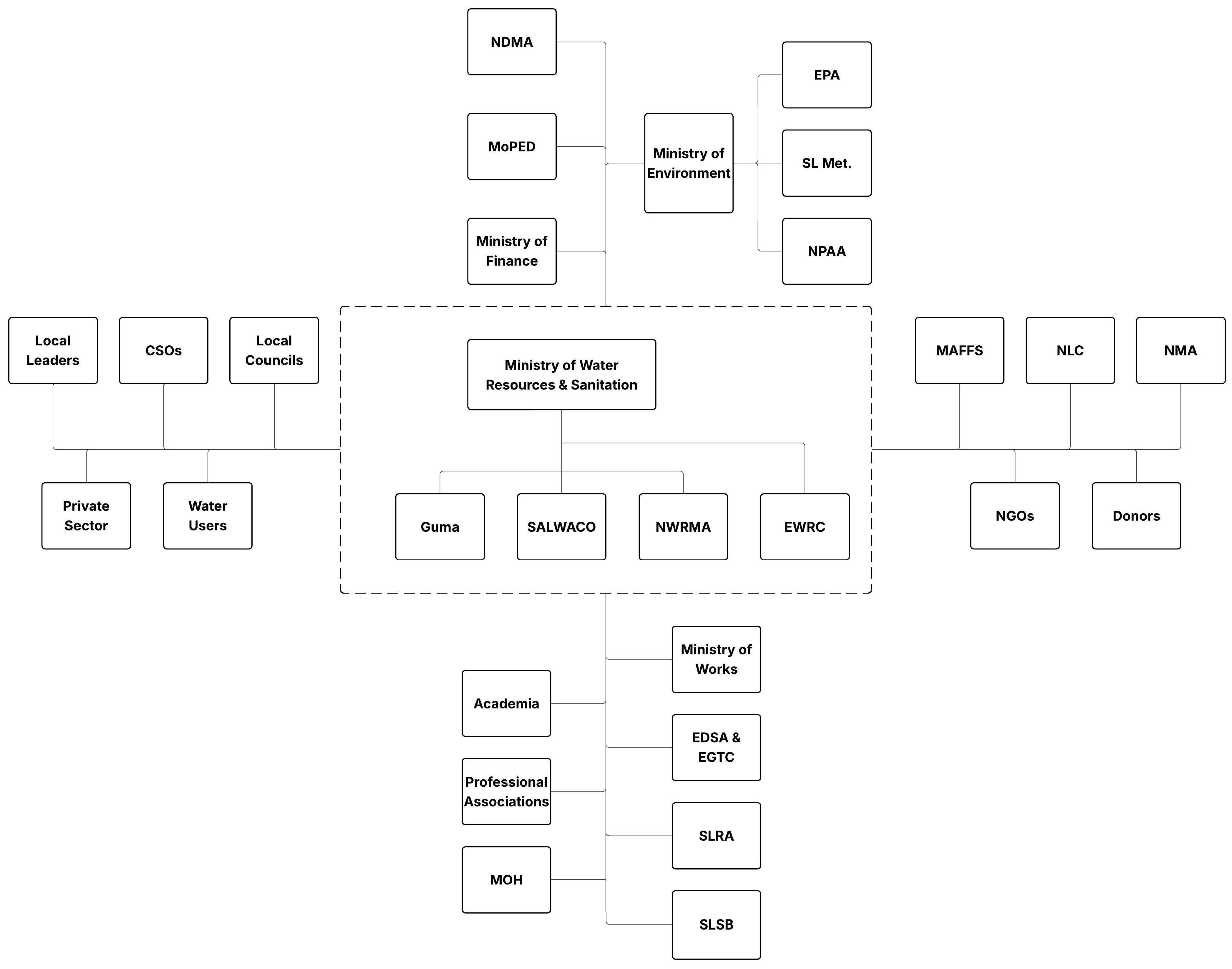
Figure 1 gives an overview of the key actors in Sierra Leone’s water sector. This complex assemblage of actors presents simultaneous opportunities for integrated water resource management and significant challenges in reconciling divergent interests and priorities.
The institutional framework for water governance in Sierra Leone has evolved significantly through a series of strategic reforms. The precursor to the current Ministry of Water Resources and Sanitation originated as a department within the Ministry of Energy and Water Resources [35]. A major reform period began in 2010 with the initiation of a National Water and Sanitation Policy [36]. This was followed in 2013 by its elevation to a full ministerial status [35]. The most recent institutional integration occurred in 2024, when the sanitation mandate was formally transferred from the Ministry of Health, culminating in the creation of the Ministry of Water Resources and Sanitation. Within this governance structure, Parliament serves as the legislative body, responsible for enacting relevant laws, approving budgets, and exercising oversight over the MWR.
Presently, the water sector in Sierra Leone operates under a multi-tier institutional framework led by the Ministry of Water Resources and Sanitation (MWR) as the primary policy-making and regulatory body. The Ministry oversees two main water utilities: Guma Valley Water Company (GUMA), which serves the capital Freetown and its environs, and the Sierra Leone Water Company (SALWACO), responsible for provincial urban centres. Rural water provision falls under the mandate of the Water Supply Division (WSD) under the Ministry of Water Resources in collaboration with Local Councils, though implementation largely depends on external support from NGOs and donor organisations, reflecting the sector’s heavy reliance on international development assistance.
Recent institutional developments include the establishment of two specialised agencies under the Ministry of Water Resources and Sanitation: The National Water Resources Management Agency (NWRMA), tasked with managing surface and groundwater resources; and the Electricity and Water Regulatory Commission (EWRC), which regulates service provision. This evolving institutional architecture demonstrates efforts to strengthen sector governance, though challenges in coordination and capacity persist.
The sector interacts with several cross-ministerial domains. The Ministry of Finance controls fiscal allocations while the Ministry of Planning and Economic Development shapes long-term strategic direction. Environmental dimensions involve the Ministry of Environment and Climate Change and its subsidiary agencies, including the Environment Protection Agency and the Sierra Leone Meteorological Agency, which address growing climate-related water security challenges. There is also the National Protected Area Authority responsible for the protection of flora and fauna and the conservation of ecosystems. The National Disaster Management Agency is responsible for managing water related disasters. There is also the Ministry of Health, which liaises with the EWRC and the Sierra Leone Standards Bureau to enforce quality, health and safety standards to water businesses. It also collaborates with the MWR to facilitate the effective transition of the sanitation mandate.
The stakeholder landscape extends to the National Lands Commission, which is the technical wing of the Ministry of Lands, Housing, and Country Planning. Land is a critically valuable and increasingly scarce resource in Sierra Leone, where urbanisation and development pose significant challenges to the conservation of terrestrial ecosystems. There is also the Ministry of Agriculture, Forestry and Food Security who are key users of water resources.
Further integral stakeholders include the Ministry of Works and Public Assets, which manages public infrastructure; the two electric utilities responsible for electricity generation (Electricity Generation and Transmission Company (EGTC)) and distribution (Electricity Distribution and Supply (EDSA)); the Sierra Leone Roads Authority (SLRA), which governs the right-of-way for utility conduits; and Civil Society Organizations (CSO) which contribute through advocacy and public education.
This water ecosystem is augmented by academic institutions and professional associations driving research and capacity building, local leaders facilitating community-level water management, private sector operators, and a diverse body of end-users encompassing farmers for agriculture, schools, healthcare facilities, and industrial and domestic consumers.

3.2. Stakeholder Roles, Interests and Influence

Stakeholder interests in the water sector are mapped and assessed through the STEEP (Social, Technical, Economic, Environmental, and Political) framework [3], which provides a structured methodology for classifying sectoral stakeholders based on their divergent interests. Examples include but are not limited to:
Social interests are characterised by a focus on equitable access, affordability, public health, safety, and community engagement.
Technical interests prioritise infrastructural integrity, asset management, human capacity development, and the adoption of advanced treatment and data management technologies.
Economic interests are predominantly concerned with funding mechanisms, tariff structures, economic affordability, and the financial sustainability of water systems.
Environmental interests emphasise addressing climate change impacts, protecting water sources, maintaining ecosystem health, and mitigating pollution.
Political/Governance interests involve the formulation of policy, the design of enforcement mechanisms, institutional arrangements, and the alignment of political priorities with water sector goals.
The stakeholder analysis reveals a diverse landscape of interests in water resource and infrastructure sustainability, as summarised in Table 1. This table provides an overview of the key stakeholders involved in the study. It first identifies the key stakeholders/stakeholder institutions, categorises them, and outlines their primary roles. It also identifies how many individuals were interviewed from each stakeholder institution. To map the stakeholder landscape, the table includes metrics of their prominence in the sector: the raw number of times each stakeholder was mentioned as a key player by interviewees, and this number expressed as a percentage of the total number of interviews to show frequency of mention. The table then quantifies perceived influence through an average of all the scores assigned by participants, and a normalised influence score, which weights this average by how frequently the stakeholder was mentioned. Finally, an assessment of each stakeholder’s interests, classified as high, medium and low, is included, a framework that was developed from the interview data and overall research findings.
Key stakeholders with high social interests include the Ministry of Water Resources and Sanitation; water utilities; local councils; EWRC, NGOs and donors, CSOs, and water users. Technical and technological interests are primarily driven by the Ministry of Water Resources, the NWRMA, and the utilities, while economic interests are dominated by the water utilities, the Ministry of Finance, the EWRC, NGOs and donors. For environmental interests, the Ministry of Environment and Climate Change (MOECC), its subsidiary agencies, the NWRMA, and the National Disaster Management Agency (NDMA) are the main actors, whereas political and governance interests are high among the Ministry of Water Resources, regulators, local councils, and most government MDAs.
The efficient governance and delivery of water services require an understanding of these interests and their potential synergies. This distribution of interests highlights potential synergies and critical gaps in governance. A key example is environmental governance, where a significant disconnect exists. While primary responsibility rests with the MOECC (and its subsidiary agencies), the National Lands Commission, and the NWRMA, these institutions demonstrate low interest in operational and technical delivery. Consequently, the operational burden of environmental failures, such as water source pollution, falls disproportionately on the Ministry of Water Resources and the utilities, GUMA and SALWACO. This fragmentation is exacerbated by the mining sector; despite its significant economic role, the National Minerals Agency shows low interest in environmental oversight. This creates a regulatory gap where the environmental impacts of mining, particularly on water resources, become a secondary concern, ultimately transferred as an operational challenge to the water sector institutions.
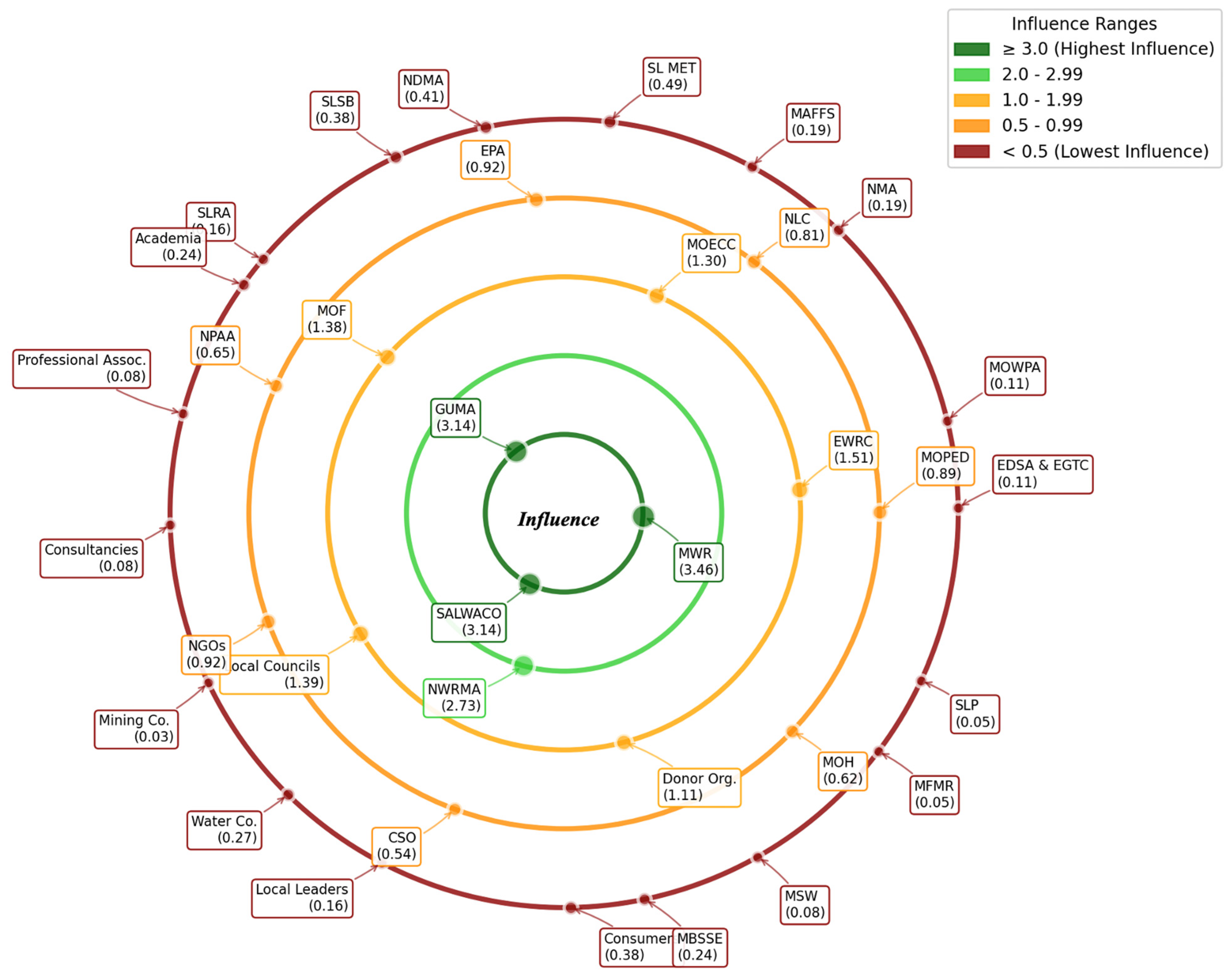
Figure 2 uses an onion diagram to show the relative influence of stakeholders in Sierra Leone’s water sector, using previously calculated values of Normalised Influence Score (NIS) presented in Table 1. The visualisation spatially represents stakeholder influence, with closer proximity to the core indicating greater influence and decision-making power. Analysis confirms that the ten most influential actors are the Ministry of Water Resources and Sanitation (NIS = 3.46), Guma Valley Water Company (NIS = 3.14), Sierra Leone Water Company (NIS = 3.14), National Water Resource Management Agency (NIS = 2.73), Electricity and Water Regulatory Commission (NIS = 1.51), Local Councils (NIS = 1.39), the Ministry of Finance (NIS = 1.38), Ministry of Environment and Climate Change (NIS = 1.30), Donor Organisations (NIS = 1.11), and NGOs (NIS = 0.92).
This concentration of influence within a core of policy, regulatory, and financial institutions is a common feature in the water sectors of many developing countries [37], often leading to a top-down governance model. In the Sierra Leone context, this centralisation is reportedly characterised by a degree of opacity and political gatekeeping, which can limit broader participation in the decision-making process.
However, a critical tension emerges from this structure. While these central actors hold formal power, the long-term effectiveness and sustainability of water management decisions are inherently dependent on local buy-in and context-specific knowledge. The relative marginalisation of local communities and groups—particularly women and children, who are disproportionately affected by water insecurity—from the inner circle of influence represents a significant governance gap. For policies to be socially robust and equitable, mechanisms must be developed to meaningfully integrate these peripheral voices into the planning process, thereby ensuring that technical and political decisions are grounded in local realities and needs.

3.3. Social Network Analysis of Stakeholders

3.3.1. Strength of Relationships

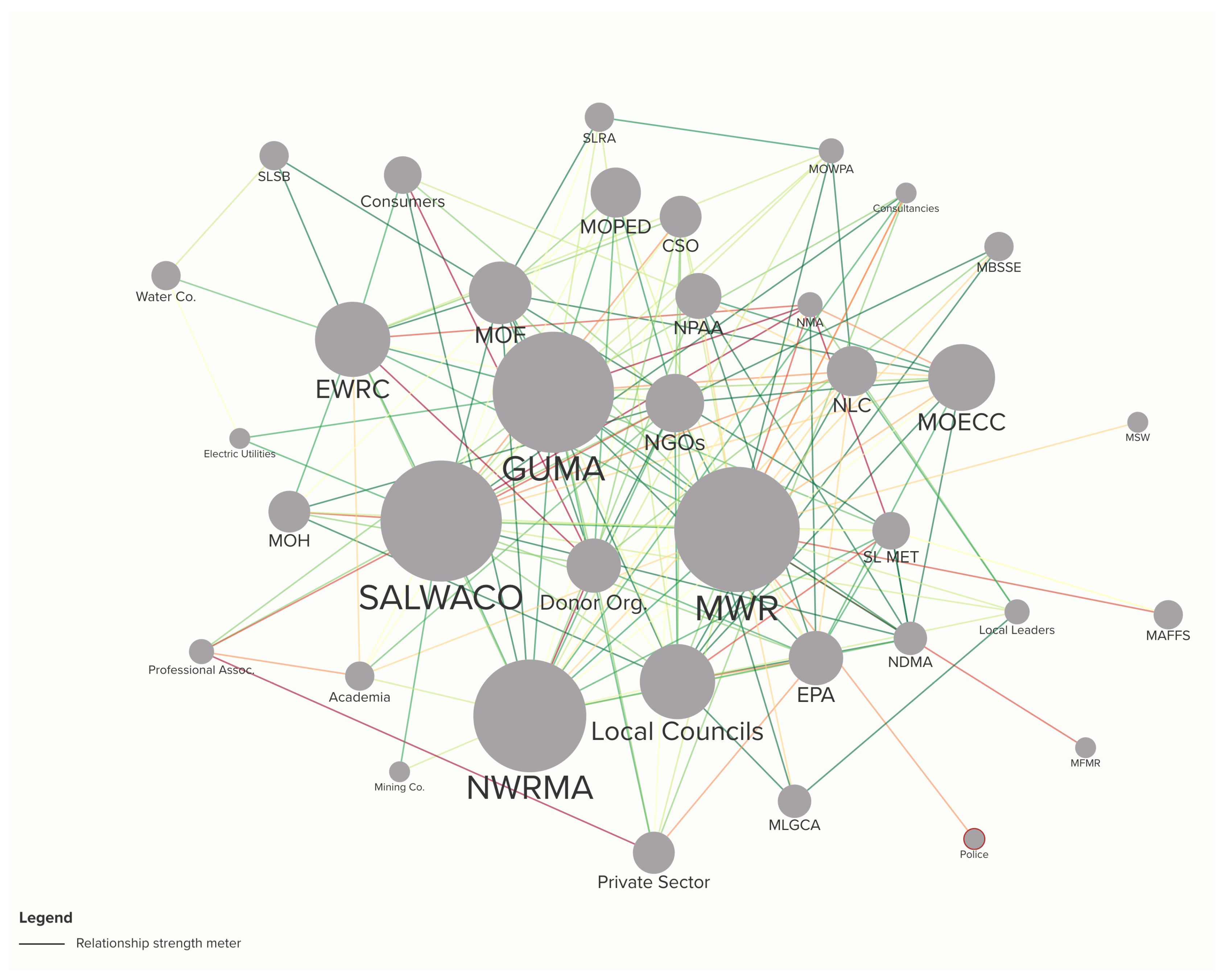
Figure 3 visualises the network of relational strength among stakeholders in Sierra Leone’s water sector. In this undirected network graph, nodes represent individual stakeholders, and the links represent their relationships (see Supplementary Materials for the scores for strength of relationships). The colour of the connections signifies the scaled strength of the relationship, ranging from green indicating strong ties to red indicating weak ties.
The size of each node is proportional to its degree of centrality, reflecting the number of times the stakeholder was mentioned as a connection point within the network (see Table 1). For example, MWR is mentioned 26 times and therefore has the largest node within the Network.
The network structure reveals a distinct core-periphery formation. A tightly knit cluster of core government institutions—primarily the Ministry of Water Resources and Sanitation and its subsidiary agencies (e.g., GUMA, SALWACO, NWRMA)—occupies the central position. This is evidenced by their large node size and the dense web of strong interconnections, confirming their role as primary hubs for the flow of information, resources, and influence.
This centralization, while ensuring cohesion among key actors, presents critical governance implications. First, it creates a system highly dependent on a few central nodes, potentially creating bottlenecks and single points of failure, if these institutions are constrained. Second, the predominantly weak ties connecting peripheral stakeholders—such as community/local leaders—to the core suggest limited integration of their perspectives into the main decision-making channels. This structural exclusion can lead to policies that are less responsive to on-the-ground realities and marginalise critical voices, particularly those related to cross-sectoral issues like payment for services or mining pollution. The quantitative metrics for the top ten stakeholders, summarised in Table 2, provide further evidence of this concentrated influence, with high degree, closeness and betweenness centrality scores (as defined in Section 2.3.3) for government MDAs. These findings indicate that governance, management and control within the sector are centralised within a particular group of government MDAs.

3.3.2. Stakeholder Dependencies

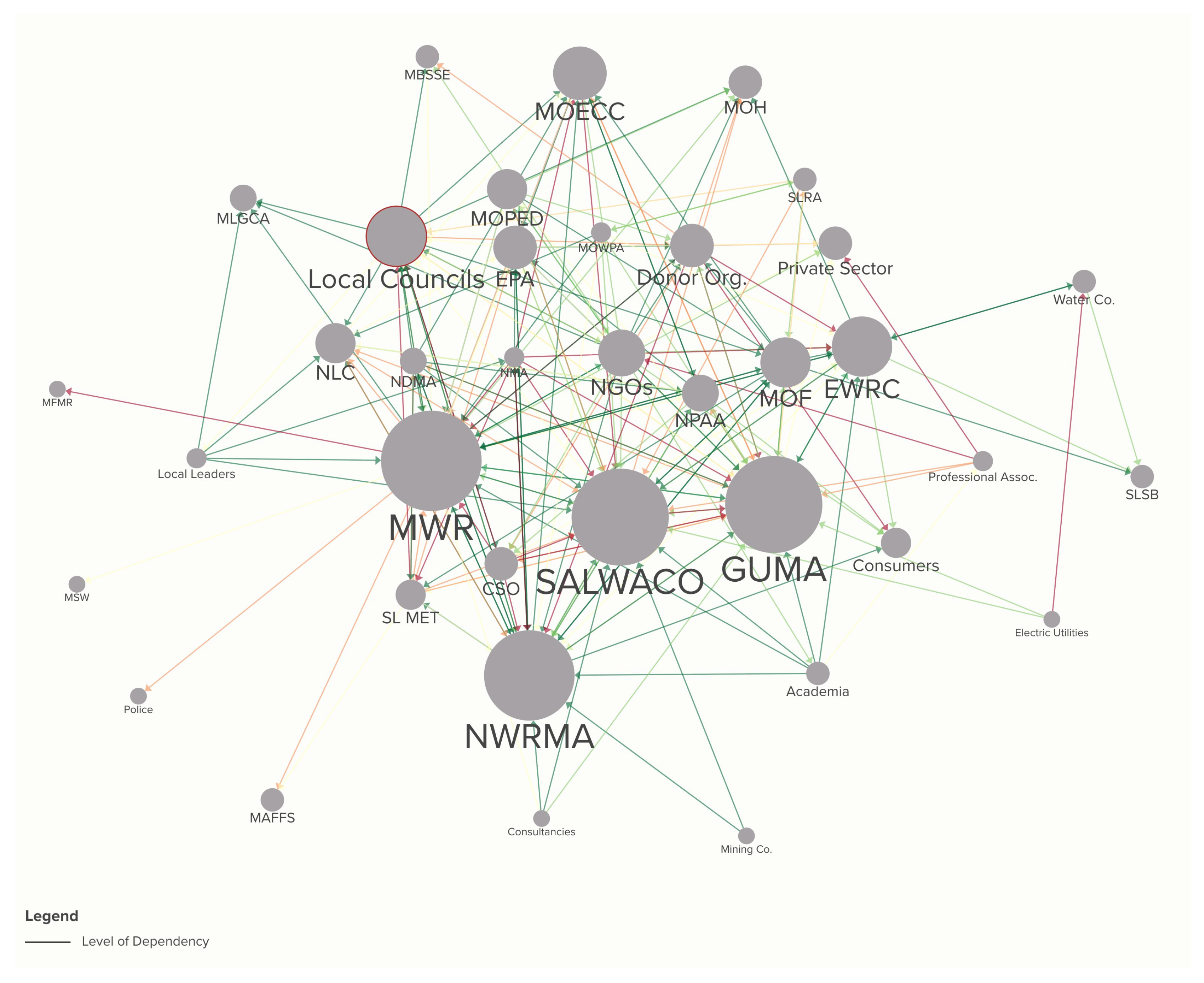
Figure 4 presents a directed graph mapping the dependencies between stakeholders in Sierra Leone’s water sector, providing critical insights into power asymmetries and systemic vulnerabilities. Unlike the strength-of-relationships analysis, the directional nature of the connections illustrates a potential power imbalance, where one actor may be highly dependent on another without reciprocity. Node size corresponds to the frequency of mentions (degree centrality), while the colour of the connections scale from green (high dependency) to red (minimal dependency).
The analysis reveals two illustrative cases of asymmetrical dependency. First, the National Minerals Agency (NMA), a key regulator under the Ministry of Mines and Mineral Resources, has numerous connections but minimal dependency on other sector stakeholders. This structural independence, combined with the mining sector’s significant role in water pollution, highlights a critical governance failure: the NMA operates without sufficient accountability or reliance on the water institutions that must manage the environmental consequences of its activities. Second, donor organisations are central nodes upon which many government agencies and utilities show high dependency, while they themselves demonstrate low reciprocal dependency. This pattern not only confirms the sector’s aid dependency but also exposes a profound systemic risk; the withdrawal of donors could trigger a cascading failure, as core functions are financially and technically unsustainable without external support. An interactive exploration of these relationships and dependencies is available online (Strength map (https://kumu.io/HenriettaGeorgeWilliams/governance-and-stakeholder-analysis-strength (accessed on 1 July 2025)) & Dependency map (https://kumu.io/HenriettaGeorgeWilliams/governance-and-stakeholder-analysis-dependency#dependency-map (accessed on 1 July 2025))).
Overall, the strength and dependency networks depict a sector characterised by fragmentation and a distinct core-periphery structure. A tightly knit core of government Ministries, Departments, and Agencies (MDAs) maintains strong internal ties, marginalising private sector actors, communities, and water users—particularly marginalised groups—to the periphery. Furthermore, even within the government core, the absence of robust, formalised communication and collaboration mechanisms means that strong ties do not necessarily translate into operational efficiency, often rendering the accomplishment of simple tasks challenging. The following section delves into the specific challenges arising from this fragmented governance structure and the mechanisms attempting to address them.

3.4. Navigating Water Sustainability in Sierra Leone—STEEP Framework

The interviews reveal a complex web of interconnected challenges that have constrained the provision of safe, reliable and affordable water in Sierra Leone. Using the STEEP framework (as explained in Section 3.2), the following sections outline the sector space and the challenges encountered as reported by the participants, the root causes of these challenges, the interventions being implemented and analyses their sufficiency. Key systemic challenges are examined through multiple SPEEP lenses to capture their complex interconnected nature. This is summarised in Table 3.

3.4.1. The Social Landscape

The social challenges within Sierra Leone’s water sector are rooted in demographic shifts and behavioural patterns, notably a persistent rural-to-urban migration particularly to Freetown that was triggered by a decade-long civil war. This rural to urban migration trend continues even today. The stakeholders believe this influx was driven by the perception of economic opportunity and a lack of development in the provinces. This created overcrowding in bigger cities especially Freetown, slum proliferation (due to unemployment and lack of affordable housing) and has placed unsustainable pressure on urban infrastructure.
For example, stakeholders estimate that the Guma Valley Water system was designed in the 1960s for a population of approximately 500,000. However, Freetown now has an estimated population of 1.5 million residents [38] according to the 2024 census. With little or no improvements made to the water infrastructure, the city now suffers from a high deficit between demand and supply. A participant indicated that GUMA can only meet around 25–30% (Participant-cited quantitative data is presented as evidence of perceived challenges within the sector, not as verified technical data.) of the demand of the population and this scarcity disproportionately affects vulnerable groups, with women and girls bearing the brunt of the burden. They spend hours each day fetching water which exposes them to risks of gender-based violence, accidents and lost educational opportunities. To fill this demand gap, there is the proliferation of sachet and bottled water companies often of unquestionable quality and at a very high financial cost to households, who reportedly spend up to 20% of their income on water. The result is a prevalence of waterborne diseases like cholera and typhoid.
Stakeholders also cited some attitudinal and behavioural challenges both professionally and at the community level. Issues of unprofessionalism, incompetence, cronyism, ego-driven conflicts, lack of trust and a silo mentality, hierarchical relationships (i.e., “fiefdom”) hinder collaboration. At the community level, several interviewees reported that a pervasive culture of non-payment of bills, illegal connections and outright vandalism of water infrastructure cripples the sector. Stakeholders described rampant “reckless theft,” where pipes are routinely cut or tapped, leading to enormous non-revenue water losses. This is compounded by a widespread public perception that water is a gift from God or an unconditional government responsibility, not a commodity that requires payment for sustainable service. This attitude extends even to major public institutions like MDAs, hospitals and the military, which accumulate large debts, further starving utilities like GUMA of the revenue needed for their sustainable operation, maintenance, and expansion.
However, several interventions are being put in place to address some of these challenges. For example, NGOs, local councils, and community leaders are establishing Water User Committees and Village Savings and Loan Associations (VSLAs). These groups manage the operation and maintenance of local water wells and boreholes, collecting small tariffs to fund future repairs and foster a sense of local ownership. Utilities and some MDAs are using radio jingles and working with local councils to educate the public on the importance of paying bills, protecting catchments and the dangers of deforestation. In addition, GUMA and private bowser operators provide water to communities without piped networks, though this is an expensive and inefficient stopgap. And EWRC has a complaint desk for consumers (even though some stakeholders think this is more a conceptual feature), and enforcement activities are being conducted for unlicensed water companies.
While these interventions are well-intended and have had localised success, they are overwhelmingly insufficient to address the scale of the systemic crisis. They are largely reactive, project-based, fragmented and treating symptoms rather than the root cause. Community-based models often falter due to weak ownership, lack of funds, or poor maintenance, while sensitisation campaigns have yet to meaningfully shift entrenched attitudes. Regulatory agencies face capacity constraints, and illegal practices continue to undermine system integrity. Sensitisation campaigns are ineffective without strong, consistent enforcement against illegal construction, deforestation, and pipe vandalism. The “social approach” mentioned by one stakeholder, while important, cannot succeed alone without a credible regulatory deterrent. The reliance on bowsers and sachet water highlights the absence of sustainable long-term solutions. And finally, interventions often operate in silos. There is a critical lack of integrated national planning that links water resource management to urban planning, housing policy, and economic development in the provinces to stop rural–urban migration.

3.4.2. The Technical/Technological Landscape

The transcripts reveal a water sector in Sierra Leone grappling with profound technical, technological and innovation-related challenges that constrain its ability to deliver reliable services. These challenges are interlinked with economic and governance issues creating a complex web of constraints that hinder sustainable development. The most critical issue highlighted is ageing and inadequate infrastructure. As previously mentioned, the GUMA infrastructure which was built to service a population of less than half a million, now struggles to serve over 1.5 million, with limited expansion and maintenance. This leads to transmission pipelines that are prone to frequent failures (6–7 times monthly as indicated by a participant), pressure is critically low, and non-revenue water (NRW) due to leaks and theft is estimated at 40–50% as indicated by one participant. This means nearly half of the already treated and insufficient supply is lost before reaching consumers. Coverage is further undermined by limited storage, and the absence of systematic asset management, resulting in costly maintenance, inefficiency, and unreliable supply. Efforts to harness new sources remain hampered by financial, technical, governance and logistical constraints.
Closely related to the above are the operational inefficiencies that undermine service delivery. The participants reported that water utilities rely heavily on reactive maintenance rather than preventive maintenance, with weak procurement systems and supply chains for spare parts and reagents leading to long downtimes. Smart devices introduced in some facilities often fail due to lack of local technical expertise, rendering million-dollar investments dependent on minor components. In rural systems, boreholes and kiosks frequently fall into disrepair due to limited maintenance capacity. These weaknesses reflect both institutional and human resource gaps—the sector is under-staffed, with limited technical expertise, brain drain, and inadequate training opportunities. Even at university level, research and curricula are outdated, labs are under-resourced, and students lack sufficient exposure to practical engineering training.
Beyond hardware constraints, data, research and systematic planning gaps significantly restrict informed decision-making. Interviewees echoed that institutions lack reliable hydrological, groundwater, and water quality data, while asset registers and monitoring systems remain fragmented and underdeveloped. Where some data exist, they are often withheld, outdated, politicised or monetised rather than shared, undermining coordination. Research is largely descriptive rather than solution-oriented, and institutional silos prevent effective integration of findings into planning and policy. This deficit is compounded by weak adoption of innovation: water utilities and ministries continue to rely on paper-based planning and outdated technologies despite global advances in modelling, digital monitoring and integrated water management systems.
In addition, there is a significant disconnect between infrastructure planning and other sectors, particularly urban development. One informant expressed frustration over poorly planned urban expansion which sees buildings constructed over streams and water pipelines, leading to foundation undermining and pipe damage. Road construction projects frequently destroy water infrastructure, leading to a cycle of repair and double handling of costs. There is no integrated spatial planning or shared GIS platform between agencies like the Sierra Leone Roads Authority and water utilities, leading to avoidable conflicts and inefficiencies.
Finally, an infrastructure/procurement/project-based mindset dominates over long-term strategic system building. NGOs and donor-funded projects often focus on quick, visible wins like constructing new boreholes rather than strengthening the entire system’s resilience, operations, and maintenance capabilities. This leads to a proliferation of assets that quickly fall into disrepair. Also, the lack of enforcement, and rewards for the wrong behaviour cause repeated technical failures. Vandalism and pipe cutting are rampant because there are few legal consequences. The focus on dry-season emergency rehabilitation creates a cycle where officials may benefit from perpetual procurement for quick fixes rather than advocating for sustainable, systemic solutions.
A range of interventions are underway to address some of these deep-seated challenges. For instance, the Freetown Water Supply Master Plan, funded by the African Development Bank (AfDB) has been developed to address the critical water scarcity and infrastructure challenges in Sierra Leone’s capital. The plan outlines a comprehensive, long-term strategy for expanding and upgrading water sources, treatment facilities, and distribution networks to ensure a sustainable and reliable water supply for Freetown’s growing population. To support this, one stakeholder highlighted that GUMA has introduced GIS for asset mapping, hydraulic modelling software (WaterGEMS), and an integrated management system (EDAMS). Smart meters are also being rolled out alongside mobile payment systems and a customer app for reporting leaks. Concurrently, laboratories have been equipped with WHO-standard testing kits and advanced equipment through donor support. Efforts to improve data and monitoring are also evident. The National Water Resources Management Agency (NWRMA) has begun installing groundwater and surface water monitoring stations, though coverage is still limited. Some NGOs and donors have supported specific mapping exercises to identify functional water points. In addition, donor-funded rehabilitation of selected systems (e.g., Bo, Kenema, and Makeni) has improved regional performance, and community engagement initiatives. Capacity building initiatives exist, often driven by donors. Examples include the MCC threshold program that sent utility staff for benchmarking in other countries and projects like the Royal Academy of Engineers’ partnership with universities to enhance research capabilities and establish a water lab at the University of Sierra Leone.
Despite these positive developments, interventions remain piecemeal and reactive, often donor-driven, and lack scale. Smart metering and GIS mapping are promising, yet their rollout is incomplete and hindered by limited technical expertise and poor data integration. Projects are siloed, and technologies like GIS are not integrated across relevant ministries, limiting their impact. The advanced software and systems require continuous funding for maintenance and skilled personnel which is not guaranteed. The University water lab, for example, stands unused due to a lack of a dedicated technician. Rehabilitation of select systems cannot address the wider infrastructural deficit, particularly in Freetown, where supply has stagnated despite population growth. Regulatory and enforcement mechanisms exist but are inconsistently applied, while research and innovation remain underfunded and fragmented.

3.4.3. The Environmental Landscape

Environmental degradation has emerged as one of the most critical threats to Sierra Leone’s water sector. The most cited challenge is massive deforestation, described by stakeholders as “catastrophic” and “biblical” in scale. Stakeholders describe the situation as dire, with rampant tree clearing in vital water catchment areas, including the Western Area Peninsula National Park and around critical infrastructures like the Guma Dam. This deforestation is driven by urban expansion, agriculture (including slash-and-burn farming and oil palm plantations), timber logging, and charcoal production. Rapid population growth and urbanisation create a conflict between conservation and development, with environmental protection often seen as a hinderance to economic progress. The consequences are multifold: reduced groundwater recharge, increased surface runoff, soil erosion, and the sedimentation of reservoirs, which diminishes their storage capacity. As one stakeholder starkly noted, a study found 79% of assessed water sources had dried up and 59% of the remaining had no forest cover.
Closely linked is the widespread pollution of water bodies. Mining activities, particularly artisanal and small-scale mining in regions like Kono, Koinadugu, and Teya, were highlighted as a paramount concern. The use of chemicals like mercury and cyanide, coupled with dredging, leads to severe turbidity and heavy metal contamination in major rivers (e.g., Sewa, Pampana, Moa), making water treatment extraordinarily difficult and expensive. Furthermore, pollution from agricultural runoff (pesticides, fertilisers), inadequate sanitation, and plastic waste further degrades water quality, posing significant public health risks from waterborne diseases.
Another major challenge, as mentioned by stakeholders, is the direct physical encroachment and land grabbing in protected areas and watersheds. Several participants commented that political and powerful individuals and a growing population are constructing buildings and settlements directly on riverbanks, over streams, and within official catchment zones. This not only destroys the natural environment but also exacerbates flooding, undermines building foundations, and blocks natural waterways. The Orugu Dam located on the outskirts of Freetown was cited as a prime example of a once-viable water source rendered, as one stakeholder described it, as “a no-go area” now due to unchecked encroachment. These anthropogenic pressures are compounded by climate change, which acts as a threat multiplier. Stakeholders reported observing altered rainfall patterns, including shorter, more intense wet seasons and longer, more severe dry seasons. This increases the strain on already depleted water resources, while more intense rainfall events overwhelm degraded catchments, leading to contamination and infrastructure damage. Stakeholders also mentioned “saline intrusion” in coastal aquifers (e.g., Moyamba, Bonthe), which further reduces freshwater availability.
However, several interventions mentioned have been initiated to address these challenges. Stakeholders also mentioned large-scale initiatives such as the Freetown City Council’s “Tree Town” project, which, according to one interview respondent, has “planted over a million trees and uses technology for monitoring”. Interestingly, the Environmental Protection Agency (EPA) is also developing a National Pollution Plan with donor support to establish a framework for controlling pollution and protecting health and ecosystems, while the Ministry of Environment and Climate Change has launched the Protect Sierra Leone Program to support Sierra Leone in meeting its biodiversity targets. Additionally, technology adopted is being explored for monitoring through apps and satellite data to track deforestation and hold offenders accountable. Regulatory frameworks, such as requirements for mining companies to treat wastewater and the NPAA’s mandate to protect forests, exist on paper, and partnerships between councils, NGOs, and government ministries are working on promoting catchment restoration and environmental education.
The current interventions, while well-intended are failing to ensure water security. They are overwhelmed by the scale of degradation and the powerful economic and political incentives driving it. Enforcement remains weak, corruption undermines protected area management, and climate impacts are accelerating.

3.4.4. The Economic Landscape

The water sector in Sierra Leone is constrained by systemic and financial barriers. This scarcity is multidimensional, affecting every facet of the sector. Stakeholders consistently reported that government ministries, departments, and agencies (MDAs), utilities, and regulators are crippled by inadequate funding, preventing them from executing essential functions, from planning and monitoring to infrastructure maintenance and expansion. One stakeholder stated, “we struggle with a range of activities primarily because we just don’t have the money”.
A critical symptom of this is the water utilities’ struggle with financial viability. Both Guma Valley Water Company and SALWACO operate far below cost-recovery. Several participants stated that revenue generation is severely hampered by extremely low tariffs, a culture of non-payment of bills, and high non-revenue water, estimated at 40–50%. This is compounded by significant debt from government institutions like hospitals, police, and the military. Consequently, the sector operates on deficit budget, and the utilities cannot fund operational expenses (OpEx), let alone capital investments (CapEx), creating a cycle of dependency on government subventions that are themselves unreliable and insufficient. Stakeholders mentioned that most utilities and ministries rely heavily on international donors without which critical infrastructure and operations would collapse. This dependency fosters short-term project-based interventions rather than systemic reform, and delays in counterpart funding further stall donor-financed projects.
Macroeconomic volatility, specifically the rapid devaluation of the Leone against the US Dollar, exacerbates these issues. As one utility manager illustrated, a tenfold increase in revenue in local currency translated to a “flat line” in US Dollar terms. Since critical inputs like chemicals, pipes, and equipment are purchased in dollars, this erodes the utilities’ purchasing power. Tariffs, set in Leones and not indexed to inflation or the dollar, have effectively plummeted, from $0.75/m3 in 2021 to approximately $0.25/m3 at the time of the interviews.
Moreover, there is a severe lack of investment in infrastructure. The system is described by stakeholders as ageing and dilapidated, with Freetown’s Guma Dam—constructed in the 1960s for a much smaller population—symbolising decades of underinvestment. Freetown’s demand has grown from 120 million litres/day in 2020 to a projected 300 million by 2030, while supply capacity remains stagnant at approximately 70–75 million litres/day, of which half is lost lamented one interviewee. The absence of capital investment reflects limited fiscal space and low attractiveness of the sector to private investors, given weak tariffs and poor governance. Stakeholders noted that the sector is “hugely underfunded,” with government priorities often directed elsewhere, leaving a vast financing gap that donor projects cannot fully bridge.
The causes are deeply entrenched and interlinked. First, there is a fundamental policy and political dilemma surrounding the commodification of water. Water is treated as a “political commodity,” with conflicting messages from political parties on whether citizens should pay. This fosters a public perception of water as a free, God-given right, severely undermining the social contract necessary for a fee-for-service model. Also, institutional and governance bottlenecks within government finance impede progress. The national budget cycle is dysfunctional; ministries and utilities receive their allocations late and irregularly, often in the second quarter of the financial year, making planning and implementation of time-sensitive projects impossible. As stakeholders noted this provides a “legitimate reason” (for underperformance) and makes holding duty-bearers accountable difficult. Regulatory agencies like the EWRC and NWRMA face significant challenges in enforcing levies and licencing fees, as non-compliance undermines their oversight authority. At the same time, financial constraints at universities and research institutions stifle innovation and limit their ability to support robust monitoring and research efforts. Furthermore, while the EWRC regulates tariffs for sachet water, it does not regulate bottled water, creating an unfair market. Businesses also report a lack of value for money in the fees they pay and difficulty accessing affordable finance from local banks due to high interest rates and prohibitive collateral requirements.
Finally, the economic reality for consumers is a major constraint. With a low national minimum wage, regulators are hesitant to approve tariffs that would constitute a significant portion of a household’s income (presently, tariffs are based on operational expenses only, with capital investments left as a responsibility of donors and the government), creating a Catch-22 where utilities are starved of funds needed to improve services, which in turn justifies public unwillingness to pay for poor and unreliable supply.
The primary intervention strategy is a heavy reliance on donor and development partner funding. Major projects from the World Bank, African Development Bank, FCDO, UNICEF, and others are underway, focusing on infrastructure rehabilitation, new treatment plants, and technical assistance. It was also noted by a stakeholder that “donor funding is shrinking”, creating an impending “cash crunch.” This reliance fosters a dependency that, as one stakeholder critiqued, makes the sector “lazy” and inhibits innovative, locally driven solutions. A key uncertainty, however, is the long-term sustainability of donor funding and the sector’s capacity to operate effectively should such financial support diminish. Other interventions mentioned by stakeholders included efforts to improve revenue collection within utilities, partnerships with private entities like Water4Ever to manage kiosks in low-income communities and attempts to formalise raw water abstraction through the NWRMA’s licencing system.
These interventions have mitigated some operational gaps but remain insufficient for long-term sustainability. They address the symptoms but not the root causes of the sector’s non-viability. While donor projects address immediate infrastructure needs, the over-reliance on donors is a strategic risk, not a solution. Tariff reforms are undermined by inflation, while revenue collection remains poor due to political interference, customer non-compliance, and weak enforcement. High energy costs and debt burdens continue to trap utilities in a cycle of inefficiency.

3.4.5. The Political/Governance Landscape

Political and governance challenges were the most cited by stakeholders, with nearly 500 coded references. Stakeholders highlighted institutional fragmentation, poor coordination mechanisms, political interference and weak accountability structures as some of the interconnected governance challenges that constrain the ability to provide sustainable and equitable water services.
A primary challenge is the proliferation of agencies with conflicting, overlapping and poorly delineated mandates. This creates, as one stakeholder referred to, a “culture of silos”, where agencies operate as “empires,” guarding information jealously, and engaging in territorial disputes rather than collaboration. A significant coordination gap exists due to the absence of formalised platforms for information-sharing, such as official communication channels, updated websites, or dedicated data portals. Instead, communication remains largely informal and reliant on personal relationships, with phone calls often serving as the primary method based on familiarity rather than institutional efficiency. The result is bureaucratic paralysis, wasted resources, poor coordination and confusion for both implementers and consumers, who are often unsure which institution holds ultimate authority.
Institutional weaknesses also extend to a systemic lack of enforcement. Majority of participants said there is the near-total absence of enforcement of existing laws and policies. Stakeholders repeatedly noted that while policies and regulations exist “on paper” and “on the shelf,” there are “no consequences” for viol/ations. This is evident in the rampant encroachment and construction in critical water catchment areas (including by powerful political figures), pervasive vandalism of infrastructure, illegal water connections, and non-payment of bills. The enforcement arms of agencies are weak, under-resourced, and often subject to political pressure.
The sector is further undermined by political patronage, cronyism, and a focus on short-term political gains over long-term sustainability. Stakeholders reported that powerful individuals are granted land titles in protected areas, and political appointees without requisite technical skills are placed in key management roles. Government priorities shift with administrations, leading to policy inconsistency and a preference for highly visible “capital projects” (new dams, pipelines) over the less glamorous but critical work of maintenance, catchment protection, and system sustainability and resilience.
Furthermore, interviewees reported that key MDAs suffer from a critical lack of human and financial resources. Low remuneration drives skilled professionals to seek opportunities elsewhere, leaving a vacuum often filled by underqualified personnel. This capacity gap impedes effective planning, regulation, and monitoring. Also, as stakeholders suggested, there is a culture of “earning a living” over public service, coupled with opportunities for rent-seeking, fosters corruption. Examples include officials demanding payment for public information or services, allocating land in catchments for personal gain, and favouring contracts that benefit specific individuals rather than the public good. Critical policies, like the National WASH Policy, are obsolete (dating to 2010). Newer laws, such as the NWRMA Act, were developed without sufficient inter-agency consultation, leading to direct contradictions with existing mandates (e.g., between the NWRMA and the EPA or the Mines and Minerals Act). This legal confusion creates friction and provides avenues for exploitation. In addition, a social contract breakdown is evident. Some interviewees stated that communities often do not feel a sense of ownership over water infrastructure, viewing it as a government or donor handout. This leads to misuse, vandalism, and a reluctance to pay for services, further starving utilities of the revenue needed for operation and maintenance.
Several interventions have been initiated to address these challenges. For example, Stakeholders mentioned the National WASH Policy (currently under review with help from development partners like UNICEF). The creation of new regulatory bodies like the NWRMA and EWRC is mentioned as being beneficial—not least as they introduce independent oversight, standardise tariffs, and regulate water quality, particularly for sachet water companies. The NWRMA for instance has also developed new regulations to govern water use and prevent uncontrolled drilling. Stakeholders also reported the establishment of formal platforms such as the Water Sector Leadership meetings chaired by the Ministry of Water Resources and Sanitation, the National WASH Steering Committee, and the district-level WASH coordination platforms. These are designed to breakdown silos, align activities and reduce duplication. The Government and development partners also continue to invest in water infrastructure projects and donors have provided technical and institutional support. Some NGOs are also piloting community-based management models and training local technicians to improve sustainability.
The consensus from the data is that while these interventions are steps in the right direction, they are insufficient to overcome the deep-rooted governance pathologies. Coordination meetings, as referred to by stakeholders, often lack follow-through and authority. Moreover, new regulators struggle with the same enforcement challenges as older agencies, donor support is fragmented, political inference undermines reforms and infrastructure projects continue to prioritise new builds over systemic fixes. Stakeholders also mentioned that capacity-building efforts at local government level have limited impact without corresponding fiscal decentralisation. Transparency initiatives are often ignored at higher levels of government, while entrenched patronage networks continue to drive land misallocation and tariff evasion.

3.5. Nexus of Social Network Analysis and STEEP Dimensions

The analysis demonstrates a disconnect between structural network centrality and functional governance authority within the sector. High centrality within the stakeholder network does not necessarily equate to comprehensive authority or capacity. For instance, the Ministry of Water Resources, while a central hub, is strained by operational and environmental burdens from other sectors. Similarly, the utilities (GUMA and SALWACO), while highly connected with high operational burden, possess low influence over the very economic and environmental policies that directly affect their performance. Conversely, regulatory agencies like the National Water Resources Management Authority (NWRMA) occupy a crucial bridging position between environmental and water-use governance, but remain capacity-constrained and lack the strong operational ties necessary for effective policy enforcement.
The analysis reveals a systemic governance fragmentation where network centrality, functional authority, and implementation capacity are misaligned among key sector actors. This fundamental disconnect—where influential bodies lack control, operational entities lack policy input, and regulators lack enforcement ties—undermines coordinated management. Consequently, achieving sustainable water governance requires structural reforms to realign mandates, resources, and network connections, rather than merely strengthening individual institutions.

3.6. Research Limitations

While 37 interviews provided rich qualitative data, the sample size and composition may not be fully representative of the entire spectrum of key players in Sierra Leone’s water sector. The necessary establishment of sectoral boundaries, due to water’s inherently multisectoral nature, also means that the perspectives of certain peripheral but potentially important stakeholders may have been excluded.
A further limitation arises from the composition of the participants, with over 65% affiliated with government utilities, ministries, departments, or agencies. This potential over-representation (even though they are the key players in the sector) introduces the possibility of optimism bias in descriptions of sectoral challenges and accomplishments, as participants may engage in positive self-presentation, potentially leading to a portrayal that differs from on-the-ground realities. Furthermore, the reliance on self-reported data in interviews and surveys introduces the possibility of social desirability bias [39], where participants may provide answers they believe are expected, rather than their candid assessments. To address this potential limitation, a peer-assessment component was incorporated, whereby participants evaluated both themselves and other key actors they interface with within the sector. An average score was calculated for each stakeholder from all received evaluations. Additionally, to weight influence by prominence, scores were normalised according to the total number of times each actor was mentioned.
In addition, the cross-sectional nature of the research provides a snapshot of stakeholder relationships at a specific point in time, limiting the ability to analyse how these dynamics evolve.
A notable methodological tension was observed between the qualitative and quantitative data collected. While qualitative responses vividly captured the nuanced complexities and collaboration challenges within the sector, the subsequent quantitative scoring of relationships tended to be disproportionately positive. This discrepancy may indicate a form of survey satisficing [40], where participants default to less critical responses when faced with repetitive scoring tasks. This inconsistency could potentially skew the results of the social network analysis, suggesting that the qualitative findings offer a more reliable depiction of the relational dynamics.
Future research could address these limitations by incorporating a broader range of community voices and employing longitudinal designs to track changes in network dynamics.

4. Conclusions

This study employed stakeholder and social network analysis to identify key actors, assess their roles, interests, and influence, and evaluate the relational dynamics within Sierra Leone’s water sector. The findings reveal a fragmented governance landscape characterised by conflicting and overlapping stakeholder interests, which often foster a contentious rather than collaborative environment. Influential actors primarily include major water ministries, departments, agencies (MDAs), utilities, and external donors. Social network analysis further uncovered a tightly knit core of government MDAs interacting predominantly among themselves, marginalising peripheral stakeholders or engaging them based on informing rather than empowering them. Moreover, the sector exhibits a heavy reliance on donor funding, while these development organisations/actors maintain weak operational dependencies on national institutions—highlighting a system marked by asymmetrical power relations and limited transparency.
The research also evaluated current sectoral challenges, interventions, and their adequacy. While acknowledging notable progress—such as the ongoing revision of the National WASH Policy, establishment of new regulatory bodies, ministry consolidations, and environmental sustainability efforts—the results indicate that most interventions remain project-focused, siloed, and insufficient to address root causes. Critical issues such as institutional fragmentation, political volatility, and inadequate long-term planning continue to undermine sectoral sustainability. To advance toward effective and efficient water governance, Sierra Leone must transition from fragmented donor-driven projects to an integrated, system-wide approach that strengthens institutional capacity, enhances stakeholder coordination, and embeds sustainable governance mechanisms.
It is evident from this study that the water crisis in Sierra Leone is fundamentally a crisis of governance rather than mere physical scarcity. While technical interventions are critical, they will continue to underperform unless underpinned by decisive, systemic reforms that address interconnected social, technical, economic, environmental, and political barriers. To transition from fragmented, donor-dependent projects to sustainable water security, an integrated strategy is essential.
Politically, the cornerstone of reform must be the establishment and enforcement of a robust national water master plan. This requires overcoming institutional fragmentation and political capture to create a coherent framework that integrates infrastructure planning with urban growth, climate resilience, and stringent environmental protection.
Environmentally, this plan must explicitly combat the existential threats of deforestation, mining, and land degradation by integrating land and water management (IWRM) and promoting sustainable livelihoods to reduce pressure on ecosystems.
Technically, achieving these goals demand large-scale investment in resilient infrastructure, such as dams, pipelines, and storage facilities, coupled with the strengthening of operations and maintenance (O&M) units and supply chains. This must be supported by the promotion of open-access data platforms and the integration of research into practice to foster innovation and coordination.
Economically, the sector’s viability hinges on systemic reforms to ensure financial sustainability, including rationalised tariff structures, improved revenue collection, and strategic government prioritisation to gradually reduce donor dependence and address chronic underinvestment.
Socially, sustainable outcomes depend on moving beyond infrastructure to foster community ownership, behavioural change, and the expansion of technical and vocational training to build a skilled local workforce.
Without such a holistic, multi-dimensional approach, Sierra Leone’s water sector will remain vulnerable to escalating climate and population pressures. Therefore, the path forward demands not just investment, but a fundamental commitment to integrated governance that synchronises political will, environmental stewardship, economic resilience, technical innovation, and social engagement to secure a water-secure future for all. The sector must evolve its focus beyond identifying what needs to be done. A successful implementation framework must instead prioritise the granular questions of execution: clearly defining who is responsible for specific actions, assessing whether they possess the requisite capacity and resources, understanding their motivations, specifying the level and timeline of intervention, outlining the processes involved, and establishing robust monitoring and accountability mechanisms to ensure quality and compliance.
Ultimately, this analysis provides the foundational map upon which a viable theory of change can be built. Such a theory must navigate the complex web of formal mandates and informal influences to achieve the effective, efficient, and equitable water system that Sierra Leone requires.
While the specific historical and geographic drivers—such as post-war urban migration and the degradation of the Western Area Peninsula—are particular to Sierra Leone, the broader governance patterns are highly generalisable. The findings on donor dependency, institutional fragmentation, the marginalisation of local actors, and the disconnect between regulatory mandates and operational capacities resonate with challenges faced by many low-income, aid-dependent nations. This study therefore provides both a specific roadmap for Sierra Leone and a transferable diagnostic methodology for analysing the core governance bottlenecks that perpetuate water insecurity beyond physical scarcity.

Supplementary Materials

The following supporting information can be downloaded at: https://www.mdpi.com/article/10.3390/su18010491/s1.

Author Contributions

Conceptualisation, H.E.M.G.-W.; methodology, H.E.M.G.-W.; investigation, H.E.M.G.-W.; writing—original draft preparation, H.E.M.G.-W.; writing—review and editing, D.V.L.H. and C.D.F.R.; supervision, D.V.L.H. and C.D.F.R. All authors have read and agreed to the published version of the manuscript.

Funding

Funding was provided to the third author by the UK Engineering and Physical Sciences Research Council for the UK Collaboratorium for Research on Infrastructure and Cities Coordination Node (Grant EP/R017727). The authors also wish to acknowledge the financial support of the Commonwealth Scholarship Commission in the UK (No. SLCS-2022-707), which funded the first author’s doctoral research.

Institutional Review Board Statement

The study was conducted in accordance with the Declaration of Helsinki, and approved by the The University of Birmingham’s Ethics Committee (protocol code ERN_3489-Nov2024 and date of approval 19 November 2024).

Informed Consent Statement

Informed consent was obtained from all subjects involved in the study.

Data Availability Statement

The original contributions presented in this study are included in the article. Further inquiries can be directed to the corresponding author.

Acknowledgments

The authors wish to acknowledge the financial support of the Commonwealth Scholarship Commission in the U.K. (No. SLCS-2022-707), which funded the first author’s doctoral research, of which this is a part. We are also grateful for the intellectual support provided by the UK Collaboratorium for Research on Infrastructure and Cities (The UKCRIC Coordination Node, Grant EP/R017727) which helped shape the conceptual foundation of this work. Finally, we extend our sincere thanks to all the stakeholders and experts in Sierra Leone who generously contributed their time and insights, making this research possible.

Conflicts of Interest

The authors declare no conflicts of interest.

Abbreviations

AfDBAfrican Development BankMLGCAMinistry of Local Government and Community Affairs
CBOsCommunity Based OrganisationsMMMRMinistry of Mines and Mineral Resources
CPCConsumer Protection CommissionMOPEDMinistry of Planning and Economic Development
CSOsCivil Society OrganisationsMOWPAMinistry of Works and Public Assets
EDSAElectricity Distribution and Supply AuthorityMSWMinistry of Social Welfare
EGTCElectricity Generation and Transmission Company MWRMinistry of Water Resources and Sanitation
EPAEnvironment Protection AgencyNDMANational Disaster Management Agency
EWRCElectricity and Water Regulatory CommissionNGOsNon-Governmental Organisation
FCCFreetown City Council NLCNational Lands Commission
FCDOForeign Commonwealth and Development OfficeNMANational Minerals Agency
GUMAGuma Valley Water Company NPAANational Protected Area Authority
MAFFSMinistry of Agriculture, Forestry and Food SecurityNWRMANational Water Resource Management Agency
MBSSEMinistry of Basic and Senior Secondary EducationSALWACOSierra Leone Water Company
MCCMillenium Challenge CorporationSL METSierra Leone Meteorological Services
MDAsMinistries, Departments and AgenciesSLPSierra Leone Police
MFMRMinistry of Fisheries and marine ResourcesSLRASierra Leone Roads Authority
MOECCMinistry of Environment and Climate ChangeSLSBSierra Leone Standards Bureau
MOFMinistry of Finance UNICEFUnited Nations Children’s Fund
MOHMinistry of HealthVSLAsVillage Savings and Loan Association
MLHCPMinistry of Lands, Housing and Country PlanningWASHWater, Sanitation and Hygiene

References

  1. OECD. OECD Principles on Water Governance. 2015. Available online: https://www.oecd.org/content/dam/oecd/en/topics/policy-sub-issues/water-governance/oecd-principles-on-water-governance-en.pdf (accessed on 3 July 2025).
  2. Lienert, J.; Scholten, L.; Egger, C.; Maurer, M. Structured decision-making for sustainable water infrastructure planning and four future scenarios. EURO J. Decis. Process. 2015, 3, 107–140. [Google Scholar] [CrossRef]
  3. George-Williams, H.E.; Hunt, D.V.; Rogers, C.D. Sustainable Water Infrastructure: Visions and Options for Sub-Saharan Africa. Sustainability 2024, 16, 1592. [Google Scholar] [CrossRef]
  4. Ratcliffe, J.; Krawczyk, E. Imagineering city futures: The use of prospective through scenarios in urban planning. Futures 2011, 43, 642–653. [Google Scholar] [CrossRef]
  5. Tortajada, C. Water Governance: Some Critical Issues. Int. J. Water Resour. Dev. 2010, 26, 297–307. [Google Scholar] [CrossRef]
  6. Akhmouch, A.; Correia, F.N. The 12 OECD principles on water governance—When science meets policy. Util. Policy 2016, 43, 14–20. [Google Scholar] [CrossRef]
  7. Reyhani, M.N.; Grundmann, P. Who influences whom and how in river-basin governance? A participatory stakeholder and social network analysis in Zayandeh-Rud basin, Iran. Environ. Dev. 2021, 40, 100677. [Google Scholar] [CrossRef]
  8. Bennett, A.; Thompson, D.; Van Ginneken, M. Sierra Leone: Public Expenditure Review for Water and Sanitation 2002 to 2009. In Water Papers; World Bank: Washington DC, USA, 2011. [Google Scholar]
  9. JMP. JMP WASH Data—Sierra Leone. 2024. Available online: https://washdata.org/data/household#!/table?geo0=country&geo1=SLE (accessed on 1 September 2025).
  10. World Bank. Sierra Leone Water Supply, Sanitation, and Hygiene (WASH) Poverty Diagnosis 2024: A Paradox of Scarcity in Abundance; World Bank: Washington DC, USA, 2024. [Google Scholar]
  11. Pahl-Wostl, C. Water Governance in the Face of Global Change; Springer: Cham, Switzerland, 2015. [Google Scholar]
  12. Debaere, P.; Richter, B.D.; Kyle Frankel, D.; Duvall, M.S.; Gephart, J.A.; O’Bannon, C.E.; Pelnik, C.; Emily Maynard, P.; Smith, T.W. Water markets as a response to scarcity. Water Policy 2014, 16, 625–649. [Google Scholar] [CrossRef]
  13. Hukka, J.J.; Castro, J.E.; Pietilä, P.E. Water, Policy and Governance. Environ. Hist. 2010, 16, 235–251. [Google Scholar] [CrossRef]
  14. Pahl-Wostl, C. The role of governance modes and meta-governance in the transformation towards sustainable water governance. Environ. Sci. Policy 2019, 91, 6–16. [Google Scholar] [CrossRef]
  15. Adom, R.K.; Simatele, M.D. The role of stakeholder engagement in sustainable water resource management in South Africa. Nat. Resour. Forum 2022, 46, 410–427. [Google Scholar] [CrossRef]
  16. Ainger, C.; Fenner, R. Sustainable Infrastructure: Principles Into Practice; ICE Publishing: London, UK, 2014. [Google Scholar]
  17. Langsdale, S.M.; Cardwell, H.E. Stakeholder engagement for sustainable water supply management: What does the future hold? AQUA—Water Infrastruct. Ecosyst. Soc. 2022, 71, 1095–1104. [Google Scholar] [CrossRef]
  18. Conallin, J.C.; Dickens, C.; Hearne, D.; Allan, C. Chapter 7—Stakeholder Engagement in Environmental Water Management. In Water for the Environment; Horne, A.C., Webb, J.A., Stewardson, M.J., Richter, B., Acreman, M., Eds.; Academic Press: Cambridge, MA, USA, 2017; pp. 129–150. [Google Scholar]
  19. Grimble, R.; Wellard, K. Stakeholder methodologies in natural resource management: A review of principles, contexts, experiences and opportunities. Agric. Syst. 1997, 55, 173–193. [Google Scholar] [CrossRef]
  20. Lienert, J.; Schnetzer, F.; Ingold, K. Stakeholder analysis combined with social network analysis provides fine-grained insights into water infrastructure planning processes. J. Environ. Manag. 2013, 125, 134–148. [Google Scholar] [CrossRef]
  21. Reed, M.S.; Graves, A.; Dandy, N.; Posthumus, H.; Hubacek, K.; Morris, J.; Prell, C.; Quinn, C.H.; Stringer, L.C. Who’s in and why? A typology of stakeholder analysis methods for natural resource management. J. Environ. Manag. 2009, 90, 1933–1949. [Google Scholar] [CrossRef] [PubMed]
  22. Donaldson, T.; Preston, L.E. The stakeholder theory of the corporation: Concepts, evidence, and implications. Acad. Manag. Rev. 1995, 20, 65–91. [Google Scholar] [CrossRef]
  23. Megdal, S.; Eden, S.; Shamir, E. Water Governance, Stakeholder Engagement, and Sustainable Water Resources Management. Water 2017, 9, 190. [Google Scholar] [CrossRef]
  24. Ahmadi, A.; Kerachian, R.; Skardi, M.J.E.; Abdolhay, A. A stakeholder-based decision support system to manage water resources. J. Hydrol. 2020, 589, 125138. [Google Scholar] [CrossRef]
  25. Rogers, C.D.F.; Makana, L.; Leach, J. Theory of Change Little Book; University of Birmingham: Birmingham, UK, 2022. [Google Scholar]
  26. Walliman, N. Research Methods: The Basics; Routledge: London, UK, 2021. [Google Scholar]
  27. Hirmer, S.; George-Williams, H.; Rhys, J.; McNicholl, D.; McCulloch, M. Stakeholder decision-making: Understanding Sierra Leone’s energy sector. Renew. Sustain. Energy Rev. 2021, 145, 111093. [Google Scholar] [CrossRef]
  28. Gill, P.; Stewart, K.; Treasure, E.; Chadwick, B. Methods of data collection in qualitative research: Interviews and focus groups. Br. Dent. J. 2008, 204, 291–295. [Google Scholar] [CrossRef]
  29. Lumivero. Nvivo (Version 14). 2023. Available online: https://lumivero.com/ (accessed on 1 July 2025).
  30. Nalumu, D.J.; Mensah, H.; Amponsah, O.; Takyi, S.A. Stakeholder collaboration and irrigation practices in Ghana: Issues, challenges, and the way forward. SN Appl. Sci. 2021, 3, 576. [Google Scholar] [CrossRef]
  31. Braun, V.; Clarke, V. Using thematic analysis in psychology. Qual. Res. Psychol. 2006, 3, 77–101. [Google Scholar] [CrossRef]
  32. Alexandra, C.; Wyborn, C. Foresight in natural resource management: A case study in Australia. Futures 2023, 154, 103259. [Google Scholar] [CrossRef]
  33. Bowman, B.M.; Hunt, D.V.L.; Rogers, C.D.F. Visualising the surface water system: An environmental justice-led approach. Front. Water 2024, 6, 1423247. [Google Scholar] [CrossRef]
  34. Lau, K. A Systematic Review on Systems Mapping in Environmental Health. Horizons 2023, 8, 1. [Google Scholar]
  35. SALWACO. The Ministry–About the Ministry of Water Resources; 2021. Available online: https://salwaco.gov.sl/the-ministry/ (accessed on 10 September 2025).
  36. Ministry of Energy and Water Resources. The Water and Sanitation Policy; Ministry of Energy and Water Resources: Freetown, Sierra Leone, 2010. [Google Scholar]
  37. Olagunju, A.; Thondhlana, G.; Chilima, J.S.; Sène-Harper, A.; Compaoré, W.R.N.; Ohiozebau, E. Water governance research in Africa: Progress, challenges and an agenda for research and action. Water Int. 2019, 44, 382–407. [Google Scholar] [CrossRef]
  38. Statistics Sierra Leone. Sierra Leone Multiple Indicator Cluster Survey 2017, Survey Findings Report; Statistics Sierra Leone: Freetown, Sierra Leone, 2018. [Google Scholar]
  39. Van de Mortel, T.F. Faking it: Social desirability response bias in self-report research. Aust. J. Adv. Nurs. 2008, 25, 40–48. [Google Scholar]
  40. Simon, H.A. Satisficing. In The New Palgrave Dictionary of Economics; Palgrave Macmillan UK: London, UK, 2018; pp. 11933–11935. [Google Scholar]
Figure 1. Key stakeholders in Sierra Leone’s water sector.
Sustainability 18 00491 g001
Figure 2. Stakeholder influence in Sierra Leone’s water sector.
Sustainability 18 00491 g002
Figure 3. Network of strengths of stakeholder relationships.
Sustainability 18 00491 g003
Figure 4. Network map of stakeholder dependencies.
Sustainability 18 00491 g004
Table 1. Stakeholder roles, interests and influence in Sierra Leone’s water sector.
InterestsInfluence
List of Stakeholders/Stakeholder InstitutionsCategoryStakeholder AbbreviationStakeholder RolesNumber of Participants InterviewedNumber of MentionsFrequency of Mention %SocialTechnicalEconomicEnvironmentPoliticalInfluence Score
(IS)
Normalised Influence
Score
(NIS)
Ministry of Water Resources and Sanitation Government Ministry, Department or AgencyMWRPolicy|Regulatory22670.27HHMMH4.923.46
National Water Resource Management AgencyNational Water Resource RegulatorNWRMARegulatory|Policy12362.16MHLHH4.392.73
Electricity and Water Regulatory CommissionNational Water & Electricity RegulatorEWRCRegulatory|Policy11437.84HMHLH41.51
Ministry of Environment and Climate ChangeGovernment Ministry, Department or AgencyMOECCEnvironment|Policy11232.43NNMHH41.3
Ministry of Planning and Economic DevelopmentGovernment Ministry, Department or AgencyMOPEDPolicy|Planning1821.62LMMLH4.120.89
National Lands Commission Government Ministry, Department or AgencyNLCEnvironment1821.62LLLMH3.750.81
Ministry of Finance Government Ministry, Department or AgencyMOFFunding11129.73NMHNH4.641.38
Electric UtilitiesEnergy UtilityEDSA & EGTCIntermediary Institution|Water Users112.70LLMNM40.11
Ministry of Works and Public AssetsGovernment Ministry, Department or AgencyMOWPAIntermediary Institution 112.70LHLLH20.11
National Minerals AgencyGovernment Ministry, Department or AgencyNMAIntermediary Institution| Water Users 125.41LNLLM3.50.19
Ministry of Agriculture, Forestry & Food SecurityGovernment Ministry, Department or AgencyMAFFSWater Users112.70MNLLM2.330.19
Environment Protection AgencyGovernment Ministry, Department or AgencyEPAEnvironment|Policy|Regulation1924.32LLMHH3.780.92
Sierra Leone Meteorological ServicesGovernment Ministry, Department or AgencySL METEnvironment1513.51LLNHM3.60.49
National Disaster Management AgencyGovernment Ministry, Department or AgencyNDMAEnvironment1410.81MLLHM3.750.41
National Protected Area AuthorityGovernment Ministry, Department or AgencyNPAAEnvironment1718.92LLNHM3.430.65
Sierra Leone Standards BureauGovernment Ministry, Department or AgencySLSBIntermediary Institution 138.11LHNNM4.670.38
Sierra Leone Roads AuthorityGovernment Ministry, Department or AgencySLRAIntermediary Institution 138.11LHNLM20.16
Local Councils Local Councils Local Councils Service delivery|Intermediary Institution31437.84HMLMH3.681.39
GUMA Valley Water Company Water UtilityGUMAService Delivery22567.57HHHMM4.643.14
Sierra Leone Water Company (SALWACO) Water UtilitySALWACOService Delivery22567.57HHHMM4.643.14
University of Sierra Leone Universities/Academic InstitutionsAcademiaResearch138.11MHNLL30.24
Sierra Leone Institution of Engineers Professional InstitutionsProfessional Assoc.Research|Intermediary Institution125.41MHNLM1.50.08
NGOsNGOs NGOsFunding|Service delivery|Advocacy21027.03HHMMM3.40.92
Engineering & Environmental ConsultanciesPrivate sector and industryConsultanciesResearch|Intermediary Institution112.70LHNML30.08
Mining Companies Private sector and industryMining Co. Water Users|Intermediary Institution112.70LLLLH10.03
Bottled & Sachet Water Company Private sector and industryWater Co.Service delivery138.11MLHLM3.330.27
Donor AgenciesDonor Agencies/ International OrganisationsDonor Org.Funding|Policy|Advocacy2924.32HMHHM4.561.11
Civil Society OrganisationsCivil Society CSOAdvocacy|Education1616.22HMNMM3.330.54
National Council of Paramount Chiefs Local LeadersLocal LeadersPolicy|Advocacy125.41HNNMH30.16
Consumer Protection Commission Water Users and CustomersConsumersWater Users1513.51HNMLM2.80.38
Ministry of HealthGovernment Ministry, Department or AgencyMOHRegulation|Water Users 0616.22MNNLL3.830.62
Ministry of Basic & Senior Secondary EducationGovernment Ministry, Department or AgencyMBSSEIntermediary Institution|Water Users038.11MNNLL30.24
Ministry of Social Welfare, Gender & Children’s AffairsGovernment Ministry, Department or AgencyMSWIntermediary Institution 012.70MNNNL30.08
Ministry of Fisheries & Marine ResourcesGovernment Ministry, Department or AgencyMFMRIntermediary Institution|Environment 012.70NLNLL20.05
Sierra Leone PoliceGovernment Ministry, Department or AgencySLPRegulation|Intermediary Institution012.70NNLNM20.05
H = High, M = Medium, L = Low, N = No Interest.
Table 2. Stakeholder strength metrics.
PositionStakeholderDegreeStakeholderClosenessStakeholderBetweenness
1MWR31MWR0.903MWR0.307
2SALWACO24SALWACO0.833SALWACO0.119
3GUMA23GUMA0.819GUMA0.085
4NWRMA22NWRMA0.792EWRC0.085
5Local Councils18NGOs0.750NWRMA0.069
6NGOs18Local Councils0.745NGOs0.051
7EWRC15EWRC0.708Local Councils0.042
8Donor Org.14Donor Org.0.694MOF 0.033
9EPA13EPA0.671Donor Org.0.021
10SL Met.13MOF0.667SL Met.0.016
Table 3. Summary of key findings.
STEEP DimensionKey ChallengesRoot CausesCurrent InterventionsWhy Interventions Are Insufficient
SocialUrban overcrowding—infrastructure overwhelmed by population increase and rural-urban migration
Access & Affordability—households spend up to 20% of income on water
Gender burden—women and girls are exposed to risks fetching water
Cultural attitudes—water is perceived as a gift from God or government
Vandalism & Non-payment—rampant they, illegal connections and non-bill payment
Health and Diseases—water borne diseases are prevalent
Post war migration and lack of rural development.
Failure of piped water supply
Entrenched public attitude against payment for water
Lack of trust
Attitudinal challenges and professional silos
Public sensitisation
Water trucking (bowers)
Water Committees and Village Saving loans
EWRC complaint desk
Reactive and fragmented—treat symptoms and not root causes
Weak ownership—community models falter
No enforcement—sensitisation fails without legal deterrence
No integrated planning- no link to urban planning or rural economic development
Technical/TechnologicalAging infrastructure—Guma system built for approximately 500 k now serves over 1.5 million people; non-revenue water (40–50%)
Operational inefficiencies—reactive maintenance, weak supply chain
Research, Data & Skills gap—lack of hydrological data, limited research, brain drain, no inter-agency GIS
Poor urban planning
Decades of underinvestment
Lack of technical expertise and training
Institutional silos, lack of data and poor data sharing
“Quick win” project mindset over system building
Freetown Master Plan (AfDB)
Tech Adoption—GIS, smart meters, mobile payments
Donor-funded rehabilitation of regional systems
Capacity building (e.g., MCC program)
Piece-meal & donor-drive—Not scaled or sustained
Lack of integration—Technologies (e.g., GIS) not shared across MDAs
Funding and skills gap—No funding for maintenance or dedicated technicians
Rehabilitation cannot keep up with deficit
EnvironmentalCatastrophic deforestation in catchment areas, reducing recharge and causing siltation
Pollution—Mining, Agriculture and sewage degrade water quality
Encroachment—building on riverbanks and protected areas
Climate change intensifies droughts and floods
Economic drivers (charcoal, farming, logging)
Political protection of powerful encroachers
Weak enforcement and corruption
Conflict between conservation and development
Reforestation—e.g., Freetown’s ‘Tree Town’ project
Policy development—e.g., National Pollution Plan
Tech Monitoring—Using apps/satellites to track deforestation
Overwhelmed by scale—Interventions dwarfed by rate of degradation
Weak enforcement—No consequences for powerful offenders
Corruption undermines protected area management
EconomicFinancial non-viability—utilities operate below cost recovery, high debt from government MDAs
Inadequate funding—MDAs and utilities are crippled by lack of fund
Macroeconomic volatility—currency devaluation erodes purchasing power for critical inputs
Underinvestment—stagnant supply vs. growing demand
Political commodification—water treated as a political tool; tariffs kept artificially low
Culture of non-payment
Dysfunctional national budget cycles—late irregular allocations
Poverty—regulators hesitant to raise tariffs
Heavy reliance on donor funding (World Bank, AfDB, etc.)
Efforts to improve revenue collection
Partnership with private kiosk operators
NWRMA raw water licencing
Interventions address symptoms, not causes—does not fix sector’s non-viability
Strategic risk—over-reliance on shrinking donor funds
Tariff reforms undermined by inflation and non-payment
No long-term sustainable financing model
Political/GovernanceInstitutional fragmentation—overlapping mandates, silo culture, poor coordination
Weak enforcement—Laws exist “on paper” but with “no consequences”
Political Interference—patronage, unqualified appointments, shifting priorities
Corruption and rent-seeking
Outdated/Conflicting policies
Lack of clear accountability and formal coordination platforms
Political will prioritises short-term gains over long term sustainability
Under-resources agencies and low staff morale
Legal contradictions in new policies and laws
Policy reviews ongoing—National Wash Policy update (with UNICEF)
New Regulators—NWRMA, EWRC, for oversight
Sector leadership meetings
Donor-funded infrastructure and training
Superficial reforms—Coordination meetings lack authority and follow through
New regulators face same old challenges (enforcement, political pressures, funding)
Political interference undermines institutional integrity
Entrenched patronage networks resist change
Disclaimer/Publisher’s Note: The statements, opinions and data contained in all publications are solely those of the individual author(s) and contributor(s) and not of MDPI and/or the editor(s). MDPI and/or the editor(s) disclaim responsibility for any injury to people or property resulting from any ideas, methods, instructions or products referred to in the content.