Article

Determinants of Digital Museum Users’ Continuance Intention—An Integrated Model Combining an Enhanced TAM3 and UTAUT


1
Academy of Arts & Design, Tsinghua University, Beijing 100084, China
2
School of Arts, Renmin University of China, Beijing 100872, China
*
Author to whom correspondence should be addressed.
Sustainability 2026, 18(1), 492; https://doi.org/10.3390/su18010492
Submission received: 13 November 2025 / Revised: 8 December 2025 / Accepted: 11 December 2025 / Published: 4 January 2026
(This article belongs to the Section Tourism, Culture, and Heritage)

Abstract

Using the “Cloud Tour Dunhuang” digital museum as a case, this study integrates an enhanced TAM3 with UTAUT and introduces two external variables—cultural identity and technological innovation—to construct a comprehensive framework for users’ continuance intention. Based on 484 valid responses, we employ a sequential mixed-method design combining structural equation modeling (SEM), artificial neural networks (ANNs), necessary condition analysis (NCA), and grounded theory (GT). The results show that (1) cultural identity and technological innovation significantly promote behavioral intention and continuance behavior by strengthening perceived usefulness; (2) performance expectancy and social influence exert significant effects, whereas effort expectancy and facilitating conditions are comparatively weaker; and (3) the integrated model delivers superior explanatory power and predictive performance relative to single-path baselines. This research enriches user-behavior scholarship in digital cultural heritage and offers theory-informed, practical guidance for improving user retention and optimizing platform design.

1. Introduction

As vital custodians of cultural heritage, museums play an indispensable role in shaping collective memory and social identity [1]. By preserving both tangible and intangible heritage, they enable the public to engage more deeply with history and culture [2]. Traditional museums, however, typically present collections in chronological order, with audiences largely receiving information passively and with limited interactivity [3]. As dependence on online information browsing has intensified, in-person museum visits have declined [4]. Against this backdrop, digital museums have emerged, offering virtual exhibition spaces and diversified services that together constitute an innovative “online museum” model [5,6,7]. The application of digital technologies and real-time interactive media not only enhances the immediacy and flexibility of visitor experiences [8,9] but also enables global dissemination of cultural heritage across time and space. Freed from the constraints of physical venues, digitally enabled museums deliver high-quality cultural experiences, expand their audiences, and advance the diffusion and sharing of cultural value [10,11,12]. With increasingly diverse audience needs and shifting social contexts, museums have continuously expanded their use of digital technologies [13]. This expansion is not merely technical; it also entails a rethinking and repositioning of the traditional roles of cultural-heritage institutions.
Existing research demonstrates that digital cultural heritage (DCH) plays a critical and sustained role in cultural preservation and public communication. DCH not only supports conservation and open access but also strengthens understanding, identification, and participation through immersive and interactive experiences [14,15]. Digitization further improves conservation efficiency, reduces costs, and expands accessibility and social impact [16,17]. As digital infrastructures enabling multi-point access and global reach, virtual museums align with sustainable development goals by preserving cultural knowledge, promoting the creative economy, and encouraging inclusive participation. Their evolution from static displays to immersive and community-driven platforms has increased opportunities for continuous engagement. Consequently, fostering sustained use of digital museums is essential for enhancing cultural communication, reinforcing cultural memory, and achieving long-term sustainable development of cultural heritage [18]. The conservation and study of Dunhuang heritage exemplify how digital technologies expand cultural communication. The beta version of “Digital Dunhuang,” launched by the Dunhuang Academy, People’s Daily New Media, and Tencent, attracted over 5.7 million visits within 20 days [19,20], illustrating the communication potential of digital platforms. Existing research on digital-museum experiences typically focuses on three themes: (1) applying digital technologies—such as QR codes, audio guides, VR/AR, immersive environments, and AI navigation—to enhance exhibition presentation [21,22]; (2) analyzing how visual, interactional, and functional design features shape embodied experience [23,24,25]; and (3) identifying determinants of sustained and repeat participation [26]. Collectively, these studies explain how digital technologies enhance experiential quality and provide a theoretical basis for understanding user behavioral mechanisms.
Regarding users’ continuance intention in digital museums, Wu et al. show that sustained use is jointly shaped by extrinsic and intrinsic motivations [27]. Extending this view, Deng et al., drawing on telepresence theory and the cognition–affect–behavior model, argue that technological innovation (extrinsic) and cultural identity (intrinsic) exert key psychological influences on post-experience museum-visiting intention. Because initial adoption does not ensure commercial success or long-term utilization, acceptance represents only the first stage of system use, whereas continuance determines overall effectiveness [28]. However, prior studies reveal a clear gap: research has predominantly focused on strategies for attracting initial users, with limited attention to the determinants that drive re-visitation and sustained engagement in digital cultural-heritage museums. First, there is a lack of research that analyzes determinants of sustainable use by integrating TAM3 and UTAUT. Second, few systematic comparative studies assess whether integrated models outperform single-theory models in explanatory power and applicability. To address these gaps, we pose the following research questions (RQs):
RQ1: When integrating cultural identity and technological innovation, does a revised TAM3 influence users’ continuance intention toward the Dunhuang Digital Museum in China?
RQ2:In the Dunhuang context, how do the core constructs from the combined TAM3 and UTAUT jointly shape users’ continuance intention?
RQ3: In analyzing user-experience factors, does the integrated TAM3–UTAUT model provide stronger explanatory power than single-theory models?
This study investigates users’ continuance engagement with the Dunhuang digital museum and proposes an application-oriented analytical framework. Using Cloud Tour Dunhuang as the empirical context, we extend TAM3 and UTAUT by incorporating cultural identity and technological innovation as contextual external variables to address limitations in explaining user experience and continuance intention. Methodologically, structural equation modeling (SEM) examines hypothesized paths and perceptual, social, and cultural influences on behavioral intention and continuance usage, consistent with its established role in information-systems research [29,30]. However, SEM’s linear assumptions constrain its ability to capture nonlinear relations. To complement this, artificial neural networks (ANN) detect latent nonlinear patterns and higher-order effects [31], thereby improving predictive accuracy. Following Loh et al. (2022) [32], necessary condition analysis (NCA) is further employed to identify indispensable thresholds and bottleneck constraints. The combined SEM–ANN–NCA strategy thus integrates causal testing, nonlinear modeling, and necessity logic, enhancing theoretical explanatory power and practical insight into users’ continuance behavior in digital cultural contexts.

2. Literature Review and Theoretical Model

2.1. Development of Digital Museums and the Status of User Participation

With the continued penetration and convergent upgrading of digital technologies across industries, museum systems worldwide have advanced and refined their roadmaps for digital transformation. In particular, the lockdowns and capacity restrictions implemented in 2020 in response to the COVID-19 pandemic made clear that pursuing digitization is both urgent and unavoidable. Museums have therefore expanded interactive, online, and demand-responsive digital services for the public [33].
Current research on digital museums generally reveals a pattern of “rapid technological enhancement coupled with differentiated participation outcomes.” First, a large body of literature shows that digital museums have evolved from early digitization and static 3D displays to interactive and immersive formats based on game engines, visual programming, VR, and WebVR, enabling multi-terminal access, real-time interaction, and—to a certain extent—more inclusive experiences, indicating that the technological foundation for accessibility has largely been established (see Table 1). Findings on determinants of participation consistently align along three strands:
(1)
Technology remains the gateway—interface ease of use, interaction fluency, device thresholds, and cross-platform compatibility directly shape whether users are willing to engage;
(2)
Culture–content is repeatedly shown to sustain interest—authenticity, source transparency, cultural contextualization, and perceived knowledge gain strengthen perceived value and trust;
(3)
Affect and social participation are gaining prominence—gamification, task design, social sharing, co-creation, and accessibility-by-design can amplify engagement within limits, with effects moderated by user motivation, device conditions, and narrative quality.
Despite substantial progress, a critical theoretical gap remains. Existing studies primarily document how digital technologies facilitate access and initial attraction, yet provide limited explanations for why such attraction often fails to evolve into sustained participation. Evidence shows that small museums and even advanced XR/AR experiences typically generate short-lived enjoyment rather than repeated usage, indicating that technological readiness alone cannot account for continuance.
Moreover, current models rarely integrate technological, cultural, affective, and contextual determinants, resulting in fragmented, single-dimension explanations of digital-heritage engagement. Systematic evaluations comparing integrated multi-construct frameworks with single-theory baselines are also lacking, leaving unclear how platforms should balance usability, cultural resonance, and contextual experience to promote long-term engagement. These gaps motivate this study’s integration of an enhanced TAM3 with UTAUT and the adoption of SEM–ANN–NCA, enabling multi-level validation that captures linear and nonlinear mechanisms, clarifies the relative importance of key determinants, and identifies the necessary conditions underpinning sustained digital-museum participation.

2.2. Integrated Model of the Enhanced TAM3 and UTAUT

Technology acceptance refers to an individual’s willingness to adopt and use a technology [42]. Davis’s TAM, rooted in the Theory of Reasoned Action, explains information-systems adoption through PU and PEU [43,44], and meta-analytic evidence shows that nearly 40% of VR-related museum studies since 2010 have relied on TAM [45]. However, TAM offers limited guidance for intervention design and underemphasizes long-term engagement and culturally driven mechanisms [46]. TAM3 further systematizes the antecedents of PU and PEU and clarifies how different cognitive determinants shape perceived usefulness and ease of use, thereby offering a more detailed cognitive explanation for technology evaluation [47]. Nevertheless, it still treats external variables unsystematically and provides limited support for complex cultural environments. UTAUT improves predictive power by incorporating performance expectancy, social influence, effort expectancy, and facilitating conditions [48], accounting for up to 70% of variance in behavioral intention and better capturing socio-environmental drivers [49]. Importantly, UTAUT contributes a social and contextual interpretation of acceptance, complementing TAM3’s cognitive mechanisms, although it provides less detail on internal cognitive processes and interaction experience [50,51]. Accordingly, this study integrates the cognitive foundations of TAM3 with the socio-contextual mechanisms of UTAUT to construct a dual cognitive–social pathway model. Given the “technology-driven yet highly culturalized” nature of Chinese digital-heritage platforms, technological innovation and cultural identity are added as contextual variables to enhance explanatory depth and contextual fit [52]. Methodologically, SEM evaluates causal paths and model fit, while ANN and NCA identify nonlinear patterns and necessary conditions, thereby strengthening robustness and practical utility.

2.3. Research Hypotheses

Building on the preceding theoretical analysis, this study conducts an empirical investigation centered on the proposed integrated model. Drawing on prior literature and theoretical rationales, we advance eleven hypotheses to test the relationships among core variables and their effects on users’ continuance usage behavior. The following subsections define the focal constructs and present the associated hypotheses.

2.3.1. Cultural Identity

Cultural identity reflects an individual’s affective bond and sense of belonging to a particular culture [53,54,55]. It captures the process by which culture becomes integrated into the self-concept, encompassing both cognitive recognition and perceptions of cultural elements. The formation of cultural identity is complex and socially embedded, evolving over time and involving multiple factors such as religion, history, customs, and social identification [56,57]. From the perspective of cultural attitudes, cultural identity is a key determinant of visitors’ psychological responses and behavioral patterns. In virtual museum experiences, user experience, perceived value, and cultural identity jointly shape users’ intention to visit a physical museum; however, perceived value does not necessarily enhance cultural identity, likely due to the limited depth of online experiences [7]. Accordingly, we posit:
H1. 
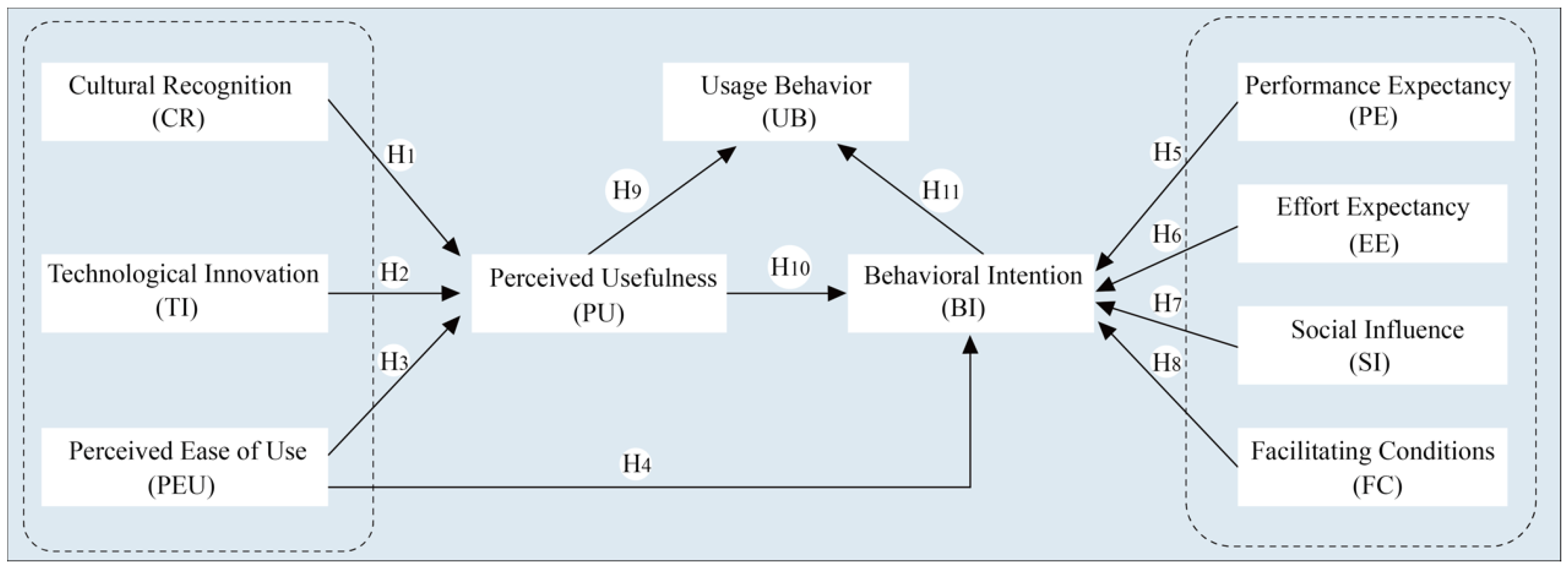
Cultural identity related to Dunhuang culture has a significant positive effect on perceived usefulness (PU) within the TAM3 model.

2.3.2. Technological Innovation

Technology is a critical vehicle for delivering value to users [58]. Within technology acceptance models, technological innovation captures users’ acceptance of new system functionalities [59]. In digital museum settings, technological innovation manifests primarily in interaction design and immersive experience. For example, virtual reality (VR) has been shown to significantly increase users’ interest and intrinsic motivation, thereby enhancing the perceived value of cultural heritage and raising the likelihood of repeated participation [60,61]. Prior research indicates that technological innovation improves user experience and positively influences both perceived usefulness and continuance intention. Thus, in digital museums, technological innovation should be positively associated with users’ PU. Based on TAM3, we propose:
H2. 
Technological innovation in the Dunhuang Digital Museum has a significant effect on perceived usefulness within the TAM3 model.

2.3.3. Relationships Among Perceived Ease of Use, Perceived Usefulness, and Behavioral Intention

Perceived usefulness reflects the extent to which an individual believes that using a particular system will enhance their performance [62]. Perceived ease of use (PEU) refers to the degree to which users expect a new technology to be easy and straightforward to operate [63]. When users can become familiar with a system with relatively little effort and in a short time, they are more likely to feel satisfied and exhibit an intention to continue using it [64,65,66]. Beyond external influences, prior studies show that PEU affects perceived usefulness (PU) and exerts positive effects on users’ attitudes and behavioral intention (BI) toward digital technologies [67]. Users’ attitudes toward adopting new technologies are jointly shaped by PU and PEU, which together determine actual system use [68]. Empirical findings indicate that PEU positively affects PU [69,70]. Shin and colleagues further demonstrated that enhancing PU in digital museums strengthens users’ positive attitudes [71]. The TAM posits that PEU influences PU and that usage intention determines actual system use; moreover, both PEU and PU significantly affect BI [72,73]. Therefore:
H3. 
In the TAM3 model, perceived ease of use in the Dunhuang Digital Museum significantly affects perceived usefulness.
H4. 
In the UTAUT model, perceived ease of use in the Dunhuang Digital Museum significantly affects users’ behavioral intention.

2.3.4. Unified Theory of Acceptance and Use of Technology (UTAUT)

Venkatesh proposed the Unified Theory of Acceptance and Use of Technology (UTAUT) to explain initial and continued technology use [74]. The model builds on the key determinants of behavioral intention [71] and synthesizes eight prior technology-adoption theories [48]. Zhou’s work suggests that UTAUT explains up to 70% of the variance in adoption behavior and outperforms earlier models in predicting behavioral intention [75]. The traditional UTAUT comprises four core constructs: performance expectancy (PE), effort expectancy (EE), social influence (SI), and facilitating conditions (FC) [74,76]. Among these, PE, EE, and SI are considered key predictors of BI [77]. These factors exert significant influences on users’ acceptance and use of the “Cloud Tour Dunhuang” digital museum. PE denotes the extent to which users believe that using the digital museum will yield tangible benefits and is a pivotal factor in new technology adoption [48,78]. Although both performance expectancy (PE) and perceived usefulness (PU) describe users’ beliefs about the benefits of technology, the two constructs represent conceptually distinct mechanisms. In the TAM perspective, PU functions as a post-adoption cognitive appraisal of a system’s instrumental utility, whereas in UTAUT, PE reflects a forward-looking expectation that technology will enhance performance in broader cognitive, motivational, and contextual terms. Consequently, PE and PU operate as complementary rather than overlapping determinants: PU concerns evaluations formed during technology use, while PE captures anticipatory beliefs prior to use. This distinction highlights their independent theoretical roles in shaping behavioral intention within the integrated framework. EE captures perceived ease of using the digital museum and positively affects BI [48]. SI refers to the degree to which individuals perceive that important others in their lives think they should visit the digital museum; its positive effect on BI is especially salient in tourism contexts. FC represent external enablers, such as the availability of technologies and devices, which significantly shape user experience by affecting system availability [78]; FC also include users’ perceptions of organizational and technical support for system use [48,78]. These factors are critical for promoting continuance.
Based on UTAUT, we posit the following hypotheses:
H5. 
Performance expectancy positively influences users’ behavioral intention in the UTAUT model.
H6. 
Effort expectancy positively influences users’ behavioral intention.
H7. 
Social influence positively influences users’ behavioral intention.
H8. 
Facilitating conditions have a significant effect on users’ behavioral intention.

2.3.5. Effects of Perceived Usefulness on Behavioral Intention and Continuance Intention

Evidence indicates that perceived usefulness (PU) exerts a direct and significant positive effect on continuance intention for emerging technologies [79]. In the context of the Dunhuang Digital Museum, we employ the revised TAM3 to examine users’ continuance usage behavior. Integrating H1, H2, and H3, we formulate a hypothesis to test whether the enhanced TAM3 significantly affects users’ continuance behavior. Accordingly, we propose:
H9. 
In the UTAUT model, performance expectancy positively influences users’ behavioral intention.
PU is defined as the degree to which an individual believes that using a new technology will enhance or improve performance. Here, PU refers to users’ perceptions of whether the “Cloud Tour Dunhuang” mini-program can enhance their learning outcomes. In TAM, behavioral intention (BI) is significantly influenced by PU [43], a relationship widely supported in existing research [62,80]. Therefore:
H10. 
In the TAM3 model, perceived usefulness positively influences users’ behavioral intention.

2.3.6. Effect of Behavioral Intention on Continuance Usage Behavior

Behavioral intention reflects users’ initial cognitive–affective evaluations when adopting a new technology, product, or service [81], whereas continuance usage denotes sustained use following initial adoption [28,82]. Prior research consistently shows that both adoption and continuance intentions are shaped by innovation attributes, individual characteristics, and contextual factors [48,83], with behavioral intention serving as a primary determinant of continuance behavior [84]. In the revised model, H9 and H10 address the direct effects of perceived usefulness on continuance usage; however, a corresponding hypothesis linking behavioral intention to continuance has not yet been specified. To provide a complete account, the enhanced TAM3 thus incorporates both PU-driven effects (H9, H10) and the broader UTAUT pathway, allowing an integrated assessment of how intention translates into sustained usage. Accordingly, we posit:
H11. 
In the UTAUT model, users’ behavioral intention significantly influences their continuance usage of the Dunhuang Digital Museum.
In summary, this study develops an integrated model that combines TAM3 and UTAUT and introduces cultural identity and technological innovation as two external variables. The model is designed to systematically analyze the interrelationships among constructs and their effects on users’ behavioral intention and continuance usage behavior.

2.4. Research Model

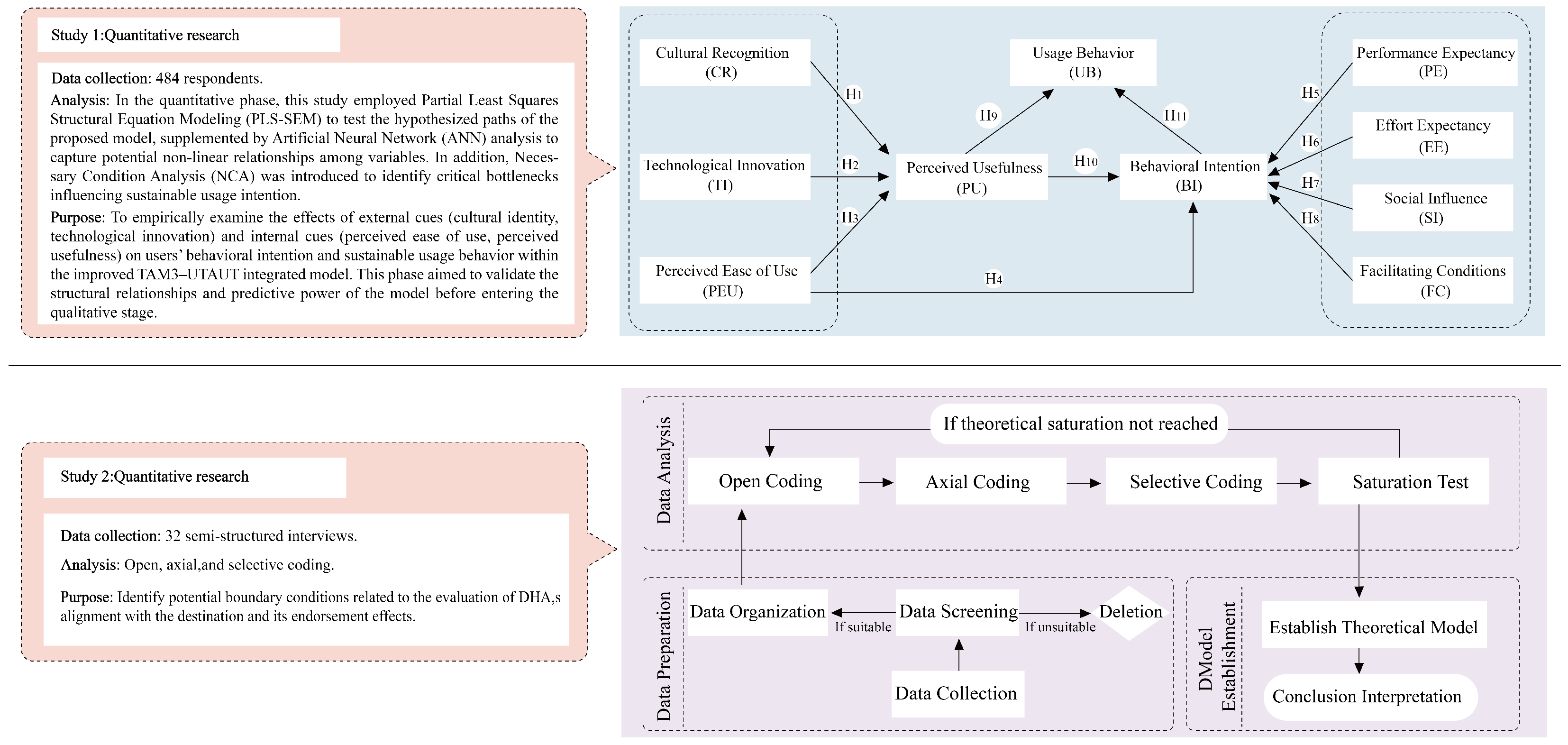
Two external variables—cultural identity (CR) and technological innovation (TI)—are incorporated to capture users’ affective attachment to Dunhuang culture and their evaluation of novel technologies within the digital museum. These variables constitute the basis for a hybrid conceptual model that integrates the revised TAM3 with UTAUT to explain continuance intention in the Dunhuang Digital Museum (Figure 1). Eleven hypotheses are formulated around this integrated framework. To validate the proposed construct relationships and assess the significance of each theoretical path, we conduct a systematic empirical evaluation.

3. Methods

3.1. Research Design

This study adopts a sequential explanatory mixed-methods design [85]. First, a large-scale survey tests the enhanced TAM3–UTAUT model for continuance intention toward Cloud Tour Dunhuang, with SEM estimating causal paths and ANN and NCA providing predictive and necessity-based triangulation. Guided by these quantitative results, follow-up semi-structured interviews with a subsample from Study 1 are analyzed using grounded theory (open, axial, and selective coding) to uncover latent mechanisms and cultural-context logics underlying both significant and non-significant effects. This quantitative-to-qualitative sequence clarifies discrepancies, deepens interpretation of cognition–affect–motivation processes, and refines a parsimonious account of continuance intention. The design aligns with a post-positivist paradigm emphasizing multi-method corroboration to enhance rigor and validity [86]. An overview of workflow and phase complementarity is presented in Figure 2.

3.2. Research Context and Site: The Cloud Tour Dunhuang Digital Museum

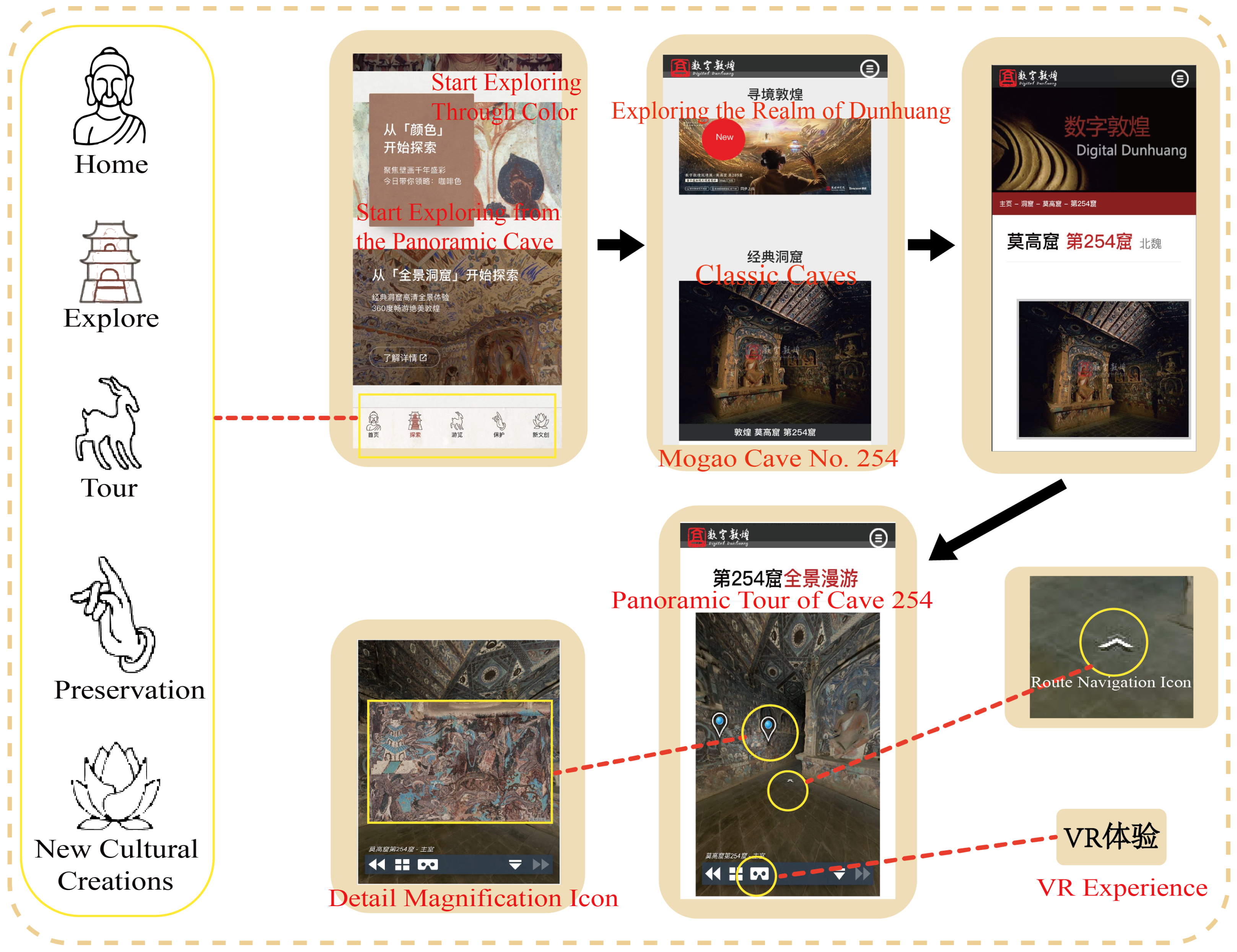
Situated on the southeastern edge of the Dunhuang oasis at a pivotal Silk Road nexus, Dunhuang’s heritage anchors exchanges between Asia and Europe [87]. The Mogao Caves were inscribed on UNESCO’s World Heritage List in 1987 [88]. Digital efforts at the Dunhuang Academy began in the early 1990s and, with a dedicated team formed in 2006, have supported both grotto conservation and technology transfer to other sites [89]. Drawing on a comprehensive resource database and open media repository, “Digital Dunhuang” now functions as a flagship platform for global dissemination, frequently cited in authoritative case studies in China and abroad [90]. By end-2021, the project had completed digital archiving for 268 caves, image processing for 164 caves, and 3D reconstructions for 45 polychrome sculptures, 146 caves, and 7 major heritage locations, involving over 100 technical staff [91]. On 20 February 2022, the Academy, People’s Daily New Media, and Tencent launched the Cloud Tour Dunhuang WeChat mini-program, which organizes content into Explore, Tour, Conservation, and Cultural & Creative sections and delivers animations, H5 interactions, and mobile VR panoramas beyond traditional image/webpage browsing [92]. In line with Arnheim’s view that time is imperceptible whereas space is visualizable, the Mogao VR experience leverages spatial perception to convey grotto structure on handheld devices [93]. Accordingly, as shown in Figure 3, this study uses Cloud Tour Dunhuang as a representative case to evaluate public acceptance of digital-museum applications and to assess the effectiveness of digital technologies in cultural-heritage communication, with the goal of informing practice.

3.3. Study 1: Quantitative Phase

3.3.1. Instrumentation

The questionnaire was developed in strict accordance with academic standards. First, the research team extracted relevant items from the existing literature and adapted them to the specific context of digital museums to produce an initial draft. To ensure content validity, five domain experts were invited to review the instrument. They provided feedback on item wording, logical coherence, and alignment with the study objectives, which served as the basis for revision. The team incorporated these suggestions and finalized a pilot version of the questionnaire.
All constructs were measured using a 7-point Likert scale ranging from 1 (“strongly disagree”) to 7 (“strongly agree”). Respondents were instructed to select the option that best reflected their actual experience. This design was intended to ensure data accuracy and analytical tractability, thereby providing a reliable foundation for subsequent analyses. The specific measurement items are reported in Table 2.

3.3.2. Data Collection Procedure

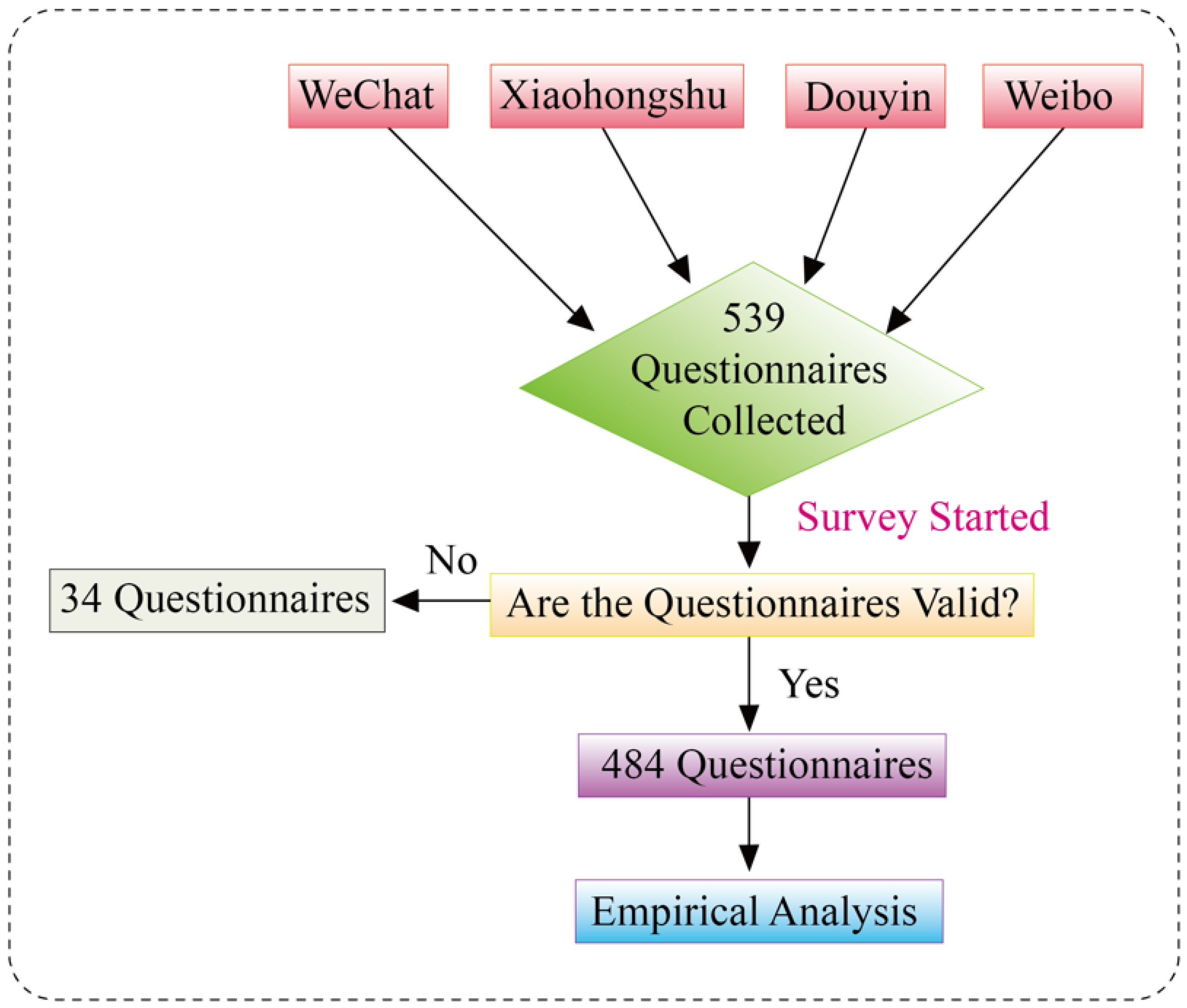
Formal data collection was conducted from March to June 2023 using a structured online survey targeting users who had experienced the Cloud Tour Dunhuang digital museum. A validated questionnaire was adapted to the digital-heritage context, and all respondents provided informed consent. To ensure sample heterogeneity, recruitment was carried out through the Cloud Tour Dunhuang WeChat mini-program and major social platforms, including WeChat groups, Douyin, Xiaohongshu, and Weibo. Data quality was controlled through three screening rules: exclusion of individuals without actual usage experience, removal of responses completed in under 100 s, and elimination of straightlined or logically inconsistent questionnaires. Of the 539 collected responses, 484 valid cases remained (valid rate = 89.80%), exceeding recommended SEM case-to-item ratios and providing adequate power for SEM, ANN, and NCA. The full data-collection workflow is summarized in Figure 4.

3.3.3. Respondent Profile

A total of 539 questionnaires were collected, of which 484 were valid. Among valid respondents, 54.75% were male and 45.25% were female. Age distribution was as follows: 20–30 years (36.16%), 31–40 years (19.42%), 41–50 years (21.49%), 51–60 years (17.36%), and 61–65 years (5.57%). The sample exhibited occupational diversity, with students (36.78%) and professionals in culture and education (24.18%) comprising the largest segments—suggesting relatively high cultural sensitivity and academic interest among digital-museum audiences. In addition, information-technology and new-media practitioners (15.70%)—a group with strong technological adaptability—showed notable participation, indicating the platform’s particular appeal to users in technology sectors. Detailed statistics are reported in Table 3.

3.3.4. Data Analysis Tools (SEM/ANN/NCA)

Progressive overview of the SEM–ANN–NCA hybrid approach.
SEM. Structural equation modeling (SEM) tests causal relations among latent variables by assessing how well a theory-implied variance–covariance matrix reproduces the empirical covariance structure [95]. By jointly estimating measurement and structural components, SEM offers systematic, theory-guided evaluation and is widely applied in user-behavior and technology-acceptance research [96]. Two streams prevail: covariance-based SEM (CB-SEM), optimized for theory confirmation via maximum likelihood, and variance-based PLS-SEM, oriented to prediction and smaller samples. Recent advances show CB-SEM accommodates reflective and composite specifications and—under Dijkstra & Henseler’s corrections—yields consistent, robust estimates [97,98]. Given our aim to validate, within an enhanced TAM3–UTAUT framework, the paths by which technological innovation and cultural identity shape continuance intention, we adopt CB-SEM as the primary analytic approach.
ANN. Because SEM primarily captures linear, compensatory relations, it can miss nonlinear or non-compensatory patterns. Artificial neural networks (ANN) mitigate this by emulating decision behavior and predicting outcomes without assuming independent covariates or linearity [99]. ANNs are robust to noise, outliers, and modest samples, accommodate both linear and nonlinear structures, and do not require normality [100]; through iterative training they minimize error to optimize prediction [101]. Owing to their “black-box” character, ANNs are not suited for hypothesis testing. In this study, SEM-supported predictors enter the ANN as inputs and the dependent variable as the output; we apply 10-fold cross-validation (90% training, 10% testing), assess performance via RMSE, and use sensitivity analysis to rank predictor importance. All ANN analyses are implemented with SPSS’s Multilayer Perceptron module.
NCA. While the SEM–ANN pairing strengthens explanation and prediction, it assesses sufficiency only and cannot determine whether a predictor is indispensable. We therefore add Necessary Condition Analysis (NCA) to test whether an antecedent is required for the outcome to occur [102]. NCA inspects empty zones in the antecedent–outcome scatter space to locate necessity constraints and thresholds, thereby flagging variables that may exert small effects yet remain required; all procedures are implemented in R via the NCA package.
Integrated use. We combine SEM, ANN, and NCA to deliver a multilayered account of continuance intention. First, CB-SEM with maximum likelihood validates path relations and overall fit in the enhanced TAM3–UTAUT model. Second, an ANN (MLP) captures nonlinear and interaction patterns and ranks predictor importance. Third, NCA identifies necessity and critical thresholds, distinguishing “should-have” from “must-have” factors and supplying causal-constraint information beyond SEM and ANN. Collectively, the SEM–ANN–NCA framework corroborates the model’s structural robustness and deepens insight into continuance behavior in the Dunhuang Digital Museum, aligning explanatory validity with predictive performance.

3.4. Study 2: Qualitative Phase

3.4.1. Sample

The Stage-2 qualitative study was designed to explain Stage-1 findings by probing mechanisms behind both significant and null paths. From 484 valid respondents, we used maximum-variation sampling (gender, age, occupation, usage frequency) to recruit a contrasting subsample (e.g., high/low cultural identity; high/low perceived ease of use). Invitations were sent to 40 users; 32 consented, and 28 interviews were retained to saturation. The sample spanned university students, teachers, cultural-heritage practitioners, digital-media designers, and high-frequency users, balancing cultural and technological perspectives. Semi-structured interviews (≈40–60 min) were conducted in person or online with written informed consent, recorded, transcribed, anonymized, and analyzed via grounded theory: open coding (line-by-line concept extraction), axial coding (causal category integration), and selective coding (core category distillation). This analysis elucidated cognitive–affective drivers and contextual logics, offering interpretive leverage for quantitative complexities and clarifying how culture, technology, and affect jointly shape continuance intention in digital museums.

3.4.2. Procedure

This phase commenced after completion of the quantitative analyses to further elucidate the mechanisms and contexts underlying significant and non-significant relationships in the continuance-intention model through semi-structured interviews about users’ cognitive, affective, and behavioral experiences with the Cloud Tour Dunhuang digital museum.
(1)
Interview guide and structure.
The guide was developed from the enhanced TAM3–UTAUT model and preliminary quantitative findings to examine users’ experiences and cognitions from multiple angles. Topics covered:
-
Technological–cognitive dimension: perceptions of technological innovation, perceived usefulness, and perceived ease of use; how these attributes inform trust and evaluative judgments.
-
Cultural–affective dimension: cultural identity, emotional resonance, and immersion during virtual visits; mechanisms of affect formation in a digital-heritage context.
-
Motivational–behavioral dimension: drivers of continuance, trust formation, and revisit intention.
Each interview began with warm-up prompts to help participants recall their usage and relax, followed by open questions such as: “What motivates you to revisit the Cloud Tour Dunhuang platform?”, “Which designs or functions conveyed innovation or cultural value?”, and “Did this experience influence your future intention to use the platform?”
(2)
Data collection and recording.
Interviews were conducted June–August 2025, after the quantitative phase. Each lasted 40–60 min and was held in person. All participants signed informed-consent forms after being informed about anonymity and confidentiality. With permission, interviews were documented (audio and notes).
(3)
Coding and analysis.
Qualitative data were organized and analyzed in NVivo 12 Plus, following Glaser and Strauss’s [103] (1967) three-stage grounded-theory procedure. First, during open coding, transcripts were examined line-by-line to identify concepts (e.g., “technological familiarity,” “cultural belonging,” “operational fluency”). Second, axial coding aggregated related concepts, explored structural logics and psychological mechanisms, and formed mid-level categories. Third, selective coding integrated higher-order categories to articulate core categories and a theoretical framework of user trust and continuance. Throughout, we used the constant-comparison method to ensure coding coherence, conducted independent double-coding by two researchers with subsequent reconciliation, and sought peer debriefing from domain experts to enhance reliability and validity. Theoretical saturation was assessed by testing additional cases, ensuring scientific rigor and completeness.
(4)
Integration with quantitative results.
Qualitative findings were compared with the earlier quantitative model to explain psychological and contextual differences across paths. Rather than hypothesis testing, this stage employed triangulation to reveal deeper experiential mechanisms not captured by the quantitative model, thereby strengthening explanatory power and theoretical robustness.

4. Study 1: Quantitative Results

4.1. Common Method Bias

Common method bias is a nonrandom, systematic measurement error that can artificially inflate or deflate statistical relationships among variables in questionnaire data, thereby undermining the reliability and interpretability of empirical findings [104]. Such bias often arises from survey design procedures, respondent response patterns, or situational cues. To ensure data quality, we conducted Harman’s single-factor test [105]. SPSS 27.0 extracted 10 factors with eigenvalues greater than 1, accounting for 77.768% of the cumulative variance. The first principal component explained only 30.365%, well below the 40% threshold. These results indicate that no significant common method bias is present in the data.

4.2. SEM Results

4.2.1. Descriptive Statistical Analysis

A descriptive analysis of the questionnaire data was conducted, including the examination of skewness and kurtosis. As shown in Table 4, the mean values (M) ranged from 2.845 to 3.717, and the standard deviations (SD) ranged from 0.787 to 1.040. Skewness values ranged from −0.788 to 0.857, and kurtosis values ranged from −0.806 to 0.658. Since the skewness and kurtosis values were all below 1, the data were considered to conform to a multivariate normal distribution.

4.2.2. Assessment of the Measurement Model

Table 5 and Table 6 report the tests of convergent validity and reliability. All standardized factor loadings exceed 0.70, indicating strong explanatory power of indicators for their respective latent constructs. The average variance extracted (AVE) values are all above 0.50, and the composite reliability (CR) values are all greater than 0.70, demonstrating satisfactory convergent validity and internal consistency. Collectively, these indices confirm the instrument’s measurement validity and support the reliability and structural soundness of the measurement model, thereby meeting the prerequisites for subsequent SEM analyses.

4.2.3. Assessment of the Structural Model

(1)
Model fit.
Using SEM—including confirmatory factor analysis (CFA) and global fit evaluation—we assessed absolute fit. As reported in Table 7, the indices indicate satisfactory model–data correspondence: CMIN/DF = 1.736 (recommended 1–3); RMR = 0.044; GFI = 0.922 (>0.90); AGFI = 0.903 (>0.90); IFI = 0.966 (>0.90); TLI = 0.960 (>0.90); CFI = 0.966 (>0.90); and RMSEA = 0.039 (<0.08). Collectively, these values meet recommended thresholds, indicating that the revised hybrid model integrating TAM3 and UTAUT achieves good fit.
(2)
Path analysis.
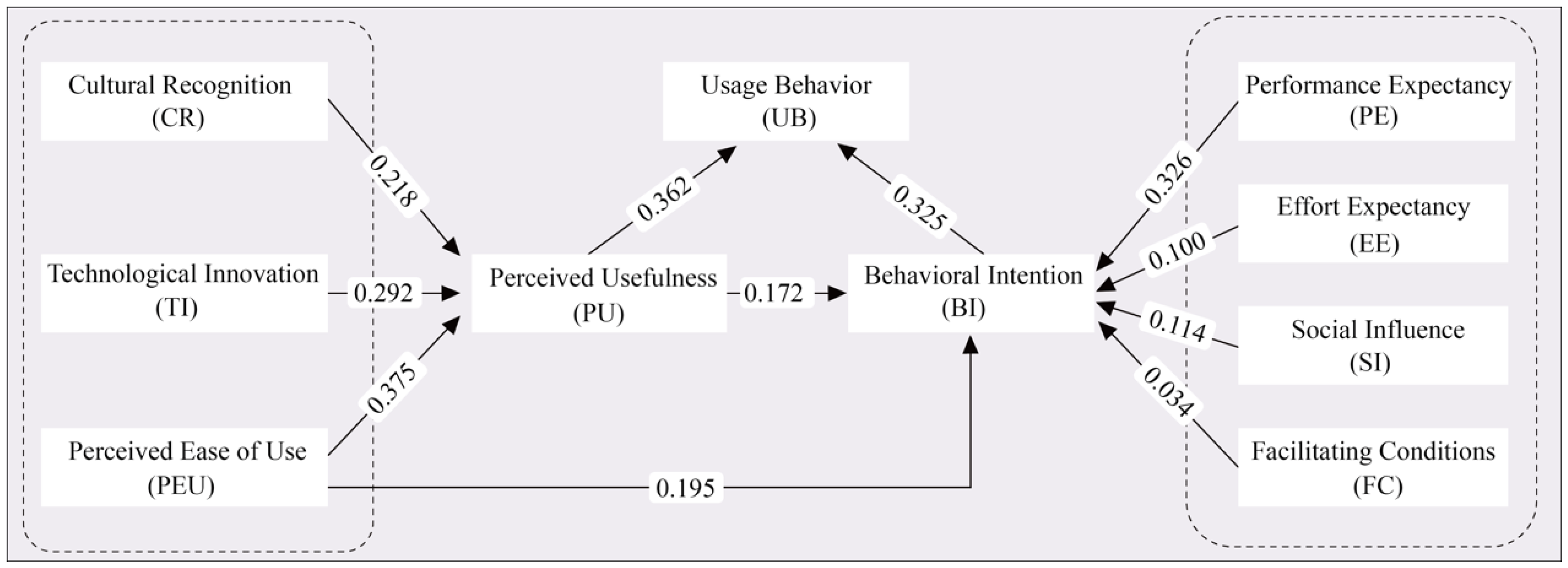
As shown in Table 8, path coefficients and their significance levels are as follows. Cultural identity ( β = 0.218 ,   p < 0.001 ), technological innovation ( β = 0.292 ,   p < 0.001 ), and perceived ease of use ( β = 0.375 ,   p < 0.001 ) each exert significant positive effects on perceived usefulness. Performance expectancy ( β = 0.326 ,   p < 0.001 ), social influence ( β = 0.114 ,   p < 0.05 ), perceived ease of use ( β = 0.195 ,   p < 0.01 ), and perceived usefulness ( β = 0.172 ,   p < 0.05 ) significantly and positively affect behavioral intention. In addition, behavioral intention and perceived usefulness both have significant positive effects on continuance usage behavior ( β = 0.325 and β = 0.362 , respectively; p < 0.001 ). By contrast, the path between effort expectancy (EE) and facilitating conditions (FC) is not significant ( p > 0.05 ), indicating that in small-scale project contexts users are relatively less sensitive to technological complexity and external support. Using the “Cloud Tour Dunhuang” digital museum as a representative case, this study examines a lightweight WeChat mini-program environment in which interaction flows are highly streamlined and the system architecture is comparatively light. As an embedded “app-in-app” service, the mini-program can be invoked directly within the host platform without additional downloading or installation, thereby substantially lowering initial access barriers and configuration costs [106]. Consistent with this, empirical studies have shown that WeChat mini-programs designed for educational and public-service scenarios are typically evaluated as “easy to use,” and users rarely require extra technical support when completing learning or task-oriented activities [107]. More importantly, mobile interface paradigms have shaped user expectations toward immediate accessibility and operational intuitiveness. In contemporary digital-content environments, users increasingly regard “low effort” and “no additional support” as default features rather than value-adding attributes. As a result, operational effort and external support exert relatively weaker explanatory effects because they are already assumed to be fulfilled in mobile settings, particularly in lightweight mini-program architectures. In such “low-complexity-low-operational-load” system configurations, users’ dependence on operational effort and external support is markedly attenuated, making the path coefficients for EE and FC less likely to reach statistical significance. Overall, the empirical results support the majority of the theoretical hypotheses and confirm the validity of the proposed model structure.
In sum, users’ continuance intention toward the Dunhuang Digital Museum is shaped by a combination of technological, cultural, and experiential factors. Cultural identity and technological innovation significantly enhance perceived usefulness, while perceived ease of use both reinforces this effect and directly fosters behavioral intention. Within the UTAUT framework, performance expectancy and social influence remain pivotal in a digital-heritage context, whereas the effects of effort expectancy and facilitating conditions are comparatively limited. Ultimately, perceived usefulness (PU) together with behavioral intention (BI) drives continuance usage behavior. These empirical findings offer actionable implications for design optimization, technological upgrading, and cultural-communication strategies on digital cultural-heritage platforms. The specific path results are shown in Figure 5.

4.3. ANN Results

4.3.1. Model Construction

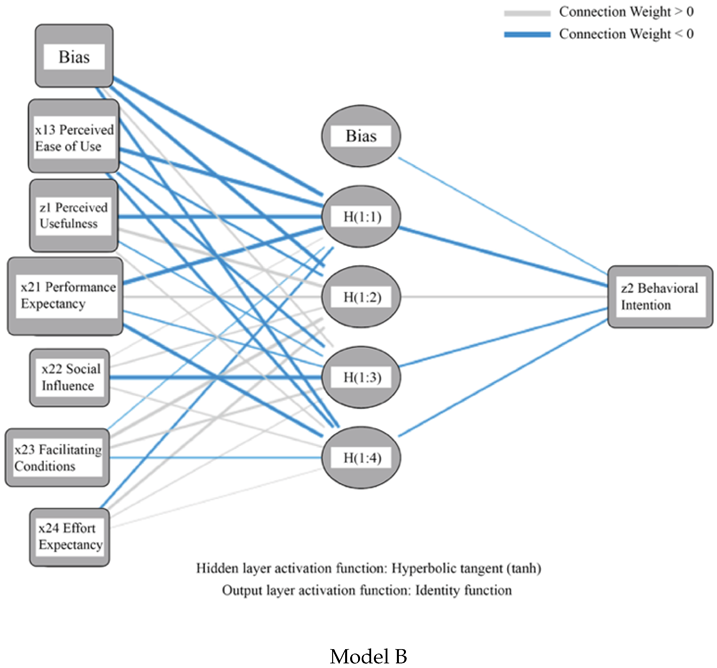
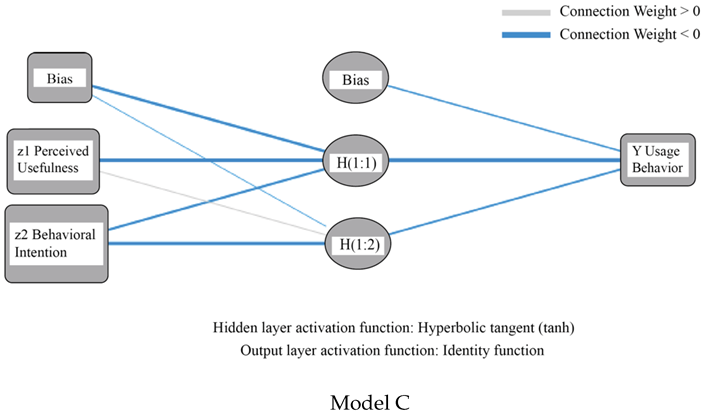
Given that structural equation modeling (SEM) relies on linear and compensatory assumptions [108] and may not capture nonlinear or non-compensatory relationships among latent variables, artificial neural networks (ANN) were incorporated as a second-stage analytic technique. ANN enhances prediction of continuance usage behavior and provides an importance ranking of key determinants. Based on the significant SEM paths (Figure 5) and measurement results (Table 7), three feed-forward multilayer perceptron (MLP) models were specified to re-model the core causal chains for perceived usefulness (PU), behavioral intention (BI), and continuance usage behavior (UB). Each ANN (Appendix A) employed a single hidden-layer architecture and was trained in SPSS 27.0 using the MLP module. To reduce sensitivity to random initialization, each model was trained ten times, generating sub-networks ANN1–ANN10. Predictive performance and variable importance were evaluated using RMSE and sensitivity analysis. This dual-stage SEM–ANN strategy preserves the theory-implied causal structure while revealing latent nonlinearities and identifying critical drivers of users’ continuance intention toward the Dunhuang Digital Museum.

4.3.2. Validation of the ANN

To prevent overfitting, we employed 10-fold cross-validation (90% training, 10% testing). Across models A, B, and C, training- and test-set RMSE values fell between 0.2651 and 0.3856 (see Table 9), indicating acceptable predictive accuracy. Model C exhibited a relatively higher test-set mean RMSE (0.522). The elevated RMSE may reflect the greater subjectivity of perceived value and heterogeneity across individuals, which complicate precise prediction. Even so, the value remains within an acceptable range, supporting the reliability of the ANN models.
Goodness of fit was further assessed using the coefficient of determination ( R 2 ), computed via Equations (1) and (2). The ANNs explained 54.4% of the variance in PU, 72.1% in BI, and 58.4% in UB. All three models demonstrated strong fit and generalization, with the BI model achieving the highest predictive accuracy and the most effective nonlinear approximation.
R M S E = M S E = S S E n
R 2 = 1 S S E S S T
In Equation (1), MSE denotes the mean squared error, SSE denotes the sum of squared errors, and n denotes the sample size for the respective training or test set.

4.4. Sensitivity Analysis

Permutation-based sensitivity analysis was conducted to determine the importance of predictors in each ANN model (Roy et al., 2023) [109]. As shown in Table 10, the normalized importance rankings were: for ANN Model A, PEU (100%), TI (92.67%), CR (69.372%); for ANN Model B, PE (100%), PEU (90.04%), PU (70.916%), EE (54.183%), FC (43.426%), SI (39.442%); and for ANN Model C, PU (100%) and BI (93.424%).
To compare the two approaches, we further performed an ordinal comparison between SEM path coefficients and ANN normalized relative importances (Table 11). Results show full concordance between SEM and ANN in Models A and C, with only minor discrepancies in Model B. Overall, the ANNs exhibit strong predictive capability while corroborating the SEM’s explanatory power for the endogenous variables.

4.5. Findings of NCA

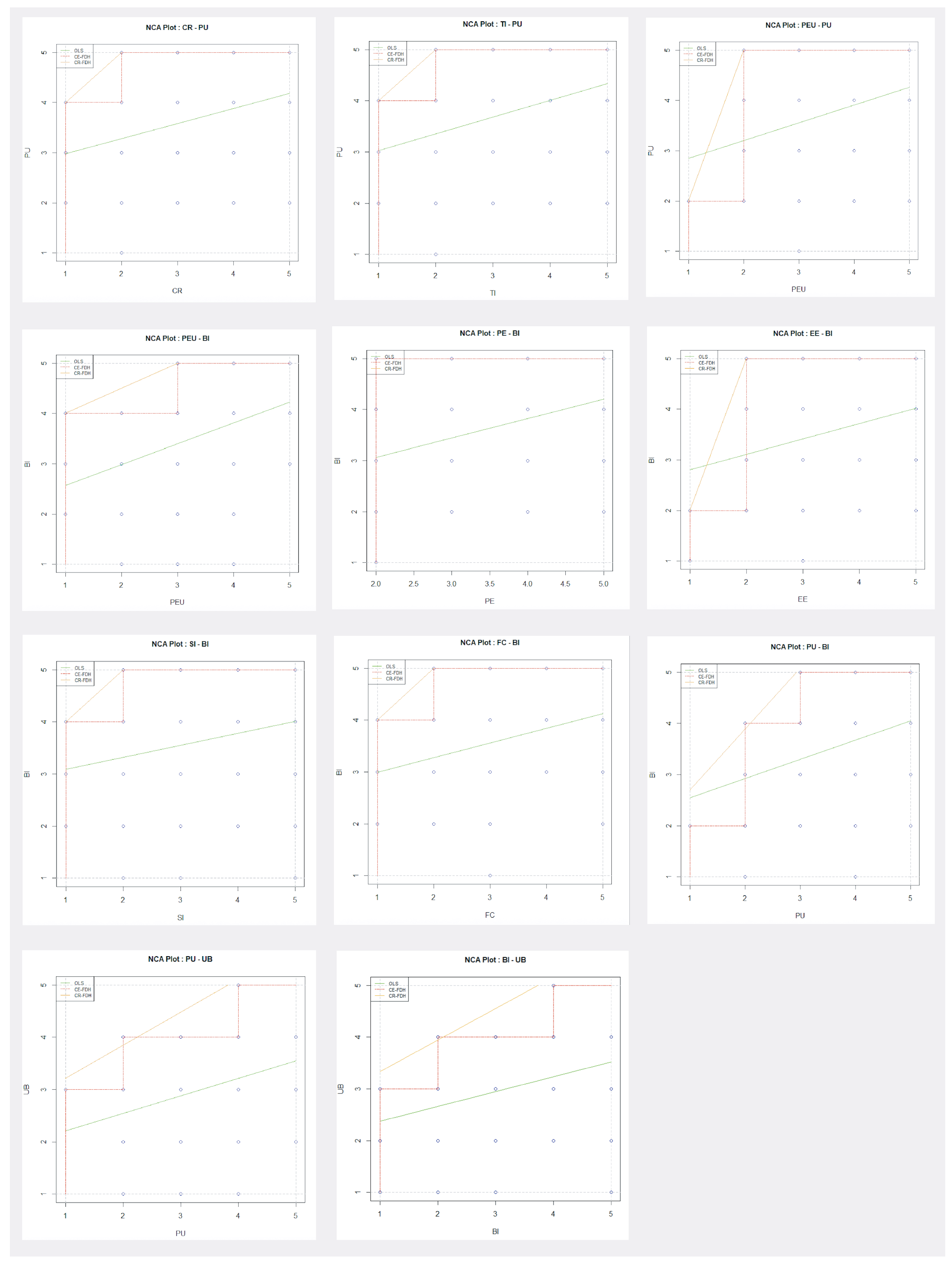
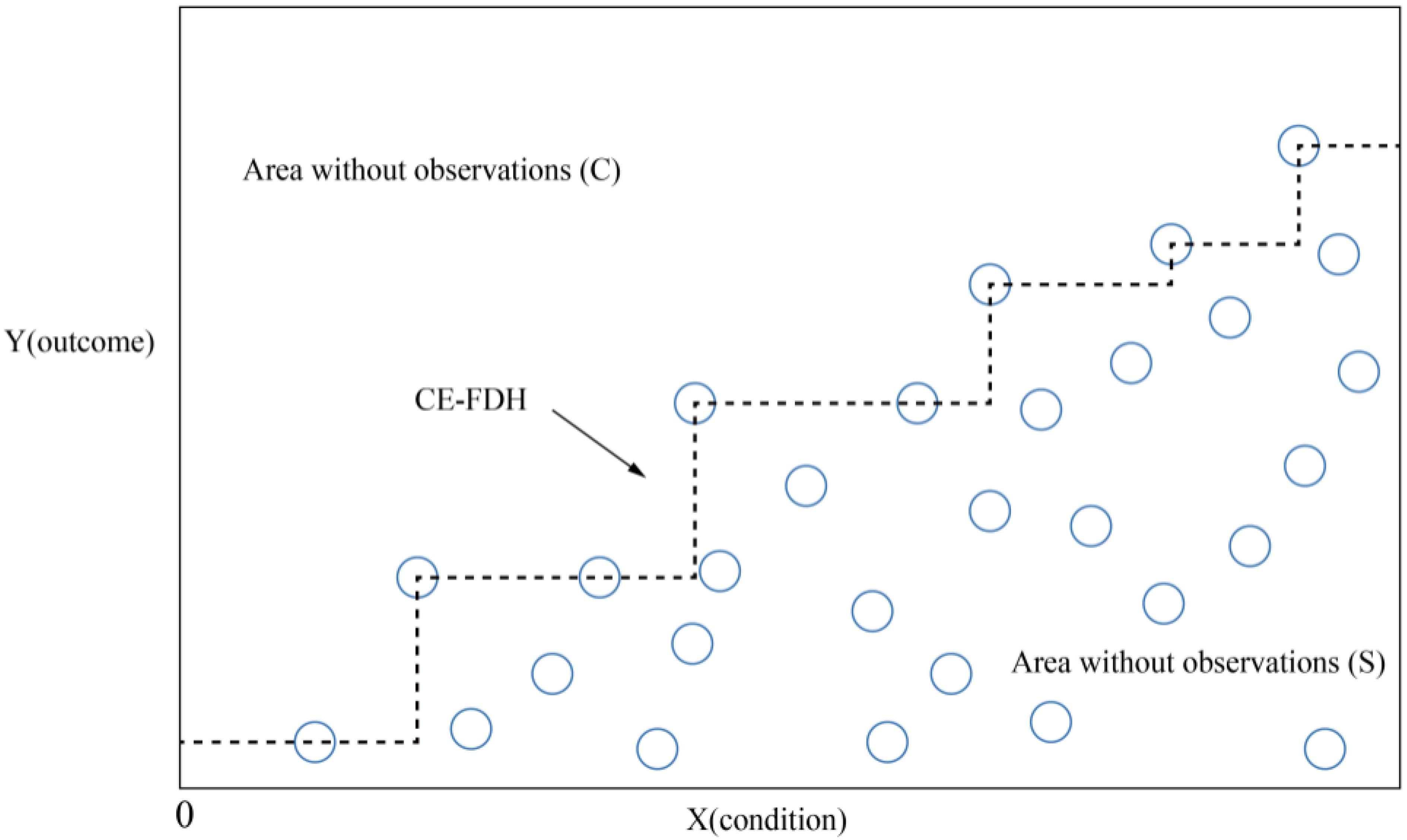
Sufficiency logic posits that “X can raise Y,” whereas necessity logic emphasizes that “X is a prerequisite for Y.” Because the SEM–ANN approach cannot identify boundary constraints that limit changes in the outcome variable, and NCA cannot quantify the strength of X’s effect on Y, combining the two into an integrated SEM–ANN–NCA framework yields complementary advantages. In a Cartesian coordinate system (see Figure 6), NCA places predictors on the X-axis and the outcome on the Y-axis to visualize the constraint relationship between them. The ceiling line, derived from the dispersion of observed points, partitions the plane into constrained and unconstrained regions; it is estimated using the ceiling envelopment free disposal hull (CE-FDH) procedure to produce a stepwise boundary [110]. The upper-left critical region indicates the minimum value of X required to achieve a given level of Y, thereby revealing the necessity constraints that structure the relationship between variables.

4.5.1. Effect Size and Significance Testing

A predictor is considered a statistically necessary condition when its effect size (CE-FDH) exceeds 0.10 and its significance level satisfies p < 0.05 [111,112]. As shown in Table 12, four variables meet this criterion.
First, the necessity effect of PEU→PU is significant ( d = 0.188 ,   p < 0.001 ), indicating that users can form a high perception of usefulness only when the system is sufficiently easy to operate. In other words, if interactions are complex, even well-designed functions are unlikely to elicit positive usefulness judgments. Second, PEU→BI ( d = 0.125 ,   p = 0.010 ) and EE→BI ( d = 0.188 ,   p = 0.019 / 0.018 ) also exhibit significant necessity effects, showing that ease of use and operational effort are prerequisite conditions for behavioral intention. When interaction is cumbersome or usage burden is high, intention is markedly suppressed. In addition, PU→BI is necessary ( d = 0.250 ,   p < 0.05 ), underscoring the central role of perceived usefulness in shaping intention. By contrast, variables such as PE, SI, and FC, although possibly positive in sufficiency analyses (e.g., SEM), display small necessity effects ( d 0.062 ,   p > 0.10 ), and thus do not qualify as must-have conditions for intention or usage.
Taken together, the NCA results reveal a characteristic threshold effect in the formation of user behavior: only when PEU, EE, and PU reach specific levels can BI and UB increase as expected. This finding corroborates the non-compensatory principle in HCI—deficits in core cognitive variables cannot be offset by other factors—and provides theoretical grounding for subsequent interface optimization and trust-mechanism design for older users.

4.5.2. Bottleneck Analysis

Bottleneck analysis identifies the minimum thresholds of predictors required to attain specific outcome levels. In other words, if a predictor does not reach its necessary threshold, the outcome cannot achieve a high level. This analysis reveals critical dependencies among variables—target outcomes are activated or can continue to improve only when key predictors meet their minimum requirements [113].
As shown in Table 13, users’ behaviors exhibit clear tiered threshold effects across stages. When the target variable reaches a high level (70–100%), perceived ease of use (PEU) must attain 15–25% at both the “perceived usefulness” and “behavioral intention” stages, indicating that ease of use is a prerequisite for cognitive appraisal and intention formation. Meanwhile, effort expectancy (EE) has a bottleneck of 8.3–15% at the behavioral-intention stage, implying that users must perceive a manageable level of operational effort to generate intention. At the continuance-usage stage, perceived usefulness (PU) and behavioral intention (BI) impose the highest thresholds: to reach 100% of the target behavior, PU and BI must reach 70.8% and 68.2%, respectively. This indicates that long-term use materializes only when users fully recognize system value and form stable intentions.
Overall, the threshold pattern from the cognitive layer (PEU) to the intention layer (EE, PU) and finally to the behavior layer (PU, BI) shows that sustained participation depends on sequential satisfaction of stage-specific conditions, with PU and BI constituting the ultimate bottlenecks. In addition, Appendix B provides NCA scatterplots generated in R version 4.5.0 (2025-04-11) that further corroborate the necessity of these thresholds.

4.6. Integrating SEM and NCA: Quadrant Typology of Influencing Factors

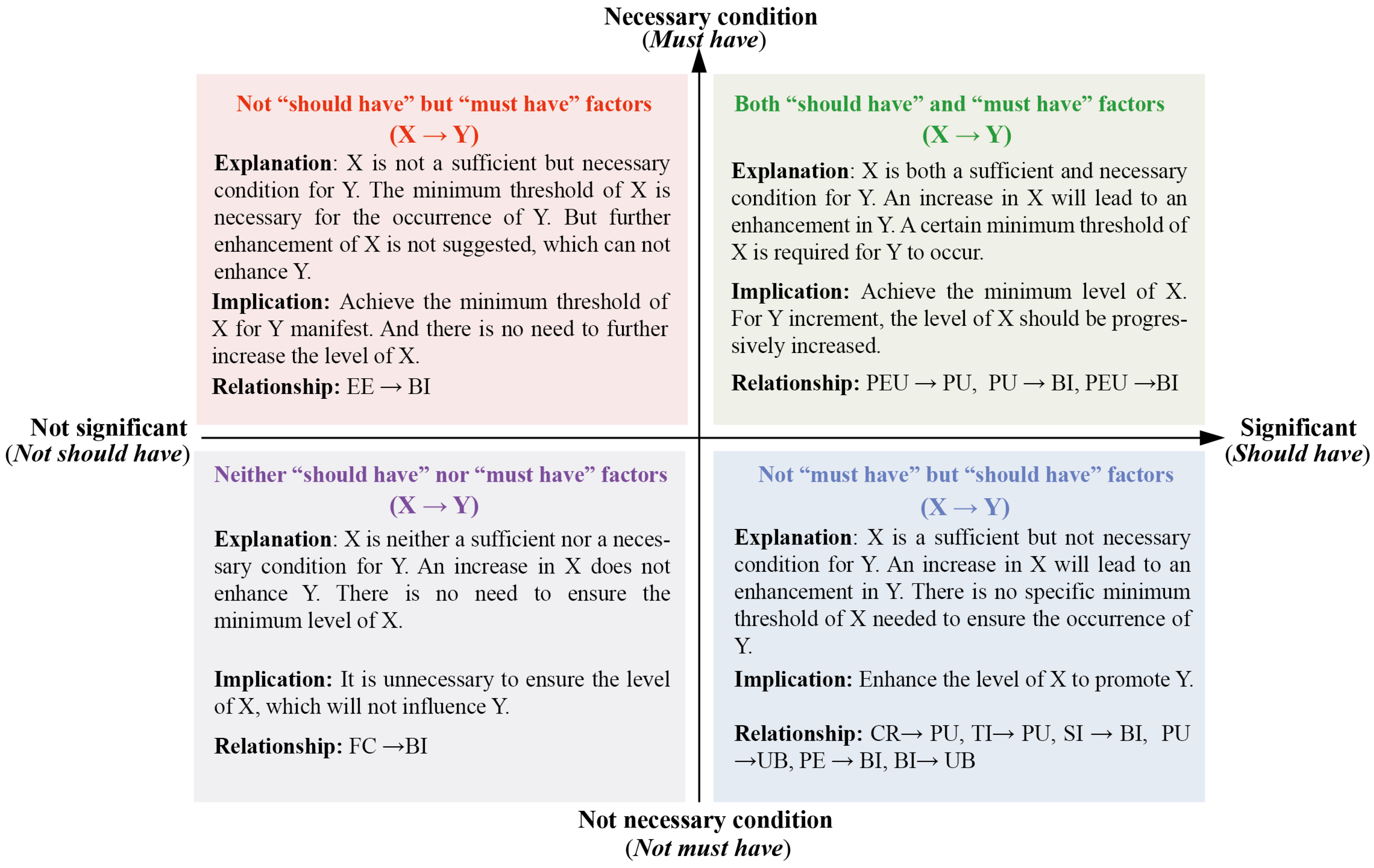
Synthesizing the SEM and NCA results allows the determinants to be organized into four quadrant types (see Figure 7) (Leong et al., 2024) [114].
The integrated model in this study primarily involves two key categories.
(1)
“Should-have” and “must-have” factors (upper-right quadrant).
These include P E U P U , P U B I , and P E U B I . Each path functions as both a sufficient and a necessary condition: raising these predictors increases the outcome level, and meeting their minimum thresholds is a prerequisite for the outcome to occur. In practical terms, if these factors are deficient, users’ intention cannot form; when strengthened, they further enhance continuance usage. Digital-museum design should therefore guarantee high ease of use and perceived usefulness, with ongoing optimization to drive behavioral conversion.
(2)
“Should-have” but not “must-have” factors (lower-right quadrant).
These comprise C R P U , T I P U , S I B I , P U U B , and B I U B . Although not necessary in the NCA sense, they exert statistically significant positive effects in the SEM analysis. Enhancing these variables improves user experience and continuance intention, yet shortfalls do not prevent the behavior from occurring. In digital-heritage platforms, cultural identity and social influence thus operate as amplifiable drivers that should be leveraged through cultural-narrative design and community-interaction mechanisms.
Implication. The joint SEM-NCA analysis reveals a dual logic shaping continuance intention. On one side, necessary-and-sufficient factors define baseline design thresholds and continuous improvement priorities. On the other, sufficient-only factors provide strategies for experience intensification and cultural-value transmission. This distinction clarifies the theoretical roles of different paths and supplies empirical guidance for prioritizing resource allocation and feature optimization in digital cultural-heritage platforms.

5. Study 2: Qualitative Results

5.1. Grounded Theory Approach

5.1.1. Three-Level Coding

As an inductive qualitative strategy, grounded theory typically organizes findings into three progressively abstract levels—open coding, axial coding, and selective coding. In this study, we first extracted open codes from participants’ narratives about their experiences with the Cloud Tour Dunhuang digital museum. We then aggregated these initial concepts into several axial categories—such as technological trust and reliability, affective–aesthetic engagement, integration of cultural identity, perceived educational and cognitive value, and motives for continuance and co-creation. Finally, we distilled selective codes from these axial categories to form higher-order constructs explaining users’ continuance intention. This stepwise abstraction enhances analytic transparency, methodological rigor, and contextual adequacy [115], and—together with triangulation from the quantitative phase—strengthens the credibility of the conclusions. Table 14 presents the three-level coding process generated via grounded theory within the Cloud Tour Dunhuang context.

5.1.2. Theoretical Saturation Test

To ensure the systematic nature of the qualitative analysis and the adequacy of the emergent model, we combined the constant comparison method with a theoretical saturation check. After completing three-level coding for the first 25 validated interview transcripts, we analyzed 3 additional transcripts to test the stability of the category system. No new concepts or relational categories emerged, and the existing core categories sufficiently accounted for the data, indicating theoretical saturation. To further enhance reliability, two researchers trained in qualitative methods independently coded the data and then cross-checked their results; the intercoder agreement reached 92.6%, meeting the reliability benchmark proposed by Miles & Huberman (1994) [116]. In addition, two domain experts (communication studies and HCI) conducted peer debriefing. They affirmed the reasonableness of the conceptual hierarchy, category delineation, and logical structure, and identified no new categories or unexplained phenomena, suggesting that the theoretical framework adequately reflects participants’ experiences and psychological processes and meets the conditions for saturation.

5.2. Research Findings

The qualitative analysis indicates that users’ continuance intention toward the Cloud Tour Dunhuang digital museum is jointly driven by four classes of psychological and affective factors. Cognitive layer: Users emphasized technological innovativeness and operational convenience, which yielded strong processing fluency and functional trust during use. Affective layer: Immersive visual and audio design stabilized emotions and amplified cultural resonance, fostering hedonic pleasure and aesthetic engagement. Trust layer: The authenticity of content and system stability strengthened perceived credibility, positioning the platform as an authoritative and reliable medium for cultural experience. Behavioral layer: Users reported motives for continued exploration and proactive dissemination, forming a loop of “revisit-recommend-co-create.” Taken together, the sequence technological ease of use→emotional resonance→trust formation→sustained motivation constitutes a stepwise psychological mechanism that offers a new cognition–affect framework for explaining long-term usage of digital cultural products.

6. Discussion

6.1. Methodological Advancement and Practical Implications

6.1.1. Comparative Analysis and Triangulation of SEM, ANN, and NCA Findings

In this study, SEM tests the theoretically hypothesized causal paths and examines whether and how integrating cultural identity and technological innovation into TAM3 influences continuance intention in the Dunhuang context (RQ1). SEM also reveals how the cognitive and social constructs jointly affect continuance intention under the integrated TAM3-UTAUT framework (RQ2). ANN, by contrast, evaluates how strongly and nonlinearly these determinants predict user outcomes, thereby assessing whether the integrated framework improves predictive performance compared with single-theory baselines (RQ3). NCA further examines which antecedents are indispensable by identifying bottleneck conditions without which continuance intention cannot occur, thus revealing necessary thresholds that extend beyond sufficiency and prediction (RQ3). Together, SEM, ANN, and NCA form a sequential explanatory chain—from causal sufficiency (SEM), to nonlinear predictive strength (ANN), to indispensable necessity (NCA)—providing complementary analytical perspectives on continuance behavior in digital-heritage settings.
The combined results of SEM, ANN, and NCA show strong cross-method convergence while revealing complementary sufficiency, predictive, and necessity patterns. For PU, SEM confirms PEU→PU ( β = 0.375), TI→PU ( β = 0.292), and CR→PU ( β = 0.218) as main drivers, a hierarchy reproduced by ANN (relative importance: 100%, 92.67%, 69.37%) with stable RMSE (≈0.35) and R2 (54.4%). This indicates that ease of use, supported by technological novelty and cultural resonance, constitutes the primary determinant of PU even under nonlinear modeling. Regarding BI, SEM identifies PE→BI ( β = 0.326 ***), PEU→BI ( β = 0.195 **), and PU→BI ( β = 0.172 *) as dominant predictors, while SI is smaller and EE/FC are insignificant. ANN largely replicates this ranking (relative importance: 100%, 90.04%, 70.92%), but assigns higher nonlinear contributions to EE (54.18%) and FC (43.43%) and a lower contribution to SI (39.44%), suggesting incremental predictive effects despite lower SEM significance. For UB, SEM reports similar influences of PU→UB ( β = 0.362 ***) and BI→UB ( β = 0.325 ***), corroborated by ANN Model C (relative importance: PU = 100%, BI = 83.92%; explanatory power = 58.4%). Thus, PU acts as a more rigid condition for repeated engagement, while BI provides additional motivation. NCA complements these results by identifying necessity relationships that are not captured through sufficiency or prediction. Based on CE-FDH thresholds (d > 0.10, p < 0.05), only PEU→PU (d = 0.188), PEU→BI (d = 0.125), EE→BI (d = 0.188), and PU→BI (d = 0.250) qualify as necessary, whereas CR, TI, PE, SI, and FC show negligible necessity (d ≤ 0.062). Bottleneck analysis further indicates that high PU and BI (70–100%) require minimum values of 70.8% and 68.2%, while PEU and EE must satisfy threshold ranges of 15–25% and 8.3–15%, respectively. Consequently, variables that are statistically significant or predictive may still lack necessity, whereas failure to reach required thresholds in PEU, EE, or PU prevents high engagement even under strong CI or SI conditions.
In summary, the three methods converge on the same core insight: ease of use (PEU), perceived usefulness (PU), and behavioral intention (BI) constitute the central cognition-to-behavior pathway. Their differences arise from methodological emphases—SEM identifies statistically sufficient predictors through linear modeling, ANN highlights the most influential variables via nonlinear predictive analysis, and NCA pinpoints indispensable bottleneck conditions. Rather than conflicting, these layers form a coherent explanatory structure: SEM answers “which factors matter,” ANN reveals “which factors matter most for prediction,” and NCA specifies “which factors must be present for the outcome to occur.” Together, they offer a comprehensive, multi-angle account of user decision processes.

6.1.2. Bottleneck-Threshold Analysis Based on ANN and NCA: Actionable Design and Management Implications for Digital Heritage Platforms

To enhance the practical interpretability of ANN and NCA, this study converts sensitivity rankings and bottleneck thresholds into actionable design strategies. ANN indicates that in lightweight platforms such as Cloud Tour Dunhuang, PEU, TI, and CR are the strongest contributors to PU, underscoring priorities in interface simplification, responsive interaction, and culturally coherent context-building. NCA provides stricter decision guidance: PU and BI must exceed ∼70% and 68%, and PEU must reach 15–25%, otherwise even high-quality or innovative content cannot sustain stable value perception. These thresholds offer quantifiable minimum requirements and clarify that enhanced features (e.g., narratives, gamification, immersive interaction) are ineffective before necessary conditions are met. For example, many digital heritage platforms have attempted to introduce immersive 3D exhibition rooms. However, pilot testing often shows that if basic interface usability (e.g., navigation clarity, loading responsiveness) does not meet a minimum threshold, users tend to exit the immersive environment prematurely. According to NCA, when PEU remains below the required bottleneck level, enhancements in 3D visualization or narrative richness alone cannot translate into continuance intention. Therefore, platform managers may need to first implement simplified navigation modes (e.g., step-based guidance, auto-rotation views) before deploying more advanced immersive scenes. Managerially, NCA’s “must-reach” conditions and ANN’s “more-is-better” contributors form two strategic pathways: (1) infrastructure strategies—reducing interaction depth, improving responsiveness, and lowering device demands to ensure PEU and EE reach required thresholds; and (2) experience-enhancement strategies—strengthening cultural storytelling, community content, personalized recommendations, and immersive presentation once the baseline is secured. In summary, ANN and NCA act as complementary decision tools, enabling a dual-layer strategic framework that first ensures behavioral feasibility through necessary thresholds and then improves participation quality via high-impact predictors.

6.2. Discussion of Research Results

6.2.1. External Cues as a Value Channel

As key external cues, cultural identity and technological innovation are widely recognized as antecedents shaping users’ evaluations and behavioral tendencies in digital heritage systems. Cultural identity—an affective-cognitive sense of self-affiliation—provides the contextual foundation for assessing instrumental and learning benefits [55,56,57], whereas technological innovation (e.g., immersive interaction, VR) enhances interest and intrinsic motivation, thereby elevating perceived value and encouraging repeated engagement [58,59,60,61]. The dual evidence base of this study—structural testing and prediction-oriented model comparison—confirms these theoretical claims: cultural identity (CR) and technological innovation (TI) do not directly promote continuance usage but operate through perceived usefulness (PU) as a value-mediated mechanism. Accordingly, H1 and H2 are supported. This aligns with the established view that “identity resonance enhances value evaluation” and “perceptible innovation facilitates utility judgments,” forming a transferable mechanism in which cultural narratives and interactive innovations elevate PU and, in turn, strengthen continuance motivation. Practically, these results suggest prioritizing resource investment in credible, coherent place-based cultural narration and perceptible interactive innovations—such as immersive tours, AI-guided interpretation, and digital-twin applications—to enhance PU as the foundation for intention formation and sustained engagement.

6.2.2. From Ease of Use to Behavior: Sufficiency Effects and Necessary Thresholds

Aligned with TAM, Davis et al. (1989) argue that perceived ease of use (PEU) not only shapes perceived usefulness (PU) but also influences behavioral intention (BI), with intention determining actual use [43,62]. Our findings corroborate this mechanism: reducing interactional burden and improving operational fluency strengthens users’ judgments of system value and facilitates continuance tendencies. Consistent with Shin et al. [71], enhanced experiential fluency—clear task flows, explicit feedback, and user-friendly guidance—reinforces PU and consolidates BI, underscoring the pathway of “first make the system easy, then make it useful” in digital-museum contexts. Within UTAUT, Venkatesh et al. (2003) identify performance expectancy (PE), effort expectancy (EE), social influence (SI), and facilitating conditions (FC) as core determinants of intention and usage [48], with Zhou et al. (2010) confirming superior predictive power [75]. Our results echo this hierarchy: PE is the dominant driver of BI; SI offers secondary support; EE operates as a necessary baseline—insufficient effort reduction undermines intention; and FC has limited marginal influence in mobile mini-program environments. Together, these findings reveal a coherent mechanism in which ease of use enables usefulness, PE anchors intention, and social/contextual cues refine engagement—offering a clear sequence for optimizing digital cultural-heritage systems.

6.2.3. Validation and Implications of the Usefulness–Intention–Continuance Chain

Consistent with technology continuance theories proposed by Bhattacherjee (2001) and Venkatesh et al. (2003), prior research demonstrates that perceived usefulness (PU) exerts a direct and significant effect on continuance intention [43,62,79,80,81]. In digital cultural heritage contexts, when users perceive that a digital museum enhances learning efficiency or cultural understanding, this value perception is internalized into more positive attitudes and stronger motivation to continue using the system, echoing Davis’s (1989) proposition that usefulness shapes intention and subsequent usage [43]. Bhattacherjee (2001) further argues that behavioral intention (BI) is the psychological bridge linking initial adoption to continuance [28], and our findings confirm this “value–intention–behavior” sequence: PU strengthens cognitive evaluations and satisfaction, which in turn consolidate stable intentions that translate into long-term usage. Moreover, PU and BI reinforce each other in shaping continuance behavior. PU directly promotes repeated use while indirectly amplifying this effect through BI, indicating that sustained engagement occurs only when users recognize genuine value and develop long-term commitment—an insight aligned with Bhattacherjee (2001) and Venkatesh et al. (2003) [43,81]. Overall, PU functions as a value precursor and BI as the mediating mechanism through which value transforms into durable continuance, offering a practical pathway for designing digital-heritage platforms: establish value, consolidate intention, and cultivate sustained use.

6.3. Contributions

6.3.1. Theoretical, Practical, and Methodological Contributions

(1)
Theoretical Contributions
This study offers three major contributions to digital cultural heritage research. First, it demonstrates that cultural identity (CI) and technological innovation (TI) shape continuance behavior through a unified value-mediation pathway, whereby both factors enhance perceived usefulness (PU) via cultural resonance and technology-derived novelty. Second, it identifies a platform-type boundary within TAM3–UTAUT: in lightweight mobile mini-program environments, effort expectancy (EE) and facilitating conditions (FC) possess only baseline relevance, indicating that system complexity and interaction load moderate core UTAUT effects—accounting for the stronger roles of EE and FC in VR/AR museums than in low-friction mobile contexts. Third, the study validates a culture-oriented sequential mechanism in which PU serves as a cognitive anchor integrating functional value with cultural meaning, thereby driving intention and continuance. Together, these findings provide a generalizable explanatory model for understanding participation in culture–technology platforms.
(2)
Practical Contributions
This study offers actionable implications for the design and operation of digital cultural platforms, supported by transferable cases. Platforms should prioritize technologies that enhance perceived usefulness (PU), such as immersive navigation, structured interaction flows, and intelligent interpretation systems. For instance, Cloud Tour Dunhuang improves comprehension through AI-driven narration, while the Kyoto National Museum employs AR devices to present virtual monks and holographic artifacts [117]. In terms of cultural representation, institutions should reinforce cultural identity via coherent narrative systems, symbolic visual cues, and historically grounded thematic content. Examples from the British Museum’s Africa galleries and the Louvre’s virtual exhibitions demonstrate that narrative framing strengthens emotional attachment and cultural affinity [118]. Participation can further be activated through online cultural communities, co-creation contests, and digital heritage campaigns (e.g., Dunhuang IP Creative Competition). Additionally, social influence mechanisms—including community sharing, digital badges, interactive tasks, and peer recommendations—help maintain long-term engagement. To guide implementation more concretely, digital museums could adopt a staged design pathway based on PU evaluation. For instance, a digital museum could first assess whether current interaction modules achieve a basic PU threshold (≈70%). If PU falls below this level, operators might begin with interface simplification (e.g., reducing navigation steps from four to two or adding guided viewing modes) before investing in immersive upgrades such as AR enhancements or narrative-rich 3D content. This stepwise approach ensures that fundamental usability conditions are satisfied prior to costly innovation, thereby reducing implementation risks and improving the effectiveness of cultural engagement strategies. For resource-limited institutions, scalable solutions such as semantic navigation, conversational AI guides, and modular digital twins additionally provide feasible pathways for digital transformation while aligning with users’ cultural expectations. Collectively, these insights provide direct guidance for planning and sustaining culture-technology integration.
(3)
Methodological Contributions
Within this methodological framework, SEM, ANN, and NCA form a multi-layered chain that links causal explanation, predictive contribution, and necessary-condition identification. SEM identifies linear causal paths; ANN models nonlinear predictor importance and compensates for interaction effects; and NCA specifies threshold conditions that sufficiency analyses cannot detect. Together, they clarify why behavior occurs, which determinants exert the greatest influence, and which minimum conditions must be met. ANN results indicate that PEU, TI, and CR are the strongest contributors to PU on lightweight platforms such as Cloud Tour Dunhuang, suggesting priorities in interface simplification, responsive feedback, and cultural-context construction. NCA adds decision value by identifying bottlenecks: PU and BI must exceed approximately 70% and 68%, and PEU must reach 15–25%; otherwise, even high-quality or innovative content cannot sustain stable value perception. These thresholds provide quantifiable minimum requirements and sharpen resource allocation. Managerially, combining NCA’s “must-reach” thresholds with ANN’s “most effective to improve” predictors yields a two-step strategy: first secure minimum usability conditions, then enhance value through cultural storytelling, community mechanisms, and personalized recommendations. This dual-layer logic underscores the theoretical and operational significance of the integrated SEM–ANN–NCA approach.

6.3.2. Limitations and Future Research Directions

Although this study employs a multi-method design and a relatively large sample, several limitations remain. First, the sample is primarily drawn from China, and the culturally specific context of Cloud Tour Dunhuang may influence perceptions of technological innovation and cultural identity. Future work should incorporate multi-country samples to assess cross-cultural generalizability. Second, reliance on self-reported questionnaires may introduce common method bias; integrating objective indicators—such as eye-tracking data, system logs, or physiological measures—would improve measurement accuracy. Third, the qualitative interviews were limited in scope; expanding interview diversity and employing AI-assisted text analytics could better capture the evolution of cultural identity and trust mechanisms. The current model also adopts a single PU-centered mediating pathway and does not include moderating variables reflecting demographic heterogeneity (e.g., age, gender, cultural experience, usage frequency). While additional moderated pathways may increase complexity, future studies could use multi-group analysis or hierarchical linear modeling to enhance ecological validity. Finally, this study focuses on user-level continuance mechanisms. Broader implications for museum operations and cultural-technology ecosystems warrant examination, including digital narrative design, community-based engagement, sustainability of technological systems, and long-term societal impacts.

7. Conclusions

Using the Cloud Tour Dunhuang digital museum as a case, this study develops and validates an integrated model grounded in an enhanced TAM3–UTAUT framework, clarifying how cultural identity and technological innovation shape continuance intention. Results show that both variables significantly affect continuance usage by strengthening perceived usefulness (PU), while performance expectancy and social influence remain key predictors. In contrast, effort expectancy (EE) and facilitating conditions (FC) are non-significant, reflecting the socio-technical characteristics of lightweight mini-program environments, where streamlined interaction and low system complexity reduce user sensitivity to EE and FC. These findings confirm a dual-drive mechanism—a technology–cognition pathway and a cultural-identity pathway—and extend the applicability of TAM3 and UTAUT to digital-heritage contexts. Methodologically, the hybrid SEM–ANN–NCA approach identifies both sufficient relations and necessary conditions, enhancing explanatory depth and predictive performance. Practically, the results indicate that design strategies should prioritize cultural semantics, narrative construction, immersive storytelling, and community-based interaction to foster trust and sustain cultural participation. Overall, the sustainable communication of digital heritage emerges not as a purely technological achievement but as a co-creative process shaped by technological innovation, cultural resonance, and social connectedness.

Author Contributions

Conceptualization, N.L. and X.W.; Methodology, N.L.; Software, N.L. and X.W.; Formal analysis, N.L. and X.W.; Investigation, N.L. and X.W.; Resources, N.L. and X.W.; Data curation, N.L. and X.W.; Writing—original draft, N.L. and X.W.; Writing—review & editing, N.L. and X.W.; Visualization, N.L. and X.W.; Supervision, X.W.; Project administration, N.L.; Funding acquisition, X.W. All authors have read and agreed to the published version of the manuscript.

Funding

This research received no external funding.

Institutional Review Board Statement

Ethical review and approval were waived for this study by Institution Committee due to Legal Regulations (Article 32, Chapter III of the Administrative Measures for the Ethical Review of Life Science and Medical Research Involving Humans (China); https://www.gov.cn/zhengce/zhengceku/2023-02/28/content_5743658.htm, accessed on 21 November 2025).

Informed Consent Statement

Informed consent was obtained from all individual participants included in the study.

Data Availability Statement

The original contributions presented in this study are included in the article. Further inquiries can be directed to the corresponding author.

Conflicts of Interest

The authors declare no conflicts of interest.

Appendix A

Sustainability 18 00492 i001
Sustainability 18 00492 i002
Sustainability 18 00492 i003

Appendix B

Sustainability 18 00492 i004

References

  1. Povroznik, N. Museums’ digital identity: Key components. In Internet Hist; Routledge: London, UK, 2025; pp. 169–184. [Google Scholar]
  2. Zou, Y.; Xiao, H.; Yang, Y. Constructing identity in space and place: Semiotic and discourse analyses of museum tourism. Tour. Manag. 2022, 93, 104608. [Google Scholar] [CrossRef]
  3. Liu, H.; Chen, M. Iconological Reconstruction and Complementarity in Chinese and Korean Museums in the Digital Age: A Comparative Study of the National Museum of Korea and the Palace Museum. Sustainability 2025, 17, 6042. [Google Scholar] [CrossRef]
  4. Greenhill, E.H. Museums and the Shaping of Knowledge; Routledge: London, UK, 1992. [Google Scholar]
  5. Meng, Y.; Chu, M.Y.; Chiu, D.K. The impact of COVID-19 on museums in the digital era: Practices and challenges in Hong Kong. Library Hi Tech 2022, 41, 130–151. [Google Scholar] [CrossRef]
  6. Chen, J.; Liao, J. Antecedents of viewers’ live streaming watching: A perspective of social presence theory. Front. Psychol. 2022, 13, 9629. [Google Scholar] [CrossRef] [PubMed]
  7. Deng, Y.; Li, X.; Zhang, J.; Zhao, W. From digital museums to on-site visiting: The mediation of cultural identity and perceived value. Front. Psychol. 2023, 14, 1111917. [Google Scholar] [CrossRef]
  8. Tao, F.; Xiao, B.; Qi, Q.; Cheng, J.; Ji, P. Digital twin modeling. J. Manuf. Syst. 2022, 64, 372–389. [Google Scholar] [CrossRef]
  9. Dong, S.; Xu, S.; Wu, G. Earth Science Digital Museum (ESDM): Toward a new paradigm for museums. Comput. Geosci. 2006, 32, 793–802. [Google Scholar] [CrossRef]
  10. Mason, M.C.; Riviezzo, A.; Zamparo, G.; Napolitano, M.R. It is worth a visit! Website quality and visitors’ intentions in the context of corporate museums: A multimethod approach. Curr. Issues Tour. 2022, 25, 3027–3041. [Google Scholar] [CrossRef]
  11. Choi, B.; Kim, J. Changes and challenges in museum management after the COVID-19 pandemic. J. Open Innov. Technol. Mark. Complex. 2021, 7, 148. [Google Scholar] [CrossRef]
  12. De Bernardi, P.; Bertello, A.; Shams, S.M.R. Logics hindering digital transformation in cultural heritage strategic management: An exploratory case study. Tour. Anal. 2019, 24, 315–327. [Google Scholar] [CrossRef]
  13. Li, J.; Wang, Q.; Wang, X.; Zhang, T.; Liu, Y. A systematic review of digital transformation technologies in museum exhibition. Comput. Hum. Behav. 2024, 161, 108407. [Google Scholar] [CrossRef]
  14. Chng, K.; Narayanan, S. Culture and social identity in preserving cultural heritage: An experimental study. Int. J. Soc. Econ. 2017, 44, 1078–1091. [Google Scholar] [CrossRef]
  15. Graham, B.; Howard, P. Heritage and identity. In The Routledge Research Companion to Heritage and Identity; Routledge: London, UK, 2016; pp. 1–15. [Google Scholar]
  16. Zahidi, Z.; Lim, Y.P.; Woods, P.C. User Experience for Digitization and Preservation of Cultural Heritage. In Proceedings of the 2013 International Conference on Informatics and Creative Multimedia, Kuala Lumpur, Malaysia, 4–6 September 2013; IEEE: Piscataway, NJ, USA, 2013. [Google Scholar]
  17. Cucchiara, R.; Grana, C.; Borghesani, D.; Agosti, M.; Bagdanov, A. Multimedia for Cultural Heritage: Key Issues. In Multimedia for Cultural Heritage; Springer: Berlin/Heidelberg, Germany, 2011; pp. 206–216. [Google Scholar]
  18. Pisani, S.; Miller, A.; Cassidy, C.; Clarke, L.; Oliver, I.; Gomes, G. Introducing sociodata in virtual museums: A holistic approach for sustainable development in cultural landscapes. In Proceedings of the Digital Heritage International Congress, Siena, Italy, 8–13 September 2025; The Eurographics Association: Geneva, Switzerland, 2025. [Google Scholar]
  19. China Daily. The “Cloud Tour Dunhuang” Mini-Program Has Exceeded 1 Million Users in Ten Days, with Those Born in the 1980s and 1990s Accounting for More Than 60%. Available online: https://tech.chinadaily.com.cn/a/202003/05/WS5e60b541a3107bb6b57a47e4.html (accessed on 10 December 2025).
  20. Wang, S.; Zhang, L.; Wang, J.; Zhao, H. ‘Smart Museum’ in China: From technology labs to sustainable knowledgescapes. Digit. Scholarsh. Humanit. 2023, 38, 1340–1358. [Google Scholar] [CrossRef]
  21. Hu, A.; Li, M.; Zhang, Q.; Yang, H.; Zhao, Y. A study on the mechanisms influencing older adults’ willingness to use digital displays in museums from a cognitive age perspective. Behav. Sci. 2024, 14, 1187. [Google Scholar] [CrossRef]
  22. Wang, B. Digital design of smart museum based on artificial intelligence. Mob. Inf. Syst. 2021, 1, 4894131. [Google Scholar] [CrossRef]
  23. Xu, N.; Li, Y.; Wei, X.; Xie, L.; Yu, L.; Liang, H.N. CubeMuseum AR: A tangible augmented reality interface for cultural heritage learning and museum gifting. Int. J. Hum.-Comput. Interact. 2024, 40, 1409–1437. [Google Scholar] [CrossRef]
  24. Konstantakis, M.; Caridakis, G. Adding culture to UX: UX research methodologies and applications in cultural heritage. J. Comput. Cult. Herit. 2020, 13, 4. [Google Scholar] [CrossRef]
  25. Li, Q.; Wang, P.; Liu, Z.; Wang, C. How generous interface affects user experience and behavior: Evaluating the information display interface for museum cultural heritage. Comput. Animat. Virtual Worlds 2024, 35, e2212. [Google Scholar] [CrossRef]
  26. Zheng, F.; Liu, Y.; Wang, X.; Chen, Y.; Zhao, L. What influences user continuous intention of digital museum: Integrating task-technology fit (TTF) and unified theory of acceptance and usage of technology (UTAUT) models. Herit. Sci. 2024, 12, 253. [Google Scholar] [CrossRef]
  27. Wu, Y.; Jiang, Q.; Ni, S.; Liang, H.E. Critical factors for predicting users’ acceptance of digital museums for experience-influenced environments. Information 2021, 12, 426. [Google Scholar] [CrossRef]
  28. Bhattacherjee, A. Understanding information systems continuance: An expectation-confirmation model. MIS Q. 2001, 25, 351–370. [Google Scholar] [CrossRef]
  29. Aldaihani, F.M.F.; Islam, M.A.; Saatchi, S.G.; Haque, M.A. Harnessing Green purchase intention of generation z consumers through Green marketing strategies. Bus. Strat. Dev. 2024, 7, e419. [Google Scholar] [CrossRef]
  30. Pathak, K.; Prakash, G.; Samadhiya, A.; Kumar, A.; Luthra, S. Impact of Gen-AI chatbots on consumer services experiences and behaviors: Focusing on the sensation of awe and usage intentions through a cybernetic lens. J. Retail. Consum. Serv. 2025, 82, 104120. [Google Scholar] [CrossRef]
  31. Zaidan, A.A.; Alnoor, A.; Albahri, O.S.; Mohammed, R.T.; Alamoodi, A.H.; Albahri, A.S.; Malik, R.Q. Review of artificial neural networks contribution methods integrated with structural equation modeling and multicriteria decision analysis for selection customization. Eng. Appl. Artif. Intell. 2023, 124, 106643. [Google Scholar] [CrossRef]
  32. Loh, X.M.; Lee, V.H.; Leong, L.Y. Mobile-lizing continuance intention with the mobile expectation-confirmation model: An SEM-ANN-NCA approach. Expert Syst. Appl. 2022, 205, 117659. [Google Scholar] [CrossRef]
  33. Bursic, E.; Golja, T.; Benassi, H.M. Analysis of Croatian Public Museums’ Digital Initiatives Amid COVID-19 and Recommendations for Museum Management and Governance. Manag.-J. Contemp. Manag. Issues 2023, 28, 211–226. [Google Scholar]
  34. Banfi, F.; Oreni, D. Unlocking the interactive potential of digital models with game engines and visual programming for inclusive VR and web-based museums. Virtual Archaeol. Rev. 2025, 16, 44–70. [Google Scholar] [CrossRef]
  35. Illsley, W.R.; Almevik, G.; Westin, J.; Aavaranta; Hansén, J.B.; Fornander, E.; Hallgren, E.; Lagercrantz, W.; Vasileiou, P. The edutainment scan: Immersive media and its deployment in museums. Mus. Manag. Curatorsh. 2025, 40, 18–35. [Google Scholar] [CrossRef]
  36. Apollonio, F.I.; Zannoni, M.; Fantini, F.; Garagnani, S.; Barbieri, L. Accurate Visualization and Interaction of 3D Models Belonging to Museums’ Collection: From the Acquisition to the Digital Kiosk. ACM J. Comput. Cult. Herit. 2025, 18, 5. [Google Scholar] [CrossRef]
  37. Yan, Z.; Lim, C.K.; Halim, S.A.; Ahmed, M.F.; Tan, K.L.; Li, L. Digital Sustainability of Heritage: Exploring Indicators Affecting the Effectiveness of Digital Dissemination of Intangible Cultural Heritage Through Qualitative Interviews. Sustainability 2025, 17, 1593. [Google Scholar] [CrossRef]
  38. Mazzanti, P.; Ferracani, A.; Bertini, M.; Principi, F. Reshaping Museum Experiences with AI: The RelnHerit Toolkit. Heritage 2025, 8, 277. [Google Scholar] [CrossRef]
  39. Xu, N.; Liang, J.; Shuai, K.; Li, Y.; Yan, J. HeritageSite AR: An Exploration Game for Quality Education and Sustainable Cultural Heritage. In Proceedings of the Extended Abstracts of the 2023 CHI Conference on Human Factors in Computing Systems, Hamburg, Germany, 23–28 April 2023; pp. 1–8. [Google Scholar]
  40. Lee, D.; Nam, D.; Choi, S. Augmenting outdated museum exhibits with embodied and tangible interactions for prolonged use and learning enhancement. Int. J. Hum.-Comput. Stud. 2025, 198, 103470. [Google Scholar] [CrossRef]
  41. Gatto, C.; Barba, M.C.; Chiarello, S.; Corchia, L.; Faggiano, F.; Nuzzo, B.L.; De Paolis, L.T. Breaking the barriers: Extended reality and innovative technologies for enhanced accessibility of the Ceramics Museum of Cutrofiano. Digit. Appl. Archaeol. Cult. Herit. 2025, 36, e00400. [Google Scholar] [CrossRef]
  42. Louho, R.; Kallioja, M.; Oittinen, P. Factors affecting the use of hybrid media applications. Graph. Arts Finl. 2006, 35, 11–21. [Google Scholar]
  43. Davis, F.D. Perceived usefulness, perceived ease of use, and user acceptance of information technology. MIS Q. 1989, 13, 319–340. [Google Scholar] [CrossRef]
  44. Davis, F.D. A Technology Acceptance Model for Empirically Testing New End-User Information Systems. Ph.D. Thesis, Sloan School of Management, MIT, Cambridge, MA, USA, 1986. [Google Scholar]
  45. Li, Y.; Othman, M.K. Investigating the behavioural intentions of museum visitors towards VR: A systematic literature review. Comput. Hum. Behav. 2024, 155, 108167. [Google Scholar] [CrossRef]
  46. Venkatesh, V.; Davis, F.D. A theoretical extension of the technology acceptance model: Four longitudinal field studies. Manag. Sci. 2000, 46, 186–204. [Google Scholar] [CrossRef]
  47. Venkatesh, V.; Bala, H. Technology acceptance model 3 and a research agenda on interventions. Decis. Sci. 2008, 39, 273–315. [Google Scholar] [CrossRef]
  48. Venkatesh, V.; Morris, M.G.; Davis, G.B.; Davis, F.D. User acceptance of information technology: Toward a unified view. MIS Q. 2003, 27, 425–478. [Google Scholar] [CrossRef]
  49. Tamilmani, K.; Rana, N.P.; Wamba, S.F.; Dwivedi, R. The extended Unified Theory of Acceptance and Use of Technology (UTAUT2): A systematic literature review and theory evaluation. Int. J. Inf. Manag. 2021, 57, 102269. [Google Scholar] [CrossRef]
  50. Venkatesh, V.; Thong, J.Y.L.; Xu, X. Consumer acceptance and use of information technology: Extending the unified theory of acceptance and use of technology. MIS Q. 2012, 36, 157–178. [Google Scholar] [CrossRef]
  51. Dwivedi, Y.K.; Rana, N.P.; Jeyaraj, A.; Clement, M.; Williams, M.D. Re-examining the unified theory of acceptance and use of technology (UTAUT): Towards a revised theoretical model. Inf. Syst. Front. 2019, 21, 719–734. [Google Scholar] [CrossRef]
  52. Kumar, J.A.; Natarajan, S.; Hamsa, A.; Sharma, A. Behavioral intention to use mobile learning: Evaluating the role of self-efficacy, subjective norm, and WhatsApp use habit. IEEE Access 2020, 8, 208058–208074. [Google Scholar] [CrossRef]
  53. Pan, X.; Hao, A.; Guan, C.; Hsieh, T.J. Affective and cognitive dimensions in cultural identity: Scale development and validation. Asia Pac. J. Mark. Logist. 2019, 32, 1362–1375. [Google Scholar] [CrossRef]
  54. Gao, C.H.; Wang, R.X.; Sun, Z.F. Ethnic contact weakens ethnic essentialism: The mediating role of cultural identity and cultural similarity. J. Psychol. Sci. 2020, 2, 445–451. [Google Scholar]
  55. He, J.; Ai, S. Study on impact of Daming Palace National Heritage Park tourist experience on tourists’ cultural identity. Areal Res. Dev. 2021, 40, 99–108. [Google Scholar]
  56. Keillor, B.D.; Hult, G.T.M.; Erffmeyer, R.C.; Babakus, E. NATID: The development and application of a national identity measure for use in international marketing. J. Int. Mark. 1996, 4, 57–73. [Google Scholar] [CrossRef]
  57. Altugan, A.S. The relationship between cultural identity and learning. Procedia-Soc. Behav. Sci. 2015, 186, 1159–1162. [Google Scholar] [CrossRef]
  58. Mason, M. The elements of visitor experience in post-digital museum design. Des. Princ. Pract. 2020, 14, 1–14. [Google Scholar] [CrossRef]
  59. Marto, A.; Gonçalves, R.; Oliveira, T.; Lorga, A. Aram: A technology acceptance model to ascertain the behavioural intention to use augmented reality. J. Imaging 2023, 9, 73. [Google Scholar] [CrossRef]
  60. Hung, P.K.; Liang, R.H.; Ma, S.Y.; Kong, B.W. Exploring the experience of traveling to familiar places in VR: An empirical study using Google Earth VR. Int. J. Hum.-Comput. Interact. 2022, 40, 255–277. [Google Scholar] [CrossRef]
  61. Kalving, M.; Paananen, S.; Seppälä, J.; Colley, A.; Häkkilä, J. Comparing VR and desktop 360 video museum tours. In Proceedings of the 21st International Conference on Mobile and Ubiquitous Multimedia, Lisbon, Portugal, 27–30 November 2022; pp. 282–284. [Google Scholar]
  62. Davis, F.; Bagozzi, R.; Warshaw, P. User acceptance of computer technology: A comparison of two theoretical models. Manag. Sci. 1989, 35, 982–1003. [Google Scholar] [CrossRef]
  63. Geng, L.; Li, Y.; Xue, Y. Will the interest triggered by virtual reality (VR) turn into intention to travel (VR vs. Corporeal)? The moderating effects of customer segmentation. Sustainability 2022, 14, 7010. [Google Scholar] [CrossRef]
  64. Lin, W.S. Perceived fit and satisfaction on web learning performance: IS continuance intention and task-technology fit perspectives. Int. J. Hum.-Comput. Stud. 2012, 70, 498–507. [Google Scholar] [CrossRef]
  65. Briz-Ponce, L.; Pereira, A.; Carvalho, L.; Juanes-Méndez, J.A.; García-Peñalvo, F.J. Learning with mobile technologies—Students’ behavior. Comput. Hum. Behav. 2017, 72, 612–620. [Google Scholar]
  66. Isaias, P.; Reis, F.; Coutinho, C.; Lencastre, J.A. Empathic technologies for distance/mobile learning: An empirical research based on the unified theory of acceptance and use of technology (UTAUT). Interact. Technol. Smart Educ. 2017, 14, 159–180. [Google Scholar]
  67. Phang, C.W.; Sutanto, J.; Kankanhalli, A.; Li, Y.; Tan, B.C.Y.; Teo, H.H. Senior citizens’ acceptance of information systems: A study in the context of e-government services. IEEE Trans. Eng. Manag. 2006, 53, 555–569. [Google Scholar] [CrossRef]
  68. Selmanović, E.; Gaeta, A.; Mangina, E.; Martinez, S. Improving accessibility to intangible cultural heritage preservation using virtual reality. J. Comput. Cult. Herit. (JOCCH) 2020, 13, 13. [Google Scholar]
  69. Li, R.; Chung, T.L.; Fiore, A.M. Factors affecting current users’ attitude towards e-auctions in China: An extended TAM study. J. Retail. Consum. Serv. 2017, 34, 19–29. [Google Scholar] [CrossRef]
  70. Pandey, V.; Fagan, M.; Kilmon, C. Exploring the adoption of a virtual reality simulation: The role of perceived ease of use, perceived usefulness and personal innovativeness. Campus-Wide Inf. Syst. 2012, 29, 117–127. [Google Scholar]
  71. Hung, S.Y.; Chen, C.C.; Hung, H.M.; Ho, W.W. Critical factors predicting the acceptance of digital museums: User and system perspectives. J. Electron. Commer. Res. 2013, 14, 231. [Google Scholar]
  72. Yaseen, S.G.; Zayed, S. Exploring critical determinants in deploying mobile commerce technology. Am. J. Appl. Sci. 2010, 7, 120–126. [Google Scholar] [CrossRef]
  73. Al-Louzi, B.; Iss, B. Factors influencing customer acceptance of m-commerce services in Jordan. J. Commun. Comput. 2011, 9, 1424–1436. [Google Scholar]
  74. Fong, L.H.N.; Lam, L.W.; Law, R. How locus of control shapes intention to reuse mobile apps for making hotel reservations: Evidence from Chinese consumers. Tour. Manag. 2017, 61, 331–342. [Google Scholar] [CrossRef]
  75. Zhou, T.; Lu, Y.; Wang, B. Integrating TTF and UTAUT to explain mobile banking user adoption. Comput. Hum. Behav. 2010, 26, 760–767. [Google Scholar] [CrossRef]
  76. Abou-Shouk, M.; Soliman, M. The impact of gamification adoption intention on brand awareness and loyalty in tourism: The mediating effect of customer engagement. J. Destin. Mark. Manag. 2021, 20, 100559. [Google Scholar] [CrossRef]
  77. Hu, S.; Xing, G.; Xin, J. Impacting elements of metaverse platforms’ intentional use in cultural education: Empirical data drawn from UTAUT, TTF, and flow theory. Appl. Sci. 2024, 14, 9984. [Google Scholar] [CrossRef]
  78. Garcia-Milon, A.; Olarte-Pascual, C.; Juaneda-Ayensa, E. Assessing the moderating effect of COVID-19 on intention to use smartphones on the tourist shopping journey. Tour. Manag. 2021, 87, 104361. [Google Scholar] [CrossRef]
  79. Xu, J.; Zhang, H.; Li, Y.; Wang, L. Persist or abandon? Exploring Chinese users’ continuance intentions toward AI painting tools. IEEE Access 2024, 12, 135469–135488. [Google Scholar] [CrossRef]
  80. Adams, D.A.; Nelson, R.R.; Todd, P.A. Perceived usefulness, ease of use, and usage of information technology: A replication. MIS Q. 1992, 16, 227–247. [Google Scholar] [CrossRef]
  81. Shi, M.; Wang, Q.; Long, Y. Exploring the key drivers of user continuance intention to use digital museums: Evidence from China’s Sanxingdui Museum. IEEE Access 2023, 11, 81511–81526. [Google Scholar] [CrossRef]
  82. Rogers, E.M. Diffusion of Innovations, 5th ed.; The Free Press: New York, NY, USA, 2003. [Google Scholar]
  83. Sabherwal, R.; Jeyaraj, A.; Chowa, C. Information system success: Individual and organizational determinants. Manag. Sci. 2006, 52, 1849–1864. [Google Scholar] [CrossRef]
  84. Limayem, M.; Hirt, S.G.; Cheung, C.M.K. How habit limits the predictive power of intention: The case of information systems continuance. MIS Q. 2007, 31, 705–737. [Google Scholar] [CrossRef]
  85. Creswell, J.W.; Shope, R.; Plano Clark, V.L.; Green, D.O. How interpretive qualitative research extends mixed methods research. Res. Sch. 2006, 13, 1–11. [Google Scholar]
  86. Lim, W.M. Philosophy of science and research paradigm for business research in the transformative age of automation, digitalization, hyperconnectivity, obligations, globalization and sustainability. J. Trade Sci. 2023, 11, 3–30. [Google Scholar] [CrossRef]
  87. Chen, H.; Wang, Q.E. Dunhuang on the Silk Road: A hub of Eurasian cultural exchange—Introduction. Chin. Stud. Hist. 2020, 53, 187–191. [Google Scholar] [CrossRef]
  88. Yu, T.; Wang, Y.; Zhang, J.; Zhou, H.; Li, X. Artificial intelligence for Dunhuang cultural heritage protection: The project and the dataset. Int. J. Comput. Vis. 2022, 130, 2646–2673. [Google Scholar] [CrossRef]
  89. Ouyang, X. Dunhuang Culture along the “Belt and Road” and Its Contemporary Connotation. Renmin Luntan 2024, 4, 106–109. [Google Scholar]
  90. World Internet Conference. Available online: https://subsites.chinadaily.com.cn/wic/2022-12/07/c_942989.htm (accessed on 23 February 2025).
  91. National Cultural Heritage Administration. Available online: http://www.ncha.gov.cn/art/2023/8/17/art_722_183524.html (accessed on 19 February 2025).
  92. Dunhuang Academy. Available online: https://www.dha.ac.cn (accessed on 24 February 2025).
  93. Hung, W. Spatial Dunhuang: Experiencing the Mogao Caves; University of Washington Press: Seattle, WA, USA, 2023. [Google Scholar]
  94. Sun, J.; Guo, Y. A new destination on the palm? The moderating effect of travel anxiety on digital tourism behavior in extended UTAUT2 and TTF models. Front. Psychol. 2022, 13, 965655. [Google Scholar] [CrossRef]
  95. Grace, J.B.; Bollen, K.A. Representing general theoretical concepts in structural equation models: The role of composite variables. Environ. Ecol. Stat. 2008, 15, 191–213. [Google Scholar] [CrossRef]
  96. Kock, N. Will PLS have to become factor-based to survive and thrive? An information systems action research outlook. Eur. J. Inf. Syst. 2024. in print. [Google Scholar] [CrossRef]
  97. Dijkstra, T.K.; Henseler, J. Consistent and asymptotically normal PLS estimators for linear structural equations. Comput. Stat. Data Anal. 2015, 81, 10–23. [Google Scholar] [CrossRef]
  98. Dijkstra, T.K.; Henseler, J. Consistent partial least squares path modeling. MIS Q. 2015, 39, 297–316. [Google Scholar] [CrossRef]
  99. Wang, G.; Tan, G.W.; Yuan, Y.; Ooi, K.; Dwivedi, Y.K. Revisiting TAM2 in behavioral targeting advertising: A deep learning-based dual-stage SEM-ANN analysis. Technol. Forecast. Soc. Change 2022, 175, 121345. [Google Scholar] [CrossRef]
  100. Teo, A.; Tan, G.W.; Ooi, K.; Hew, T.; Yew, K. The effects of convenience and speed in m-payment. Ind. Manag. Data Syst. 2015, 115, 311–331. [Google Scholar] [CrossRef]
  101. Taneja, A.; Arora, A. Modeling user preferences using neural networks and tensor factorization model. Int. J. Inf. Manag. 2019, 45, 132–148. [Google Scholar] [CrossRef]
  102. Richter, N.F.; Schubring, S.; Hauff, S.; Ringle, C.M.; Sarstedt, M. When predictors of outcomes are necessary: Guidelines for the combined use of PLS-SEM and NCA. Ind. Manag. Data Syst. 2020, 120, 2243–2267. [Google Scholar] [CrossRef]
  103. Glaser, B.G.; Strauss, A.L. The Discovery of Grounded Theory: Strategy of Qualitative Research; The University of Chicago Press: Chicago, IL, USA, 1967; pp. 377–380. [Google Scholar]
  104. Chang, S.J.; Van Witteloostuijn, A.; Eden, L. Common method variance in international business research. In Research Methods in International Business; Springer International Publishing: Cham, Switzerland, 2019; pp. 385–398. [Google Scholar]
  105. Podsakoff, P.M.; MacKenzie, S.B.; Lee, J.Y.; Podsakoff, N.P. Common method biases in behavioral research: A critical review of the literature and recommended remedies. J. Appl. Psychol. 2003, 88, 879. [Google Scholar] [CrossRef]
  106. Yang, J.; Li, Z. Digitalization of Art Exhibitions in Times of COVID-19: Three Case Studies in China. In Practicing Sovereignty: Digital Involvement in Times of Crises; Transcript Verlag: Bielefeld, Germany, 2022; pp. 339–355. [Google Scholar]
  107. Li, Q.; Zhao, J.; Yan, R.; Gao, Q.; Zhen, Y.; Li, X.; Yang, L. WeChat mini program in laboratory biosafety education among medical students at Guangzhou Medical University: A mixed method study of feasibility and usability. BMC Med. Educ. 2024, 24, 305. [Google Scholar] [CrossRef]
  108. Lo, P.S.; Dwivedi, Y.K.; Tan, G.W.H.; Ooi, K.B.; Aw, E.C.X.; Metri, B. Why do consumers buy impulsively during live streaming? A deep learning-based dual-stage SEM-ANN analysis. J. Bus. Res. 2022, 147, 325–337. [Google Scholar] [CrossRef]
  109. Roy, S.K.; Singh, G.; Sadeque, S.; Harrigan, P.; Coussement, K. Customer engagement with digitalized interactive platforms in retailing. J. Bus. Res. 2023, 164, 114001. [Google Scholar] [CrossRef]
  110. Vis, B.; Dul, J. Analyzing relationships of necessity not just in kind but also in degree: Complementing fsQCA with NCA. Sociol. Methods Res. 2018, 47, 872–899. [Google Scholar] [CrossRef] [PubMed]
  111. Dul, J.; Van der Laan, E.; Kuik, R. A statistical significance test for necessary condition analysis. Organ. Res. Methods 2020, 23, 385–395. [Google Scholar] [CrossRef]
  112. Dul, J.; Vis, B.; Goertz, G. Necessary Condition Analysis (NCA) does exactly what it should do when applied properly: A reply to a comment on NCA. Sociol. Methods Res. 2021, 50, 926–936. [Google Scholar] [CrossRef]
  113. Duan, X.; Si, H.; Xia, X. Understanding the non-users’ acceptability of autonomous vehicle hailing services using SEM-ANN-NCA approach. Transp. Res. Part F Traffic Psychol. Behav. 2025, 110, 211–229. [Google Scholar] [CrossRef]
  114. Leong, L.Y.; Hew, T.S.; Ooi, K.B.; Chau, P.Y. “To share or not to share?”—A hybrid SEM-ANN-NCA study of the enablers and enhancers for mobile sharing economy. Decis. Support Syst. 2024, 180, 114185. [Google Scholar] [CrossRef]
  115. Reed, M.; Ferr e, M.; Martin-Ortega, J.; Blanche, R.; Lawford-Rolfe, R.; Dallimer, M.; Holden, J. Evaluating impact from research: A methodological framework. Res. Policy 2021, 50, 104147. [Google Scholar] [CrossRef]
  116. Miles, M.B. Qualitative Data Analysis: An Expanded Sourcebook; Sage: Thousand Oaks, CA, USA, 1994. [Google Scholar]
  117. Chen, Y.; Wang, X.; Le, B.; Wang, L. Why people use augmented reality in heritage museums: A socio-technical perspective. Herit. Sci. 2024, 12, 108. [Google Scholar] [CrossRef]
  118. Evrard, Y.; Krebs, A. The authenticity of the museum experience in the digital age: The case of the Louvre. J. Cult. Econ. 2018, 42, 353–363. [Google Scholar] [CrossRef]
Figure 1. Improved TAM3 model path diagram.
Sustainability 18 00492 g001
Figure 2. Research Flowchart.
Sustainability 18 00492 g002
Figure 3. Cloud Tour Dunhuang Dunhuang Digital Museum.
Sustainability 18 00492 g003
Figure 4. Data Collection Procedure Flowchart.
Sustainability 18 00492 g004
Figure 5. Results of path analysis.
Sustainability 18 00492 g005
Figure 6. Relationship of condition (X) for outcome (Y) through CE-FDH.
Sustainability 18 00492 g006
Figure 7. Integrated SEM and NCA results (Note: Horizontal and vertical axes respectively represent SEM and NCA results).
Sustainability 18 00492 g007
Table 1. Summary of the Current Status of Digital Museum Research.
AuthorResearch TopicMethodInfluencing FactorsResearch Findings
[34]Transforming HBIM/3D heritage assets into interactive, cross-platform VR/Web museums through game engines and visual scriptingTechnical prototyping; importing existing 3D/HBIM assets into Unity/ Unreal Engine; multi-platform testing (desktop, headset, and web)Interactivity, real-time rendering, cross-device accessibility, cost of digital asset reuseThe study indicated that digital museums have evolved from static visualization to interactive/immersive and inclusive access. However, user engagement remains constrained by hardware performance and production costs, resulting in technically accessible yet uneven participation depth.
[35]Immersive media deployment and educational assessment in museumsLiterature review, multi-case comparison, and critical analysisLevel of immersion, pedagogical integration, transparency of source/reconstruction, maintenance costThe findings revealed that immersion does not necessarily equate to learning effectiveness. Many museums were “digitally ready” but not “technologically prepared.” The absence of systematic evaluation frameworks hindered sustained user engagement, highlighting the need for integrating educational and interactive design.
[36]High-precision 3D artifact visualization and interaction design for diverse audiencesEngineering workflow: 3D scanning, modeling, decimation, and multi-platform deploymentModel accuracy, interface usability, interaction cost for different audiencesResults demonstrated that improved interaction significantly enhanced instant engagement; however, audience heterogeneity and platform compatibility issues led to stratified participation—visibility does not ensure repeated engagement.
[37]Indicators and sustainability factors influencing the effectiveness of intangible cultural heritage digital disseminationSemi-structured interviews and three-stage grounded theory codingAuthenticity, completeness, stakeholder participation, cultural contextualizationThe study emphasized that without the inclusion of cultural and emotional dimensions, digital accessibility alone cannot sustain engagement. Cultural identity should therefore be integrated into subsequent behavioral models.
[38]Enhancing interactivity and inclusivity in European small and medium-sized museums through AI, gamification, and mobile toolsToolkit design and stakeholder (staff/visitor) needs assessmentMobile accessibility, gamification, emotional engagement, institutional technological capacityThe research found that visitors preferred playable, no-download, and shareable interactive experiences. However, technological and human resource gaps within museums resulted in limited deployment and unstable participation.
[39]AR-based exploratory heritage games for enhancing education and sustainable cultural engagementExpert interviews, online survey, and AR prototype user testingContextual storytelling, route guidance, task/reward mechanisms, social sharing, device constraintsFindings showed that gamification substantially improved on-site participation and learning outcomes. Nonetheless, its sustainability relied on content design quality and user motivation, limiting long-term online engagement.
[40]Augmenting existing exhibits with embodied and tactile interactions to extend usage and learningControlled experiments and interaction log analysisEmbodiment, real-time feedback, playfulness, pre-exhibit guidanceGrasp rate and dwell time increased significantly, demonstrating that “engagement is designable.” However, the effects were mostly short-term, indicating the need for platform-based mechanisms to sustain engagement.
[41]Application of XR and innovative technologies for accessibility and inclusion in small and specialized museumsCase study and experiential evaluationAccessibility design, cost, audience capability differencesThe study suggested that emerging technologies expanded the range of accessible users. Nevertheless, sustained engagement depended on lowering operational barriers and providing adaptive content, indicating that user participation remained context-dependent.
Table 2. Behavioral measurement scale.
VariablesCodeContentOriginal Reference
Technological InnovationTI1I believe the technology currently in use is innovative compared to similar products.[59]
TI2I believe that new technologies can enhance the user experience.
TI3I believe that systems adopting innovative technologies can provide a competitive advantage.
Perceived Ease of UsePEU1I believe that using this system requires little effort, with simple functions and convenient operation.[71]
PEU2I find it easy to learn how to use this system and am very satisfied with its interactivity.
PEU3I believe that the system has a user-friendly interface and is easy to operate.
Cultural RecognitionCR1I believe that the design of this system reflects local cultural characteristics.[7]
CR2People who are important to me support my use of generative AI for creative purposes.
CR3I feel that the user experience of this system aligns with my cultural practices.
Perceived UsefulnessPU1I believe that this system can improve my work efficiency.[71]
PU2I feel that this system helps me accomplish tasks more effectively.
PU3I believe that using this system is beneficial to my work or daily life.
Behavioral IntentionBI1I am willing to use this system in the future.[59]
BI2If possible, I would prefer to choose this system.
BI3I would recommend this system to others.
Usage BehaviorUB1I intend to use this system as a long-term part of my daily work.[81]
UB2I will regularly update and maintain the use of this system.
UB3I plan to rely on this system for task completion over the long term.
Performance ExpectancyPE1I believe that this system contributes to improved job performance.[94]
PE2I feel that using this system enables me to achieve better outcomes.
PE3I believe that this system can help me accomplish more complex tasks.
Effort ExpectancyEE1I believe that using this system requires considerable effort.[94]
EE2I feel that operating this system requires a significant amount of time and effort.
EE3I believe that learning how to use this system is difficult.
Social InfluenceSI1I feel that using this system can enhance my social status.[94]
SI2I believe that people around me have a positive attitude toward the use of this system.
SI3I feel that people around me would encourage me to use this system.
Facilitating ConditionsFC1I believe that there are sufficient resources available to support my use of this system.[59]
FC2I feel that technical support and assistance for using this system are adequate.
FC3I believe that my surrounding environment is conducive to using this system.
Table 3. Survey Respondent Demographic Data.
AttributeItemsNumbersPercentage (%)
GenderMale26554.75%
Female21945.25%
Age20–3017536.16%
31–409419.42%
41–5010421.49%
51–608417.36%
61–65275.57%
OccupationStudent17836.78%
Cultural and Educational Professionals11724.18%
Information Technology and New Media Professionals7615.70%
Freelancers and Creative Industry Professionals5711.78%
Business Management and Administrative Professionals5611.56%
All484100%
Table 4. Descriptive Statistics of the Data Sample.
VariablesCodeSample SizeMeanStandard DeviationSkewnessKurtosis
Cultural RecognitionCR14843.3640.882−0.2710.051
CR14843.4110.843−0.1460.220
CR14843.3310.975−0.4860.183
Technological InnovationTI14843.0500.9470.4450.040
TI14843.1200.9380.7720.155
TI14843.0410.8950.8570.658
Perceived Ease of UsePEU14843.4240.832−0.2110.085
PEU14843.3620.923−0.4290.013
PEU14843.4320.904−0.370−0.152
Perceived UsefulnessPU24843.6780.921−0.340−0.190
PU24843.6820.865−0.4370.227
PU24843.7170.908−0.4770.237
Behavioral IntentionBI14843.4940.994−0.275−0.429
BI14843.5141.024−0.497−0.275
BI14843.5171.000−0.364−0.279
Performance ExpectancyPE14843.2930.9530.048−0.609
PE14843.2890.9030.110−0.378
PE14843.3001.021−0.005−0.799
Social InfluenceSI24843.4320.985−0.142−0.806
SI24843.4590.944−0.333−0.010
SI24843.4280.859−0.020−0.478
Facilitating ConditionsFC14842.9750.8360.3030.623
FC14843.0250.8870.148−0.001
FC14842.8970.8600.4750.357
Effort ExpectancyEE14843.0391.0400.487−0.292
EE14843.0370.9650.3010.137
EE14842.9190.9370.4650.154
Usage BehaviorUB14842.8620.819−0.399−0.287
UB14843.6800.996−0.7880.329
UB14842.8450.787−0.4350.061
Table 5. Model Fit Evaluation Results.
Latent VariableObserved VariableUnstandardized
Coefficient
Standardized
Coefficient
S.Et-Valuep
Perceived Usefulness<—Cultural Recognition0.2040.2180.0553.739***
Perceived Usefulness<— Technological Innovation0.2490.2920.0455.538***
Perceived Usefulness<— Perceived Ease of Use0.3750.3750.0655.781***
Behavioral Intention<— Performance Expectancy0.3120.3260.0535.91***
Behavioral Intention<— Effort Expectancy0.0940.10.0511.8470.065
Behavioral Intention<— Social Influence0.090.1140.0422.119*
Behavioral Intention<— Facilitating Conditions0.0370.0340.0590.6170.537
Behavioral Intention<— Perceived Ease of Use0.2250.1950.0822.751**
Behavioral Intention<— Perceived Usefulness0.1990.1720.082.474*
Usage Behavior<— Behavioral Intention0.2740.3250.0525.285***
Usage Behavior<— Perceived Usefulness0.3550.3620.0655.485***
* p < 0.05; ** p < 0.01; *** p < 0.001.
Table 6. Chart of Square Root of AVE Values.
VariablesCodeUnstandardized Factor LoadingStd. ErrorStd. EstimateZ(CR)AVECR
Technological InnovationTI11.0000.7940.6110.825
TI20.9440.0580.78516.139
TI31.0660.0670.76615.881
Perceived Ease of UsePEU11.0000.8070.7730.910
PEU21.1100.0470.90523.534
PEU31.0790.0450.92123.933
Cultural RecognitionCR11.0000.7980.5900.812
CR21.0400.0670.74715.573
CR31.0330.0660.75915.765
Perceived UsefulnessPU11.0000.7210.5130.759
PU20.9530.0730.73213.060
PU30.9500.0750.69512.649
Behavioral IntentionBI11.0000.8030.6310.837
BI21.0430.0580.81217.932
BI30.9640.0570.76917.046
Usage BehaviorUB11.0000.8270.6960.873
UB20.9630.0480.84120.197
UB31.0820.0540.83520.076
Performance ExpectancyPE11.0000.8170.6000.817
PE20.7930.0550.67614.412
PE30.8770.0530.82216.645
Effort ExpectancyEE11.0000.8450.7320.891
EE21.0710.0480.85322.144
EE31.0570.0470.86922.581
Social InfluenceSI11.0000.9240.7850.891
SI20.9020.0310.89929.562
SI30.8120.0320.83325.616
Facilitating ConditionsFC11.0000.7840.6640.857
FC21.2620.0700.81318.069
FC31.0390.0560.84718.663
Table 7. Model Fit Indices.
Model Fit IndicesStatistical
Value
Threshold
Value
Statistical Result
CMIN647.591
DF373
CMIN/DF1.741–3The statistical value is greater than 1 and less than 3.
RMR0.0440.05The statistical value is below the minimum threshold, indicating a good fit.
GFI0.922≥0.9The statistical value is above the minimum threshold, indicating a good fit.
AGFI0.903≥0.9The statistical value is above the minimum threshold, indicating a good fit.
NFI0.923≥0.9The statistical value is above the minimum threshold, indicating a good fit.
IFI0.966≥0.9The statistical value is above the minimum threshold, indicating a good fit.
TLI0.960≥0.9The statistical value is above the minimum threshold, indicating a good fit.
CFI0.966≥0.9The statistical value is above the minimum threshold, indicating a good fit.
RMSEA0.039≤0.08The statistical value is below the minimum threshold, indicating a good fit.
Table 8. Path Coefficients and Significance Levels of the Model.
Latent VariableObserved VariableUnstandardized
Coefficient
Standardized
Coefficient
S.Et-Valuep
Perceived Usefulness<— Cultural Identity0.2040.2180.0553.739**
Perceived Usefulness<— Technological Innovation0.2490.2920.0455.538**
Perceived Usefulness<— Perceived Ease of Use0.3750.3750.0655.781**
Behavioral Intention<— Performance Expectancy0.3120.3260.0535.91**
Behavioral Intention<— Effort Expectancy0.0940.10.0511.8470.065
Behavioral Intention<— Social Influence0.090.1140.0422.1190.034
Behavioral Intention<— Facilitating Conditions0.0370.0340.0590.6170.537
Behavioral Intention<— Perceived Ease of Use0.2250.1950.0822.7510.006
Behavioral Intention<— Perceived Usefulness0.1990.1720.082.4740.013
Usage Behavior<— Behavioral Intention0.2740.3250.0525.285**
Usage Behavior<— Perceived Usefulness0.3550.3620.0655.485***
*** p < 0.001; ** p < 0.01.
Table 9. RMSE values for models A, B and C.
Neural
Network
Model A (PV)Model B (PV)Model C (PV)
Input: PEU, TI, CROutput: PUInput: PEU, PU, PE, SI, FC, EEOutput: BIInput: PU, BIOutput: UB
TrainTestTrainTestTrainTest
ANN10.34250.34730.32680.23200.37830.2598
ANN20.34030.33760.32300.21070.38290.3832
ANN30.33350.35050.34090.28370.39100.6025
ANN40.36780.35880.35170.25870.39210.3102
ANN50.34950.41200.34060.27060.39550.3099
ANN60.35270.30520.35250.24650.38930.2955
ANN70.36740.36770.32650.22710.37880.5250
ANN80.35810.44940.33930.34530.38090.3729
ANN90.33380.43470.34280.23690.38580.3937
ANN100.37230.40640.32370.33950.38090.3766
Mean0.35180.37700.33680.26510.38560.3829
SD0.01430.04640.01110.04600.00610.1065
Table 10. Sensitivity analysis for model A, B and C.
ANNModel AModel BModel C
CRTIPEUPEUPUPESIFCEEPUBI
ANN10.2570.3150.4270.2520.1690.2460.1170.1000.1040.5270.473
ANN20.1650.4530.3810.2170.1650.2420.1420.1160.1180.4350.565
ANN30.1940.4330.3730.2150.1850.2580.0900.1280.1230.4990.501
ANN40.3620.3180.3210.2470.1610.1810.0320.1300.2500.6460.354
ANN50.2980.2790.4230.1760.1910.2600.0970.1140.1620.5140.486
ANN60.2930.2820.4250.2760.1870.2110.0490.1020.1750.4820.518
ANN70.2710.3220.4070.1750.1680.2830.1410.1090.1240.5130.487
ANN80.2360.3180.4460.2390.2190.2790.0930.0740.0960.5360.464
ANN90.1960.4210.3840.2530.1410.2760.1220.1230.0860.5350.465
ANN100.3780.3940.2280.2130.1960.2720.1040.0930.1220.4840.516
RI0.2650.3540.3820.2260.1780.2510.0990.1090.1360.5170.483
NI (%)69.37292.670100.00090.04070.916100.00039.44243.42654.183100.00093.424
Table 11. Comparison between SEM and ANN results.
SEM PathSEM Path
Coefficient
ANN Normalized Relative Importance (%)Ranking (SEM)Ranking (ANN)Remark
Model A (Output: PU)
PEU→PU0.375100.00011Match
TI→PU0.29292.67022Match
CR→PU0.21869.37233Match
Model B (Output: BI)
PU→BI0.17270.91633Match
PEU→BI0.19590.04022Match
PE→BI0.326100.00011Match
FC→BI0.03443.42665
SI→BI0.11439.44246
EE→BI0.10054.18354
Model C (Output: UB)
PU→UB0.362100.00011Match
BI→UB0.32583.92422Match
Table 12. NCA effect sizes (Method: CE-FDH).
HypothesesRelationsScopeCE-FDHp-ValueCR-FDHp-Value
H1CR→PU160.0620.350.0310.215
H2TI→PU160.0620.2920.0310.006
H3PEU→PU160.18800.0940
H4PEU→BI160.1250.010.1400
H5PE→BI160101
H6EE→BI160.1880.0190.0940.018
H7SI→BI160.0620.3620.0310.217
H8FC→BI160.0620.1330.0310.112
H9PU→UB160.250.5310.1580.120
H10PU→BI160.250.10.140
H11BI→UB160.2500.2260.1420.028
Table 13. Bottleneck (in percentage).
CRTIPEUPEEESIFCPUBI
Perceived Usefulness
0NNNNNN
10NNNNNN
20NNNNNN
30NNNN1.7
40NNNN5.0
50NNNN8.3
60NNNN11.7
70NNNN15.0
805.05.018.3
9015.015.021.7
10025.025.025.0
Behavioral Intention
0 NNNNNNNNNN
10 NNNNNNNNNN
20 NNNNNNNNNN
30 NNNNNNNN1.7
40 NNNNNNNN5.0
50 NNNNNNNN8.3
60 NNNNNNNN11.7
70 NNNNNNNN15.0
80 10.0NN5.05.018.3
90 30.0NN15.015.021.7
100 50.0NN25.025.025.0
Usage Behavior
0 NNNN
10 NNNN
20 NNNN
30 NNNN
40 NNNN
50 NNNN
60 7.52.7
70 23.319.1
80 39.235.5
90 55.051.8
100 70.868.2
Table 14. Three-level coding process.
No.OpenAxialSelective
1“I was able to use it the first time I entered; the interface is very intuitive and doesn’t require a tutorial.”System ease of use; Platform familiarity; intuitive interactionTechnological Trust & Reliability
2“The AI explanations are very vivid, and it talks to me like a tour guide.”AI-guided narration; interactive clarity; intelligent feedback
3“The content is updated promptly, the information is very accurate, and it’s clear that it’s from an official source.”Content authenticity; perceived credibility; system stability
4“The combination of light and shadow and music is excellent, giving you the feeling of stepping into a grotto.”Visual immersion; spatial presence; sensory flowAffective & Aesthetic Engagement
5“This experience brought me peace of mind, as if I had returned to the scene of history.”Spiritual tranquility; sacred emotion; immersive atmosphere
6“I often recommend it to my friends, and they are all amazed by it.”Social sharing; emotional contagion; user recommendation
7“Seeing the murals in Dunhuang makes me especially proud; this is our culture.”Cultural pride; identity belonging; historical connectionCultural Identity Integration
8“I want students to learn about Chinese art through this platform.”Cultural transmission; educational promotion; sense of mission
9“This platform has helped me to better understand the value of traditional Chinese culture.”Cultural empathy; cognitive internalization; value realization
10“I learned a lot about the details of the murals that I had never seen before.”Knowledge acquisition; curiosity; information enrichmentPerceived Educational & Cognitive Value
11“The explanations are more interesting and easier to understand than the textbooks.”Learning motivation; pedagogical enhancement; knowledge utility
12“Every time I enter, I discover something new, and the more I use it, the more addictive it becomes.”Novelty; user engagement; expectation of discoverySustained & Co-creative Motivation
13“I’ve used it many times and I’ll continue to use it.”Habitual return; behavioral intention; satisfaction
14“I hope to see more interactive content in the future.”Anticipated innovation; user feedback; improvement desire
15“The experience degrades when loading is slow, but overall I still like it.”Technical barriers; effort expectancy; perceived limitationEffort Expectancy Constraint
16“This platform is a combination of history and technology.”Fusion of culture and technology; cognitive-affective linkageCognitive-Emotional Mechanism of Sustainable Use
17“It is not only a learning tool, but also a cultural experience.”Cultural-aesthetic synergy; meaningful engagement
18“I trust this platform because it is both professional and inspiring.”Perceived professionalism; reliability; emotional trust
Disclaimer/Publisher’s Note: The statements, opinions and data contained in all publications are solely those of the individual author(s) and contributor(s) and not of MDPI and/or the editor(s). MDPI and/or the editor(s) disclaim responsibility for any injury to people or property resulting from any ideas, methods, instructions or products referred to in the content.