Article

Government-Led Servitization and Sustainable Manufacturing: Evidence from the Service-Oriented Manufacturing Demonstration Policy in China

1
School of Public Administration, Southwestern University of Finance and Economics, Chengdu 611130, China
2
School of Economics and Management, Beijing University of Posts and Telecommunications, Beijing 100876, China
*
Author to whom correspondence should be addressed.
Sustainability 2026, 18(1), 462; https://doi.org/10.3390/su18010462
Submission received: 26 November 2025 / Revised: 29 December 2025 / Accepted: 31 December 2025 / Published: 2 January 2026
(This article belongs to the Section Economic and Business Aspects of Sustainability)

Abstract

The Chinese government has promoted intelligent, green, and integrated transformation to advance sustainable manufacturing. Central to this strategy is the Service-Oriented Manufacturing Demonstration (SOMD) policy, which aims to deepen manufacturing-service integration. However, its regional spillovers and transmission mechanisms remain unclear. Using China’s county-level panel data from 2015 to 2023, we exploit the staggered national rollout of the SOMD policy as a quasi-natural experiment, employing a staggered difference-in-differences (DID) design. We find that the policy significantly increases both the number and share of new manufacturing firms among total business entries by fostering diversified agglomeration of producer services and reducing manufacturers’ operational costs. This effect is highly context-dependent and occurs only when new producer service firms constitute 60% to 98% of all new service entrants. Moreover, we identify a sustainability trade-off, as it stimulates regional economic activity through manufacturing entry but suppresses overall business formation. These findings suggest that achieving balanced sustainable manufacturing requires moving beyond narrow sectoral growth targets toward fostering an integrated industrial ecosystem that strengthens both manufacturing resilience and service-sector dynamism.

1. Introduction

As global industrial chains reorganize and international competition intensifies, countries are promoting the sustainable transformation of manufacturing to foster resilient industries and inclusive regional growth. In response, the Chinese government prioritizes intelligent, green, and integrated manufacturing. Central to this approach is the Service-Oriented Manufacturing Demonstration (SOMD) policy, a state-driven initiative that anchors manufacturing as the core sector while advancing its integration with services. Unlike the firm-driven Western notion of “servitization of manufacturing,” the SOMD policy represents a government-led industrial initiative that leverages a structured process of selecting, certifying, and promoting demonstration entities to scale up successful practices in manufacturing-service integration and guide regional manufacturing toward sustainable transformation.
Traditionally, the concept of sustainable manufacturing has been understood primarily in terms of resource conservation, energy efficiency, emission reduction, and the application of green technologies within manufacturing production processes [1,2]. Research on manufacturing transformation policies, such as intelligent manufacturing pilot projects [3,4,5,6,7,8] and green factory certification schemes [9,10], has similarly focused on their direct effects on the adopting firms themselves. However, whether such policies generate broader, region-wide demonstration effects that promote the sustainable development of manufacturing ecosystems remains an open question. Less attention has been paid to whether such policies generate broader demonstration effects at the regional level and thereby promote the sustainable development of regional manufacturing as a whole.
In contrast to this firm-centric view, this paper re-examines sustainable manufacturing within a regional industrial coevolution framework. We emphasize that its essence lies in a systemic process through which manufacturing deepens its integration with producer services, thereby enhancing foundational growth capacity, strengthening cross-industry collaboration, and building long-term resilience. From this regional industrial evolution perspective, the study addresses two core questions. To what extent does the SOMD policy promote sustainable development in regional manufacturing, and through what underlying mechanism does it work?
Servitization describes the transformation process through which manufacturing firms integrate services into their core business activities to create additional value by offering product-related or integrated service solutions [11]. Advances in digital technology have enabled firms to develop new service models using innovations such as big data [12], thereby accelerating the evolution from traditional servitization toward digital servitization [13]. A key driver behind this transformation is that manufacturing firms increasingly adopt the Service-Dominant Logic [14,15], seeking to meet differentiated customer demands [16] by providing integrated solutions [17]. This strategic realignment motivates manufacturers to proactively adjust their business models and transition toward service-oriented operations [18]. In this context, the SOMD policy has emerged as a major industrial policy tool through which the Chinese government promotes servitization among manufacturing firms, reflecting a distinct model of government-led institutional guidance.
The existing literature has extensively examined the transformation toward service-oriented manufacturing in terms of its influencing factors, inherent challenges, and economic implications. Regarding determinants, studies highlight that the structure of service supply cooperation networks [19], the extent of supply chain integration [20], and firms’ internal service capabilities [21,22] significantly shape the effectiveness of this transformation. At the same time, firms often face major challenges such as conflicts rooted in pre-existing organizational structures and cultures [17,23], difficulties in quantifying the value created by services [24], and divergent approaches between service innovation and product innovation [25]. Furthermore, the shift toward service-oriented manufacturing exhibits a dual effect on firms’ economic performance. On the one hand, it can help firms cultivate unique competitive advantages [26], improve financial returns [27], enhance long-term market performance [18], and better identify customer needs, thereby stimulating innovation and creating a virtuous cycle between service offerings and technological advancement [28]. On the other hand, an excessive emphasis on services may weaken product innovation efforts [29], be moderated by the degree of product modularity [30], and impose significant short-term transition costs [19].
While existing studies have shed light on the nature and firm-level effects of servitization, research remains limited on the regional industrial impacts of the SOMD policy, a key Chinese initiative designed to foster manufacturing-service integration. Among studies evaluating industrial policies aimed at manufacturing transformation, a representative example is Liu et al. [7], which examines how intelligent manufacturing pilot projects promote intelligent upgrading among firms that are both in the same city and operate in the same industry through peer effects. However, this work focuses exclusively on interfirm impacts and remains confined to within-industry learning, imitation, or technology spillover. Similarly, Liu and Zuo [8] find that intelligent manufacturing pilot projects generate demonstration effects along the same industrial chain. Studies by Li et al. [9]. and Yu et al. [10] also document imitative behaviors toward green practices adopted by certified green factories. In contrast, this paper moves beyond this literature by shifting the analytical focus from the micro-enterprise level to the regional industrial evolution level. It explores how the SOMD policy promotes the sustainable development of regional manufacturing through a “signaling-agglomeration” mechanism. This approach departs from the prevailing framework centered on intra-industry learning or technology spillovers and instead emphasizes how policy-driven signals reshape cross-industry agglomeration and regional industrial dynamics.
This paper fills this gap by constructing a three-sector theoretical model that includes manufacturing, producer services, and consumer services. By introducing firm-level fixed costs, the model analyzes how the SOMD policy influences regional manufacturing development. We then test the model’s predictions empirically using business registration data from 1341 counties between 2015 and 2023, leveraging the staggered release of the SOMD list as a quasi-experimental shock and applying a staggered difference-in-differences design. Our analysis assesses the policy’s effect on sustainable regional manufacturing development, examines its underlying mechanisms, and explores its structural and long-term economic implications. Consistent with the theoretical model, we find that the SOMD policy raises both the number of new manufacturing firms and their share in total new business registrations by enhancing the diversified agglomeration of producer services and reducing operational costs for manufacturers. However, these effects are highly contingent on the local structure of the service sector. Moreover, while the policy boosts manufacturing entry, it simultaneously suppresses overall business formation, particularly in consumer services. A significant positive effect on manufacturing entry and share is observed only when the proportion of new producer service firms among all new service entrants lies between 60% and 98%. These findings highlight the importance of a balanced industrial structure for achieving sustainable regional development through servitization-oriented policies.
This study makes the following contributions. First, this study broadens the conceptual and theoretical scope of sustainable manufacturing. Moving beyond the existing literature’s emphasis on green performance at the micro enterprise level, it situates sustainable manufacturing within a regional industrial co evolution framework. The analysis highlights how sustainable manufacturing builds on foundational growth capabilities, industrial collaboration capacity, and long-term resilience arising from the deep integration of manufacturing and producer services. This approach aligns with socio technical systems theory in sustainable manufacturing [31] and elevates sustainability from a firm level behavior to an outcome of multidimensional regional system co evolution.
Second, it reveals the internal mechanism through which SOMD policy affects regional manufacturing sustainability. The paper proposes and empirically validates a “signaling-agglomeration” mechanism. By selecting, certifying, and designating demonstration entities, the government sends credible policy signals. These signals guide the diversified agglomeration of producer services, which in turn lowers entry and operational costs for manufacturing firms and increases the entry rate and share of new manufacturing establishments. This mechanism extends beyond conventional explanations based on fiscal subsidies or technology diffusion [7]. It enriches the application of agglomeration externality theory in policy intervention contexts and provides new evidence on how industrial policies reshape cross industry collaborative relationships.
Third, the study contributes new evidence based on long term structural transformation to the debate on industrial policy effectiveness. Existing research indicates that industrial policies, while capable of stimulating rapid industry growth, are often accompanied by overcapacity and resource misallocation [32] and may generate general equilibrium effects [33,34]. In contrast, China’s SOMD policy represents a key long standing initiative to integrate manufacturing and services. It appears to avoid the problems of overcapacity and resource misallocation associated with traditional industrial policies. Furthermore, it optimizes the industrial structure of new entrants and enhances regional industrial resilience. These findings provide important empirical support and policy insights for designing new industrial policies that emphasize cross-industry collaboration and are oriented toward sustainable development.
The remainder of this paper is organized as follows. Section 2 provides the policy background and theoretical analysis. Section 3 details the empirical strategy, variable construction, and data sources. Section 4 presents the benchmark regression results and a series of robustness checks. Section 5 explores the underlying mechanisms through which the policy operates. Section 6 extends the analysis by examining heterogeneous effects and additional effects, including on the service sector structure and long-term economic outcomes. Finally, Section 7 concludes with key findings, theoretical contributions, policy implications, and a discussion of limitations and future research directions.

2. Policy Background and Theoretical Analysis

2.1. Policy Background

To support China’s transition from a manufacturing giant to a manufacturing power, the Ministry of Industry and Information Technology (MIIT), in collaboration with other relevant ministries, has issued a series of policy documents since 2016. These documents establish a comprehensive policy framework for service-oriented manufacturing and foster deeper integration and synergistic development between the manufacturing and service sectors. Between December 2016 and October 2025, the MIIT carried out five rounds of selection for service-oriented manufacturing demonstration initiatives. As detailed in Appendix A, these rounds collectively identified 372 demonstration enterprises, 157 demonstration projects, 225 demonstration platforms, and 33 demonstration cities in Table 1.
The SOMD policy is implemented through three sequential stages: entity selection, national certification, and experience demonstration. This framework has been refined across five completed rounds of designation. The process begins with local industry and information technology authorities nominating eligible firms for preliminary selection. The MIIT then conducts a rigorous national-level certification process, involving document screening, third-party assessment, field visits, and expert panel reviews. Entities that pass this process are officially designated and publicly listed as national demonstration units. In the final stage, the successful practices of these demonstration entities are systematically documented, adapted to local contexts, and disseminated nationwide. This knowledge diffusion mechanism aims to strengthen regional manufacturing capabilities and accelerate the broader adoption of service-oriented models.
The SOMD policy has established a comprehensive support system to amplify its demonstration effects and advance integrated manufacturing-service development. First, the policy lowers operational and innovation costs for designated entities by providing preferential access to key service-oriented inputs, facilitating market-based financial services, and piloting flexible industrial land use arrangements that accommodate mixed manufacturing-service functions. These measures reinforce the leadership of demonstration entities and establish replicable benchmarks for servitization. Second, the policy promotes large-scale talent development through dedicated initiatives such as the “Service-Oriented Manufacturing 10,000-Mile Journey” and the “Service-Oriented Manufacturing Conference,” complemented by targeted talent programs and industry-education collaboration mechanisms. Together, these efforts build critical human capital and platform infrastructure, enhancing regional attractiveness for firms and supporting the emergence of specialized industrial clusters.

2.2. Theoretical Analysis

Based on the policy background outlined above, the SOMD policy may exert multifaceted effects operating through interacting channels, making it difficult to identify its impact on the sustainable development of regional manufacturing via any single pathway. Therefore, this paper first develops a theoretical framework drawing on signaling theory and agglomeration externality theory to analyze how the SOMD policy promotes sustainable regional manufacturing development through its three sequential stages of selection, certification, and demonstration. Subsequently, the paper constructs a three-sector model comprising manufacturing, producer services, and consumer services. Built on the Dixit-Stiglitz monopolistic competition framework, the model examines how variations in SOMD policy intensity affect the number and sectoral share of manufacturing firms, thereby assessing the policy’s contribution to sustainable regional manufacturing development.

2.2.1. Conceptual Framework

Unlike studies focusing on the service-oriented transformation of individual firms, this paper establishes a theoretical framework grounded in signal theory and agglomeration externality theory. We propose a “signaling-agglomeration” mechanism to systematically explain how the SOMD policy fosters the deep integration of manufacturing and services through selection, certification, and demonstration, advancing the sustainable development of regional manufacturing. First, drawing on signal theory, we clarify how the SOMD policy serves as a credible policy signal that reduces uncertainty and guides firm behavior, thereby attracting new market entrants. Second, based on agglomeration externality theory, we analyze how Jacobs-type externalities in demonstration areas lower entry costs for manufacturing and service firms, accelerate cross-industry integration, and ultimately facilitate the transition toward service-oriented manufacturing and enhance regional sustainability.
The SOMD policy is an industrial policy implemented by the central government to promote deep integration between manufacturing and services. Its three core stages, namely selection, certification, and demonstration, not only provide national recognition to entities that have achieved such integration, but also convey a credible policy signal that a supportive ecosystem for integrated development is taking shape in the region. Specifically, the policy first selects manufacturing firms that have successfully transitioned to service-oriented models to become demonstration entities. It then certifies these entities, releasing a high-credibility policy signal to the market regarding their successful transformation [35]. Finally, through demonstration, the private transformation experience of these entities is turned into observable and imitable public knowledge, enabling broader dissemination. This sequence of selection, certification, and demonstration enhances the credibility and reach of the policy signal. It reduces information search costs and investment uncertainty for potential adopting firms, stabilizes market expectations, and increases the attractiveness of demonstration areas to new entrants [10]. This process generates a demonstration effect, whereby certified entities exert positive spillover influence on non-demonstration firms [7], thereby fostering cross-industry agglomeration through the “signaling-agglomeration” mechanism.
As the SOMD policy is implemented, a growing number of firms agglomerate in demonstration areas. The convergence of diverse enterprises generates Jacobs-type agglomeration externalities [36], which help rapidly cultivate a cohort of mature firms in producer services. Benefiting from the standardized, replicable, and low-cost transformation templates developed by demonstration entities, these producer services firms supply high-quality, low-cost intermediate inputs to manufacturing enterprises, significantly lowering the costs associated with service-oriented transition [37]. Concurrently, to fully leverage localized service resources and knowledge spillovers, an increasing number of manufacturing firms choose to locate in demonstration areas [38], further reinforcing manufacturing agglomeration. The large-scale entry of manufacturers substantially expands market demand for producer services [39], thereby creating a robust market foundation for the continued agglomeration of producer services firms. Thus, by emitting credible policy signals, the SOMD policy continuously attracts new firm entry, enhances regional agglomeration externalities, and effectively accelerates the shift toward service-oriented manufacturing. This dynamic process, driven by the interplay of signaling and agglomeration, fosters deep integration between manufacturing and services at the regional level, builds a mutually reinforcing industrial ecosystem, and provides sustained support for the sustainable development of regional manufacturing.

2.2.2. Theoretical Model

Building on the theoretical framework outlined above, this paper develops a three-sector general equilibrium model that incorporates manufacturing, producer services, and consumer services, thereby providing a clear mathematical characterization of the transmission mechanism of the SOMD policy. The model is based on the monopolistic competition framework of Dixit and Stiglitz [40] and introduces both the fixed cost of firm entry and the intensity of the SOMD policy, thus enabling a formal model of the “signaling-agglomeration” mechanism proposed earlier.
Specifically, we adopt the standard setup of the Dixit-Stiglitz monopolistic competition model, assuming that labor is the sole factor of production and that firms are in symmetric equilibrium. These simplifying assumptions ensure analytical tractability while preserving a clear benchmark structure. Within this framework, we rigorously derive how the SOMD policy promotes diversified agglomeration in the producer services sector, reduces entry costs for manufacturing firms, and consequently affects the entry of manufacturing enterprises across regions. This allows for a formal analysis of the “signaling-agglomeration” mechanism of the SOMD policy and yields the research hypotheses tested in the subsequent sections.
We consider a representative regional economy with a fixed total labor supply L, allocated across three production sectors: manufacturing (M), producer services (P), and consumer services (C). In this framework, the manufacturing sector combines labor and intermediate inputs from the producer services sector to produce final goods consumed by households. The producer services sector employs labor to supply specialized intermediate services exclusively to manufacturing firms. The consumer services sector uses labor to deliver final services directly to households.
The utility function of a representative resident in city i is described by the Cobb–Douglas form:
U = Q M α Q C 1 α
where Q M = [ k = 1 c M , k σ M 1 σ M ] σ M σ M 1 and Q C = [ k = 1 c C , k σ C 1 σ C ] σ C σ C 1 denote composite consumption goods for manufactured products and consumer services, respectively.
The budget constraint for the representative resident is
P M Q M + P C Q C = w L
Under utility maximization by the representative consumer, the demand for the output of a representative manufacturing firm k is given by
x M = ( p M P M ) σ M α w L P M
where P M = [ k = 1 Q M p M , k 1 σ M ] 1 1 σ M is the price index for manufactured goods.
In symmetric equilibrium, where all consumer service firms charge the same price P C and offer identical varieties, the demand faced by each firm is given by
x C = ( 1 α ) w L p C N C
where N C is the number of consumer service firms in the region.
The production function of a representative manufacturing firm in city i exhibits constant returns to scale and takes the Cobb–Douglas form:
x M = A M L M β Q C 1 β
where L M denotes labor input employed by the manufacturing firm, and Q C = [ 0 M P x P ( i ) ρ 1 ρ d i ] ρ ρ 1 is its composite intermediate input from producer services, aggregated via a CES function.
In symmetric equilibrium, the labor and producer service demand functions of a representative manufacturing firm are given by
L M = x M A M N P Γ ( 1 β β w P P ) β 1
x P = x M A M N P Γ ( 1 β β w P P ) β
and the unit variable cost function is
c M = 1 A M N P Γ ( w β ) β ( P P 1 β ) 1 β
where N P is the number of producer service firms and Γ = ρ ( 1 β ) ρ 1 is the agglomeration elasticity with respect to producer service variety.
Given product differentiation, firms possess market power and operate under monopolistic competition as in Dixit and Stiglitz [37]. The representative manufacturing firm sets its price as a constant markup over marginal cost:
p M = σ M σ M 1 c M = σ M σ M 1 1 A M N P Γ ( w β ) β ( P P 1 β ) 1 β
where c M is the unit variable cost defined in Equation (8).
Both producer and consumer service sectors employ only labor in production. Under monopolistic competition, their representative firms also apply constant markups. Since producer services are used exclusively as intermediate inputs in manufacturing, and the elasticity of substitution among producer service varieties is σ P = ρ , the price charged by a representative producer service firm is
p P = ρ ρ 1 w A P
Similarly, for consumer services, the price set by a representative firm is
p C = σ C σ C 1 w A C
Firms incur a fixed cost of entry, denoted F j in units of labor, when entering the region. The number of firms in each sector is determined by the zero-profit condition. Within the Dixit-Stiglitz monopolistic competition framework, an increase in the number of firms corresponds to an expansion in the variety of products or services [40].
Under symmetric equilibrium, the number of manufacturing firms is
N M = α L σ M F M
the number of producer service firms is
N P = ( 1 β ) ( σ M 1 ) α L ρ σ M F P
and the number of consumer service firms is
N C = ( 1 α ) L σ C F C
Consequently, the share of manufacturing firms among all new entrants is
S h a r e M = N M N M + N P + N C
The SOMD policy fosters diversified agglomeration in producer services. This agglomeration reduces both the fixed entry costs and variable production costs faced by manufacturing firms. By lowering these barriers, the policy incentivizes the entry of new manufacturing enterprises, thereby altering the share of manufacturing in the regional industrial structure. To capture this mechanism, the model explicitly incorporates the impact of diversified agglomeration, measured by the number of producer service firms, into the fixed cost function of manufacturing firms. This formulation enables the model to reflect how the SOMD policy reshapes industrial composition through agglomeration-driven cost reductions.
Theoretical analysis suggests that the SOMD policy can rapidly cultivate a cohort of mature producer service firms in designated demonstration areas through its three core stages: selection, certification, and demonstration. To capture this effect, we model the policy as reducing the fixed entry costs of producer service enterprises. Specifically, the fixed cost for a producer service firm entering a region affected by the policy is given by
F P = F P 0 e τ
where F P 0 denotes the baseline fixed entry cost for producer service firms in the region, and τ 0 measures the intensity of the SOMD policy. A higher value of τ implies stronger policy implementation and greater cost reduction due to agglomeration and institutional support.
At the same time, the fixed entry cost for manufacturing firms is influenced by the diversified agglomeration of producer services. Specifically, the fixed cost for a manufacturing firm entering the region is given by
F M = F M 0 N P η
where F M 0 denotes the baseline fixed entry cost for manufacturing firms in the region, and η > 0 captures the magnitude of agglomeration externalities that manufacturing firms derive from the diversity and scale of producer service firms.
Following the introduction of the SOMD policy, the number of producer service firms in the region becomes
N P = ( 1 β ) ( σ M 1 ) α L ρ σ M F P 0 e τ
Consequently, the effect of policy intensity on the number of producer service firms is
N P τ = ( 1 β ) ( σ M 1 ) α L ρ σ M F P 0 e τ = N P > 0
Equation (19) implies that a stronger demonstration policy, reflected in a higher τ , leads to a strictly positive increase in the number of producer service firms in the demonstration area. This result underscores the policy’s role in catalyzing the growth of producer services through reduced entry barriers and enhanced institutional support.
The impact of demonstration policy intensity on the fixed entry cost of manufacturing firms is given by
F M τ = F M N P N P τ = η F M 0 N P η 1 N P = η F M < 0
The cross-partial derivative with respect to policy intensity and the number of producer service firms is
2 F M τ N P = η F M N P = η 2 F M 0 N P η 1 > 0
Substituting the price index of producer services into the unit variable cost function of manufacturing yields
c M = 1 A M ( w β ) β ( ρ w ( 1 β ) ( ρ 1 ) A P ) 1 β N P θ
where θ = ( 1 β ) ( ρ + 1 ) ρ 1 < 0 .
Consequently, the effect of policy intensity on variable production costs is
c M τ = c M N P N P τ = θ 1 A M ( w β ) β ( ρ w ( 1 β ) ( ρ 1 ) A P ) 1 β N P θ 1 N P = θ c M < 0
Finally, the cross-partial derivative with respect to policy intensity and the number of producer service firms is
2 c M τ N P = θ c M N P = θ 2 1 A M ( w β ) β ( ρ w ( 1 β ) ( ρ 1 ) A P ) 1 β N P θ 1 > 0
As shown in Equations (20) and (23), an intensification of the SOMD policy significantly reduces both the fixed entry costs and variable production costs for manufacturing firms in designated demonstration areas. At the same time, Equations (21) and (24) show that the marginal cost-reducing effect of the policy diminishes as the number of producer service firms, denoted by N P , increases. This pattern reflects a diminishing marginal effect of producer services agglomeration, suggesting that once agglomeration reaches a certain threshold, the cost advantages from additional entry become progressively smaller.
With the introduction of diversified agglomeration in producer services, the number of manufacturing firms in the region is given by
N M = α L σ M F M 0 N P η
The marginal effect of the number of producer service firms on manufacturing entry is therefore
N M N P = η α L σ M F M 0 N P η 1 = η N M N P > 0
Combining this with Equation (19), the impact of demonstration policy intensity on manufacturing firm entry is
N M τ = N M N P N P τ = η N M N P N P = η N M > 0
The effect of policy intensity on the manufacturing firm share is
S h a r e M τ = S h a r e M N P N P τ = N M [ η ( N P + N C ) N P ] ( N M + N P + N C ) 2
Setting S h a r e M τ = 0 yields the threshold condition:
η = N P N P + N C
This result shows that the direction of the policy’s effect on the manufacturing share hinges on the relative magnitude of the agglomeration externality ( η ) and the share of producer service firms within the broader service sector ( N P N P + N C ). Specifically:
  • If η > N P N P + N C , intensifying the demonstration policy raises the manufacturing share;
  • If η < N P N P + N C , the same policy reduces the manufacturing share.
Thus, while the policy always increases the absolute number of manufacturing firms, its impact on industrial composition is ambiguous and depends on the strength of cross-sectoral spillovers relative to the existing structure of the service economy.
Based on the theoretical and modeling analysis presented above, this paper proposes the following three interrelated research hypotheses.
First, Equation (27) shows that the equilibrium number of manufacturing firms increases with the intensity of the SOMD policy. This result arises because the policy releases credible signals through selection, certification, and demonstration [35], reducing information asymmetry and investment uncertainty for potential entrants [10]. These signals not only validate the achievements of designated demonstration entities but also indicate that local institutions and ecosystems are becoming more supportive of integrated manufacturing and producer service development, thereby enhancing regional attractiveness. Building on this theoretical prediction, we propose:
Hypothesis 1.
The SOMD policy will significantly increase the number of manufacturing firms in designated areas, thereby promoting regional manufacturing development.
Second, Equations (18)–(24) jointly establish the cost reduction mechanism underlying the SOMD policy’s effectiveness. Specifically, Equations (18)–(21) demonstrate that the policy raises the number of producer service firms, which in turn lowers the fixed entry costs for manufacturers by providing standardized, low-cost transformation templates and institutional support. Meanwhile, Equations (22)–(24) show that the same agglomeration of producer services reduces variable production costs through diversified intermediate inputs and knowledge spillovers [37,41], generating Jacobs-type externalities [36]. However, the marginal cost saving effect diminishes as agglomeration intensifies. Grounded in these model outcomes, we formulate:
Hypothesis 2.
The SOMD policy reduces the entry and operating costs of manufacturing firms by promoting the diversified agglomeration of producer services. This cost saving effect weakens gradually as the degree of agglomeration rises.
Third, Equations (25)–(29) characterize the structural impact of the SOMD policy on the composition of regional industry. In particular, Equation (29) reveals that the change in the manufacturing share depends critically on two factors: the strength of agglomeration externalities and the initial balance between producer and consumer services. When agglomeration effects are strong and the share of producer services is relatively low, the policy raises the manufacturing proportion. Conversely, in regions where consumer services dominate or agglomeration gains are limited, new entrants may be drawn disproportionately into services, diluting the manufacturing share, a pattern consistent with concerns about “excessive servitization” [42]. Informed by this structural insight, we propose:
Hypothesis 3.
The SOMD policy exerts a structural effect on the share of manufacturing firms. In regions with strong agglomeration externalities and a relatively low share of producer services, the policy will raise the proportion of manufacturing. In regions where agglomeration effects are weak or the service sector is skewed toward consumer services, the policy may restrain the increase in manufacturing share.
We test these hypotheses in the following sections. Research Hypothesis 1 is examined in Section 4.1, which presents the benchmark regression results; Hypothesis 2 is investigated in Section 5, which analyzes the underlying mechanisms; and Hypothesis 3 is assessed in Section 6.2, which explores the service sector structure effect.

3. Research Design

3.1. Econometric Specification

Between the inaugural launch of the service-oriented manufacturing demonstration list in 2017 and 2023, five batches have been released, designating a total of 372 demonstration enterprises, 157 demonstration projects, 225 demonstration platforms, and 33 demonstration cities. These demonstration entities are located in 537 distinct counties. Leveraging the staggered rollout of this policy, this study employs a staggered difference-in-differences approach combined with county-level panel data to evaluate the impact of SOMD policies on regional manufacturing development. Our analysis is based on the following econometric model:
y i t = β 0 + β 1 S O M D i t + X i t θ + γ i + η t + ε i t ,
where i indexes counties and t denotes years. The dependent variable y i t measures manufacturing development in county i during year t , proxied by either the number of manufacturing firms or their share among all registered firms. The treatment indicator S O M D i t equals 1 for county i from the year it first hosts an entity included in the service-oriented manufacturing demonstration list onward, and 0 otherwise. Our primary parameter of interest is β 1 . A positive and statistically significant estimate would suggest that counties hosting demonstration entities experience greater manufacturing development, as reflected in both a higher number and a larger share of manufacturing firms relative to non-demonstration counties. The vector X i t includes time-varying controls for local economic and geographic characteristics: initial night-time light intensity, population density, urban area share, and distances to the prefectural and provincial administrative centers. To accommodate potentially nonlinear time trends, each control is interacted with linear, quadratic, and cubic time polynomials. County fixed effects ( γ i ) and year fixed effects ( η t ) are included to absorb time-invariant unobserved heterogeneity and common time shocks, respectively. Standard errors are clustered at the county level to address heteroskedasticity and serial correlation.

3.2. Variable Definitions

3.2.1. Outcome Variable: Regional Manufacturing Development

We measure regional manufacturing development using data on new firm entry, proxied by two indicators. The first is the log number of new manufacturing firms. The second is the share of new manufacturing firms among all new firm entrants across sectors.

3.2.2. Treatment Variable: Service-Oriented Manufacturing Demonstration (SOMD) Policy

The SOMD policy aims to facilitate the transformation of manufacturing enterprises from a production-centric model to one that integrates advanced manufacturing with modern services. By promoting deep integration between these sectors, the policy seeks to enhance manufacturing quality, efficiency, and industrial upgrading. Since 2017, the Ministry of Industry and Information Technology (MIIT) has released five batches of the national demonstration list, designating exemplary firms, platforms, projects, and cities. A county is considered treated if it hosts any designated entity or belongs to a designated demonstration city. We construct a binary treatment indicator that equals 1 for a county from the first year it is covered by the policy onward, and 0 otherwise.
Given that all announcements occurred in the second half of the year (e.g., Batch 1 on 12 September 2017; Batch 5 on 29 November 2023), we define the effective policy year as the calendar year following the official release. This approach accounts for the time needed for firms and local governments to respond to the designation, ensuring that observed effects reflect genuine post-policy changes rather than announcement-year noise.
It should be noted that a district or county is assigned a treatment value of 1 if it hosts an enterprise, project, or platform included in the Service-oriented Manufacturing Demonstration list or if the prefecture-level city to which it belongs is designated as a demonstration entity. This coding aligns with the paper’s focus on capturing the extensive margin effect of the SOMD policy at the district-county level. Although different types of demonstration designations may vary in intensity, all such designations are theorized to influence regional manufacturing sustainability through the “signaling-agglomeration” mechanism. In the absence of a reliable continuous measure of policy intensity, the binary treatment indicator offers a transparent, conservative, and replicable identification strategy.

3.2.3. Control Variables

To mitigate potential omitted variable bias, we include a set of control variables constructed by interacting baseline time-invariant economic and geographic characteristics with linear, quadratic, and cubic time trends. Following the approach of Li et al. [43], these characteristics comprise night-time light intensity in 2014, population density in 2014, the share of the county’s administrative area relative to its prefectural city, the distance to the prefectural administrative center, and the distance to the provincial administrative center. Four of these variables, namely night-time light intensity, population density, and the two distance measures, are logged to reduce skewness and improve interpretability. The area share is calculated as the ratio of the county’s administrative area to the total administrative area of its prefectural city.

3.2.4. Additional Variables

Other variables used in the analysis are as follows. For robustness checks, we control for the initial levels of night-time light intensity and population density at the county level, measured as the three-year average from 2012 to 2014 and the five-year average from 2010 to 2014, respectively. To examine potential mechanisms underlying the policy’s effects, we include a set of industrial agglomeration indicators, such as the diversification of producer services, the number of producer service firms, the number of producer service firms per 100 residents, the density of producer service firms, the diversification of manufacturing, the number of manufacturing firms per 100 residents, and the density of manufacturing firms. We also incorporate cost-related variables for listed companies, including total operating costs, operating costs, and period expenses. In additional analyses, we further employ county-level variables such as the share of producer services, the share of consumer services, the total number of firms across all sectors, the number of manufacturing firms, the number of service firms, the number of producer service firms, the number of consumer service firms, and night-time light intensity as a proxy for local economic activity.

3.3. Data

The analysis uses a panel of 1341 counties spanning the period from 2015 to 2023, yielding a total of 12,069 observations. The sample period begins in 2015, the year in which the State Council launched the “Made in China 2025” strategy, which formally articulated at the national level the objective of transitioning from production-oriented manufacturing to service-oriented manufacturing. Following this policy initiative, the Ministry of Industry and Information Technology, in coordination with other government bodies, issued several supporting documents, including the “Special Action Guide for Developing Service-Oriented Manufacturing” and the “Guiding Opinions on Further Promoting the Development of Service-Oriented Manufacturing.” These efforts were accompanied by the gradual rollout of a multi-batch selection process for service-oriented manufacturing demonstration projects. In constructing the sample, the control group consists of other counties within the same prefecture-level city as those in the treatment group. This approach helps ensure that the treatment and control units exhibit relative similarity in terms of economic, geographic, and social characteristics.
The data on new firm entry are sourced from the Chinese Industrial and Commercial Enterprise Registration Database. The list of service-oriented manufacturing demonstration designations was compiled from official announcements published on the website of the Ministry of Industry and Information Technology. County-level economic and geographic characteristics, such as night-time light intensity, population density, the share of county administrative area within its prefectural city, and distances to municipal and provincial administrative centers, were derived from raster data processed in ArcGIS 10.8. We exclude observations with severe missing data or from counties that experienced major administrative boundary changes during the sample period. Summary statistics for the main variables are reported in Table 2.

4. Main Results

4.1. Benchmark Regression Results

This section tests Research Hypothesis 1, which states that the SOMD policy enhances regional manufacturing development by promoting firm entry. Table 3 presents the benchmark regression results estimating the impact of the SOMD policy on regional manufacturing development. Columns (1) and (3) report estimates without control variables, whereas columns (2) and (4) include a full set of controls. The results show that the demonstration policy has a statistically significant and positive effect on both the entry of new manufacturing firms and the share of manufacturing firms among all new entrants, irrespective of model specification.
Focusing on columns (2) and (4) in Table 3, the estimates indicate that counties selected for the demonstration program experienced an increase of 4.15 percentage points in the number of new manufacturing firms and a 1.04 percentage point rise in the share of manufacturing entrants, relative to non-demonstration counties. These effects are significant at the 5% and 1% levels, respectively. The findings suggest that the policy not only stimulated greater manufacturing firm entry but also enhanced the local industrial structure by attracting a higher proportion of new businesses into the manufacturing sector. These results provide empirical support for Hypothesis 1.

4.2. Robustness Check

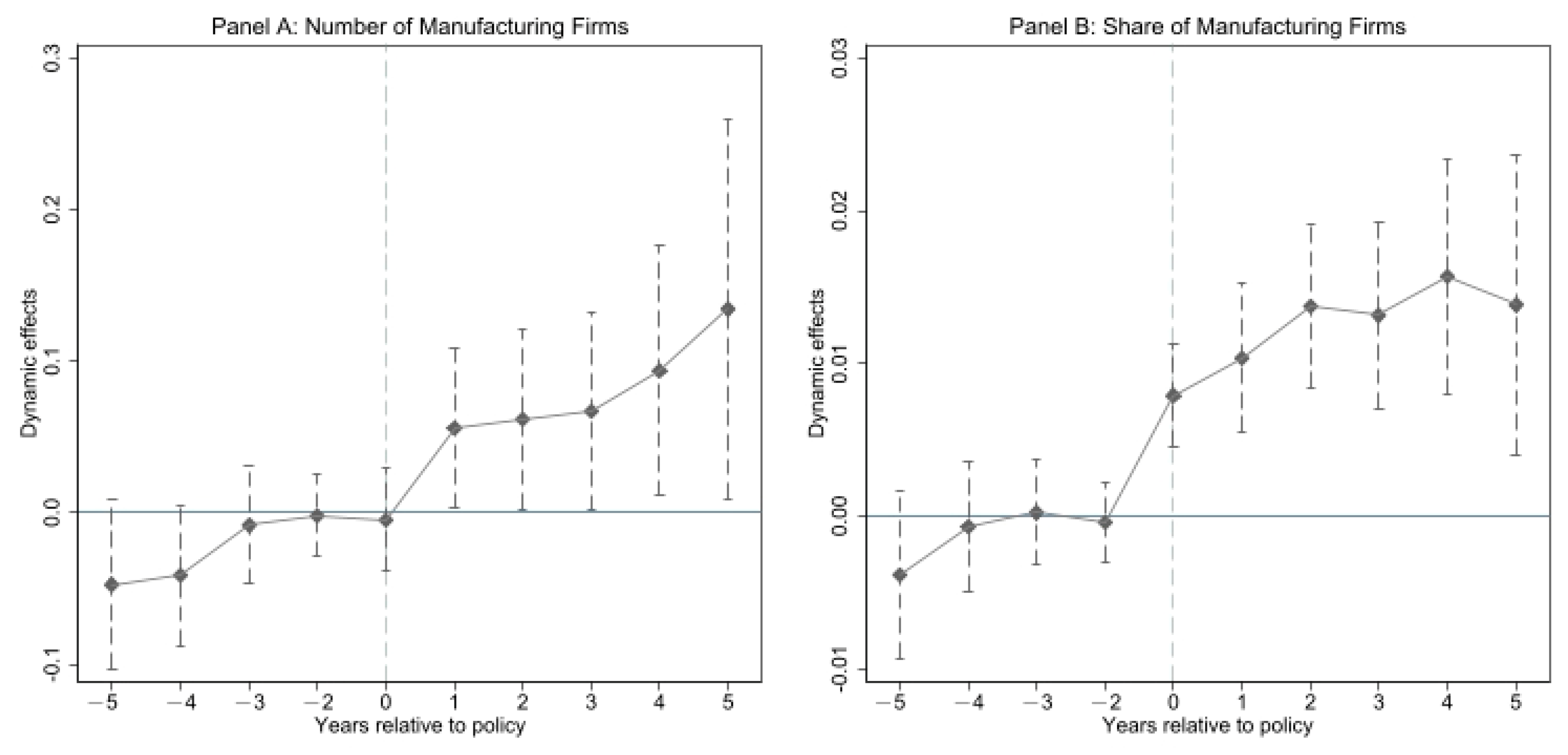
4.2.1. Parallel Trend Test

A key identifying assumption of the difference-in-differences approach is that, in the absence of treatment, the outcome trajectories of the treatment and control groups would have evolved in parallel. To test this assumption, we follow Miller [44] and estimate an event-study specification of the following econometric model:
y i t = β 0 + k 5 + , k 1 5 β k S O M D i t k + X i t θ + γ i + η t + ε i t ,
where k = t y e a r denotes the number of years relative to the year when the service-oriented manufacturing demonstration list was announced for county i . The dummy variable S O M D i t k equals 1 if county i is k periods away from its policy announcement year in period t , and 0 otherwise. For example, S O M D i t 5 = 1 when k = 5 , and S O M D i t 5 = 1 when k = 5 . All other model specifications are consistent with Equation (31). To maintain a balanced time window around the policy event, observations more than five years before the policy are grouped into the k = 5 bin, and the period immediately preceding the policy ( k = 1 ) is used as the baseline.
Figure 1 presents the estimation results from Equation (31). As shown in Figure 1, all pre-treatment coefficients are statistically insignificant, indicating no significant differences between demonstration and non-demonstration counties in either the number of new manufacturing firms or the share of manufacturing entrants prior to policy implementation. This result supports the parallel trend assumption.

4.2.2. Heterogeneous Treatment Effects

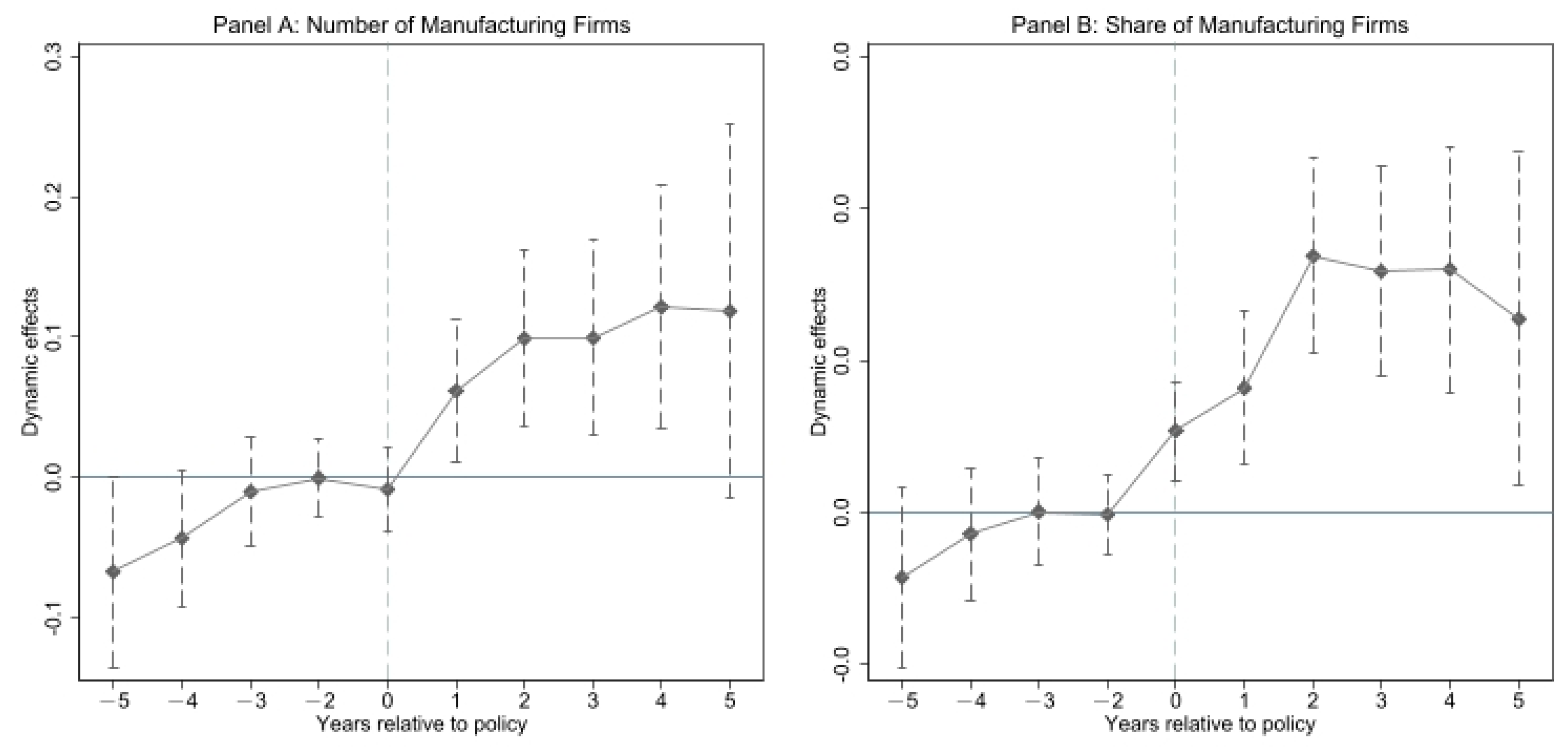
In settings with staggered policy adoption and potentially heterogeneous treatment effects over time, conventional two-way fixed effects (TWFE) estimators can yield biased or misleadingly weighted average treatment effects. To address this concern, we implement the event-study estimator proposed by Sun and Abraham [45], which delivers robust and interpretable estimates of dynamic treatment effects under effect heterogeneity. As shown in Figure 2, the estimated coefficients on pre-treatment periods are statistically indistinguishable from zero, providing support for the parallel trend assumption.
Additionally, this paper employs two recent econometric approaches, those of Callaway and Sant’Anna [46] and Borusyak et al. [47], to reassess the impact of the SOMD policy on regional manufacturing sustainability. The results, reported in Table 4, show that the estimated treatment effects from both methods are positive and statistically significant at the 1% level, with magnitudes closely aligned with the benchmark estimates. These findings indicate that, even in the presence of heterogeneous treatment effects, the SOMD policy continues to significantly increase both the number and the share of new manufacturing firms. Thus, the core conclusions of the benchmark analysis are robust to alternative estimators that allow for heterogeneous treatment effects.

4.2.3. Placebo Test

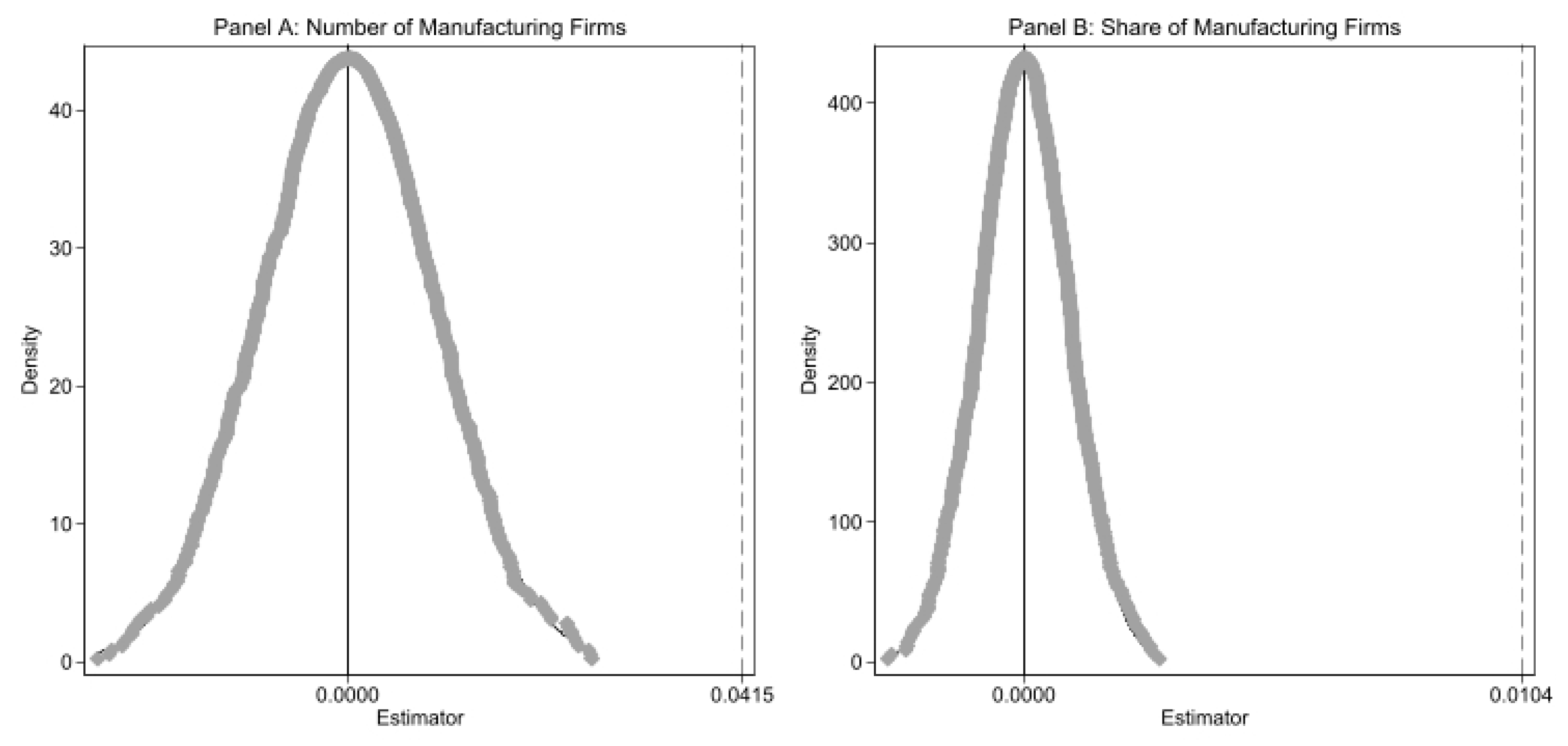
To further rule out confounding influences from concurrent policies or unobserved shocks, we conduct a randomization-based placebo test. Specifically, we randomly reassign treatment timing across counties and re-estimate the policy effect 1000 times under these fictitious assignments. As shown in Figure 3, the resulting placebo estimates are tightly centered around zero, with no apparent bias or skewness. In contrast, the benchmark estimate lies far from zero and falls well outside the 95% quantile range of the placebo distribution. This suggests that our main finding is unlikely to arise from random noise or omitted time-varying confounders.

4.2.4. Pre-Treatment Effects Test

The SOMD policy operates through an application and selection process, which may incentivize certain counties to adjust their industrial strategies in anticipation of designation, even before official implementation. Such anticipatory behavior, potentially driven by applicant firms, platforms, or local governments, could influence the entry decisions of new manufacturing firms and bias baseline estimates. To assess this possibility, we augment the baseline specification with lead indicators for one and two years prior to a county’s official policy adoption. As reported in Table 5, the coefficients on these pre-treatment leads are small in magnitude, statistically indistinguishable from zero, and centered around zero. Meanwhile, the estimated treatment effects remain consistent with the benchmark results in both magnitude and statistical significance. These findings provide no evidence of anticipatory adjustments and further support the robustness of our main conclusions.

4.2.5. Matching-Based DID Estimates (PSM-DID)

To address potential systematic differences between treatment and control groups that could introduce selection bias, this paper further conducts robustness checks using a matching-based difference-in-differences (DID) approach. As reported in Table 6, the estimates from Radius Matching, Kernel Matching, and Nearest Neighbor Matching all yield coefficients on the SOMD policy indicator that are positive, statistically significant, and quantitatively similar to those in the benchmark specification. These results confirm that the main findings are robust.

4.2.6. Alternative Definition of the SOMD Policy Implementation Timing

We redefine the policy implementation year as the year in which the Ministry of Industry and Information Technology officially announced the list of demonstration zones and reconstruct the treatment indicator accordingly. As shown in Table 7, the estimated coefficients remain positive and qualitatively consistent with the baseline results. The effect on the number of manufacturing enterprises remains economically meaningful but becomes marginally significant at the 10% level (previously significant at 5%). This slight attenuation may reflect a lagged response by market participants, who likely require time to incorporate the policy signal into their entry decisions. Overall, the consistency of the sign and magnitude across specifications reinforces the robustness of our main findings.

4.2.7. Using Averaged Pre-Treatment Covariates

In the baseline specification, we include county-level nighttime light intensity and population density from 2014 as time-invariant control variables to account for pre-existing differences in economic activity and population concentration. To reduce sensitivity to temporary fluctuations or measurement noise in any single pre-treatment year, we reconstruct these controls using the average values over the first three years (2012–2014) and the first five years (2010–2014) of the sample period. These multi-year averages better capture underlying pre-policy conditions at the county level. We replace the original 2014-based controls with these averaged measures in otherwise identical regression specifications. As reported in Table 8, the estimated policy effects remain consistent in both magnitude and statistical significance, further supporting the robustness of our main findings.

4.2.8. Controlling for Potential Confounding Policies

To address potential confounding from the concurrent rollout of the Intelligent Manufacturing Pilot Demonstration (IMPD) Policy, we augment the baseline model with a time-varying indicator that equals 1 if a county was designated under this policy in a given year, and 0 otherwise. As reported in Table 9, the estimated effect of the SOMD policy remains positive, with a magnitude and level of statistical significance closely aligned with the baseline results. This suggests that our main findings are unlikely to be driven by spillovers or overlapping effects from the intelligent manufacturing initiative, further supporting the robustness of the estimated SOMD policy impact.

4.2.9. Further Robustness Checks

We conduct two further robustness checks. First, we exclude the centrally administered municipalities, as their unique institutional and economic characteristics may disproportionately affect the estimates. Second, we winsorize the outcome variables at the 1st and 99th percentiles to mitigate the influence of extreme outliers. Table 10 reports the results of these exercises. The estimates obtained after excluding centrally administered municipalities remain consistent with the baseline findings in both sign and magnitude. Similarly, the results based on winsorized outcomes show little change in either coefficient size or statistical significance. Together, these tests reinforce the robustness of our main conclusions.

5. Mechanisms

This section tests Research Hypothesis 2, which states that the SOMD policy reduces both fixed entry costs and variable production costs for manufacturing firms by fostering diversified agglomeration of producer services, thereby generating positive agglomeration externalities. However, this effect is hypothesized to diminish as the local level of service agglomeration increases.
To examine this mechanism, we first assess the policy’s impact on the agglomeration of producer service industries. Using diversification-based agglomeration indices for both manufacturing and services, we investigate whether the SOMD policy enhances manufacturing firm entry by fostering a more diversified local service ecosystem. Next, leveraging financial data from listed private manufacturing firms, we evaluate the policy’s effect on variable production costs. While enterprise-level data constraints limit our ability to directly estimate changes in fixed entry costs, the observed patterns in service agglomeration and cost reduction offer plausible support for the full theoretical channel.

5.1. Producer Service Agglomeration Mechanism

To align with the substantive interpretation of producer service agglomeration in the theoretical model, specifically the diversification of producer services, this paper adopts a diversification index of producer service industries as the core measure of their agglomeration level. To examine the impact of the SOMD policy on the producer service agglomeration, we construct a sectoral diversification index for both manufacturing and producer service industries based on one minus the Herfindahl-Hirschman Index. Specifically, for county j in a given year, the diversity index is defined as:
D i v e r s i t y j = 1 i ( E i j E j ) 2 ,
where E i j denotes the number of newly established firms in two-digit industry i within county j , and E j is the total number of new firms across all two-digit industries in the same county. A higher value of D i v e r s i t y j indicates a more diversified industrial composition in the manufacturing or producer service sector of county j . We compute this index separately for the manufacturing sector and the producer service sector to assess whether the SOMD policy promotes diversification within each domain.
Table 11 reports regression results using four distinct measures of producer service development. The first measure is the industrial diversification index, computed using Equation (32), which captures the variety of producer service industries in a county. The remaining three measures reflect different aspects of spatial scale. Specifically, they are: the logarithm of new entrants in producer services; the logarithm of new entrants per 100 residents; and the logarithm of new entrants per square kilometer. While the diversification index reflects the breadth of the local producer service ecosystem, the other three indicators capture the intensity of producer service activity across counties.
Table 11 shows that the implementation of the SOMD policy significantly increased the industrial diversification of producer services in treated counties relative to untreated ones. In contrast, the policy had no statistically significant effect on the total number of producer service firms, the number of such firms per 100 residents, or their geographic density. These results suggest that the SOMD policy primarily fostered sectoral variety in local producer service ecosystems, rather than expanding their scale or promoting spatial concentration. The findings provide empirical support for Research Hypothesis 2, which posits that the policy encourages diversified development in producer services, a pattern consistent with Jacobs-type externalities.
Table 12 reports regression results for three dependent variables: diversified agglomeration in manufacturing, computed using Equation (32); the number of manufacturing firms per 100 residents, defined as the log of new entrants divided by county population; and the spatial density of manufacturing firms, measured as the log of new entrants divided by county area. These indicators reflect the variety of manufacturing industries and the intensity of manufacturing activity across counties, respectively.
Table 12 presents a contrasting pattern to that observed for producer services. The SOMD policy significantly increased both the number of manufacturing firms per 100 residents and the spatial density of manufacturing firms in treated counties, but it had no statistically significant effect on diversified agglomeration in manufacturing. This suggests that, whereas the policy enhances the variety of local producer services, it primarily drives an expansion in the scale of manufacturing activity rather than an increase in its industrial diversity.
Combined with the results from Table 11, these findings imply that the policy may foster path-dependent development [48]. New manufacturing entrants likely align with incumbent industrial specializations to better access the tailored services offered by locally agglomerated producer service firms. As a result, while manufacturing growth is stimulated, it does not broaden sectoral variety; instead, it may reinforce specialized agglomeration within demonstration areas.

5.2. Production Cost Reduction Mechanism

To examine the impact of the SOMD policy on manufacturing firms’ operating costs, we employ a panel dataset of private-sector listed manufacturing firms in China and estimates the following econometric model:
y j t = α 0 + α 1 S O M D j i t + X j t θ + X i t δ + γ i n d + η t + ε j t ,
where j indexes individual private-sector listed manufacturing firms and t denotes the year. The dependent variable y j t captures firm-level operating cost measures, including total operating costs, cost of operations, and period expenses. Total operating costs are measured as the natural logarithm of a firm’s total operating expenditures. Cost of operations is the natural logarithm of production-related operating costs excluding period expenses. Period expenses are constructed as the natural logarithm of the sum of selling expenses, general expenses, and financial expenses. The treatment indicator S O M D j i t equals 1 if, in year t , the county i where firm j is headquartered has been designated under the SOMD program through the inclusion of a local firm, a project, a platform, or the entire city, and it remains 1 for all subsequent years. Otherwise, it is 0. The vector X j t includes firm-level controls such as firm size, firm age, return on equity, return on assets, cash liquidity, Tobin’s Q, board size, ownership concentration, and board independence. The vector X i t comprises county-level covariates identical to those used in Equation (30). We also include two-digit industry fixed effects ( γ i n d ) and year fixed effects ( η t ). Standard errors are clustered at the county level to account for within-county correlation over time.
Building on the theoretical and empirical framework outlined earlier, the SOMD policy is expected to reduce manufacturing firms’ operating costs by fostering industrial diversification in producer services. To test this mechanism, we estimate the following econometric model:
y j t = α 0 + α 1 S O M D j i t × D I V j i t + α 2 S O M D j i t + α 3 D I V j i t + X j t θ + X i t δ + γ i n d + η t + ε j t ,
where D I V j i t measures the industrial diversification of producer service industries in the county where listed company j is headquartered in year t . All other model specifications are identical to those in Model (33).
An important sample restriction applies to both Model (33) and Model (34). We exclude private manufacturing firms that were designated as service-oriented manufacturing demonstration entities. This ensures that the estimated coefficients reflect only the indirect policy effect transmitted through the diversified agglomeration of producer service industries, consistent with the mechanism proposed in our theoretical framework. Our analysis focuses exclusively on privately listed firms for two main reasons. First, unlike state-owned enterprises, private firms typically have limited access to policy information prior to its official announcement, which better satisfies the unpredictability assumption required by the difference-in-differences design. Second, private firms generally exhibit greater managerial flexibility, enabling them to respond more swiftly to policy-induced changes in market conditions.
Furthermore, the use of financial data from listed firms to test the production cost reduction mechanism is primarily motivated by the general lack of publicly available, continuous financial records for newly registered enterprises. This data constraint precludes direct testing of the mechanism at the full-sample level. Although the listed-firm sample offers high-quality, audited financial indicators that enable a credible identification of the theoretical channel, these firms differ systematically from typical new entrants in terms of scale, ownership structure, and developmental stage. Consequently, the external validity of the findings based on this subsample is necessarily limited.
Table 13 presents the estimation results of Equations (33) and (34). Columns (1) and (2) report findings for total operating costs, Columns (3) and (4) for operating costs, and Columns (5) and (6) for period expenses. Columns (1), (3), and (5) show that the SOMD policy significantly reduces total operating costs and operating costs among private listed manufacturing firms, but has no statistically significant effect on period expenses. This indicates that the policy primarily lowers costs in production-related activities, rather than in selling, administrative, or financial overheads, providing initial support for the hypothesis that the policy reduces manufacturing production costs. Columns (2), (4), and (6) further reveal that the cost-reducing effect of the policy becomes smaller in magnitude as the level of industrial diversification in producer services increases within a firm’s host county. This suggests diminishing marginal returns to producer service agglomeration in lowering operating costs.
Taken together, the results from Table 11 and Table 13 support Research Hypothesis 2. The SOMD policy reduces variable production costs by fostering diversified agglomeration in producer services and generating positive externalities. However, this cost-reducing effect weakens as the degree of diversification intensifies. Table 11 confirms that the policy promotes such agglomeration, while Table 13 demonstrates that the associated cost savings exhibit diminishing returns at higher levels of agglomeration.

6. Further Analysis

6.1. Regional Heterogeneity

Given significant disparities in industrial foundations, service sector development, and resource endowments across China’s eastern, central, and western regions, the effects of the SOMD policy may vary spatially. To examine this potential heterogeneity, we partition the sample into eastern, central, and western subsamples and re-estimate the benchmark model (Equation 30) separately for each. The results are reported in Table 14.
Columns (1) and (3) in Table 14 present estimates with the number of manufacturing firms as the dependent variable. The coefficient on the SOMD policy is largest in the western region, followed by the eastern region. In contrast, the estimate for the central region is statistically insignificant. This pattern suggests that the SOMD policy most strongly stimulates manufacturing entry in the west, exerts a modest effect in the east, and has no detectable impact on firm entry in the central region. Columns (4) and (6) report results using the share of manufacturing firms among new entrants as the outcome. Here, the SOMD policy exhibits a significantly positive coefficient across all three regions, indicating that it consistently raises the manufacturing share of new market entrants, irrespective of geographic location.
These findings underscore that the effectiveness of the SOMD policy is closely tied to regional industrial development stages and factor endowments. In the western region, where the industrial base is relatively underdeveloped, the policy’s selection, certification, and demonstration mechanisms effectively catalyze manufacturing entry, yielding pronounced marginal effects. In the more mature eastern region, the policy continues to support manufacturing development, albeit with a smaller marginal impact. The central region, despite its role as a recipient of industrial transfers from the east, may lack a sufficiently advanced local producer service ecosystem to fully harness the policy’s demonstration effect, explaining the null finding on firm counts. Nevertheless, even in this region, the SOMD policy appears to steer new entrants toward manufacturing, thereby contributing to the sustainable development of the local manufacturing sector.

6.2. Service Sector Structure Effect

This section tests Research Hypothesis 3, which states that the impact of the policy on the manufacturing share in a regional economy depends jointly on the strength of agglomeration externalities and the composition of the service sector. To examine how service industry composition conditions this policy effect, we analyze two key structural indicators: the share of newly established producer service firms relative to all new service firms, and the analogous share for consumer service firms. We denote these ratios as the producer services share and the consumer services share, respectively, and use them as dependent variables in regressions that follow the specification of Equation (30). We then introduce the producer services share as a moderating variable to assess how shifts in service sector composition influence the policy’s effectiveness. Specifically, we estimate the following econometric model:
y i t = λ 0 + λ 1 S O M D i t × C S I i t + λ 2 S O M D i t + λ 3 C S I i t + X i t θ + γ i + η t + ε i t ,
where C S I i t measures the share of producer services in the county i in year t . All other model specifications are identical to those in Model (30).
Table 15 presents the estimation results for the service industry structure and its moderating role. The first two columns show that the SOMD policy significantly increases the share of newly established producer service firms among all new service firms, while reducing the share of consumer service firms. Columns (3) and (4) examine how this structural shift conditions the policy’s impact on manufacturing activity. The dependent variable in column (3) is the natural logarithm of the number of manufacturing firms, whereas column (4) uses the share of manufacturing firms in the local economy.
In column (3), the policy has a negative effect on manufacturing firm numbers in areas with no producer service activity, but this effect becomes positive as the local producer services share rises. Specifically, the policy begins to stimulate manufacturing entry when the producer services share exceeds approximately 60.3%, a threshold given by the ratio of the policy’s main effect to its interaction coefficient ( 0.5539 ÷ 0.9185 0.6030 ). In column (4), the policy raises the manufacturing firm share in regions where producer services are absent, but this benefit gradually weakens as the producer services share increases. The positive effect disappears entirely when the share reaches about 98% ( 0.0355 ÷ 0.0362 0.9807 ).
These results indicate that the policy’s impact on manufacturing depends critically on the local service sector composition. In regions with underdeveloped producer services, the policy suppresses manufacturing firm entry but still increases its relative share. This pattern likely arises because the policy curbs consumer service entry even more strongly, as shown in the second column. In contrast, in regions where the producer services share exceeds 60%, the policy fosters net growth in manufacturing firm numbers. However, because producer services expand rapidly in these areas, the relative share of manufacturing may eventually decline once the producer services share approaches very high levels such as above 98%. Together, these findings support Research Hypothesis 3: the effect of the SOMD policy on regional manufacturing outcomes is jointly shaped by agglomeration externalities and the internal structure of the service sector.
The empirical results in Table 15 indicate that when the share of producer services is too low, their diversified agglomeration cannot adequately support the operational and transformation needs of manufacturing firms. Conversely, when this share is excessively high, such agglomeration tends to crowd out manufacturing entry. The SOMD policy therefore promotes sustainable regional manufacturing development by enhancing both the number and structural composition of manufacturing firms, but only when the producer service share lies within a moderate range. Based on the estimates in Table 15, we identify a lower threshold of approximately 60%. Below this level, the effect of the SOMD policy on the number of manufacturing firms shifts from negative to positive. We also identify an upper threshold of approximately 98%. Beyond this level, the policy’s effect on the manufacturing firm share turns from positive to negative. Within the interval between 60% and 98%, the SOMD policy fosters concurrent growth in both the quantity and structural quality of regional manufacturing.

6.3. Long-Term Economic Effect

This study further examines how an increase in the share of manufacturing firms affects local economic growth and new firm entry. We consider several outcome variables that capture distinct dimensions of economic performance: county-level economic development (measured by nighttime light intensity), the total number of newly established firms, and the number of new entrants in manufacturing, services, producer services, and consumer services. To assess the broader economic consequences of the SOMD policy, we introduce the manufacturing firm share as a moderating variable and estimate the following econometric model:
y i t = λ 0 + λ 1 S O M D i t × M A I i t + λ 2 S O M D i t + λ 3 M A I i t + X i t θ + γ i + η t + ε i t ,
where M A I i t measures the share of manufacturing firms in the county i in year t . All other model specifications are identical to those in Model (30).
As reported in Table 16, the SOMD policy enhances regional economic growth through its positive effect on the manufacturing share. However, this growth comes at the expense of service sector dynamism. Specifically, a higher manufacturing share significantly reduces new firm entry in consumer services, resulting in a net decline in the total number of new firms. These findings suggest that while the policy successfully strengthens the manufacturing base and improves aggregate economic activity as reflected in nighttime lights, it may simultaneously crowd out entrepreneurial activity in the service sector, particularly in consumer services.
Table 17 presents the estimated impact of the SOMD policy on firm entry in the overall economy and the service sector, based on the benchmark regression model specified in Equation (30). The dependent variables in columns (1) through (6) correspond sequentially to the number of firms in all industries, the number of service firms, the number of producer service firms, the share of producer service firms, the number of consumer service firms, and the share of consumer service firms.
The results indicate that after the implementation of the SOMD policy, demonstration counties and districts experienced a significant decline in new firm entry across the overall economy, the total service sector, and the consumer service sector. In contrast, the policy had no statistically significant effect on the entry of new producer service firms. More importantly, a clear seesaw effect emerged within the service sector: the share of producer services rose significantly, while the share of consumer services fell significantly.
This pattern suggests that the SOMD policy driven increase in both the number and share of new manufacturing firms does not stem from a simple reallocation away from service sector entry. Rather, it arises from an internal restructuring of the service sector amid an overall reduction in total firm formation. The net crowding-out effect of the policy is primarily concentrated in the consumer service industry. These findings underscore that the SOMD policy effectively fosters deep integration between manufacturing and producer services. The strong spatial and functional complementarities between these two segments help alleviate competitive pressures for key production factors, enabling producer services to avoid displacement. In contrast, consumer service industries, which exhibit weaker linkages to manufacturing, face greater competition for resources such as land and labor, rendering them more vulnerable to crowding out under the policy.

7. Conclusions and Discussion

7.1. Conclusions

Utilizing business registration data from 1341 districts and counties between 2015 and 2023, this study treats the Service-Oriented Manufacturing Demonstration (SOMD) policy as a quasi-natural experiment to systematically examine its impact on the sustainable development of regional manufacturing. The results show that the SOMD policy significantly increases both the number and the share of new manufacturing firms in demonstration areas. This indicates that the policy not only strengthens the foundational growth capacity of regional manufacturing but also lays the groundwork for optimizing industrial structure and fostering long-term resilient development. A key contribution of this paper is the identification of a “signaling-agglomeration” mechanism. By issuing credible policy signals, the SOMD initiative continuously attracts new market entrants and guides the diversified agglomeration of producer services. This, in turn, reduces operational costs for manufacturing firms and fosters a virtuous cycle of cross-industry coordination. Unlike existing explanations that emphasize within-industry imitation or technology spillovers [7], this mechanism shifts the analytical focus from micro-level firm behavior to the broader dynamics of regional industrial evolution.
Further analysis reveals that the effectiveness of the SOMD policy is highly contingent on the local development level of producer services. When new producer service firms account for between 60 percent and 98 percent of all new service entrants, the policy simultaneously enhances both the quantity and structural upgrading of manufacturing firms. This finding resonates with Kohtamaki et al. [13] and Feng et al. [16], who argue that successful service-oriented transformation hinges on robust support from specialized producer services.
Importantly, the study also uncovers a sustainability trade-off. While the SOMD policy stimulates manufacturing entry and boosts regional economic activity, it may suppress overall firm formation and selectively crowd out consumer service industries. This implies that an exclusive focus on manufacturing expansion could compromise regional economic diversity and inclusiveness [10,20], potentially undermining long-term resilience.
Situating this trade-off within a comprehensive sustainability framework yields multidimensional insights. From a social perspective, constraints on firm entry, particularly in consumer services, may limit employment opportunities and reduce quality of life, thereby impeding balanced regional development. From an environmental standpoint, manufacturing expansion that lacks integration with intelligent and green professional services may erode gains in resource efficiency and exacerbate local environmental pressures. Therefore, the SOMD policy should be understood not as a short-term incentive but as an institutional arrangement designed to advance sustainable manufacturing development. In practice, policymakers should move beyond narrow, single-sector growth targets. By refining policy design and reinforcing positive inter-industry linkages, the SOMD initiative can better contribute to a sustainable development system that integrates economic vitality, social equity, and ecological security.

7.2. Theoretical Contributions

This study makes two main contributions. First, in terms of analytical perspective, it broadens the conceptual boundaries of “sustainable manufacturing” by shifting the focus from the micro level of individual firms to the regional level of industrial evolution. In contrast to most existing studies, which concentrate on environmental aspects such as green production, energy conservation, emission reduction, or resource efficiency [1,2], this paper examines sustainable manufacturing within a regional industrial coevolutionary framework. It emphasizes foundational growth capacity, cross industry synergy, and long-term resilience. Our findings suggest that the sustainable development of regional manufacturing depends not only on the operational performance of individual firms but also on their ability to deeply integrate with producer services. This insight echoes and extends the socio technical systems perspective on sustainable manufacturing advanced by Scharmer et al. [31], indicating that sustainable manufacturing is not merely a firm level activity but rather an outcome of the coevolution of regional economic, social, and environmental systems.
Second, regarding theoretical mechanisms, this study proposes and empirically validates a “signaling-agglomeration” mechanism. While much of the literature examines how industrial policies influence firms through fiscal subsidies or technology diffusion [7], we develop a unified theoretical and mathematical framework to demonstrate that the core mechanism of the SOMD policy operates through credible policy signals sent via selection, certification, and demonstration. These signals guide the diversified agglomeration of producer services, thereby reducing both fixed entry costs and variable operating costs for manufacturing firms. The “signaling-agglomeration” mechanism not only provides a micro foundation for the effectiveness of the SOMD policy but also extends agglomeration externality theory to policy driven contexts, moving beyond explanations centered on within industry imitation or technology spillovers.

7.3. Policy Implications

This study offers important policy insights for optimizing industrial policy design and promoting sustainable development in regional manufacturing.
First, policymakers should reinforce the long-term nurturing role of the SOMD policy. In selecting demonstration sites, greater weight should be given to regional industrial synergies. Robust evaluation and monitoring mechanisms must be leveraged to provide continuous guidance to designated entities, shifting focus away from short-term expansion toward fostering genuine transformational leadership.
Second, an industrial ecosystem and policy environment that enables deep integration between modern services and advanced manufacturing should be cultivated. Policy design must strike a balance in the production-service mix while removing institutional barriers to integration. Support in land allocation, financing, and talent development should be strengthened to nurture a collaborative regional industrial ecology.
Third, a careful balance must be struck between targeted policy support and market fairness. While promoting demonstration enterprises, projects, and platforms, policymakers should guard against potential distortions in market access caused by selective industrial policies. Complementary measures, such as lowering entry barriers, improving access to finance, and expanding public service platforms, should accompany targeted interventions to level the playing field. Such an approach can foster the growth of diverse market participants and generate virtuous synergy between policy guidance and market-driven dynamism.

7.4. Limitations and Future Research Directions

This study has several limitations, suggesting opportunities for future research. First, the theoretical model is based on the standard Dixit Stiglitz monopolistic competition framework and relies on simplifying assumptions such as single factor labor input and symmetric firms to formalize the “signaling-agglomeration” mechanism. While this streamlined approach helps clarify the core transmission channel, it inevitably omits real world complexities including capital accumulation, firm productivity heterogeneity, and virtual network agglomeration. Future work could extend the model by incorporating multi factor inputs, heterogeneous firm settings, and diverse forms of agglomeration, including geographical clustering and virtual networks, to more comprehensively and realistically capture the differential impacts of SOMD policies across firm types and the complex industrial synergies they generate.
Second, due to data availability, this study faces constraints in fully identifying heterogeneity in policy intensity and in assessing the external validity of the SOMD policy mechanism. On the one hand, existing data do not allow clear differentiation across SOMD policy types in terms of implementation intensity, resource commitment, or local influence. On the other hand, the general lack of publicly available financial records for newly registered firms limits our ability to test the production cost reduction mechanism across the full population of entrants, necessitating reliance on data from listed companies. This constraint somewhat weakens the external validity of the findings. Future research could leverage more detailed longitudinal firm level datasets, precisely matched with information on demonstration entities, to better identify variations in policy intensity and provide stronger empirical evidence on how the “signaling-agglomeration” mechanism operates across different contexts and agglomeration forms.

Author Contributions

C.L.: Conceptualization, Writing—original draft preparation, Methodology, Software, Visualization. J.Z.: Funding acquisition, Methodology, Resources, Validation, Writing—review and editing. All authors have read and agreed to the published version of the manuscript.

Funding

This research received no external funding.

Institutional Review Board Statement

Not applicable.

Informed Consent Statement

Not applicable.

Data Availability Statement

The datasets generated and/or analyzed during this study are available from the corresponding author upon reasonable request.

Conflicts of Interest

The authors have no competing interests to declare that are relevant to the content of this article.

Abbreviations

The following abbreviations are used in this manuscript:
SOMDService-Oriented Manufacturing Demonstration
MIITMinistry of Industry and Information Technology
IMPDIntelligent Manufacturing Pilot Demonstration

Appendix A

To support China’s transition from a manufacturing powerhouse to a globally competitive manufacturing innovator, the Ministry of Industry and Information Technology (MIIT), together with the National Development and Reform Commission and the Chinese Academy of Engineering, issued the Special Action Guide for Devel-oping Service-Oriented Manufacturing in 2016. This document marked the beginning of a systematic effort to build a policy framework aimed at deepening integration between the manufacturing and service sectors. According to the Guide, the program aimed to cultivate 50 demonstration enterprises, 100 demonstration projects, 50 demonstration platforms, and 5 demonstration cities by 2018. Under this framework, the MIIT launched the first round of selections for service-oriented manufacturing demonstration entities in December 2016. The first list, published in 2017, included 30 demonstration enterprises, 60 demonstration projects, and 30 demonstration platforms. By 2018, the program had cumulatively recognized 63 demonstration enterprises, 110 demonstration projects, and 61 demonstration platforms.
In 2020, the MIIT, together with 14 other government agencies, jointly issued the Guiding Opinions on Further Promoting the Development of Service-Oriented Manufacturing. This policy set a target to select and cultivate 200 demonstration enterprises, 100 demonstration platforms, 100 demonstration projects, and 20 demonstration cities by 2022. It also articulated a longer-term vision for the continuous identification and nurturing of service-oriented manufacturing demonstration entities, including enterprises, platforms, projects, and cities, through 2025. As of October 2025, the program’s two implementation phases had collectively designated 372 demonstration enterprises, 157 demonstration projects, 225 demonstration platforms, and 33 demonstration cities in Table 1. Building on this foundation, in September 2025, MIIT and seven other departments released the Implementation Plan for Further Promoting the Innovation and Development of Service-Oriented Manufacturing (2025–2028), which outlines a series of strategic objectives to be achieved by 2028. These include formulating 20 industry-specific standards, cultivating 50 leading brands, establishing 100 innovation and development hubs, and widely disseminating representative models of ser-vice-oriented manufacturing.

References

  1. Domfeh, S.A.; Govindan, K.; Xu, S. Drivers and Outcomes of Sustainable Manufacturing Practices: A Technological, Organisational, and Environmental–Natural Resource-Based View Perspective. Supply Chain Manag. Int. J. 2025, 30, 818–835. [Google Scholar] [CrossRef]
  2. Kumar, P.; Sharma, M.K. Sustainable Manufacturing Practices in Global Context. Circ. Econ. Sustain. 2025, 5, 5903–5933. [Google Scholar] [CrossRef]
  3. Liu, J.; Yang, Y.; Cao, Y.; Forrest, J.Y.-L. Stimulating Effects of Intelligent Policy on the Performance of Listed Manufacturing Companies in China. J. Policy Model. 2021, 43, 558–573. [Google Scholar] [CrossRef]
  4. Wei, X.; Jiang, F.; Chen, Y.; Hua, W. Towards Green Development: The Role of Intelligent Manufacturing in Promoting Corporate Environmental Performance. Energy Econ. 2024, 131, 107375. [Google Scholar] [CrossRef]
  5. Zhu, M.; Liang, C.; Yeung, A.C.L.; Zhou, H. The Impact of Intelligent Manufacturing on Labor Productivity: An Empirical Analysis of Chinese Listed Manufacturing Companies. Int. J. Prod. Econ. 2024, 267, 109070. [Google Scholar] [CrossRef]
  6. Jin, M.; Chen, Y. Has Green Innovation Been Improved by Intelligent Manufacturing?—Evidence from Listed Chinese Manufacturing Enterprises. Technol. Forecast. Soc. Chang. 2024, 205, 123487. [Google Scholar] [CrossRef]
  7. Liu, Y.; Chao, W.; Mbanyele, W.; Zhu, B.; Huang, H. From Pilot to Peers: How Intelligent Manufacturing Policy Drives Corporate Intelligent Transformation through Demonstration Effects. Econ. Model. 2025, 152, 107292. [Google Scholar] [CrossRef]
  8. Liu, Y.; Zuo, Y. Implementing Intelligent Manufacturing Policies to Increase the Total Factor Productivity in Manufacturing: Transmission Mechanisms through Construction of Industrial Chains. Int. J. Prod. Econ. 2025, 279, 109468. [Google Scholar] [CrossRef]
  9. Li, X.; Zhu, J.; Zhao, Q.; Zhang, G.; Gao, Y. Government-Guided Voluntary Environmental Regulations and the Entry of Green Investors: Evidence from the Chinese Green Factory Program. Resour. Energy Econ. 2025, 84, 101530. [Google Scholar] [CrossRef]
  10. Yu, L.; Sha, H.; Ji, P. Government-Led Voluntary Environmental Regulation and Corporate Investment Efficiency: Evidence from the Green Factory Certification in China. Energy Econ. 2025, 152, 109004. [Google Scholar] [CrossRef]
  11. Vandermerwe, S.; Rada, J. Servitization of Business: Adding Value by Adding Services. Eur. Manag. J. 1988, 6, 314–324. [Google Scholar] [CrossRef]
  12. Chen, Y.; Visnjic, I.; Parida, V.; Zhang, Z. On the Road to Digital Servitization—The (Dis)Continuous Interplay between Business Model and Digital Technology. Int. J. Oper. Prod. Manag. 2021, 41, 694–722. [Google Scholar] [CrossRef]
  13. Kohtamäki, M.; Parida, V.; Patel, P.C.; Gebauer, H. The Relationship between Digitalization and Servitization: The Role of Servitization in Capturing the Financial Potential of Digitalization. Technol. Forecast. Soc. Chang. 2020, 151, 119804. [Google Scholar] [CrossRef]
  14. Vargo, S.L.; Lusch, R.F. Evolving to a New Dominant Logic for Marketing. In The Service-Dominant Logic of Marketing; Routledge: New York, NY, USA, 2006. [Google Scholar]
  15. Hartwig, K.; von Saldern, L.; Jacob, F. The Journey from Goods-Dominant Logic to Service-Dominant Logic: A Case Study with a Global Technology Manufacturer. Ind. Mark. Manag. 2021, 95, 85–98. [Google Scholar] [CrossRef]
  16. Feng, C.; Jiang, L.; Ma, R.; Bai, C. Servitization Strategy, Manufacturing Organizations and Firm Performance: A Theoretical Framework. J. Bus. Ind. Mark. 2021, 36, 1909–1928. [Google Scholar] [CrossRef]
  17. Oliva, R.; Kallenberg, R. Managing the Transition from Products to Services. Int. J. Serv. Ind. Manag. 2003, 14, 160–172. [Google Scholar] [CrossRef]
  18. Eggert, A.; Hogreve, J.; Ulaga, W.; Muenkhoff, E. Industrial Services, Product Innovations, and Firm Profitability: A Multiple-Group Latent Growth Curve Analysis. Ind. Mark. Manag. 2011, 40, 661–670. [Google Scholar] [CrossRef]
  19. Zhou, D.; Yan, T.; Zhao, L.; Guo, J. Performance Implications of Servitization: Does a Manufacturer’s Service Supply Network Matter? Int. J. Prod. Econ. 2020, 219, 31–42. [Google Scholar] [CrossRef]
  20. Shah, S.A.A.; Jajja, M.S.S.; Chatha, K.A.; Farooq, S. Servitization and Supply Chain Integration: An Empirical Analysis. Int. J. Prod. Econ. 2020, 229, 107765. [Google Scholar] [CrossRef]
  21. Kowalkowski, C.; Kindström, D.; Gebauer, H. ICT as a Catalyst for Service Business Orientation. J. Bus. Ind. Mark. 2013, 28, 506–513. [Google Scholar] [CrossRef]
  22. Sousa, R.; da Silveira, G.J.C. Capability Antecedents and Performance Outcomes of Servitization: Differences between Basic and Advanced Services. Int. J. Oper. Prod. Manag. 2017, 37, 444–467. [Google Scholar] [CrossRef]
  23. George, G. Slack Resources and the Performance of Privately Held Firms. Acad. Manag. J. 2005, 48, 661–676. [Google Scholar] [CrossRef]
  24. Kroh, J.; Luetjen, H.; Globocnik, D.; Schultz, C. Use and Efficacy of Information Technology in Innovation Processes: The Specific Role of Servitization. J. Prod. Innov. Manag. 2018, 35, 720–741. [Google Scholar] [CrossRef]
  25. Kindström, D.; Kowalkowski, C. Service Innovation in Product-Centric Firms: A Multidimensional Business Model Perspective. J. Bus. Ind. Mark. 2014, 29, 96–111. [Google Scholar] [CrossRef]
  26. Saccani, N.; Visintin, F.; Rapaccini, M. Investigating the Linkages between Service Types and Supplier Relationships in Servitized Environments. Int. J. Prod. Econ. 2014, 149, 226–238. [Google Scholar] [CrossRef]
  27. Fang, E.; Palmatier, R.W.; Steenkamp, J.-B.E.M. Effect of Service Transition Strategies on Firm Value. J. Mark. 2008, 72, 1–14. [Google Scholar] [CrossRef]
  28. Favoretto, C.; Mendes, G.H.S.; Oliveira, M.G.; Cauchick-Miguel, P.A.; Coreynen, W. From Servitization to Digital Servitization: How Digitalization Transforms Companies’ Transition towards Services. Ind. Mark. Manag. 2022, 102, 104–121. [Google Scholar] [CrossRef]
  29. Wang, Y.; Gao, J.; Wei, Z. The Double-Edged Sword of Servitization in Radical Product Innovation: The Role of Latent Needs Identification. Technovation 2022, 118, 102284. [Google Scholar] [CrossRef]
  30. Wei, Z.; Huang, W.; Wang, Y.; Sun, L. When Does Servitization Promote Product Innovation? The Moderating Roles of Product Modularization and Organization Formalization. Technovation 2022, 117, 102594. [Google Scholar] [CrossRef]
  31. Scharmer, V.M.; Vernim, S.; Horsthofer-Rauch, J.; Jordan, P.; Maier, M.; Paul, M.; Schneider, D.; Woerle, M.; Schulz, J.; Zaeh, M.F.; et al. Sustainable Manufacturing: A Review and Framework Derivation. Sustainability 2023, 16, 119. [Google Scholar] [CrossRef]
  32. Chen, T.-J. The Development of China’s Solar Photovoltaic Industry: Why Industrial Policy Failed. Camb. J. Econ. 2016, 40, 755–774. [Google Scholar] [CrossRef]
  33. Liu, E. Industrial Policies in Production Networks. Q. J. Econ. 2019, 134, 1883–1948. [Google Scholar] [CrossRef]
  34. Rotemberg, M. Equilibrium Effects of Firm Subsidies. Am. Econ. Rev. 2019, 109, 3475–3513. [Google Scholar] [CrossRef]
  35. Spence, M. Job Market Signaling. Q. J. Econ. 1973, 87, 355. [Google Scholar] [CrossRef]
  36. Glaeser, E.L.; Kallal, H.D.; Scheinkman, J.A.; Shleifer, A. Growth in Cities. J. Political Econ. 1992, 100, 1126–1152. [Google Scholar] [CrossRef]
  37. Eswaran, M.; Kotwal, A. The Role of the Service Sector in the Process of Industrialization. J. Dev. Econ. 2002, 68, 401–420. [Google Scholar] [CrossRef]
  38. Marshall, A. Principles of Economics; Palgrave Classics in Economics; Macmillan & Co.: London, UK, 1890; ISBN 978-0-230-24929-5. [Google Scholar]
  39. Moretti, E. Local Multipliers. Am. Econ. Rev. 2010, 100, 373–377. [Google Scholar] [CrossRef]
  40. Dixit, A.K.; Stiglitz, J.E. Monopolistic Competition and Optimum Product Diversity. Am. Econ. Rev. 1977, 67, 297–308. [Google Scholar]
  41. Moretti, E. Workers’ Education, Spillovers, and Productivity: Evidence from Plant-Level Production Functions. Am. Econ. Rev. 2004, 94, 656–690. [Google Scholar] [CrossRef]
  42. Chen, X.; Pei, G.; Song, Z.; Zilibotti, F. Tertiarization Like China. Annu. Rev. Econ. 2023, 15, 485–512. [Google Scholar] [CrossRef]
  43. Li, P.; Lu, Y.; Wang, J. Does Flattening Government Improve Economic Performance? Evidence from China. J. Dev. Econ. 2016, 123, 18–37. [Google Scholar] [CrossRef]
  44. Miller, D.L. An Introductory Guide to Event Study Models. J. Econ. Perspect. 2023, 37, 203–230. [Google Scholar] [CrossRef]
  45. Sun, L.; Abraham, S. Estimating Dynamic Treatment Effects in Event Studies with Heterogeneous Treatment Effects. J. Econom. 2021, 225, 175–199. [Google Scholar] [CrossRef]
  46. Callaway, B.; Sant’Anna, P.H.C. Difference-in-Differences with Multiple Time Periods. J. Econom. 2021, 225, 200–230. [Google Scholar] [CrossRef]
  47. Borusyak, K.; Jaravel, X.; Spiess, J. Revisiting Event-Study Designs: Robust and Efficient Estimation. Rev. Econ. Stud. 2024, 91, 3253–3285. [Google Scholar] [CrossRef]
  48. Arthur, W.B. Competing Technologies, Increasing Returns, and Lock-In by Historical Events. Econ. J. 1989, 99, 116. [Google Scholar] [CrossRef]
Figure 1. Parallel trend test.
Sustainability 18 00462 g001
Figure 2. Heterogeneous treatment effects.
Sustainability 18 00462 g002
Figure 3. Placebo test.
Sustainability 18 00462 g003
Table 1. Number of service-oriented manufacturing demonstration entities selected by year.
Category20172018202120222023Total
Demonstration Enterprises303388111110372
Demonstration Projects605025220157
Demonstration Platforms3031565751225
Demonstration Cities0699933
Total120120178199170787
Source: Compiled from the five batches of service-oriented manufacturing demonstration lists published by the Ministry of Industry and Information Technology.
Table 2. Descriptive statistics.
VariableMeanStd. Dev.MinMaxN
Number of Manufacturing Firms (log)6.65301.02260.693111.097812,069
Share of Manufacturing Firms0.15130.07140.00390.600612,069
SOMD policy0.12510.33090.00001.000012,069
Nighttime Light Intensity (log)1.88441.6134−4.69794.143112,069
Population Density (log)6.00961.3908−2.003510.427512,069
Share of County Area0.10440.09790.00031.000012,069
Distance to Municipal Center (log)3.45770.9631−0.24655.938912,069
Distance to Provincial Center (log)4.60681.0708−0.24316.881212,069
Table 3. Benchmark Regression Results.
Variable(1)(2)(3)(4)
Number of Manufacturing FirmsShare of Manufacturing Firms
SOMD0.0577 ***0.0415 **0.0114 ***0.0104 ***
(0.0202)(0.0195)(0.0019)(0.0019)
Constant6.6457 ***6.8182 ***0.1498 ***0.1934 ***
(0.0025)(0.2511)(0.0002)(0.0249)
Control variable × linear time trendNoYesNoYes
Control variable × squared time trendNoYesNoYes
Control variable × cubed time trendNoYesNoYes
County FEYesYesYesYes
Year FEYesYesYesYes
Observations12,06912,06912,06912,069
Overall R20.91720.91910.82130.8233
Within R20.00190.02550.00700.0180
Notes: *, **, *** indicate significance at the 10%, 5%, and 1% levels, respectively; the values in parentheses of the regression coefficients are the standard errors clustered at the county level. In addition, the table reports both the overall R2 and the within R2.
Table 4. Heterogeneity-robust DID estimators.
Variable(1)(2)(3)(4)
Number of Manufacturing FirmsShare of Manufacturing Firms
Callaway & Sant’AnnaBorusyak et al.Callaway & Sant’Anna Borusyak et al.
SOMD0.0688 ***0.0635 ***0.0119 ***0.0119 ***
(0.0214)(0.0218)(0.0021)(0.0020)
Observations12,06912,06912,06912,069
Notes: *, **, *** indicate significance at the 10%, 5%, and 1% levels, respectively; the values in parentheses of the regression coefficients are the standard errors clustered at the county level.
Table 5. Pre-Treatment effects test.
Variable(1)(2)(3)(4)
Number of Manufacturing FirmsShare of Manufacturing Firms
SOMD0.0460 **0.0516 **0.0105 ***0.0110 ***
(0.0199)(0.0207)(0.0020)(0.0020)
One year before SOMD0.0156 0.0004
(0.0122) (0.0013)
Two years before SOMD 0.0184 0.0013
(0.0123) (0.0013)
Constant6.8166 ***6.8256 ***0.1934 ***0.1939 ***
(0.2511)(0.2513)(0.0249)(0.0249)
Control variable × linear time trendYesYesYesYes
Control variable × squared time trendYesYesYesYes
Control variable × cubed time trendYesYesYesYes
County FEYesYesYesYes
Year FEYesYesYesYes
Observations12,06912,06912,06912,069
Overall R20.91920.91920.82330.8233
Within R20.02560.02570.01800.0181
Notes: *, **, *** indicate significance at the 10%, 5%, and 1% levels, respectively; the values in parentheses of the regression coefficients are the standard errors clustered at the county level. In addition, the table reports both the overall R2 and the within R2.
Table 6. PSM-DID estimates.
Variable(1)(2)(3)(4)(5)(6)
Number of Manufacturing FirmsShare of Manufacturing Firms
RadiusKernelNeighborRadiusKernelNeighbor
SOMD0.0416 **0.0415 **0.0508 **0.0105 ***0.0104 ***0.0126 ***
(0.0196)(0.0196)(0.0206)(0.0019)(0.0019)(0.0020)
Constant6.8943 ***6.7818 ***7.7554 ***0.1913 ***0.1825 ***0.2353 ***
(0.2561)(0.2550)(0.2891)(0.0242)(0.0243)(0.0284)
Control variable × linear time trendYesYesYesYesYesYes
Control variable × squared time trendYesYesYesYesYesYes
Control variable × cubed time trendYesYesYesYesYesYes
County FEYesYesYesYesYesYes
Year FEYesYesYesYesYesYes
Observations11,96112,006733511,96112,0067335
Overall R20.91500.91680.91050.82010.82040.8320
Within R20.02520.02480.03700.01850.01890.0240
Notes: *, **, *** indicate significance at the 10%, 5%, and 1% levels, respectively; the values in parentheses of the regression coefficients are the standard errors clustered at the county level. In addition, the table reports both the overall R2 and the within R2.
Table 7. Alternative definition of the SOMD policy implementation timing.
Variable(1)(2)
Number of Manufacturing FirmsShare of Manufacturing Firms
SOMD0.0335 *0.0064 ***
(0.0178)(0.0017)
Constant6.8074 ***0.1919 ***
(0.2512)(0.0249)
Control variable × linear time trendYesYes
Control variable × squared time trendYesYes
Control variable × cubed time trendYesYes
County FEYesYes
Year FEYesYes
Observations12,06912,069
Overall R20.91910.8227
Within R20.02520.0150
Notes: *, **, *** indicate significance at the 10%, 5%, and 1% levels, respectively; the values in parentheses of the regression coefficients are the standard errors clustered at the county level. In addition, the table reports both the overall R2 and the within R2.
Table 8. Using average pre-treatment control variables.
Variable(1)(2)(3)(4)
Number of Manufacturing FirmsShare of Manufacturing Firms
2012–20142010–20142012–20142010–2014
SOMD0.0460 **0.0482 **0.0105 ***0.0108 ***
(0.0194)(0.0194)(0.0019)(0.0019)
Constant6.8249 ***6.7907 ***0.1950 ***0.1904 ***
(0.2520)(0.2540)(0.0248)(0.0247)
Control variable × linear time trendYesYesYesYes
Control variable × squared time trendYesYesYesYes
Control variable × cubed time trendYesYesYesYes
County FEYesYesYesYes
Year FEYesYesYesYes
Observations12,06912,06912,06912,069
Overall R20.91930.91940.82340.8235
Within R20.02780.02850.01850.0190
Notes: *, **, *** indicate significance at the 10%, 5%, and 1% levels, respectively; the values in parentheses of the regression coefficients are the standard errors clustered at the county level. In addition, the table reports both the overall R2 and the within R2.
Table 9. Controlling for potential confounding policies.
Variable(1)(2)
Number of Manufacturing FirmsShare of Manufacturing Firms
SOMD0.0391 **0.0102 ***
(0.0194)(0.0019)
IMPD0.02440.0013
(0.0247)(0.0026)
Constant6.8176 ***0.1934 ***
(0.2516)(0.0249)
Control variable × linear time trendYesYes
Control variable × squared time trendYesYes
Control variable × cubed time trendYesYes
County FEYesYes
Year FEYesYes
Observations12,06912,069
Overall R20.91920.8233
Within R20.02560.0180
Notes: *, **, *** indicate significance at the 10%, 5%, and 1% levels, respectively; the values in parentheses of the regression coefficients are the standard errors clustered at the county level. In addition, the table reports both the overall R2 and the within R2.
Table 10. Further robustness checks.
Variable(1)(2)(3)(4)
Number of Manufacturing FirmsShare of Manufacturing Firms
Exclude CA
Municipalities
Winsorized
Outcomes
Exclude CA
Municipalities
Winsorized
Outcomes
SOMD0.0539 **0.0448 **0.0100 ***0.0098 ***
(0.0211)(0.0191)(0.0021)(0.0019)
Constant6.7718 ***6.8257 ***0.2008 ***0.1854 ***
(0.2548)(0.2291)(0.0260)(0.0238)
Control variable × linear time trendYesYesYesYes
Control variable × squared time trendYesYesYesYes
Control variable × cubed time trendYesYesYesYes
County FEYesYesYesYes
Year FEYesYesYesYes
Observations11,29512,06911,29512,069
Overall R20.92120.91890.81540.8235
Within R20.02980.02540.01660.0187
Notes: *, **, *** indicate significance at the 10%, 5%, and 1% levels, respectively; the values in parentheses of the regression coefficients are the standard errors clustered at the county level. In addition, the table reports both the overall R2 and the within R2.
Table 11. Mechanism test: agglomeration of producer service firms.
Variable(1)(2)(3)(4)
Industrial Diversification in Producer ServicesNumber of Producer Service FirmsProducer Service Firms Per 100 ResidentsProducer Service Firms Per km2
SOMD0.0060 ***−0.0248−0.0261−0.0248
(0.0022)(0.0205)(0.0211)(0.0205)
Constant0.8674 ***8.1302 ***−0.8429 ***1.4070 ***
(0.0258)(0.2298)(0.2771)(0.2298)
Control variable × linear time trendYesYesYesYes
Control variable × squared time trendYesYesYesYes
Control variable × cubed time trendYesYesYesYes
County FEYesYesYesYes
Year FEYesYesYesYes
Observations12,06912,06912,06912,069
Overall R20.71720.88250.78130.9639
Within R20.02110.01630.01260.0163
Notes: *, **, *** indicate significance at the 10%, 5%, and 1% levels, respectively; the values in parentheses of the regression coefficients are the standard errors clustered at the county level. In addition, the table reports both the overall R2 and the within R2.
Table 12. Mechanism test: agglomeration of manufacturing firms.
Variable(1)(2)(3)
Industrial Diversification
in Manufacturing
Manufacturing Firms
Per 100 Residents
Manufacturing Firms
Per km2
SOMD0.00140.0402 **0.0415 **
(0.0015)(0.0203)(0.0195)
Constant0.9426 ***−2.1549 ***0.0950
(0.0165)(0.2633)(0.2511)
Control variable × linear time trendYesYesYes
Control variable × squared time trendYesYesYes
Control variable × cubed time trendYesYesYes
County FEYesYesYes
Year FEYesYesYes
Observations12,06912,06912,069
Overall R20.58180.83500.9690
Within R20.02750.02830.0255
Notes: *, **, *** indicate significance at the 10%, 5%, and 1% levels, respectively; the values in parentheses of the regression coefficients are the standard errors clustered at the county level. In addition, the table reports both the overall R2 and the within R2.
Table 13. Mechanism test: impact on manufacturing firms’ operating costs.
Variable(1)(2)(3)(4)(5)(6)
Total Operating CostsOperating CostsPeriod Expenses
SOMD−0.0728 **−1.1884 ***−0.0894 **−1.2890 **−0.0254−0.9041 *
(0.0368)(0.4208)(0.0424)(0.5239)(0.0393)(0.4920)
SOMD × DIV 1.2191 *** 1.3103 ** 0.9605 *
(0.4615) (0.5746) (0.5274)
DIV −0.8682 ** −0.7123 −0.8371 **
(0.4235) (0.5124) (0.3445)
Constant16.7579 ***17.5308 ***16.2702 ***16.9115 ***14.2356 ***14.9759 ***
(0.4155)(0.5506)(0.4507)(0.6310)(0.4356)(0.5323)
Enterprise control variableYesYesYesYesYesYes
Control variable × linear time trendYesYesYesYesYesYes
Control variable × squared time trendYesYesYesYesYesYes
Control variable × cubed time trendYesYesYesYesYesYes
Industry FEYesYesYesYesYesYes
Year FEYesYesYesYesYesYes
Observations13,75813,75813,75813,75813,75813,758
Overall R20.40640.40740.41260.41330.39290.3937
Within R20.33140.33240.30780.30860.30700.3079
Notes: *, **, *** indicate significance at the 10%, 5%, and 1% levels, respectively; the values in parentheses of the regression coefficients are the standard errors clustered at the county level. In addition, the table reports both the overall R2 and the within R2.
Table 14. Heterogeneous effects of SOMD policy by region.
Variable(1)(2)(3)(4)(5)(6)
Number of Manufacturing FirmsShare of Manufacturing Firms
EastCentralWestEastCentralWest
SOMD0.0593 **0.00090.1171 ***0.0135 ***0.0079 **0.0101 ***
(0.0267)(0.0426)(0.0389)(0.0030)(0.0035)(0.0033)
Constant7.7588 ***6.6807 ***5.6438 ***0.2598 ***0.03520.0951 ***
(0.3588)(0.6553)(0.4169)(0.0415)(0.0488)(0.0362)
Control variable × linear time trendYesYesYesYesYesYes
Control variable × squared time trendYesYesYesYesYesYes
Control variable × cubed time trendYesYesYesYesYesYes
County FEYesYesYesYesYesYes
Year FEYesYesYesYesYesYes
Observations545439152700545439152700
Overall R20.91840.88960.93050.86090.69860.7127
Within R20.06330.04030.04060.02510.02310.0682
Notes: *, **, *** indicate significance at the 10%, 5%, and 1% levels, respectively; the values in parentheses of the regression coefficients are the standard errors clustered at the county level. In addition, the table reports both the overall R2 and the within R2.
Table 15. Service sector structure effect.
Variable(1)(2)(3)(4)
Share of
Producer
Service Firms
Share of
Consumer
Service Firms
Number of
Manufacturing
Firms
Share of
Manufacturing
Firms
SOMD0.0121 ***−0.0137 ***−0.5539 ***0.0355 ***
(0.0034)(0.0034)(0.1221)(0.0098)
SOMD × CSI 0.9185 ***−0.0362 **
(0.1962)(0.0153)
CSI 0.2036 **−0.1435 ***
(0.0833)(0.0083)
Constant0.8138 ***0.1685 ***6.6720 ***0.3095 ***
(0.0426)(0.0422)(0.2622)(0.0249)
Control variable × linear time trendYesYesYesYes
Control variable × squared time trendYesYesYesYes
Control variable × cubed time trendYesYesYesYes
County FEYesYesYesYes
Year FEYesYesYesYes
Observations12,06912,06912,06912,069
Overall R20.57120.58030.91980.8368
Within R20.01740.01880.03340.0932
Notes: *, **, *** indicate significance at the 10%, 5%, and 1% levels, respectively; the values in parentheses of the regression coefficients are the standard errors clustered at the county level. In addition, the table reports both the overall R2 and the within R2.
Table 16. Long-Term economic effect.
Variable(1)(2)(3)(4)(5)(6)
Nighttime
Lights
Total
Firms
Manufacturing
Firms
Service
Firms
Producer
Service
Firms
Consumer
Service
Firms
SOMD × MAI0.2138 *−0.3843 *−1.3067 ***−0.4198 *−0.3486−0.5108 **
(0.1188)(0.2196)(0.2208)(0.2271)(0.2430)(0.2305)
SOMD−0.0856 ***0.03700.2155 ***0.05840.0763 *0.0196
(0.0238)(0.0398)(0.0417)(0.0408)(0.0443)(0.0406)
MAI−0.3482 ***−2.0629 ***4.1183 ***−3.3692 ***−4.1811 ***−1.6331 ***
(0.1135)(0.1594)(0.1446)(0.1670)(0.1942)(0.1545)
Constant0.2813 *9.2534 ***5.9542 ***8.9802 ***8.9209 ***6.8856 ***
(0.1503)(0.1986)(0.2162)(0.2092)(0.2291)(0.2262)
Control variable × linear time trendYesYesYesYesYesYes
Control variable × squared time trendYesYesYesYesYesYes
Control variable × cubed time trendYesYesYesYesYesYes
County FEYesYesYesYesYesYes
Year FEYesYesYesYesYesYes
Observations12,06912,06912,06912,06912,06912,069
Overall R20.99070.91180.93310.91250.90000.9057
Within R20.15020.07450.19400.14320.16310.0582
Notes: *, **, *** indicate significance at the 10%, 5%, and 1% levels, respectively; the values in parentheses of the regression coefficients are the standard errors clustered at the county level. In addition, the table reports both the overall R2 and the within R2.
Table 17. Crowding-Out effect.
Variable(1)(2)(3)(4)(5)(6)
Total
Firms
Service
Firms
Producer
Service
Firms
Share of Producer
Service
Firms
Consumer
Service
Firms
Share of Consumer
Service
Firms
SOMD−0.0481 ***−0.0461 **−0.02480.0121 ***−0.0820 ***−0.0137 ***
(0.0169)(0.0181)(0.0205)(0.0034)(0.0172)(0.0034)
Constant8.8743 ***8.3502 ***8.1302 ***0.8138 ***6.5962 ***0.1685 ***
(0.1932)(0.2076)(0.2298)(0.0426)(0.2232)(0.0422)
Control variable × linear time trendYesYesYesYesYesYes
Control variable × squared time trendYesYesYesYesYesYes
Control variable × cubed time trendYesYesYesYesYesYes
County FEYesYesYesYesYesYes
Year FEYesYesYesYesYesYes
Observations12,06912,06912,06912,06912,06912,069
Overall R20.90640.89970.88250.57120.90220.5803
Within R20.01760.01700.01630.01740.02290.0188
Notes: *, **, *** indicate significance at the 10%, 5%, and 1% levels, respectively; the values in parentheses of the regression coefficients are the standard errors clustered at the county level. In addition, the table reports both the overall R2 and the within R2.
Disclaimer/Publisher’s Note: The statements, opinions and data contained in all publications are solely those of the individual author(s) and contributor(s) and not of MDPI and/or the editor(s). MDPI and/or the editor(s) disclaim responsibility for any injury to people or property resulting from any ideas, methods, instructions or products referred to in the content.