


Abstract
Low-altitude logistics (LAL), supported by unmanned aerial vehicles (UAVs) and emerging urban air mobility operations within the low-altitude airspace (typically <1000 m), is rapidly reshaping last-mile distribution and time-critical delivery. However, LAL systems remain vulnerable to compound disruptions spanning weather, infrastructure, governance, and cybersecurity. Using a PRISMA-guided protocol, this systematic review synthesizes 1600 peer-reviewed studies published from 2020 to 2025 and combines bibliometric mapping (VOSviewer) with qualitative content analysis to consolidate the knowledge base on low-altitude logistics resilience (LALR). We conceptualize LALR via four coupled pillars, including robustness, adaptability, recoverability, and redundancy. The synthesize evidence across key vulnerability domains consists of platform reliability, communication and infrastructure readiness, regulatory fragmentation, cyber exposure, and weather-driven operational uncertainty. Building on the synthesis, we propose a Technology–Policy–Ecosystem roadmap that links (i) AI-enabled autonomy and risk-aware planning, (ii) adaptive governance tools such as regulatory sandboxes and dynamic airspace/UTM management, and (iii) ecosystem-level interventions, notably public–private partnerships and equity-oriented service design for underserved areas. We further outline a research agenda centered on measurable resilience metrics, activate redundancy design, climate-adaptive UAV operations, and digital-twin-enabled orchestration for scalable and sustainable LAL ecosystems.
1. Introduction
With the gradual development of low-altitude airspace, the low-altitude economy has emerged as a new engine driving global economic transformation. Within this domain, LAL, defined as a high technological transportation system leveraging unmanned aerial vehicles (UAVs) and electric vertical takeoff and landing (eVTOL) aircraft operating below 1000 m. It has become a central pillar supporting next-generation intelligent logistics and mobility services [1,2,3,4,5]. However, as these systems expand in scale and complexity, the ability of resilience from disruptions has become a key determinant of sustainable development and societal acceptance in LAL domain [6,7].
Traditional logistics often struggle with road congestion, high carbon emissions, and limited accessibility in remote or disaster-affected regions. In contrast, LAL systems with the advantage of resilient can provide rapid, flexible, and energy-efficient transport plans that remain efficient transportation even under dynamic and bad conditions. Leveraging autonomous UAV fleets and intelligent control systems, these networks are capable of ensuring continuity of critical deliveries, such as medical supplies, high-value goods, and emergency materials, even in the face of infrastructure failures or environmental hazards [8,9,10].
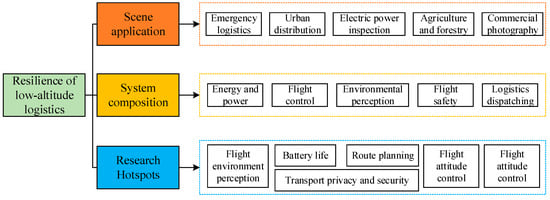
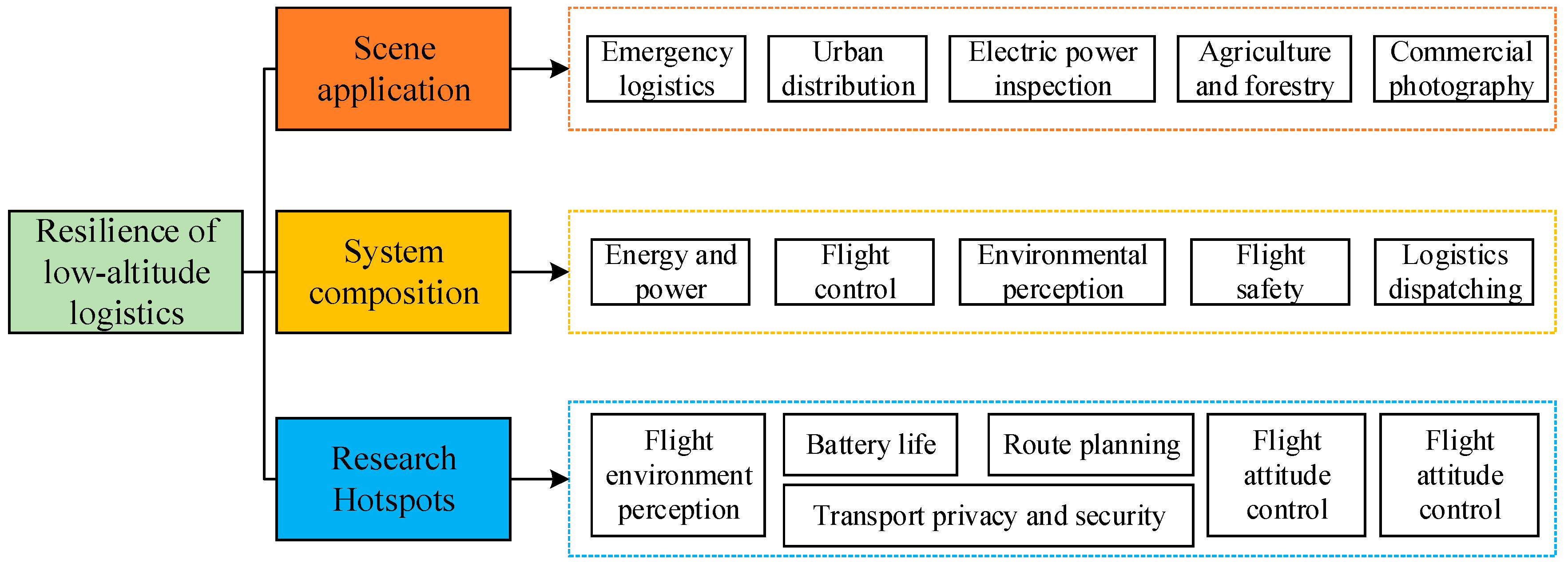
With the advancements in autonomous navigation, sensor fusion, and battery technology, the developments of LAL have been accelerated in transforming it from a conceptual innovation into a pre-commercial reality [11,12]. In addition, major enterprises, such as Amazon Prime Air, DHL, Wing, Zipline, Matternet, Cainiao, and JD Logistics, have demonstrated the feasibility and resilience potential of LAL across diverse application domains, from medical logistics to last-mile parcel delivery [9,13,14,15,16], is shown in Figure 1. Despite these advancements, achieving large-scale, resilient deployment still remains challenging due to interrelated technical, infrastructural, regulatory, and societal barriers. It requires coordinated progress across UAV design, network architecture, communication system, and governance frameworks. Therefore, developing an integrated understanding of LALR is crucial for guiding both academic research and industrial application aimed at ensuring reliable, equitable, and sustainable logistics networks.
Figure 1.
Low-altitude logistics resilience system and research hotspots.
This paper provides a comprehensive review and synthesis of the state of research on LAL resilience. Unlike prior reviews that have focused on routing algorithms or air traffic control, this study adopts a holistic perspective, integrating insights from engineering, systems science, operations management, and policy analysis, as shown in Table 1. The core research questions addressed include the following:
Table 1.
Comparative analysis of relevant low-altitude logistics review papers.
- What are the key technological, operational, and organizational components that determine the LALR?
- What vulnerabilities and interdependencies constrain the robustness and adaptability of these systems across technological, infrastructural, and regulatory domains?
- What strategic and governance frameworks can enhance the resilience, equity, and sustainability of the LAL?
Accordingly, this review pursues three main objectives: (1) to analyze the technological architecture and resilience mechanisms underpinning LAL systems; (2) identify critical challenges related to technological reliability, infrastructure interdependency, environmental uncertainty, and regulatory alignment; (3) propose strategic pathways for strengthening the LALR through innovation, redundancy design, adaptive governance, and multi-stakeholder collaboration.
Compared with prior reviews that predominantly emphasize routing/scheduling algorithms or aviation safety discussions, this review offers three incremental contributions. First, we deliver a PRISMA-compliant synthesis augmented by bibliometric mapping to characterize topic evolution and identify research clusters in LAL resilience. Second, we propose and operationalize a resilience-centric framework that structures the evidence using robustness, adaptability, recoverability, and redundancy, enabling systematic comparison across heterogeneous studies. Third, we translate the consolidated evidence into an actionable Technology–Policy–Ecosystem roadmap, explicitly elevating PPP-enabled infrastructure sharing, equity-oriented access design, and recovery-oriented planning (e.g., incident automation and RTO-driven operations) as system-level resilience levers.
The remainder of this paper is organized as follows. Section 2 describes the PRISMA-guided methodology, including database retrieval, screening, and bibliometric analysis. Section 3 presents the architecture of LAL systems and formalizes the conceptual framework of LALR. Section 4 synthesizes critical issues in building resilience across technological, regulatory, infrastructural, and environmental dimensions. Section 5 discusses implementation challenges, focusing on stakeholder alignment, economic feasibility, and operational flexibility. Section 6 consolidates strategies and policy recommendations spanning technologies, governance instruments, industrial ecosystems, and environmental and social resilience. Section 7 concludes with implications and future research directions toward robust, adaptive, and sustainable LAL ecosystems.
2. Methodology
To ensure the rigor, transparency, and reproducibility of this study, a systematic literature review was conducted following the PRISMA lists. This review adopts a mixed-methods approach, combining quantitative bibliometric analysis with qualitative content synthesis to comprehensively evaluate the resilience of Low-Altitude Logistics (LAL) systems. The supplementary materials could be found in the Section Supplementary Materials.
2.1. Search Strategy
To answer these above research questions, a systematic literature review was conducted using the Web of Science, Scopus, IEEE, and INFORMS databases, with the search terms “UAV delivery,” “drone logistics,” “supply chain resilience,” “logistics resilience,” and “LAL.” A total of 1600 relevant publications from 2020 to 2025 were identified, spanning leading journals such as Transportation Research Record, Transportation Research Part A/B/C/D/E, IEEE Transactions on Intelligent Transportation Systems, Transportation Science, and IET Intelligent Transport Systems. Bibliometric visualization using VOSviewer 1.6.20 revealed research clusters centered on keywords such as urban logistics, vehicle routing, drone scheduling, and resilient supply chains, reflecting a clear academic shift toward resilience-oriented logistics frameworks.
2.2. Selection Strategy
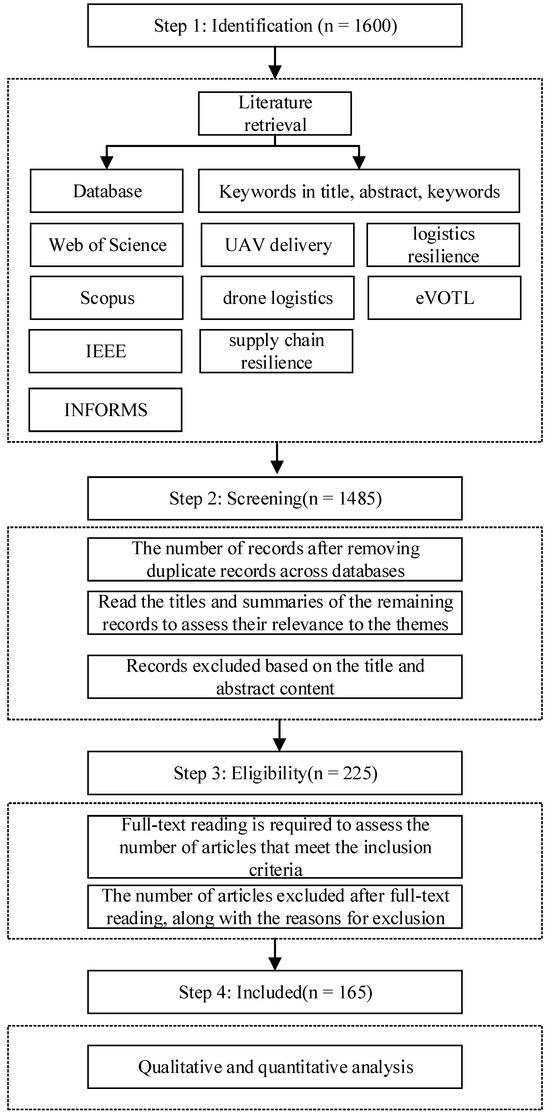
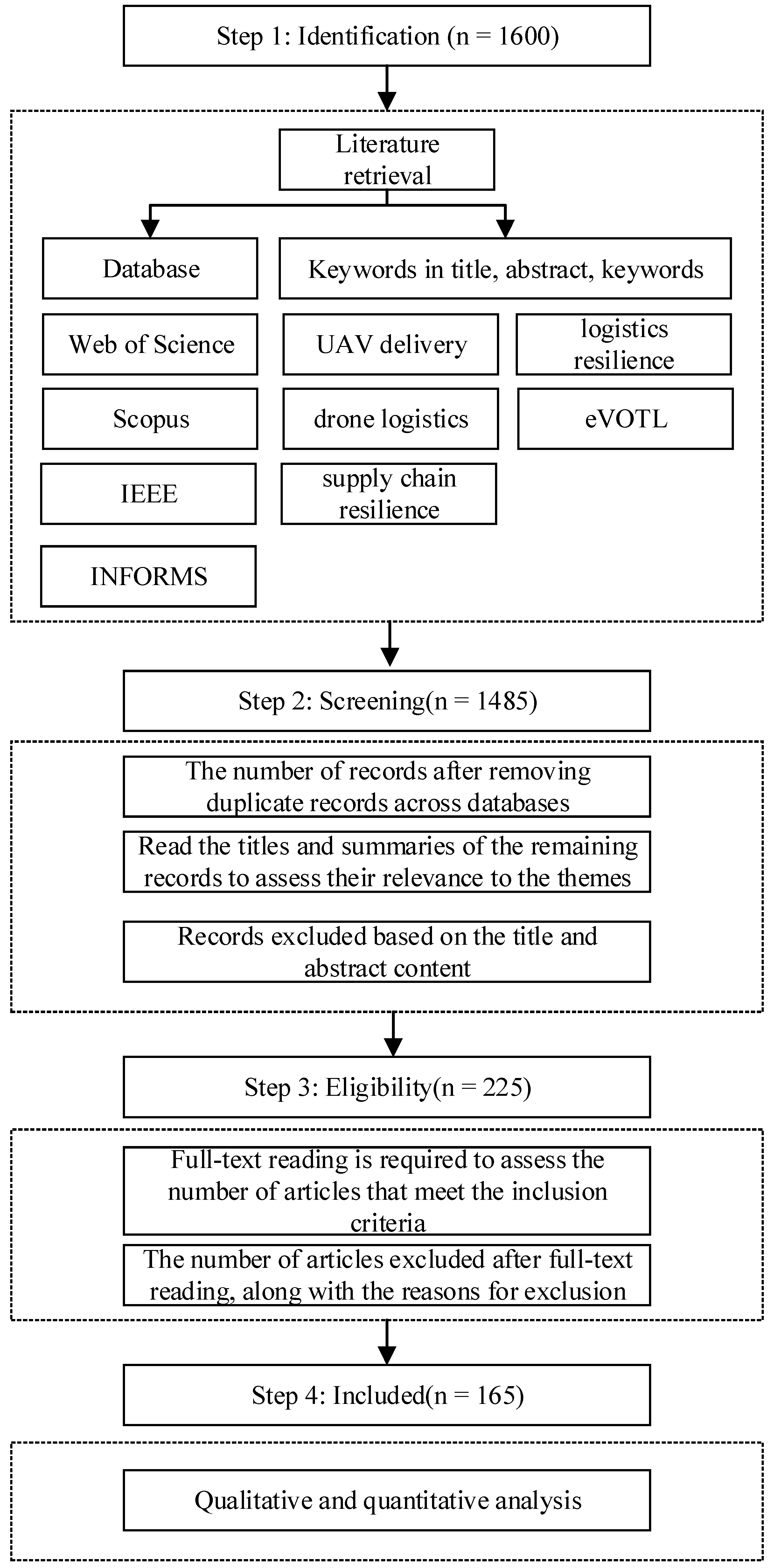
To ensure the review focused exclusively on high-quality and highly relevant studies, a rigorous selection process was applied, which presented using a PRISMA flow diagram in Figure 2. Inclusion focused on high-quality, peer-reviewed journal articles and conference proceedings published in English that explicitly addressed logistics or transportation applications of UAVs/eVTOLs, with a thematic emphasis on system resilience, risk management, routing optimization, or infrastructure planning relevant to Low-Altitude Logistics (LAL). Conversely, Exclusion criteria barred editorial materials, book reviews, commentaries, and other gray literature, as well as papers focusing solely on UAV hardware engineering (e.g., aerodynamics, material science) without an operational or logistics context. Furthermore, duplicate records identified across the databases were removed prior to the screening phase.
Figure 2.
PRISMA Flow Diagram (records identified n = 1600; screened after duplicate removal n = 1485; full texts assessed and included n = 225).
In total, 1600 records were retrieved from the four databases. After duplicate removal (n = 115), 1485 records remained for title/abstract screening. At this stage, 1260 records were excluded because they did not satisfy the inclusion criteria (e.g., engineering-only UAV studies without logistics relevance, or studies not addressing resilience/risk). The full texts of 225 articles were then assessed and retained for the qualitative synthesis (Figure 2).
2.3. Literature Analysis
This data analysis of systematic review was processed using VOSviewer software to visualize the knowledge domain’s structure. This quantitative analysis, is shown in Figure 3, was crucial for mapping major research clusters (e.g., urban logistics, drone scheduling), identifying keyword co-occurrence networks, tracing the temporal evolution of research hotspots in the LAL resilience framework, and developing strategic pathways.
Figure 3.
Keyword co-occurrence network.
3. System Architecture of LAL
3.1. Basic Concept of LAL
3.1.1. Definition of LAL Networks
In the context of this review, we adhere to precise terminology to maintain academic rigor. The term Unmanned Aerial Vehicle (UAV) is utilized as the standard academic and technical term to refer to the aircraft component of the LAL system, particularly when discussing system architecture, autonomy, and operational metrics [18]. While the term “drone” is commonly employed in industry reports, public media, and sometimes interchangeably in last-mile logistics literature, we standardize the usage to UAV for all technical descriptions and analyses within the main text. The use of “drone” is reserved only when quoting specific industry or policy documents, ensuring clarity and consistency throughout the manuscript [17].
Logistics distribution optimization typically involves network construction, task scheduling and distribution route optimization [20,21,22]. LAL is often carried out on the basis of the existing logistics distribution network, using existing distribution centers/warehouses, transfer stations and other logistics facilities as the take-off and landing points for drones, replacing ground vehicles to perform some customer delivery tasks [1,2,5].
3.1.2. Evolution of LAL System
The evolution of LAL can be traced back to early attempts at drone-based delivery, with significant milestones occurring in the last decade [23]. Initially, UAVs were designed for military or research purposes, but by the 2010s, companies such as Amazon and Google began developing commercial applications, particularly for delivery services [10,24]. Due to the low payload capacity and poor endurance of unmanned aerial vehicles (UAVs), individual delivery by UAV swarms is mostly suitable for small-batch and multi-batch scenarios. However, it is not very advantageous for large-scale and wide-ranging logistics distribution. Nevertheless, the combination of UAVs and ground vehicles can complement each other’s advantages and form an efficient joint logistics model, thus attracting more attention from both the business and academic communities. Recent studies increasingly emphasize hybrid air–ground logistics, where UAVs and trucks complement each other under different coupling structures [5]. To ensure terminological rigor, we classify UAV–truck collaboration into three widely used modes based on task coupling and launch/recovery logistics:
a. Truck-assisted UAV delivery: The unmanned aerial vehicle (UAV) vehicle delivery mode refers to the practice where the truck acts as a mobile base station, carrying UAVs to strategic launch points; the UAVs replenish out-of-stock vehicles when they are performing delivery tasks. Currently, there are few applications and studies in this area. Jeong et al. optimize truck parking locations and UAV routes using heuristics to minimize total completion time.
b. UAV-truck delivery: The parallel delivery mode of drones and vehicles, defined as that UAVs are launched and recovered while the truck is on route, refers to the situation where vehicles and drones independently transport goods from the warehouse. Due to the limitations of battery life and load capacity, drones usually serve customers within a small area around the warehouse, and there is no intersection between their service routes and those of vehicles, so the optimization complexity is relatively low. Thomas et al. formulate this as a mixed-integer linear program (MILP) and develop a two-stage heuristic for large-scale instances.
c. UAV-assisted trucks: trucks remain the primary carriers, while UAVs are used to serve remote, urgent, or hard-to-access customers, thereby shortening truck tours and improving responsiveness. This mode is particularly relevant for resilience scenarios.
These models face computational complexity due to coupling constraints, such as synchronization windows, and battery levels, necessitating decomposition methods such as Benders’ decomposition and column generation.
3.1.3. Major Players and Technologies Involved
Key players in the LAL space include Amazon Prime Air, Google Wing, Zipline, and Matternet. These companies have developed advanced UAVs capable of handling a wide range of deliveries, from small parcels to medical supplies [5]. Technologies such as high-precision navigation and obstacle avoidance (multi-sensor fusion, RTK positioning), intelligent flight control algorithms, cloud dispatching systems and automated takeoff and landing technologies, which are critical for supporting the stable transportation of unmanned aerial vehicles within visual range and enhancing the efficiency and resilience of these systems [25]. As the technology continues to evolve, further advancements are expected in communication protocols, such as 5G networks, real-time radar perception technology solid-state battery technology, and in the integration of AI to predict and manage potential “trap” [7,19,26].
3.2. Resilience in LAL Networks
3.2.1. Definition and Components of Resilience
Followed by the conceptualizations of supply chain resilience [27,28], this paper defines LAL Resilience (LALR) as the adaptive capability of a logistics system in low-altitude airspace to maintain supply chain continuity during sudden market disruptions, including extreme weather, public emergencies, and natural disasters. The capability is realized by leveraging aerial vehicles (e.g., drones, eVTOLs, general aviation aircraft) to establish transportation channels in low-altitude airspace, thereby rapidly deploying a responsive, adaptive, and recoverable distribution system.
Its core strength lies in the integration of dynamic airspace management, intelligent algorithm-based scheduling, and ground-air collaboration networks, enabling this system to overcome ground physical constraints in scenarios where traditional logistics routes are obstructed or severely degraded, including delivering supplies to remote islands, conducting emergency relief operations in disaster areas, and connecting isolated mountainous regions. Consequently, it facilitates rapid response and precise delivery of goods, thereby enhancing the overall logistics system’s capacity to withstand uncertainties, maintain essential functions, and swiftly recover from risks and disturbances.
Resilience in LAL is characterized by four main components: robustness, adaptability, recoverability, and redundancy. These components can be expressed as follows:
- (a)
- Robustness refers to the systems’ ability to withstand disruptions, such as mechanical failures or environmental challenges, without significant performance degradation.
- (b)
- Adaptability indicates how well the system can adjust to changing conditions, such as new regulatory requirements or emerging technologies.
- (c)
- Recoverability measures how quickly the system can return to normal operation after a disruption.
- (d)
- Redundancy involves the inclusion of backup systems or alternative routes to ensure continuous service during disruptions.
3.2.2. The Development Stage of Resilience
The concept of resilience has been explored in traditional supply chain management but is increasingly applied to LAL as UAV-based systems become more prevalent. Frameworks for assessing resilience in logistics networks typically involve real-time risk monitoring, scheme planning, and scenario simulation [29]. AI-based resilience models that predict potential disruptions and recommend proactive solutions are becoming more common in UAV systems [30]. The overall development of resilience assessment in LAL can be divided as follows:
- (1)
- Stage 1: The period of technology borrowing focuses on learning and drawing on experience from the assessment of resilient networks in other fields. For instance, early research regarded the LAL system as one of the links in the traditional supply chain and transportation, with a particular emphasis on the impact of transportation channel disruptions caused by unexpected situations (such as natural disasters and epidemics) on the entire transportation network. The assessment indicators mainly follow the recovery speed and elasticity of logistics transportation [29,31,32].
- (2)
- Stage 2: During the period of technological development, the focus was on the technological upgrading of low-altitude transportation equipment such as UAVs, eVoTL, and the research emphasis gradually shifted to the safety, reliability, and economic applicability of low-altitude aircraft themselves. The assessment includes technical indicators such as the rated load capacity, endurance range, anti-interference capability, and failure rate of UAVs to enhance the comprehensive strength of UAVs and other equipment [29,32,33].
- (3)
- Stage 3: During the ecological construction period, as various countries and governments have begun to open up low-altitude airspace and introduce relevant policies and measures such as LAL drones, the focus has gradually shifted from the drones themselves to recognizing the LAL system and conducting an overall assessment of the LAL ecosystem. In the face of unique ecological risks, such as urban traffic congestion and climate (such as wind speed and rainfall), Assess the impact on the overall LAL ecosystem, the challenges to flight safety and operational efficiency, as well as the unpredictability of regulatory policies and airspace management [2,26,34,35].
- (4)
- Stage 4: During the comprehensive application period, LAL has gradually been applied in urban instant delivery, county and rural distribution, emergency rescue material transportation, medical material transportation, material transportation in special terrains (mountainous areas and islands), as well as cross-city express delivery services, etc. By ensuring continuous operation capabilities in various complex environments and emergencies, LAL is accelerating its integration into the modern logistics supply chain system and has become an indispensable and crucial part [31,36,37,38].
- (5)
- Stage 5: During the system integration period, we move towards the resilience assessment of the LAL collaborative network. By introducing advanced quantitative analysis methods such as GRACH, multi-criteria decision model (MCDM), and other index evaluation models, These models aim to quantify the combined effect of different risk factors (such as delivery time and traffic impact) on the resilience of LAL systems, assess the adaptive capacity, predictive analysis and self-recovery ability under extreme conditions, and achieve the highest level of resilience [32,39].
4. Critical Issues in Building Resilience
LAL systems aim to solve “last-mile delivery” problem efficiency, improve supply chain resilience in emergencies, and reduce ground congestion and carbon emissions in urban environments [26,40]. However, despite rapid technological advancements and pilot deployments worldwide, the realization of scalable and sustainable LAL networks still encounters multiple challenges. This section identifies and analyzes core research issues that constitute the foundation of current LAL studies: technological challenges, regulatory and policy Barriers, infrastructure limitations, and environmental factors.
4.1. Technological Challenges
The LAL currently faces a key challenge: technological bottlenecks in core components and fragmentation of technical standards. Critical subsystems, such as high-performance aviation batteries, flight control chips, and precision sensors. These challenges are heavily reliant on imports, which constrains key performance metrics including endurance, payload capacity, and operational reliability in complex environments. Moreover, essential algorithms for intelligent obstacle avoidance and autonomous flight remain immature. Compounded by the lag in standardized protocols, this results in poor interoperability among heterogeneous aerial platforms, severely impeding efficient, high-density cooperative operations.
4.1.1. The Application of Advanced Technologies in LAL
Advanced technologies such as AI, machine learning, and large language model is crucial for ensuring the resilience of LAL systems. These technologies allow for real-time data collection and analysis, enabling UAVs to optimize flight routes, avoid obstacles, and make decisions autonomously [1,6]. However, the application of such technologies presents significant challenges, particularly in terms of system compatibility, data security, and scalability [37]. Moreover, high-cost investments and the need for specialized expertise are barriers to widespread adoption.
In collaborative logistics networks involving multiple stakeholders (e.g., logistics providers, platform operators, infrastructure owners), fair and stable benefit allocation is crucial for long-term cooperation. Game-theoretic approaches, including cooperative games (Shapley value, core solutions) and non-cooperative bargaining models. They are used to analyze profit distribution and incentive alignment.
4.1.2. Security in LAL
Security is a critical concern for LAL, given the reliance on digital systems for flight navigation and communication. UAV systems are vulnerable to hacking, denial-of-service attacks, and data breaches, which could disrupt service and lead to significant financial and operational losses [40] (Haessler et al., 2023). Therefore, robust encryption methods and decentralized control frameworks are necessary to protect sensitive logistics data and ensure the security of UAV systems [41,42] (Wang et al., 2024).
4.1.3. Battery Life in LAL
One of the technical barriers to widespread UAV application is limited battery lifetime. Conventional lithium-ion batteries, which could support only 30 to 60 min of flight, with actual endurance varying according to payload and airframe dimensions [43,44]. This constraint not only limits the maximum fly distance but also becomes especially problematic in dense urban settings, where delivery routes frequently surpass the UAV’s operational radius [45]. Compounding the issue, heavier payloads accelerate energy consumption, thereby narrowing the feasible range of transportable commodities. To overcome these limitations, researchers are exploring alternative energy technologies, including solid-state batteries and hydrogen fuel cells, both of which offer the potential for substantially longer endurance. Pending their commercialization, a pragmatic near-term strategy involves establishing urban networks of charging or docking stations to facilitate en-route battery replenishment [46,47].
4.2. Regulatory and Policy Barriers
4.2.1. Overview of Current Regulations Affecting LAL
Current regulatory frameworks for LAL suffer from insufficient comprehensiveness and inter-agency coordination. As this emerging sector spans aviation, logistics, and airspace security, existing regulations lack a dedicated, operational governance structure [17,48,49,50]. The main predicaments are as follows: (1) incomplete airworthiness certification standards for drones and associated equipment, leading to prolonged and costly approval processes for new logistics UAVs; (2) ambiguous rules governing airspace access, with unclear distinctions in usage rights, openness levels, and liability across airspace classes, creating uncertainty for network expansion; (3) fragmented regulatory oversight among the Airspace Committee, civil aviation authorities, and local governments, exacerbated by the absence of a unified digital supervision platform or coordinated command mechanism, resulting in complex approvals and policy unpredictability for operators.
4.2.2. Challenges in Policy Adaptation and Compliance
The growth of LAL is fundamentally hindered by institutional fragmentation in airspace governance [4,43,51]. Multiple authorities, such as the military, civil aviation regulators, and local governments, they often exercise overlapping and conflicting powers, resulting in protracted permitting processes and limited operational airspace availability. For instance, in Shenzhen’s designated zone, airspace utilization is below 40%, primarily due to the proximity to airports. At the national level, the lack of standardized regulations has led to inconsistent local implementation, making flight plan approvals highly unpredictable and impeding cross-jurisdictional network integration.
Moreover, regulatory cycles consistently lag behind technological advancements by 6 to 12 months, fostering strategic conservatism among companies and stalling innovation [52,53]. This regulatory gap is particularly evident in emerging operational paradigms, such as urban aerial logistics in high-density areas, where enabling legal frameworks are either underdeveloped or nonexistent, thereby delaying real-world validation.
Additionally, systemic gaps persist in supporting institutional structures, including accident liability regimes, insurance models, and data protection protocols. These deficiencies elevate enterprise risk and compliance costs, discouraging investment and eroding market confidence. As a result, enterprise participants face a self-reinforcing inertia, wherein the lack of clear, comprehensive rules both hinders the industry’s growth and prolongs the regulatory maturity process that can only evolve through active engagement from the sector.
4.3. Infrastructure Limitations
A major bottleneck in scaling LAL lies in the dual deficiency of physical and digital infrastructure [24,41,54,55]. On the physical side, ground support facilities are highly unevenly distributed: in China, airports, charging units, and service stations cluster in the east, while coverage in county-level and remote western regions remains minimal. JD’s network, nearly 1000 nodes in the east versus under 20% penetration in the central-western interior, which exemplifies this disparity, which frequently disrupts interregional drone missions, especially in time-sensitive applications such as disaster relief or farm-to-market transport.
On the digital front, low-altitude CNS infrastructure suffers from extensive coverage gaps [34,52,54,56]. In rugged terrains, 4G/5G signal availability falls below 30%, insufficient for BVLOS telemetry and control. Compounding this, purpose-built low-altitude communication networks remain experimental, and digital air traffic management systems lack integrated, real-time coordination functions. Consequently, drones face persistent challenges in accurate localization, dynamic obstacle avoidance, and multi-agent collaboration, directly resulting in compromising operational safety and efficiency.
4.4. Environmental Factors
Accurate perception of dynamic urban environments is fundamental to safe UAV operations. Unlike ground vehicles constrained to two-dimensional roads, UAVs must navigate complex three-dimensional spaces filled with static obstacles (e.g., buildings, power lines) and dynamic hazards (e.g., birds, other drones, weather changes). Therefore, robust environmental sensing requires multi-sensor fusion techniques integrating GPS, inertial measurement units (IMUs), LiDAR, monocular/stereo cameras, and radar systems [53,57].
4.4.1. Impact of Weather and Climate on LAL
The operational resilience of LAL systems is fundamentally constrained by inadequate environmental perception and adaptive capacity. Despite their strong dependence on ambient weather, most small- and medium-sized drones cannot access high-resolution, real-time forecasts of localized low-altitude phenomena, including gust fronts, wind shear, and convective bursts. Prevailing meteorological data products are too coarse to support lane-level environmental risk assessment, resulting in recurrent flight disruptions [2,57,58]. This deficiency is magnified in terrain-sensitive regions (e.g., alpine or littoral zones) with heterogeneous microclimates, where unpredictable conditions erode schedule adherence and preclude true all-weather service [59]. Consequently, the system remains brittle in the face of natural variability, limiting its robustness as a dependable logistics solution.
4.4.2. Strategies for Mitigating Environmental Risks
Urban LAL faces a fundamental challenge: operating within an electromagnetically and physically cluttered environment shaped by human activity [26,52,60]. High-density architecture induces microscale wind shear, GNSS outages, and strong RF interference, while non-cooperative aerial traffic and consumer-grade wireless devices exacerbate spectral congestion and collision hazards. Current drone systems lack the integrated capability for continuous situational awareness, interference-resilient communication, and agile navigation under these high-uncertainty conditions. Consequently, their performance in dynamic obstacle evasion and signal stability remains unreliable. This gap in environmental adaptability not only elevates safety risks but also acts as a key constraint on the network’s operational resilience and scalability in complex urban airspace.
5. Challenges in Implementation
5.1. Stakeholder Engagement
Establishing a resilient LAL networks requires the active collaboration among of a diverse range of stakeholders, including government agencies, logistics enterprises, technology developers, and local communities [3,54,56]. Each group plays a crucial role in shaping the infrastructure and regulatory environment necessary for successful operation [61].
The LAL confronts is the management and allocation of airspace, a public resource [10]. This determines that the government must play the core role of a rule-maker and supervisor. However, effective regulation is not a one-way output but requires in-depth interaction with enterprises that represent the forefront of market exploration and communities that set technical standards. The government provides initial momentum by releasing airspace and setting a safety bottom line. Enterprises provide feedback on regulatory blind spots through real operational data. communities, on the other hand, bring together industry consensus and transform best practices into industry standards. Only through in-depth interaction among effective market participants can a market ecosystem that shaped the development of LAL, laying a solid institutional foundation for the orderly development of the entire industry [48].
Within a stable framework of rules, the vitality of an industry stems from continuous technological innovation and market validation, which constitutes a dynamic “innovation double helix” [40]. On the one hand, technology research and development institutions (technology providers) need to conduct targeted research and development based on the pain points encountered by enterprises in actual operations, such as complex building take-offs and landings, battery life, and adaptability to adverse weather conditions, to ensure that technology research and development are in harmony with market demands [13,62]. On the other hand, enterprises apply cutting-edge technologies (such as AI decision-making and high-precision navigation) to specific logistics scenarios, feedback technological iterations through commercial operations, and give rise to new business models. This interaction between “technology-driven” and “market-pulled” has formed a powerful value co-creation mechanism, jointly driving the spiral upward of product performance, operational efficiency and economy, which is the core engine for the industry to break through bottlenecks and achieve endogenous growth [3].
The ultimate goal of LAL is to integrate into the urban fabric and become a key infrastructure for future intelligent cities [19]. This means that it is not merely a transportation solution, but an important component of a complex socio-technological system that is deeply coupled with subsystems such as energy, communication, transportation, and urban planning. At this level, the government needs to carry out cross-departmental top-level design and plan public infrastructure such as take-off and landing fields and energy supplies. Enterprises need to build open platforms, integrate supply chains and explore cross-industry value [28,55]. The technical party needs to ensure the interconnection and interoperability between systems as well as network security. communities, on the other hand, need to take the lead in formulating long-term technical roadmaps and undertake public communication and fostering social trust. Only through such in-depth ecological co-construction can the transformation of LAL from “achievable” to “widely accepted public service” be achieved [49].
5.2. Economic Feasibility
While the long-term benefits of LAL systems, such as reduced delivery times, improved efficiency, and lower transportation costs, are well-documented, the initial investment required for their development and deployment remains a significant barrier [36]. The upfront costs associated with establishing resilient LAL infrastructure, particularly in urban environments where operational complexity and regulatory compliance are heightened, can be substantial. These costs often involve not just the technological development and hardware deployment but also the regulatory processes, public safety initiatives, and system integration efforts that must be undertaken to ensure the viability of the system [3].
The financial landscape for LAL systems requires diverse funding mechanisms to support the development and scaling of resilient logistics infrastructure [11,46]. Public funding, private investment, and venture capital are crucial for ensuring that LAL systems are not only technically feasible but also economically viable. Governments, as key stakeholders in regulating and overseeing LAL networks, can play a pivotal role by providing financial support through grants, public–private partnerships (PPPs), and low-interest loans targeted at innovative logistics technologies [4].
In addition to traditional funding routes, innovative financial models such as green bonds, impact investing, and crowd funding may provide alternative sources of capital. These financial mechanisms can not only attract investment into the LAL sector but also align financial returns with sustainability goals, encouraging broader support for resilient, LAL systems.
5.3. Operational Flexibility
Operational flexibility is a cornerstone of resilience in LAL systems [53]. The ability to adapt to rapidly changing environmental, technological, and regulatory conditions is essential for ensuring the uninterrupted operation of logistics networks. Unlike traditional logistics systems, which may rely on fixed routes and schedules, LAL networks must be capable of adjusting in real-time to a variety of factors, such as inclement weather, airspace congestion, or unexpected regulatory changes [63].
This adaptability extends to several key operational aspects, including flight routing [64], maintenance schedules [65], and integration with traditional, ground-based logistics systems [66,67]. For instance, drones may need to reroute their flights to avoid weather disruptions or restricted airspace [8,62]. In addition, maintenance operations must be flexible enough to accommodate new technologies or adapt to regulatory changes in UAV safety standards [9,15]. Furthermore, seamless integration with existing logistics infrastructure, such as warehouses, distribution centers, and ground vehicles, which require operational flexibility to ensure that both systems can function in tandem without delays or inefficiencies. This flexibility is not only crucial for maintaining system reliability but also for optimizing cost-effectiveness and speed of delivery in dynamic environments.
6. Strategies for Enhancing Resilience
To strengthen analytical rigor beyond high-level recommendations, this section consolidates major resilience levers into an operational synthesis. Specifically, we connect redundancy, recoverability, public–private partnerships (PPPs), and equitable access design to (i) disruption types addressed, (ii) underlying resilience mechanisms, (iii) implementable operational and governance instruments, and (iv) measurable indicators that support evaluation and cross-study comparability [17,19,21].
Table 2 summarizes these levers in a mechanism-and-metrics scaffold that can be reused for both research design and practical deployment. Section 6.1, Section 6.2, Section 6.3 and Section 6.4 then detail each lever with representative approaches and domain-specific implications.
Table 2.
Operationalizing key LALR levers: disruption coverage, mechanisms, implementable instruments, and evaluation metrics.
As summarized in Table 2, redundancy and recoverability primarily reinforce the operational and technical layers of LALR, whereas PPPs and equitable access design act as ecosystem-level enablers that shape infrastructure availability, interoperability, and social legitimacy. The following subsections expand each lever and discuss design implications for planning, operations, and policy.
6.1. Innovative Technologies
6.1.1. Advancing Battery Technology and Real-Time Path Planning for eVTOL Logistics
This study overcomes critical technical barriers in battery performance and transportation dispatching by enhancing the energy density of aviation power batteries through lightweight material development and solid-state battery integration [44]. These innovations significantly extend eVTOL endurance, enabling efficient logistics operations across urban clusters [11,47]. Furthermore, a real-time path planning system leveraging large language models is implemented to enable autonomous decision-making and swarm intelligence-based collaborative scheduling under complex operational conditions, thereby optimizing flight efficiency and establishing a robust technical foundation for the LAL system [46].
6.1.2. Intelligent Air-Ground Coordination Platform for Seamless Logistics Management
By harnessing 5G communication and artificial intelligence, an intelligent dispatching platform is developed to establish a real-time monitoring and decision-making center for LAL operations [16,68]. This platform ensures collaborative UAV swarm control and seamless integration between aerial and ground transportation networks. AI-driven cargo tracking facilitates end-to-end visual management of logistics processes, reduces operational costs, and substantially enhances the system’s dynamic response capability in unforeseen scenarios [69,70].
6.1.3. Building System Redundancy Through Network and Multi-Modal Designs
Redundancy is a critical component of LALR, defining the system’s capacity to sustain functionality after specific component failures by utilizing backup resources. We identify two primary strategies for building effective redundancy in LAL systems: Network Topology Redundancy and Multi-Modal Redundancy. The former involves designing alternative flight paths and distribution hub locations, leveraging research in graph theory and network optimization to create diverse, non-overlapping backup routes. This minimizes the impact of localized infrastructure failures and ensures system connectivity. The latter strategy, Multi-Modal Redundancy, addresses the inherent limitations of UAVs (e.g., weather sensitivity, limited range) by explicitly incorporating ground vehicles (e.g., trucks, vans) as primary contingency resources. This UAV + Ground backup approach ensures delivery certainty and enhances the overall system’s resilience by utilizing operational flexibility far beyond what a single technology can achieve [18,19].
Guided by Table 2, redundancy should be evaluated not only by the existence of backups but also by whether such backups can be activated under low-altitude constraints. We therefore encourage the use of network indicators (e.g., k-connectivity, alternative path diversity, hub criticality) together with operational indicators (e.g., activation latency, continuity under node/link failures). In practice, redundancy should be co-designed with battery-limited range, weather-feasibility, and airspace capacity to avoid nominal redundancy that fails to deliver resilience in real disruptions.
6.2. Policy Recommendations
6.2.1. Advancing the Reform of Low-Altitude Airspace Management
To facilitate the scaled operation of UAVs, it is essential to promote refined low-altitude airspace management by establishing a dynamic airspace mechanism. This includes implementing 4D grid-based management and dynamic pricing strategies to automatically release more airspace resources during off-peak hours or in low-risk areas. Additionally, streamlining the UAV flight approval process through a “single-platform application, one-stop service” mechanism will significantly enhance operational efficiency and support large-scale deployment [19,41,71].
6.2.2. Innovating Regulatory Mechanisms and Cross-Departmental Collaboration Systems
A regulatory sandbox mechanism should be established to allow enterprises to conduct innovative business trials within designated zones [3,41,65]. Concurrently, policies such as the “LAL Airworthiness Standards” and “Safety Specifications” need to be formulated to clarify rights and responsibilities and improve the operational environment for stakeholders. By integrating resources from civil aviation, transportation, and public security departments, a cross-departmental coordination platform can be developed. This will foster policy synergy and ensure the safe, efficient, and regulated development of the industry [72].
6.2.3. Fostering PPPs
The large-scale deployment of LALR networks necessitates significant upfront investment in ground infrastructure. To mitigate the financial risk and accelerate development, effective PPPs are essential. Governments should play a facilitative role by establishing clear standards, managing low-altitude airspace area access rights, and funding shared, critical infrastructure components. The Private sector, in turn, can focus on optimizing flight operations, maintaining specialized drone fleets, and developing value-added logistics services. This collaborative model enhances system redundancy and recoverability by enabling infrastructure sharing, preventing service monopolies, and ensuring a diversified base of capital and operational expertise that can be rapidly deployed during system shocks [2].
To translate PPPs into measurable resilience gains (Table 2), agreements should specify (a) shared-use rules and ownership of landing pads/vertiports, charging assets, and digital UTM services; (b) explicit risk allocation for safety incidents, cyber events, and weather-driven cancelations; and (c) performance-based terms (e.g., SLA uptime, maximum outage duration, emergency throughput, and minimum coverage obligations for remote areas). Such contract structures reduce investor uncertainty while enabling public agencies to enforce baseline resilience and equity objectives.
6.3. Industrial Ecosystem
6.3.1. Fostering a Collaborative Innovation Ecosystem Across the Industrial Chain
To enhance the resilience and integration of the low-altitude logistics (LAL) industry, it is essential to encourage partnerships among drone manufacturers, communication operators, logistics enterprises, and end-users. Establishing an industry-academia demonstration platform for LAL will facilitate the joint development of emergency response plans, risk-sharing mechanisms, key equipment, and algorithms. These efforts will help reduce equipment costs and improve logistics efficiency. Furthermore, innovation in integrated service models, such as “logistics-finance-customs-clearance”, which should be promoted to provide comprehensive solutions in financing, insurance, and customs processes. Such collaboration will build a more robust and risk-resilient industrial network.
6.3.2. Developing Integrated Full-Chain Logistics Service Providers
Enterprises should be supported in transitioning from single-function distribution services toward becoming full-chain LAL solution providers [52]. This includes diversifying into application scenarios such as fresh cold chain, island delivery, and emergency medical logistics, thereby expanding specialized service areas [13,62]. Moreover, promoting the joint establishment of LAL demonstration parks by enterprises and local governments will help accelerate the industry’s shift from fragmented operations to a systematic and sustainable ecosystem.
6.3.3. Implementing Rapid Response and Recovery Mechanisms
Recoverability defines the speed and efficiency with which the LAL system can return to a normal operational state following a major disruption (such as power outages or cybersecurity breaches). Effective recoverability hinges on three key Rapid Response Mechanisms: First, Automated Incident Management, which involves implementing AI-driven platforms capable of instant failure detection, zone isolation, and autonomous rerouting of unaffected UAVs to minimize system downtime. Second, Modular and Self-Healing Infrastructure, requiring airports and charging stations to be modular, easily replaceable, and deployable; the rapid deployment of temporary mobile charging hubs is crucial for quickly restoring limited LAL operations during disaster logistics applications. Third, Cross-Sector Data Sharing, which establishes agreements between LAL operators and government agencies for sharing real-time data (e.g., weather, emergency services status). This ensures recovery plans are based on accurate situational awareness, thereby drastically reducing the Recovery Time Objective (RTO) of the logistics network [58].
Recoverability benefits from explicit, measurable targets (Table 2). We recommend using recovery-oriented metrics such as Recovery Time Objective (RTO) and Mean Time To Recovery (MTTR), complemented by restoration curves that quantify the trajectory of performance rebound. Future work should benchmark recovery strategies (e.g., mobile charging, temporary hubs, dynamic reassignment) under standardized disruption scenarios (power outages, GNSS interference, cyberattacks, extreme winds) to build evidence-based recovery playbooks.
6.4. Environmental and Social Resilience
6.4.1. Advancing the Application of Green and Low-Carbon Logistics Technologies
To achieve carbon neutrality in low-altitude logistics (LAL), it is imperative to optimize flight trajectories and adopt clean energy power systems [73,74,75]. Concurrently, research should be conducted to assess the impact of UAV operations on urban ecosystems, leading to the formulation of science-based environmental impact assessment protocols. These efforts will facilitate a synergistic balance between economic performance and ecological sustainability.
6.4.2. Establishing an Eco-Friendly Technical Standard System
The promotion of environmentally protective technologies should be accelerated, such as low-noise UAVs and biodegradable packaging materials [76]. An integrated environmental monitoring network for LAL needs to be established to enable real-time tracking of air quality and noise pollution [23,77,78]. Furthermore, incorporating environmental performance into enterprise evaluation frameworks will incentivize the industry’s transition toward sustainable practices, ultimately fostering a green, low-carbon, and renewable LAL ecosystem.
6.4.3. Ensuring Equitable Access and Social Resilience
While technological innovation bolsters physical resilience, the long-term sustainability and adaptability of LAL systems rely equally on equitable fair access design to enhance social resilience. It is crucial to prevent LAL services from simply concentrating in high-profit urban centers, which would exacerbate the existing “logistics divide.” An effective equitable access strategy must be embedded in policy frameworks to mandate or incentivize operators to serve remote, rural, or underserved communities, thereby improving overall supply chain equity and regional resilience. Furthermore, regulatory bodies must monitor pricing to ensure affordability for critical deliveries to low-income populations. By prioritizing fairness and accessibility in system design, LAL gains necessary public trust and community support, which is a non-technical determinant of system-wide recoverability following major disruptions.
Equitable access should be framed as a resilience condition rather than solely a normative objective (Table 2), because persistent service inequities can erode public trust, weaken license-to-operate, and slow post-disruption recovery. Operationally, equity can be embedded through minimum coverage constraints for underserved areas, affordability safeguards for critical deliveries, and public procurement of emergency resilience capacity. We further encourage formal equity metrics to be integrated into multi-objective planning and policy evaluation.
7. Conclusions
7.1. Summary of the Key Findings
LAL has emerged as a transformative component of modern supply chains, offering new pathways to enhance resilience, adaptability, and sustainability in logistics networks [27,36]. Positioned within the global movement toward cultivating new quality productive forces, the integration of low-altitude UAV logistics has attracted growing attention of academic and industrial sectors. A comprehensive review of the existing literature indicates that research has advanced rapidly across multiple dimensions, including UAV design, flight control, route optimization, and scheduling algorithms, as well as regulatory frameworks encompassing flight safety [70,79], privacy protection, and social inclusion [80]. However, from a resilience-oriented perspective, current studies remain largely fragmented, emphasizing technical optimization while underexploring systemic resilience attributes, such as redundancy, recoverability, robustness, and adaptive governance. These attributes determine the long-term stability and scalability of LAL systems [18,81].
- (1)
- Response to RQ1 (System Architecture): We first established the foundational architecture of LAL systems and defined LALR through its four essential and interconnected components: robustness, adaptability, recoverability, and redundancy. We summarized how each component functions to mitigate different categories of operational and external shocks.
- (2)
- Response to RQ2 (Vulnerabilities and Challenges): Our analysis detailed the primary critical challenges and vulnerabilities facing LAL system resilience, reiterating the need for substantial progress in three areas: (a) technological limitations (e.g., battery energy density, sensor reliability under adverse weather); (b) regulatory fragmentation across local and national jurisdictions; and (c) cybersecurity threats and environmental perception issues identified in Section 4.
- (3)
- Response to RQ3 (Strategic Pathways): Finally, we proposed a strategic roadmap centered on a “Technology-Policy-Ecosystem” approach to enhance LALR, summarizing the need for Technical Innovation (AI-driven autonomy, advanced sensors), Policy Reform (Performance-Based Regulation), and Ecosystem Building (Public–Private Partnerships and equitable access design) as elaborated in Section 5.
Finally, the LAL technology suggests that the field is currently situated near the peak of inflated expectations, driven by strong policy incentives, media exposure, and capital investment. This stage mirrors earlier trajectories observed in the evolution of new energy and connected vehicle industries, where periods of rapid growth were followed by consolidation and structural adjustment. Building resilience into LAL therefore requires not only technological innovation but also institutional, infrastructural, and socio-economic adaptability, enabling the systems to withstand fluctuations in regulation, market demand, and external shocks. As the ecosystem transitions from conceptual enthusiasm to practical implementation, future development should prioritize resilient integration frameworks that balance safety, efficiency, and equity. It ensures that LAL evolves into a stable, reliable, and inclusive component of sustainable urban and regional logistics networks.
7.2. Future Research Directions and Implications for Practice
In conclusion, with the rapid development of the low-altitude economy, enhancing the resilience of the LAL system has become an important direction for future academic research. The core objective lies in building a drone logistics system that can maintain safe, stable and sustainable operation in complex environments. Specifically, it can be developed from the following four aspects: (1) Operational safety Resilience: The precise identification ability of UAVs of aircraft, obstacles and the environment in low-altitude environments, as well as dynamic path planning and high-precision trajectory control in three-dimensional space; (2) Operational Resilience: For diverse scenarios such as residential communities, logistics parks and urban blocks, we can explore the collaborative distribution mechanism of heterogeneous unmanned aerial vehicle (UAV) swarms, as well as the multi-mode collaborative operation mode of UAVs with trucks, electric vehicles, bicycles, etc. (3) Policy Resilience: For large-scale urban and intercity logistics tasks, the airspace planning, route layout, air traffic control mechanism and infrastructure configuration are studied from the perspective of managers to achieve policy coordination and dynamic adaptation in aspects such as privacy protection, network and information security, and subsidy mechanism. (4) Social Resilience: we should focus on the accessibility and fairness of LAL in remote rural areas, explore the impact of unmanned delivery, and promote the inclusive, fair and sustainable development of LAL systems.
Supplementary Materials
The following supporting information can be downloaded at: https://www.mdpi.com/article/10.3390/su18010461/s1, Table S1: Prisma 2020 checklist.
Author Contributions
Conceptualization, H.X. and J.Y.; methodology, H.X.; software, H.X.; validation, H.X. and J.Y.; formal analysis, H.X.; investigation, H.X.; resources, H.X.; data curation, H.X.; writing—original draft preparation, H.X.; writing—review and editing, H.X.; visualization, H.X.; supervision, H.X.; project administration, H.X.; funding acquisition, J.Y. All authors have read and agreed to the published version of the manuscript.
Funding
This research was funded by the Fundamental Research Funds for the Central Universities, CHD (No. 300102225502).
Institutional Review Board Statement
Not applicable.
Informed Consent Statement
Not applicable.
Data Availability Statement
The data presented in this study are available from the corresponding author upon reasonable request.
Conflicts of Interest
The authors declare no conflict of interest.
Abbreviations
The following abbreviations are used in this manuscript:
| LAL | Low-altitude logistics |
| PRISMA | Preferred Reporting Items for Systematic Reviews and Meta-Analyses |
| UAV | Unmanned aerial vehicle |
| eVTOL | Electric vertical takeoff and landing |
| LALR | Low-altitude logistics resilience |
| AI | Artificial intelligence |
| RQ | Research Question |
| PPP | Public–Private Partnerships |
| RTO | Recovery Time Objective |
| MTTR | Mean Time To Recovery |
| GNNS | Global Navigation Satellite System |
| UTM | Unmanned Aircraft System Traffic Management |
References
- Hong, I.; Kuby, M.; Murray, A.T. A range-restricted recharging station coverage model for drone delivery service planning. Transp. Res. Part C Emerg. Technol. 2018, 90, 198–212. [Google Scholar] [CrossRef] [Scilit]
- Huang, C.; Fang, S.; Wu, H.; Wang, Y.; Yang, Y. Low-altitude intelligent transportation: System architecture, infrastructure, and key technologies. J. Ind. Inf. Integr. 2024, 42, 100694. [Google Scholar] [CrossRef] [Scilit]
- Na, H.; Chang, Y.S. Study on the policies, regulations of drone-based logistics. In Proceedings of the 2024 2nd International Conference on Cyber Resilience (ICCR), Dubai, United Arab Emirates, 26–28 February 2024; pp. 1–4. [Google Scholar]
- Jin, Y. The evolution and challenges of low-altitude economy: Insights from experience in china. In Proceedings of the 1st International Conference on Modern Logistics and Supply Chain Management, Foshan, China, 28–30 June 2024. [Google Scholar]
- Wang, Y.; Sun, G.; Sun, Z.; Wang, J.; Li, J.; Zhao, C.; Wu, J.; Liang, S.; Yin, M.; Wang, P.; et al. Toward realization of low-altitude economy networks: Core architecture, integrated technologies, and future directions. IEEE Trans. Cogn. Commun. Netw. 2025, 11, 2788–2820. [Google Scholar] [CrossRef] [Scilit]
- Anand, A.; Bandyopadhyay, S.; Das, S.; Agarwal, A.; Moitra, A. Drone delivery system using gps and telemetry. In Information and Communication Technology for Competitive Strategies (ICTCS 2021); Kaiser, M.S., Xie, J., Rathore, V.S., Eds.; Springer Nature: Singapore, 2023; pp. 423–429. [Google Scholar]
- Lv, B. Supply chain resilience modeling based on dynamic hypergraph and quantum reinforcement learning for low-altitude-ground networks. Transp. Res. Part E Logist. Transp. Rev. 2025, 204, 104458. [Google Scholar] [CrossRef] [Scilit]
- Doole, M.; Ellerbroek, J.; Hoekstra, J. Estimation of traffic density from drone-based delivery in very low level urban airspace. J. Air Transp. Manag. 2020, 88, 101862. [Google Scholar] [CrossRef] [Scilit]
- Miranda, V.R.F.; Rezende, A.M.C.; Rocha, T.L.; Azpúrua, H.; Pimenta, L.C.A.; Freitas, G.M. Autonomous navigation system for a delivery drone. J. Control Autom. Electr. Syst. 2022, 33, 141–155. [Google Scholar] [CrossRef] [Scilit]
- Beliaev, V.; Kunicina, N.; Ziravecka, A.; Bisenieks, M.; Grants, R.; Patlins, A. Development of adaptive control system for aerial vehicles. Appl. Sci. 2023, 13, 12940. [Google Scholar] [CrossRef] [Scilit]
- Gu, R.; Zhao, Y.; Ren, X. Integrating wind field analysis in uav path planning: Enhancing safety and energy efficiency for urban logistics. Chin. J. Aeronaut. 2025, 39, 103605. [Google Scholar] [CrossRef] [Scilit]
- Tan, H.; Guo, Z.; Yan, J.; Zhang, D.; Chen, Y.; Zhang, H. Advancing low-carbon smart cities: Leveraging uavs-enabled low-altitude economy principles and innovations. Renew. Sustain. Energy Rev. 2025, 222, 115942. [Google Scholar] [CrossRef] [Scilit]
- Madrigal, A.C. Inside google’s secret drone-delivery program. Atlantic 2014, 28. [Google Scholar]
- Ponza, A. Optimization of Drone-Assisted Parcel Delivery. Master’s Thesis, University of Padua, Padua, Italy, 2016. [Google Scholar]
- Moradi, N.; Wang, C.; Mafakheri, F. Urban air mobility for last-mile transportation: A review. Vehicles 2024, 6, 1383–1414. [Google Scholar] [CrossRef] [Scilit]
- Wu, J.; Yang, Y.; Yuan, W.; Liu, W.; Wang, J.; Mao, T.; Zhou, L.; Cui, Y.; Liu, F.; Sun, G.; et al. Low-altitude wireless networks: A survey. arXiv 2025, arXiv:2509.11607. [Google Scholar] [CrossRef] [Scilit]
- Jazairy, A.; Persson, E.; Brho, M.; von Haartman, R.; Hilletofth, P. Drones in last-mile delivery: A systematic literature review from a logistics management perspective. Int. J. Logist. Manag. 2024, 36, 1–62. [Google Scholar] [CrossRef] [Scilit]
- Hamid, A.; Almoghathawi, Y.; Alghazi, A.; Saleh, H. Enhancing resilience in uav swarms: A literature review. J. Saf. Sci. Resil. 2025, 100268. [Google Scholar] [CrossRef] [Scilit]
- Meng, Z.; Ji, J.; Liu, L.; Liu, S.; Sun, Z.; Xiao, Q.; Yang, Z. Evtol aircraft for the low-altitude economy: A review of development history, core technologies, and future trends. Case Stud. Transp. Policy 2025, 22, 101629. [Google Scholar] [CrossRef] [Scilit]
- Lai, K.-h.; Ngai, E.W.T.; Cheng, T.C.E. Measures for evaluating supply chain performance in transport logistics. Transp. Res. Part E Logist. Transp. Rev. 2002, 38, 439–456. [Google Scholar] [CrossRef] [Scilit]
- Ishfaq, R.; Sox, C.R. Design of intermodal logistics networks with hub delays. Eur. J. Oper. Res. 2012, 220, 629–641. [Google Scholar] [CrossRef] [Scilit]
- Akhavan, M.; Ghiara, H.; Mariotti, I.; Sillig, C. Logistics global network connectivity and its determinants. A european city network analysis. J. Transp. Geogr. 2020, 82, 102624. [Google Scholar] [CrossRef] [Scilit]
- Zhai, S.; Hou, M. Modified active disturbance rejection control for low-altitude logistics transport fixed-wing unmanned aerial vehicles. Appl. Math. Model. 2026, 151, 116584. [Google Scholar] [CrossRef] [Scilit]
- Capitán, C.; Pérez-León, H.; Capitán, J.; Castaño, Á.; Ollero, A. Unmanned aerial traffic management system architecture for u-space in-flight services. Appl. Sci. 2021, 11, 3995. [Google Scholar] [CrossRef] [Scilit]
- Chen, S.; Wang, H.; Meng, Q. Cost allocation of cooperative autonomous truck platooning: Efficiency and stability analysis. Transp. Res. Part B Methodol. 2023, 173, 119–141. [Google Scholar] [CrossRef] [Scilit]
- Zhang, H.; Tian, T.; Feng, O.; Wu, S.; Zhong, G. Research on public air route network planning of urban low-altitude logistics unmanned aerial vehicles. Sustainability 2023, 15, 12021. [Google Scholar] [CrossRef] [Scilit]
- Chowdhury, M.M.H.; Quaddus, M. Supply chain resilience: Conceptualization and scale development using dynamic capability theory. Int. J. Prod. Econ. 2017, 188, 185–204. [Google Scholar] [CrossRef] [Scilit]
- Pettit, T.J.; Croxton, K.L.; Fiksel, J. Ensuring supply chain resilience: Development and implementation of an assessment tool. J. Bus. Logist. 2013, 34, 46–76. [Google Scholar] [CrossRef] [Scilit]
- Yu, Z. Assessment of uav-based low-altitude logistics in urban supply chains: Slope-intercepted grey incidence analysis. Grey Syst. Theory Appl. 2025, 15, 881–895. [Google Scholar] [CrossRef] [Scilit]
- Zhang, D.; Yang, X.; Ma, Z.; Zhu, T.; Wu, J. Can low-altitude mobility enhance the resilience of urban public transportation systems? Reliab. Eng. Syst. Saf. 2026, 267, 111848. [Google Scholar] [CrossRef] [Scilit]
- Petritoli, E.; Leccese, F.; Ciani, L. Reliability and maintenance analysis of unmanned aerial vehicles. Sensors 2018, 18, 3171. [Google Scholar] [CrossRef] [Scilit]
- Shafaghizadeh, S.; Ebrahimnejad, S.; Navabakhsh, M.; Sajadi, S. Proposing a model for a resilient supply chain: A meta-heuristic algorithm. Int. J. Eng. Trans. C Asp. 2021, 34, 2566–2577. [Google Scholar]
- Xing, L.; Johnson, B.W. Reliability theory and practice for unmanned aerial vehicles. IEEE Internet Things J. 2023, 10, 3548–3566. [Google Scholar] [CrossRef] [Scilit]
- Hsu, H.-H.; Wang, L. The development of low-altitude logistics and smart city under the era of digital economy. Adv. Manag. Intell. Technol. 2025, 1. [Google Scholar] [CrossRef] [Scilit]
- Yang, S.; Hui, H.; Wang, H.; Song, Y. Low-altitude economy is coming: How to develop new-type power system. Innov. Energy 2025, 2, 100088. [Google Scholar] [CrossRef] [Scilit]
- Abdallah, R. Reliability Approaches in Networked Systems: Application on Unmanned Aerial Vehicles. Ph.D. Thesis, Université Bourgogne Franche-Comté, Besançon, France, 2019. [Google Scholar]
- Abdillah, M.R.N.; Wahyuilahi, M. Digital twin technology in logistics: A narrative review of implementation, impact, and challenges. Sinergi Int. J. Logist. 2024, 2, 225–238. [Google Scholar] [CrossRef] [Scilit]
- Shafiee, M.; Zhou, Z.; Mei, L.; Dinmohammadi, F.; Karama, J.; Flynn, D. Unmanned aerial drones for inspection of offshore wind turbines: A mission-critical failure analysis. Robotics 2021, 10, 26. [Google Scholar] [CrossRef] [Scilit]
- Allouch, A.; Koubaa, A.; Khalgui, M.; Abbes, T. Qualitative and quantitative risk analysis and safety assessment of unmanned aerial vehicles missions over the internet. IEEE Access 2019, 7, 53392–53410. [Google Scholar] [CrossRef] [Scilit]
- Haessler, P.; Giones, F.; Brem, A. The who and how of commercializing emerging technologies: A technology-focused review. Technovation 2023, 121, 102637. [Google Scholar] [CrossRef] [Scilit]
- Wang, C.; Kim, Y.-S.; Kim, C.Y. Causality between logistics infrastructure and economic development in china. Transp. Policy 2021, 100, 49–58. [Google Scholar] [CrossRef] [Scilit]
- Wang, C.; Zhang, X.; Wu, J. Disaster information mining from a social perception perspective: A case study of the “23·7” extreme rainfall event in the beijing–tianjin–hebei region. Int. J. Disaster Risk Reduct. 2024, 115, 105056. [Google Scholar] [CrossRef] [Scilit]
- Li, X. Development path of low-altitude logistics and construction of industry-education integration community from the perspective of new quality productive forces. Ind. Sci. Eng. 2024, 1, 44–51. [Google Scholar] [CrossRef] [Scilit]
- Zhu, T.; Boyles, S.D.; Unnikrishnan, A. Battery electric vehicle traveling salesman problem with drone. Netw. Spat. Econ. 2024, 24, 49–97. [Google Scholar] [CrossRef] [Scilit]
- Okulski, M.; Ławryńczuk, M. How much energy do we need to fly with greater agility? Energy consumption and performance of an attitude stabilization controller in a quadcopter drone: A modified mpc vs. Pid. Energies 2022, 15, 1380. [Google Scholar] [CrossRef] [Scilit]
- Guo, Y.; Liu, K.; Li, C.; Song, D.; Zhang, H.; Wang, Z.; Yan, Y.; Zhang, L.; Dai, S. A sulfide-based solid electrolyte with high humid air tolerance for long lifespan all-solid-state sodium batteries. Adv. Energy Mater. 2024, 14, 2401504. [Google Scholar] [CrossRef] [Scilit]
- Dong, Z.L.; Sourav, B.; Gan, Y.; Martins, V.; Wang, X.; Mozafarighoraba, A.; Zhang, R.; Turner, C.; Pang, X.; Abdolvand, H.; et al. Design of sodium chalcohalide solid electrolytes with mixed anions for all-solid-state sodium-ion batteries. Adv. Funct. Mater. 2025, n/a, e16657. [Google Scholar] [CrossRef] [Scilit]
- Gillis, D.; Petri, M.; Pratelli, A.; Semanjski, I.; Semanjski, S. Urban air mobility: A state of art analysis. In Computational Science and Its Applications—ICCSA 2021; Gervasi, O., Murgante, B., Misra, S., Garau, C., Blečić, I., Taniar, D., Apduhan, B.O., Rocha, A.M.A.C., Tarantino, E., Torre, C.M., Eds.; Springer International Publishing: Cham, Switzerland, 2021; pp. 411–425. [Google Scholar]
- Kannan, S.S.; Min, B.C. Autonomous drone delivery to your door and yard. In Proceedings of the 2022 International Conference on Unmanned Aircraft Systems (ICUAS), Dubrovnik, Croatia, 21–24 June 2022; pp. 452–461. [Google Scholar]
- Sorooshian, S.; Khademi Sharifabad, S.; Parsaee, M.; Afshari, A.R. Toward a modern last-mile delivery: Consequences and obstacles of intelligent technology. Appl. Syst. Innov. 2022, 5, 82. [Google Scholar] [CrossRef] [Scilit]
- Xu, C.; Liao, X.; Tan, J.; Ye, H.; Lu, H. Recent research progress of unmanned aerial vehicle regulation policies and technologies in urban low altitude. IEEE Access 2020, 8, 74175–74194. [Google Scholar] [CrossRef] [Scilit]
- Li, S.; Zhang, H.; Li, Z.; Liu, H. An air route network planning model of logistics uav terminal distribution in urban low altitude airspace. Sustainability 2021, 13, 13079. [Google Scholar] [CrossRef] [Scilit]
- Mahoney, J.; Ramirez, D.; Ramirez, T.; Foster, N. Low-altitude and high-speed transportation approach for improved logistics efficiency and carbon reduction in urban networks. J. Comput. Signal Syst. Res. 2025, 2, 123–130. [Google Scholar] [CrossRef] [Scilit]
- Barykin, S.E.; Borisoglebskaya, L.N.; Provotorov, V.V.; Kapustina, I.V.; Sergeev, S.M.; De La Poza Plaza, E.; Saychenko, L. Sustainability of management decisions in a digital logistics network. Sustainability 2021, 13, 9289. [Google Scholar] [CrossRef] [Scilit]
- Varnavskii, V.G. The global transportation and logistics infrastructure. Her. Russ. Acad. Sci. 2021, 91, 65–72. [Google Scholar] [CrossRef] [Scilit]
- Pekarčíková, M.; Trebuňa, P.; Kliment, M.; Edl, M.; Rosocha, L. Transformation the logistics to digital logistics: Theoretical approach. Acta Logist. 2020, 7, 217–223. [Google Scholar] [CrossRef] [Scilit]
- Deng, M.; Yang, Q.; Peng, Y. A real-time path planning method for urban low-altitude logistics uavs. Sensors 2023, 23, 7472. [Google Scholar] [CrossRef] [Scilit]
- Feng, L.; Cao, H. Neural network-based air–ground collaborative logistics delivery path planning with dynamic weather adaptation. Mathematics 2025, 13, 2798. [Google Scholar] [CrossRef] [Scilit]
- Carvalho, G.F.; Andrade, F.A.A.; Ramos, G.S.; Zachi, A.R.L.; Barros, A.L.F.d.; Pinto, M.F. Sliding mode controller applied to autonomous uav operation in marine small cargo transport. IEEE J. Miniaturization Air Space Syst. 2023, 4, 345–357. [Google Scholar] [CrossRef] [Scilit]
- Yin, Y.; Yang, Y.; Yu, Y.; Wang, D.; Cheng, T.C.E. Robust vehicle routing with drones under uncertain demands and truck travel times in humanitarian logistics. Transp. Res. Part B Methodol. 2023, 174, 102781. [Google Scholar] [CrossRef] [Scilit]
- Li, Y.; Zhang, T.; Lu, J. A digital twin system for low-altitude logistics. In Proceedings of the First Aerospace Frontiers Conference (AFC 2024), Xi’an, China, 13 April 2024; p. 132182G. [Google Scholar]
- Ma, J.; Yu, S.; Hu, W.; Wu, H.; Li, X.; Zheng, Y.; Zhang, J.; Chen, P. Finite-time robust flight control of logistic unmanned aerial vehicles using a time-delay estimation technique. Drones 2024, 8, 58. [Google Scholar] [CrossRef] [Scilit]
- Rodríguez-Abreo, O.; Ornelas-Rodríguez, F.-J.; Ramírez-Pedraza, A.; Hurtado-Ramos, J.B.; González-Barbosa, J.-J. Backstepping control for a uav-manipulator tuned by cuckoo search algorithm. Robot. Auton. Syst. 2022, 147, 103910. [Google Scholar] [CrossRef] [Scilit]
- Young Jeong, H.; Lee, S. Drone routing problem with truck: Optimization and quantitative analysis. Expert Syst. Appl. 2023, 227, 120260. [Google Scholar] [CrossRef] [Scilit]
- Meng, S.; Guo, X.; Li, D.; Liu, G. The multi-visit drone routing problem for pickup and delivery services. Transp. Res. Part E Logist. Transp. Rev. 2023, 169, 102990. [Google Scholar] [CrossRef] [Scilit]
- Thomas, T.; Srinivas, S.; Rajendran, C. Collaborative truck multi-drone delivery system considering drone scheduling and en route operations. Ann. Oper. Res. 2024, 339, 693–739. [Google Scholar] [CrossRef] [Scilit]
- Madani, B.; Ndiaye, M. Hybrid truck-drone delivery systems: A systematic literature review. IEEE Access 2022, 10, 92854–92878. [Google Scholar] [CrossRef] [Scilit]
- Petritoli, E.; Leccese, F. A new approach to reliability evaluation and fault diagnosis of uav as a complex system. In Proceedings of the 2024 11th International Workshop on Metrology for AeroSpace (MetroAeroSpace), Lublin, Poland, 3–5 June 2024; pp. 449–454. [Google Scholar]
- Gao, J.; Zhen, L.; Wang, S. Multi-trucks-and-drones cooperative pickup and delivery problem. Transp. Res. Part C Emerg. Technol. 2023, 157, 104407. [Google Scholar] [CrossRef] [Scilit]
- Zhong, Q.; Yu, Y.; Zhong, L.; Zhang, Y.; Liu, S.; Pan, W.; Yan, X. Optimizing safety buffer spacing and 3d dynamic obstacle avoidance strategies for urban low-altitude uav (swarm) operations. Chin. J. Aeronaut. 2025, 103901. [Google Scholar] [CrossRef] [Scilit]
- Zhao, Z.; Zhang, L.; Zhou, R.; Li, G.; Wang, S.; Liu, T.; Wu, Y. A flight risk field model for advanced low-altitude transportation system using field theory. Transp. Res. Part A Policy Pract. 2024, 190, 104268. [Google Scholar] [CrossRef] [Scilit]
- Zhang, D. Optimizing urban logistics through low-altitude aerial routes: A study on uav integration in supply chains. In Proceedings of the 2025 5th International Conference on Enterprise Management and Economic Development (ICEMED 2025); Atlantis Press: Paris, Frances, 2025; pp. 973–982. [Google Scholar]
- Sir Elkhatem, A.; Naci Engin, S. Robust lqr and lqr-pi control strategies based on adaptive weighting matrix selection for a uav position and attitude tracking control. Alex. Eng. J. 2022, 61, 6275–6292. [Google Scholar] [CrossRef] [Scilit]
- Lu, X.; Wu, Q.; Zhou, K. Path optimization for uav food delivery under extreme weather conditions with wind disturbance consideration. Comput. Ind. Eng. 2025, 209, 111452. [Google Scholar] [CrossRef] [Scilit]
- Liu, J.; Zhan, J.; Zhang, J.; Chen, J.; Song, Y.; Tang, L.; Zhou, L.; Du, C.; Wei, Y.; Guo, Y. Robust scale fusion and edge-aware feature attention network for remote sensing uav road detection under harsh weather. Results Eng. 2025, 27, 106172. [Google Scholar] [CrossRef] [Scilit]
- Sadok, A.; Euchi, J.; Siarry, P. Vehicle routing with multiple uavs for the last-mile logistics distribution problem: Hybrid distributed optimization. Ann. Oper. Res. 2025, 351, 59–99. [Google Scholar] [CrossRef] [Scilit]
- Bakirci, M. Evaluating the impact of unmanned aerial vehicles (uavs) on air quality management in smart cities: A comprehensive analysis of transportation-related pollution. Comput. Electr. Eng. 2024, 119, 109556. [Google Scholar] [CrossRef] [Scilit]
- Fernando, C.; Adams, M. Practical validation of unmodified handheld monitors for uav-based air quality measurements. Geomatica 2025, 77, 100044. [Google Scholar] [CrossRef] [Scilit]
- Yan, S.; Hsieh, T.-H.; Lai, Y.-C. Enhancing public safety through integrated uav and police patrols. Socio-Econ. Plan. Sci. 2025, 102, 102334. [Google Scholar] [CrossRef] [Scilit]
- Zhao, L.; Chen, Y.; Wahab, M.I.M. The impact of low-altitude airspace opening policy on aviation manufacturing innovation: A double machine learning approach. Transp. Res. Part A Policy Pract. 2025, 200, 104660. [Google Scholar] [CrossRef] [Scilit]
- Dui, H.; Zhang, H.; Dong, X.; Tang, C.; Chen, Z. A new spatiotemporal resilience optimization strategy for uav swarm in data-physical-enabled low-altitude iot networks. Reliab. Eng. Syst. Saf. 2026, 266, 111762. [Google Scholar] [CrossRef] [Scilit]

Disclaimer/Publisher’s Note: The statements, opinions and data contained in all publications are solely those of the individual author(s) and contributor(s) and not of MDPI and/or the editor(s). MDPI and/or the editor(s) disclaim responsibility for any injury to people or property resulting from any ideas, methods, instructions or products referred to in the content. |
© 2026 by the authors. Licensee MDPI, Basel, Switzerland. This article is an open access article distributed under the terms and conditions of the Creative Commons Attribution (CC BY) license.