3.1. Data Set and Theoretical Background
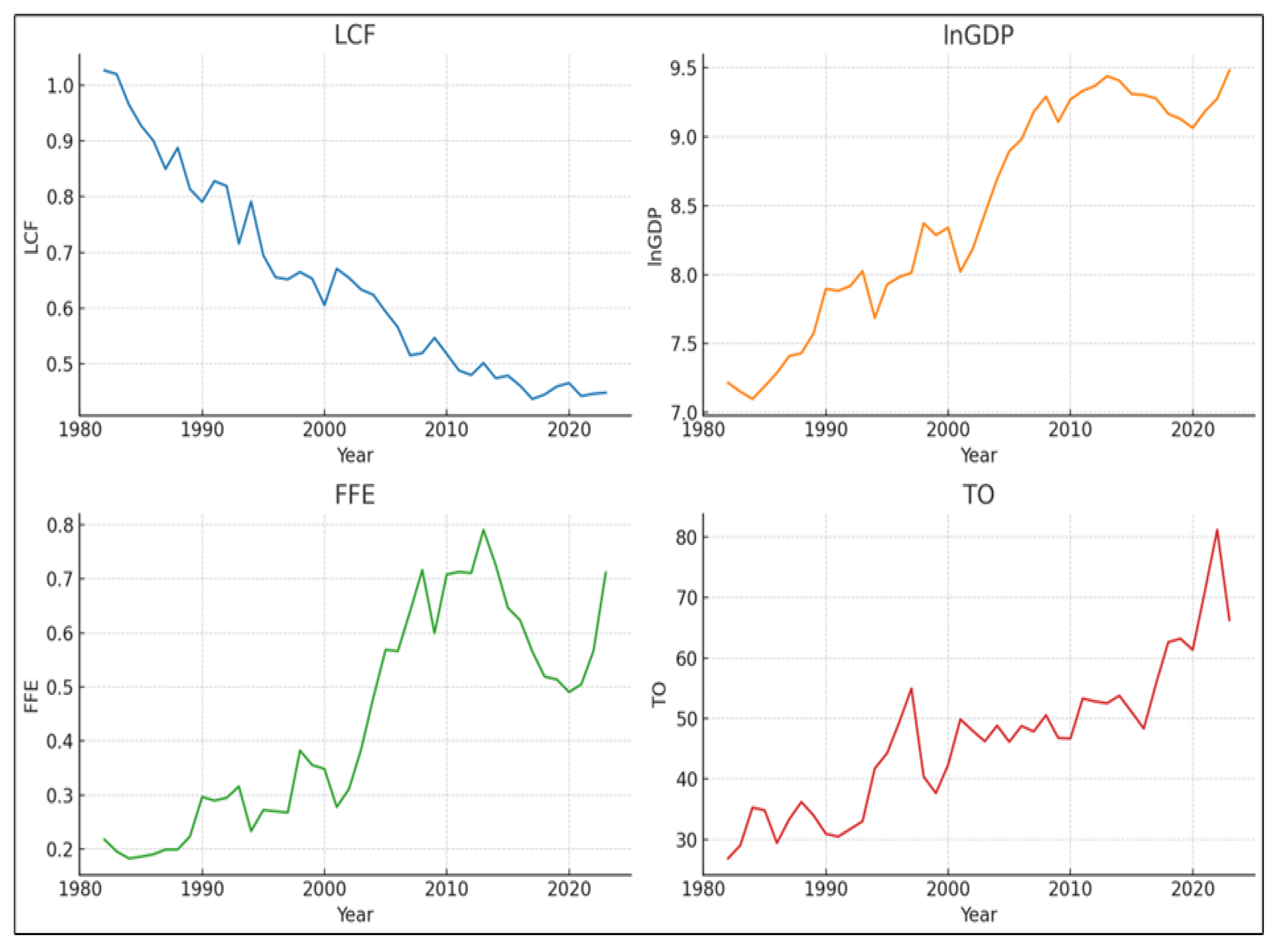
This study uses an annual data set covering the period from 1982 to 2023. The starting year, 1982, was chosen because data on per capita fossil fuel consumption in kilowatt-hours (kWh) is only available from that year onward. The analysis ends in 2023, as this is the most recent year for which data published by the World Bank is available.
Table 1 below summarizes the definitions of the variables obtained from the data set, the types of transformations applied, and the data sources.
To reduce differences in measurement units between series, minimize potential issues with varying variance (heteroscedasticity), and facilitate the interpretation of flexibility coefficients, the GDP variable has been converted to logarithmic form and prefixed with the symbol “ln”. Since the other variables are ratio variables, they were not log-transformed. The study used non-renewable energy efficiency as a variable, which indicates how much non-renewable energy is required to generate 1 US dollar of income. Non-renewable energy efficiency was calculated using the formula [
66]:
.
LCF, used as the dependent variable in the model, is an important indicator of environmental sustainability. A decrease in LCF indicates increased environmental pressure due to the ecological footprint exceeding biocapacity. Conversely, an increase in LCF indicates that natural resource use has become more aligned with the capacity provided by the ecosystem and that environmental conditions have improved. LCF reflects the ratio of biocapacity to ecological footprint. This ratio is a direct measure of the environmental supply-demand balance. A decrease in LCF indicates that demand exceeds supply, while an increase indicates that ecological demand is approaching current capacity.
The main objective of this study is to examine the effects of economic growth (GDP), fossil fuel energy efficiency (FFE), and openness to trade (TO) variables on LCF in Türkiye. Furthermore, the transformative role of openness is tested through the energy efficiency channel. The FFE × TO interaction term in Model 2 tests under which conditions openness strengthens or weakens the effect of energy efficiency on LCF. The functional structures of the models used in the study are presented in Equations (1) and (2).
After the natural logarithmic transformation, Equations (1) and (2) are re-expressed in the following regression form.
These models aim to test the effects of economic growth, energy efficiency, and openness on environmental sustainability both directly (Model 1) and interactively (Model 2). The theoretical expectations of these variables are discussed below in light of the literature and mechanisms.
Economic growth affects environmental outcomes through three main mechanisms [
17]. The combination of these mechanisms can create a nonlinear, three-stage dynamic on LCF, leading to an inverted-N relationship. In the first stage, the scale effect dominates. Increases in production and energy use increase the ecological footprint faster than biocapacity, reducing LCF (
). As income rises, compositional and technical effects driven by structural transformation, the adoption of cleaner technologies, and efficiency gains become apparent and improve LCF (
. At high income levels, however, increased mobility, residential energy demand, and overall consumption intensification re-accelerate the ecological footprint, making the scale effect dominant again and causing LCF to decline once more (
. This three-stage progression forms the theoretical basis for the inverse-N relationship between economic growth and environmental sustainability; within this framework, the marginal effect of growth in Model 1 is obtained by taking the derivative of the regression equation with respect to GDP, as shown in Equation (5).
If , an inverse-N relationship is present.
This three-stage scale–composition–rescale cycle demonstrates that the impact of economic activities on environmental sustainability can change direction depending on the income level. Therefore, the coefficients , , and are key indicators that determine which effect is dominant in the economic growth process and provide a critical theoretical reference for interpreting the analysis findings.
Energy efficiency is a critical component of sustainable growth. Fossil fuel energy efficiency (FFE), as used in this study, is the ratio of GDP per capita to fossil energy consumption per capita. When efficiency increases, it is possible to produce the same output with less energy, thereby reducing the ecological footprint and increasing LCF. The marginal dimension of this effect is shown in Model 1 by taking the derivative of LCF with respect to FFE and is expressed in the following equation:
Here
shows the elasticity of energy efficiency on LCF. When energy efficiency increases, the same production can be achieved with less fossil fuel. In this case, the ecological footprint decreases and LCF increases. However, the rebound effect, which is often discussed in the literature, can limit these gains. This effect arises from the stimulating impact of lower energy costs on demand. Lower energy costs can directly cause a rebound effect by increasing total energy demand. Furthermore, an indirect rebound may occur if the savings are diverted to other energy-intensive activities [
67].
Openness to trade also affects environmental sustainability through different mechanisms. When the scale effect is dominant, increased trade volume leads to intensified production and transportation activities, which increases environmental pressures and leads to a decrease in LCF, a situation defined as the pollution haven effect. Conversely, when composition and technical effects are dominant, cleaner technologies and environmental standards can spread through trade, increasing LCF and pointing to the pollution halo effect. In this context, the marginal effect of openness is derived from Model 1.
the scale effect is dominant and environmental quality deteriorates; when , the composition/technical effects become dominant and environmental quality improves.
In Model 2, since the growth channel does not interact with TO, the effect of growth on LCF depends entirely on income level. The coefficients
and
indicate that this relationship is not linear. At low income levels, the scale effect may be dominant and growth may reduce LCF. At medium income levels, technical and composition effects may create a temporary improvement. At high incomes, however, increased energy and resource use may again have a negative impact on LCF. This pattern is clearly evident in the marginal effect function defined by the derivative of Model 2 with respect to lnGDP.
Equation (8) shows how the marginal effect of growth on LCF can change direction as income levels increase. For example, when
,
, and
, the environmental impact of growth may initially be negative, then positive, and finally negative again at high income levels, exhibiting an inverted-N relationship. This three-stage pattern forms the theoretical basis for the inverted-N shape observed in Türkiye. In Model 2, since growth does not interact directly with openness to trade, its effect on LCF is shaped entirely by the varying dominance of scale, composition, and technical effects across income levels. Taking the derivative with respect to FFE yields the conditional marginal effect of energy efficiency:
Equation (9) shows that the effect of FFE on LCF depends on the level of openness (TO). The term
reflects the basic (unconditional) effect, while
reflects the extent to which this effect strengthens or weakens as openness increases. If
and
, an increase in FFE raises LCF, and this positive effect strengthens as the TO level rises; conversely, if
, efficiency gains may weaken at high levels of openness due to rebound and similar mechanisms. The effect of openness on LCF consists of two parts. For the part where TO enters the model as a level, the derivative with respect to TO is shown in Equation (10):
According to Equation (10), if
, the increase in trade volume reduces LCF through the scale effect; if
, composition and technical effects dominate, and openness increases environmental sustainability. When the derivative is taken with respect to lnTO, the efficiency channel created by the interaction term emerges:
Equation (11) shows that the marginal effect of openness on LCF depends on the level of FFE. When FFE is high (and under the assumption of ), an increase in openness improves LCF more, while when FFE is low and/or , the same increase in openness may limit environmental gains or even undermine them.
Therefore, the theoretically expected inverse-N dynamics describe a fluctuating pattern where environmental pressure first intensifies, then weakens, and finally increases again at high income levels as Türkiye’s income level rises. Energy efficiency (FFE), which accompanies this growth cycle, emerges as a strategic element that reshapes environmental balances by interacting with openness (TO), beyond being a direct improver. The current framework provides a critical theoretical basis for interpreting, through a holistic approach, the directional shifts indicated by growth coefficients in econometric analysis and the transformative effect revealed by interaction parameters.
3.2. Methodology
A two-stage methodological approach was followed in this study. First, the stationarity structures of the variables were tested. Then, long-term relationships were analyzed using the Fourier ARDL method. In the first stage of the analysis, the stationarity properties of the time series were examined using both the Augmented Dickey–Fuller (ADF) test and the Fourier Bootstrap ADF (FBADF) test, which considers structural breaks. Within the scope of the ADF test, models with a constant (Equation (12)), with a constant and trend (Equation (13)), and without a constant and trend (Equation (14)) were estimated for the variable
. Other variables were also evaluated according to the same test structures.
In these models, the constant term is represented by
, the time trend by
, the lagged level term by the coefficient a, and the error term by ε
t. The lag length is typically determined based on AIC or SC criteria; first-difference lags are added to prevent autocorrelation. The stationarity of the series at the level is tested by comparing the tau-statistic of the coefficient a with the critical values of MacKinnon [
68]. However, since classical ADF tests may be inadequate in structural breaks, the Fourier ADF test developed by Enders and Lee [
69], which includes sine-cosine terms, is used. The relevant equations are given in Equations (15)–(17).
In the Fourier ADF test, k represents the frequency, t represents the time trend, and T represents the number of observations. The significance of the added sine and cosine terms in the regression indicates the presence of a structural break in the series and reveals that the classical ADF test may be inadequate. In this case, if the test statistic exceeds the critical value, the series is considered stationary. Fourier components make the test more flexible and reliable by indirectly reflecting structural changes in the model.
In the second stage of the analysis, the long-term relationship between the variables was examined using the Fractional Frequency Fourier ARDL (FARDL) bounds test. This Fourier transform-based method increases the flexibility and statistical power of the test by incorporating the effect of structural breaks into the model through sine and cosine terms. The Fourier approach was developed to address the shortcoming of the traditional ARDL bounds test, which ignores structural changes and can lead to misleading results in long-term relationships. In this context, studies such as Solarin [
70], Pata and Aydın [
71] consider integer frequencies (k = 1, 3, 5), while Yilanci and Pata [
72], Christopoulos, and Leon-Ledesma [
73] integrated permanent structural breaks into the model based on fractional frequencies (k = 0.1, 0.3, …, 4.8, 5). In this regard, the model structures used in the study were enriched with Fourier components and estimated within the scope of Equations (18) and (19).
In Equations (18) and (19), the operator
represents the first difference of the variables. The constant term is denoted by
in Equation (18) and
in Equation (19). The coefficients from
to
in Equation (18) and from
to
in Equation (19) represent the long-term relationships of the model. Similarly, the coefficients in Equation (18) from
to
and in Equation (19) from
to
reflect the model’s short-term dynamics. The terms from
to
and from
to
in both equations represent the lag lengths of the relevant variables, and these values were determined based on the Akaike Information Criterion (AIC). ε
t in Equations (18) and (19) represents the error term. Finally, the hypotheses tested for the models specified in Equations (18) and (19) are presented below.
| Equation (18) hypothesis tests | Equation (19) hypothesis tests |
| |
| |
| |
The presented hypotheses are based on three complementary test statistics used to test for the existence of a long-term relationship in the model. The
tests the joint significance of all level terms; the
tests only the level term of the dependent variable; and the
tests the joint significance of the level terms of the independent variables. The presence of cointegration is accepted when all three tests reject the null hypothesis. The empirical model including the error correction term (ECT) is specified in Equations (20) and (21).
Equations (20) and (21) represent the coefficients of the error correction terms, where () and (), respectively, and this coefficient must be negative and statistically significant.