Article

Dual Drivers and Sustainability Tension: How Does Agricultural Supply Chain Finance Affect Core Enterprise Performance?


by
Zhaoming Sun
*,
Fengfei Li
and
Yuna Liu
School of Economics and Management, Qingdao Agricultural University, Qingdao 266109, China
*
Author to whom correspondence should be addressed.
Sustainability 2026, 18(1), 433; https://doi.org/10.3390/su18010433 (registering DOI)
Submission received: 23 November 2025 / Revised: 19 December 2025 / Accepted: 30 December 2025 / Published: 1 January 2026

Abstract

Based on the “dual-driven” framework, this study uses data from A-share listed agricultural companies from 2012 to 2022 to empirically test the mechanism by which agricultural Supply Chain Finance (SCF) affects the performance of core enterprises via the dual paths of “efficiency” and “responsibility.” Drawing on transaction cost theory and corporate social responsibility perspectives, the analysis reveals several key findings. First, SCF significantly improves enterprise performance by reducing transaction costs (coefficient = 0.117, p < 0.01), with transaction costs playing a partial mediating role. Second, fulfilling the social responsibility of connecting with and leading farmers negatively affects enterprise performance due to increased transaction costs (interaction term coefficient = −0.423, p < 0.1), creating a sustainable efficiency–responsibility tension. Third, supply chain concentration strengthens the efficiency path of SCF (interaction term coefficient = 0.002, p < 0.1). Non-state-owned enterprises, large-scale enterprises, and enterprises with executives having a financial background are more sensitive to the dual-driven mechanism. This study provides policy-relevant implications for supply chain governance that coordinate economic and social benefits.

1. Introduction

Supply Chain Finance (SCF) is a market-driven mechanism centered around core enterprises, leveraging their credit capacity to provide tailored financial solutions for upstream and downstream partners. In the agricultural sector, SCF serves as a vital component of inclusive finance, alleviating financing constraints for small and medium-sized enterprises (SMEs), supporting technology adoption, and facilitating the integration of smallholders into modern agricultural systems. However, as the dual core of both agricultural supply chains and SCF activities, core enterprises operate within a complex dual-driver structure. On one hand, they are driven by an efficiency logic aimed at enhancing supply chain resilience and reducing transaction costs to improve financial performance. On the other hand, they are expected to fulfill social responsibilities, such as promoting farmer integration and providing support, which aligns with broader sustainable development goals.
While prior research has explored the efficiency benefits of SCF and its social responsibility implications, most studies treat these two dimensions separately. Research focusing on financial performance seldom considers how responsibility commitments may erode efficiency gains, and vice versa. This oversight leads to a significant gap in understanding how core enterprises navigate the inherent tension between economic and social sustainability. To address this gap and provide a measurable framework, we define “sustainability tension” as the trade-off between efficiency-driven and responsibility-driven outcomes, manifested through changes in transaction costs. Specifically, in our analytical model, efficiency gains from SCF are hypothesized to reduce transaction costs, thereby enhancing performance, while fulfilling social responsibilities may increase transaction costs, subsequently inhibiting performance. This contradiction is empirically captured through the mediating role of transaction costs and the moderating effects of supply chain concentration and corporate social responsibility.
This study contributes to the literature in several ways. First, unlike previous research that treats efficiency and responsibility as independent dimensions, we integrate them into a unified “dual-driver” framework to examine their simultaneous and often contradictory impacts on core enterprise performance. Second, by conceptualizing “sustainability tension” through transaction cost dynamics and specifying its mediating and moderating pathways, we provide a testable model that moves the concept beyond mere theoretical discussion. Third, using panel data from Chinese agricultural listed companies (2012–2022), we offer robust empirical evidence on the mechanisms and boundary conditions of SCF effects, thereby delivering nuanced insights for both theory and practice.

2. Theoretical Analysis and Research Hypotheses

2.1. Agricultural SCF and Core Enterprise Operational Performance

SCF exhibits dual characteristics of operational coordination and financial mechanisms, reflecting synergistic functionality and the optimization of information governance. From the perspectives of the resource-based view and resource dependence theory, its implementation allows core enterprises to effectively manage and control critical external resources and dependencies within the supply chain. From a financial dimension, agricultural SCF mitigates financing constraints and promotes bank–enterprise coordination. The long production cycles inherent in agriculture, combined with frequent price volatility, introduce challenges in measuring credit risk premiums, leading financial institutions to adopt systemic credit rationing mechanisms [1]. Owing to sector-specific vulnerabilities, core enterprises encounter financing deficits in key areas, including technological innovation and equipment modernization [2]. At the same time, SMEs within agricultural supply chains experience limited access to external financing due to insufficient creditworthiness and pronounced informational asymmetries [3].
Through supply chain financial instruments, including accounts receivable financing and inventory pledging, core enterprises optimize capital structures, stabilize liquidity circulation within the supply chain, and provide implicit credit enhancement for SMEs via credit transmission mechanisms [4], thereby improving overall supply chain operational efficiency. In the context of bank–enterprise collaboration, continuous information exchange strengthens strategic partnerships and enhances financial flexibility through customized financial products, preferential interest rates, and relationship-based financing, while facilitating dynamic risk assessment and optimized risk-sharing through digital technologies [5]. This process drives the transformation of SCF from a short-term liquidity support mechanism into a sustainable value-creation system consistent with stakeholder theory.
From the supply chain perspective, drawing on network theory and social capital theory, SCF enhances the operational performance of core enterprises by promoting network structural integration and optimized information governance. By embedding financial instruments, such as order financing and warehouse receipt pledging, core enterprises gain access to real-time production and inventory data from upstream and downstream partners, thereby establishing a transparent, traceable supply chain system that strengthens supply control capabilities and supports digital transformation [6].
Agricultural SCF integrates diverse actors, including core enterprises, farmers’ cooperatives, logistics providers, and financial institutions into collaborative networks. This approach drives the evolution from linear supply chains to polycentric, multi-actor structures. Core enterprises consolidate resources through credit endorsement and shared data platforms, financial institutions provide capital and deploy advanced risk-control technologies, while SMEs and farmers contribute through stable supply commitments, collectively generating a value co-creation ecosystem. This ecosystem operates through three principal mechanisms: first, relationship-specific investments in supply chain relationships facilitate the synergistic reconfiguration of production processes across upstream and downstream entities, thereby improving production-marketing alignment and efficiency [7]; second, collaboration with SMEs through contractual arrangements, such as cross-shareholding and revenue-sharing mechanisms, effectively mitigates exposure to price volatility risk [8]; third, network-based synergies enable the aggregation and efficient allocation of innovation resources, including technological capabilities and human capital [9].
Through these mechanisms, core enterprises generate value across multiple dimensions: operationally, by accelerating capital turnover and improving liquidity management [10]; innovatively, by utilizing supply chain data to support precision R&D, reducing experimentation costs and accelerating product iteration; and market-wise, by expanding service coverage through channel network synergies while stabilizing SME order fulfillment [11]. Agricultural SCF thus enhances supply chain governance for core enterprises and produces positive spillover effects [12] through risk-sharing and benefit-sharing mechanisms, contributing to the structural upgrading of regional agricultural industry chains.
H1. 
Agricultural SCF positively affects the operational performance of core supply chain enterprises.

2.2. Risk Aggregation, Risk-Taking and Agricultural SCF

Agricultural SCF, as a multi-agent, short-term economic mechanism, functions as a “double-edged sword,” simultaneously enhancing resource allocation efficiency while concentrating risks within core enterprises, thereby posing significant industry-wide challenges. This dynamic can be analyzed through the lens of institutional theory and risk management frameworks, which emphasize how core enterprises adjust governance structures to respond to institutional pressures and environmental uncertainties.
First, when core enterprises extend credit enhancement services to upstream and downstream partners through accounts receivable pledges or cargo-right collateralization, they assume contingent financial liabilities. Defaults or operational failures among affiliated entities lead to the accumulation and transmission of risks within core enterprises. Second, providing financial services across diverse actors and complex transaction scenarios, particularly involving SMEs, generates supply chain architectures characterized by complexity, dynamism, openness, and cross-sectoral integration. Consequently, multi-source financial risks exhibit contagious, accumulative, and cyclical dynamics, significantly amplifying operational uncertainties for core enterprises. Third, core enterprises may exploit their dominant market positions and information asymmetries through high-risk financialization strategies, cross-market arbitrage, “credit arbitrage,” and inequitable trading arrangements [13]. Simultaneously, upstream and downstream participants may engage in information concealment or misrepresentation to secure financing, thereby exacerbating moral hazard risks. As a result, financial institutions often impose elevated risk premiums due to supply chain opacity and informational disparities. Prior research highlights that financialization substitution motives in core enterprises often outweigh precautionary motives [14], with documented occurrences of “elite capture” and institutional mission drift [15], ultimately constraining the realization of system-wide value creation potential. Fourth, the agricultural sector exhibits structural vulnerabilities, including fragmented production, low standardization, pronounced seasonality and regional specificity, extended production cycles, and the coexistence of natural and market risks. When combined with complex stakeholder relationships and elevated transaction costs, these vulnerabilities necessitate heightened prudence from core enterprises in implementing supply chain financial operations or projects.
Supply chain structure and stability constitute the fundamental basis for core enterprises to mitigate risks. Supply chain concentration, as a key indicator reflecting the dominant position of core enterprises within the supply chain network, captures the density of resource integration and the centripetal allocation of organizational influence among enterprises operating within vertically specialized division-of-labor systems. This strategic alignment is consistent with resource dependence theory, as firms seek to reduce environmental uncertainty and manage inter-organizational dependencies by consolidating their network positions.
At the upstream procurement end, core enterprises achieve scale economies and enhance governance efficiency through centralized procurement strategies, develop agricultural product quality traceability systems via order bundling mechanisms, implement self-enforcing supplier screening mechanisms, restrain moral hazards through repeated interactions, and reduce supplier default risks. At the downstream distribution end, the centralized information synergy platforms effectively mitigate the bullwhip effect. By integrating retailers’ data and logistics flows, core enterprises reduce temporal lags in the transmission of market fluctuations, improve the accuracy of demand forecasting, facilitate self-sustaining SCF cycles [16], and ultimately enhance market competitiveness [17] and operational performance [18], thereby reinforcing their structural dominance within vertically specialized division-of-labor systems.
Higher supply chain concentration indicates that core enterprises maintain intensive and strategically aligned partnerships with selected key suppliers and customers, implement collaborative oversight through network embeddedness and multilateral contractual arrangements, and transform traditional unidirectional principal-agent relationships into polycentric governance structures reinforced by reputational constraints and power-balancing mechanisms. This configuration constitutes an external governance mechanism grounded in resource dependence theory, complementing conventional corporate governance structures while substantially reducing agency costs [19].
This self-organized and transboundary governance paradigm inherently mitigates risks by constraining managerial moral hazards and adverse selection behaviors, in core enterprises’ decision-making processes, thereby lowering default probabilities, strengthening supply chain network resilience [20], and improving corporate financial stability [21]. Following increased supply chain concentration, upstream suppliers secure long-term procurement contracts supported by relationship-specific asset investments, while downstream distributors leverage channel resource consolidation to achieve scale economies, jointly forming an efficiency-driven collaboration framework that minimizes contractual frictions.
Consequently, guided by holistic and long-term strategic considerations, core enterprises exhibit a tendency to intensify agricultural supply chain concentration through the optimization of transaction frequency and transaction volume, thereby reducing transaction costs. Even when facing resource allocation costs [22], firms are able to achieve strategic and operational adjustments with relatively low adjustment costs.
Accordingly, the following hypothesis is proposed:
H2. 
To address agricultural supply chain financial risks, core enterprises strategically enhance supply chain concentration to optimize operational performance.

2.3. Transaction Costs, Social Responsibility and Core Operational Performance

In the SCF framework, transaction costs and operational performance of core enterprises exhibit a nonlinear dynamic interdependence, reflecting a structural efficiency-risk tradeoff under constrained resources. This relationship is central to transaction cost economics (TCE), which posits that firms select governance structures to minimize the total costs of production and transactions. Transaction costs encompass information processing, contractual execution, and risk monitoring [23], and their magnitude is positively related to the degree of supply chain complexity. Core enterprises maintain a dynamic balance between performance objectives and transactional expenditures, whereby improvements in operational performance typically accompany expansion in operational scale, while escalating transaction costs may erode profit margins and negatively affect operational outcomes.
Through data sharing and platform-based services, core enterprises achieve information integration, thereby reducing credit assessment and auditing expenditures [24], enhancing SMEs’ creditworthiness through social responsibility initiatives and guarantee substitution mechanisms, and lowering systemic default probabilities via multi-stakeholder risk-sharing protocols and multi-tier risk mitigation frameworks embedded in SCF ecosystems. Simultaneously, capital costs are optimized through policy coordination, fiscal incentives, and streamlined regulatory compliance procedures [25].
Building on the structural characteristics of agricultural supply chains, transaction costs emerge as a critical mediating mechanism linking SCF implementation to enterprise performance enhancement. Accordingly, the following hypothesis is proposed:
H3. 
Agricultural SCF improves core enterprises’ operational performance by reducing transaction costs.
Integrating smallholder farmers into agricultural value chains represents a core social responsibility of agricultural supply chain core enterprises. This imperative is strongly supported by stakeholder theory [26], which posits that firms bear obligations to a broad set of stakeholders beyond shareholders, including suppliers, local communities, and the environment. Leveraging SCF platforms, core enterprises achieve interoperable credit data sharing and transparent risk assessments, establish credit empowerment mechanisms based on accounts payable rights and bill endorsement instruments, reduce financing risk premiums for in-chain SMEs through implicit guarantee arrangements [27], and transmit creditworthiness through contractual relationships, thereby forming credit extension mechanisms.
Empirical evidence indicates that core enterprises’ credit facilitation, combined with stable transactional relationships, effectively alleviates financing constraints for upstream and downstream SMEs [28], constituting a pivotal pathway for integrating smallholder farmers into modern agricultural systems. The institutional and policy frameworks governing agricultural SCF inherently encourage the fulfillment of agrarian integration responsibilities by core enterprises [29], while simultaneously necessitating careful oversight of transaction cost dynamics. Institutional theory explains this process by highlighting how normative and coercive pressures from governments and industry associations shape corporate behavior towards social objectives.
To fulfill their social responsibility, core enterprises must establish linkages with a large number of upstream and downstream SMEs, including emerging agricultural actors [30], through diversified and inclusive engagement mechanisms. This process inevitably increases supply chain decentralization and structural complexity, thereby intensifying information asymmetry and coordination challenges across operational nodes. Such developments may conflict with strategic objectives aimed at maintaining structural stability, mitigating systemic risks, and optimize transactional efficiency, thereby creating an inherent tension between stakeholder integration and transaction cost efficiency.
The fulfillment of social responsibility by agricultural supply chain core enterprises thus exhibits dual characteristics: it may reduce transaction costs in the long run through trust-building, collaboration, and risk mitigation [31], while simultaneously generating short-term cost increases due to substantial initial investments and operational complexity. This duality reflects the interaction between stakeholder theory’s emphasis on relational governance and transaction cost economics’ focus on efficiency.
Specifically, the execution of agrarian integration responsibilities can increase transaction costs through several documented mechanisms:
First, information asymmetry is amplified. Agricultural SMEs and farmers often lack standardized financial records and verifiable credit histories, requiring core enterprises to allocate significant resources to due diligence and verification procedures, frequently involving third-party intermediaries. This substantially increases information search, acquisition, and verification costs [32].
Second, contractual complexity intensifies. Owing to the cyclical nature of agricultural production and pronounced price volatility, core enterprises must adopt more flexible and sophisticated contractual arrangements incorporating protective clauses and risk-sharing mechanisms for vulnerable participants, such as smallholder farmers. This results in higher costs related to contract negotiation, drafting, enforcement, and adaptation [33].
Third, monitoring and coordination challenges become substantially more pronounced. Managing relationships with a numerically expanded, highly fragmented, and weakly standardized set of upstream partners (e.g., numerous small-scale farmers) incurs elevated inter-organizational coordination costs. Core enterprises must invest in enhanced traceability systems and more frequent oversight to ensure quality and compliance, thereby increasing supervisory and audit expenditures [34]. Furthermore, heightened agricultural production risks and market volatility necessitate higher financial service premiums and additional hedging costs when extending support to these partners.
Fourth, risk-sharing expenditures increase correspondingly. Initial social responsibility investments, such as establishing inclusive procurement systems or providing technical assistance programs, involve substantial sunk costs. These are compounded by frictional costs arising from efforts to standardize diverse supply chain practices and bargaining costs due to asymmetries in benefit distribution among heterogeneous partners [35]. Organizational adjustments to accommodate agrarian integration, alongside enhanced risk governance and regulatory compliance requirements, collectively increase adaptive and administrative costs.
Consequently, the hypothesis is formulated:
H4. 
Core enterprises’ execution of agrarian integration responsibilities may reduce the performance-enhancing effects of SCF through increased transaction costs.
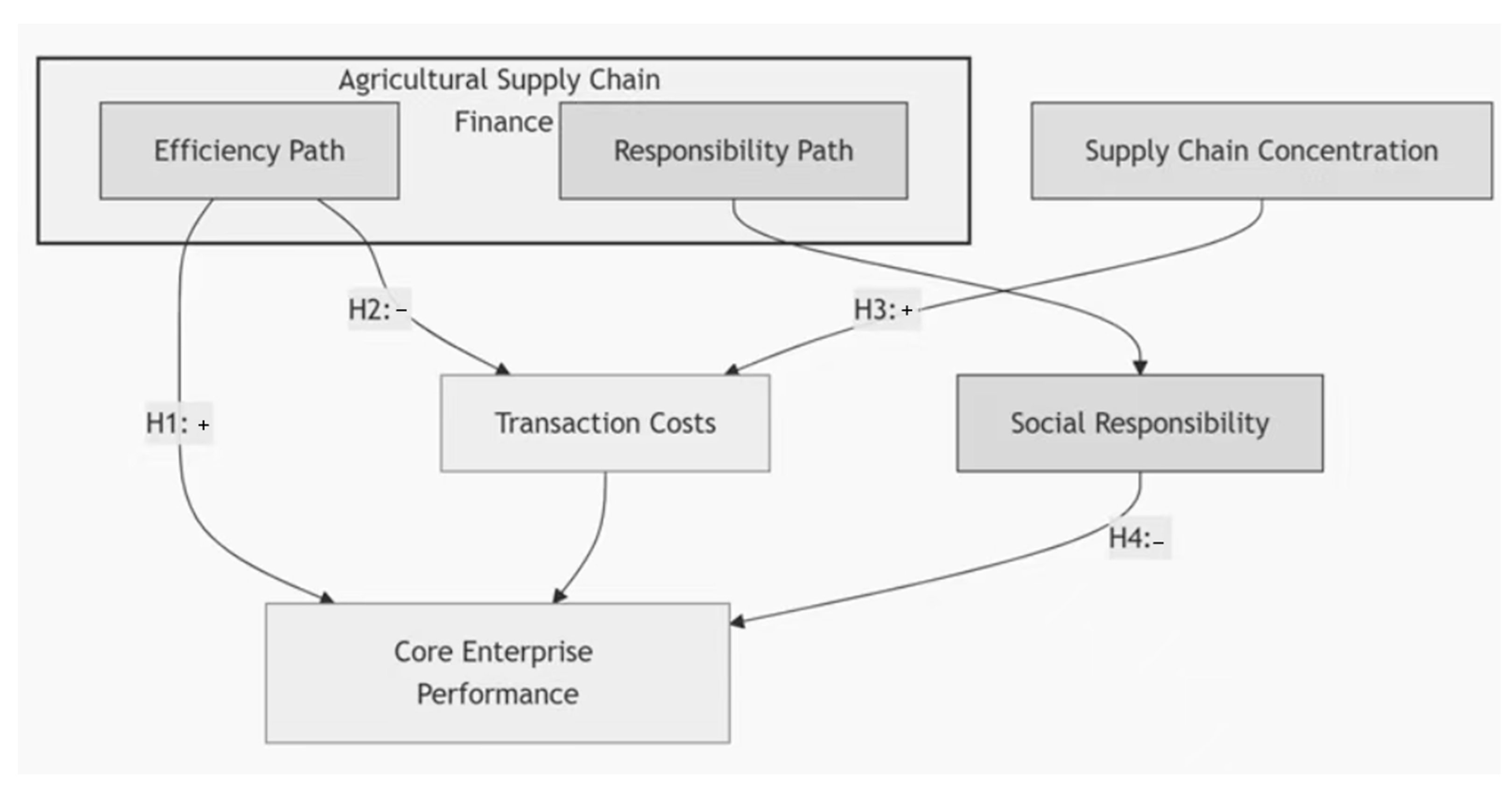
The conceptual framework diagram is shown in Figure 1:

3. Research Design

This section may be divided by subheadings. It should provide a concise and precise description of the experimental results, their interpretation, as well as the experimental conclusions that can be drawn.

3.1. Model Construction

To empirically examine the impact of SCF on the operational performance of agricultural listed companies, the following econometric model is specified:
R O A i , t = β 0 + β 1 S C F + β 2 S i z e i , t + β 3 A g e i , t + β 4 G r i , t + β 5 G u i , t + β 6 L e v i , t + β 7 C a f i , t + β 8 S o e i , t + β 9 D u a l i , t + β 10 B s i z e i , t + μ i + δ t + ε i , t
Here, ROA (Return on Assets) serves as the proxy for operational performance, while SCF quantifies the degree of supply chain financialization. β2 to β10 denote the coefficients of the control variables. To mitigate omitted variable bias, the model incorporates μᵢ (entity fixed effects) and δₜ (time fixed effects), through a two-way fixed effects specification. The stochastic error term εᵢ,ₜ captures residual variations. In Model (1), the statistical significance of coefficient β1 directly tests the primary hypothesis: a statistically significant positive β1 estimate (β1 > 0, p < α) indicates a performance-enhancing effect of SCF, whereas a significant negative coefficient (β1 < 0, p < α) suggests an inhibitory impacts on operational performance.

3.2. Description of Variables

The dependent variable, Return on Assets (ROA), measures operational performance. Following the methodologies of [36,37], the key explanatory variable SCF is operationalized as the ratio of short-term borrowings and notes payable to total assets. Control variables include firm size (Size), firm age (Age), operating income growth rate (Gr), fixed asset ratio (Gu), asset–liability ratio (Lev), operating cash flow (Caf), ownership type (Soe), CEO duality (Dual), and board size (Bsize). These definitions are consistent with the measurement frameworks of [38,39]. A formal summary of the variable definitions is provided in Table 1.

3.3. Data Sources

This study selects Chinese A-share agricultural companies from 2012 to 2022 as the sample of core enterprises. In accordance with the China Securities Regulatory Commission’s 2012 industry classification standards, listed companies in agriculture and related manufacturing industries (including agriculture, food processing, textiles, chemical raw materials, etc.) were screened. An analysis of the sources of missing data indicates that they mainly stem from the non-disclosure of relevant financial or supply chain information by certain companies. Furthermore, the missing data does not follow any systematic pattern across firm size, ownership type, or year, and are therefore considered missing at random, which ensures that the overall representativeness of the sample is not compromised. After excluding ST/*ST companies and observations with missing key variables, a final sample of 64 firms with 704 firm-year observations was obtained. Among these, 23 firms have actually engaged in SCF business through either self-built platforms or partnerships with financial institutions. To mitigate the potential influence of extreme outliers on estimation results and considering the possible skewness of certain financial variables, all continuous variables in this study were Winsorized at the 1st and 99th percentiles. This procedure aims to enhance the robustness of the model estimation and to prevent the distortion of regression results by individual extreme observations. The data were obtained from the CSMAR database. Table 2 presents the descriptive statistics for all variables.

4. Empirical Analysis

4.1. Benchmark Regression

Prior to estimation, multicollinearity diagnostics were conducted, revealing that all variance inflation factor (VIF) values were below 5, with a mean VIF of 1.44, indicating no significant multicollinearity. The F-test and Hausman tests confirmed the superiority of the fixed effects model compared to both pooled OLS and random effects specifications. Considering the presence of unobserved heterogeneity across firms and time periods, a two-way fixed effects model, incorporating both individual and temporal effects was employed as the primary analytical approach. For robustness checks, results from pooled regression results are presented as comparative benchmarks.
Table 3 presents the estimation results for fixed-effects and mixed-effects models, where columns (1) and (3) present the fixed-effects regression outcomes, and columns (2) and (4) report mixed-effects specifications. In column (1), coefficients for the majority of control variables demonstrate statistical significance at the 10% level or better. After incorporating the SCF variable, the goodness-of-fit of the model is observed to improve. The regression coefficient for SCF is 0.117 and is statistically significant at the 1% level, indicating that a one-unit increase in SCF is associated with an average increase of approximately 11.7 percentage points in the return on assets (ROA) of core enterprises. This result provides empirical support for Hypothesis H1, confirming that agricultural SCF has a significant positive impact on the operational performance of core enterprises.
Among the control variables, enterprise size (Size), operating income growth rate (Gr), and operating cash flow (Caf) exhibit statistically significant positive relationships with operational performance, suggesting that core enterprises with greater scale, higher growth rates, and stronger operational capabilities possess comparative advantages in resource acquisition. The fixed asset ratio (Gu) and gearing ratio (Lev) are negatively associated with operational performance, indicating that higher financial leverage exposes core enterprises to heightened operational risks. While existing literature suggests that corporate governance characteristics may influence corporate decision-making and performance, the coefficients of SOE, Dual, and Bsize in this study are not statistically significant. This finding indicates that, within the context of agricultural SCF, the direct effect of these traditional governance variables on the operational performance of core enterprises is relatively limited. Instead, corporate performance appears to be predominantly determined by factors at the supply chain level, such as supply chain structure, financial resource allocation, and market dynamics. Moreover, the governance structures of the sampled agricultural listed companies are relatively homogeneous, which may constrain the explanatory power of these variables. These results suggest that, when analyzing the effects of agricultural SCF, greater emphasis should be placed on supply chain-specific characteristics and mechanisms.

4.2. Discussion on Endogeneity

To address potential endogeneity issues arising from reverse causality, an instrumental-variable approach is employed. Contemporaneous variables may correlate with their lagged counterparts, which are not affected by current-period stochastic disturbances. In this study, the one-period lagged core explanatory variable SCF (L.SCF) is utilized as the instrument, and a two-stage least squares (2SLS) regression is implemented. The first-stage regression results, presented in column (1) of Table 4, indicate that L.SCF exhibits a statistically significant positive association at the 1% level, indicating the instrument’s relevance. Column (2) reports the second-stage regression outcomes, where the coefficient for SCF remains positive and statistically significant at the 1% level, indicating that the performance-enhancing effect of agricultural SCF persists after correcting for endogeneity. These results are consistent with the benchmark regression estimates, reinforcing the robustness of the core findings.

4.3. Robustness Test

To further test the robustness of the baseline results, we substitute the dependent variable by using alternative performance metrics—Return on Equity (ROE) and Earnings Per Share (EPS)—for substitute the original Return on Assets (ROA). Columns (3) and (4) of Table 4 present the regression results with ROE and EPS as the dependent variables, respectively. The estimated coefficients for SCF are 0.235 (ROE) and 1.188 (EPS), both significant at the 1% level. This indicates that a one-unit increase in SCF is associated with an average increase in ROE of approximately 23.5 percentage points and an average increase in EPS of approximately 1.188 yuan, providing further evidence supporting the robustness of the positive effect of SCF on operational performance across performance indicators. Relative to the SCF coefficient in the baseline model (0.117 for ROA), the impact of SCF on ROE and EPS is numerically larger. This may reflect the fact that ROE and EPS more directly capture shareholder returns and profitability and are more sensitive to capital structure and equity scale, whereas ROA primarily reflects the overall efficiency of asset utilization. Although the magnitudes of the coefficients vary due to the characteristics of the respective indicators, all three consistently support the conclusion that SCF exerts a significant positive influence on the performance of core enterprises, thereby underscoring the robustness of the study’s findings.
To validate robustness through independent variable substitution, we adopt the SCF intensity metric (SCF1), defined as the ratio of short-term borrowings, notes payable, and accounts payable to total assets. The results are reported in column (5) of Table 4. The coefficient for SCF shows a slight variation but retains both its sign and the statistical significance, consistent with the baseline estimates (** p < 0.01). Specifically, each one-unit increase in SCF is associated with an average increase in ROA of approximately 13.2 percentage points. These findings provide further evidence supporting the robustness of the primary results of this study.

4.4. Heterogeneity Analysis

Given the distinctive characteristics of agricultural industries and the complexity of SCF, analyses should systematically incorporate heterogeneity in core enterprises’ ownership structures, market positioning, and operational governance characteristics.
(1)
Heterogeneity in ownership structures of core enterprises. Divergent ownership configurations within supply chain entities may differentially influence the effectiveness of SCF. Non-state-owned agribusinesses typically face more stringent financing constraints and stronger profit-maximization pressures compared to their state-owned counterparts. They exhibit greater operational flexibility in supply chain integration, heightened sensitivity to transaction costs, and strategic risk tolerance, which collectively enhance market competitiveness and support sustainable growth. Increased supply chain concentration amplifies these behavioral patterns in non-state-owned enterprises.
Conversely, state-owned agricultural enterprises benefit from more diversified capital resources and pursue dual objectives of profit optimization and social responsibility fulfillment, often incurring higher operational expenditures. The tenure-driven incentive structures of state-owned enterprise management foster risk-averse decision-making, predisposing these firms toward projects with predictable returns while limiting their responsiveness to transaction costs. This institutional rigidity reduces their receptiveness to agricultural SCF initiatives, which are typically characterized by extended operational cycles and standardization challenges.
As empirically validated in Columns (1)–(2) of Table 5, the SCF coefficient demonstrates statistically significant positive effects for non-state-owned enterprises (β = 0.172, p < 0.01), whereas the state-owned enterprise cohort exhibits non-significant effects (β = 0.029, p > 0.10). These results substantiate that SCF effectively enhances operational performance primarily in non-state-owned enterprise ecosystems. Non-state-owned enterprises exhibit a stronger response to SCF, primarily because they face more severe financing constraints and possess a greater profit orientation, which renders them more flexible and cost-sensitive in supply chain integration. In addition, non-state-owned enterprises generally exhibit a higher degree of marketization and a stronger propensity for risk-taking, which enables them to utilize SCF more effectively to optimize capital allocation, reduce transaction costs, and thereby enhance performance. In contrast, state-owned enterprises undertake more social responsibilities and policy tasks, and their decision-making processes are relatively conservative, resulting in a weaker response to the efficiency incentives of SCF.
(2)
Heterogeneity in corporate market positioning. Corporate market positioning significantly shapes the adoption and effectiveness of SCF. Core enterprises demonstrate varying market dominance, l supply chain integration capabilities, and propensities for supply chain financial operations. Compared with agricultural supply chain anchors of smaller operational scales and weaker market positions, large-scale core enterprises exhibit three strategic advantages: (a) enhanced market leadership and superior resource endowment; (b) greater access to government support and stronger risk mitigation capacity; (c) broader transaction networks with upstream and downstream partners, coupled with reduced cost elasticity.
These attributes collectively increase the likelihood of successful SCF implementation. Following median-based classification of total assets, enterprises exceeding the median are categorized as large-scale, while those below the median constitute the small-scale group. Columns (3)–(4) of Table 5 present the stratified regression outcomes. The large-scale cohort demonstrates a statistically significant SCF coefficient of 0.141 (p < 0.01), whereas the small-scale group shows an insignificant coefficient of 0.033. This evidence confirms the differential efficacy of agricultural SCF, demonstrating that operational effectiveness is substantiated for large-scale enterprises but remains statistically unverified for smaller counterparts.
(3)
Heterogeneity in managerial financial expertise. Managerial financial expertise plays a critical role in determining the effectiveness of SCF. As the operational implementers of SCF strategies, the executive teams of core enterprises exhibit critical disparities. Executives with financial backgrounds possess enhanced knowledge in financial operations, superior risk assessment capabilities, and stronger governance over project execution. These collectively strengthen the performance outcomes of SCF initiatives. A binary variable is constructed to identify financial expertise among executives (including directors, supervisors, and C-suite managers), where 1 indicates the presence of financial expertise and 0 otherwise. Columns (5)–(6) in Table 5 present the stratified regression outcomes. The group with financially experienced executives shows a statistically significant SCF coefficient of 0.206 (p < 0.01), while the non-expert group shows an insignificant coefficient of −0.08. These findings confirm that SCF mechanisms operate effectively only when implemented by financially literate management teams. An executive team with a financial background tends to respond more strongly to SCF, reflecting the advantages of their professional capabilities in the application of financial instruments, risk assessment, and resource allocation. Such teams are able to more accurately evaluate the benefits and risks of SCF projects and design more effective risk control mechanisms and contract structures, thereby enhancing capital utilization efficiency and overall operational performance. In contrast, management lacking financial expertise may face cognitive constraints in project evaluation and implementation, making it challenging to fully exploit the potential benefits of SCF.

5. Analysis of Mechanisms of Action

5.1. Analytical Models of Mechanisms

To examine whether SCF influences operational performance through transaction costs, the model is constructed following the three-step method of [40]:
R O A i , t = β 0 + β 1 S C F + β 2 T C o s t i , t + β 3 C o n t r o l i , t + μ i + δ t + ε i , t
T C o s t i , t = β 0 + β 1 S C F + β 2 C o n t r o l i , t + μ i + δ t + ε i , t
Here, TCost denotes transaction costs. Models (1)–(3) jointly test for the mediation effects. Transaction costs exhibit partial mediation when coefficient β1 is significant in both models (1) and (2), and β1 and β2 remain significant in model (3). Full mediation occurs when β1 becomes non-significant while β2 remains significant in model (3).
To assess the moderating role of supply chain structure in the relationship between SCF and operational performance, the following model is constructed:
R O A i , t = β 0 + β 1 S C F + β 2 C S + β 3 S C F × C S + β 4 C o n t r o l i , t + μ i + δ t + ε i , t
The coefficient β3 of the expected cross term in Model (4) is significantly positive.
Similarly, to evaluate the moderating influence of corporate social responsibility (CSR) on the SCF–performance nexus, a model is constructed:
R O A i , t = β 0 + β 1 S C F + β 2 C S R + β 3 S C F × C S R + β 4 C o n t r o l i , t + μ i + δ t + ε i , t
The coefficient β3 of the expected cross term in Model (5) is significantly negative.
Building on prior research [41,42,43,44], we develop a CSR evaluation index system and apply an improved entropy weight method for CSR measurement (see Table 6).

5.2. Mediation Effect Test

The mediating effect of transaction costs (TCost) is assessed using Models (2) and (3) (see Table 7). Column (1) of Table 7 examines the total effect of SCF on core firms’ operating performance (ROA). The coefficient of SCF is significantly positive, indicating that SCF enhances core firms’ operating performance; Column (2) examines the effect of SCF on the mediating variable, transaction costs (TCost). The SCF coefficient is significantly negative, indicating that SCF reduces transaction costs; Column (3) incorporates both SCF and TCost as explanatory variables. Both coefficients remain statistically significant, and the SCF coefficient is smaller than in Column (1).
These results demonstrate that SCF not only directly improves operational performance, but also indirectly promotes performance by optimizing supply chain governance, reducing information asymmetry, and lowering transaction costs. Therefore, transaction costs play a partial mediating role, providing empirical support for the hypothesis.

5.3. Moderating Effects Test

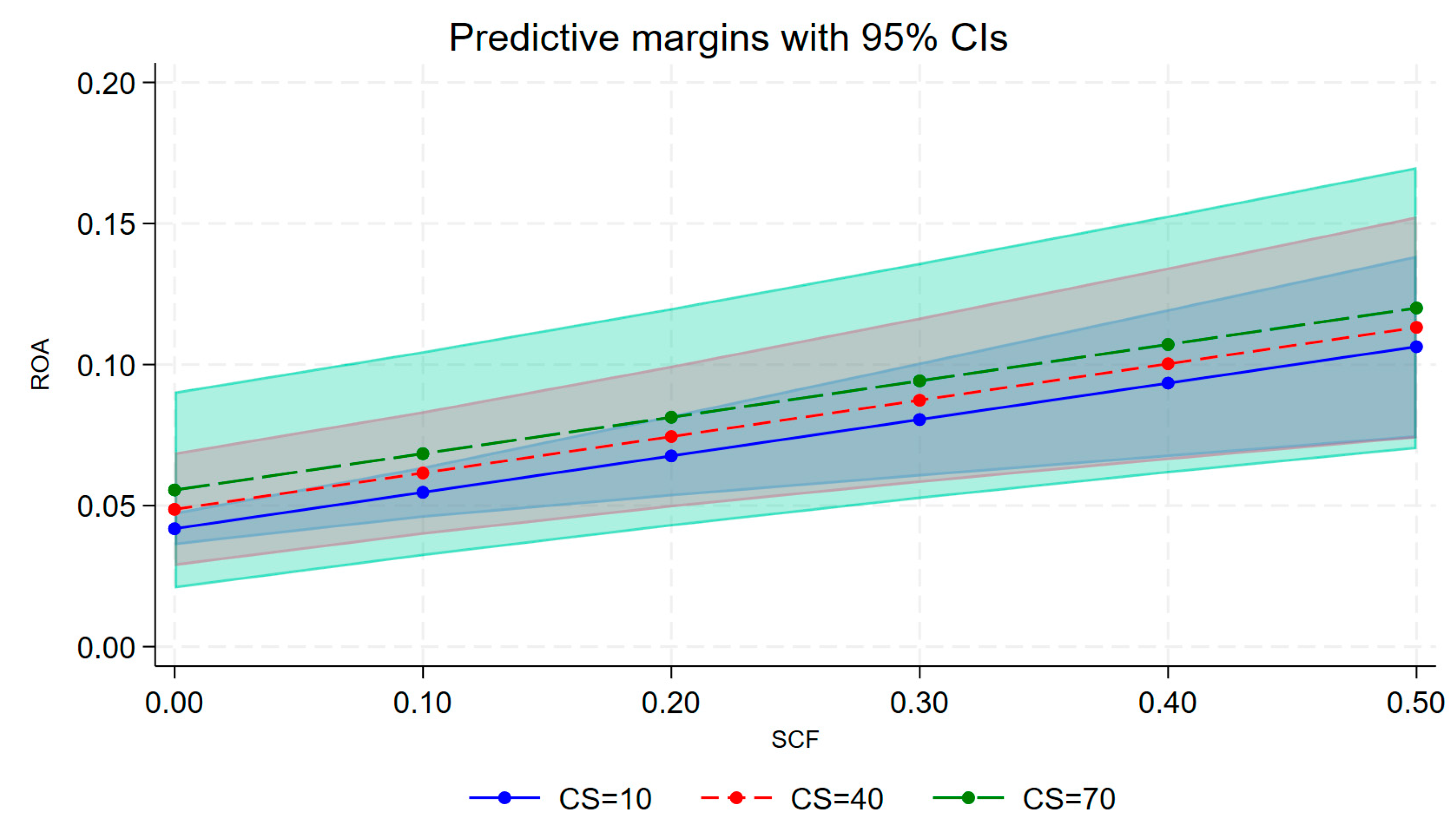
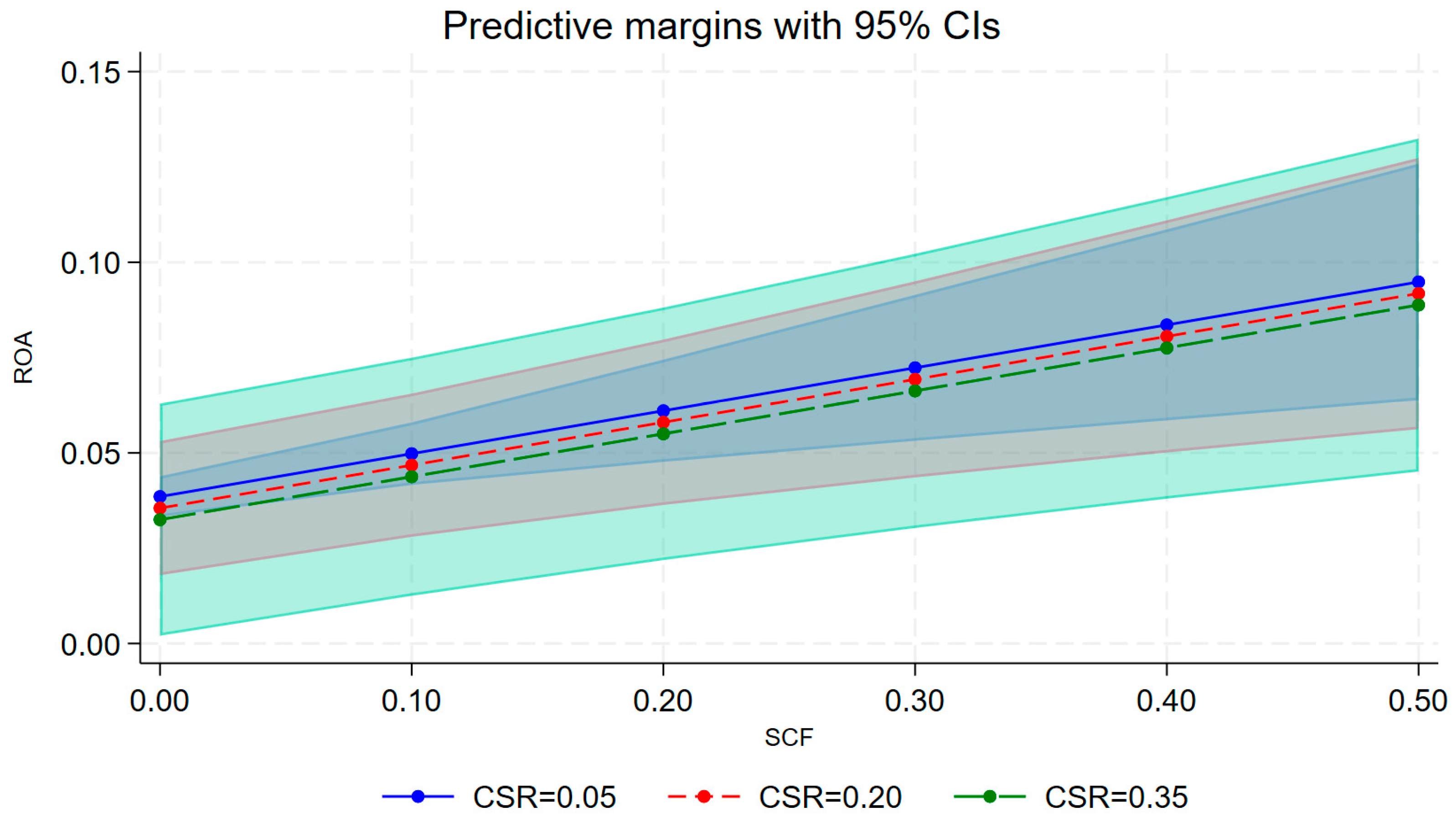
Using Models (4) and (5), the moderating effects of supply chain concentration and social responsibility are examined (see Table 7). In column (5), the regression coefficient of the interaction term between SCF and supply chain concentration (SCF × CS) is 0.002, which is statistically significant at the 0.1 level. This indicates that higher supply chain concentration incentivizes core enterprises to implement SCF initiatives, thereby enhancing operational performance. Accordingly, Hypothesis H2 is supported. As illustrated in Figure 2, as supply chain concentration increases, the marginal effect of SCF on ROA exhibits a significant and sustained upward trend. The confidence intervals consistently exclude zero, suggesting that high concentration amplifies the performance-enhancing effect of SCF through strengthened collaboration and reduced risk. In column (6), the regression coefficient of the interaction term between SCF and social responsibility (SCF × CSR) is −0.423, which is significant at the 0.1 level. This implies that undertaking social responsibility diminishes the positive effect of SCF on core enterprises’ performance, confirming Hypothesis H4. Figure 3 further illustrates that as the level of social responsibility fulfillment increases, the marginal effect of SCF on ROA exhibits a significant declining trend. This suggests that, in the short term, the fulfillment of social responsibilities may entail additional costs and regulatory obligations, thereby constraining the economic benefits of SCF.

6. Conclusions and Recommendations

From the perspective of the “dual-wheel drive” theory, this study employs panel data from Chinese A-share agricultural listed companies from 2012 to 2022 to systematically examine the internal mechanisms and boundary conditions through which agricultural SCF influences the performance of core enterprises. The principal theoretical contribution of this research lies in integrating the fundamental tension between “efficiency” and “responsibility” in the context of sustainable development into a unified analytical framework. The study elucidates the dual-path mechanisms and moderating conditions through which agricultural SCF affects firm performance, thereby deepening the understanding of the complex relationship between the economic sustainability (efficiency-driven) and the social sustainability (responsibility-driven) in SCF, and enriching the existing literature at the intersection of SCF and sustainable development. The main research findings are as follows:
First, agricultural SCF is found to significantly enhance the operational performance of core enterprises, reaffirming its fundamental role as an efficiency-oriented instrument. This effect is manifested not only in direct performance improvements but also, more importantly, in substantially reducing transaction costs within the supply chain system through network structure integration and information governance optimization, revealing its key pathway to enhancing economic sustainability.
Second, the study confirms the positive moderating role of supply chain concentration as a mechanism that amplifies efficiency-driven effects. This finding indicates that the establishment of stable and concentrated supply chain networks can further magnify the benefits of SCF in reducing costs and improving operational efficiency through economies of scale, collaborative supervision, and risk mitigation. Consequently, such networks reinforce market competitiveness and enhance the operational resilience of core enterprises.
Third, this study centrally reveals the sustainability tension between “efficiency” and “responsibility” within the dual-wheel-drive framework. Empirical results show that actively fulfilling the social responsibility of “supporting and assisting farmers” leads to increased transaction costs due to factors such as heightened management complexity and information asymmetry, thereby negatively moderating the performance-enhancing effects of SCF. This clearly underscores a practical trade-off and conflict between achieving social sustainability goals and financial performance reflecting economic sustainability in the short-term, constituting a core dilemma in corporate strategic decision-making.
Fourth, heterogeneity analysis further delineates the contextual boundaries of the dual-wheel-drive effects. Core enterprises that are non-state-owned, large-scale, or led by executives with financial expertise demonstrate greater agency and adaptability in responding to efficiency drivers and managing the responsibility–efficiency tension, owing to their higher cost sensitivity, richer resource endowments, and more sophisticated management capabilities.
Based on the above conclusions, the policy implications of this study extend beyond one-dimensional incentives or constraints, emphasizing the need to construct a comprehensive governance system capable of recognizing, balancing, and synergizing the dual-wheel drive, thereby promoting inclusive growth and long-term sustainable development of agricultural supply chains. Specific recommendations are as follows:
1.
For Core Enterprises: Implement tension management strategies and develop dynamic ambidextrous capabilities. Enterprises should move beyond perceiving social responsibility as a static cost burden and actively transition toward “strategic ambidextrous governance.” Firstly, they should continuously strengthen the efficiency drive by systematically optimizing supply chain processes through digital governance tools, such as big data analytics and blockchain, to reduce information, negotiation, and supervision costs. For example, enterprises can design and implement blockchain-based platforms for agricultural product traceability and accounts receivable confirmation, automatically executing smart contracts to minimize manual verification and dispute resolution costs.
Secondly, they should innovate models for implementing the responsibility drive, such as designing tight interest linkage mechanisms, including “farmer cooperative equity participation” or “contract farming combined with futures hedging.” Such approaches enhance supply chain standardization and controllability while fulfilling the responsibility of supporting farmers, thereby mitigating the tension at its source.
2.
For Government Departments: Design incentive-compatible policies and implement targeted empowerment and compensation. The government should shift from a “blanket approach” to a “targeted precision.” To begin with, it should establish cost compensation mechanisms specifically aimed at supporting the fulfillment of social responsibilities, such as creating special subsidies, tax incentives, or performance-based reward funds linked to measurable outcomes of farmer support (e.g., the number of farmers reached, the increase in farmers’ income). These measures directly offset the additional transaction costs borne by core enterprises, alleviating financial pressures. In addition, the government should vigorously promote the integration of substantive achievements in supporting and assisting farmers into corporate ESG (Environmental, Social, and Governance) evaluation systems and guide capital markets to recognize and reward long-term value creation associated with sustainable practices. In doing so, external social value is internalized as endogenous economic value for enterprises.
3.
Optimize the supply chain governance ecosystem to strengthen the foundation for sustainable development. Core enterprises should be encouraged to develop “communities of shared future” with high-quality upstream and downstream partners through strategic alliances, cross-shareholdings, and other arrangements. Such approaches enhance supply chain concentration and operational efficiency while providing stable and credible organizational platforms for the effective fulfillment of social responsibilities. Meanwhile, regulatory authorities should lead the development of agricultural SCF risk early warning and emergency response platforms, leveraging fintech solutions to enable dynamic monitoring, joint prevention, and systemic risk control, thereby ensuring the secure and smooth functioning of the dual-wheel drive.
4.
Strengthen heterogeneity guidance to enhance policy system adaptability. For non-state-owned enterprises, key support should focus on providing specialized credit assistance and technical advisory services for SCF, thereby unleashing market vitality. For state-owned enterprises, the emphasis in performance evaluations on fulfilling the social responsibility of supporting farmers should be increased to prevent “mission drift.” Through categorized guidance and precise policy implementation, the comparative advantages of various core enterprises in advancing the sustainable development of agricultural supply chains can be fully leveraged.
While summarizing the research findings, it is also essential to acknowledge several limitations of this study and propose directions for future research, thereby providing guidance for subsequent investigations in the field.
(1)
Research Limitations
Firstly, the sample of this study primarily focuses on agricultural listed companies in China’s A-share market, which are generally large-scale and possess relatively standardized governance structures. This scope does not sufficiently capture the diversity of entities such as small and medium-sized non-listed agricultural enterprises and cooperatives. Therefore, potentially limiting the generalizability of the findings across the broader agricultural supply chain. Secondly, the measurement of SCF primarily relies on explicit indicators in financial statements such as short-term loans and notes payable, which may not fully reflect implicit dimensions including business model innovation and the adoption of digital platforms. Future research could integrate text analysis, survey data, and other multidimensional characterization. Thirdly, due to the relatively limited statistical significance of the moderating effect of CSR, the intensity and universality of the sustainable tension require further validation through larger sample sizes or more refined econometric models. Finally, although this study mitigated endogeneity issues using instrumental variable methods, estimation bias due to omitted variables or bidirectional causality may still persist.
(2)
Future Research Directions
Future research could advance in the following directions: First, expand the scope of research subjects to include more inclusive entities, such as micro, small, and medium-sized agricultural enterprises and family farms, to investigate their performance responses and risk-bearing mechanisms under different SCF models. Second, adopt richer measurement approaches for SCF, such as the extent of smart contract adoption via blockchain or the depth of access to SCF platforms, to enhance construct validity. Third, employ longitudinal case studies or tracking surveys to dynamically examine the evolution of the “efficiency–responsibility” tension at different stages of supply chain development, and assess its impact on the long-term sustainable development of enterprises. Fourth, explore a multidimensional performance evaluation system for agricultural SCF within the ESG (Environmental, Social, and Governance) framework, with particular emphasis on spillover effects in non-economic dimensions, such as ecological conservation and rural governance. Fifth, conduct comparative studies across regions and industries to identify the heterogeneity of dual-wheel-drive mechanisms and derive policy implications under varying institutional contexts and industry characteristics.

Author Contributions

Conceptualization, Z.S.; methodology, Z.S.; validation, F.L.; formal analysis, F.L. and Y.L.; investigation, F.L.; resources, Z.S.; data curation, Y.L.; writing—original draft preparation, F.L.; writing—review and editing, Z.S.; visualization, F.L.; supervision, Z.S.; project administration, Z.S.; funding acquisition, Z.S. All authors have read and agreed to the published version of the manuscript.

Funding

This study was supported by the Corn Innovation Team Industry Economics Position of the Shandong Modern Agricultural Industrial Technology System, under the grant number SDAIT-02-13, and also received funding from the Shandong Provincial Key Research Project on Financial Applications, titled “Research on the Development Models and Optimization Pathways of Agricultural Supply Chain Finance in Shandong Province,” under the grant number 2022-JRZZ-16. The APC was funded by the Corn Innovation Team Industry Economics Position of the Shandong Modern Agricultural Industrial Technology System and the Shandong Provincial Key Research Project on Financial Applications, “Research on the Development Models and Optimization Pathways of Agricultural Supply Chain Finance in Shandong Province”.

Institutional Review Board Statement

Not applicable.

Informed Consent Statement

Not applicable.

Data Availability Statement

The data presented in this study are available on request from the corresponding author.

Conflicts of Interest

The authors declare no conflicts of interest.

References

  1. Deng, L.; Yu, X. Optimal Financing Strategy in a Dual-Channel Supply Chain with Agricultural Product. Mathematics 2024, 12, 2835. [Google Scholar] [CrossRef]
  2. Muntaka, S.A.; Apike, A.I.; Antwi, D. Antecedents of sustainable agricultural supply chain financing for achieving food security in resource-constrained developing economies: A complex adaptive systems theory perspective. Aust. J. Agric. Resour. Econ. 2024, 68, 868–890. [Google Scholar] [CrossRef]
  3. Sexton, J.R.; Xia, T. Increasing Concentration in the Agricultural Supply Chain: Implications for Market Power and Sector Performance. Annu. Rev. Resour. Econ. 2018, 10, 229–251. [Google Scholar] [CrossRef]
  4. Xu, Z.; Gong, B.; Hu, L.; Gu, H. Supply Chain Finance, FinTech and Corporate Risk-Taking: Evidence from Textual Analysis of China Public companies’ Announcements. Emerg. Mark. Financ. Trade 2025, 61, 2374–2400. [Google Scholar] [CrossRef]
  5. Wang, Y.; Cheng, P. Supply chain upstream shocks and downstream concentration in the new energy sector: Balancing diversification and centralization. Energy Econ. 2025, 145, 108510. [Google Scholar] [CrossRef]
  6. Pu, X.; Luan, S.; Li, X. The antecedent configurations of the supply chain finance adoption in China: Evidence from SEM and fsQCA findings. Financ. Res. Lett. 2025, 79, 107302. [Google Scholar] [CrossRef]
  7. Yin, H.; Tang, Y.; Jin, H. Sustainability in the supply chain, environmental, social and corporate governance performance, and corporate value. Financ. Res. Lett. 2025, 77, 107061. [Google Scholar] [CrossRef]
  8. Marak, R.Z.; Pillai, D. Determinants of Supply Chain Finance Adoption Among Small and Medium Enterprises in India: Mediating Role of Collaboration. J. Knowl. Econ. 2025, 1–38. [Google Scholar] [CrossRef]
  9. Tian, L.; Tian, W.; Guo, M. Can supply chain digitalization open the way to sustainable development? Evidence from corporate ESG performance. Corp. Soc. Responsib. Environ. Manag. 2024, 32, 2332–2346. [Google Scholar] [CrossRef]
  10. Zhao, Z.; Lei, W. Impact of supply chain finance on the business risk of core enterprises: Evidence from China. J. Bus. Ind. Mark. 2024, 39, 2545–2555. [Google Scholar] [CrossRef]
  11. Zardo, J.D.; Granela, P.A.; Sehnem, S.; Julkovski, D.J. Circular supply chain and circular practices: An analysis from the perspective of sustainability and Industry 4.0. Corp. Soc. Responsib. Environ. Manag. 2024, 32, 1831–1846. [Google Scholar] [CrossRef]
  12. Wang, Y.; Chen, Y.; Huang, S. Agricultural supply chain financing strategy with social responsibility consideration under platform financing mode. Electron. Commer. Res. Appl. 2023, 62, 101337. [Google Scholar] [CrossRef]
  13. Chen, Q.; Chen, X.; Li, S.; Chen, J. Blockchain-enabled supply chain finance model: A study of the dual-channel closed-loop supply chain of electronic products. Ann. Oper. Res. 2024, 343, 87–124. [Google Scholar] [CrossRef]
  14. Saeed, M.M.; Mohammed, S.S.; Kumari, M.; Pandey, G. The impact of corporate environmental reporting on the financial performance of listed manufacturing firms in Ghana (Csr-24-2036). Corp. Soc. Responsib. Environ. Manag. 2024, 32, 1230–1244. [Google Scholar] [CrossRef]
  15. He, L.; Zhou, L.; Qi, J.; Song, Y.; Jiang, M. The Role of Digital Finance Embedded in Green Agricultural Development: Evidence from Agribusiness Enterprises in China. Land 2024, 13, 1649. [Google Scholar] [CrossRef]
  16. Wei, S.; Deng, C.; Liu, H.; Chen, X. Supply chain concentration and financial performance: The moderating roles of marketing and operational capabilities. J. Enterp. Inf. Manag. 2024, 37, 1161–1184. [Google Scholar] [CrossRef]
  17. Chakradhar, J.; Gupta, R. Heterogeneous effect of economic policy uncertainty and firm financial performance: Empirical evidence from India. Manag. Decis. Econ. 2024, 45, 4930–4951. [Google Scholar] [CrossRef]
  18. Mao, J.; Xie, J.; Gao, Y.; Tang, Q.; Li, Z.; Zhang, B. Navigating Growth: The Nexus of Supply Chain Finance, Digital Maturity, and Financial Health in Chinese A-Share Listed Corporations. Sustainability 2024, 16, 5418. [Google Scholar] [CrossRef]
  19. Liu, X.; Zheng, Z. The impact of supply chain finance on supplier stability: The mediation role of corporate risk-taking. Financ. Res. Lett. 2024, 65, 105606. [Google Scholar] [CrossRef]
  20. Zhang, C.; Li, S.; Liu, X.; Li, J. The effect of strategic supply management on operational and innovation performance: The mediating role of external supply resources mobilization. J. Bus. Ind. Mark. 2024, 39, 871–886. [Google Scholar] [CrossRef]
  21. Garrido-Ruso, M.; Otero-González, L.; López-Penabad, M.; Santomil, P.D. Does ESG implementation influence performance and risk in SMEs? Corp. Soc. Responsib. Environ. Manag. 2024, 31, 4227–4247. [Google Scholar] [CrossRef]
  22. Tao, J.; Shan, P.; Liang, J.; Zhang, L. Influence Mechanism between Corporate Social Responsibility and Financial Sustainability: Empirical Evidence from China. Sustainability 2024, 16, 2406. [Google Scholar] [CrossRef]
  23. Chandio, A.A.; Alnafissa, M.; Akram, W.; Usman, M.; Joyo, M.A. Examining the impact of farm management practices on wheat production: Does agricultural investment matter? Heliyon 2023, 9, e22982. [Google Scholar] [CrossRef] [PubMed]
  24. Lee, C.; Ha, Y.-K. Applying an extended investment model for enhancing supply chain performance. J. Bus. Ind. Mark. 2023, 38, 2533–2544. [Google Scholar] [CrossRef]
  25. Wang, S.; Yu, H.; Wei, M. The effect of supply chain finance on sustainability performance: Empirical analysis and fsQCA. J. Bus. Ind. Mark. 2023, 38, 2294–2309. [Google Scholar] [CrossRef]
  26. BenitezAltuna, F.; Materia, C.V.; Bijman, J.; Gaitán-Cremaschi, D.; Trienekens, J. Farmer–buyer relationships and sustainable agricultural practices in the food supply chain: The case of vegetables in Chile. Agribusiness 2023, 40, 3–30. [Google Scholar] [CrossRef]
  27. Elisa, M.; Federico, C.; Maria, A.M. Exploring supply chain finance along different supply chain stages: A case-based research in the agri-food industry. Supply Chain Manag. Int. J. 2023, 28, 77–96. [Google Scholar] [CrossRef]
  28. Li, X.; Yan, J.; Cheng, J.; Li, J. Supply-Chain Finance and Investment Efficiency: The Perspective of Sustainable Development. Sustainability 2023, 15, 7857. [Google Scholar] [CrossRef]
  29. Yan, L.; Gao, J.; Wang, S.; Mou, S.; Xu, G.; Wang, H. Product Quality Matching Strategy in a Dual-Channel Supply Chain: A Perspective From Mental Accounting Theory in Behavioral Finance. SAGE Open 2023, 13, 21582440231174853. [Google Scholar] [CrossRef]
  30. Xia, Y.; Long, H.; Li, Z.; Wang, J. Farmers’ Credit Risk Assessment Based on Sustainable Supply Chain Finance for Green Agriculture. Sustainability 2022, 14, 12836. [Google Scholar] [CrossRef]
  31. Bai, S.; Jia, X. Agricultural Supply Chain Financing Strategies under the Impact of Risk Attitudes. Sustainability 2022, 14, 8787. [Google Scholar] [CrossRef]
  32. Liang, D.; Cao, W.; Wang, M. Credit rating of sustainable agricultural supply chain finance by integrating heterogeneous evaluation information and misclassification risk. Ann. Oper. Res. 2021, 331, 189–219. [Google Scholar] [CrossRef]
  33. Ran, R.; Dong, D.; Jia, H.; Xie, Y. Can the improvement of institutional environment promote corporate social responsibility in the context of information technology?—An exploratory study. Asia Pac. J. Manag. 2025, 1–37. [Google Scholar] [CrossRef]
  34. Lekkakos, D.S.; Serrano, A. Supply chain finance for small and medium sized enterprises: The case of reverse factoring. Int. J. Phys. Distrib. Logist. Manag. 2016, 46, 367–392. [Google Scholar] [CrossRef]
  35. Burch, D.; Lawrence, G. Financialization in agri-food supply chains: Private equity and the transformation of the retail sector. Agric. Hum. Values 2013, 30, 247–258. [Google Scholar] [CrossRef]
  36. Herman, A.; Oplotnik, J.Ž.; Jagrič, T. The Impact of ESG on Business Performance: An Empirical Analysis of NASDAQ–NYSE-Listed Companies. Sustainability 2025, 17, 9683. [Google Scholar] [CrossRef]
  37. Tahtamoni, T.; Hassan, K.M.; Sohag, K. Impact of ESG practices and economic volatility on firm performance in the US IT Sector: Evidence from 2010–2022. J. Environ. Manag. 2025, 393, 127048. [Google Scholar] [CrossRef]
  38. Grzelak, A.; Staniszewski, J. Relative return on assets in farms and its economic and environmental drivers. Perspective of the European Union and the Polish region Wielkopolska. J. Clean. Prod. 2025, 493, 144901. [Google Scholar] [CrossRef]
  39. Estébanez, P.R.; Martín, S.J.F. Business Sustainability and Its Effect on Performance Measures: A Comprehensive Analysis. Sustainability 2025, 17, 297. [Google Scholar] [CrossRef]
  40. Hayes, A.F. An Index and Test of Linear Moderated Mediation. Multivar. Behav. Res. 2015, 50, 1–22. [Google Scholar] [CrossRef]
  41. Shayan, N.F.; Mohabbati-Kalejahi, N.; Alavi, S.; Zahed, M.A. Sustainable Development Goals (SDGs) as a Framework for Corporate Social Responsibility (CSR). Sustainability 2022, 14, 1222. [Google Scholar] [CrossRef]
  42. Ahn, J.; Shamim, A.; Park, J. Impacts of cruise industry corporate social responsibility reputation on customers’ loyalty: Mediating role of trust and identification. Int. J. Hosp. Manag. 2021, 92, 102706. [Google Scholar] [CrossRef]
  43. Tian, G.; Liu, J.; Gong, Y.; Wang, Q.; Sun, H.; Chen, H. Multinational companies’ coordination mechanism for extending corporate social responsibility to Chinese suppliers. J. Clean. Prod. 2020, 267, 121896. [Google Scholar] [CrossRef]
  44. Sheikh, S.; Beise-Zee, R. Corporate social responsibility or cause-related marketing? The role of cause specificity of CSR. J. Consum. Mark. 2011, 28, 27–39. [Google Scholar] [CrossRef]
Figure 1. Conceptual Framework Diagram.
Sustainability 18 00433 g001
Figure 2. SCF × CS marginal effect diagram.
Sustainability 18 00433 g002
Figure 3. SCF × CSR marginal effect diagram.
Sustainability 18 00433 g003
Table 1. Variable Definitions and Symbols.
Variable TypeTitleNotationDefine
Dependent
Variable
Return on AssetsROANet Income divided by average total assets
Core Explanatory VariableSupply Chain FinanceSCFRatio of short-term borrowings and notes payable to total assets
Mediating
Variable
Transaction CostTCostMeasured by two proxies: MFEE (overhead costs/operating income) and AGC [(overhead + operating expenses)/operating income]
Moderating
Variable
Supply Chain ConcentrationCSAverage of the proportion of purchases from top five suppliers and sales to top five customers
Corporate Social ResponsibilityCSRIndex calculated using the Improved Entropy Weighting Method
Control VariablesFirm SizeSizeNatural logarithm of total assets
Firm AgeAgeNatural logarithm of (current year − establishment year + 1)
Revenue Growth RateGr(Current year operating income − Prior year operating income)/Prior year operating income
Fixed Asset RatioGuFixed assets divided by total assets
Leverage RatioLevTotal liabilities divided by total assets
Operating Cash Flow RatioCafNet cash flows from operating activities scaled by total assets
State-Owned EnterpriseSoeDummy variable: 1 for state-owned enterprises, 0 otherwise
CEO DualityDualDummy variable: 1 if CEO concurrently serves as board chair, 0 otherwise
Board SizeBsizeNatural logarithm of the number of board members
Table 2. Descriptive Statistics of Variables.
VariableNMeanMedianSDMinMax
ROA7040.0400.0330.066−0.1870.223
SCF7040.1560.1350.1300.0000.568
MFEE7040.0660.0550.0430.0130.261
AGC7040.1250.1010.0840.0170.490
CS70421.8518.9512.832.66058.27
CSR7040.3160.3250.0720.1360.473
Size70422.2722.141.07020.3824.94
Age7042.8892.9440.3051.7923.434
Gr7040.1260.0800.293−0.5111.666
Gu7040.2860.2640.1440.0660.675
Lev7040.4210.4030.1760.0770.901
Caf7040.0640.0580.080−0.1700.295
Soe7040.3740.0000.4840.0001.000
Dual7040.2590.0000.4380.0001.000
Bsize7042.0742.1970.2331.6092.565
Table 3. Benchmark Regression Results.
VariableFixed-EffectsMixed-EffectsFixed-EffectsMixed-Effects
(1)(2)(3)(4)
ROAROAROAROA
SCF 0.117 ***0.112 ***
(3.793)(4.536)
Size0.010 *0.013 ***0.012 **0.014 ***
(1.686)(6.704)(2.169)(6.709)
Age−0.015−0.014 *−0.025−0.014 *
(−0.543)(−1.895)(−0.919)(−1.877)
Gr0.055 ***0.053 ***0.056 ***0.053 ***
(9.148)(8.405)(9.277)(8.409)
Gu−0.117 ***−0.039 ***−0.117 ***−0.040 ***
(−4.304)(−3.007)(−4.330)(−3.026)
Lev−0.174 ***−0.116 ***−0.241 ***−0.121 ***
(−9.796)(−9.884)(−9.673)(−7.284)
Caf0.277 ***0.395 ***0.294 ***0.398 ***
(10.741)(16.317)(11.352)(15.875)
Soe00.0030.0030.003
(0.047)(0.770)(0.263)(0.770)
Dual0.0010.00300.003
(0.208)(0.753)(0.003)(0.725)
Bsize0.020.0050.0150.005
(1.249)(0.660)(0.938)(0.632)
Constant−0.092−0.200 ***−0.109−0.201 ***
(−0.692)(−4.263)(−0.827)(−4.275)
CodeYesYesYesYes
YearYesYesYesYes
N704704704704
R20.4440.4990.4570.499
Note: ***/**/* denote statistical significance at the 1%, 5%, and 10% levels, respectively; t-statistics are reported in parentheses below coefficients.
Table 4. Robustness Tests.
Variable2SLSDependent Variable SubstitutionIndependent Variable Substitution
(1)(2)(3)(4)(5)
SCFROAROEEPSROA
SCF 0.268 ***0.235 ***1.188 ***
(2.997)(3.320)(3.583)
L.SCF0.332 ***
(5.775)
SCF1 0.132 ***
(4.159)
ControlsYesYesYesYesYes
Constant0.1020.061−0.441−5.924 ***−0.145
(0.326)(0.382)(−1.465)(−4.193)(−1.096)
N640640704704704
R20.4510.6440.370.4120.459
Note: *** denote statistical significance at the 1% levels; t-statistics are reported in parentheses below coefficients.
Table 5. The Impact of SCF on the Operational Performance of Core Firms across Different Contextual Settings.
VariablesState-Owned EnterprisesNon-State EnterprisesLarge-Scale EnterprisesSmall-Scale EnterprisesFinancial BackgroundNon-Financial Background
(1)(2)(3)(4)(5)(6)
ROAROAROAROAROAROA
SCF0.0290.172 ***0.141 ***0.0330.206 ***−0.08
(0.667)(4.136)(2.788)(0.667)(4.723)(−1.439)
Size0.010.019 ** 0.021 **0.009
(1.260)(2.351) (2.552)(0.866)
SOE −0.0230.029 *−0.026−0.001
(−1.204)(1.806)(−1.346)(−0.086)
ControlsYesYesYesYesYesYes
Constant−0.360 *−0.1650.170.213 *−0.485 **−0.118
(−1.663)(−0.927)(1.327)(1.956)(−2.369)(−0.526)
CodeYesYesYesYesYesYes
YearYesYesYesYesYesYes
N263441352352447257
R20.4410.5430.5250.4350.4290.656
Note: ***, **, * denote statistical significance at the 1%, 5%, and 10% levels, respectively; t-statistics are reported in parentheses below coefficients.
Table 6. Comprehensive Evaluation Indicators and Weights for Corporate Social Responsibility.
StakeholderEvaluation
Indicator
Calculation MethodIndicator PropertyWeight
SupplierAccounts payable turnoverOperating costs/Average accounts payable balanceForward0.4294
ShareholderEarnings per shareNet profit for the period/Paid-in capital at the end of the periodForward0.0128
EmployeesEmployee profitability levelCash paid to and for employees/Operating incomeForward0.2385
CreditorsInterest coverage multiple(Net profit + Income tax expense + Finance costs)/Finance costsForward0.0398
GovernmentNet taxes and feesLN (taxes paid − tax refunds received)Forward0.2033
CommunityNumber of new jobsNumber of employees at the end of the current year − Number of employees at the end of the previous yearForward0.0029
CustomersOperating cost ratioOperating costs/Operating incomeForward0.0733
Table 7. Regression Results for Mechanisms of Action.
VariablesMFEEROAAGCROAROAROA
(1)(2)(3)(4)(5)(6)
SCF−0.038 **0.104 ***−0.085 ***0.097 ***0.129 ***0.113 ***
(−2.134)(3.406)(−2.894)(3.182)(4.076)(3.628)
MFEE −0.368 ***
(−5.350)
AGC −0.246 ***
(−5.966)
CS 0
(0.901)
SCF × CS 0.002 *
(1.682)
CSR −0.02
(−0.456)
SCF × CSR −0.423 *
CS (−1.776)
ControlsYesYesYesYesYesYes
Constant0.268 ***−0.0110.285 **−0.039−0.122−0.097
(3.553)(−0.081)(2.274)(−0.304)(−0.913)(−0.722)
CodeYesYesYesYesYesYes
YearYesYesYesYesYesYes
N704704704704704704
R20.210.4810.2150.4860.4590.46
Note: ***, **, * denote statistical significance at the 1%, 5%, and 10% levels, respectively; t-statistics are reported in parentheses below coefficients.
Disclaimer/Publisher’s Note: The statements, opinions and data contained in all publications are solely those of the individual author(s) and contributor(s) and not of MDPI and/or the editor(s). MDPI and/or the editor(s) disclaim responsibility for any injury to people or property resulting from any ideas, methods, instructions or products referred to in the content.