Multi-Criteria Assessment of Vehicle Powertrain Options for Car-Sharing Fleets Using the Analytic Hierarchy Process: A Case Study from Poland

Abstract
1. Introduction
2. The City’s Transport System, Car-Sharing Research to Date and Multi-Criteria Assessment of the Interconnection of Issues
3. Materials and Methods
3.1. Data for the Solution Method
- Variant 1—car with a spark ignition engine (SI) (a1);
- Variant 2—car with a compression ignition engine (CI) (a2);
- Variant 3—with a hybrid drive (MHEV-Mild Hybrid Electric Vehicle) (a3);
- Variant 4—with a plug-in hybrid drive (PHEV-Plug-in Hybrid Electric Vehicle) (a4);
- Variant 5—car with an electric motor (BEV-Battery Electric Vehicle) (a5).
- gk—evaluation criterion;
- k—evaluation criterion number.
3.2. Solving the Problem Using the AHP Method
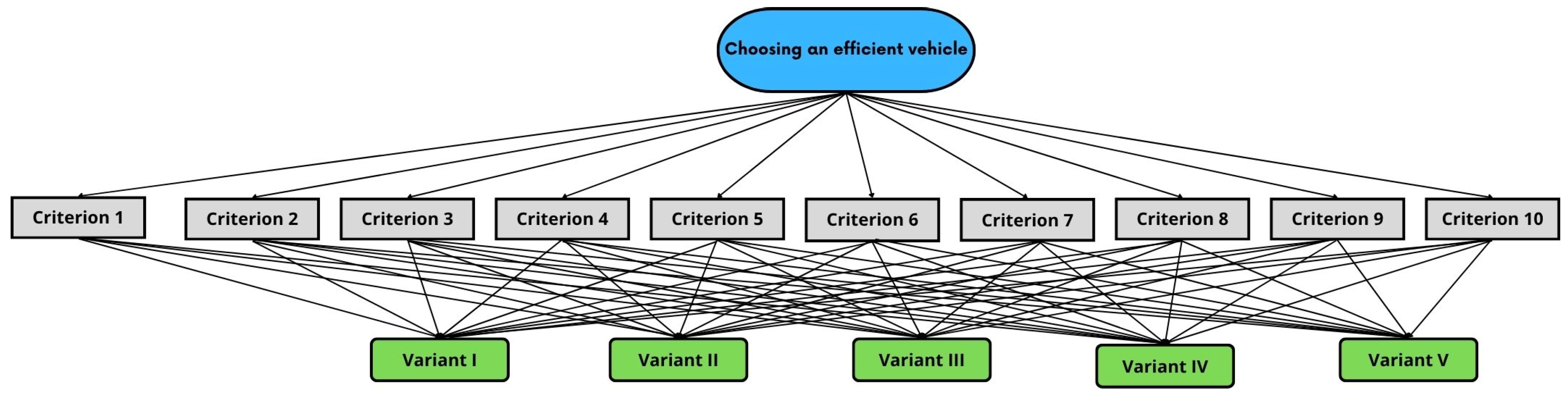
Hierarchical Structure of the Decision-Making Process
- K—number of compared criteria (or variants);
- CI—consistency index;
4. Results
5. Discussion and Conclusions
- The obtained results confirm that the AHP method can be an effective tool for supporting the selection of the optimal drive type based on multiple criteria, enabling the integration of economic, ecological, and technical aspects into a single assessment model. The authors indicate that the method can also be useful in the analysis of other urban fleets, supporting sustainable mobility planning.
- The selection of the type of drive in car fleets, despite the growing interest in low- and zero-emission vehicles, still poses an environmental and operational challenge. According to the data presented in the market report [8], only about 2% of surveyed small and medium-sized enterprises use fully electric vehicles (5% among medium-sized companies), 3% use plug-in hybrid cars, and every tenth company has a classic hybrid. Combustion vehicles still dominate, appearing in almost all fleets. The results obtained in this study confirm this trend—combustion-powered vehicles ranked higher than BEVs in the AHP analysis, which indicates that in current market conditions their economic and operational advantage still outweighs environmental aspects. These data are consistent with other European studies [60,61,62], which indicate that infrastructural and economic barriers continue to hinder the development of electromobility in car-sharing.
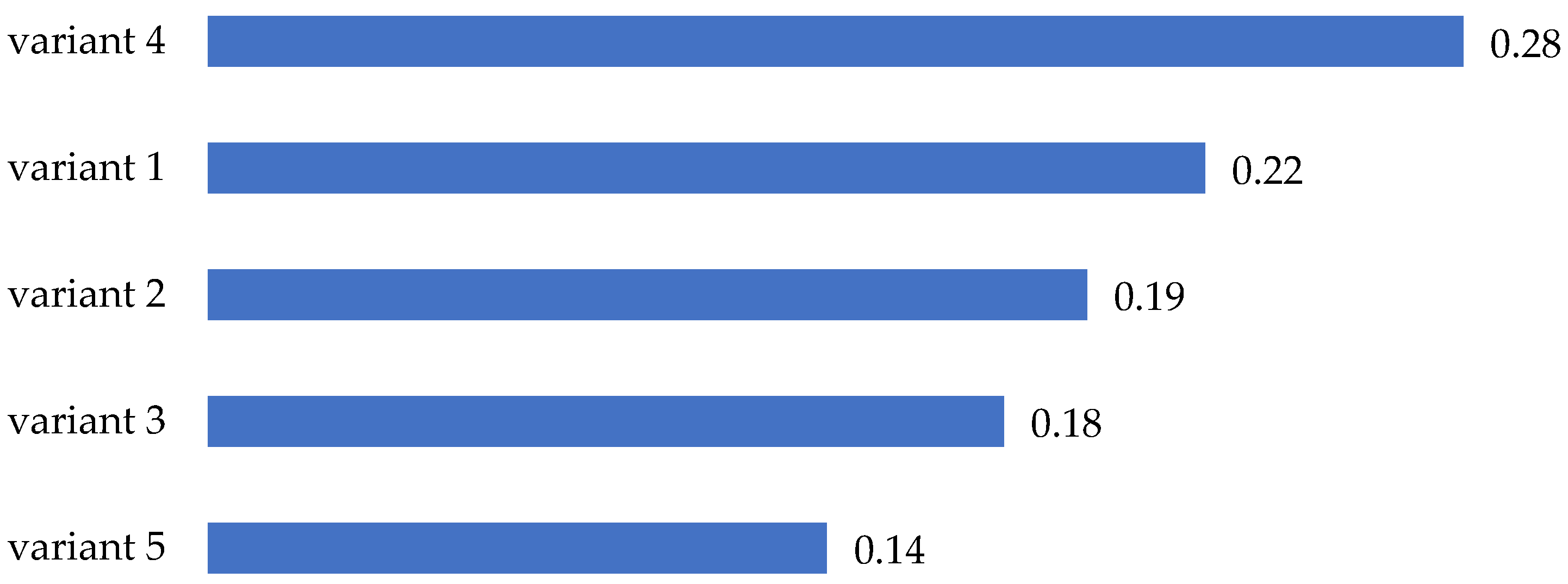
- The analysis showed that the most environmentally and economically advantageous drive is PHEV. It combines low CO2 and PMx emissions with the lowest travel cost per 100 km, which is important considering the rising costs of fuel and vehicle servicing. Additionally, the PHEV drive is distinguished by the greatest operational flexibility—it allows both charging from the network and refueling, which reduces the risk of downtime and increases the operating range of the vehicle. Thanks to this, it can be effectively used in car-sharing systems where the availability of charging infrastructure is still limited. The results are consistent with the findings of Bardhi et al. [63], who pointed out that plug-in hybrid vehicles provide a balance between ecological efficiency and operational flexibility.
- Despite the dynamic development of electromobility, cars with combustion engines—both spark ignition (SI, a1) and diesel (ZS, a2)—remain the least environmentally beneficial drive variants and still pose a challenge in the context of fleet decarbonization.
- -
- Adapting the proposed methodology to other geographical conditions in which car-sharing fleets have a similar scale and structure;
- -
- Extending the analyzes to the entire urban transport system, including public transport and taxis, taking into account the comparison of the drives used;
- -
- Developing a coherent set of criteria and preference models for assessing variants in the field of technical diagnostics and shared fleet management;
- -
- Introduction of an additional variable in the form of the TCO indicator, which allows for better consideration of economic aspects related to the use of vehicles;
- -
- Conducting long-term simulations of the profitability of using BEVs under various scenarios of energy prices and the development of charging infrastructure.
Author Contributions
Funding
Institutional Review Board Statement
Informed Consent Statement
Data Availability Statement
Conflicts of Interest
References
- United Nations. Department of Economic and Social Affairs. Population Division. Available online: https://population.un.org/wup/ (accessed on 20 March 2025).
- Eurostat. Available online: https://ec.europa.eu/eurostat/web/main/data (accessed on 1 March 2025).
- CleanCities. Available online: https://cleancitiescampaign.org/research-list/state-of-european-transport-in-cities/ (accessed on 1 March 2025).
- European Commission. Commission Staff Working Document Impact Assessment Report. 2023. Available online: https://environment.ec.europa.eu/document/download/2f6d95b0-7a76-4074-a080-341d417f34c1_en?filename=IMPACT%20ASSESSMENT%20REPORT_SWD_2023_421_part1_0.pdf (accessed on 1 March 2025).
- WHO. Ambient Air Pollution: A Global Assessment of Exposure and Burden of Disease. Available online: https://www.who.int/publications/i/item/9789241511353 (accessed on 2 February 2025).
- European Environment Agency. Europe’s Air Quality Status 2022. Available online: https://www-eea-europa-eu.translate.goog/publications/status-of-air-quality-in-Europe-2022?_x_tr_sl=auto&_x_tr_tl=pl&_x_tr_hl=pl (accessed on 2 February 2025).
- European Commission. Directive (EU) 2024/2881 of the European Parliament and of the Council of 23 October 2024 on Ambient Air Quality and Cleaner Air for Europe. 2024. Available online: https://eur-lex.europa.eu/legal-content/EN/TXT/PDF/?uri=OJ:L_202402881 (accessed on 2 February 2025).
- Electric Vehicles Promotion Foundation. 2024. Available online: https://fppe.pl/dyrektywa-aaqd-propozycja-rewizji/ (accessed on 2 February 2025).
- Transport and Environment. Available online: https://www.transportenvironment.org/articles (accessed on 2 February 2025).
- Mitropoulos, L.; Kortsari, A.; Ayfantopoulou, G. A systematic literature review of ride-sharing platforms, user factors and barriers. Eur. Transp. Res. Rev. 2021, 13, 61. [Google Scholar] [CrossRef] [Scilit] [PubMed]
- Kopeć, K. Przekształcenia transportowe miast służące poprawie jakości życia. Pr. Kom. Geogr. Komun. PTG 2021, 22, 34–49. [Google Scholar] [CrossRef] [Scilit]
- Nansubuga, B.; Kowalkowski, C. Carsharing: A systematic literature review and research agenda. J. Serv. Manag. 2021, 32, 55–91. [Google Scholar] [CrossRef] [Scilit]
- MarketResearch.biz. Available online: https://marketresearch.biz/about-us/ (accessed on 1 March 2025).
- Rodrigue, J.P. The Geography of Transport Systems: 8.2–Urban Land Use and Transportation. 2024. Available online: https://transportgeography.org/contents/chapter8/urban-land-use-transportation/ (accessed on 2 February 2025).
- Shaheen, S. Carsharing Trends and Research Highlights; Transportation Sustainability Research Center, University of California: Berkeley, CA, USA, 2017. [Google Scholar]
- PSPA. New Mobility Development Strategy in Poland Until 2030. 2023. Available online: https://psnm.org/wp-content/uploads/2023/09/PSPA_Strategia_Nowej_Mobilnosci_Raport_2023.pdf (accessed on 11 March 2022).
- The Society of Motor Manufacturers and Traders. New Car CO2 Report; SMMT: London, UK, 2018. [Google Scholar]
- Whitmore, A.; Constantine Samaras, C.; Hendrickson, C.T.; Matthews, C.S.; Wong-Parodi, G. Integrating public transportation and shared autonomous mobility for equitable transit coverage: A cost-efficiency analysis. Transp. Res. Interdiscip. Perspect. 2022, 14, 100571. [Google Scholar] [CrossRef] [Scilit]
- WysokieNapięcie.pl. 10 Pros and Cons of Car Sharing. How to Drive a Car for “Minutes”? 2023. Available online: https://wysokienapiecie.pl/7693-carharing_wynajem_auta_na_minuty_test_vozilla_traficar_panek_4mobility/ (accessed on 11 March 2022).
- BIOGAZ-TECHPL. What Are the Benefits of Car Sharing in Big Cities? 2023. Available online: https://biogaz-tech.pl/jakie-sa-korzysci-z-car-sharingu-w-duzych-miastach/#Ekonomiczne_korzysci_z_carsharingu (accessed on 11 March 2022).
- Statista. Available online: https://www.statista.com/ (accessed on 11 March 2022).
- Hui, Y.; Wang, W.; Ding, M.; Liu, Y. Behavior Patterns of Long-term Car-sharing Users in China. Transp. Res. Procedia 2017, 25, 4662–4678. [Google Scholar] [CrossRef] [Scilit]
- Trading Economics. Available online: https://pl.tradingeconomics.com/poland/gdp-per-capita (accessed on 29 March 2025).
- Central Statistical Office. Available online: https://stat.gov.pl/ (accessed on 29 March 2025).
- Komornicki, T. Changes in Poles’ Everyday Mobility Against the Backdrop of Motorization Development; No. 227; Geographical Works of the Institute of Geography and Spatial Organization PAN: Warszawa, Poland, 2011. [Google Scholar]
- IBRM SAMAR. Available online: https://www.samar.pl/wiadomosci/carsharing-w-polsce-2024 (accessed on 29 March 2025).
- Shaheen, S.; Chan, N.; Micheaux, H. One-way carsharing’s evolution and operator perspectives from the Americas. Transportation 2015, 42, 519–536. [Google Scholar] [CrossRef] [Scilit]
- Shaheen, S.; Sperling, D.; Wagner, C. A Short History of Carsharing in the 90’s. J. World Transp. Policy Pract. 1999, 5, 18–30. [Google Scholar]
- Cronin, P.; Ryan, F.; Coughlan, M. Undertaking a literature review: A step-by-step approach. Br. J. Nurs. 2008, 17, 38–43. [Google Scholar] [CrossRef] [Scilit]
- Muheim, P.; Reinhardt, E. Car-Sharing: The Key to Combined Mobility Energy 2000; BFE Swiss Federal Office of Energy: Bern, Switzerland, 1998; pp. 58–71. [Google Scholar]
- Alonso-Almeida, M.d.M. To Use or Not Use Car Sharing Mobility in the Ongoing COVID-19 Pandemic? Identifying Sharing Mobility Behaviour in Times of Crisis. Int. J. Environ. Res. Public Health 2022, 19, 3127. [Google Scholar] [CrossRef] [Scilit]
- Chun, Y.-Y.; Matsumoto, M.; Tahara, K.; Chinen, K.; Endo, H. Exploring factors affecting car sharing use intention in the Southeast Asia region: A case study in Java, Indonesia. Sustainability 2019, 11, 5103. [Google Scholar] [CrossRef] [Scilit]
- Ferrero, F.; Perboli, G.; Rosano, M.; Vesco, A. Car-sharing services: An annotated review. Sustain. Cities Soc. 2018, 37, 501–518. [Google Scholar] [CrossRef] [Scilit]
- Kim, D.; Park, Y.; Ko, J. Factors underlying vehicle ownership reduction among carsharing users: A repeated cross-sectional analysis. Transp. Res. Part D Transp. Environ. 2019, 76, 123–137. [Google Scholar] [CrossRef] [Scilit]
- Migliore, M.; D’Orso, G.; Caminiti, D. The environmental benefits of carsharing: The case study of Palermo. Transp. Res. Procedia 2020, 48, 2127–2139. [Google Scholar] [CrossRef] [Scilit]
- Schwabe, J. The evolution of cooperative electric carsharing in Germany and the role of intermediaries. Environ. Innov. Soc. Transit. 2020, 37, 108–119. [Google Scholar] [CrossRef] [Scilit]
- Shaheen, S.; Cohen, A. Innovative Mobility: Carsharing Outlook; Carsharing Market Overview, Analysis and Trends. 2020. Available online: https://escholarship.org/uc/item/61q03282 (accessed on 27 May 2024).
- Tennøy, A.; Usterud Hanssen, J.; Visnes Øksenholt, K. Developing a tool for assessing park-and-ride facilities in a sustainable mobility perspective. Urban Plan. Transp. Res. 2020, 8, 1–23. [Google Scholar] [CrossRef] [Scilit]
- Terama, E.; Peltomaa, J.; Rolim, C.; Baptista, P. The Contribution of Car Sharing to the Sustainable Mobility Transition. Transfers 2018, 8, 113–121. [Google Scholar] [CrossRef] [Scilit]
- Turoń, K.; Kubik, A. Business Innovations in the New Mobility Market during the COVID-19 with the Possibility of Open Business Model Innovation. J. Open Innov. Technol. Mark. Complex. 2021, 7, 195. [Google Scholar] [CrossRef] [Scilit]
- Alencar, V.A.; Rooke, F.; Cocca, M.; Vassio, L.; Almeida, J.; Vieira, A.B. Characterizing client usage patterns and service demand for car-sharing systems. Inf. Syst. 2019, 98, 101448. [Google Scholar] [CrossRef] [Scilit]
- Barbour, N.; Zhang, Y.; Mannering, F. Individuals’ willingness to rent their personal vehicle to others: An exploratory assess-ment of peer-to-peer carsharing. Transp. Res. Interdiscip. Perspect. 2020, 5, 100138. [Google Scholar] [CrossRef] [Scilit]
- Hahn, R.; Ostertag, F.; Lehr, A.; Büttgen, M.; Benoit, S. I like it, but I don’t use it: Impact of carsharing business models on usage intentions in the sharing economy. Bus. Strategy Environ. 2020, 29, 1404–1418. [Google Scholar] [CrossRef] [Scilit]
- Ko, J.; Ki, H.; Lee, S. Factors affecting carsharing program participants’ car ownership changes. Transp. Lett. 2019, 11, 208–218. [Google Scholar] [CrossRef] [Scilit]
- Meelen, T.; Frenken, K.; Hobrink, S. Weak spots for car-sharing in The Netherlands? The geography of socio-technical regimes and the adoption of niche innovations. Energy Res. Soc. Sci. 2019, 52, 132–143. [Google Scholar] [CrossRef] [Scilit]
- Münzel, K.; Boon, W.; Frenken, K.; Blomme, J.; van der Linden, D. Explaining carsharing supply across Western European cities. Int. J. Sustain. Transp. 2020, 14, 243–254. [Google Scholar] [CrossRef] [Scilit]
- Nitschke, L. Reconstituting Automobility: The Influence of Non-Commercial Carsharing on the Meanings of Automobility and the Car. Sustainability 2020, 12, 7062. [Google Scholar] [CrossRef] [Scilit]
- Nourinejad, M.; Roorda, M. Carsharing operations policies: A comparison between one-way and two-way systems. Transportation 2015, 42, 97–518. [Google Scholar] [CrossRef] [Scilit]
- Rodenbach, J.; Jeffrey, M.; Chicco, A.; Diana, M. Car Sharing in Europe: A Multidimensional Classification and Inventory, Deliverable D2.1. 2018. Available online: http://stars-h2020.eu/wp-content/uploads/2019/06/STARS-D2.1.pdf (accessed on 22 March 2024).
- Valor, C. Anticipated emotions and resistance to innovations: The case of p2p car sharing. Environ. Innov. Soc. Transit. 2020, 37, 50–65. [Google Scholar] [CrossRef] [Scilit]
- Zhang, Y.; Li, L. Intention of Chinese college students to use carsharing: An application of the theory of planned behavior. Transp. Res. Part F Traffic Psychol. Behav. 2020, 75, 106–119. [Google Scholar] [CrossRef] [Scilit]
- Xue, Y.; Zhang, Y.; Chen, Y. An Evaluation Framework for the Planning of Electric Car-Sharing Systems: A Combination Model of AHP-CBA-VD. Sustainability 2019, 11, 5627. [Google Scholar] [CrossRef] [Scilit]
- Seo, J.; Sheok, C. A Study on Optimizing Depot Location in Carsharing Considering the Neighborhood Environmental Factors. J. Korea Inst. Intell. Transp. Syst. 2017, 16, 49–59. [Google Scholar] [CrossRef] [Scilit]
- Ruhrort, L.; Steiner, J.; Graff, A.; Hinkeldein, D.; Hoffmann, C. Carsharing with electric vehicles in the context of users’ mobility needs-Results from user-centred research from the BeMobility field trial (Berlin). Int. J. Automot. Technol. Manag. 2014, 14, 286–305. [Google Scholar] [CrossRef] [Scilit]
- Schmöller, S.; Weikl, S.; Müller, J.; Bogenberger, K. Empirical analysis of free-floating carsharing usage: The Munich and Berlin case. Transp. Res. Part C Emerg. Technol. 2015, 56, 34–51. [Google Scholar] [CrossRef] [Scilit]
- Namazu, M.; Mackenzie, D.; Zerriffi, H.; Dowlatabadi, H. Is carsharing for everyone? Understanding the diffusion of carsharing servces. Transp. Policy 2018, 63, 189–199. [Google Scholar] [CrossRef] [Scilit]
- Ma, F.; Guo, D.; Yuen, K.F.; Sun, Q.; Ren, F.; Xu, X.; Zhao, C. The influence of continuous improvement of public car-sharing platforms on passenger loyalty: A mediation and moderation analysis. Int. J. Environ. Res. Public Health 2020, 17, 2756. [Google Scholar] [CrossRef] [Scilit] [PubMed]
- Lagadic, M.; Verloes, A.; Louvet, N. Can carsharing services be profitable? A critical review of established and developing busi-ness models. Transp. Policy 2019, 77, 68–78. [Google Scholar] [CrossRef] [Scilit]
- Clark, M.; Gifford, K.; Anable, J.; Le Vine, S. Business-to-business carsharing: Evidence from Britain of factors associated with employer-based carsharing membership and its impacts. Transportation 2015, 42, 471–495. [Google Scholar] [CrossRef] [Scilit]
- Charoniti, E.; Kim, J.; Rasouli, S.; Timmermans, H.J. Intrapersonal heterogeneity in car-sharing decision-making processes by activity-travel contexts: A context-dependent latent class random utility–random regret model. Int. J. Sustain. Transp. 2020, 15, 501–511. [Google Scholar] [CrossRef] [Scilit]
- Carrone, A.P.; Hoening, V.M.; Jensen, A.F.; Mabit, S.E.; Rich, J. Understanding car sharing preferences and mode substitution patterns: A stated preference experiment. Transp. Policy 2020, 98, 139–147. [Google Scholar] [CrossRef] [Scilit]
- Becker, H.; Ciari, F.; Axhausen, K. Comparing car-sharing schemes in Switzerland: User groups and usage patterns. Transp. Res. Part A 2017, 97, 17–29. [Google Scholar] [CrossRef] [Scilit]
- Bardhi, F.; Eckhardt, G.M. Access-based consumption: The case of car sharing. J. Consum. Res. 2012, 39, 881–898. [Google Scholar] [CrossRef] [Scilit]
- Balac, M.; Becker, H.; Ciari, F.; Axhausen, K.W. Modeling competing free-floating carsharing operators–A case study for Zurich, Switzerland. Transp. Res. Part C Emerg. Technol. 2019, 98, 101–117. [Google Scholar] [CrossRef] [Scilit]
- Repoux, M.; Kaspi, M.; Boyacı, B.; Geroliminis, N. Dynamic prediction-based relocation policies in one-way station-based car-sharing systems with complete journey reservations. Transp. Res. Part B Methodol. 2019, 130, 82–104. [Google Scholar] [CrossRef] [Scilit]
- Moein, E.; Awasthi, A. Carsharing customer demand forecasting using causal, time series and neural network methods: A case study. Int. J. Serv. Oper. Manag. 2020, 35, 36–57. [Google Scholar] [CrossRef] [Scilit]
- Kypriadis, D.; Pantziou, G.; Konstantopoulos, C.; Gavalas, D. Optimizing relocation cost in free-floating car-sharing systems. IEEE Trans. Intell. Transp. Syst. 2020, 21, 4017–4030. [Google Scholar] [CrossRef] [Scilit]
- Kubik, A. Impact of the Use of Electric Scooters from Shared Mobility Systems on the Users. Smart Cities 2022, 5, 1079–1091. [Google Scholar] [CrossRef] [Scilit]
- Hua, Y.; Zhao, D.; Wang, X.; Li, X. Joint infrastructure planning and fleet management for one-way electric car sharing under time-varying uncertain demand. Transp. Res. Part B Methodol. 2019, 128, 185–206. [Google Scholar] [CrossRef] [Scilit]
- Hu, S.; Chen, P.; Lin, H.; Xie, C.; Chen, X. Promoting carsharing attractiveness and efficiency: An exploratory analysis. Transp. Res. Part D Transp. Environ. 2018, 65, 229–243. [Google Scholar] [CrossRef] [Scilit]
- Caggiani, L.; Prencipe, L.P.; Ottomanelli, M. A static relocation strategy for electric car-sharing systems in a vehicle-to-grid framework. Transp. Lett. 2020, 13, 219–228. [Google Scholar] [CrossRef] [Scilit]
- Bruglieri, M.; Colorni, A.; Luè, A. The relocation problem for the one-way electric vehicle sharing. Networks 2014, 64, 292–305. [Google Scholar] [CrossRef] [Scilit]
- Cartenì, A.; Cascetta, E.; de Luca, S. A random utility model for park & carsharing services and the pure preference for electric vehicles. Transp. Policy 2016, 48, 49–59. [Google Scholar] [CrossRef] [Scilit]
- Deza, A.; Huang, K.; Metel, M.R. Charging station optimization for balanced electric car sharing. Discret. Appl. Math. 2020, 308, 187–197. [Google Scholar] [CrossRef] [Scilit]
- Firnkorn, J.; Müller, M. Free-floating electric car-sharing fleets in smart cities: The dawning of a post-private car era in urban environments? Environ. Sci. Policy 2015, 45, 30–40. [Google Scholar] [CrossRef] [Scilit]
- Lu, X.; Zhang, Q.; Peng, Z.; Shao, Z.; Song, H.; Wang, W. Charging and relocating optimization for electric vehicle car-sharing: Anevent-based strategy improvement approach. Energy 2020, 207, 118285. [Google Scholar] [CrossRef] [Scilit]
- Wang, N.; Guo, J.; Liu, X.; Liang, Y. Electric vehicle car-sharing optimization relocation model combining user relocation and staff relocation. Transp. Lett. 2021, 13, 315–326. [Google Scholar] [CrossRef] [Scilit]
- Weikl, S.; Bogenberger, K. A practice-ready relocation model for free-floating carsharing systems with electric vehicles–Mesoscopic approach and field trial results. Transp. Res. Part C Emerg. Technol. 2015, 57, 206–223. [Google Scholar] [CrossRef] [Scilit]
- Boldrini, C.; Bruno, R.; Laarabi, M.H. Weak signals in the mobility landscape: Car sharing in ten European cities. EPJ Data Sci. 2019, 8, 7. [Google Scholar] [CrossRef] [Scilit]
- European Commission. MOMO Car-Sharing Project—Business Plan for Car-Sharing. 2017. Available online: https://trimis.ec.europa.eu/project/more-options-energy-efficient-mobility-through-car-sharing (accessed on 4 April 2024).
- European Environment Agency. Ensuring Quality of Life in Europe’s Cities and Towns. 2009. Available online: https://www.eea.europa.eu/publications/quality-of-life-in-Europes-cities-and-towns (accessed on 22 March 2024).
- Hjorteset, M.A.; Böcker, L. Car sharing in Norwegian urban areas: Examining interest, intention and the decision to enrol. Transp. Res. Part D Transp. Environ. 2020, 84, 102322. [Google Scholar] [CrossRef] [Scilit]
- Mugion, R.G.; Toni, M.; di Pietro, L.; Pasca, M.G.; Renzi, M.F. Understanding the antecedents of car sharing usage: An empirical study in Italy. Int. J. Qual. Serv. Sci. 2019, 11, 523–541. [Google Scholar] [CrossRef] [Scilit]
- Peterson, M.; Simkins, T. Consumers’ processing of mindful commercial car sharing. Bus. Strategy Environ. 2019, 28, 457–465. [Google Scholar] [CrossRef] [Scilit]
- Jacquillat, A.; Zoepf, S. Deployment and utilization of plug-in electric vehicles in round-trip car-sharing systems. Int. J. Sustain. Transp. 2018, 12, 75–91. [Google Scholar] [CrossRef] [Scilit]
- Turoń, K.; Kubik, A.; Chen, F. What Car for Car-Sharing? Conventional, Electric, Hybrid or Hydrogen Fleet? Analysis of the Vehicle Selection Criteria for Car-Sharing Systems. Energies 2022, 15, 4344. [Google Scholar] [CrossRef] [Scilit]
- Turoń, K. Multi-Criteria Decision Analysis during Selection of Vehicles for Car-Sharing Services—Regular Users’ Expectations. Energies 2022, 15, 7277. [Google Scholar] [CrossRef] [Scilit]
- Li, W.; Li, Y.; Fan, J.; Deng, H. Siting of Carsharing Stations Based on Spatial Multi-Criteria Evaluation: A Case Study of Shanghai EVCARD. Sustainability 2017, 9, 152. [Google Scholar] [CrossRef] [Scilit]
- Awasthi, A.; Breuil, D.; Singh Chauhan, S.; Parent, M.; Reveillere, T. A Multicriteria Decision Making Approach for Carsharing Stations Selection. J. Decis. Syst. 2007, 16, 57–78. [Google Scholar] [CrossRef] [Scilit]
- Saaty, T. Transport planning with multiple criteria: The Analytic hierarchy process. Applications and progress review. J. Adv. Transp. 1995, 29, 81–126. [Google Scholar] [CrossRef] [Scilit]
- Gercek, H.; Karpak, B.; Kilincaslan, T. A Multiple Criteria Approach for the Evaluation of the Rail Transit Networks in Istambul. Transportation 2004, 31, 203–228. [Google Scholar] [CrossRef] [Scilit]
- Żak, J.; Fierek, S. Design and Evaluation of Alternative Solutions for Integrated Urban Transportation System. In Proceedings of the World Conference on Transport Research, Berkeley, CA, USA, 24–28 June 2007. [Google Scholar]
- Żak, J.; Fierek, S. Konstruowanie i Ocena Wielokryterialna Zintegrowanych Systemów Transportu Miejskiego. In Proceedings of the VI Konferencja Naukowo-Techniczna: Wspomaganie Decyzji w Projektowaniu i Zarządzaniu Transportem, Poznań, Poland, 23–25 May 2007. [Google Scholar]
- Turoń, K. Carsharing Vehicle Fleet Selection from the Frequent User’s Point of View. Energies 2022, 15, 6166. [Google Scholar] [CrossRef] [Scilit]
- Turoń, K. Selection of Car Models with a Classic and Alternative Drive to the Car-Sharing Services from the System’s Rare Users Perspective. Energies 2022, 15, 6876. [Google Scholar] [CrossRef] [Scilit]
- Figueira, J.; Greco, S.; Ehrgott, M. (Eds.) Multiple Criteria Decision Analysis: State of the Art Surveys; Springer: New York, NY, USA, 2005. [Google Scholar] [CrossRef] [Scilit]
- Roy, B. Decision Science or Decision-Aid Science? Eur. J. Oper. Res. 1993, 66, 184–203. [Google Scholar] [CrossRef] [Scilit]
- Vincke, P. Multicriteria Decision-Aid; John Wiley & Sons: Chichester, UK, 1992. [Google Scholar]
- Autocentrum. Independent Automotive Portal. 2024. Available online: https://www.autocentrum.pl/dane-techniczne/peugeot/308/iii/hatchback-plug-in/silnik-hybrydowy-1.6-hybrid-180km-od-2021/ (accessed on 2 March 2024).
- Car Labelling. Recherche Multicritères. 2024. Available online: https://carlabelling.ademe.fr/recherche?searchString=&co2=&brand=peugeot&model=308&category=&range=&carbu%5B%5D=EL&transmission=&price=0%2C500000&maxconso=&energy=0%2C7&RechercherL=Rechercher&offset=0&orderby[]=particules%20desc&searchString (accessed on 12 March 2024).
- Chargemap. Statistics. 2024. Available online: https://chargemap.com/about/stats/poland (accessed on 23 March 2024).
- Motonews.pl. 2024. Available online: https://www.motonews.pl/auta-nowe/auto-14867-peugeot-308.html (accessed on 23 May 2024).
- PEUGEOT. 2024. Available online: https://www.peugeot.pl/ (accessed on 29 April 2024).
- Transport & Environment. CO2 and Emissions Performance of PHEV Vehicles. 2023. Available online: https://www.transportenvironment.org/wp-content/uploads/2023/02/2023_02_TE_PHEV_Testing_2022_TU_Graz_report_final.pdf (accessed on 14 June 2024).
- Saaty, T.L. The Analytic Hierarchy Process; McGraw-Hill: New York, NY, USA, 1980. [Google Scholar]
- Jacquet-Lagreze, E.; Siskos, J. Assessing a Set of Additive Utility Functions for Multicriteria Decision Making, the UTA Method. Eur. J. Oper. Res. 1982, 10, 151–164. [Google Scholar] [CrossRef] [Scilit]
- Garcia-Cascales, M.S.; Lamata, M.T. Solving a decision problem with linguistic information. Pattern Recognit. Lett. 2007, 28, 2284–2294. [Google Scholar] [CrossRef] [Scilit]
- Saaty, T. Axiomatic foundation of the analytic hierarchy process. Manag. Sci. 1986, 32, 841–855. [Google Scholar] [CrossRef] [Scilit]
- Saaty, T. How to make a decision: The analytic hierarchy process. Eur. J. Oper. Res. 1990, 48, 9–26. [Google Scholar] [CrossRef] [Scilit]
- Saaty, T.; Ozdemir, M. Why the magic number seven plus or minus two. Math. Comput. Model. 2003, 38, 233–244. [Google Scholar] [CrossRef] [Scilit]
- Augustyn, G.; Mikulik, J.; Lewicki, W.; Niekurzak, M. Assessment of the Energy Efficiency of Individual Means of Transport in the Process of Optimizing Transport Environments in Urban Areas in Line with the Smart City Idea. Energies 2025, 18, 4079. [Google Scholar] [CrossRef] [Scilit]



| City | 2012 | 2013 | 2014 | 2015 | 2016 | 2017 | 2018 | 2019 | 2020 | 2021 | 2022 |
|---|---|---|---|---|---|---|---|---|---|---|---|
| Wroclaw | 540 | 558 | 575 | 600 | 632 | 659 | 689 | 715 | 707 | 730 | 751 |
| Torun | 428 | 441 | 452 | 469 | 490 | 510 | 535 | 557 | 580 | 601 | 619 |
| Lublin | 425 | 446 | 463 | 483 | 505 | 530 | 557 | 577 | 605 | 629 | 647 |
| Lodz | 447 | 466 | 483 | 502 | 525 | 550 | 578 | 605 | 623 | 640 | 660 |
| Krakow | 503 | 521 | 534 | 557 | 585 | 610 | 639 | 659 | 663 | 685 | 699 |
| Radom | 399 | 413 | 426 | 445 | 470 | 490 | 513 | 535 | 576 | 598 | 616 |
| Warsaw | 580 | 598 | 619 | 648 | 680 | 715 | 749 | 778 | 765 | 783 | 815 |
| Rzeszow | 434 | 451 | 466 | 489 | 515 | 543 | 567 | 586 | 613 | 625 | 634 |
| Bialystok | 354 | 365 | 377 | 393 | 412 | 430 | 452 | 474 | 495 | 516 | 532 |
| Gdansk | 508 | 523 | 542 | 552 | 572 | 593 | 618 | 639 | 640 | 664 | 684 |
| Gdynia | 483 | 502 | 520 | 542 | 567 | 584 | 601 | 622 | 637 | 660 | 677 |
| Czestochowa | 452 | 466 | 478 | 496 | 519 | 540 | 563 | 586 | 623 | 648 | 666 |
| Katowice | 539 | 571 | 599 | 631 | 668 | 704 | 734 | 761 | 789 | 810 | 834 |
| Sosnowiec | 467 | 483 | 495 | 509 | 525 | 537 | 551 | 569 | 596 | 615 | 630 |
| Kielce | 417 | 431 | 454 | 467 | 492 | 518 | 547 | 572 | 612 | 637 | 656 |
| Poznan | 554 | 578 | 600 | 625 | 660 | 689 | 725 | 757 | 758 | 778 | 796 |
| Szczecin | 433 | 448 | 465 | 486 | 508 | 530 | 554 | 575 | 595 | 614 | 631 |
| Vehicle Parameters | Variant 1 | Variant 2 | Variant 3 | Variant 4 | Variant 5 |
|---|---|---|---|---|---|
| Vehicle purchase cost [PLN] | 133,800 | 141,600 | 141,100 | 178,300 | 185,500 |
| Cost of driving 100 km (mixed mode) [PLN] | 37.46 | 33.04 | 37.66 | 8.62 | 28.31 |
| CO2 emissions [g/km] | 123 | 124 | 109 | 26 | 49.93 |
| PMx emissions [mg/km] * | 0.66 | 0.04 | 0.35 | 0.42 | 0 |
| Noise emissions at 100 km/h [dB] | 76 | 76 | 68 | 74 | 66 |
| Top speed [km/h] | 210 | 207 | 210 | 170 | 170 |
| Acceleration to 100 km/h [s] | 9.7 | 10.6 | 9.7 | 7.6 | 9.8 |
| Total range (combined cycle) [km] | 945 | 1155 | 978 | 3333 | 416 |
| Number of refueling/charging stations (as of March 2024) | 7919 | 7919 | 7919 | 10,020 | 2101 |
| Time required to fill up with petrol/diesel/electricity (charging at an AC charging station) [min] | 3 | 3 | 3 | 121 | 330 |
| Criterion g1 | Criterion g2 | Criterion g3 | Criterion g4 | Criterion g5 | Criterion g6 | Criterion g7 | Criterion g8 | Criterion g9 | Criterion g10 | |
|---|---|---|---|---|---|---|---|---|---|---|
| Criterion g1—vehicle purchase cost [PLN] | 1.00 | 3.00 | 5.00 | 7.00 | 7.00 | 7.00 | 5.00 | 5.00 | 5.00 | 5.00 |
| Criterion g2—cost of driving 100 km (mixed mode) [PLN] | 0.33 | 1.00 | 3.00 | 5.00 | 5.00 | 5.00 | 3.00 | 3.00 | 3.00 | 3.00 |
| Criterion g3—CO2 emission [g/km] | 0.20 | 0.33 | 1.00 | 3.00 | 3.00 | 3.00 | 1.00 | 1.00 | 1.00 | 1.00 |
| Criterion g4—PMx emission [mg/km] | 0.14 | 0.20 | 0.33 | 1.00 | 3.00 | 3.00 | 0.33 | 0.33 | 0.33 | 0.33 |
| Criterion g5—noise emission at 100 km/h [dB] | 0.14 | 0.20 | 0.33 | 0.33 | 1.00 | 3.00 | 0.33 | 0.33 | 0.33 | 0.33 |
| Criterion g6—maximum speed [km/h] | 0.14 | 0.20 | 0.33 | 0.33 | 0.33 | 1.00 | 0.33 | 0.33 | 0.33 | 0.33 |
| Criterion g7—acceleration to 100 km/h [s] | 0.20 | 0.33 | 1.00 | 3.00 | 3.00 | 3.00 | 1.00 | 1.00 | 1.00 | 1.00 |
| Criterion g8—Total range (mixed cycle) [km] | 0.20 | 0.33 | 1.00 | 3.00 | 3.00 | 3.00 | 1.00 | 1.00 | 1.00 | 1.00 |
| Criterion g9—number of refueling/charging stations (as of March 2024) | 0.20 | 0.33 | 1.00 | 3.00 | 3.00 | 3.00 | 1.00 | 1.00 | 1.00 | 1.00 |
| Criterion g10—time needed to draw petrol/diesel/electricity (charging at an AC charging station) [min] | 0.20 | 0.33 | 1.00 | 3.00 | 3.00 | 3.00 | 1.00 | 1.00 | 1.00 | 1.00 |
| Total | 2.76 | 6.27 | 14.00 | 28.67 | 31.33 | 34.00 | 14.00 | 14.00 | 14.00 | 14.00 |
| Criterion g1 | Criterion g2 | Criterion g3 | Criterion g4 | Criterion g5 | Criterion g6 | Criterion g7 | Criterion g8 | Criterion g9 | Criterion g10 | Global Priority (Weight) wi | |
|---|---|---|---|---|---|---|---|---|---|---|---|
| Criterion g1 | 0.36 | 0.48 | 0.36 | 0.24 | 0.22 | 0.21 | 0.36 | 0.36 | 0.36 | 0.36 | 0.33 |
| Criterion g2 | 0.12 | 0.16 | 0.21 | 0.17 | 0.16 | 0.15 | 0.21 | 0.21 | 0.21 | 0.21 | 0.18 |
| Criterion g3 | 0.07 | 0.05 | 0.07 | 0.10 | 0.10 | 0.09 | 0.07 | 0.07 | 0.07 | 0.07 | 0.08 |
| Criterion g4 | 0.05 | 0.03 | 0.02 | 0.03 | 0.10 | 0.09 | 0.02 | 0.02 | 0.02 | 0.02 | 0.04 |
| Criterion g5 | 0.05 | 0.03 | 0.02 | 0.01 | 0.03 | 0.09 | 0.02 | 0.02 | 0.02 | 0.02 | 0.03 |
| Criterion g6 | 0.05 | 0.03 | 0.02 | 0.01 | 0.01 | 0.03 | 0.02 | 0.02 | 0.02 | 0.02 | 0.03 |
| Criterion g7 | 0.07 | 0.05 | 0.07 | 0.10 | 0.10 | 0.09 | 0.07 | 0.07 | 0.07 | 0.07 | 0.08 |
| Criterion g8 | 0.07 | 0.05 | 0.07 | 0.10 | 0.10 | 0.09 | 0.07 | 0.07 | 0.07 | 0.07 | 0.08 |
| Criterion g9 | 0.07 | 0.05 | 0.07 | 0.10 | 0.10 | 0.09 | 0.07 | 0.07 | 0.07 | 0.07 | 0.08 |
| Criterion g10 | 0.07 | 0.05 | 0.07 | 0.10 | 0.10 | 0.09 | 0.07 | 0.07 | 0.07 | 0.07 | 0.08 |
| Hierarchy Level | λ | CI | CR | |
|---|---|---|---|---|
| Criterion g1 | 5.03 | 0.00 | 0.007 | Connected matrix |
| Criterion g2 | 5.01 | 0.00 | 0.002 | Connected matrix |
| Criterion g3 | 5.10 | 0.03 | 0.024 | Connected matrix |
| Criterion g4 | 5.19 | 0.05 | 0.043 | Connected matrix |
| Criterion g5 | 5.06 | 0.01 | 0.013 | Connected matrix |
| Criterion g6 | 5.00 | 0.00 | 0.001 | Connected matrix |
| Criterion g7 | 5.00 | 0.00 | 0.000 | Connected matrix |
| Criterion g8 | 5.24 | 0.06 | 0.054 | Connected matrix |
| Criterion g9 | 5.12 | 0.03 | 0.027 | Connected matrix |
| Criterion g10 | 5.30 | 0.07 | 0.069 | Connected matrix |
Disclaimer/Publisher’s Note: The statements, opinions and data contained in all publications are solely those of the individual author(s) and contributor(s) and not of MDPI and/or the editor(s). MDPI and/or the editor(s) disclaim responsibility for any injury to people or property resulting from any ideas, methods, instructions or products referred to in the content. |
© 2026 by the authors. Licensee MDPI, Basel, Switzerland. This article is an open access article distributed under the terms and conditions of the Creative Commons Attribution (CC BY) license.
Share and Cite
Sendek-Matysiak, E.; Lewicki, W.; Łosiewicz, Z. Multi-Criteria Assessment of Vehicle Powertrain Options for Car-Sharing Fleets Using the Analytic Hierarchy Process: A Case Study from Poland. Sustainability 2026, 18, 429. https://doi.org/10.3390/su18010429
Sendek-Matysiak E, Lewicki W, Łosiewicz Z. Multi-Criteria Assessment of Vehicle Powertrain Options for Car-Sharing Fleets Using the Analytic Hierarchy Process: A Case Study from Poland. Sustainability. 2026; 18(1):429. https://doi.org/10.3390/su18010429
Chicago/Turabian StyleSendek-Matysiak, Ewelina, Wojciech Lewicki, and Zbigniew Łosiewicz. 2026. "Multi-Criteria Assessment of Vehicle Powertrain Options for Car-Sharing Fleets Using the Analytic Hierarchy Process: A Case Study from Poland" Sustainability 18, no. 1: 429. https://doi.org/10.3390/su18010429
APA StyleSendek-Matysiak, E., Lewicki, W., & Łosiewicz, Z. (2026). Multi-Criteria Assessment of Vehicle Powertrain Options for Car-Sharing Fleets Using the Analytic Hierarchy Process: A Case Study from Poland. Sustainability, 18(1), 429. https://doi.org/10.3390/su18010429