
Article

The Legal and Policy Framework for Shipping Noise Pollution Governance in China: Status Quo, Challenges, and Optimization
School of Law, Beijing Technology and Business University, Beijing 102488, China
Sustainability 2026, 18(1), 423; https://doi.org/10.3390/su18010423 (registering DOI)
Submission received: 29 October 2025 / Revised: 17 December 2025 / Accepted: 29 December 2025 / Published: 1 January 2026
(This article belongs to the Special Issue Sustainable Ocean Governance and Marine Environmental Monitoring)

Abstract

The shipping industry serves as an integral component of the global and regional economy development; however, the anthropogenic acoustic emissions generated during its operations pose considerable threats to human health, marine biodiversity and ecosystems, ultimately undermining the foundations of sustainable development. With the expansion of global trade and the continued growth of maritime transport, strengthening the governance of shipping noise pollution has emerged as a critical issue of international concern. The effective governance of shipping noise is no longer a peripheral environmental issue but an imperative, cross-sectoral challenge. Addressing it is critical for ensuring the integrity of marine ecosystems, safeguarding biodiversity, and advancing the long-term sustainability of our blue economy. This study investigates the legal and policy framework for shipping noise governance in China and finds that China has established a foundation for addressing shipping noise pollution through a dual-track legislative system which is supplemented by systematically deployed policy measures aiming at advancing noise mitigation in shipping. However, the current institutional framework exhibits some limitations. This study summarizes existing experiences, identifies areas requiring further improvement and attention, and offers recommendations for enhancing domestic legal frameworks on shipping noise pollution as well as promoting international cooperation in shipping noise governance.

1. Introduction

The shipping industry serves as an integral component of the global and regional economy development; however, the anthropogenic acoustic emissions generated during its operations pose considerable threats to human health and ecosystems [1], ultimately undermining the foundations of sustainable development. Shipping noise pollution refers to sound generated during vessel activities such as navigation, docking, and cargo handling, which disrupts the ambient living environment. Such noise not only adversely impacts the daily life of residents near ports and shipping routes but also negatively affects the survival and reproduction of marine organisms [2,3]. With the expansion of global trade and the continued growth of maritime transport, strengthening the governance of shipping noise pollution has emerged as a critical issue of international concern [4]. In alignment with the United Nations Sustainable Development Goals [5], particularly those targeting ocean health, the mitigation of shipping noise pollution has been prioritized on the agendas of the International Maritime Organization (IMO) and national governments. Therefore, the effective governance of shipping noise is no longer a peripheral environmental issue but an imperative, cross-sectoral challenge. Addressing it is critical for ensuring the integrity of marine ecosystems, safeguarding biodiversity, and advancing the long-term sustainability of our blue economy.
In recent years, the Chinese government has introduced a series of laws and policies to address this challenge. Through the development and refinement of relevant policies and legislation, a relatively systematic regulatory framework has been progressively established. Currently, international legal regulations governing shipping noise remain fragmented and lack a coherent structure. China’s experience may offer valuable insights for the development and improvement of shipping noise pollution governance at the national level. By examining the laws and policies related to shipping noise governance in China, this study summarizes existing experiences, identifies areas requiring further improvement and attention, and offers recommendations for enhancing domestic legal frameworks on shipping noise pollution as well as promoting international cooperation in shipping noise governance.

2. Literature Review, Materials and Analytical Framework

2.1. Literature Review

Maritime shipping plays a pivotal role in global trade and economic development [6]. However, it also adversely impacts the aquatic environment by contributing to various forms of pollution, including oil spills, plastics, garbage, air emissions, and noise. According to scholarly research, global underwater noise emissions from shipping have doubled in merely 11.5 years [7]. Unlike tangible pollution such as oil spills and microplastics, noise pollution is intangible, making its measurement and regulation more challenging and resulting in less public awareness. The impacts of shipping noise pollution manifest primarily in three dimensions: affecting residents near ports and shipping routes, impacting shipboard personnel, and harming marine life.

2.1.1. Impact on Inhabitant Adjacent to Ports and Shipping Routes

Noise generated by vessel navigation, including whistles and engine sounds, impacts residents near shipping routes. Additionally, noise produced during port entry and dock-side cargo handling operations interferes with the lives of those in port-adjacent communities [8,9]. Data from the 2024 Report on Noise Pollution Prevention and Control in China by Ministry of Ecology and Environment (MEE) [10] reveals that compliance with nighttime noise standards in Category 4 zones falls significantly short of requirements. Given that most major Chinese coastal ports are in close proximity to residential neighborhoods, the number of port-related noise complaints has been growing. Noise from transportation was the subject of 4.3% of all noise complaints filed nationally in 2023 [10].
As principal stakeholders in the maritime sector, ports have a crucial part to play in managing and alleviating noise pollution from ships [11]. Studies suggest that the use of shore power and a shift to electric propulsion for auxiliary power can significantly reduce noise emissions from vessels at berth, thereby lessening the impact on port communities [12]. Vessel engine operations are a major contributor to shipping noise, with low-frequency noise at 63 Hz and 250 Hz exceeding 70% of total emissions [13]. Given that propellers and machinery are also primary sources of underwater noise [14], enhancing their design presents a viable pathway for reducing pollution from shipping activities.

2.1.2. Effects on Shipboard Personnel

With advances in technology, modern vessels require smaller crews and reduced physical labor, yet demands on crew performance have intensified. High or prolonged noise levels may lead to unwanted health effects [15], providing a conducive work environment is paramount to enabling crew members to perform effectively and ensuring navigational safety [16]. The control of noise levels and acoustic comfort in living quarters for both crew and passengers within the maritime working environment has been object of specific requirements since a few decades [17]. Noise level regulations and standards for distinct spaces aboard ships are established with regard to health protection and comfort criteria. For crew members exposed to prolonged high noise levels, the primary objectives are the prevention of annoyance, interference, and potential hearing loss. In the case of passengers, noise requirements focus predominantly on comfort-related aspects, such as privacy in cabins and sleep quality [18].
Vessel-radiated noise is commonly correlated with ship speed [19], and reducing vessel speed can effectively mitigate shipping noise pollution [20]. Numerous technologies currently exist that could be immediately applied to many ships to reduce shipping noise. However, there is a lack of quantitative data on the effectiveness of many noise reduction technologies [21], and uniform speed restriction policies fail to account for significant variations in speed-noise profiles across different vessel types [19]. Furthermore, since speed reduction inevitably impacts the economic interests of shipping operations, the maritime industry faces constraints in adopting these technologies in the absence of economic incentives [21]. Identifying approaches to balance noise pollution control with the economic viability of the shipping industry represents a critical area for future research and deliberation.

2.1.3. Impacts on Marine Life

Commercial shipping has undergone substantial expansion over recent decades. Projections indicate that the total radiated noise from the global fleet could nearly double by 2030 [22]. The increasing noise from this growing global fleet has the potential to disturb acoustically sensitive species [23,24,25]. Substantial research has been directed toward investigating behavioral responses of marine mammals to anthropogenic noise, specifically examining the relationship between exposure levels and the severity of behavioral responses [26]. Shipping elevates noise levels in critical whale habitats [27,28], and emerges as a predominant stressor for fish [29].
Shipping noise is increasingly recognized as a significant pollutant on a global scale [30]. The governance of shipping noise pollution has become an important area of focus. Current research has examined the impacts of shipping noise from three distinct dimensions; however, these studies predominantly focus on scientific and technological perspectives, revealing a noticeable gap in exploration from the standpoint of legal regulatory frameworks and policy guidance. The governance of shipping noise exhibits a site-specific nature, necessitating comprehensive assessment that accounts for local environmental characteristics [31]. Given the scale of its maritime activities, China bears a unique responsibility and possesses considerable potential to address shipping noise pollution. However, research focusing on the legal regime governing shipping noise pollution within the Chinese context remains underexplored. This study analyzes China’s existing legal and policy framework pertaining to shipping noise governance. It further explores pathways to develop a noise governance system and policy structure that aligns with China’s stature as a major shipping power. Such efforts are not only imperative for addressing domestic environmental challenges but may also offer valuable insights from China’s experience to advance the sustainable maritime development.

2.2. Methods, Materials and Analytical Framework

This study examines China’s status quo, challenges, and future directions in managing shipping noise pollution by analyzing its existing legal and policy frameworks. The analysis draws on materials encompassing national and local statutes, regulations, and regulatory instruments concerning vessel pollution control and noise pollution prevention. All materials were obtained from the official websites of legislative and governmental bodies. Concerning source selection, this study analyzes all central-level legislative and policy documents, which are few yet nationally significant. For local-level materials, the selection criteria are as follows: First, from the approximately 27 local noise pollution regulations identified, 18 were chosen for analysis, including those from Shandong Province, Nanjing, Haikou, Fuzhou, Tianjin, and Tongling. Second, seven specific regulations targeting vessel pollution were selected from jurisdictions including Jiangsu Province, Zhoushan, Shanghai, Anhui Province, Chongqing, Xiamen, and Hainan. These selected localities are predominantly coastal or contain vital inland waterways, characterized by major ports and intense maritime and riverine activities. Consequently, their legal and policy frameworks on shipping noise offer considerable representativeness for this research.

3. China’s Legal Framework for Shipping Noise Governance

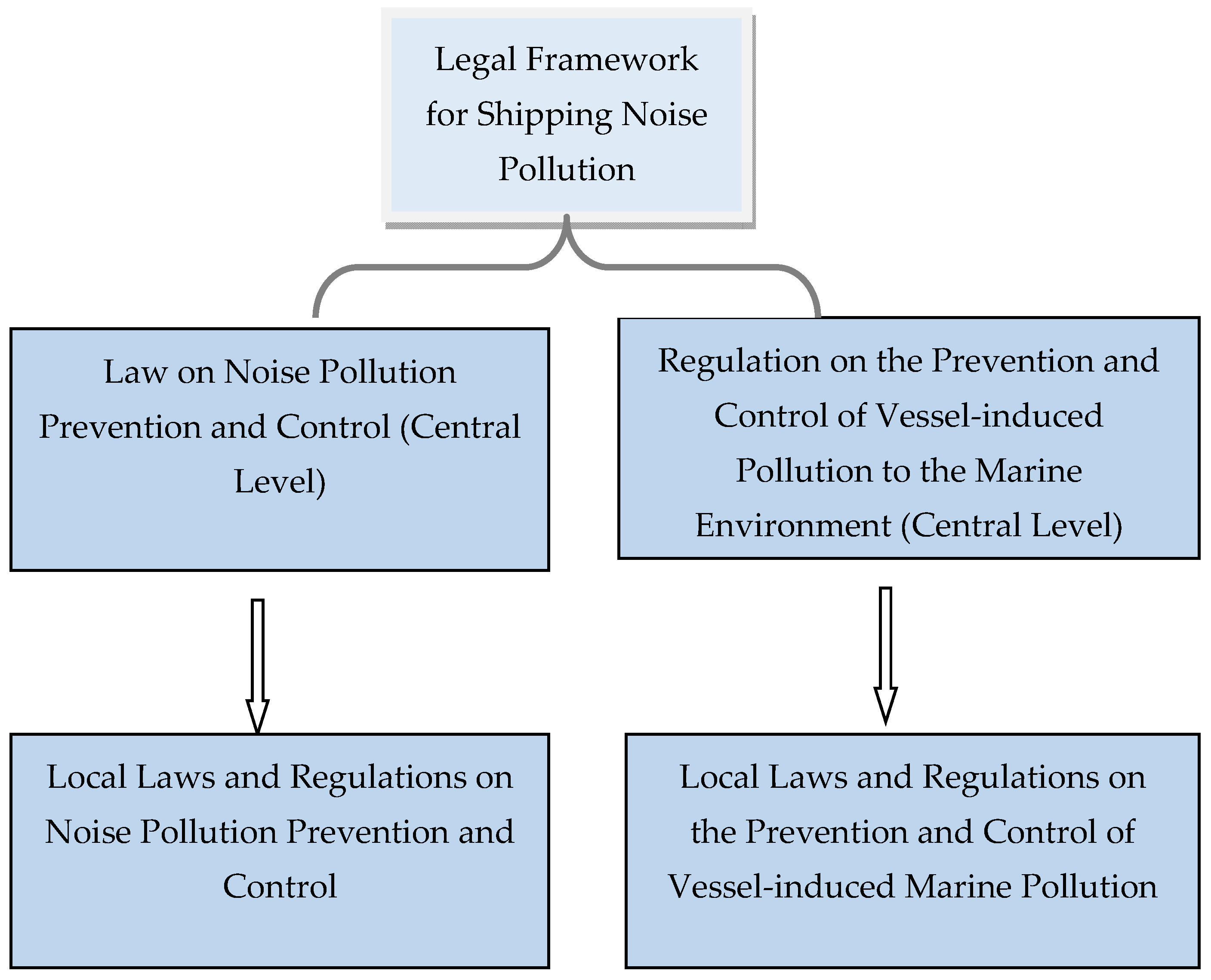
In China, the regulation of shipping noise pollution falls within the realm of environmental governance. The Environmental Protection Law, enacted by the Standing Committee of the National People’s Congress (NPCSC), serves as the fundamental legal framework governing environmental matters nationwide. Article 42 of this law explicitly classifies noise pollution as a form of environmental pollution. Specifically concerning shipping noise pollution control, China has adopted a dual-track legislative model, addressing the prevention and mitigation of shipping noise through two distinct pathways: the noise pollution control legislative system and the vessel-source pollution prevention legislative system (Figure 1).

3.1. Track 1: Regulation of Shipping Noise Under China’s Noise Prevention and Control Legislative Framework

3.1.1. Legislative Overview

In 2021, NPCSC enacted the “Law on the Prevention and Control of Noise Pollution.” This legislation, established at the central level, represents China’s first law specifically dedicated to regulating noise pollution. It identifies sound generated by the operation of motorized vessels and other transportation vehicles that disturbs the living environment as a category of regulated noise pollution, thereby establishing fundamental principles and direction for the management of shipping noise pollution from the national level.
At the local level, provincial and municipal governments have formulated approximately 27 distinct noise pollution prevention and control regulations applicable within their respective jurisdictions. Among these local laws, provisions addressing shipping noise pollution are found in 18 regions. These are predominantly coastal provinces and cities or municipalities along major inland waterways, including Haikou City, Fuzhou City, Hefei City, Zigong City, Nanjing City, Tianjin City, Tongling City, Heihe City, Hangzhou City, Zhuzhou City, Guangdong Province, Jiangsu Province, Qinhuangdao City, Shandong Province, Qingdao City, Qiqihar City, Liuzhou City, and Chongqing City (see Table 1). Conversely, several provincial and municipal-level regions that have enacted local noise pollution control regulations do not contain specific stipulations for shipping noise. These are primarily inland cities without significant inland river shipping routes, such as Beijing City, Xingtai City, Fushun City, Shijiazhuang City, Hohhot City, Handan City, Guyuan City, Shenyang City, and Kunming City.

3.1.2. Legislative Content

National-level legislation establishes overarching principles for addressing shipping noise pollution, mandating that competent authorities prevent and control environmental noise pollution without prescribing specific implementation measures. In contrast, provincial and municipal regulations contain more detailed provisions outlining concrete measures to be adopted by responsible agencies (Table 1), including
  • Designation of regulatory authorities for shipping noise pollution control. Local environmental protection departments typically exercise unified supervision over environmental noise pollution prevention, while other departments conduct oversight within their respective jurisdictions. Specifically for shipping noise pollution, relevant authorities include environmental protection departments, transport authorities, maritime safety administrations, fisheries supervision agencies, and public security organs.
  • Establishment of environmental noise monitoring systems through coordinated monitoring networks, standardized protocols, and implementation of ambient noise quality standards. While adhering to national standards, local governments develop specific standards adapted to local conditions.
  • Creation of information-sharing mechanisms and joint enforcement protocols for noise pollution control, complemented by dedicated complaint handling systems. These require local authorities to establish supervisory hotlines and reporting email addresses for centralized acceptance of noise pollution reports and complaints, which are then promptly routed to relevant functional departments according to their respective responsibilities.
  • Imposition of environmental noise pollution discharge fees, requiring entities generating excessive noise to pay fees in accordance with national regulations.
  • Delineation and periodic adjustment of zones subject to specific ambient noise quality standards within administrative regions. Based on local conditions, designated areas and time periods may prohibit vessel navigation and audible signaling.
  • Specification of rules governing vessel sound-producing devices, requiring compliance with national standards during navigation and volume control during port operations to mitigate noise impact on surrounding environments.
  • Promotion of scientific research, technological development, and dissemination of advanced control technologies and knowledge regarding noise pollution prevention.
  • Clarification of legal liabilities. Violations of noise emission regulations during vessel navigation or port stay incur penalties from maritime administrative authorities, primarily through warnings or fines. Penalty amounts vary substantially across jurisdictions, with the Haikou City Environmental Noise Pollution Prevention Measures prescribing fines of 100–200 RMB, while the Fuzhou City Provisions on Environmental Noise Pollution Prevention stipulate fines ranging from 1000 to 5000 RMB.

3.2. Track 2: Regulation of Shipping Noise Under China’s Vessel Pollution Prevention Legislative Framework

An alternative regulatory approach to shipping noise pollution in China operates through the legislative framework for vessel pollution prevention. At the national level, the State Council has promulgated the “Regulations on the Prevention and Control of Marine Environmental Pollution from Vessels,” while the Ministry of Transport (MOT) has enacted the “Provisions on the Prevention and Control of Environmental Pollution in Inland Waters from Vessels.” Locally, provinces and municipalities have developed vessel pollution prevention regulations tailored to their specific jurisdictional contexts. Within this specialized legislative framework for vessel pollution prevention, certain instruments incorporate shipping noise pollution into the regulatory framework as a distinct category of vessel pollution (Table 2). The regulatory scope primarily encompasses:
  • The structure, equipment, and materials used for vessel pollution prevention shall conform to relevant specifications and standards.
  • When navigating or operating in port areas, vessels shall ensure that emitted noise complies with national vessel noise level regulations; vessels navigating, berthing, or operating within specially protected waters shall adhere to pollution prevention regulations and standards applicable to such zones.
  • To address noise pollution prevention needs, maritime authorities may designate restricted navigation zones and time periods, establish specific waters as green shipping demonstration areas, and implement enhanced vessel pollution control measures.
  • Vessels shall utilize acoustic signaling devices in accordance with prescribed requirements.
  • In environmentally protected sea areas, vessels shall adopt measures to mitigate underwater noise emissions.
  • Support shall be extended to green port initiatives and sustainable shipping development, promoting vessel and port facility upgrades to reduce shipping noise pollution.
  • Advanced and applicable new technologies, processes, materials, and equipment for vessel pollution prevention shall be promoted, with concerted efforts to encourage and support scientific research in vessel pollution prevention, thereby reinforcing the foundational role of science and technology in maritime environmental protection.

4. China’s Policy Instruments for Shipping Noise Governance

The Chinese government has enacted a series of policies to advance the control of shipping noise pollution from multiple dimensions. These measures are closely aligned with legislative provisions governing shipping noise pollution, collectively forming a comprehensive legal and policy framework for addressing this environmental challenge in China.

4.1. Mitigating Shipping Noise Pollution Through Green Port Initiatives

Green port management plays a critical role in promoting sustainable marine development [32,33]. Vessels generate significant noise during port operations. In response, the Chinese government has proposed a two-pronged approach: advancing the adoption of clean energy for ships while simultaneously promoting the upgrading and utilization of shore power infrastructure, thereby accelerating the development of green ports.
In 2015, the Ministry of Transport of China issued the “Guiding Opinions on Promoting the Transformation and Upgrading of Ports [34],” emphasizing the need to “strengthen environmental protection in ports by actively promoting and implementing new technologies and facilities for energy conservation and emissions reduction, thereby controlling and reducing pollutant emissions from vehicles and vessels calling at ports.”
In 2023, the Chinese government released the 14th Five-Year Plan for Noise Pollution Prevention and Control Action Plan [35], establishing clear targets for noise pollution mitigation. Regarding vessel noise control, the plan mandates “enhanced oversight of noise from inland waterway vessels, promotion of clean energy adoption in inland shipping, and advancement of shore power utilization for berthed vessels. Key initiatives include the deployment and upgrading of shore power infrastructure at ports and vessel power reception systems in major waterways such as the Yangtze River Basin, Bohai Bay, and the Qiongzhou Strait.” The action plan emphasizes the adoption of clean energy and shore power infrastructure as key strategies for noise reduction, with the Ministry of Transport designated as the lead implementation agency.
The 2024 Annual Report on Noise Pollution Prevention and Control in China published by the Ministry of Ecology and Environment [10] summarized the progress in vessel noise pollution control during 2023: “In addressing vessel noise pollution, efforts have been made through strengthened supervision of noise generated by inland waterway vessels, promotion of clean energy adoption for inland shipping, and advancement of shore power usage during port stays, thereby mitigating the impact of vessel noise on surrounding areas.”

4.2. Formulation and Updating of National Standards for Shipping Noise Control

To establish an implementation framework for shipping noise governance, China has formulated numerous national standards addressing shipping noise and maintains a systematic process for their periodic updating in response to practical requirements (Table 3).
These national standards encompass measurement methodologies for onboard, ambient, and underwater vessel noise, thereby providing the technical foundation for implementing legal and policy measures. For instance, the Regulation on Noise Levels on Board Inland Ships establishes maximum permissible limits for cabin noise, creating unambiguous criteria and legal basis for controlling cabin noise pollution—significantly contributing to improved comfort for crew and passengers. The standard Measurement of Radiated Noise from Vessels in Inland Waterways and Ports employs A-weighted exposure sound pressure level as the primary metric, supplemented by parameters including octave-band sound pressure levels, to standardize noise measurement protocols in inland waterways and port areas. Furthermore, the Guidelines for Assessing the Impact of Anthropogenic Underwater Noise on Marine Life provide comprehensive guidance for evaluating impacts from human activities such as coastal engineering, island/reef projects, and deep-sea mining, covering assessment subjects, operational procedures, field measurements, and analytical methodologies.

4.3. Designation of Shipping Noise Control Zones in Designated Waters

China’s legal framework for shipping noise pollution control empowers local administrative authorities to designate specific waters as control zones based on regional noise mitigation needs. Although such measures are not frequently implemented in practice, they have been effectively applied. For instance, the Chongqing Maritime Safety Administration issued the Circular on Regulating Vessel Noise Emissions in Certain Waters of Chongqing’s Central Urban Area (Circular No. 034, 2023) [45], which states:
To effectively mitigate the impact of shipping noise on the daily life and study of residents along the river in certain waters of Chongqing’s central urban area, and in accordance with the Law of the People’s Republic of China on the Prevention and Control of Environmental Noise Pollution and other relevant legal provisions, it is decided that from 00:00 on 4 March 2023, vessel noise emissions will be regulated in the segment between the Dadusi Yangtze River Bridge and the Yudong Yangtze River Bridge (approximately river mileage 655.2–694.5 km). Vessels navigating, berthing, or operating in these controlled waters shall take measures such as closing engine room doors to reduce noise emissions from main and auxiliary engines during normal operation.
The designation of specific waters as shipping noise control zones represents a targeted approach to effectively manage and mitigate vessel-generated noise.

4.4. Regulatory Control Through Economic Instruments: Noise Emission Fees and Taxation

The Chinese government enacted the Administrative Measures on the Collection Standards for Pollutant Discharge Fees in 2003, authorizing local environmental protection authorities to collect discharge fees from entities exceeding noise emission standards. This regulation was repealed following the implementation of the Environmental Protection Tax Law in 2018. The latter statute classifies noise as a taxable pollutant, imposing levies on noise exceeding nationally prescribed decibel limits. Notably, neither the Administrative Measures on the Collection Standards for Pollutant Discharge Fees nor the Environmental Protection Tax Law incorporates shipping noise into their respective regulatory scopes. This exclusion primarily stems from the mobile nature of vessel-generated noise, which poses persistent challenges in monitoring compliance with emission standards. The effective identification and enforcement of shipping noise pollution regulations remain contingent upon technological advancements and the continued refinement of industry-specific standards.

5. Deficiencies, Challenges and the Way Forward

In recent years, China has demonstrated a growing prioritization of noise pollution control, adopting not only targeted legal frameworks but also implementing a coordinated approach integrating policy instruments and national standards. While legislation provides the foundational support and establishes fundamental principles, these are operationalized through detailed policies. This integrated legal-policy model has established essential principles and directional guidance for addressing shipping noise pollution, forming a basic regulatory framework and systematic structure within China’s jurisdiction. Nevertheless, the current legal and policy mechanisms governing shipping noise pollution confront several challenges that require further refinement.

5.1. Legislative Gaps in the Dual-System Regulatory Framework

China currently employs a dual-track legislative model for regulating shipping noise pollution, comprising both the noise pollution control legal framework and the vessel pollution prevention regulatory system. This dual approach reflects the country’s commitment to addressing shipping noise emissions and has established a legal foundation for its governance. Nevertheless, several legislative shortcomings persist.
First, the dual-track model has led to fragmented enforcement authority involving multiple regulatory entities—including local governments, ecological and environmental departments, maritime authorities, and public security bureaus—creating potential jurisdictional conflicts. Local governments and their ecological-environment departments are responsible for unified oversight, including setting noise standards and planning. Yet, their enforcement remains limited to land, with minimal direct control over ships underway. Maritime authorities focus on ship safety, navigation order, and preventing water pollution. While ship noise affecting “navigation safety” or the “aquatic environment” provides a legal basis for their involvement, these issues usually fall outside their core duties. Public security bureaus, handling social order disturbances, are also primarily focused on land. This overlap in responsibilities, coupled with differing core priorities, leads to a scenario where multiple agencies are nominally involved but none addresses the issue thoroughly.
Second, existing penalties for violations remain limited in variety, predominantly relying on monetary fines, with significant disparities in penalty criteria across provinces and municipalities.
Third, the legislative scope requires expansion. Current regional shipping noise regulations primarily focus on mitigating impacts on port communities, riverside residents, and onboard personnel, while demonstrating insufficient attention to mitigating the impact of anthropogenic noise on marine life through targeted legislation.
Moving forward, it is imperative to consolidate enforcement authority, diversify penalty mechanisms, broaden legislative coverage, and enact targeted legislation to address noise pollution affecting marine ecosystems.
To address these gaps, future legislation should diversify the forms and substance of penalties while progressively integrating legal standards specifically aimed at mitigating noise pollution affecting marine life. As for fragmented enforcement across multiple authorities, China has developed various coordination mechanisms in practice to overcome this dilemma. The core of these efforts lies in transforming compartmentalized “departmental responsibilities” into a shared “common objective.” Among these, joint enforcement protocols and targeted special campaigns are the most prevalent forms of coordination, typically institutionalized through “inter-agency meeting systems” and “jointly issued directives.” A case in point is the initiative in Wuhan to reduce noise from nighttime shipping on the Yangtze River. To mitigate the impact on riverside residents, the Wuhan Maritime Safety Administration and the Wuhan Transportation Comprehensive Law Enforcement Brigade jointly issued a “Notice on Implementing Ship Noise Control.” This notice requires vessels in designated areas and during specified periods to proactively reduce noise by “adopting effective measures to control noise from main and auxiliary engines” and “closing hatch doors or installing silencers,” thereby minimizing operational noise. Similarly, port operations and waterway construction projects must effectively control noise to ensure compliance with standards. Subsequently, the Wuhan Maritime Safety Administration and the Wuhan transportation department conducted consecutive enforcement inspections to ensure the full implementation of the Notice [46].
Such joint operations deliver immediate, tangible results within set periods and zones. Yet, their nature as campaign-driven tools—dependent on high-level attention and temporary resources—makes them inherently unsustainable. Post-campaign, compliance often lapses, causing issues to return and failing to address the core structural problems of divided mandates and blurred responsibilities. To achieve long-term and effective control of shipping noise pollution, it is necessary to move beyond temporary “joint actions” and advance toward a new phase of “holistic governance” underpinned by clear legislation, data sharing, and a credit-based system. Concrete steps include legally defining a lead agency with coordination and oversight powers; linking noise violations to the vessel and company’s credit records; and establishing national data standards to integrate AIS, noise monitoring, shore power, and registry data. This enables automated generation of suspect vessel lists, providing frontline officers with actionable intelligence.

5.2. Challenges in Expanding the Application of Noise Control Zones in Designated Waters

The Chinese government has implemented the designation of shipping noise control zones in specific waters as a regulatory approach, achieving positive outcomes in addressing particular types or localized instances of shipping noise pollution. However, the application of such measures remains confined to inland waterways and has been utilized rather infrequently.
The establishment and implementation of noise control zones in Chinese waters present a complex undertaking that must balance ecological protection, shipping efficiency, and technical feasibility, while confronting policy, technical, and managerial challenges. On the policy front, although Chinese law empowers local authorities to designate specific waters as control zones based on local noise pollution needs, it lacks specialized regulations and policies detailing the operational procedures. Technically, an effective and precise underwater noise monitoring network capable of covering specific waters has yet to be established. Managerially, the designation of noise control zones typically requires transiting vessels to reduce speed or detour, which can impact shipping efficiency to some extent. Balancing effective noise control with transport efficiency is therefore a critical issue. Addressing this requires a dual approach: firstly, adopting a cautious and nuanced strategy for zone designation, implementing precise, differentiated measures based on strict zoning criteria; and secondly, instituting necessary dynamic adjustments and management of these zones in response to seasonal variations and environmental conditions.

5.3. Inadequate Scope of National Standards

China has promulgated numerous national standards for controlling shipping noise pollution, establishing regulatory thresholds for noise emissions and regularly updating these requirements. While these standards reflect the precautionary principle in managing shipping noise and play a positive role in mitigation efforts, their current scope remains predominantly focusing on shipbuilding. Future revisions should expand their coverage to include additional domains, such as introducing standardized measurement protocols for underwater noise pollution from vessels.
Effective national standards are expected to exhibit determinacy, accuracy, and operationalizability. A case in point is the “Measurement of Noise Onboard Ships” which delineates maximum limits for cabin noise on both inland and seagoing vessels, as well as for environmental noise from inland vessels. The rules apply to 16 types of onboard spaces, such as machinery areas, engine control rooms, workshops, wheelhouses, chart rooms, dining areas, and so on. For inland vessel external noise, separate day and night limits are defined, complete with specified attenuation over distance. Formulating these standards depends on the availability of mature scientific and technical support, including noise measurement methods and impact studies. Consequently, current standardization efforts are largely confined to ship construction. Expanding into other domains, such as establishing monitoring standards for underwater noise pollution, poses a pronounced obstacle. While considerable research confirms the adverse effects of shipping underwater noise on marine organisms, these studies are typically confined to particular locales, short durations, or specific species. Moreover, noise tolerance can vary significantly among co-occurring species. This variability complicates the creation of broadly applicable underwater noise monitoring standards. Nonetheless, establishing tailored standards for defined waterways and specific vulnerable species represents a feasible and pragmatic pathway forward.

5.4. Coordinating Stakeholder Interests in Leveraging Green Port Initiatives for Shipping Noise Mitigation

Chinese policy frameworks highlight green port development as a strategic component in addressing shipping noise pollution, promoting vessel use of clean energy and enhancing the retrofitting and utilization of shore power infrastructure. While this approach has proven notably effective in mitigating noise from inland waterway shipping, its application to coastal port operations presents persistent institutional deficiencies and practical challenges [33]. Although regulatory measures coupled with policy incentives have yielded progress in shore power adoption, further optimization remains necessary to achieve comprehensive noise reduction in maritime contexts.
Shipping noise pollution governance involves multiple stakeholders. To better coordinate their interests, this article proposes a three-pronged approach: First, establish structured, multi-level consultative platforms as a collaborative governance mechanism. This would integrate all relevant parties—government agencies, port operators, shipping companies, equipment manufacturers, and coastal communities—into a shared decision-making process, ensuring their concerns are fully articulated. Second, implement supporting incentive policies, such as differentiated port fees and green technology subsidies. These would offset the added costs and delays from adopting low-noise technologies or slow steaming through measures like port fee reductions, priority berthing, or tax incentives, thereby balancing ecological protection, economic development, and social interests. Third, leverage a shared data platform to provide an objective basis for dynamic, adaptive management, allowing for continuous optimization based on implementation outcomes to mitigate the economic impact of noise control measures.

5.5. Application of Noise Emission Fees or Taxes in Shipping Contingent on Technological Advancement

The Chinese government has adopted economic instruments in the form of noise emission fees or taxes for general noise pollution control. Extending this mechanism to address shipping noise pollution would introduce an additional regulatory instrument and dimension to current mitigation efforts. However, the effective imposition of such fees or taxes is contingent upon the establishment of definitive noise pollution criteria and reliable measurement technologies. Future policy initiatives should prioritize incentivizing the research and development of such technologies, thereby creating the necessary conditions for leveraging economic instruments to more effectively control shipping noise pollution.

5.6. Enhancing International Cooperation in Shipping Noise Governance

Currently, China’s legal and policy frameworks for shipping noise governance are predominantly focused on its inland waters. However, given the transboundary and global nature of shipping noise and China’s pivotal role in global shipping, it is well-positioned to play a proactive role in advancing the international governance regime, steering it toward being more scientific, coordinated and operational. Specifically, China can:
First, spearhead the development of international rules, particularly within the IMO framework, by proposing Chinese solutions for the formulation, revision, and refinement of global shipping noise standards.
Second, catalyze the establishment of regional monitoring and data-sharing networks. By collaborating with neighboring states to integrate AIS data with acoustic monitoring data, China can help generate robust evidence for oversight and enforcement, while also providing valuable datasets for scientific research.
Third, promote and support technological research and development. This includes encouraging domestic shipyards to build and promote quiet vessel demonstration projects, using operational data to validate their environmental and economic benefits for international replication.
Fourth, as a major regional power, China can convene international symposiums and training programs through which to share its technical and managerial expertise. Specifically, sharing its experiences in noise monitoring, vessel retrofitting, and port management can support other countries in upgrading their shore power and noise detection infrastructure, thereby fostering global knowledge transfer and capacity-building.

6. Conclusions and Future Research

The governance of shipping noise pollution is increasingly recognized as a critical issue in marine environmental protection and the development of green shipping. Compared to traditional forms of pollution, shipping noise is more challenging to measure and regulate. This study examines China’s legal and policy framework for shipping noise pollution and identifies that China has established a legal foundation for governing shipping noise pollution through a dual-track legislative approach, encompassing both the environmental noise pollution prevention framework and the vessel pollution prevention regulatory system. Supplementing these legal instruments, policy measures—including the promulgation of national and industry standards, designation of noise control zones in waters, promotion of green port initiatives, and implementation of noise pollution action plans—have been systematically deployed to advance noise mitigation in shipping activities. Collectively, these legislative and policy interventions play a positive role in addressing vessel-sourced noise pollution. Nevertheless, the current institutional framework exhibits several limitations and challenges. These include incomplete legislative coverage, difficulties in expanding the application of noise control zones, and insufficient scope of national and industry standards. Future efforts to mitigate shipping noise pollution must address these gaps, reconcile diverse stakeholder interests, enhance international cooperation, and encourage scientific research and technological innovation. The study findings provide a comprehensive portrayal of China’s existing legal and policy framework for shipping noise governance. This serves as a critical foundation for its future improvement and offers instructive lessons for other countries. Moving forward, China must broaden and specify its legislative scope and investigate the creation of more durable and well-defined enforcement systems. In addition to domestic efforts, enhanced international collaboration is essential to develop a global governance regime that is more scientifically grounded, coordinated, and actionable.
Moreover, this study finds that despite China’s establishment of a relatively comprehensive legal framework governing shipping noise pollution and the ongoing development and updating of national standards for noise control across various sectors, frontline enforcement personnel continue to face challenges due to insufficiently detailed standards and difficulties in operational application within complex environments. This underscores the importance of technological application in shipping noise pollution control.
While legislation generally refrains from prescribing specific technical methods—preferring instead to regulate manifestations of noise pollution across different scenarios, governmental supervisory responsibilities, enforcement procedures, liable entities, legal consequences, and stakeholder coordination—it seldom incorporates explicit standard acoustic measurement indicators or methodologies. Nevertheless, it is undeniable that precise acoustic metrics and methodologies, along with the corresponding measurement instruments and equipment derived from them, play a crucial role in enabling effective field enforcement.
Looking ahead, future research could focus on integrating technical acoustic assessment methods with policy formulation, particularly exploring how key acoustic indicators can enable more scientific measurement and evaluation of noise levels and their impacts. Establishing these methods as national standards upon maturation, and translating them into critical monitoring devices to assist frontline officers in conducting rapid and accurate enforcement, represents a highly promising and practical research direction with significant potential to advance shipping noise pollution governance.

Funding

This research received no external funding.

Institutional Review Board Statement

Not applicable.

Informed Consent Statement

Not applicable.

Data Availability Statement

Data will be made available on request.

Conflicts of Interest

The author declares no conflicts of interest.

References

  1. Larayedh, R.; Cornuelle, B.D.; Krokos, G.; Hoteit, I. Numerical investigation of shipping noise in the Red Sea. Sci. Rep. 2024, 14, 5851. [Google Scholar] [CrossRef]
  2. Duarte, C.M.; Chapuis, L.; Collin, S.P.; Costa, D.P.; Devassy, R.P.; Eguiluz, V.M.; Erbe, C.; Gordon, T.A.C.; Halpern, B.S.; Harding, H.R.; et al. The Soundscape of the Anthropocene Ocean. Science 2021, 371, eaba4658. [Google Scholar] [CrossRef]
  3. Erbe, C.; Marley, S.A.; Schoeman, R.P.; Smith, J.N.; Trigg, L.E.; Embling, C.B. The Effects of Ship Noise on Marine Mammals—A Review. Front. Mar. Sci. 2019, 6, 606. [Google Scholar] [CrossRef]
  4. Vakili, S.; Ölçer, A.I.; Ballini, F. The Development of a Transdisciplinary Policy Framework for Shipping Companies to Mitigate Underwater Noise Pollution from Commercial Vessels. Mar. Pollut. Bull. 2021, 171, 112687. [Google Scholar] [CrossRef]
  5. UN. Transforming Our World: The 2030 Agenda for Sustainable Development, Goal 14: Conserve and Sustainably Use the Oceans, Seas and Marine Resources. Available online: https://www.un.org/sustainabledevelopment/oceans/ (accessed on 28 October 2025).
  6. Canbay, Ş. The Analysis of Relationships between Global Shipping Networks and Foreign Trade Volumes in Developing Countries. Case Stud. Transp. Policy 2024, 17, 101242. [Google Scholar] [CrossRef]
  7. Jalkanen, J.-P.; Johansson, L.; Andersson, M.H.; Majamäki, E.; Sigray, P. Underwater Noise Emissions from Ships during 2014–2020. Environ. Pollut. 2022, 311, 119766. [Google Scholar] [CrossRef] [PubMed]
  8. Badino, A.; Borelli, D.; Gaggero, T.; Rizzuto, E.; Schenone, C. Airborne Noise Emissions from Ships: Experimental Characterization of the Source and Propagation over Land. Appl. Acoust. 2016, 104, 158–171. [Google Scholar] [CrossRef]
  9. Nastasi, M.; Fredianelli, L.; Bernardini, M.; Teti, L.; Fidecaro, F.; Licitra, G. Parameters Affecting Noise Emitted by Ships Moving in Port Areas. Sustainability 2020, 12, 8742. [Google Scholar] [CrossRef]
  10. MEE. 2024 Report on Noise Pollution Prevention and Control in China. Available online: https://www.mee.gov.cn/hjzl/sthjzk/hjzywr/202408/t20240829_1084711.shtml (accessed on 28 October 2025).
  11. Vakili, S.V.; Ölçer, A.I.; Ballini, F. The Development of a Policy Framework to Mitigate Underwater Noise Pollution from Commercial Vessels: The Role of Ports. Mar. Policy 2020, 120, 104132. [Google Scholar] [CrossRef]
  12. Andersson, C.; Johansson, A.T.; Genell, A.; Winroth, J. Fully Electric Ship Propulsion Reduces Airborne Noise but Not Underwater Noise. Ocean Eng. 2024, 302, 117616. [Google Scholar] [CrossRef]
  13. Helal, K.M.; Fragasso, J.; Moro, L. Underwater Noise Characterization of a Typical Fishing Vessel from Atlantic Canada. Ocean Eng. 2024, 299, 117310. [Google Scholar] [CrossRef]
  14. Kim, S.; Kinnas, S.A. Numerical Prediction of Propeller-Induced Noise in Open Water and Ship Behind Conditions. Ocean Eng. 2022, 261, 112122. [Google Scholar] [CrossRef]
  15. Fredianelli, L.; Nastasi, M.; Bernardini, M.; Fidecaro, F.; Licitra, G. Pass-by Characterization of Noise Emitted by Different Categories of Seagoing Ships in Ports. Sustainability 2020, 12, 1740. [Google Scholar] [CrossRef]
  16. Kurt, R.E.; Khalid, H.; Turan, O.; Houben, M.; Bos, J.; Helvacioglu, İ.H. Towards Human-Oriented Norms: Considering the Effects of Noise Exposure on Board Ships. Ocean Eng. 2016, 120, 101–107. [Google Scholar] [CrossRef]
  17. Borelli, D.; Gaggero, T.; Rizzuto, E.; Schenone, C. Analysis of Noise on Board a Ship during Navigation and Manoeuvres. Ocean Eng. 2015, 105, 256–269. [Google Scholar] [CrossRef]
  18. Bocanegra, J.A.; Borelli, D.; Gaggero, T.; Rizzuto, E.; Schenone, C. Characterizing Onboard Noise in Ships: Insights from Statistical, Machine Learning and Advanced Noise Index Analyses. Ocean Eng. 2023, 285, 115273. [Google Scholar] [CrossRef]
  19. McIntyre, D.; Lee, W.; Frouin-Mouy, H.; Hannay, D.; Oshkai, P. Influence of Propellers and Operating Conditions on Underwater Radiated Noise from Coastal Ferry Vessels. Ocean Eng. 2021, 232, 109075. [Google Scholar] [CrossRef]
  20. Williams, R.; Ashe, E.; Yruretagoyena, L.; Mastick, N.; Siple, M.; Wood, J.; Joy, R.; Langrock, R.; Mews, S.; Finne, E. Reducing Vessel Noise Increases Foraging in Endangered Killer Whales. Mar. Pollut. Bull. 2021, 173, 112976. [Google Scholar] [CrossRef]
  21. Smith, T.A.; Rigby, J. Underwater Radiated Noise from Marine Vessels: A Review of Noise Reduction Methods and Technology. Ocean Eng. 2022, 266, 112863. [Google Scholar] [CrossRef]
  22. Kaplan, M.B.; Solomon, S. A Coming Boom in Commercial Shipping? The Potential for Rapid Growth of Noise from Commercial Ships by 2030. Mar. Policy 2016, 73, 119–121. [Google Scholar] [CrossRef]
  23. Halliday, W.D.; Pine, M.K.; Citta, J.J.; Harwood, L.; Hauser, D.D.W.; Hilliard, R.C.; Lea, E.V.; Loseto, L.L.; Quakenbush, L.; Insley, S.J. Potential Exposure of Beluga and Bowhead Whales to Underwater Noise from Ship Traffic in the Beaufort and Chukchi Seas. Ocean Coast. Manag. 2021, 204, 105473. [Google Scholar] [CrossRef]
  24. Frankish, C.K.; von Benda-Beckmann, A.M.; Teilmann, J.; Tougaard, J.; Dietz, R.; Sveegaard, S.; Binnerts, B.; de Jong, C.A.F.; Nabe-Nielsen, J. Ship Noise Causes Tagged Harbour Porpoises to Change Direction or Dive Deeper. Mar. Pollut. Bull. 2023, 197, 115755. [Google Scholar] [CrossRef]
  25. Taylor, J.J.; McIntosh, R.R.; Gray, R.B.; Charrier, I. Behavioural Response of Australian Fur Seals (Arctocephalus pusillus doriferus) to Vessel Noise during Peak and Off-Peak Human Visitation. Mar. Pollut. Bull. 2024, 208, 116947. [Google Scholar] [CrossRef] [PubMed]
  26. Darias-O’Hara, A.K.; Booth, C.G.; Erbe, C.; Isojunno, S.; Janik, V.M.; Lucke, K.; Southall, B.; Tougaard, J.; von Benda-Beckmann, A.M.; Verfuss, U.K. Behavioural Response Thresholds for the Assessment of Noise Impact on Antarctic Marine Mammal Species. Mar. Policy 2025, 179, 106738. [Google Scholar] [CrossRef]
  27. Williams, R.; Erbe, C.; Ashe, E.; Beerman, A.; Smith, J. Severity of Killer Whale Behavioral Responses to Ship Noise: A Dose–Response Study. Mar. Pollut. Bull. 2014, 79, 254–260. [Google Scholar] [CrossRef]
  28. Arranz, P.; De la Cruz-Modino, R.; Sprogis, K.R. Investigating the Effects of Underwater Noise from Two Vessels on the Behaviour of Short-Finned Pilot Whales. Mar. Environ. Res. 2024, 199, 106574. [Google Scholar] [CrossRef]
  29. Wysocki, L.E.; Dittami, J.P.; Ladich, F. Ship Noise and Cortisol Secretion in European Freshwater Fishes. Biol. Conserv. 2006, 128, 501–508. [Google Scholar] [CrossRef]
  30. Merchant, N.D. Underwater Noise Abatement: Economic Factors and Policy Options. Environ. Sci. Policy 2019, 92, 116–123. [Google Scholar] [CrossRef]
  31. De Jong, K.; Murray, C.C.; Anabitarte, A.; Bailey, S.; Drake, L.; Fernandes-Salvador, J.A.; Hassellöv, I.-M.; Heibeck, N.; Jalkanen, J.-P.; Lehikoinen, A.; et al. Trade-Offs and Synergies in the Management of Environmental Pressures: A Case Study on Ship Noise Mitigation. Mar. Pollut. Bull. 2025, 218, 118073. [Google Scholar] [CrossRef]
  32. Xu, L.; Di, Z.; Chen, J.; Shi, J.; Yang, C. Evolutionary Game Analysis on Behavior Strategies of Multiple Stakeholders in Maritime Shore Power System. Ocean Coast. Manag. 2021, 202, 105508. [Google Scholar] [CrossRef]
  33. Wang, Q. Charting a Greener Course: China’s Recent Legal Strategies in Shore Power Promotion for Achieving Maritime Emission Targets. Mar. Policy 2024, 170, 106386. [Google Scholar] [CrossRef]
  34. MOT. Guidance on Promoting the Transition and Upgrading of the Port Sector. Available online: https://xxgk.mot.gov.cn/jigou/syj/202006/t20200623_3314249.html (accessed on 28 October 2025).
  35. MEE; NDRC; MOT; CCO; MOE; MOST; MIIT; MPS; MCA; MNR; et al. Action Plan for Noise Pollution Prevention and Control During the 14th Five-Year Plan Period. Available online: https://www.gov.cn/zhengce/zhengceku/2023-01/10/content_5736095.htm (accessed on 28 October 2025).
  36. CB/T 3339-2001; Measurement Methods for Marine Diesel Engine Exhaust Mufflers. State Administration of Science, Technology and Industry for National Defense: Beijing, China, 2001.
  37. GB 5980-2009; Regulation on Noise Levels on Board Inland Ships. General Administration of Quality Supervision, Inspection and Quarantine/National Standardization Administration: Beijing, China, 2009.
  38. GB/T 4964-2010; Measurement of Radiated Noise from Vessels in Inland Waterways and Ports. General Administration of Quality Supervision, Inspection and Quarantine/National Standardization Administration: Beijing, China, 2011.
  39. GB/T 4595-2020; Measurement of Noise on Board Vessels. Ministry of Transport: Beijing, China, 2020.
  40. HY/T 0341-2022; Guidelines for Assessing the Impact of Anthropogenic Underwater Noise on Marine Life. Ministry of Natural Resources: Beijing, China, 2022.
  41. JT/T 781-2023; The Disign Code of Practice for Noise Control in Ships. Ministry of Transport: Beijing, China, 2023.
  42. GB/T 43943-2024; Ambient Noise on Ships. State Administration for Market Regulation/National Standardization Administration: Beijing, China, 2024.
  43. GB/T 43945-2024; Cabin Noise Prediction for Ships Based on Statistical Energy Analysis. State Administration for Market Regulation/National Standardization Administration: Beijing, China, 2024.
  44. GB/T 44042-2024; Measurement Methods for Underwater Radiated Noise from Ships. State Administration for Market Regulation/National Standardization Administration: Beijing, China, 2024.
  45. China MSA. Chongqing Maritime Safety Administration issued the Circular on Regulating Vessel Noise Emissions in Certain Waters of Chongqing’s Central Urban Area. Available online: https://www.msa.gov.cn/msacncms_wap/pages/content.do?articleId=F88E5B08-2824-46E0-9BC5-2D46F7F66502 (accessed on 28 October 2025).
  46. CENEWS. Wuhan Launches Nighttime Noise Control for Ships in Designated Waters. Available online: https://www.cenews.com.cn/news.html?aid=1753482 (accessed on 28 November 2025).
Figure 1. China’s legal framework for shipping noise governance.
Sustainability 18 00423 g001
Table 1. China’s noise prevention and control legislation on shipping. Source: Author’s compilation based on publicly promulgated laws and regulations of China.
YearTitleLaw-Making AuthorityMain Content
Central level
2014 latest revisionEnvironmental Protection Law of the People’s Republic of ChinaNPCSC
  • Enterprises, public institutions and other producers and business operators that discharge pollutants shall take measures to prevent and control the environmental pollution caused by noise generated during production, construction or other activities.
2021Law on the Prevention and Control of Noise PollutionNPCSC
  • Local governments to integrate noise control into development plans, with dedicated budgets and clear targets.
  • Implementation of target-based responsibility and evaluation system, linked to performance assessments.
  • Establishment of cross-departmental coordination and information-sharing mechanisms at local levels.
  • Support for research and development, commercialization, and talent cultivation in noise control technology.
  • Development and periodic revision of noise pollution prevention and control standards. Formulation of monitoring standards, network planning, automated monitoring, and public data release.
  • Interview system for areas with severe noise issues.
  • Fines (5000–10,000 RMB) for improper use of vessel audible signals.
Local level
1998Administrative Measures for the Prevention and Control of Environmental Noise Pollution in Zigong CityZigong Municipal People’s Government
  • Include noise control in environmental planning.
  • Support research, technology, and training in noise control.
  • Implement a target-based accountability system for noise control.
  • Establish local cross-departmental coordination mechanisms.
  • Classify motor vessel noise as transportation noise.
  • Require regulated use of audible signals on vessels; impose fines for violations.
  • Monitor noise via automated networks and publicize data.
  • Conduct official interviews in areas with severe noise issues.
2010Administrative Measures for the Prevention and Control of Environmental Noise Pollution in Tongling CityTongling Municipal People’s Government
  • Public security and transport authorities supervise traffic and social noise within their jurisdictions.
  • Transport departments establish and manage hotlines for noise pollution reports and complaints.
  • Maritime authorities are specifically responsible for supervising vessel noise pollution control.
  • All entities and individuals must remediate noise-generating facilities within deadlines set by environmental authorities.
  • Port belt conveyor systems must implement noise reduction measures to comply with boundary emission standards.
  • Motorized vessels must use whistles in compliance with regulations; steam whistles are prohibited in urban areas.
  • Violators face administrative penalties from competent authorities and liability for damages.
2010Administrative Measures for the Prevention and Control of Environmental Noise Pollution in the Urban Area of Heihe CityHeihe Municipal People’s Government
  • Operational noise from vessels disturbing the living environment is classified as transportation noise.
  • Maritime administrative authorities supervise and manage vessel noise emissions.
  • Environmental protection and other responsible departments must publish contact details for handling noise complaints.
  • Operators of commercial noise-generating equipment must take measures to ensure boundary noise meets national standards.
  • Violations are addressed by maritime and other relevant authorities within their statutory powers.
2010 latest revisionRegulations of Hangzhou City on Environmental Noise ControlStanding Committee of the Hangzhou Municipal People’s Congress
  • Operational vessel noise classified as transportation noise.
  • Maritime authorities supervise vessel noise pollution control.
  • In urban waters, high-pitched horns prohibited; visual signals required for vessel encounters except during specific maneuvers.
  • Outboard engine vessels banned from nighttime urban waterway navigation.
  • Horn use prohibited on West Lake.
  • Dock broadcast horn noise must meet zonal ambient noise standards.
2010Regulations of Qiqihar City on the Prevention and Control of Environmental Noise PollutionStanding Committee of the Qiqihar Municipal People’s Congress
  • Establish dedicated noise complaint hotline.
  • Set and adjust municipal noise standards and zones.
  • Conduct systematic noise and source monitoring.
  • Noise producers must mitigate pollution; violators pay fees.
  • Motorized vessels must follow acoustic signaling rules in urban waters.
  • Maritime authority may restrict navigation/signaling in designated areas.
  • Fines: 1000–10,000 RMB for vessel noise violations.
2011Interim Measures for the Prevention and Control of Environmental Noise Pollution in the Urban Area of Zhuzhou CityZhuzhou Municipal People’s Government
  • Maritime authorities supervise vessel noise.
  • Operational vessel noise is classified as transportation noise.
  • Volume must be controlled for loudspeakers in port operations.
  • Vessels must maintain mufflers to meet national noise regulations.
  • Violations incur warnings or fines.
2012 latest revisionMeasures of Haikou City on Environmental Noise Pollution Prevention and ControlHaikou Municipal People’s Congress
  • Municipal environmental protection administration centrally supervises noise control; maritime authority regulates shipping noise.
  • Noise-generating entities must implement timely mitigation measures and pay discharge fees.
  • Public complaint hotline and mailbox established; all reports require formal responses.
  • Vessels must use compliant acoustic signals in urban waters.
  • Violations subject to RMB 100–200 fines.
2012 latest revisionProvisions of Fuzhou City on the Prevention and Control of Environmental Noise Pollution Standing Committee of the Fujian Provincial People’s Congress
  • Centralized public noise complaint system established.
  • Vessels must comply with national noise emission standards.
  • High-pitched horn use restricted in Minjiang River North Channel during midday/night.
  • Violations incur warnings or fines (RMB 1000–5000).
2017 latest revisionRegulations of Nanjing City on the Prevention and Control of Environmental Noise PollutionStanding Committee of the Nanjing Municipal People’s Congress
  • Environmental agencies must handle public noise complaints promptly.
  • Municipal environmental noise zones are determined by environmental administration and approved by government.
  • Maritime Safety Authority may designate no-navigation/no-signal zones.
  • Violations incur warnings or fines up to 1000 RMB.
2017Regulations of Qinhuangdao City on the Prevention and Control of Environmental Noise PollutionStanding Committee of the Qinhuangdao Municipal People’s Congress
  • Maritime & fisheries authorities regulate vessel noise pollution.
  • Establish coordinated noise complaint handling system.
  • Apply ambient noise standards.
  • Designate and announce public no-horn zones.
  • Restrict port sound signals to essential safety use.
  • Prohibit nighttime fishing port noise disturbances.
  • Violations: 1000–3000 RMB fines & port departure ban.
2018 latest revisionRegulations of Shandong Province on the Prevention and Control of Environmental Noise PollutionStanding Committee of the Shandong Provincial People’s Congress
  • Maritime authorities oversee vessel/waterfront noise control.
  • Establish noise monitoring network and publish bulletins.
  • Provide dedicated reporting channels (hotline/email).
  • Public can report violations; authorities must process within 3 days (urgent cases expedited).
  • Urban port/waterway vessels must use acoustic signals per national rules.
  • Violations incur administrative penalties.
2018 latest revisionMeasures of Guangdong Province for the Implementation of the Law of the PRC on the Prevention and Control of Environmental Noise PollutionStanding Committee of the Guangdong Provincial People’s Congress
  • Excessive noise emitters must apply control measures and pay discharge fees/taxes.
  • Urban inland vessels must use low-decibel horns and respect no-horn zones.
  • Non-compliant signaling results in warnings or fines (RMB 200–500).
2018 latest revision Regulations of Jiangsu Province on the Prevention and Control of Environmental Noise PollutionStanding Committee of the Jiangsu Provincial People’s Congress
  • Establish noise reporting channels; complaints processed within 3 business days.
  • Set local noise emission standards.
  • Environmental authorities monitor and publish noise data.
  • Non-compliant vessel signaling incurs fines of RMB 500–1000.
2020 latest revisionAdministrative Measures of Tianjin Municipality on the Prevention and Control of Environmental Noise PollutionTianjin Municipal People’s Government
  • Maritime/fisheries authorities regulate vessel noise.
  • Entities exceeding noise limits must apply controls and pay fees.
  • Vessels in urban waterways must follow acoustic signal regulations.
  • Ports/airports to reduce horn volume and adopt low-decibel/radio alternatives.
2020 latest revisionRegulations of Qingdao City on Environmental Noise ManagementStanding Committee of the Qingdao Municipal People’s Congress
  • Maritime/fisheries agencies oversee vessel noise regulation.
  • Entities exceeding noise limits must mitigate and pay fees.
  • Urban vessels must follow acoustic signal rules.
  • Port/airport horns must be reduced and replaced with low-decibel/radio systems.
2021Administrative Measures for the Prevention and Control of Environmental Noise Pollution in Liuzhou CityLiuzhou Municipal People’s Government
  • Authorities must promptly investigate noise complaints.
  • Vessel noise control follows existing laws.
  • Designated no-horn zones to be publicly signed and announced.
2023Measures of Chongqing Municipality on the Prevention and Control of Noise PollutionChongqing Municipal People’s Government
  • Environmental authorities oversee and plan regional noise pollution control.
  • Vessels prohibited from testing signals or using horns in urban areas when visibility is adequate.
2024Regulations of Hefei City on the Prevention and Control of Environmental Noise PollutionStanding Committee of the Hefei Municipal People’s Congress
  • Environmental authorities lead noise control; departments coordinate within mandates.
  • Develop targeted noise control plans.
  • Designate and adjust noise quality zones per standards.
  • Establish cross-department coordination.
  • Vessels must maintain mufflers and follow urban whistle regulations.
Table 2. Provisions on noise pollution in China’s vessel pollution control law. Source: Author’s compilation based on publicly promulgated laws and regulations of China.
YearTitleLaw-Making AuthorityLaw-Making Authority
2022 latest revisionProvisions of the PRC on the Administration of the Prevention and Control of Vessel-Induced Pollution to the Inland Water EnvironmentMinistry of Transport (MOT)
  • Chinese vessels follow national pollution standards; foreign vessels follow applicable international conventions.
  • Inland water vessels must use acoustic signals per regulations.
  • Vessels in protected waters must comply with stricter rules.
  • Pollutant discharge into inland waters is prohibited.
Local level
2018 latest revisionRegulations of Jiangsu Province on the Prevention and Control of Vessel Pollution in Inland WatersStanding Committee of the Jiangsu Provincial People’s Congress
  • Vessels in urban rivers and ports must keep functional mufflers meeting national noise regulations.
  • Maritime authorities may set restricted navigation zones/times based on air and noise control needs, subject to government approval and public notice.
2021Regulations of Zhoushan City on the Management of Vessel Pollutants in PortsStanding Committee of the Zhoushan Municipal People’s Congress
  • Noise pollution is categorized as a type of vessel pollutant.
  • Vessel noise emissions during navigation and port operations must meet national standards.
2022Regulations of Shanghai Municipality on Prevention and Control of Vessel PollutionStanding Committee of the Shanghai Municipal People’s Congress
  • Support advanced pollution control technologies and clean energy adoption.
  • Vessel owners/managers and shipmaster bear primary and ultimate pollution responsibility.
  • Whistle use banned in specific Huangpu River sections.
  • Green shipping zones enforce stricter pollution and emissions standards.
  • Violations primarily result in fines.
2023Regulations of Anhui Province on Prevention and Control of Vessel Pollution in the Yangtze RiverStanding Committee of the Anhui Provincial People’s Congress
  • Support the development of green ports and sustainable shipping by upgrading vessels, promoting clean energy vessels, and developing shore power systems.
  • Vessels must use acoustic signals and comply with noise control requirements during navigation.
2024Regulations of Chongqing Municipality on Prevention and Control of Vessel PollutionStanding Committee of the Chongqing Municipal People’s Congress
  • Urban vessels restricted from using horns unless for safety.
  • Establish integrated vessel pollution control and enforcement.
  • Ports must supply shore power; non-compliance results in fines (20,000–100,000 RMB).
2024Regulations of Xiamen Special Economic Zone on Prevention and Control of Vessel PollutionStanding Committee of the Xiamen Municipal People’s Congress
  • Vessel pollution control follows principles of prevention, treatment, land–sea coordination, and green development.
  • Promote green shipping, scientific innovation, and professional development.
  • Encourage vessels to adopt clean energy; support electrification of Xiamen-registered vessels.
  • Ports should offer berthing priority and lower fees to shore power users.
  • Whistle use near sensitive areas is restricted to official duties or safety needs.
  • Vessels must mitigate underwater noise in marine protected areas.
2025Regulations of Hainan Province on Prevention and Control of Vessel PollutionStanding Committee of the Hainan Provincial People’s Congress
  • Promote vessel retrofitting, clean energy, and phase out high-pollution ships.
  • Green shipping zones may enforce stricter pollution control.
  • Vessels must comply with noise regulations during operations.
  • Whistle use in urban ports is restricted to official duties, safety, or special occasions.
Table 3. National Standards for Shipping Noise Control. Source: Author’s compilation based on official government websites, including but not limited to the MOT and the Ministry of Natural Resources (MNR).
YearStandard No.Title
2001CB/T 3339-2001 [36]Measurement Methods for Marine Diesel Engine Exhaust Mufflers
2009GB 5980-2009 [37]Regulation on Noise Levels on Board Inland Ships
2011GB/T 4964-2010 [38]Measurement of Radiated Noise from Vessels in Inland Waterways and Ports
2020GB/T 4595-2020 [39]Measurement of Noise on Board Vessels
2022HY/T 0341-2022 [40]Guidelines for Assessing the Impact of Anthropogenic Underwater Noise on Marine Life
2023JT/T 781-2023 [41]The Disign Code of Practice for Noise Control in Ships
2024GB/T 43943-2024 [42]Ambient Noise on Ships
2024GB/T 43945-2024 [43]Cabin Noise Prediction for Ships Based on Statistical Energy Analysis
2024GB/T 44042-2024 [44]Measurement Methods for Underwater Radiated Noise from Ships
Disclaimer/Publisher’s Note: The statements, opinions and data contained in all publications are solely those of the individual author(s) and contributor(s) and not of MDPI and/or the editor(s). MDPI and/or the editor(s) disclaim responsibility for any injury to people or property resulting from any ideas, methods, instructions or products referred to in the content.