


Abstract
As global demand for critical minerals intensifies with the expansion of energy transition technologies and advanced manufacturing, developing sustainable and efficient exploration strategies has become a national priority. In this shift, AI-driven exploration technologies are emerging as a transformative force, reshaping how mineral resources are discovered, assessed, and managed. This study analyzes the global research landscape in critical mineral exploration by examining patent and scientific publication data to evaluate both research efficiency and knowledge spillover capacity. Using data envelopment analysis and super-efficiency modeling, we compare national R&D performance, identify leading countries, and quantify diffusion dynamics. The results reveal significant disparities: countries such as the United States, South Korea, and Canada demonstrate high research efficiency and strong spillover effects, supported by active innovation ecosystems and technological adoption. In contrast, resource-rich nations including China, Australia, and Russia show limited diffusion due to weaker AI-based innovation incentives and insufficient industry–academia collaboration. Italy stands out as an effective model of policy-driven R&D utilization and technological diffusion. These findings highlight the strategic importance of combining AI-enabled exploration, qualitative research impact, and international cooperation. The study offers policy implications for countries seeking to strengthen resource security and enhance competitiveness through sustainable and innovation-driven mineral exploration.
1. Introduction
The exploration and development of critical minerals are essential for promoting sustainable mining practices, which are crucial to current environmental and climate policies and vital for modern industries such as energy production and electronics manufacturing [1,2,3,4]. In recent years, the global demand for critical minerals has surged, leading to supply chain issues and increased price volatilities. Therefore, proactive acquisition of critical minerals is crucial for ensuring national economic development and energy security [5,6]. The exploration of critical minerals serves as the foundation of a stable and sustainable supply chain, an essential component in the transition towards green mining practices, and its success relies on R&D outcomes that develop new technologies and methodologies to enhance the efficiency and accuracy of resource discovery and extraction processes [7]. Consequently, analyzing trends in research outcomes in the field of critical mineral exploration allows for an evaluation of national-level qualitative R&D efficiency, by examining the relationship between the volume of research outputs and their associated knowledge spillover indicators.
Previous studies examining research outcomes in the field of critical mineral exploration have largely focused on identifying technological trends, key actors, and industry dynamics using patent and scientific publication data [8,9,10]. This stream of research has contributed to understanding the evolution of exploration technologies, sustainability-oriented innovations, and the distribution of research activities across countries and institutions. However, much of the existing literature remains predominantly descriptive, emphasizing output volumes and thematic trends rather than analytically examining how these research outcomes translate into broader scientific and industrial innovation.
In particular, relatively limited attention has been paid to the role of knowledge diffusion and spillover effects in linking exploration-related R&D outputs to sustainable mining practices. Innovation and sustainability studies suggest that the impact of R&D is increasingly determined not only by the quantity of outputs produced but also by the extent to which knowledge is disseminated, cited, and internationally utilized, thereby contributing to cumulative technological progress and industrial upgrading [11,12,13]. Nevertheless, empirical analyses that explicitly incorporate such diffusion-oriented indicators—especially in the context of critical mineral exploration—remain scarce.
Moreover, research outcomes in critical mineral exploration are strongly shaped by national characteristics and strategic contexts, including resource endowments, technological capabilities, institutional structures, and patterns of international collaboration [14,15]. Despite this, cross-country comparative studies that systematically evaluate how efficiently different national systems convert R&D inputs into influential and internationally diffused knowledge are still limited. As a result, existing studies provide insufficient guidance on how countries can benchmark their performance, enhance international collaboration, or adjust the scale and structure of exploration R&D to improve sustainable resource management from a global perspective.
To address these gaps, this study analyzes patent and publication data in the field of critical mineral exploration and evaluates national-level research performance using a knowledge diffusion–oriented efficiency framework. This study adopts a comparative and evaluative research design, systematically comparing national-level R&D performance in critical mineral exploration across countries. Specifically, by applying data envelopment analysis (DEA) with diffusion-related output indicators, this study conducts a comparative assessment of how effectively countries transform R&D investments into scientifically and industrially influential outcomes. By applying a quantitative efficiency framework based on DEA, the study evaluates how effectively different national systems transform R&D inputs into knowledge outputs and spillover effects. Through this approach, the study aims to move beyond trend identification and actor mapping, offering practical insights into knowledge spillover effects and policy-relevant strategies for maximizing the impact of exploration R&D relative to resources invested at the national level.
Based on this analytical framework, this study seeks to address two interrelated research questions. First, it examines how efficiently countries transform R&D inputs in the field of critical mineral exploration into influential research outputs and measurable knowledge spillover effects, as reflected in citation-based indicators and internationally diffused innovations. Second, the study investigates which countries function as effective benchmarks for enhancing knowledge spillover efficiency and explores the underlying characteristics that explain their benchmark roles. By addressing these questions, the analysis aims to provide a systematic basis for cross-country comparison and to derive policy-relevant insights into improving the qualitative impact of exploration-related R&D.
The remainder of this paper is structured as follows. Section 2 reviews the existing literature on patents and publication analysis in the field of critical minerals and the DEA methodology. Section 3 describes the research data and methodology. Section 4 presents an analysis of country-specific patents and publication trends as well as the knowledge spillover effects of these research outcomes. Finally, Section 5 offers policy implications based on the results of the analysis.
2. Literature Review
2.1. Previous Studies on Patent and Publication Analysis in the Field of Mineral Resources
Analysis of research outputs, particularly patents and academic papers, along with their knowledge diffusion effects, plays a critical role in advancing mineral resource exploration [8,16]. Previous studies have investigated various facets of this field, emphasizing the importance of understanding technological trends and strategic planning.
Fernandez [10] examined patents from 1970 to 2018 and found that a few countries such as China, Germany, Japan, and the United States dominated patent filings in mineral resource exploration. This dominance is attributed to factors such as mineral prices, production volumes, and the inventive capacity of these nations. This analysis provides insights into global technological leadership and its economic implications. Further research by Fernandez [17] highlighted that most patent families had a limited international scope, with Chinese entities leading patent filings post-2000. However, while China’s specialization in this field decreased, countries such as Australia and Russia saw an increase, reflecting shifts in innovation dynamics.
Focusing on innovation drivers, Fernandez [18] identified long-term mineral prices and inventive performance as key factors influencing technological development in mineral resource exploration. The positive correlation between the inventiveness of patent applicants and mineral prices suggests that economic trends significantly shape technological advancement.
Studies on non-invasive exploration technologies, such as those by Ruiz-Coupeau, Jürgens [8], have emphasized the growing importance of sustainable and environmentally friendly methods. This study identifies key players and collaboration patterns, stressing the need to bridge the gap between sustainable innovation and its practical implementation. Similarly, Kesselring, Wagner [19] underscored the necessity of developing technologies that reduce social and environmental impacts, advocating sustainable practices, and collaborating with social and environmental scientists to align R&D resources use with sustainability goals.
Aznar-Sánchez, Velasco-Muñoz [20] conducted a comprehensive review of research from 1998 to 2017, highlighting the rapid growth of sustainability-focused studies in mineral exploration compared with general mining research. The study pointed out that a significant proportion of mining innovations have impacted environmental and economic sustainability, addressing challenges such as energy reduction and the use of renewable resources.
Marlatt [21] highlighted that collaboration between academia and industry plays an important role in technological innovation within mineral exploration. Such partnerships have been shown to contribute to technological advancements, particularly by improving the economic viability of mineral deposits and supporting the accumulation of geoscientific knowledge relevant to exploration activities.
Despite the breadth of existing research, there remains a gap in comprehensively analyzing patents and academic papers to understand their role in knowledge creation and diffusion in mineral resource exploration. Current studies have identified key players, innovation drivers, and sustainability trends but have not fully explored how these innovations are generated and disseminated or their impact on technological progress and economic development. Addressing this gap through a detailed analysis of research outputs will provide valuable insights into the innovation lifecycle and guide strategic planning and policymaking to foster sustainable advancements in mineral resource exploration.
2.2. Measuring R&D Efficiency
Efficiency refers to output relative to input. Even if the input size is the same, differences in efficiency can result in different organizational outcomes and competitiveness. Thus, efficient management is important for organizations [22]. This also applies to R&D activities. In R&D activities, large-scale investments are made in technological development and future economic performance. Therefore, there can be large differences in the output depending on efficiency. R&D efficiency has become an important factor in survival in this era of global competition [23]. Therefore, there is a need to focus on the efficient utilization of R&D resources at the national level [24]. Research has also been conducted on R&D efficiency from this perspective.
Previous research on R&D efficiency at the national level is as follows. Wang and Huang [25] compared the R&D efficiency of 30 countries and found that paper publications were more beneficial to R&D efficiency than patents. To analyze R&D efficiency, R&D expenditure, R&D capital stock, and the number of researchers and technicians were used as input variables, whereas patents and papers were used as output variables. Chen, Hu [26] compare changes in R&D efficiency using panel data from 29 countries and find that the R&D efficiency of OECD countries is lower than that of non-OECD countries.
Recently, a study analyzed a country’s R&D activities by dividing them into two stages. Feng, Zhang [27] compare the efficiency of innovation and marketing in 57 countries from 2013 to 2015 according to national income. R&D expenditure, labor, and fixed assets were set as input variables; patents and papers were set as intermediate variables; and patent royalties and high-tech exports were set as output variables. Additionally, research has been conducted to identify the factors affecting a country’s R&D efficiency. Another study analyzed the R&D efficiency of 21 OECD countries using panel data and found that the characteristics of individual countries affected their patenting efficiency of that country [28]. Yoon, Chung [29] analyzed and compared R&D efficiency by country and analyzed whether external indicators, such as environmental pollution or employment stability, affect R&D efficiency.
As R&D gradually becomes more sophisticated and enters the high-tech industry, efforts are being made to evaluate the quality of R&D output beyond simply measuring quantitative efficiency, by measuring the number of papers or patents created relative to R&D expenditure. Lanjouw and Schankerman [30] calculate indicators to measure patent quality and find that patent quality is inversely proportional to research productivity. In other words, R&D efficiency based on quantitative indicators does not guarantee the utilization of qualitative aspects. Citation is the most commonly used method in research that analyzes qualitative aspects. This is because citations indicate the quality, influence, and network relationships of the patent and paper [31,32,33].
The number of citations is also used for knowledge diffusion in R&D. Previous studies have used patent citations as an indicator of knowledge diffusion [34,35]. In other words, the number of citations is defined as R&D performance and used as the output of R&D efficiency. Bae, Chung [36] analyzed the R&D efficiency of public institutions from the perspective of knowledge diffusion using the number of patent citations as the R&D achievement variable and the number of paper citations as the R&D realization variable. In another study, triadic patents were presented as the qualitative output of R&D [37,38]. Bae, Chung [39] also analyzed the R&D knowledge spillover effect using the number of triadic patents in addition to the number of patents and paper citations as a result of the spread of R&D. Thus, the number of citations to patents, citations to papers, and triad patents can be used as R&D outputs.
3. Methodology
3.1. Research Model
There are various methodologies for evaluating the efficiency of R&D activities, including DEA, which has been widely adopted in cross-country R&D efficiency studies due to its ability to handle multiple inputs and outputs without assuming a specific functional relationship. DEA is a non-parametric approach for assessing the relative efficiency of Decision-Making Units (DMUs), a concept of efficiency analysis first introduced by Farrell [40]. The goal of DEA is to identify the efficiency frontier using linear programming techniques. Numerous DEA models exist, each of which is based on different assumptions regarding the efficiency frontier. For instance, the Charnes, Cooper [41] model, known as the CRS model, evaluates the technical efficiency of DMUs under the Constant Returns to Scale (CRS) assumption. The VRS model proposed by Banker, Charnes [42] is based on Variable Returns to Scale (VRS) assumptions.
DEA can be categorized into two types based on whether the focus is on inputs or outputs. The input-oriented model seeks to reduce the inputs while maintaining the same output levels. In contrast, the output-oriented model aims to increase output without requiring additional input. DEA has been widely used in various studies to analyze R&D efficiency using this non-parametric method [43,44]. DEA is particularly suitable for this study because it allows for the simultaneous consideration of multiple inputs and outputs without requiring an explicit functional form, making it well suited for cross-country comparisons of heterogeneous national R&D systems [45]. This study also utilizes DEA and sets up an input-oriented model corresponding to Equation (1).
The Return to Scale (RTS) is the result of dividing the result of CRS, which does not assume scale efficiency, by that of VRS, which assumes scale efficiency. This can be expressed using Equation (2). The RTS allows us to determine whether small or large inputs cause inefficiencies in a particular DMU. In addition, by calculating RTS through DEA analysis, it is possible to know not only the level of inefficiency according to scale but also whether the DMU is in a diminishing returns to scale (DRS) or increasing returns to scale (IRS) status. In the case of DRS, it can be recommended to reduce the input scale due to inefficiencies arising from the large input scale, and in the case of IRS, it can be seen that the country needs to increase the input scale due to inefficiencies arising from the small input scale. This study seeks to derive the implications for the scale of R&D in each country through an RTS analysis.
To calculate the DEA efficiency score, a frontier line is drawn through the DMU, and the efficiency score is calculated based on the distance of a specific DMU from the frontier line. Therefore, as a benchmark, a particular DMU uses a point on the frontier line that it must approach and reduces the distance to increase efficiency. That is, a point on the frontier drawn by a combination of efficient DMUs can be used as a benchmark for a relatively inefficient DMU. This study aims to derive benchmark countries that specific countries can use as references to improve the quality of their R&D through benchmark analysis.
The DEA draws a frontier line with the most efficient DMU; therefore, the efficiency score is 1 as the maximum, and the efficiencies of DMUs with 1 cannot be compared. To analyze the differences between countries with excellent qualitative R&D to determine the differences between advanced countries and establish R&D strategies, it is necessary to analyze the differences between DMUs with an efficiency level of 1. For this purpose, this study uses the Super-efficiency DEA model, as shown in Equation (3), to distinguish the level and ranking of efficient DMUs.
3.2. Data
Patent citations were used to measure knowledge diffusion across institutional and geographical boundaries. Such citation analysis helps understand the flow of technological knowledge and its impact on innovation and economic growth [46,47]. Recent studies have suggested alternative approaches to measuring knowledge diffusion, emphasizing digital visibility and online dissemination [48]. However, in science- and patent-intensive fields such as critical mineral exploration, innovation activities are primarily embedded in formal R&D systems characterized by high technological complexity, long development cycles, and strong regulatory frameworks. In this context, citation-based indicators are more suitable for capturing structured and codified knowledge transmission across scientific and technological domains.
Therefore, this study examines the knowledge spillover effects of research outputs using the number of research outputs from each country as the input variable and the number of citations of patents and academic papers as the output variables [49]. To enhance the diversity of the output variables, the number of triadic patents was included as an output variable. Triadic patents are often used to measure knowledge diffusion because of their ability to minimize domestic bias and provide a comprehensive view of international innovation [38,39]. Table 1 lists the input and output variables used in the study.
Table 1.
Input and output variables.
To gather data on patents and academic papers related to critical mineral resource exploration worldwide, we used the WINTELIPS database for patent analysis, focusing on the IP5 patents (from Korea, the United States, Japan, Europe, and China). In addition, we searched for academic paper data from SCIE-indexed journals using the Web of Science database. The analysis period is from 2000 to July 2023. To ensure the validity of the data, patent and paper search queries and the selection of valid patents and papers were reviewed in collaboration with relevant experts and patent/paper analysis firms. The final patent and paper data for the analysis are presented in Table 2.
Table 2.
Descriptive statistics of variables.
4. Results
4.1. Analysis of Article/Patent Trends
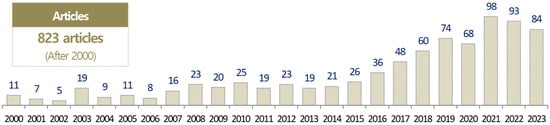
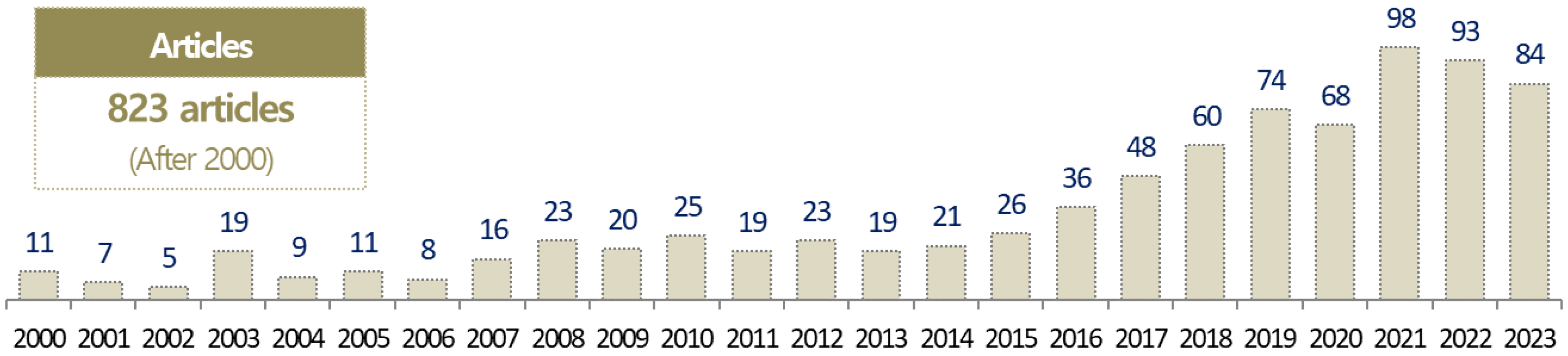
As shown in Figure 1, the number of papers published in the field of critical mineral exploration exhibits a growing trend, reflecting technological advancements and the increasing global demand for resource acquisition. In the early 2000s, the number of papers was relatively low, which can be attributed to technological limitations and a lower recognition of the importance of exploration. However, after 2015, there was a sharp increase in the number of papers, which was closely related to the rising demand for critical minerals such as lithium, cobalt, and nickel, which are essential for electric vehicles, batteries, and renewable energy technologies. This steep increase, particularly after 2018, indicates intensified research efforts aimed primarily at discovering new mineral deposits and improving exploration effectiveness, which ultimately contributes to securing a stable supply chain for critical minerals and highlights the importance of continued research and technological development in this field.
Figure 1.
Article trends of the critical mineral exploration from 2000 to 2023.
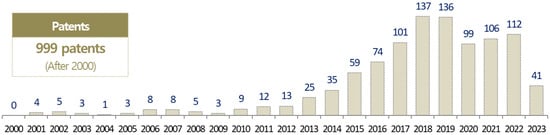
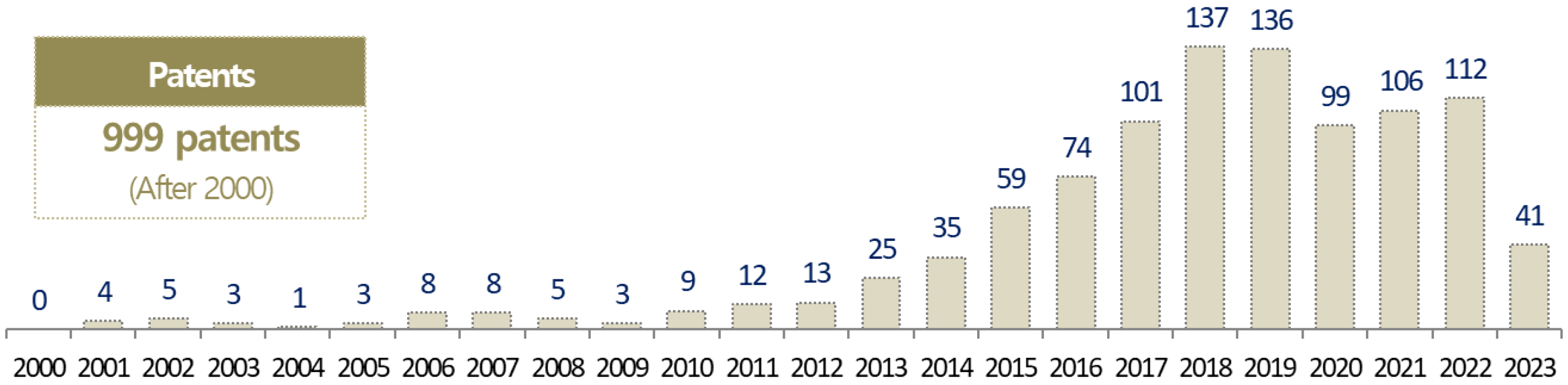
As shown in Figure 2, the data represent the annual number of patent applications in the critical mineral exploration sector. In the early 2000s, the number of patent applications was either low or non-existent. However, starting in the mid-2010s, there has been a rapid increase. This trend was particularly pronounced after 2015 and peaked at 137 applications in 2018. This surge can be attributed to the growing demand for critical minerals and the heightened need for technological development, which has increased the interest in innovation related to exploration and mining technologies. From 2019 to 2023, the number of patent applications fluctuated but remained relatively high. This indicates that technologies for critical mineral exploration are continuously advancing, highlighting their significant roles in both the industry and research sectors.
Figure 2.
Patent trends of the critical mineral exploration from 2000 to 2023.
4.2. Results of DEA
4.2.1. Efficiency Score and RTS
Table 3 reports CRS and VRS efficiency scores and RTS classifications for 27 countries. Eight countries—the United States, Republic of Korea, Canada, Finland, the United Kingdom, Sweden, Italy, and Japan—achieved an efficiency score of 1.000 under both CRS and VRS, indicating consistently high relative efficiency in transforming research outputs into citation-based outcomes. Several countries, including China, Iran, Switzerland, Argentina, Greece, and Australia, recorded an efficiency score of 1.000 under VRS but lower scores under CRS. This divergence indicates that while these countries perform efficiently relative to peers of similar scale, their overall efficiency is more sensitive to scale effects. RTS results show that thirteen countries operated under IRS, six under DRS, and the remaining countries under CRS. This distribution suggests substantial heterogeneity in how research scale relates to observed efficiency across countries.
Table 3.
The results of efficiency score.
4.2.2. Benchmark Analysis
Table 4 summarizes benchmark relationships for countries with efficiency scores below 1. In this analysis, benchmark countries represent efficient reference points located on the efficiency frontier. Italy emerged as the most frequently selected benchmark, appearing in 18 of the 19 benchmark sets. Japan and the United States were selected six and four times, respectively, while Finland and Sweden appeared less frequently. Country-specific patterns were also observed. For example, China was benchmarked primarily against the Republic of Korea and Japan, while Germany and Greece were benchmarked against Finland. These results indicate that benchmark selection is not uniform across countries and varies according to relative efficiency profiles.
Table 4.
The results of benchmark.
4.2.3. Super-Efficiency Score
To differentiate performance among countries with an efficiency score of 1.000, a super-efficiency analysis under the CRS assumption was conducted. The results are presented in Table 5. The United States ranked first, followed by the Republic of Korea and Canada. Finland and the United Kingdom exhibited similar super-efficiency scores slightly above 1.5, while Sweden, Italy, and Japan recorded lower values within the efficient group. Although these countries are all located on the efficiency frontier, the super-efficiency results reveal meaningful variation in their relative positions. Overall, the super-efficiency analysis indicates that frontier countries differ not only in whether they are efficient, but also in the degree to which they outperform other efficient peers in terms of citation-based research outcomes.
Table 5.
The results of super-efficiency score.
These results can be directly interpreted through the theoretical constructs of knowledge spillover and diffusion-oriented R&D efficiency introduced earlier. In particular, the super-efficiency scores reflect not merely differences in research volume, but systematic variation in how national innovation systems transform R&D inputs into influential and internationally diffused knowledge. Countries with higher super-efficiency scores demonstrate stronger alignment between research production, citation-based diffusion, and institutional mechanisms that facilitate external knowledge absorption, thereby empirically substantiating the role of knowledge spillover efficiency as a core explanatory concept in cross-country R&D performance.
5. Policy Implications
This study underscores the importance of analyzing patent and publication data in the field of sustainable critical mineral exploration to understand the technological trends and knowledge diffusion effects that drive innovation and economic growth. Critical minerals are vital for modern industry and national economies, and growing global demand has heightened the need for efficient exploration and resource management. By examining aggregated research outcomes, this study evaluates the efficiency of different countries in critical mineral exploration using DEA and analyzes national-level patterns of knowledge diffusion and spillover effects. This analysis aims to provide insights into the practical applications of the research findings, enhance international collaboration, and develop strategies to maximize the impact of research investments, thereby strengthening national competitiveness, economic development, and energy security.
From a causal perspective, the findings suggest that differences in knowledge spillover efficiency arise not simply from the scale of R&D investment, but from the mechanisms through which research outputs are institutionalized, disseminated, and reutilized. National systems that incentivize publication quality, patent citation, and industry–academia collaboration tend to reinforce cumulative knowledge diffusion, thereby generating higher spillover efficiency. In contrast, systems that prioritize internal utilization of research outputs or lack coordinated diffusion channels may weaken the transmission of knowledge beyond organizational or national boundaries, even when overall research activity remains substantial.
Among the seven leading critical mineral countries—the United States, Canada, China, Australia, Russia, Chile, and South Africa—the knowledge spillover effects of R&D output were found to be inefficient in countries other than the United States and Canada. Unlike the U.S. and Canada, which show high knowledge spillover effects due to active patent and paper creation and subsequent citations [50,51], the remaining five leading global critical mineral producers exhibit lower knowledge spillover effects in their mineral resource exploration research outputs. This can be interpreted as follows: first, some major critical mineral–producing countries may experience reduced pressure to rapidly adopt new exploration technologies, given their existing production capacity and long-standing geological endowment, which may partially constrain the diffusion of exploration-related knowledge [52]. At the same time, limited diffusion may reflect strategic choices to retain proprietary technologies or sensitive exploration knowledge rather than deficiencies in innovation capability. Moreover, differences in intellectual property regimes, publication norms, and language preferences may influence citation-based indicators, thereby shaping observed efficiency scores.
Additionally, the lack of collaboration between industry and academia limits technological innovation and knowledge diffusion [21]. This may be because key players in the critical minerals sector prefer to keep major technologies and research outcomes as internal know-how rather than promoting the diffusion of knowledge. In other words, R&D outcomes with high potential for knowledge dissemination and impact have not been published externally. Finally, the absence of effective policies and regulatory environments has led to insufficient commercial utilization of research outcomes [53]. Therefore, these countries must pursue bold technological innovation, policy improvements, and enhanced industry-academia collaboration to effectively utilize R&D outcomes and promote knowledge diffusion.
According to the return-to-scale analysis, China and Australia showed DRS, which means that as the number of research results increased, the knowledge spillover effect decreased. This implies that there is considerable quantitative research due to excessive R&D investment, but the qualitative spillover effect is low. Therefore, China and Australia should increase the proportion of international research cooperation rather than increasing the quantity of research results, improve the quality of research, and focus on important research topics to reduce resource wastage [54]. In addition, as the number of duplicate studies in similar fields increases, innovation creation decreases; therefore, national policies should be reviewed to manage this effectively [55]. On the other hand, Chile and South Africa showed IRS, which means that the effect of knowledge diffusion and technological innovation increased proportionally as the number of research results increased. As these countries still have low levels of mineral resource exploration technology compared with advanced countries, they need to build a basic research infrastructure and strengthen international cooperation to introduce advanced foreign technologies [56,57]. Governments and institutions should establish and implement R&D strategies that have a significant impact in the early stages, such as providing research funding, improving infrastructure, and creating research environments.
Italy stands out as an important case in terms of knowledge spillover efficiency as a result of creating a benchmark for inefficient countries. Owing to its geographical location and geological characteristics, Italy has abundant core mineral resources, including various ores and industrial minerals, and has a long history of systematically managing and utilizing these resources [58,59]. According to the Korea Trade Investment Promotion Agency (KOTRA), Italy’s core raw material acquisition strategy focuses on strengthening resource self-reliance and supply chain stability, making it an important reference case for other countries. Italy is producing influential research results suitable for knowledge diffusion in order to implement this strategy. In particular, this background is that Italy seeks to protect its own economic interests while pursuing policies consistent with the goals of the European Union (EU). In other words, it pursues the goals of the union through research on knowledge diffusion and strengthens its competitiveness. Therefore, it is an appropriate benchmark for other countries. This approach can be a useful model for countries seeking to pursue international goals and domestic interests simultaneously. Therefore, Italy’s strategy can serve as an important reference for other countries to develop effective strategies to strengthen their resource utilization capacity and enhance their independence in global supply chains.
Finally, the Super-efficiency analysis results for the ranking of knowledge spillover efficiency by country yield the following implications. First, among the key mineral-producing countries, those with low knowledge spillover efficiency may have abundant resources, which may weaken the motivation for technological innovation and slow the development of new exploration technologies and knowledge diffusion. In addition, a lack of policy support, strict regulations, and cooperation among industry, academia, and research may result in inefficient knowledge diffusion of research results [60]. To improve this, it is necessary to strengthen government policy support, ease institutional barriers, and strengthen the cooperation between industry and academia [61]. However, countries with high knowledge spillover efficiency, despite their poor key mineral resources, are building systems that encourage the participation of various stakeholders through knowledge co-production and support real-time data-based decision-making by integrating digital technologies. In addition, they are helping countries with various key mineral resources, but still lack the technological capabilities to explore and develop resources by establishing an international cooperation system. This will strengthen the global competitiveness of these countries in mineral resource exploration.
From a policy and managerial perspective, the findings indicate that enhancing national performance in critical mineral exploration requires a shift from quantity-driven R&D investment toward diffusion-oriented innovation governance. Rather than focusing solely on expanding research inputs, governments and public research organizations should incentivize high-impact outputs, international collaboration, and patenting strategies that facilitate citation and cross-border knowledge reuse. Strengthening industry–academia linkages and adopting AI-enabled exploration technologies can further accelerate the dissemination and practical utilization of research outcomes. For resource-rich countries with low spillover efficiency, the results underscore the importance of complementing resource advantages with institutional frameworks that promote openness, knowledge sharing, and global benchmarking to support sustainable mining and long-term competitiveness.
This study has several limitations that suggest directions for future research. First, the analysis is conducted at the country level using a DEA-based framework, which allows for cross-country comparison of research efficiency and knowledge spillover effects but does not capture micro-level dynamics at the level of individual firms, institutions, or research networks. As a result, the findings reflect relative efficiency relationships rather than fully specifying the dynamic causal pathways through which R&D inputs and institutional arrangements shape long-term innovation outcomes. Future studies could address this limitation by adopting firm-level or network-based analyses. Second, knowledge spillover is measured using citation-based indicators, which effectively capture structured and codified knowledge diffusion in science- and patent-intensive domains but may not fully reflect informal or digital diffusion channels. Future research may therefore incorporate alternative indicators, such as web-based or digital visibility measures, to complement citation-based approaches. Third, this study does not examine the internal structure or thematic organization of patents and academic publications. Future research could extend the present framework by applying clustering techniques and factor analysis, such as principal component analysis (PCA), to identify latent knowledge clusters and explain heterogeneity in knowledge spillover patterns across technological domains.
Author Contributions
Conceptualization, J.B. and S.Y.; methodology, S.Y.; software, S.Y.; validation, J.B. and S.Y.; formal analysis, S.Y.; investigation, J.B.; resources, J.B.; data curation, J.B. and S.Y.; writing—original draft preparation, J.B. and S.Y.; writing—review and editing, S.Y.; visualization, J.B.; supervision, S.Y.; project administration, J.B.; funding acquisition, J.B. All authors have read and agreed to the published version of the manuscript.
Funding
This work was supported by a grant-in-aid awarded by the Basic Research Project (Policy Research on Geological Resources Technology and Industry in Preparation for 2030 Amid the Global Transition, 25-3134) of the Korea Institute of Geoscience and Mineral Resources (KIGAM), funded by the Ministry of Science and ICT.
Institutional Review Board Statement
Not applicable.
Informed Consent Statement
Not applicable.
Data Availability Statement
All data reported in this paper will be shared by the corresponding author upon reasonable request.
Acknowledgments
We gratefully acknowledge the support and assistance provided by the participating institutions and universities that contributed to this research.
Conflicts of Interest
The authors declare no conflict of interest.
References
- McNulty, B.A.; Jowitt, S.M. Barriers to and uncertainties in understanding and quantifying global critical mineral and element supply. iScience 2021, 24, 102809. [Google Scholar] [CrossRef] [Scilit]
- Kim, R.; Lee, J.; Park, J.; Shin, S.; Park, I.-S.; Chung, K.W.; Yoo, J.H.; Kim, S.; Cho, S.-J.; Jeon, H.-S. Current status in the mining industry of critical minerals for battery (Li, Ni, Co, and C) in the energy transition era. J. Korean Soc. Miner. Energy Resour. Eng. 2022, 59, 218–232. [Google Scholar] [CrossRef] [Scilit]
- Galos, K.; Lewicka, E.; Burkowicz, A.; Guzik, K.; Kot-Niewiadomska, A.; Kamyk, J.; Szlugaj, J. Approach to identification and classification of the key, strategic and critical minerals important for the mineral security of Poland. Resour. Policy 2021, 70, 101900. [Google Scholar] [CrossRef] [Scilit]
- Khlystova, O.; Kalyuzhnova, Y. Exploring knowledge spillovers: Innovation strategies in resource-rich countries. J. Technol. Transf. 2025. [Google Scholar] [CrossRef] [Scilit]
- Jowitt, S.M.; McNulty, B.A. Battery and Energy Metals: Future Drivers of the Minerals Industry? SEG Discov. 2021, 11–18. [Google Scholar] [CrossRef] [Scilit]
- Qurbani, I.D.; Heffron, R.J.; Rifano, A.T.S. Justice and critical mineral development in Indonesia and across ASEAN. Extr. Ind. Soc. 2021, 8, 355–362. [Google Scholar] [CrossRef] [Scilit]
- Okada, K. A Historical Overview of the Past Three Decades of Mineral Exploration Technology. Nat. Resour. Res. 2021, 30, 2839–2860. [Google Scholar] [CrossRef] [Scilit]
- Ruiz-Coupeau, S.; Jürgens, B.; Keßelring, M.; Herrero-Solana, V. Sustainability in Mineral Exploration—Exploring Less Invasive Technologies via Patent Analysis. Sustainability 2020, 12, 9761. [Google Scholar] [CrossRef] [Scilit]
- Rojas-Sola, J.I.; Aguilera-García, Á.I. Global Bibliometric Analysis of the ‘Mining & Mineral Processing’ Subject Category From the Web of Science (1997–2012). Miner. Process. Extr. Metall. Rev. 2015, 36, 349–369. [Google Scholar] [CrossRef] [Scilit]
- Fernandez, V. Patenting trends in the mining industry. Resour. Policy 2021, 72, 102090. [Google Scholar] [CrossRef] [Scilit]
- Griliches, Z. Patent statistics as economic indicators: A survey. In R&D and Productivity: The Econometric Evidence; University of Chicago Press: Chicago, IL, USA, 1998; pp. 287–343. [Google Scholar]
- Jaffe, A.B.; Trajtenberg, M.; Henderson, R. Geographic Localization of Knowledge Spillovers as Evidenced by Patent Citations. Q. J. Econ. 1993, 108, 577–598. [Google Scholar] [CrossRef] [Scilit]
- Hall, B.H.; Jaffe, A.B.; Trajtenberg, M. Market Value and Patent Citations: A First Look; National Bureau of Economic Research: Cambridge, MA, USA, 2000. [Google Scholar]
- Ali, S.H.; Giurco, D.; Arndt, N.; Nickless, E.; Brown, G.; Demetriades, A.; Durrheim, R.; Enriquez, M.A.; Kinnaird, J.; Littleboy, A.; et al. Mineral supply for sustainable development requires resource governance. Nature 2017, 543, 367–372. [Google Scholar] [CrossRef] [Scilit]
- Guan, J.; Chen, K. Modeling the relative efficiency of national innovation systems. Res. Policy 2012, 41, 102–115. [Google Scholar] [CrossRef] [Scilit]
- Wright, G.; Czelusta, J. Mineral Resources and Economic Development; Stanford University: Stanford, CA, USA, 2003. [Google Scholar]
- Fernandez, V. Cross-country concentration and specialization of mining inventions. Scientometrics 2021, 126, 6715–6759. [Google Scholar] [CrossRef] [Scilit]
- Fernandez, V. Innovative intensity in the mining industry: Evidence from patent families. Resour. Policy 2022, 78, 102805. [Google Scholar] [CrossRef] [Scilit]
- Kesselring, M.; Wagner, F.; Kirsch, M.; Ajjabou, L.; Gloaguen, R. Development of Sustainable Test Sites for Mineral Exploration and Knowledge Spillover for Industry. Sustainability 2020, 12, 2016. [Google Scholar] [CrossRef] [Scilit]
- Aznar-Sánchez, J.A.; Velasco-Muñoz, J.F.; Belmonte-Ureña, L.J.; Manzano-Agugliaro, F. Innovation and technology for sustainable mining activity: A worldwide research assessment. J. Clean. Prod. 2019, 221, 38–54. [Google Scholar] [CrossRef] [Scilit]
- Marlatt, J. The role of industry-academia collaborative research in mineral exploration. Can. Mineral. 2020, 59, 803–812. [Google Scholar] [CrossRef] [Scilit]
- Dilling-Hansen, M.; Madsen, E.S.; Smith, V. Efficiency, R&D and ownership—Some empirical evidence. Int. J. Prod. Econ. 2003, 83, 85–94. [Google Scholar] [CrossRef] [Scilit]
- Werner, B.M.; Souder, W.E. Measuring R&D Performance—U.S. and German Practices. Res. Technol. Manag. 1997, 40, 28–32. [Google Scholar] [CrossRef] [Scilit]
- Hu, J.L.; Yang, C.H.; Chen, C.P. R&D efficiency and the national innovation system: An international comparison using the distance function approach. Bull. Econ. Res. 2014, 66, 55–71. [Google Scholar] [CrossRef] [Scilit]
- Wang, E.C.; Huang, W. Relative efficiency of R&D activities: A cross-country study accounting for environmental factors in the DEA approach. Res. Policy 2007, 36, 260–273. [Google Scholar] [CrossRef] [Scilit]
- Chen, C.-P.; Hu, J.-L.; Yang, C.-H. Produce patents or journal articles? A cross-country comparison of R&D productivity change. Scientometrics 2013, 94, 833–849. [Google Scholar] [CrossRef] [Scilit]
- Feng, Y.; Zhang, H.; Chiu, Y.-H.; Chang, T.-H. Innovation efficiency and the impact of the institutional quality: A cross-country analysis using the two-stage meta-frontier dynamic network DEA model. Scientometrics 2021, 126, 3091–3129. [Google Scholar] [CrossRef] [Scilit]
- Fu, X.; Yang, Q.G. Exploring the cross-country gap in patenting: A stochastic frontier approach. Res. Policy 2009, 38, 1203–1213. [Google Scholar] [CrossRef] [Scilit]
- Yoon, S.; Chung, Y.; Han, S.; Woo, C. Do external risk factors increase or decrease country-level R&D efficiency: Focused on air pollution and job insecurity? Technol. Anal. Strateg. Manag. 2024, 36, 472–485. [Google Scholar] [CrossRef] [Scilit]
- Lanjouw, J.O.; Schankerman, M. Patent Quality and Research Productivity: Measuring Innovation with Multiple Indicators. Econ. J. 2004, 114, 441–465. [Google Scholar] [CrossRef] [Scilit]
- Érdi, P.; Makovi, K.; Somogyvári, Z.; Strandburg, K.; Tobochnik, J.; Volf, P.; Zalányi, L. Prediction of emerging technologies based on analysis of the US patent citation network. Scientometrics 2013, 95, 225–242. [Google Scholar] [CrossRef] [Scilit]
- Sharma, P.; Tripathi, R.C. Patent citation: A technique for measuring the knowledge flow of information and innovation. World Pat. Inf. 2017, 51, 31–42. [Google Scholar] [CrossRef] [Scilit]
- Higham, K.; de Rassenfosse, G.; Jaffe, A.B. Patent Quality: Towards a Systematic Framework for Analysis and Measurement. Res. Policy 2021, 50, 104215. [Google Scholar] [CrossRef] [Scilit]
- Maurseth, P.B.; Verspagen, B. Knowledge Spillovers in Europe: A Patent Citations Analysis. Scand. J. Econ. 2002, 104, 531–545. [Google Scholar] [CrossRef] [Scilit]
- Noailly, J.; Shestalova, V. Knowledge spillovers from renewable energy technologies: Lessons from patent citations. Environ. Innov. Soc. Transit. 2017, 22, 1–14. [Google Scholar] [CrossRef] [Scilit]
- Bae, J.; Chung, Y.; Ko, H. Analysis of efficiency in public research activities in terms of knowledge spillover: Focusing on earthquake R&D accomplishments. Nat. Hazards 2021, 108, 2249–2264. [Google Scholar] [CrossRef] [Scilit]
- Criscuolo, P. The ‘home advantage’ effect and patent families. A comparison of OECD triadic patents, the USPTO and the EPO. Scientometrics 2006, 66, 23–41. [Google Scholar] [CrossRef] [Scilit]
- Messinis, G. Triadic citations, country biases and patent value: The case of pharmaceuticals. Scientometrics 2011, 89, 813–833. [Google Scholar] [CrossRef] [Scilit]
- Bae, J.; Chung, Y.; Lee, J.; Seo, H. Knowledge spillover efficiency of carbon capture, utilization, and storage technology: A comparison among countries. J. Clean. Prod. 2020, 246, 119003. [Google Scholar] [CrossRef] [Scilit]
- Farrell, M.J. The Measurement of Productive Efficiency. J. R. Stat. Soc. Ser. A (Gen.) 1957, 120, 253–281. [Google Scholar] [CrossRef] [Scilit]
- Charnes, A.; Cooper, W.W.; Rhodes, E. Measuring the efficiency of decision making units. Eur. J. Oper. Res. 1978, 2, 429–444. [Google Scholar] [CrossRef] [Scilit]
- Banker, R.D.; Charnes, A.; Cooper, W.W. Some Models for Estimating Technical and Scale Inefficiencies in Data Envelopment Analysis. Manag. Sci. 1984, 30, 1078–1092. [Google Scholar] [CrossRef] [Scilit]
- Chun, D.; Chung, Y.; Bang, S. Impact of firm size and industry type on R&D efficiency throughout innovation and commercialisation stages: Evidence from Korean manufacturing firms. Technol. Anal. Strateg. Manag. 2015, 27, 895–909. [Google Scholar] [CrossRef] [Scilit]
- Son, H.; Chung, Y.; Yoon, S. How can university technology holding companies bridge the Valley of Death? Evidence from Korea. Technovation 2022, 109, 102158. [Google Scholar] [CrossRef] [Scilit]
- Hollingsworth, B.; Dawson, P.J.; Maniadakis, N. Efficiency measurement of health care: A review of non-parametric methods and applications. Health Care Manag. Sci. 1999, 2, 161–172. [Google Scholar] [CrossRef] [Scilit]
- Jaffe, A.B.; Trajtenberg, M. Flows of knowledge from universities and federal laboratories: Modeling the flow of patent citations over time and across institutional and geographic boundaries. Proc. Natl. Acad. Sci. USA 1996, 93, 12671–12677. [Google Scholar] [CrossRef] [Scilit]
- Xu, Y.; Chen, X.; Mao, J.; Li, G. Will patents with more interdisciplinary scientific knowledge have higher technological impact? Empirical evidence from USPTO patents. Scientometrics 2025, 130, 2037–2068. [Google Scholar] [CrossRef] [Scilit]
- Gaviria-Marin, M.; Cruz-Cázares, C. Ranking web as indicator of knowledge diffusion: An application for SMEs. Acad. Rev. Latinoam. Adm. 2020, 33, 219–240. [Google Scholar] [CrossRef] [Scilit]
- Audretsch, D.B.; Belitski, M.; Caiazza, R. Knowledge spillovers or R&D collaboration? Understanding the role of external knowledge for firm innovation. RD Manag. 2025, 55, 531–553. [Google Scholar] [CrossRef] [Scilit]
- Bacchiocchi, E.; Montobbio, F. Knowledge diffusion from university and public research. A comparison between US, Japan and Europe using patent citations. J. Technol. Transf. 2009, 34, 169–181. [Google Scholar] [CrossRef] [Scilit]
- Marinova, D.; McAleer, M. Modelling trends and volatility in ecological patents in the USA. Environ. Model. Softw. 2003, 18, 195–203. [Google Scholar] [CrossRef] [Scilit]
- Litvinenko, V.S. Digital Economy as a Factor in the Technological Development of the Mineral Sector. Nat. Resour. Res. 2020, 29, 1521–1541. [Google Scholar] [CrossRef] [Scilit]
- Chen, R.-H.; Lin, Y.; Tseng, M.-L. Multicriteria analysis of sustainable development indicators in the construction minerals industry in China. Resour. Policy 2015, 46, 123–133. [Google Scholar] [CrossRef] [Scilit]
- Zhang, D.; Ding, W.; Wang, Y.; Liu, S. Exploring the Role of International Research Collaboration in Building China’s World-Class Universities. Sustainability 2022, 14, 3487. [Google Scholar] [CrossRef] [Scilit]
- Lei, Y.; Cui, N.; Pan, D. Economic and social effects analysis of mineral development in China and policy implications. Resour. Policy 2013, 38, 448–457. [Google Scholar] [CrossRef] [Scilit]
- Fernandez, V. Innovation in the global mining sector and the case of Chile. Resour. Policy 2020, 68, 101690. [Google Scholar] [CrossRef] [Scilit]
- Neingo, P.; Tholana, T. Trends in productivity in the South African gold mining industry. J. South. Afr. Inst. Min. Metall. 2016, 116, 283–290. [Google Scholar] [CrossRef] [Scilit]
- Nebbia, G. Il prodotto interno materiale lordo dell’Italia nel 2000. Statistica 2007, 63, 397–409. [Google Scholar] [CrossRef] [Scilit]
- Assereto, R.; Brigo, L.; Brusca, C.; Omenetto, P.; Zuffardi, P. Italian ore/mineral deposits related to emersion surfaces a summary. Miner. Depos. 1976, 11, 170–179. [Google Scholar] [CrossRef] [Scilit]
- Mirelman, A.; Mentzakis, E.; Kinter, E.; Paolucci, F.; Fordham, R.; Ozawa, S.; Ferraz, M.; Baltussen, R.; Niessen, L.W. Decision-Making Criteria among National Policymakers in Five Countries: A Discrete Choice Experiment Eliciting Relative Preferences for Equity and Efficiency. Value Health 2012, 15, 534–539. [Google Scholar] [CrossRef] [Scilit] [PubMed]
- Malhotra, A.; Schmidt, T.S.; Huenteler, J. The role of inter-sectoral learning in knowledge development and diffusion: Case studies on three clean energy technologies. Technol. Forecast. Soc. Change 2019, 146, 464–487. [Google Scholar] [CrossRef] [Scilit]

Disclaimer/Publisher’s Note: The statements, opinions and data contained in all publications are solely those of the individual author(s) and contributor(s) and not of MDPI and/or the editor(s). MDPI and/or the editor(s) disclaim responsibility for any injury to people or property resulting from any ideas, methods, instructions or products referred to in the content. |
© 2026 by the authors. Licensee MDPI, Basel, Switzerland. This article is an open access article distributed under the terms and conditions of the Creative Commons Attribution (CC BY) license.