Measuring Green Total Factor Productivity in China’s Power Industry Based on Super-Efficiency SBM and GML Index Models

Abstract
1. Introduction
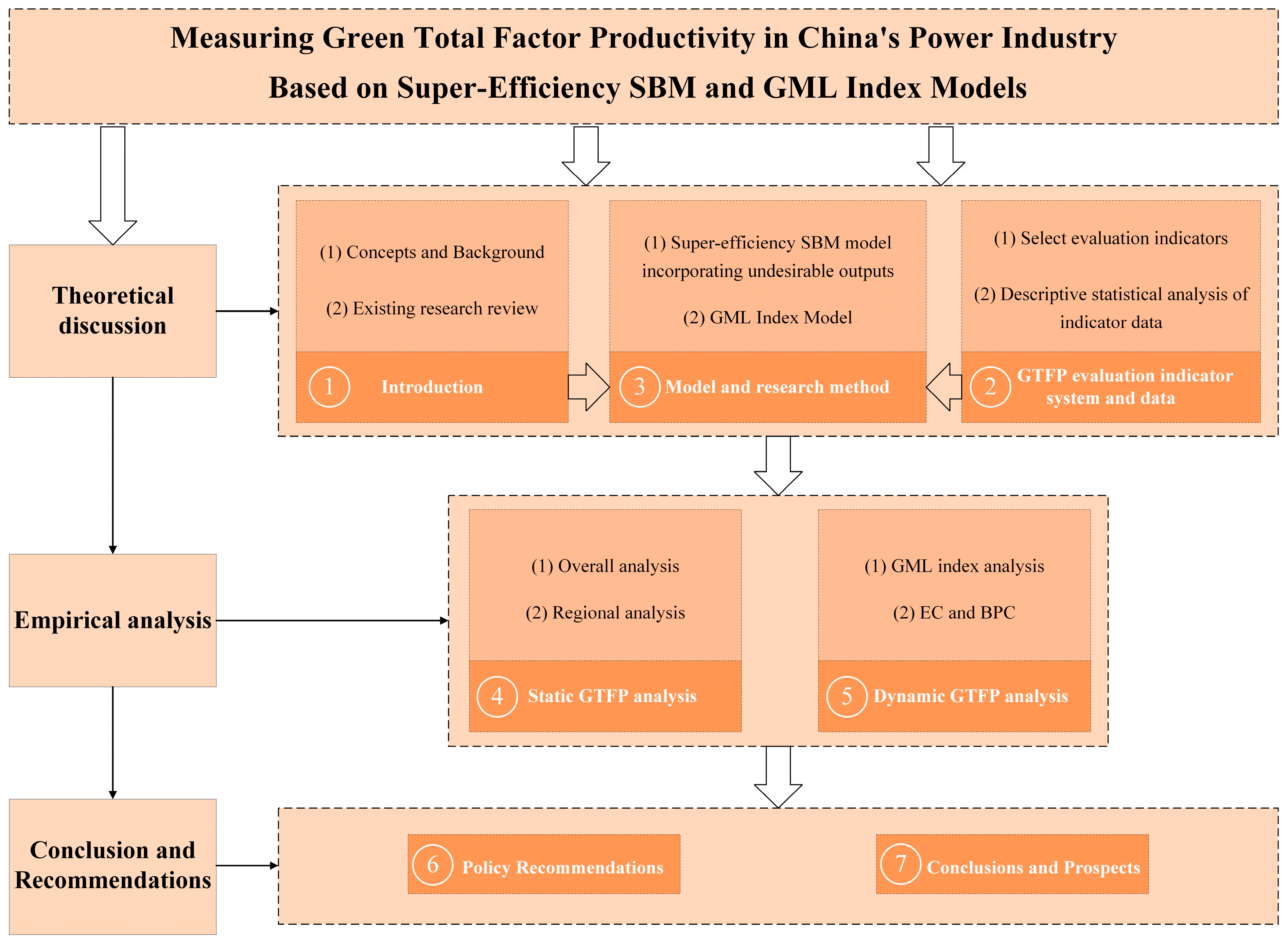
2. Research Model and Data Sources
2.1. Research Methods and Model Construction
2.1.1. Super-Efficient SBM Model Incorporating Non-Intended Outputs
2.1.2. GML Index Model
2.2. Indicator Selection and Data Analysis
2.2.1. Indicator Selection and Data Sources
2.2.2. Descriptive Statistics
3. Empirical Analysis
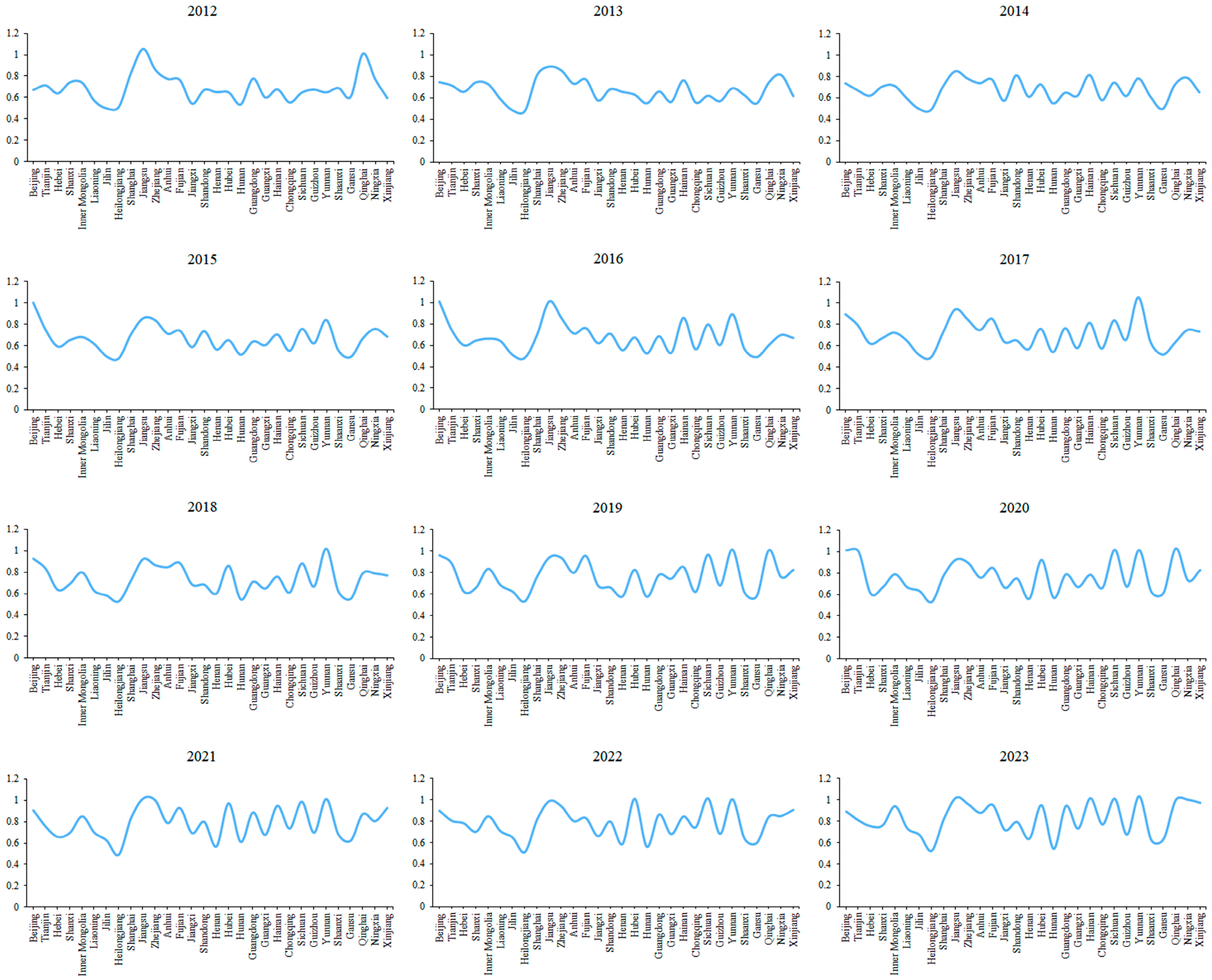
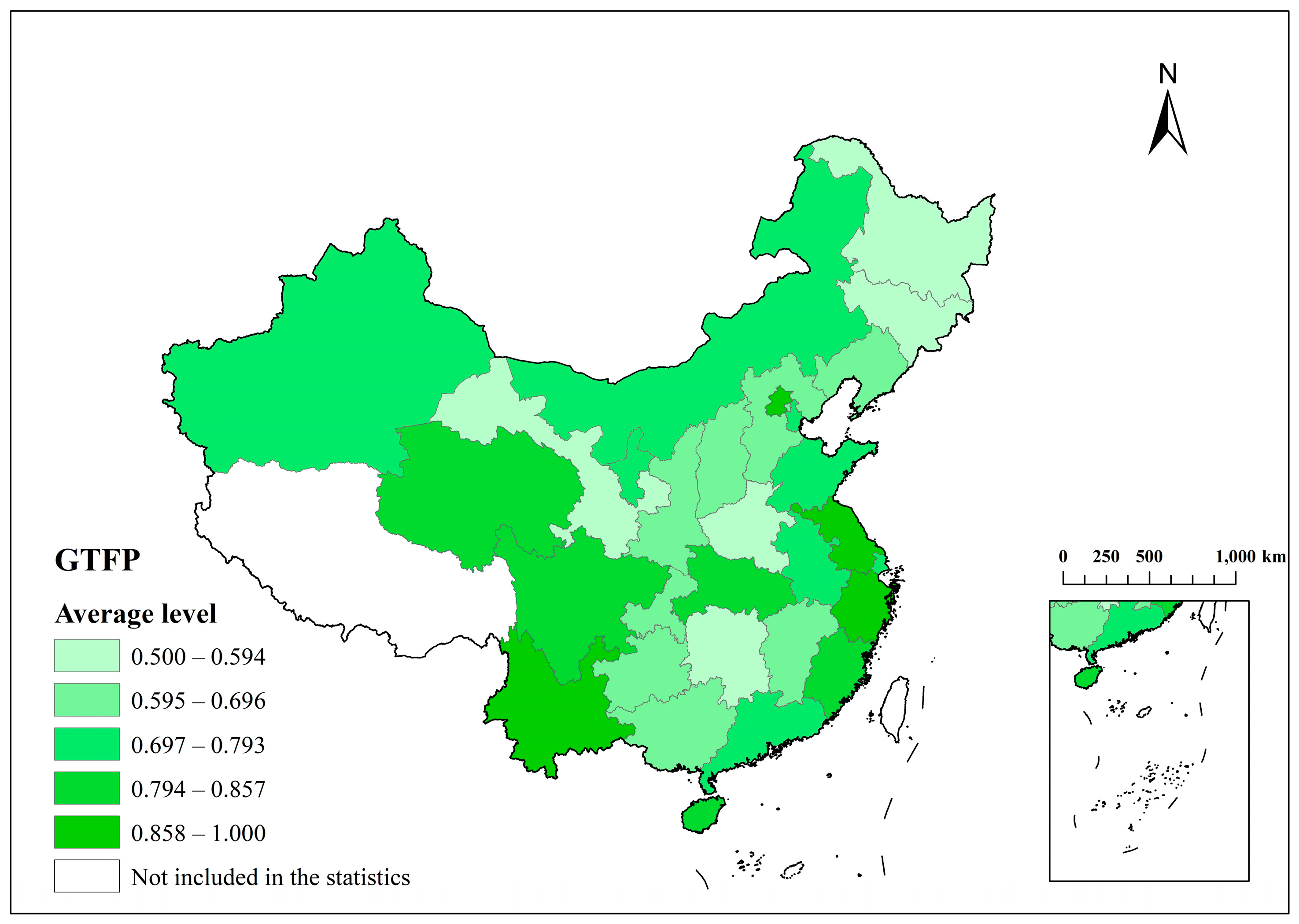
3.1. Static Analysis
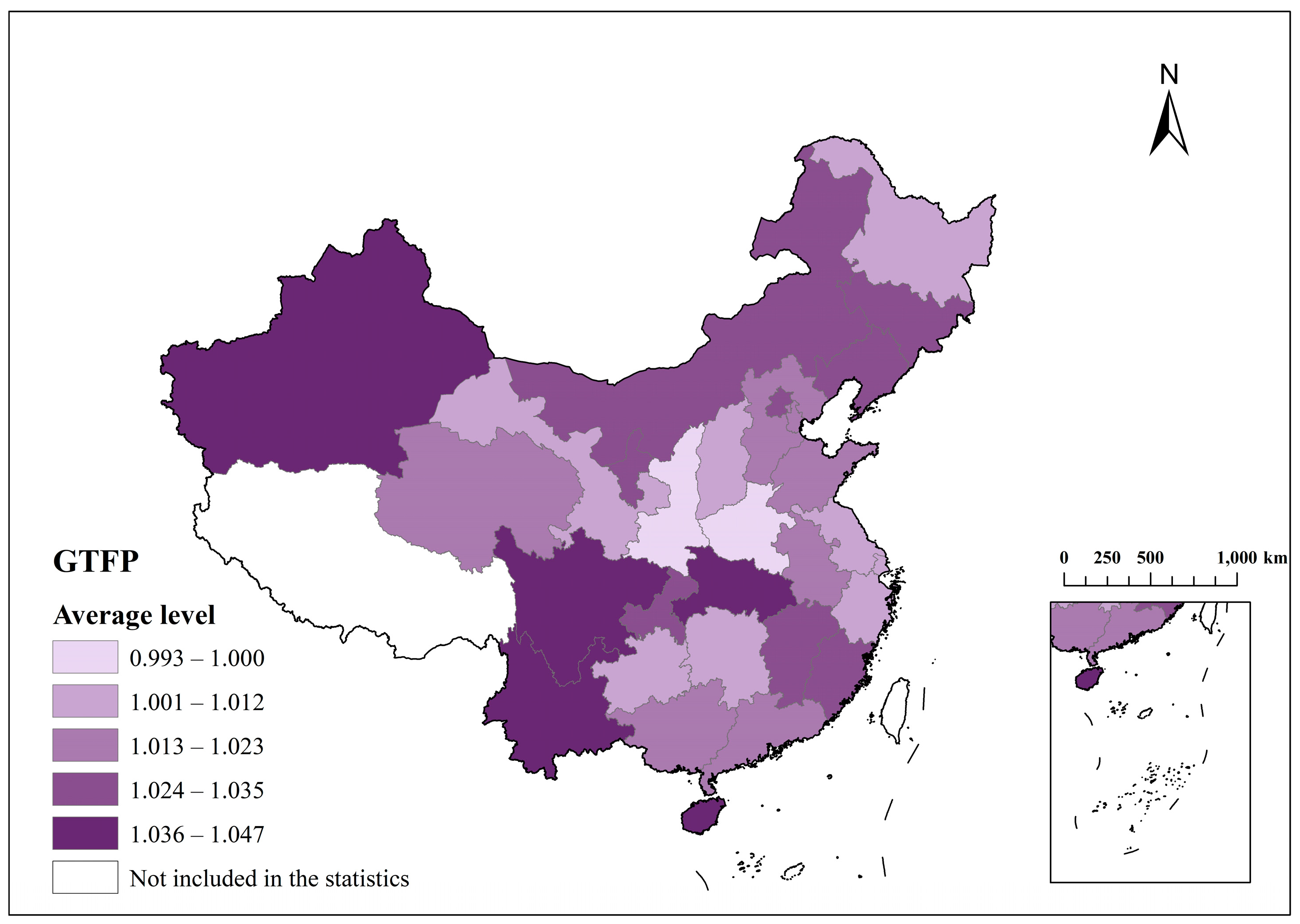
3.2. Dynamic Analysis
4. Policy Recommendations
- Promote the development of clean energy in a manner tailored to regional conditions and resource endowments. Policymakers and industry stakeholders should design differentiated clean energy strategies that reflect the unique natural, economic, and technological characteristics of each region. Examples include building a regional implementation system led by the National Energy Administration and the National Development and Reform Commission with multi-departmental collaboration, and measuring targets such as the new installed capacity of wind and solar PV power and the minimum output of coal-fired units, to promote the effective connection between installed capacity target and grid consumption. From a regional perspective, in resource-rich areas, particularly in northwestern China, priority should be given to establishing large-scale wind and photovoltaic power bases. These developments should be accompanied by flexibility retrofits of existing coal-fired power units to enhance their peak-shaving and load-balancing capabilities, ensuring stable integration of intermittent renewable energy into the grid. In contrast, in eastern coastal regions, efforts should focus on accelerating the deployment of offshore wind power and exploring the integration of distributed PV system with building infrastructure, creating synergies between urban energy consumption and renewable generation. Such regionally tailored strategies not only facilitate the green transformation of the electric power industry but also contribute to measurable improvements in the GTFP, supporting the broader goals of sustainable energy development and low-carbon transition across different regions in China.
- Strengthen regional coordination and promote complementary electricity sharing across regions. To optimize the utilization of renewable energy resources over a broader spatial scale, a cross-provincial and cross-regional coordination mechanism for electricity consumption should be established, which should integrate both intergovernmental agreement and market-based transaction. Such a mechanism would enable more efficient allocation of clean energy, reduce curtailment of renewable generation, and support grid stability. Simultaneously, the development of a unified national electricity market should be actively promoted, which would create opportunities for emerging market participants, including microgrids, energy storage operators, and load aggregators, to participate in energy trading and ancillary services. It is also necessary to clarify the responsibilities of State Grid Corporation of China and China Southern Power Grid Corporation for cross-regional transmission channel construction and scheduling coordination. The provincial energy regulatory department should implement the connection between the provincial market and cross-provincial transactions and enhance system flexibility and consumption capacity by introducing emerging entities such as load aggregators and energy storage operators to participate in the auxiliary service market. By leveraging these market-driven mechanisms, regions can more effectively balance supply and demand, enhance the integration and utilization of renewable energy, and reduce reliance on conventional fossil-based generation. Collectively, these strategies can systematically increase the operational efficiency and sustainability of the electric power industry, thereby contributing to measurable improvements in the GTFP and supporting the broader goals of a low-carbon and environmentally sustainable energy transition in China.
- Promote innovation in low-carbon energy technology and facilitate the effective commercialization of research outcomes. To promote the development of clean energy in the power system, it is necessary to clarify the division of labor and goals of various power enterprises. Power grid enterprises should focus on improving the cross-regional transmission capacity and intelligence level of distribution networks, increasing the proportion of new energy electricity in ultra-high voltage channels. Power generation enterprises should focus on promoting the flexibility transformation of coal-fired power plants and the construction of large-scale wind and solar bases. New energy enterprises should focus on system-friendly power plant technology research and development and improving the reliable output of power plants, and power equipment enterprises need to achieve an increase in the localization rate of key equipment. All parties need to work together through mechanisms such as technological innovation collaboration, market mechanism improvement, and digital empowerment to jointly build a clean and efficient new-type electric power system. Overall, the electric power industry should intensify its research and development efforts with regard to both energy utilization and low-carbon technology and foster breakthroughs that can support sustainable and efficient energy production. Leveraging major national and regional energy projects, collaborative innovation platforms spanning the entire industry value chain can be established, which can enable the sharing of technological advancements, best practices, and knowledge across enterprises, research institutions, and policymakers. At the same time, designing a robust innovation incentive mechanism can encourage continuous technological development, which can ensure that research outcomes are effectively translated into practical application. Policy instruments such as green finance initiatives, dedicated innovation bonds, and targeted subsidies can guide social and private capital into electric power technology research and development, thereby accelerating the implementation of clean and efficient technologies. Collectively, these strategies will consolidate technological progress as the primary driver of GTFP growth, reinforce the sustainable transformation of power industry, and steadily enhance the GTFP of China’s electric power industry, which can support broader national goals of low-carbon development and environmental sustainability.
- Promote the adoption of green management practices and the digital transformation of power industry. Establishing a comprehensive green management system informed by advanced domestic and international best practices can significantly enhance the operational efficiency and oversight of renewable energy resources. In parallel, the integration of digital technology offers opportunities to optimize the allocation and utilization of power system resources, which can enable more intelligent and responsive management. Cutting-edge tools, such as artificial intelligence, big data analytics, and predictive modeling, can be leveraged to develop a smart energy platform that facilitates seamless coordination across generation, transmission, distribution, storage, and demand-side operations. The platform is led by the National Energy Administration to establish a standardized standard and management system, while the State Grid Corporation of China and China Southern Power Grid Corporation relies on them for the specific construction, data access integration, and daily operation and maintenance of the platform, with the goal of achieving enterprise coverage in the power industry. These platforms can also support sophisticated demand-side management, balance load variability and improve grid stability while accommodating high shares of renewable energy. Collectively, these measures can strengthen operational efficiency and create favorable conditions for the sustained enhancement of the GTFP, ultimately contributing to the broader objectives of low-carbon development, environmental sustainability, and green transformation of China’s electric power industry.
5. Conclusions and Prospects
5.1. Conclusions
- The static GTFPs of the power industry across Chinese provinces remain relatively low, with significant interprovincial disparities. Regionally, the average GTFPs in the eastern and western regions are higher than that in the central region.
- The GTFP of China’s electric power industry exhibits a general upward trend. Compared to central and western provinces such as Hainan and Hubei, the GML index in eastern coastal areas, including Zhejiang, Jiangsu, and Shanghai, is relatively low.
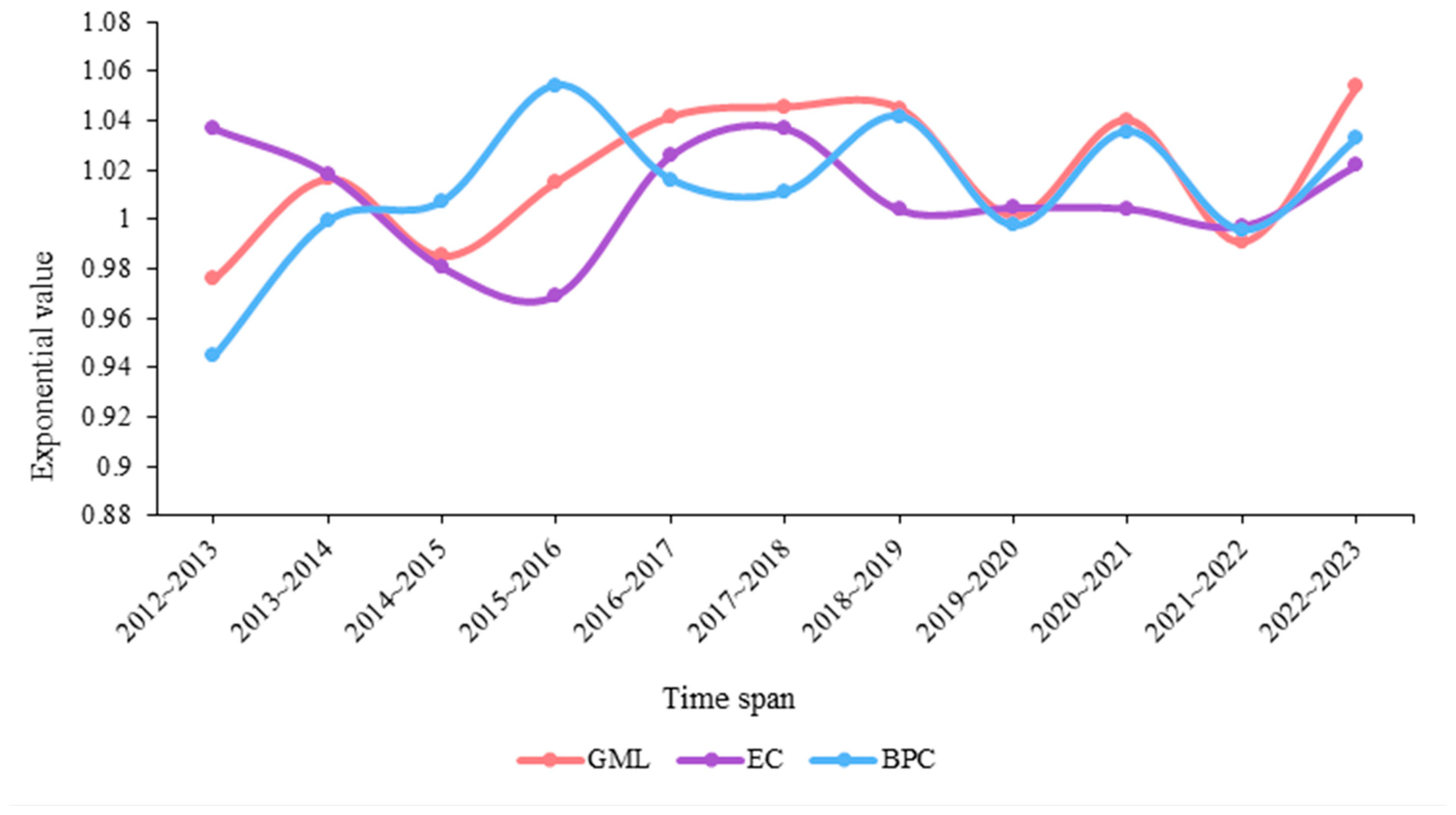
- The decomposition analysis of the GML index indicates that the BPC curve aligns more closely with the GML trend. In most years, the BPC values exceed EC values, which indicates that technological progress is the primary driver of the GTFP improvement in China’s electric power industry.
5.2. Limitations and Prospects
Author Contributions
Funding
Institutional Review Board Statement
Informed Consent Statement
Data Availability Statement
Acknowledgments
Conflicts of Interest
Abbreviations
| GTFP | Green total factor productivity. |
| TFP | Total factor productivity. |
| SBM | Slack-based measure. |
| GML | Global Malmquist–Luenberger. |
| SFA | Stochastic frontier analysis. |
| OP | Olley–Pakes. |
| LP | Levinsohn–Petrin. |
| DMUs | Decision-making units. |
| EC | Efficiency change. |
| BPC | Best practice change. |
References
- Yang, L.; Ni, M. Is financial development beneficial to improve the efficiency of green development? Evidence from the “Belt and Road” countries. Energy Econ. 2022, 105, 105734. [Google Scholar] [CrossRef] [Scilit]
- Cui, N.; Sheng, S. Influencing factors, quality measurement and dynamic analysis of agricultural green development in major grain producing areas from the perspective of green total factor productivity. J. Agric. Resour. Environ. 2022, 39, 621–630. (In Chinese) [Google Scholar]
- Ofley, S.; Pakes, A. The dynamics of productivity in the telecommunications equipment industry. Econometrica 1996, 64, 1263–1298. [Google Scholar] [CrossRef] [Scilit]
- Levinsohn, J.; Petrin, A. Estimating production functions using inputs to control for unobservable. Rev. Econ. Stud. 2003, 70, 317–341. [Google Scholar] [CrossRef] [Scilit]
- Ni, Z. Trade opening, foreign investment opening and green total factor productivity: The empirical evidence from 41 cities in the Yangtze river delta. J. East China Univ. Sci. Technol. Soc. Sci. Ed. 2023, 38, 136–148. (In Chinese) [Google Scholar]
- Dai, P.; Xu, J.; Zhang, J.; Yao, G.; Li, C. Spatio-temporal evolution analysis of green total factor productivity in the logistics industry in Chinese provinces. Coal Econ. Res. 2025, 45, 51–60. (In Chinese) [Google Scholar]
- Li, Y.; Chen, Y. Development of an SBM-ML model for the measurement of green total factor productivity: The case of pearl river delta urban agglomeration. Renew. Sustain. Energy Rev. 2021, 145, 111131. [Google Scholar] [CrossRef] [Scilit]
- Ma, C.; Gao, T.; Wang, Y. Study on the impact of digital economy on green total factor productivity of corn. J. Maize Sci. 2025, 33, 118–126. (In Chinese) [Google Scholar]
- Qu, S.; Wang, F.; Cheng, Q.; Zeng, M.; Ji, Y. Impact mechanism of environmental regulation on industrial green total factor productivity: A perspective from structural adjustment. J. Arid. Land Resour. Environ. 2025, 39, 1–12. (In Chinese) [Google Scholar]
- Yao, S.; Li, H.; Deng, Z. The impact of land leasing strategies on industrial green total factor productivity: Insights from Chinese cities. Land Use Policy 2025, 156, 107607. [Google Scholar] [CrossRef] [Scilit]
- Pan, J.J.; Hou, G.M.; Gu, J.F.; Zhang, H.F.; Wang, J.P.; Chen, Z.W. Empirical study on the impact of technological progress on the environmental efficiency of China’s power industry: Based on SBM Super Efficiency-ML-Tobit. Chin. J. Manag. Sci. 2023, 31, 215–227. (In Chinese) [Google Scholar]
- Dong, F.; Chen, Y.; Sun, J.; Li, J.; Wang, L.; Dong, T.; Cui, J. Measurement and decomposition of environmental efficiency in the power industry based on multi-hierarchy meta-frontier BAM model. J. Clean. Prod. 2024, 441, 140818. [Google Scholar] [CrossRef] [Scilit]
- Yuan, J.; Hu, Y.; Zhang, J. The carbon emission efficiency of China’s listed thermal power companies: An improved three-stage slack based measure-data envelopment analysis model. Power Gener. Technol. 2024, 45, 458–467. (In Chinese) [Google Scholar]
- Wei, X.; Zhao, R. Evaluation and spatial convergence of carbon emission reduction efficiency in China’s power industry: Based on a three-stage DEA model with game cross-efficiency. Sci. Total Environ. 2024, 906, 167851. [Google Scholar] [CrossRef] [Scilit]
- Yang, H.; Chen, Q. Material balance and correction for the measurement of green total factor productivity growth. Energy Econ. 2025, 148, 108647. [Google Scholar] [CrossRef] [Scilit]
- Tone, K. A slacks-based measure of super-efficiency in data envelopment analysis. Eur. J. Oper. Res. 2002, 143, 32–41. [Google Scholar] [CrossRef] [Scilit]
- Li, H.; Fan, D.; Zhang, S.; Ma, L. Research on the classified measurement and promotion modes of regional green technology innovation efficiency in China—SBM-SupSBM model based on unexpected output. Oper. Res. Manag. Sci. 2022, 31, 184–189+203. (In Chinese) [Google Scholar]
- Yong, Y. Evaluation and influencing factors of eco-efficiency in Henan province, China based on major function-oriented zoning. J. Earth Sci. Environ. 2025, 47, 693–705. (In Chinese) [Google Scholar]
- Al-Majali, A.A. Estimation of green total factor productivity and green efficiency in Jordan based on the Super-SBM model. J. Econ. Stud. 2024, 52, 1113–1122. [Google Scholar] [CrossRef] [Scilit]
- Duan, W.; Li, Z.; Deng, Z. Research on the symbiosis of port and city based on symbiosis theory: Empirical evidence from China’s coastal port groups. Int. J. Shipp. Transp. Logist. 2023, 16, 210–230. [Google Scholar] [CrossRef] [Scilit]
- Meng, M.; Qu, D. Understanding the green energy efficiencies of provinces in China: A Super-SBM and GML analysis. Energy 2022, 239, 121912. [Google Scholar] [CrossRef] [Scilit]
- Zhang, N. Carbon Total factor productivity, low carbon technology innovation and energy efficiency catch-up: Evidence from Chinese thermal power enterprises. Econ. Res. J. 2022, 57, 158–174. (In Chinese) [Google Scholar]
- Meng, M.; Pang, T.; Li, X. Assessing the total factor productivity of China’s thermal power industry using a network DEA approach with cross-efficiency. Energy Rep. 2023, 9, 5196–5205. [Google Scholar] [CrossRef] [Scilit]
- Du, M.; Antunes, J.; Wanke, P.; Chen, Z. Ecological efficiency assessment under the construction of low-carbon city: A perspective of green technology innovation. J. Environ. Plan. Manag. 2021, 65, 1727–1752. [Google Scholar] [CrossRef] [Scilit]
- Li, Y.; Yang, X.; Du, E.; Liu, Y.; Zhang, S.; Yang, C.; Ning, Z.; Liu, C. A review on carbon emission accounting approaches for the electricity power industry. Appl. Energy 2024, 359, 122681. [Google Scholar] [CrossRef] [Scilit]
- Chen, X.; Chen, Y.; Huang, W.; Zhang, X. A new Malmquist-type green total factor productivity measure: An application to China. Energy Econ. 2023, 117, 106408. [Google Scholar] [CrossRef] [Scilit]



| Variable Properties | Variable Type | Indicator | Data Source |
|---|---|---|---|
| Input indicators | Capital investment | Installed capacity | China Electricity Council |
| Labor input | Number of employees in the power industry | China Labor Statistical Yearbook | |
| Resource allocation | Power generation coal consumption | China Electricity Council | |
| Output indicators | Expected output | Electricity generation | China Electricity Council |
| Non-expected output | CO2 emissions in the power industry | IPCC Emission Factor Method Calculation [25] |
| Indicator | Unit | Mean | Standard Deviation | Maximum Value | Minimum Value |
|---|---|---|---|---|---|
| Installed capacity | Ten thousand kilowatts | 5992.052 | 3751.062 | 18,958.000 | 497.000 |
| Number of employees in the power industry | Person | 96,738.000 | 51,765.320 | 253,007.000 | 13,237.000 |
| Power generation coal consumption | Ten thousand tons | 6503.694 | 4165.363 | 17,650.000 | 610.000 |
| Electricity generation | Hundred million kilowatt-hours | 2214.088 | 1434.707 | 6306.000 | 211.000 |
| CO2 emissions in the power industry | Ten thousand tons | 16,096.593 | 10,309.262 | 43,683.948 | 1509.230 |
| Region | 2012~2013 | 2013~2014 | 2014~2015 | 2015~2016 | 2016~2017 | 2017~2018 | 2018~2019 | 2019~2020 | 2020~2021 | 2021~2022 | 2022~2023 |
|---|---|---|---|---|---|---|---|---|---|---|---|
| Beijing | 1.111 | 0.992 | 1.353 | 1.010 | 0.886 | 1.032 | 1.043 | 1.051 | 0.898 | 0.987 | 0.995 |
| Tianjin | 1.001 | 0.941 | 1.111 | 0.996 | 1.065 | 1.049 | 1.069 | 1.126 | 0.756 | 1.062 | 1.006 |
| Hebei | 1.025 | 0.948 | 0.949 | 1.020 | 1.031 | 1.021 | 0.985 | 0.976 | 1.085 | 1.181 | 0.968 |
| Shanxi | 1.001 | 0.951 | 0.919 | 0.991 | 1.038 | 1.032 | 0.957 | 1.013 | 1.046 | 1.004 | 1.088 |
| Inner Mongolia | 0.984 | 0.986 | 0.946 | 0.977 | 1.088 | 1.104 | 1.051 | 0.942 | 1.080 | 0.991 | 1.116 |
| Liaoning | 1.033 | 1.019 | 1.022 | 1.044 | 1.014 | 0.959 | 1.099 | 0.974 | 1.049 | 1.011 | 1.039 |
| Jilin | 0.968 | 1.033 | 0.991 | 1.025 | 1.011 | 1.127 | 1.074 | 1.016 | 0.992 | 1.033 | 1.040 |
| Heilongjiang | 0.932 | 1.022 | 0.980 | 1.008 | 1.009 | 1.079 | 1.010 | 0.996 | 0.935 | 1.039 | 1.025 |
| Shanghai | 0.975 | 0.878 | 0.991 | 0.990 | 1.039 | 0.994 | 1.059 | 1.023 | 1.069 | 0.975 | 1.011 |
| Jiangsu | 0.843 | 0.958 | 1.005 | 1.182 | 0.932 | 0.979 | 1.023 | 0.982 | 1.100 | 0.967 | 1.036 |
| Zhejiang | 0.992 | 0.921 | 1.066 | 1.022 | 0.992 | 1.019 | 1.088 | 0.952 | 1.118 | 0.937 | 1.023 |
| Anhui | 0.943 | 1.013 | 0.961 | 0.999 | 1.048 | 1.137 | 0.946 | 0.945 | 1.045 | 1.015 | 1.098 |
| Fujian | 1.007 | 1.006 | 0.954 | 1.029 | 1.120 | 1.038 | 1.083 | 0.887 | 1.096 | 0.889 | 1.152 |
| Jiangxi | 1.056 | 0.998 | 1.020 | 1.057 | 1.027 | 1.075 | 0.993 | 0.975 | 1.051 | 0.949 | 1.090 |
| Shandong | 1.012 | 1.197 | 0.903 | 0.966 | 0.917 | 1.048 | 0.973 | 1.130 | 1.070 | 0.994 | 0.998 |
| Henan | 1.005 | 0.936 | 0.919 | 0.985 | 1.020 | 1.058 | 0.964 | 0.971 | 1.019 | 1.030 | 1.086 |
| Hubei | 0.968 | 1.159 | 0.892 | 1.035 | 1.126 | 1.133 | 0.965 | 1.115 | 1.056 | 1.033 | 0.945 |
| Hunan | 1.021 | 1.003 | 0.931 | 1.022 | 1.026 | 1.011 | 1.056 | 0.990 | 1.079 | 0.918 | 0.968 |
| Guangdong | 0.848 | 0.987 | 0.981 | 1.074 | 1.114 | 0.929 | 1.102 | 1.009 | 1.129 | 0.968 | 1.096 |
| Guangxi | 0.936 | 1.101 | 0.972 | 0.879 | 1.087 | 1.120 | 1.154 | 0.899 | 1.015 | 1.001 | 1.079 |
| Hainan | 1.127 | 1.070 | 0.861 | 1.220 | 0.952 | 0.927 | 1.132 | 0.916 | 1.215 | 0.885 | 1.205 |
| Chongqing | 1.004 | 1.043 | 0.946 | 1.024 | 1.016 | 1.064 | 1.019 | 1.068 | 1.116 | 1.007 | 1.038 |
| Sichuan | 0.956 | 1.205 | 1.011 | 1.055 | 1.052 | 1.050 | 1.103 | 1.049 | 0.971 | 1.022 | 0.998 |
| Guizhou | 0.845 | 1.086 | 1.002 | 0.972 | 1.087 | 1.016 | 1.022 | 0.989 | 1.041 | 0.974 | 0.993 |
| Yunnan | 1.061 | 1.139 | 1.071 | 1.060 | 1.185 | 0.965 | 1.001 | 0.996 | 1.000 | 0.989 | 1.030 |
| Shaanxi | 0.905 | 0.981 | 0.901 | 1.025 | 1.120 | 0.974 | 0.996 | 1.017 | 1.092 | 0.937 | 0.978 |
| Gansu | 0.902 | 0.912 | 0.984 | 0.995 | 1.050 | 1.068 | 1.057 | 1.062 | 1.014 | 0.957 | 1.064 |
| Qinghai | 0.737 | 0.978 | 0.916 | 0.904 | 1.041 | 1.258 | 1.284 | 1.016 | 0.849 | 0.960 | 1.191 |
| Ningxia | 1.048 | 0.974 | 0.955 | 0.922 | 1.070 | 1.055 | 0.966 | 0.962 | 1.105 | 1.049 | 1.182 |
| Xinjiang | 1.034 | 1.062 | 1.044 | 0.979 | 1.094 | 1.049 | 1.078 | 1.002 | 1.124 | 0.972 | 1.076 |
| Region | 2012~2013 | 2013~2014 | 2014~2015 | 2015~2016 | 2016~2017 | 2017~2018 | 2018~2019 | 2019~2020 | 2020~2021 | 2021~2022 | 2022~2023 |
|---|---|---|---|---|---|---|---|---|---|---|---|
| Beijing | 0.996 | 1.021 | 1.041 | 0.987 | 1.015 | 0.998 | 1.002 | 1.005 | 0.972 | 1.001 | 1.000 |
| Tianjin | 1.104 | 0.967 | 1.106 | 0.934 | 1.111 | 1.041 | 1.095 | 1.006 | 0.771 | 1.124 | 0.950 |
| Hebei | 1.131 | 0.949 | 0.984 | 0.988 | 1.025 | 0.977 | 0.964 | 0.990 | 1.053 | 1.299 | 0.858 |
| Shanxi | 1.129 | 0.946 | 0.937 | 0.953 | 1.007 | 1.007 | 0.931 | 1.034 | 1.003 | 1.010 | 1.074 |
| Inner Mongolia | 1.086 | 1.008 | 0.976 | 0.940 | 1.045 | 1.251 | 1.020 | 0.987 | 0.879 | 0.983 | 1.107 |
| Liaoning | 1.106 | 1.013 | 1.018 | 1.005 | 1.002 | 0.946 | 1.078 | 0.952 | 1.049 | 0.955 | 1.058 |
| Jilin | 0.997 | 1.005 | 0.940 | 1.029 | 1.003 | 1.120 | 1.028 | 1.002 | 1.005 | 0.995 | 1.027 |
| Heilongjiang | 0.997 | 0.990 | 1.007 | 0.995 | 1.013 | 1.068 | 0.983 | 0.990 | 0.924 | 0.997 | 1.026 |
| Shanghai | 1.006 | 0.991 | 0.814 | 0.944 | 1.043 | 0.981 | 1.030 | 1.040 | 0.997 | 0.993 | 0.983 |
| Jiangsu | 0.898 | 0.998 | 1.024 | 1.056 | 0.979 | 0.956 | 1.003 | 1.046 | 0.980 | 0.984 | 0.970 |
| Zhejiang | 1.004 | 1.002 | 1.032 | 0.966 | 0.998 | 0.999 | 0.998 | 0.963 | 1.037 | 0.961 | 1.010 |
| Anhui | 1.041 | 1.044 | 0.962 | 0.940 | 1.064 | 1.174 | 0.888 | 0.945 | 0.982 | 1.033 | 1.066 |
| Fujian | 0.947 | 1.033 | 1.004 | 1.019 | 1.002 | 1.026 | 0.997 | 0.989 | 1.004 | 0.991 | 1.018 |
| Jiangxi | 1.034 | 0.982 | 1.056 | 1.042 | 0.999 | 1.076 | 0.948 | 0.971 | 1.002 | 0.934 | 1.095 |
| Shandong | 1.109 | 1.336 | 0.992 | 0.743 | 0.942 | 1.054 | 0.944 | 1.187 | 1.007 | 1.026 | 0.924 |
| Henan | 1.074 | 0.933 | 0.948 | 0.949 | 0.999 | 1.056 | 0.920 | 0.974 | 1.015 | 0.994 | 1.086 |
| Hubei | 0.922 | 1.078 | 0.881 | 1.015 | 1.118 | 1.001 | 0.936 | 1.077 | 0.995 | 0.999 | 0.963 |
| Hunan | 1.041 | 1.007 | 0.859 | 1.033 | 1.020 | 0.980 | 1.039 | 1.002 | 1.057 | 0.853 | 0.989 |
| Guangdong | 0.923 | 0.997 | 0.990 | 1.022 | 1.086 | 0.923 | 1.089 | 1.000 | 1.074 | 0.979 | 1.127 |
| Guangxi | 0.905 | 1.045 | 1.031 | 0.810 | 1.082 | 1.108 | 1.069 | 0.911 | 1.010 | 0.921 | 1.090 |
| Hainan | 1.105 | 1.146 | 0.792 | 1.223 | 0.964 | 0.948 | 1.057 | 0.910 | 1.157 | 1.008 | 1.018 |
| Chongqing | 1.105 | 1.041 | 0.940 | 1.068 | 0.960 | 1.050 | 0.977 | 1.080 | 1.066 | 1.012 | 1.073 |
| Sichuan | 1.143 | 1.016 | 1.011 | 1.012 | 0.977 | 0.996 | 0.996 | 1.025 | 0.987 | 0.994 | 1.041 |
| Guizhou | 0.873 | 1.090 | 1.110 | 0.889 | 1.027 | 0.992 | 0.971 | 1.006 | 0.995 | 0.974 | 0.984 |
| Yunnan | 1.078 | 1.110 | 1.058 | 0.983 | 1.010 | 0.975 | 0.965 | 0.952 | 0.997 | 1.011 | 1.024 |
| Shaanxi | 0.982 | 0.992 | 0.926 | 0.989 | 1.176 | 0.905 | 0.966 | 1.014 | 1.057 | 0.941 | 0.963 |
| Gansu | 0.926 | 0.857 | 1.019 | 1.026 | 0.996 | 1.009 | 1.041 | 1.122 | 0.985 | 0.893 | 1.086 |
| Qinghai | 0.966 | 0.913 | 0.965 | 0.655 | 0.973 | 1.375 | 1.266 | 0.953 | 0.972 | 0.980 | 0.973 |
| Ningxia | 1.339 | 0.989 | 0.873 | 0.923 | 1.099 | 1.095 | 0.858 | 0.915 | 1.054 | 1.078 | 1.124 |
| Xinjiang | 1.139 | 1.056 | 1.126 | 0.943 | 1.046 | 1.018 | 1.060 | 1.100 | 1.048 | 1.002 | 0.956 |
| Region | 2012~2013 | 2013~2014 | 2014~2015 | 2015~2016 | 2016~2017 | 2017~2018 | 2018~2019 | 2019~2020 | 2020~2021 | 2021~2022 | 2022~2023 |
|---|---|---|---|---|---|---|---|---|---|---|---|
| Beijing | 1.115 | 0.972 | 1.300 | 1.023 | 0.873 | 1.034 | 1.041 | 1.045 | 0.924 | 0.986 | 0.995 |
| Tianjin | 0.907 | 0.972 | 1.005 | 1.067 | 0.959 | 1.007 | 0.977 | 1.119 | 0.980 | 0.945 | 1.059 |
| Hebei | 0.906 | 0.999 | 0.965 | 1.032 | 1.005 | 1.045 | 1.023 | 0.986 | 1.031 | 0.909 | 1.129 |
| Shanxi | 0.886 | 1.005 | 0.981 | 1.040 | 1.031 | 1.024 | 1.028 | 0.980 | 1.043 | 0.994 | 1.013 |
| Inner Mongolia | 0.905 | 0.979 | 0.970 | 1.039 | 1.041 | 0.883 | 1.031 | 0.955 | 1.228 | 1.008 | 1.008 |
| Liaoning | 0.935 | 1.006 | 1.004 | 1.039 | 1.012 | 1.014 | 1.020 | 1.023 | 1.001 | 1.059 | 0.982 |
| Jilin | 0.972 | 1.028 | 1.055 | 0.997 | 1.008 | 1.006 | 1.044 | 1.014 | 0.987 | 1.038 | 1.013 |
| Heilongjiang | 0.936 | 1.032 | 0.974 | 1.012 | 0.997 | 1.010 | 1.028 | 1.007 | 1.012 | 1.042 | 1.000 |
| Shanghai | 0.969 | 0.886 | 1.218 | 1.049 | 0.996 | 1.014 | 1.028 | 0.984 | 1.072 | 0.982 | 1.028 |
| Jiangsu | 0.939 | 0.960 | 0.982 | 1.119 | 0.952 | 1.024 | 1.020 | 0.939 | 1.122 | 0.983 | 1.068 |
| Zhejiang | 0.988 | 0.919 | 1.033 | 1.058 | 0.995 | 1.020 | 1.090 | 0.988 | 1.078 | 0.975 | 1.013 |
| Anhui | 0.906 | 0.971 | 0.998 | 1.062 | 0.985 | 0.968 | 1.065 | 1.000 | 1.064 | 0.982 | 1.030 |
| Fujian | 1.064 | 0.974 | 0.950 | 1.010 | 1.117 | 1.012 | 1.086 | 0.897 | 1.092 | 0.898 | 1.132 |
| Jiangxi | 1.022 | 1.016 | 0.966 | 1.014 | 1.028 | 0.999 | 1.048 | 1.004 | 1.049 | 1.016 | 0.995 |
| Shandong | 0.912 | 0.896 | 0.910 | 1.299 | 0.974 | 0.994 | 1.030 | 0.952 | 1.062 | 0.969 | 1.080 |
| Henan | 0.936 | 1.003 | 0.970 | 1.038 | 1.021 | 1.002 | 1.047 | 0.997 | 1.004 | 1.037 | 1.000 |
| Hubei | 1.050 | 1.075 | 1.012 | 1.020 | 1.007 | 1.132 | 1.031 | 1.035 | 1.061 | 1.035 | 0.981 |
| Hunan | 0.981 | 0.996 | 1.084 | 0.989 | 1.006 | 1.032 | 1.016 | 0.988 | 1.021 | 1.076 | 0.979 |
| Guangdong | 0.918 | 0.990 | 0.991 | 1.051 | 1.026 | 1.006 | 1.011 | 1.009 | 1.052 | 0.989 | 0.973 |
| Guangxi | 1.035 | 1.054 | 0.943 | 1.085 | 1.005 | 1.010 | 1.080 | 0.987 | 1.005 | 1.086 | 0.989 |
| Hainan | 1.020 | 0.933 | 1.087 | 0.997 | 0.987 | 0.978 | 1.070 | 1.007 | 1.051 | 0.878 | 1.184 |
| Chongqing | 0.908 | 1.001 | 1.006 | 0.959 | 1.058 | 1.014 | 1.043 | 0.989 | 1.046 | 0.995 | 0.967 |
| Sichuan | 0.837 | 1.186 | 1.000 | 1.042 | 1.077 | 1.054 | 1.107 | 1.024 | 0.984 | 1.029 | 0.959 |
| Guizhou | 0.969 | 0.996 | 0.903 | 1.093 | 1.059 | 1.024 | 1.053 | 0.982 | 1.046 | 1.000 | 1.009 |
| Yunnan | 0.985 | 1.026 | 1.012 | 1.078 | 1.173 | 0.990 | 1.037 | 1.046 | 1.002 | 0.978 | 1.006 |
| Shaanxi | 0.921 | 0.989 | 0.974 | 1.036 | 0.953 | 1.076 | 1.031 | 1.002 | 1.033 | 0.996 | 1.015 |
| Gansu | 0.974 | 1.064 | 0.966 | 0.969 | 1.054 | 1.058 | 1.015 | 0.947 | 1.030 | 1.071 | 0.980 |
| Qinghai | 0.763 | 1.071 | 0.950 | 1.380 | 1.070 | 0.915 | 1.014 | 1.066 | 0.874 | 0.979 | 1.224 |
| Ningxia | 0.782 | 0.985 | 1.094 | 0.998 | 0.973 | 0.964 | 1.126 | 1.052 | 1.048 | 0.973 | 1.052 |
| Xinjiang | 0.907 | 1.005 | 0.927 | 1.038 | 1.046 | 1.031 | 1.016 | 0.911 | 1.072 | 0.970 | 1.126 |
Disclaimer/Publisher’s Note: The statements, opinions and data contained in all publications are solely those of the individual author(s) and contributor(s) and not of MDPI and/or the editor(s). MDPI and/or the editor(s) disclaim responsibility for any injury to people or property resulting from any ideas, methods, instructions or products referred to in the content. |
© 2025 by the authors. Licensee MDPI, Basel, Switzerland. This article is an open access article distributed under the terms and conditions of the Creative Commons Attribution (CC BY) license.
Share and Cite
Yin, S.; Lu, Y.; Song, H.; Liao, Y.; Guo, S. Measuring Green Total Factor Productivity in China’s Power Industry Based on Super-Efficiency SBM and GML Index Models. Sustainability 2026, 18, 38. https://doi.org/10.3390/su18010038
Yin S, Lu Y, Song H, Liao Y, Guo S. Measuring Green Total Factor Productivity in China’s Power Industry Based on Super-Efficiency SBM and GML Index Models. Sustainability. 2026; 18(1):38. https://doi.org/10.3390/su18010038
Chicago/Turabian StyleYin, Shuo, Yao Lu, Haixu Song, Yiyang Liao, and Sen Guo. 2026. "Measuring Green Total Factor Productivity in China’s Power Industry Based on Super-Efficiency SBM and GML Index Models" Sustainability 18, no. 1: 38. https://doi.org/10.3390/su18010038
APA StyleYin, S., Lu, Y., Song, H., Liao, Y., & Guo, S. (2026). Measuring Green Total Factor Productivity in China’s Power Industry Based on Super-Efficiency SBM and GML Index Models. Sustainability, 18(1), 38. https://doi.org/10.3390/su18010038