


Abstract
Green credit policies serve as the driving force behind the green allocation of credit resources and constitute a key strategy for promoting capital structure optimization among highly polluting enterprises. Utilizing data from Chinese A-share listed companies between 2007 and 2023, this study employs the implementation of the 2012 Green Credit Guidelines (hereinafter referred to as the Guidelines) as a quasi-natural experiment. It empirically examines the impact of green credit policy implementation on the capital structures of China’s heavily polluting enterprises and its underlying mechanisms. Findings indicate: (1) Following the Guidelines’ promulgation, the financial leverage ratios of heavily polluting enterprises declined significantly, restraining capital structure expansion. The policy thus played a positive role in optimizing their capital structures. (2) Mechanism tests reveal that corporate ESG performance exerts a positive moderating effect within the relationship between green credit policies and corporate capital structure. The Guidelines heightened attention to ESG performance, which in turn constrained debt financing channels and strengthened equity financing, thereby reducing corporate financial leverage. (3) Heterogeneity analysis reveals asymmetric impacts of the green credit policy, with state-owned heavily polluting enterprises and those in eastern and central regions experiencing more pronounced reductions in financial leverage following policy changes. This study elucidates the mechanism through which the Guidelines’ implementation moderate’s capital structure, providing crucial empirical evidence for refining green credit policies and upgrading the capital structures of heavily polluting enterprises.
1. Introduction
China’s recent economic achievements have garnered global attention, with rapid industrialization and large-scale investment driving historic leaps in gross domestic product. However, this traditional development model has also led to intensified resource depletion, environmental degradation, deficits in social responsibility, and social inequities. As the economy transitions to a new stage of high-quality development, China’s supply-side structural reforms have driven the comprehensive green transformation of economic and social sectors, which has become a core tenet of national strategy. Within the institutional framework of supply-side structural reform, the financial system, as the central hub for resource allocation, has been entrusted with the critical mission of directing capital flows towards green and low-carbon sectors. In 2016, the People’s Bank of China and six other ministries and commissions first explicitly stated in the “Guiding Opinions on Establishing a Green Financial System” that green finance aims to channel funds into ecological and environmental protection industries through instruments such as green loans and bonds, thereby promoting the sustainable development of both the economy and the financial sector. In 2024, the Chinese government further clarified the development objectives for green finance over the next five and ten years, proposing policies to advance the construction of carbon emissions trading markets, increase support for green credit, and vigorously develop green financial services. Green finance policies have thus emerged and deepened within this historical context as a top-level national design. They serve not only as a financial lever for ecological civilization construction but also as a crucial market-based tool for optimizing industrial structure upgrades and mitigating environmental and social risks.
Green credit policies constitute the most fundamental, mature, and direct implementation tool within the green finance policy framework. As early as 2012, the China Banking Regulatory Commission’s Green Credit Guidelines (hereinafter referred to as the “Guidelines”) set forth explicit requirements for banking financial institutions to effectively implement green credit, thereby vigorously promoting energy conservation, emission reduction and environmental protection. By 2021, China’s green credit portfolio had become the world’s largest, with generally sound asset quality and non-performing loan ratios significantly below the overall industry average for all loans during the same period. The environmental benefits of green credit are progressively becoming evident. Green credit refers to credit services provided by financial institutions to support green industries, including environmental protection, energy conservation, emission reduction, and renewable energy development. It fulfills three core functions: optimizing resource allocation, mitigating environmental risks, and guiding corporate behavior. This policy requires banking institutions to incorporate environmental risk assessments into credit decision-making, guide enterprises towards green operations through differentiated credit policies, and restrict financing for high-pollution projects.
As a core financial instrument driving industrial green transformation, green credit policies have been extensively studied for their policy effects. Micro-level research primarily focuses on corporate investment and financing behavior. At the financing level, while green credit policies provide loan support and preferential interest rates for green industries, they also impose lending restrictions and penalize polluting industries with higher interest rates. The impact is concentrated in financing scale and financing costs. Regarding financing scale, green credit policies explicitly require financial institutions to incorporate environmental risk factors into credit assessment processes, directly increasing the difficulty for heavily polluting enterprises to secure new loans. Research by Su Dongwei and Lian Lili found significant declines in both interest-bearing debt financing and long-term liabilities for heavily polluting enterprises, with the most pronounced reductions observed among large state-owned enterprises in high-emission regions [1]. Research by scholars including Cai Haiqing further confirms that green credit policies effectively curb the irrational flow of credit funds to heavily polluting enterprises, with a significant reduction in new bank borrowings by such enterprises, fully demonstrating the policy’s “penalizing effect” on their financing [2]. Regarding financing costs, the policy implements differentiated credit interest rates for polluting and green projects, directly impacting corporate financing expenses. Research by Chen Qi, Meng Xiangsong, and others indicates that green credit policies substantially increase debt financing costs for heavily polluting enterprises, while higher environmental disclosure standards mitigate policy impacts [3,4]. At the investment level, green credit policies compel heavily polluting enterprises to adjust investment decisions through financing constraints and environmental regulations. This encourages cautious investment planning while redirecting investment away from traditional high-pollution capacities towards green transformation sectors, thereby mitigating financial and environmental risks. Existing research primarily focuses on investment scale and efficiency. Su Dongwei and Lian Lili found that green credit policies led to a significant reduction in investment scale among heavily polluting enterprises, with the suppression effect being more pronounced among state-owned polluting enterprises [1]. Zhang Xiao and colleagues further indicate that the policy primarily curbs investment scale through three channels: intensifying financing constraints, raising financing costs, and reducing government subsidies [5]. Regarding investment efficiency, Guo Hong and colleagues’ research reveals that green credit policies generally enhance investment efficiency in heavily polluting enterprises by mechanisms such as lowering the proportion of long-term debt and reducing agency costs. In essence, financial institutions incorporate environmental risks into assessments, raising financing costs through credit tightening and differentiated pricing to worsen the financing environment for heavily polluting enterprises, thereby compelling them to enhance environmental disclosure. Simultaneously, financing constraints and environmental regulations guide enterprises away from high-pollution investments towards green transformation, curbing inefficient expansion while improving investment efficiency. This channels capital towards green sectors, facilitating industrial greening and upgrading.
In summary, green credit policies profoundly reshape enterprises’ external investment and financing environments through explicit environmental standards, differentiated credit pricing, and resource allocation. Their impact extends beyond mere compliance constraints, forming a long-term incentive mechanism that guides enterprises to proactively enhance their environmental, social, and governance (ESG) performance. Corporate ESG performance, serving as a core metric for assessing sustainable development capabilities and non-financial risks, directly influences credit availability and financing costs within the green credit policy framework [6]. This holds significant importance for addressing information asymmetry in green credit development and quantifying green credit screening criteria, aiding banking institutions in credit risk assessment, formulating lending strategies, and ensuring the proper flow of credit funds [7]. Concurrently, capital structure decisions—as the cornerstone of corporate financial strategy—inevitably face cross-influences from external policy environments and internal non-financial performance. Enhancing ESG performance enables enterprises to secure greater investor funding support, thereby alleviating financing constraints and strengthening incentives to transform production methods and optimize capital structures [8]. Firms with superior ESG performance attract greater investor favor, demonstrate heightened sustainability awareness, incur lower capital restructuring costs, and possess greater advantages and motivation for capital structure optimization.
A pivotal theoretical and practical question thus arises: how precisely do green credit policies, designed to drive economic greening, influence corporate capital structure optimization and adjustment via the intermediary pathway of ESG performance? To elucidate this transmission mechanism, Pan Haiying and Dong Yue conducted research on the pace of corporate capital structure adjustment [9]. Building upon this foundation, the core question addressed in this paper is: How does the implementation of green credit policies affect corporate capital structures under varying property rights and regional conditions? Can the three components of ESG performance play a role? Scientifically answering these questions not only reveals the concrete implementation effects of macro policies at the micro-firm level and tests the logical chain of “policy guidance–behavioral change–financial response,” but also provides empirical evidence for optimizing the green finance policy system and incentivizing firms to gain long-term financing advantages through improved ESG performance.
Therefore, this paper will delve into the intrinsic connections between green credit policies, corporate ESG performance, and capital structure against the backdrop of China’s high-quality economic development. The research endeavors to unravel both the direct effects of green credit policies on corporate capital structure and their indirect influences mediated through ESG performance, while examining their heterogeneity across scenarios involving property rights characteristics, industry pollution intensity, and regional distribution. This research contributes to expanding theoretical understanding in the intersection of green finance and corporate finance, offering valuable insights for government departments to refine incentive-compatible green financial systems and for corporate managers to optimize financial decisions during green transitions.
2. Literature Review and Hypothesis Research
2.1. Green Credit Policy and Enterprise Capital Structure
Green credit policies influence corporate financing behavior through a dual mechanism of “positive incentives + negative constraints”. Their impact on the capital structure of heavily polluting enterprises can be fully explained by information asymmetry theory and credit rationing theory.
From the perspective of information asymmetry theory, a persistent information gap regarding environmental matters exists between heavy polluting enterprises and financial institutions: enterprises have far more comprehensive knowledge of their own pollution emissions, environmental protection investments, and transformation potential than financial institutions, which face difficulties in accurately assessing enterprises’ environmental risks and potential debt-servicing capacity. Green credit policies mandate that financial institutions incorporate environmental risk into the entire credit assessment process, providing them with unified risk assessment standards and a basis for information collection. This effectively alleviates the credit decision-making dilemma caused by information asymmetry. Through clearly defined environmental compliance requirements, financial institutions can swiftly identify enterprises with high environmental risk, subsequently implementing restrictive measures such as scaling back loan volumes and raising financing thresholds [10].
In line with credit rationing theory, where capital supply in credit markets is scarce, financial institutions prioritize allocating credit resources to entities with lower risk and more stable returns. The Guidelines steer credit resources towards green enterprises through policy direction, while heavily polluting enterprises become constrained subjects in credit rationing due to environmental risks. On one hand, the policy directly curtails the debt financing scale of heavily polluting enterprises. Empirical research by He Qinyu et al. confirms that following the implementation of green credit policies, the total debt of high-polluting enterprises declined significantly [11]. On the other hand, heavily polluting enterprises face substantially increased debt costs and pressure on operational performance [12]. To mitigate financial risks, enterprises proactively reduce loan volumes and accelerate the dynamic adjustment of their capital structure. With total capital remaining relatively stable, the reduction in debt directly lowers financial leverage, thereby optimizing the enterprise’s capital structure.
Based on this analysis, Hypothesis 1 is formulated:
H1.
After the implementation of the Guidelines, the financial leverage of high-polluting enterprises decreases significantly.
The impact of green credit policies on the capital structures of heavily polluting enterprises is not uniformly consistent, being constrained by factors such as the nature of enterprise ownership and regional development characteristics. Based on institutional theory, state-owned enterprises (SOEs), as key vehicles for the government to fulfill its economic and social functions, bear not only economic responsibilities but also policy-oriented tasks. Consequently, their operational decisions are more susceptible to policy and institutional constraints. Following the implementation of green credit policies, state-owned enterprises face heightened pressure to comply, necessitating proactive alignment with green development requirements and increased investment in green transformation. Concurrently, they encounter stricter environmental compliance scrutiny when accessing credit resources. Compared to non-state-owned enterprises, the financing activities of state-owned heavily polluting enterprises are more susceptible to policy regulation, with the tightening of credit channels having a more pronounced effect, leading to a greater reduction in their financial leverage ratios.
From the perspective of resource dependency theory, non-state-owned enterprises lack the institutional backing and resource advantages of state-owned enterprises, facing more severe long-term market competition pressures. However, they exhibit relatively greater flexibility in policy implementation. Some non-state-owned enterprises may mitigate policy impacts through rent-seeking or adjusting financing structures, resulting in weaker effects of green credit policies on their capital structures compared to state-owned enterprises. Accordingly, Hypothesis 2a is proposed:
H2a.
After the implementation of the Guidelines, there is heterogeneity in the impact on enterprises with different property rights.
Integrating resource dependency theory with institutional environment theory, China’s eastern, central, and western regions exhibit significant disparities in financial development levels, industrial structure dependency, and policy implementation environments. Eastern and central regions possess more mature financial markets, stronger risk assessment and policy enforcement capabilities among financial institutions, and relatively lower proportions of heavily polluting industries within their regional industrial structures. Consequently, these regions demonstrate weaker dependency on such industries. Following the Guidelines’ implementation, policy intentions can be rapidly transmitted, resulting in more direct and effective credit constraints on heavily polluting enterprises.
Western regions exhibit greater economic dependence on heavily polluting industries. To sustain regional growth, some local governments may dilute the implementation of green credit policies, diminishing policy transmission efficiency. Concurrently, relative scarcity of financial resources and inadequate environmental risk assessment capabilities among financial institutions in western regions further undermine the policy’s effectiveness in regulating the capital structures of heavily polluting enterprises.
Accordingly, Hypothesis 2b is proposed:
H2b.
After the implementation of the Guidelines, there is heterogeneity in the effects for enterprises with different regional natures.
2.2. ESG Performance and Corporate Capital Structure
Corporate ESG performance is a comprehensive metric covering environmental, social, and governance (ESG) dimensions. Its impact on the transmission mechanism of green credit policies affecting corporate capital structure can be analyzed from three perspectives. Stakeholder theory posits that corporate survival and development depend upon the support of diverse stakeholders, including investors, financial institutions, and governments. Enhanced ESG performance signifies improved fulfillment of environmental and social responsibilities, thereby fostering stakeholder recognition and trust [13]. Regarding equity financing, strong ESG performance attracts green investors and socially responsible investors to participate in equity investments, broadening corporate equity financing channels [14] and reducing reliance on debt financing, thereby lowering financial leverage ratios. Concerning debt financing, companies with outstanding ESG performance are more likely to secure green credit support from financial institutions, partially offsetting the credit constraints imposed by green credit policies.
The theory of information asymmetry indicates that insufficient transparency increases a company’s financing costs and capital structure adjustment costs. The process of enhancing ESG performance also involves progressively improving environmental, social, and governance disclosures. This effectively increases transparency and reduces information asymmetry with financial institutions and investors [15]. On one hand, transparent ESG information enables financial institutions to more accurately assess environmental risks, thereby reducing credit premiums stemming from uncertainty and lowering corporate capital restructuring costs. On the other hand, heightened transparency bolsters investor confidence, creating more favorable conditions for equity financing and facilitating capital structure optimization.
Agency theory posits that conflicts exist between shareholders and management within enterprises. Sound governance mechanisms can reduce agency costs and enhance corporate decision-making efficiency. Companies with strong ESG performance typically possess more robust regulatory frameworks and long-term, stable remuneration incentive mechanisms, enabling effective balancing of agency relationships and curbing management’s short-term profit-seeking behavior [16]. Under green credit policies, such enterprises are more inclined to proactively adjust their capital structures from a long-term development perspective. They respond to policy shocks by optimizing financing channels and reducing financial leverage, while simultaneously seizing green transition opportunities more effectively.
In summary, corporate ESG performance influences external financing and the balancing of agency relationships, thereby affecting capital structure. Hence, Hypothesis 3 is proposed:
H3.
After the implementation of the Guidelines, ESG performance plays a positive moderating role in green credit policy affecting corporate capital structure.
3. Research Design
3.1. Sample and Date
In this paper, China’s A-share listed companies from 2007 to 2023 are selected as the research sample, on the basis of which ST, ST*, PT-type companies, financial sector companies, companies listed after 2012, companies listed for less than one year, companies that have been delisted or suspended from the market, and companies with serious missing relevant data are excluded, and a total of 2028 listed companies are obtained, with a total of 27,967 observations. The treatment group and control group contain 10,426 observations and 17,541 observations, respectively. The basis for the classification of heavy pollution industries refers to the Environmental Protection Law of the People’s Republic of China and the Guidelines for Industry Classification of Listed Companies (revised in 2012) of the Securities and Futures Commission (SFC). The corporate data used in this paper comes from the Cathay Pacific database, and the corporate ESG performance comes from the CNRDS database (China Research Data Service Platform). In addition, this paper applies a 1% winsorization to all continuous variables, so as to avoid estimation interference caused by outliers in corporate financial data.
3.2. Defnition of Variables
3.2.1. Explained Variables
Corporate financial leverage (Lev) is selected as a proxy variable for changes in capital structure. Among them, financial leverage can be measured by several indicators, such as equity ratio and gearing ratio. Considering that the research object of this paper is the capital structure of enterprises, and referring to the research of Yanju Zhou et al. [17], total liabilities divided by total assets is chosen to be measured.
3.2.2. Explanatory Variables
The interaction term did is introduced to represent, did = time × treat, time is a time dummy variable, if the year is before 2012 (the year of the Green Credit Guidelines), time = 0; vice versa time = 1; and treat is an individual dummy variable, if the enterprise is a heavy polluting enterprise, treat takes the value of 1 and vice versa.
3.2.3. Control Variables
According to the previous research on the impact of corporate capital structure [18], a total of six control variables is selected in this paper, namely, enterprise size (Size), collateral capacity (Far), profitability (Roe), growth opportunity (Growth), degree of financial distress (Retain), and shareholding concentration (Sharehold). Larger firms have stronger operating power, and larger firms tend to have better access to financing and higher leverage levels. Collateral capacity uses the percentage of fixed assets of the firm, and a high proportion of stable assets tends to imply greater operational stability. Firms with high profitability can afford to take on more debt to expand production and investment. Firms with good growth have stronger debt servicing capacity in comparison. A higher share of retained earnings implies that firms face a lower risk of financial distress, using retained earnings/total assets as a proxy variable for the degree of financial distress. A higher degree of concentration of equity structure is conducive to unifying the interests of shareholders and management and enhancing governance efficiency, so the proportion of shares held by the first largest shareholder is chosen as a proxy variable.
3.2.4. Moderating Variables
Corporate ESG performance is the moderating variable in this paper, and the ESG evaluation data in the CNRDS database is selected. The ESG data included in the China Research Data Service Platform (CNRDS) covers a wider range of years and more data volume compared to CSI and wind, which is suitable for analyses over a longer time span. Detailed definitions and measurement methods for these variables are provided in Table 1.
Table 1.
Variable definitions and measurement methods.
3.3. Model Specifcation
This paper uses a double difference model to empirically investigate the changes in corporate capital structure adjustment before and after the implementation of the Guidelines. To test Hypothesis 1, this paper sets up the following econometric model (1):
where is the explanatory variable; is the interaction term, reflects the impact of green credit policy on corporate capital structure; is the time dummy variable, which takes the value of 0 before the promulgation of the policy (2012), and vice versa, and represents the time effect; represents the individual dummy variable, which takes the value of 1 for the heavy polluting enterprises, and vice versa, and represents the individual effect; represents the added control variable; and represent the time fixed effect and individual fixed effect, respectively; For the random disturbance term, the control variables are lagged by two periods to mitigate the effect of endogenous variables. This approach helps to estimate the relationship between the variables more accurately and avoids estimation bias due to problems such as mutual causation or omission of variables. To test Hypothesis 2, this paper constructs models (2) and (3) by creating dummy variables Soe and Region for firms’ ownership attributes and regions they belong to:
In order to test Hypothesis 3, the ESG performance of enterprises may affect the role of green credit policy on the financial leverage of enterprises, this paper constructs model (4). By analyzing the significance and coefficients of and , we determine whether the impact of corporate ESG moderating role exists.
4. Empirical Results and Analysis
4.1. Descriptive Statistics
Table 2 shows the descriptive statistics of the main variables. As can be seen from Table 2, the mean level of the explanatory variable (Lev) is 0.464, and the standard deviation is 0.201, indicating that the average debt level of the sample firms is moderate, but with a high degree of dispersion, and the maximum and minimum values of the financial leverage ratio are 0.894 and 0.0647, respectively, which reveal the significant variability of different firms in terms of capital structure. Although the overall financial leverage ratio is in line with industry expectations, the high debt level of some companies implies that they are facing relatively high debt servicing pressure, and companies need to review and optimize their capital structure appropriately. The mean value of ESG performance is 26.31, with a standard deviation as high as 10.88, which reflects significant differences in ESG performance across companies, and is likely to be related to the characteristics of different industries, and corporate strategies. The mean values of firm size (Size), collateral capacity (Far), profitability (Roe), growth opportunity (Growth), degree of financial distress (Retain), and shareholding of the first largest shareholder (Sharehold) are 22.45, 0.234, 0.0475, 0.151, 0.143, and 0.343, respectively. by comparing the standard deviation, maximum, and standard deviation of each of the standard deviation, maximum and minimum values of the control variables, it is evident that there is significant heterogeneity among the sample firms in terms of size, collateral capacity, profitability, growth potential and financial stability.
Table 2.
Descriptive statistics.
4.2. Parallel Trend Test
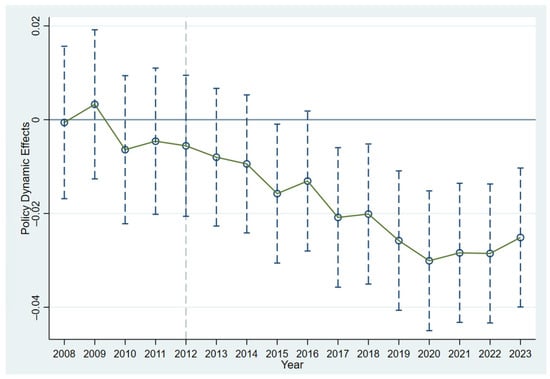
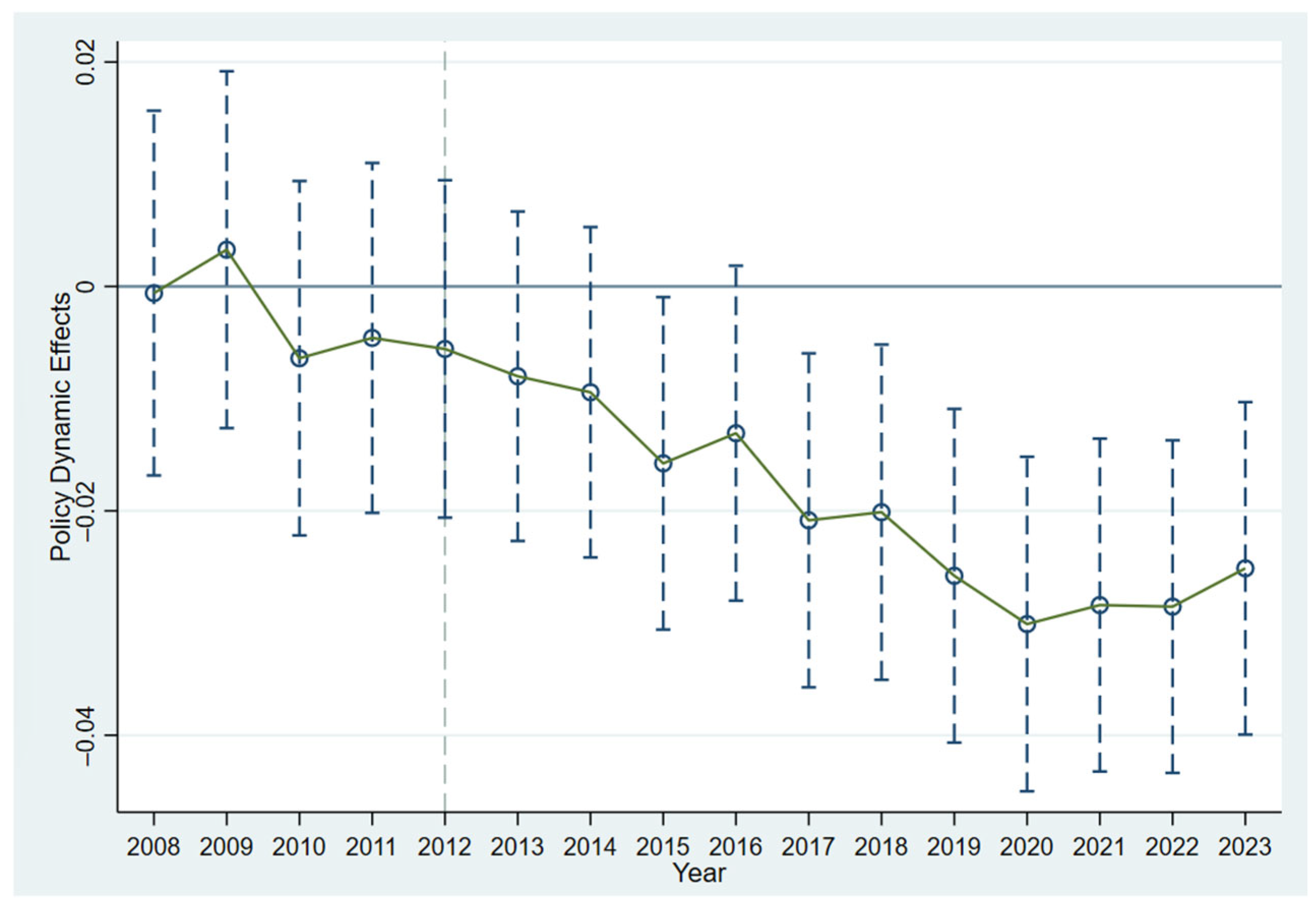
The prerequisite for the use of the double-difference method requires the sample to satisfy the parallel trend assumption, therefore, by plotting the dynamic effect of the policy (as shown in Figure 1), this paper can more clearly observe the dynamic change in the sample regression coefficients before the implementation of the policy.
Figure 1.
Annual policy dynamic effects. Gray vertical dashed line: policy timeline (2012), Blue vertical dashed lines: 95% confidence intervals for estimated coefficients.
As shown in Figure 1, the regression coefficient estimates for the years 2008 to 2011 were all non-significant. Following the promulgation of the Guidelines in 2012, the coefficients exhibited annual fluctuations with a degree of volatility, yet became statistically significant from 2017 onwards. This pattern reflects two factors: firstly, inherent implementation lags within the policy framework, alongside ongoing refinement requirements for the policy itself. The gradual introduction of supporting measures has facilitated phased adjustments to the policy’s regulatory intensity and coverage scope. Concurrently, enterprises and financial institutions must synchronously adapt to evolving policy demands, a process that contributes to fluctuations in the policy’s impact on capital structure. Concurrently, the abnormal stock market fluctuations in 2015 precipitated rapid deleveraging, heightening uncertainties in corporate equity financing. The 2017 supply-side structural reforms accelerated capacity reductions in heavily polluting industries, directly curtailing corporate investment and financing demands. Between 2020 and 2023, the pandemic strained corporate operating cash flows, triggering a phase of financing tightening. Such events interacted with green credit policies, further amplifying the volatility in policy effects. Moreover, research indicates that the role of green credit policies in promoting industrial low-carbon transformation varies significantly across regions [19]. Due to differing regional response times to policies, regression coefficients remained non-significant five years after policy implementation. These findings confirm that the study data satisfy the parallel trends assumption, permitting the use of the difference-in-differences approach.
4.3. Benchmark Regression
The regression results are shown in Table 3, with no control variables included in columns (1) and (2), and included in columns (3) and (4). Moreover, fixed effects are not considered in both columns (1) and (3), and fixed for time and individual in columns (2) and (4).
Table 3.
Benchmark regression results.
As Table 3 clearly demonstrates, under the implementation of green credit policies, the financial leverage ratios of enterprises in the treatment group generally exhibit a significant downward trend. All four regression results achieved significance at the 1% level, with corresponding coefficients of −0.035, −0.035, −0.025, and −0.024, respectively. The regression results in Column (4) reveal that firm size (Size), growth opportunities (Growth), and equity concentration (Sharehold) exert a significant positive influence on financial leverage (Lev). Conversely, profitability (Roe) and financial distress (Retain) demonstrate a significant inverse effect. This outcome aligns closely with capital structure theory and the logic of corporate operational practice. Specifically, larger enterprises possess stronger asset collateralization capabilities and operational stability, access more diversified financing channels, and exhibit greater debt-bearing capacity. High-growth enterprises face substantial investment demands that internal funds struggle to cover, necessitating debt financing to support expansion. Companies with concentrated shareholdings favor debt financing to avoid equity dilution and are more readily trusted by financial institutions. Highly profitable enterprises, possessing ample internal funds, can reduce debt dependency according to the pecking order theory. Firms in severe financial distress, with weak debt-servicing capacity and restricted financing, proactively reduce debt and lower leverage to safeguard operations.
The comprehensive empirical results show that the implementation of green credit policy has a significant impact on the capital structure of heavy pollution enterprises, which is manifested in the significant reduction in corporate financial leverage. This finding not only coincides with the originally proposed Hypothesis 1, but also further confirms the trend of adjusting the financial management of enterprises in the heavy pollution industry, i.e., their financial leverage has shrunk after the implementation of the Guidelines policy.
4.4. Robustness Test
4.4.1. Changing the Observation Window
Considering that the impact effect of the policy is continuous and there is a certain lag effect, the explanatory variable (Lev) is lagged by two and three periods, and the model is reconstructed with the original explanatory variables to observe whether the implementation of the policy in the last two years as well as in the last three years will have an impact on the capital structure of the current year. The results are shown in Table 4.
Table 4.
Robustness test for adjusted time window.
Table 4 indicates that the coefficient for L2.did (two periods lagged) is −0.015 and significantly negative at the 1% level. This demonstrates that the policy shock retains strong explanatory power over two years, meaning the policy effects from the preceding two years still significantly reduce the current year’s financial leverage ratio. The coefficient for the three-period lag L3.did is −0.011 and similarly negative at the 1% significance level. This indicates that the lagged impact of policy shocks extends to three years later, though the absolute value of the coefficient diminishes compared to the two-period lag, suggesting a marginal attenuation of policy effects. This fully demonstrates that changes in corporate capital structure are not attributable to short-term data fluctuations or exceptional circumstances. This finding not only reinforces the empirical conclusions but also further enhances their robustness and academic credibility.
4.4.2. Placebo Test
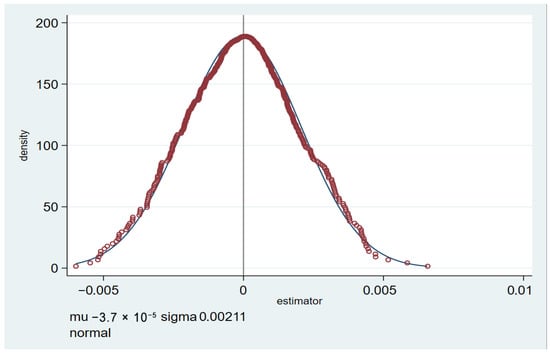
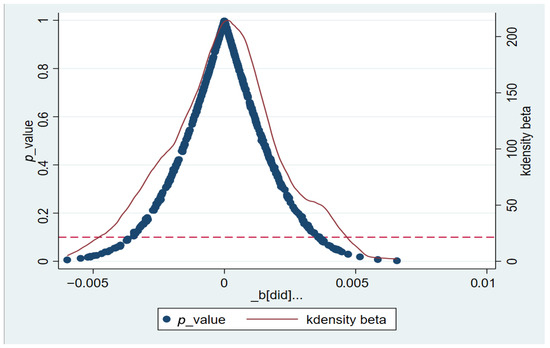
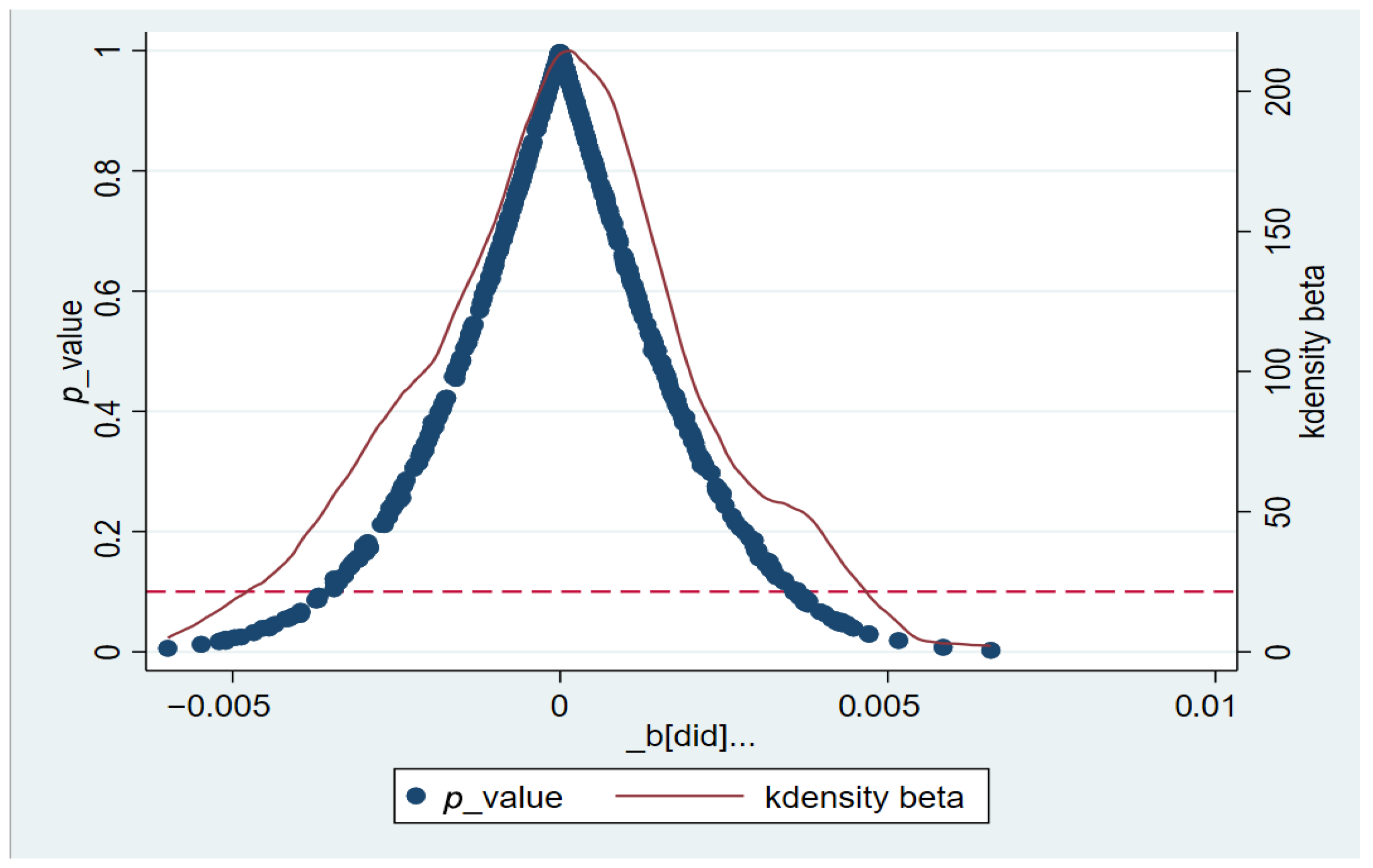
In order to investigate whether the reduction in financial leverage is purely caused by time variation, and to eliminate the potential interference of unobserved firm sample characteristics on the regression analysis, this paper randomly selects 123 observations in the overall sample as the “simulated experimental group”, and to ensure the reliability of the results, repeats this random sampling process a total of 500 times, and then conducts regression. In order to ensure the reliability of the results, this random sampling process is repeated for a total of 500 times, and then regression is performed. The distribution of the coefficients of the regression results is shown in Figure 2, and the p-value image is shown in Figure 3.
Figure 2.
Distribution of placebo test coefficients. The red dots: beta value, Connecting line: kernel density curve.
Figure 3.
Distribution of p-values from the placebo test. Blue dots: p-value, Connecting line (red): Kernel density curve, Red dashed line: pre-set p-value threshold.
From the data shown, it can be clearly observed that the distribution of coefficients of all regression models is closely centered around the value of 0, which is a standard normal distribution, and most of the p-values are located above the beta value. This indicates that the sample portfolio after random sampling did not have a significant effect on the capital structure of the firm. Based on this analysis, it can be concluded that the regression results in this paper are robust, i.e., the reduction in financial leverage is not caused by time variation alone, but has substantial economic significance.
4.5. Heterogeneity Test
4.5.1. Heterogeneity Analysis of Nature of Ownership
In order to explore the heterogeneous impact of the nature of enterprise ownership on capital structure, this paper divides the total sample according to enterprise equity attribution and introduces a dummy variable for the nature of equity (Soe), which is set to 1 for state-owned enterprises and vice versa assigned to 0. The regression results are detailed in Table 5.
Table 5.
Heterogeneity Analysis of Nature of Ownership.
According to the data in Column (1), it can be seen that the policy has a significant impact on the capital structure of the overall sample of enterprises, and from the analysis of the data in Column (2) and Column (3), it can be seen that there is a significant difference between the impact of the policy on the capital structure of state-owned and non-state-owned enterprises. Specifically, the adjustment of the capital structure of state-owned enterprises is more significant at the 1% statistical level, while non-state-owned enterprises are not significant. This result indicates that the sensitivity of capital structure of state-owned enterprises is higher than that of non-state-owned enterpri ses under the effect of green credit policy orientation. This analysis verifies Hypothesis 2a that there is heterogeneity in the impact of the Guidelines after its implementation on enterprises with different property rights properties, providing empirical support for understanding the differentiated effects of green credit policies in different enterprise types.
According to institutional theory, state-owned enterprises, as vehicles for the government to fulfill public policy functions, bear not only economic responsibilities but also policy-oriented tasks. This institutional constraint makes them more proactive in adjusting their business philosophy and capital structure, resulting in a more pronounced policy impact.
4.5.2. Regional Heterogeneity Analysis
The government divides the provinces into east, center and west according to the degree of economic development and geographic location of each region, considering that enterprises in different regions will respond to green credit policies to different degrees, this paper regresses the explanatory variables by different regions, respectively. The regression results are shown in Table 6. The regression results show that the core explanatory variables (did) in each region are significant, but there are some differences in the level of significance, the significance of the East and Central regions is 1% level, while the significance of the Western region is 10% level, this result initially indicates that the intensity of the impact of green credit policy on the capital structure of the enterprise varies according to the characteristics of the region. In order to rigorously test whether there are structural differences between regional zones, this paper conducted the Chow test. The results show that the coefficient is 43.04 and the p-value is significant, which supports Hypothesis 2b, that green credit policy has a greater impact on the capital structure of firms in the east-central part of the country, and a weaker impact on firms in the western part of the country.
Table 6.
Regional Heterogeneity Analysis.
According to resource dependence theory and institutional environment theory, the eastern region possesses more developed financial markets, enabling fuller application of green credit policy instruments. Concurrently, enterprises in this region benefit from diversified financing channels, allowing policy signals to be transmitted more efficiently. In contrast, the western region exhibits greater economic dependence on heavily polluting industries. Some local governments may flexibly adjust the implementation intensity of green credit policies, thereby creating a “dilution effect” in policy transmission.
5. Further Discussion
Mediating Effect
To examine the moderating effect of corporate ESG performance on the relationship between green credit policies and corporate capital structure, we estimate Model (4), and the results are reported in Table 7. Column (1) presents the benchmark regression results, while column (2) shows that the difference-in-differences (DID) estimator remains significantly negative at the 1% level. Additionally, the interaction term between ESG and did is also significantly negative. This indicates that as corporate ESG performance improves, the inhibitory effect of green credit policy on corporate capital structure will be significantly strengthened, i.e., corporate ESG performance plays a positive moderating role between green credit policy and corporate capital structure, and Hypothesis 3 holds.
Table 7.
Regression results of ESG performance moderating effect.
In summary, the higher a firm’s ESG performance, the more pronounced the dampening effect of green credit policies on financial leverage; conversely, the less pronounced the effect. According to stakeholder theory and information asymmetry theory, firms with superior ESG performance are more readily recognized by investors, possess more robust governance mechanisms and higher information transparency. Consequently, they incur lower capital structure adjustment costs and possess greater incentive to optimize their capital structure, thereby driving down financial leverage.
6. Conclusions and Recommendations
6.1. Conclusions
Green credit policies aim to raise the financing thresholds and costs for heavy polluting enterprises, encourage the flow of resources to more environmentally friendly and energy-efficient sectors through economic instruments, and guide the capital structure optimization of “two-high” industries (high-polluting and high-energy-consuming industries). These policies represent a key environmental and economic strategy to promote the transformation of enterprises toward more environmentally sustainable and efficient production models. In this context, this paper applies the double-difference model to conduct empirical analyses to explore the mechanism of green credit policy on enterprise capital structure. The results show that the green credit policy has a significant impact on corporate capital structure, which is manifested in the significant reduction in the financial leverage ratio of heavily polluting enterprises. The mechanism analysis shows that enterprise ESG performance plays a positive moderating role in green credit policy and enterprise capital structure, i.e., enterprises with better ESG performance face fewer internal and external financing constraints, thereby strengthening the inhibitory effect of green credit policies on their capital structure. State-owned enterprises and enterprises in the east-central region are more prominently affected by the Guidelines in terms of the reduction in financial leverage ratio.
6.2. Recommendations
This research provides empirical evidence for governments and financial institutions to effectively implement and steadily advance green credit policies, while offering strategic guidance for the transformation and upgrading of heavily polluting enterprises. At the governmental level, policy frameworks must be refined based on regional and corporate heterogeneity. Eastern regions should enhance policy tool innovation and market-based constraints to deepen green credit policy implementation; western regions should provide relevant policy subsidies and credit risk sharing to mitigate the “dilution effect” of policy execution. Furthermore, clear policy objectives for state-owned enterprises’ green transformation should be established. Credit approval processes for non-state-owned enterprises’ green projects should be streamlined, reducing compliance costs for ESG disclosure to alleviate financing constraints and secure green transition funding. Financial institutions should reasonably account for the long-term nature of corporate green transitions, establishing appropriate green transition leverage space and permitting gradual capital structure optimization. Concurrently, creditworthiness assessments should prioritize ESG performance, broadening financing channels for non-state-owned enterprises with strong ESG credentials pursuing green transformation. At the corporate level, non-state-owned and western enterprises should prioritize low-cost green reforms, aligning with policy support through precise ESG disclosure. Furthermore, enterprises should integrate ESG performance into long-term strategies, enhancing ESG value through technological upgrades and governance optimization. This approach not only meets credit thresholds but also builds a credit foundation for equity financing.
Author Contributions
N.W.: Conceptualization, Methodology, Formal Analysis, Writing—Original Revision, Supervision, Funding acquisition, Validation, and Writing—Review and Editing; Y.W.: Conceptualization, Methodology, Formal Analysis, Writing—Original Draft, and Revision; K.Y.: Investigation, Data Curation, and Editing. All authors have read and agreed to the published version of the manuscript.
Funding
This work was supported by the Youth Fund for Humanities and Social Sciences Research, Ministry of Education (24YJC630267) and the Major Project of Philosophy and Social Science Research in Jiangsu Universities (2024SJZD058).
Institutional Review Board Statement
Not applicable.
Informed Consent Statement
Not applicable.
Data Availability Statement
The raw data supporting the conclusions of this article will be made available by the authors on request.
Conflicts of Interest
The authors declare no conflicts of interest.
References
- Su, D.; Lian, L. Does Green Credit Policy Affect Corporate Financing and Investment? Evidence from Publicly Listed Firms in Pollution—Intensive Industries. J. Financ. Res. 2018, 462, 123–137. [Google Scholar]
- Cai, H.; Wang, X.; Tan, C. Green Credit Policy, Incremental Bank Loans and Environmental Protection Effect. Account. Res. 2019, 3, 88–95. (In Chinese) [Google Scholar]
- Chen, Q. Has China’s Green Credit Policy Been Implemented? An Analysis of Loan Scale and Costs Based on “Two Highs and One Surplus” Enterprises. Contemp. Financ. Econ. 2019, 3, 118–129. (In Chinese) [Google Scholar] [CrossRef]
- Meng, X.; Ruan, Y.; Tang, Y. Research on the Impact of Green Credit Policies on the Cost of Corporate Debt Financing. Friends Account. 2025, 21, 92–99. (In Chinese) [Google Scholar]
- Zhang, X.; Hu, J. Do Green Credit Policies Inhibit the Investment of Heavy Polluting Enterprises? Shandong Soc. Sci. 2022, 33, 138–146. [Google Scholar] [CrossRef] [Scilit]
- Li, S. The Impact of Corporate ESG Performance on Credit Financing. Master’s Thesis, Fujian Normal University, Fujian, China, 2023. (In Chinese) [Google Scholar] [CrossRef]
- Wang, Y.; Xie, M.; Guo, C. Does Firm ESG Performance Influence Bank Credit Decisions? Empirical Evidence from A-share Listed Firms in China. Financ. Econ. Res. 2023, 38, 97–114. [Google Scholar]
- Wang, B. Green Credit, Corporate Social Responsibility Disclosure and Debt Financing Cost: Empirical Study on Heavy Pollution Enterprises Listed in A-share Market from 2011 to 2017. Financ. Theory Pract. 2019, 40, 47–54. (In Chinese) [Google Scholar]
- Dong, Y.; Pan, H. Green Credit Policy, ESG Performance, and Capital Structure Adjustment of Highly- Polluting Firms. Resour. Ind. 2024, 26, 75–85. [Google Scholar] [CrossRef]
- An, W. A Probe into the Connotation, Mechanism and Practice of Green Finance. Econ. Surv. 2008, 25, 156–158. (In Chinese) [Google Scholar] [CrossRef]
- He, Q.; Wang, L. Can Green Credit Policies Curb the Debt of Heavily Polluting Enterprises? Policy effect evaluation based on counter-factual analysis. Sci. Technol. Ind. 2023, 23, 26–32. [Google Scholar]
- Li, Z. Research on the Impact of Green Credit on the Investment and Financing Behaviour of Heavy Pollution Enterprises. Huabei Financ. 2023, 12, 25–43. (In Chinese) [Google Scholar]
- Liu, M.; Zhao, S.; Wei, Z. How does enterprise ESG performance affect green investor entry? J. Chongqing Univ. Technol. (Soc. Sci.) 2024, 38, 43–58. [Google Scholar]
- Flammer, C.; Bansal, P. Does a long-term orientation create value? Evidence from a regression discontinuity. Strateg. Manag. J. 2017, 38, 1827–1847. [Google Scholar] [CrossRef] [Scilit]
- Han, L.; Xin, J. Investor Concerns, ESG Information Disclosure and Corporate Green Technology Innovation. Econ. Probl. 2024, 6, 115–122. [Google Scholar] [CrossRef]
- Faulkender, M.; Flannery, M.J.; Hankins, K.W.; Smith, J.M. Cash flows and leverage adjustments. J. Financ. Econ. 2012, 103, 632–646. [Google Scholar] [CrossRef] [Scilit]
- Zhou, Y.; Zou, F.; Wang, Z. Relationships among profitability, technology innovation capability and capital structure—An empirical analysis based on high-tech firms. Sci. Res. Manag. 2014, 35, 48–57. [Google Scholar] [CrossRef]
- Cai, H. Study on the Implementation of Green Loan Policy and its Effects in China—An Empirical Study Based on Paper, Mining and Power Industries. Collect. Essays Financ. Econ. 2013, 1, 69–75. [Google Scholar] [CrossRef]
- Tan, F. Research on the Impact of Green Credit Policyon the Low-Carbon Transition of Industry—Evidence Based on Industry Provincial Panel. Master’s Thesis, Guangxi University, Nanning, China, 2024. [Google Scholar] [CrossRef]

Disclaimer/Publisher’s Note: The statements, opinions and data contained in all publications are solely those of the individual author(s) and contributor(s) and not of MDPI and/or the editor(s). MDPI and/or the editor(s) disclaim responsibility for any injury to people or property resulting from any ideas, methods, instructions or products referred to in the content. |
© 2025 by the authors. Licensee MDPI, Basel, Switzerland. This article is an open access article distributed under the terms and conditions of the Creative Commons Attribution (CC BY) license.