


Abstract
In the face of growing geopolitical instability, an important question remains whether ESG (Environmental, Social, and Corporate Governance) indices are sensitive to geopolitical shocks and whether they can act as protective assets. The aim of the study was to empirically compare the STOXX Global ESG Leaders index with the response of the technology sector (Nasdaq 100 and Philadelphia Semiconductor Index (SOX)) to changes in the geopolitical risk index (GPR). Monthly data from 2019 to 2025 were used, along with a procedure including Vector Autoregression (VAR) modeling, Impulse Response Function (IRF) analyses, the Johansen test, and Granger causality tests. The results indicate a lack of significant relationships between GPR and the analyzed indices in the short and long term: no cointegration was found, IRF responses were weak and quickly faded, and Granger tests did not demonstrate the predictive power of GPR for the analyzed markets. VAR forecasts additionally confirmed the stable trend, unrelated to GPR fluctuations. The results suggest that ESG indices are not directly affected by geopolitical shocks, which indicate their relative resilience. A similar response was observed for technological indices. The results may have practical implications for investors interested in sustainable investing while looking for stable assets in periods of global uncertainty. The results may be important for institutional investors in terms of portfolio stabilization functions during periods of increased geopolitical uncertainty, and for policymakers and market regulators in the context of designing frameworks supporting the stability of ESG markets.
1. Introduction
For many years, there has been a significant increase in geopolitical risk, which has become a significant factor influencing economic, financial, and stability worldwide. Geopolitical risk is a multifaceted issue, relating to the political, social, economic, and military situation, as well as interactions between states. It is subject to segmentation and takes various forms, including: the risk of political change and tensions, the risk of international sanctions, the risk of military conflicts, and the risk of terrorism. Growing uncertainty is reflected in asset valuations and capital flows, and also influences investor expectations [1,2]. Analysis of this relationship is complicated by the simultaneous occurrence of contemporary market trends, including the dynamic development of new technologies and the technology sector, as well as increased legal regulations and investment expectations related to ESG factors. Dynamically developing technology markets, represented by, among others, by the Nasdaq 100 or Philadelphia Semiconductor Index (SOX), are characterized by high innovation, scalability, and the dominance of global companies. On the other hand, the global regulatory and institutional transformation has strengthened the importance of sustainable investments, which is reflected in the development of ESG indices [3,4].
Despite the growing importance of both market segments, the empirical literature is inconclusive regarding their sensitivity to increased geopolitical uncertainty. Some studies suggest that technology sectors may be particularly susceptible to geopolitical shocks due to the global nature of supply chains, the concentration of production, and the dominance of companies sensitive to regulation [5,6]. At the same time, other analyses indicate that companies with high ESG parameters may be more resilient to risk shocks because their business models are based on non-financial risk reduction, process predictability, and operational stability [7,8]. However, there is a lack of studies directly comparing the structural sensitivity of ESG and technology indices to geopolitical risk in a dynamic approach.
This study focuses on the research gap regarding the sensitivity to geopolitical shocks of two distinct asset classes: sustainable markets and technology markets. The study therefore empirically examines which of these asset classes, represented by the STOXX Global ESG Leaders Index, the Nasdaq 100, and the Philadelphia Semiconductor Index (SOX), exhibits a stronger response to geopolitical shocks (GPR Index). The STOXX Global ESG Leaders Index includes companies with the highest ESG ratings, representing stable business models, high levels of corporate governance, and above-average institutional resilience. The Nasdaq 100 and SOX Indices, on the other hand, include the largest global technology corporations, such as Apple, Microsoft, Nvidia, Intel, and TSMC. These companies are characterized by global operations, high market capitalization, and significant exposure to international supply chains and trade regulations.
The aim of the study is to assess the resilience of selected equity market segments, represented by the ESG Leaders Index and the Nasdaq and Philadelphia Semiconductor Index (SOX), to fluctuations in geopolitical risk (measured by the Geopolitical Risk Index according to [2]). Specifically, the study examines whether sustainable and technology markets differ in their resilience to global political uncertainty and whether changes in GPR constitute a significant source of their price volatility.
Global risk factors directly impact on expected cash flows, uncertainty, and required rates of return. According to prior research, assets sensitive to systemic factors should exhibit stronger price responses and higher risk premiums [2,5,6]. The ESG literature indicates that companies with higher ESG parameters exhibit lower exposure to systemic factors, lower volatility, and less susceptibility to macroeconomic shocks [3,7,8]. On the other hand, the technology sector is characterized as a segment with high exposure to systemic risk, especially global supply, regulatory, and political shocks [9].
Within the framework of efficient markets theory [10] and information-based models [11], asset prices react primarily to unexpected information. Geopolitical risk indices (GPR) [2] aggregate press releases, meaning that some index changes may be predictable and already discounted by the market. ESG literature indicates that organizations with high ESG indicators react less strongly to negative information and recover more quickly [12,13]. Technology companies, on the other hand, react particularly strongly to information about trade restrictions, sanctions, or supply chain disruptions. Therefore, according to information theory, their response to geopolitical shocks should be more pronounced. These mechanisms justify the theoretical expectation of limited sensitivity of ESG indices and increased sensitivity of technology indices to geopolitical risk.
Based on the literature review and financial theory, the following two hypotheses were formulated:
H1.
Geopolitical risk (GPR) volatility does not have a statistically significant impact on either the short-term or long-term dynamics of the STOXX Global ESG Leaders Index.
H2.
Geopolitical risk (GPR) volatility is a significant factor determining the dynamics of technology indices represented by the Nasdaq 100 and the Philadelphia Semiconductor Index (SOX).
The empirical analysis covers the period from January 2019 to October 2025 and uses monthly data for four variables: the STOXX Global ESG Leaders, the Nasdaq 100, and the Philadelphia Semiconductor Index (SOX). This period encompasses significant geopolitical events in recent years, including the COVID-19 pandemic, Russia’s invasion of Ukraine, and the escalation of technological and trade tensions between the United States and China. These events potentially had an impact on the dynamics of the indexes under study. The study is based on a Vector Autoregression (VAR) model. All calculations were performed in Python 3.13 software.
The study of the impact of geopolitical risk (GPR) on ESG and technology indices is motivated by the growing need to identify assets resilient to global uncertainty. The contribution of this study is to directly compare the dynamic responses of ESG and technology sector indices to a common GPR shock within a single, coherent VAR model. The results may be particularly useful for institutional investors and ESG product developers. They also provide value to regulators and risk analysts, helping to assess the vulnerability of these market segments.
2. Literature Review
Growing global instability has led to intensified research on the relationship between geopolitical risk (GPR) and the prices of major asset classes [14,15,16]. Economic and financial literature indicates a negative correlation between geopolitical risk (GPR) and environmental, social, and governance (ESG) performance. Cross-country studies covering various countries and various time periods confirm that escalating GPR, understood as armed conflicts, political instability, and other geopolitical threats [2], leads to statistically significant downgrades of ESG ratings, both at the level of individual companies and entire stock indices. For example, ref. [17] analyzes geographic variation in the transmission of volatility between regional ESG equity indices under the influence of geopolitical and climate risks. They found that developed markets (North America and Western Europe) are the main transmitters of shocks, while emerging markets (Asia-Pacific and, after considering ESG factors, also Latin America) act as recipients. They emphasize that, despite taking into account ESG criteria, developed financial markets remain key epicenters for the spread of instability. Ref. [18] examine how the Russia-Ukraine and Israel-Palestine conflicts affect interconnectedness and risk transmission between specific ESG ETF markets. They find that conflicts intensify market interdependencies but emphasize that the risk impact is indirect.
By decomposing individual ESG effects, ref. [19] demonstrate that individual ESG pillars are not equally important for investors during wartime. Focusing on Eurozone stocks after the Russian invasion of Ukraine in 2022, they demonstrate that only corporate governance (G) was rewarded by the market. This was confirmed by higher, positive returns for well-managed companies. Environmental (E) and social (S) factors proved less important in this context. Observations of [19] emphasize the heterogeneity of ESG and demonstrate that the importance of its individual pillars is strongly context-dependent. Their findings indicate that during geopolitical shocks, investors primarily seek signs of good governance and resilience, rather than advanced environmental or social practices.
In the economic literature, ESG is also presented as a strategic tool for managing geopolitical and political risks. Based on data from 37 countries from 2002 to 2022 [20], they prove that companies dynamically adapt their ESG practices in response to the increase in these risks, while also pointing out the diversity of responses. The research shows that companies with higher ESG indicators respond more strongly to geopolitical shocks, while companies with lower ESG indicators respond to political instability. Additionally, they found that individual ESG pillars react differently: environmental (E) performance deteriorates under the influence of GPR, while social (S) and corporate governance (G) often improve. Ref. [21] on the other hand, found that companies with higher ESG ratings are more resistant to the negative impact of GPR. They attribute the mitigating effect primarily to the environmental (E) and social (S) dimensions, which, by building a better reputation and greater transparency of the company, counteracting the loss of investor confidence.
Ref. [22] also provides evidence supporting ESG practices as an effective strategy for mitigating risk and building financial resilience. Their findings suggest that a commitment to sustainability plays a protective role during periods of uncertainty. The results show that geopolitical risk has a significantly negative impact on non-ESG companies, while companies implementing ESG practices demonstrate resilience. They emphasize that the presence of ESG companies in “green markets” mitigates the overall negative impact of geopolitical risk.
Similar results were obtained by [23], who examined the impact of geopolitical risk on the ESG performance of Chinese companies. They found that ESG practices mitigate the negative effects of GPR on corporate risk and reputation, while also increasing benefits for stakeholders. This effect is particularly strong for state-owned companies, polluting industries, and companies with highly environmentally conscious managers.
A literature review indicates that GPR is a significant factor influencing corporate performance in financial markets, while also pointing to the limited number of studies examining technology sector indices. Empirical studies confirm that escalating geopolitical tensions typically negatively impact corporate sector returns. For example, ref. [9] found that the impact of geopolitical shocks on company valuations is strongly dependent on the specific sector. They indicate that this risk negatively impacts the information technology (IT) and consumer staples sectors, while it has a positive impact on the communication services sector.
This divergent response was observed in different event windows. In turn, Refs. [24,25] indicates that this impact varies depending on the national context. Ref. [24] indicates that geopolitical shocks are more significant for emerging economies and oil exporters. The results of the research by [25] also confirmed that geopolitical risk has a significant predictive power for stock market volatility in emerging countries. They also proved that breaking down the GPR Index into its components (acts and threats) provides better forecasting properties for geopolitical acts than for geopolitical threats.
Despite the growing body of research examining the relationship between geopolitical risk (GPR) and ESG performance, the existing literature demonstrates a clear research gap in comparing and quantifying the sensitivity of ESG and technology sector indices to geopolitical shocks. This study fills this gap by providing additional context for investment decisions and financial instrument selection during periods of global turmoil. The findings provide empirical evidence that including sustainable financial instruments in portfolios can be a valuable risk diversification strategy under conditions of GPR.
3. Materials and Methods
To verify the impact of geopolitical risk on sustainable and technology markets, a vector autoregressive (VAR) model was estimated [26,27,28]. The model included the following four variables:
- GPR Index (by Caldara and Iacoviello), (GPR),
- STOXX Global ESG Leaders Index (STOXX Ltd., Zurich, Switzerland), (ESG),
- Nasdaq 100 (Nasdaq, Inc., New York, NY, USA), (Nasdaq),
- Philadelphia Semiconductor Index (PHLX Semiconductor Sector Index, Nasdaq, Inc., New York, NY, USA), (SOX).
The GPR Index is a measure of geopolitical risk constructed by [2]. The choice of this index is due to its global nature, widespread recognition and use in empirical research, and its ability to aggregate global geopolitical tensions. The index based on unfavorable geopolitical events reported in press articles, representing their share of the total number of news articles. An automatic text search system is used to calculate the indices. The choice of STOXX Global ESG Leaders as the subject of analysis is justified for several reasons. First, STOXX Global ESG Leaders focuses simultaneously on three dimensions: environmental (E), social (S), and corporate governance (G). Second, its structure enables the identification of companies that are leaders in individual ESG components. Third, this choice is justified in the context of existing research gaps. Previous studies have focused primarily on traditional indices, omitting specialized ESG indices. The Nasdaq 100 and the Philadelphia Semiconductor Index (SOX) were chosen because of their role as global benchmarks for the technology sector, differing in their level of specialization and sensitivity to external factors. The Nasdaq 100 represents a broad segment of technology companies with significant capitalization and global reach. The SOX on the other hand focuses on companies from the semiconductor industry, which is a strategically crucial sector particularly exposed to geopolitical tensions. Including both indices allows for a comparison of the general and specialized parts of the technology sector in terms of their response to GPR volatility.
The study covers the period from January 2019 to October 2025 (monthly data). This period was chosen for two reasons. First, it encompasses the geopolitical shocks of recent years, including the COVID-19 pandemic, Russia’s invasion of Ukraine, and the US-China technology war. Second, this period coincides with the development phase of the ESG market, characterized by increased capital inflows and the development of sustainable financial instruments. Meanwhile, the analysis based on monthly data made it possible to determine the lasting reactions of the indices to geopolitical risk, limiting the impact of short-term information noise. All series were subjected to the Augmented Dickey–Fuller (ADF) test, using the null hypothesis of a unit root [29]. The ADF test indicated non-stationarity at all levels (p-value > 0.05), and therefore, first differences were used [30]. The use of first differences was aimed at eliminating the non-stationarity of the time series and ensuring the correct estimation of the VAR model:
where Δyt—the first difference of variable y in period t; yt—the value of variable y in the current period t; yt−1—the value of variable y in the previous period t − 1.
Δyt = yt – yt−1
The optimal number of lags p (lag = 1) was selected based on the AIC, BIC, and HQIC information criteria, testing lags from 1 to 12 [31,32]. The model was estimated using the OLS method (separately for each equation). The response dynamics were examined using Impulse Response Functions (IRFs) for a 12-month horizon and Forecast Error Variance Decomposition (FEVD) [33]. The selected model order ensures that the stability condition is met (all roots of the characteristic polynomial are located within the unit circle).
The VAR model equation has the following form:
where Yt—vector of endogenous variable; Ai—lag parameter matrices; p—lag order of the model; εt—vector of random components.
To verify the existence of long-run equilibrium between nonstationary variables, the Johansen cointegration test was used [34,35]. This test is based on a sequential procedure for testing hypotheses regarding the order of long-run equilibrium. The procedure begins with the most restrictive null hypothesis of no cointegration relationship (H0: r = 0). If this null hypothesis is rejected, the test proceeds to testing the hypothesis of at most one relationship (H0: r ≤ 1), continuing the process until the null hypothesis cannot be rejected, e.g.,:
- H0: r = 0—no cointegration relationship,
- H0: r ≤ 1,
- H0: r ≤ 2,
Where r is the number of cointegrating vectors.
For each hypothesis, the trace statistics are calculated and compared to the critical values at 10%, 5%, and 1% significance levels, according to the tables presented in [36].
Then, in order to assess whether the GPR index has a predictive power with respect to changes in the ESG market indices, Nasdaq 100 and SOX, a Granger causality test was performed [27,37]. This test allowed us to assess whether the historical values of the GPR index contain significant information for forecasting the current rates of return on the analyzed market indices. In order to capture short-term and medium-term dependencies, the tests were performed for lags from 1 to 6. For each lag, the F statistic and p values were recorded.
Finally, 12-month forecasts were generated. To return to the original scale, a cumulative difference reconstruction was used. This approach is consistent with [27,30,38,39]:
where —forecasted level of the variable in period k; Yt—last observed level of the variable in the sample; Δ—forecasted value of the first difference in the variable in month t + i; k—forecast horizon (number of periods ahead, e.g., 1–12).
4. Results
4.1. Preliminary Analysis and Model Specification
The analysis was conducted using monthly data for the STOXX Global ESG Leaders (ESG variable), GPR, Nasdaq 100, and Philadelphia Semiconductor Index (SOX). ADF tests showed that all series, except GPR, are non-stationary (Table 1a). Consequently, the series were transformed to first differences. The selection of the lag order (1) was performed using information criteria. Lag 1 reflects the short-term dynamics of the monthly variables (Table 1b).
Table 1.
ADF test results and information criteria. (a) ADF test results, (b) Information criteria.
4.2. VAR Estimation and Impulse Response Analysis
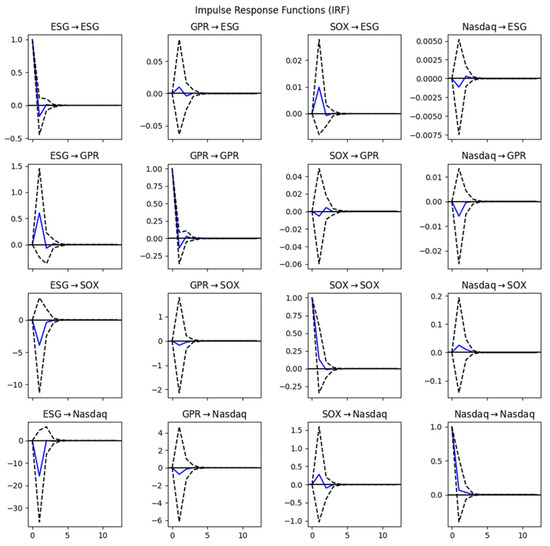
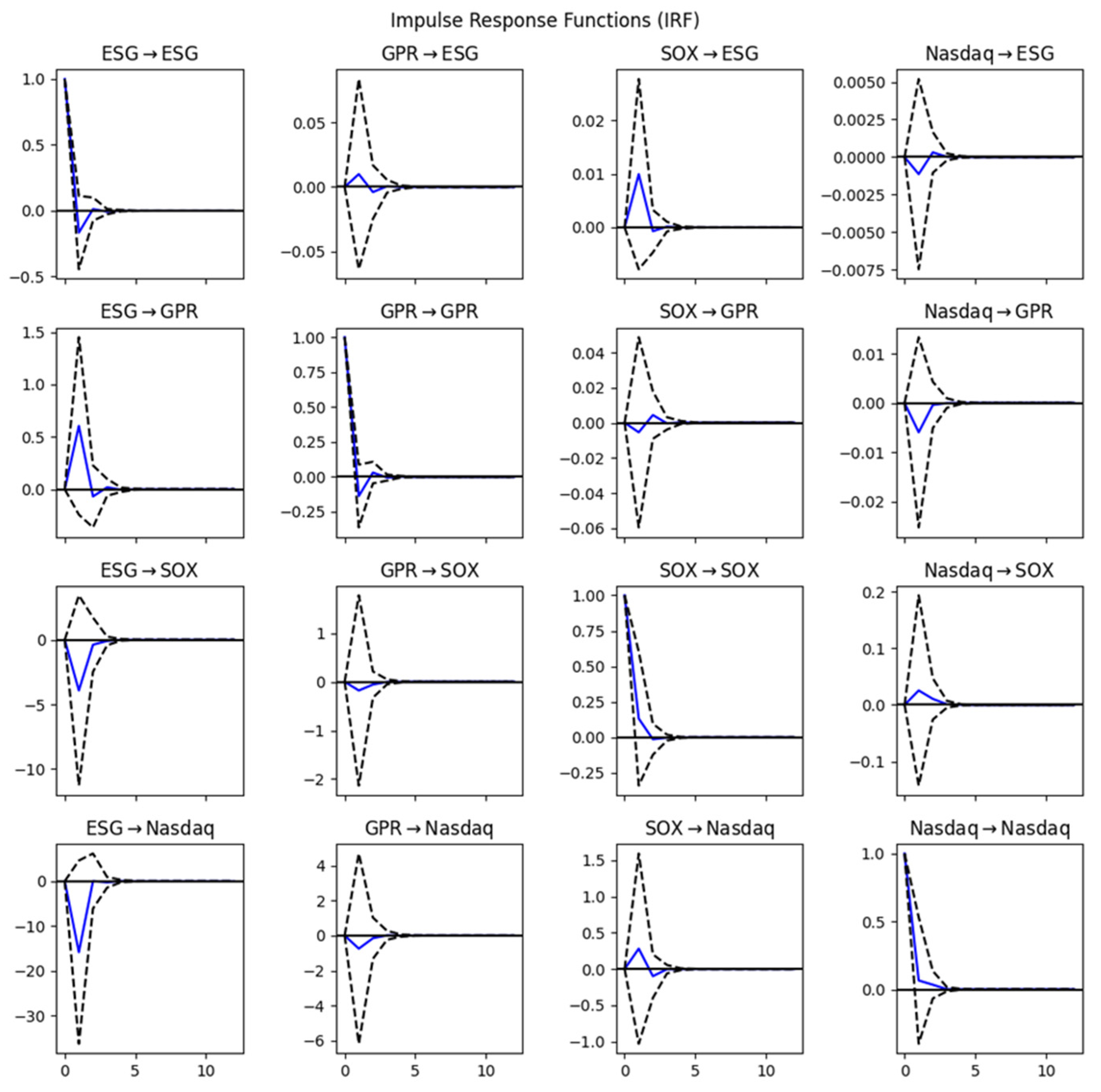
The estimation results showed that monthly changes in the GPR index had no statistically significant impact on the endogenous variables. The coefficient for GPR in the ESG equation was 0.009958 (p = 0.792), for Nasdaq 100 −0.005941 (p = 0.546), and for SOX −0.178761 (p = 0.858). All coefficient results indicate limited direct transmission of geopolitical shocks in the short term. These observations are confirmed by the IRF analysis, which showed that the responses of all indices to a positive GPR shock are short-lived, small, and quickly fade away (Figure 1).
Figure 1.
Impulse Response Functions (IRF). Sources: Own calculations, based on [40,41,42,43].
Figure 1 shows that the geopolitical shock represented by the GPR generates low-amplitude, short-term responses. The weakest response was observed for STOXX Global ESG Leaders, which response remains close to zero and fades out in the first two periods. The low IRF amplitude indicates that the effect of GPR is not only statistically insignificant but also economically negligible. In contrast, the responses of the Nasdaq technology indices and SOX are slightly stronger, though still limited and quickly fading. In particular, SOX exhibits the highest, yet still modest, elasticity to the GPR impulse, consistent with the semiconductor industry’s exposure to geopolitical factors related to supply chains and trade tensions. The lack of persistent IRF effects indicates that geopolitical risk is not a significant source of short-term disruptions in the studied markets.
4.3. Johansen Cointegration Test Results
To examine the existence of a long-term relationship between variables (STOXX Global ESG Leaders (ESG variable), GPR, Nasdaq 100, and the Philadelphia Semiconductor Index (SOX)), a Johansen cointegration test was used (Table 2).
Table 2.
Johansen Cointegration Test Results.
As shown in Table 2, the Trace Statistic test clearly demonstrated the absence of cointegration relationships between the analyzed variables. This result indicates that no long-term, statistically significant relationship emerged between the GPR index and the sustainable and technology markets during the analyzed period. The absence of such a relationship means that the analyzed markets do not exhibit a tendency toward a common, correlated trend toward a single, sustainable equilibrium level, which would be determined by geopolitical factors. Consequently, it can be concluded that while geopolitical shocks exert a temporary impact on asset price dynamics, in light of the Johansen test, they do not constitute a long-term common factor determining the common price trends of the analyzed indices.
4.4. Granger Causality Test Results
The cointegration analysis is complemented by Granger causality test results, which provide further evidence against a strong relationship between the variables. Granger causality tests conducted for lags 1 to 6 did not indicate that changes in the GPR influenced future changes in any of the market indices. All p-values were significantly above significance, demonstrating that geopolitical volatility is not predictive of either ESG or technology (Table 3).
Table 3.
Granger causality test results (GPR–ESG).
4.5. Forecast Error Variance Decomposition (FEVD) Results
To determine the relative importance of geopolitical shocks in shaping the volatility of the markets studied, an Forecast Error Variance Decomposition (FEVD) analysis was conducted. The results indicate that the contribution of GPR shocks to the volatility of the ESG index is only about 0.1%. This indicates a virtually complete lack of sensitivity of this market segment to geopolitical factors. In the case of the SOX index, the GPR impact is equally minimal (0.1%). The Nasdaq 100, on the other hand, is characterized by a slightly higher sensitivity to geopolitical risk, but the contribution of GPR shocks to this index’s volatility does not exceed 0.5%. The FEVD results confirm that geopolitical pressures are not an economically significant source of price volatility for any of the analyzed variables (Table 4).
Table 4.
The share of GPR index shocks in the forecast error variance (FEVD) for the studied indices. (A) FEVD for ESG, (B) FEVD for GPR, (C) FEVD for SOX, (D) FEVD for Nasdaq.
4.6. Forecasting Analysis
Forecasts were generated for a twelve-month horizon based on the VAR model. The forecasts also indicate no disturbances related to geopolitical risk. All indices exhibit stable trends, consistent with the current data dynamics, without any sudden deviations that could be attributed to changes in the GPR. This result confirms the marginal role of geopolitics in shaping the dynamics of sustainable and technological markets during the period under review (Table 5). It should be emphasized that the forecasts are illustrative and are not subject to a formal assessment of predictive accuracy.
Table 5.
Twelve-month horizon forecasts.
The analysis clearly indicates that geopolitical risk has no significant impact on either the ESG or technology markets. Technology indices exhibit a slightly higher, but still very limited, sensitivity to changes in the GPR. Consequently, it can be concluded that, during the period under review, geopolitical risk was not a factor with the potential to impact the analyzed markets, either in the short or long term.
The lack of significant responses of the STOXX Global ESG Leaders, Nasdaq 100, and Philadelphia Semiconductor Index (SOX) to changes in the GPR index should be considered a theoretically consistent result with existing literature. First, the GPR index is a very general measure, aggregating heterogeneous events, many of which do not directly impact the cash flows of technology companies or investor decisions in the ESG market. Second, the GPR index is based on press reports, which typically do not carry an element of surprise and therefore do not constitute new information in the sense of efficient markets. Finally, the monthly data frequency smooths short-term reactions and prevents transitory shocks from impacting the dynamics of monthly returns.
The presented analytical results allow for a positive verification of hypothesis H1. In the case of hypothesis H2, the obtained results do not provide evidence to confirm it.
5. Discussion
The results of research comparing the response of the sustainable STOXX Global ESG Leaders Index to the technology-driven Nasdaq 100 and Philadelphia Semiconductor Index (SOX) to geopolitical shocks between 2019 and 2025 provide important insights for both the literature and investment practice. Previous research demonstrates that financial assets exhibit heterogeneous and often asymmetric responses to changes in geopolitical risk [14]. Previous findings indicate heterogeneity in sectoral responses, particularly within technology industries. Some studies document a negative response of IT companies to geopolitical shocks [9], while others highlight the significant role of country-specific factors [24] and differences between developed and emerging markets [25]. In light of these mixed findings, the results of this study indicate no significant transmission of GPR shocks to the Nasdaq 100 and Philadelphia Semiconductor Index (SOX) technology indices.
Previous results indicate that an increase in GPR leads to a decrease in ESG performance [15,16], a deterioration of environmental and social components [20] and increases correlations between ESG fund markets during conflicts [18]. It has also been emphasized that during periods of geopolitical escalation, investors reward strong governance practices [19], and that companies with higher ESG performance demonstrate greater resilience [21,22]. Against this background, the lack of significant GPR effects in this model in both the short and long term should be interpreted as an unexpected result. In particular, the lack of significant effects of GPR on the ESG index contradicts numerous studies indicating its sensitivity to conflicts and political tensions [16,20]. A possible explanation is the specific construction of the analyzed index, which includes the largest and most liquid companies with the highest ESG ratings. Studies by [21,22] suggest that such entities are characterized by the greatest resilience to external geopolitical shocks and explain the lack of response both in the short term (IRF) and in predictive models (Granger causality) or long term (Johansen test). The results therefore support the interpretation of ESG as an institutional risk buffer that limits the sensitivity of stock prices to external shocks. Strong corporate governance, greater transparency, and more stable stakeholder relationships may explain the weaker response of ESG indices to geopolitical risk. Furthermore, the results may also be explained by the specificity of the GPR index, which is based on press reports [1]. This suggests that some information may have been previously discounted by the market explaining the limited scale of price reactions.
To complement this interpretation, it is also worth referencing firm-level evidence that advanced risk management practices focused on ESG factors strengthen the institutional resilience of economic entities. Empirical studies show that implementing an enterprise risk management (ERM) framework that incorporates ESG risks promotes improved environmental performance and long-term green growth, which reduces firms’ vulnerability to external shocks [44]. This mechanism may partially explain the lack of significant response of ESG indices to the increase in geopolitical risk observed in this study.
6. Conclusions
The contribution of this work is to directly link the dynamics of ESG indices to the GPR index, while simultaneously comparing the response to GPR shocks in the technology sector.
The empirical analysis did not provide evidence of a short-term impact of geopolitical risk (GPR) on the dynamics of the STOXX Global ESG Leaders Index. Impulse response (IRF) data confirmed the index’s insensitivity to exogenous GPR shocks, indicating its high short-term stability with respect to changes in the global geopolitical environment. Similar results were obtained for the benchmark indices, the Nasdaq 100 and the Philadelphia Semiconductor Index (SOX). However, the STOXX Global ESG Leaders Index has shown a particularly consistent lack of response. The results therefore underscore its relative resilience to geopolitical fluctuations. Furthermore, Granger causality tests did not reveal statistically significant predictive relationships between GPR and the STOXX Global ESG Leaders Index, clearly confirming the lack of short-term causal relationships.
Johansen’s cointegration tests yielded consistent results over the long term: there is no common trend or corrective relationship between the GPR and ESG indexes, indicating a lack of structural and fundamental linkages between these variables. These results are consistent with the analysis of the Nasdaq 100 and SOX indices used as benchmarks. However, in the case of the ESG index, the particularly pronounced lack of long-term cointegration with the GPR means that its long-term dynamics are not co-shaped by geopolitical risk.
Taken together, the tests conducted indicate that the STOXX Global ESG Leaders Index is highly resilient to geopolitical shocks, both in the short and long term. The GPR does not act as a source of volatility, does not constitute a predictive factor, and does not shape a common trend with the ESG market. Compared to technology indices, the structural stability of the ESG market appears particularly pronounced, suggesting that the impact of geopolitical risk on price indices in this segment is limited and does not generate observable transmission effects.
From the institutional investors perspective, the results suggest that ESG instruments can serve as a portfolio stabilizer during periods of heightened geopolitical uncertainty. At the same time, the lack of response from technology indices suggests that short-term geopolitical shocks may not significantly disrupt long-term investment strategies based on technological innovation.
This study has several significant limitations that should be considered when interpreting the results. First, the use of monthly aggregate data limits the ability to capture short-term market reactions to sudden geopolitical shocks. Studies based on daily data could reveal short-term effects that are not visible in monthly analysis. Second, the GPR indicator reflects global geopolitical risk, which may mask the differential impact of regional conflicts on individual markets. Incorporating component indicators (threats vs. acts) or regional indices could increase the precision of the estimates. Third, the study focuses on US indices, which limits the generalizability of the findings to emerging economies, which are more susceptible to geopolitical risk. Fourth, the linear models used (VAR, Granger tests) do not account for potential nonlinearities, threshold effects, or asymmetric responses, which may play a role in conditions of high uncertainty.
This work is exploratory in nature, and its primary goal was to verify the validity and determine the potential of research in this area. The preliminary results constitute a starting point for in-depth studies, which the author intends to undertake. Future research could consider methods such as Time-Varying Parameter Vector Autoregression (TVP-VAR) or Markov Switching Models and incorporate high-frequency data and component indicators (threats vs. actions). Further work could also explore extending the analysis to include longer-term data, enabling a comparison of the resilience of developed and emerging markets to varying geopolitical tensions.
Funding
This research was funded by the Ministry of Science and Higher Education under the Regional Excellence Initiative (RID) program.
Institutional Review Board Statement
Not Applicable.
Informed Consent Statement
Not Applicable.
Data Availability Statement
The data presented in this study are available in https://www.matteoiacoviello.com/gpr.htm (accessed on 8 November 2025); https://stoxx.com/data-index-details?symbol=SXWESGP (accessed on 8 November 2025); https://eikon.refinitiv.com/ (accessed on 8 November 2025); https://www.investing.com/indices/nq-100-historical-data (accessed on 8 November 2025); https://pl.investing.com/indices/phlx-semiconductor (accessed on 8 November 2025).
Acknowledgments
During the preparation of this manuscript/study, the author used Google Translate for the purposes of checking linguistic correctness. The authors have reviewed and edited the output and take full responsibility for the content of this publication.
Conflicts of Interest
The author declares no conflicts of interest.
References
- Caldara, D.; Iacoviello, M. Measuring geopolitical risk. Am. Econ. Rev. 2022, 1124, 1194–1225. [Google Scholar] [CrossRef] [Scilit]
- Bekaert, G.; Hoerova, M.; Duca, M.L. Risk, uncertainty and monetary policy. J. Monet. Econ. 2013, 60, 771–788. [Google Scholar] [CrossRef] [Scilit]
- Friede, G.; Busch, T.; Bassen, A. ESG and financial performance: Aggregated evidence from more than 2000 empirical studies. J. Sustain. Financ. Invest. 2015, 5, 210–233. [Google Scholar] [CrossRef] [Scilit]
- Fatemi, A.M.; Fooladi, I.J. Sustainable finance: A new paradigm. Glob. Financ. J. 2013, 24, 101–113. [Google Scholar] [CrossRef] [Scilit]
- Pastor, L.; Veronesi, P. Uncertainty about government policy and stock prices. J. Financ. 2012, 67, 1219–1264. [Google Scholar] [CrossRef] [Scilit]
- Kelly, B.; Pástor, Ľ.; Veronesi, P. The price of political uncertainty: Theory and evidence from the option market. J. Financ. 2016, 71, 2417–2480. [Google Scholar] [CrossRef] [Scilit]
- Broadstock, D.C.; Chan, K.; Cheng, L.T.; Wang, X. The role of ESG performance during times of financial crisis: Evidence from COVID-19 in China. Financ. Res. Lett. 2021, 38, 101716. [Google Scholar] [CrossRef] [Scilit]
- Albuquerque, R.; Koskinen, Y.; Zhang, C. Corporate social responsibility and firm risk: Theory and empirical evidence. Manag. Sci. 2019, 65, 4451–4469. [Google Scholar] [CrossRef] [Scilit]
- Fossung, G.; Vovas, V.; Quoreshi, A. Impact of Geopolitical Risk on the Information Technology, Communication Services and Consumer Staples Sectors of the S&P 500 Index. J. Risk Financ. Manag. 2021, 14, 552. [Google Scholar] [CrossRef] [Scilit]
- Fama, E.F. Efficient capital markets: A review of theory and empirical work. J. Financ. 1970, 25, 383–417. [Google Scholar] [CrossRef] [Scilit]
- Grossman, S.J.; Stiglitz, J.E. On the impossibility of informationally efficient markets. Am. Econ. Rev. 1980, 70, 393–408. Available online: http://www.jstor.org/stable/1805228 (accessed on 8 November 2025).
- Lins, K.V.; Servaes, H.; Tamayo, A. Social capital, trust, and firm performance: The value of corporate social responsibility during the financial crisis. J. Financ. 2017, 72, 1785–1824. [Google Scholar] [CrossRef] [Scilit]
- Nofsinger, J.; Varma, A. Socially responsible funds and market crises. J. Bank. Financ. 2014, 48, 180–193. [Google Scholar] [CrossRef] [Scilit]
- Snarska, M.; Frydrych, S.; Łukowski, M.; Czech, M.; Perez, K. Semiconductor game of thrones: A comprehensive study of geopolitical and equity market uncertainty transmission. Int. Rev. Financ. Anal. 2025, 106, 104457. [Google Scholar] [CrossRef] [Scilit]
- Nonejad, N. An interesting finding about the ability of geopolitical risk to forecast aggregate equity return volatility out-of-sample. Financ. Res. Lett. 2022, 47, 102710. [Google Scholar] [CrossRef] [Scilit]
- Zaremba, A.; Cakici, N.; Demir, E.; Long, H. When bad news is good news: Geopolitical risk and the cross-section of emerging market stock returns. J. Financ. Stab. 2022, 58, 100964. [Google Scholar] [CrossRef] [Scilit]
- Karkowska, R.; Urjasz, S. How does the volatility of ESG stock indices spillover in times of high geopolitical risk? New insights from emerging and developed markets. J. Sustain. Finance Investig. 2025, 15, 577–623. [Google Scholar] [CrossRef] [Scilit]
- Ullah, A.; Liu, X.; Zeeshan, M.; Shah, W.U. Evaluating Growth and Crisis Risk Dynamics of Sustainable Climate Exchange-Traded Funds. Sustainability 2024, 16, 10049. [Google Scholar] [CrossRef] [Scilit]
- Kovács, B.; Neszveda, G.; Baranyai, E.; Zaremba, A. ESG unpacked: Environmental, social, and governance pillars and the stock price reaction to the invasion of Ukraine. Eurasian Bus. Rev. 2024, 14, 755–777. [Google Scholar] [CrossRef] [Scilit]
- Erzurumlu, Y.; Gozgor, G.; Lau, C.; Soliman, A.; Turkkan, M. The effects of geopolitical and political risks on corporate ESG practices. J. Environ. Manag. 2025, 386, 125747. [Google Scholar] [CrossRef] [Scilit]
- Fiorillo, P.; Meles, A.; Pellegrino, L.; Verdoliva, V. Geopolitical risk and stock price crash risk: The mitigating role of ESG performance. Int. Rev. Financ. Anal. 2023, 91, 102958. [Google Scholar] [CrossRef] [Scilit]
- Alnafrah, I. ESG practices mitigating geopolitical risks: Implications for sustainable environmental management. J. Environ. Manag. 2024, 358, 120923. [Google Scholar] [CrossRef] [Scilit]
- Kuai, Y.; Wang, H. Geopolitical Risk and Corporate ESG Performance: Evidence from China. Emerg. Mark. Financ. Trade 2024, 61, 1010–1029. [Google Scholar] [CrossRef] [Scilit]
- Zhang, Y.; He, J.; He, M.; Li, S. Geopolitical risk and stock market volatility: A global perspective. Financ. Res. Lett. 2022, 53, 103620. [Google Scholar] [CrossRef] [Scilit]
- Salisu, A.; Ogbonna, A.; Lasisi, L.; Olaniran, A. Geopolitical risk and stock market volatility in emerging markets: A GARCH—MIDAS approach. N. Am. J. Econ. Financ. 2022, 62, 101755. [Google Scholar] [CrossRef] [Scilit]
- Sims, C.A. A Nine-Variable Probabilistic Macroeconomic Forecasting Model. In Business Cycles, Indicators, and Forecasting; University of Chicago Press: Chicago, IL, USA, 1993. [Google Scholar]
- Lütkepohl, H. Vector autoregressive models. In Handbook of Research Methods and Applications in Empirical Macroeconomics; Edward Elgar Publishing: Cheltenham, UK, 2013; pp. 139–164. [Google Scholar] [CrossRef] [Scilit]
- Novales, A. Modelos Vectoriales Autoregresivos (VAR); Universidad Complutense de Madrid: Madrid, Spain, 2017; Volume 58. [Google Scholar]
- Said, S.E.; Dickey, D.A. Testing for unit roots in autoregressive-moving average models of unknown order. Biometrika 1984, 71, 599–607. [Google Scholar] [CrossRef]
- Enders, W. Applied Econometric Time Series, 4th ed.; University of Alabama: New York, NY, USA, 2015. [Google Scholar]
- Akaike, H. A new look at the statistical model identification. IEEE Trans. Autom. Control 2003, 19, 716–723. [Google Scholar] [CrossRef] [Scilit]
- Tu, S.; Xu, L. A theoretical investigation of several model selection criteria for dimensionality reduction. Pattern Recognit. Lett. 2012, 33, 1117–1126. [Google Scholar] [CrossRef] [Scilit]
- Lütkepohl, H. Impulse response function. In The New Palgrave Dictionary of Economics; Palgrave Macmillan: London, UK, 2018; pp. 6141–6145. [Google Scholar]
- Johansen, S. Estimation and hypothesis testing of cointegration vectors in Gaussian vector autoregressive models. Econometrica 1991, 59, 1551–1580. [Google Scholar] [CrossRef] [Scilit]
- Asteriou, D.; Hall, S.G. Applied Econometrics; Bloomsbury Publishing: London, UK, 2021. [Google Scholar]
- Johansen, S.; Juselius, K. Maximum likelihood estimation and inference on cointegration—With appucations to the demand for money. Oxford Bull. Econ. Stat. 1990, 52, 169–210. [Google Scholar] [CrossRef] [Scilit]
- Granger, C.W. Investigating causal relations by econometric models and cross-spectral methods. Econometrica 1969, 37, 424–438. [Google Scholar] [CrossRef] [Scilit]
- Hamilton, J.D. Time Series Analysis; Princeton University Press: Princeton, NJ, USA, 2020. [Google Scholar]
- Pfaff, B. Analysis of Integrated and Cointegrated Time Series with R; Springer New York: New York, NY, USA, 2008. [Google Scholar]
- Caldara, D.; Iacoviello, M. Geopolitical Risk GPR Index. 2025. Available online: https://www.matteoiacoviello.com/gpr.htm (accessed on 10 November 2025).
- Available online: https://stooq.com/q/d/?f=20041008&t=20251126&s=%5Endx&c=0 (accessed on 10 November 2025).
- Available online: https://pl.investing.com/indices/phlx-semiconductor-historical-data (accessed on 10 November 2025).
- Available online: https://eikon.refinitiv.com/ (accessed on 10 November 2025).
- Shah, S.Q.A.; Lai, F.; Shad, M.K.; Hamad, S.; Ellili, N.O.D. Exploring the effect of enterprise risk management for ESG risks towards green growth. Int. J. Prod. Perform. Manag. 2025, 74, 224–249. [Google Scholar] [CrossRef] [Scilit]

Disclaimer/Publisher’s Note: The statements, opinions and data contained in all publications are solely those of the individual author(s) and contributor(s) and not of MDPI and/or the editor(s). MDPI and/or the editor(s) disclaim responsibility for any injury to people or property resulting from any ideas, methods, instructions or products referred to in the content. |
© 2025 by the author. Licensee MDPI, Basel, Switzerland. This article is an open access article distributed under the terms and conditions of the Creative Commons Attribution (CC BY) license.